

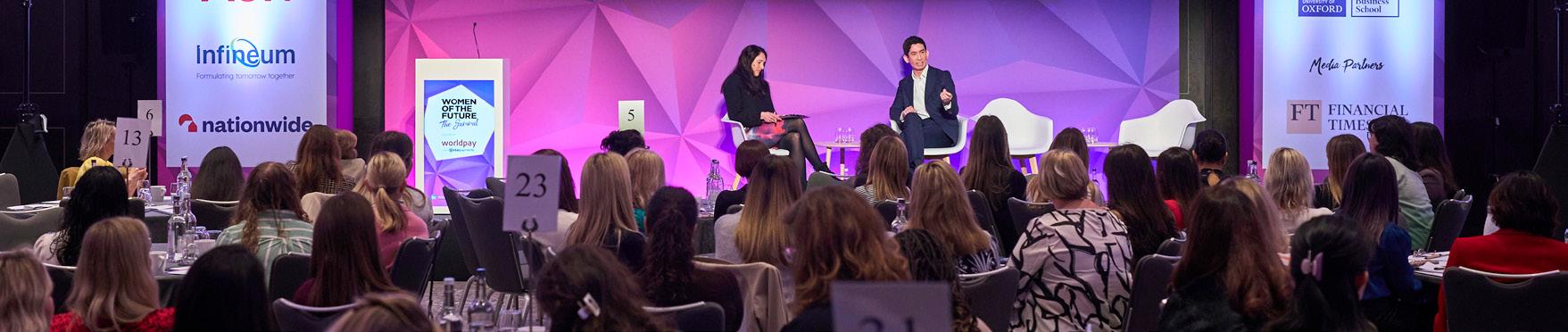
In an era defined by uncertainty, fragmentation, and accelerating change, leadership is being fundamentally redefined. The Women of the Future Summit 2026 convened leaders across industries to examine what it means to lead with courage today as a lived, daily practice.
This summary distils the key insights emerging from the Summit, offering a perspective on how leadership must evolve to remain effective in an increasingly complex world.
Courage is not a personality trait. It is a discipline of action, expressed through consistent decision-making in conditions of uncertainty.
Three dimensions define this shift:
• Behavioural Acting without certainty or emotional readiness
• Relational Grounding decisions in responsibility to others
• Systemic Engaging with and reshaping the structures that influence outcomes
This reframing moves leadership away from moments of heroism toward everyday practice, where small, often unseen decisions accumulate to shape culture and impact.
Courage requires movement.
Leaders are increasingly operating in environments where precedent offers limited guidance. Whether navigating technological disruption, geopolitical instability, or shifting societal expectations, the ability to act amidst ambiguity has become essential.
At the same time, this urgency must be balanced with intentional reflection. The capacity to create a strategic pause, to step back, interpret change, and respond thoughtfully, emerges as a critical leadership capability.
In this context, leadership is less about having the right answers, and more about asking better questions and enabling shared understanding.
Courageous leadership therefore requires moving beyond individual performance to system design. Structures, incentives, and cultural norms shape behaviour at scale. This includes:
• Challenging environments that perpetuate inequity or inefficiency
• Redesigning incentives to align with desired behaviours
• Embedding psychological safety to enable constructive challenge
This shift also reframes burnout. Rather than viewing it as a personal failing, it is increasingly understood as a signal of system-level dysfunction, requiring structural intervention.
The Summit highlights a critical paradox: as technology advances, leadership becomes more human.
What distinguishes effective leaders is not their mastery of tools, but their ability to apply judgment, context, and ethical reasoning.
Empathy, relational intelligence, and the ability to navigate complexity are no longer “soft skills”. They are core strategic capabilities.
At the same time, adopting new technologies requires courage not because of technical barriers, but because of mindset barriers. Leaders must be willing to engage, experiment, and learn in real time.
Careers are now evolving into dynamic, non-linear journeys, defined by adaptability and continuous learning.
This shift requires a deeper level of courage: the willingness to let go of established identities.
Leaders must now navigate identity transitions, redefining how they see themselves and their value. Increasingly, the ability to acquire and apply new knowledge becomes a more reliable indicator of future success than past expertise.
Leadership today is increasingly collaborative. Progress is driven through community, sponsorship, and mutual reinforcement rather than isolated effort.
This requires a redefinition of leadership behaviours:
• Sharing visibility and opportunity
• Enabling others to lead
• Building ecosystems of trust and support
Kindness in this context becomes a courageous leadership choice. It is expressed through advocacy, accountability, and the creation of environments where others can succeed.
7
In a landscape often described as a “polycrisis”, where challenges are interconnected and compounding, the greatest risk is not uncertainty, but disengagement.
Anxiety signals awareness. Apathy signals withdrawal.
Courageous leadership requires sustaining engagement, even when issues feel overwhelming or beyond immediate control. This includes:
• Building connections across silos
• Engaging with differing perspectives
• Creating coherence in fragmented systems
Leaders must resist the pressure to react constantly and instead cultivate depth, reflection, and wisdom in their decision-making.
The Women of the Future Summit 2026 makes clear that leadership is no longer defined by authority, certainty, or individual performance alone.
Courageous leadership is the discipline to:
• Act despite ambiguity
• Remain engaged despite discomfort
• Design systems that enable collective progress
It is expressed in the consistency of everyday decisions that shape culture, influence outcomes, and determine the future of organisations and societies alike.
The challenge ahead is not simply to respond to change, but to actively shape what comes next.