PO Box 3000, Denville, NJ 07834-3000 Changes of address must be submitted in writing.
Where Women Create (USPS #000-310) is published quarterly by Women Create, LLC, 65 Redding Road, Box 985, Georgetown, CT 06829. Periodicals postage paid at Dover, NJ and at additional mailing offices.
Printed in Canada
Where Women Create® is a registered trademark of Women Create, LLC and may not be used without permission. No part of this publication may be reproduced without written permission from the publisher or Women Create, LLC. The information contained in this magazine is provided AS IS. Neither Women Create, LLC, nor the publisher, make any representation or warranty with respect to this magazine or the contents thereof and do hereby disclaim all express and implied warranties to the fullest extent permitted by law. Women Create, LLC and the publisher do not endorse any individuals, companies, products, services, or views featured or advertised in this magazine.
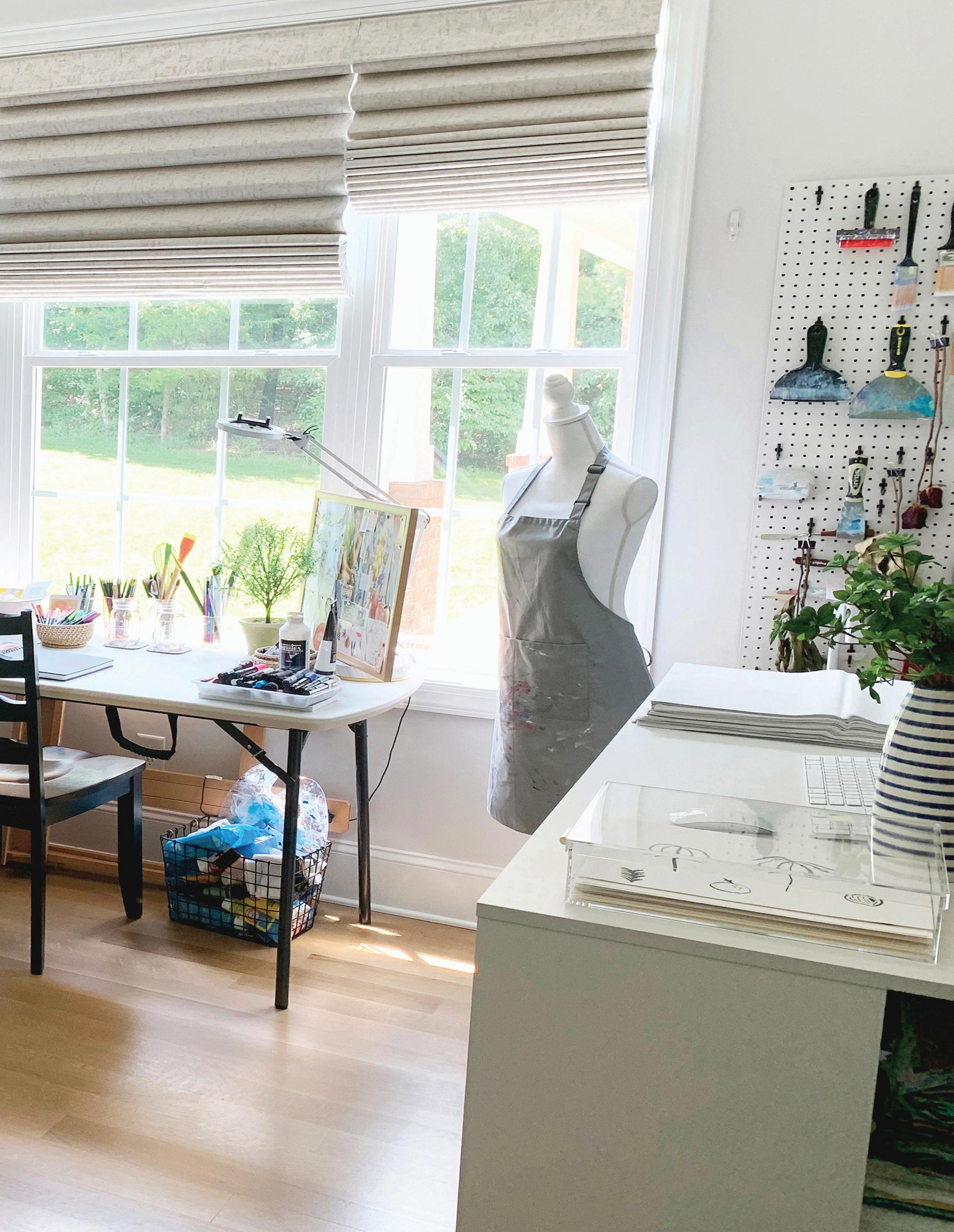
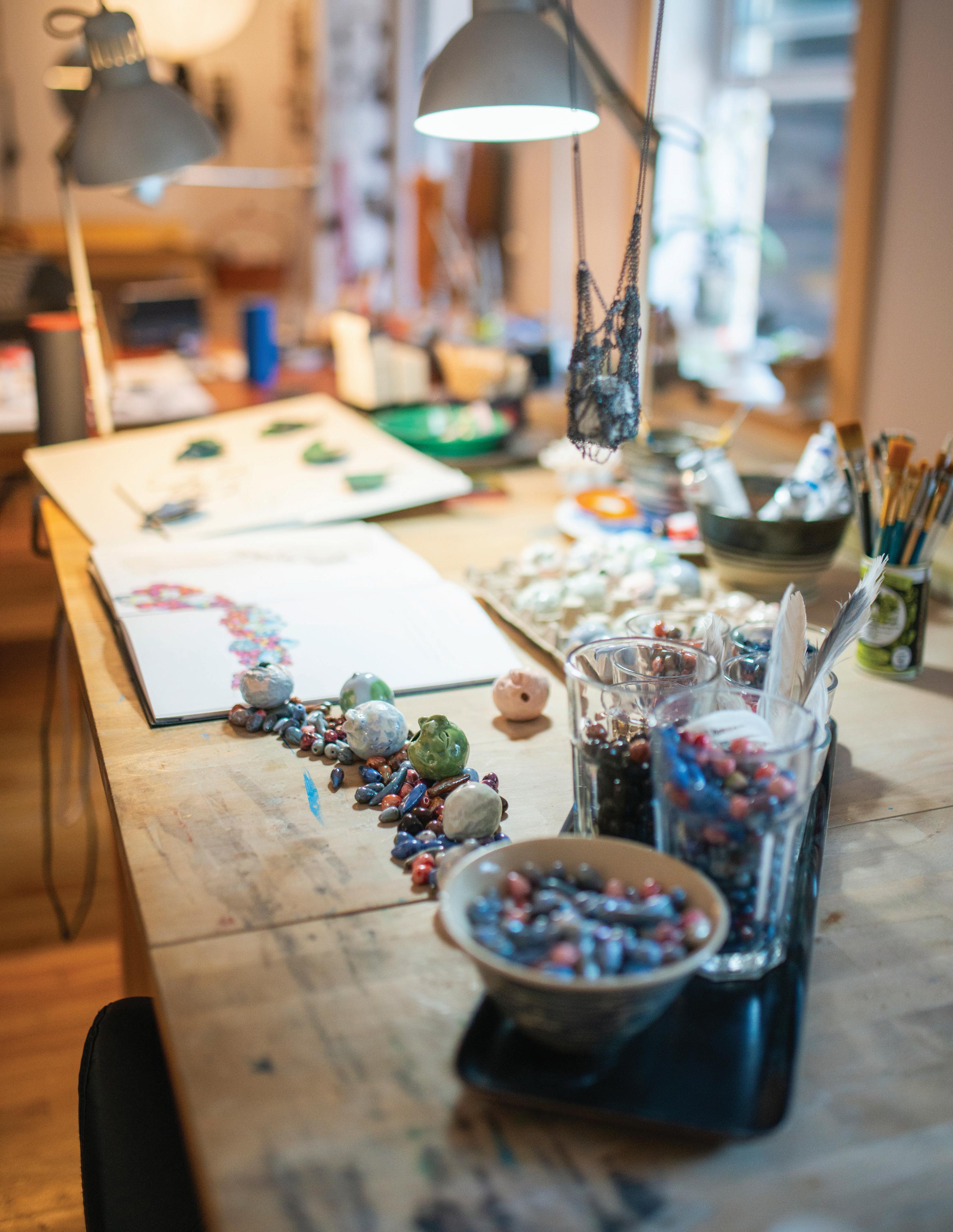
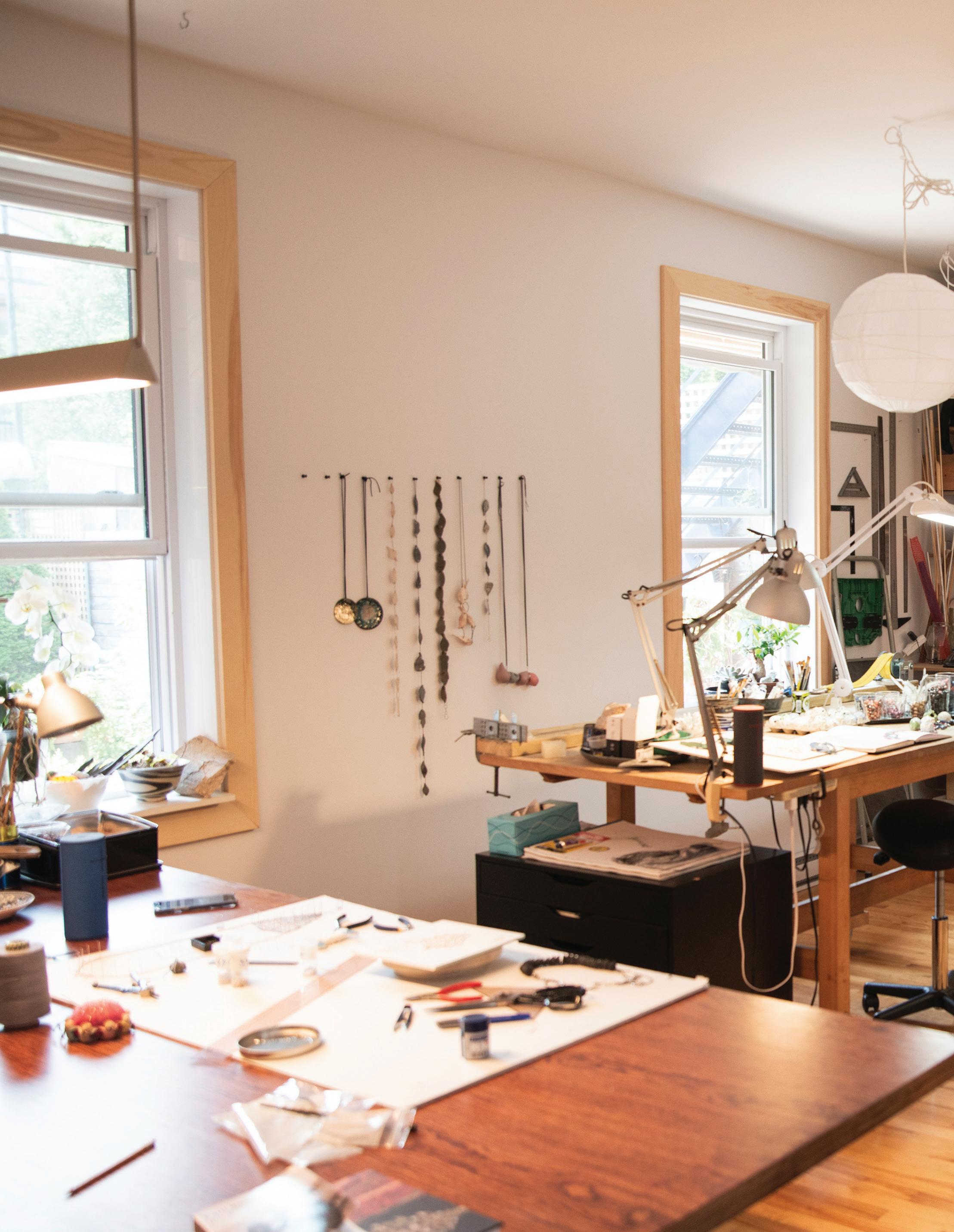
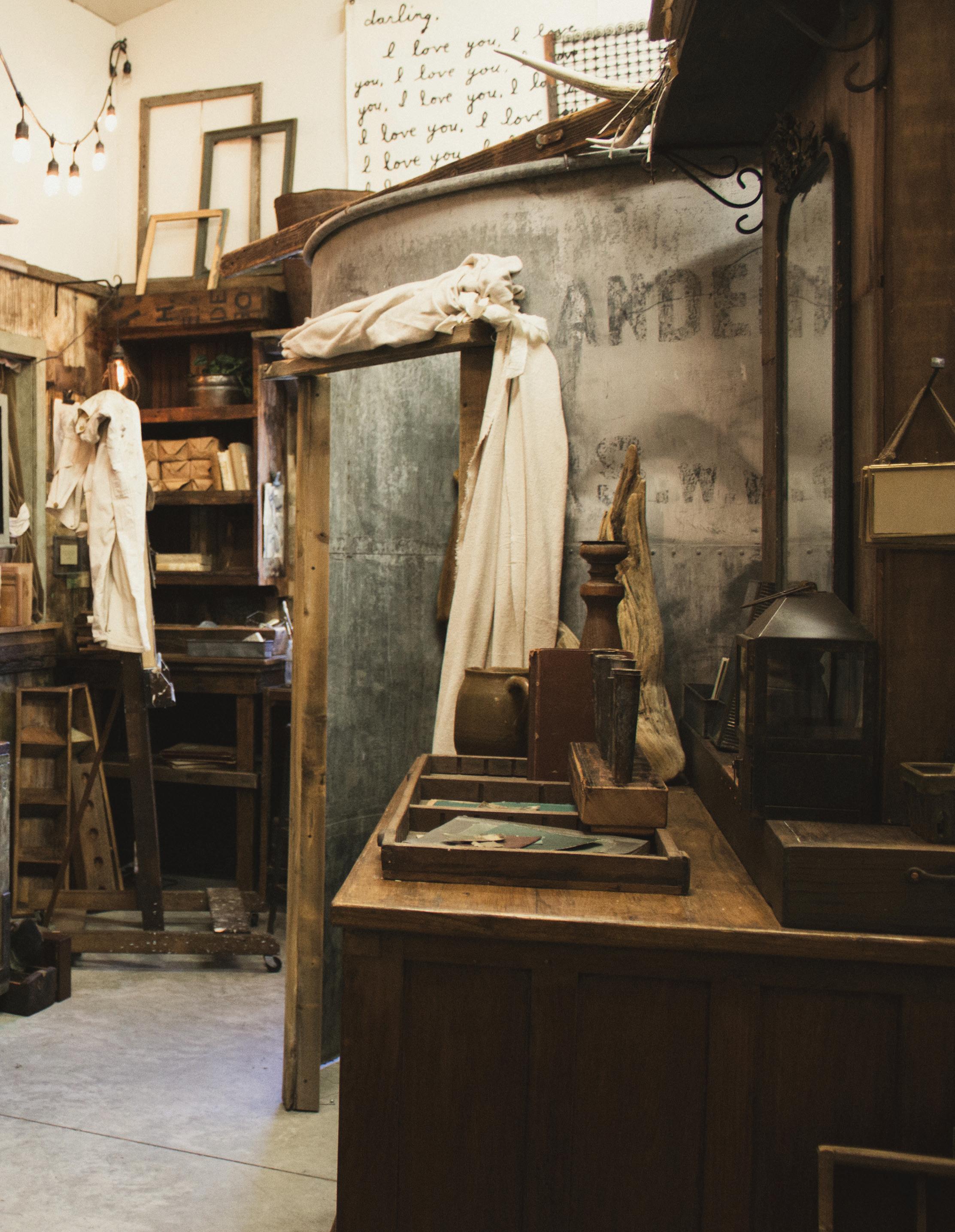
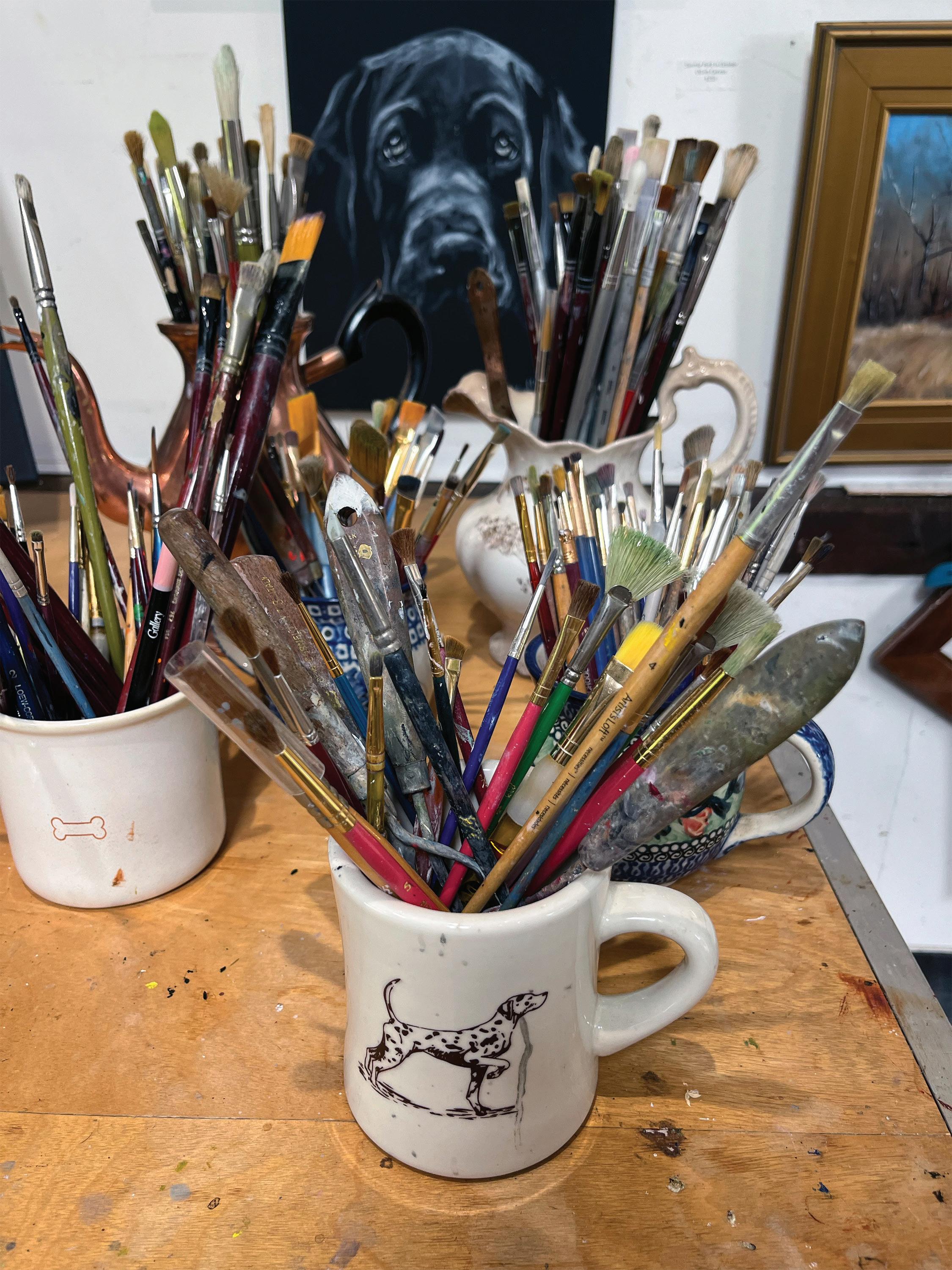
when you practice art. No matter what your medium is, art in any category comes accessorized with a lot of stuff. Pigments, brushes, palettes, buttons, beads, thread, precious metals and gems, paper, yarn, clay, stone, dried fruits and flowers, and so much more. And as anyone in the creative world can tell you, art supplies seem to grow and multiply on their own, with gremlin-like speed. Painters tend to collect colors, knitters collect yarns, paper artists collect paper, and so on. I am endlessly fascinated with how artists keep and organize their supplies—their creativity extends beyond their actual works to their spaces, and I’m here for every metal box, wonky shelf, and paint-spattered bin.
Though by day I am a magazine editor, I am also an artist. A hobbyist to be sure, but an artist, nevertheless. Ever since I could hold a brush or pencil in my hand, I have wanted to express ideas through both words and paint on paper. Though I love to paint and draw, I have also dabbled in linoleum block printing and cut paper. Currently, I am in my watercolor era, having returned to it after taking a break for several years. And so, I am reworking my tiny art space to accommodate full pans and new brushes and some new and interesting papers. Finding space for it all is like putting together a challenging puzzle, but it is a challenge worth doing well. This current phase of my own practice is making me even more interested in the details of our
OUR NEW SHOP IS HERE!
From Her Hands to Your Home
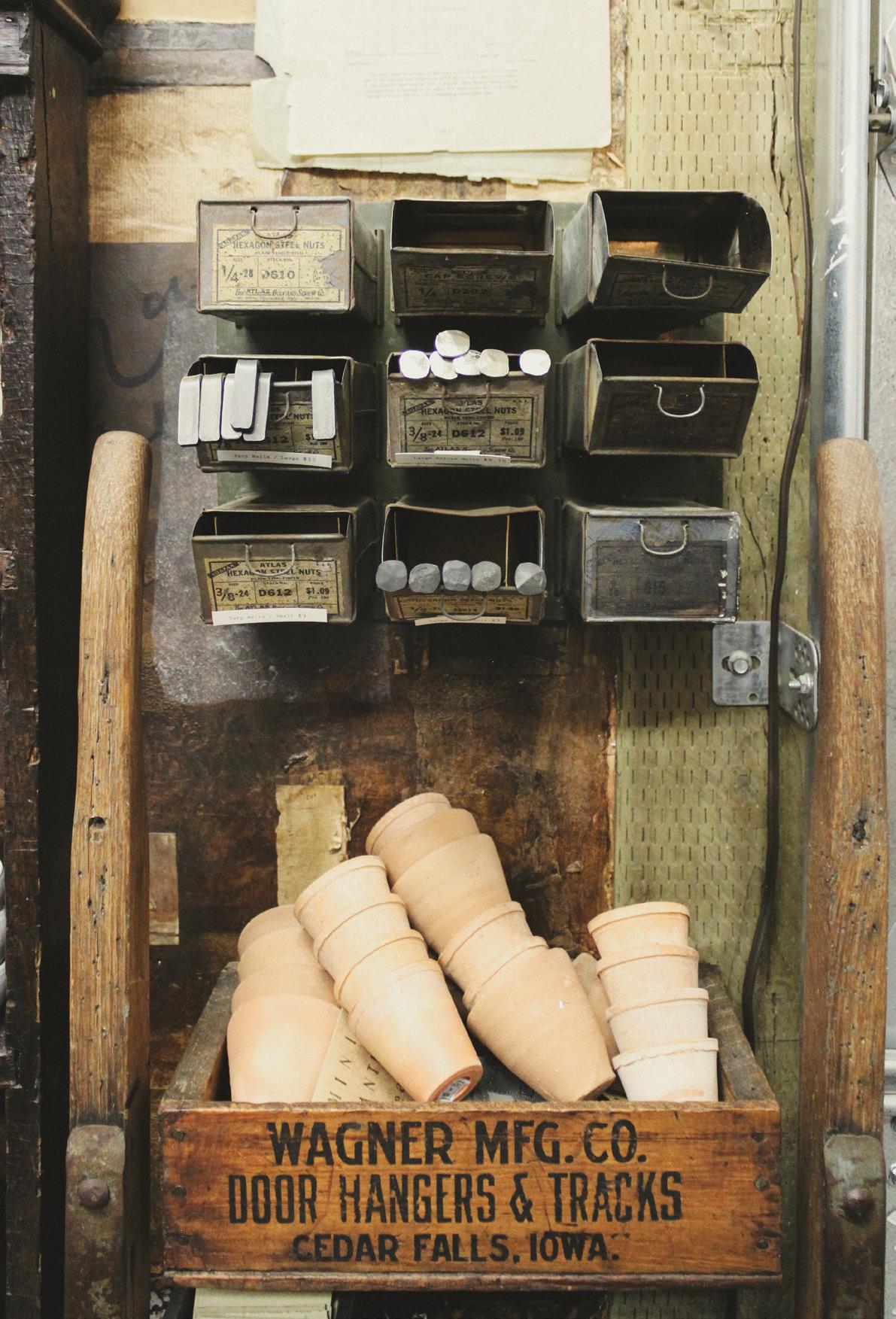
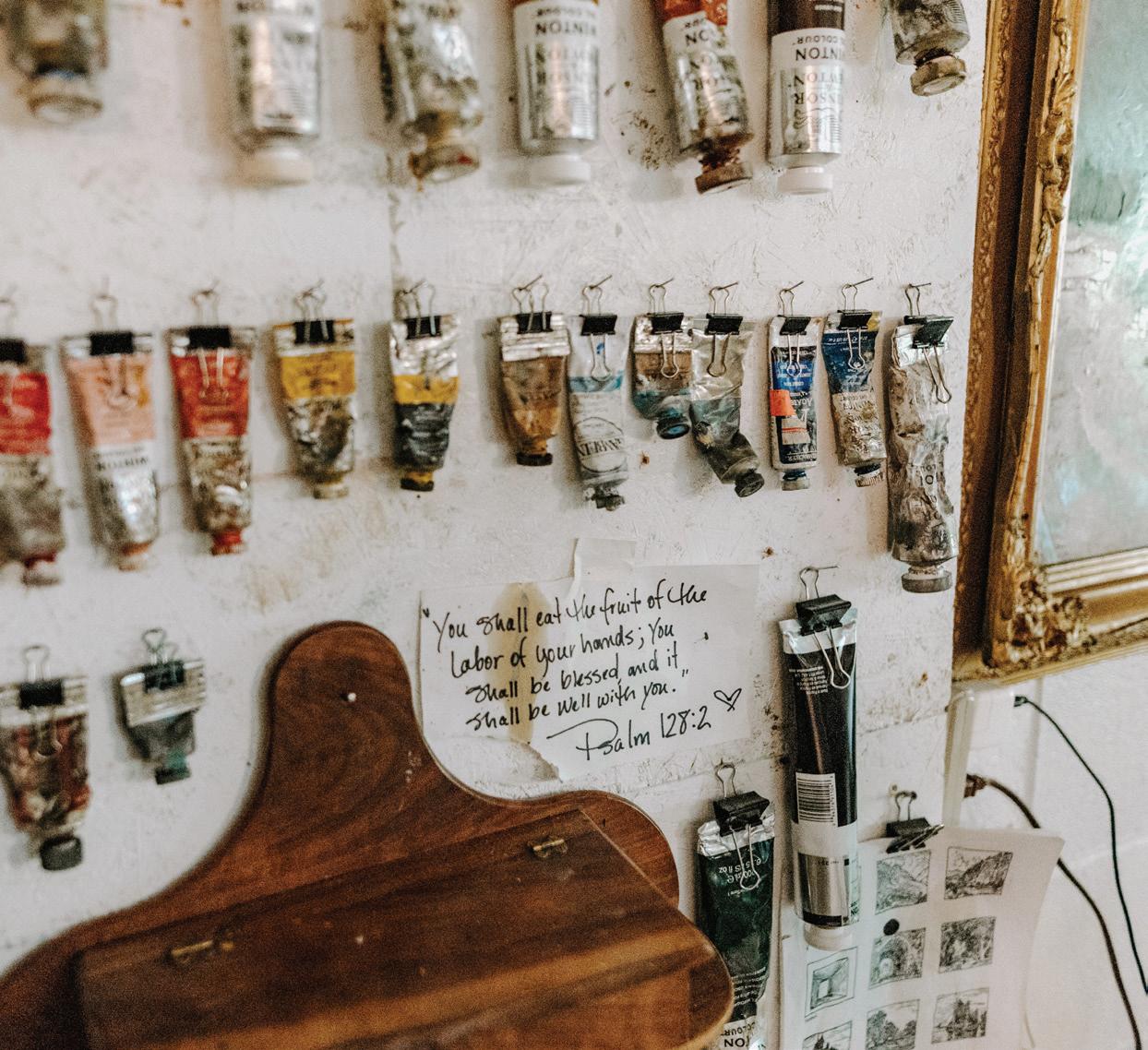
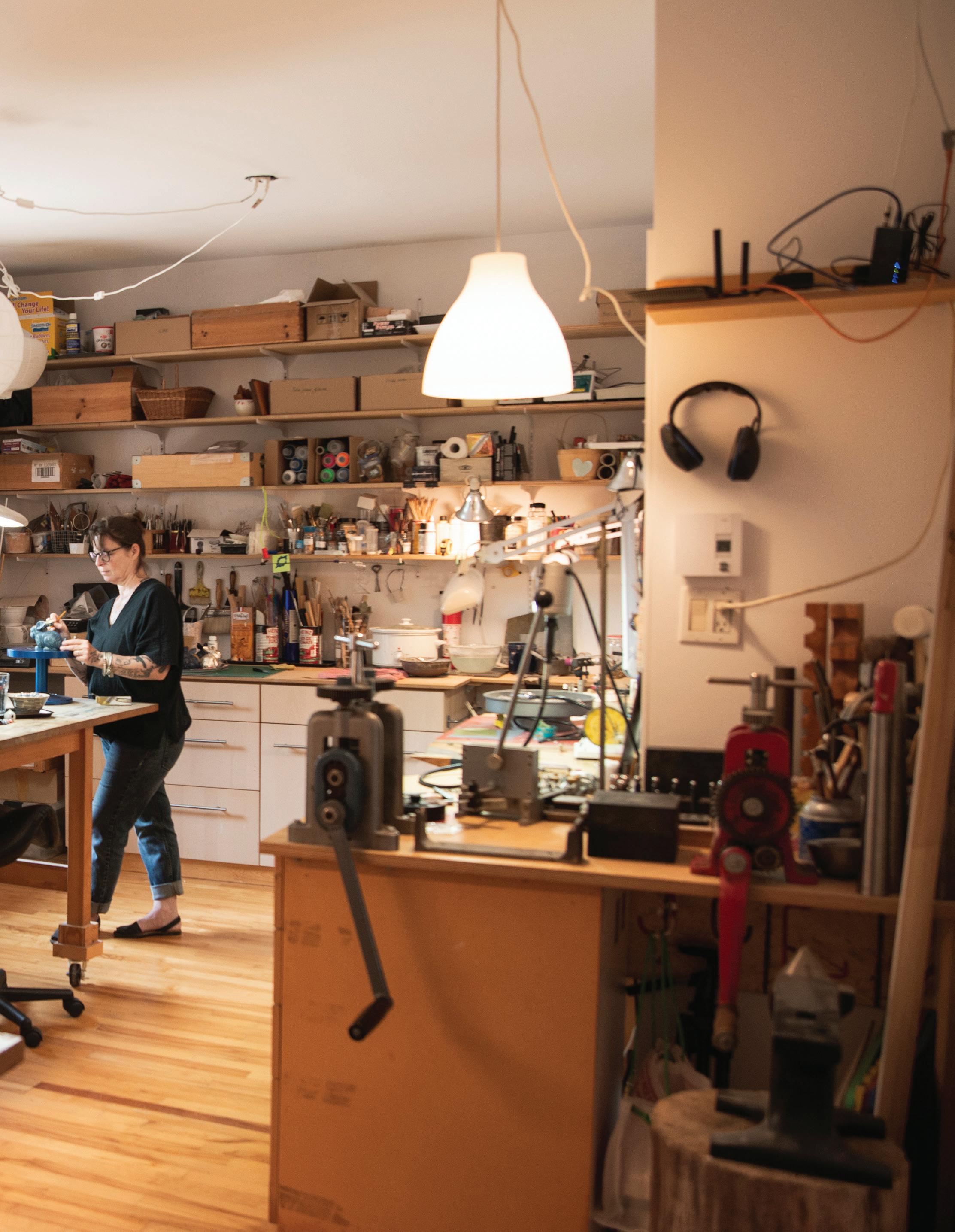
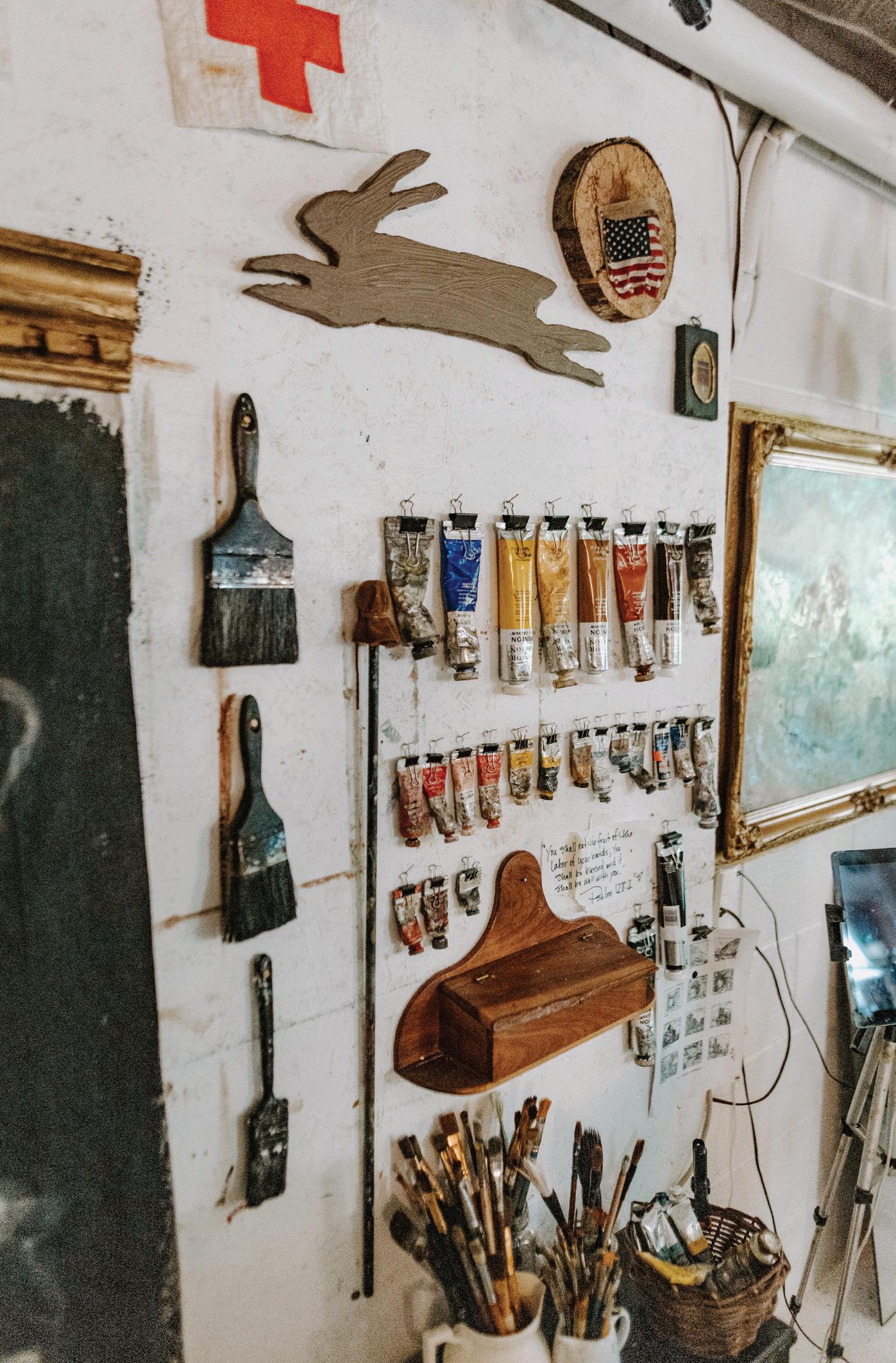
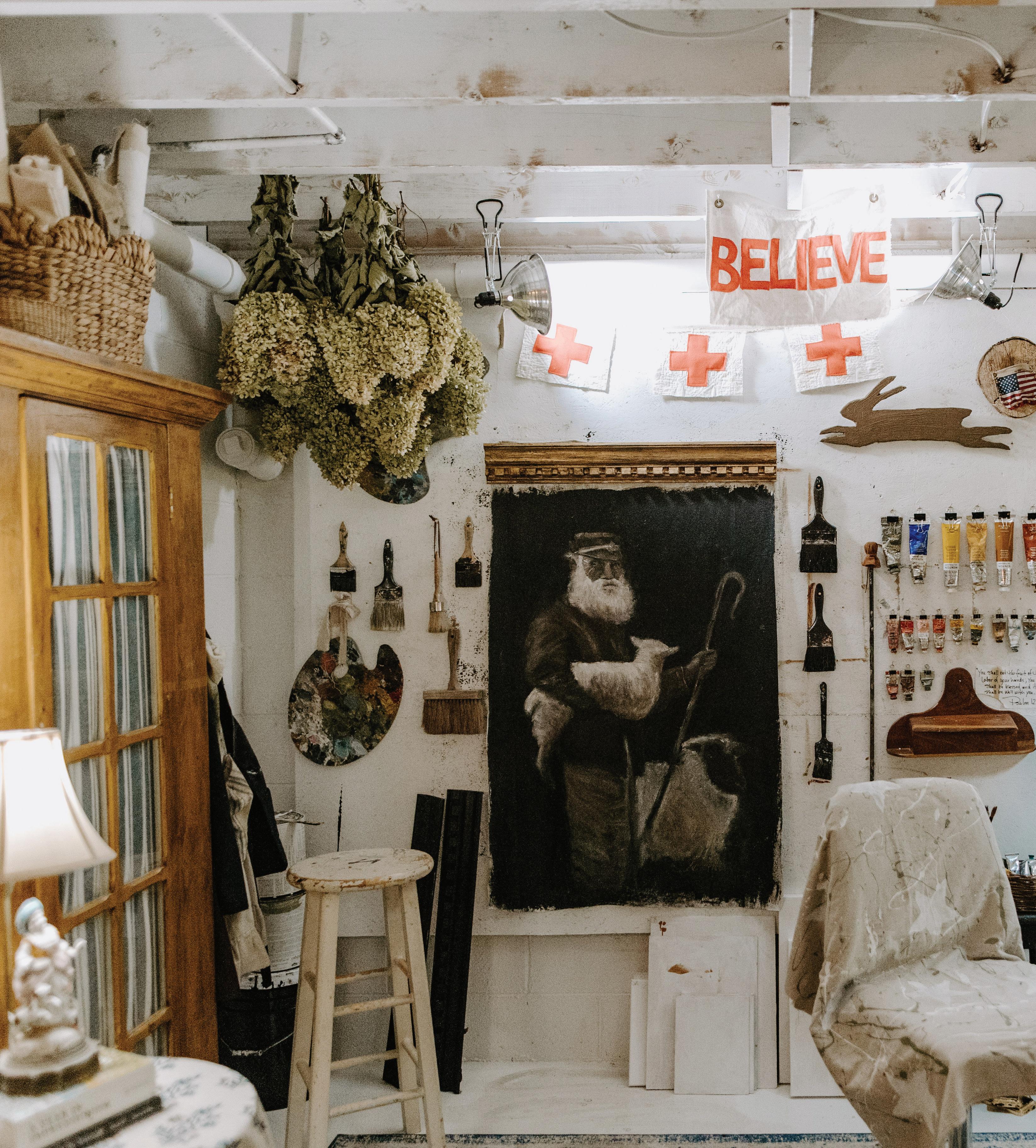
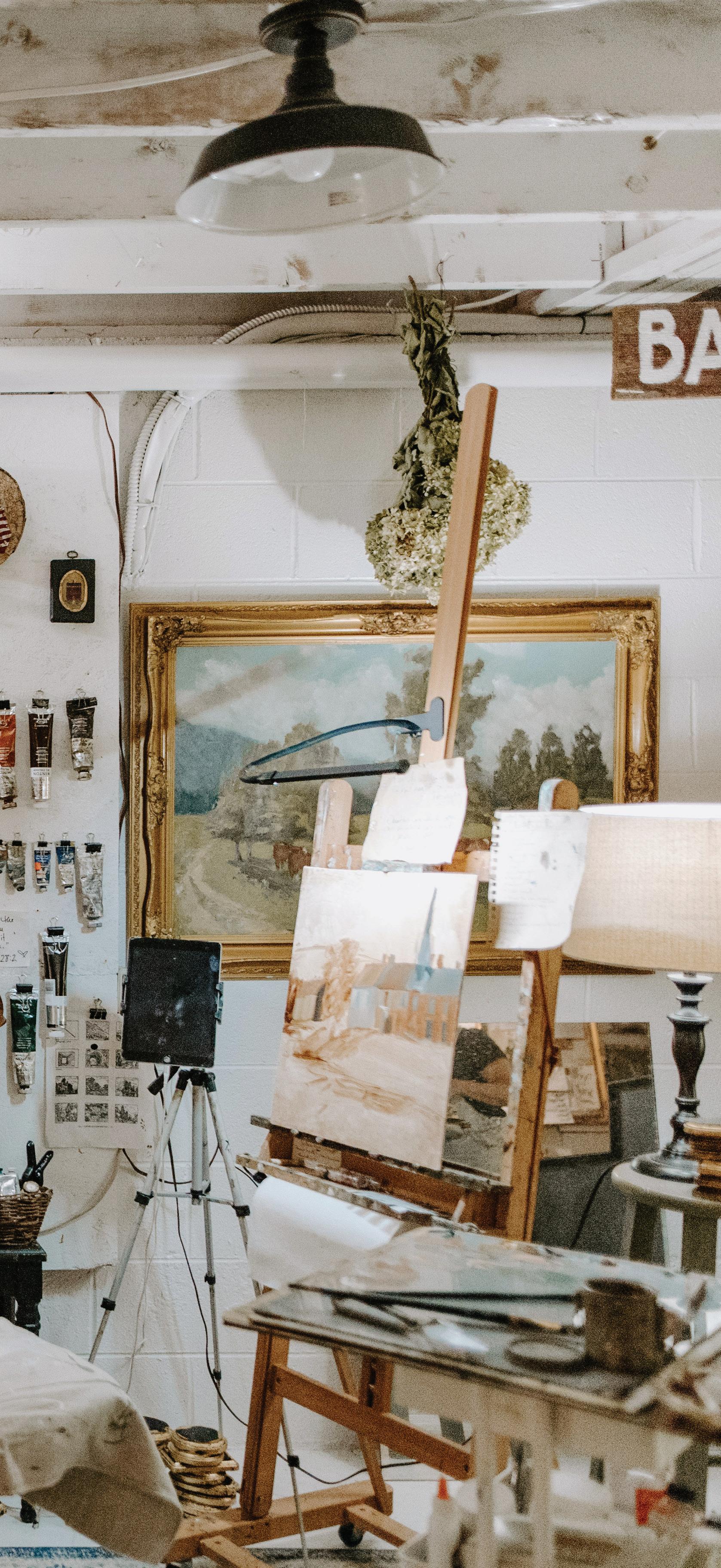
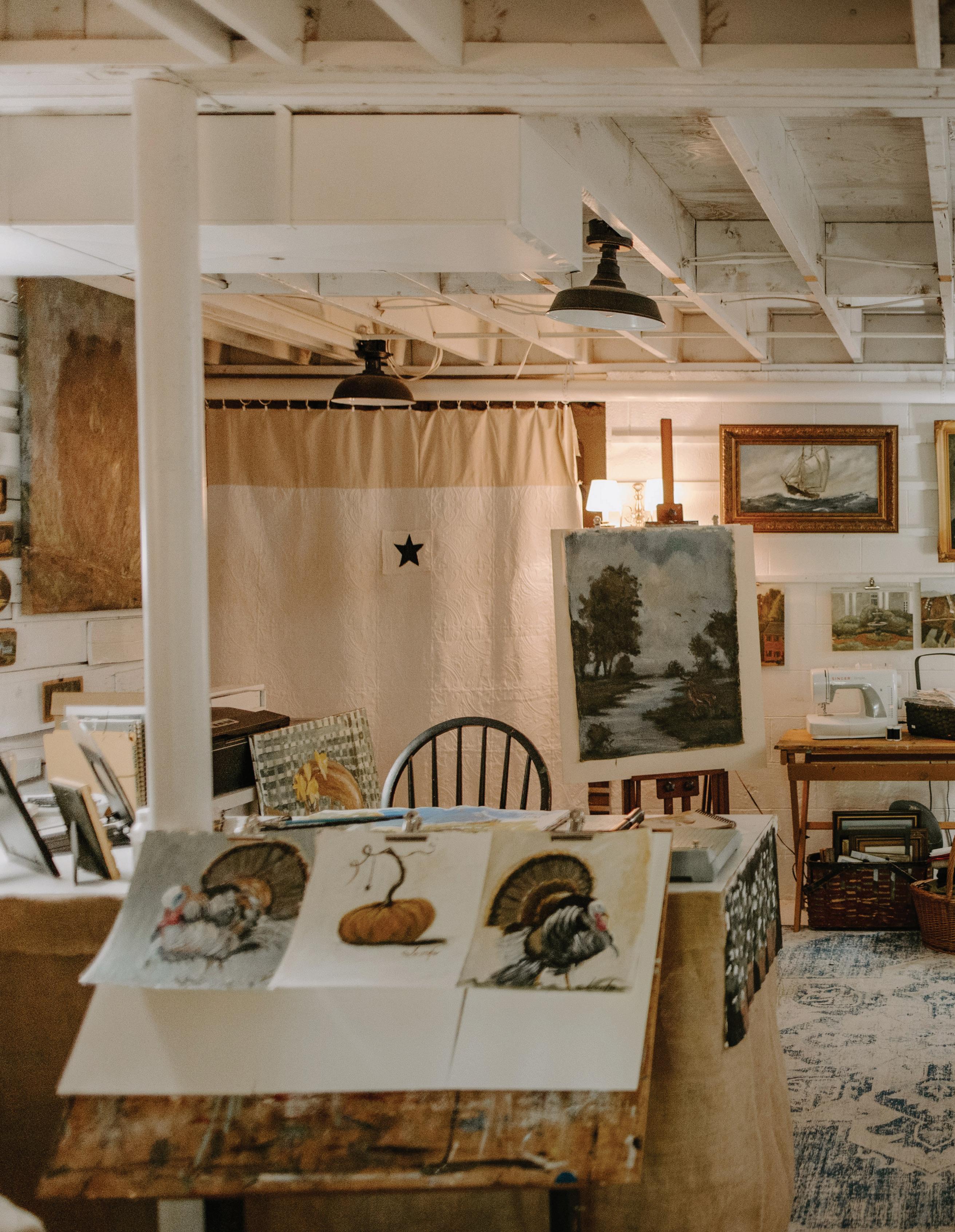
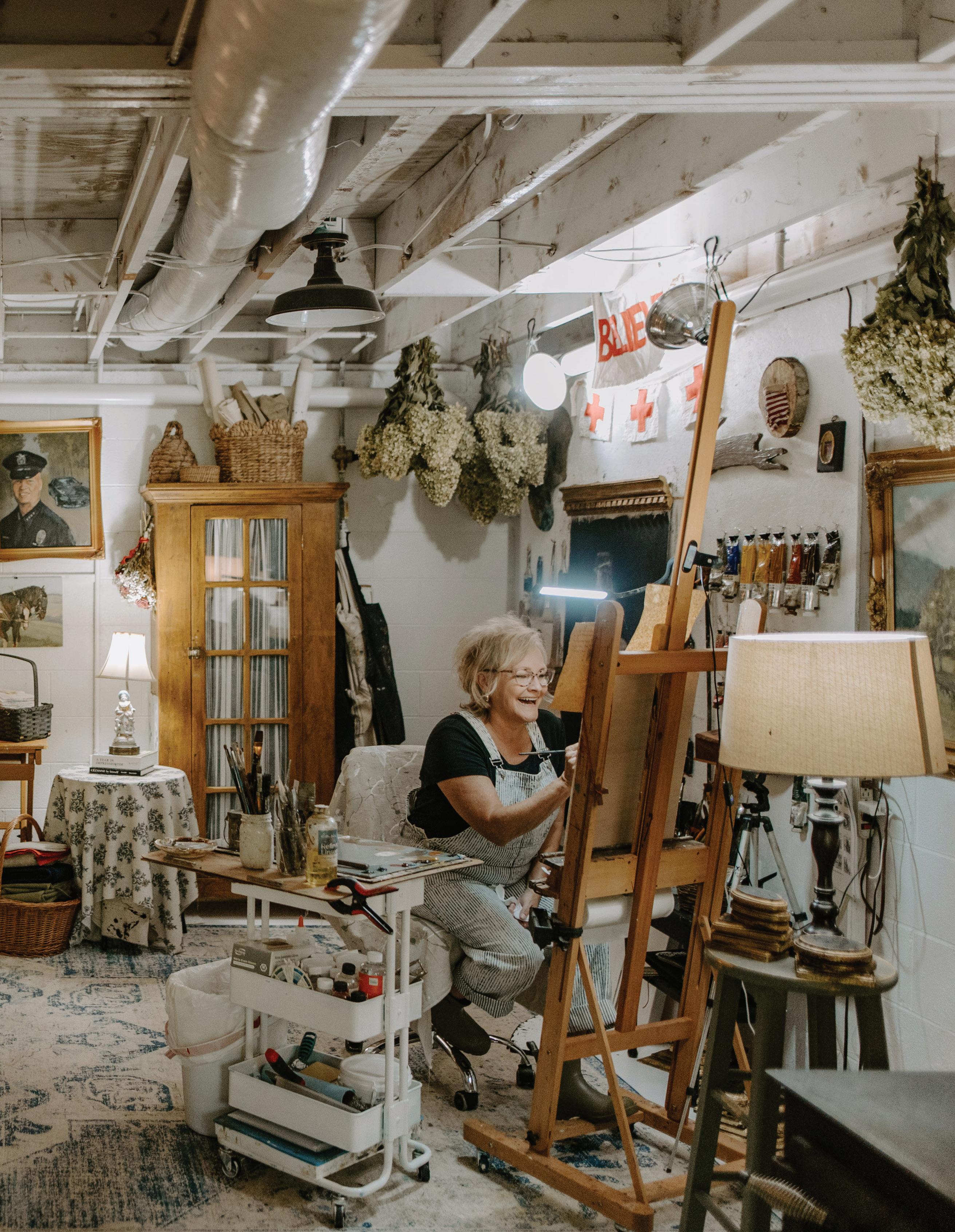
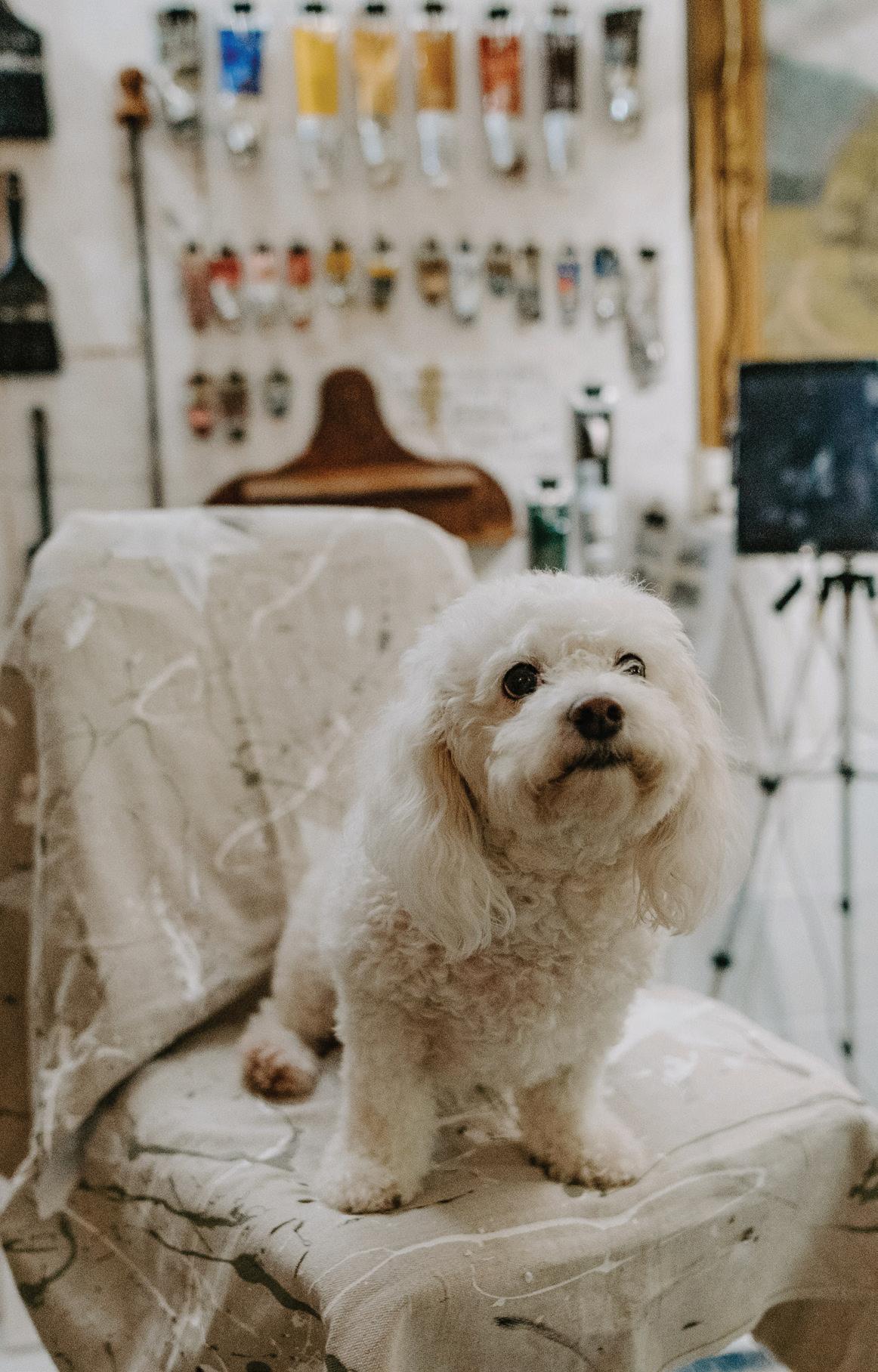
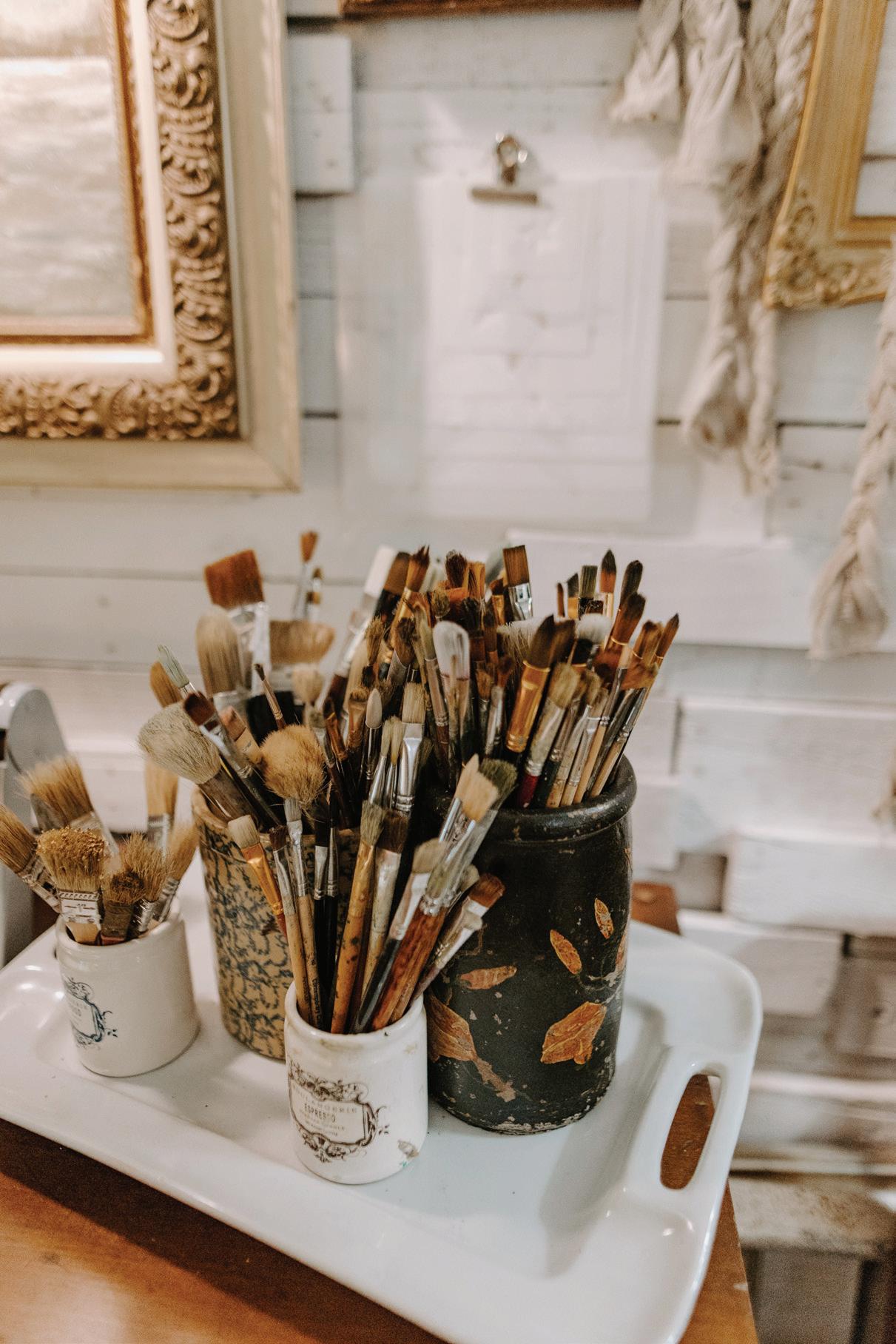
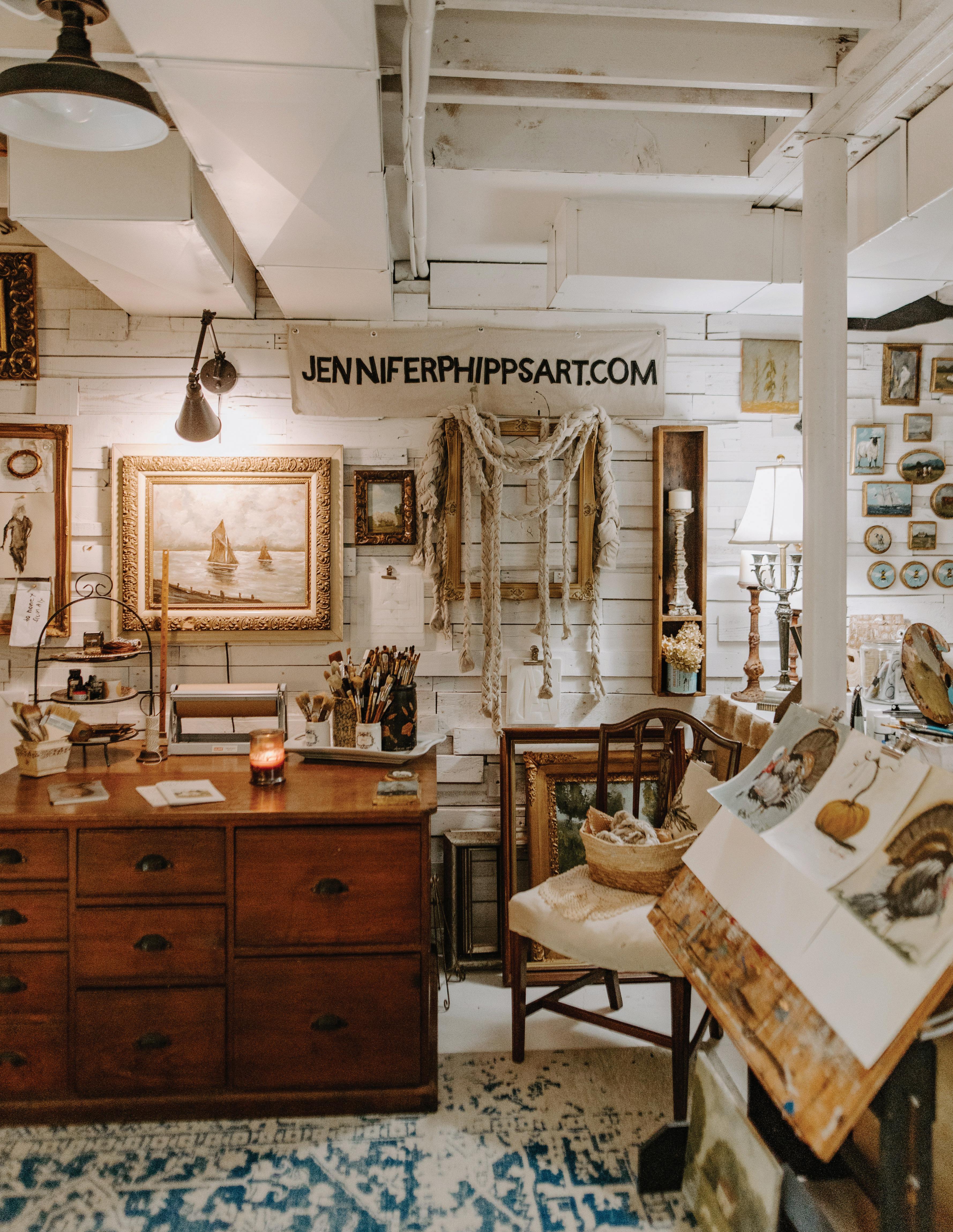
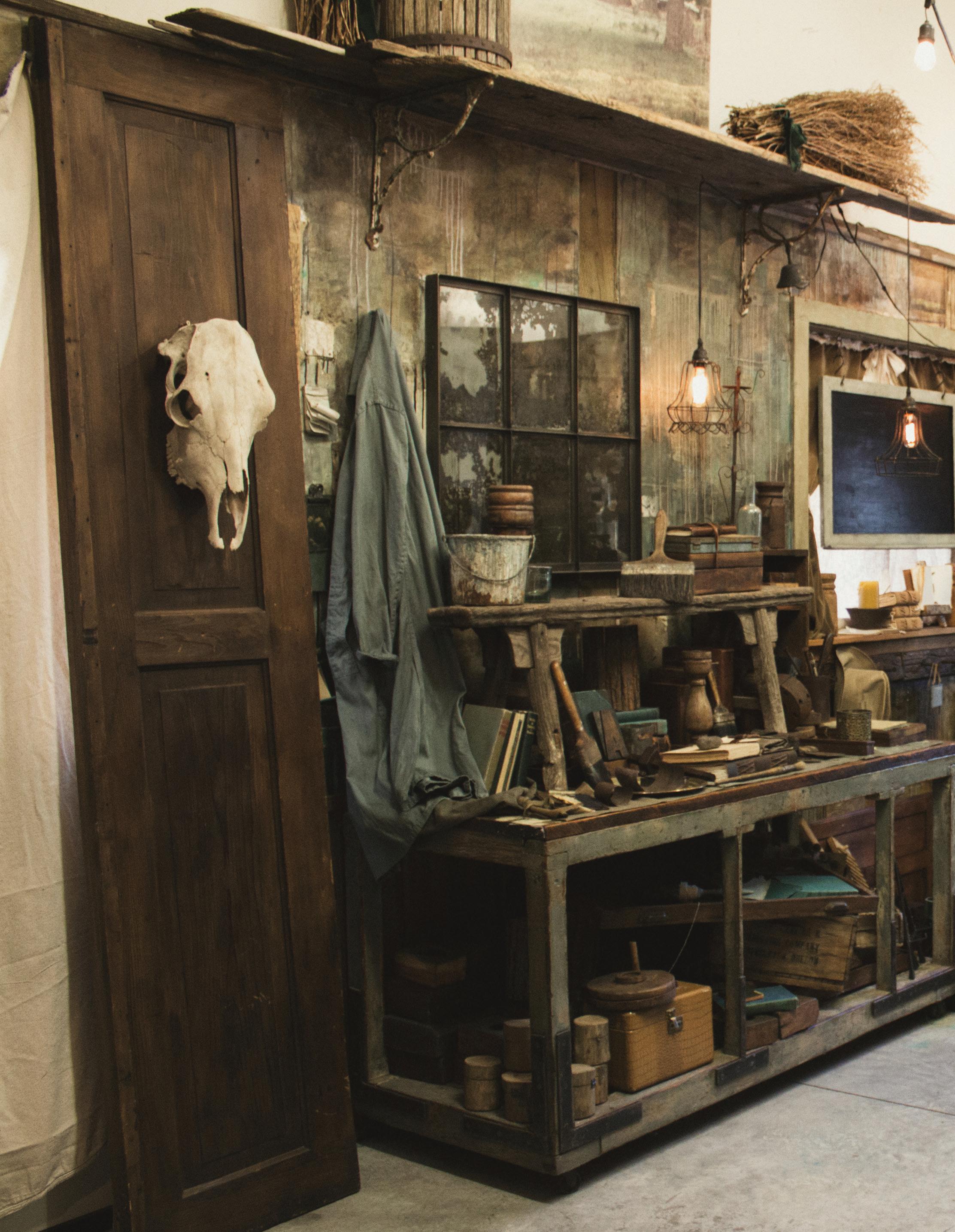
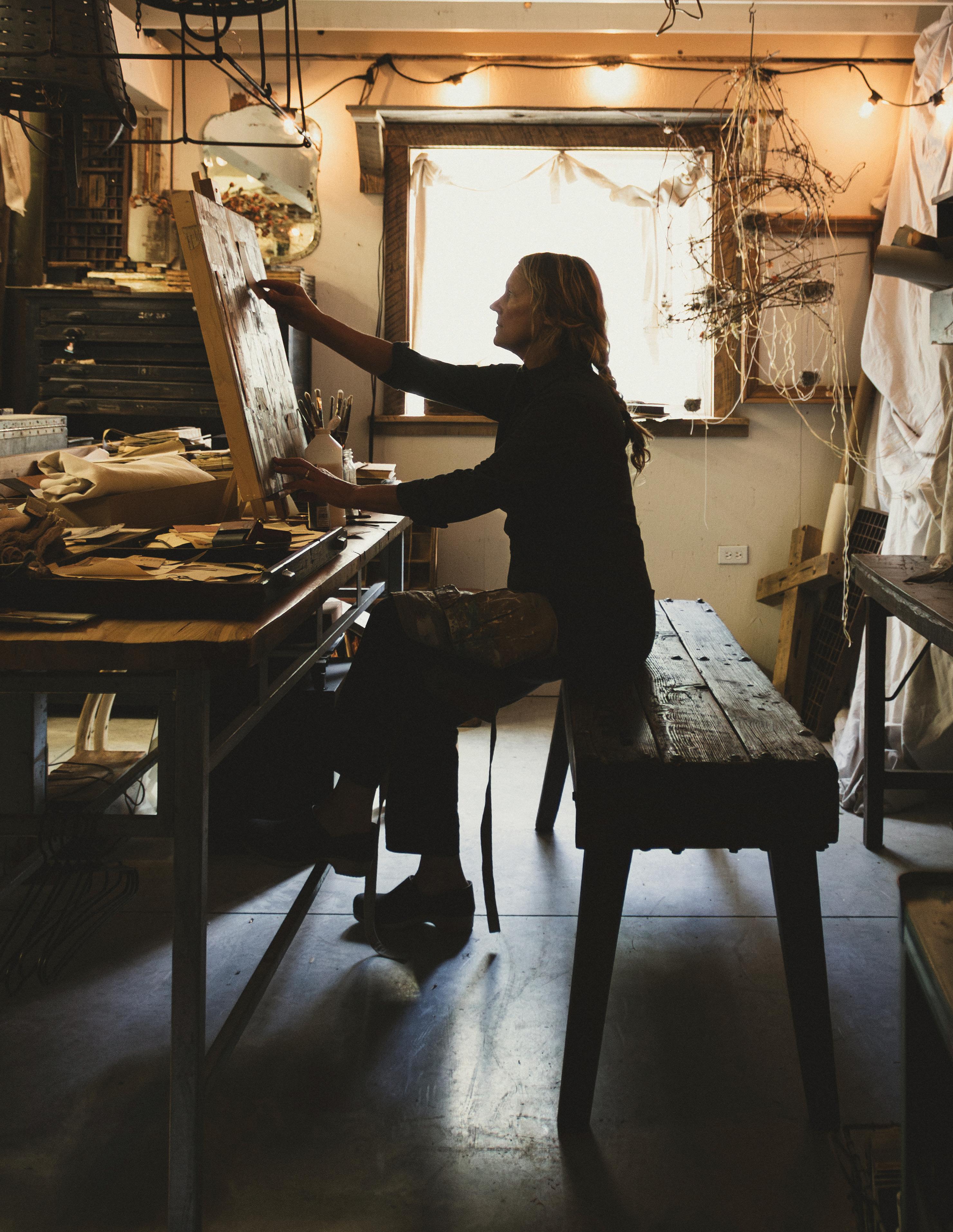
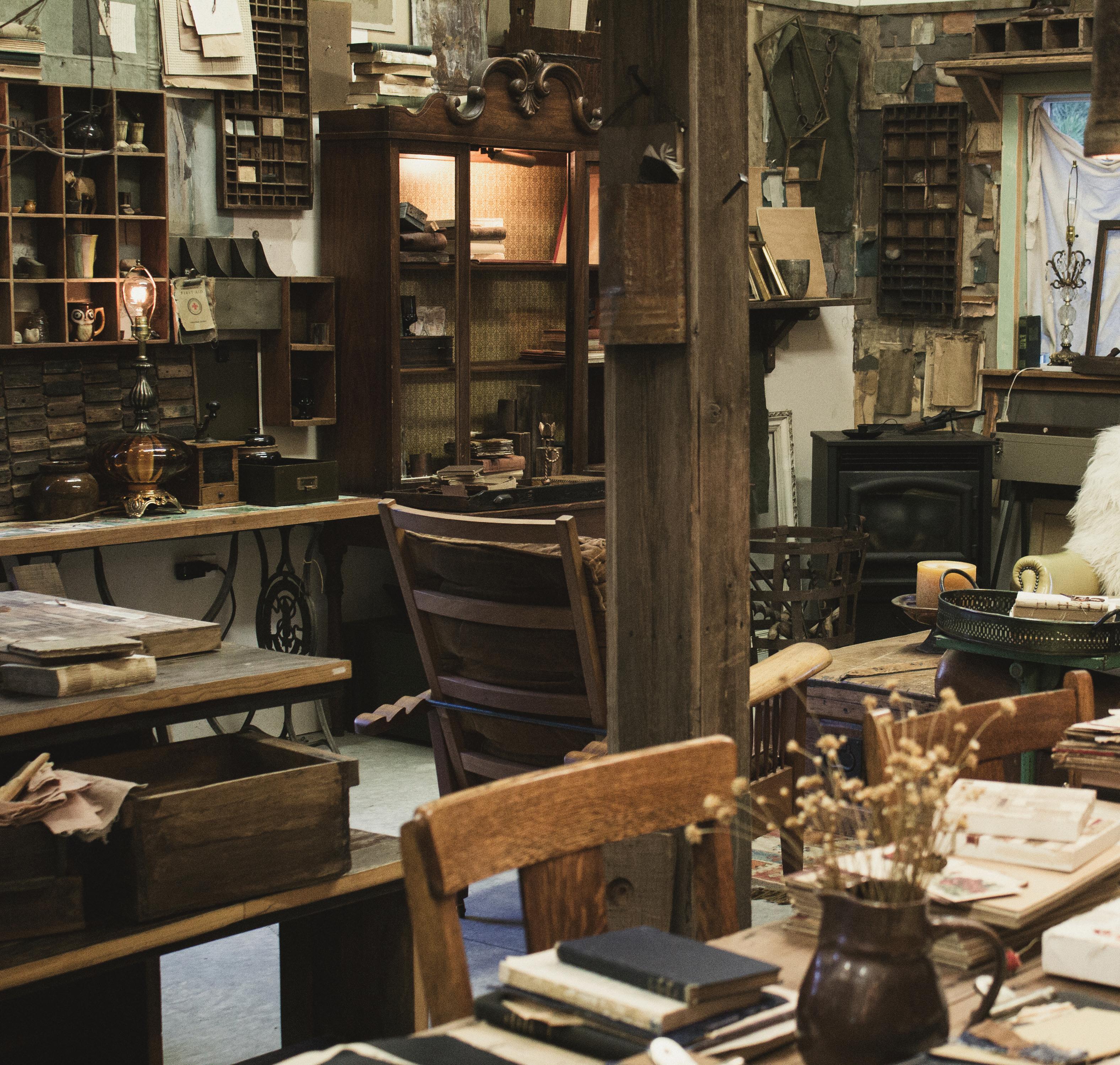
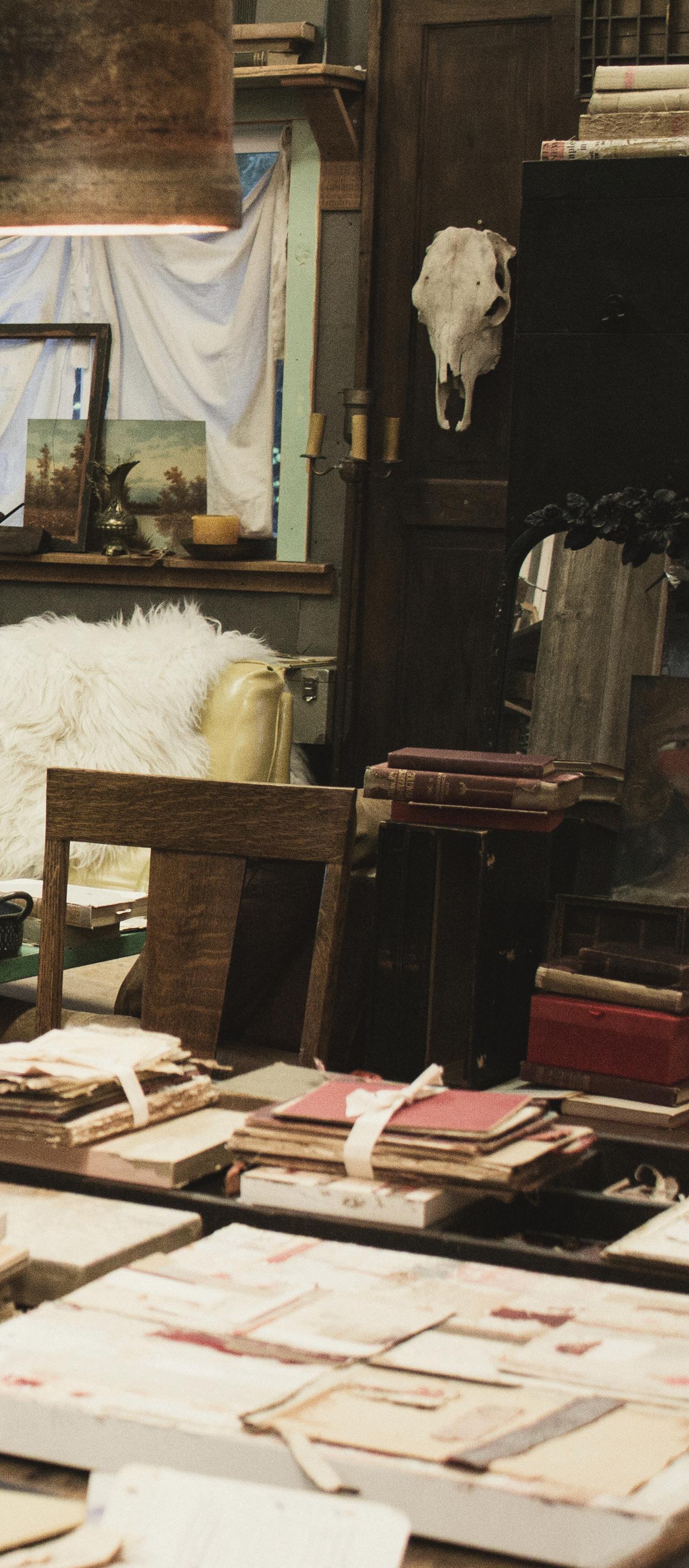
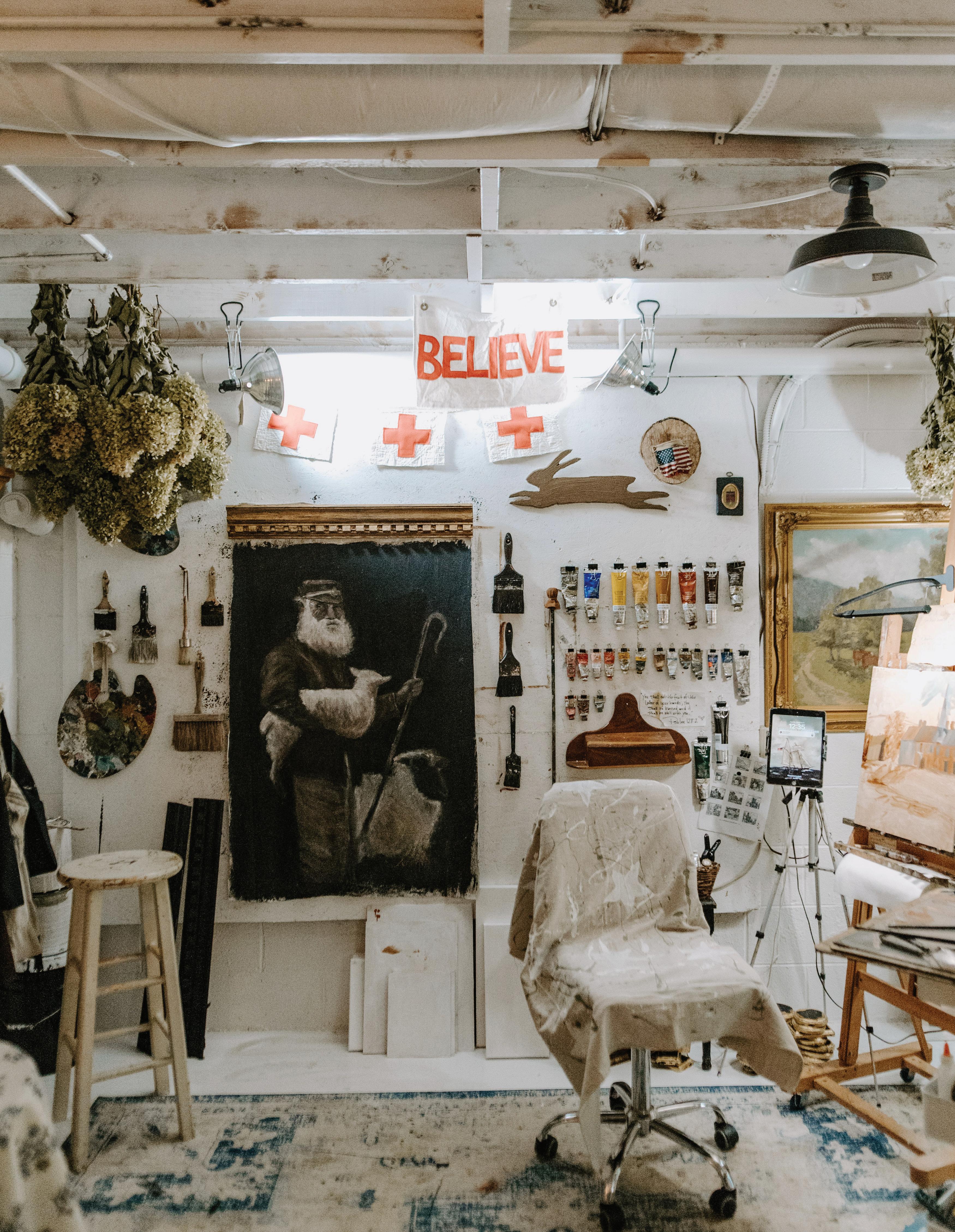
artists’ spaces in this issue. I absolutely love Jennifer Phipps’s paint tubes suspended with ordinary binder clips, and the industrial metal bins in the deeply layered studio of Denise Shives.
As you peruse our pages, I know you will find creative solutions for your own spaces, and inspiring ideas for your art practice. Our Women Create community is rich with ideas for living life as an artist, and I hope that you are inspired to have conversations and explore ideas, hopefully over a nice cup of tea (or a dram of something stronger) in a cozy nook or in front of a roaring fire, as we head into the bracing chill of winter ahead.
Cheers!
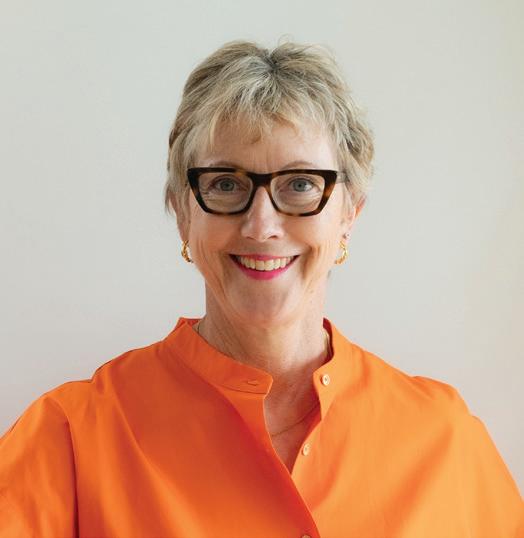
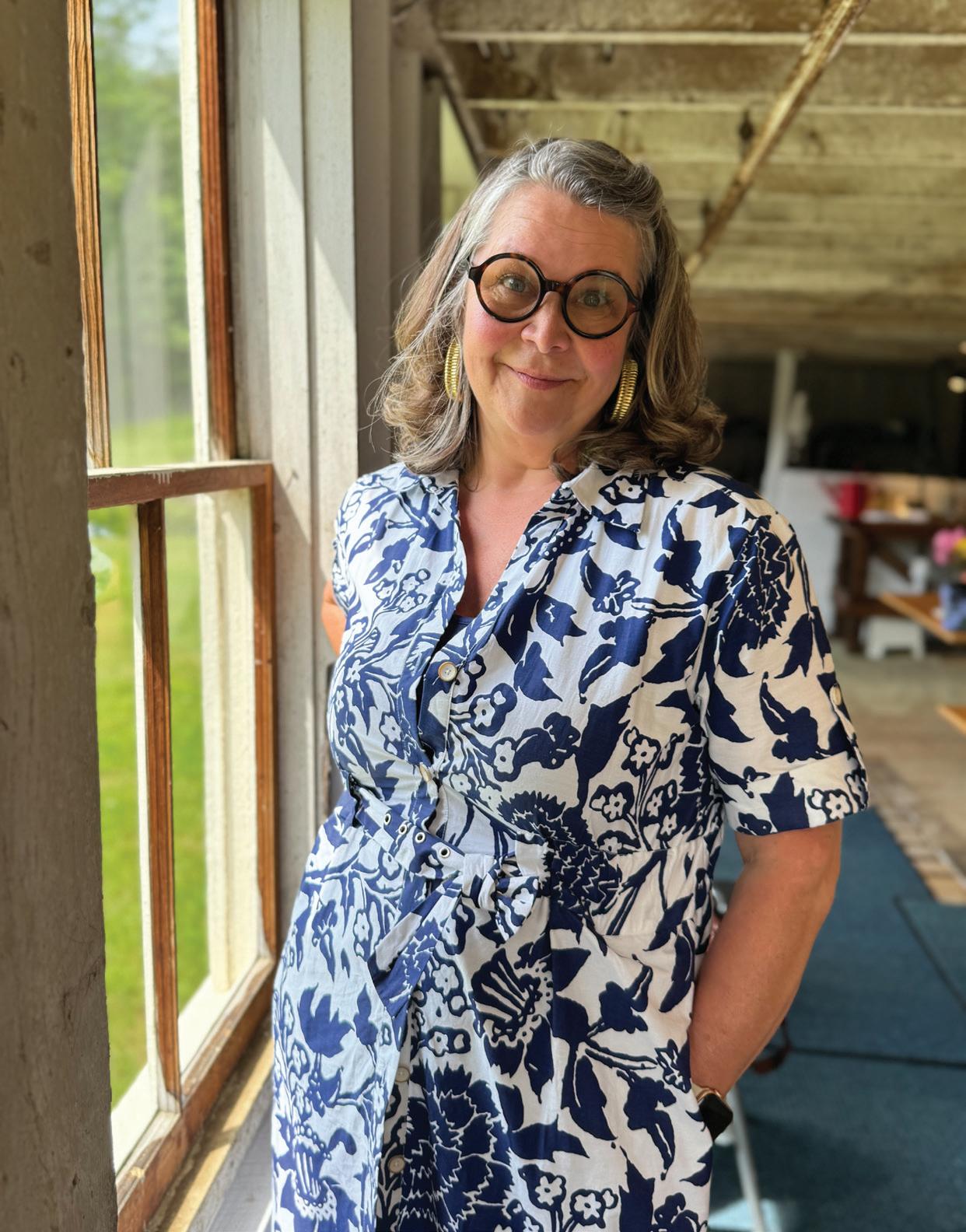
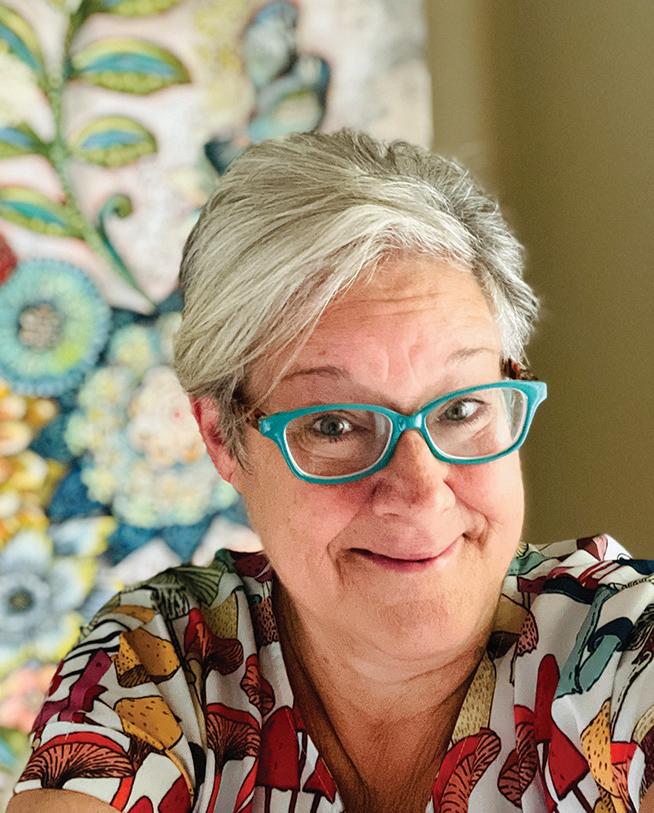
DEBORAH L. MARTIN, EDITOR IN CHIEF
Prepare to discover a curated collection of exquisite, hand-crafted creations! The Women Create Shop is launching this fall, bringing the incredible artistry highlighted in our magazines directly to you. Shop pieces from the dedicated artists we champion and bring their passion into your home. Visit www.womencreateshop.com for details.
PHOTOGRAPH BY ALICE TEEPLE
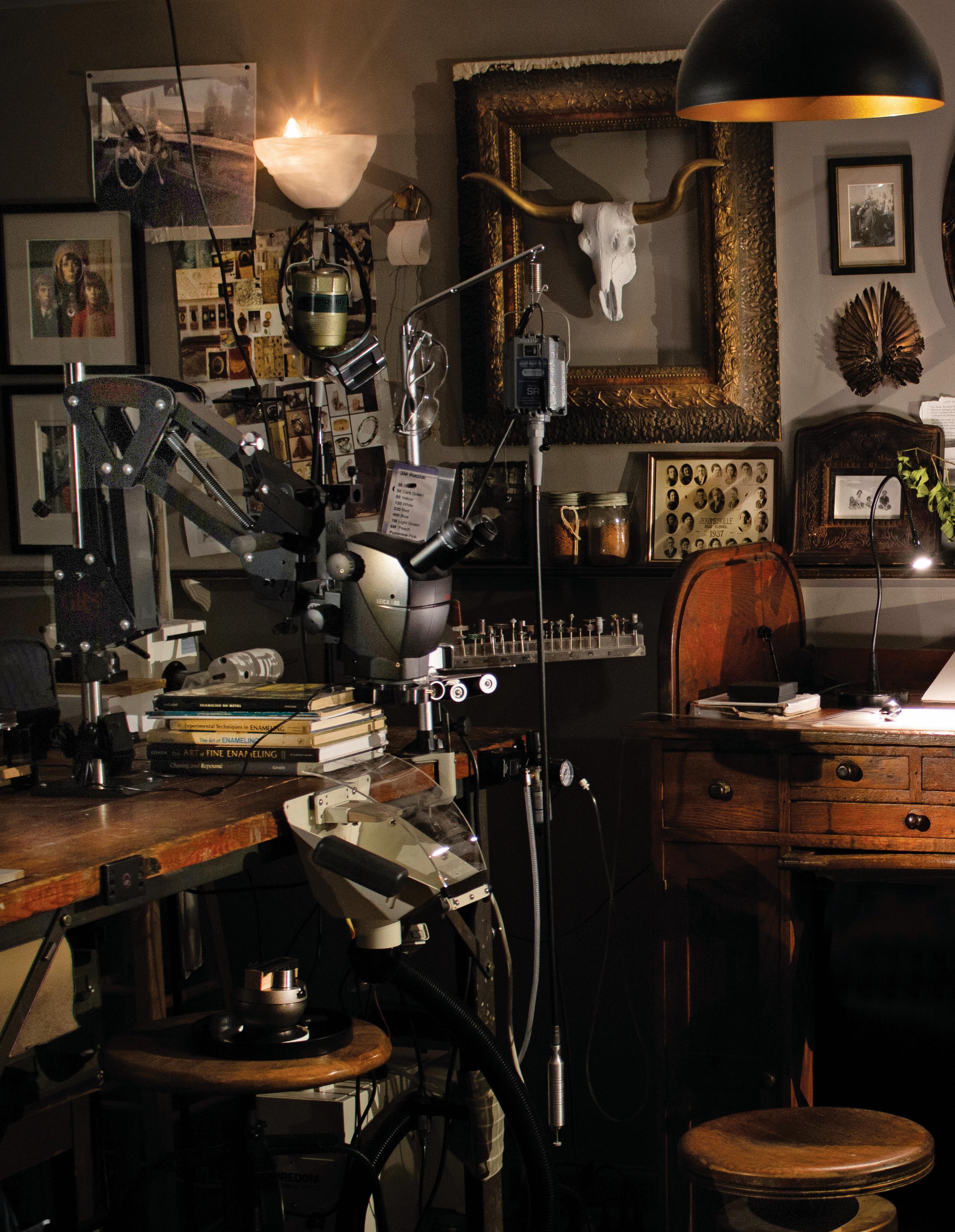
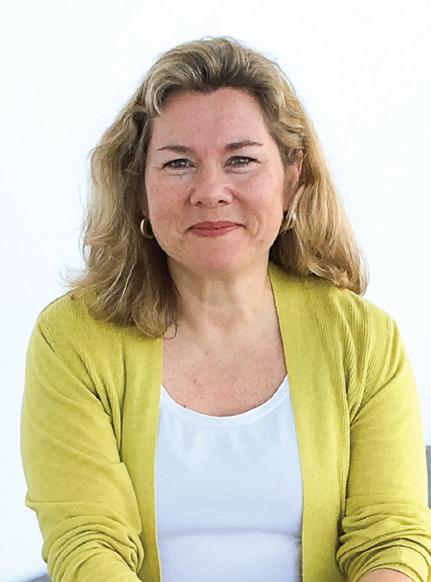
TERESA KIPPLINGER, P94
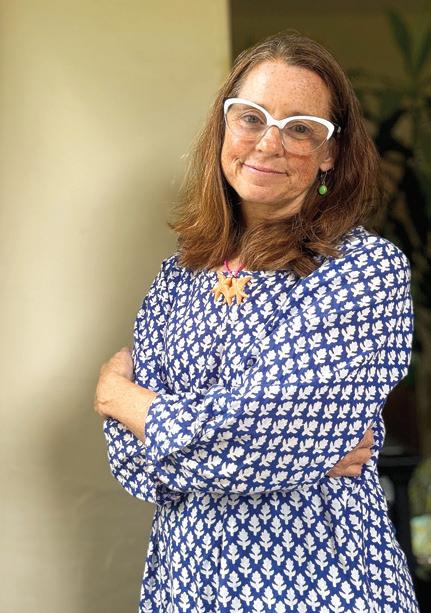
LISI ASHBRIDGE, P20
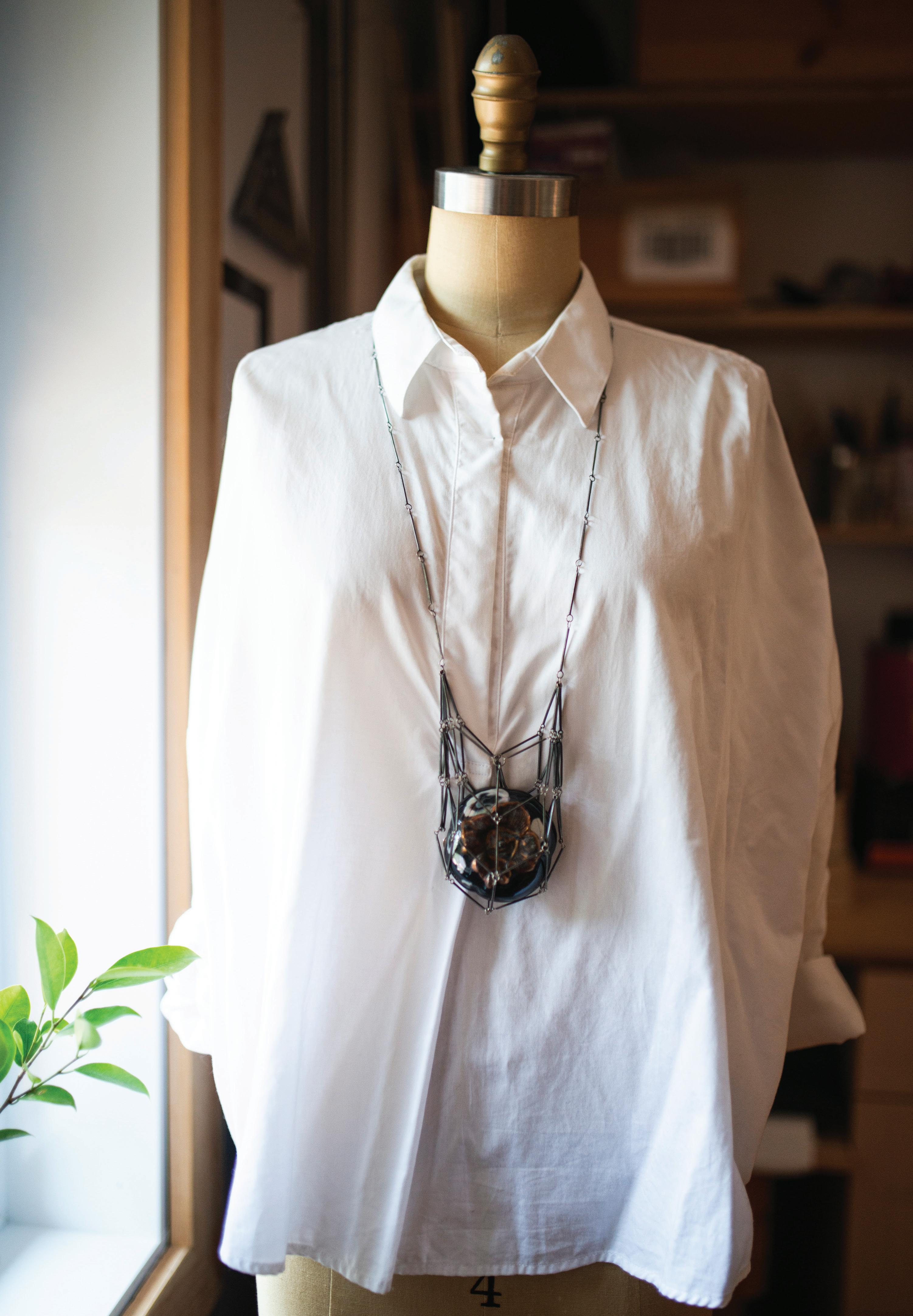
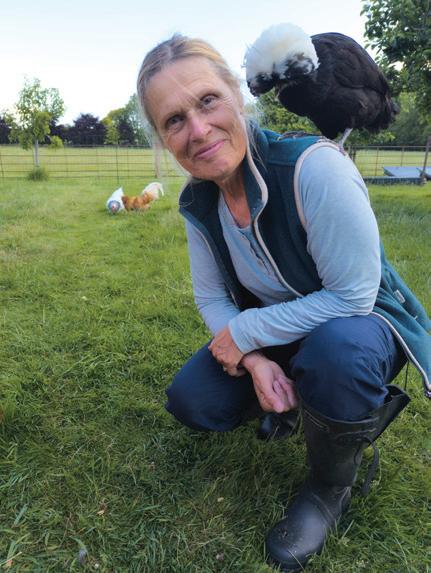
CATHERINE GRANCHE, P84
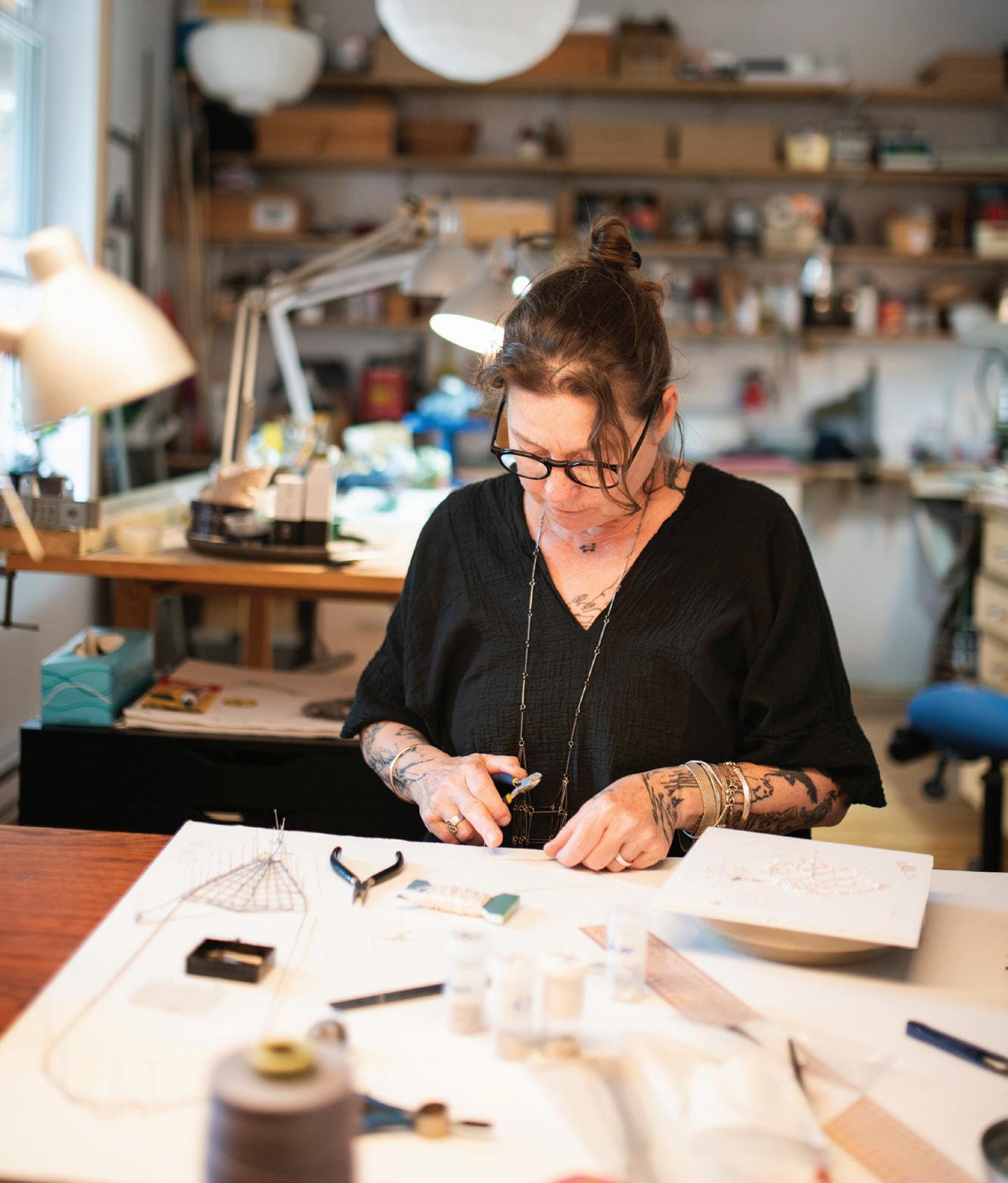
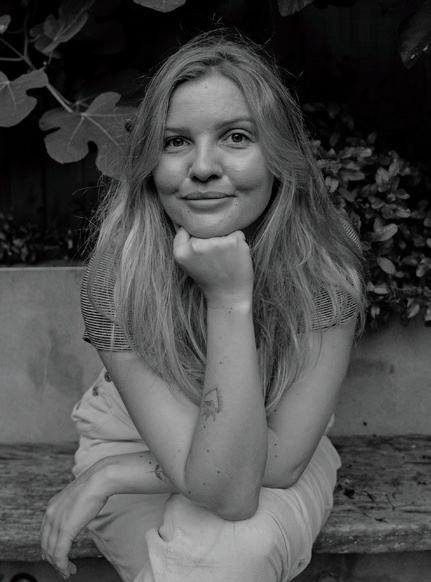
DENISE SHIVES, P132
JENNIFER PHIPPS, P120
NICKY ANDRAG
Text: Robyn Alexander
Production: Sven Alberding
Photographs: Warren Heath/Bureaux
Floral designer, creative maker, and conservationist
NICKY ANDRAG of Cape Town, South Africa, transforms a variety of plants into unique botanical artworks for her nature-focused brand, Velt.
Ihad to learn to trust my gut about what is beautiful. This is how I came to start my botanical art studio, Velt, in 2017. Exhausted by the relentless demands of a high-pressure corporate job, I decided to leave the world of IT behind and embrace my childhood passion for pressed flowers and transform this love into a thriving small creative business.
My story might sound familiar to many. A creative person at heart, I graduated from South Africa’s Vega School—which focuses on training in design and brand communication—in the late 2000s, but ended up working as a project manager in the field of software development. Some eight years later, I was almost completely burnt out, and in those pre-pandemic times, working from home or requesting more flexible working hours was out of the question.
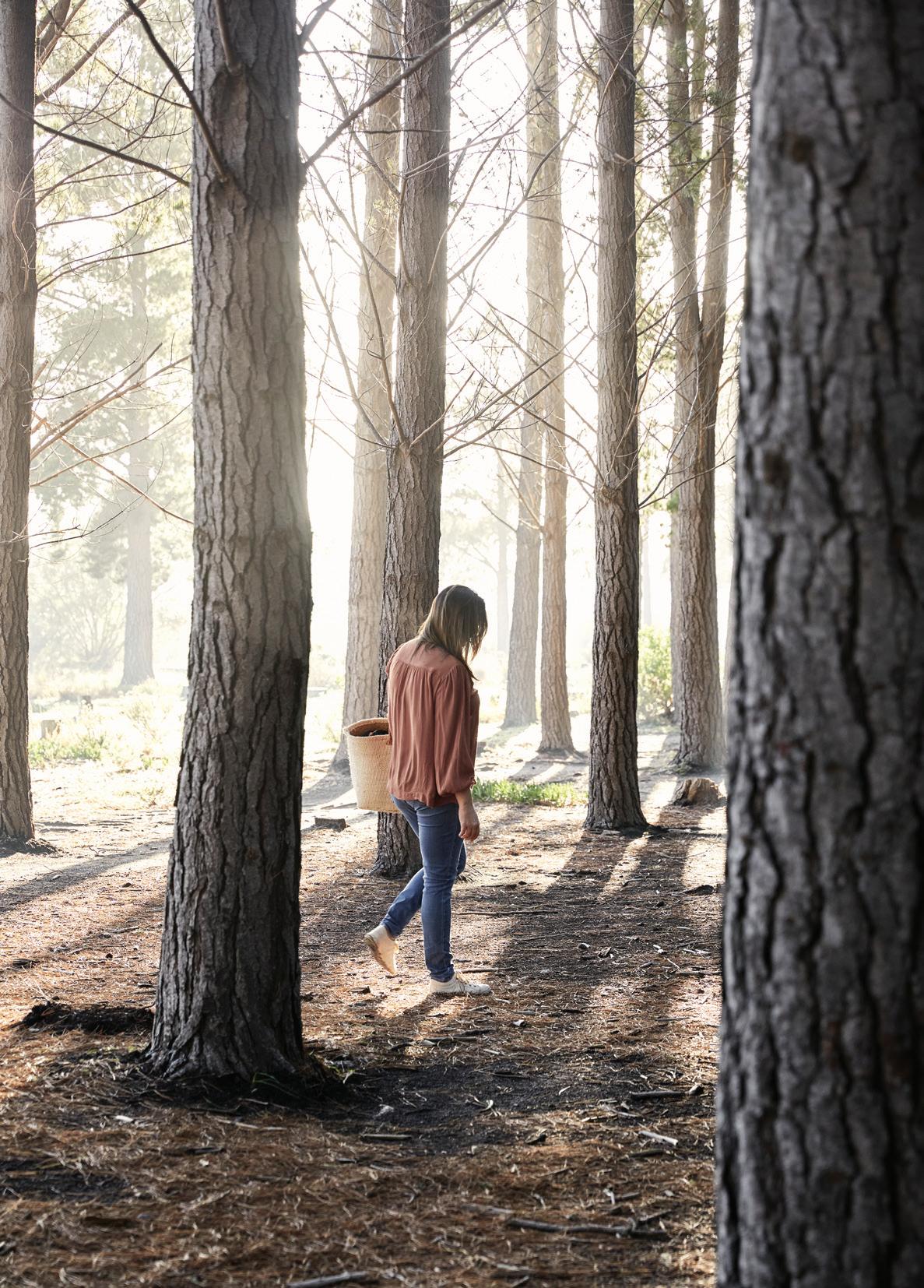
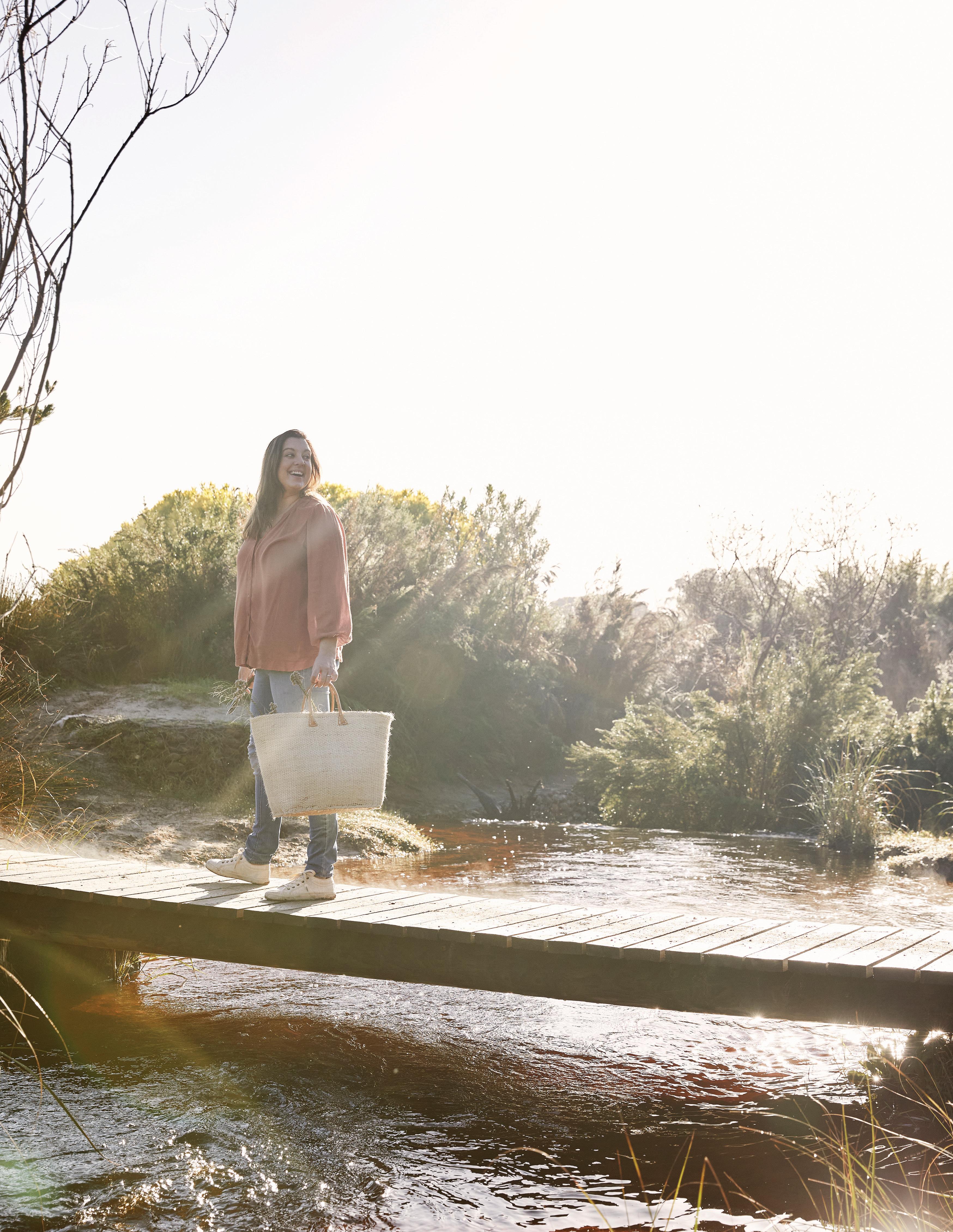
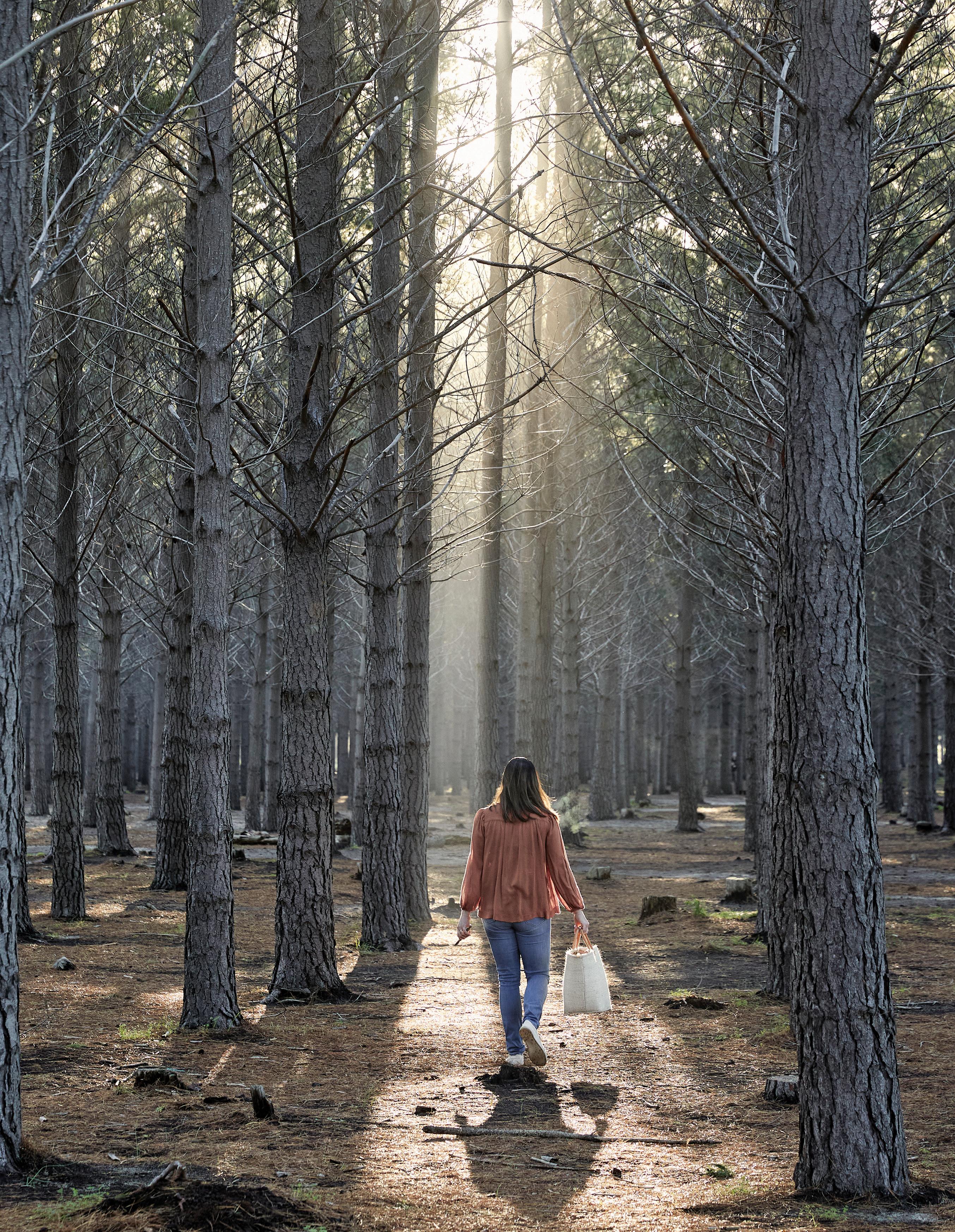
I resigned, with the initial intention of simply taking some much-needed time out. The instant transition to having “too much time” in a day was a shock, so I took long daily walks with my beloved dog, Luna, in the forests and mountainside sanctuaries that many Capetonians are fortunate enough to access. I had to learn to let go and make peace with stripping back in the face of feelings of guilt about doing nothing.
Those long, grounding walks in nature also became a time to ponder a new direction; however, one of the questions I began asking myself was, “What did I most enjoy doing during my childhood?” The answer: flower pressing. I loved the entire process of pressing various types of flora to preserve them as a child and was inspired by the increasing connection with the natural world around me—by my mother (a dedicated, lifelong gardener)—and by my own dedication toward wildlife conservation. I began a process of research and development that led to the emergence of Velt.
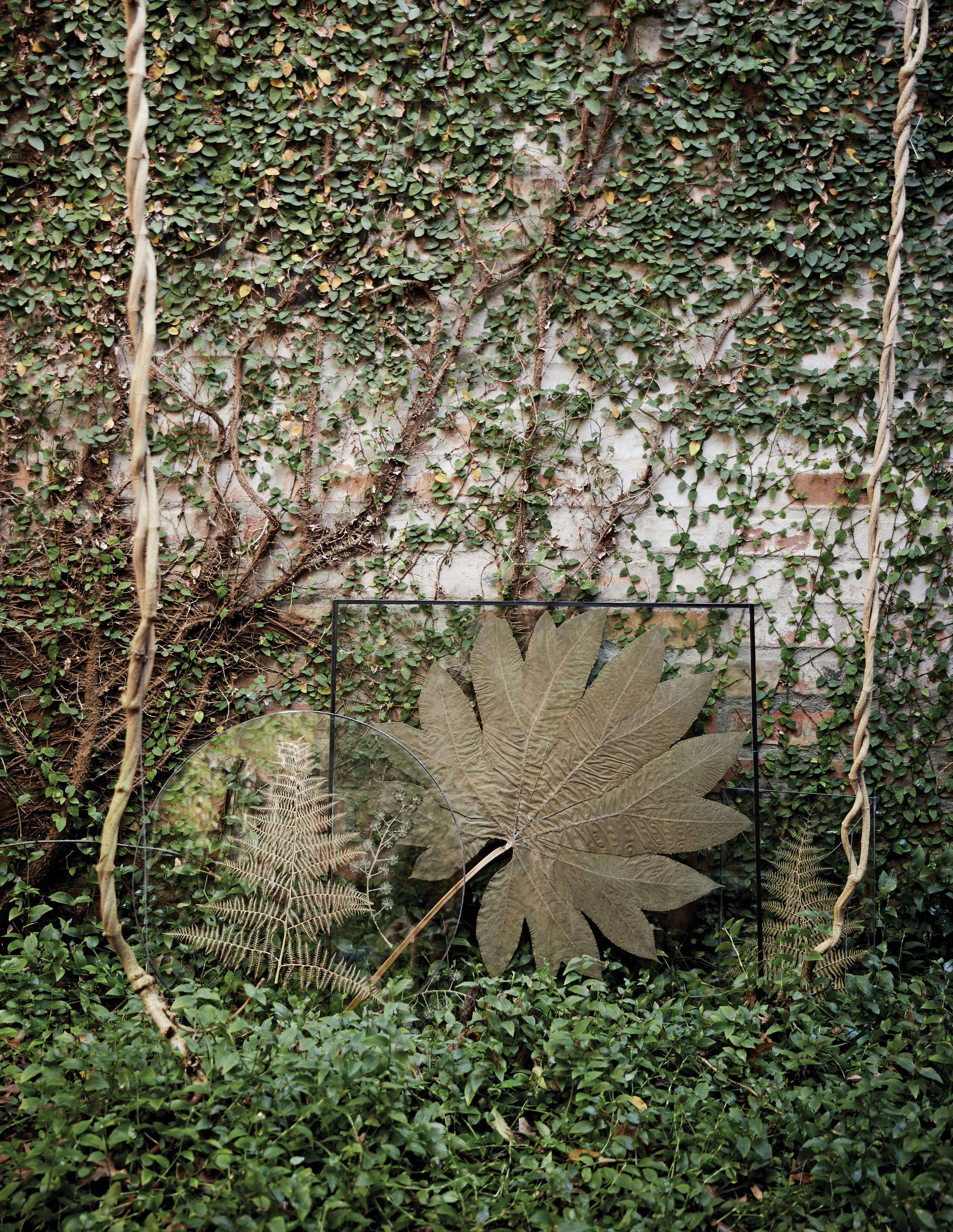
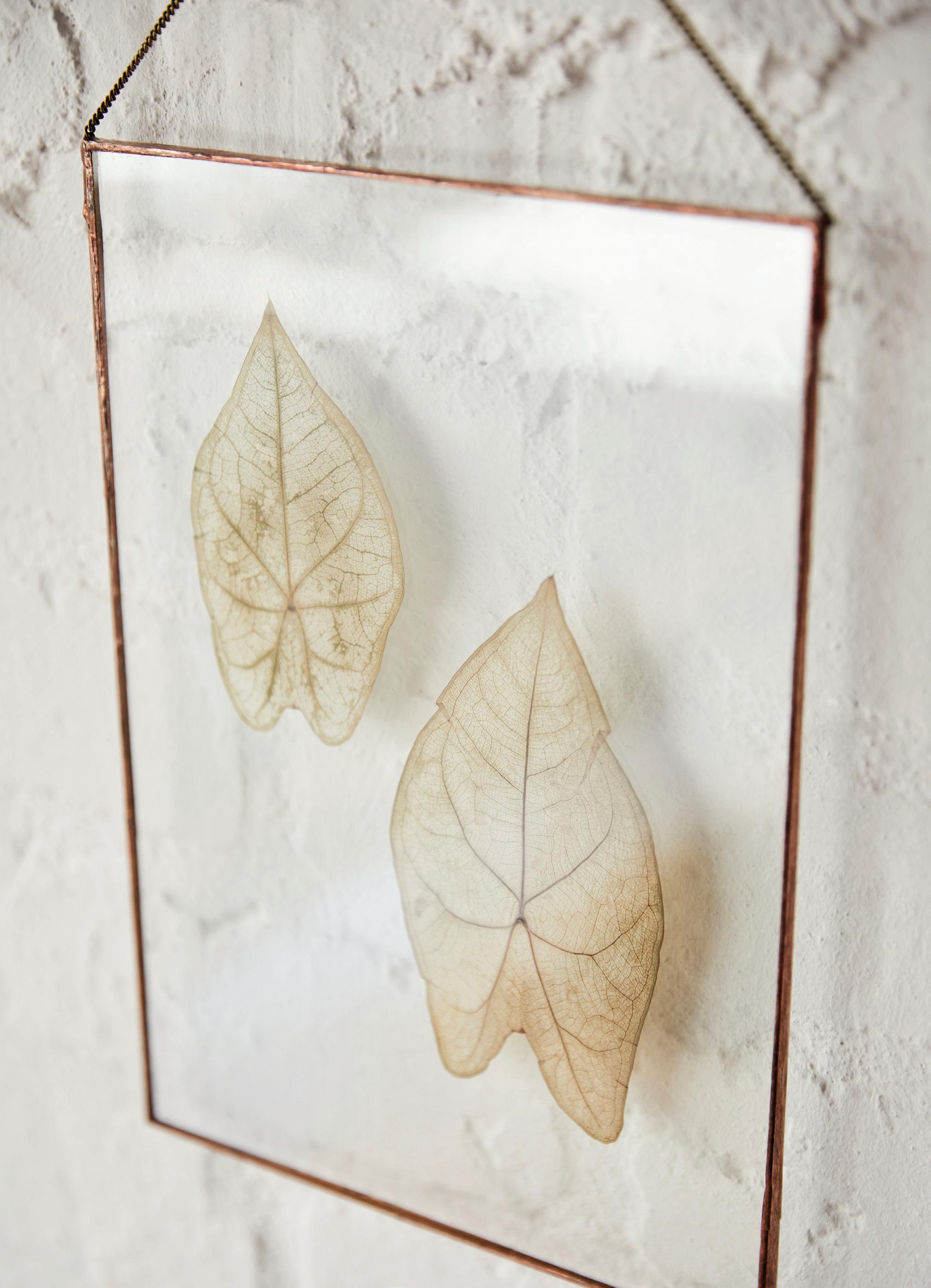
Right away, once I refreshed and rediscovered pressing skills, I rejected the idea of conventional box frames for my work. I was attracted to glass “sandwich” framing with soldered edges, feeling that this style showed off the floral specimens best while also feeling fresh and contemporary. So, I went off to learn to solder these myself. It was a time of experimentation—and plenty of mistakes!
Wanting to achieve a beautiful and sophisticated result, I was also very conscious of needing to continuously stay grounded in the work. I wanted to keep a clear focus on making every aspect of Velt meticulously respectful of nature, with an eye on the ongoing task of preservation and environmental awareness, too. There’s a definite “spiritual side” to my work as well. Working with plants, you become aware that they each have their own energy–and that this needs to be respected. As a result, every Velt piece exudes love and care for the natural world.
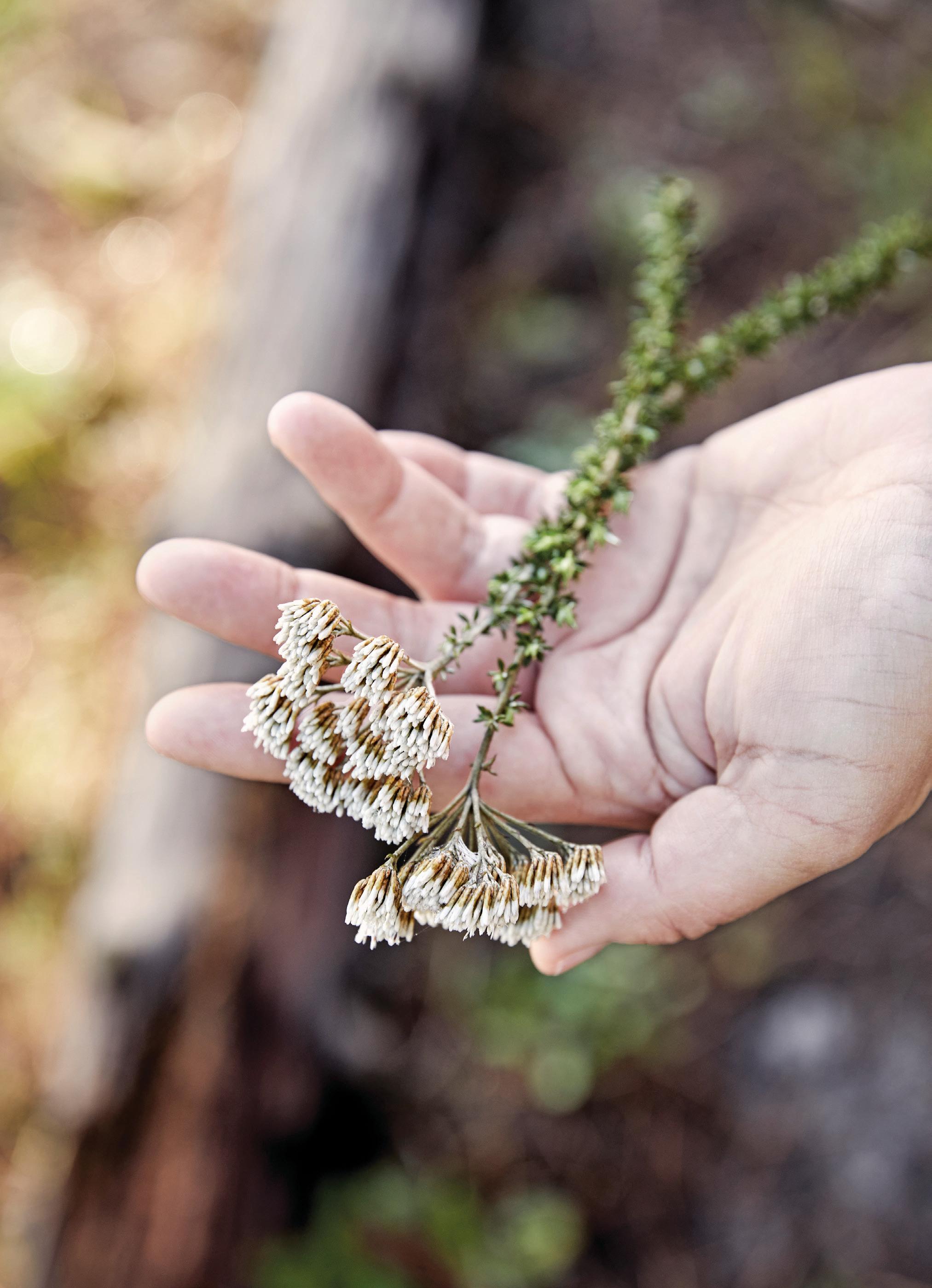
Velt is all about the preservation of nature. The notion of stopping to smell the flowers might be cliché, but it’s true: most people genuinely don’t pay much attention to the amazing complexity of the natural world around them. Having spent the past few years carefully harvesting plants–only sourcing specimens from farms and gardens–and working to understand their unique forms while meticulously processing and pressing them, my respect for the natural world has increased considerably.
So, part of the mission at Velt is to encourage others to change their perspective, too. My unique glass displays give a modern twist to
admiring the sheer diversity of shape, form, and texture in the way plants have evolved. The “sandwich” of glass allows a comprehensive view, and both sides of the plant are visible. With a younger generation in particular, this is definitely striking a chord, and hopefully, in turn, helping to develop a more conservation-conscious view of the world.
Velt is centered around a strong message to never disrespect or disrupt nature.
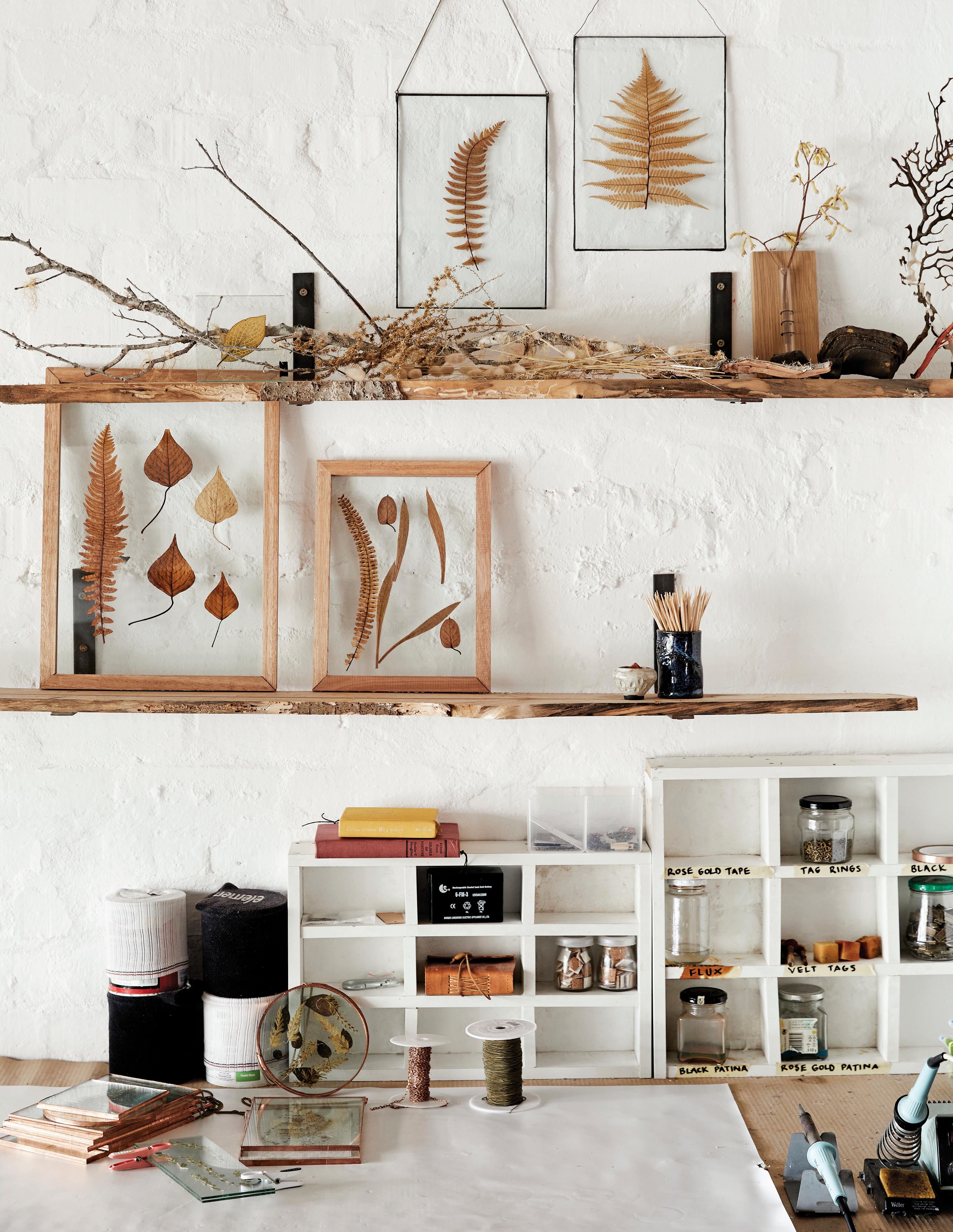
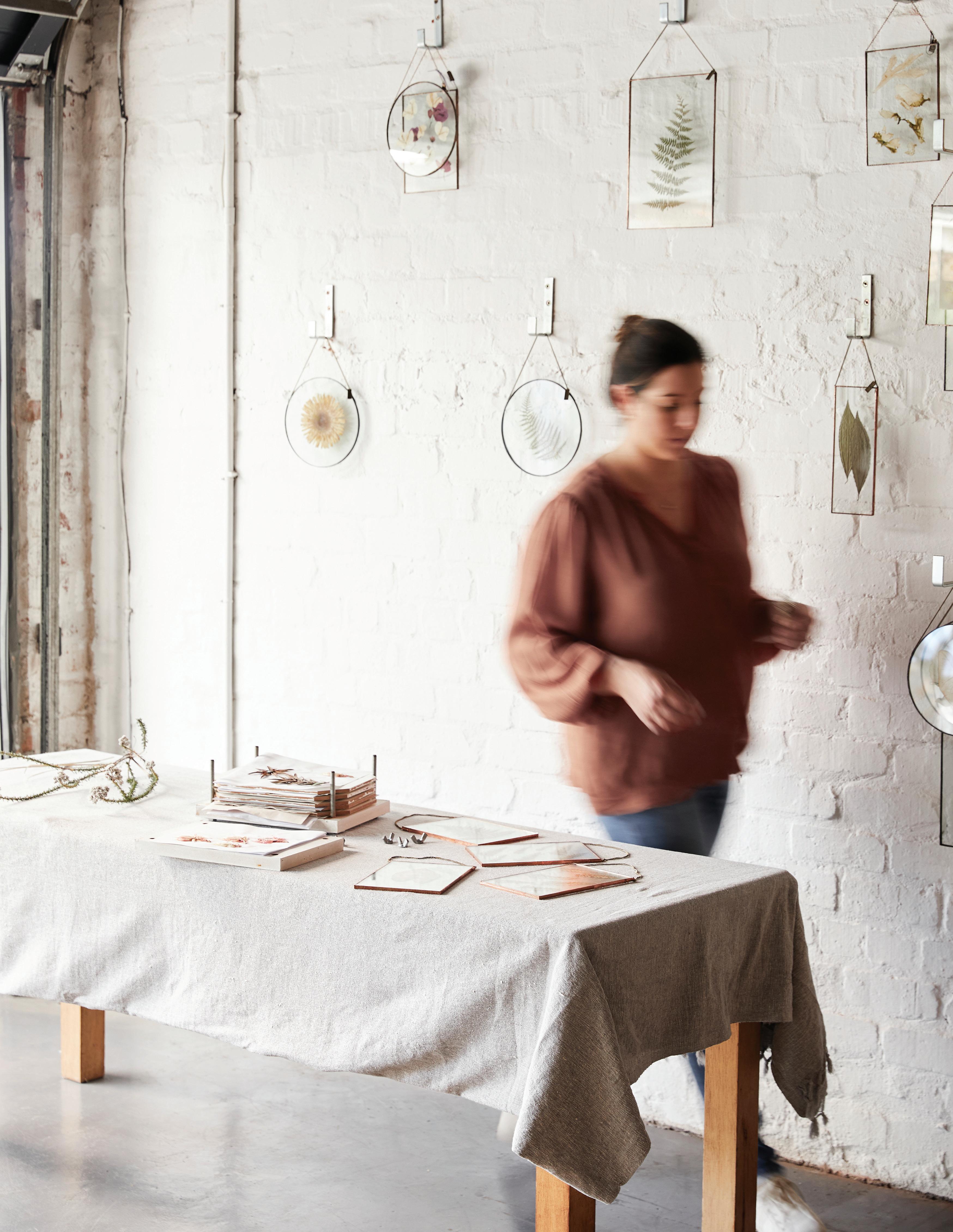
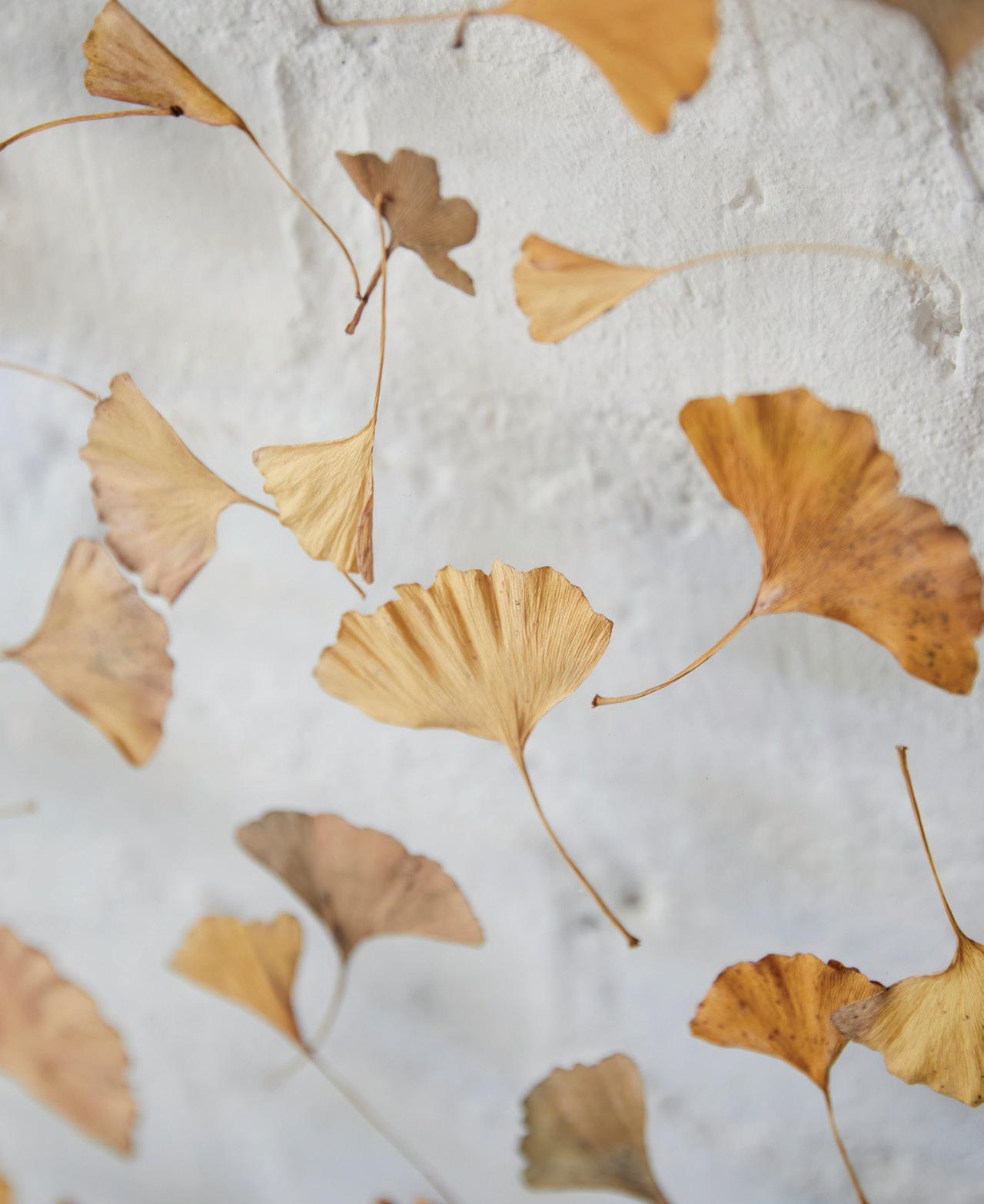
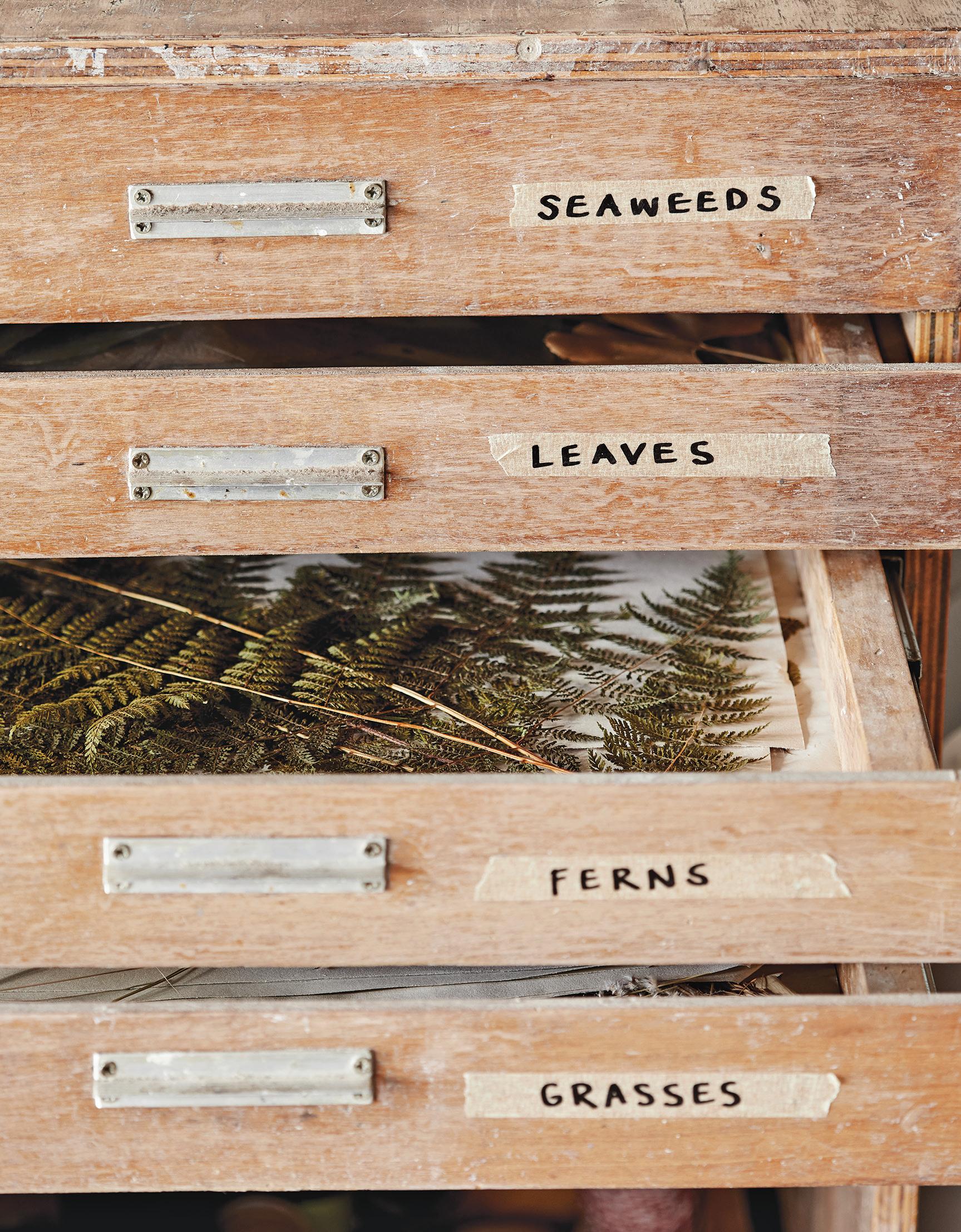
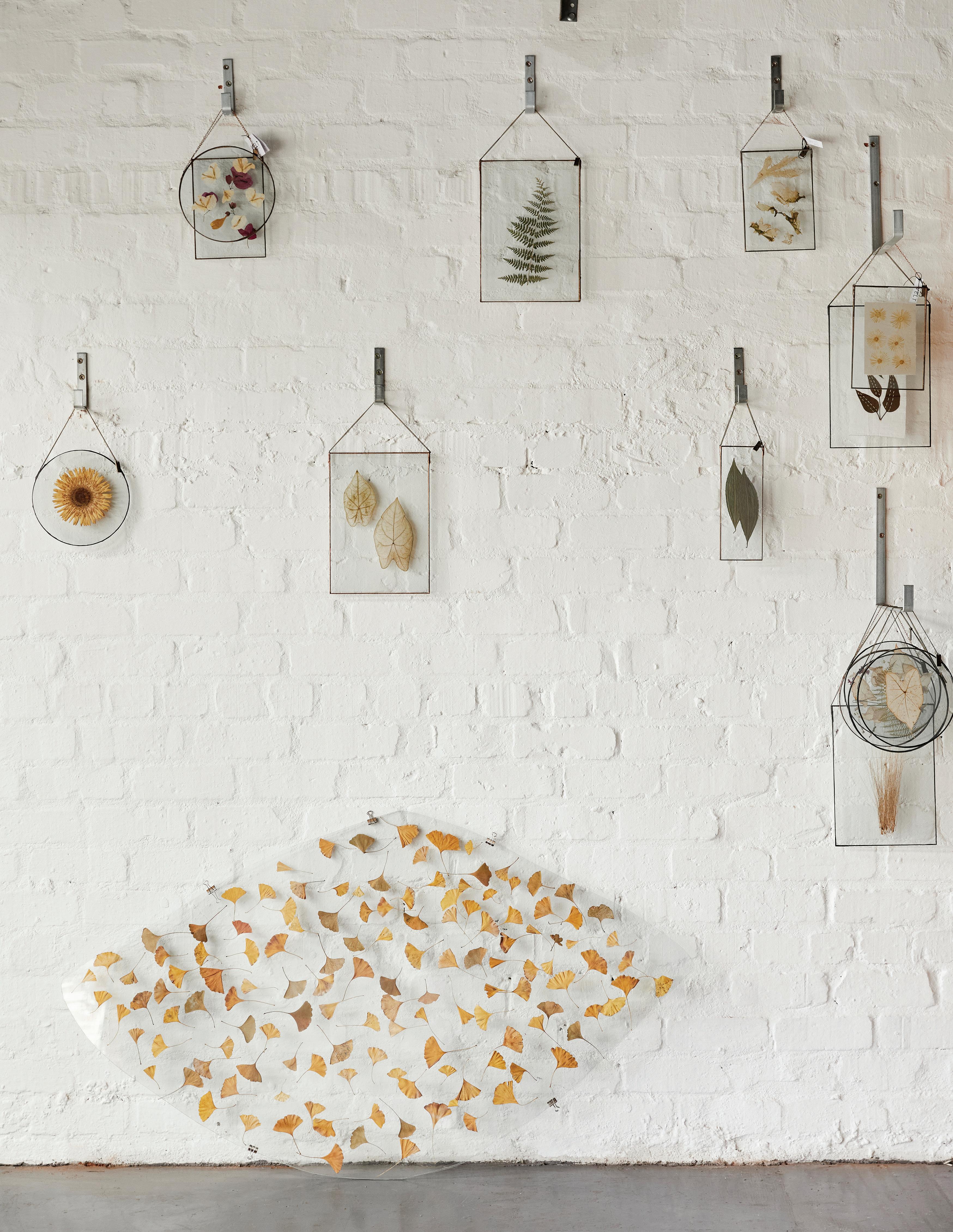
My simply decorated, low-fi studio is adjacent to my home. A neat set of cubby holes on my desk holds all the essentials I need for my work, and the narrow shelves above contain a selection of works in progress, samples, and dried plant cuttings for inspiration. A selection of Velt pieces is displayed on the wall, and a mini chest of drawers holds a variety of specimens that have already been pressed and prepared for framing. My calm and quiet studio surroundings truly inspire my work. Working days don’t follow a set routine, unlike my previous job as an IT project manager. I had to teach myself to stop project managing and learn different daily rhythms to suit my new occupation as an artist. But I do still work in an organized and disciplined way.
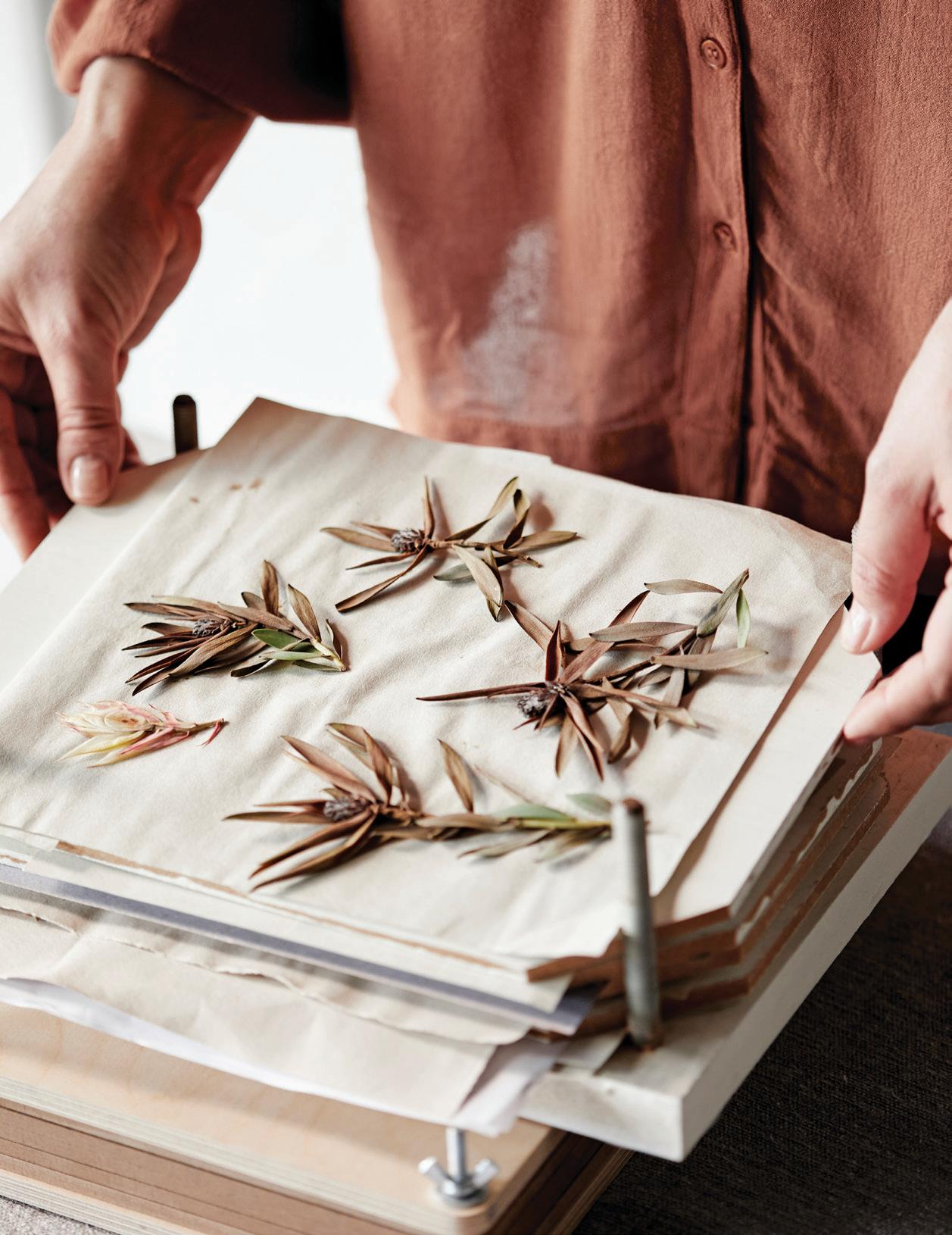
Some days are all about collecting plant specimens, while others are dedicated to methodically fitting those new finds into handmade presses and checking on the progress of flora that are already in the presses. Still other days are dedicated to framing, while the administrative tasks that are an inevitable part of running one’s own small business are fitted in as needed.
Having started out selling at markets and now operating primarily via my online store (as well as being available through selected stockists across South Africa), Velt currently offers works that slot into five broad categories: The Ocean’s Garden (seaweeds), Life With Ferns, Love Of Leaves, Bougainvillea Summer, Orchid Blooms, and Bushveld Living (grasses).
Orchids are particularly popular, while youthful customers seem especially attracted to the ethereal, often colorful pieces featuring bougainvillea blooms. These leaves from a “Devil’s Blush” Leucadendron bush once formed part of a client’s wedding bouquet. I personally love the seaweed works because these convey something of the uniqueness of ocean flora; in spite of the fact that the plants’ extremely high moisture levels make them difficult to press.
Ialso regularly work on special commissions and have collaborated with interior designers on bespoke projects, including a complex six-foot piece created with Andrea Kleinloog of Johannesburg’s Anatomy Design. It now has pride of place in the lounge area of the luxurious Kruger Shalati lodge. For the spa at the new Singita Kwitonda lodge in Rwanda, I produced 12 large works and also recently used foliage foraged on site by the designers of a lodge in Botswana to create unique pieces that feature the endemic plant species of the area around it. On occasion, private commissions include regular requests to press and preserve wedding bouquets, and pressed floral funeral tributes to keep as memorial mementoes.
Future plans for Velt include a new type of product that is still at the concept and prototyping stage, and includes stained glass elements. It’s quite bright and Art Deco, in a way! I’m also involved in the development of a conservation project in Kafue National Park, Zambia, together with my husband.
What began as a way to explore and celebrate a connection with plants is now leading towards long-term ways to support the worldwide push to conserve and respect the natural world. It’s an understatement to say that this all seems a rather long way from software development!
More on Nicky
www.velt.co.za
Instagram: velt.co.za
ASHBRIDGE
Photography by Deborah Husk
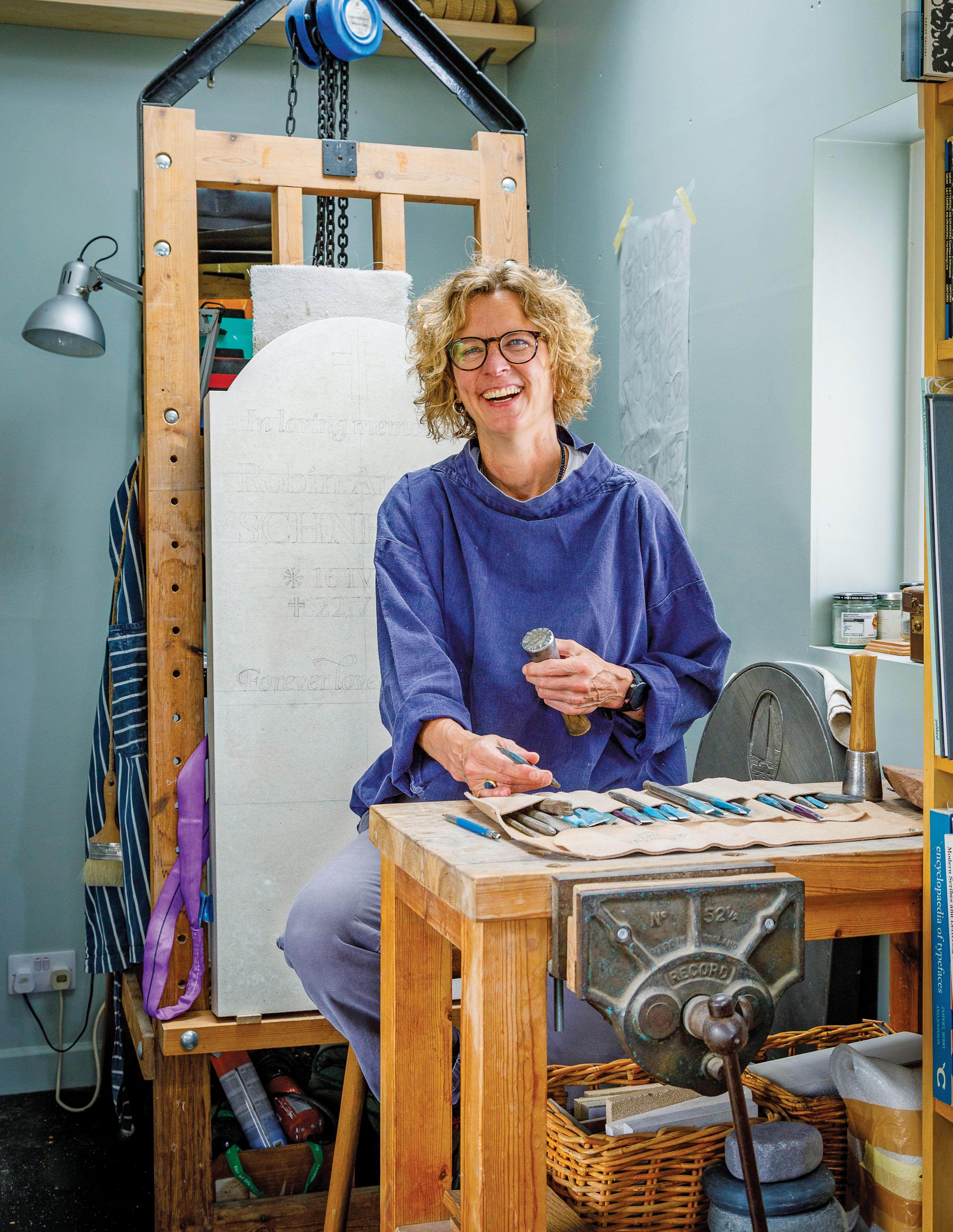
fRoM ISABELLE fISH: In addition to her superb skills as a letter carver, Lisi brings into her craft her whole life experience, her entire being. She will sit with a brief until all is perfectly aligned in her mind’s eyes—the stone, the font, the volumes, the spacing, the wording—and then she will get to work with an assured hand, giving a soul to the stone, and it will be perfect.
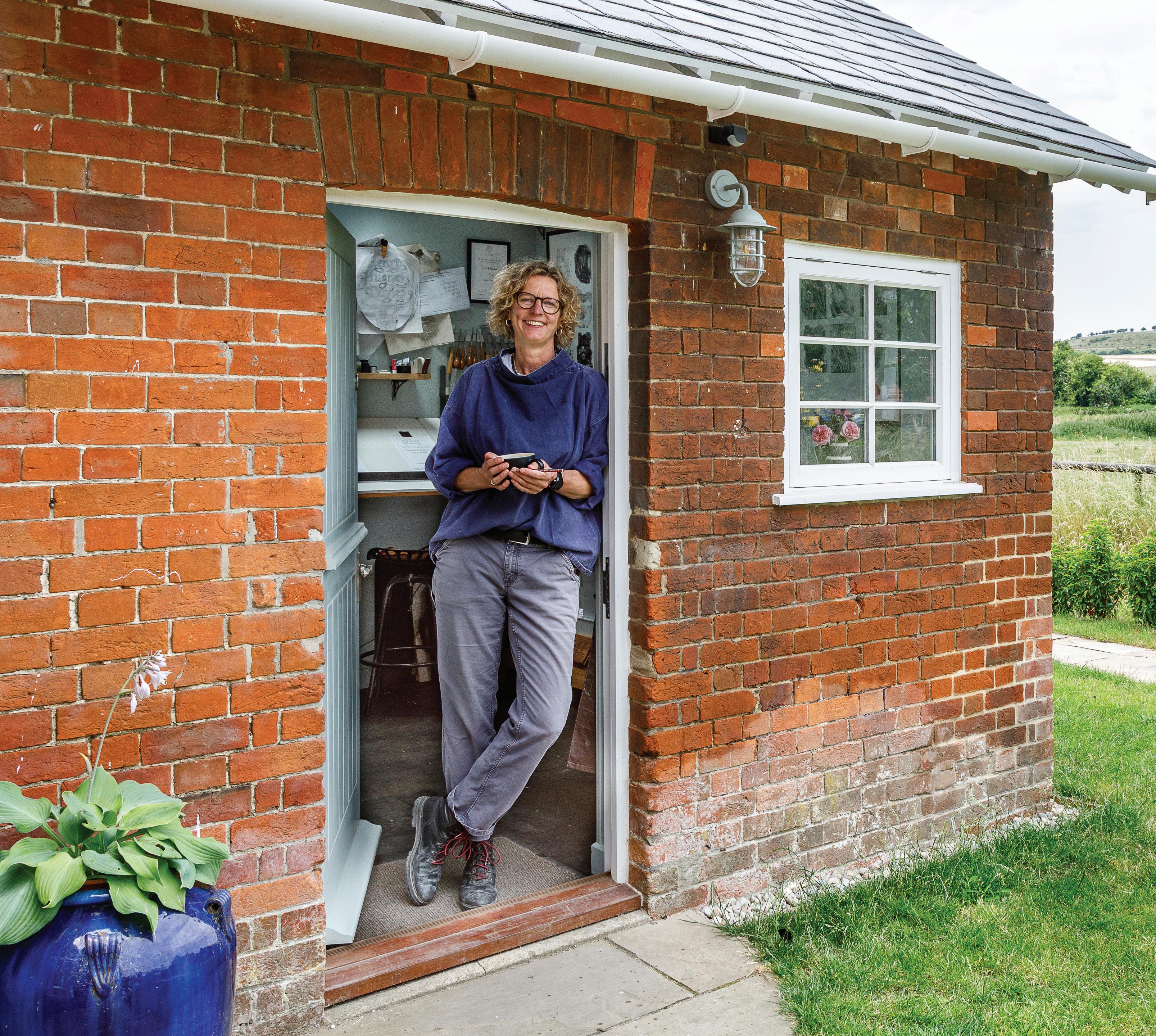
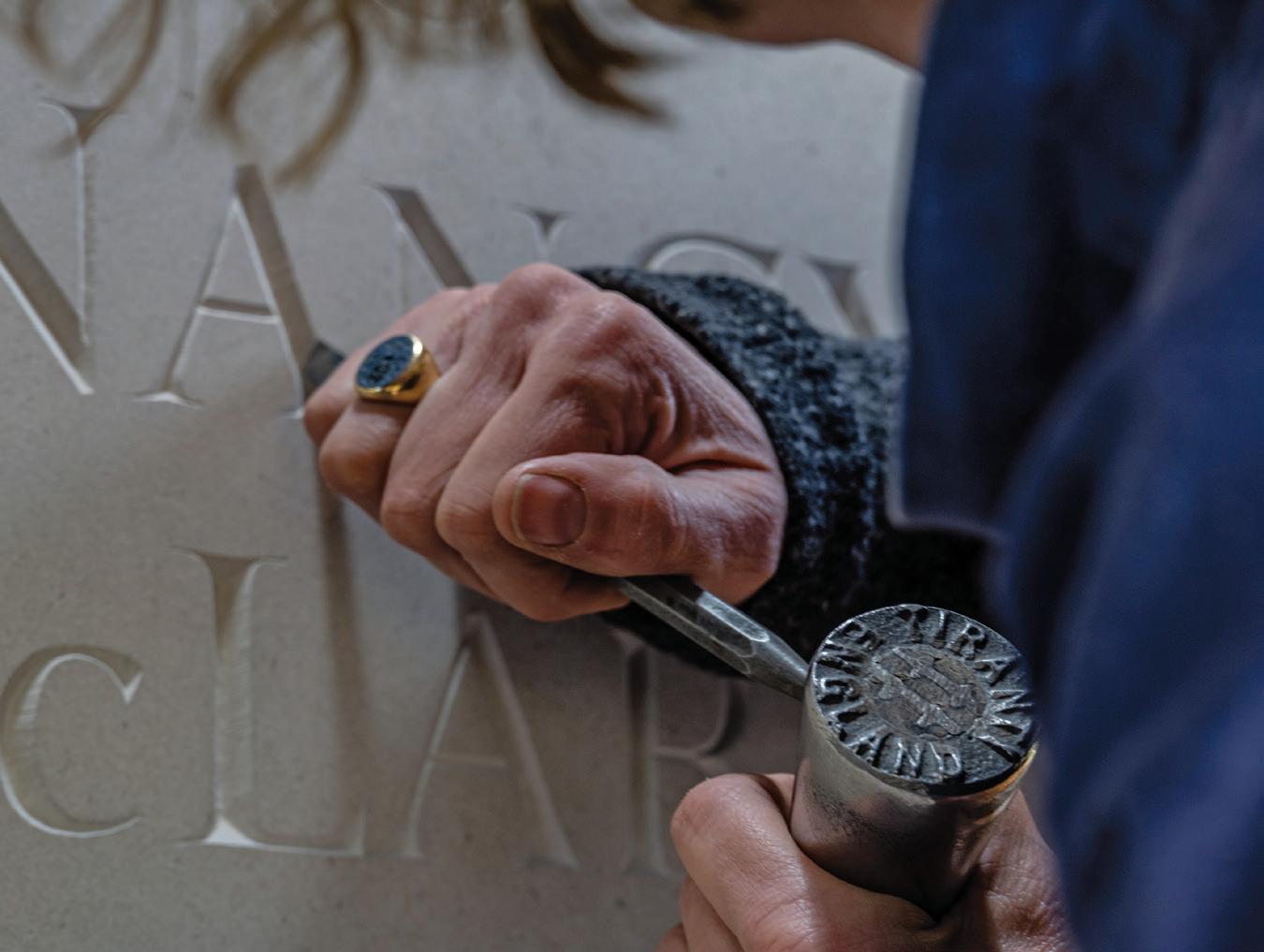
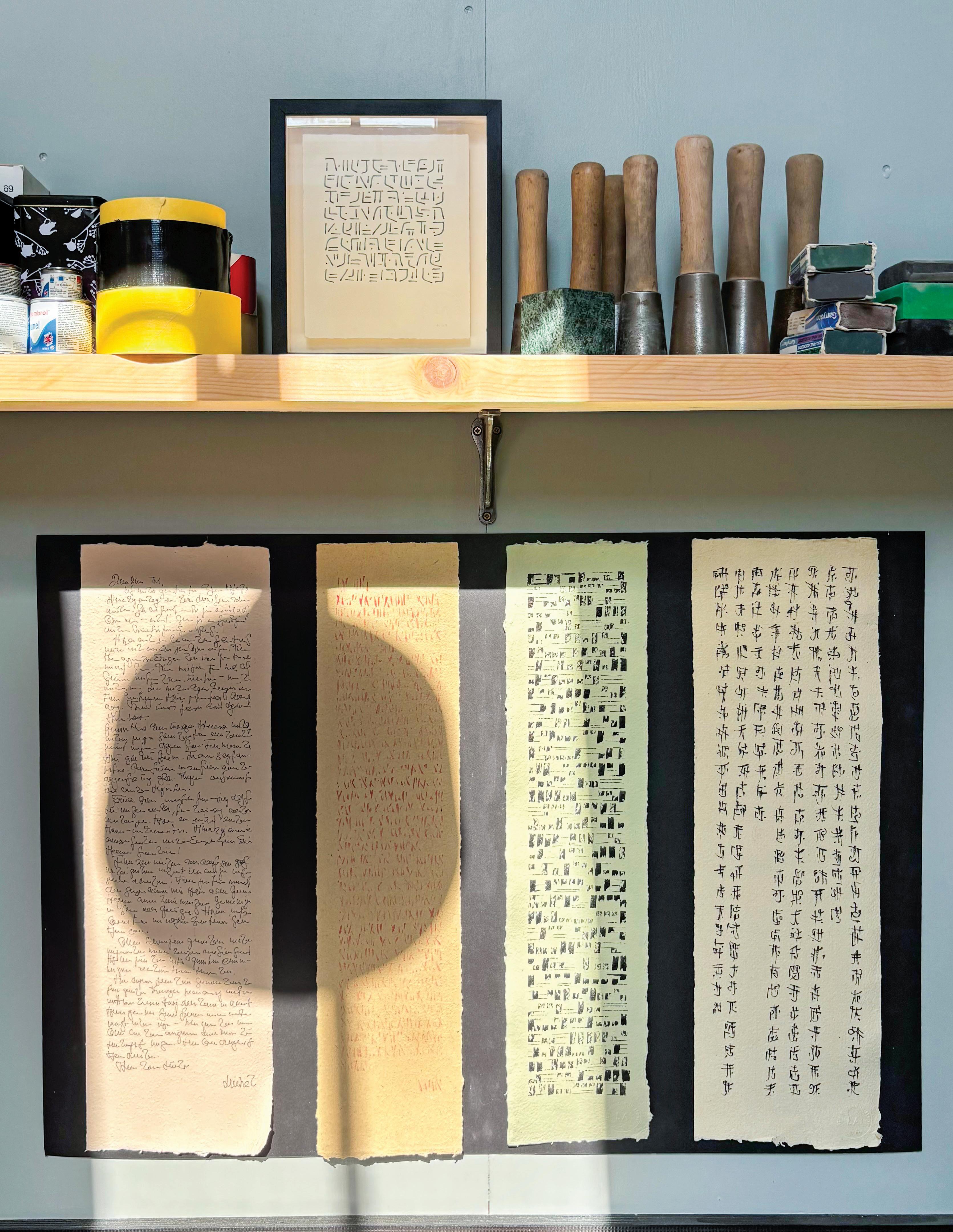
From neuroscientist to artist—LISI ASHBRIDGE is a lettering artist working from her studio in the Pewsey Vale, England. Based on her background in visual recognition, art, and design, and inspired by themes as diverse as poetry, history, philosophy, science, and landscapes, Lisi creates a wide range of original, beautifully handcrafted sculptural carvings in stone and wood. Her exploratory work in abstract writing fuels her curiosity and pushes her academic and artistic boundaries.
IGRE w up I n Sw I tz ERLA n D I n A v ER y
HA ppy A n D c REA t I v E H ou SEH o LD. My M ot HER w AS t HE f IRS t G ERMA n woman to receive a scholarship after the war to go and study graphic design at Yale, where she was inspired and taught by the top Bauhaus teachers. As so often in those days, she returned to Germany and, rather than continuing with her career in art, she married and supported my father’s path in academic medicine. I was the youngest of four, and my mother was keen to get back to work. She became the first art therapist in Switzerland, resulting in some of my earliest memories being painting, making, and playing with the children who came to my mother for help. Being creative and practical with my hands was woven into my upbringing. For the last two years of my education, I gained a scholarship to an international school in Italy (United World College), where I further developed my love for and interest in art, especially lettering. I was surrounded by so many people who were able to write in many different scripts from all over the world, and I found the diversity in the lettering fascinating.
tH ou GH AR t w AS M y p ASSI on, I
fo LL ow ED t HE p ER c EI v ED SA f ER R out E of t HE S c IE nc ES , w HI c H I had always been interested in, and studied human sciences and neurosciences at University College London. But even there, I continued my interest in the visual arts, taking a life drawing module at the Slade Art School. My scientific studies led to a Ph.D. at St Andrews University, a postdoctoral research fellowship at Oxford University, and a lectureship in London investigating how the brain recognizes visual objects and shapes, including lettering. Even today, I am fascinated by how the brain decodes different letter shapes and what we perceive as beautiful.
I am constantly questioning and trying to understand the way in which the brain receives and interprets such varied forms of
lettering (think of how many types of the letter E exist!). The brain has an area specifically allocated to decoding letter shapes, even though, in evolutionary terms, we have not been reading and writing for very long. Furthermore, the location of such an area is dependent on whether the writing system is based on a pictorial or phonetic language. What kind of changes will our brains undergo now that we increasingly use computers and smartphones? The connection between science, language, lettering, and art is one I continuously explore.
However, when I had my two daughters, I put my career in academia on hold and was lucky enough to devote my time to bringing up my children, my proudest achievement to date. Of course, there was a lot of artistic creativity involved in my approach to parenting!
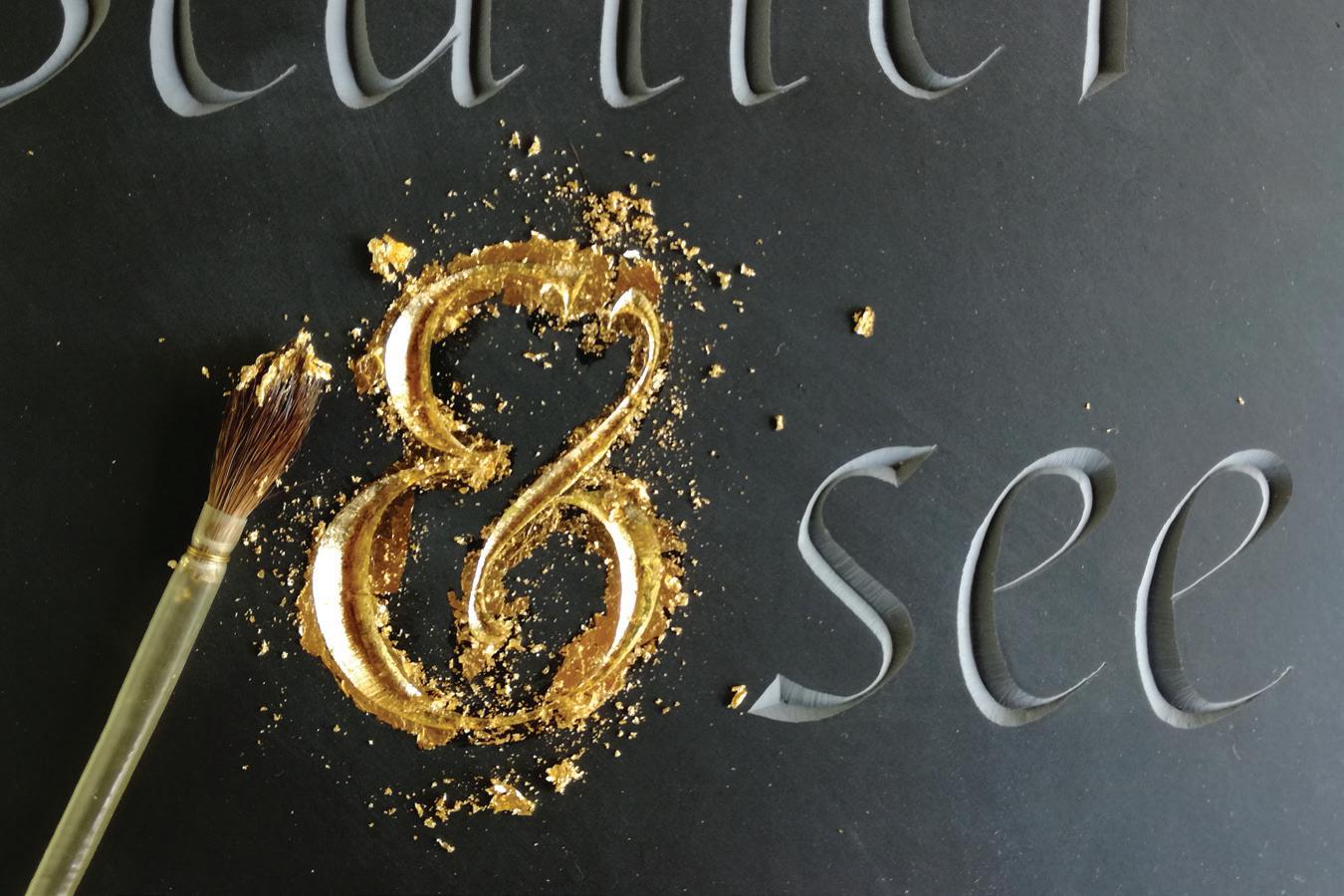
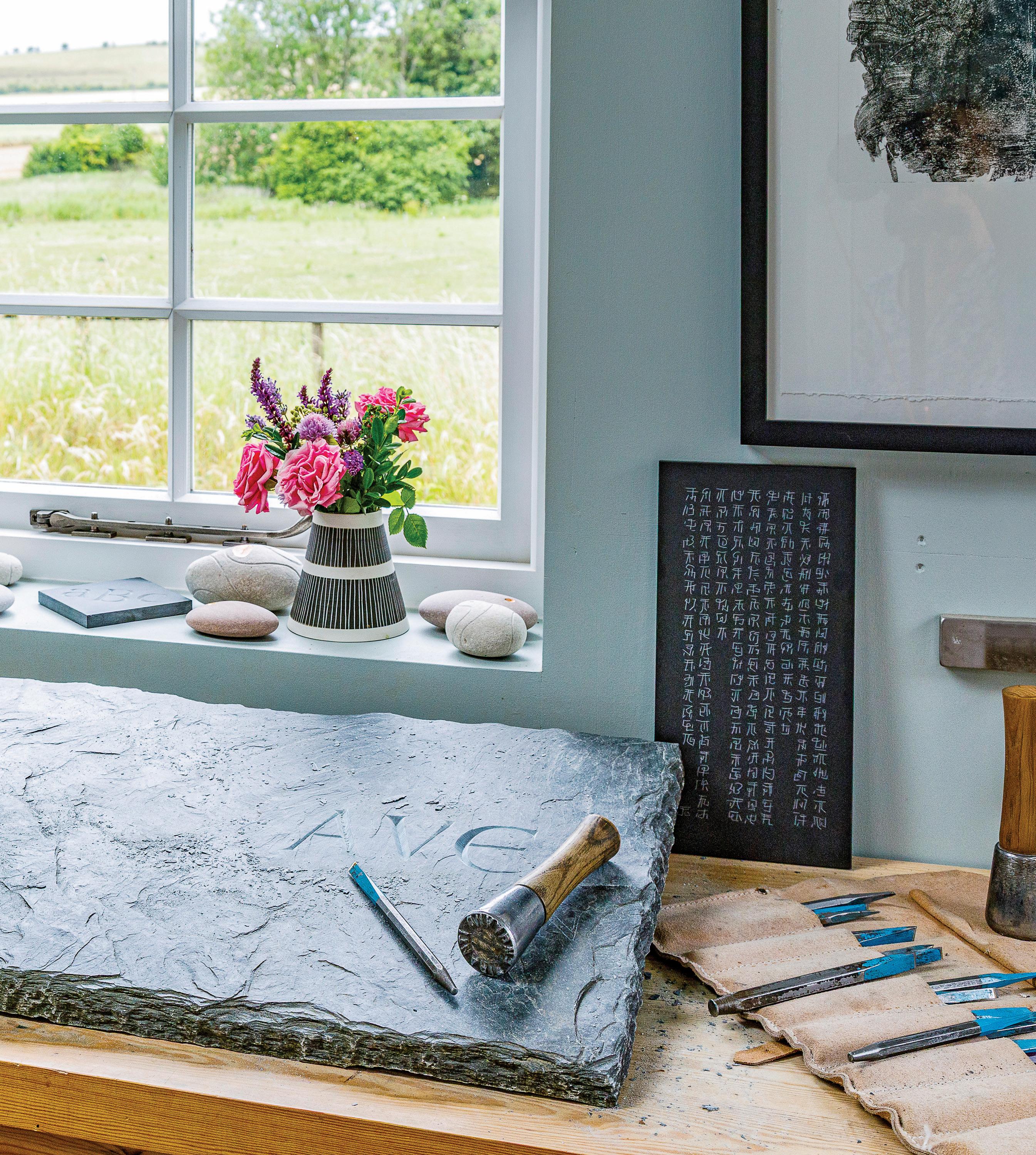
“ScAttER tHE cLouDS AnD SEE tHE Sun”
(carved in slate with gold leaf) my own
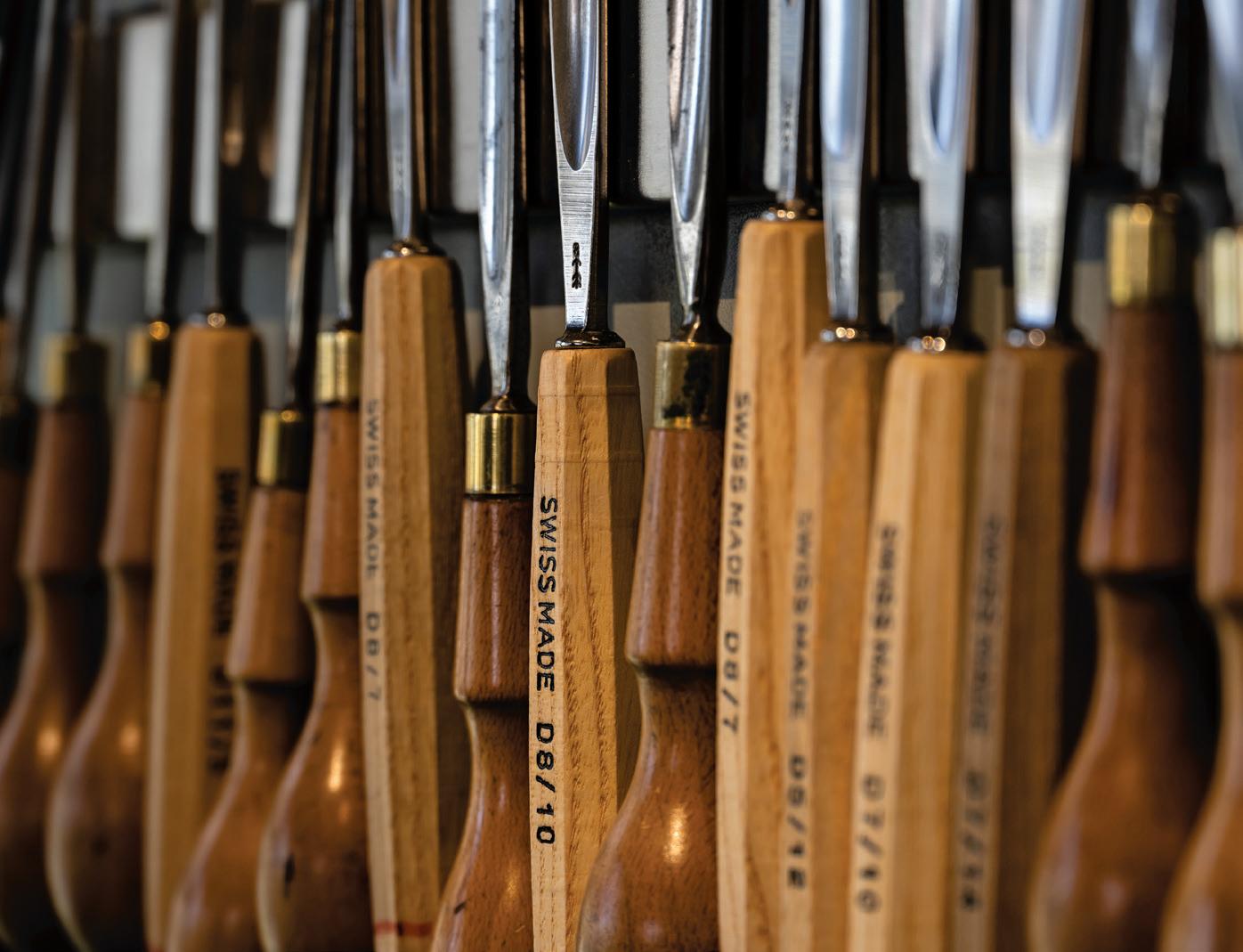
wHE n w E M ov ED to wILt SHIRE , I ME t, A t t HE S c H oo L GA t ES , t HE H u GELy t ALE nt ED A n D REnownED late letter carver Caroline Webb. She put a chisel and mallet in my hands, and right from the beginning, I knew that this was going to be the next chapter in my life—I wanted to make this a career. I finally could put my passion for lettering into action. I learned letter carving under her watchful eye, in addition to attending other short training courses with equally well-known letter carvers across the U.K.
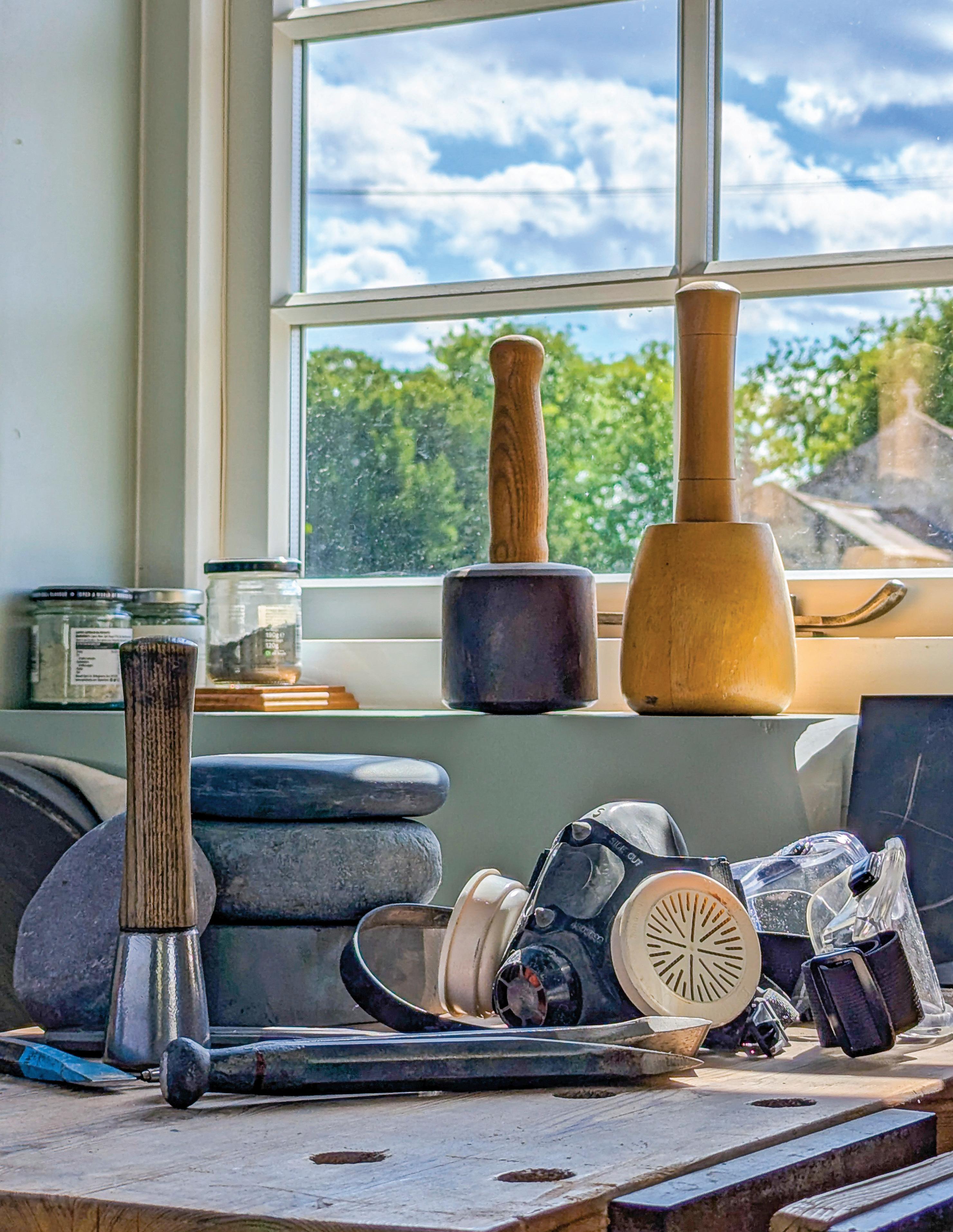
In 2010, I set up my own studio at the bottom of the garden, in a small summer house— starting with “The Nook,” which 8 years later doubled in size to become “The Nook and Cranny.” In early 2024, I moved house to set up a life on my own, and my priority was to create a beautiful studio to work in, surrounding myself with inspiration for happiness and creativity.
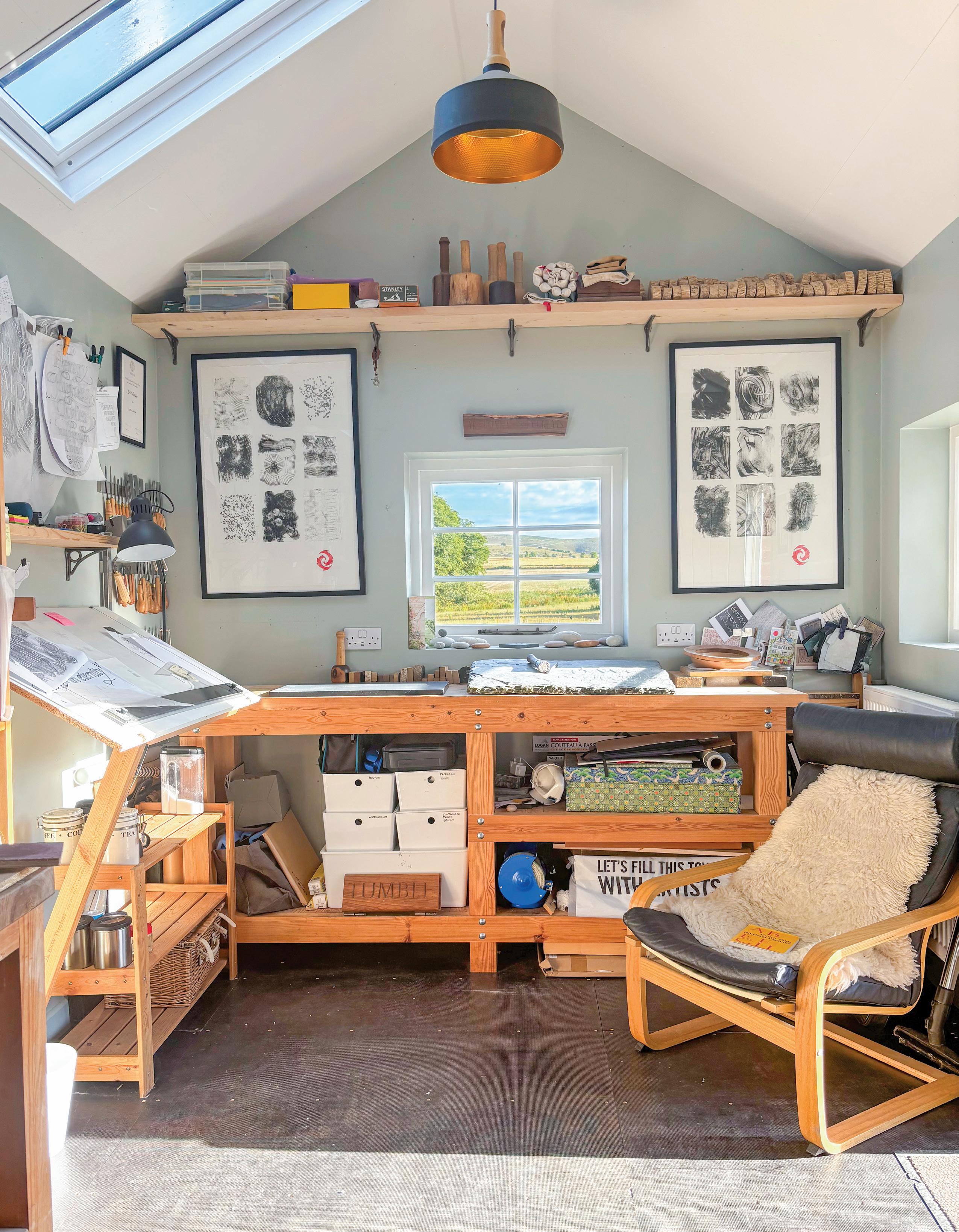
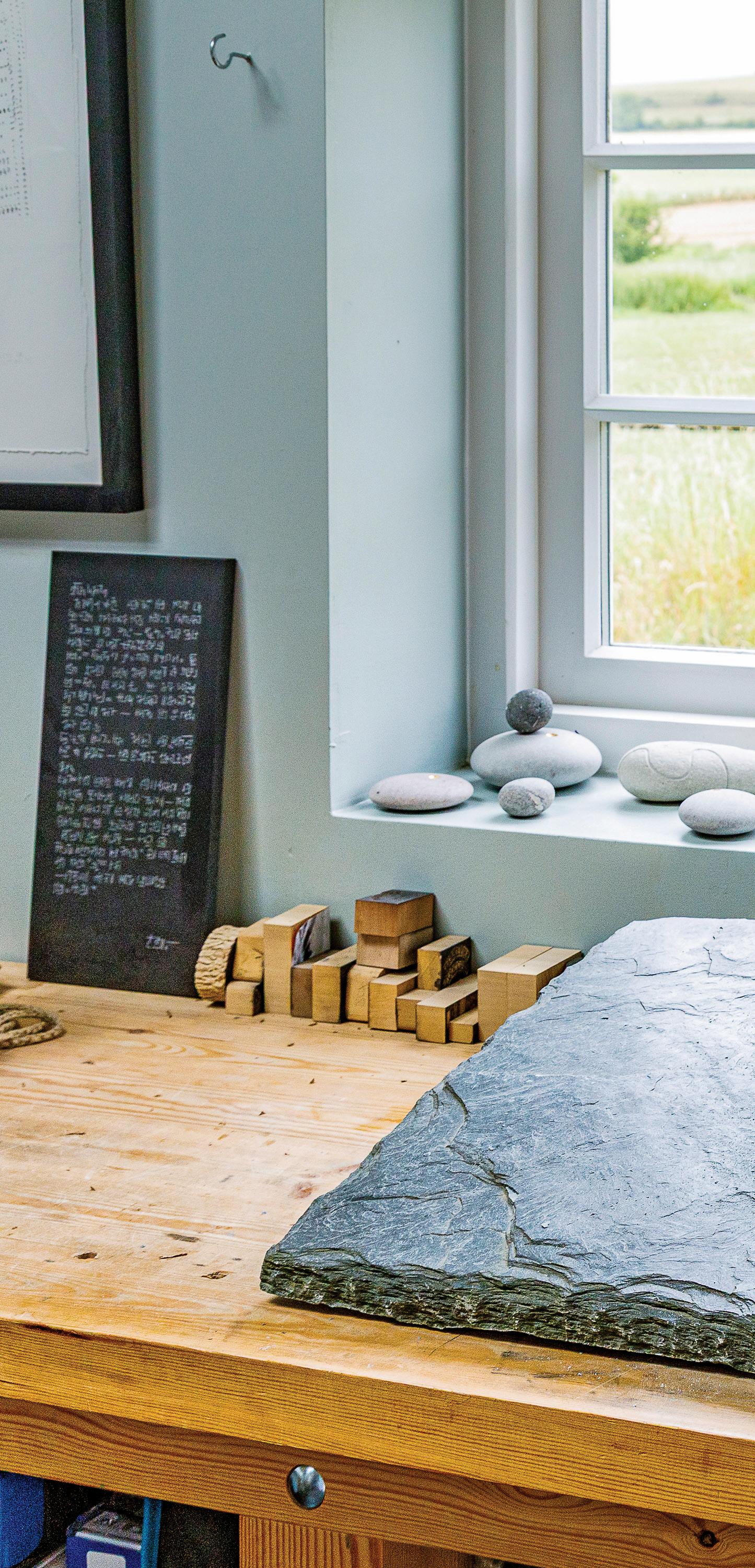
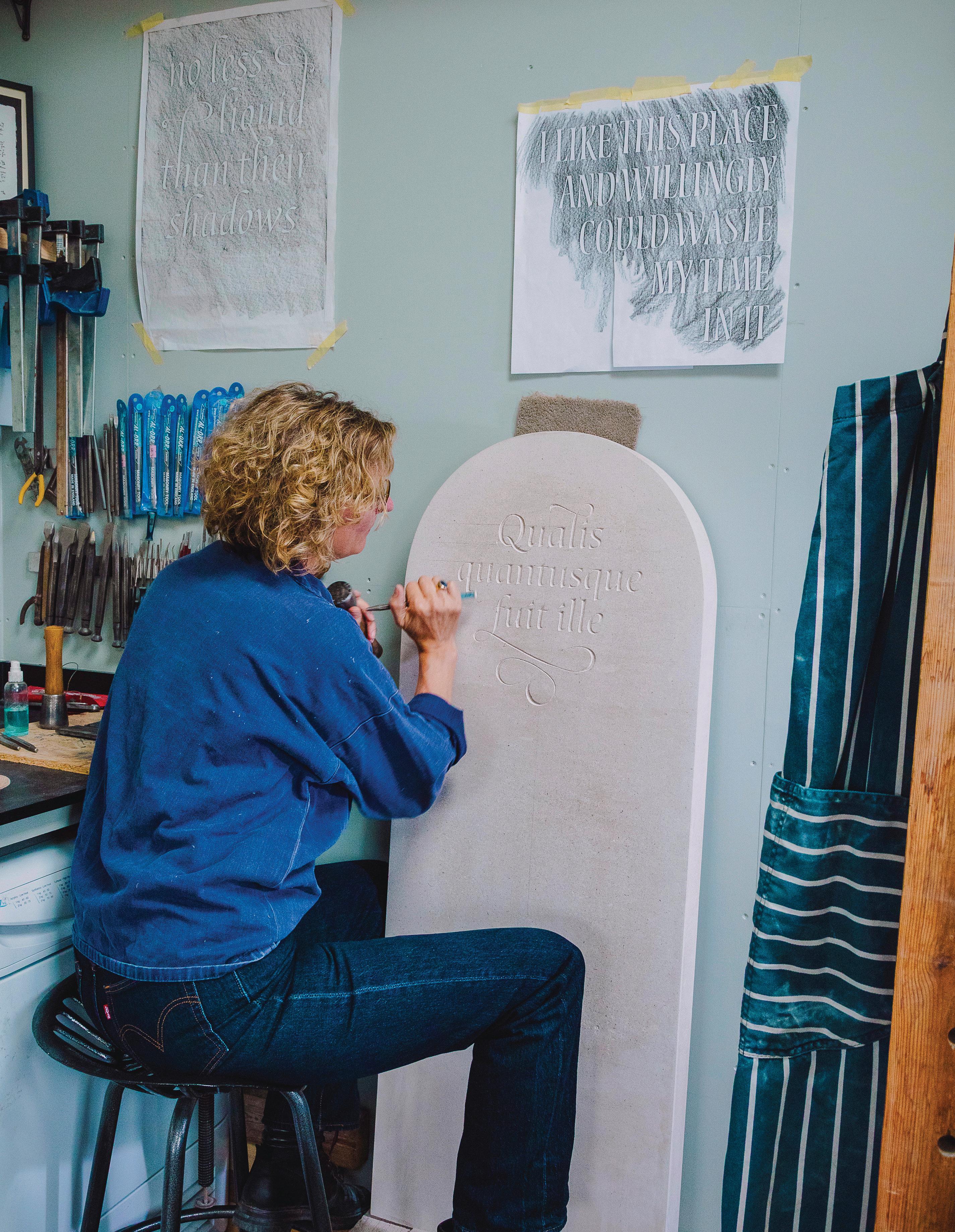
An old Victorian dingy, dark outbuilding, built in 1882, was transformed into my studio— my safe and happy place—where I can truly be myself with plenty of light, incredible views, and peace. I have an area for stone carving, a home-adapted easel with a chain pulley to lift stones weighing up to several hundred pounds, some purpose-built workbenches, and, of course, plenty of books and a comfy chair to sit and contemplate whilst drinking a good coffee.
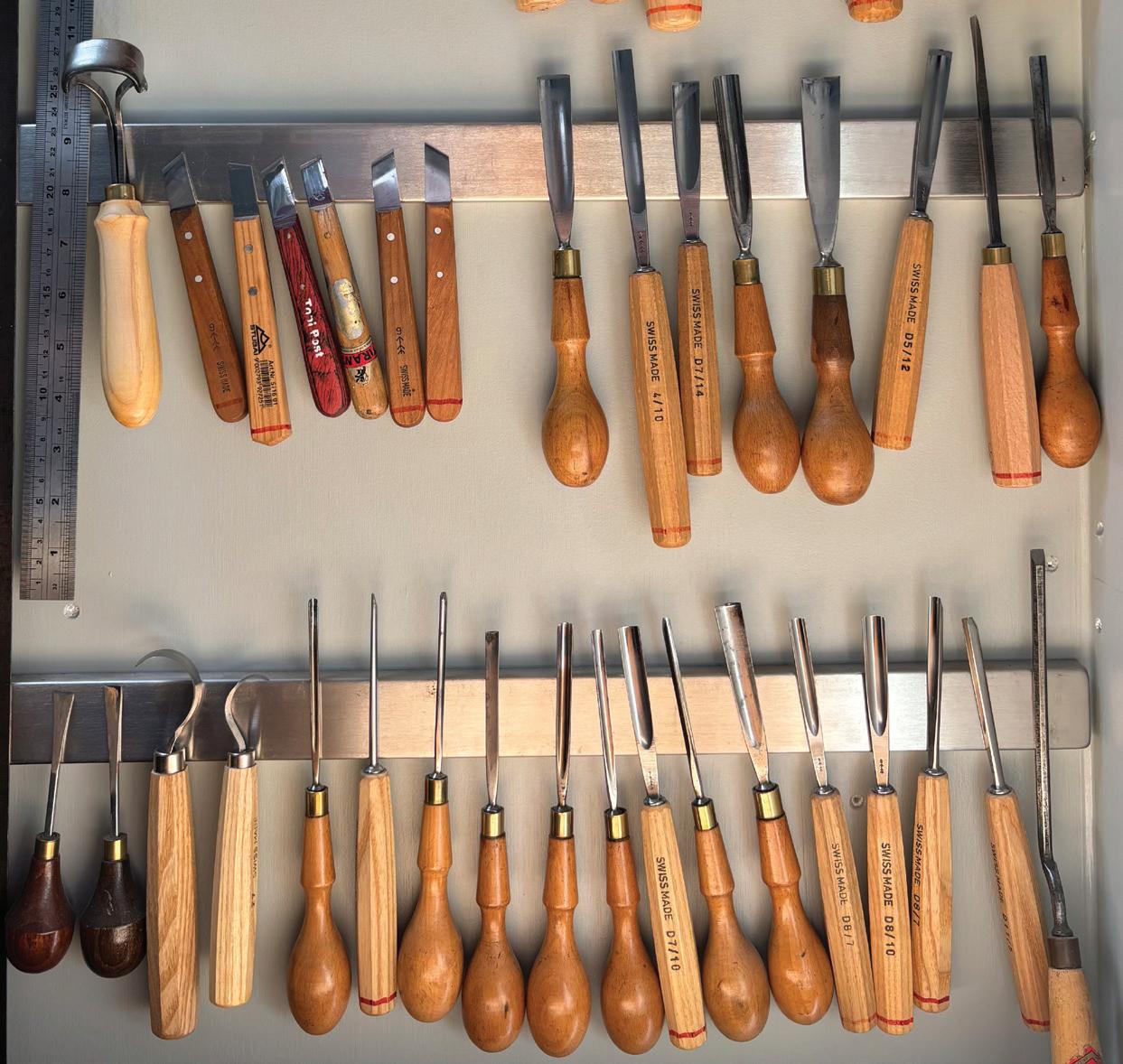
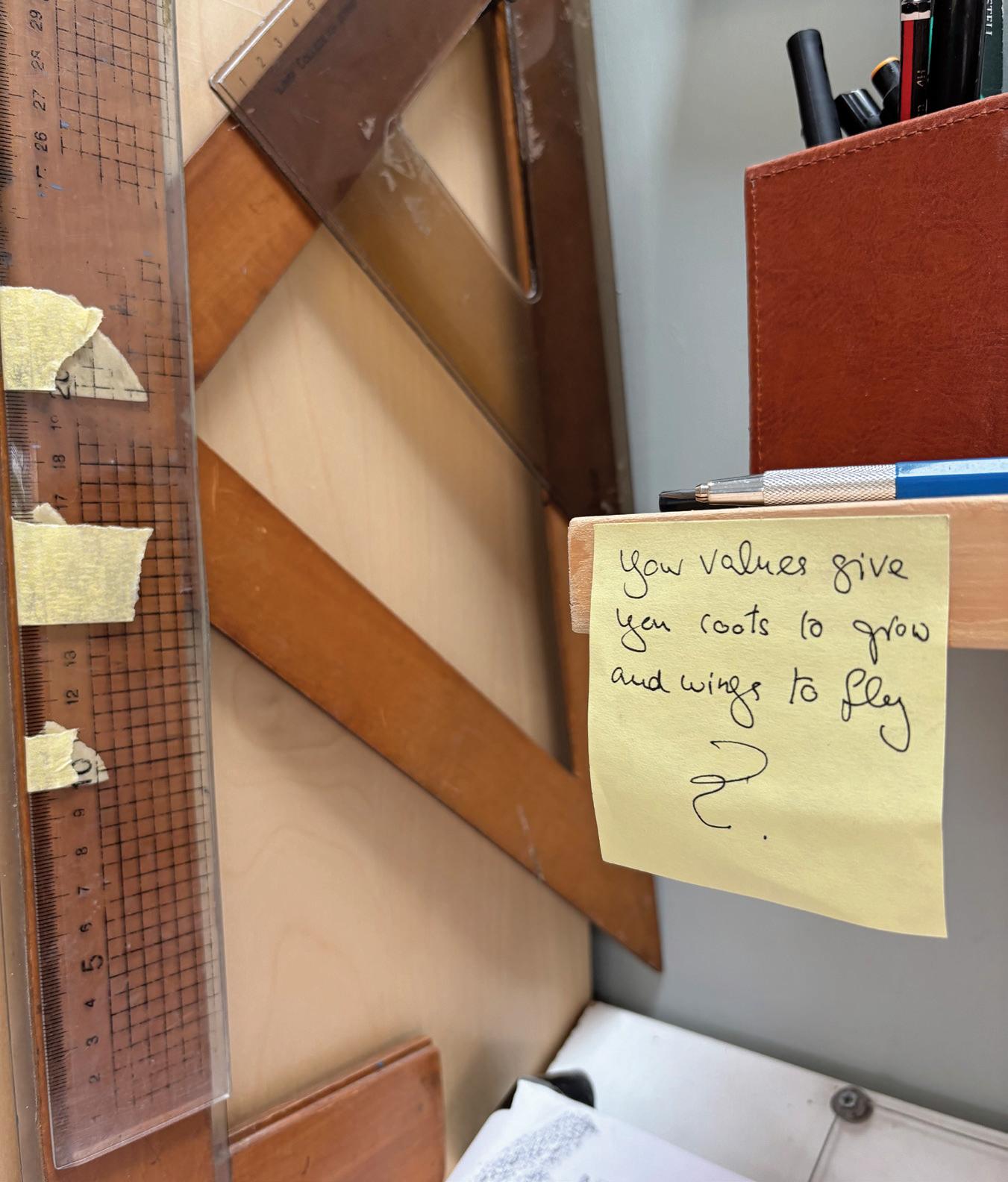
MAG n E t I c kn I f E S t RI p S H o LD M y c HISELS A n D MA k E GREA t p I n B o ARDS fo R DRA w I n GS , rubbings, and ideas. I still have my old selfmade drawing board with a parallel ruler—a large, laminated board (discarded when a friend got a new kitchen) which is hinged off the wall with a removable support leg to allow the board to fold back to the wall or use a longer leg to change the angle and height of the drawing board. A sample block of wood with carved lettering lends itself as a footrest with hinges.
Scaffolding planks make great shelves, and old wooden wine boxes are stacked in corners as floor shelves or for holding stone samples. Colorful boxes covered in Japanese paper serve as beautiful storage boxes for all my different art materials. I make things as I need them.
Knowing that I had to make a living as an artist and fully, financially supporting myself was terrifying to start with, but equally, I am tremendously proud of myself for having achieved it. The challenge now is to balance the
commissioned work with giving myself enough time and space to create my exploratory, speculative work. And of course, there are the other time-demanding parts of running your own business like keeping your books, admin, website, etc.—but let’s not talk about those!
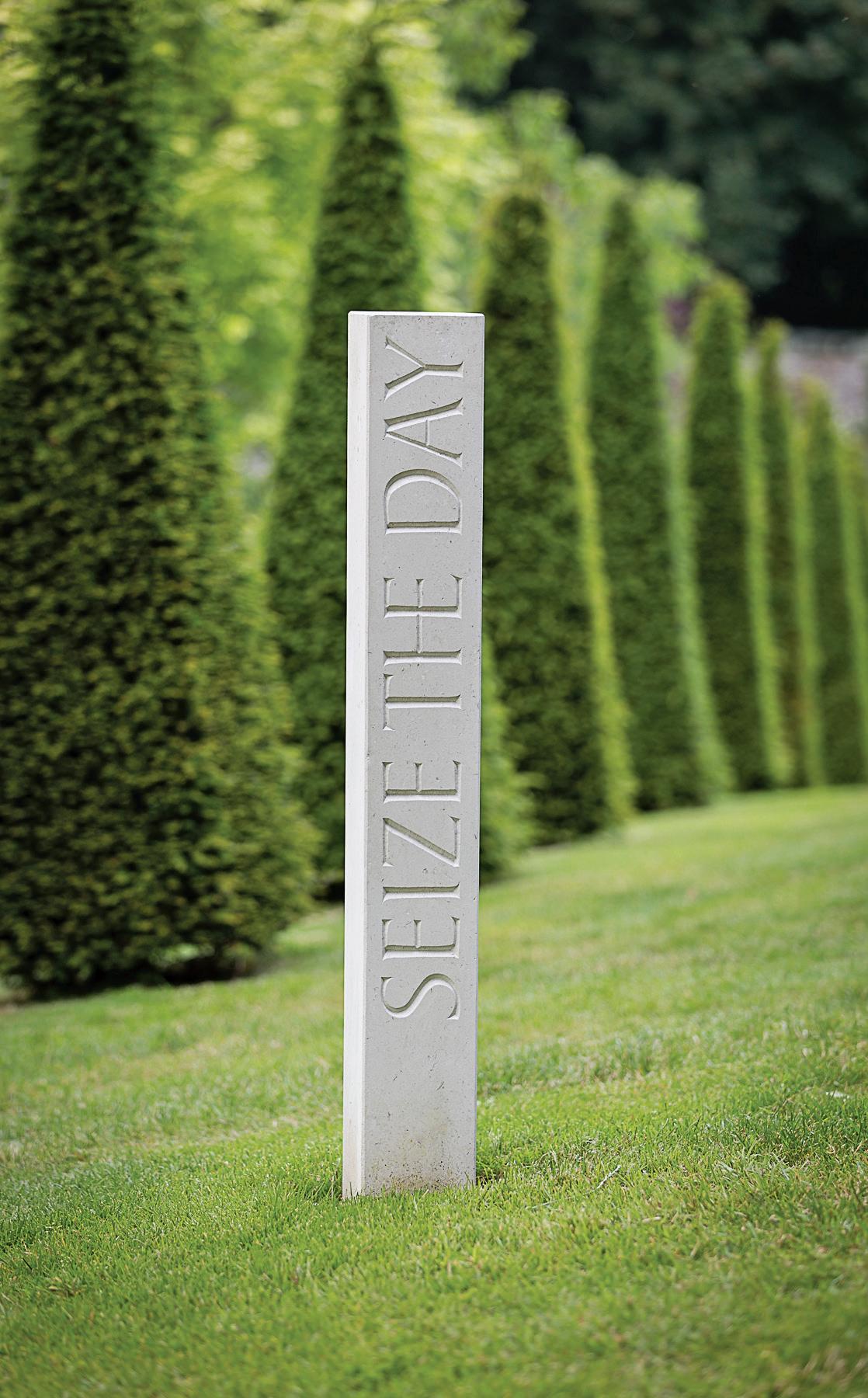
As touched on above, it is not the medium that fascinates me but the subject, lettering. There are really two parts to my practice. First, the old traditional craft of letter carving in stone and wood; and second, free abstract asemic writing. Both are slow, gentle, personal, and made by the human hand. I love the process from hand-drawing the design to carving lettering with a chisel and mallet. Being the first person to cut into a piece of stone or slate that is millions of years old, feeling the grain and resistance of wood, and gently teasing the material out to create something beautiful and meaningful is a process that I find deeply gratifying. A machine will never be able to give that same feeling to a piece. It is the human touch that makes it alive, unique, and attractive.
The great thing about this job is that no two commissions are the same. I hand-draw and carve lettering for garden sculptures, commemorative pieces, public art, house names, memorials/headstones, and sculptural pieces to go on the mantelpiece. I get to work closely with the clients, and together we create something very special, personal, and unique. It is the journey I particularly enjoy. I feel very lucky that I get to create something which will be around for a very long time, well after we have gone, that will be enjoyed by many. It does not matter whether the piece is for the curator of the British Museum, the Dean of Windsor Castle, a famous artist, or the local thatcher. Anyone who comes through my workshop door is the same—we want to make something beautiful together.
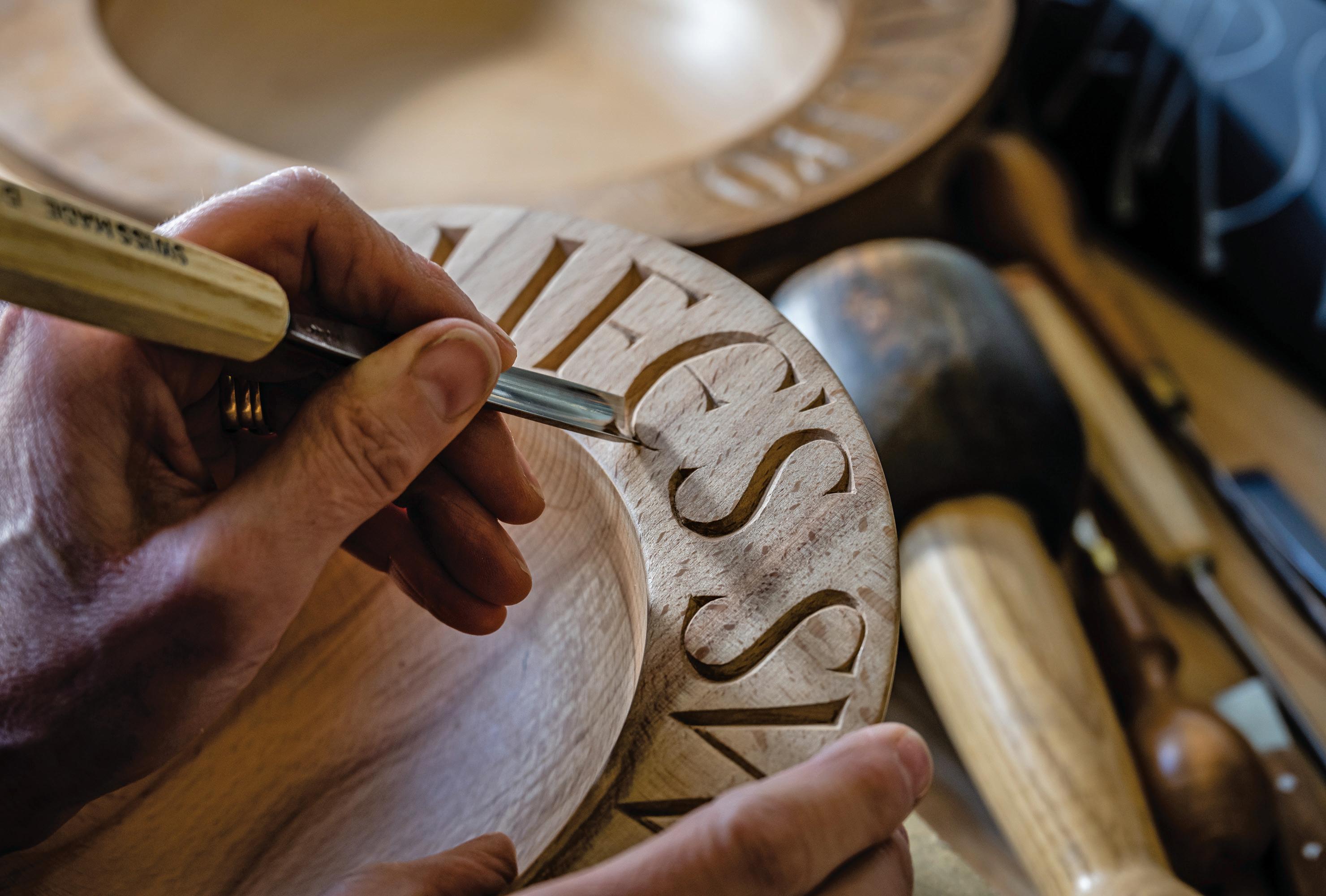
“MARcEt SInE ADvERSARIo vIRtuS”
—I interpret this as ‘keep challenging yourself’ (carved wooden walnut bowl) The Latin phrase “marcet sine adversario virtus” (Seneca the Younger, De Providentia 2:4) is often translated as “valor becomes feeble without an opponent” and means that a person’s courage or strength weakens and diminishes without challenges or adversity to test and exercise it. It suggests that true virtue and strength are developed and maintained through struggle and opposition.
ILovE woRkInG wItH pEopLE, But BEInG A MAkER, I ALSo LovE BEInG In My own SpAcE, tAppInG AwAy, BEInG allowed to create.
The other side of my practice is abstract asemic writing, which, to me, is where the viewer can communicate just with themselves. I want to give the viewer an opportunity to have a private and personal experience with a text—a message to themselves. The artist does not impose their words. The shapes are not characters as we expect or as we are used to in traditional forms of writing. It is down to the viewer to interpret what they see in the text and what they want to “read,” just as they would do if viewing an abstract work of art.
This work of mine is influenced by all the different international writing systems. The mark-making is so varied, but the aim is still the same—communication.
Asemic writing removes the differences between languages, writing systems, the reader’s culture, background, and their intellectual ability. For once, we are all the same. The ultimate power of art: a language without words!
Iw
AS A w ARDED A Qu EE n E LISABE t H
Sc H o LARSHI p (QES t, t HE RoyAL
wARRA nt Ho LDER ’ S S c H o LARSHI p), AM an elected member of the Master Carvers Association, as well as an elected member, and now Trustee, of the Lettering Arts Trust— organizations which devote themselves to keeping the old craft of carving, whether in wood or in stone, alive.
I love working with people and inspiring them. Having established myself in designing and carving letters in stone and slate, I now pass on my knowledge by teaching letter carving at the Traditional Craft Centre at Highgrove, which is part of the King’s Foundation. A foundation which, 35 years ago, was set up by the King to pass on and preserve old British crafts. I run short courses for the public and am also involved in teaching their foundation and building arts students.
To bridge the gap between short courses and full apprenticeships, I have just set up a twoyear part-time diploma course which will start in 2026 at West Dean College—I am particularly excited about this.
I have also spent time working in a trauma special needs school as the resident artist, creating and printing “abstract” writing and mark-making works with the children. Hugely rewarding!
My life experiences, combined with the respect and care I have for my tools, materials, and working environment, have given me the confidence to push the boundaries of my own abilities. I value the opportunity for the continuous challenge as it dynamically moves my work and life forward. I am very fortunate that my work is my passion and that passion has accompanied me through my different chapters of life.
Curator ISABELLE fISH is a craft ambassador and founder of The Club, by Rue Pigalle, a membership-based community for women patrons of craft. She shares: “I believe in the intrinsic value of manual intelligence, and in the important role that artisans play in their communities. Nurturing craftspeople helps create a kinder and more connected society.”
NICOLLE ASTON
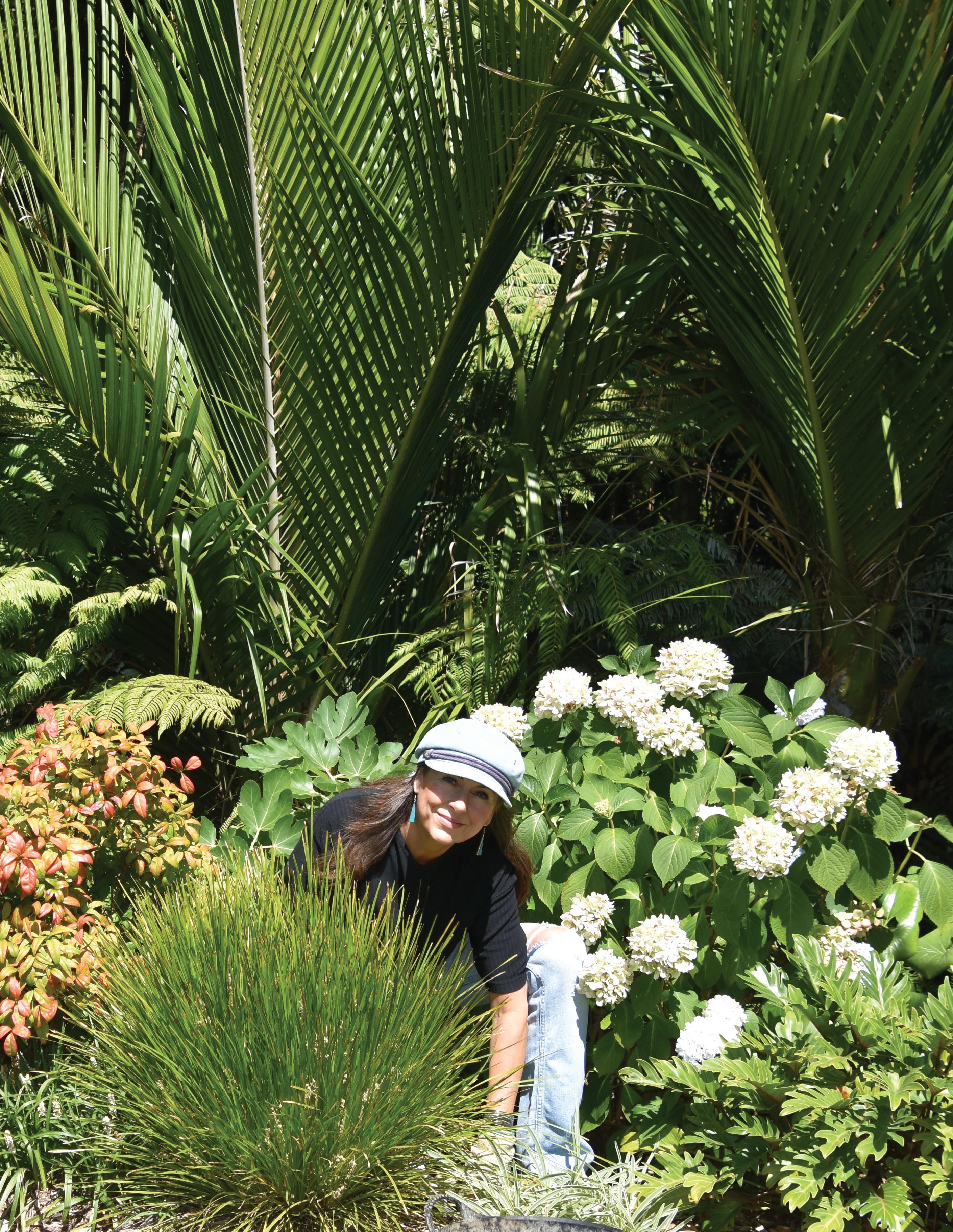
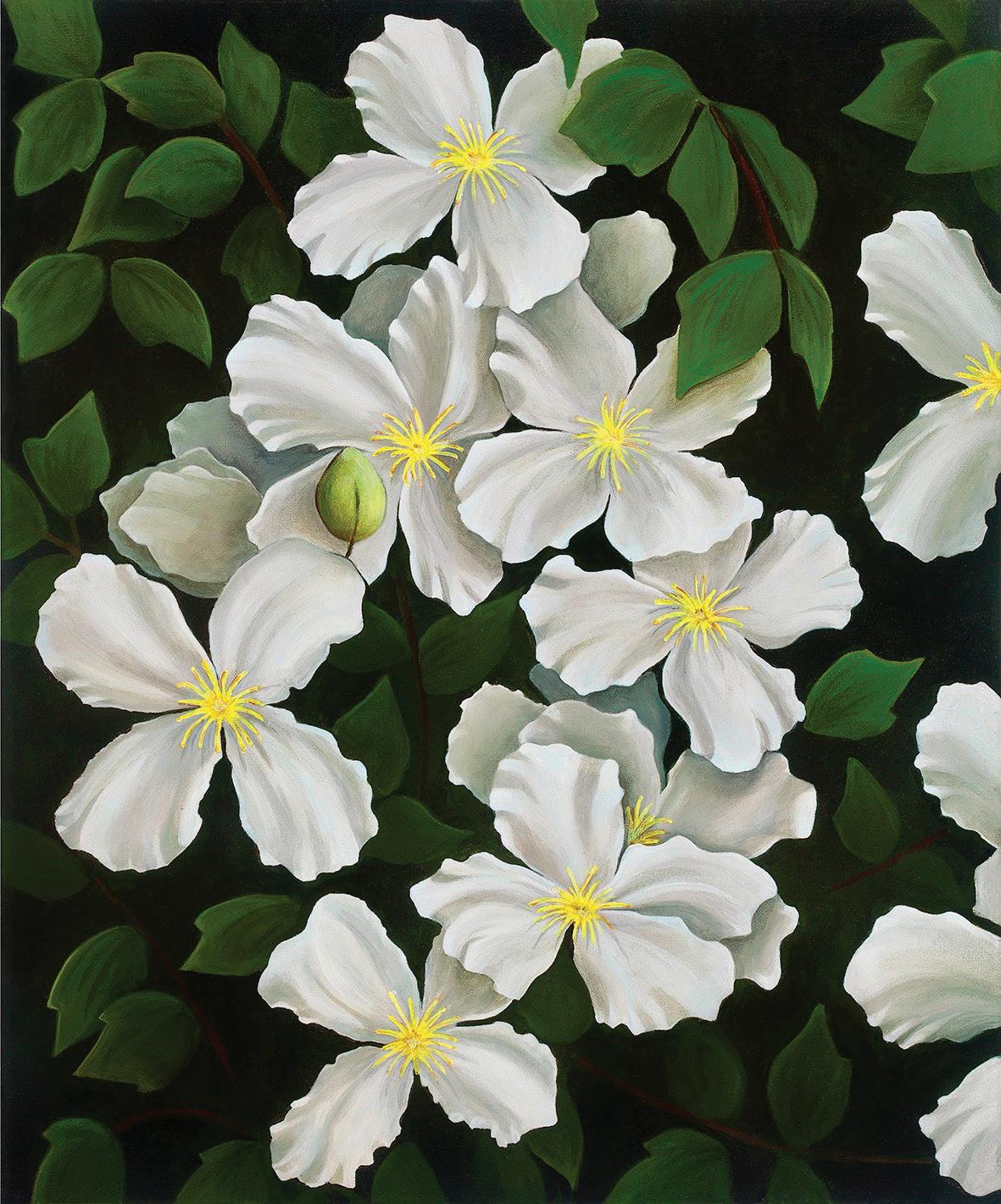
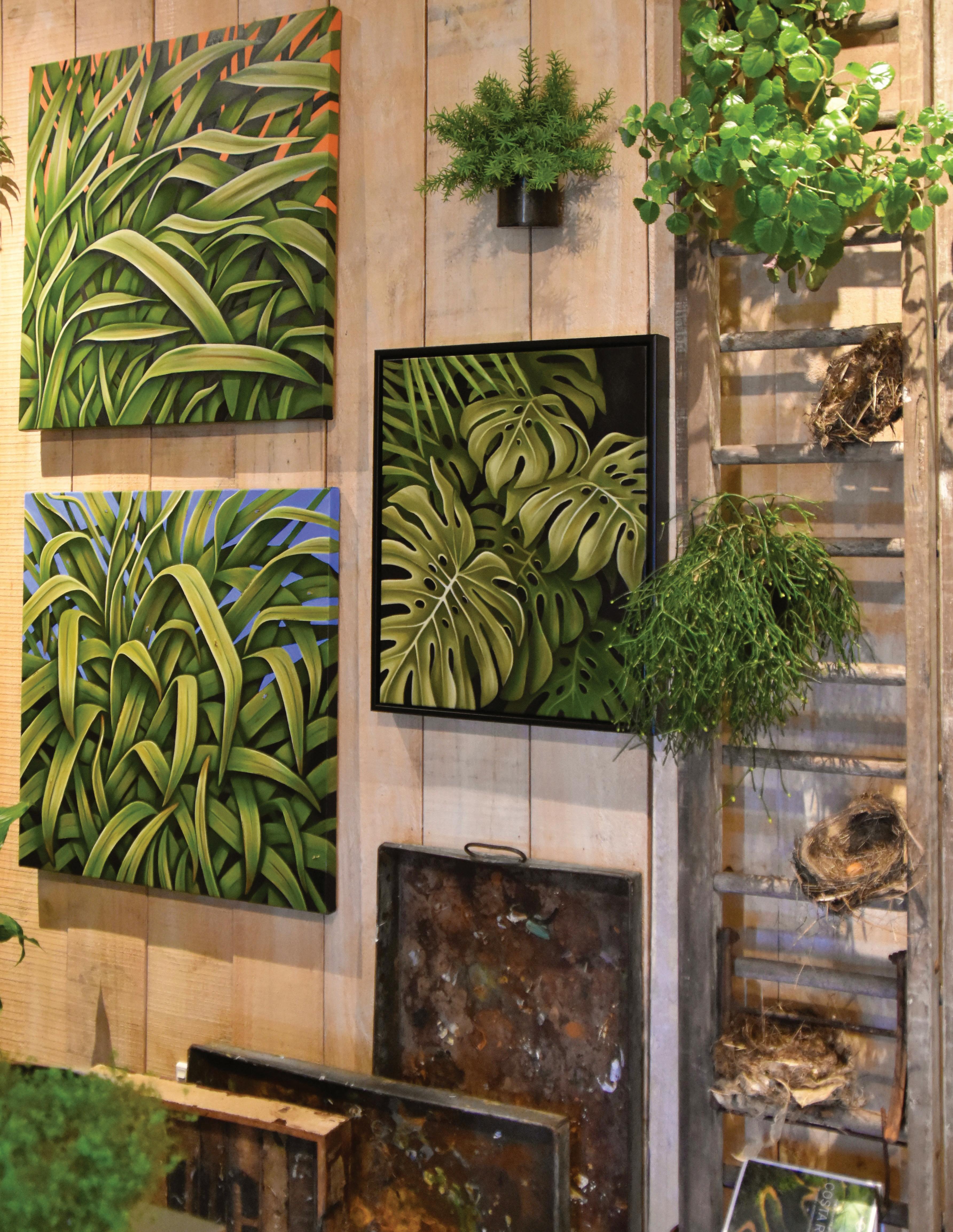
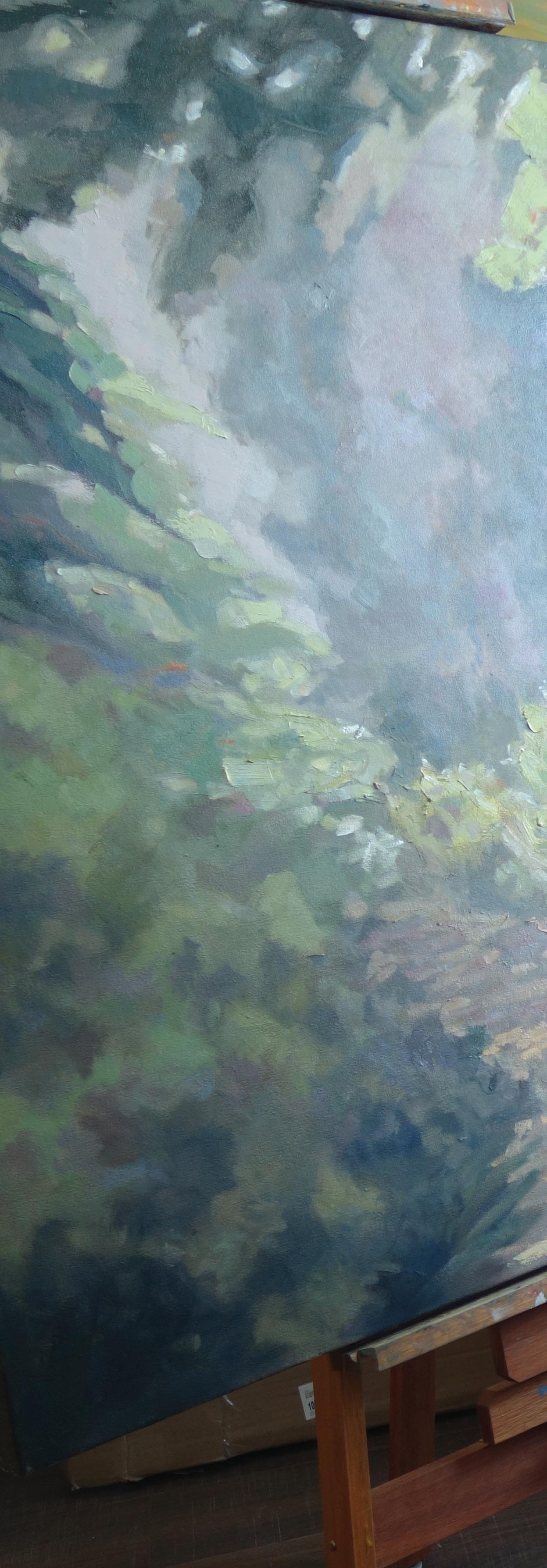
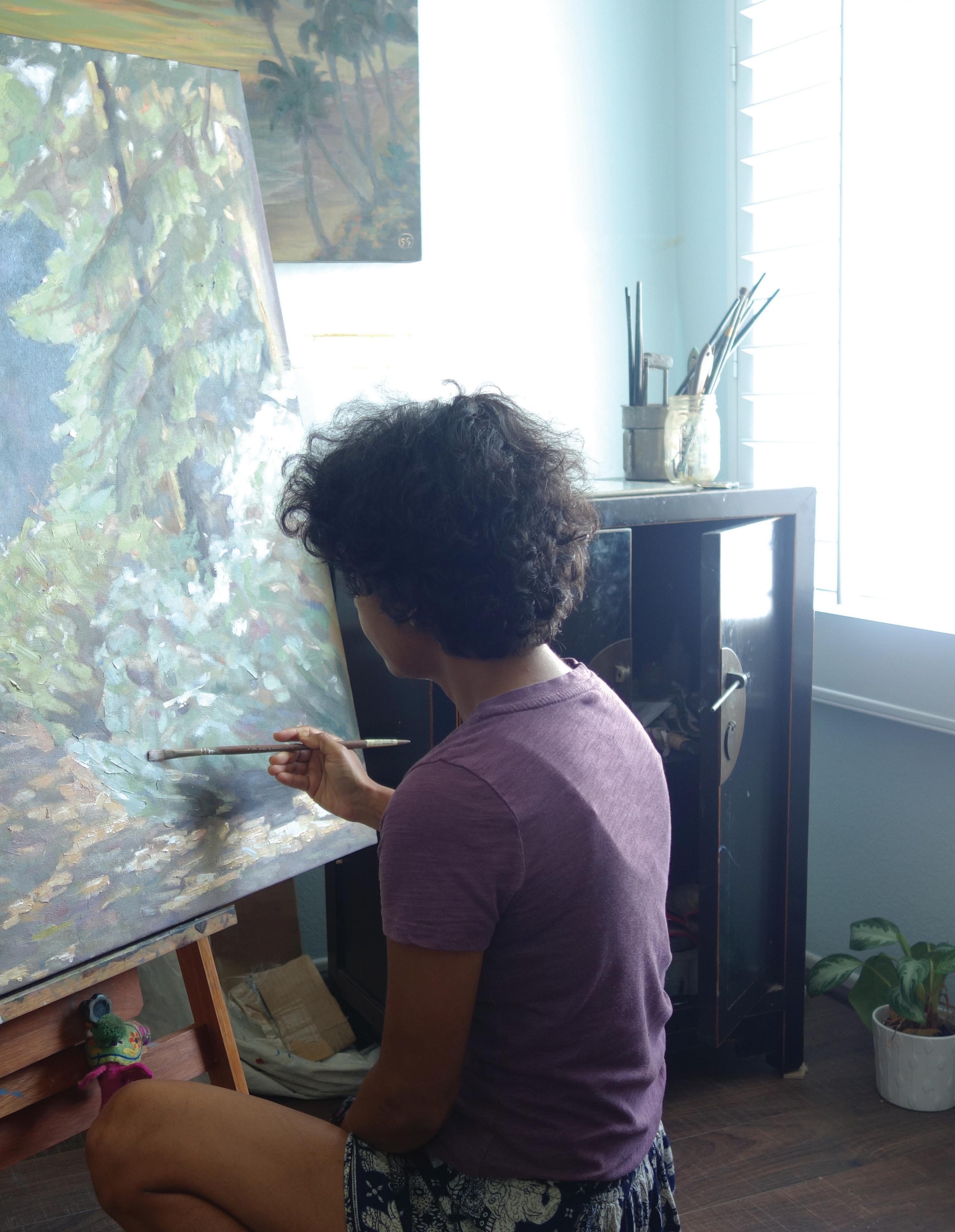
Grounded in a lifelong love of gardens and wild landscapes, NICOLLE ASTON paints the lush, layered energy of nature. From her studio beneath Mount Tamahunga, she transforms botanical forms into intimate, vibrant compositions. Her work merges realism and stylized simplicity, inviting viewers into dreamlike landscapes where memory and imagination intertwine. Every canvas reflects a deep reverence for the living world, capturing its quiet wonder, intricate beauty, and the pulse of life that surrounds us.
Life and art... I love them both.
I am a painter dedicated to celebrating all things natural and botanical. My mission is to create lively artworks for open hearts, so we can share the love of nature together.
My studio is situated in the foothills of Mount Tamahunga, in the beautiful Matakana Valley, where streams trickle over sandstone and the native forest rings with birdsong.
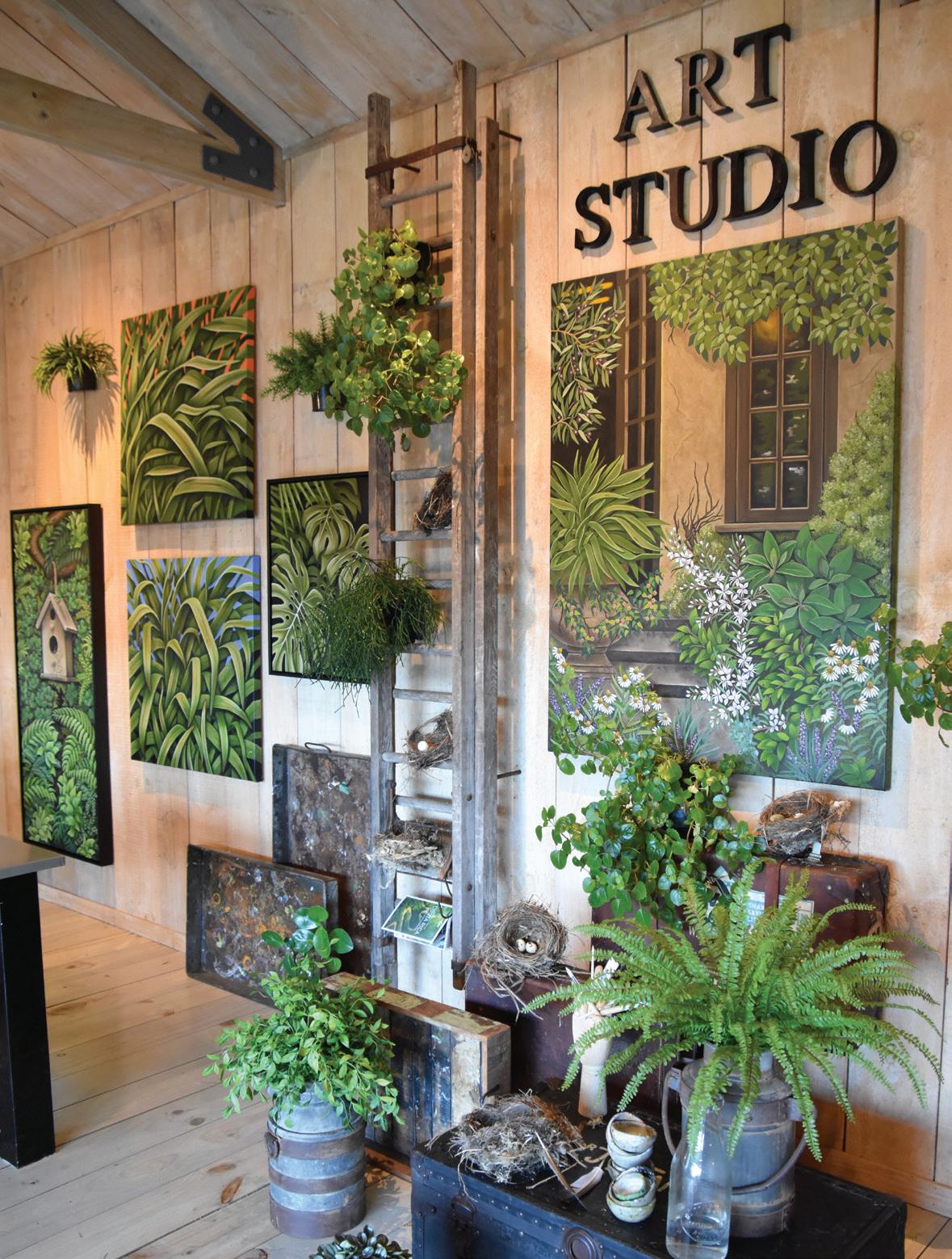
The studio sits at the rear of the garden, sheltered, serene, and deeply in tune with its surroundings. Step inside, and the space opens into something far more intimate: a sanctuary where my imagination and the living pulse of nature converge on canvas.
My artwork is inspired by a lifelong love of gardens, glades, rainforests, meadows—all things green, lush, tangled, and alive.
I have always loved the vibrational energy of plants. I enjoy painting moody botanicals, jungle leaves, natives, pods, blooms, and berries.
My childhood was spent playing in large steamy greenhouses full of ferns, palms, and house plants. I still remember the deliciously earthy smell and hushed feeling of those spaces, where delicate maiden hair ferns and vibrant green mosses would naturalize wherever they could find the light and water droplets made the plinking sound of tiny chimes.
Nature’s layers of green energize me, and every cell in my body awakens in these environments—it is this feeling that I try to capture with my artwork.
My parents always directed my attention toward the natural world. They often took my brother and I hiking on nature trails around New Zealand, where my mother would spend much of the time marvelling aloud at the magnificence of a wild orchid, or the shape of a mushroom, or the amazing colors of intricate mosses, as if she had discovered a secret kingdom at every turn. These are some of our favorite shared memories.
Some of the first “big” words I learned as a child were the Latin and botanical names of the shrubs growing outside my bedroom window.
In time, a love of horticulture bloomed. My mother worked in a garden center, my uncle tended acres of greenhouses containing new seedlings, my grandmother, Elsie, owned a florist shop, and my great-grandmother, Mary Priscilla, grew blooms and vegetables to share from her roadside stall during the World War and the Great Depression. Nature, nurture, and growth were woven into my earliest experiences—and continue to inspire my life today.
Over the years, I have developed several acres of garden, and my studio sits in lush surroundings under a majestic weeping willow tree. What makes this place extra special to me is the peaceful setting. My studio and garden are situated on the very edge of the vast Tamahunga ecological area in the north island of New Zealand, with its waterfalls, ancient boulders, and abundant bird life. While I don’t paint birds, I love to photograph them. The garden is brimming with wildlife. Mount Tamahunga is a taraire-dominated forest— providing an important food supply for the native kereru (wood pigeon). Mount Tamahunga holds cultural and spiritual significance to the Māori, with its ancestral connections and distinctive double peaks reaching over 1,400 feet. My garden sits at the base of this mountain and feels beautifully sheltered by its presence.
When I first moved into the studio, I imagined a space that was minimal, open, and bright—clean and crisp, almost like the austere atmosphere of a gallery. Needless to say, that vision didn’t last long. I love character-filled
spaces, and as often happens with places we love, my personal imprint quietly crept in. I quickly realized how fortunate I was to have a studio that was entirely my own domain, and the space began to tell my story.
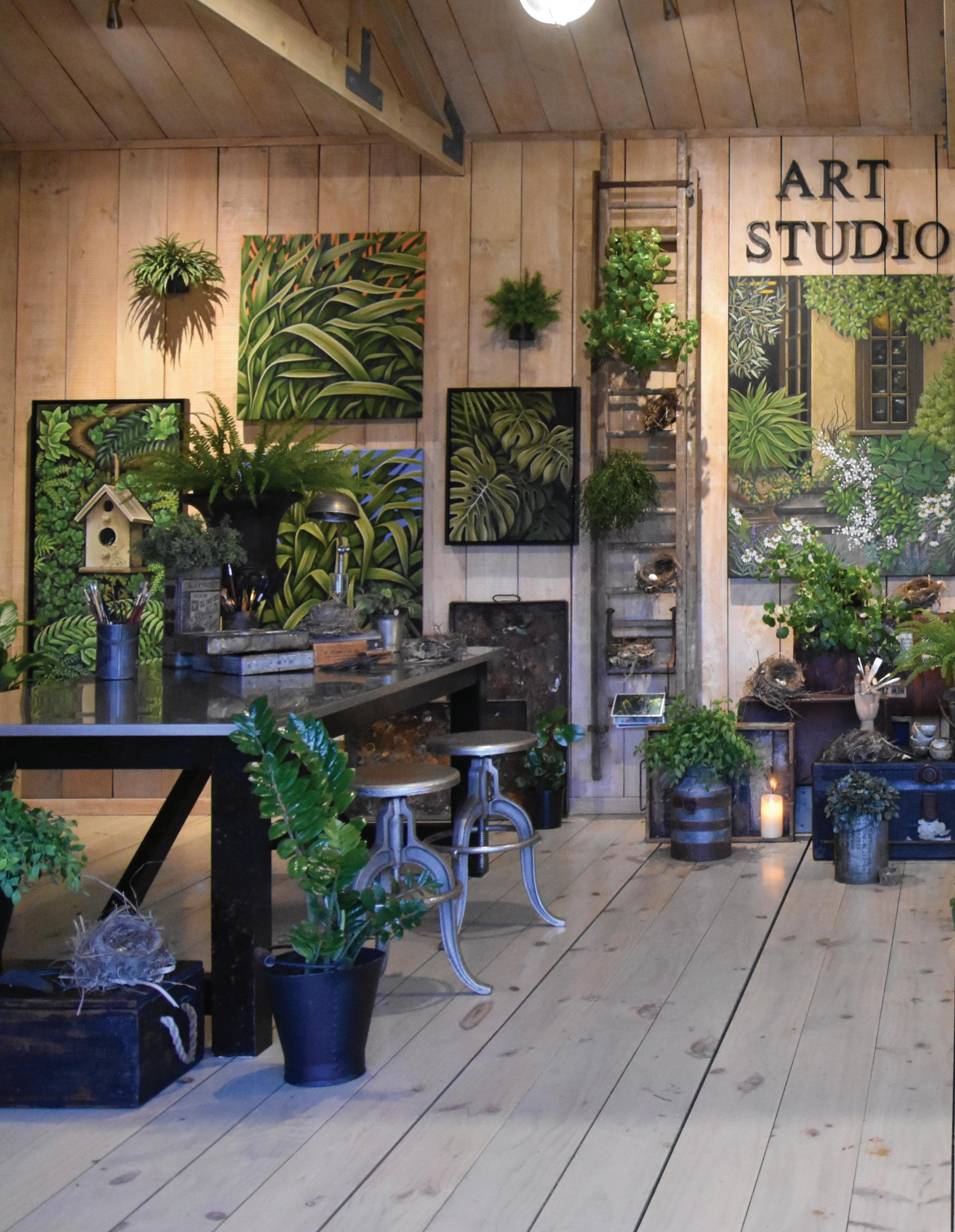
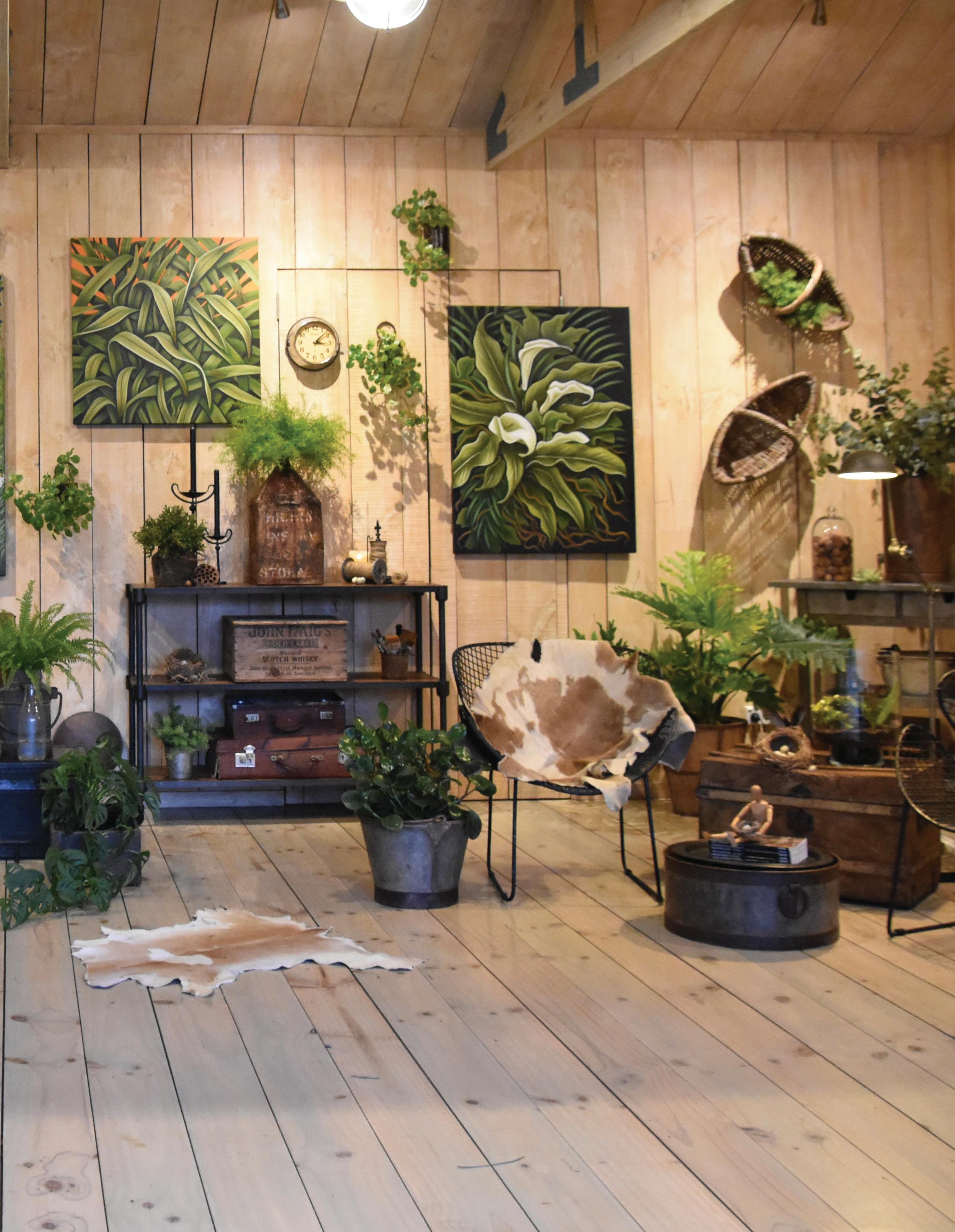
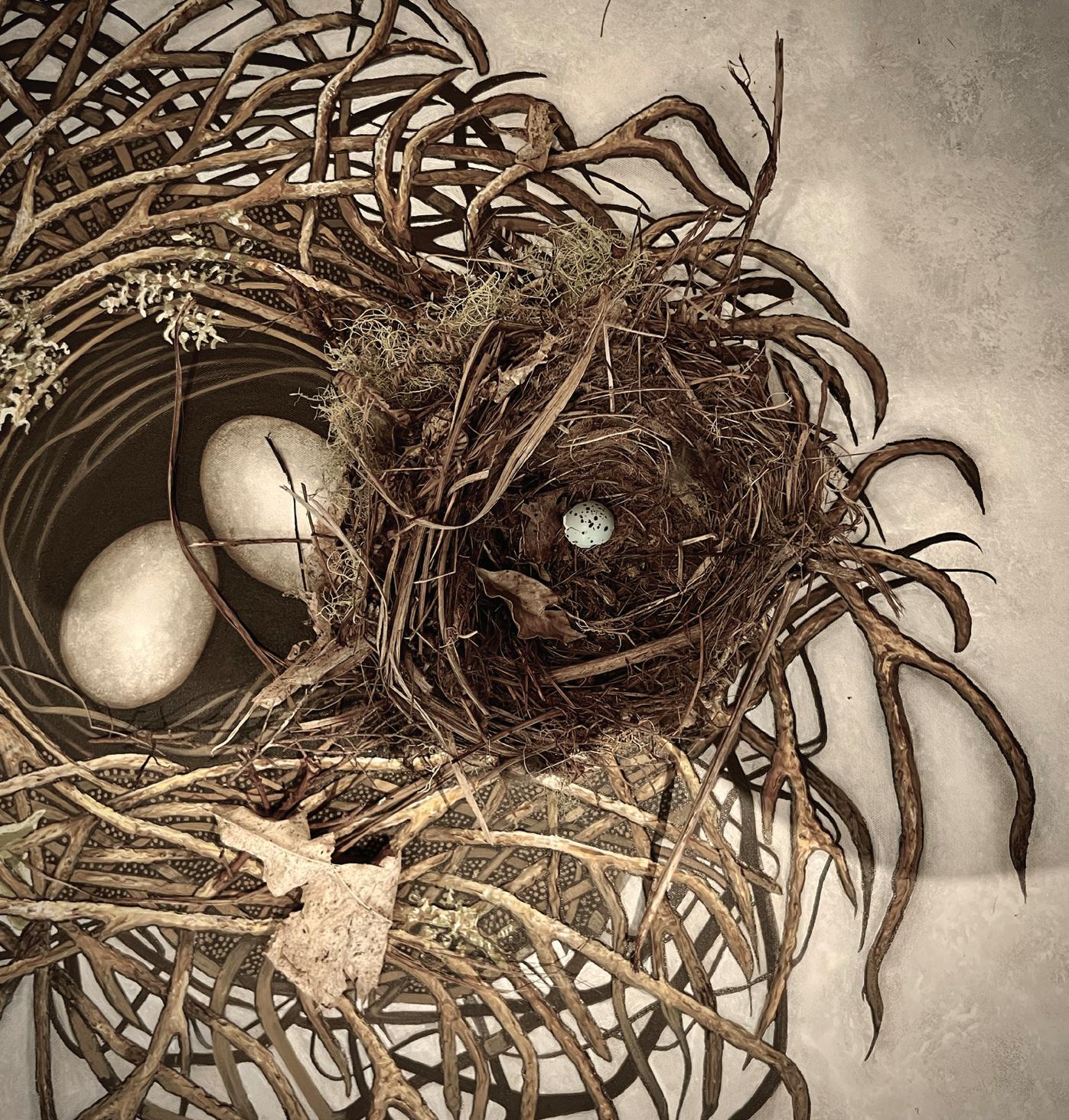
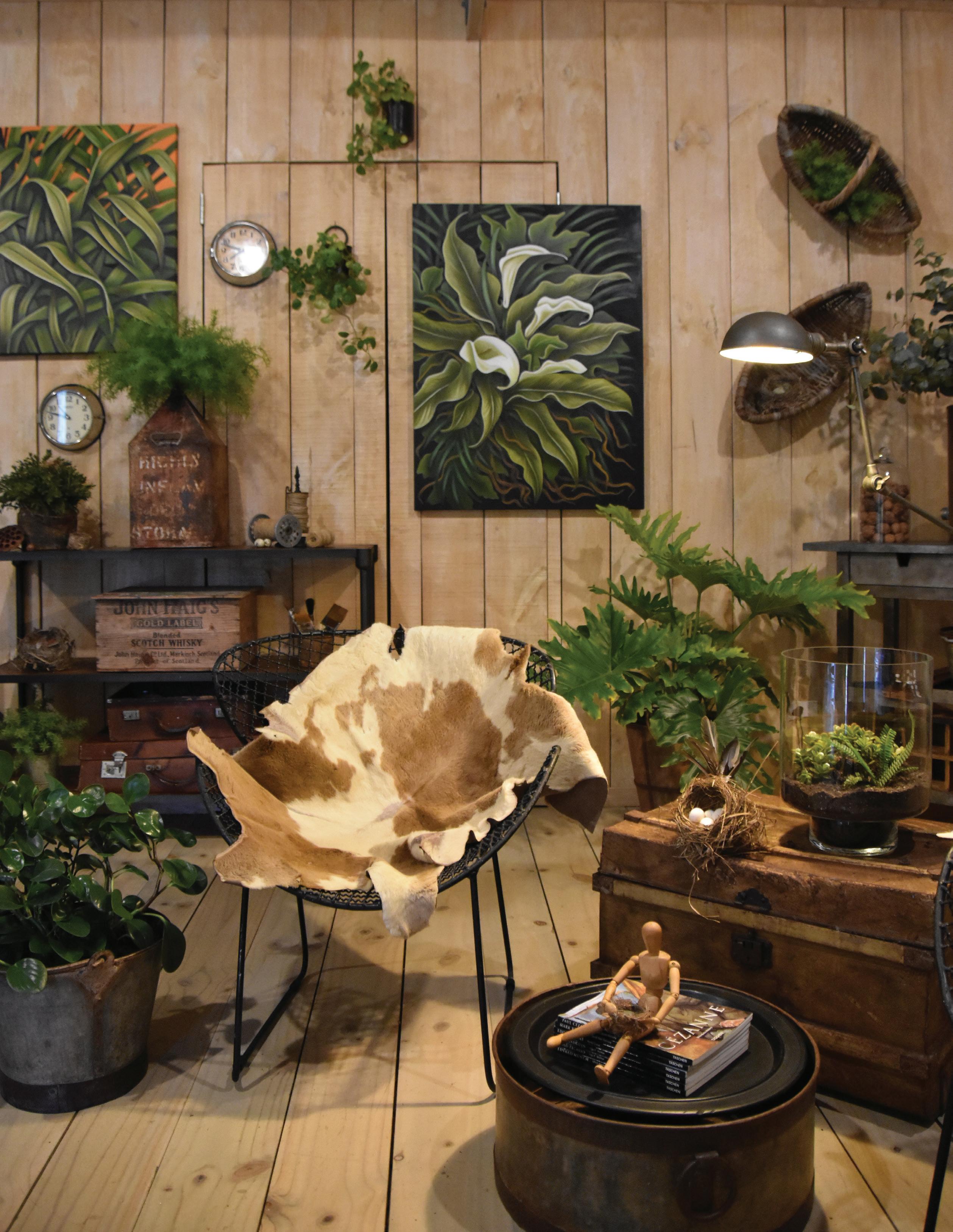
My love of house plants transformed corners into little green sanctuaries and my favorite objects found their way onto shelves: my grandmother’s old floristry scissors, her leather school satchel from 1919, old suitcases and travel trunks house my painting supplies, a collection of bird’s nests and feathers found over the years, scented candles and my love of aromatherapy, my father’s old paintbrushes, a precious handmade trinket box my brother gave me after his travels abroad, all have made their way into the studio. What started as a spacious gallery-like studio became a living, breathing reflection of who I am—a balance of creativity and the small treasures that make a space feel like a sanctuary. The studio is now an altogether peaceful and personal space, and I spend most of my working day (and many summer evenings) in here.
Ibegan painting from a desire to fill my home with original works of art. Art, for me, is more than aesthetics. It’s an invitation to slow down, and to reconnect with the wonder that exists beyond our screens and routines. When we live fast-paced lives with our eyes on our digital devices, or we are swept along in our momentum to be somewhere or be someone, we can forget to stop, breathe, and look around at nature’s miracles and magnificence. Regardless of the chaos we humans can create for ourselves, the spectacle of nature continues on around us. And when all else has come and gone in our lives, nature is still there to comfort and replenish us.
We are surrounded by the mass-produced, the manufactured, the disposables, the digitally enhanced, the AI-generated, the devices, and the instantaneous. Anything original, one of a kind, or handmade with care holds the energy of the maker.
We can be uplifted by the beauty that surrounds us, even in the most ordinary of circumstances. I aim to bring the energy of nature indoors to sharpen our senses and serve as a reminder that life is colorful, complex, layered, delicate, and beautiful.
I value peace and quiet. I see visual art as a way to communicate without words and noise. Each painting has a story, from concept to completion. The excitement of the initial sketch, the concentration, the layers, the long, solitary hours in the studio, and the immense patience each piece demands give painting an intrinsic value to me.
“Tell me, what is it you plan to do with your one wild and precious life?”
—MARY OLIVER
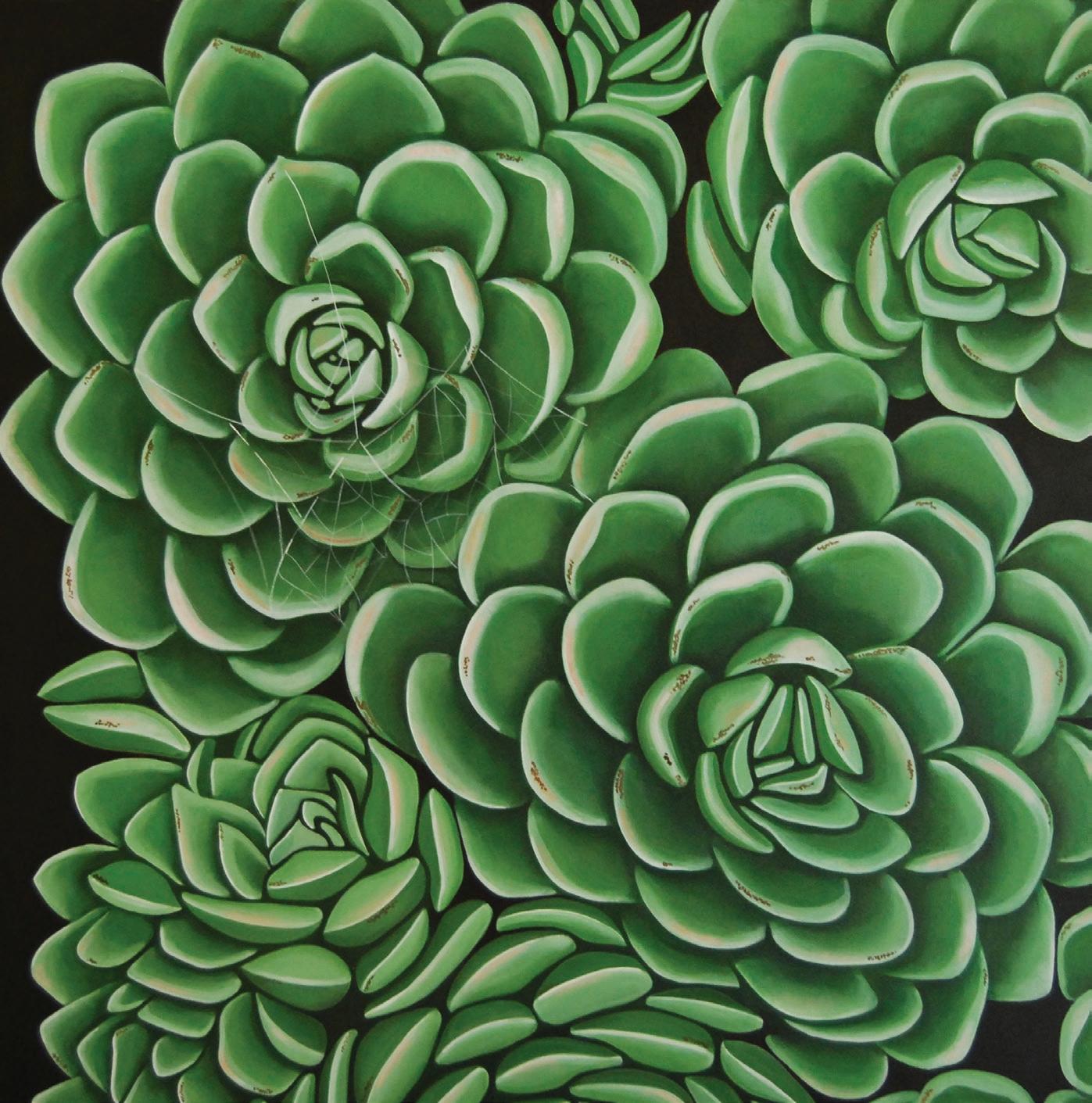
My signature style is a combination of realism and stylism—with exaggerated simplicity. I deliberately avoid the fine detail realism requires, placing more emphasis on shape, form, and the play of light.
I’m very excited to embark on a new series called Beyond. These works will be painted on large-scale canvases and feature lush garden compositions that invite viewers into dreamlike landscapes where memory and fantasy intertwine. Six canvases have just arrived on this morning’s courier, and I am itching to unpack them and begin painting.
This new work will explore the emotional imprint of nature. I want to paint the essence and atmosphere of a place I’ve never truly seen but somehow deeply know. I want to create compositions that feel both intimate and expansive, and evoke the quiet wonder of remembered places, half-imagined, half-felt. Places not bound by geography or time, but born from a lingering memory, a felt sense, and the longing we feel for more connection to the natural world in our daily lives.
Tabby Booth
Photography by Imogen Rosemary
Although TABBY BOOTH studied illustration at Central Saint Martins in London, it would be another ten years before she returned to her own art. It wasn’t until a move to Cornwall, and the “accidental” opening of an art gallery with her husband, that everything began to change.
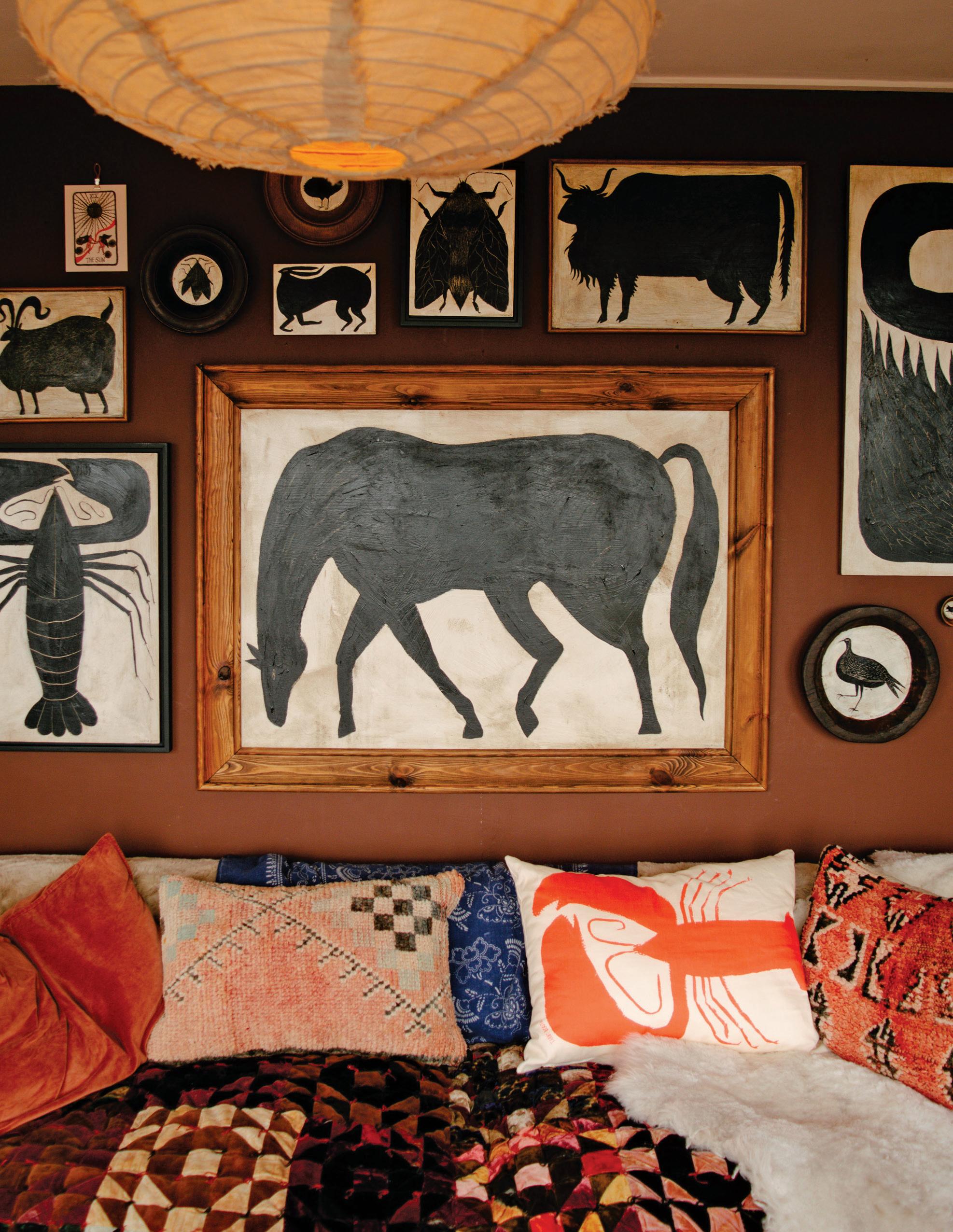
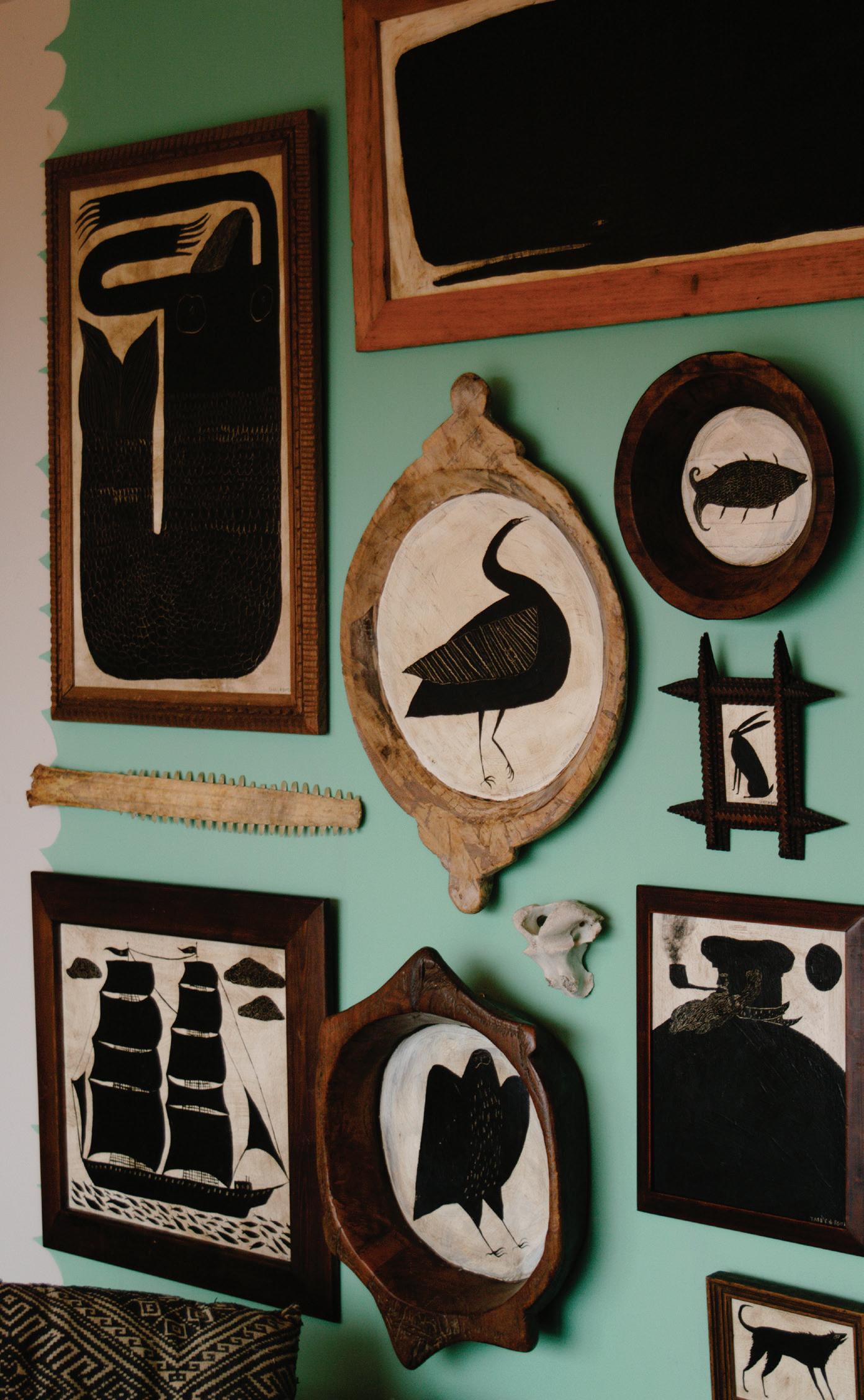
Now known for her signature silhouette, Tabby’s work treads a captivating parallel between illustration and traditional folk art painting. With a passion for interiors, each piece is designed with this in mind, threaded with themes of beasts, folklore, and the sea.
I often think about the serendipity of how I ended up here. What seemed like a random series of events and decisions somehow led me—quite unexpectedly—to making a living from my dream job. Let me take you back to the beginning.
I never wanted to be anything but an artist. Even as a young child, I was always creating, and there was never any question about what I would do. I studied illustration at Central Saint Martins in London, but after graduating, I quickly became disillusioned with the idea of being a commercial illustrator.
During university, I met my husband, Hessy. After graduating, we were living on a boat just outside London when we decided to open a children’s art school. It felt like a practical way to earn a reliable income while giving ourselves time to pursue our own creative work.
However, the business grew into something far bigger than we’d imagined. Ten years later, we had 30 branches across the country. Between running a business of that scale and raising our two children, there was no time left for our own art.
I missed creating deeply, but didn’t know how to find my way back to it. In 2020, we moved to Cornwall and bought a 1970s bungalow by the sea with a large double garage attached. A few years later, in 2023, we were searching for a new space to run our Falmouth art classes when, quite suddenly, a building came up for rent. It turned out to be the original town jail, built in 1666. The moment we stepped inside, we knew it would make an incredible art gallery.
At the time, I was
supposed to be on maternity leave with our second child, but we decided to go for it anyway.
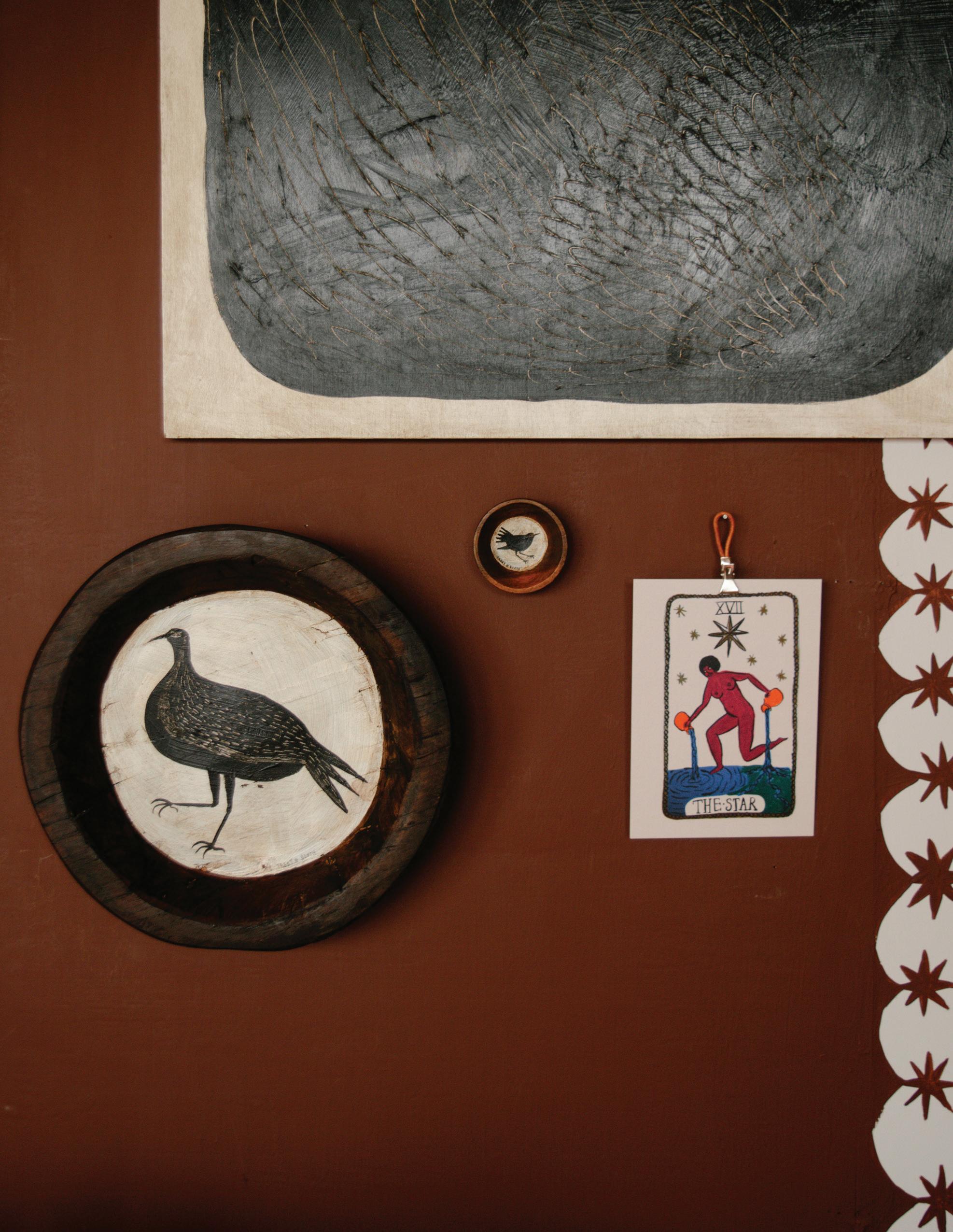
A few months before opening, we had the sudden realization: we should create some of our own work to hang in the gallery. So, we started painting again. I also dug out some old tarot card illustrations I had done years earlier while pregnant with my son, which I made into prints.
To our surprise and joy, the gallery was a huge success, and our own work quickly became some of the most popular. But balancing two businesses with family life was overwhelming. Neither Hessy nor I had a studio, so we took turns painting at the kitchen table in the evenings after the kids were in bed, clearing it all away again before breakfast.
I began dreaming of a space of my own: a real studio with a sea view. One day in August 2024, while having that exact thought, I looked over at
the garage attached to our house. At the time, it was essentially a dumping ground. We decided to convert it.
Hessy built a wall down the middle, taking the back half as his workshop and generously giving me the front half with the incredible sea view. Over the next few months, we transformed it into the small, but perfect, creative space I had always imagined.
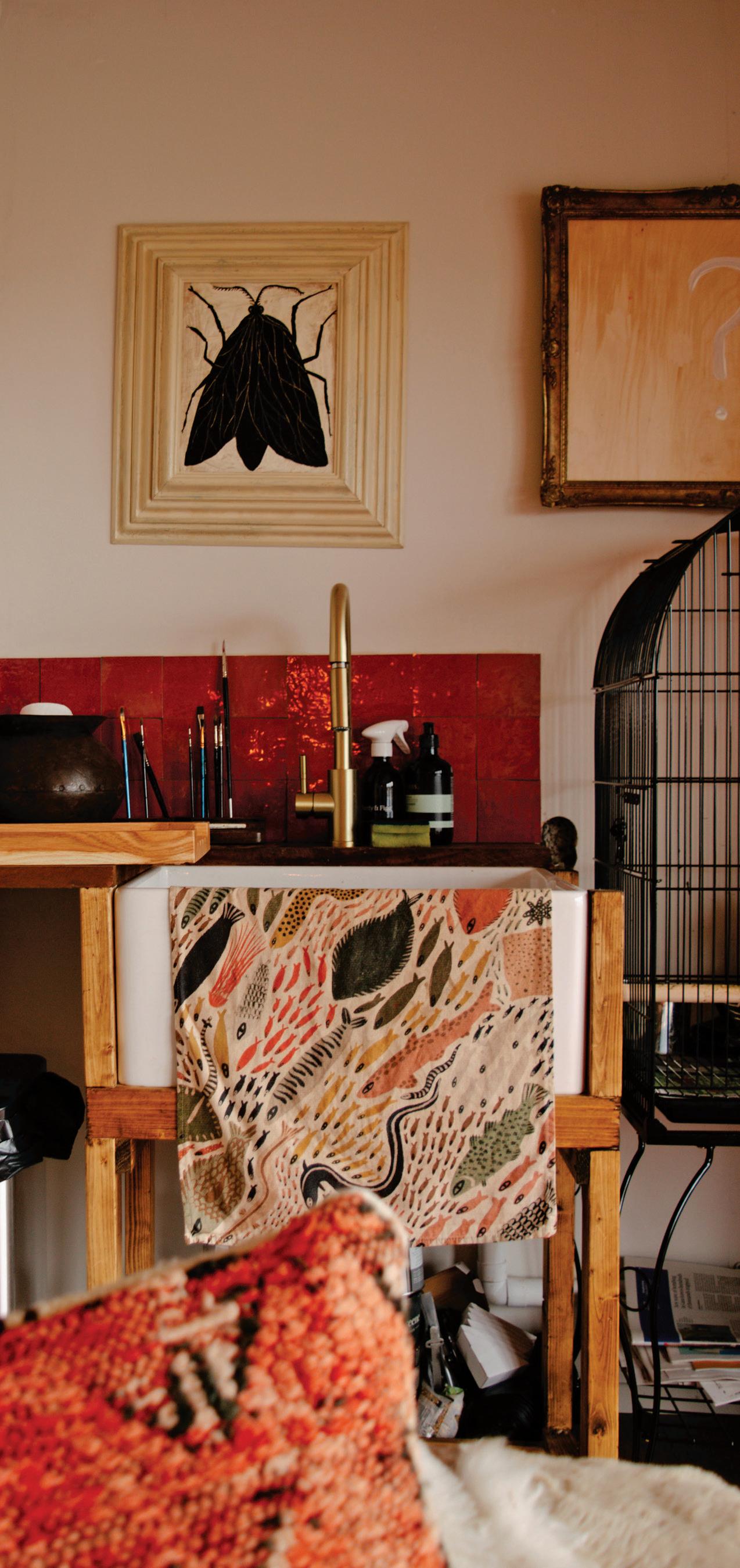
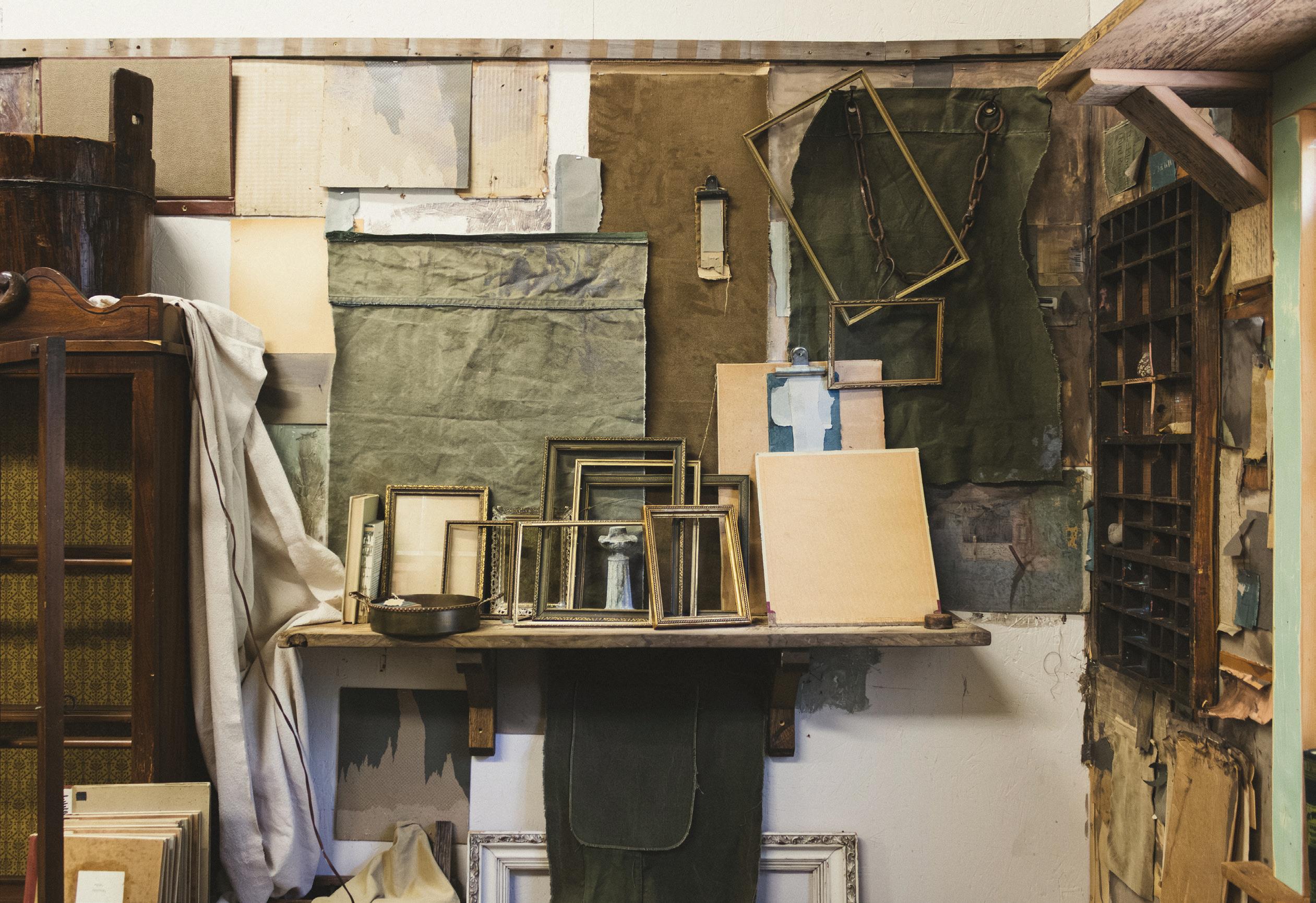
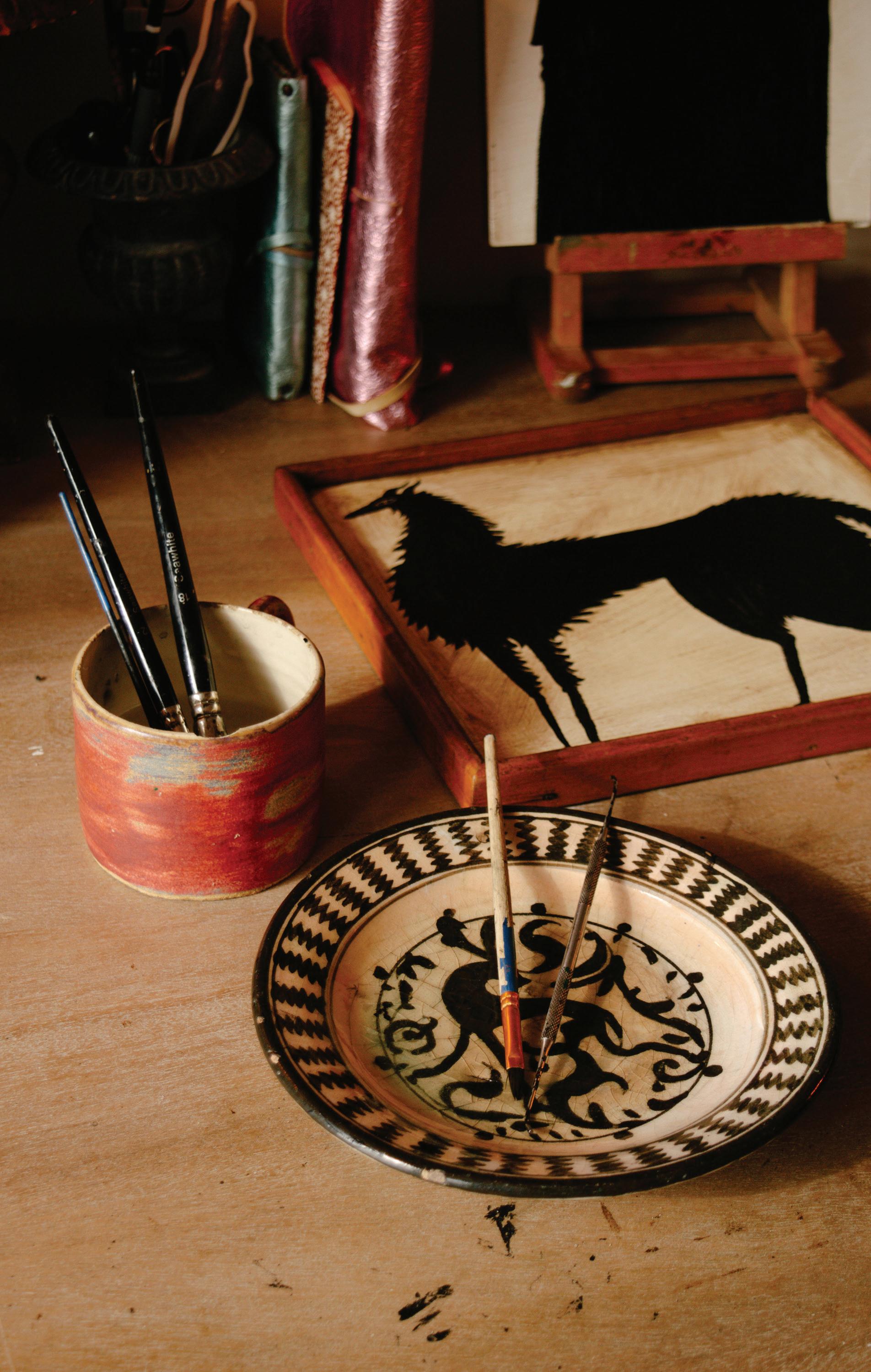
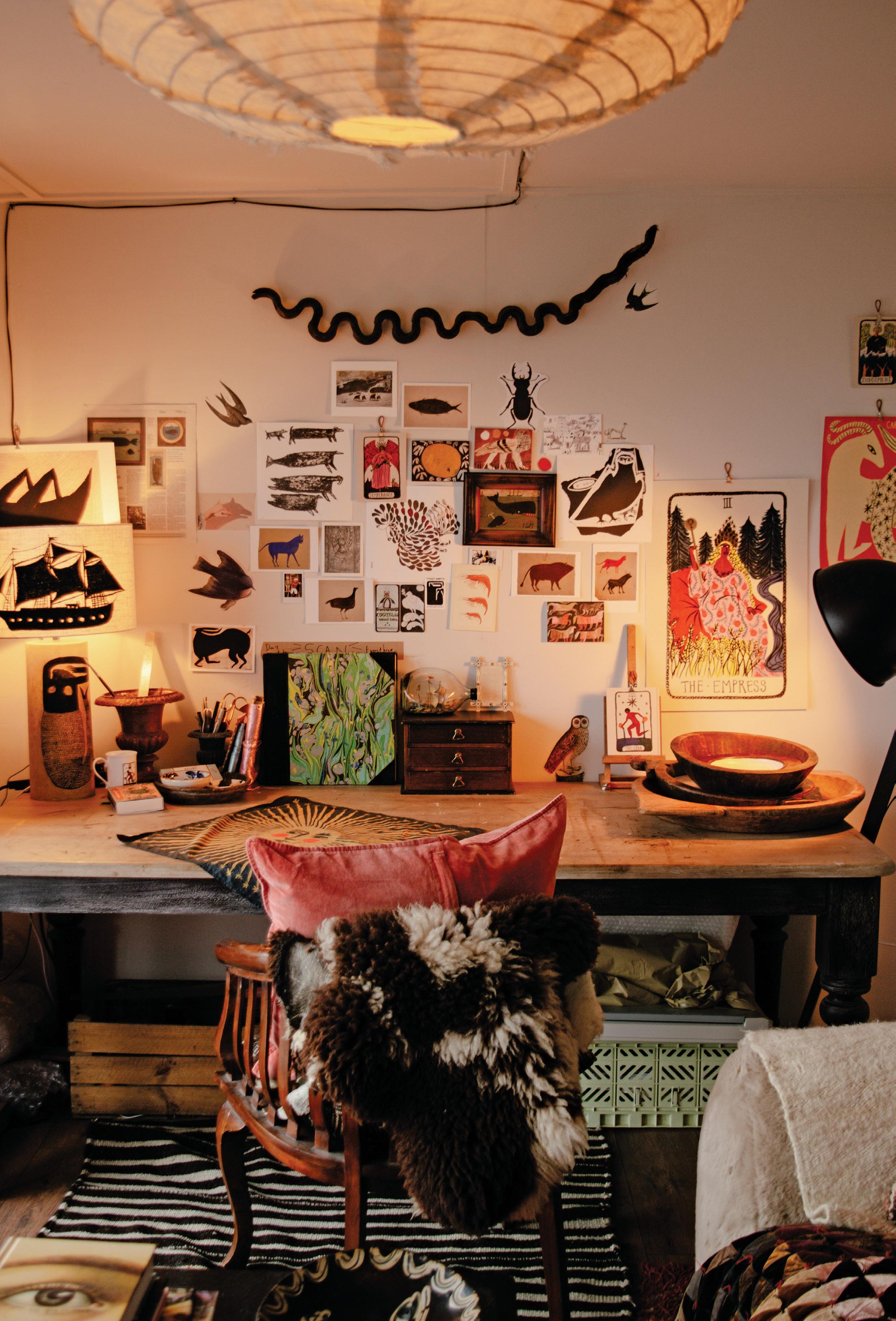
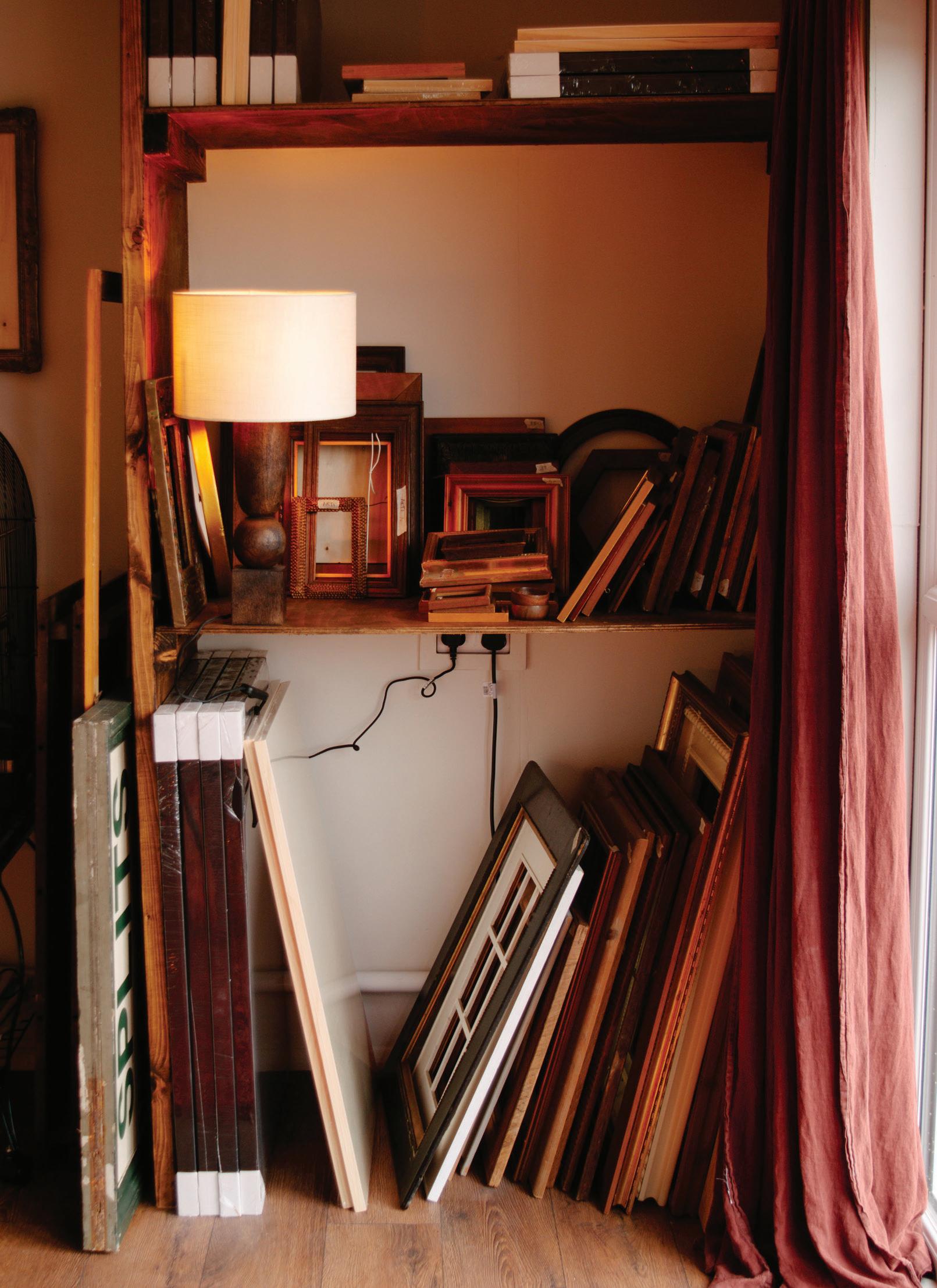
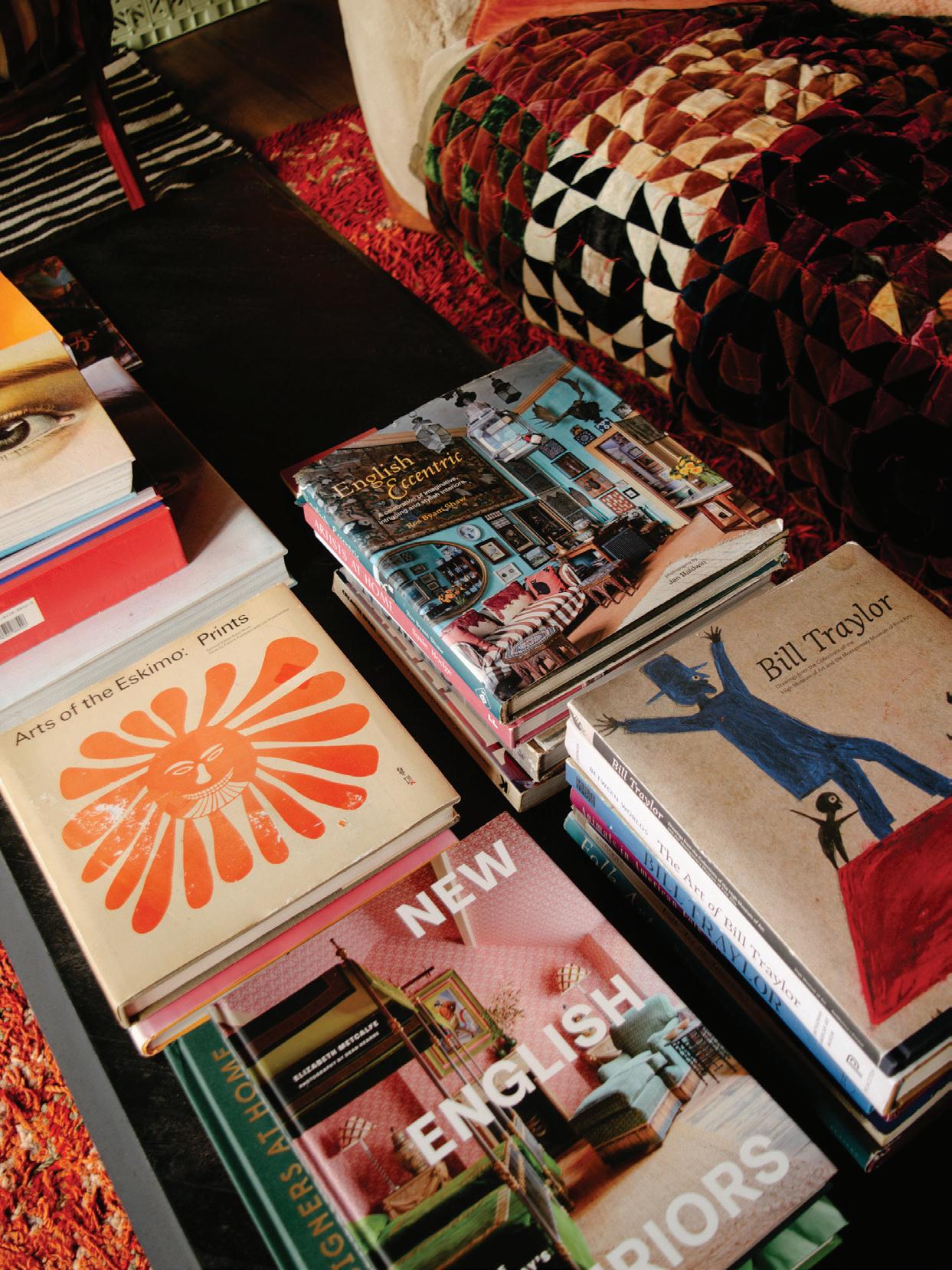
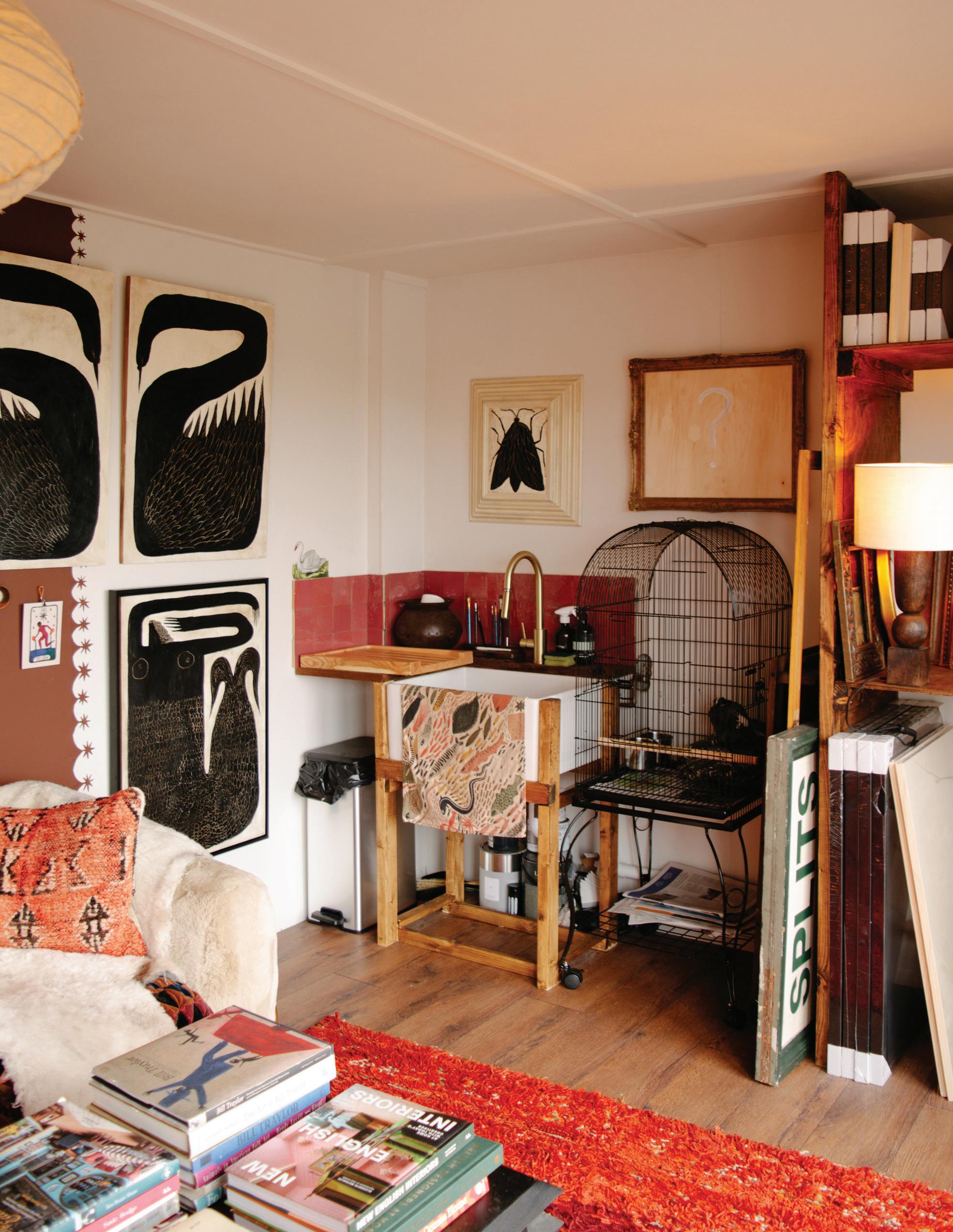
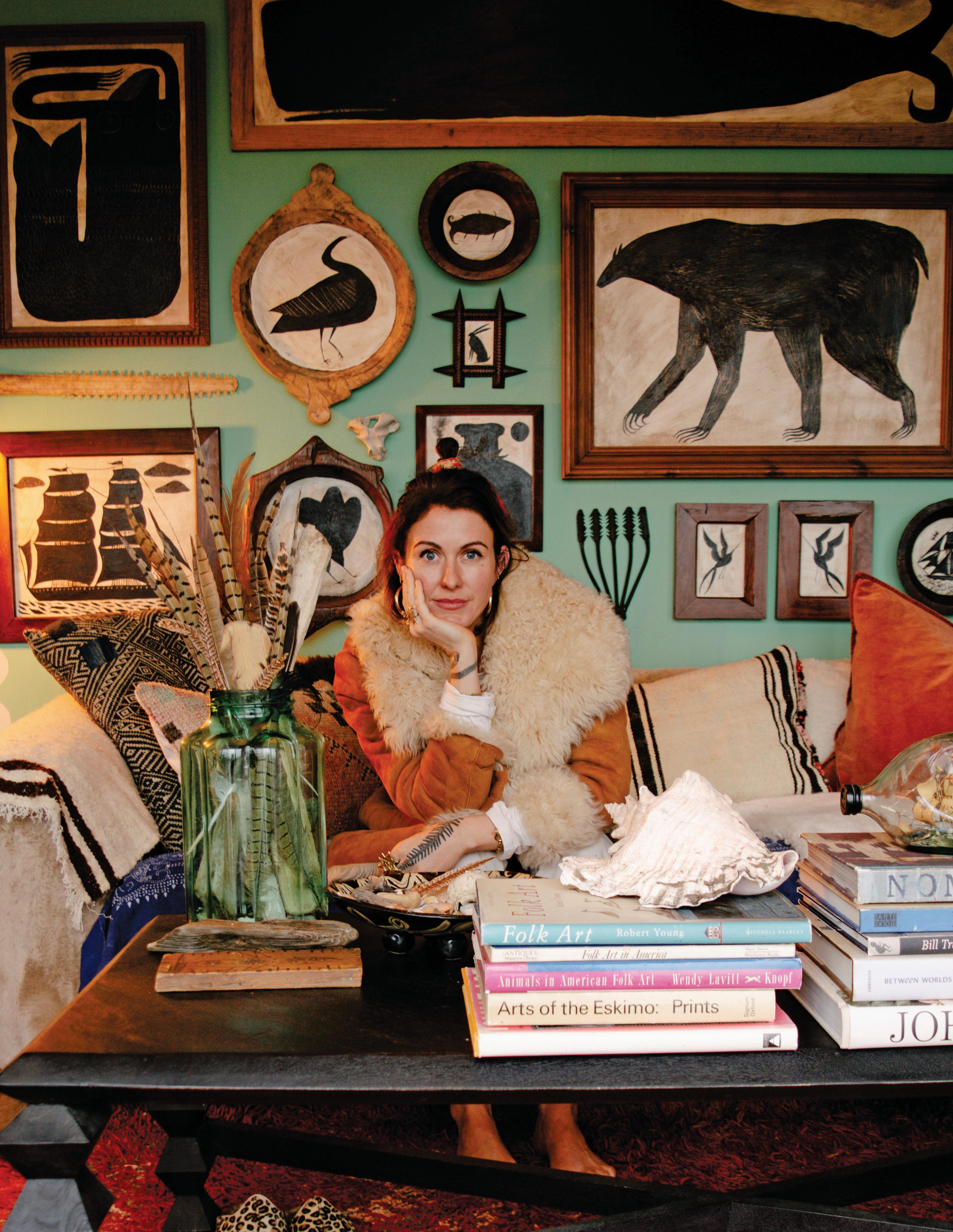
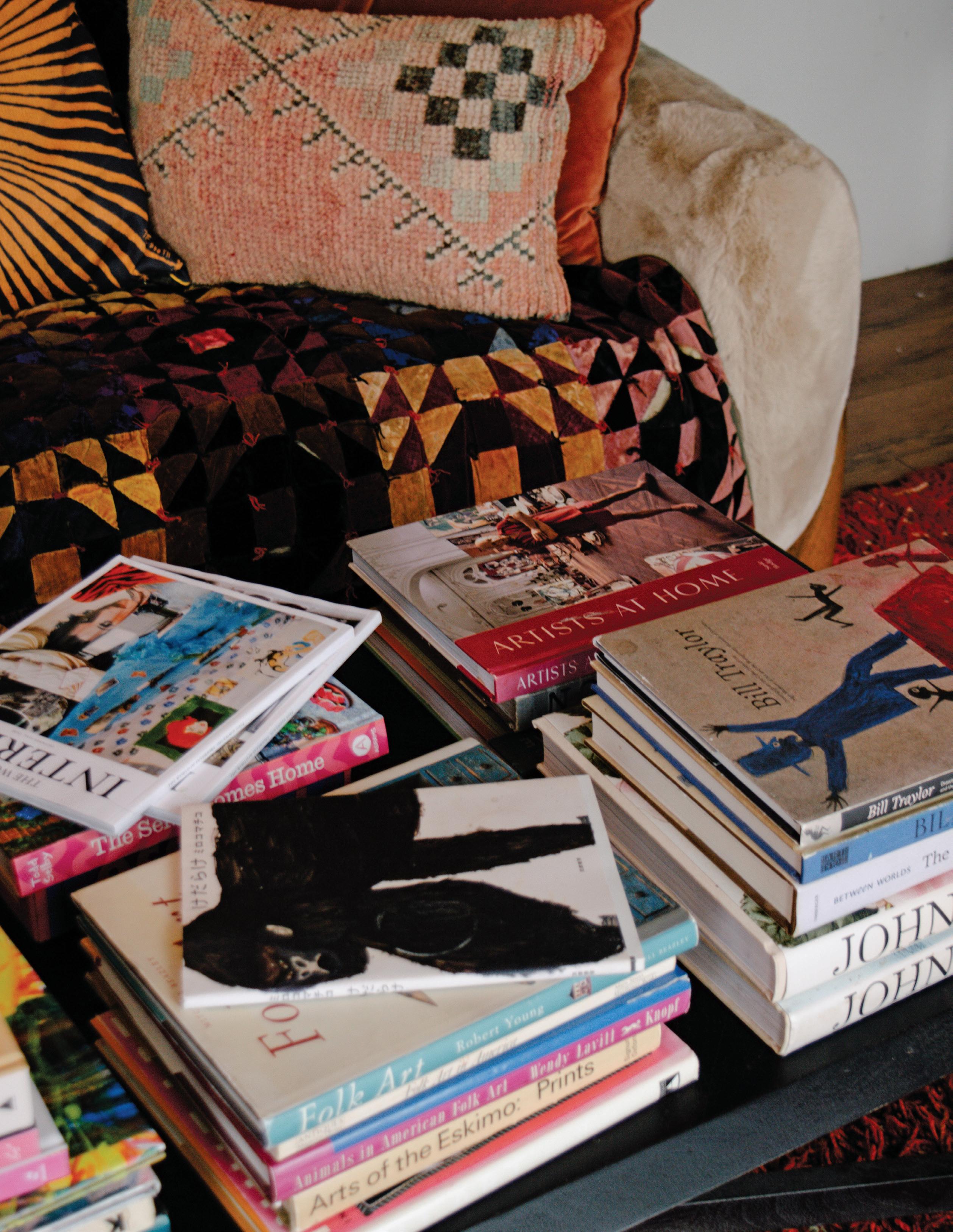
I designed it to be both beautiful and practical: a sink for washing brushes, space to store my collection of antique frames, and a large desk surrounded by inspirational images and objects. Slightly less conventionally, I also carved out a soft, cozy nook: a place to relax, flip through art books, and work on digital illustrations. I wanted it to feel like an eclectic gallery in itself, where I could style and showcase my work in an interior setting.
“To create one’s own world takes courage.”
—Georgia O’Keeffe
Looking back, there were two key decisions that brought me to where I am today. The first was opening the gallery. The second was creating the studio space. When it was finished, I shared a video and some photos on Instagram. That content really seemed to capture people’s imaginations and helped grow my presence as an artist. The sales and commissions started rolling in.
I’ve always had a passion for interiors: playing with color, texture, textiles, and objects. So being able to combine that love with my art has been such a fulfilling part of the process. Although I’m normally a color-drencher, I decided to paint just the central section of the back studio wall, so it’s easy to change. In one year, it’s already been brown, green, brown again, and now red. I love how each new color alters the entire mood of the space. When photographing a new collection, I often walk around our home, selecting other artworks and objects to curate alongside my pieces, adding layers to the storytelling.
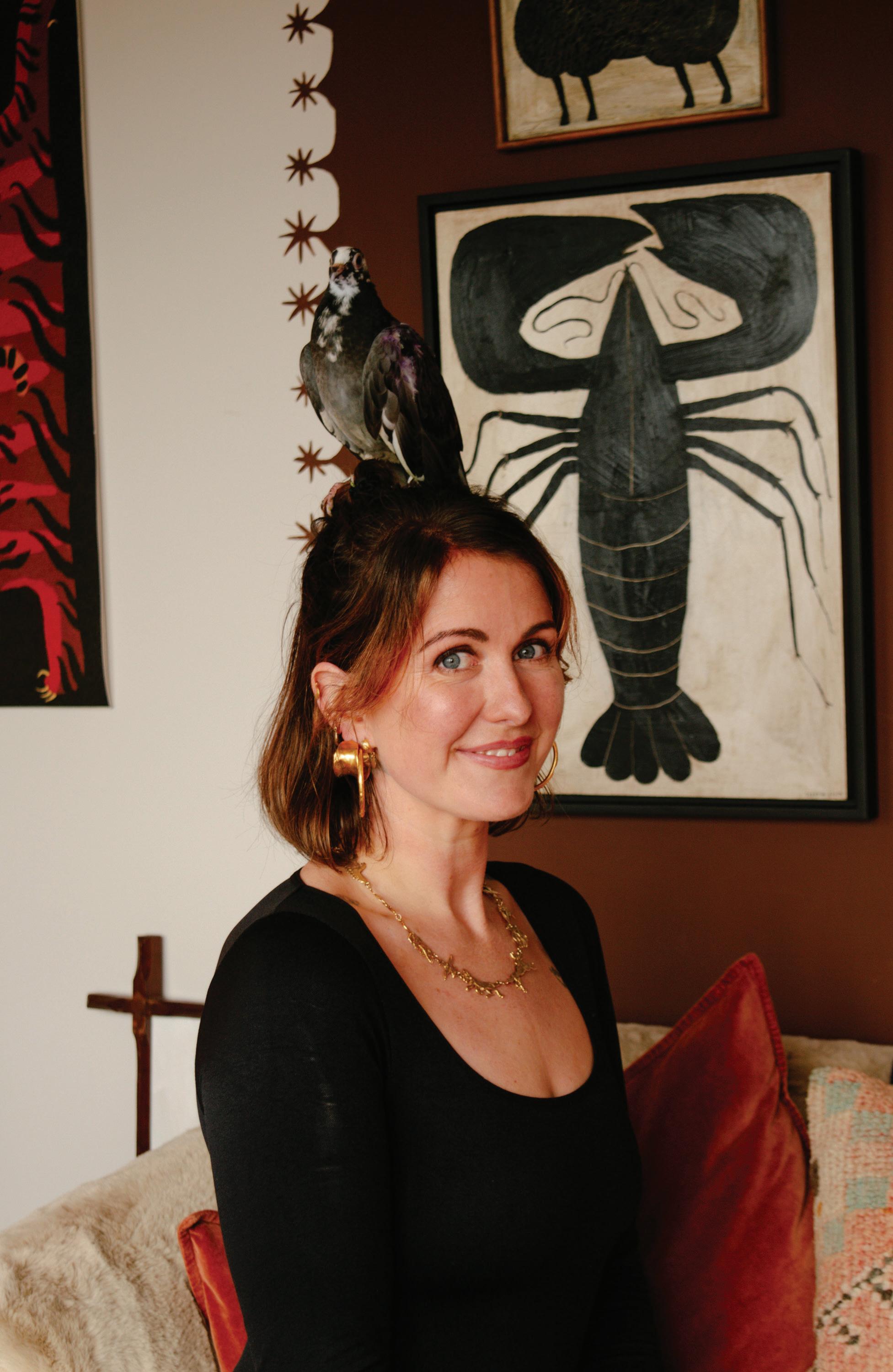
There’s something so special about, in the words of Virginia Woolf, “a room of one’s own.” I love our home, but it’s a shared, busy space, filled with my husband, children, and usually a few animals. My studio, on the other hand, is entirely mine to do with as I please. Or at least it was, until I rescued an injured pigeon named Raisin, who now lives in there with me. She’s a sweet, funny presence— pecking at my toes as I work, and scattering seeds and feathers as far as the eye can see.
With the rapid growth of this new chapter, we sold the art school at the end of 2024 to focus fully on the gallery and our art. It’s hard to believe that just a few years ago, I was longing to create again and didn’t know where to begin. And now here I am—living it.
My studio has been such an integral part of that journey. It gave me the space, physically and mentally, to reconnect with my creativity and share it with others.
Although I have to admit I’m already dreaming of a bigger one... so watch this space!
More on Tabby www.tabbybooth.com www.sailorsjail.com/tabby-booth Instagram: tabby.booth.artist
In the Spring 2026 issue of Where Women Create , we’ll explore the artistry, creativity, and design inside Tabby’s home in her “An Artist Lives Here” feature.
Tess Deal
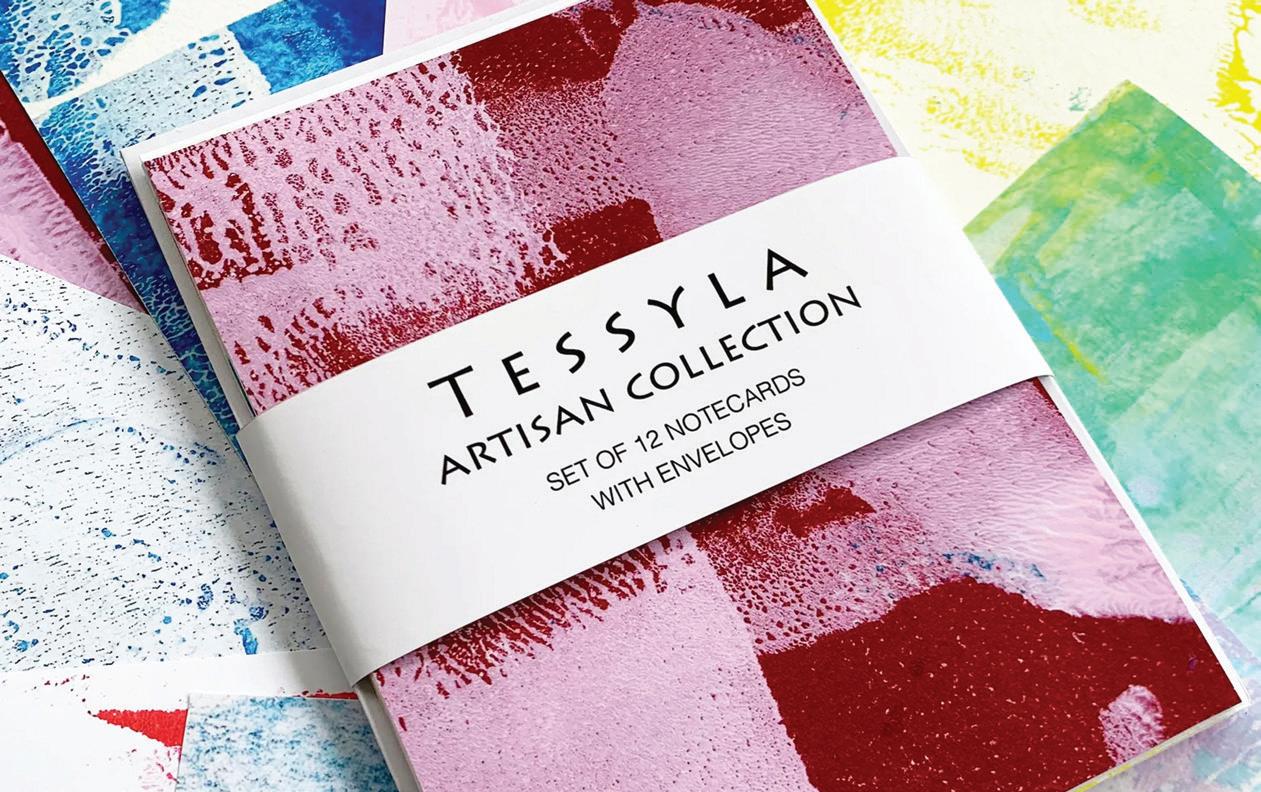
TESS DEAL is a multi-passionate North Carolina artist exploring illustration, abstract art, and jewelry design. She shares her joyful creations through her Etsy shops, Tessyla and JEWELbyTessyla. Her textile designs are available as wallpaper, fabric, and other home decor items in her Spoonflower shop. Tess welcomes licensing opportunities and invites readers to join her email list for studio news, freebies, and giveaways: tessdeal.myflodesk.com/jointhelist.
Like most creatives,
my childhood held clues. I spent hours creating my own paper dolls, carefully designing and cutting out outfits, complete with folding tabs. I can vividly recall the Christmas I received a clay jewelry-making kit—the thrill of molding the shapes, watching them bake in the oven, and proudly wearing those clip-on earrings until my ears ached. Looking back, those early moments of play were clues that my path would be a creative one.
As a young adult, I was sure my future was in fashion, so I packed my bags for The Art Institute of Fort Lauderdale to study fashion design. Amid the measuring, pattern drafting, and sewing, I began to realize it wasn’t quite right for me. However, there was one aspect I thoroughly enjoyed—computer-aided design. I loved creating textile designs and compiling my digital portfolio. I could have spent every waking hour in that computer lab… and often did! That passion led me to dive deeper into the world of surface design at The Fashion Institute of Technology. I loved everything about New York—the energy, the fashion, and of course, the soft pretzels!
When I became engaged and moved to North Carolina, I felt like I had strayed from my creative path. Unsure how to move forward, I took a job as a bank teller while figuring out my next steps. It was around this time that I stumbled upon a relatively new platform called Etsy. I thought, “What the heck,” and opened a shop with a few
art prints, greeting cards, and beaded necklaces. To my surprise, things started to sell—slowly—but enough to keep me going.
Spoiler alert: I got fired from the bank and, as my husband likes to say, it was the best thing that could have happened to me. I started waitressing, which freed up more time to focus on my shop. This was the push I needed to see if I could really make this Etsy thing happen. As it turns out, I could! Cue the classic “quit your day job” story… I was working a lunch shift at the restaurant and had just greeted a table when I heard the “cha-ching” notification from my apron. I hurried to the bathroom, pulled out my phone, and saw that I had made a sale for over $200. All I could think about was getting home to work on my Etsy order—the thought of serving another table felt impossible! So, I walked up to the manager and quit on the spot, feeling confident that I was ready and able to pursue my art full-time. That was the fall of 2011.
Today,
I run two Etsy shops: Tessyla, where I sell art prints, paintings, calendars, and a few other creations, and JEWELbyTessyla, where I specialize in women’s gemstone necklaces, unique earrings, and a best-selling wood necklace line for men. My work has been featured in several publications, including Brides, Southern Living, Uppercase, and Pregnancy & Newborn Magazine. A true pinch-me moment? My art prints were used as set design for a Netflix hit series! Seeing them on TV was surreal.
Like all businesses, there have been ebbs and flows. My shops naturally slowed after the birth of my son. After hustling for so many years, I found myself enjoying the slower pace, allowing me to be fully present with him during those precious early years. When he started preschool, something unexpected happened: the pandemic. Suddenly, everyone was home and redecorating, and my shop became busier than ever. I was back to working long hours, but felt lucky to be able to sustain myself as an artist during such an uncertain time. My work continues to remain steady, and for that I am deeply grateful.
It’s not always easy—working from home can be lonely. I sometimes dream of owning my own brick-and-mortar shop, mingling with customers and selling anything and everything I could create. I envision a magical, colorful space where people could walk in and feel transported. For now, my studio is my sanctuary—a place that provides freedom, inspiration, and the joy of creating every day.
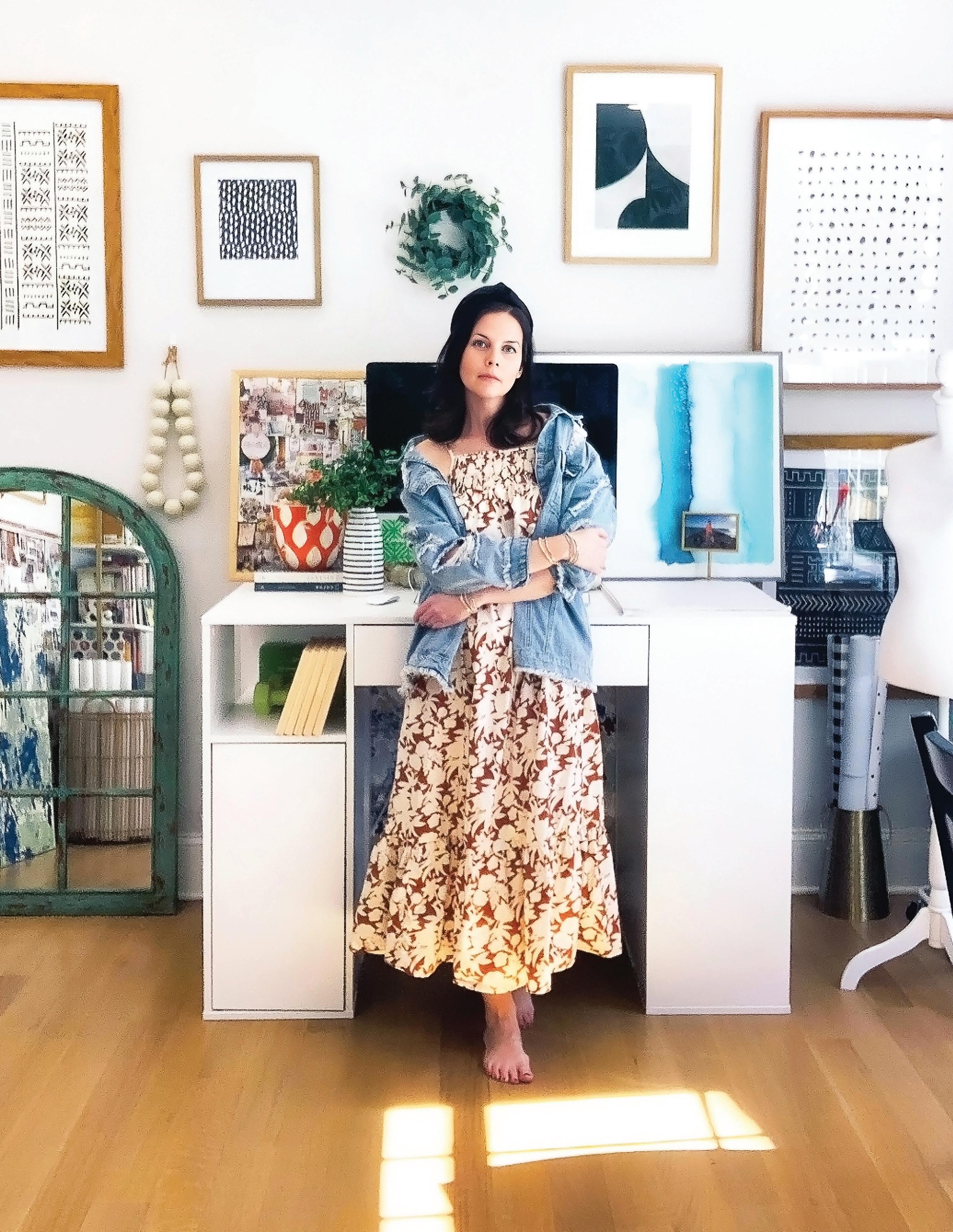
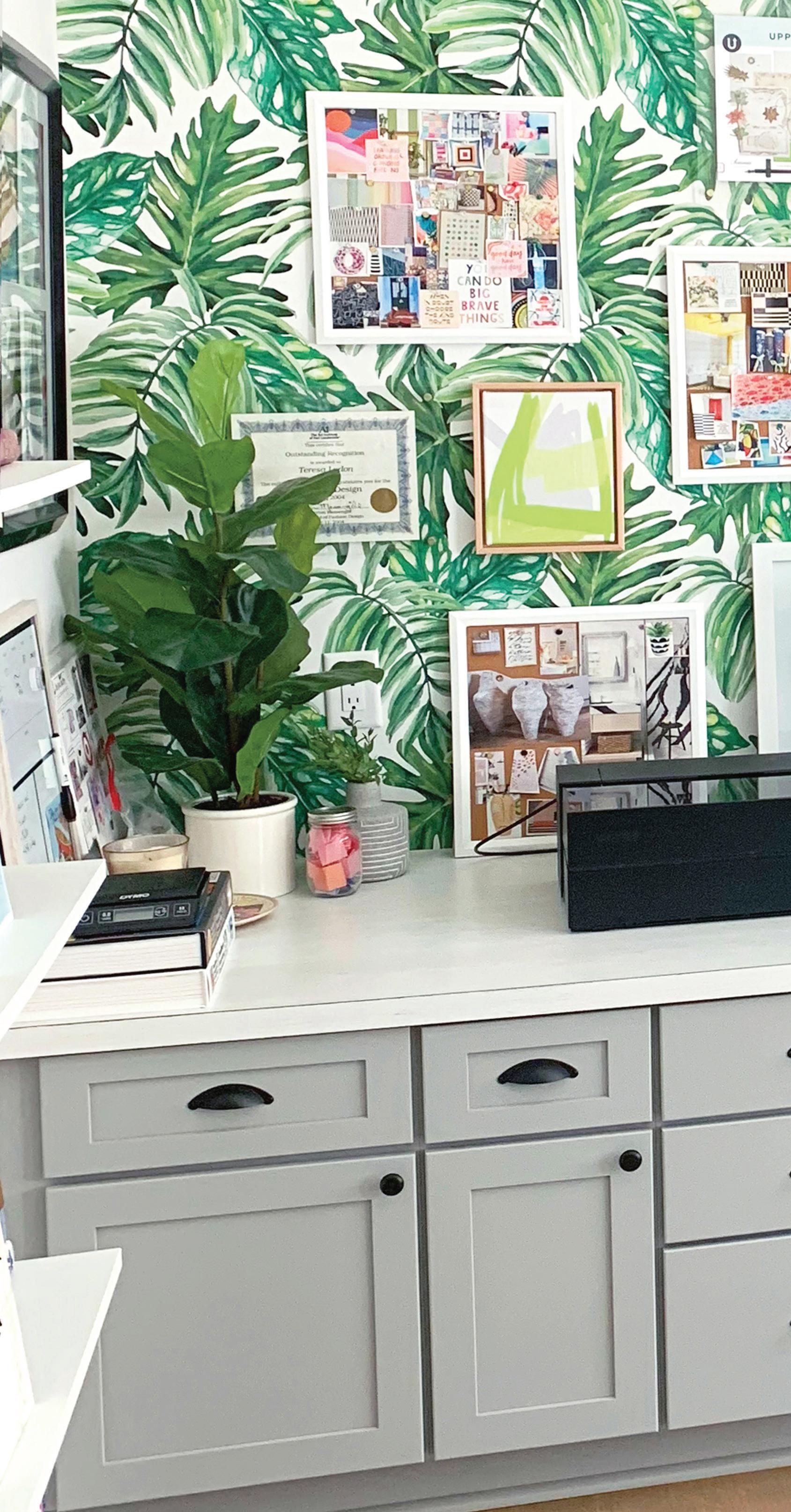
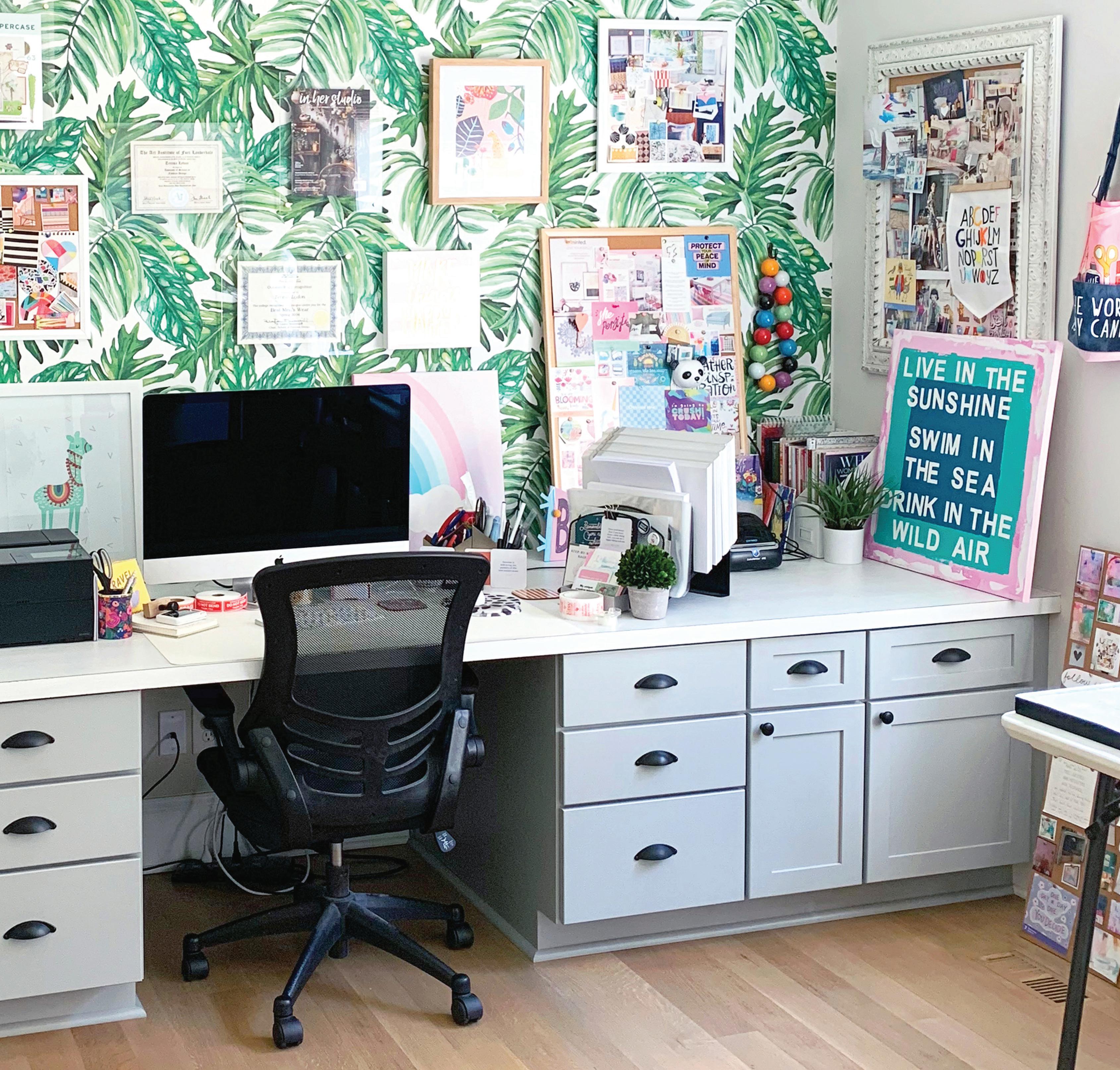
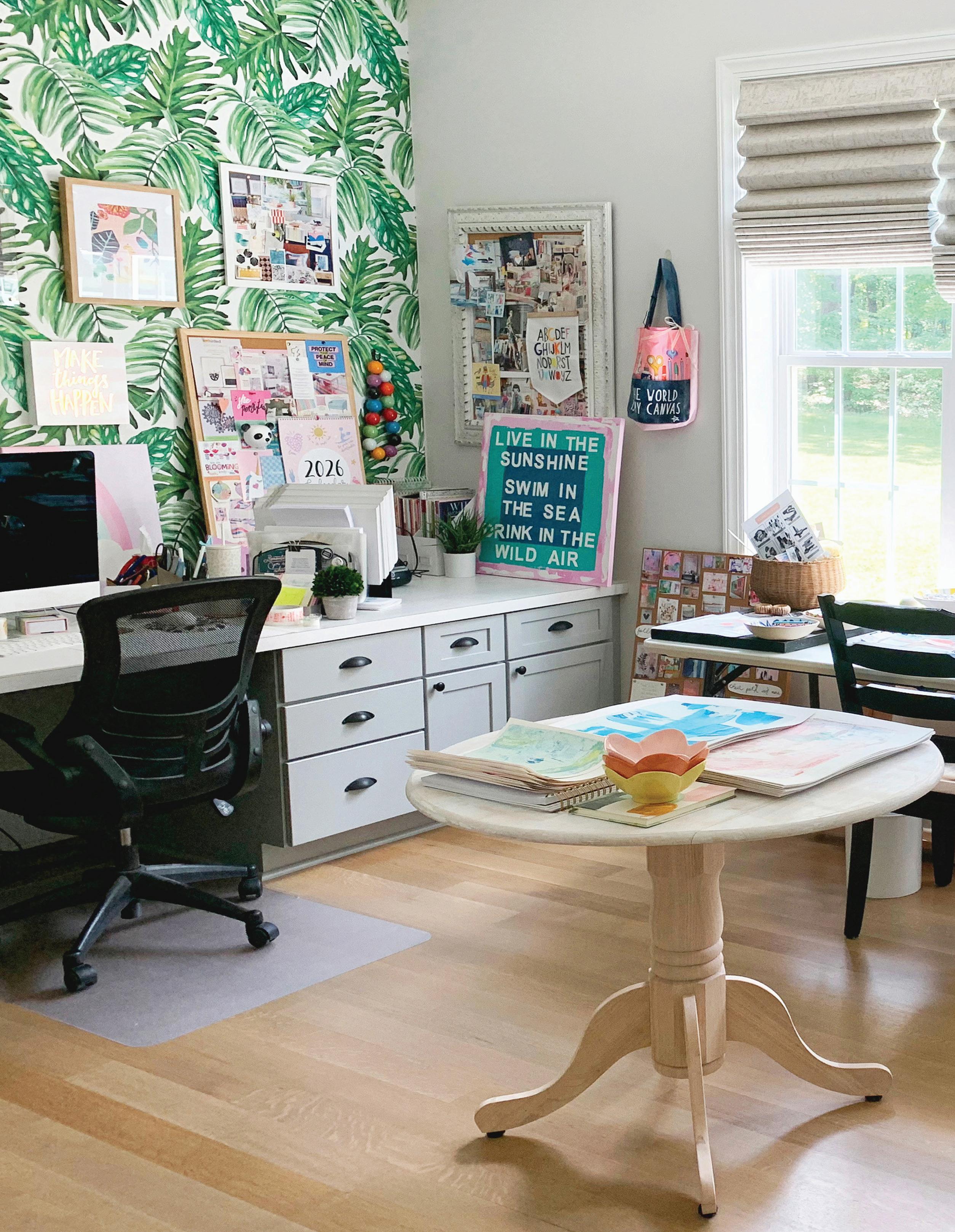
Thisis my sixth studio space, and I had the chance to design it from scratch with the build of our new home. The star of the show is a custom-built, 11-foot-long wall-to-wall desk. The base is a beautiful pale blue wood with a thick white grain top. It’s extra deep with plenty of storage for all of my supplies. That same wall features a bright and bold tropical wallpaper—a nod to my Floridian roots. A trio of large windows floods the space with natural light. The back of the room features a counterheight desk, which is ideal for packaging orders. Gone are the days of bending over on the floor! I have a large bookcase filled with my favorite art and décor books, ready to inspire my next project. Numerous mood boards are displayed throughout the studio, covered in inspirational quotes and magazine tear-outs that fuel my creativity. Two tables are available at the ready for art making. You may be surprised to learn that the rest of my home is very neutral and minimalist, but this space is pure color and energy—it’s all mine.
Most days begin with a cup of tea and a lengthy to-do list. My workdays are a mix of printing, packaging orders, designing artwork, creating jewelry, and tackling administrative tasks. After doing this full-time for 15 years, it can sometimes feel monotonous. Listening to a variety of different things helps to keep me going. Lately, I’ve been enjoying my 90s Pandora playlist, anything by Kristin Hannah on Audible, and true crime podcasts… I’m kind of obsessed!
“A jug fills drop by drop.”
“Follow your soul. It knows the way.”
Lookingahead,
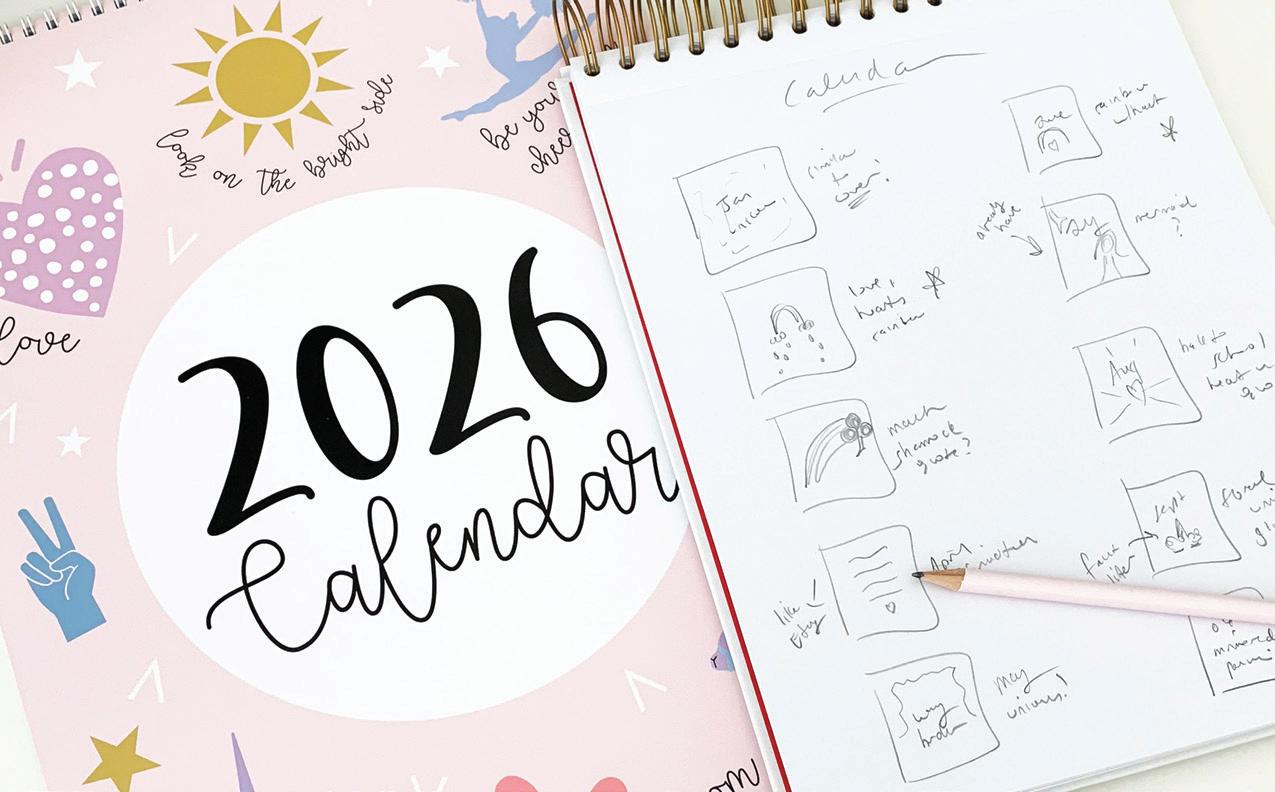
I’m dreaming of new possibilities. I’ve recently released a series of calendars: two adorable versions for young girls and boys, as well as an abstract art edition featuring my originals… I’m delighted by how these turned out! I’ve also written an affordable Etsy e-book full of my very best tips for sustainable success. I’m excited to expand into licensing my wall art and exploring collaborations—it would be a dream to see my work in physical stores! I look forward to devoting more time to creating abstract art (my current favorite) and growing
my Spoonflower shop. Every day in my studio, I get to bring my creations to life, and I don’t take that for granted. My hope is that my work continues to spark joy for others as much as it has for me.
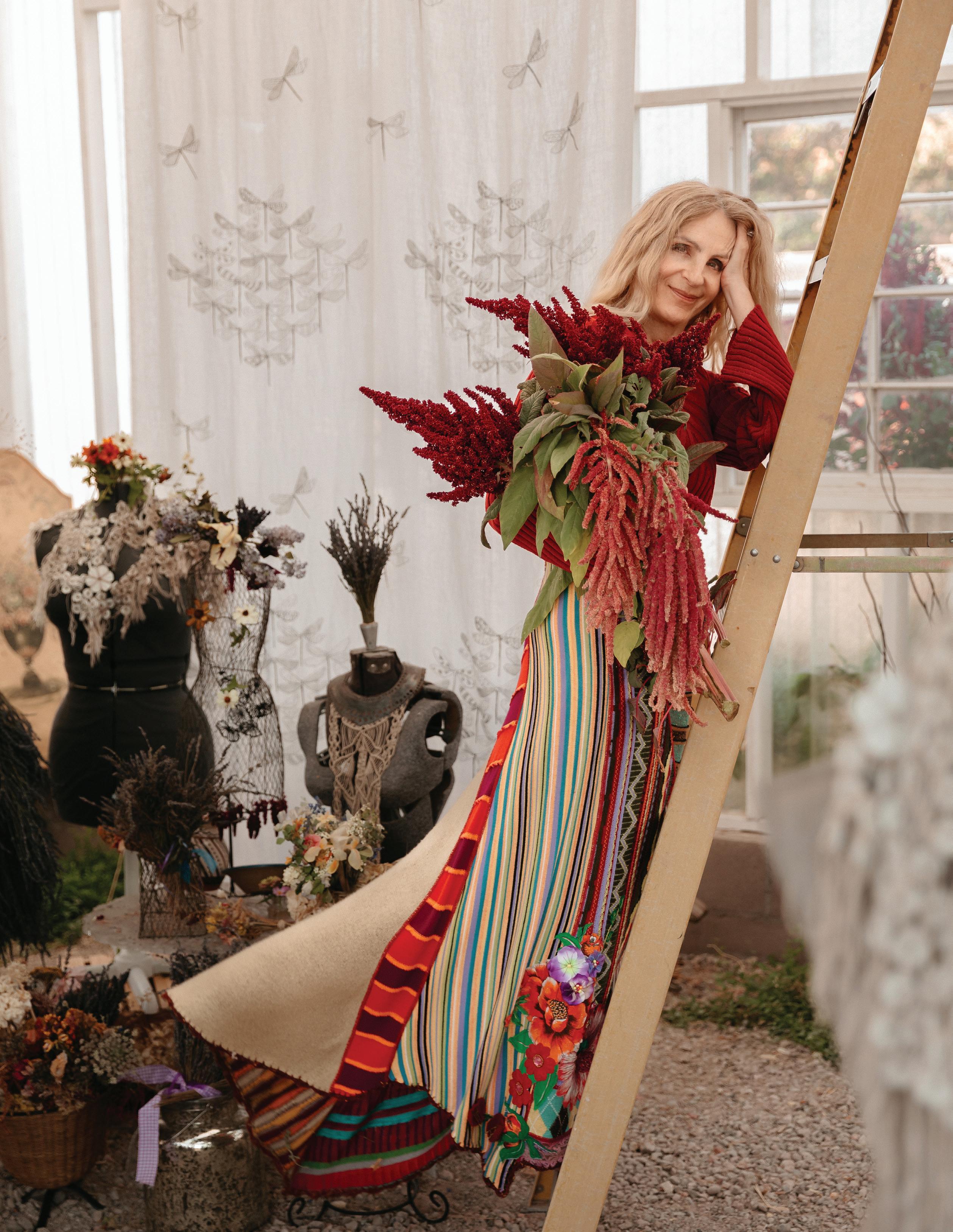
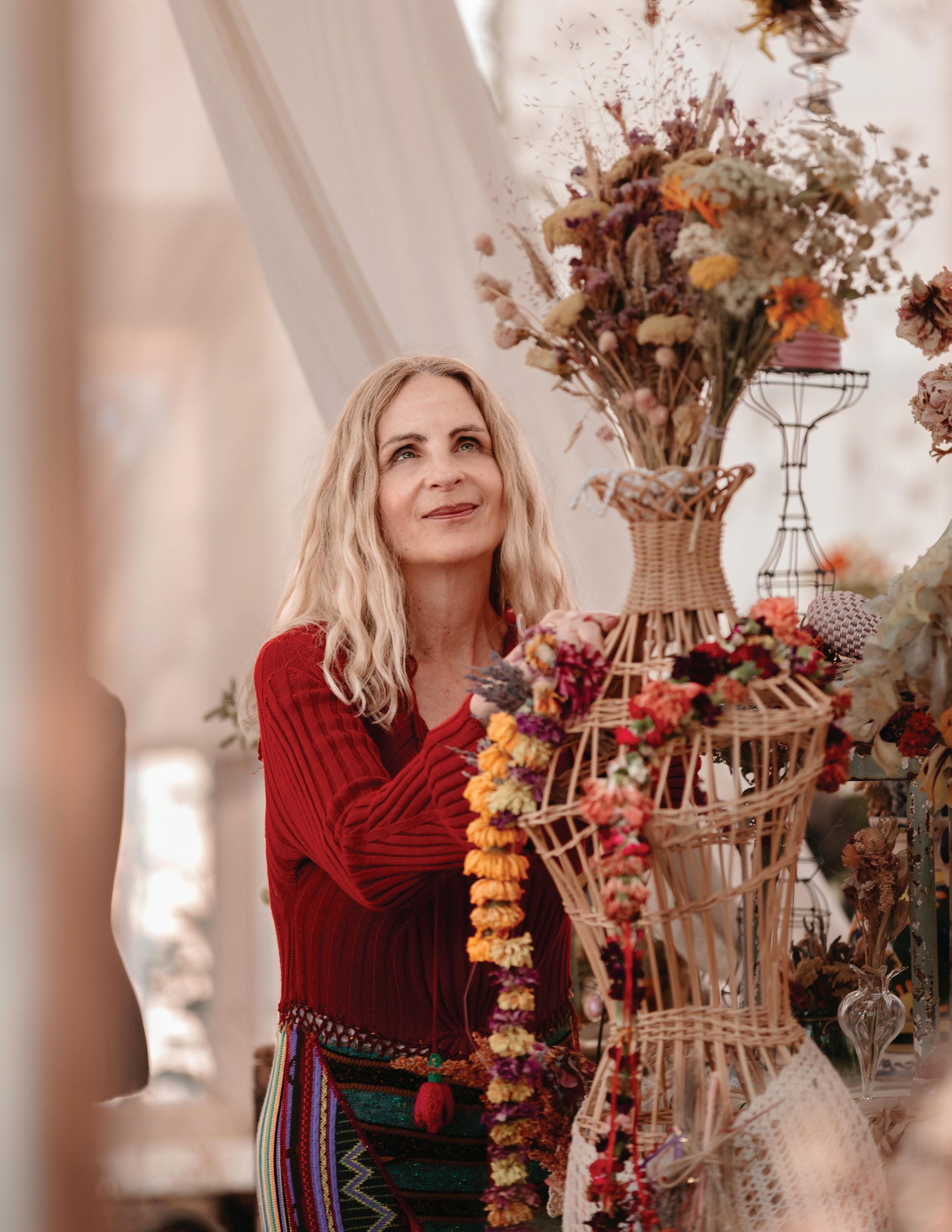
Stylist, flower farmer, and floral creator, LISA FONTANAROSA is the founder of the international styling business that bears her name, as well as Jo’s Farms, her lavender flower farm in Albuquerque, New Mexico. A lifelong lover of France, Lisa began championing and promoting collections from home décor artists from around the world in 1997. She and the artists she represents have been featured in numerous publications, including Vogue and The New York Times
Lisa’s always been a fan of flowers, and her second career, as a creator of dried-flower sculptures on vintage mannequins, came into bloom in 2023.
Iam a floral-obsessed woman whose greatest joy has been creating businesses built on beauty for over 30 years. I describe myself as a city girl with a country spirit.
My interest in design started at age 14 when my mother, who was born in Sicily, and my father, who was from Naples, took my siblings and me on trips to the Mediterranean. These vacations left an indelible mark on my heart, leading me to France and the lavender fields of Provence, where my passion for design, art, and flowers became the inspiration for my styling business.
The first time I visited France in my early 20s, it was clear it was going to be a lifelong love affair. My obsession began in Paris when I walked into a little flower shop and was instantly taken with the French style and the country’s love of dried flowers. France awakened a different side of me because it’s visually stimulating—fashion, design, food, and a sense of history, everything all at once. France, which holds my heart in a way that no other country ever will, continues to be my muse.
I am a curator and a creator of a world filled with poetic pieces that I style for interior designers, architects, private clients, and other international style makers. My choices are guided by Paris, where the mix of antique and modern complements each other like a favorite old shirt and shiny new shoes.
As a girl, I read Vogue magazine, never dreaming I’d ever be in it, and spent all my money on clothes. I tried my hand at fashion illustration, and I wanted a life in fashion. I spent my
early career around the New York fashion scene, working at Condé Nast magazines such as Vogue and Architectural Digest
It was a job styling the window displays for the luxe Henri Bendel department store, “Street of Shops,” that solidified my love of interior design and styling. This ultimately led to an international design career and the founding of my business, The Lisa Fontanarosa Collection, in 1997. A favorite point in my career was when the Paris boutique, Colette, asked me to style an exhibition.
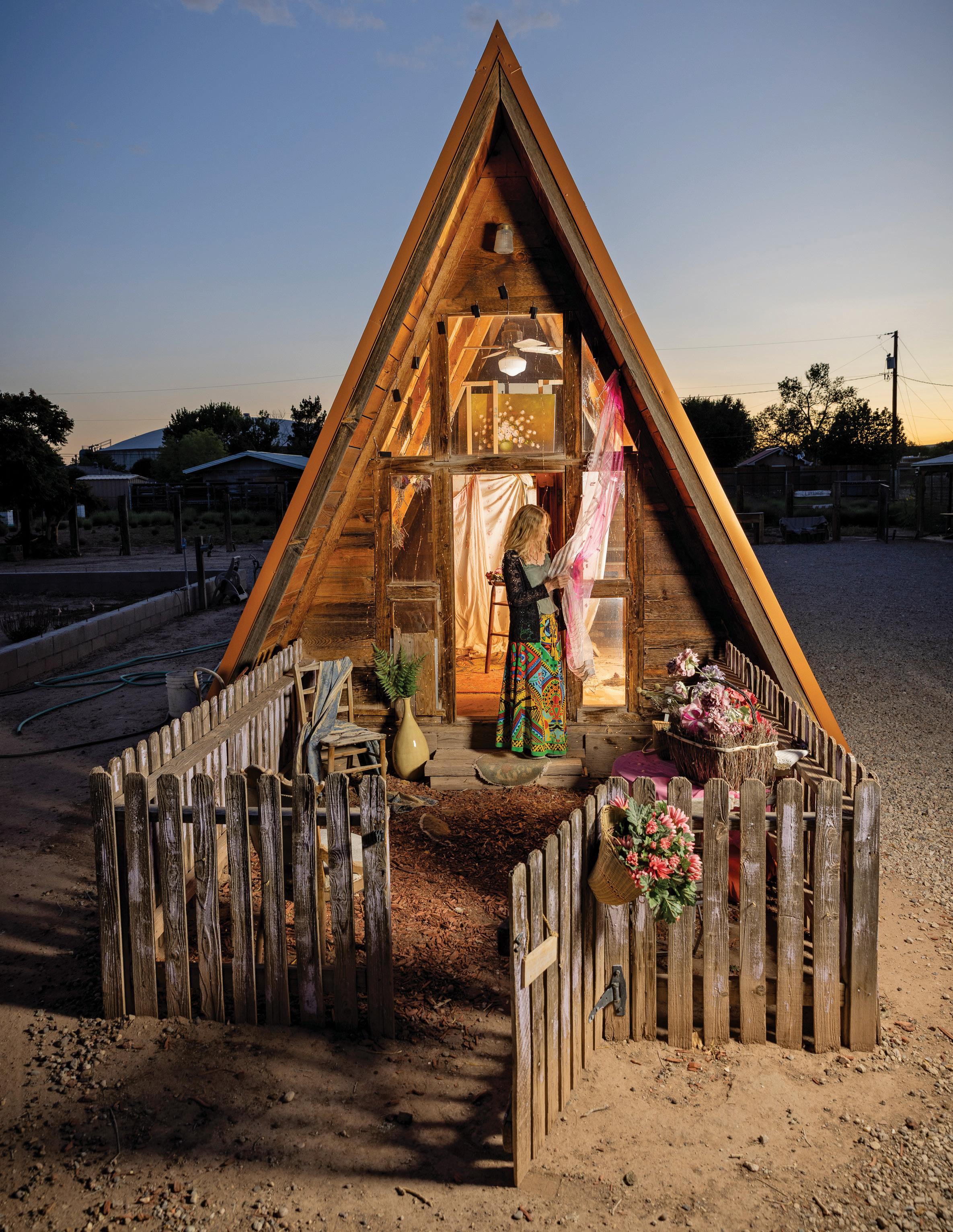
I lived and worked in New York City before moving to New Mexico, where a search for purpose and meaning in gardens changed my life. In 2018, I found my two-acre property with meandering gardens and a shed that had been neglected for some time. Now, it’s beautifully planted with a lavender field, lovely flower gardens, and paths where scented flowers unfold their bloomy perfume. My property now includes my lavender farm, apple orchard, flower-cutting gardens, aviary, greenhouse, and a chicken coop (all my chickens have names!).
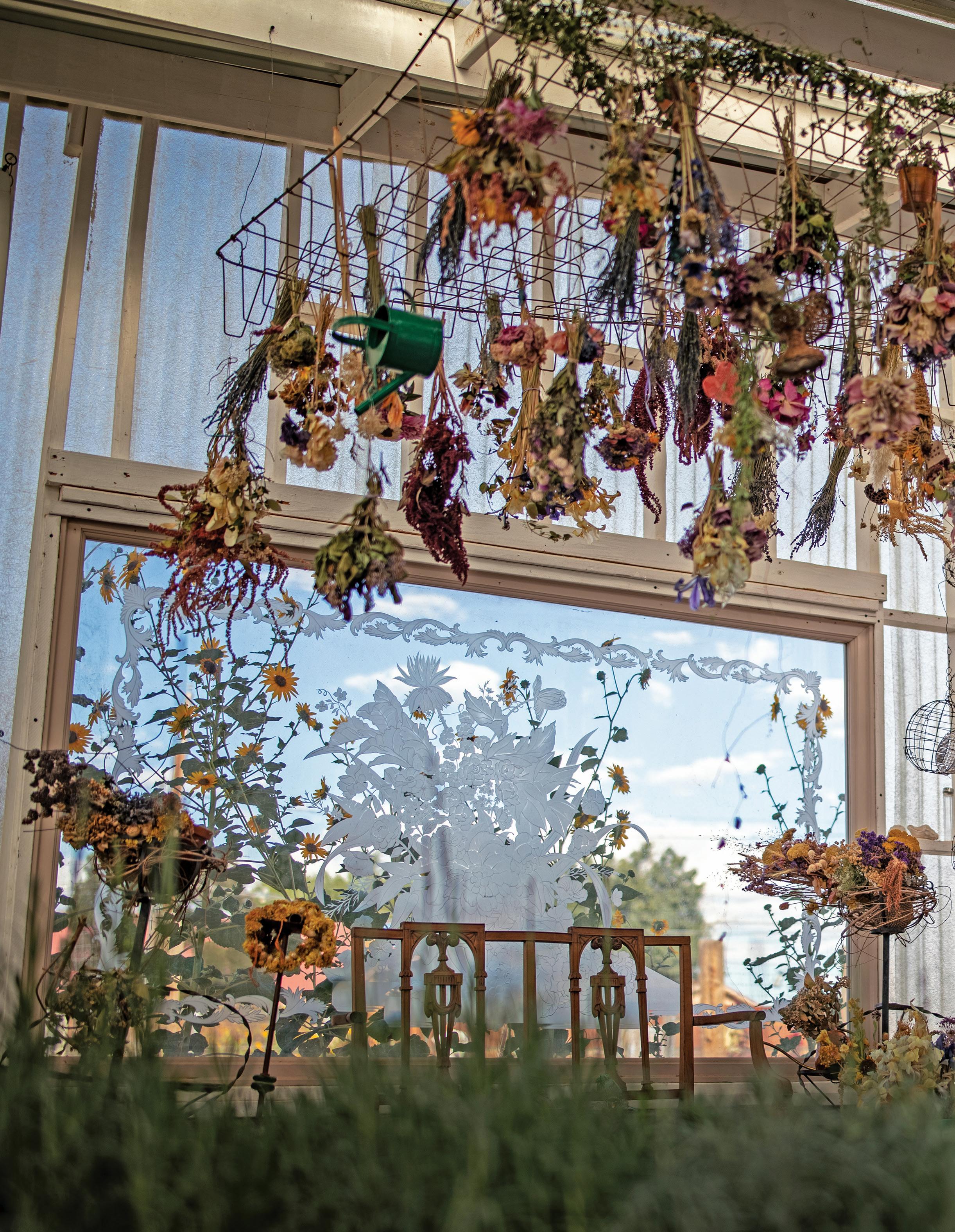
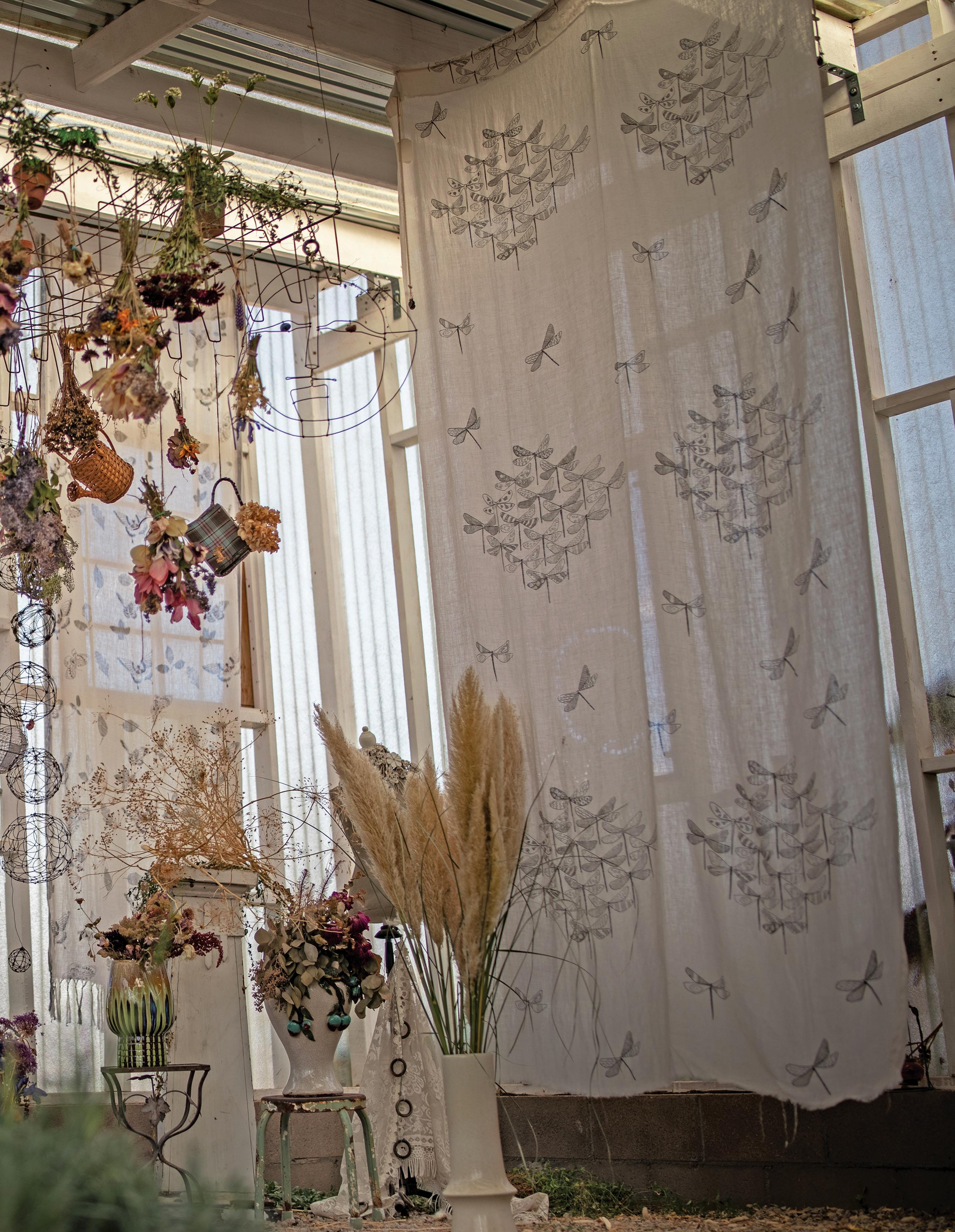
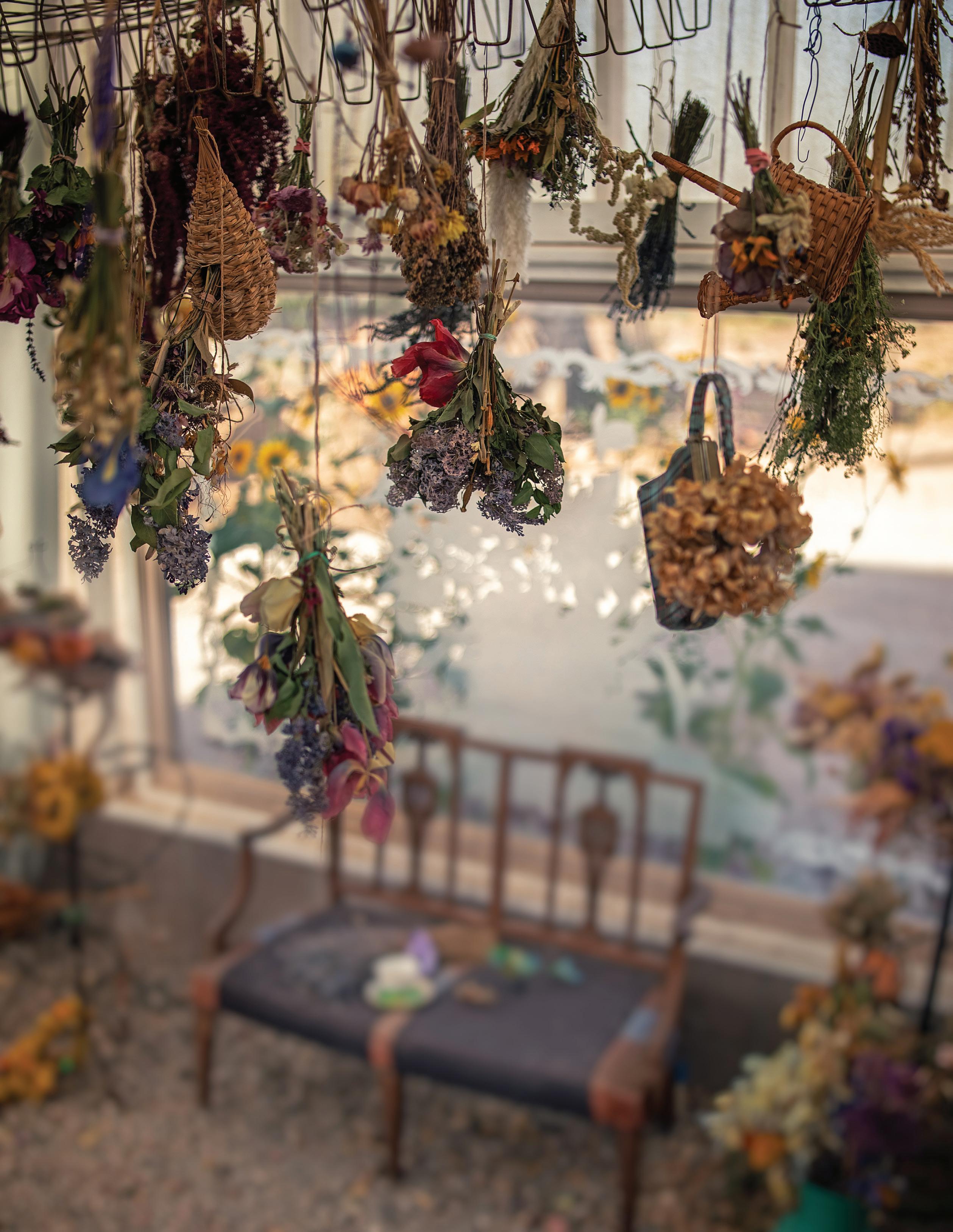
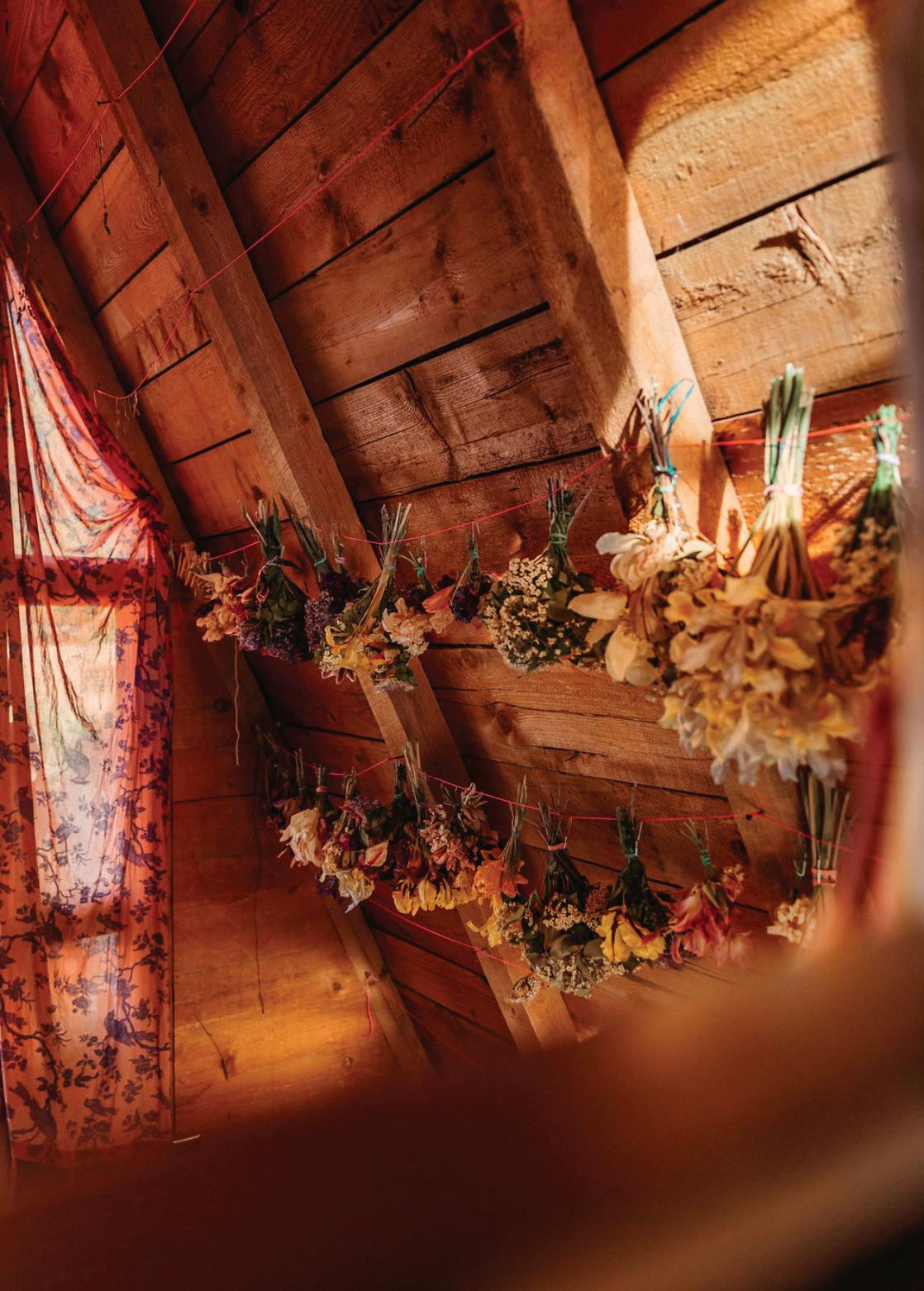
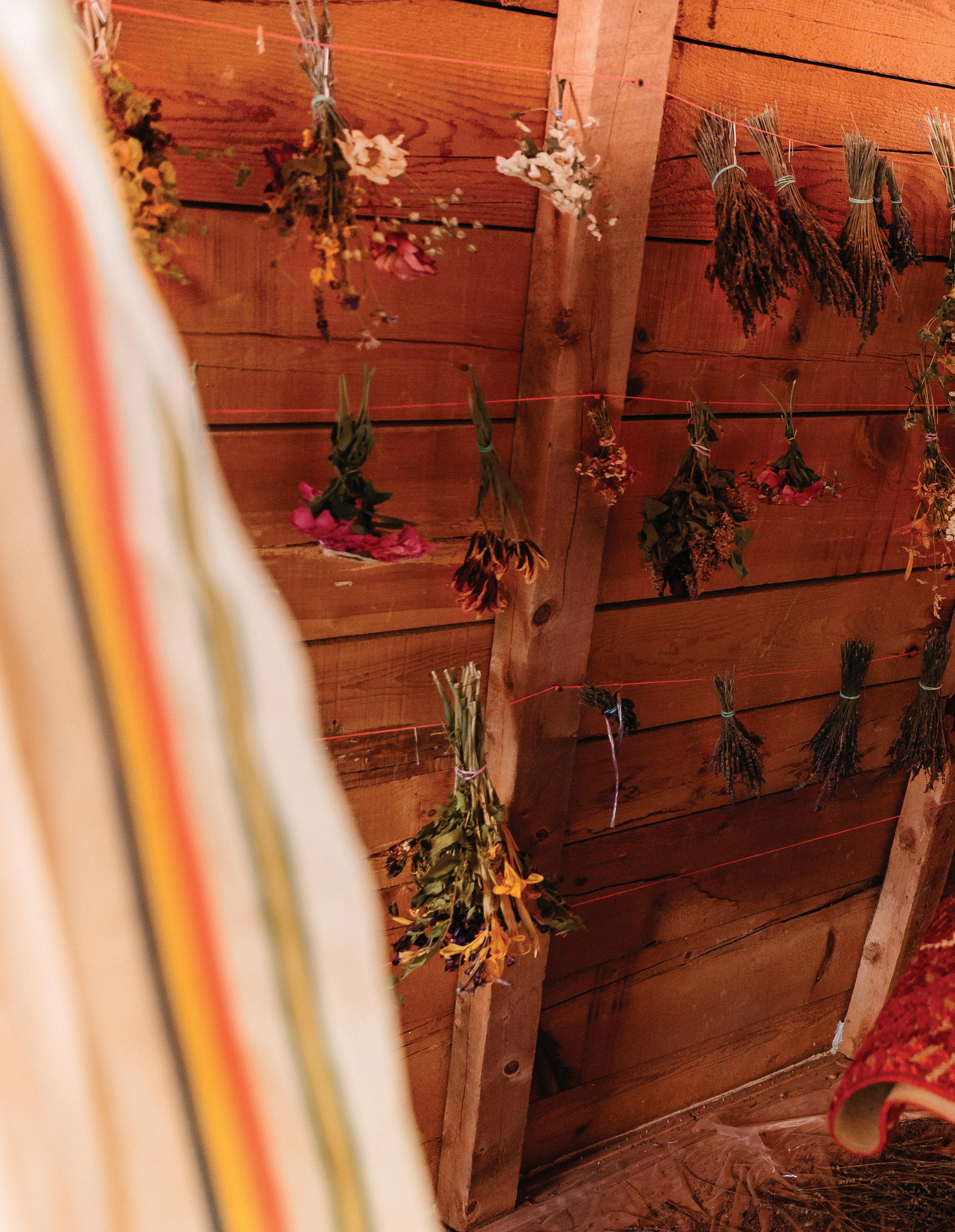
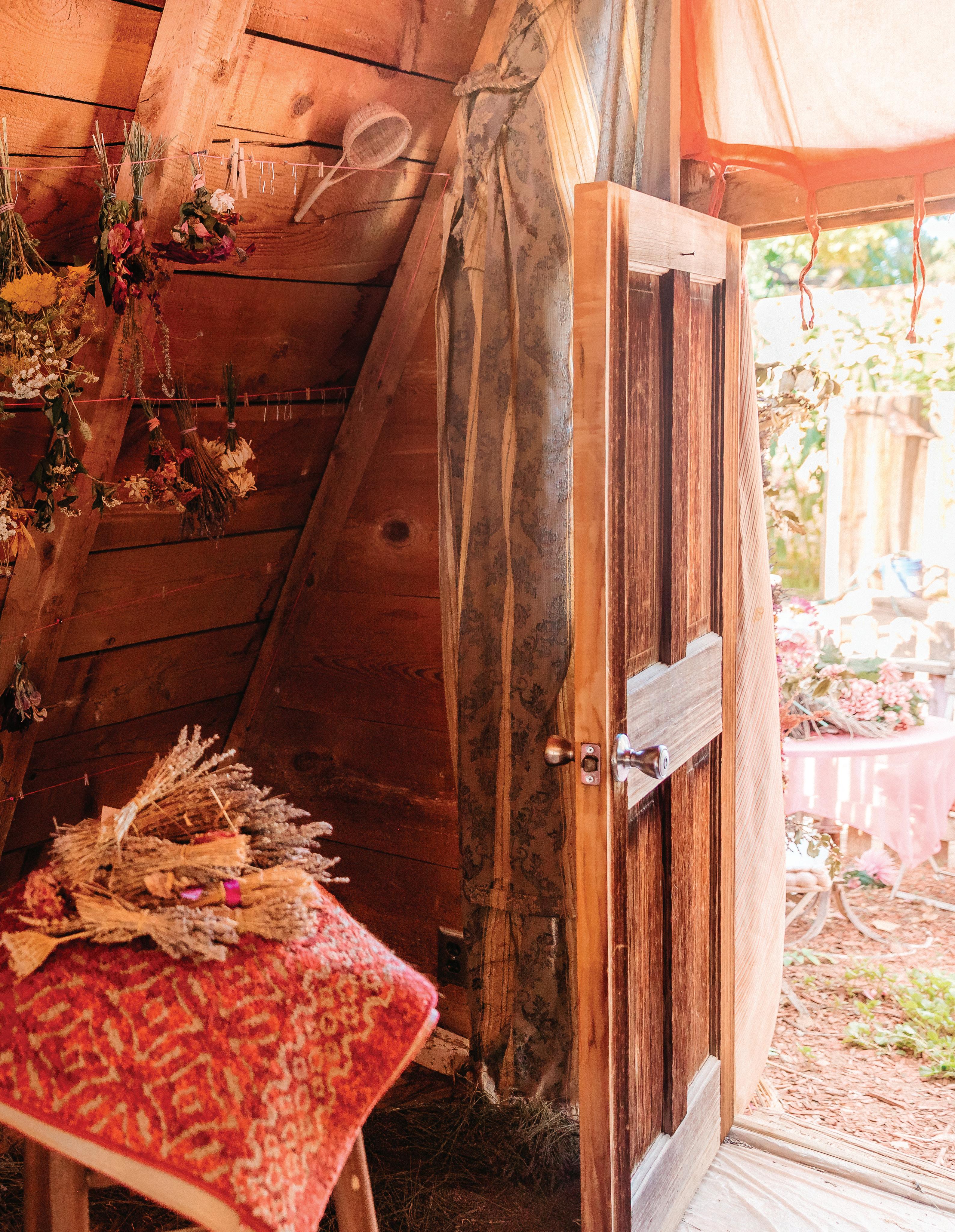
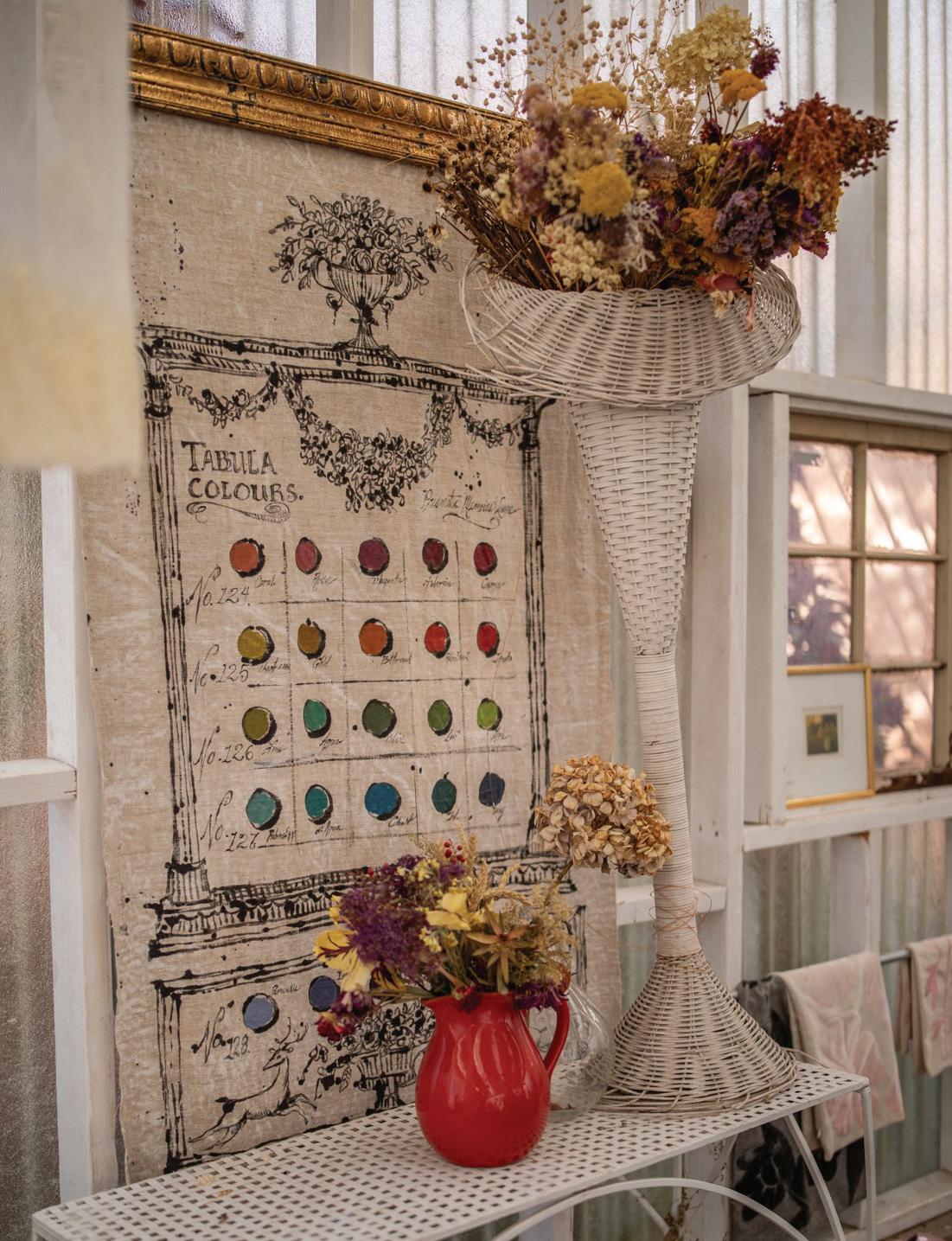
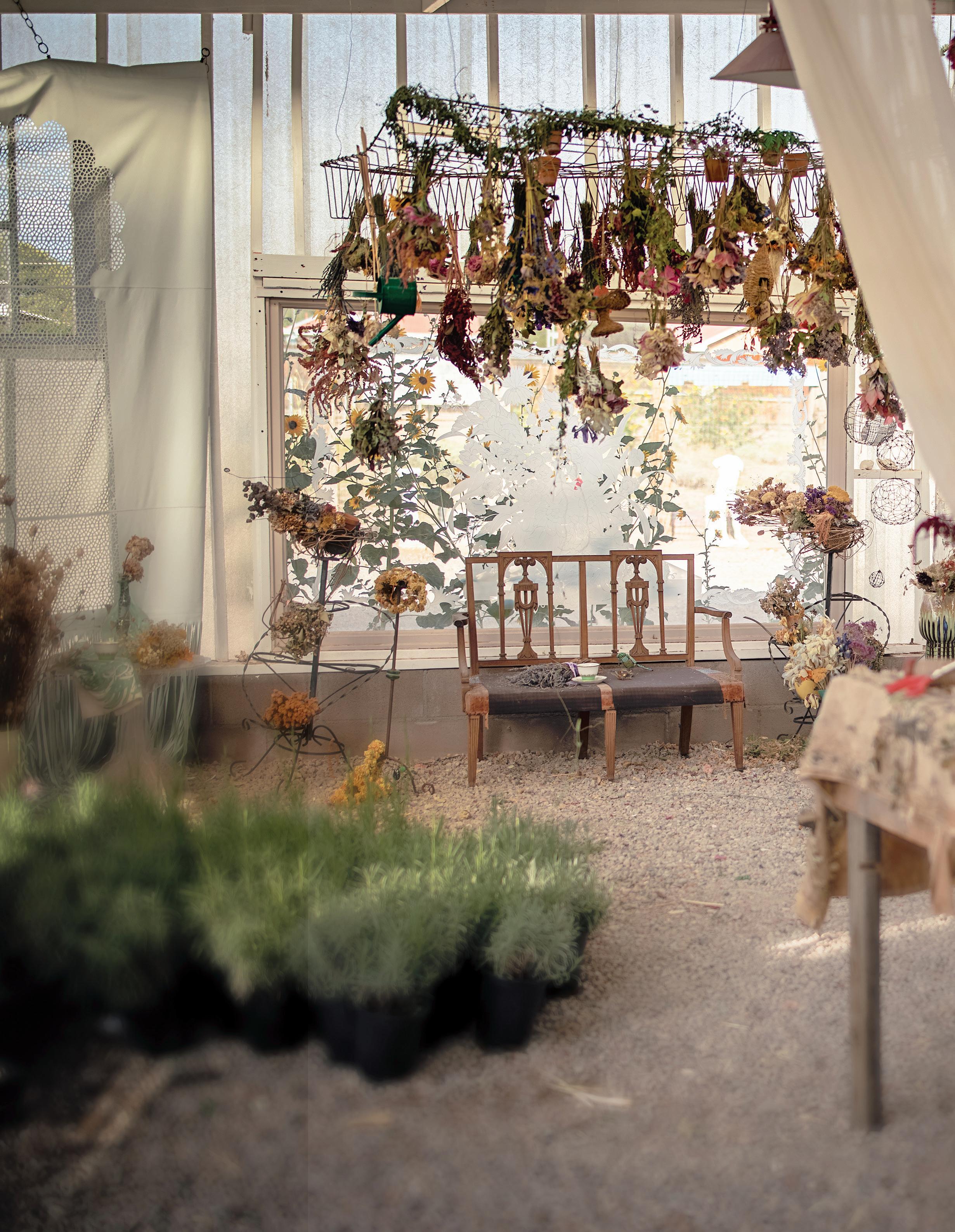
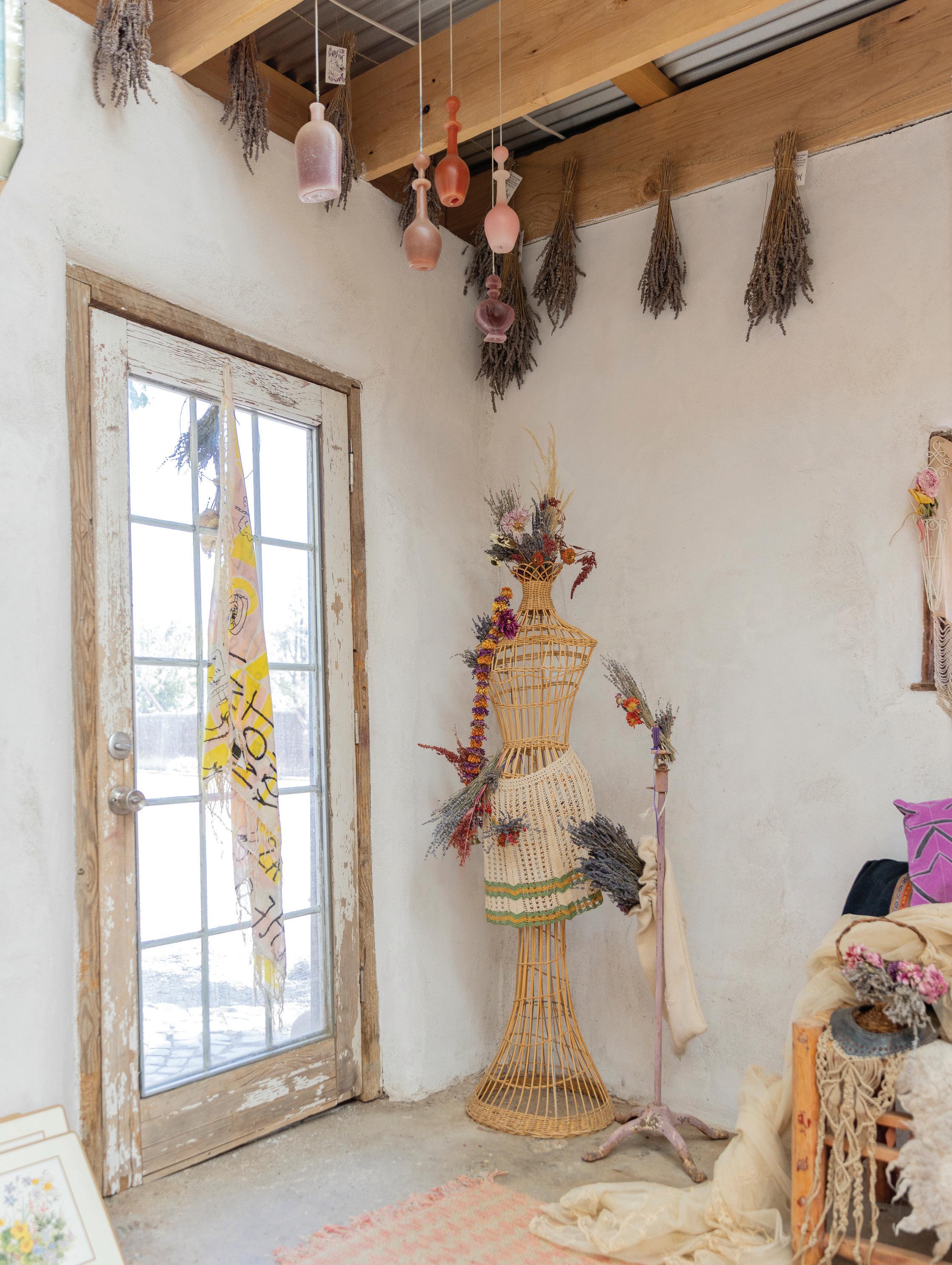
Creating and styling in my three studio spaces—greenhouse, shop, and flower shed— is inspiring because I can see my lavender field and amaranth garden from them. I love blurring the lines between inside and out. One of my secret pleasures is viewing the landscape from the focal point of my greenhouse, the beautiful bouquet of blooms, through a handetched vintage window. In front of the window is a bench showcasing my coveted creations from Marie Christophe, France—a crystal bird and flower. Hanging from above are my dried flowers on the rack. And my favorite Picasso Soleil rooster vase rests on a nearby table draped with a vintage, garden scene, 18th-century textile I found in France that is worn and falling apart… but is still one of my faves.
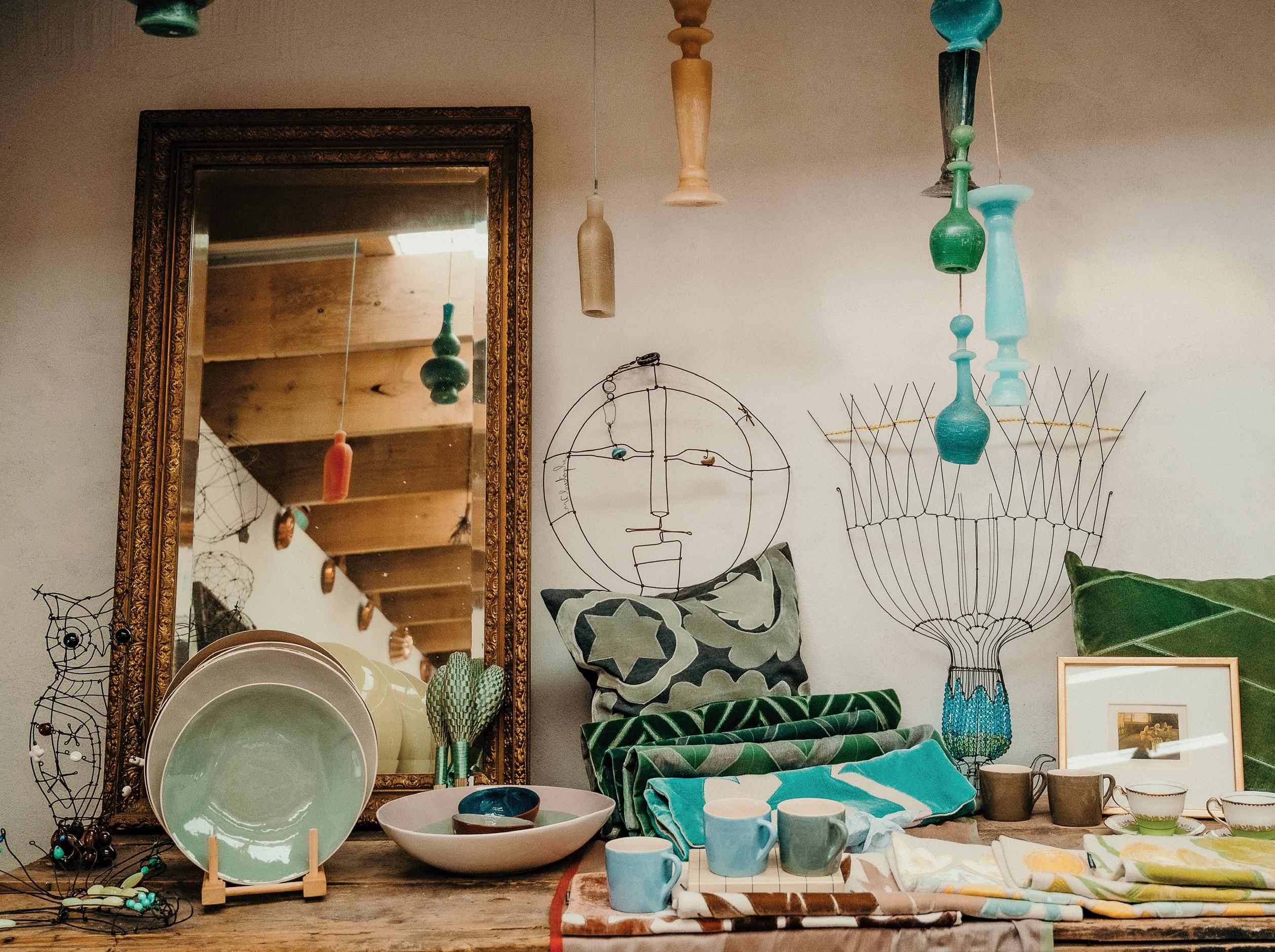
Another noteworthy piece in my shop is the owl sculpture by French artist Marie Christophe. I just love her whimsical, beautiful, and custom creations.
My studios are a place to gather, a place where beauty and the simple pleasures of life come together.
In my flower shed, I store all my creativity. In my shop, I arrange
and rearrange the art objects that form the curated collection of my business. It’s also where I display my new dried-flower creations on vintage mannequins. In my greenhouse, I sow seeds in the winter, store my plants, and create my arrangements and floral sculptures. Because I’m a stylist, I also create table settings in my greenhouse where I showcase dried blooms with the poetic handmade objects created by the European artists I represent.
My international design business includes an emporium of handmade works of art, lighting, and textiles from these European artists. My businesses are shaped by creativity and my passions for beauty, home, and flowers.
Flowers always whisper beauty to the world, even as they rush to fade.
Several years ago, I circled back to fashion (my first love), playing floral dress-up by creating flower-adorned mannequins. I love to slip off into this world with my femme and French flower mannequins. It’s ridiculously fun! I’ve been collecting vintage mannequins for years, and I source many of them on my travels to France.
My mannequins are everlasting creations that bring the summer inside for winter. I love the changing personalities and phases of dried flowers, which I collect from my lavender field and gardens. I find the connection between my dried-flower sculptures and their environment endlessly fascinating. I love creating floral mannequins that have texture and depth, and the idea of giving new life to something that was part of my landscape. These mannequins have always had a special place in my décor. I like animated objects that have a presence. And I love the life and romance that emanates from them.
Ialso create runway-ready sculptures that are inspired by all things femme and French. I wanted to take a more avant-garde approach to the floral craft by creating works of art made out of real flowers that I dry to give them a new life. My floral-fashion mannequins are the keystone of my style. The vintage figures are a blank canvas: I let the compositions create themselves so they can tell their stories with a large dose of je nais se quois. Fashion is a desire, beauty is a desire, creating is a desire… you have to dare.
Like fashion, my flower mannequins create fantasy. It’s a world where poetry is found in little things, where beauty blends all mediums, all orchestrated with an accomplished hand–where a sense of setting also invites a sense of play. From first bloom to last petal, flowers are storytellers; beacons of beauty. A dried flower’s faded form is that of a delicately crafted sculpture. Like fashion, flowers have their seasons. Like fashion, they fascinate me.
One of my favorite fashion designers is Dries Van Noten. I love his shop in Paris; it’s such an inspiration, and I always visit it when I’m there. He wrote the introduction to Francois Halard’s beautiful new book Art & Flowers, and it speaks to my creations:
“A fleeting moment, blossoming into a lasting memory, while the real flower, vibrant and alive, ultimately withers away, reminding us that beauty can be both preserved and ephemeral.”
At the beginning of my career, Massimo Vignelli advised me to “go to Venice, Florence, Paris, walk down the street, and you’ll learn more than at any design school. Not everyone comes back a master of the Renaissance, but something sticks.”
I did what he said, and I found my niche. Traveling to Europe changed my life and has driven my design sense ever since. Let the beauty of what you love be what you seek and what you create.
Sangeetha Gopalakrishnan
Sangeetha Gopalakrishnan lives in Irvine, California, where she works as a full-time landscape oil painter. After a 19-year career in electrical engineering, she followed her heart into the world of art and nature. Her work is inspired by the places she hikes and backpacks with her dog, and she creates using only non-toxic, sustainable materials. Sangeetha is also the founder of a women’s outdoor group and a certified California Green Business, blending her love for wild spaces with a mission for low-impact living.
Inever knew I had an artist in me. Math and tech were all I dreamt of since childhood.
For 19 years, I was an electrical engineer designing semiconductor chips, ticking all the boxes of what looked like a successful life. All along, something was missing—joy, freedom, and a sense of really living.
In 2010, a back injury from overworking at my new job knocked me off the treadmill of routine. The doctor prescribed an active lifestyle for my crippling back pain, and that’s when I discovered the outdoors. I started small, just walking, but those walks turned into hikes, camping, and then to multiday backpacking trips and other outdoor adventures. The trails became my therapy. Nature woke something up in me that I didn’t even know existed.
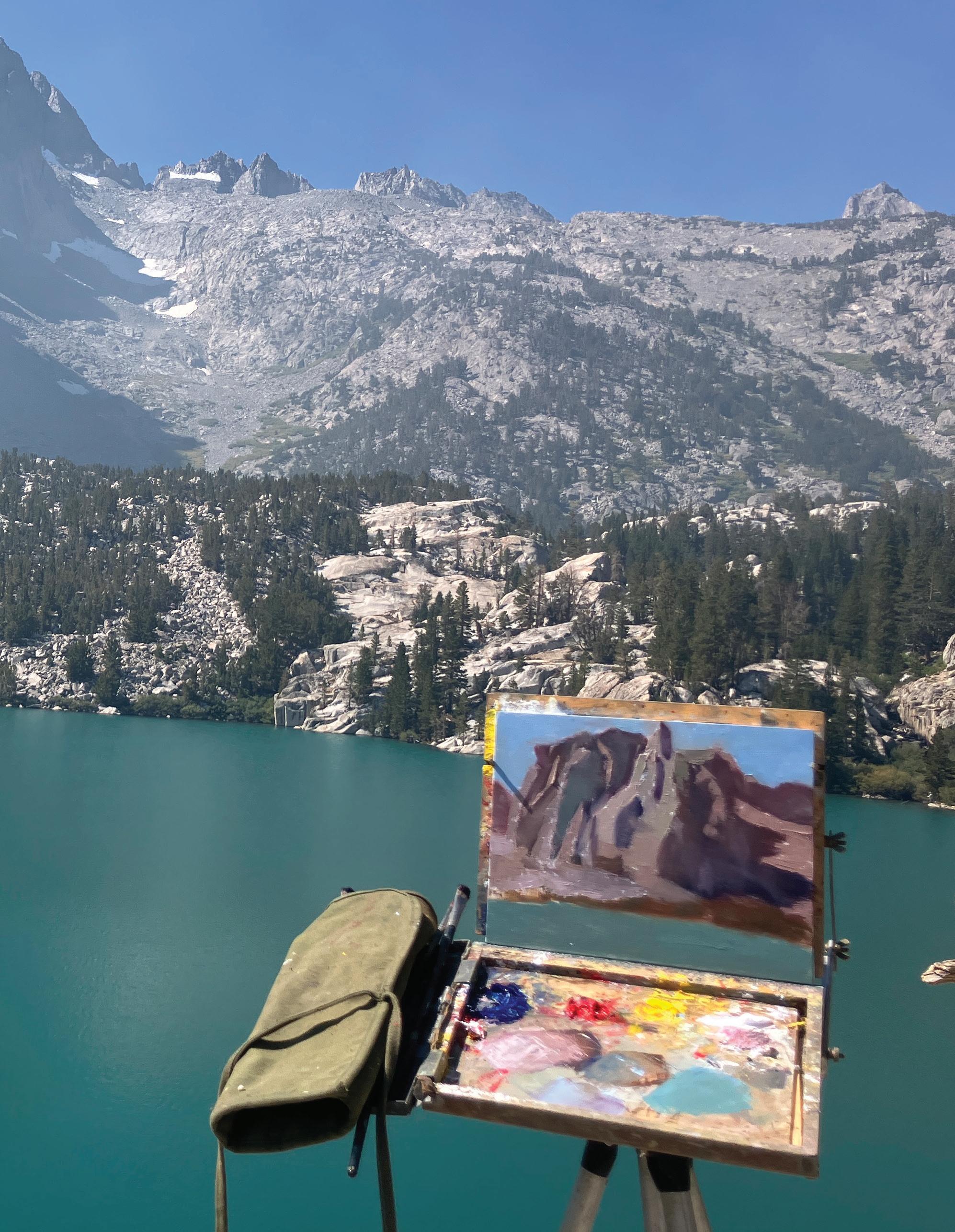
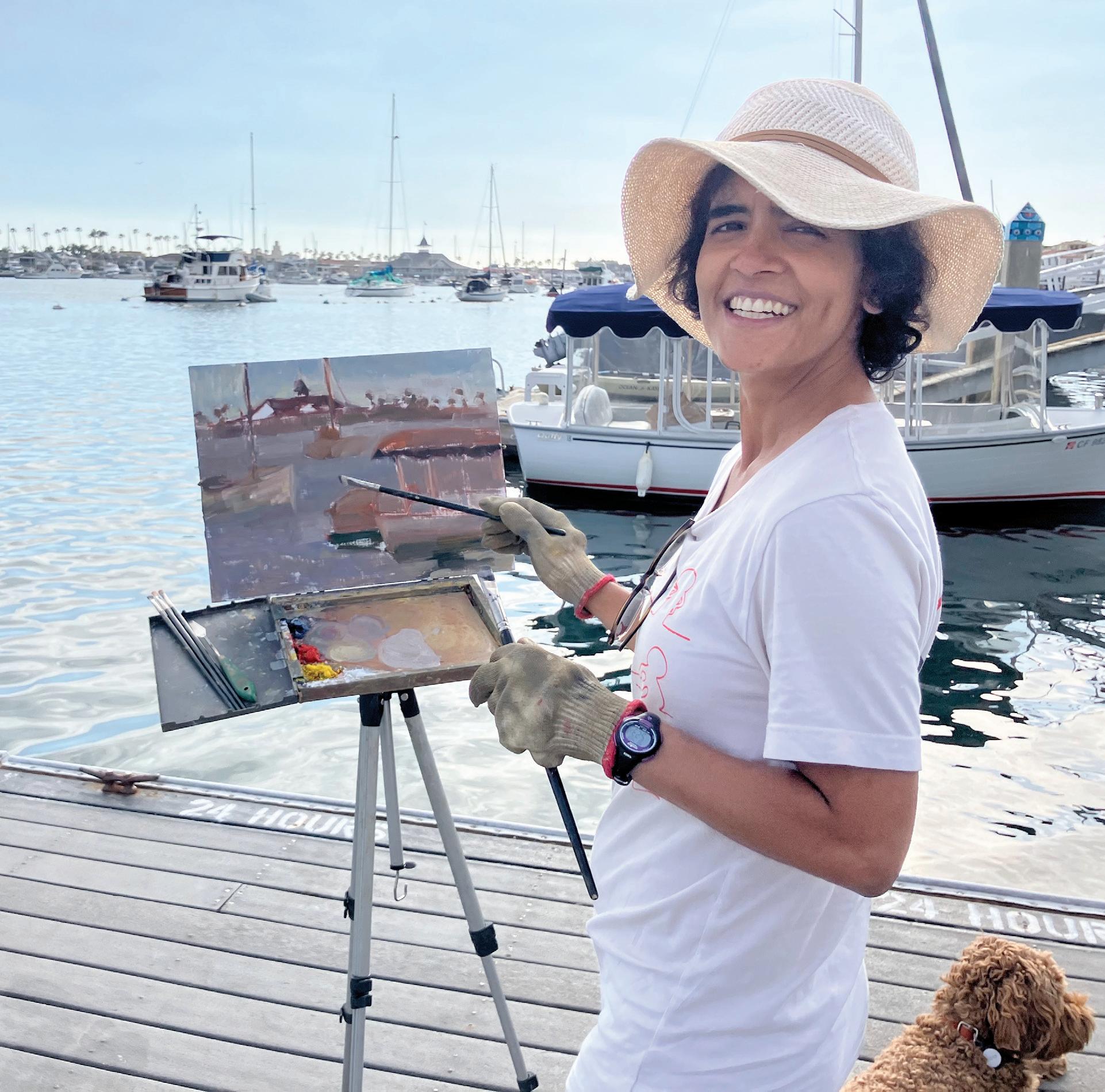
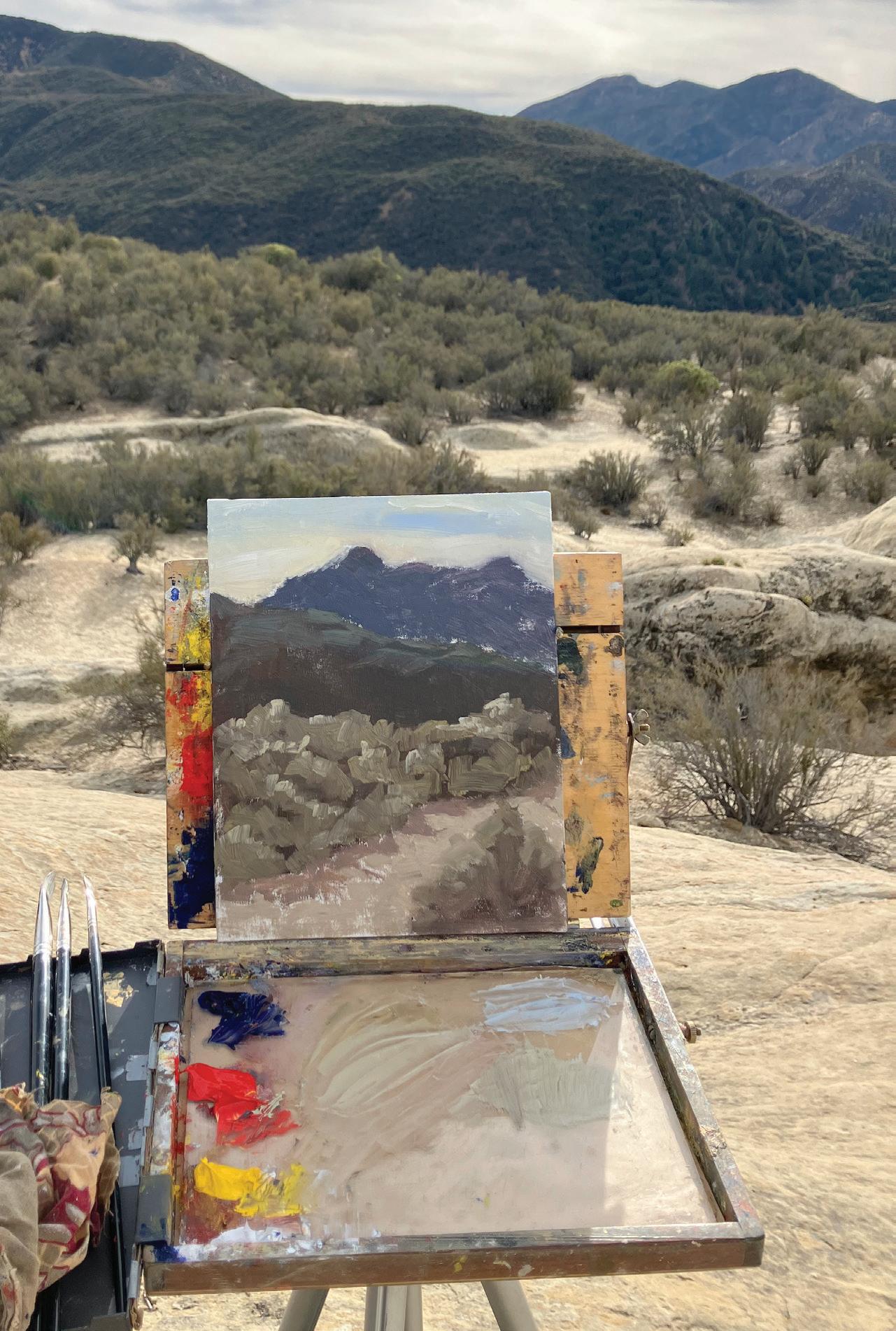
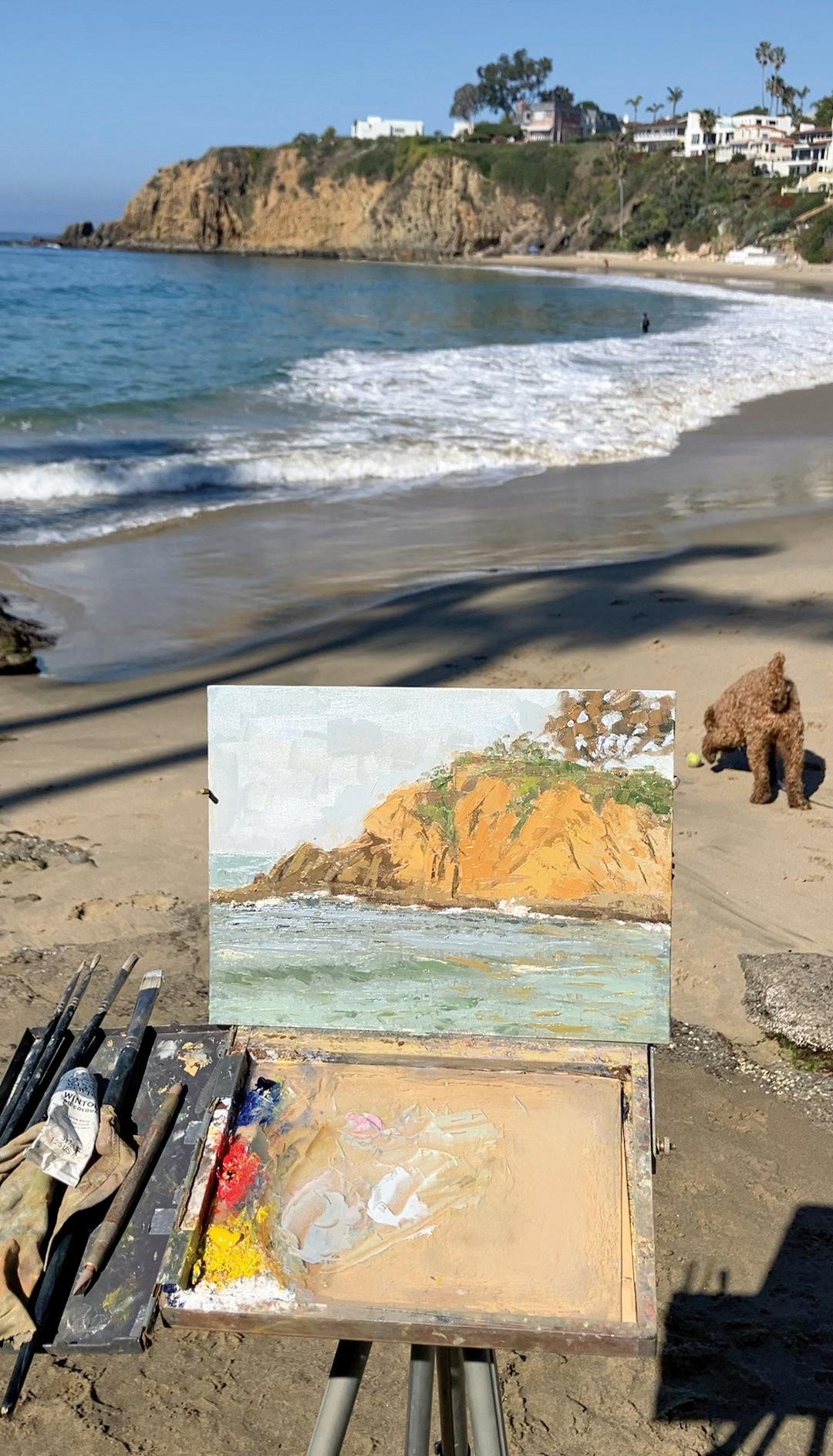
Still, I didn’t know I had an artist inside me until 2020. And when I accidentally picked up a brush, images of nature I knew so well emerged effortlessly. As I learned I could use the outdoors as my studio as a plein-air painter, it became a blissful combination. I gave myself the permission to follow my spark with childlike passion and wonder.
In 2024, the calling was so strong, it was clear I should leave my job and follow this path. What scared me most was wondering if there was space for another artist in the world and if I had anything truly different to offer. The years of training as an engineer wasted, the efforts of my parents to get me here neglected, the thought that I was starting too late, all of it came rushing in. But the deeper inner certainty of this path was so clear it propelled me forward. Now, my days are often spent on hikes and trail time, and I end them with paint under my nails and dirt on my boots.
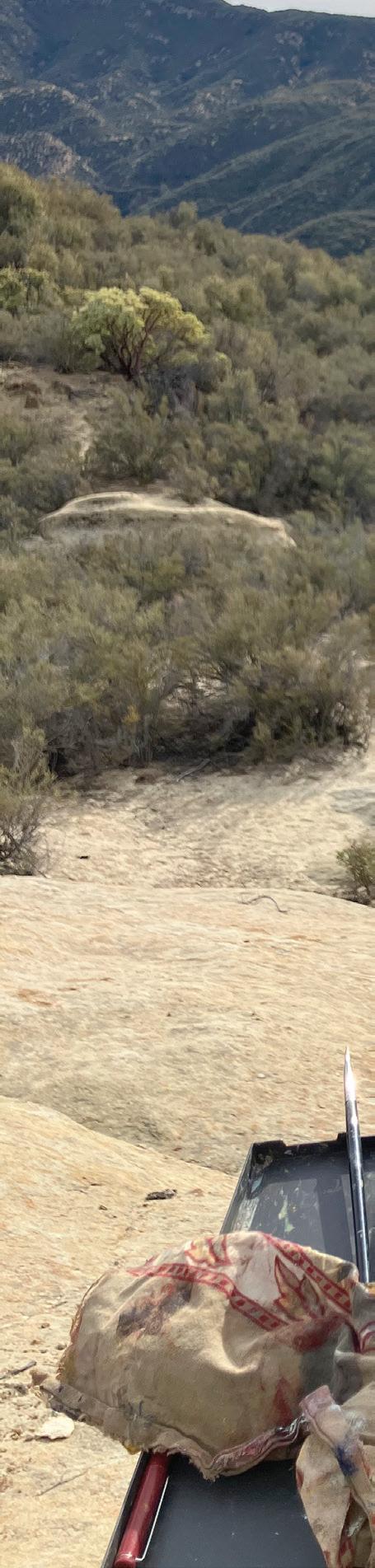
The outdoors is my real studio. That’s where it all begins—on snowy ridges, foggy coastlines, desert canyons, and alpine lakes. I carry my painting kit alongside my camping gear, set up under the open sky, and paint in the wild. A hot cup of tea at sunrise and a canvas waiting for color is my version of magic. Out there, I feel most alive and at peace, like I’ve found the truest version of myself. I carry only small canvases outdoors to quickly capture the colors, essence, and raw emotion of what I experience in the moment, like watching clouds magically lifting after a storm, which tears you up from joy. Other times, it’s mixing the warm colors to express the sweltering heat of the desert, giving you survival lessons. And then there are the frigid mornings when my fingers are numb from the cold, yet the stark beauty before me demands to be painted.
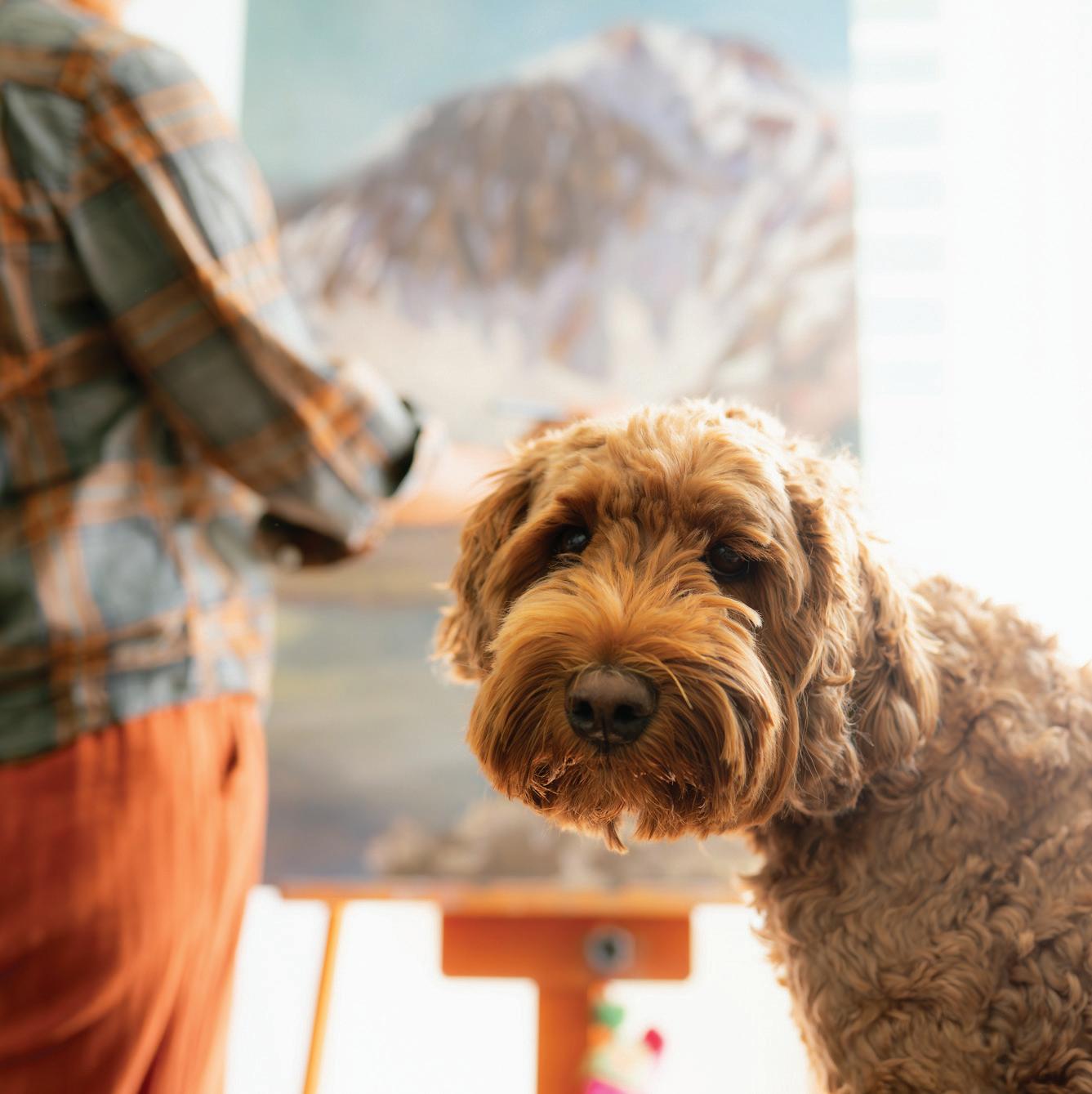
Ginger, my dog and adventure buddy, is with me for all of it. She’s got a sixth sense for when I need space or when something’s not right. She guards me when I paint, intercepts overly curious strangers, and naps beside me while I work. She knows this rhythm as well as I do. She’s just as much a part of this journey as I am—my quiet protector, trail companion, and my reminder to live with presence and simplicity.
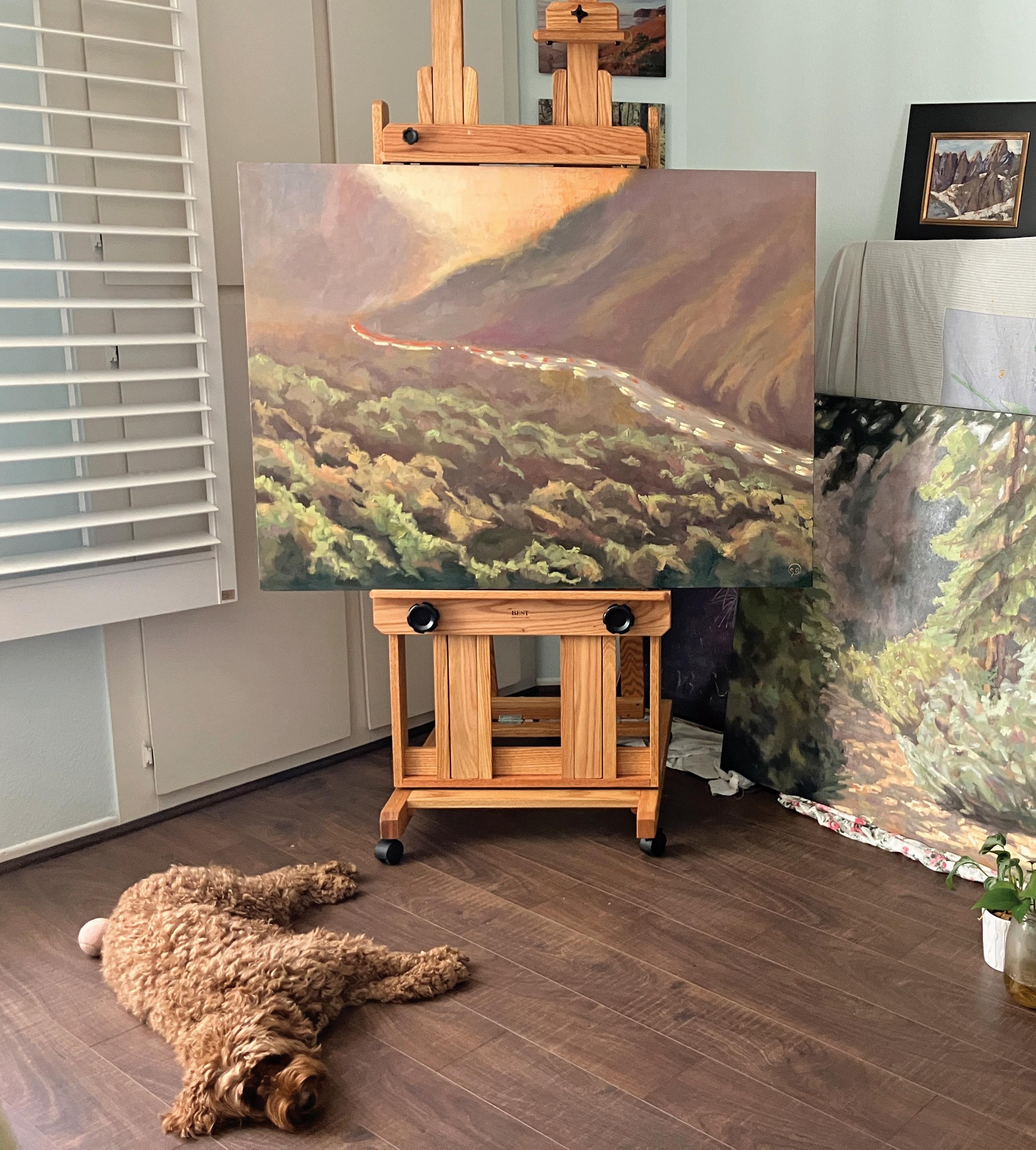
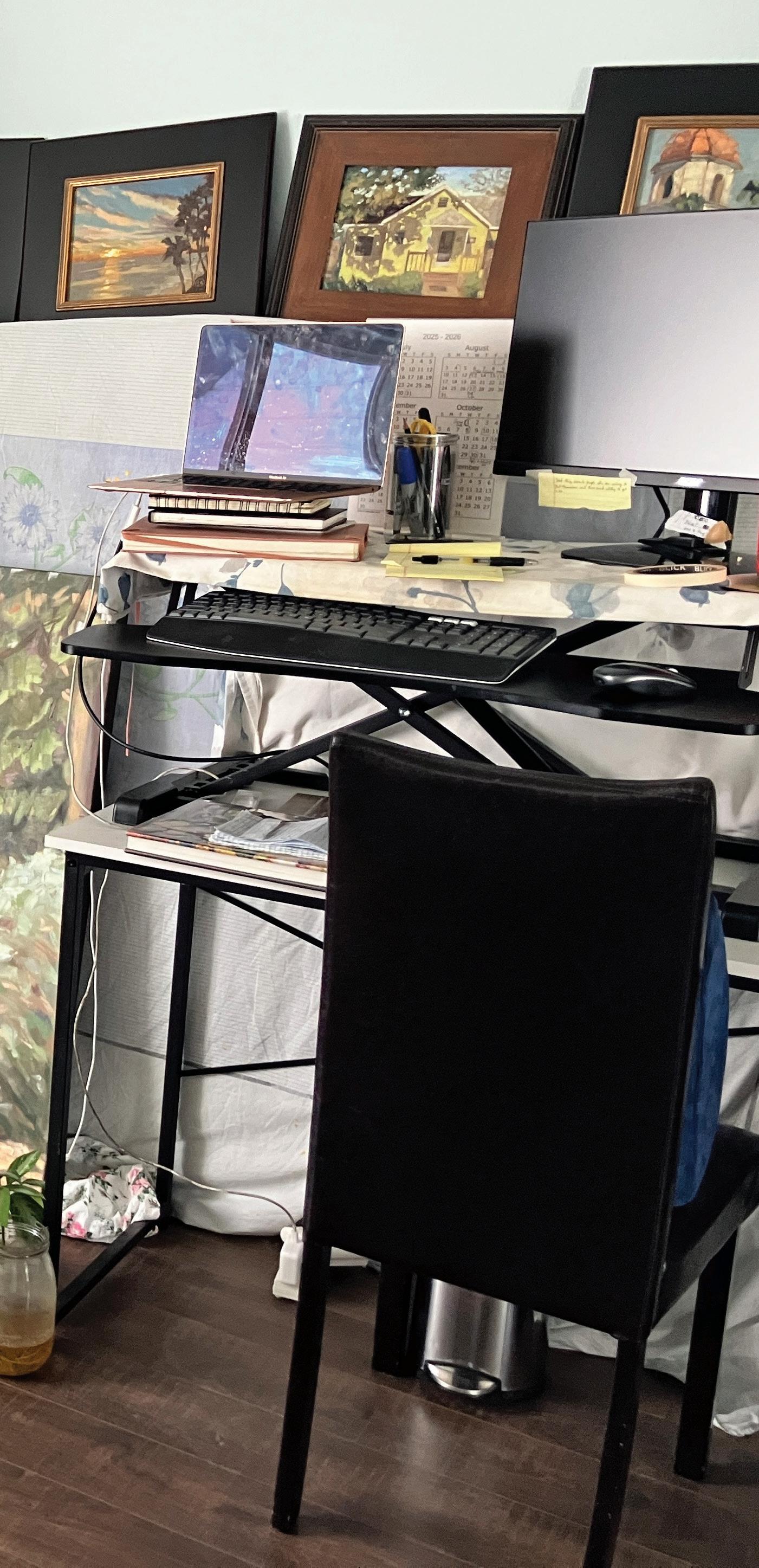
Back in Irvine, my home studio is where those trail-born ideas grow bigger. It is an extra bedroom converted to be my fun workplace. It’s cozy, quiet, filled with natural light, and looks out on hummingbirds flitting through my California native plant garden, and that little room is the heartbeat of my process. It’s where quick plein-air sketches turn into larger, deeper works that carry the soul of the places I’ve been. I start my painting days brewing a hot cup of tea and sipping it as I walk into the studio. Hans Zimmer’s music fills the room, and I move with it as I work on large canvases, painting almost like a dancer, pausing now and then for another sip of tea. Ginger walks in and out of this studio, reminding me of our combined time together on those trails while I try to paint them.
I only use non-toxic, sustainable materials, i.e., no cadmium paints, no turpentine or harsh chemicals, and nothing that’ll harm the land I love. My studio is Green Business Certified, because art and sustainability go hand in hand for me. It means a lot to me to know that my creative process aligns with my values and that I’m leaving behind something better than I found it.
My dream is for these paintings to do more than just decorate walls. I want people to feel a visceral connection to the land through them, to remember the trail they hiked as a kid, the breeze on their face at the summit, or that deep sense of stillness only nature can give. I want the art to feel like home, even if they’ve never set foot in the places I’ve painted.
Of course, there have been disappointments too. Art shows with no sales, silences from galleries and collectors that you reach out to, moments of self-doubt, the leap from steady paychecks to unpredictable income, questioning of my career change from friends and family, and times when I myself wondered if I’d made the right choice leaving my old life. Sometimes I feel like an impostor in the art world, someone who slipped in through the side door instead of walking through the front. But each setback has also made me sharper, more grounded and committed. The fear hasn’t disappeared, but I’ve learned to walk with it, just as I hike with uncertainty in the wilderness, trusting that the trail itself is where I am meant to be, not just some peak to arrive at.
Where I hope to go is more shows, larger canvases, deeper connections with collectors, solo exhibitions that pull together all these threads of art, nature, and community, a gallery filled with towering landscapes that feel like portals, so when someone steps inside, it feels like stepping onto the trail itself. But the biggest dream of them all, which is already a reality, is to bring to people what the natural world has to offer and to ask, Why not get out there? You are safe in nature. Life is simple out there. Let nature hold you warmly the way it wants to.
And while my art serves this purpose, that’s not the only way I help people find their way outside. In 2019, I started the OC Women’s Outdoors and Wilderness Group to enable other women to get outside, too. What started as a few of us walking trails has grown into a big, thriving community of hikers, campers, backpackers, and adventurers enjoying the outdoors and making lifelong connections.
I’m grateful for this life I’ve built—this wild, handmade, imperfect life full of color, trail dust, and purpose. That, to me, is the definition of success.
“Tell me, what is it you plan to do with your one wild and precious life?”
—Mary Oliver, The Summer Day
ARTISANAL JOURNEYS
CURATED BY ISABELLE FISH
Catherine Granche
Photography by Élisabeth Anctil-Martin
CATHERINE GRANCHE is an artist and jeweler living and working in Quebec City, Canada. Her unique and singular path seems disorganized at first glance, but it is wholly representative of this artistic soul endowed with a curiosity for nature and culture, with a thirst for knowledge and discovery. Here you will discover how theater, horticulture, and jewelry have fashioned the artist she has become.
My professional career may
seem strange at first, but there is a thread binding it all together, and the jewelry I make today is a testament to this atypical path. I try to communicate my fascination for plants and the changing of the seasons with their tie to human existence, and how our bodies mature. I am fascinated by all intricate details and stories of life, and give great value to all that is handmade, be it bread or an intricate quilt!
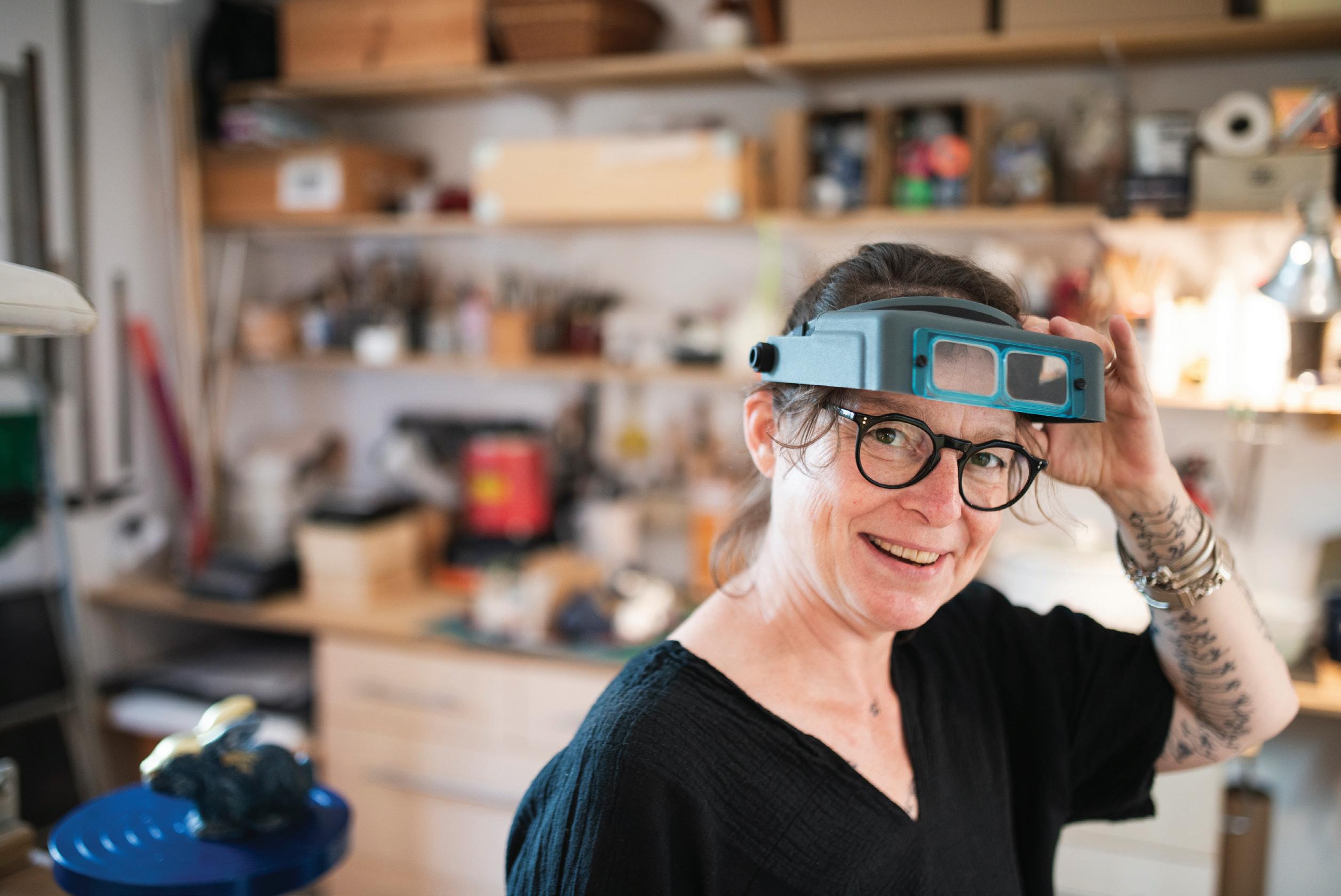
I consider my workshop to be a space that is both comforting and demanding. My work in the studio is made up of joys and sorrows, setbacks and little victories. It’s also the sum of 35 years of shared work between three careers, a son, houses, dogs, important encounters, and inspiring people.
35 years ago, I began my career as a scenographer and prop master. For ten years, I made sets, spending time at antiquities shops and garage sales to find period objects. I did stage painting, sewed costumes with meager budgets, and tutti quanti (everything). The world of theater served as a wonderful school where resourcefulness and creativity went hand in hand. Parallel to this career, I continued my studies in French literature and arts history at university, which allowed me to start teaching scenography and the history of fashion and style. These lessons never left my mind, and I remain just as fascinated as I was then. It is important to me that my work stays grounded in principles of theory, art, and history. I love taking the time to appreciate every detail of an intricate jewel, a painting, exhibitions, and a walk in the garden.
From ISABELLE FISH: To wear a piece of jewelry by Catherine Granche is a very corporeal experience. One has to step behind the piece, make oneself discreet, become the background— as if becoming the canvas on which the piece lives. It’s not that the piece wears you, but more that it inhabits you, it becomes you—it is an emotional connection that is both unsettling and delicious.
Duringthis time, my son was growing, and I no longer wished to work several nights a week at the theater. To reinvigorate myself, I decided to make a dream come true and enrolled in the horticulture course at the Montreal Botanical Garden. Two years later, I was leaving with a horticulturist diploma in hand, with a specialization in alpine plants.
The profession of horticulturist has given me precision in my work, attention to detail, and the commitment necessary for a job well done that is also sustainable. I loved knowing the names of plants and drawing gardens. This job made me proud and happy. And one day, in my office as head horticulturist, I started to miss creation and the workshop. I dreamed of being dressed in an apron again, stained with color and surrounded by art books.
16 years ago, a simple suggestion by my husband changed everything: “You could sign up for a jewelry workshop.” Everything followed suit naturally. I left my job as a horticulturist, got a diploma at Montreal School of Jewelry, and participated in many exhibitions and advanced classes where I could meet artists from Canada and abroad. A few years later, the Galerie Noel Guyomarc’h added my name to their list of artists. This step was fundamental to me. Being represented by this prestigious gallery gave me power over my own creation— my artistic approach was viable and recognized. Playing in the workshop was getting serious!
When I play in the studio, it often results in good things, and if I am lazy or not in a good enough mood to create, I will allow myself to knit or work on things that aren’t immediately
necessary. This way of being present in the shop allows me to find my energy, or even the spark that was missing to continue a piece.
Each of my three careers is linked together by one main notion: the body in space. With scenography, I worked on building scenic habitats for the body. By creating gardens, I built spaces where the body etches itself in nature. And with jewelry, the body has become a space to ornament. In all these approaches, I was sensitive to history, fashions and style, ethnobotany, traditions, and all that could support my inspirations and artistic intuition. These references are essential to my mission; they allow me to anchor my work in reality. My jewelry isn’t solely the fruit of my imagination; it refers to specific propositions.
Currently, there are multiple projects in preparation in the studio, two of which are for exhibitions, one in Montreal and the other in Paris. I have also just completed a series of jewelry designs for a small exhibition, which freed up some space in the studio. Tidying up the workshop after a project is pleasant and a harbinger of new experiments; however, this lack of chaos makes me feel a slight spleen, a boredom or lack of inspiration that can be compared to writer’s block. I like it when a certain mess reigns; in other words, I enjoy a natural, less formal environment for creating over a highly
structured space. I prefer English gardens to French gardens if you see what I mean! I like having many projects concurrent with each other and making progress on them together. With knitting, for example, do not tell me to finish something before I begin another; impossible. I am simply interested in too many things! Having several projects at the same time allows me to take a longer-term approach. I can question the work in progress and not be in a hurry to find solutions. I can check the coherence between the various pieces of a corpus. It also allows me to choose what I want to do, and in which order.
Notwo days at the
studio are the same, although all the moves in the end are the same: draw, assemble, solder, pour a silver ingot then stretch it into string, water the plants, read, write, knit, walk Nellie (my 9-year-old, 100% soft coated Irish Wheaten terrier), get lost in innocuous searches on the web, knead clay, shape, mold, unmold, polish, color, in the kiln and out again, fix tools, order materials, get lost again discovering an artist’s portfolio or a new suppliers catalogue. It is often the small details that start a chain of ideas, like the cherries’ overripe color, the leaves flying by my feet, etc. Whenever I begin a new project, I gather all sorts of plant matter (dried fruits, twigs) and I mold or shape it in clay. I develop a routine that belongs to the series in court.
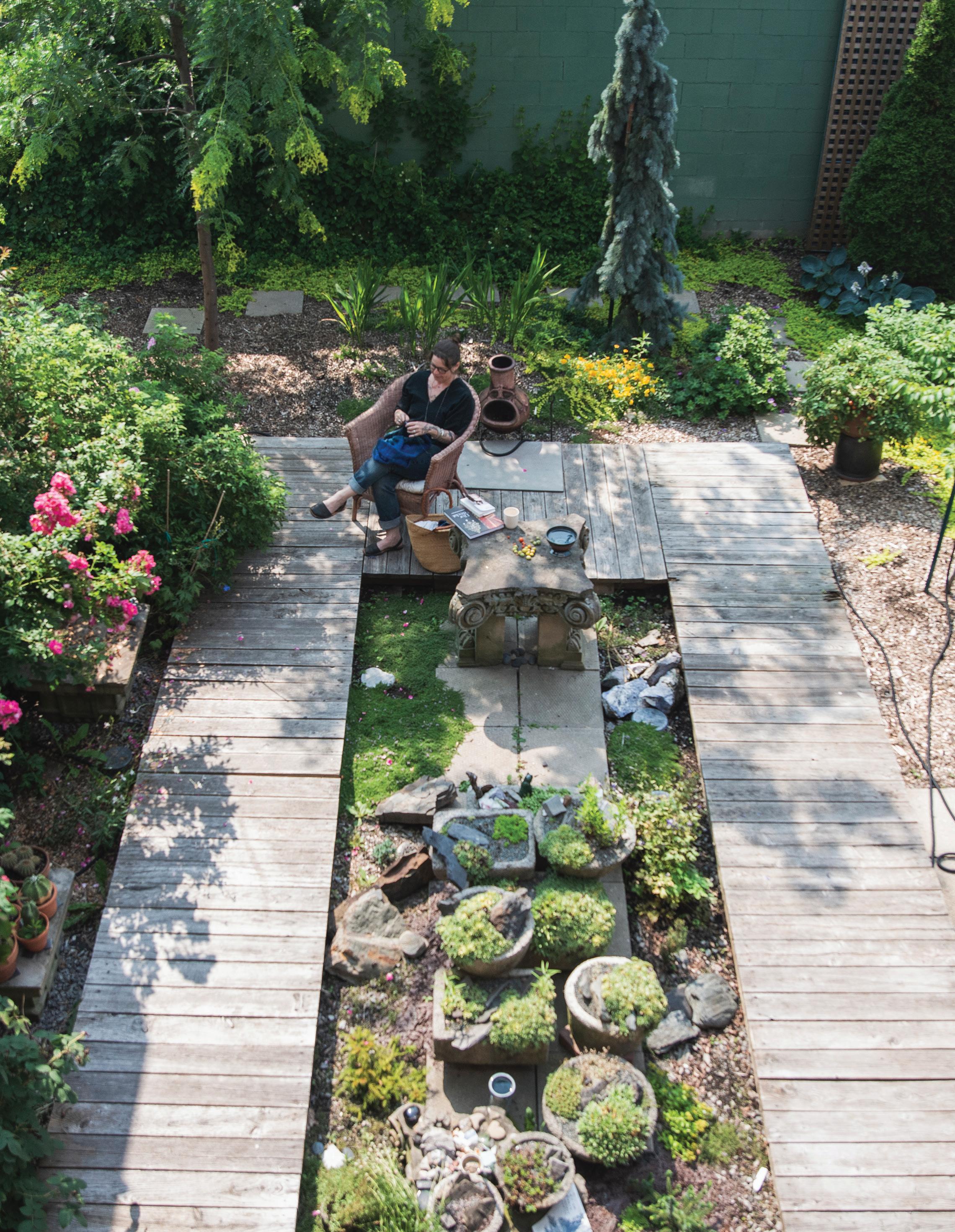
In this sense, my garden is an extension of the studio. I can find materials there, inspiration, and become aware of the quality of the light throughout the seasons. Sometimes I get lost in it, sometimes I take refuge there; this cherished haven in the heart of the city is both a place of life, work, and reflection. It reminds me of humility and the intrinsic strength needed to fulfill myself as an autonomous creative woman.
One of my aspirations is to open my workspace and organize workshops and meetings with artists. I truly believe in the interlocking and interweaving of disciplines and the meeting of artists, or active participants of the cultural flow, in order to broaden horizons, share knowledge and networking, as well as promote the discipline of contemporary jewelry. I want my space to be unifying and useful.
I believe this professional aspiration is directly related to knitting. The latter takes a prominent place in my life. It sets the pace for my days, is part of the seasons, and allows me a valve of well-being without pressure. This activity gives me access to a great community that brings together generous and creative people who perpetuate and modernize traditions. I see a direct correlation with my practice, especially in the design of “basket” necklaces made of chains, with or without porcelain elements added.
Opening the workshop is to me a gesture of sharing and openness. Just as well as designing and making jewelry is a privilege that allows me to open myself up to others by offering my interpretation of the world. The practice of jewelry gives me the opportunity to meet great people and to travel to see or participate in exhibitions. It’s a world that is constantly opening up to new experiments and expressions. I am filled with gratitude for all those who have accompanied me on this journey full of contradictions and questions, but infinite in its expression of creativity. There are still so many people to meet, so many works to appreciate; the world of jewelry is extraordinary.
More on Catherine www.catherinegranche.com
Instagram: catherine.granche
More on Isabelle www.ruepigalle.ca
Instagram: ruepigallecommunity
Teresa KIPLINGER
CURATED BY SANDRA EVERTSON
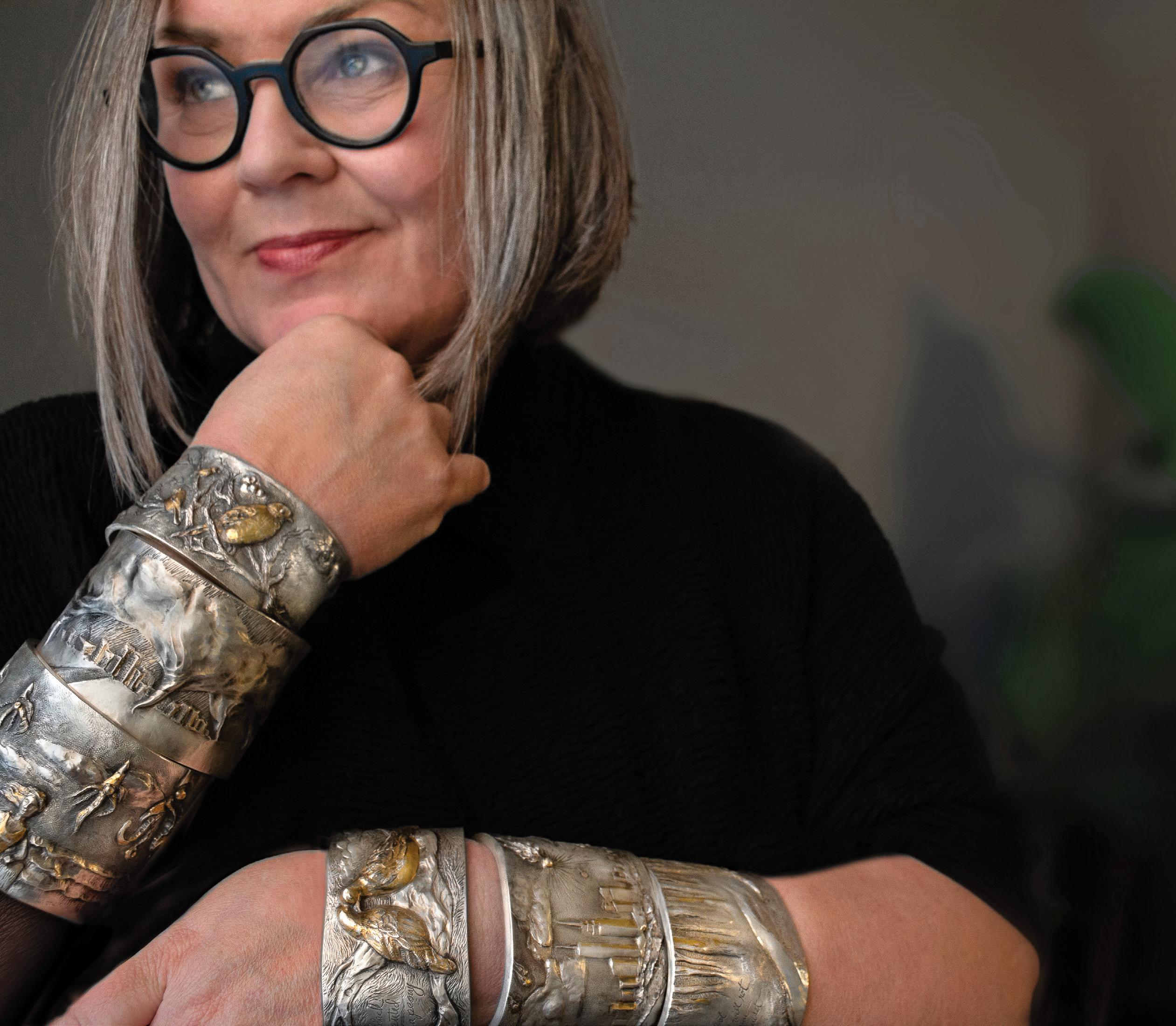
TERESA KIPLINGER is an interdisciplinary artist who combines precious metals, illustration, and original poetry to create haunting and expressive art jewelry. She is known for her use of intricate old-world goldsmithing techniques to create modern wearable expressions of isolation, loss, and existential dread. She works out of her studio in northeast Ohio.
I spent the first half of my professional life
immersed in digital technology, completely enmeshed in the evolving language of screens, pixels, and code. As a young graphic designer in the late 1990s, I forged my early career during the onset of the digital age, a time when creative boundaries were being redrawn overnight. I was an animator for children’s broadcast television, a designer and developer of experimental interactive stories, and eventually, a co-founder of a digital-first creative agency. We built things
that lived on the internet before the internet felt fully formed. It was a time of constant invention and reinvention, and I was entirely swept up in it. The last thing I expected for my professional trajectory was a second act as a metalsmith—an artisan at the workbench, immersed not in code or software, but in fire, metal, and stone.
But life has a way of unfolding along paths we never imagined. When I found myself going
through a divorce in mid-life—a time already heavy with introspection and recalibration—I was compelled to do something radical: to start again, and this time, to work with my hands. I enrolled in my first metals workshop almost on a whim, and what I discovered there felt almost mythic in its impact. I fell in love with the elemental and empowering nature of the craft. The process was visceral and grounding. I learned to wield fire with precision, to render form with hammers,
to saw and solder and sand metal until it became something wearable—something meaningful. Each tool offered a new lesson in patience and presence. There was something deeply therapeutic about this tactile world, where outcomes were the direct result of effort and care. And in shaping metal, I found myself beginning to reshape my life. What started as a curiosity quickly grew into something far more profound: a lifeline, a practice, and eventually, a calling.
Not long after that chapter began,
the sudden death of my teenage stepson shattered whatever stability I had begun to recover. It was a grief unlike any other— unrelenting, disorienting, total. In those raw months and years that followed, I turned increasingly to my bench. I began to make work—sometimes at a fever pitch—that explored themes of sorrow, impermanence, and the fragility of joy. I etched verses into metal late at night. I shaped tiny birds, sculpted silver branches, and built bracelets that held invisible weight. From within this deep well of loss, I began to find my voice as an artist.
What started as a kind of therapy soon became a compulsion, and then a devotion. I set about building a proper studio, not just a place to make jewelry, but a place to rebuild myself. At first, the space was purely utilitarian—just a workbench in a spare corner, a few tools I
barely knew how to use, and a smattering of books and sketches. But over time, that modest corner evolved into something sacred. I had not merely constructed a workshop; I had created a sanctuary.
I grew up in rural Ohio on my grandparents’ defunct farm. I delighted in that drafty farmhouse, in its crumbling 19th-century poetry books, its creaking spaces, and the quiet magic of a hidden room filled with blurry snapshots, crepe paper flowers, and inky letters from longgone relatives. Enchanted by this landscape of mysterious artifacts and half-told tales, I learned to love forgotten things. I spent long days drawing and daydreaming among the faded tintypes, abandoned bureaus, and ghosts of the past. That sense of wonder—the ability to be still and curious in the presence of the unknown—is something I carry into my work today.
“Inspiration exists, but it has to find you working.”
—PABLO PICASSO
My studio is a reflection
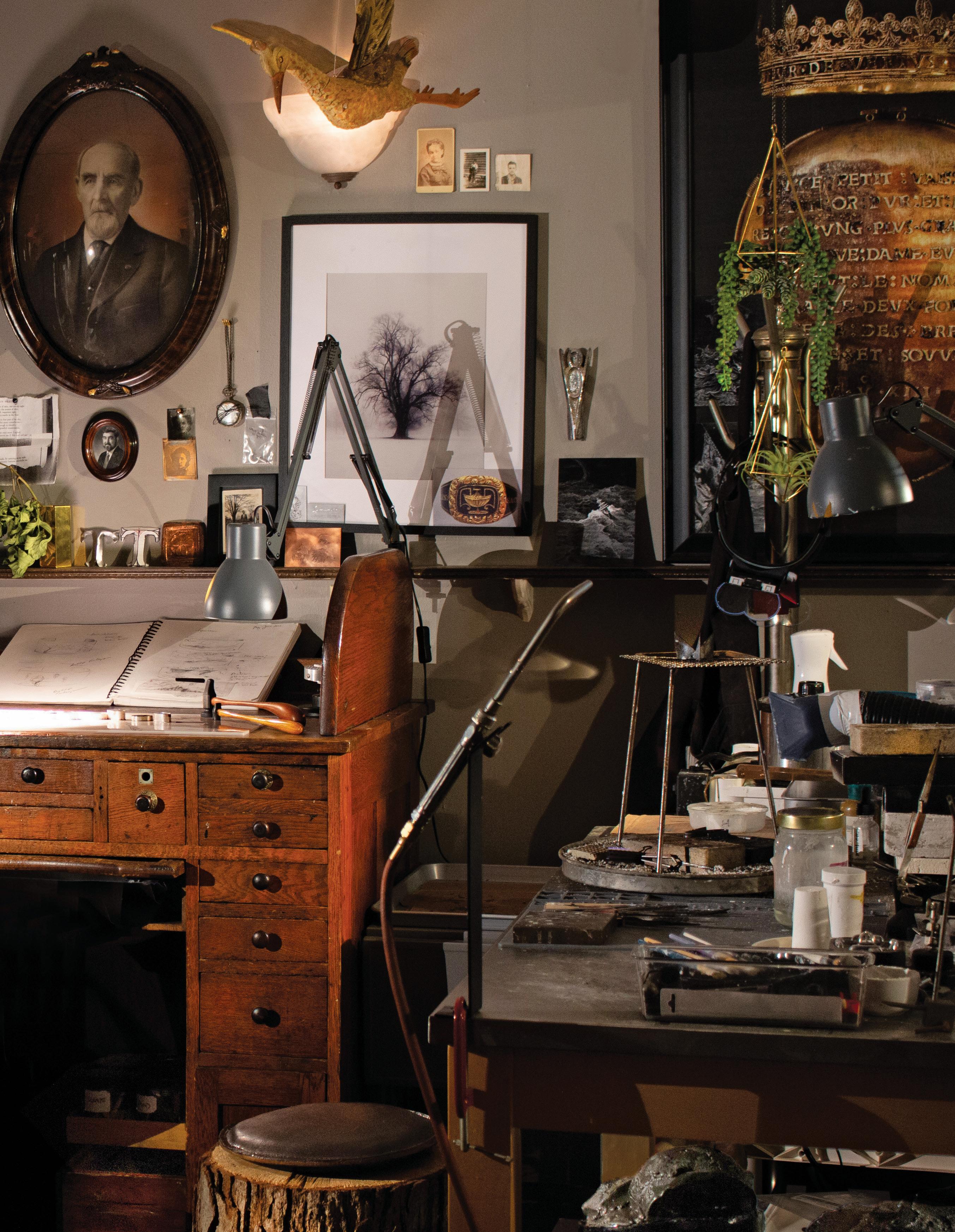
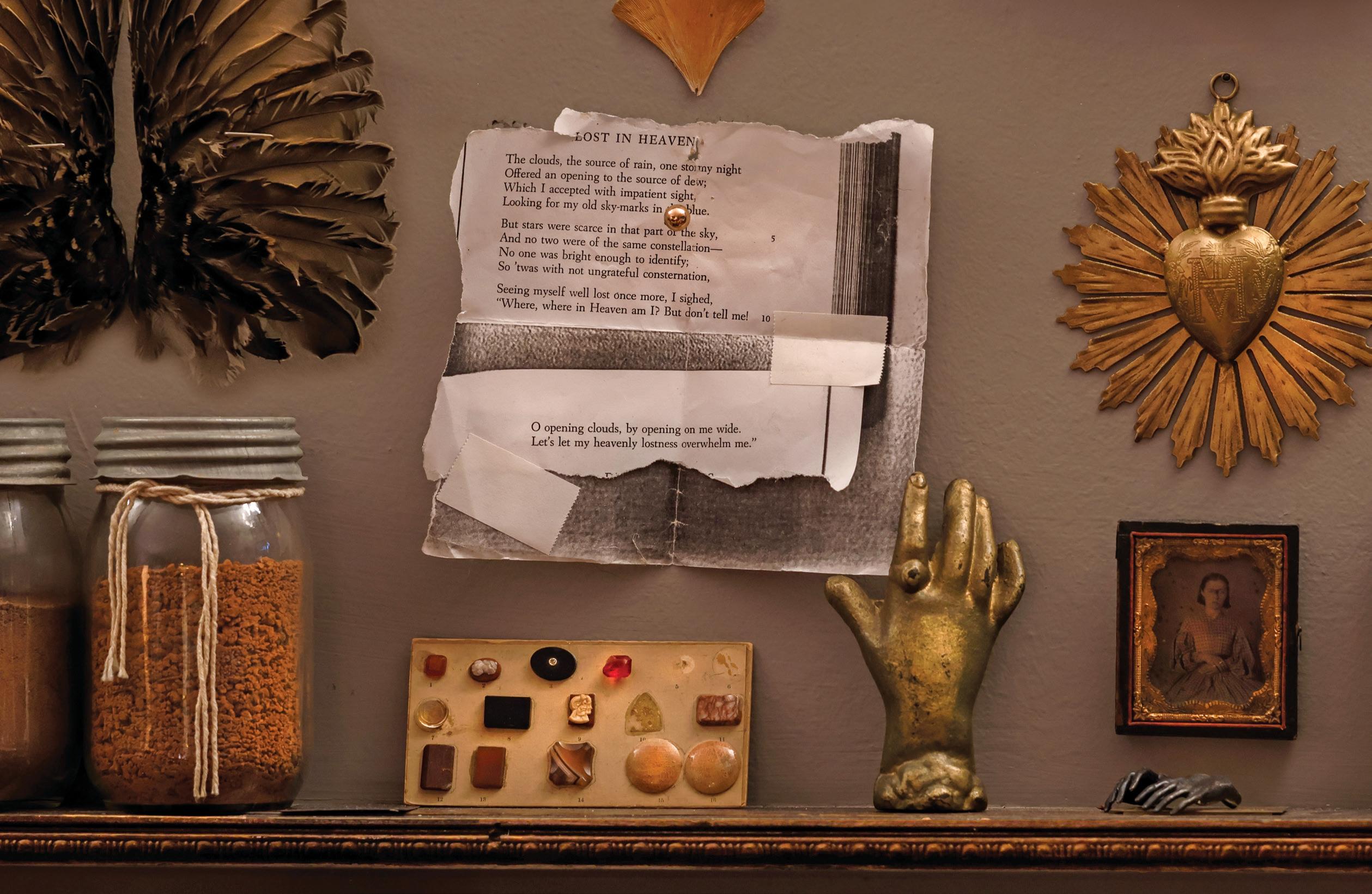
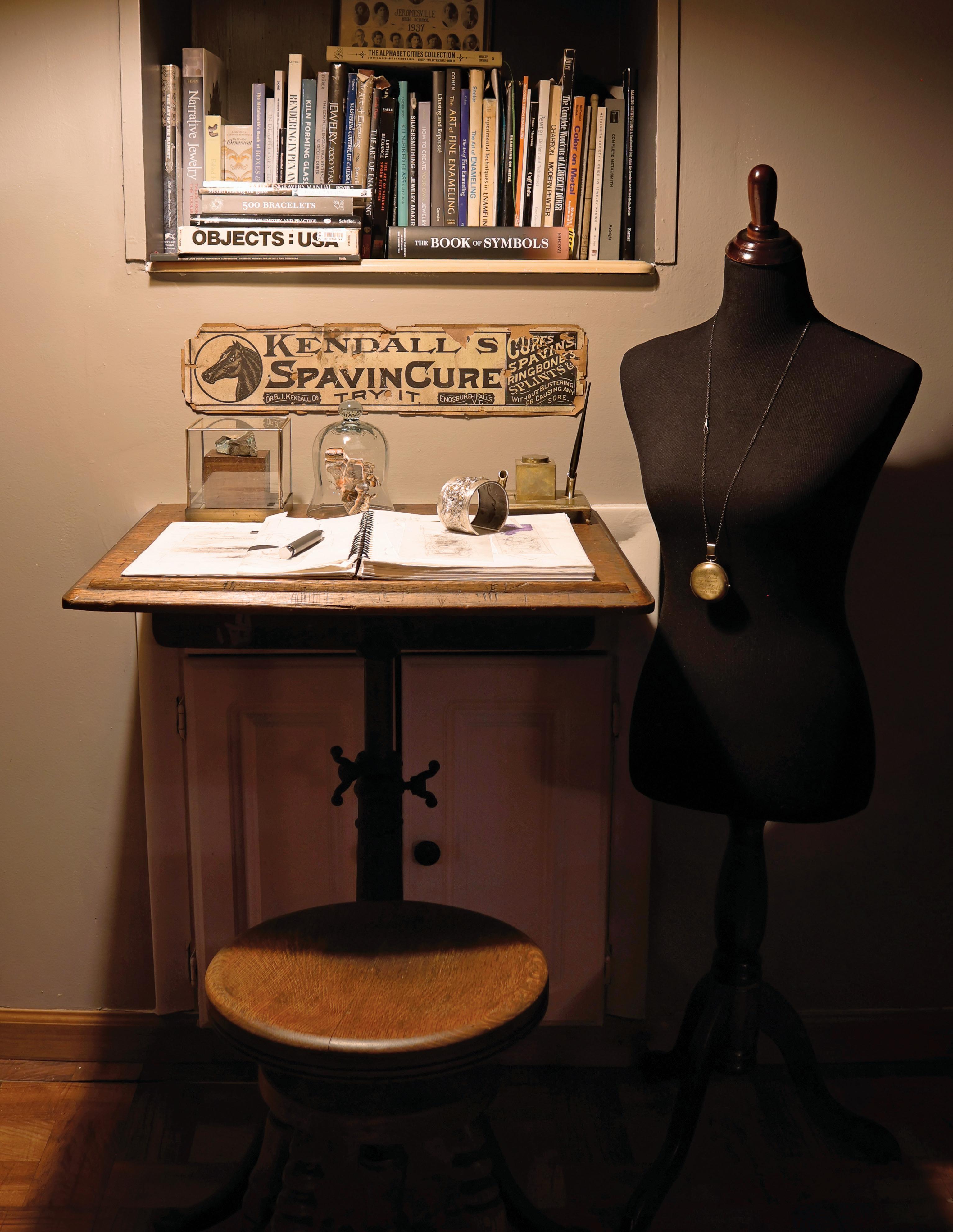
of that same sensibility. I’ve surrounded myself with talismans that hold meaning and memory. A red leather pocket journal that once belonged to my father sits close at hand. Faded books line the shelves, their margins scribbled with forgotten thoughts. Folded paper poems from a long-lost love are pinned carefully to the walls. Jars of dirt collected from spirited adventures rest alongside sparrow wings and leaves gathered at the turning of seasons. These are not just decorations—they are part of the work. This space is not merely where I produce jewelry; it is where I go to quiet an unquiet mind, to return to something slow, intentional, and soulful.
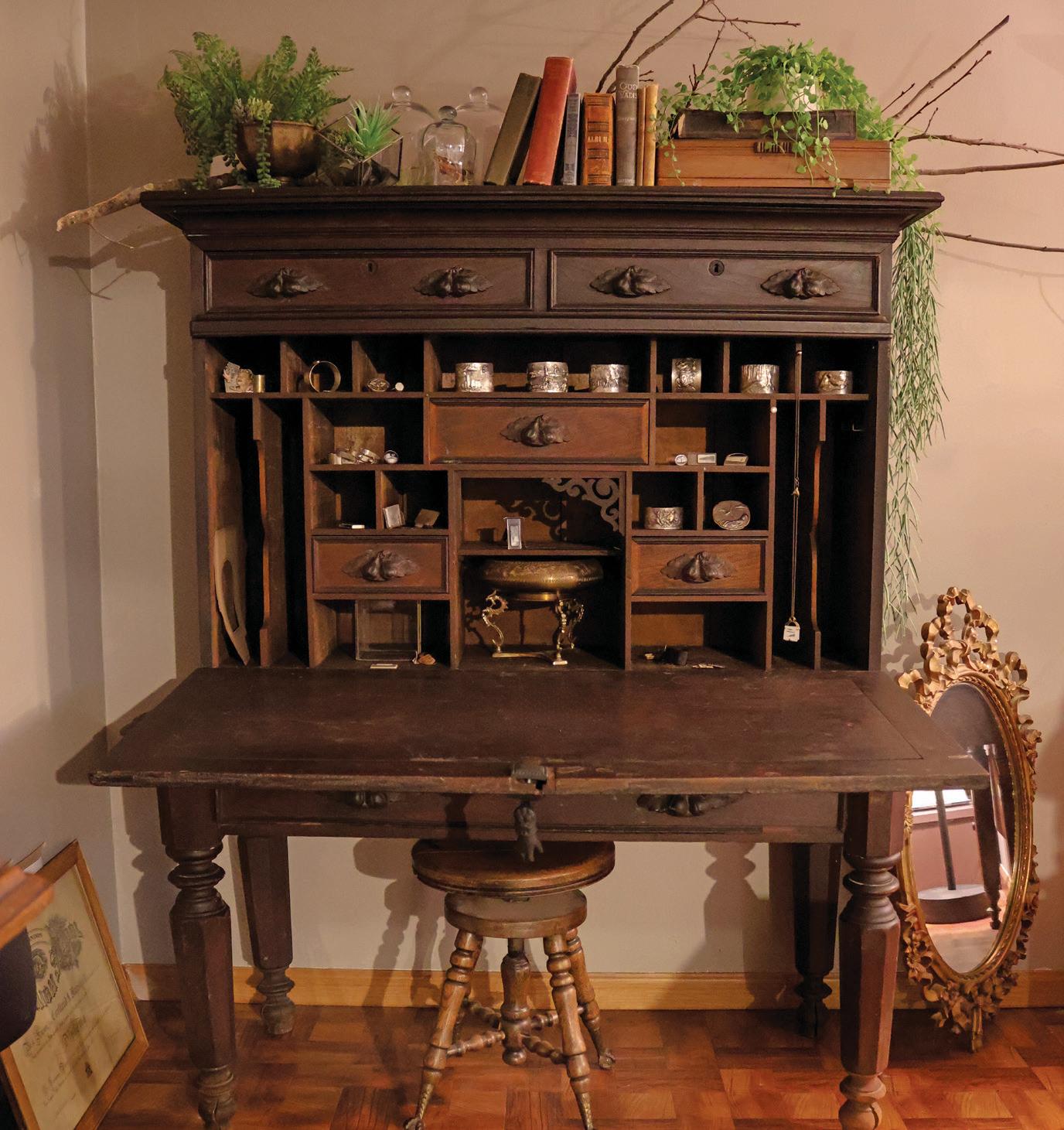
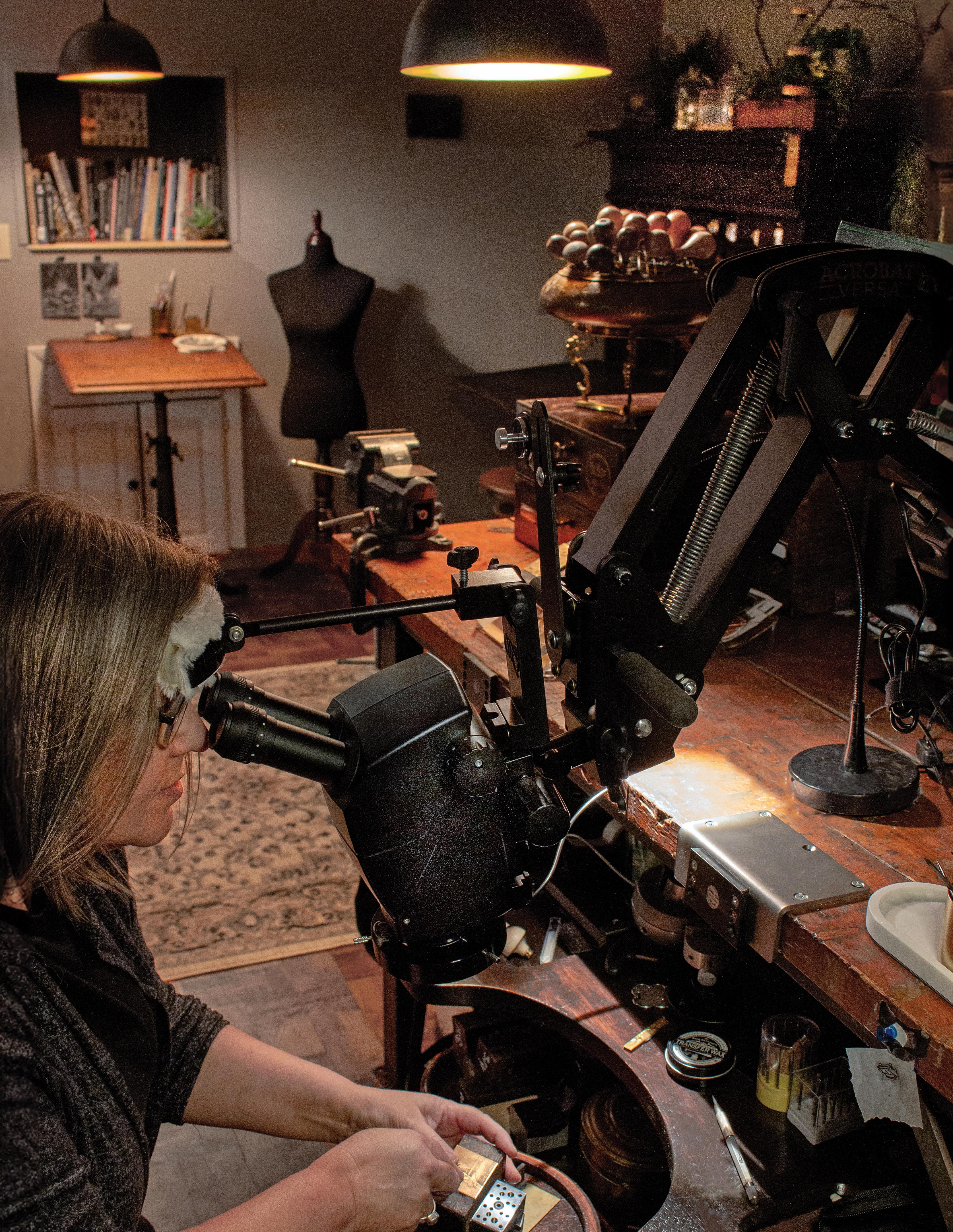
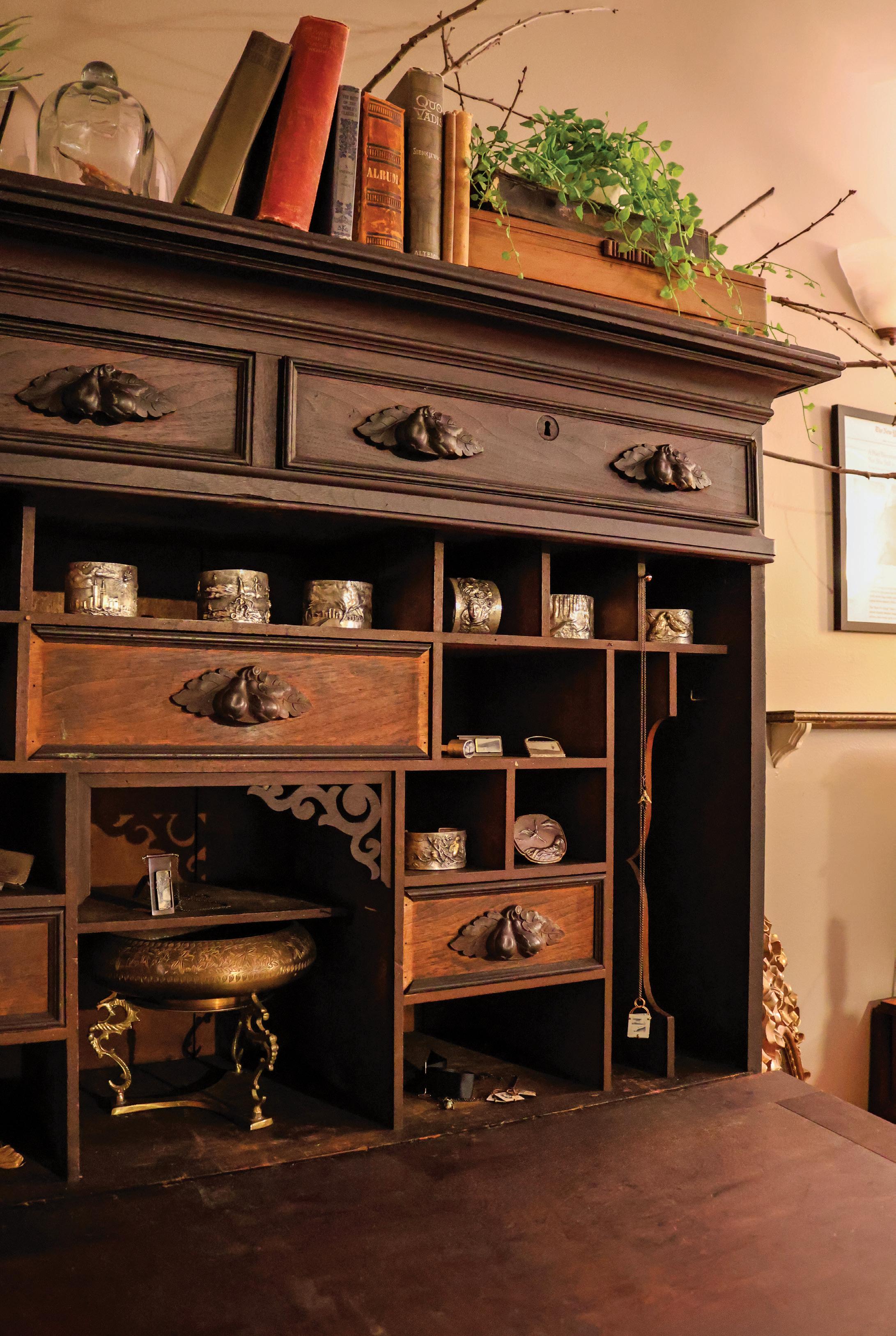
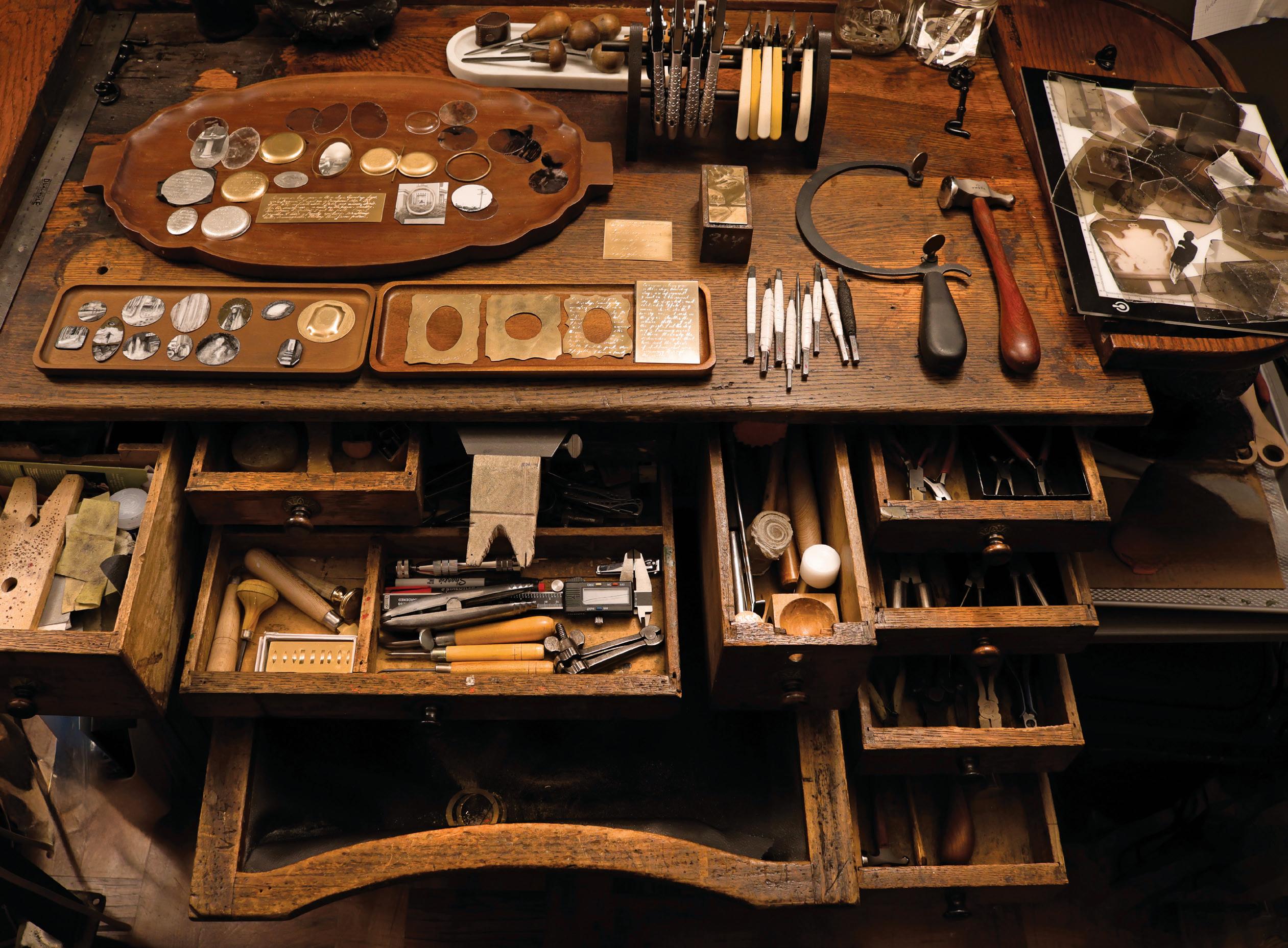
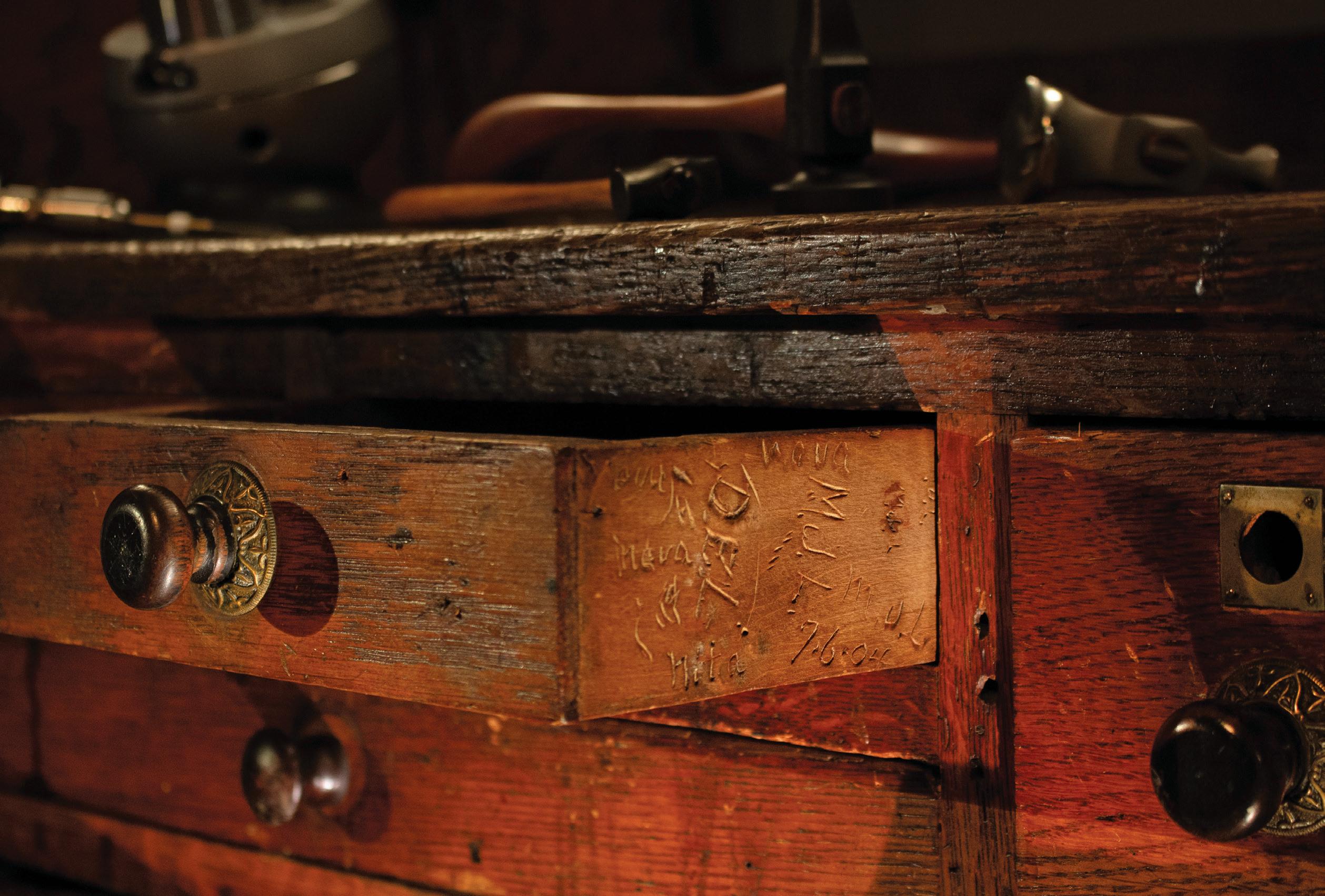
At the heart of my studio is an 1860s watchmaker’s bench that was salvaged from a barn. It is compact, worn smooth in places by decades of use, and filled with dozens of thin drawers—each one holding small tools. Some of those drawers are carved inside with names and dates of goldsmiths and watchmakers from more than 130 years ago. I like to think of them as companions in the craft, their presence stitched invisibly into every piece I make. Over time, I’ve added other storied pieces to the space: a centuries-old wrought iron writing desk, compact and solid, that once supported letters and ledgers; a walnut secretary with a flip-up panel that hides dozens of cubbies, perfect for storing and displaying my finished work.
As
a lifelong poet, I often begin
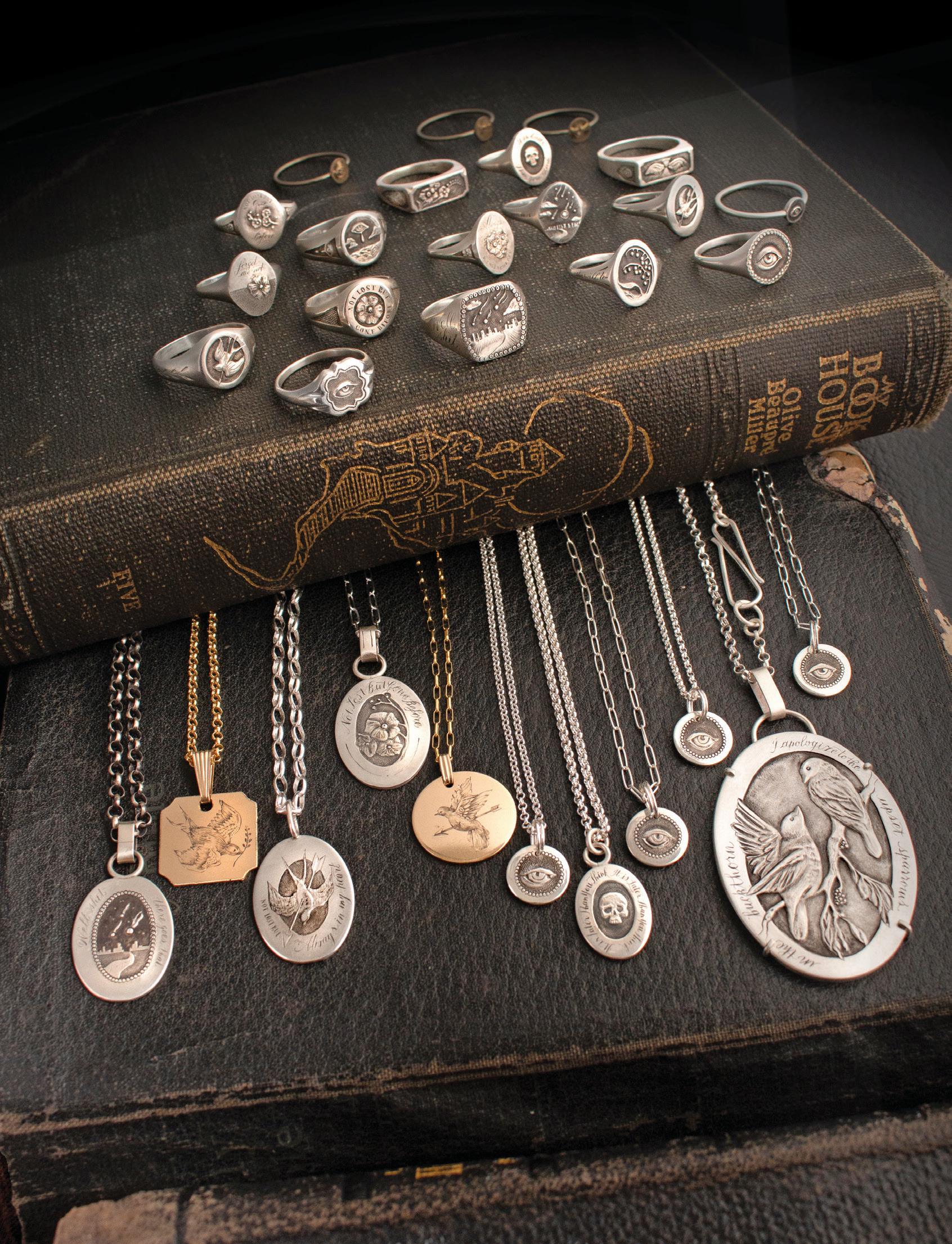
a collection not with a sketch, but with a line of original writing—sometimes a phrase, other times a full poem—and those words often find their way directly into the work itself. I engrave text by hand into metal, along the edge of a ring or sprawling across the face of a pendant, wild and imperfect. In this way, my work straddles multiple disciplines. It is part craft, part poem, part elegy. I do not aim to follow trends or to dazzle with bling; instead, my jewelry is a quiet call to reflection. It asks us to consider loss, time, memory, and legacy.
These are pieces that invite closeness, that encourage you to touch and read and linger. A locket might hold a hidden phrase only visible when opened. A pendant may bear a faint painting of two figures standing in fog. A delicately sculpted sterling bird, pierced
through the breast, might rest heavy on the collarbone—an image of both beauty and ache. These are modern relics, forged in fire but born of love, meant to carry something—an emotion, a question, a truth—through time. A century from now, I hope someone will find one of my pieces tucked inside a drawer or buried in a garden, the metal burnished with age, the engraving softened by time, and feel something.
Instagram: tkiplinger
Facebook: teresakiplingerjewelry
YouTube: tkiplinger
Pinterest: teresakiplinger
Jennifer Nelson
Photography by Sue Schlabach Photography, Sheridan Kahmann
Photography
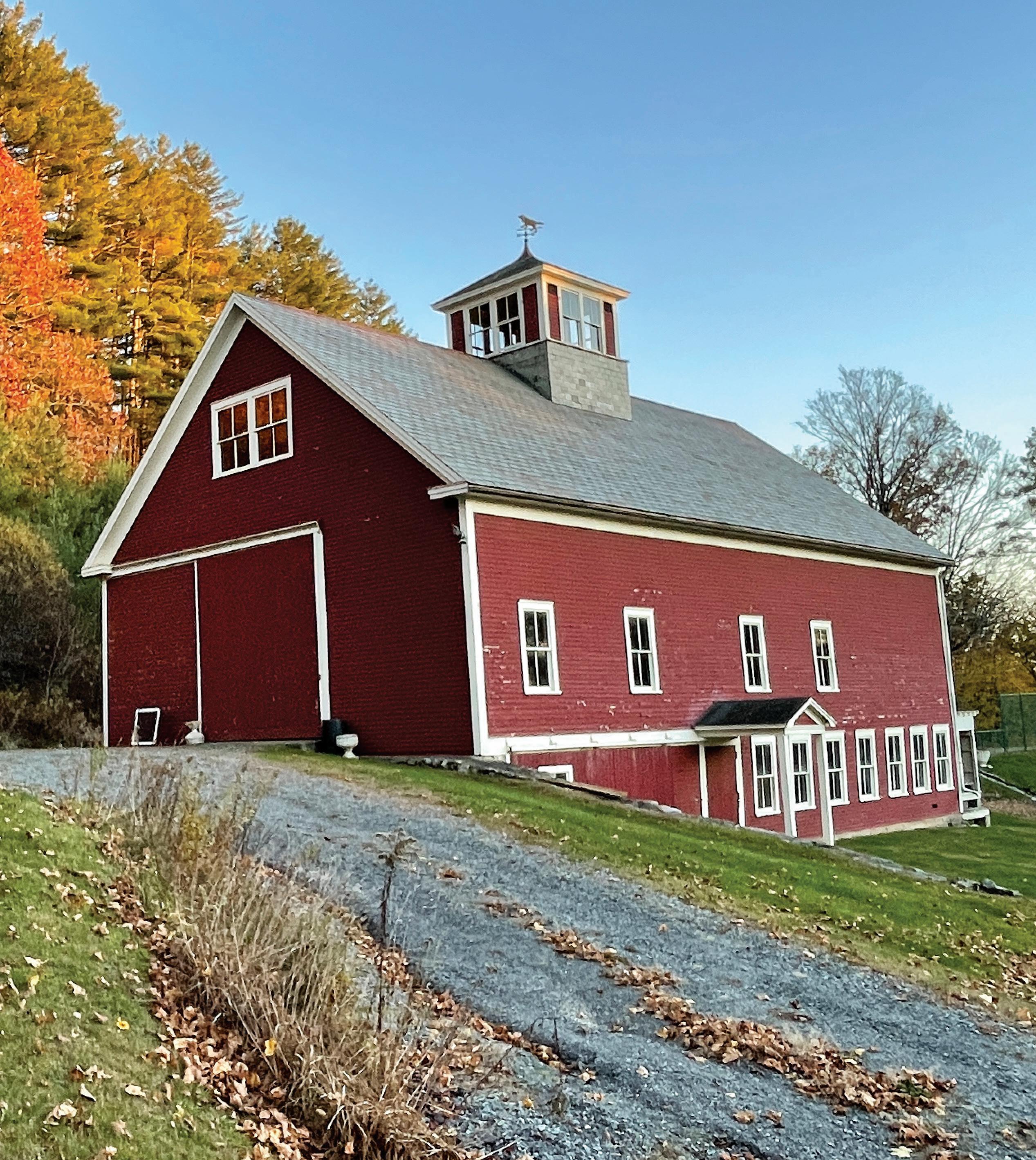
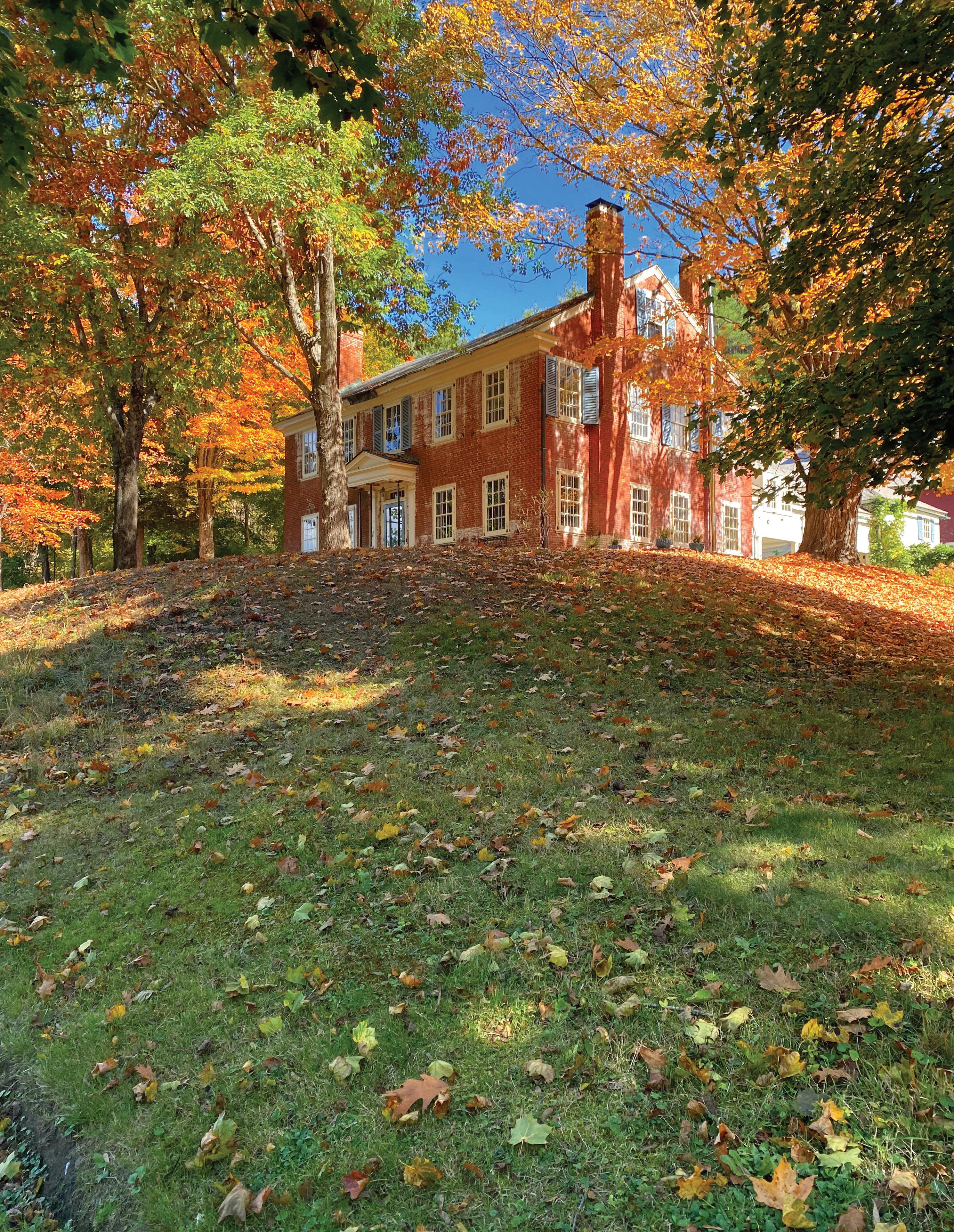
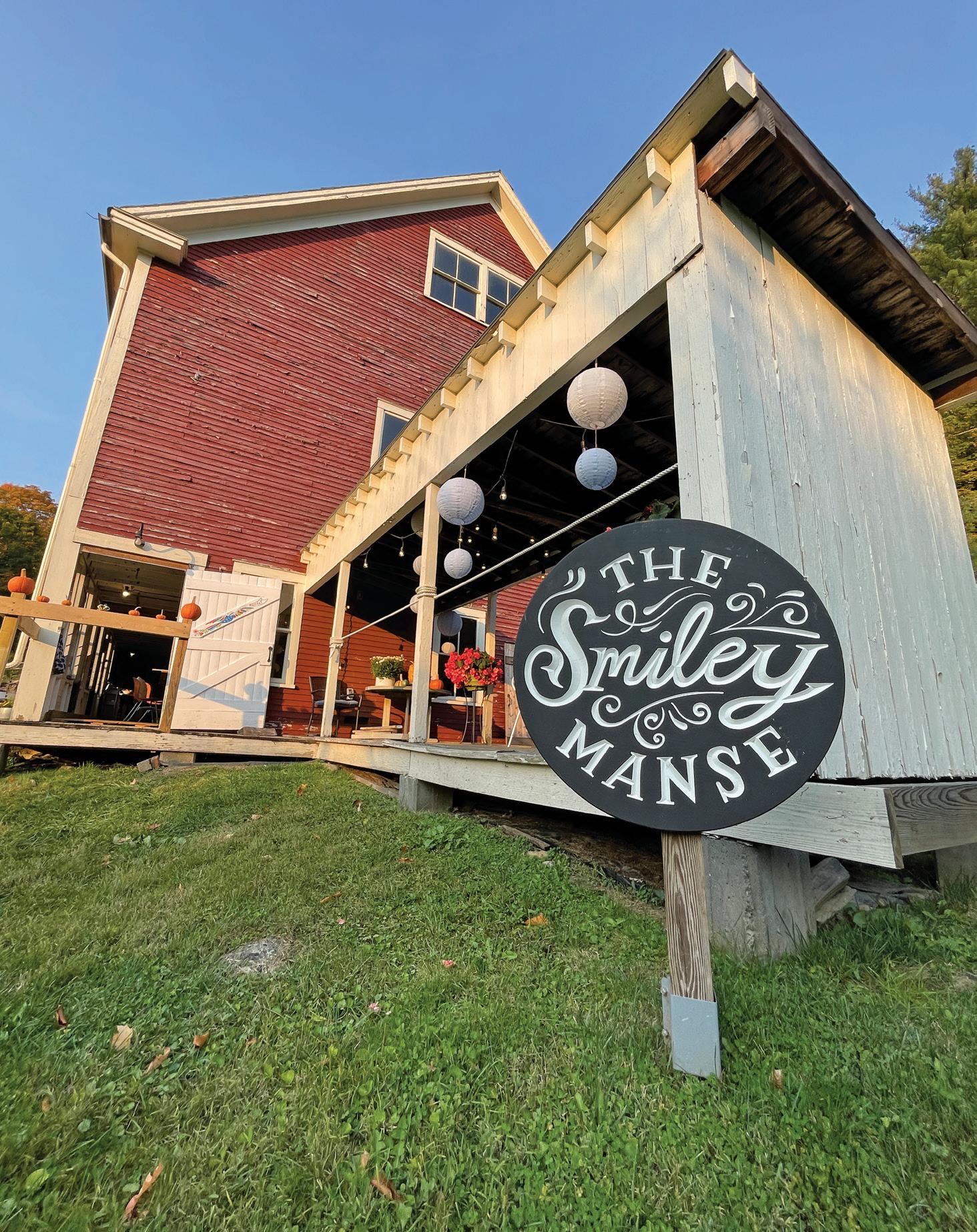
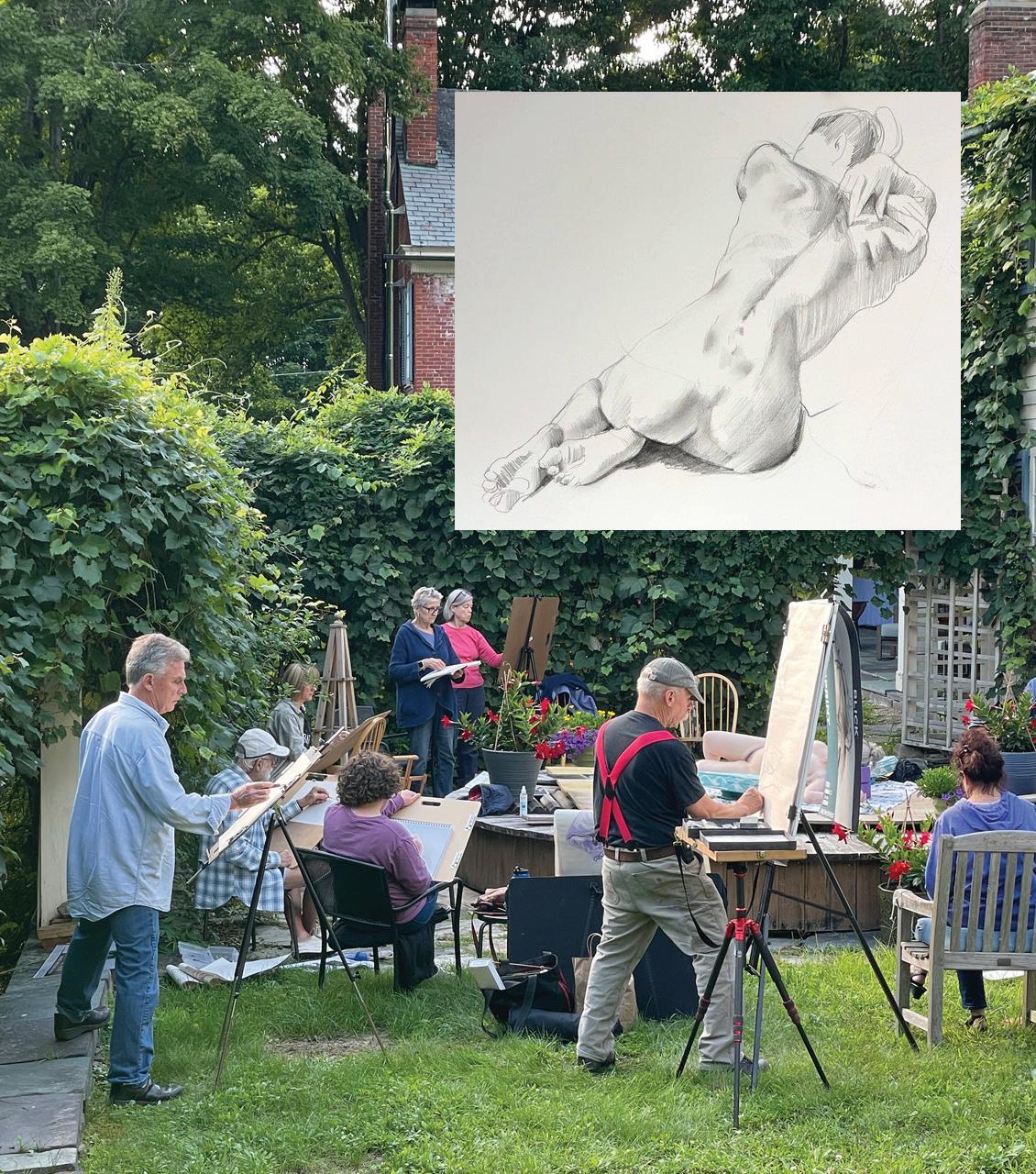
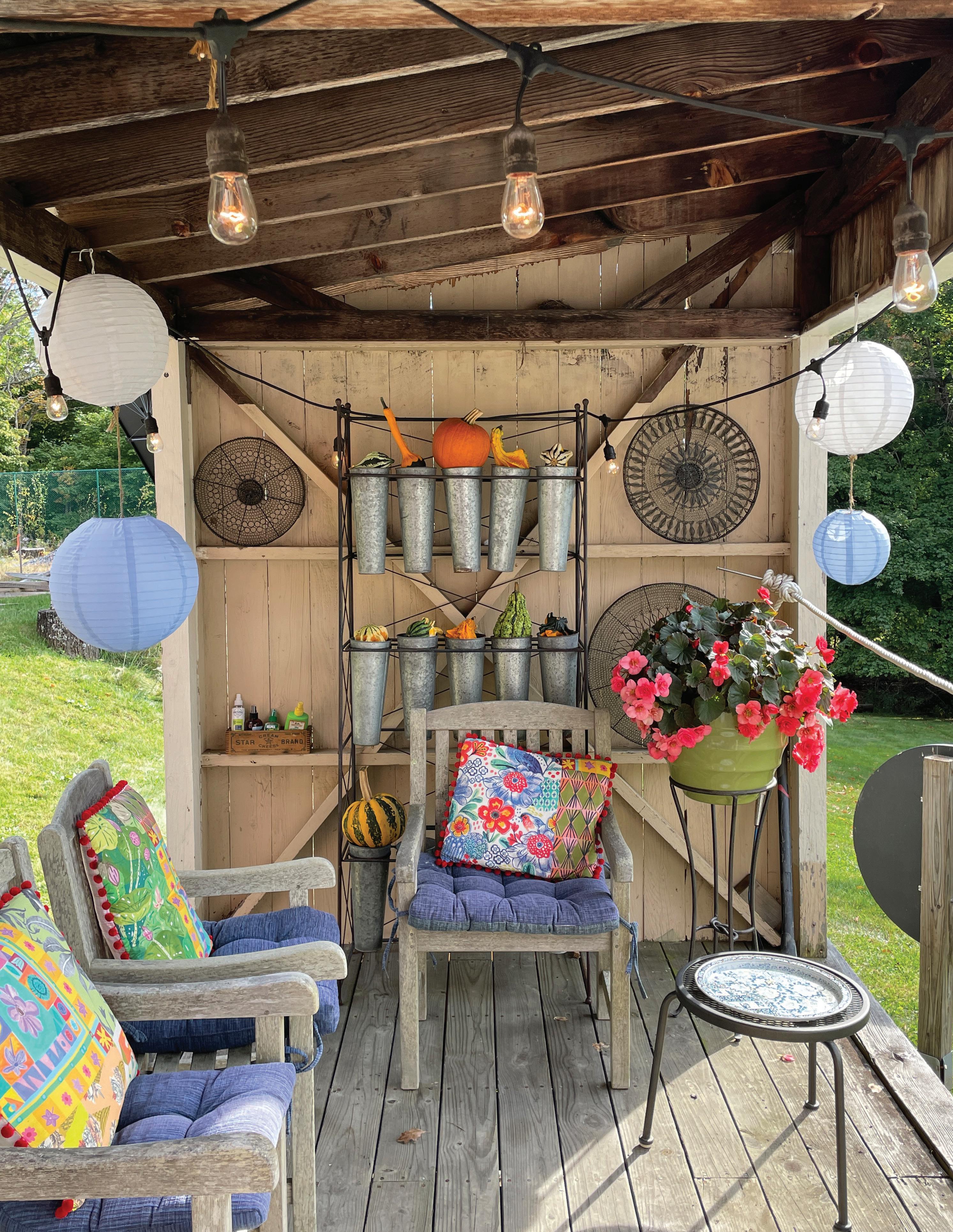
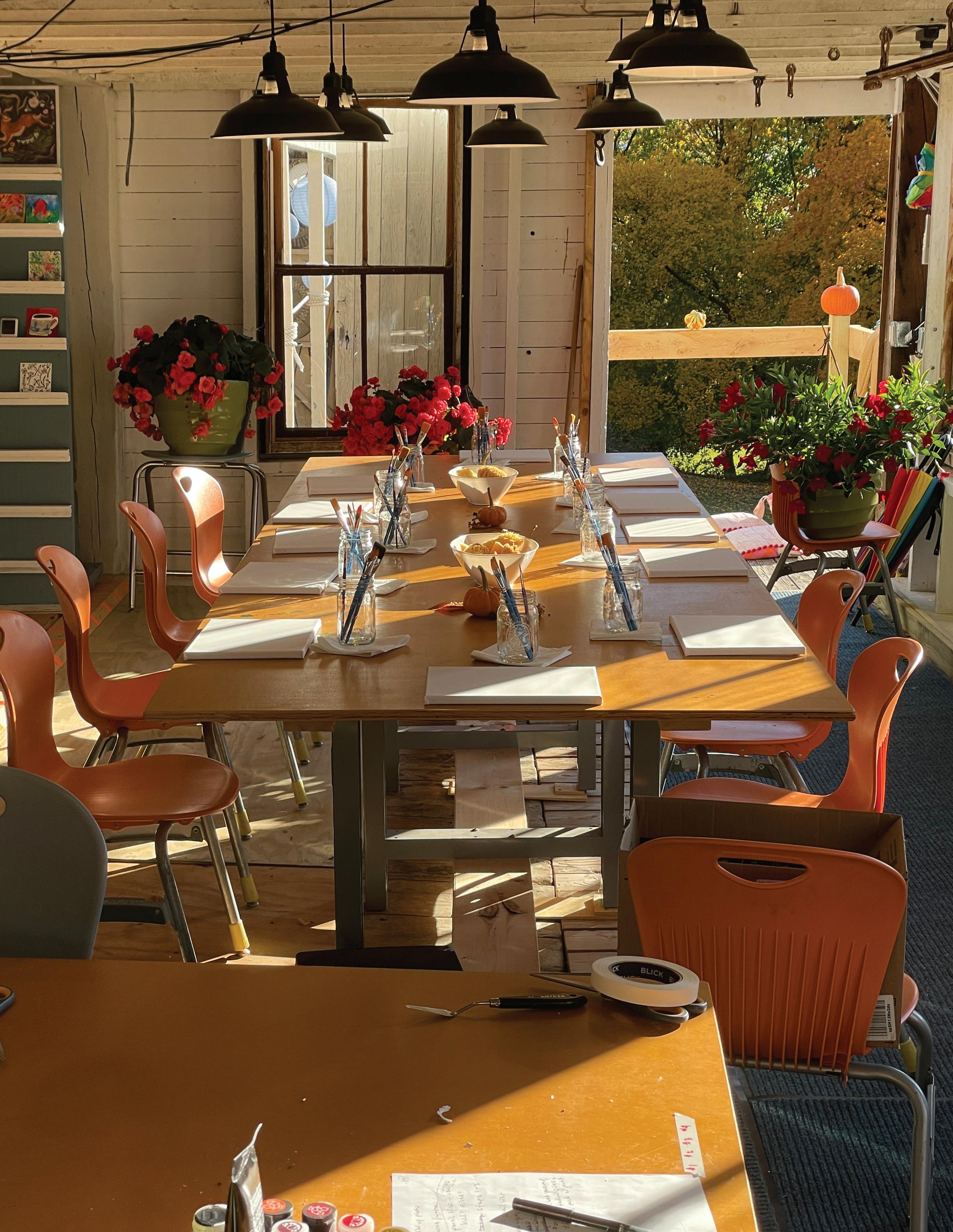
JENNIFER NELSON lives and breathes art. She’s the owner of Jennifer Nelson Artists, a boutique agency representing talented artists from around the globe, and hosts artist-led retreats at The Smiley Manse, her historic home and barn in lush Southern Vermont. The Smiley is inspired by Jennifer’s early days running the “Art Shack” at Georgia’s Camp Mikell and has become a haven of creative community for artists and creatives of all kinds.
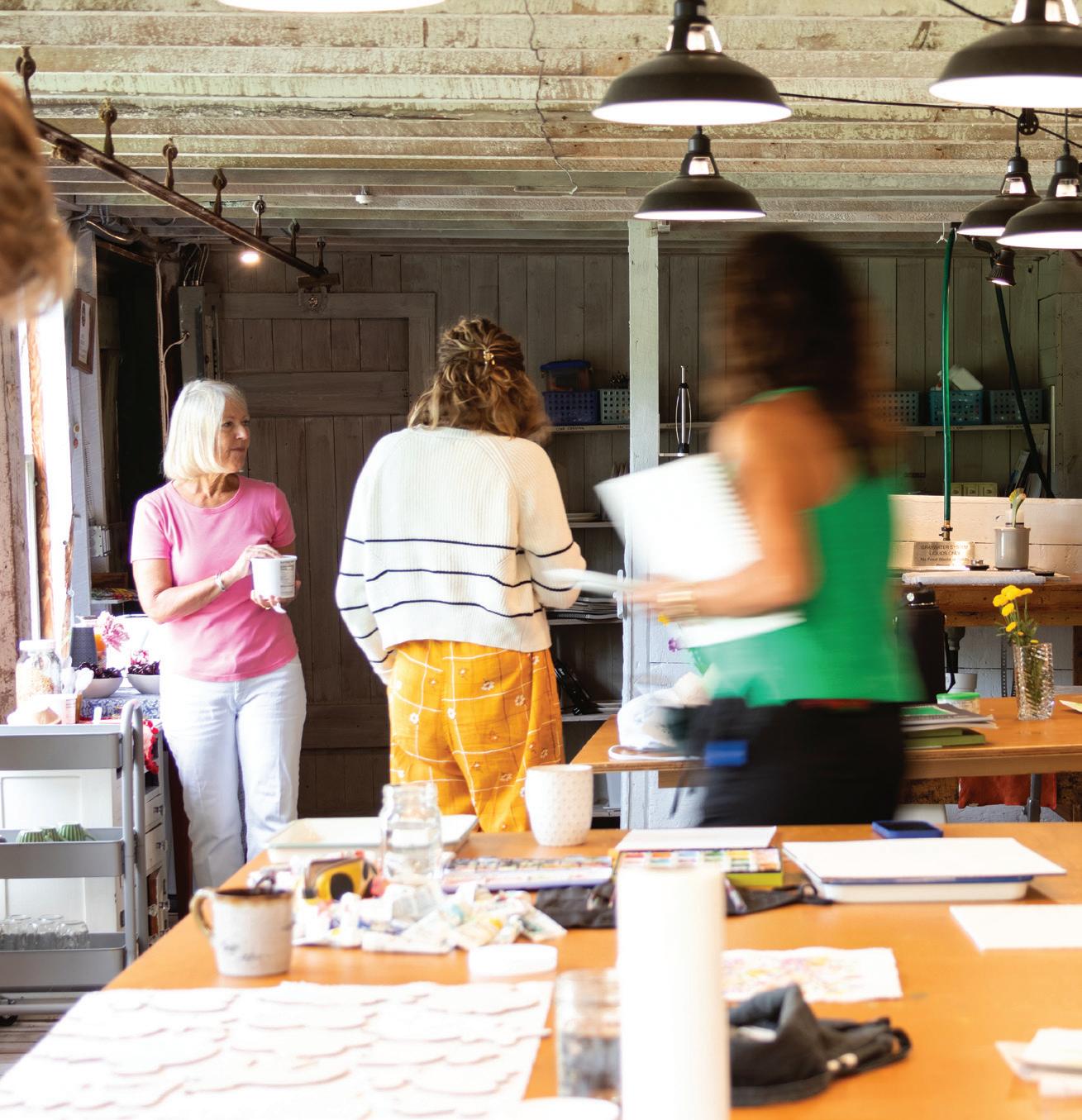
One of the first places where I felt completely free to be myself was the “Art Shack” in the Northeast Georgia mountains at Camp Mikell. There was no pressure, no comparison—just pure joy in making things together. We shared whatever supplies we had (nothing fancy), and that made it feel even more special. The building itself was old and simple, perched over a little creek. I can still
remember the earthy smell of the woods and the breeze drifting through. Artwork hung from clotheslines on the porch, and we’d all sign our names on the walls inside. It gave us this sweet feeling of belonging, like we’d always be part of the place. That same spirit of openness and creativity is something I wanted to bring to The Smiley Manse.
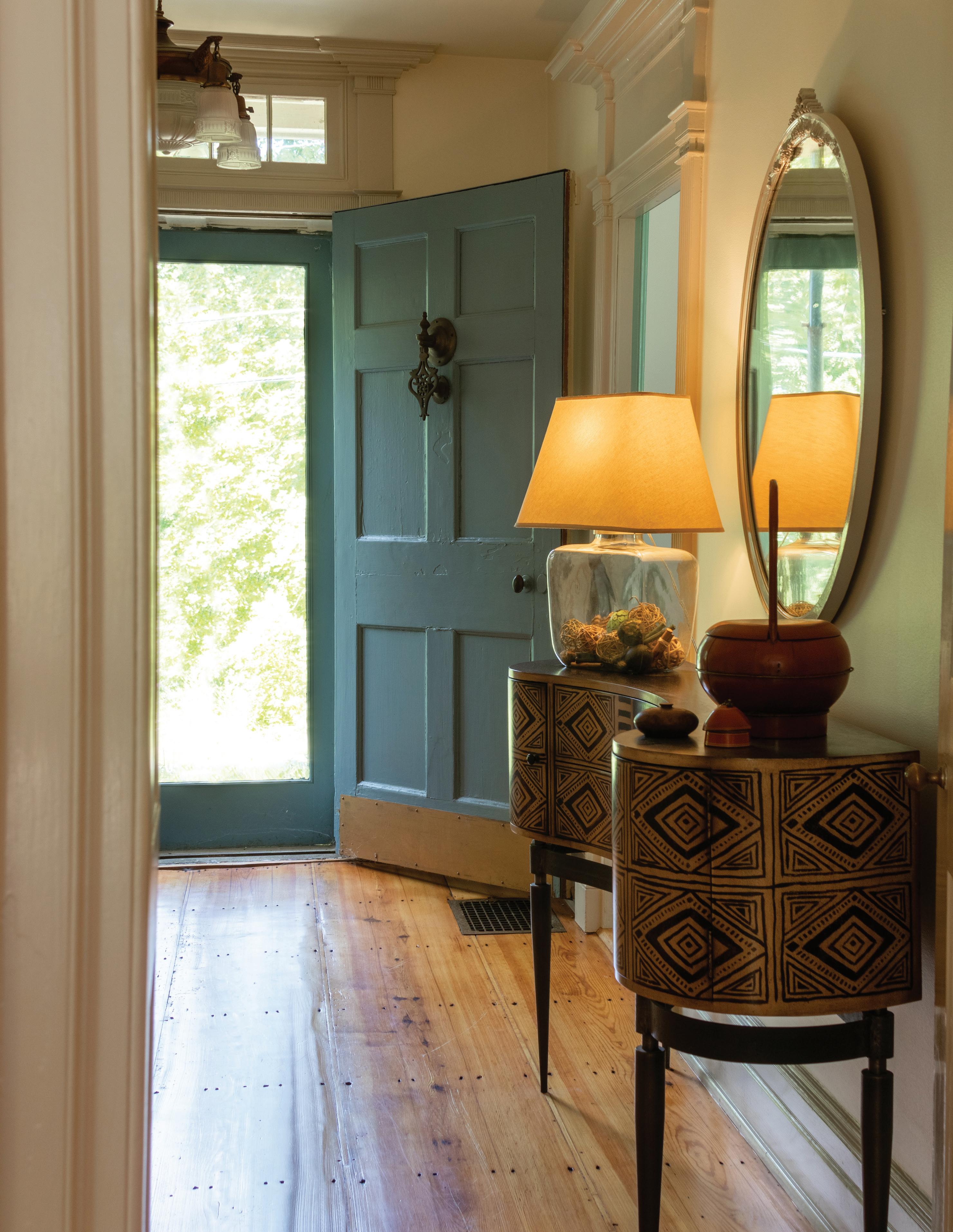
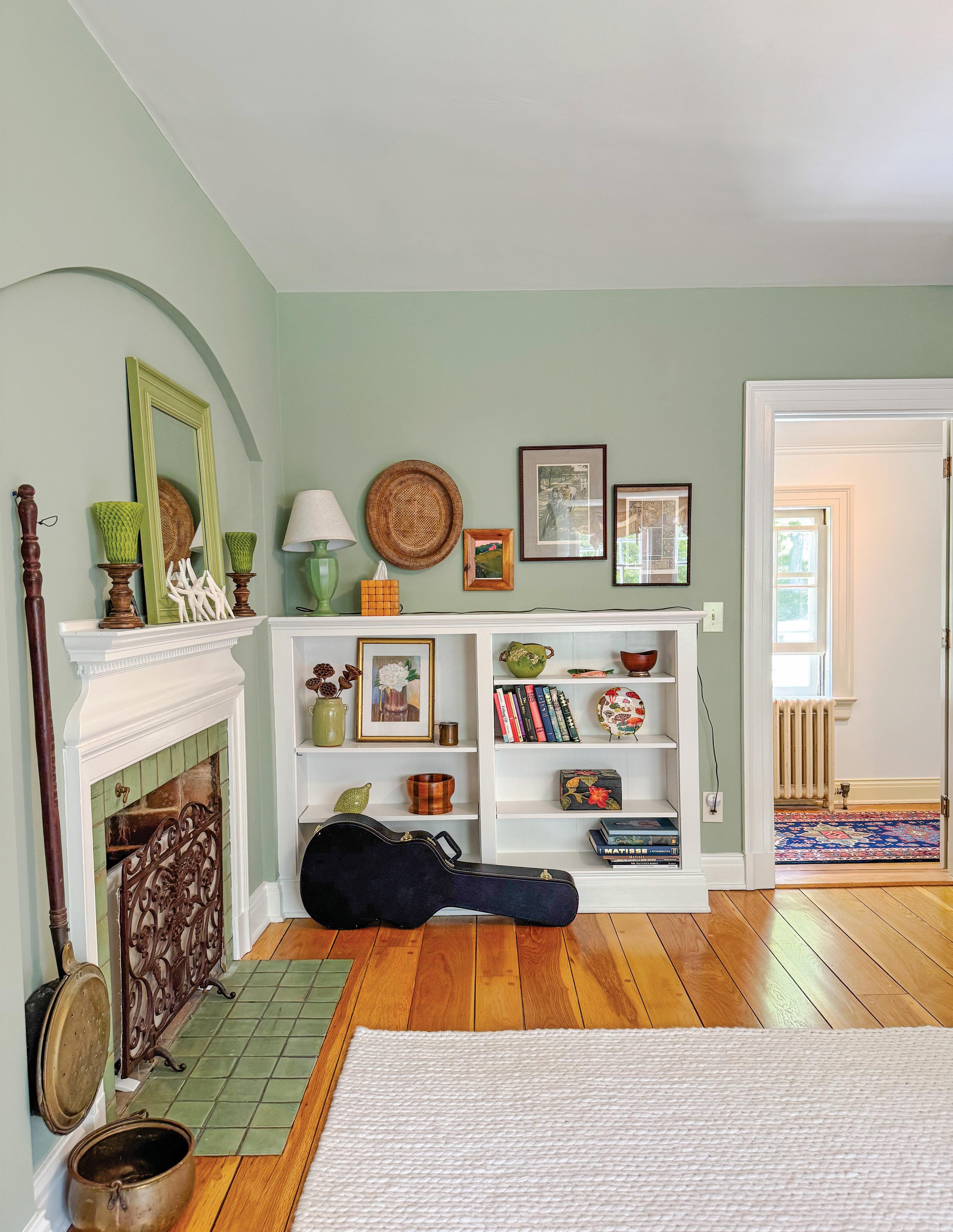
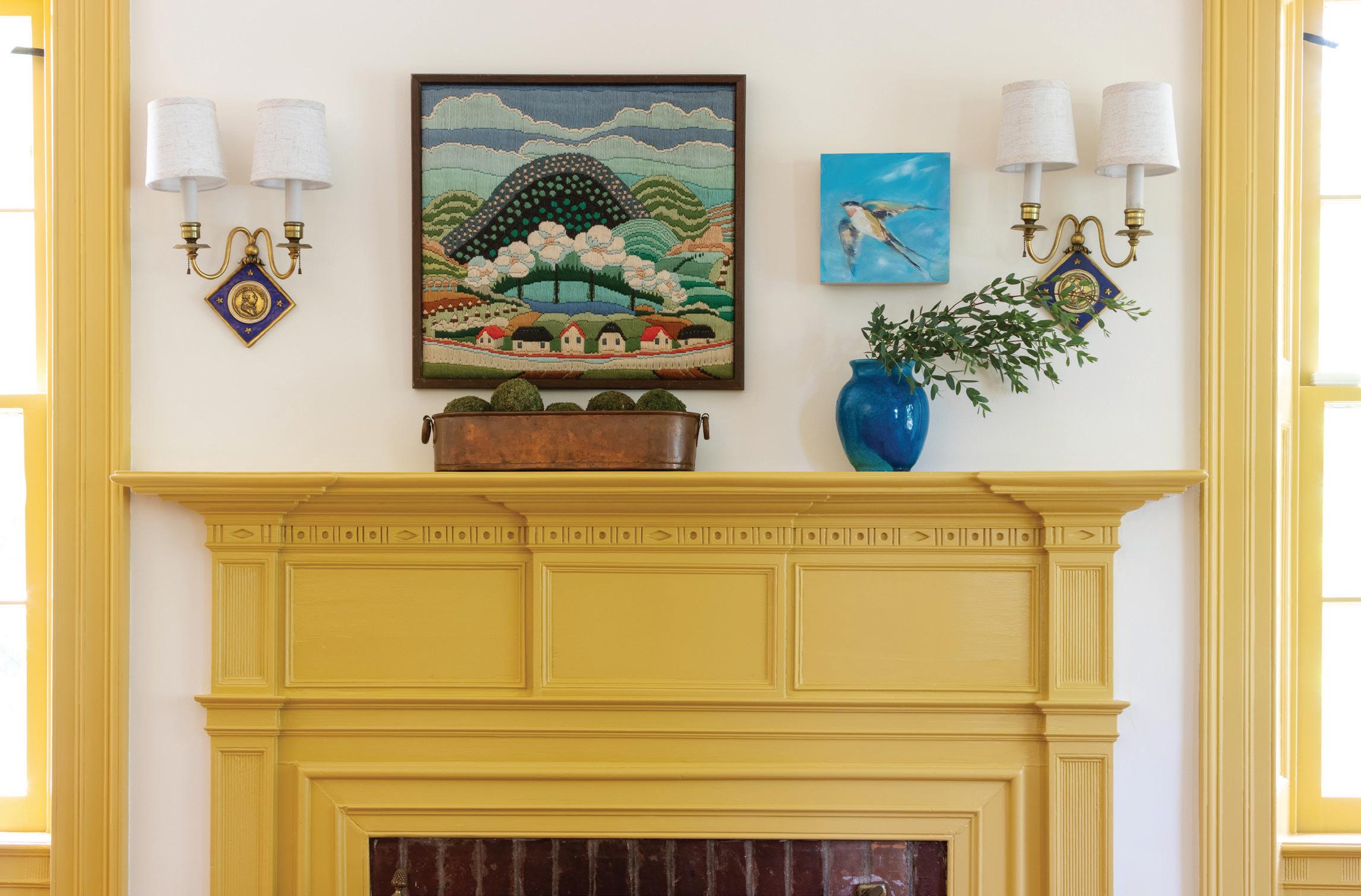
My very first thought when I saw the sprawling Vermont property with my partner, Nate, was, “We have found our place!” It felt like coming home. There was this undeniable pull, like we were meant to be here. We knew it would mean completely uprooting our lives, but somehow it didn’t feel scary. It felt right. The Smiley is a giant creative undertaking. Nate is always scheming about the next thing he can build (or fix!). The house is like a big canvas that I can transform through my love of color and textiles. We both love to buy secondhand items and refurbish them. I think this place will be ever-changing.
From LORI SIEBERT:
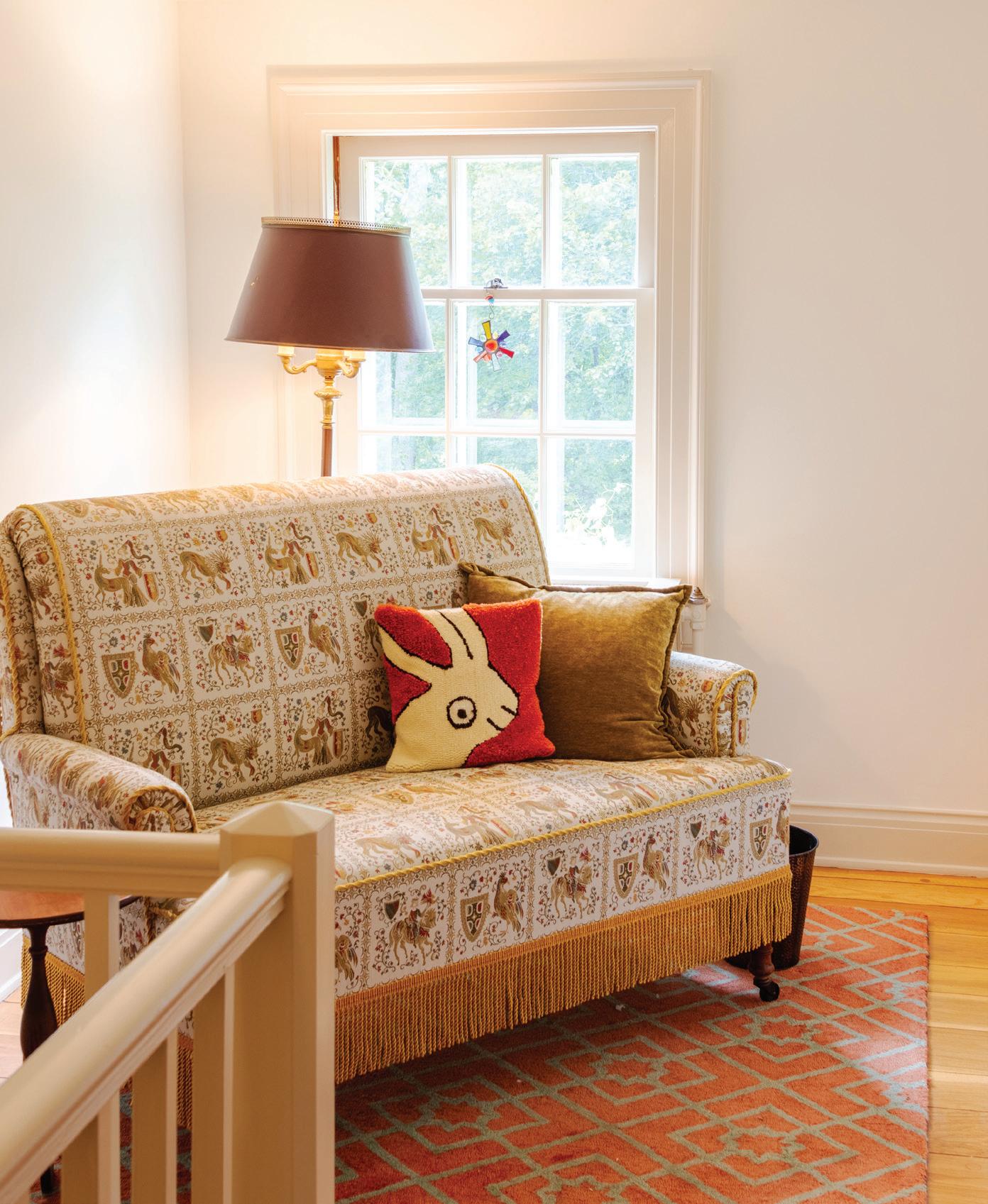
I have had the great honor of teaching at the beautiful Smiley Manse twice. The property, the mansion, and the big red barn are truly magical. Jennifer and Nate have created an oasis for artists to come and create together. It is evident that Jennifer appreciates art and craft. She has curated beautiful paintings, textiles, and ceramics throughout their home. And there is even a whole designed playroom for her rabbit, Penny. It is such a warm, cozy, and artistic treasure.
I’m endlessly inspired by the history here. In the 19th century, Robinson and Elizabeth Smiley built a parsonage—the “manse”—as their home and as a place for the Reverend to minister to the growing community of Springfield, Vermont. I recently did a huge land deed search on the property. The town came together to
build this house for the Smileys and what would be their nine children. There were craftsmen
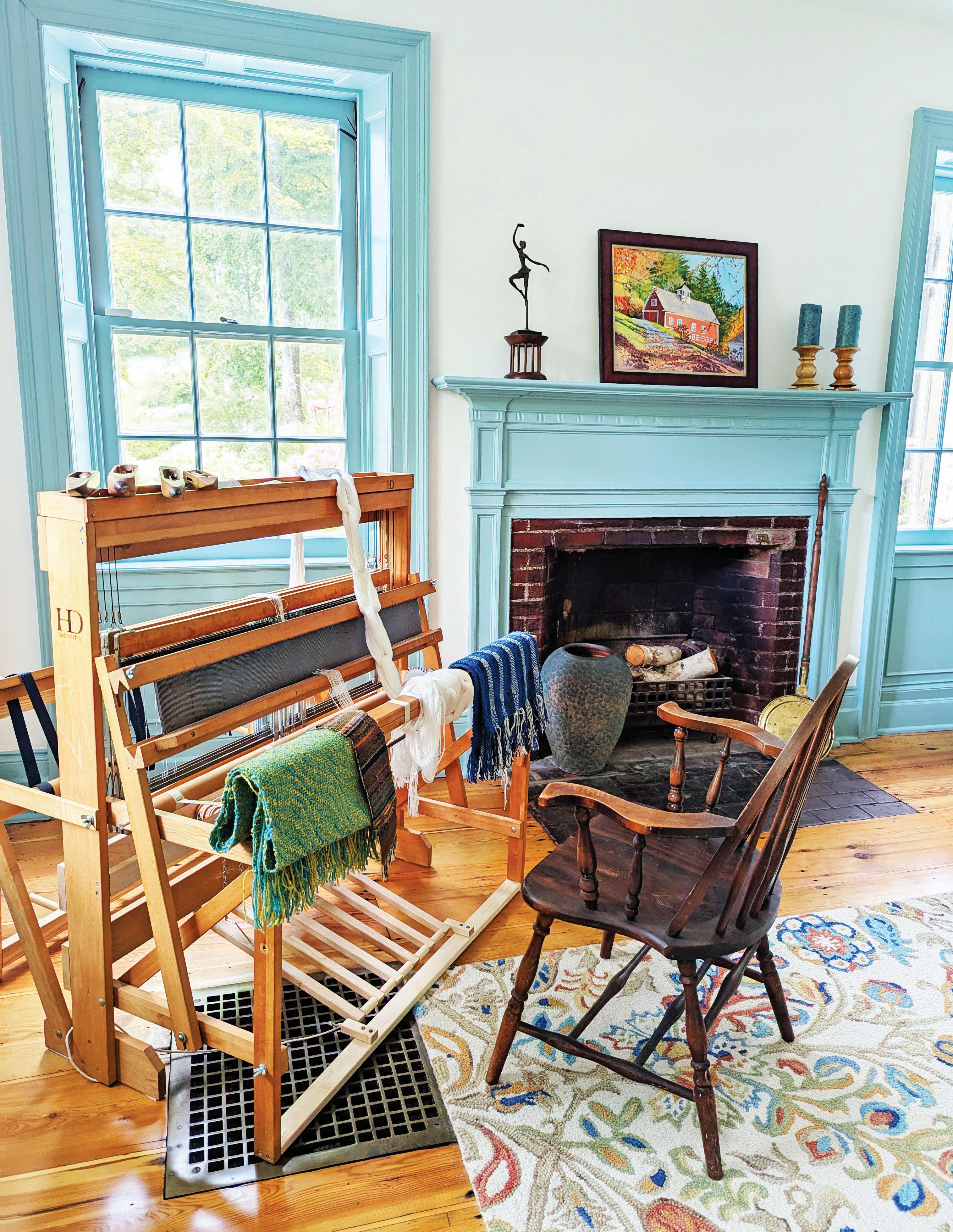
who carved the mantles and others who set the windows in their deep sills. I think about the people who have lived here, raised their children, and had various careers and jobs. The history of this home is so rich, you can feel it. The old window glass from the 1800s really brings it home for me. When I look through it, I think of all the other women who did the same.
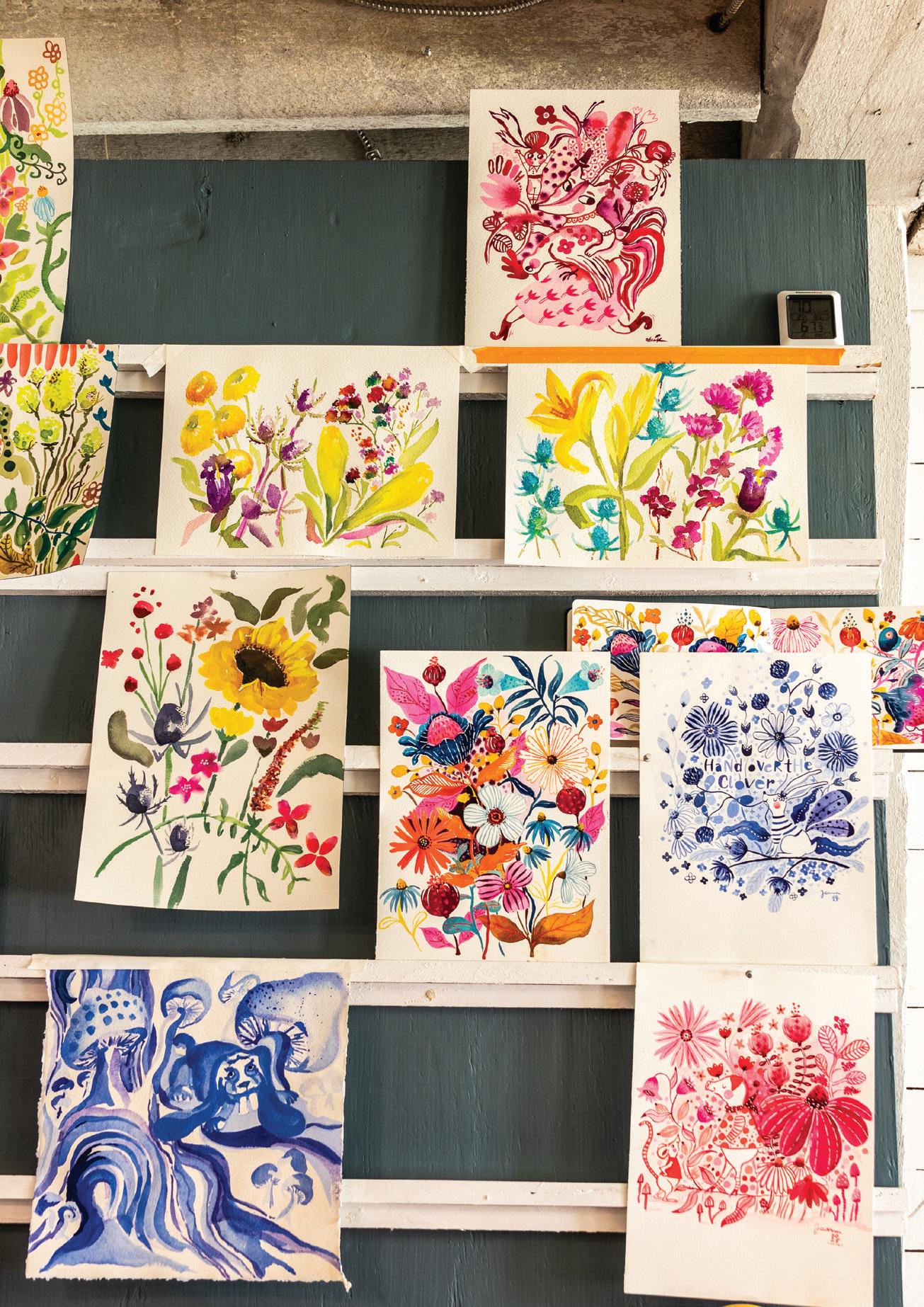
My design sense is eclectic and largely inspired by the agency artists (Jennifer Nelson Artists aka JNA). Many of the Smiley rooms house pieces from the incredibly talented artists we’re honored to represent. I like to display their work for that spark of joy and inspiration whenever I walk into a space. They’re
reminders of the people I care about and admire.
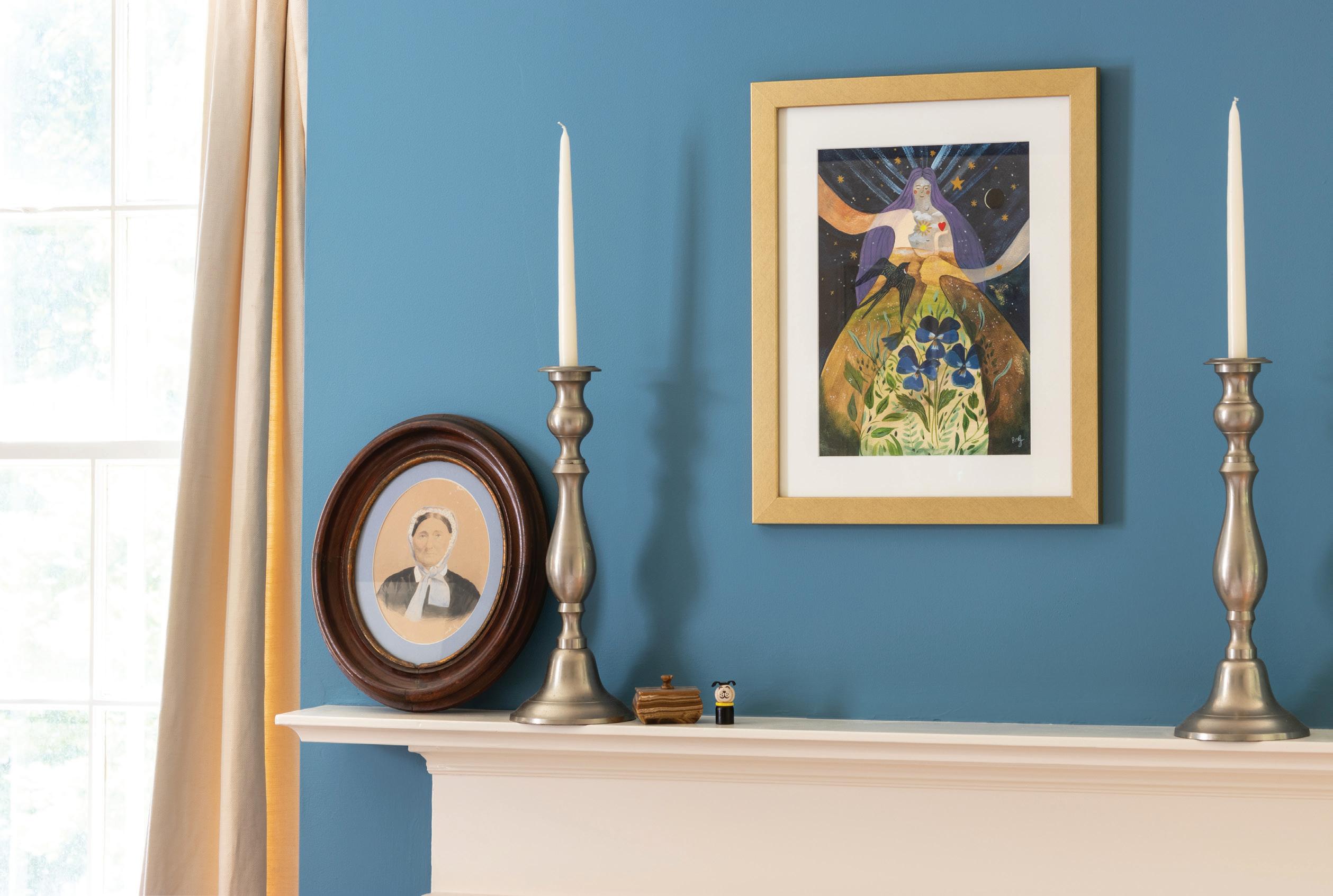
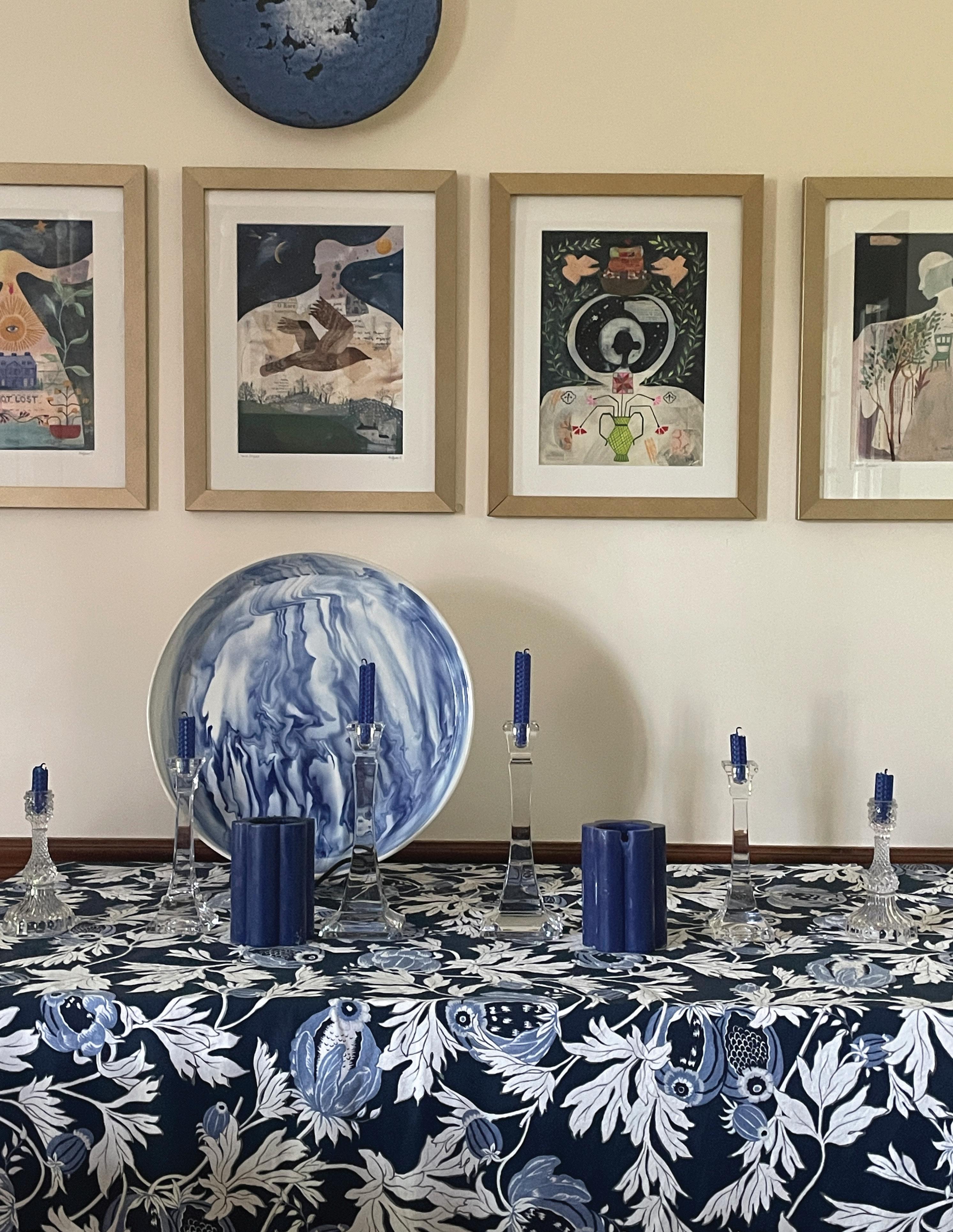
Rachel Grant’s series of painted women are companions to me—they feel like sisters. I imagine them quietly watching over the artists who pass through The Smiley. I have five of her pieces hanging in the house: Not Lost: She’s a
guide. She is grounded and knowing, like a spiritual compass; Wild Flight: She is all hope and possibility with a little mystery mixed in; Carry: She takes on burdens without hesitation. It’s like she’s holding up the whole world. Secret Garden: She knows how to be still. She reminds me it’s okay to have quiet, hidden spaces inside ourselves. One of my absolute favorites is All the Women. This one hangs in my bedroom and honors the women who came before us—our mothers, grandmothers, and beyond. It reminds me that I’m part of something bigger: a long line of strong, beautiful women.
One of the bedrooms that we aptly call The Blue Room features textiles from JNA artist Sumit Gill. Our client, Garnet Hill, designed the duvet and shams to emphasize Sumit’s bold and sophisticated work. I love this particular piece for its opulent, oversized florals. There are hidden butterflies, bugs, and even little fish to be discovered there. I could look at it for hours, finding hidden gems each time I come into the room.
In the center of the house, there is a very long vaulted hallway. There I’ve hung artwork from a wide variety of artists: folks who have visited The Smiley, makers I know only online, longtime friends of the agency, and beyond. The collection is eclectic and curated with love for each piece. Somehow, they all work
very well together. If you’re lucky, you might catch a glimpse of my sweet rabbit Penny hopping down the hall. She’s really part of the place and brings her own kind of calm and companionship.
What used to be the parlor, where Elizabeth Smiley would tend the fire, mend clothes, and offer counsel to visitors, we now lovingly call “the loom room.” I enjoy oddball crochet and knitting projects, and I find weaving to be such a satisfying challenge, so of course, a loom has become the centerpiece for the entire room. There’s something elemental about weaving, about taking individual strands and making something whole. I love the rhythm of the shuttle moving through the warp, the feel of the wool in my hands. It connects me to something deep and old.
Making the move to The Smiley Manse has changed my life. I went from being overworked, stressed, and moving quickly all the time to enjoying a much slower pace. This gives me a solid bird’s eye view of my life, my artists’ work, and the agency. With the help of my amazingly detailed
and lovely agents, Shannon and Maria, I’ve found a true balance. This has allowed me to set goals and see the big picture with clarity. I do most of my agency work downstairs in the company of a grand tufted piece from my friend and former JNA agent, Haley Wood. It’s a fascinating blend of medieval myth, storytelling, and hand-crafted vibrancy. It features a little house in the country and—nice and large in the foreground—a rabbit, of course!
Nestled up behind the main property is the barn. This historic post-and-beam structure with a slate roof that rises to a massive walled cupola is noted as one of the finest carriage barns in the region. This space is the heart of our art retreats, which we’ve been hosting for almost four years now. In the future, I’d love
to host artist residencies and to work with artists who are interested in children’s books and surface design. I’d also like to incorporate more craft offerings, particularly fiber work. We salvaged a big clawfoot bathtub in the barn studio, and Nate has rigged up the plumbing for natural dying. I can imagine beautiful pieces hanging on a clothesline on the porch. I also think it would be lovely to one day have people experience a stay in the house for an extended period of time, with access to the barn studio. For now, The Smiley barn has brought me full circle from my days at my summer camp… It’s become this incredible environment where artists work side by side. Everyone is deep in their own world, but there’s this sense of shared purpose. You can lose yourself in your work for hours, and then look up to find the best kind of company—supportive, encouraging, and present. It’s magic to me. More
JENNIFER PHIPPS is an impressionistic-style artist living in the Smoky Mountains of East Tennessee. She spent over 30 years as a professional custom art framer, and at one point owned her own gallery, which ultimately birthed her passion to begin painting at the age of 50 in 2017. Drawn to impressionism, Jennifer is deeply inspired by the beauty depicted in the scriptures and often creates work that reflects her strong faith.
Her many years surrounded by art and custom framing have given Jennifer a unique eye for composition and presentation. For a more personal side, painting is more than a craft or skill; it’s a realization of a calling and a true joy she’s grateful to pursue.
My journey
began several decades ago, working in a small custom framing business in Bossier City, Louisiana. As time elapsed, I found myself drawn to the idea that art and custom framing were a way that people could express their style when decorating their personal spaces. To me, investing in any form of art reflects personality. I lean toward impressionism as I am fascinated with brush strokes, color palettes, and the way the artist interprets the subject matter.
My favorite subjects are clouds, cattle, and sheep. These have deep spiritual meaning for me, from which I draw inspiration commonly found in the books of the Old Testament, such as Nahum and the Psalms. My paintings are a constant reminder of God’s faithful provision and care that He has shown me during my life.
In 2017, as I was turning the big 50, I felt the Lord leading me to pursue my dream and ambition. So on a leap of faith, I picked up a brush, watched some tutorials, and simply started painting. As I honed my newly developing skill, I began sharing my work on social media, and people started responding and showing interest in my creations. It wasn’t long before local collectors started showing interest, as well. In my home and converted basement studio, my inventory began to accumulate with studies and finished canvases. I needed to find a way to hopefully get my art into the hands of those who were interested.
In the autumn of 2018, I approached my husband with an idea to host an art sale, but I needed to use his outdoor shed, our tiny barn. We moved all the equipment out, cleaned it up, and the Tiny Barn Sale was in full-scale motion. For the past seven years, each fall, I’ve opened up the barn doors to welcome collectors and locals who have an appreciation for my unique style. It’s still truly humbling to see people arrive early, lining up on chilly mornings with their cup of coffee in hand, to get an opportunity to take home one of my paintings. What started as a simple idea has grown into a fall tradition that I deeply cherish.
“For as he thinks in his heart, so is he.”
PROVERBS 23:7A NKJV
From day one
of my journey, I knew how I desired my art to make people feel. My personal decorating style has always leaned toward antiques and traditional American. I wanted to create pieces that gave the impression as though they could have been discovered in a New England antique shop or tucked away in a European market; art that feels settled and timeless, as though it was always meant to be there. As well, much of my inspiration comes directly from the scriptures. Psalm 50:10 reminds us that God owns “the cattle on a thousand hills,” and Psalm 100:3 tells us that we are “the sheep of His pasture.” I am also drawn to ships at sea and the clouds in the vast sky. Scripture describes the clouds as the “dust of His feet”, which brings me great comfort.
My studio is more than just a workspace. It is a comfortable retreat where I can focus, create, and stay inspired. It has always been central to my creative work, but during our home remodel a couple of years ago, I gave it a fresh look. I chose to keep the things that inspire me the most: simple containers for brushes, antique furniture, shelves filled with art books, and personal details that make the space echo with my personality and style. Scriptures painted on the walls and dried hydrangeas hanging from the ceiling add to the warmth and character of the room. I designed the space to be highly functional and practical, but also to have a charming appeal to those who visit. A shipping cabinet, rolling table for drying and gold leafing, and numerous sketchbooks and reference materials in all shapes and sizes are at my fingertips to foster new ideas. Each area has a clear and defined purpose, making it easy to move between projects. When I need a moment from the busyness of the world, you can always find me withdrawing to my studio.
In addition
to the Tiny Barn Sale, my paintings find buyers through a few select shops and my website. My prayer and hope going forward is very simple: to spend my days painting subjects that I love in my studio and sharing the work with collectors who feel connected to it. Painting has become more than a pursuit of my dreams and ambitions, but a fulfillment of a calling I long sensed many years ago when framing the work of others. This is the life I once dreamed and now it is the work I get to enjoy each day… for that alone, I thank Jesus for this incredible gift.
on Jennifer www.jenniferphippsart.com Instagram: jenniferdphipps
Scan here to follow Jennifer on Instagram.
DENISE SHIVES
Photography by Jessie Shives
Tucked in a pole barn behind DENISE SHIVES’ home in Walla Walla, Washington, sits her art studio and occasional shop. It’s a place that, over time, has been filled with things that she loves and tells a story of years of chasing dreams, working hard, and learning to be patient. Denise is a mixed-media artist and creator of The Pocket Lady.
My family moved
to a run-down farm, called Hidden Acres, when I was ten years old. Filled with curiosity for this new life at a place with that name, had my imagination running wild. The farm gave me wide-open spaces to play, to imagine, to collect colors and textures from nature, and to form quiet friendships with the animals we raised. Farm life shaped me, and I loved my childhood. Over time, my parents transformed the house and property into something beautiful. That taught me the values of chasing dreams, working hard, and being patient with growth— it always takes time.
As a teenager, my bedroom became a canvas. I spent hours cutting up fashion magazines to arrange into collages to hang on my walls. Arranging the furniture became a weekly project. My mom had some shelving installed so I would have a place to spend hours arranging and re-arranging my childhood collections. The love of fashion led me to sewing, and the love of both led to studying apparel design in college.
The summer before I left for college, a small corner of our barn was cleared out for me—a tiny sanctuary for the creativity that was beginning to bloom. Looking back, that was my first studio space. I felt at home there, in the same barn that had once housed the cattle I adored.
My creative journey
has woven itself into many forms—most notably a retail business I built called The Pocket Lady. My original dream was to curate gifts, home decor, and a little clothing, as well as create a line of Pocket Lady products. The products would include a Pocket Lady story that I would write and illustrate, and a doll to go with it. At the time, I didn’t yet know the full meaning of the story, but it would have something to do with her pockets being filled with love and kindness and inspiration to share with others. The name came from my mom, who was “the pocket lady” at my childhood school carnival. It represented that nostalgia, and her support of me following my creative dreams.
Starting small, I curated a pop-up shop in my parents’ barn. That success led to a brick-and-mortar store on Main Street. Those days were fun, and helped to develop a good following of customers, but the amount of work it was did not leave any time to create. For multiple reasons, I closed down the shop, but not my dreams for creating The Pocket Lady.
Today, the venture
has found its way back to a barn, but this time one behind our home, right next to my parents’ farm, where they still live. Daily walks on those hidden acres have stirred up memories of childhood and given new life to stories and characters that have been forming in my head for many years. I find myself always coming home with a pocket full of rocks, sticks, and rusty old parts of farm equipment. Each little finding gets a place in the shop that eventually gets used in a display or a piece of art. Occasionally, I still have a pop-up sale, curating new and old home décor and vintage finds. I have found a balance—more time and space to create.
Years of following this retail dream led this space to be filled with things that I love—the props, furniture, collections, textures, and small improvements made each year. Quietly, without me noticing until recently, it has taken shape in a different form. I think it has taken all of these years to collect the pieces of this story, and it’s now the home of The Pocket Lady.
The walls, layers of paper
and paint, are dripping into stories. Little vignettes appear throughout the space, telling tales of friendship between The Pocket Lady and her whimsical companions. Little visual stories and worlds are coming to life about the Hidden Acres, where imaginations run wild, friendships are formed, and little life lessons are learned. The Pocket Lady’s pockets are stuffed full of gathered inspiration, just waiting to get out into the world.
As For My Art
All of this collecting and surrounding myself with things that I love has also brought me to making art that I love. I create textures with layers and layers of paint, papers, pieces of worn and torn pages from books too damaged to repair. Sometimes fabrics, clippings from old magazines, pencils, pens, and all kinds of other mixed media find their way into the layers.
Currently, I’m making a piece of art for each little vignette I’ve created. The vignettes are all inspired by the characters in The Pocket Lady’s life; some are still forming, but the ones that are close enough, I’m using for inspiration for my art.
Organizing and keeping track of all the bits of pieces and papers is a big challenge. A printer’s cabinet has become handy, using a different tray for each piece being created. If I need to do a quick cleanup for a pop-up, the trays easily slide back in the cabinet.
My Daughter
The best part of my creative life right now is having my daughter, Jessie, working with me. She sees this whole world I’ve built, and understands my brain, how I think and create, adding a helpful layer that’s been missing. She’s revamped my website and organized our inventory system, and is helping shape what comes next.
We work well together and are having fun. Also, collaborating her love of printmaking with some of my characters. It’s a true gift right now to get this time with her, working creatively together.
I am grateful!
Isabella Rossellini, Abigail Rose, Frank Sinatra & Christine MacClintic
In Suffield, Connecticut, artist CHRISTINE MACCLINTIC spends her days painting large-scale portraits of dogs and the people who love them. Sharing her studio with three spirited rescue pups, Christine’s current work—a sabbatical-year series titled Bonds—explores the deep emotional terrain of human-canine connection through expressive oil on canvas storytelling.
I’vealways said, “Studio dogs are the best dogs.” Actually, to be fair, I say “All dogs are the best dogs.” But there’s something about the rhythm of sharing a creative space with my pups that brings an unmatched joy to my work—and to my life.
My name is Christine MacClintic, and I’m an artist living and painting in Suffield, Connecticut. For the past year, I’ve been on sabbatical, focusing fully on a body of work that’s long lived in my heart: a series of largescale oil portraits exploring the relationship between dogs and the humans who love them. I’m calling the show Bonds—because that’s what this work is about. The unshakable, emotional, and often healing connection between people and their dogs.
This series is deeply personal. It’s inspired by the many dogs I’ve fostered over the years—22 so far—and especially by the three who have become permanent members of our family and fixtures in my studio life: Isabella Rossellini, Abigail Rose, and Frank Sinatra.
Izzy, my seven-year-old Great Dane mix, is the heart of the studio. She’s big, graceful, and watchful—my constant companion while I work. Most days, you’ll find her stretched out beside my easel, her quiet presence keeping me grounded. She’s my soul dog. Sometimes, without realizing it, I’ll rest my feet on her as I paint. She never minds. I like to think she understands exactly what we’re doing.
Abigail Rose, or Abby, is a sixteen-year-old Chihuahua who’s perfected the art of napping. She’s our elder stateswoman, the calm in the chaos, and my reminder to slow down. Her favorite spot is wherever the sun hits the floor. She’s not interested in squirrel patrol or studio politics—she just wants warmth, peace, and the occasional snack.
Then there’s Frank Sinatra. One year old, part pit, part husky, and all energy. He was supposed to be a temporary guest, just like so many others before him. But Frank won my heart with his big blue eyes and persistent charm. Now he’s here to stay. He’s also the reason we had to install a gate at the front of the studio—his chipmunk surveillance program was getting a little too enthusiastic.
“Dogs are not our whole life, but they make our lives whole.”
—Roger Caras
Eachmorning, the four of us head out to the studio together. We do a little backyard loop first—a perimeter check, as the dogs see it—and then settle in for the day. While I mix paint and lose myself in the work, they find their places: Izzy at my feet, Abby in a sunbeam, and Frank keeping watch by the door. We’re a well-oiled machine. They’re not just companions; they’re collaborators.
In many ways, Bonds is their story, too. Each of the 12 portraits in the series captures a unique relationship between a dog and their human. Some are filled with joy. Some speak to grief. All of them are deeply emotional, because that’s the reality of sharing your life with a dog—they change you. They hold space for your feelings. They witness your days. They teach you what love looks like at its most pure.
As I’ve painted, I’ve found myself thinking about how our dogs shape our homes and our routines, how they create structure and comfort, how they pull us outside of ourselves. That’s what I’m hoping viewers will feel when they see the work—nostalgia, healing, connection. A recognition of their own story reflected in someone else’s bond.
This studio—my sanctuary, my workspace, my quiet corner of the world—wouldn’t be the same without Izzy, Abby, and Frank. They bring rhythm to my days, paws to the paint-splattered floors, and a reminder with every tail wag of what this is all really about: presence, devotion, and love.
So yes, studio dogs are the best dogs. Because dogs aren’t just part of my life. They’re part of my art. And they make both better in every possible way.
www.christinemacclintic.com
Facebook: christine.macclintic
Instagram: cmacclintic
TikTok: cmacclintic
Through the LENS
Our Contributing Photographers
Maggie Smith
Jennifer Phipps
Passionate about chasing the light and capturing life’s most meaningful moments, Maggie Smith is a photographer driven by adventure, joy, and a deep love for Jesus. Whether climbing mountains or seeking beauty in unexpected places, she captures meaningful moments with intention and care. Inspired by creation and connection, Maggie brings authenticity and warmth to each session, telling stories that reflect the gift of life and the light that guides it.
INSTAGRAM: maggiesmithphotography
Warren Heath/ Bureaux
Nicky Andrag
Warren Heath is originally from Durban, South Africa, where he studied photography for three years. He has been living in Cape Town for the last several years and photographs some of Africa’s most beautiful homes. He believes that photographs should tell a story and believes you can tell a lot of great stories with simple, beautiful pictures. Warren gets daily inspiration from his natural surroundings and the beautiful landscape of Africa.
INSTAGRAM: framethirtysix
Élisabeth Anctil-Martin
Catherine Granche
Élisabeth Anctil-Martin’s passion is photography. Ever since she was a child, Élisabeth was always seen with a camera in her hands. Loving adventures, the great outdoors, creativity, and simplicity, her intuition lands wherever nature or people inspire her. Traveling abroad allows her to capture the power of the elements and the wisdom of humans, but she also loves to spread her roots at home, in Quebec. Trails and roads are a pretext for Élisabeth to trace her own path.
WEBSITE: www.elisabethanctilmartin.com
INSTAGRAM: elisabethanctilmartin
FACEBOOK: elisabethanctilmartin.photographe
Sheridan Kahmann
Jennifer Nelson
Originally from New York, transplanted to Boston, Sheridan Kahmann has spent her lifetime loving, practicing, and working in the fields of art and photography. Years of managing a photography studio in New York paved her way to working at the Museum of Fine Arts Boston, to finally opening a studio and sharing her talent as a portrait photographer in Arlington, Massachusetts. Sheridan concentrates on photographing women, headshots, personal branding, and portraits.
WEBSITE: www.sheridankahmannphotography.com
INSTAGRAM: sheridan_kahmann_photography
LINKEDIN: sheridan-kahmann-7434a4a
Sue Schlabach
Jennifer Nelson
Sue Schlabach is a Vermontbased artist and photographer who tells the stories of artists and makers through her lens. Her work has taken her from Europe to India, Mexico, and across the U.S. Grounded in a practice that blends photography, painting, flax sculpture, teaching, and writing, Sue creates from a light-filled studio in an 1800s brick home.
WEBSITE: www.sueschlabach.com
INSTAGRAM: sueschlabachcreative
PINTEREST: sues
Deborah Husk Lisi Ashbridge
With over 20 years of industry experience, Deborah Husk is a seasoned commercial photographer known for her precision, creativity, and studio expertise. A graduate of Bournemouth University with a bachelor’s in visual arts, Deborah has built a reputation for producing high-impact visual content that meets the exacting demands of commercial clients. Deborah has worked extensively with small and independent creative businesses, using photography as a powerful tool to help shape and strengthen their brand identities. From artisan makers to boutique retailers, her collaborative approach and understanding of visual storytelling help clients stand out in competitive markets.
WEBSITE: www.deborahhusk.co.uk
INSTAGRAM: deborahhuskphotographer
Imogen Rosemary
Tabby Booth
Imogen Rosemary is a photographer whose creative practice is rooted in storytelling. Whether capturing artists, fashion, or personal projects, she believes every subject carries a narrative worth sharing. Her work is guided by two enduring inspirations: warmth and nostalgia. For Imogen, these qualities make people and products timeless, transforming photographs into lasting memories. She approaches each shoot with intention, seeking to preserve emotion and connection that resonate long after the moment has passed.
INSTAGRAM: imogen_rosemary
marketplace \ Products
Visions of Christmas
By Fifi O’Neill
Step into a world of enchanting holiday magic with Visions of Christmas, a captivating book that celebrates the most wonderful time of the year. This beautiful collection showcases stunning photographs of Christmas trees, ornaments, and decorative collections that will inspire your festive spirit. From traditional to contemporary designs, discover creative DIY ideas to transform your home into a magical winter wonderland.
Custom Artwork
Rachael Nerney Reese
Rachael Nerney Reese is a Charleston-based fine artist and illustrator. Her artwork celebrates fleeting culinary moments through vibrant color, light, and pattern. Rachael loves working one-on-one with brands, collectors, and interior designers. She creates thoughtful custom artwork that is individually tailored. Scan the QR code to get started on your custom piece!
Styling Beyond Instagram
By Robin Zachary
Robin Zachary is a multihyphenate artist, prop stylist, creative director, and educator. Her book Styling Beyond Instagram has been embraced globally as an essential guide to prop styling. Fifteen years ago, who would have predicted that posting styled photos on social media would become the massive phenomenon that it is today? Styling Beyond Instagram not only demystifies the business side of commercial prop styling, but shows creatives how their natural eye for arrangement in areas of interiors, food, tabletop, vintage, and events can become a professional pursuit.
Tunisian Crochet Tops
By Ashley Rivas
Enter the wonderful world of Tunisian crochet and create unique, beautiful pieces that will carry you through every season! With careful guidance from pattern designer Ashley Rivas, you can crochet lovely tops using the trendy Tunisian technique—filling your wardrobe with everything from cozy pullovers to comfy tees. This easy-to-follow, comprehensive guide will walk you through each method, including Tunisian crochet’s signature Forward Pass and Return Pass, ensuring that each top you create is high quality and will last a lifetime.
The Art of the Studio
Susan Harold
For over 16 years, Where Women Create and What Women Create magazines have been championing women and celebrating the power of their creativity. Now, with a dedicated following of makers and artists asking for more, we are thrilled to debut our first coffee table book, The Art of the Studio
The Art of the Studio is a stunning exploration of the intimate and inspirational workspaces of over 70 artists. Dive into creative sanctuaries, homegrown studios, and ateliers influenced by the beauty of color, the tranquility of nature, and the power of light. Preorder your copy today.
Women Create’s Marketplace SHOP is now Online.
BRAVE NOUVELLE
Textiles by
Ellene McClay
Unique quilts, garments, and accessories.
DAWN LOMBARD
GLASS AND METAL
Bold, colorful enamel jewelry for women who love to stand out in style.
ATENTI
USA handmade project bags, handbags, and accessories
MCREATIVEJ
Nature-inspired embroidery kits, patterns, and supplies for the modern maker
THE ONE THING
that will inspire you every day
The following is a complete Statement of Ownership, Management, and Circulation, as required by the U.S. Postal Service (All Periodicals Publications Except Requester Publications), for the publication Where Women Create, which has a Publication Number of 310. The filing date of this statement is 10/02/2025. The issue frequency is Quarterly, with four issues published annually at an Annual Subscription Price of 54.97. The complete mailing address of the Known Office of Publication (Not printer) is 94 Cooper Road, Ridgefield, CT 06877, which is also the address of the Headquarters or General Business Office of the Publisher (Not printer). The Publisher is Thomas Smith, 94 Cooper Road, Ridgefield, CT 06877, and the Editor is Susan Harold, 876 Genoa Way, San Marcos CA 92078; the Contact Person is Thomas Smith with a Telephone number of 9172269754. The owner is Thomas Smith at 94 Cooper Road, Ridgefield, CT 06877. There are no Known Bondholders, Mortgagees, and Other Security Holders Owning or Holding 1 Percent or More of Total Amount of Bonds, Mortgages, or Other Securities. The tax status is that the purpose, function, and nonprofi t status of this organization and the exempt status for federal income tax purposes has Not Changed During Preceding 12 Months. The extent and nature of circulation is as follows: The average number of copies of each issue during the preceding 12 months for the Total Number of Copies (Net press run) was 28,261, and the number of copies of the single issue published nearest to the filing date was 25,844. The Total Paid Distribution (15c), which is the sum of Mailed Outside-County Paid Subscriptions Stated on PS Form 3541 (3,012 average, 2,967 nearest to filing date), Mailed In-County Paid Subscriptions Stated on PS Form 3541 (0 average, 0 nearest to filing date), Paid Distribution Outside the Mails Including Sales Through Dealers and Carriers, Street Vendors, Counter Sales, and Other Paid Distribution Outside USPS® (8,411 average, 6,730 nearest to filing date), and Paid Distribution by Other Classes of Mail Through the USPS (0 average, 0 nearest to filing date), was 11,423 copies average and 9,697 copies nearest to the filing date.
The Total Free or Nominal Rate Distribution (15e), which is the sum of Free or Nominal Rate Outside-County Copies included on PS Form 3541 (14 average, 33 nearest to filing date), Free or Nominal Rate In-County Copies Included on PS Form 3541 (0 average, 0 nearest to filing date), Free or Nominal Rate Copies Mailed at Other Classes Through the USPS (15 average, 34 nearest to filing date), and Free or Nominal Rate Distribution Outside the Mail (368 average, 200 nearest to filing date), was 397 copies average and 267 copies nearest to the filing date. The Total Distribution (15f) was 11,820 copies average and 9,964 copies nearest to the filing date. Copies not Distributed (15g) totaled 16,441 copies average and 15,880 copies nearest to the filing date. The total circulation (15h) was 28,261 copies average and 25,844 copies nearest to the filing date, yielding a Percent Paid (15i) of 96.51 average and 97.32 nearest to the filing date. The publication is not claiming electronic copy circulation, and the Statement of Ownership Will be printed in the Winter 2025 issue of this publication. The statement was signed on 10/02/2025 by Thomas Smith, Principal.
The Women Create Shop is HERE!
Are you interested in joining our dynamic new marketplace and share your creations with the world? From handmade goods to original artwork, our SHOP celebrates creativity, community, and the power of supporting small businesses. With visibility in front of over 500,000 consumers each month, this is a unique opportunity to grow your brand and reach a wider audience. We’re currently seeking passionate vendors to join us.
Whether you’re an experienced vendor or just starting out, this is your chance to share your work with a supportive audience.
APPLY NOW to become a vendor and be part of something inspiring!
LEARN MORE:
Women Create’s first coffee table book, The Art of The Studio, is available for preorder NOW.
LEARN MORE AND ORDER YOUR COPY HERE:
VISIT OUR SHOP where new artists are added weekly: