WHERE WOMEN CREATE—Fulco Inc. PO Box 3000, Denville, NJ 07834-3000
844-263-3472
womencreatecustservice@fulcoinc.com
ADVERTISING INQUIRIES advertise@womencreate.com
SUBMISSION INQUIRIES submissions@womencreate.com
WHERE WOMEN CREATE® SPRING ISSUE 30 PUBLISHED 4 TIMES PER YEAR BY: Women Create, LLC 65 Redding Road, Box 985 Georgetown, CT 06829 womencreate.com
POSTMASTER
Send address changes to:
WHERE WOMEN CREATE—Fulco Inc.
PO Box 3000, Denville, NJ 07834-3000 Changes of address must be submitted in writing.
Where Women Create (USPS #000-310) is published quarterly by Women Create, LLC, 65 Redding Road, Box 985, Georgetown, CT 06829. Periodicals postage paid at Dover, NJ and at additional mailing offices.
Printed in Canada
Where Women Create® is a registered trademark of Women Create, LLC and may not be used without permission. No part of this publication may be reproduced without written permission from the publisher or Women Create, LLC. The information contained in this magazine is provided AS IS. Neither Women Create, LLC, nor the publisher, make any representation or warranty with respect to this magazine or the contents thereof and do hereby disclaim all express and implied warranties to the fullest extent permitted by law. Women Create, LLC and the publisher do not endorse any individuals, companies, products, services, or views featured or advertised in this magazine.
Life is what happens to you while you e busy making other plans.
The famous words of John Lennon came to mind more than once when putting together this incredible collection of stories for our spring issue — stories that are filled with all the color and hope that springtime brings. Behind the beauty and optimism and joy of getting to know these amazing artists and makers, I had a frontrow seat to their resilience and adaptability.
In the final months of 2024, I worked with artists in both WHERE Women Create and WHAT Women Create who had been dealt serious and unexpected disruptions to their homes, studios and creative rituals — from waiting out hurricanes and power outages in North Carolina to severe flooding in the U.K. Many of the makers were in the midst of putting together big projects when Mother Nature forced them to pivot quickly.
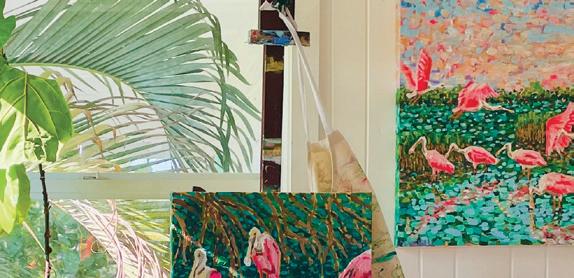
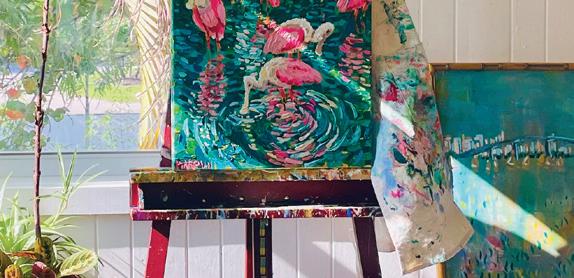
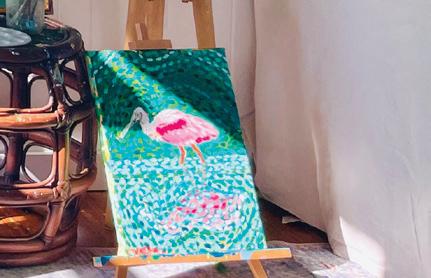
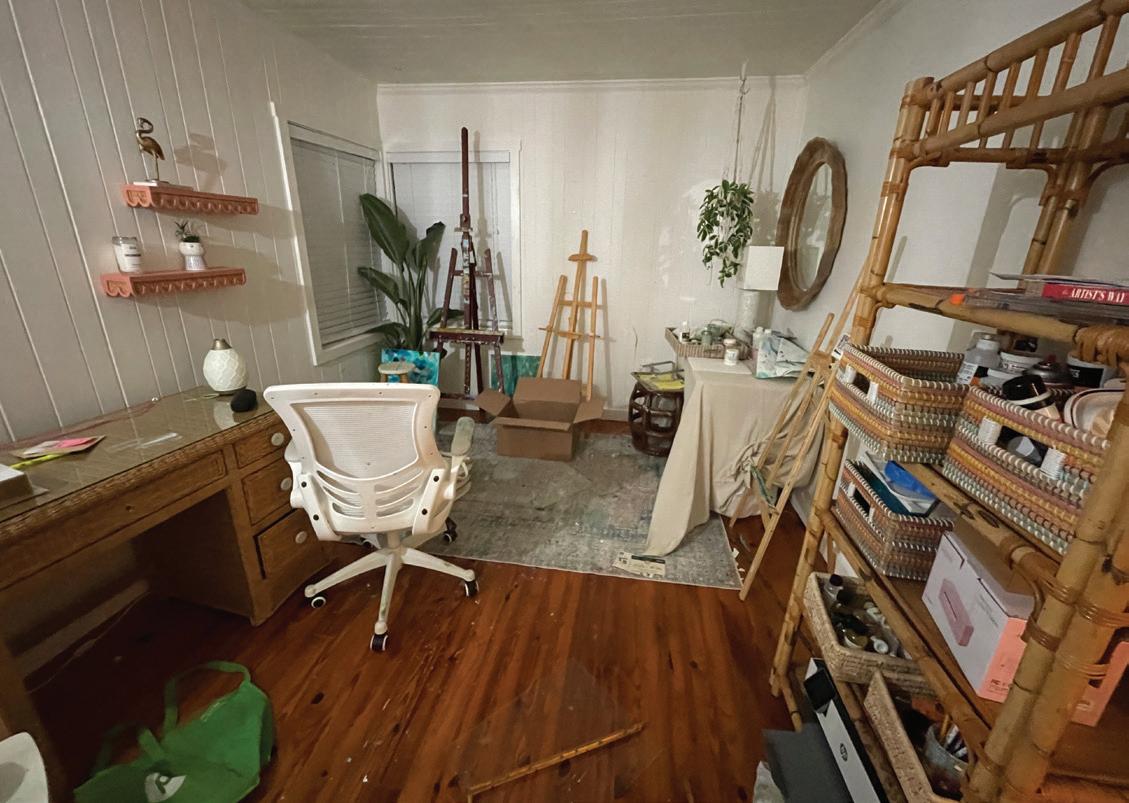
When I first connected with Lauren Marshall last year, I was enchanted by her coastal studio in Siesta Key, Florida, which appeared to be perpetually filled with sunlight. But the story she ended up sharing in this issue was very different than the one she set out to write. Lauren and her family scrambled to save the belongings in her home, plus her artwork, when not one but multiple hurricanes — Debby, Helene, Milton — came through and forced them to evacuate. Fortunately, she now is settled back in her studio — a place she will never take for granted.
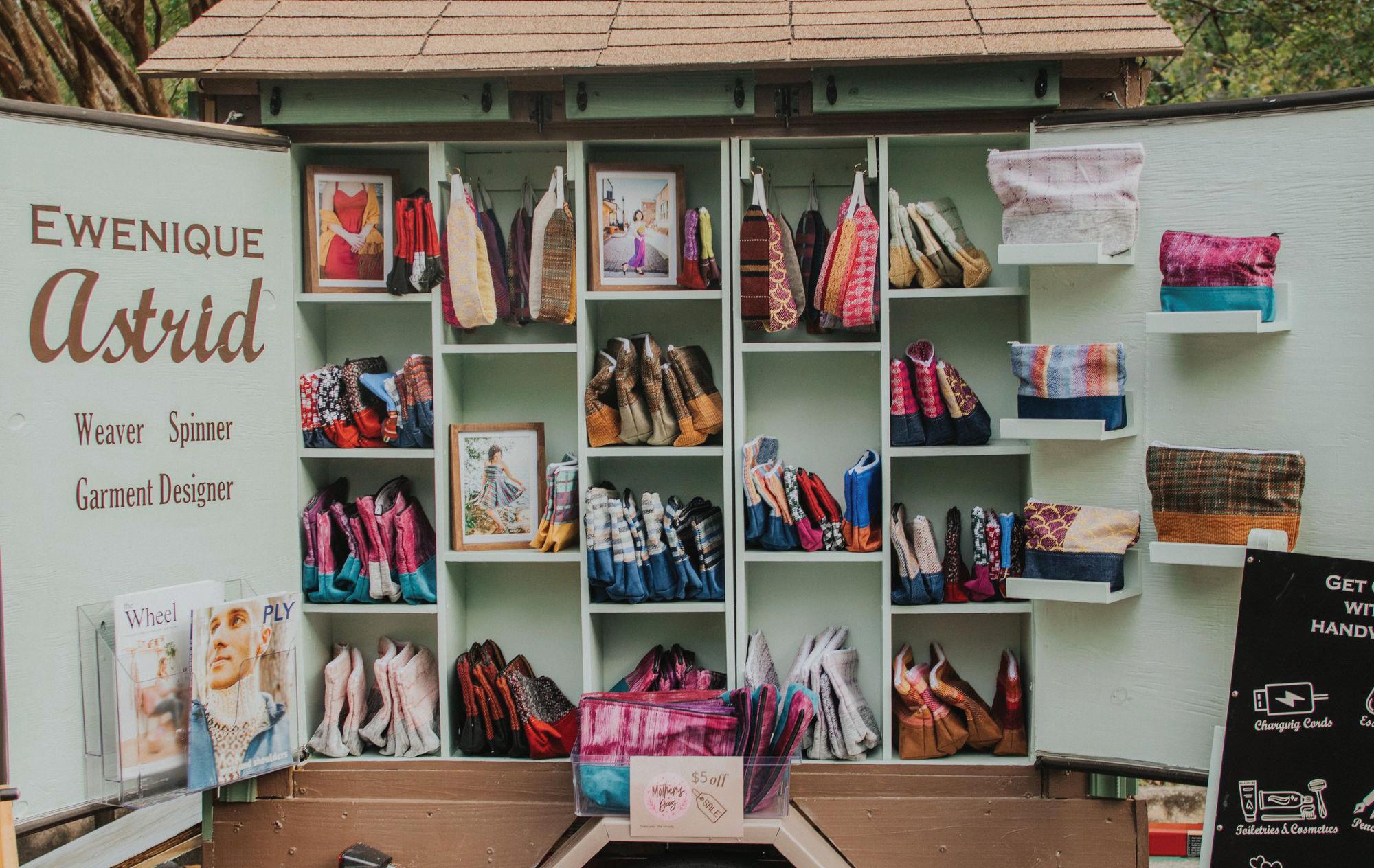
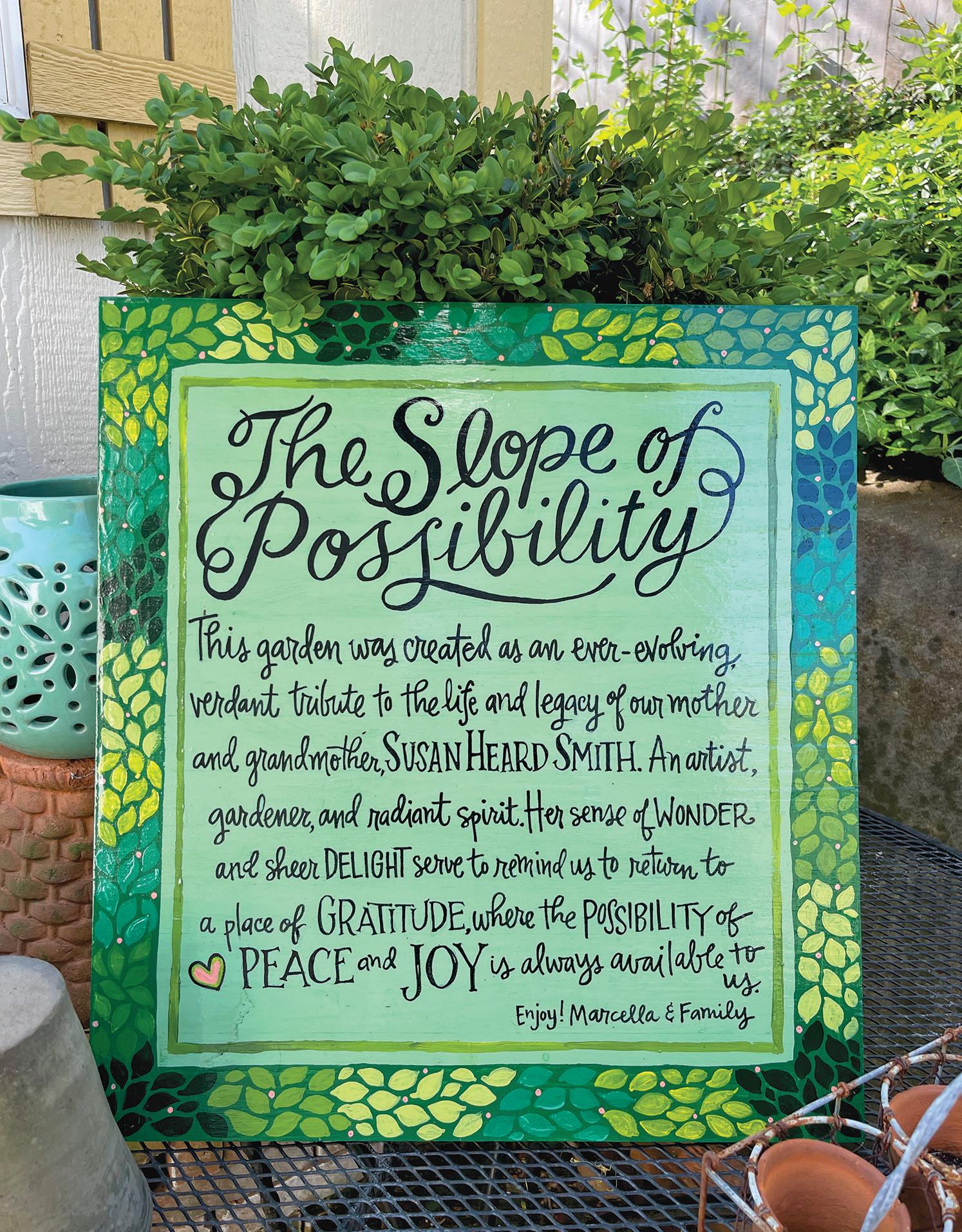
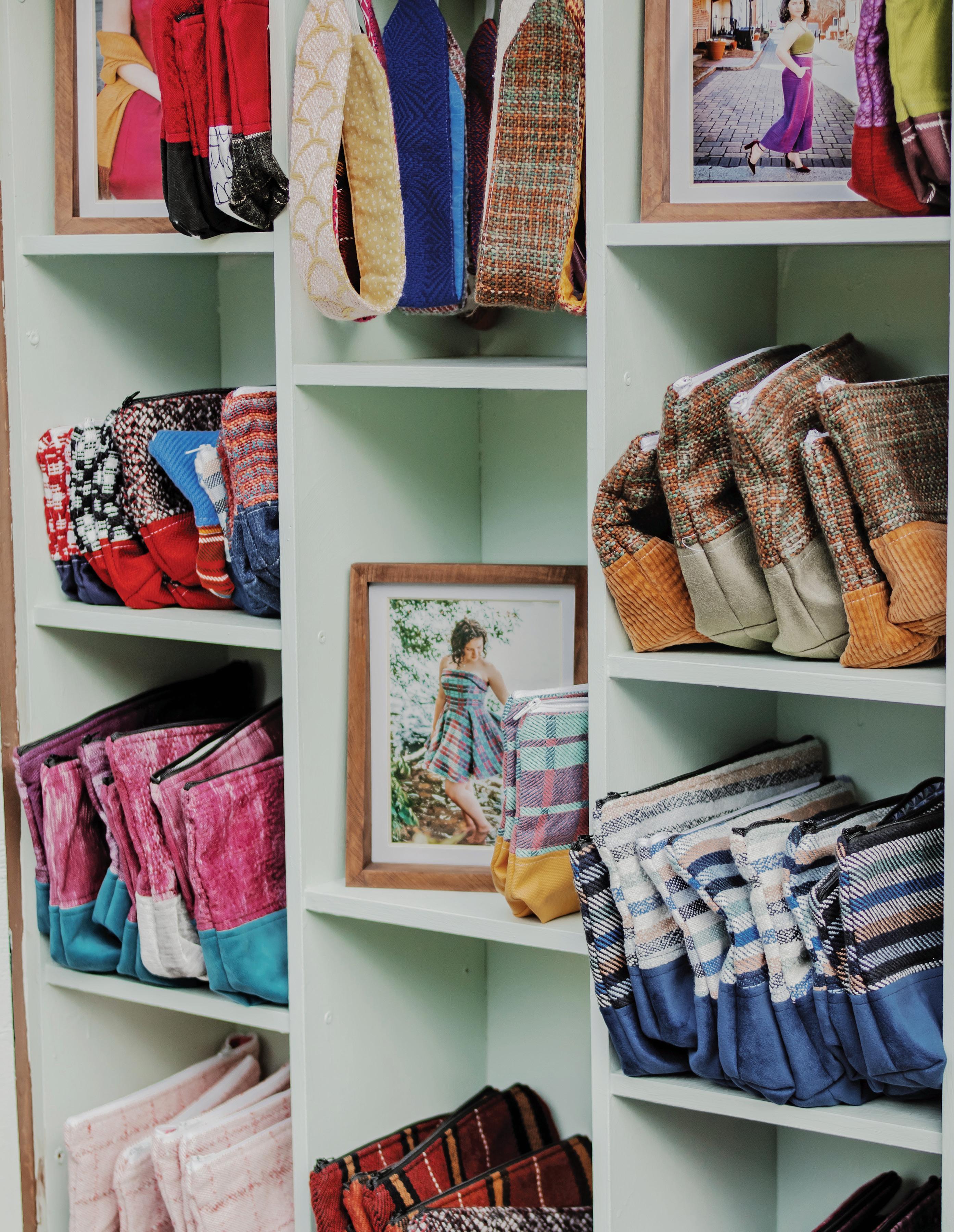
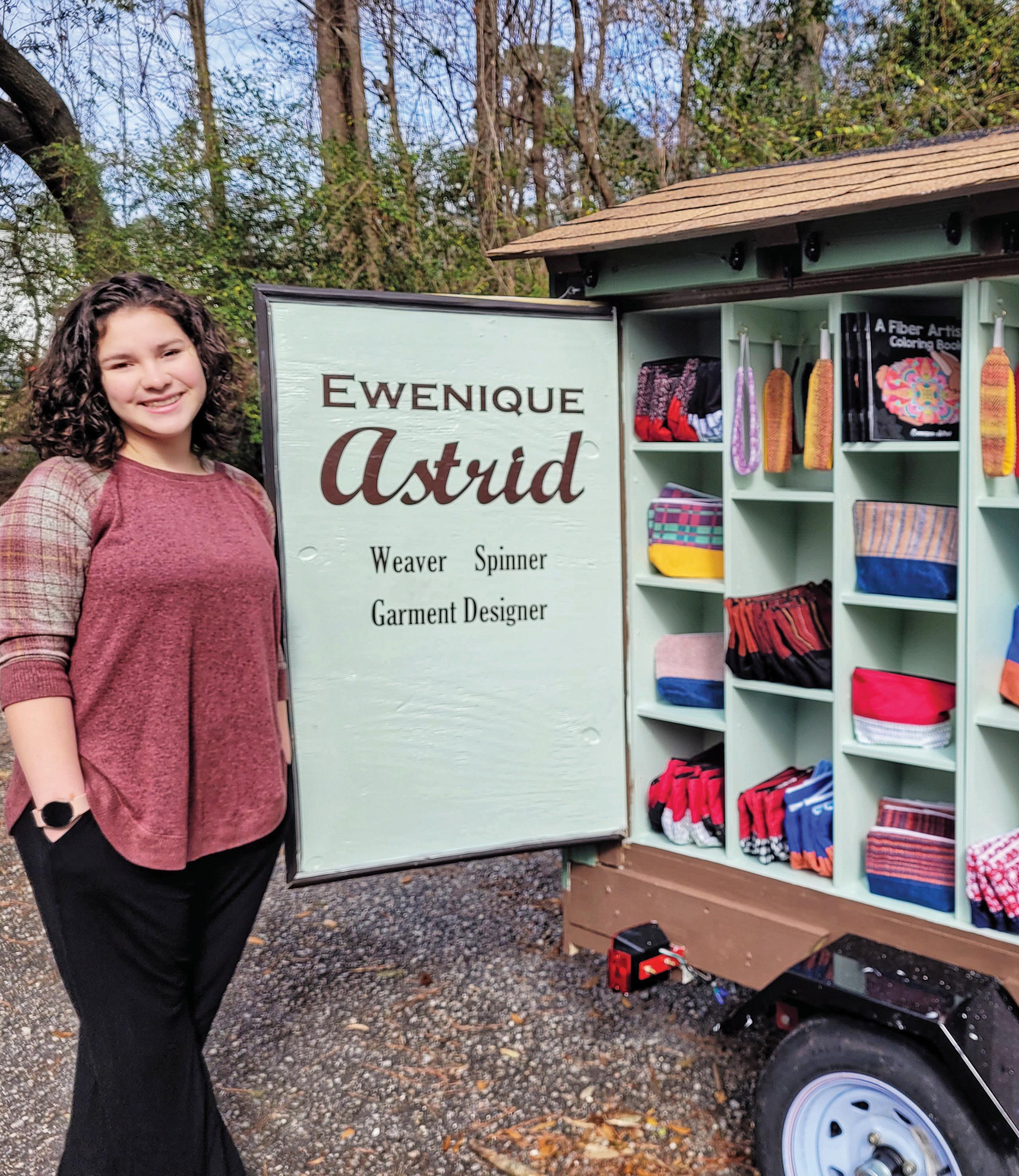
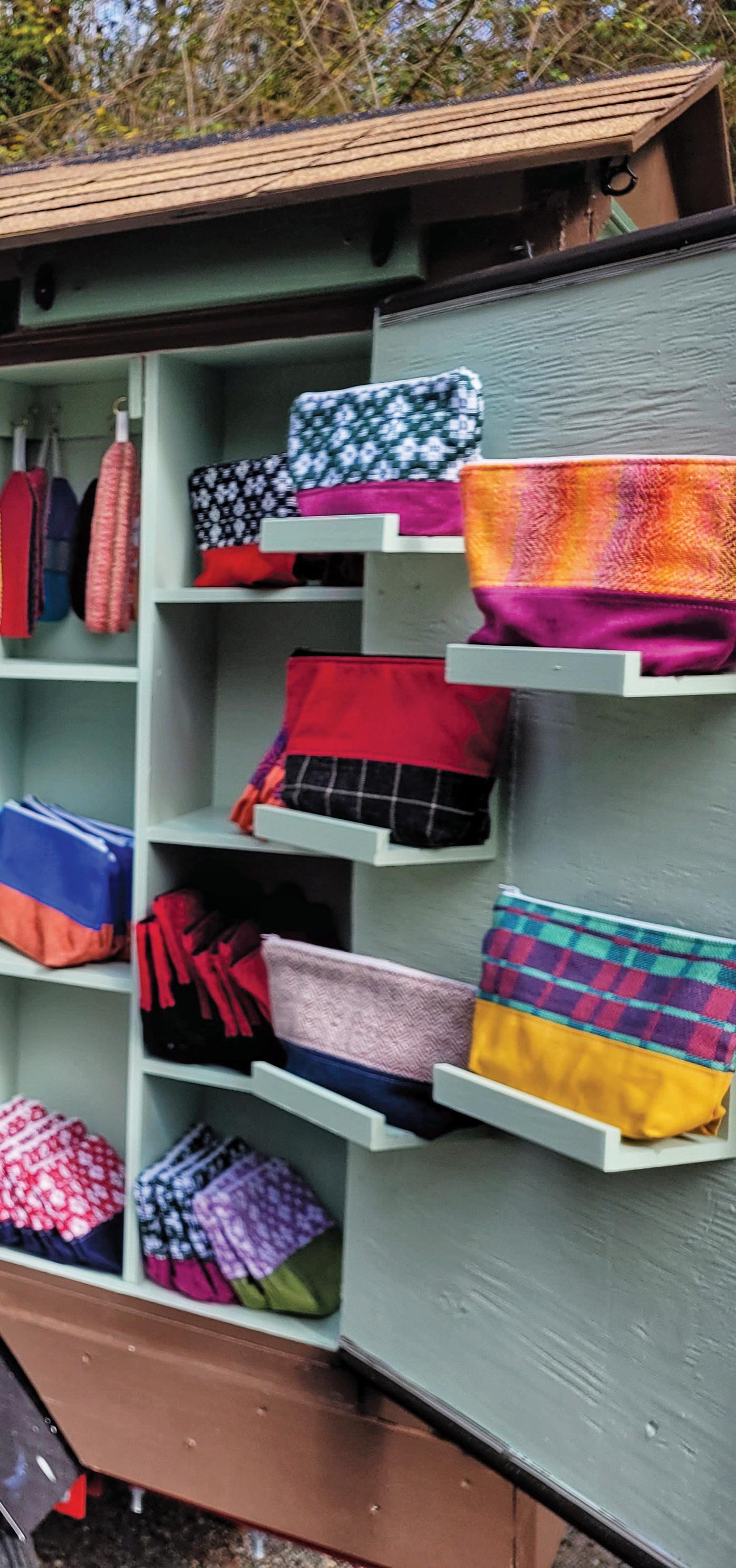
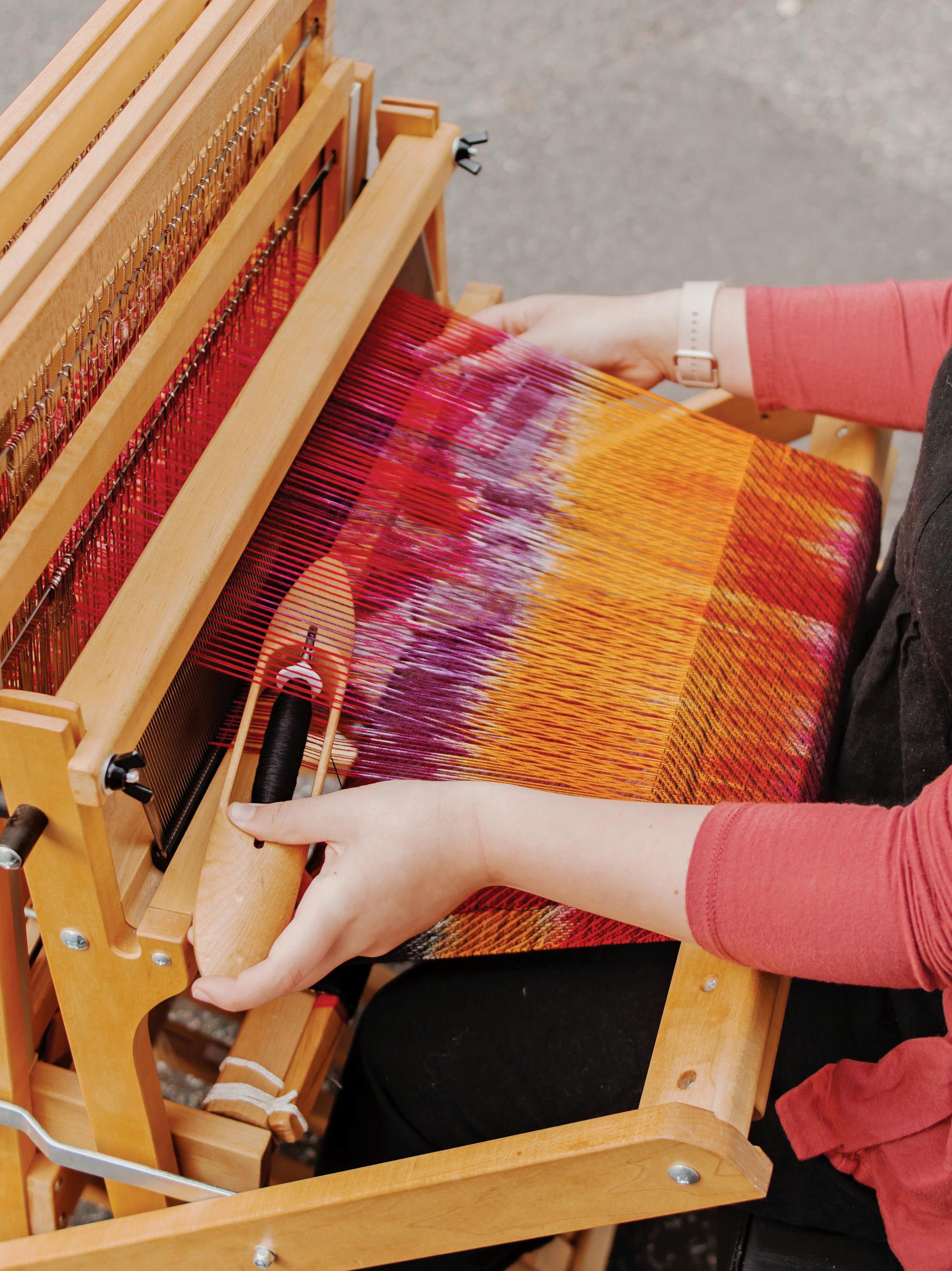
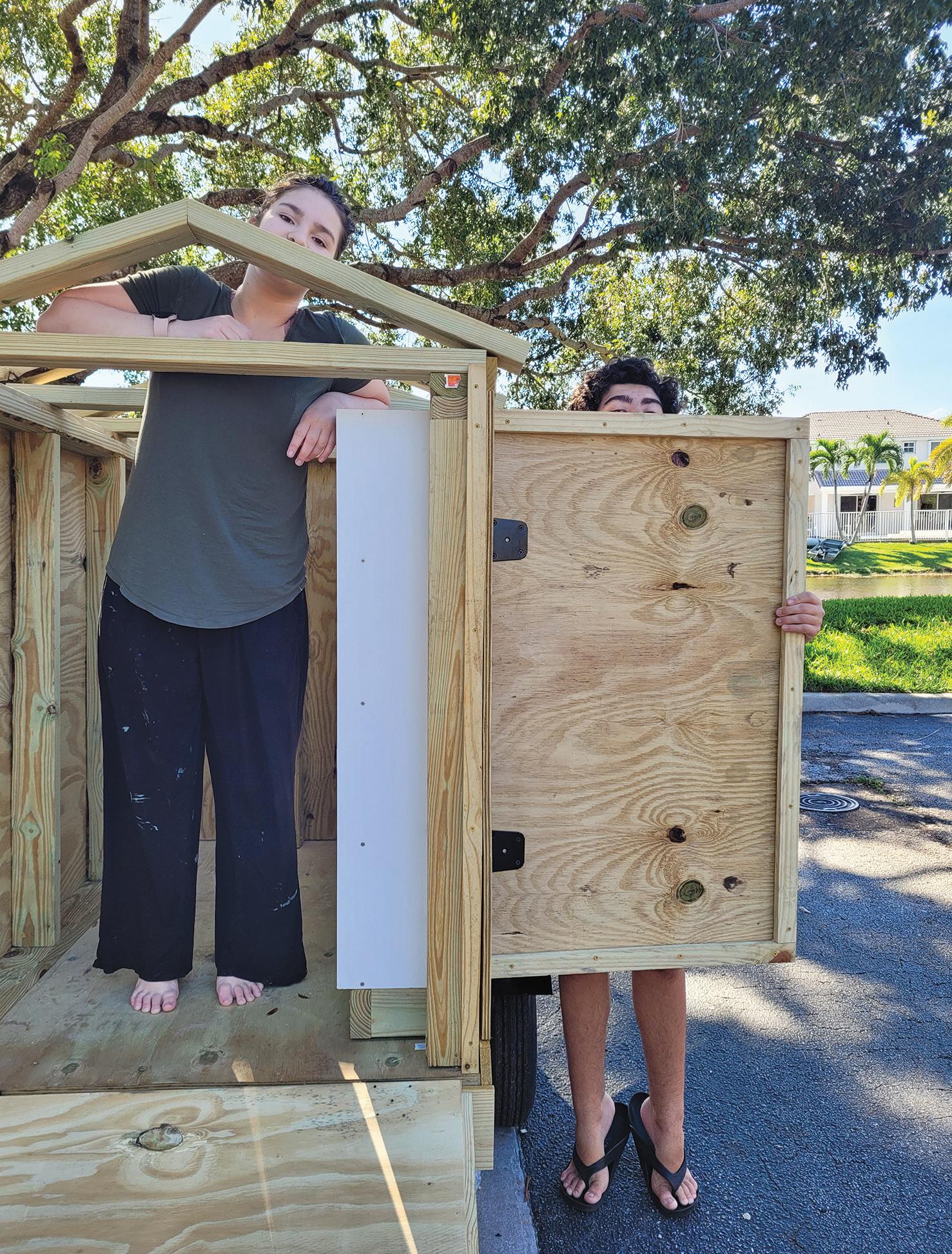
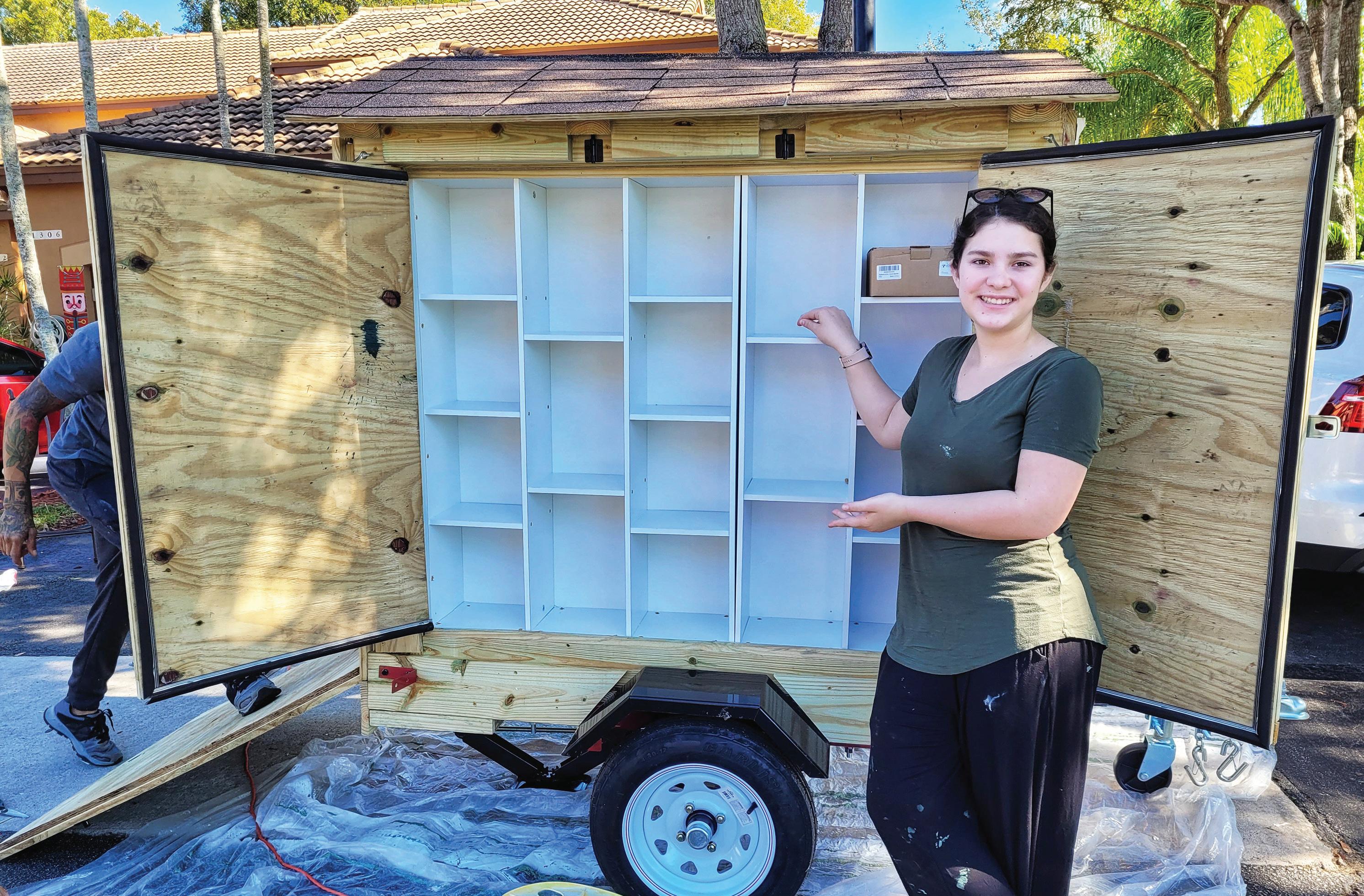
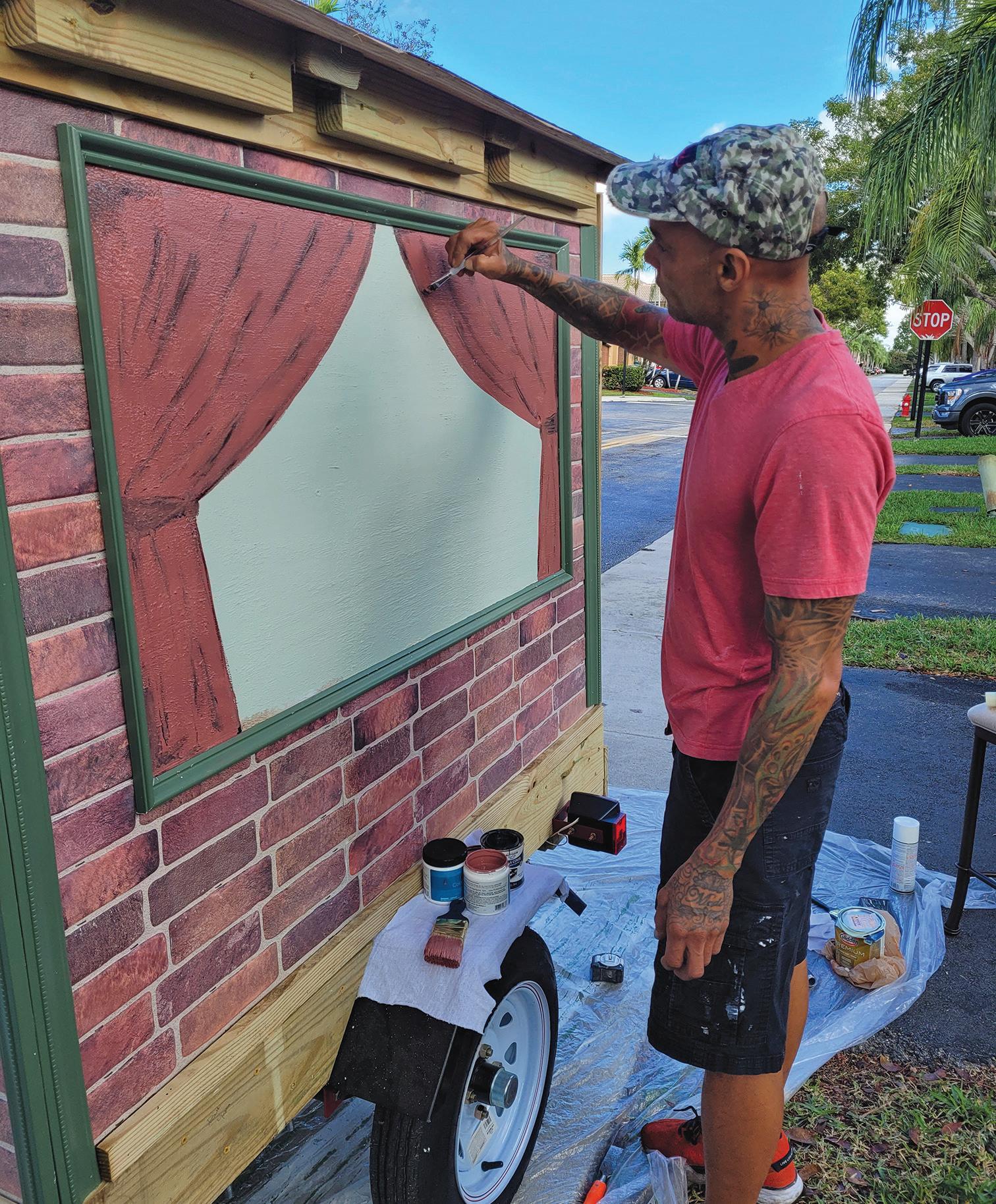
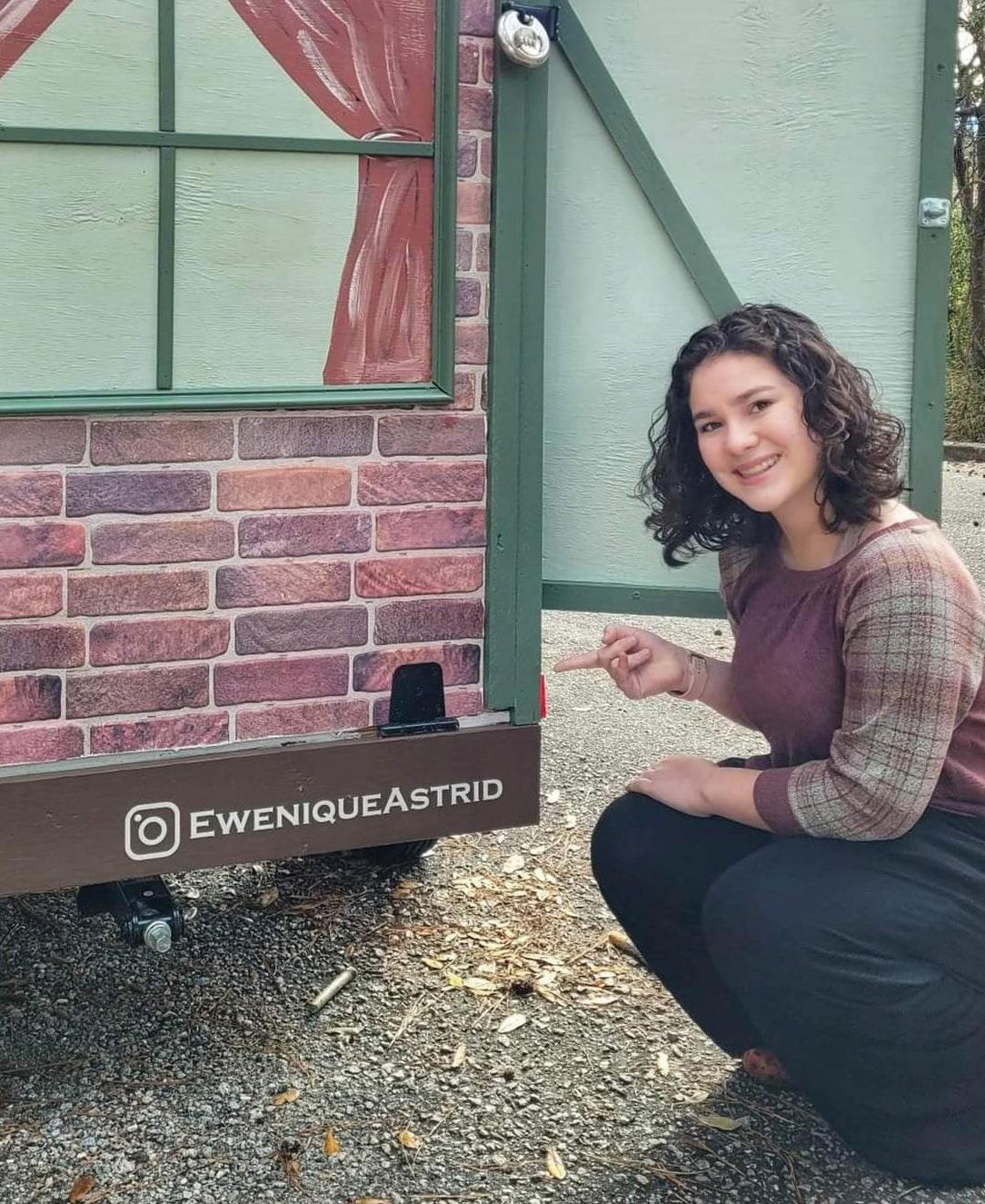
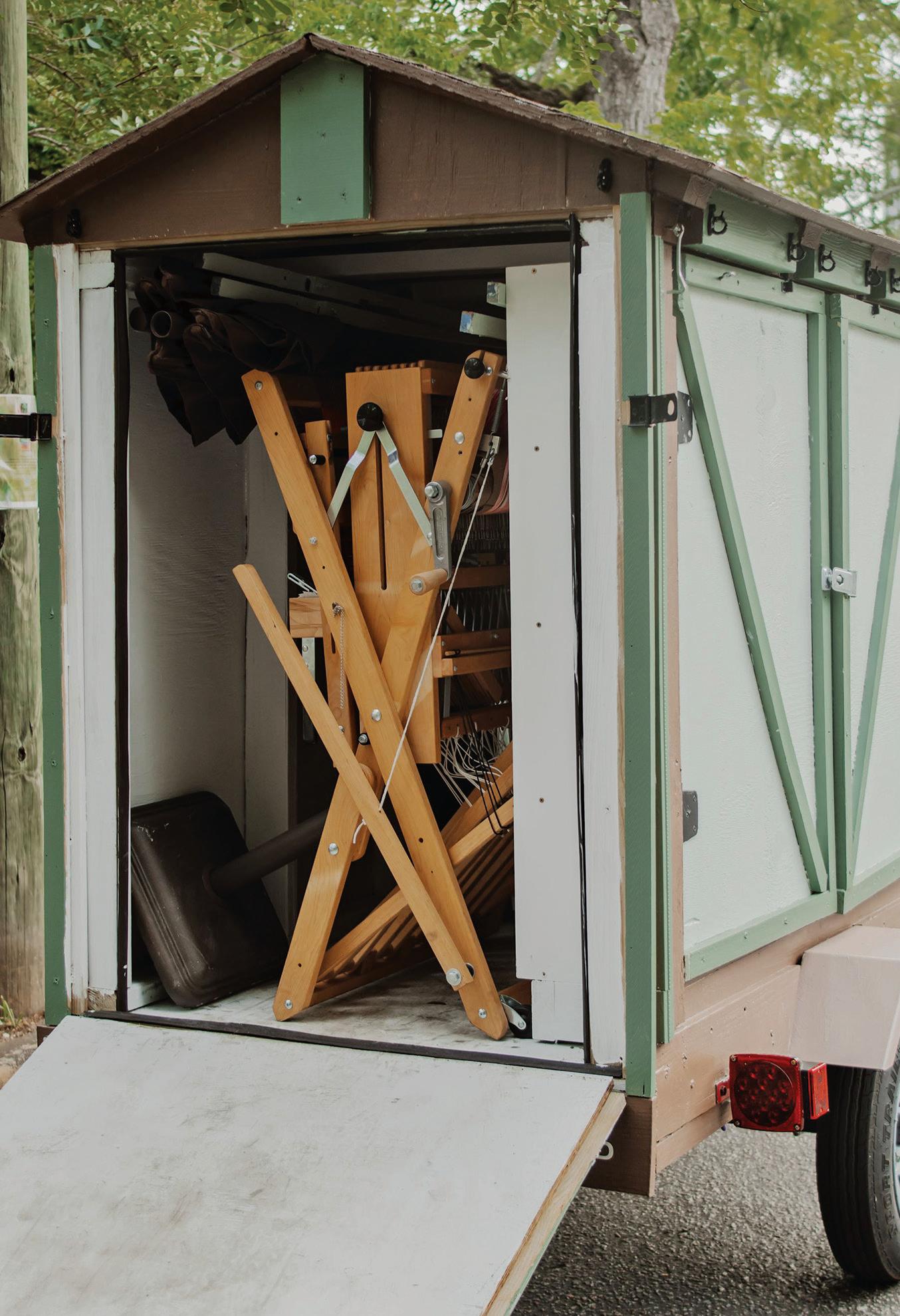
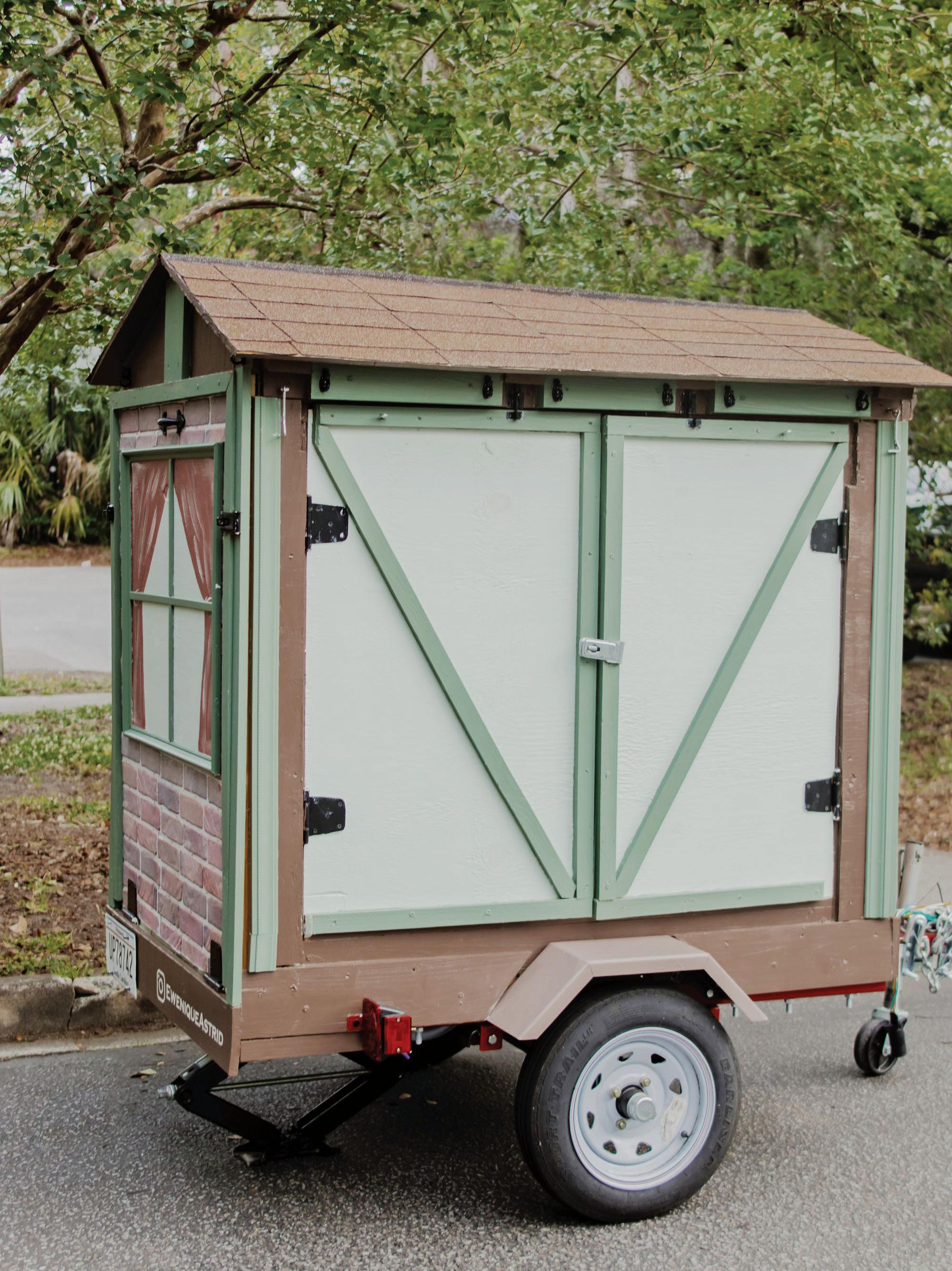
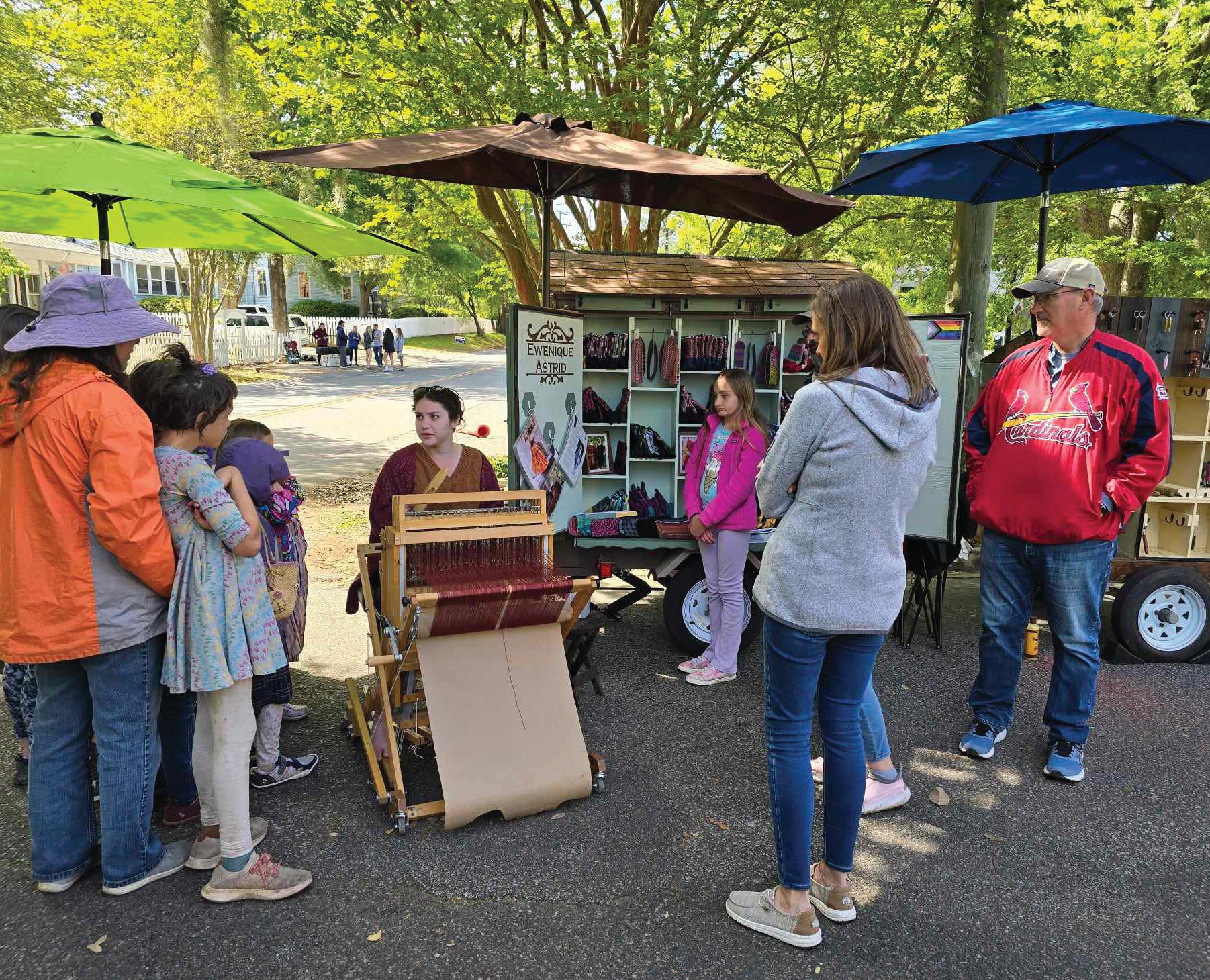
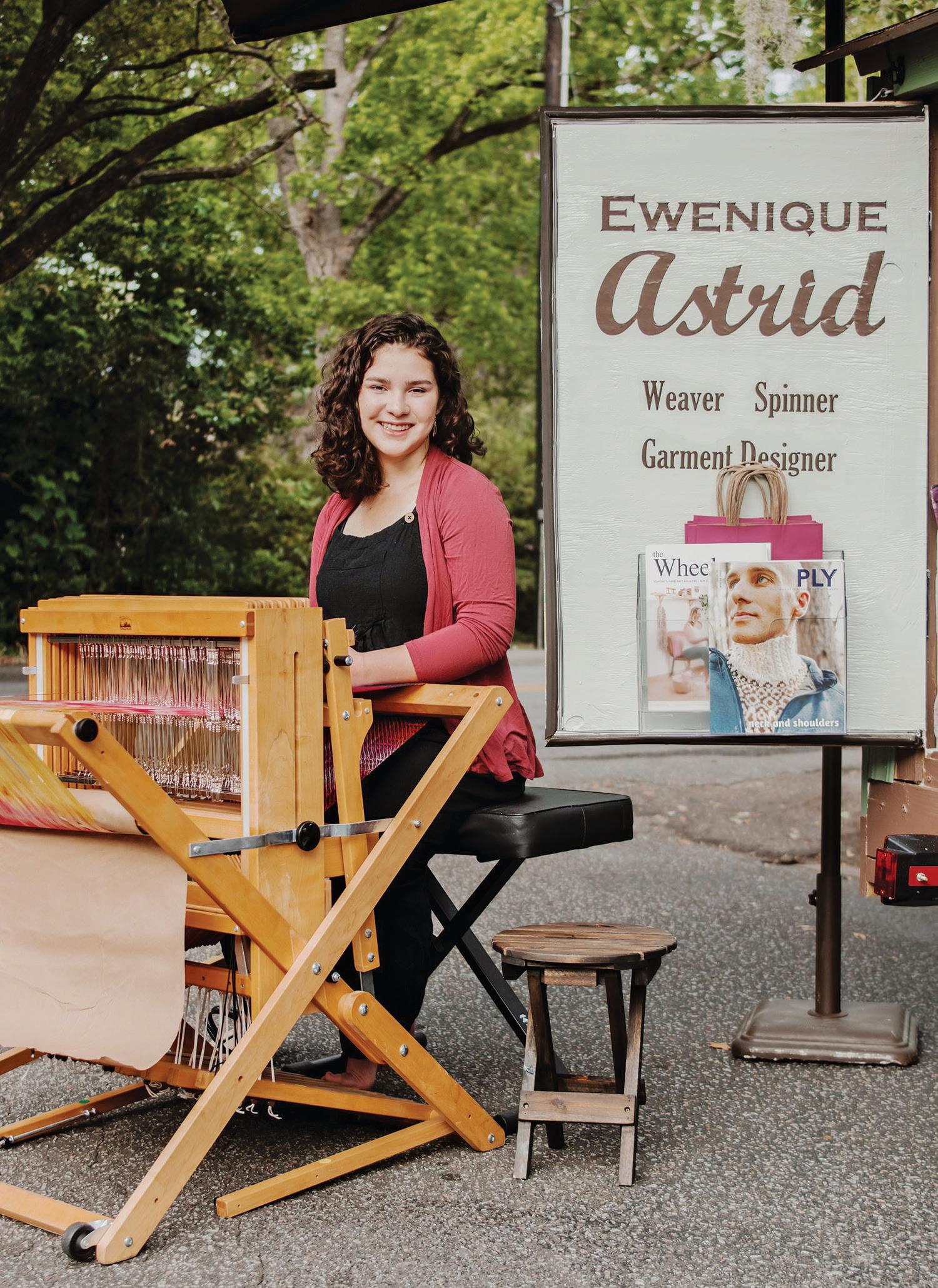
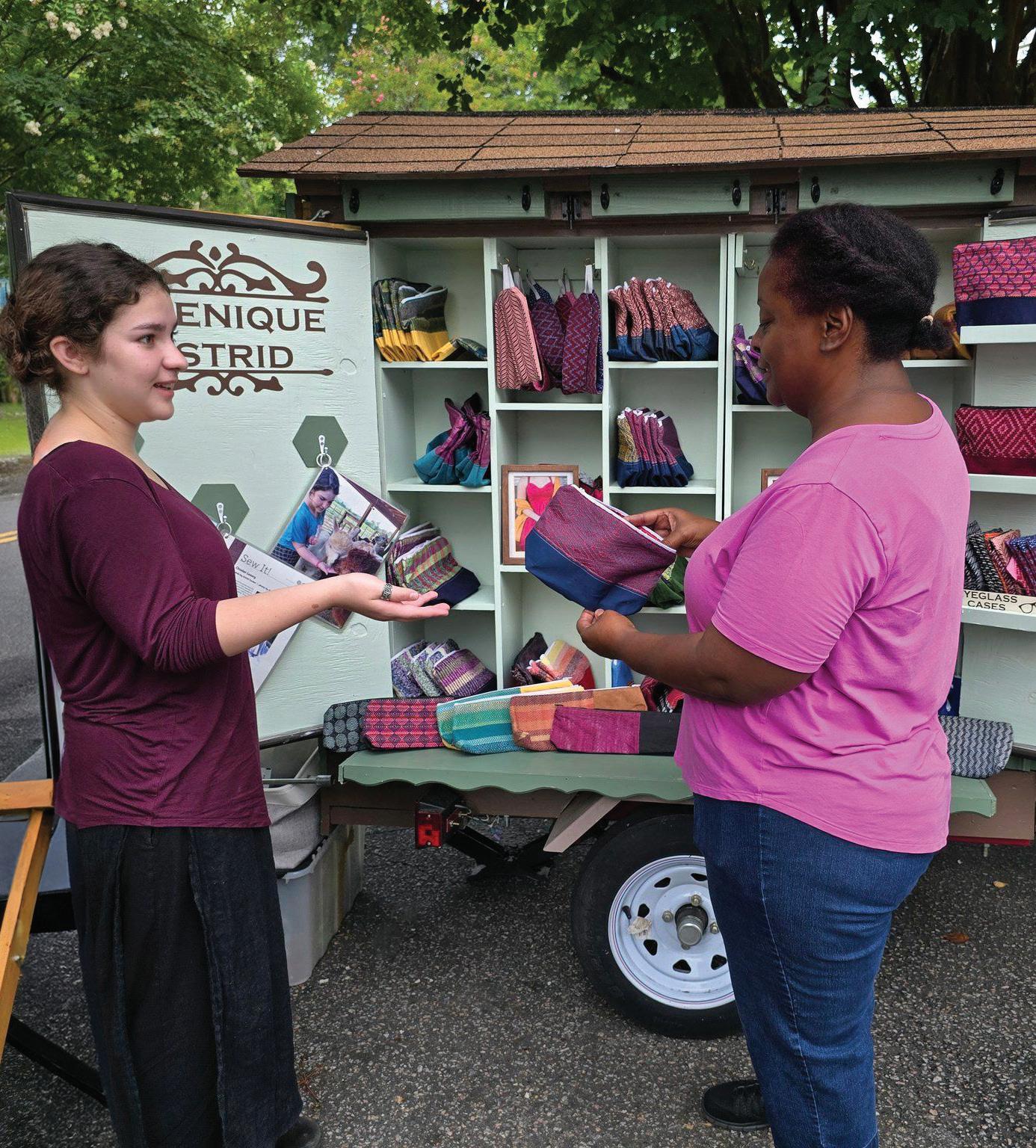
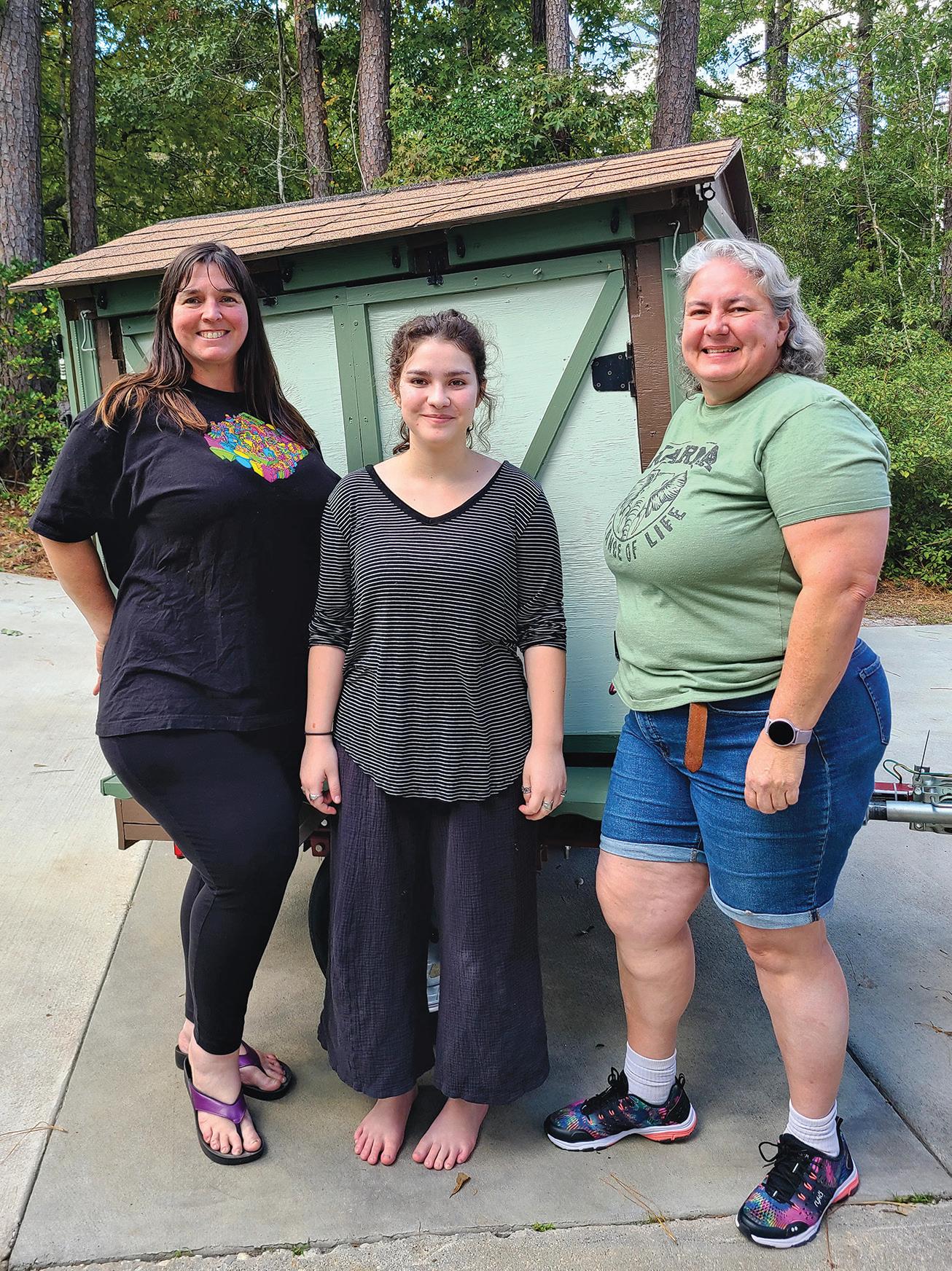
Astrid Tauber, one of our youngest Women Create artists, was putting the final touches on the story of her innovative mobile shop — a traveling studio/ shop that housed her loom and handwoven creations and was a staple at markets near her home — when she found out her family would be moving out of the country. The mobile shop, sadly, would not be accompanying them. As she mourned the loss of a business concept she’d conceived and built from scratch in her early teens, Astrid — who is wise beyond her years — focused on its next chapter with new stewards. With every challenge and change, there comes possibility. Graphic artist and entrepreneur Marcella Hawley, featured in “An Artist Lives Here: Inspiration Everywhere with Lori Siebert,” exemplifies this through the transformation of a patch of land on her property that she christened “The Slope of Possibility.” During a period in her life when she faced overwhelming grief, illness and a lack of direction, she took her creativity beyond the studio, stepped outside and embraced a plot of land that once seemed too wild and daunting to tackle.
If there’s anything I’ve learned from the resilience and strength of Women Create artists, it’s that very few things are too daunting to tackle. Creativity — especially the tactile act of making — comes to us just when we need it most and has a way of helping us through the hard times.
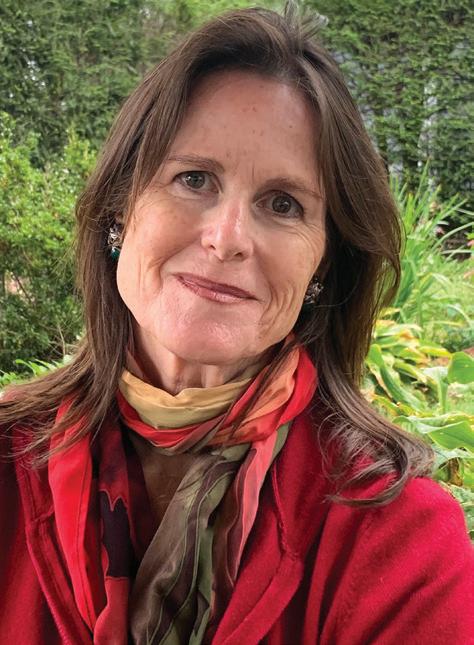
Jennifer Blot, Editor in Chief
ASTRID TAUBER, P140
MARCELLA HAWLEY, P22
MARY GREGORY
by Cortney Dani
Photography
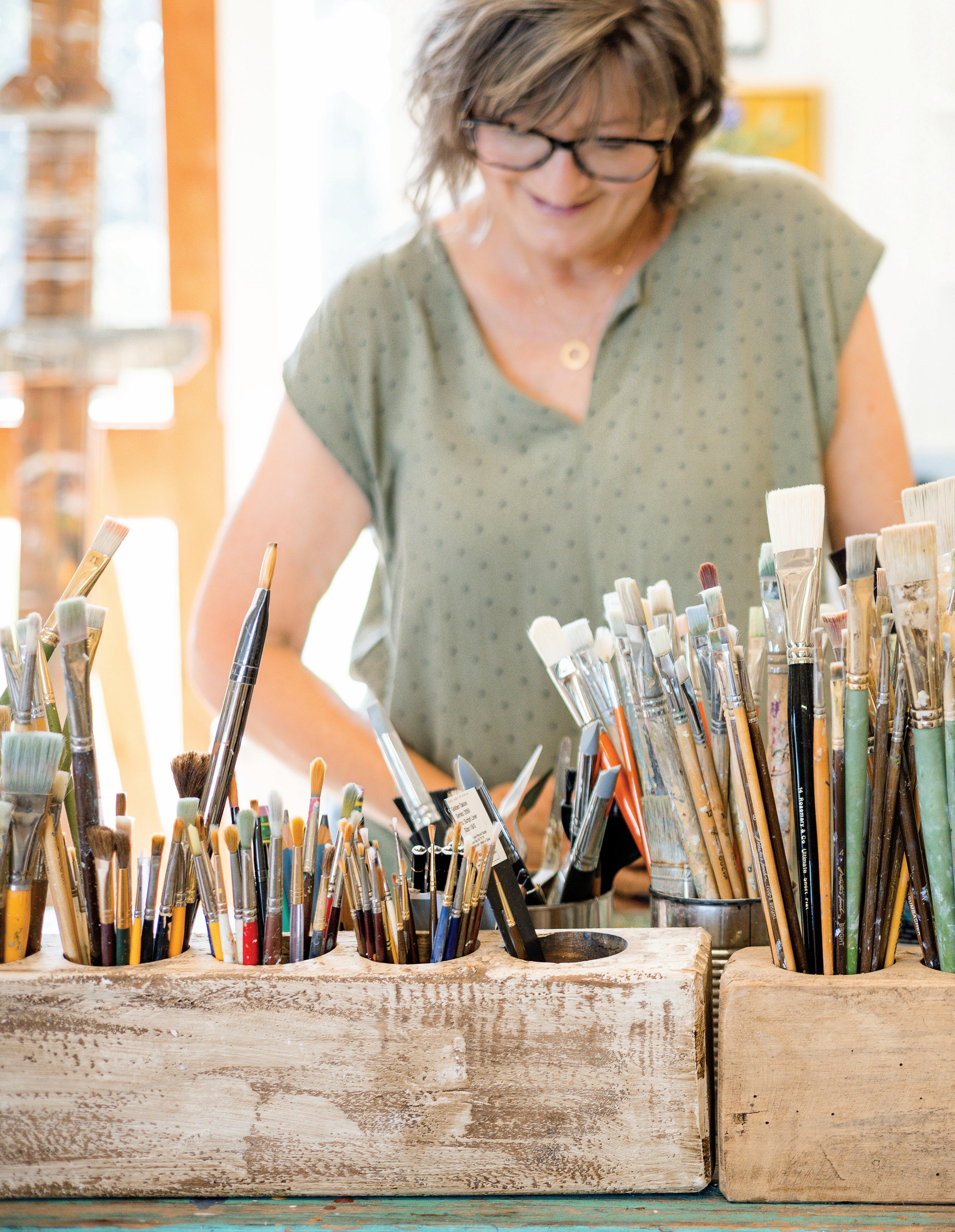
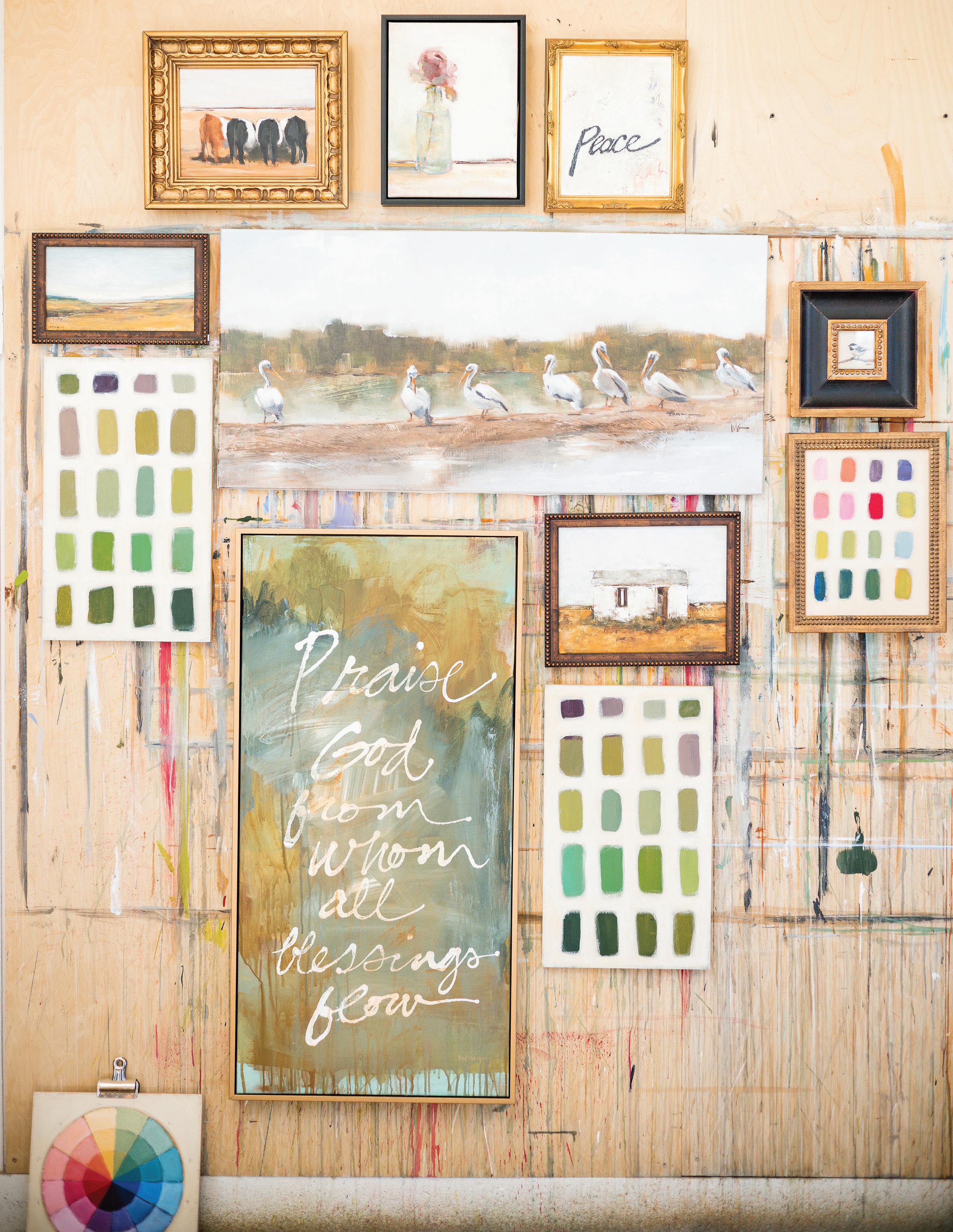
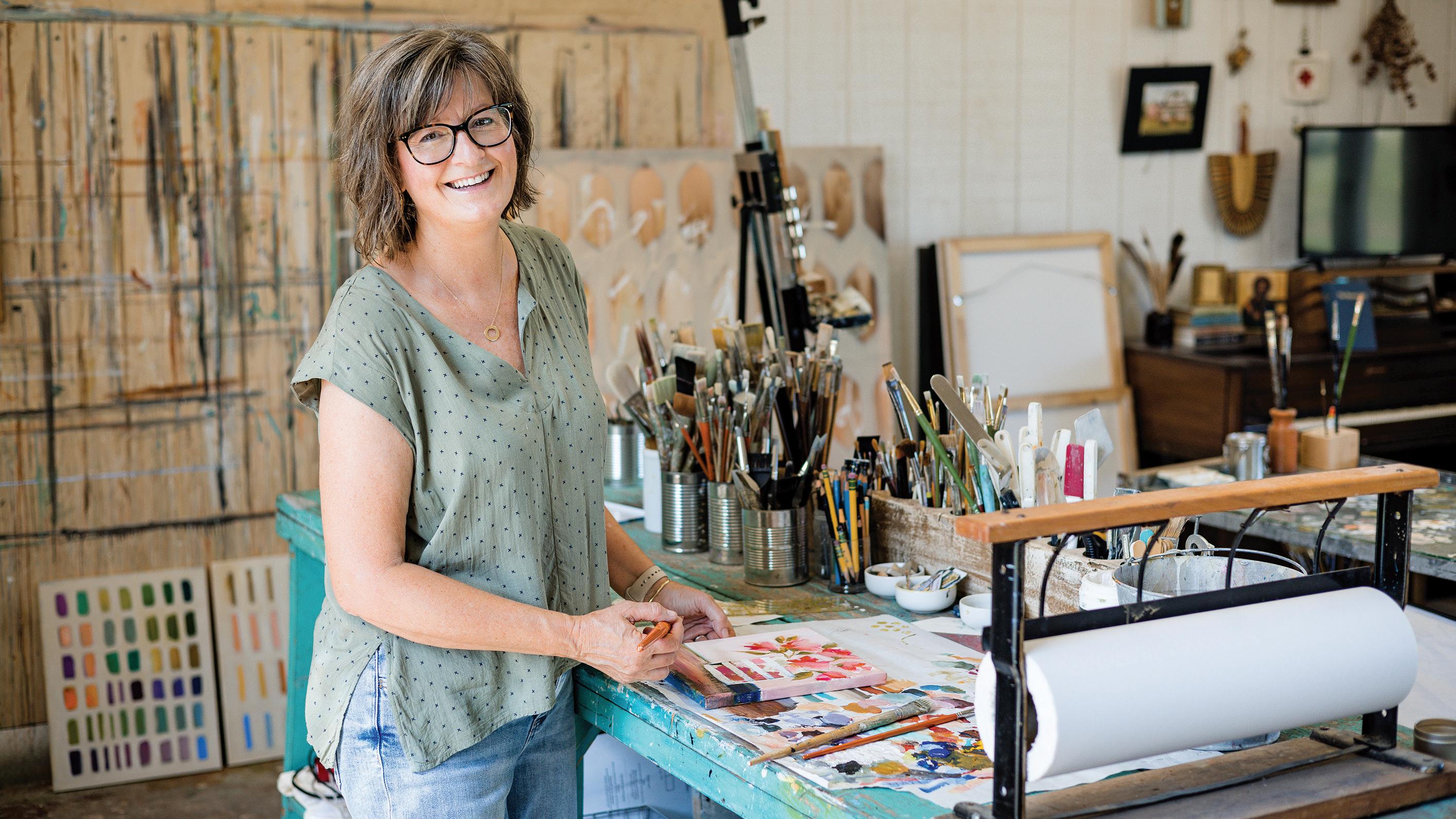
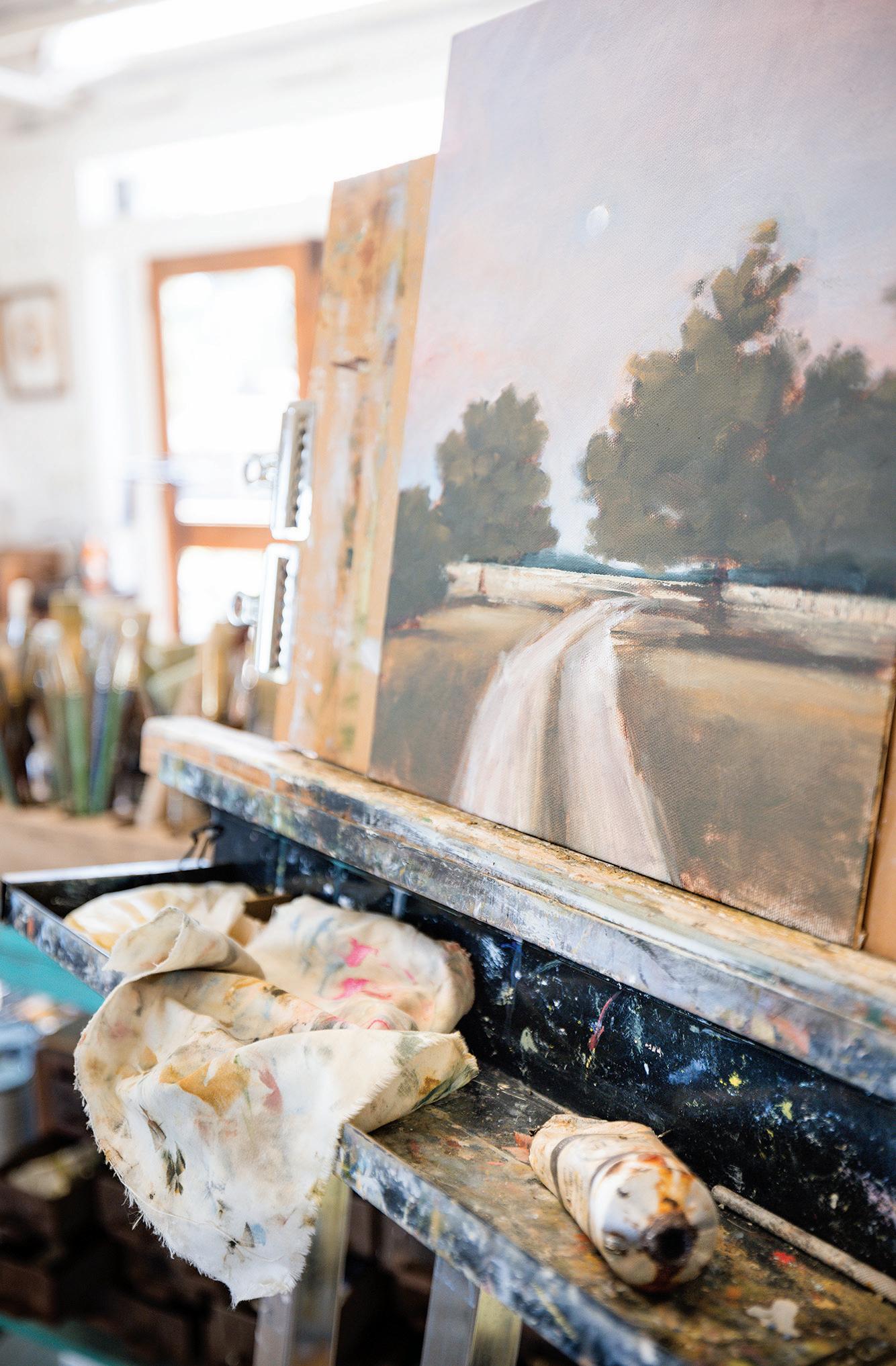
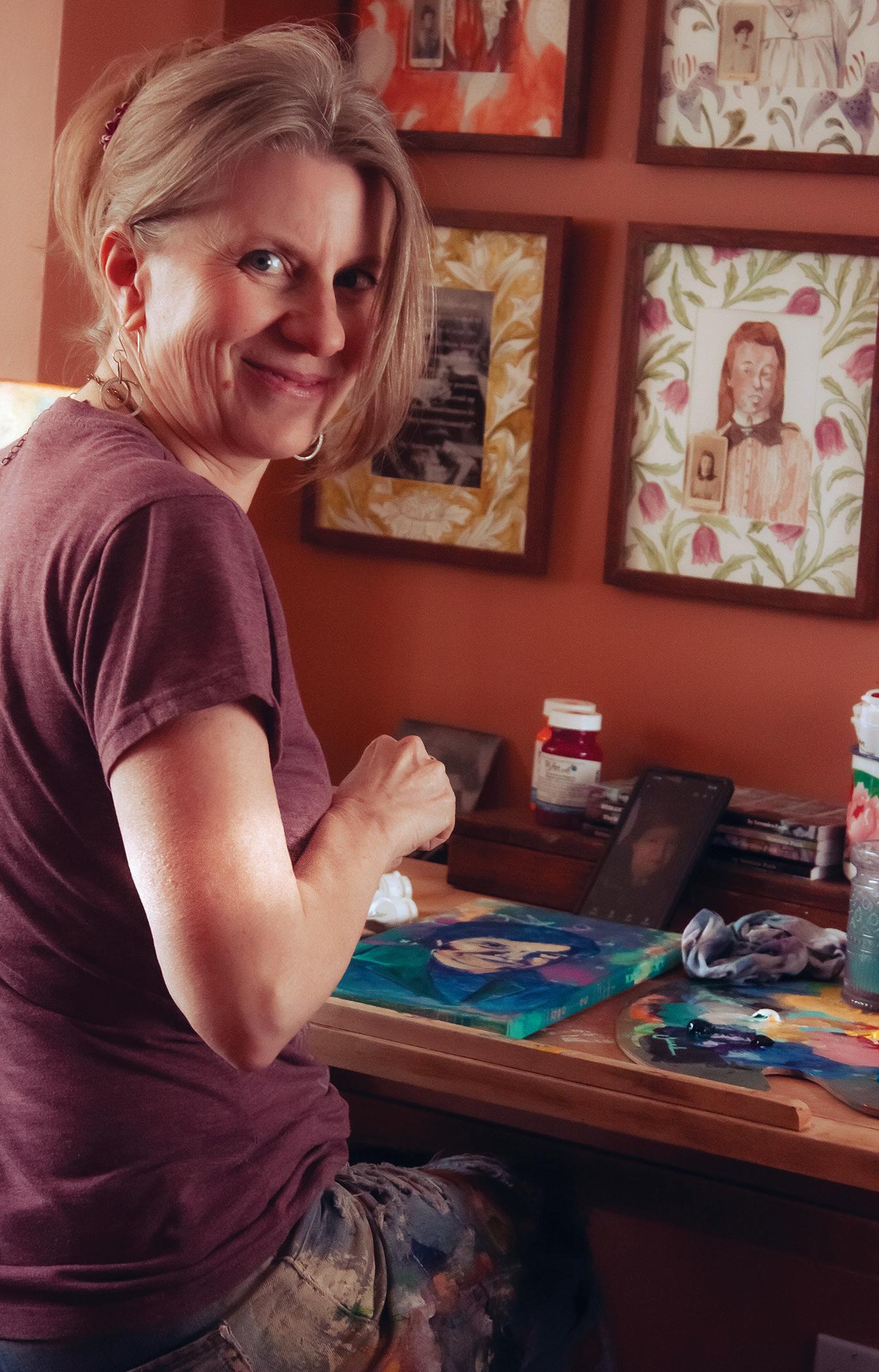
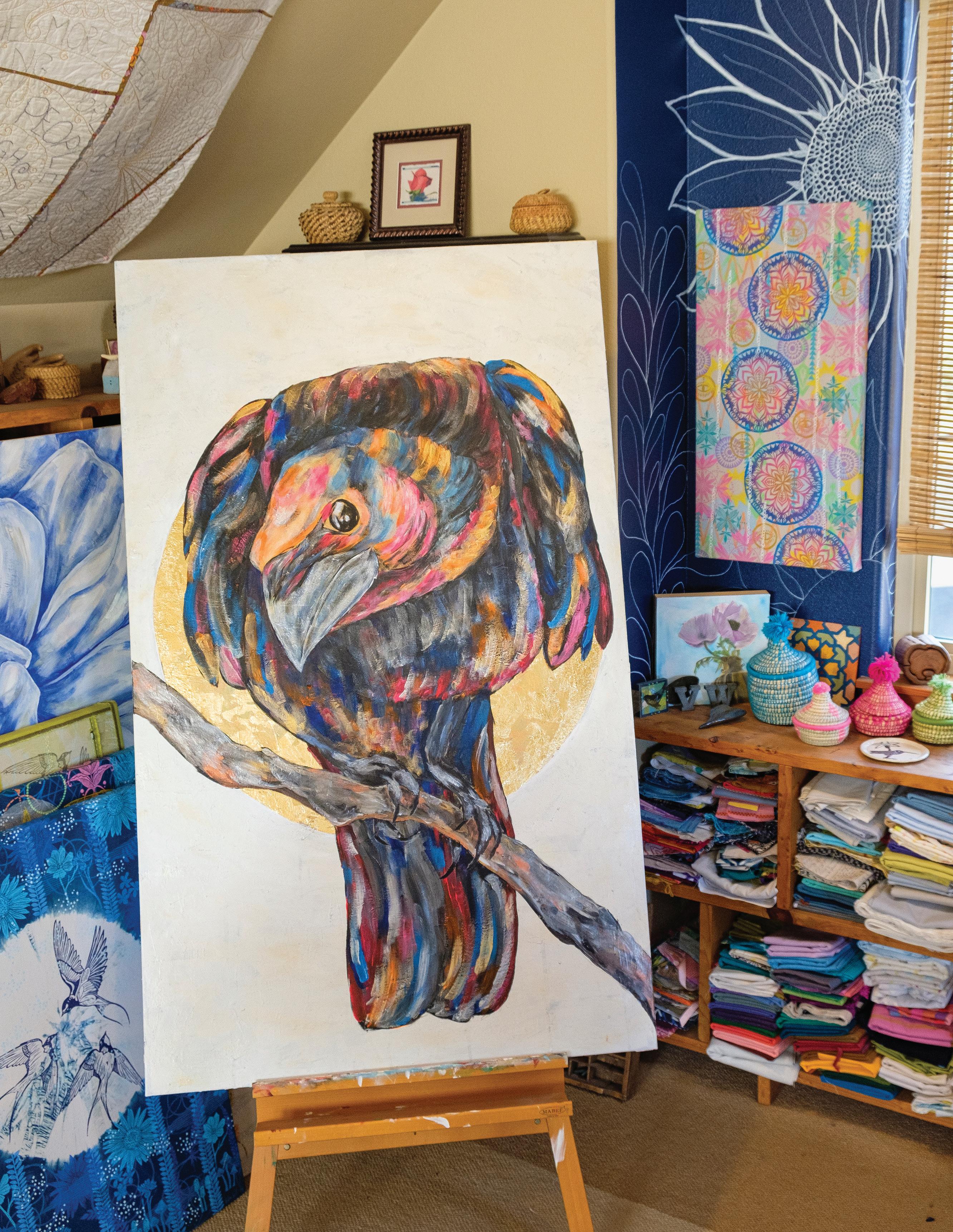
Artist MARY GREGORY paints scenes from her country home and studio in West Texas. She takes great delight in the natural world — from a butterfly wing to a vast landscape — and hopes to depict its beauty through the eyes of love: love for the subject, love for the viewer, and love for the Creator of it all.
PAINTING, DRAWING AND DREAMING HAVE always been what I do best. I was fortunate to have a family who believed in the importance of the arts and encouraged me at every turn. When I showed my grandmother a drawing at the age of 8, she said I was an artist. I believed her and set my course. My great-aunt gave me my first real art supplies at 10, which I still have. My mother was an accomplished musician and showed me how to practice and excel.
In high school, I had a very good art teacher, Mrs. Broderson, who further helped to build my confidence. Even though she could not give me good grades for assignments that were turned
in late, she declared my work to be good. Time management is still not my strong suit but things have worked out in spite of it.
I have known, for as long as I can remember, that I would one day make a business of art. I waited until our daughters were grown before launching my business because I knew myself and my limitations — I knew that I would not have been the best mother or business owner if I had done both at the same time. So, I waited … even though the waiting was hard. There was the looming fear that I would miss my chance, that it would be too late. But I am here to tell you that it is never too late. I was 50 years old when Mary Gregory Studio began. The timing was perfect, and I have no regrets.
IBEGAN BY USING MY ARTWORK ON A variety of products, such as wall decor, pillows, aprons and notecards. Our youngest daughter, Anna, helped me and we showed at our first wholesale market in Dallas. We got more orders than we could fulfill on our own, and dear friends came to the rescue, folding tea towels, tying twine and packaging cards. If not for them, shops would be waiting for their merchandise to this day.
For the next three to four years, we attended many trade shows in Dallas, Atlanta, and New York. We then added Country Living Fairs, Round Top Antiques Week, and other retail shows to our schedule. That is when things began to shift and I was able to concentrate on fine art, which was always my heart’s desire. We still have wholesale accounts (some of which have been with us since the beginning) but are now only showing at Round Top twice a year and selling online. I am so grateful for all of the past opportunities, but am now appreciative for more time at home and in the studio.
By the second or third year, when we saw that this was a viable business, my husband, David, came on board full time — and it is a good thing he did. The skills that he brought to the business and his hard work have helped us grow and achieve success. He really and truly takes care of all of the hard things that would never get done if left up to me, and I am sure I would have given up if he had not been there to pull us through the difficult times. Working together has had its own challenges, but we have learned and grown into a harmonious team and, even on our worst days, we agree that we would not want to be doing anything else.
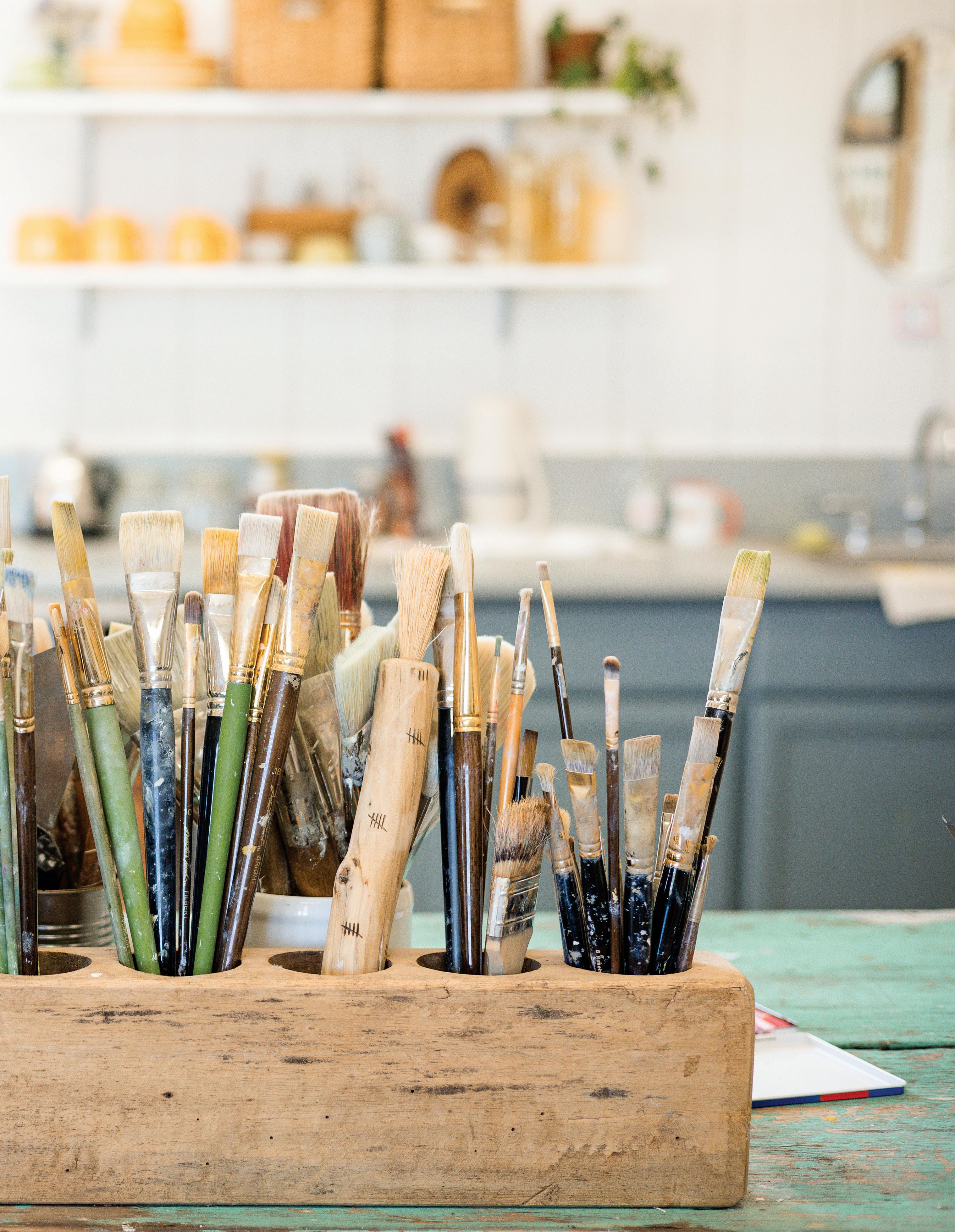
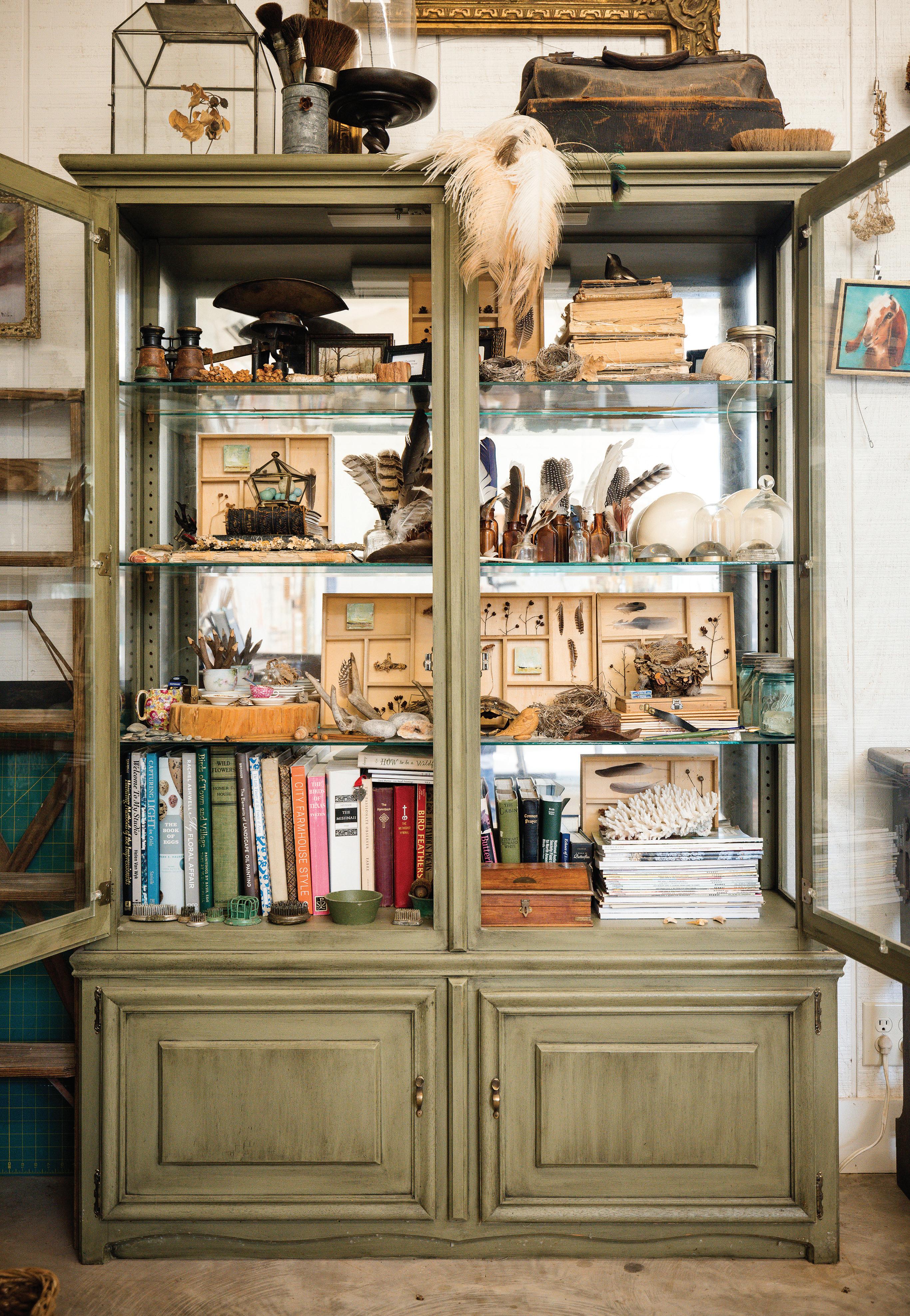
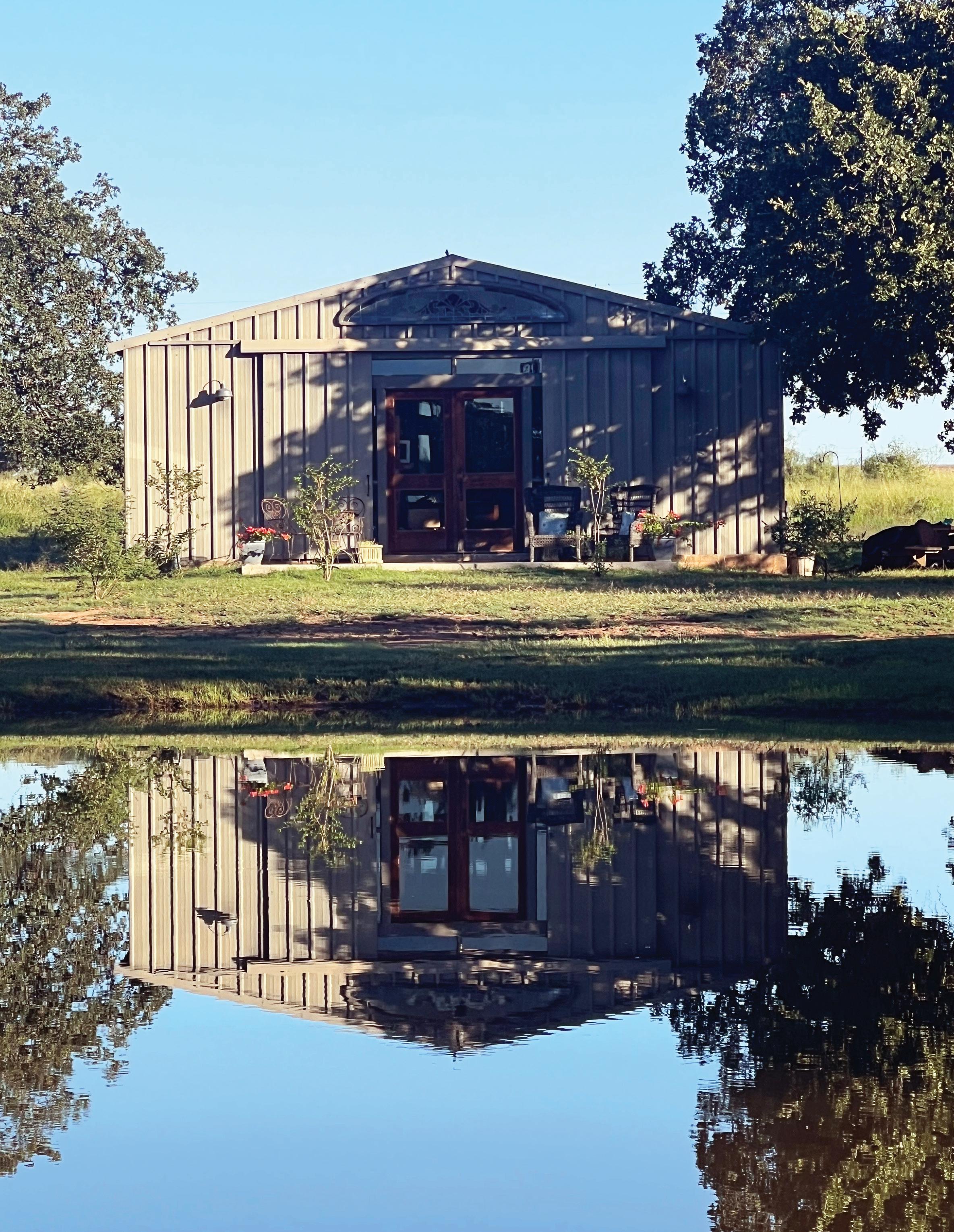
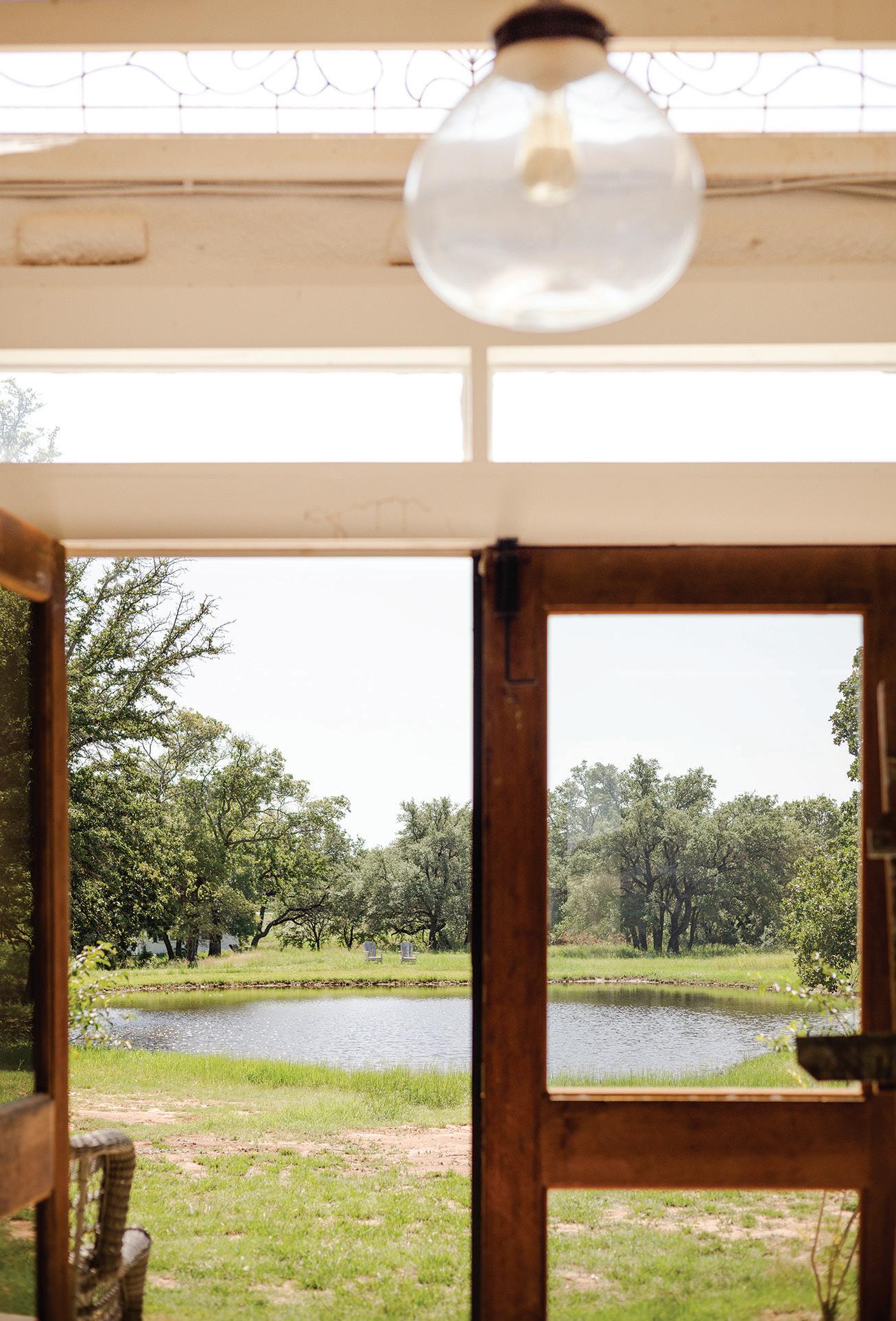
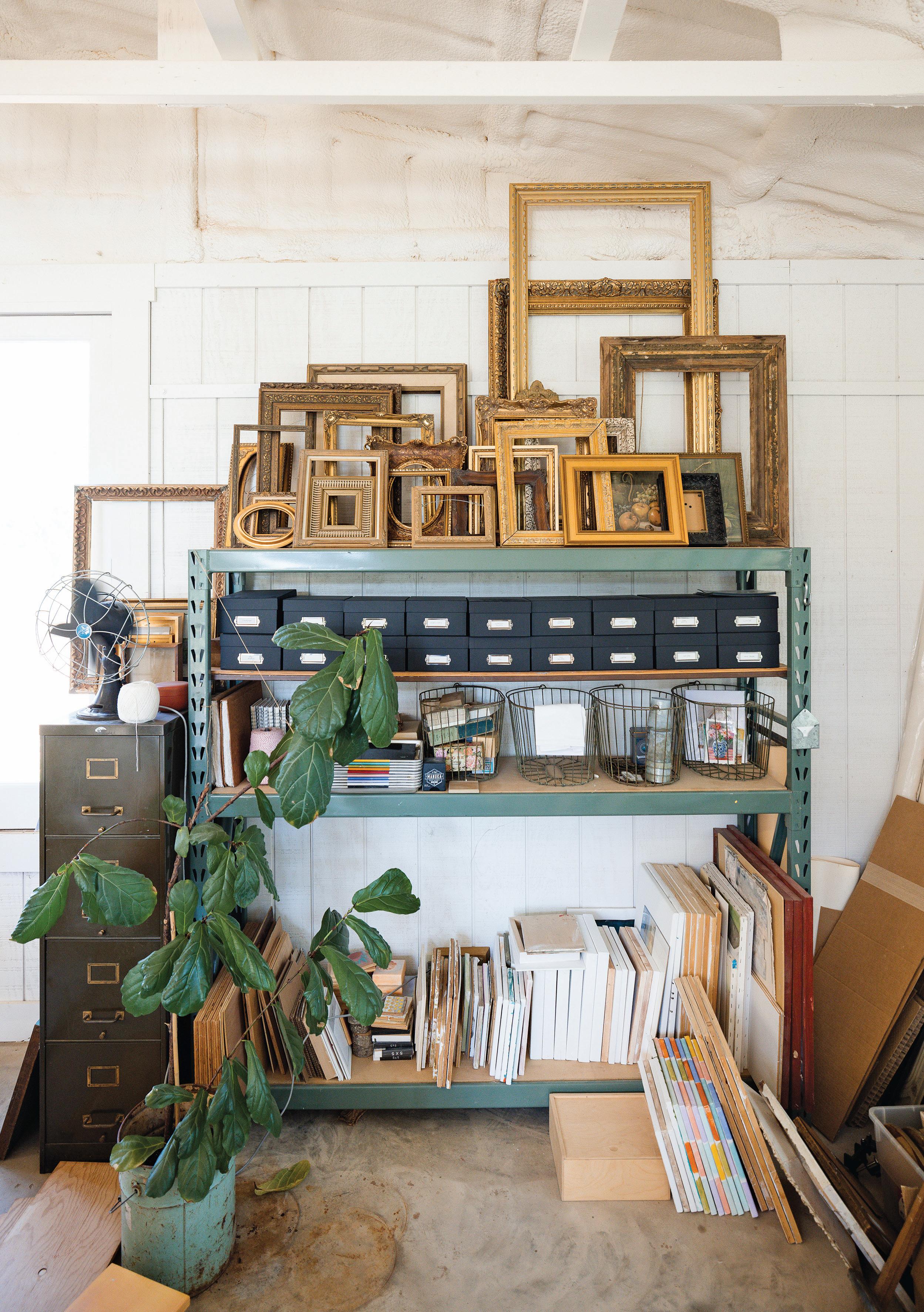
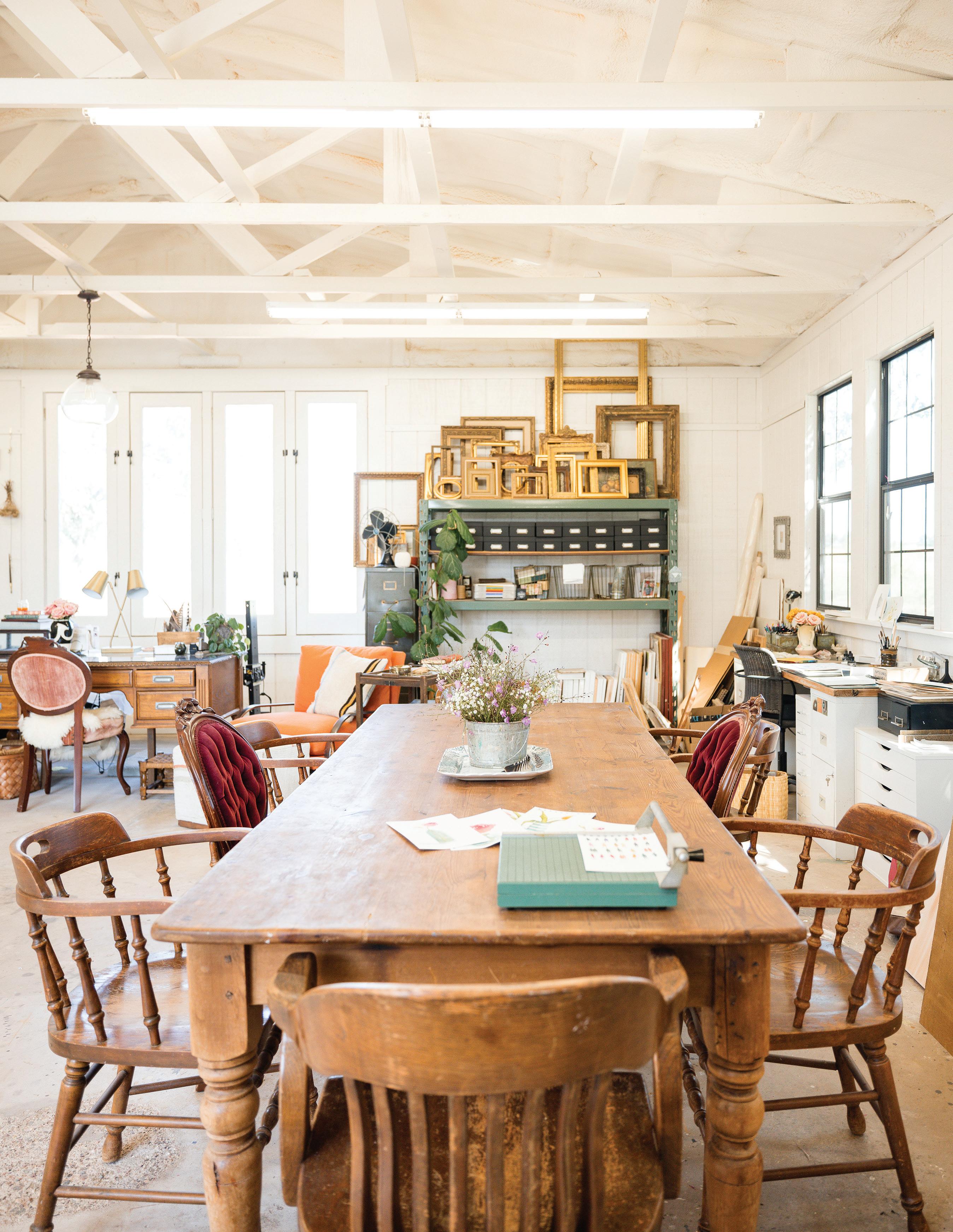
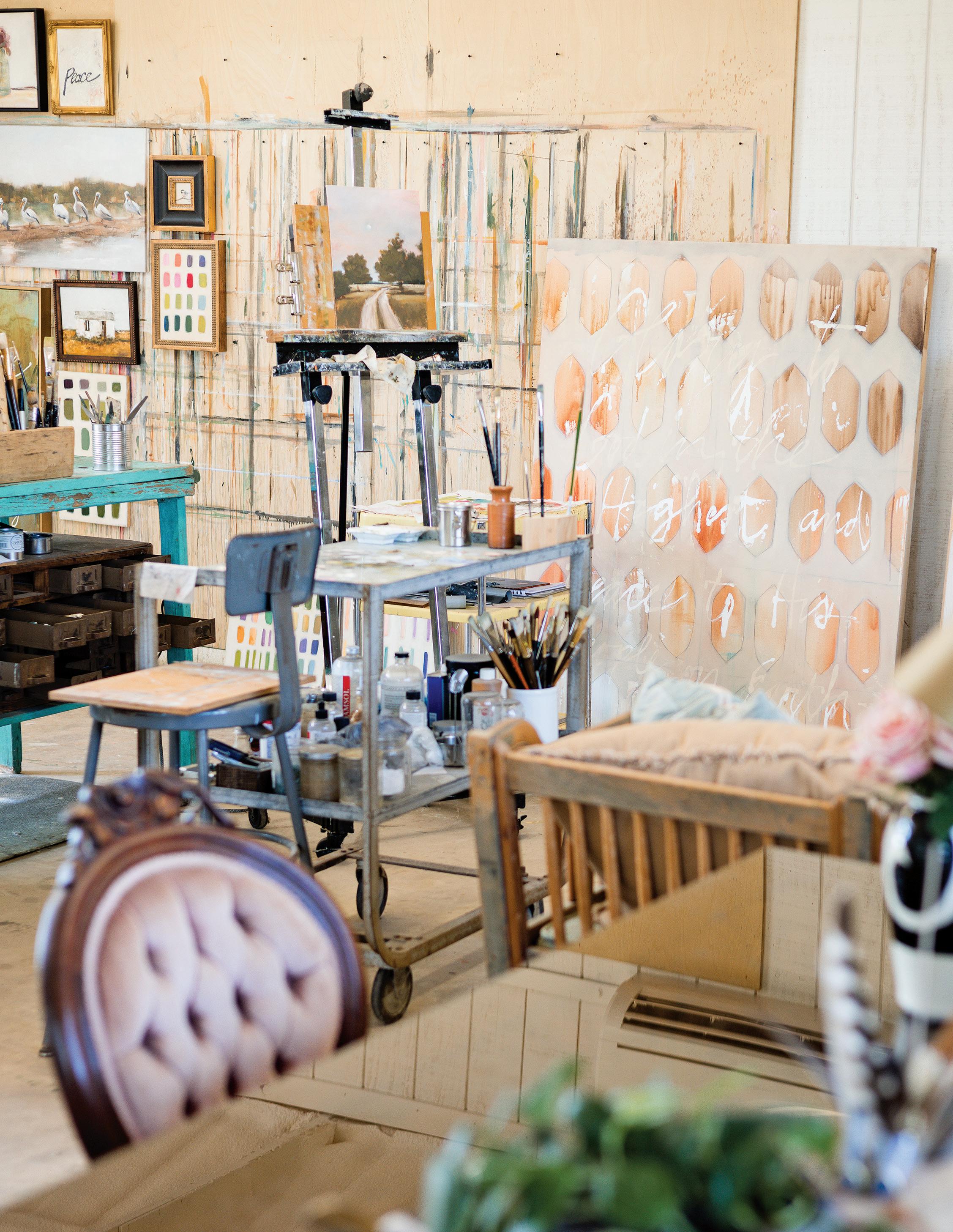
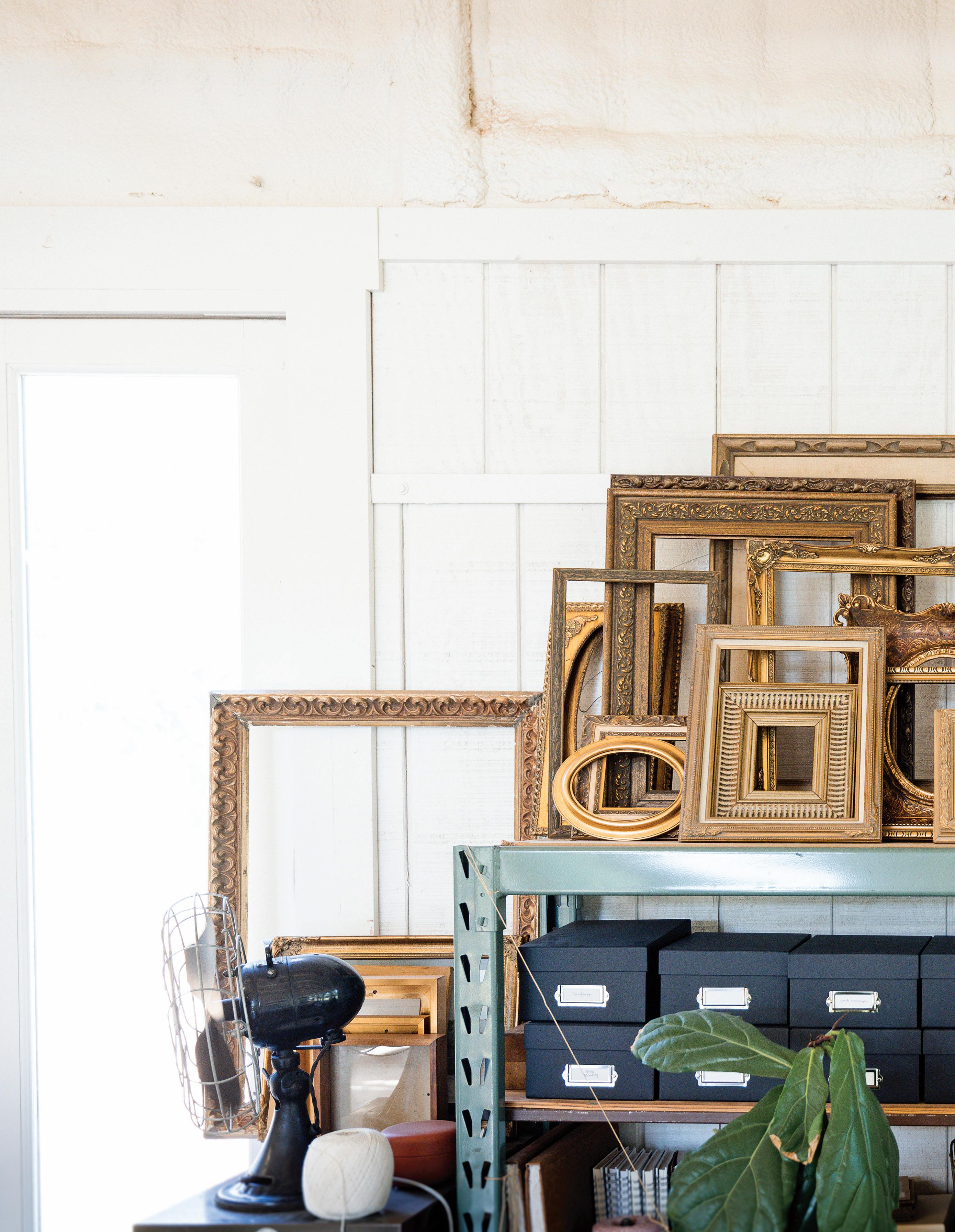
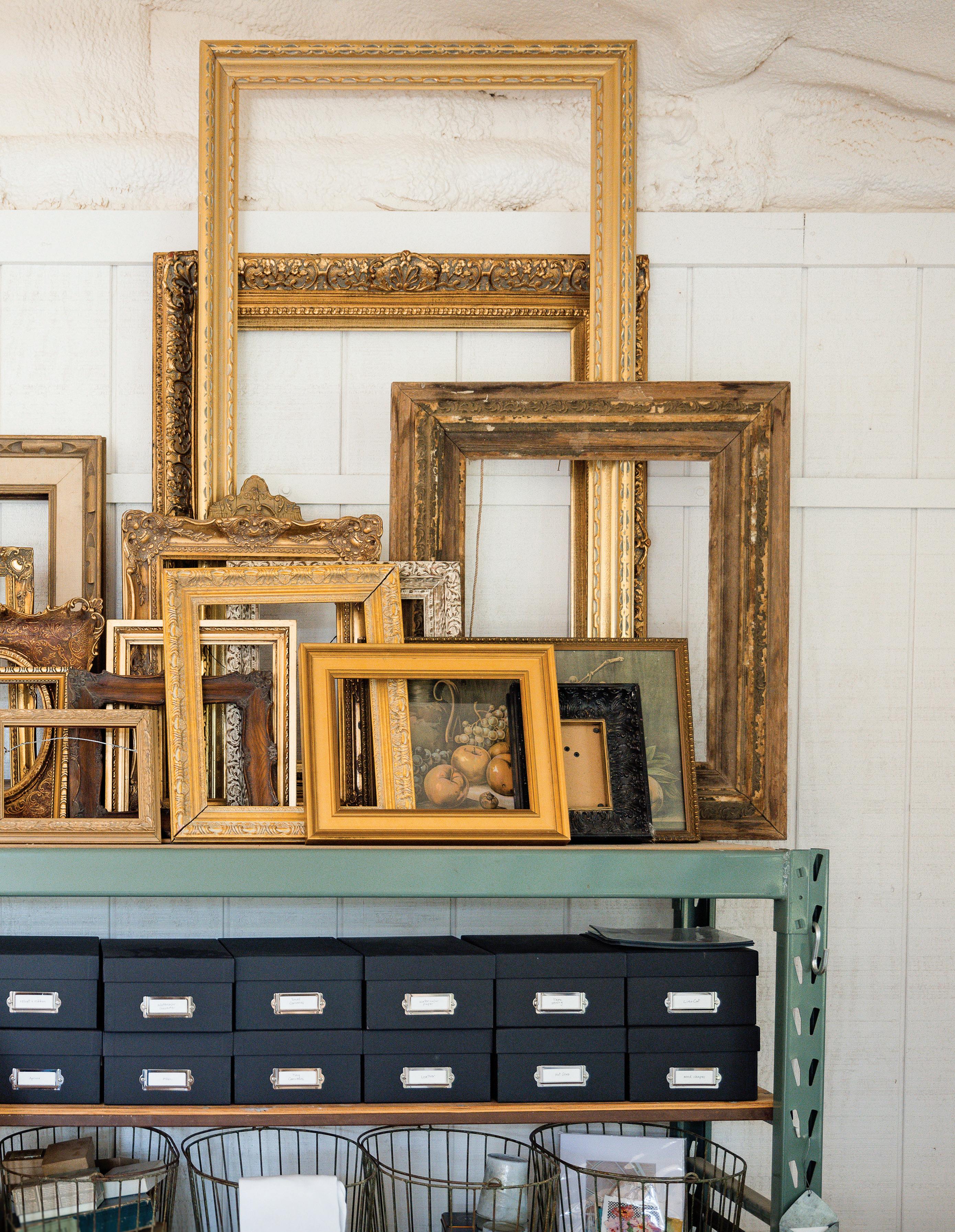
MY STUDIO WAS ORIGINALLY A BARN where the previous owner stored and worked on his farm equipment. It sits on our 40 acres, just steps from the house, nestled in the live oaks, facing our little pond. When we moved here, it was just a shell of a metal building with a greasy floor. David cleared it out, cleaned it up and added windows, walls and doors, many of which were found and collected on show trips. He has always supported me and my dreams, and this act of love was a big one. I have filled the space with things I love and use and made it pretty and inviting — but it mostly functions as the utility building that it was originally made to be. It is a beautiful, lightfilled, hard-working space.
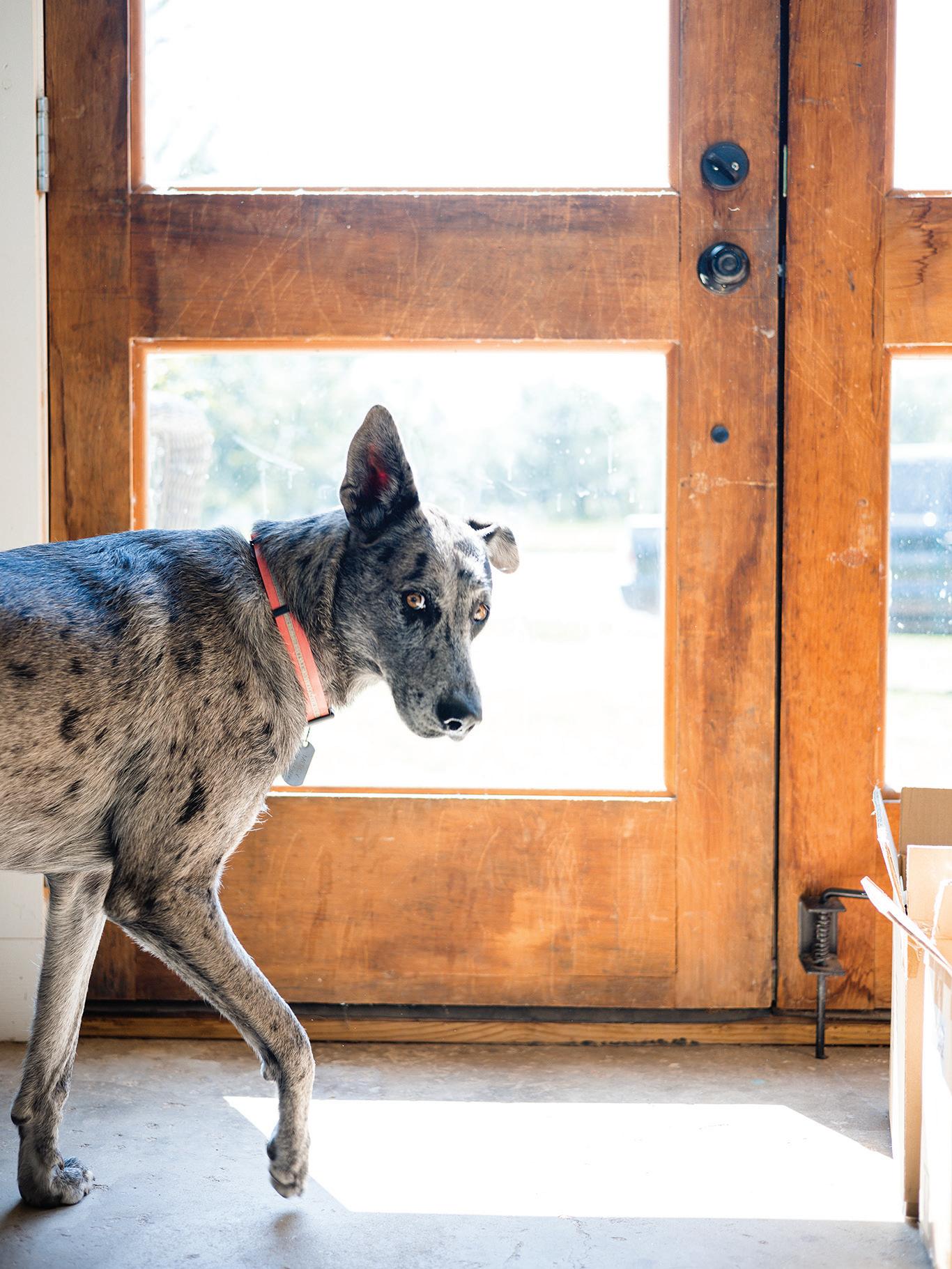
Most mornings start on the front porch lingering over coffee with David. We pray and discuss the day’s doings, then go our separate ways: he to his barn and me to mine. But first, I take a good, long walk with our dog, Mercy, followed by the cats, Spratt and Fern. My walks are of utmost importance to me and to my day. They are as much for exercise as for praying, meditating and seeking beauty.
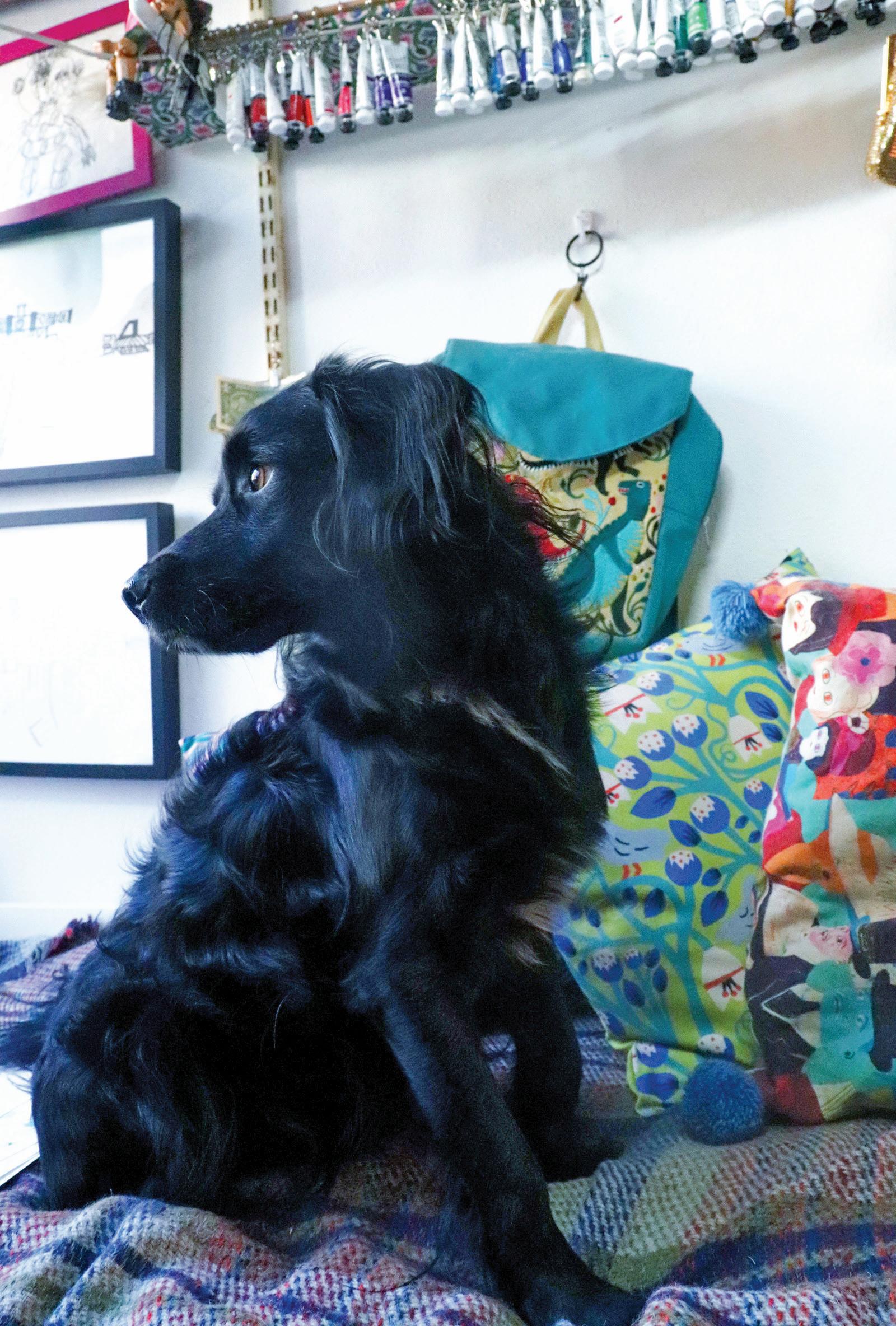
Our dry, rugged region of Texas is not known for its great beauty, but I find it everywhere, every day. I have learned to see it in the places and things that most people overlook and feel that it is my job to point it out. I end my walk at the studio, where Mercy spends her days with me and is a good helper. She first showed up at our house injured, hungry and scared. Our plan was to find her a good home (not ours) but she fit in so well that here she remains.
I slide the barn doors open and step through the large wooden doors. The morning light shining through the leaded glass window above the doors (a Round Top find), casts rainbows onto everything and I’m greeted by peace and projects that I’m excited to get back to work on. I notice the morning sounds: birds, bugs, and the breeze as it rustles the trees and makes glitter on the pond’s surface. I marvel at the gift of such a large space in which to work, after so many years of having worked in small corners and tiny spaces. All is well and I can begin the day’s tasks.
IRESERVE THE FIRST PART OF THE DAY FOR painting, either pieces that will be for sale or class-related work. I have begun teaching more, in person and online, and am enjoying it immensely. I love sharing what I have learned and am a good encourager. It makes me happy to see the joy that painting brings to others. Then, there are the dozens of other not-so-fun-but-important business and marketing tasks to attend to.
David frames, ships and takes care of a hundred other things as well. Anna does all of the technical and design work that makes our reproductions look as much like the originals as possible, and our daughter Elizabeth helps manage the website and
emails. Our two sons-in-law are always willing to step in when needed. Even the grandchildren help — I turn them loose on large canvases and use whatever they create as under-paintings. They have a ball and it keeps me out of any ruts I might get into. This is truly a family endeavor and we are so glad that our girls and their families want to be a part of it.
Painting will always be my first love, but because I like variety and have many interests and much curiosity, I do a lot of experimenting. New ideas are cropping up in my mind continually and I am happiest when giving some of those ideas a try. Generally, after making a few pieces, it is out of my system, and I can go back to my usual work.
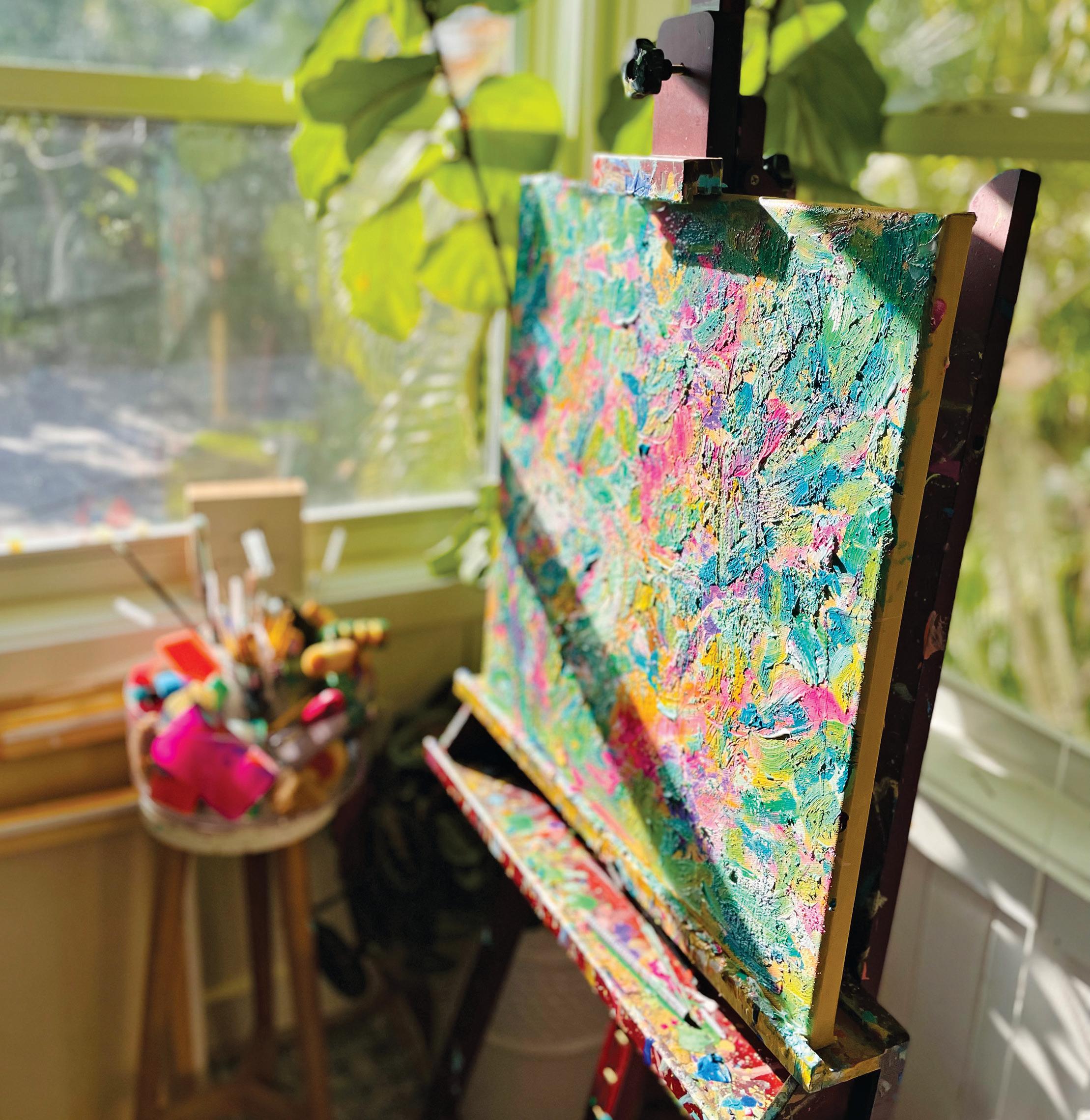
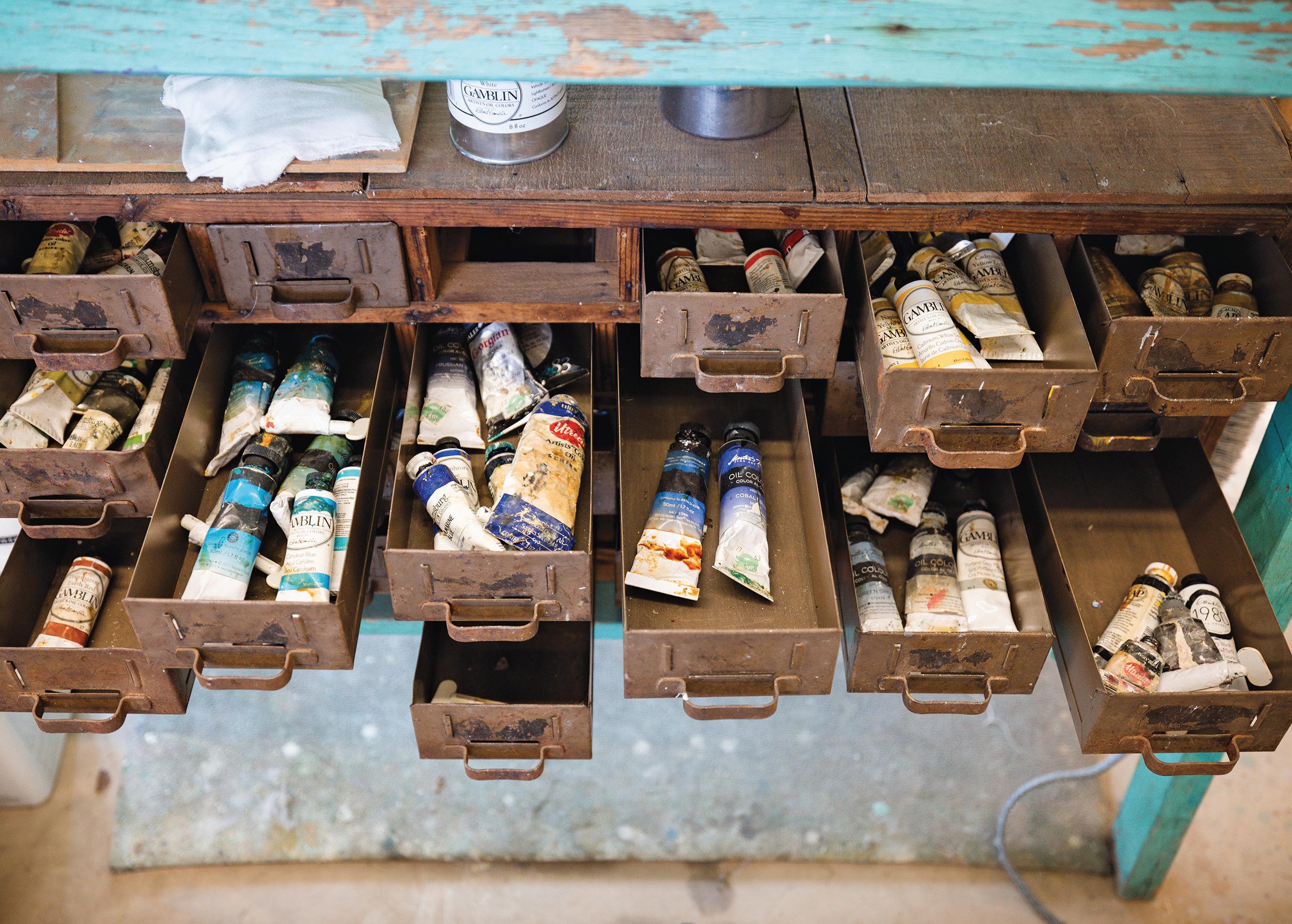
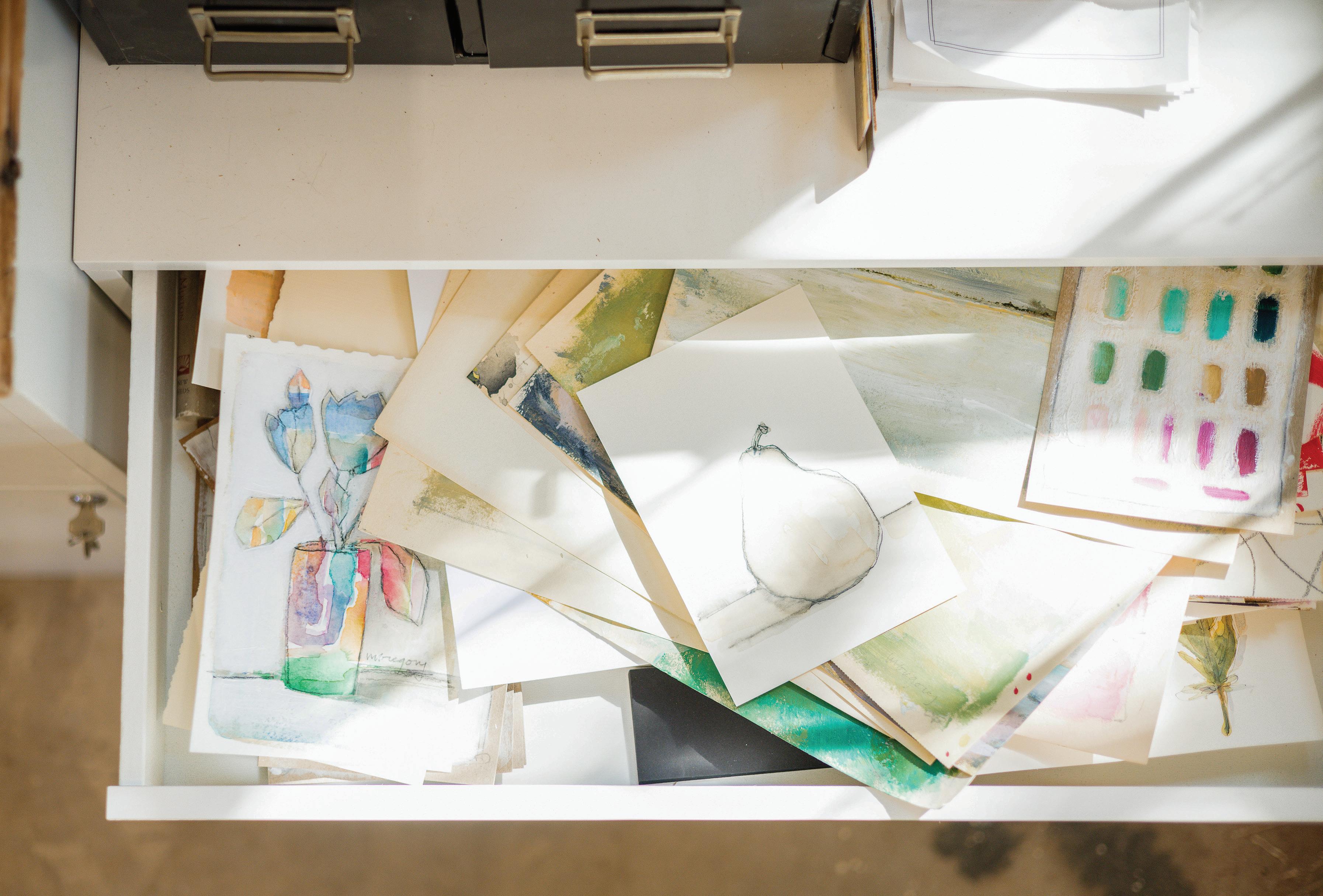
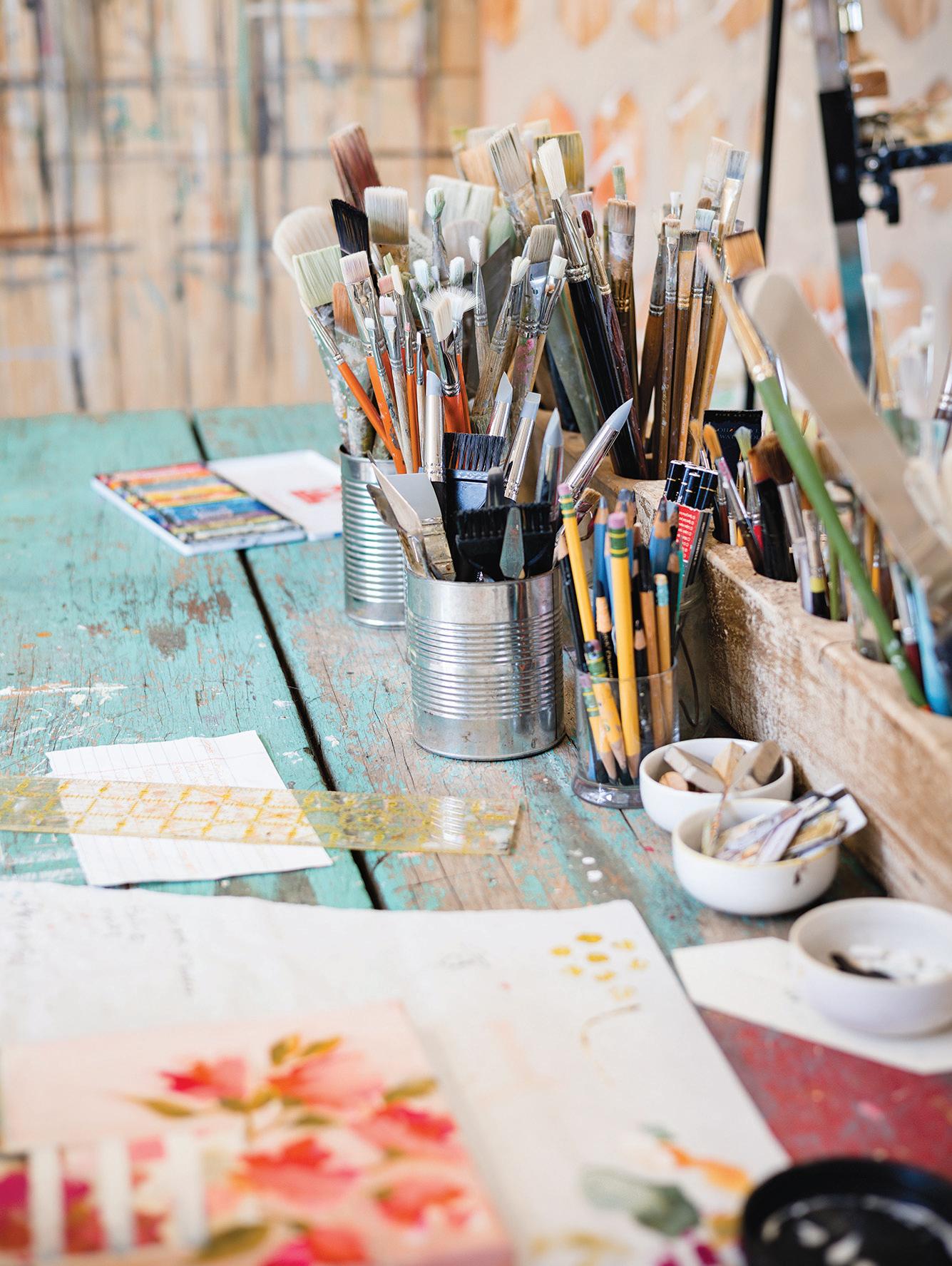
OIL, ACRYLIC AND WATERCOLOR ARE my favorites, and I find that going from one to the other keeps things interesting and fresh. I tend to use oils on landscapes, birds and animals; acrylics on larger pieces and abstracts; and watercolor for nature journaling and when working away from the studio. Whatever the medium or the subject, I hope the finished painting brings peace and beauty into the world.
This story would not be complete without the telling of the difficulties: David and I have started and run several successful businesses
from the time we were 20 years old, so we knew full well what we were getting into — but this one was the hardest, by far. This new business was the first we owned that required so much of me, and I was in for a rude awakening.
The pressures, financial and physical, were relentless for the first five years and there were many times we questioned what we believed to be a calling. The hardships caused many seasons of doubt. But looking back, we have more of an understanding that just because a thing is hard does not mean that it is wrong. Quite the opposite, in fact.
“Never lose an opportunity of seeing anything that is beautiful; for beauty is God’s handwriting — a wayside sacrament. Welcome it … and thank God for it as a cup of blessing.”
— Ralph Waldo Emerson
MANY OF THE HARDEST THINGS, especially the ones that moved us out of our comfort zones, have proven to be the very best and most right things. Much growth, both spiritual and business-wise, results from plumbing the depths — and we tend to avoid doing that when everything is rosy.
If you want to know my formula for success, if there is such a thing, I would say that it is perseverance, plus trust, plus thanksgiving, for both the good and the bad. You do not need to feel it to do it or say it. It still counts! As to the future, we hope to carry on maintaining what we have worked so hard to build and to continue adapting and evolving as needed, because it is never once and done.
Now, the day is done, and I turn at the door to look back inside and breathe a prayer of thanks for the gift of this sacred space, where my prayer is my work and my work is my prayer.
More on Mary
www.marygregorystudio.com
Instagram: marygregorystudio
Facebook: marygregorystudio
Pinterest: megregory
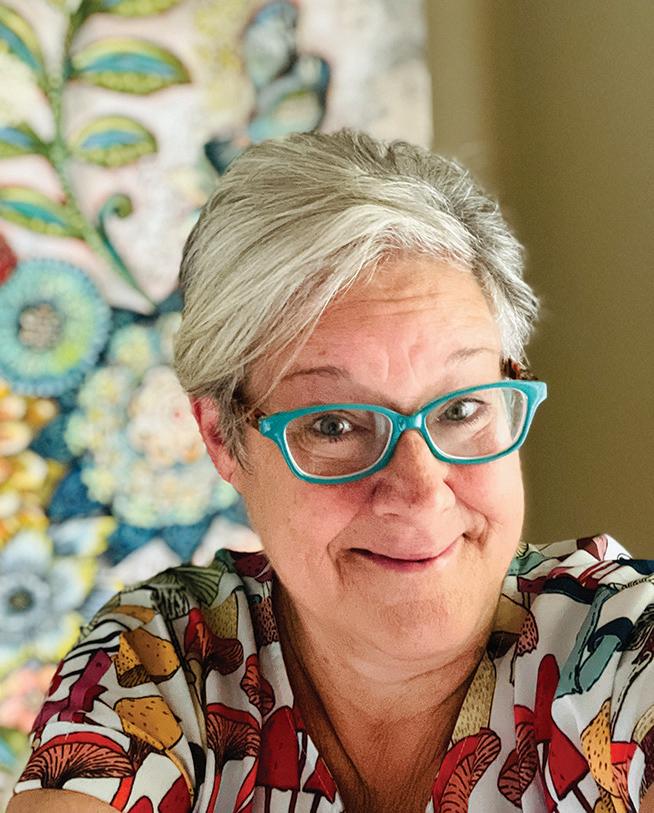
Marcella Hawley
Portrait Photography by Kim Dillon
Home/Garden Photography by Marcella Hawley
Breaking ground on her garden in Webster Groves, Missouri, artist and graphic designer MARCELLA HAWLEY knew she had a dirty job ahead. Yet she had no idea she was uprooting her way of life. Indoor and outdoor spaces serve as laboratories for ideas, offering sanctuary and stimulation, rest and renewal. Over time, Marcella realized the transformative healing power of gardening, and she’s developing exciting new projects to help other women do the same.
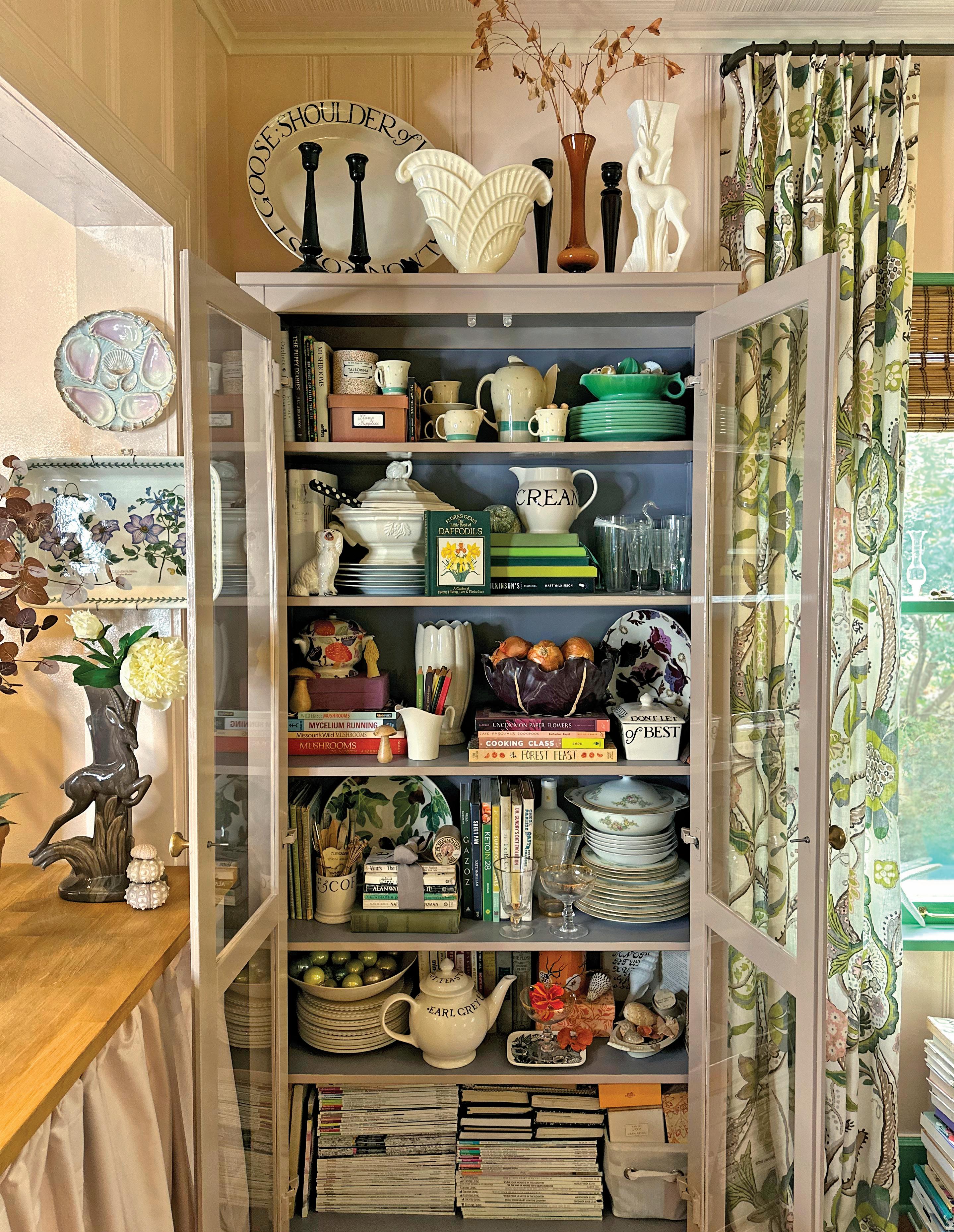
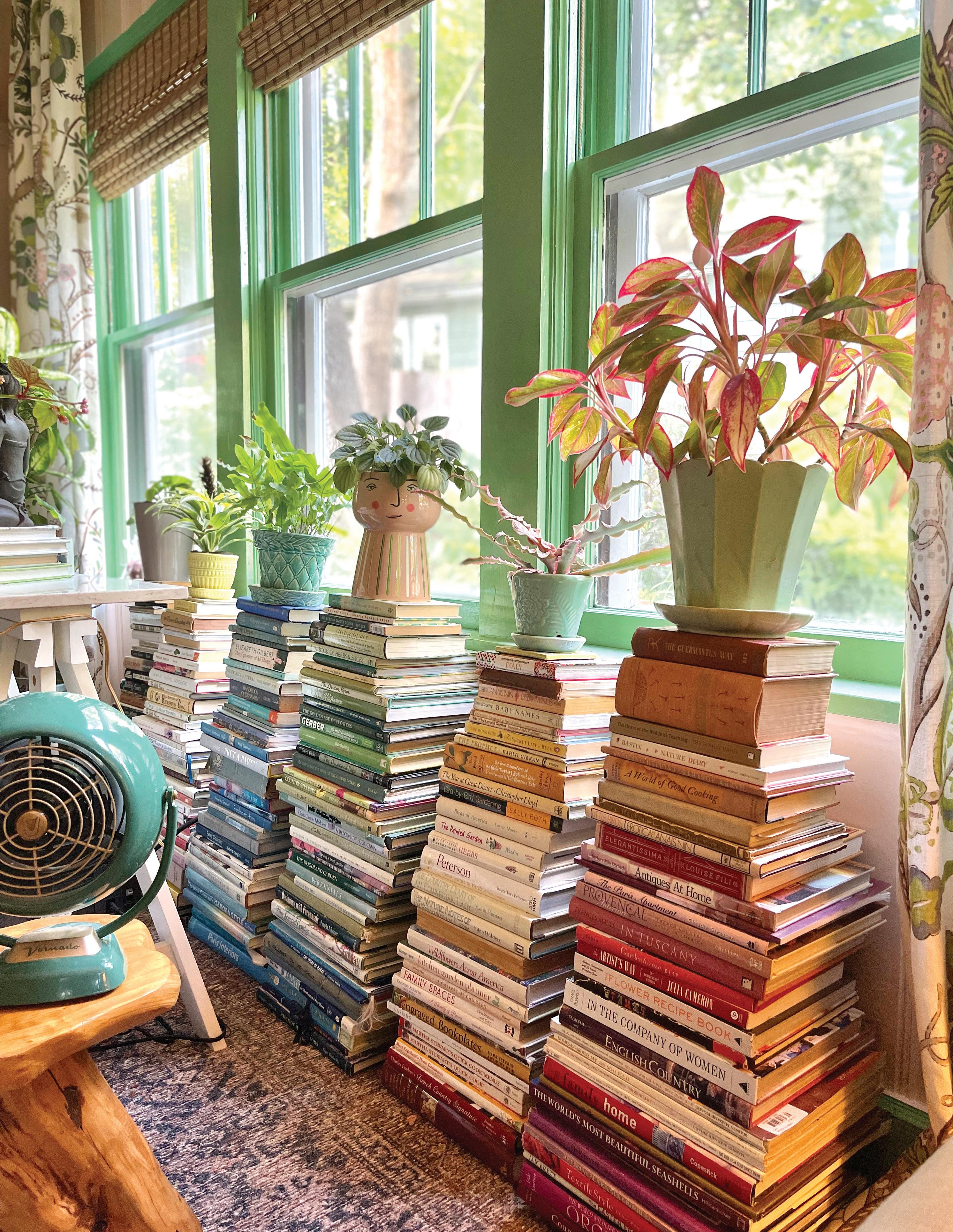
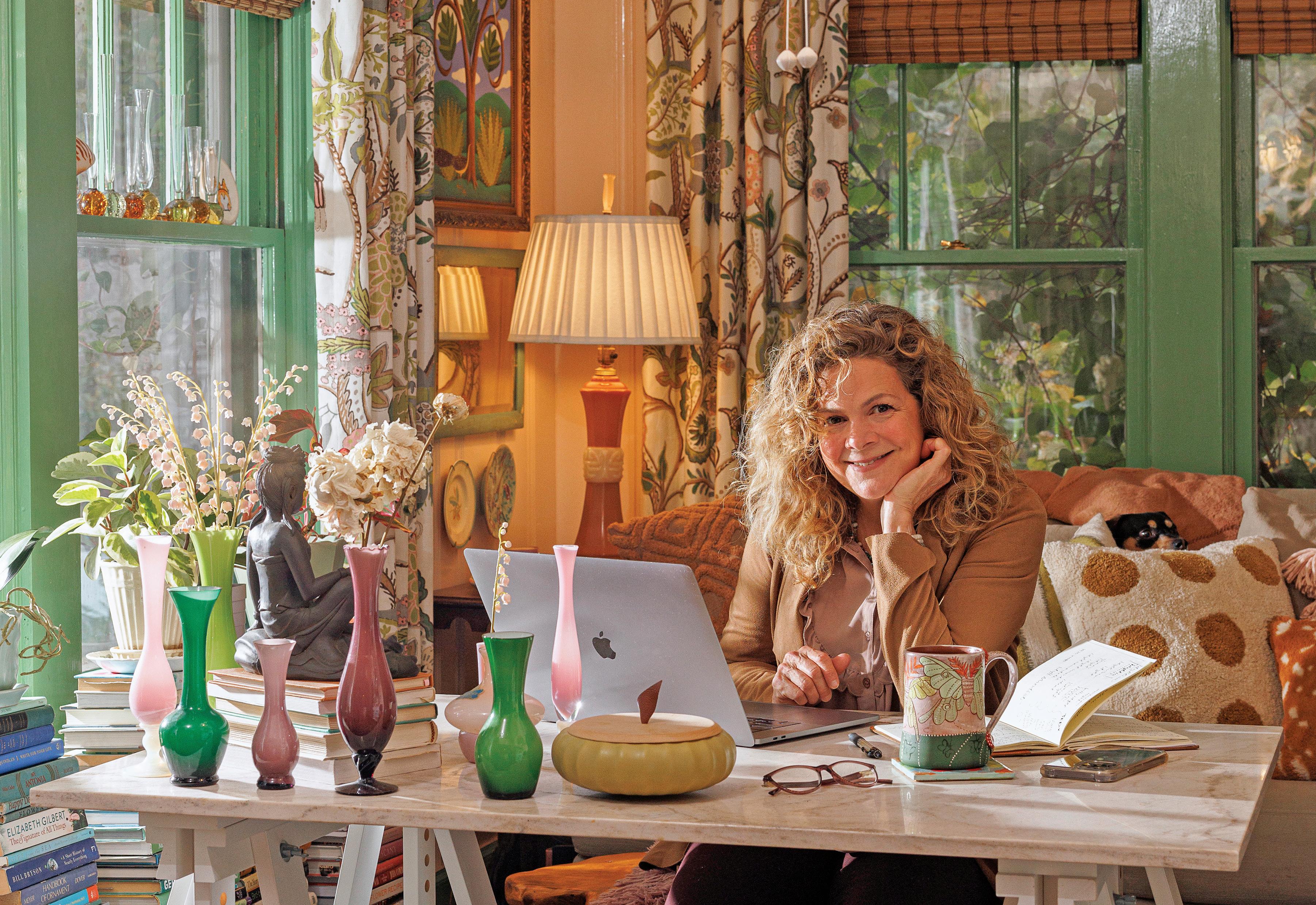
It’s not that surprising that our house and gardens are so full. I was raised to be a maximalist, to feed my zest for life by surrounding myself with whatever sparks delight, happy memories and personal connection. Color is essential.
Leafing through wallpaper sample books with my mom is one of my earliest memories, a jumping-off point for imagination. She would point out the plaids, palm fronds, parrots, pomegranates. Options overflowed in every colorway imaginable; and to us, the scent of the freshly silk-screened inks smelled like possibility.
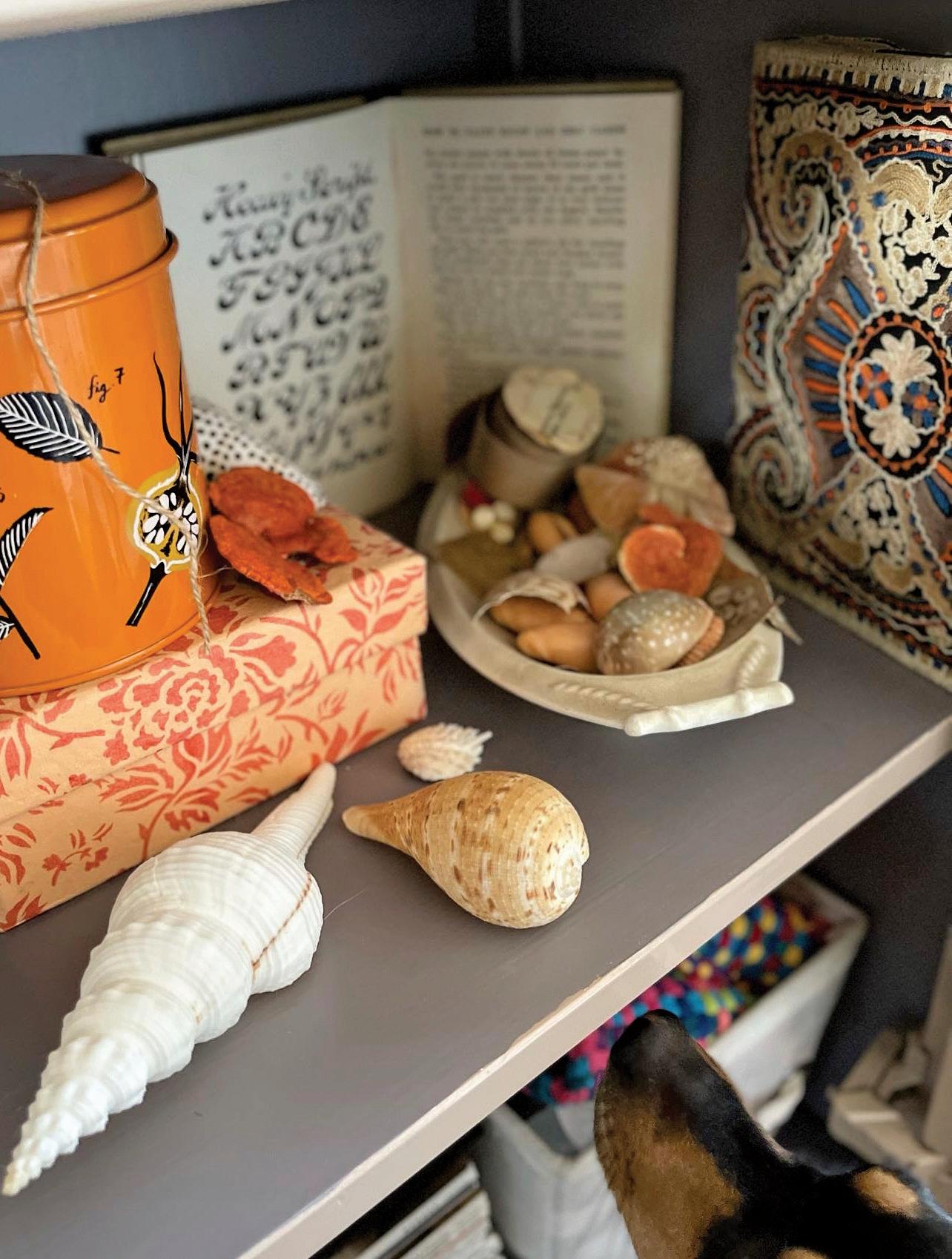
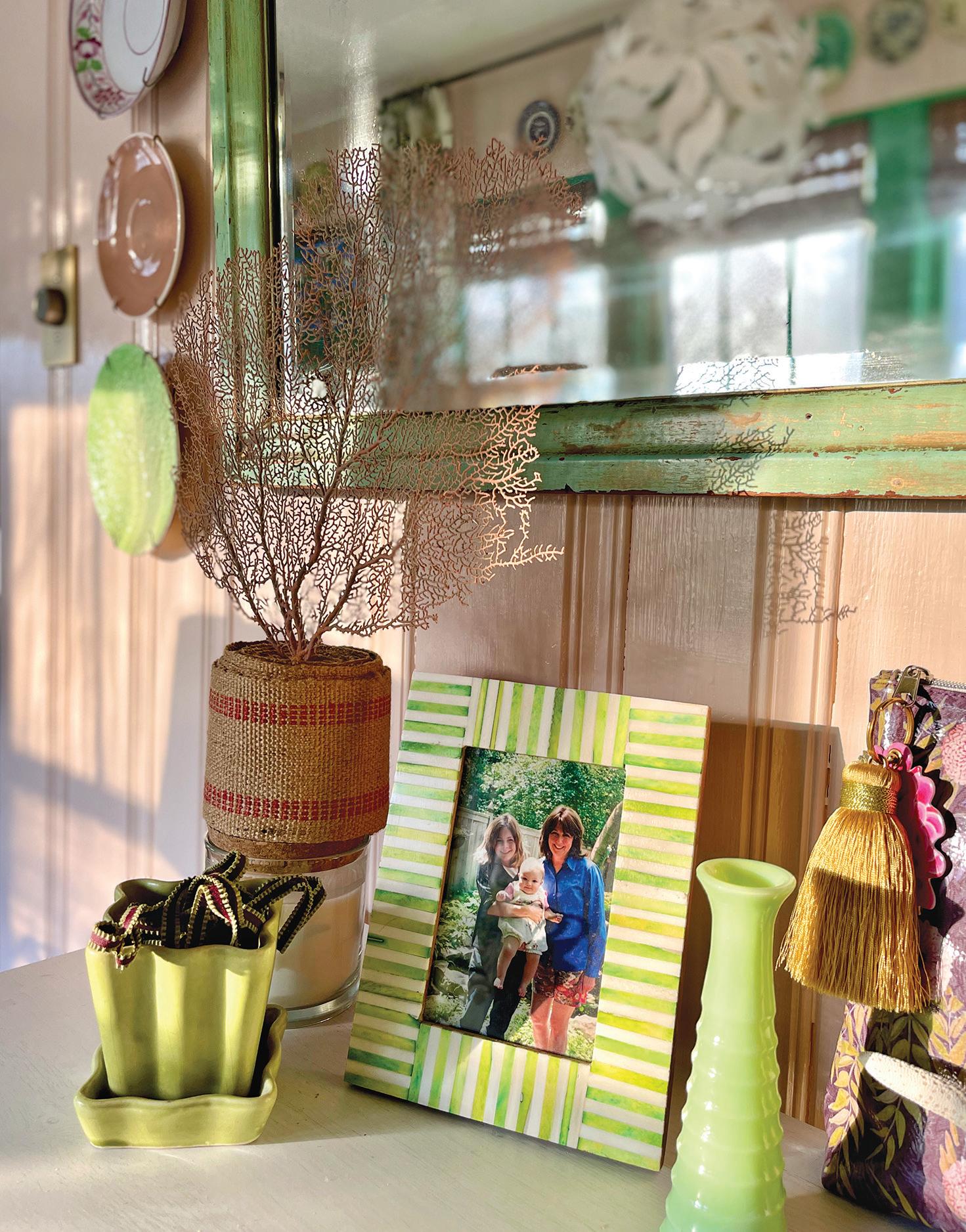
Mom was an artist and, like Claude Monet, color was her obsession, joy and torment. I could sense her excitement building as she schemed which wallpapers to try and fabrics to coordinate, what paint to choose for the trim or the furniture. She collected and displayed all kinds of objects, seashells, ornaments and artwork. Her hand-stitched Kaffe Fassett needlepoint pillows crowded us off the couch. The house was Mom’s decorating playground — we were all just living in it.
From LORI SIEBERT:
I was lucky enough to be introduced to Marcella by my friend Mary Engelbreit. We have since become regular cheerleaders for one another on Instagram. Mary suggested Marcella for this feature. When she sent me a few initial photos and I dug into her feed, I could totally see why. It’s evident in her beautifully curated home that she was born from a creative family. The way she honors her mother in the way she displays her vast collection of colorful vases creates such a joyful environment. And, being a fan of green, I am IN LOVE with how she fearlessly splashes that color throughout her home. It so speaks to her love of nature and gardening. Her home is so unique and CLEARLY decorated by a true artist!!
My family now has to do the “throw pillow shuffle” before sitting, or move multiple candlesticks so we can see each other across the table. I might feel sorry for them if it weren’t so cool in here.
My style is a direct reflection of the joy I find in the interplay of colors, objects, textures and patterns. It’s a lot like designing a magazine spread! As a graphic designer, I’ve been fortunate to work for two iconic women who influenced me from an early age: Mary Engelbreit and Martha Stewart. Martha’s art director plucked me from obscurity not long after I graduated with a graphic design degree from the University of Illinois. Mary brought me in as founding art director for Home Companion magazine — the dreamiest job ever. Over the years, we shared hundreds of artistic homes and studios in our issues.
While designing layouts, I absorbed the decorating moxie of the visionary creative people we featured, which helped me to develop my own style. Folks feathered their nests so joyfully and lovingly; their personalities were interwoven into the walls. I’m innately drawn to spaces designed to lift the spirit and stimulate curiosity, enhancing one’s everyday experience and quality of life. Toss the rules out the window!
Humantouch is important in my work as an artist and in my approach to the house. I’ve never hired anyone to paint. I want to hold the brush in my hand, to feel the luscious dollops of creamy color get slathered onto woodwork, making what once were disparate pieces of trim into a silky continuum. It’s the same in our garden — every square inch was cultivated and planted by me. It can be exhausting, messy and somewhat dangerous (teetering on the top rung of a ladder at midnight to paint the ceiling?). But doing the work gives me a deeper connection to the process and pleasure in the outcome.
You can feel the transformation come to life because it’s springing from your hands! Hot-gluing pompom trim to a lampshade, lettering words on the wall, heaving pink sandstone slabs into their perfect place on a garden path. When I walk from room to room, or along the path I’ve laid, a proud voice inside me affirms: “I made that.”
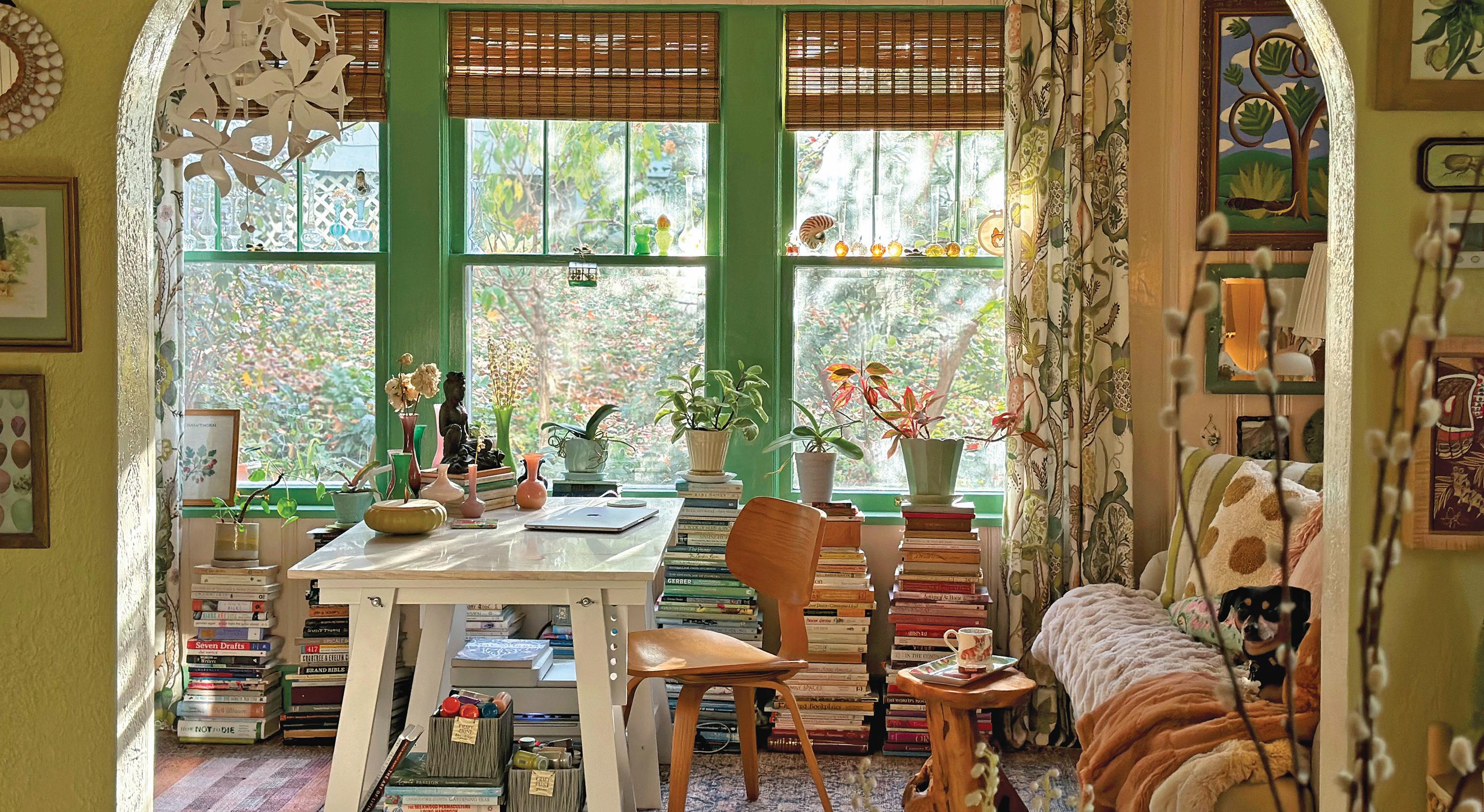
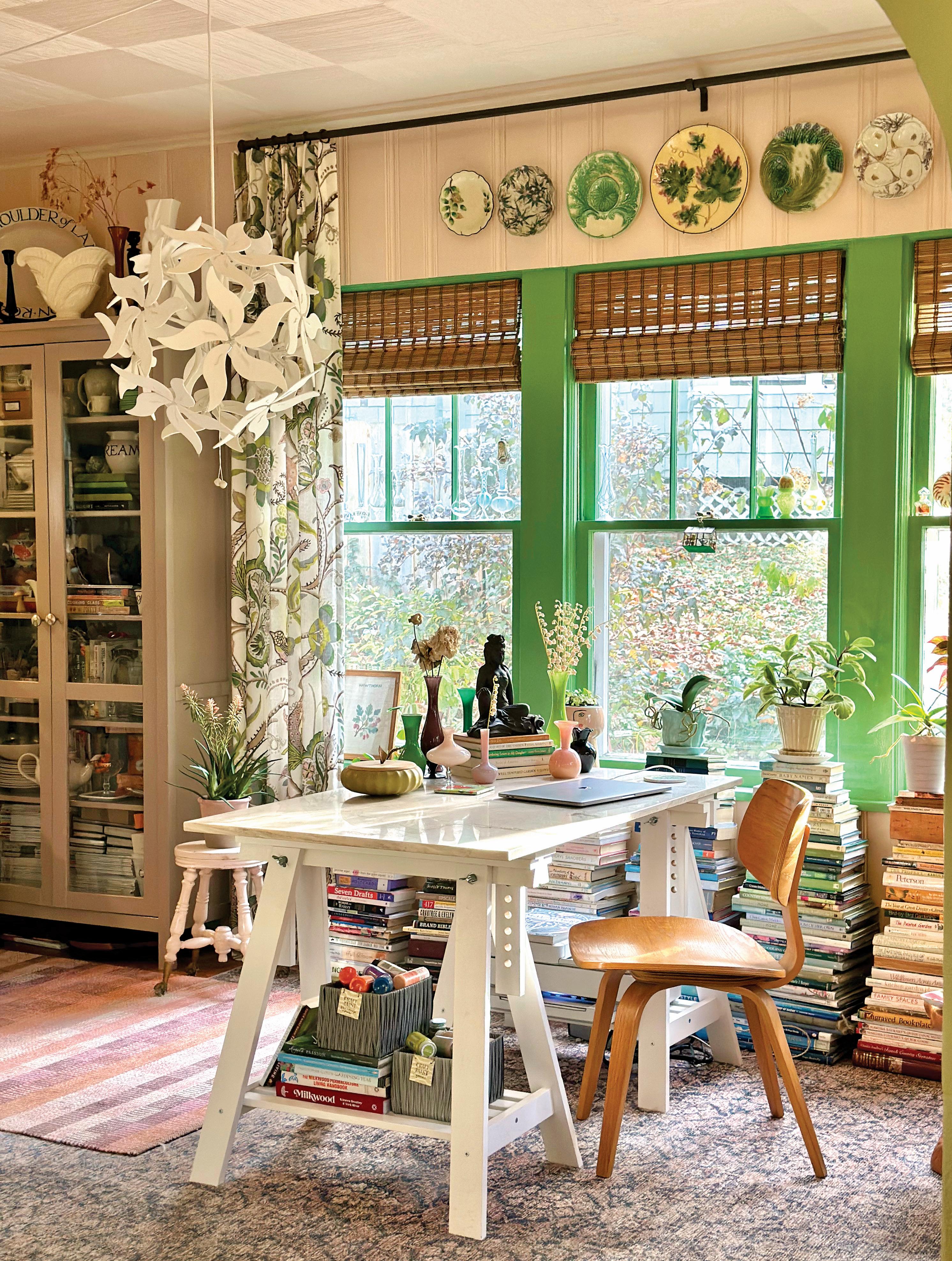
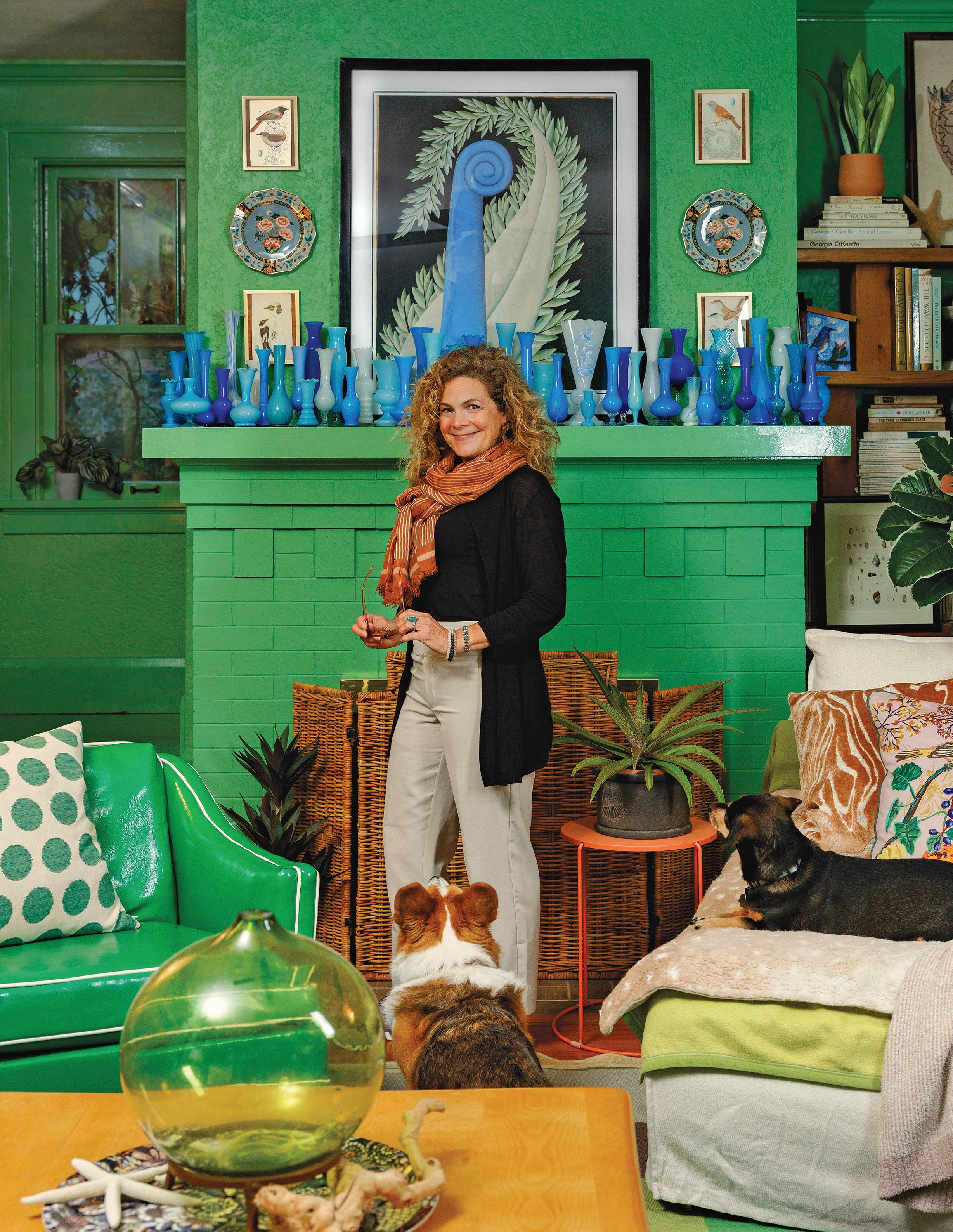
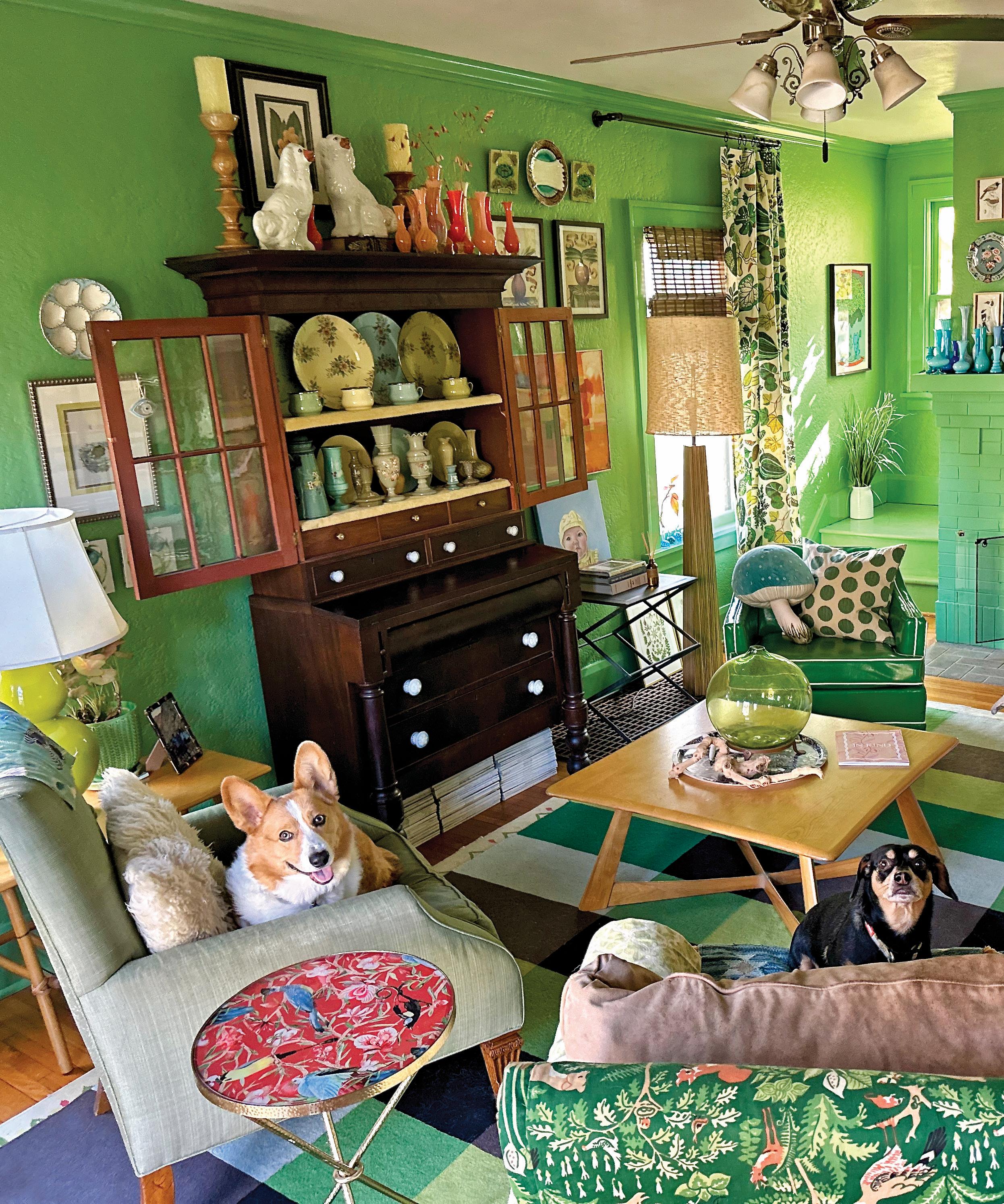
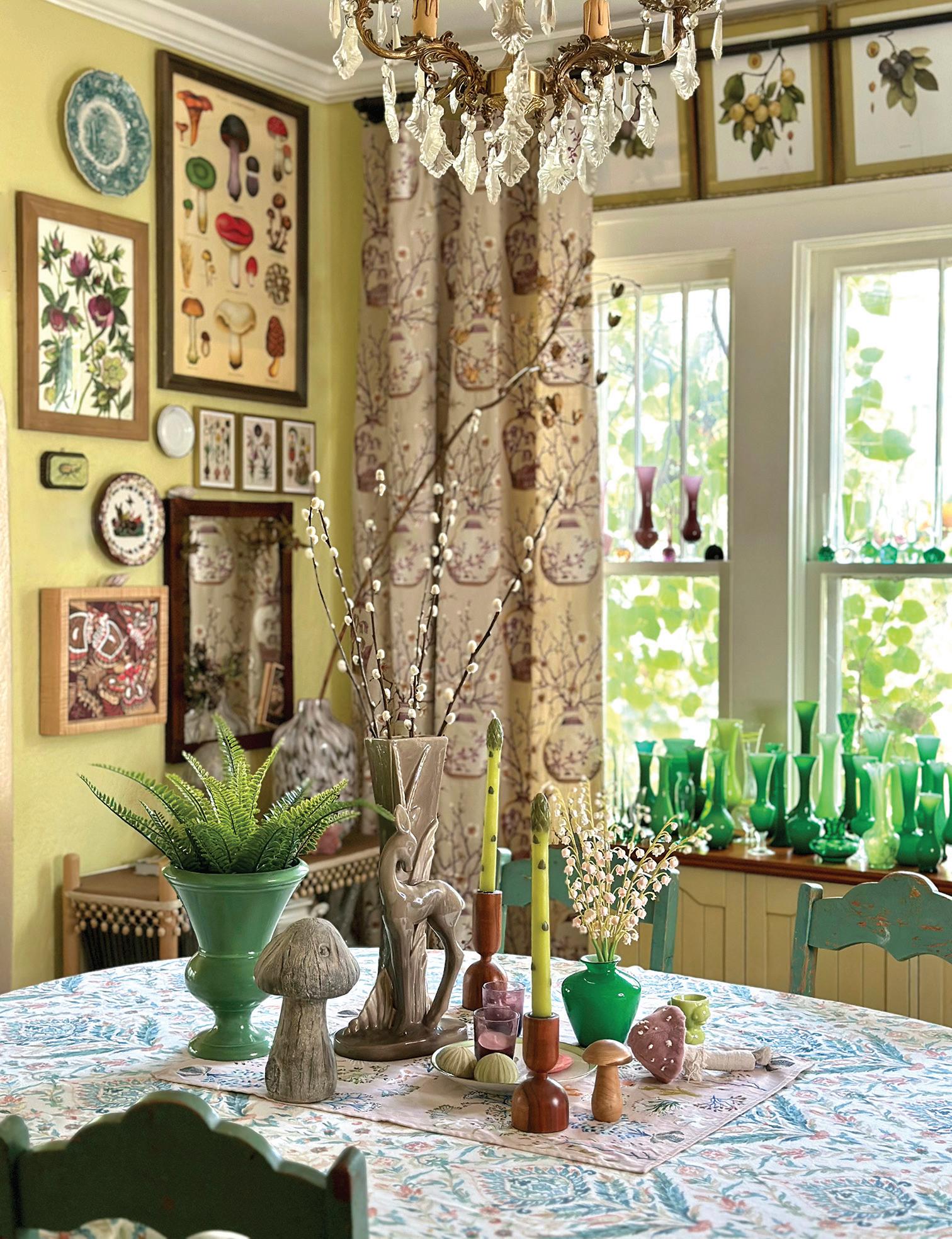
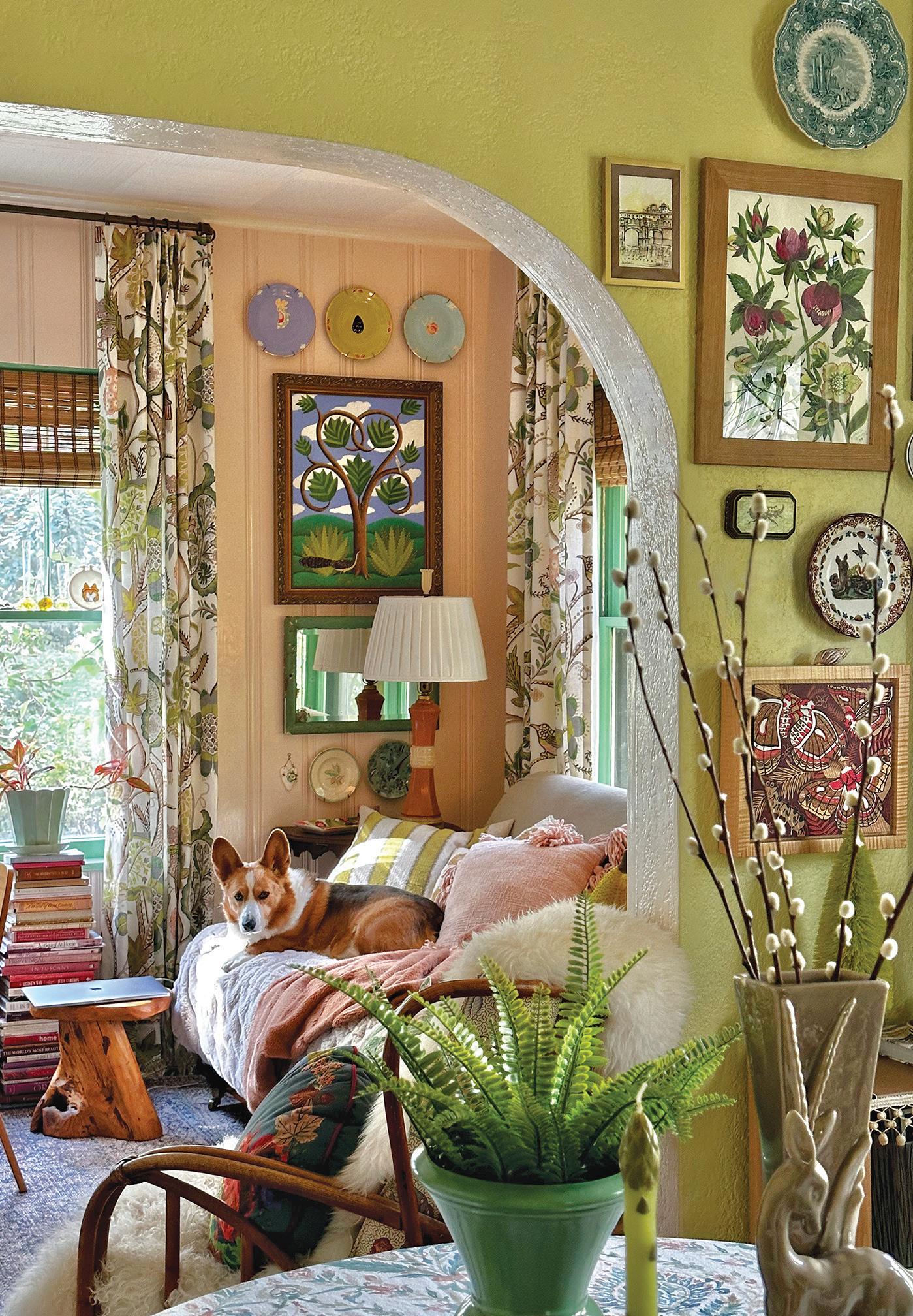
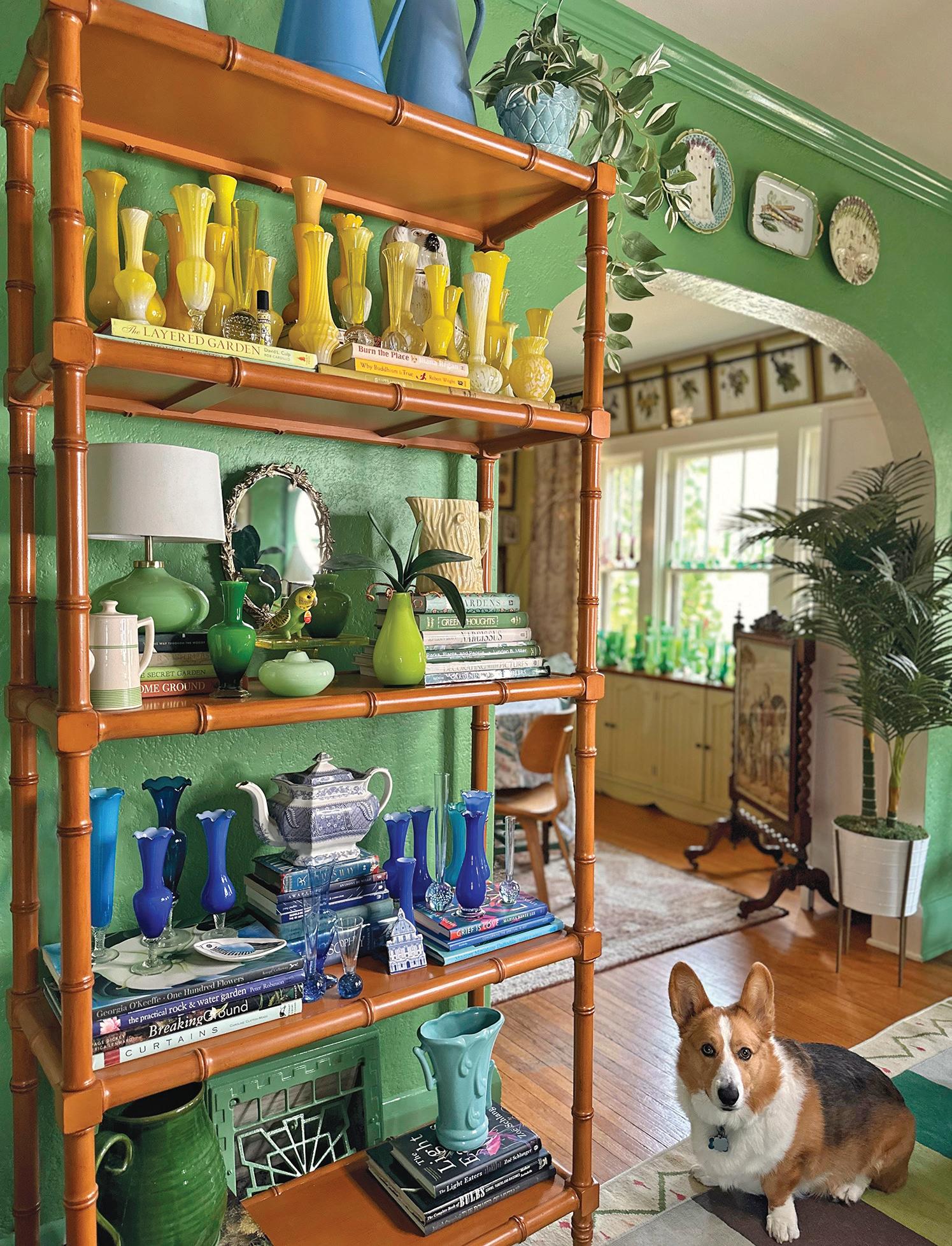
The rooms on the first floor of our cozy 1929 house are separated by wide archways, where one side is visible from the other. Colors spill from pale pink in my sunroom studio, into pear green in the dining room and an emerald-green immersion in the living room. Maybe it’s the gardener in me, but I am drawn to green like no other color. For years I imagined painting the living room walls and woodwork, even the fireplace, the same shade of green. Life is short and now my mantra is: Everything is an experiment. I took the green paint plunge and couldn’t be happier. It is like being inside a ripening shoot, an unfurling leaf.
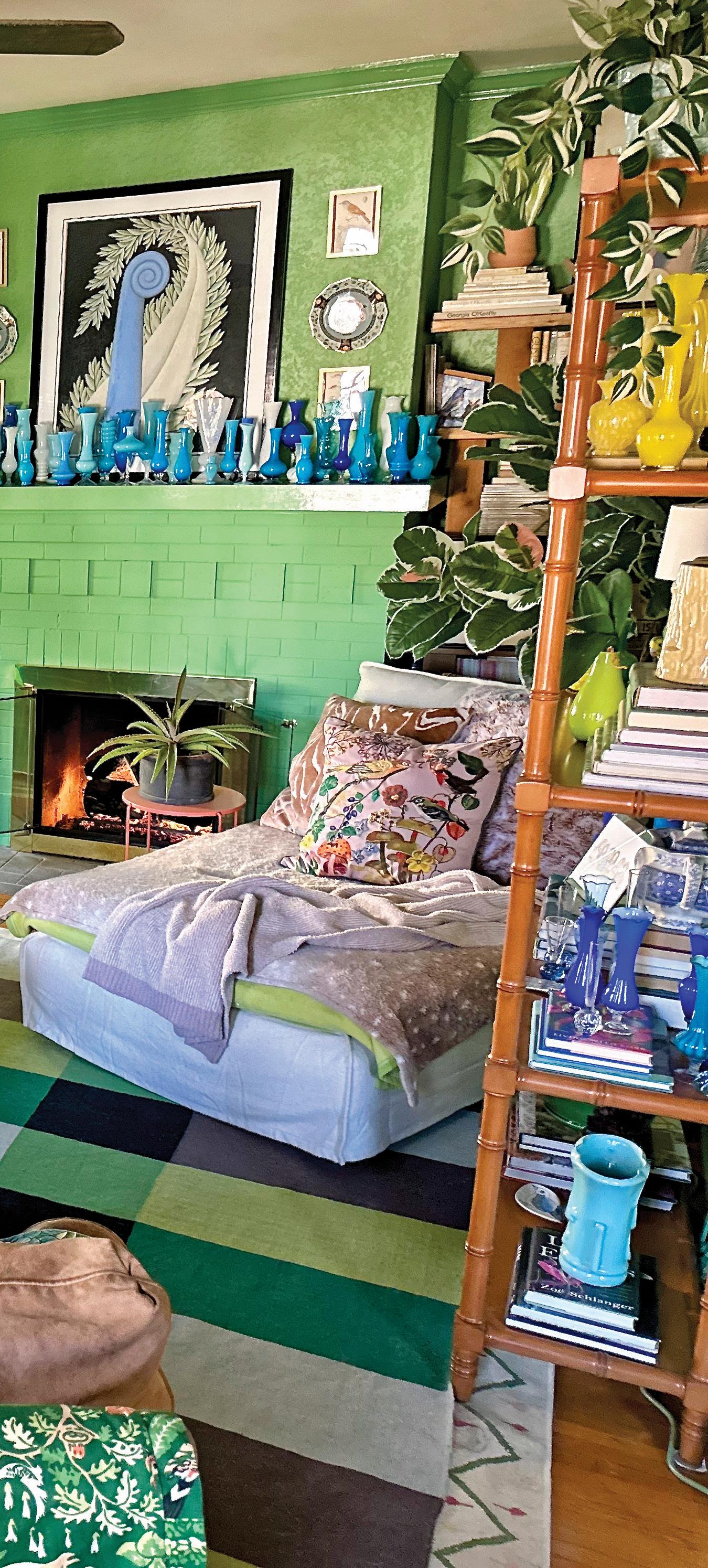
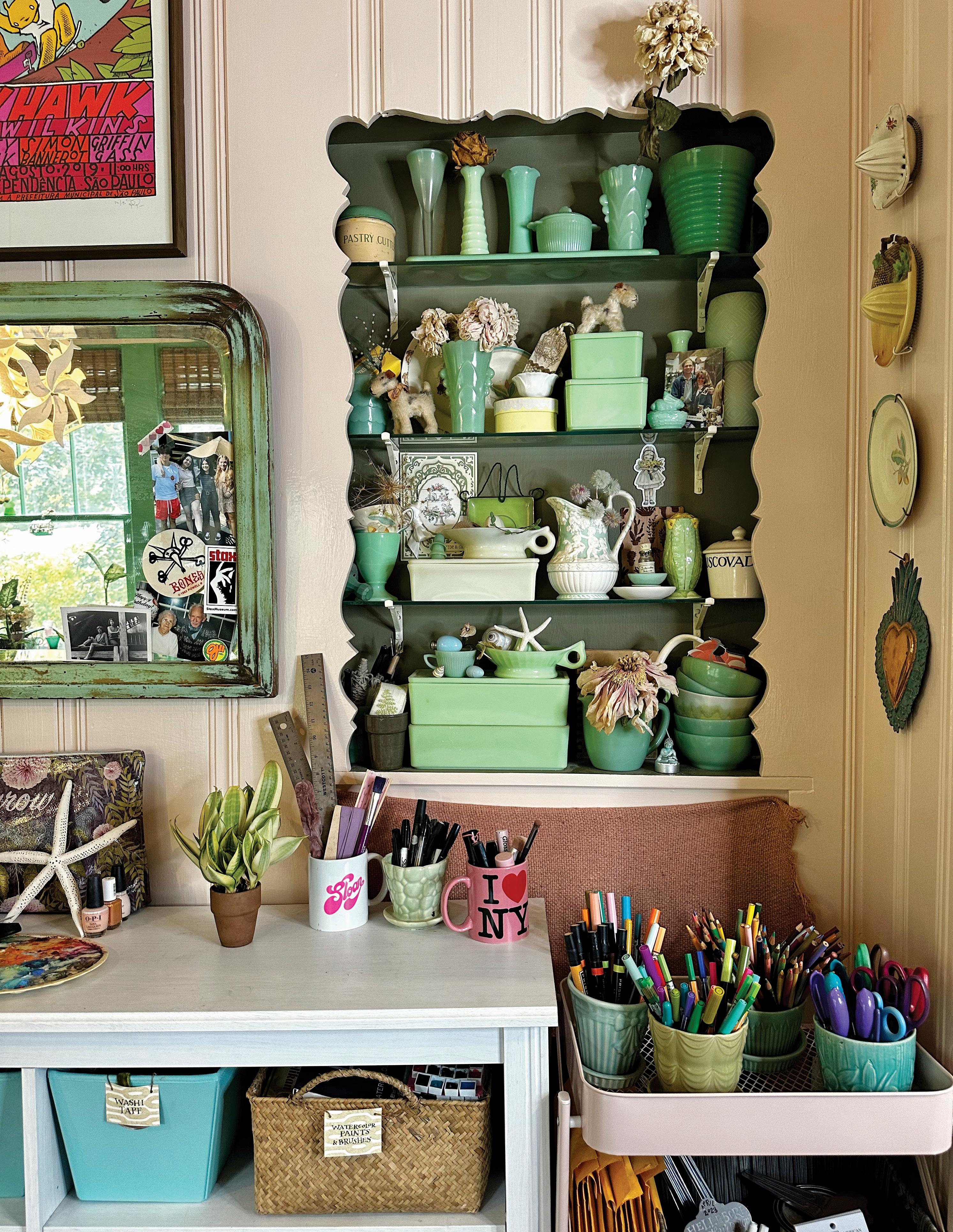
Ibegin each day with hot coffee, our corgi, Tibbs, and Rudy the chiweenie on the chaise beside the fire. The green walls and mantel are livened up further with abstract paintings by my mom, Susan Heard Smith; works in gouache by artist Jane Troup; and treasures made by our children, Tallulah, Sylvia, Finn and Clara. I’ve mixed in botanical prints, Minton tiles, antique oyster and asparagus plates, heirloom Staffordshire dogs, enamelware dishes, and plants both real and fake. Light filters through leaf-printed curtains and sets all of the colorful glassware aglow. I am simultaneously energized and soothed in that green room.
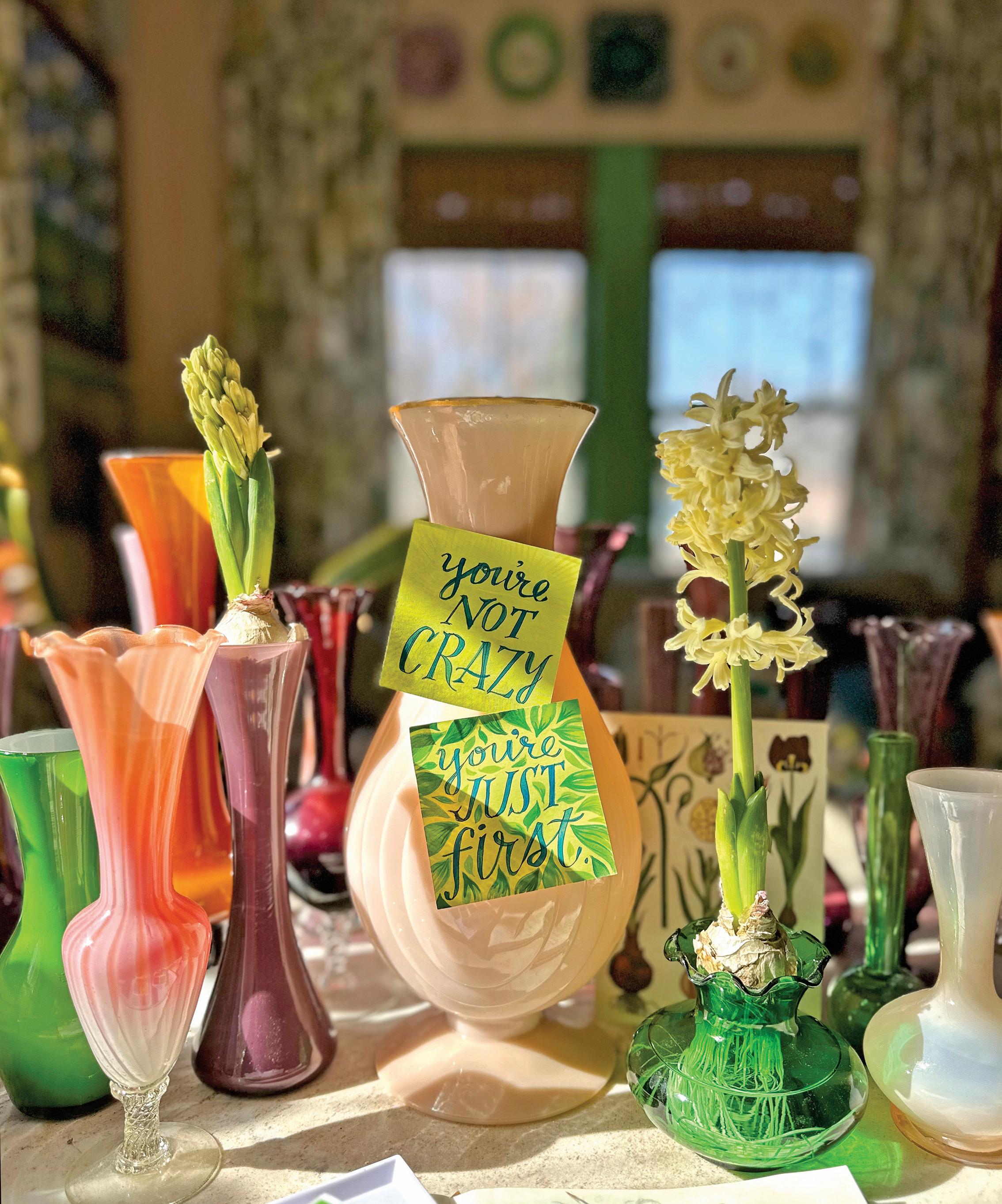
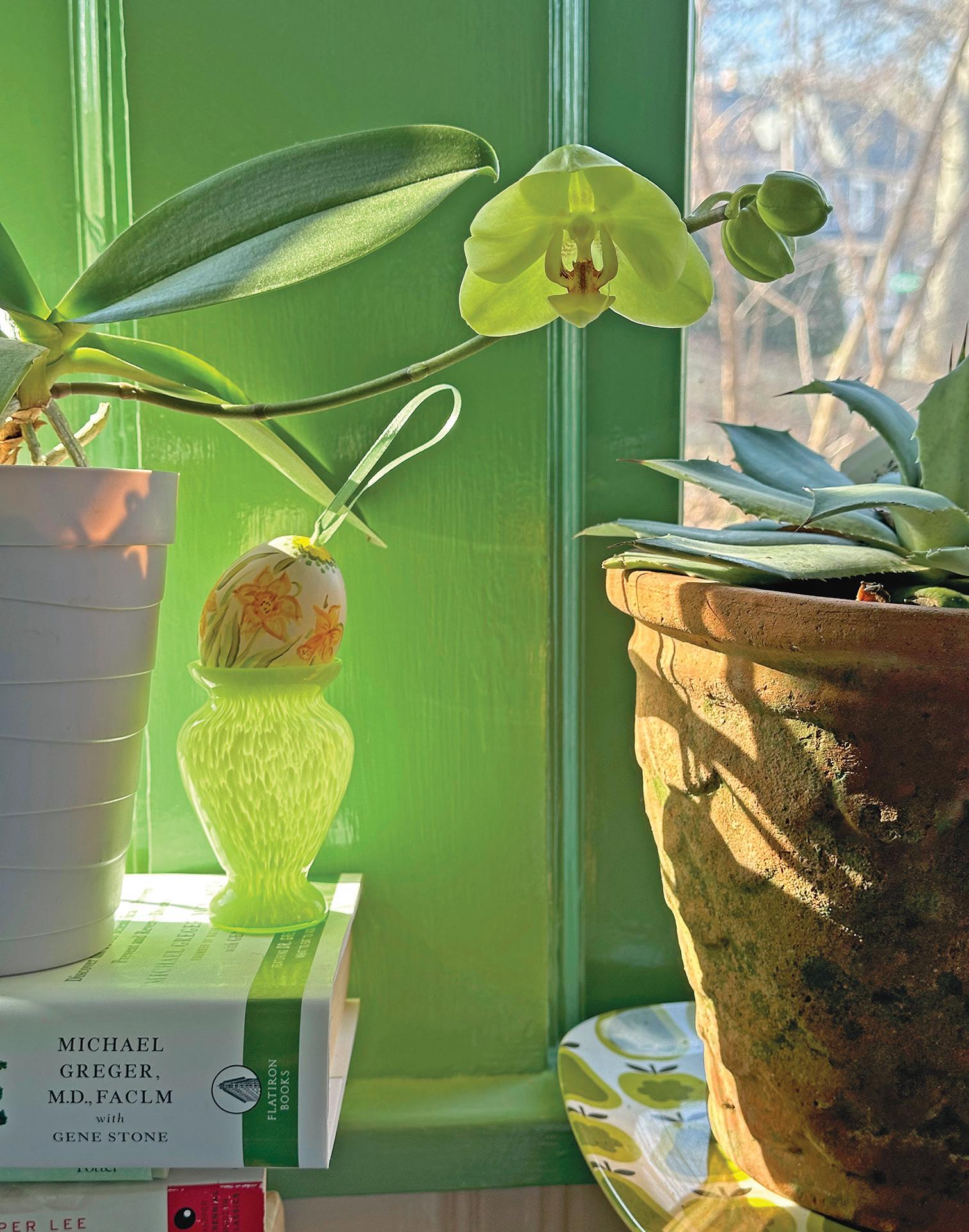
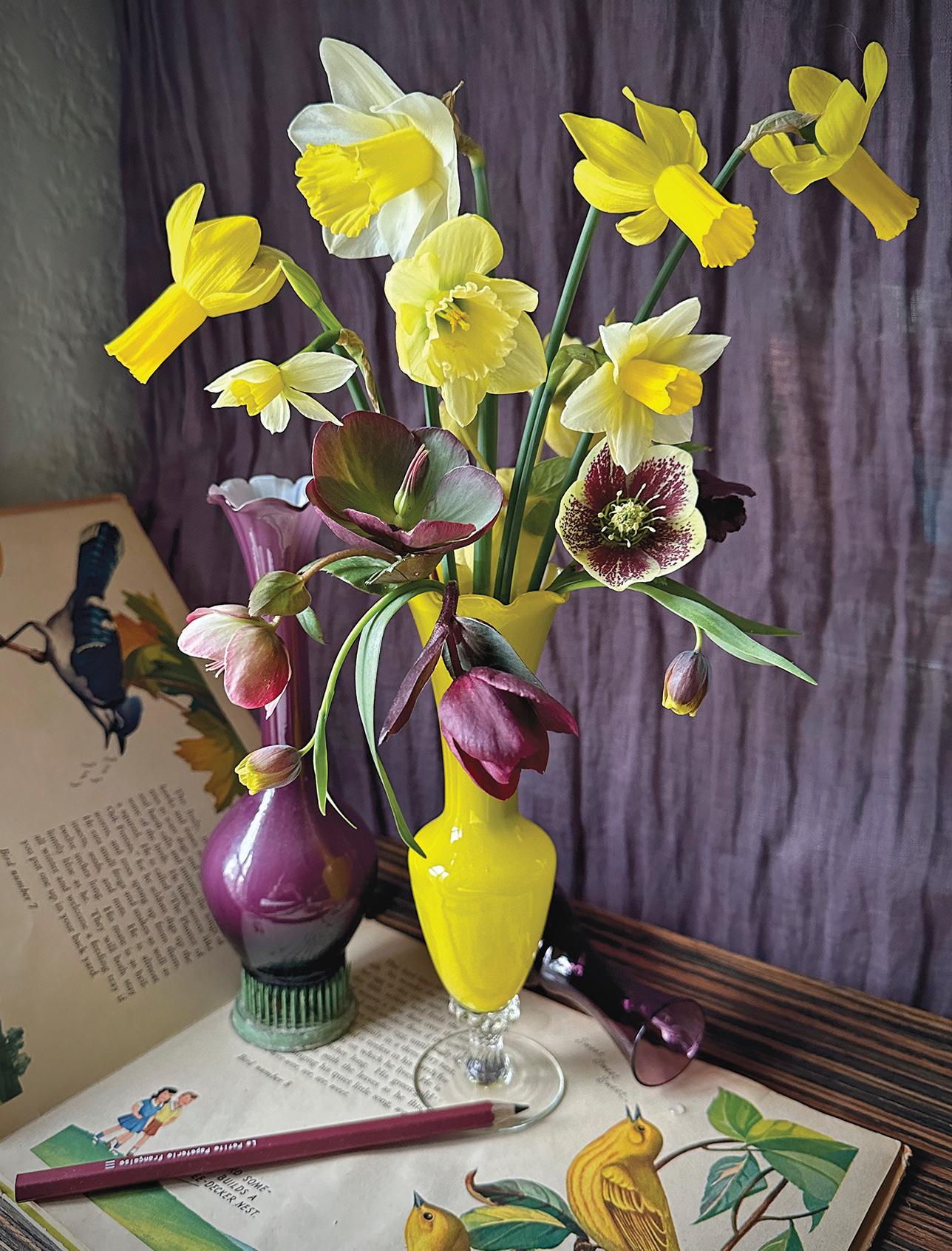
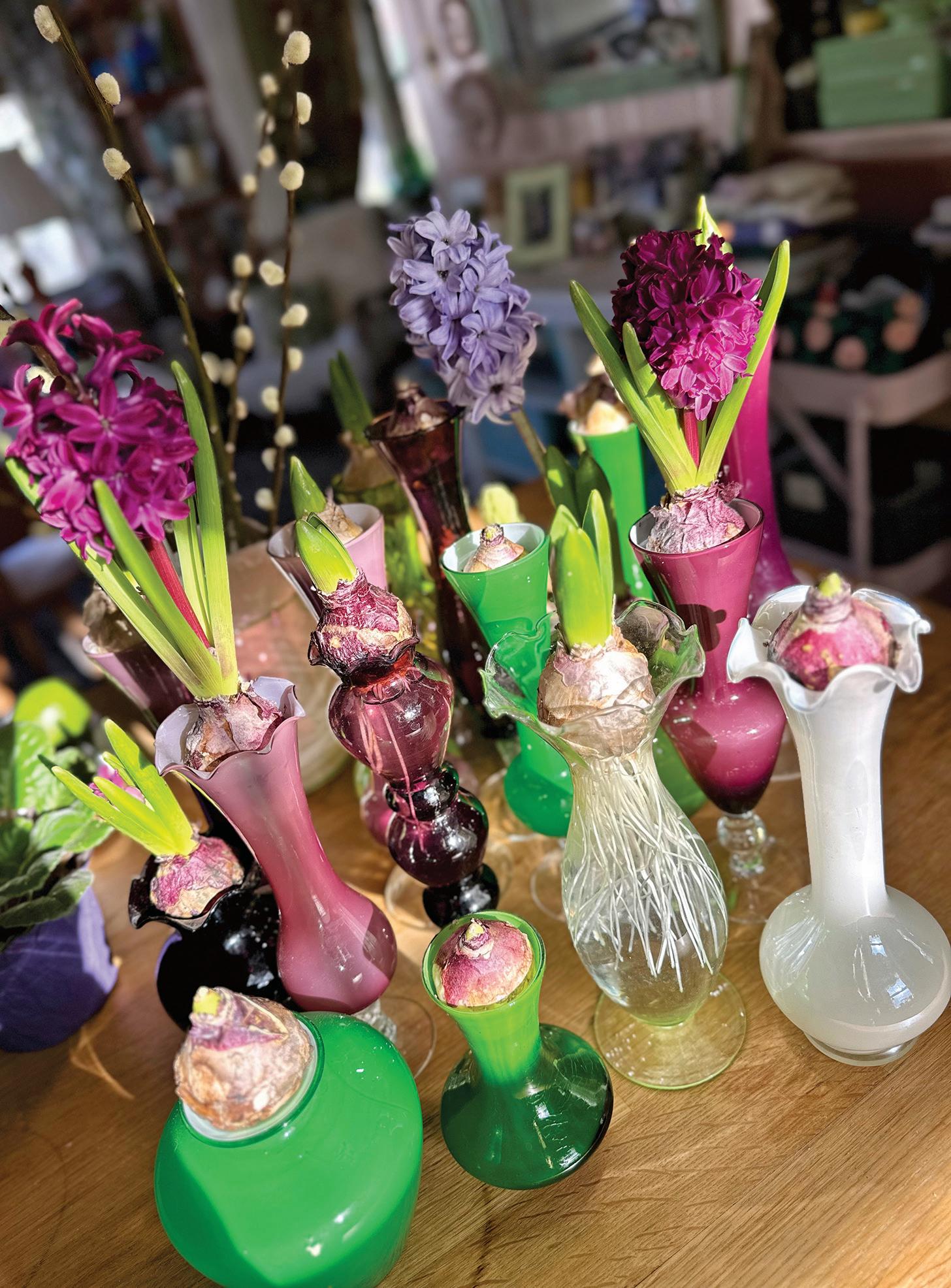
A few years ago, I started seeking out vintage glass vases on eBay and Etsy. My marvelous, maximalist mother was fond of displaying her cherished daffodils in bud vases, keeping dozens fresh in the refrigerator well into June. She tragically passed away in 2016 from breast cancer. Along with profound sadness, I inherited her vases. My initial look-see on eBay snowballed into an obsessive hunt for these semiprecious jewels.
The quest was comforting. I felt like my mom was moving through me. Together, we sought out the sweetest hand-blown vases in the world … a tall one; a quirky fluted number; a shorty with swirls. Why not all three? So as not to overwhelm (or overspend), I limited myself to green at first. But I soon branched into blue. Then yellow. When all was said and done, no color was safe.
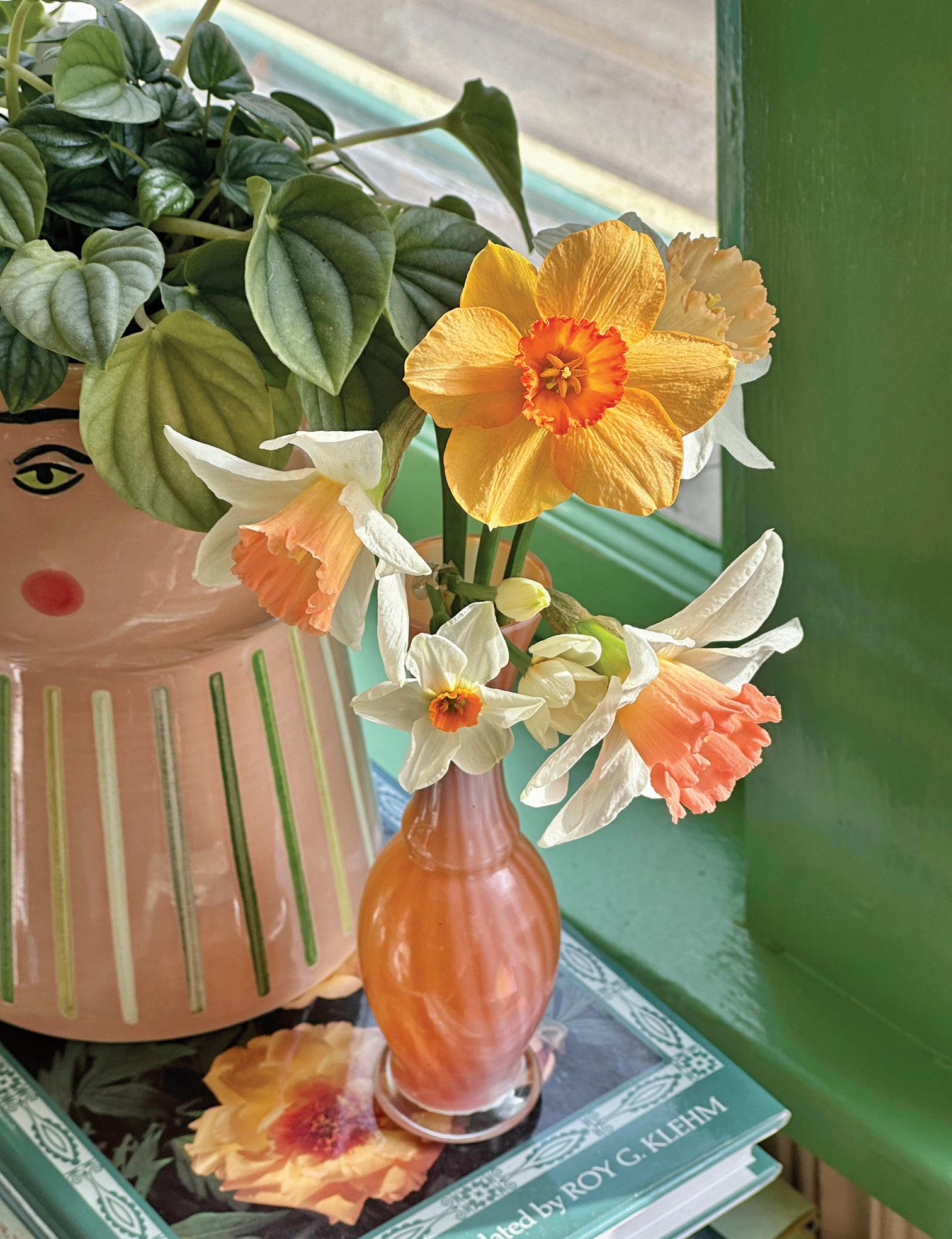
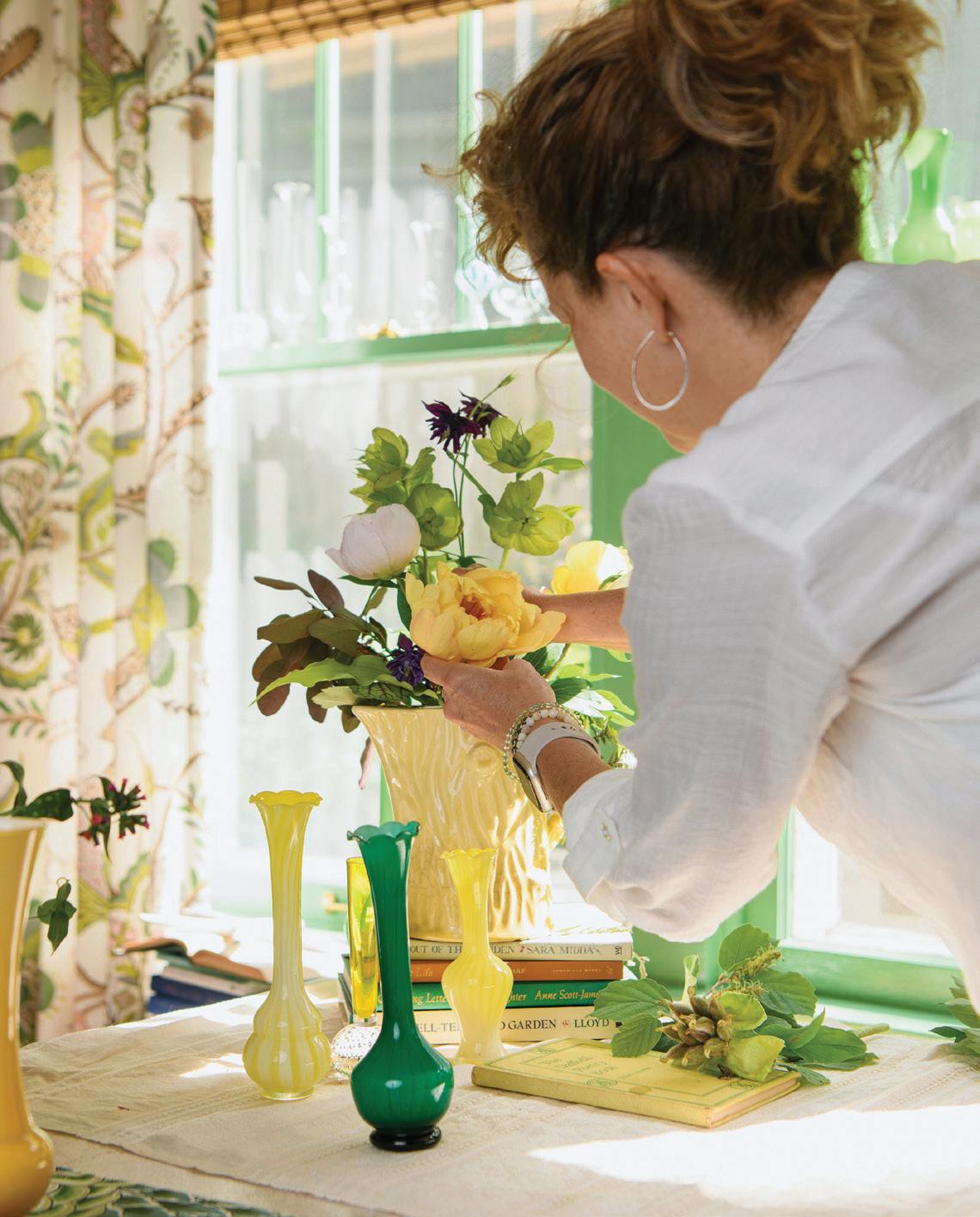
Now that the kids are away at college, I play with my vases anywhere and everywhere. Any flat surface is a potential display zone. If we aren’t in the dead of winter, I’ll run outside, snip a few flowers, pick out coordinating vases and then arrange a scene, tucking in tidbits like ribbon, art supplies, paper ephemera and fabric swatches.
I play with height by adding books, then I photograph the scene from every angle. Whatever is happening in my brain and body as I set up vignettes is akin to electricity. Pleasurable volts of flowing sparkitude race through me. I do this for no other reason than because it inspires me. Then I will go about my day, and every time I pass the display, good vibes reverberate.
This house has been an incubator, a place to nurture and launch our children into the world. It’s been there for us during tumultuous years, job changes, a divorce and the death of my dear mama. In 2017, I was diagnosed with early-stage breast cancer (boo!) and married my soulmate, Douglas (yay!). We reconfigured spaces to accommodate everybody and all our stuff (my husband is also a maximalist who collects bicycles and guitars — hey, the more the merrier).
As an entrepreneur who worked from home running two businesses (freelance graphic design and Power Poppy, a paper crafting website offering my downloadable botanical illustrations to print and color), plus raising four teenagers between us and running a household where decorating had long taken a backseat, I eventually found myself overwhelmed and unmoored. I was grieving, drinking too much, wavering between wanting to crawl into a hole and wanting to conquer the world.
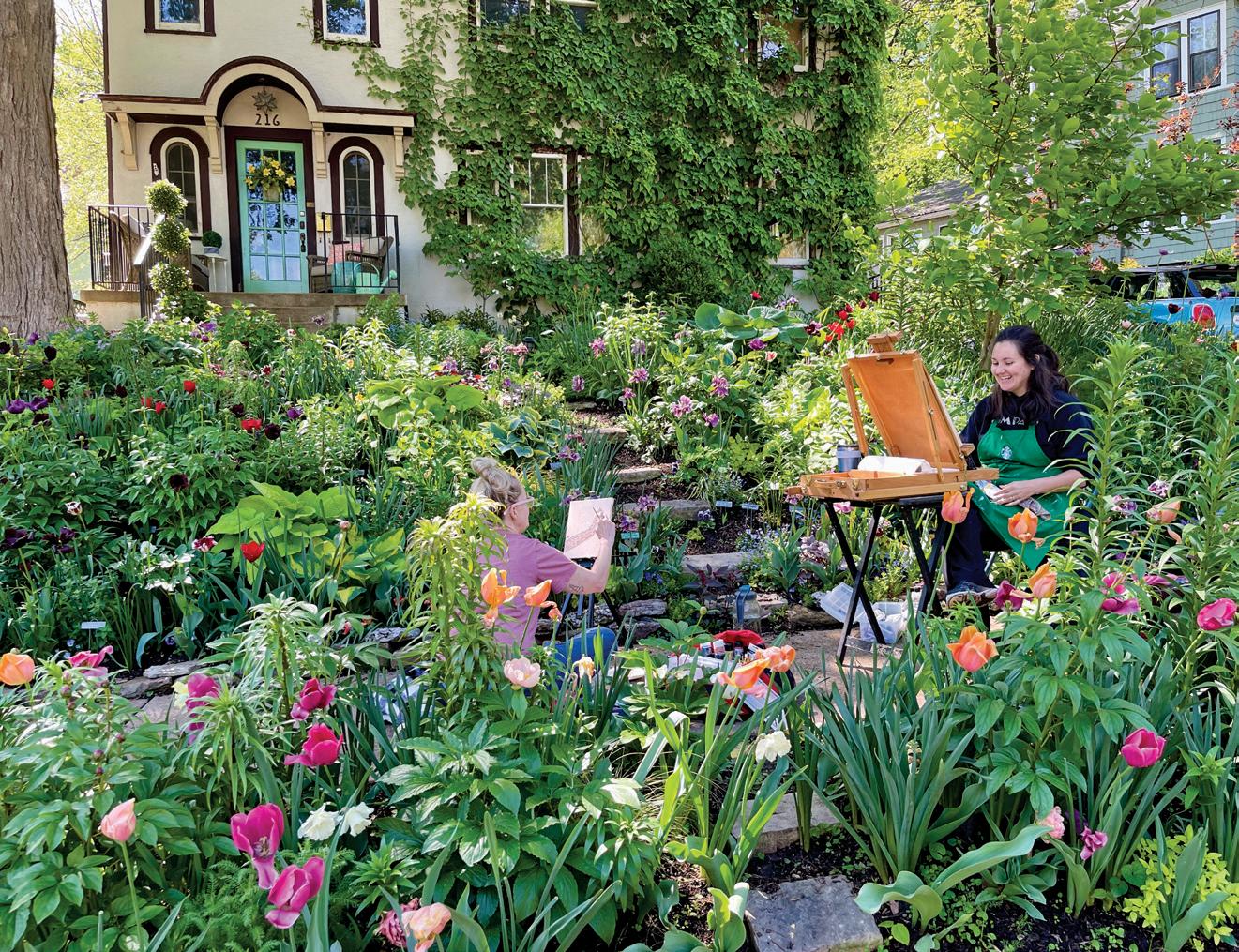
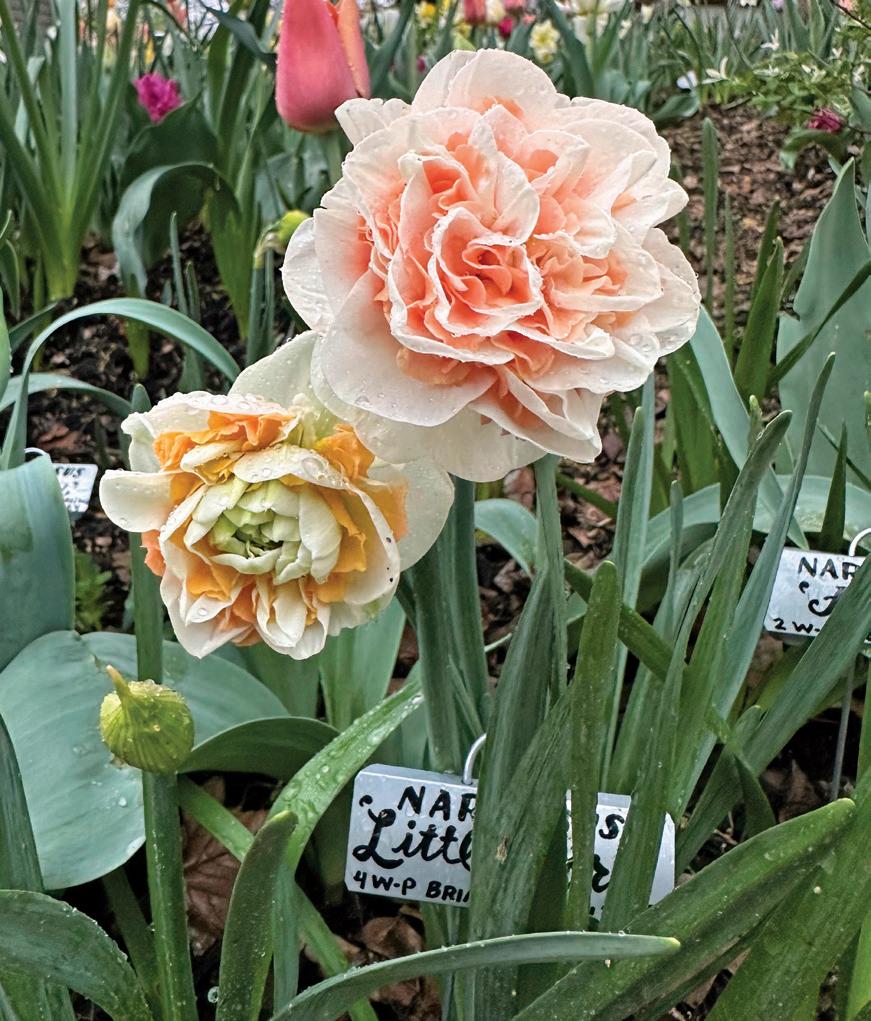
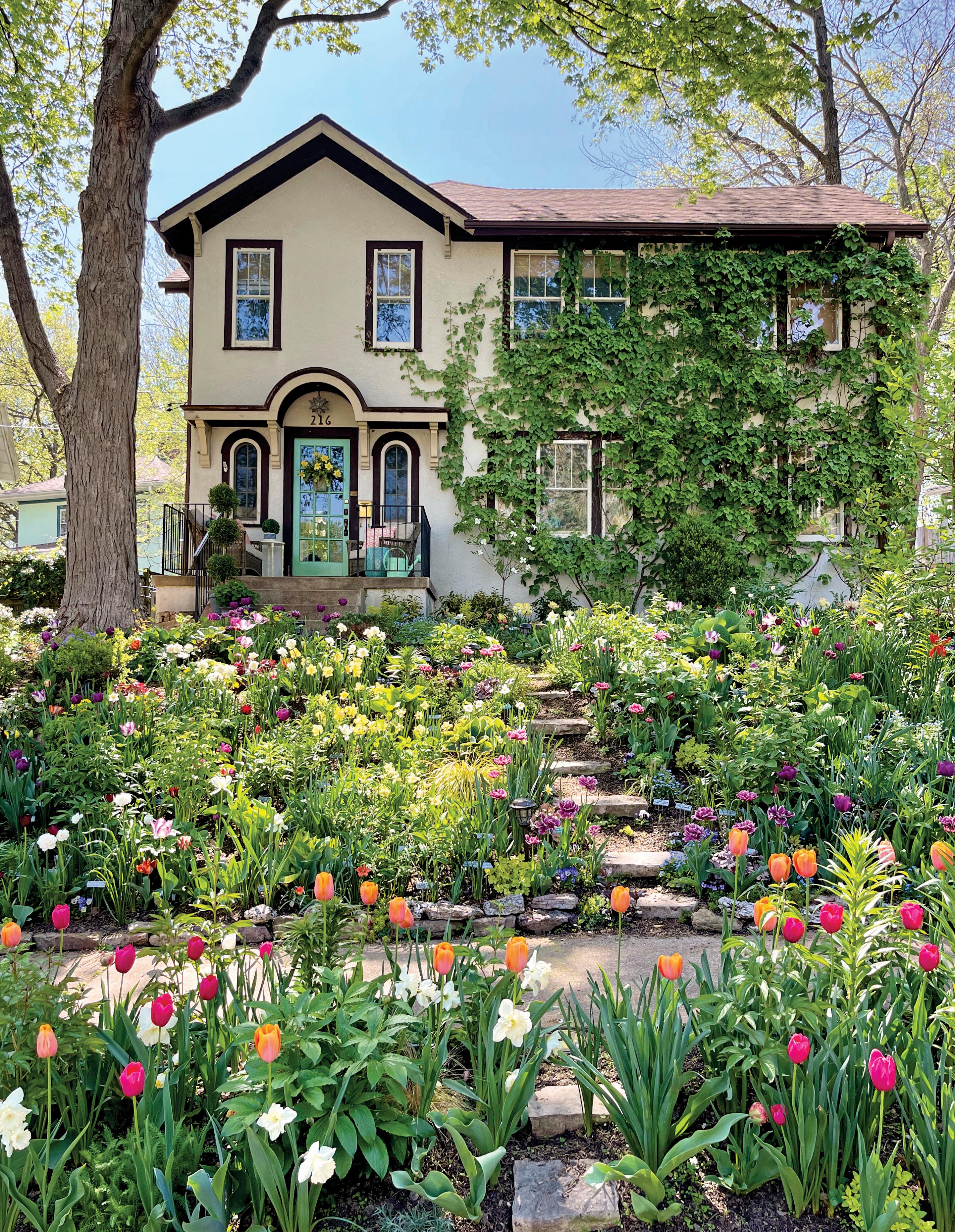
Without the bandwidth to understand that something needed to change, I opened the front door and began to dig up our yard. I didn’t know what I was doing, but at the time, I didn’t need to know. I just felt pulled to go outside, in solitude, and feel the distant yet familiar comfort of dreaming and scheming to create something beautiful. With one shovelful of dirt and daffodil bulb at a time, over the course of several seasons, I took what had once been a steep slope of invasive groundcover vines and turned our entire front yard into a flourishing garden, planted with thousands of daffodils, tulips, peonies, hostas, hellebores — and my heart and soul.
I named it “The Slope of Possibility.” The garden embodies so much of what my mother infused in me from my earliest memory. Wonder and delight. Curiosity. A love of learning. The great reward of seeking out rare, heirloom and hybrid plants from small growers. A can-do, DIY spirit. Gratitude for the gifts of nature and our bodies that do hard work. Connection and camaraderie with gardeners and mentors. Trusting your gut. Providing a vessel for creativity; a respite for myself; and a destination for our neighbors, who walk by and share what a bright spot our garden is in their day. Creating this garden caught me off guard, and it changed me forever.
Sanctuary, catalyst, cocoon for healing — all inside a pie-shaped piece of property with a house on it. The experience of rediscovering my rooms, revitalizing my landscape, and finding myself anew has had a profound impact. I want to help other women find a more sustainable balance between the energy they give away and the amount of energy they need for themselves.
I started Vivopolis, a virtual community for women, where we come together to reset, reevaluate and reimagine the kind of lives we want to live. It’s a collaborative space for guidance and inspiration, with a roadmap to help you figure out what you need to thrive. I’m developing books and speaking about the healing power of gardening — it feels electric to be doing this work!
This is exactly where I am supposed to be right now; while at the same time, at age 53, I feel like I’m only getting started.
More on Marcella www.marcellahawley.com
Instagram: marcellahawley
Facebook: marcellahawley
Women have long been at the forefront of creativity in art; however, they often face significant barriers in accessing funding and opportunities to nurture their visions. The Women Create Foundation is a catalyst for small but significant strides to empower women creators through grants that help bring projects to life and foster innovation. Go
SUSANCOLLETT
ARTISANAL JOURNEYS
CURATED BY ISABELLE FISH
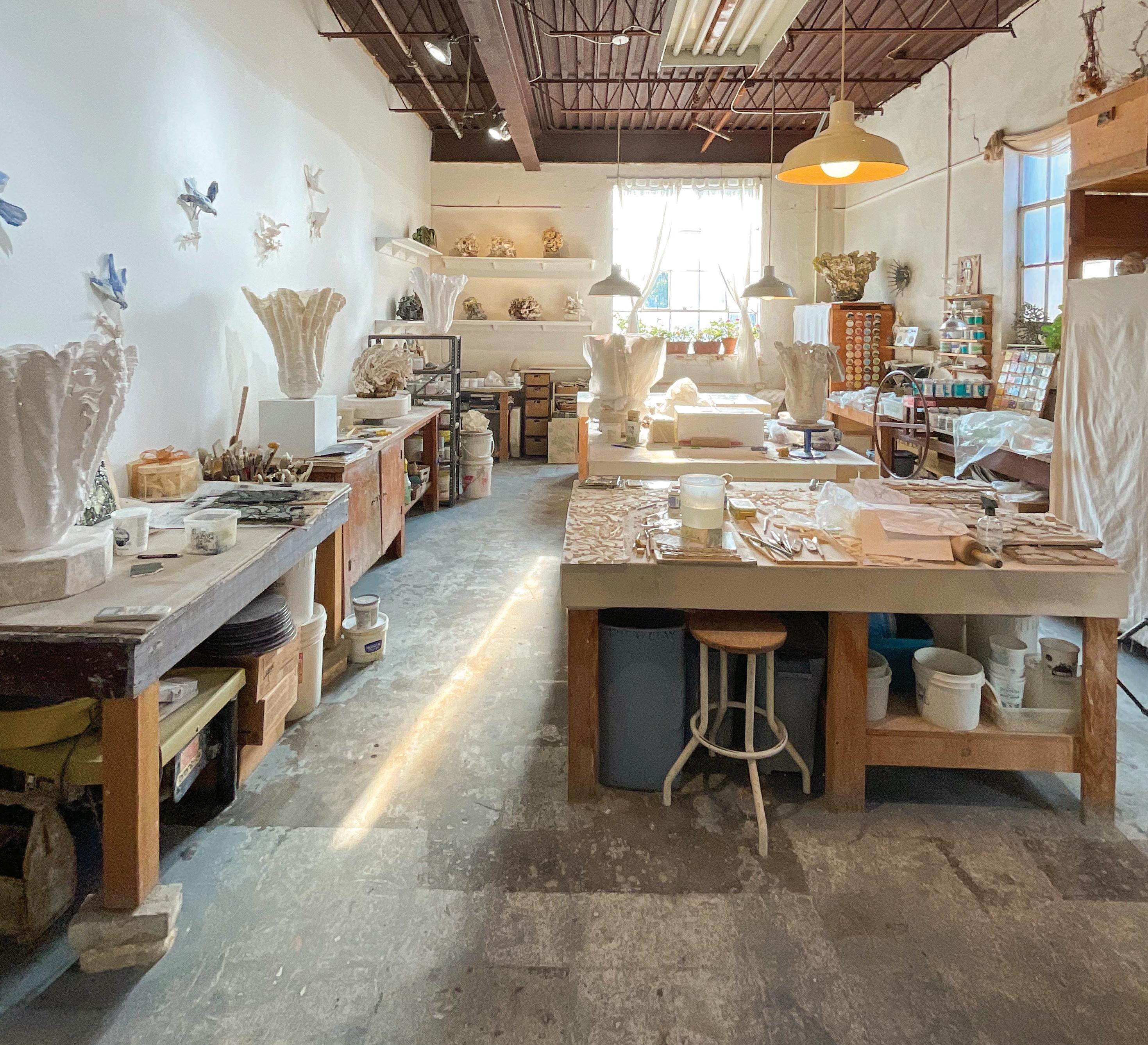
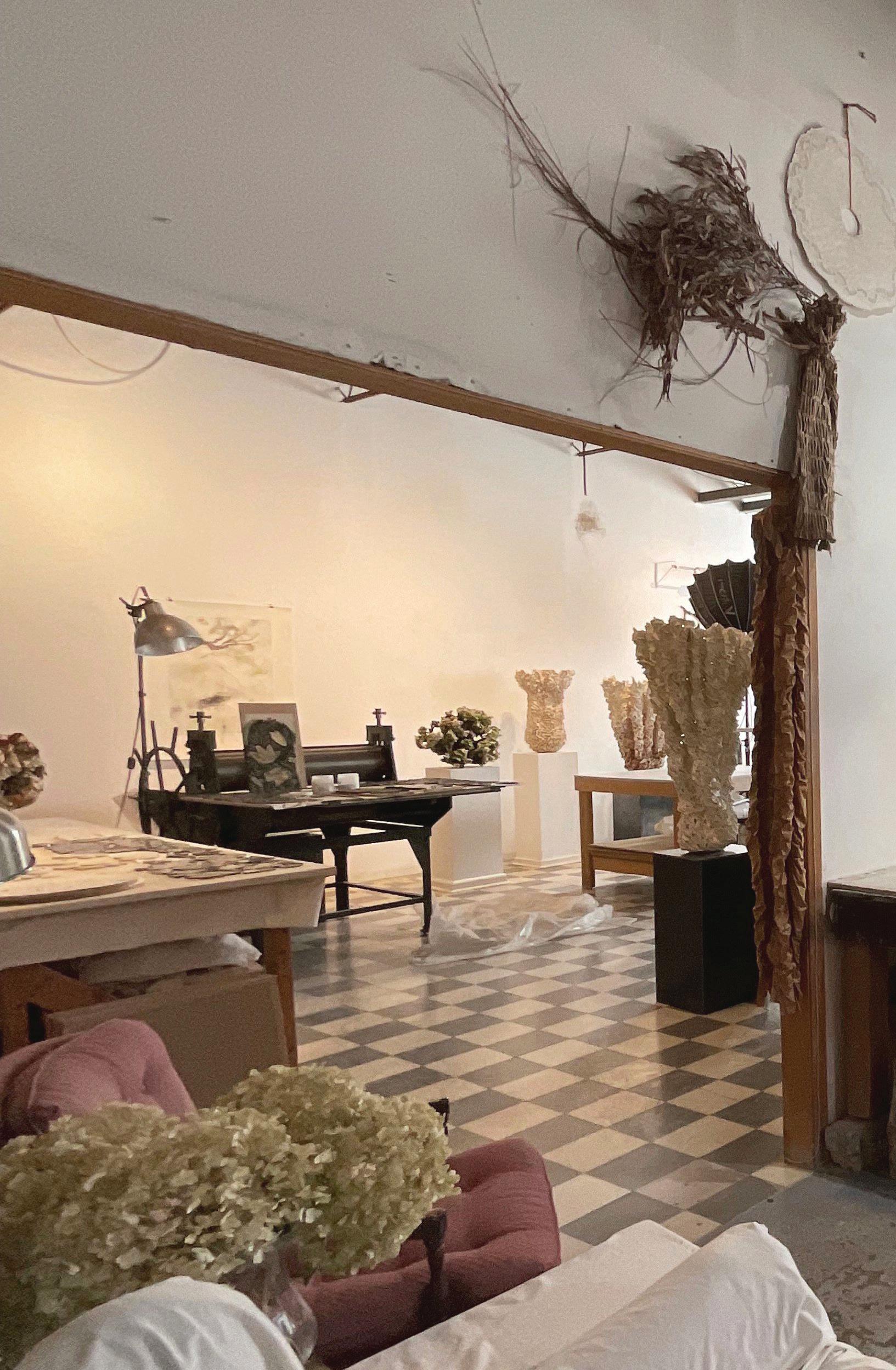
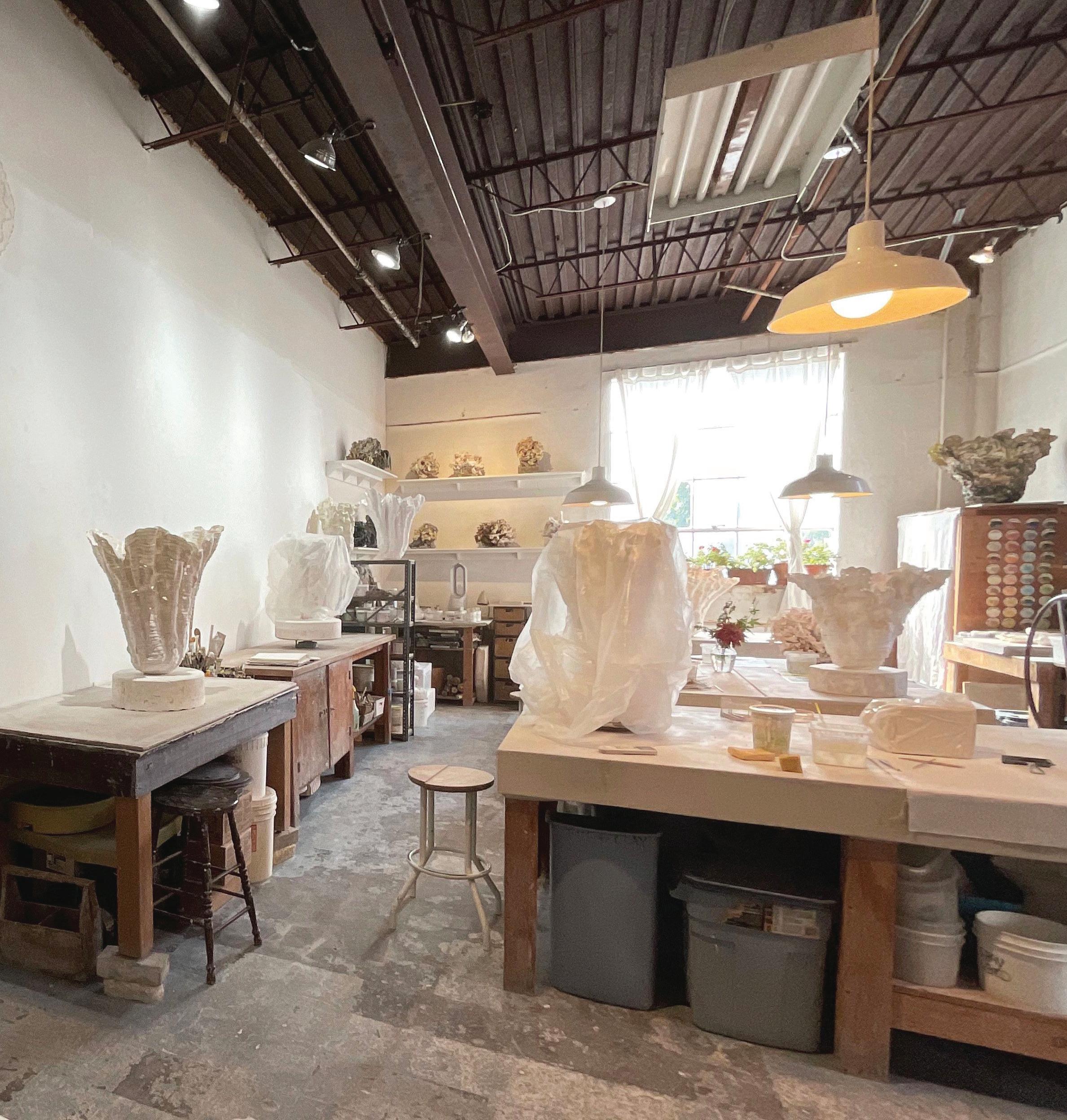
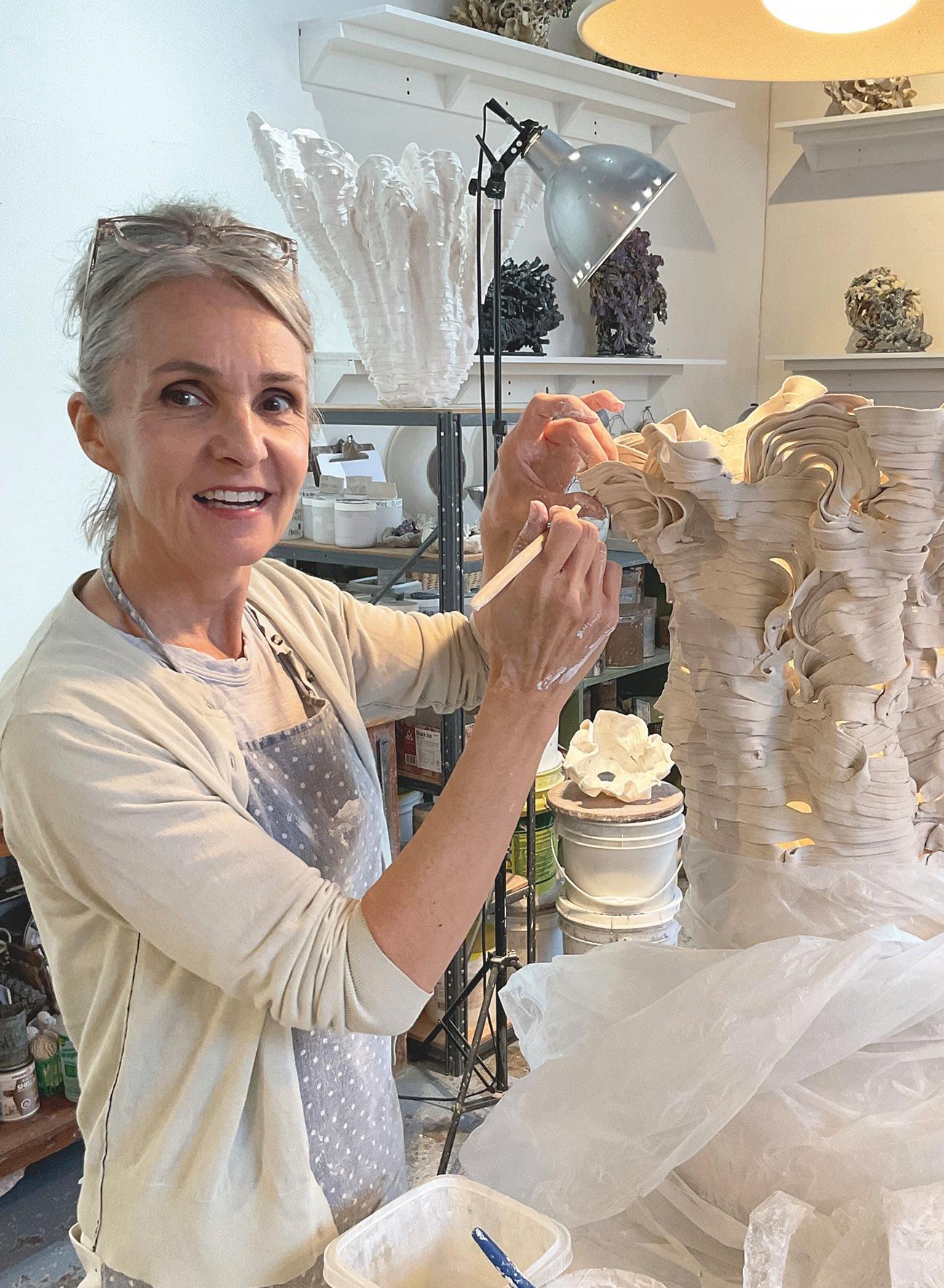
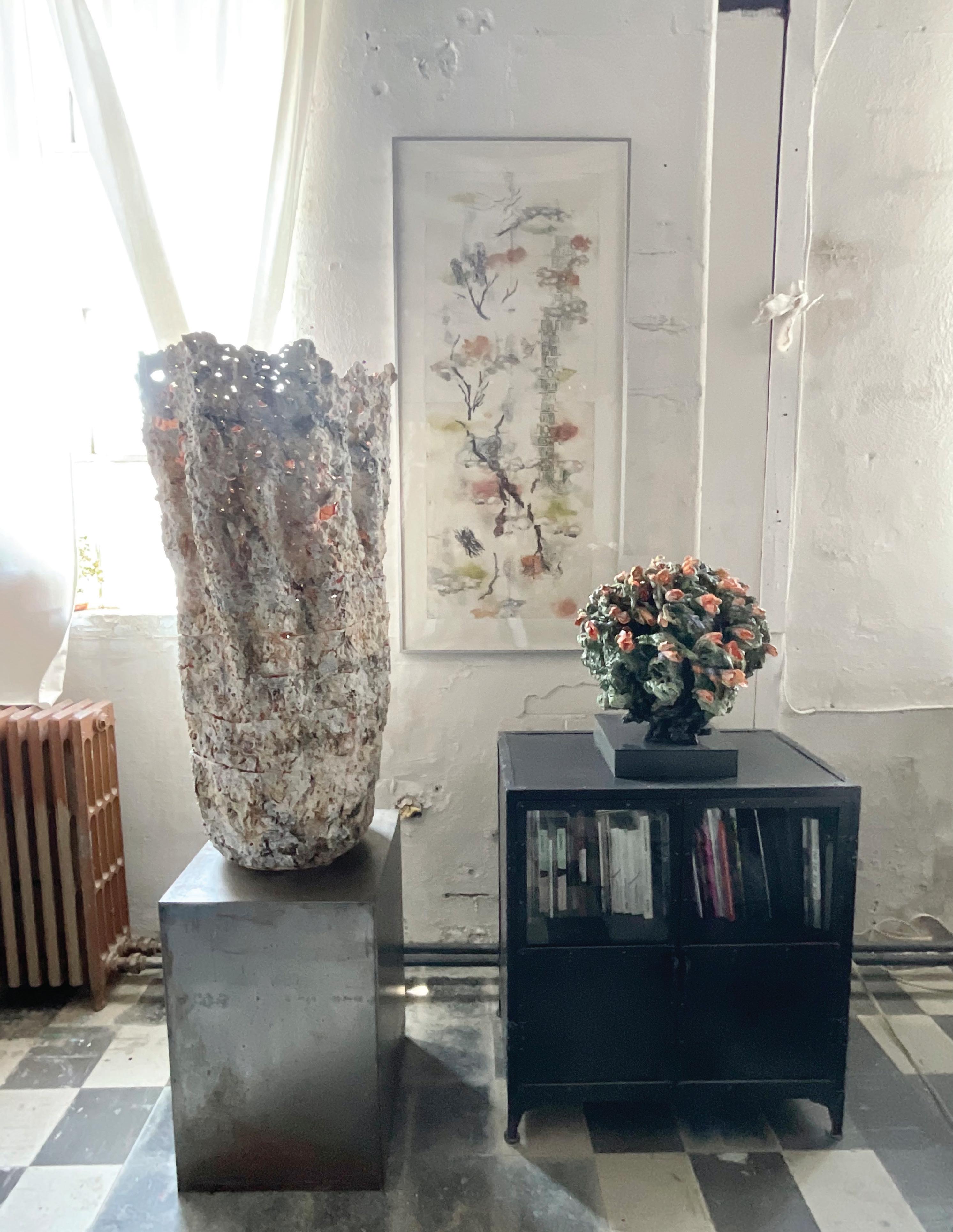
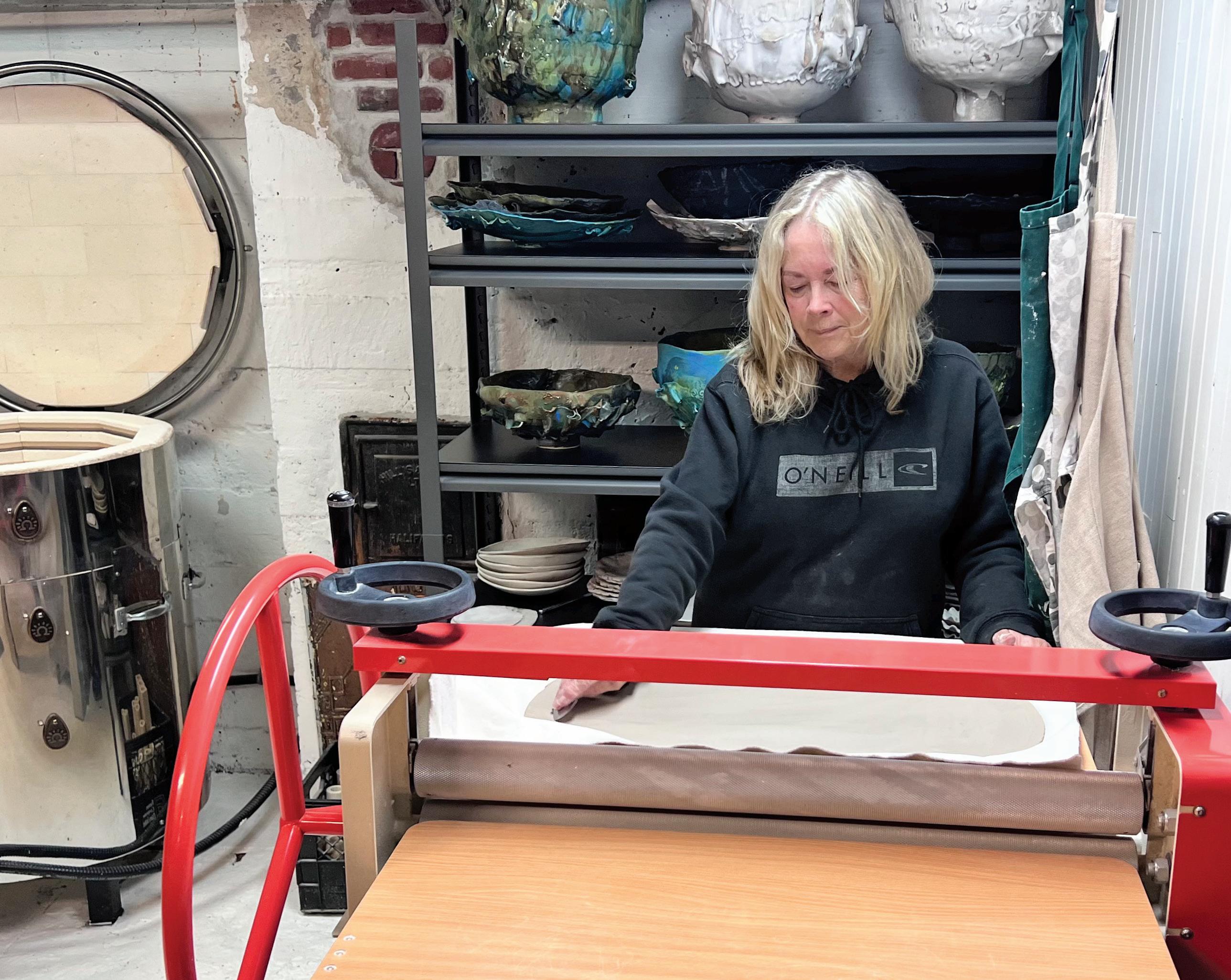
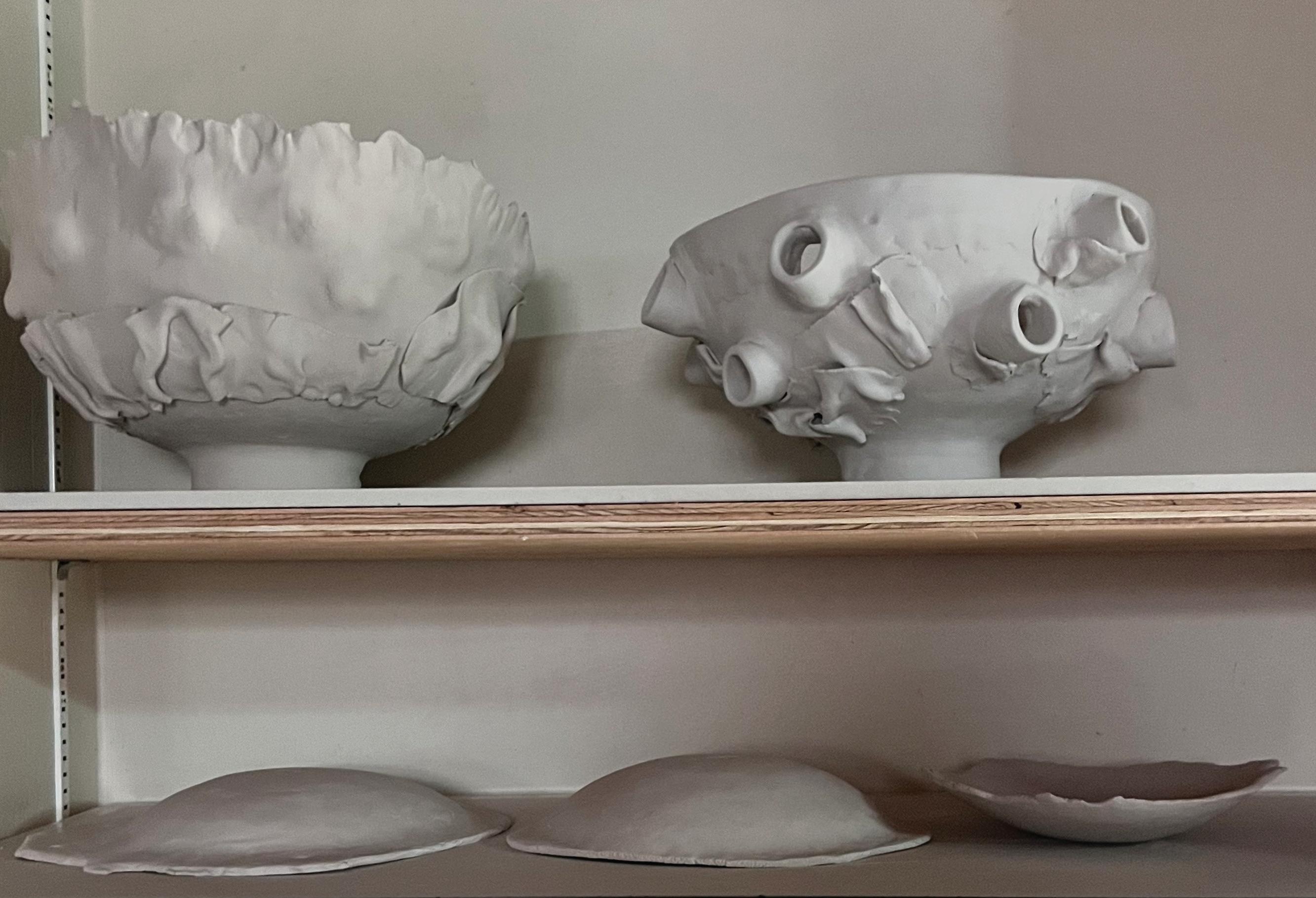
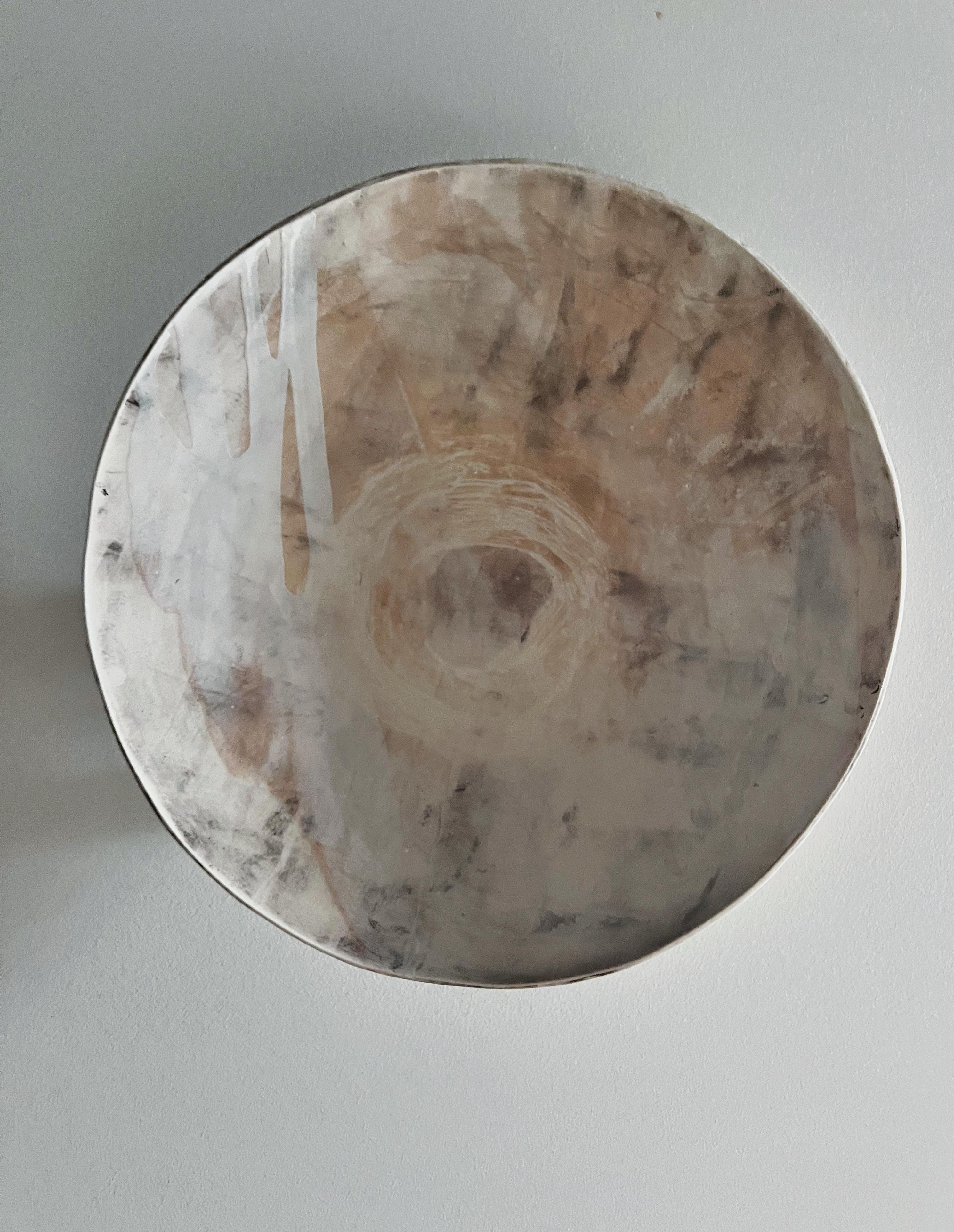
Established in Toronto in 1993, SUSAN COLLETT’s full-time studio practice includes clay sculpture and printmaking. Within the complexities of running a business, a momentum of exhibitions, commissions, workshops and studio visits sustains her.
Her work is in the collections of museums in Canada, including the Montreal Museum of Fine Arts and the Gardiner Museum in Toronto, as well as the Kasturbhai Lalbhai Museum in India, and Sèvres porcelain museum in Paris.
She received her letters from the International Academy of Ceramics in 2007 and the Royal Canadian Academy of Arts in 2008.
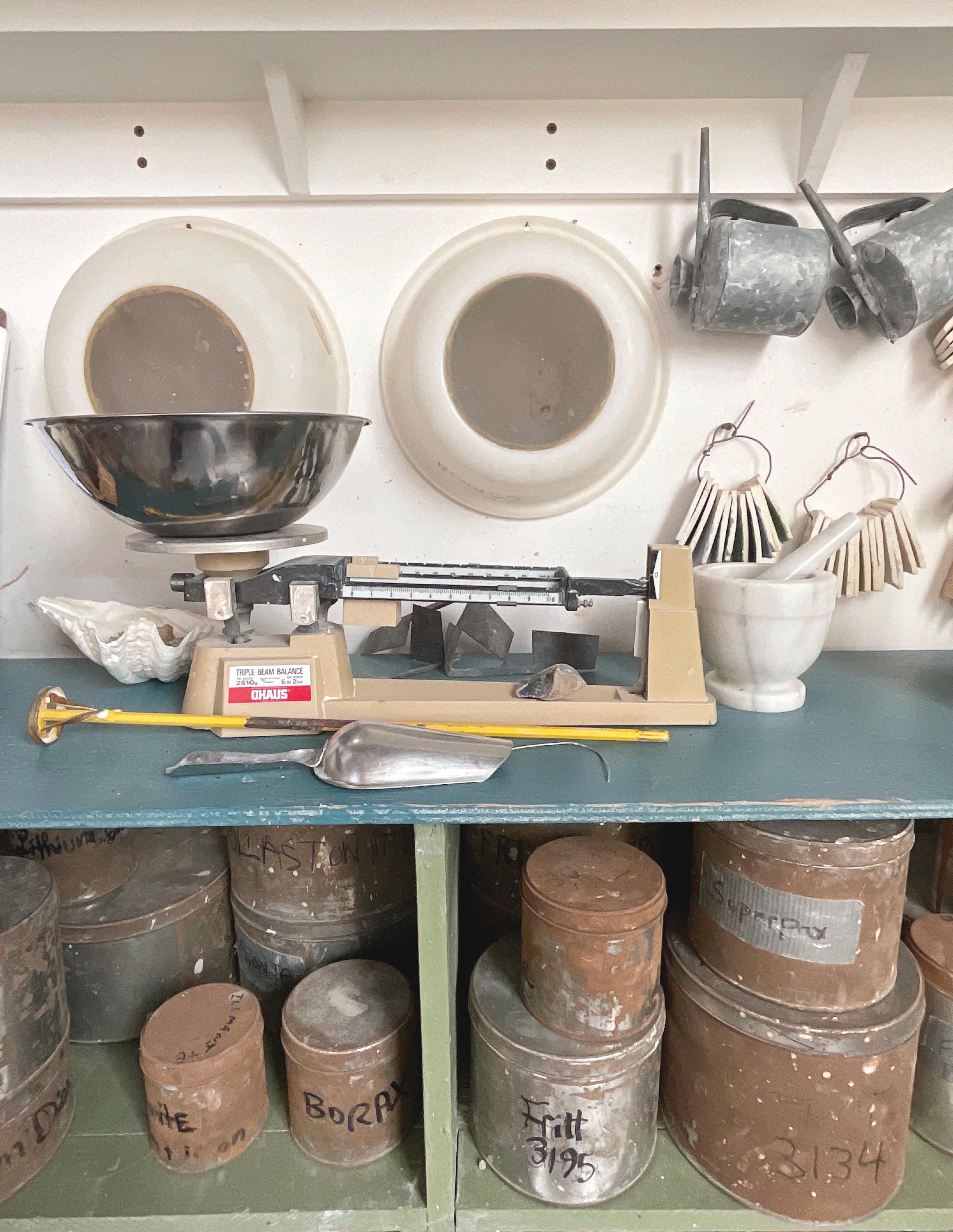
ONE of my favourite times of the day is when l leave my studio. I like to turn around and look back into the room to envision tomorrow, to mentally prepare before I return the next day. Mix those glazes ... finish that piece … start the wire armature.
When I am away, I always have a sketchbook on hand — one in the car, one in my handbag, and always one in my suitcase. Sketching strengthens my hand and mind coordination so that when I arrive in the studio, I can hit the ground running and get straight into the clay and paper.
I was always going to be an artist. I grew up plein-air oil painting with my father off the southern shores of Georgian Bay, Ontario. He was a businessman and a “Sunday painter” and painting was a form of relaxation for him. I thought everyone did this; and luckily, I liked it a lot. From this early experience I learned how to see, understanding that things around me are always changing — the landscape, the light and shadows, and the colours, trees and buildings.
I went on to study at the Cleveland Institute of Art, graduating with a major in printmaking and a minor in ceramics, which I added only in my final year.
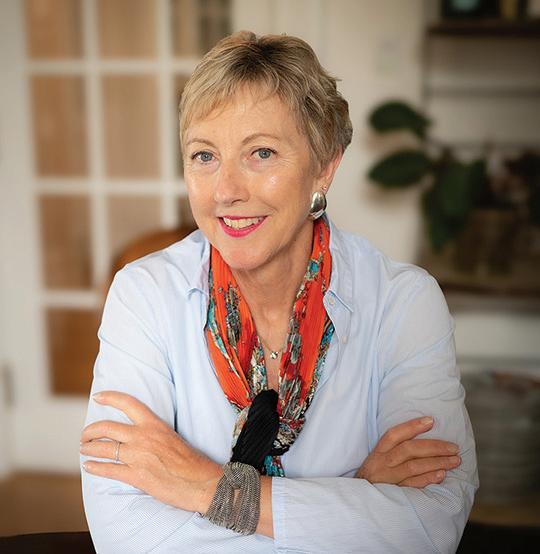
From ISABELLE FISH:
Susan Collett is that rare breed of artistic entrepreneur who seamlessly moves from a state of artistic flow to dealing with logistics and sales. Her pieces are in her image: joyful and elegant with a depth that denotes kindness and thoughtfulness. Susan’s art elevates us.
MY (DREAM) STUDIO
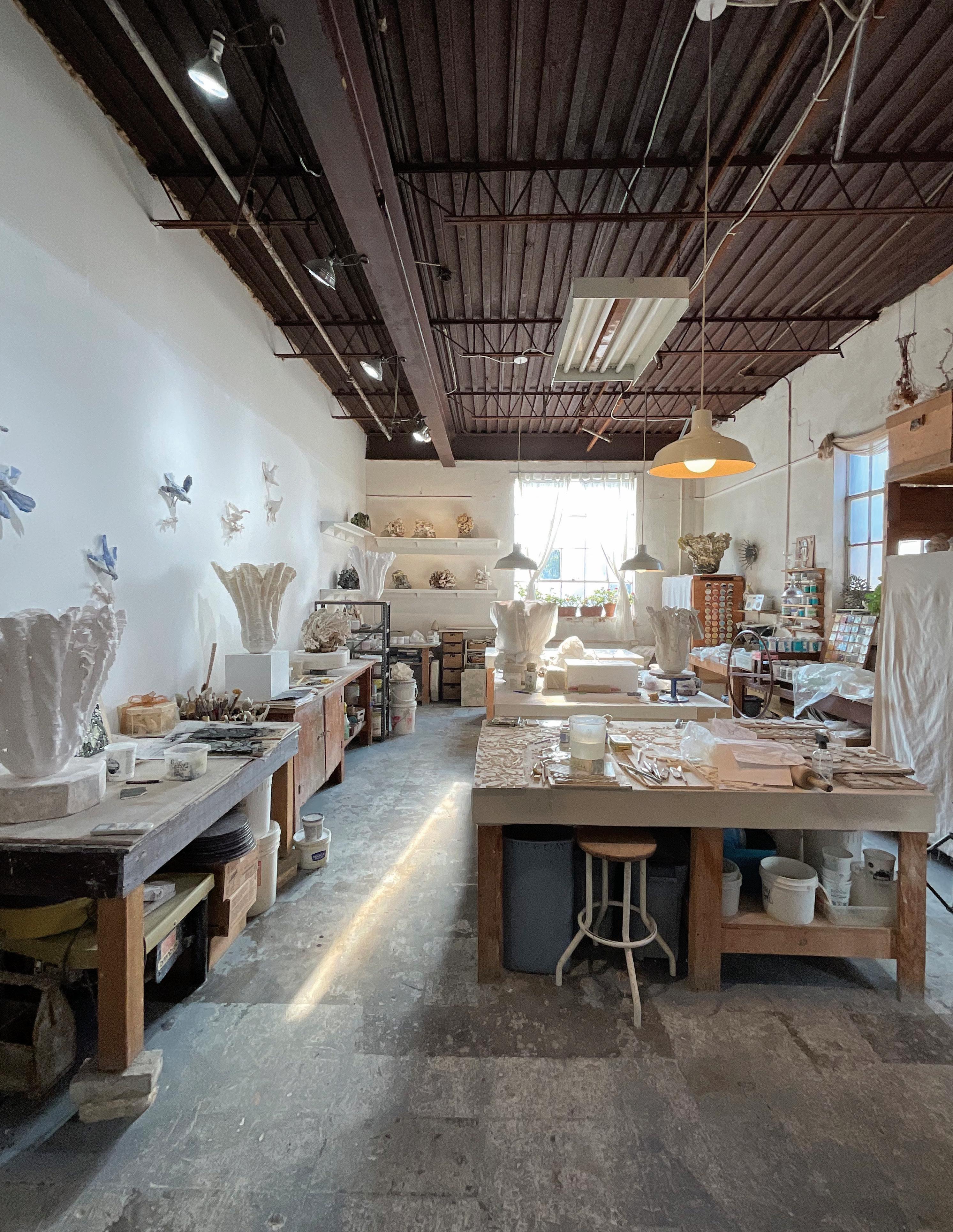
is in downtown Toronto. Layer by layer, I have built a place where I am happy. Although I am in the middle of a booming metropolis, the studio is my splendid walk in the woods, where I look to find myself. It is my daily practice of showing up. Time evaporates here, so often 10-hour days are the norm. Even when there are no deadlines, I am making my own luck just by being in the studio. As Thomas Jefferson said, “I am a great believer in luck, and I find the harder I work, the more I have of it.”
The first 15 years of my practice were brimming with tile commissions from interior designers, specifically fireplace surrounds for kitchens and wine cellars. Demanding days of proposal drawings, sample boards, spec invoices and installations. At the same time, I worked on sculpture and print commissions for four galleries and art consultants’ hotel placements. I also learned the behind-the-scenes importance of keeping an office and keeping the computer out of the studio!
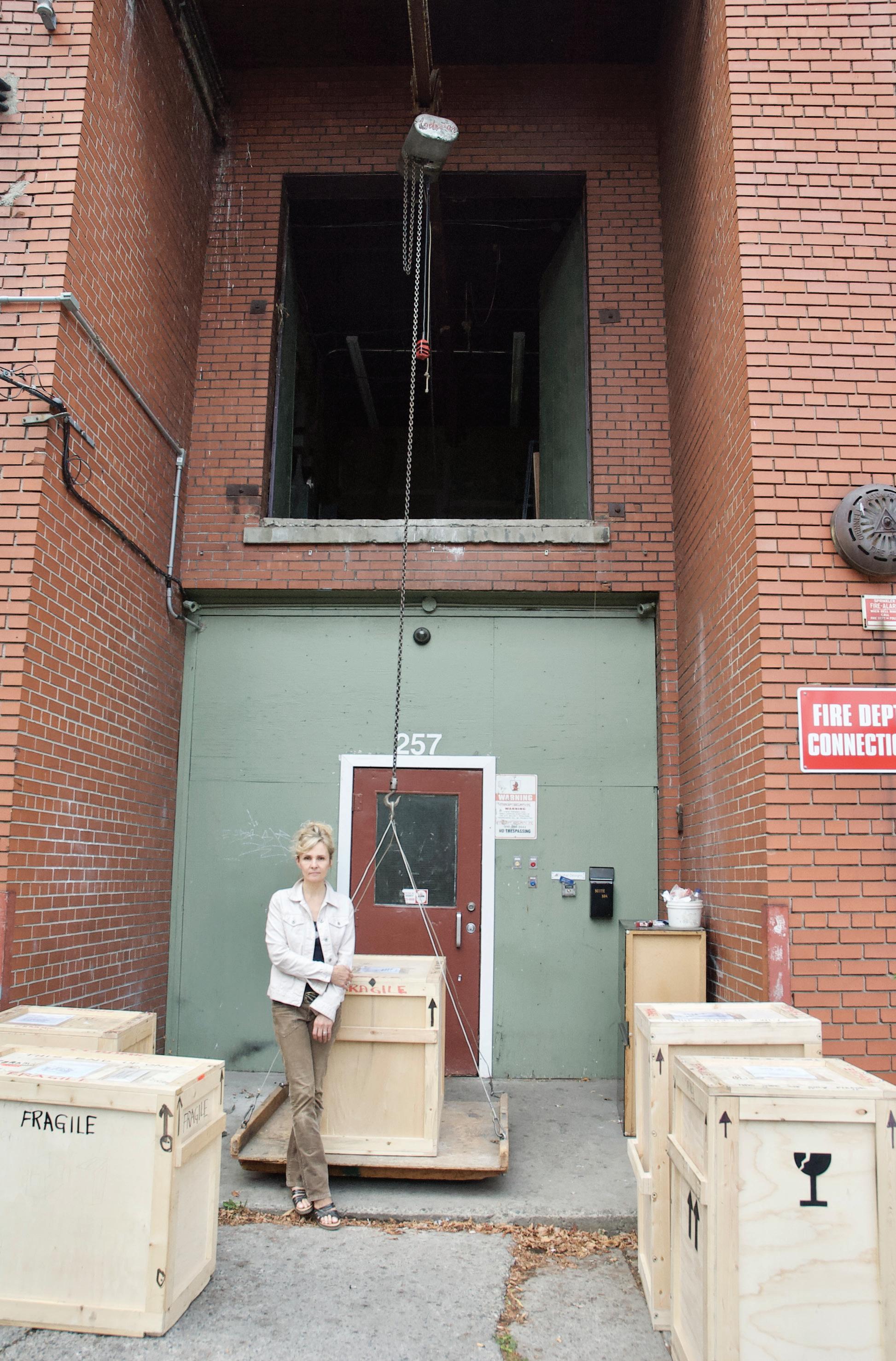
Early on, I hired a shipper for the afternoon to show me the ropes, and it turned out to be one of the best investments in my studio. No one really talks about the skills required for packing and shipping, yet it is so important for getting your work to market. Now I can pack for shipping worldwide and make international connections that are important to my growth as an artist. Just recently, I crated GLIMMER to travel to India to the Kasturbhai Lalbhai Museum for its permanent collection; and sent THICKET to the Korean International Ceramic Biennale 2024, where it is now in the permanent collection of the Gyeonggi Museum of Modern Art.
RUNNING A BUSINESS
is the practical side supporting the romance of having a studio. So much was gleaned from the early days about productivity, relations with clients, strict deadlines, how to write up a contract and invoice, and remembering to pay myself and find the steady income necessary to keep the studio going. All stepping stones to where I am now, working with a more focused art portfolio for public and private galleries and collectors, plus studio visits and making a living while making work true to myself.
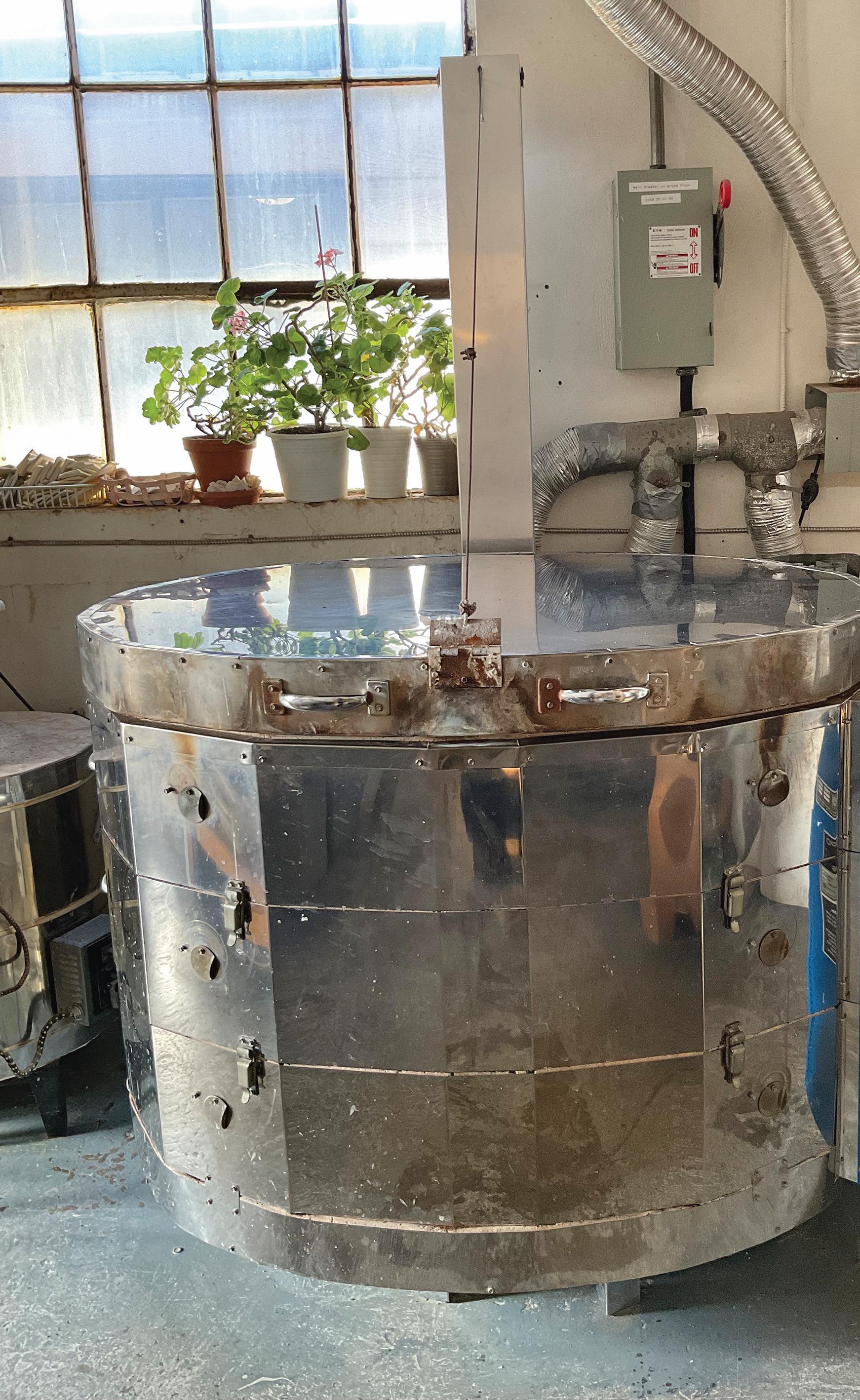
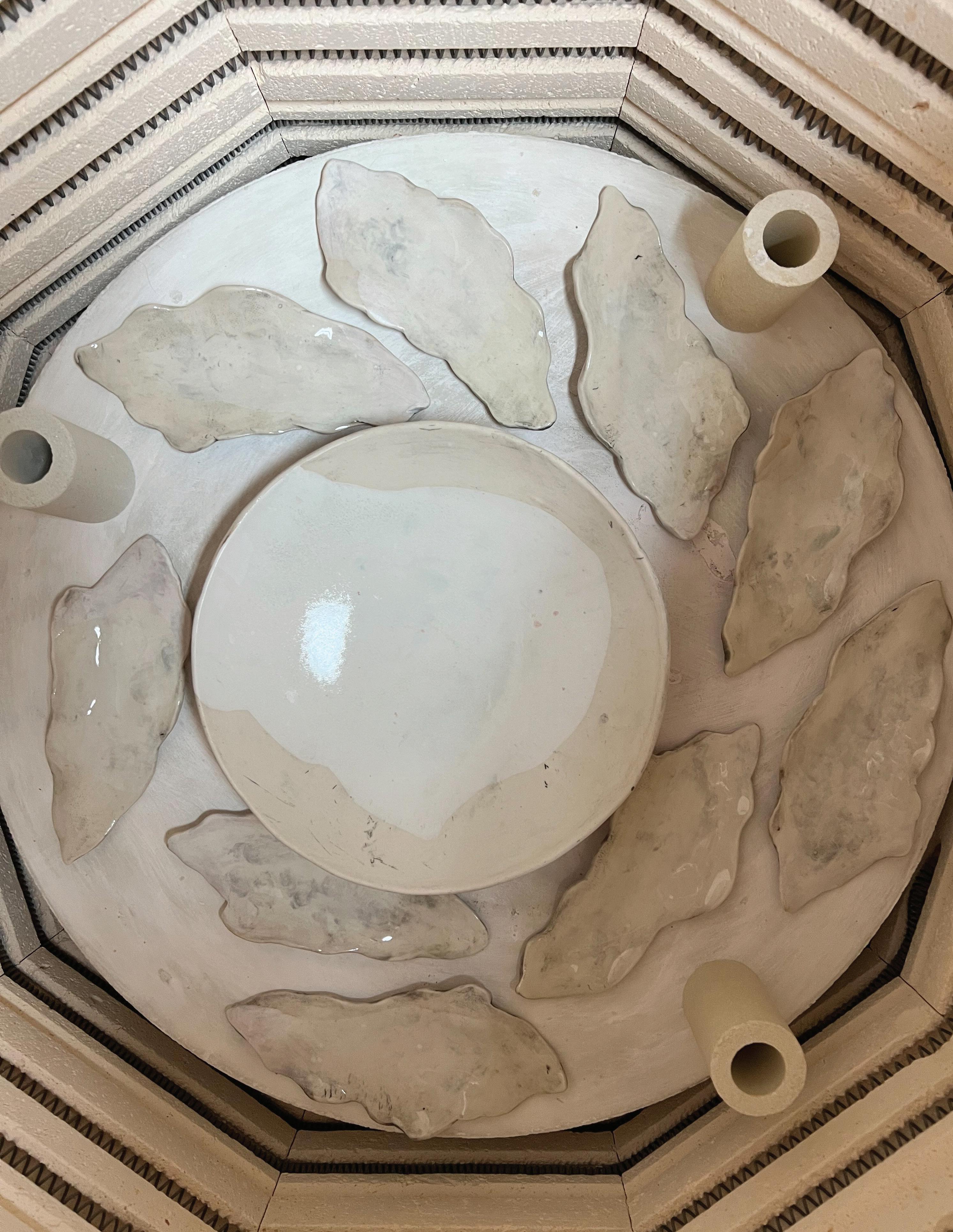
In my thirty-first year, clay sculpture and fine art printmaking are my focus. The clay teaches me about transformation, of letting go of expectations — from opening the kiln to all the business tasks in between. Everything contributes to an idea. If you can just let go of that expected outcome from life — or from the kiln or the printing press — great discoveries can be realized.
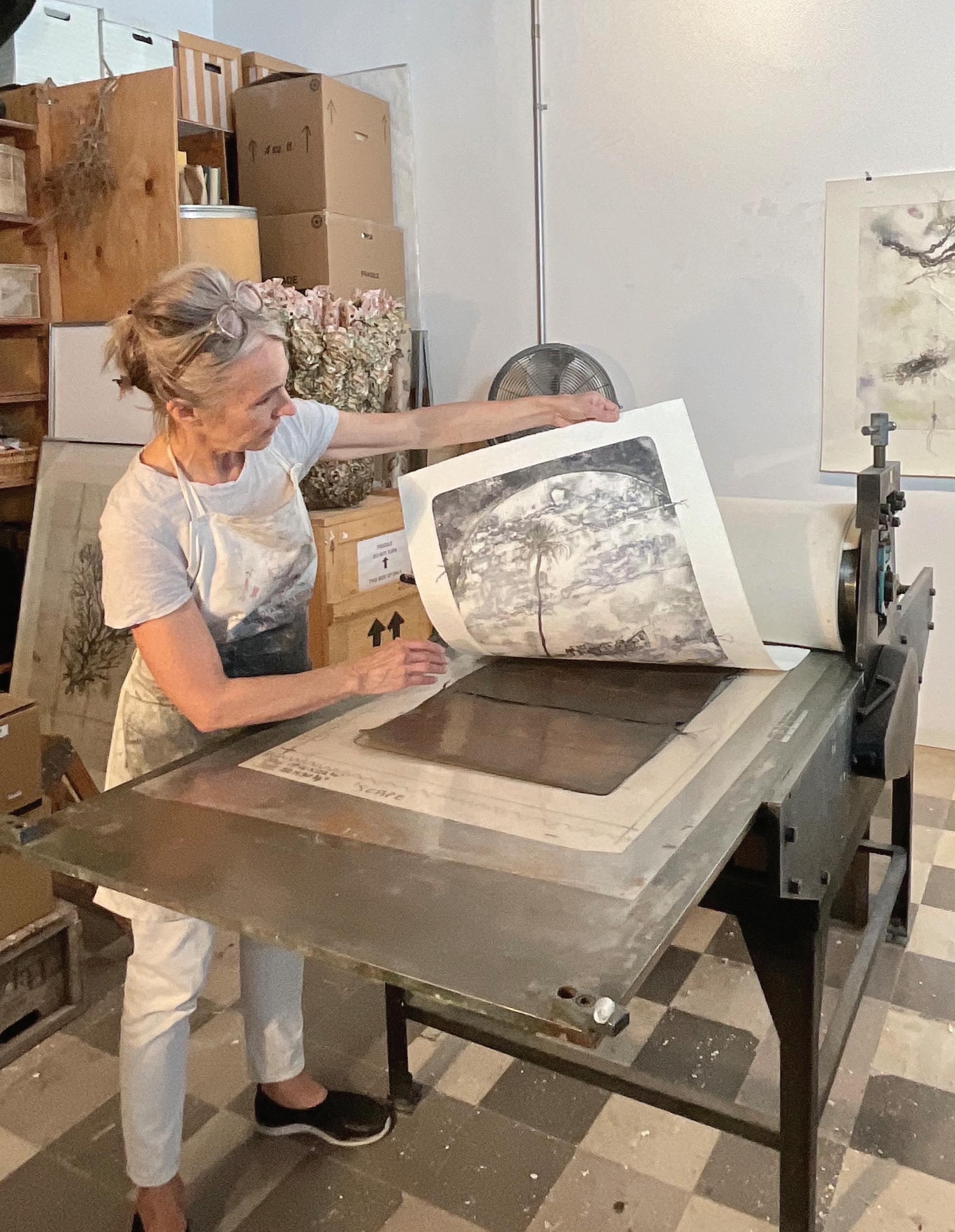
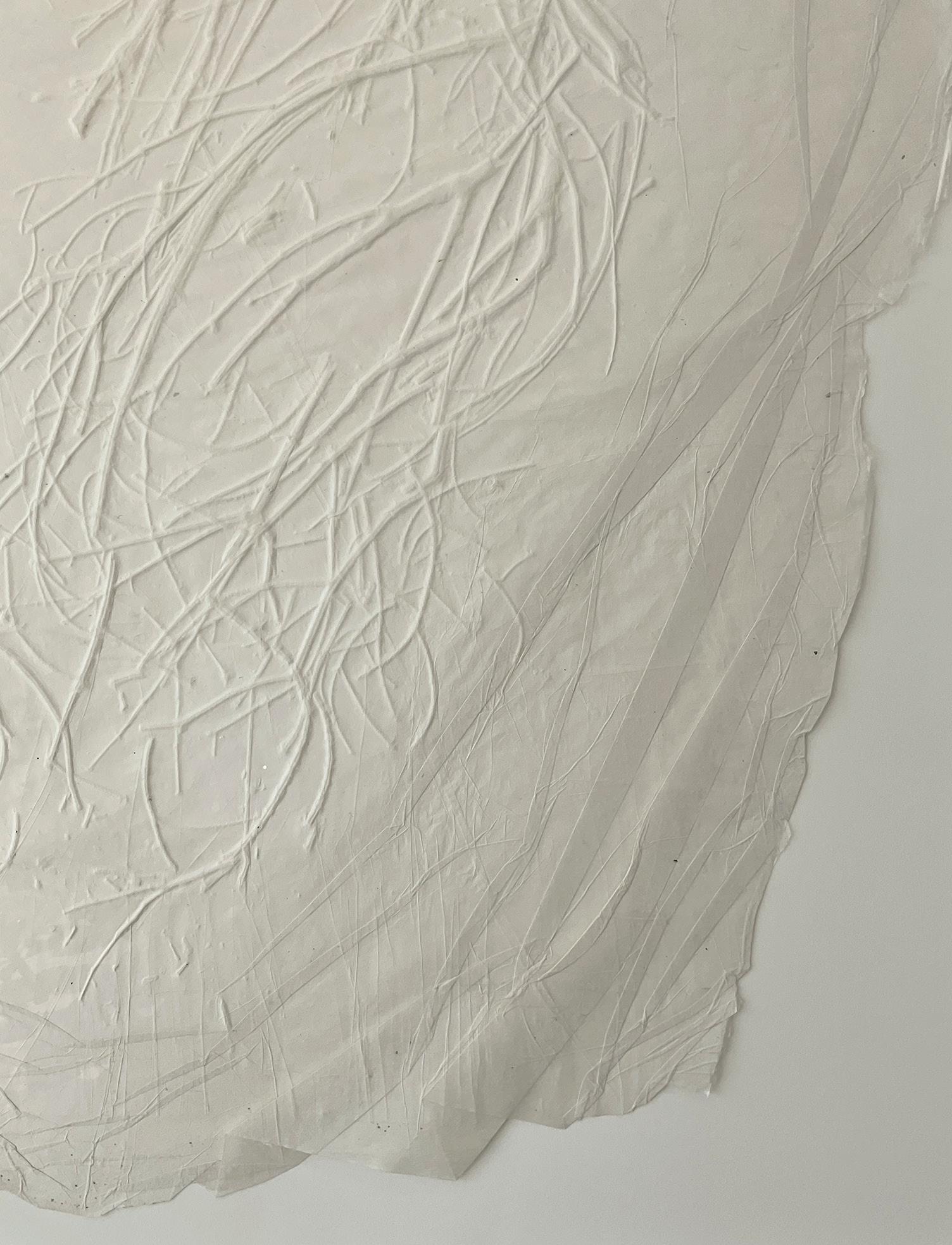
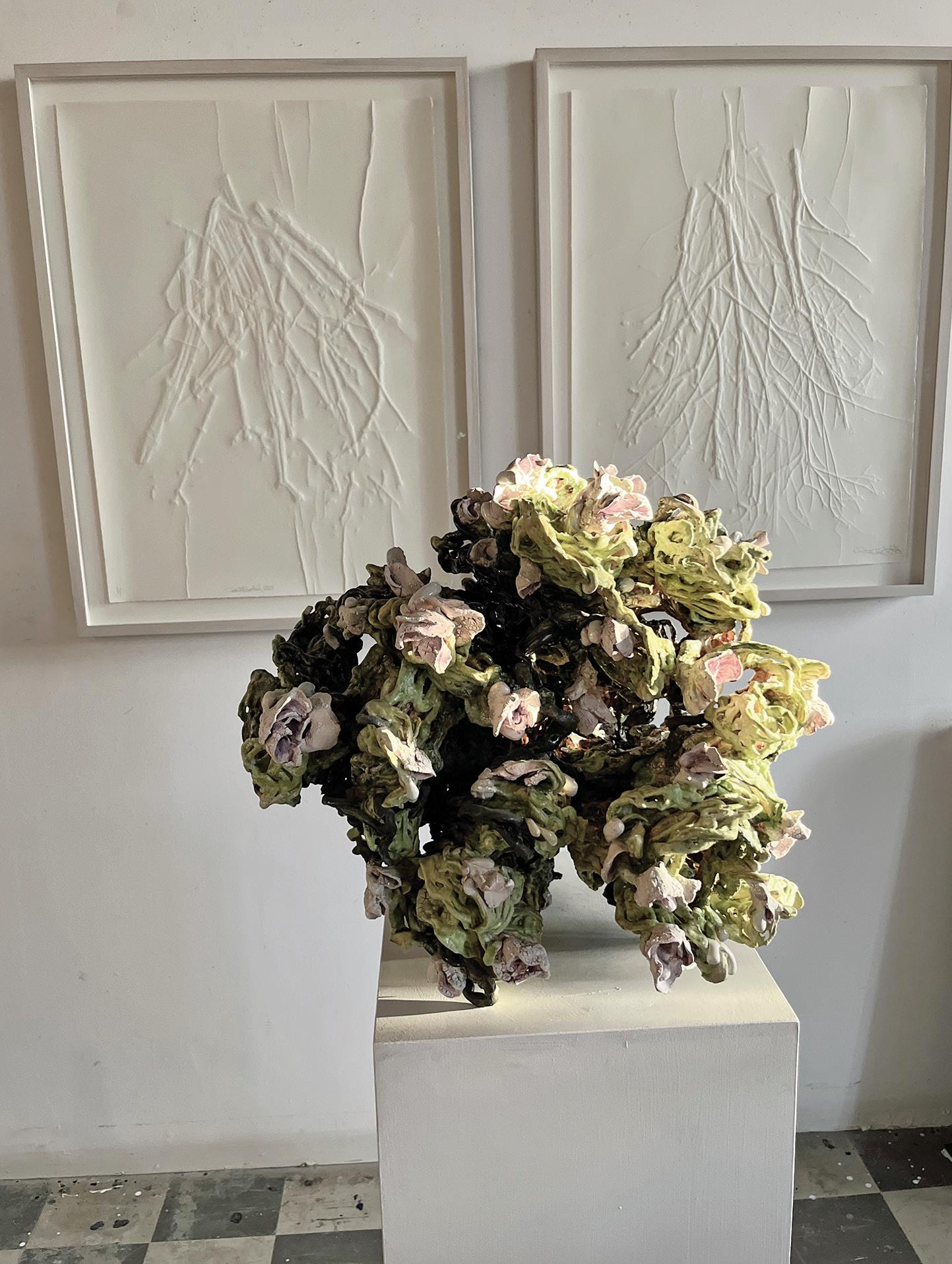
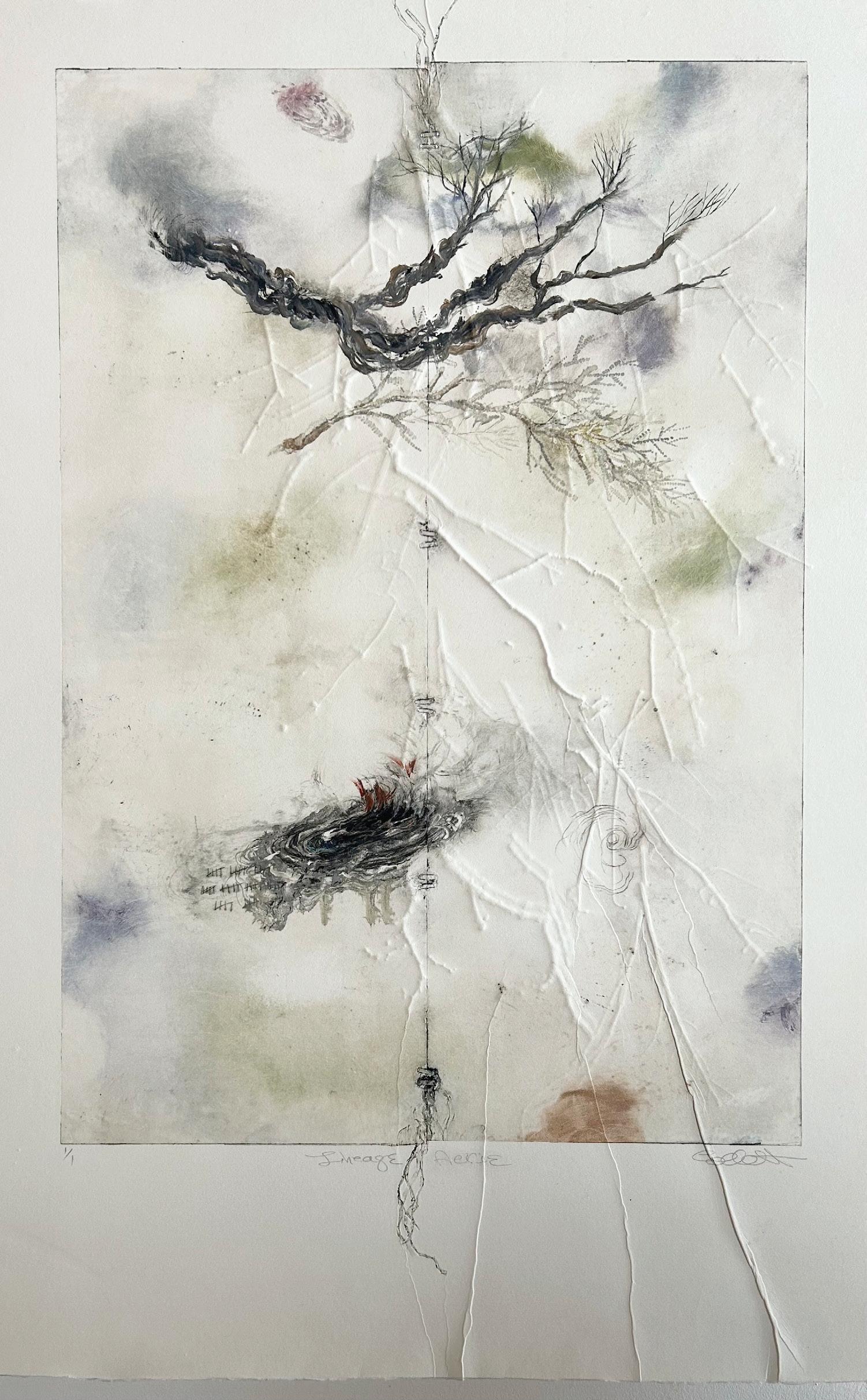
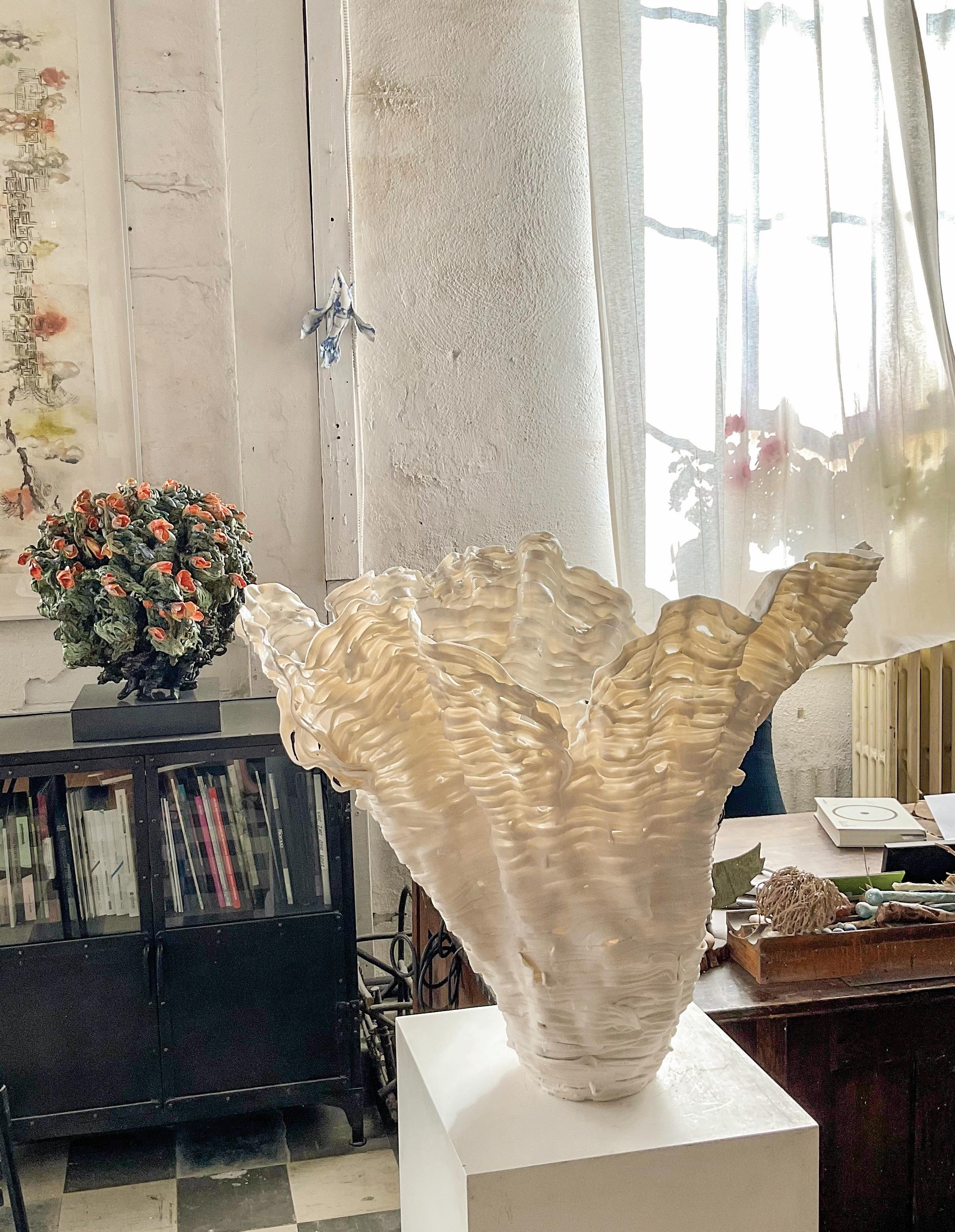
I exhibit the clay and prints together, as they feed each other. From working with clay, the blind-embossing technique inspired a sculptural approach to printmaking, with its three-dimensional relief branch work and veining embossed into the diaphanous washi paper.
The resulting “lifelines” in the clay point to the strength in our lives as collections of experience on that fine line of collapse. The Nichrome wire substructure becomes a drawing line with clay, the wire taking the clay where it could not go alone. I delight in working between these two mediums and letting ideas transform as they impress upon each other.
UPON winning the inaugural Winifred Shantz Award for Ceramics at the Canadian Clay & Glass Gallery, I completed an important residency in China. There, it struck me that the striated landscape of tea farming related to the layered landscape of our own lives. The light and shadow cast from these works remind me of the Rumi quote, “Let yourself be silently drawn by the strange pull of what you really love.” Some things we will never be able to explain. I find this so important — to remain flexible, to respect the ephemeral.
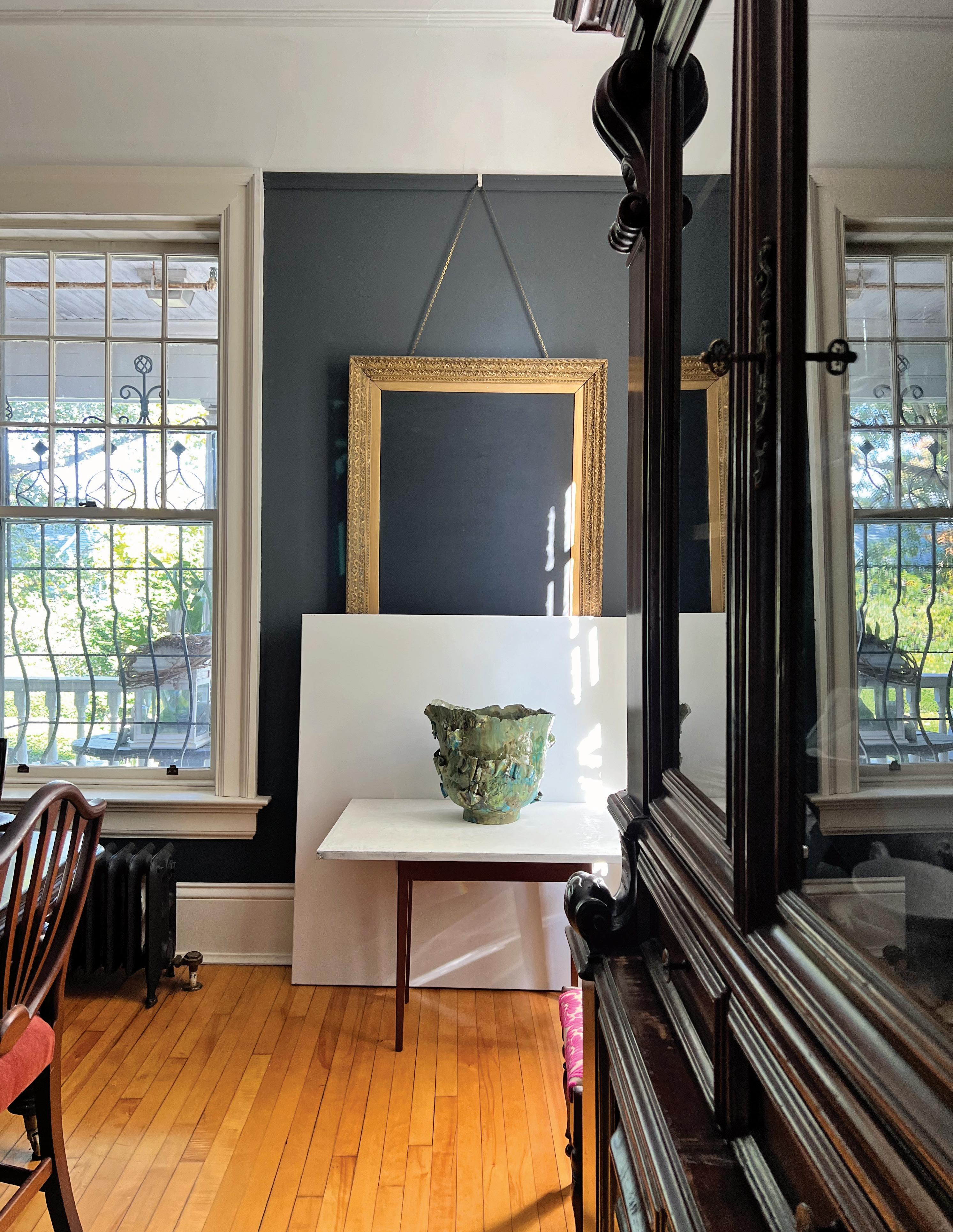
It all relates to an overriding theme of strength up against fragility, the balance of it all. My current Beacon series is a sculptural interpretation of memory with all its fragility, gaps and mysteries. The vessel-based form describes in porcelain the collected tension, and thin skins of the known and the unknown as an interior world collides with the exterior.
INthe Racine series, the use of Nichrome wire as a drawing line within the sculpture arrived at a eureka moment when the kiln techs were in the studio changing the electric kiln wiring one morning. As the used wires lay lifeless on the studio floor, I realized that they had survived the heat, and with the addition of clay could provide a substructure for the tendrils enabling me to “draw” with clay.
Drawing and printmaking are at the root of my practice. I am interested in the endless permutations of monoprinting, an instinctive approach to printmaking, more like paintings on paper with no two alike. In the process, one image is completed and printed on fine Japanese washi paper, using roofing copper as the plate substrate; and when the copper is wiped clean of ink, a new image is created. The imagery I employ is organic in nature and relates directly to the body in its large scale and reference of lungs, veins and skin.
I do not make preparatory drawings for the sculpture or the prints, rather I hone in on the spontaneous, which perhaps stems from those early plein-air painting days capturing the changing sunlight. And perhaps also from early ballet training, where I learned about being present in the moment, and about movement and gesture. All elements I try to infuse into the work.
Curator ISABELLE FISH is a craft ambassador and founder of Rue Pigalle, a community for women patrons of craft. She shares: “I believe in the intrinsic value of manual intelligence, and in the important role that artisans play in their communities. Nurturing craftspeople helps create a kinder and more connected society.” www.ruepigalle.ca
I FEEL the accomplishment of my years within the community at my Tuesday studio workshops. Seven incredible women have come together through word of mouth, forming a core group of kindness and respect, curiosity — and great works! They have returned for over 10 years now and I feel lucky to have their camaraderie and support, reminding me of the pure joys of working with clay. What projects am I preaching to my class? All that I need to learn myself …
I work hard for art, but that doesn’t mean it always brings success, nor will I be paid equally for my efforts. Everything can be going beautifully — the rent paid, the materials ordered, an iced coffee at hand, a clear day stretching before me — and yet no work gets done. Ideas don’t arrive like lightning bolts; and more often than not, it’s back to the drawing board the next day, and so it goes a daily practice. In fact, I have learned it is important to slow down in order to speed up. In a word: patience … and that takes practice. You never know what is around the corner in making your own luck.
“Had I not created my whole world, I would certainly have died in other people’s.” I have always resonated with that thought expressed by Anaïs Nin. There is a moment when you may have reached your goals and yet you are only up against yourself. I am not “fit & 40” or “fabulous & 50,” but seriously 60! My goal right now is to continue to be willing to try new avenues; take that fork in the road; walk that country lane in the studio.
The real work is to push through to the next level, and I realize that this is not dependent upon the next opportunity or portfolio sent out, or the next “brilliant” piece, but instead depends on the inner strength of you.
Felicia Lo
Photography by Joshua Yong
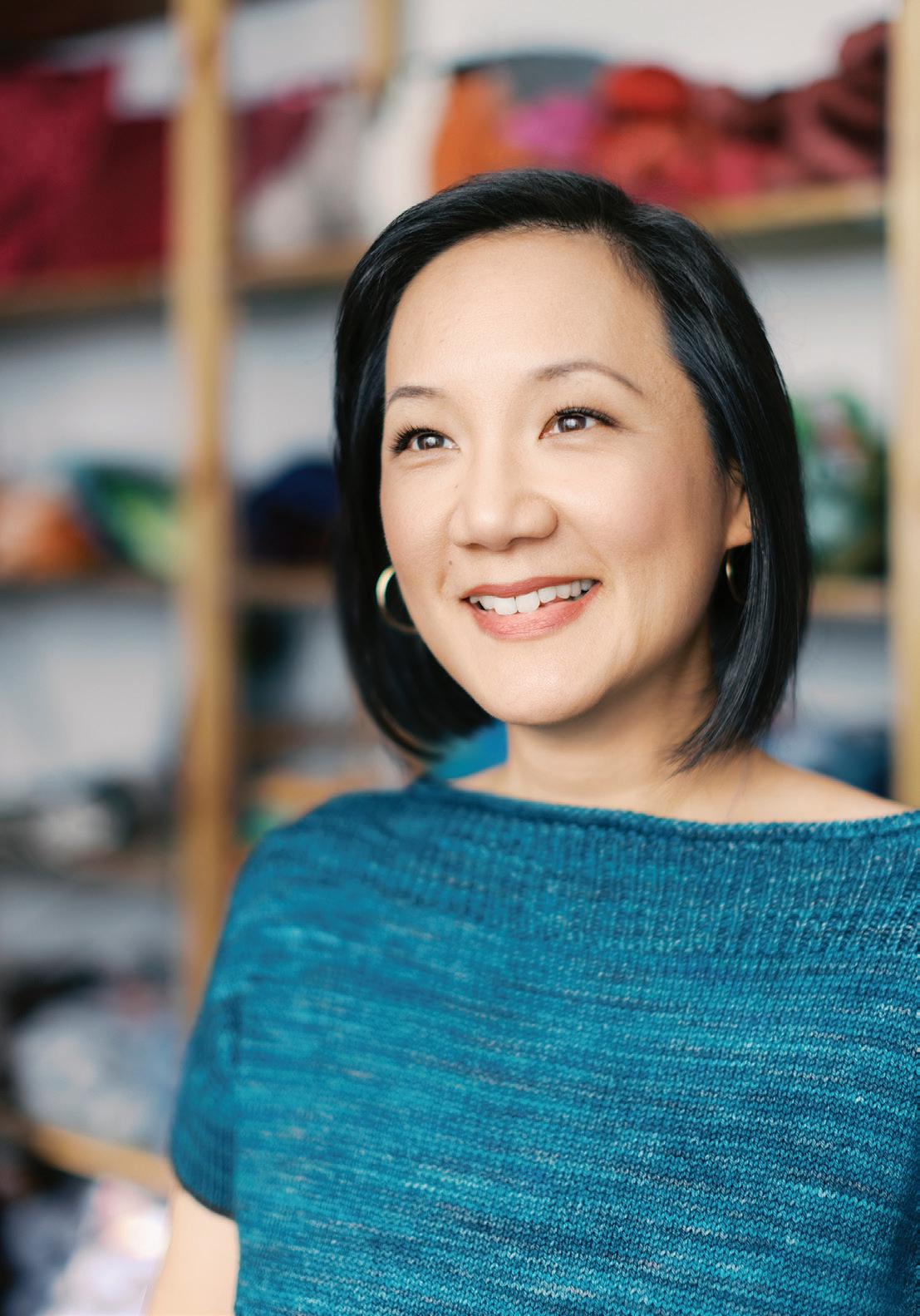
Felicia Lo is the founder and creative director of SweetGeorgia Yarns, a hand-dyed artisan yarn company, and the School of SweetGeorgia, an online learning platform and community for the fibre arts. Felicia’s creative journey is fueled by her passion for hand-dyed colour in knitting, spinning and weaving. She lives in Vancouver, Canada, with her husband and two kids.
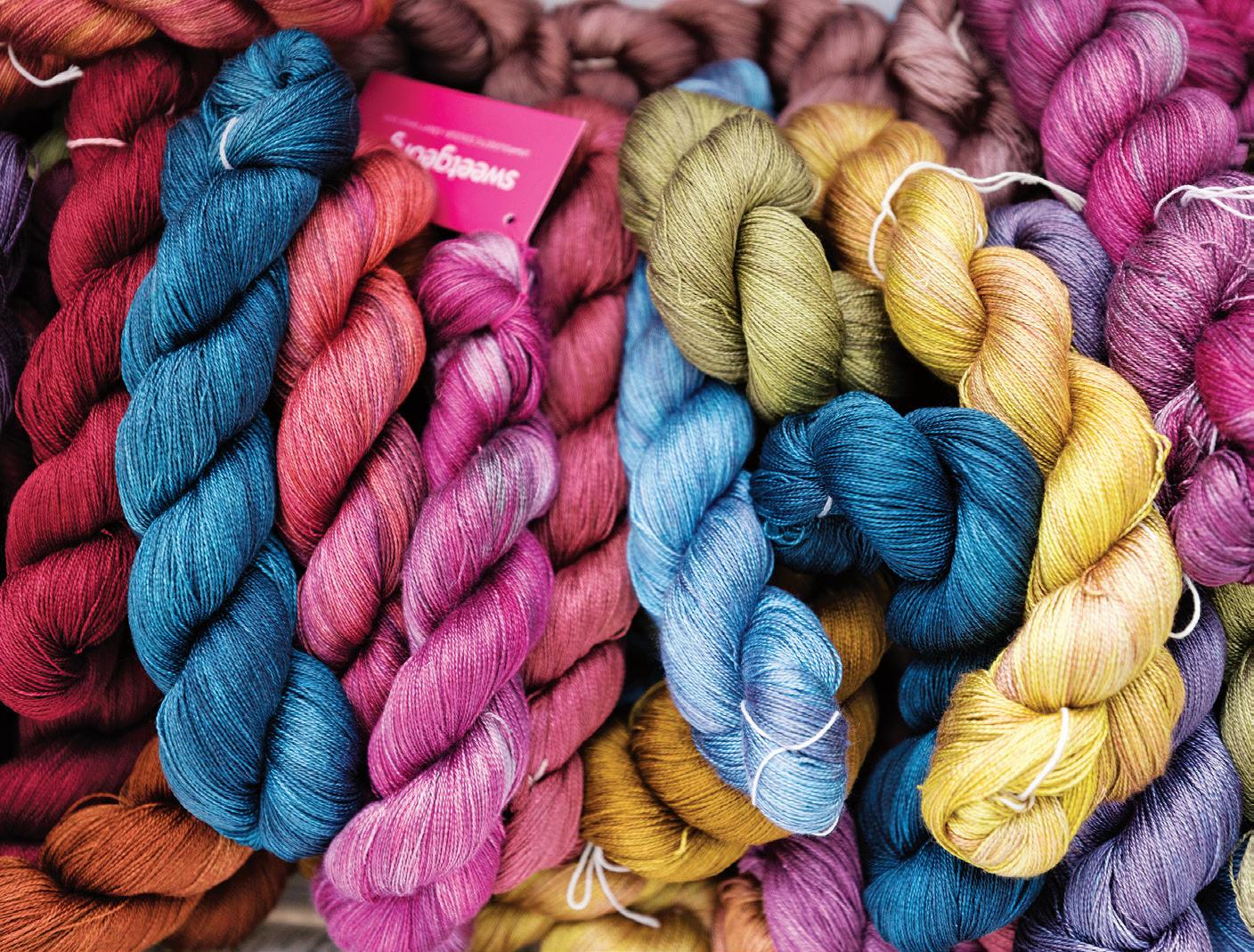
Imagine creating your own vibrant, evershifting colours on luxurious, natural fibre yarn and then transforming those yarns into gorgeous textiles and fabrics through knitting and weaving. This is the world that I’m obsessed with creating at SweetGeorgia.
I was born into a creative family. My father is a painter and printmaker; my mother is passionate about writing and has also taken up painting; and both of my brothers and I grew up surrounded by oil paints, colour, music and books. Being immersed in art, colour and music at a young age sparked my lifelong passion for colour and craft. This obsession has taken me on a creative journey that includes starting a luxury yarn company, an online fibre arts school, and a media company in the yarn and textile arts space. In 2024, we celebrated 20 years since the day I started SweetGeorgia.
When I was very young, maybe 6 or so, I watched my mother cut and sew a dress out of silky fuchsia fabric and it left an unforgettable impression on me … the idea that you could make something that didn’t previously exist. Looking back, I believe that carving out the time and space to sew this dress was such a meaningful choice for my mother. She had so many roles and responsibilities at work and at
home, but was still inspired and motivated to make something beautiful with her own hands.
Later, when I was around 12, I watched my father make a career change — leaving a structured, stable career to completely dedicate his life to becoming a painter and printmaker. Again, this reinforced for me the significance of self-expression as a way of life.
In fourth or fifth grade, I sent away for a black and white pamphlet to learn how to knit. By seventh grade, I had finished knitting my first sweater. All through high school I sewed my own clothes; and at 16, I started my first business, sewing clothes and doing alterations around town.
Istarted a graphic design business at 21 while I was studying and finishing my five-year degree at university. During this time, I put down my knitting needles to focus on school. But in 2004, after being out of school and working for a few years, I picked knitting back up and almost immediately became interested in learning to spin my own yarn, dye wool fibre, and weave on a floor loom.
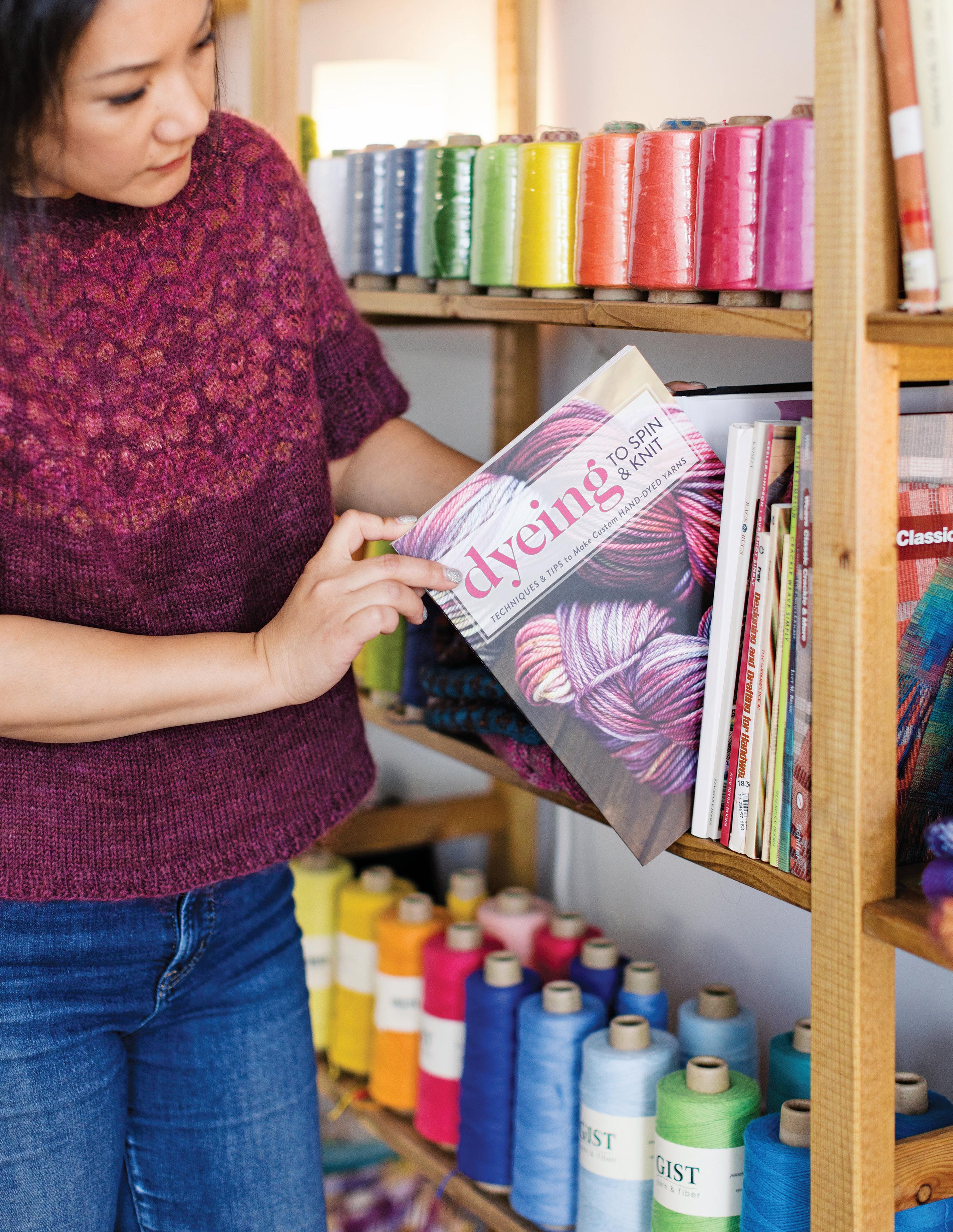
All my newfound skills were so fascinating to me and I wanted to share my enthusiasm, so I started a blog to document my projects and learning experiences. Never did I imagine that my curiosity and passion for just “making things” would lead me into this business and life. I’m incredibly grateful for all the opportunities, mentors, teachers and experiences that the yarn and craft community has brought me over the years and I wish to share everything I’ve learned with others as well.
I call SweetGeorgia the “home for the multicraftual maker” because we encourage and empower people to explore the multiple crafts involved in transforming fibre to fabric — everything from preparing and dyeing wool fibre from a sheep, to spinning fibre into yarn, to knitting, crocheting or weaving the yarn into cloth.
My vision for SweetGeorgia Yarns is to create visually stunning colours on luxurious, highquality yarns and spinning fibres. The goal for the School of SweetGeorgia is to produce engaging online video-based educational courses and content around knitting, crochet, spinning, weaving, dyeing, and more — we support this entire spectrum of the fibre arts.
On any given day, we might have dyers on our team preparing and creating yarns destined for yarn shops around the world, while others are filming new content with guest instructors. Some of us might be photographing products for our online store and designing or editing patterns, and I might be writing or filming new content for our YouTube channel or school. With the multiple activities that our team and I handle, we need a variety of creative spaces, so we maintain a big studio for SweetGeorgia and another set of spaces at my home.
The SweetGeorgia Studio
Currently, for SweetGeorgia Yarns, we have a 3,500-square-feet production dyeing and content studio that is located in a peaceful spot in south Vancouver, right next to the Fraser River. The team and I share a quiet view of the river and trees just outside our windows. The sound and sight of the river offer a moment of meditation every time I stop to look.
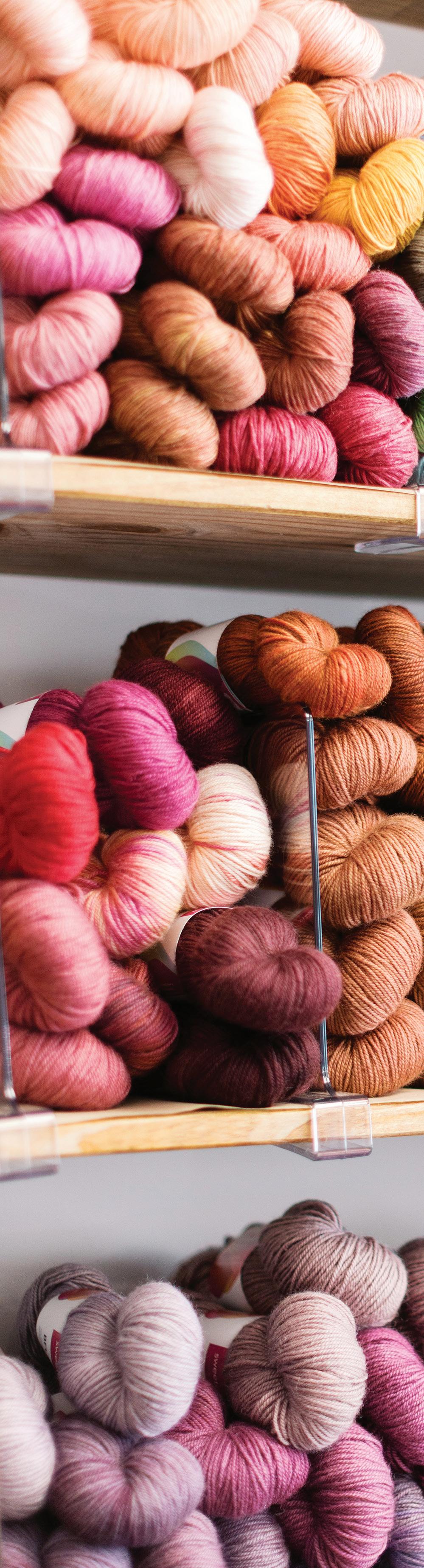
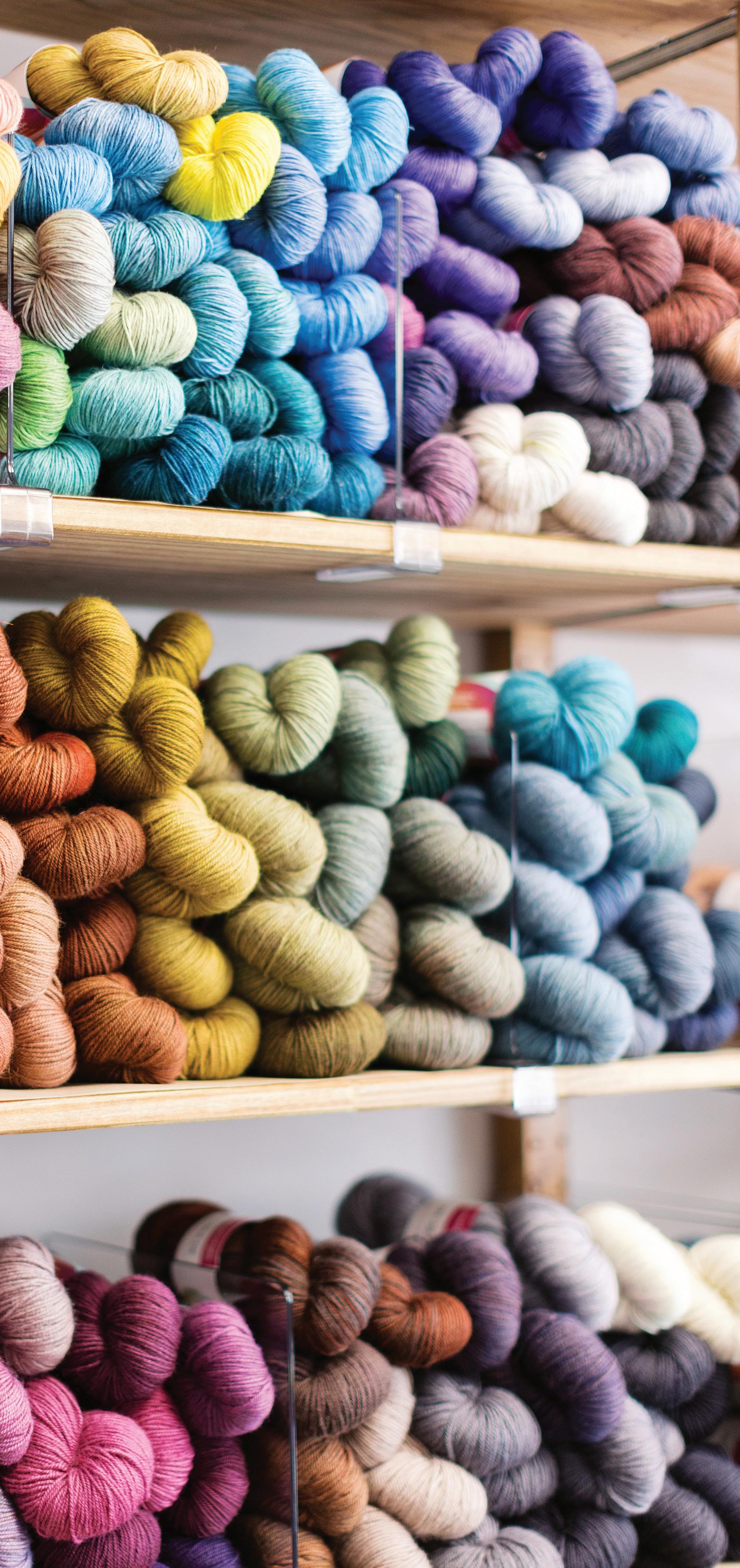
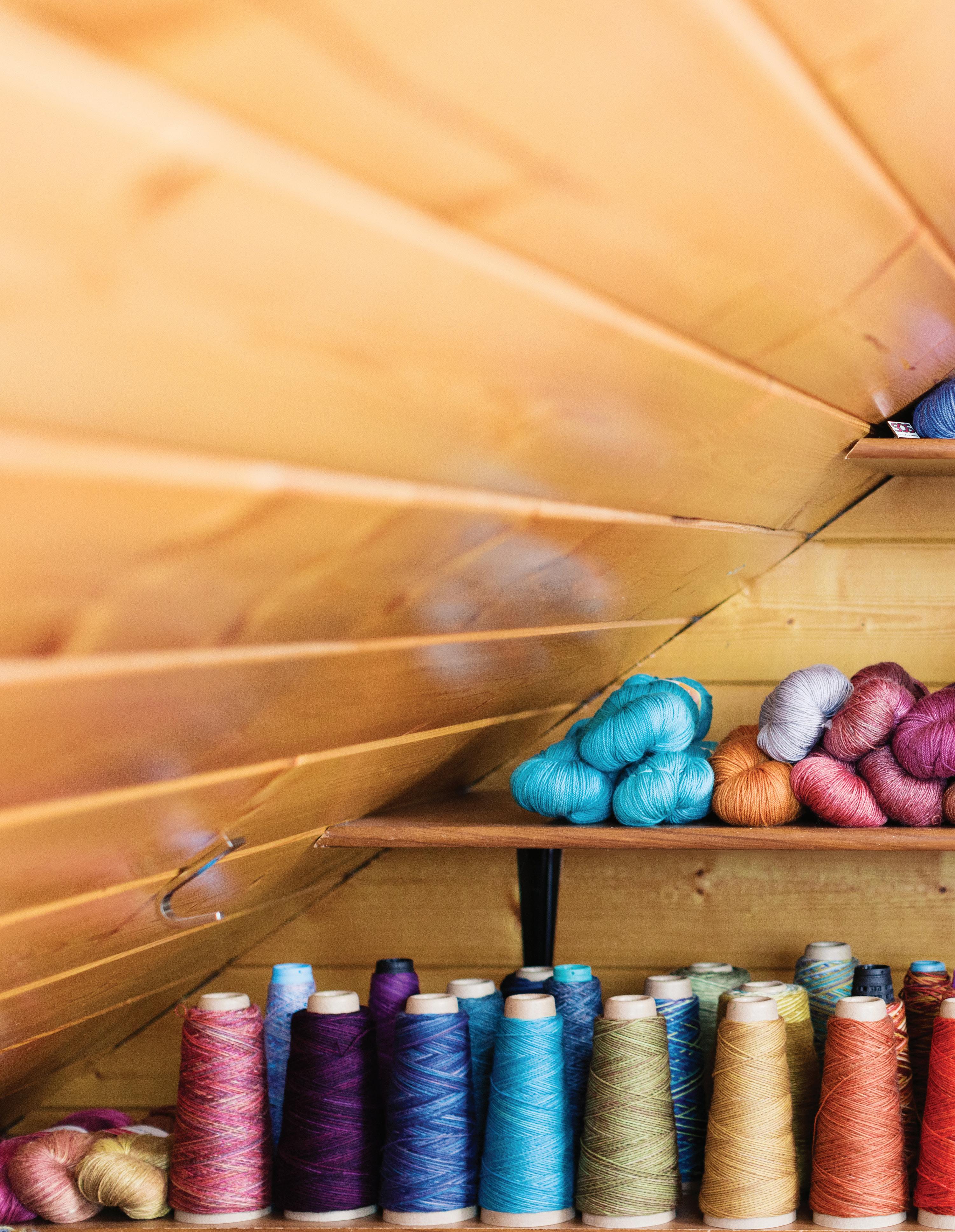
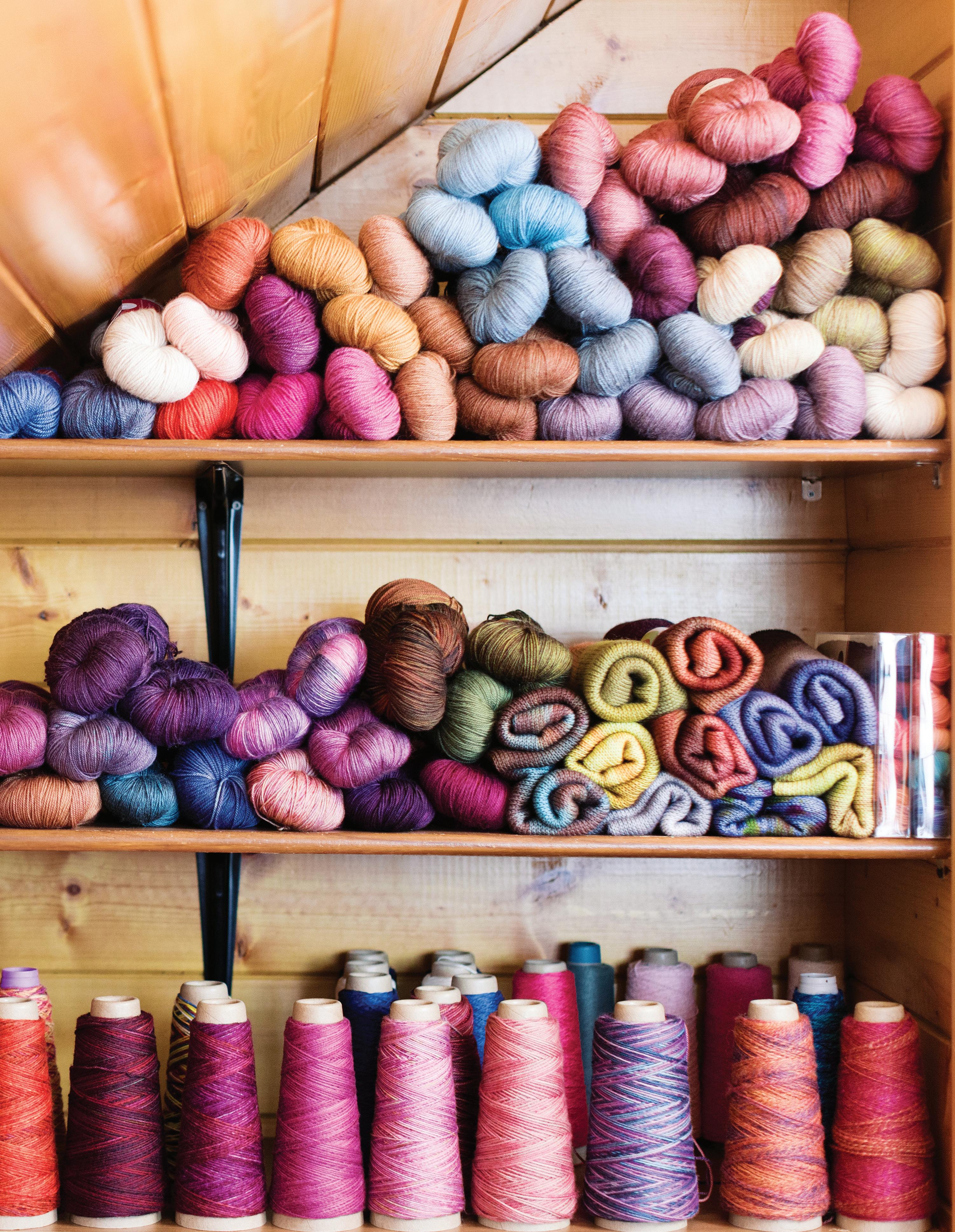
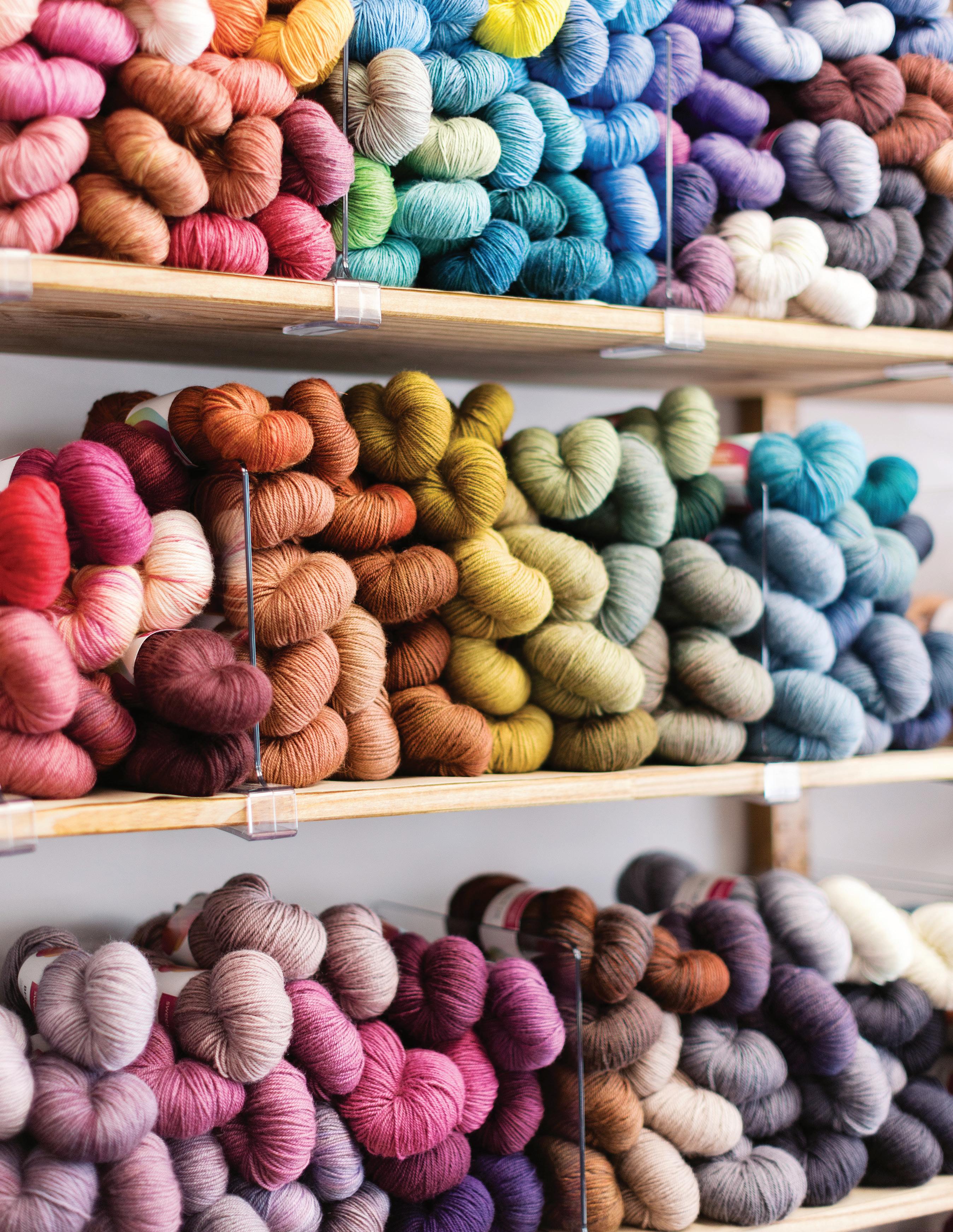
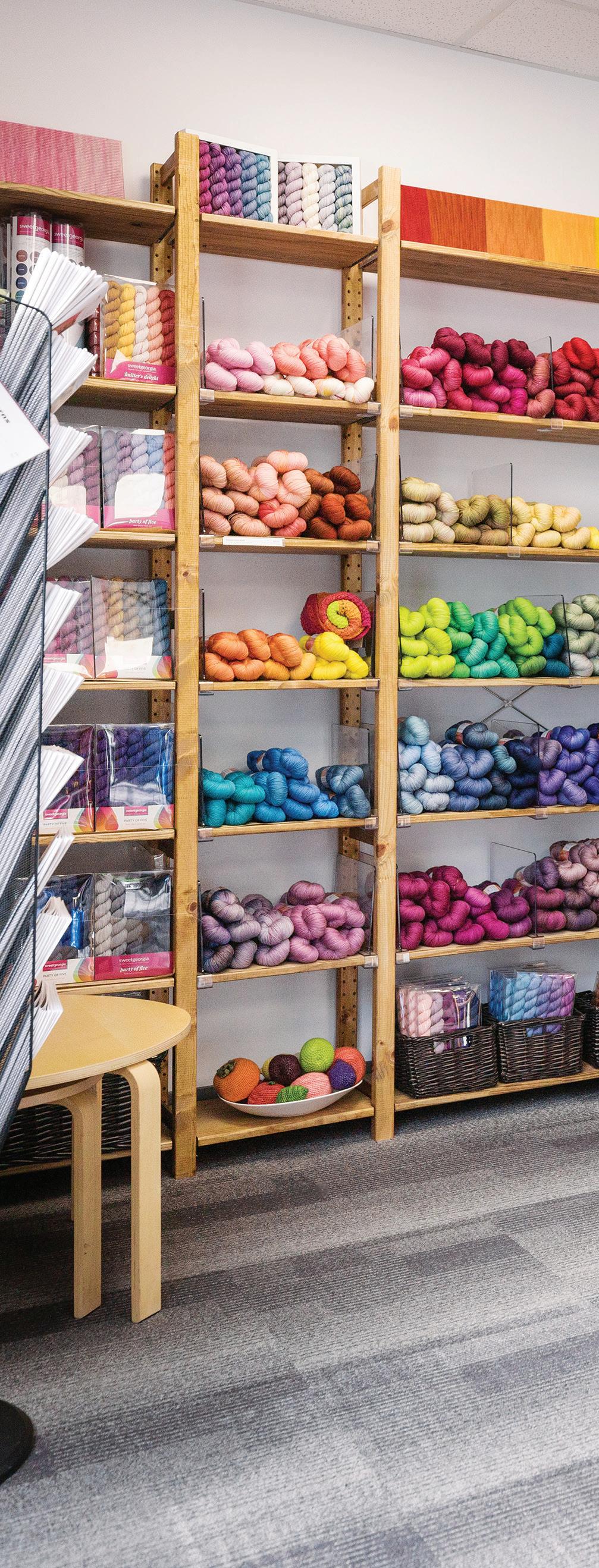
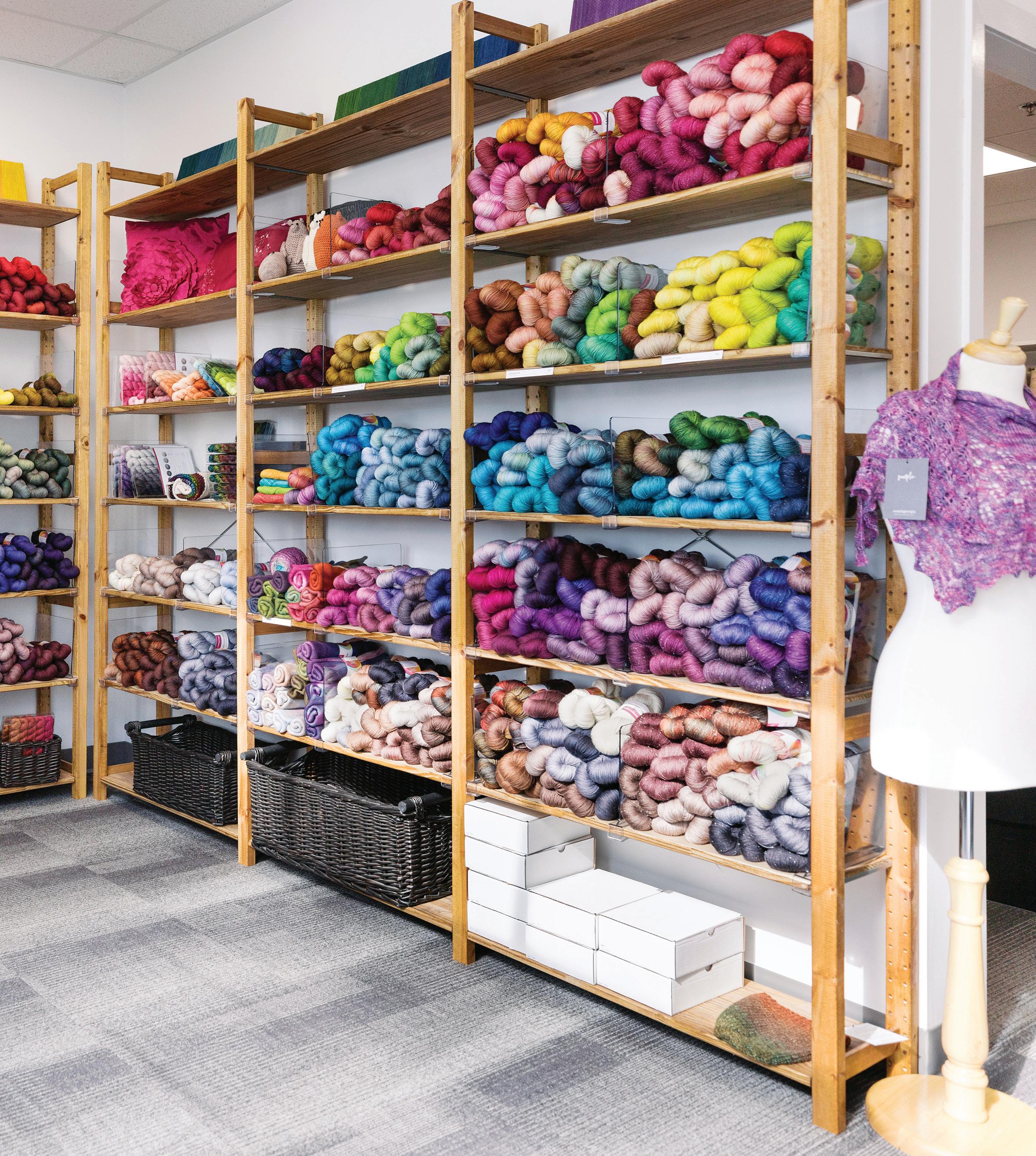
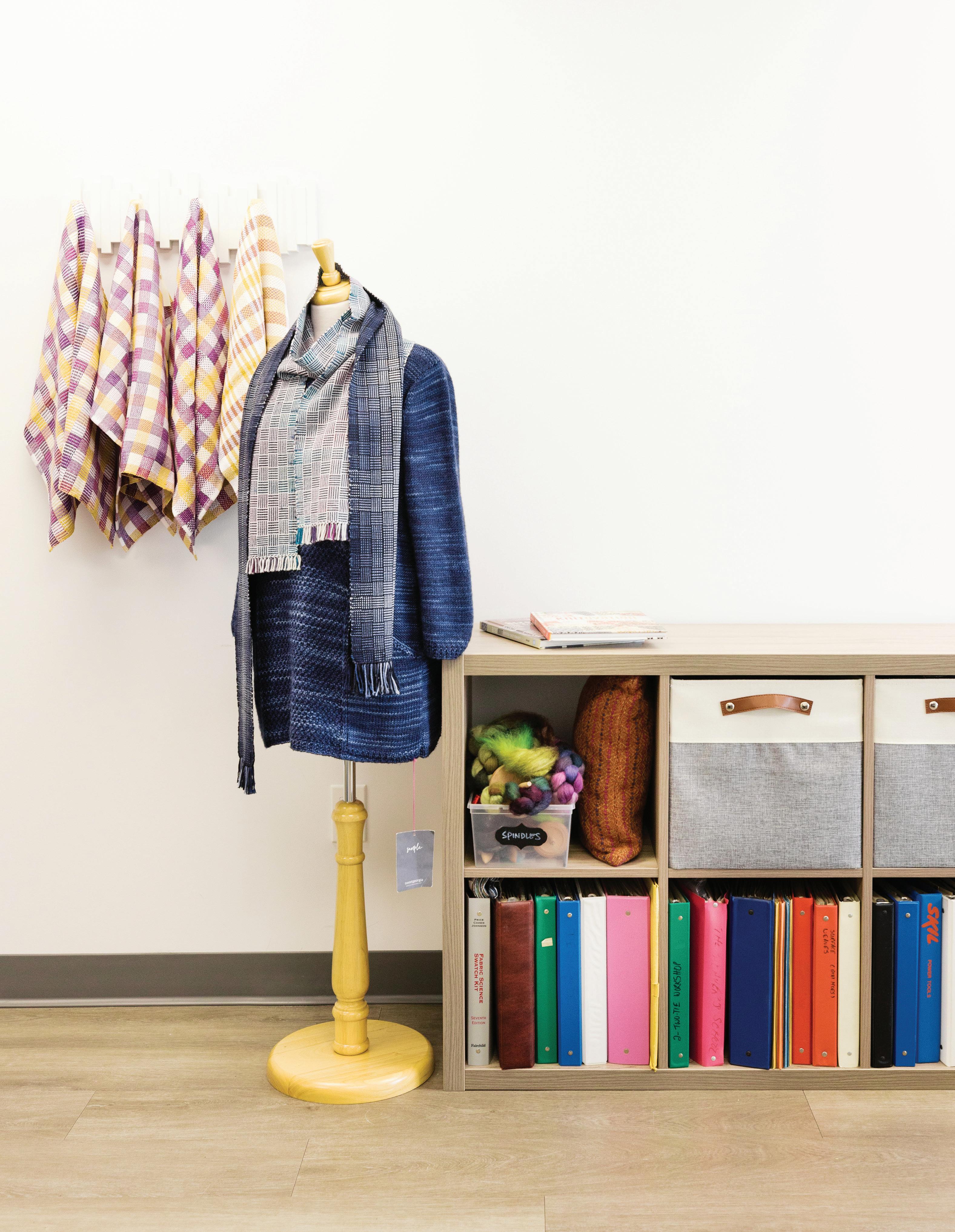
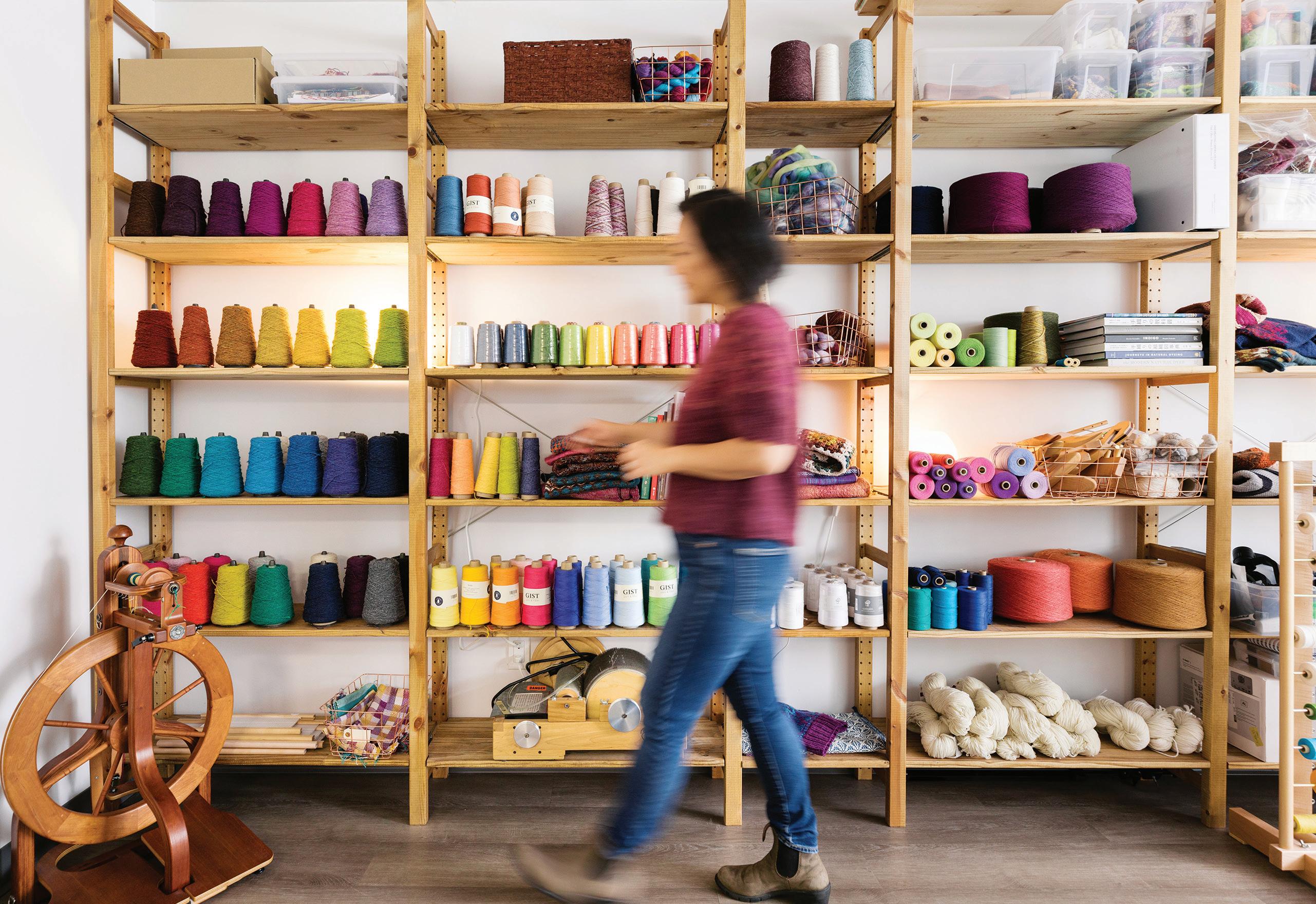
At the front entrance of our studio, we have our own yarn shop. The SweetGeorgia “front shop” is open to the public and has welcomed many knitters traveling to Vancouver. Every shelf is filled from top to bottom with our SweetGeorgia hand-dyed yarns. You can find every yarn line in most every colour that we dye. The biggest dream for me has always been to
offer spinning and weaving yarns, and tools and equipment through our front shop, so the dedicated space also has many different weaving looms and spinning wheels.
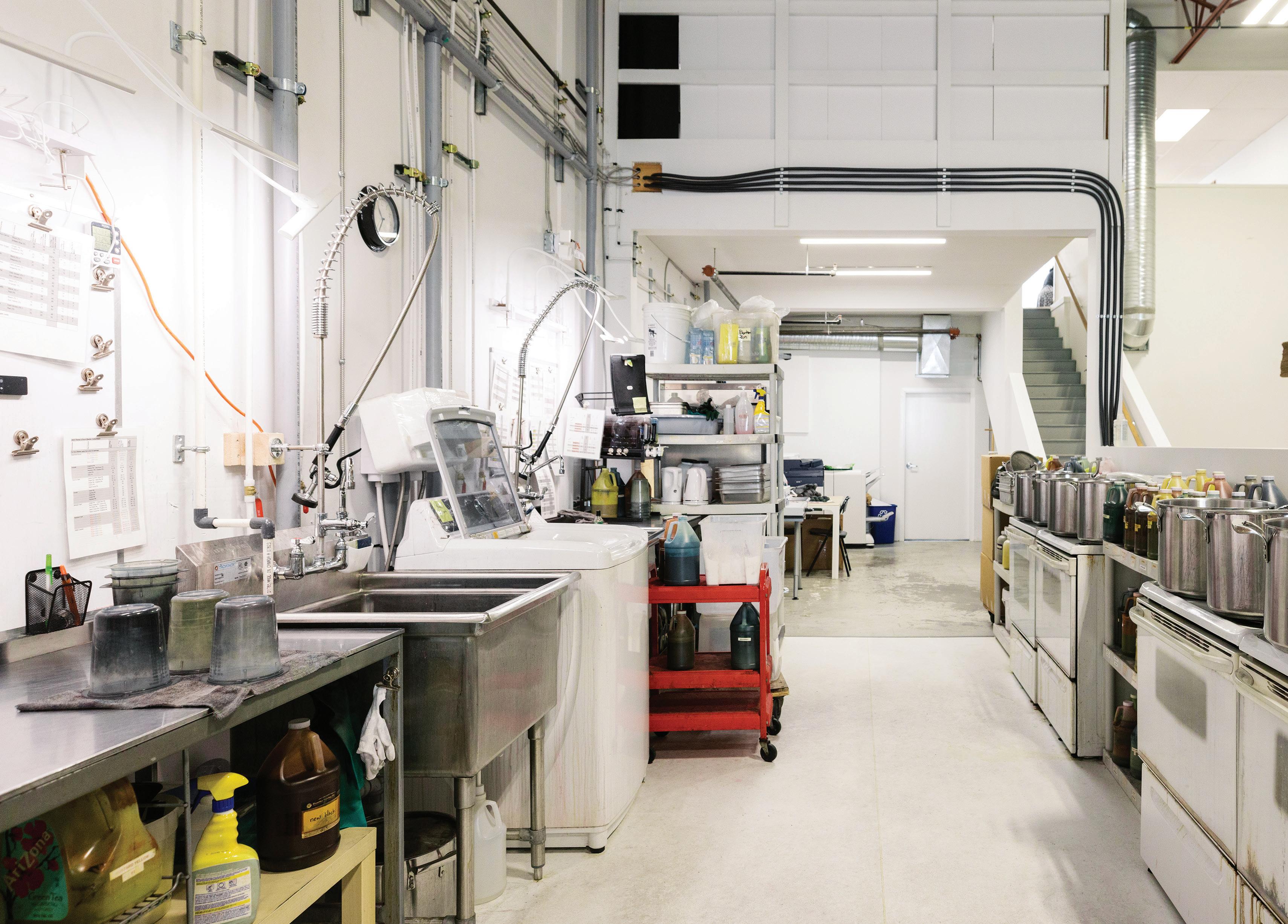
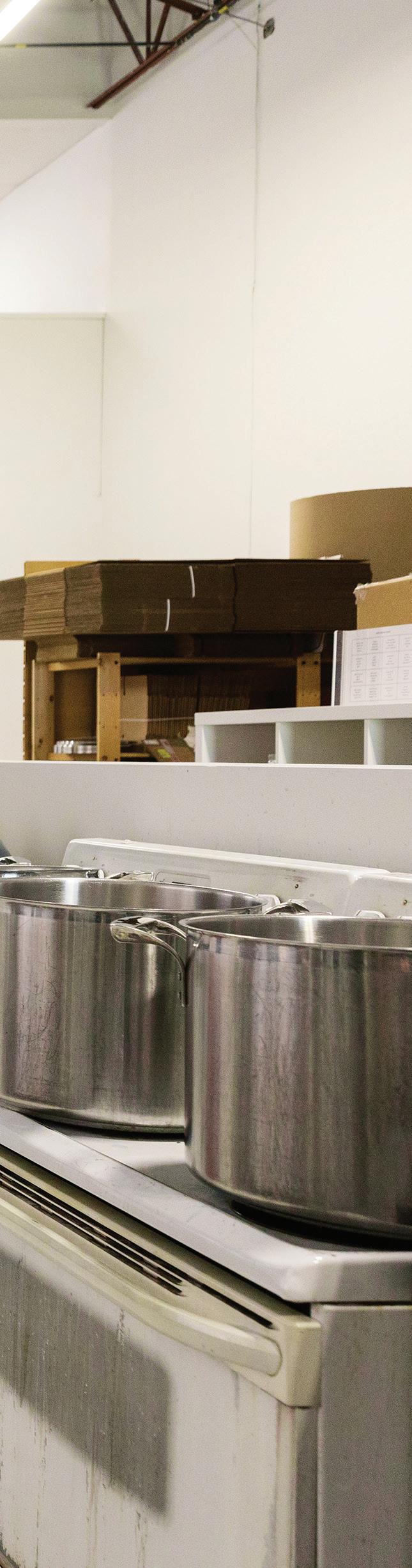
In the heart of our riverside studio, our team of production dyers creates hand-dyed yarns and spinning fibres in our custombuilt dye kitchen. Stocked with giant commercial-grade pots and pans, dyes and un-dyed yarn, this is the seventh iteration of our production dye studio, as we’ve had to move and rebuild the studio many times over the past 20 years. With each new studio build, we have improved the design of our workspace so that it is more ergonomic and efficient for our dyers.
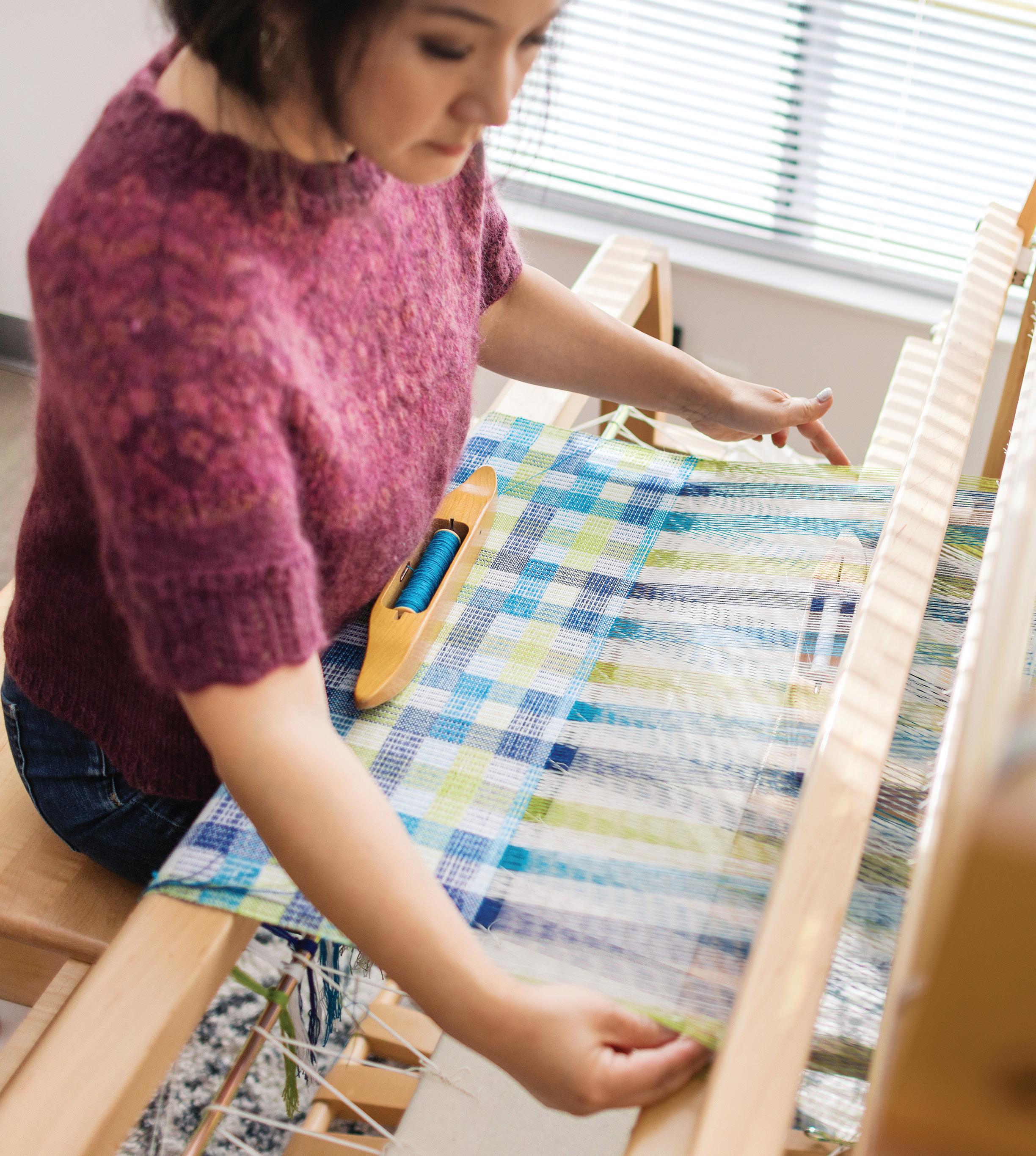
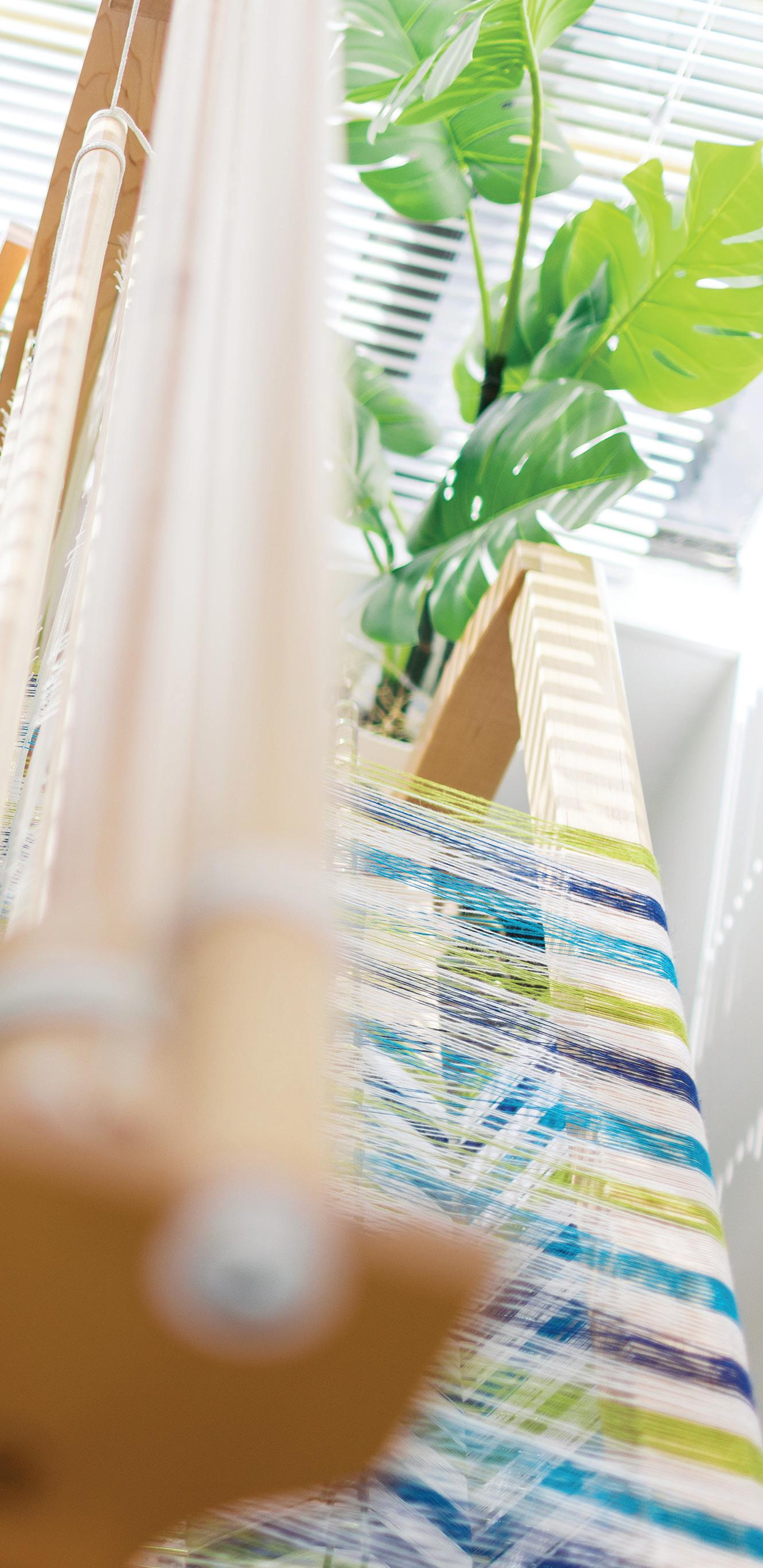
Upstairs, we have our open workspace and the photography and film studio where we produce many of our video courses for the school and shoot natural daylight photos for our websites. The film space doubles as my office and loom room, as a third of the room is taken up by a 45-inch-wide Leclerc Mira II counterbalance floor loom.
“A creative life is an amplified life. It’s a bigger life, a happier life, an expanded life, and a hell of a lot more interesting life. Living in this manner — continually and stubbornly bringing forth the jewels that are hidden within you — is a fine art, in and of itself.”
— Elizabeth Gilbert, Big Magic
The Home Studio
For me to do my best creative work, I need to balance team collaboration with absolute quiet and solitude. So, on days when I’m not at the riverside studio, I’m working from my creative spaces at home.
In 2013, when I was seven months pregnant with our first child, my husband and I went looking for a home for our family. After weeks of visiting open houses, we stumbled upon a house with a beautiful finished attic space, lined from floor to ceiling in wood panels. The original owner had built the house himself, finishing the
attic with two distinct rooms, each about 350 square feet in size. The seller was using one of the attic rooms for yoga, but when I saw it, I just knew (naturally) it was destined to become my craft room!
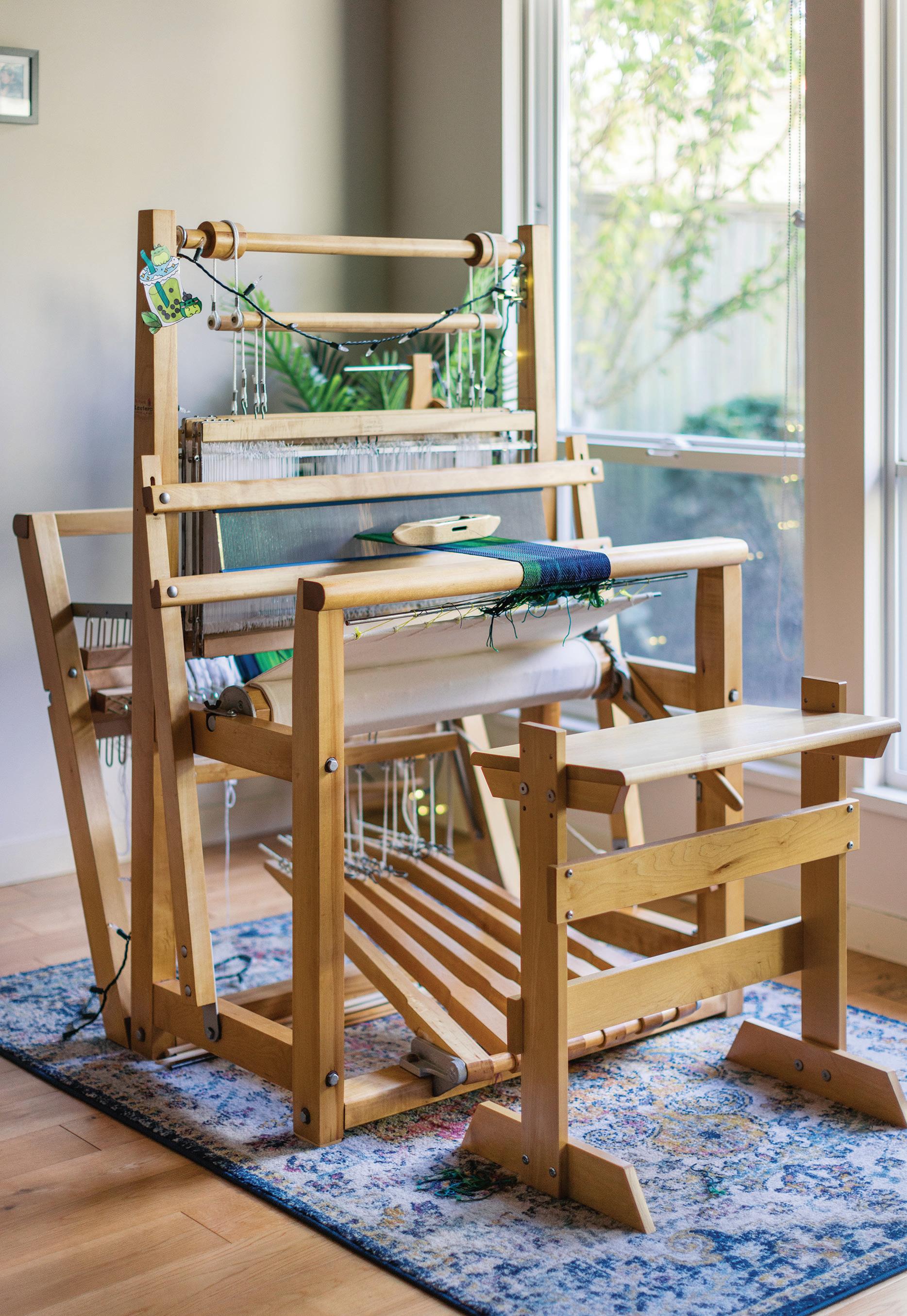
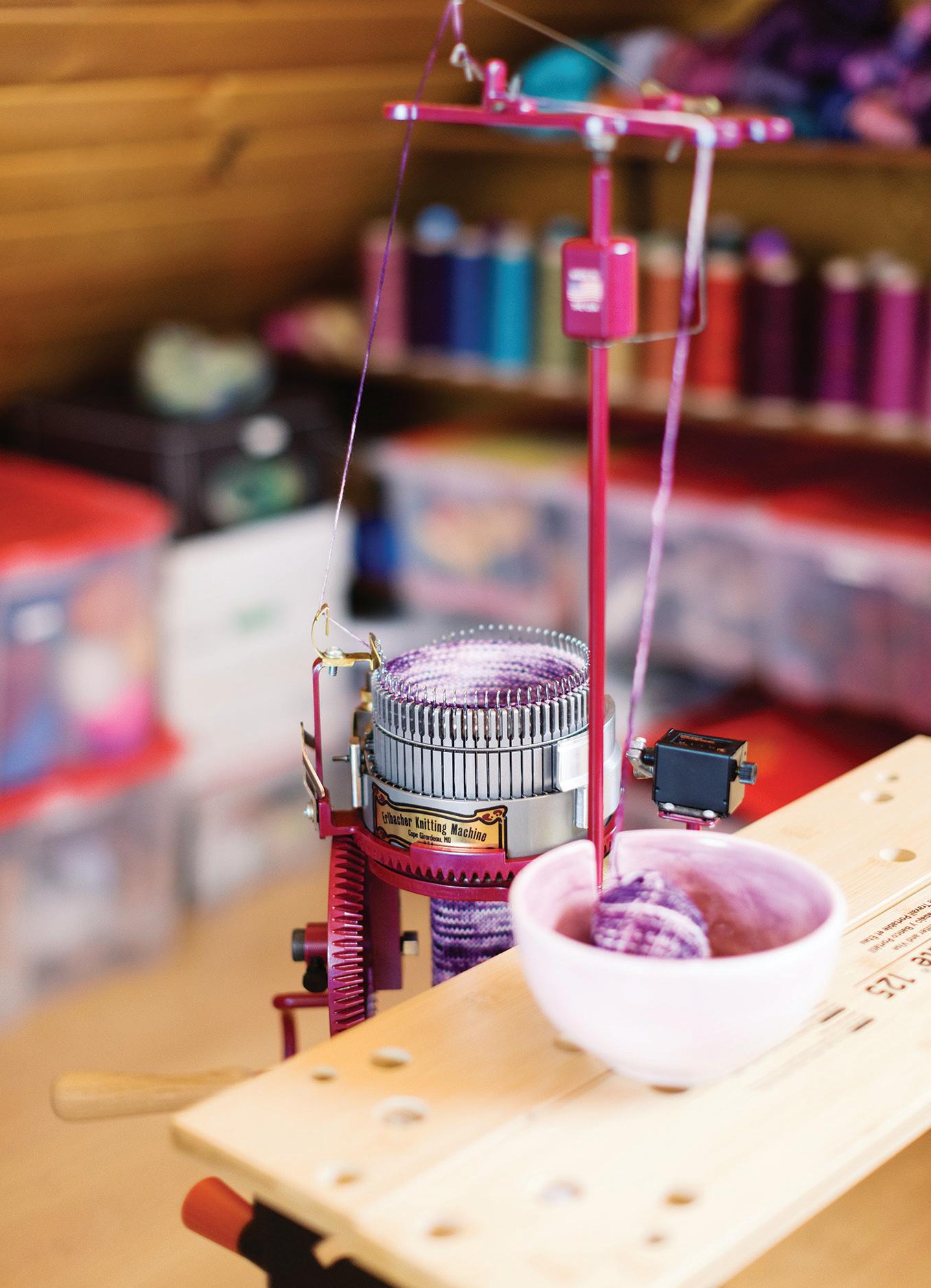
This room is my sanctuary. It is a secluded space where I can explore different crafts, store favourite supplies, and safely leave projects that are still in progress. The craft attic now hosts a pair of Louet Spring countermarch weaving looms, a sewing machine, several vintage and rescued knitting machines, all of my knitting yarn stash, and now also my circular sock knitting machine.
When my two kids were very little, we spent hours in this attic. Maybe I was weaving and they were drawing or playing with Legos … or maybe we were sorting yarn colours together … or sometimes they would help me wind yarn into balls for knitting. I wove a baby wrap for my daughter and later taught her how to weave here. And my son helped me film my first videos in this space. This attic has become a very special place for making things and is full of happy memories.
Finally, one of my favourite spots in the whole world is sitting at my Leclerc Fanny counterbalance loom next to the window in the dining room (I just slide our dining table over a little bit to make room!). This loom is an older one, built in 1968, that I bought from a marketplace in Ontario and had shipped to Vancouver. It’s one of my proudest achievements that I completely restored the loom, sanding it down to bare wood, refinishing and rebuilding it. It is a special 27-inch-wide size that isn’t made anymore, and the relatively smaller width fits beautifully next to the window.
When I weave here during the quiet morning hours, it feels incredibly meditative and restorative. And when I weave here in the evening, I’m surrounded by the sounds and activities of my family. My kids see me doing something I am so passionate about, but I am still present and available to them.
To Have a Room of One’s Own
I’ve always said that I am living my ultimate dream — to make things that I love, share those things through photos and videos, and then teach others to also make things they love. This is creatively satisfying on so many levels for me.
I’ve always believed that a creative space is meant to be a sanctuary — both physical and mental. I believe in the idea of having a room of one’s own. It’s the necessity of carving out both time and space to honour your creative soul and feed your spirit. The SweetGeorgia studio and my spot at my weaving looms and knitting machines are my sanctuaries — physical spaces that are quiet, warm and inviting, and also create space in my mind for me to chase clear thoughts, new ideas and even more inspiration.
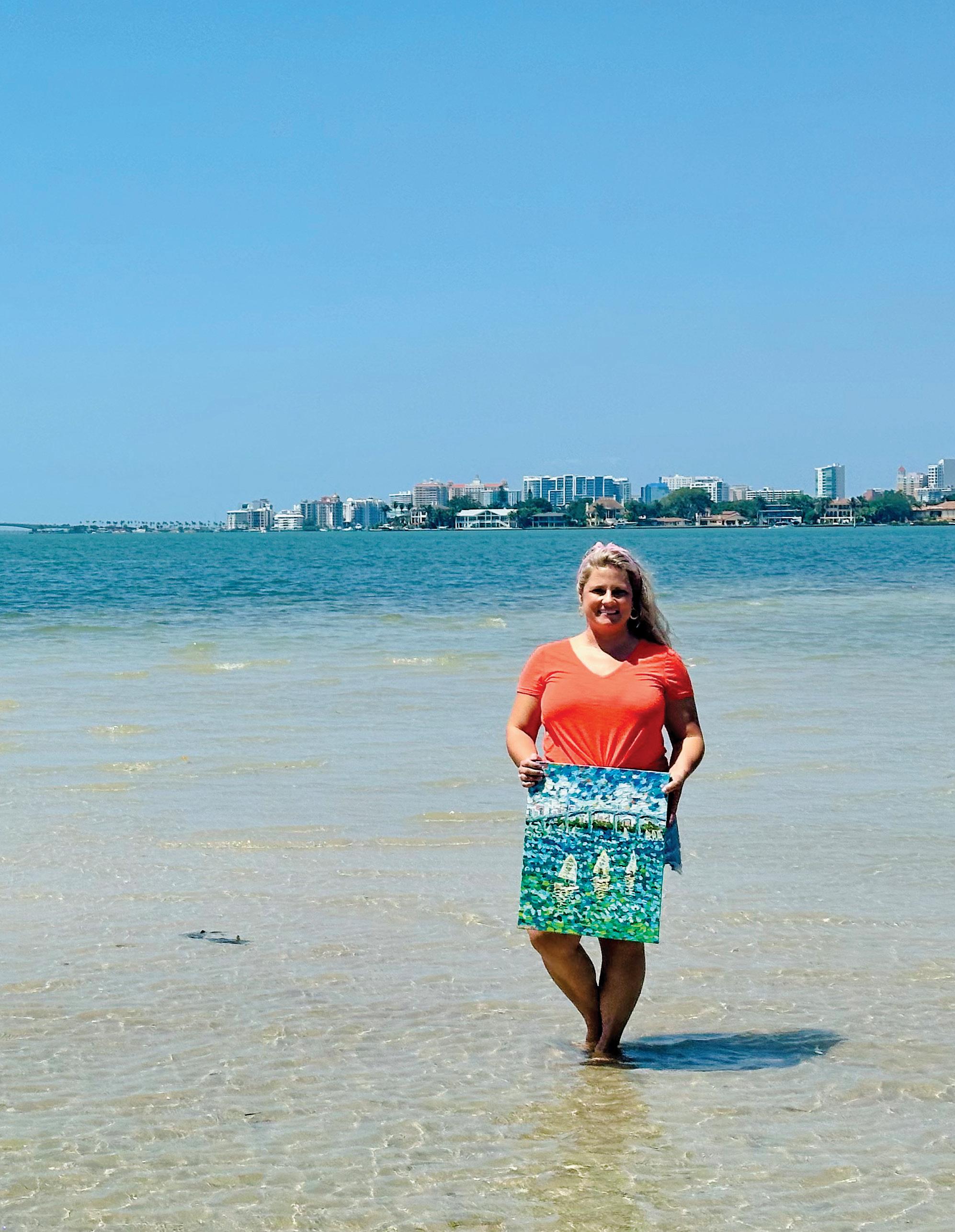
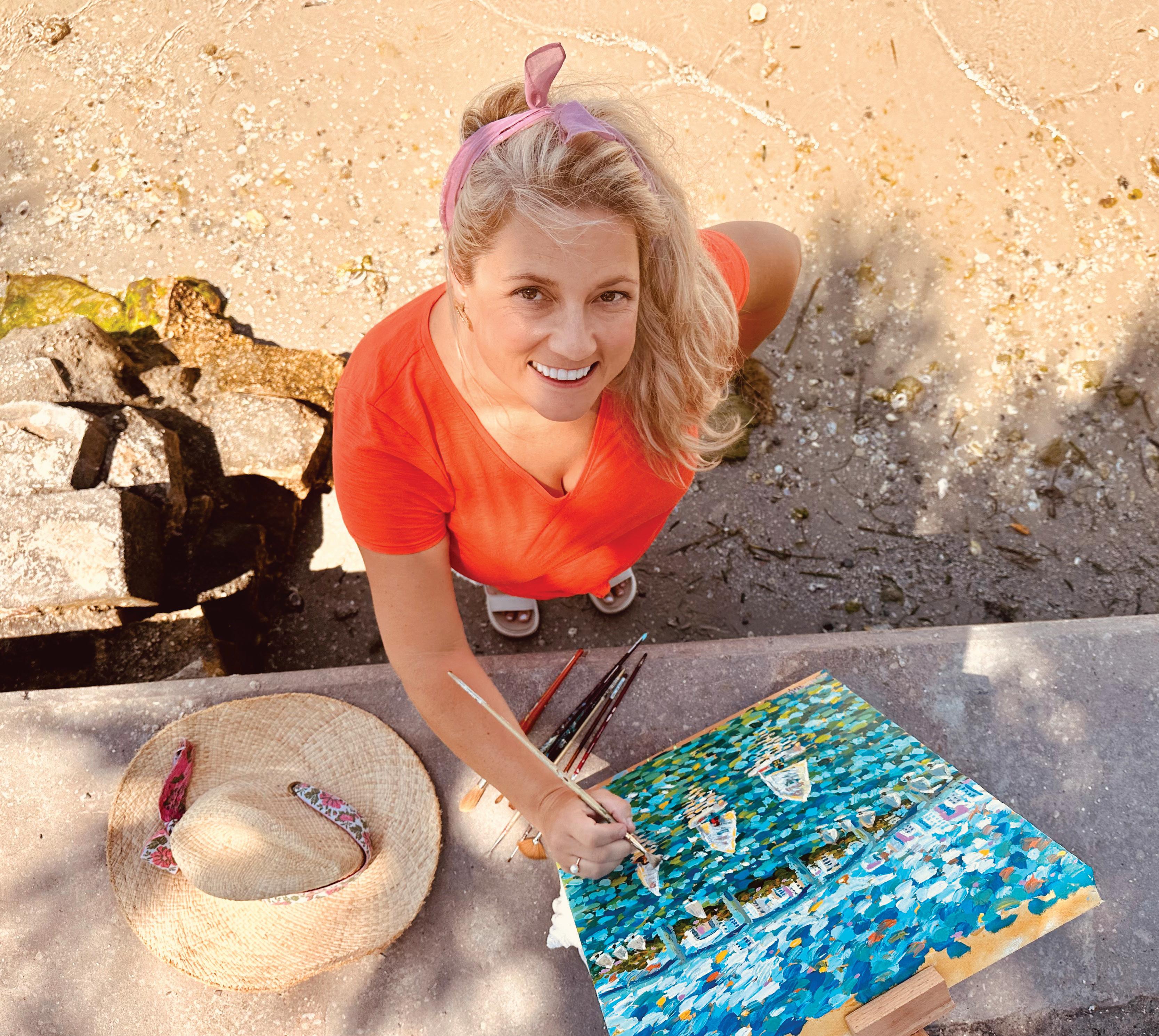
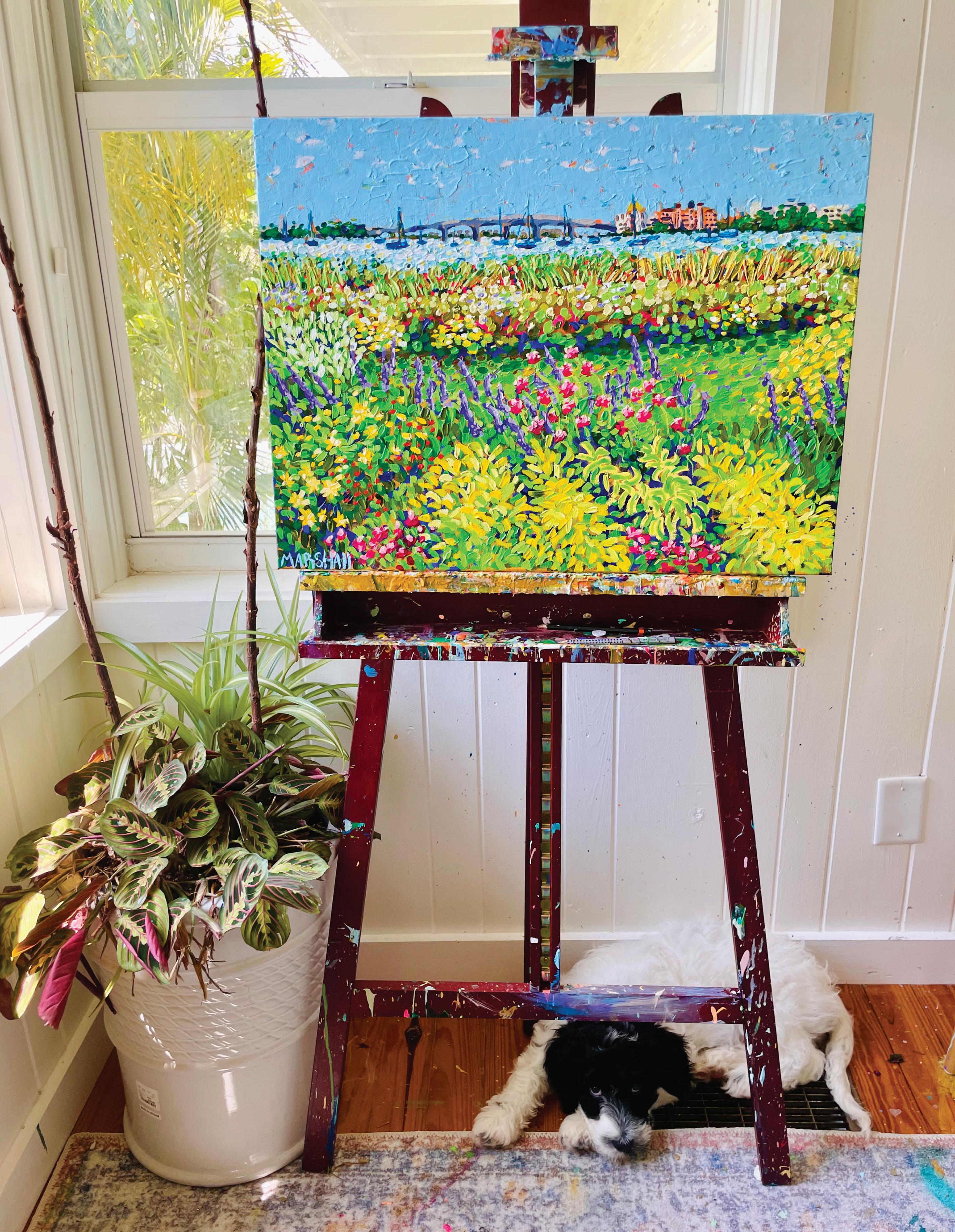
Lauren Marshall is a fine artist and illustrator in Siesta Key, Florida. Kansas-born, Paris-trained, and a Ringling Art College graduate, she is now on a mission to inspire others to join her on her ocean conservation mission with her impressionist coastal-inspired art.
The Studio Before the Storms
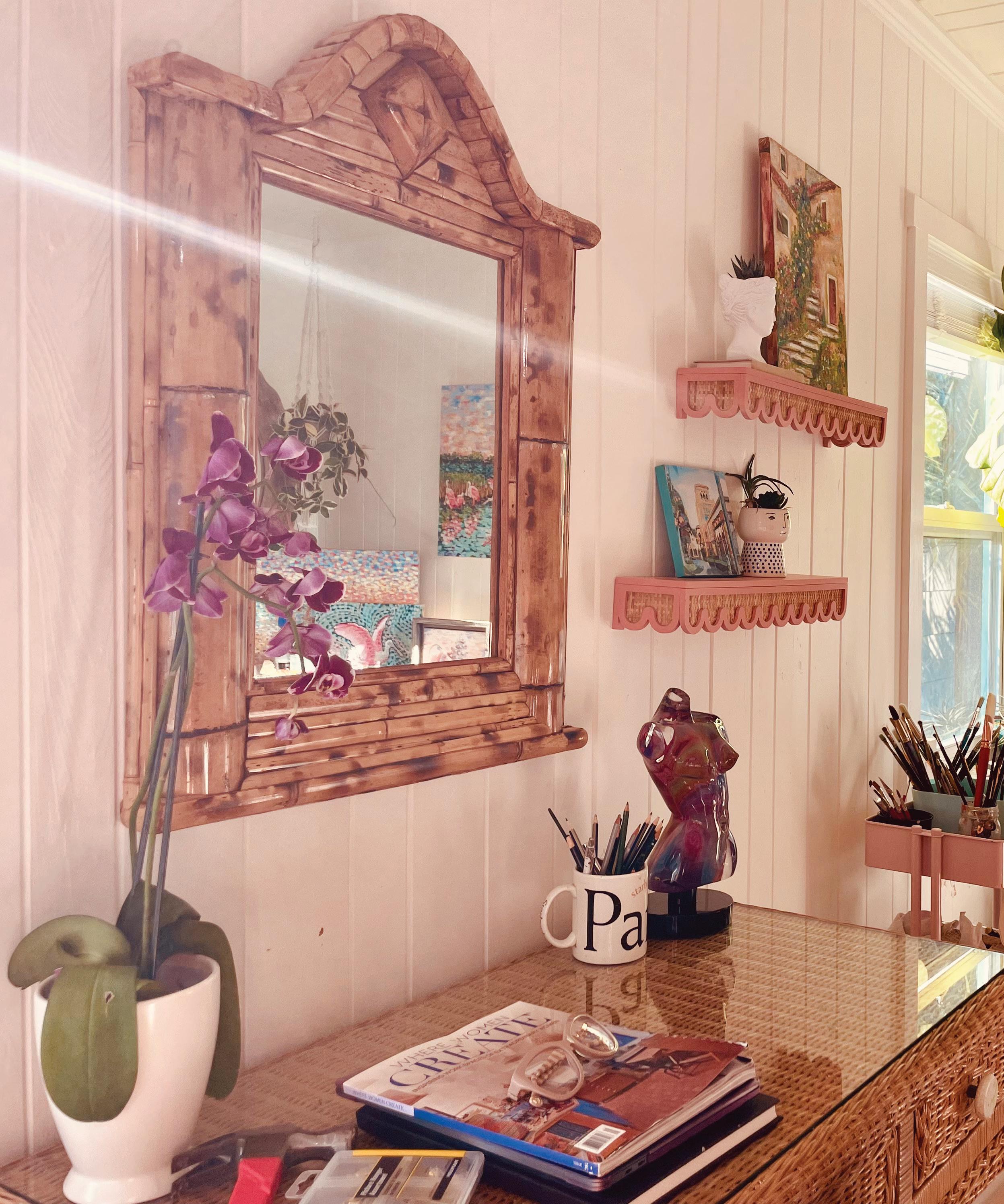
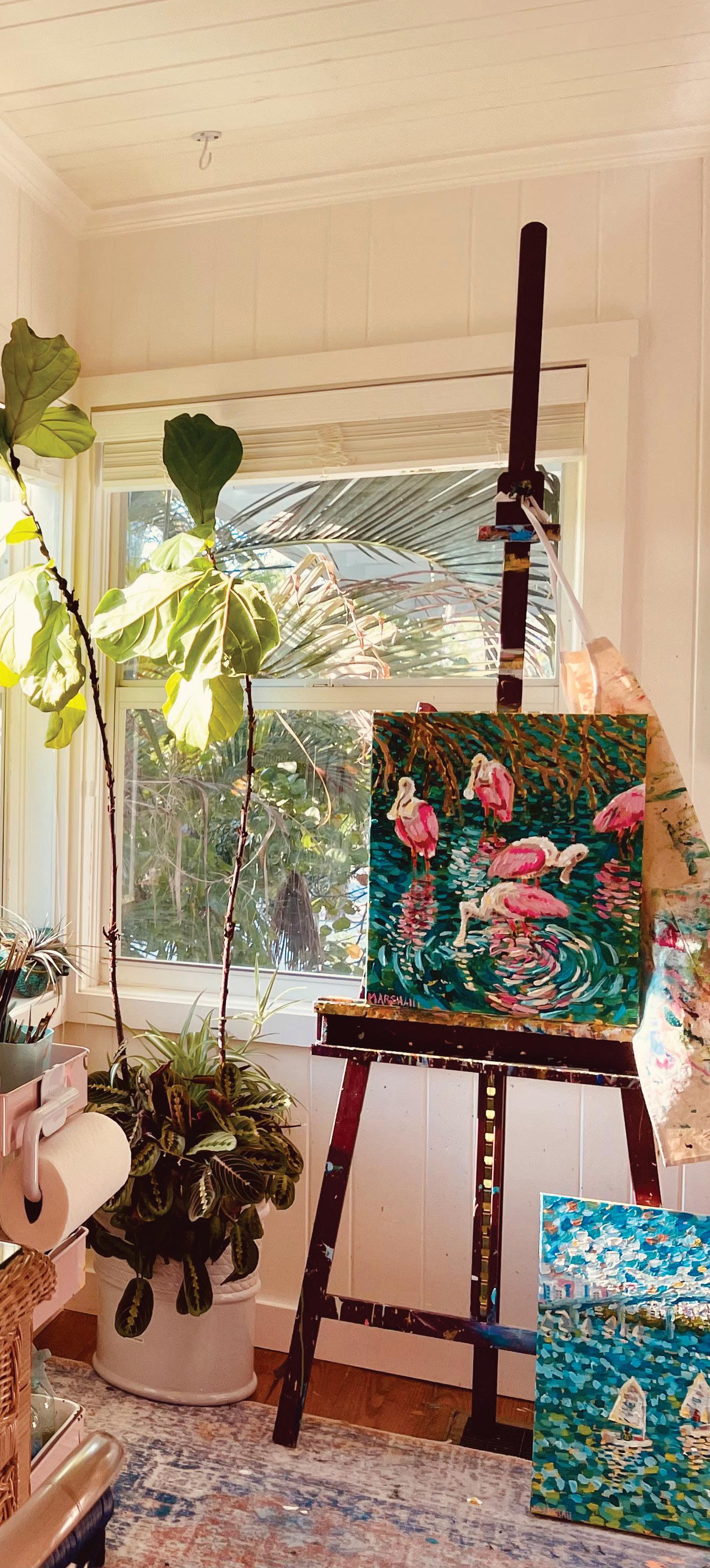
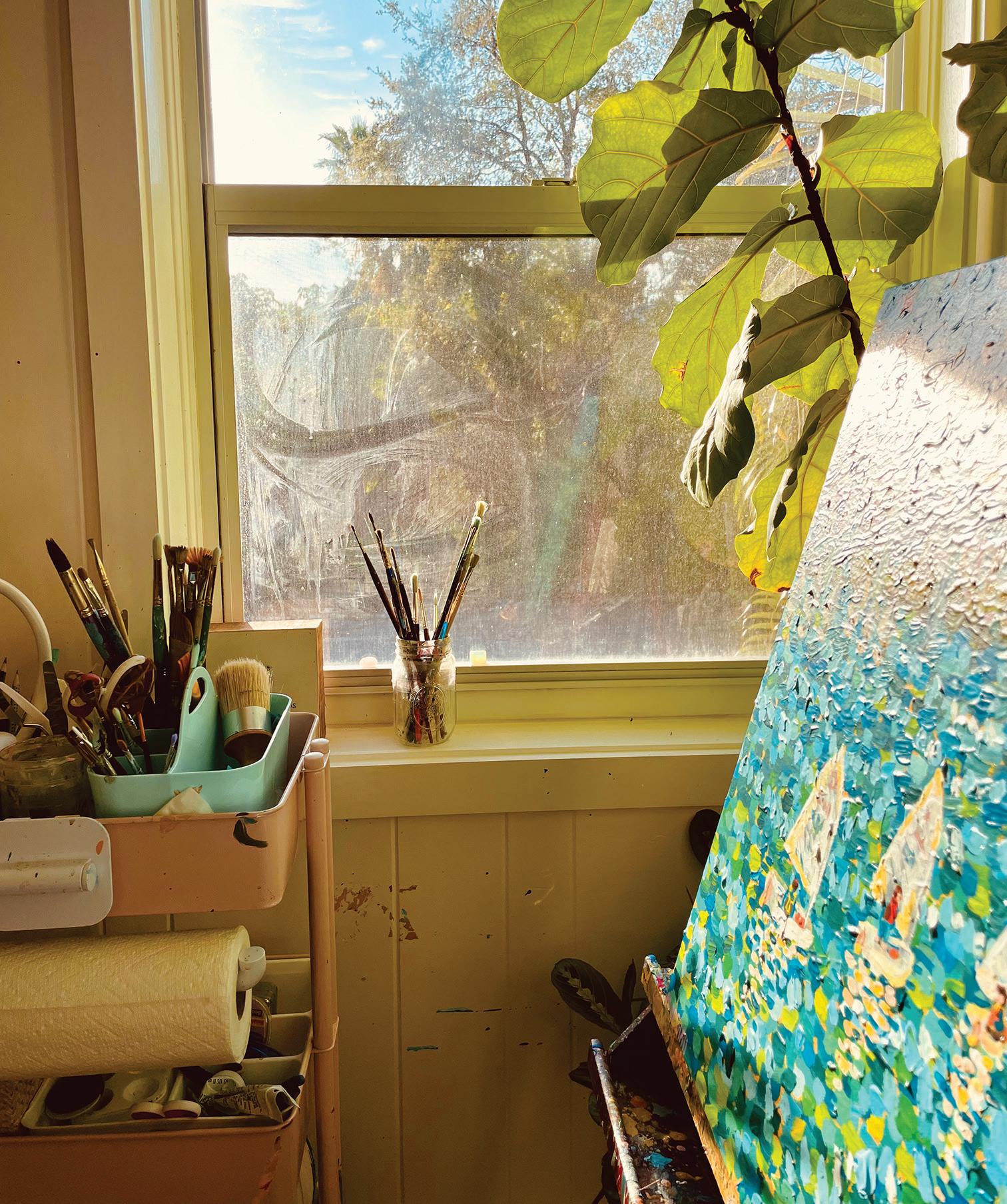
I’ve never heard of another art studio in a centuryold former island resort cabana that has taken a direct hit from a Category 3 hurricane, was flooded three times in three months, and is still here to continue telling its story. But that sums up the Coconut Treehouse Studio, as I call it. Does this make the studio magical? Blessed? Maybe there’s some special energy in the air now — a fortitude and wisdom from having seen so much. I’d like to stick around and find out.
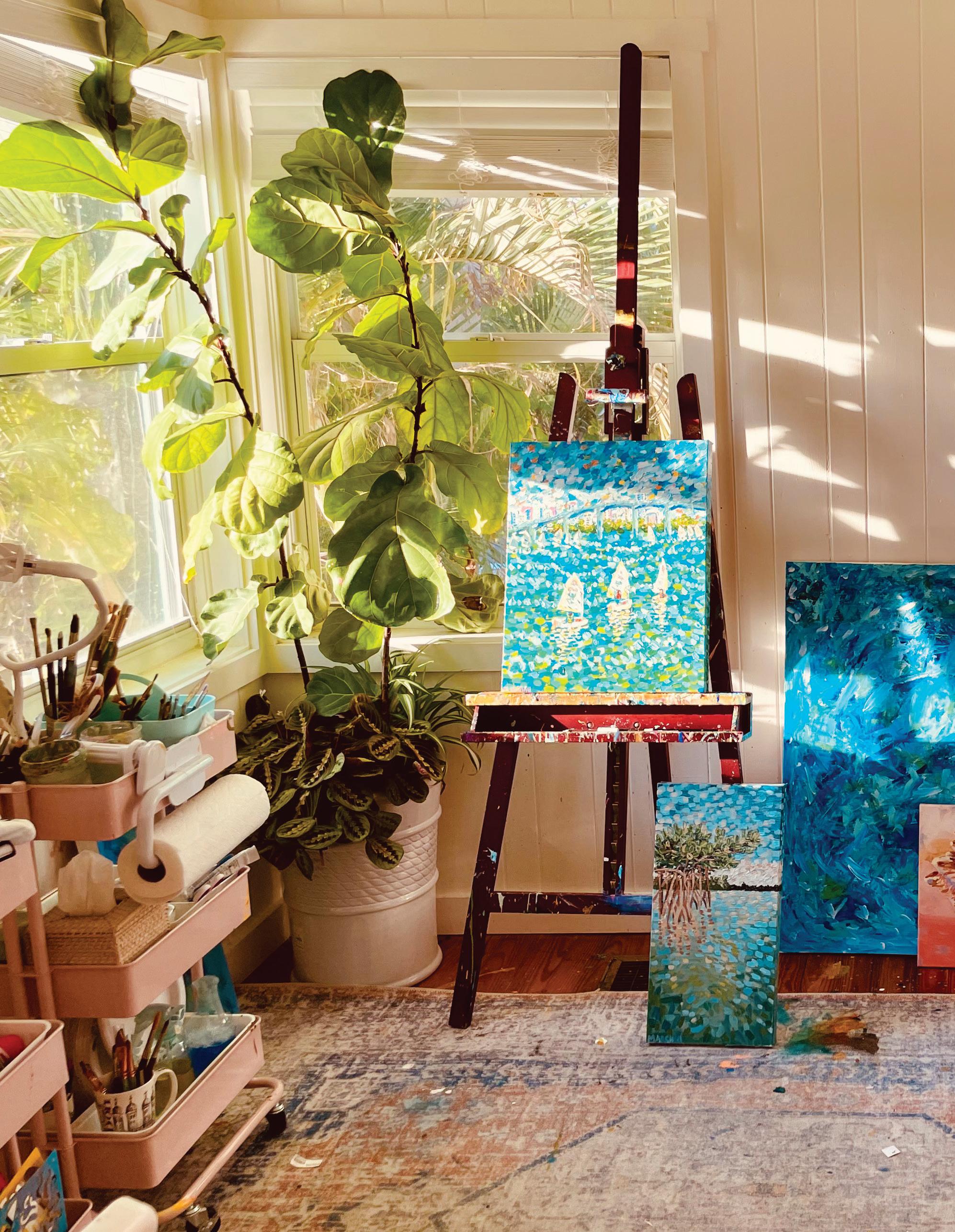
Last summer, when I was first submitting this story, I described my studio in peaceful terms: “It’s a small but inspiring space in our historical home
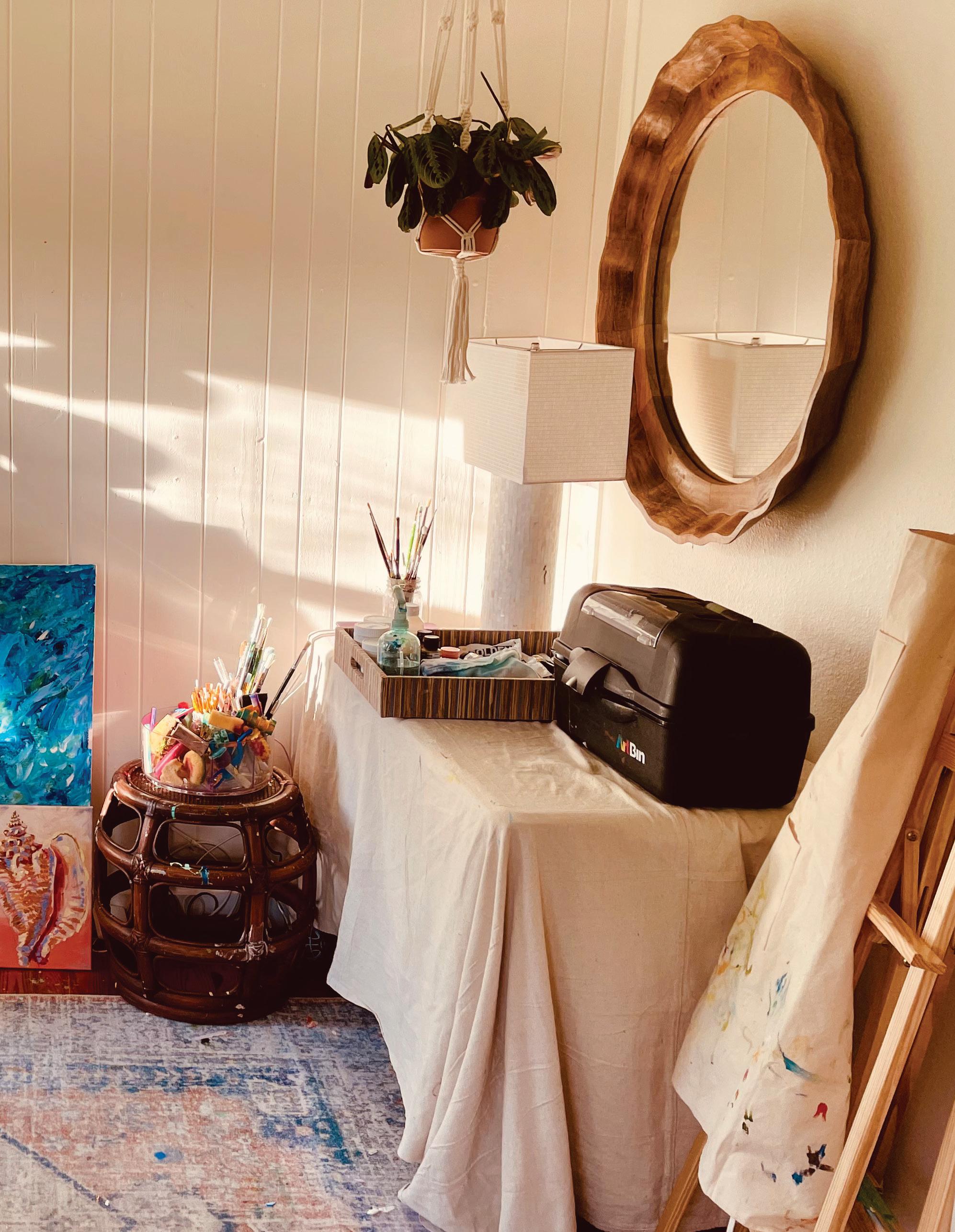
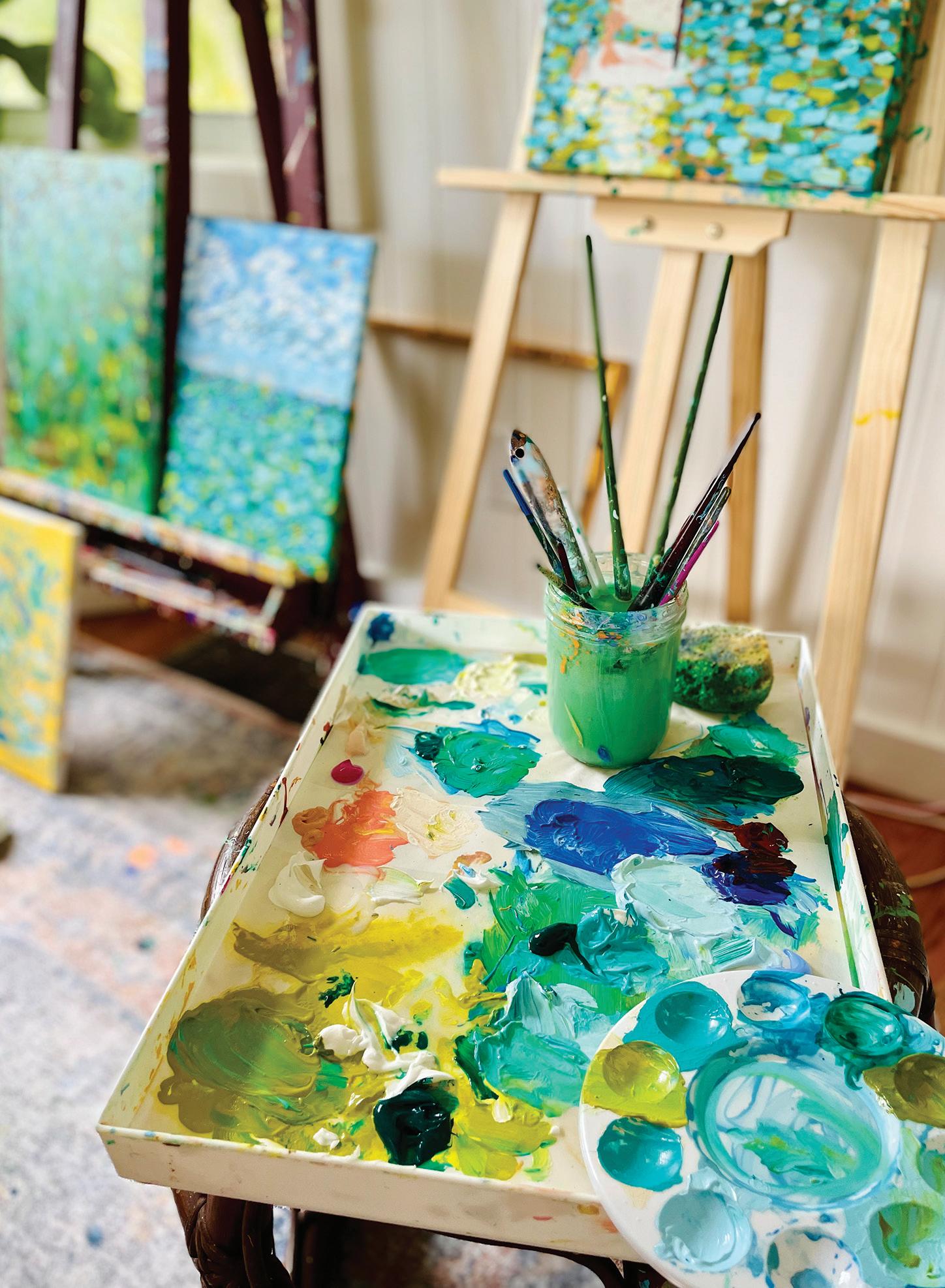
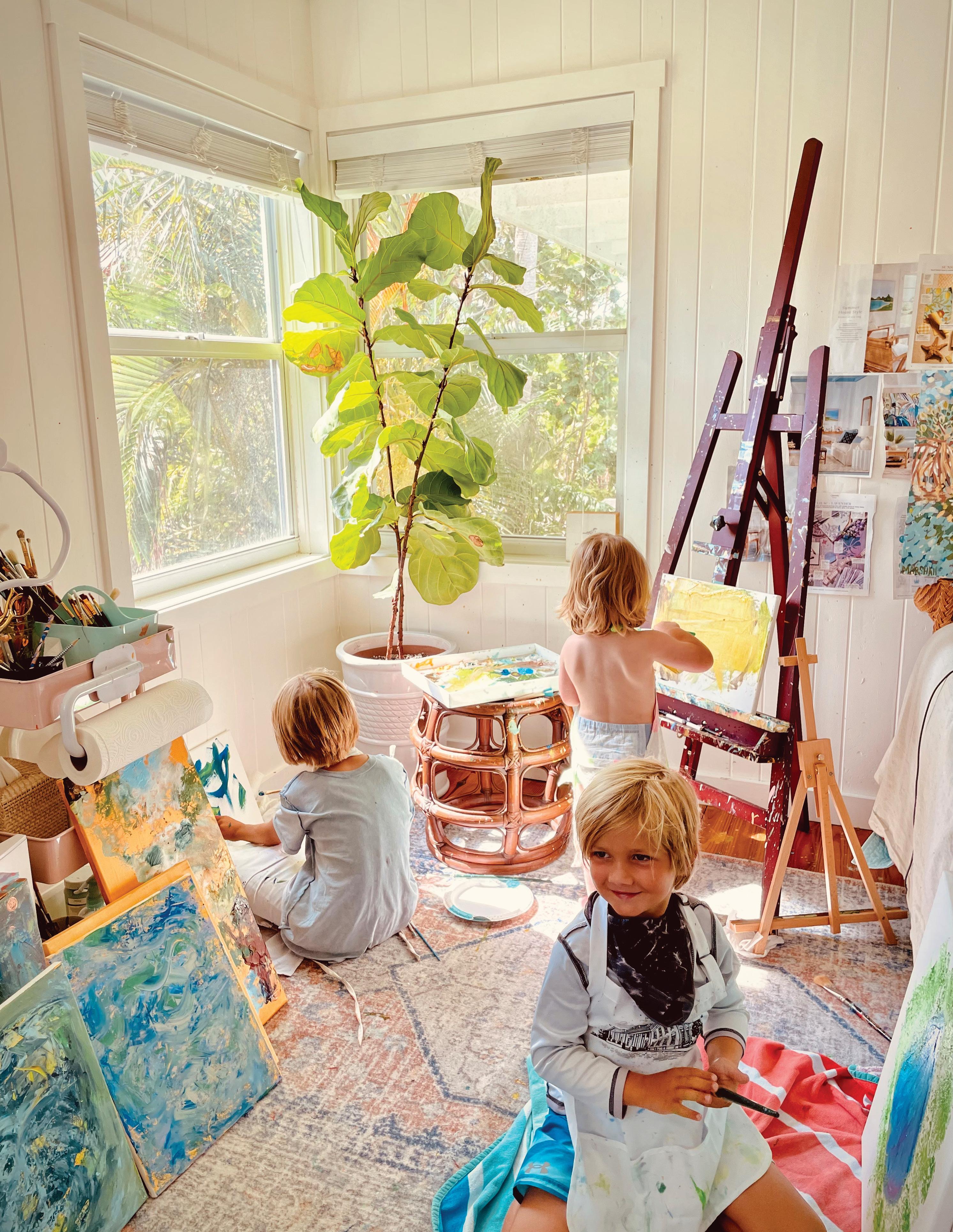
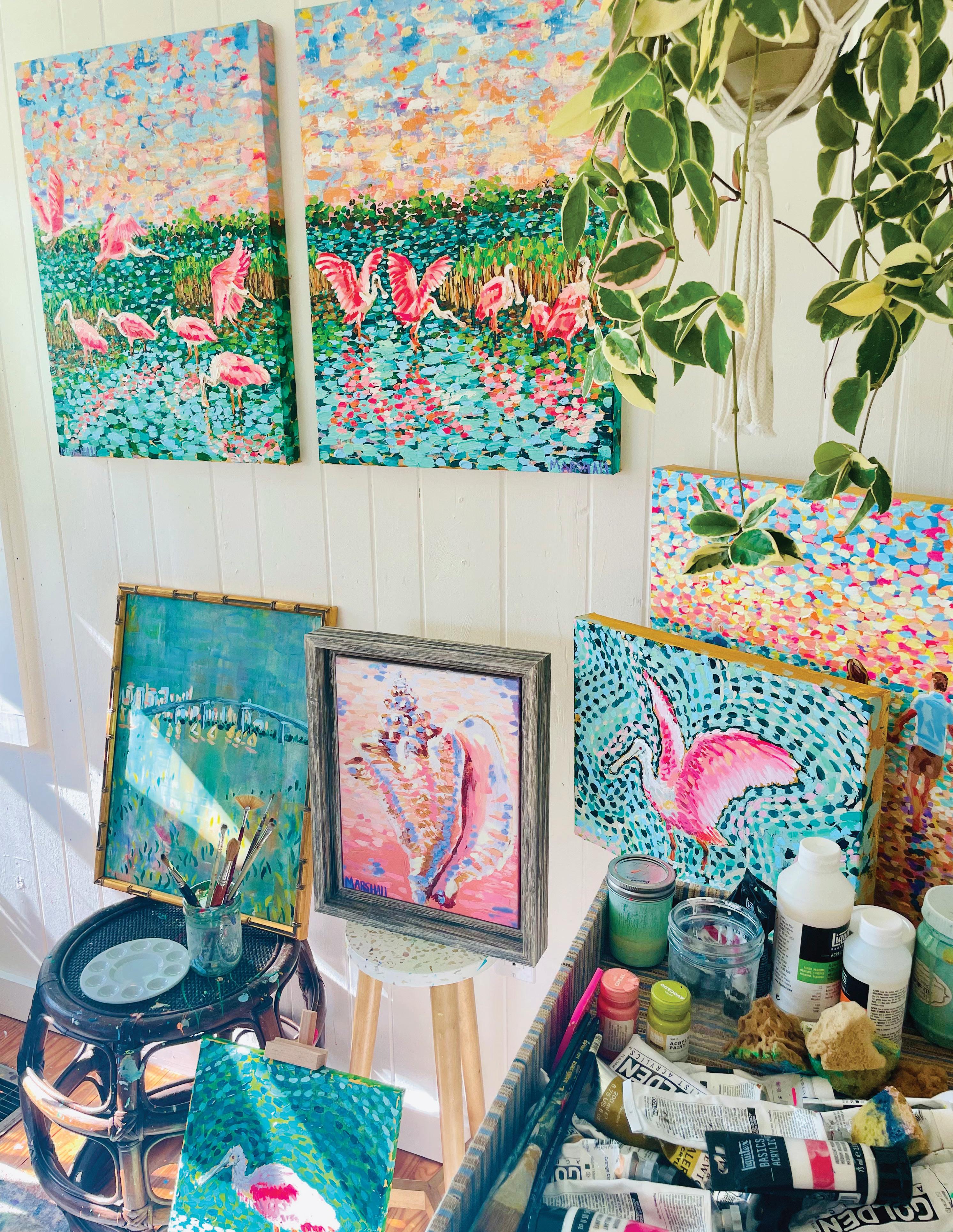
on Siesta Key, just off the coast of Sarasota, Florida. I can hear the boaters and seabirds that also call this barrier island home. We are tucked up high in the native palms, with huge poinciana trees that bloom red when the tarpon run, and banyan trees that have been here for ages. My studio is filled with coastal treasures from our adventures, along with antiques and Palm Beach-style furniture I’ve found at bargain prices (so they aren’t too precious to get paint on). I also have kid-friendly art supplies and extra easels for whenever my little boys want to join in on painting.”
Then, the unthinkable happened.
The Storms
Hurricane Debby – August 4, 2024
At first, we were told it would be “just a tropical storm.” But Debby turned quickly into a hurricane. It parked right over Sarasota, dumping a historic amount of rain. The flooding was worse inland, but we still had to replace our roof and take shelter from a tornado passing nearby. The lightning strikes were intense. It was a mess, but the home and studio made it through still standing.
Hurricane Helene – September 26, 2024
Next came Hurricane Helene, a Category 4 beast that swept the entire Gulf Coast. Despite being 100 miles offshore, it still dumped 8 feet of water on Siesta Key. The island took the brunt of the surge, and more homes flooded. It was the worst storm surge in the history of recorded weather for our area.
I had been working on a series of coastal studies that I planned to use for a larger painting when Helene “went by.” I expected a rainy, cozy day in the studio, but as the storm picked up, it quickly became clear this was no ordinary rainstorm. As the first band of the storm hit, we realized we needed to evacuate. We sought shelter inland, staying at a hotel to escape the worst of it.
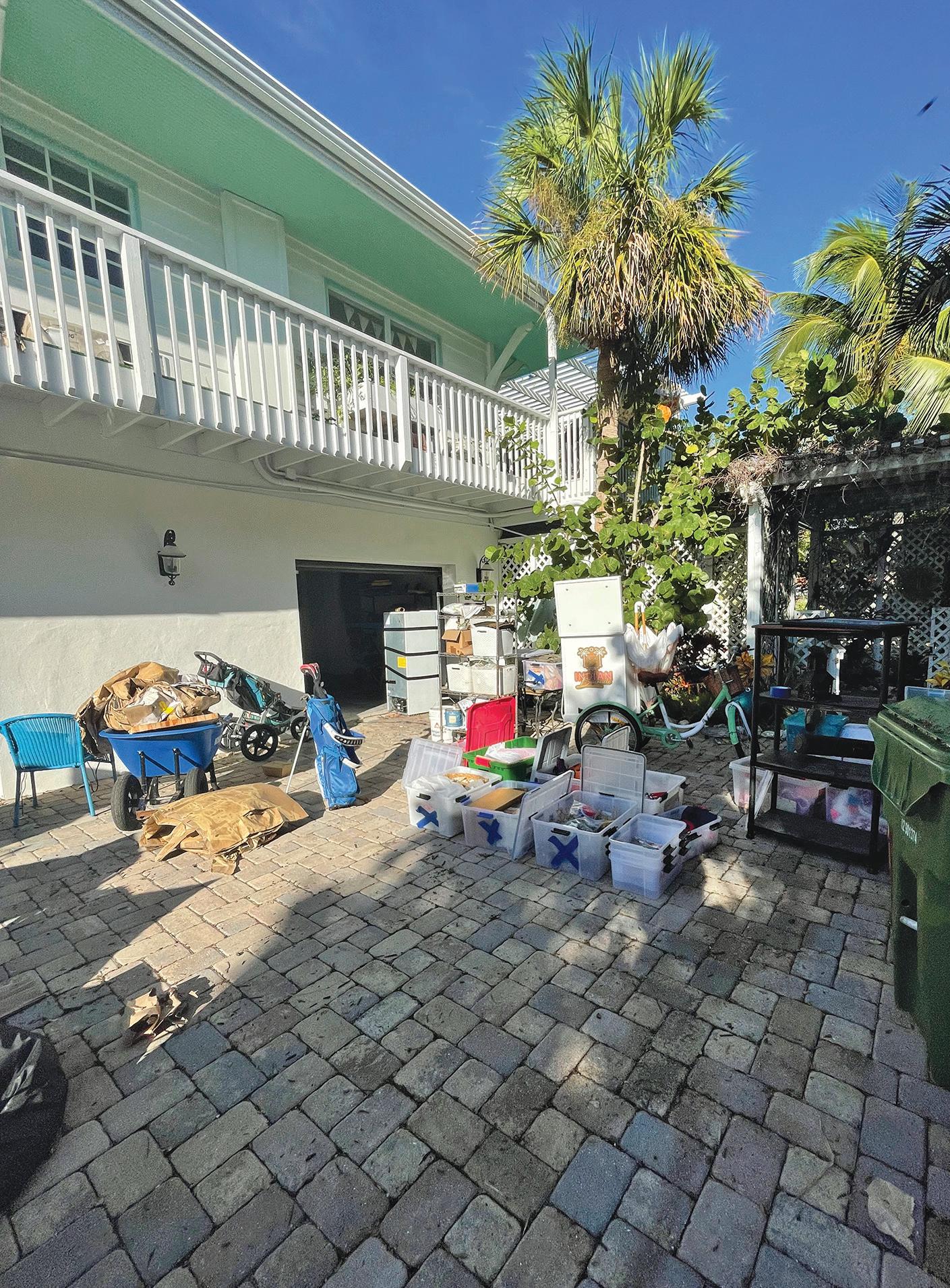
That night, I received messages from friends asking if we needed rescuing, as the surge was rising fast. I will never forget that family’s selfless and brave offer. The power went out soon after, and I didn’t know how my friends who stayed behind were doing. I spent the night glued to my phone, watching the radar and praying the water would recede soon. Our property flooded again, this time reaching between 4 and 6 feet. Storm surge, by the way, isn’t just beautiful clean ocean water — it’s backed up sewage drains, chemicals, boat fuel, mud, broken glass and flesh-eating bacteria.
Hurricane Milton – October 9, 2024
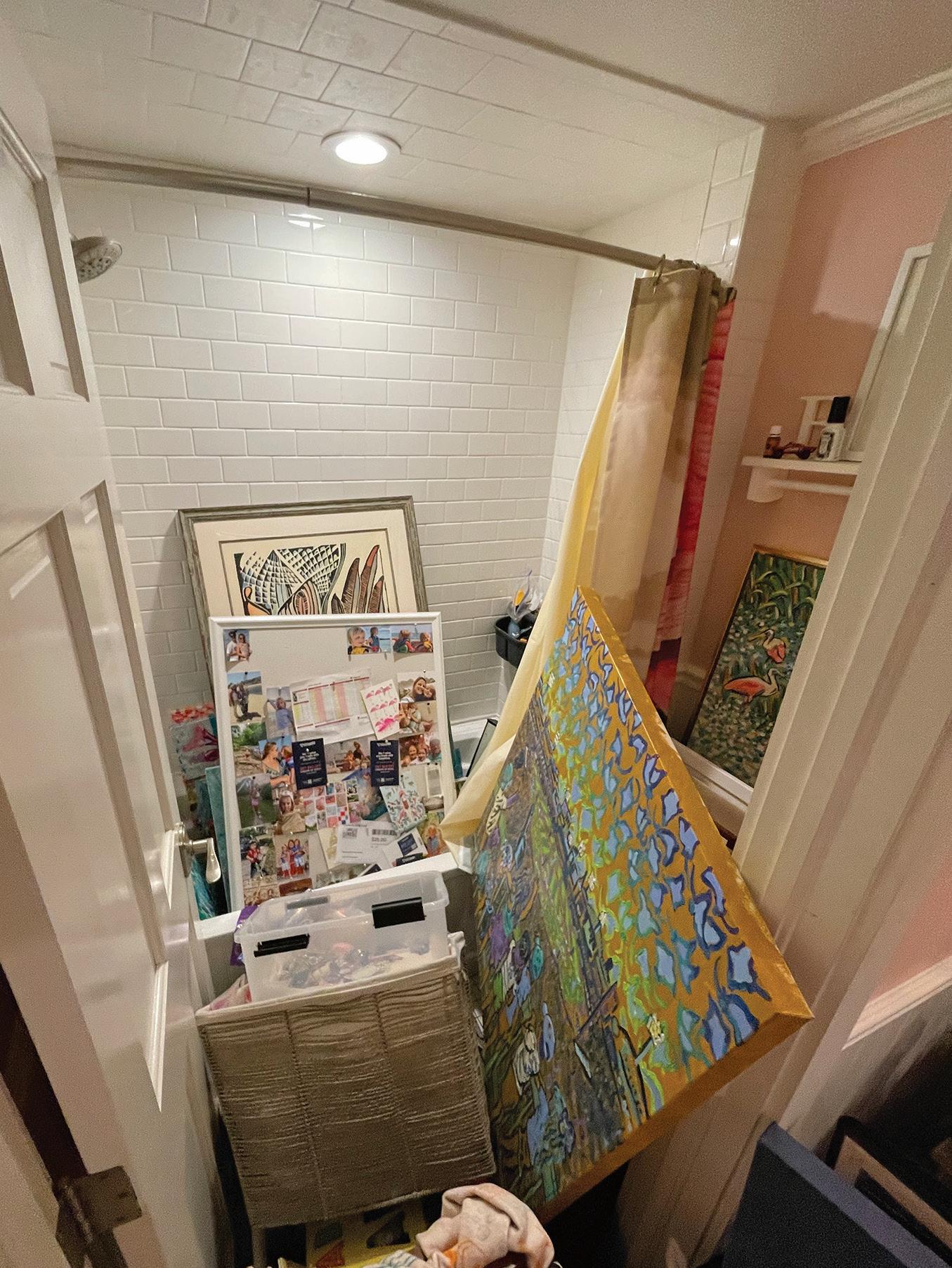
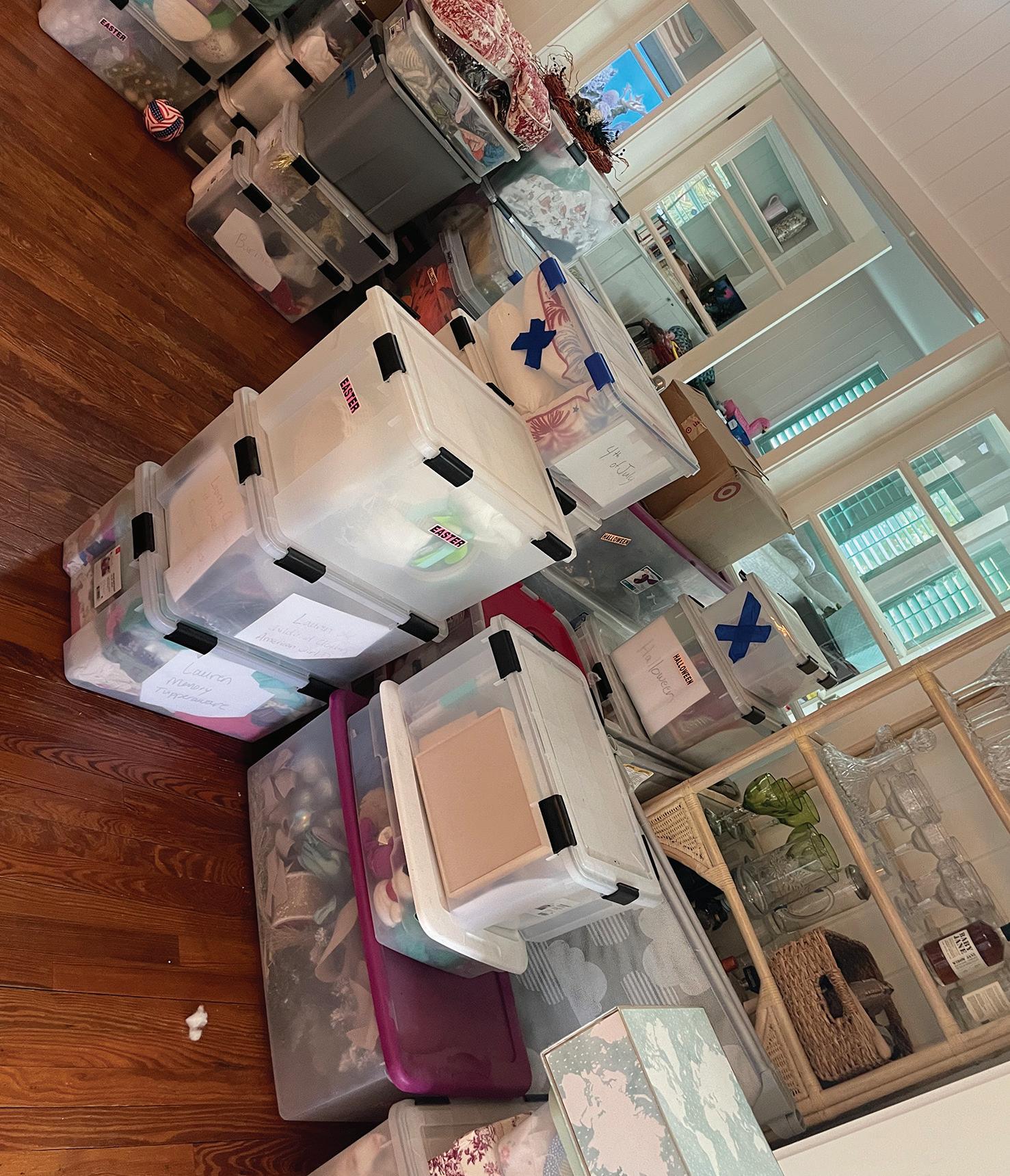
The third storm, Milton, came just two weeks later. We were warned by weather experts that it would cause catastrophic damage, and we took it seriously. We left 36 hours before impact, staying until the last possible minute to prep our house and help others. You don’t forget who comes over in those eerie moments — the calm before (another) storm — and helps when the chips are down and the city is mostly empty. I took my favorite and sentimental paintings by myself, my kids, and my grandma with me to Orlando, carrying them up to the hotel room on the luggage cart. I took photos of paintings I had to leave behind, just in case.
On the way to Orlando, I stopped by a local gallery to evacuate not only my art but also other artists’ work. I ended up carting multiple pieces out in a frantic flurry, driven by the need to protect what was irreplaceable.
A collector who had commissioned a painting sent me this message that day: “Hey Lauren! I have watched your stories all week, and stopped and prayed. I can’t fathom your emotions and devastation but I know you are covered in love. Take care and know people are lifting you up!!!!”
A message from my brother sent that day from his Army deployment overseas also brought much comfort: “Last night I had a dream we were all at the beach swimming, and a huge wave was coming. The wave dissipated at the last second because we were under a bridge or something. Stay safe.” His dream ended up being true. Right before Milton hit Siesta Key, the eye wall of the storm mysteriously visibly dissipated. You could see it happen live on the radar, and the storm wasn’t actually as bad as it should have been as it dropped from a Cat 5 to a Cat 3.
It still caused extensive damage, though. Our house flooded again — about 4 feet on the first floor. Whatever had survived from Helene was gone now, too. The cleanup was overwhelming, but miraculously, our home stood firm — and so did most of the mature trees. I found Christmas ornaments hanging from shrubs like bizarre remnants of a past holiday. The studio survived, too, and I was incredibly thankful.
Lessons Learned
Trying to process all that we’ve been through feels impossible at times. The whole experience still feels surreal. But some things are crystal clear now: This hurricane season taught me the value of community. If our town and businesses can rebuild and keep their doors open, it will be because people cared enough to help and shop locally. I’ve been so grateful for those who supported me by purchasing prints and stationery from my online store during this time.
The hurricanes also forced me to let go of things I couldn’t control. We had many different plans for the fall — I had work commitments, deadlines, trips planned, and kids’ sports events — and all that went out the window. We had earmarked finances for things other than hurricane evacuation and repairs. We had planned on our kids always being able to go to school around the corner, but now they take buses to separate locations quite a ways away while their school is under major repair.
Any sense of control is an illusion. I’m just here on earth to love my people and to channel this gift of painting as a way to bring others joy and point out Mother Nature’s/God’s handiwork to others. Whatever higher power you do or don’t believe in, going through three hurricanes in a row will make you ponder it and most likely seek it.
I’ve also learned to embrace holding opposing emotions at once. It’s OK to feel gratitude and grief simultaneously. We are tired, but we’re happy we are safe. This has cost us so much, and yet the truly priceless things — our family, our health — are still intact. We have also learned to accept help for the first time. It’s humbling to be on the receiving end of help when I’ve always been the one giving.
For the first time, I accepted a bucket of cleaning supplies and a gift card as a token of care from my kids’ school. I’ve always prioritized and loved volunteering, so it has been very, very humbling to instead be the receiver. I was so touched to receive a text from a collector who, instead of asking why their commission was delayed, asked if they could come help clean and load the dumpster. I will always remember that.
Most importantly, I’ve learned that relationships and time spent with loved ones are all that really matter in life. Giving back to others, helping others, and sharing blessings when you can may be the meaning of life. I feel that to my core after all this.
The Return to Art
After the storm, I struggled to return to my work. The exhaustion and overwhelming emotions hit me all at once. The first morning back, I sat at my laptop and just stared, too tired to move. But then I thought of the teachers who had been through the same chaos, yet showed up right away for the kids. They provided safe spaces for learning and fun while we all began the long process of rebuilding. I decided all I could do was put together a bag of my prints and stationery gift items for them and write a note expressing my sincere gratitude and admiration. It has been a hurdle to get over thinking people don’t want my art as a gift, but I am slowly starting to feel it in my bones that they do. So, it was actually a big win for me to gift the teachers my art instead of something silly purchased from a big-box store.
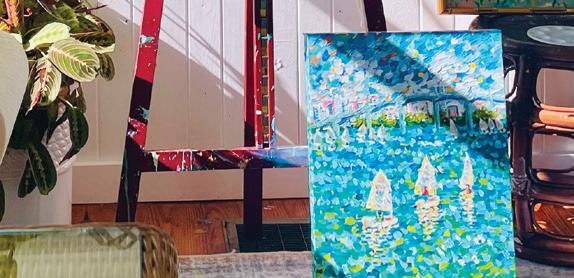
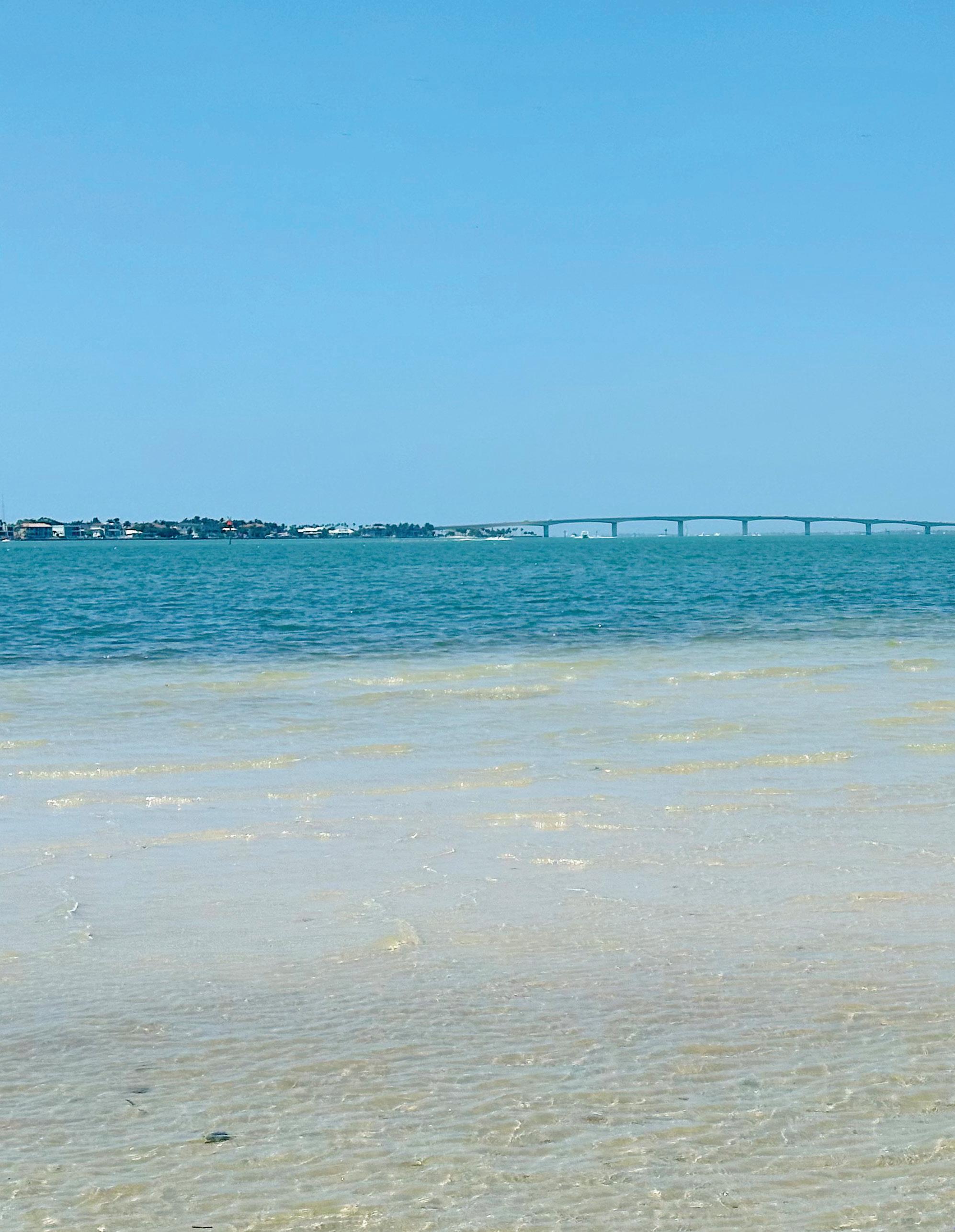
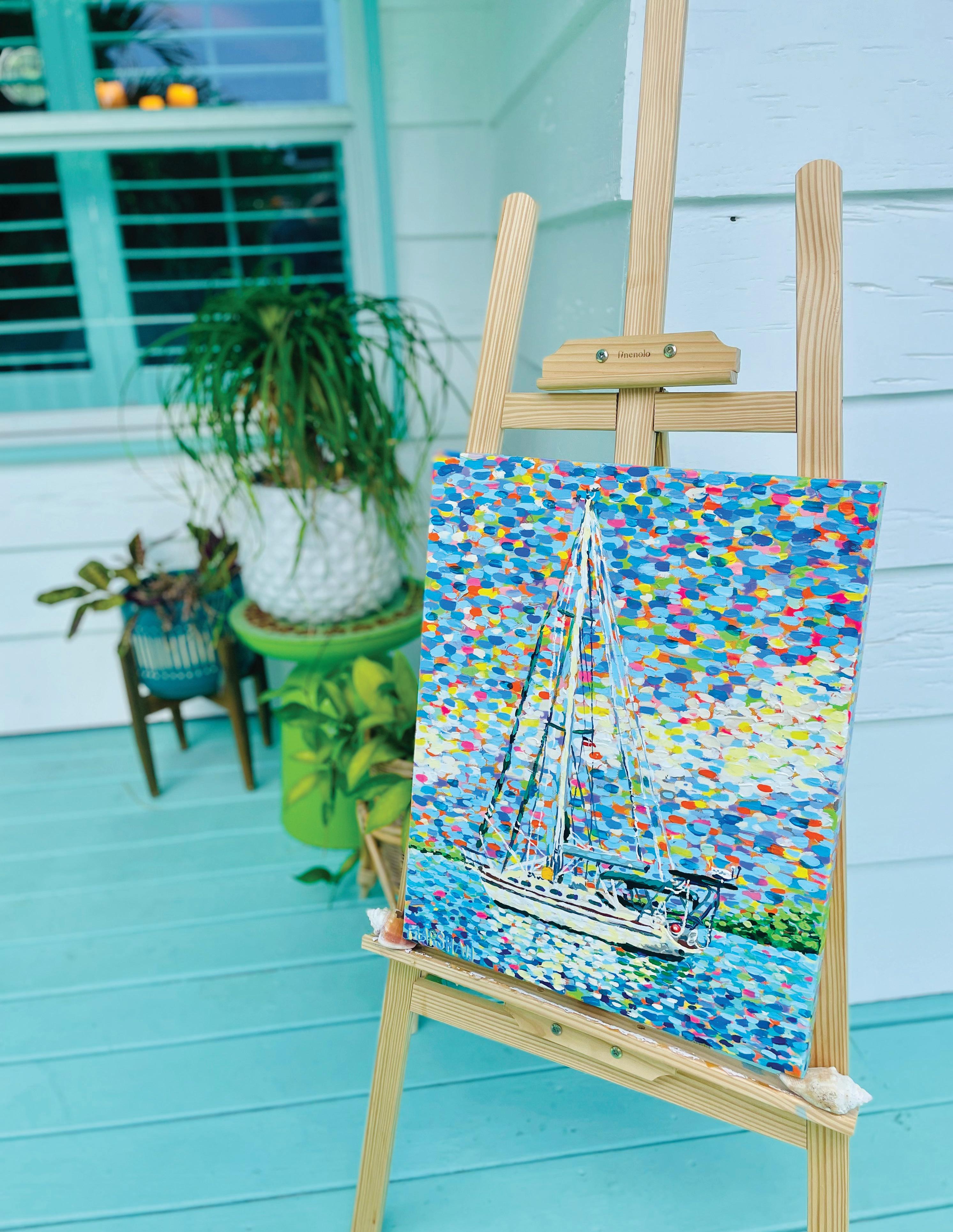
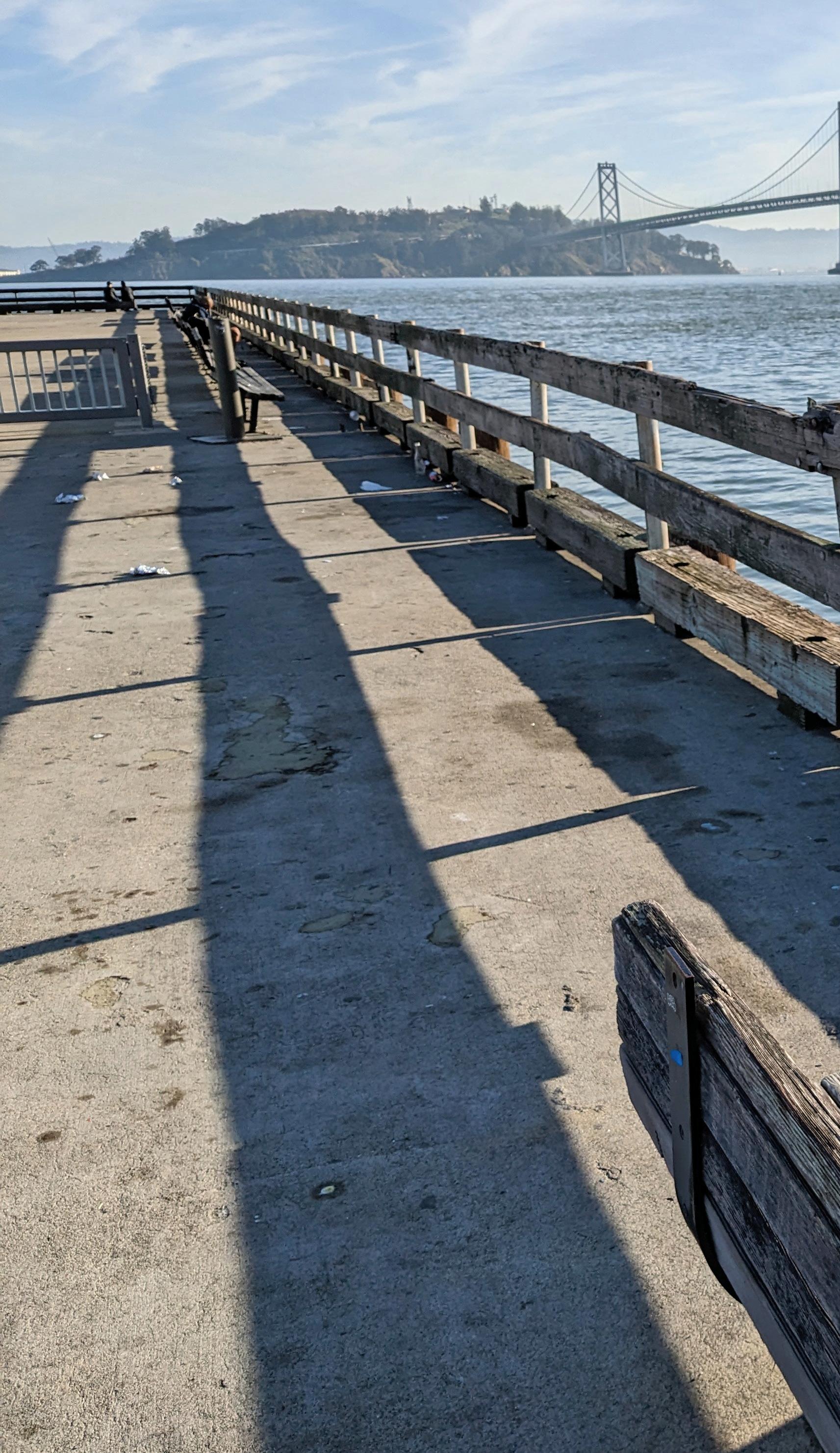
As time passed, I picked up the brushes again. I returned to the coastal paintings I had started before the hurricanes. The series, now titled Sarasota Strong, depicts my favorite view of Sarasota Bay and the Ringling Bridge. With a sense of gratitude, I poured my emotions into finishing these works. The paintings are a way of honoring my community’s resilience: a tribute to the spirit of Siesta Key, Sarasota, and its barrier islands.
The collection has already been photographed and is selling well, with more collectors and art dealers reaching out. These paintings have become a symbol of Sarasota’s strength and beauty — attributes that are tangible in my work.
The Future
I don’t know how long we can stay in our home and studio. The constant storms and financial strain from repairs are real concerns. But whatever happens, I’m determined to keep painting. I’ve learned not to take anything — my studio, my family, or the precious time I have to paint — for granted. Every day here in this studio feels sweeter now. I’m more inspired than ever to keep painting, to continue sharing the beauty of our coast and raising awareness about ocean conservation.
Whatever comes, I’ll face it with strength, gratitude, and a commitment to the art that honors the resilience of this beautiful place I call home.
www.laurenmarshallfineart.com
Instagram: laurenmarshallart
Pinterest: laurenmweems
PHOTO BY KATHERINE FUNK
Veronica Funk
VERONICA FUNK grew up in northern Canada and studied art and design in the 1980s. Now, while pursuing an English degree, she balances her studies with painting. Through her journey, she discovered that the act of creating is more important than the time and place in which it happens.
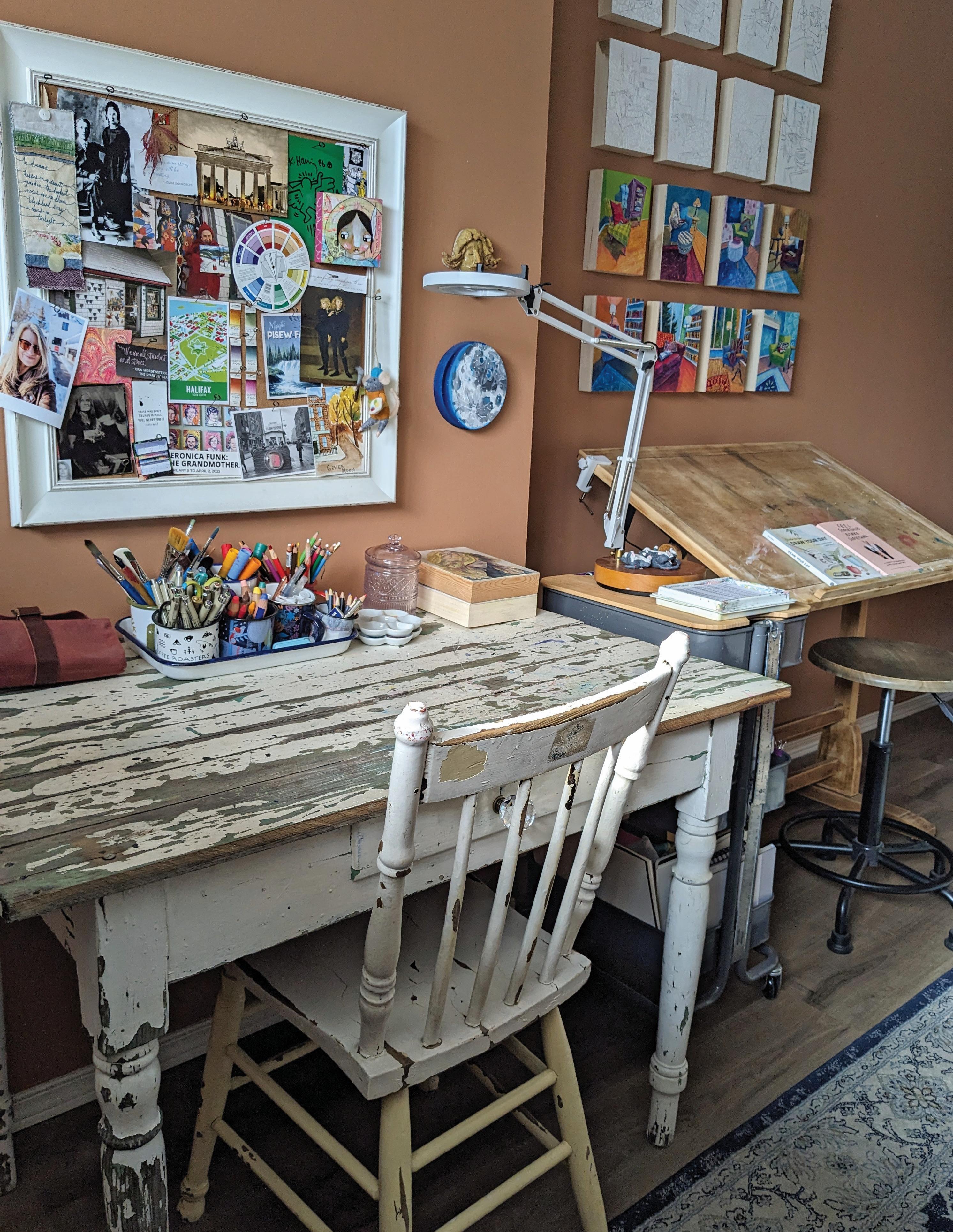
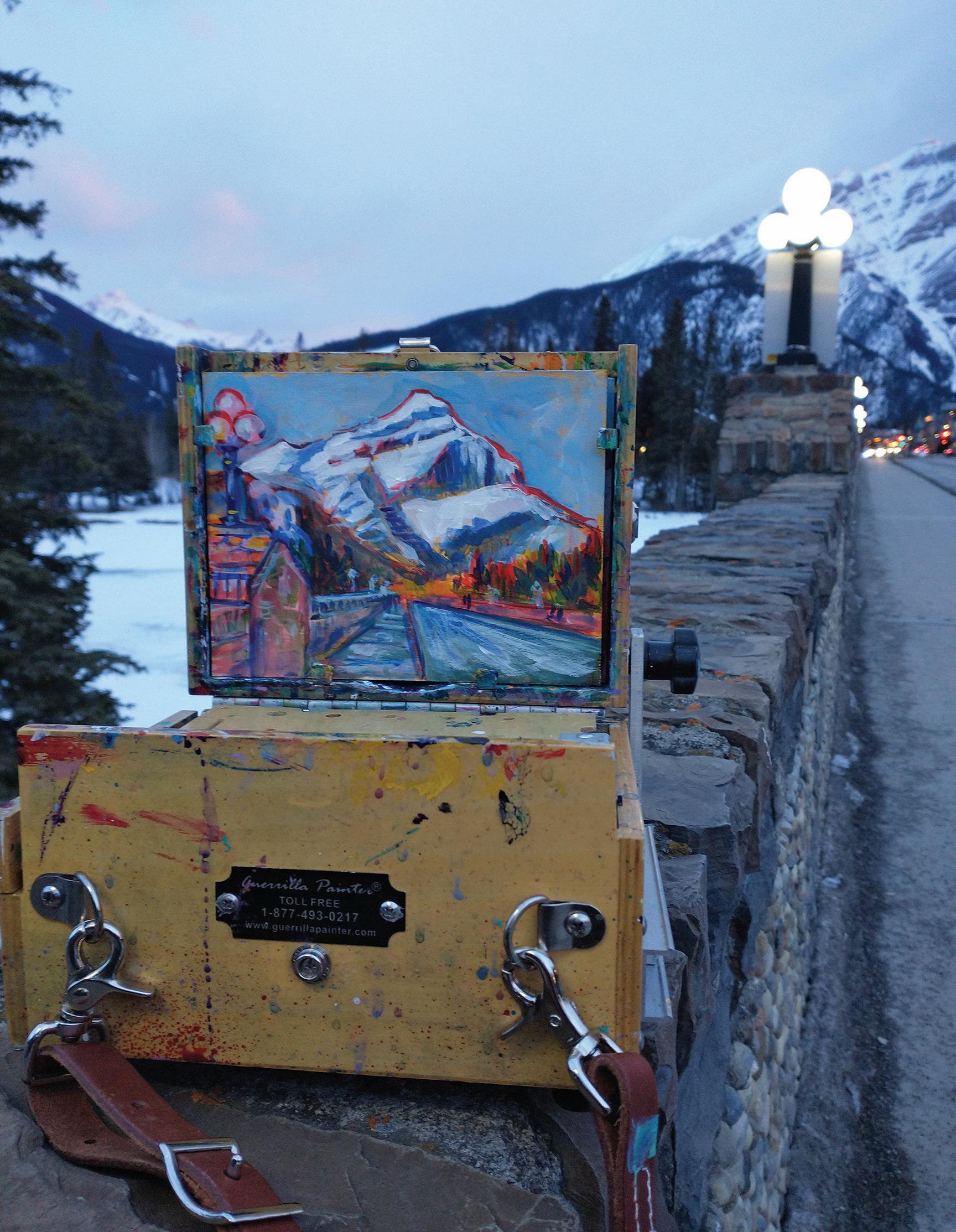
I remember my first studio fondly. It was in my first apartment and consisted of a wall covered in plastic bags, a large picture hook and a small cart of supplies. That was 35 years ago, and since then I have created in spaces ranging from a closet to a large room, utilizing anything from a pochade box (painting box) to even a small sketchbook that I can carry in my shoulder bag.
I have lived in our current home for over 20 years, and my children are grown and gone, but throughout that time my spaces have shifted depending on the needs of our family. I have always been grateful to have space in the smallest room in our home or the largest, complete with exhibition walls and storage space. While raising my family, I shared spaces with playpens and toys, and in all of those iterations, I learned that all I really need are the supplies that I love to use.
Art Studio
After attending art school, I thought I needed a big, beautiful space with the perfect studio furniture in order to be creative and be taken seriously as an artist. Initially, my work consisted of large paintings which I was always able to create, even in my first little one-room apartment. If there was no wall space available to me, I just threw a drop cloth on the floor and worked … something I still practice to this day. A mentor once suggested hanging my work in progress in order to view what I need to change, and also to recognize what I have accomplished, so my studio has become the space that allows me to do that.
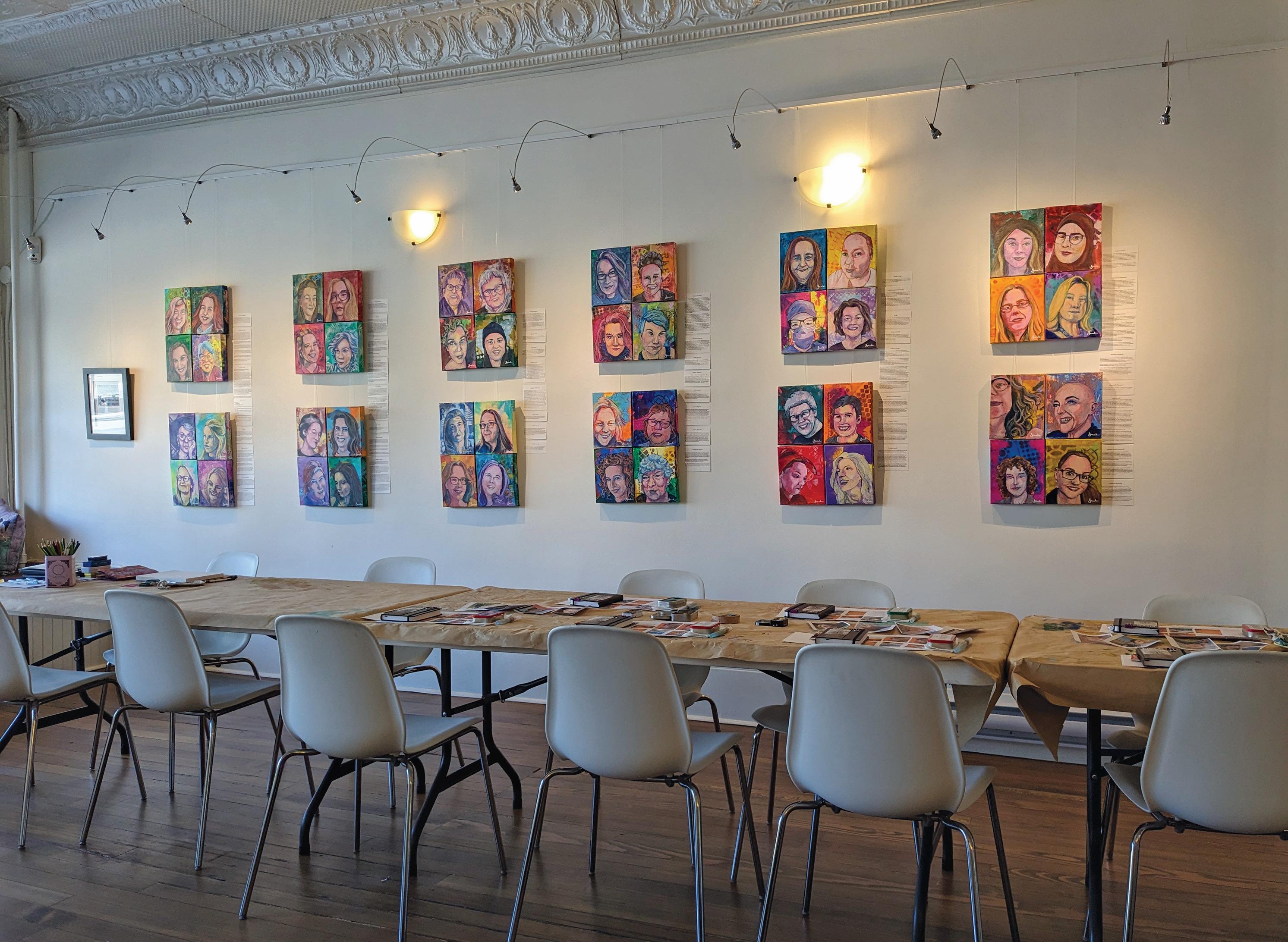
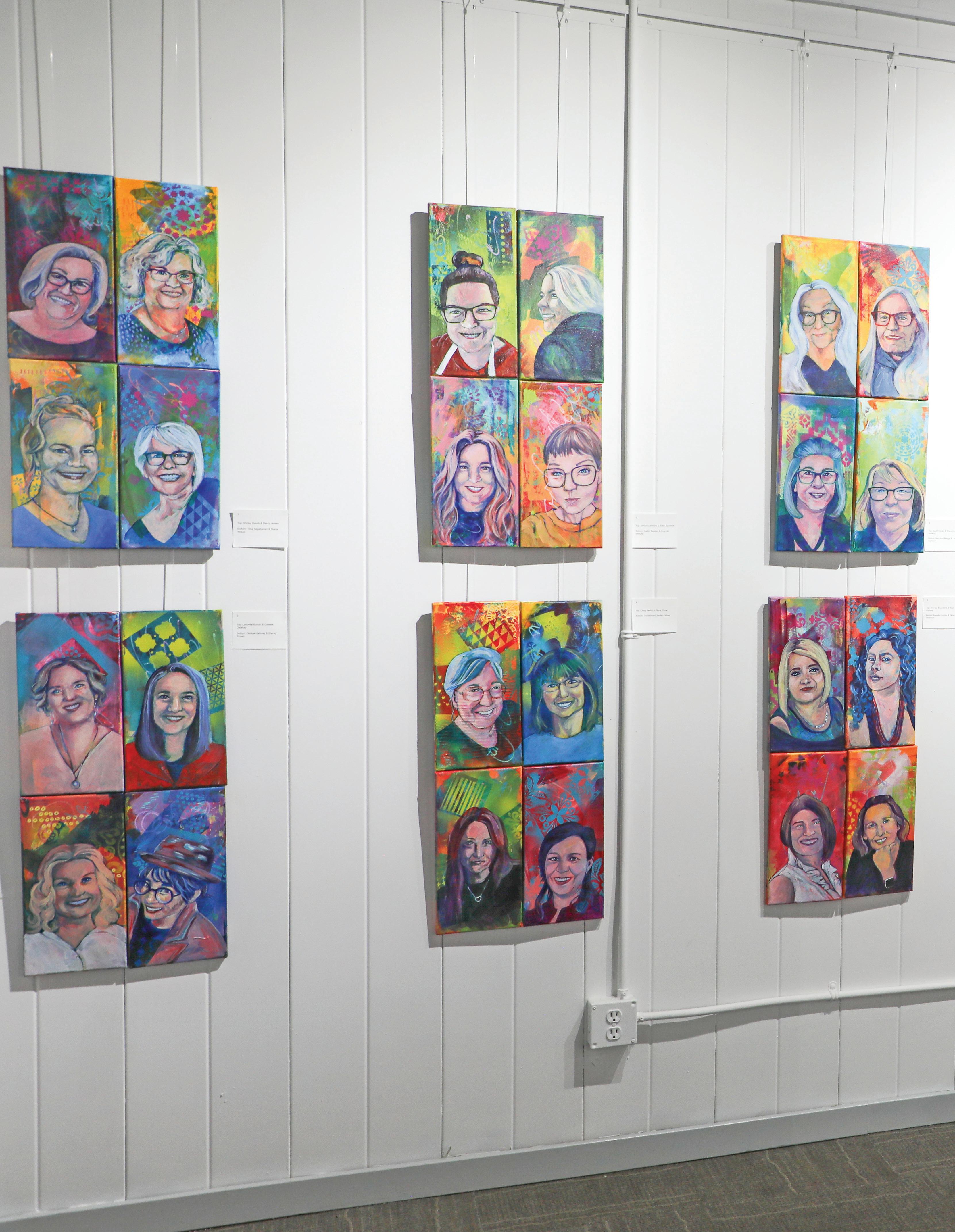
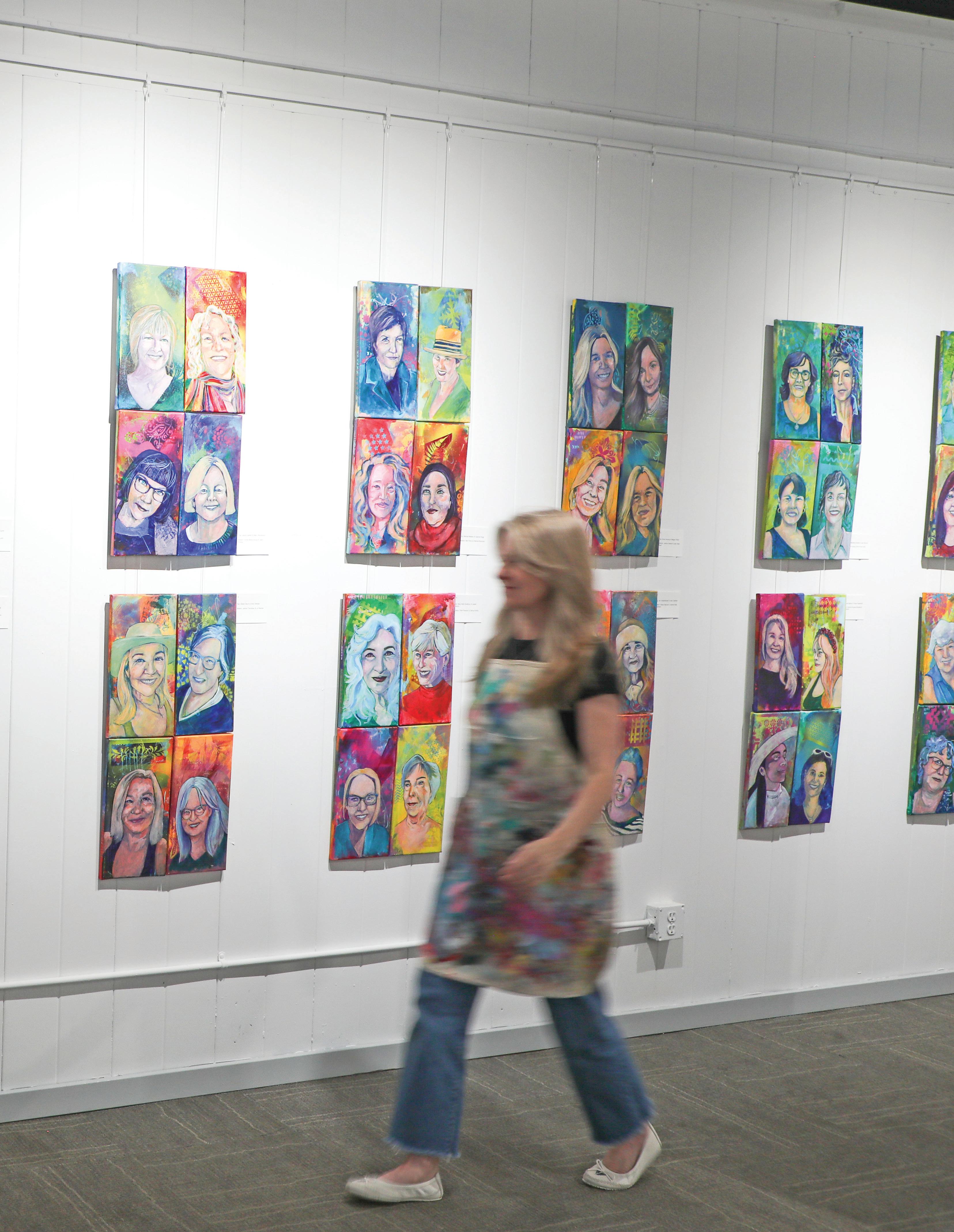
Several years ago, I was diagnosed with adhesive capsulitis in both of my shoulders, a painful condition that meant I could no longer paint on large canvases. As I struggled physically with years of treatment, I also struggled with the direction of my art. I knew I wanted to create a body of work over a year-long period of time, but wasn’t certain what that would entail until one day my youngest daughter suggested that I paint portraits — something I had not done since my college application in the mid-1980s.
This ended up being a bit of a blessing in disguise as I began to create large bodies of work that consisted of a number of smaller 8-by-10 or 7-by-14-inch paintings. Since this work is so much more flexible to create, exhibit, and ship, I have received even more opportunities to work in different spaces, such as artist residencies or outdoors.
Artist Residency
I have had the privilege of working as an artist in residence in some of the loveliest spaces. This has given me the opportunity to explore new media and experiment with new work. It is also a wonderful opportunity to get feedback, either from other artists or from people who visit these spaces.
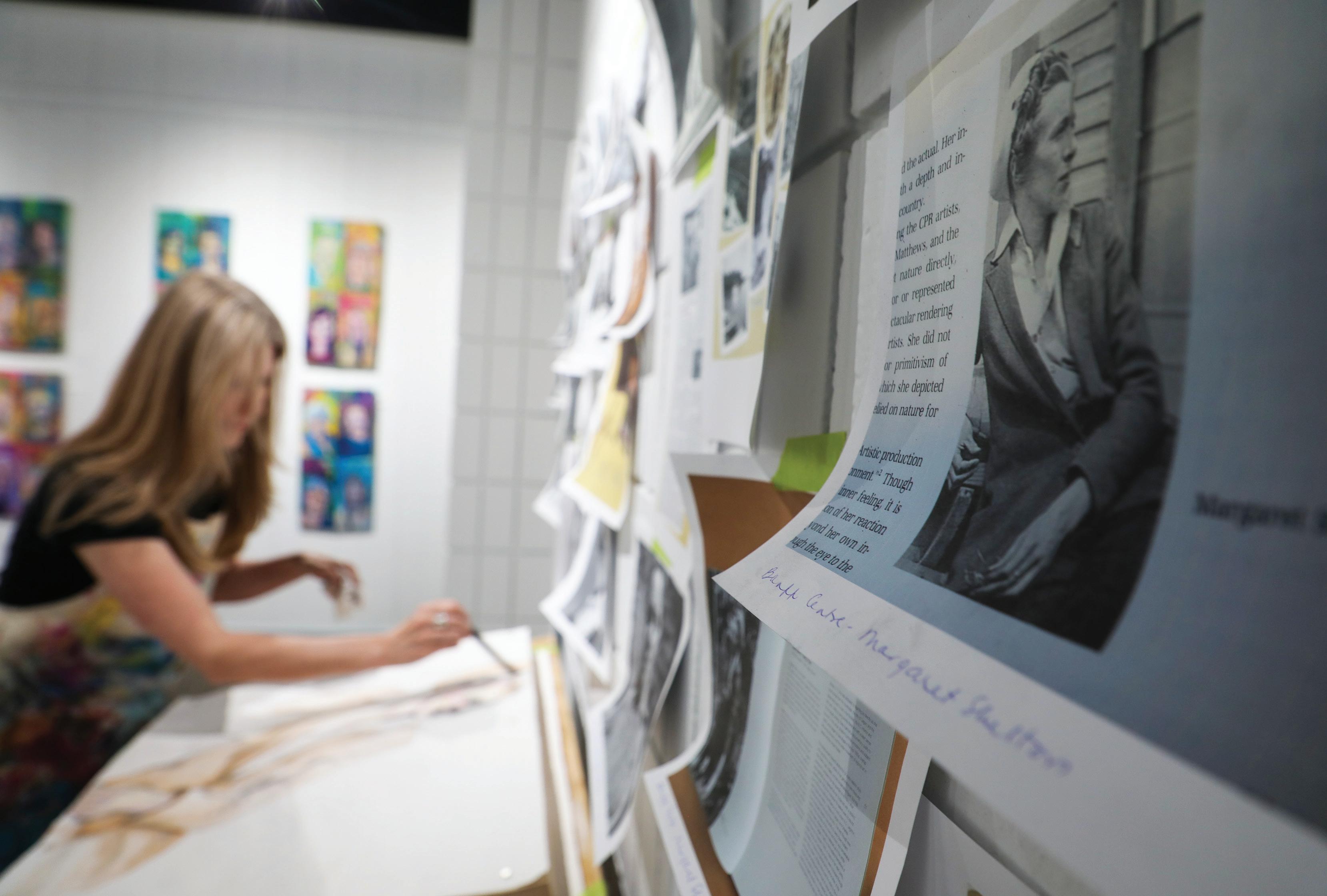
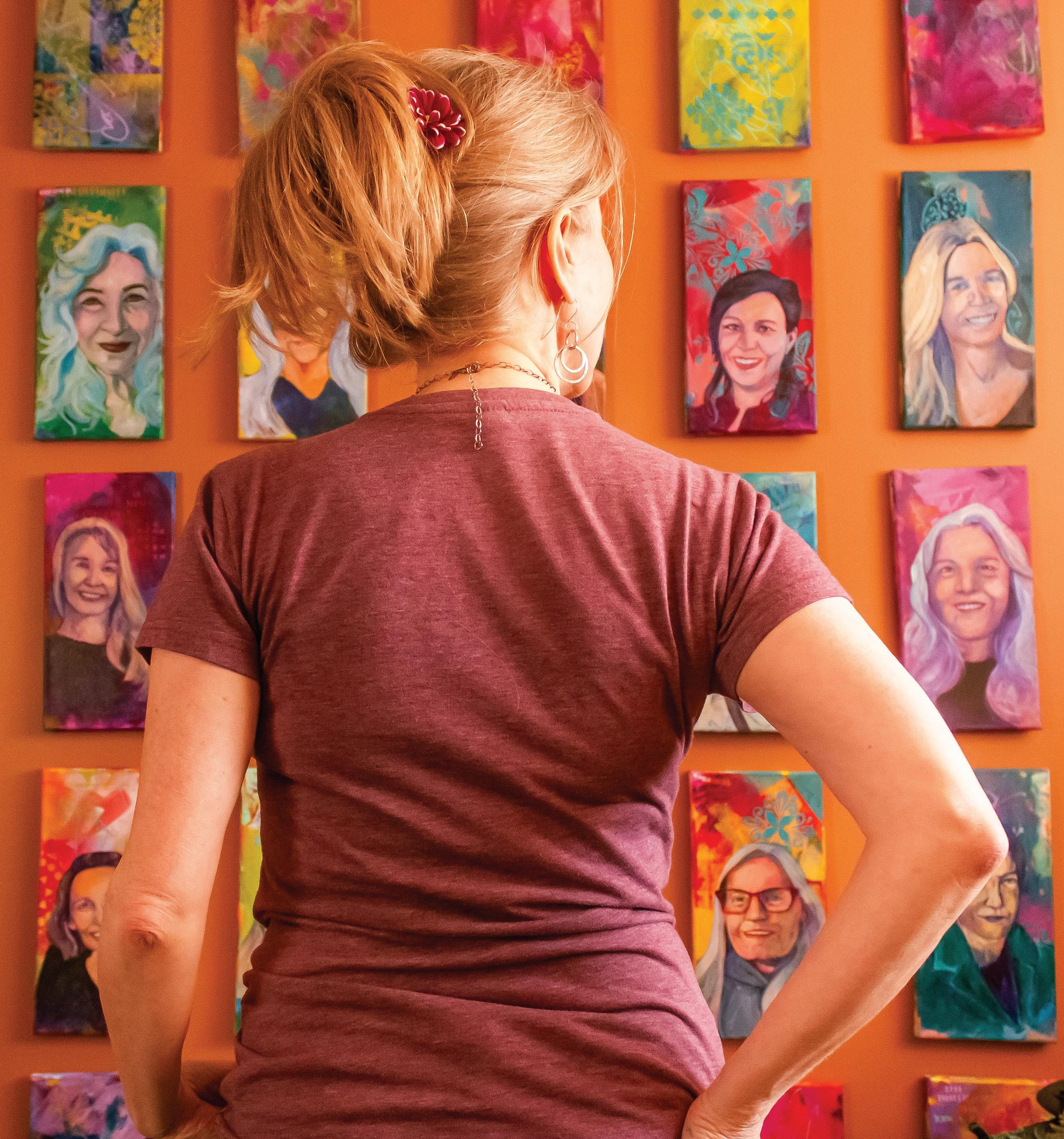
My current body of work, titled Women of the West and inspired by a previous residency a year ago, has now begun during a new residency and features paintings on paper of historical female western Canadian artists. As a female artist and longtime resident of Alberta, I have felt the challenges that many women face in the art
world today — and have an understanding that in the past, the challenges were even greater. Researching archives on location opens the doors to the history of the women artists who contributed to the growth of arts in this region.
Over time, I noticed that in taking one small step after another by creating one small painting at a time, I have been able to paint over 600 portraits of women. I also know that I could not have done this on my own. As much as I hope to inspire and encourage other women, I have been supported, too. As solitary as this work can be, taking part in residencies has been a wonderful collaboration.
“Great things are not done by impulse, but by a series of small things brought together.”
— Vincent van Gogh
Plein Air
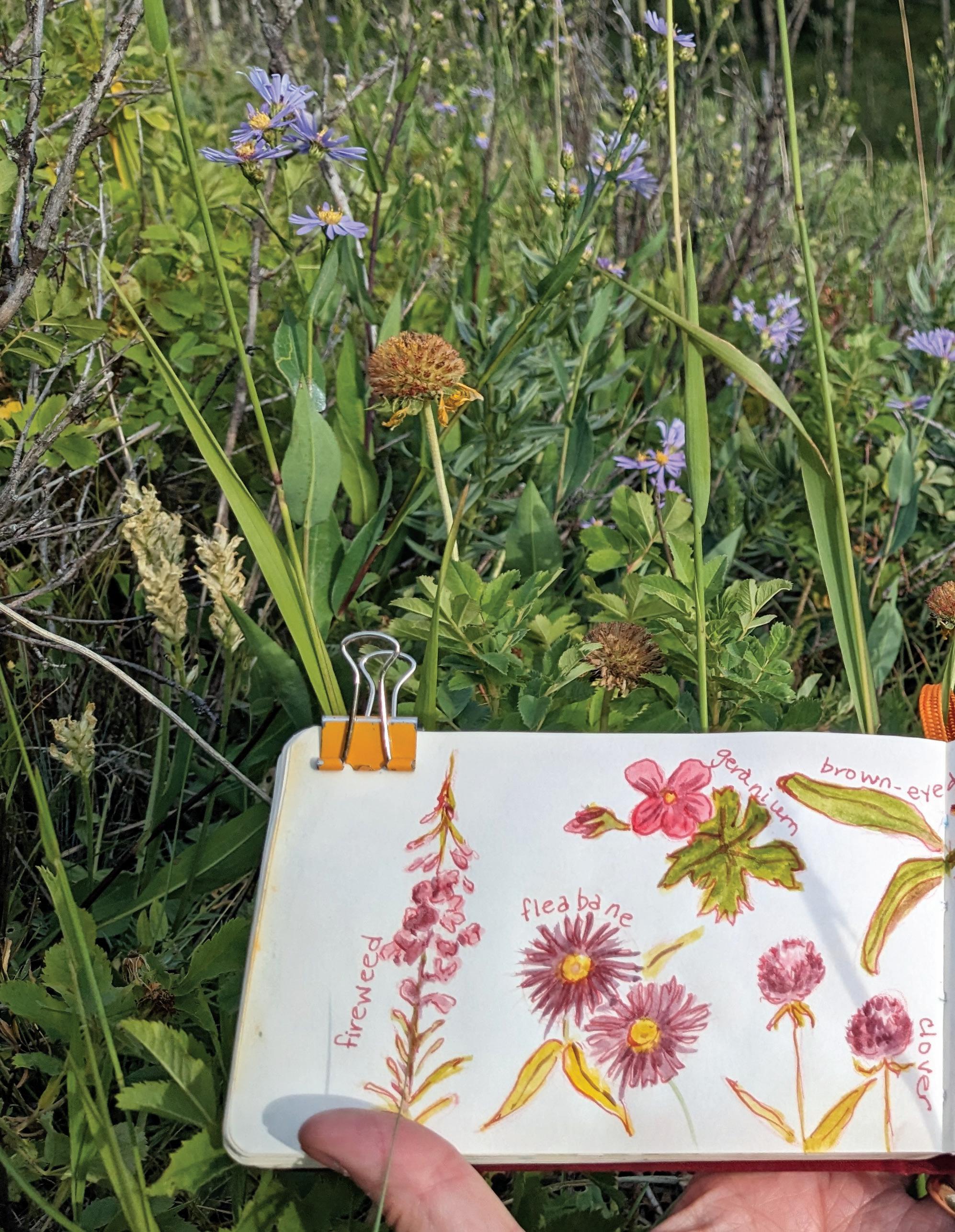
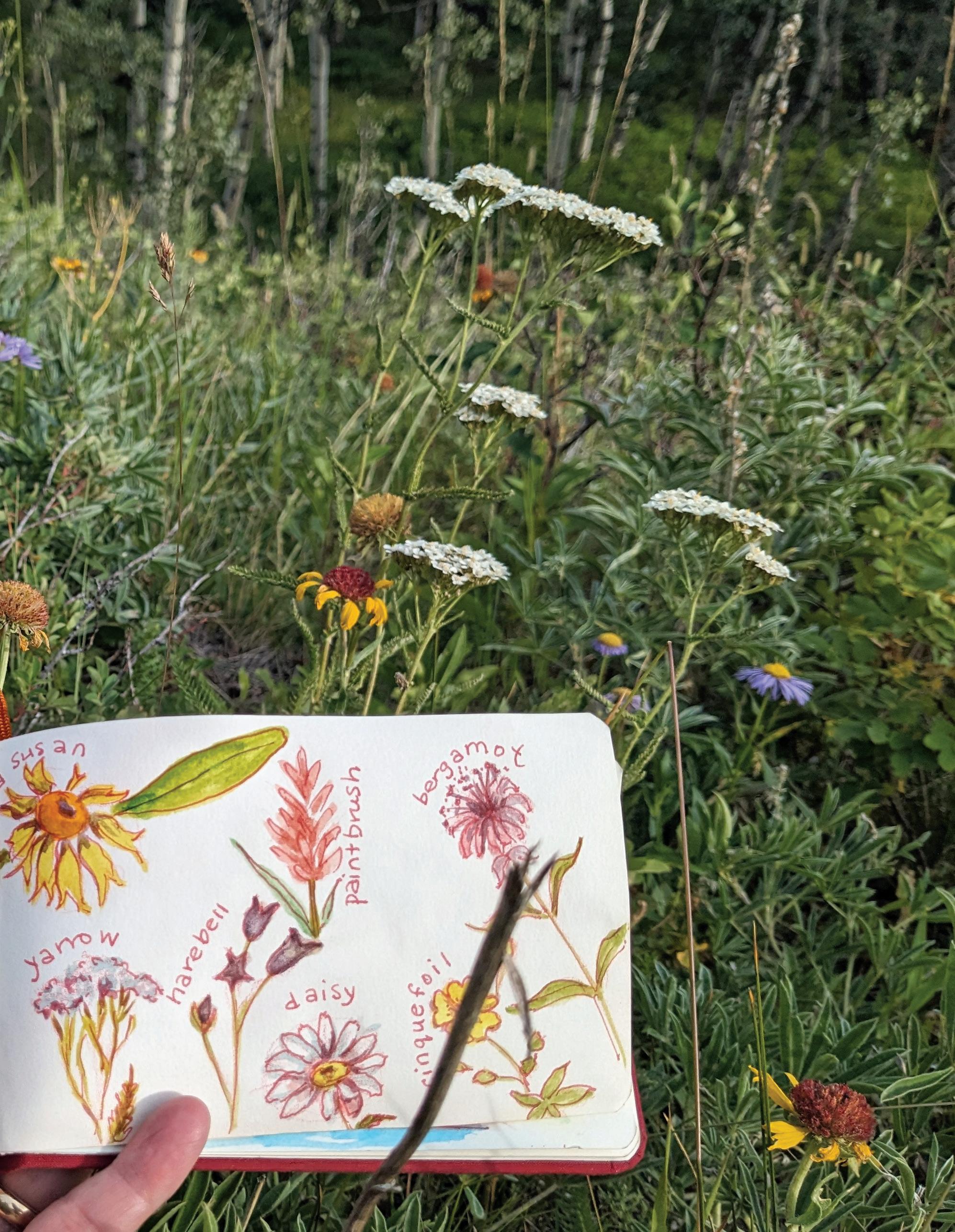
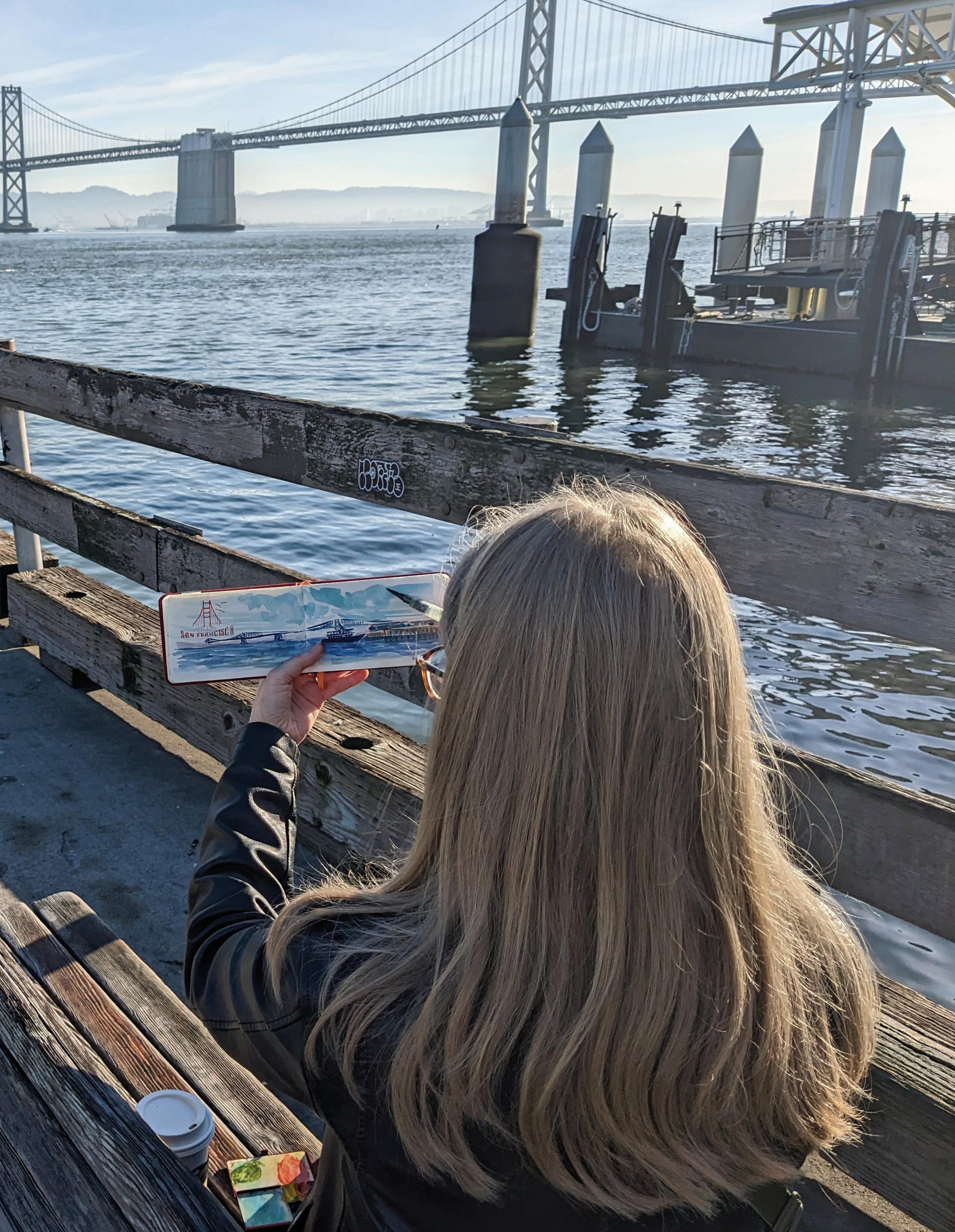
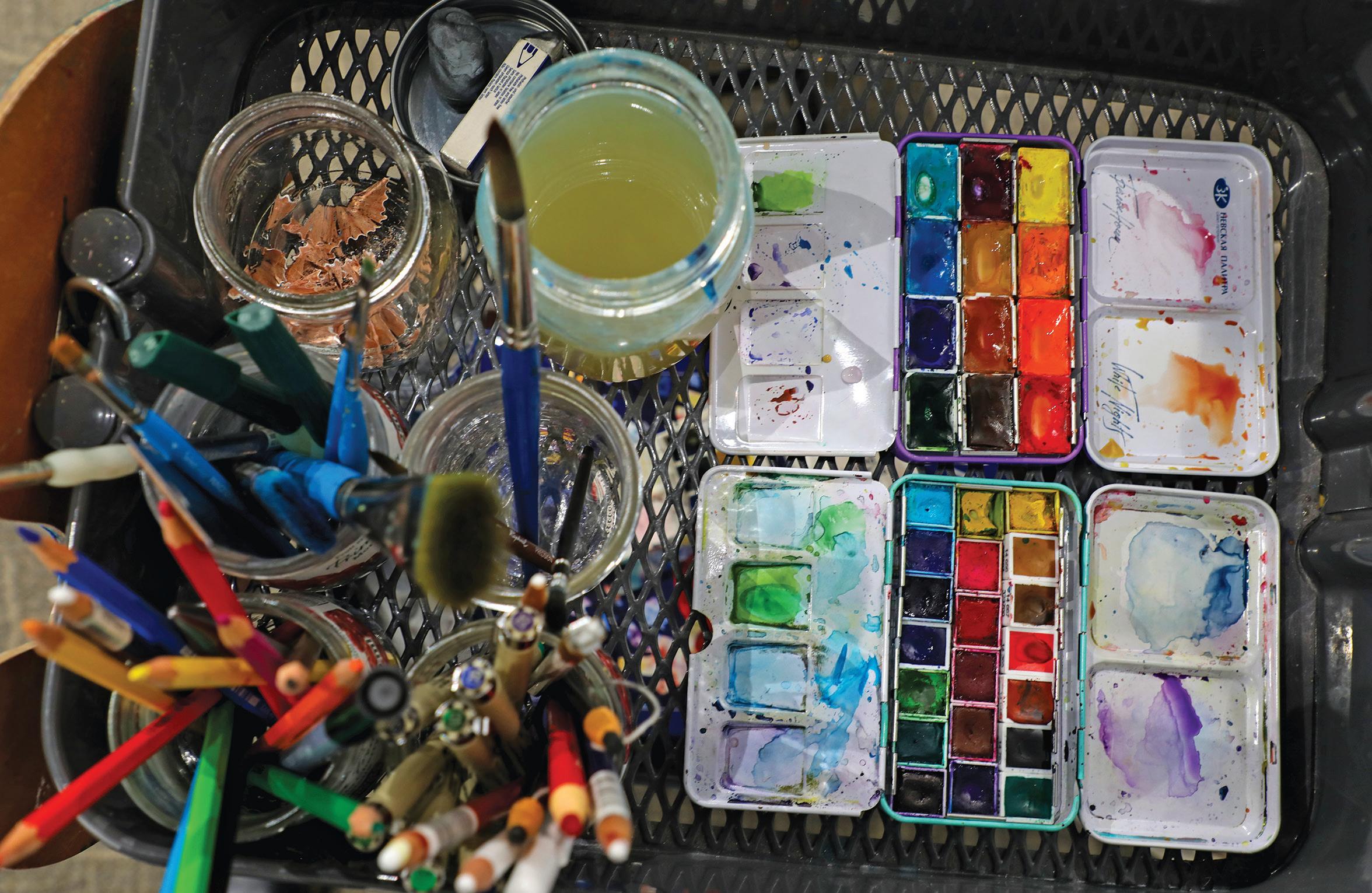
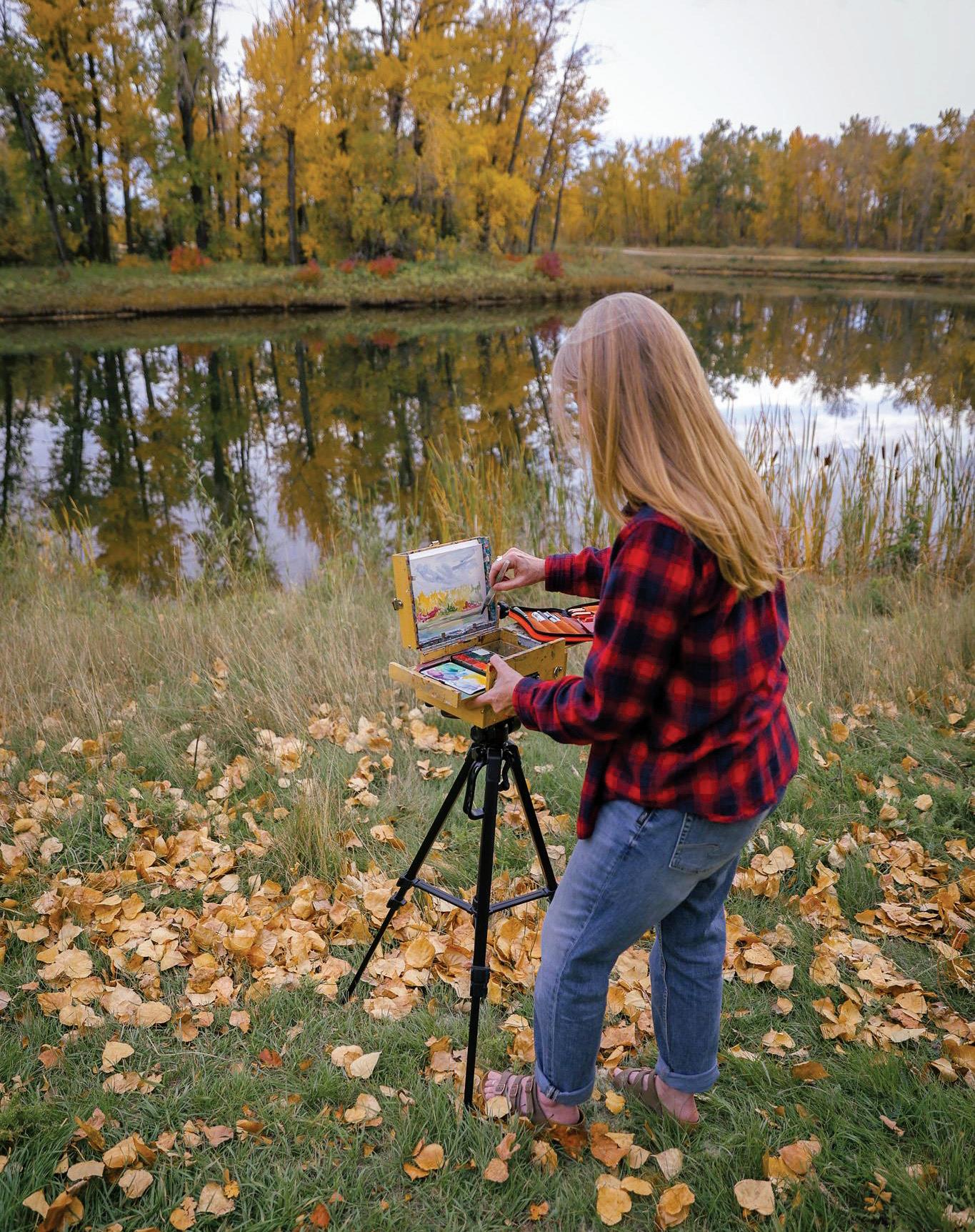
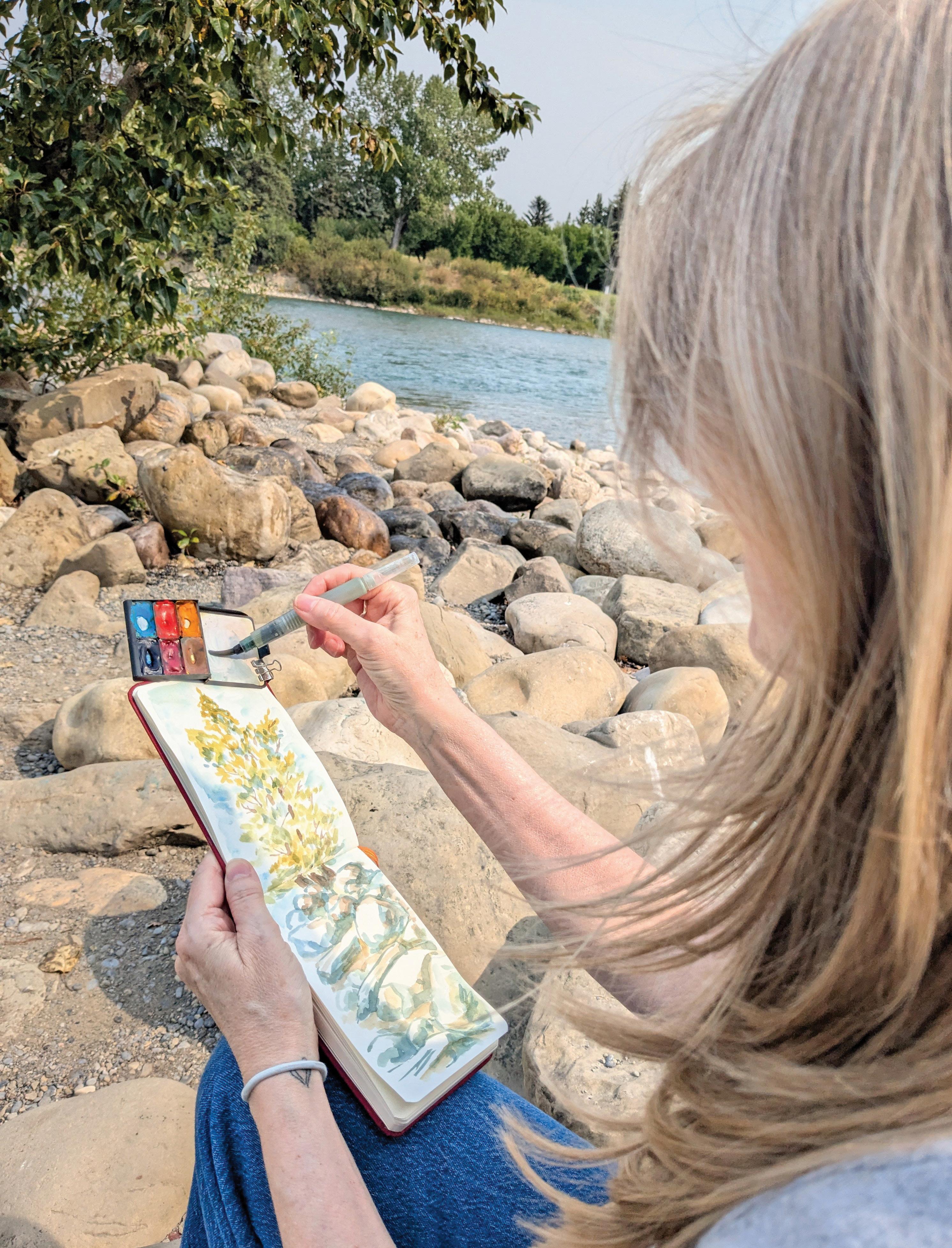
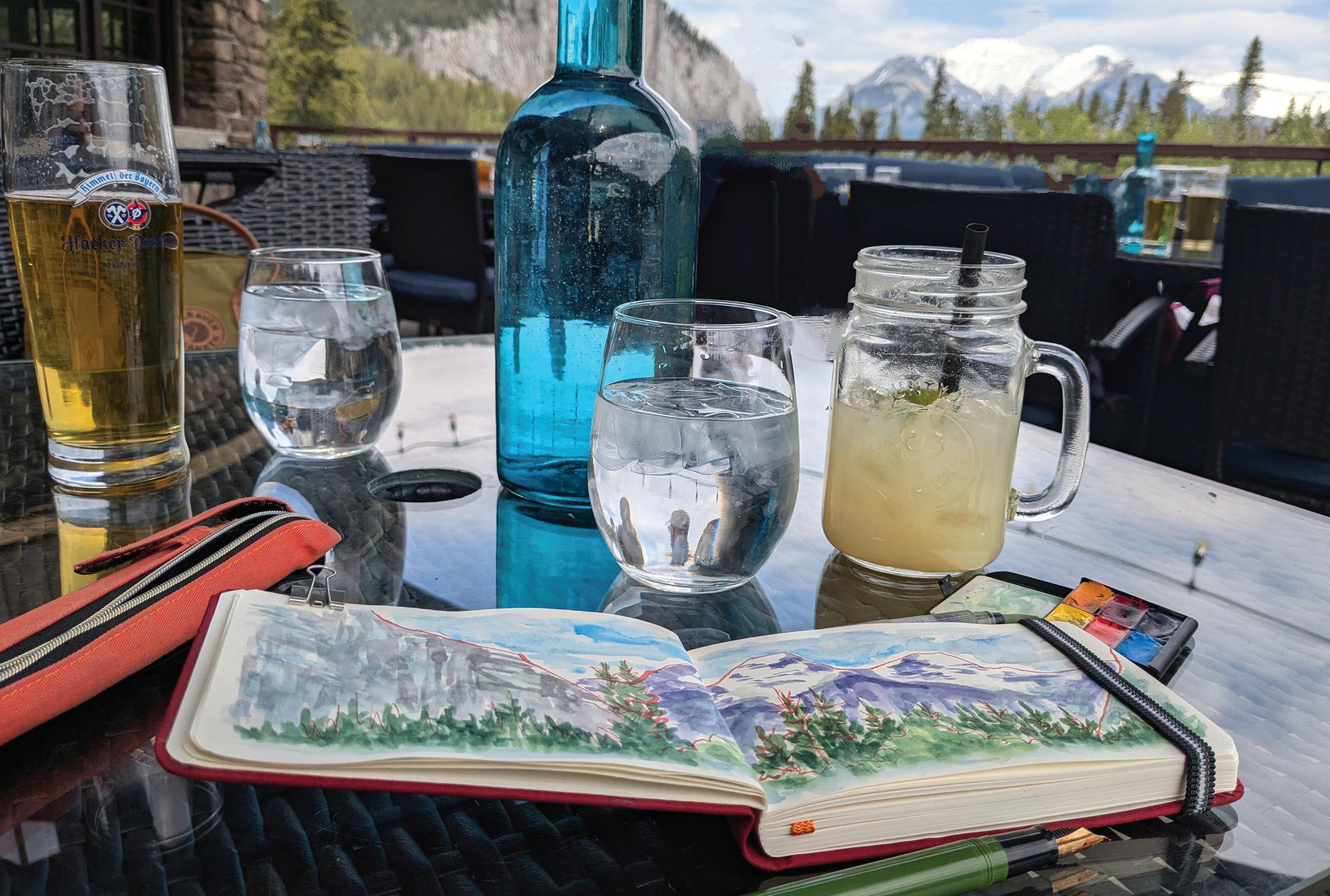
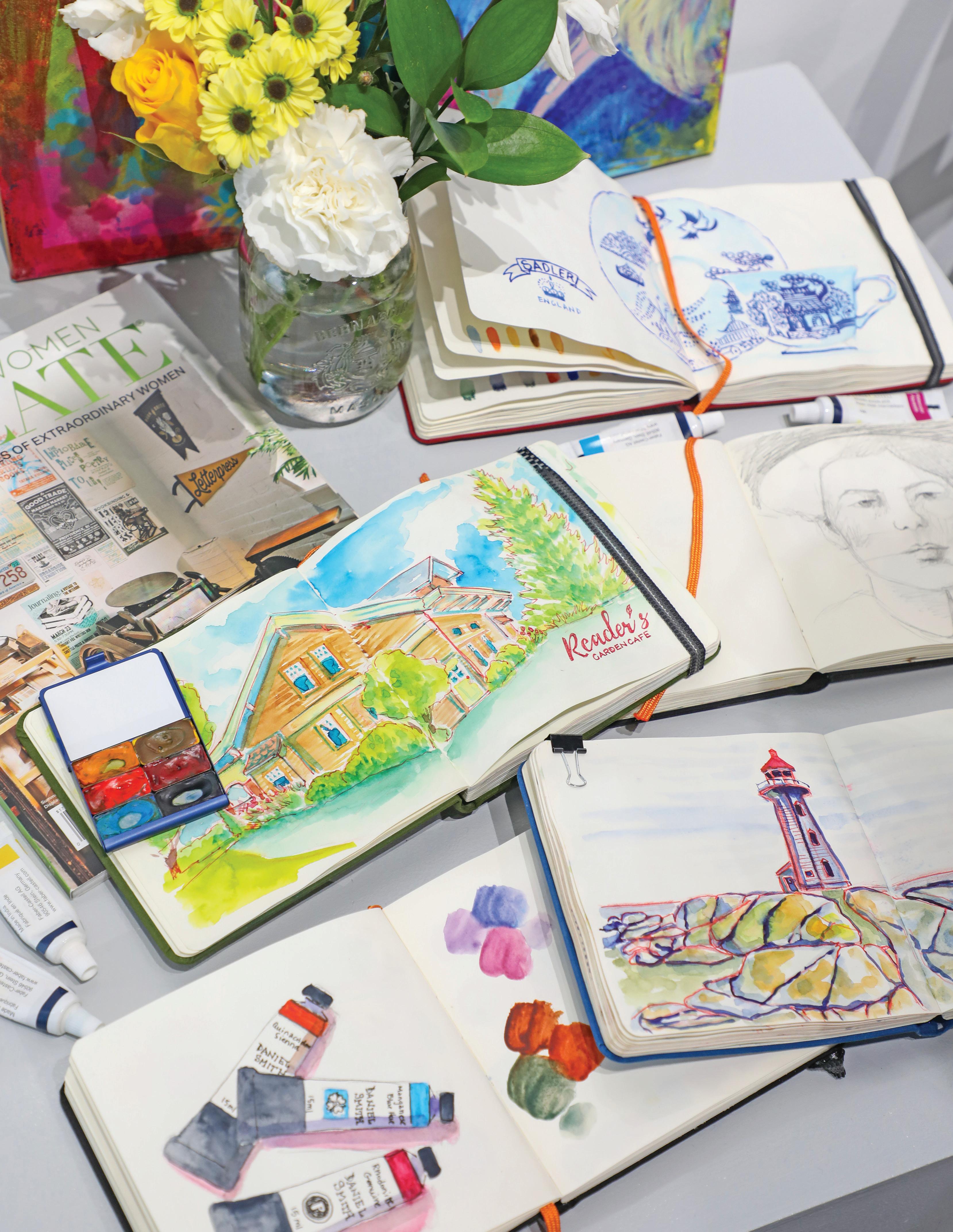
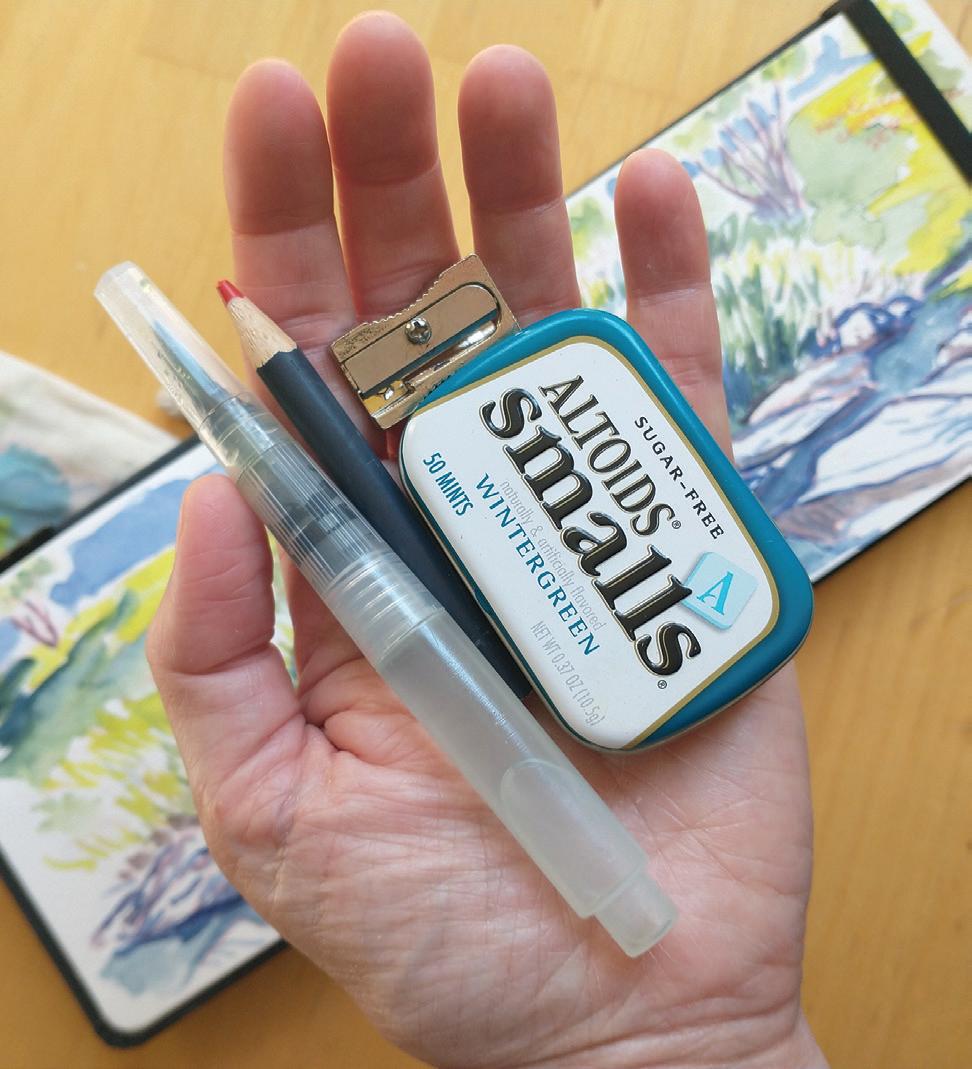
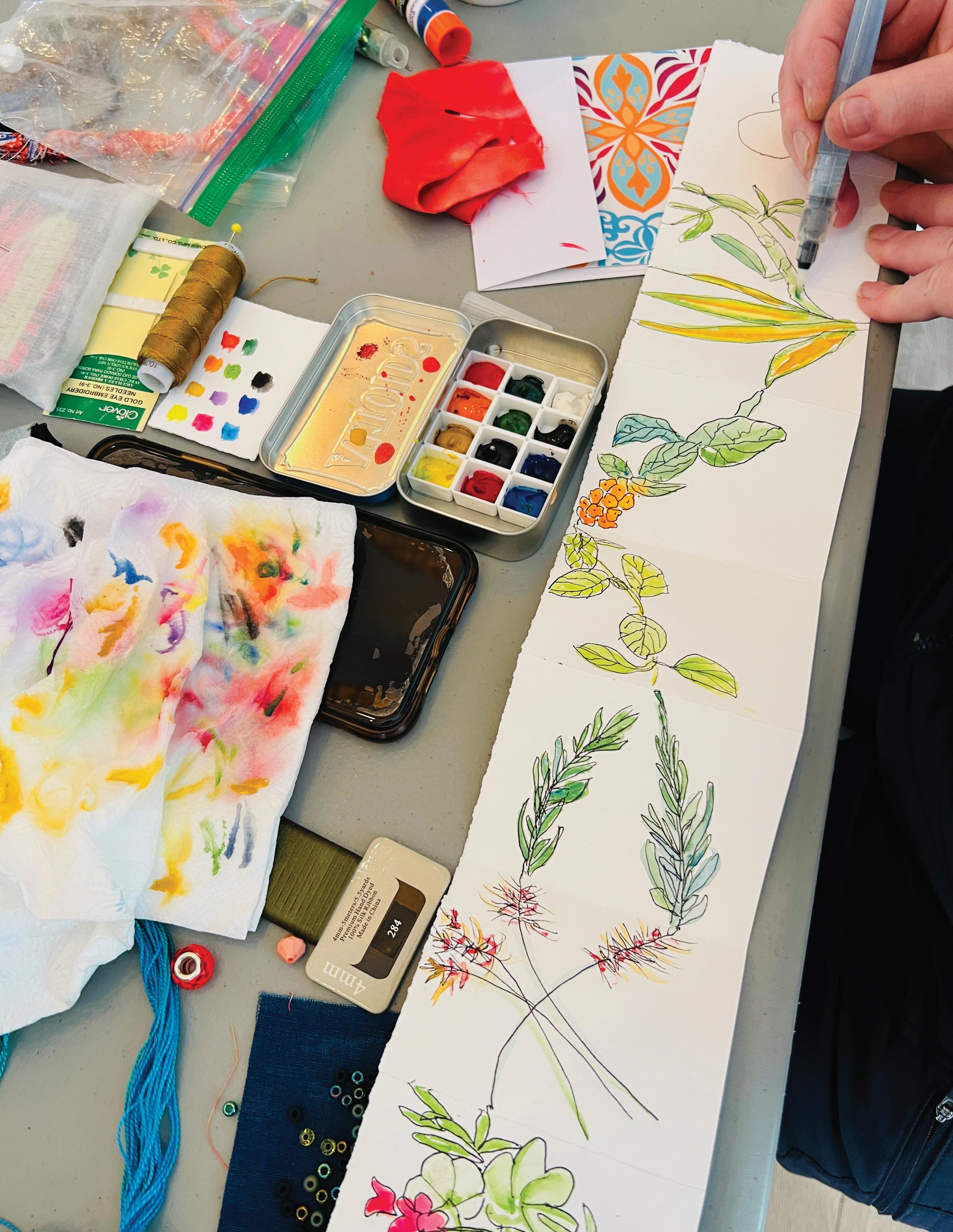
These days, with my daughters living in different regions and countries, travel has become a bigger part of my life. This has meant that utilizing sketchbooks has become even more important. I love capturing memories rather than collecting things on my trips; and, since we walk so much, I need lightweight, easily accessible items. When I paint closer to home, I still use the small 6-by-8-inch paint box that inspired so many projects (I call it my “studio in a box”) and always have it ready to go. Over time, some of my favorite supplies have grown to include a small sketchbook, a small water brush and a miniature set of watercolors, which originally consisted of a mini Altoids tin filled with watercolor paint. It is easily accessible and extremely lightweight.
I used to be very specific about the primary colors I used, but now find that the particular colors no longer matter to me, as long as they are a version of yellow, red (or pink) and blue. Sometimes I add a pencil crayon or a fountain pen filled with red ink to my kit (love the contrast of red with the sketches), but find that the simpler I keep things, the greater the possibility that I will actually create while away.
I happily paint while in a train, plane, vehicle, hotel, park or café … and any time we stop to have a rest, bite to eat or a drink. It really is a lovely way to while away my time doing something that gives me so much joy. Plus, those sketchbooks have become an important part of gathering inspiration for my work and are wonderful mementos of my travels.
CARBURN LAKE, ALBERTA / PHOTO BY LANCETTE BURTON
CASCADE MOUNTAIN, ALBERTA / PHOTO BY KATHERINE FUNK
BOW RIVER, ALBERTA /
PHOTO BY KATHERINE FUNK
Challenges
After developing adhesive capsulitis, I had to switch from working on large canvases to small; and, after 35 years, my husband developed an allergy to acrylics, so I began to switch to watercolor. Every time I finish a project, I am afraid that I may reach a sort of “writer’s block” as a painter — and yet it never happens. Eventually, I learned to view each challenge as an opportunity to try something new.
There have been many quiet times, which I have learned are times to rest, and there have also been many times to celebrate. Those times are always so much sweeter when experienced with a group of inspiring women. The beauty of creativity is that it is endless, though I often have to remind myself just to create for the pleasure of creating in order to keep that well flowing.
The biggest lesson, for me, has been to recognize that the space does not really make a difference. Once I realized that the supplies I loved to work with and the subject matter that drew my attention were the most important parts of my creative practice, the space where I painted did not matter as much. I still maintain a home studio but, with the work I now create, I have been moving further and further away from it.
The ability to practice creativity anywhere is the greatest thing. When I realized that I could work in any environment, I simplified my supplies and began to receive many wonderful opportunities as an artist. Sometimes changing my space is as important to my creative process as actually creating.
BANFF, ALBERTA / PHOTO BY KATHERINE FUNK
THROUGHOUT ALL OF MY years as an artist, I have had to make many adjustments in order to fit the needs of my family and accommodate my physical limitations. A number of years ago, I was given the best advice by an artist who encouraged: “Pay attention to what draws your attention and focus on that.”
Her advice made me realize two things:
1. All I need is my pochade box or a small sketchbook to create anywhere.
2. I can create something large that is also meaningful out of a group of small things.
It has taken a long time to get to this point in my life as an artist. I thought that everything needed to be perfect for me to be inspired or to be taken seriously as an artist. I thought that the space, the supplies, the subject — basically everything — had to be “just right” in order to create something that mattered. Yet, the more I found myself working away from my studio — whether it was live painting for an event, creating a mural, doing work as part of an artist residency or just documenting the world around me — it became clear it was the actual act of creating that mattered.
Nothing brings me more joy than painting, so it is important that I find space in my life for it. After learning of the challenges that female artists of the past overcame in order to create, I realize how fortunate I am to receive so many incredible opportunities as a female artist in this world. I also know that I would paint no matter what, as I believe I have been created to do this work. I believe that so many of us are.
PHOTOS BY ARIEL JADE DOUGHTY
Photography by Lancette Burton, Shallon Cunningham, Ariel Jade Doughty and Katherine Funk
Valori Wells
VALORI WELLS lives in Sisters, Oregon, where her life has been a rich tapestry of passion, perseverance and artistic evolution. From a childhood immersed in the vibrant world of quilting, she discovered photography, fabric design and teaching, continuously refining her craft. Overcoming personal challenges, including navigating grief and rediscovering her artistic voice, she has found new ways to inspire through her work. Now, she reflects on her career, family and future aspirations as she prepares to celebrate significant milestones in both her life and creative ventures.
Ialways wanted to be an artist. My mom told me, “Of course, you can be an artist — but you may have to have an ‘A’ job, ‘B’ job, and ‘C’ job.” At a young age, I took this to heart as I found myself with my hands and heart in multiple jobs and projects.
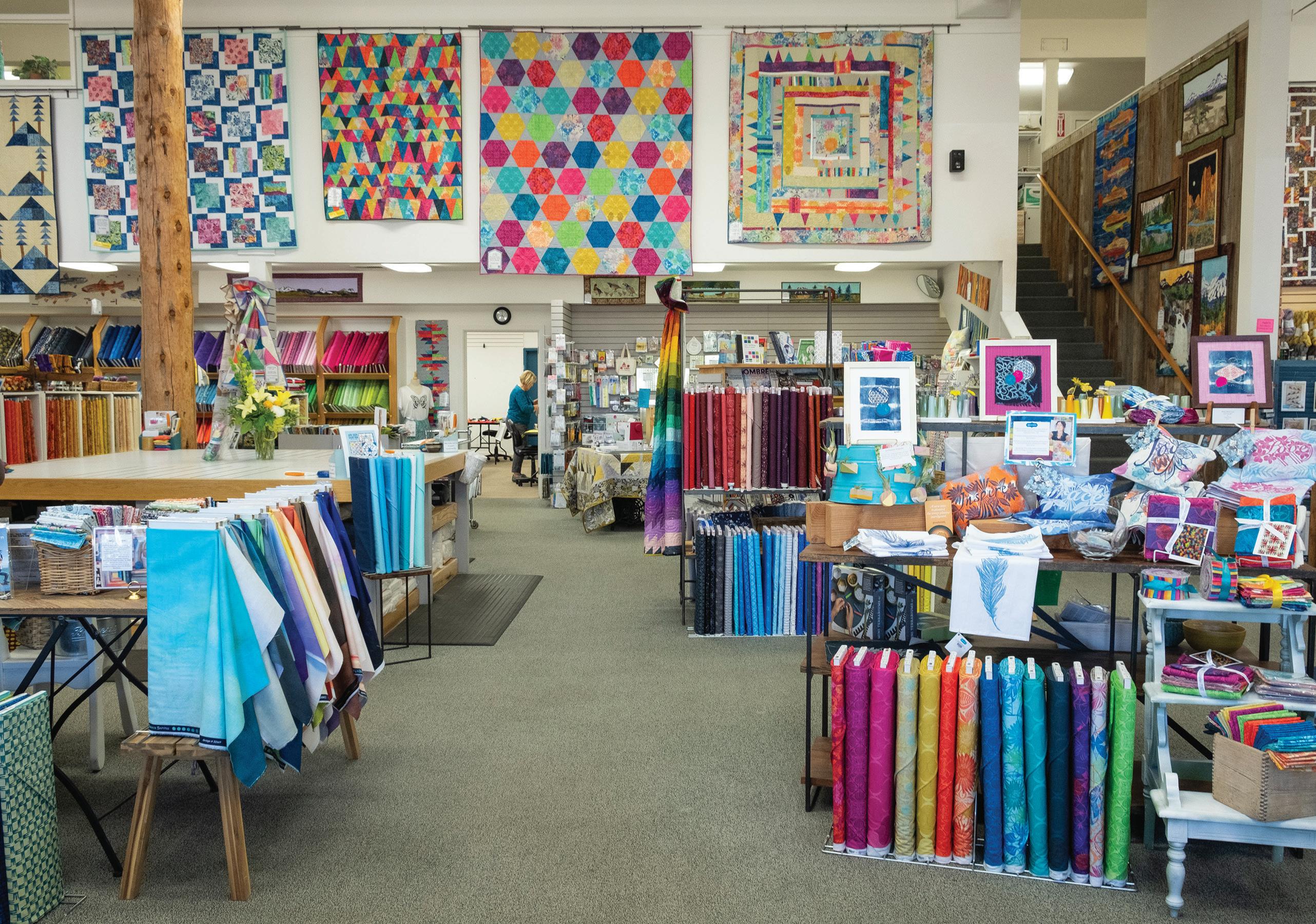
I grew up in my mom’s quilt shop, the Stitchin’ Post, in Sisters, Oregon. At 13, I discovered photography, working in the darkroom and developing film and photos that captured what I saw and felt. I love how photography can capture a moment and tell a story inside and outside the frame. I love how it captures the finest details of nature and can encompass emotions, moments and lives.
I graduated high school in 1991, and after a year I felt lost and needed to find my path. My stepdad gave me a job as a waitress in his restaurant, where I worked hard and, with the help of my mom and her friend, put together a portfolio for Pacific Northwest College of Art. In 1993, I started my journey in art school. I learned so many new mediums and styles of art, and found myself always going to the subject matter that I loved the most: nature.
Between my junior and senior years in college, my mom hired me to do the photography for one of her quilting books, and that is when I discovered my love of fabric. I was in awe of the palette Mom had to choose from and how she painted with fabric. I even had her give me a refresher course on quilting.
After four years of exhausting all of the photography classes offered at my school, I filled my credits and passion with block printing and screen printing, not to mention the four years of required life drawing. I graduated with a bachelor’s degree in fine art in 1997.
Later that year, I moved to Greensboro, North Carolina. My mom and I were working on a book at the time, and I was making a quilt for it — my first real quilt. Don’t get me wrong: I had sewn most of my life, and had learned a lot from watching Mom, but I had no interest in quilting. When I was ready to machine quilt, I called my mom for advice, and she sent me to a local quilt shop that sold Bernina sewing machines.
I ended up working at Fran’s Quilt Shop. This job sparked a desire to design my own fabric and bring something fresh and modern into the quilting industry. In a conversation with my mom, I mentioned this, and she immediately knew someone to introduce me to: the design director for a fabric company called Quilter’s Only, in Charlotte, North Carolina. I gathered up a portfolio of my nature photography, hopped in my red Jeep, and drove to Charlotte. This was the beginning of my fabric designing career.
After a year in North Carolina, I was extremely homesick and found myself yet again calling my mom. I asked if she had any job openings at the shop (I knew she wouldn’t make a special job just for me). Luckily, the buyer of books, patterns and notions was retiring. I got the job. This became my “A” job. My “B” job was designing fabric; and my “C” job was writing how-to quilt books.
Over the next several years, my mom and I created seven books together, and I did all the photography. I was becoming a quilter after all. As I learned new techniques, I would become obsessed and work on them until I had exhausted my curiosity, which led to four of my own books.
The evolution of my art over the years and my desire to continue to grow is evident in my career as a fabric designer. My first collection started with a studio using my black-and-white photography and creating repeats and color stories for the fabric. I found myself wanting to have my hand in the designing, so I set forth and learned how to draw repeats and create color callouts.
After a year, I realized I wanted to be the one painting the designs, not a studio. With a lot of practice and tips from a fellow artist, I learned how to paint with gouache. I designed in this fashion for years, until I started getting curious about using Adobe Illustrator to color, change scale and create repeats — all of the things I did by hand that were very time-consuming. At the time, I had little children, worked at the shop, and wrote quilting books.
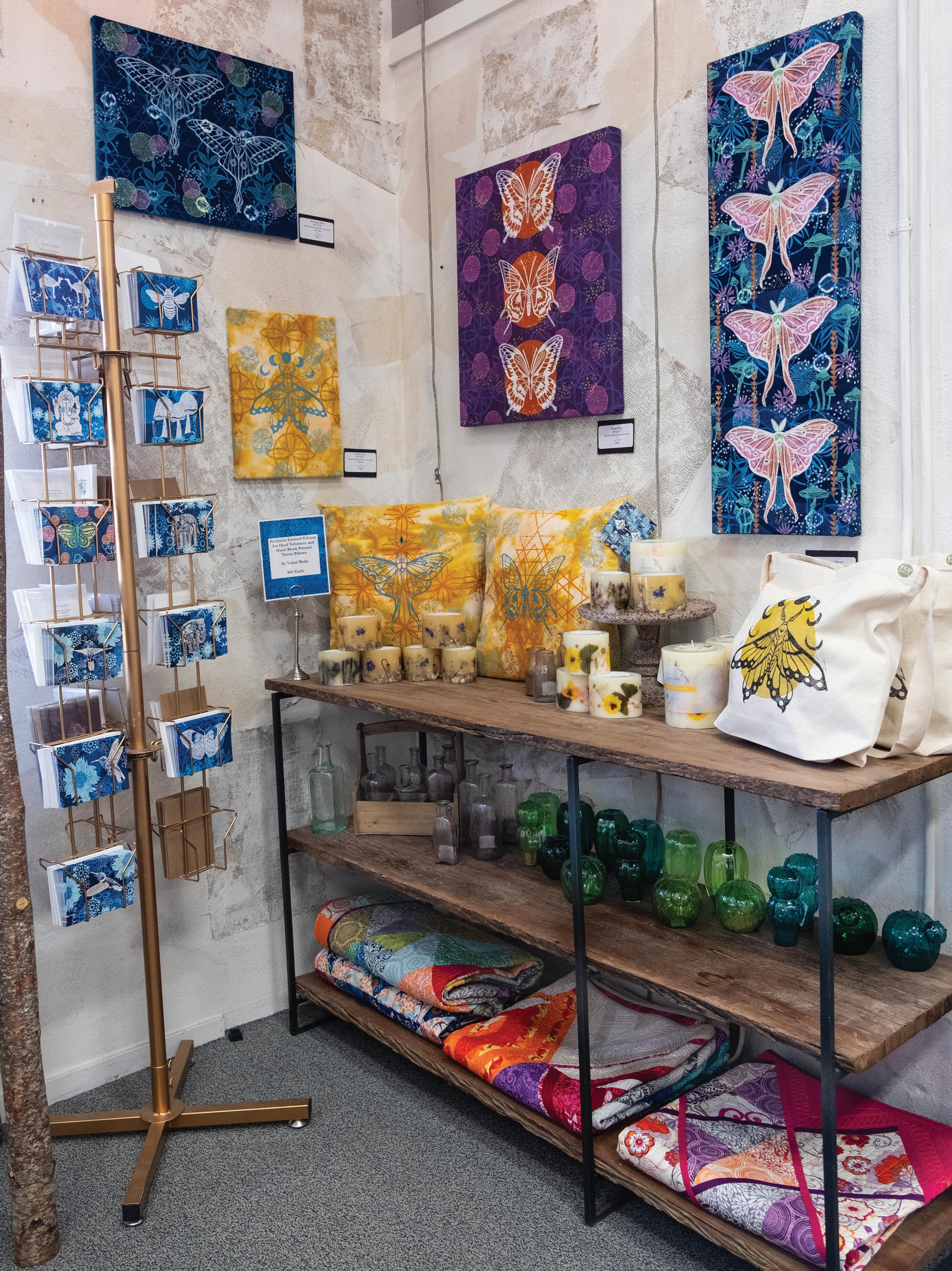
During these years, I started block printing and screen printing again, purely for myself. As I got deeper and deeper into carving and printing, I decided it was time to incorporate them into my fabric design. The first collection of blockprinted designs came out in 2018, and I haven’t exhausted my curiosity or enjoyment of creating in this way. It allows me to make intricate layered pieces that tell a story.
“And now that you don’t have to be perfect, you can be good.”
— John Steinbeck, East of Eden
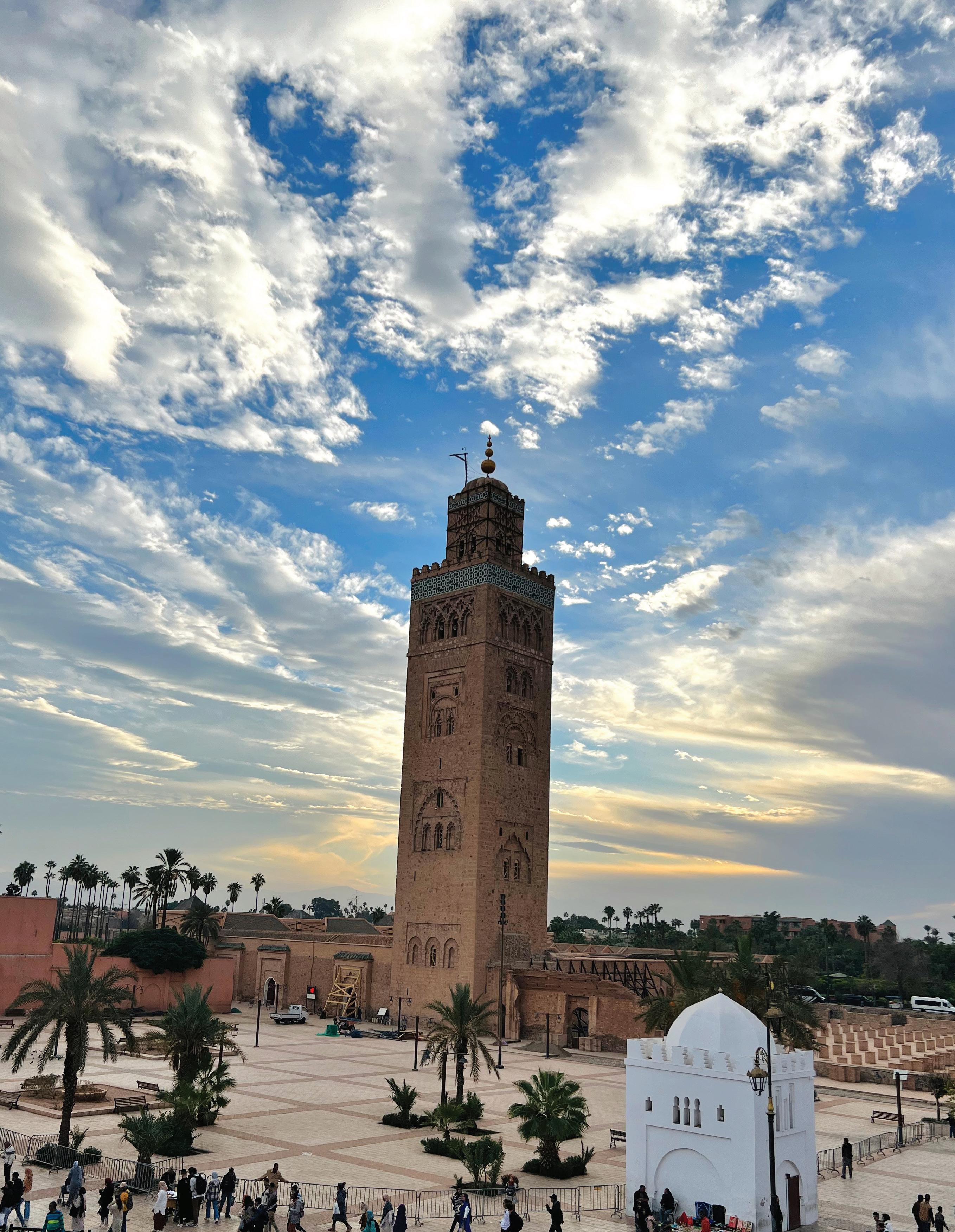
As a teenager, I dreamed of visiting Morocco. I was drawn to the art, culture and color. In 2014, I attended an artist retreat in Marrakech and fell in love with the city from the minute I stepped off the plane. That trip changed my life; my art exploded, and I was able to return in 2016 to teach at a retreat. My “C” job of writing quilting books had transformed into teaching, whether it was in Morocco, our shop, or other quilt shops and conferences in the U.S.
It was also in 2016 that I met a woman who would change my life. The best way to describe Kelly Sheets is as an “artist of life.” Her profession was business mentorship and life coaching. She came into my world when I was dealing with a lot of depression and anxiety, feeling lost as I juggled life. I was tired and unfocused, expending all my energy outward on work and my young family.
Kelly taught me how to break old habits and the thought patterns that kept me from being my true self. The work I did with Kelly gave me the confidence to start taking over the shop, allowing my mom to semi-retire. The prospect had always scared me, and I wasn’t sure I was capable. In January of 2018, I officially took it over (though Mom is always nearby and ready to help).
Kelly and I became friends outside of the work we did together, and we started dreaming of creating our international retreats. Just as I loved Morocco, she had the same love affair with Bali. We wanted to create something different from other artist retreats, to incorporate Kelly’s work and wisdom to expand our clients’ ways of thinking and creating. Our first Creatives Retreat was in the spring of 2018 in Ubud, Bali.
The retreats have been one of my greatest joys in my career as an artist. I teach photography, drawing, block printing and stitching, while Kelly gives morning “energy” talks about creativity and how to become an artist of life. We take classes from local art masters and experience museums, culture, food and friendship, which allows the group to form a unique bond.
In 2020, when COVID hit and we had to close our shop doors to the public, my life turned on its heel, and my focus went to the “A” job. At first, it was my 12- and 14-year-old daughters and me answering phones and filling online orders. I realized very quickly that I needed some of my team back if I was to save the shop and not kill my kids. I brought back four of my key people, and we started brainstorming.
Our shop was built on education and inspiration, and over the 45 years in business, we had created a community that needed us. We got extremely creative with our newsletters, curbside pickup, how-to videos and new products, perfect for people stuck at home. It was one of the hardest and most rewarding times in my life. I would come home absolutely exhausted, but joyful that we were still there and were connecting with people.
COVID prepared me for another twist in my life: In January of 2021, my husband unexpectedly announced he wanted a divorce. As you can imagine, this sent my three kids and me into a tailspin of grief and change. I went into survival mode, keeping myself above water and available for my kids. I paused my fabric design and focused on my family and the shop.
I was drowning in grief and wondering who I was without my husband of 18 years. My creativity was stifled, but I needed something, so I bought a roll of canvas and started painting huge canvases to feel something besides sadness. I would paint, and the next day paint over it. I did this for months. What I didn’t realize at the time was that creating in this fashion connected me to my soul, my truth and my creativity, which was always there waiting for me. Nothing ever has come of those paintings, but the act of painting my emotions is something I still do, sometimes painting repeatedly on a canvas and sometimes finishing one and saying: You can stay for a while.
Ihave spent my life as a working artist, always thinking about how I can make money from what I create. My paintings are rarely seen by others, and I have less attachment to the outcome. It’s about being in the moment of creation where nothing else in the universe matters. This self-reflection brought me to wonder what my purpose is in this life. I look at my mom, and I know her purpose is to educate. My inward reflection took me on a journey, and I realized that my purpose is to inspire and be inspired.
In the spring of 2022, I decided to do the #100dayproject on Instagram. It is a prompt to create something every day for 100 days, with no guidelines. I have hundreds of blocks in my library and a lot of fabric, and almost every day I would spend half an hour printing a block on a colored piece of fabric. I didn’t have to come up with something new, but just print and play with color. It took me close to 200 days to complete the project, and I would give myself grace for the days I didn’t print. About halfway through, I was inspired to carve something new. It was magical. I finally felt like I was finding myself in this new life.
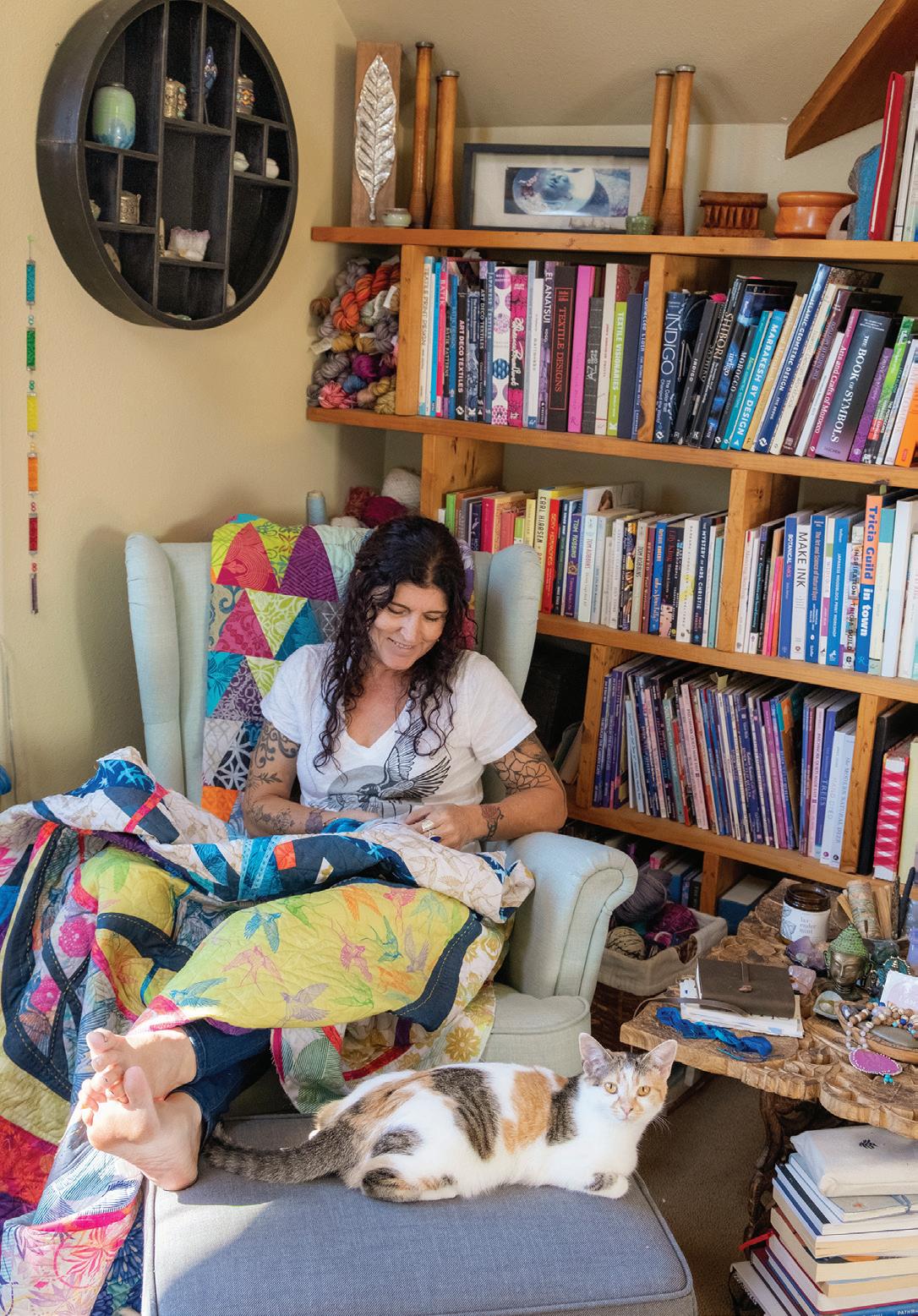
The ever-patient fabric company I designed for gently asked me if I was up to doing a new collection in the summer of 2022. I was a single mom and needed to plan for my future, so I showed them my new panels. They became my next fabric collection, Grace. On my journey, grace had become the ingredient I needed to get out of my grief and start living my life. 2025 is a milestone year. The shop celebrates 50 years in business, and I celebrate 27 years of designing fabric and inspiring the quilting community and beyond. I continue to design fabric and make quilts, teach classes, travel to Bali and Morocco for artist retreats, and paint my emotions. I find myself grateful for my journey — the successes and failures, the tears and laughter, heartache and happiness — and look to the future with an authentic open heart.
TRACY
KRAUTER SPLASH FABRIC
PHOTOGRAPHY BY SARAH JORGENSEN
MY STORY
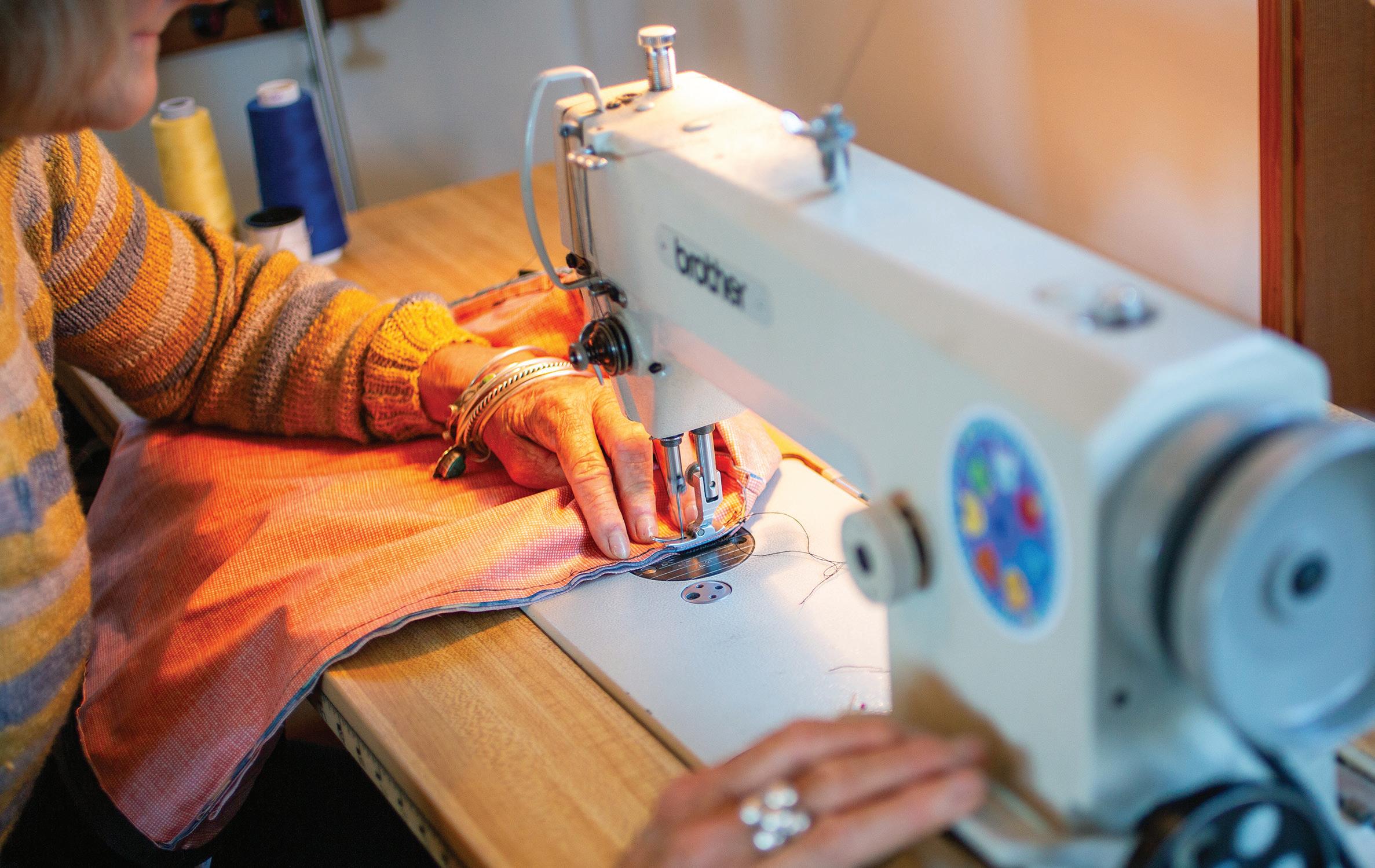
I’ve always been a maker. I took a Singer sewing class at age 12 and never stopped sewing. (Kudos to all the sewing teachers out there!) There’s profound power in creating with our hands.
When Michelle Obama took up knitting, she called it “the power of small,” saying: “It’s the idea that narrowing your focus into a small, seemingly insignificant task can remind us of our own agency. It shows us our own ability to build, create, and succeed.”
I know how life-saving sewing is. This is why I do my best to bring inspirational fabrics, products and projects into the world. A former National Park Ranger concerned about our planet, I made sure our fabrics are PVC-free, PFAS(Forever Chemicals)-free, food safe and nontoxic.
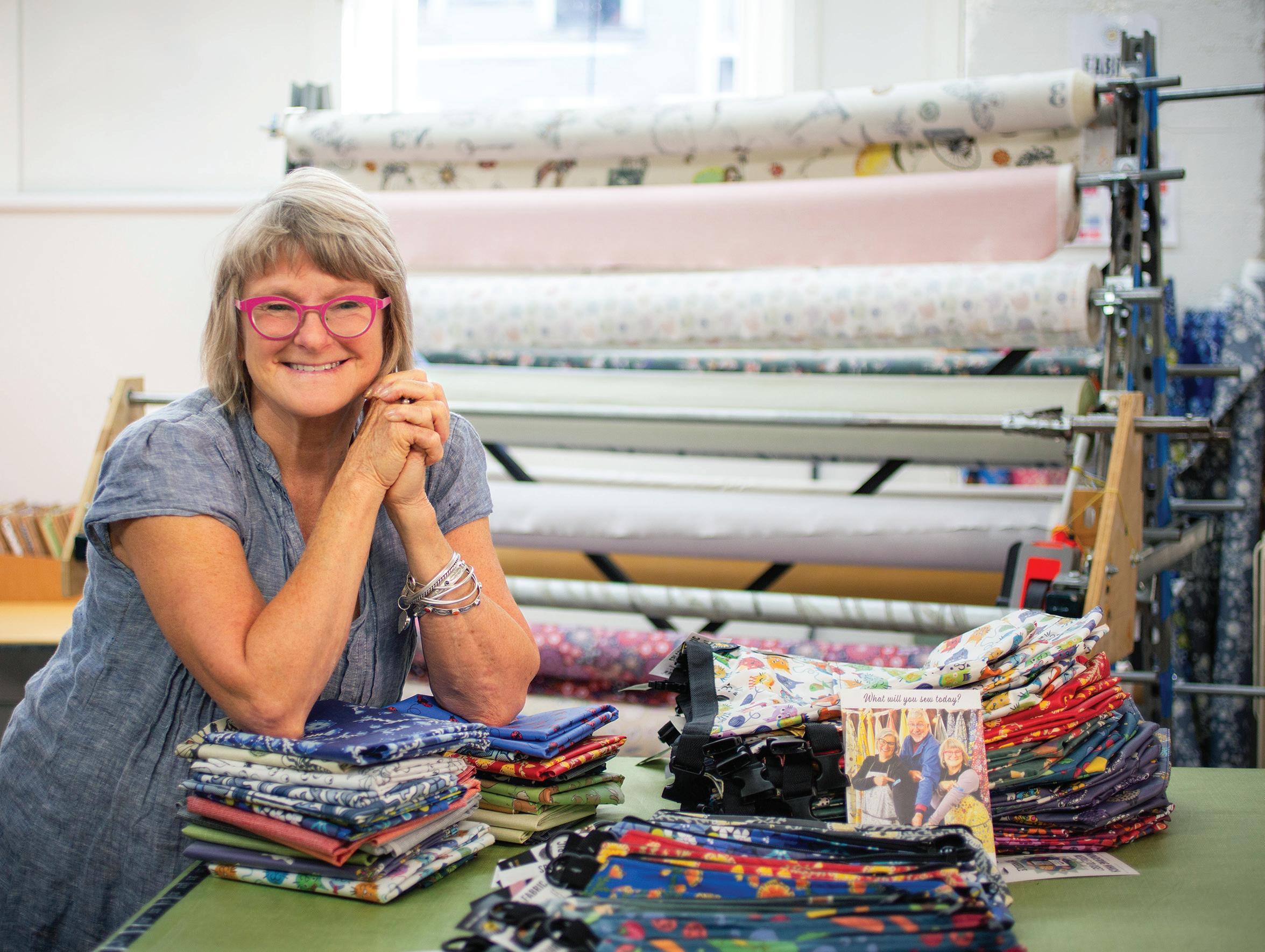
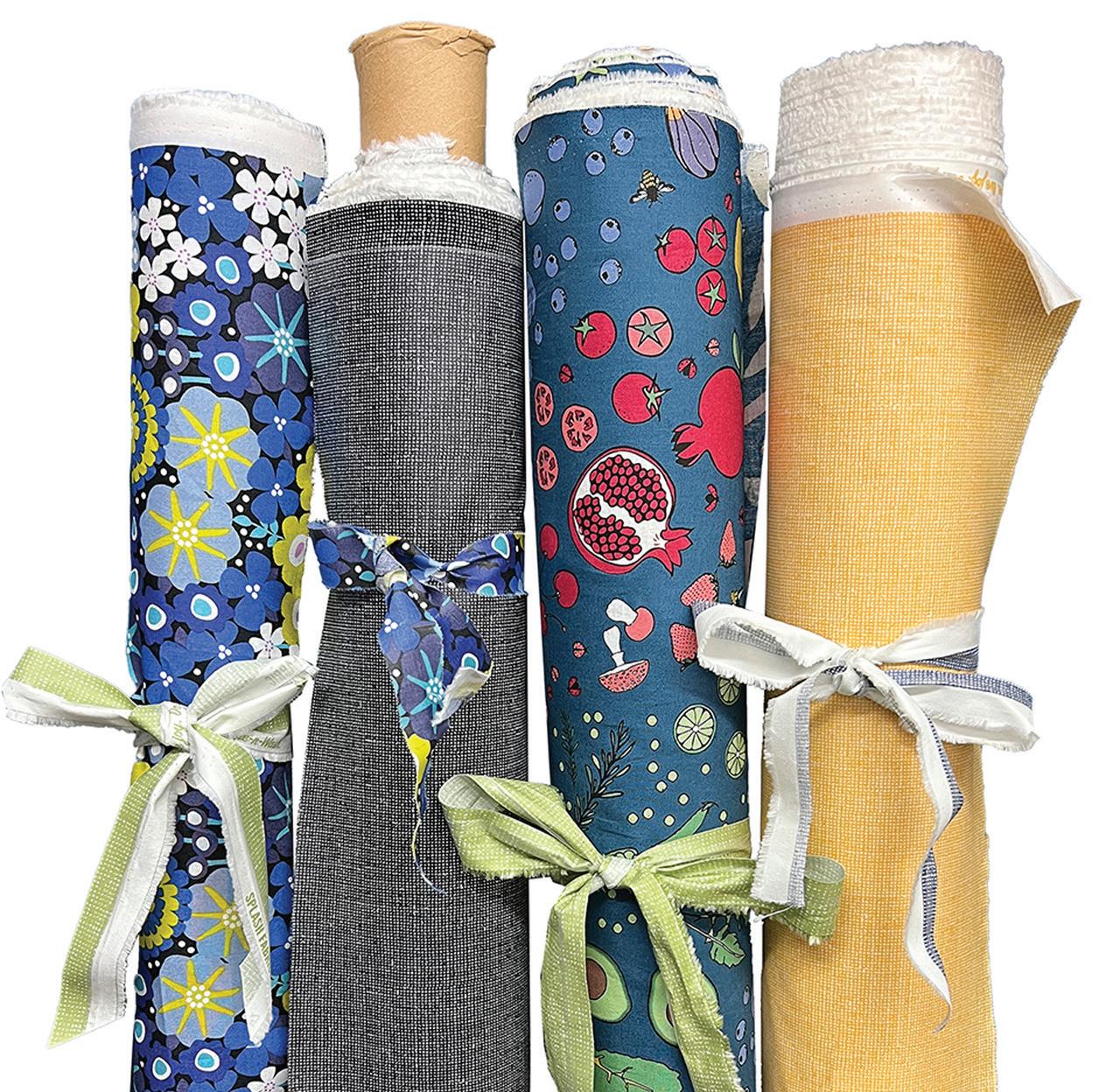
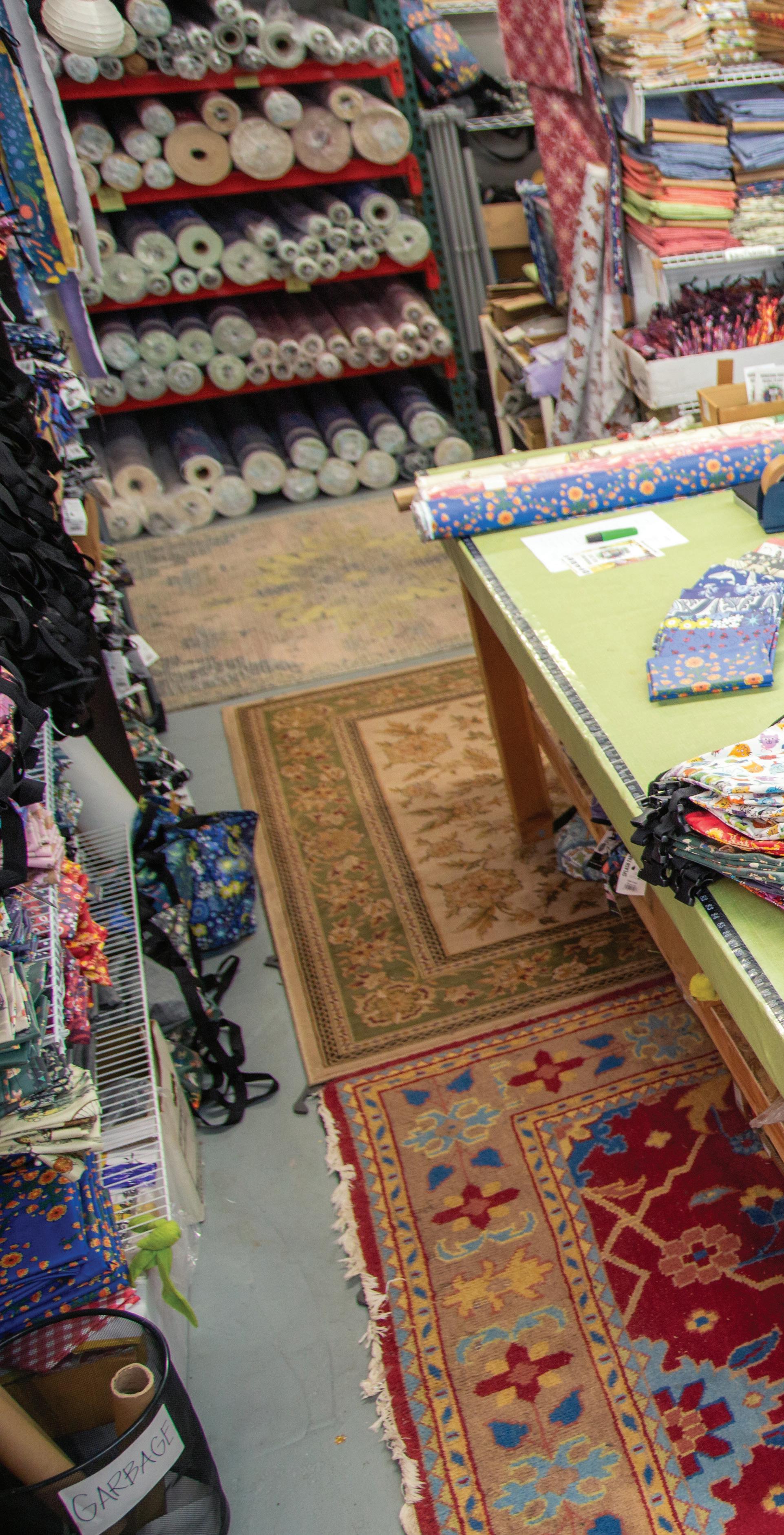
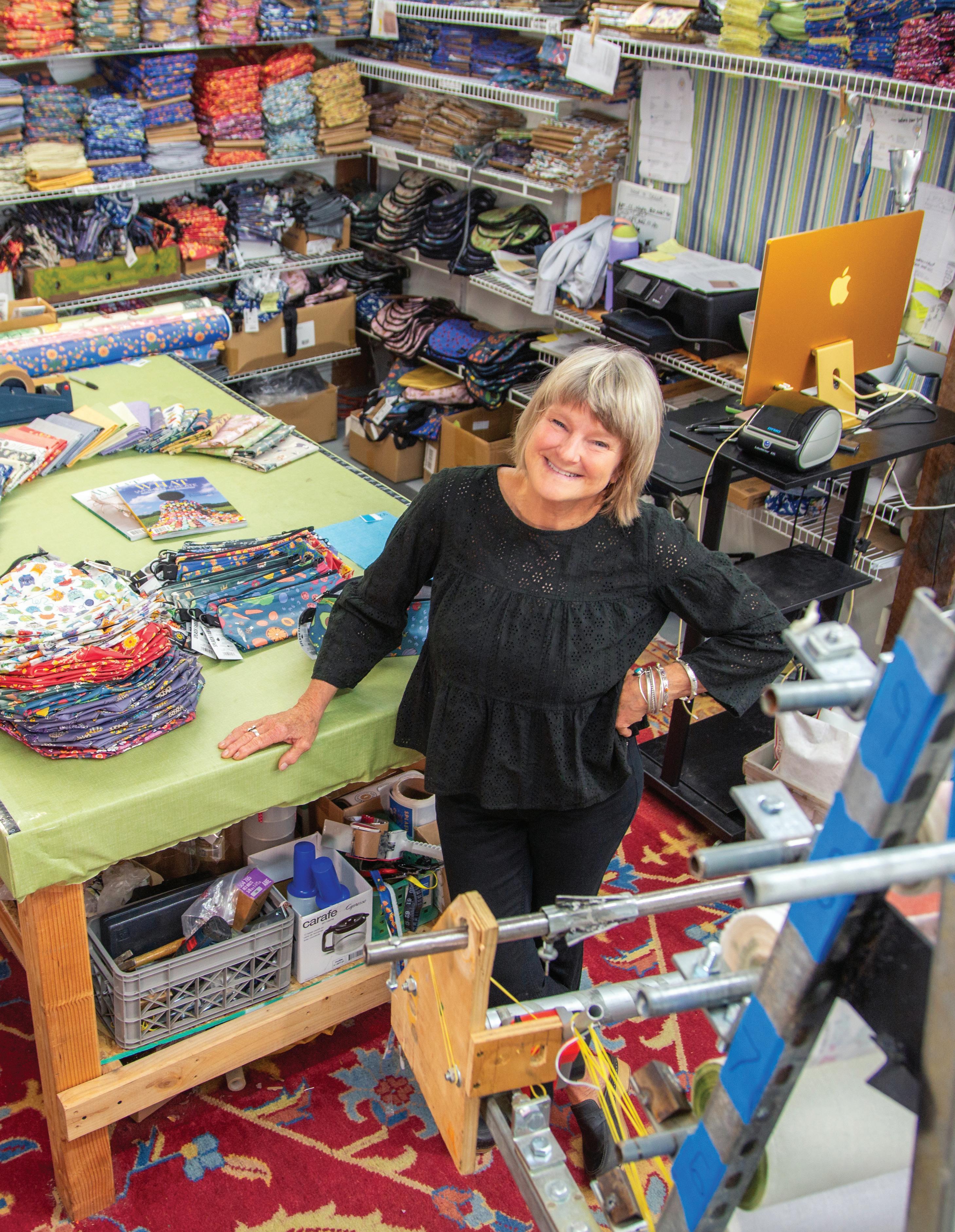
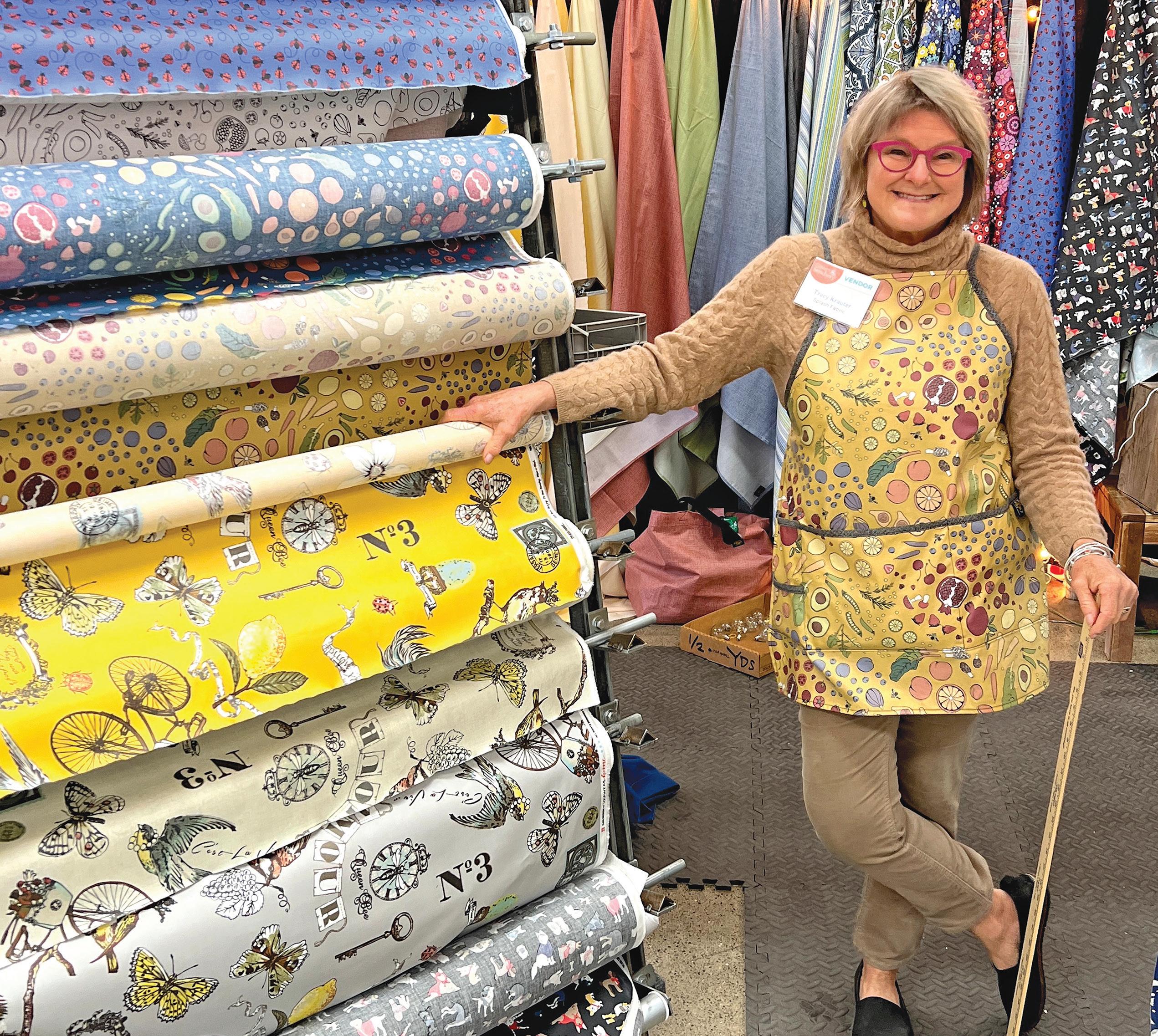
Raising three boys, TRACY KRAUTER knew there had to be a better solution to everyday messes. When she couldn’t find the perfect fabric — soft yet waterproof, durable yet sewable, with fun designs in good colors — she didn’t just settle. She built her own fabric company in Seattle, Washington.
Today, her signature laminated cotton transforms ordinary items into spill-proof shields, creating beautiful, practical solutions that protect her clients’ tables and bag contents and reduce their laundry, while adding a splash of joy to daily life.
CREATIVITY TRAINING
As a kid, one of my favorite outings was to the hardware store. I’d roam the aisles, looking for something that sparked interest and opened my mind to what I could make out of it. I believe this was where my creativity was nurtured. I still use the skill for opening my brain honed in those aisles when I’m trying to solve a design problem. I love a good design problem!
Making things was an escape. Growing up, our home swirled with crazy family drama. I found peace in my quiet room, drawing and creating.
I fell in love with repeat patterns in college, studying art, design and silk-screening at Stanford with Matt Kahn. He taught me critical thinking and excellence. I sewed there too, making my
clothes, tent and backpacking gear. I dreamed of my future studio: a white room filled with color.
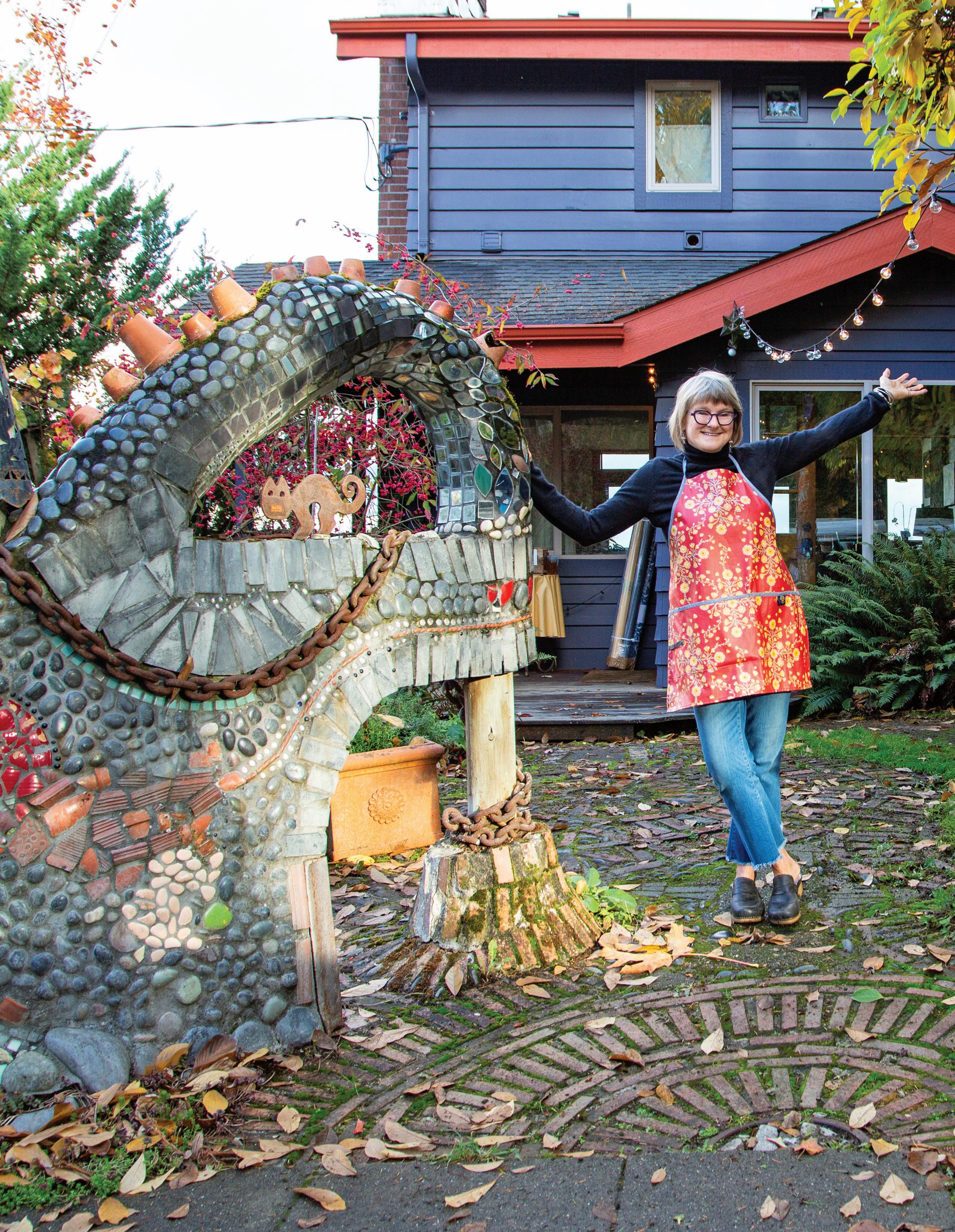
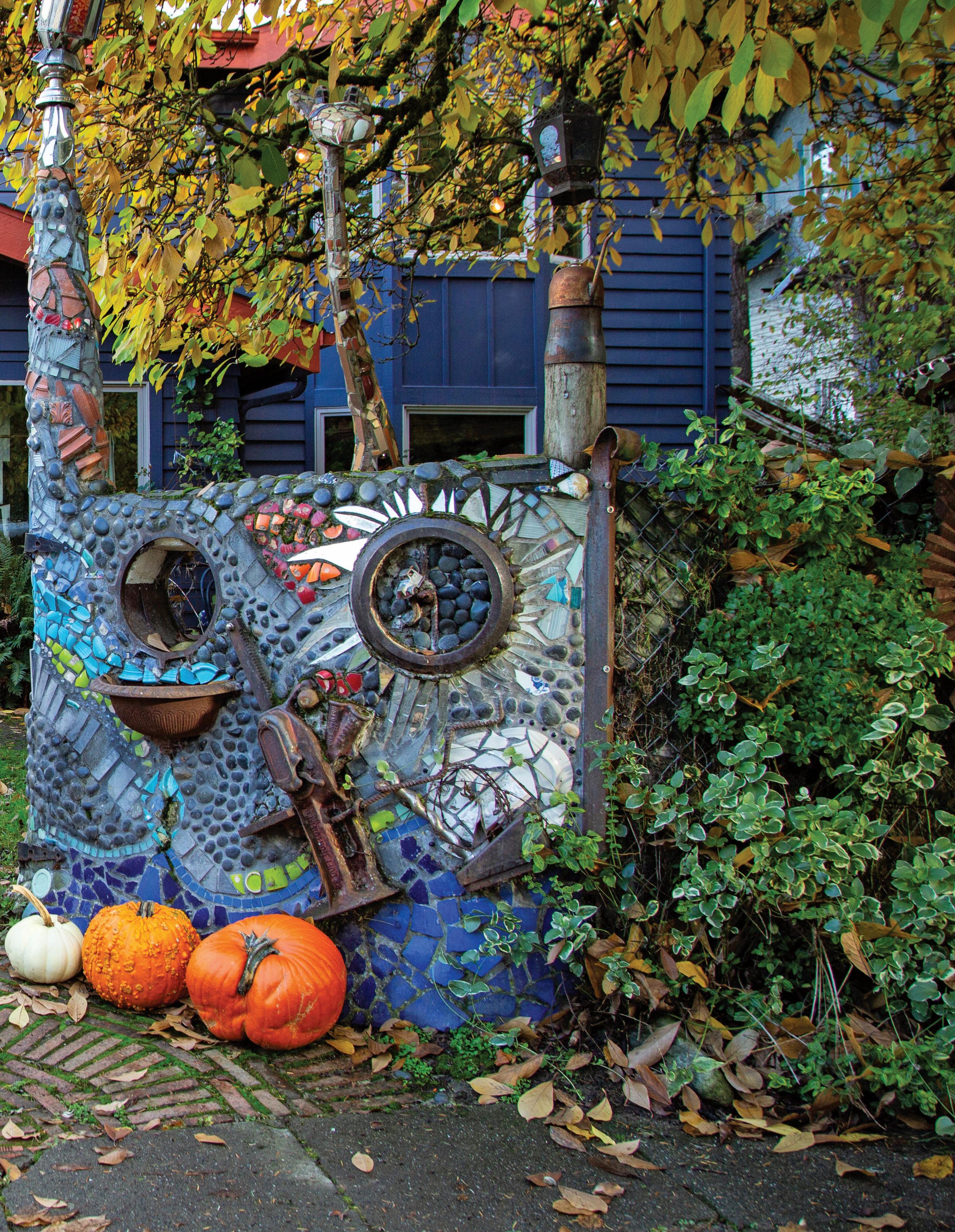
At 54, I wondered if I was “done” with big new projects. I’d worked as a scale model maker, and had a kids’ clothing line, purchasing lots of fabric designed by others. I’d taught art and sewing in Seattle Public Schools. I’d rebuilt a few houses and gardens, and mosaic tiled a lot of surfaces. But I was ready for a new challenge, even as I feared being too old to start again. I asked: What would I do if I wasn’t afraid?
Design my own prints, of course! How hard could it be? Two full years of research later, I found a mill where I could order my unique fabric, make things out of it, and still make some profit. My first few 3,000-yard printings were designed by the amazing Christine Joly de Lotbiniere. I had no digital skills, nor concept of the process.
I’ve conquered Photoshop, Illustrator and Procreate well enough to make them conform to my wishes. Now, I’ve designed most of our line’s 32 prints!
WHAT MAKES A BODY OF WORK?
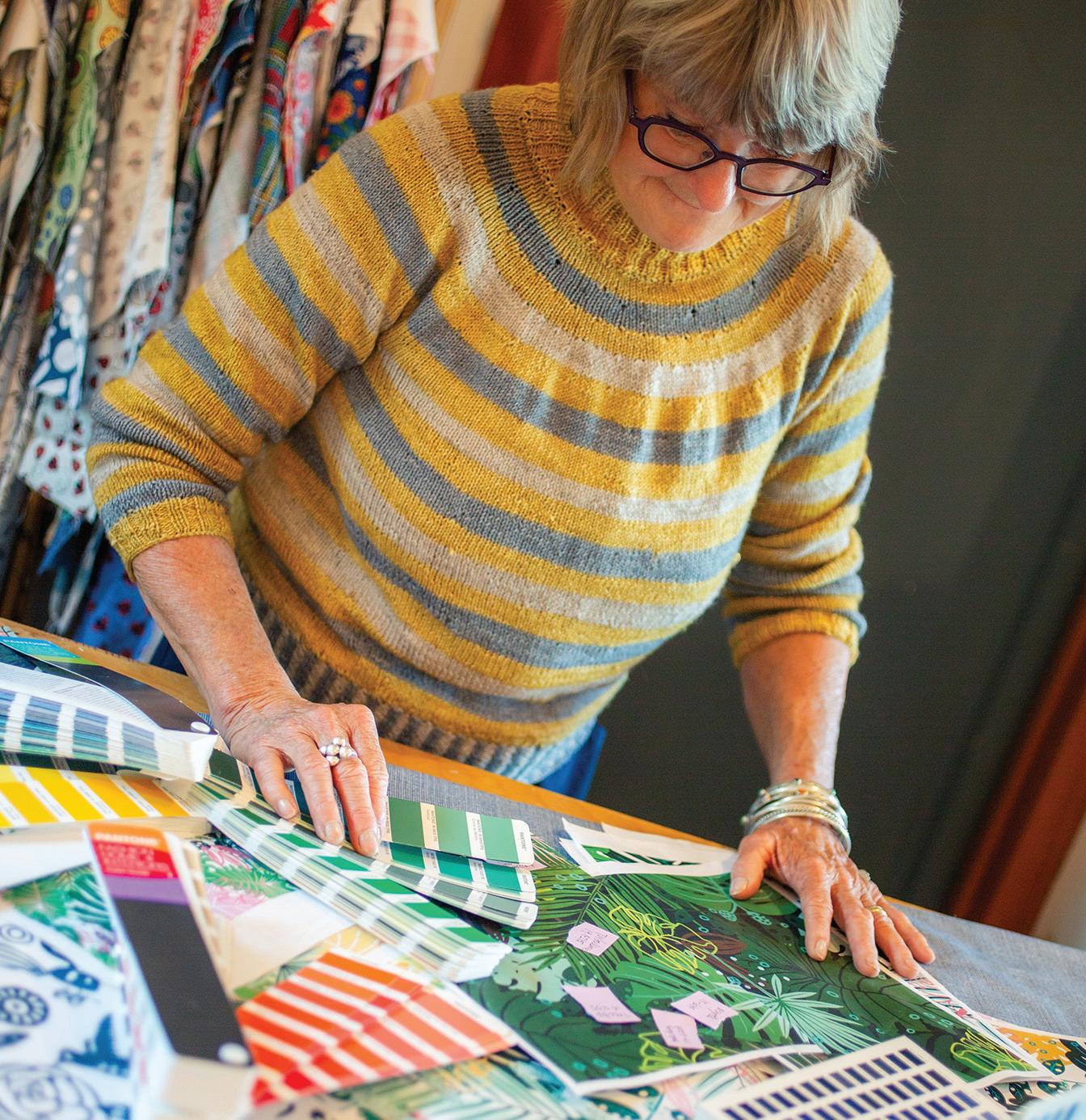
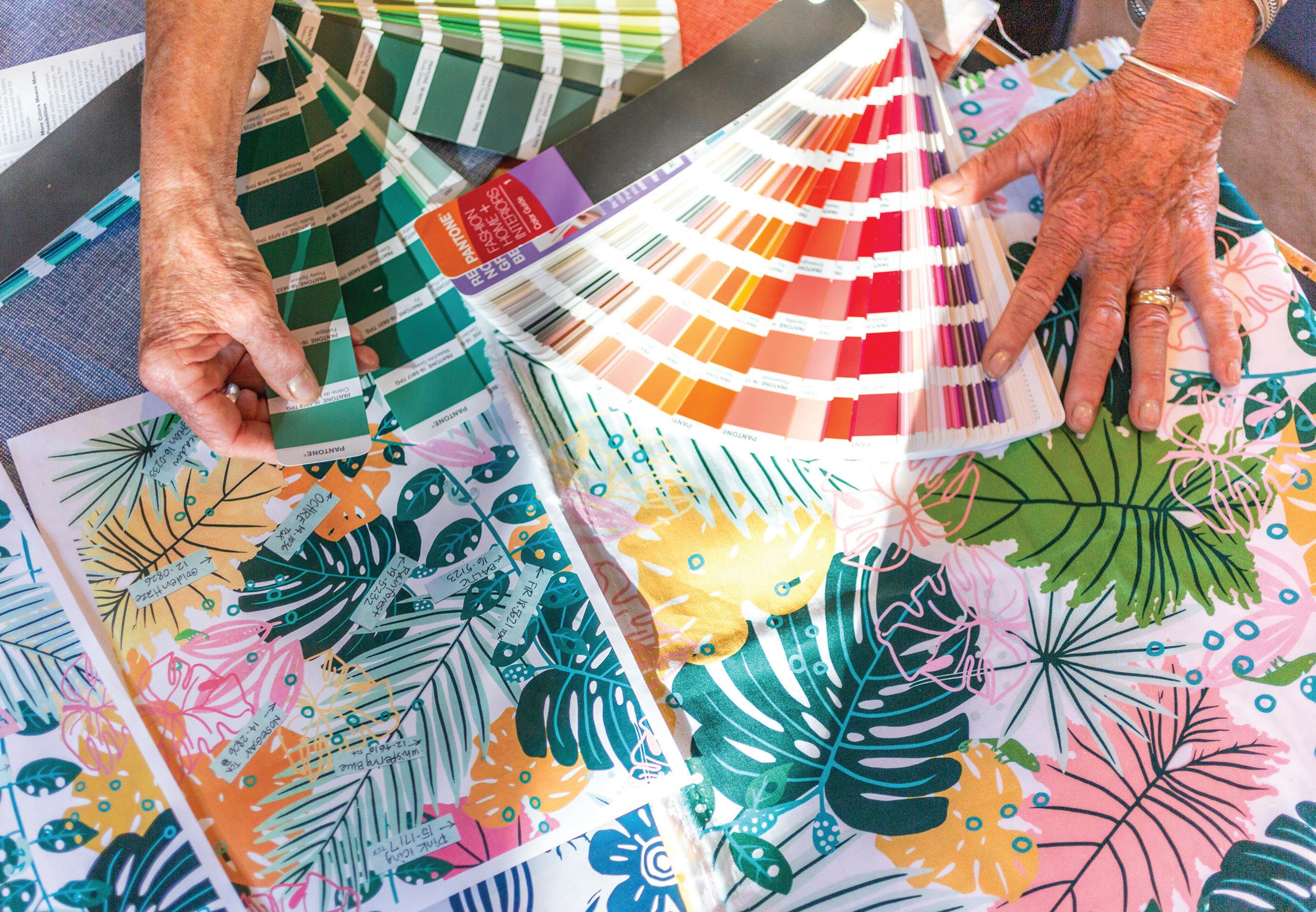
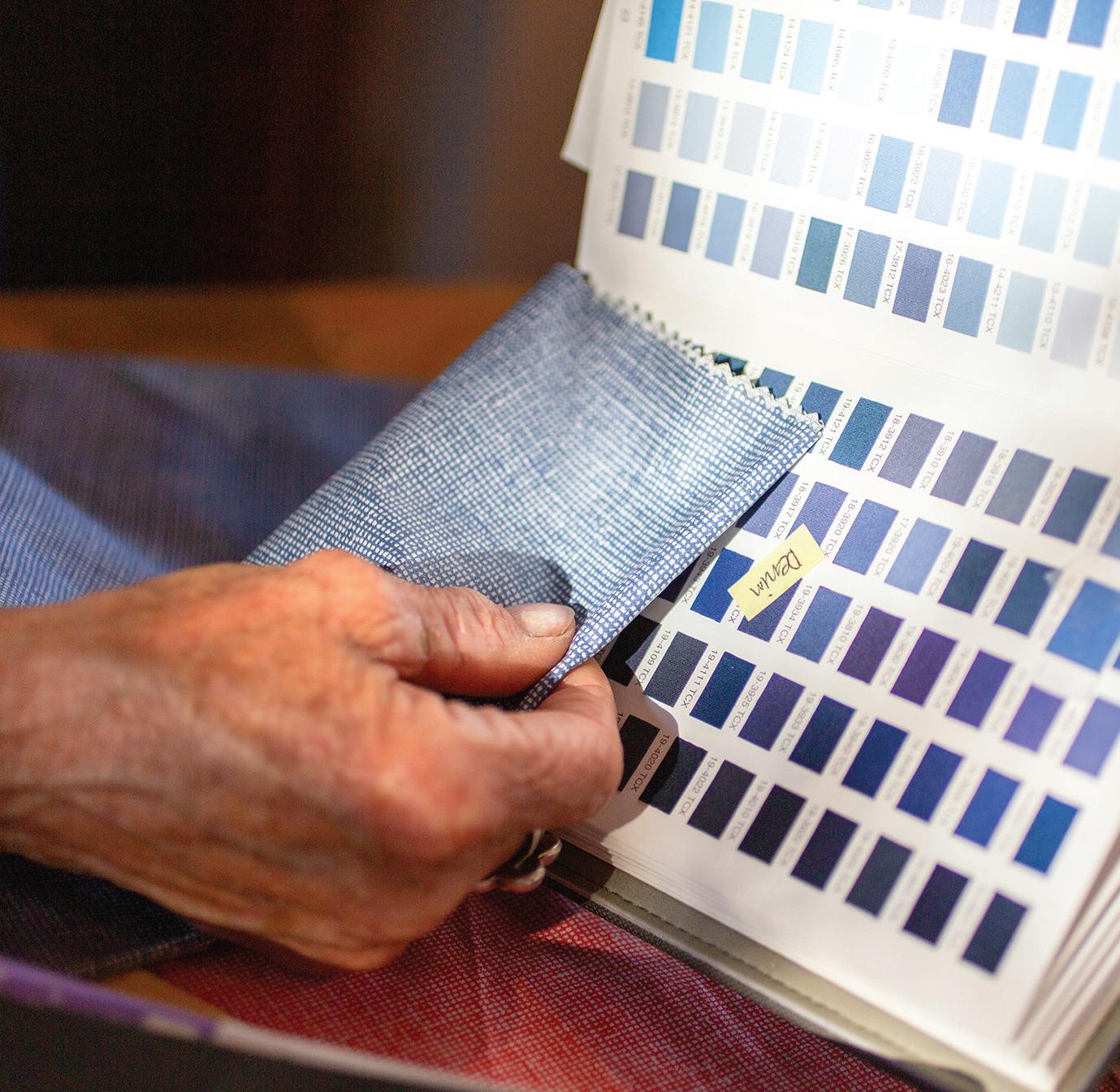
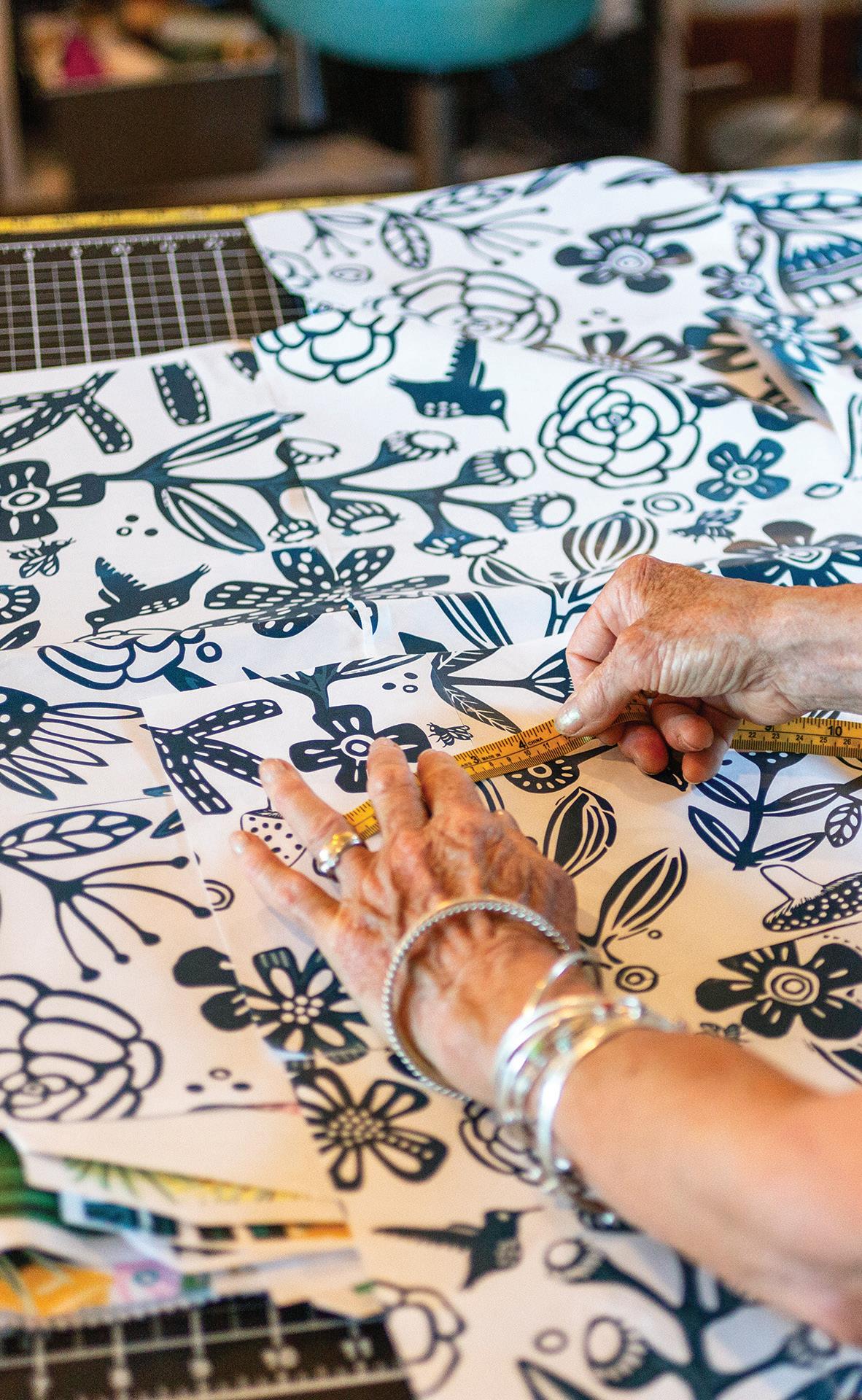
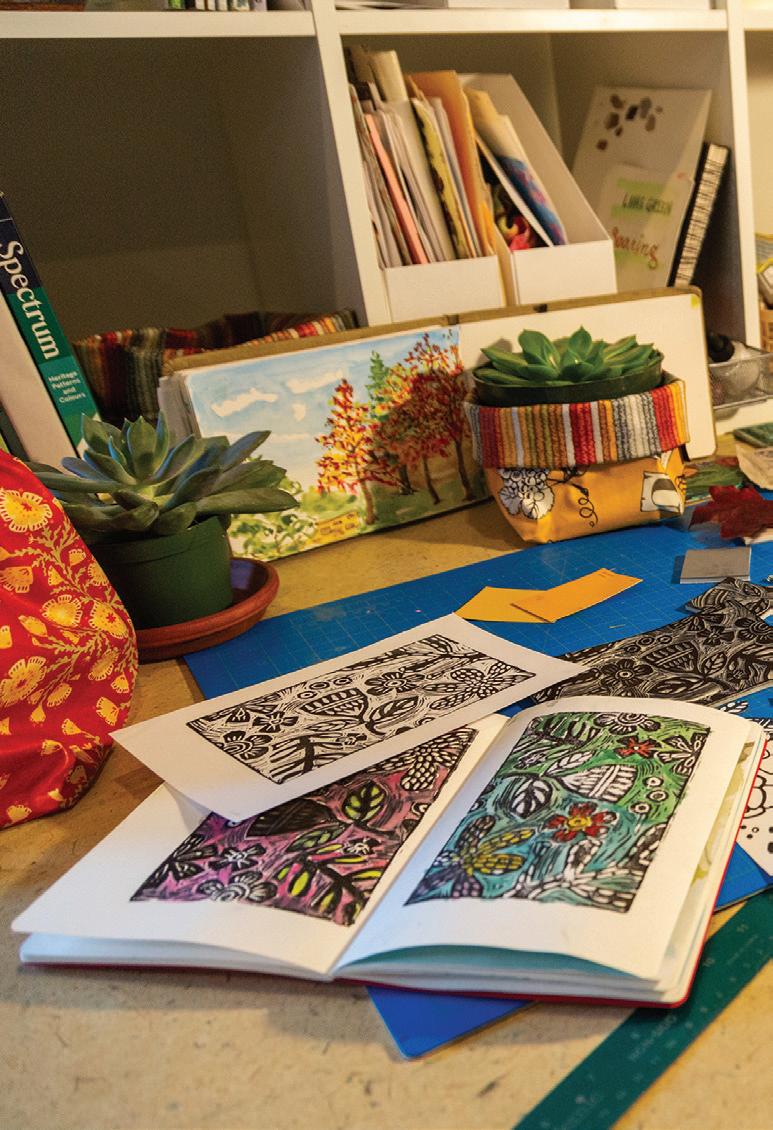
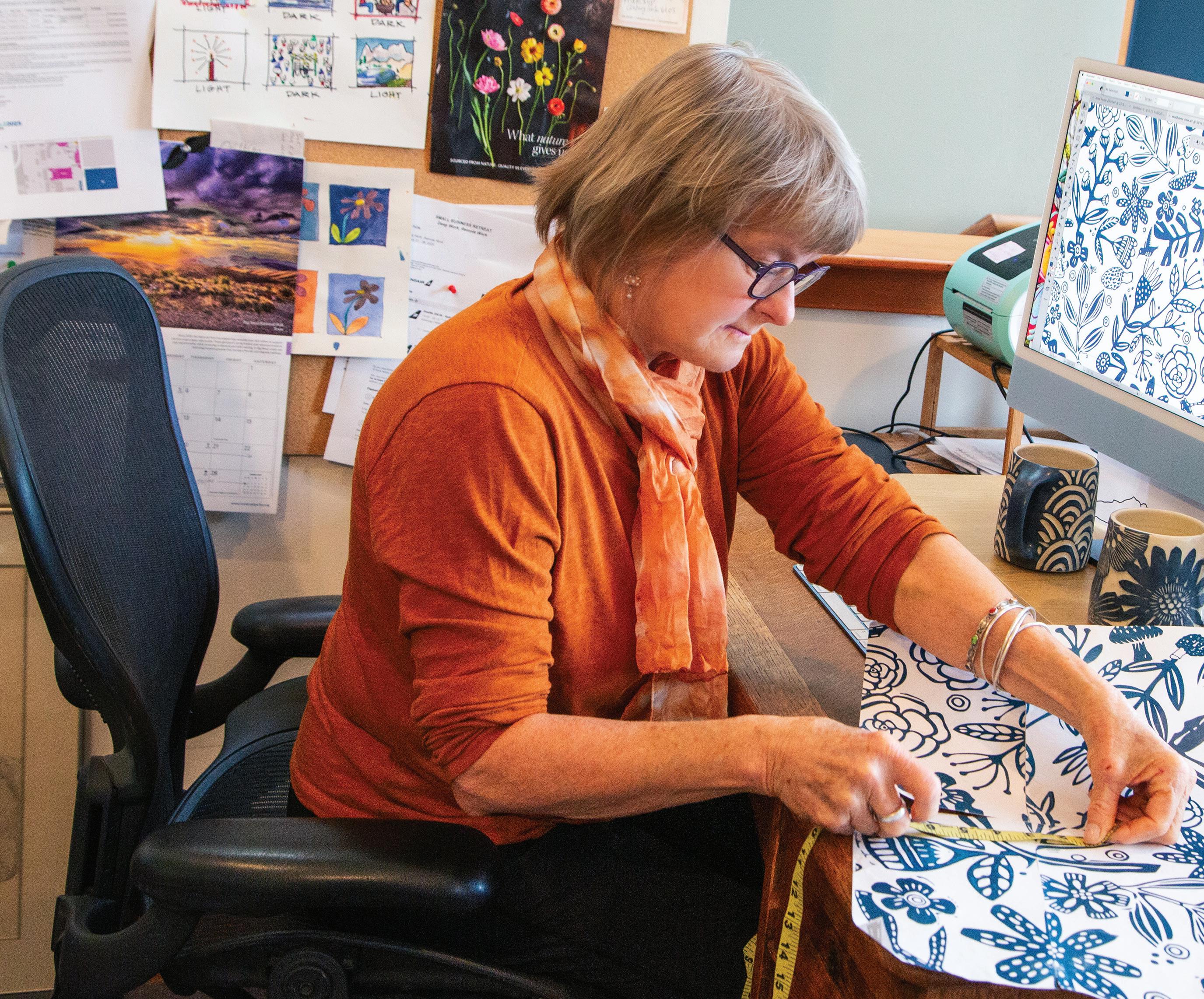
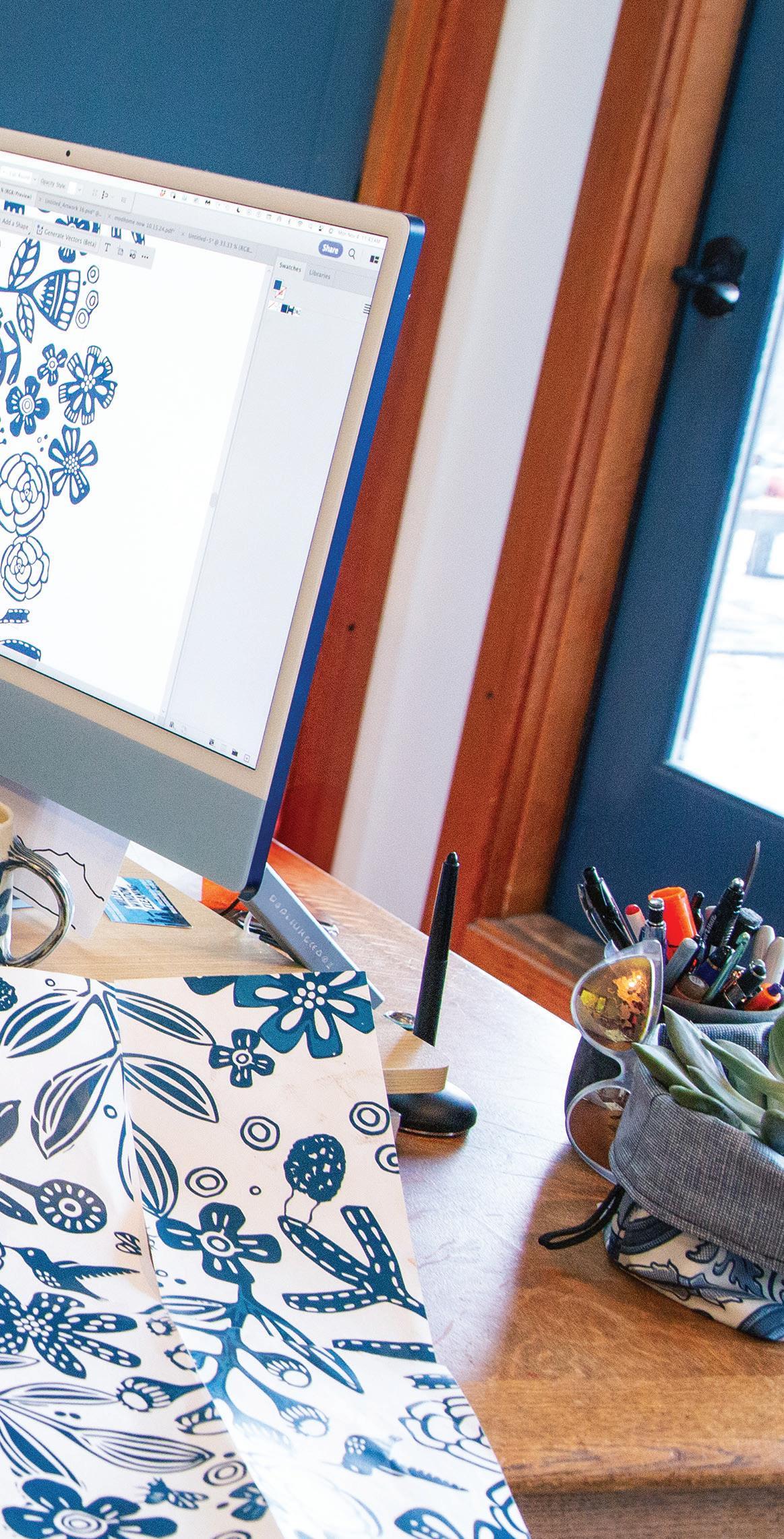
My fabric designs find me: I become obsessed with an idea. I create artwork in service of my vision. I start with my iPad, block printing and sketching — whatever it takes to develop the imagery I see in my head. I use Illustrator to get the repeat, scale and colors. What does it go with? What is the vibe of this print? What’s missing in the line?
New prints must fill gaps in our collection, using a new color, theme or style. The most important thing about a print is that I have to feel a chill. If I don’t feel it in my gut, it may need work or need to be abandoned.
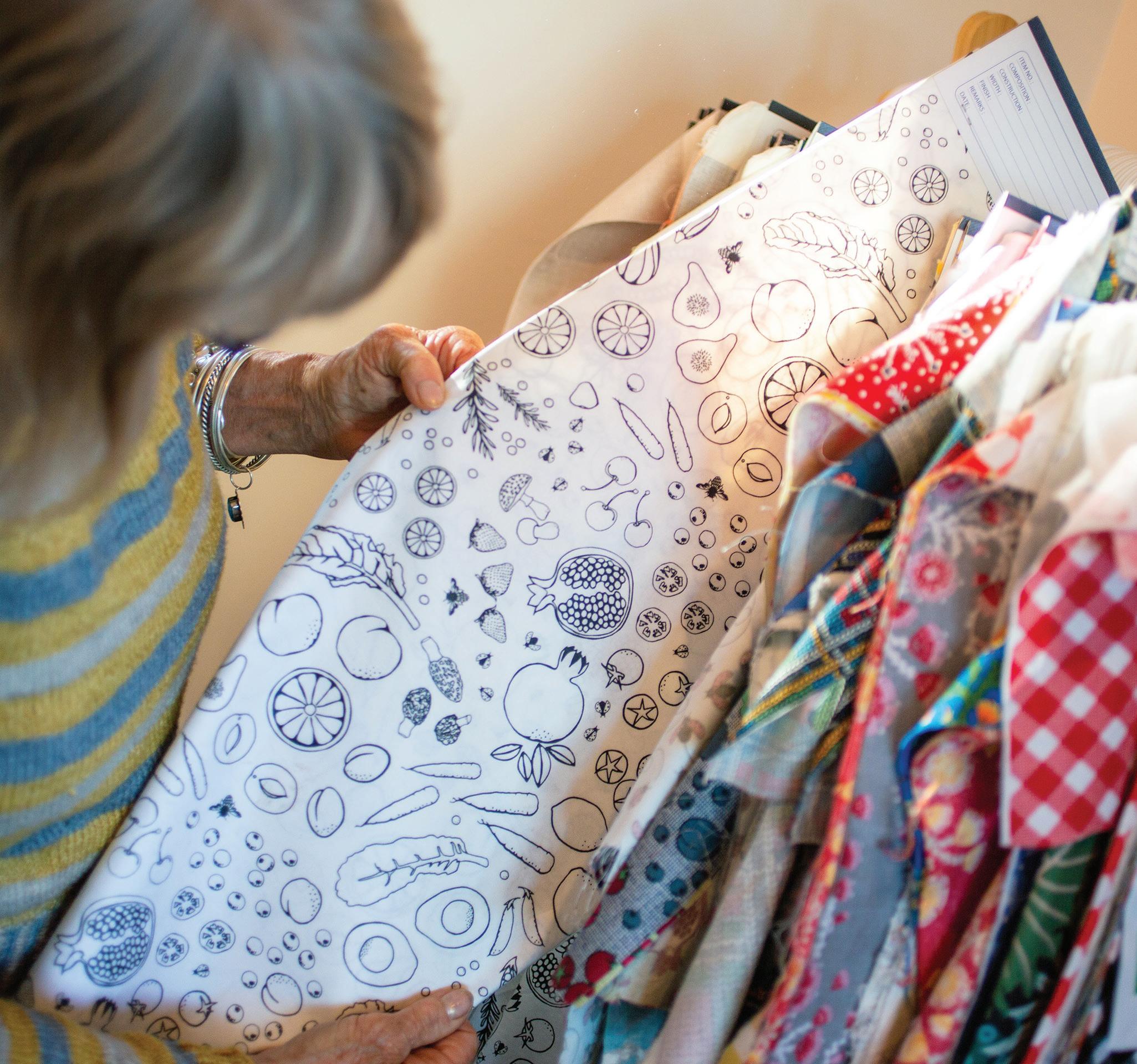
Take our Kale print, aka “Food Fight.” I wanted a foodie fabric and drew all the fruits and veggies I love (and some I don’t). I added black outlines to mimic old block prints and tossed them about in Photoshop. It didn’t work — until I realized I could place them in rivers of color across the fabric. I had almost given up. The mill let me try 10 different colorways for my first test prints. I narrowed it to three, and Kale instantly became a runaway bestseller.
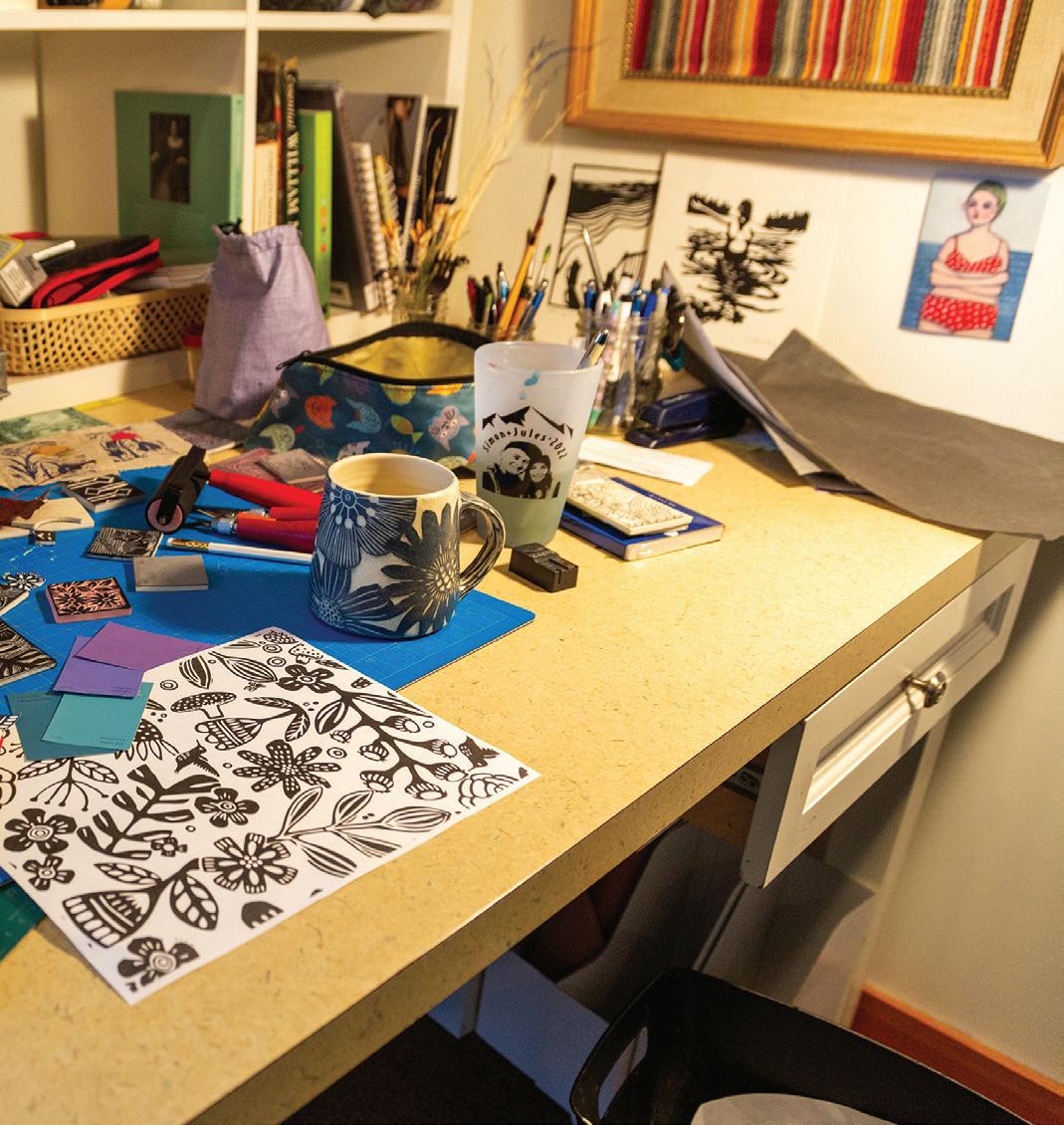
I love being in my hidey-hole with a view. I finally have a place for personal creative exploration, where I give myself permission to be in my zone. It takes physical space to make the mental space to create.
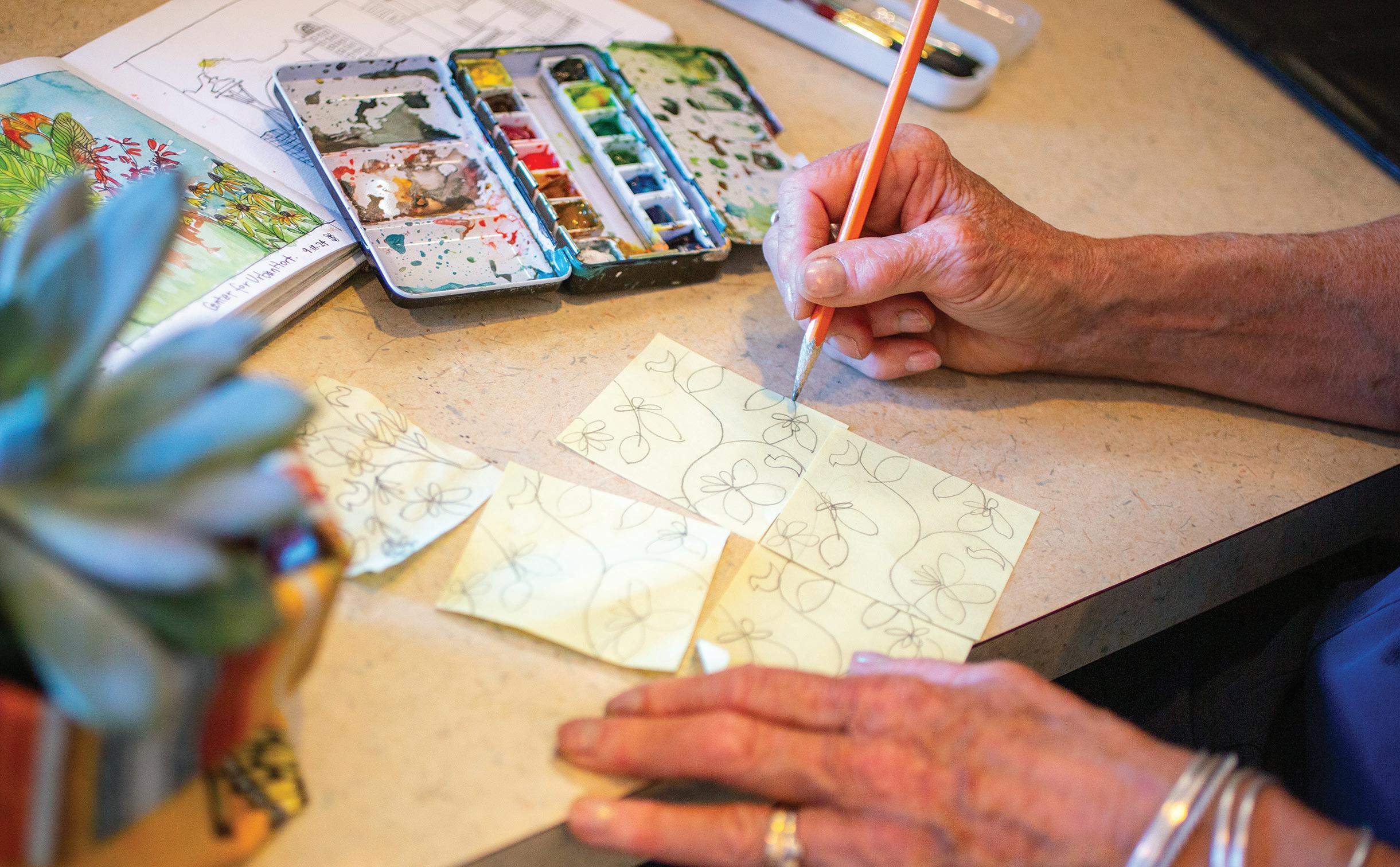
My art desk is often littered with paint swatches, feathers I’ve found, or some flowers I want to draw before they wilt. I’m surrounded by books about pattern and art, block prints and paper-cut art.
I draw with a plain old pencil, a thin Sharpie and my ultra-minimal watercolor compact kit by Art Toolkit. I also often draw on my iPad. My best inspirations come while I’m out and about. I do pleinair art — in the car, on the train, or during a hike. Then I come back to the studio to fine-tune. I have a stack of block printing carvers and blank blocks. I play with small squares first. It loosens my brain by starting small. I scan my images and play with them in Illustrator, building a repeating pattern until I get something irresistible.
MY STUDIO
MY INSPIRATION
I’m inspired by folk patterns, old blankets, rugs and all kinds of woven, painted and crafted patterns from the past. When I was a park ranger in the Southwest, I studied Anasazi pottery. I also grew up walking on lovely threadbare Oriental rugs. They took me to places in my imagination and provided the backdrop for hours of play and drawing.
Like a handmade rug, my fabrics often have a flaw or a surprise — a stray pixel, a gecko hiding, a broken tile, or bunny poop in the grass. I honor knitting, sewing and embroidery in my prints. Currently, I’m working on:
❖ A quilt design with Maria Shell, a modern improv quilter
❖ A design using my grammy’s embroidery
❖ A classic gingham for our new collaboration with Missouri Star Quilt Company
❖ A collaboration with Nicole of MODHome Ceramics
We release three to five fabrics a year, with four to five queued up for later. My goal is to sell more fabric so I can make more fabric. (Thank you all for helping!)
OH, FOR THE LOVE OF FABRIC!
How do I know what will sell? Some prints languish for years while I redesign, rethink, recolor and go down rabbit holes. I print patterns out to scale (multiple passes through 8.5-by-11inch paper in my printer) and tape them together like a sewing pattern. I walk by randomly, seeing them out of the corner of my eye. When other people see it and catch their breath, that visceral connection tells me it’s worth pursuing.
I struggle to communicate color. Even with Pantone, the way the print looks on fabric is different from my paper print or computer screen. It can be a many-month process back and forth with the mill to get the colors to work. It doesn’t even have to match my paper — it just has to make my heart sing! If I love it enough, my customers will too.
When my grammy died, the only thing I really wanted were her pillows. She taught me embroidery. She was a maker. I’m making an embroidery fabric to honor grammies who inspire us to become makers.
I draw what she stitched and see her sitting in front of the TV, in her 80s, leg flung over the arm of her floral easy chair, cat at her side and methodically stitching, as women have done forever. I can feel her hands pulling the floss through the cloth.
More on Tracy
www.splashfabric.com
Instagram: splashfabric
Facebook: splashfabric
Pinterest: splashfabric
marketplace \ Products
The New Art of Paper Flowers
By Quynh Nguyen
Beautifully shot and concisely written in her own unique voice, Quynh generously shares her wisdom and knowledge of all things paper flowers and beyond. Delve into the enchanting art of lifelike floral design. Whether you’re a novice looking to discover a gratifying new hobby or a seasoned crafter seeking inspiration, this all-inclusive handbook will equip you to cultivate lush, long-lasting blooms using colorful crepe paper.
Knit a Little: 24 Seamless Patterns for Children’s Sweaters and Hats
By Marie Greene
Dive into the heartwarming world of knitting garments for children with 24 adorable patterns (sizes 0 to 12) from renowned knitwear designer and Olive Knits founder Marie Greene. Perfect for anyone with a little one to knit for — be it a child, grandchild, or friend — these styles are set to capture the hearts of knitters everywhere!
Simple Paper Flowers
By Paula Milner, The Crafty Lass
From festive holly to delicate primroses and golden marigolds, these beautiful paper flowers look astonishingly realistic and are incredibly versatile. They can be used in bouquets, buttonholes, garlands and in many other ways. Primarily constructed from floristry wire, crepe paper and card, they require very few materials. Perfect for beginners or experienced crafters who can put their own imprint on the finished product.
Flowerie
At Flowerie, Bonnie Christine’s love for nature and creativity comes alive through her hand-drawn designs, crafted to bring a touch of garden-inspired beauty into your life. Each piece at Flowerie is thoughtfully created, carefully designed and meticulously approved. Creativity blooms in every detail. Limited offerings now, but be sure to follow along for the broader collection launch in summer of 2025.
Events & Coaching
DIY Upholstery Course
With Wendy Conklin of Chair Whimsy
Take your old, shabby chairs from castoffs to cherished treasures. If you have an old chair in desperate need of a makeover, you’ll love this beginner upholstery course. You’ll learn how to strip a chair, repair damages, paint and reupholster. The course is prerecorded and self-paced so you can rewatch it as much as you like. Lifetime access! Once you join, you can start at your convenience. Join the waitlist now!
Live Courageously: Rebloom Retreat
With Colleen Sutton and Lori Siebert
May 5–8, 2025
Get ready for an incredibly uplifting retreat, set against the picturesque backdrop of Richwood on the River in Milton, Kentucky. This transformative experience features dynamic speakers, creative sessions, and the opportunity to nurture your courage and bloom anew! Pack your positivity for an unforgettable journey of empowerment and growth. Use the discount code REBLOOM305 for $300 off!
h+h americas Convention & Conference
2025
May 7–May 9, 2025
Rosemont, IL
h+h americas provides show attendees with countless opportunities to network, learn, share info and connect with colleagues and the industry’s best suppliers and manufacturers. With over 400 exhibitors, workshops, classes, networking events and more, h+h is the premier trade show for today’s creative business environment.
Words and Wildflowers Retreat in Portugal
With Lori Siebert and Kenzie Elston
October 17–24, 2025
Join artists Lori Siebert and Kenzie Elston for a vibrant and inspiring art retreat in a glorious villa on the breathtaking southern coast of Portugal. Explore the world of florals and lettering as you discover innovative mixed-media techniques through playful exercises, hands-on projects and creative challenges. You’ll venture to local villages, take a sailing excursion, and work side by side in the studio. Treat yourself and bring a friend!!
Brand Coaching
With Nicole Bedard
Nicole provides 1:1 custom coaching for small business owners and photographers. Get answers to all your brand photography and/or social media-related questions specific to your unique business, learn about photography gear and explore creative ideas for your brand and portfolio.
Heather Waugh Pitts
HEATHER WAUGH PITTS is a self-taught ceramicist who hails from where Nova Scotia’s seacoast meets the industrial refinery lands her family lived by and worked on for generations. Her 25-year career has spanned interior design, oil painting, murals, frescoes, Venetian plaster and, more recently, ceramics. The clay she hand builds weaves a story that is raw, authentic and fired to fine art.
Growing up along the Atlantic coast and living behind the refinery storage tank fields influenced the ways I interpret nature and, ultimately, my work. I was exposed to surfaces of rust and colours of decay. The ocean nearby was rich for foraging along its shores, ever-changing in erosion and tides.
I was a dreamer as a child (I probably inherited that from my dad, who was also a dreamer) and spent much of my free time drawing. At 8, I received my first art award (a free meal for my family!) from a local restaurant after submitting a picture I had colored, then altered by scraping off most of the crayon wax, leaving muted tones.
I ended up earning a degree in human ecology and studied the interdisciplinary and transdisciplinary relationships between humans in their natural, social and built environments. This, along with my love of industrial surfaces, gardens and the sea — and 20 years of owning and running a successful interior design business — has informed my work in design. Drawn toward brutalist, baroque, Georgian and modern architecture, I hand build my clay in an abstract or realist form, inspired by these eras and my memory of known environment.
From ISABELLE FISH:
The world of Heather Pitts is deliciously eccentric, an invitation to travel along the shores of Nova Scotia where she finds her inspiration. I always decorate my dining table with her porcelain peas and pods, oyster shells, vases and other treasures — it is impossible to resist such simple beauty.
These plates were part of a 350-piece commission for Mystic, a new restaurant on the sea in Halifax.
Before interior design and art became my professional focus, I worked at a hospital. When I became pregnant with my second child, I decided to leave the job and focus on the home and time with my family (which evolved into three children: Maggie, Chris and Mike; plus, my husband, Tommy). My creativity flourished and I entered my oil paintings in juried shows and sold work through exhibitions. I also hand-painted furniture, applying techniques I’d learned while spending time in Paris and Germany.
As the children became older, I was able to travel and do work in cathedrals, museums, resorts and restaurants. I was successful in operating my own interior design company, serving clients in Canada and the U.S., while also participating in designer showcases for many years.
My start in ceramics came late, but I was fortunate to be able to explore clay at Findlay
Community Centre, a 10-minute walk from my home. It was therapy for me while fully engaged in operating my interior design company. I looked forward to friendships made there and the whole discipline of hand wedging, hand building and sculpting work.
As I grew my body of work, I realized I wanted my ceramics to be chosen by other interior designers. During my design career, I had chosen works of art for my clients, and now I was envisioning where my own work would fit into designs. I found myself contemplating: Where do I want my work to land?
I wanted my work to be my story, one that someone else might feel and enjoy. Though I did not initially market my ceramics (I’m an extreme introvert), I was surprised and excited when a few galleries offered to represent my work, which I believe caught their attention on Instagram.
When COVID hit, I decided to build and carve out a ceramic studio in my basement: a warren of rooms ready to be made into a workspace. Converting the maze of rooms in our 100-year-plus home into a studio merged the home’s storied past with the present. The room where I now hand build and fire work was originally the furnace/coal room. Other rooms are now used for photographing and showcasing work, and they act as a gallery for visitors (by appointment only).
Our home had been a private school for 20 years, and all of the tables and shelving I use are recycled from old fire doors and shelves that existed in the school. My studio is the womb in this old house. We peeled back the ceilings to expose the old beams; placed found glass blocks in the vintage coal chutes; and recycled some old wide boards and painted the concrete. I had a customized kiln built in Ontario, ordered a roller and a ton of various clays, and started to experiment. I learned everything in those failures and successes through experimentation during COVID.
My work is comprised of mostly porcelain clay; for some pieces, I use stoneware clay. I create sculptures or vessels, hand building over a form I make, or coiling the ropes of clay I roll. Depending on the season, I usually work a fiveday week in my home studio. When I first enter, I make a coffee, put on music (I have lots of vinyl from the 70s and 80s), and think of experiences that move me. Then I start wedging clay to form a story by hand.
After I wedge a few pounds of it, I then roll it into slabs or make coils, depending on the kind of vessel or sculpture I’m going to create. Incorporating architectural elements and experimenting with glazes is what I love when making. The freedom of hand building is essential to how I create. It can take many days or weeks to form the piece and then wrap and dry it. Living in the Maritimes by the sea impacts the drying times. The humidity in the summer can mean drying for a month. During the winter, the old steam pipes ping and heat the space beautifully and I dry my work in a wet box or wrapped in plastic. Once dry, the work is bisque-fired and glaze-fired in mid to high firing temperatures — sometimes multiple times.
When designing a new collection, I often find myself researching different periods of history. I create collections for art galleries, fine furniture galleries and exhibitions, as well as for interior designers, chefs and restaurants. Each piece is one of a kind, hand built — a one-off.
I still take on a few interesting interior design projects each year, but focus primarily on ceramics. At some point, I’d love to apply for artist residency programs to continue my creative growth and, ultimately, find American and European galleries to represent my art. In the meantime, I am showing work regularly, including an upcoming interior design show in Toronto and the Collect art fair at Somerset House in London (I never dreamed I’d land there!).
Instagram: heatherpittsceramics
Facebook: handbuiltpittsceramics More on Isabelle www.ruepigalle.ca
Instagram: ruepigalletoronto
Facebook: ruepigalletoronto
Scan here to follow Heather on Instagram.
Astrid Tauber
Astrid Tauber is a weaver, spinner and garment designer. Having discovered her medium at the tender age of 7, she continues to evolve as a creative entrepreneur and has created a range of unique garments and products made exclusively from handwoven fabric. Citing nature as one of her greatest sources of inspiration, she works with natural fibers and bold colors. She recently completed diploma studies with The Cut Design Academy in Vancouver and has her sights set on educational opportunities in Europe.
Afew years ago, a little seed was planted in my creative brain and I became determined to find an easy way to vend my work at markets and artist shows. This is the story of that journey! However, like any good home makeover show, I’ll need to provide
you with a bit of backstory before the big reveal. So here it goes.
My soul has been smitten with fiber arts for more than half of my life now. That is to say: Eight of my 15 years on this earth have been wholeheartedly devoted to exploring fiber. What began as a “give this a whirl” experience in a crochet class for homeschooled children at my local Joann fabric store drastically shaped my path forward.
Those initial endless chains of practice stitches eventually became headbands and washcloths of single and double crochet. I ventured into blankets and headed to YouTube to learn new stitch after new stitch. My collection of hooks grew, and I never went anywhere without a ball of yarn!
However, I am a very curious person. I think it goes along with the culture of homeschooling. We are taught to explore, ask questions and seek information. So, it seemed only natural that I started wondering if I could make my own yarn.
Elyse Myers is an online content creator
who jokes that she was born with the “How hard could it be?” gene that makes her willing to try just about anything. I think I must have been born with it, too, because the next thing I knew I was sitting in a hotel conference room with a spinning wheel in front of me listening to fiber artist Julie Wilson discuss drafting fiber. I had a different chair than everyone else in the class so that I could reach the treadles, but I was determined. After all, how hard could it be? Right?
As my chunky, lumpy, uneven yarn evened out and my stash of handspun yarn grew, I needed to find a use for it. I loved spinning, but I didn’t love crocheting with handspun. What’s a fiber artist to do?
But then I discovered weaving! A fellow fiber lover invited me over and it was love at first pick. Over the next 18 months, I upgraded looms four times. Every time I thought I had found the one,
I quickly found myself wishing my loom was wider and offered more design possibilities. I have a very supportive family. They offer me love, advice and opportunities galore! However, I do not have a loom fairy or a spinning wheel fairy that delivers new equipment if I click my heels three times and repeat, “Oh, how I love fiber!” So, to help me accomplish my goals, I began selling handwoven items at local fairs and shows. And that is precisely how we circle back to the idea of a traveling weaving studio.
My painfully shy self began packing up my wares and heading to shows to open up more opportunities for myself as an artist. Into the car went folding tables, a 10-foot-by-10-foot tent, plus displays, signage, table covers, products to sell, my small floor loom for demonstrations, and so much more. Loading, unloading, setting up, breaking down and reloading the car week after week began to take a toll on my creative spirit.
Then there was this one show in Texas. It was a doozy! We lived in Hill Country for two years for my father’s job and the weather was extreme. One day I was sitting in my booth, happily weaving away, when out of nowhere the wind picked up, dust started flying, and then the rain came. Everyone in the section of the farmers market I was in lost their tents. We were all scrambling to save the handmade products that we’d spent hours creating.
When the weather died down and I replayed the scene in my head, I thought of my neighbor across the way lending a hand. He was free to do so because he had a food truck. When Mother Nature unleashed her fury, all he had to do was close his hatch before he so kindly ventured out to help others. At that moment, I decided I needed a new vendor setup … and my wheels began to turn.
The following six months were all about brainstorming and planning. There were some factors that I knew were “musts” for me. For budgetary reasons, I still needed to be able to fit into a 10-by-10 vending space. My dad transferred often for work, so I needed something that would fit into the garage if
I ended up in a strict HOA neighborhood. I wanted something like my neighbor’s mac and cheese food truck. Ideally, I’d be able to pull in, open a few small hatches with minimal setup, have a great day, and quickly fold up to head home!
My typical brainstorming resources, such as Google Images and Pinterest, weren’t much help because it appeared that not too many people were building mobile weaving shops on a supertight budget. Shocking, right? While not surprised, I was also not deterred. I was happy to pioneer the idea!
After many iterations of the concept, I decided that my ideal vision would be a small structure on a tiny utility trailer that exuded Old English cottagecore vibes. I planned to incorporate basic shelving to display functional items made with my handwoven fabric and, if a storm snuck up on me, there would be doors that simply closed over them to protect my work. There would also be a storage area where my small floor loom would safely live while shuttling from event to event.
My father is practically MacGyver and my brother is a talented woodworker, but none of us had ever done anything like this. We were a bit tentative and sought an expert who could take our idea from “Wow, that would be amazing!” to a road-safe, watertight structure.
Enter Stefon Holness. Stefon has been a presence in my life since I was a little peanut. My parents hired him, when he was just starting out as an entrepreneur, to do some work at our house. One day Stefon was working alone at the house and moved our sweet blind dog, Daisy, to another room to avoid scaring her with loud noises. Instantly, my mom saw the core of his character and he became a trusted and appreciated fixture at our house. Any time my mother had a wonky idea, he was always game to experiment and see what could become of it.
From painting stunning murals to custom built-ins, we learned that he could do anything. Did this mean he could also build a mobile weaving shop? Like all the harebrained ideas we’d put before Stefon previously, he was keen to take on the challenge!
Every step from that moment on was a beautiful collaboration.
My brother, Aidan, created a 3D model to help me better illustrate to Stefon what was in my imagination. Stefon determined material needs, and we put our heads together to figure out how to create the desired aesthetic. I purchased an itty-bitty utility trailer at Harbor Freight for $400 and we were off and running.
We started building with a rough 3D sketch, tying our visions together, and no tested building plans. That meant a lot of trial and error! Thankfully, my mom volunteered as the “project gofer.” It took us about a week to build the mobile shop, and she made countless visits to Home Depot during that time. One day she went six times! She became an expert on wood screws, and buying non-warped 2-by-4s, by the time we were done. Her other essential job was feeding the crew, i.e., Aidan, Stefon, and myself. We were all grateful for that as well!
We incorporated pre-built bookshelves into the DIY concept. We saved time and money by purchasing inexpensive bookshelves, assembling them, and then attaching them to the frame of the mobile studio/shop. I later painted them a light, neutral color because the white laminate didn’t scream cottagecore to me. (But overall, they were ideal for displaying my items at events.)
Another element we incorporated to impart an English cottage look to the outside was 3D wall art panels that look like brick. They are waterproof for outdoor use and were easy to affix to the outer plywood walls with some caulk and a staple gun. (In 2023, I took my little shop to our town farmers market approximately 35 times — plus additional events around town in Charleston — and those faux bricks always looked as good as they did the day the Amazon truck delivered them!)
When we needed some extra support, there was always YouTube. Stefon is an amazing craftsman, and was the heart of this project, but he’d never installed a roof before. Thankfully, after a few tutorials, we were roofing ourselves silly!
One of my absolute favorite aspects of this project are the faux windows that Stefon painted. He’s an incredible painter (and muralist), and I am grateful that all it took was a “please, please, pretty please” and some fancy brushes to entice him to add a beautiful personal touch to complete the cottage look.
Soon, my shop on wheels was in action at many events around South Carolina’s Lowcountry and was quite the spectacle. Each week, I’d roll my loom down the back ramp at the farmers market and get to work. Market shoppers would ask questions about the mechanics of my loom, the types of fabric I make, and yes, the story behind my unique mobile shop. Weaving at markets was a great icebreaker for an introvert like me. I’d spend hours weaving at the market every weekend, and it was always so wonderful to share my passion for my work, as well as the story of how my mobile shop came to be.
From planning to budgeting to building, it was definitely a labor of love … and worth every single minute of the journey! I was so fortunate to have my brother and Stefon along for the ride to help bring my vision to life.
Throughout my childhood, we’ve moved a lot for my dad’s job. While I was in the middle of writing this story, I learned we would be embarking on another move. This time, it was international and, unfortunately, not possible to take my sweet little shop with me.
I ended up putting out a call for a new owner to my followers on social media and am absolutely thrilled that a pair of creative and kind weavers from Texas “adopted” my shop. Shannon and Karen will continue to spread knowledge about weaving — and the collective joy we share for fiber arts — with market shoppers. And it makes me so happy to know that it will still have a little Schacht floor loom neatly tucked away in the back for demonstrations.
When I packed up my shop to send it off to its new home, I did my best to transfer the love and passion that went into its creation, with the hopes that owning it will be as joyful for the new stewards as it was for me.
Scan here to follow Astrid on Instagram.
Bungle, Eddie and Monika Forsberg
Bungle and Eddie provide inspiration and day-to-day encouragement to London-based artist Monika Forsberg, whose fantastical technicolor illustrations can be found on products in shops around the world. Monika, who was born and raised in a coastal town in Swedish Lapland, always dreamt of someday living in a big barn, writing stories and drawing and having a house full of cats, dogs and kids.
Bungle:
I was one of seven pups born on Mansfield Road in London (my parents met on a beach, so the story goes), a couple of days before Halloween in 2021. When Christmas rolled around, I moved across the road and in with my now family: Monika aka “Mum,” her husband, and their two sons. They named me Bungle, but Mum says I should’ve been called Ernest because I am an earnest boy. I like to sleep, and I love to sit on a hill outside and watch the world go by. I also like balls. And running through the forest. Most of the time, I curl up by Mum’s feet while she draws. I am very scared of THE CAT. Oh, here he comes.
Eddie:
I lived a good life before that mutt moved in. Sigh … I still have a pretty good life here. This is important: I like food. I love food. But I’m only fed three times a day and if they’re one minute late feeding me, I will MEOW. Who are they? Well, they love color and they always spread out paints and sketchbooks and fabrics for me to investigate. And they love animals. They fetched me from a cat sanctuary back in 2012, so I guess you could call me a senior cat. But I am still sharp as ever — especially when it comes to feeding time. I insist on being fed not one minute later than 7 a.m. Oh, and at 4 p.m., and 10 p.m. sharp. Maybe I overdo it sometimes since I have a habit of vomiting in awkward places. Oh, and the other thing that makes me extra special: I have no tail.
Bungle and I don’t exactly get along most of the time, but we do agree on one thing: We are the best studio mates Monika could dream of, and together we help oversee her projects. We’ve heard that most people work at a desk or table, but Monika is not good at sitting in chairs. She gets restless. Can’t sit still. Ants in the pants. So, she made herself a cool workstation/daybed/ chaise lounge sort of setup out of two Ikea Kallax shelves and a large dog bed big enough for a Great Dane.
This is a big improvement from the previous workspace: her bed. In the old days, after the kids would go to school, Monika used to spend the day on top of the bed doing illustration work for clients all over the world and listening to audiobooks and podcasts. In the evenings, she lifted the bedspread up with all the art materials on it, and it became a bed to sleep in again.
I sometimes pretend not to care about Monika’s work, but the truth is: I’m proud of her. She is constantly drawing animals for her illustrations in children’s books, fabric collections, greeting cards and kids’ activity cards. Her animal drawings make kids and grownups smile. I have been keeping track lately and I think she has been sketching dogs more than cats … but maybe that’s because they’re easier to draw. They are simple, after all. We cats, well, we are complex.
More on Monika www.walkyland.com
Instagram: monika_forsberg
Scan here to follow Monika on Instagram.
Through the LENS
Our Contributing Photographers
Kim Dillon
Marcella Hawley
With a camera in hand and a love for all things green and growing, Kim Dillon has spent 15 years capturing the charm of architectural landscapes and the beauty of gardens — and everything in between. Based in St. Louis, but always ready for the next adventure, she finds beauty in wildflowers and custom garden spaces, blending artistry with an inviting, natural touch. If it’s got flowers, a patio or a touch of architectural flair, Kim is ready to make it shine — dirt under the nails optional.
WEBSITE: www.kimdillonphotography.com
INSTAGRAM: kimpixstl
Cortney Dani
Mary
Gregory
Cortney Dani is a wife, mother of two, and lover of Jesus, who lives in the Fort Worth, Texas, area. She loves doing photography during the school year and spends the summers traveling with her family. Capturing everything from animals to weddings over the past 10 years, she has settled into the sweet spot of editorial and family photography.
INSTAGRAM: cortneydaniphotography
Sarah Jorgensen
Tracy Krauter, Splash Fabric
Sarah Jorgensen is a self-taught artist whose work spans photography, illustration, videography and graphic design. As a visual storyteller, she celebrates and shares the creative journeys of fellow artists, capturing their unique stories with empathy and artistry. Through every project Sarah brings an emotional depth and distinct style that invites connection and curiosity.
WEBSITE: www.keepitsareal.com
INSTAGRAM: keepitsareal
Joshua Yong
Felicia Lo
Joshua Yong, a wedding photographer for more than a decade, recently shifted his focus to lifestyle photography. While he’s particularly skilled at natural light photography, he’s also well versed in studio lighting. He holds a diploma in digital photography from the Vancouver Institute of Media Arts. With years of experience in wedding and studio photography, he’s gained a deep understanding of photography, from posing subjects to managing lights in various settings — both natural and studio. His love for nature shines through in his photos, creating a vibrant and captivating visual style.
WEBSITE: www.joshyong.com
INSTAGRAM: _joshes
Ariel Jade Doughty
Veronica Funk
Ariel Jade Doughty makes artwork centered around the empowerment of all women and the evolution of their womanhood. Thus, making her artwork centered around the empowerment of all women and the evolution of their womanhood. All aspects of a woman’s life carry a specific weight in shaping oneself, leaving Ariel Jade the chance to capture it in photographs. You could say it’s her mission to discover and create while cultivating her own beautiful womanhood and encouraging the rest to grow into themselves.
Lancette Burton’s photography journey began after the birth of her son in 2013. She was motivated to learn how to capture as many special moments from his childhood as possible. She enrolled in courses and photography workshops and began experimenting with those special moments with her own family and quickly discovered that she truly enjoyed working with others, capturing authentic moments and the details that make those families unique. She also loves working with other professionals and artists, focusing on unique and creative business portraits.
As a designer and seamstress, with a master’s degree in history and an interest in photography, Katherine Funk’s work focuses on women and their experiences. She uses natural fabrics to create something contemporary that is inspired by another era, and is influenced by couturiers Charles James and Christian Dior. Her work has been included in fashion shows and garnered opportunities for presentations and publication.
With a passion for food, family and culture, and as a food photographer with experience spanning more than a decade, Shallon Cunningham now finds herself focused on two different types of assignments — one for commercial photography; and the other for the heart, featuring food stories and wisdom from our elders — though she finds both eventually lead us back to the table.