WHERE WOMEN CREATE—Fulco Inc. PO Box 3000, Denville, NJ 07834-3000
844-263-3472
womencreatecustservice@fulcoinc.com
ADVERTISING INQUIRIES advertise@womencreate.com
SUBMISSION INQUIRIES submissions@womencreate.com
WHERE WOMEN CREATE® SUMMER ISSUE 31 PUBLISHED 4 TIMES PER YEAR BY: Women Create, LLC 65 Redding Road, Box 985 Georgetown, CT 06829 womencreate.com
POSTMASTER
Send address changes to:
WHERE WOMEN CREATE—Fulco Inc.
PO Box 3000, Denville, NJ 07834-3000 Changes of address must be submitted in writing.
Where Women Create (USPS #000-310) is published quarterly by Women Create, LLC, 65 Redding Road, Box 985, Georgetown, CT 06829. Periodicals postage paid at Dover, NJ and at additional mailing offices.
Printed in Canada
Where Women Create® is a registered trademark of Women Create, LLC and may not be used without permission. No part of this publication may be reproduced without written permission from the publisher or Women Create, LLC. The information contained in this magazine is provided AS IS. Neither Women Create, LLC, nor the publisher, make any representation or warranty with respect to this magazine or the contents thereof and do hereby disclaim all express and implied warranties to the fullest extent permitted by law. Women Create, LLC and the publisher do not endorse any individuals, companies, products, services, or views featured or advertised in this magazine.
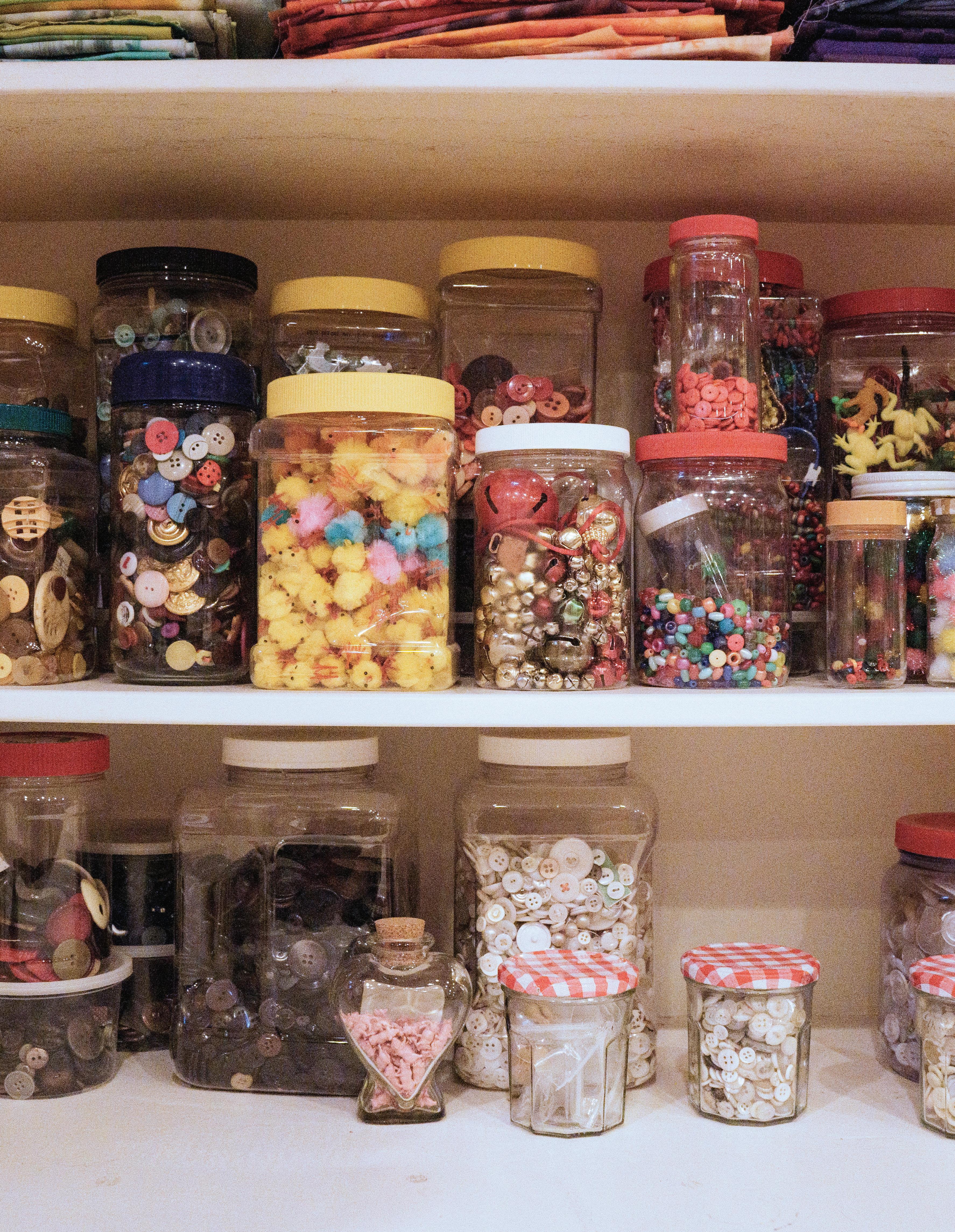
things. Even those of us who claim to be minimalists, I am convinced, have a secret stash of bits and bobs, little pieces of sentiment that remind us of days and people past: matchbook covers, buttons, seashells, an odd teacup, a silver carafe from a hotel tray, and so on.
Of course, the extreme example of this was the Collyer Brothers, who tragically died in their Harlem mansion, killed by their own inability to throw away even a single newspaper, but that’s a pretty extreme example. I’m just thinking about the lovely little things that we keep, that inspire us and make us comfortable in our lives. We are magpies, feathering our nests with the things that give us joy.
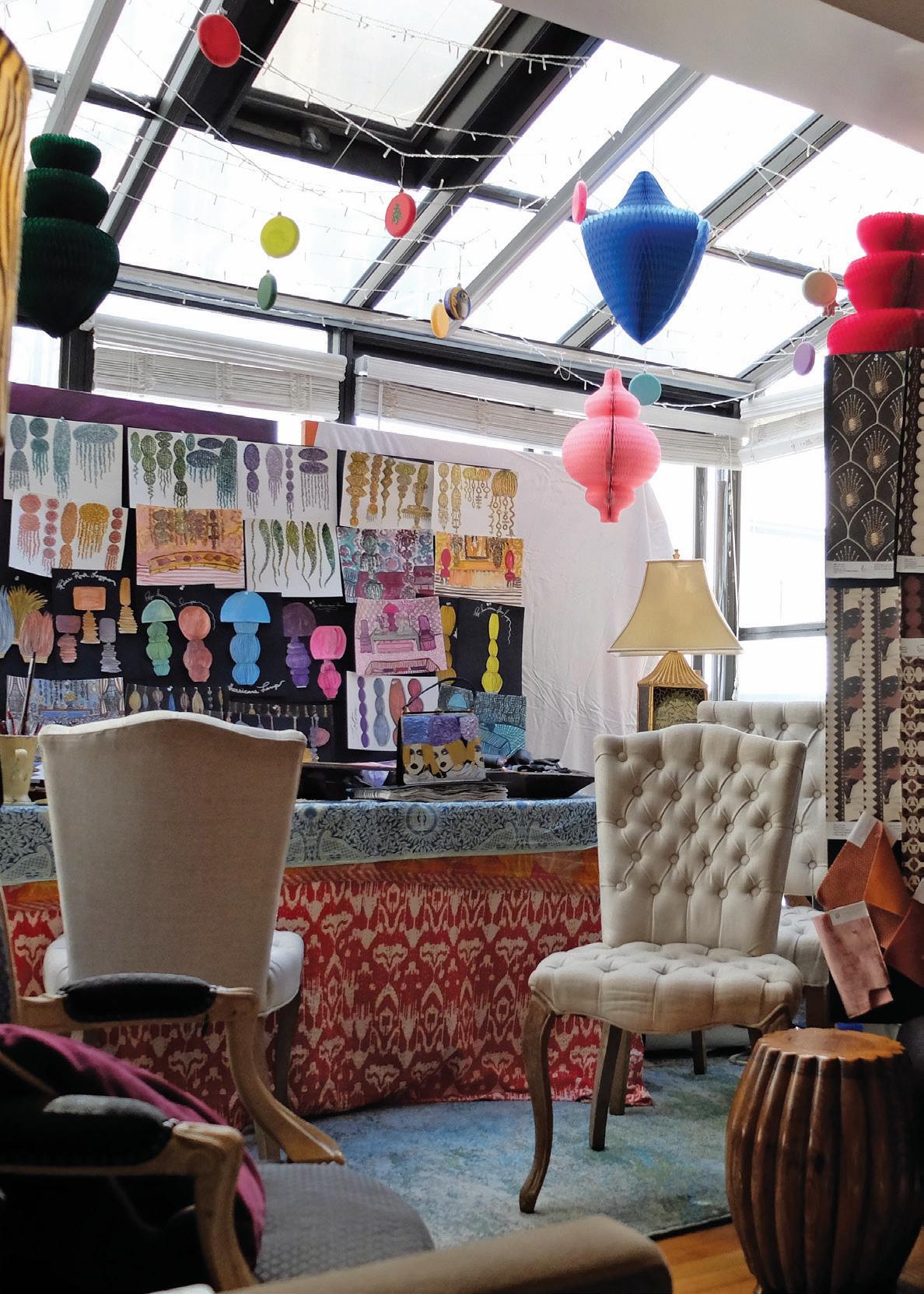
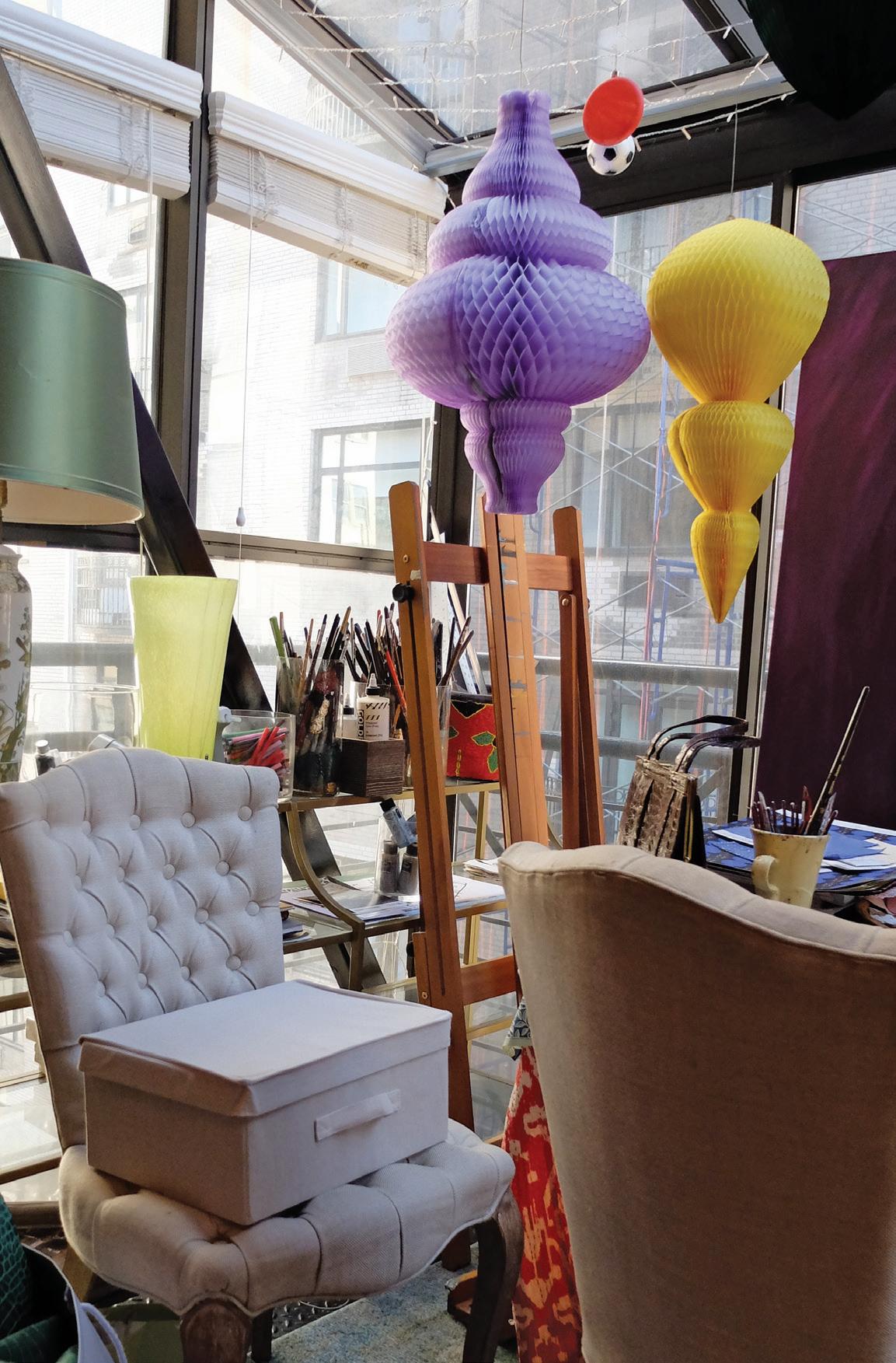
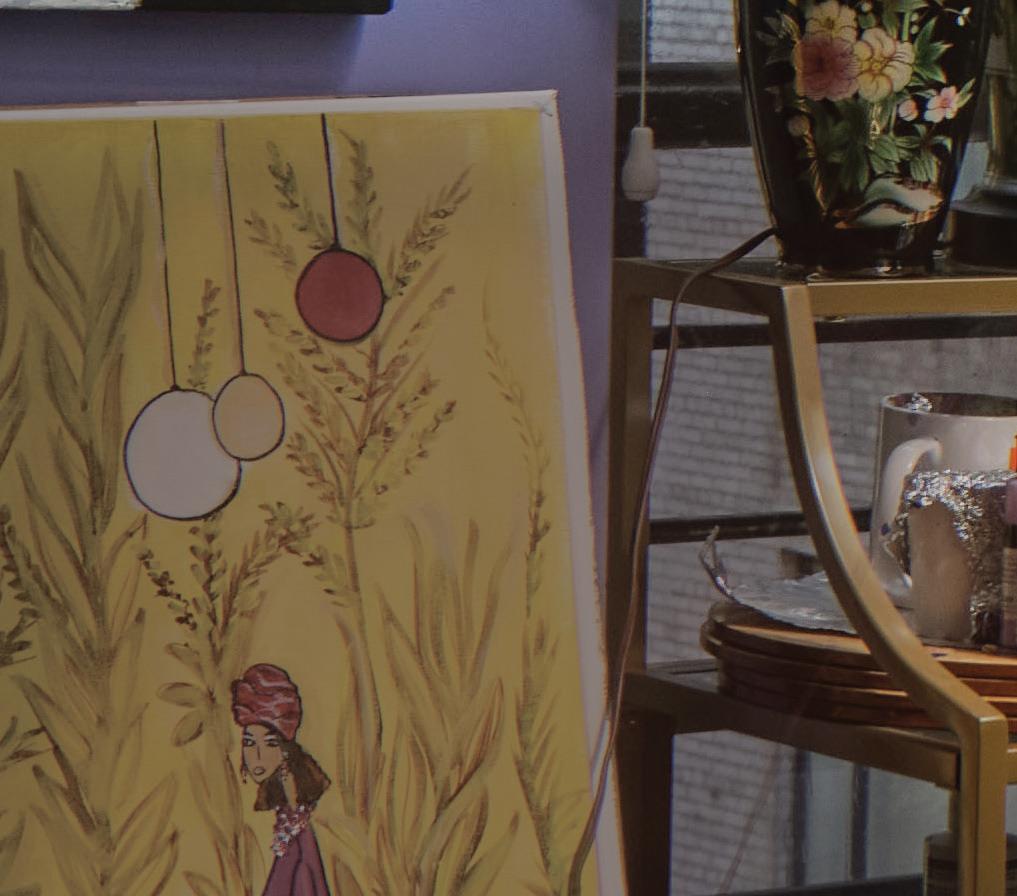
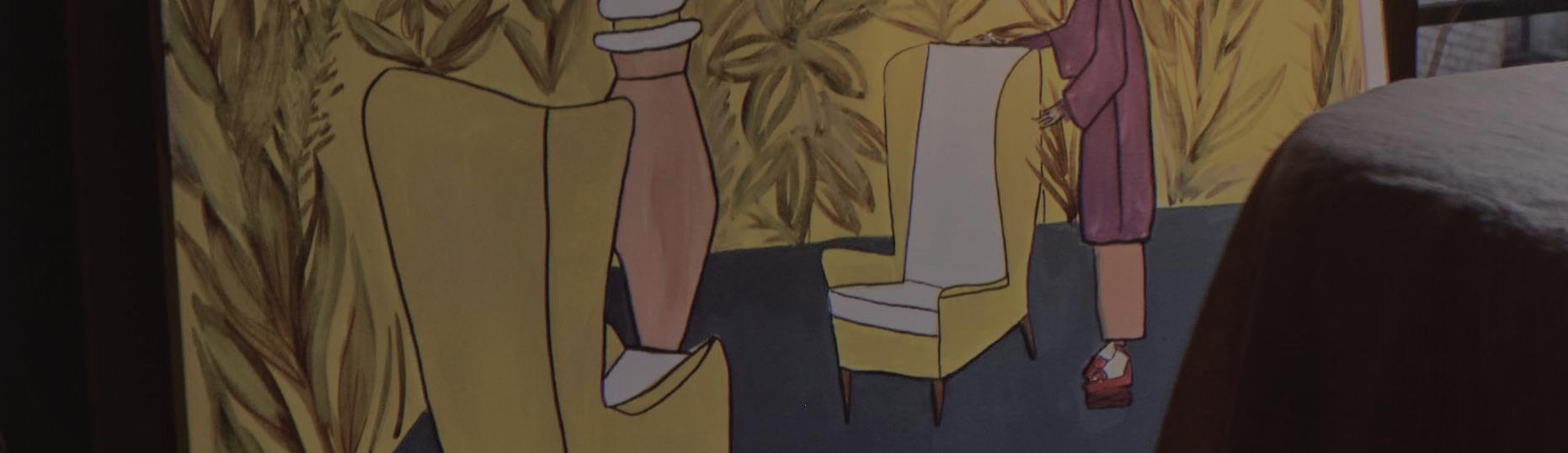
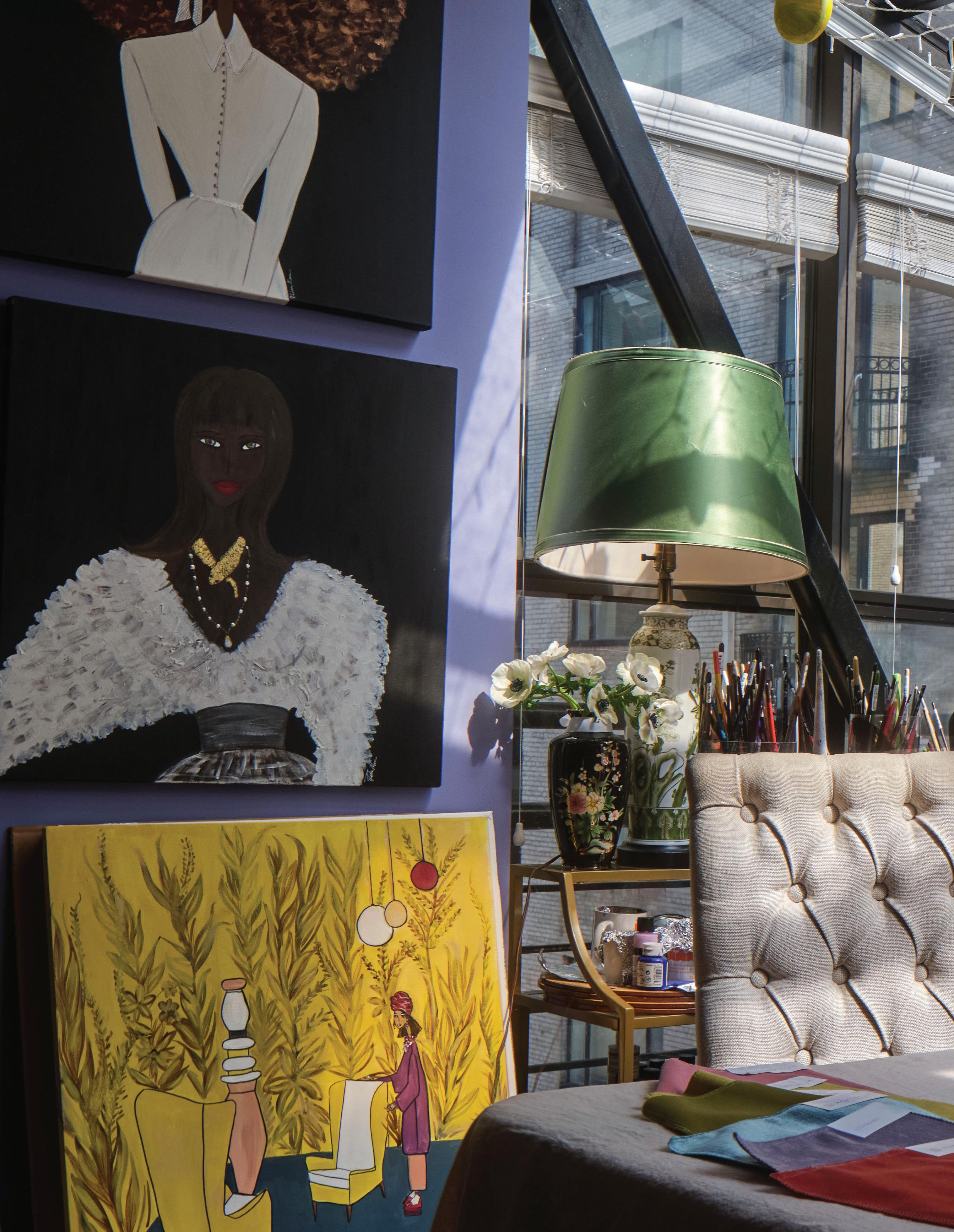
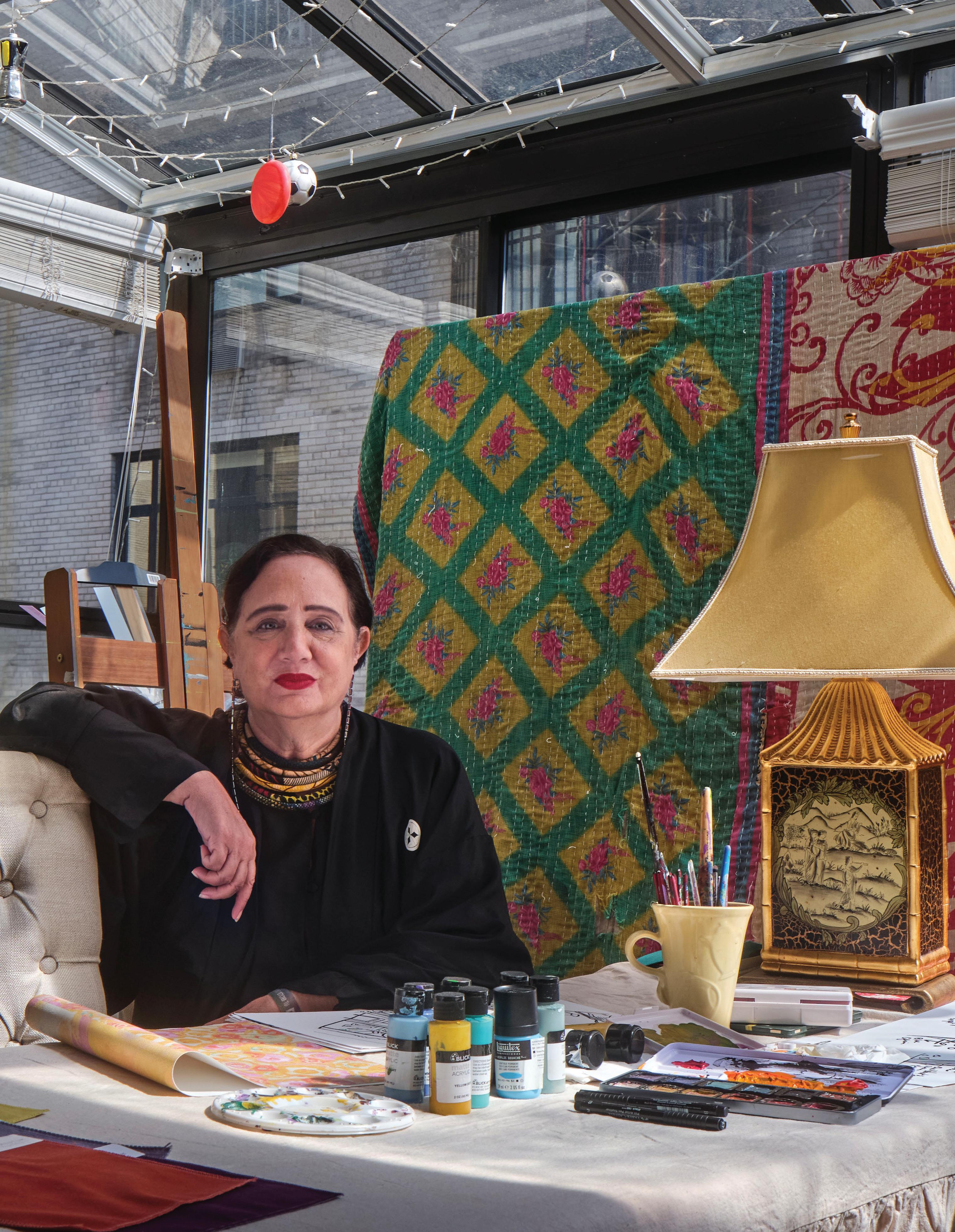
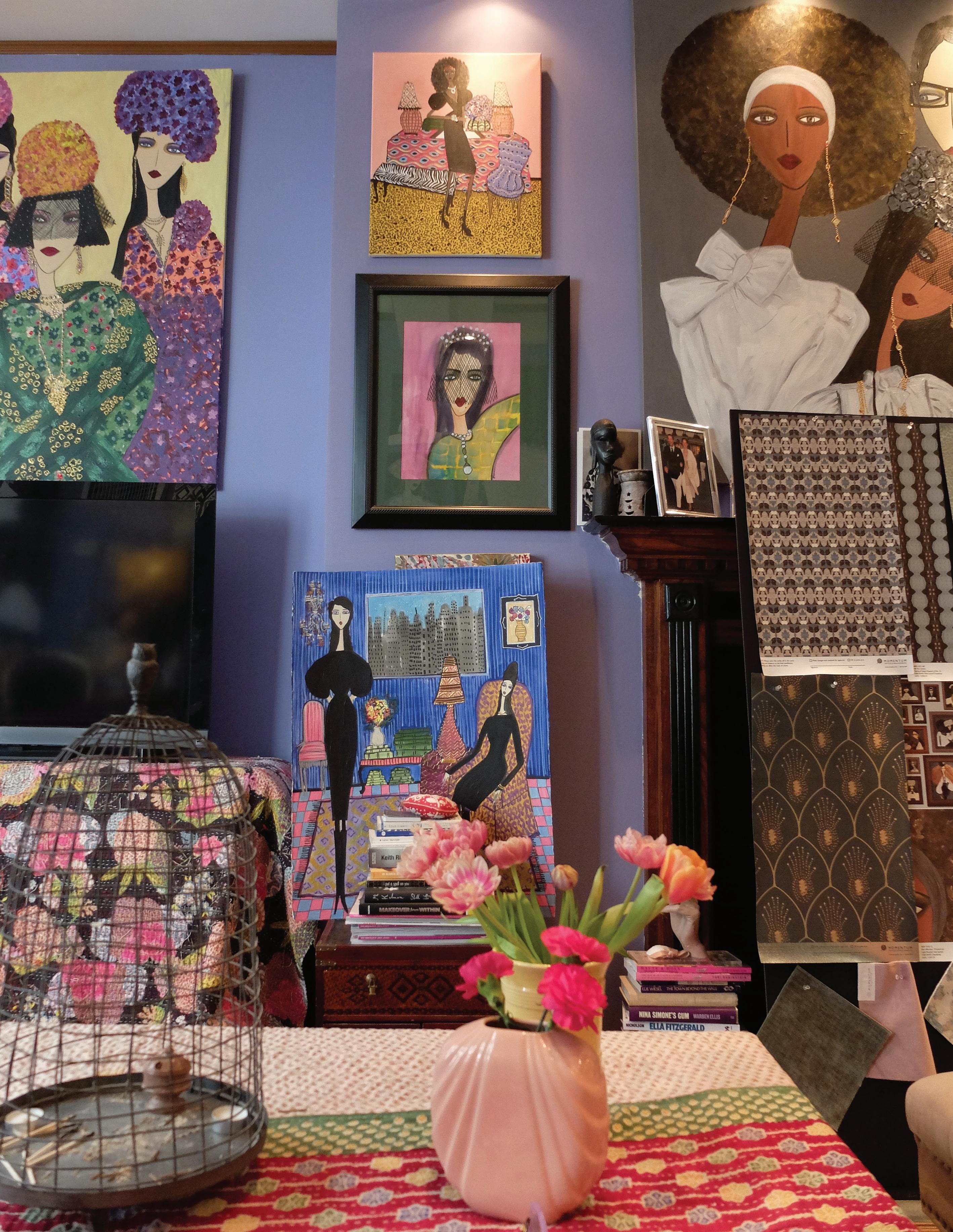
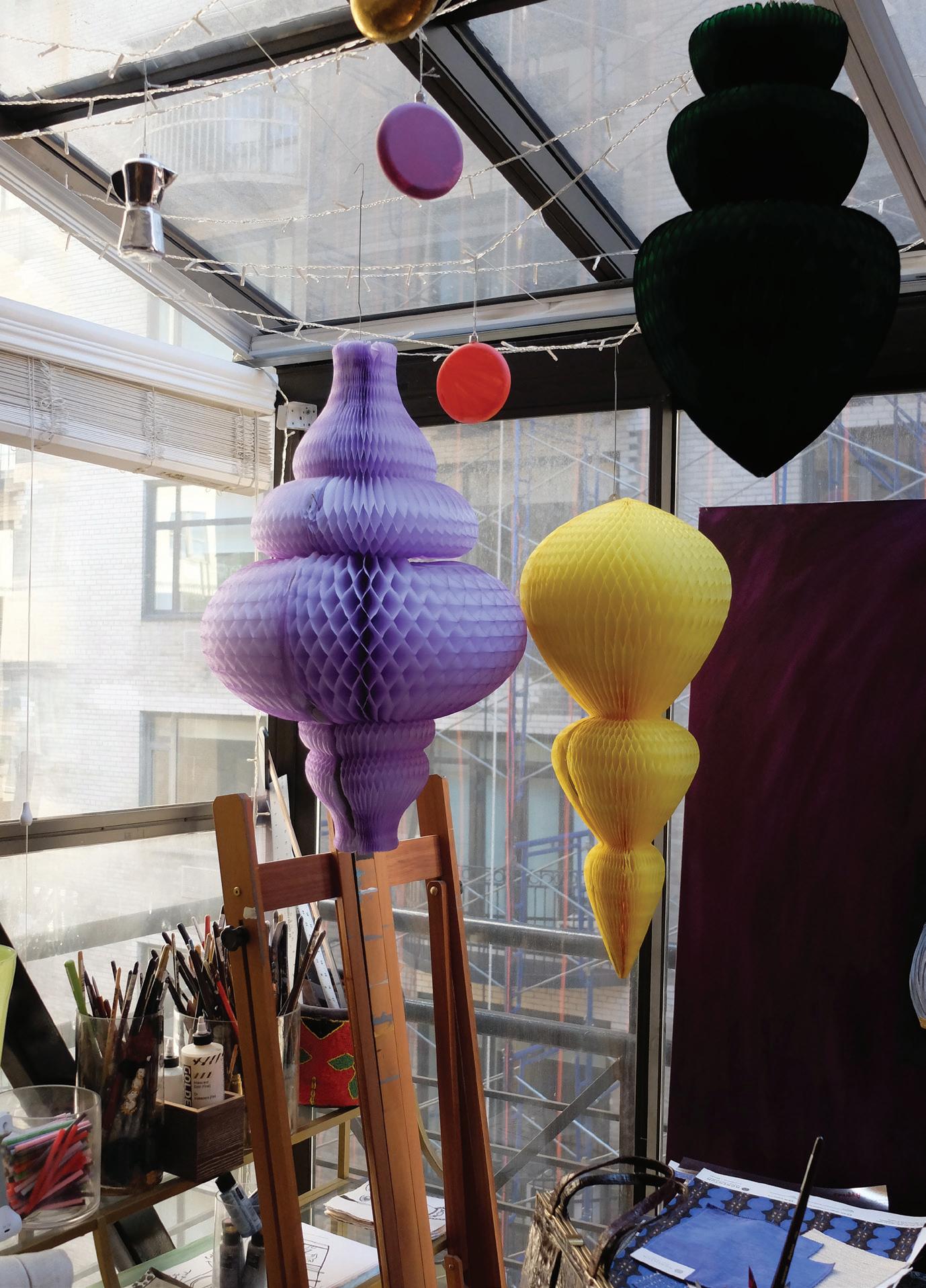
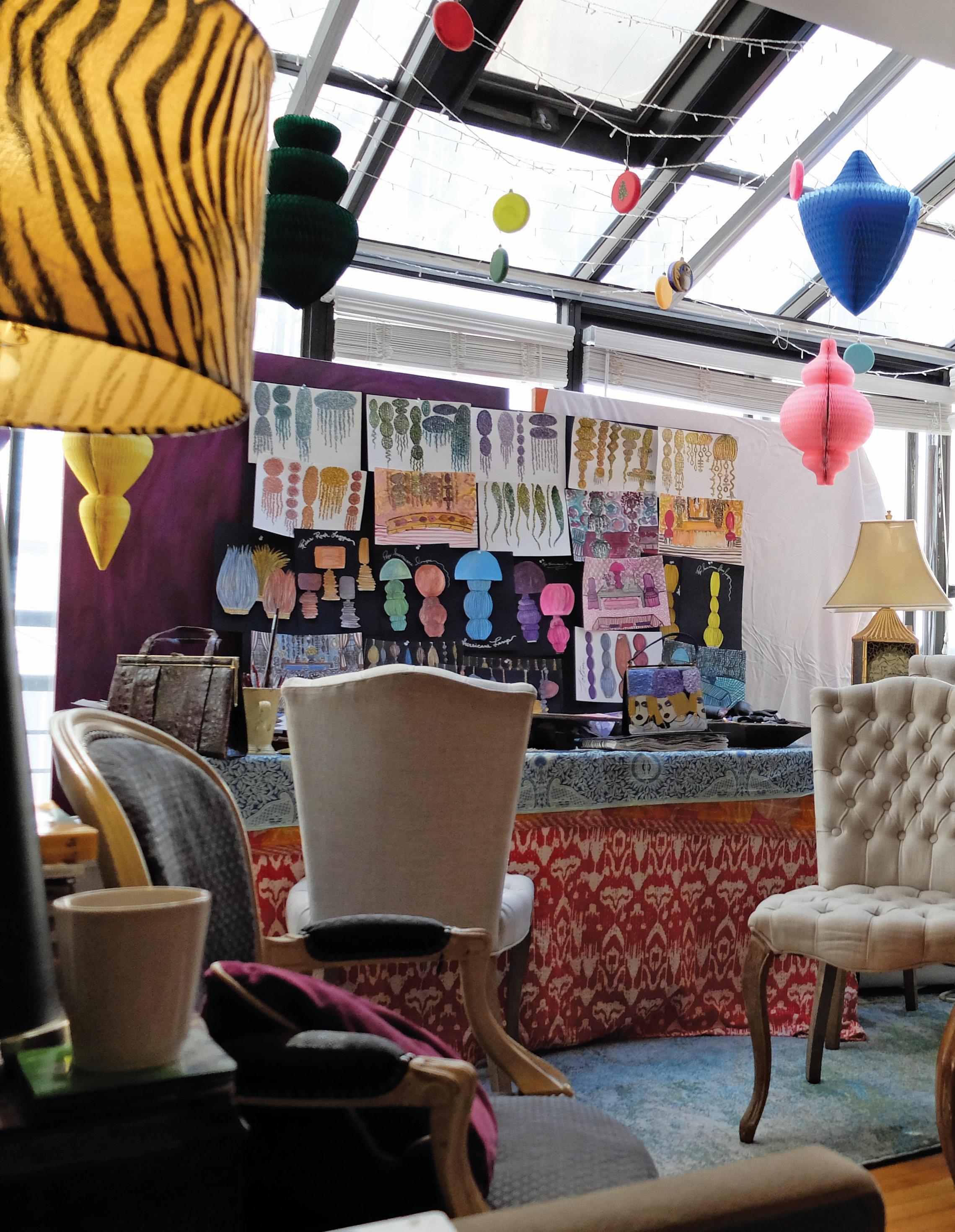
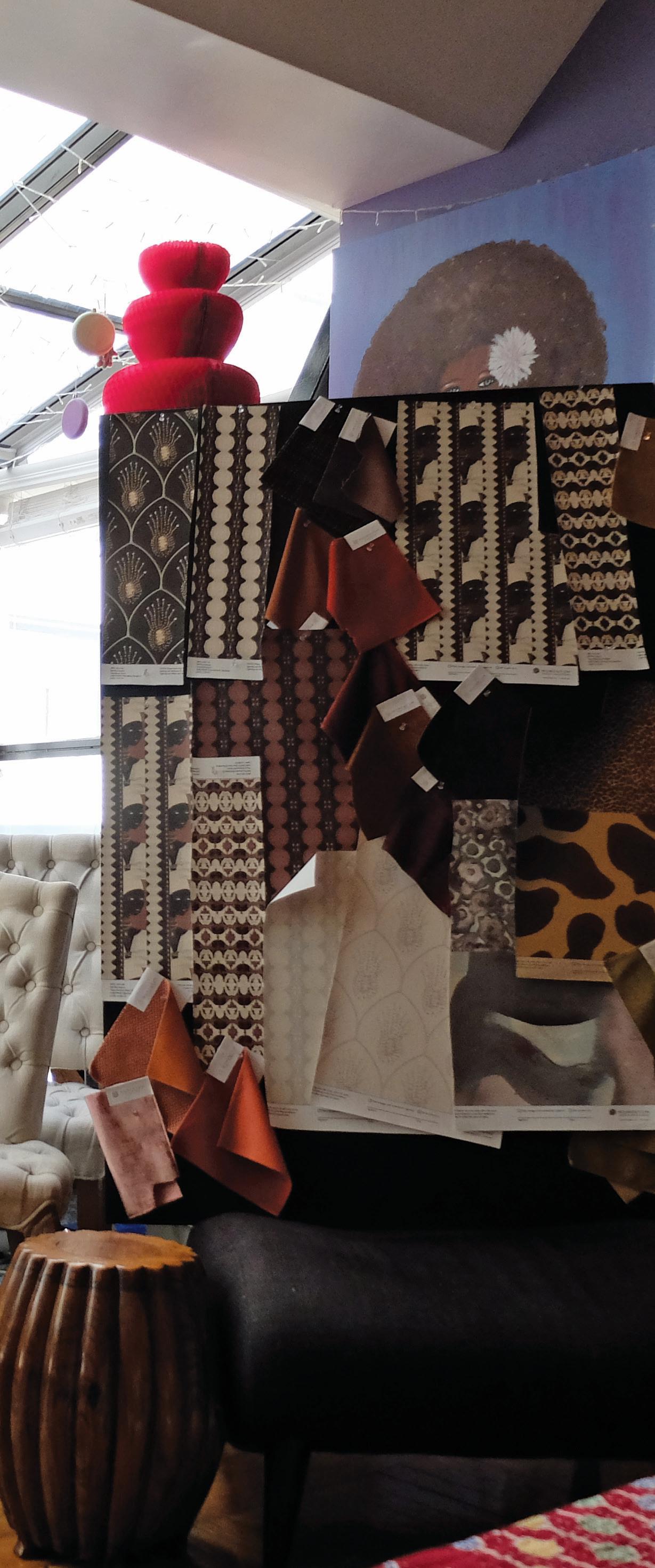
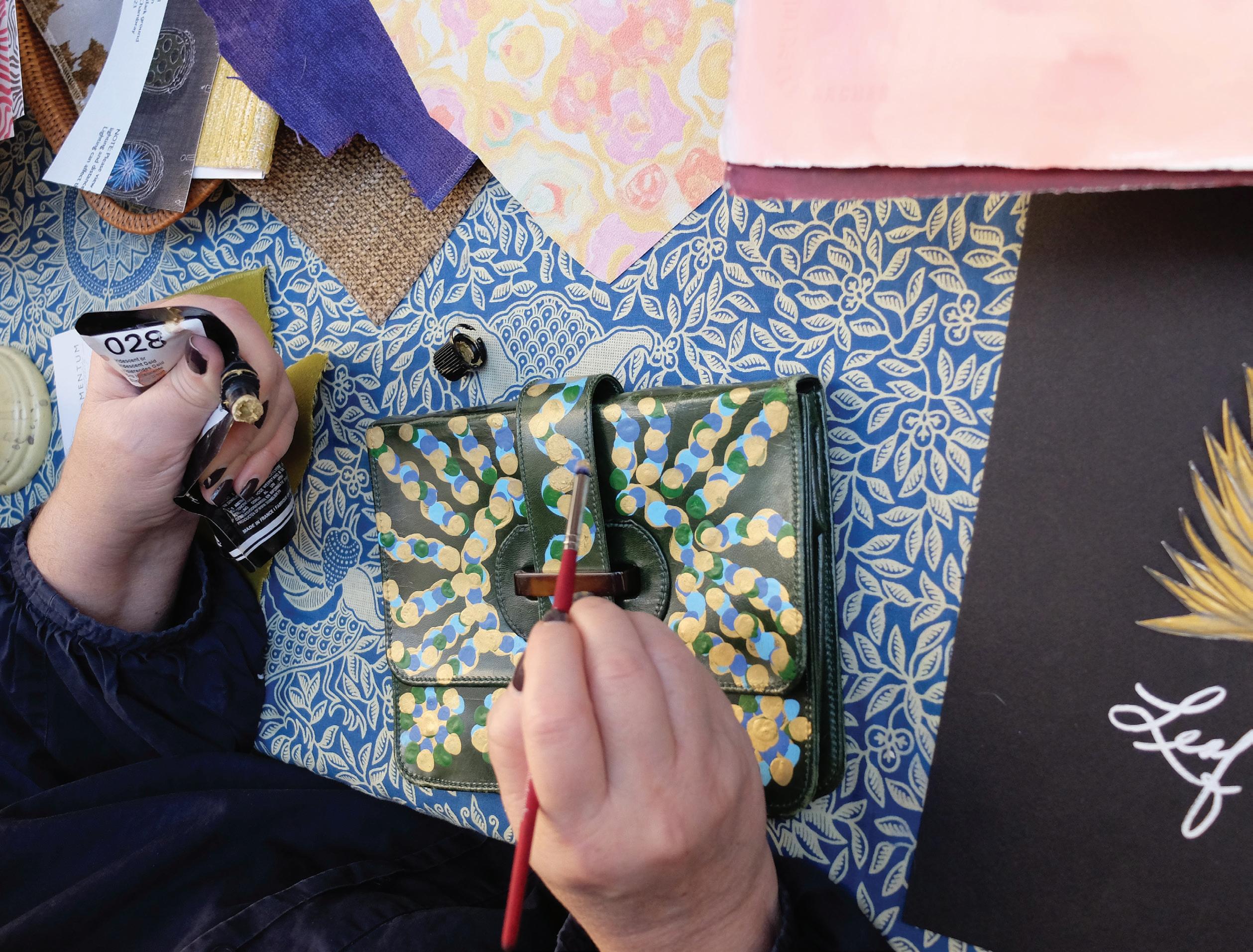
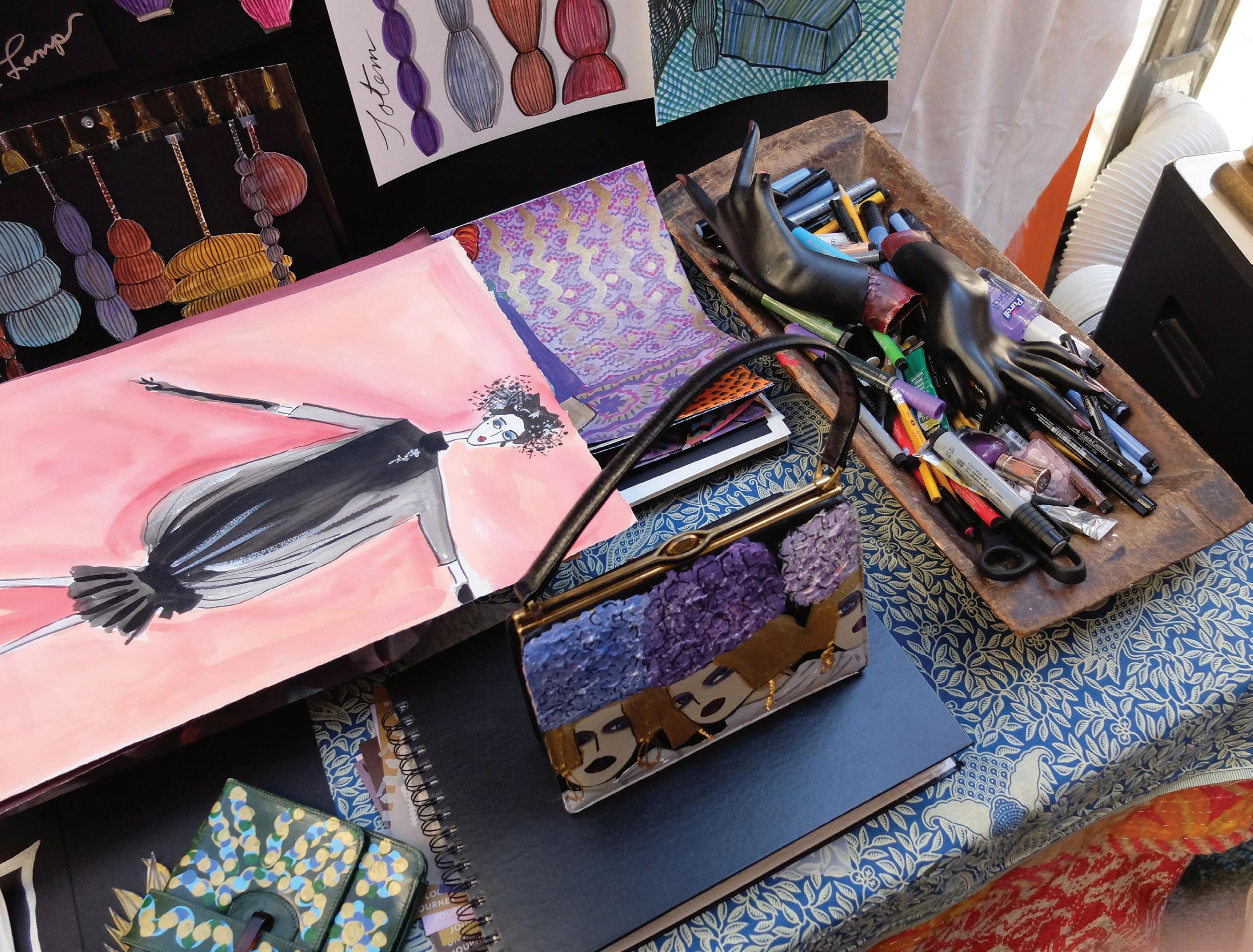
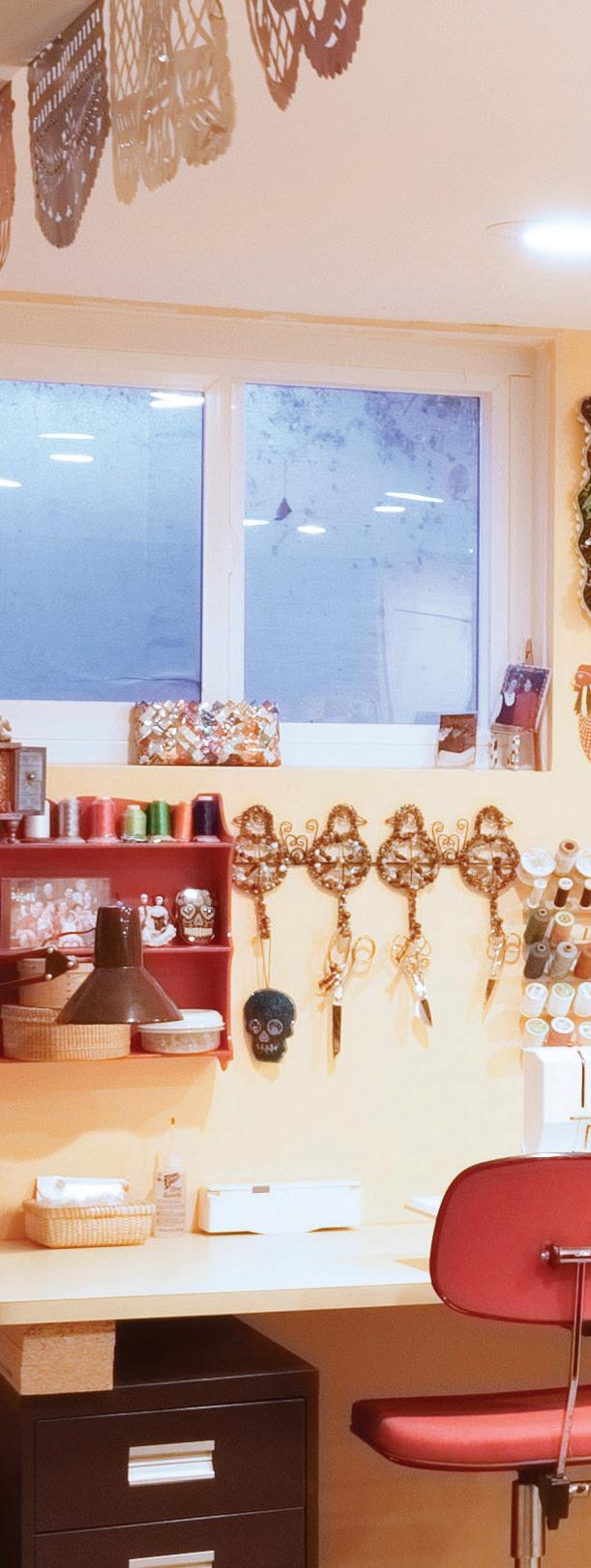
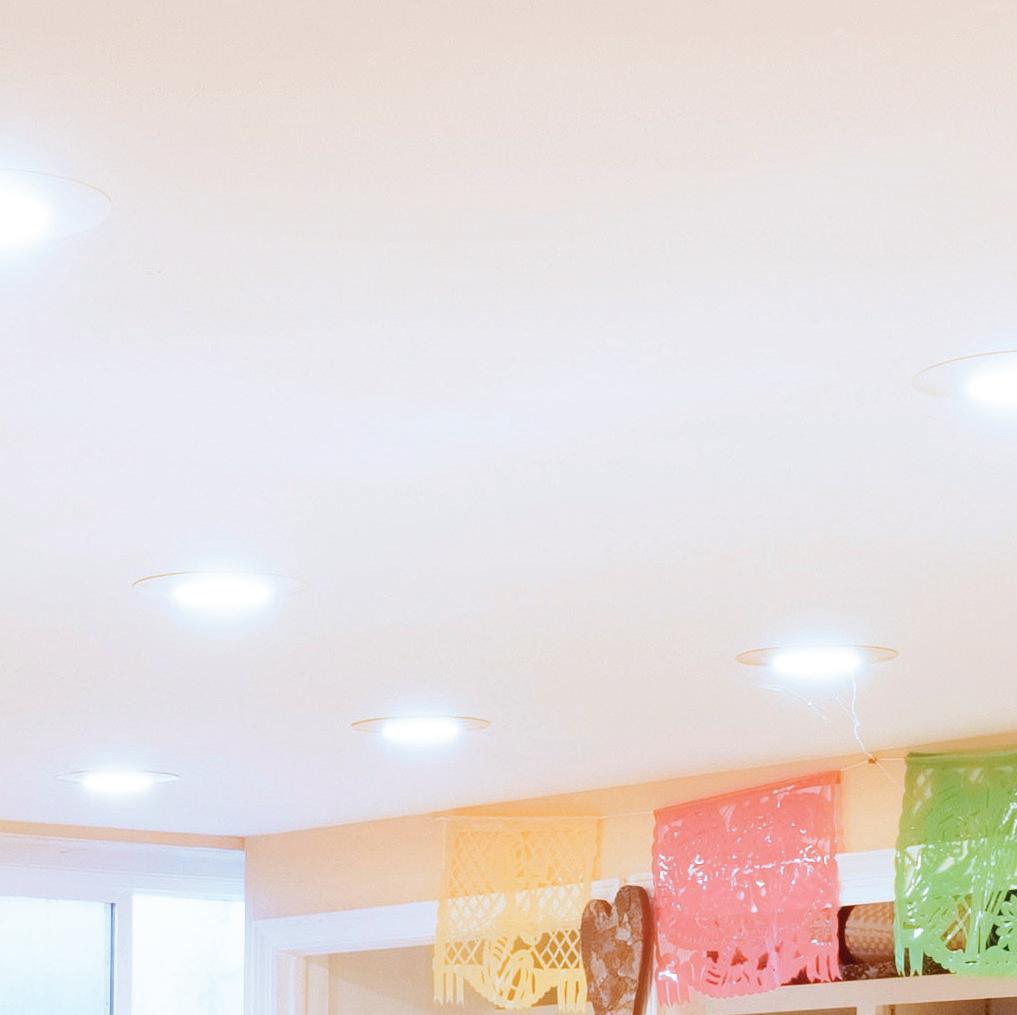
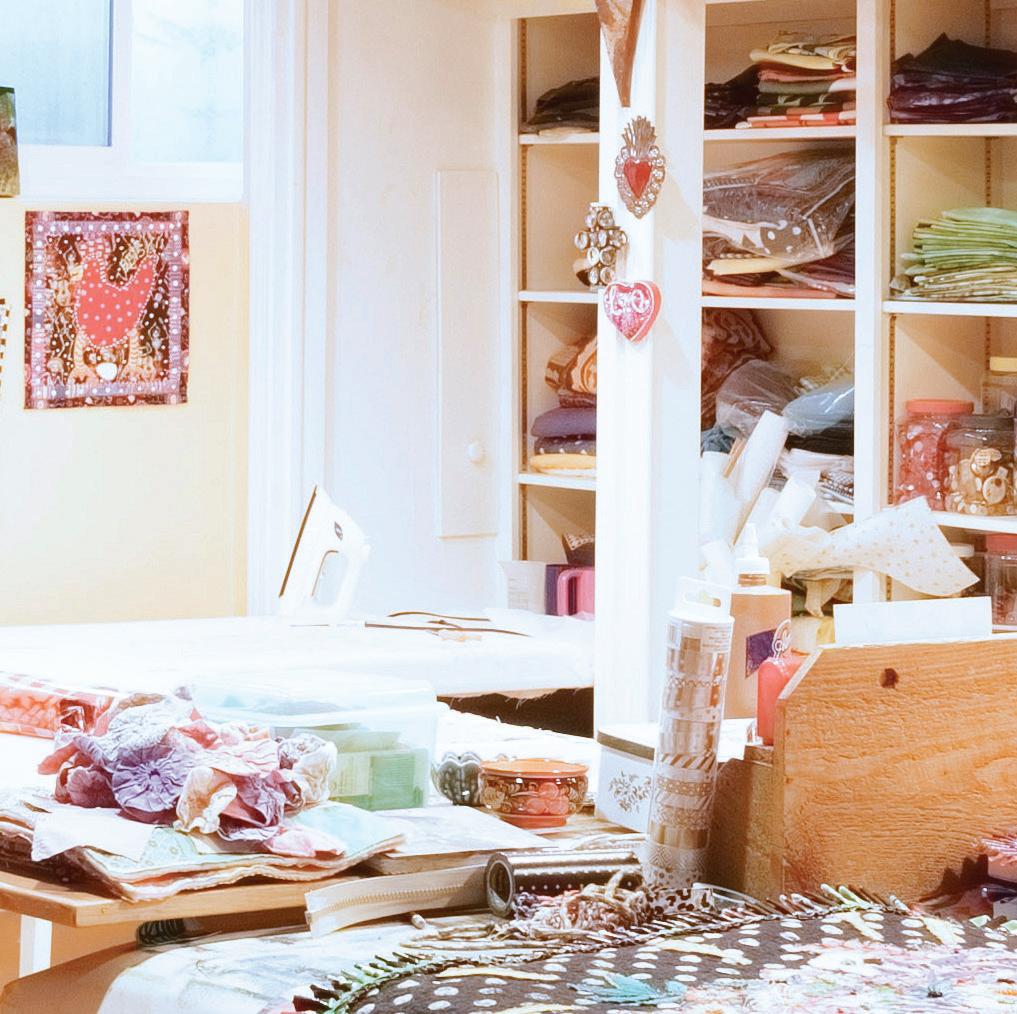
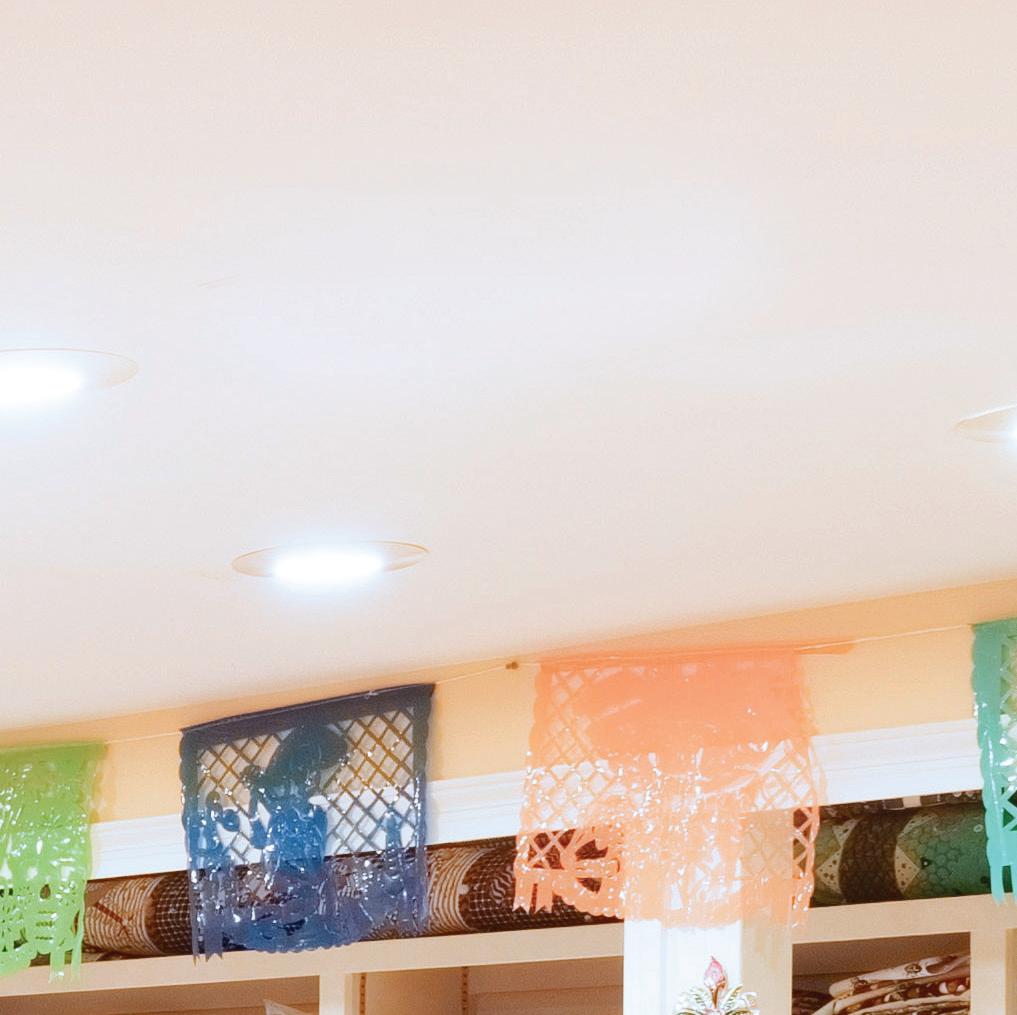
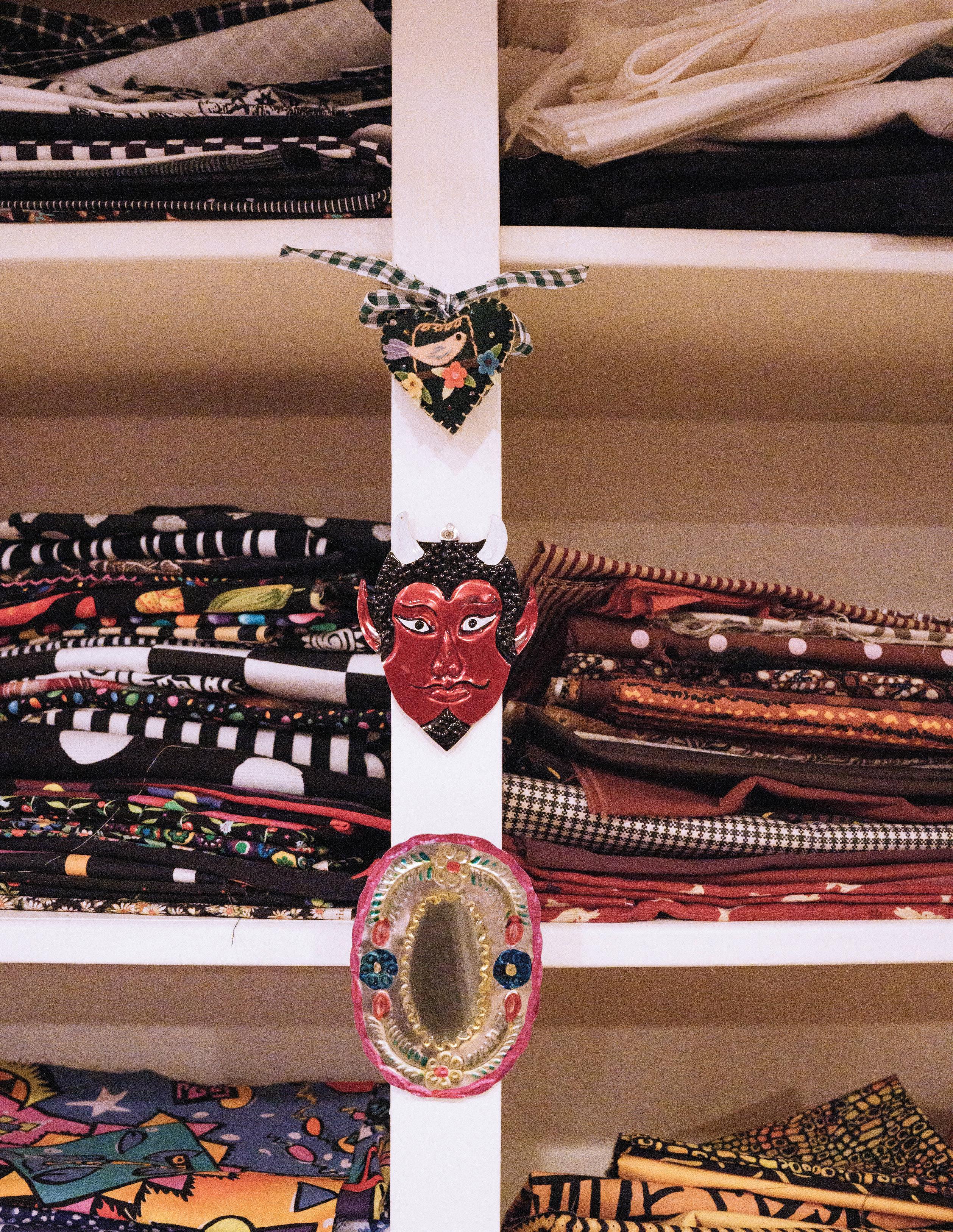
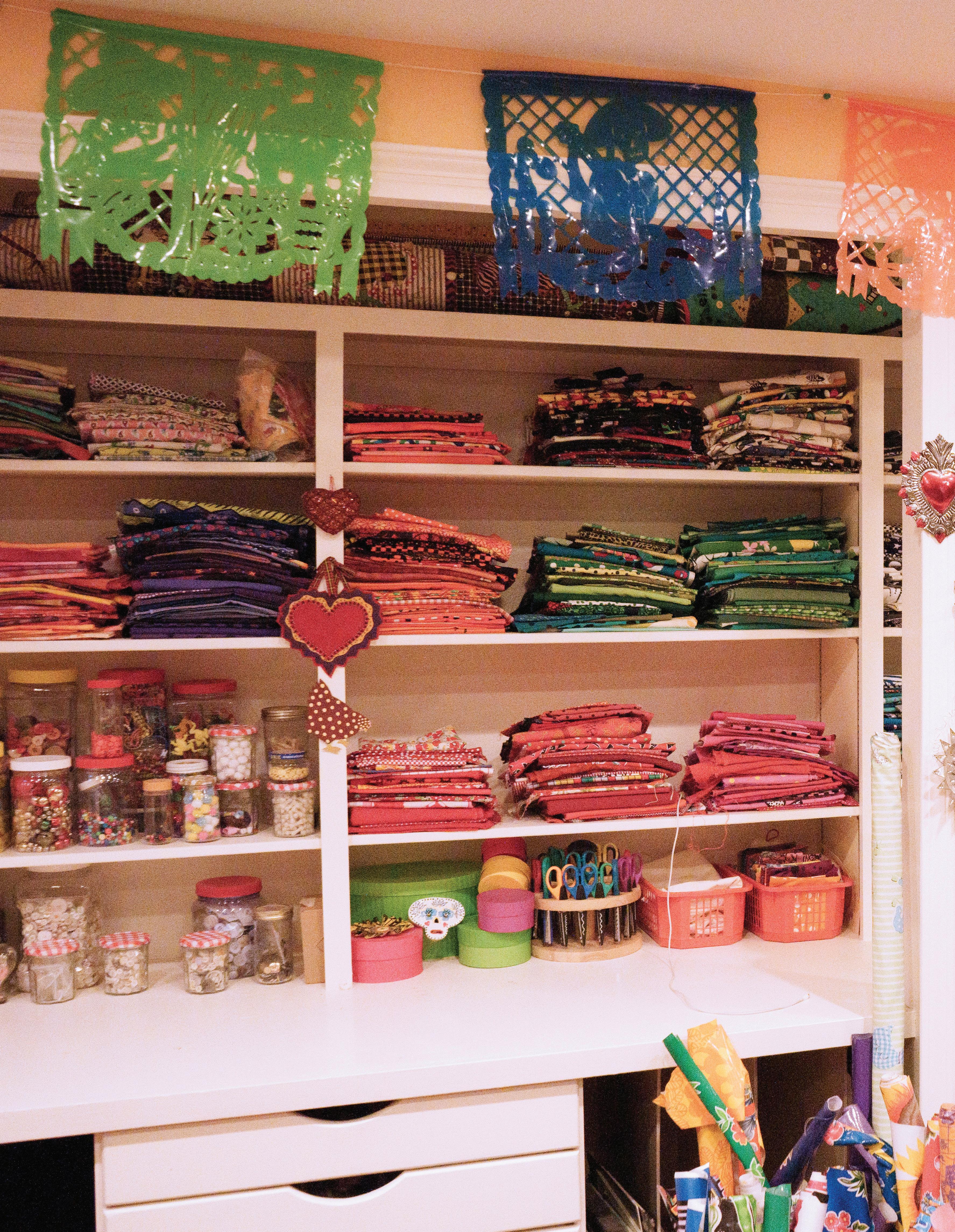
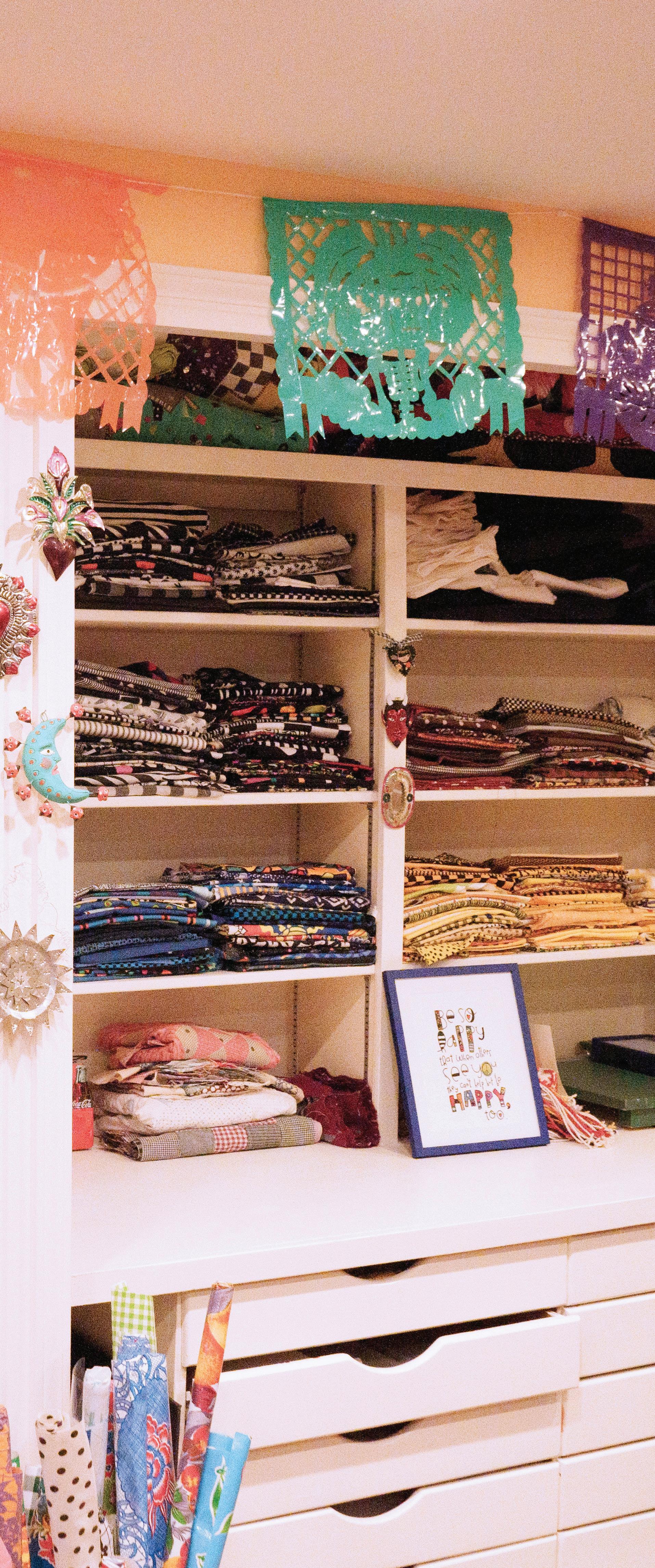
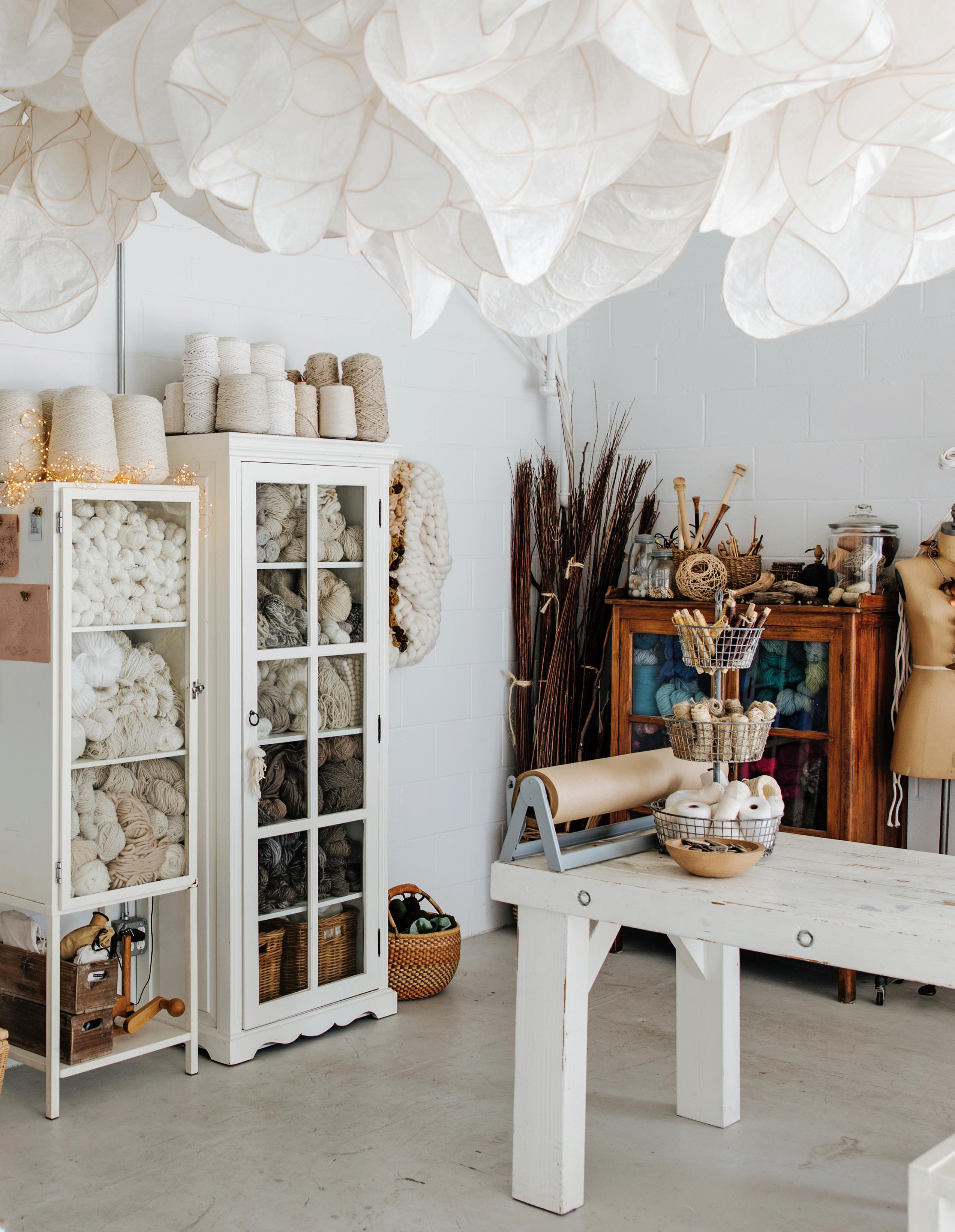
I confess that I am endlessly intrigued by the things that people keep and surround themselves with. And that is why I love looking at the images that our artists share with us and our readers for Where Women Create. If you look at them long enough you can start to see patterns. Colors, shapes, textures show up in their treasures that repeat in their works of art and craft and that is quite wonderful to discover. My friend Rebecca Moses, an internationally known fashion designer, illustrator, and artist, who generously shared the story of her life with me for this issue, has a wonderful studio and apartment that is filled with things that are so her, they almost couldn’t exist anywhere else but in her world. I love the wonderful paper lanterns hanging in her art space, and I can see the the shapes of those lanterns repeated in some of her beautiful works of
art. You can see her studio and read her story on page 80. I hope you enjoy it.
We live in a chaotic world, maybe more chaotic now than at any time in history, so it’s comforting to know that art will always be with us. And it’s even more comforting to be able to celebrate the women who persevere, who are determined to make the world better through art, and who are willing to share a little piece of their souls with us. At Women Create, we are so privileged to be able to share their stories with you, our readers. Here’s to a wonderful summer of creativity, color, diversity, and above all, fun!
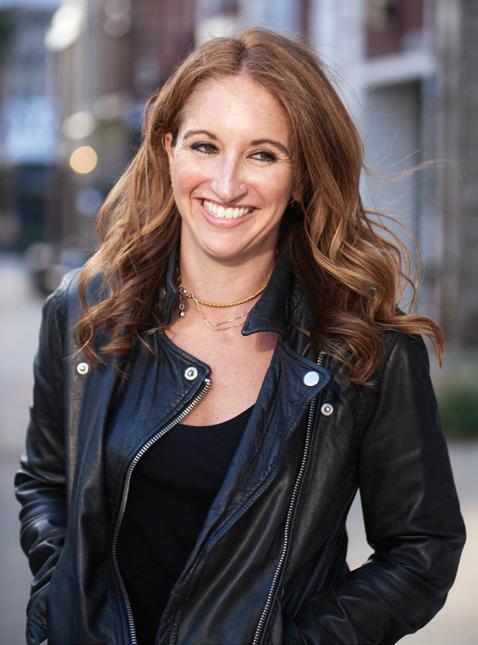
DEBORAH L. MARTIN, EDITOR IN CHIEF
PHOTOGRAPH BY ALICE TEEPLE
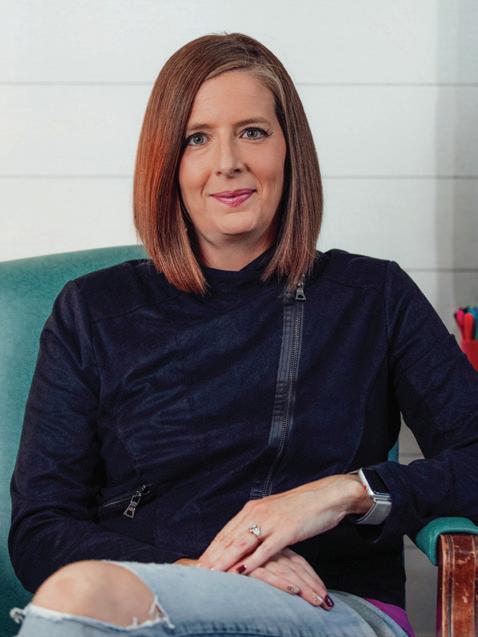
ANA BIANCHI, P8
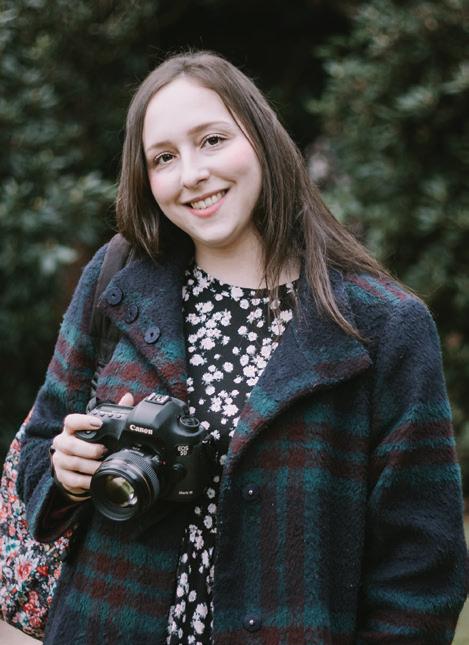
TAMMY HUDGEON, P118
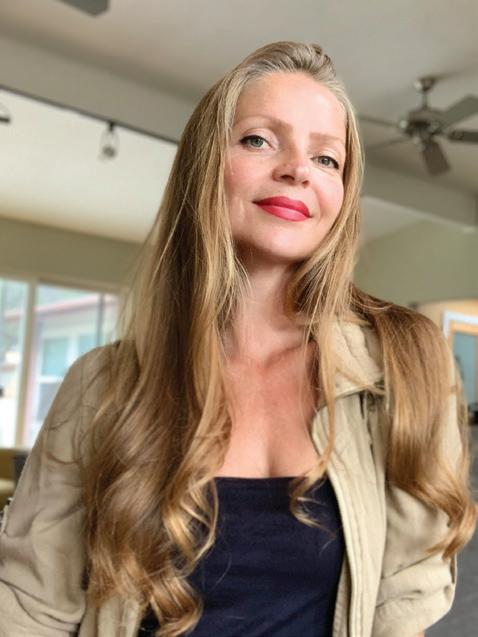
SHANNON AMIDON, P40
REBECCA MOSES, P80
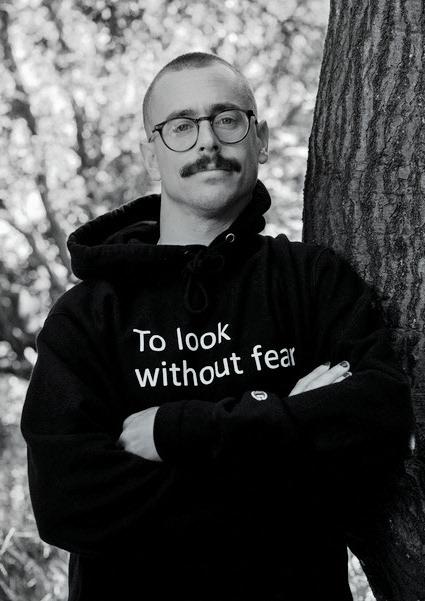
ANNE BROOKE, P142
Ana Bianchi
Photography by Ana Bianchi
Curated by Lori Siebert
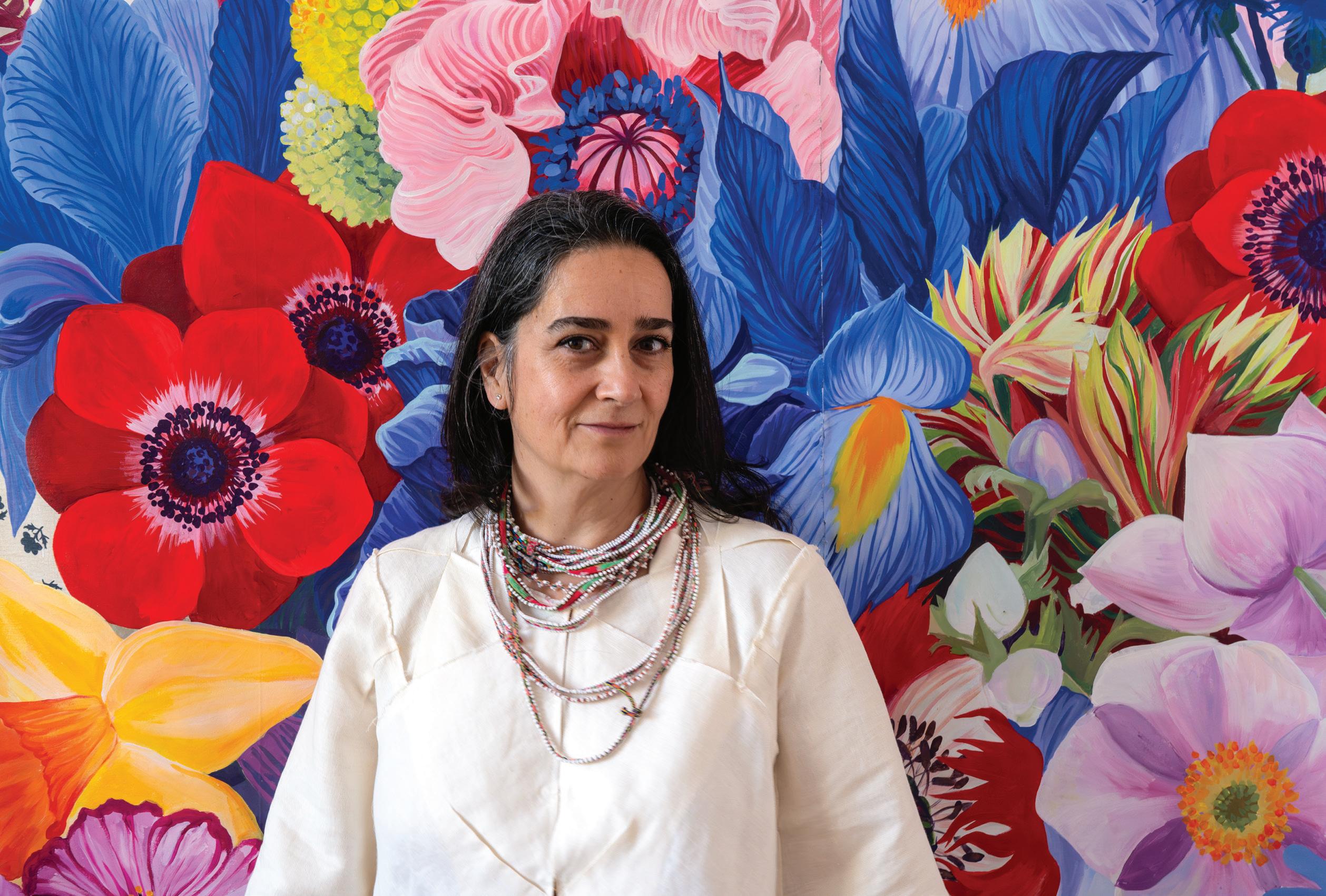
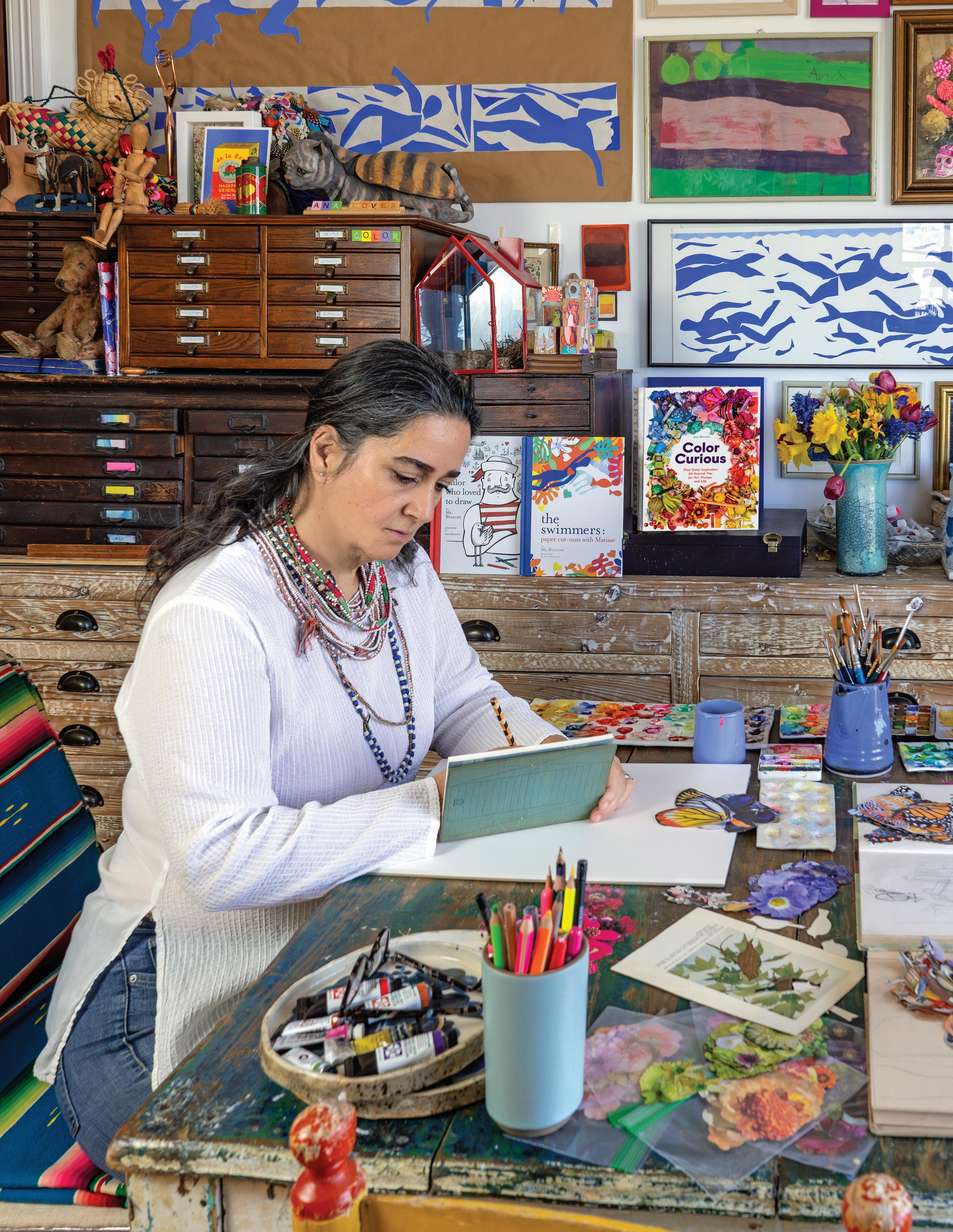
ANA BIANCHI is an artist, designer, and illustrator, as well as a published author. With degrees in design and fine arts, her creative work spans across disciplines, from illustration, surface design, and childrenswear to graphic design and branding. Her lifelong love of color is what connects it all and helps her comfortably move from one discipline to another and from one technique to another. Her book Color Curious will come out Fall 2025.
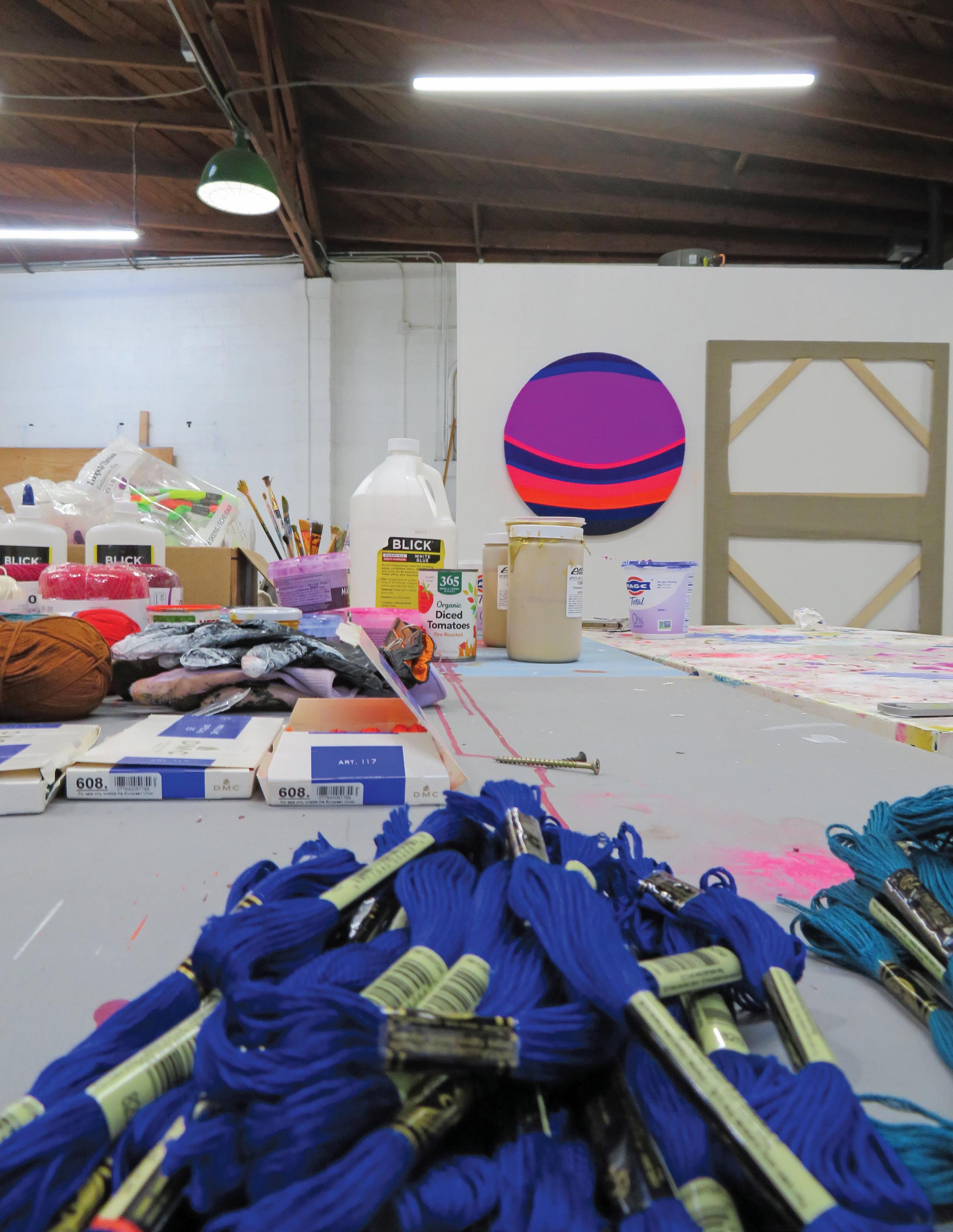
Ifirst came across the notion of an art studio—a dedicated space for art making—very early on. I was an artsy kid from the get-go. Some kids want a puppy, or a bike, or a ball, instead, I bugged my parents for art classes and art materials every birthday and Christmas until my mother finally signed me up when I was 5. My teacher taught painting in her garage, but noting that I was more dedicated than any other kid, she invited me to private printmaking classes at her own studio. She was a master printmaker and her studio was an eye-opening paradise! She set me off on a lifelong creative path. As a reminder of those days, in my current studio I have a little etching I did back then and two color studies, when I felt I was an alchemist able to mix the whole rainbow with just the basic primary colors. However, early on I encountered the myth that red-blue-yellow mix all the colors, as anyone mixing red and blue and coming up with muddy purples knows, soon I realized what I needed was magenta!
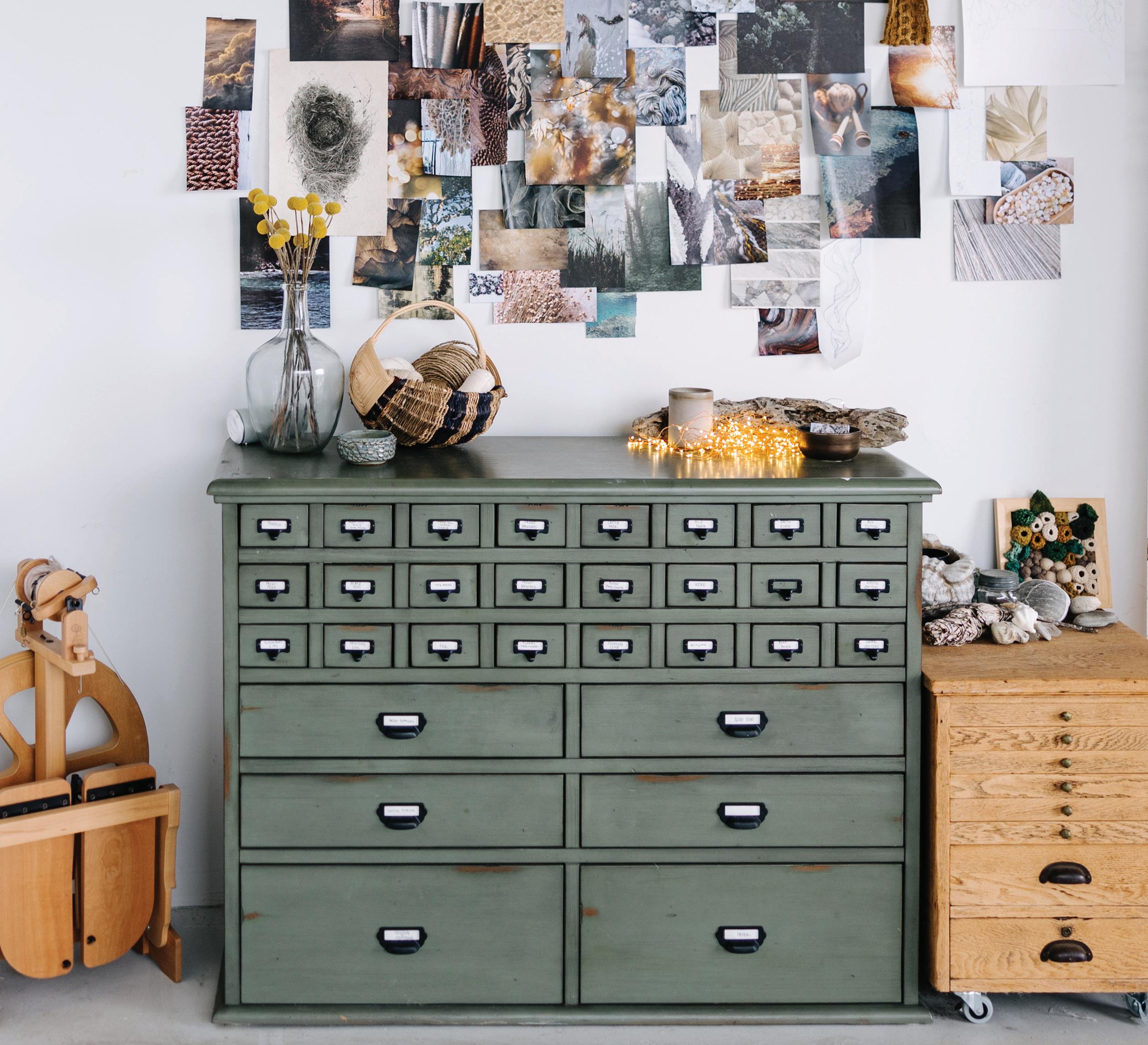
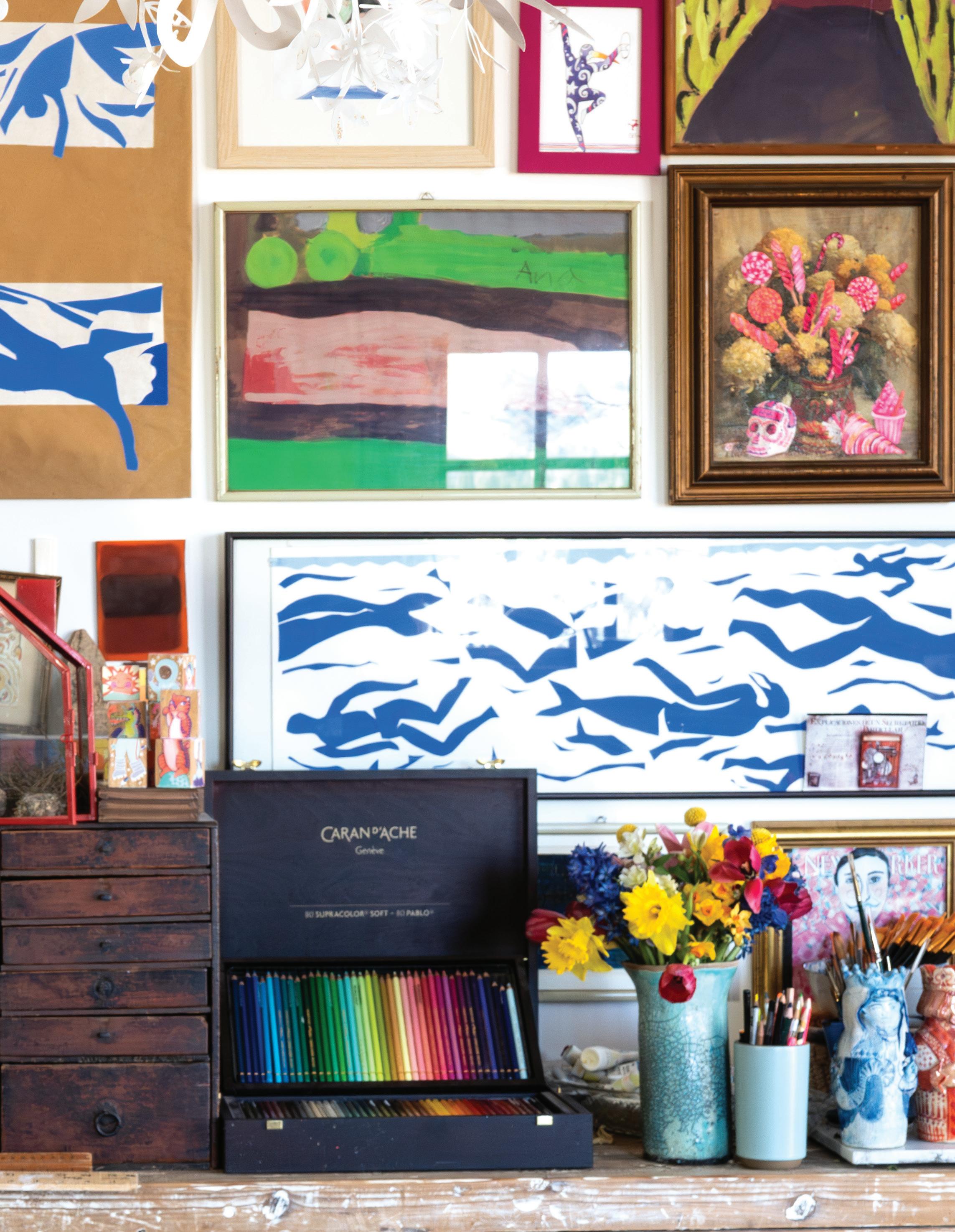
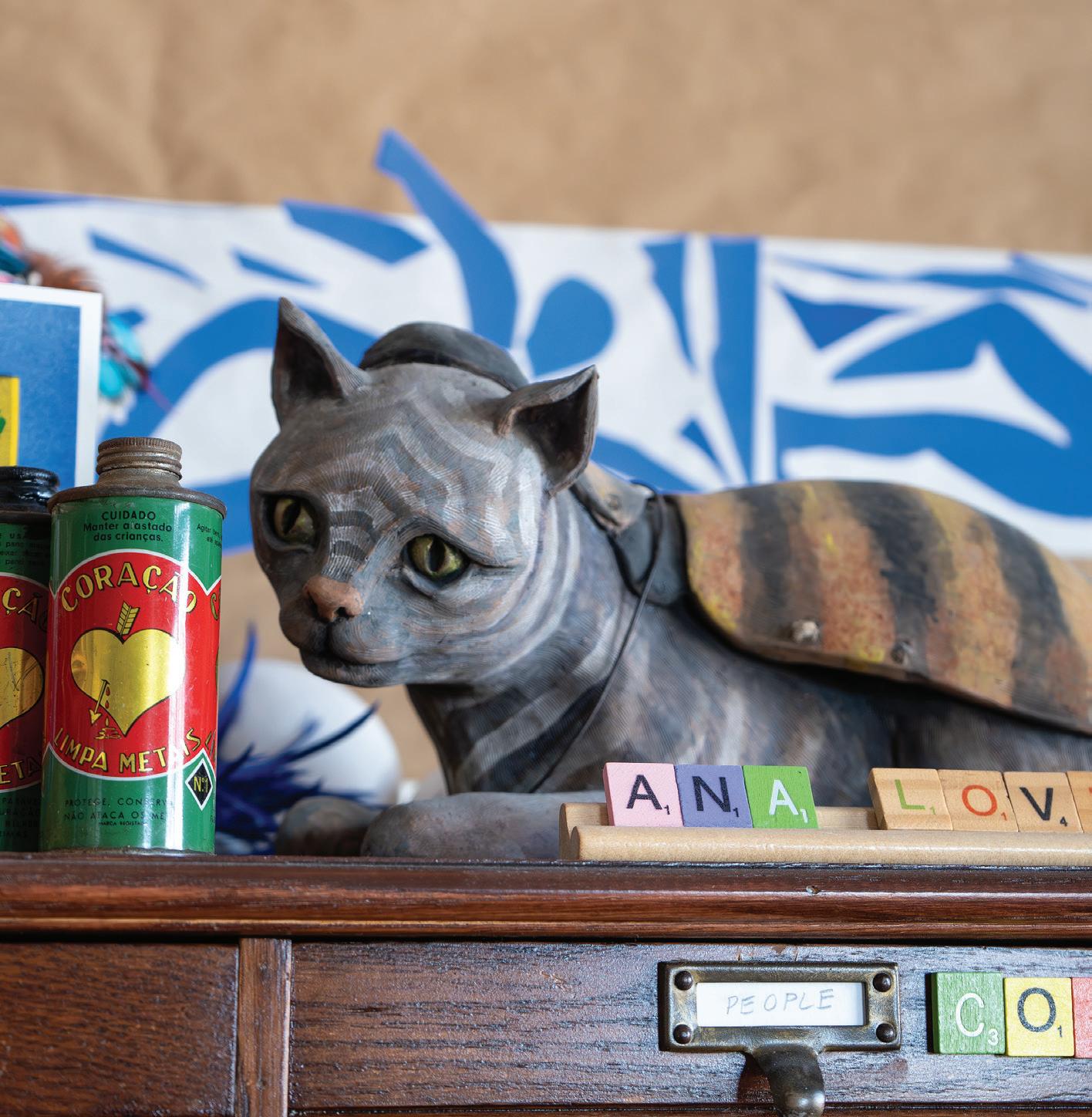
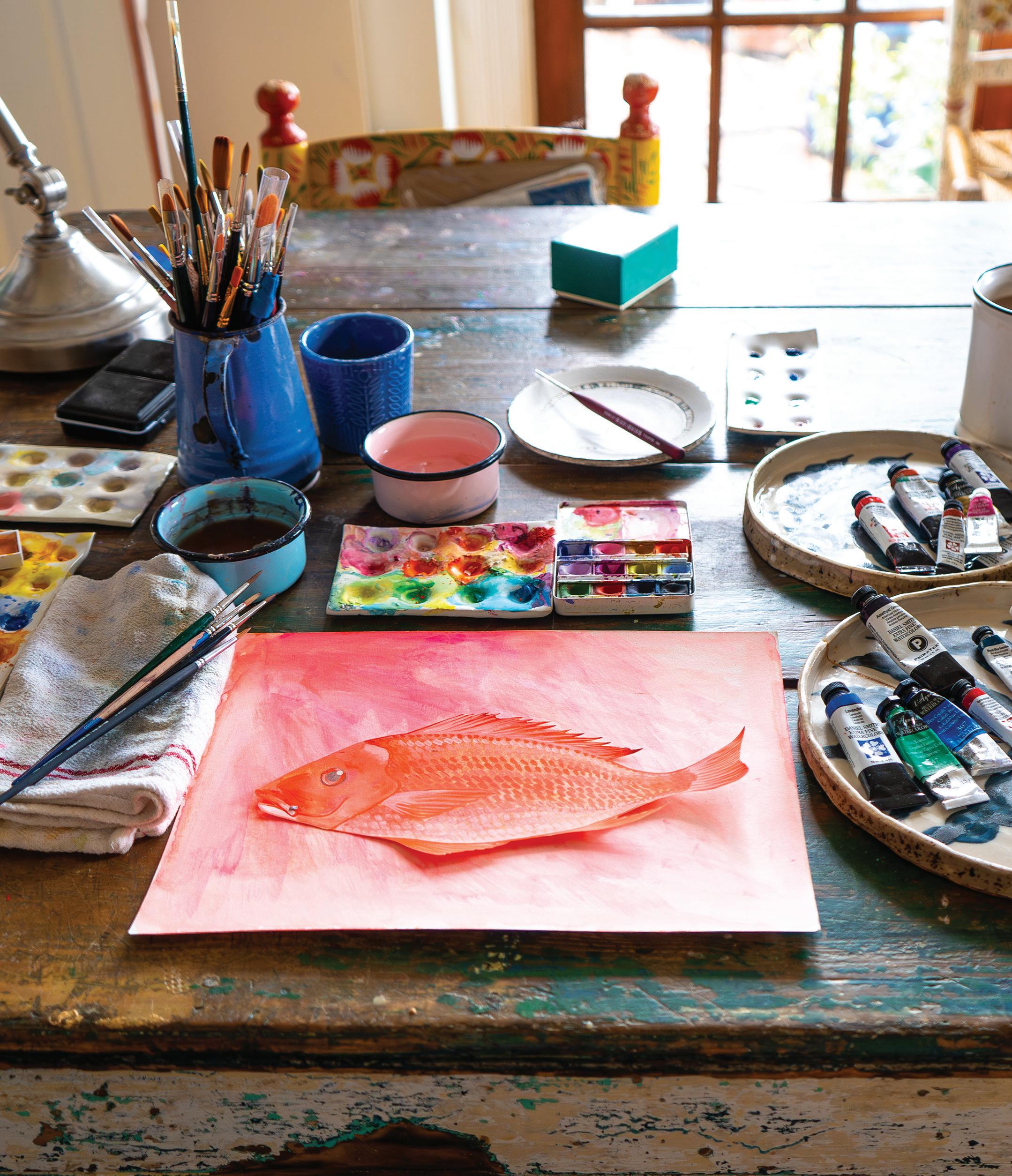
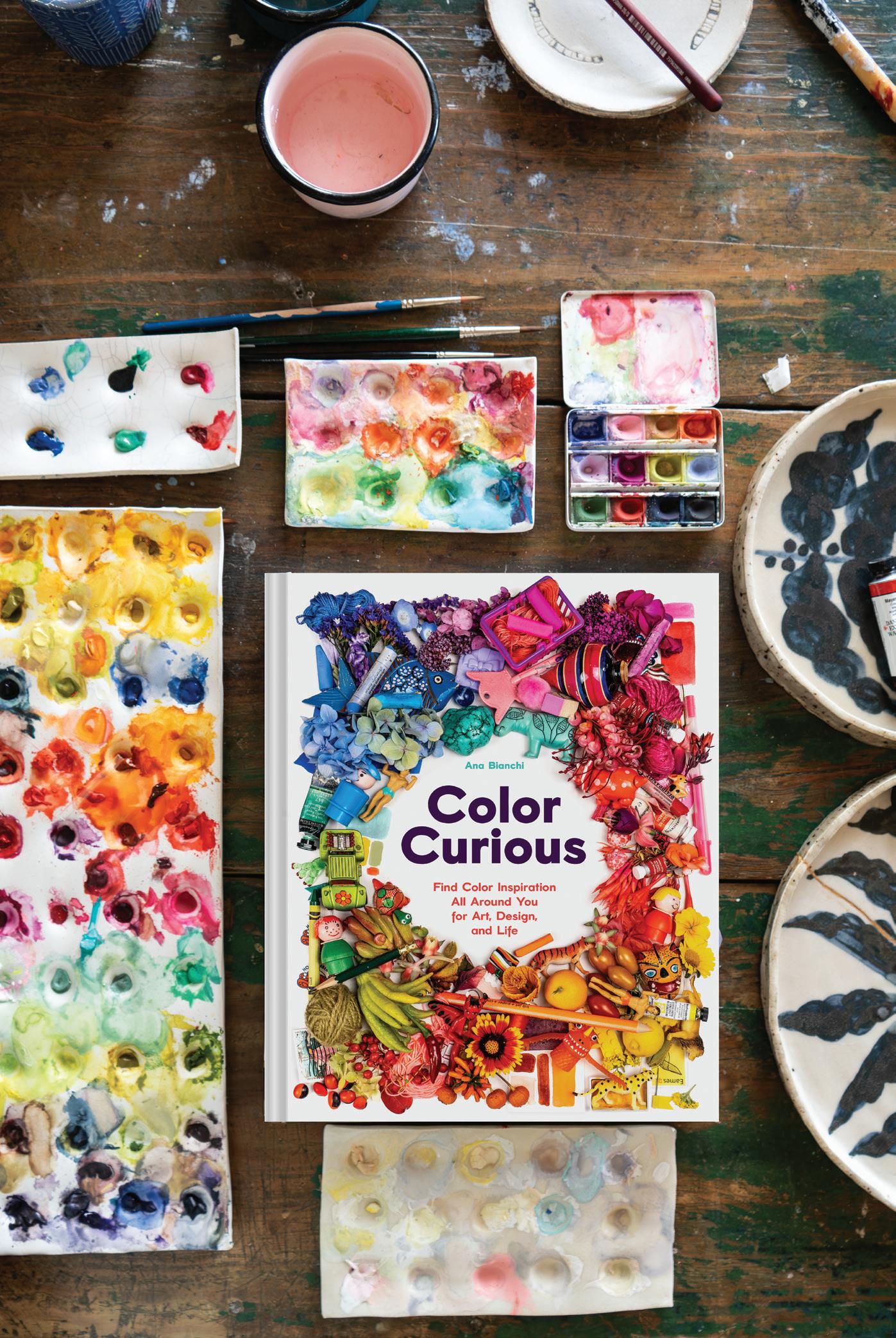
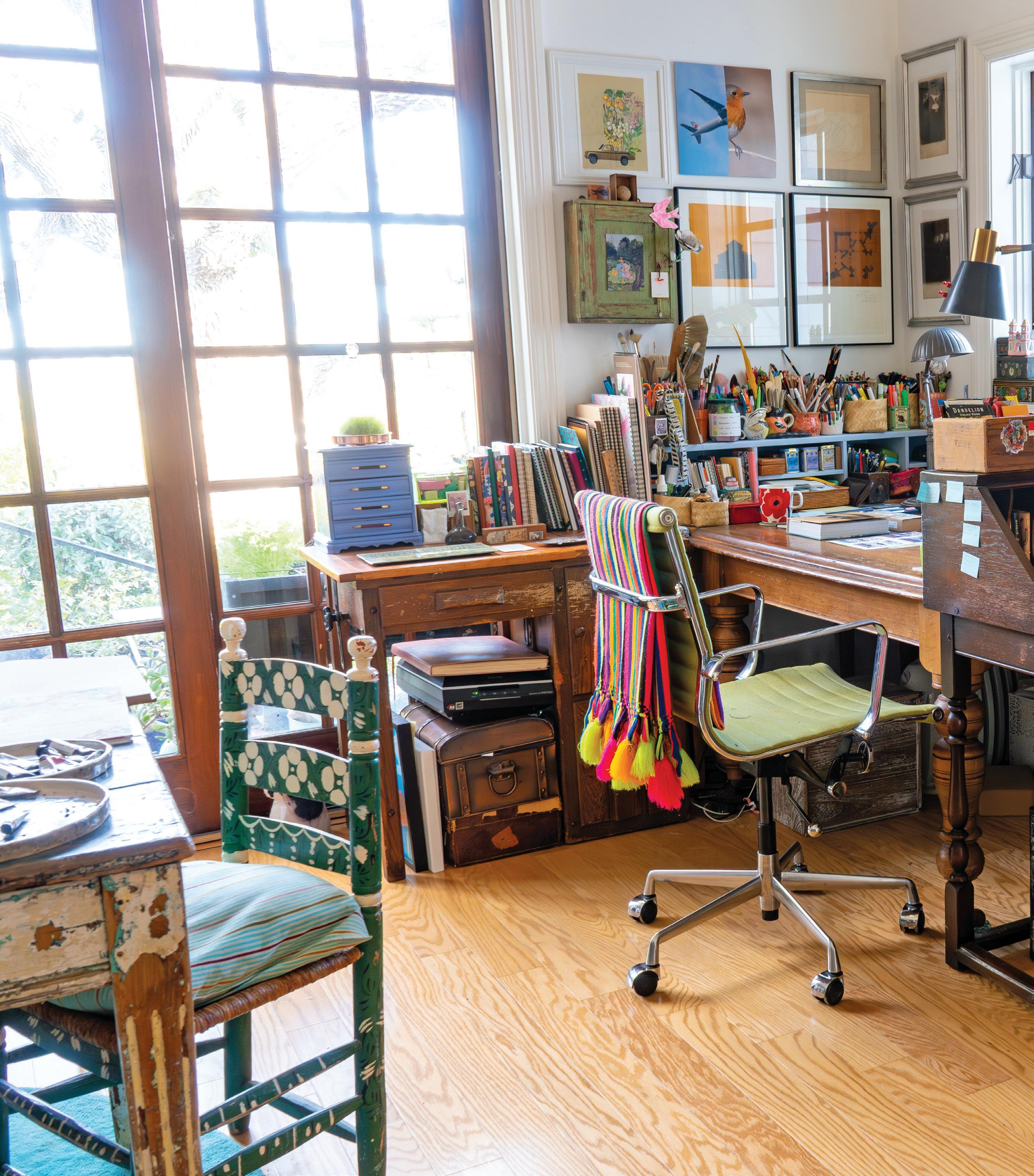
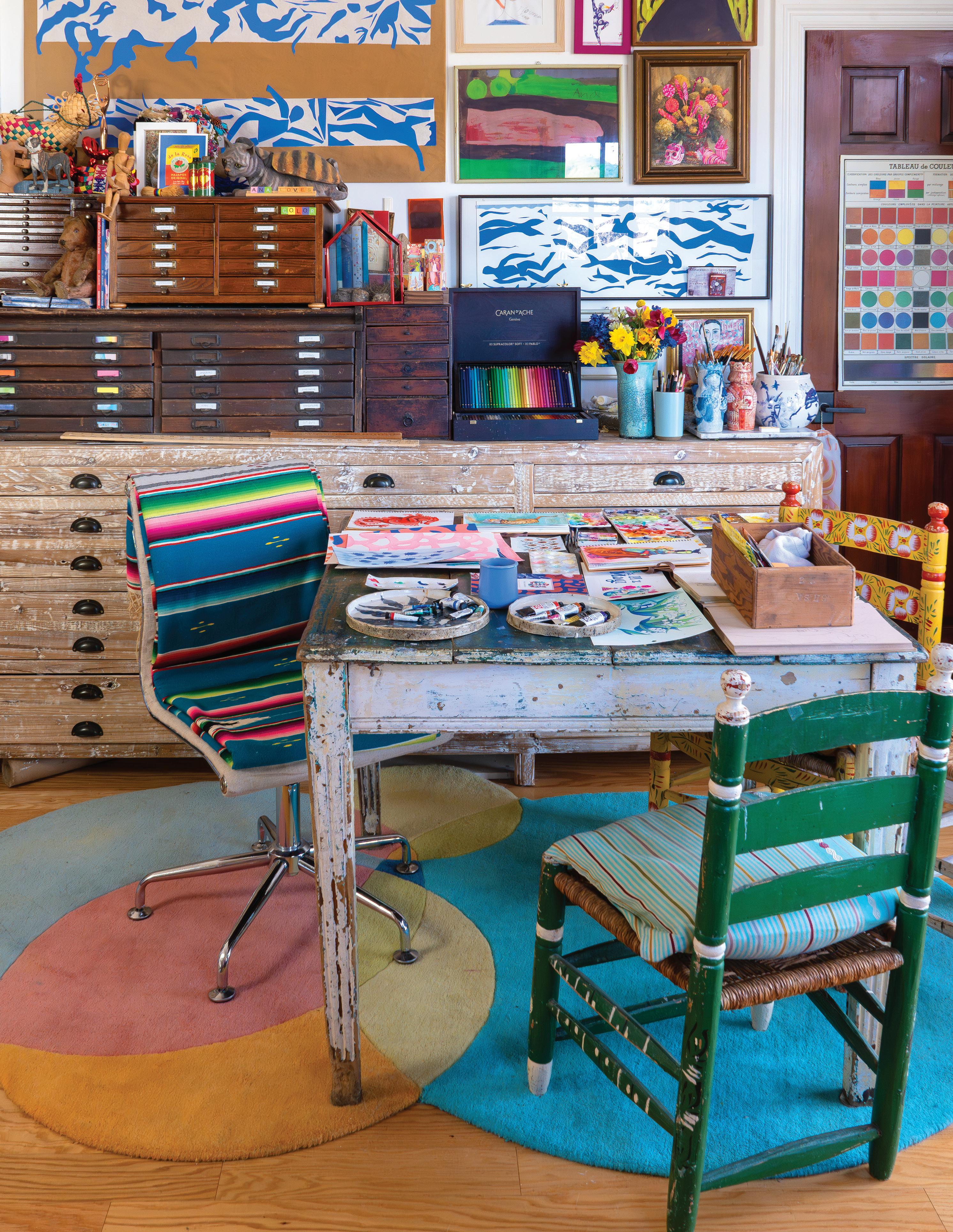
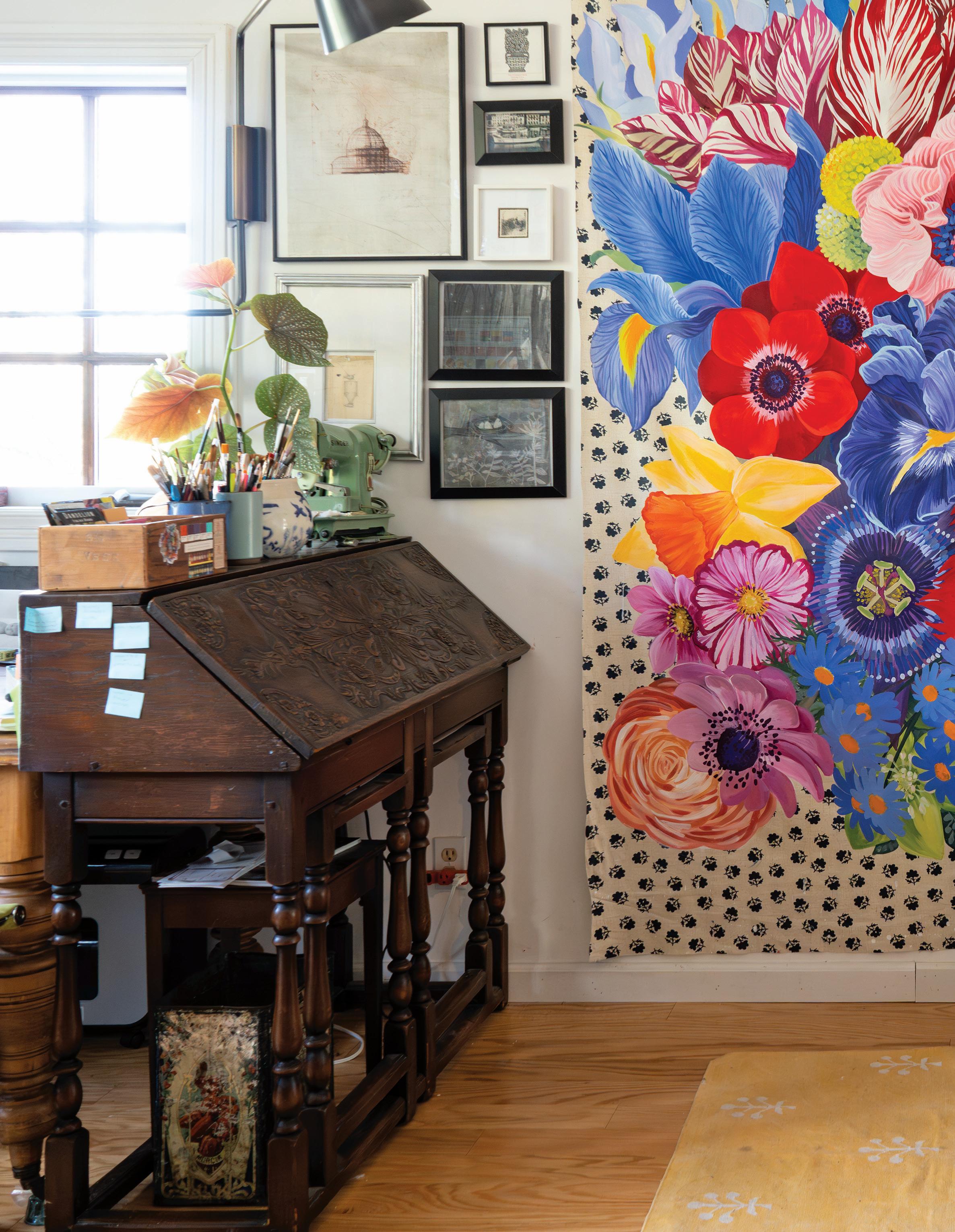
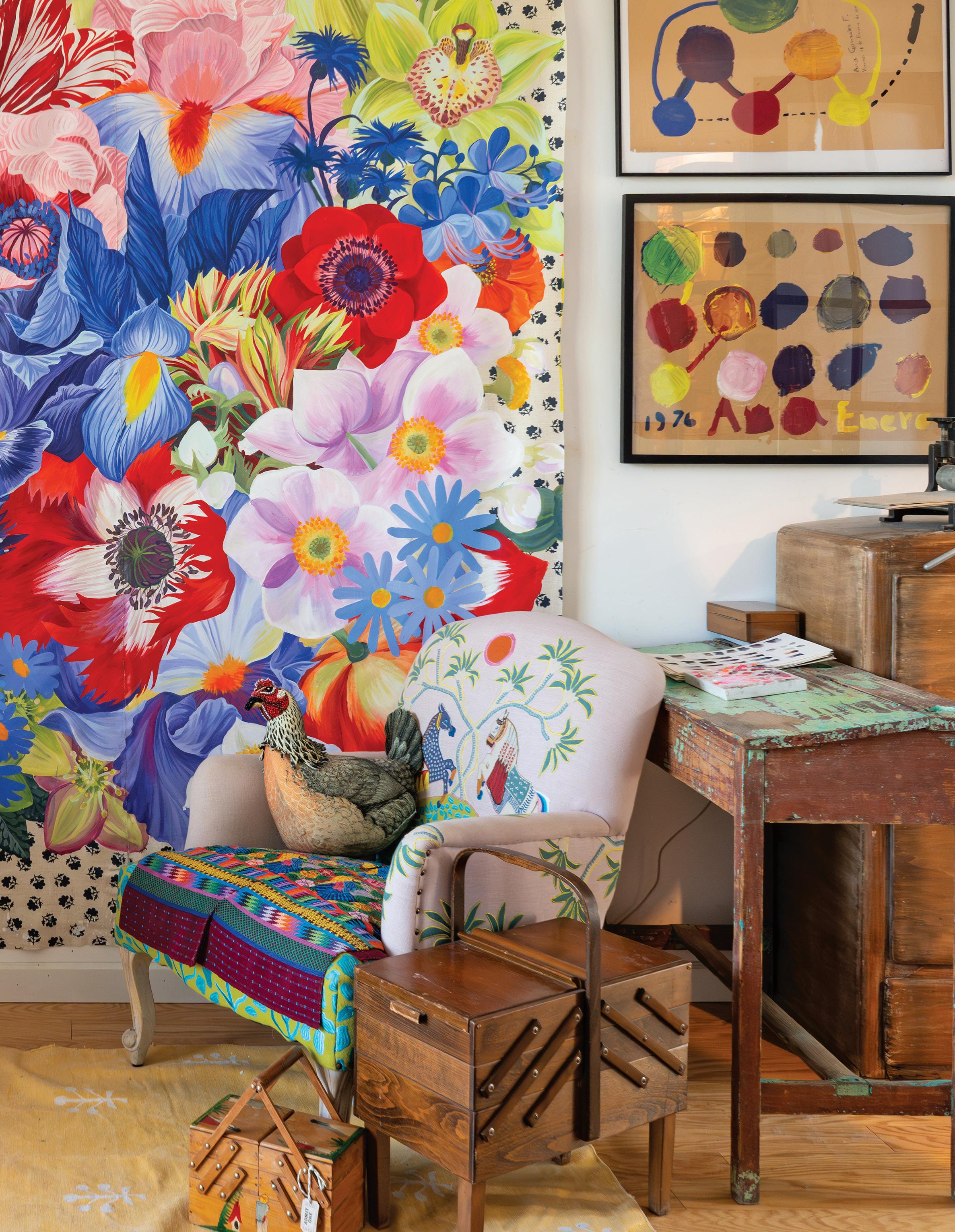
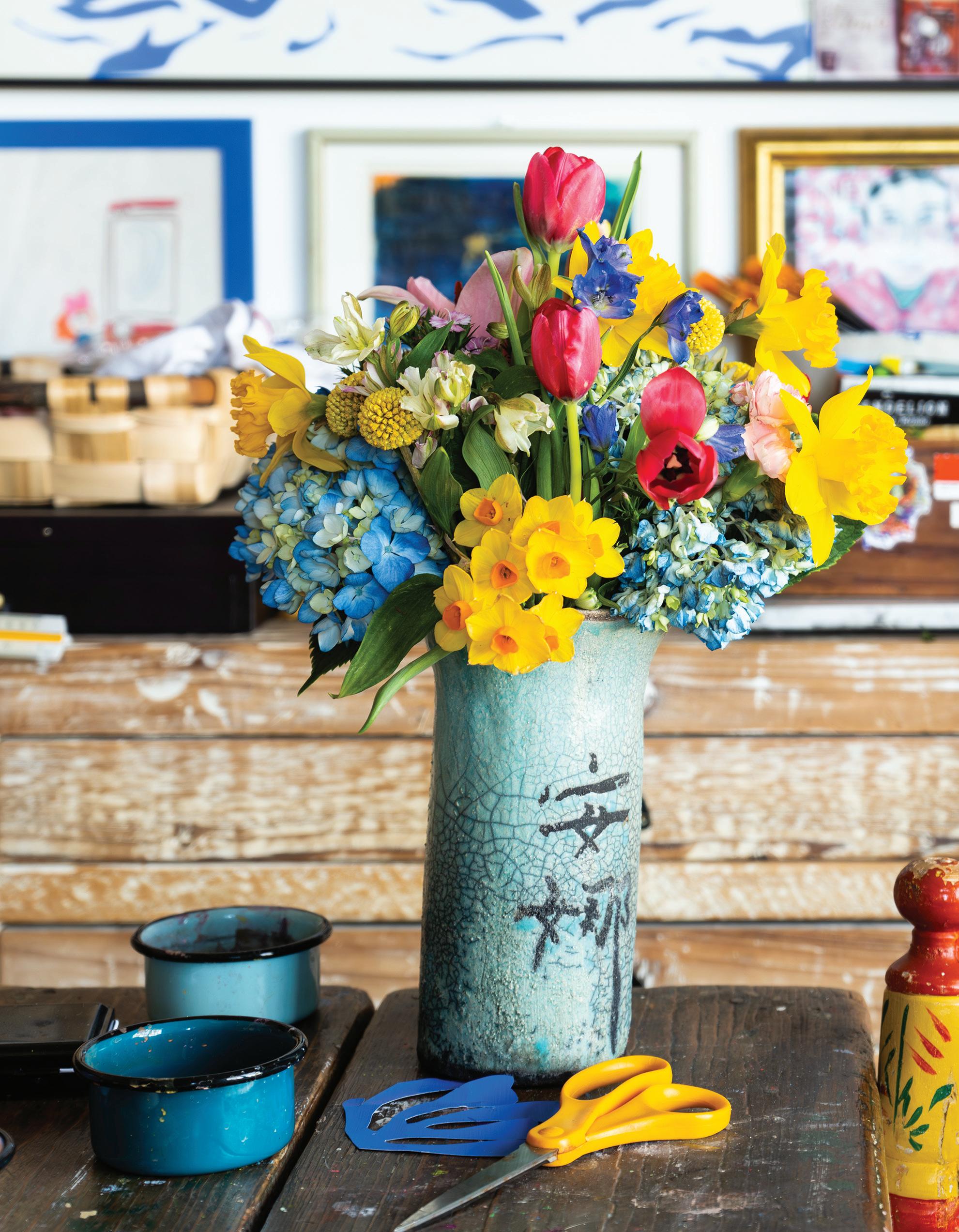
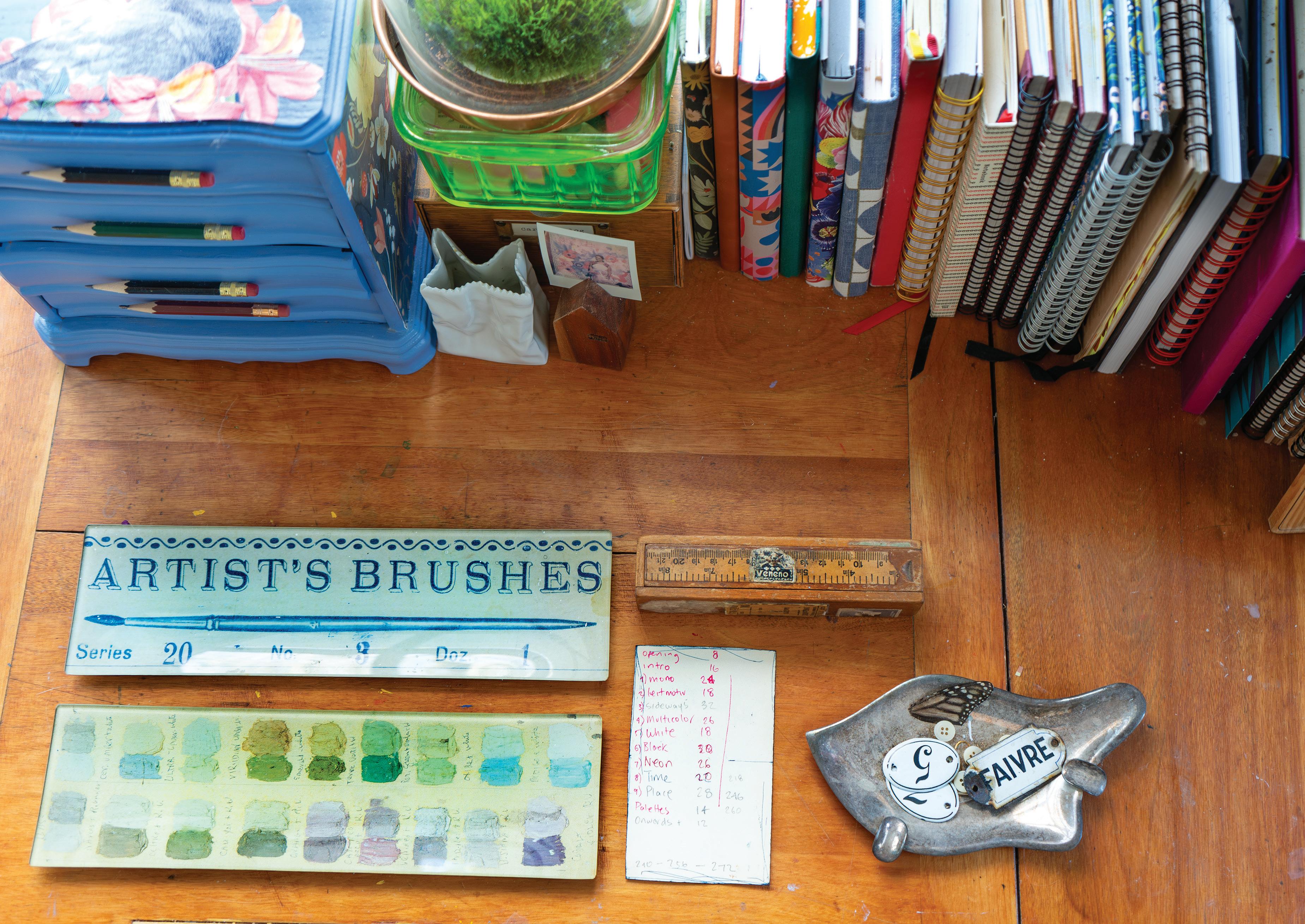
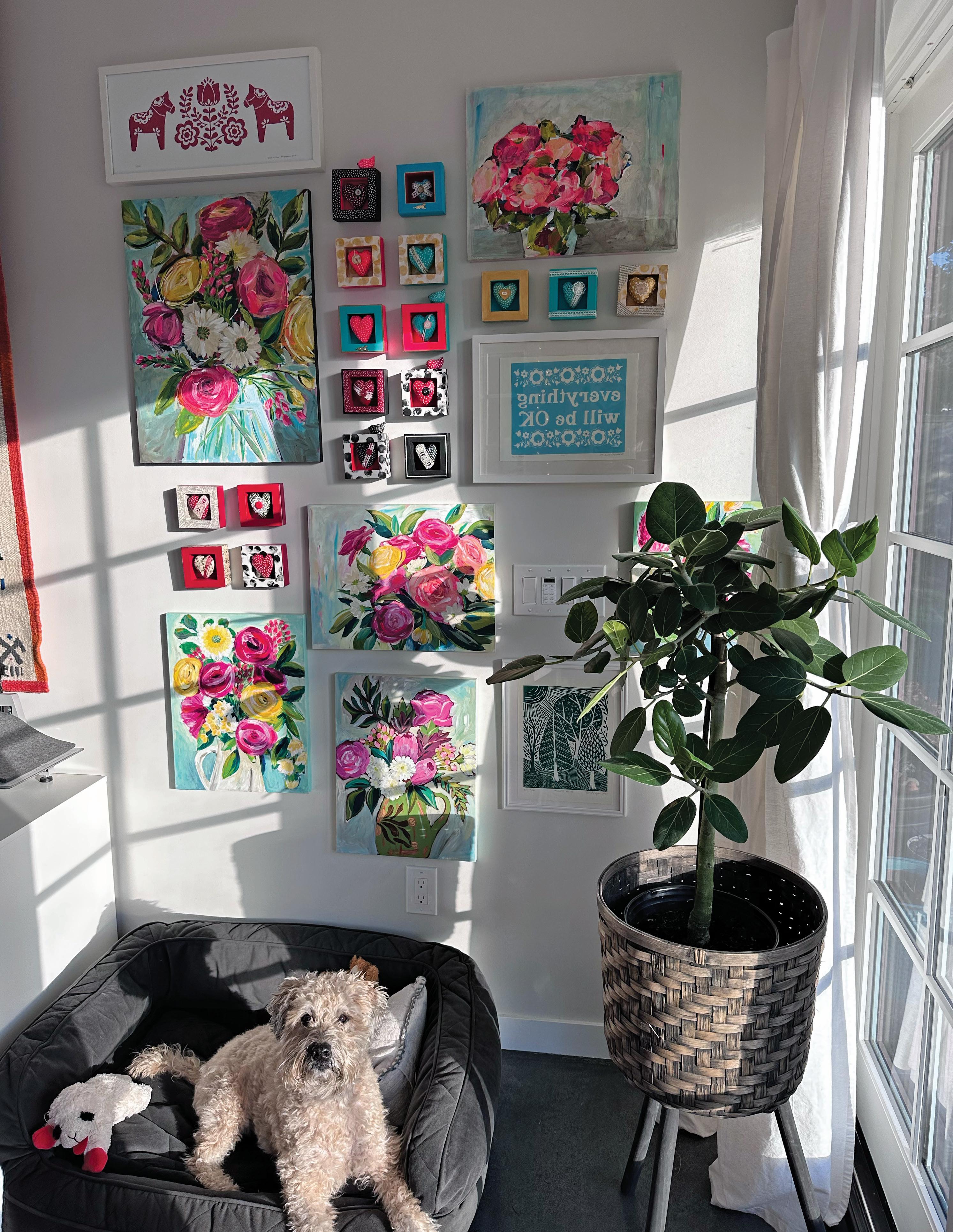
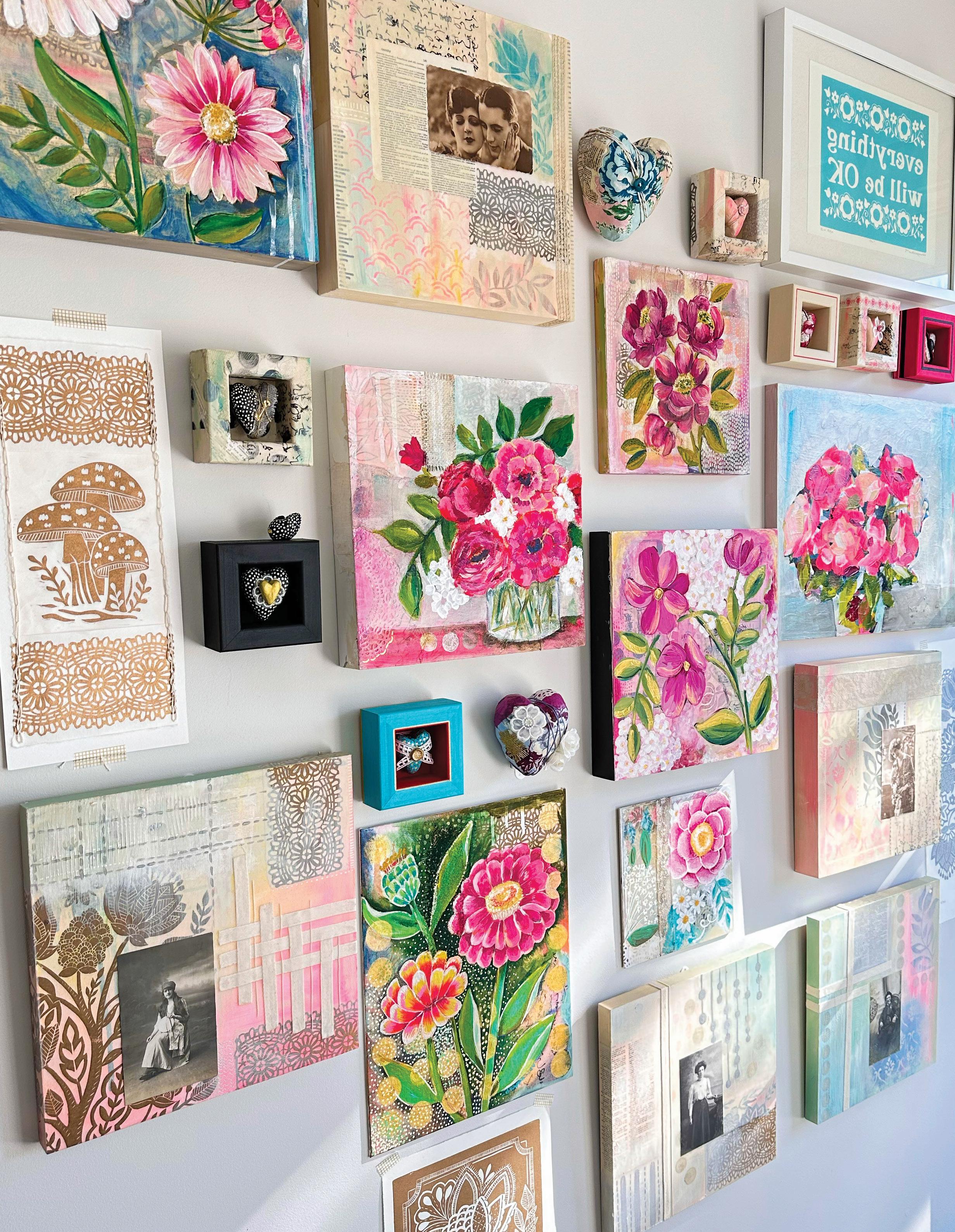
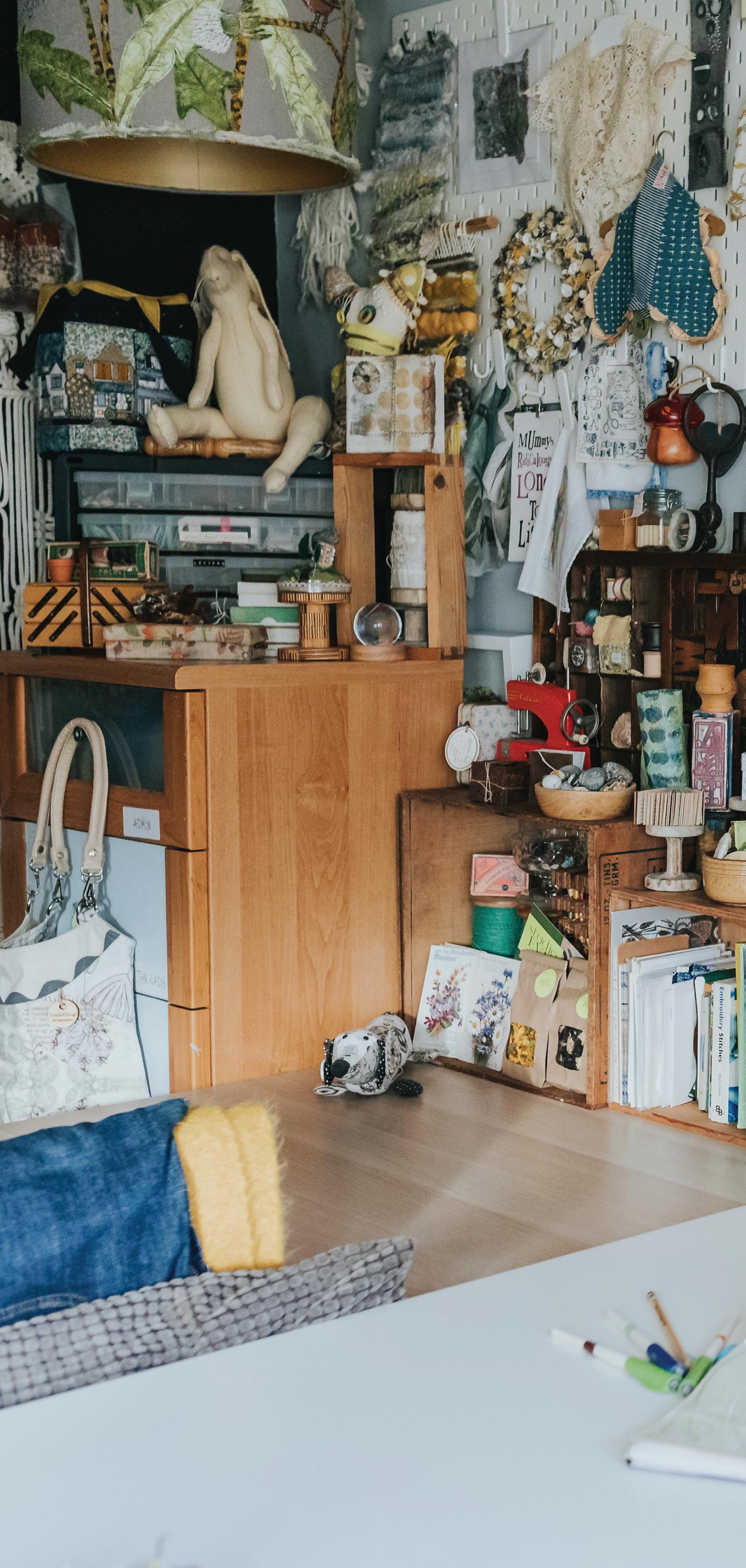
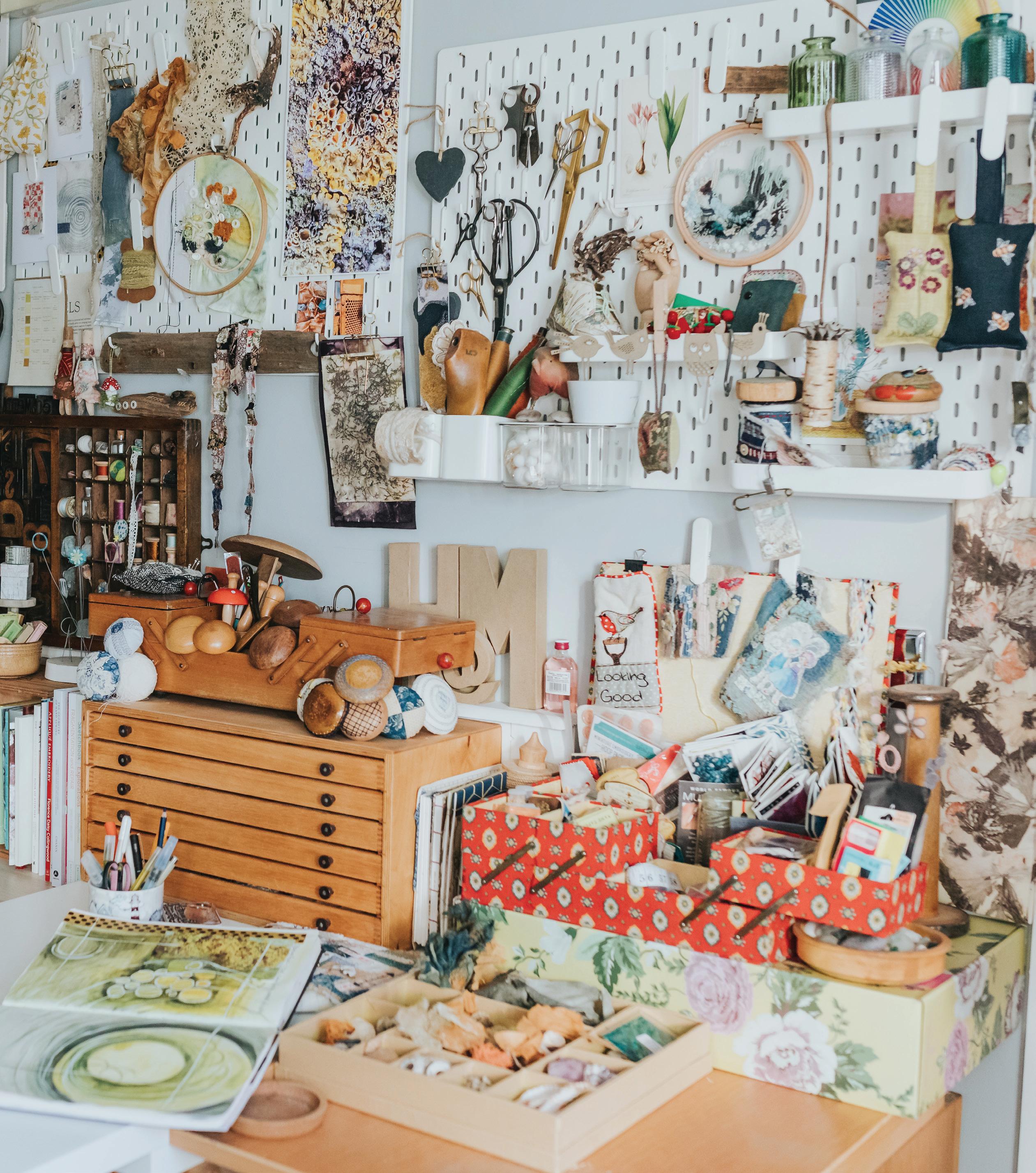
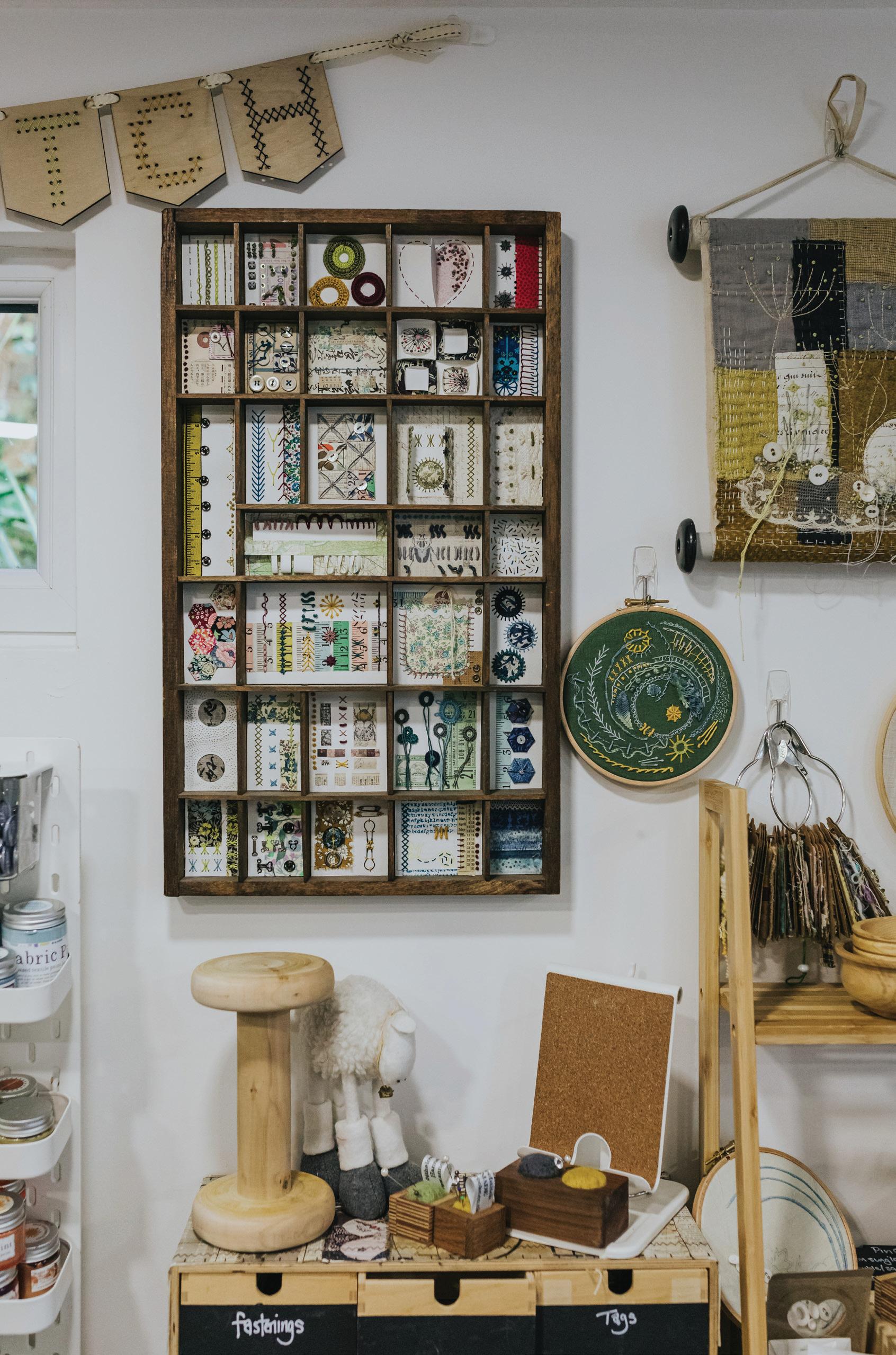
Color, since then has always been a key element in my work, and as much as my Zen side would love a minimalist white studio like the one I had in Mexico, where I grew up, I now have a studio exploding with colors. Like the little good and evil on the shoulder, in this studio, it was the baroque side of my creativity that won: lots of colors, lots of trinkets, lots of art covering the walls, and even a colorful rug, and tons of drawers with everything needed to make the whole range of colorful art. Recently, I came across the term “clustering” for the trend of grouping stuff for décor. Well, it turns out I have been “clustering” my whole life! In my studio, I have clusters of art materials, clusters of textiles from around the world, and little toys and figurines. I put these things together by theme—erasers, pencils, glass bottles—or by colors, because I like to see their colors together or to use them as inspiration for whatever project I am working on. Even my upcoming book Color Curious (to be published this Fall by Chronicle Books) is full of clusters! While it is a book about color and all my thoughts around the subject, it is illustrated by photographs I took of color clusters—either the ones I gathered of whatever was blooming, fruiting, or growing in my yard (my other color studio) or the treasures, trinkets, tchotchkes or textiles I found in my drawers.
However, don’t picture my studio as a total flea market full of all kinds of things. There is always an ebb and flow of order and mess. The busier I am, the more congested my tables get until I take a day off to bring everything back to its place. My mother would half-joke that I am like an ivy: you first put it in a little cute pot and before you know it, it climbs all over the walls. She used to say that when I was in design school (my undergrad is in graphic design) and finals were approaching, I had so many projects going on that my art materials would start spilling out of my room and down the stairs before she'd make me retreat. Nowadays, I must say, I still
spill over out of my studio: the kitchen island is great for cutting fabric, the dining table for spreading out books or images when I research or edit, and I know how the natural light works best all around my home for photography. But my favorite way to spill out of the studio is with art. I always dreamed of a house where I could design everything, I am not there yet, but all over my house, you can see my ceramics, sculpture, printmaking, painting (mine and my daughter’s), and textiles, along with more subdued clusters.
ONE WAY TO DESCRIBE MY STUDIO IS BY SHARING FURNITURE STATISTICS. IN MY STUDIO, I HAVE:
5
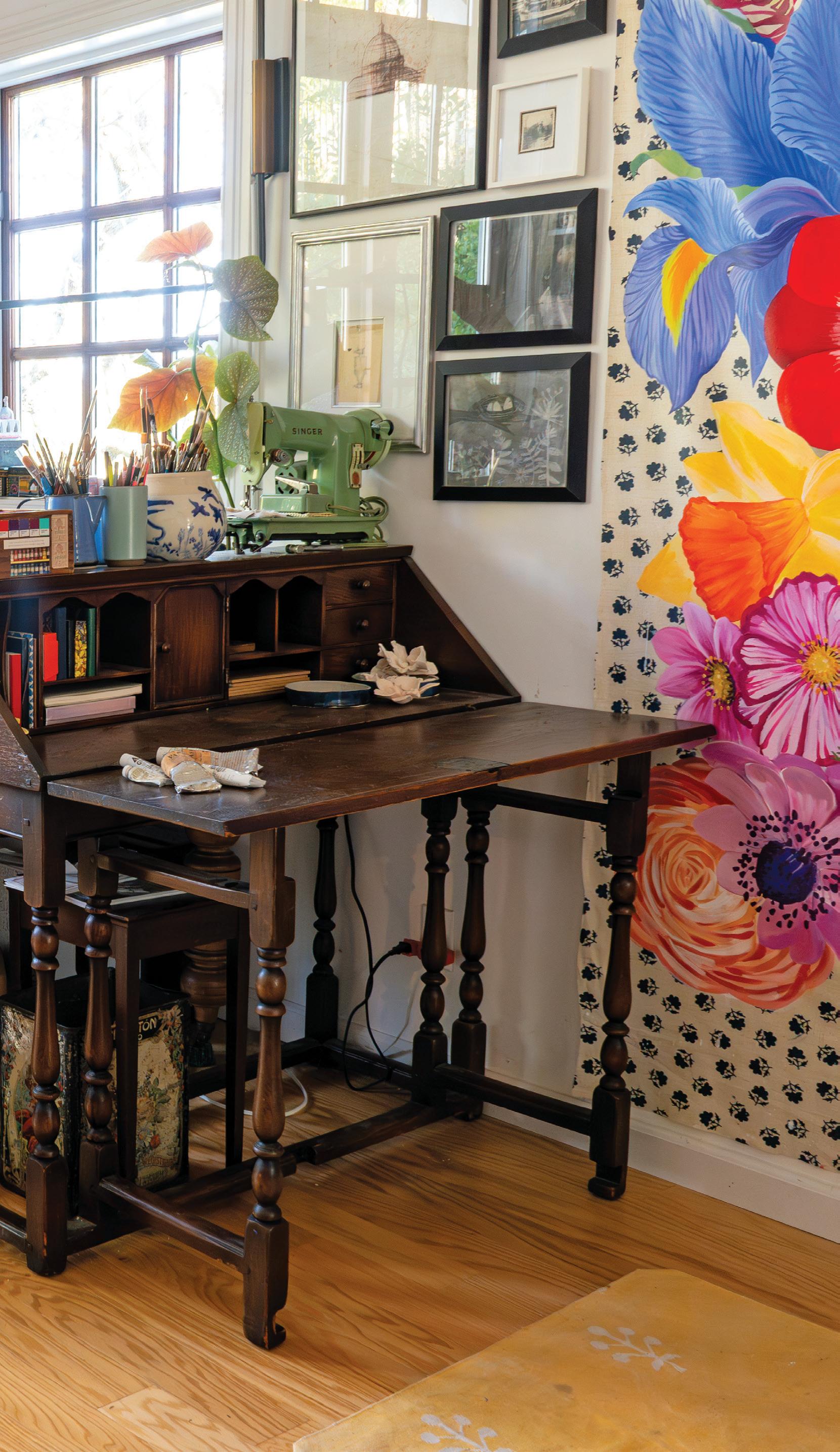
VINTAGE DESKS: a green school desk from Mexico, a petit oak draftsman desk from New York, a secretaire-style desk from my local Buy Nothing group in Walnut Creek, CA, and two XIX.c tables, one English bought in New York and one from Mexico. They are a testament to the places I have lived and each serves a function. The two tables are the main workspaces, one for my laptop, writing, sewing, and “clean” work with a view of the surrounding hills, and the other for the “dirty” work: paint, printmaking, carving, things with glue and even clay, with a view of the huge 300-year-old oak outside.
2
EAMES OFFICE CHAIRS, 3 PAINTED MEXICAN CHAIRS and 1 ARMCHAIR: each beautiful on its own but with the added beauty of Mexican textiles I collect.
8
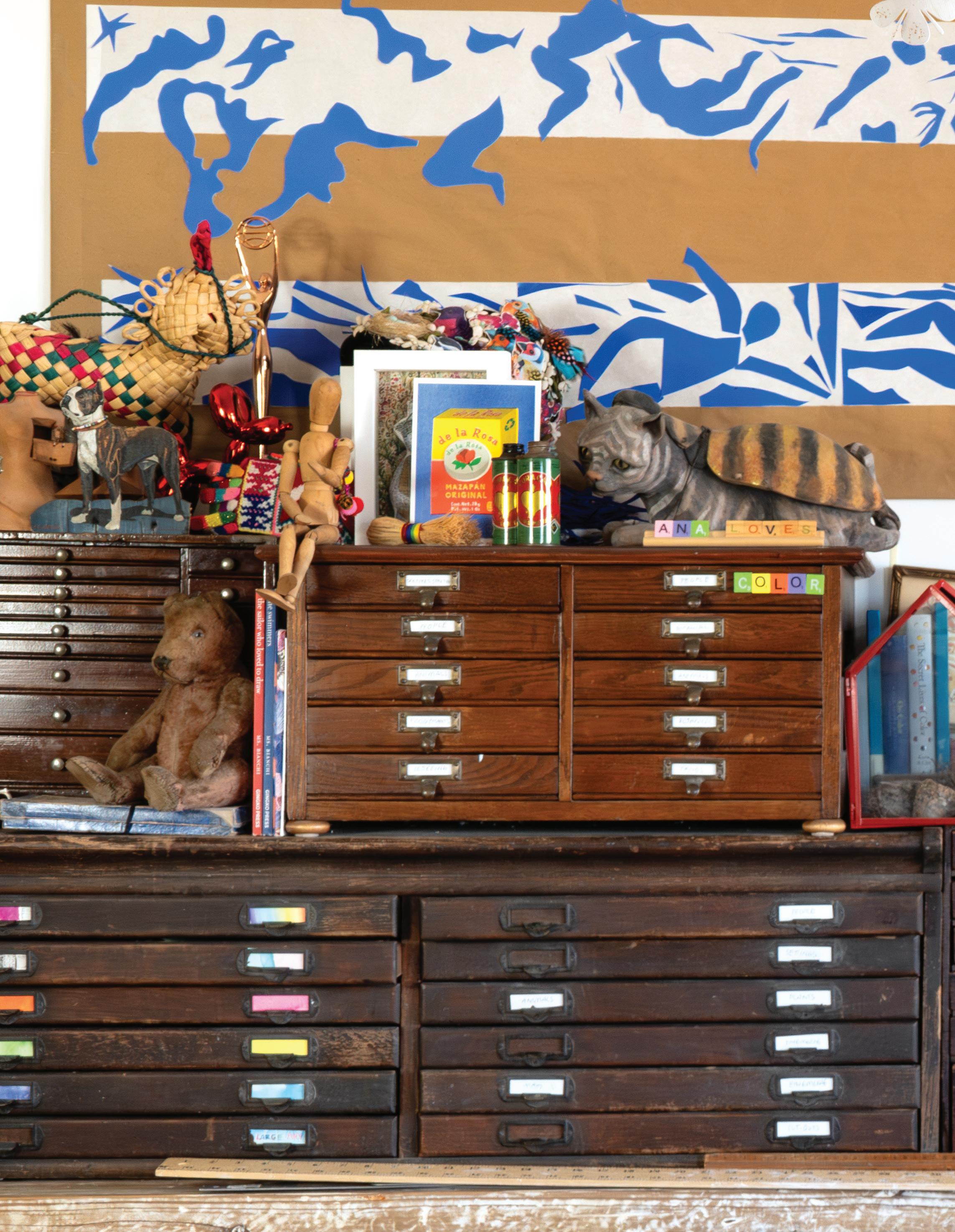
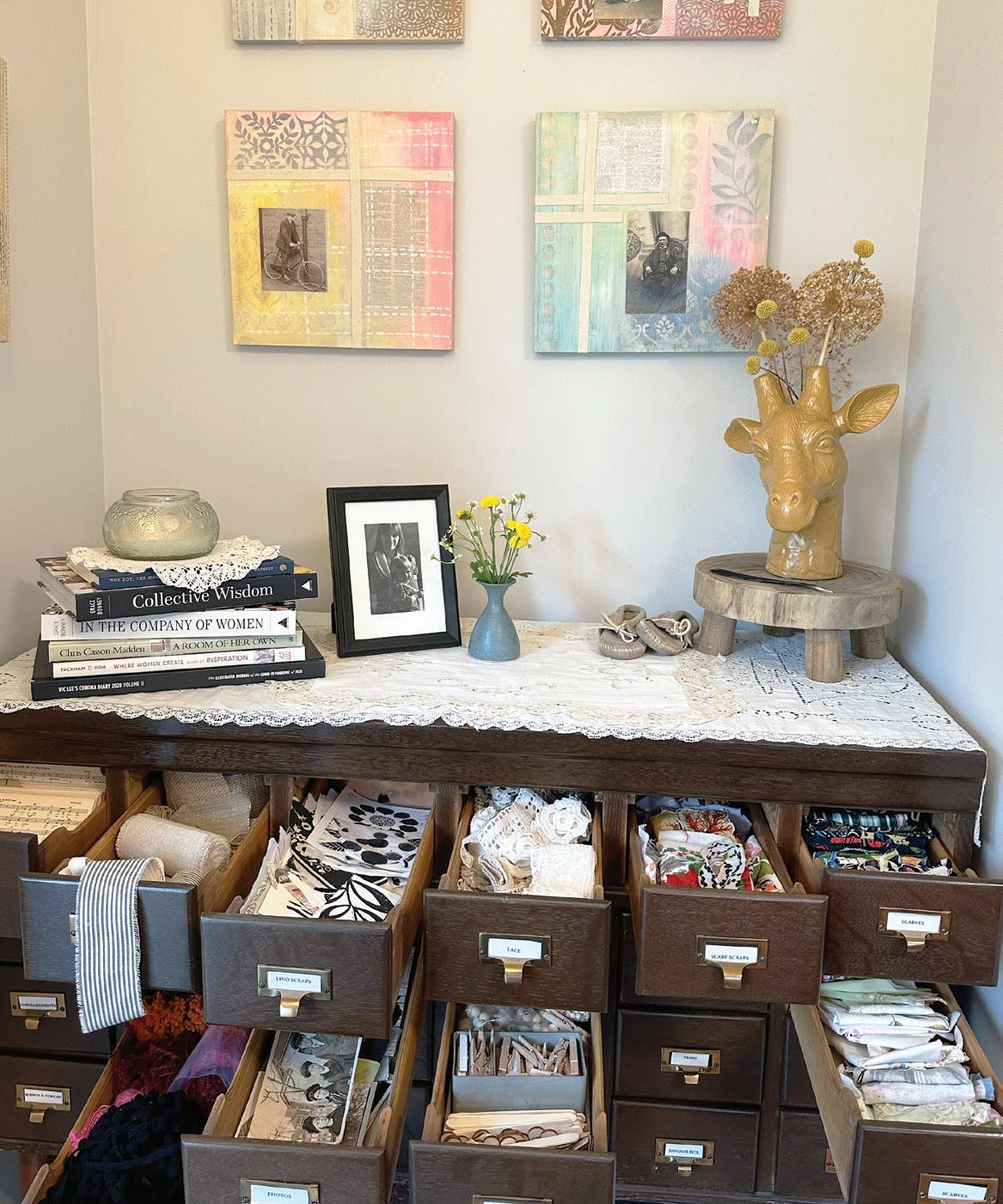
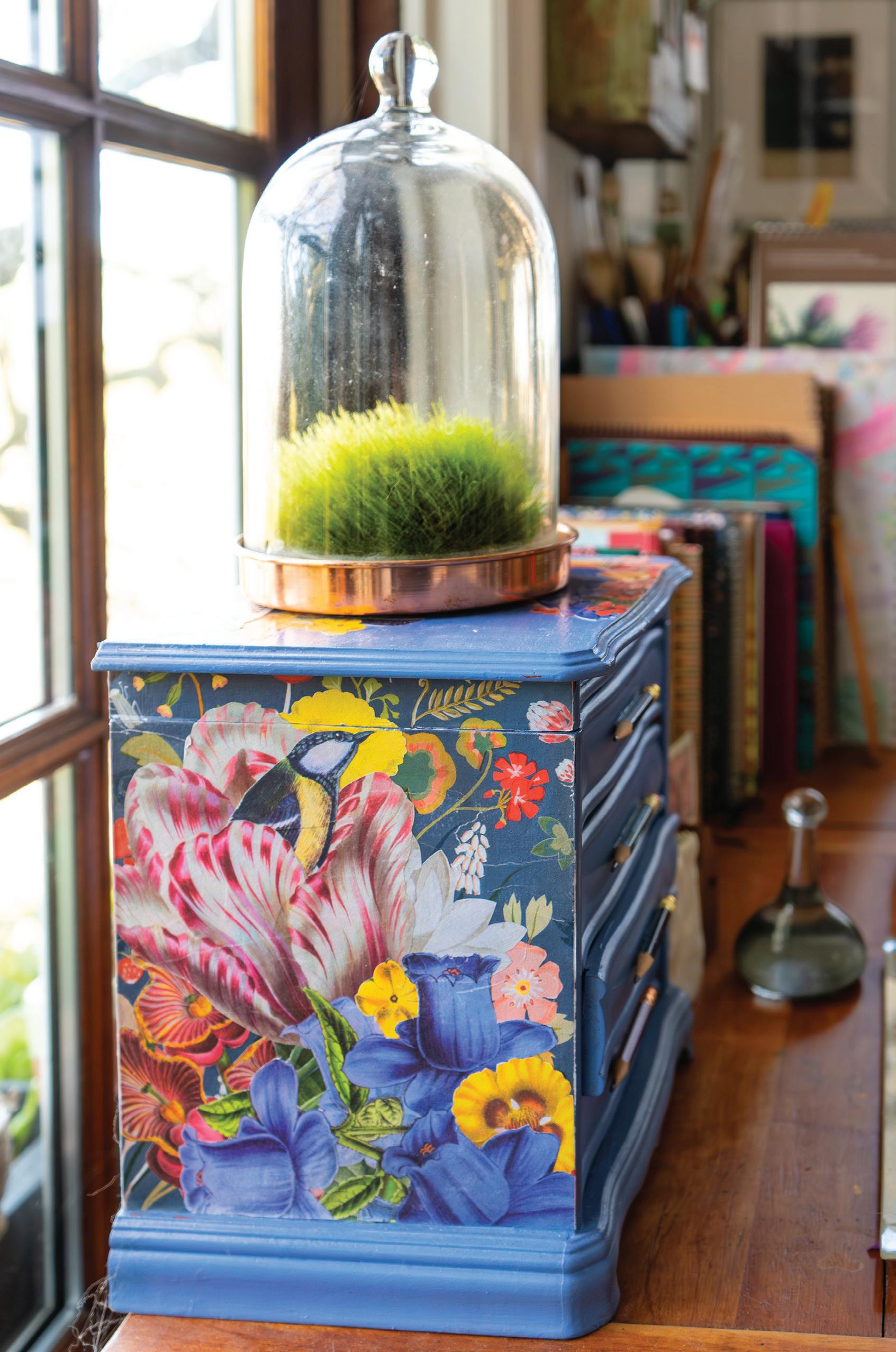
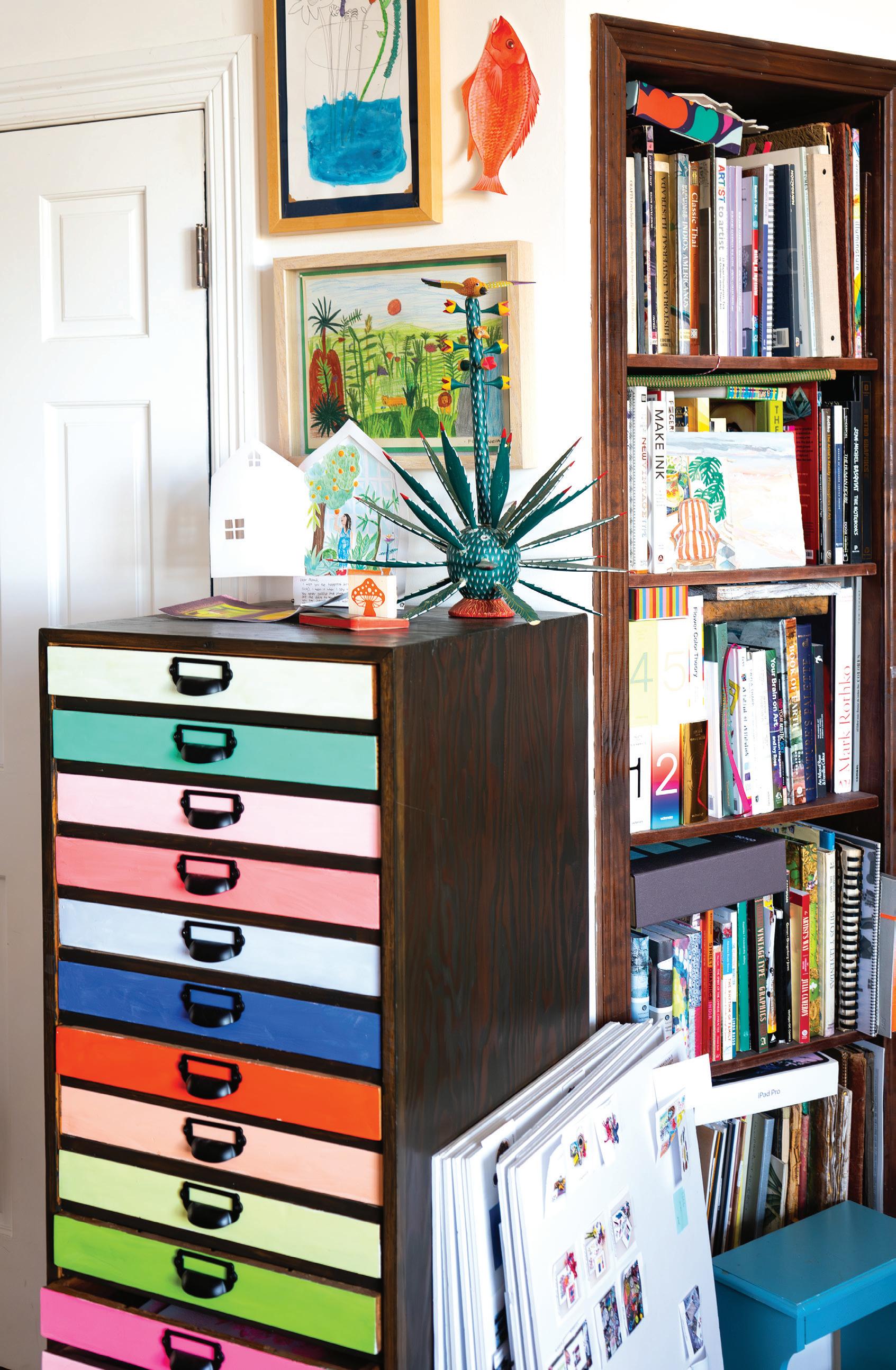
CHEST OF DRAWERS of different sizes: The oldest is a 17th-century Japanese little chest my husband gifted me when we were dating (it holds my painting brushes and origami paper). The newest being an upcycled wood chest that holds most of my art materials and paper inside, plus 4 smaller chests of drawers on top. The most colorful is a flat file cabinet for my drawings, which I also got from a Buy Nothing neighbor and painted in different favorite colors
2BOOKSHELVES: one with illustration and design books and one with gardening and plant books. To this I would add one major spillover, my bookshelves of art books, my biggest source of inspiration, did not fit in here, thus they are in the main open space in the house.
50
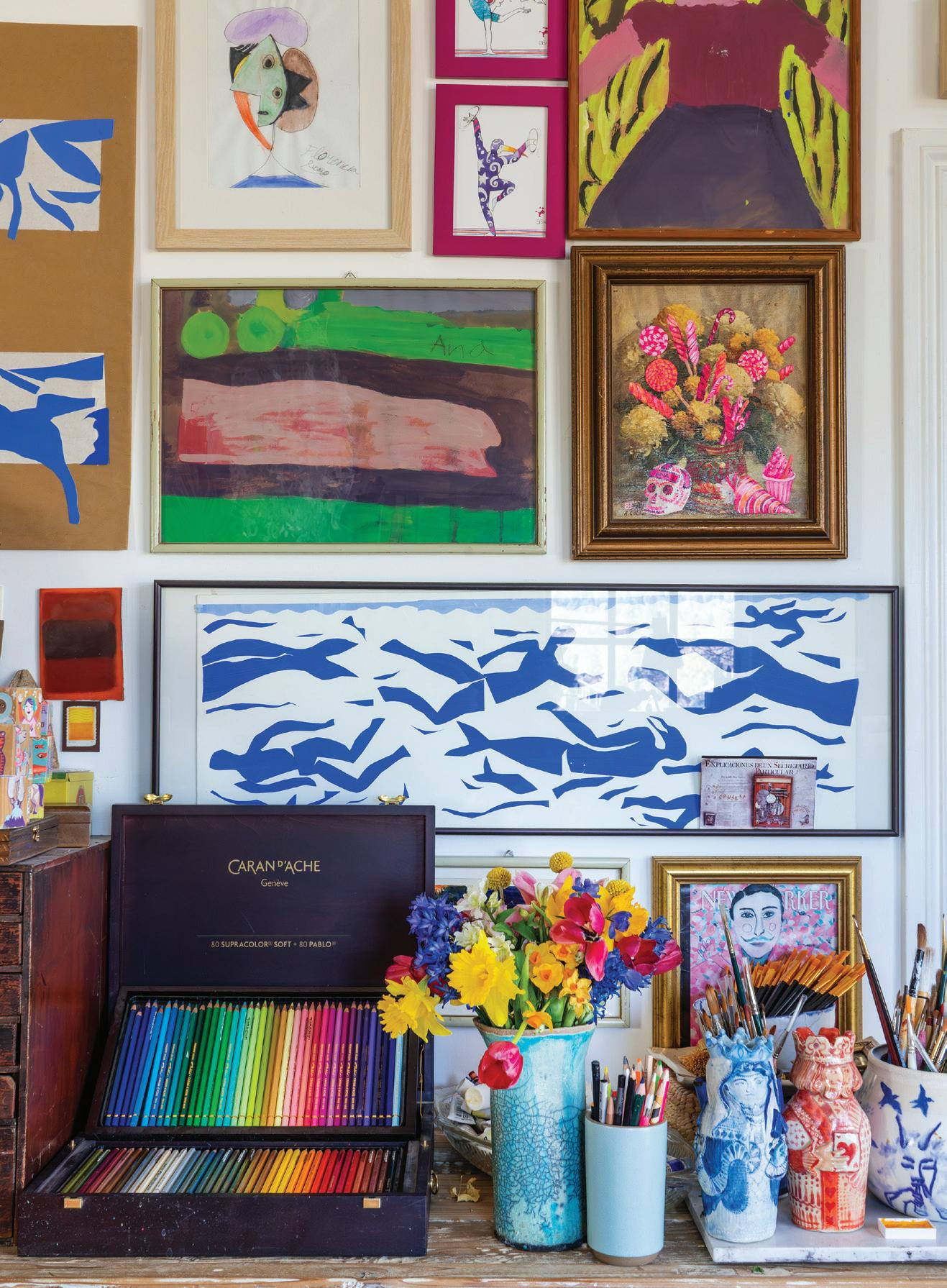
PIECES OF FRAMED
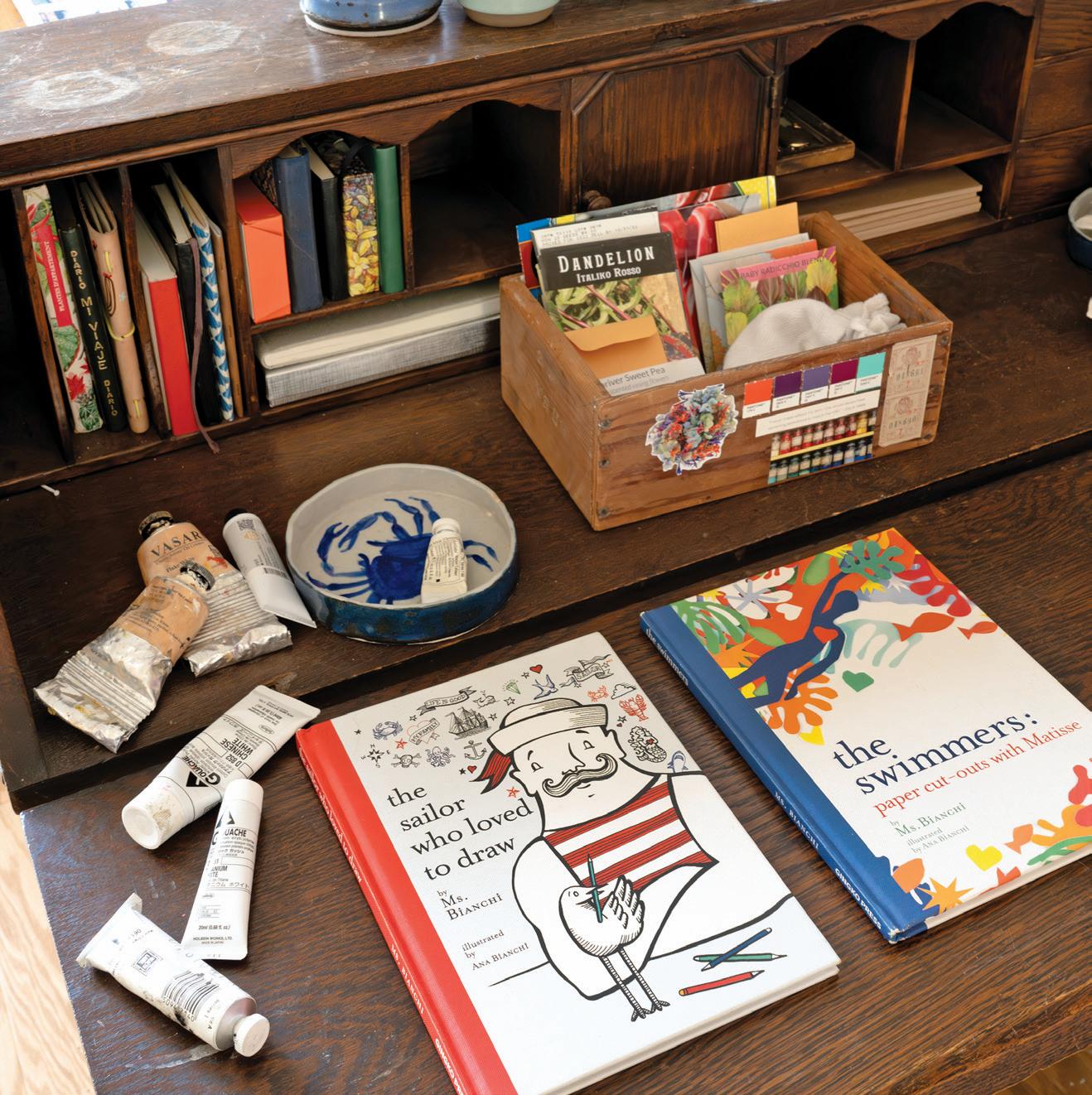
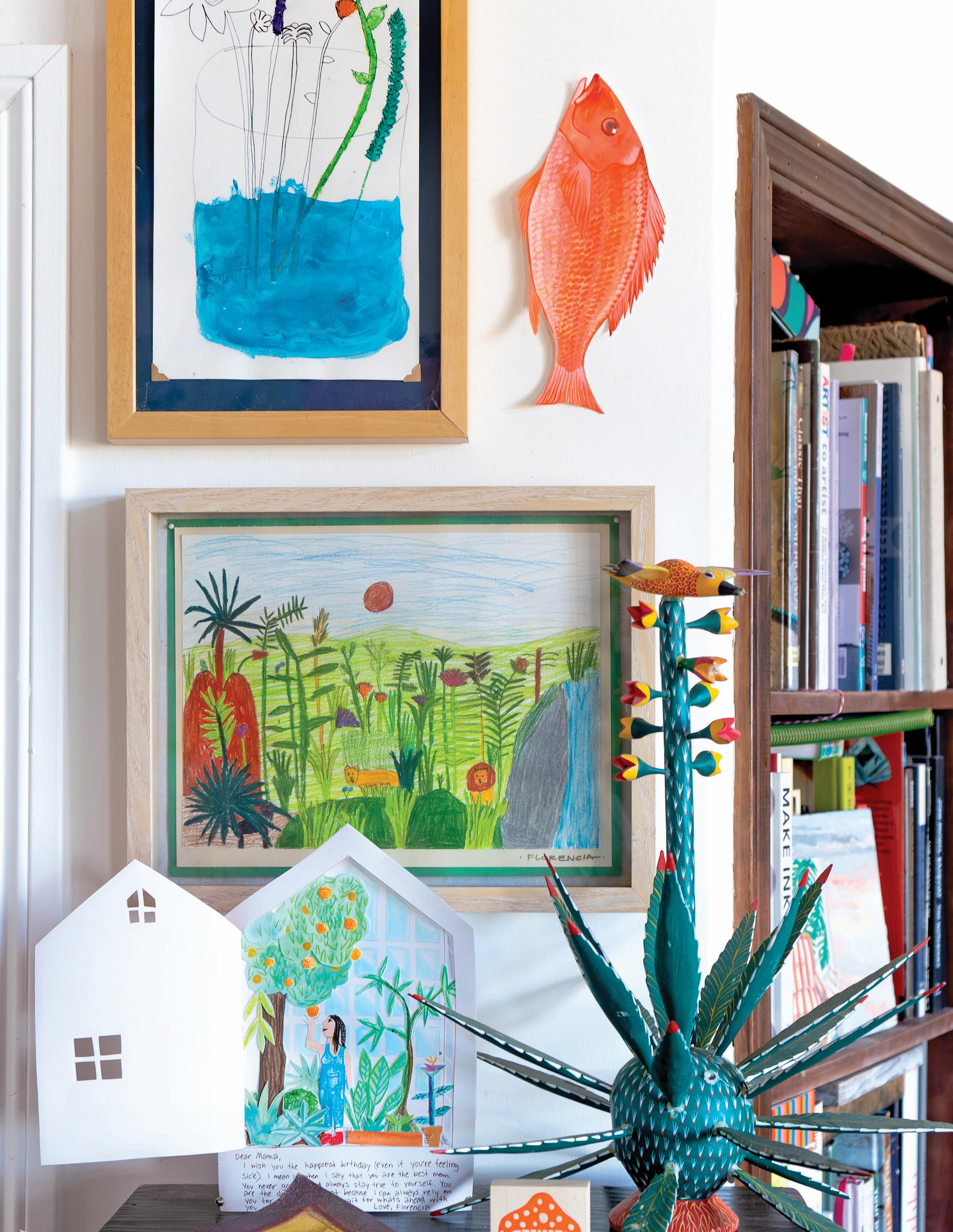
ART that includes art I made as a kid, art made by my daughter, art I made for my childrenswear line PaperGirl Collection, art I made for my books—The Sailor who Loved to Draw, The Swimmers: Paper Cutouts with Matisse and the new Color Curious—a few pieces from other artists, and very special drawings made by my greatgrandfather and my greatgreat-granduncle, an ode to the ancestors that passed on the creative gene to me.
1LARGE MURAL, inspired by my colorful flora photo clusters I painted on fabric, and that we use as a photo backdrop when we throw a dinner party.
“Are you a designer or an illustrator or a painter or a ceramicist?” That is a question some people ask me when they see the variety of work I do. I am all of this, since I feel creativity should not be siloed. I am also a color lover since it is color that connects it all. My studio reflects this, but how did I end up in this studio doing all these things?
Growing up in Mexico, I was always surrounded by art, color, and craft. After my early childhood making art, I knew very soon that art was what I wanted to do in life. While I could not go to art school (the one I envisioned with easels, oil paint, brushes, and naked models) because my parents wouldn’t let me, I did go to graphic design school, the closest thing to art that I could find that was parent approved.
I did 5 years of just graphic design with a major in illustration and another in textiles and went on to work as a full-time illustrator at a major newspaper. This job, full of late nights, allowed me to save enough to fulfill my dream: finally going to a real art school (with the paint and models) and doing so in Florence, Italy. I spent 2 years in Italy and eventually came back to Mexico to carry a double life: designer/ illustrator by day, artist/painter/ceramicist by night. There weren’t enough hours in the day to make art! I lived in a neighborhood full of artists and in the local cafe I met a creative director who offered me the job that would eventually land me in New York City, my home for 18 years, the base to expand my creative universe, to travel to faraway places, and most importantly, where I met my husband and had my daughter. (Oh! and got my dog Pepa the Pug.)
But as creative as I was there, I did not have a studio. My studio was the little draftsman desk I still have; it is only 24-by-36-inches, but it served me well all those years thanks to an artist friend who reminded me that Paul Klee made all his body of work on a similar small desk. When life brought us to the Bay Area, to a spacious home unlike our New York apartment, I finally had a dedicated space for art making: my first studio in decades!
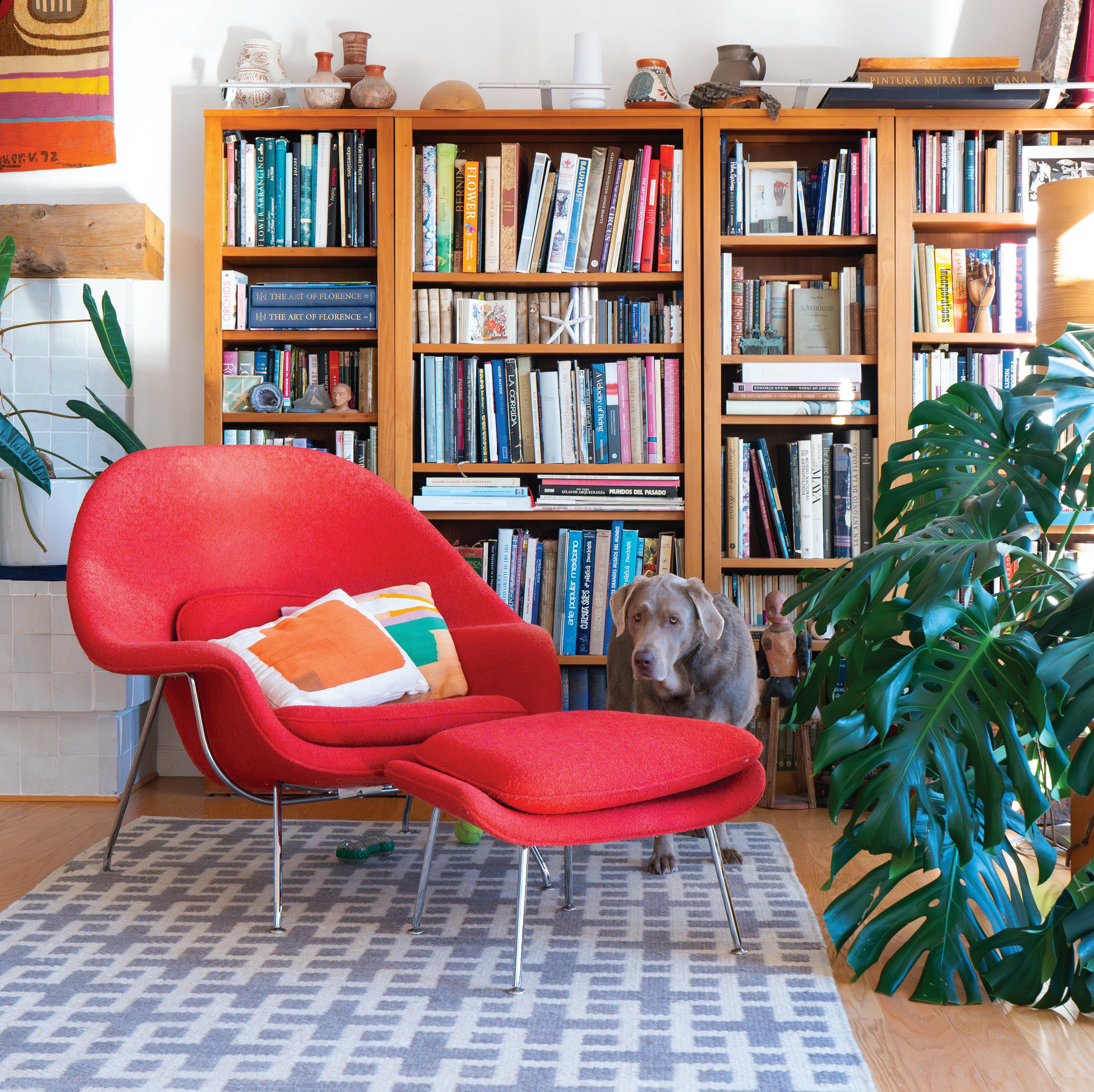
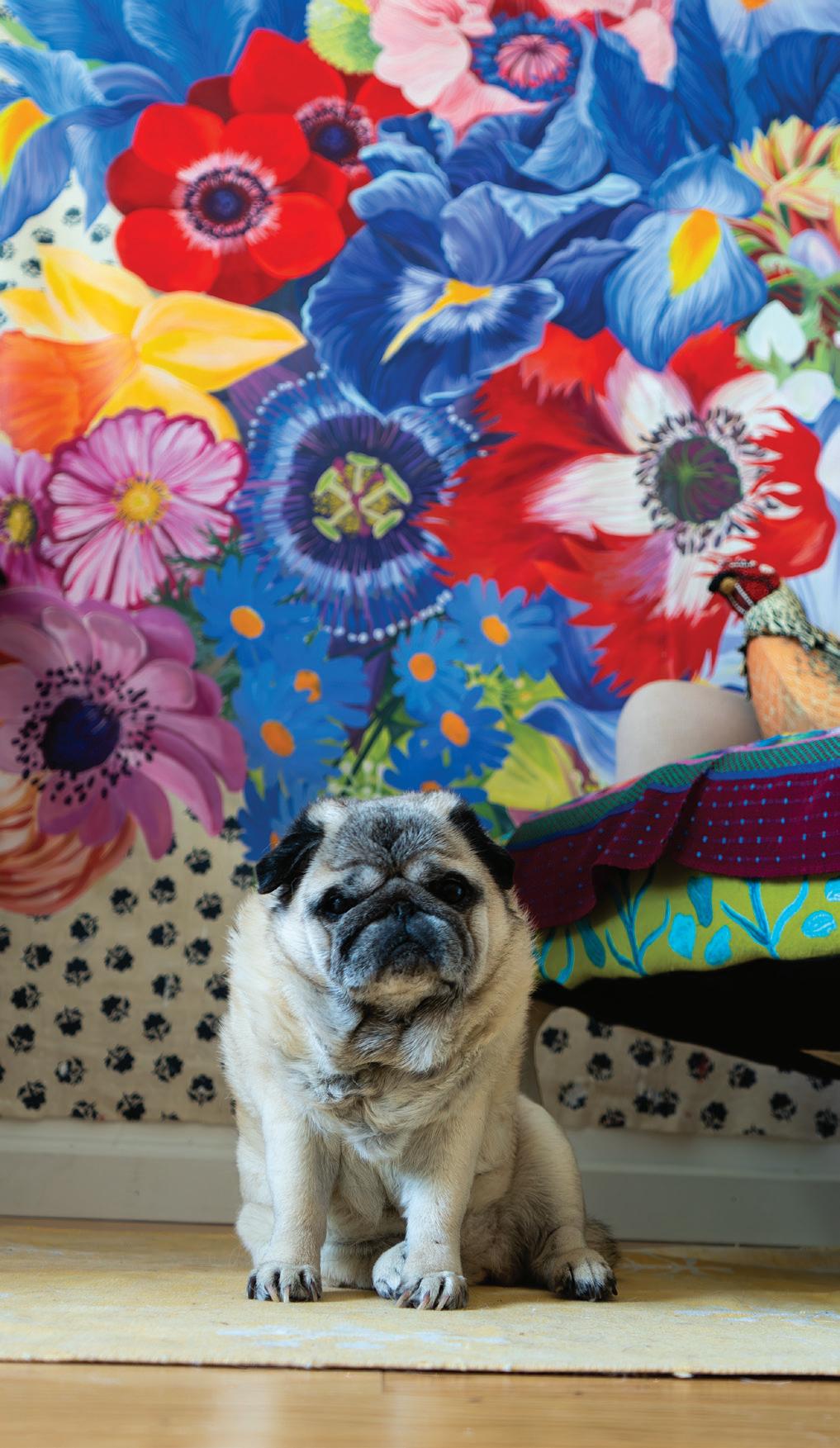
Nowadays I spend up to 12 hours here, every day, with Pepa snoring in her bed and, occasionally, Bonnie, my silver Lab sleeping on the armchair. If the French doors connecting it to the house are closed, nobody can come in—I am concentrating. If I am in the middle of an expansive project and there is stuff everywhere, nobody is allowed to come in or have an opinion about the mess—my happy, colorful mess. If my daughter wants to make something,
she is always welcome to the space and my art materials, the drawers and the closet being my personal Fort Knox of supplies.
As I sit here writing this down, I feel so grateful and fortunate to have a space— physically and mentally—to do what I love. As my old maestro in art school would say: “Art is a very demanding mistress, it will wake you up in the middle of the night and ask you to do something.” Now, finally, I have a space for the creative rendezvous with art, whether the middle of the night or anytime during the day. A space where I can make anything I can imagine.
SAMANTHA THOMAS
CURATED
BY NICOLE HADDAD
PHOTOGRAPHY BY CHAD UNGER AND NICOLE HADDAD
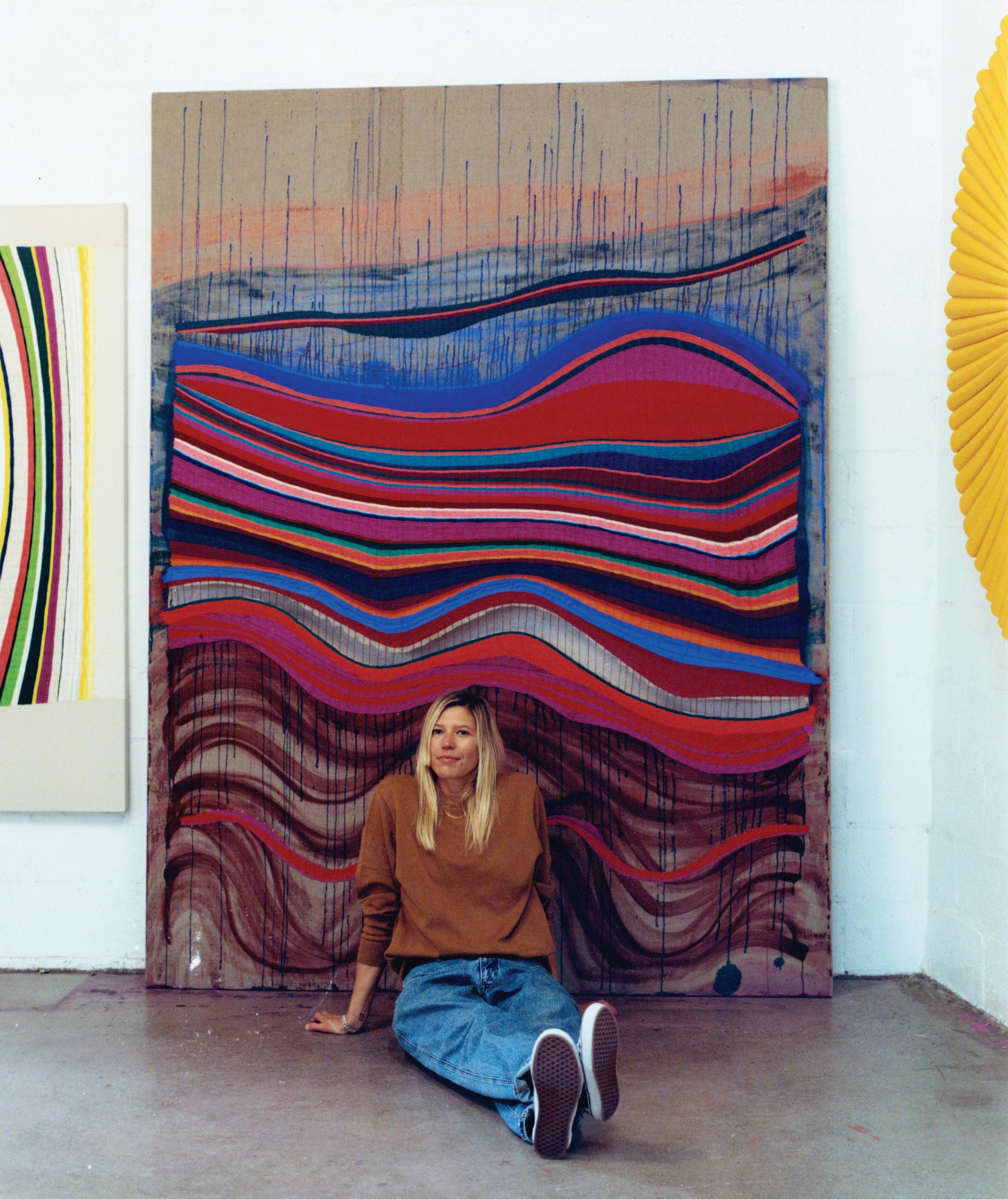
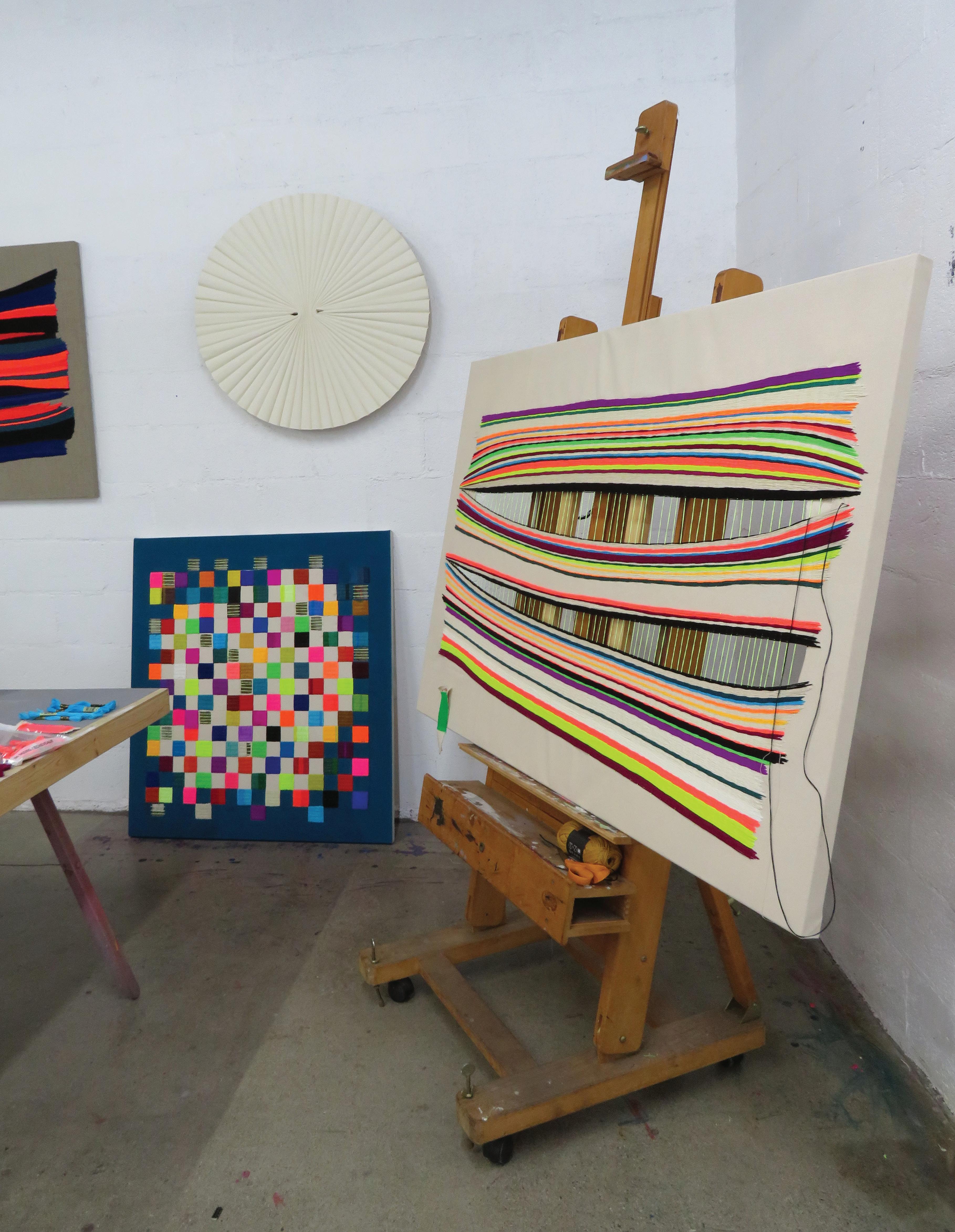
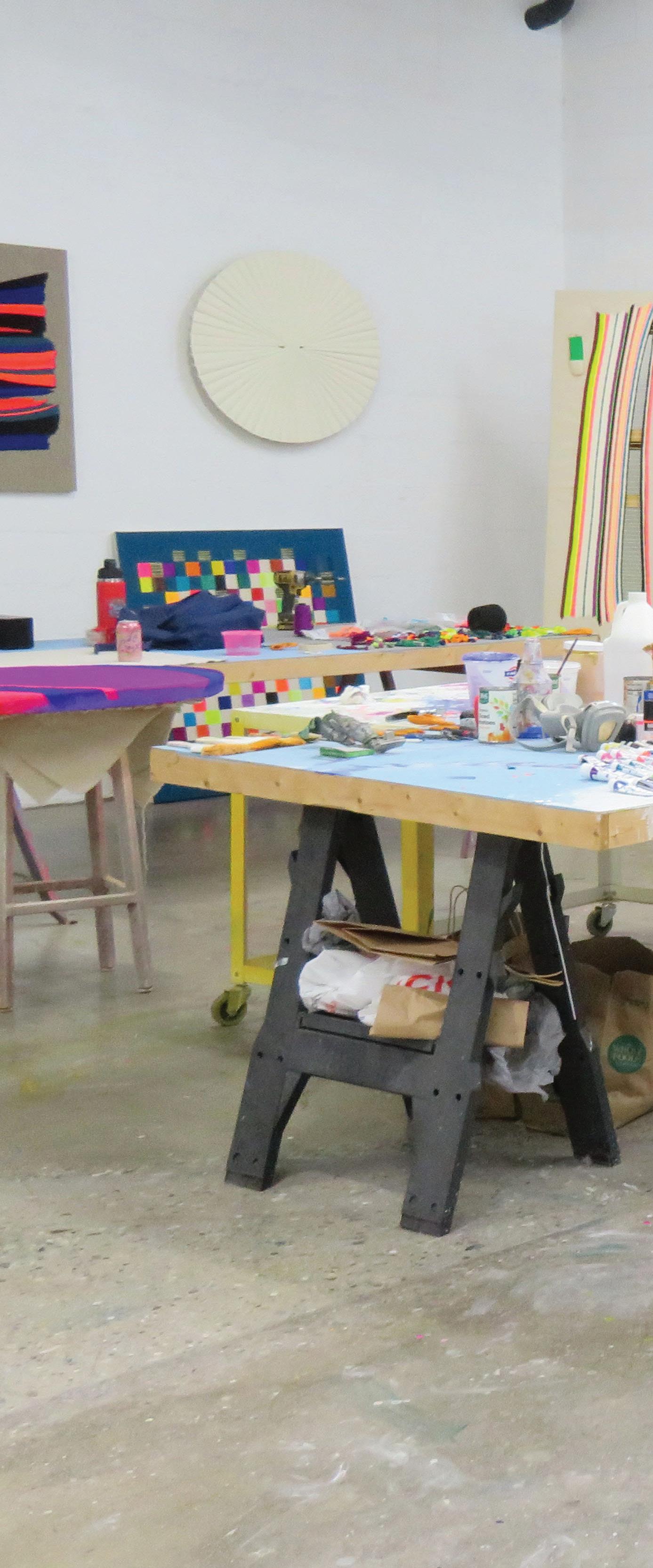
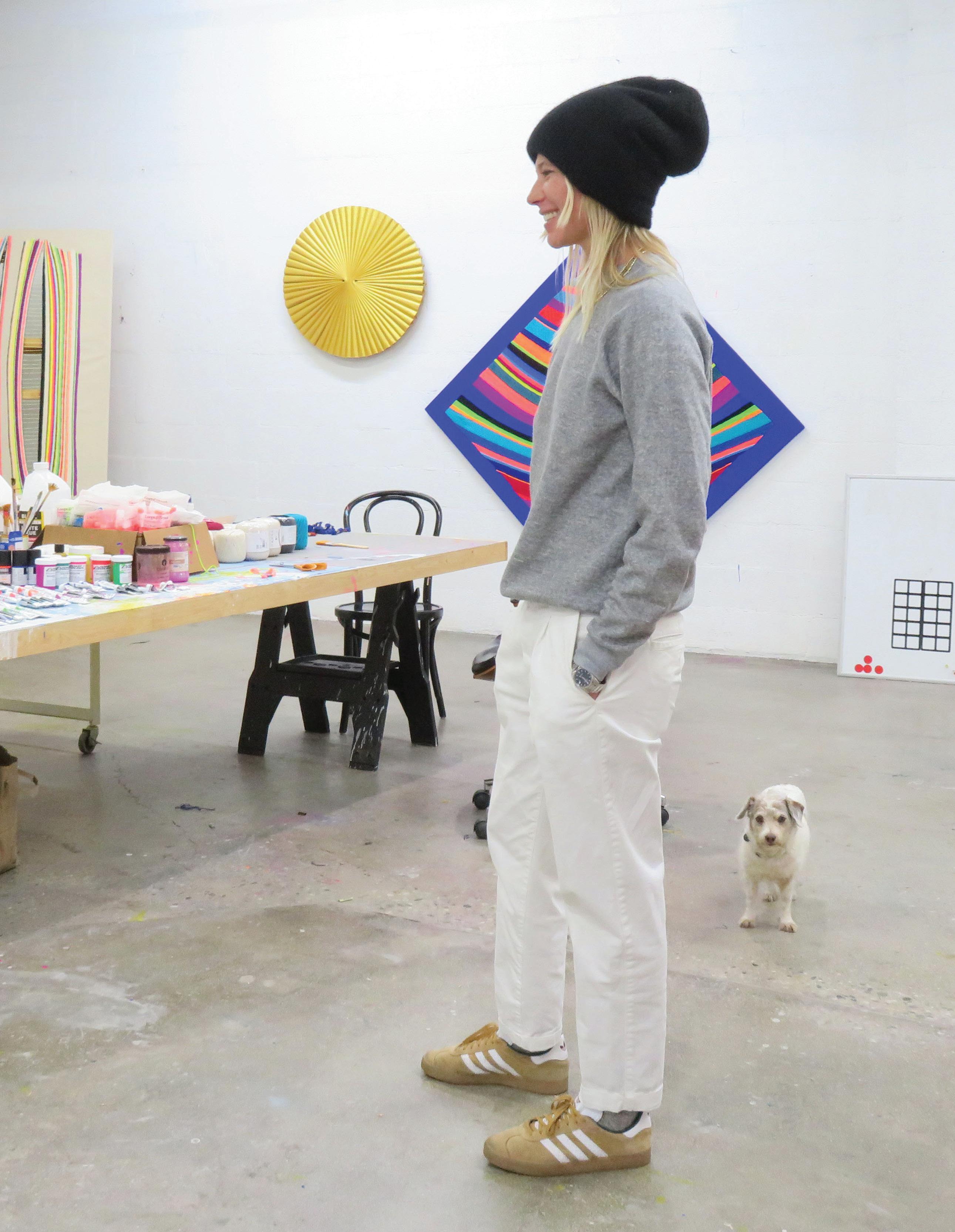
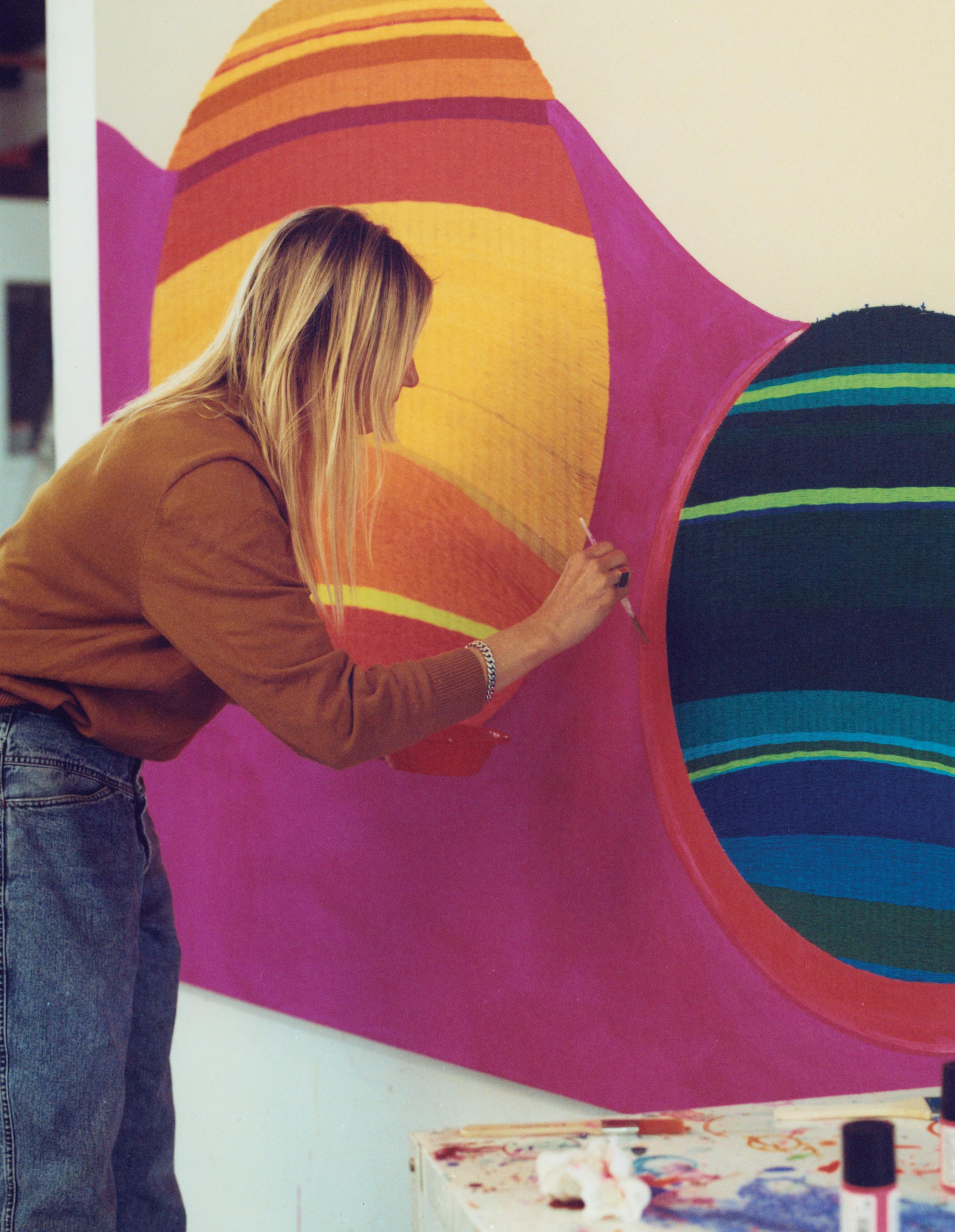
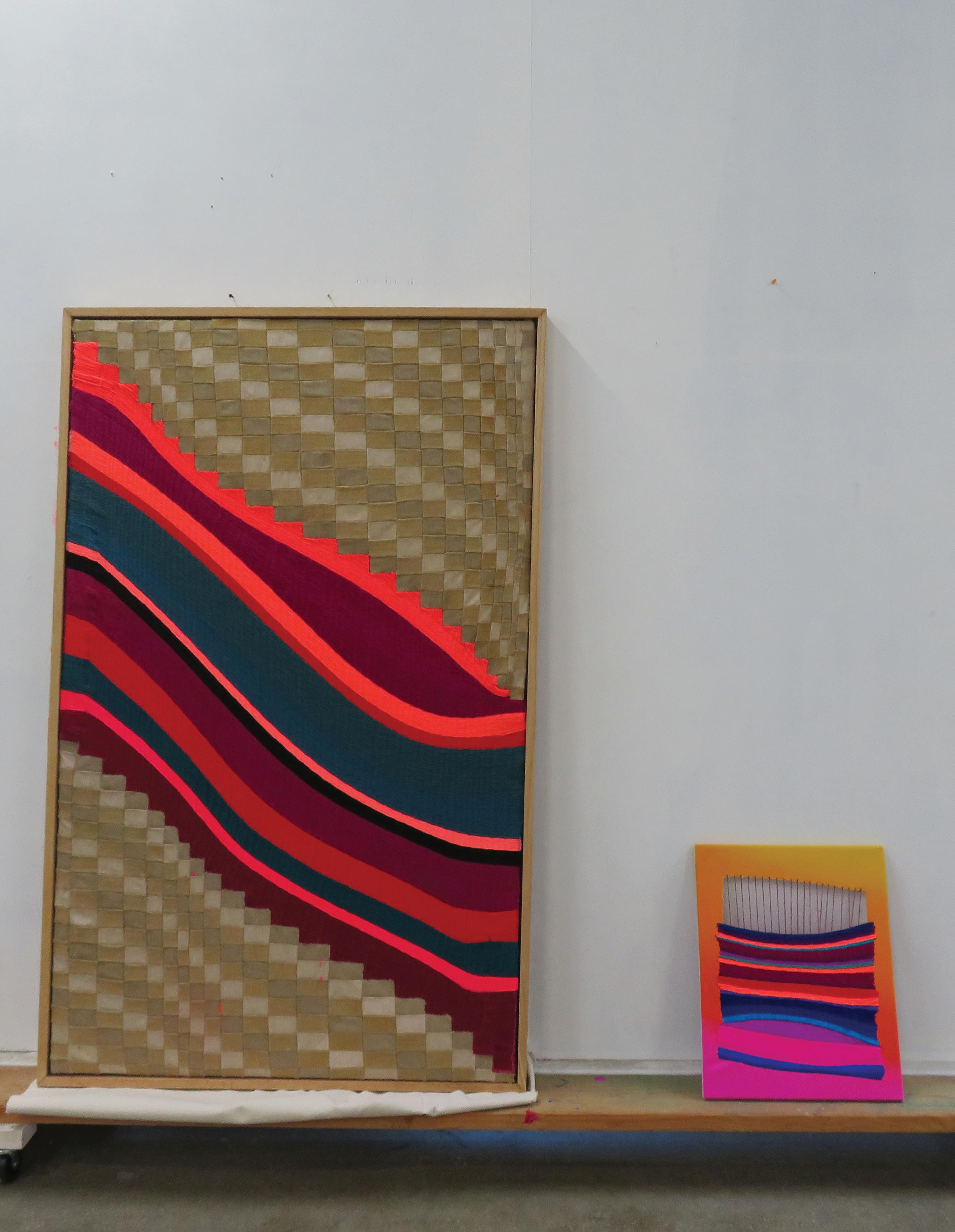
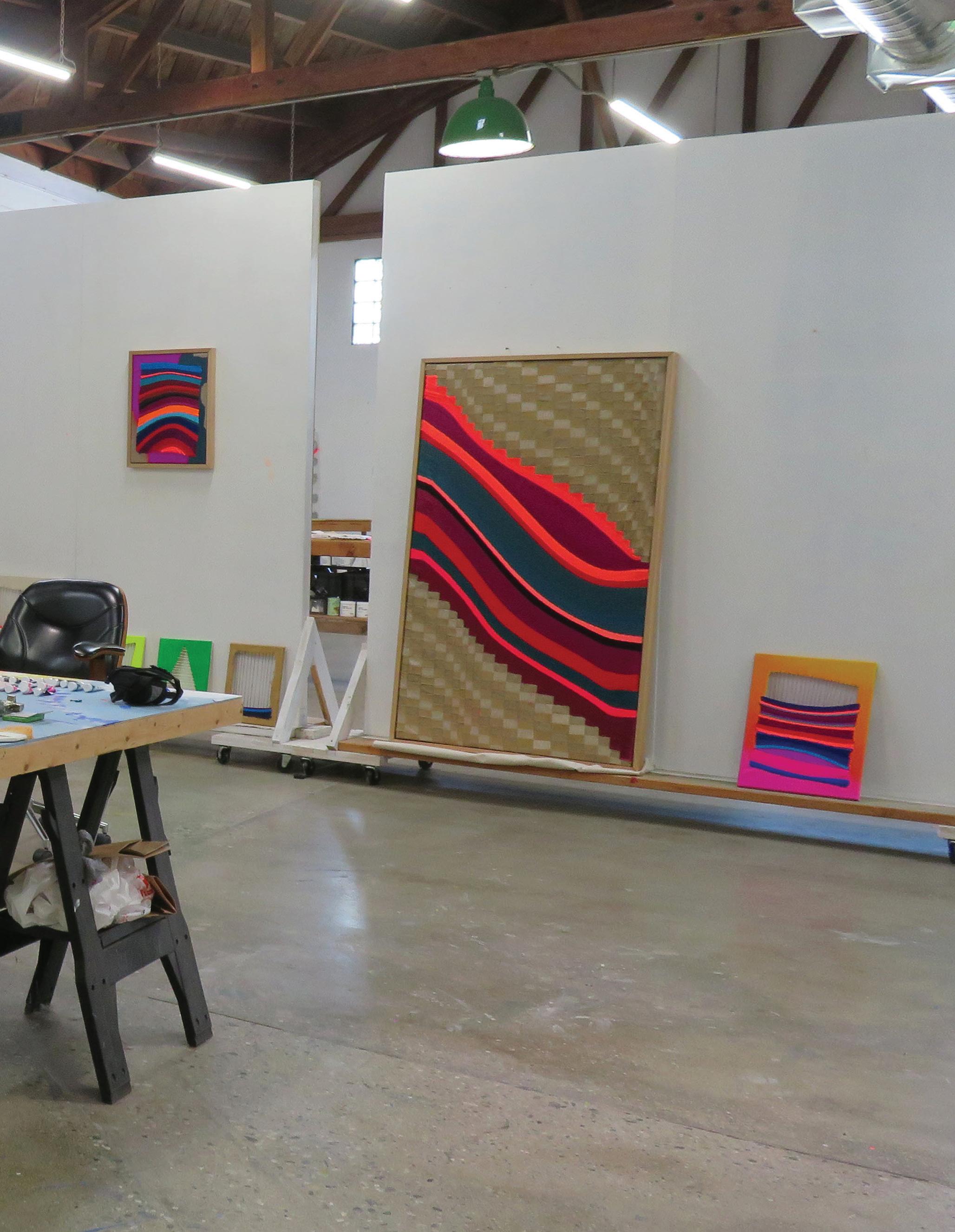
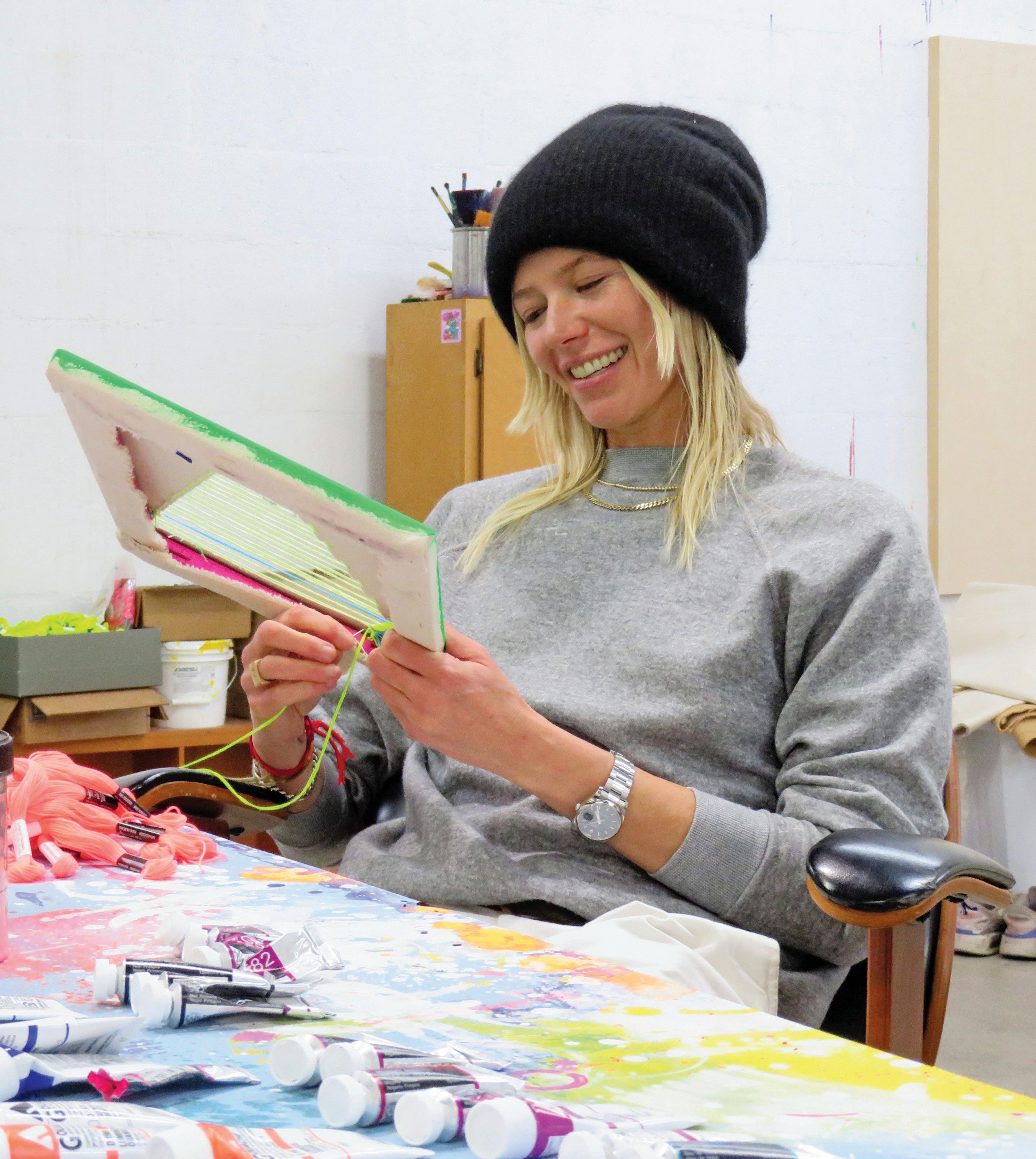
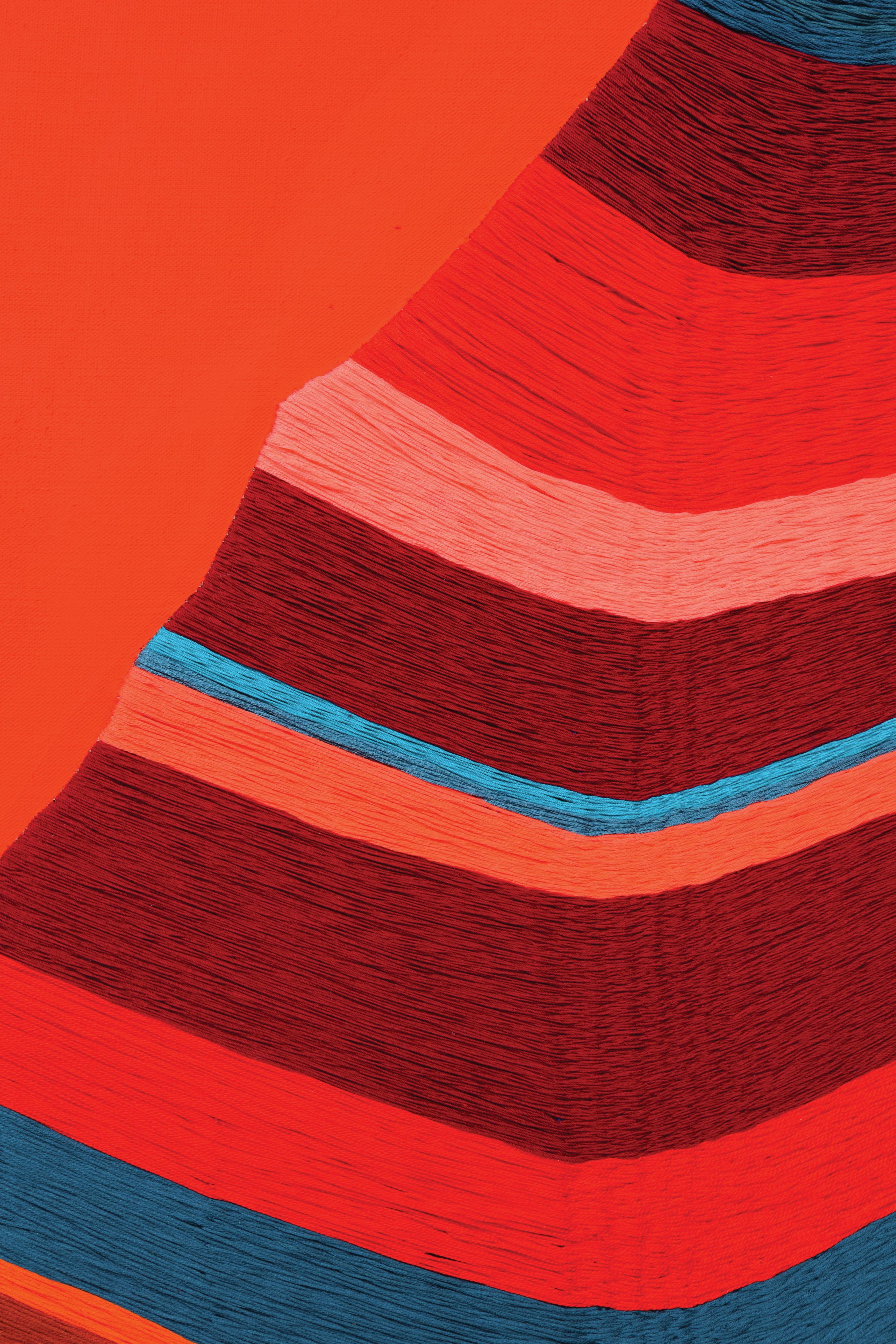
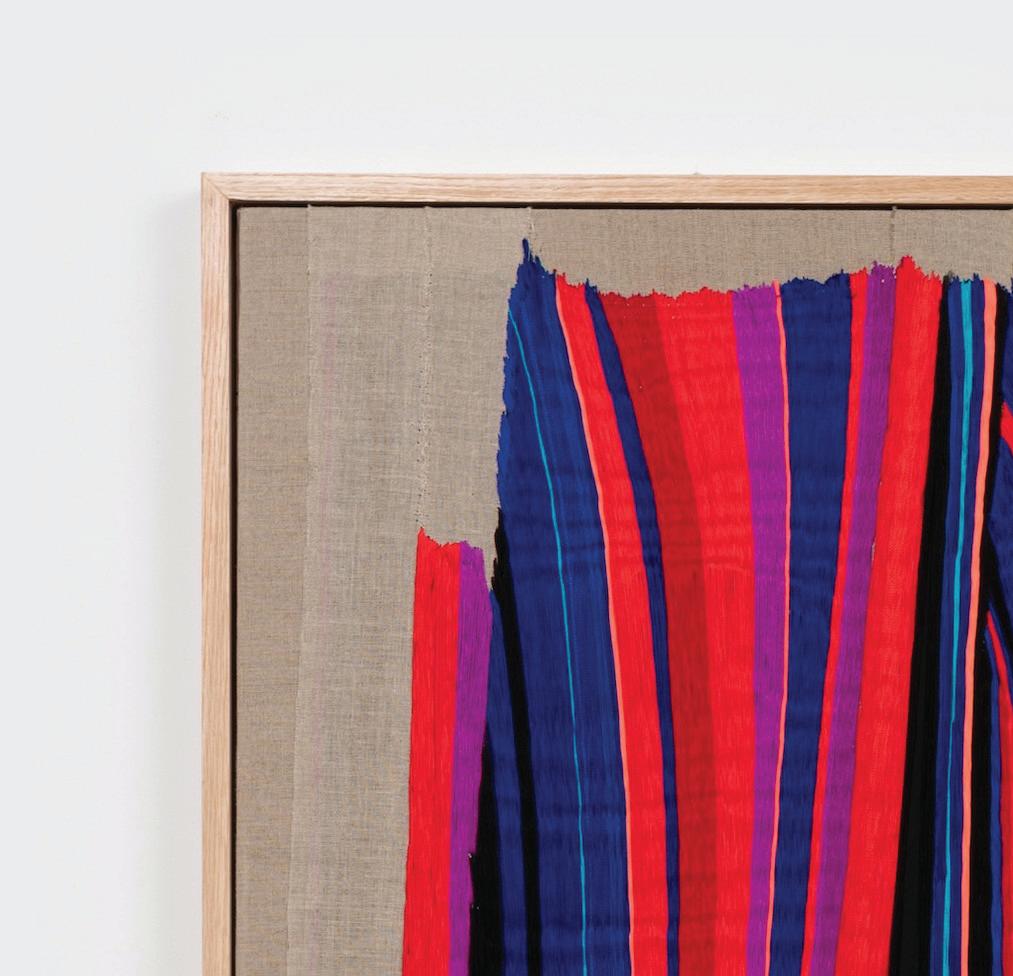
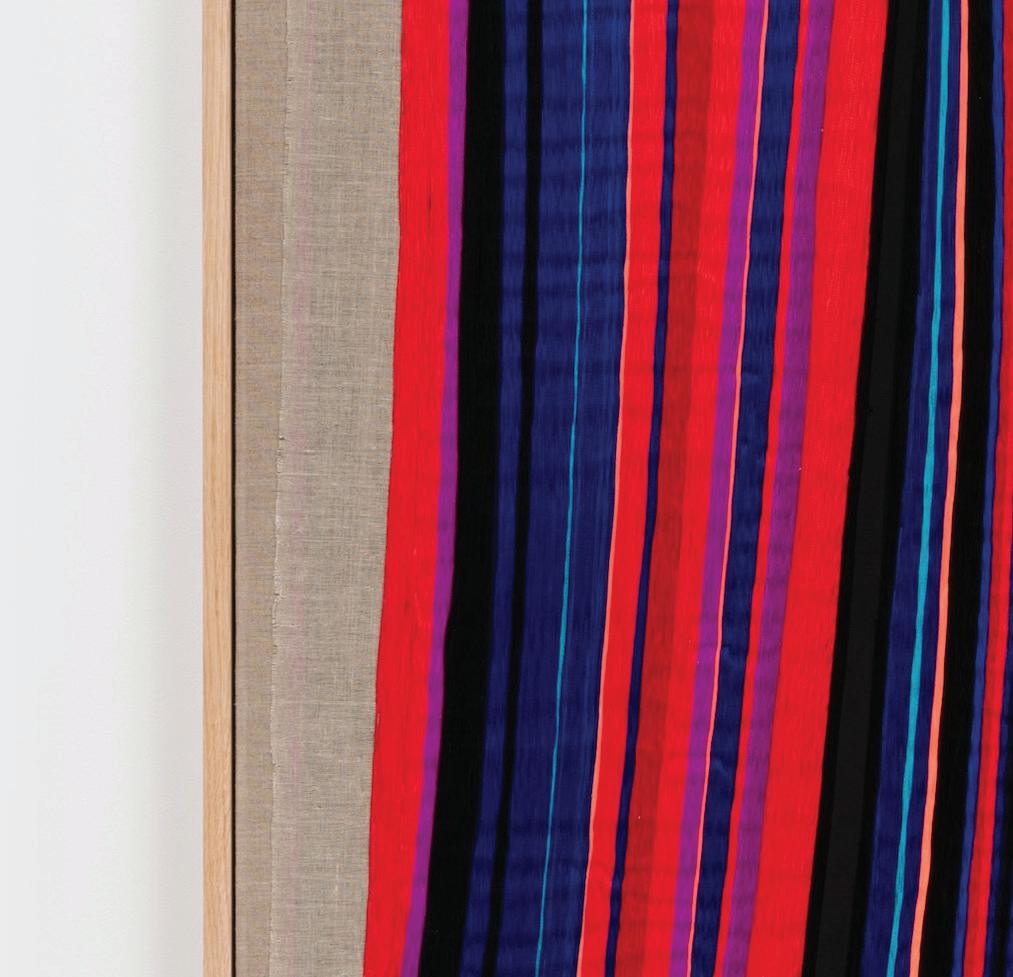
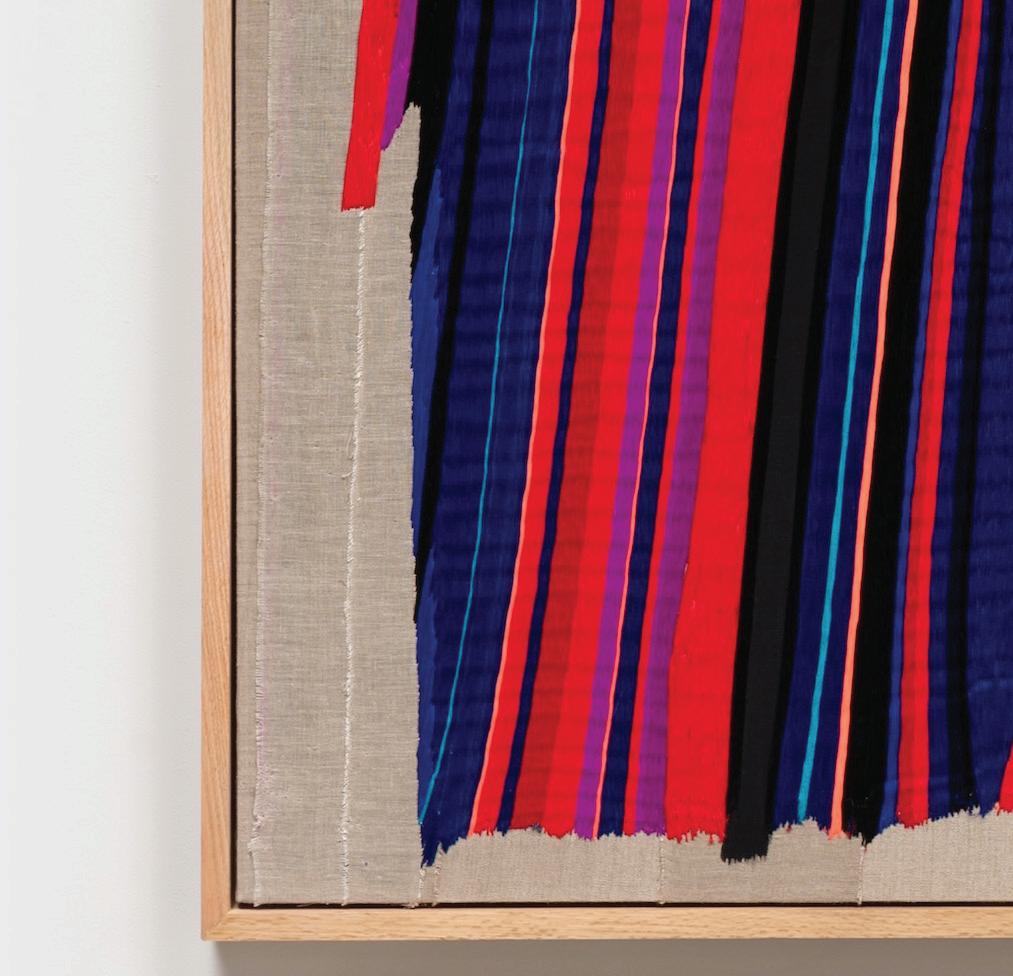
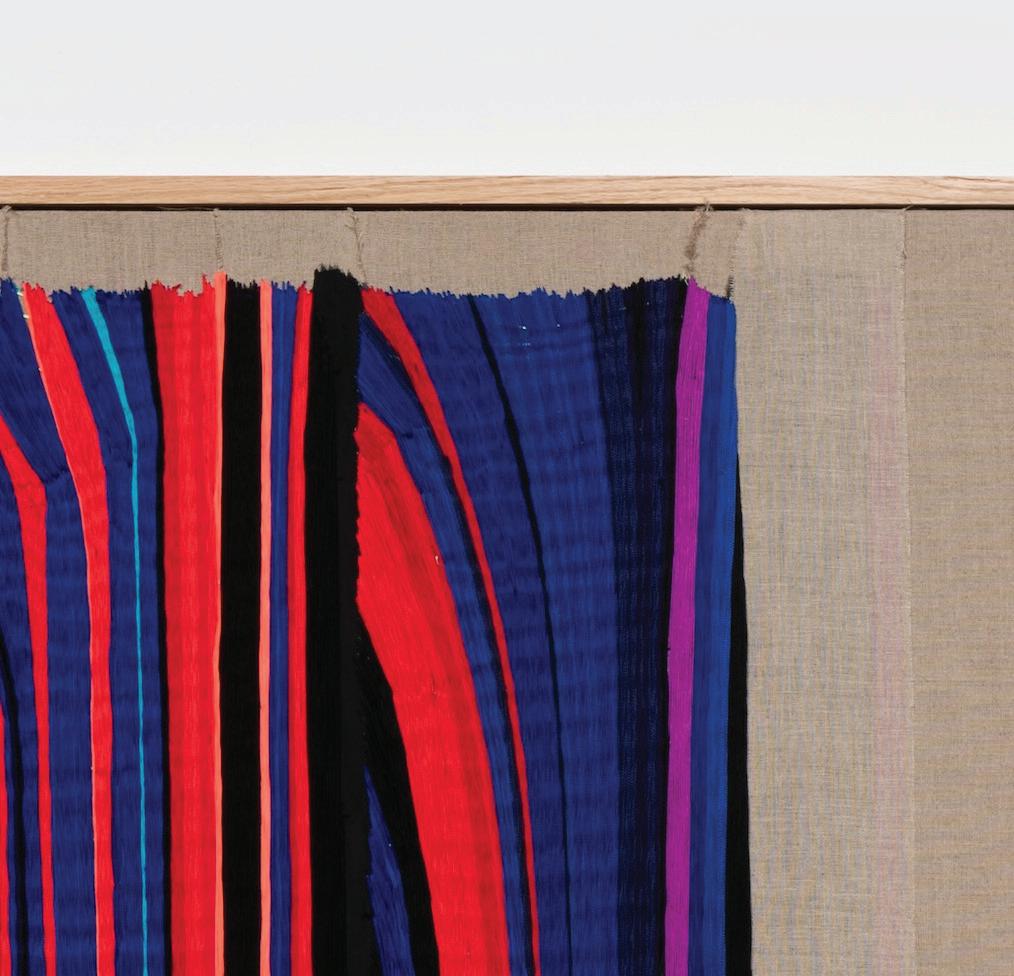
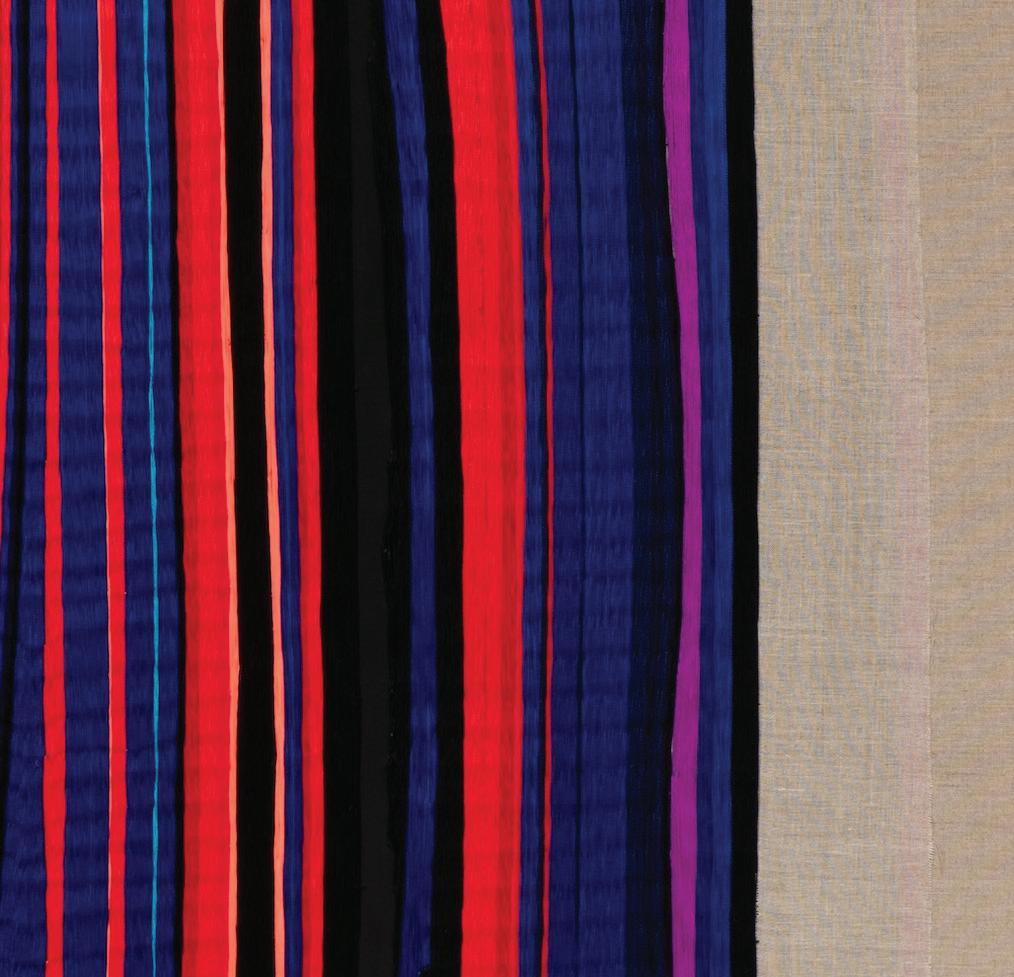
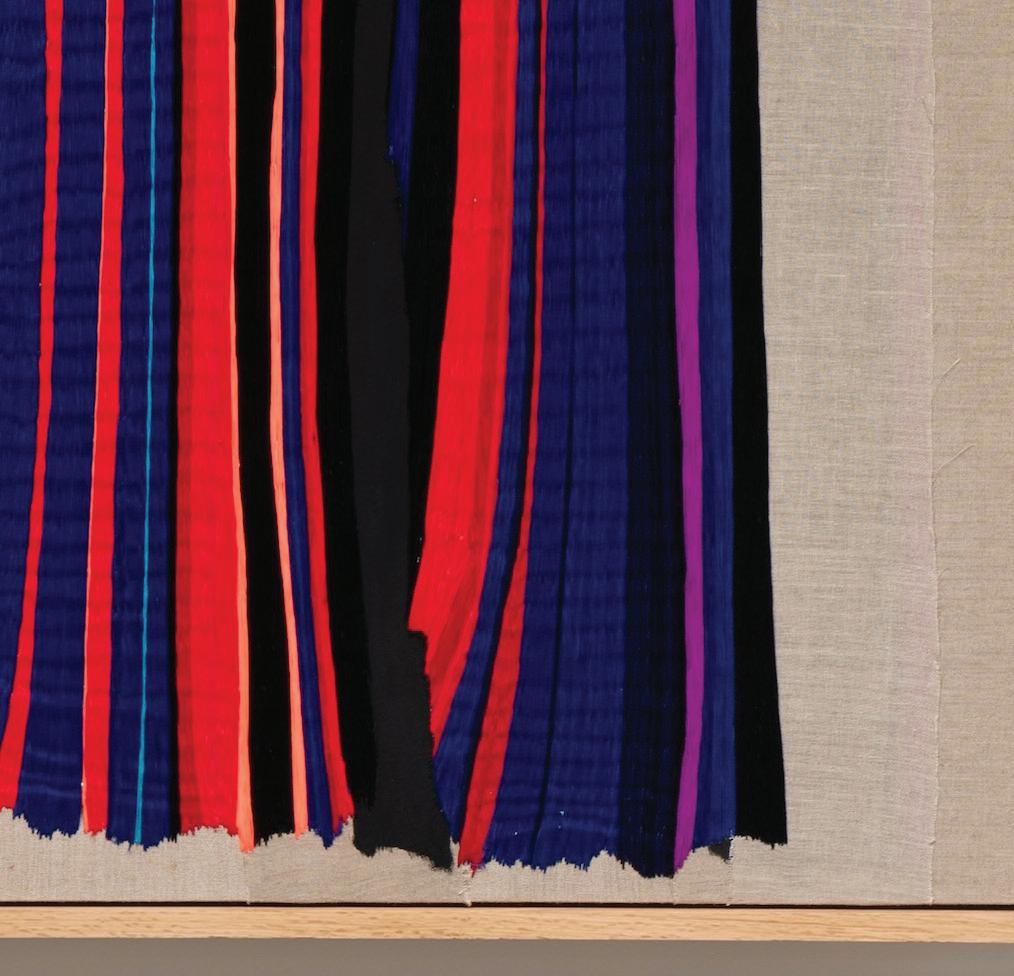
Ever-exploratory and idiosyncratic, SAMANTHA THOMAS’s work begins with color, shape, texture, line, space, and light, the primary building blocks of painting. Using common studio materials such as raw canvas, thread, and acrylic paint, she embraces their fundamental and distinct qualities to expose their limits and possibilities for expression. Jagged extrusions, folded thresholds and frenetically woven strands of thread transform her canvases into paintings that are, at once, physical, architectural, and sculptural. Experiments in the potential of color; ruched reflections on the subtleties of shifting light and shadow; and defiantly contesting the inherent flatness and regularity of canvas from which they are constructed; Thomas’s work speaks to the language and legacy of abstract painting and drawing.
GROWING UP, my mom always had a studio. I was mesmerized by it—the scent of oil paint and charcoal always lingered in the air. Painting beside her on my Big Bird easel, happily mimicking her work, is my earliest creative memory—one that stands alone, as early on, I dedicated all my free time to competitive sports. At some point, engaging in them became my escape—they were a vehicle designed to transcend my origins. I had carefully mapped out my path to attend college on a golf scholarship, but by the time I achieved my goal, my passion for the game had waned. My roommate was taking art classes, and I was intrigued by the idea of an alternative to courses that failed to hold my attention. I took one class, and it dramatically altered my whole trajectory—I had finally found something I was passionate about. I relinquished my scholarship and moved to New York with a romanticized notion of art and an idealized vision of the city as the epicenter of the art world. But the brutal winter quickly made it clear—New York was not for me.
DURING THIS PERIOD,
a commercial for the San Francisco Art Institute steered me towards a desire to attend art school, until I was pointed in the direction of the ArtCenter College of Design in Pasadena. To prepare, I relocated to Altadena, enrolled in a semester of night classes, compiled a portfolio, and applied. I didn’t even really know how to make art at the time, I was just drawing and finding discarded objects to paint on (very Rauschenberg-esque). Once I was accepted, everything changed. I learned about materials, process, history, and the theory of art. In 2004, post college, instead of going to grad school, I started working for artists in Los Angeles. I worked for Ed Moses, a central figure of postwar West Coast art known for forming the “Cool School” of artists. He took me under his wing, ingraining in me the discipline and dedication of a daily art practice. What I learned from his proximity, his connections, and his community were invaluable.
The path that led me to art really was that random, messy, and serendipitous. My naivety and youth worked in my favor, allowing me to take risks without overthinking how it would all turn out. I was resolute in the road I was meant to take, and I’ve never wavered, regardless of the obstacles.
At the time, LA was a haven for artists— affordable rent made it possible to live and maintain a separate studio. Since graduating, I’ve always kept one—a dedicated space to create and explore freely, without inhibiting my process, however messy it sometimes gets. In 2018, I lost everything in the Woolsey Fire. I was living in Malibu at the time, and I had to consolidate my life in order to build it back up. That was the first time I created a home studio. Timing-wise, it could not have been better as the pandemic hit shortly after. Interestingly enough, an explosion of color began to show up in my work. I can’t say for certain it was an emotional reaction, but it was most certainly a psychological one.
Post-fire, my painting process shifted to incorporate sewing and weaving into the works—I was also adapting to my new normal. I was always at home or in transit so I would just fold up my canvas, take it with me, and then stretch it later. I think the work I was making pre-fire was very much in the canon of abstraction and really pointing the viewer in the direction of who/what I was referencing. Now, I am not dictating that read or movement at all—my work feels very authentically mine, even though it’s referential to so much that comes before it.
ART IS A CODED LANGUAGE.
One reads it semiotically, by deconstruction and reconstruction to create meaning. I explore this literally in the approach to my work by investigating the relationship between abstract ideas from painting’s history and the physical properties of my materials. I have very strict self-imposed parameters—the materials must relate to the lineage of painting, so that it stays within that context.
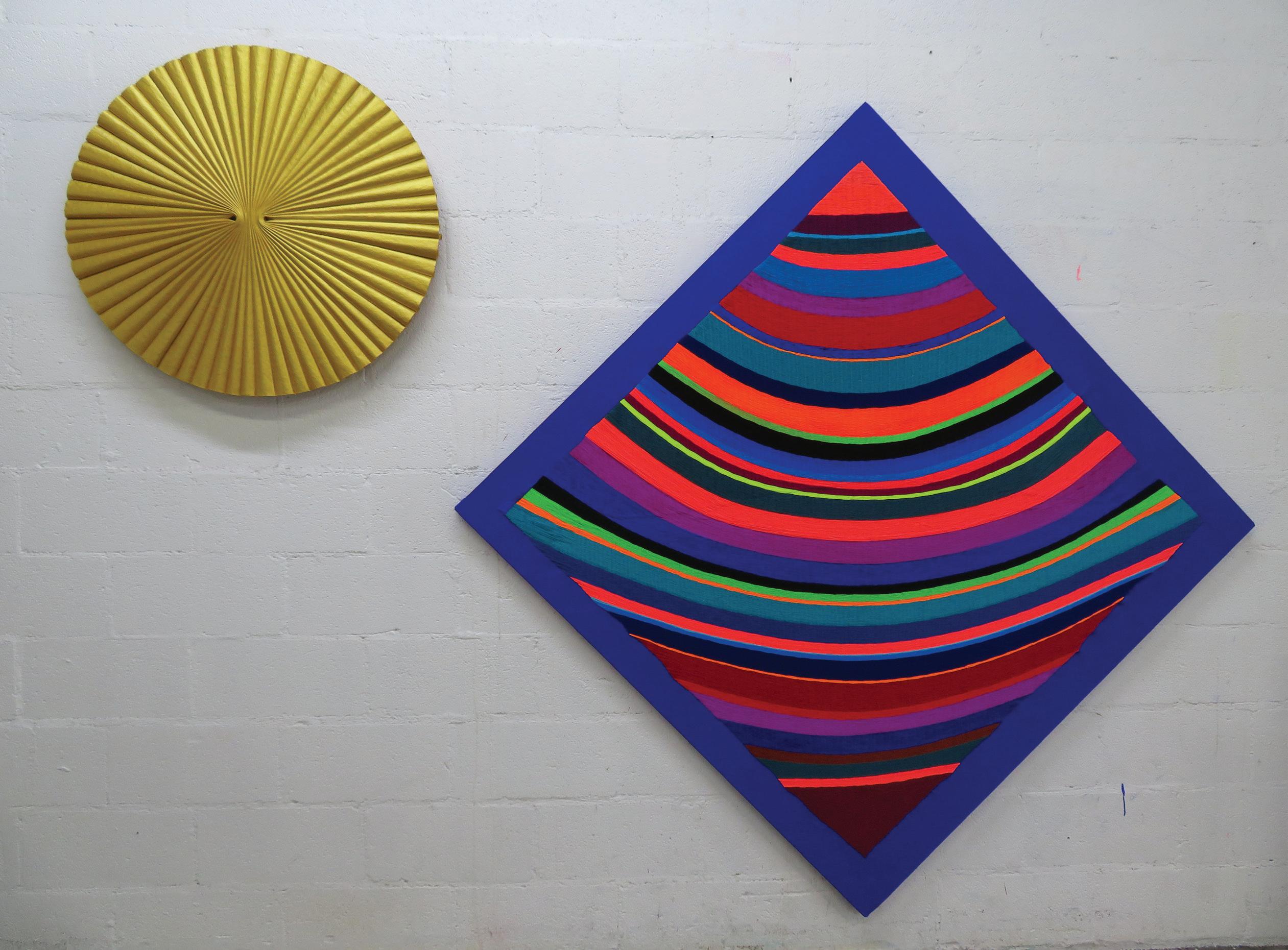
My current body of work is my most personal to date—they’re topographies featuring layers of love, loss, history, time. They exhibit all the emotive sediment that carries and forms the human experience. To bring them to life, I essentially forge a negative space on the canvas by cutting out the interior surface area. I build a loom within it, hand-weaving intuitively chosen threads through it line by line until it forms a cacophony of color. Conversely, in my Fleurs series, the canvas is taken out of the center and formed into pleated “flowers.”
They are my monochrome paintings, but they can also be read as sculpture—ultimately born from my desire to challenge the boundaries of painting. Existing beyond the traditional fourcorner structure, they explore the materiality of paint as surface, color, adhesive, and texture.
The layering aspect is always present, reflecting a subconscious echo, an affective remnant that lingers within the work. My largescale paintings alone take six to eight months to fully come to life—a process that demands both commitment and trust. I am always trying to engage the viewer in a way that creates a tactile desire to want to touch the work, and within that transference, unveil the handmade quality. Even without knowing how the work is made, one can acknowledge an idea of the time taken to make each piece.
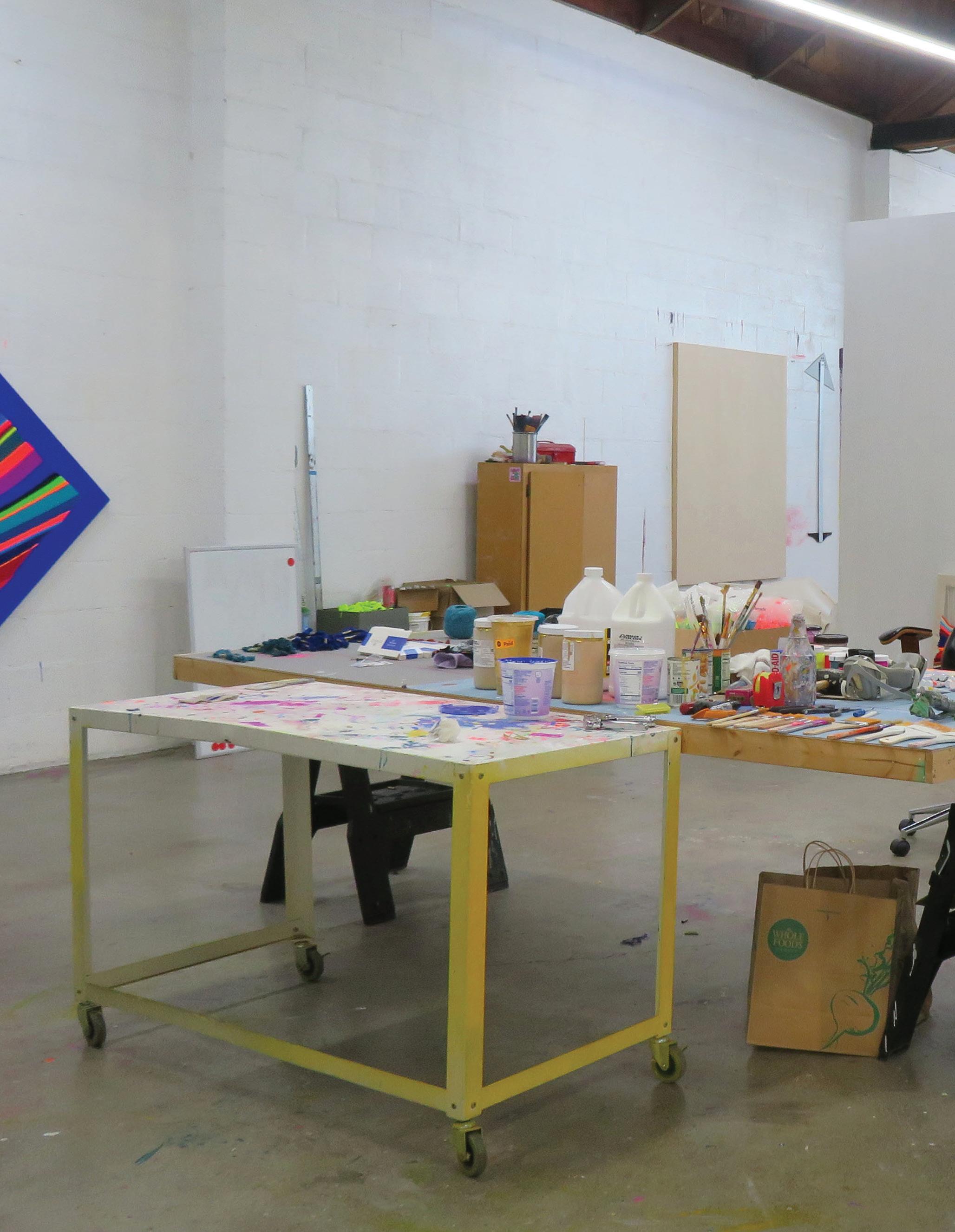
IN 2022, everything shifted when a close friend proposed we share a studio—a decision that reshaped my practice in unexpected ways. We discovered the most breathtaking space I have ever had the privilege of working in. I walk in each day, and I still can’t believe this is my reality. It’s a dream studio and my sanctuary of exploration—it has high ceilings, great light, indoor/outdoor access, a place to work outside, parking, and it’s enclosed, private, and safe. It’s not a cheap expense but it’s been a great investment in myself as an artist. The nature of these situations is such that they’re defined by three-to-five-year leases. I know it won’t last forever so I make the most of it every day. While preparing for an exhibition, my daily routine tends to be more rigorous due to the time-consuming nature of the process. Starting at 5 a.m., I immerse myself in work to the tune of audiobooks until about 8 a.m., accompanied by my dog, Patters. It’s a peaceful, quiet window of time that wraps the two of us in stillness before the sun rises and the world wakes up. I dedicate the hours of 8-11 a.m. to our wellbeing, walking and feeding him, followed by either surfing the Venice Pier or a home workout. From 11:30-4:30 p.m. I am in the studio working, before I take a break from 5-7 p.m. to rest and have dinner. From 7:30-11 p.m. I work while watching a film or listening to an audiobook.
THE RHYTHM of work and reflection reminds me of a quote from my favorite artist, Louise Bourgeois. It shatters my soul each time I read it—it’s literal, poetic, and personally internal, and it distills the universal emotional drive behind creating art, regardless of the medium.
Shannon Amidon
Photography by Stephanie Honeycutt
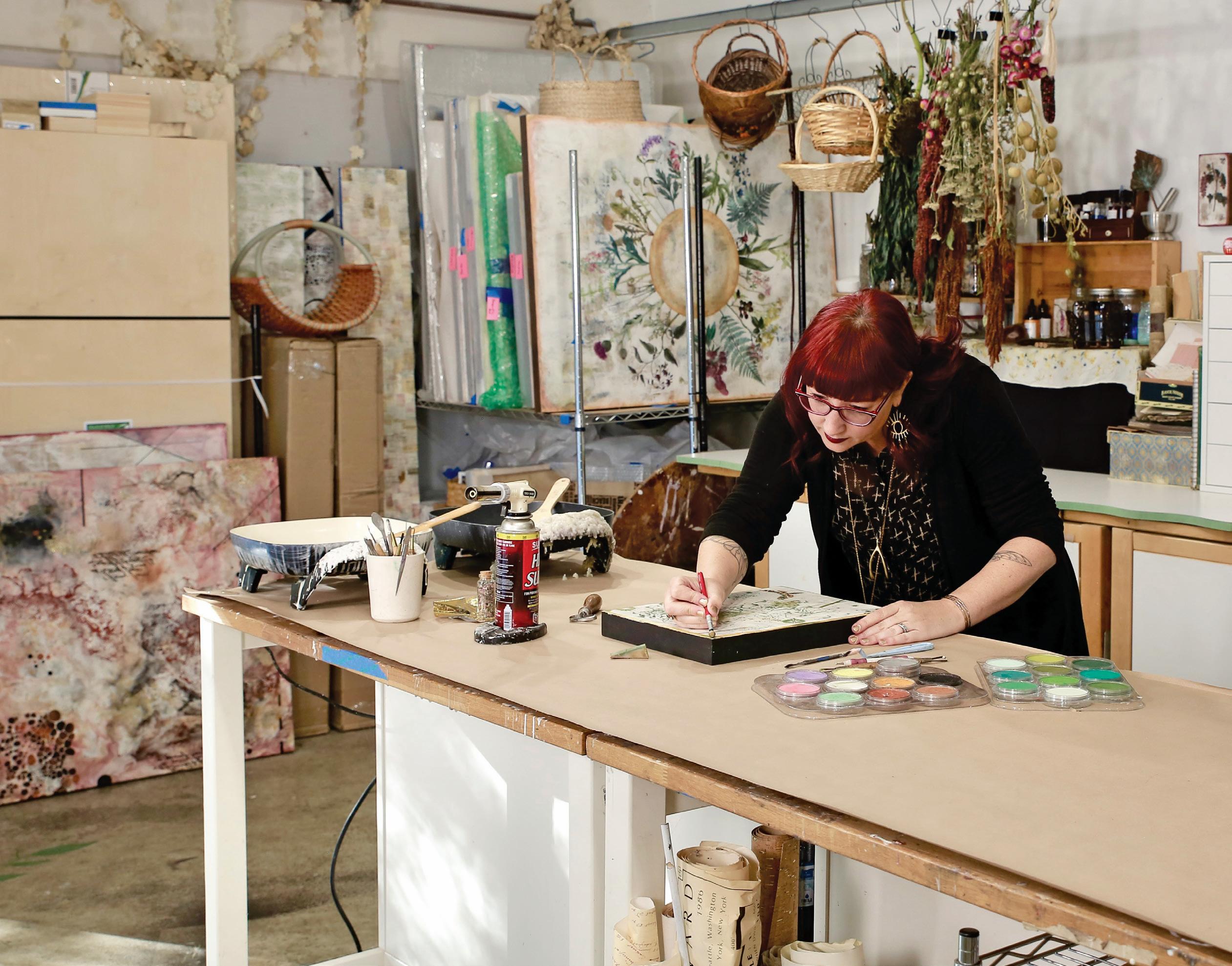
SHANNON AMIDON lives in Troutdale, Oregon, where she channels her boundless curiosity and love of learning into her art, garden, and creative exploration. A wonderseeker at heart, she finds magic in insects, plants, rocks, and the pages of well-loved books. An encaustic artist and environmental steward, Shannon teaches workshops from her studio and is the founder of The Verdancy Project, a multidisciplinary artist residency fostering creativity and connection with nature.
From an early age, I have been fascinated by the unknown. A curious child, I asked endless questions and felt a deep attraction to mystery and discovery. Some of my early occupational dreams included being an Egyptologist, geologist, and marine biologist. These fields fascinated me because they offered a way to uncover hidden stories whether through ancient artifacts, layers of earth, or the mysteries of the ocean depths. Each represented a unique form of exploration and discovery that fueled my childhood imagination. It was a powerful realization to discover that creating art could inspire the same sense of wonder, mystery, and exploration I had always sought.
Like many creatives, I stumbled around a bit trying to find a medium that spoke to me. Traditional painting never felt quite right, so I started with assemblage and collage, two mediums that are still very close to my heart. That led me to photography, and a way of capturing the world around me. I loved the medium, but it still didn’t fulfill that desire to discover, dig deep, and get my hands dirty. I am a process-driven artist and discovering alternative process photography and techniques like cyanotypes, gum bichromates, and liquid emulsions felt more exciting and allowed me to get lost in the process. When I started pouring wax on my photographs, something magical happened. The wax created a dreamy and moody effect that I loved. A chance encounter with an encaustic artist at an art fair opened the door to the world of encaustic, and I have never looked back.
Another very deep part of my creative life is my connection to nature. I have always been a naturalist, growing up on a small piece of land where a creek, foothills, and trees fostered my love of the natural world. I would catch tadpoles and tarantulas to study, spend hours climbing trees, and digging up rocks to identify and polish. These experiences seeded a deep connection with nature and an insatiable curiosity to learn about natural history.
“Be daring, be different, be impractical, be anything that will assert integrity of purpose and imaginative vision against the play-it-safers, the creatures of the commonplace, the slaves of the ordinary.”
― Cecil Beaton
For me, art is an investigation, similar to science. Just as when I was a child, I continue to ask questions, observe, collect specimens, probe the unknown, and seek to see things in new or different ways. My artwork explores themes of nature, science, and our environmental impact. The cycles of life, death, and impermanence play a primary role in my work. I collect insect and natural history specimens and attend science and nature-based residencies where I can study and photograph various species to add to my source materials. Driven by curiosity and wonder, my practice is interdisciplinary and ever evolving. I am deeply interested in all aspects of ecology and the natural world—art allows me to discover and study these areas without specialization.
After a difficult stretch of time when I lost my parents, grandparents, and many other important people in my life, I found myself longing for solace and a fresh start. Those losses, combined with 22 years of city living, deepened my desire for a quieter life rooted in nature. I was ready to move back to the country to follow my dreams and be closer to the natural world and a slower pace of living.
We packed up our lives and moved 700 miles away to Portland, Oregon. It turned out to be one of the best decisions of our lives. Moving to a new state with a five-year-old, no friends, and no relatives was challenging. But everything seemed to fall into place, and I immediately fell in love with the city and its landscape. We knew our first move was temporary while we searched for land. We found a cute rental house in one of the arts districts and settled in. I was even able to create a temporary studio in an old shed out back. The arts community here is fantastic, and I met many wonderful creatives who made my transition to a new arts community easy and enjoyable.
We ended up staying in that little house longer than anticipated while trying to find the perfect piece of land to start our new life—something not too rural with plenty of trees, open space for gardens, a water source, strong internet, and studio space. After years of searching, we found a beautiful dream property in Troutdale, just east of Portland. It’s
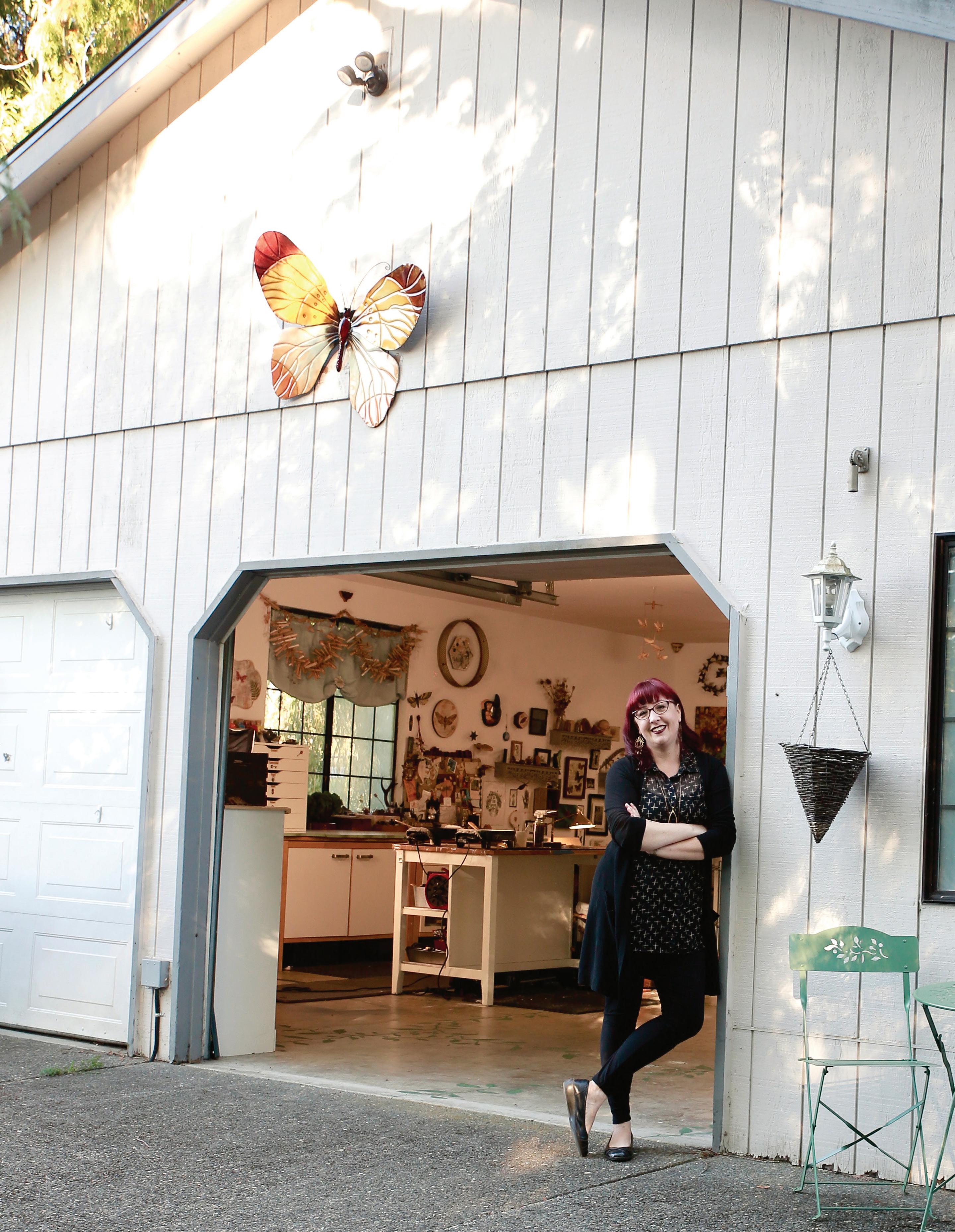
4.5 acres of lush woodland, fields, a flowing creek, a magical treehouse, gardens, chickens, and more. In addition to the home—which was in surprisingly good condition, there was also a 1,000-square-foot detached garage with a powder room. Hello, future art studio!
I knew right away that this was the place. The land reminded me of where I grew up, there was something familiar and comforting about it, as if I had stepped back into the wild spaces of my childhood. The creek winding through the property, the dense clusters of trees, and the untamed beauty of the surroundings mirrored the landscapes I had once explored with bare feet and wide-eyed curiosity. It felt alive with the same kind of quiet magic I had known as a child, a place where imagination could run wild, and nature always had something new to discover. We made an offer just a few hours after seeing it and were filled with joy when it was accepted.
It took a lot of vision and hard work to bring this place to life in a way we knew it could be. The garage and land had been neglected for many years. The land was overgrown with invasive blackberry bushes, piles of junk, old tires, and garbage. The garage looked like something out of a horror movie: soiled animal cages stacked floor to ceiling, dirty plastic shower curtains covering the windows, crumbling drywall, and a solitary flickering shop light hanging in the middle. Despite these flaws, I saw the possibilities and potential in the land and garage that would soon become my sanctuary.
Two days before the moving truck was due to arrive, rushing down the basement stairs to grab a box, I missed the last couple of steps and ended up on the floor with a broken foot. The first six weeks after we moved, I was on crutches, unable to explore the land, work on my studio, or do much unpacking. It was immensely frustrating, but I used the time to plan, daydream, and find help for the work needed in the studio. The first thing I desperately needed was an electrician to install more lighting. After a lot of research, I decided on track lighting. I had six tracks installed, each with three adjustable lights. After years of working with suboptimal lighting, I wanted my studio to be lit up like a Christmas tree!
With the new lighting installed and my broken foot healed, I donned safety glasses, gloves, a mask, and a crowbar and got to work clearing and cleaning the soon-to-be studio space. A contractor installed the insulation and drywall, and a few months later, I was left with a beautiful blank space and the opportunity to create my dream studio. This was the biggest studio I had ever had, and I quickly learned that having unlimited possibilities in setting up and designing my studio would be both a gift and a challenge.
“We are all stardust and stories.”
― Erin Morgenstern, The Starless Sea
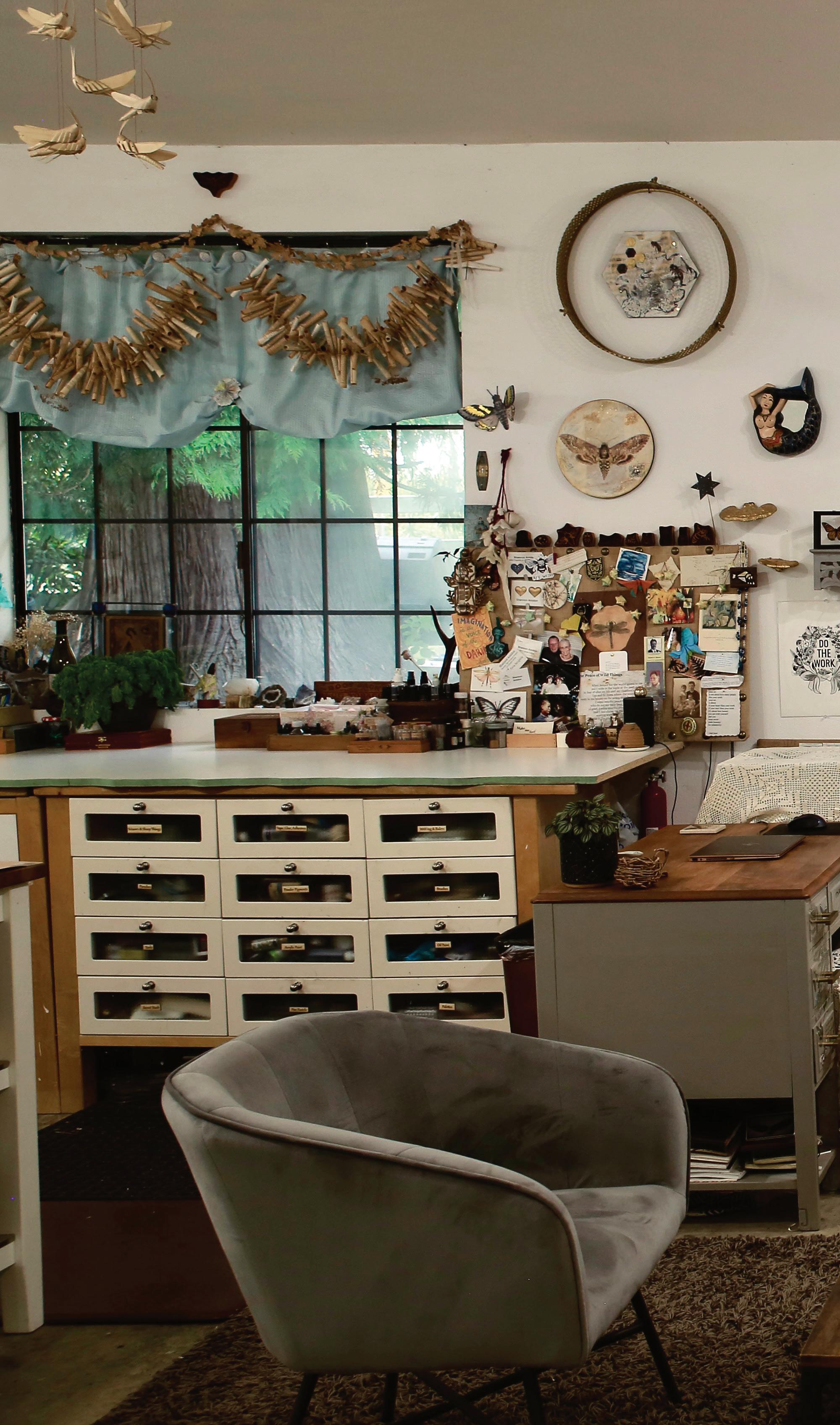
Ilike to set my studio up in zones. I have my main art-making tables, a desk and admin area, an inspiration area, finished artwork storage space, a gallery display wall, a teaching area, and a relaxing sitting and meeting space. The challenge was figuring out the best configuration for my new space.
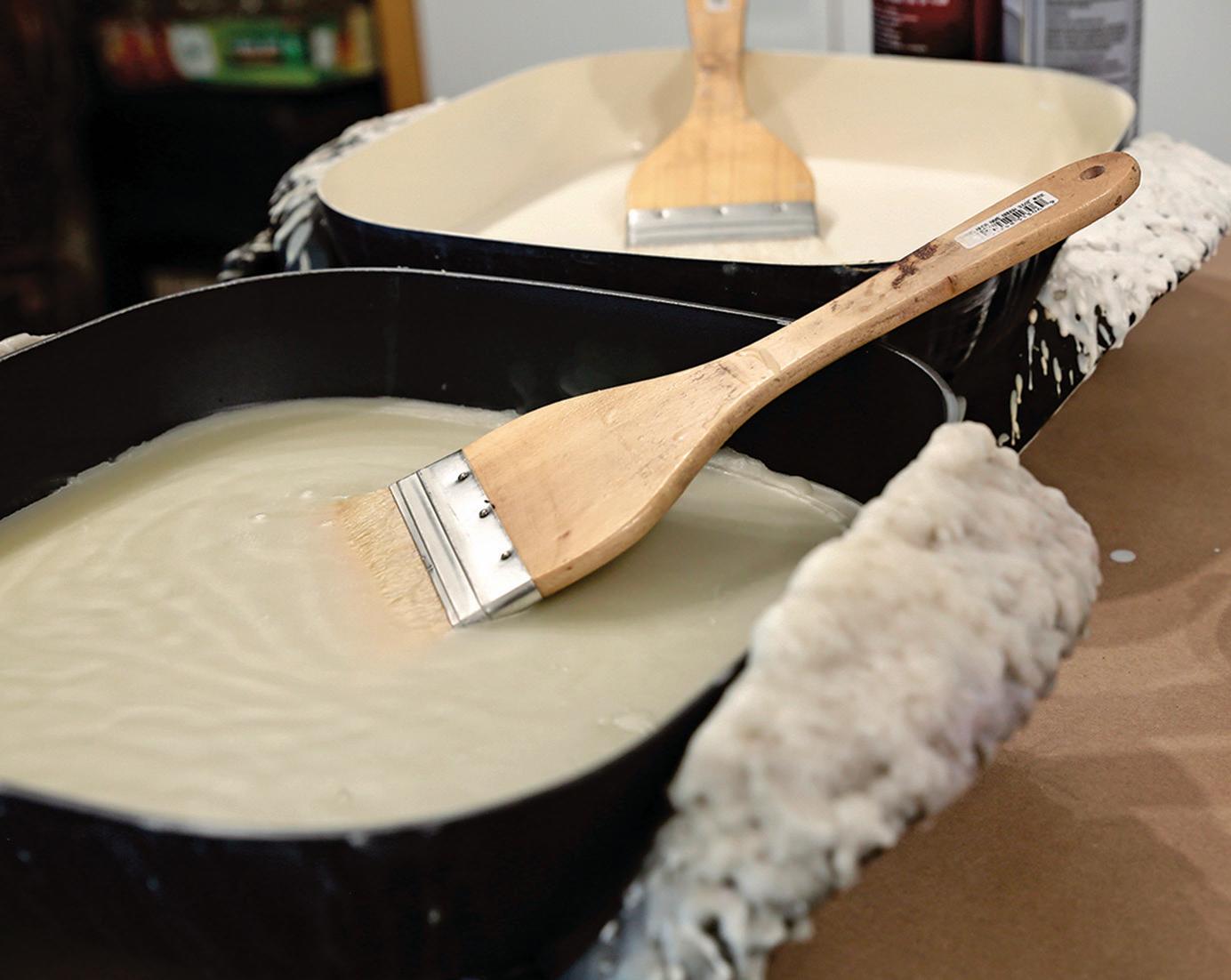
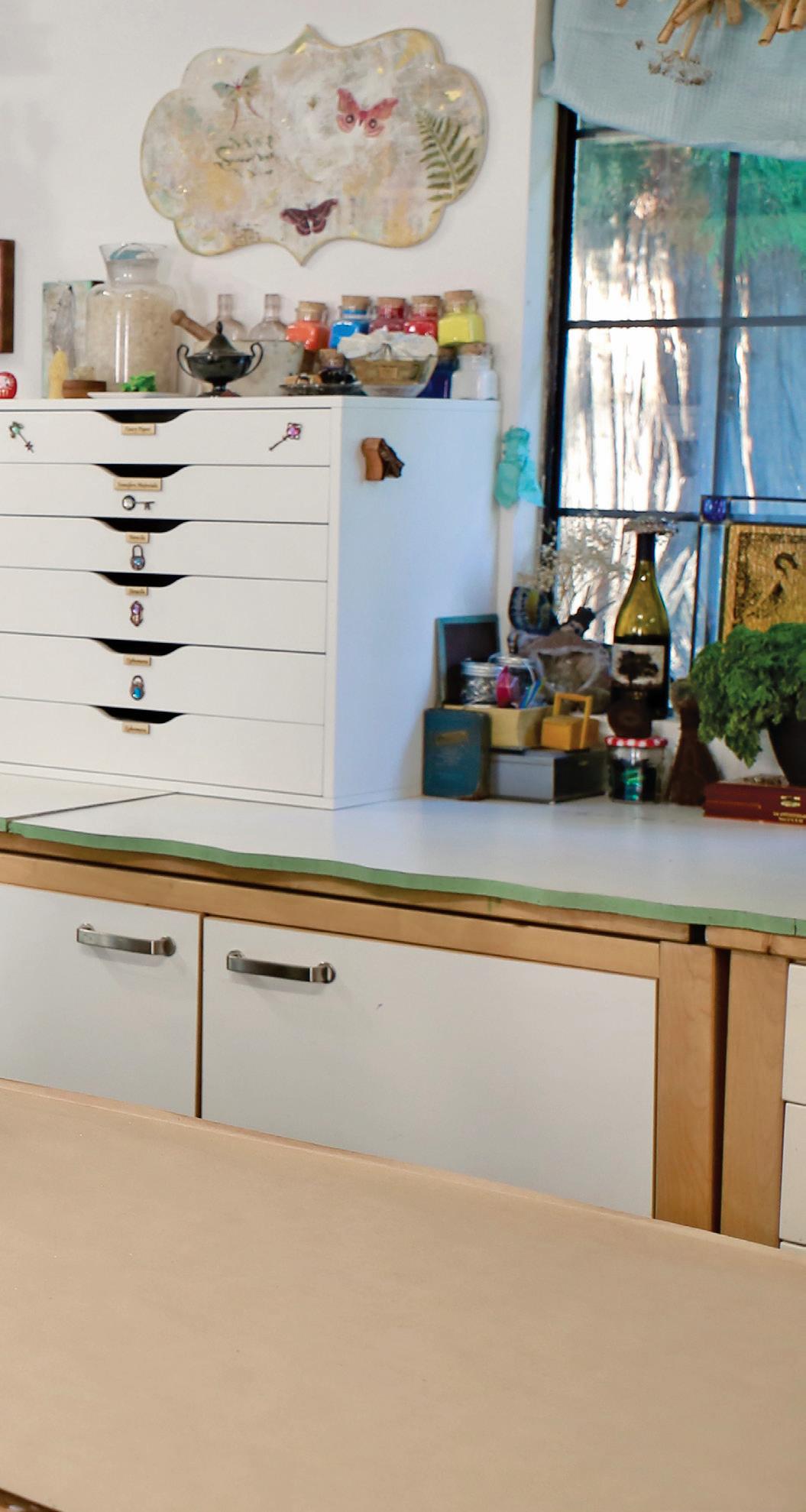
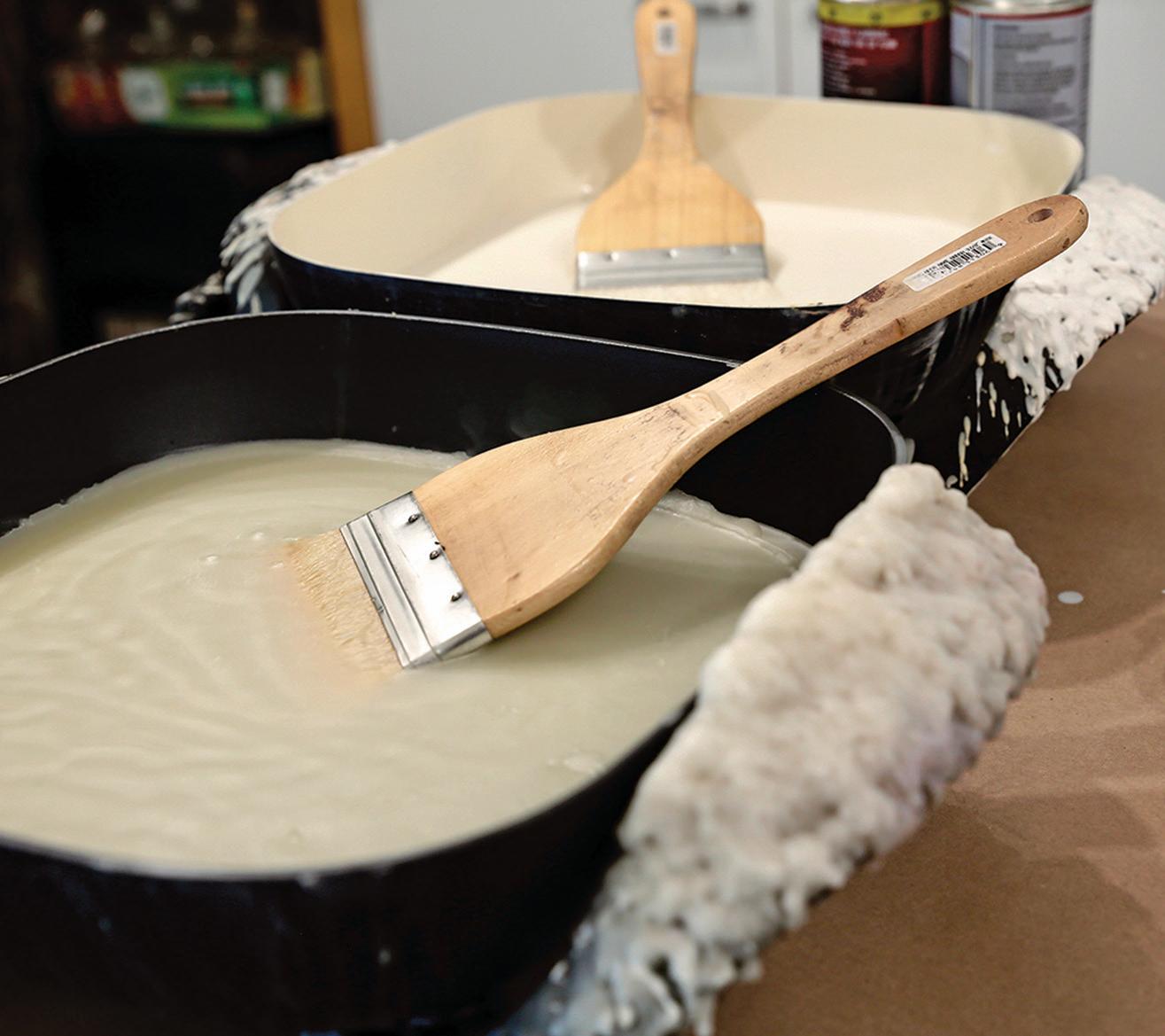
Working primarily in encaustic, I need to work flat on a tabletop because the medium involves applying layers of molten wax, which requires a stable, level surface to prevent uneven textures or dripping. I also work largescale, so I need a big worktable. I moved in five Ikea kitchen counters with butcher block tops from my previous studio. I find these perfect for worktables and storage. Two have open shelving underneath to store materials
and supplies I need easy access to. One has 12 drawers that hold everything from scissors and tape to paint and rulers. Two more have double doors to store items I don’t need to access often. They are each free-standing, so I can configure them however I want. It took several variations to find a setup that worked for me in the space.
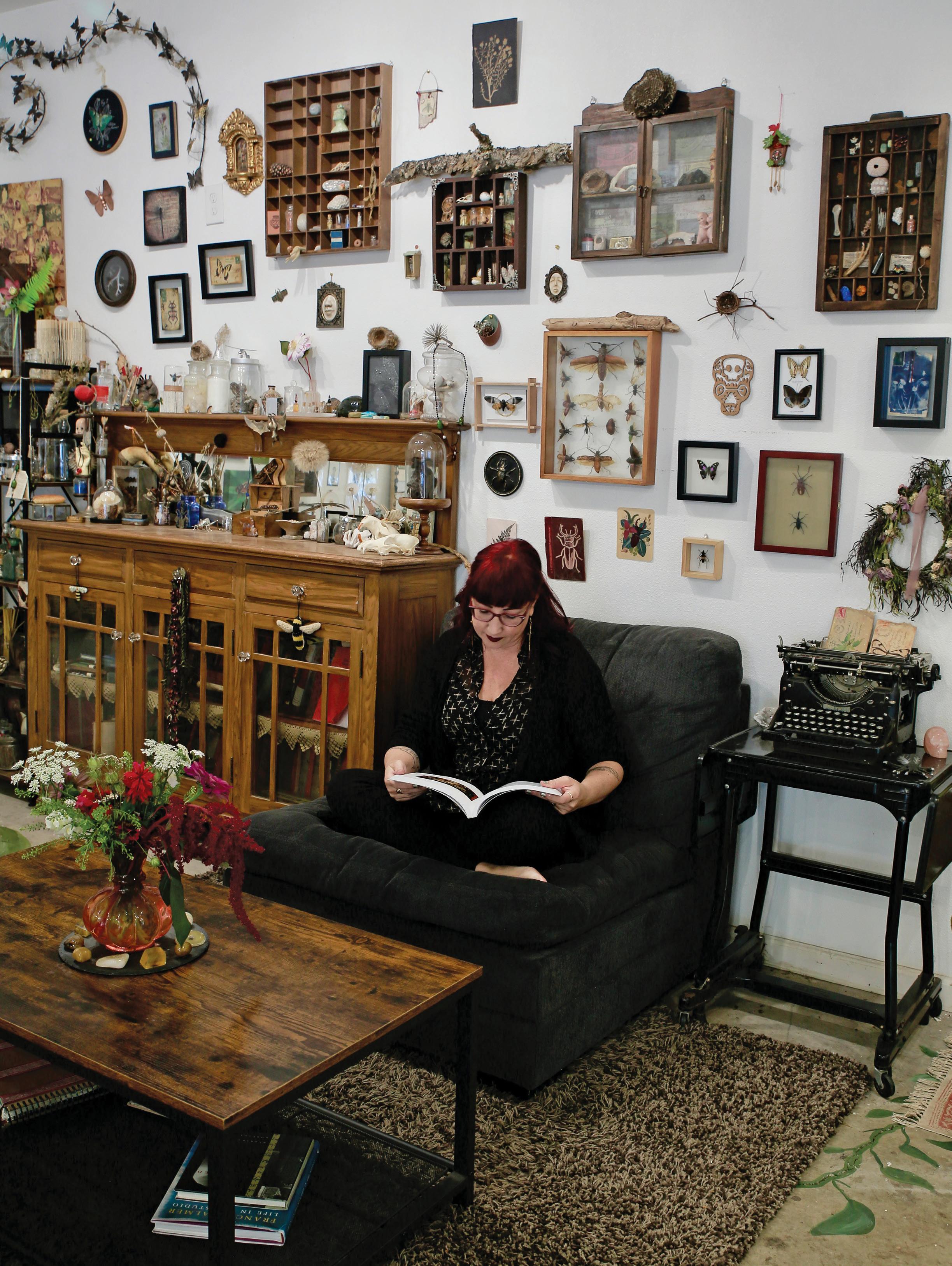
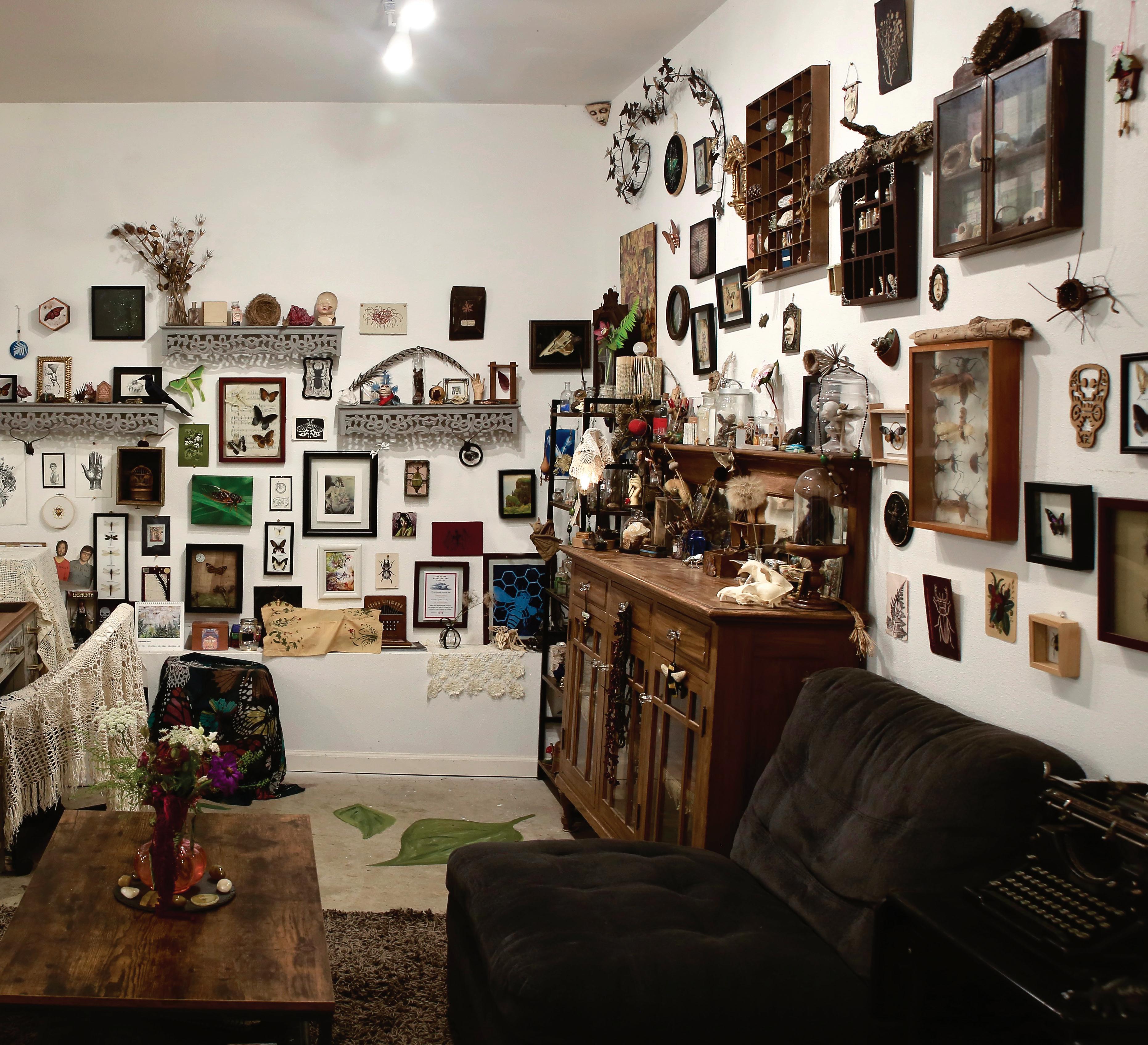
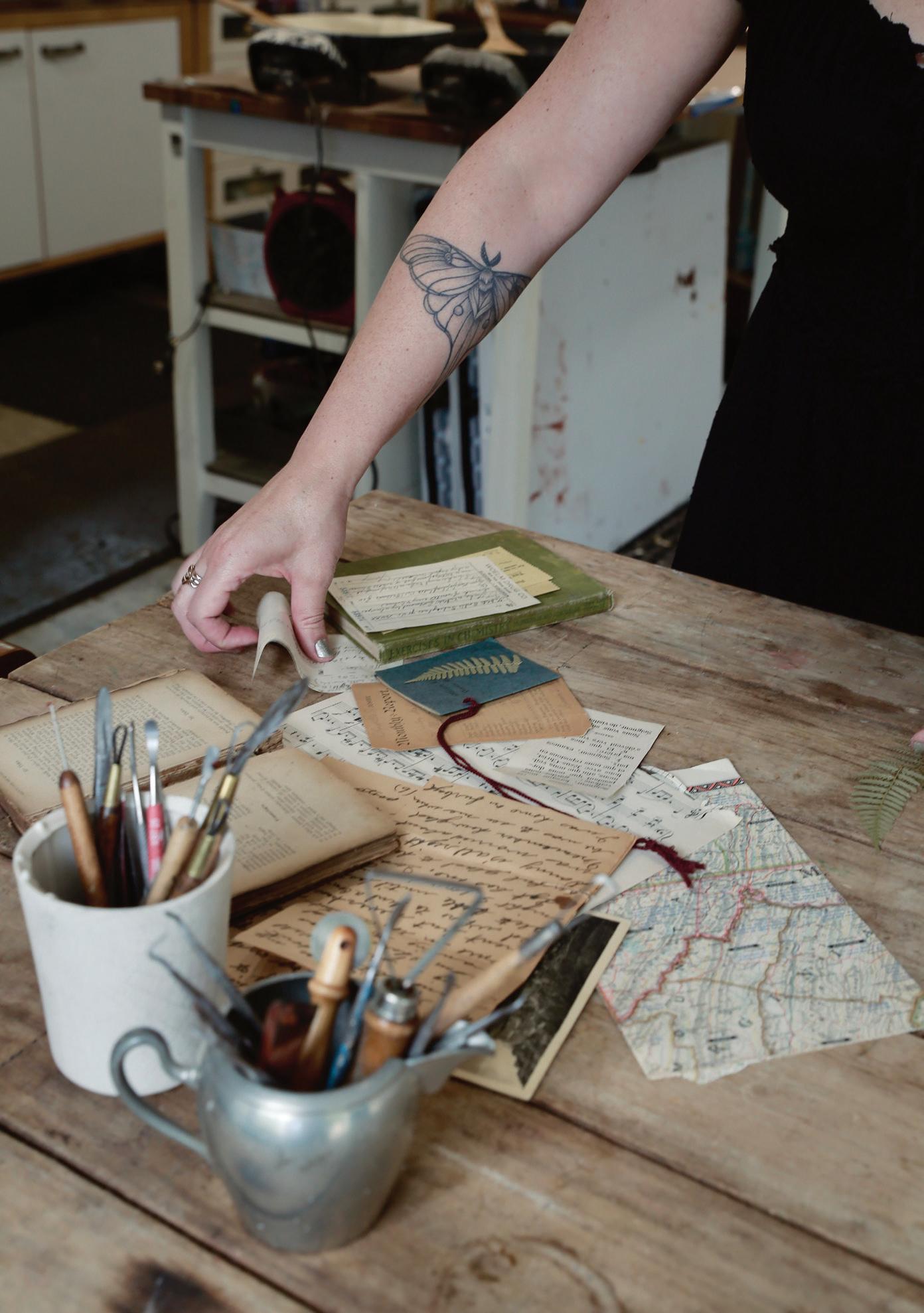
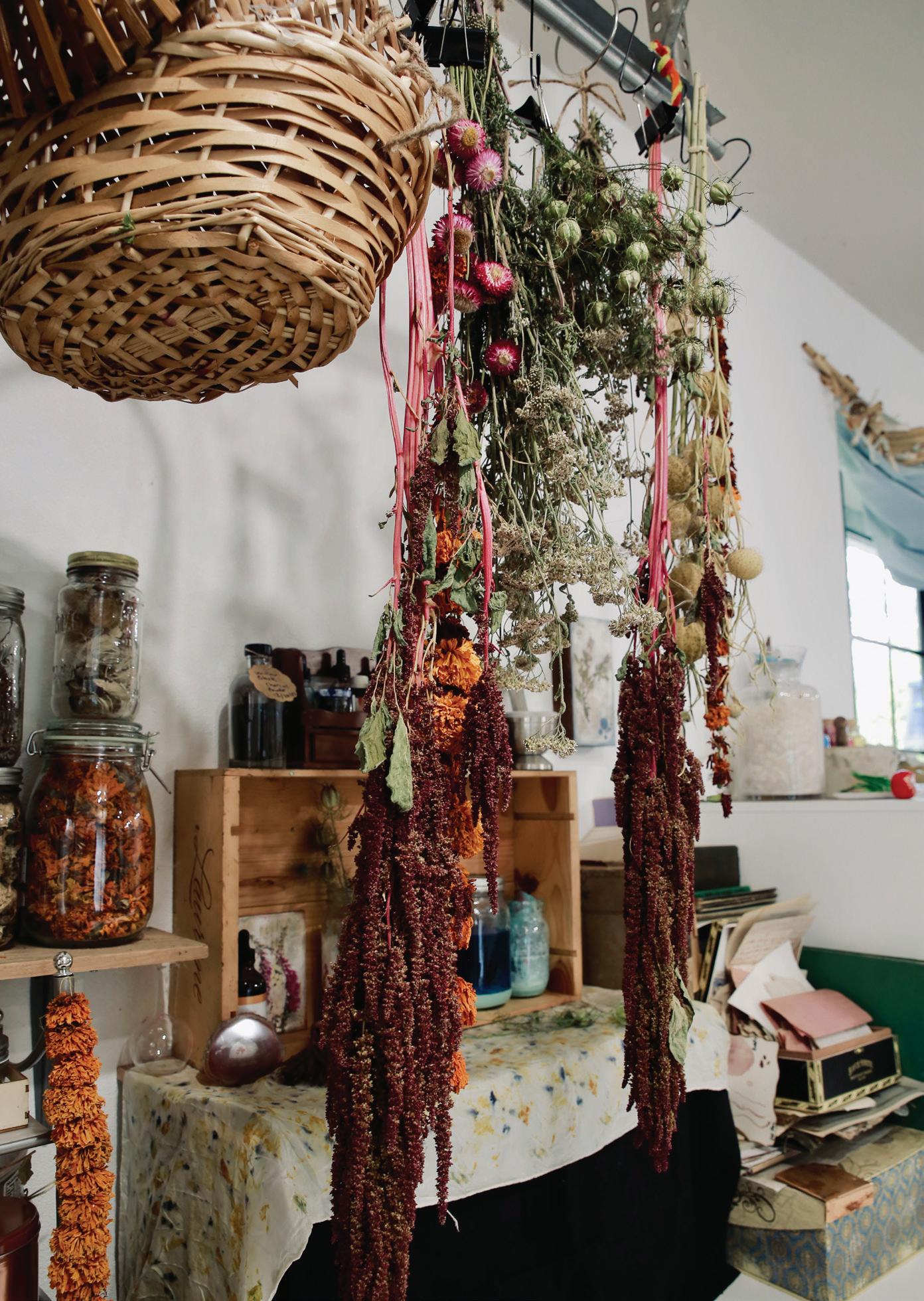
My inspiration and office area are a wunderkammer filled with oddities, natural history specimens, artwork made by friends or admired artists, books, fossils, feathers, and treasures. These objects inspire me, serving as tangible reminders of the natural world’s complexity and beauty. This is the coziest area of the studio, with a small sofa, coffee table, lots of books, and wonder-filled walls.
“A creative life is an amplified life. It’s a bigger life, a happier life, an expanded life, and a hell of a lot more interesting life.”
— Elizabeth Gilbert
There is a large 15-foot display wall to exhibit my artwork. Tired of constantly spackling and repainting, I installed a new track hanging system on the gallery wall. This allows me to hang my artwork without putting nails in the wall and provides a clean and professional way to display my work for studio visits or open studios.
My studio is an extension of my home, blending warmth and creativity. The cozy atmosphere fosters a sense of ease, allowing ideas to flow freely and organically. Boundaries around my time and limiting distractions have been essential with a family and home studio, but these are a small price to pay for the freedom to run out to the studio in my pajamas in the middle of the night because I have an idea or need a tool.
Beyond the walls of my studio, the land I live on serves as a muse and an extension of my creative space. Immersed in nature, I draw constant inspiration from the flowing creek, the ever-changing light filtering through the trees, and the vibrant life that surrounds me. Whether gathering natural specimens to incorporate into my paintings, photographing wildlife, or simply walking through the woods, the landscape becomes both my muse and my collaborator.
This space is always evolving, changing, and improving, a reflection of my own growth as an artist. As I experiment, learn, and adapt, my studio and the land I live on transform alongside me, supporting my creative journey. Like most artists, my studio has always been my sanctuary. Whether it’s been a clearedoff kitchen table, a spare bedroom, or a cold garage, I have always strived to create a refuge away from the noise of the world. A place where I am free to create, experiment, play, and get lost in wonder.
DIANE KAPPA
CURATED BY LORI SIEBERT
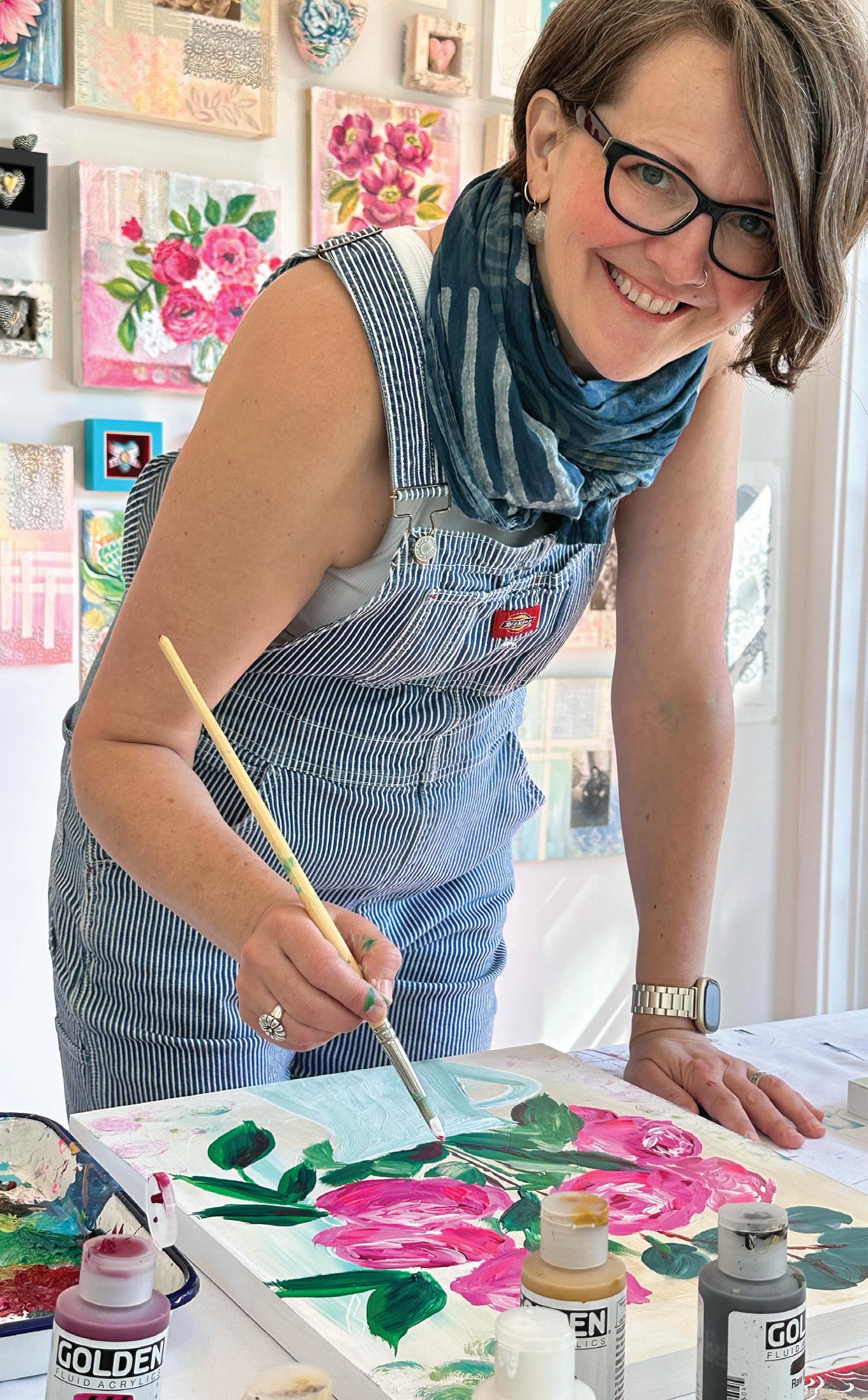
DIANE KAPPA lives in Seattle with her husband and wheaten terrier, Maggie. Growing up the daughter of an artist, Diane has always been encouraged to be creative. She started her art licensing business nearly 20 years ago. When she is not designing for her art business, she enjoys teaching block printing out of her new studio.
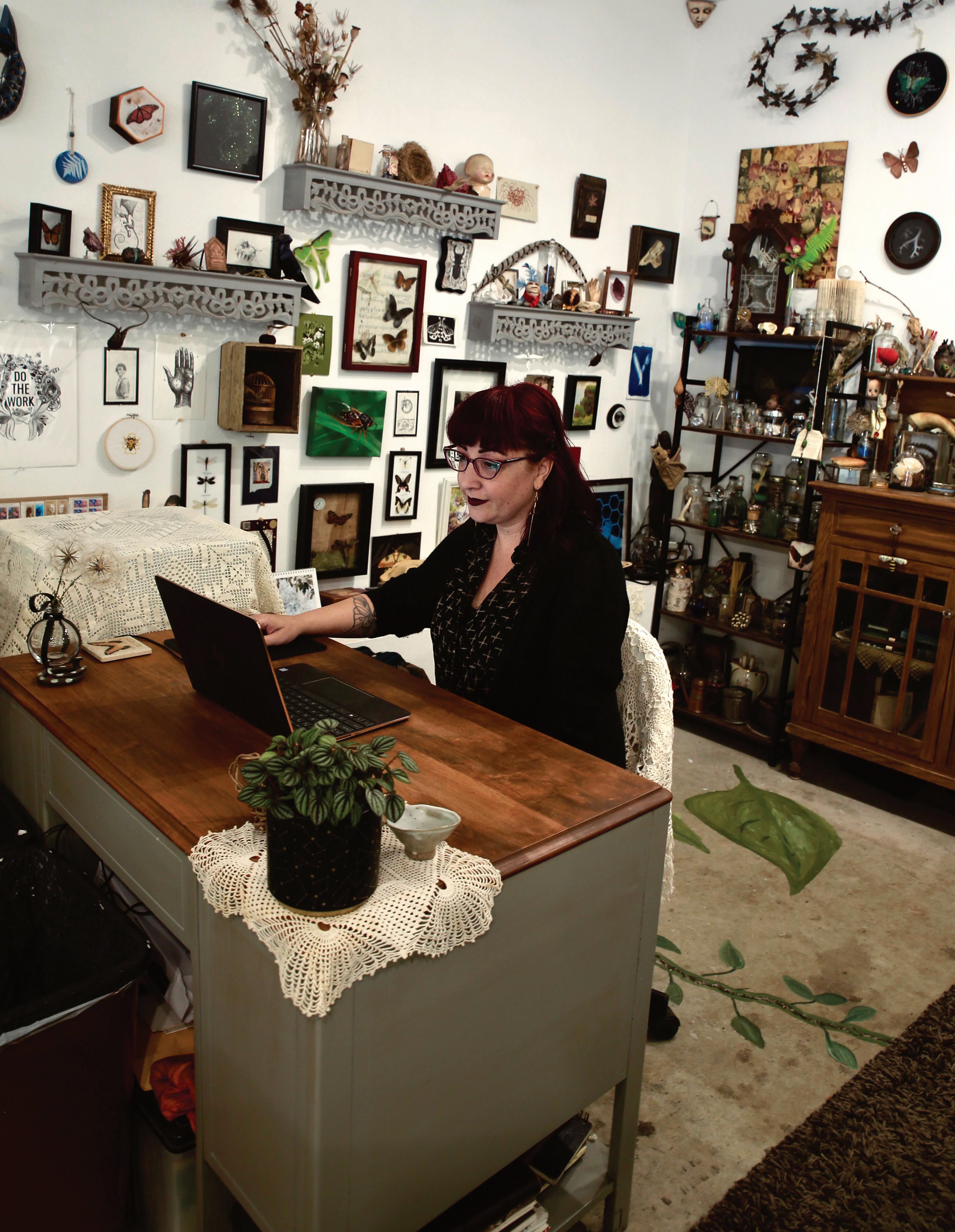
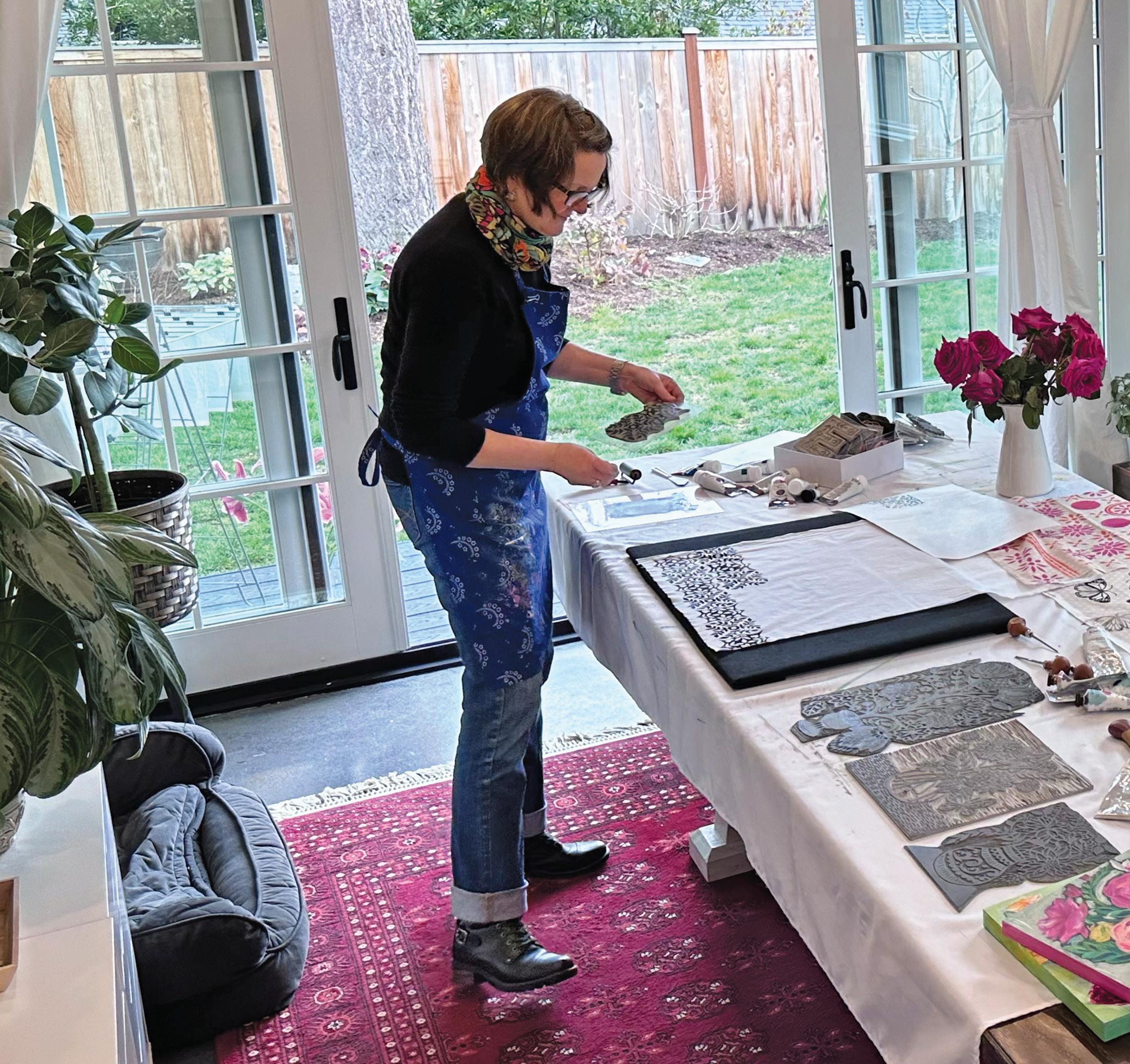
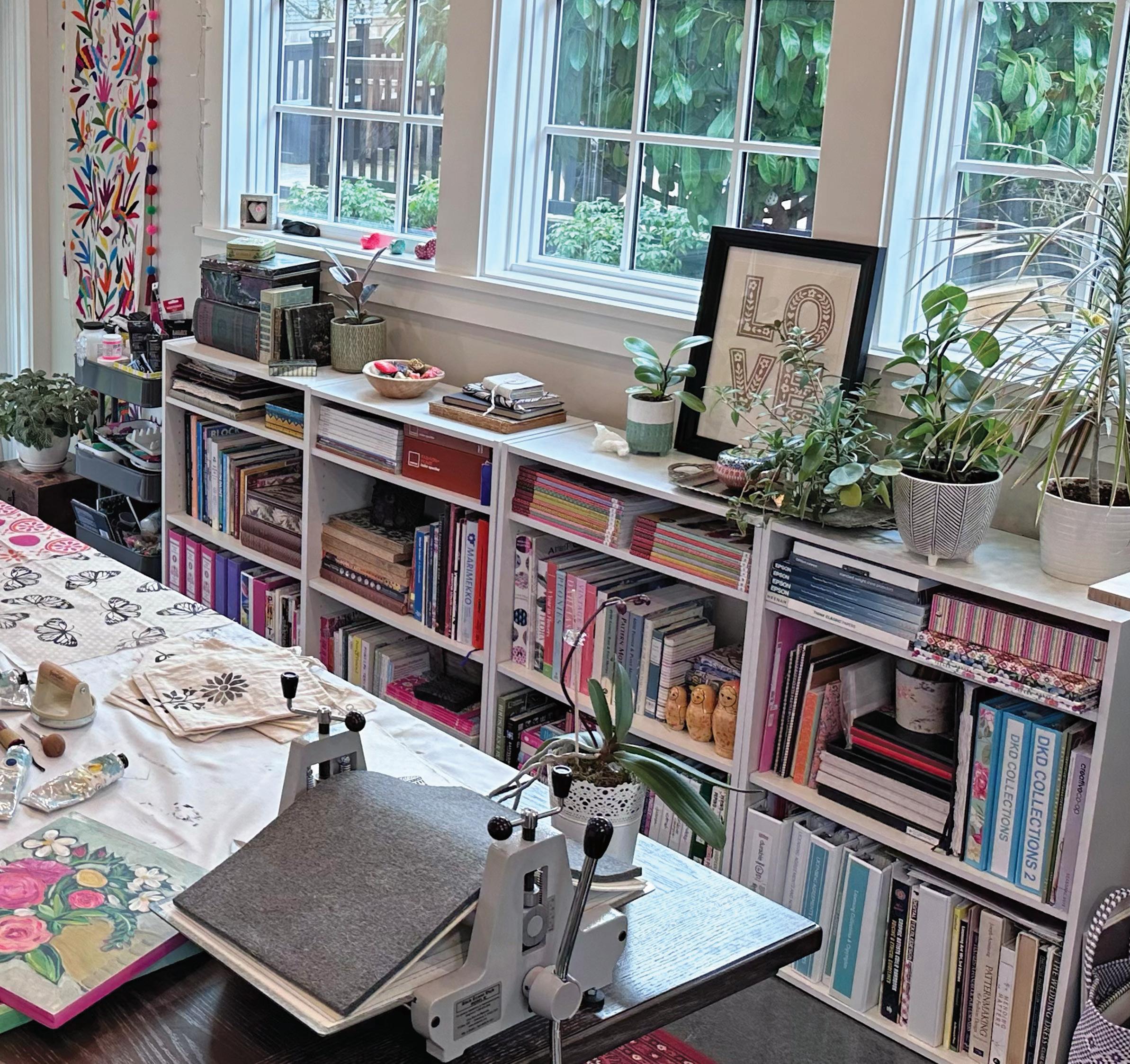
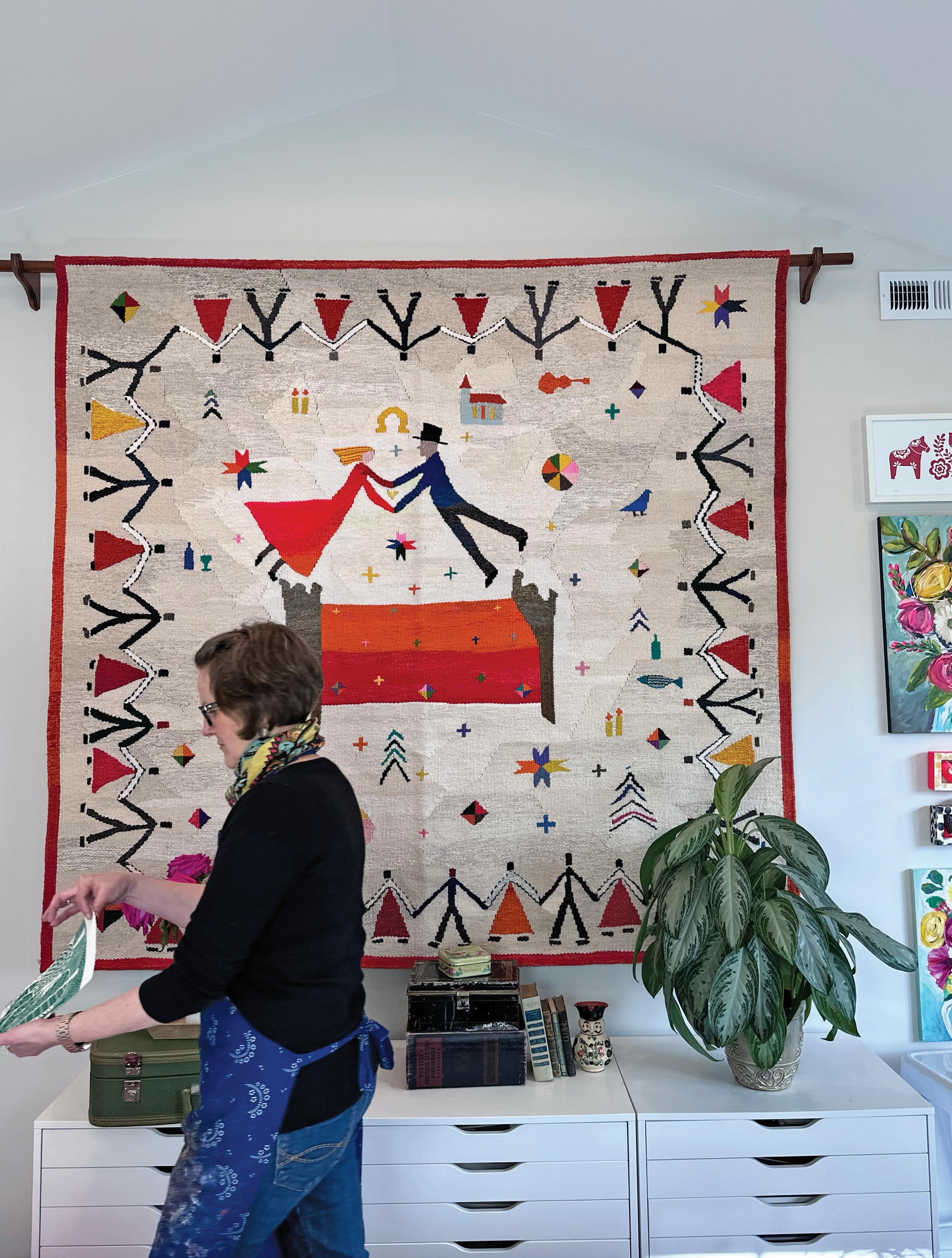
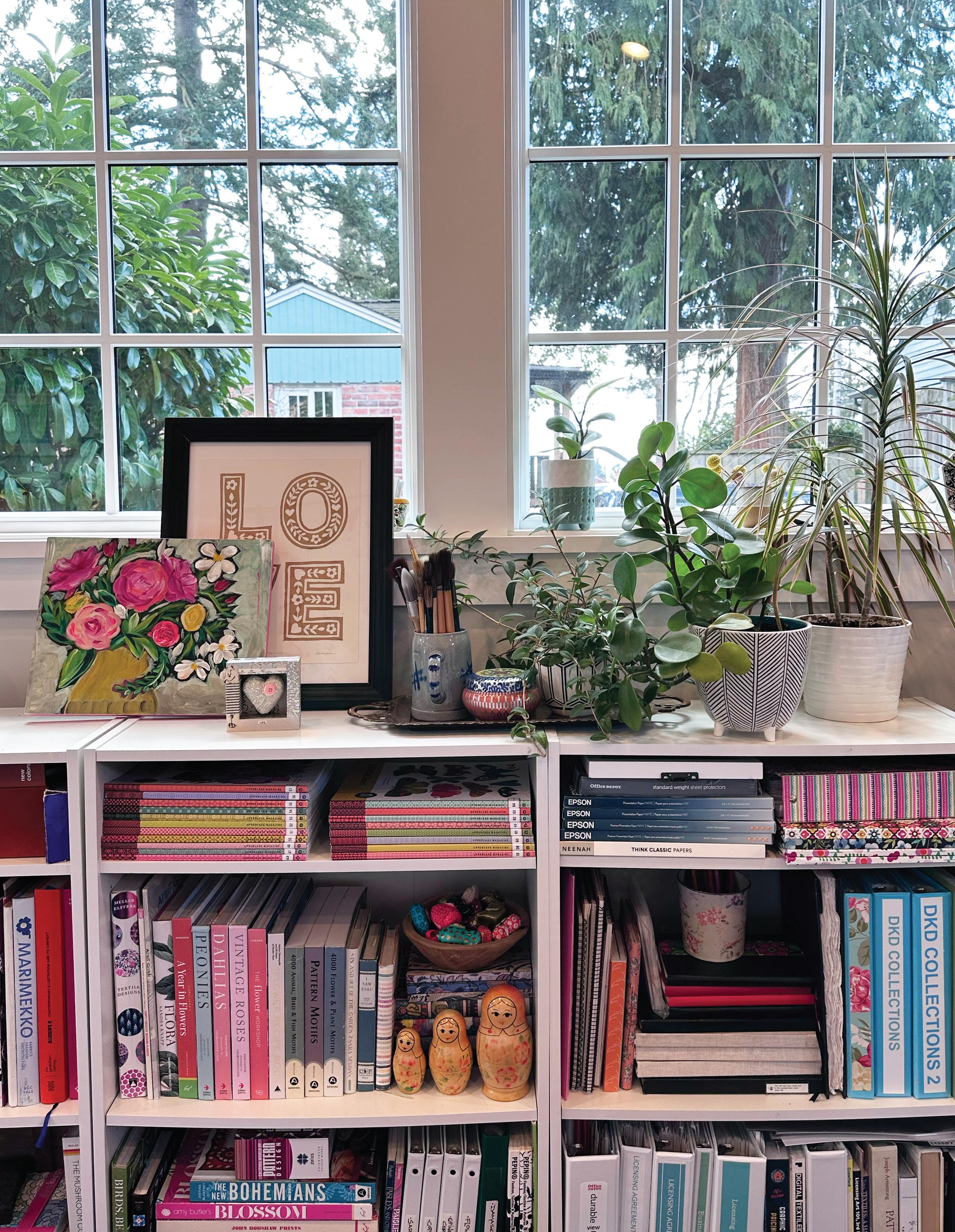
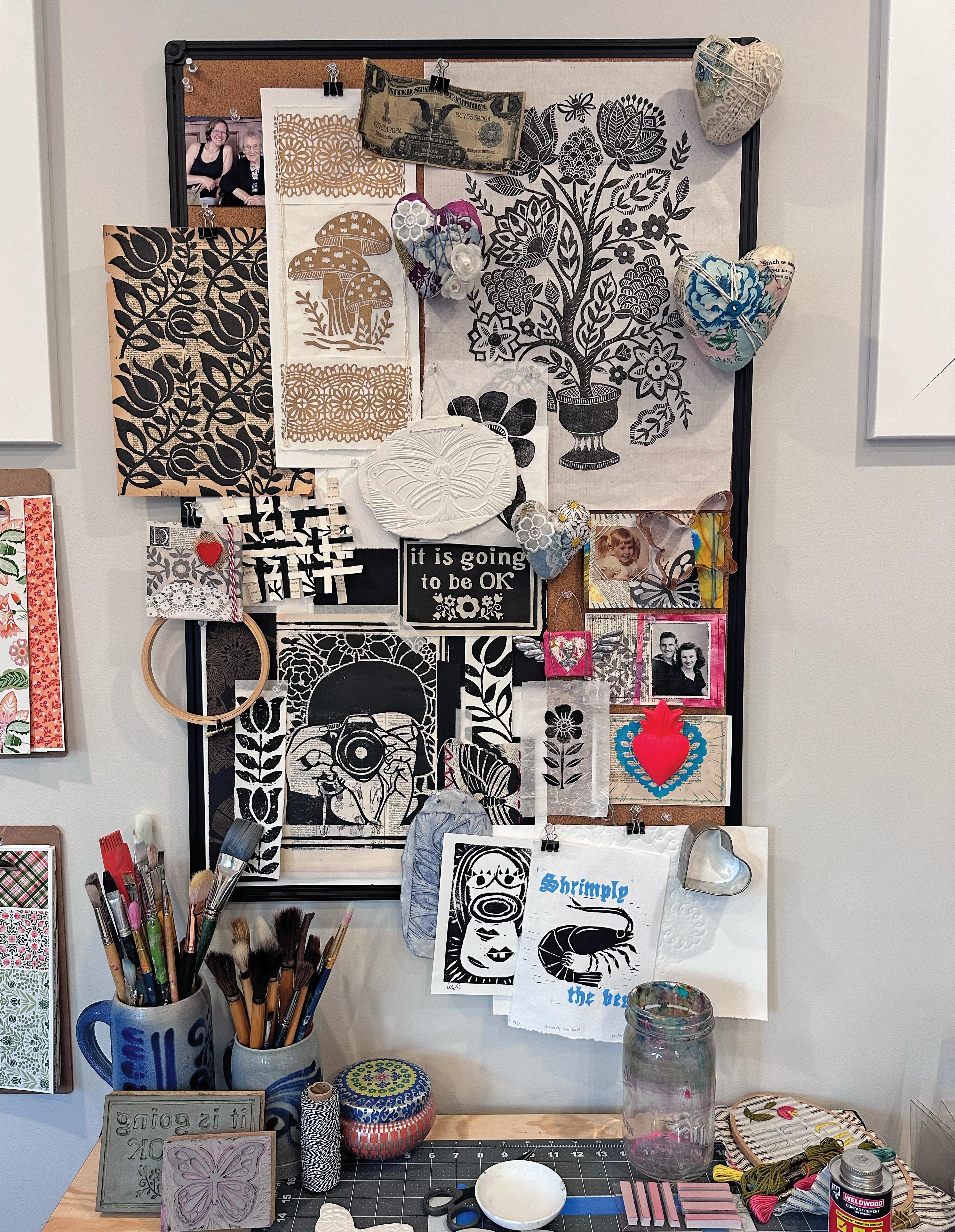
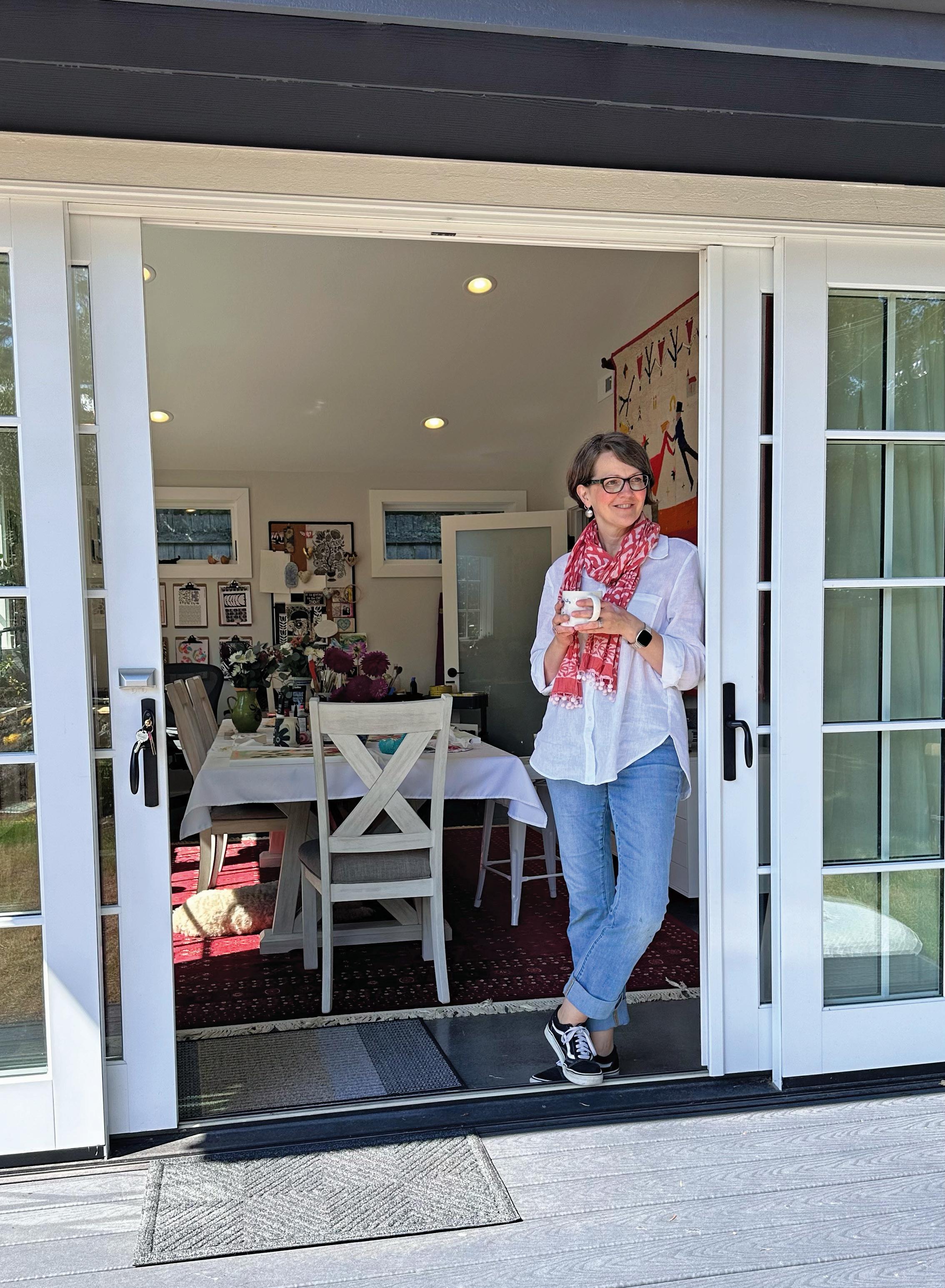
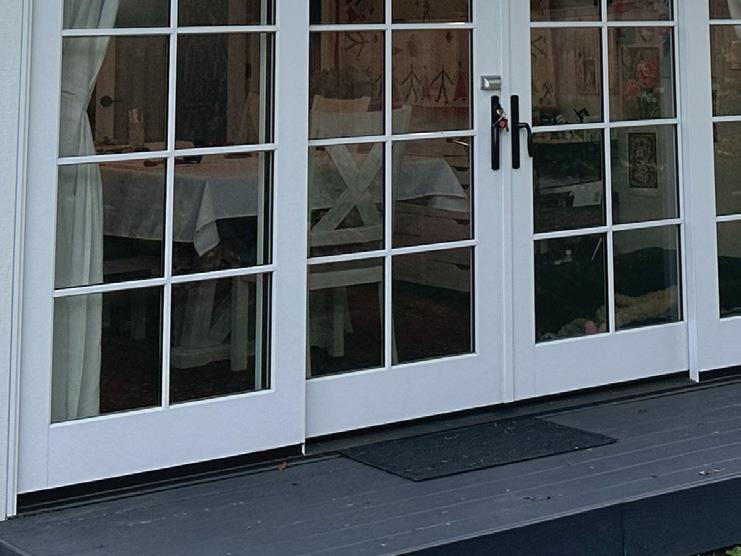
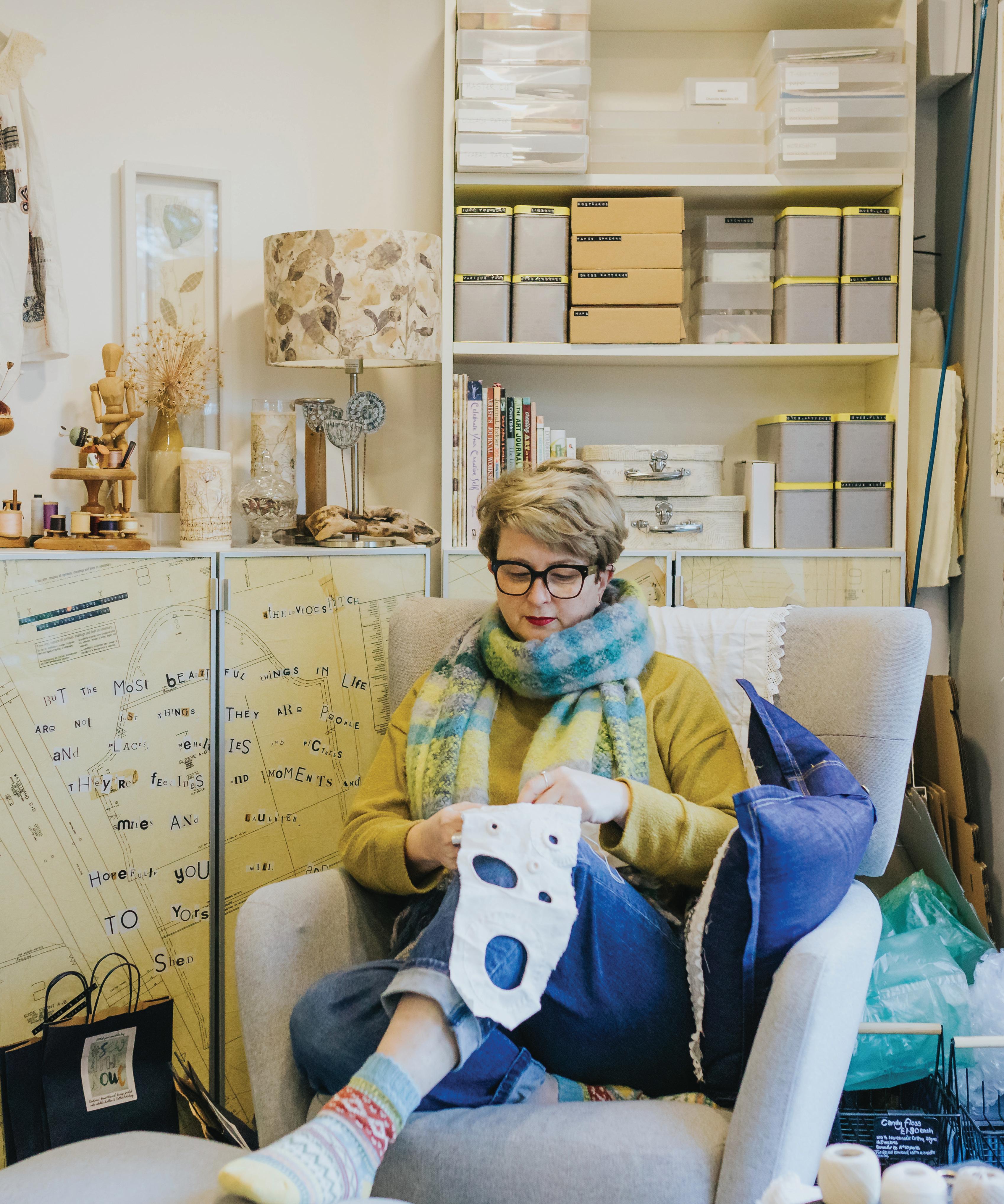
As you walk into the Väike Kodu (Estonian for “little home”) you are surrounded by tons of windows, a large Estonian tapestry (which I refer to as my engagement ring), a wall dedicated to my trips to Mexico, a small, coveted printing press, paints, block prints, and books from around the world. The morning light is magical here, and the smell of coffee is strong. On clear days, there’s no need to turn on any lights as the natural light shines through the double glass doors outshining all other light sources. On gloomy days, the fairy lights add a touch of magic as I listen to the rain from my warm, cozy studio.
I haven’t always had a separate room to create, let alone a separate building. My first “studio” was a table in the corner of our bedroom, then a corner in our living room, then the extra bedroom, then the kitchen table, and now the amazing space I currently have. All those creative workspaces were appreciated and inspiring regardless of location or size, but this is the one I’ve always dreamed of.
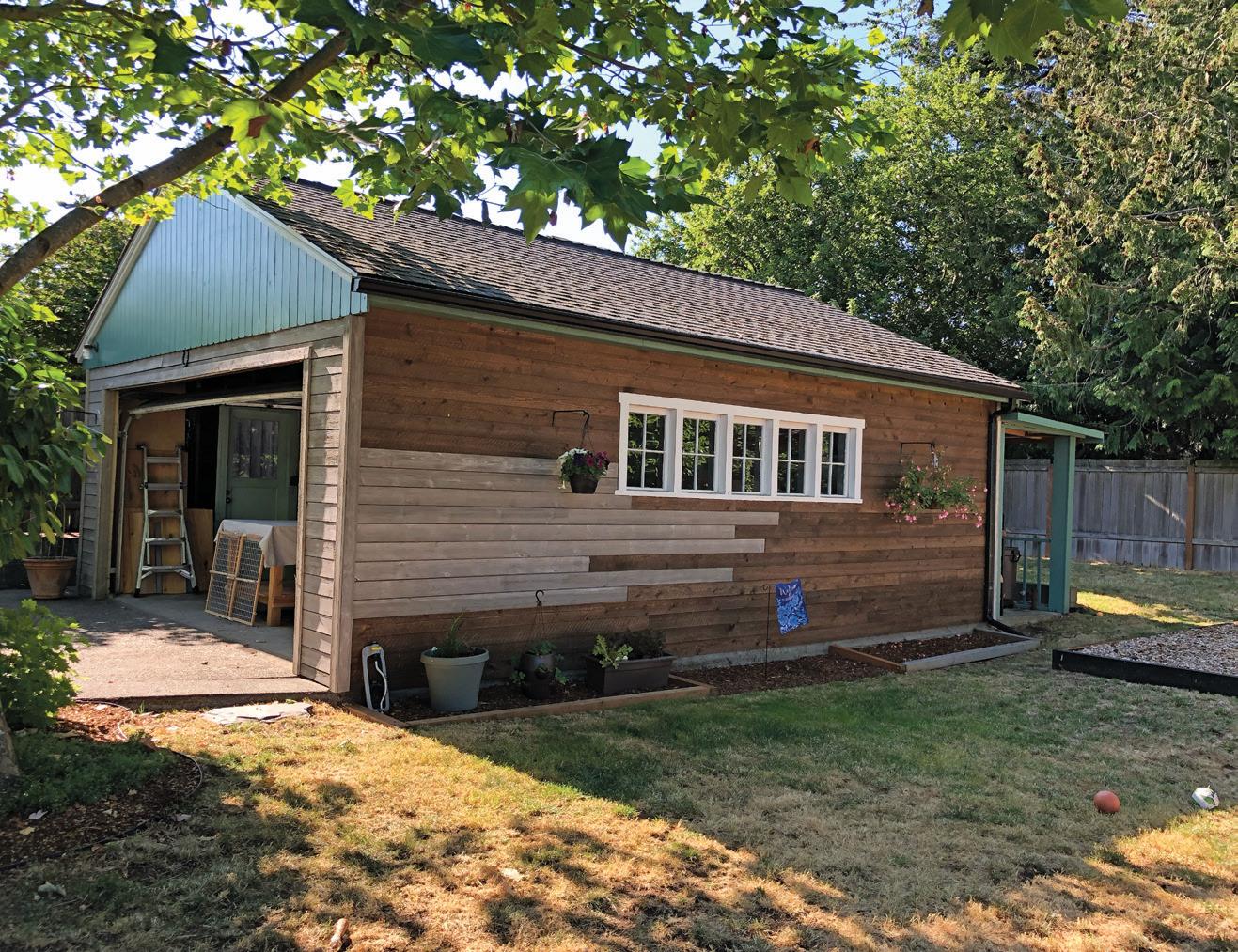
We bought this 1948 house in 2018. The story of finding it is remarkable, but let me start from the beginning…
I grew up in Ohio, the daughter of an artist/ art teacher and fireman. Our summers were built around long camping vacations out west—Dad playing his favorite music and Mom sketching the scenery from the passenger seat. My mom’s sketchbook came with her everywhere—it didn’t matter if the road was bumpy, she was sketching. My sister and I sweat it out in the back of a blue van while my parents enjoyed their time away from work.
This is where my love for travel and adventure originated—and my creative nature.
As a young kid, art supplies were always welcome gifts at birthdays and Christmas—creativity always encouraged. When my sister and I were around 5 and 8 (I’m the oldest), my mom went to college and was put in charge of the college art gallery. My sister and I went to every gallery opening. Mom would put us in the empty classroom next door where I pretended to be teaching an art class—my sister the only student. The classrooms were filled with looms,
easels, and desks splattered with paint—the smell of turpentine still takes me back to that happy place. The opportunity as a child to look up close, unsupervised, at all the art and textiles supplies is something I will never forget. My mom surrounded my sister and me with artists, art, and a passion to create. Her teaching me to create was made official when she became my high school art teacher.
In addition to my mom, my grandmother has been a huge influence in my life. A phenomenal
quilter and sewer, she taught me to sew and bought me my first sewing machine—an old olive green, knee-operated Kenmore she found at a garage sale. As a teenager, Grandma and I would go to the fabric store where I would pick multiple dress patterns. I would tell her, “I want the skirt from this one, the top from this one and a huge bow in the back,” and she would put together my vision. Together we would make my homecoming and prom dresses—me the design director and she the
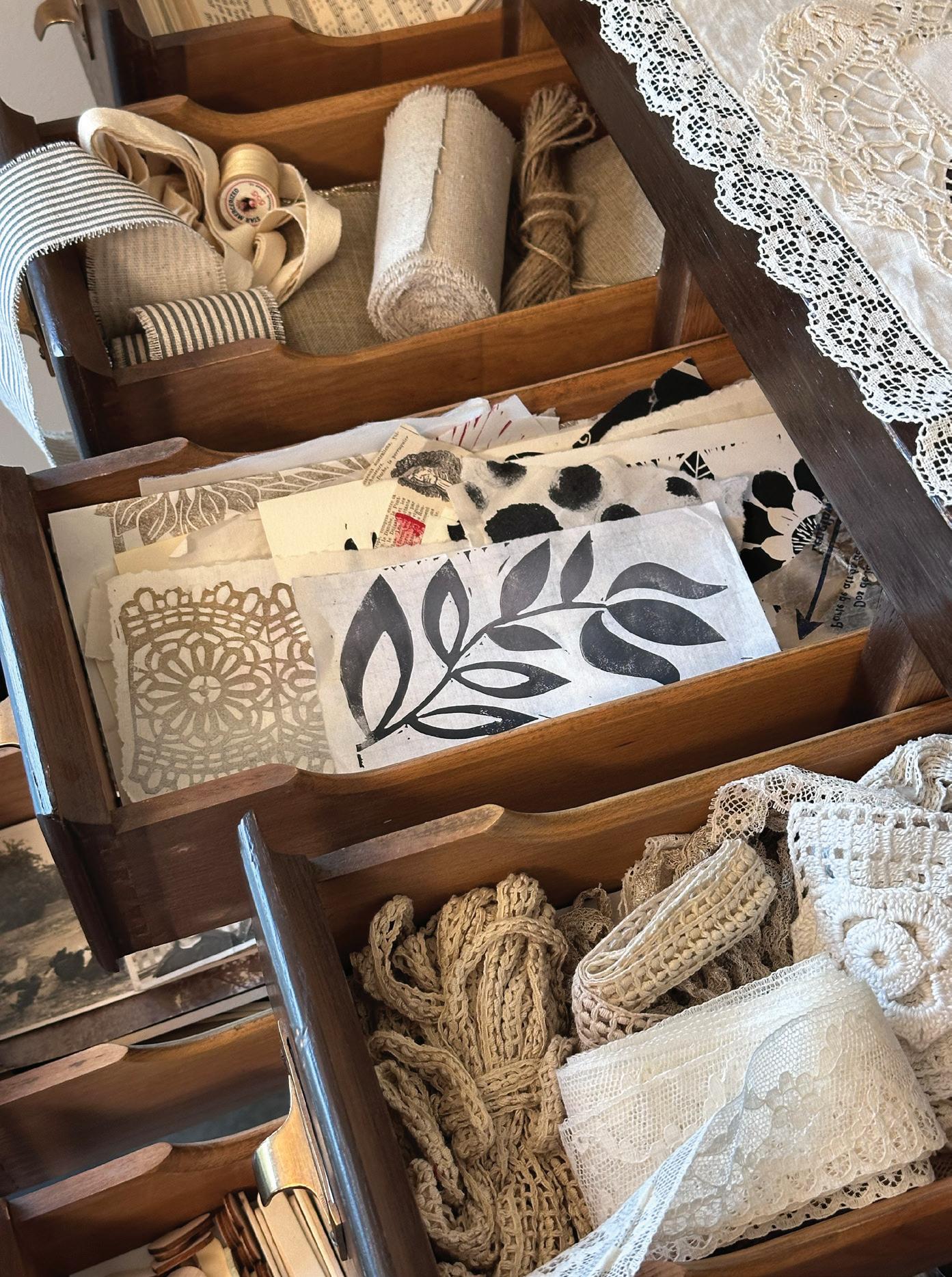
ever-patient sewer. My grandma today is 97 years young and still a powerful inspiration to me. We spend a couple of weeks together each year just she and I, talking about her childhood and looking at old photos, old notebooks, and letters. She still has her notebooks from 8th grade! These precious weeks I spend with her have influenced my current art and my love for vintage lace, old, yellowed dictionaries, and relics with stories and history, many of which are beginning to overtake my studio.
“A ship in harbor is safe, but that’s not what ships are built for.”
— John A. Shedd
It should come as no surprise that I would follow a creative path when I went to college. I had always wanted to be a fine artist, but with gentle encouragement from my mom, I decided to major in something creative but more commercially viable: fashion design. Making a living as an artist is hard, and my mom knew first-hand how hard, so she encouraged a creative life that could more easily pay the bills. Sadly, she passed away before I became a licensing artist and began to find my true creative calling. But I like to think she is with me every time I put brush to paper.
Once in college, I took an elective course that opened the door to a career that I didn’t even know existed: print and pattern design. I graduated with a degree in fashion design, but leaned into computers and CAD design which took me down a path of designing patterns for Lane Bryant and Nordstrom.
I met a professor who would be the next woman to help me find my creative path. Grace encouraged manipulation of fabric, whether it be dying, painting, or stitching. She was a master at making fabric unique and your own. My senior thesis in college was inspired by European stained-glass windows. I ended up painting so much silk that by the end of the quarter, I had nearly mastered the techniques of preparing the fabrics, setting the dyes and trying not to make a mistake when cutting the fabric to make my garments.
While in college, I met one of my closest friends, Emily. After college, she moved to Seattle and later, she would start lobbying me to make the move by sending me letters, local magazines, and postcards of my favorite grunge bands. Finally, in 1996, I made the move, and a year later, my boyfriend Steve (now husband) followed. (More on Emily later!)
We loved living in Seattle, but Steve and I had always had a strong itch to live abroad. We traveled overseas as often as time and money would allow. But we wanted more—we wanted to live in a city long enough to not feel like tourists. Steve had had the experience of
the Peace Corps in Estonia, and I had spent a quarter during college traveling throughout Europe. Finally, in 2008 (after years of saving money and planning), we made the move to Budapest, Hungary. Looking back, this was one of the most transforming experiences of my life. Still today, the lessons learned and the folk art I was surrounded by influence all aspects of my life and art. I could write this whole article on my time abroad—how I met so many artists who were encouraging, welcoming, and inspiring, how living abroad gave me a feeling of true freedom, a sense of anonymity—not worrying about impressions or failing since no one in the country knew me! It was real freedom! We spent four years in Budapest. While I am grateful to have this life in Seattle, I will always look back at my time in Europe as transforming and one of the most important decisions that changed the course of my life.
Fast forward to 2018. Living north of the city, Steve and I had been wanting to move to West Seattle for years. But the housing market was madness at the time, and Steve and I didn’t have the stomach for the craziness of buying and selling a house. One morning, Emily (the friend from college who recruited me to move to Seattle) sent me a text saying she had run into her next-door neighbor, and he was going to be putting his house on the market. Did she know anyone she wanted to be her neighbor, he asked her. She texted me the address, and I looked up the house online, finding an old real estate listing with photos. A week later, we met with the owners.
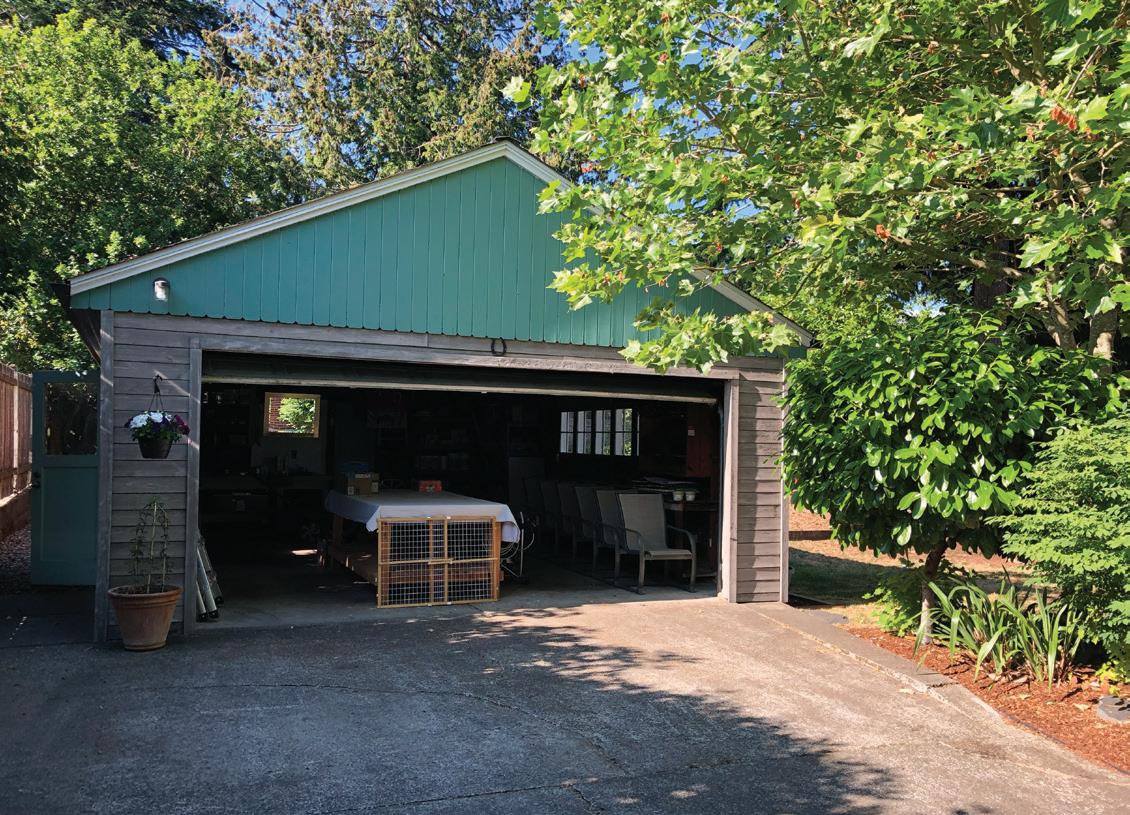
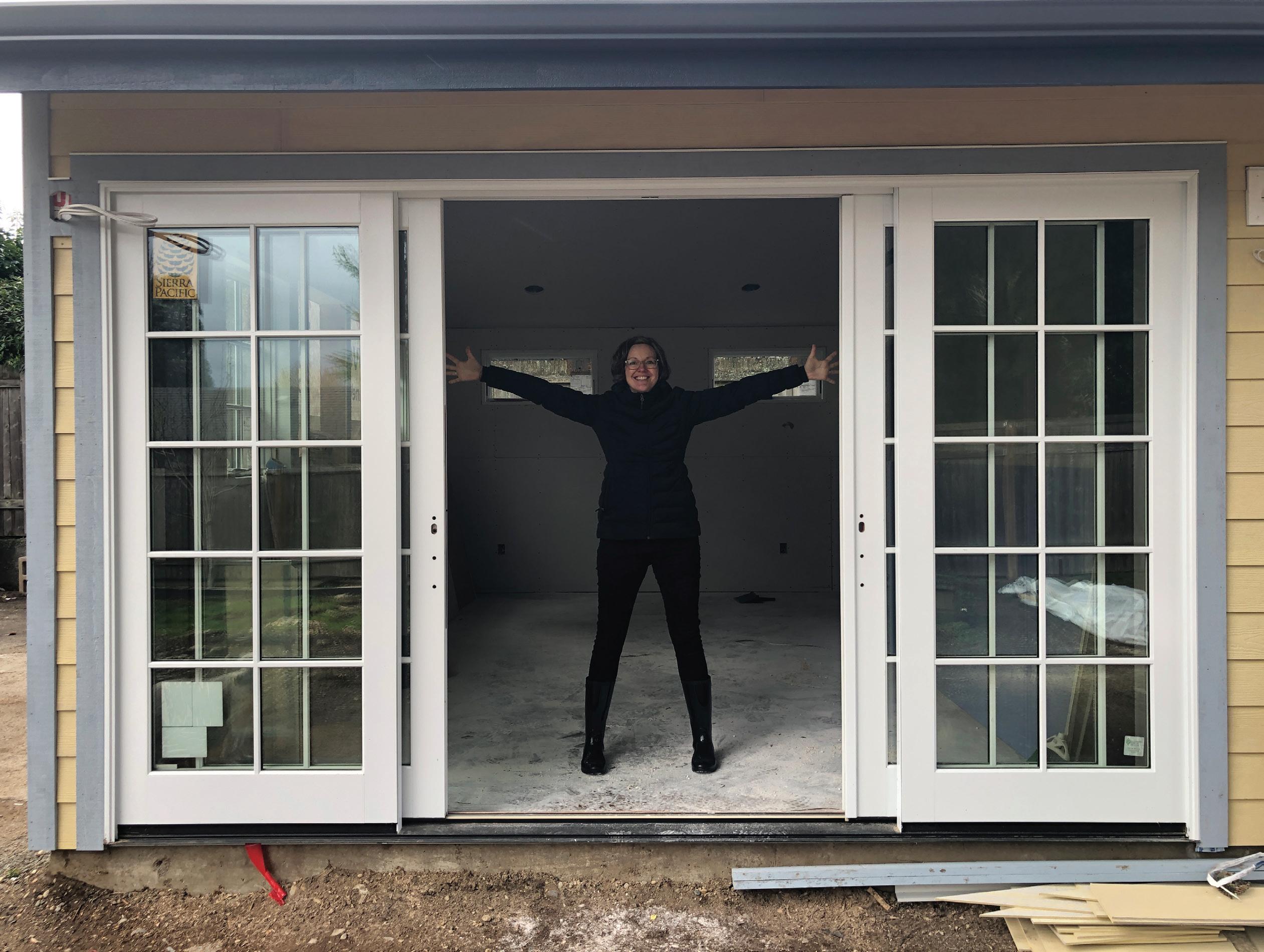
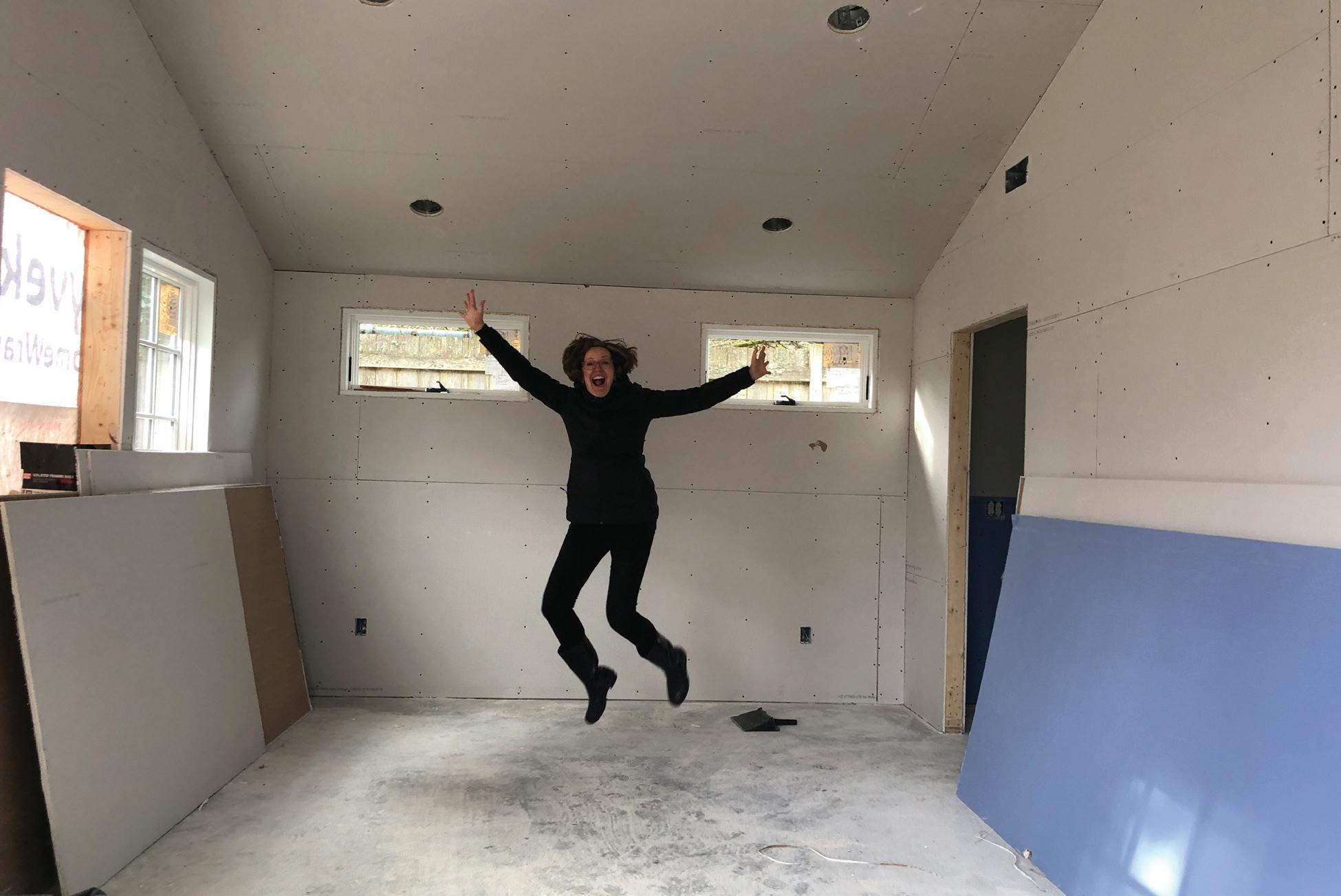
The house was/is adorable. Built in 1948, the small 850-square-foot home came with a large 640-square-foot detached garage. When we saw the garage, we were hooked. We envisioned a remodel with a studio for me and a sauna for Steve. The backyard was substantial and calling for a garden. As soon as we got in the car to leave Steve said, “Let’s buy it.” We negotiated price through a text and began the process of buying the house. The house never went on the market, and we are still in contact with the previous owners who, it turns out, had also dreamed of remodeling the garage and adding a sauna. In 2022, we began the process of remodeling. We sat down with my iPad and sketched out a rough plan. We were on a budget and relied on the project manager and construction guys to guide us through some decisions. One example was the molding. They asked what we wanted them to use—something we hadn’t thought about. I asked what our options were, the price ranges, what’s most commonly used, and what they would choose. I would make these kinds of
decisions on the spot, and we would keep moving forward. The features most important to us and non-negotiable were the windows, doors, and the sauna. The rest we were ok with changing to fit within our budget. With that said, we never went for the cheapest solution, but we never went for the most expensive either. The result—our Väike Kodu—our little home.
When I am in the studio, I’m surrounded by reminders of travels and friends abroad. Textiles, trunks, and trinkets hold memories of markets, people, and cultures I was privileged enough to experience. The large Estonian tapestry, the old vases and textiles I collected while in Hungary, the Mexican textiles, the old books found in a brocante in France, the old lace found in a flea market in England—all remind me of a life well lived and inspire me to keep exploring, keep trying to live a life of true authenticity and bravery. To be creative without worrying about the judgment or opinions of others.
Today, I love inviting others to my studio to create with me. I started teaching block printing classes over a year ago! When my students arrive at the studio, they are always in awe of the windows, the high ceilings, and the tapestry. I absolutely love teaching and sharing my space. I want to offer my students an escape from daily life. I want to encourage them to find the spark of creativity that allows them to feel empowered and proud.
“Twenty years from now you will be more disappointed by the things you didn’t do than by the ones you did. So, throw off the bowlines. Sail away from the safe harbor. Catch the trade winds in your sails. Explore. Dream. Discover.”
— Mark Twain (attributed)
I’m grateful for such a grand space where I can spread out and work on multiple projects at once. I love having paints and canvases on one side and a working lino on the other side. I like to think of art like food cravings. Sometimes you want salty and sometimes you want sweet. Having all the options laid out gives me the freedom to sit down and dive into whatever I am craving. It wouldn’t be fair to write this without mentioning how forever grateful I am to have a partner who understands the importance of a creative space. Always giving up the primary bedroom so I had more room to create and then finally giving up the garage to turn it into a real studio at last. None of this would be possible without his encouragement and support.
More on Diane www.dianekappa.com Instagram: dianekappa
KELLEN MEYER
Photography by Cecliy Breeding
ARTISANAL JOURNEYS
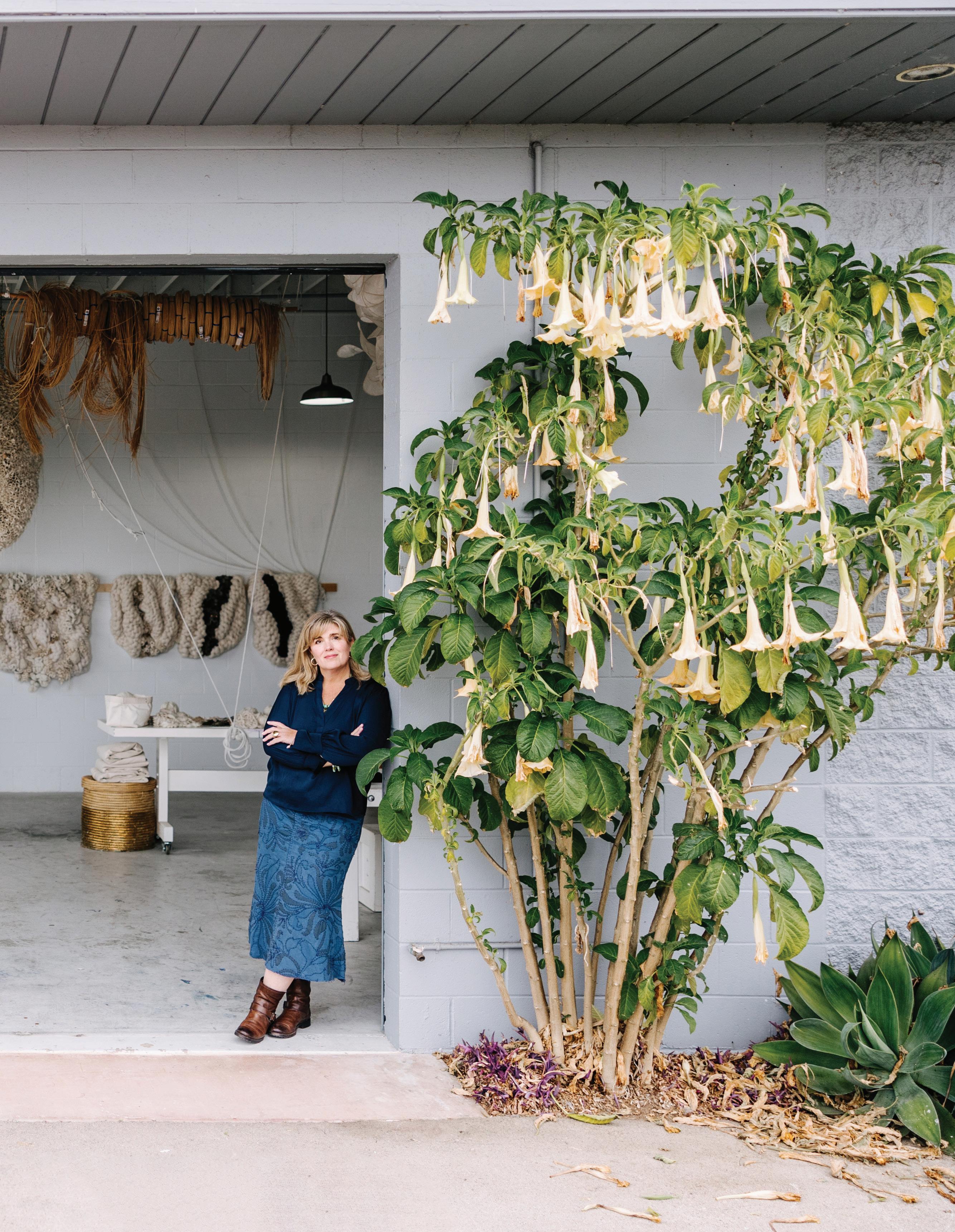
KELLEN MEYER lives and works in Southern California. As a fiber artist and sculptor, she explores the natural world and entwines a variety of fibers and organic elements to create works of art. The influence of the wild outdoors weaves a common thread throughout her work. Kellen creates in her studio overlooking a bird sanctuary. She walks daily on the beach collecting colors, stories, and images. Kellen believes in the power of love, connection, and community.
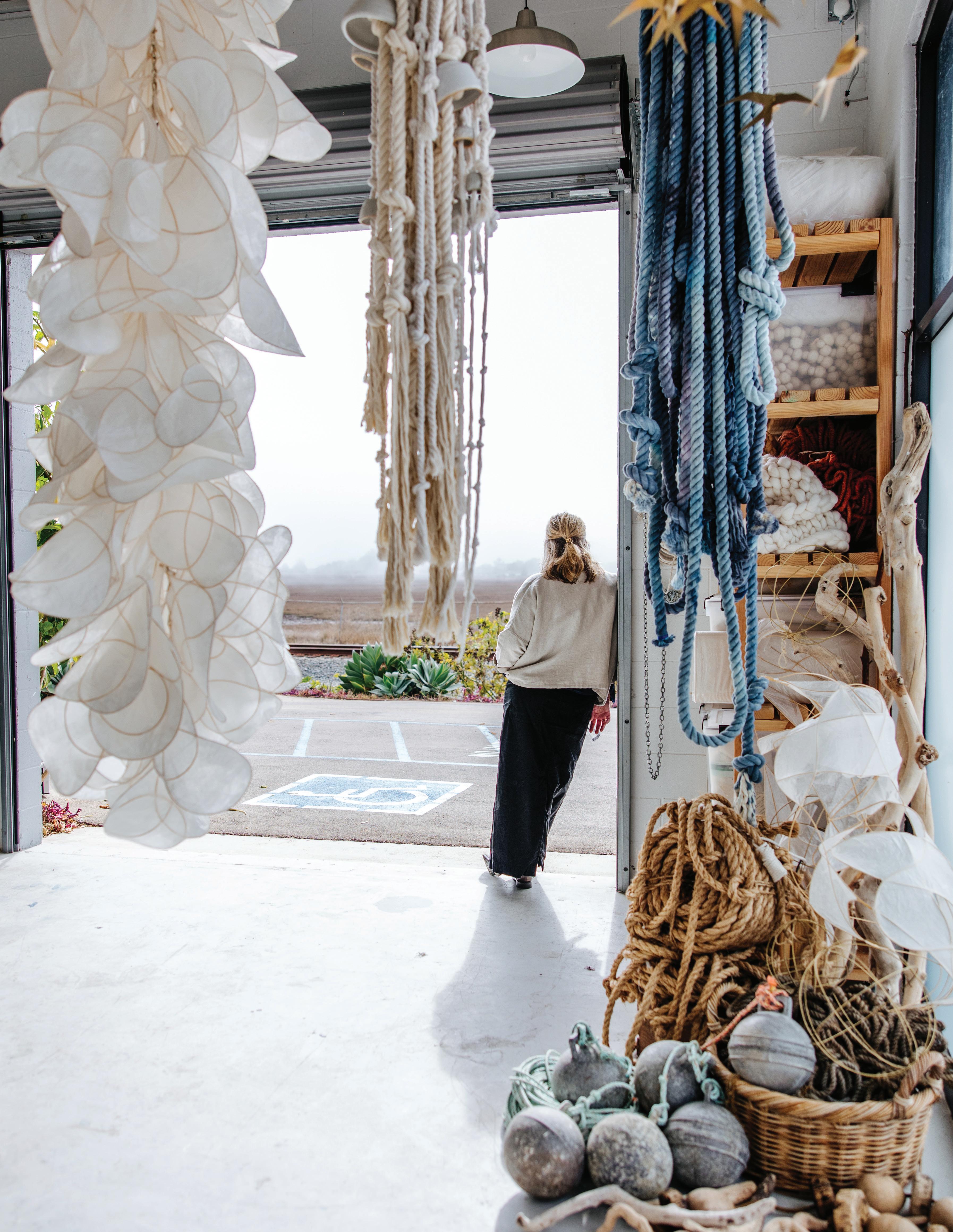
MY day starts with the rumble of the garage-style door opening to my first glimpse of the marshland outside my studio. Hawks glide on the breeze above. Bees hum in the trumpet vine nearby. Some days I’m met with large clouds, blue skies, and water moving through the bird sanctuary. Other days, rolling fog tucks me in, while I wrap my scarf more firmly around my neck. On particularly magical days my eyes scan across the train tracks to spy the glint of sunlight on the Pacific Ocean in the distance. Today, holding my hot cup of tea, I turn to survey the space inside.
From ISABELLE FISH:
Kellen and I were introduced by a member of our women’s community and I felt an instant kinship with her art. I admire the audacity of her work in its scale and complexity. The natural origin of each piece is palpable— quietly rest your eyes on her murals and the marsh, the wind, the currents, and the rolling swell will materialize in front of you.
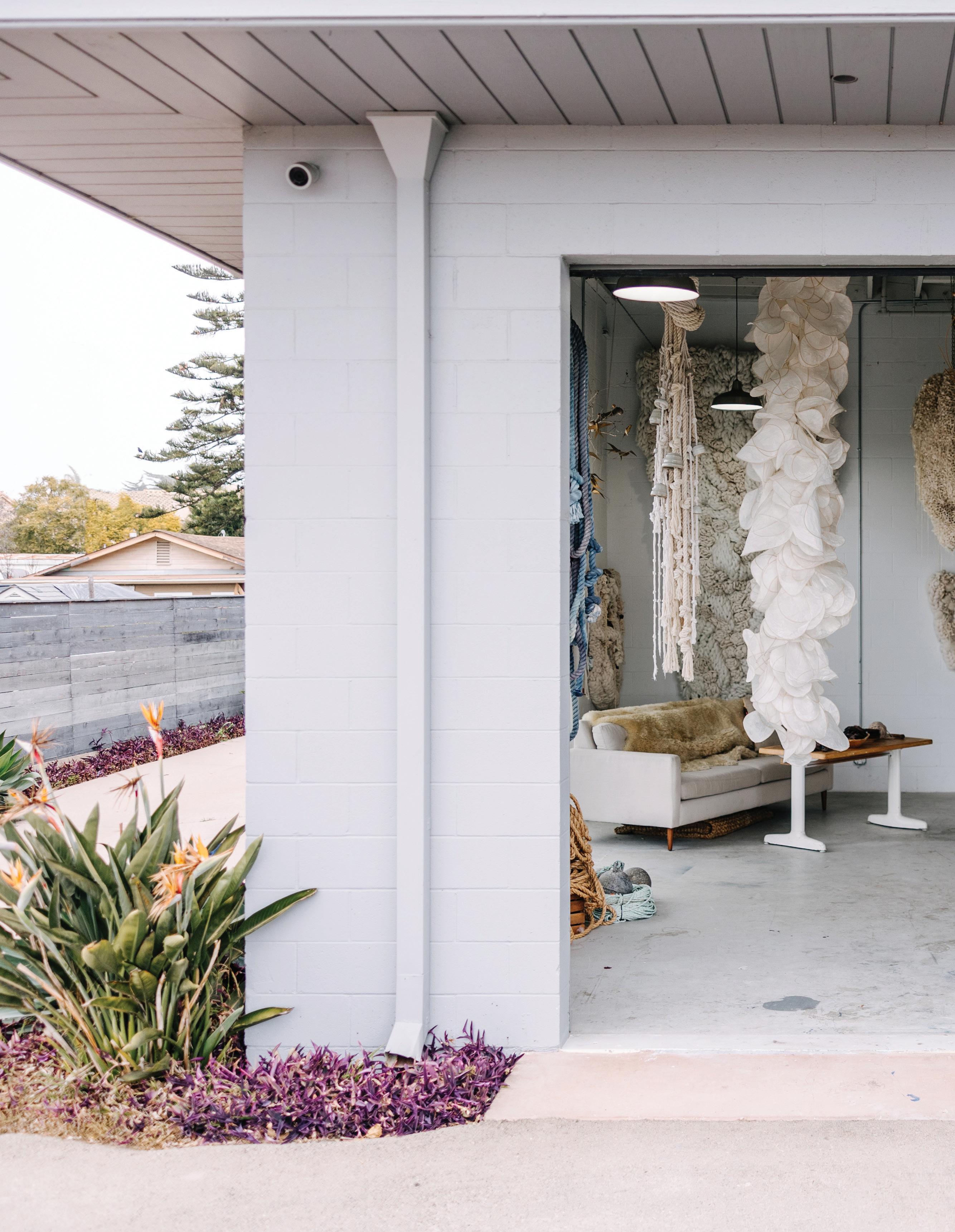
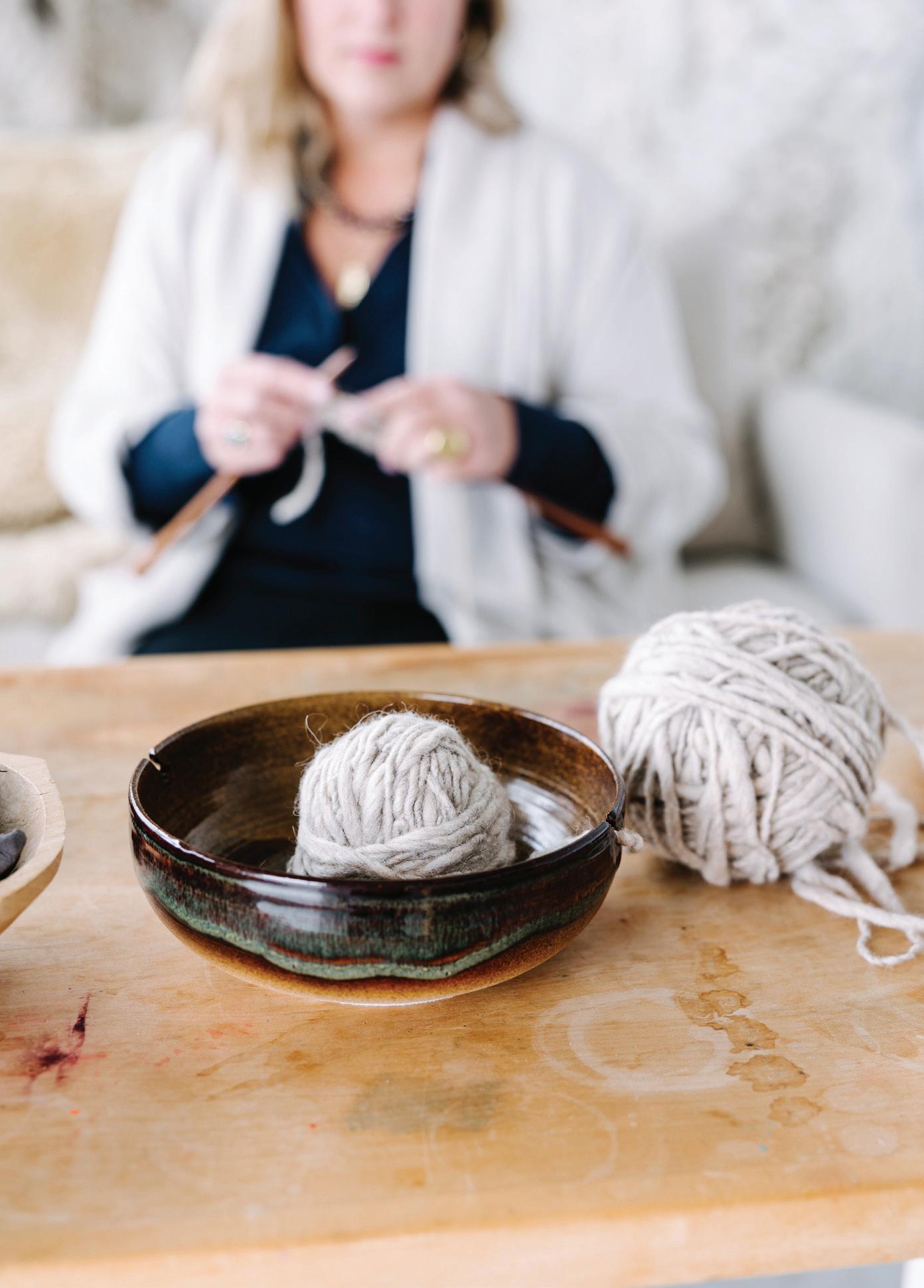
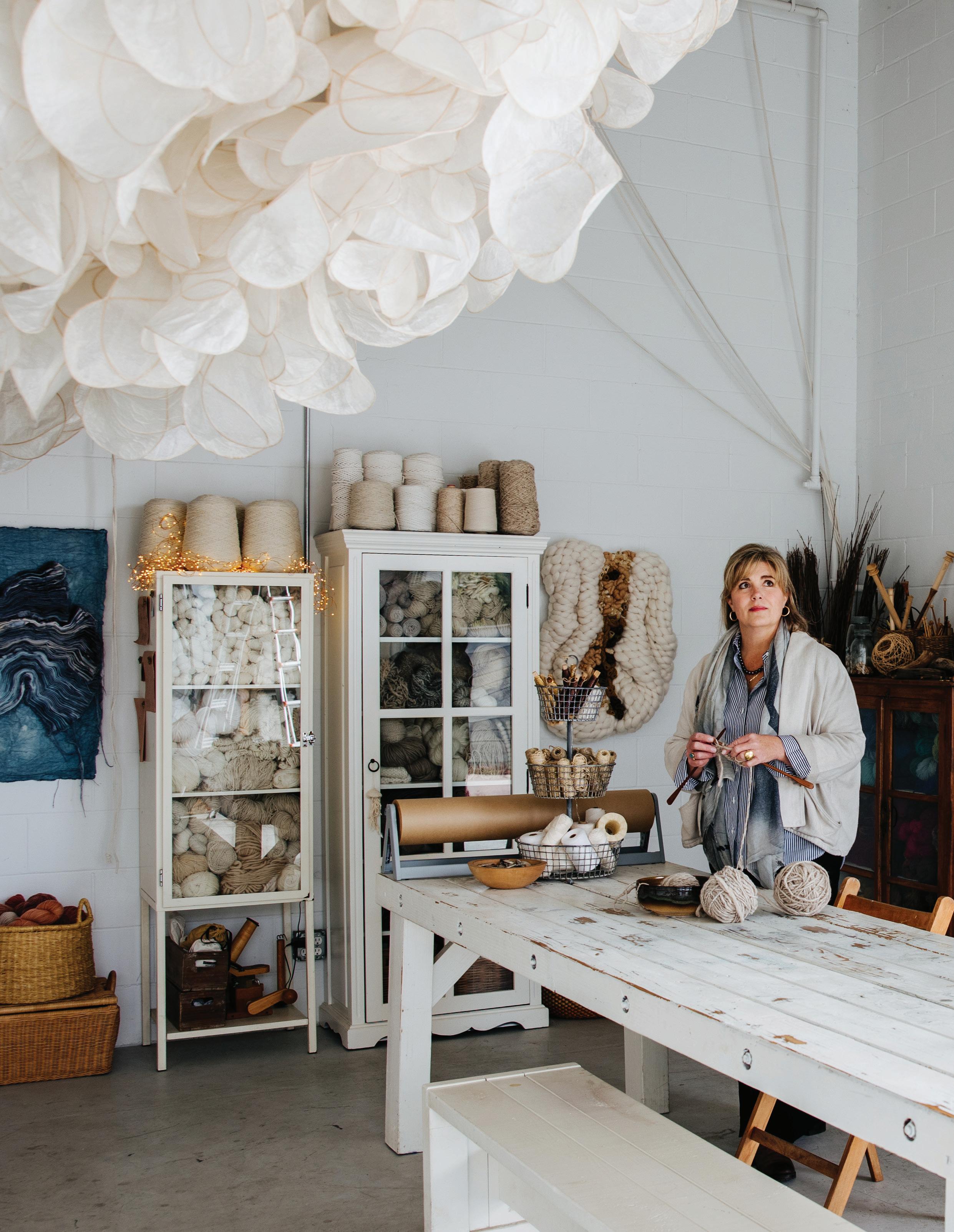
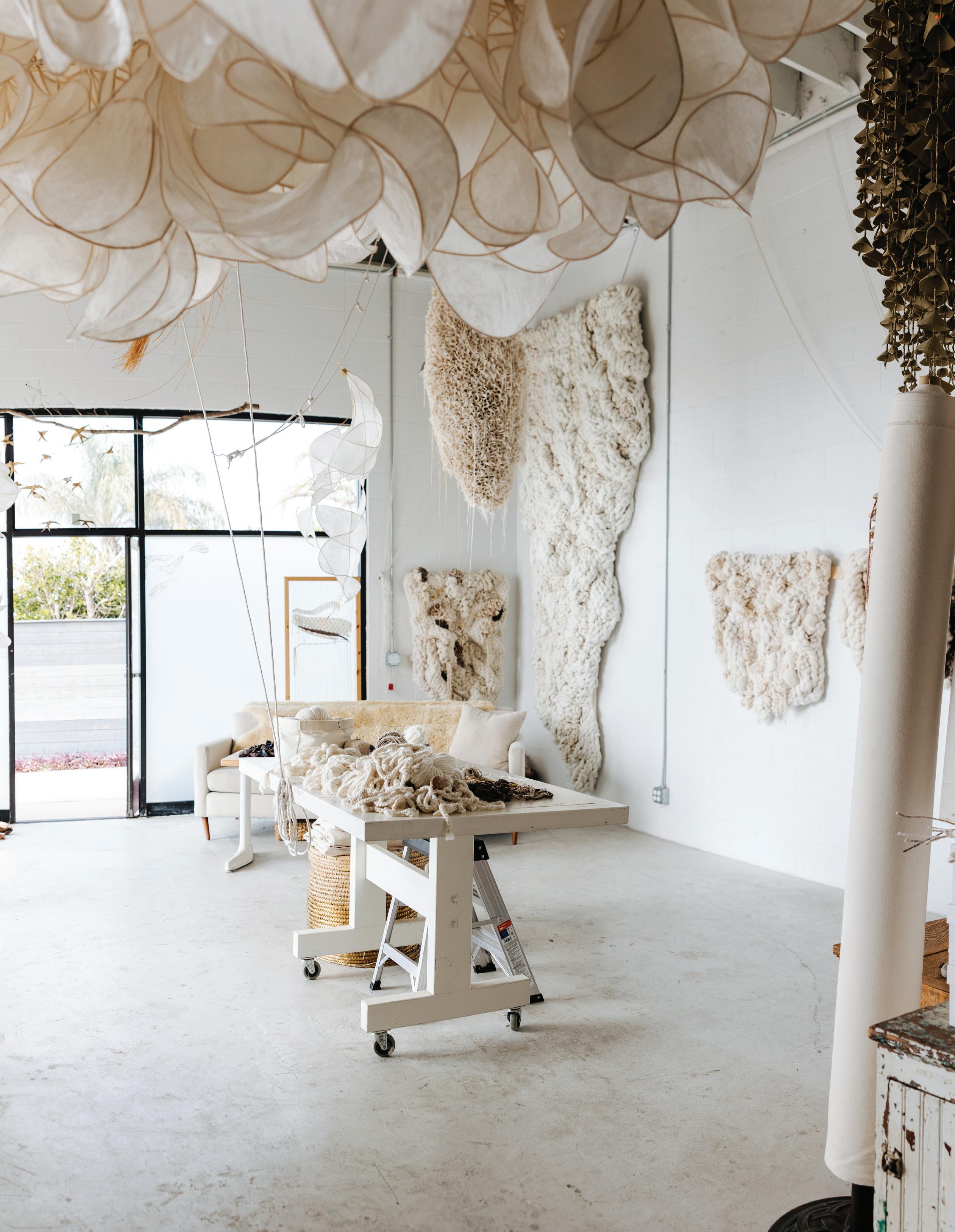
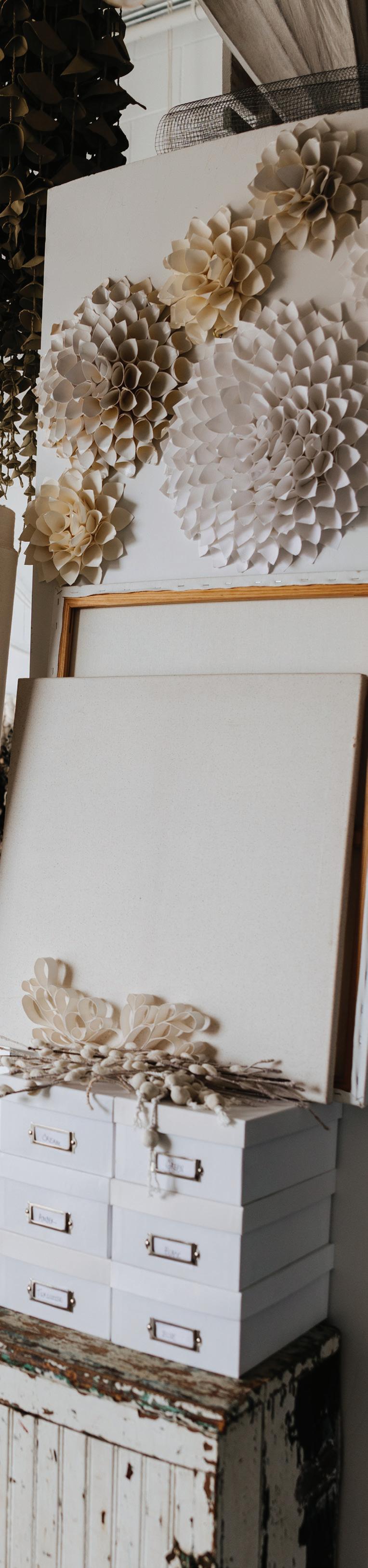
INSIDE the studio, work is strewn on tables piled high with an array of natural elements wool, canvas, paper, driftwood, clay, and raw stones. Piles of knit pieces await their final placement. Large-scale pieces line the walls hung on wooden cleats or pulled up with ropes and dowels. Pulleys throughout the studio allow for work to raise and lower while laden with finished works and pieces in progress, as well as supplies for future ideas. Wood and glass storage units vary in size, shape, and age (thrifted from interesting places) all stuffed full of yarn and fibrous materials. Baskets of knitting needles sit on top awaiting direction. Twinkle lights adorn spaces to add a glint of magic on foggy days. Organic materials nestle in corners for projects dreamt up and those yet to be imagined. Long rustic tables support various states of projects. Large storage shelves hold huge skeins of roving and boxes of fabric and canvas. An indigo-dyed rope installation hangs from
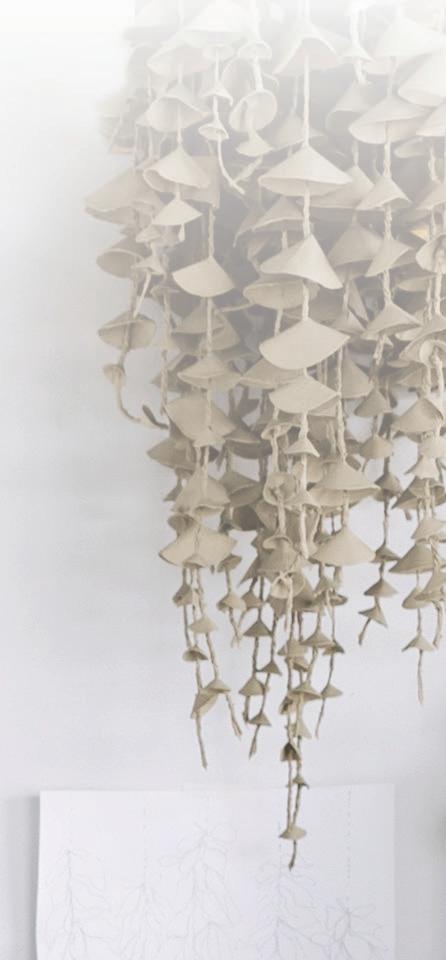
a pulley while ceramic bells adorn another. Ethereal paper petals float and dance in the breeze from outside. While the couch invites moments to pause and reflect on pieces hanging nearby.
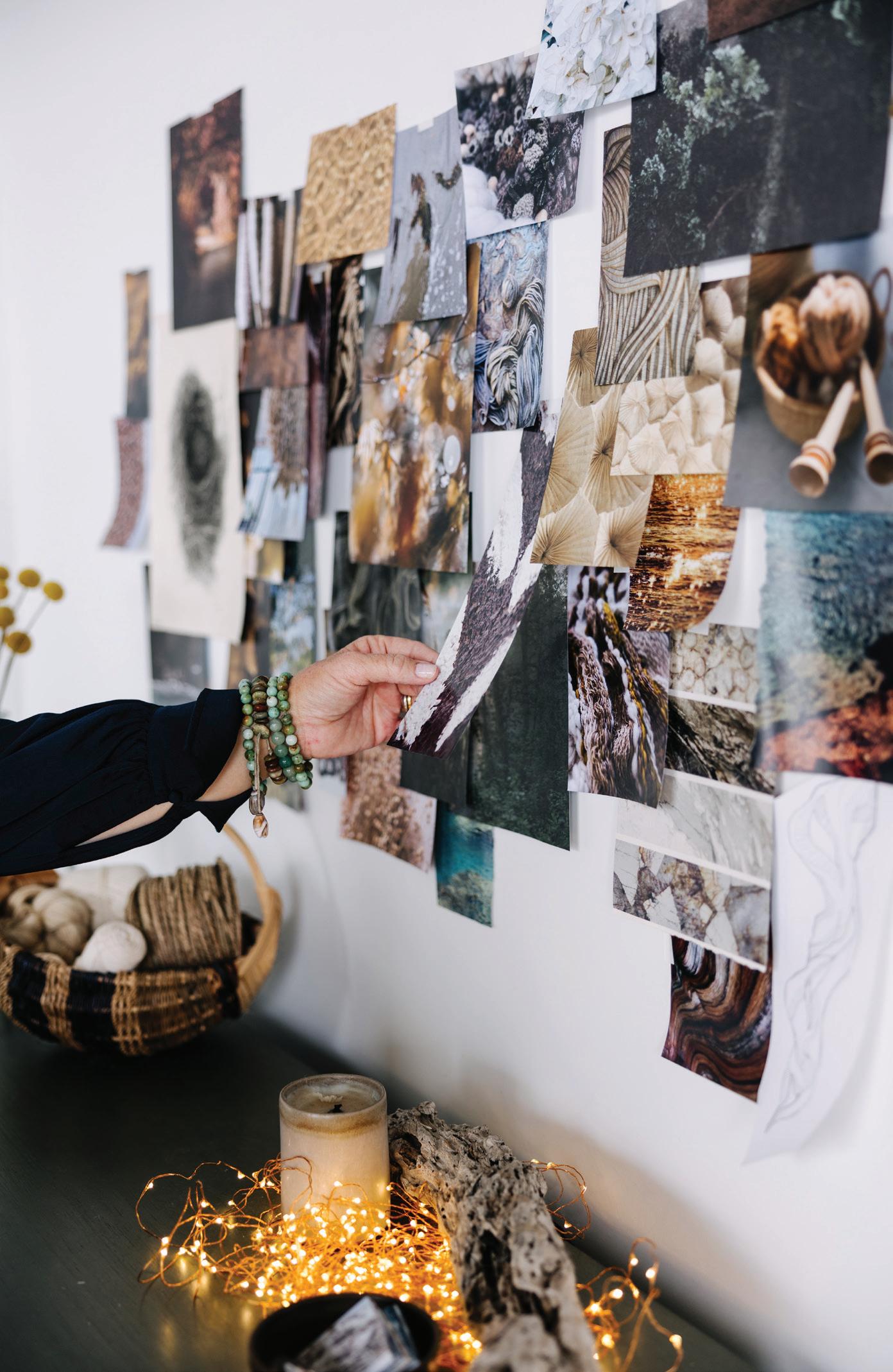
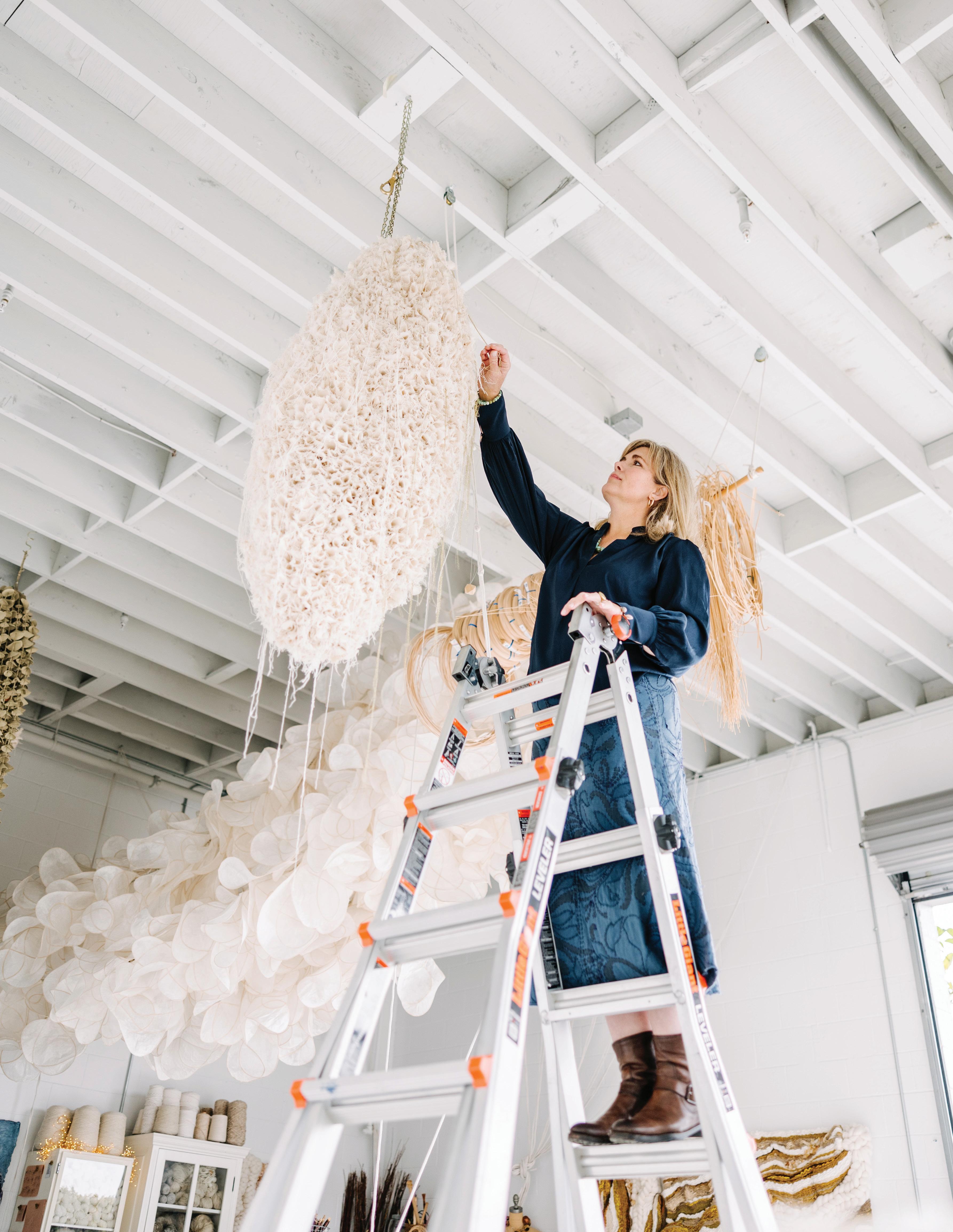
The storage loft above the small bathroom holds supplies for various stages of the process wood for cleats, frames for structure, and even papier-mâché pods awaiting their next purpose. The cement floors swirl with dust bunnies from working with fiber and allow drips from an indigo vat to leave their mark. The 23-foot ceiling is accessible with my favorite expandable ladder. An inspiration board, filled with images ripped from magazines as well as sketches of past and future projects, adorns the wall. Light streams in no matter the season; shifting ever so slightly as the day progresses, illuminating one wall and then another. Origami birds float above the entry. A space for creating. A space for inspiration. A space for big work.
“If you feel safe in the area you’re working in, you’re not working in the right area. Always go a little further into the water than you feel you’re capable of being in. Go a little bit out of your depth. And when you don’t feel that your feet are quite touching the bottom, you’re just about in the right place to do something exciting.”
David Bowie
I didn’t always have a studio like this. I started with small nooks in our home. A corner. A window seat. A table. Then, as the family grew to four children, the table was used more for homework and school projects and less for my art. As an impending gallery show loomed in the distance, the space at home grew too small to accommodate the size of my work. I realized I needed a space of my own. A space to stretch out and create the big art I seemed drawn to. The moment I found this space I knew it was the right one. Though it was a daunting leap to claim the need for this space, it made all the difference in my work. As though, at that moment, I chose my art. My creativity. My worth. A moment to finally see if I could do this. If I could claim my art; champion my own need that would ultimately feed my soul. The magic of creating was within and I needed to honor that for myself. I had an incredible, passionate desire to put this light out into the world and to see what would happen. The desire to dive in, sink or swim. The uncertainty outweighed by the risk of never knowing if I could. Until I dove in headfirst, I would never know.
NOW I know. I’m so many things, including an artist. I’m an artist who isn’t afraid to work hard. To struggle through figuring out a particularly challenging piece and find the solution on the other side. Perhaps not the first time or the fifth time but maybe the twelfth time. I made the commitment to continuously show up. Everyday. To choose inspiration in all forms. “To consistently choose curiosity over fear,” as Elizabeth Gilbert speaks about in her book Big Magic. This had a lasting impression on how I approach each day, each project, each choice. Who gets to choose: curiosity or fear? I choose curiosity. It’s so much more interesting. Every day that I roll up the door in my studio, I make that choice. Never really knowing what will come from the day but always knowing I would choose it again. Can I do this? Will this work? What happens when I add these two materials together? Working on three to four pieces at a time, (sometimes more), my mind swirls with ideas. A challenge at times is to remain focused on the one in front of me as new ideas constantly flow. A flood of ideas. I trust in the process of making. It took me a long time to realize that not everyone thinks that way. And it may not work for others, but for me, it enlivens my heart, my mind, my hope for the future. My studio is a sacred space for me to explore all those ideas, whether they end up as an art piece or not.
“When I refer to ‘creative living,’ I am speaking more broadly. I’m talking about living a life that is driven more strongly by curiosity than by fear.”
Elizabeth Gilbert, Big Magic: Creative Living Beyond Fear
IREALIZE that creative energy is quite mystical. You don’t always know what the idea or shape or texture or color will become. Sometimes, with ideas I’ve had in the past, I’ve waited too long to pursue and they moved on. The flow is ever moving and searching. Though I seem to have an urgent need to move through an idea when it arrives. Whatever it takes to make that idea manifest into something. I’ve been reminded that this is about the journey, not the destination. To truly live in harmony with who I am, I’ve had to listen to my curiosity and pursue different ways of thinking. I’ve learned so much when projects push me to my edges. The edges that allow me to know who I am and what I stand for. I’ve had pieces of work, large pieces of work, that in the last moments before installing needed to be redone. Not just a little, but the whole thing. In those moments I found myself with a choice crumble or step up and do what needed to be done. Perhaps there were some dicey moments initially, but ultimately, I found my power in this. To accomplish something that seems impossible to others, yet knowing deep down that I can do it, breathe and get back to work. I’ve found this aspect of who I am to be empowering. I’m grateful that I chose art and a creative life. I make it my mission to honor that through my hands every day.
The natural world brings me a tremendous amount of joy. The extraordinary beauty of California and elements in nature are a constant source of inspiration in my work. Walks at the beach, hiking in the mountains, scuba diving, and spending time in the remote Canadian wilderness are considered a large part of my art practice and my extended studio space.
With studio life, most days you will find me moving from different projects on multiple tables throughout the space. Some days, I’m up and down on my 18-foot ladder adjusting, fixing, securing some huge project. Other days I’m covered in papier-mâché working on a thousand-piece paper petal installation. Ducking and weaving under strings that zigzag throughout the studio while dripping petals dry. A creative dance. And still another day,
pieces are pulled from a bubbling indigo vat to drip on the studio floor beneath. Each and every piece is knit, shaped, created out of clay, formed through papier-mâché, painted, or stitched and done by hand. What I discovered about myself is that I’m not afraid to tackle big things. In fact, sometimes the bigger the better. There are hundreds of hours that go into my work as well as hundreds of small pieces. I love the symbolism in that it’s a beautiful reminder for me that each small thing can feel insignificant until you add it to the whole. That’s when the real beauty happens.
Curator ISABELLE FISH is a craft ambassador and founder of The Club, by Rue Pigalle, a membership based community for women patrons of craft. She shares: “I believe in the intrinsic value of manual intelligence, and in the important role that artisans play in their communities. Nurturing craftspeople helps create a kinder and more connected society.” www.ruepigalle.ca
LOOKING back, I realize I’ve always been creating. Many different forms; many different tools; many different options; such an incredible concept to live and thrive by doing what we love. If I were to speak to my younger self, I would want her to cherish and follow every curious thought to its completion. To speak as the woman she hopes to be in this world. The artist who lives her art. Who is her art. Who will ultimately find her freedom within its elements. To allow for the possibility of not knowing. Of being wrong. To be open to the incredible power of a creative life. To live and “consistently choose curiosity over fear.”
More on Kellen
www.kellenmeyer.com
Instagram: kellenmeyer
Pinterest: kellenmeyer
More on Isabelle
www.ruepigalle.ca
Instagram: ruepigallecommunity
Facebook: ruepigalletoronto
As told to Deborah L. Martin
REBECCA MOSES
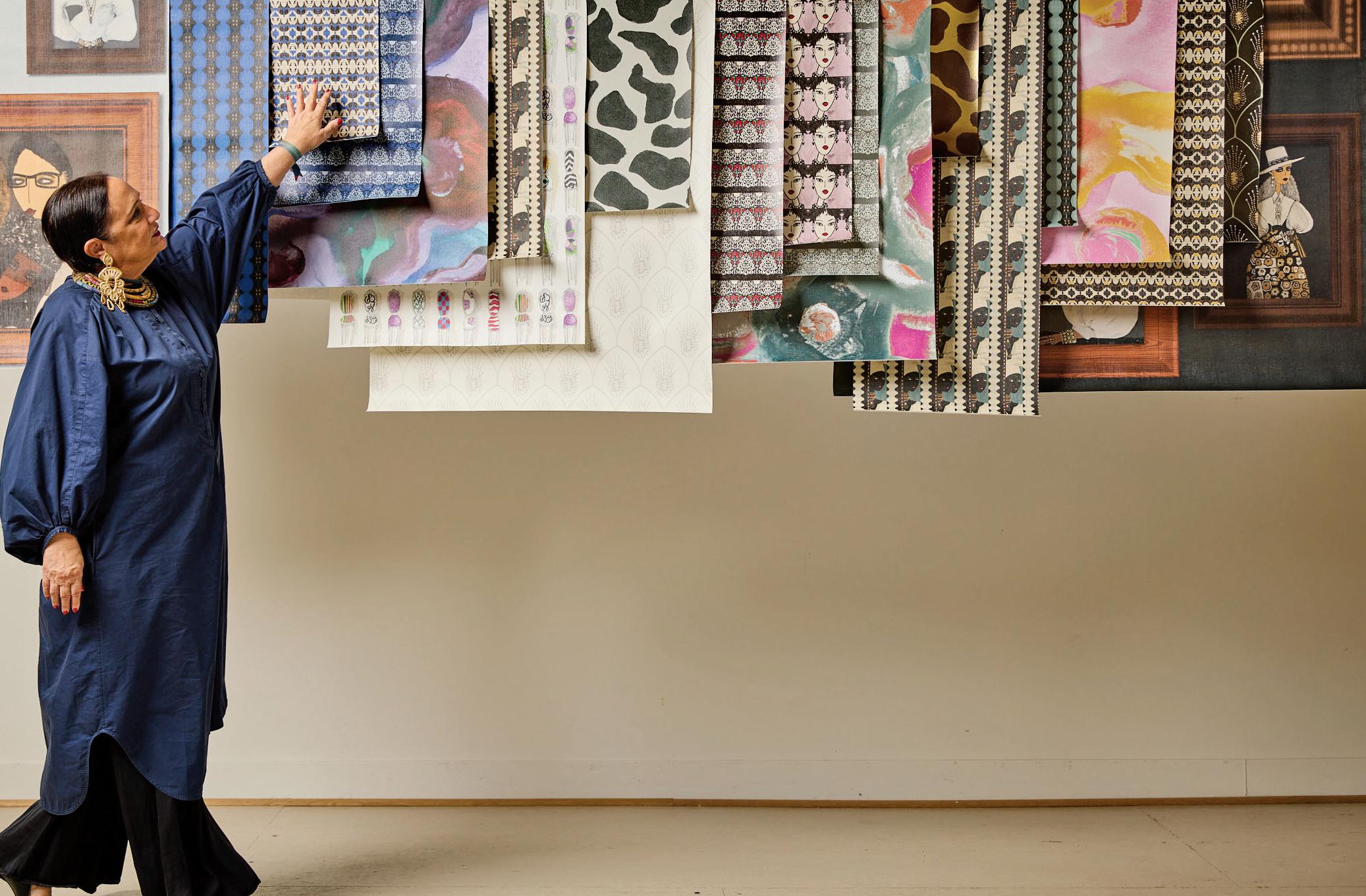
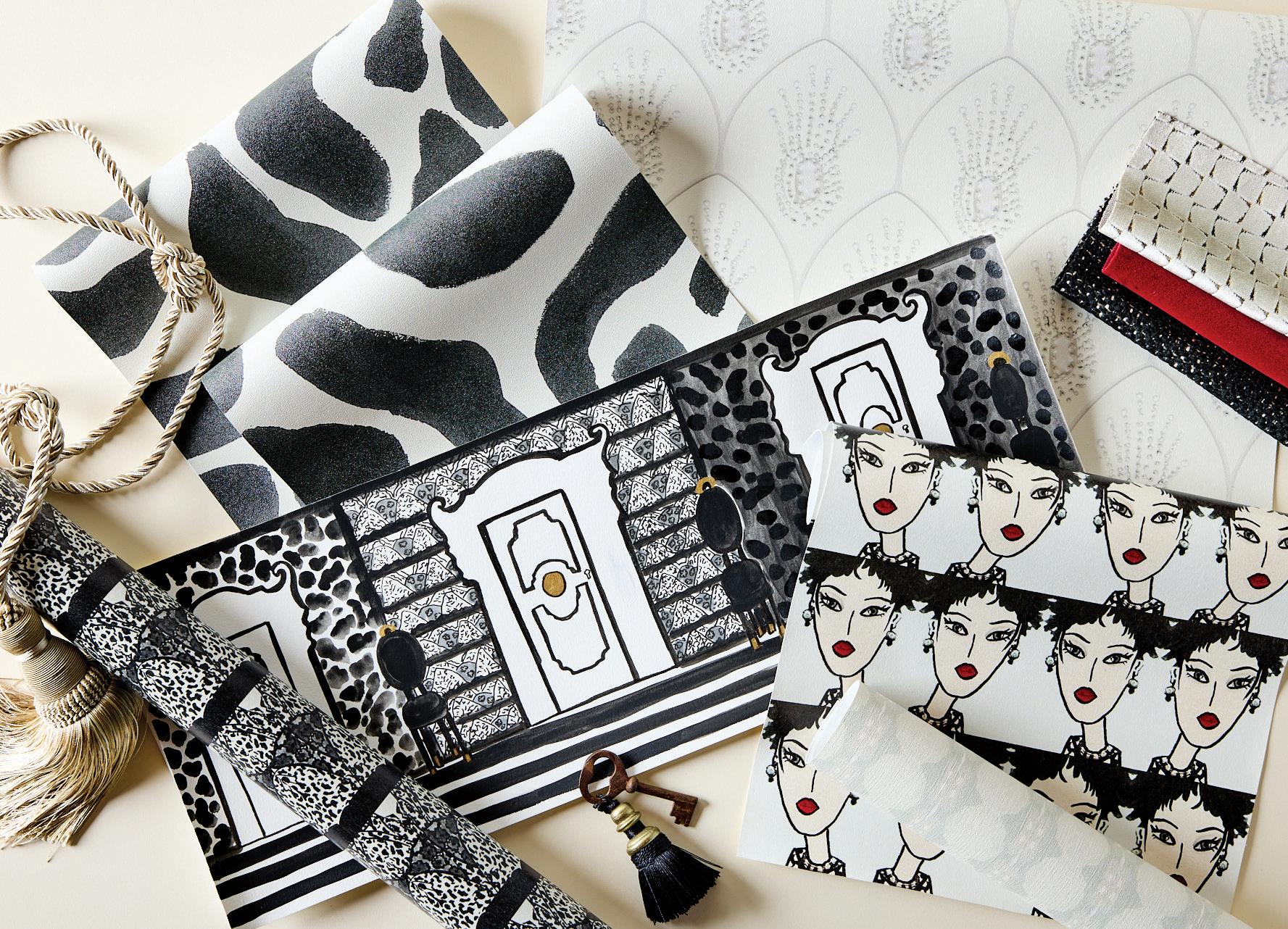
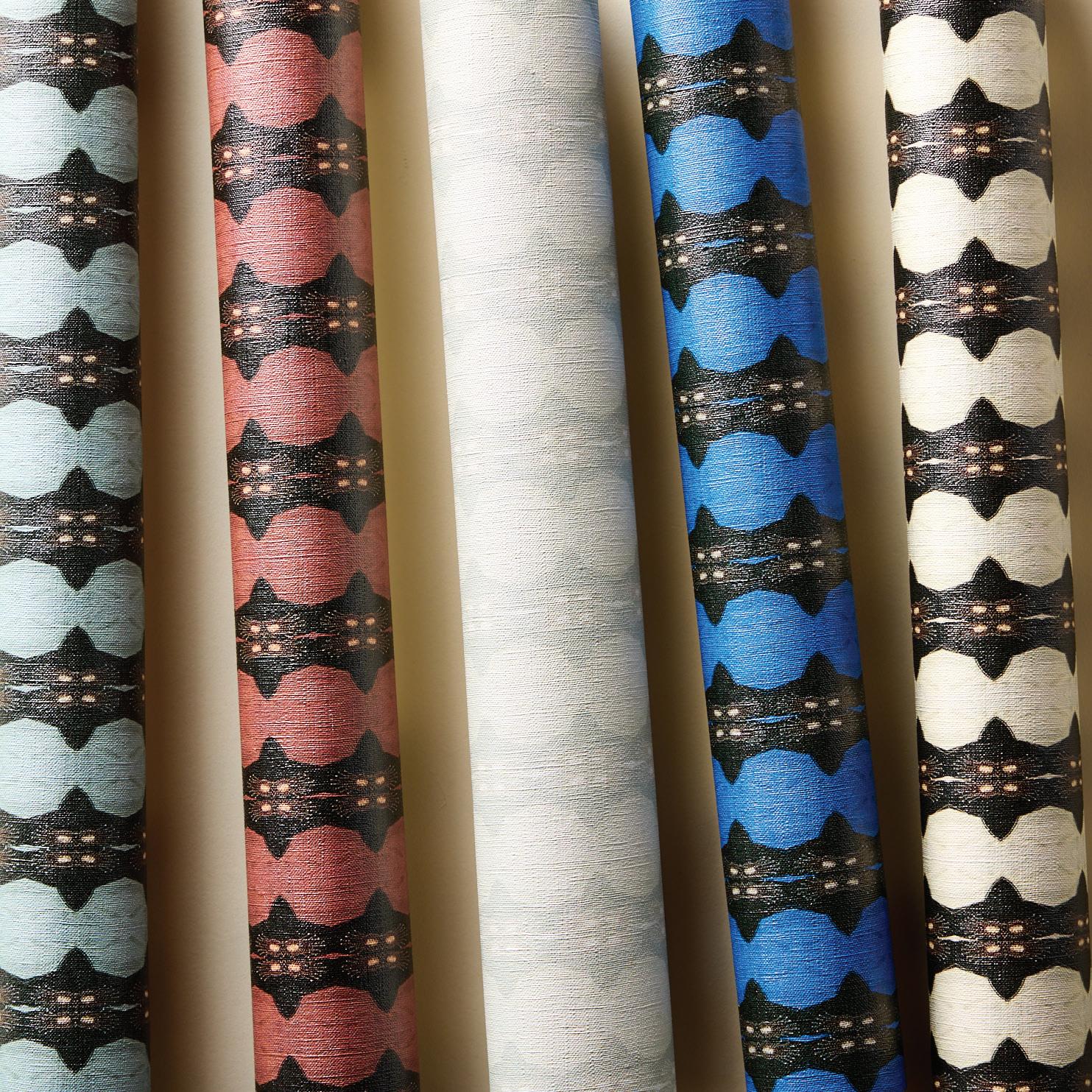
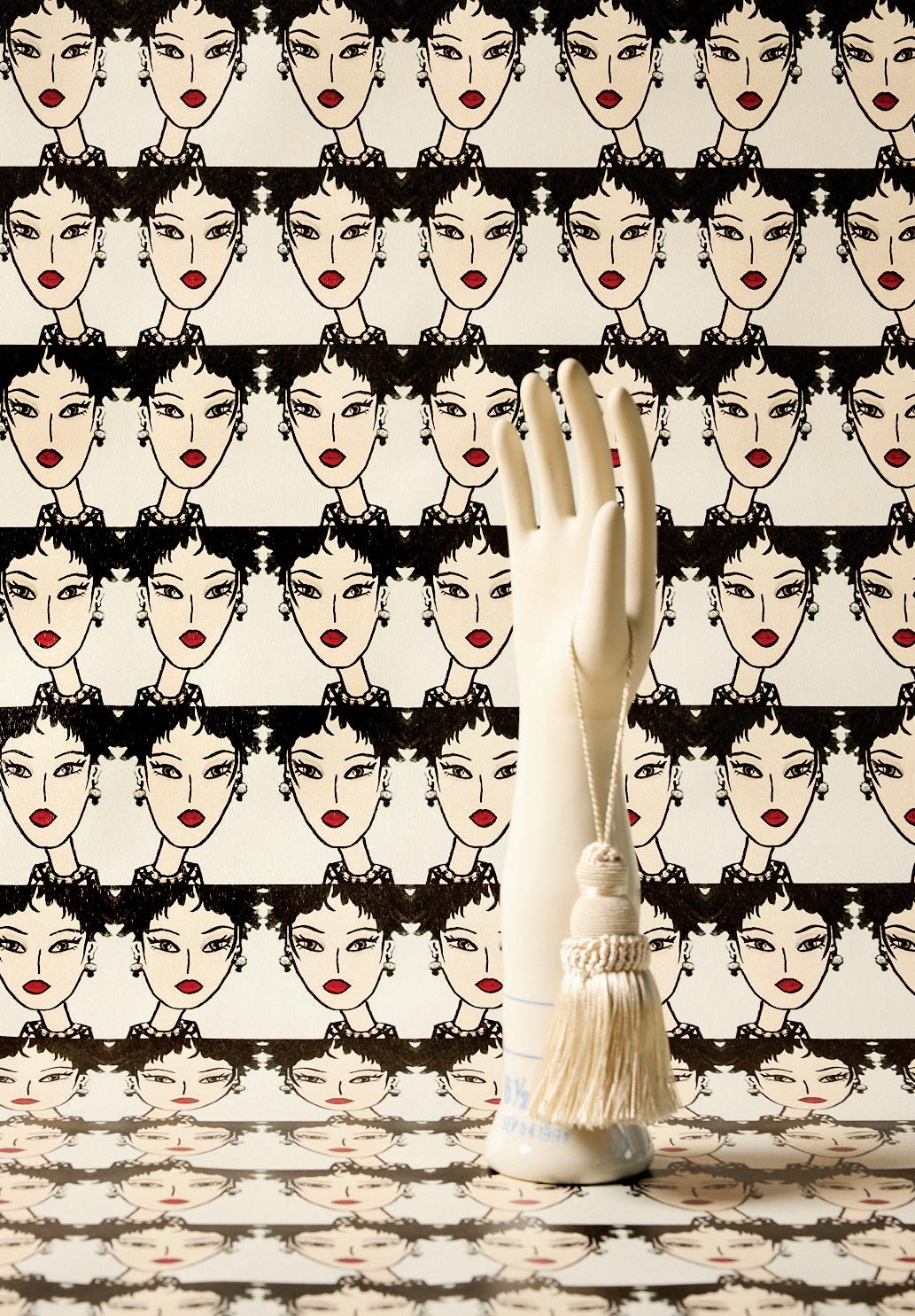
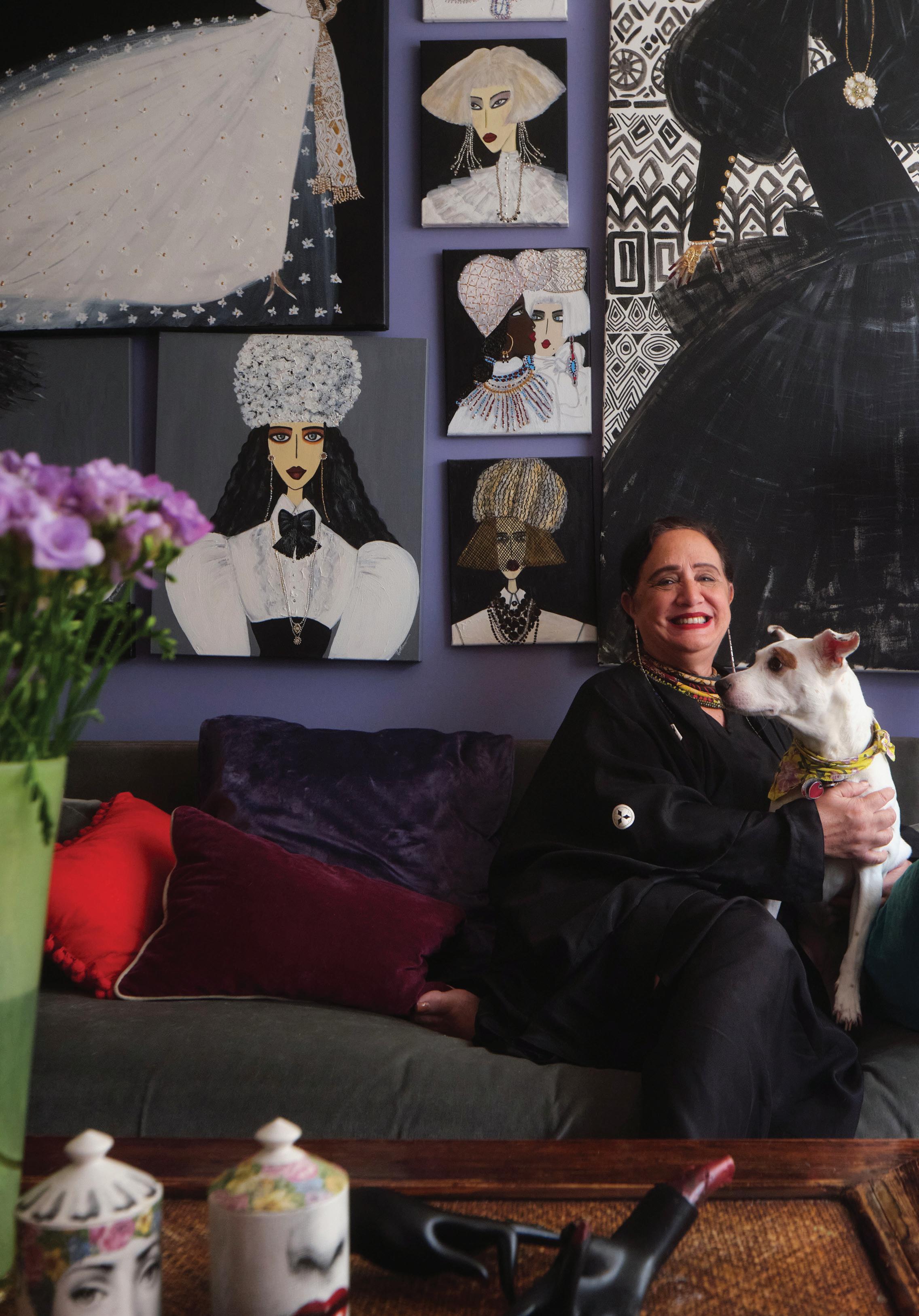
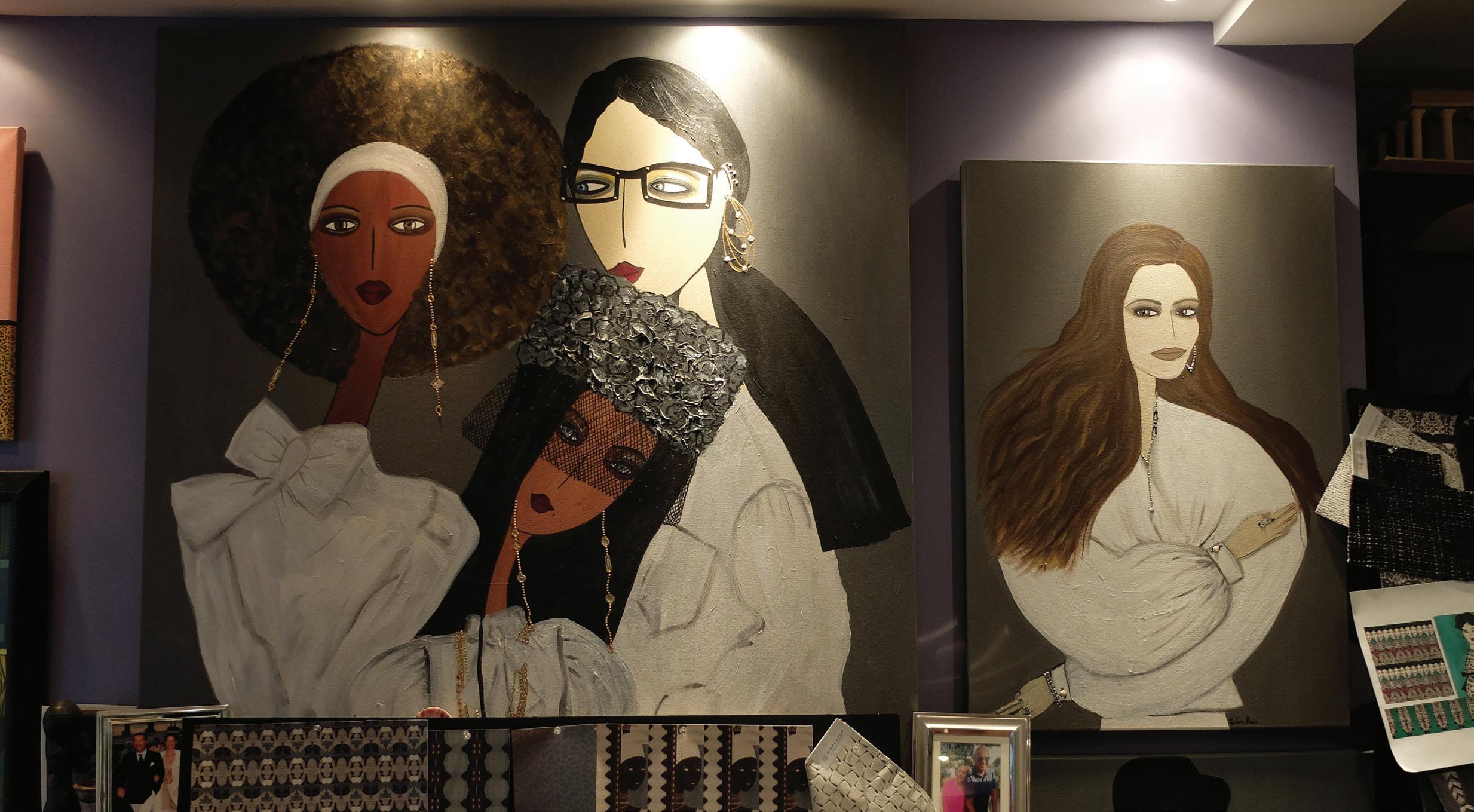
Rebecca Moses has led a fabulously creative life, and she continues to work at her craft, injecting color and passion into everything she does. Her career as a fashion designer, illustrator, painter, and champion of women’s empowerment through her art continues to roll, with new forays into product collaborations in the home décor field. Her latest, with Momentum Textiles & Wallcovering, breaks down two of her paintings, Kimono Lady and The Queen, into abstract patterns and endlessly captivating repeats. She is currently working on developing a lighting collection of blown glass and natural elements like river rocks, and of course, continues to create her stylized portraits of a diverse array of women, in her apartment/studio near Central Park in Manhattan. There is a direct line from DaVinci’s Mona Lisa to Moses’s diverse, intriguing ladies. Who are they? What is their place in the world? And how did they get here?
Istarted as a fashion designer at the age of 18. After I graduated from the Fashion Institute of Technology in New York City, I got a job in the Garment District designing coats and suits for Pierre Cardin. That was an incredible opportunity for me. My first trip was to Paris where I met Monsieur Cardin during the haute couture shows. I stayed with the company for three and a half years, and then I decided I really wanted to do separates and do a collection.
I started my own company, and for 10 years was in and out of business but building a dream and trying to survive as so many designers do. But in those days, in the 80s, it was a tough business. I had to deal with unions and partners, and it’s always harder when you’re a woman. But the good thing about being a woman is that we don’t accept the word no. Because I’m a woman, I have a sense of determination that no one will rob from me. And I always believe that women can think from all sides. We can do multiple things at once. Men tend to do one thing, and they do it with blinders on. Women can have the house burning and put the fire out and do the homework with the kids, and roast a chicken. We do our work from wherever, and we get it done. That takes a lot of discipline, but I think that’s how women are wired.
After 13 years in the Garment District, I fell in love with an Italian man, Giacomo. And I decided that if it was ever going to have a shot in hell, that I’d have to go to Italy with him because he had a family factory there and he couldn’t leave. Living in Italy was like getting 10 doctorates. I learned so much.
I think that this is something that we all must think about. No matter what age we are, we must constantly be learning. This is something I say to the younger generation. There is a velocity of information today that gives people the feeling that they know everything. What I have discovered is the longer I’ve lived, the less I know. And I think the only way we really grow as creatives is to constantly take risks, constantly explore, constantly ask questions. Things are evolving and changing so quickly every day. Open your mind to new approaches. Don’t assume that it’s been done, you did it, or it doesn’t have to be. Question everything.
When I went to Italy, it gave me an unbelievable access to growing and learning craft. Not just the craft that I needed to learn, but crafts that I never imagined learning. It gave me a sense of history, a global perspective. It gave me access to developing my own craft. I can only grow if I have more information to grow with. And that’s how I became so eclectic in my repertoire.
What’s necessary is not to get stuck doing the same category or the same thing. And sometimes we can, because it’s comfortable. You may fail, but at least you tried something different. And maybe that failure will lead you somewhere else. I don’t think you can look at disappointment or failure as the end road. If you live like that, you don’t get depressed from something not working out. Timing is so important in life. And sometimes my timing may have been off. It may have been too early to think a certain way where other people weren’t ready to think like that.
My paintbrush has always been my point of expression. I would always paint the illustrations of what I wanted to create, whether it was fashion or an environment, how I saw the woman wearing the clothes. Many times, in Milano, we would do installations. I didn’t love doing fashion shows because I didn’t really love the catwalk concept. It was without a story. For me, I wanted to always create a stage. There’s a part of me that loves set design and I’m inspired by movies like Indiscreet, Deception, and Auntie Mame
Eventually I started a small brand of cashmeres which became even bigger than I ever imagined. I had that company for about eight years before I took a partner on to try to help me balance it all because it was a lot on my shoulders. It was a mistake. And then my husband got sick, and he died within six months. When Giacomo died, the children were 9 and 12, and I was not sure what I was going to do. I went to talk to Franca Sozzani, who was an amazing woman, a visionary, and very, very smart. She said, “Rebecca, go to New York for a while, change your environment. You’ve designed so much clothing in your life. Go after your art.”
At the time, Franca was setting up the website for Italian Vogue. So, I did stories with her and from that came other consulting work. My book, A Life of Style, was published right when Giacomo died. It was a five-year body of work. I started illustrating for Vogue, doing stories, and then I started working for other magazines. Then MAC cosmetics asked me to do a project for them. I started doing some more consulting and just looking at life from a very different perspective. It was frightening but healthy. But after losing my husband, I had to raise my kids
on my own. He was a very strong force in our marriage, and an amazing father. I was very frightened to know whether I could do this on my own, but I did. We came to New York in 2010. It was a great distraction for the kids, because they were able to just be normal kids and not the kids who lost their dad. Eventually I found this apartment, and I’ve been here now around nine years. About three and a half years after I got here, I met Rick, and never would I have imagined being able to fall in love again, but I did, and we had a great nine years together. He died during COVID.
I’ve always looked at life through diversity. When I think about the models that I chose my whole life, the more unique, the more unusual, the more imperfect they were, I loved them more. When I tell stories about women, they have to say something. For my show White Shirts at Ralph Pucci International in 2019, I thought about the fact that portraiture has always been something for royalty, for the bourgeois, for the people who had the money to hire an artist. I wanted to do a show where nobody knew who the women were, but they had a sense of regality. Looking at the paintings, you would think, “Who’s that woman?” Each one has a beautiful white shirt on to equalize them. But then maybe she has a tattoo on her neck. Or she has 20 earrings in her ears. Does that throw you? What do you think she does? Is she a prima ballerina? Does she work at CVS? We make judgments about people without really knowing. If she has braids, do you think that she’s not upper class? Is she working class? I wanted to do a show that could kind of say, well, she’s really got a good look, but who is she?
During the pandemic, we were all stuck at home. From this spot I thought about how we were all alone and how women were really going to pay a price for this, keeping families together and doing what we do. So, I went on Instagram Live, and I asked women to share their stories, and I would do a portrait. In the end, I did 400 portraits of women, and 50 nurses from all over the world. The stories were incredible, and I’m so proud of that work, that connection. Eventually, I hope to do an exhibit somewhere. My space is filled with my own art and things that inspire me. There are lots of things I like to do. I do some things, and I put them on shelves. It’s all about timing. It’s a process and it’s timing. And sometimes you just have to put something down on paper and then come back and revisit it. That’s how I have approached my whole life.
More on Rebecca www.rebeccamoses.com
Instagram: rebeccamosesoffical
Represented in New York, Los Angeles, and Miami by Ralph Pucci International @ralphpucciintl and in Milan by Nilufar @nilufargallery
Dee Harvey
With a passion for creativity and handmade goods, DEE HARVEY began her career in early 1990 by launching Holly Berry Hill catalog with a focus on handmade treasures. In early 2000 she began working on her first line of holiday collectibles for Bethany Lowe Designs. Dee’s collectibles have been featured in several publications including Country Home, Country Living, Romantic Homes, and Where Women Create, and sold through catalogs and major retailers such as Martha by Mail, Ballard Designs, Anthropology, Macy’s, and Gump’s to name a few. In early 2000, Dee also became an editor for Better Homes & Gardens Creative Collection™ where she helped create and launch Simply Creative Weddings Magazine. Find out what creative adventure she is up to next.
EVERY DAY’S A HOLIDAY
at Studio Dee. And has been for as long as I can remember. While most people are starting to celebrate the warmer weather of summer, I’m gearing up to create my Halloween and Christmas holiday collectibles. In fact, if you happen to stop by my studio that time of year, you might just hear Christmas music playing. But I’m getting ahead of myself, let me start from the beginning …
My creative journey started with a very magical childhood growing up in Ohio. I loved the changing of the seasons, especially the crisp change in the fall air, the falling leaves, and then a blanket of wintery snow. Making snowmen with my dad became an art form. I can still remember the crunching sound the new snow made under my boots as we scouted for the perfect spot where we would begin our work of art. Each snowball would begin to gain momentum as it rolled back and forth in the snow, almost as if it knew it was going to become a snowman. It was this experience that launched a lifelong love of snowmen, created a sense of magic, and how I first fell in love with crafting handmade goods.
IT WASN’T UNTIL
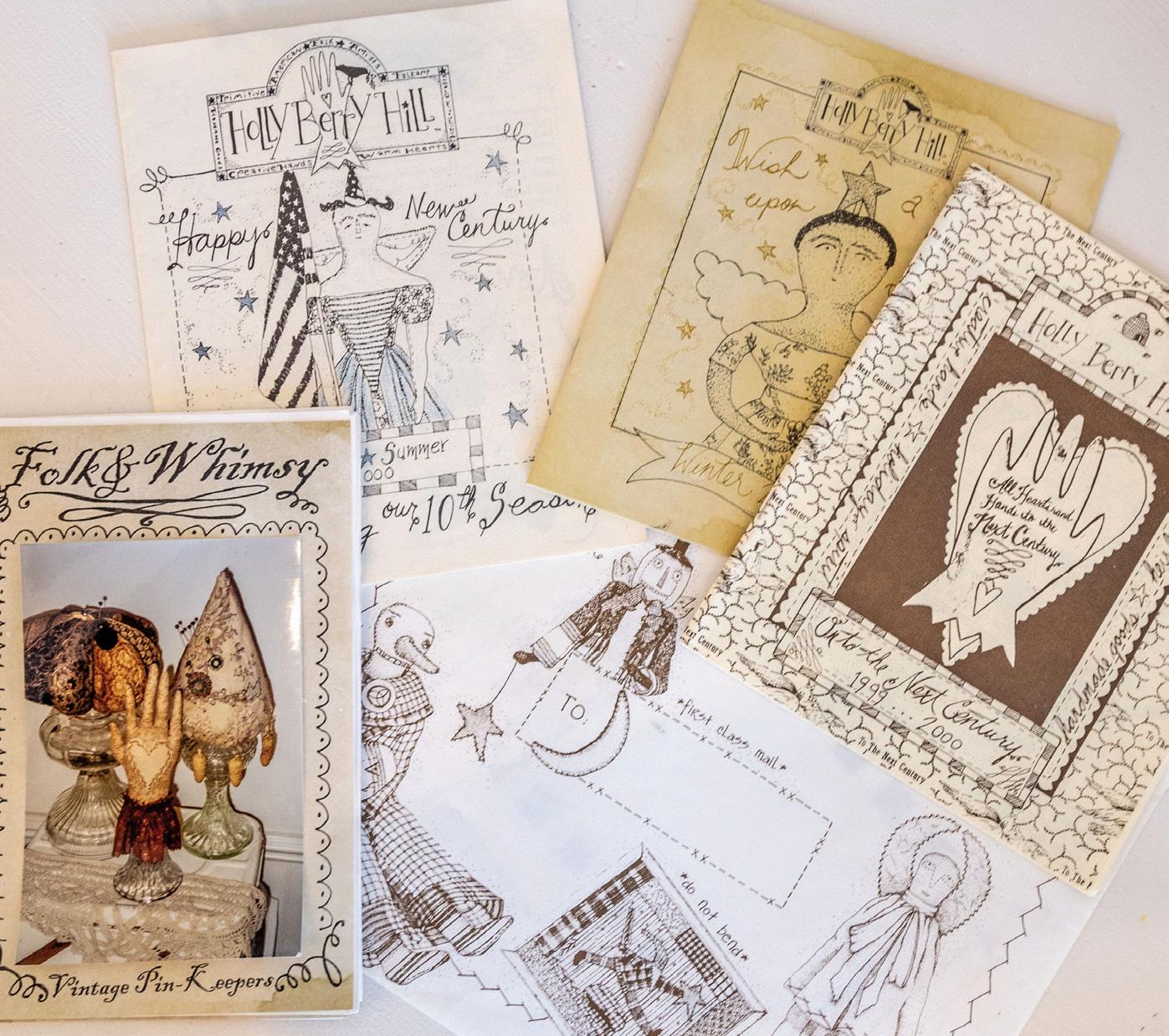
after I had my kids, Austin and Lauren, that my crafting evolved and was a means of making a little extra money when they were little. I started by renting space in a crafter’s mall and selling my handmade goods, and occasionally would do a local craft show. During this time, I was also making a line of dolls with my good friend Marian called Wee Hearts. We would go on a hunt for vintage children’s shoes, old hats, etc. to dress them up. It was at one of the local craft shows that I first met my dear friend Nicol Sayre. She had a beautiful booth filled with lots of wonderful handmade goods. I knew that we would be instant friends and kindred spirits. Our friendship launched many years of creative collaborations starting with our line of patterns and books called Folk & Whimsy. In addition to the pattern line I also created my mail-order catalog Holly Berry Hill in 1991 and ran it until 2000. The catalog was hand illustrated by Deb Strain and showcased patterns from several artists whose creative work I loved.
Also featured in my catalog was our Folk & Whimsy pattern line. At the time I created my catalog, quilt shops were aplenty. I can remember walking into our local quilt shop and not knowing where to look first, the rows and rows of whimsical and vintage-style fabrics or the racks of fanciful patterns. These shops would be the inspiration for taking our Folk & Whimsy patterns to the wholesale market called Quilt Market. This was where we launched not only our pattern line but at the time a little-known craft called Needle Punch. I can’t remember where we first discovered the needle, but we designed several patterns around this tool. It was a hit, and we were inundated at the Oregon Quilt Market Show. It was also my very good fortune to meet a vendor
at one of these shows by the name of Bethany Lowe. She owns a company that manufactures and wholesales holiday collectibles and was looking for new artists to license, so I submitted my designs. She loved them and added them in her line and off we went. More on that adventure in just a bit.
It was around this same time that I took a leap, closed my catalog, and applied for a job as editor for Better Homes Gardens Creative Collection What a big life adventure that was! I got the job, packed up my daughter and off we went. I lived in Northern California at the time, but relocated to Des Moines Iowa. The first day was the most memorable—there was an orientation, meet and greet, then I was shown my cubicle, given a list of four annual publications along with deadlines and budgets, and left to figure it out on my own. Whew, a moment of panic set in then. I sat back in my chair and decided to visit one of the departments I had walked through earlier that day. It was the library of all the magazines that BH&G produced. I pulled 8–10 back issues from each of the publications I was assigned and dissected them one by one. How many stories, what type of stories, were there projects associated with each of them, etc.
After I compiled all of that information, I was once again at a standstill. I needed to find freelance writers and designers, and possibly locations to photograph, but luckily for me, they had in-house photographers. It was quite the challenge, especially when all the other editors were so busy working on their own publications that they could only give me bits and pieces. Good news is I figured it out rather quickly and within a few months was offered a new publication to launch, Simply Creative Weddings. I would have to say that it was one of the highlights of my creative career.
“Be brave. Be wild, and stay forever hungry for love, art, knowledge, and adventure.”
— ERIN VAN VUREN
AFTER LIVING
IN Iowa for a little over a year, I decided that I needed to return to Northern California to be close to family and friends. Luckily for me, BH&G loved my work and allowed me to bring the wedding magazine back with me and produce it in the Bay Area. It was the best of both worlds. I continued to produce the magazine along with other stories from different publications for another three years until their budgets would no longer allow me to be a freelance editor. But there is a silver lining … believe it or not, the entire time I was an editor I was creating my holiday collectibles for Bethany Lowe Designs. Once I no longer had a day job, I was able to dive into designing full time.
What a glorious creative time this was. I had so many adventures with Beth, going to all the big wholesale shows, dinners, and theater in New York, and even a design trip to China which
was truly an adventure of a lifetime. I also had the good fortune of having many of my holiday collectibles featured in several magazines, sold through catalogs such as Ballard Designs and Martha by Mail, and many retailers such as Macy’s, Anthropology, and Gump’s. One year the White House even hung one of my ornaments on one of their many trees.
I designed for many years for Beth and then decided to take a creative break. After I stopped creating my holiday collectibles, I went on to license my bedding designs and even created a line of handbags. Worth mentioning are some of my other favorite memorable creative highlights that happened along the way … being on Martha’s Radio Talk Show two times and working with buyers from Martha by Mail. I also taught projects at large creative retreats throughout the U.S. and found that to be very inspiring.
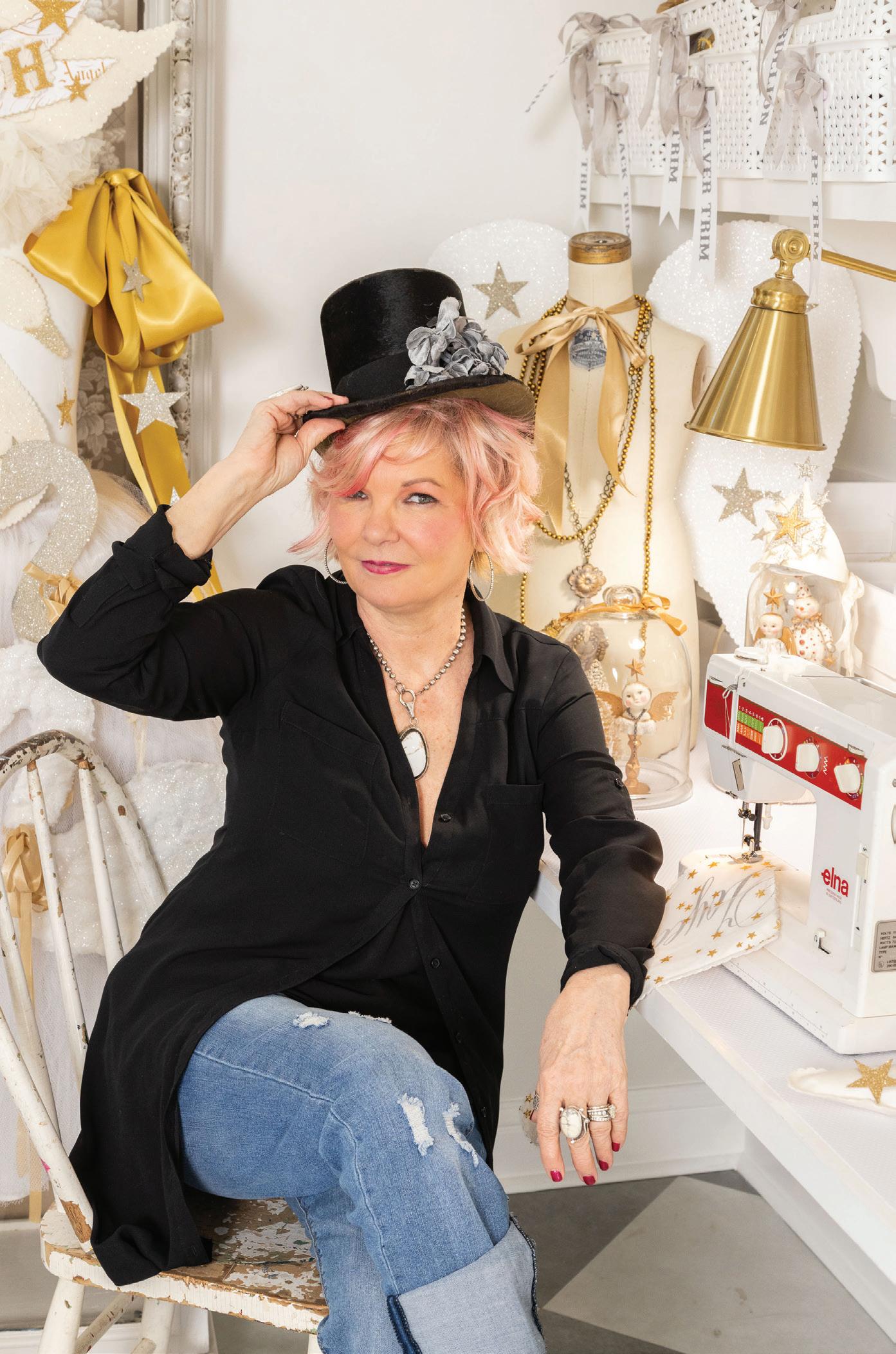
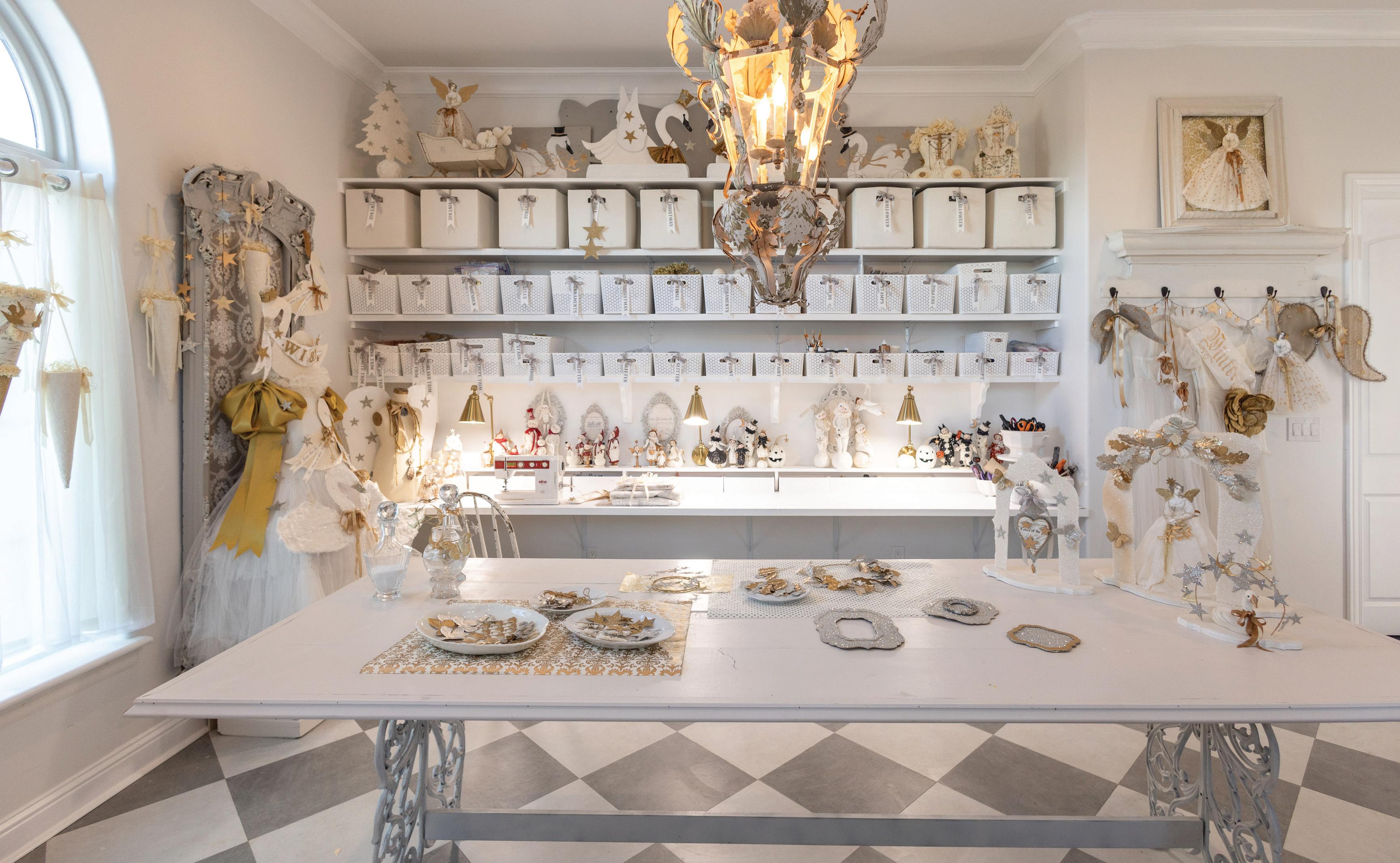
SO, NOW THE story behind my new beautiful studio! One day, out of the blue, my sweet hubby announced he was going to build me a studio. Truth be told, he probably wanted to reclaim his garage space, which I had taken over years ago. And lucky for me, he’s a contractor. I was so excited as we both sat down to design the space. I had so much to think about with all the different supplies and projects I work on simultaneously. I needed to be sure I was able to create storage and organize all my materials, and so the layout on paper began. Finally, the day arrived when my studio was finished. It turned out so beautiful, hubby did an amazing job!
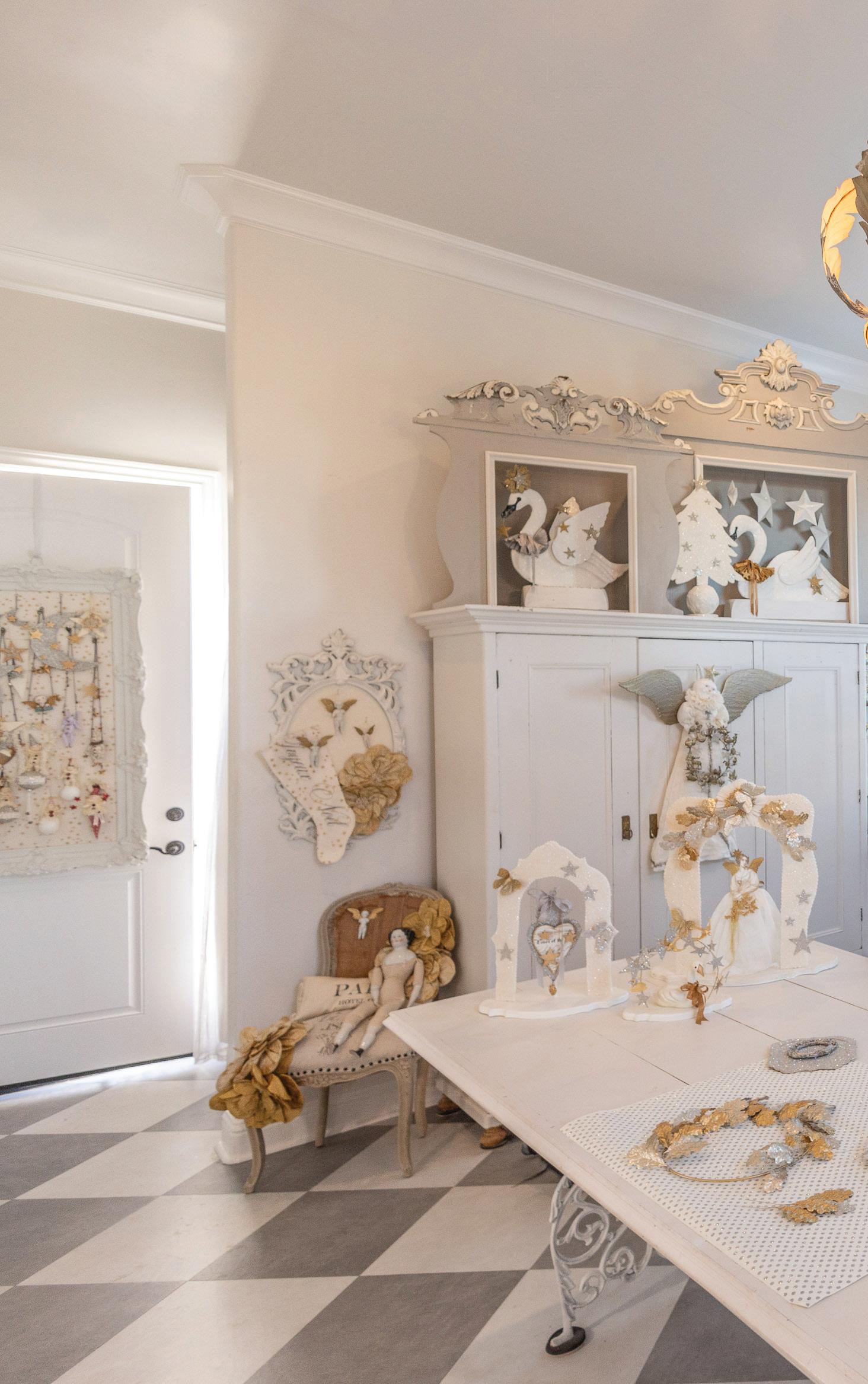
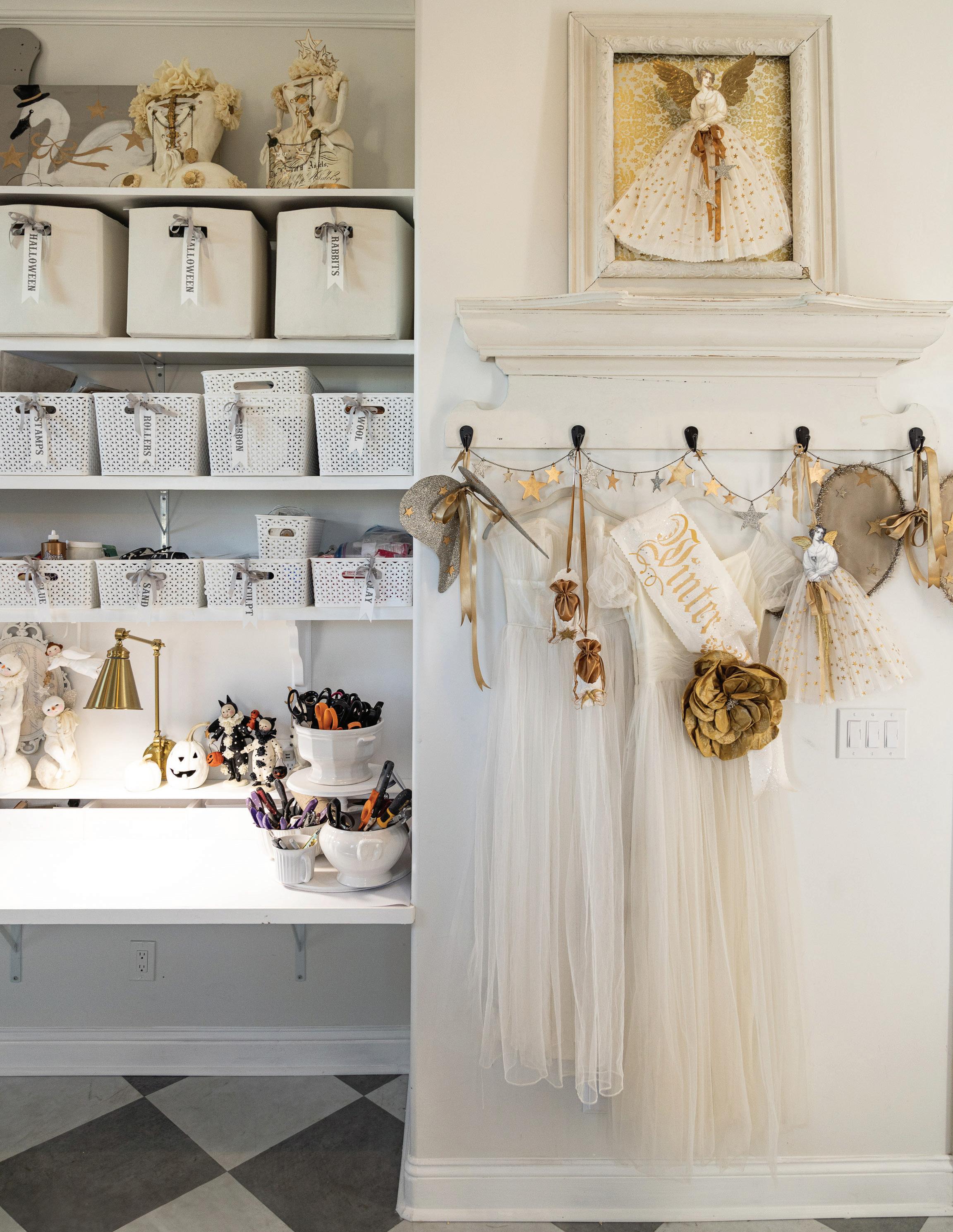
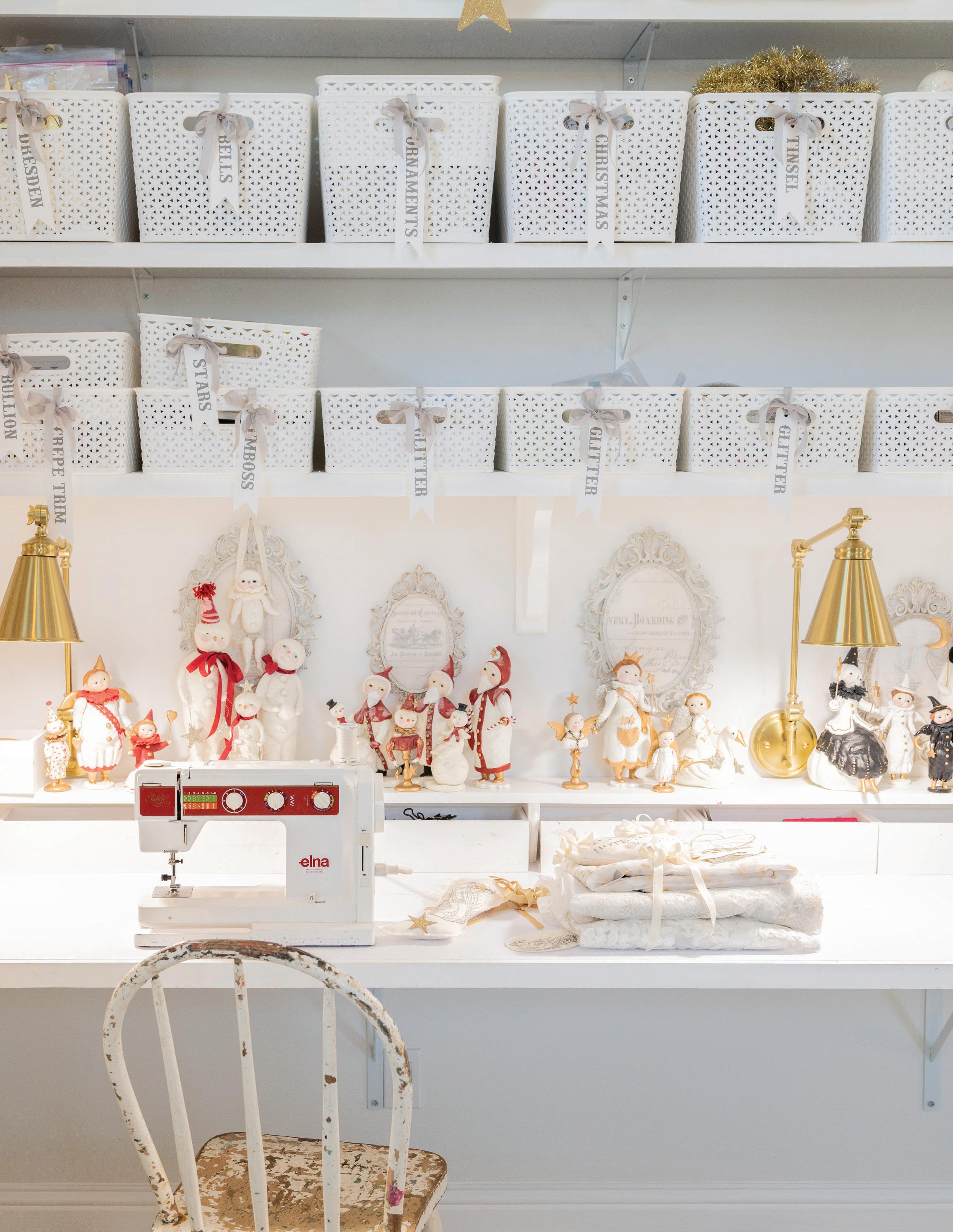
Once the space was built, most of what I had on paper did work out. I had to make a few minor adjustments when I set the space up, but all in all, it functions very well. The long wall with the built-in table has shelves above it that house all the materials I use on a regular basis. There is a small shelf that sits
just above the table which I use to display my holiday collectibles from previous seasons so I can create the next collection. The space under this shelf has pull-out boxes which are for the smaller items I use on a daily basis.
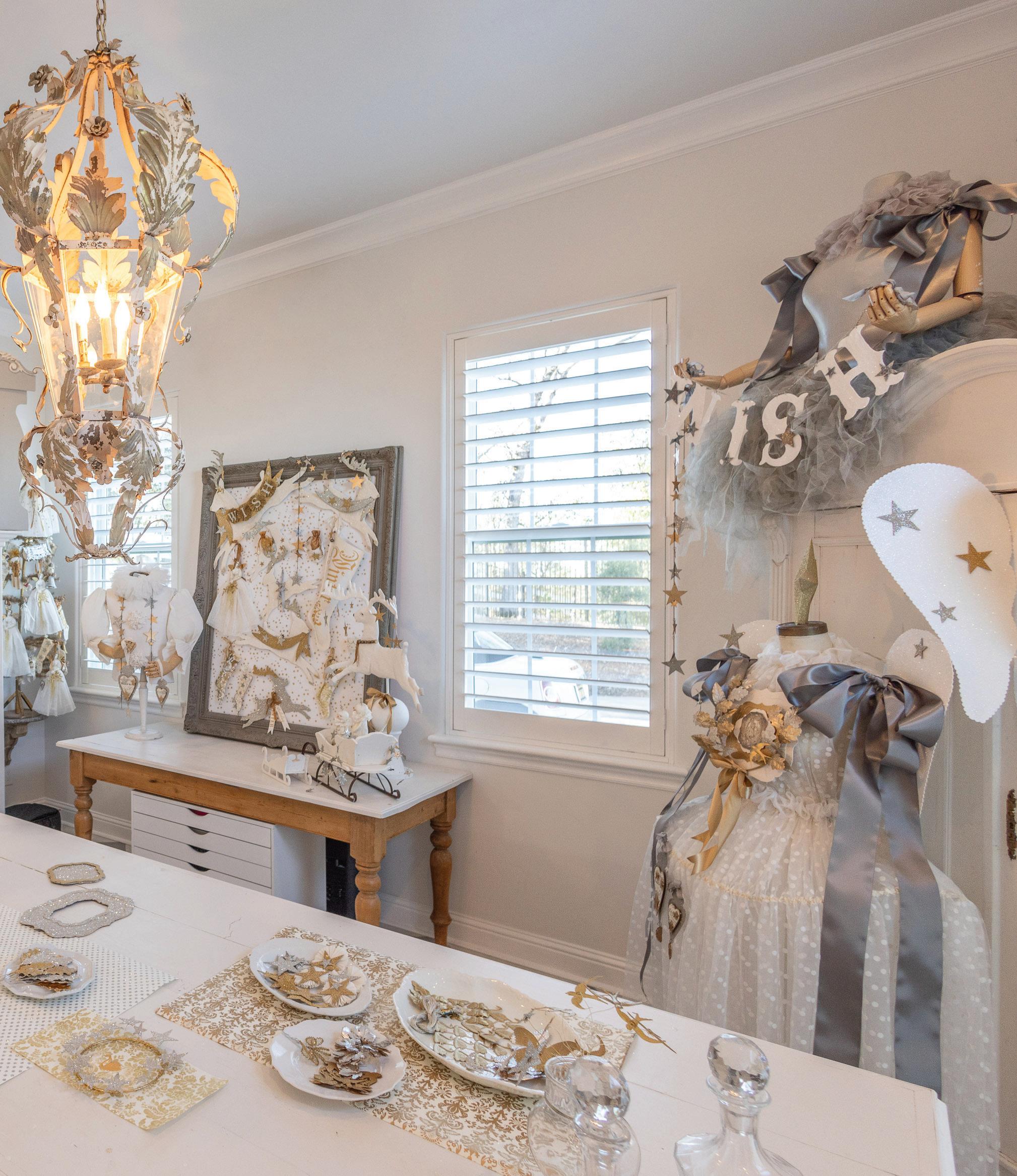
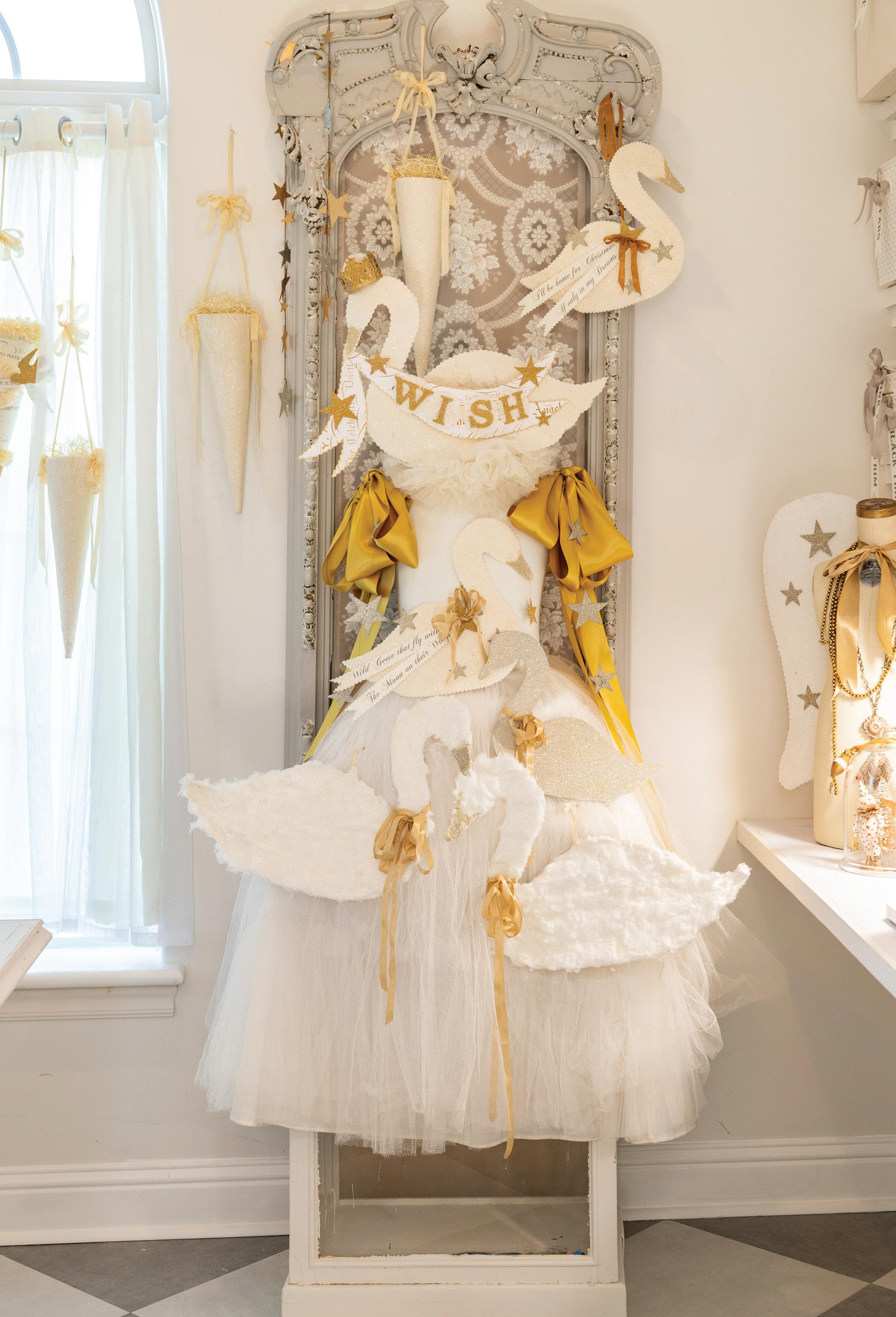
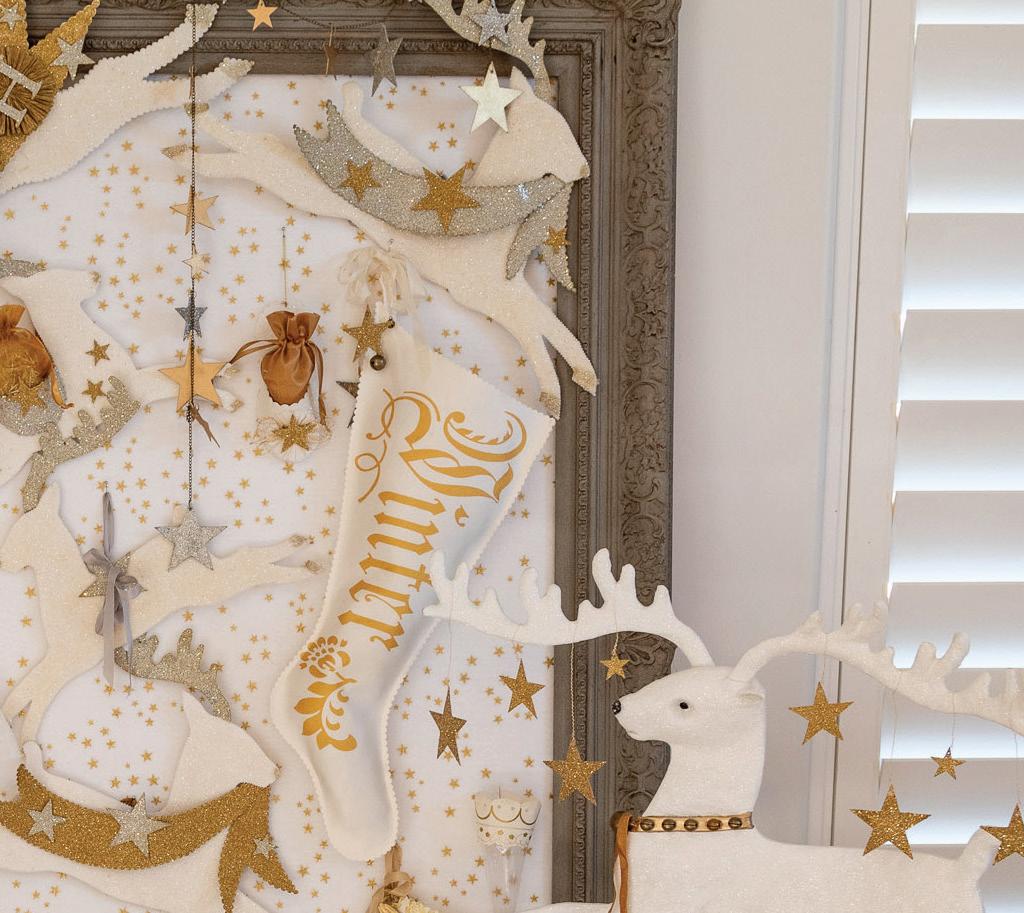
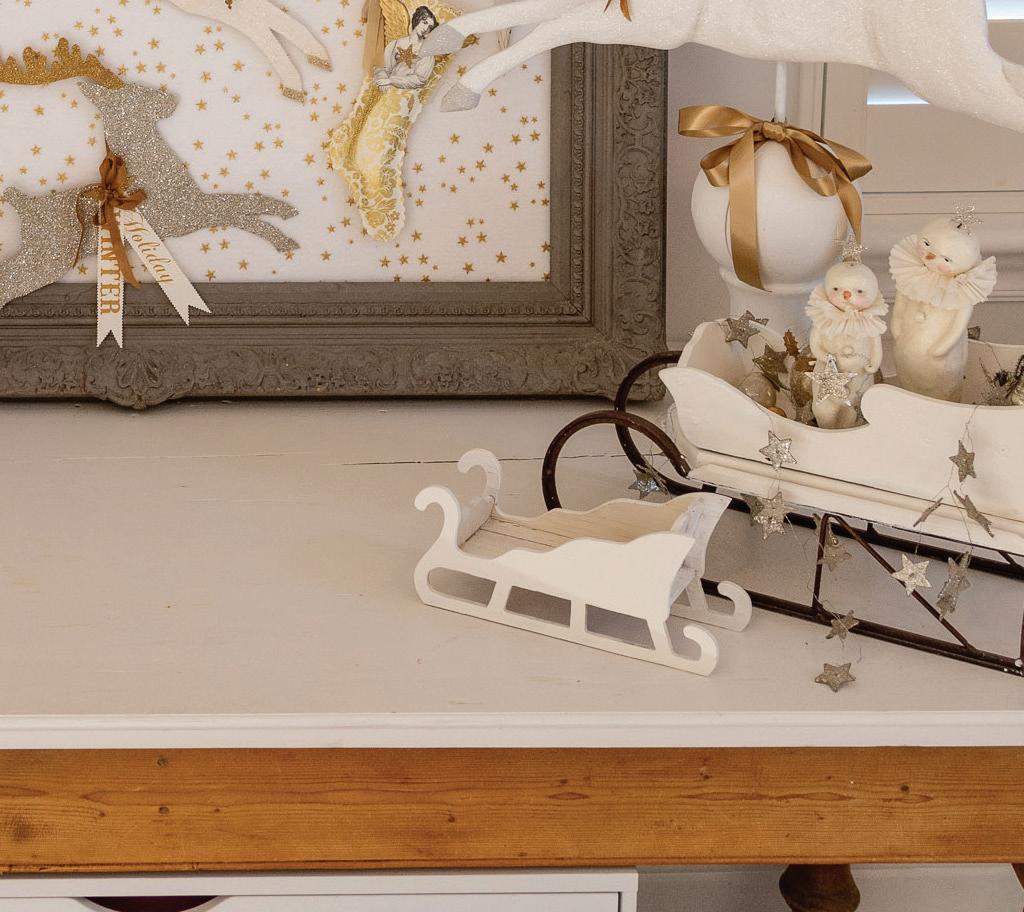
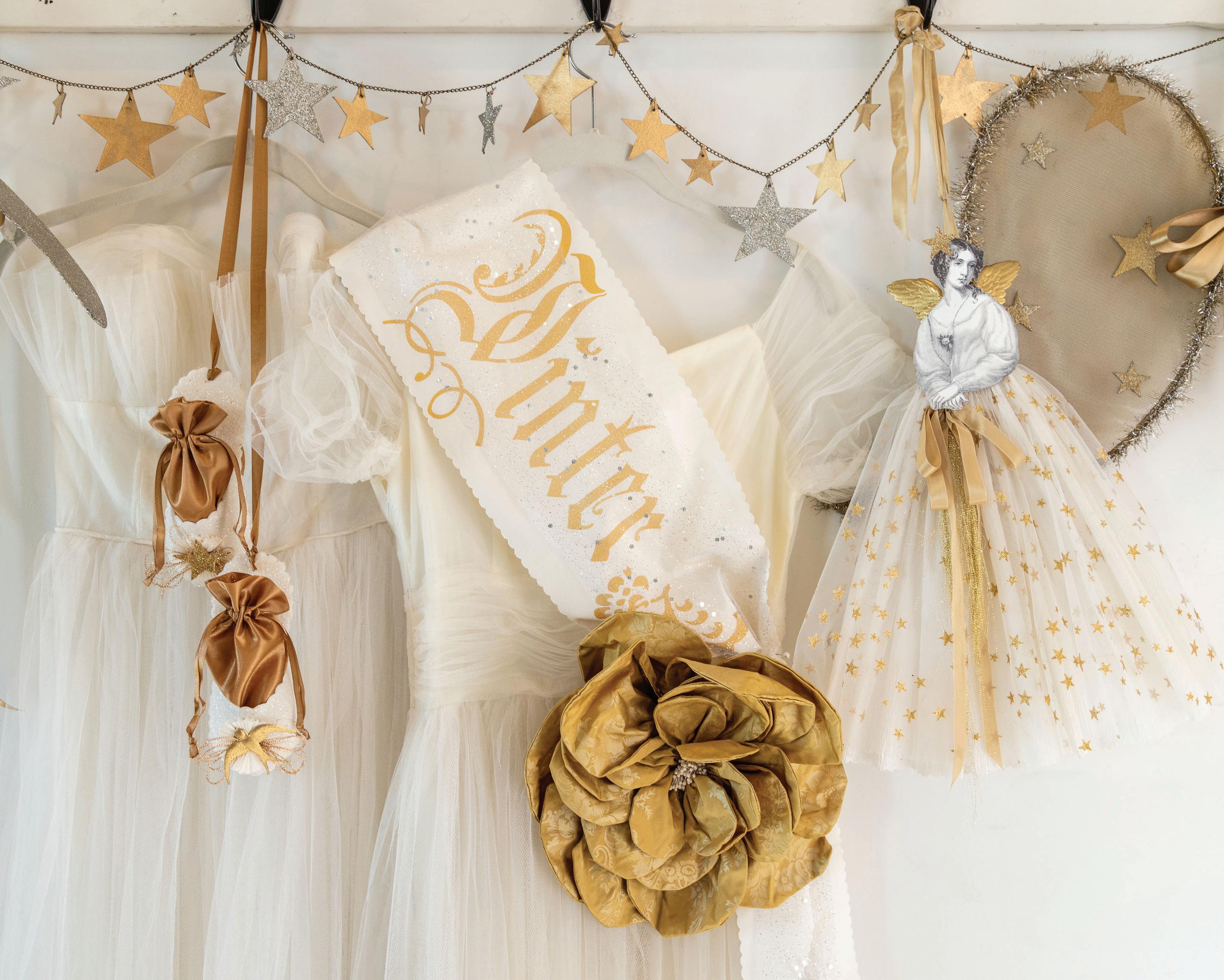
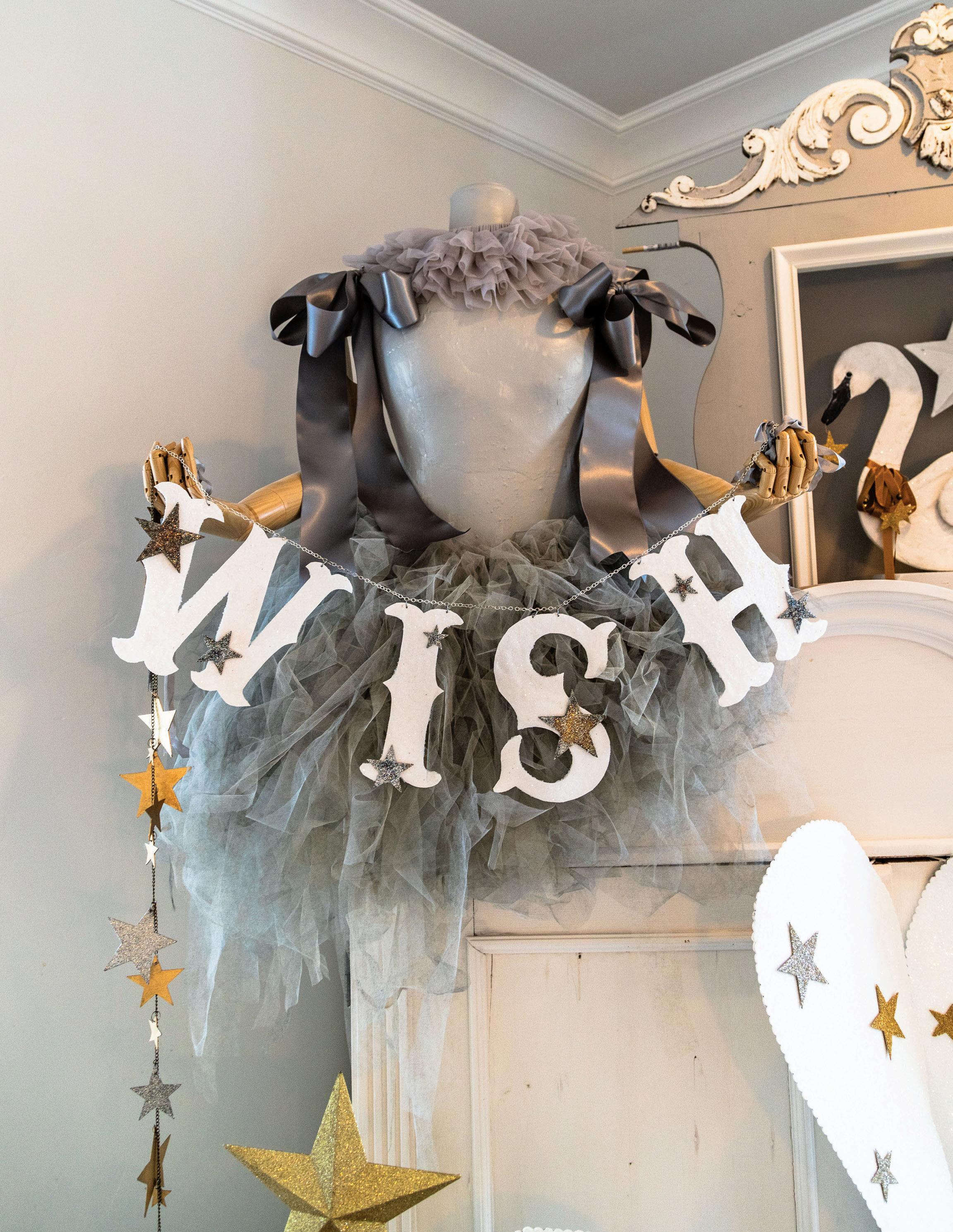
My vintage frames are one of my favorite features—these showcase various projects along with inspiration and are used for creating storyboards for collections I am currently designing. Mannequins are a fancier part of the space and are used for display when I do shows. My beautiful theaters built from vintage pediments top off my two tall cupboards and are for display only. Also not seen in my studio is a closet packed with what I call project boxes. These are boxes that keep each of my upcoming projects organized and contain sketches, patterns, and materials I am going to use on that project. But the fanciest part of my studio is my French bulldog, Lulu. She designs with me every day!
AS USUAL, I HAVE several design projects in the works. I am thrilled to announce I am back as a licensed artist designing for Bethany Lowe Designs. My new Halloween and Christmas holiday collectibles will be available in 2026. In addition, I am working on a line of projects and patterns for my Etsy shop. These will be patterns and projects that can be created at home and will include several holiday themes along with wedding and baby designs. It is my hope to eventually find a publisher to publish a book of my patterns and projects. I also work on my line of jewelry along the way, as that is a work in progress. Several vintage-style designs are completed, but I am still working on the final overall look and finishes.
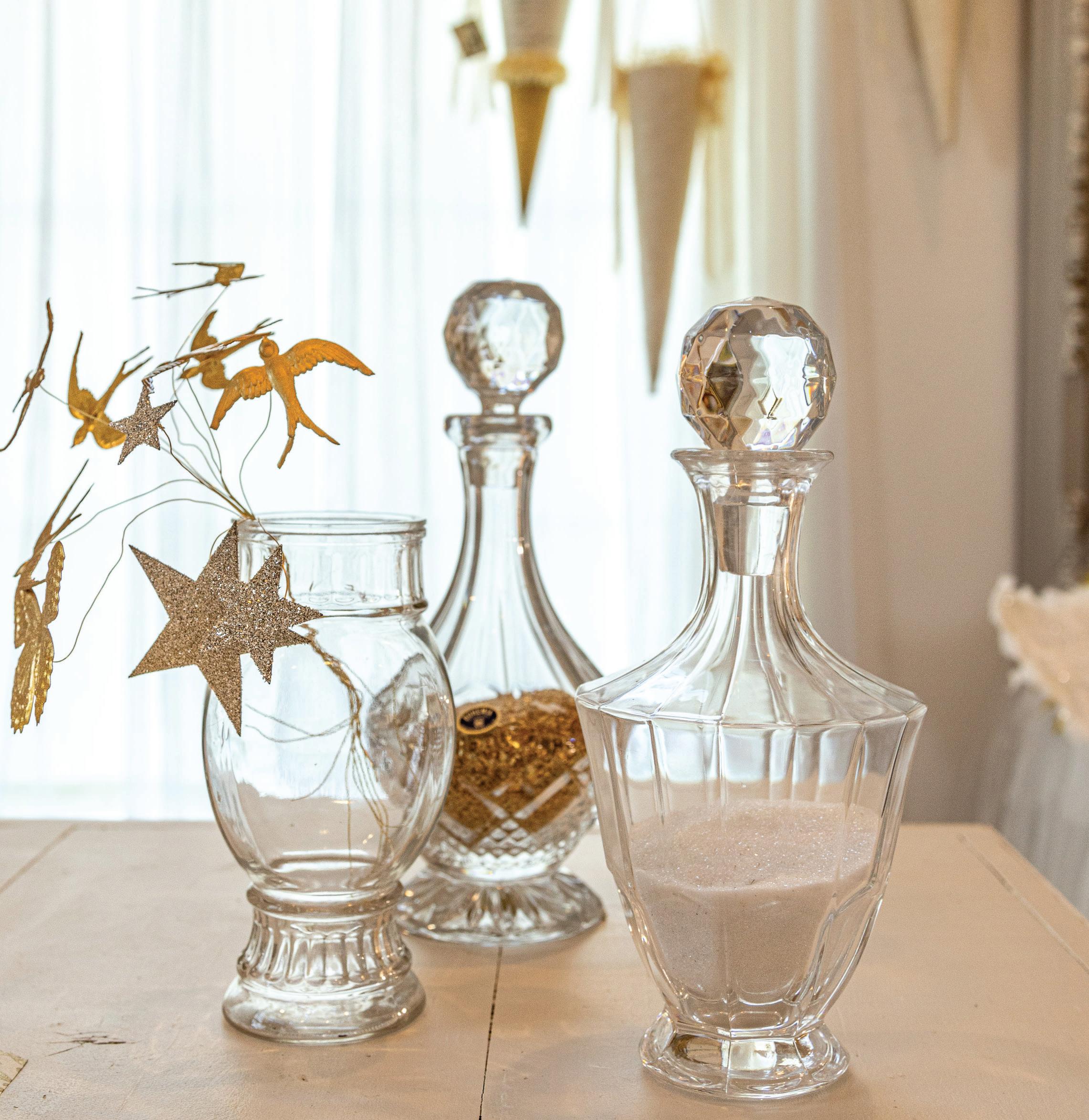
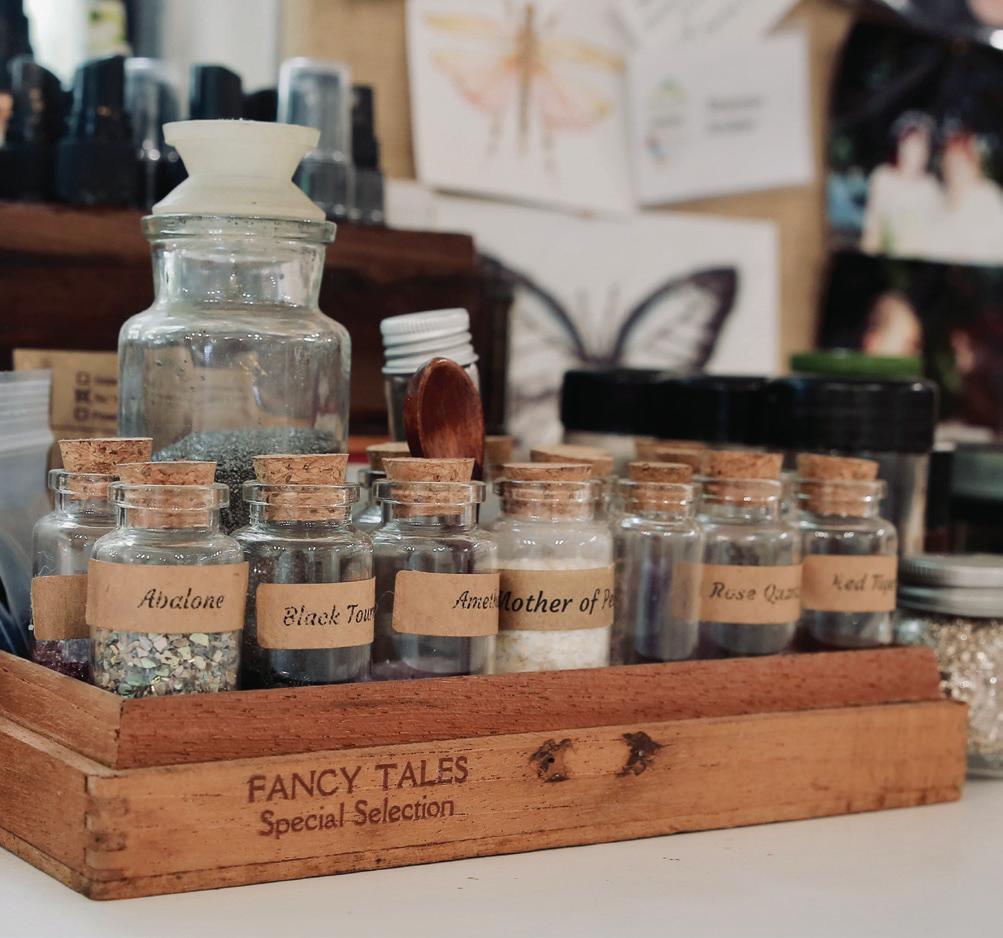
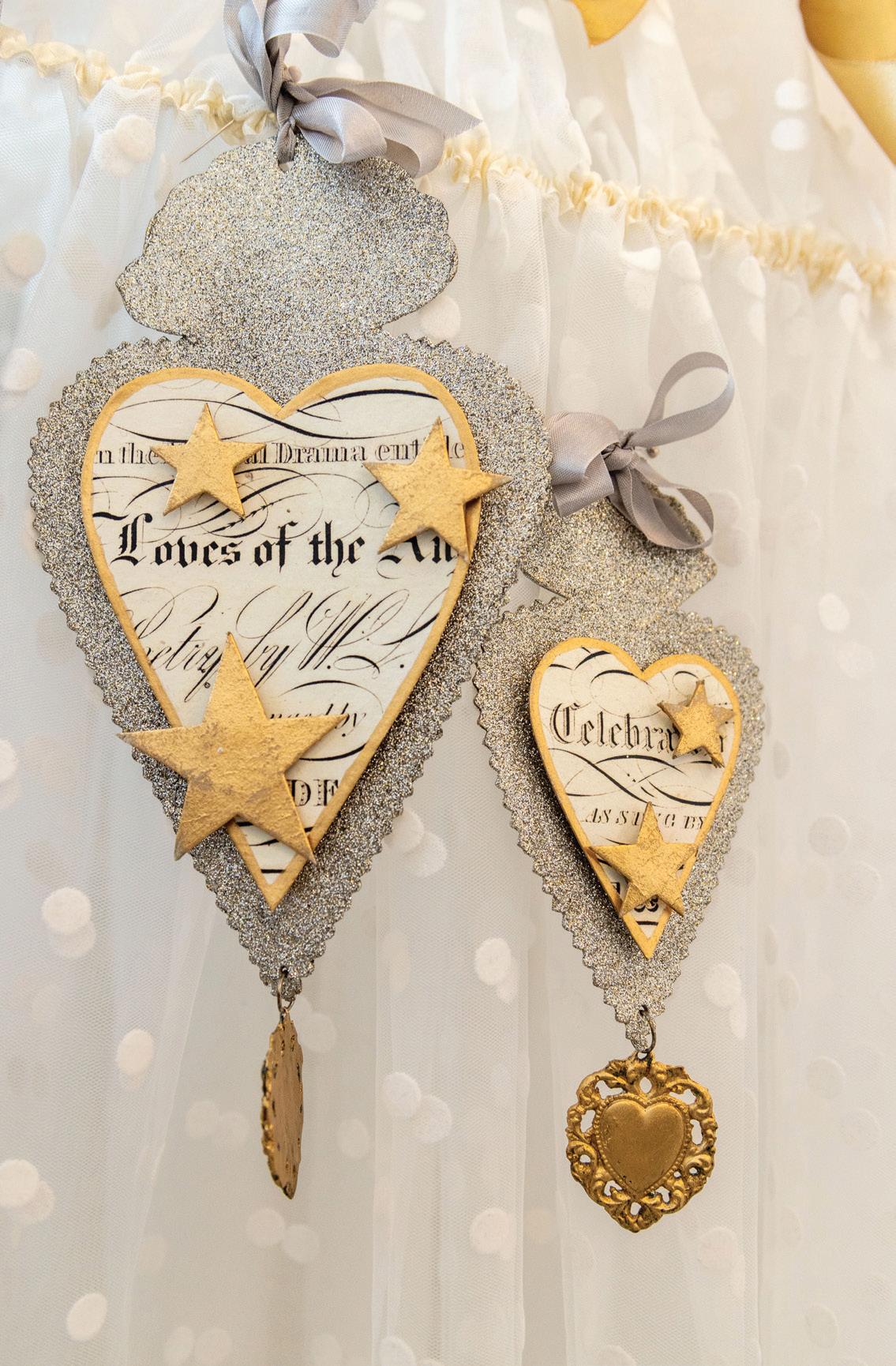
Photographed on my table are some projects I am working on for my Etsy shop. My oak leaf wreath is antique inspired. In addition, I am working on my tabletop theater projects for my Etsy shop. These are perfect to showcase treasured items. Also on my table are some of my favorite supplies, German glass glitter and paper Dresden’s. I always try and use the very best materials for handmade projects. Handmade goods take time to create and I want them to look beautiful for years to come.
All in all, I love waking up every day and walking into my beautiful studio. It is an inspiring space that sparks my creativity and imagination, and adds a bit of fancy to my life!
Leanne Anderson and
Kaytlyn Kuebler
Photography by Juli Camarin
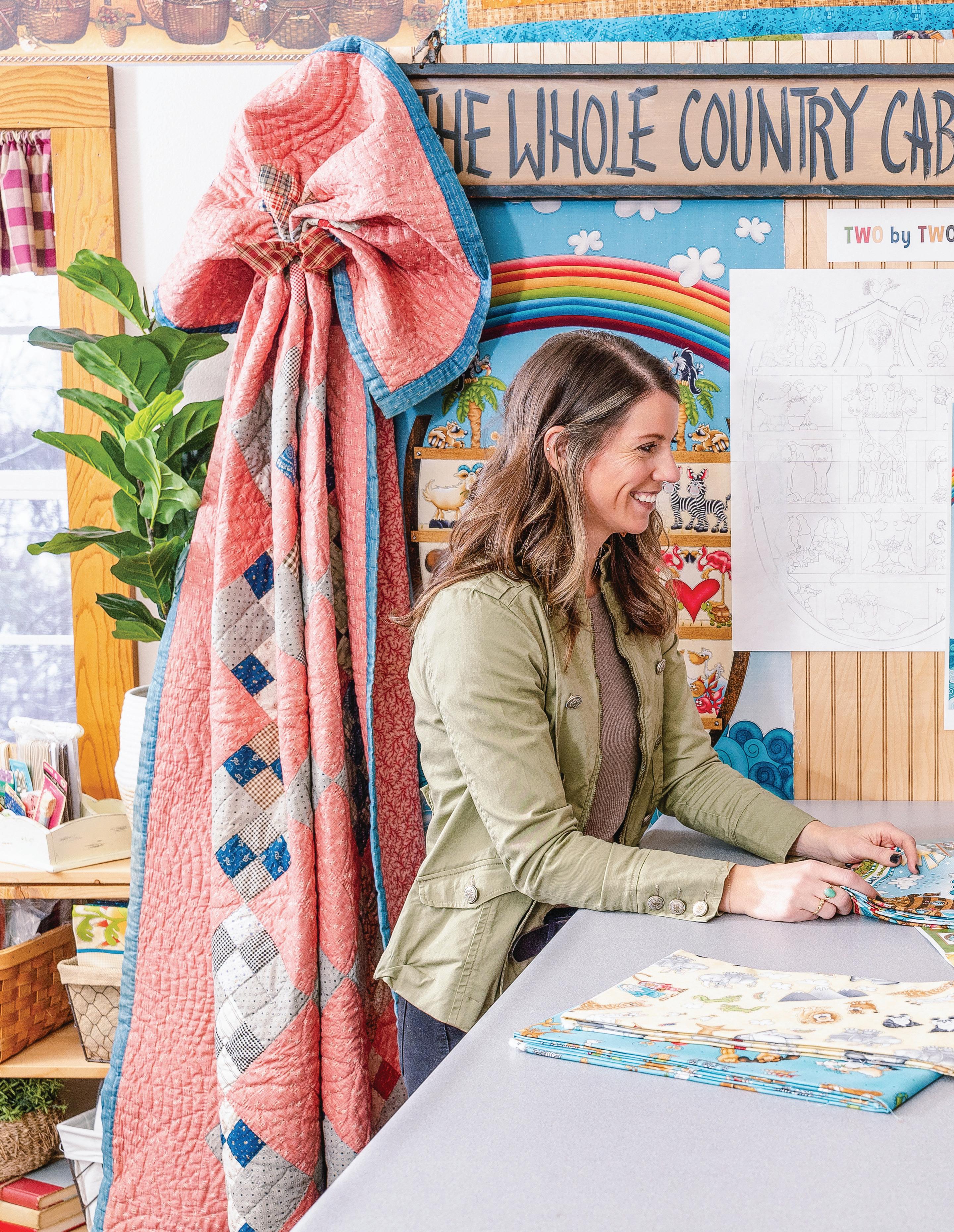
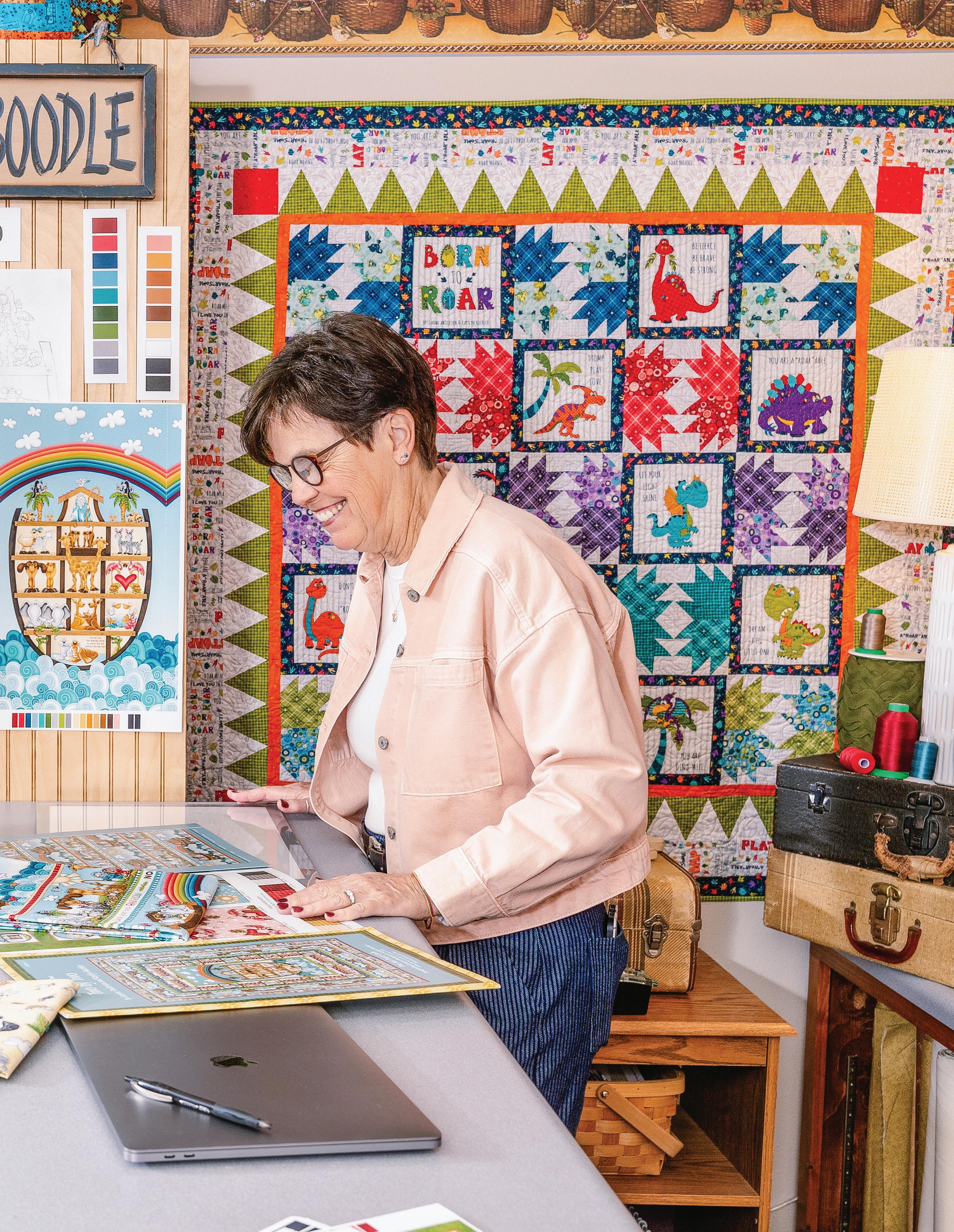
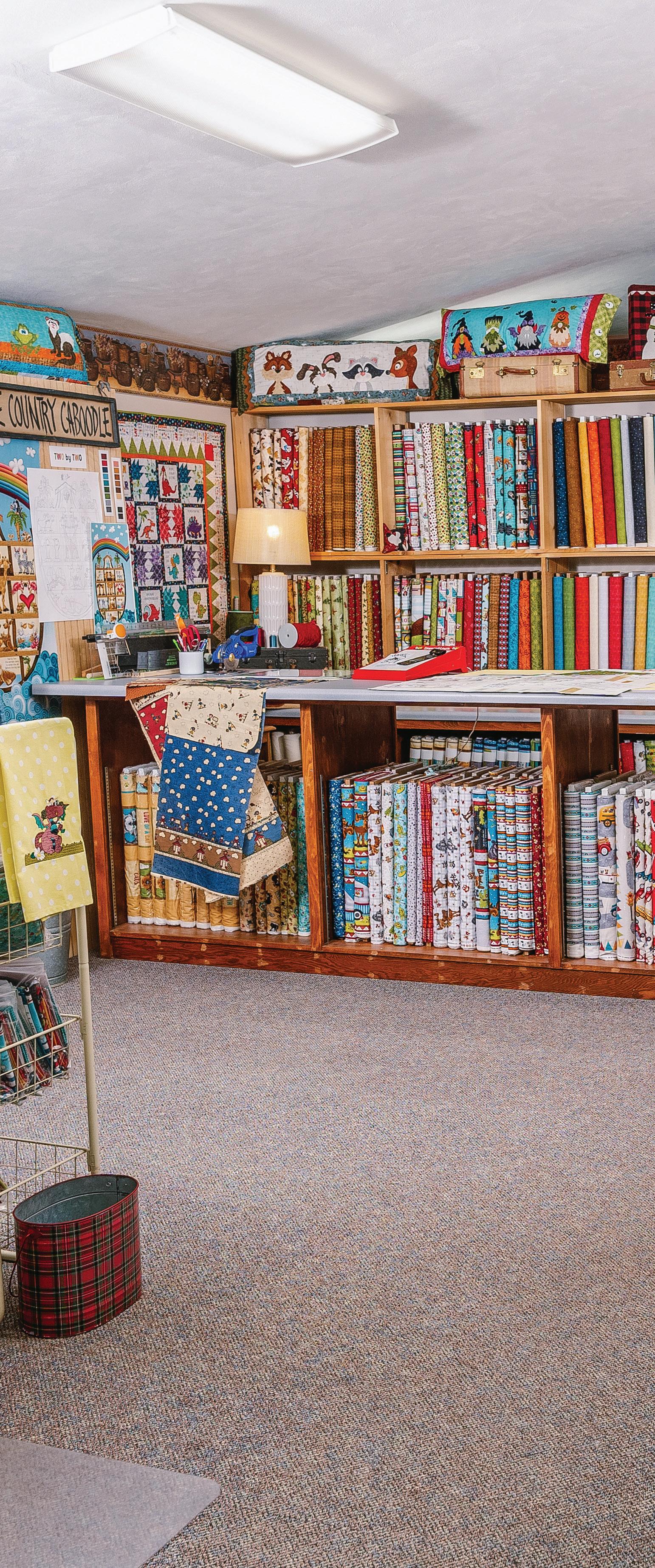
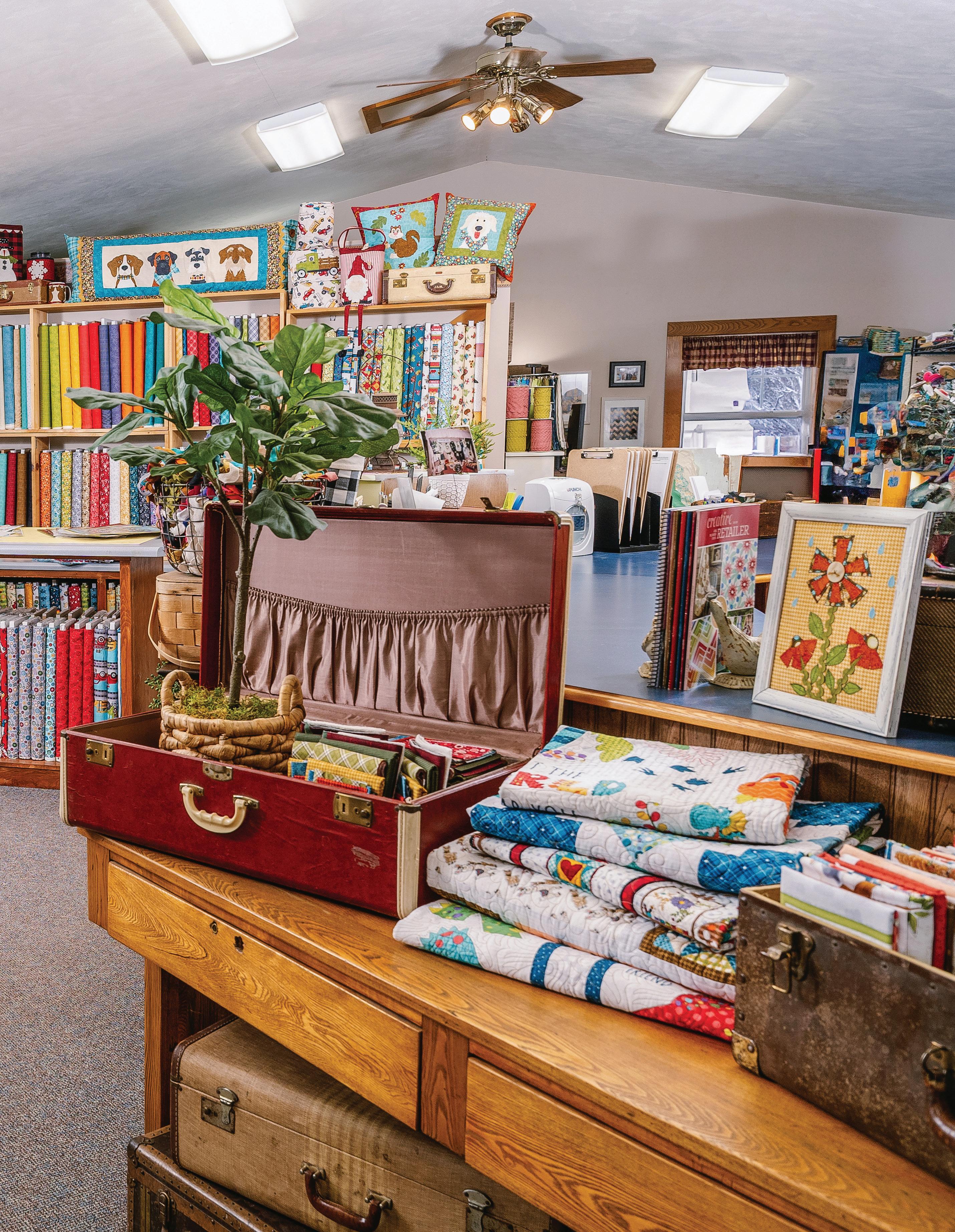
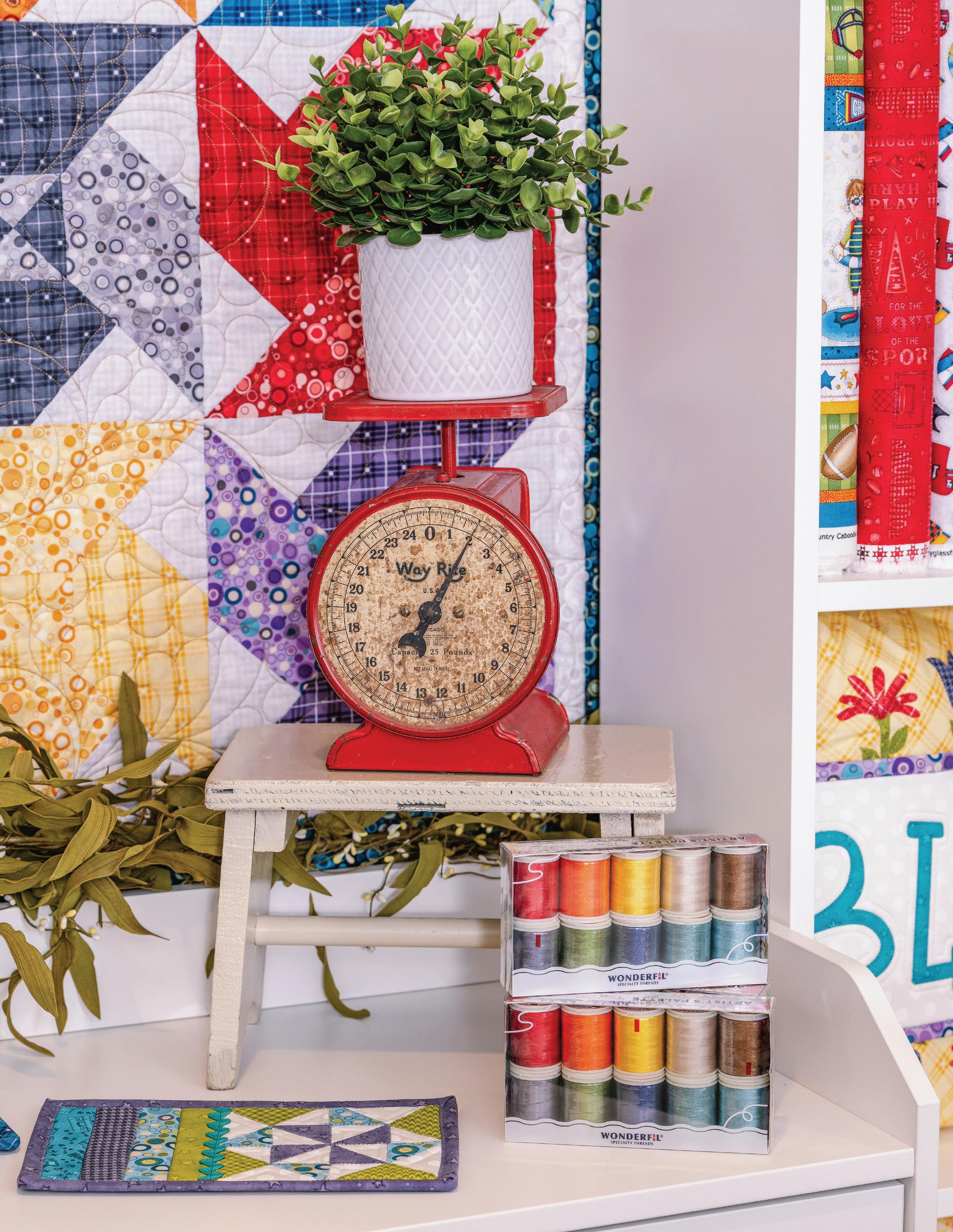
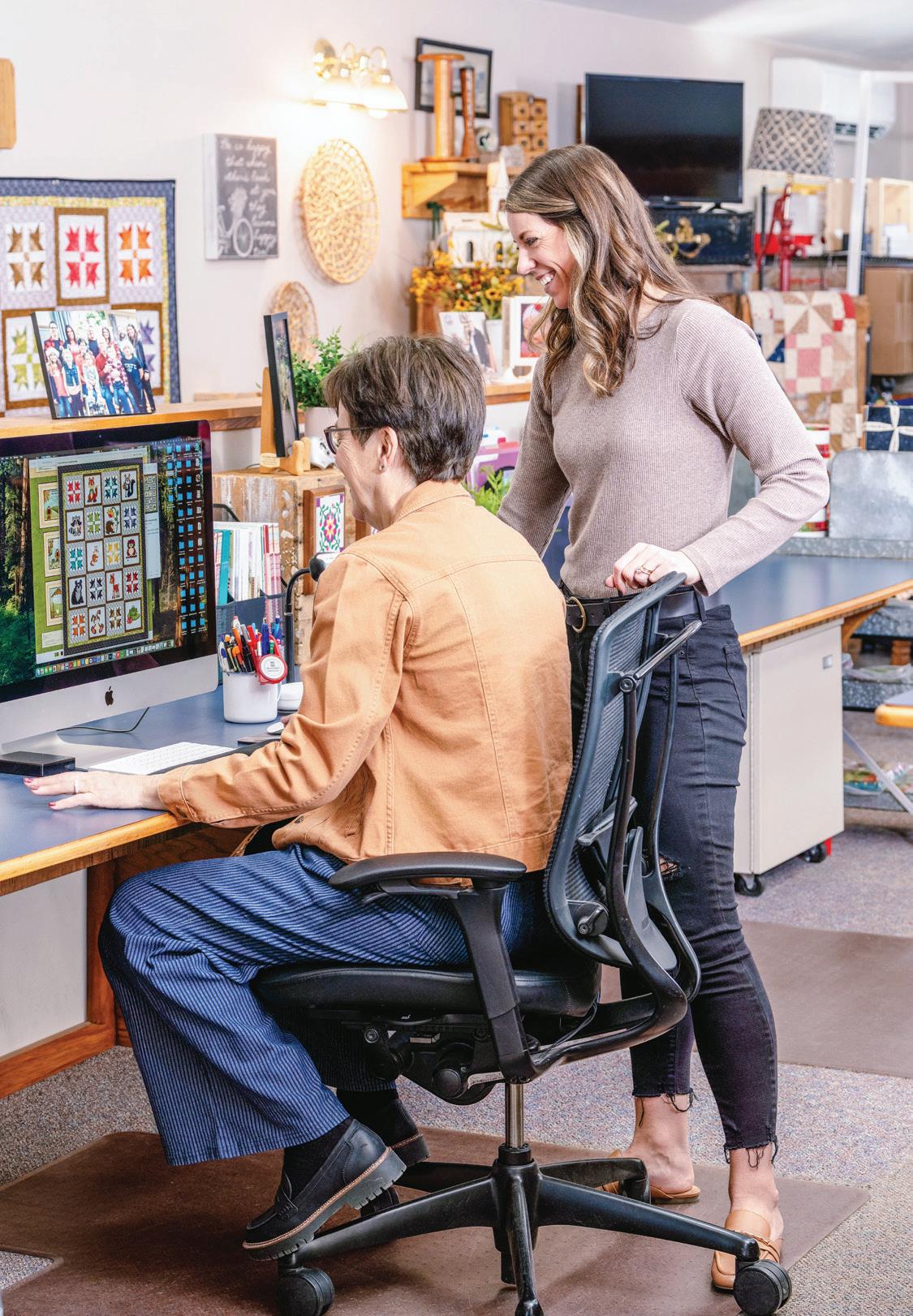
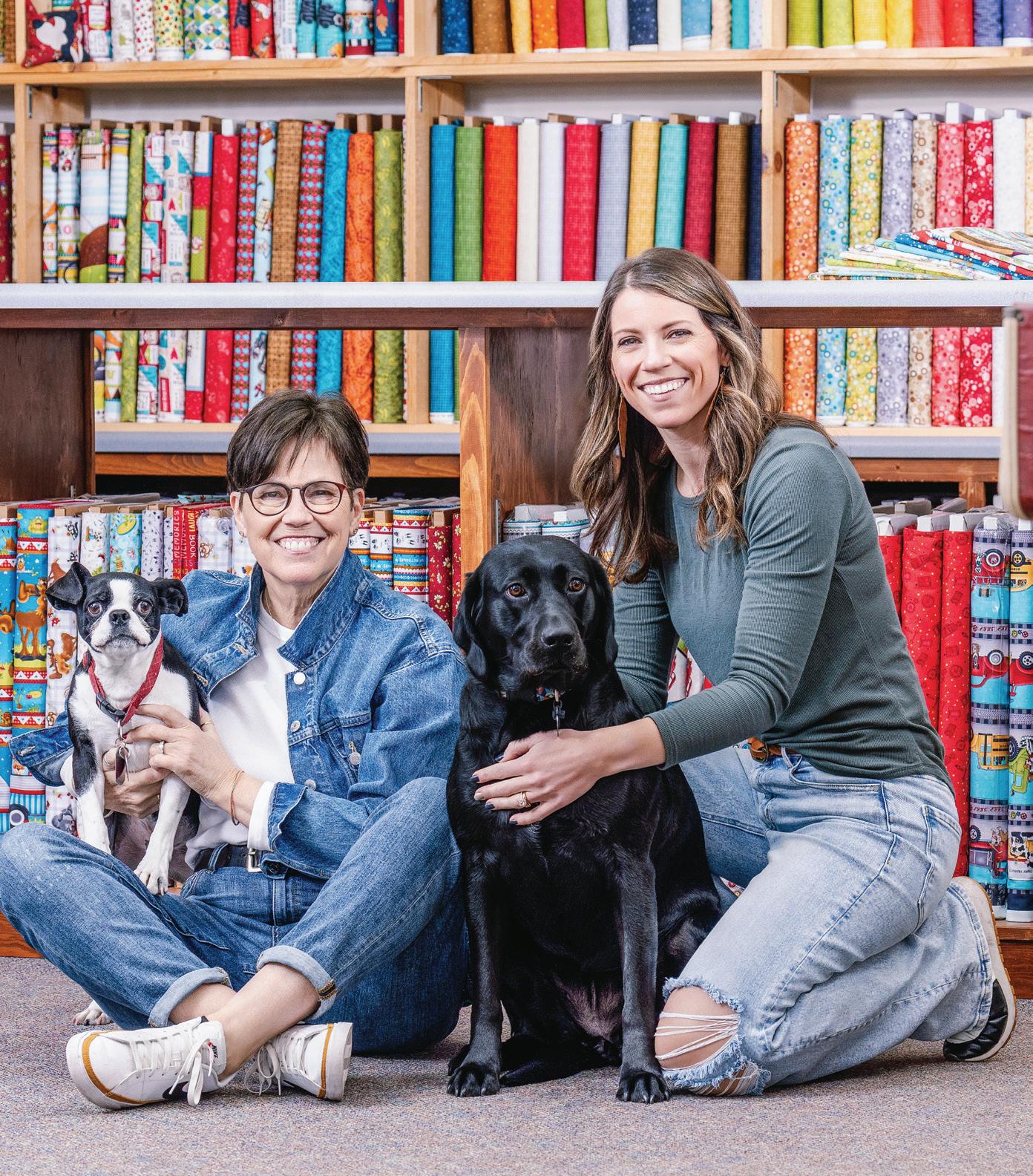
Leanne Anderson and Kaytlyn Kuebler of Northeast Iowa are the motherdaughter duo behind The Whole Country Caboodle. Leanne established the company in 1992 with the dream of creating a business that would allow her time with family while offering an outlet for her creativity. She never imagined one of her children joining the business, but, like many twists and turns in her 30-plus year journey, the plan wasn’t hers—it was part of a much higher power’s design!
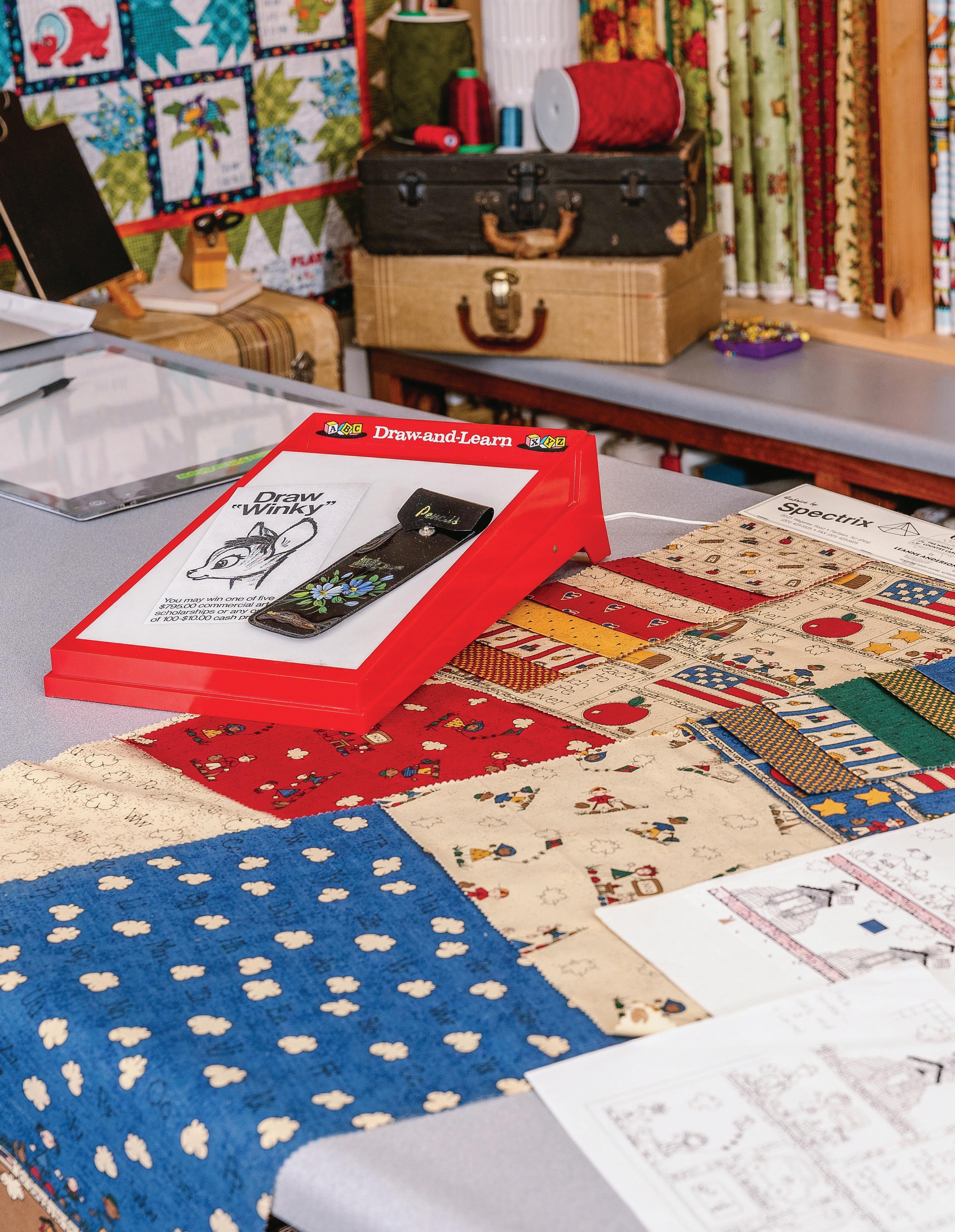
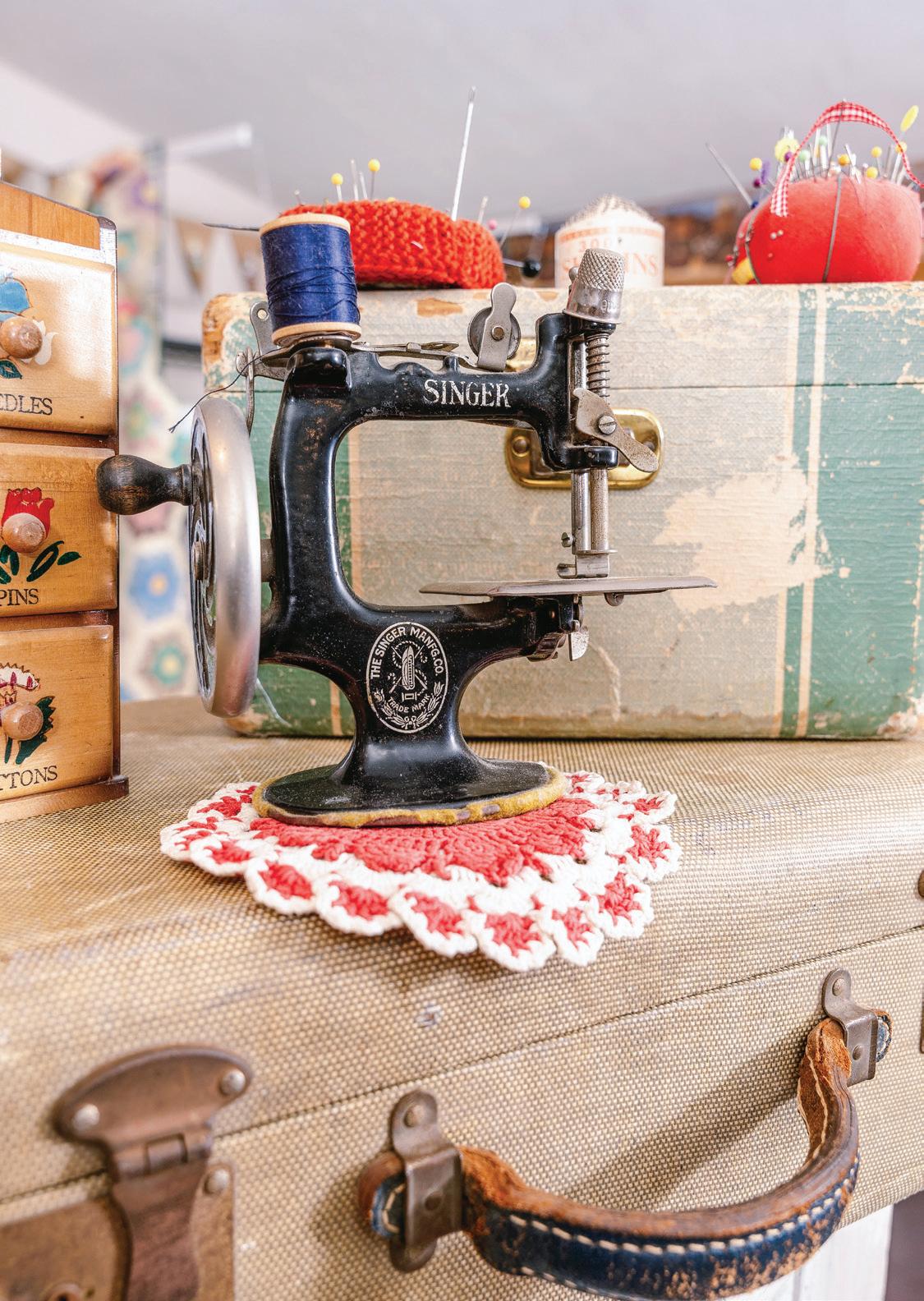
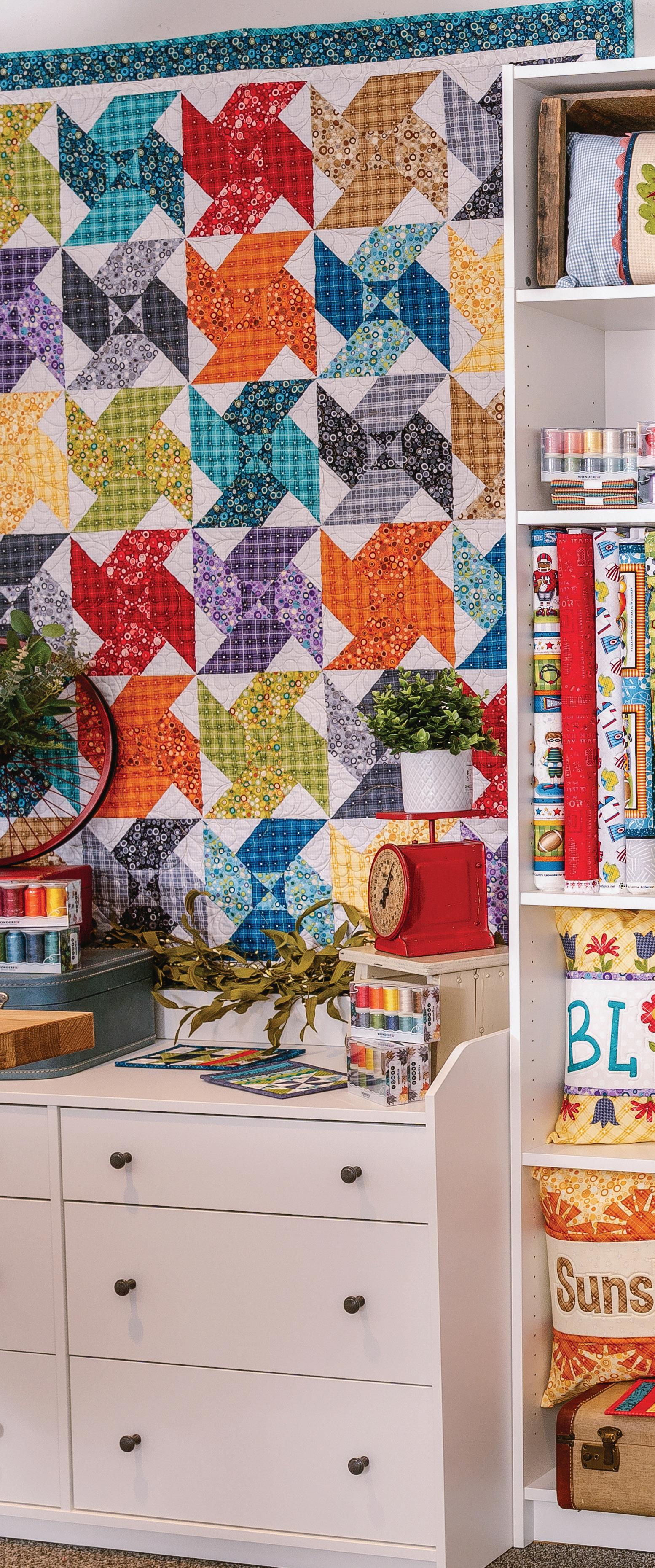
Leanne: From the time I was a little girl, I remember drawing “Winky” the deer from a magazine, hoping to win the grand prize. Though I never did, it didn’t diminish my desire to create. One of my favorite childhood pastimes was using my little red Draw & Learn light table to explore my creativity. Along with drawing, I was deeply influenced by my grandmother, a professional seamstress, and by my mother, who sewed clothes for my brother and me. The sound of a sewing machine was a constant in our home. To this day, my grandmother’s first little Singer sewing machine sits in my shop as a reminder of my roots.
My own interest in sewing didn’t spark until junior high, when I took home economics. Sewing came naturally, and I quickly fell in love. However, my true passion was in the arts, and in high school, I found my comfort zone in both the art room and the home economics room. These two creative outlets eventually shaped the direction of my life, which would become my full-time occupation.
After graduating from high school, I enrolled at the University of Northern Iowa as an art major, only to realize it wasn’t the right fit for me. Dropping out of college wasn’t an option, as my father— who had an eighth-grade education—was determined that his children would earn a college degree. I’m forever grateful for his encouragement to stay in school. I switched my major to home economics in business with a business minor. While I didn’t know what I would do with it at the time, I loved my classes, and that was what kept me going. Looking back, I can see that it wasn’t my plan, but a plan shown to me by a much higher power. I give all the credit for my career to God, as I truly believe that without His guidance, I wouldn’t be where I am today.
In 1980, I married my husband, Ed, and started my first business, Sew What? Almost Anything. I ran the business from our home as we began our family. Our children, Shelby, Taylor, and Kaytlyn, have been, and continue to be, our greatest achievements.
When my oldest daughter was little, we received matching appliqué sweatshirts for Christmas. I became fascinated with the appliqué process. After perfecting the technique, I began selling my designs at craft shows. As the business grew, so did the stress on my hands from the repetitive sewing, leading to a diagnosis of carpal tunnel syndrome. This was a huge hurdle. I had to stop the repetitive sewing, which was so hard. However, I trusted in God’s plan for me.
Following my husband’s advice, I decided to sell my ideas instead of my finished products. The journey wasn’t easy, but I started calling anyone who could offer advice on how to begin designing patterns. Some were helpful, others hung up on me, but every experience was a lesson that shaped me as a designer. One piece of advice I received was, “Go big or go home.” I wasn’t sure what that meant at the time, but I took it to heart. I attended the largest trade show I could—the International Quilt Market in Portland, Oregon—and designed 18 new patterns. The show proved to be very successful. I came home with a mountain of orders, models to stitch, and enough income to cover my expenses. I was hooked on the process of designing and the challenges it brought—not only in learning about the quilt industry but also in discovering more about myself and my purpose. I quickly learned to keep asking questions and never to let “no” be the final answer.
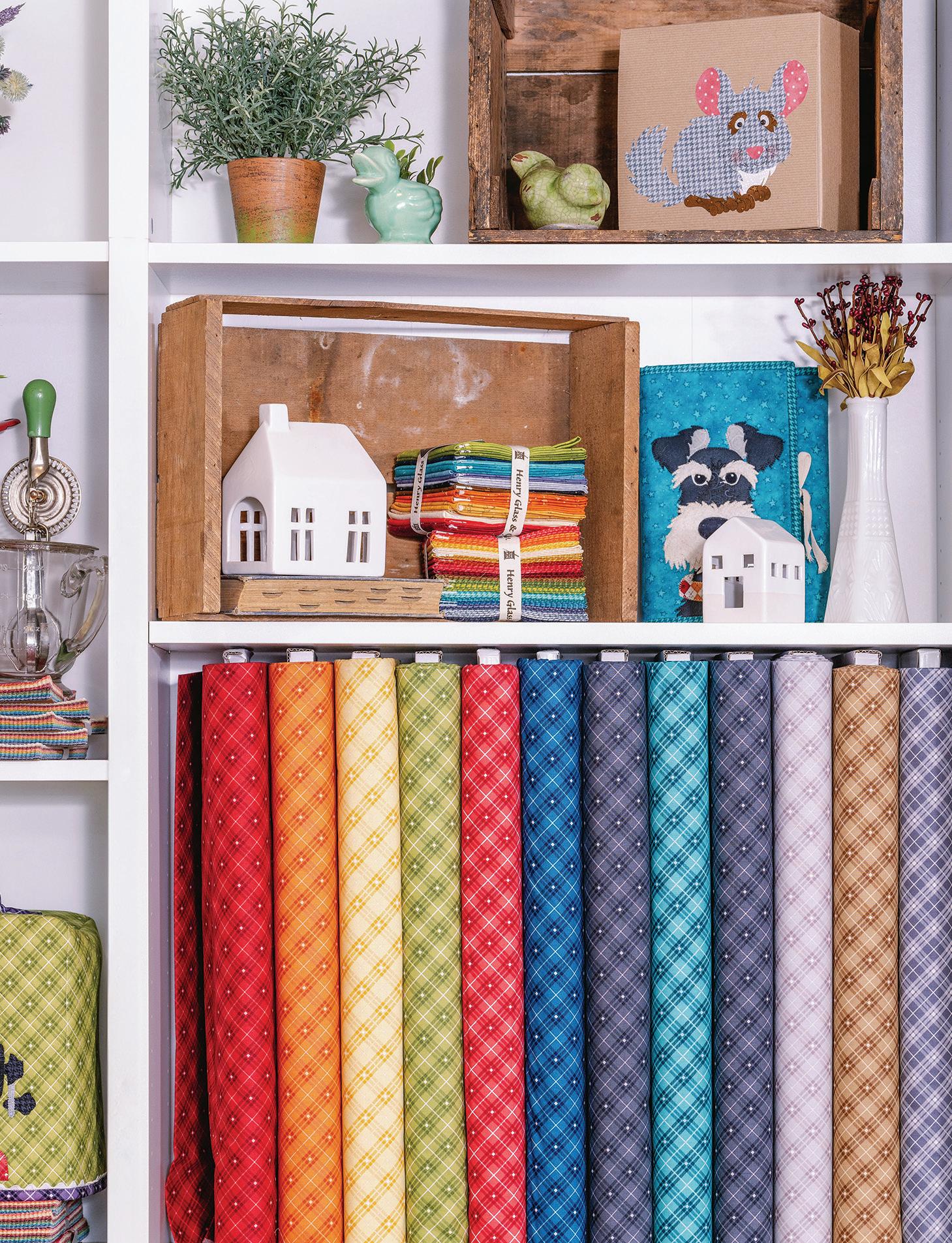
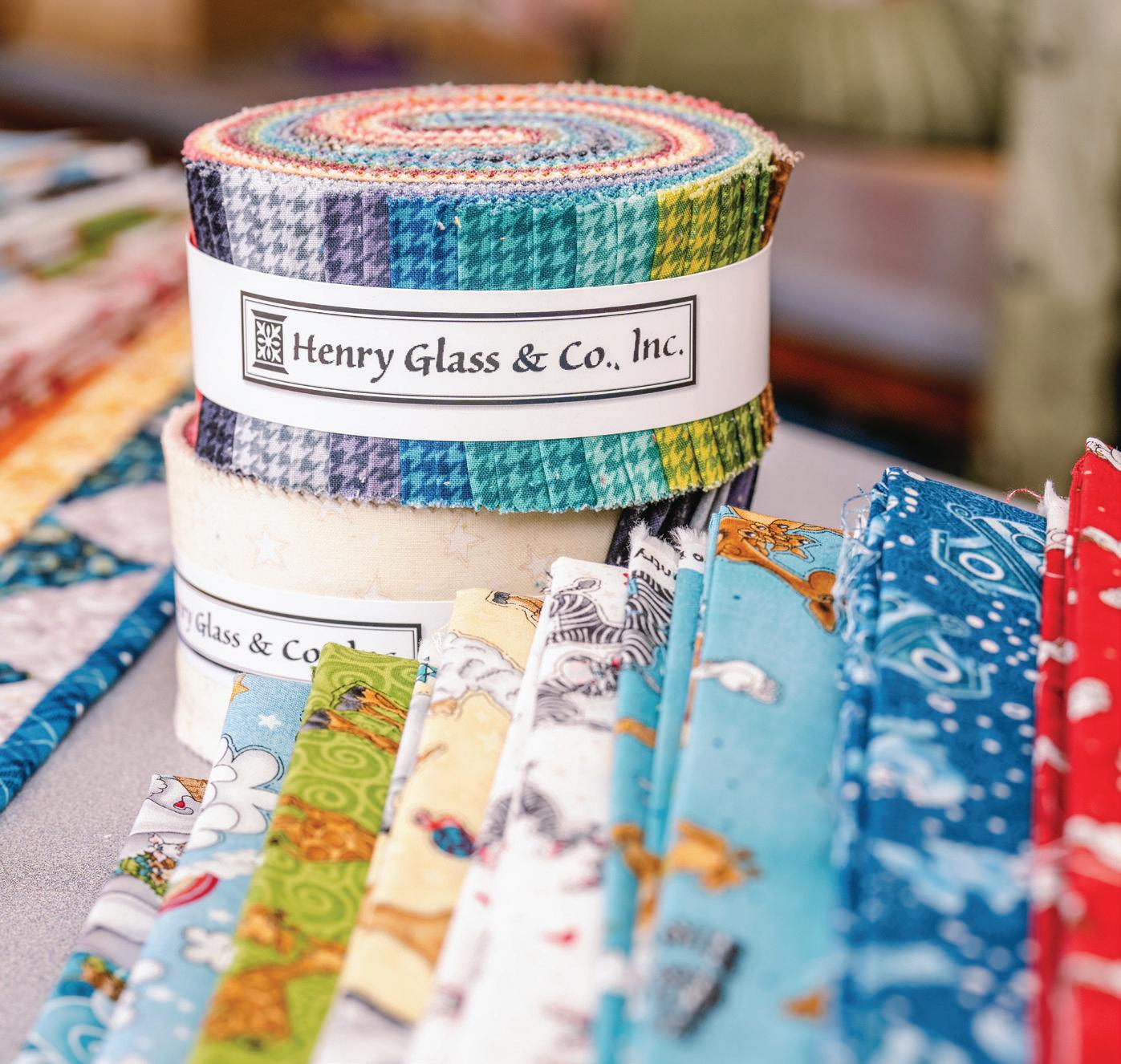
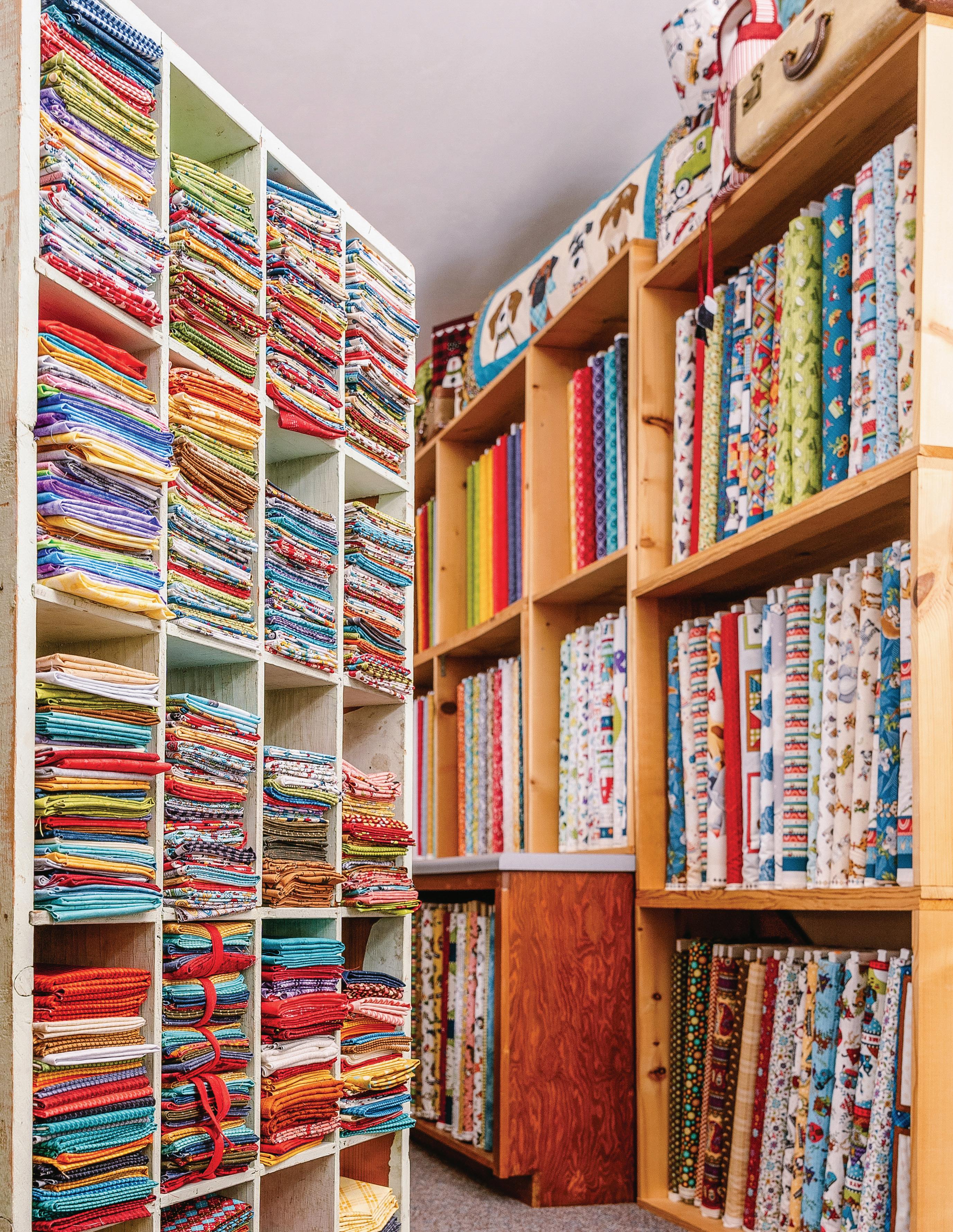
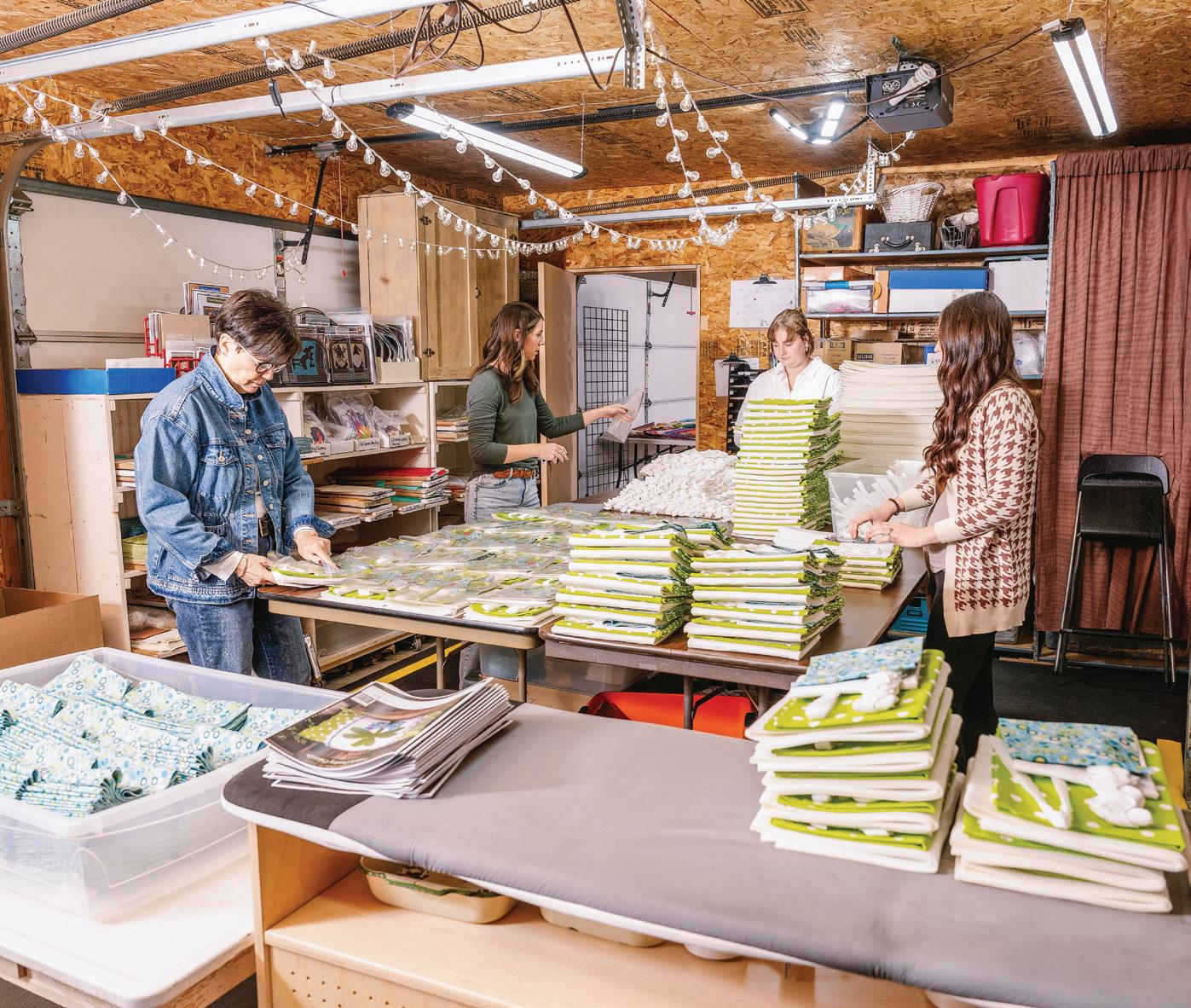
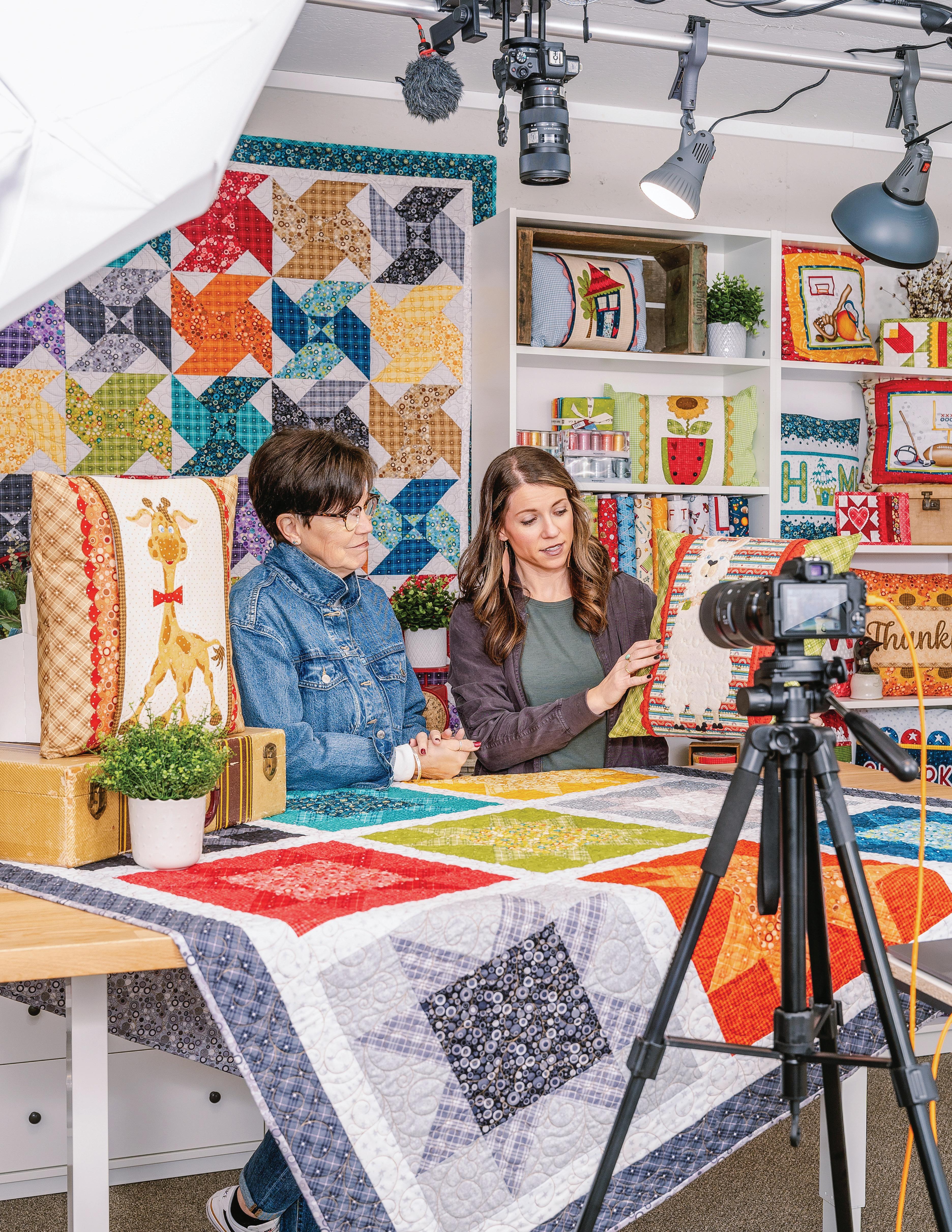
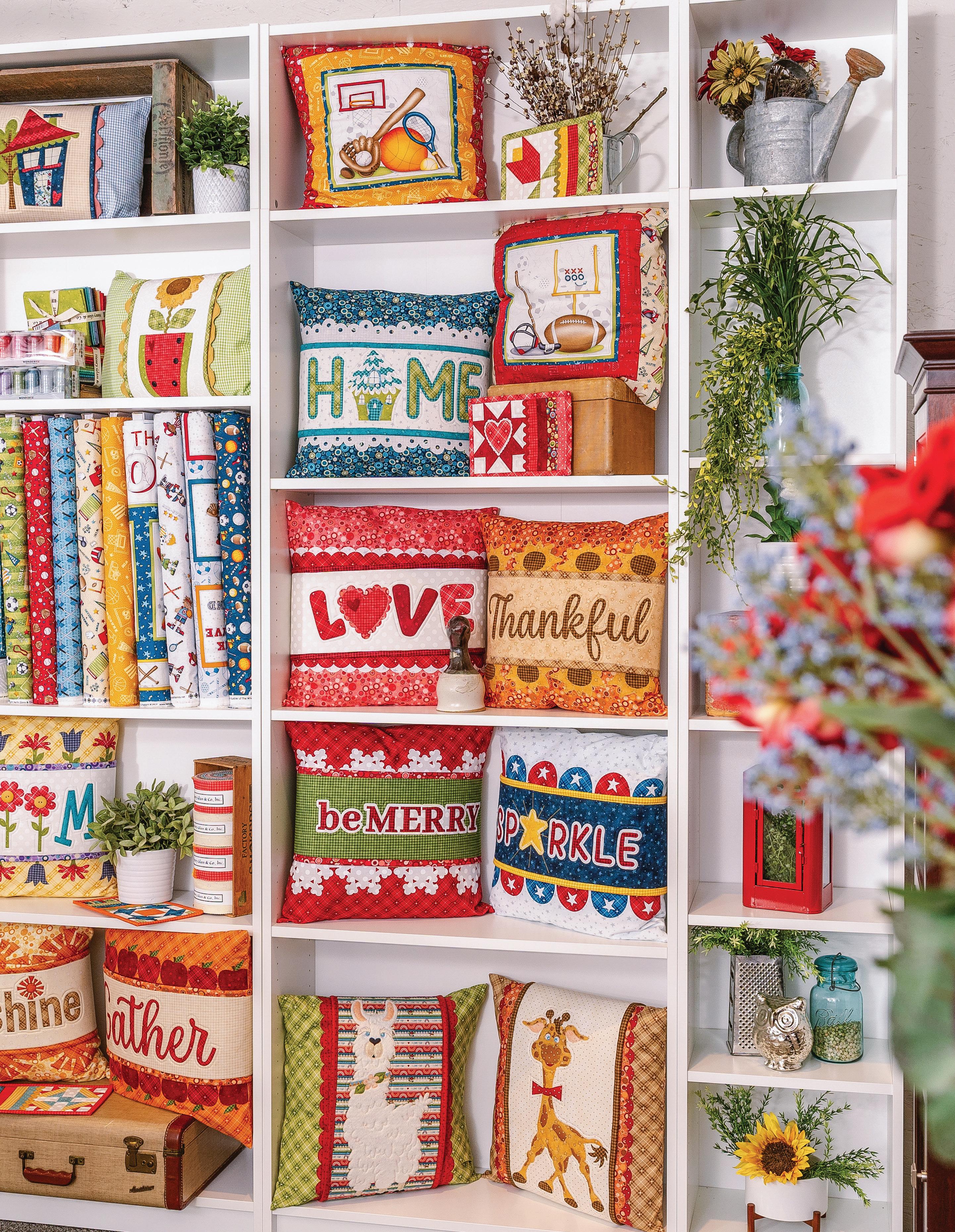
Two years into designing, a fabric company approached me to submit artwork for a potential fabric design opportunity. I knew nothing about designing fabric, but I could draw, and I was determined to learn. I vividly remember coloring my first fabric collection while sitting at my son’s T-ball game. It may have been primitive, but it worked. Fast forward 32 years, and I’m still designing fabric, now for Henry Glass Fabrics, and our company is thriving. Along with designing fabric, we have an extensive line of laser precut appliqués, patterns, and kits creating a full range of products that allow our customers to mix and match effortlessly.
I am often asked what inspires me, and it’s simple: it’s everything I surround myself with. My faith, family, eleven beautiful grandchildren, the beauty of nature, life experiences, and of course, my dogs. Many of our four-legged family members have come and gone from the shop, but currently, it’s Leo and Rory who roam freely and keep us company. Leo, my rescue dog, has brought so much joy to my husband and me.
overlooking Cedar Lake. Living on 12 acres of land has provided us with plenty of room to grow. Over time, the use of the space has evolved to meet the changing needs of our business. More recently, one of the most meaningful additions to our property is a building we dedicated to my mom, Jan. We affectionately call it the “Janny Shack” as a tribute to the profound impact she had on our journey. The serene beauty of the surrounding lake and timber filled with wildlife provides us with endless inspiration.
Over the years, there have been many changes, with one of the biggest being my daughter Kaytlyn joining the business. While it wasn’t something either of us planned, it’s clear that God’s plan was far greater than our own.
A verse that sums up how I feel about my business is Jeremiah 29:11, “For I know the plans I have for you,” declares the Lord, “plans to prosper you and not to harm you, plans to give you a hope and a future.”
In the early 90s, we made the decision to move from our downtown studio space to a building that we built on our property
God’s plan for me has far surpassed anything I could have envisioned. As I sit at my sewing machine, with the sliding glass doors open and the lake in view, I can’t help but reflect on the past 30-plus years—how God has used my talents to bless others. I am deeply grateful for it all!
Kaytlyn: Creativity has always been in my bones. Growing up, I spent hours playing with my Little Tike kitchen in the front bay window of my mom’s shop, surrounded by color, pattern, and possibility. While I didn’t know it at the time, those simple, imaginative moments of play sparked a lifelong passion for design. I’ve always loved being creative, and as I watched my mom in her element, I found myself drawn to the work she was doing.
In her shop, I learned what it meant to work hard, play hard, and prioritize family. I spent countless hours drawing, folding patterns, and assembling kits, all while taking in the creative energy that filled the space. Being there with her felt natural. Even as I grew older, I remained intrigued by the creative process—watching my mom design, turning her ideas into fabric, quilts, and more. People often said I would follow in her footsteps and join the family business, but at the time, I couldn’t imagine it.
After high school, I went to college to study Nonprofit Youth Administration, with hopes of working in youth ministry. However, I quickly realized that wasn’t my calling. Instead, I found myself drawn to digital design after taking a graphic design class. Everything suddenly clicked, and I could see a new path ahead—even though I still had no idea where it would lead. It wasn’t until 2010 that the pieces began to fall into place. I had the best of both worlds, working part time as a graphic designer for a student ministry program and part time with my mom, and the path for my future started to unfold.
In 2012, I had the incredible opportunity to intern with Henry Glass Fabrics in New York City. That experience changed my life in so many ways. I grew my design skills, deepened my understanding of the industry, and grew closer to knowing the person God had created me to be.
By 2019, I realized it was no longer working to split my time between the church and The Whole Country Caboodle, so I made the leap to join the family business full time. From that point on, it’s been full speed ahead! It’s incredible to look back and see how my journey has come full circle—from the front bay window of my mom’s shop to now working side-byside with her, designing fabric collections and projects that bring light and life to the quilting industry.
My mom and I make a great team, we push each other to be better every day. My mom hand-draws our fabric collections, and I handle the digital work, bringing her sketches to life. Together, we create designs that are fun, inspiring, and share a positive message. I love tapping into my childlike imagination when designing, drawing inspiration from the people I love most—especially my daughter Elyse.
I can already picture a future where Elyse sits in that same window of the shop, creating and designing just as I did when I was young. It’s exciting to think that the legacy of creativity could continue through her, a new generation bringing her own spark of imagination into the mix. And of course, my dog Rory is never far away.
While I thrive working at the shop, I’ve also come to appreciate the importance of solitude in my home office to recharge. This balance is something I truly value—collaborating with my mom and others in the creative space, paired with the focused time of working alone.
The message behind my journey is simple: “All glory to God, who is able, through his mighty power at work within us, to accomplish immeasurably more than we can ask or imagine” (Ephesians 3:20). Looking back on my life, I can see how God has done immeasurably more than I ever could have planned for myself. It’s a beautiful story and one that I’m grateful to be living.
One of the core values of our business is building relationships. It’s something that makes us better as individuals and as a company. We care deeply about the people we work with, and those connections fuel our creative spirit. As the industry continues to change, my mom and I have learned to adapt and look at the big picture. We trust the next chapter will unfold as it’s meant to, with new opportunities for growth, creativity, and inspiration.
It’s funny how life works out. What started with hours spent playing in a bay window has turned into a career that blends creativity, faith, and family. The best part? We feel like we are just getting started.
Tammy
Hudgeon
Photography by Stephanie Artuso
From the wide-open prairies to life on the west coast of Canada, glass artist and painter Tammy Hudgeon found her full creative voice once she left the lands she originally called home. She discovered her own deep well of creativity and her unique artistic style while living in an island community alive with dancers, musicians, actors, architects, visual artists, filmmakers, singers, and writers.
Her belief in the spirit of all things, animate or inanimate, informs every creative move she makes, and keeps her returning again and again to her creative practice.
“This is too much for me” I thought as I stood on the
threshold of what was about to become my new, sacred studio space.
Nestled in a west coast temperate rainforest (on the unceded territory of Snuneymuxw First Nation), surrounded by ferns, salal, and mature trees of many varieties, sits my humble, and beloved color- and light-filled studio.
I can see the magnificent matriarch maple tree through the abundant skylights, stretching high above, branches laden with gorgeous green leaves as she holds space and connects
the energies from earth to sky, running through my studio. Every direction I look is a window to the wild natural world that I’m a part of, a world that inspires me every day.
But you see, for most of my life I wasn't doing anything creative. Or more accurately, I truly believed that only special people were creative and artistic, and I wasn't one of them.
Who was I to have this much space devoted to my creativity and my creations, I thought?
In fact, to ease into the reality that this humble cabin in the woods was now my studio (even though I was working as a professional artist!), I offered to share half of the space with my partner so that he could use it for his music. It soon became clear that I could fill the whole
“All you have to do to create is to get out of the way.”
— DR. CLARISSA PINKOLA ESTÉS
studio, and not only that, I knew that I wanted all that space for me. He never did get a chance to set up his musical gear, although he did store his electric pianos in the space for a couple of years. Eventually though, there wasn’t even room for them.
My first medium, the one that began my career as an artist, is fused glass art. The scale in which I now create requires space, outlets for kilns, sheet glass storage (over a hundred sharp, shiny, colored 2 by 4 foot glass sheets), and a large table for glass cutting and assembling my art. Glass fusing is a precise process, even though I’m pretty fluid with it, and though I definitely stretch the boundaries of what’s possible, it’s still a sharp and unforgiving medium.
In the beginning, I wondered what
to do. What color, shape, size? Fortunately for me, many of those decisions were out of my hands because of the tiny toaster-sized kiln that I started with. No need to wonder what I’d make, the kiln decided for me. Size and ability were dictating.
Fewer decisions equal more flow and freedom.
I needed these confinements as I began my creative path with glass. It may sound surprising to say, with all the talk of creative freedom (I talk about this a lot in my online art courses and continually strive to feel free), I also know in retrospect that too much freedom at that point in my artistic life would’ve been paralyzing.
“How much freedom can you handle?” a wise mentor once asked me.
A profound question that I still ponder.
I’m a self-taught artist so I learned by playing. I would’ve been called a late bloomer at the time, starting with fused glass when I was about 40 years old. I determinedly stuck to it when inevitable issues with kiln temperature, firing schedules, and weird and unexpected things happening inside the kiln resulted in broken glass and tears of frustration. There were (and still are) simply bad color combinations or design lines that didn’t pan out as I’d imagined and hoped.
Glass fusing was a relatively new medium for a home studio at the time I began. As a result, I learned about glass fusing by reading the one book that I could get my hands on (this was very early internet days, and I was late to that party) and by experimenting a lot. I now have thousands of kiln firings under my belt. I figured out a lot of things simply by doing them and doing them again and again and again. The glorious color and reflections when light pours through glass are endlessly inspiring.
I didn’t believe that I had any talent or any
voice that needed expression. It was enough to be immersed in energizing colors and shapes and possibilities. I was gaining confidence by simply working with my hands, getting skilled with my tools, and using and trusting my wild imagination.
My studio is now equipped with 2 large kilns, but other than that, my tools are the same basic tools I began with all those years ago. A small handheld glass cutter, 2 pairs of glass pliers, and a square. (Plus, a box of Band-Aids nearby for those sharp and stinging glass cuts and slices into fingertips that happen with regularity.)
At this time my unexpected art career was thriving. I was showing my art in galleries across North America and my art was in collections globally. I was being recognized and honored with awards for my innovative and original glass art designs.
I was starting to trust that something I hadn’t even dared to dream about was now my life. Can this be true? Will this last?
Who am I to have this life?
This new studio allowed me to expand into other mediums—other avenues that piqued my curiosity but that felt out of reach because I was still holding onto the limiting belief that I wasn’t an artist, not really. I would say “I work with glass” but being a painter was out of the question.
However, my soul was calling for a fuller expression, to show more of me in my art. To express a fuller range of myself.
Now I had the room to begin to play and
explore. Was I ready to let myself get “messy” and stop being so careful?
Rather than the sharp and fragile qualities of glass, I was excited to use materials that I could squeeze out of a tube or scribble with. I love to scrape the surface of my paintings with knives and gouge into them with nails. Mixed media art had entered the picture with a bang!
These new tools and materials led to an ongoing body of work that’s deeply fulfilling to me. The two mediums, fused glass and mixed media paintings, complement each other beautifully and satisfy my different temperaments. These mediums inform each other and keep me motivated to continue to explore the endless possibilities for creative expression.
I had a bit of a tug of war in learning how to let go and let myself use this space for what I wanted. My space for what I want. What a concept, right?
All these transitions took time. Years of working through old beliefs and limitations within myself and within my art and my studio. This studio space started a transformative process that continues to this day.
There were the internal struggles I needed to make peace with, to integrate parts of myself as I integrated how to use my studio. This might seem surprising, because a building is simply a building, right? But a building is also a container, and within this safe container, I came home to myself, literally and figuratively. Over the years I discovered, through much hard work, devotion, and self-reflection, that I belonged.
My creative life and my art
career have been
the biggest portals for self-discovery and spiritual growth that I could ever have imagined. There's so much more to it, the symbolism of the sacred container, the symbolism of space. The freedom and JOY of creative expression without worrying about what anyone else will think. Ahhhhh… sounds good, doesn’t it? It’s a dance of knowing when I’m creating 100% for me, and when I’m honoring my commitment to my galleries and collectors and when it’s a blend of both.
Sometimes (often) these creative impulses and results overlap. I’ve learned to navigate this tricky dynamic by knowing exactly what’s inspiring me to pick up my tools. And to have the space internally for all of it.
I love making my living with my hands; being my own sole financial supporter by creating income with my art. This is very satisfying to me. My studio has been witness to every kind of emotion that I experience. I’ve been down on the floor crying jagged tears, pounding my wooden canvases and screaming with frustration and anger, and jumping for joy looking through the immense skylights to the wild blue beyond.
When I step out the door, I immediately feel the cool freshness of Mama Gaia underfoot. Daily I watch birds bathing and frogs croaking in the nearby pond and see the deer moving through the dense forest and daisy-filled meadows around my studio.
The raucous call of ravens in the trees is a constant soundscape. A gaggle of geese fly overhead honking their way home. Robins are nesting right outside my window, I’m finding their delicate, bluish green eggshells scattered in the ferns. All a remembrance of my own innate wildness.
What I see and feel sometimes translates directly into my art, whether it’s an animal, plant, or bird out my window, or in my imagination.
Or I can be inspired by the colors and patterns in a dress or quilt, or gazing at the stars on a dark moon night, and all kinds of folk art from around the world.
Sometimes, especially with my paintings, the visions I create come from a deep well inside of me. Sometimes it’s simply a feeling needing expression, often in the form of wild exuberance that comes through in my art.
When I travel to color drenched locales like India, during the wet, west coast Canadian winters, my studio lies fallow. Then I have my portable studio in the form of mixed media art journals where I record my travels and simply play with paint and collage. I experiment with pattern, color, shape, and texture. My way of art journaling is much looser than a travel diary, much more informal and way more hodge-podge.
As a result of my love of mixed media play, and the freedom I feel when creating in this way, I built my online course “Creative Sovereignty” art journaling and “Paint Your Wild Spirit” online art courses.
Before either of these courses existed, and what helped me to believe that I had something worthy of teaching, I wrote and illustrated my book, Tender Brave Spirit, sharing the fuller version of my creative journey, with luscious full-color art pages and truthful, vulnerable journal excerpts. What started out as a book to showcase my art soon became a book to share my love of creativity, my understanding of how vulnerable I was and how many of us feel with our creative expression and my desire to encourage others to embrace their own style, to follow their own creative impulses, no matter their level, from scared beginner to accomplished professional.
Because if I can do it, so can you.
Betsy Cannon
Photography by Bindi Binkley
BETSY CANNON is an art quilter who lives a few feet outside Denver, Colorado and has made highly embellished story quilts for over 50 years. People think she really likes chickens, but what she really likes is chicken feet! She likes to bead them and add them to her work.
PORTRAIT OF THE ARTIST AS A YOUNG WOMAN
My journey as an art quilter started when my grandmother taught me to sew as a teenager, with the intention that I would eventually take over her role of making my clothes. For a few years, that was my focus, until I discovered quilts that told a story and didn’t rely on patterns, sparking a new interest in me! I loved that I could make something that was my own and measuring was kept to a minimum. This was the early 1970s, and my studio was a table I cobbled together in my children’s playroom. In the beginning, I made interesting potholders, baby t-shirts and small quilts using appliqué techniques. I sold them at craft shows and took classes from artists I admired. Throughout this time, I always made sure I had a dedicated
space for creating. But it wasn’t until the late 1980s that I had a full studio space in a finished basement—a big upgrade!
We were living in the Denver area, our children were off to college, and my husband was an airline pilot and gone for days at a time. It was then that I was finally able to devote a lot of time to the elaborate quilts that were in my head. With this new freedom to explore creatively, I sought out like-minded artists. I joined a large contemporary quilt organization called Front Range Contemporary Quilters, where I met some lifelong creative partners. I also joined a design group for artists, led by a retired art professor, Helen Davis, who remained a friend and mentor until her passing at age 100—still producing art daily until the day she died! It was there that I learned to describe my process and to either seek advice or ask for a critique. It made a huge impact on my work to hear from quilters, painters, weavers, basket makers, and printmakers! These groups have kept me interested in continuing to grow artistically and express myself. It’s so difficult— but also so rewarding—to find a group of other artists of similar ability and interest (mine
is Piecemakers) who are willing to give well considered, honest thoughts about your work. It’s essential if you want to continue to move ahead artistically.
Learning new techniques and materials from fellow artists and pushing into areas you might not have previously dared to try, truly keeps the creative spark alive. All the classes I have taken from artists that I admire over the years, occasionally in techniques that I haven’t yet tried, have served to keep me on track, expand my knowledge, and create wide variety in my quilts. They inspired me to introduce nontraditional elements like popular culture, whimsical songs, and funny sayings into my work, an interesting departure in a “traditional” art form like quilting.
I never know what will stick in my head and send me off on a creative adventure. As an example, one day my walking partner mentioned a story she read about Baba Yaga. Baba Yaga is a fearsome witch in Russian fairy tales who lives in a cottage in the forest that dances around on gigantic chicken legs and is surrounded by a fence of human bones. A house on giant chicken legs? I’ve never been more ready to make anything in my entire life! With that, I was off and running, and over many years, I have made dozens of quilts with that as a jumping off point. I have always tried to make my appliqué quilts tell a story, usually, a whimsical one. And honestly: why limit chicken legs to witches’ houses? This kicked off a theme that continues in my work to this day.
My obsession with adding colorful animals and imagery to my quilts then broadened with my renewed obsession with Day of the Dead. I had learned about the Mexican holiday while studying Spanish in college, but I was finally able to experience and embrace the holiday more fully on numerous trips around Latin America and Mexico to build houses with Habitat for Humanity. The images of dancing
skeletons in graveyards, the fabulous shrines made to honor loved ones, and the decorated graves made appearances in my quilts for years. The folk art I have collected on those trips decorate not only my studio, but the entirety of our house, and it inspires me every day.
When I begin a project, I may make a little sketch, or I may simply start with a background fabric. As I cut out and lay down scraps of fabric, the piece comes together before my eyes. I have huge bins of fabric pieces, collected over decades, that—with adhesive web on the
back—can be ironed onto the background and set in place. After lots of placing, removing, adding, replacing, I iron the pieces onto the background fabric. After I have finished ironing on pieces to the quilt top, I then sandwich the quilt with batting and a backing. Next, I consider the best way to quilt it, usually by free motion quilting on the sewing machine.
Often, I add hand quilting with large stitches and heavier thread for contrast. After everything is sewn down, my favorite part of the process begins: embellishment! This includes either adding paint or sewing sequins and beads to
the quilt top or sewing already embellished elements to the quilt. I feel that this makes my quilts come alive. Because of my husband’s job, we have traveled all over the world. Some of my favorite trips were to Hong Kong, where I encountered an absolute motherlode of sequins and beads. I love being able to add sparkle and texture to my work and to add paint (particularly puffy paint!) to ramp up the excitement. The colorful, exotic beads from around the world, combined with the colors and imagery of the West Texas desert where I grew up, heavily inspire many of my quilts.
My husband and I have downsized to a smaller home. One reason we moved to this house was that it had the perfect studio space for me.
I find that simply entering my studio makes me want to get to work. All the things I need are at my fingertips. If I want to start by rubberstamping fabric, all the supplies are nearby. If I need vintage pieces as a part of the design, I have storage bins full of options. The shelves have all the fabrics that I have collected, sorted by color. Drawers are full of colored beads and sequins, and I have jars full of buttons of every color. The borders of my quilts often are oilcloth ruffles, and I have lots of choices of colors and designs. Just the idea of being in my creative space with large tables, good lighting, and lots of options gets me excited to begin a new project.
I am surrounded by inspiration on all the walls, which makes my studio a special place to be. I no longer am entering shows, with all the attendant work involved with sending quilts all over the country. I prefer instead to make one-on-one sales and gift my work to close friends and family. Making quilts gives me lots of pleasure and keeps me active creatively.
Piecemakers still meets monthly to show our work, ask for suggestions, and gather the feedback that we all need to grow as artists. For about 30 years we have exhibited together and entered shows, knowing we had a network of support behind us. Now we have all graduated into a new phase, enjoying creating for its own sake, free from deadline pressure!
More on Betsy Instagram: betsyhcannon
Anne Brooke
BY JENNY MILNER
PHOTOGRAPHY
Working from her studio shed in West Yorkshire in the U.K., ANNE BROOKE still has to pinch herself to believe she is now a full-time artist, tutor, and wobble gob. She has always dreamed of this moment but never believed it would happen, until now.
From an early age, all I ever wanted to be was a teacher originally in a primary school but the roads we travel are never straight forward. After a few changes of direction, I completed a degree in visual art and culture at the University of Salford, followed by my teaching degree, then I started teaching art and photography in a school in Lincolnshire.
Until then, the only textiles work I had really experienced was dressmaking, which my mum did the whole time we were growing up. I remember buying clothes at the village jumble sale and upcycling them because of that; who knew I was ahead of my time? I also remember sneaking into the kitchen to watch the ladies sitting at the kitchen table, drinking tea, eating cake, and stitching an altar cloth for the local church. Little did I know at the time that I was peeking into my own future.
As I began my career as a teacher, the world of textiles began to open up to me. I didn’t realize what a rabbit hole I was going to go down. I didn’t have a studio space at this point, and my classroom and teaching took up all my time. It wasn’t until two years later when I moved home and schools, got married, and started a new life, that a new obsession with going to workshops began, and my love of learning new techniques took me down a number of different routes.
I finally had a space to work (the dining room table) and a growing number of boxes in the corner of the room that housed the bits and pieces from various workshops I had been to. I began to get stuck in a cycle of going to a workshop, loving it and buying the tools, kits, and materials, only to discover a few months down the line that it wasn’t for me. So, I would box it all up and go to another workshop, and so the cycle began again. It soon became clear that I needed a focus, and it just so happened that at work we were in the process of setting up an A-level textiles course. I decided I needed to be
better qualified to teach it and embarked on a 3-year distance learning City and Guilds Level 3 course in embroidery. I loved this exploration into traditional techniques, but it became very clear, to both me and my tutor, that it was the experimental and exploratory work that interested me the most.
However, life was moving on, and we had added two daughters to our family, so we needed a bit more space. In the back of my mind when we were house hunting was a space to call my own, where I could leave my work out and it would be safe from little curious hands.
My attic studio was on the third floor of the house and started with a small table, bookshelf, and all the boxes from the dining room. It felt like a huge space, but in a matter of months, I had filled it. Having a dedicated space to disappear into was heaven. I was able to surround myself with my equipment, a growing collection of books, textile yumminess, and work on display. It very quickly became my happy place.
On completion of my embroidery course, I was asked to enter work in our local art show. At this point, I had never thought about exhibiting my work, but I took the plunge and entered some of my embroideries that were based on my love of seed heads, applique, and free machine embroidery. To my surprise, not only was my work accepted, but I won the Shibden Hall prize and sold the work. Robert, my hubby, realized very quickly that all the stuff I had accumulated over the years could be put to good use and convinced me to apply for Art in the Pen, a contemporary art show in Skipton North Yorkshire that we used to visit. It was a huge surprise to be accepted, and a moment of panic as I sold all the work I had built up. So, I got to work in my studio, with my collection of papers and sewing machine, and created my first collection of stitch collages. This was a technique I had developed mixing my love of paper and drawing with free machine embroidery, depicting the plants and flowers I saw and collected on my many walks.
And so, my accidental second career started, and over the next 8 years I exhibited work at a variety of shows, gave talks, and taught workshops all over the U.K., whilst still working full time and having a family. Life was very busy. I adapted my sewing space and could be found stitching in the car, waiting outside dance class stitching, even stitching on the beach or up a snowy mountain on holiday.
Having a dedicated space
meant I could start running small workshops, but I outgrew my attic studio and kept mentioning to Robert about the possibility of having a studio in the garden. Over our summer holiday, he drew up the plans for my shed and together we spent the next 6 months building a new space for me to use. It was so exciting to see it growing and trying to imagine what it would be like to work inside it. Finally, in 2017 Shed 76 ½ opened its doors. The purpose of the shed wasn’t primarily a space for me, it was a place to continue to run my workshops, build my online shop, and create a space that was all about bringing people together to stitch, hugely inspired by the memory of me sneaking into the
kitchen as a little girl. The large table is the focal point of the shed, and my favorite time is when the shed is full of people stitching, chatting, and drinking many cups of tea.
My own work culminated in 2019 when I exhibited at the British Craft Trade Fair. Afterwards, I had my work on exhibition and for sale in shops all over the U.K. I was really proud of where I had gotten to, but working full time as Head of Art at this point, having a family, and running a business was taking its toll. By the end of the year, I had lost my mojo for making my own work and decided to take a break and just get back to basics and evaluate where I was heading.
I
cut a day at
work
to give myself some space to see if I could develop my own work, and at the start of 2020, I started a bobbin roll that I was going to stitch a bit each week, based on a theme or technique. My sewing space became the corner of the sofa, so in the evening I could sit while watching TV with my family and just sew. As this was a new direction, I decided to start documenting the development of my work on my YouTube channel to share with others. Little did I know that the world was heading for lockdown, and this little bit of stitching would get me through. I had planned on working on it over the whole year, but as we had more time at home, it grew very quickly, as did the number of people who discovered my project and asked if they could stitch along. #sew4thesoul began with that piece and extended to a book and mini book in a tin. I found that hand stitching was something that relaxed me, and my mind went quiet while stitching. I was able to think about other things that I wanted to do.
At the start of the following year, I wanted to carry on stitching each week and I remembered a selection of tags I created during my embroidery course, so decided to start the #52tags challenge, where I would spend each week of the coming year creating a tag based on a theme. I began week 1 with the theme “all white,” again filming my stitching and sharing it online. In week 2 we went back into lockdown, and over the coming weeks and months I was so thankful for this little bit of stitching. When I started, I didn’t think I would complete all 52 weeks, as life can get in the way. But by week 26, when I suggested that people could send me a tag with their location on it to see where people were based, it astounded me to receive over 700 tags from all over the world. Who would have thought a small piece of stitching would keep a tribe of stitchers going through some very difficult times? And I am so thankful to everyone who stitched along and gave me something to focus on.
Slowly my mojo was returning, and the yearly #52 projects were launched. After the tags came the #52flags in 2022, #52stitches in 2023, #52blocks in 2024 and now #52words in 2025. Things were becoming quite busy attending various shows and delivering workshops all over the U.K. so I decided time had come to step down as Head of Art and reduce my hours to two days a week focusing on A-level art and textiles. I had intended to do this for the next 5 years.
In 2023 I was ready to start
to explore my own work again and couldn’t work in the shed as this needed to be kept tidy, so I set up a separate space in the spare room. Completing an online course with Donna Watson exploring the “Essence of Identity” I found my own voice again not only in my work, but also in creating a space to work in.
My studio space is full of all my collections and things that inspire me. This extends to a printer’s tray I have on the kitchen wall, where I display things that I have made, gathered on my walks, or simply have holes or circles on them. Having this inspiration around me helps the thoughts I have about my work and what I could do next. I am usually found on my walks, particularly on the East Yorkshire coast, looking at the floor, saving a pocket full of treasures to admire once I return home. I created mood boards of inspiration to inspire my new work that was totally different from anything I had done before using these. The main development in my work was my new love of hand stitching and telling a story with a needle and thread. I started painting my double or triple hoops with a range of media beforehand, stitching and embellishing the pieces. This series of work was shown at my first solo exhibition in Huddersfield titled Whole:hole which, alongside my work, included a community stitched tablecloth that featured over 100 circles that I received or were stitched at the exhibition to represent the holes people have in their lives and how time can heal or repair them.
I also use my sewing room to record projects for my YouTube channel and online workshops, as well as my Wobble Gob series. This is a name my mum gave me when I was little, as I was a chatterbox, and I love sharing my wanderings and ponderings about all sorts of things with my followers. From the #52 projects I have grown an online tribe of fellow stitchers and we all stitch together #4theloveofstitch.
2 years later, on the 31st of August 2024, I finally took the plunge and left teaching. I couldn’t believe I was starting a new career as a full-time artist. I had mixed feelings of excitement and disbelief that I was going to fulfill a dream, but also a level of fear to leave behind the security of a job I had held and loved for 28 years. But I was finally ready to spend more time creating for myself. I decided it was time to take over the shed as my main workspace, and it was lovely to spend time setting up the space. The first thing I got was a comfy chair to sit by the patio door looking out on the garden. However, Duncan, our cat, was quick to claim this as his spot, especially on a sunny day. It is a cozy space of quiet and calm, and I love spending time stitching there, contemplating the world and where I am heading next.
My biggest fear is to not live out my dream and be successful in the future. But as author Joseph Chilton Pearce said, “To live a creative life we must lose our fear of being wrong.”
So, I am jumping in feet first, and excited to see where my thread takes me next.
More on Anne
www.annebrooke.co.uk
Instagram: hannemadebyanne
YouTube: annebrooketextileartist
ONE THING
A DRESS WITH POCKETS
Caucus artists’ handcrafted dresses reflect what women carry, seen and unseen. Each stitch shows strength, with pockets holding everyday items and the weight of memories, dreams, and emotions.
CORNER POCKET
COMPARTMENTALIZE
Women artists nationwide use their work to explore unpacking the complexities of identity, culture, and personal experience as they navigate multifaceted roles in life.
Socially engaging, participatory activities for the community will accompany the two exhibitions in the Corner Gallery.
Colorado
www.NationalWCA.org www.WCACO.org
Women have long been at the forefront of creativity in art; however, they often face significant barriers in accessing funding and opportunities to nurture their visions. The Women Create Foundation is a catalyst for small but significant strides to empower women creators through grants that help bring projects to life and foster innovation.
marketplace \ Products
The Dolphin Studio
The Dolphin Studio is a family-run hand-screen printing company in Stockbridge, Massachusetts, specializing in creating high-quality, hand-pulled prints, including their signature hand-printed silk-screen calendars. Shop in-store or online for unique cards, prints, totes, kitchen towels, and more.
Handmade on Main
347 North Main St. Boerne, TX 78006
A unique and welcoming handmadelover’s paradise! Shop in store or online for unique offerings made by Texas artisans.
Half Yard Sewing Club
Dress Making Projects
TV sewing expert and Search Press author, Debbie Shore of Half Yard Sewing Club, launches her exciting new online dressmaking projects designed to inspire and empower sewers of all levels, from beginners to advanced stitchers. Members can access six captivating patterns (including patterns for children) with step-by-step instruction, expert tips, and invaluable advice.
Preserving the Seasons
Holly Capelle
Preserving the Seasons is your ultimate guide to mastering the art of preserving fresh produce, herbs, and edible flowers. From canning and drying to freeze-drying, infusing, and quick pickling, this book covers the most accessible and effective methods for extending the life of your harvests. Written by Holly Capelle, a passionate home-preserver and culinary expert, Preserving the Seasons invites readers into the world of sustainable food preservation. Holly, shares a wealth of knowledge and inspiration, showcasing everything from beautifully jarred jams and fragrant oils to homemade honey, dehydrated powders, and much more.
Events & Coaching
MUSES Santa Fe 2025 Workshops Register Early!
Creativity is something born in every person. It is something that grows with care and attention. It is a superpower. Sometimes we need a place to do it or someone to show us how. That is why
MUSES exists. Come practice growing your creative mind, learn new skills, make friends, make stuff, make time for creativity.
Inspire A Connection
Nina Christy Brand Strategist, Designer, and Marketing Consultant
Ready to take your creative business to the next level? Elevate your brand and amplify your sales. Nina provides expert marketing strategy for women artists, photographers, and makers, crafting a clear path to connect with your ideal audience and drive consistent conversions.
UPCOMING WORKSHOPS
MAY 1 – 5
Reverse Glass Painting | The Signature Technique of Lynn Leahy
MAY 10
Little Stabs | Intermediate Sashiko Noren Curtain with Ari Irving
J U N E 7
Little Stabs | Sashiko Mending with Ari Irving
JUNE 14 & 15
Scaling Up | Large Abstract Painting in Mixed Media w/ Cynthia Young
JUNE 26 – 30
Dear Present Moment, Is It You? Creative art and journaling retreat with Jenny Doh
AUGUST 21 – 24
Tuft the World | Wild & Woolly Rug-Making with Tim Eads
SEPTEMBER 8 – 13
Embedding Ourselves in the Story | figurative ceramics with Kirsten Stingle
SEPTEMBER 22 – 26
Exploring landscape through Encaustic & the mark with Lorraine Glessner
OCTOBER 10 – 13
Spirit Guardians & Totems, mixed media sculpture with Geoff rey Gorman
More workshops added throughout the year WWW.MUSESSANTAFE.COM
Through the LENS
Our Contributing Photographers
Stephanie Honeycutt
Shannon Amidon
Stephanie Honeycutt is the photographer behind Stephotography-PDX.
A recent transplant to the PNW, she has a two-decade-long background in newborn, family, lifestyle, wedding, maternity, and landscape photography, and recently started photographing local art and artists. “It is so much fun to photograph the process of each artist and how they share the spirit of their vision in the tangible world,” Stephanie shares
Juli Camarin is a talented portrait and product photographer based in Cedar Falls, Iowa, celebrated for her vibrant senior portraits and her ability to bring bold colors and motion to life in her work. Her passion for photography began in college when her husband surprised her with a digital camera, sparking a lifelong creative journey. When she’s not behind the lens, Juli loves diving into a good book, writing, and spending quality time with her husband, daughter, and their three lively dogs.
WEBSITE: www.julicamarinphotography.com
Bindi Binkley
Betsy Cannon
Bindi Binkley was raised learning photography from her father while traveling the world in a unique way. She was born in India and raised throughout Asia and Europe until landing in Hawaii in her youth. She has continued her passion for photography and travel, and loves to capture her images in a variety of styles, while learning and growing through culture, community and connection. “I believe that through nature, community, and experience, one can grow and thrive to build a better knowledge and in turn, a better world,” Bindi says. “We all have our own ways to be a part of this world and photography is one way I like to do so.”
Jenny Milner is a West Yorkshire-based photographer specializing in natural light portraiture, weddings, and family photography. Jenny uses a candid, storytelling approach to capture moments and reflect the personalities of her subjects. She loves animals and nature, reading, and everything creative.
Chad Unger is a Deaf, gay visual artist from Maryland, now based in Los Angeles. Growing up in a Deaf family and actively involved in the Deaf community, he primarily communicates through American Sign Language. His experiences shaped him into a keen observer with a deep appreciation for visually driven storytelling. Chad began his career by merging his passion for capturing stories with snowboarding in Utah, where the vast landscapes influenced his creative aesthetic. His work focuses on the interplay of mixed hues and composition, capturing subjects within their environments to enhance their narratives. Through his art, he provides an organic glimpse into his inaudible world, offering a unique perspective shaped by his deaf identity. Beyond his artistic work, Chad enjoys drawing, sewing, surfing, and cycling in his spare time, further enriching his creative expression and connection to the world around him.
WEBSITE: www.chadunger.com
Nicole Haddad
Samantha Thomas
Nicole Haddad is a writer and editor with more than two decades of experience working at luxury shelter and lifestyle magazines covering everything from interior design, architecture, art, culture, travel, fashion, profiles, and more. She picks up her camera to document her travels, and has an instinctive eye for an interesting photo.
INSTAGRAM: nicoclaxton
Cecily Breeding
Kellen Meyer
Cecily Breeding is a photographer based in Ventura, California, and Austin, Texas. She has been shooting professionally since 2012. She primarily shoots people and moments (weddings, engagements, family milestones) and also enjoys working with hospitality brands, clothing and lifestyle companies, and universities. She believes that photography is a life skill everyone should cultivate—like journaling— that enables us to mediate and share our experiences with our future selves and others.
WEBSITE: www.cecilybreeding.com
INSTAGRAM: cecilybreeding, cecilybreedingcreative
Stephanie Artuso
Tammy Hudgeon
Stephanie Artuso is a mother, artist, and photographer from Gabriola Island, British Columbia, Canada. She draws inspiration from working with women, children, and artists in her community. She strives to create images that capture authentic moments and the connection between herself and her subjects.