Retired Infotainment Director, Siemens and Continental Automotive
Amy Hosford
General Manager, KN Literary Arts
Donna Joyce
Advancement Director, DOOR International
Bob Kwiecien
Retired Vice President of Sales, Amstore Corporation
Stacy Mellema, CPA
Shareholder, Hungerford
Jason Olthoff
Vice President of Sales, Nichols
Emma Peterson
Director of Philanthropy, Trinity Health
Jennifer Ross
City Clerk, Muskegon Heights
Ryan Sterkenburg CTFA®, CISP®
VP / Senior Trust Administrator, Macatawa Bank
Thomas Trzaska
Chief Engineer, RENK America
West Michigan Symphony is an Equal Opportunity Employer and provides programs and services without regard to race, color, religion, national origin, age, sex or disability. Programs are funded in part by a grant from the Michigan Council for Arts and Cultural Affairs with the generous support of the National Endowment for the Arts.
Message from the Music Director
Meet the WMS Principal Musicians
West Michigan Symphony Musicians
Message from the Chairperson
West Michigan Symphony Annual Fund
West Michigan Symphony Endowment
West Michigan Symphony Legacy Giving
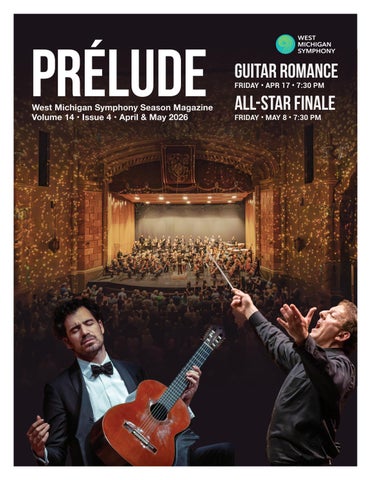
Guitar Romance
Finale
Community Music Encounters
MISSION
West Michigan Symphony connects and enriches our diverse community through the transformative power of music. We fulfill this primarily through three core offerings:
• Professional, live symphonic performances in a welcoming environment
• Inspired small ensemble performances in an immersive live listening room
• Learning activities that enrich the lives of children and adults through exploration, participation and performance
VISION
We are a catalyst for a musicinfused West Michigan: leading, facilitating, connecting and collaborating with the community to stimulate cultural vibrancy, inclusivity and pride of place.
Find Us Online
Website: westmichigansymphony.org
Facebook: facebook.com/wmsymphony
Facebook: facebook.com/AtTheBlock
Email: info@westmichigansymphony.org
Instagram: westmichigansymphony
Spotify: West Michigan Symphony
LinkedIn: West Michigan Symphony
Dates, artists and programs are subject to change.
SEASON SPONSORS
On WMS concert nights, ride from the Muskegon Farmers Market (near the clock) to the Frauenthal between 6:30–7:30 pm. Wheelchair accessible. Return shuttles run after the concert until 10 pm.
About
Dear Friends,
As we approach the final notes of our season together, we’ve saved some of our most vibrant and soulful colors for last. These two programs are a celebration of sumptuous instrumental sound, moving from the intimate heat of the Spanish guitar to the earth-shaking power of the King of Instruments.
In April, Guitar Romance brings the incomparable Pablo Sáinz Villegas back to West Michigan after many years. To call him a guitarist is an understatement; he is a force of nature who has captivated audiences from the Berlin Philharmonic to our own Frauenthal stage. Our program traverses the vibrant musical landscapes of Spain and Latin America, from the theatrical flair of Manuel de Falla to the sensuous midnight rhythms of Astor Piazzolla, culminating in Joaquín Rodrigo’s beloved Concierto de Aranjuez. In Pablo’s hands, a single guitar can command an entire orchestral hall, with boundless flair and remarkable emotional depth. You are in for a transformative evening.
Then in May, we bring the house down—quite literally—with our All-Star Finale. Our own principal cellist, Igor Cetkovic, takes center stage in Friedrich Gulda’s wildly inventive Cello Concerto. This rarely-heard gem gleefully crosses musical borders, blending classical virtuosity with jazz, folk music, marching-band swagger, and even rock. It’s playful and surprising, truly a joy to experience live. To bring our season to a triumphant close, we then turn to one of the great monuments of the symphonic repertoire: SaintSaëns’ magnificent “Organ Symphony.” With Peter Kurdziel at the Frauenthal’s Barton Theatre Organ, the orchestra unleashes a sonic spectacle that begins in mystery and ends in radiant triumph. Few works make a concert hall vibrate quite like this one. It is the ultimate symphonic exclamation point.
Whether we are whispering through a Spanish garden or filling this theater with a wall of sound, your presence is what gives these moments their special meaning. Thank you for joining us on this journey throughout the season. It’s an honor to share this music with you.
Warmly,
Scott Speck Music Director
MEET THE WMS PRINCIPAL MUSICIANS
Our musicians are West Michigan’s cultural ambassadors and a key part of its creative capital. In addition to WMS, our players teach privately and at major Michigan universities, perform with other orchestras, and appear as recitalists and chamber musicians across the Midwest and beyond.
IGOR CETKOVIC Principal – Cello
SLAUGH Assistant Principal – Cello
ROBERT JOHNSON Principal – Bass
OPEN Principal – Viola
REBECCA BOELZNER Associate Principal – Viola
MARK PORTOLESE Associate Principal – Violin 2
CARMEN ABELSON Assistant Principal – Violin 2
PAUL CLIFTON Principal – Horn
BILL BAXTRESSER Principal – Trumpet
ELIZABETH KAPITANIUK Principal – Clarinet
CHLOE ROBBINS Principal – Bassoon
ASAKO FURUOYA Principal – Oboe
EDWARD HICKMAN Principal – Trombone
LEO TAYLOR Principal – Timpani
MATTHEW BECK Principal – Percussion
SYLVIA NORRIS Principal – Harp
RILEY LINDSEY Principal – Tuba
JILL MARIE BROWN Principal – Flute
CAMERON
JACIE ROBINSON Assistant Concertmaster
ADAM LIEBERT Assistant Principal – Violin 1
AMANDA DYKHOUSE Principal – Violin 2
GENE HAHN Associate Concertmaster
Music Director
Scott Speck
Mike & Kay Olthoff Endowed Chair
First Violin
Open concertmaster
Gene Hahn interim concertmaster
Gust and Mary Theodore Danigelis
Endowed Chair
Jacie Robinson asst. concertmaster
Sponsored by Bruce & Donna Hood
Adam Liebert asst. principal
Sponsored by Dr Alan Steinman
Hannah Christiansen
Sponsored by Evelyn Geile
Ebedit Fonseca
Robbie Herbst
Jennifer Kotchenruther
Sponsored by Bob & Charlotte Chessman
Jane Mockus
Maya Shiraishi
Sponsored by Kevin & Annette Even
Oxana Sourine
Sponsored by Darlene Collet in memory of Lee Collet
Lena Vidulich
Second Violin
Amanda Dykhouse principal
Warner Norcross + Judd LLP
Endowed Chair
Mark Portolese assc. principal
Sponsored by Joanna Norris
Carmen Abelson asst. principal
Katie Bast
Sponsored by David & Darcy Dye
Patrick Foley
Karen-Jane Henry
Sponsored by Elinore Verplank
Natalie Hockamier
Emily Nardo
Britta Bujak Portenga
Sponsored by Gordon & Mary Buitendorp
Luis Vivas
Viola
Open principal
Sponsored by Jan & Laura Deur ??
Rebecca Boelzner assc. principal
Sponsored by Anonymous
Csaba Erdélyi
Sponsored by JoLee Wennersten
Josh Holcomb
Rebecca Miller
Jane Mockus
WEST MICHIGAN SYMPHONY MUSICIANS
Cello
Igor Cetkovic principal
Sponsored by Steve & Deb Olsen
Open assc. principal
Cameron Slaugh asst. principal
Sponsored by Dr F Remington & Ginny Sprague
Lee Copenhaver
Sponsored by Dr Mark D & Kristina M Clark
Karen Krummel
Sponsored by Susan Rehrer
Grace Mockus
Sponsored by Eric & Merica Dobry
Abigail Monroe
Sponsored by Cynthia Mazurek
Calin Muresan
Sponsored by Elinore Verplank & Thomas Knight
Bass
Robert Johnson principal
Frank E. & Flora M. Johnson Endowed Chair
Open assc. principal
Brett Armstrong
Stephen Reichelt
Flute
Jill Marie Brown principal
Sponsored by Anonymous
Abigail Peel
Sponsored by Mary E Malek
Leslie Deppe piccolo
Sponsored by David & Beth Pickard
Oboe
Asako Furuoya principal
Sponsored by Joanne & Amy Bensinger
Natalie Feldpausch
Sponsored by Ellie Williams
Clarinet
Elizabeth Kapitaniuk principal
Sponsored by Susan Cloutier Crain
Stephanie Hovnanian
Sponsored Anonymously in honor of Jane Blyth
Lisa Raschiatore bass clarinet
Sponsored by Don & Kathy Dahlstrom
matched by the Charles Stewart Mott Fundation
Bassoon
Chloe Robbins principal
Sponsored by Sheila & Patrick Miller
Jason Kramer
Sponsored by Eric & Merica Dobry
Horn
Paul Clifton principal
Jeffrey Lake Johnson Endowed Chair
Greg Bassett
Lisa Honeycutt
Sponsored by Allen & Sandy Beck
Leah Brockman
Sponsored by Karen & John Wells
Trumpet
Bill Baxtresser principal
Sponsored by Roger & Rebecca Tuuk
Ethan Adams
Sponsored by Tom Knight
Kai-Chun Chang
Sponsored by Robert and Carol Pyka
Trombone
Edward Hickman principal
Sponsored by Stephen & Debra Jackson
Joe Radtke
Sponsored by Gretchen & Randy Rhoades
Carter Woosley bass trombone
Sponsored by Joel & Linda Engel
Tuba
Riley Lindsey principal
Sponsored by David & Darcy Dye
Timpani
Leo Taylor principal
Douglas & Janet Hoch Endowed Chair
Percussion
Matthew Beck principal
Sponsored by Jill Sanders
Fabian Correa
Isabella Butler
Harp
Sylvia Norris principal
Sponsored by Valerie & Fred Church-McHugh
Music Librarian
Amanda Dykhouse
Musical Chairs: Sponsor a musician for the season. Endow for a lifetime. For more information, contact Andy Buelow at 231.726.3231 or abuelow@westmichigansymphony.org.
Dear WMS Friends,
Welcome! Spring has finally arrived and with it comes the romance and wonder of our final two concerts of the season.
We are thrilled to welcome Pablo Sáinz-Villegas whom Billboard Magazine called ”the global ambassador of Spanish guitar.” You can sense from Scott’s remarks on the previous page how elated he is about this artist’s return engagement with WMS. I’m also excited about the way Scott has built this program around Spanish and Latin American music, giving us a true flavor of the styles that emanate from the culture of these delightful regions.
Our season finale celebrates our own: principal cellist Igor Cetkovic and West Michigan’s gifted organist Peter Kurdziel on the Frauenthal’s magnificent Barton Theatre Organ. We are so lucky to perform in this glorious theater and are pleased to offer a rare opportunity to hear this historic, restored instrument.
Although this season is ending, we are already planning a fantastic array of concerts for next year. Subscription renewals are well underway, and if you’re not a subscriber yet, we invite you to become one! Choose the option that matches your musical tastes and schedule and join our community of music lovers.
Our regular season may be coming to an end but your opportunity to perform with the Symphony at the Frauenthal is just around the corner! Check out the music and sign up for our July 25th “Side by Side.” Last year’s participants will tell you they had a great time rehearsing and then performing on the Frauenthal stage for our community. You’ll find the signup form at westmichigansymphony.org/education/wms-side-by-side.
As this season comes to a close, I want to thank you for your attendance and your support. We are your West Michigan Symphony and we’re so glad you’re here.
Kate Kesteloot Scarbrough Chairperson, WMS Board of Directors
FOOTLIGHTS SUMMER PROGRAMMING
Fun Camp for grades K–6
Four sessions: June 29–July 3, July 6–10, July 20–24 or August 3–7
Mini Camp for grades PreK–2
Two Sessions: June 22–24 or August 10-12
Teen Intensive and Teen Tech Intensive for grades 7–12
Rehearsals: July 20–24 and July 27–31
Tech Week: August 3–6
Performances: August 7–9
Class sizes are limited! For more information or to register, scan the QR code at left or go to muskegoncivictheatre.org/performing-arts-school
231-722-3852 muskegoncivictheatre.org
West Michigan Symphony Annual Fund
Your annual contributions to West Michigan Symphony help to sustain a vital community resource. Just over 60% of contributions to WMS come from individual patrons, with the remainder generated from corporate and foundation support. We extend our deepest appreciation to you for helping make WMS a cultural touchstone in our community.
The listings below represent total pledges and gifts by each patron household from January 1, 2025 through March 27, 2026. This includes our Annual Fund, other special initiatives and events. In particular, we wish to express our gratitude to Mike and Kay Olthoff for their support of our November-December Matching Challenge campaign.
We have given careful attention to ensure a complete and accurate list. Please notify us of any inaccuracies by calling 231.726.3231.
Annual & Monthly Giving
Giving to the Annual Fund makes the Orchestra accessible to the entire community! One-time, monthly and annual contributions to WMS are fully tax-deductible and acknowledged with a receipt for tax purposes. You can make a gift designated toward sponsoring a musician, underwriting a youth learning program, or simply “where most needed.”
To make a secure, tax deductible donation now, simply point your smart phone at the QR code with your camera app open and tap the link that appears, visit westmichigansymphony. org/donate, or call 231.726.3231.
$10,000 and up
Anonymous (2)
Jan & Laura Deur
Bob & Heather Garretson
Douglas & Janet Hoch
Stephen & Debra Jackson
Patricia Johnson
Wendy M Kersman
Amy J Klop
Daniel & Sheryl Kuznar
Steve & Deb Olsen
Jason & Jamye Olthoff
Mike & Kay Olthoff
Douglas Hannink & Jocelyn Shaw
Philip Smith & Family
Tom & Liz Trzaska
$5,000-$9,999
Allen & Sandy Beck
Jane Blyth
Pete & Sherry Brown
George W & Lori Lynn Cannon III
Susan Cloutier Crain
Deborah DeVoursney
Mark & Jennifer Gross
Carl & Sylvia Hansen
Robert & Clara Harrell
Paul & Karen Jackson
Kate Kesteloot Scarbrough
Rich & Nancy Klassen
Lois & Bill Lydens
Patrick & Sheila Miller
Bonnie Olson Memorial Fund
Barbara Potuznik
Jill Sanders
Sawyer Family Fund of CFFMC
Jack & Becky Slimko
Dr. Michael & Marijean Smith
Susan & Stephen Struck
Roger & Rebecca Tuuk
JoLee Wennersten
Marguerite & Kenneth Winter
Jim & Linda Zolman
$2,500-$4,999
Anonymous (2)
Roy & Esther Baldridge
Amy Bensinger
Joanne Bensinger
Andy & Beth Buelow
Bob & Charlotte Chessman
Valerie Church-McHugh & Fred McHugh
Darlene Collet in honor of Lee Collet
Mary Douville
William & Mary Lou Eyke
James & Susan Geisler
Jeff & Gwen Hazekamp
Bruce & Donna Hood
Amy & William Hosford
Ratan & Vicky Khatri
Mike & Becky Kuznar
John & Jessie Martin
Chris McGuigan & Gary Neal
Mark & Bonnie Meengs
Jane Missimer
Joanna Norris
KN Literary Arts
Frank & Emma Peterson
David & Beth Pickard
John & Karen Pitcher
Susan Rehrer
Gretchen & Randy Rhoades
John Saling & Diane Fischer
Mary Price & Tom Schaub
Laura Schultz
Sam Slaughter & Anne Lehker
Scott Speck
Dr Alan Steinman
Peter M Turner
Karen & John Wells
Jon J & Cathy Workman
$1,000-$2,499
Anonymous (2)
Charles Alstrom
Susan & Frank Bednarek Fund of the CFFMC
Herb & Anne Bevelhymer
Ronnie & Kelli Bluhm
Brian & Jill Boersema
Art & Marilyn Bolt
Janice Buck
Gordon & Mary Buitendorp
Jennifer Grow & Rick Charles
George & Deborah Chmelar
Amy Conn Tenny
E Jane Connell & Steven W Rosen
Dr Donald & Nancy Crandall
Don & Kathy Dahlstrom
Anne M Dake
Mary Theodore Danigelis
Diane DeGrazia
Eric & Merica Dobry
Karen Driver
Robert & Cathleen Dubault
Mark & Christine Fazakerley
Larry & Lynette Fife
Evelyn Geile
David F Gerdes & Carolyn Smith-Gerdes
Mary Anne Gorman
Virginia Hague
Bill Haug & Jane Curtis
Dr Tom & Heidi Hill
Greg & Debi Hillebrand
Larry & Lari Hines
Norma Jean Horan
Richard & Holly Hughes
Pat Hunt
Ed Hunt & Nancy McCarthy
Wilda James
Dick & Lynn Kamps Fund of the CFFMC
Barbara Kelso
Heather Kettler
R?na & Kara Komarek
Pete & Mimi Kunz
Bob & Dee Kwiecien
Patricia Ladas
Tim & Lynette Lipan
Jim & Mary Malek
Cindy Mazurek
Don & Jean Medema
Stacy & Eric Mellema
Barbara & Joseph Mockus
Roger C Morgenstern
Richard & Katie Norton
Chris & Amy Olthoff
Ed & Judy Pietila
Mike & Dina Poland
Roy & Britta Portenga
Bob & Carol Pyka
Judith Rahrig
Eric & Michelle Ringelberg
Dan & Sarah Rinsema-Sybenga
Wietse & Melanie Schaafsma
Robert N & Merle N Scolnik Advised Fund of the CFFMC
Jeff Shoemaker & Nancy Birge
Craig & Cathy Simons
Kathy & Kevin Smith
Dr F Remington & Ginny Sprague
Ryan & Kris Sterkenburg
Clifford & Lucia Storr
George & Dottie Strabel
John & Mary Swanson
Drs David & Linda Taylor
Nicole Thomas
Kristine & Jim Tyler
Elinore Verplank
Michael & Patricia Wade
Melody & JR Whitby
Judy Wilcox
Ellie Williams
Jane J Wright
$500-$999
Anonymous
Chris Adams
Melisa Baker
Gary & Carol Beatty
Colin Billingsley
Eriic & Monica Bollman
Dr Mary & Robert Boyer
Ron & Ann Marie Brown
Dana & Claudia Bryant
Pat & Amy Campanelli
Curtis Chambers & Diana Wojton
Rudy & Pat Chmelar
Don Clemens
Pat & Julie Donahue
William & Donna Eckert
Carla Flanders CMF Marketing & Events
Manley Ford
Charles & Lynn Freeman
Charles & Jeanne Gembis
Jeff & Gail Hall
Michael Hanley
Patricia Hesling
Susan Hoekenga
Cornelia Holley
Marcia Hovey-Wright
Todd & Tami Jacobs
Joel & Kathleen Jarvis
Donna Joyce
Karen Kayes
Thomas Knight
Joan La Mourie
Brian & Gay Landstrom
David MacPherson
Charles & Kay Cater Matthews
Mary McLaughlin Eyke
Susan Meston
Adam & Amanda Moblo
Scott & Janee' Musselman
Perry & Deb Newson
Eric & Lori Nisja
Amy Norris & MJ Towle
Patricia Renucci
Clyde & Beth Rinsema
Rosenberg Family Trust
Bob & Bobbi Sabine
Gregory Shaull
Duane & Susan Schecter
Gwynne & Steve Schoff
Sally Schwartz
John & Zephyra Selmon
Allen & Mistelle Serio
Jonathan Seyferth & Matthew Ellis
Colleen & Joseph Skendzel
Dr Carlo V Spataro
Tom & Denise Spoelman
Susan Sridharan
Tom & Nanci Stone
Julie Stuberg
Kim Suarez
Robert S Swan
Marty & Heidi Sytsema
Don & Jane Tjarksen
Richard & Marge Tourre
Ed DeJong & Diane VanWesep
Susan Vogel-Vanderson
Jay & J'Nai Wallace
Bill & Shirley Walther
Ann M Wassmann & Thomas Edwards
Sheryl Wescott
Dr Roy Winegar & Ms Barbara Klingenmaier
Lynn Winter
Robert & Joanne Zayko
$100-$499
Anonymous (5)
Ross & Sandra Aden
Jason & Ann Aerts
Laura Aikens
Kirsten Anderson
Rosalie Anderson
Tom & JIll Archambeau
Bernadette Hofer Arnold
Margo Atwell
Larry & Sandy Austin
Greg Bassett
Earl Baxtresser
Lisa Bayne
Jeanne Kuharivicz Bleich
Jerry & Marcia Brichan
Jennifer Bride
Bill & Sue Brookstra
Michael & Joanna Buboltz
Brenda Burgess
Jay Burrows
John Max Busard & Elizabeth Busard Fund
Marie Bustin
Bill & Carol Cross
Jessica Wolin & Frank Crownover
David Culver
Debbie Dausey
Ian & Shannon Davis
Agnes De Boer
Chris Dean
Paula DeGregorio & Frank Galante
Dean Denman & Gale Ford
David & Dortha DeWit
John & Jan Ditmar
Joyce Downing
Marcia D'Oyly
Kevin & Jane Drake
Judy Draper
Dennis & Barbara Dryer
Amanda & Gregory Dykhouse
Nancy Emmerich
Harold Englund
Wallace & Jane Ewing
Cork Farkas & Kathy Mauck
Eugene Fethke
Dale & Bridget Fox
Steven Frantz
Trevor & Amy Friedeberg
Bruce Froelich & Margot Haynes
Arlen-Dean Gaddy
Cesar Galan
Susan & Ellery Gill
Dana & Jeff Glamzi
Marjorie Gorajec
Ann Gorter
Marcia Grasman
David & Shari Groendyk
Patricia Groessl & David Leonard
LaDon Gustafson
Revs. Gerald & Susan Hagans
Kirk Hallman & Dawn Boston
Richard & Diane Harder
Brad Hastings & Ashley Arnounts
Judith Hayner HMS, LLC & Charlene Romanosky
Marcy Henehan
Gwen Hoffman
William Hogan
Hon Kathy L Hoogstra & Dr Robert Hoogstra
David & Dina Horne
Mary Anne & Thom Hornik
Margaret Hudson
John & Jane Humphrey
Nicholas Huryk
Robert & Susan Johnson
Marjorie Jones
Donita Kelly
Laura & Kourosh Khatir
Kellen & Mary Kiley
Jay Kilgo
Randy & Debra Knapp
Alan Kohley
Judy Komar
Sarah & Gregory Korose
Jerry & Alison Lang
Kenneth & Christine Lee
Fred & Pam Levin
Lori Lind & Jill Ryan
Holly Lookabaugh-Deur & Sean Deur
Marsha Love
Dale & Amanda Lowder
Mark Luttenton
Velvet Lyght & Arvin Candelaria
Joseph Lyons
Deborah Margules
Rondalyn Marron
Christine Marshall
Adam & Anna Mausolf
Molly McCarthy & Timothy Hicks
Mary McKiernan
John & Cindy McKinnon
Howard & Carole Meade Fund
Richard Meads
Carol Meech
Joan Menke-Schaenzer
Rich & Teresa Micheil
Tony Moceri
Vern Molitor
Wendy Morden
John & Lisa Mulder
Maris Myers
Michael T. Naess
Jennie Naffie & Richard Oman
Bruce Neckers
Kathryn Neumann
Adam & Daisha Ngo
Robert & Holly Nolan
Bill & Erin O'Brien
David Olsen
Garry & Charlotte Olson
Henry & Mollie Osborn
Cara Owens
Bill Papo
Richard A Pardini
Bob & Linda Penny
Dr Richard & Nancy Peters
Nick & Barb Pietrangelo
Garry Post & Robert Hill
Debbie Potter
Sylvia Precious
Thomas Prince
John & Janet Quinn
Anthony Rickley & Terry Chambers
Gail Ringelberg
Claire Ritter
Dr Gary & Pennie Robertson
Susan Rositch
Karl & Barbara Rowe Family
Brian & Julia Rupp
Stephen Schmidt
Ellen Cutting-Schoepf & Ken Schoepf
Pat & Ed Schroeder
Susan (Sue) Schuiteman
Brianna Scott
Todd Sellon
John & Elaine Severson
Karen Shields
Scott & Lisa Shlaffer
Kim & Andy Sims
Dr Melissa Smith
Emylia Smith
Helen & Jay Smith
Joanie Smith
Cindy Soyars
Anbritt & Darlene Stengele
Larry Sterkenburg
James & Nancy Stier
Eileen B Stoffan
Robert Strauss
Zachary & Jessica Stucky
Judith Tabaczka
Ann & Dan Tabor
George & Laura Thurlow
Charles & Susan Rogalla Tindall
Katie Trzaska-Miller
Peggy Tully
Pastor Bill & Bev Uetricht
Catherine & Chris Uganski
Ula Rzepien
John Van Walsum
Vanessa & Alex Vander Meulen
David Vander Wall
Mikala VanDop
Christine VerHulst
Sabrina Warren
Louann & Hank Werksma
Nate & Amanda Westbrook
Neil & Beverly Whitbeck
Dave & Nita Wikman
Brewster & Mary Ellen Willcox
Jan Witt
Raimonds T Ziemelis
Douglas & Jennifer Zwemer
Corporate, Arts Council & Foundation Donors
$10,000 and up
Community Foundation for Muskegon County
Grand Haven Area Community Foundation
Harbor Steel & Supply Corporation
Hines Corporation
Leonel L. & Mary Loder Fund
Meijer Foundation
Michigan Arts & Culture Council
Smith Haughey Rice & Roegge
The Gerber Foundation
Warner Norcross + Judd LLP
$5,000-$9,999
DTE Energy Foundation Fund
Embark Financial Partners
Fremont Area Community Foundation
Howmet Community Fund of the CFFMC
Macatawa Bank
Samuel L. Westerman Foundation
Smith Davis Morse Group
The Leonard Luxury Apartments
Trinity Health
White Lake Community Fund of the CFFMC
Women's Division Chamber of Commerce
$2,500-$4,999
Billie Klont Greinke Memorial Fund of the CFFMC
Grand Valley State University
Hazekamp's Premier Foods
Hungerford i'move
Lorin Industries
Muskegon Community College
Raymond James
Shoreline Insurance Agency, Inc.
$1,000-$2,499
Charles Stewart Mott Foundation
Mart Dock Corporation
Mary C Payne Fund of the CFFMC
Newkirk Electric
Sparta Community Foundation
Webb Chemical Service Corporation
$500-$999
Ann & Bud Eichmann Fund of the CFFMC City of Muskegon
John L. Wheeler Memorial Scholarship Fund of the CFFMC
Past Chairs Committee
The Past Chairs Committee provides ongoing guidance, advocacy and support to the WMS long after its members’ terms are completed. WMS thanks and honors these individuals for their generosity, collective wisdom and continuing leadership.
Tim Arter
Susan Cloutier Crain
Pete Brown
Marcia D’Oyly
David Gerdes
David Hogan
Holly Hughes
Pat Hunt
Paul Jackson
Wendy Kersman
Deb Newson
Kay Olthoff
Mike Olthoff
Sylvia Precious
Chip Sawyer
Ann Tabor
Peter Turner
Jane Toot
Jane Wright
Block Underwriters
Grand Valley State University
Lorin Industries
Michael & Kimberly Martin (Endowed)
Muskegon Community College
Steve & Deb Olsen
Mike & Kay Olthoff
Mary Price & Tom Schaub
Shoreline Insurance Agency
Jack & Becky Slimko
Raymond James
Smith, Haughey, Rice and Roegge
Trinity Health
Warner Norcross + Judd LLP
WEST MICHIGAN SYMPHONY ENDOWMENT
Now in its 86th Season, WMS is dedicated to building a music-infused West Michigan, providing professional concerts in a welcoming environment and music encounters and learning that enrich the lives of both children and adults. The Endowment, along with robust annual giving, provides a stable funding base that supports this cause. WMS’s Endowment is held in two funds at the Community Foundation for Muskegon County (CFFMC) and in a third at the Grand Haven Area Community Foundation (GHACF).
Established in 1992, the CFFMC Secure the Spirit fund reported a fair market value of $672,101 on June 30, 2025. Established in 2020, the CFFMC Play Your Part fund reported $3,355,909 on the same date. The GHACF Play Your Part fund, established in 2021, was at $117,290.
The corpus of each fund is owned, managed and directed by these foundations, whose staff and trustees determine the timing and amount of distributions—normally an annual amount equal to 4% of the average balance over the previous 16 quarters. Foundation staff handles all administrative details and investment responsibilities, freeing WMS leadership and staff to focus on mission delivery.
Play Your Part Campaign
The primary objective for WMS’s 2020-2022 Play Your Part Campaign was to grow the organization’s Endowment, providing a stable revenue model for the future. The second objective was to provide funding for a new string orchestra program for underserved students in Muskegon Public Schools. This initiative, called “Tune Up,” launched in fall 2022 and is now entering its third season. For more information, please see page 29.
As of June 30, 2025, gifts to the Play Your Part Campaign totaled $4,025,979. We thank all those who have given generously to the campaign, and invite you to consider “playing a part” in WMS’s future. Whether through an outright gift or a designation in your will and trusts, your support will ensure continuity and future growth of WMS’s artistic and education footprint.
To learn more, please contact Andy Buelow at 231.726.3231 or abuelow@westmichigansymphony.org.
Maestro: $250,000 and up
Michael & Kay Olthoff
Larry & Lari Hines
Jeffrey Lake Johnson
Premier: $100,000-$249,999
Community Foundation for Muskegon County (CFFMC)
Douglas & Janet Hoch
Robert & Wendy Kersman
Scott & Donna Lachniet
Crescendo: $50,000-$99,999
Bernie & Cathy Berntson
Jon & Jane Blyth
Mary Theodore Danigelis
Jan & Laura Deur
Pat & Julie Donahue
Mark & Christine Fazakerley
Mrs Carol Folkert
Grand Haven Area Community Foundation (GHACF)
Howmet Aerospace
Dan & Sheryl Kuznar
Meijer Foundation
Patrick O’Leary Foundation
Steve & Deb Olsen
Jack & Becky Slimko
Warner Norcross + Judd LLP
Symphony: $25,000-$49,999
Pete & Sherry Brown
Orville & Susan Cloutier-Crain
Don & Kathy Dahlstrom matched by Charles Stewart Mott Fund
Rob & Cathleen Dubault
Eagle Alloy
William & Mary Lou Eyke
Fifth Third Bank
Paul & Karen Jackson
John & Jessie Martin
Monica Morse
Dr Richard & Nancy Peters
Tom Schaub & Mary Price
Concerto: $15,000-$24,999
Marilyn Andersen
Allen & Sandy Beck
Jackie Engel, CFP
James & Susan Geisler
Kimberly & Michael Martin matched by Bank of America
Stephen & Susan Struck
Roger & Rebecca Tuuk
Prelude: $10,000-$14,999
Anonymous
Andy & Beth Buelow
G&L Hot Dogs
The Gerber Foundation
David Gerdes
& Carolyn Smith-Gerdes
Stephen & Debra Jackson
F Martin & Dorothy A Johnson Fund of the GHACF
Paul C Johnson Fund of the CFFMC
Fred & Joanna Norris
Greg & Shelley Olson
Susan Rehrer
Robbins Road Animal Clinic
Dr Alan Steinman
John & Mary Swanson
Liz & Tom Trzaska
matched by RENK America
Peter M Turner
Webb Chemical
Judy Wilcox
Overture: $5,000-$9,999
Anonymous BDO
Bill Baldridge
Sherry Albertie Becker
Frank & Susan Bednarek
George & Lori Lynn Cannon
Cofessco Fire Protection
Consumers Energy
Dr Donald & Nancy Crandall
Anne & Allan Dake
Kevin & Annette Even
Mary Anne Gorman
Judith Hayner & Charlene Romanosky
Greg & Debi Hillebrand
Pat Hunt
Bari Johnson
Tom & Pat Johnson
Dick & Lynn Kamps
Ray & Betsy Komray
Clara Lang
Mark & Bonnie Meengs
Frank & Emma Peterson
Bruce & Marilyn Reichardt
Suzanne Richards & Lee Burlison
Kurt Rosen
Dr F Remington & Ginny Sprague
John & Sue Sytsema
Dan & Ann Tabor
Don & Jane Tjarksen
LJ Verplank
Webb Chemical
Kathy West in memory of David Alan West
Jan Witt
Sonata: $1,000-$4,999
Anonymous (3)
Cynthia Ackerman
Christine Adams
Charles & Gloria Alstrom
Margo Atwell
Bank of America
Charitable Foundation
Jack & Marilyn Brown
Ryan & Katie Bryker
Ardy Bulthouse Kroes in honor of Amanda Dykhouse
Robert & Charlotte Chessman
Dr & Mrs Paul Christie
Dr Mark D & Kristina M Clark
Darlene Collet
Core Realty Partners
Kurt & Cheryl Deford
Jean Enright
Charles & Lynn Freeman
Evelyn Geile
Michael Gluhanich
Mr & Mrs Bill Hendrick
Cornelia Holley
Keith & Mary Kay Hopkins
Hugh & Barbara Hornstein
Richard & Holly Hughes
Ed Hunt & Nancy McCarthy
Joel & Kathleen Jarvis
Heather Kettler
Bruce & Mary Krueger
Peter Kurdziel
Michael Martin
Cindy Mazurek
Chris McGuigan & Gary Neal
Susan Meston
Roger & Jane Missimer
Roger & Michelle Morgenstern in memory of Richard & Nancy Morgenstern
Scott & Janee’ Musselman
Gary Nelund
& Angie Wasserman-Nelund
matched by State Farm Insurance
Dr Dale & Connie Nesbary
Steve & Kathy Parker
Gary & Beth Post
Denis & Barbara Potuznik
RENK America
David & Georganna Rice
David Roodvoets
John & Marilyn Ruck
John Saling & Diane Fischer
Jill Sanders
Chip & Susan Sawyer
Duane & Susan Schecter
Laura Schultz
John & Elaine Severson
Jocelyn Shaw & Doug Hannink
Shoreline Insurance Agency
Michael & Corina Soimar
Scott Speck in honor of the WMS Musicians
Ted & Judy Stojak
Suarez/Polakis Family
Marty & Heidi Sytsema
Bryce & Marti Tallant
Carol Parker Thompson
Peter & Judy Theune
Judy Tierney
Evan & Rachel Ufer
David & Laura Valk
Karen & John Wells
JR Whitby
Eleanor Williams
Dr Roy Winegar & Ms Barbara Klingenmaier
Jane Wright
Robert & Joanne Zayko
Environmental Fund of the CFFMC
Douglas & Jennifer Zwemer
Introit: Up to $999
Anonymous (4)
Larry & Sandra Austin
Susan A Bissell Memorial Fund
Charles Black in honor of Fred & Joanna Norris
Gary & Rhonda Bogner
Dana & Claudia Bryant
Jerry & Marcia Brichan
Rachel Calderon in memory of Dick Baker
Benjamin Christian on behalf of Tina Horigan
E Jane Connell & Steven W Rosen
Calvin Deur
Harold & Mary Englund
Eugene Fethke
Martha Ferriby
Tilio Giacobassi Family
Erica Gillard
Harvey & Maraleigh Heyer
Ellen Hanichen
Gwen Hoffman
Doug & Judy Hostetler
Mary Ann Howe
Kristi Klomp
Randy & Debra Knapp
Pete & Mimi Kunz
Cindy Larsen
Joeseph & Barbara Legatz
Charles Matthews & Kay Cater Matthews
Patrick & Sheila Miller
Barb & John Mullally
Kathryn Neumann
Perry & Deb Newson
Amy Norris & MJ Towle in honor of Fred & Joanna Norris
James & Ruth Olthoff
Thomas Pascoe
Janet Payne
William & Gay Peterson
Linda Quaine
Rev William Randall
Mike & Char Ratchford
Stephen & Susan Salisbury
Schieholz/Hogan Fund of the CFFMC
Sally Schwartz
Asaline Scott
Joanie Smith
Howard & Marilyn Swanson
Warren Tibbitts
Richard & Marge Tourre
Mary Towner
Nancy & Gerritt Vanderwest
Rebecca Veltman
Duane & Laurie Wright
Raimonds T Ziemelis
Jim & Linda Zolman
Tune Up Donors: $5,000 and up
Cathy & Bernie Berntson Fund of CFFMC
Jon & Jane Blyth
Orville Crain & Susan Cloutier Crain
Community Foundation for Muskegon County (CFFMC)
Mary Theodore Danigelis
Jan & Laura Deur
Mark & Christine Fazakerley
Fifth Third Bank
Gerber Foundation
Harbor Steel & Supply Corporation
Hines Corporation
Dr Douglas E & Janet P Hoch
Howmet Aerospace Foundation
Dick & Lynn Kamps
Robert & Wendy Kersman
Dan & Sheryl Kuznar
Scott & Donna Lachniet
Meijer Foundation
Patrick J O’Leary & Karen Yamasaki
Steve & Deb Olsen
Mike & Kay Olthoff
Jack & Becky Slimko
Stephen & Susan Struck
West Michigan Symphony Legacy Giving Circle
It Takes just one note to Start a Symphony
With a planned gift to West Michigan Symphony, you can continue to support the Orchestra even after your passing. Planned giving is simply creating a plan to make a gift. You don’t need to be wealthy to make an impact—you just need to make a plan.
The easiest way to make a planned gift is through a charitable bequest, where you designate in your will or trust the assets that you wish to gift to WMS upon your death. A bequest is not all or nothing; you can leave either a percentage of your total estate value, a specific asset (such as part of an investment portfolio), a specified amount of money, or the remaining assets in your estate after all your other requests have been satisfied. You can also make a planned gift by designating the WMS as a beneficiary of your retirement or IRA account, or your life insurance.
You can also specify how you would like your gift used by designating it toward music education, the Endowment, or “wherever it is needed.”
Creating a planned gift is a wonderful way to leave a legacy, provide future funding, and ensure that WMS continues to delight, teach and entertain audiences in the future. Talk with your estate plan attorney about your options.
We welcome your questions. Please reach out to Andy Buelow at 231.726.3231, or visit our website at westmichigansymphony.org. We would be happy to provide sample language to include in your estate plan documents, explore your ideas about your plan, or simply connect. And if you do make a planned gift, or have already done so, please consider letting us know so that we can thank you!
Legacy Giving Circle Members:
Allen & Sandy Beck
Andy & Beth Buelow
Susan Cloutier Crain
E. Allan & Anne M. Dake
Jan & Laura Deur
Eric & Merica Dobry
Pat & Julie Donahue
Robert & Jackie Engel
Gil Grevel
Jeffrey Lake Johnson
Clara Lang
James & Mary Malek
Mike & Kay Olthoff
Bob & Bobbi Sabine
Kate Kesteloot
Scarbrough
OTHER WAYS YOU CAN MAKE AN IMPACT
Asset Transfer
Stocks, bonds and mutual funds can be transferred directly to WMS, allowing you to avoid capital gains tax. It is very easy! Contact us for the instructions to share with your financial advisor to initiate the transfer.
Qualified Charitable Distribution
If you are 70 ½ or older, you can transfer up to $108,000 annually from your IRA directly to a public operating charity, thereby reducing your adjusted gross income. At age 73, the IRS requires that you start taking withdrawals from most qualified retirement accounts. Gifts to a public charity such as WMS count toward required minimum distributions (RMDs) for the year.
Contact your financial advisor with any questions, or to initiate a gift. Our federal tax ID number is 38-6092131.
Donor–Advised Fund
A donor-advised fund, or DAF, is like a charitable investment account for the sole purpose of supporting organizations you care about. When you contribute cash, securities, or other assets to a donor-advised fund, you are generally eligible to take an immediate tax deduction. Then those funds can be invested for tax-free growth, and you can recommend grants to any eligible IRS-qualified nonprofit organization like WMS.
You can easily set up a DAF at the Community Foundation for Muskegon County or another public charity. For more information, visit https://muskegonfoundation. org/giving/how-to-start-a-fund/ or contact CFFMC at 231.722.4538.
GUITAR ROMANCE
FRIDAY APRIL 17
7:30 PM
SCOTT SPECK CONDUCTOR
PABLO SÁINZ VILLEGAS CLASSICAL GUITAR
Manuel de Falla (1876-1946)
Suite No.1 from The Three-Cornered Hat
I. Introduction – Afternoon
II. Dance of the Miller’s Wife (Fandango)
III. The Corregidor
IV. The Grapes
Astor Piazzolla (1921-1992)
Tangazo
Joaquín Rodrigo (1901-1999)
Selections from Soleriana, Suite for Orchestra
SPONSORS
Friends of Pablo Sáinz Villegas
I. Entrada
V. Passepied
VIII. Boleras
INTERMISSION
Manuel de Falla (1876-1946)
Ritual Fire Dance from Love the Magician
Anonymous / orch. Chris Hazell
Spanish Romance
Joaquín Rodrigo (1901-1999)
Concierto de Aranjuez
I. Allegro con spirito
II. Adagio
Pablo Sáinz Villegas SEASON
III. Allegro gentile
Loop and Infrared Systems in place for the hearing impaired. Please inquire with an usher for use of this system.
Please silence and dim screens of all cell phones and other electronic devices. The use of recording devices during the performance is strictly prohibited.
Pablo Sáinz Villegas
Pablo Sáinz Villegas has been praised by the international press for his “virtuous and moving performance, with an irresistible exuberance and a range of bright colors.” (The New York Times)
Undoubtedly the most virtuoso guitarist of his generation, Pablo Sáinz Villegas has been acclaimed by the international press as the successor to Andrés Segovia and an ambassador of Spanish culture in the world. He is the first solo guitarist to perform at Carnegie Hall in New York since Segovia in 1983; the first guitarist to play with the Chicago Symphony Orchestra since 2001; and the first guitarist to perform with the Berlin Philharmonic at the New Year’s Eve Gala since 1983.
Since his debut with the New York Philharmonic under the baton of Rafael Frühbeck de Burgos at Avery Fisher Hall in the Lincoln Center, he has performed in over 40 countries and with orchestras such as the Israel Philharmonic, Philadelphia Orchestra, San Francisco Symphony, Zurich Tonhalle Orchestra, and the National Orchestra of Spain, as well as in venues such as the Tchaikovsky Concert Hall in Moscow, the Musikverein in Vienna, the Concertgebouw in Amsterdam, the National Centre for the Performing Arts in Beijing, and Suntory Hall in Tokyo, among many others of equal importance and reputation.
His most notable milestones include the Princess of Asturias Awards Concert and his participation in the Metropolitan Opera Gala last May at the Palace of Versailles. His numerous performances at the Santiago Bernabéu Stadium in Madrid, which captivated more than 85,000 attendees, as well as concerts held in distinguished venues such as Grant Park in Chicago, the iconic Praça do Comércio in Lisbon, and the illustrious Hollywood Bowl (with the LA Philharmonic), have made him one of this generation’s most remarkable and prolific performers.
As a socially committed artist, he is the founder and driving force behind the non-profit association Strings in Common in the United States. He is also the creator and artistic director of the La Rioja Festival in Spain.
As an exclusive SONY Classical artist, he has released solo albums as well as duo recordings with tenor Plácido Domingo and cellist Yo-Yo Ma. Film composer John Williams has written two works for him for guitar: Rounds and Prayer for Peace.
Highlights of his 2025/2026 performance season include his return to the Chicago Symphony Orchestra with Maestro Riccardo Muti; the continuation of the premiere tour of Místico y Profano by Mexican composer Arturo Márquez with the Ottawa, Annapolis and Pacific symphonies; the world premiere of a work for string quartet and guitar by Andrea Casarrubios with the Agarita Quartet; his new chamber project Spanish Night, which will premiere on a U.S. tour; and appearances with orchestras such as the Gulbenkian Orchestra, Orchestre de Québec, and Argovia Philharmonic, among others.
Pablo Sáinz Villegas was born in La Rioja, Spain, and has been living in the United States since 2001. For the 2025/26 season, Pablo wears TOMBLACK.
Manuel de Falla (1876-1946)
Suite No.1 from The Three-Cornered Hat
Along with his older countrymen Albéniz and Granados, Manuel de Falla helped to restore Spanish music to a level it had not enjoyed since Renaissance times. He decided on composition after developing a passion for the works of the Norwegian composer Edvard Grieg, vowing to achieve a comparable legacy for Spanish music.
In 1907, at the age of 31, he went to Paris, where he benefitted by his acquaintance with Dukas, Debussy, and Ravel. Falla had an original voice, however, and he learned from them without imitating. In fact, both Debussy and Ravel were drawn to the sensuous harmonies and compelling rhythms of Falla’s native Spain, revealing more of Spain in their French music than Falla did of France in his own. Falla is best known for his symphonic impressions for piano and orchestra, Nights in the Gardens of Spain, and the two ballet scores El amor brujo (“Love the Magician”) and El Sombrero de Tres Picos (“The Three-Cornered Hat”), from which this program’s selections are drawn.
In its original 1917 version, The Three-Cornered Hat was a comic pantomime about flirtation, temptation, attempted seduction and mistaken identity. The Russian impresario Serge Diaghilev convinced Falla to develop Pedro Antonio de Alarcon’s folk tale into a ballet; in its new form it premiered in London in 1919, with sets by Picasso. Falla added the Introduction so that the English audience would have
sufficient time to appreciate the drop-curtain that Picasso had designed for the second production.
The work is suffused with musical humor, relying heavily on folk dances of Murcia, Aragon, Navarre, and Falla’s native Andalusia. Falla’s vibrant score breathes the perfumes of Spain, with arresting melodies and foot-tapping (sometime foot-stomping) rhythms.
The scenario revolves around an unattractive miller and his beautiful young wife. They love each other, but neither one can resist flirtation. The ballet takes its name from the local magistrate [Corregidor], whose three-cornered hat is a symbol of his authority. Falla employs the bassoon to illustrate his stuffy, self-important personality. The miller’s wife catches his eye as he passes by in a procession. Slipping back to attract her attention, he watches as she dances, ignoring him. “Dance of the Miller’s Wife” is a fandango, a dance in rapid triple time customarily danced by a couple with accompaniment of guitar and castanets. When she eventually acknowledges his presence, she dances a very Spanish minuet, tempting him with a cluster of grapes that she keeps just out of reach. Falla’s compelling and melodically rich score frequently evokes the sonorities of Spanish guitar.
At this point the plot becomes very complicated, with the Corregidor winding up in the Miller’s house, and the Miller stealing away disguised in the magistrate’s uniform—to serenade the Corregidor’s wife! In the end, the Miller and his wife are reunited and reconciled and everyone, of course, lives happily ever after.
Astor Piazzolla (1921-1992) Tangazo
Nadia Boulanger, the legendary French composition teacher, once told Astor Piazzolla that he should write tangos, nothing but tangos, for that is where he would find his greatest success. He later recalled, “Nadia asked where, in all my works, was Piazzolla, for [my music] seemed to represent all kinds of things—but not Piazzolla. Once, she heard me play tango on the piano, and said to me, ‘There is Piazzolla— and there is the direction you must take.’” He took her advice, returned to his cultural roots, and went on to become one of Argentina’s most beloved musicians.
After returning to Buenos Aires in the late 1950s, Piazzolla organized a band, then founded the Quinteto Nuevo Tango in 1960. He recorded extensively with Quinteto, playing both piano and bandoneón (a relative of the accordion). Apart from 11 years in Paris from 1974 to 1985, he spent most of
his career in Argentina, performing and composing operas, theater pieces, film scores, and chamber music.
Tangazo is slang for “one helluva tango.” This particular example is respectful of tradition through its contrapuntal salute to Johann Sebastian Bach. Listen, for example, to its opening for cellos and double basses. At the same time, Piazzolla underscores the inherent mournfulness of the tango, a characteristic that he felt defined the dance. His Tangazo divides into five principal sections that change tempo, character, and instrumentation. After the opening for cellos and basses, he offers a faster section featuring percussion, winds, and piano. The third section has a horn solo; toward the end he brings back the basses, this time pizzicato. Always we sense the vivid imagination of a composer who loves the big orchestra almost as much as his own bandoneón.
Joaquín Rodrigo (1901-1999)
Selections from Soleriana, Suite for Orchestra
Much has been written about the powerful influence of Spanish music and culture on French musicians. Of equal import, if more subtly manifested, is the reverse process: French music, and particularly French pedagogy and the stimulating atmosphere of Parisian salons, exercising its own power over Spanish musicians. Joaquín Rodrigo was one of several major Spanish composers whose music bears a pronounced Gallic flair. He went to Paris in 1927 to study composition with Paul Dukas (composer of The Sorcerer’s Apprentice). Rodrigo spent five years under Dukas’s tutelage, gaining the respect of his teacher and his French contemporaries as both pianist and composer. He also met and was befriended by his older countryman Manuel de Falla, who had earlier studied in Paris and was enjoying great success there. French schooling left an unmistakable imprint of refinement and elegance on Rodrigo’s imaginative, individual, and decidedly Spanish style.
Joaquín Rodrigo was blind. He lost his sight at age three, the victim of a diphtheria epidemic. His hearing was unimpaired, however, and a strong predilection for music led him to seek formal lessons in piano, violin, and theory as a child. He matriculated at the Conservatory in Valencia when he was 16, and had won his first national competition in composition by the time he was 23. He worked on a special Braille music typewriter, with manuscripts being copied into conventional notation afterward.
Soleriana is an eight-movement orchestral suite. Each movement is based on a harpsichord sonata by the 18thcentury Spanish composer Padre Antonio Soler (1729-1783),
who was a key transitional figure between the Baroque and Classical eras. Soler’s keyboard sonatas often tapped into Spanish folk culture, as reflected in the dance-like titles for Soleriana’s movements. Rodrigo sought to celebrate what he called “the purity of the Spanish cultural heritage, undiluted by European influence.” In an effort to evoke the transparent sound of the 18th-century harpsichord, Rodrigo wrote for a chamber orchestra with limited brass and no percussion. Rodrigo’s attractive orchestration maximizes the connection between Spain’s folkloric tradition and 20th-century neoclassicism.
Manuel de Falla
Ritual Fire Dance from Love the Magician
Falla began work on El amor brujo (“Love the Magician”) at the behest of Pastora Imperio, a well-known Gypsy dancer and singer. A native of Seville, Imperio did not read music, but she was musical. She asked him to work with the playwright and director Gregoria Maria Martínez Sierra to create an entertainment for her. The initial version of El amor brujo, introduced in April 1915, was a gitaneria: a Gypsystyle entertainment for two dancers and small instrumental ensemble. The reaction in Madrid was lukewarm, so Falla and Martínez reworked it. A second production in Barcelona did considerably better. A further revision in 1916 condensed the work to one scene comprising a ballet with songs. Falla later credited Pastora Imperio with several authentic musical ideas derived from Gypsy culture that he incorporated into his music.
El amor brujo is the story of Candelas, a young woman whose jealous lover has died. Candelas knows that the dead man was unfaithful to her. Still, his ghost haunts her, interfering with the advances of her new suitor, Carmelo.
Ritual Fire Dance, the ballet’s most famous excerpt, is one of Candelas’s efforts to exorcise the departed lover’s unwelcome ghost so that her new romance may flourish. Charged with exotic Arab/Iberian harmonies and pulsing incantations, Falla’s music has retained its visceral impact. His music serves Candelas as well, allowing her new love to triumph. The exuberant closing chords of the Ritual Fire Dance herald that happy ending.
Anonymous; arranged by Chris Hazell
Romance Anónimo (Spanish Anonymous Romance)
Romance Anónimo originated as a late 19th-century solo guitar piece in salon style: music intended for pleasure and
entertainment in an intimate environment. It is thought to have been written in Spain, and was first recorded on a wax cylinder phonograph in the late 1890s. A number of prominent Spanish guitarists—notably Andres Segovia— incorporated it into their concert repertoire, adding to its popularity. A modest piece of less than three minutes’ duration, Romance Anónimo charms with its lovely melody and guitar-like accompaniment.
Joaquín Rodrigo Concierto de Aranjuez
Concierto de Aranjuez is not only Rodrigo’s best known composition; it is also the most celebrated guitar concerto, and a 20th-century classic. Rodrigo composed it in 1939 in Paris, where he and his wife had been forced to remain during the turbulent years of the Spanish Civil War. They returned to Spain in late 1939, with the manuscript. At the work’s premiere in 1940, Rodrigo was immediately acknowledged to be the leader among Spain’s younger generation of composers.
Part of the work’s genius lies in the delicacy with which it is scored. Rodrigo was not daunted by the relative quietude of the guitar as a solo instrument. Rather, he celebrated its delicacy, providing the guitarist with extensive unaccompanied passages and segments with very light accompaniment. This has the effect of making the guitar sound very loud indeed during the forte sections, rather than being overpowered by the breadth of the orchestra. Further, when the full orchestra enters during the passages when the soloist is silent, the drama is palpable. Both idiomatic and virtuosic, Concierto de Aranjuez is a masterpiece.
Rodrigo’s own words about the Concierto are as relevant today as they were when he wrote them nearly 90 years ago:
“Throughout the veins of Spanish music, a profound rhythmic beat seems to be diffused by a strange phantasmagoric, colossal and multiform instrument . . . that might be said to possess the wings of the harp, the heart of the grand piano and the soul of the guitar. . . . The Aranjuez Concerto is meant to sound like the hidden breeze that stirs the tree tops in the parks, and it should be only as strong as a butterfly, and as dainty as a veronica.”
Catch the sun-soaked sounds of Endless Summer as they join your WMS for full orchestral arrangements of timeless hits like “Good Vibrations,” “Surfin’ U.S.A.,” “California Girls,” “Wouldn’t It Be Nice,” and more. From rolling surf rhythms to sparkling harmonies, this concert radiates all the fun, sunshine-filled energy of America’s favorite summer soundtrack.
Tchaikovsky Violin Concerto
Friday, November 13 at 7:30 pm
Scott Speck conductor
Vadim Gluzman violin
World-renowned violinist Vadim Gluzman delivers an evening of powerful, expressive music-making. From fiery, driving passages to tender, lyrical lines, this performance of Tchaikovsky’s Violin Concerto showcases masterful technique nd compelling emotional depth at every turn.
Coleman Seven O’Clock Shout Dvořák Symphony No. 8
Tchaikovsky Violin Concerto
Home for the Holidays
Friday, December 18 at 7:30 pm
Scott Speck conductor
Darryl Williams vocals
Join Scott Speck and your WMS for this beloved annual holiday celebration. Imagine the Frauenthal decked with holiday cheer, a full orchestra, a stunning tenor and two youth choruses. Add in all your seasonal favorites, a spirited singalong, a visit from Santa and you’ve got... Home for the Holidays! It’s an evening of joyful, heartwarming, pure family fun.
Beethoven & Blue Jeans
Friday, January 29 at 7:30 pm
Matthew Kraemer conductor
Clayton Stephenson piano
Immerse yourself in the heroic brilliance and drama of Beethoven. From soaring triumph to introspective moments, this program captures the range, contrast, and enduring intensity of one of classical music’s greatest masters.
Beethoven Egmont Overture
Beethoven Piano Concerto No. 4
Beethoven Symphony No. 3 “Eroica”
Wild Wild WMS
Friday, February 26 at 7:30 pm
Scott Speck conductor
Chloe Robbins bassoon
This unmistakably American program gallops from sweeping western movie themes to vivid orchestral storytelling, capturing the energy drama, and bold spirit of the Wild West.
Bernstein Theme from The Magnificent Seven Torke West, for Bassoon and Orchestra
Daugherty Ghost Ranch mvt. III
“Black Rattle”
Williams Cowboys Overture
Grofé “On the Trail” & “Cloudburst” from Grand Canyon Suite
Copland Billy the Kid Suite
Celtic Spirit with fiddler Eileen Ivers
Friday, March 19 at 7:30 pm
Scott Speck conductor
Fiddler Eileen Ivers will change the way you think about the violin. Ivers, the music star of Riverdance and nine-time All-Ireland Fiddle Champion, joins your WMS for an unforgettable journey through Celtic music and tradition. Just in time to celebrate St. Patrick’s Day!
Water Reflections
Friday, April 16 at 7:30 pm
Scott Speck conductor
From rushing rivers and sparkling fountains to radiant shores and rolling waves, this program brings water to life: a reflection of harmonies flowing from serene calm to breathtaking grandeur.
Korngold The Sea Hawk Overture
Boyer Rolling River (Sketches on “Shenandoah”)
Albéniz “Almeria” from Iberia Suite
Respighi Fountains of Rome
Ellington Excerpts from The River
Debussy La Mer
Rachmaninoff & Tchaikovsky
Friday, June 4 at 7:30 pm
Scott Speck conductor
Zlata Chochieva piano
Enter a world of Russian passion with fiery orchestral rhythms, bold harmonies, and dazzling piano mastery. This program captures the expressive power, technical artistry, and emotion of Russia’s greatest composers.
Rimsky-Korsakov Russian Easter Overture
Tchaikovsky Capriccio Italien Rachmaninoff Piano Concerto No. 3
FRIDAY MAY 8
7:30 PM
SCOTT SPECK CONDUCTOR
IGOR CETKOVIC CELLO
PETER KURDZIEL ORGAN
Mikhail Glinka (1804-1857)
Overture to Ruslan and Ludmilla
Friedrich Gulda (1930-2000)
Cello Concerto
I. Ouverture
II. Idylle
III. Cadenza
IV. Menuett
V. Finale alla marcia Igor Cetkovic
SPONSORS
CONCERT
SEASON
Mike & Kay
Olthoff
MEDIA
INTERMISSION
Camille Saint-Saëns (1835-1921)
Symphony No. 3 in C minor, Op. 78, “Organ Symphony”
PART I
Adagio - Allegro moderato Poco adagio
PART II
Allegro moderato - Presto Maestoso - Allegro Peter Kurdziel
Loop and Infrared Systems in place for the hearing impaired. Please inquire with an usher for use of this system.
Please silence and dim screens of all cell phones and other electronic devices. The use of recording devices during the performance is strictly prohibited.
A native of Belgrade, Serbia, cellist Igor Cetkovic enjoys a career as a soloist, chamber musician, orchestra member, and educator. Igor has served with orchestras across Europe and the United States, including the Bergen Philharmonic, Stavanger Symphony Orchestra, the Belgrade Philharmonic Orchestra, and as principal cellist of the Serbian chamber orchestra and St. George Strings. Igor has appeared as a guest soloist with the Kalamazoo, Saginaw Bay and Wichita Falls symphonies, Yugoslav Army Orchestra, St. George Strings, and in solo and chamber music recitals all over the world. His career has included performances in many of Europe’s greatest halls, including Alte Oper in Frankfurt, the Barbican Center in London, and KKL-Luzern Concert Hall.
An avid fan of modern music, Igor has also played with some of Serbia’s biggest pop stars. Igor finished his doctoral studies at Michigan State University, studying under the renowned Suren Bagratuni. He also holds degrees from Stavanger University, University of Belgrade and Central Michigan University. Igor’s other principal teachers include his father Relja Cetkovic, Sandra Belic, Liv Opdal and Jamie Fiste.
In addition to his role as principal cello of WMS, Igor is an artist-in-residence and principal cello of the Kalamazoo Symphony Orchestra and a member of the BurdickThorne String Quartet. He is on the music faculty of Hope College and has given masterclasses at Grand Valley State University, Western Michigan University, Flint Institute of Music and for the Michigan chapter of American String Teachers Association (MASTA).
Peter Kurdziel is Director of Music at St. John’s Episcopal Church in Grand Haven, and previously served in the same position at the Basilica of St. Adalbert in Grand Rapids for 15 years. He earned degrees in organ from Hope College, where he was a student of Huw Lewis; and the University of Notre Dame, where he was a student of Craig Cramer. He earned the Doctor of Musical Arts from the University of Illinois (Urbana-Champaign) where he was a student of Dana Robinson. In addition to the organ, Peter has also studied voice, conducting, harpsichord, and theology at the graduate level. He is the past dean of the Grand Rapids and Muskegon-Lakeshore Chapters of the American Guild of Organists. He has served on the executive boards of the Grand Rapids Chapter of the National Pastoral Musicians, West Michigan Symphony, and the Art and Architecture Committee of the Diocese of Grand Rapids.
Camille Saint-Saëns (1835-1921)
Symphony No. 3 in C minor, Op. 78, “Organ”
Camille Saint-Saëns enjoyed that rare luxury for composers: enormous success during his lifetime. (Hector Berlioz famously observed of his younger colleague, “He knows everything, but he lacks inexperience.”) Saint-Saëns’s music has suffered some of the “Mendelssohn syndrome,” from critics who claim that his inspiration slacked. They contend that a lack of obstacles and major crises in his lifetime prevented him from bringing his undeniable talent to fullest bloom. That assessment has undergone reassessment, and Saint-Saëns’s chamber music is appearing more frequently on concert programs, finding new enthusiasts.
Igor Cetkovic
Dr. Peter Kurdziel, DMA
The Symphony in C minor never relinquished those audiences. It found champions at its premiere and has remained steadily in favor ever since. Its success is all the more remarkable when one considers that it was his first symphony in 27 years.
Saint-Saëns took a number of structural and other liberties in this work. It consists of two large parts, each of which is subdivided into two sections played without pause. Thus the whole is an adaptation of four-movement symphonic form. Another unconventional feature of the symphony is the inclusion of organ and piano in the scoring. The composer uses the organ to evoke the spirituality and reverence associated with church organs, and to dramatize his musical climaxes with the sheer mass of sound an organ can produce with all its stops pulled. He uses the piano in the scherzo for punctuation, with rapid scales and arpeggios.
The symphony was composed when Saint-Saëns was 50. It bears a dedication to the memory of Franz Liszt, who had died in July 1886 at the age of 75. The two men had admired each other greatly, and Saint-Saëns knew he had lost a great ally outside France when Liszt died. He was otherwise embroiled in a major mid-life crisis: his children had died and his marriage had failed. These factors may account for the frank emotional character of the Third Symphony. From a more strictly musical standpoint, SaintSaëns’s inclusion of the important role for organ is likely an imitation of Liszt’s similar scoring in the symphonic poem Hunnenschlacht (1877).
The work was commissioned by the London Philharmonic Society in conjunction with a piano solo appearance by Saint-Saëns. The English audience loved the new work, erupting into an uncharacteristic ovation. It is easy to understand their enthusiasm. This is music of immediate, poignant appeal that verges on but never descends to the sentimental. The opening string theme, which bears a passing resemblance to the Dies Irae chant, introduces much of the material that will recur later in the symphony. It has an agitated quality similar to the string background in Schubert’s “Unfinished” Symphony.
A Lisztian imprint is evident in Saint-Saëns’s adaptation of thematic transformation, which unifies the symphony. The familiar scherzo, opening part II, exudes a rough masculine vigor that serves as an auditory appetizer for the no-holdsbarred thrills of Saint-Saëns’s finale. The French critic Augé de Lassus described the climax as “like Napoleon hurling in the Imperial Guard at Waterloo.” This triumphant conclusion falls clearly within the tradition established by Beethoven in his Fifth Symphony and continued by Brahms in his First Symphony, whereby victory prevails after a lengthy
struggle. Such a progression, while familiar in Germany and Austria, was new to France. Saint-Saëns was an innovator in that respect as well.
Seven months after the English première, Jules Garcin led the Conservatoire Orchestra in a performance of the Third Symphony in Paris, introducing the work to French audiences. The London program notes were translated for that performance, marking the first time that notes were provided to the audience in a French concert hall.
Mikhail Glinka (1804-1857)
Overture to Russlan and Ludmilla
Before Mussorgsky, before Tchaikovsky, long before either Stravinsky or Shostakovich, there was Glinka. The undisputed father of Russian nationalism in music, Mikhail Glinka bequeathed a substantial legacy through his operas, especially to Tchaikovsky as well as the group of five composers known as the “Russian Five” or “Mighty Handful”: Mily Balakirev, César Cui, Modest Mussorgsky, Nikolai Rimsky-Korsakov and Alexander Borodin.
An unusually cosmopolitan composer, Glinka met both the Irishman John Field and the Austrian Johann Nepomuk Hummel during his childhood. Both older composers were impressed with Glinka’s vocal and pianistic talent. Later Glinka studied in Milan, Rome, Naples and Berlin, where he became acquainted with Bellini, Donizetti, Mendelssohn and Berlioz.
Glinka also numbered many important Russian writers among his personal friends, including Pushkin, the author of the fairy-tale poem Russlan and Ludmilla upon which Glinka’s most famous opera is based. Only Pushkin’s premature death from injuries sustained in a duel prevented him from writing Glinka’s libretto for the opera. Russlan and Ludmilla the opera failed on the Russian stage, but its overture is a jewel, bubbling like champagne for its duration. It has become one of the best-loved concert openers in the repertoire.
A crisp sonata form movement, the overture is filled with wonderful melodies: folk-like in character, yet not specifically Russian. Glinka maintains a brisk tempo throughout the overture, achieving variety by means of colorful orchestration and effective use of dynamic contrasts. In particular, his use of timpani is highly imaginative, actually endowing the kettledrums with a significant motivic role in the development and recapitulation. Brimful of vitality, the Overture to Russlan and Ludmilla is a perfect curtain raiser and a delightful movement on its own.
Friedrich Gulda (1930-2000)
Concerto for Cello and Winds (1980)
Modesty was not Friedrich Gulda’s strong suit. He once wrote to a German critic:
“I am the most important creative Viennese musician of the second half of our century. This is because I have composed valid works that lead our music out of the blind alley of twelve-tonery and of other, unworldly, anti-musical and anti-human practitioners and give it back to the relaxed affection and love of the public.”
Arrogance aside, he was undeniably a huge talent. A child prodigy at the piano, he matriculated at Vienna’s University of Music and Performing Arts at age 12. Two years later he made his debut, and won the Geneva Competition in 1946. International recognition soon followed, and by 1950 Gulda was celebrated as a first-tier interpreter of Bach, Mozart, Beethoven and Schubert.
In the 1950s, Gulda developed a passion for jazz. While still concertizing as a classical pianist, he also appeared at the Newport Jazz Festival and New York City’s Birdland. By the early 1960s, Gulda had experienced an epiphany and began branching out to other areas of music. He learned to play flute and baritone saxophone, expanding his horizons to rock and pop. Soon he was combining jazz and modern dance music on programs with traditional classical repertoire.
Gulda’s original compositions are a stylistic hodge-podge, drawing on big band jazz, hard rock, beer hall music, and Austrian folk tunes. He juxtaposes traditional tonality with occasional edgy dissonance and improvisation. All these aspects are present in the 1980 Concerto for Cello and Winds, which was commissioned by the Austrian cellist and conductor Heinrich Schiff.
The five movements form an arch structure, whose fulcrum is the unaccompanied third movement cadenza. The concerto opens with a hard-driving rock’n’roll riff with elements of big band jazz, alternating with two episodes of a sweetly rocking second theme. The soloist skitters and scurries across the instrument’s full range, sometimes in antiphonal call-andresponse with the brass.
A brass chorale opens Idylle, Gulda’s salute to the beautiful Alpine scenery of the Salzkammergut. Here again, a central section provides contrast, this time a sentimental Biergarten waltz. The cadenza is the most adventuresome of the five movements, shifting abruptly from aggressive outbursts to
warm lyricism. Two sections require improvisation. At seven and a half minutes, this cadenza has considerable gravitas.
It leads attacca [without pause] to a stately, well-mannered Menuet. Tambourine, muted brass, and guitar are throwbacks to late Renaissance and Baroque dance music. Woodwind solos share honors with the soloist in the tuneful trio section.
Gulda’s finale brings us back into the realm of popular Austrian culture. He sails headlong into raucous circus music, with an oom-pah march. The cello delivers rapid-fire passage work in every direction at once, amid brass tunes worthy of John Philip Sousa. We hear snippets of big band jazz, mariachi music, a train whistle, and a wild polka. Gulda’s exuberant jumble concludes with a perpetual motion coda that accelerates until you think it cannot go faster or get crazier, until it does. It is all great fun: wacky, unorthodox, and irresistible.
The publisher’s note follows:
The first movement of the concerto presents completely new challenges to the cellist. Besides the immensely difficult techniques involved, the aggressive rockrhythm needs to be mastered. It must be played exactly, without vibrato.
Idylle precisely describes the Austrian Salzkammergut as the source of the beauty, the greatness and the simplicity of this music. The jovial middle part of this movement brings happy country-like relaxation and its center is a tribute to the cellist.
The cadenza—central point of the concerto—develops out of the last B-flat major chord of the second movement. The two improvised sections contrast charmingly with thoughtful and hesitating monologues, as well as with wild rhythmic memories of the time before the Idylle.
Fantastically unreal the minuet, like in a dream, gliding from its Central European origins into an oriental reverie. The wonderful maggiore-trio seems to float in space.
The last movement overwhelms with earthly happiness. Extremely agitated, like a thunderstorm in the Austrian Salzkammergut, a jazz-like middle-part develops once more. It is followed by a “coda par excellence” which, first smilingly, then outright laughingly stimulates the soloist to reach a magnificent end.
Based on books by Doreen Cronin and Betsy Lewin, this series introduces children ages 3-8 to instrumental music in a storybook format. A host/ narrator introduces the small ensemble of WMS musicians, teaches the children about musical concepts, and then reads the story aloud— accompanied by music written for the series. Let us know if you are Interested in bringing CCM to your area!
Premier Strings brings together youth that are more advanced in their skill and performance levels providing them unique performance opportunities on stage with the West Michigan Symphony during Link Up concerts and forming string quartets that focus on community engagement performances. Debut Strings offers young musicians with at least 1–2 years of experience the opportunity to come together and develop their playing and performance skills.
Douglas Hannink & Jocelyn Shaw, 2025-2026 Season Sponsors
WEST MICHIGAN SYMPHONY
CHILDREN’S
CHOIR
Audition-based for children ages 8-13, WMS Children’s Choir performs in its own concerts, collaboratively with Debut and Premier Strings, and on stage with the Symphony during Home for the Holidays and the spring Link Up concerts.
Douglas Hannink & Jocelyn Shaw, 2025-2026 Season Sponsors
WEST MICHIGAN SYMPHONY
LINK UP
Beginning its 22nd season, this free beginner music education program— a collaboration with Carnegie Hall—pairs WMS with 55 area schools in six West Michigan counties. Students in grades 3-5 learn to play music on the recorder and gain an understanding of orchestral repertoire. They benefit from regular contact with classroom visits from Music Mentors from the Orchestra. The program culminates with an interactive concert at the Frauenthal Center during which students perform on recorders along with the Symphony.
TUNE UP
Beginning its fourth year with additional Tune Up teaching staff, this after-school string program partners with Muskegon Public School’s 21st CCLC Impact program. Students involved in Tune Up are learning to play an instrument at an earlier age and finding the thrill of making music. Tune Up offers students a free violin or viola instrument and performing opportunities, right in their own school. Currently offered at Muskegon Public Elementary Schools and the Charles Hackley Middle School.
LUNCH
‘N LEARN
These free noon hour events, hosted by Music Director Scott Speck, are held in The Block on Wednesdays prior to each Masterworks concert. Guests enjoy a delicious lunch and learn about the music on the upcoming concert. Everyone is invited, including those who already have tickets to the concert, those who are curious and want to learn more, downtown community businesses, and area residents.
SIDE-BY-SIDE
Our newest program brings people of West Michigan who have a passion to play their instruments together for a full summer day of music-making with Scott Speck and musicians of WMS. The day includes sectionals and full orchestra rehearsals, food and camaraderie. It closes with a concert performed by all participants—with community and WMS musicians sitting side-by-side.
WEST MICHIGAN SYMPHONY
MUSIC DIRECTOR SCOTT SPECK ABOUT WEST MICHIGAN SYMPHONY
An anchor cultural organization headquartered in Muskegon, WMS is a resident performing group at the Frauenthal Center, where its eight-concert season is the most visible part of a larger artistic enterprise of far-reaching community benefit. Founded in 1939, today’s WMS is comprised of professional musicians of the highest caliber playing challenging repertoire and presenting some of the world’s most acclaimed guest artists. WMS concerts and education events bring 17,000 people— more than 30% of whom are children and students—downtown annually, making it the largest performing arts organization on the West Shore. Audiences come from throughout Muskegon, Ottawa, Kent, Oceana and surrounding counties.
Mission
West Michigan Symphony connects and enriches our diverse community through the transformative power of music. We fulfill this primarily through three core offerings:
• Professional, live symphonic performances in a welcoming environment
• Inspired small ensemble performances in an immersive live listening room
• Learning activities that enrich the lives of children and adults through exploration, participation and performance
Statement Of Diversity, Equity & Inclusion
West Michigan Symphony is committed to building an organization that fosters diversity, equity and inclusion. We acknowledge and celebrate the 19th century European cultural heritage from which the symphony orchestra arises. At the same time, we believe the art form is renewed and enlivened by embracing multifarious cultures and influences.
We will continually explore ways to reflect plurality, inclusivity and curiosity in our artistic programming. We commit to inviting under-represented ethnic groups into an ongoing, active dialogue so that we can learn, grow, and change, making the Symphony a place where everyone feels invited and accepted. In our Board, staff and volunteer base, we will work for greater inclusivity, thereby reflecting the rich diversity of the West Michigan community. We will strive to reflect these values throughout our organization.
Scott Speck became Music Director of the West Michigan Symphony in 2002. Since then he is proud to have helped the WMS enter the ranks of the nation's finest regional orchestras.
Scott also holds positions as music director of the Joffrey Ballet, Chicago Philharmonic and Mobile Symphony. He previously held positions as conductor of the San Francisco Ballet; music advisor and conductor of the Honolulu Symphony; and associate conductor of the Los Angeles Opera. During a tour of Asia he was named principal guest conductor of the China Film Philharmonic in Beijing. He was also invited to the White House as music director of the Washington Ballet.
In past seasons Scott Speck has conducted at London’s Royal Opera House at Covent Garden, the Paris Opera, New York's Lincoln Center, Chicago’s Symphony Center, Washington’s Kennedy Center, San Francisco’s War Memorial Opera House, and the Los Angeles Music Center. He has led numerous performances with the symphony orchestras of Chicago, Houston, Baltimore, Paris, Moscow, Shanghai, Beijing, Vancouver, Romania, Slovakia, Buffalo, Columbus, Louisville, New Orleans, Oregon, Rochester, Florida, and Virginia, among many others.
Speck is co-author of the world’s best-selling books on classical music for a popular audience: Classical Music for Dummies, Opera for Dummies, and Ballet for Dummies. He has been a regular commentator on National Public Radio, the BBC, the Australian Broadcasting Corporation and Voice of Russia, broadcast throughout the world.
Born in Boston, Scott Speck is a Fulbright Scholar, a summa cum laude graduate of Yale University, and an Aspen Conducting Fellow. He is fluent in English, German and French, has a diploma in Italian, speaks Spanish and has a reading knowledge of Russian.
scottspeck.org facebook.com/ConductorScottSpeck
CONCERTS AT THE BLOCK
WMS’s Listening Room for the Musically Curious, The Block, is an innovative performance venue featuring a mixture of jazz, classical crossover and "curious." Since its opening in 2013, The Block has become a vibrant downtown gathering space that sparks curiosity, inspiration and fellowship through the shared experience of uncommon live music and educational programs. Audiences have found the venue a refreshing alternative—to the formality of a concert hall on one hand, the clamor of a brewpub on the other. The Block is also a gathering place for various nonprofit, musical and community groups. Recent users have included Black Business Expo, GVSU Piano Chamber Series, Greater Muskegon Economic Development, Harbor Hospice, Muskegon Rotary, the Poppen Foundation, Third Coast Trombone Retreat, Tux ‘n Chucks, and Young Black Professionals, to name a few.
For rental information, call 231.726.3231
MUSKEGON ARTS & CULTURE COALITION
WMS is a founding member of the Muskegon Arts & Culture Coalition (MACC), whose purpose is to advocate for and educate the community on the significant economic and quality of life impact of the arts and cultural sector. Muskegon County is home to a wide range of institutions offering exceptional arts and culture experiences that reflect and celebrate our diverse community. The arts have been key to the revitalization of our region for decades, and they remain pivotal in the post-COVID recovery economy. A recent study by Visit Muskegon found that cultural institutions and festivals contributed more than $70 million annually to Muskegon County’s economy. According to the Creative State Michigan Report, the Arts accounted for $2.5 billion in state tourism revenues—more than professional sporting events, golf, boating and sailing, hunting and fishing, hiking and biking combined.
Dear Friends,
There’s more to the West Michigan Symphony than meets the eye... and even the ear. What you see before you is truly a miracle: a community resource nurtured and grown over the past 86 years and sustained through the dedication and love of the entire community. WMS brings together the finest musicians and guest artists from across the country and touches the hearts and souls of listeners of all ages. We are proud to sponsor the 2025/26 Season. Enjoy the performance!
Mike & Kay Olthoff
2025/26 Season Sponsors
WEST MICHIGAN SYMPHONY
WMS is the largest presenter of live music in Muskegon County, offering more than 30 events annually at the Frauenthal, The Block and elsewhere for audiences of all ages
WMS impacts more than 6,000 area youth from six West Michigan counties through its music education programs
Music Director Scott Speck also conducts the Joffrey Ballet, Chicago Philharmonic and Mobile Symphony
Tune Up provides free string instruments and free after school instruction at all Muskegon Public Elementary schools and Muskegon Middle School.
The Orchestra prepares Masterworks performances in just 3-4 evening rehearsals, Pops in 1-2 rehearsals