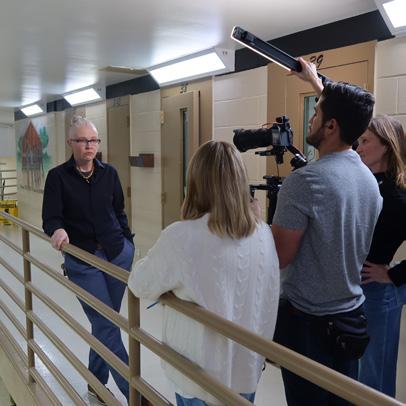
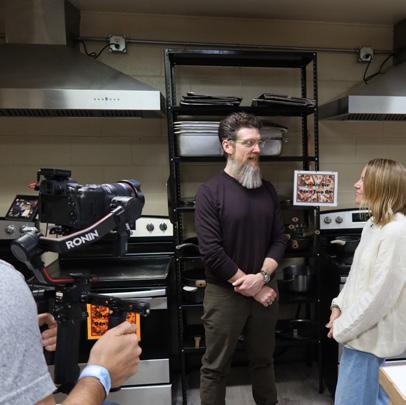
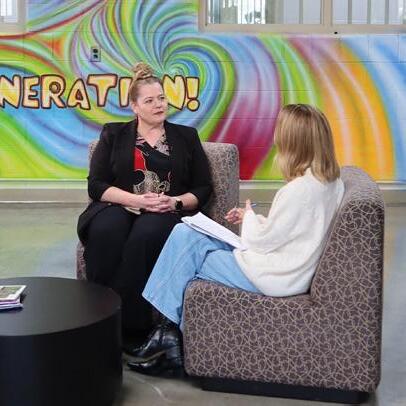
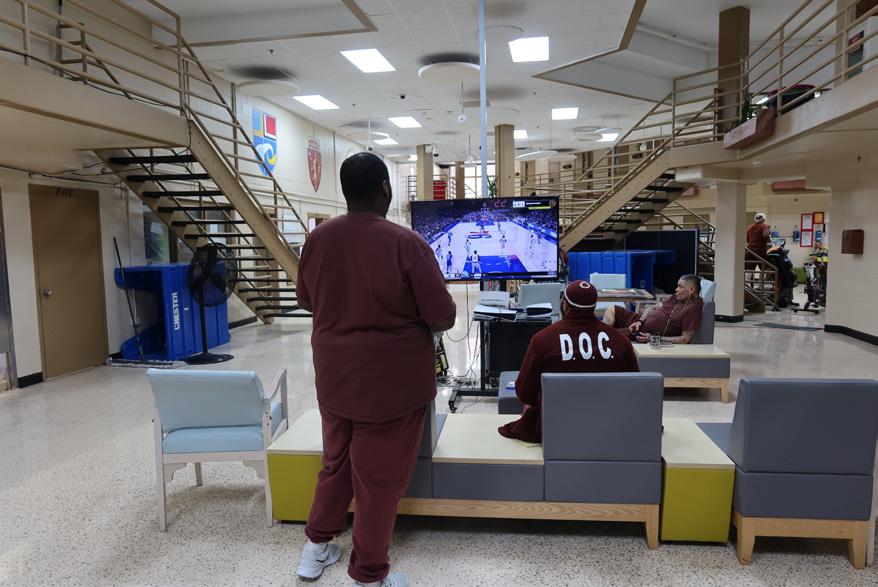
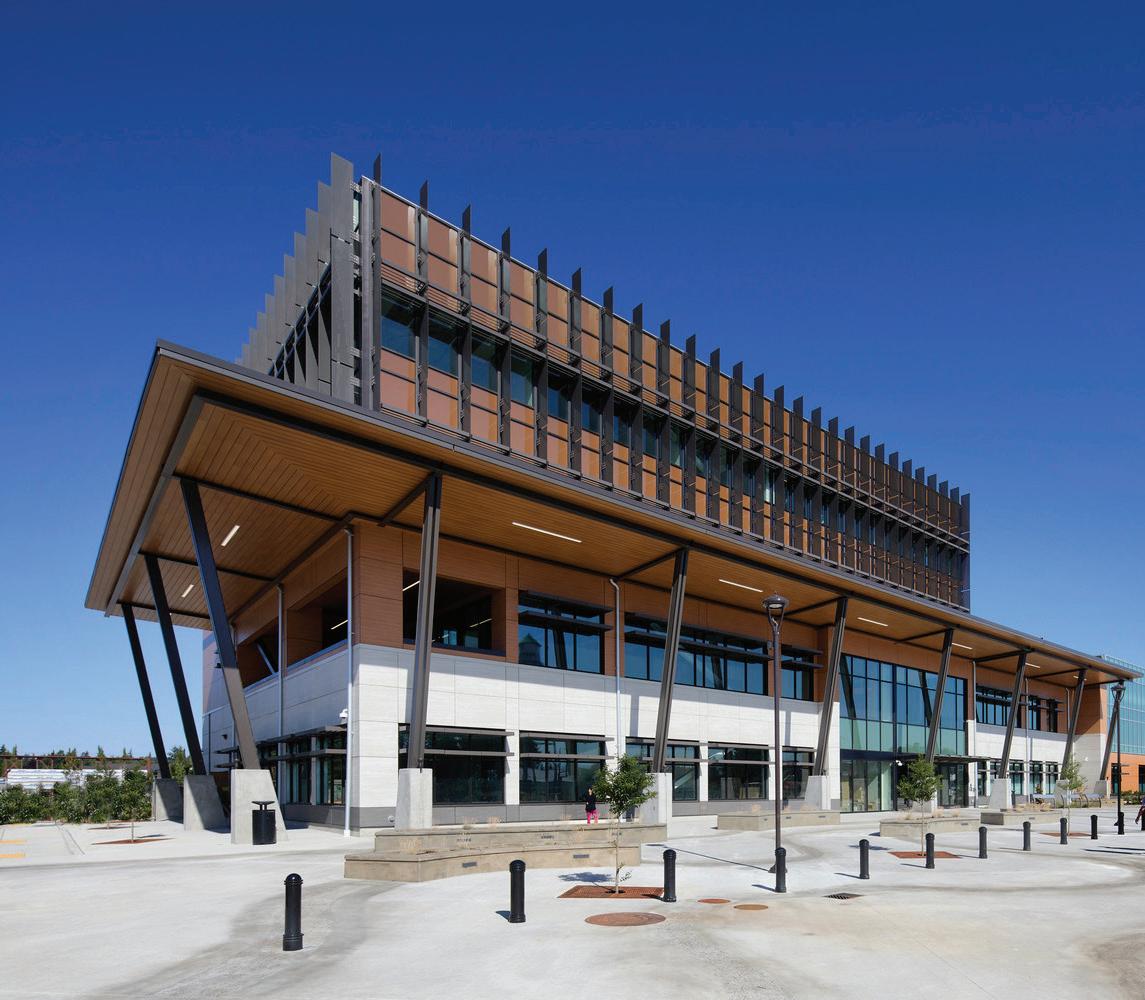
Pierce County, Wash., expands and modernizes court operations
Law Enforcement Roundtable
Public safety experience gives correctional leaders a different perspective
Facility of the Month
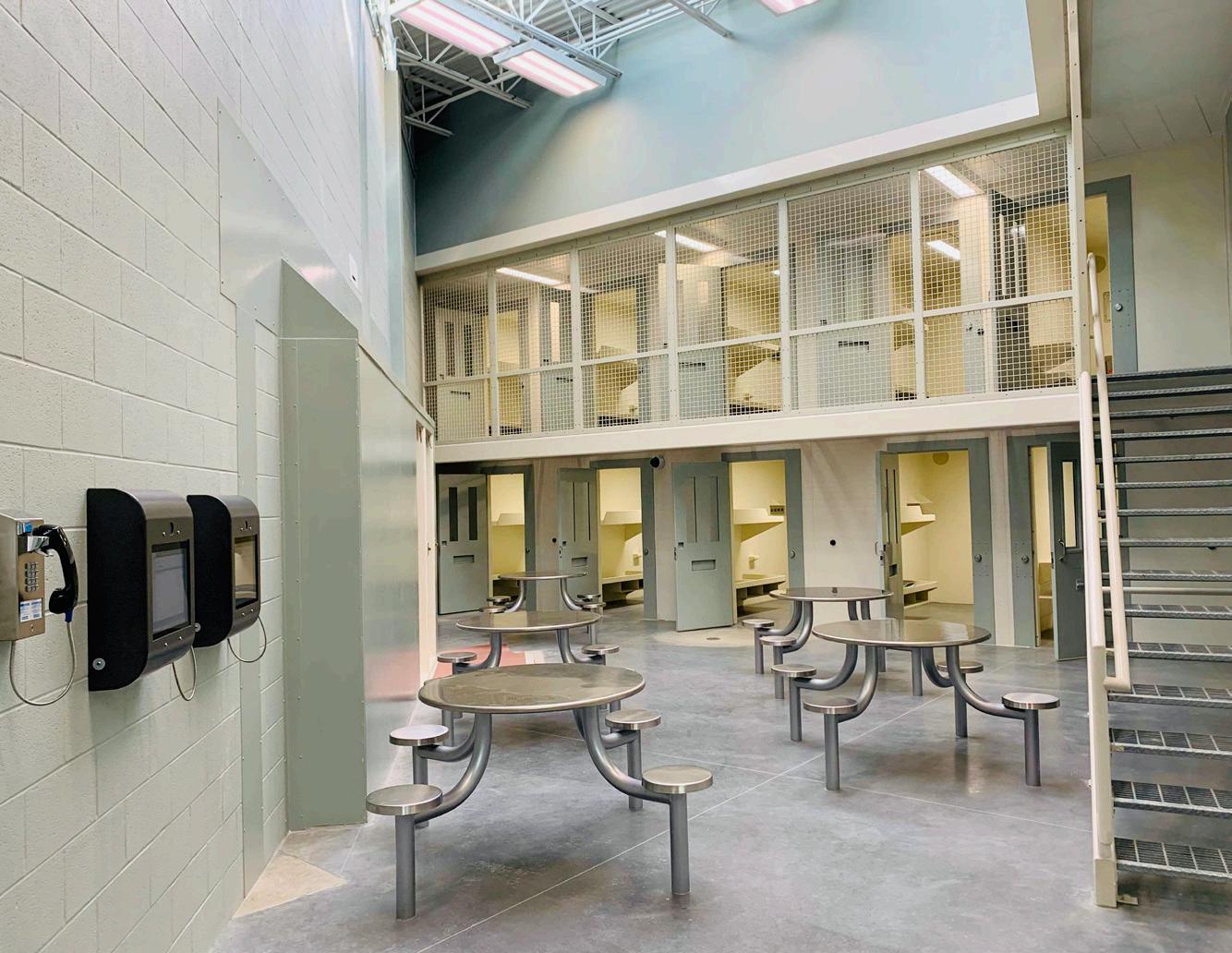
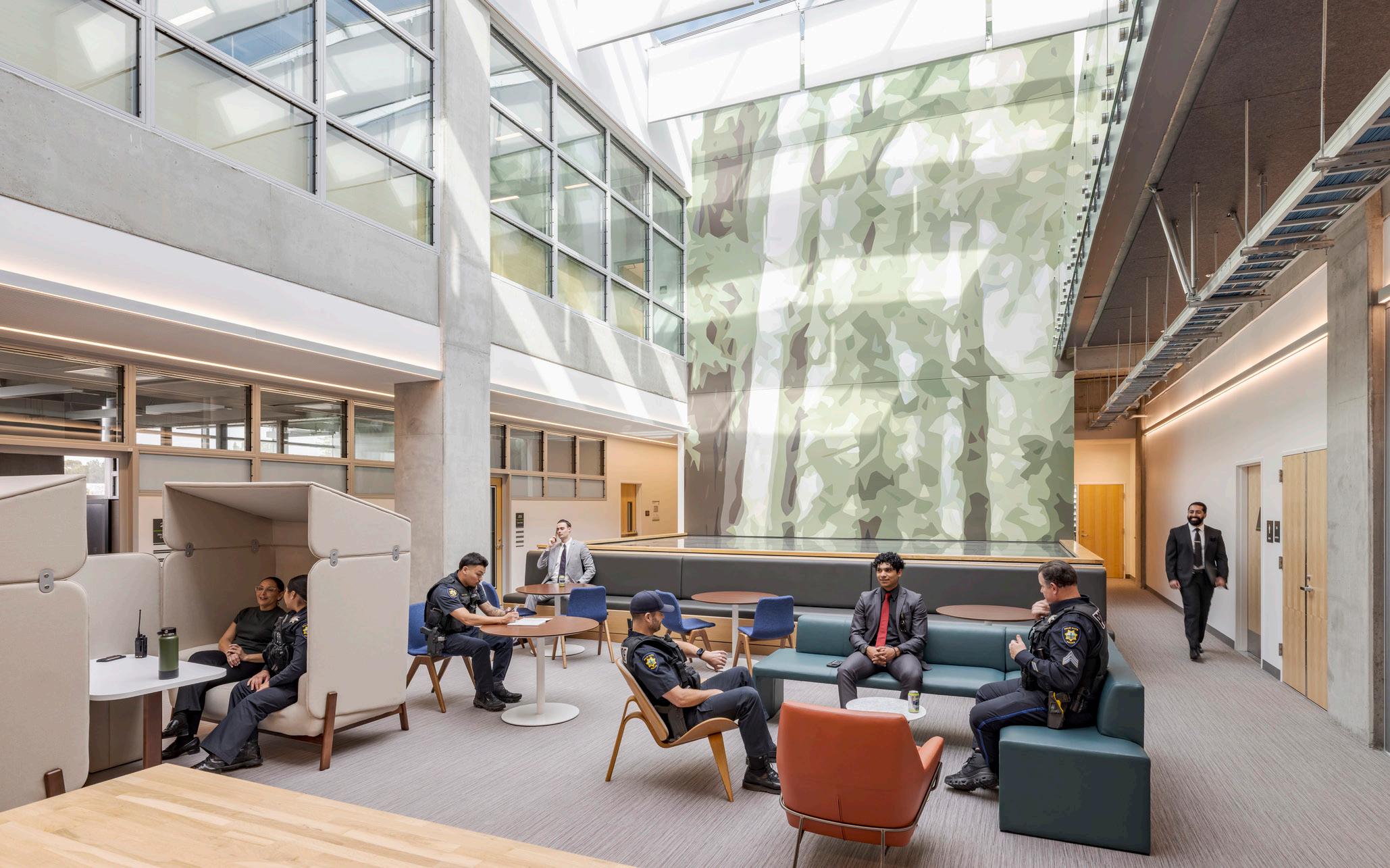
New Hamblen County Justice Center offers a safer, more intuitive layout for staff
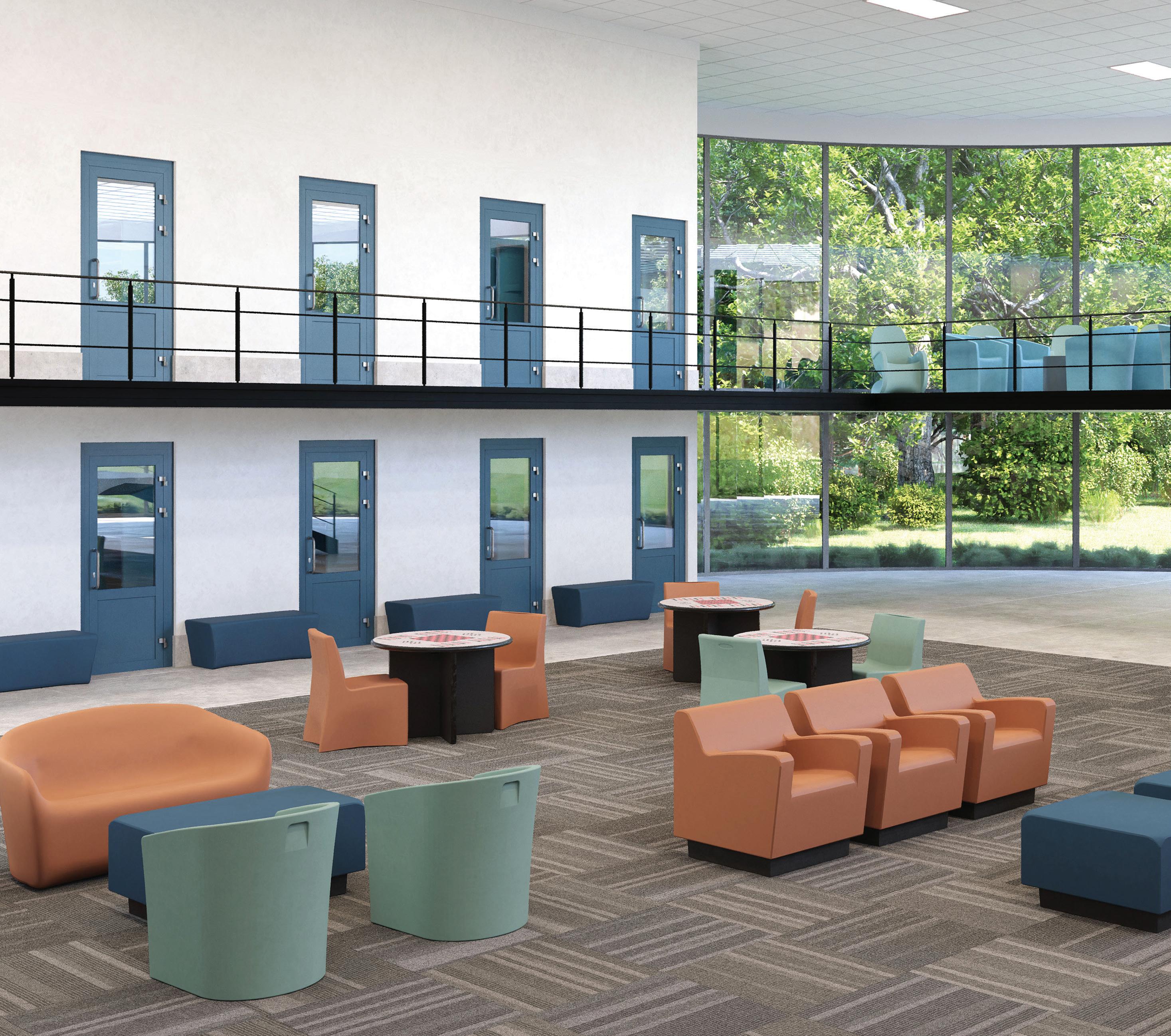
At Norix, we believe every person deserves to feel safe, respected, and at ease. That’s why we design furniture that quietly supports dignity and comfort – creating environments rooted in care, not crisis.
How VR and AR Are Redefining Deescalation Training in Corrections
Pierce County, Wash., Celebrates A New Era of Justice in An Existing Footprint
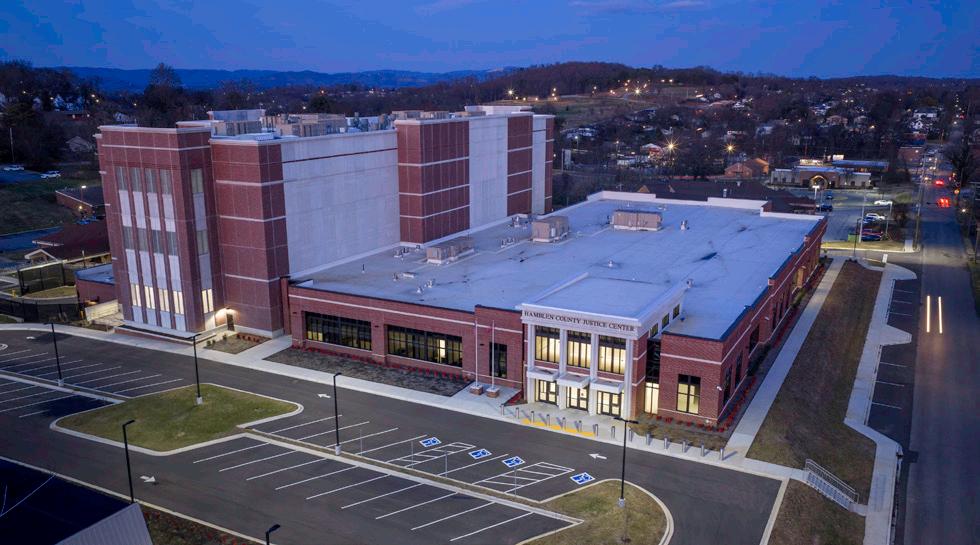
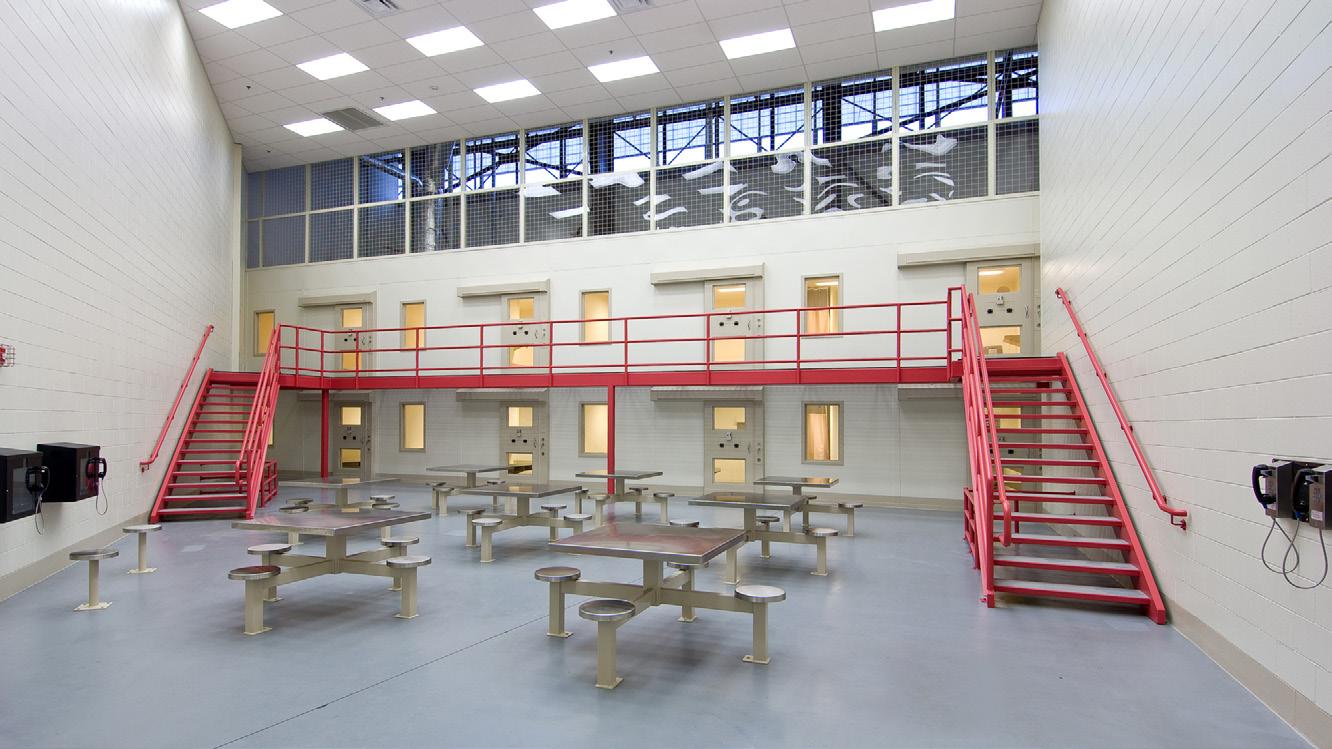
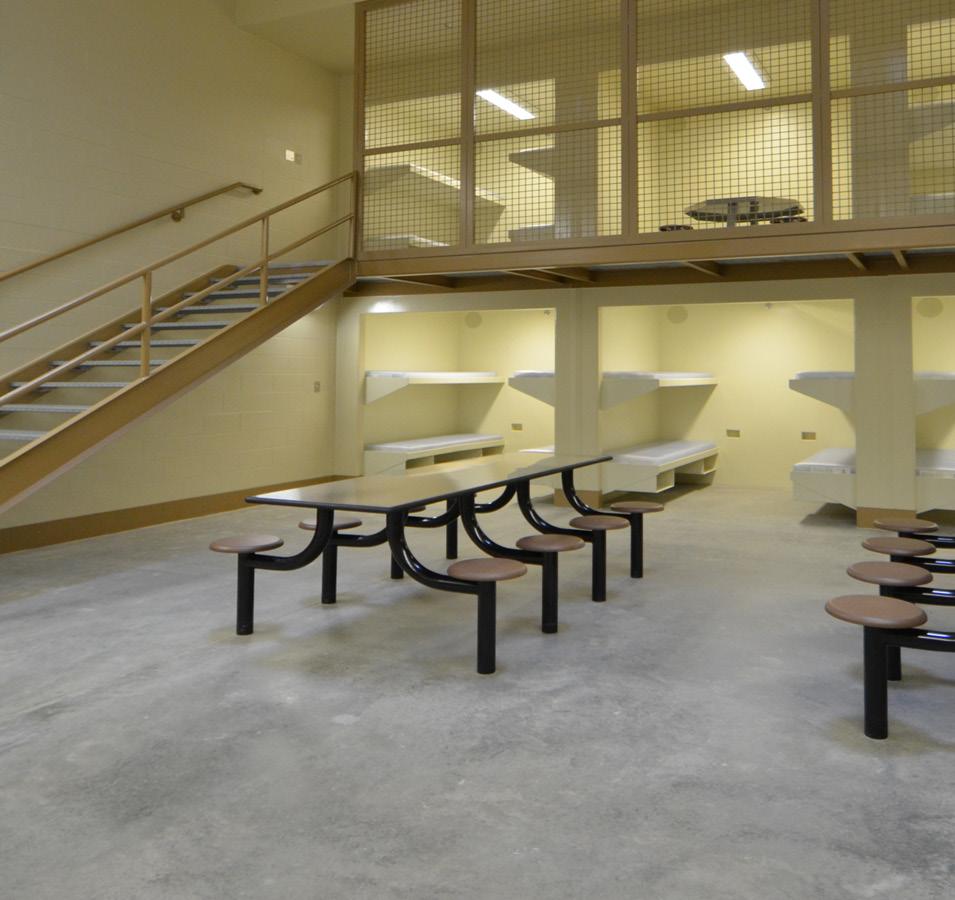
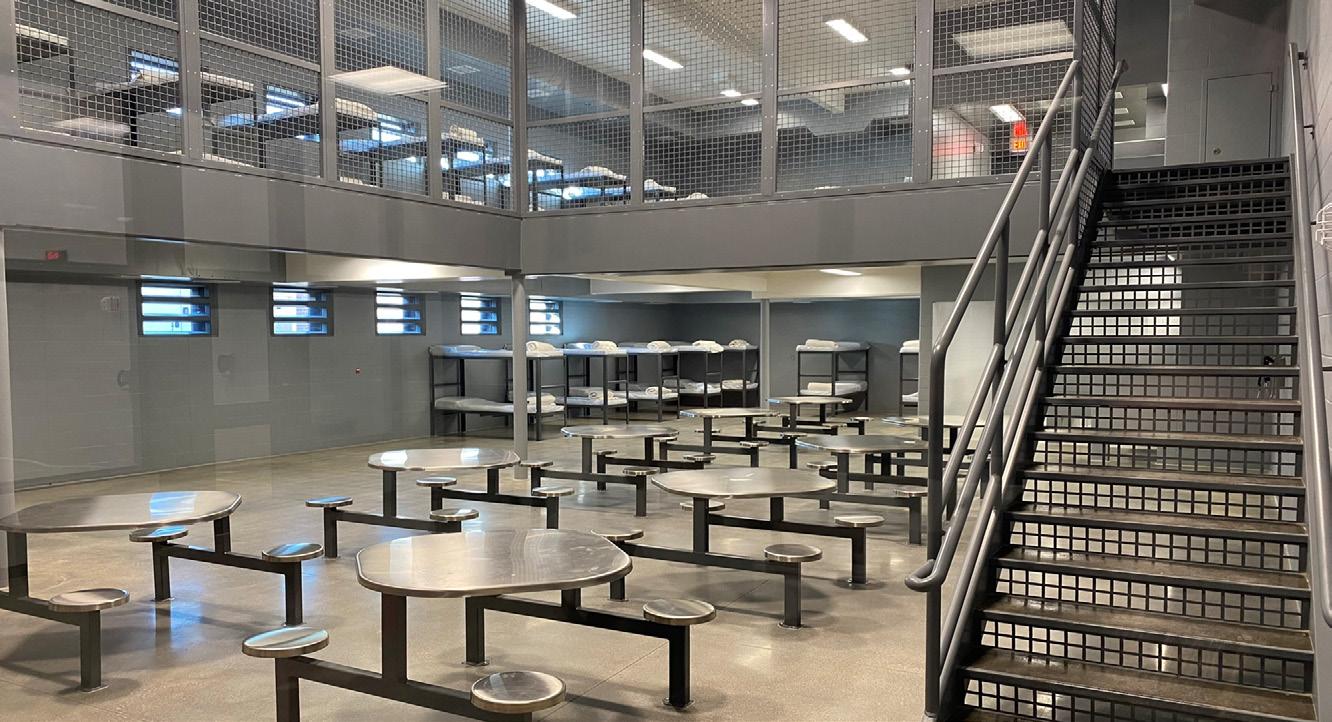
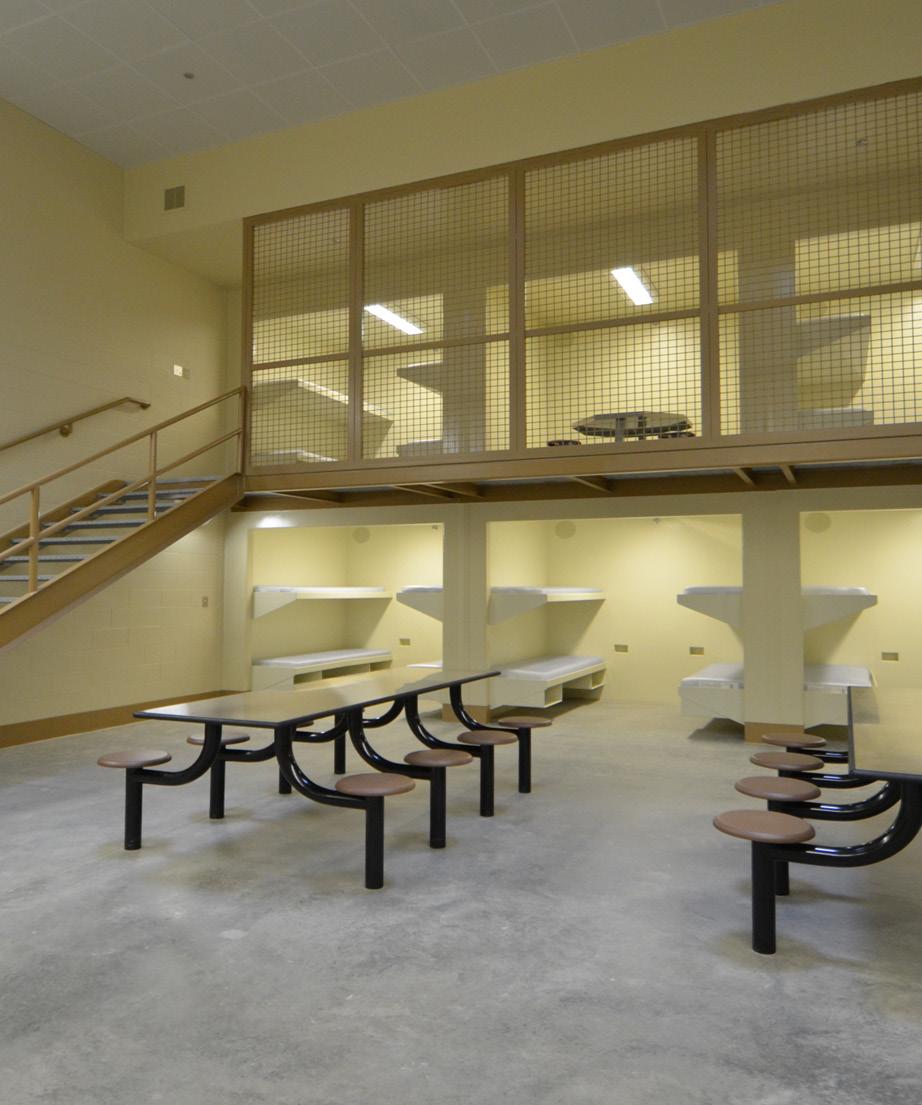
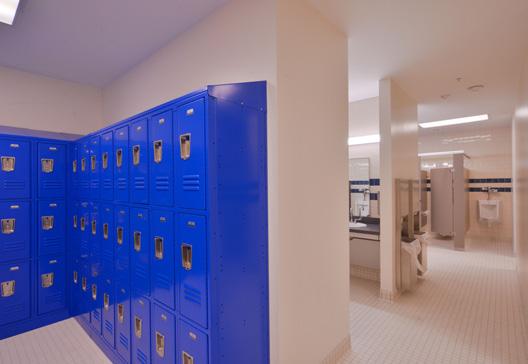
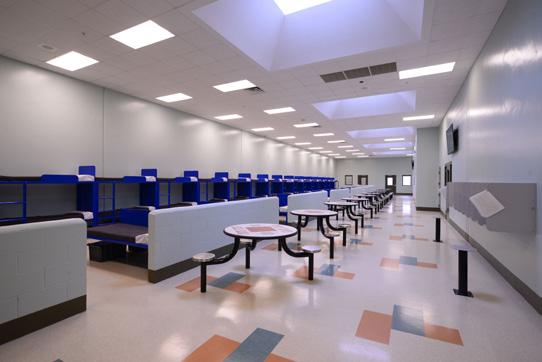
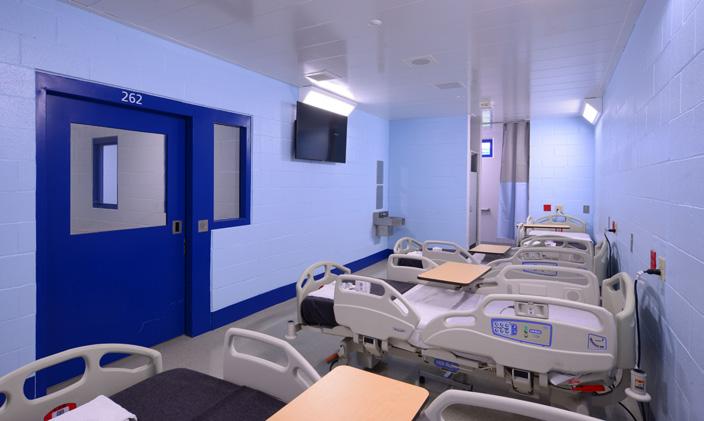
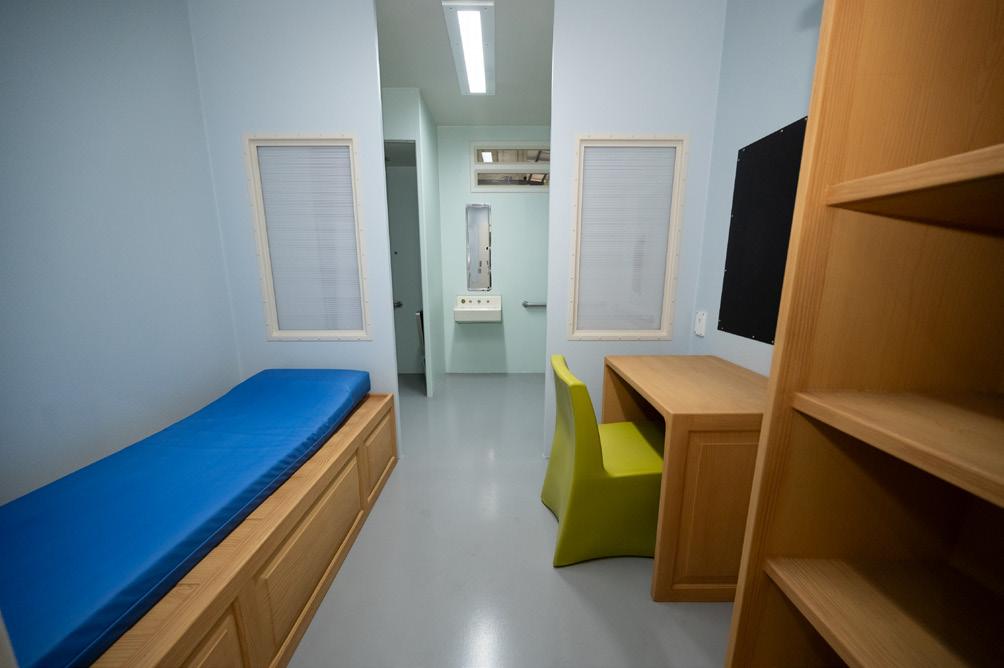
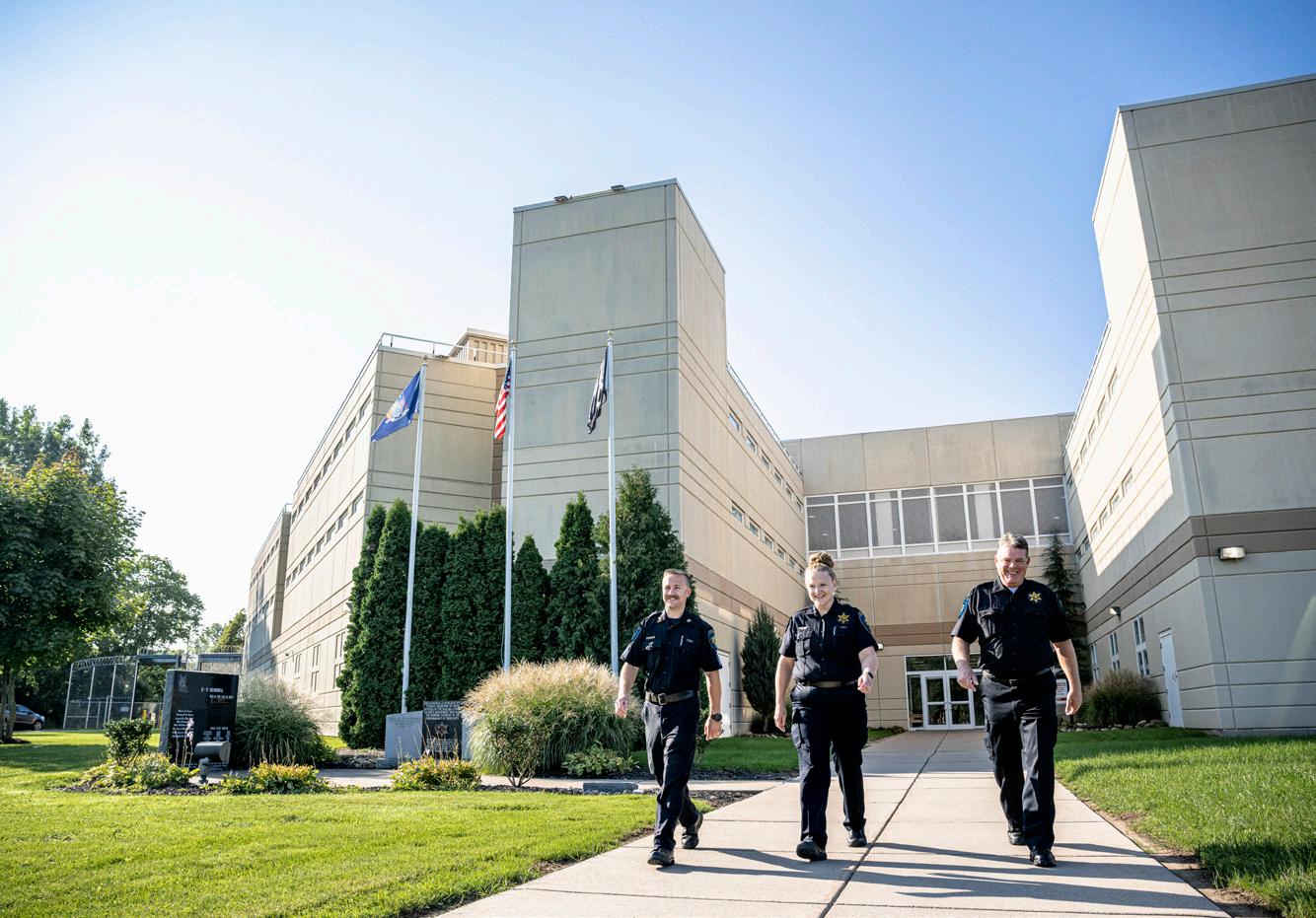
Hamblen County, Tenn., Justice Center Balances Public Safety with a More Intuitive Layout for Detention Staff
Next Edition: June 2026: Maintenance & Operations
Ad Deadline: 5/18/26
Contact: sarah@wmhmedia.com COVER IMAGE:
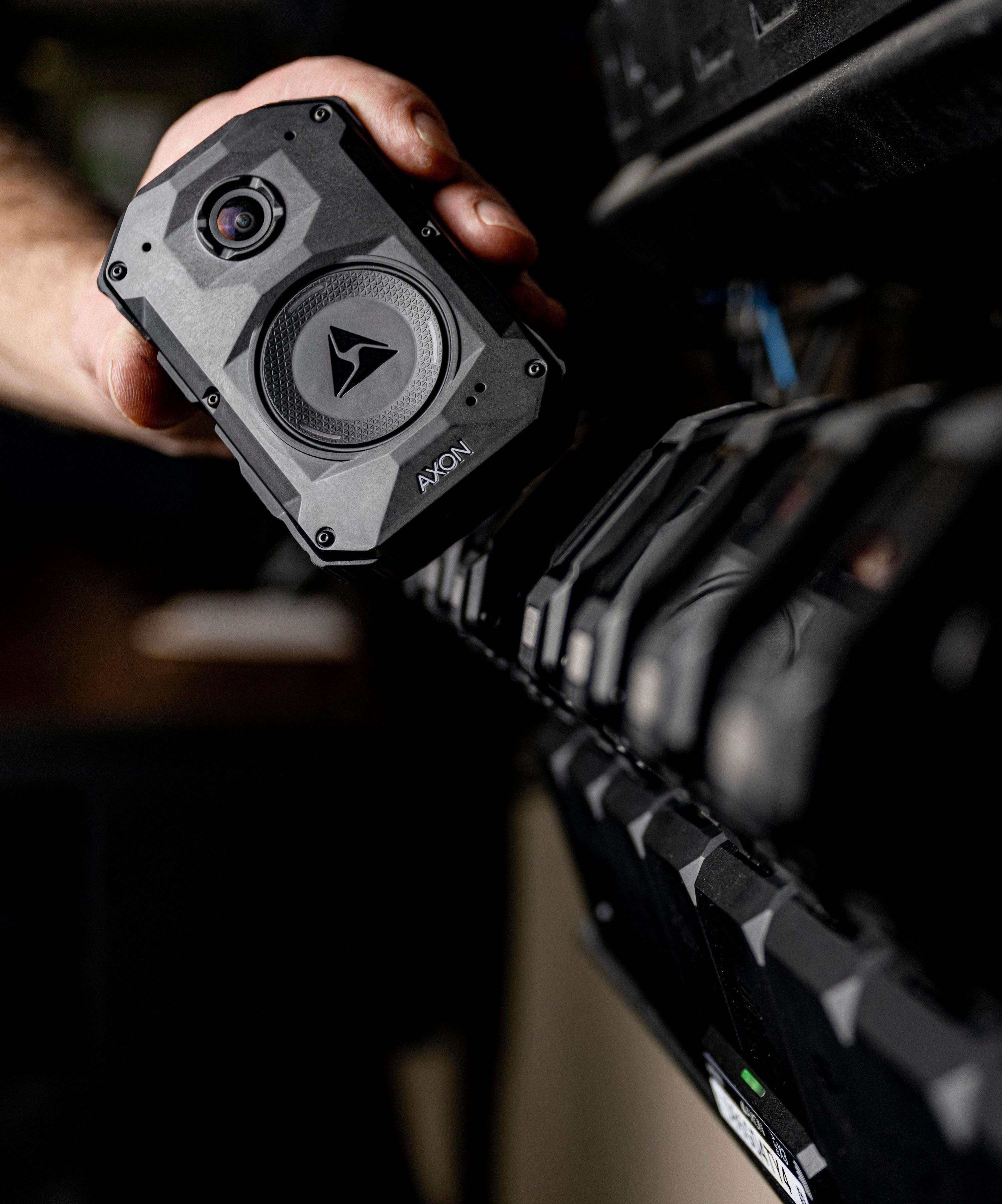
Sponsored by Axon | Learn more on page 35
Amy L. Ast
Jeff Beard, Ph.D.
Bryan Collier
Director, Ohio Department of Youth Services
Former Secretary of Corrections for California and Pennsylvania
Former Executive Director, Texas Department of Criminal Justice
Nicholas Deml Rikers Island Remediation Manager, New York City DOC
Tyrone Oliver Commissioner, Georgia Department of Corrections
Wayne Salisbury Director, Rhode Island Department of Corrections
Cory Salzillo Managing Partner, WPSS Group
Nneka Jones Tapia, Psy.D. Managing Director for Justice Initiatives, Chicago Beyond
Josh Tewalt Former Director, Idaho Department of Correction
Felice Upton Former Asst. Secretary, Juvenile Rehabilitation, Washington DCYF
Tim Ward Former Commissioner, Georgia Department of Corrections
President
Torrey Sims
STAFF CONTACT
Sales
Sarah Clow
Vice
Vice President of Sales and Marketing sarah@wmhmedia.com
Editorial Charlie Lange, Reporter charlie@wmhmedia.com
Subscription Information billing@wmhmedia.com
For reprints, PDFs and plaques, please contact: Jeremy Ellis, ReprintPros (949) 702 5390 Jeremy@ReprintPros.com
ReprintPros: www.reprintpros.com
Request a quote: www.reprintpros.com/index.php/ request-a-quote
EDITORIAL ADVISORY BOARD
Kansas City’s Bloch School of Management and mentors Bloch graduate students.
Nicholas Deml, former Commissioner of the Vermont Department of Corrections, was appointed to the role of Remediation Manager for the New York City Department of Corrections in January, placing him in operational control of Rikers Island under federal court oversight. U.S. District Judge Laura Taylor Swain selected Deml to lead reform efforts aimed at improving safety, staffing and conditions across the troubled jail complex. During his tenure as Commissioner, Deml led Vermont’s corrections system, where he focused on workforce stabilization, healthcare improvements and organizational culture change. Deml’s career includes distinguished service with the Central Intelligence Agency. He is also a member of the Council on Criminal Justice. In August 2025, Deml retired from the department to serve as Managing Director of Everly Bly, a Vermont-based advisory firm. He will continue to serve on the Correctional News Editorial Advisory Board.
Wayne Salisbury, a veteran corrections leader with nearly four decades of public service experience, is stepping down as director of the Rhode Island Department of Corrections to join the federal receivership team overseeing reform efforts at New York City’s Rikers Island jail complex. In March 2016, Salisbury joined the Rhode Island Department of Corrections, where he has held multiple leadership roles. He previously served as Deputy Warden and Warden of the department’s Intake Service Center, as well as Deputy Warden overseeing the Training Academy. He also held the position of Assistant Director of Administration for two years. Salisbury will leave the department at the end of June. During his tenure as Director, he championed strategic planning, leadership development, facility modernization and recidivism reduction initiatives. His new role will draw on extensive operational experience in one of corrections’ highest-profile assignments. Salisbury will continue to serve on the Correctional News Editorial Advisory Board.
A/E/C
Guy Mallozzi has joined HOK’s Civic+Justice team as the new Director of Business Development.
Mallozzi is based in Kansas City and brings more than 30 years of experience working with architecture and engineering teams on complex projects nationwide, including courthouses, corrections centers and law enforcement facilities. His clients have included federal entities as well as counties and local departments.
Sletten Construction Company has named Jeremy Miller as the company’s new Preconstruction Division Manager. In this role, Miller will provide oversight on all preconstruction efforts on projects utilizing alternate delivery methods in the Preconstruction group, which encompasses preconstruction, estimating, commissioning and virtual construction.
Miller has 28 years of experience in the design and construction industries. He joined Sletten in 2018, working on the company’s estimating team and driving continued growth of its preconstruction efforts. He holds a bachelor’s degree in physics and mathematics from Shippensburg University and a master’s degree in civil engineering from Montana State University. He was admitted into the Montana Board of Professional Engineers in 2017.
CORRECTIONAL OFFICIALS
Ohio Department of Rehabilitation and Corrections (ODRC) Director
Annette Chambers-Smith has announced that she will leave the Department for a role in the Office of Gov. Mike DeWine, where she will offer her expertise on ongoing criminal justice initiatives.
Chambers-Smith has led the ODRC since 2019 and has more than 30 years of correctional experience. During her tenure, she prioritized staff safety, security and wellness by establishing the Office of Employee Support Services, implementing an extensive body-worn camera system and introducing a contrabandinterdiction strategic plan. Chambers-Smith also worked to improve post-release success for offenders, expand prison opiate treatment including the use of medications for opioid use disorder, and increase public safety.
Chambers-Smith received the E.R. Cass Correctional Achievement Award — the highest honor awarded by the American Correctional Association — in 2025. She is the Chair of the ACA’s Committee on Standards, Vice Chair of the RecoveryOhio Advisory Council and serves on DeWine’s Ohio Human Trafficking Task Force. In 2023, she was appointed to the National Institute of Corrections Advisory Board.
Upon Chambers-Smith’s departure, Assistant Director Ed Banks has assumed the role of Interim Director.
In his new role, Mallozzi will partner with HOK’s leaders to strengthen client engagement, major pursuit performance and long-term account development.
Mallozzi holds a Bachelor of Science in international business and marketing with a concentration in economics from New York University. He also serves on the Marketing Advisory Board at the University of Missouri-
Banks began his career with the Department in 1994 as a correctional officer at the Trumbull Correctional Institution. He moved on to hold several positions at the Belmont Correctional Institution before serving as Warden of the Hocking and Noble Correctional Institutions. Banks was appointed as the ORDC’s Managing Director of Organizational Development in 2012 and worked as the Deputy Director of Human Resources for both ODRC and the Ohio Department of Youth Services before being appointed to the Regional Director position in the Office of Prisons. Banks was named ORDC Assistant Director in December 2022.
Natalia Bowser has been named Deputy Director of the Montana Department of Corrections. Bowser joined the Montana DOC as Innovation Chief in August 2025, where she oversaw project management, research and analytics, security technology, desistance initiatives, comprehensive safety culture and infrastructure improvements. Prior to that, she served as Director of the Montana Board of Crime Control for seven years. She also held various positions in finance and operations at the Montana Highway Patrol between 2003 and 2018.
Bowser attended the University of Montana where she received her undergraduate degree in criminology.
New Award Highlights Corrections Professionals
The corrections industry is fortunate to have exceptional leaders guiding county and state departments of correction, supported by teams of dedicated executive-level staff members.
Inspired by the Utah DOC’s #UDC365 campaign, which celebrates one corrections employee each day, as well as National Correctional Officers and Employees Week, Correctional News will celebrate the critical leadership team members who are moving the corrections field forward.
As part of Correctional News’ 2026 Industry Awards program, we’re excited to introduce a new recognition for executive-level leaders.
In June, we will invite readers to nominate outstanding employees in this category. Honorees will be announced at the 2026 Corrections Summit in Southern Pines, N.C., in November and will be featured in a future edition of Correctional News. Scan the QR code to learn more.
CALENDAR
45th AJA Conference & Jail Expo
May 16–20 | Milwaukee
CLA Midwest Region Meeting
May 27–30 | Wisconsin Dells, Wis.
National Sheriffs’ Association 2026 Conference
June 8–11 | Omaha, Neb.
CLA on the Hill
June 22–25 | Washington, D.C.
CLA Western Region Meeting
July 13–16 | Cle Elum, Wash.
NCCHC Correctional Mental Health Conference 2026
July 18–20 | Austin, Texas
NOBLE 50th Annual Training Conference
July 24–28 | Dallas
ACA 156th Congress of Correction
July 30–Aug. 2 | Pittsburgh
Miller
Deml
Salisbury
Mallozzi
Chambers-Smith
Banks
Bowser
Fulton County, Ga., Implements Drones-as-First-Responder System to Enhance Jail Security
By Charlie Lange
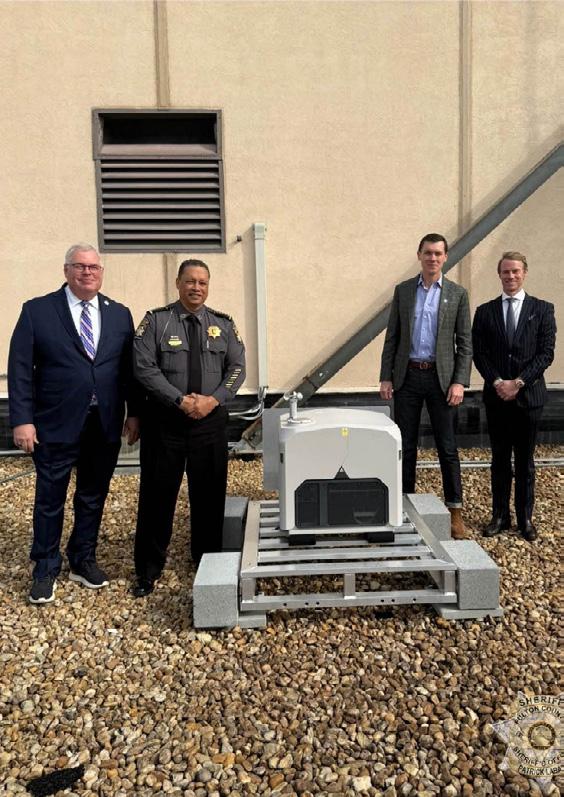
ATLANTA — The Fulton County Sheriff’s Office (FCSO) has launched a drone-as-first-responder (DFR) system intended to bolster security at the Fulton County Jail in Atlanta and counter contraband.
Under the plan, the drone will be stored in an automated dock on the jail’s roof and can be deployed quickly when staff identify a security concern. The system, the Flock Aerodome™ DFR platform from Flock Safety, can cover a four-mile radius with an average response time of 85 seconds, the Sheriff’s Office said in a news release.
Officials with the Sheriff’s Office pointed to unauthorized drone activity around the facility and the ongoing concern of
contraband entering the facility via drones as drivers for the new technology. The FCSO shared in a statement that in a six-month period in 2025, nearly 300 unauthorized drones entered the airspace over the jail.
According to the FCSO, the technology is being deployed through a public-private partnership with the Fulton County Sheriff’s Foundation and Flock Safety. The DFR system is intended to improve situational awareness by providing real-time aerial intelligence, strengthening perimeter security, and reducing risk to staff and people in custody.
“This partnership reflects a forward-looking opportunity to strengthen jail security and modernize how we protect both our facility and the surrounding community,” said Sheriff Patrick “Pat” Labat. “Initiatives like this make us safer today and position us to be better tomorrow.”
“The Sheriff’s Foundation serves as the bridge between innovation and implementation,” added Ken Ashley, Chair of the Fulton County Sheriff’s Foundation. “This exciting
initiative represents what is possible when public and private sectors work together for a common purpose.”
Flock Safety founder and CEO Garrett Langley described the program as a first-of-its-kind effort. “We are incredibly proud to support Sheriff Labat and the Fulton County Sheriff’s Office in this first-of-its-kind program for streamlined, safer automated jail security,” Langley said.
The system will improve situational awareness by providing real-time intelligence. | Photo Credit: Fulton County Sheriff’s Office
STATE OF ILLINOIS
Building the Future of Corrections in Illinois
By Latoya Hughes
When I became Director of the Illinois Department of Corrections (IDOC), I joined the Department at a pivotal moment in our agency’s evolution. The needs of the people we serve and the demands placed on our staff have grown more complex, even as the spaces built to support this work remained largely unchanged.
Addressing Facility Needs
Across 28 facilities, our staff carry out challenging, mission-critical work every single day while supporting individuals in custody, who often come to us with significant needs including untreated trauma, mental illness and substance-use disorders. At the same time, many of our institutions are aging. Twenty percent of IDOC facilities were built before 1926, and most were constructed between 1970 and 2000 — long before the introduction of modern technology and the rehabilitative model of corrections we know to be most effective today.
These realities underscore both the challenges of our work and the opportunity before us to address today’s needs while building environments that strengthen rehabilitation, enhance safety, support family connection and prioritize staff wellness. This requires us to move with intention, invest for longevity and design correctional spaces that align with IDOC’s mission today and our vision for the future.
Over the past year, IDOC has installed new fire alarm systems, replaced aging HVAC units, expanded greenhouse and agriculture areas, and converted underused rooms into classrooms and programming spaces. As we maintain the spaces we operate today, we’re also building for the future. In March 2024, Gov. JB Pritzker and IDOC announced plans to dedicate capital funds to rebuild Logan and Stateville Correctional Centers. The transformational investment became “RISE IDOC: Rehabilitation and Restoration Inside Safe Environments,” an initiative that reimagines the future of corrections in Illinois by centering innovative rehabilitative principles and designing safe, restorative spaces that support opportunity and connection.
PROUD PARTNER OF
Technology as a Tool
Equally important as physical infrastructure is building the technological foundation that allows education, rehabilitative initiatives, healthcare and re-entry planning to thrive. Technology is no longer a supplemental tool — it’s foundational. Over the past two years, IDOC has worked to expand digital access for both individuals in custody and the staff who support them.
People who leave our custody are entering a world where nearly every job, service and opportunity
requires digital literacy. Tablets have become an essential component in building those skills. To support this, IDOC expanded Wi-Fi throughout living units to make tablet-based learning more reliable and give individuals in custody greater autonomy in maintaining relationships with their loved ones. With the statewide rollout of tablets in 2025, individuals in custody could, for the first time, receive their own tablet at no cost and use it to place phone calls, access scanned mail, consult a digital law library and engage with the Edovo learning platform.
After tablets were enabled for phone calls, phone usage increased significantly. To ensure communication remained accessible, IDOC launched the Voices of Connection pilot program, which provides 775 free minutes per month to each individual in custody. Regular contact with loved ones, especially children, plays a critical role in promoting stability and improving reentry outcomes. By increasing Wi-Fi access and expanding connectivity, we’re not only enabling meaningful connection, but also strengthening paths to reunification.
Tablets have also resulted in dramatic growth in educational opportunities.
Director Hughes delivers remarks celebrating the individuals in custody who graduated from the Richland Community College EnRich program.
Expanding workforce training is helping Illinois Department of Corrections staff contribute to better outcomes for people in custody.
Photo Credit (all): IDOC
Since the launch of the Edovo learning platform, more than 31,000 learners have completed over 2.4 million learning items, totaling more than 2.3 million hours of engagement. This year, IDOC introduced Journey to Success, a custom educational portal that offers reentry guides, community resources, health content, legal information and more. This supplemental content expands access to trusted resources while supporting the work of teachers, counselors and program partners across our facilities — bridging classroom instruction with realworld digital expectations.
Building on this momentum, IDOC is actively expanding the use of technology in traditional classroom settings. Upgraded wiring now supports computer-based instruction for emerging adults through the Illinois Department of Juvenile Justice’s school district. IDOC has also connected additional
classrooms to the internet and equipped them with laptops and educational software to strengthen instruction and programming. These investments give educators the tools to help students build the digital skills essential for success upon release.
Expanded Workforce Training, Resources
As we modernize our physical and technological infrastructure, we are also strengthening the workforce that supports this transformation. In 2025, IDOC launched a pilot program establishing Regional Training Academies to expand access to correctional officer trainee positions, resulting in a 44% increase in cadet hiring. Additionally, IDOC upgraded its screening and background tools through improved software and streamlined procedures, creating a more efficient and effective hiring process.
The Department continues to introduce training that reflects modern correctional practice, including new trauma-informed and gender-responsive curricula as well as staff-wellness-related training that addresses the emotional and mental health realities of correctional work. IDOC has also expanded wellness efforts to include workshops for the adult family members of frontline staff — a first-of-its-kind initiative among state correctional agencies.
Additionally, we are expanding use of technology to help staff work more effectively. IDOC has begun implementing a comprehensive Electronic Health Record (EHR) system that is on track for full deployment in 2026. This system will improve continuity of care, reduce administrative burden and support stronger emergency response through immediate access to accurate medical histories. To prepare for this transition, IDOC partnered with the Illinois Department of Innovation & Technology to begin a largescale IT refresh, ensuring every healthcare unit is connected and EHR-ready.
Today’s Challenges, Tomorrow’s Solutions
These combined investments reflect a clear direction for the future of corrections in Illinois. We are embracing evidencebased approaches, strengthening rehabilitative opportunities, building environments and introducing new resources that empower staff to do their best work — while ensuring individuals in custody have every opportunity to grow. Our transformation is ongoing, but the progress is undeniable. Across IDOC, the message is clear: we are not simply responding to today’s needs, we are shaping the Illinois Department of Corrections for decades to come.
Latoya Hughes is the Director of the Illinois Department of Corrections.
How Long-Acting Injectables Reduce Risk, Save Time and Redefine Operations in Corrections
By Lindsey Coulter
As correctional and public safety systems continue to grapple with opioid use disorder (OUD) among justice and corrections clientele, a growing number of agencies are rethinking how treatment fits into daily operations. Many agencies are turning to longacting injectable medications — not just as a clinical solution, but as a strategic operational tool.
Unlike daily oral medications, which can be missed, diverted or misused, long-acting injectables (LAI) maintain steady medication levels and are administered by a healthcare professional. That distinction is increasingly important in detention environments, where medication management intersects directly with safety, staffing and security.
Indivior, a specialty pharmaceutical company, is singularly focused on delivering evidence-based treatment and advancing understanding of OUD as a chronic but treatable brain disease. At the center of this work is SUBLOCADE® (buprenorphine extended release) a once monthly injectable formulation of buprenorphine designed to provide consistent therapeutic coverage over the course of the month. Already used by agencies and municipalities across the country, LAI formulations have the potential to demonstrate meaningful impact on treatment outcomes and facility operations within the criminal justice system.
Reducing Diversion, Improving Safety
In many facilities, daily medication distribution creates operational challenges. Medication lines require more intensive staffing, supervision and security protocols to ensure each dose is administered and completed successfully.
Because LAI are administered in controlled clinical settings under Risk Evaluation and Mitigation Strategy (REMS) protocols, they mitigate the risk of self administration and reduce the potential for misuse or trafficking — two major safety concerns for correctional staff.
A national survey recently published in the Journal of Correctional Health Care showed that correctional leaders perceived staffing and coordination gaps as key barriers to reducing diversion of medications for opioid use disorder (MOUD) and recognized LAI buprenorphine as a strategy to help mitigate diversion and improve treatment in jail and prison settings.
The cross-sectional survey included responses from 180 correctional professionals across U.S. jail and prison facilities. Among respondents, a strong majority — 88% of those working in jails and 87% in prisons — perceived that LAI buprenorphine could help reduce MOUD diversion within their facilities.
Brad DeCamp, Executive Director of ADAMH (Alcohol, Drug Addiction, and Mental Health Services) of Crawford and Marion Counties in Ohio, said LAI fundamentally change that dynamic.
“Long-acting injectables remove a major barrier for jail staff and make the program much safer and more effective for everyone involved,” DeCamp said.
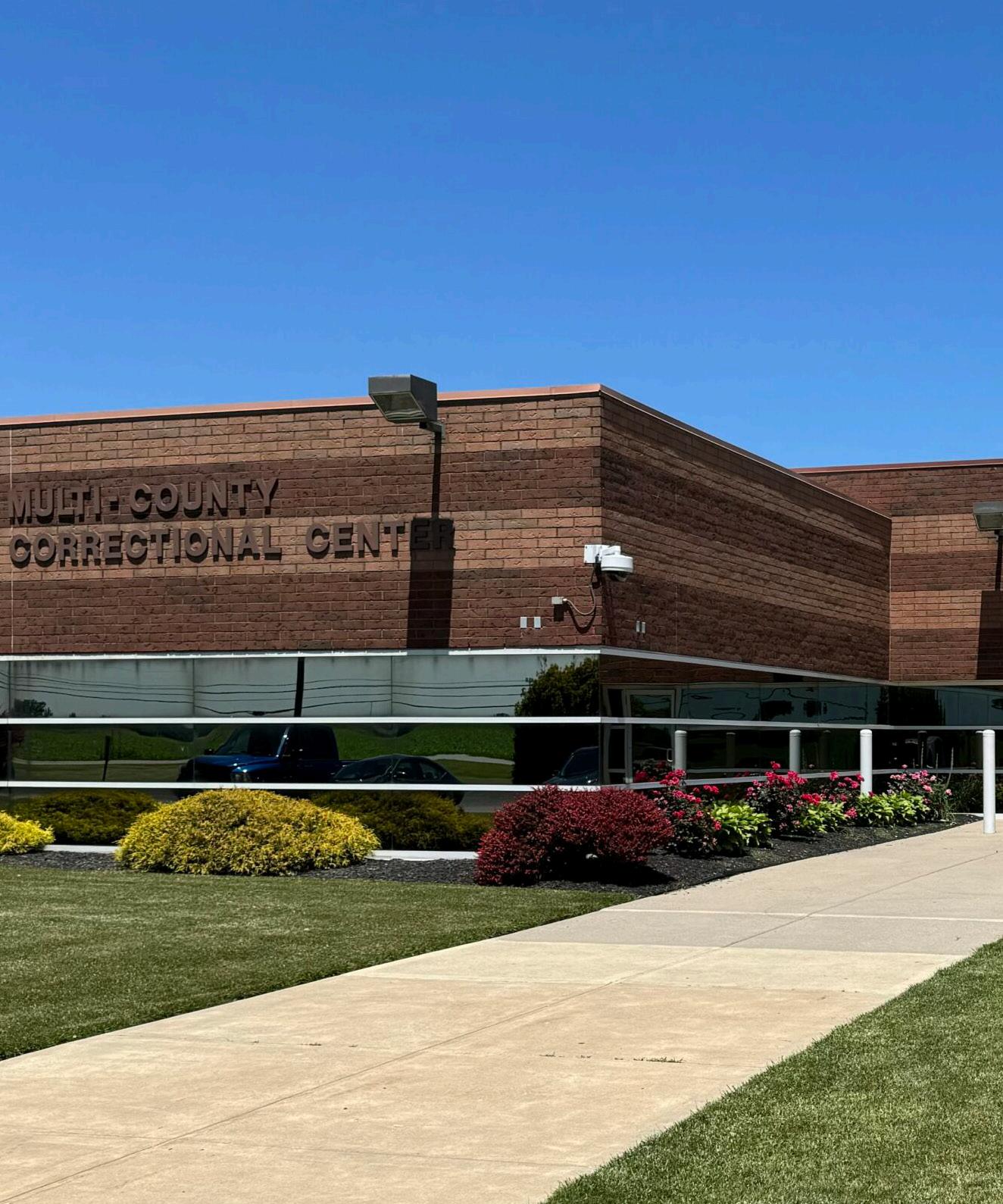
That reduction in diversion risk is a recurring theme among corrections leaders. Steve Aiken, Executive Director of the Multi-County Correctional Center in Marion, Ohio, said oral medications can present persistent challenges inside facilities.
“It’s easy to miss a pill. Even here we have problems with inmates passing them off to others,” Aiken said. “With the injection, it stays in the system for 30 days. That consistency dramatically increases our ability to help [detainees] stay on track and succeed.”
Staffing Efficiency and Operational Impact
Beyond safety, correctional leaders are increasingly evaluating medication-assisted treatment (MAT) and MOUD programs through an operational lens. Daily dosing requires repeated staff engagement, while monthly injectables streamline the process.
By replacing daily medication lines with a single monthly dose, facilities can reduce staff time spent on distribution and supervision, freeing personnel for other responsibilities. The result is not only greater efficiency but also improved working conditions. Facilities also report that stabilized individuals contribute to calmer housing environments, reducing incidents and easing pressure on staff.
A Collaborative Model for Success
While medication plays a central role, stakeholders emphasize that outcomes depend on a broader system of care. For example, the MultiCounty Correctional Center integrates medication, counseling and life skills training. DeCamp notes that the medication helps give the brain a pause, breaking the craving cycle and allowing for other supportive treatments and life skills courses to be even more effective.
“I look at these [tactics] as a three-legged stool,” DeCamp said. “If you don’t have one of those legs functional, you’re going to fall and that’s going to be painful. Medication, counseling and life skills must all work together for the program to truly succeed.”
injections while here and graduated the program,” Aiken said. “He now holds a steady job, bought a vehicle, and is even in the process of purchasing a home. Seeing that transformation validated everything we were trying to accomplish.”
Tom Stotts, chief probation officer with Marion Municipal Court, shared a similar example of an LAI program participant whose successful completion from the program has helped her maintain stable housing, find employment and improve her quality of life — significantly reducing her odds of recidivism.
“She’s done the best that she’s ever done on probation, and I attribute much of that success to the support and structure of the LAI program in the jail,” Stotts said.
Scaling for Systems of All Sizes
That integrated approach also includes partnerships with courts, probation departments, healthcare providers and local mental health boards. Monthly coordination meetings ensure continuity of care from incarceration to reentry — one of the most high-risk intervention points. In the two weeks post-release, individuals face a risk of overdose death that is up to 40 times higher than the national average, according to a recent study published by the American Journal of Public Health.
The results are measurable. The facility has engaged hundreds of participants, delivered thousands of hours of counseling and achieved significant reductions in recidivism — thanks in great part to using LAI.
Real-World Outcomes and Human Impact
For correctional leaders, operational improvements are only part of the equation. The ultimate goal remains long-term recovery and reduced recidivism.
“I have seen many defendants who have been incarcerated for significant periods of time find success [with LAI],” said Judge Teresa Ballinger with the Marion County Municipal Court. Ballinger was excited to see the interest expand from the municipal courts and ADAMH teams to the local jails and prisons and championed by Aiken.
“One of our first participants received three
While large correctional systems often lead innovation, LAI programs are equally valuable and accessible for smaller, rural agencies and facilities.That scalability is critical as jurisdictions across the country seek solutions that address both public health and operational demands. Aiken said that making the case for new ways of providing care can be a challenge, but ultimately the LAI conversation is necessary.
“Seeing what’s available today — the tools, the programs, the structure — it can drastically reduce the revolving door,” he said. However, implementation does require planning, funding and partnerships.
Aiken stresses the importance of working with medical providers and community organizations.
“My officers maintain a safe environment, but it’s the medical partners who administer the program and ensure it’s executed effectively,” he said.
A New Framework for Corrections
As correctional systems evolve, LAI are redefining how agencies approach substance use disorder. What began as a clinical innovation is now being viewed through an operational lens — one that prioritizes safety, efficiency and measurable outcomes.
Despite growing progress in the availability of MAT in the carceral setting, disparities remain. A 2022 survey found that only 58% of correctional facilities offer at least one FDA-approved treatment. Access varies by geography and facility type, with southern facilities reporting the lowest rates.
The shift from daily to monthly administration represents more than a change in medication — it signals a move toward a more controlled, scalable and sustainable model of care. For facilities navigating staffing constraints, safety concerns and rising behavioral health needs, that shift may prove to be as operationally significant as it is clinically effective.
This article was sponsored by Indivior. For further information, visit www.indivior.com.
Ohio’s Marion County Municipal Court has seen benefits from integrating long-acting injectables.
Photo Credit: Nyttend
Virtual-reality training places officers inside fully rendered, three-dimensional environments populated by characters whose behavior can be dialed up or down by an instructor in real time.
Beyond the Classroom: How VR and AR Are Redefining Deescalation Training in Corrections
Immersive simulation technology is giving officers a safe space to rehearse high-stakes, low-frequency incidents
By Dr. Julie van der Hoop
The Problem: You Can’t Practice What Never Happens
A corrections officer might spend years on the job without ever witnessing a large-scale use-of-force incident — until the day they do. Unlike surgeons or pilots, who build procedural memory through repetition, corrections officers face a wide spectrum of high-stakes incidents that may occur once in a career, if at all. Annual classroom training builds knowledge. It doesn’t build instinct.
The Technology: More Than a Headset
Assistance has issued multiple solicitations since 2023 specifically funding VR deescalation training, signaling that federal infrastructure increasingly treats this as a legitimate training investment.
The more important investment is curricular: VR works best as a rehearsal layer after foundational Crisis Intervention Training or Mental Health First Aid training, not as a standalone tool. The debrief session after each simulation — a structured review of communication choices and decision points — is as valuable as the scenario itself.
Virtual reality (VR) training places officers inside fully rendered, threedimensional environments populated by characters whose behavior — intoxication level, weapon type, psychiatric profile — can be dialed up or down by an instructor in real time. Scenarios branch based on officer choices. The stress is real even when the situation isn’t.
The agencies piloting VR deescalation training aren’t waiting for a perfect evidence base — they’re helping build it.
What makes this particularly valuable for corrections is repetition: an officer can work through a hostage scenario or acute mental health crisis dozens of times before facing one in reality. That rehearsal changes how the brain responds when adrenaline hits — a principle known as stress inoculation, well-established in military and emergency medicine training contexts.
What the Research Shows
Most of the rigorous research on VR training effectiveness comes from law enforcement and military settings; specific corrections studies are needed. The National Institute of Corrections has noted that evidence in correctional settings remains largely anecdotal. That caveat matters — but so does what the adjacent research is finding.
A 2023 study published in Policing found VR-based deescalation training produced outcomes comparable to traditional live-action role-play in police officers, validating VR as a clinically equivalent alternative at a fraction of the logistical cost. A 2024 study in Frontiers in Psychology went further, measuring actual physiological responses — heart rate, stress markers — in officers running VR mental health crisis scenarios, confirming that the training generates real stress arousal, not just cognitive engagement. Dutch researchers found that after-action review conducted inside VR — particularly replaying scenarios from the subject’s perspective — significantly improved learning outcomes compared to standard debriefs. The evidence base is promising. It is not yet definitive for corrections officer training specifically — and that honesty should inform how agencies frame VR internally: as a high-potential tool under active evaluation rather than a proven solution.
Implementation Realities
Full VR simulator setups currently run from $50,000 to $100,000, though costs are falling. Department of Justice grants and some opioid settlement funds have covered costs for several early adopters. The Bureau of Justice
Who’s Doing It Now
· Rockingham County Department of Corrections in New Hampshire deployed two VR simulators in early 2024, funded with $70,000 in opioid-abatement settlement funds. Officers train on scenarios including a psychotic inmate wielding a knife and a hostage situation triggered by a medication refusal, all customizable by substance, behavior and threat level. The goal in every scenario is verbal resolution, not force.
· Ohio University’s OHIO 360 program developed Cine-VR scenarios built directly from regional incident patterns in Appalachia, in close partnership with local law enforcement. The program received the Federal Bureau of Investigation National Academy Associates Science and Innovation Award in 2023 and offers a replicable co-design model for corrections agencies wanting facility-specific content.
· Mason City, Iowa, used a Bureau of Justice Assistance Justice and Mental Health Collaboration Program grant to deploy VR for mental health, and notably extended the training to community mental health stakeholders, not just sworn staff, building shared response frameworks across the full crisis system.
· The Colorado Department of Corrections took a different angle entirely, using VR to prepare long-term incarcerated individuals for reintegration, walking juvenile lifers through supermarkets, job interviews and daily tasks they’ve never experienced as adults. Early National Institute of Justice-supported research on similar VR job-readiness programs found participants were significantly more likely to be employed six months post-release.
What’s Coming
The agencies piloting VR deescalation training aren’t waiting for a perfect evidence base — they’re helping build it. What’s already established is that the technology generates genuine stress responses, produces outcomes comparable to live role-play, and costs less to scale than traditional simulation. What still needs corrections-specific research is whether those gains translate into measurable reductions in use-of-force incidents, staff injuries and critical incident response times on the floor.
That’s the study the field needs. In the meantime, the programs running now are generating the anecdotal foundation that tends to precede it — and Falcon Technologies is watching this space closely as the technology matures.
Julie van der Hoop, Ph.D., is the Lead Product Manager for Falcon Technologies. She holds a doctorate from MIT. This article was sponsored by Falcon Technologies. Learn more at www.falconinc.com.
Photo Credit (all): Courtesy of Falcon Technologies
VR can help prepare long-term incarcerated individuals for reintegration.
Photo Credit: GPT-5.4 Thinking
Stronger Staff, Safer Outcomes
ACA’s expected practices on staff wellness are a key contributor to overall public safety
By David Haasenritter
The American Correctional Association’s (ACA) expected practices (previously known as standards) serve as benchmarks for correctional institutions across the U.S., encompassing areas such as facility safety, inmate management, staff training and rehabilitative programming. By adhering to ACA guidelines, facilities promote safer environments for both staff and the incarcerated population, reducing the risk of violence, escapes and other security breaches.
See ACA Standards, page 21→
of ACA standards supports public safety by ensuring that incarcerated individuals are managed in ways that minimize threats to the community outside of correctional facilities. These practices include comprehensive screening, secure facility design and safely. Addressing stress and
Ensuring that correctional staff have access to wellness offerings is central to ACA’s efforts to increase public safety through standards.
Photo Credit: ACA/Lovestruck Images
South Dakota Begins Sitework for New Men’s Prison
Set to open in 2030, the facility will include 1,500 beds delivered at a maximum price of $650 million
By Dena Sattler
In South Dakota, construction of a new men’s prison to replace the outdated state penitentiary, driven by the goal of reducing recidivism and getting offenders back to work, is officially underway after the project broke ground in late April.
Overcrowding was a key concern in official talks in 2025 about replacing the South Dakota State Penitentiary, which has been in use since 1881 and lacks sufficient housing and adequate space for education and rehabilitation programs.
Data from the South Dakota Department of Corrections (SDDOC) showed the penitentiary operating at more than 176% of its safe, recommended capacity for male offenders. A facility that was originally designed for single-occupancy cells has been forced to house multiple offenders in those spaces, leading to safety-related issues for inmates and staff alike. This has led officials to describe the existing facility as “worn out” and unsuitable for rehabilitative programming.
Changing Course
In September 2025, South Dakota state lawmakers took a bold step toward a more modern facility by approving construction of a 1,500-bed men’s prison in Sioux Falls, S.D., with a guaranteed maximum project cost of $650 million. That was after they rejected an earlier plan for an $825 million facility.
The joint venture of Henry Carlson Construction LLC and JE Dunn Construction Group will construct a 540,000-square-foot facility with a 100-year life expectancy that will house inmates in four separate buildings with nearly 1,200 combined cell beds and 300 dorm beds. The new facility will also include 40 square feet of dayroom space per inmate, exceeding the 35-square-foot ratio required by American Correctional Association standards.
State legislators hailed the planned prison’s overall size, guaranteed pricing and space for rehabilitation programming as significant improvements over the initial proposal.
Various Voices Guide Task Force
Gov. Larry Rhoden’s creation of a Correctional Rehabilitation Task Force also helped build lawmaker support for the new men’s prison in Sioux Falls.
The task force was led by Lt. Gov. Tony Venhuizen and was comprised of members from within and outside of state government: 11 members of the South Dakota Legislature, one judge, two representatives from law enforcement, an Indigenous community representative, a healthcare or behavioral health representative, and other members chosen by the governor.
The emphasis on including voices from outside government was viewed as a critical step toward improving the process of successfully returning offenders to their communities. The task force began its work in October 2025 and is studying inmate
Grading and clearing of the new site in rural Lincoln County near Sioux Falls is being done as weather allows, with the project on track for a January 2030 completion.
Gov. Larry Rhoden and project representatives broke ground on the new 540,000-square-foot prison on April 22.
Photo Credit (all): Courtesy of SDDOC
DESIGN & CONSTRUCTION
programming needs, options for faith-based and Native American-focused programs, and best practices for reentry of inmates into society. The group also is charged with making recommendations on how to best use additional space that will be available.
“The new facility will create a better, safer working environment for staff, helping to maintain order, reduce violent behavior, and control contraband,” said Michael Winder, spokesman for the SDDOC. “It is our hope that improved working conditions will strengthen morale and lead to a higher retention of staff.”
Plan Triples Training Space
Winder said design work for the new men’s prison is ongoing. Grading and clearing of the new site in rural Lincoln County near Sioux Falls is being done as weather allows, with the project on track for a planned January 2030 completion date.
Once finished, the new prison will feature three times more space for vocational training than the current facility.
“The new, modern physical plant will include adequate space for educational, vocational, reentry programming and rehabilitative services,” Winder added. “This will also help reduce over-occupancy at our other facilities.”
South Dakota has eight adult prisons, including the state penitentiary. At the end of 2025,
the state’s adult prison population was 3,753, with another 3,778 people on supervised parole. Every correctional facility in South Dakota currently operates beyond its capacity. Additionally, construction is underway on the 288-bed Rapid City Correctional Facility for women, which will be the state’s ninth prison facility and is set to open this summer.
The plan to replace the outdated, high-maintenance state penitentiary with a new men’s facility incorporating expanded space for vocational training, rehabilitation programs and enhanced security has been hailed as a long-term investment in rehabilitation and public safety.
“While this plan cuts costs, it does not cut corners on security,” Rhoden said of replacing the state penitentiary, which was built in 1881 — eight years before South Dakota entered statehood.
The new prison will be paid for with an Incarceration Construction Fund started in 2022, made up of excess revenue, and federal cash infusions received during the COVID-19 pandemic. The new facility is being built in northeast Sioux Falls on an undeveloped patch of industrial land approximately three miles northeast of the current penitentiary.
joint-venture of JE Dunn and Henry Carlson Construction will build the new facility.
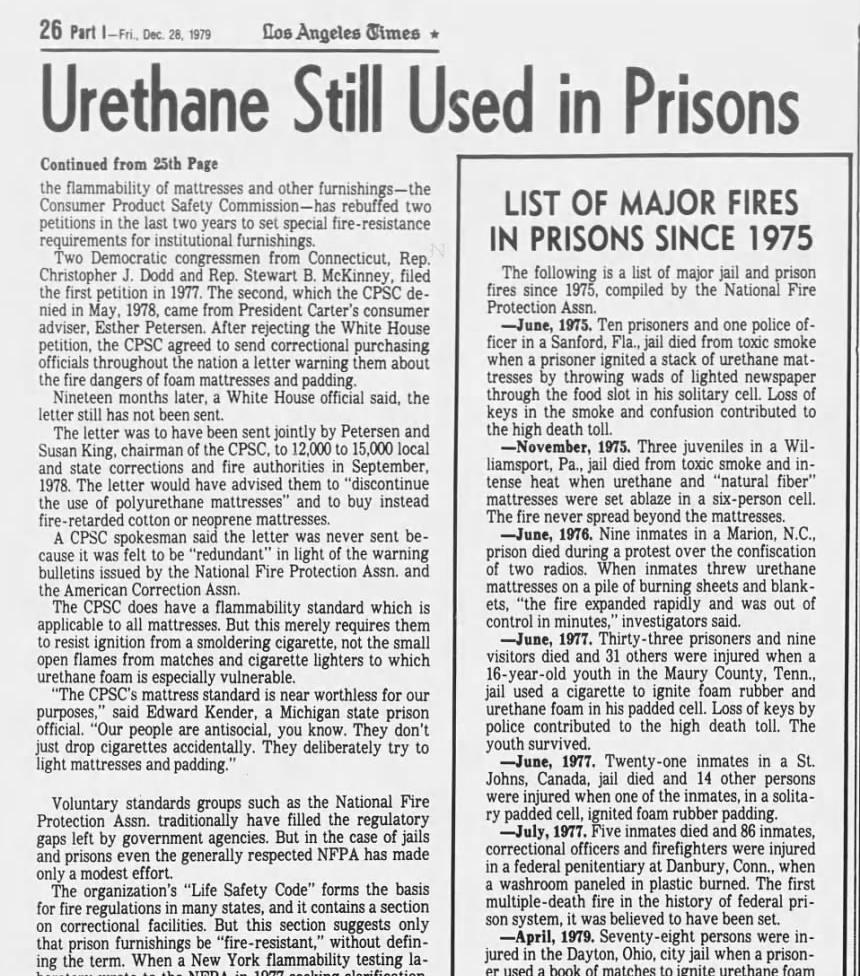
Polyurethane Returns to Cell Mattresses: Have prior deaths taught us nothing?
By Alicia Dixon
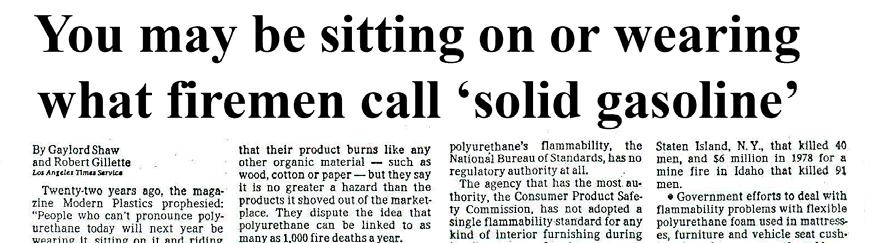
Fire safety experts have long branded polyurethane (urethane) foam as “solid gasoline” — a blunt warning of its extreme flammability. Previously purged from correctional facilities for
this very reason, the material is now reappearing in cell mattresses across North America. This alarming comeback of polyurethane is reckless, exposing inmates, staff and entire facilities to serious and unnecessary risk.
When exposed to minor open flame ignition sources (such as a match or lighter), polyurethane cushioning easily combusts, burns profusely, melts, drips and can rapidly ignite surrounding materials. Its danger is amplified as large volumes of dense,
“In most instances, facilities are completely unaware of the serious liability they incur with mattresses which can burn profusely.” – Justin Head, Director of Sales, Chestnut Ridge Foam
A TIMELINE OF TRAGEDIES
10 inmates and one
JUNE 1975
black smoke and highly toxic gas quickly overtake any area of confinement.
The fire hazards of polyurethane have been recognized and documented for decades. Tragically, its use in correctional mattresses has fueled numerous deadly fires in the United States, Canada, South America and abroad. During the 1970s, a series of catastrophic jail and prison fires — linked to polyurethane — drew national attention. Investigative journalists Gaylord Shaw and Robert Gillette of the Los Angeles Times exposed these dangers, pressing institutions to be held accountable for the safety of both inmates and staff. The following are a glimpse into several of the tragedies due to polyurethane inside incarceration facilities.
A Timeline of Tragedies
June 1975 – Ten inmates and one police officer in a Sanford, Fla., jail died from toxic smoke when a prisoner ignited a stack of urethane mattresses by throwing wads of lighted newspaper through the food slot in his solitary cell.
November 1975 – Three juveniles in a Williamsport, Pa., jail died from toxic smoke and intense heat when urethane and “natural fiber” mattresses were set ablaze in a six-person cell. The fire did not spread from the mattresses before it was extinguished.
June 1976 – Nine inmates in a Marion, N.C., prison died during a protest over the confiscation of two radios. When inmates threw urethane mattresses on a pile of burning sheets and blankets, the fire expanded rapidly and was “out of control” in minutes.
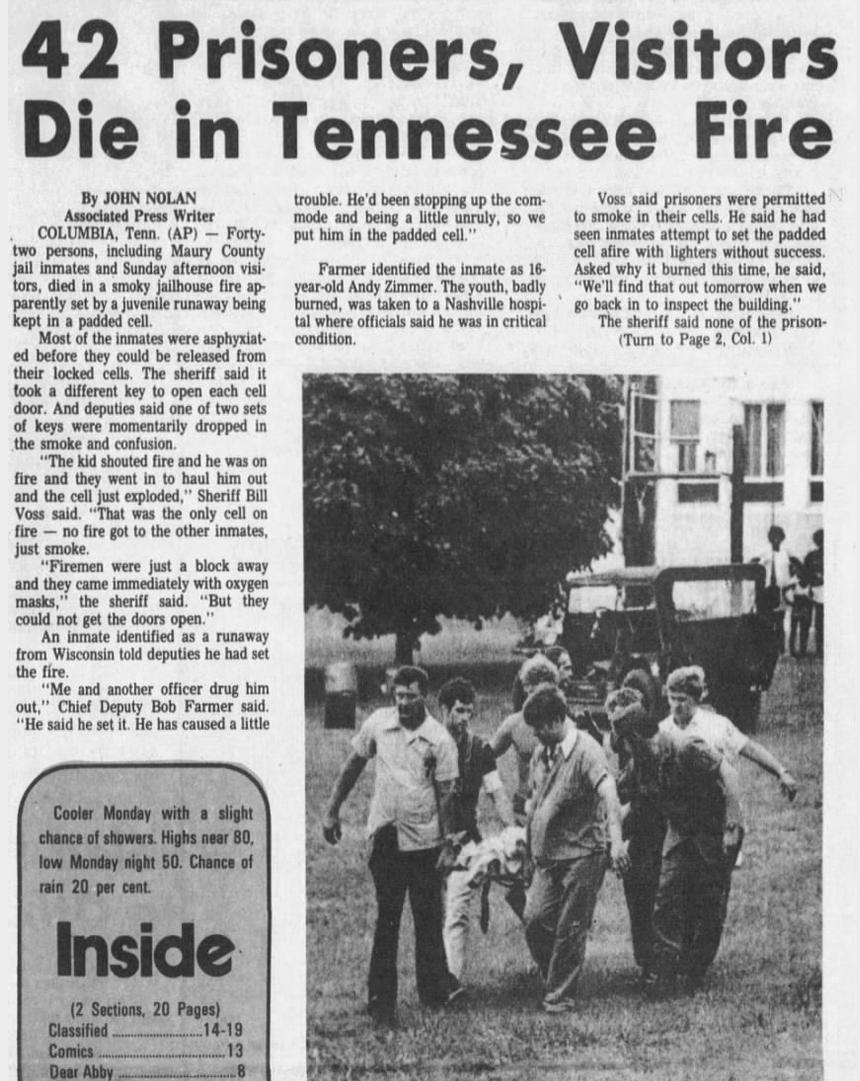
June 1977 – Thirty-three inmates and nine visitors died and 31 others were injured when a 16-yearold youth in the Maury County, Tenn., jail used a cigarette to ignite urethane foam in his padded cell.
June 1977 – Twenty-one inmates in a St. John’s, Canada, jail died and 14 other people were injured when one of the inmates in a solitary padded cell ignited the foam.
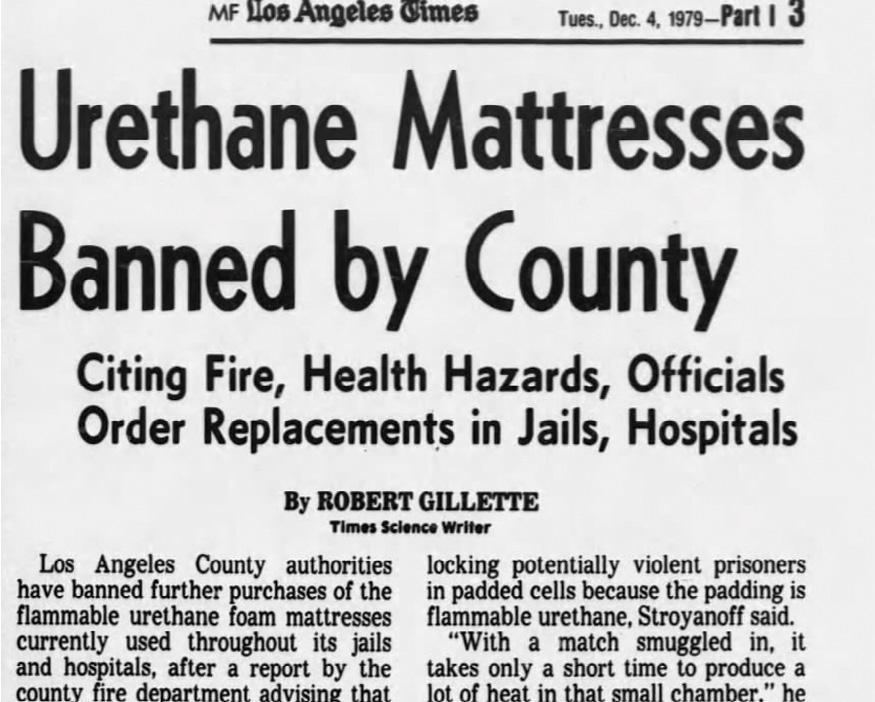
As evidence and countless stories of jail and prison fires were brought to light, the Federal Bureau of Prisons prohibited polyurethane in its facilities in 1979. Los Angeles County authorities banned “flammable urethane foam” after a report by the county fire department advising that urethane can be an “extreme fire and health hazard.”
As comprehension of the risk began to spread,
NOVEMBER 1975
Three juveniles in a Williamsport, Pa., jail died from toxic smoke and intense heat when urethane and “natural fiber” mattresses were set ablaze in a six-person cell. The fire did not spread from the mattresses before it was extinguished.
Nineoverinmates the urethane mattresses the fire expanded
During the 1970s, a series of catastrophic jail and prison fires — linked to polyurethane — drew national attention.
Photo Credit (collage): www.newspapers.com
police officer in a Sanford, Fla., jail died from toxic smoke when a prisoner ignited a stack of urethane mattresses by throwing wads of lighted newspaper through the food slot in his solitary cell.
correctional personnel sensibly began to eliminate polyurethane from their facilities; however, some were not swift enough.
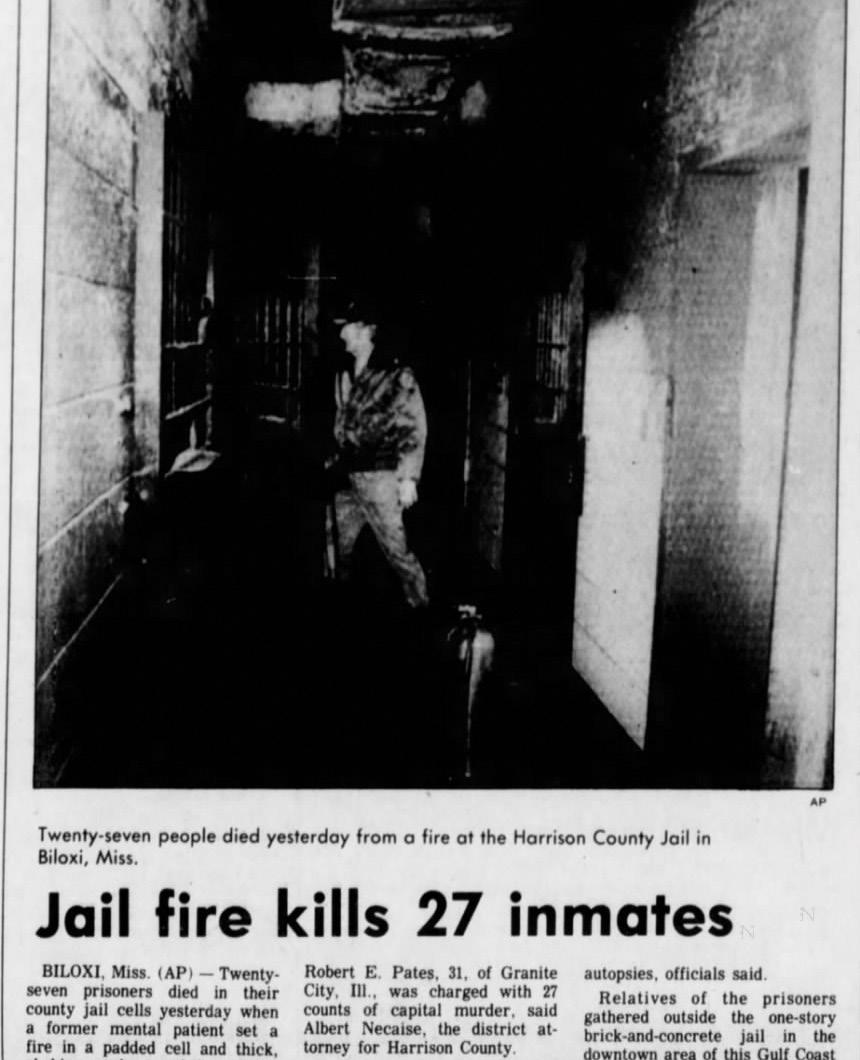
In 1982, a jail fire in Biloxi, Miss., left 27 inmates dead and 52 others injured (11 critically). The fire sent deadly clouds of polyurethane smoke billowing.
“It was just full of smoke,” Jail Warden Jim Wren told a local news outlet. “[The rescuers] were working as fast as they possibly could.”
It was also reported that Fire Chief Guy Roberts and Coroner Ed Little said the deceased were inmates who inhaled the blinding clouds of smoke as it was spread through the cells via the air conditioning system.
Removal and Return
In the years that followed, correctional facilities — either by their own discretion or under the direction of governing agencies — gradually phased out polyurethane.
However, in recent years, awareness of the risks associated with polyurethane in correctional facilities has waned, largely due to staff turnover, retirements and the influx of employees who were not present during the periods of tragedy, intense scrutiny and widespread warnings.
Compliance
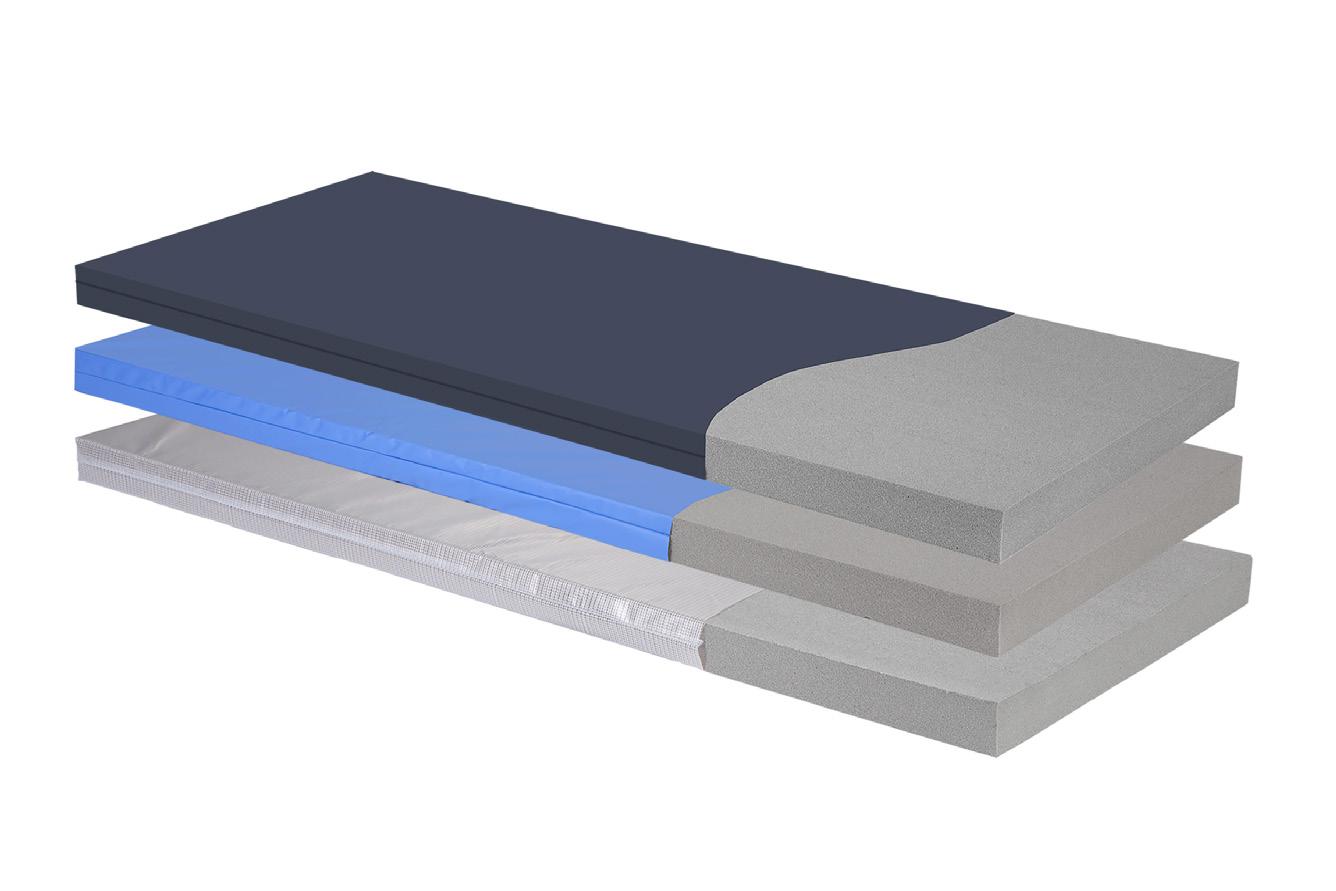
The primary mattresses for correctional facilities have traditionally included Neoprene compound foam cushioning or fiber-based options (synthetic polyester fiber, boric acid-treated cotton and cotton-fiber blends). Now, alarmingly, polyurethane foam has reappeared on this list, as it is not only permitted but occasionally specified in new mattress purchases, significantly heightening fire hazards, injury or death within cell walls.
exposing the flammable core and nullifying the intended fire resistance. From a CSPC standpoint, prisons continue to still require the same standards designed for suburban bedrooms. Relying solely on 16 CFR 1633 creates a serious fire hazard and has allowed for dangerous polyurethane mattresses to infiltrate jail and prison cells.
Proper Testing
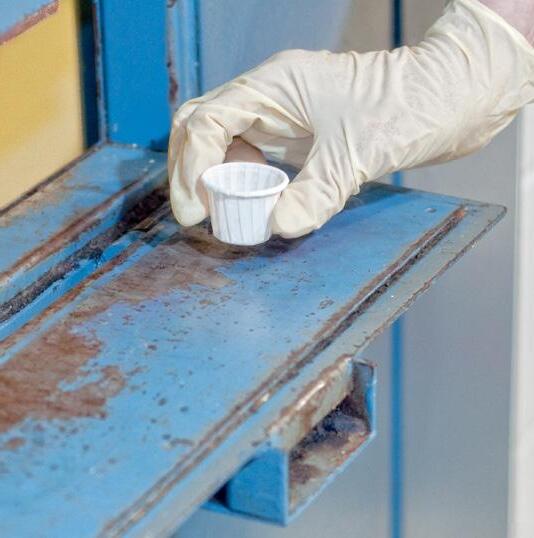
Detention-specific fire-performance testing is essential to properly evaluate the fire resistance of mattresses and their components. ASTM F1870,
An additional complication is the lack of effective sprinkler response within modern prisons. The use of double or even triple bunks within a cell allows for combustibles to grow unimpeded due to the bunk platform being a solid substrate. For intentional arson, it is easy for the inmate to set fires underneath a lower bunk in order to evade the suppression system.
Mattresses that minimally comply with the 16 CFR 1633 standard are likely to fail under detentionspecific fire testing scenarios. Polyurethane foam and synthetic fiber-based mattresses can ignite easily and burn violently, producing thick black smoke and molten material. Cotton and recycled fiber blends tend to smolder for extended periods — both creating serious hazards. These fire-performance failures expose the inadequacy of utilizing minimum residential mattress standards in correctional settings.
Currently, all detention facilities are required to comply, at minimum, with the federal flammability standards for mattresses established by the Consumer Product Safety Commission (CPSC). These standards evaluate the mattress ignition risk from two sources: a smoldering cigarette (16
Selection of Fire Test Methods for the Assessment of Upholstered Furnishings in Detention and Correctional Facilities, provides a standardized guide for fire performance testing, offering multiple and realistic test procedures to govern confinement mattress specifications. Component testing of the mattress interior materials is particularly critical due to the frequent vandalism of mattress covers. One key procedure, the “Roll Test” (Sections 10.2–10.2.10), simulates a realistic fire scenario: a rolled mattress or mattress insert forms a “chimney,” into
In contrast, fire-resistant foam mattresses made from polychloroprene (Neoprene), easily withstand the ASTM F1870 “Roll Test.” They do not melt, drip or sustain flames and self-extinguish once the initial fuel source is consumed or removed.
“In most instances, facilities are completely unaware of the serious liability they incur with mattresses which can burn profusely,” explained Justin Head, director of sales for Chestnut Ridge Foam, a 40-year fireresistant foam manufacturer. “We often use the ASTM F1870 Roll Test as an educational tool to depict the dangers of sole reliance to 16 CFR 1633 or mattress requisition documents with a lack of performance criteria, resulting in receiving a mattress adhering to inadequate fire safety requirements.”
Responsibility
Within the cell, the mattress is often the greatest and most dangerous fuel source — and when manufactured with polyurethane cushioning, its extreme flammability turns it into a life-threatening hazard. Correctional facility administrators bear direct responsibility for selecting mattresses that
In recent years, awareness of the risks associated with polyurethane in correctional facilities has waned, largely due to staff turnover, retirements and the influx of employees who were not present during the periods of tragedy, intense scrutiny and widespread warnings.
CFR 1632) and an open flame (16 CFR 1633). The primary objective of these two tests from CPSC was to reduce deaths and injuries caused by mattress fires in residential settings. However, these tests fail to address the risks in correctional settings, where vandalism and arson are common practice.
To comply with 16 CFR 1633, polyurethane mattresses use a fire-protective fabric barrier over this highly flammable cushioning. While this lightweight barrier may be acceptable in residential settings, vandalism easily compromises any of these barriers,
which eight double sheets of crumpled newspaper are inserted and ignited from the top, directly assessing the mattress’s real-world fire risk.
The NFPA® Life Safety Code (NFPA 101) and the International Fire Code (IFC) establish critical safety requirements for confinement mattresses. Both recognize ASTM F1870 and its “Roll Test” as suitable methods for evaluating fire performance in correctional facilities. NFPA 101 specifically warns that mattresses must account for environmental fire hazards as well as the probable likelihood of vandalism, highlighting this unique risk.
meet proper fire-performance standards and provide safety. Only detention-specific mattress testing, such as these within ASTM F1870, paired with rigorous fire-performance criteria, can provide real protection. Anything less will once again leave facilities exposed to the disastrous fires, massive liability and the irrefutable risk of inmate injury or death.
21 inmates in a St. John’s, Canada, jail died and 14 other people were injured when one of the inmates in a solitary padded celltheignited foam. JUNE 1976
33 inmates and nine visitors died and 31 others were injured when a 16-year-old youth in the Maury County, Tenn., jail used a cigarette to ignite urethane foam in his padded cell.
Alicia Dixon is the Director of Marketing for Chestnut Ridge Foam. This article was sponsored by Chestnut Ridge Foam. For further information, visit www.chestnutridgefoam.com.
CR SAFGUARD foam mattresses provide unrivaled fire performance within incarceration environments. | Photo Credit: Chestnut Ridge Foam
inmates in a Marion, N.C., prison died during a protest the confiscation of two radios. When inmates threw mattresses on a pile of burning sheets and blankets, expanded rapidly and was “out of control” in minutes.
A New Era of Justice in an Existing Footprint
Pierce County, Wash., repurposes existing space to expand and modernize court operations
By Charlie Lange
When justice populations expand and operations broaden, many communities must decide whether to either renovate existing buildings or invest in replacements — often balancing nuanced decisionmaking against tight timelines and limited resources. In urban municipalities, space constraints and the
need to blend facilities into the surrounding built environment bring additional obstacles.
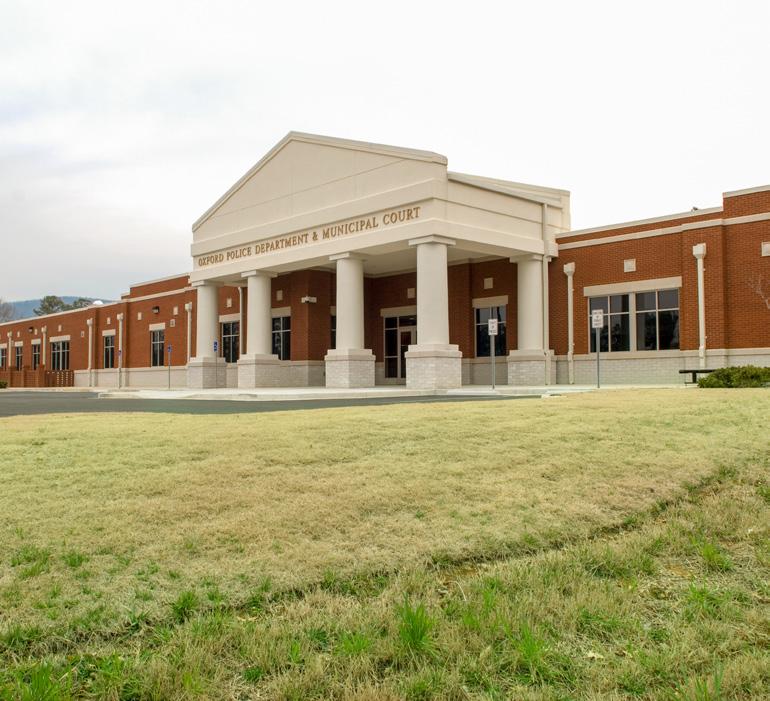
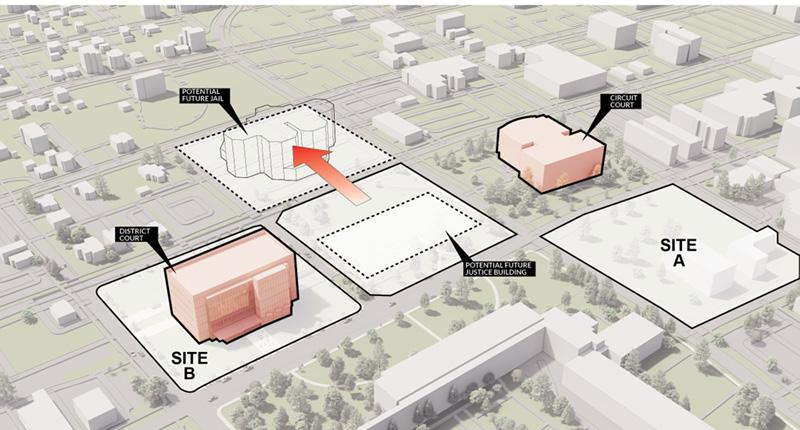
In Pierce County, Wash., a team from KMB Architects was tasked with reimagining existing spaces for the county’s court functions in downtown Tacoma and crafted a plan for upgrades to the county’s cramped, inefficient justice campus layout. Additionally, the project included the acquisition
and creative reuse of a former health insurance office building to help expand and modernize operations.
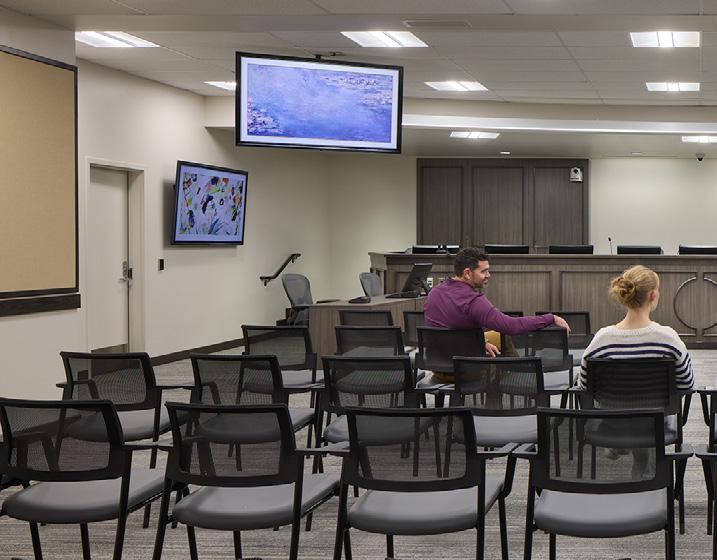
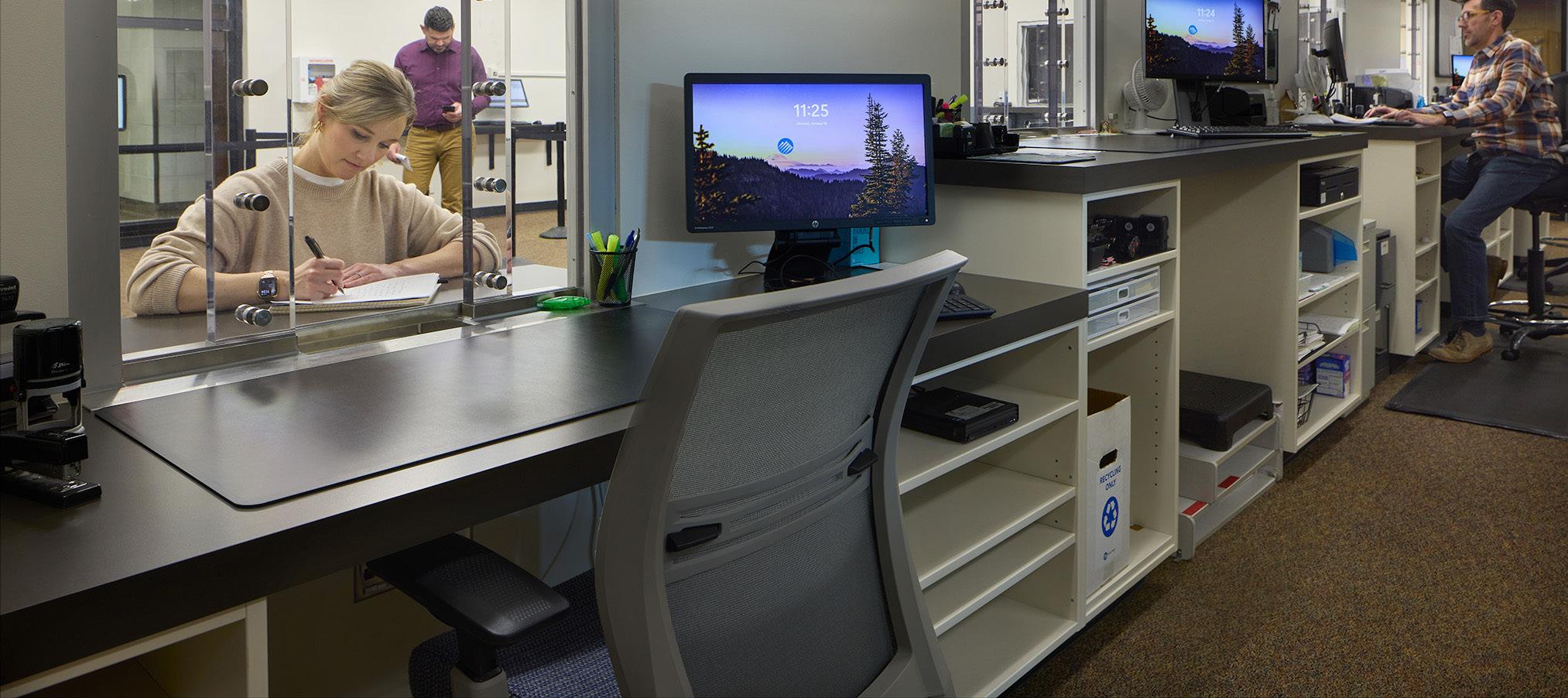
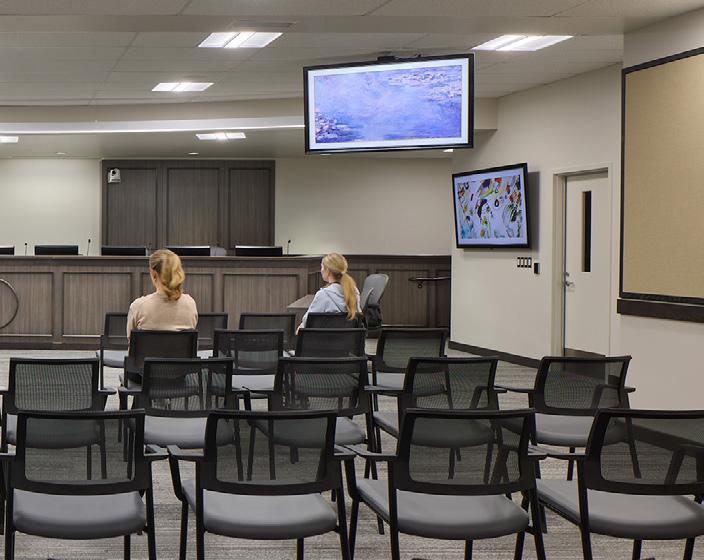
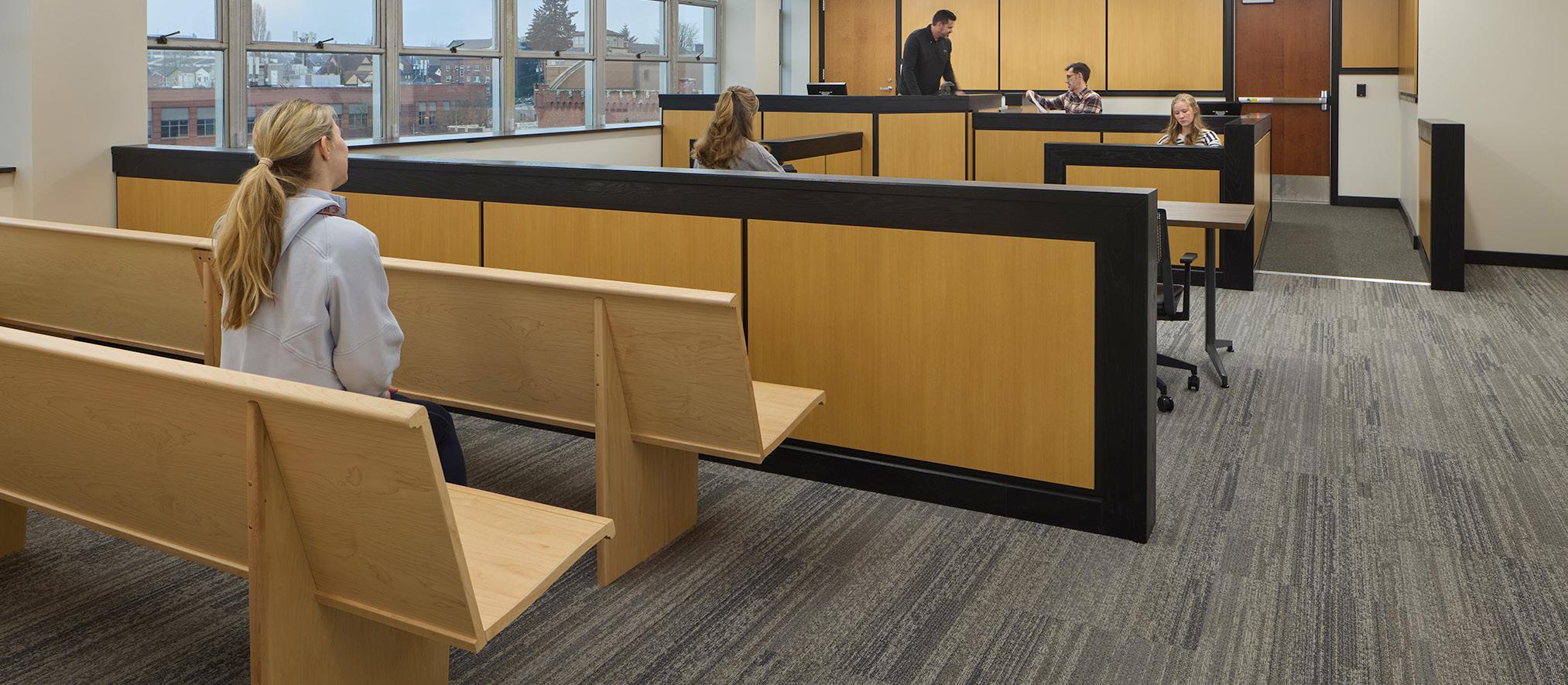
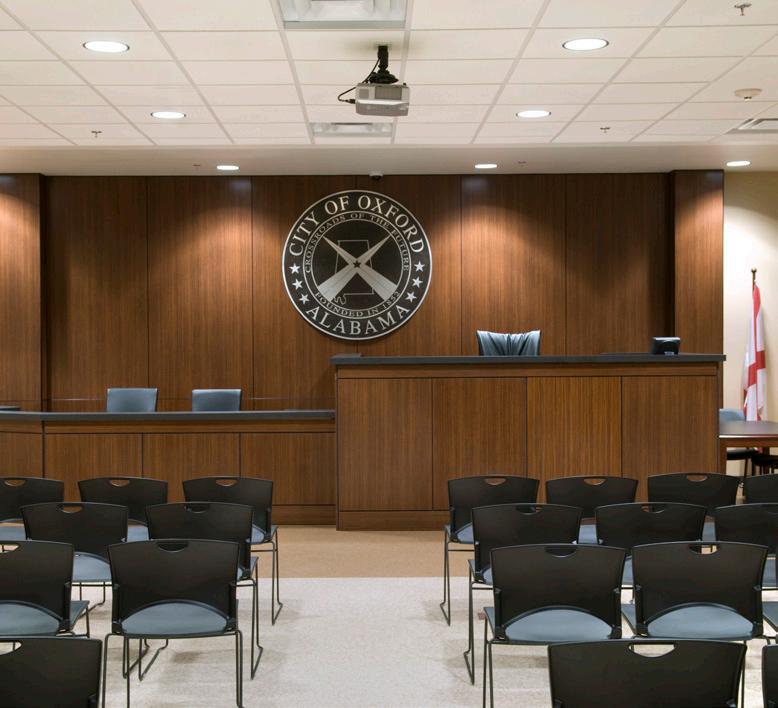
The ensuing Pierce County Justice Center, which partially opened in February, now offers five new District and Superior Court courtrooms, along with improved public access and streamlined judicial, legislative, executive and administrative services.
A Piece of the Justice Puzzle
Wexford Health has been implementing, staffing, and managing successful correctional health care programs for more than three decades. Our clients trust us to maintain quality of care, generate positive patient outcomes, minimize lawsuits, avoid negative publicity, and stay within budget.
To learn why Wexford Health should be your correctional health care team, scan the QR code.
SECURITY YOU CAN TRUST. SYSTEMS YOU CAN SCALE.
Bill Valdez, PE, LEED Green Associate, DBIA, a Partner with KMB who oversaw the design team, said the project was the culmination of multiple master plans and needs studies that the firm conducted for the county.
In those studies, KMB assessed the county’s overarching justice operations — focusing on corrections, juvenile justice and courts — as well as its administrative functions, from the county executive and county council to the finance department, communications department and sheriff’s office.
Those studies identified a need for greater capacity within each department and an opportunity to consolidate municipal and judicial services.
Valdez explained, “The overall
[takeaway] was that everybody needs growth, but how can we accommodate it?”
Ultimately, the county acquired an existing 149,330-squarefoot office building at 1501 Market Street, and Valdez led efforts to renovate the facility to serve as Pierce County’s administrative headquarters. Work was completed by Lincoln Construction.
Finding Efficiencies, Fit for Each Function
The district and superior courts, prosecuting attorney’s office and county council presented the most pressing needs for expanded space.
“Those are some of the largest departments in the state of Washington, and they were previously crammed into one and
The district and superior courts, prosecuting attorney’s office and county council all required expanded Photo Credit (all): Courtesy of KMB Architects
one-third floors,” said Valdez. “By relocating some departments, we were able to build out the rest of the floor.”
The Pierce County Facilities Department assisted with the prioritization of spaces. KMB’s successful 2019 renovation of the county’s district court facility, which added three new courtrooms, offered what Valdez called “a new baseline” for efficiencies that guided the most recent renovations.
the way through.”
With the county council chambers being public spaces where many proceedings are televised, the client desired a symmetric and elevated design. The chambers now feature curved light fixtures and soffits that match the curve of the elevated
and ADA-accessible dais. In the lobby and waiting spaces, illuminated signage, monitors and graphics were added to assist with wayfinding.
“We wanted to have a design aesthetic that really See Courthouse Design, page 33→
“By walking around and kicking the tires on all the different types of courtrooms that the county had on campus already, we settled on how we want the space to function,” Valdez said. “That allowed us to dig into some of the other spaces that had more office-based functions and come up with creative solutions.”
While there were no specific LEED-related goals on the project, the team incorporated sustainable or recyclable materials as part of what Terrence Bills, RA, a Senior Project Manager with KMB, calls a “responsible design” process, as well as meeting evolving Washington
State energy code requirements. Installing new LED lighting throughout the 1501 Market facility was one major component of this effort.
Unifying Interior Design
Working across multiple sites, where some building components were more than 50 years old while others had been renovated in the past decade, the KMB team sought to unite all interior renovations to establish a consistent look throughout the justice campus and 1501 Market building.
“We were able to borrow from the existing campus and some of the previously renovated spaces,” said Valdez. “It wasn’t like trying to create a new design vocabulary — it was trying to make sure that design vocabulary was applied all
Security & Fire-Rated Glazing for Correctional Facilities
Tested to Nationally Recognized Forced Entry & Fire-Rated Standards
Available Options Include:
• Custom Interlayers for One-way Vision/Sight Separation
• Ballistic and IGU
• No access to plastic can liner. Limited access to disposed items
• Purpose built: Lockable. Tamper and ligature resistant. Feature filled
• Range of color options
• Proudly made in the USA
attorney’s expanded spaces.
‘We Never Walk Alone’
How OK Alone
By Scott Witte
ensured
Florida Department of Corrections parole officers stay safe and supported in the field
For probation and parole agencies, officer safety in the field remains a persistent operational concern — particularly in geographically large states like Florida, where supervision environments range from dense urban areas to remote rural communities. In response, the Florida Department of Corrections (FDC) has implemented a statewide lone-worker safety platform, OK Alone, to address long-standing visibility and response gaps associated with officers working independently.
Today, approximately 2,100 officers across Florida actively use the system as part of routine field operations. The implementation provides a structured approach to check-ins, real-time status visibility and escalation protocols — functions that were previously inconsistent or manual.
“The Florida Department of Corrections (FDC) recognizes the dangers our officers face each day, and our agency is committed to fundamentally strengthening their safety by ensuring no member of our team is ever truly alone in the field,” said FDC Assistant Deputy Secretary of Community Corrections Joe Winkler. “By leveraging innovation and accountability, FDC is reaffirming its commitment to protect those who serve our communities every day.”
Operational Context and Catalyst
FDC leaders have long recognized the inherent risks of community-based supervision.
“The challenges facing probation officers continue, working alone in dangerous areas and interacting with potentially dangerous individuals, as that is the nature of the business,” said now-retired FDC Consultant Randy Agerton. “However, the challenges of not knowing where staff were during a dangerous situation has been a challenge dating back decades.”
While working alone in dangerous areas and interacting with potentially dangerous individuals is the nature of the business, the May 2024 murder of Maryland parole agent Davis Martinez was the catalyst to finding a sustainable solution to employee safety.
The tragedy prompted FDC leaders to conduct a formal review of available technologies. The agency explored and evaluated multiple platforms before selecting the lone worker app and safety monitoring solution OK Alone.
FDC’s Implementation Approach
For the FDC, the OK Alone system functions as a safety tool rather than a performance-monitoring system, a distinction that helped support adoption across field staff.
“We wanted to provide staff with a sense of the agency’s motto, ‘We never walk alone.’” Agerton said. “We wanted them to know even if they were by themselves there was a way they could get help if they needed it and a way for us to determine where to send that help.”
Prior to that widespread adoption, however, FDC first deployed the OK Alone system through a statewide pilot. That allowed the department time for policy calibration and operational alignment, as well as improving backend configuration and establishing governance structures. During this initial phase, leaders also defined alert protocols, reporting structures and supervisory workflows. Simplification of those workflows — particularly within the monitoring portal — was prioritized during rollout.
Field Use and Compliance
In practice, the OK Alone system is embedded into the FDC’s daily operations. Officers are required to initiate a session when conducting fieldwork, including during home visits, offender meetings and travel between sites. This requirement has contributed to improved check-in compliance and more consistent supervisory awareness. While FDC reports that no critical incident has required full system activation, the platform has supported multiple welfare checks.
These routine interventions illustrate the system’s role in early identification of potential issues rather than solely emergency response.
“During the initial rollout and implementation the focus and command intent was this was to be a safety application and that unless there was a serious
incident, that OK Alone, would not be solely used to investigate an employee,” Agerton said. “However, the oversight ability to verify submitted trip itineraries with actual travel has been beneficial.”
Oversight and Data Visibility
One of the more significant operational changes has been the increase in real-time visibility for supervisors. The system provides reporting across organizational levels, enabling both local and regional oversight. FDC notes that this visibility has reduced administrative burden while improving situational awareness. Supervisors can verify officer status, monitor field activity and respond more quickly to missed check-ins or alerts.
Importantly, the agency maintained clear guidance on appropriate use. This policy framework helped reinforce trust and clarify expectations during deployment.
Measurable Outcomes in Florida
Since implementation, FDC has moved from having no standardized loneworker system to a structured, statewide protocol that has resulted in improved compliance, faster supervisory awareness and reduced manual tracking.
The system has also provided new operational insights, with data informing decisions and policing conversations related to staffing models, risk exposure and resource allocation. FDC leadership now has quantifiable evidence of field activity levels that were previously anecdotal.
Additional benefits include improved interdepartmental understanding of community corrections work and increased confidence among leadership.
Cultural and External Impact
Beyond operational metrics, FDC reports broader organizational effects. The system has been incorporated into staff meetings and reinforced through internal communication, helping normalize its use.
Families of officers have also responded positively, particularly regarding assurance that missed check-ins trigger immediate awareness.
Other departments within FDC have gained a clearer understanding of field conditions and associated risks.
The program has drawn interest from other states that are evaluating similar approaches, positioning Florida as a reference point for statewide deployment of lone-worker safety technology in corrections.
Considerations for Other Agencies
FDC’s experience highlights several implementation considerations relevant to other departments of corrections:
· Executive-level support and clearly defined command intent
· Defined protocols for alerts, escalation and response responsibility
· Alignment between training and system go-live
· Flexibility to adapt policies based on operational feedback
These factors, rather than the technology alone, appear central to achieving sustained adoption and measurable outcomes.
Practical Value
The FDC’s deployment of OK Alone demonstrates a structured approach to addressing a long-standing operational risk in community corrections. By integrating routine check-ins, real-time visibility and defined response protocols, the agency has improved both oversight and officer support in the field.
While the system has not yet been tested in a critical incident, its day-today use — particularly in enabling early intervention and improving situational awareness — suggests practical value in reducing uncertainty associated with lone-worker environments. For agencies managing large, distributed field forces, the Florida model provides a current example of how technology, policy and training can be aligned to support officer safety.
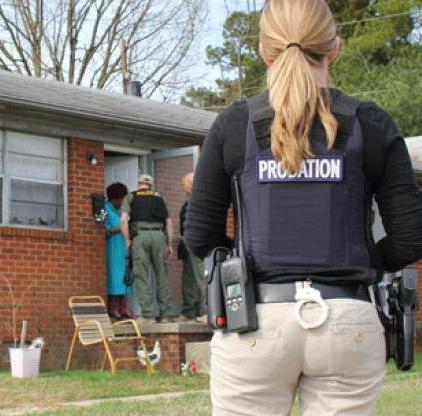
Officers are required to initiate a session when conducting fieldwork, including during home visits, offender meetings and travel between sites.
Approximately 2,100 officers across Florida actively use the system as part of routine field operations.
The OK Alone system is used by the FDC in rural as well as dense urban areas.
Photo Credit (all): Courtesy of OK Alone
for staff wellness, and includes far more than just physical health considerations, such as mental health, spiritual support, social assistance and financial help. Through written policy, procedures and practices, it mandates that all correctional staff have access to ongoing health and wellness education, programs and activities inside and outside of their institutions or agencies.
The expected practice encourages agencies to provide access to education and programs while allowing the agency to tailor programs to meet staff needs, and not just take a one-size-fitsall approach. At a minimum a program should include:
· Education on inherited health risks
· Monitored goals and objectives
· Engagement surveys
· A designated committee that has oversight of activities
· Periodic health screenings
· Incentives to encourage employee participation
· Links to support programs (i.e. employee assistance programs, Critical Incident Response Team)
Additionally, ACA’s Wellness Committee provides education and shares best practices with agencies to help them develop their own programs within their facilities.
Enabling Information-Sharing
Coordination between agencies is key in law enforcement and corrections. As incarcerated individuals cycle in and out of multiple facilities, continuity of information sharing is essential — especially when ties to gangs or terrorism are part of the equation.
In January 2007, ACA Standards Committee approved an expected practice facilitating information-sharing between correctional institutions and local or federal law enforcement agencies, particularly in intelligence gathering. The expected practice required coordination between correctional agencies and the local Joint Terrorism Task Force, or similar agency on terrorism matters. This has had a sizeable impact on public safety.
Identifying Risks, Taking Action
The transportation of inmates is a crucial component of correctional operations. Agencies must balance security, safety and human rights. As such, staff assigned to transport inmates offsite, regardless of the need, must be vigilant and take precautions to ensure safety for all.
This expected practice was the result of numerous requests to enhance the safety and efficiency of transportation operations after a series of incidents. By applying available policy data and information from after-action reports into evidence-based standards, the ACA filled a void in correctional practices and make a huge impact on public safety.
In summary, the ACA’s expected practices play a critical role in shaping detention operations and public safety outcomes, fostering trust and supporting efforts to protect the public. The “Performance-Based Standards and Expected
Practices for Transportation of Inmates” manual addresses how to improve security and safety at a most critical point. Our staff is the most important asset, and the wellness expected practice addresses their mental and physical health needs, improving their performance and reducing critical incidents. Standardizing cross-departmental informationsharing is also essential to public safety efforts.
David Haasenritter is the Director of the ACA’s Standards and Accreditation Department.
million, 200,000-square-foot
Justice for All
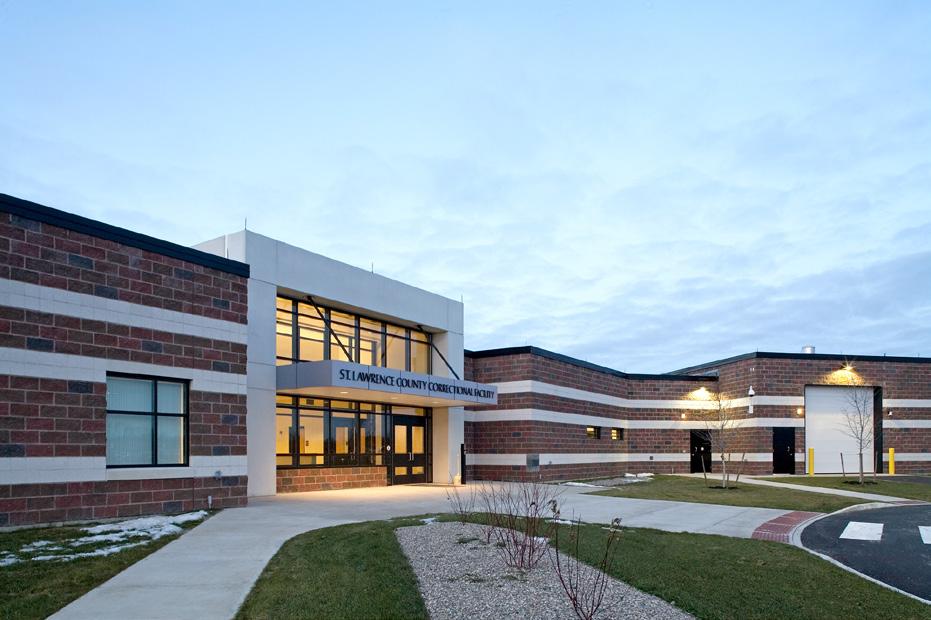
The new 200,000-square-foot Hamblen County, Tenn., Justice Center offers a welcoming environment for the public, with a safer, more intuitive layout for detention staff
By Charlie Lange
When it came time for officials in Hamblen County, Tenn., to replace the county’s 50-year-old, 255-bed detention center, stakeholders knew they had to think outside the box.
A condition assessment of the county’s existing facility, conducted by architecture firm Moseley in 2016, highlighted a host of deficiencies, from overcrowding by more than 200 beds to sightlines that reduced safety and security, and temperature control and ventilation issues that contributed to mold growth. Before the 2016 assessment, those conditions had already contributed to the loss of certification from the Tennessee Correctional Institute (TCI) in 2010 and struggles to retain staff, according to Hamblen County Sheriff Chad Mullins.
Under the direction of designers from Moseley and Knoxville, Tenn.-based contractor Blaine Construction Corp., the county took on one of the largest construction projects in its history — a $105 million effort to build a combined justice campus.
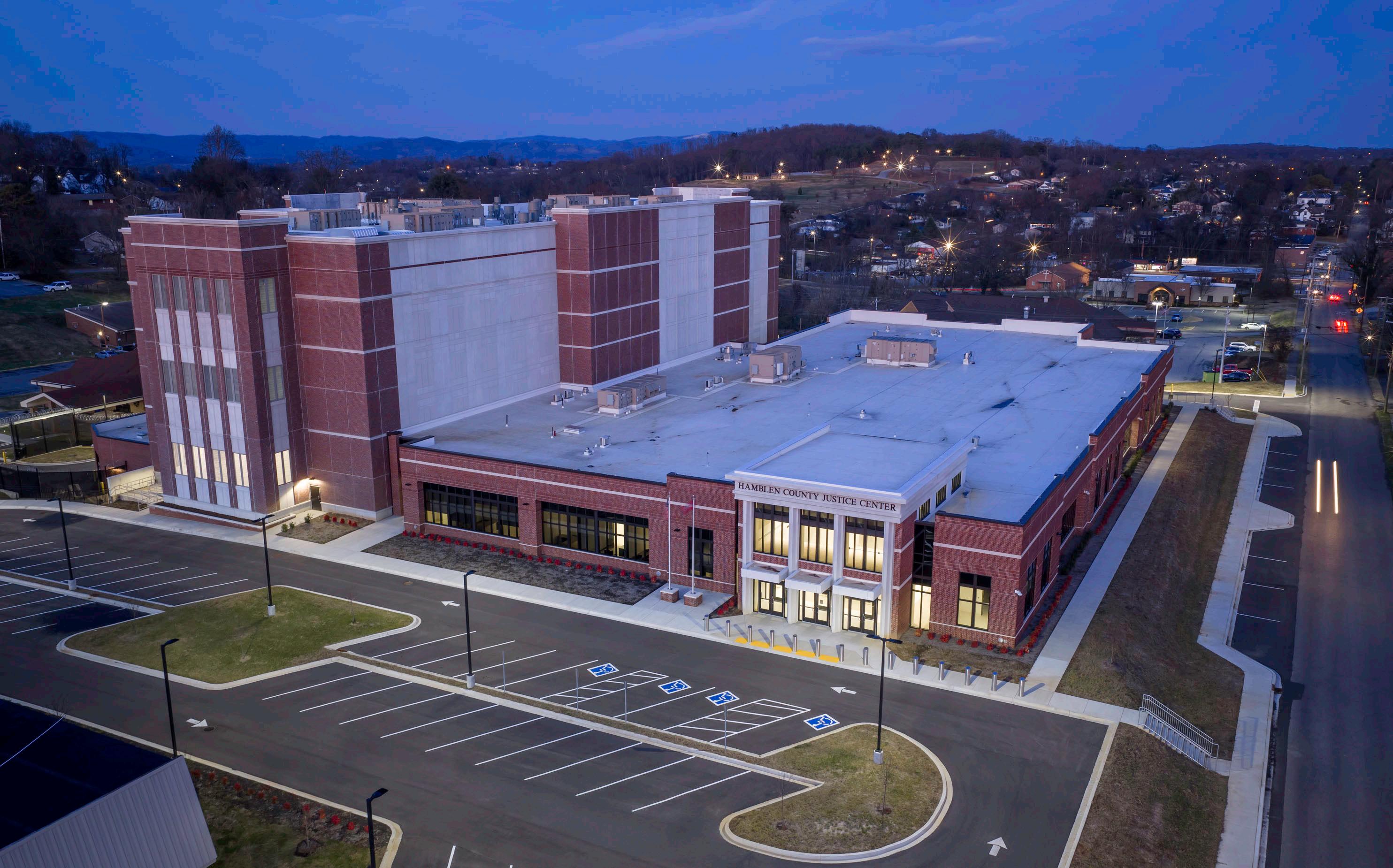
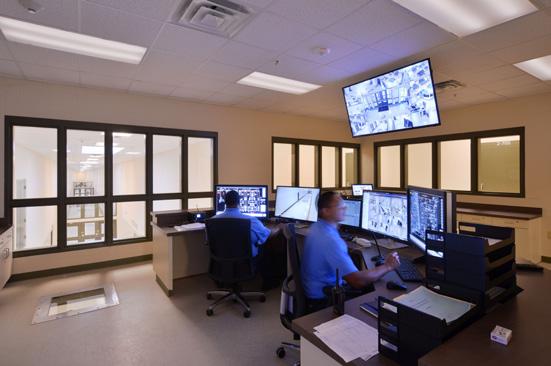
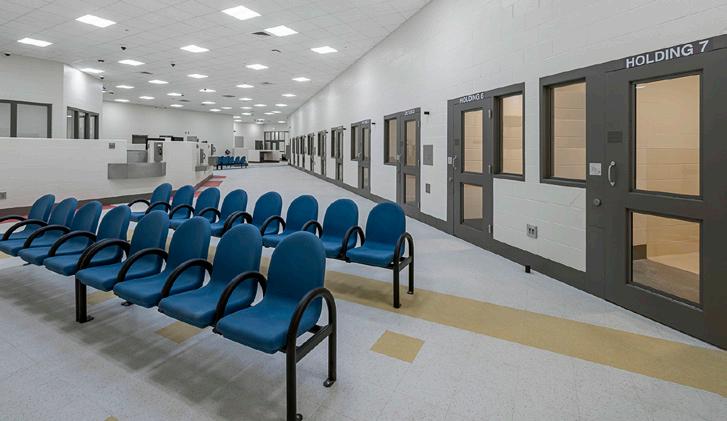
The result is the new 200,000-square-foot, multi-story Hamblen County Justice Center, which opened with a ribbon-cutting ceremony in December 2025, followed by the transfer of inmates from the former facility in March. The new detention center has 621 beds with infrastructure to support a 750bed core capacity, along with expanded spaces for counseling, educational and rehabilitative programming, vocational training and healthcare, as well as staff training areas, indoor and outdoor recreation, and administration.
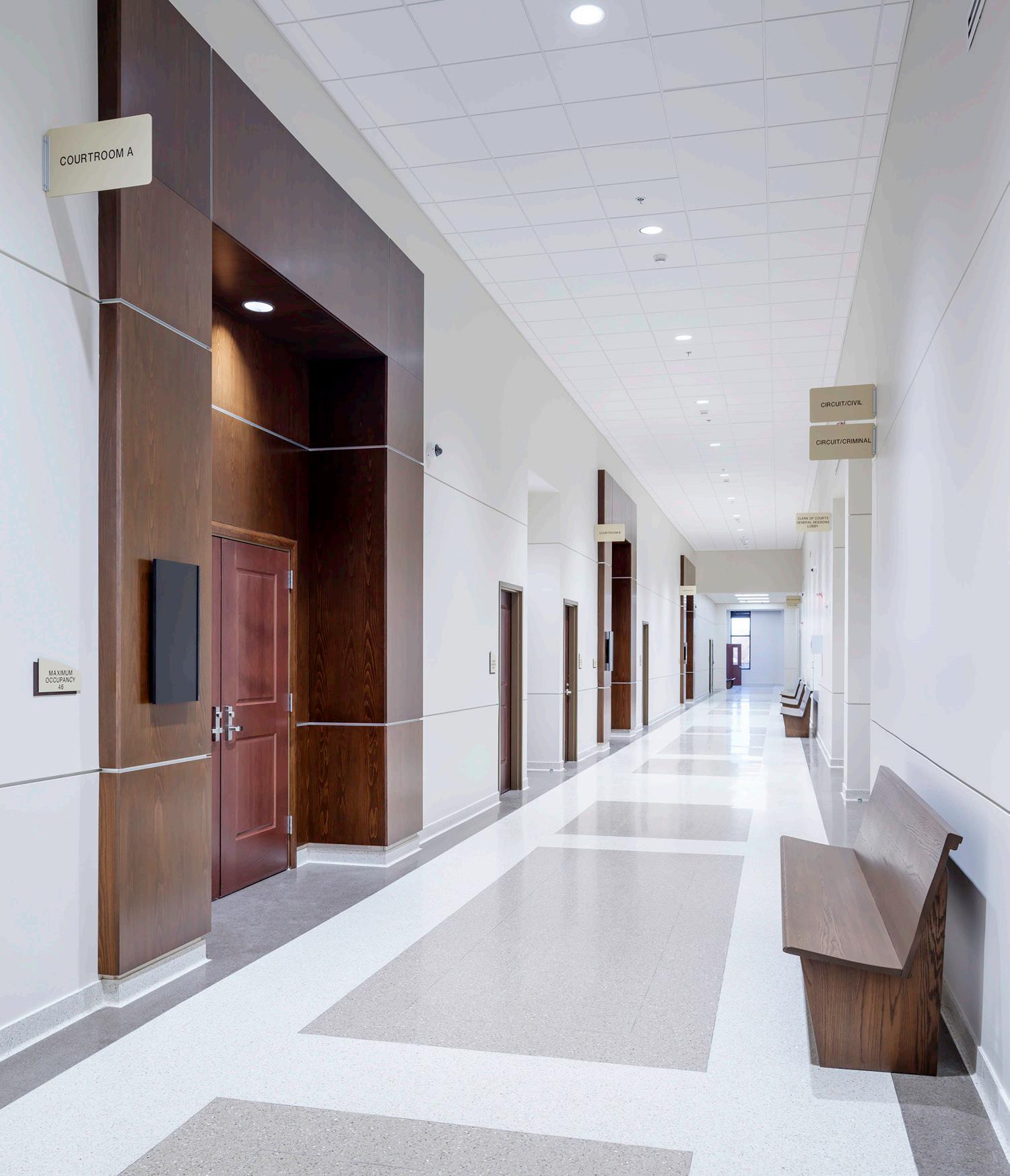
The courthouse component includes two courtrooms for the circuit, sessions and criminal courts, along with a third courtroom for juvenile court hearings, all supported by judicial offices, administrative areas and community services.
New Spaces, Expanded Capabilities
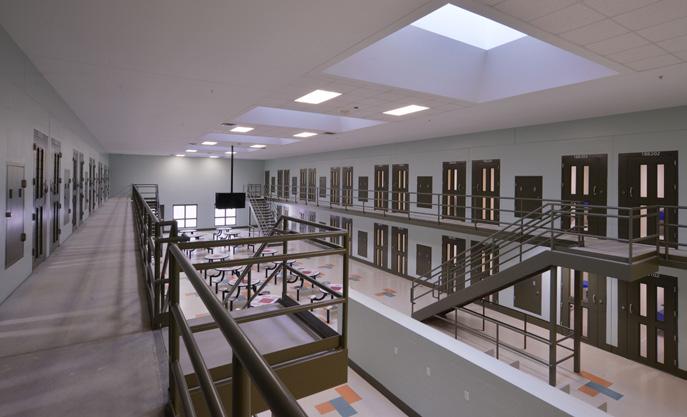
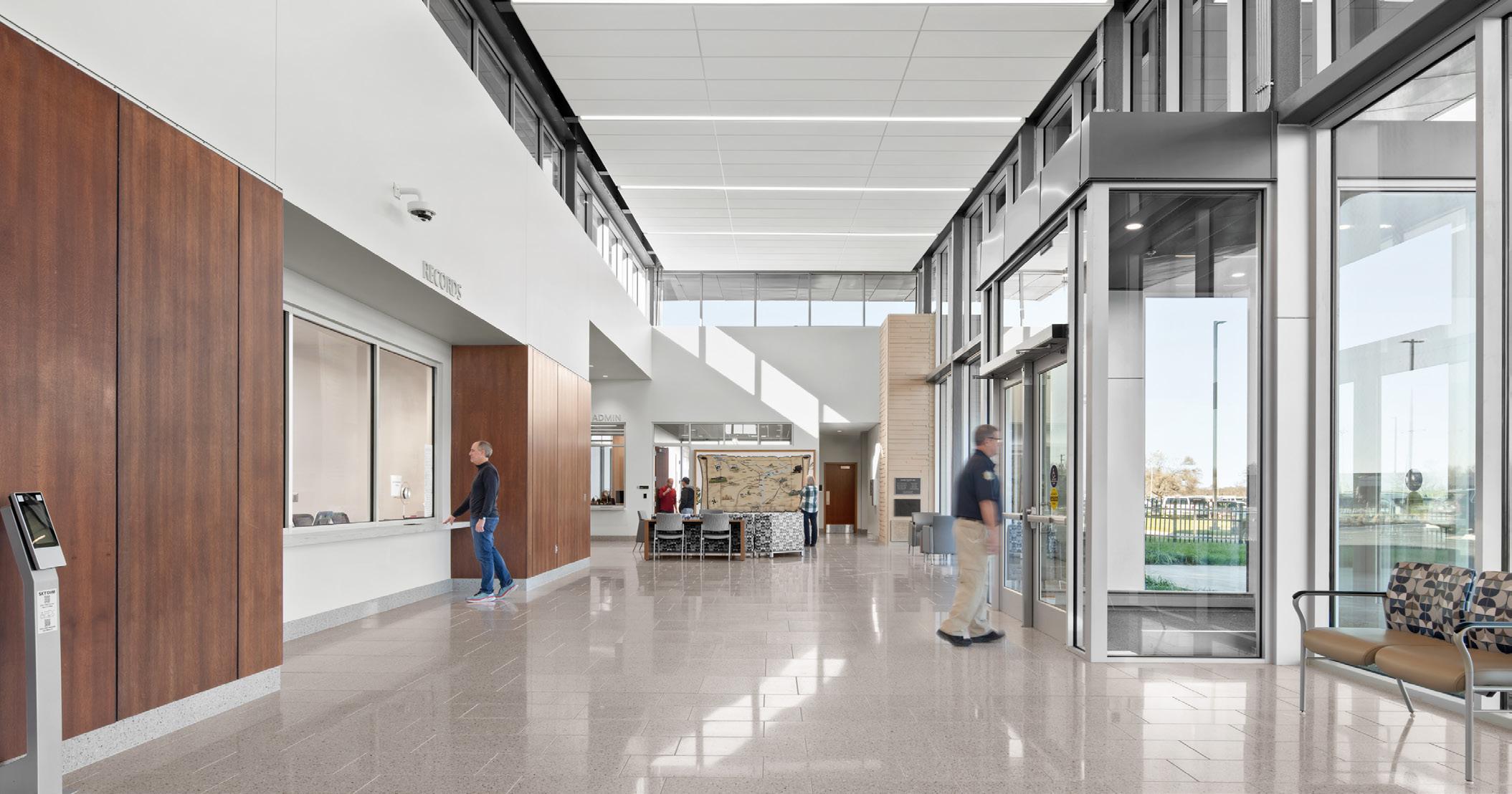
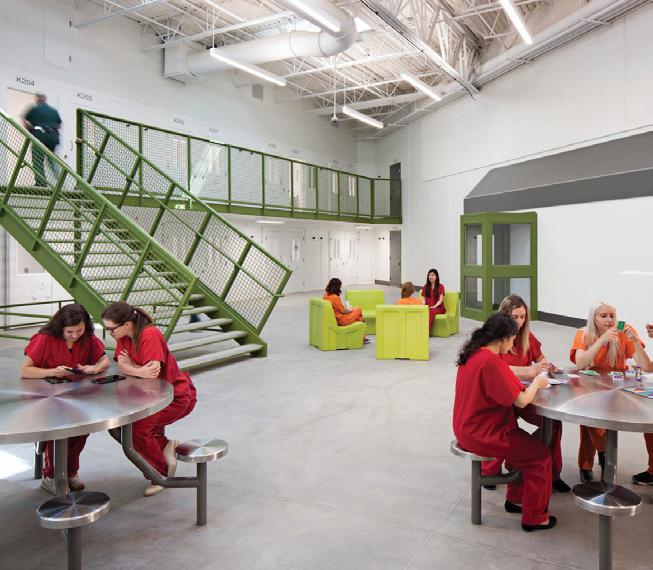
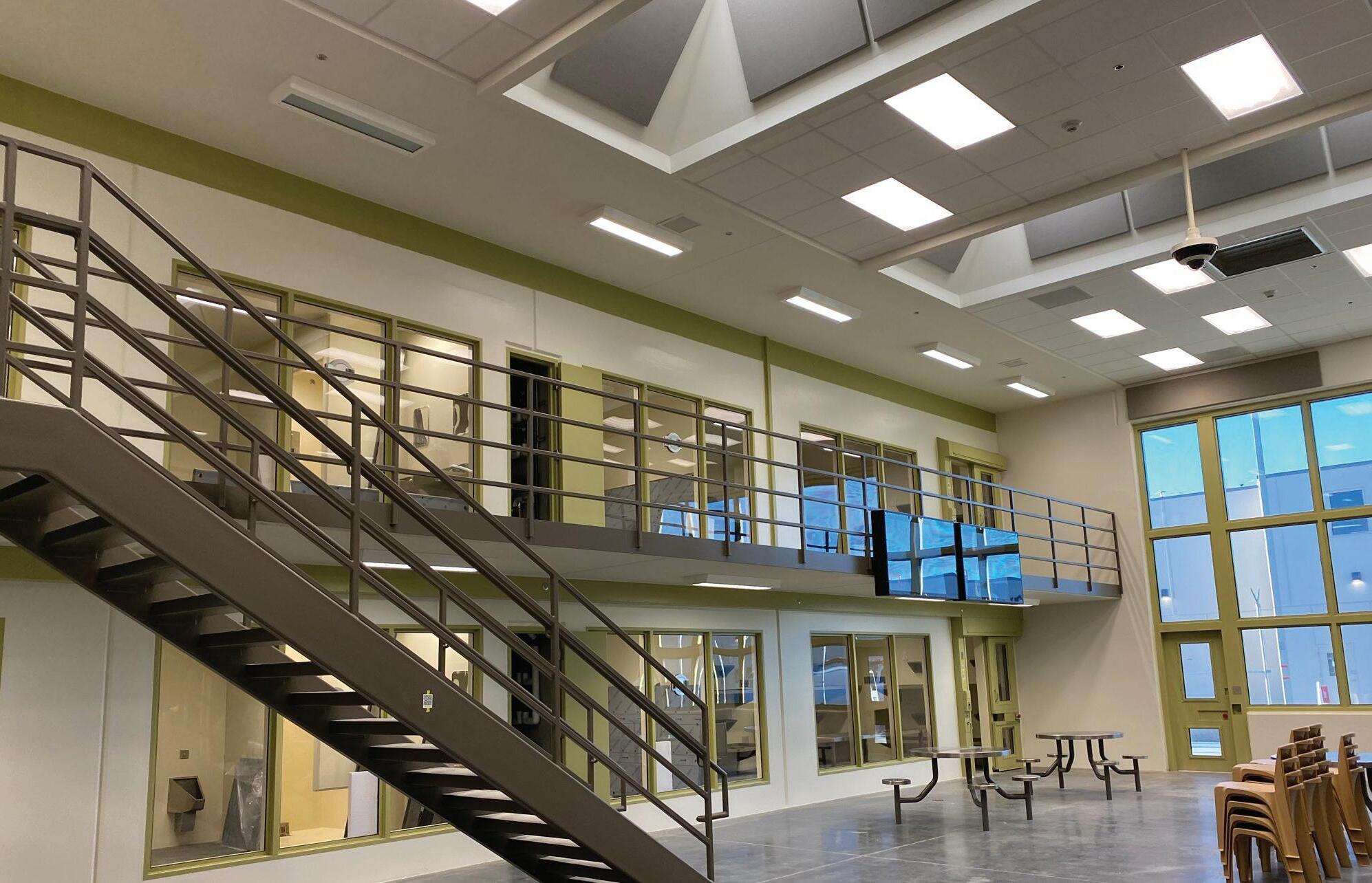
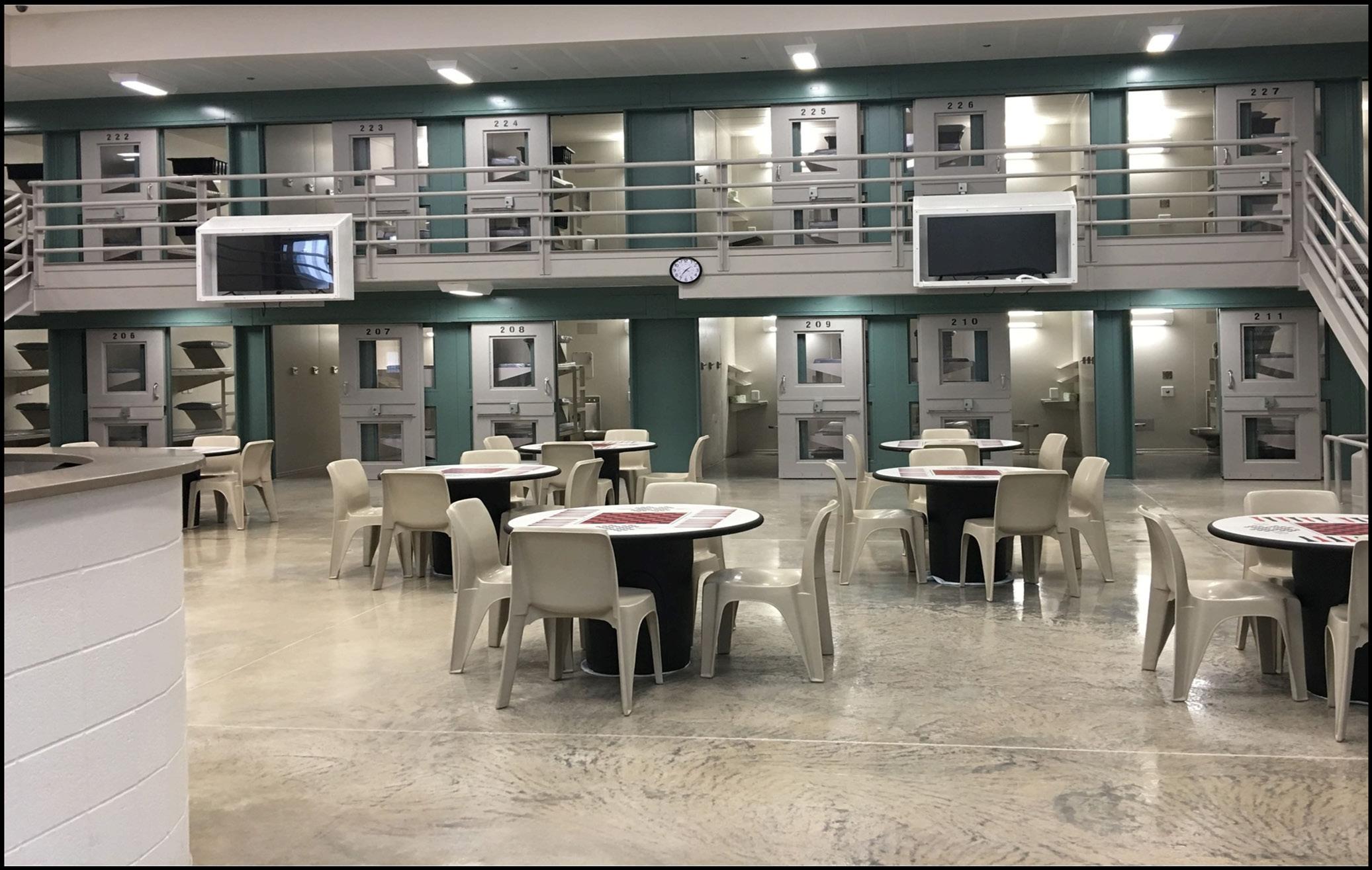
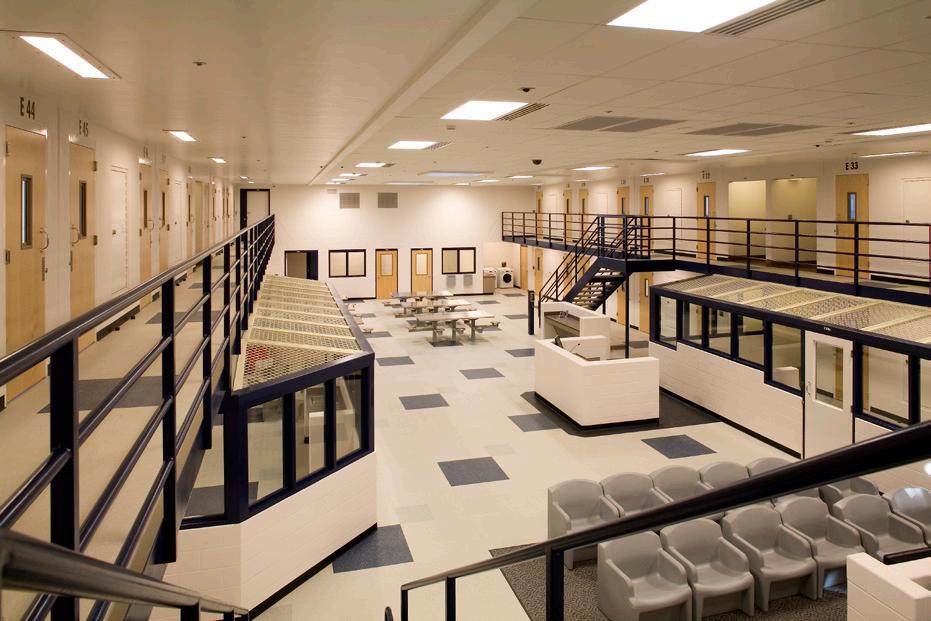
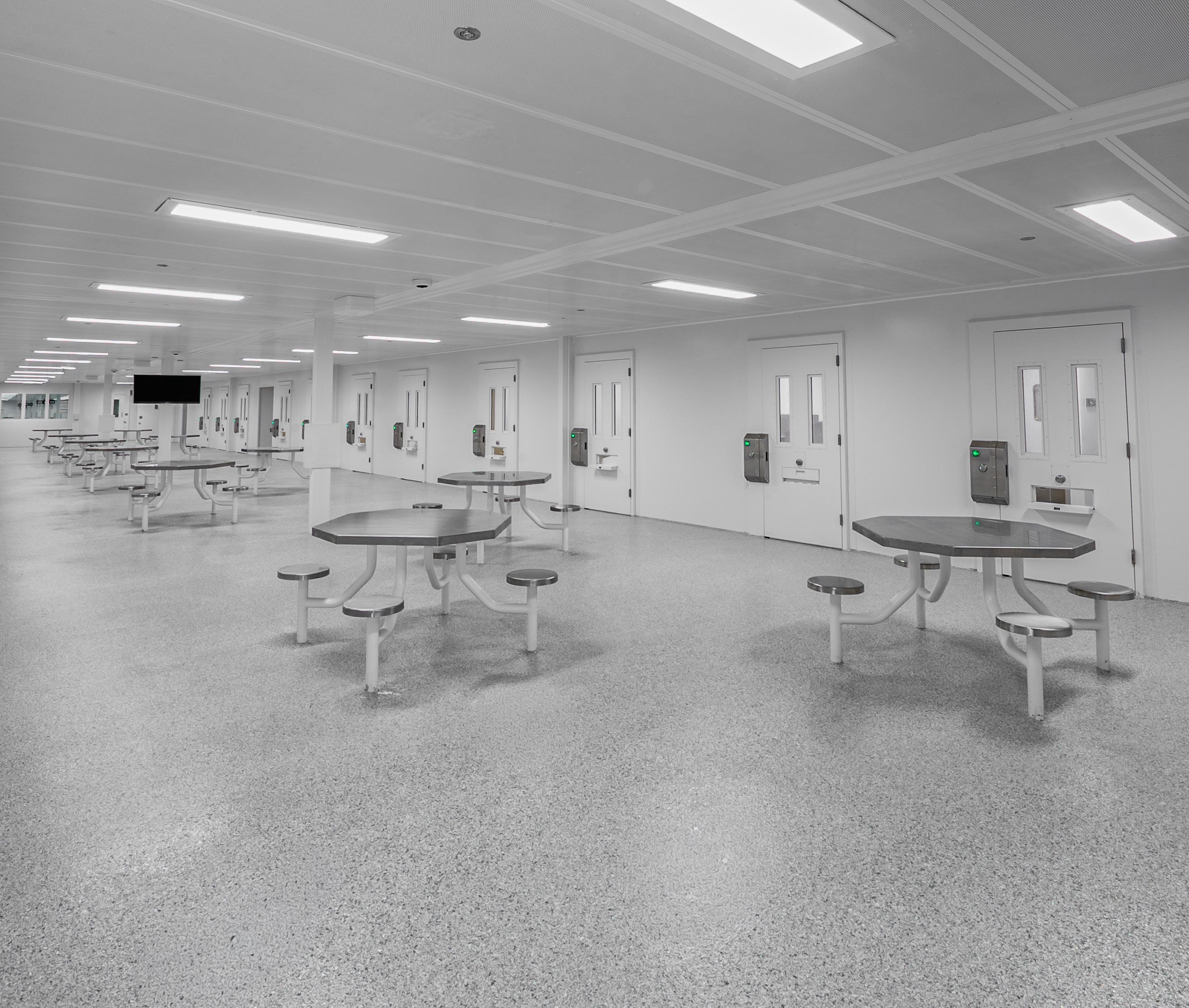
The floorplan of the new detention facility safely separates classification levels across different floors, with virtually identical layouts on each floor and housing unit. This enabled designers to build centralized, flexible programming spaces within each unit — something the former facility lacked.
“We created a central hub for programming spaces on each floor level so that inmates can be moved from housing to that centralized area each day,” said Bryan Payne, a Vice President with Moseley and Project Manager for the Hamblen County project.
Those programming spaces will be able to accommodate a wide array
The new $105
justice center combines corrections and courthouse operations under one roof.
Photo Credit (all): Courtesy of Moseley Courthouse staff provided Moseley designers with input on how to create a better working environment.
of programs, including GED certification and other continuing education, counseling and rehabilitative services, vocational training and religious assembly. The units also feature medical, dental and mental health treatment spaces, easing the transport burdens on staff.
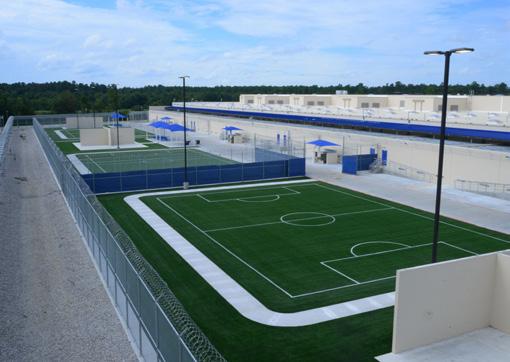
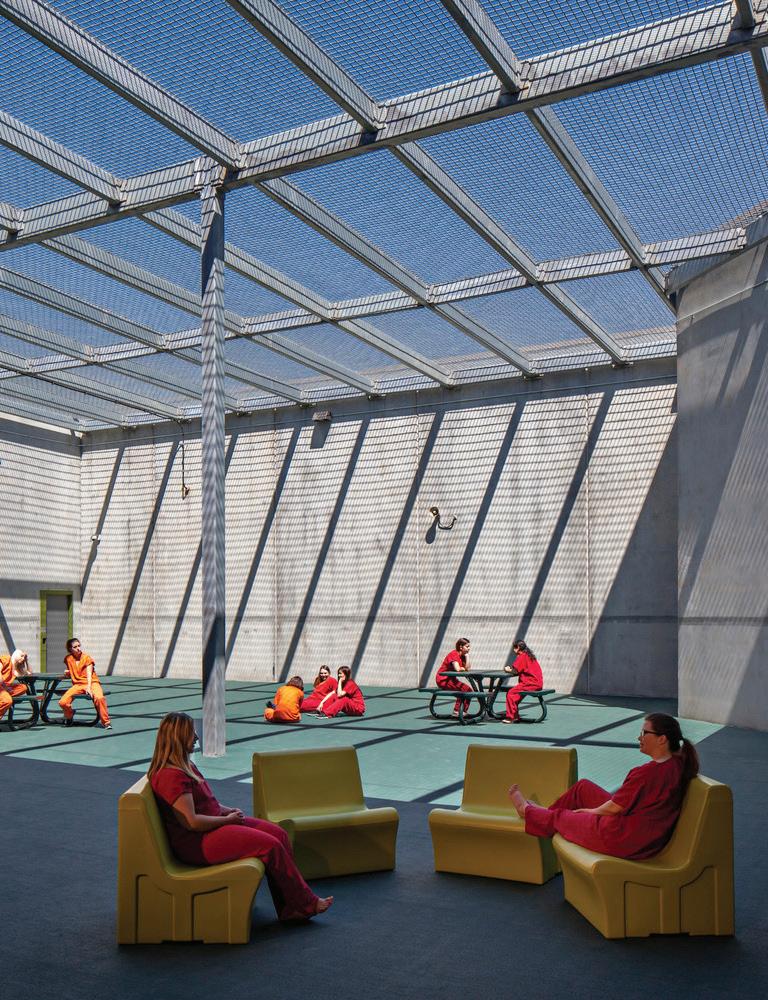
Another key feature of the housing units is the addition of outdoor recreational yards on each floor, which eliminated some of the security concerns and staff pressures that came with moving higher-security inmates to a central
FACILITY
their cells.
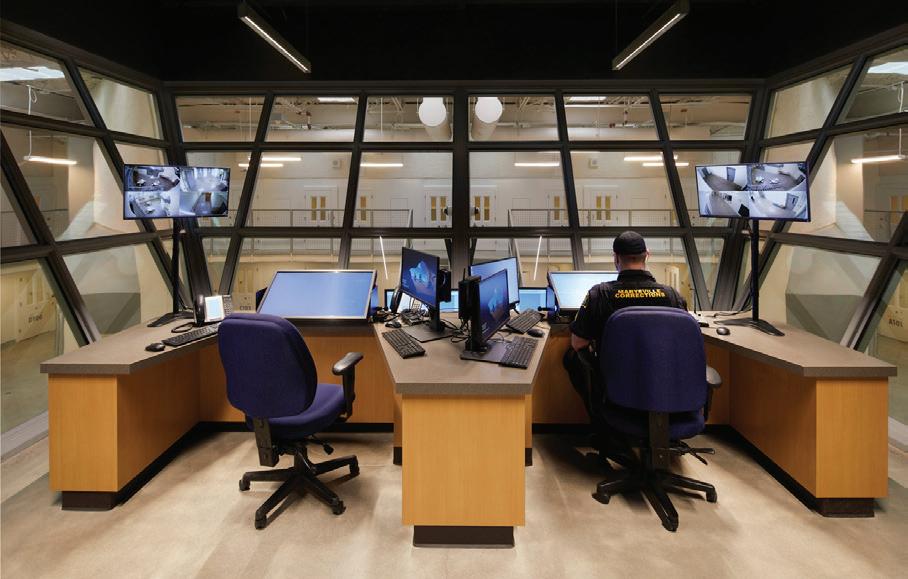
In terms of sightlines and wayfinding within the jail, Payne said that intentionally designed corridor movement paths that are almost identical on each floor aid in staff’s ability to respond to incidents quickly.
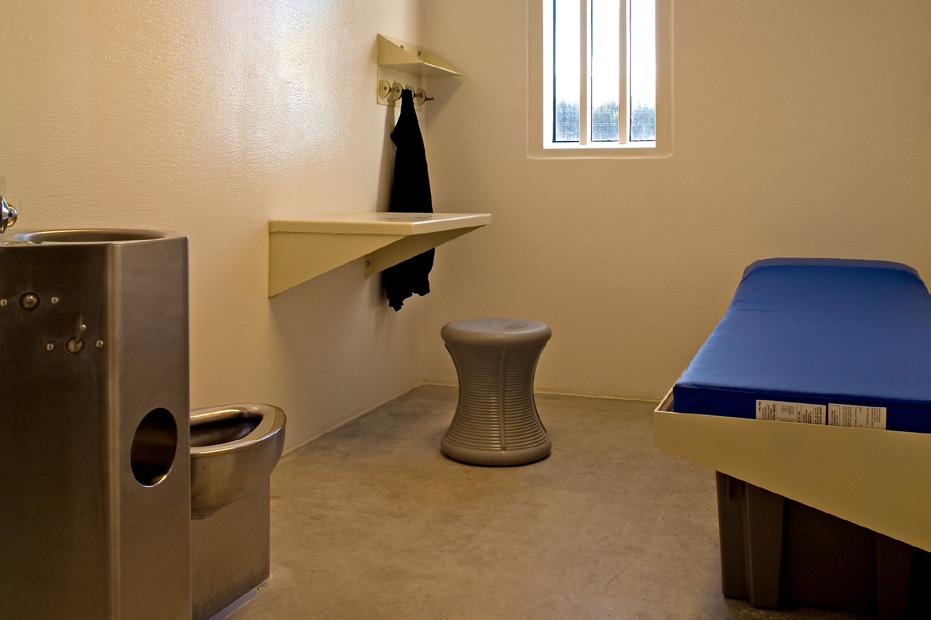
Vandermosten also said contraband prevention capabilities were built into the design of the housing cells, noting that bunks and light fixtures were welded to walls and ceiling to remove any hiding spaces.
recreation yard in the former facility. The recreation areas have an added benefit, as they introduce indirect natural light into the dayrooms and units — part of a holistic effort to increase daylighting, even in courtrooms and administrative areas.
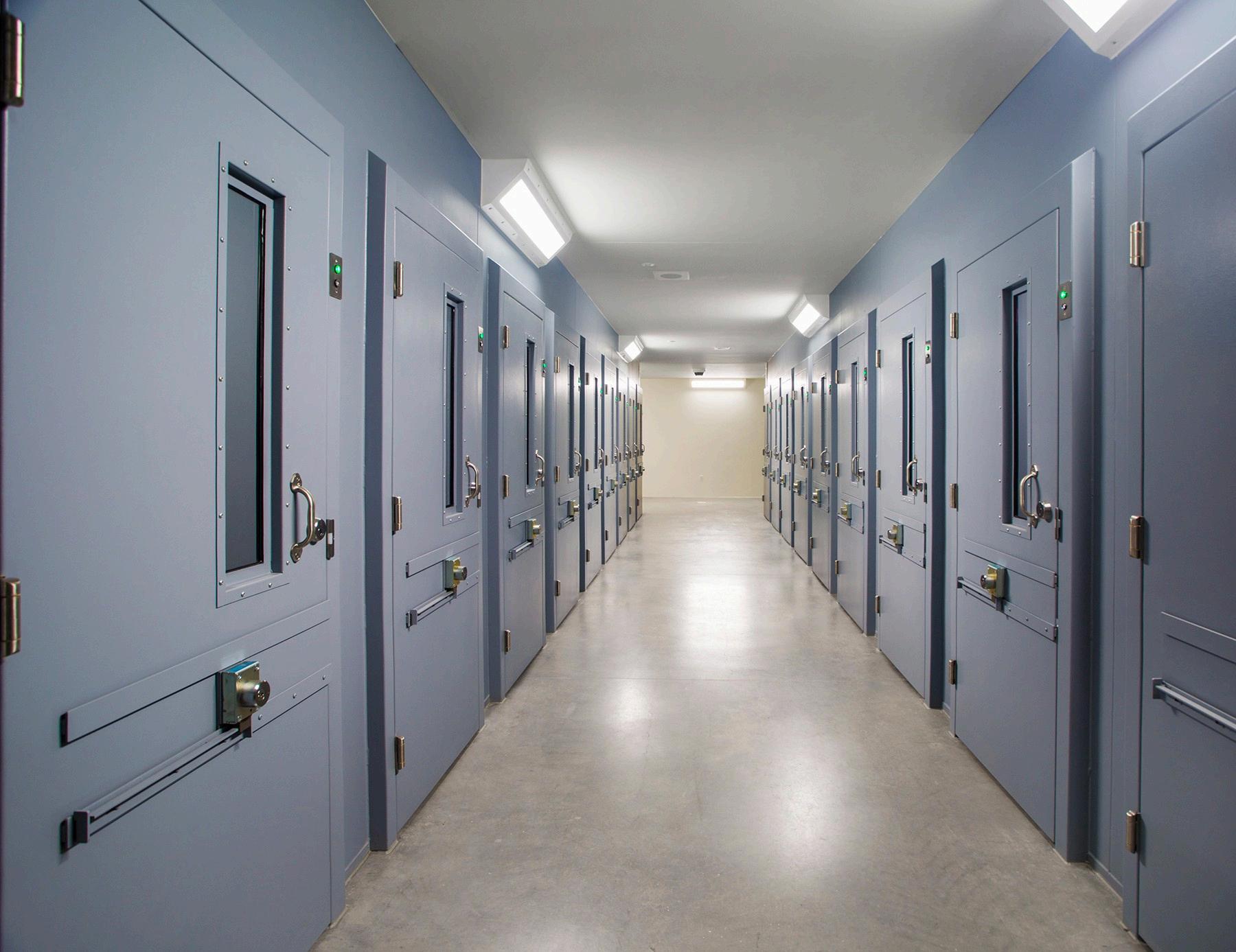
“One of the unique things about how Tennessee interpreted their jail standards was that the inmates needed to actually see the source of daylight,” said Payne. “We performed a study to ensure that an inmate standing in their cell could actually see the source of light, which resulted in larger vision panels in the cells doors.”
Aesthetics and Acoustics for a Better Environment
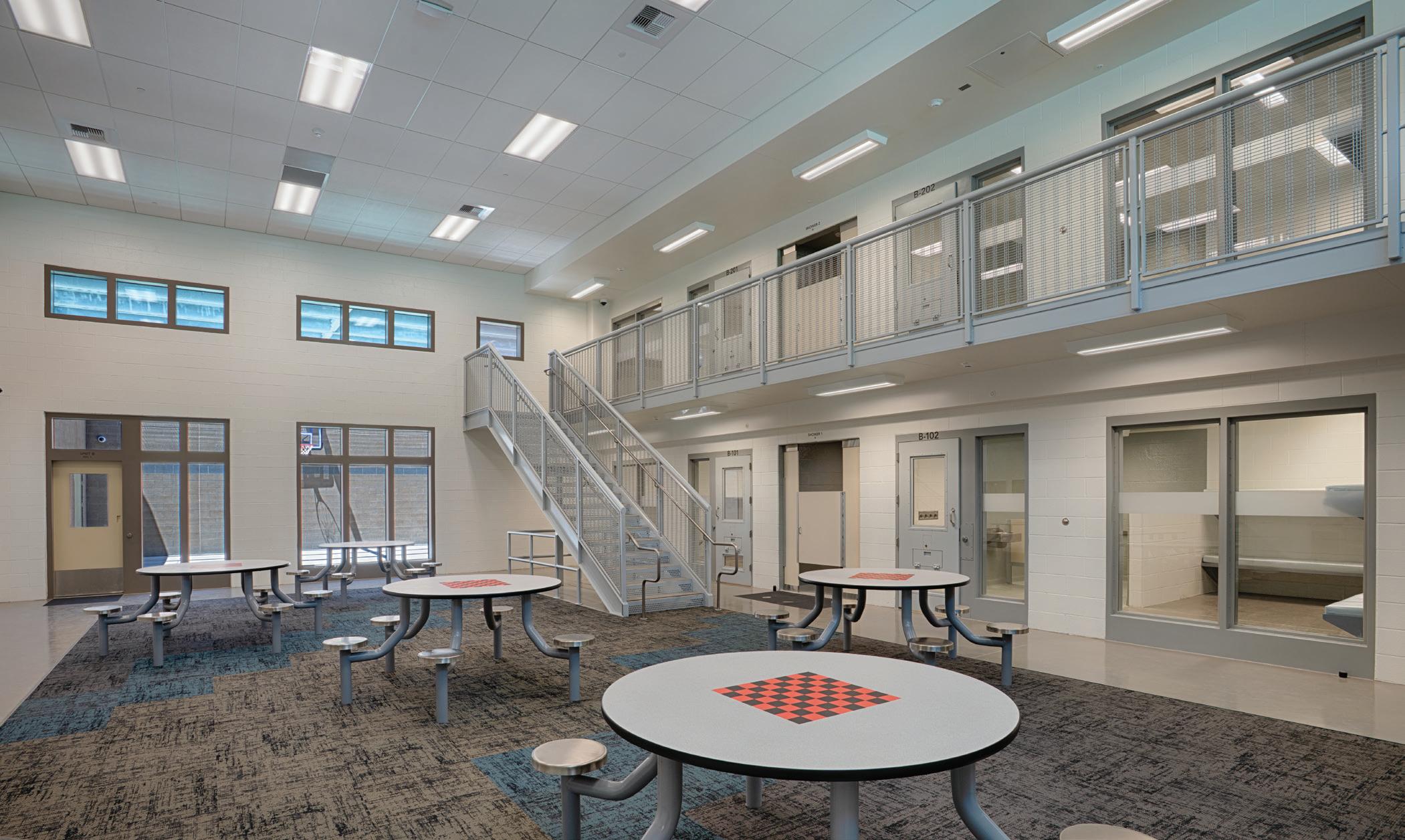
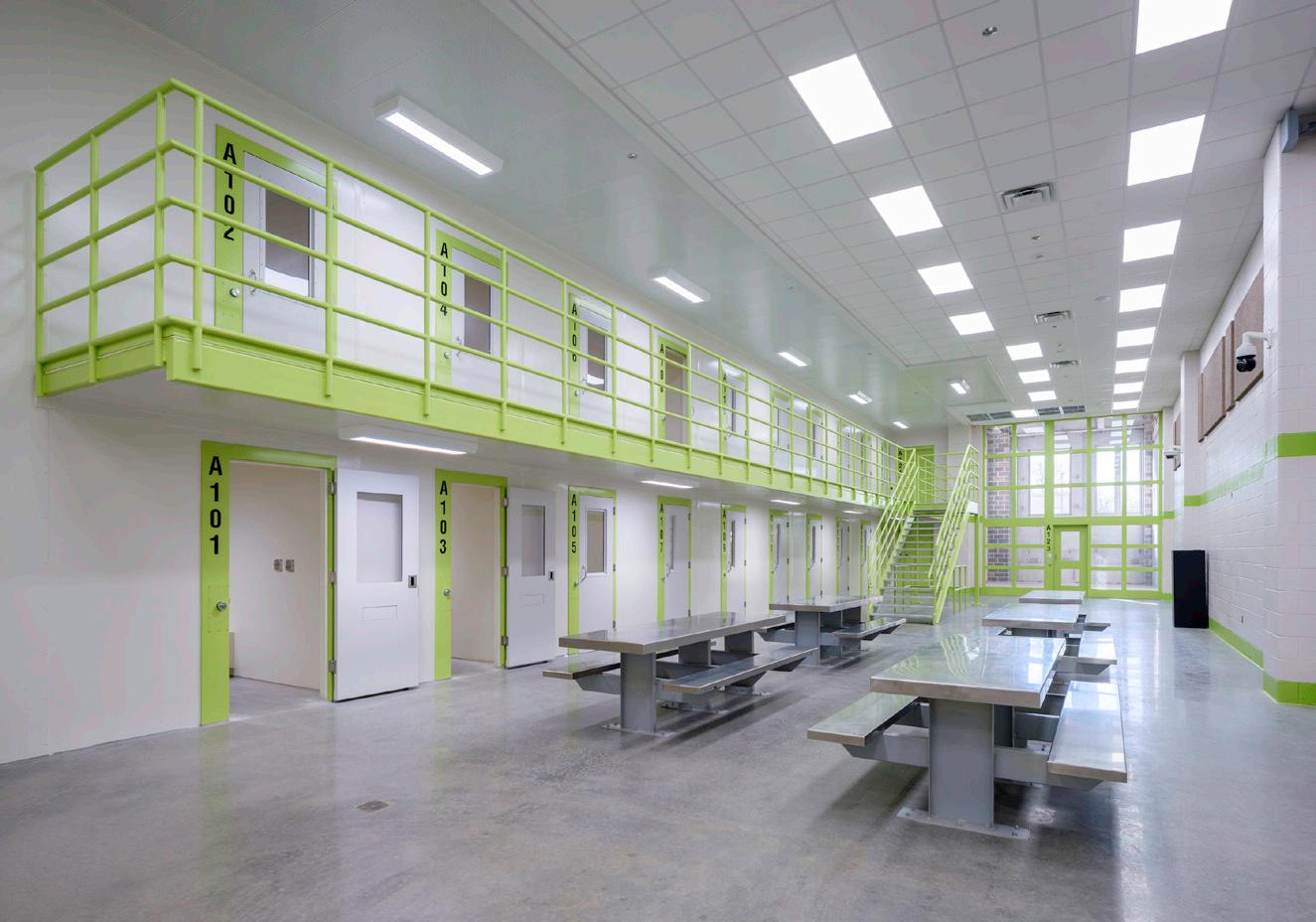
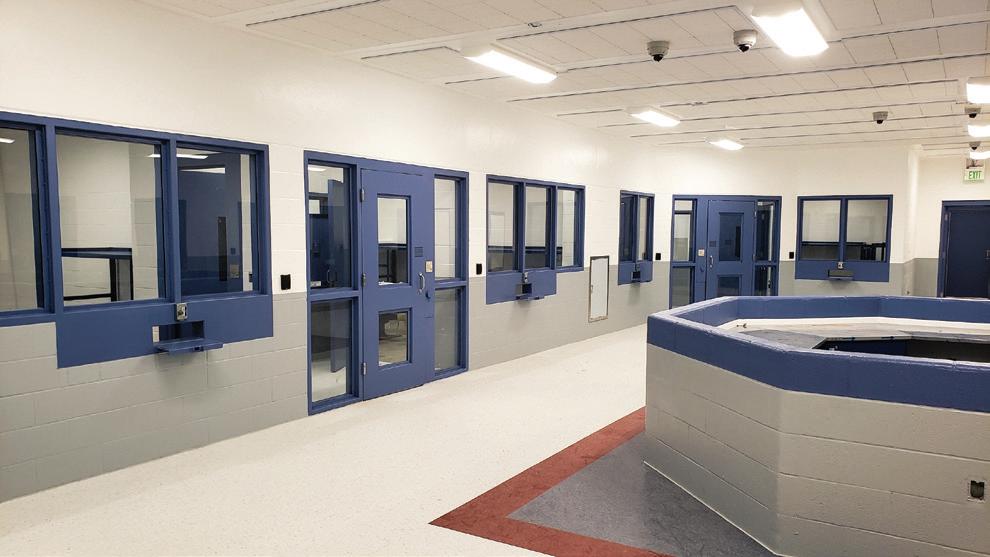
Finishes within the housing units and day rooms were carefully chosen to create a calmer, more positive environment. The design team avoided the traditional battleship gray color commonly associated with jails and prisons and instead applied brighter colors to accent walls, doors and striping that match throughout each housing unit.
“It’s very inviting when you enter one of the housing units, and the sun is coming through the windows and you see bright colors,” said John Vandermosten, Director of Criminal Justice Planning Development for Moseley. “It doesn’t really look like most people would expect a jail to look like.”
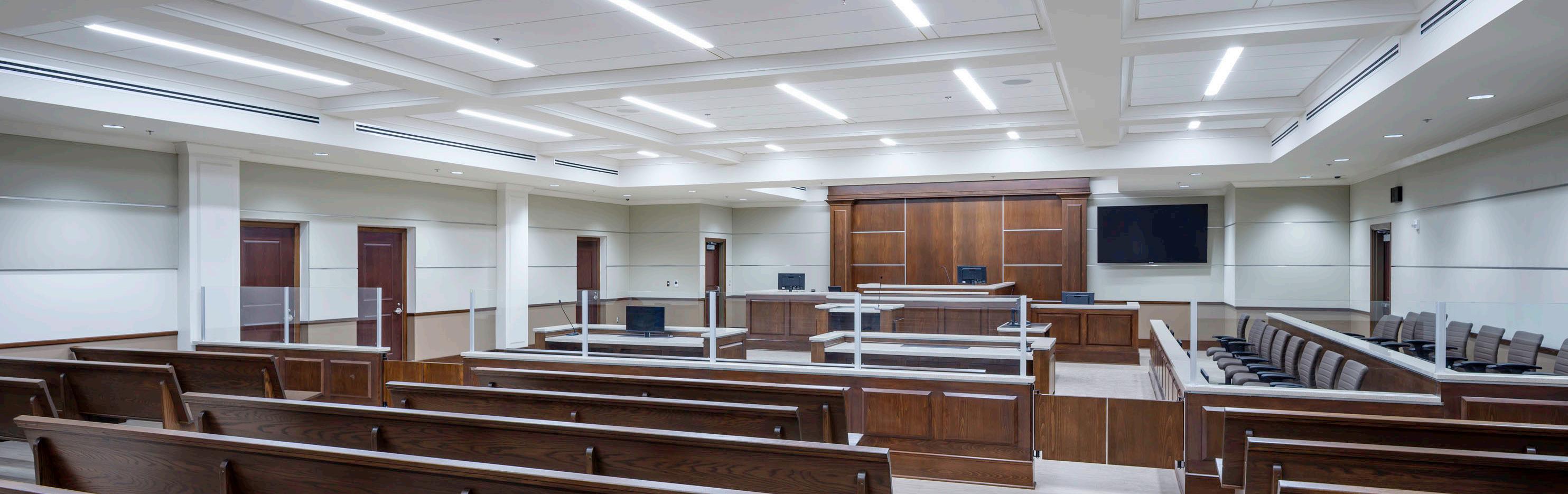
In planning the courthouse portion, the Moseley team held several meetings with the staff that would be occupying the space — from clerks and judges to the district attorney and other administrators — to get their input on how lighting, millwork and finishes would contribute to a better working environment. These discussions resulted in the use of elevated ceilings and warm wood paneling, and an overall focus on symmetry and balance to convey a sense of fairness and impartiality.
“I think they’re all happy with how it looks and the effects it has on people that they serve,” said Todd Davis, Moseley’s Justice Sector Leader.
The Moseley team also brought in an acoustician to create a better soundscape within the jail, leading to the use of high lay-in ceiling systems and acoustical wall panels in day rooms and in the courthouse.
“We were very intentional, specifically in the courtrooms, for controlling sight and sound during transfer from public spaces to the courtroom spaces,” said Payne.
Safety and Security
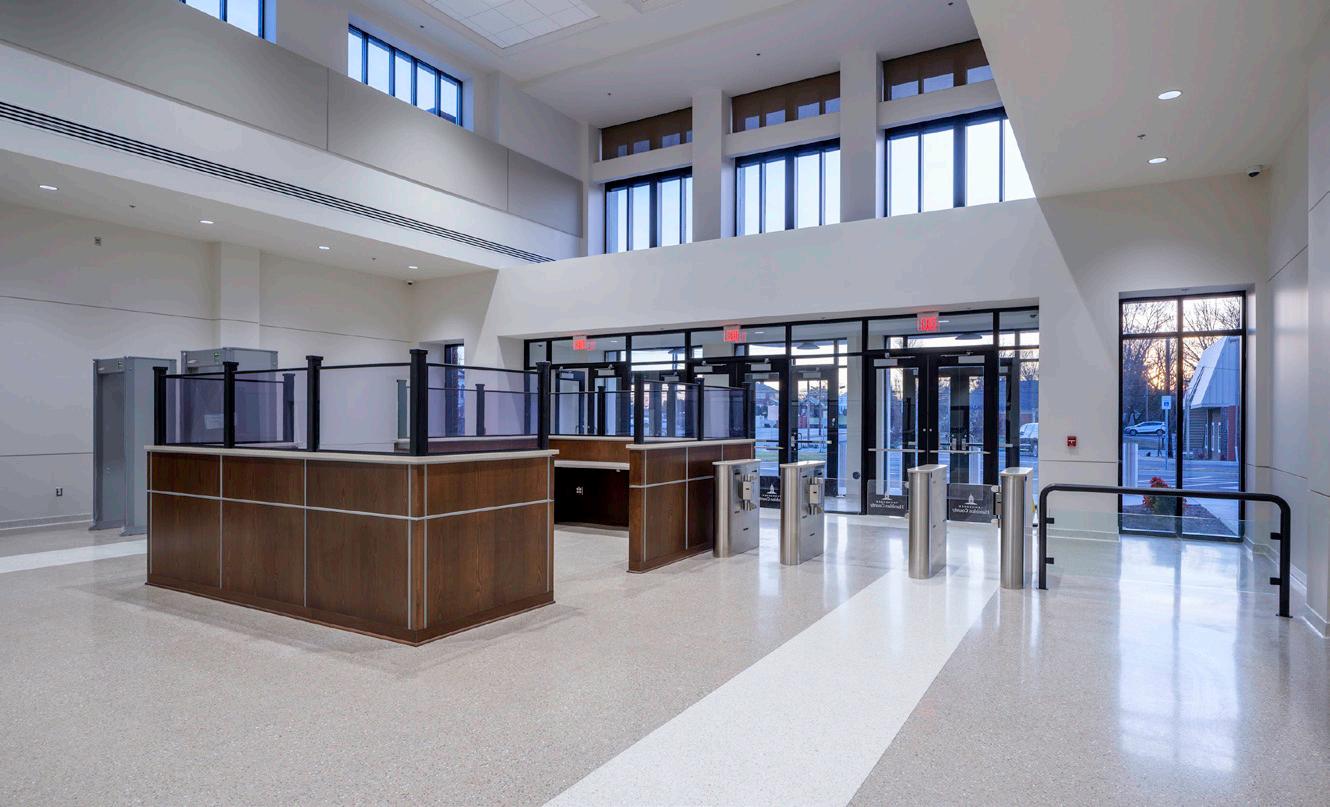
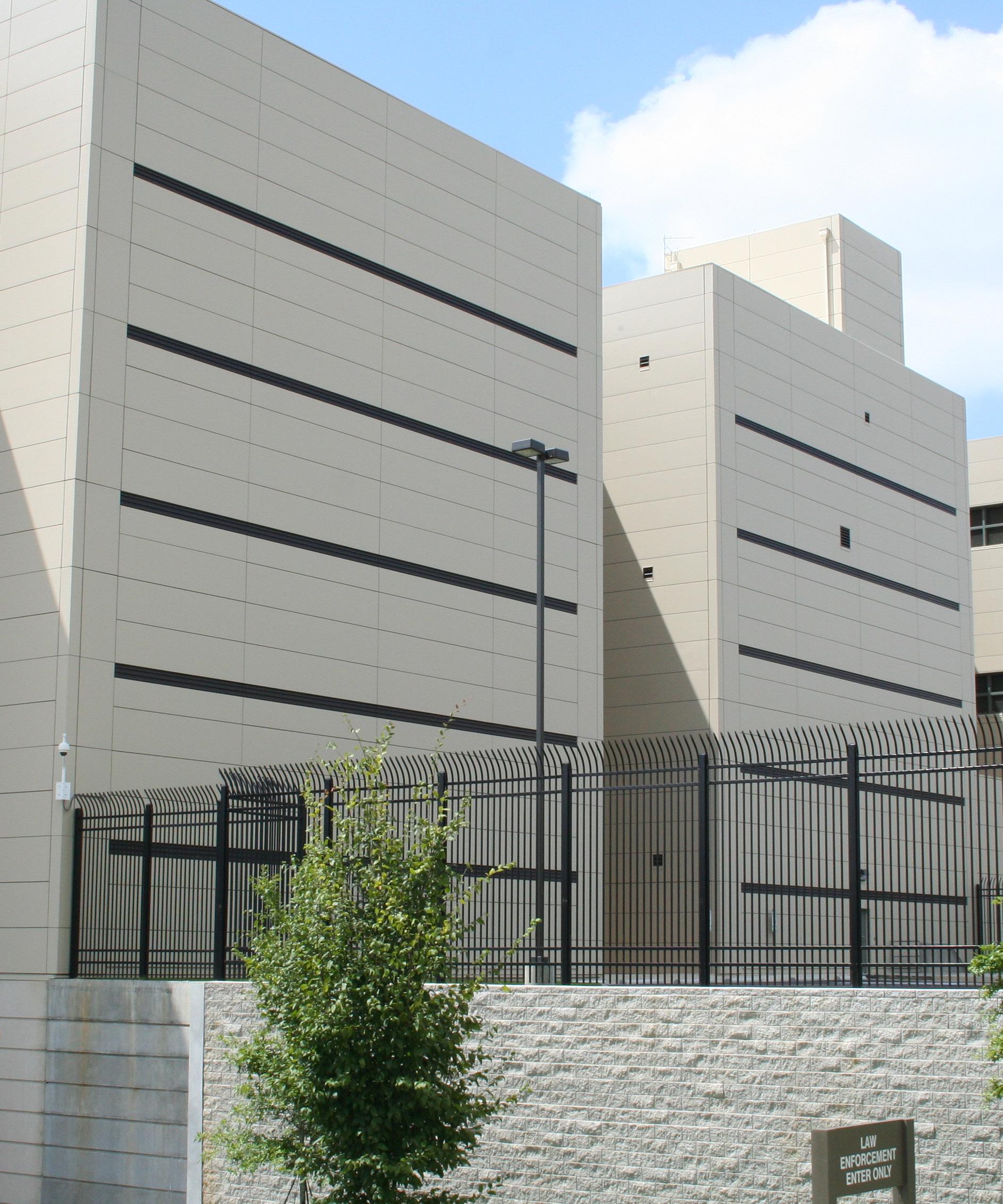
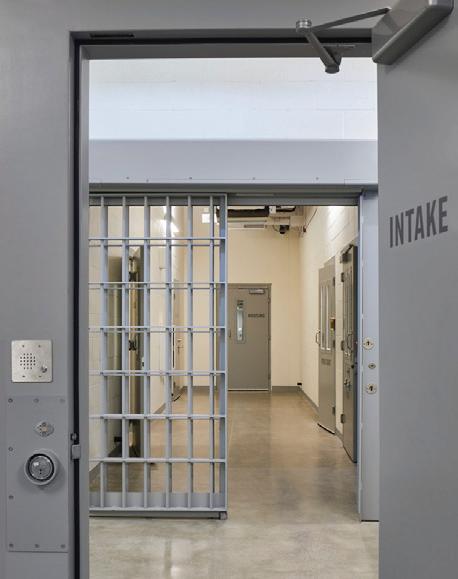
Davis noted the cross population of the public, staff and people in custody as a major challenge within the former facility. “One of the things we accomplished with this design was to have clear lines of movement patterns that were very distinct, from public to judicial movement to inmate movement and kept them separate,” he said, noting that these intentions drove the need for a multi-story scheme.
The implementation of rear chases within the housing units also allows maintenance to be safely performed without the need for removing inmates from
“If there’s a small hole somewhere, [detainees] will find it and they’ll put something in it,” said Vandermosten. “We eliminated all of those by the way that we put everything together.”
Built for Growth
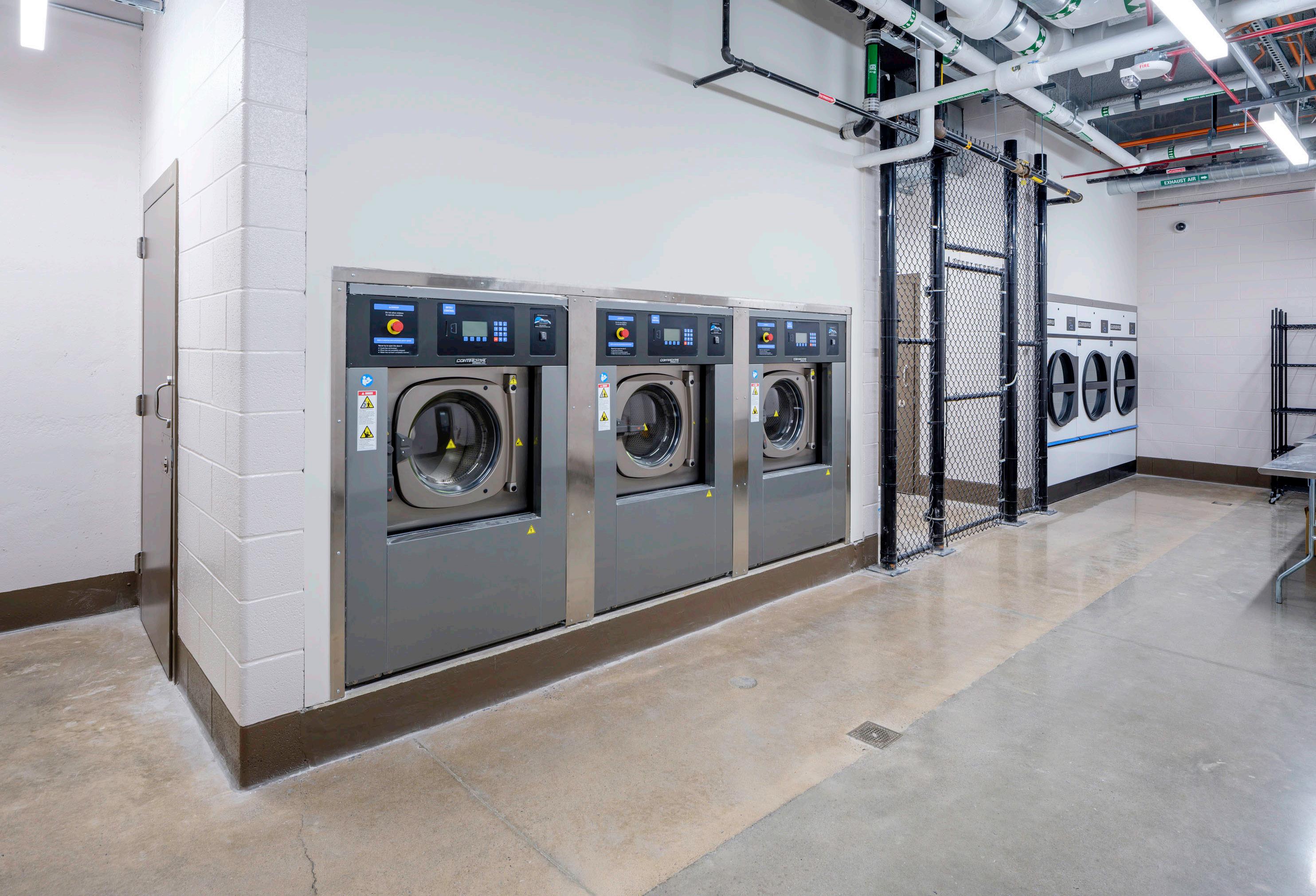
While the jail is built with 621 beds, Moseley intentionally designed the infrastructure to accommodate up to a 750-bed core capacity. Davis said that one of the ways the team built growth into the facility was by sizing the facility core by square footage, so that the county can simply add additional beds, or kitchen and laundry equipment, to the space it already has.
“That’s a staple of what we normally do to prepare [clients], so they’re not having to walk away from the initial investment and build a whole new expansion down the road when they just need more capacity,” explained Davis.
In fact, the third floor of the jail and a portion of the courthouse were initially designed as a shell space, but the capacity needs grew as the project unfolded, and design plans changed to convert those areas into usable space.
Hamblen County Mayor Chris Cutshaw says the new facility will serve as a 40- to 50-year investment for the community. “We were woefully behind, but we answered the bell, stepped in and gave our community something they won’t have to worry about for many years.”
New laundry facilities were designed to meet current needs and accommodate future growth.
Brighter colors were applied to accent walls, doors and striping throughout the jail.
Security Windows, Glazing and Mirrors: Keller Glasco
Building Automation and Controls: Johnson Controls
Detention Accessories: Viking Detention Products
Direct-Fired Makeup Unit: CaptiveAire
Digital Fire Alarm: Johnson Controls
Elevator Installations: Otis Elevator Company
Exterior, Precast Concrete: Castone Corporation
Fire Sprinkler Installation: Johnson Controls
HVAC Power Ventilator: Greenheck
Prefabricated Cells: SteelCell of North America
Roof Top Units: Daikin
Security Plumbing Fixtures: Willoughby Industries
Turnstiles: Controlled Access Turnstiles
HM Doors and Frames, Wood Doors and Finish Hardware: Appalachian Commercial Products
A Building that Benefits Staff
As part of the project, the Moseley team performed a staffing analysis to determine how the new facility would enable more efficient, safer operations, and worked with the county on transitioning both existing and new staff into what they call a “blank slate” of a building.
The initial feedback from staff, who were able to train in the new facility and become acquainted with its enhanced features and capabilities before operations officially switched over, has been overwhelmingly positive.
“Staff came out and started doing tours of the facility, which we encourage on the front end to get staff buy-in so they feel like they’re included in the project,” said Vandermosten. “They came out there and said, ‘Are you kidding me? Is this the place we’re going to work?’”
Vandermosten says the new facility has even served as a recruitment tool, thanks to its welcoming, safe environment, intuitive layout and technological features.
“The county actually brought people over from other agencies who wanted to work in a more modern and safer facility,” said Vandermosten.
Pride in the Final Product
Overall, the new justice center will not only enhance Hamblen County’s judicial and detention operations but will serve as a centerpiece for the Morristown community.
Payne said the designers took care to address how the scale of the building would blend in with the surrounding residential area, which influenced the decision to keep the courthouse portion to a single story. They even made efforts to match the brick colors of the new facility with that of a nearby historic community center, the Rose Center.
“It’s great to see that we were able to provide the county with a solution to their current problem and provide a much better facility for not just the people that work in it, but the people that are housed in it, and make it kind of the center of Morristown,” said Davis.
Sheriff Mullins says the facility exceeds his expectations and will serve as a model for future facilities to follow. The county’s next goal is reattaining TCI certification — eventually hoping to become the third facility in the state to receive Tier 2 certification. He and Cutshaw laud the years-long collaboration between the county and the architecture and construction teams for getting the project across the finish line.
“We didn’t have the crystal ball of what exactly we needed, so it was a lot of different people coming together and the melding of ideas to bring this project to fruition,” said Cutshaw.
“Thanks to the work from Moseley and Blaine Construction, we have a quality facility, and we believe others are in awe of what we have,” Mullins said.
High ceilings, warm wood panels and security features highlight the public-facing courthouse spaces.
Inside the courtrooms, balanced and symmetrical designs represent fairness and impartiality.
Manufacturing Spotlight
Kane Innovations Delivers On its Name
Vertical integration, evolving product lines and a commitment to American manufacturing keep the company at the forefront of detention
By Lindsey Coulter
Kane Innovations — founded in 1890 — has built a legacy that spans more than 130 years and a wide spectrum of safety and architectural metal solutions. What began with wooden windows and Venetian blinds has grown into a
national architectural products manufacturer known for specialized detention equipment, railings, ornamental metal fabrications and security screens. Throughout that evolution, Kane and its people have embraced their core mission as the “Guardians of Safe Environments,” supplying mission critical products and systems that protect people in commercial buildings, public spaces and justice facilities across the United States.
Over the decades, Kane’s offerings expanded from traditional metalwork into advanced safety and security hardware, including multi-level security screens and high-containment detention systems. The company’s Detention Division is
is all about quality and throughput.”
Detention Sales Representative Christopher Morey underscored the practical impact of these innovations, especially as it relates to the company’s ever-growing list of corrections and justice clients.
“Our focus isn’t just on supplying a product, it’s on delivering a comprehensive solution. We take a single product and build a complete barrier system tailored to each facility’s needs,” Morey explained. “We consider ease of installation, long-term durability and safety.”
Vertical Integration and American Manufacturing
Maintaining in-house U.S.-based manufacturing has been central to Kane’s operations. Gilmore noted that sourcing and producing domestically allows the company to avoid tariffs, shipping delays and quality inconsistencies that can impact end-users.
“Having all this equipment and everything in-house ensures precise material, creating installer-friendly products that don’t require field modifications,” Gilmore said. “Competitors may have quality issues that drive up costs for the customer. Kane standards prevent that.”
For example, in a recent recreation yard barrier installation, the company was able to bring an estimated two-week installation process down to a straightforward and successful two-day install.
“That’s because we focused on the front-end engineering, material preparation and fabrication,” Morey said. “We provide installers with reliable materials and support, helping to reduce both installation time and costs.”
Project Milestones and Industry Impact
Kane’s detention division traces its origins back to the 1970s, beginning with FCI Leavenworth in Fort Leavenworth, Kan. From there, the company
“Our focus isn’t just on supplying a product, it’s on delivering a comprehensive solution. We take a single product and build a complete barrier system tailored to each facility’s needs.”
— Christopher Morey, Detention Sales Representative, Kane Innovations
located in Kane, Pa., while the Railing Division and Corporate location is in Erie, Pa. Across all divisions, however, its products are designed, engineered, fabricated and finished exclusively in U.S. facilities, ensuring total control over quality, lead times and customization. This American-made heritage — rooted in innovation and craftsmanship — has set the stage for Kane’s detention division to emerge as a leader in criminal justice environments.
Innovation in Detention
Kane’s legacy is steeped in both historical significance and technological evolution.
“Kane Innovations is an American industrial success story,” said Joe Berman, Chief Commercial Officer, noting that the company has continuously adapted to changing client needs, investing in new materials and processes and expanding into a multi-division manufacturing operation with state-of-the-art technology. “Today, Kane utilizes state-of-the-art manufacturing equipment including laser cutters, plasma cutters, water jets, robots, cobots — and we are constantly evolving. We are never satisfied with the status quo.”
Charles Gilmore, Engineering Manager, also highlighted Kane’s consistent pursuit of quality. “We originated the Kane Vantage Wall Barrier product itself, coming to market with a patent and copyright,” he said. “We’ve evolved from manual booths and cutting with custom dies to a CNC turret punch process, and within the past two years we’ve moved to a fiber optics laser. This evolution
has learned that, while its products are fit for nearly any correctional or justice facility, each client and project has different priorities, needs and budgets.
“Every job is customized around the customer,” Morey said. “We modify our standard products to meet their unique requirements.”
The Mezzanine Vantage Wall Barrier offers maximum security protection in elevated areas inside prisons, jails and other criminal justice institutions.
Kane’s detention furniture products and equipment are built to withstand high levels of use.| Photo Credit (all): Kane Innovations
Kane supplied Vantage Wall Mezzanine Barriers in common areas at the Starke County Sheriff’s Office and Justice Center in Knox, Ind., to protect inmates from accidental falls and suicide attempts.
That full-service approach extends to partnering with design firms and facilities to turn needs or desires into realities. A project for a client in
“Today,
plank ceiling products and food pass retrofits,” Morey said. “Being close to our DECs, facilities and architects positions us to react to emerging trends.”
Kane utilizes state-of-the-art manufacturing equipment including laser cutters, plasma cutters, water jets, robots, cobots — and we are constantly evolving. We are never satisfied with the status quo.”
— Joe
Berman, Chief Commercial Officer, Kane Innovations
northeastern New York is a recent example. Morey explained, “A simple sample request on our website led to a six-inch open woven rod configuration, compared to our standard two-inch design. We’ve advanced the concept into the budgeting phase, expanded it to nine pods, and are now coordinating with detention equipment contractors on installation pricing. That’s the full-service approach Kane provides.”
Meeting Current Trends in Security and Design
As the detention industry shifts toward facilities that balance security and safety with rehabilitation and normalized environments, Kane has also kept pace, offering products that respond to all modern justice and corrections needs.
“We offer solutions for both security and rehab purposes,” Gilmore said. “Facilities now understand the need for heavier security while also considering rehabilitation goals. Kane is positioned to provide both.”
Morey added that visibility continues to be a significant design trend, supporting both safety and the mental health of staff and inmates.
“There’s also growing interest in polycarbonate integration, adopting softer detention aesthetics and implementing recreation yard barriers that prevent contraband transfer,” Morey added. “We continue to adapt our solutions to meet these needs. Kane’s ability to shorten install timeframes helps clients prevent the receipt of back charges or liquidation damages.”
Timeline management and budget control have also become critical. Gilmore said 10 years ago, building a facility might take 18 months. Today, timelines are often much more accelerated. Kane’s ability to reduce installation timelines, he says, also directly lowers costs for facilities.
“Maintaining project timelines helps control costs and prevent budget overruns,” Morey added. “Clients can move forward with confidence, knowing their expectations will be met.”
Looking Ahead: Innovation and Safety
While the company has enjoyed sustained success and growth, its leaders remain focused on anticipating future needs, while expanding and refining detention solutions for both immediate and long-term use.
“We’re working on stainless steel shower swing doors, additional security
This focus on innovation also comes from a place of deep pride in the company’s mission and in the quality of its products.
“Receiving feedback from clients that we’ve exceeded their expectations is truly gratifying,” Morey said.
“We’re motivated by providing meaningful change for facilities and the people they serve,” Gilmore added. “Seeing a project move from drawing board to finished product, knowing we’ve improved a structure for safety and functionality — that’s what drives pride in our work.”
The Vantage Wall is also used in Fulton County Jail in Rochester, Ind.
Chicago’s Cook County Jail, the largest single-site jail in the country, utilized Kane Detention’s Vantage Wall Barriers in the sallyport and outdoor recreation areas.
The Instinct That’s Failing Us — and the Evidence We Can’t Ignore
By Brian K. Lovins, Ph.D.
There is a nearly universal instinct in corrections: when someone breaks the rules, make the consequences harder. That often means imposing longer sentences, more restrictions and greater surveillance. The assumption is intuitive — if the punishment is severe enough, people will stop offending. After more than two decades working in research, practice and policy across the criminal
justice system, I’ve come to a different conclusion: our instincts, however well-intentioned, are steering us wrong.
The Pull Toward Harshness
Most of us who work in corrections didn’t start this career to be punitive. We entered the field motivated by public safety and, for many, a genuine desire to help people turn their lives around. Yet the
systems we inherited — and in many cases helped build — lean heavily on control, restriction and consequences as the primary tools of change. This isn’t surprising. When someone violates the conditions of their supervision, or reoffends, or fails a drug test, the instinct to “ratchet up” is powerful. It feels logical; even just. If the current level of accountability isn’t working, more of it should. The problem is that decades of research tell us otherwise.
JUSTICE FACILITY EXPERTS
Study after study has shown that increasing the severity of sanctions — such as adding jail time, more reporting requirements and electronic monitoring — does not reliably reduce reoffending. What the research does show is that the certainty of consequences matters more than their severity, that positive relationships between practitioners and the people they supervise are among the most consistent predictors of successful outcomes, and that support-oriented interventions — addressing housing instability, substance use, mental health and employment — produce far better returns than punitive escalation alone.
The Evidence for Support
This isn’t a theoretical argument. The research base is substantial and growing. Cognitive-behavioral programs, when delivered with fidelity, reduce recidivism at rates that no sanction structure has matched. Motivational approaches improve engagement and treatment completion. Mentoring and pro-social network development matter. Housing and economic stability matter. Access to care matters.
What’s harder to explain is why, if the evidence is this clear, our systems continue to default toward punishment when someone struggles. Part of the answer is organizational culture. Part of it is the legitimate pressure that practitioners feel when something goes wrong — when a person under supervision commits a serious offense, the question isn’t, “Did we provide enough support?” It’s, “Did we enforce hard enough?” That asymmetry shapes decisions made at every level of the system, from the individual officer to the legislature.
Reframing the Job to Be Done
One concept that has reshaped how I think about this problem is the idea of the “Job to Be Done.” At its core, this framework asks a fundamental question: what are the people in this system actually trying to accomplish?
We tend to answer that question for the people we supervise: they need to stop reoffending, comply with conditions, stay sober and get a job. But when we expand the frame to include everyone involved in the system — officers, supervisors, administrators, community members and, yes, the people under supervision — a different picture emerges. Everyone in this system is trying to thrive. That includes the officer struggling with burnout and dangerous working conditions; the person on probation trying to rebuild their life while managing trauma, debt and stigma; the administrator trying to deliver public safety outcomes with a depleted workforce; and the family waiting for a loved one to come home changed.
When we center the goal of helping all people in the system to thrive, the logic of punitive escalation begins to break down. Practices that grind down the people we supervise without providing meaningful pathways also grind down the people who deliver those practices. Culture and outcomes are inseparable.
What This Looks Like in Practice
At Justice System Partners, my colleagues and I have spent years developing and testing frameworks that operationalize this shift. The Coach-Referee Model for Change positions correctional staff not primarily as enforcement agents, but as coaches — people who use the authority of their role to create conditions where real change becomes possible. This doesn’t mean eliminating accountability. It means pairing accountability with consistent support, using motivational techniques and building the kind of trust that research has shown to be central to behavior change.
This model isn’t naive about public safety. Quite the opposite — the evidence consistently shows that blended approaches outperform pure enforcement. When officers build genuine rapport, when supervision is responsive to individual need rather than formulaic, and when the system is oriented toward building capacity rather than documenting failure, outcomes improve for everyone.
A Different Kind of Courage
It takes a particular kind of courage to lead with support in a field that has historically valorized toughness. The political and cultural pressures to appear hard on crime haven’t disappeared. But the data have accumulated to a point where continuing to ignore them is itself a choice — one that affects not just recidivism rates but the wellbeing of officers, families and communities.
takes seriously the full complexity of human behavior — one that meets the people in it, in every role, with the tools they actually need to succeed. Not just harder consequences, but real support. That’s what the evidence says. And after 30-plus years in this work, I believe it’s also what justice requires.
Brian K. Lovins, Ph.D., is President of Justice System
Through our trusted brands--SteelCell, CareAffirm, Portable Solutions Group, Connexure, and BIG Enterprises--we’re shaping the future of secure, efficient, and purpose-driven spaces.
Contact us to help you find the right solution for your project.
How Should Corrections Think About TV? Advice for administrators, architects and
builders
By Thomas Herzog
A Familiar System Is Changing
For prisons and jails, TV has been a dependable utility for decades: a simple system of coaxial cables, splitters, amplifiers and an antiquated head-end device tucked behind a locked door.
That familiar configuration is about to transform in a meaningful way, driven by a triad of consumer, business and technology changes that are unfolding right now. It’s important for correctional officials to understand what is changing, the unique exposure for corrections and what stakeholders should do now to prevent expensive retrofits, loss of content options or security gaps.
“Corrections television is no longer just about entertainment — it is an opportunity to inform and to educate,” said Steven Hastings, Chief Executive Officer of West Pond. “With the right technology, TVs have become an affordable, dependable and secure platform to communicate with the incarcerated, with staff and with visitors according to need.”
Consumerism
Recent data on consumer trends show that linear broadcast television is still very much relied upon, even as streaming grows. However, findings suggest that consumers increasingly expect content to be available seamlessly across platforms rather than through separate systems.
This trend is already evident in corrections, as facilities seek streaming services for movies and sports events — just like people do when viewing at home. Tablets have this capability but may not be an option for a correctional system on a tight budget, or for those with limited bandwidth. A smart TV linked to the internet sounds like a solution but presents security risks to the network that outweighs any benefits of the smart TV, such as unmonitored access to the internet for the incarcerated.
The Digital Transformation of Business
The broadcast television industry is rapidly moving from RF to digital infrastructure. As smart-TV platforms enable a dynamic shift from an entertainment-only system into a new model that can deliver education, enhance communication and promote health and wellness, cable and satellite TV providers are shifting their business models to include more streaming services.
Senior living centers, hospitals and hotels are already making the transition to align TV services with broader digital-service platforms to enhance resident services, increase engagement and improve operational efficiency.
Can corrections TV evolve similarly? We think so.
Emerging Technology
Technology has emerged that can transform corrections television into a managed, secure digital service, providing facility operators the ability to select what TV services to broadcast and when. No longer just a utility, this technology can transform a correctional TV system into an enterprise-class service delivery network for messages, treatment, education and public safety initiatives.
The consequence of these changes is not simply “better picture quality” for the incarcerated. Thoughtful planning and proper system design can provide correctional systems with flexibility and control over their TV systems that they associate with enterprise class systems like telecommunications and IT, but only if done correctly.
Making Sense of It All
Unlike homes, facilities cannot simply “buy a new box” when technology or compatibility changes. Unlike hotels, facilities cannot treat TV distribution as a guest amenity that can be quietly swapped out behind the scenes.
Correction-oriented television solutions need to emphasize secure network designs, hardened displays/enclosures, remote management capabilities and include device and content controls. These are not attributes of off-the-shelf television solutions.
What is Needed?
A correctional TV system should have the capability and flexibility to capture free over-the-air broadcasts, cable or satellite TV as desired, as well as free curated content from sources such as YouTube. The system should have the ability to seamlessly add subscription-based media, and it should provide the ability to create and customize TV channels internal to the department for programs such as education, treatment and religious services. It should also allow for the centralized management and control of both devices and media content.
Many of the corrections TV systems in operation today do not meet these criteria, in part because they were designed and managed as an off-the-shelf utility. Security was not an issue since the distribution technology was a one-way broadcast, but this is changing.
A Smart Corrections TV System
Seldom does a solution emerge ahead of a problem. Fortunately, that is precisely what West Pond Enterprises has developed with its FlexStream Corrections TV Solution. The system is powered by West Pond’s proprietary smart headend TV technology. When coupled with West Pond’s control modules and content filtering software, it stands alone as the most secure, dependable and affordable corrections TV solution within the United States.
A smart headend is not just a device placed in the equipment rack in a communications room. It is a software-defined, network-aware control point that unifies TV operations for everything a facility shows on its screens (and optionally delivers to secure tablets or kiosks). In corrections, a smart headend
Not just entertainment anymore, properly designed correctional TV can be used to promote communications within a facility and as a secure platform for education, programming and behavioral health.
becomes the policy engine for who can watch what, where and when — while insulating the facility from external changes in standards and rights.
If the old headend was plumbing, the smart headend is traffic control. It does not just move signals; it decides which signals go where, how they are secured, which lanes they use and what happens when something breaks. That shift is captured within the FlexStream Solution — a hybrid architecture that gives correctional leaders options they never had in the coax-only era.
Moving Forward
Correctional departments, prison and jail architectural firms, and builders are not experts in broadcast TV. Fortunately, they do not have to be. West Pond Enterprises is a company that is focused on prison and jail TV systems and can help any organization navigate the path forward.
Thomas Herzog is a corrections consultant and a retired Deputy Commissioner with the New York State Department of Corrections and Community Supervision.
This article was sponsored by West Pond Enterprises. To learn more, contact West Pond Enterprises at westpond.com/about/contact-us/ or call (978) 562-4306 ext. 507.
Broadcast television is still an integral element of the correctional environment, providing entertainment for the incarcerated population, but that system is rapidly changing. | Photo Credit (all): Courtesy of West Pond
STANDOUTPRODUCTS
Detention Windows
Kane Detention’s Van-Guard screens, adapted from Kane Security designs, combine the functional characteristics of security screens with detentiongrade construction. These screens are intended for use in holding cells, dormitory settings, jail-cell windows and other operable openings requiring additional protection. Medium detention Van-Guard window screens are fully welded and available in custom sizes and configurations. Each unit includes multi-point locking mechanisms and anti-compression hinges to support secure installation and consistent performance in controlled environments.
Kane Detention
www.kaneinnovations.com
Ligature-Resistant Combination Plumbing Fixtures
V700 and SVX: The Ultimate Public Safety Ecosystem
Equip your officers with the ultimate communication and evidence-capture ecosystem. The Motorola V700 LTE body camera delivers continuous broadband livestreaming, critical location tracking and reliable recording capabilities. This ensures you never miss a crucial moment on patrol or inside the facility. Pair it with the groundbreaking Motorola SVX video remote speaker microphone, which perfectly merges APX radio audio with HD video capture. The SVX reduces physical clutter while utilizing AI to tag footage and filter background noise. Built tough for law enforcement and corrections, the V700 and SVX seamlessly integrate to protect teams, streamline workflows and secure indisputable evidence.
Body Inspection System
The HT3000SV Human Body Inspection System from STVS detects contraband concealed under clothing or in body cavities with one scan and without shoe removal. Optimized for deployment in correctional facilities and law enforcement agencies, its radiation dose level complies with the IAEA and ANSI N43.17 standards. Customizable and optional image processing and operations functions include remote control, centralized management, smart terminals and safety accessories. With one-click scanning, real-time imaging and modular design, the system is easily installed and maintained.
STVS www.securetechvs.com
Metcraft’s line of ligature-resistant combination lavatory/toilet fixtures is designed for areas both with and without an accessible pipe chase. Fixtures are fabricated using 14-gauge type 304 stainless steel, welded to form a vandalresistant unit. Internal piping is stainless steel. Exposed surfaces are polished to a satin finish, except for the integral seat which is polished to a bright finish. Fixtures are available in 15-inch-wide, 18-inch-wide and straight-wall configurations.
Metcraft www.metcraft.com
Impact-Resistant Lighting
NewStar Lighting’s StarTile Max series features a low-profile, 14-gauge, coldrolled steel surface-mounted housing unit with beveled edges, designed to deflect the force of an impact. The series includes two lenses for maximum durability as well as tamper-resistant Torx® fasteners. Polyester powdercoated following a five-stage iron phosphate pre-treatment, fixtures are certified to UL Standards and suitable for Wet Location and comply with the Buy American Act (BAA) and the Build America, Buy America Act (BABAA).
NewStar Lighting www.newstarlighting.com
Courthouse Design, from page 19
says, ‘This is Pierce County,’ so that everybody knows this is no longer a health-insurance building — this is the county administration,” said Valdez.
changing requirements and perspectives.
“We have to be light on our feet and manage that with our client to give them the end product that they need,” said Bills.
the public in mind,” said Bills. “Being a part of that and knowing that we’re improving that relationship between Pierce County and the public is always fulfilling.”
Existing Structure Challenges
While not as complex as new builds, existing facilities that have their own structural, mechanical and space issues present a different kind of design challenge.
“One of the big questions is what we can do with the space that we actually have available,” said Valdez. “As far as public spaces go on the courts floors, there’s not a lot of it, so, we have to make it as efficient as possible.”
Where a new facility would offer more flexibility to add attorney-client meetings rooms, for example, the team has had to carve out such spaces within the existing building.
A Productive Partnership
Having successfully worked with Pierce County on the previous courts project in 2018, KMB leaned on that positive relationship to complete this latest project on time and on budget.
“I’m always proud to be a part of something that’s going to serve the public better, and Pierce County is one of those clients that has the interest of
Valdez agrees, adding that the complexity of the project made the end result all the more rewarding.
“Being able to accommodate a super challenging project with a lot of moving parts and an extremely tight budget, and having it completed on time and successfully, is extremely rewarding. It’s something that our entire design team — including our consultants and partners in the county — are really excited about,” said Valdez.
Defining Durability since 1947.
Bills says that the 1501 Market building, which was built in the 1990s, was a better fit for some of the functions that the county desired, such as open office spaces with some private offices around the perimeter. The KMB team efficiently reorganized space there, while some of the older justice campus buildings contained unmovable support columns and
Milnor’s V-Series open-pocket cylinder Washer-Extractors range from 40-160 lb capacities.
Times have changed since Milnor built its first commercial laundry machine, but Milnor’s dedication to quality construction and durability hasn’t. Our washer-extractors are built with high-quality components designed to last. Plus, each model design is tested in a significant out-of-balance state for over 1,000 hours at maximum extraction speed, which is why you see so many Milnor machines working for decades in laundries around the world. And that’s why you will continue to see machines bought today working well in the future. Find out more at milnor.com.
BEHIND GLASS BLINDS
A SHERWOOD EXCLUSIVE
Introducing Sherwood’s DSW 6280 Series composite construction Detention Security Window with blinds for shading/privacy control – the first choice of owners, DECs and architects for cost-effective, maintenance-free detention security glazing.
DESIGN
• Stainless-steel/aluminum construction
• 2B stainless finish
• Fully thermally broken frame
• Lockable secure blinds
• Manual or electric operation
PERFORMANCE
• Maximum security
• Improved energy efficiency
• Superior strength & weather resistance
• Damage proof & wear-free surfaces
• Long-life, low-maintenance
• 2-year standard warranty
• Best-in-class performance
For 65 years, The Sherwood Windows Group has been North America’s premier manufacturer of custom designed security window systems. From small projects to the complete design of new maximum detention facilities including cell windows, entrances and/or curtain walls, our team will work with you to ensure that all security and aesthetic requirements are not only met but exceeded.
Body-Worn Cameras in Correctional Facilities Are Expanding Evidence Collection and Operational Uses
AI, cloud storage, and video systems are reshaping documentation, oversight and safety in corrections
By Dena Sattler
Body-worn cameras in correctional facilities are doing the critical work of collecting high-quality video and audio evidence — and much more.
With a boost from artificial intelligence (AI), body cameras are helping process video, perform numerous administrative tasks, and enhance safety and security in a more intelligent and proactive way
As the leading manufacturer of body-worn cameras for law enforcement and correctional facilities, Axon Enterprise is at the forefront of a strategic shift from paper-based records to a streamlined and intelligent system of cameras, cloudbased evidence management and AI-driven incident reporting.
Axon Sales Director for Corrections Zach Austin said the use of digital evidence is rising sharply in part because it promises a more modern and efficient documentation process.
“Agencies have an explosion of digital evidence, and the biggest message we got from corrections agencies and law enforcement as well is they need better tools to manage this large body of evidence and then allow it to flow through the standard processes that they have today,” Austin said.
By automatically storing digital evidence from body and fixed cameras in the cloud at Evidence. com, agencies also can move on from older, on-premise servers with a limited useful life and susceptibility to damage such as fires or flooding.
Austin said more than 20 state departments of corrections use Axon body-worn cameras and roughly 15 have deployed TASER devices.
AI: A Game Changer
Axon’s Draft One streamlines a process flowing from initial evidence capture on the bodyworn camera to an AI-assisted draft of reports. As AI helps
draft the initial narratives, staff members are freed to handle other tasks such as walking the halls of a facility, building stronger relationships with inmates and other safety-minded duties.
The use of digital evidence is rising sharply in part because it promises a more modern and efficient documentation process.
Axon is also developing customized workflows for specific investigation or document flows an agency may need, Austin said, with the process capable of providing tailored assistance in situations ranging from TASER energy device deployment to allegations of excessive force by an inmate and many other situations that demand precise evidence sharing and reporting.
“On top of that body of visual evidence, we’ve built all sorts of tools designed for some of the routine forms that agencies have to fill out,” Austin said. “They could have hundreds of reports that are routine or incident-based,” including such standard reports as inmate count.”
In every situation, accountability and transparency are essential in the process, Austin said.
“I think most importantly in this is that there is an evidentiary record of where those investigations are flowing,” Austin said, adding that AI only “assists” with the draft. A front-line officer and/or someone on the command staff must review that draft, make changes and digitally certify the report to ensure the final product is accurate. Being able to see who has digitally signed off on the investigation document and other details ensures accountability, with customized form flows that know exactly who should review next.
“Leadership has visibility of each step in the process,” Austin said. “It could be as granular as a single investigation, or it could be as high level as everything that is going on in the state department of corrections.”
Arizona Embraces Body Cameras
The Arizona Department of Corrections, Rehabilitation & Reentry (ADCRR) worked in partnership with Axon in deploying 1,330 body-worn cameras across its prison facilities in 2025.
Chris Jackson, Deputy Chief of Emergency Management for ADCRR,
The ADCRR worked in partnership with Axon in deploying 1,330 body-worn cameras across its prison facilities in 2025.
Photo Credit (all): Courtesy of Axon
designed and implemented deployment of the cameras across nine facilities in the ACDRR system, which, as of February, housed 34,720 inmates statewide.
Most of the ADCRR body-worn cameras are in high-security areas where fixed cameras can’t capture all angles. In those units, every officer wears a body camera, with about one-third of officers equipped with the cameras at Arizona state prisons overall.
As ADCRR works toward a more efficient and streamlined process from video capture to AI-assisted report writing with Draft One, the department is
deployment in May 2025 to February 2026, ADCRR saw a 20% decrease in the time to resolve major disciplinary violations and a 13% decline in use-of-force incidents where the cameras were deployed.
“Previously, whenever we had incidents that needed to be recorded, regardless of their nature, we would have to have staff that go in with a hand-held camera much like you would shoot with home videos in the late ’90s and early 2000s,” Jackson said. “The officer really could do nothing other than hold the video camera and make sure that they’re capturing as much of the event as possible and
SAFETY DOESN’
DOESN’
DOESN’
T SAFETY
T SAFETY
CHANCES SECOND CHANCES SECOND CHANCES
T COME WITH COME WITH COME WITH SECOND
When safety and security demand the highest standards, you need a detention contractor who delivers performance. Because safety doesn’t always come with a second chance.
The adoption of body-worn cameras has led to measurable safety and security results within the ADCRR.
Balancing for Security and Community: Modern Approaches to Public Safety Facility Design
Common concerns communities face when designing public safety facilities — and how to combat them
By Hillary Morgan, AIA, NCARB, and Kevin Baughn, Associate AIA, CSI
In public safety facilities throughout the country, design and architecture determine who crosses paths, how the community interacts, where tensions rise and how elected officials, staff and the public move through buildings.
In facilities such as law enforcement buildings and courthouses, there is a natural tension between security and community. When applying modern and thoughtful design principles, public safety facilities can serve as a place to welcome as well as a place to be secure. The use of these buildings is often twofold, if not more — a place to gather and a place to contain.
For public safety facilities, it is pertinent to balance security, transparency and civic trust. These strategies must be embedded in the design of the facility itself rather than added after construction.
police and the station itself.
The organization of space is also critical. Creating clearly defined zones of separation to classify public and secure areas is helpful and necessary in police stations. Interiors should be durable and secure internally, while the exterior and public-facing rooms and elements should be light to convey openness and approachability.
Police Stations to Serve All Needs
This duality and tension are easily seen and faced in every community’s police stations. These buildings are often seen as windowless structures that were planned with no thought of the community. Of course, police stations must be designed for their fundamental purpose of security and law enforcement, but they also need to be welcoming to the public. Police stations are spaces that must be hardened for some and softened for others. They are spaces with both secure and public environments and must balance unique needs.
From a security standpoint, the station should incorporate layered defenses and enhanced security measures for the safety of officers, inmates and the surrounding community. Critical areas in the station, such as interview rooms, must be secure and controlled for occupants and sensitive information. At the same time, interview rooms for victims, families or the general public must be designed to be softened. It’s important that victims are in a space where they feel open and supported. The use of materials such as carpets and finishes helps to facilitate a softer environment. The room can be designed to have sofas and chairs instead of conference tables that may be typical in other interview rooms.
In addition, police stations support a wide range of services through multipurpose rooms that are accessible, efficient and cost-effective for the community. These environments should also be intentionally softened for public access, community engagement and transparency. Without this balance, police stations can feel intimidating and unapproachable to the very people they serve.
For example, incorporating dedicated communityoriented spaces is essential to fostering connections. Additionally, features like a multipurpose room for media and community events can help to bridge the gap between law enforcement and residents. Allowing the public into the facility is essential to building trust and reshaping perceptions around the
Solutions to welcome the public can also include designing welcoming publicfacing elements, a visible reception upon arrival into the building and clear wayfinding. Together, these combined elements create an environment that is not only efficient and secure, but also inviting, transparent and rooted in the community it serves.
Contemporary Courthouses
Modern courthouse design has evolved beyond the image of imposing stone facades and echoing halls. Today’s courthouses are expected to embody transparency, accessibility, safety and civic pride — while also meeting highly technical operational demands. As communities invest in new judicial facilities, they often face a complex intersection of design concerns.
Understanding modern design approaches and how to address common concerns from the community can help ensure these buildings serve both justice and the public effectively.
Contemporary courthouse design begins with a fundamental shift; the building is no longer just a place where legal proceedings occur, but a civic institution that reflects a community’s values. Architects and planners must prioritize openness and public engagement. This means designs with light-filled atriums, visible courtrooms and intuitive layouts to reduce confusion and intimidation for visitors.
Security, as always, remains one of the most critical and sensitive elements of courthouse design. Modern facilities must protect judges, staff, jurors and the public while avoiding an atmosphere that may feel oppressive.
conferencing systems or accommodate different types of proceedings over time as technology changes.
Modern courthouse design is a careful balancing act, reconciling security with openness and durability with flexibility. While communities often approach courthouses with understandable concerns, thoughtful design strategies and meaningful public engagement can transform these into spaces that not only administer, but also embody, justice.
By addressing both functional needs and public perception, today’s courthouses can stand as enduring symbols of fairness, accessibility and community trust.
The Benefits of Co-location
Co-location is another strategy, utilized to combine facilities such as police stations, courthouses, detention facilities and emergency services in a shared or adjacent site. Many communities are shifting toward this trend and are building combined facilities.
This integrated design solution is on the rise for good reason. Co-location can alleviate logistical issues that arise from the transfer of inmates and can save the community money. By creating a controlled connection between facilities, it enhances both safety and efficiency.
Goodwyn Mills Cawood (GMC) has successfully implemented this design approach at the Montgomery County Jail in Montgomery, Ala. The jail is located adjacent to the county courthouse and connected via a secure, enclosed bridge. This allows inmates to be escorted directly between the two places without ever leaving a controlled environment. Upon the completion of court proceedings, inmates return to the jail via the same route used for access, eliminating any transportation risks and improving operational security.
To achieve this balance, designers rely on the concept of zoning. Zoning creates separate circulation paths for the public, judiciary and in-custody individuals. Secure corridors, holding areas and discreet screening zones allow for safety and separation for each path without dominating the visitor experience.
Modern designs also incorporate adaptable courtrooms with movable furniture, scalable technology infrastructure and multipurpose spaces. This ensures that facilities can evolve without requiring costly renovations. For example, courtrooms can be designed to easily integrate video
Beyond safety, co-location designs create a shared resource, enabling faster coordination and increased response across agencies. When thoughtfully planned and designed, co-location strengthens operations and efficiency.
Public safety facilities must evolve beyond purely defensive architecture. These places are not merely places for containment that offer security. Through modern and thoughtful design, public safety facilities can be used to build trust, support justice and enhance safety for all stakeholders.
Looking toward the future of justice design, communities increasingly expect facilities that reflect transparency, equity and humanity. To meet these expectations, designs must evolve because the most successful designs don’t just protect; they also connect, communicate and serve.
Hillary Morgan is the Vice President, Justice Architecture for Goodwyn Mills Cawood.
Kevin Baughn is the Senior Project Manager, Justice Architecture for Goodwyn Mills Cawood.
This article is sponsored by Goodwyn Mills Cawood. For further information, visit www.gmcnetwork.com.
Co-located municipal courts and police headquarters in Oxford, Ala.
Photo Credit (all): Courtesy of Goodwyn Mills Cawood
Modern courthouse design balances security, openness, flexibility and durability.
Bringing “Little Scandinavia” to the U.S. Insights into the research that inspired a groundbreaking new approach in a Pennsylvania prison
By Jordan M. Hyatt, J.D., Ph.D., and Synøve N. Andersen, Ph.D.
True reform can be difficult to achieve in corrections. Whether hindered by budgetary or legislative constraints, constantly rotating leadership, lack of public support or deep-seated, department-wide resistance to change, ambitious attempts to transform systems are all-too-often tabled for a continuation of the status quo.
But at one correctional facility in Pennsylvania, administrators and staff took a risk on an innovative new approach to incarceration — and are seeing the benefits unfold in real time.
In April, Correctional News released “Changing Minds, Changing Lives,” the second episode of its new Corrections Connections docuseries, filmed inside the Little Scandinavia unit at SCI Chester in Pennsylvania. The episode shows how leaders with the Pennsylvania Department of Corrections and SCI Chester implemented Nordic principles of confinement inside the facility — and how initial apprehension has evolved into a near-unanimous buy-in between administration, staff and Little Scandinavia unit residents.
authorities in Sweden (Kriminalvården) and Norway (Kriminalomsorgen). Since opening in May 2022, the unit has served as a test of whether core elements of Scandinavian correctional practices can be adapted within a general population unit in an American prison to improve institutional climate and outcomes.
Built for Engagement
Little Scandinavia is a specialized housing unit at SCI Chester developed through a partnership between the Pennsylvania Department of Corrections, the Scandinavian Prison Project — an international and interdisciplinary team led by researchers from Drexel University and the University of Oslo documenting the implementation, impact and continued development of the project — and correctional
The unit differs from standard housing in both design and operation. Physical changes include single-occupancy cells, a fully equipped commercial kitchen and a reconfigured common space intended to support more normalized daily routines and interactions. These features are not secondary. They are meant to foster a different social environment — one that promotes dignity, responsibility, and engagement among residents and staff. Perhaps more consequential than furniture is the introduction of an adapted “contact officer” model. Staff assigned to the unit received in-depth experimental learning opportunities in Norway and Sweden as well as additional training in Pennsylvania, preparing them for a more active, relational role. Rather than focusing exclusively on surveillance, unit staff are expected to engage residents in daily activities, support problem-solving and contribute to a more constructive unit culture. This reflects an emphasis on dynamic security — maintaining safety through relationships.
Research-Driven Principles
This effort is also grounded in research, seeking
to produce policy-relevant data. To assess the unit’s impact, placement is determined through a lotterylike process. This design minimizes selection bias, increases fairness and enables a more credible estimate of Little Scandinavia’s effects.
The evaluation draws on multiple data sources. Central to this effort is the Prison Climate Questionnaire, a survey administered every six months to all incarcerated individuals at SCI Chester. To date, thousands of participants have completed a survey, reporting on prison conditions and their perceptions of punishment, enabling
unique longitudinal analyses. Additional data are gathered through in-depth qualitative interviews with staff and incarcerated people and via administrative records.
Assessing Efficacy
Saline County Kansas Justice Center
Preliminary findings indicate meaningful improvements across several domains. The Little Scandinavia unit has recorded the lowest level of misconduct among general population units since the study began. Early estimates suggest a meaningful reduction in violent incidents and a decrease in overall misconduct. Reduced exposure to violence contributes to a safer environment for residents and staff and supports greater institutional stability.
Survey data reinforce these patterns. Residents report more positive perceptions of living conditions and stronger relationships with both peers and
Transforming justice facilities
Common areas encouraging community and collaboration are central to the Little Scandinavia unit.
Gina Clark, Superintendent, SCI Chester
Jordan Hyatt, Professor, Drexel University
Dr. Laurel Harry, Secretary, Pennsylvania DOC
the broader premise of the model: that institutional climate is co-produced and that changes in staff roles are central to sustainable reform.
Room to Grow
Taken together, the early evidence suggests that targeted changes to physical space, staff practice and organizational culture can produce measurable improvements in safety, well-being and prison climate. While ongoing analysis will assess longerterm outcomes, including post-release trajectories,
initial findings from the Little Scandinavia unit point to the importance of environment and relationships in shaping the interconnected correctional experiences for those who live and work in prisons.
Jordan M. Hyatt is a Professor of Criminology in the Department of Criminology and Justice Studies and the Director of the Center for Public Policy at Drexel University.
Synøve N. Andersen is a Professor of Sociology in the Department of Sociology and Human Geography at the University of Oslo and a Faculty Fellow at the Center for Public Policy at Drexel University.
comparable general population housing.
Focus on Reentry, Staff Wellbeing
There is also evidence of increased engagement around reentry. Residents assigned to the Little Scandinavia unit report more frequent discussions with staff about release planning. They also express greater confidence in their ability to succeed after release, suggesting that the unit may influence both incustody experiences and future
Those officers working on the unit
more meaningful interactions with peers and residents, indicating aligns with
WATCH THE EPISODE
THANK YOU TO OUR SPONSORS
EPISODE 2: CHANGING MINDS, CHANGING LIVES
Inside the Lil’ Scandinavia Unit at SCI Chester
For the second episode of the Corrections Connections docuseries, Correctional News gets a behind-thescenes tour of the Little Scandinavia unit at Pennsylvania’s SCI Chester prison, where a research-driven application of Nordic incarceration principles is reshaping the experience of confinement.
Hear directly from Pennsylvania Department of Corrections Secretary Dr. Laurel R. Harry and SCI Chester Superintendent Gina Clark, who were initially skeptical but have now fully bought into the concepts, the Drexel University researchers charged with tailoring the program for an American model, and the Little Scandinavia residents who cook, exercise and care for the unit together.
See firsthand how this progressive new approach to corrections is creating a safer, more collaborative community inside SCI Chester, and how these principles could be applied to improve environments and outcomes in other facilities in the future.
EDITORIAL + EVENT + DIGITAL MEDIA
Justice Facilities and Their Civic Role
By Kyle Yardley
Courts, detention facilities and law enforcement agencies collectively uphold the rule of law. These institutions form the operational framework through which communities adjudicate disputes, enforce laws and maintain public safety.
Justice facilities are the physical environments where this work occurs. They are highly specialized buildings that must balance strict security
requirements with public accessibility and civic presence. Unlike conventional building types, they serve both operational and symbolic roles, supporting complex internal functions while representing the authority and legitimacy of the legal system.
Despite their interdependence, justice facilities have historically been delivered as separate capital projects. Courthouses, jails, and sheriff operations
times based on immediate needs and available funding. This incremental approach is largely unavoidable but can result in fragmented systems where facilities are not optimally aligned with one another. In practice, these institutions operate as a unified system. Law enforcement generates cases, detention facilities house individuals awaiting trial or sentencing, and courts adjudicate outcomes. Sheriff departments frequently bridge these functions by managing detention operations, court security and inmate transport. Recognizing these relationships is fundamental to effective planning.
The
Justice Infrastructure Ecosystem
The justice system functions through coordinated processes linking law enforcement, detention, courts and supporting services. Each component performs a distinct role, but system performance depends on how effectively these components interact.
Detainee movement is a primary example. Individuals must be securely transported between detention facilities and courtrooms, requiring controlled circulation systems that maintain separation from the public while supporting efficient operations. Similarly, evidence handling, staff coordination and case processing rely on close interaction between agencies.
When facilities are planned independently, these operational flows can become inefficient.
Long-distance transport of inmates increases staffing demands and security risks. Dispersed facilities can duplicate infrastructure and complicate coordination among agencies.
Understanding the justice system as an integrated ecosystem highlights the importance of aligning facilities to support these interdependent workflows.
Infrastructure Planning and Campus Strategies
Viewing justice facilities as Master Planning, page 54→
Stainless Steel Reigns Supreme
Durable. Vandal Resistant. Anti-Microbial*.
STAINLESS STEEL SECURITY LAVATORY MODEL NO. 3325 BEFORE
OFF-FLOOR BLOWOUT JET STAINLESS STEEL TOILET MODEL NO. R 2100
REPLACE-WARE® FIXTURES
Featuring an anti-microbial powder coat and no-touch foot button, these replacements are not only superior in terms of durability—they’re more hygienic as well.
Benefits
• Higher durability
• Easy replacement
• Touchless
• Anti-Microbial
• Cost Saving
• Labor Saving
Powder coat, anti-microbial additive, and foot button are optional.
OFF-FLOOR BLOWOUT JET STAINLESS STEEL TOILET
OFF-FLOOR SIPHON JET STAINLESS STEEL TOILET MODEL NO. R2105-T-1
JET STAINLESS SIPHON JET STAINLESS STEEL TOILET WITH WALL WASTE MODEL NO. R2115-T-2
SIPHON
How a Public Safety Background Guides Correctional Leaders Today
By Charlie Lange
Law enforcement and corrections are often viewed as separate entities. However, there is a growing recognition that these two critical public safety
branches have considerable overlap in terms of duties and mission. Many corrections professionals entered the field through law enforcement positions — including some state-level corrections directors, who recently spoke with Correctional News (CN) about how their time in law enforcement prepared them for the work they do today.
Jared Garcia was appointed Executive Director of the Utah Department of Corrections in March 2025. He joined the Utah Department of Public Safety in 2002 and served in a variety of roles at the Utah Highway Patrol and State Bureau of Investigation. Garcia was named Chief of Police in Moab, Utah, in May 2022 and served on the governing boards for the Salt Lake Area Gang Project, Utah Trafficking in Persons Task Force and the Utah Crime Victim Council. He is also member of the Correctional News Editorial Advisory Board.
Jon Murad was named Commissioner of the Vermont Department of Corrections (VDOC) in February after serving as Interim Commissioner since August 2025. Before joining VDOC, Murad spent 20 years in law enforcement, holding several positions with the New York City Police Department. He retired as an Assistant Commissioner in 2016 before returning to lead the Burlington Police Department in Vermont from 2020 to 2025.
Mike Reese has been the Director of the Oregon Department of Corrections since November 2023. He began his career in 1989 as a Deputy Sheriff for Multnomah County, Ore., and transferred to the Portland Police Bureau in 1994, where he held Sergeant, Lieutenant, Captain and Precinct Commander positions before being serving as Chief of Police from 2010 to 2015. He was elected Sheriff of Multnomah County in 2016 and served two terms.
CN: How did your experience working in law enforcement prepare you for your career in corrections?
GARCIA: Throughout my law enforcement career, I focused heavily on gangs, violent crime and building cases that made our communities safer. That work kept me grounded in a victimcentered and community-focused approach, but it also exposed me to the patterns behind criminal behavior. That perspective has
GARCIA MURAD REESE
been critical in corrections. In Utah, about 95% of the individuals in our custody will return to our communities. If we want to truly reduce crime and prevent future victimization, we must do more than just incarcerate. We must prepare people to succeed when they leave.
with resources, and over time, he got clean, found employment and completely changed his trajectory.
That experience stayed with me. It reinforced that accountability matters, but so does opportunity. When we provide the right structure, support and access
“In corrections, we can have a profound positive impact on adults in custody when we treat people with dignity and respect and provide the resources they need to heal.” - Mike Reese, Director, Oregon Department of Corrections
My law enforcement background also shaped my expectations around professionalism, strong documentation and leadership accountability. Those principles are essential to building a corrections system that is both effective and credible.
MURAD: Both policing and corrections are uniformed, paramilitary public-service professions in the public-safety sphere, so there’s a fair amount of overlap. But one thing I’ve come to appreciate deeply about corrections is the degree to which we’re invested in offenders as people and preparing them for successful roles in the community. Good cops care about that, too, of course; and really good ones will try a lot of solutions before settling on handcuffs. But corrections gets a better shot at the interventions that cops frequently wish someone had tried before they had to answer the radio run that led to an arrest.
REESE: The commitment to public service and that desire to be a problem-solver and to help our community remain safe and thriving is core to who I am. Public safety is the foundation for healthy, thriving community communities, a place where you can raise a family or grow a business. I love Oregon and love the city of Portland and Multnomah County and wanted to give back.
CN: How did first-hand interactions with offenders (and re-offenders) during your law enforcement career influence how you prioritize rehabilitation and reentry now?
GARCIA: During my 20-year law enforcement career, I saw the impact of being proactive: getting out, engaging directly with individuals really understanding the population we were working with, and addressing root causes through treatment and services. There’s one individual that stands out. He was a repeat offender who had caused significant harm in the community, and frankly, we all assumed incarceration was inevitable. During one interaction, we made it clear that this was an opportunity to turn things around; otherwise, prison was the likely outcome. What surprised me was that he came back and asked for help. We connected him
to treatment, even the individuals we least expect can change. That’s why in corrections I prioritize rehabilitation and reentry, because it’s not just about
Come see us at the AJA Conference & Jail Expo
Booth 926 May 16-20, 2026 | Milwaukee
COMMUNICATION SAVES LIVES
Trust the s secure, seamless, reliable nication system in use in over 2,000 facilities across the USA. Built to withstand the harshest correctional applications.
ep your facility safe with supervised contact monitoring and audio level alarm detection.
T Trust Harding. Design and Manufacturing Excellence
doing what’s right for the individual, it’s about preventing future victimization and making communities safer.
MURAD: Cops and correctional officers both see the same cycle of recidivism, sometimes generational recidivism. Good policing seeks ways to interrupt that, but more often than police would like, interrupting means arrest. Corrections is on the other end of the equation. In Vermont, we sit under the Agency of Human Services rather than Public Safety. That shapes the mindset of corrections as a place where the desire to disrupt the cycle can find purpose and make a real difference, whether through treatment or education or services. Not every offender will change, but there’s a belief that every offender deserves a chance to try.
REESE: In corrections, we can have a profound positive impact on adults in custody when we treat people with dignity and respect and provide the resources they need to heal. We’re focused on transforming people’s lives by providing healthcare, treatment programs and educational and work opportunities so that when they do leave custody, they can re-enter our communities and never come back. It’s a work in progress; we’re not perfect as an agency, and we have challenges. At the end of the day, you also have to realize that your impact, while it can be profound, is sometimes limited by the willingness of the adult in custody to accept that help.
CN: How do differences in the public’s perception of law enforcement versus corrections affect operations,
Innovative Secure Facility Development
• We deliver secure, efficient facility designs that support operational performance and modern correctional standards.
• We provide high quality, compliant construction solutions built for durability, security, and on time activation.
• We offer full scope development services from concept through commissioning to ensure mission ready facilities.
geogroup.com
build trust, strengthen support and ensure people understand that what happens inside our facilities directly impacts the safety of our communities.
REESE: Oftentimes corrections operates literally behind a wall, and figuratively it’s not as transparent as policing is. In policing, your actions are captured on video or you’re in the public eye in everything you do. The advent of body cameras and other tools that increase transparency and accountability in policing are going to come to corrections, and it’ll help show the public the good work that happens in our institutions.
To be honest, I was surprised when I first walked into the prisons in Oregon at how professional and collegial the environment was and at the relationship between the staff and the adults in custody. It’s not what you see in movies or on TV. Our staff are incredible professionals, and they have great relationships with the adults in custody.
I remember talking to one of the adults in custody early in my time as the director; someone serving a life sentence who has been incarcerated for more than 25 years. He came into our custody as a very young man, and he said, “Your staff have helped raise me. I know them well, and they treat me well. This is my home.”
It was a sobering reminder to me that we have a responsibility to the adults in custody to treat them with dignity and respect. I believe in redemption, and all of us can be redeemed. There’s a core humanity that exists in all of us, including the offenders that are incarcerated in our system.
CN: What advice would you give to law enforcement professionals interested in the corrections field — or to those who have skills that align with corrections work but may not have considered a corrections career?
GARCIA: This is the time to step into corrections and make an impact on public safety in a different, but equally critical, way. Corrections is becoming more forward-facing and more engaged upstream in the criminal justice system, and we need experienced, mission-driven professionals who are ready to help shape that future.
I’d also say this: corrections is likely very different from what you think. There are opportunities in intelligence, investigations, leadership, rehabilitation and reentry that directly influence community safety. If you’re looking to expand your impact, develop as a leader, and be part of long-term solutions — not just immediate responses — corrections offers a level of purpose and influence that’s hard to match.
MURAD: While some might think of incarceration as cure, I believe that, done right, it’s actually prevention. But the rehabilitation that incarceration offers — “the disciplined preparation of offenders for their return to responsible roles in the community,” as Vermont statute
puts it — is an even better form of prevention. It’s no secret that America is wrestling with a lot of public challenges. There’s division, danger and despair. Our profession has a big role in tackling the second two. So, if you want to be part of the solution, there’s a job in corrections waiting for you.
REESE: As a police officer, you’re a problem-solver. I’ve seen a lot of officers who, over the course of their careers, can become cynical. You see people cycling through the system, and you’re at the front end of that cycle and don’t necessarily see the transformation that happens in incarceration.
As a corrections officer, at a micro level, you’re a coach and mentor. You do get to see people grow, gain new skills and transform their lives. The staff at our institutions — whether they’re corrections officers, medical professionals, counselors or the folks that run our prison industries — help to create sober, healthy, safe environments in which people can be transformed.
Civic + Justice
Places in support of community
Prefabricated Solutions for Secure, High-Performance Facilities
When St. Lawrence County replaced a correctional facility dating back to the 1800s, officials selected a total precast solution to support long-term performance. The project achieved faster occupancy through off-site production, expert coordination, and efficient installation. Six-sided cell modules, architectural exterior finishes, and fully furnished interiors delivered a facility that balances durability, security, and visual appeal.
Talk to Tindall.
Osvaldo N. Soto Miami-Dade Justice Center • Miami, Florida
Video Intelligence Powered by Agentic AI The new operating model for modern corrections
By Lindsey Coulter
Correctional leaders are grappling with a crisis that shows no signs of easing: chronic understaffing that has left facilities vulnerable and officers overburdened. Post-pandemic staffing shortages continue to stress agency capabilities, forcing highly trained personnel to spend hours on routine tasks that technology can now handle far more efficiently.
The solution? Verus Vision AI, by LEO Technologies (LeoTech), automates inmate counts using existing camera investments, applying artificial intelligence, facial recognition and advanced video analytics to usher in an era of “Always Counting.” By shifting from manual tallies to real-time automation, facilities can reclaim hundreds of millions of dollars and millions of man-hours annually, redirecting staff to proactive interventions such as narcotics interdiction and suicide prevention.
This capability reflects the emergence of agentic AI within correctional environments — systems that continuously monitor conditions, identify anomalies and generate actionable alerts without requiring constant human initiation, shifting facilities from periodic verification to continuous awareness.
The problem is national in scope. Before COVID-19, state correctional officer and corrections staff totals hovered between 220,000 and 230,000 in 2019. By 2022, those numbers reached their lowest point in more than 20 years — roughly 195,000 to 205,000, about 10% below 2019 levels according to U.S. Census Bureau and Association of State Personnel Executives analyses. By 2024, the workforce remained 11% to 12% below pre-pandemic peaks, with vacancies of 20% to 50% in many states.
These shortages compound operational strain. Officers lose critical time to manual headcounts that are inefficient, time-consuming and difficult to reconcile. Nationally, the manual burden exceeds $1.5 billion in annual costs and consumes 62.7 million man-hours each year — equivalent to over
five hours daily per officer, or 21% of available time.
One large state prison system illustrates the challenge. Filled positions stood at 16,000 to 17,000 in early 2022 amid peak shortages and reached 18,757 by fiscal year 2024. Yet turnover rates of 28% to 31% and vacancy rates near 28% — with some units exceeding 40% — underscore persistent gaps.
Verus Vision AI applies agentic AI directly to the camera infrastructure already deployed across prison systems — more than 25,000 body-worn cameras and 450,000 facility-fixed cameras nationally. Rather than letting tools sit underutilized for security footage alone, the platform integrates facial recognition and video analytics to deliver automated, realtime counts with higher frequency and precision than manual methods, analyzing feeds to detect objects, behaviors and movement patterns that may indicate risk. The technology transitions facilities into “Always Counting” mode, treating tracking as a continuous background process.
The system automatically recognizes weapons, narcotics, contraband phones and suspicious items, and identifies behavioral indicators of escalating conflict, self-harm risk and unusual movement patterns — enabling earlier intervention and more informed decision-making. It also supports efficient post-incident reviews, allowing staff to move from incident identification to response and resolution.
Verus Vision AI is expected to enable more than $627 million in annual cost reallocations and reclaim 37.6 million man-hours — more than three hours daily per officer. For the large state system, potential reallocations exceed $146 million annually and free 5.84 million man-hours.
“By automating routine counts with AI and existing cameras, we’re not just saving time — we’re
reclaiming officers’ focus for the work that truly protects lives and prevents crises,” said Steve Harpe, Chief Product and Technology Officer for LeoTech. “Verus Vision AI integrates directly with body-worn and fixed cameras already in place, so agencies see immediate value without a single additional hardware dollar spent.”
“When institutions need to review video footage, Verus Vision supports efficient semantic search,” said Jeremy Turner, Chief Artificial Intelligence and Data Officer for LeoTech. “Instead of scrolling through hours of feeds, operators can search by names, objects and events, seamlessly compiling results and stitching multiple feeds through AI powered search.”
Projected benefits are substantial. Nationally,
“This is the shift to ‘Always Counting’ — using facial recognition and video analytics to keep a constant, accurate pulse on facility populations,” Harpe added. “Technology investments already made in cameras and body-worn systems are finally being utilized to remove manual workload, allowing staff to move from clerical observation to proactive intervention in narcotics interdiction and suicide prevention.”
The platform turns passive camera networks into active intelligence platforms that support early threat detection, continuous monitoring, and an operational posture of anticipating risk and strategic resource deployment. Agencies maximize investments in cameras across housing units, recreation areas, corridors and perimeters without new hardware or disruptive changes.
Staffing shortages remain a reality for correctional systems nationwide. LeoTech’s Verus Vision AI demonstrates how automated population verification and continuous video intelligence can strengthen operational reliability and enhance safety without requiring additional staffing or infrastructure.
The future of correctional operations will not be defined solely by the number of staff on duty, but by the level of awareness they can maintain. Video intelligence powered by agentic AI delivers that awareness, turning observation into intelligence, technology into capability and info into action.
Agencies can maximize prior investments in cameras across housing units, recreation areas, movement corridors and perimeters without new hardware or disruptive changes.
Photo Credit (all): Courtesy of LEO Technologies
Vant4ge, Guidehouse Partner on AI-Enabled Modernization for Public Safety, Human Services
SALT LAKE CITY — Technology company
Vant4ge has partnered with global professional services firm Guidehouse to deliver integrated, AI-enabled solutions for public sector agencies that oversee corrections, justice, health and human services, the companies announced April 7.
The partnership is designed to help agencies modernize legacy systems, streamline operations and improve decision-making, according to the announcement.
Vant4ge and Guidehouse explained that these public sector agencies are under pressure to meet rising demand with limited resources — and that fragmented systems and manual processes can restrict visibility, delay decision-making and complicate coordination. The companies said the new collaboration will focus on unifying data across systems, reducing administrative burden
and providing actionable insights to frontline staff and leadership to support more informed and consistent decisions.
“This partnership helps agencies move beyond outdated systems by modernizing mission critical capabilities in a practical, phased way,” said Chris O’Brien, Partner and Communities, Energy & Infrastructure Leader at Guidehouse. “By aligning technology with improved ways of working, we help agencies reduce implementation risk while delivering measurable improvements in operational performance and program outcomes.”
“Corrections and human services agencies have been asked to solve complex, deeply human problems with tools that were never built for them. This partnership gives agencies something they rarely have: a credible, structured path from where they are to where they need to be,” said Sean Hosman, CEO of Vant4ge.
The partners will support clients with crossagency visibility for coordinated care, reduced administrative burden through automation, stronger decision-making with real-time analytics and AI insights, and secure interoperable systems.
Vant4ge’s flagship platform, Vant4gePoint, is intended to help agencies unify data, automate workflows and apply advanced analytics to support operational and clinical decision-making. The announcement also highlighted AIDA, a patent-pending, agentic AI-powered interview platform intended to improve efficiency, consistency and accuracy in data acquisition.
When combined with Guidehouse advisory, implementation and changemanagement capabilities, the companies said the partnership offers a modernization approach that addresses technology deployment and organizational readiness.
A Widening Influence in the West
Western States Sheriffs’ Association conference shows continued growth, deepened connections
LOCKS THAT STAY LOCKED.
Mississippi River. While WSSA represents more than 1,200 sheriffs across those 19 states, the association’s dues-paying membership is at 570 and climbing. Members’ common interests are grounded in challenges that are unique to states in the western U.S., including issues related to border security, public lands, tribal relations and Second Amendment challenges. With an underlying mission of protecting sheriffs’ offices across those member states, WSSA remains committed to assisting members with federal and state legislative issues and assisting in areas of common interest.
Aging infrastructure, frequent use, and tampering all put pressure on your facility’s door and lock systems. When those systems become unreliable, the risk extends beyond maintenance. It affects daily operations, staff safety, and overall control.
Willo Products helps correctional facilities restore and maintain dependable door and locking systems through upgrades, retrofits, and ongoing service. Our team works with your existing infrastructure whenever possible, reducing downtime and avoiding full system replacement.
How Willo Supports Your Facility
LOCKING SYSTEMS
• Maximum Security for Retrofits & New Construction
• Swinging & Sliding Door Systems
• Control Panel Upgrades & Replacements INSTALLATION & COMPONENTS
• Detention Hollow Metal Installation
• Door Hardware & Secure Glazing
• Replacement Parts and Keys ONGOING SUPPORT
• Inspections & Preventative Maintenance
• Repair Services & On-Site Assessments
• Maintenance Training Programs
From sliding and swinging door locking systems to hard-wired control panels, Willo provides equipment built to perform under the demands of daily use. Our retrofit approach allows facilities
The WSSA recently held its annual conference in Reno, Nev., from Feb. 28 to March 4. With a theme of “Leading for the Future,” this year’s conference training program focused heavily on artificial intelligence in law enforcement. Attendance exceeded past years, and the conference continues to grow and gain interest from both members and business partners. With more than 450 attendees and 300-plus exhibitors, the 2026 event surpassed expectations, and the level of connections was impressive.
Pre-Conference Activities
The conference was preceded by a three-day leadership training held in conjunction with the Joppa Training Group, a group of former public-safety experts dedicated to providing realworld training and professional development to law enforcement and first responders and the Washoe County, Nev., Sheriff’s Office.
WSSA committees — the space where the heavy lifting is done — focused their conversations on the recent FCC ruling affecting telephone rates and commissions in jails, which continue to be a volatile issue for sheriffs. Additionally, the Government Affairs/Public Lands Committee remains focused on eliminating an administrative rule implemented in the eleventh hour of the outgoing Biden administration. This rule, allowing U.S. Forest Service law enforcement officers to utilize federal authority to enforce state laws, is deeply troubling to sheriffs
The WSSA Executive Board at the opening ceremony of the organization’s 2026 conference in Reno, Nevada.
Photo Credit: Washoe County, Nev., Sheriff’s Office
on many fronts, and efforts to eliminate this rule through congressional action are a priority for the committee and WSSA.
Lastly, the Border Security Committee remains focused on securing all the country’s borders and continues to seek funding to specifically enhance security on the northern border.
For the first time, a Sunday morning prayer breakfast was held. While approximately 80 people were expected to attend, more than 180 people join the event. This proved to be a moving and powerful time for those present.
Event Agenda
The conference’s opening ceremony was another highlight of the week. The annual memorial ceremony conducted to pay tribute to fallen officers is always powerful, but this year, the addition of the state flag procession from all 19 member states truly enhanced the event.
Joint honor guard members from Lewis and Clark County, Mont.; Cochise County, Ariz.; and Washoe County conducted activities under the leadership of Sheriff Leo Dutton of Lewis and Clark County. Former U.S. Department of Homeland Security Secretary Kristi Noem also addressed the membership and affirmed the commitment of the federal government and President Trump to work with the nation’s sheriffs and support the activities of mutual concern to create a safer America.
Monday evening was filled with the WSSA President’s Reception to honor Sheriff Mark Dannels of Cochise County as well as the annual auction to support fallen deputies. This event continues to grow, and an immense level of financial support is shown each year.
Conference activities concluded with an event first established last year, “Exploring the West.” This event honors the incoming WSSA president and is themed after that leader’s home state. This year, Sheriff Tracy Glover from Kane County, Utah, was installed as the 202627 WSSA president. The event, filled with food and activities representative of the state of Utah, saw more than 300 attendees and proved to be a great wrap-up to the week.
Staff, Sponsor Support
How does WSSA put all of this together? The organization is blessed with a tremendous staff of volunteers from sheriffs’ offices around the west. These individuals work throughout the year on the conference and training committee to help plan and carry out the processes necessary to a successful event.
work of these volunteers, the annual conference wouldn’t be possible without the unmatched support of business partners, who participated in a two-day trade show at the Peppermill Resort. The WSSA is extremely proud of the level of relationships we have with the many corporate partners who support the conference and activities throughout the year. The organization could not provide the level of conference training and activities without partner support. The event included more than 165 exhibitors, with an additional 40 on the wait list. The value of the association to WSSA’s corporate partners is certainly recognized, and we are grateful.
In concert with the invaluable
Dave Brown is the Executive Director of the Western States Sheriffs’ Association. More information can be found at www.westernsheriffs.org or on the WSSA’s Facebook, X and Instagram pages.
Creating ‘Teamliness’: The Importance of Shared Purpose
By Dr. Evan Norton
In January 2025, I was promoted to Deputy Executive Director for one of the largest juvenile justice systems in the world: the Texas Juvenile Justice Department. The first year, in particular, tested not only my technical competence, but my ability to inspire, innovate and sustain the people responsible for carrying out the agency’s mission. My task was cultivating belief — belief in the work, belief in each other and more importantly, belief in the capacity of young people to change.
Over the past year, I have come to appreciate the importance of balanced budgets, accurate data and giving myself time to reflect before making substantial decisions. As Brene Brown once said, “I’ve never regretted a decision I’ve waited until the next morning to make.”
Embracing the Pressure
Correctional environments are inherently high-risk and high-stress spaces. The work wears on us over time, whether we realize it or not. Pressure isn’t necessarily a bad thing — it depends on our response. Pressure and wear could be considered a form of polishing, an action necessary to develop gems and diamonds.
it is, “Working together with trust, shared purpose and selfless commitment to achieve our mission.” It’s short, sweet and encapsulates our values. I oversee the Integrated Treatment, Medical Services, Research, Probation and Re-entry divisions of our agency. During my first year, I had to build up my team of directors. I reorganized multiple divisions to create more effective systems and spent a lot of time learning about the people I would be working with every day. Ever present in my mind was how I could maximize teamliness.
I found myself reflecting on this question: Could we harness the pressure and stakes of our environment to improve outcomes? I started to look for a common theme between the programs and facilities that thrived and compared them to areas that were struggling. As I dove into this question further, I frequently came to the same conclusion: outcomes are largely attributable to highly effective staff and teams. It became clear that “collective efficacy” must be a guiding principle for leadership.
At its core, collective efficacy is the shared belief among a group that together, they can achieve meaningful outcomes. It is not simply about an individual performer; it is about the strength of the group’s confidence in its ability to act effectively and make a difference. We’ve been exploring this phenomenon at TJJD since 2018, and we’ve tracked, evaluated and even found statistical significance in its impact on secure facility outcomes. But how do we quantify this concept to be evaluated, trainable and convince more than 2,000 staff to buy into its impact?
A New Guiding Principle
Our executive team has spent the last year attempting to crack that code. Our first course of action was to rename the concept to better capture what happens in our facilities day to day into a word people can hear instantly and be reminded of its meaning. Collective efficacy became “teamliness.” Teamliness, as we define
PRO BLEMS?
Teamliness became the bridge to better outcomes. By engaging staff in conversations about why their work matters and how their individual roles contribute to broader outcomes, we began to shift perspectives. Line staff, clinicians, educators and administrators all play distinct roles, but when they see themselves as part of a cohesive system working toward shared goals, their investment deepens.
“Teamliness”
in Action
This shift required intentional communication. I held office hours. I visited staff. I didn’t avoid the “challenging” staff but instead went directly to them to figure out those challenges and come together to find solutions. I also prioritized transparency and accessibility. Through facility visits, listening sessions and informal conversations, I sought to create spaces where staff felt heard.
Listening was not performative; it was followed by action whenever possible. When staff see their feedback translated into tangible and timely responses, trust grows. It became a priority to connect daily tasks to long-term impact, and to remind people of the “why?” of what we do — reducing recidivism, strengthening families and enhancing community safety.
Equally important was fostering trust among staff. High-performing teams are not just skilled; they are cohesive. We began emphasizing team-based problem solving, encouraging staff to rely on one another’s strengths and to avoid blanket criticism.
The Path Forward
I frequently tell my teams to be proud of where we are, what we’ve achieved and to think about where we’ll be a year from now. This work is filled with incredible highs and tremendous lows. It can be so easy to become demoralized and burnt out. We must celebrate our successes and lean on our teammates.
We’re never going to have all the answers, and the youth of today will forever challenge and require us to stretch. As I reflect on my first year, one lesson stands out: effective leadership in juvenile justice is not about having all the answers — it is about creating the conditions for others to succeed. Teamliness provides a powerful framework for doing just that.
Dr. Evan Norton is the Executive Deputy Director of the Texas Juvenile Justice Department.
Texas Juvenile Justice Department Deputy Executive Director Dr. Evan Norton highlights the Department’s mission during a presentation.
Photo Credit: Courtesy of Texas Juvenile Justice Department
Enabling More Efficient Post-Release Supervision
The proposed Safer Supervision Act aims to
prioritize
high-risk cases, enhance public safety
By Dena Sattler
Congressional lawmakers on both sides of the aisle are behind a plan to revamp federal supervised release from prison to improve rehabilitation efforts and enhance public safety.
Instead of a one-size-fits all approach, the proposed Safer Supervision Act, currently under consideration in the nation’s capital, calls for a tailored postrelease supervision approach that prioritizes individuals who need more support or pose a greater risk. Simply put, it’s a way to narrow supervision requirements to direct resources to those who need the most oversight.
The plan also would ease the burden on probation officers currently dealing with so many low-risk cases that higher-risk cases may not receive the attention they need. Proponents of the Safer Supervision Act say it would allow federal probation officers to concentrate more on preventing serious crime and supporting successful reintegration.
The Safer Supervision Act is supported by numerous law enforcement and justice-related organizations, including Right on Crime, a national campaign of the Texas Public Policy Foundation that supports conservative criminal justice solutions resulting in less crime, fewer victims and safer communities.
As part of its push for public safety policies that produce the best possible results at the lowest possible cost, Right on Crime supports empowering judges to determine the appropriate length and terms of supervision; reducing recidivism with proper support for those being supervised; and eliminating unnecessary supervision as a way to allow law enforcement and judicial resources to concentrate more on high-risk cases and, in turn, lower costs.
Right on Crime reports that there are 110,000 people under federal supervised release, at an annual cost of $500 million.
Additionally, officer caseloads can surpass 100 cases per year, well higher than the number recommended.
A More Tailored Approach
When the proposed Safer Supervision Act was introduced in late 2025, enhanced emphasis on judicial discretion and individualized assessments were hailed as hallmarks of the plan. At the time, Rep. Laurel Lee, the Florida Republican who introduced the proposal in the U.S. House, shared the following specifics.
· Early termination incentives: A presumption for early termination of supervision after an individual has completed half their term (or two-thirds for certain violent offenses), provided they have shown good conduct and pose no risk.
· Removal of one-year bar: Eliminates the current rule that prevents individuals from requesting early termination until they have served at least one year.
· Restoring judicial discretion: For low-level drug possession or technical violations, judges would be empowered to use treatment-focused responses rather than mandatory reincarceration, helping individuals maintain housing and employment.
· Tailored supervision (risk-based): The bill shifts focus from one-size-fitsall oversight to tailored supervision. It ensures probation resources are focused on higher-risk cases, while low-risk individuals who are compliant can transition out of the system sooner.
· Increased efficiency and cost savings: By reducing the supervision time for low-risk individuals, the act aims to lower the burden on probation officers and save taxpayer dollars.
· Individualized assessments: The bill encourages courts to assess the specific facts of each case rather than applying automatic penalties for compliance issues.
While research suggests programs that provide education, job training and structured supervision can significantly lower the likelihood that formerly incarcerated individuals return to prison, the question for some debating the proposed Safer Supervision Act is how far federal reforms should go. Lawmakers from both parties who support the measure note that most federal inmates eventually return to society and should be equipped with tools needed to avoid reoffending.
The Safer Supervision Act has bipartisan support within the U.S. Senate and House of Representatives.
Support on Both Sides of the Aisle
The bipartisan call for reforming the federal supervised release program is led by Lee, with Reps. Deborah Ross (D-North Carolina), Mark Harris (R-North Carolina) and Lucy McBath (D-Georgia) as co-sponsors; and Senator Mike Lee, the Utah Republican who introduced it in the U.S. Senate, with co-sponsors in senators Chris Coons (D-Delaware), Kevin Cramer (R-North Dakota), James Lankford (R-Oklahoma), Thom Tillis (R-North Carolina) and Roger Wicker (R-Mississippi).
In a November 2025 news release on the plan, Lee, the senator from Utah, noted the need for supervised release to focus more on high-risk cases.
“Probation officers and judges know exactly which criminals are high-risk repeat offenders in need of monitoring through supervised release,” Lee said. “But when runaway government programs tie judges’ hands and spread officers’
time too thin, our streets become dangerous and the same people return to prison again and again. The bipartisan Safer Supervision Act allows our law enforcement to focus on the most dangerous criminals to reduce both repeated crime and government waste at the same time.”
Also in the news release, Right on Crime Executive Director Brett Tolman, a former U.S. attorney, said supervised release should serve one clear purpose: improve public safety.
“Today, hundreds of thousands of Americans remain under supervision long after demonstrating rehabilitation,” Tolman said. “This outdated system wastes taxpayer dollars and strains law enforcement resources. The Safer Supervision Act restores focus and balance — prioritizing accountability, rehabilitation and the safe reintegration of individuals into their communities.”
In a separate November 2025 statement, Rep. McBath called for support of the measure.
Actall builds real-time locating systems for the most complex, high-security, unpredictable, multipath-heavy environments in the world.
Our systems are designed to maximize value for YOUR operations with a variety of hardware options that feed to the HubSens API.
HubSens supports ATLAS, Sentry, PALS 9K and Bosch Security Escort - from one interface.
Experience MATTERS
Visit https://actall.net/demo to learn more.
“Far too many people are caught in a federal justice system that no longer reflects the needs of our communities,” McBath said. “The Safer Supervision Act helps modernize that system so that post-release supervision is used where it is truly needed, rather than applied as a one-sizefits-all requirement. By rewarding rehabilitation and good conduct, we can reduce recidivism and support reintegration into our communities. This bill strengthens public safety while giving individuals a real chance to rebuild their lives — something we should all support.”
Kate Trammell, Senior Vice President of Advocacy, Legal, and Research at Prison Fellowship, urged Congress to pass the act, saying it “offers a sensible solution that is rooted in values such as fairness, compassion and second chances.” Prison Fellowship, a leading advocate for criminal justice reform, is the nation’s largest Christian nonprofit serving currently and formerly incarcerated people and their families.
The proposed Safer Supervision Act is being pitched as way to build on goals of the bipartisan First Step Act, which President Trump signed into law in 2018. Considered one of the more significant changes to federal sentencing and corrections policy since the 1970s, the First Step Act focused on improving prison conditions, promoting successful reentry into society, reducing recidivism and changing certain mandatory minimum sentencing laws. It included key reforms such as expanding rehabilitation programs, allowing inmates to earn time credits for early release, reducing certain mandatory minimum sentences and banning the shackling of pregnant inmates.
“The First Step Act will help prepare inmates to successfully rejoin society and enact commonsense sentencing reforms to make our justice system fairer for all Americans,” read a statement from the White House after the bill signing.
Security Through Inertia or Initiative?
By Stephen Carter, AICP
During the U.S. Presidential campaign in 1992, one of the candidates made a statement that has not only stuck with me, but in a manner of speaking has become a mantra: In a time of change, security flows more from initiative than inertia.
Initiative and Inertia in Design
If you permit yourself to dwell on that thought for a moment, you recognize that notion has implications for virtually everything that we address related to security and public safety. One might argue that inertia (a tendency to resist changes to the state of motion) is the foundation for operating a correctional facility or ensuring public safety in a community. Inertia implies order, discipline and accountability.
Initiative, while not the opposite of inertia, implies an ability to incorporate forward-thinking, motivation and independence in individual or corporate actions. Even though initiative is not discouraged in corrections or public safety, by fiat, it is exercised within the political, social and functional guardrails of precedence.
Leaving that thought for a moment, I want to put on my educationally influenced hat of an urban planner and muse on the observation that there is a difference between public safety and private security, and suggest that until we articulate that, all of our actions to improve security at any level will be exclusively based on inertia.
Implications for Public Safety
of protection and personal harm reduction. Virtually every design decision impacts this primal emotion, from street lighting to the illumination in cells. A trend in correctional design has been the incorporation of “trauma-informed” approaches to the operation and design of the total environment. The emotional foundation of this approach is essentially fear reduction.
Purpose and Process
Fully embracing this approach to design begins with a purpose (a vision to create safe environments)
inertia also is most often evidenced through the acceptance of a limited number of options for the design of housing units and prison perimeters. My colleague, Stanley Hallet, FAIA, former Dean of Architecture at Catholic University, has challenged this “inertia” through his inspiring concept called “Rehab City.” He designed this without any correctional design experience (in fact, I don’t think he has ever been inside a correctional facility), but instead used research and personal initiative to think comprehensively about safety and security in non-traditional terms. His solution is receiving significant attention from the design and correctional community.
and a process (an inclusive step-by-step evaluation of the elements to achieve the feeling of personal security) that is comprehensive in scope and specific in space configuration and material choices. As the noted author David Brooks has suggested, “There is a difference between purpose and process.”
According to an AI-generated definition, public safety refers to the protection of the general public and the maintenance of social order and is carried out by governmental agencies whose mission is to serve society. Legislation, policies and procedures establish the scope and accountability of enforcement. This is where inertia is so critical because it requires appropriate training, equipment and resources.
Security is, for lack of a better word, more intuitive. In this context, I do not mean private security forces or companies (even though this is the most rapidly expanding aspect of protection). I am speaking to the concept of security which establishes a feeling of personal safety by reducing fear. In urban planning, this is accomplished through techniques like “target hardening” as well as street lighting and landscape management. In correctional design, security is creating a sense of personal safety through the design of cells, dayrooms and congregating spaces.
Evidence-informed design can support public safety and security in both city planning and correctional facilities by reducing personal fear and anxiety. The core requirement of safe spaces is a guarantee
This difference can be found in our exploration
One could rightfully suggest that because Hallet had no “client” other than his own imagination, creating Rehab City was barrier- or obstacle-free. The obvious challenge for designers with government clients is, for the most part, to accept that their notion of a safe and secure facility is grounded in the “rule of inertia.” In my view, we won’t see the focus shift to initiative and less punitive solutions until we commit to a very broad education process.
This is my point: our views and ultimately our design solutions depend on the response of others. If their views about safety and security are primarily grounded in the management of fear (as I believe they are), we have to address the information-sharing challenge. This means acknowledging that “trauma-informed” design should actually be “fear-elimination” design, and the design responses should demonstrate how this is achieved.
Stephen Carter, AICP, is the Executive Vice President and Global Strategic Development Officer of CGL Companies and a member of Correctional News’ Industry Knowledge Council.
Stanley Hallet, FAIA, created the “Rehab City” concept, using research and personal initiative to think comprehensively about safety and security in non-traditional terms. | Photo Credit: Stanley Hallet
Planning, from page 40
civic infrastructure shifts planning from individual buildings to system-level organization. Across many
jurisdictions, this has led to the development of justice campuses or civic districts that co-locate related functions within a coordinated framework.
Because justice facilities are often funded separately, long-term planning is critical. Each project must be evaluated not only on its immediate needs but also on how it supports future phases of development.
Co-locating justice functions offers clear operational advantages. Locating courthouses near detention facilities reduces the need for extensive prisoner transport and allows for secure connections such as tunnels or enclosed bridges. Shared infrastructure, including parking, circulation and perimeter security, can reduce redundancy and improve efficiency. Proximity also enhances coordination among judges, attorneys and sheriff staff.
Equally important, campus planning supports long-term flexibility. Justice systems evolve due to changes in population, policy, and technology. A coordinated site strategy allows jurisdictions
to anticipate expansion and maintain functional relationships as new facilities are developed.
Case Example: Long-Term Campus Planning
The value of system-level planning is particularly evident in courthouse site selection.
In one project, a county initially selected a site for a new district courthouse adjacent to its existing circuit court. While this approach consolidated court functions, the site was not well aligned with the county jail, which was nearing the end of its useful life. Although a connection to the existing jail was feasible, a future relocation of the jail facility would have resulted in inefficient prisoner transport.
Through a broader system analysis, the project team proposed an alternative site strategy. The revised concept located the courthouse adjacent to the existing jail and aligned it with the most likely location for a future detention replacement.
This approach will improve long-term operational efficiency by simplifying detainee transport and strengthening coordination between court security and detention operations. It also creates a framework for future expansion,
allowing the existing jail site to be redeveloped for additional court-related functions.
This example demonstrates how early planning decisions, particularly site selection, can influence justice system performance for decades.
Implications for Future Design
As jurisdictions modernize justice facilities, project teams must consider how individual buildings fit within the broader system. Designing a courthouse or detention facility requires an understanding of operational relationships across the justice ecosystem.
Key planning considerations include:
· Detainee movement between facilities
· Location of sheriff operations
and detention
An alternative site strategy shifted the location of a new courthouse from the original countyselected site (“A”) to a new location (“B”).