First Friday Letter The World Methodist Council
January 2026
Greetings from the General Secretary Grace and Peace to you, “Rejoice always, pray continually, give thanks in all circumstances, for this is God’s will for you in Christ Jesus” (1 Thessalonians 5:16-18) As we all look forward to the new year in faith and hope, we ought not to forget how tragic and on the other hand how blessed 2025 has been. A terrible year for those caught in wars, xenophobic policies, the victims of economic inequalities and/or victims of natural disasters as the result of climate crisis. However, faith holds on tightly to the promise that nothing can separate us from the love of God found in Jesus Christ our Lord, and for that we ought to be thankful in all circumstances. I rejoice in the many blessings received in 2025, in particular with the WMC Steering Committee meeting in Ghana. I give thanks to God and have immense gratitude for the welcome the African Methodist Council and the Methodist Church, Ghana afforded us, their WMC brothers and sisters. I would like to encourage all of us to look forward in faith and positivity as we enter 2026. Traditionally Methodists and those with a Wesleyan heritage faith would mark our commitment to God and God’s commitment to us by reverently saying together the Covenant prayer: I am no longer my own but yours. Put me to what you will, rank me with whom you will; Put me to doing, put me to suffering: Let me be employed for you or laid aside for you, Exalted for you or brought low for you; Let me be full, let me be empty, Let me have all things, let me have nothing; I freely and wholeheartedly yield all things to your pleasure and disposal. And now, glorious and blessed God, Father, Son and Holy Spirit, You are mine and I am yours. So be it. And the covenant now made on earth, Let it be ratified in heaven. Amen.
In 2026, I look forward to the World Methodist Council meeting in El Salvador, under the invitation of the CIEMAL (The Latin American Council of Methodist Churches) and the Methodist Church in El Salvador. My prayer is that each of the WMC Member Churches will be able to send their delegates to express our commitment to each other and our covenant, being part of an Association which is a Connexion of the Connexions, because together, though many, we are but one. You can find in this FFL: news from a Uniting Church of Australia’s campaign against domestic violence; about Methodist Schools in Ghana and their ability to affirm their faith identity while still respecting the religious plurality of their context. A sermon preached at Wesley’s Chapel in London that takes the theme of the WMC 2024-29 quinquennium: On the Move. Information about a publication updating the “Synthesis” on the outcomes of the Methodist Roman Catholic International Dialogue Commission. The report from the WMC representative to COP 30 that took place in Brazil. A link to a book on the Deaconess Order in late 19th to early 20th century. Information regarding Brian Beck’s Memorial Lecture 2026. Stefanie Gabuyo argues in her article that Peace must be approached as a constructive practice, oriented towards Justice and sustained overtime. And this is only the beginning of a year that promises to be full of reasons to be thankful to God and faithful to our covenant through the WMC, a Connexion of Connexions. Yours in Christ, Reynaldo Ferreira Leão Neto (Léo), General Secretary
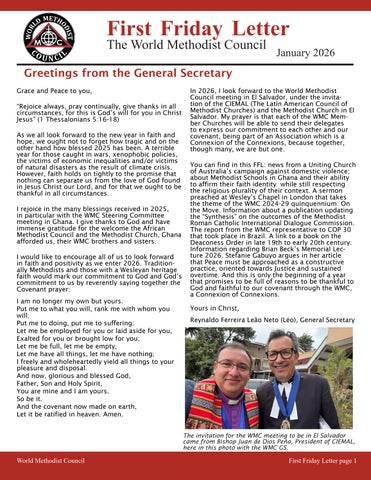
The invitation for the WMC meeting to be in El Salvador came from Bishop Juan de Dios Peña, President of CIEMAL, Photo 136007839 © Kabayanmark here in this photo with the WMC GS. | Dreamstime.com
World Methodist Council
First Friday Letter page 1
From the General Secretary’s Diary “While they were in Bethlehem, the time came for the baby to be born, and Mary gave birth to her firstborn, a son. She wrapped him in cloths and placed him in a manger, because there was no room for them in the inn.” (Luke 2:6 and 7)
I was able to visit the Tent of Nations Farm in November 2025. That was during my trip to the Palestinian Occupied Territories for the launch of the Kairos Palestine 2 Declaration. All of this took place in Bethlehem. (see report in December FFL). My Advent season and my Christmas Carol singing were further deepened by this experience of being with Daoud, the Nassar family and their church community in Bethlehem, the Lutheran Church of the Christ born in the rubble.
of Nations Farm there is neither electricity nor running water, they are not allowed. Also, they are not allowed to build any buildings on the Farm. Bethlehem is in Area A of the West Bank, meaning it is under the Palestinian Authority control as per the Oslo Accords. But, in fact, the area is under Israel overall military occupation, checkpoints are in operation, and there is strict control and restriction over Palestinian people’s movement. This creates a complex situation of nominal Palestinian rule overlaid by Israeli military imposed occupation. This implies limited Palestinian sovereignty and restricted access for residents and tourists. The staff of the Methodist Liaison Office Jerusalem made sure I could get to places. In a particularly tense moment, we thought we were in trouble with the military but that is a story for another time. The 2025 World Methodist Peace Laureate is H.E. Dr Fatou Bensouda. Somehow linked with the struggle of the Nassar Family. As the International Criminal Court senior prosecutor, Dr Bensouda put pressure on Israel regarding issues related to the occupation. Dr Bensouda was sanctioned by the USA and was under surveillance by the Israeli secret service. The World Methodist Peace Award is a recognition of the contributions of the Peace Laureates to the cause of Peace.
The Nassar Family received the World Methodist Peace Award in 2017 for their life, work, and witness through the Tent of Nations Farm. For holding onto peace when everything around them spells out violence. The Farm is on a hilltop, 100 acres of land, southwest of Bethlehem. They are surrounded by illegal Israeli settlements. The family has been under massive pressure to give up the farm and move away. They have appealed to the Israeli courts of justice, but justice has been denied or delayed. More recently, Israeli colonial settlers set camp right on the border of the Farm, directed cameras at them, and walk carrying arms in daylight, a threatening presence. The farm is now divided by roads, preventing the Nassar family from accessing some of their own land. The access road to the farm is blocked. The route available to reach the farm is tortuous and it takes longer. The Israeli colonial settlements in the surrounding hills are all lit and built up. There is a school for the settlers’ children. All of this, of course, in illegally occupied land. But for the Tent World Methodist Council
Daoud Nassar and nativity scene in a repurposed cave house, they are not allowed to build in the land. More on this, in the Guardian article in the link here! First Friday Letter page 2
We Believe in One God: 60 years of Methodists and Catholics walking together “A record of hope and a call to deeper communion” ‘We believe in One God’ is the title of a new publication by the Catholic Church and the World Methodist Council, detailing progress made over the past six decades towards full visible unity between the two Christian world communions. Printed by the Vatican Publishing House as part of an ecumenical series, the volume draws together the results of 11 reports produced by the Methodist-Roman Catholic International Commission (MERCIC) since their formal dialogue began back in 1967. These reports, named after the cities in which they were presented to the World Methodist Conference, explore topics such as baptism, holiness, Scripture and tradition, Eucharist, nature and mission of the church and the call to visible communion. In the preface, the new volume, compiled by the joint commission with the assistance of the Vatican’s Dicastery for Promoting Christian Unity and the Methodist Ecumenical Office Rome, defines itself as “both a record of hope and a call to deeper communion.” During the year in which Christians mark the 1,700th anniversary of the Council of Nicaea – the first attempt to reach consensus amongst the early Christian communities – the publication is designed as “a gift to all the churches, as they affirm their faith in the Triune God and reflect on the next stages of the quest for Christian unity.”
of preaching the Word.” Significantly, they reaffirm that both Methodists and Catholics “welcome one another to attend their celebrations of the Eucharist” and although they are not in agreement over admission to Holy Communion, they encourage believers “to make the fullest use of the provisions in their ecumenical legislation.” Other issues, including the ordination of women, samesex marriage, contraception and abortion, are raised in a thoughtful way, highlighting the need for further study in order to find paths forward to a deeper consensus. In recommitting to the dialogue and reaffirming a “confidence in God’s providential leading,” the new publication provides a summary of the fruits of the past 60 years, while offering important signs of hope for the future of the ecumenical journey. The document can be download from the website of the Methodist Ecumenical Office Rome: https:// meorome.org/2025/12/10/we-believe-in-one-god/ “We Believe in One God: 60 Years of Methodists and Catholics Walking Together,” ISBN 978-88-266-1052-8, €18.00, Libreria Editrice Vaticana, www.libreriaeditricevaticana.va Article by: Rev. Matthew A. Laferty Director, Methodist Ecumenical Office Rome
Fostering mutual respect and trust Central to understanding the Methodist-Catholic dialogue is the fact that there is no history of formal separation between these two churches, with Methodism dating its origins as a revival movement within the Church of England in the mid-18th century. Nevertheless, as the publication reveals in its nearly 90 pages, “division is real,” requiring “healing of memories, acknowledgment of past wrongs and the retelling of histories to honour victims and foster mutual respect and trust.” “The language of ‘We Believe in One God’ seeks to do exactly that, setting out in a clear and concise way, the many shared convictions on Trinitarian faith, on the nature and mission of the church, and on the foundations for living a holy Christian life, as well as remaining differences of perspective. While not shying away from the difficult questions of doctrine, the sacraments or the structures of authority and decision making, the authors stress that “we have much to learn from each other’s structures of oversight.” On the central question of the Eucharist, they note that there has been “remarkable convergence,” with Methodists increasingly “recognising that the Lord’s Table belongs to the fulness of Christian worship, while Catholics are appreciating the fundamental importance
World Methodist Council
First Friday Letter page 3
Methodist Participation in COP30 My participation in COP30 was a deeply meaningful moment, both personally and for the Methodist Church. Being present at this global gathering — which brings together people from all nations to discuss the climate crisis — reinforced the urgency of expanding our work as a faith community committed to justice, creation, and life. COP is a vibrant movement of people, cultures, and organizations united in search of solutions for the planet. It is essential that Methodists and Wesleyans are represented in this space, where global decisions are shaped and where the presence of faith communities has a real impact on building more sustainable, ethical, and humane pathways. One of the most significant moments for me was a meeting held at the Lutheran Church, bringing together ecumenical representatives from different parts of the world. During this gathering, we focused on three essential questions for those working in climate justice: Where are we now? Where do we want to go? And how will we get there? Divided into groups by nationality, we shared experiences, listened to one another’s stories, and built common perspectives on the role of religious traditions in this process. It was a moment of communion, deep reflection, and collective commitment, reaffirming that faith can — and must — act as a transformative force in the face of the climate emergency. I also attended the TAPIRI meeting, a space for dialogue among Brazilian and Latin American communities, especially those living in the Amazon region. There, Indigenous peoples, quilombola communities, riverine populations, and several religious organizations
The photo captures this broader context: the vastness of COP, its opening, and the vibrant movement of people, cultures, and organizations united in search of solutions for the planet. World Methodist Council
discussed ways to protect the forest, strengthen local economies, and ensure dignified livelihoods for the communities that keep the Amazon standing. TAPIRI focuses primarily on Brazil and the Amazon, but its reach extends throughout Latin America and the Caribbean. I firmly believe that the participation of Methodists in this group is essential, as it enables us to contribute with proposals, support community initiatives, and work alongside those who are most directly protecting creation. Finally, my experience at COP30 highlighted something I consider urgent: the need to place environmental health at the center of climate justice discussions. We must develop strategies for prevention and for rapid health response in the face of the climate-related disasters that are already happening — severe droughts, intense rainfall, heatwaves. Environmental health is an area in which we, as Methodists, can offer significant contributions, bringing knowledge, community engagement, and practices that promote dignity and the protection of creation. COP30 reaffirmed my commitment to this mission. I hope that together, as a Church, we can continue advancing in this urgent calling for our time. Article by: Prof. Dr. Márcia Amorim, Belo Horizonte, Brazil
The photo reflects one of the most significant moments for me: the meeting held at the Lutheran Church, bringing together ecumenical representatives from different parts of the world.
First Friday Letter page 4
No Man’s Land: The International Methodist Deaconess Movement No Man’s Land: The International Methodist Deaconess Movement, 1874-1918, by Rev. Prof. Priscilla Pope-Levison, past participant in the Methodist-Roman Catholic International Commission, is a groundbreaking study of the international characteristics of a remarkable but largely forgotten women’s movement of Methodist deaconesses. Pope-Levison has carefully curated archival resources–vivid vignettes, striking photos, and intimate personal diaries–to offer us, not just an historical overview, but an encounter with the women who left their homes in Australia, Great Britain, Canada, continental Europe, New Zealand, the Philippines, and the United States, to don the black dresses, distinctive bonnets, and sturdy shoes of a burgeoning movement dedicated to serving those ground down by suffering, sickness, poverty, and addition.
World Methodist Council
This is not just any book. It is an experience that captures the lost lives of women who visited in tenements, waited on train platforms to welcome young boys and girls arriving alone, who nursed and preached and taught and fed. Deaconesses carved out a precarious existence in no man’s land–neither fully clergy nor fully laity–that nonetheless galvanized an international network of Methodist women. Click here to purchase the book! Article by: Rev. Prof. Priscilla Pope-Levison Research Professor of Practical Theology
First Friday Letter page 5
The Holy Refugee Family Hebrews 2:10-18 & Matthew 2:13-23 Theme: The God who stands with those on the Move: the vulnerable, the economic migrants and the refugees The readings we hear through carol services always come to an end when the picture is still acceptable – when the baby has been born, and the shepherds and wise men have come and marvelled at him – and presented their gifts. Today from the gospel according to Matthew, we have heard what happened next – and it does not make comforting reading. Perhaps having heard it, you are now longing for the cosy warm feelings of Christmas to return – but this might just remind us that the birth of Jesus was itself not cosy or comfortable. Christmas card images of an idyllic Mary and Joseph looking lovingly at a tranquil clean baby with straw made to look like the softest of pillows, can easily distract us from the facts. But he was born in an occupied land, outside a civilised inn, possibly in a place designed for animals - and from the moment he arrived in the world, he was not safe. Matthew rather characteristically is at great pains to convince his Jewish audience that Jesus was the promised Messiah. He does it by making links between Jesus and prophecies contained within the Hebrew scriptures. Sometimes the links seem rather contrived – but they do nevertheless show how the early church made the connections. The passage has many allusions to Hebrew scripture but within it are three actual quotations from that scripture. The first is from the prophet Hosea. Matthew quotes the words of God spoken through the prophet, “Out of Egypt I have called my son”. The rest of the passage in Hosea actually reads “When Israel was a child, I loved him, and out of Egypt I called my son”. It was a reference to God saving his people from their slavery in Egypt – the story of the exodus – and actually nothing to do with the promised Messiah. So this is an example of Matthew manipulating scripture to make it prove his point. Yet there are interesting connections. When the Jewish people were enslaved in Egypt, they were oppressed by the king of Egypt – the Pharaoh. He was so determined to limit the numbers and the power of the Jewish people that he decreed that every boy born to them should be thrown into the Nile and drowned. One male child of course was saved – Moses - hidden in the bullrushes and then brought up as if he was the son of Pharaoh’s daughter. And here in Matthew’s account – another Jewish male child is saved from a king intent on killing Jewish children – not the Pharaoh this time, but King Herod. Both kings were threatened by the potential power of the Jewish people. Both resorted to draconian measures to try to solve the problem and both failed
World Methodist Council
to eliminate first Moses and then Jesus. Egypt too was a common denominator in these events – Moses bringing the people out of their oppression in Egypt, and Joseph, Mary’s fiancé, fleeing to Egypt to keep his family safe. And so Matthew quotes: “out of Egypt I have called my son” – referring to the time when it was safe for Joseph to bring his family back after Herod had died. You might be wondering what this little foray into connections across centuries of biblical history has to do with us. Well we live in a world where fleeing from danger is an ever-present reality. Small boats, crossing he English channel have become a familiar sight on news reports that it is easy to forget what may have happened before each person wades through cold sea water from a beach in Calais and clambers onto a flimsy dinghy with no possessions and no security and no guarantees of welcome or status even if they make it to the other side of the English channel. This is not an easy choice – this is desperate. Yet each person is seeing even that desperate journey as a better choice than the situation they have left behind in their home country. It is perhaps hard to imagine what instability, poverty, conflict, persecution or danger they have already faced before reaching those insubstantial boats. People are fleeing from danger all over the world and having to start again from nothing – in places they have often not chosen. How do you start to feel you belong when almost every decision about your future is taken away from you? How can you settle and start to live again when you are constantly fearful of violence fuelled by prejudice? Refuge is meant to be about safety and yet refugees in today’s world often struggle to find real safety. And from the very start of his life, Jesus went through the same experience, escaping a death threat and living his earliest days in a land that was not his own, being part of a refugee family. The incarnation that we have just celebrated again is all about God’s identification with human beings – and here at the very beginning he identified with those on the move, some of the most desperate people on earth. He knew about being a refugee. The second of Matthew’s quotations comes from the prophet Jeremiah. After Joseph had escaped and taken his family to safety in Egypt, Herod carried out the threat that Joseph had been warned about in his dream – and killed all the children in the vicinity of Bethlehem who were two years old and under. This, said Matthew, fulfilled Jeremiah’s words : “A voice was heard in Ramah, wailing and loud lamentation, Rachel weeping for her children; she refused to be consoled, because they are no more”. Rachel, as mother of Joseph and Benjamin, was the ancestor of the northern tribes, the tribes who later were taken into exile in Babylon. Continued on next page...
First Friday Letter page 6
The Holy Refugee Family continued... In the book of Genesis it is recorded that Rachel died when she gave birth to Benjamin, so she wasn’t alive actually to weep over the tribes that developed from her children. Jeremiah is therefore referring in a rather poetic way to the general sorrow of the nation because of the exile. Again it might seem that Matthew is manipulating scripture for his own ends – but again there are connections. Rachel’s weeping was for whole communities, and she refused to be consoled. Often at Christmas we look for consolation, so we only listen to half of the story. We love to hear about how the clever old wise men managed to trick Herod by disappearing in a different direction so that he couldn’t get his nasty little hands on Jesus. And that can make us feel good. But after they had departed, and Joseph took his vulnerable family into safety in Egypt, there was a whole community left behind in Bethlehem – a community which was devastated by the wanton destruction of their young children. I am sure that the parents of Bethlehem were inconsolable when their children were removed by force and then killed just as the Jewish parents must have been inconsolable when their children were destroyed in Egypt. And it was all done just because these leaders the Pharaoh in Egypt and now Herod – felt threatened. Christmas is not always the warm, cosy celebration we might all want it to be. So many images surround us on cards, decorations, in the shops and on the television, of Christmas as the time of happy families. But what about people who have just spent their first Christmas alone – having experienced bereavement this year, or those whose families have been devastated by accidents or disasters? What about those who are facing separation from people they love. What about people who feel they have lost their loved ones to Alzheimer’s disease, or dementia, or paralysis, or deep-seated misunderstandings? What about those who have been made redundant? When you feel that the rest of the world is happy and healthy and enjoying themselves – Christmas can, at best, be an ordeal that has to be survived, and at worst, a time of real pain and longing for a different life. The community into which Jesus was born, knew about suffering as they mourned their loved ones and could find no consolation. There is no pretence here that the pain was not real – no shutting of hearts to the tragedy that befell that community. And that again is surely what the incarnation is all about. God has come into the world to stand alongside humanity in every one of its experiences. As we heard from the letter to the Hebrews “since therefore the children share flesh and blood, he himself likewise shared the same things”. We might all long for a time when, as the book of Revelation predicts, “mourning and crying and pain will be no more”, but, until that day, we have to find ways of living with it. And I cannot see how that would be possible without a powerful conviction that God knows what it is like too – that he
World Methodist Council
suffers as we suffer – and that he leads us through suffering to a new understanding of his grace and his greater purposes. So through the flight of Joseph and the family into Egypt and the words of Hosea, we find God in Jesus identifying with people who are refugees. And through the massacre of the innocent children and the words of Jeremiah, we find God in Jesus identifying with those who have lost the people who matter most to them. The final passage quoted by Matthew here is rather more puzzling. Matthew recounts how Joseph returned from Egypt – not to his home region of Judea, where Herod’s violent son was now ruling, but to the district of Galilee which was under the authority of another of Herod’s sons, who was reputed to be a much better king. And there he settled in Nazareth. And all this, said Matthew, was in order to fulfil the scripture “he will be called a Nazorean”. The problem we have is that there is no such reference in the whole of the Hebrew bible! In fact Nazareth is not mentioned at all. Various suggestions have been made to solve this puzzle. It was possibly a play on words. The Hebrew word for ‘branch’ is ‘nezer’ – which could sound similar to ‘Nazorean’. So perhaps this was a reference to Isaiah’s prophecy about a branch that would grow from the stump of Jesse. So it may have been a reference to Jesus’s line of descent – emphasising that he was rooted in real human history. Whether or not that was Matthew’s meaning – the sense of this remains the same. Jesus was a normal man – growing up in an unexceptional town. He had a lineage, and he was part of a community, with a language and customs and a religious faith. He was subject to the cultural norms of that time and place. So again we see how he came into real human history, identified with real human history and transformed real human history. Matthew’s echoes from the past help us to focus today on anyone who has ever sought refuge, those on the move and on all people who suffer. It help us to remember how God came into the down-to-earth reality of human life. The God who stands with those on the move: the vulnerable, the economic migrants and the refugees. It is because of the incarnation that we have the confidence to find joy and light even in the midst of all the difficulties that human living can bring. The incarnation of Christ informs all our living, all our relating, and all our responding to the God who came amongst us. This is the season of wonder and joy and glory – Hallelujah! Amen. Sermon preached at Wesley’s Chapel, London by: Rev. Dr. Claire Potter
First Friday Letter page 7
You are warmly invited to join us either in-person or online for the second Brian E Beck Memorial Lecture on Thursday 22 January 2026. For further information and to register, either in-person or online, please CLICK HERE World Methodist Council
First Friday Letter page 8
Living the Call to Peace in Unsettled Times At the dawn of 2026, we are invited to pause and reflect on peace: on whether it continues to speak as a Christian calling, and on how that calling might be carried with integrity in a world shaped by enduring conflicts, crumbling norms, and ever-deepening polarisation. Efforts toward peace unfolds among multilateral institutions under intense pressure, and within religious narratives often drawn into political struggles over authority and legitimacy. In such a landscape, peace cannot be merely the absence of violence, but must be approached as a constructive practice, oriented towards justice and sustained over time. Recent ecumenical meetings have drawn attention to the urgency and fragility of this calling. In October, the International meeting “Daring Peace”, convened by the Community of Sant’Egidio, brought together religious leaders and moral witnesses from multiple regions and traditions, reaffirming peace as a relational process – formed through encounter, sustained by memory and nourished by moral imagination. In December, representatives of churches, institutions, and ecumenical partners gathered under the Conference of European Churches to reflect on ways religious language can be drawn into the logic of security and power, and used to justify domination and war. Emerging from different geopolitical settings, both gatherings arrived at a similar recognition: peace depends on forms of formation that can resist ideological capture, rather than on words or declarations alone.
In this spirit, the World Methodist Council, through the Youth and Young Adult Committee is strengthening connections between Peace Award Laureates and its peacebuilding formation programme. An online learning programme planned for early 2026 will bring Dr. Bensouda into dialogue with youth and young adults engaged in peacebuilding across diverse contexts. The programme reflects an understanding of peacebuilding as a long-term formative process— one that cultivates theological literacy, ethical discernment, and responsible public faith. Nominations for the 2026 World Methodist Peace Award are now open. Nominate someone today by clicking here! The award honours individuals and institutions whose witness demonstrate courage, creativity, and consistency in the pursuit of peace, justice, and reconciliation. To nominate a candidate is to affirm that the Church continues to believe peace can be formed, taught, and lived—faithfully and credibly—in every generation and within the realities of contemporary international life. As the Council looks toward its gathering in San Salvador in August 2026, the invitation remains clear and timely: to lift up witnesses whose lives make visible the costly hope that peace, grounded in justice, remains possible. Article by: Ms. Stefanie Gabuyo, WMC YYA Committee Chair (Co-ordinator)
This conviction stands at the heart of the World Methodist Council Peace Award, and was articulated with exceptional clarity by Dr. Fatou Bensouda, the 2025 Peace Award Laureate. In her acceptance address, Dr. Bensouda affirmed that “peace is not merely the absence of conflict, but the presence of justice,” emphasising that peace “is built brick by brick on the foundation of justice.” She warned against approaches to reconciliation that defer accountability for the sake of expediency, noting that “peace without justice is fragile,” while justice—however slow and contested—remains peace’s true safeguard. Her witness resonates deeply with Wesleyan tradition, which refuses any separation between personal holiness and social holiness, or faith from public ethical responsibility. Peace, in this vision, is neither quietism nor naïve reconciliation. It is an ongoing practice of truth-telling, resistance to impunity, and commitment to human dignity within complex political realities. As Dr. Bensouda affirmed, “justice, when practiced earnestly, is not an obstacle to reconciliation—it is its very heart.”
World Methodist Council
WMC President, Bishop Debra (left) and WMC Youth and Young Adult Co-Ordinator, Stefanie Gabuyo (right) at the Sant’Egidio meeting.
First Friday Letter page 9
School at Centre of Constitutional Debate Mr Osman, however, said that although founded as a mission school, because it received state funding for the provision of education it could not impose a “religious programme” on non-Christian students without violating constitutional rights. The court is being asked whether publicly-funded mission schools should be allowed to require students to follow a specific religious ethos or doctrine and how the state should balance respect for a school’s founding religious character with its constitutional duty to protect the religious rights of minority students. Mr Osman also wants the court to order the Government to publishes a national policy or guideline to ensure more inclusive practices in public schools. The school is being supported by the Ghanaian Roman Catholic Bishops’ Conference and the Christian Council of Ghana.
Students from the Wesley Girls’ senior high school in Cape Coast, operated by the Methodist Church of Ghana. (Photograph: High Schools Society of Ghana.) A Methodist school on Ghana’s Cape Coast is at the centre of a national constitutional debate after a human rights lawyer challenged its Christian ethos. Shafic Osman is suing the school and the state’s Ghana Education Service (GES), claiming that the school’s “institutional faith” regime amounts to a “no Islam” policy. Ghana Supreme court Justice Gabriel Scott Pwamang has given Wesley Girls’ senior high school (WGSH) and GES gave a deadline in December to file their response to claims that the school’s “institutional faith” policy breaches the country’s constitution. Mr Osman argues WGSH’s policy is in breach of constitutional freedoms of thought and conscience and of practising any religion. He says the school also breaches non-Christian students’ right not to be discriminated against on the grounds of religion as well as the prohibition against state or public institutions imposing a religious programme. Central to the dispute is WGSH’s “expectation” that students and staff should “adhere to, or not to conflict with, its ‘institutional faith’ policy” Mr Osman said. The policy is said to include compulsory Methodist worship and limits on non-Christian religious expression, including a ban on wearing the hijab, fasting during Ramadan and engaging in Islamic worship or prayers. Ghana’s Attorney General, Dr Dominic Akuritinga Ayine, supports WGSH, saying that it was “established and operated under the Methodist Church of Ghana (and) is entitled to maintain rules consistent with its Methodist heritage and doctrines”. He said that the constitutional protections of freedom of religion meant that the school’s “faith-based identity grants it the authority to establish standards on religious conduct within the school environment, even where such standards limit the expression of other religious practices”.
World Methodist Council
In a joint statement, the two groups said that national debate created by the case reflected a misunderstanding of the history and purpose of mission schools. They said that the schools were established, owned and operated by Churches long before the modern state of Ghana existed. Receiving financial support from the Government did not grant the state authority to redefine their identity, they argued, adding that parents made a voluntary decision to send their children to mission schools for their discipline, moral training and academic performance. “It is unfair to expect these schools to dilute their Christian character when numerous public, private and Islamic schools exist,” they said in the statement. A Ghanaian intelligence analyst specialising in international conflict management and peace building, Mustapha Bature Sallama, described the case as “a crucial moment for religious freedom in Ghana”, adding: “On one side, the right of a mission school to maintain its Methodist heritage and institutional faith; on the other side, the fundamental rights of students including minority religious students, to freely manifest their beliefs. “Ultimately, the outcome could reshape how Ghana handles religious accommodation in schools, potentially leading to more inclusive policies that respect both the identity of mission schools and the rights of individual students.” Ghana was founded in March 1957 when the area that had previously been known as the Gold Coast gained independence from British rule. More than 71 per cent of the population are Christian; Muslims account for another 20 per cent. Wesley Girls’ senior high school was founded in 1836 by Harriet Wrigley, who arrived in Cape Coast that year with her husband, the Rev George Wrigley, as Methodist missionaries. In its founding year, the school had 25 girls; today it educates 1,700 girls. This article first appeared in the “Methodist Recorder”, an independent, weekly newspaper published in Great Britain
First Friday Letter page 10
Gender-based violence ‘against the will of God’ The President of the Uniting Church in Australia, the Rev Charissa Suli, joined voices from across Australia, New Zealand and the Pacific in a united message for the international 16 Days of Activism against Gender-Based Violence, that continued through December 10. Inspired by the 2025 global theme for the 16 Days —”End digital violence against all women and girls” — the Uniting Church recorded a video message featuring a variety of people taking part in the President’s Conference on the Tongan island of Tongatapu. Mrs Suli introduced the video, saying: “The 16 days of Activism against Gender-Based Violence calls us to remember who we are: followers of Christ called to create communities where all are seen and safe. “This year we turn our hearts towards a digital world where connection holds great promise and deep pain. We are challenged to confront harm in the places we connect most and to weave a digital world that reflects the love and justice of God.”
“Love speaks in the face of harm. Love protects and love restores. Jesus stood with those the world tried to shame. He saw those the world rejected. He saw their dignity. If Jesus did this, so must we. “We are called to build communities, online and offline, where safety is sacred and people can be their true selves without fear, to teach our children that words can heal. Together, we can weave a digital world that reflects God’s love.” Mrs Suli added: “The 16 days of activism challenges us to act, to be love made visible in word, in witness and in the world we build together. In every post, every word, every click, may we choose goodness. May our online spaces be places of collaboration, creativity and community and may we end digital violence against all women and girls. May the light of Christ guide us to create communities of safety, dignity and love, online and everywhere. Until every person knows they are seen, valued and free.”
The video’s contributors then say: “Every person bears the image of God. No one is disposable. No one is invisible. In today’s world, our lives are deeply connected through screens and stories. Online, we learn, laugh, share and seek belonging.
On its website, the Uniting Church said: “We affirm that gender-based violence, like all violence, is against the will of God. We are committed to advocating for a Church and world where all may flourish in equality, safety and respect.” Gender-based violence is one of Australia’s most significant social challenges.
“However, the same spaces that connect us have also been used for harm. Words have been weaponised, images stolen and people hurt and isolated.
On average, one woman a week is murdered by her current or former partner and one in four women has experienced violence, emotional abuse or economic abuse by a partner since the age of 15.
“Digital violence is real violence. It wounds hearts, breaks trust and steals the future from some women and girls. Behind every hateful comment, every threat, every invasion of privacy, there is a person beloved by God.
This article first appeared in the “Methodist Recorder”, an independent, weekly newspaper published in Great Britain
Participants at the Uniting Church’s President’s Conference in Tongatapu call for an end to digital violence against all women and girls. (Photograph: Uniting Church.) World Methodist Council
First Friday Letter page 11
ID 252909336 | Christmas Advent © Manaemedia | Dreamstime.com
In 1755, John Wesley introduced the “Covenant Renewal Service” which took place in London, here is his statue at Methodist Central Hall Westminster.
Please send press releases, articles and resources! Submissions should be a page around 500 words, edited and ready to publish. Contact us by Friday, 23 January at communications@worldmethodistcouncil.org if you would like your story to be included in the February edition of the First Friday Letter.
On the Web
About the First Friday Letter
This and past First Friday Letters can be found online at FirstFridayLetter.worldmethodistcouncil.org.
The First Friday Newsletter is a monthly publication of the World Methodist Council.
The World Methodist Council’s website may be found at worldmethodistcouncil.org. Publisher: Rev. Dr. Reynaldo F. Leão Neto, General Secretary To subscribe to this newsletter, please email communications@worldmethodistcouncil.org.
Communications: Michaela Bryson All stories and photos, unless otherwise stated, are protected by their respective copyrights. Please do not copy without expressed written permission from the Council.
Follow the Council on social media!! YouTube
@worldmethodistcouncil
World Methodist Council
Facebook @World Methodist Council
Instagram @wmcouncil
First Friday Letter page 12