Chapter One: His Time and His Life in the Twentieth Century
1 His Time
The first half of the twentieth century is a period filled with turmoil and upheaval; behind the disturbance it also contained and accumulated various potentials Especially after 1905, the end of the Imperial examinations — which was key to forming the class of scholar-bureaucrats — many intellectuals became the “floating resources” for society Although they could never practice the Confucian ideal through the traditional political system, the intellectuals still tried to enlighten the public wisdom in many ways Some of them published journals to introduce new concepts from the culture of the West, and some began to study Western art Most of the scholars/intellectuals believed Western civilization obtained its power from its cultural mores Thus, they expected they could use the Western nutrient to raise the weakened China from the dead
Michael Sullivan wrote, “After 1900, and far more rapidly after the Revolution of 1911 overthrew the Manchus, Western art came to be seen by many as the expression of all that was useful, progressive, and outward-looking Since that time, art in China has been one expression of a huge dialectical struggle — or rather two struggles: between Chinese and Western culture, and between tradition and modernization ”5 Sullivan focused on “the Impact of the West” in Chinese art from 1900 to 1937 But I think this explanation of the traditional Chinese painting from the perspective of politic is a stereotype 6
A well-known example can be found in You-wei Kang’s (1858-1927) preface to his book “Collections of Wan Mu Cao Tang ” In this, he found Western realistic painting to be more valuable than traditional Chinese painting He also concluded that literati painting weakened the skill of painters and led to the end of Manchurian Qing . 7
However, Si-zeng Chen (1876-1923) seemed not to agree with Kang’s discussion In his book entitled, “The Value of Literati Painting ”8 Chen claimed the conservative Chinese literati painting, which does not seek realism as valuable and is criticized by Kang, is respected by the modern Western artist
5Michael Sullivan, Art and Artists of Twentieth-Century China, Berkeley: University of California Press, 1996, 4 .
6Ibid
7Published in 1917
8Published in 1922
specifically for its lack of realism, but also for its dedication to the idea of the subject In fact, Chinese literati painting has its own special context
Much has been written about Chinese literati painting by scholars in the West and East 9 By combining theoretical approaches with historical materials and the works of literati painters, scholars have attained a new understanding of the development of literati painting and its influence on Chinese art history throughout the centuries Silbergeld, for example, by studying the literati paintings during the beginning and end of the Yuan Dynasty, the end of the Ming Dynasty, and the beginning of the Qing Dynasty, opines these literati painters were either adherents of the former dynasty or officials loyal to the sovereign Regardless, they used literati painting to express opposition to the political trends of the time, and their paintings were intimately linked to their chosen ethnic identity Thus we can use this context of ethnic identity to examine the political loyalties of these literati painters 10
The conditions of the literati painters in the twentieth century, however, were perhaps even more complex than the situation of literati painters in Imperial China Beginning in the middle of the 19th century, the Qing Dynasty began to experience a series of setbacks at the hands of the Western powers The onset of imperialism and military intrusion was accompanied by concepts and ideas of cultural superiority and thus Chinese inferiority For example, at the beginning of the twentieth century, Chinese intellectuals held divided views concerning the value of traditional Chinese painting Some intellectuals believed the conservative and slavish copying of the Four Wangs (四王) in the early Qing Dynasty was but one sign of cultural and political degeneration and stagnation These intellectuals advocated a renewed emphasis on objectivity and innovation as exemplified by the Western art and thought
Other intellectuals, however, believed in artistic splendor and objectivity, which had been a part of Chinese painting throughout its long history, and that the paintings of the Song Dynasty were most representative of this spirit These intellectuals believed the Chinese should maintain confidence in their own culture and strive to bring out the best essence in its artistic achievements Chinese artistic and cultural production should resist Western cultural intrusion Thus, the history of Chinese painting
9See Ling-ting Chiu, “Art as Opposition: The Development of Chinese Literati Painting in Taiwan during the Cold War Era (1950s-1970s) using the Example of the Seven Friends Painting Association,” presented at Princeton University, U S , 2008
10Jerome Silbergeld, “Chinese Painting Studies in the West: A State-of-the-Field Article” in The Journal of Asian Studies, vol 46, no 4 (1987) Most of the painters and works discussed in this article were prior to the twentieth century
throughout the twentieth century is replete with questions of ethnic identity, a topic addressed by my earlier research 11
In his work entitled, Between Two Cultures, Professor Wen C Fong has provided a rather extensive discussion concerning the cultural encounter and confrontation between the East and West Fong pointed out that modernity is a crucial topic, which must be addressed in discussing the encounter between East and West Fong suggests the analysis of the history of modern Chinese painting requires interpretation of modernity and Westernization Fong also argued the history of modern Chinese painting should be analyzed from a perspective using the sociohistorical and cultural context of China as the point of departure Fong asserts modern Chinese painting should be placed in “the context of Chinese art history, and comparative cultural values ”12
Therefore, it’s difficult to argue that Chinese art in this period developed as a result of influence by the West Rather, I believe it derived its perspective from the “Call of East ” Here, I am referring to Chinese literati painting, which contains not only the skill of ink and brush, but also one’s spirit or mind The Kuomintang government advocated the Three Principles of the People, while the Chinese Communist Party was a steadfast devotee of Marxist-Leninism Thus, the cultural chasm and conflict on either side of the Taiwan straits was intimately connected with the “ism” advocated by each ruling government
From the perspective of “globalization,” the U S . overseas Chinese artists represent different connotations and identities in their interpretation of Chinese ink and brush art The key factors influencing their interpretation might have stemmed from their family background in China, their experience before traveling to the States, and even their individual artistic views Perhaps this is exemplified by I-Hsiung Ju, who once described himself by saying “a Chinese artist is not only a painter, he is also a philosopher and poet ”13
11See Ling-ting Chiu, 2011
12Wen C Fong, Between Two Cultures, New York: The Metropolitan Museum of Art, 2000, 4-22
13See News-Gazette, Lexington, Virginia, Oct 3, 1990
A Early Days in China (1922-1947)
I-Hsiung Ju was born in 1922 (officially documented inaccurately as September 15, 1923), in Jiangyin . Ju described the image of Jiangyin through his mother:
She knew Jiangyin only through what she saw through the cracks of the front door Our front door faced the main street It was formed by many panels, and the two panels in the center could be opened by pulling them inward Every New Year, Spring Festival couplets would be placed on these two panels I remember one such couplet written by my father: “The family fame spreads afar; the humanitarian spirit extends forever ” It tells others that we are the descendants of Zhu Xi The panels could not be closed shut, and through the many cracks in between one could see the going on in the street ”15
About his study during the turmoil period, he wrote:
I was fifteen I graduated from Zheng Cun Academy located on the south side (of Jiangyin) where I learn woodblock carving wit Fu-bao Xu(徐甫堡) In the same year, the war spread to Jiangyin; outraged by the war, I joined a guerilla unit to fight against the Japanese In the following two years, we engaged the Japanese on so many occasions…I was wounded and captured, and escaped; I was displaced to the south of Anhui Province and the west of Zhejiang Province…I believe a second year student in the provisional Provincial Lianhe (United) High School in Zhejiang and learned painting with Duo-ci Sun (孫多慈)…(After I graduated from high school) I traveled by foot to National Xiamen University which had been moved to Changting in the west of Fujian Province and became a college student there I majored in Chinese Literature, but I devoted all my free time to dramatic activities ”16
Here, Ju mentions Duo-ci Sun(1912-1975,孫多慈) and Fu-bao Xu(1913–2004, 徐甫堡) Duo-ci Sun studied painting with Bei-hong Xu (1895-1953, 徐悲鴻), a famous Chinese realistic brush painter, in the
14I have regarded I-Hsiung Ju’s life as “a diasporic journey bound up with the twentieth-century history of China” in the essay entitled “A Shining Oriental Pearl Displaced Overseas ” See Lin-ting Chiu, “A Shining Oriental Pearl Displaced Overseas,” in I-Hsiung Ju’s Landscape Paintings Book III, (Princeton NJ: Art Farm Gallery with the Beard Art Center, Indiana Wesleyan University, 2014, translated to English by Hsieh Yau-ling, 48 Also see the related papers from Ying-shih Yu’s discussion
15I-Hsiung Ju, “Jiangyin Seen through the Cracks of the Door,” in Si Xiang Cao, Taipei: Bookman Press This section translated to English by Hsieh Yau-ling, 2009, 14
16I-Hsiung Ju, Si Xiang Cao, Taipei: Bookman Press This section translated to English by Hsieh Yau-ling, 2009, 308-9
National Central University Fu-bao Xu is a famous writer and artist He once took part in the Chinese National Woodcut Society for Resistance to the Enemy His woodcuts have been published in several newspapers, journals and related collections — such as “Selected Works of Woodcuts for the AntiJapanese War for 8 Years,” “Collection of New China Prints,” and “Selected Works of New China Prints for 50 Years ”
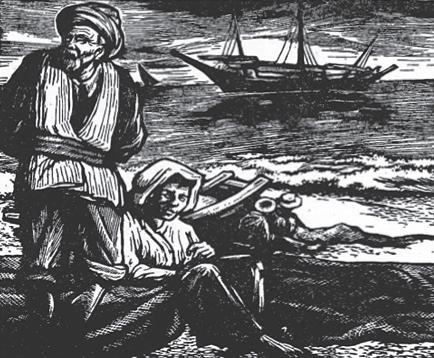
Ju learned his woodcut skills from Fu-bao Xu in 1937, and his painting skills from Duo-ci Sun in 1939 Ju even had some exhibitions in his younger years During the wartime, a young mind like Ju’s might easily be attracted by woodcut work Just as Pearl S Buck said:
It is interesting that the woodcut should be the first, for there is an alliance between the woodcut and the old Chinese wood block print It may be that the young Chinese artists have felt this Practically, however, the scarcity of pigments and oils and canvas has probably had much to do with their choosing this medium 17
Many scholars have noted the relationship between woodcut and propaganda during the turmoil period For example, Elizabeth Enrich stated:
Woodcuts, with their inherent reproducibility, were critical in conveying information to the reading public, and were routinely reproduced in newspapers, books, journals, and magazines during the 1920s and 1930s This was so not only in Shanghai, but throughout China, reflecting patterns of travel and information flow 18
17Pearl S Buck, China in Black and White: An Album of Woodcuts by Contemporary Chinese Artists with Commentary, Asia Press, Inc , 1944, 12
18Elizabeth Enrich, “Modernity through Experimentation: Lu Xun and the Modern Chinese Woodcut Movement” in Print, Profit, and Perception: Ideas, Information and Knowledge in Chinese Societies, 1895-1949, edited by Lin Pei-Yin The Netherlands: Brill, 2014, 64
Ju's woodcut in China
During this period, sometimes woodcut works were also related to the “Avant-Garde” period Xiaobing Tang regarded the “Avant-Garde” as the “National Imaginary ” He said:
In June 1935, Lu Xun underscored the challenges presented to the established aesthetic order by the rediscovered artistic medium and its new cultural associations . Printmaking as a native art went back to much earlier times and had always been associated with popular cultural forms, Lu Xun observed, but the woodcut movement had recently ushered in radically new values and directions By giving expression to “the same inner needs shared by the printmakers and the public,” the modern woodcut served a unique function and had gathered irrepressible energy What the young artists succeeded in expressing through their prints, he claimed, was “the ardent sincerity of an art apprentice, therefore often the soul of modern society;” their impassioned artwork was far from what the traditional literati would appreciate as “elegant” or “refined”(ya), but it could not be dismissed as “vulgar” or “lowbrow”(su) either 19
During the Second Sino-Japanese War (1937-1945), Meng-ou Wang (王夢鷗, 1907-2002), who engaged himself in the study of Chinese and Western literature,20 taught in the Department of Chinese Literature at Xiamen University He wrote dramas for students to act in to earn money for school I-Hsiung Ju and Yi-wei Yao(姚ㄧ葦,1922-1997) were students who attended these activities 21 There, Ju met Ting-shih Chen (陳庭詩), who took part in the Anti-enemy Manga and was a designer for the Ministry of Education 22
Besides paintings and woodcut works, Ju engaged himself in Xiamen University’s modern drama circle, and there fell in love with another member who became his wife 23 His wife, Chow-Soon Chuang, memorialized her first image of him in her memoir:
During my first year I participated in many extra-curricular activities I was chosen for a team of fifteen from Xiada to join the summer camp in Shangrao of Jiangxi Province This camp was organized by the government to gather participants from the universities of the five southeast provinces We rode an army truck to the destination I did not know at first that my Fujian-accented Mandarin had created a story during the trip I was looking for a lost umbrella, but my teammates were helping me look for a lost fan I-Hsiung Ju, also a freshman, was one of the fifteen from Xiada
19Xiaobing Tang, Chinese Avant-Garde: The Modern Woodcut Movement, Berkeley: University of California Press, 2008, 165
20See Chiu Ling-ting & Liao Tung-liang Tiwuchuanshen: Wang Meng-ou on Abstract Conceptualization in Chinese Art, Bulletin of the Department of Chinese Literature National Chengchi University No 22 (2014): 101-131
21See Jane Ju’s interview, July 25, 2018; and Yu Tiancong, “Ta yingxiang le namedou ren: ji nian Wang Mengou Jiaoshou,” in Huishou women de shidai Taipei: Yinke wenxue , 2011, 122-128
22Chuang Cheng-Lin, Sound Paintings, Silent Poems-Ten Pieces of Ting-shih Chen, Taipei: uStory Press, 2017, 63
23See Jane Ju’s interview, July 25, 2018
He wrote up the story and sent it back to be published on the campus wall newspaper We became acquainted because of this incident 24
But Ju wrote in his memoir, he purposefully spilled water on her in a rehearsal so she would notice him
B . Living in the Philippines (1947-1968)
In 1946, Chow-soon Chuang traveled to the Philippines and taught at Chiang Kai Shek High School The next year, Ju came to the Philippines and married his Xiamen college schoolmate First, he taught Chinese literature at the Overseas Chinese Patriotic School and St Stephen’s High School Ju also encouraged and coached his students to participate in drama performances and debates contests 25 After he earned his BFA in Painting from the University of Santo Tomas, he became an art editor of the Great China Press (daily news) in Manila
According to his wife’s book, entitled Popo’s World:
The nationalist government retreated to Taiwan, leaving the overseas Chinese communities more confused Left wing groups became more active even as the anti-communist movement became more fervent I-Hsiung had been teaching at Chinese schools peacefully for years — first at the Manila Patriotic School and later at St Stephen’s High School Now, someone put a red cap on him (call him a communist) Under baseless suspicion by the Philippine-Chinese, he decided to be a artist and avoid political involvements 26
24Chow-Soon Chuang Ju (Hsin-jen), illustrations by I-Hsiung Ju, Popo’s World, N J: Art Farm Gallery Press, 2010, 91
25See Helen Ju’s interview, July 2, 2018
26Chow-Soon Chuang Ju (Hsin-jen), 2010, 96
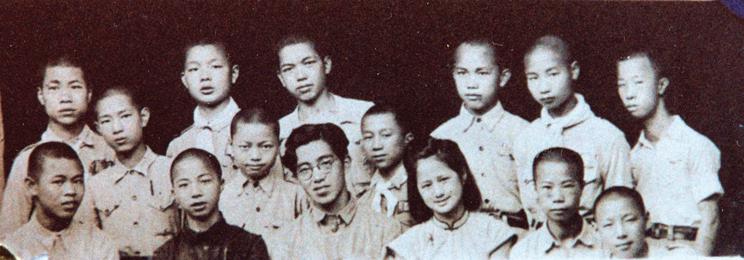
Ju (front row, third from the left) and his wife (fourth from the right)
Ju himself also described the difficult position in his memoir:
In Manila, I was still bent on stage performances, and I produced wood carving works and published modernist poems in newspapers…Since I was making woodcuts, local Guomindang (Kuomintang) party members said I must be a communist because communists had been working on woodcuts in Yenan When I published an essay remembering my home “Si Xiang Cao,” they said I was trying to encourage overseas Chinese to return to the Chinese Mainland One of my woodcuts depicting the fields of southern China showed a peasant woman with a headscarf; they said she must be a Soviet woman and that I was making propaganda for Stalin’s collectivization campaign 27
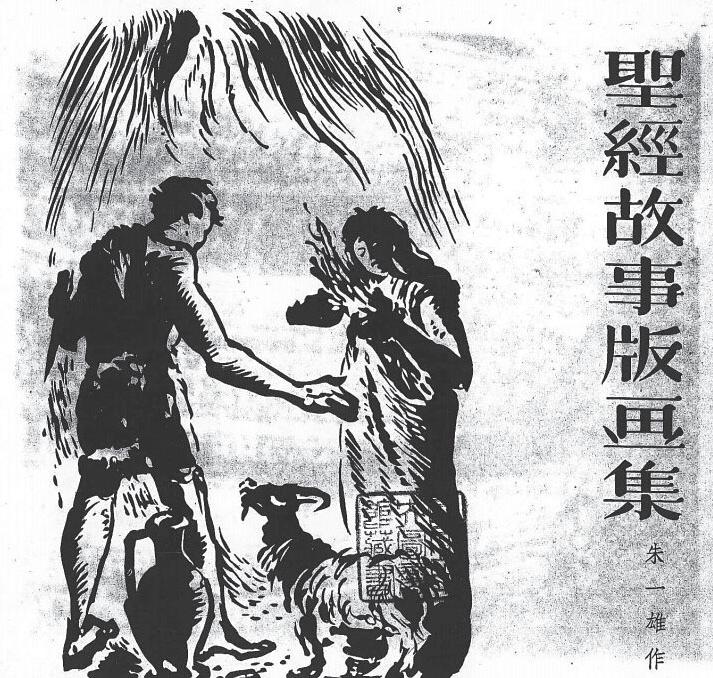
But this precarious position in the Philippines could be regarded as the important shift in his art career In 1954, Ju spent a year creating 90 scratchboard woodcuts for Children of the Light, a book of Bible stories This work seems to arise from his becoming a devoted Christian as a result of his experience during the second Sino-Japanese war
In a story he relayed to his students, he found Christianity when he was only sixteen years old, after a devastating ambush by the Japanese . At the time, he was with of company of guerrilla fighters, and the ambush left maybe 10% of of his company alive As he was the only survivor who could write or work the radio, he became “default leader” despite his young age In an effort to help his men, who were lost and without water or food, Ju climbed a tree to try to see where they were From that perch, he saw a wisp of smoke rising from the forest Making their way down the cliff, the group found a nunnery with the doors open and food on the table as if the inhabitants had just left On the wall in front of Ju was the Bible verse 6 Matthews 28: “Consider the lilies of the field, how they grow; they toil not, neither do they spin ” This overwhelmed Ju as this seemed to say “God will provide,” and He had . This proved to be the inspiration for Ju to turn to Christianity 28
The Bible on Scratchboard (or as Ju referred to it, Children of the Light) was published in 1957 It is in two parts: the Old and New Testament There are sixty-four scratchboards in the Old Testament section beginning with 1 Genesis 3, “Let there be light; and there was light,” and ending with 4 Daniel 20, “O Daniel, ……has your God…been able to deliver you from the Lions?” The New Testament section has twenty-six scratchboards, from 11 Luke 10, “Be not afraid; for behold, I bring you good news of a great joy which will come to all the people,” to 5 Ephesians 8, “…For once you were darkness, but now you are
27See Chi Wei-jan “Lost Blood and Tears in His Autobiography: The Legendary I-Hsiung Ju” in Si Xiang Cao, Taipei: Bookman Press 2009 Pp 328-29 This section translsated to English by Hsieh Yau-ling
28See Michael Kopald’s interview, August 5, 2018
light in the Lord; walk as child of light ”29 Ju’s style of scratchboard is more smooth and peaceful than his earlier woodcuts
In 1955, he became a member of the Art Association of the Philippines (AAP); the next year he was one of the founding members of the Contemporary Artists Club Ju also participated in many art exhibitions in the Philippines
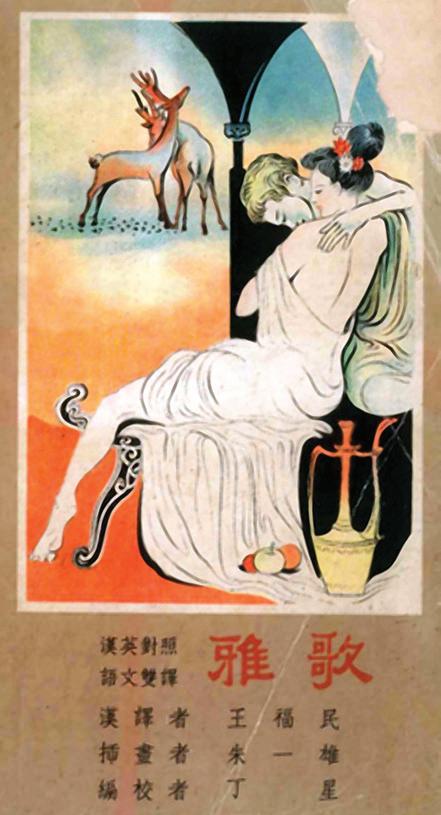
In 1960, Ju’s The Song of Songs was published It was also illustrated, but here the illustrations are colorful and the style is softer and romantic 30 The delicate style here might be related to another famous Philippine artist, Kiukok Ang (1931-2005) Ang and Ju may well have known each other 31 Ang’s parents were immigrants from Xiamen, China He was born in the Philippines and younger than Ju, but they had similar experiences — editing illustrations and active in art circles If we compare the artists’ treatment of biblical subjects, Ju’s linework in The Song of Songs can be seen as more elegant, while Ang’s linework is more powerful
29I-Hsiung Ju, The Bible on Scratchboard, Hong Kong, 1957
30The Song of Songs, Hong Kong, 1960
31See Jane Ju’s interview, May 28, 2018
In 1961, Kwang-chung Yu (1928-2017, 余光中), a famous Taiwanese poet, and another Taiwanese writer Lan Wang (1922-2003, 王藍) visited Ju in Manila Ju took these men along with local artists to travel to the Taal Lake In his essay, Yu mentions, “Tan-Feng (Ju), the modern artist, because of his opposition to sketching, he painted it a bit ”32
In addition to communicating with artists from Taiwan, in the 1950s and 1960s, Ju took his students from the Philippines to Taiwan several times to study Chinese art Of this, Ju wrote, “In those days, Taiwan was still under martial law, so our activities were limited, but our program was still very rich We met many famous masters and learned a great deal from them Back then, Taipei was an old traditional Japanese city and the streets were narrow and dark ”33
During the 1960s period, Ju held several big shows of “Chinese Brushwork” and “Chinese Art ” In 1965, he became a member of the Japanese artist Nanga Society, Tokyo, Japan, and the Philippines-China Friendship Association in Manila The next year, he became a member and director of the Board of the Chinese Literary Workers Association In 1967, Ju taught at the University of Santo Tomas Graduate School and was appointed a faculty member of the University of the East to assist in establishing the
32Kwang-chung Yu, in I-Hsiung Ju’s Essays, Xiamen University Press, 2016, 167-168 33I-Hsiung Ju, “One More Trip,” in Journey to Taiwan, 2007
The cover of Bible on Scratchboard
The cover of The Song of Songs
university’s painting center In 1968, Ju completed his M A in History from the University of Santo Tomas; his thesis was entitled “A Study of the Ancient Chinese Metaphysical Concepts through the Oracle Writing ”34 His adviser was Dr William Henry Scott, who was a historian of the Gran Cordillera Central and Prehispanic Philippine 35 When William Henry Scott translated the “Prehispanic Source Materials: for the Study of Philippine History” in 1984, Ju was listed as the co-translator 36
In his thesis’s preface, Ju wrote:
While (an) author at the National University of Amoy (廈門), China, majoring in Chinese literature, (I) spent most of (my) time in the field of Hsiao-hsueh or Wen-tsu-hsueh which means the study of characters
After coming to the Philippines, as a teacher in Chinese literature and Chinese brush-work, (I) acquired experience not only in teaching non-Chinese Chinese writing but also in teaching them the art of Chinese brushwork (I was) convinced that the artistic value of Chinese characters can be found not only in calligraphically performance but also in the ways the characters were constructed and in their symbolic expression
When (I) took up modern oil painting at the school of Fine Arts (in the) University of Santo Tomas in 1952, (I) learned that today, the modern artists have been very deeply influenced by the philosophy behind Oriental art and that some of them have even established a modern school of painting labeled with a new word “Calligraphicism,” which would mean that their highest aesthetic ideal is the same as that of the Chinese artists 37
Here, we find that Ju tried to connect his training in Chinese traditional culture with Western modern painting These experiences would later guide his creative energy in the United States
C . Teaching in the United States (1968-2012)
Ju began his life in America on a lecture tour on Chinese art at several state universities Washington and Lee University hired him as Artist-in-Residence in 1969 In 1975, he founded his own garden of art — the Art Farm in western Virginia .
34See “Have Brush Will Travel: A Chronology of I-Hsiung Ju’s life,” in I-Hsiung Ju’s Landscape Paintings Book III, Princeton, NJ: Art Farm Gallery with the Beard Art Center, Indiana Wesleyan University, 2014, 76-77
35https://en.wikipedia.org/wiki/William_Henry_Scott_(historian) July 4, 2018
36See Doris Ju’s interview, July 4, 2018, also see https://en.wikipedia.org/wiki/Ma-I, July 4, 2018
37I-Hsiung Ju, A Study of the Ancient Chinese Metaphysical Concepts Through the Oracle Writing, unpublished M A Thesis, University of Santo Tomas, Philippines: Melina, 1968
In 1968, he brought his family to the United States as immigrants He was recruited by the President of the University of Connecticut (U Conn) for his first job in the United States, a lecture tour on Chinese Art at four state universities in New England over the span of a year (The head of the Art Department of W&L, Dr Marion Junkin,) and Jack Warner, of Alabama, a trustee of W&L, admired I-Hsiung’s talent very much Warner not only asked I-Hsiung to make mural paintings for his new office, he also persuaded the Board to grant him faculty tenure I-Hsiung worked hard for the university He promoted W&L with public lectures He renovated the university art gallery and showed works by artists from all over For many years he took students abroad for study, especially the study of Chinese language and painting in Taiwan This program became important and was well known on and off campus 38
At Washington and Lee University, Ju taught basic art classes; e g , Drawing I, Drawing II, Sculpture I and II;39 Painting I and II and Printmaking (silkscreen, etching, lithography) 40 He also taught Western oils and acrylics, Chinese brush painting, etching, and photography 41
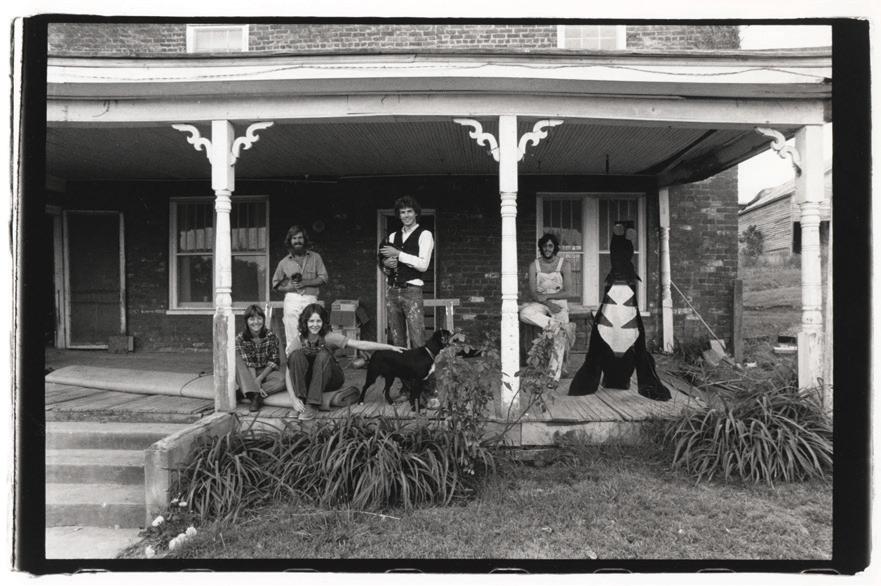
On Feb 6, 1975, Ju bought a piece of land in Lexington, situated in Rockbridge County in the Shenandoah Valley of Virginia’s western highlands, and established the “Art Farm” (Garden of ART, Alphine’s Farm) . Ju’s wife mentioned this idea came to them after the first trip to Taiwan with W&L students to study Chinese art He wanted to find a place for people to come and learn painting and other Chinese arts 42 Mrs Ju noted the “Art Farm” was similar to the Chinese Academy (Shu Yuan,書院):
I-Hsiung taught art courses at the university by day and spent nights with students at the (Art Farm), telling stories and leading discussions We repaired the houses while he taught Chinese brush painting and calligraphy Students and teacher lived together as it was at the ancient Chinese Shu Yuan (academy) We held art exhibitions every month Our workshops introduced the Asian arts and Chinese philosophy They were attended not only by W&L students but also by students from the nearby women’s colleges, by artists, housewives and retired officials from far and near Frequently, regional teachers of oriental painting brought their students to join the painting and cooking workshops for one or two weeks We provided food and beds We had to register and pay taxes as business Needing help, we hired one nephew of mine from China, then another, who were skilled in pasting and mounting scroll paintings The Art Farm became a center of cultural activities Organizations held meetings there Tourists also came 43
38Chow-Soon Chuang Ju (Hsin-jen), 2010, 106
39See Steve Roberts’ interview, July 5, 2018
40See Michael Koplad’s interview, July 9, 2018
41Virginia Lloyd-Davies, “Professor Ju in Taiwan,” in Journey to Taiwan 2007 Also see News-Gazette, Lexington, Virginia, December 26, 2007
42Chow-Soon Chuang Ju (Hsin-jen), 2010, 107
43Chow-Soon Chuang Ju (Hsin-jen), 2010, 109-110
From the view of the local community, the Art Farm was as “an ancient art (thriving) in the new world The ancient art of Oriental brush painting is thriving in modern day Rockbridge County I-Hsiung Ju has brought his art, his philosophy and his dreams of creating an art enclave from China’s Kiangsu province ”44 One of his students mentioned, “He (Ju) wants to see artists grow like grass, that’s why he called it the Art Farm ”45
44See New-Gazette, Lexington, Virginia, November 11, 1987
45See Susan Phillips, “Chinese culture, philosophy blend in art workshops,” Lynchburg, VA, THE NEWS, August 26, 1984
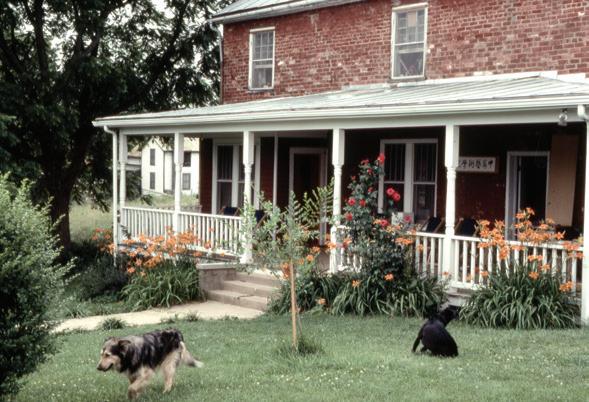
The Art Farm, photograph by Michael Kopald
The Art Farm
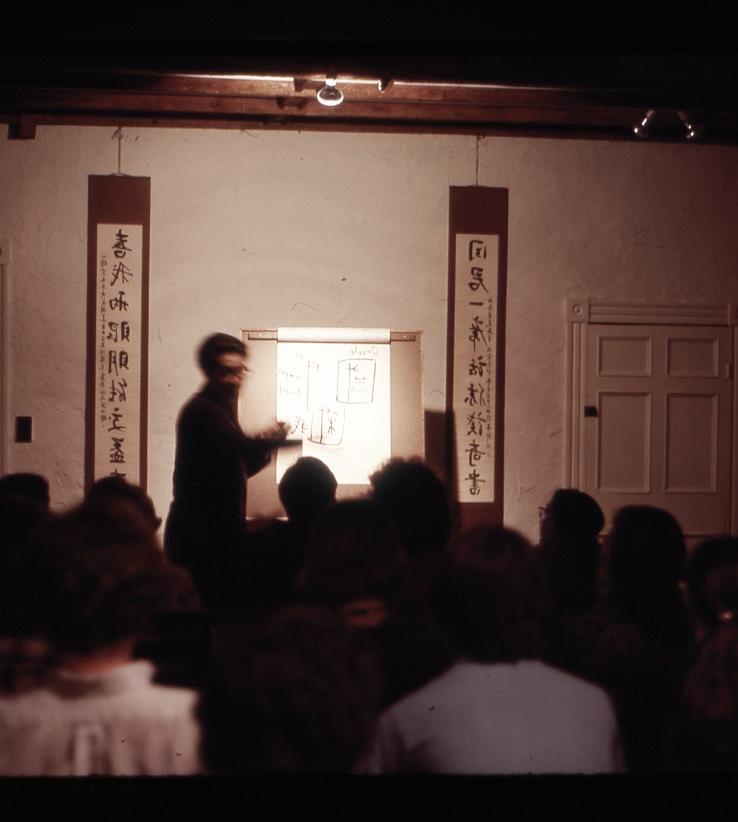
Ju’s lecture in the Art Farm
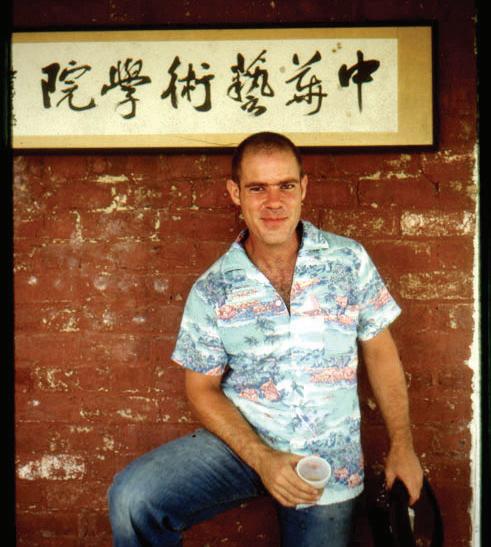
The horizontal tablet of the Art Farm and Michael Kopald
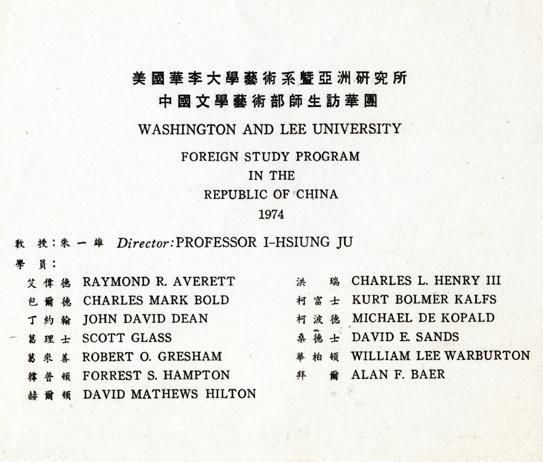
The members of the Art Trip to Taiwan in 1974
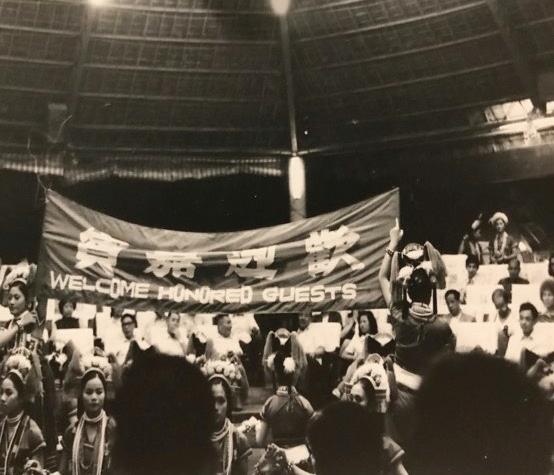
Welcome performance W&L’s art trip to Taiwan in 1974
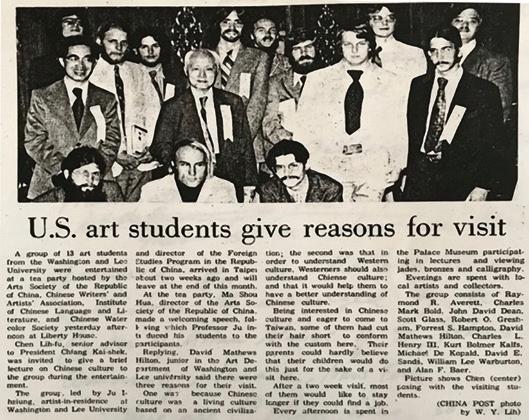
Prof. Ju and W&L students with Chen Lih-fu, senior advisor to President Chiang Kai-shek, 1974
Beginning in 1974, Ju began to create an “Art in Taiwan” program, also called “Art Trip (Tour) to Taiwan .” Ju brought his W&L students to Taiwan for six weeks (from late April to early June) . According to the newspaper: “They were entertained at a tea party hosted by the Arts Society of the Republic of China, Chinese Writers’ and Artists’ Association, Institute of Chinese Language and Literature, and Chinese Water color Society ”46 In Taiwan, they met Taiwanese painters, such as Ho-nien Au, Keh-ming Hu, Read Lee, and Lan Wang They visited museums, e .g , National Palace Museum, National Museum of History and some galleries in Zhongshan North Rd , and traveled to the famous sights, such as the religious temples, Sun Moon Lake, and Cross-Island Highway When they came back to W&L, an exhibit named “Art in Taiwan” displayed a number of paintings and books given to individual students, photographs students took of their classes and of Taiwan’s people and scenery, other gifts they received, and many souvenirs 47 Afterwards, on the trips to Taiwan, Ju’s students visited more and more Taiwanese painters; i e , Ho-nien Au(歐豪年), Chi-mao Li(李奇茂), Shou-hwa Mao (馬壽華), Lan Wang (王 藍), Max Chi-wai Liu (劉其偉), Tseng-chih Shu (舒曾祉), Hsiue-feng Teng (鄧雪峰), Read Lee (李 德), Chieh Chang (張杰), Tao-lin Chang (張道林), Chung-ming Liang (梁中銘), K C Teng (鄧國清), Shih-tai Chiao (焦士太), You-xuan Shao (邵幼軒), Chin-cheng Lai (賴敬程)48 Bo-hong Fan (范伯洪), Meng-gu Yao (姚夢谷), Ke-min Hu (胡克敏), Dan-feng Liang (梁丹丰), Song-quan Zhao(趙松泉), Xian-jing Lin (林賢靜), Shou-ren Chung (鍾壽仁), Yu-yu Yang (楊英風), Ming Ju (朱銘), and Ku-mo Lee(李轂摩)
46See David Hilton’s collection of newspapers, 1974
47See News-Gazette, Lexington, Virginia, October 2, 1974
48See David Hilton’s interview on July 30, 2018
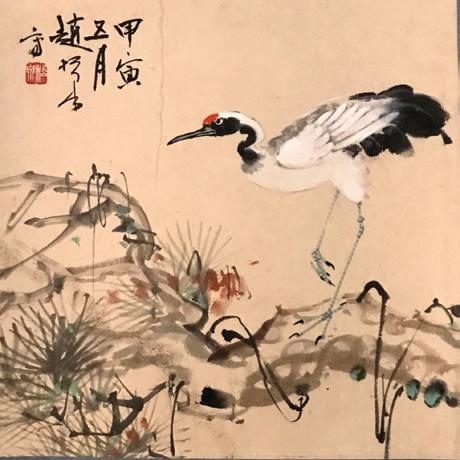
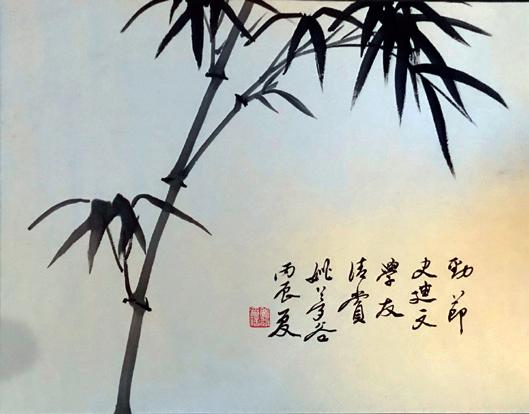
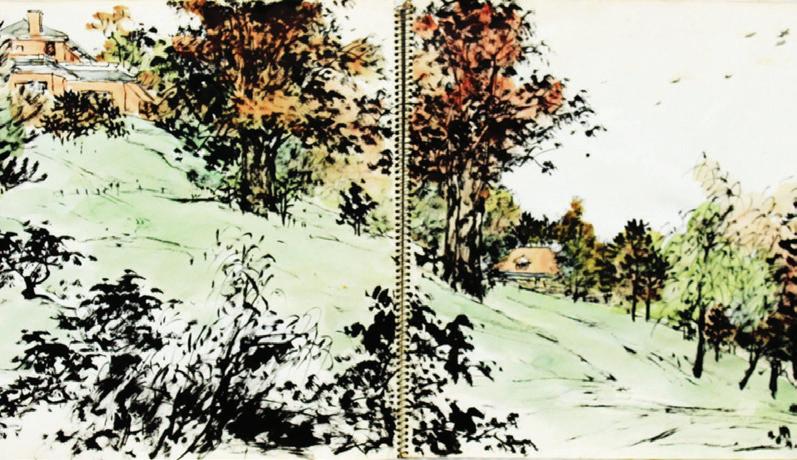
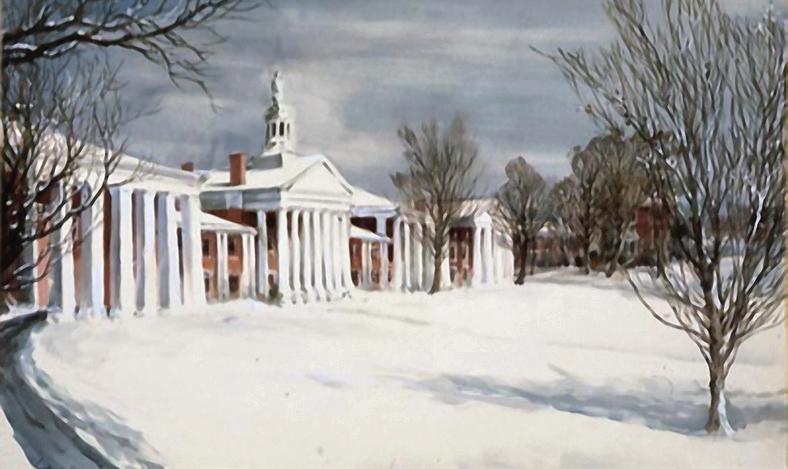
Ju invited some Taiwanese artists to come to Washington and Lee University and his Art Farm to give lectures and demonstrations of Chinese painting — e g , Pai-sui Ma (馬白水) gave a public demonstration and an introductory lecture about “techniques which unite the best qualities of East and West;”49 Chi-mao Li(李奇茂) gave his lecture-demonstration at Virginia Polytechnic Institute and State University and at W&L;50 Chin-cheng Lai (賴敬程) was on display in W&L’s duPont Gallery on March in 1975,51 and Yu-pei Chao (趙友培) and Yung Liu (劉墉) gave a lecture and demonstration of calligraphy and brush painting on campus 52 Ho-nien Au (歐豪年), Lan Wang (王藍), Jun-bi Huang (黃君璧),Youxuan Shao (邵幼軒) (Shao was one of Ju’s daughter’s teachers)53 Zhen-xian Lo (羅振賢) also were invited by Ju The following is a sketch of the campus from Zhen-xian Lo, who visited W&L in 1987, and I-Hsiung Ju’s work which depicted W&L’s same scenery
49See THE NEWS, Lynchburg, Virginia, September 24, 1974
50See News-Gazette, Lexington, Virginia, November 13, 1974
51See News-Gazette, Lexington, Virginia, March 12, 1975
52See Richmond Times-Dispatch, May 14, 1978
53See Grace Ju’s interview, July 2, 2018
Michael Kopald’s collection (a gift from Art Trip to Taiwan)
David Hilton’s collection (a gift from Art Trip to Taiwan)
Steve Roberts’ collection (a gift from Art Trip to Taiwan)
Zhen-xian Lo’s work at W&L University, 1987
I-Hsiung Ju, the Colonnad in Winter, 1977 (W&L)
Ju and his students also obtained paintings from Chuan-fu Fu (傅狷夫), Dan-cheng Chen (陳丹 誠), Yi-hong Gao (高逸鴻), Shu-mian Gong (龔書綿), Ku-nian Chang (張穀年), Yu-shan Lin (林玉 山), Feng Chao (曹楓), and Jia-xi Han (韓家熹)
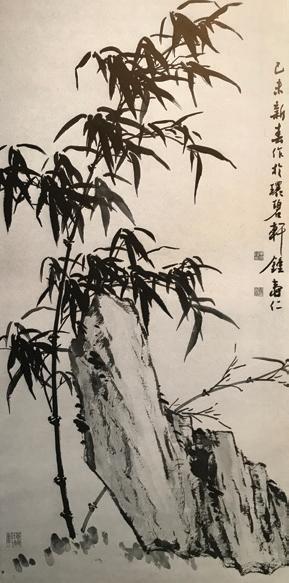
Herbert H P Ma, the Grand Justice in Taiwan and also the son of the leader of Seven Friends Painting Association, Shou-hua Ma (馬壽華), donated a Chinese brush painting entitled “Young Bamboo and a Rock,” to W&L He also delivered at W&L a lecture on “Law and Social Change: The Experience of the Republic of China on Taiwan ” Ju appeared at the donation ceremony When Ju published his first collection in 1976, Shou-hua Ma wrote the cover inscription for him
In 1975, Ju arranged for W&L a panoramic show of paintings by Chinese Masters of the past 50 years as the concluding event in “Oriental Art Month,” which was jointly sponsored by the Fine Arts department and the University’s Chinese Studies Program According to the local newspaper, “the 30 paintings in the show — all on silk scrolls — are on a nationwide tour sponsored by the National Museum of History in Taiwan, and arranged in this country by the Center for Asian Studies at St John’s University in New York These works include still lifes, portraits, landscapes, especially waterfall scenes, and a number of paintings of flowers and animals ”54 The artists in the show may have included Ya-cheng Wang, Chi-mao Li, Keh-mai Li, Man-shih Li, Yu-hsian Shao, Yu-shan Lin, Chung-hsing Lin, Kang Chi, Mung-go Yao, Keh-ming Hu, Nian-chi Hu, Shou-hwa Ma, Yi-Hung Kao, Chun-pi Huang, Tai-chian Chang, Ku-nian Chang, Tzu-hu Chen, Tau-chi Chen, Yin Sunm Yuan-fang Sheng, Chuan-fu Fu, George K C Yen,
54See News-Gazette, Lexington, Virginia, March 19, 1975
Er-tai Chau, Yian-tao Liu, Yung Liu, Hau-nian Au, Feng-nan Su, Ching-cheng Lai, Sung-chuan Chao, and Chi Chen 55
Ju took an art trip to Taiwan in 1976, as an Associate Professor of Art and Director of the duPont Art Gallery of Washington and Lee University He also was the representative of the Danville Museum of Art and History in Virginia In this latter capacity, he signed an agreement with the National Museum of History in Taiwan recognizing the two museums as sister museums 56 In the same year, in order to support the program of promoting Chinese Art, Ju obtained replicas of ancient works from National Museum of History in Taipei, as well as works from Taiwanese artists These included four replicas of ancient Chinese bronzes, four ceramic pieces, eight pieces of porcelain, ten painting scrolls by early masters, twenty-two scrolls of original brush works by contemporary artists, four oil paintings, three watercolors, and four graphic art works The Taiwanese Ministry of Education subsidized the shipping of these to Washington and Lee University 57 Due to Ju’s contact with the new Danville Museum of Fine Arts & History, he may have sent some of this collection to Danville Ju wrote:
During the same year, 1976, many distinguished Chinese artist(s) in the Republic of China began a campaign to support Washington and Lee’s art program China which called upon its members voluntarily to contribute their works to the permanent collection of Washington and Lee The first group of works to be donated was exhibited before shipment at the National Museum of History’s art gallery Traditional Chinese paintings on rice paper were given the necessary scroll mounting, also at the expense of the Museum 58
Ju noted:
In all Virginia, there are perhaps only two or three museum which show Oriental art, and none of these is in the Shenandoah Valley This is unfortunate, since the Valley boast many fine colleges and institutions and a great many people who have demonstrated an interest in Oriental art It is gratifying to think that this collection will now be available not only to the Washington and Lee community, but to the entire area 59
55See David Hilton’s collection about I-Hsiung Ju’s note
56Ho Hao-tien, Preface, in A Collection of I-Hsiung Ju’s Landscape Painting Taipei: National Museum of History, 1976
57See I-Hsiung Ju, a list of “Chinese Art Exhibition of Ancient and Contemporary Works in 1977,” Collected by Special Collections at W&L
58Ibid
59Ibid
There are some of these mentioned replicas and original works at the Danville Museum of Fine Arts & History These replicas came from the National Museum of History in Taipei, and include a tricolor horse, a tricolor camel, and replicas of Ming and Ching Dynasties Some original paintings; i e , Yu-shan Lin’s owl, Fu-ting Lu’s landscape, Shou-po Tao’s plum, Chi-mao Li’s horse, Dan-cheng Chen’s flowers and birds, bamboo and orchid by Yi-hong Ga and Shu-mian Gong, Song-quan Zhao’s eagle, Shu-qi Zhang’s peacock, and Pei-yu Zeng’s oil work are also held by the Danville Museum
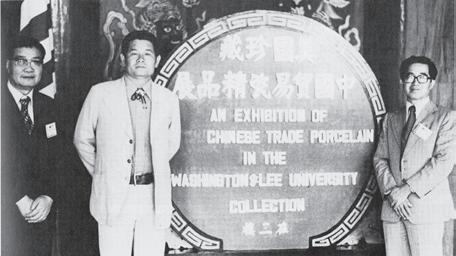
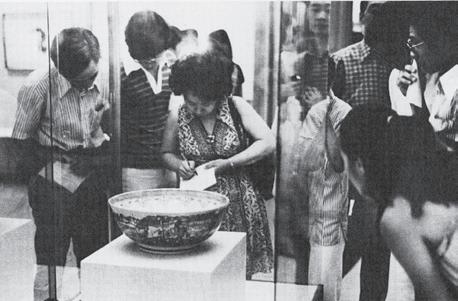
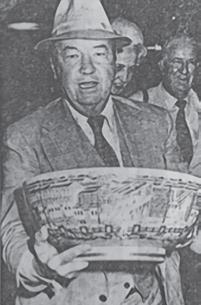
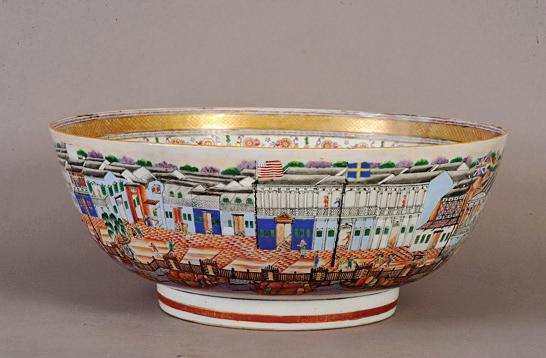
In 1978, Ju arranged an exhibition, entitled “An Exhibition of Chinese Trade Porcelain in the Washington and Lee University Collection,” at the National Museum of History in Taipei On display from the Reeves Center Collection at Washington and Lee were more than 100 pieces of Chinese export porcelain to America from the 18th and early 19th centuries Most of these porcelains are “decorated with representations of scenes, people and emblems of particular significance in the formation of the United States Many of the pieces show American eagles or flags ”60 In mid-July, President and Mrs Robert E R Huntley; University Treasurer James W Whitehead, curator of the Reeves Collection, with Mrs Whitehead; and Prof Ju, Artist-in-Residence, with Mrs Ju, participated in the opening The Huntleys visited Taiwan for the exhibition as guests of the Chinese Education Ministry The Whiteheads and Jus visited through grant support from the National Museum and the Pacific Cultural Foundation 61
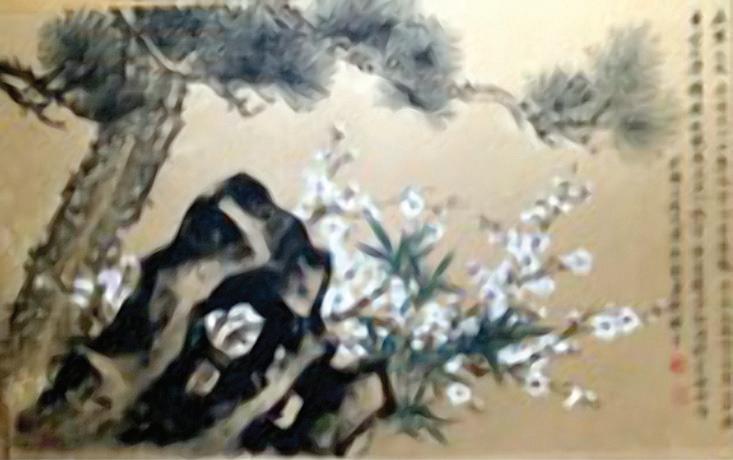
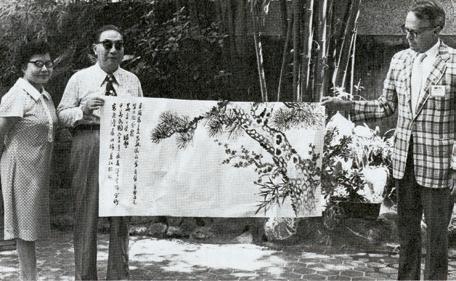
This exhibition was very successful in Taipei Many Taiwanese painters joined the welcome party and cooperatively painted literati paintings to send to W&L University; for example, here are two symbolic paintings entitled, “Three Friends in Winter ” One was painted by Jun-bi Huang (黃君璧), Qinbo Jin (金勤伯), and Meng-gu Yao (姚夢谷) ; and the other was as follows: the bamboo painted by Shu-mian Gong (龔書綿), the plum and the pine tree painted by Yi-hong Gao (高逸鴻),62 and the rock (or hill) might have been painted by I-Hsiung Ju . 63
60See “W&L’s Famed Reeves Collection of Porcelain Return to China,” in the Alumni Magazine of Washington and Lee, Volume 53, Number 5, July 1978, 11
61Ibid,11 . Thank you to Prof Laurent Boetsch and his wife, Elizabeth, for correcting mistakenly identified persons in the photographs
62Ibid,11 .
63According to the inscription, the rock (or hill) was painted by W&L University; I believe I-Hsiung Ju was being humorous as he most likely painted it
An Exhibition of Chinese Trade Porcelain at the National Museum of History in Taipei, 1978
The Hong bowl viewed by many visitors at the National Museum of History in Taipei
James Whitehead with the bowl
A gift painted by Ga and Gong for W&L President Robert E.R. Huntley
Gao and Shu-mian Gong. “Three Friends in Winter,” 1978 (W&L)
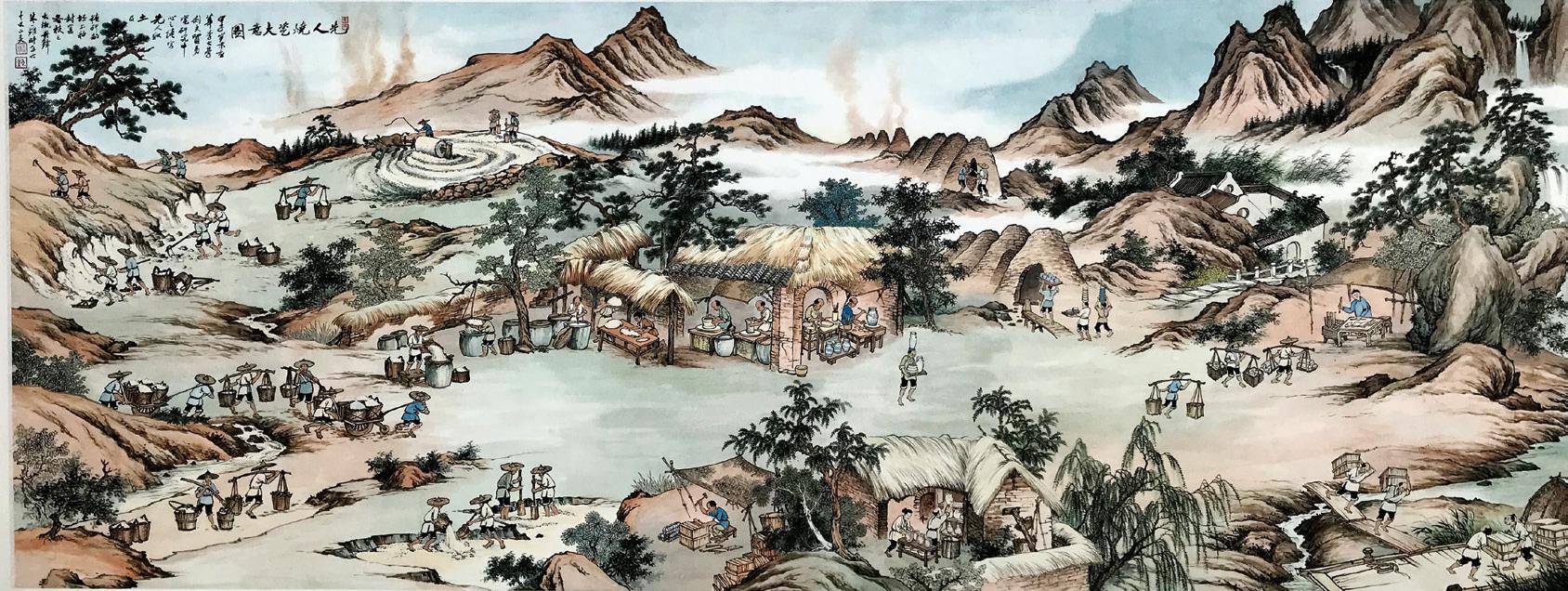
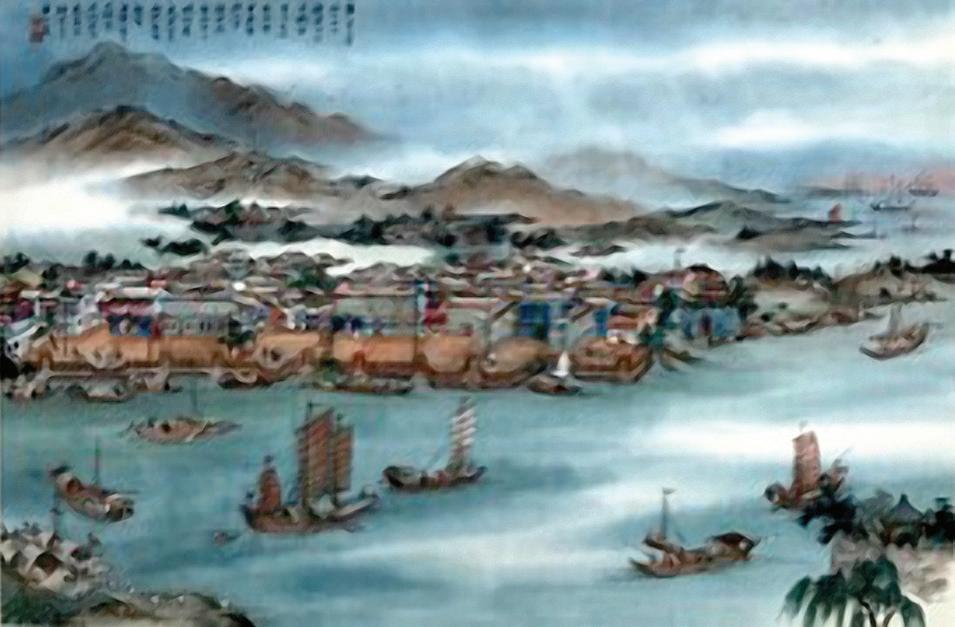
Ju made two paintings for the Reeves Center . One was the Making of Porcelain (from choosing materials, forming, glazing, decoration, firing, packing and shipping) in 1984; and the other, painted in 1988, was the scene from a Hong bowl depicting the foreign factories or Hong on the waterfront at Canton, which was a subject popular between 1760 and 1800 64
64See the illustration of Fig 95 “Hong” Punch Bowl, c 1785, in Picturing Cathay: Maritime and Cultural Images in the China Trade, Hong Kong: University Museum and Art Gallery, The University of Hong Kong, 2003, 155
Jun-bi Huang, Qin-bo Jin, and Meng-gu Yao. “Three Friends in Winter,” 1978 (W&L)
Yi-hong
In addition to Chinese art, Ju promoted a children’s painting exhibit In a related report, we find the exhibit’s description:
Artwork by Chinese and Japanese school children constitutes a traveling art exhibit that is now being scheduled for county schools and libraries The artwork is on loan to the County Recreation Department from I-Hsuing Ju, artist in residence at Washington and Lee University Selected by the National Museum of History in Taiwan, these pieces were part of an international exhibit there before being displayed in Richmond since September The 20 paintings and prints are delightful in their creative aliveness and show many aspects of the everyday life of the young artist 65
65See News-Gazette, Lexington, Virginia, March 1, 1978
Ju’s the Making of Porcelain, 1984 (W&L)
Left: Ju’s the Scene from a Hong Bowl, 1988 (W&L)
Ju taught art education at some elementary schools in the Appalachian area He inspired the children with interesting stories, and they gave him feedback by drawing pictures illustrating the story Ju told For example, before Ju left them, the children thanked Ju with a drawing of an uncovered cup — a metaphor symbolizing Ju’s encouragement for them to open their eyes for learning . 66 Ju also created art projects for the children at the church he attended in Lexington, as well as donated many paintings for local fundraisers 67
With all his work and inspiration, it is easy to realize Ju was a painter, a curator, and an educator
We also can see Ju was a performer He presented a Chinese brush painting demonstration for the Association for Asian Studies meeting held at Washington & Lee University on Jan 14, 1981 Also he once filled in as a poolside artist and painted several Chinese brush paintings as trophies to the winning team and outstanding individual performers of the W&L Fall Classic Water Polo Tournament . 68
“Journey to Taiwan in 2007” was Ju’s last art trip to Taiwan In October 2007, the National Taiwan University of Art put on a retrospective art show of Ju’s 85 years of painting At this time, Ju took nine of his brush-painting students to Taiwan, and again involved them in art classes and a painting tour around the island 69 In 2011, Ju had his one-person exhibition at Washington and Lee University . This exhibition, entitled “Journey Home,” was the last show of his life
In conclusion, I quote an American writer who spent 10 years interviewing Ju, and was working on a book about his life entitled, The Dog Painter In her book, she wrote, “Ju inspired us to look beyond ourselves as well as within our own hearts ”70 Describing the life of Ju in short but vivid sentences, she wrote:
He had come to retire from teaching at the small Virginia university by a circuitous route: Mainland China, the Philippines, Connecticut and Virginia In 2002 he had become a snowbird, landing in New Jersey or Florida according to the seasons Some would say that a cloud of good fortune hovered over his head But I-Hsiung Ju had long ago learned that bad luck can easily be mistaken for good and good luck sometimes turns bad without warning, so he chose to live simply, appreciating each moment with the eyes of an artist and the soul of a teacher 71
66See Helen Ju’s interview, July 3, 2018
67See Virginia Lloyd-Davies’s interview letter, June 21, 2018 .
68See News-Gazette, Lexington, Virginia, Oct 7, 1981
69I-Hsiung Ju, “One More Trip,” in Journey to Taiwan, 2007
70Suanne Kelley Kopald, “Three Generations,” in Journey to Taiwan, 2007
71Suanne Kelly Kopald, The Dog Painter, which remains unpublished due to her untimely death
Chapter Two: “What is Chinese Painting?” The Books of Four Gentlemen
“Ju had participated in more than 125 one-man and group exhibits since 1943 He had also created special television programs and written several books and articles dealing with Chinese art ”72
During his time at the Art Farm, I-Hsiung Ju published the Books of Four Gentlemen: The Book of Bamboo (1982), The Book of Chrysanthemum (1984), The Book of Plum (1988), and The Book of Orchid (1989) These four books might be based on the famous printed manual of Chinese painting from the Qing dynasty entitled The Mustard Seed Garden Manual of Painting In Ju’s books, he mentions many times The Mustard Seed Garden Manual of Painting — a book he regarded as “a kind of how-to-do-it book of Chinese art ”73 But in his books, he attempted to convey his way of explaining Chinese painting to foreigners In this chapter, I will compare The Mustard Seed Garden Manual of Painting and Ju’s Books of Four Gentlemen in order to evaluate Ju’s “new” method of teaching Chinese painting
1 Introduction: The Mustard Seed Garden Manual of Painting
The Mustard Seed Garden Manual of Painting, compiled by Wang Kai (1650-1710) and his brothers during the early Q’ing dynasty, is based on a teaching draft by the painter Li Liu-fang (1575-1629) This manual is considered to be the most important manual of Chinese painting for the past five centuries Some researchers have even noted the influence of The Mustard Seed Garden Manual of Painting in Japan, as well as in the United of States In 1956, the English translation, by Mai-mai Sze, was first published in the Bollingen Series and reissued in 1963 The Princeton Press decided to republish the English translation in 1977 In 1979, a contemporary reviewer wrote: “It is the sole English translation of the most influential painting manual in the last three hundred years in China, Japan, and Korea (It) played a formative role in the shaping of Japanese painting of the Literati School ”74
The Mustard Seed Garden Manual of Painting includes the specific motif (landscape, trees, rocks, people and things, bamboo, orchid, plum, chrysanthemum, grasses and insects, feathers and fur) of
72See Roanoke County Press, June 2, 1981 .
73I-Hsiung Ju, The Book of Chrysanthemum, Virginia: The Art Farm Gallery Press, 1984, 2
74Dawn Ho Delbanco, Reviewed work: The Mustard Seed Garden Manual of Painting by Mai-mai Sze, Harvard Journal of Asiatic Studies, Vol 39, No 1 (June 1979), 184-190
Chinese painting In other words, it is essentially an encyclopedia of Chinese painting Beginners can easily locate the motif they want to learn In order to make sure the students paint in the right manner, the section entitled “fundamentals of painting” mentions rules from painters in different periods; e g , Hsieh Ho’s (479-501) the Six Canons in the Southern Ch’i period, and Liu Tao-ch’un’s the Six Essentials and the Six Qualities in the Sung period It also points out mistakes to be avoided; such as Kuo Jo-hsü’s the Three Faults in the Sung period, and Jao Tzŭ-jan’s the Twelve Things to Avoid in the Yüan period 75
Students could also acquire important ideals of Chinese art — which make Chinese art so unique from other cultures The section of The Mustard Seed Garden Manual of Painting called “Men of Quality” is a good example “One is curious not only about the pictures they collected but also about the men themselves; in fact, their pictures make one wonder what sort of men they were ”76 A famous example is Lu Hung, who owned the painting The Grass Hut77 from the T’ang period Ju also named his garden of art (Art Farm) “The Grass Leaves Hall,” as it was not a private hut but a public exhibit hall
Not only are there symbolic relationships between artists and pictures, but also between brushstrokes and the essence of objects For example, if you want to describe a rocky mountain, you should use the specific brushstroke named Fu p’i ts’un . If you want to express the sandy hill, you might choose the popular brushstroke P’i ma ts’un, which is especially applicable to the landscape in southern China
Therefore, ink and brush in Chinese art not only portrays the subjects, but also establishes a language, which creates some distinct textures to capture the unique geographic features of landscape In Chinese landscape painting, there is a general list of brushstrokes used for modeling:
P’i ma ts’un: brushstrokes like spread-out hemp fibers
Luan ma ts’un: brushstrokes like entangled hemp fibers
Ta fu p’i ts’un: brushstrokes like big ax cuts
Hsiao fu p’i ts’un: brushstrokes like small ax cuts
Yün t’ou ts’un: brushstrokes like cloud heads or thunderheads
Yü tien ts’un: brushstrokes like raindrops
Ho yeh ts’un: brushstrokes like the veins of a lotus leaf
Fan t’ou ts’un: brushstrokes like lumps of alum
75Mai-mai Sze, The Tao of Painting: A Study of the Ritual Disposition of Chinese Painting — with a translation of the Chieh Tzŭ Yüan Hua Chuan or Mustard Seed Garden Manual of Painting 1679-1701, Vol. 2: the Chieh Tzŭ Yüan Hua Chuan, New York: Pantheon Books, 17-22
76Ibid, 24
77Ibid, 24
Chieh so ts’un: brushstrokes like raveled rope
Niu mau ts’un: brushstrokes like hair of cattle78
In fact, for each ancient painter in China, there was a recognizable meaning to the different brushstrokes (ts’un) he used Sometimes brushstrokes appeared only in specific circles You can find Yün t’ou ts’un and Yü tien ts’un in the circles of the Northern Sung period; and P’i ma ts’un, Ho yeh ts’un, and Niu mau ts’un in the scholars’ circle of the Yüan period . You might also find Ta fu p’i ts’un, and Hsiao fu p’i ts’un in the academy circle of the Southern Sung period, and their successors in the Che (Zhe) School in Ming period
In short, for a Chinese painter, the brushstrokes are important clues that reveal the style they inherited and to which ancient school they belonged Brushstrokes uncover both the painter’s identity and the tradition he follows
There are two famous schools of Chinese painting mentioned in The Mustard Seed Garden Manual of Painting:
The division in Buddhism into Northern and Southern Schools began in the T’ang period A similar division in the painting also took place in the T’ang period The painters representing these two schools did not, however, come respectively from the north and the south; it was not a geographical classification
The Northern School was founded by Li Ssŭ-hsün and his son . Their style was followed and carried on by Chao Kan, Chao Po-chü, and (Chao) Po-su in the Sung period, and later by Ma Yüan and Hsia (Kuei) Yen-chih
The Southern School began with Wang (Wei) Mo-chieh, who used light washes and inaugurated the method of kou chê (broken outline) This style was used and carried on by Chang Tsao, Ching Hao, Huan T’ung, Kuo Chung-shu, Tung Yüan, Chü-jan, and the Mi’s, father and son, down to the Four Great Masters of the Yüan period
The situation in painting was similar to that in Buddhism after the time of the Sixth Patriarch (Huinêng, 637-713), when the Ma-chu and Yun-mên (branches of the Southern School of Zen Buddhism flourished and the Northern School) declined 79
In my opinion, The Mustard Seed Garden Manual of Painting is not only a manual of Chinese painting; but it also notes the distinct traditional history of Chinese painting in these two schools
78Ibid, 27
79Ibid, 23-24
2 The Book of Bamboo (1982)
Historically, Mai-mai Sze, translator of The Mustard Seed Garden Manual of Painting, has been questioned as providing an unfounded and misleading analysis 80 But, I-Hsiung Ju supported her translation throughout his Books of Four Gentlemen (The Book of Bamboo, The Book of Chrysanthemum, The Book of Plum, and The Book of Orchid) In these books, The Mustard Seed Garden Manual of Painting appears to be the frame of reference
Ju divided his own books into two parts: the concept of Chinese art and the method of forming the subject In the beginning of The Book of Bamboo, Ju explained the common origin of calligraphy and painting by using the example of bamboo Ju also mentioned the development of the “word” or “image” in ancient China He said:
Bamboo in seal-style, bamboo in painting: two groups of bamboo leaves Even since the beginning, bamboo has been written and also been painted in the same manner, in other words, a work depicting bamboo is both a painting and a piece of calligraphy The early Chinese characters had only two “families,” one called pictography and another, ideography They evolved gradually from the Pa Kua (八卦) or Eight Trigrams, invented by Fu Hsi (伏羲) which were composed by the grouping together of simple horizontal lines broken and unbroken, symbolizing the diverse objects of the universe 81
In his first book, Ju differentiated between painting and writing Chinese art:
In the first “word book” Shuo Wen Chieh Tse (說文解字) (literally, explanation and description on words) it was said that the pictographic characters were “drawings of objects by tracing their forms ”82 We might call every pictographic word an abstract painting . To use the painter’s or writer’s term, it is Hsie Yi (寫意) meaning — to write ideas Chinese artists so preferred Hsie Yi (寫意) they had a low opinion of Hsie Shih (寫實), which means to write the real They enjoyed the symbolic or abstract arts very much, and gave way to “artisans” to work for “realistic” works, which are copies of nature Chinese painters speak of painting and writing as fundamentally the same, and of styles of brushwork in terms of calligraphy, and they often use the word Hsie (寫) (to write) in place of Hwa (畫) (to paint) 83
80Dawn Ho Delbanco, reviewed work: The Mustard Seed Garden Manual of Painting by Mai-mai Sze, Harvard Journal of Asiatic Studies, Vol 39, No 1 (June, 1979), 184 .
81I-Hsiung Ju, The Book of Bamboo, Virginia: The Art Farm Gallery Press, 1982, 2-3
82Ibid, 4
83Ibid, 4
In fact, the concept of the common origin of calligraphy and painting came from a famous artist in the Yüan dynasty
Zhao Meng-fu (趙孟頫,1254-1322) was the first painter to equate painting and calligraphy He wrote that to draw rocks one must use the “flying white” method of cursive script, in which the bristles of the brush separate so that lines include streaks of uninked white paper In outlining trees, Zhao stated that one should use the unmodulated lines of seal script To emphasize that his paintings had the same self-expressive intent as handwriting, he described his creative process not as “painting” but as “writing;” here he placed his signature in a prominent position to reinforce his point 84
The dynasty, in which Zhao Meng-fu lived, was a period in which literati painting flourished As a literati painter, Ju followed this tradition and introduced oracle writings: big-seal style, small-seal style, Chuan (篆) (which means seal), and Ts’ao (草) style of calligraphy, which evolved from the Chuan (篆) characters In Chinese painting, the Pi Fa (painting conventions) or Pi Ch’u (brushstroke) of a plumtrunk or a branch of pine is similar to the big seal, while the bamboo and orchid are close to Ts’ao (草) characters 85
After explaining the common origin of calligraphy and painting, Ju stressed the right way to learn Chinese painting based on imitation
The practice of copying art work plays an important role in the Tao (path) of painting and calligraphy Tracing, faithful, reproduction, and interpretation of the model are the three “ways” of copying The purpose for these exercises is to learn brushstrokes as well as methods and certain recurrent designs in composition We know that the quality of the brushwork has always been the basis for Judging both painting and calligraphy Attention is directed to the particular degree of pressure of the brush and the manner of applying the ink in either thick or thin strokes, rugged or delicate, light or dark, dry or moist Special concern must also be taken as to how the strokes are joined . Even the speed and directions of the strokes are carefully studied 86
The Book of Bamboo is divided into three parts:
1 Equipment and Supplies — the four treasures of the Chinese scholar and the use of the tools;
2 . Basic Exercise on Bamboo — trunk, knots or joints, horn-of-deer, the bamboo leaves;
3 Group of Stems, Branches and Leaves — composition with more than one stem, cluster of leaves, and diverse “leaf-formations” for a larger and thicker cluster
84Maxwell K Hearn, How to Read Chinese Paintings, New York: the Metropolitan Museum of Art Press, 2008, 80 85I-Hsiung Ju, The Book of Bamboo, 1982, 16 86I-Hsiung Ju, The Book of Bamboo, 1982, 18
First, Ju introduced the basic tools for Chinese brush painting — the Four Treasures: the ink stone, the ink stick, the brush and the paper Next, he demonstrated how to draw each part of bamboo in a formalized way Last, he showed the ideal composition to display a grouping of bamboo leaves
In Ju’s Book of Bamboo, we find his attempt to teach progressed from simple to complicated, from singles to groups If students followed the rules step by step, they could finish a work But Chinese painting, especially the subject of bamboo, looks seemingly simple, but actually is difficult The Mustard Seed Garden Manual of Painting, described how to “write” bamboo leaves with an impressive language
One brushstroke, like a side view of a boat . One brushstroke, like a crescent moon Two brushstrokes, like a fish’s tail Three brushstrokes, like a wild goose in flight Three brushstrokes, like a goldfish’s tail (Four brushstrokes, in “fish’s tail” form ) Five brushstrokes, combing strokes called “fish’s tail” with those called “wild goose in flight ” Six brushstrokes, doubling the three strokes of the “wild goose in flight” form 87
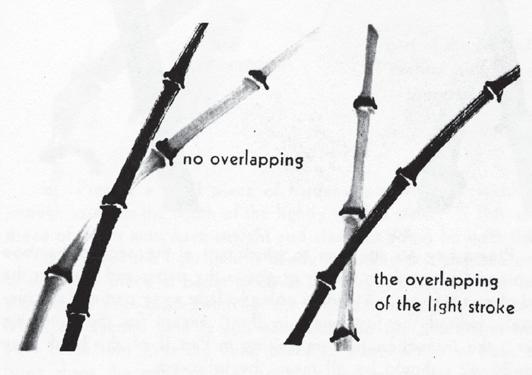
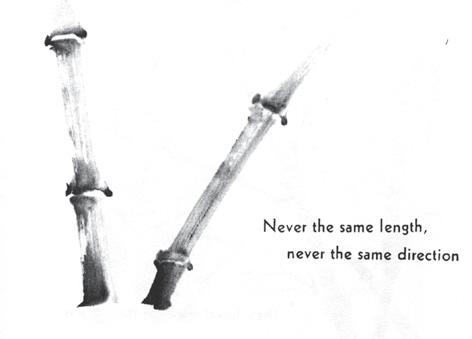
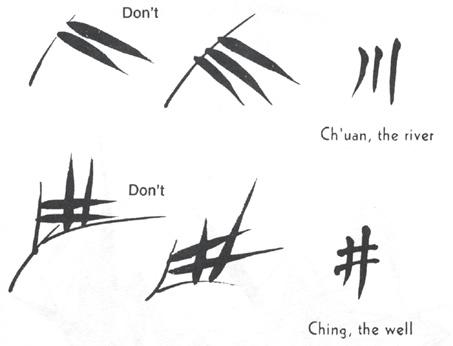
In Ju’s bamboo book, he tried to translate the “impressive” language into a clearer composition He said: “Fish Bone has a middle segment, one on the left side, and one on the right side But the left and right side segments branch off at a common point ” (See illustration below )88 Considering his students were Americans who did not know the Chinese language, Ju gave detailed explanations on both the right way and the wrong way to “write ” For example, he explains the “Fish Tail” as:
There are always two leaves on one segment to form the fish tail They are on opposite sides of the segment and they do not start at exactly the same point, and they do not have the full front view For a side view make one leaf long and one leaf short 89
87Mai-mai Sze, 381
88I-Hsiung Ju, The Book of Bamboo, 1982, 47
89I-Hsiung Ju, The Book of Bamboo, 1982, 53
The Book of Bamboo, 65 The Book of Bamboo, 61 The Book of Bamboo, 81
Ju’s demonstration with vivid explanations allowed his American students to see the proper method of Chinese painting This also inspired his students, some of whom became brush painting teachers in America following Ju’s methods of providing models for the students to copy 90
3 The Book of Chrysanthemum (1984)
As I mentioned above, each one of the books of the Four Gentlemen is divided into two parts: one addressing the concept of Chinese art and the other containing painting instructions . In the first part of The Book of Chrysanthemum, Ju pointed out another important concept of Chinese art; i e , the relation between words and signs “Words are the signs of ideas;” “one word, one character, is just one sign ” Ju reminds us that in Chinese art, there is a meaning behind every “word and sign… which is used universally in Asian countries like Korea, Japan, Vietnam, to represent a certain concept or message . And when these signs, also words, become more systematically organized, showing deeper and more complicated ideas, they become metaphors themselves and scarcely need any interpretation ”91 Ju further explained the type of symbolism “analogy” which uses imaginary characters to enrich many fables — for example, on a four-fold painting screen showing four important Confucian virtues: first, to the nation and fealty; second, to family and filial piety; third, to marriage and chastity; and last, to friends and community, and faithful duty 92
90See Charlene Fuhrman-Schulz’s interview, July 7, 2018; Virginia Lloyd-Davies’s interview, June 21, 2018 91I-Hsiung Ju, The Book of Chrysanthemum, Virginia: The Art Farm Gallery Press, 1984, 4 92I-Hsiung Ju, The Book of Chrysanthemum, 1984, 12
But how to express this abstract ideal as a concrete image? The Mustard Seed Garden of Manual Painting lays out some rules:
Rules of painting the chrysanthemum phrased for memorizing
The chrysanthemum season is mid autumn It is the flower that “braves the frost ” To capture its quality, brush style(shih) must be imbued with dignity Its color is that of the Center, that most honorable of colors, gold ” Spring flower are supple and captivating, but how can they be compared with the chrysanthemum? Transferred to a painting, it wafts a fragrance that lingers 93
Ju also said:
In painting flowers, Chinese artists try to treat plants as human figures They either enlarge the size of the plant to be as tall as a human being or reduce the size of the viewer to the size of a chrysanthemum plant The Chinese word, ”shih,” is used very often in The Mustard Seed Garden Manual and is considered to be a “prized element in a flower painting, because it not only refers to the structural integration but also indicates a certain posture of a person ”94
The famous example is found in Tao Yuan-ming’s poem, which described how he was picking his “yellow flower” under the “eastern fence” of his garden “Eastern fence” became the euphemism for chrysanthemums 95 Another one is Cheng Ssu-hsiao, who painted his orchids with a deep sigh, “Our land has been taken by the Tartars, where could I plant my orchids?”96
Ju liked to connect the traditional story to modern events In The Book of Chrysanthemum, he portrays a vivid legend from the Cold War Era
Ch’i Pai-shih who constantly painted chrysanthemums as the image of himself
Once when he was asked by a demanding cadre to paint a different composition to make sure there would be a new image of China for the Communist government, Chi turned his chrysanthemum painting upside-down and angrily put several black ink lines on it . He saturated his brush with newly ground ink and wrote his poem composed on the spot in front of this illiterate cadre as following: “The most famous garden has long been neglected; Everyday, only a herd of animals here enjoy eating the weeds Lo! This dying chrysanthemum still has his daydream: Outside the bamboo fence, young branches will be in blossom next spring ” People who know the Chinese poem know clearly that the flowery garden stands for China and the animals for the materialists When most of the
93Mai-mai Sze, 440
94I-Hsiung Ju, The Book of Chrysanthemum, 1984, 100
95Ibid, 11
96Ibid, 13
flowers in the garden have gone, we feel great sympathy towards that dying old chrysanthemum that braved the frosty winter and fought for his fading dreams Yet, it is not his fighting for survival that should be counted as heroic . The most beautiful part is that he has had a dream about the young branches; about the new buds; about the spring; about the garden out-side the “Bamboo Fence ” (Ju noted: after the Second World War, Winston Churchill described Eastern Europe as behind the “Iron Curtain” and some writers in the West later jokingly called China a country behind a “Bamboo Curtain ”)97
Chi’s painting prompted Ju to push himself further He, who had been called “little barbarian” by his father, grew up, moved to the Philippines, and lived outside the Bamboo Fence Now he had the responsibility to promote Chinese literati painting overseas 98
(T)he idea that we must paint the blossom first has something to do with symbolism in Chinese art Chinese scholar-painters always believe that the chrysanthemum has its own spiritual life Since this is the last flower of the year, the brightly colored, robustly-shaped and persistence, and therefore they have to be enlarged and painted with great care Artists may purposely depict the leaves of chrysanthemum as dry and weary, and the branches as thin and broken to indicate the cold of a frosty night and how marvelously in contrast the blossoms have survived ”99
Now, let’s turn to the second part of The Book of Chrysanthemum, to find the steps of painting a chrysanthemum
The Book of Chrysanthemum is divided into five parts:
1 . Tip Strokes, Side Strokes — three hand positions (resting wrist, suspending wrist, hanging arm); three tip strokes (hidden stroke, straight stroke, returning stroke); three side strokes (inclining stroke, open stroke, lying stroke)
2 . Basic Exercises on Chrysanthemum flowers — the importance of the blossom; steps in painting a spider chrysanthemum flower (preparation, groupings, ink variations, from bud to full blossom, position variations, common mistakes); steps in painting outlined chrysanthemum flower (the first petal and common mistakes, brush movement, exercise by tracing, bud, views of flowers)
97Ibid, 14-15
98See Michael Kopald’s interview on July 12, 2018
99I-Hsiung Ju, The Book of Chrysanthemum, 1984, 36
3 Leaves — leaves in ink (“hsuan-jan” method, “wo-feng” and vertical leaf, single vertical leaf, single leaf slanting and horizontal, common mistakes); structure of each leaf (variations of a single leaf, leaves with two lobes, sideview mature leaves, foreshortened mature leaves, “five paths and four spaces,” curled leaves in tints); the grouping of leaves (comparing chrysanthemum leaves with bamboo leaves, comparing chrysanthemum leaves with orchid leaves, oriental perspective in flower painting)
4 Stems & Branches — stems (postures of “shih,” things to be avoided, methods of laying out the main stem, peduncles and receptacles), branches (“horn of the deer;” the main stem as the first stroke of the “horns;” size and direction of the secondary strokes; additional “horns;” broken branches and leaf buds; the way of “writing” the “horns;” six common mistakes)
5 Veins (also outlined leaves and branches) — veins (petioles and midribs, how to paint the midrib, how to paint the secondary ribs); roundness and perspective (correct placement, shadows and highlights on leaves, rhythmic sequence and intervals, common faults); outlined leaves and outlined branches (ink and color, outlined leaves, outlined stems and branches) Ju went on:
It should be noted that the step-by-step brush painting lessons have been especially designed by the masters to introduce fundamental methods or brush painting in a progressive and interactive manner A basic method, like the painting of the “horn of the deer” of the bamboo, is further developed into the method of painting the stems and branches of the chrysanthemum New aspects are developed from the old And after the mastery of the old, newer aspects will be introduced The process of Chinese painting is evolutionary But, it is important to know that a complete dedication in mastering each stage is required before a student of Chinese painting can smoothly move on to the next stage 100
Besides asserting that learning should proceed step by step, Ju also compared the wrong way and the right way in painting He wrote:
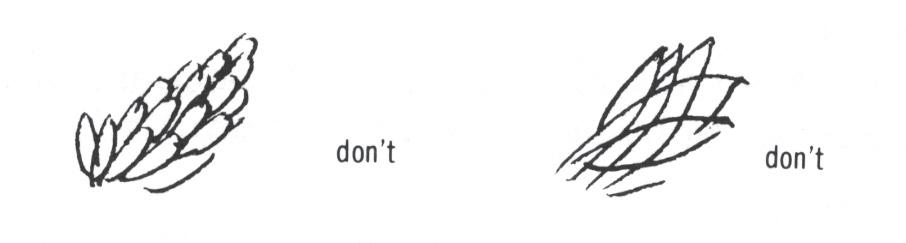
Based in this writer’s thirty years teaching experience, the common mistakes in painting the “wheel” and the “wheels” are as follows:
(1) Rejecting the idea of making “wheel” or “wheels ”
(2) Repeating one petal formation too many times in the same size and in the same direction
(3) Neglecting the rule that all the petals of one flower should belong to the single center of that flower 101
100Ibid, 159
101Ibid, 58-62
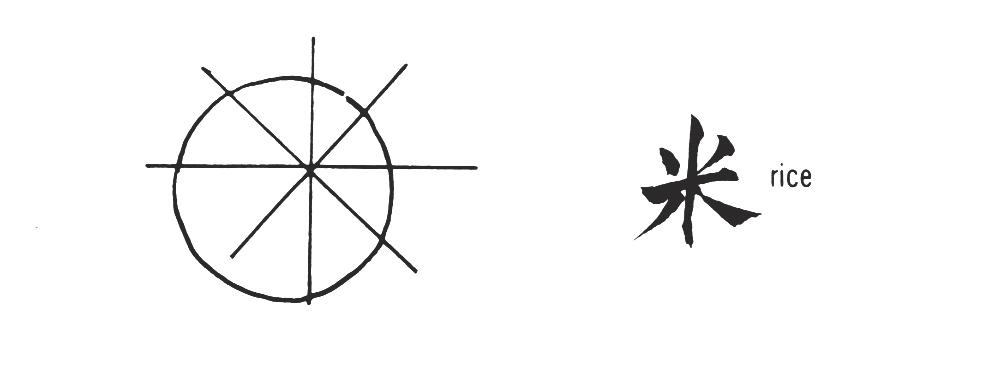
Then Ju gave us some exercises to practice correctly:
1 Draw a design with four straight lines in the composition of a Chinese character, which means rice
2 On this “rice” design, one circle is to be added This circle is not necessarily in the center
3 Paint petals, either eight or sixteen in number, within the circle, guided by those eight “spokes ”102
Below are some of Ju’s illustrations:
The Book of Chrysanthemum, 58. The Book of Chrysanthemum, 59
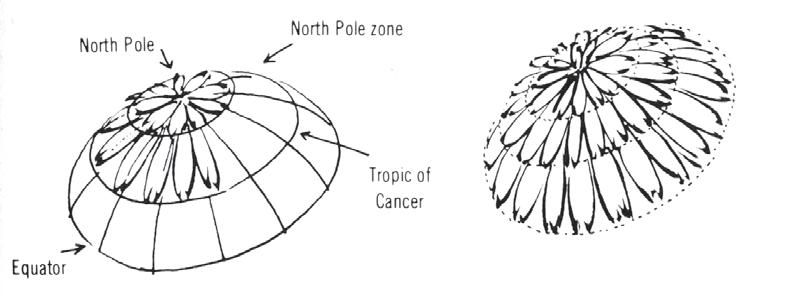
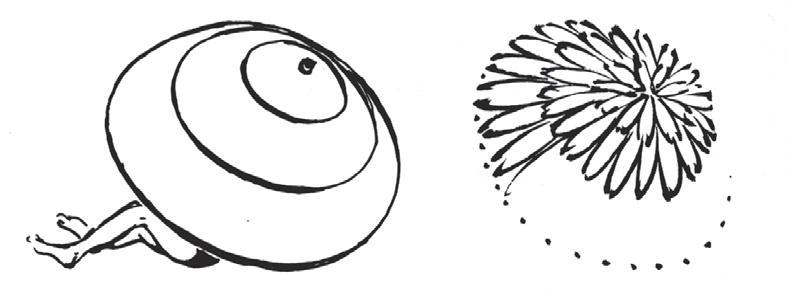
In The Book of Chrysanthemum, in the section on “Exercise by Tracing,” Ju gave two models for imagining the chrysanthemum — one is Northern Hemisphere and the other is a beach parasol He said, “The writer suggests that the drawing of the Northern Hemisphere and the drawing of the beach parasol are made either under the teacher’s supervision or by tracing from a good sample And, by the way, the size of the Northern Hemisphere, as well as of the beach parasol should be that of a real chrysanthemum ”103
Here, see Ju’s demonstrations are filled with imagination as well as practicality
The Book of Chrysanthemum, 61 The Book of Chrysanthemum, 62
102Ibid, 58-62 103Ibid, 62
4 The Book of Plum (1988)
In the first part of this book, Ju wrote of the concept of spirit and rhythm and the kinds of Chinese color The concept of spirit and rhythm came from Hsieh Ho (479-501 A D ), who pointed out the important theory of “Six Canons” in the book entitled Ku-hua P’in Lu The Six Canons, listed below, became a guide of how to appreciate Chinese painting:
1 Vitality with spirit and rhythm
2 Structure with proper brushstrokes
3 Likeness according to the subject matter
4 Right colors and shades
5 Well pondered composition
6 Tracing and copying the ancients
In expressing his opinion of the “order” in Six Canons, he wrote:
Logically, the six canons represent different aspects and are not necessary listed in order of importance
Vitality with spirit and rhythm is very vaguely talking about a painting’s appearance in general, while strokes and colors are related to the technique of painting Composition actually is the concrete evidence of the vitality, and likeness of the subject matter has never been important to any brush painter in the past Tracing and copying the ancients are ways of learning and should not be listed as important as the others 104
Ju stressed:
Ch’i is the spirit and ideal of the artist, the content of the art work, while Yun is the artistic arrangement, the form of the art work An artist’s spirit could be very Sheng Tung, which means lively, attractive, exciting and full of vitality, but it takes a great deal of effort to reveal the spirit through Yun, the artistic arrangement A good student may learn many techniques to make a rhythmic composition, in order to reach a high standard of Yun, but if there is no spirit, no ideal, no moral strength, we find only artificial appearances, no inner life in the art works, and we see only, in a figurative sense, a well-proportioned body but no soul ”105
Here Ju revealed the reason he emphasized the first rule of the Six Canons He argued that only when the last five (2-6) were done well, would the first canon arise .
Moreover, Ju introduced different kinds of color, such as organic and transparent ink, as kind as
104I-Hsiung Ju, The Book of Plum, Virginia: The Art Farm Gallery Press, 1988, 7 105Ibid, 9
colorful minerals — sienna brown, stone green, stone blue, stone yellow, carmine red, and Chinese white
Additionally, Ju mentioned the techniques of dark and light, thick and thin, dry and wet 106
The Book of Plum is divided into four parts:
1 . Basic Exercises on Plum Trunks — the principles of composition (rules, harmony, negative space, proportion); how to paint the plum trunk (the order, the ways of holding the brush, the “Nyu”(女) formation, comparison: plum vs cherry and peach); using sized rice paper; knobs and knots; fungus dots; preparing for outline technique; basic structure of each section of the trunk
2 Branches – how to paint the plum branches (growing branches, brush and ink, the relationship between two branches, things we should do, adding more branch formations, spaces for the flowers, outlined branches); how to deal with misplaced strokes (single strokes, two strokes not parallel, two parallel strokes with wrong width); how to change the “Horns” into “Nyu” formation
3 Flowers — how to paint a single plum flower (the procedure, single-petaled flower, from a bud to a side-view flower, from a side-view to a top-view flower, a side-view with two petals in front, calyxes and peduncles, the stamens and the “heart,” double-petaled flower); how to paint plum flowers in groups (basic understanding, the arrangements, two buds or two flowers); how to paint “boneless” flowers (what is “boneless,” preparation, “boneless” buds or petals, sepals, peduncles and stamens, grouping); how to combine branches and flowers into a painting (combination of branches and trunk, four major combinations)
4 Background Wash — what we should know, tools and equipment, preparation, applying the wash (brushing order, improvement composition, taking precautions against trouble)
Ju notes,
In this book, I will set up some easy-to-follow formulas to clarify and simplify the arrangements of or the relationships among trunks, branches, and flowers As oriental painting always contains the idea of harmony, in order to depict the essence of the beauty of Mother Nature, or the willingness of the artist to be harmonious with Mother Nature There are still many contrasting elements, but these are subordinate and exist to make the idea of harmony more noticeable and more effective ”107
106Ibid, 12-20
107Ibid, 23
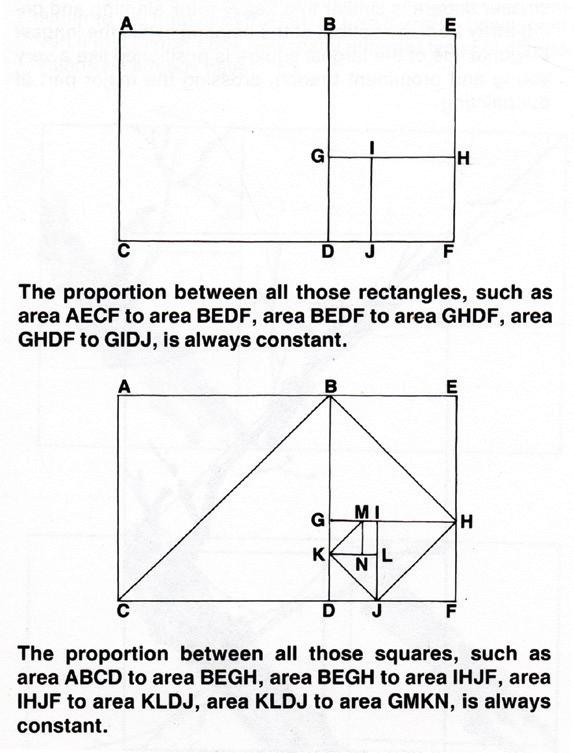
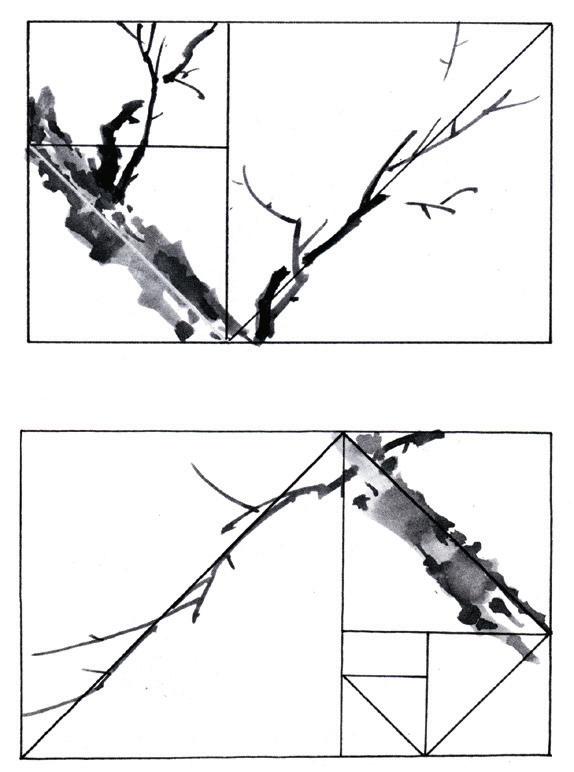
Ju seemed to use the Golden Mean proportion from the Western world to explain the composition of the concept of beauty and idea in Chinese painting
The Book of Plum, 35
The Book of Plum, 37
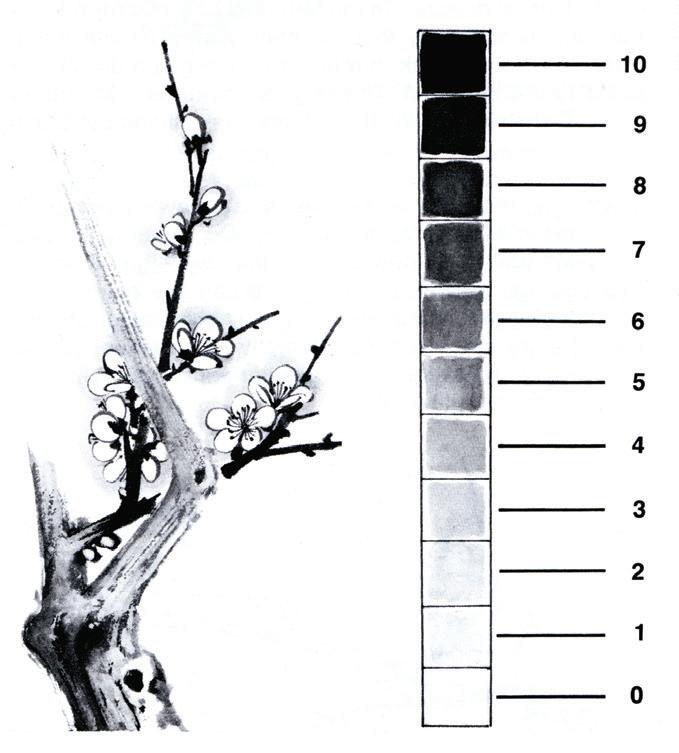
Another part of his book worth mentioning is “the diagram of ink tones ” Ju used this diagram to demonstrate the “chiu-fen mo chih, shih-fen mo ti,” which means 9/10s black ink for the branch, 10/10s black ink for the Calyx . 108
108Ibid, 70
Here, by using either the compositional elements or different shades and tints, Ju intended to blend the esthetics of the West and the East
5 The Book of Orchid (1989)
In this book, Ju pointed out the character of The Mustard Seed Garden Manual of Painting.
It is not a book of rules but a sort of list of suggestions There are eleven kinds of “threadshaped” lines, four kinds of “band-shaped” lines, and another four kinds of “dot-shaped” lines suggested for the creation of different types of textures for rocks and mountains In short, examples of lines, dots, and striped in the Mustard Seed Garden are stylized modes which are designed for representing certain feelings, certain qualities of beauty, and certain moods separately and specifically ”109
The Book of Plum, 70
Ju further explained the mood and modes from the perspective of literati painting:
Chinese arts have usually been an expression of maturity Most of the great masters first distinguished themselves as officials, scholars, poets, or expert calligraphers before they turned to painting Because of their maturity, the masters believed that a painting was, or at least should be, a revelation of the nature of the man who painted it, and of his mood feelings at the moment he painted it This is the fundamental contention of the Wen-jen-hua or literati painting theory It has been repeatedly written in many Chinese books that the expressive content of a painting depends more upon the artist’s own personal qualities and his transient feeling that upon the qualities of the subject represented 110
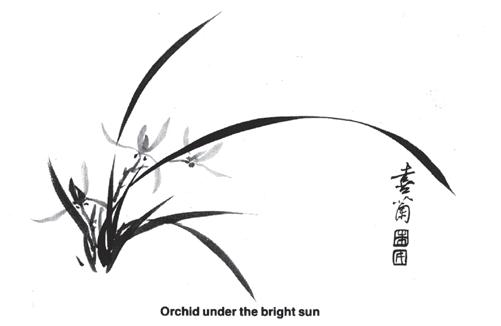
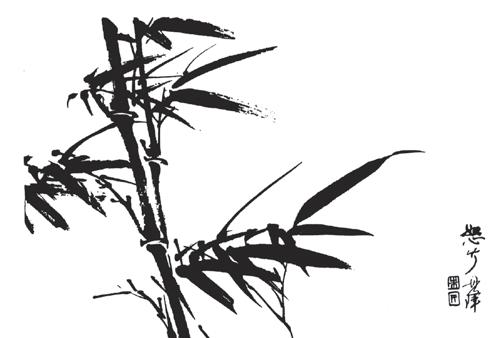
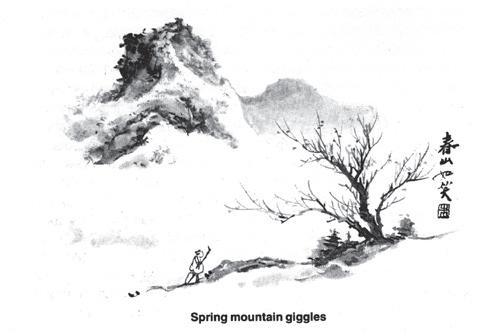
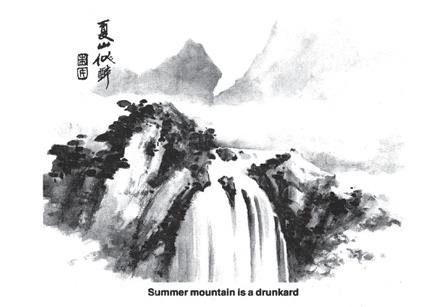
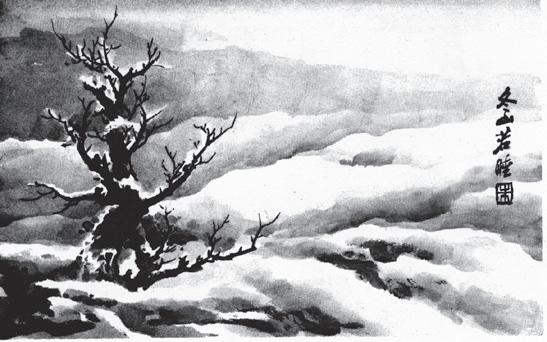
For this, Ju gives us some examples; i e , “orchid under the bright sun,” “an angry bamboo,” “Spring Mountain giggles,” “Summer Mountain is a drunkard,” and “flying white ”
109I-Hsiung Ju, The Book of Orchid, Virginia: The Art Farm Gallery Press, 1989, 14-15 110Ibid, 7
The Book of Orchid is divided into four parts:
1 Tools and Hand — brush, ink, paper, painting surface, silk, pasting, inkstone, mixing dishes, thin ink, dry ink, fei-pai, the proper way of holding the brush, rules
2 Basic Exercises on Orchid Leaves — first three leaves (brush, ink and color, the first leaf, the second leaf, the third leaf, two more points); the second and third three leaves (the second three leaves, the third group, jumping fish); rules in composition (the way of checking, eight mistakes)
3 Orchid Flower — basic structures (three kinds of lan, bud, young flowers with three petals, young flowers with four or five petals, flower in full blossom); some rules on making flower (direction of the strokes, “write” stems and stamens, faults and mistakes, the way to check); the stalk (the right flower and the right place, horn of the deer, faults and mistakes)
4 Composition and Others — better performer and worse composer, poor performers, endless composition, some creative lessons
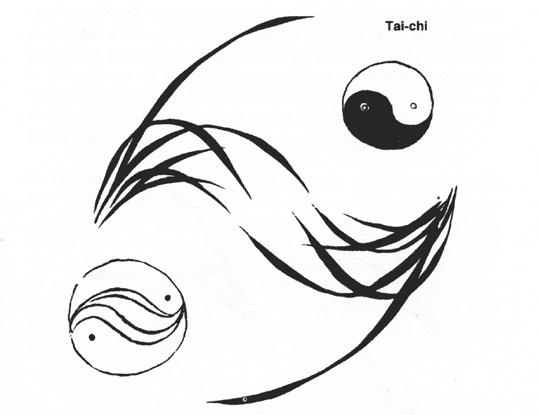
As the leaves of the orchid are important, and they represent the feeling of floating, Ju suggested his students borrow the S-shaped patterns of Tai-chi He said, “the line between the two sections of
The Book of Orchid, 12
The Book of Orchid, 13
The Book of Orchid, 14
The Book of Orchid, 9
The Book of Orchid, 10
Tai-chi which form all kinds of S-shaped patterns in our orchid composition suggests the quality of floating movement ”111 Below is Ju’s demonstration:
Book of Orchid, 71
The Book of Orchid, 91
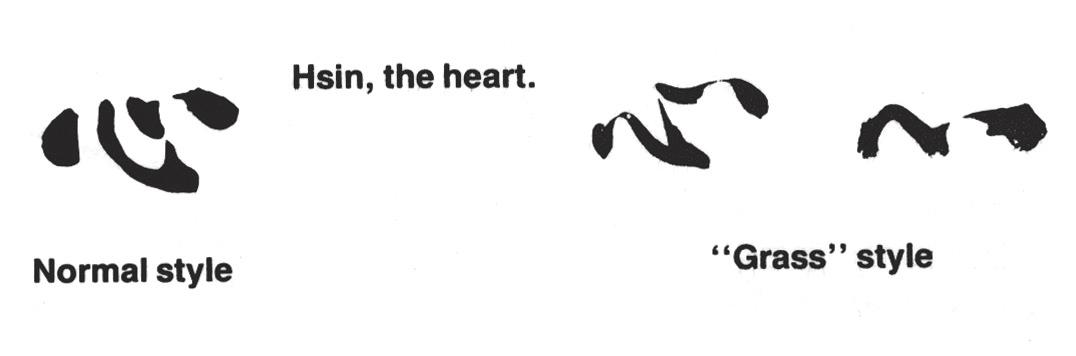
Sometimes Ju used a Chinese character to demonstrate how to write orchid, “With exactly the same way of writing, this character Hsin(心) might be found repeatedly at every open blossom’s center Since the Hsin is in the grass style or swift style, it may be simplified into two small dots or one short wavy line This simplified “heart” is used for a flower with a big petal in front, so that part of the stamen is hidden and for a younger flower which always has a tight center, therefore, we do not see much of the stamen ”112
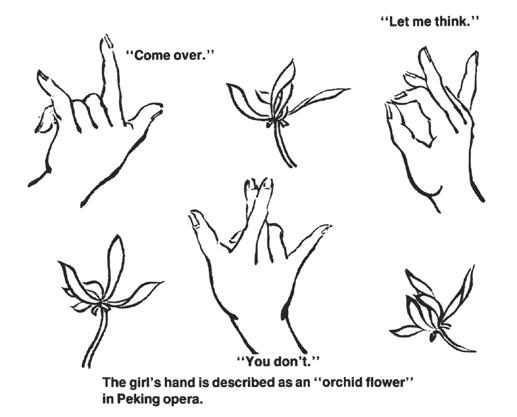
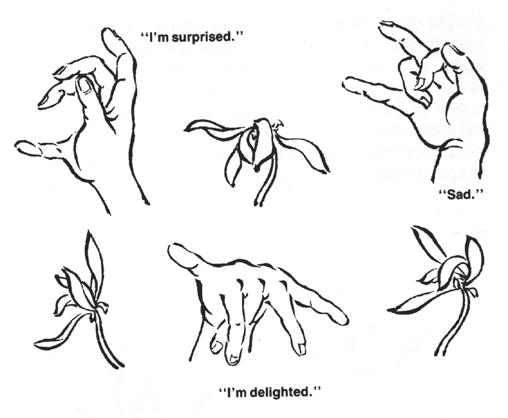
Ju stressed the most important issue was to reveal the relationship among petals, but he also knew it was difficult to do this Ju used skills from the Peking Opera to demonstrate the way to arrange the petals of orchid
In Peking opera, the girl’s hand is usually described as an “orchid flower” hand No matter which action it performs, holding, waving, pushing, pulling, pitching, throwing, the lady’s hands assume the attitude of orchid flowers, facing up or bending down, under the sun or suffering the rain, and so on The wrist is the base and the fingers are petals Her hands are always as beautiful as orchid flowers 113
111Ibid, 70-71
112Ibid, 94
113Ibid, 94
The
Here are sample of Ju’s demonstrations
The Book of Orchid, 94
The Book of Orchid, 95
The Book of Orchid, 96
In short, Ju’s demonstrations did not only explain the skill of painting, but also conveyed the idea of Chinese art
6 Conclusion
In his study on The Mustard Seed Garden Manual of Painting, Liu stated, “ In most people’s eyes, it is a painting [book of] materials, artists in China, even they used it as the initial textbook, but after they became famous, most of them did not mention it 114 Liu also mentioned that only the painter Ch’i Paishih and the scholar Shi-xiang Wang ever affirmed the book’s contribution of Chinese illustration However, Ledderose, a well-known modern German scholar in Chinese art, who tried to explain the literati painting through the concept of module, noticed the influence of The Mustard Seed Garden Manual of Painting He wrote: “Its many monochrome and colored woodcuts contain all the separate motifs that a painter might need, and they teach how paintings to the taste of literati can be built up from these modules ”115
Ju, as a Chinese scholar teaching brush painting in America, experienced a different situation than the literati circle in China or Taiwan He was flexible in interpreting how one learns Chinese painting In fact, Ju’s Books of the Four Gentlemen reflect a new blended perspective for seeing and learning Chinese brush painting as a foreigner
114See Liu Yue, “Mustard Seed Garden Painting in China’s influence,” Literary Review, Volume 5 (2009), 79-81 115Ledderose, Lothar, Ten Thousand Things: Module and Mass Production in Chinese Art, N J : Princeton University Press, c 2000, 204
Chapter Three: Ju’s Brush Paintings and Students in America
1 As a Literati Painter
When we talk about literati painting, we not only speak of the style of painting, but more importantly the painter’s expression of his difficult situation As mentioned in Chapter One, in the 20th century, the development of Chinese literati painting faced a great influence from Western culture As a Chinese scholar educated in Confucian thought, the literati painter spent his whole life “cultivating” himself and keeping his family in order If he passed the Imperial examination, he might have a political career and provide advice in running the country But if he has no opportunity, though talented, he might turn to painting When the Imperial examination was abolished in 1905, it shifted the future of scholars At that time, while some scholars turned to learn from the West, others stayed with the core of Confucian thought Si-zeng Chen (1876-1923) in his book entitled, “The Value of Literati Painting,” defined the elements of literati painting “It (is) based on moral standing, knowledge, talent and thought ” In other words, literati painting expressed some symbolic meaning from the painter Remarkably, the works of I-Hsiung Ju convey the special situation of a Chinese literati painter in America Ju’s status as a literati painter, as well as an overseas Chinese painter, created a strong connection between him and Taiwan during the Cold War Period (1950s-1970s) After losing Mainland China in 1949, the KMT (Kuomintang) Government retreated to Taiwan and shaped Taiwan as a symbol of “culturally Chinese ”116 At that time, the Chinese painters who followed the KMT Government to Taiwan regarded themselves as literati painters Therefore, these literati painters played an important role as they combined “artistic value” with “political reality ” Through the policy of “culturally Chinese,” the KMT Government aimed to highlight its own orthodox status of being “politically Chinese . ”117 The policy of the KMT Government included inviting any Chinese who lived overseas to Taiwan to learn Chinese culture When Ju brought his American students to Taiwan for art trips, he was aligned with this policy In Taiwan, they met with many Taiwanese brush painters and studied traditional Chinese painting techniques . In traditional Chinese painting, there are two schools: one is the Northern School; the other is the
116See Ling-ting Chiu, 2011 117Ibid
Southern School The former one refers to the court painters, the latter refers to the scholar painters
The Southern School was known as the Wu School and was followed by literati painters The Northern School was known as the Zhe School and was followed by the “court” painters Although these two Schools seemed to fight against each other, both are integral parts of Chinese tradition Ju’s paintings express the skill of Chinese painting while blending the style of the Northern and Southern Schools; e g his painting entitled “Home Coming in the Snow ”
As a Chinese brush painter in America, Ju tried to introduce the skill of Chinese painting to his American viewers He explained the special skill of “open space” in Chinese brushing below:
I begin this collection of my landscape paintings with a painting of snow, depicting my homeland and also my childhood My teacher taught me three special techniques for making landscape paintings: waterfalls; mist or clouds; and snow The techniques for painting these areas are all related and based on the idea called “liu bai” or “liu kong bai”which means “keep the white or open spaces ” My paintings clearly reflect this idea Readers will see the importance of the “liu bai” technique, demonstrated by darkening the sky to show the snow-capped mountains and adding a strong wash to show that the water is deep and frozen 118
As a literati painter in his time, the painting’s inscription reflected the mood of his time:
Wind, snow, and late home coming This is based on my memory More than fifty years ago, I was lost at night in a snowstorm in Western Zhejiang Province This experience still causes me nightmares 119
Blending the style of Zhe School (the Northern School or court paintings), and Wu School (the Southern School or literati paintings) in the Ming Dynasty also exposed the mood Ju mentions in the inscription Ju’s painting borrowed the famous subject “returning late” and composition of “Returning Late from a Spring Outing” from Tai Chin (1388-1462), who was the leader of Zhe School But Ju changed the season from spring to winter in order to tell his own story Although Ju depicted the winter season, he borrowed from another famous landscape painting entitled, “Deep Snow in Mountain Passes” by Wen Zheng-ming (1470-1559), who was a leader of the Wu School . But Ju changed Wen’s mountains from a left to right undulation to a front to back undulation Ju’s blending of the opposite styles provides us a new perspective of Chinese literati painting
118See I-Hsiung Ju’s Landscape Paintings Book II, Lexington, Art Farm Press, 1996, 5 119Ibid, 5
Wen Zheng-ming (1470-1559), Deep Snow in Mountain Passes (detail), 1528-1532, National Palace Museum, Taipei
Tai Chin (1388-1462), Returning Late from a Spring Outing National Palace Museum, Taipei
In addition, Ju described a wonderland landscape, cloud-shrouded and rich with animals (cranes, monkeys, birds), plants (pine trees, maples, cypress trees), waterfalls, and temples In this blue and green Chinese landscape painting, Ju borrowed the concept of “Dragon Mountain” from a literati painter in the Ming dynasty, Dong Qichang, who suggested the division in painting into the Southern School and Northern School, yet promoted the Southern School But on the other hand, Ju used the famous blue and green landscapes of the Northern School again showing his interest in blending the two styles
Ju’s Homecoming in the Snow 1995 (Michael Kopald)
“One Autumn Leaf” is another important literati painting that reflects Ju’s individual mood Here, Ju followed the tradition of literati painting, but gave us a modern perspective Using traditional landscape subjects, he added special meanings to the objects in his inscription; such as “the relentless flow of water,” “stones full of hate,” and “a fallen red leaf floating” between them These phrases also reference poems from the ancient literati For a realist painter, water, stone and leaf are just objective existences; but for a literati painter, each existence shares the painter’s mood of the moment
blue and green Chinese landscape
According to the inscription, Ju expressed his sentiment of life when he was sixty-two years old The water and stones in this painting are symbolic of his time, and the lonely leaf represents himself It was common to self-confess in Chinese literati painting But Ju displayed these objects in a bird’s-eye composition, rather than in the way they were used in the past The new view appears in his “The Lilies of the Field” in the same year Thus, we find both the traditional and modern in this painting
Ju's
painting, 2006 (W&L)
2 His brush paintings
James Cahill and Maxwell K Hearn once mentioned:
The greatest of Chinese landscapists, Li Cheng, was active in the north during the late Five Dynasties and early Sung period; he specialized in winter scenes, perhaps because they agreed with something austere and wintry in his personal nature, but also for reasons related to technique: the black-and –white scenery of this season was well suited to depiction in ink monochrome, and its bare trees, with their traceries of branches and twigs, served as ideal vehicles for displaying the extraordinary vitality of his brushwork ”120 Li Cheng also created a new brushstroke like “crab-claw” (xiezhao ts’un) to depict the trees in winter Another famous painter Guo Xi (ca 1000-ca 1090) in Northern Sung continued the idiom of this brushstroke by Li Cheng In his work entitled “Old Trees, Level Distance,” Maxwell K Hearn wrote: “landscape emerges from and recedes into a dense, moisture-laden atmosphere: rocks and distant mountains are suggested by outlines, texture strokes, and ink washes that run into each other to create an impression of wet, blurry surfaces 121
120James Chill, Treasures of Asia Chinese Painting, New York: Crown Publishers, Inc , new edition 1972, 29-31
121Maxwell K Hearn, How to Read Chinese Painting, New York: Metropolitan Museum of Art; New Haven: Yale University Press, ca 2008
Ju’s The Lilies of the Field, 1984 Ju’s One Autumn Leaf, 1984 (W&L )
Guo Xi (ca.1000-ca.1090), Old Trees, Level Distance, The Metropolitan Museum of Art, New York.
Both Li Cheng and Guo Xi painted ink brush on silk and used their creative skills to express their personal nature Ju’s brush painting reflects his personal nature and expression of mood by washing technique, side strokes, and the “ghost faces” (Guĭmiàn ts’un) brushstroke
A Washing Technique
Ju wrote:
This wetting of the paper is difficult, but we must do it to ensure that the ink spreads evenly and deeply The most important part is to create the soft edges of the mist, clouds, and the bubbles of the running rapids There is no excuse to let ink strokes dry on the paper, leaving hard edges It is critical to determine how much moisture and how fast to apply the wash; much practice is needed I use a flat wide brush with a gradation of ink tones on it to show the snow and its shadow The strokes are spontaneous but the execution of the whole is done under strict rules 122
122I-Hsiung Ju’s Landscape Paintings, Book II, 1996, 29
Ju’s “Firecrackers in
This technique appears in many of Ju’s paintings, especially in his winter scenes; e g , “A Traveler in the Winter,” “A Village in the Winter Evening,” and “Firecrackers in the New Year ” The “washing skill” is suitable for snow scenes
B . Side Strokes and Ghost Faces
In his “Grand Canyon #1,” Ju was reminded of the famous Chinese painter Ni Zan and wrote:
Ni Zan of the Yuan dynasty was well known for his “side stroke” shading lines and the special formation of his horse teeth rectangular rocks He painted scenes of Lake Tai, his home, with many flat and narrow rocks in front of a few bare winter trees The wide open spaces represent the lake Actually, this is a very rich country which produces great quantities of fish and rice; the lake is always surrounded by thick, luxuriant trees and other vegetation Ni Zan choose to paint everything contrary to nature To him, dead trees and dry land were symbols of solitude and desperation I stood at the very edge of the canyon and looked towards the horizon…at that moment I recalled the great master Ni Zan and his horse teeth rocks Of course I felt lonely and lost The canyon is forever so grand but I am so small and insignificant 123
123Ibid, 39
Ju’s “A Traveler in the Winter,” 2002 (W&L)
Ju’s “A Village in the Winter Evening,” 2002 (W&L)
the New Year,” 1979 (W&L)
When Ju stood at the very edge of the canyon and looked to the horizon, he felt Ni Zan’s loneliness
At this moment, Ju might have realized why Ni Zan’s use of dead trees and dry land as symbols of solitude and desperation In fact, when Ju stood at the edge of the Grand Canyon, the dry land reminded him of the Chinese brushstroke “Ghost Face ”124
In his “Grand Canyon #2,” Ju introduced another Chinese brushstroke “Ghost Face,” he wrote:
In the past, an art student was told to practice and even to memorize many techniques for making “wrinkles” for mountain and rocks These “wrinkles” are the shading lines or dots for different mountain and rocks The “hemp wrinkles” are many loose, fine strokes, designed for a place that is not too rocky; the “folded ribbons” are for flat and huge rocks Rocks with many “rain drops” are for rocks that have a sandy or porous quality, and the huge rock or cliff with “axe cuts” are for rocks with surfaces, which are hard and sleek, and the canyon is very precipitous The rocks at the lower right are painted in the style called “ghost faces” which are formed by many swollen muscles 125
Comparing Ju’s brushstroke with Ni’s, we find Ju’s stroke to be wetter and darker It may be Ju followed the technique of “washing” from Lingnan School In addition, while Ju created a spectacular scene of nature, Ni focused on his own mental images 126 These differences show us the individuals’ personal approaches to their art: the outer world versus inner feelings
124Ibid, 41
125Ibid, 41
126See Wen C Fong, Images of the Mind, N J : Princeton University Press, ca 1984
Ni Zan (1301-1374)
Rongxi Studio 1372, National Palace Museum, Taipei
C Expression of Mood
Ju’s “Huge Rocks” shows us a Chinese brush painter expressing his mood in front of nature He wrote:
This is a quick sketch that I painted in less than half an hour, while I sat and rested on a rock on the other side of winding road The painting it is very much the true record of my felling and experience at that moment… I painted the rocks along the highway in Arizona with “side strokes,” showing little texture, and repeated many rectangular formations with sharp edges to show that the place is cold, almost barren 127
127I-Hsiung Ju’s Landscape Paintings, Book II, Hong Kong: Golden Production Co, 1996, 37
Ju’s Grand Canyon #1
Ju’s Grand Canyon #2
His “Goshen Pass” is one of the “tea house” screen paintings, painted when Ju was 73 years old It is his observations of the Goshen River viewed from his seat on the rock beside the river 128
128See Michael Kopald’s interview on July 22, 2018
Ju's huge rocks
Ju's Goshen Pass (W&L)
Left: Goshen Pass
Above: One of Ju's sitting places
The painting’s inscription reads:
Half my life, living in the deep Valley, Every day I see the mighty Blue Ridge The Bible mentions a place called Goshen, here at our place, we’ve Goshen Pass gorges Old Autumn leaves, carried by water, are gone, storm comes, I then recall hardships in the past My brush and ink are still in good shape, I tell my friend: “Do not worry, I’m alright ”129
In the Bible, Goshen was a fertile land and blessed place As a Chinese Christian, Ju added pine trees, used by literati painters He also added red leaves to express the melancholy mood of literati painters
His “Goshen Pass” blends the elements of East and West
D His Abstract Paintings
In addition to traditional Chinese brush painting, Ju made modern abstract brush paintings Pauline Edwards mentioned a new way I-Hsiung Ju summed up today’s interest in Oriental painting
A very wonderful thing (is) the serious artist’s search for something new and different Ju also compared some British, American, and French painters and summed “now, instead of using watercolors almost like oil, they use the Oriental technique — very free, let the water run, let the brush go-o, very, ve-ry spontaneous ” Ju also gave a example of the Oriental free style, he said, “perhaps a ring or a crack in the wall becomes a landscape or a branch It is the mood, the feeling that goes into the work ” And after several days, there was a picture to show a demonstration of authentic Oriental brush-painting technique 130
129I-Hsiung Ju’s Landscape Paintings, Book II, 1996, 17
130See News-Gazette, Lexington, Virginia, June 4, 1978
Chu-tsing Li, a famous art historian of modern Chinese painting, wrote of the difference between Western abstract painting and Chinese literati painting:
In Western Abstract Expressionism or total abstraction to purely formal elements that any resemblance to actual objects in nature is regarded as an aberration, meaning must come directly from the form itself This, however, is not true of literati painting However far it departs from the strictly representational, nature is always there, in the form of landscape or bamboo or plum blossom The brushwork, though of primary importance, never denies the reality of what it is meant to represent 131
Here are two abstract paintings from Ju: one blending the cursive script and modern art, the other writing the image of the root of the dead tree . Ju’s abstract modern paintings reflect what Li wrote, “nature is always there,” “the brushwork, though of primary importance, never denies the reality of what it is meant to represent ”
E His Ideal Home
Ju founded the Art Farm in America, and he painted many works to describe the surrounding scenes He also told us about his way of observation He wrote:
There are several huge sugar maple trees in our yard When spring comes, we watch the young leaves grow and change color It is like magic Our masters tell us that to be a great landscape artist, one should constantly observe nature Observation can improve our sight and help us to know nature better In the art manuals, our teachers use phrases such as “it sharpens your ability to see things ” We
131Chu-tsing Li, “The Artistic Theories of the Literati,” in The Chinese Scholar’s Studio: Artistic Life in the Late Ming Period, New York: Thames and Hudson, Inc , The Asia Society Galleries, 1987, 19
Ju's work, 1984
Ju's The Root of the Dead Tree
are not required to paint photo graphically, but we are expected to paint objects reasonably correct with all the details in proper order The realism in Chinese brush painting is based on our inner feelings The artist depicts the essence of the subject matter and the viewers’ reaction should be spontaneous understanding . Art is the universal language, which communicate our feelings . 132
As Ju mentions here, “[t]he realism in Chinese brush painting is based on our inner feelings ”133 He refers to the blending of memory and reality, which was an important character of his brush painting In fact, we find many of his brush paintings of American scenes convey this character; e .g , “Early Spring in Virginia,” “Humpback Rocks Mountain Farm,” and “Sunset in the Virginia Countryside ” These works formed Ju’s ideal home: a place around mountains and rivers, the season’s trees, and all in shrouded clouds The inscription of Humpback Rocks Mountain Farm reads:
The Blue Ridge Parkway starts in central Virginia and ends at the southern slopes of the Great Smoky Mountains In the past few centuries, many settlers have lived in this area They hunted, farmed, mined, logged and raised their families, while enjoying the solitude of the mountains The unspoiled beauty of the area still draws new settlers 134
As “Early Spring in Virginia” and “Humpback Rocks Mountain Farm” reveal the inner ideal home for him, Ju’s “Sunset in the Virginia Countryside” blends the real scene and traditional image:
“The cattle are coming home under the setting sun ” I have lived in the mountain area of Virginia for twenty years and love the scenery This is my way to depict one line of an ancient poem about sunset in the mountains 135
132I-Hsiung Ju’s Landscape Paintings, Book II, Hong Kong: Golden Production Co ., 1996, 11
133Ibid, 11
134Ibid, 22
135Ibid, 14
Ju’s Early Spring in Virginia Ju’s Humpback Rocks Mountain Farm
Although Ju lived in Virginia, he saw everything around him as the narrative from the Chinese ancient poem
3 His Students in America
A Washington and Lee University Students (1970s)
Mr . Ju’s talks always raised his students up 136
Michael Kopald (Art Farm: 1975-1978)
Michael met Prof Ju at Washington and Lee University, both in their second year there Ju became
Michael’s faculty advisor and art professor, teaching him silkscreen printing and Western painting
136See Michael Kopald's interview, July 14, 2018
Ju’s Sunset in the Virginia Countryside
The Art Farm real scene, July 2018
L. to r.: June Morgan, Missy Morgan, Michael Kopald, David Hilton, and Steve Roberts in Art Farm. Photograph by Patrick Hinely.
technique 137 Michael thought Ju was a blessing to him in a time of confusion and insecurity A year after he graduated in 1974, he traveled with Prof Ju to Taiwan on their first of many Asian trips together There Ju introduced Michael to the Four Treasures of Chinese painting, which led Michael to return to Lexington to begin a lifelong study of brush painting with the “master,” Ju Michael and several other students helped as Mr and Mrs Ju established the Art Farm — a gallery and school of Chinese arts and culture — a place of which Ju had dreamed, to “grow artists ”138
Michael lived at the Art Farm from 1975 to 1978 He is regarded by some as the oldest dragon son of Ju 139 He said, “So much of my life is directly related to the Jus, to my trip to Taiwan, and the years at the Art Farm, here in Lexington ”140 “Through Ju’s instruction and inspiration, I began my life’s work in Chinese brush painting Now these many years later, when I look at my bamboo painting, I see ‘Mr Ju,’ my second father looking back at me ”141 Like Michael, two other students of Ju’s, Phillip Welch and Jeff Shumate feel Ju’s influence changed their life 142
Ju approved of Michael’s bamboo painting He even wrote “my student’s bamboo is better than mine” in an inscription on one of Michael’s paintings
Michael met Shou-ren Chung, a famous Taiwanese artist, in Taipei in 1986 Chung found Michael’s bamboo was a little weak and suggested he add more energy to his bamboo 143 Michael accepted Chung’s advice and began to explore a “new” way of writing bamboo Here are Michael’s new bamboos admired by Ju .
137See News-Gazette, Lexington, Virginia, May 10, 1978
138See Michael Kopald, Two Painters’ Stories, in I-Hsiung Ju’s Landscape Paintings, Book III, 70
139See David Hilton’s interview, July 30, 2018
140See Michael Kopald, in Journey to Taiwan, 2007
141See Michael Kopald, Two Painters’ Stories, in I-Hsiung Ju’s Landscape Paintings, Book III, 70 .
142See the interview of Michael, Phillip Welch, and Jeff Shumate, June 20, 2018
143See Michael Kopald’s interview, August 2, 2018
Chung’s bamboo, 1979
Michael's bamboo, 1986
Ju’s bamboo, 1991
Exhibition titled “The Master and the Student,” Art Farm, 1981. Photograph by Patrick Hinely..
L. to r.: Phillip Welch, Michael Kopald, Chiu, Terry, and Jeff Shumate
Michael’s bamboo and Ju’s inscription, 1996
Michael’s studio
David Hilton (Art Farm: 1975-1976)
According to the Art Farm residents, David played a leadership role at the Art Farm 144 As the scholars in many Chinese paintings have a servant to carry items for them, David likes to say he was the servant of Ju . 145 After the first art trip to Taiwan, David spent four to five months working at the National Museum of History in Taipei and editing an English brochure for the museum While in Taiwan, he lived with the literati painter and Ju’s friend, Chi-mao Li in Beitou 146
Although David did not pursue a career in the arts, he is an avid art collector Nevertheless, through the years he kept his relationship with Ju . For example, Ju often painted on stained rice paper; e g “Settlers Home:”
For this painting I used sheets of rice paper already stained with ink because these sheets had been used to dry other paintings after washes Those stains were not planned or painted, they just happened By studying them I discovered trees, bushes, fences, rocks and many other objects My brush strokes were guided by those marks, but my ideas were not limited by them . If the ink stains are black and grey, I may create a snow of the same valley 147
So, David rubbed a piece of rice paper to made stains on it and sent Ju the “pre-work,” hopeful Ju would finish it After Ju passed away, David found Ju had indeed started “their” painting . 148
144See Michael Kopald’s interview, June 15, 2018
145See David Hilton’s interview, July 31, 2018
146See David Hilton’s interview, July 30, 2018
147I-Hsiung Ju’s Landscape Paintings, Book II, 1996, 24
148See David Hilton’s interview, July 31, 2018, and interview letter, August 12, 2018
Ju’s work Settlers Home, 1995
Mark was a student of Ju’s at Washington and Lee from 1970-1974, and Ju also served as his academic advisor At that time, Mark was more of an abstract painter than a traditional Chinese brush painter Mark remembered Ju liked to say that all art was abstract and paid Mark the greatest compliment when Ju did a Chinese brush demonstration in “Mark Bold” style . 149 Mark’s work below reflects his rethinking of Ju’s study on Chinese calligraphy from the perspective of module:
Using Chinese calligraphy as a stylistic base, establish a grid to allow for a pattern evolution that uses changing line quality as well as texture and color If you step back you see a abstract texture or field background, like some of the color field painters but then you can look closer at see the subtle differences in each square in the grid So there is a larger world view, that you can see it as a patterned whole but step in and you can see the individuals that make it up . Until you can actually get involved in the untold stories of the painting 150
149See Mark’s interview letter, July 31, 2018
150See Mark’s interview (email), July 31, 2018
Mark Bold
David and his collection (the top one at left is Ju's work)
David's pre-work for Ju Ju's unfinished work
Steve Roberts (Art Farm: 1975-1976, 1977-1978)
Steve Roberts graduated from Washington and Lee University in 1976 As an art major, after graduating he studied woodcarving in Taiwan He is best known for his woodcarvings, though he also exhibits silkscreen prints and graphic sculpture 151 Steve remembers his first meeting with Ju:
I met Prof Ju my freshman year at Washington & Lee when, on a lark, I took Drawing 1 to fulfill one of my arts electives I entered W&L with the idea of being a math/ pre-law major but after 2 semesters of drawing class, Professor Ju suggested that I might consider art as a major 152
Steve was also part of the original Art Farm group He lived and worked there from the summer of 1975 until he left with Ju on an art class trip to Taiwan in the spring of 1976 On that trip, Ju had arranged for him to stay in Taiwan and study with the artist Yuyu Yang and then Yang’s protégé, Ju Ming, for several months When he returned to the Art Farm late in the summer of 1977, he remained until late 1978 153 In 2007, he assisted in the installation of Ju’s retrospective exhibition . Reminiscing about Ju, he said “Mr Ju was my first mentor, the man who most influenced my path in life, and made my 1976 adventure with Ju Ming possible ”154
151See News-Gazette, Lexington, Virginia, May 10, 1978
152See Steve Roberts’ interview letter, June 7, 2018 He worked as an artist full time concentrating on sculpture and silkscreen printing, then transitioned to professional art installation in 1985
153See Steve Roberts’ interview letter, June 7, 2018
154Steve Roberts, “Connecting with the Three Jus,” in Journey to Taiwan, 2007
Mark Bold (left) and David Hilton Ju’s painting
Mark Bold’s work, 1985-1987
Patrick Hinely
Patrick made his living as a photographer after graduating from W&L with a degree in journalism in 1973 Although he did not take any courses from Ju, he “ hung out” in some of Ju’s studio sessions to hear him tell his stories, which were not only about art, but also about life He remembered, while subsisting as a freelance photographer in the then tiny professional context of Lexington, Ju gave him a book by Harald Mante, hoping it would be useful When Patrick taught his first photography courses in the Art Department in W&L, this book was one the main texts he used 155
155See Patrick Hinely’s interview letter, June 7, 2018
Steve Roberts’ gift from Art trip to Taiwan in 1976
Steve Roberts’ work Steve Roberts and Ju Ming’s work
Prof. Ju wrote bamboos. Photograph by Patrick Hinely.
Patrick Hinely
Turner McGehee
Turner McGehee, who is a Professor of Art and Art History at Hastings College, Nebraska, was a 1975 graduate of W&L, where he majored in psychology Beginning in the winter of 1976, Turner studied graphic arts with Ju as a special student He participated in the first exhibition at the Art Farm in May 1978 The exhibition called “Spring Harvest,” included silkscreen prints, sculpture, paintings and photography Only Steve Roberts, Turner McGehee and Michael Kopald participated 156
Stephen Brooks
Brooks, a furniture designer and artist, met Ju when he was 19 He remembers that Ju not only taught him art technique and art history, but also Eastern philosophy, religion, life skills and even cooking He lived and worked at the Art Farm for two summers, took lessons in painting technique, played music on the front porch, built fences, made egg drop soup, gathered bamboo shoots, and did “lots of mowing ”157
B . Students at the Art Farm (Lexington, 1980s-1990s)
Even though each student in his class was not at the same level, Ju always gave the suitable model for each 158
Virginia Lloyd-Davies
Virginia is a brush painter, who lived in Scotland and moved to Lexington after her trip to meet Ju in September 1986 159 She assisted Ju at many workshops and wrote articles about his work 160 As Ju’s “dry daughter,” she said,
156See News-Gazette, Lexington, Virginia, May 10, 1978
157See Stephen Brooks’s interview letter, July 4, 2018
158See Virginia Lloyd-Davies’s interview, July 19, 2018
159See Virginia Lloyd-Davies’s interview, June 21, 2018
160See Virginia Lloyd-Davies’s interview letter, June 26, 2018
He was uniquely gifted as a teacher, and had a way to engage us all in his stories, which might start out as a “history lesson” about Oracle Bone Calligraphy or the Eight Crazy Painters of Yangzhou, and they would conclude with a moral that clarified the painting technique or the composition he was demonstrating 161
Virginia, who edited The Book of Plum for Ju, also compared The Mustard Seed Garden of Manual Painting with Ju’s The Books of the Four Gentlemen She said, “The text of the former one is too incomprehensible for the inexperienced western student; in contrast, Ju’s books have clearer illustrations and explanations ”162
Charlene Fuhrman-Schulz
Charlene, who has a Master’s Degree in urban planning and works as a city planner, met Ju through Virginia Lloyd-Davies She took her first class from Ju in September 1989 at the Art Farm When she became a teacher of traditional oriental brush painting, she taught in the same manner as Prof Ju — working with each student individually, and offering guidance and encouragement as a model to facilitate the student’s growth and understanding of what he or she is painting She also mentioned “the sessions also included discussion about Chinese culture, philosophy, the meaning of what is being
161See Virginia Lloyd-Davies’s interview letter, June 26, 2018
162See Virginia Lloyd-Davies’s interview, June 21, 2018
Virginia’s practice of peacock
Ju’s model of peacock
Virginia Lloyd-Davies’ film studio
painted ”163 Ju always asked his students what subject they wanted to learn and painted such as “models” for each student in their own individual painting album 164 Charlene was very impressed with Ju’s stepby-step teaching method She kept many of Ju’s illustrations, and they continue to inspire her teaching 165
C The Sumi-e Society of America
Ju insisted only the work painted with Chinese brush and ink can be called brush painting 166
163See Charlene Fuhrman-Schulz’s interview, July 7, 2018
164See Virginia Lloyd-Davies’s interview, July 19, 2018
165See Charlene Fuhrman-Schulz’s interview, July 7, 2018
166See Charlene Fuhrman-Schulz’s interview, July 7, 2018
Ju's model of lotus
Ju's illustration of crane
Ju's model of lotus
Charlene Fuhrman-Schulz's studio
The Society was created in New York in 1963 by Professor Motoi Oi, who was born in Japan and emigrated to the U S A in 1958 He worked as a printmaker, painted, wrote books on Sumi-e painting, and taught art at Queens College, in New York City, and the Brooklyn Institute of Art and Science Over the years, the Society has grown to a national society with a sister organization in Canada 167
Ju was the judge for the Sumi-e Society National Juried Exhibitions in 1989 and again in 1995 168 At an exhibition of Chinese brush painting at Sumi-e, Ju proffered that brush painting should use the traditional brush; otherwise, it could not be called brush painting 169
One of Ju’s students gives us a vivid picture of Ju’s lecture-demonstration in Sumi-e:
The brush, perfectly poised to a point, continues its dance led by the expert hand “One, two, three, one, two, three!” The rhythm for the bamboo leaves changes as they take the shape of “swallows,” of “new moons” or “double fish tails” and returns to “One, two, three” for the “horn of deer” strokes that will be the stems for those leaves whose “posture” will give away their age In full movement the shoulder leads the arm, the arm in turn commands the hand but they all obey his heart 170
In the essay entitled, “Brushstrokes of Life and Ink,” this same student also passed on the story Ju always told to his students. It’s a story about the power of painting and the power of a name — especially the power of love. When Ju was a young Chinese soldier, a young Japanese soldier captured him. Because of a shared last name, and their love of art, the Japanese soldier looked for an opportunity to help Ju escape. After the end of the war, Ju went back to Japan to thank the soldier even though Ju’s father and brothers suffered in the second Sino-Japanese war. But the Japanese soldier had been killed during the Pacific War. Instead, Ju met the soldier’s parents and told them his own life was a gift from their son.
In order to promote Ju’s contribution to Chinese painting, Carole L Yee, a student of Ju, donated the “I-Hsiung Ju Memorial Award” for Sumi-e Society of America, after Ju passed away in 2012 In 2017 the winner Lee Gerry Wertheimer painted the work entitled “The Waltzing Plum ”
In 2012, I-Hsiung Ju, a Professor Emeritus of Art at Washington and Lee, and the family of I-Hsiung Ju established an endowment for traditional Chinese art studies, known as “The I-Hsiung Ju and ChowSoon Chuang Ju Endowment for Traditional Chinese Art Studies ” The endowment provides support
167http://sumiesociety org/history php, July 22, 2018
168See Carla Jaranson’s interview letter, July 10, 2018
169See Carole L Yee’s interview, July 6, 2018, and Charlene Fuhrman-Schulz’s interview, July 7, 2018
170Sylvia Scherer, “Brushstrokes of Life and Ink,” Sumi-e (The Quarterly Journal of the Suni-e Society of America, Inc ), Volume 264 (2016), 14
for a student to travel to China or Taiwan to study traditional Chinese art (e g , brush painting or calligraphy), and may also fund students traveling to China or Taiwan to enhance his or her study of language and literature The ultimate goal of the endowment is to offer varied opportunities for W&L students to explore and study the artistic expressions related to the literati culture of the Chinese past . 171
4 Conclusion
We know Chinese traditional culture struggled after Western influence came to China It especially frustrated the literati painters’ work By Ju living in America, his paintings reflect not only the influence of the West, but also his Eastern heritage Moreover, when I interviewed Ju’s American students, I was struck that they always mentioned Ju was not only their teacher, but also their life mentor
These young people lived in a world which had experienced the Vietnam War and the following social upheaval of the hippie movement, women’s liberation and America’s violent desegregation Because of these societal circumstances, perhaps his students were searching for meaning, which Ju gave them His involvement in the Sino-Japanese war, his knowledge of Eastern culture, his love of people,
171https://columns wlu edu/endowment-established-at-wl-in-honor-of-i-hsiung-ju/, August 2, 2018
Ju at his last exhibition “Journey Home,” 2011 at W&L
and his gift of storytelling offered his students an open fulfilling view of life Throughout their lives, his students’ stories made him a life legend This humble, treasure of a man established an enduring link between Washington and Lee University and Asian art and culture He left a continuing legacy through his students and a lasting endowment and gifts of art to the university
I believe Ju’s experience requires us to consider a new perspective in traditional literati painting As Si-zeng Chen said, “the elements of literati painting are based on moral standing, knowledge, talent and thought ”172 Ju shows us how a Chinese literati painter had a great influence on American students throughout their lives And the paintings of a “legendary” Chinese painter in America may cause us to rethink the transition of Chinese painting from traditional to modern
172Si-zeng Chen, The Value of Literati Painting, 1922
acknowledgements
First, I wish to acknowledge Washington and Lee University for hosting my visit, and the assistance of former Dean Suzanne Keen My deep thanks to Prof Mark Rush, for his assistance in the publication of this book Much thanks also goes to Hunter Swanson, and Patrick Sheridan at the Center for Global Learning for their invaluable help in many ways Thanks to Patricia A Hobbs at Reeves Center, who located the many works of Prof I-Hsiung Ju for my research Thanks to Prof Thomas E Camden, Lisa S McCown, Seth McComnick-Goodhart for their enthusiasm and patience in providing me with related and important documents from the Special Collection Thanks to Elizabeth Anne Teaff, who always instantly helped me with many important details Thanks also to Laurent Boetsch, whose titles are too many to list, for his invaluable advice and aid in this project
I would also like to express my gratitude to Prof Ju’s students — David Hilton, who generously assisted my trip to Eugene; Mark Bold; Steve Roberts; Patrick Hinely; Phillip Welch; Jeff Shumate; Virginia LloydDavies; Charlene Fuhrman-Schulz; and Carole L Yee, who shared their time, memories, and their personal collection of Prof Ju’s paintings with me And a very special thanks to Michael Kopald for the many hours he spent sharing his stories about Prof Ju, and their paintings, and for his tireless support He and his wife, Terry, who helped edit this report, were so kind to open their hearts and home to me during this summer I am also greatly indebted to the Ju family — Mrs Ju, Doris, Helen, Jane, and Grace
Thanks to Mary Woodson who designed this beautiful book; Patrick DiTondo ’19 for proofreading and Julie Grover for the final editing
Thanks to Fulbright Taiwan for making this whole experience possible
Finally, thanks to my beloved family — my husband Chi-ping and our son, Hung-chun, for their loving consideration and unshakeable confidence in me all through my three months of research away from our home