Print edition published two times this semester by WKU Student Publications at Western Kentucky University. First copy: free | Additional copies: $5
EDITORIAL BOARD
Jake McMahon Editor-in-Chief
Anthony Clauson News Editor
David Quintanilla Herald en Español Editor Von Smith Visuals Editor
Austin Rice
Sports Editor
Summer Crawford
Sports Visuals Editor
Shelbi Bale
Design Editor
Kane Smith
Assistant News Editor
Emmy Libke
Multimedia Editor
Jonah Savage
Multimedia Visuals Editor
Michael Givner Jr.
Assistant Sports Editor
OTHER LEADERS AND ADVISERS
Sarah Thompson
Cherry Creative Director
Carrie Pratt
Herald Adviser
Avari Weis
Advertising Adviser and Sales Manager
Olivia Games
Co-Advertising Manager
Harrison Rogers Co-Advertising Manager
Chuck Clark
Student Publications Director
POLICIES
Opinions expressed in the College Heights Herald are those of student editors and journalists and do not necessarily represent the views of WKU. Student editors determine all news and editorial content, and reserve the right to edit or reject submissions.
CONTACT US
REPORT AN ERROR: herald.editor@wku. edu 270-745-5044
NEWSROOM: herald.digital@wku.edu
270-745-2653 or 270-745-5044
ADVERTISING: herald.advertising@wku.edu
270-745-6285
LETTERS TO THE EDITOR: herald.opinion@wku.edu
ON CAMPUS:
Adams Whitaker Student Publications Center, 1660 Normal St.
ONLINE: WKUHerald.com
NEWSLETTER: WKUHerald.com/newsletter
SOCIAL MEDIA:
• X: @wkuherald, @wkuheraldsports
• Facebook, Instagram: @WKUHerald
• YouTube: wkuheraldvideo
• Tiktok: @wkuherald
Letter from the Editor
Hello, Hilltoppers!
I hope everyone is having a great semester as we inch towards the homestretch. It’s been a strong semester at the Herald, which, earlier this month, was recognized as one of the best student publications in the country with a 2025-26 online Pacemaker award! We are proud to bring you award-winning reporting every day.
In our magazines, we’ve illuminated issues across WKU’s campus, like the university’s dorm issues, while also approaching issues at the national and state level, like immigration and House Bill 4. I’m proud to say that in this edition, we’ve continued asking hard questions in pursuit of important journalism.
Assistant News Editor Kane Smith asked how data centers could impact the Bluegrass — including right here in Warren County — in this issue’s cover story.
News Editor Anthony Clauson asked the question, “Who will own WKU’s dorms?” in reporting on the Collegiate Housing Foundation.
News reporter Coumba Cisse asked how the National Alliance on Mental Health is supporting students’ mental health at WKU.
Lastly, in a letter from the Herald Editorial Board, we informed readers of why we ask the hard questions and how those in power are making our job more difficult than it needs to be.
This is my last magazine as editor-in-chief and as a WKU student. It has been an honor to serve as a watchdog and mirror for this campus and community. The Herald and the Hill will always hold such a special place in my heart as the place I grew as a journalist and person.
You can’t get rid of me just yet, as we’ll keep asking the hard questions to deliver award-winning content on WKUHerald.com, our daily email newsletter and our social media accounts.
Sincerely,
Jake McMahon Editor-in-Chief
Photo by Carrie Pratt
Who will own WKU’s dorms?
Story by Anthony Clauson
The Collegiate Housing Foundation will soon own all WKU dorms in a first-of-its-kind deal for both organizations.
The move is a milestone for the nonprofit organization, founded in 1996, which has never acquired all the housing on a single campus. The most dorms on a single campus owned by the Alabama-based Collegiate Housing Foundation are five of the 53 dorms at the University of California, Irvine. Of the 53 universities partnered with the Collegiate Housing Foundation, 42 host just one dorm owned by the foundation. Across the 53 universities, the foundation has completed 70 projects.
Legislation to formally approve the change in ownership is working its way
through the Kentucky General Assembly.
If the acquisition is passed and the group completes its proposed construction plans — and assuming no other dormitories close in the meantime — WKU will be the third-largest entity in the Collegiate Housing Foundation’s portfolio, with 4,176 beds across 10 dorms.
UC Irvine ranks first with 7,681 beds across five dorms, and the University of California, Davis, comes in second, with 4,713 beds across two dorms.
A Feb. 20 WKU press release said the new housing plan would cost “approximately $350 million.” The project is listed on Gilbane’s website, WKU’s private dorm partner, at “more than $300 million.” Either figure would put WKU in the top five
Top 10 most expensive Collegiate Housing Foundation projects
$794,040,000
$765,005,000
$350,000,000
$320,915,000
$280,250,000
$171,875,000
$151,605,000
$150,580,000
$147,680,000
$137,905,000
$137,280,000
University of California, Davis
University of California, Irvine
Western Kentucky University*
University of California, Riverside
Samford University
University of Hawai’i at Mānoa
Northern Illinois University
Texas A&M University - Corpus Christi
University of North Carolina at Wilmington
Purdue University
Tarleton State University
The initial investment for WKU’s housing plan is projected to be approximately $350 million, which would place the university as the foundation’s third most expensive partnership. The Collegiate Housing Foundation has partnered with 53 universities.
most expensive campuses for the nonprofit.
Currently, the three most expensive student housing developments owned by the Collegiate Housing Foundation are the University of California, Riverside, for $320.9 million, UC Irvine for $765 million and UC Davis for $794 million.
WKU’s three newest dorms were shut down in the last two years following the discovery of structural failures.
Hilltopper Hall was the first built and first to close. The 400-bed dorm opened in 2018 for $40 million. In 2024, it was abruptly shuttered and is set to be demolished “the day after graduation,” WKU President Timothy Caboni said at a Feb. 3 press conference. Demolition will cost an estimated $2.1 million.
Normal and Regents halls, which house a combined 635 beds in First Year Village, opened in 2021 for $48 million. They shut down in May 2025 for repairs and are currently scheduled to reopen in fall 2027.
The Student Life Foundation, established by WKU in 1999, is the current owner of WKU’s dorms.
Former WKU President Gary Ransdell established the SLF to expedite the renovation of WKU’s aging dorms and keep the associated debt off WKU’s books.
The SLF also ensured money generated by housing was only used for housing, Ransdell said.
Ransdell said “most campuses” that needed to quickly improve dorms have made similar moves.
The SLF has been issued a $55 million bond with room for a 10% increasing adjustment for the repairs in Normal and Regents halls. The City of Bowling Green is acting as a conduit for the bond, and no debt will be reflected on the city, according to minutes from a Dec. 2 Board of Commissioners meeting.
All three dorms were closed after structural analyses — the first ever done on the residences — determined the buildings were uninhabitable. Hilltopper Hall was open for six years before its first analysis, and Normal
and Regents were open for four.
In response, WKU entered a $5.8 million pre-development agreement with Rhode Island-based international real estate company Gilbane to operate, manage, renovate and construct all of WKU’s dorms. The contract was announced at the Dec. 11 Board of Regents meeting.
Gilbane was founded as a carpentry firm in 1870 and has grown into a multinational company that generated $7.7 billion in 2024, according to its annual report. Gilbane has public-private housing partnerships with 10 other universities.
Alongside the Collegiate Housing Foundation, Gilbane will collaborate with Inwood Management, Capital Markets, CenTrio, Mackey Mitchell Architects, Structural Design Group, Broeren Russo Builders Inc., Element Design and Keer-Greulich Engineers Inc. on the project.
Keer-Greulich Engineers is the only collaborator based in Kentucky. The firm has worked on Downing Student Union, Houchens-Smith Stadium and the Soccer/Softball Complex.
University Spokesperson Jace Lux said this is the Collegiate Housing Foundation’s first time working with Gilbane.
Vice President of Marketing for Gilbane’s development arm, Stephanie Handfield, said Gilbane chose the Collegiate Housing Foundation because “it is one of the nation’s most experienced nonprofit student housing organizations…”
At the Dec. 11 Board of Regents meeting, Caboni said that Gilbane’s “national expertise” and “good third-party oversight from outside organizations” factored into his decision to bring the company before the Board of Regents for consideration.
The agreement between the university and the foundation will last 40 years, after which the agreement can either be extended or the university can reclaim the dorms.
“Going the private developer route makes sense to me, and I would probably be doing the same thing if I were still engaged,” Ransdell said.
The Collegiate Housing Foundation’s President and Chairman of the Board, William Givhan, declined the Herald’s interview request and said he had “been asked to refer any questions to the university spokesperson,
Jace Lux.”
The Collegiate Housing Foundation recorded $336 million in revenue and $3.21 billion in assets in fiscal year 2024. The foundation also reported $320 million in expenses and $3.39 billion in liabilities.
The two-phase dorm plan is slated for completion by 2030.
On Feb. 20, Caboni and representatives from Gilbane and Mackey Mitchell Architects unveiled renderings for phase one that depicted an over 300,000-square-foot facility with “over 1,000 beds,” across five floors, Caboni said. Gilbane’s website lists the project at 980 beds. The new dorm would replace Douglas Keen and Hugh Poland halls.
Phase two would replace PearceFord Tower, McCormack, Gilbert, and Rodes Harlin halls with 1,400 beds. Construction is slated to begin in 2028.
Caboni said in an interview on Dec. 11 that the Collegiate Housing Foundation will take on the SLF’s debt and invest “$26 million or so in construction and renovation” as part of the initial $300 million to kickstart the dorm plan.
“SLF has pledged to cooperate and work with the University to complete the transfer, however it is ultimately arranged,” Tad Pardue, SLF legal counsel, said.
News Reporter Anthony Clauson can be reached at anthony.clauson994@topper.wku.edu
The university responsible for providing student housing.
Gilbane
The Rhode Islandbased private company responsible for the construction, renovation, operation and management of all WKU dorms.
Collegiate Housing Foundation
The Alabama-based nonprofit organization set to own all of WKU dorms
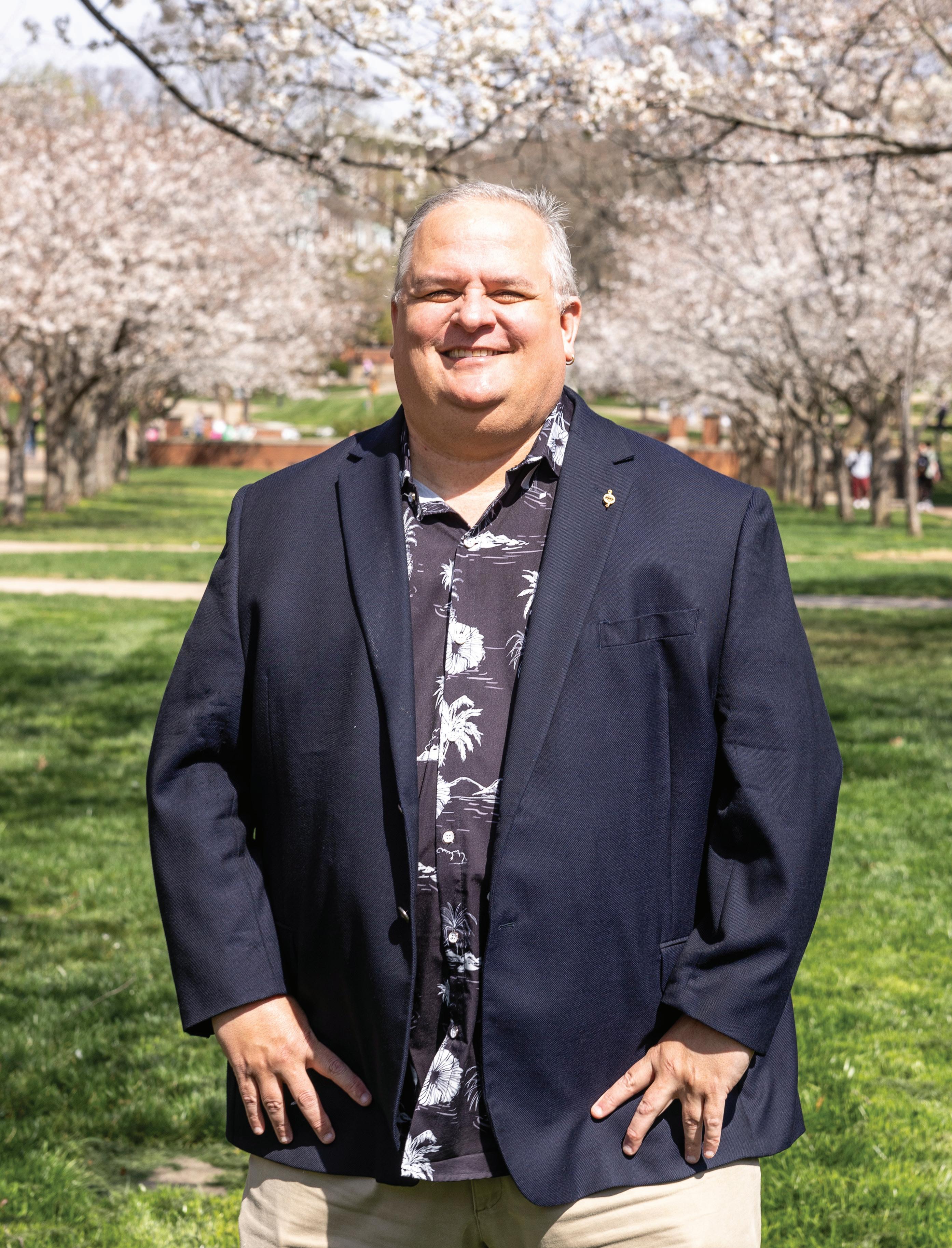
Jay Gabbard, professor of social work, helps run NAMI on WKU’s campus. “My passion is helping others like myself who are in mental health recovery — especially WKU students in crisis,” Gabbard said.
NAMI prescence at WKU provides lifeline, reduces mental health stigma
Story by Coumba Cisse
At WKU, students in a peer-led support group encourage one another to speak up about mental health challenges.
The National Alliance on Mental Illness came to campus a decade ago after a student suicide prompted Social Work Professor and NAMI Facilitator Jay Gabbard and his colleague Deborah Weed to form the student support group. WKU’s NAMI chapter operates with oversight from the Bowling Green and state NAMI offices.
“We’re not therapy, that’s the Counseling Center,” Gabbard said. “What we provide is a safe place for students to be able to talk to other students who are struggling with things like depression, anxiety, PTSD, eating disorders and suicidal ideation.”
Mia Fisher, a junior social work major, dealt with lifelong mental health challenges and hoped to find a sense of belonging after transferring from community college. She was encouraged when she first heard about the support group that Gabbard advertised in his class.
“He was really welcoming,” Fisher said.
So she decided to try it.
“I think the most challenging part of attending the support group meetings was having the courage to go for the first time,” Fisher said. “I remember walking in and feeling really nervous, but as the meeting went on, I was made to feel welcome and comfortable.”
The semicolon has become a symbol amongst mental health advocates, representing a decision to move forward and continue living despite the circumstances.
Photos by Gabriel Milby
Fisher looked forward to the meetings because she felt heard and able to be herself. There, she found a sense of belonging and connection to others she had been missing.
“Some knowledge I have
gained is that struggling is normal and that mental health does not have to be a taboo topic,” Fisher said. “Talking about your struggles can create meaningful change if you find the right people to listen.”
Fisher has always wanted a career in mental health, and her experience with NAMI has reinforced that determination.
“My advice to another student thinking about joining is to do it and see
Mental health does not have to be a taboo topic. Talking about your struggles can create meaningful change if you find the right people to listen.”
- Mia Fisher
what happens,” Fisher said. “No one will judge you for trying it, seeing if it works for you.”
NAMI was founded in 1979 in Madison, Wisconsin, by Harriet Shetler and Beverly Young, two mothers who were frustrated with the lack of support for their schizophrenic sons.
Early versions of NAMI began with local self-help groups and grew into a national organization focused on education, support and public policy. The organization later changed its name from the National Alliance for the Mentally Ill to the National Alliance on Mental Illness.
Gabbard said his journey with NAMI began as someone simply looking for help.
“I was inspired to join NAMI through their outstanding advocacy efforts for individuals like myself who struggle with mental illness,” Gabbard said.
After attending support groups, he became a certified group leader and eventually served as vice president of NAMI Bowling Green. From there, he helped launch the NAMI support group at WKU. He also presented research at NAMI Connection — the organization’s national conference — and served on the state mental health
policy advisory group.
“Over time, NAMI gave me a platform to share my story and support others,” Gabbard said.
NAMI Bowling Green President Rebecca Coursey said she connected with Gabbard in a support group around 2012, when they were both attendees.
“Later, we joined the board and began volunteering,” Coursey said.
For Coursey, the work is rooted in personal loss and a long relationship with the organization. Her path to NAMI began when her sister died from an overdose in 2010. Coursey was so overcome with grief that she had to be hospitalized.
After grieving for about a year, she wanted to help others who may be struggling by volunteering. Over time, that simple step evolved into a leadership role with NAMI.
Coursey said that there are not many college NAMI groups. “The groups make a difference because students find that connection they are missing.”
Coursey said she believes today’s college students are carrying unique burdens, especially in the aftermath of the COVID-19 pandemic.
“I believe any young adult, whether in college or not, has lived through a time where they lost valuable social events,” Coursey said. “They missed prom, in-person graduation, sports… all the things that connect young people. I’ve found that young adults don’t know how to make connections with others. Our groups connect people.”
NAMI is a complement — not a substitute — to counseling services, but provides a “two-way street” for referrals between peer support and professional treatment. If a student needs something more, NAMI often refers them to the WKU Counseling Center or the Talley Counseling Center.
“Absolute confidentiality: what is said in the room stays in the room,” Gabbard said. “Now there’s
an exception to that... If somebody threatens to harm themselves, we have an obligation to follow up.”
Beyond regular meetings, NAMI activities on campus intend to reduce stigma around mental health through outreach, tabling and guest speakers.
NAMI meets twice monthly in Academic Complex Room 118. The next meetings are scheduled for April 13 and 27 from 6 p.m. to 7:30 p.m. and are free for everyone, regardless of diagnosis.
“People are often going through similar things, but don’t judge your pain as less than anyone else’s,” Coursey said.
News Reporter Coumba Cisse can be reached at coumba.cisse830@gmail. com
DATA CENTER DILEMMA
How Kentucky communities are responding
Story
by Kane Smith
Photos by Cayden Duncan and Sam Huffman
Warren County opened the door for potential data center construction when the planning commission amended its zoning regulations on March 19.
Data center developers are using rural Kentucky communities as a blueprint for their nationwide expansion, reaching into counties across the Commonwealth — some just 25 minutes down the road.
City and county governments have often been unprepared for data center proposals and forced to play defense, only drafting zoning ordinances after data centers that would cost hundreds of millions of dollars approached.
Data centers are large facilities that typically host
2,000 to 5,000 servers, data storage devices and infrastructure to power and cool the systems, according to Pew Research Center. Such structures aren’t new, but they are being built at historic rates to support the growing demand for artificial intelligence, according to Pew.
A Harvard University study reported that data centers in the United States could use up to 12% of the country’s total electricity consumption by 2028.
In March 2025, the passage of Kentucky House Bill 775 enticed data center developers with tax breaks, prompting the installation of largescale data centers across Kentucky. Data centers require heavy infrastruc-
ture and utilities to power and cool the facilities. This often translates to higher utility bills, according to an Environmental and Energy Study Institute article from February.
While rural Kentucky communities have often opposed data center proposals, Executive Director of the Warren County City-County Planning and Zoning Commission Ben Peterson told the Herald that Bowling Green and Warren County are generally very supportive of “job creation and economic development.” He said the city would approach any proposal with “cautious optimism.”
At a March 19 meeting, the commission approved amendments to the zoning regulations, including an
item that Peterson said would set the groundwork for a data center proposal. The text amendments ensure data center developers won’t “adversely affect both our current and future utility capacities,” Peterson said.
He said the implications on the county’s electricity, water and infrastructure all depend on the type and scale of a data center proposal. He said the planning commission will require any data center proposers to meet with any affected utility companies as part of the vetting process.
The proposed amendments will be sent to the legislative bodies of Bowling Green, Warren County, Oakland, Plum Springs, Smiths Grove and
Woodburn, all under the umbrella of the Warren County City-County Planning and Zoning Commission. Peterson said they have 90 days to vote or act on the proposed text amendments.
Just 25 minutes outside Bowling Green, the Franklin Planning and Zoning Commission approved a preliminary data center development plan on March 3. The meeting was contentious — opposing citizens flung expletives at the proposers and commissioners and police escorted several attendees out of the room.
TenKey LandCo LLC, owner of more than 200 acres in Franklin, plans to build three 200,000-square-foot facilities on the property in Franklin.
Franklin is the county seat for Simpson County, which has a population of approximately 20,000 people, according to the U.S. Census. Under HB 775, big data companies need a capital investment of $25 million to be eligible for tax breaks in counties with fewer than 50,000 people. On TenKey’s website, the company stated it would not request tax benefits and use “on-site power generation via clean natural gas turbines,” which means it would not be connected to the city’s electricity grid.
Warren County has an estimated population of 147,936 people, according to the 2024 U.S. Census, which would require a capital investment of $450 million to render the center eligible for tax breaks.
TenKey’s request to move forward with a preliminary development plan resulted in meetings packed with people who were frustrated by the developers’ proposal and commissioners confused by the zoning regulations. Discussions were tabled twice. Simpson County attempted to enact an ordinance requiring data center companies to obtain a conditional use permit, which would allow the county more oversight on the project. TenKey responded with a lawsuit, stating the county doesn’t have legal authority to enact the ordinance on this project.
The planning commission called a special meeting on Jan. 20 to give the public an opportunity to ask questions
about the preliminary development plan. Franklin citizens questioned TenKey representatives about wastewater runoff and possible effects on the city’s cavernous, or karst, topography.
Gregory Dutton, an attorney who represented TenKey at several commission meetings, rebutted many inquiries and said some questions were “outside the scope” of the discussion. Most Franklin citizens prefaced their questions with long-winded introductions, which were shut down by Dutton, who interrupted by retorting, “I’m not hearing a question.” For others, Dutton often said that it was “too preliminary in the process” to answer the question.
Jack Hayes, a Franklin citizen, was concerned
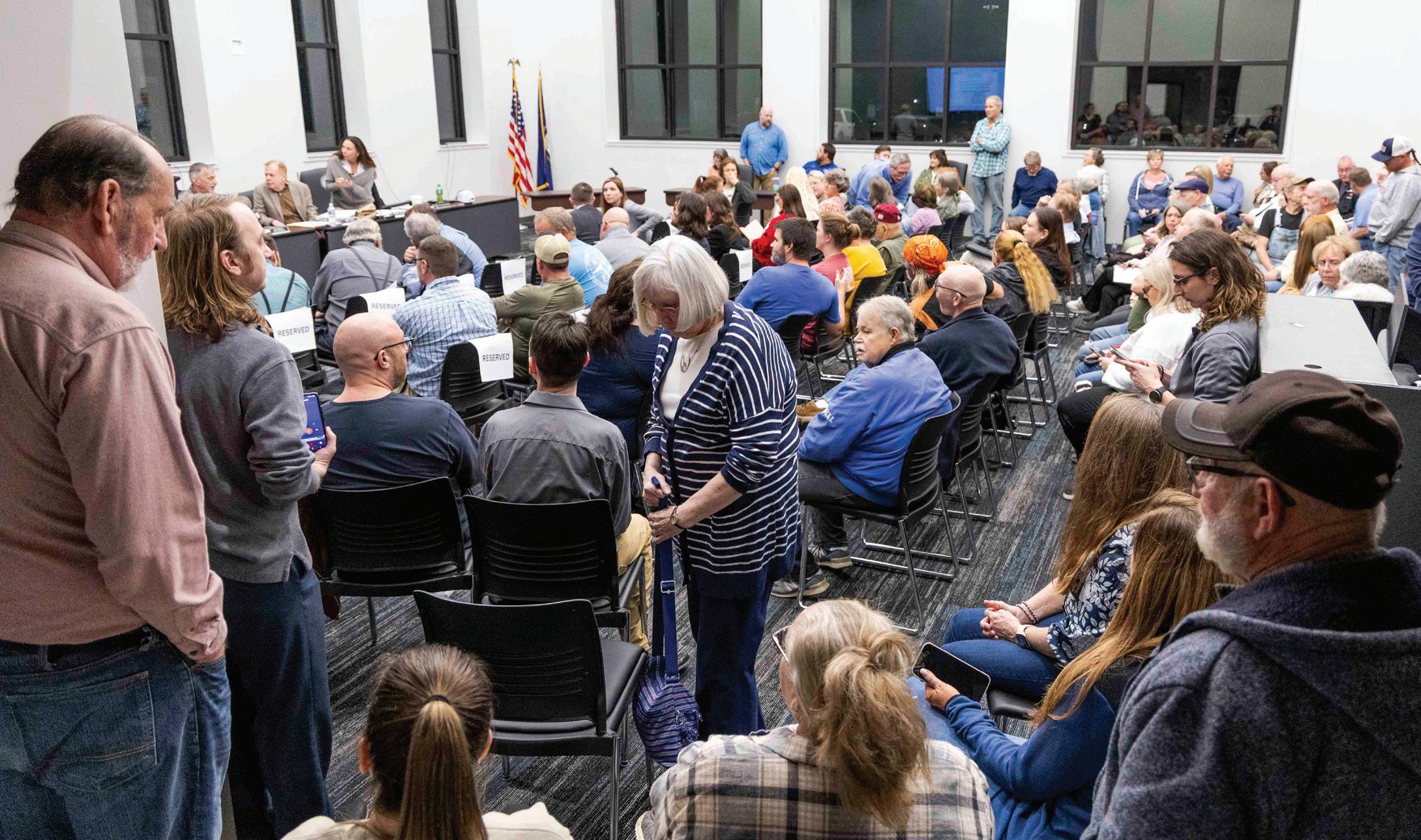
Community members from Franklin, Ky, and surrounding counties fill the Franklin Police Station’s conference room on Tuesday, March 3, 2026 to attend a planning and zoning commission meeting. The meeting pertained to the decision of whether or not to un-table and approve TenKey LandCO LLC’s request to move forward with the development of their proposed data center. Members of the community on both sides attended to express their support or disapproval of the development, with many being removed for disrupting the technically private meeting. After nearly four hours of debate, the board decided to approve the preliminary development plan.
with the environmental implications of a potential data center.
“You are building a data center on top of an area that is topographically karst, and it feeds the water system all the way to Mammoth Cave to Pennyroyal, 400 miles,” Hayes said. “What are y’all gonna do about it if this does leak into that water system?”
Dutton objected to the question initially, then responded.
“There are a number of environmental studies that have to be done for the final development plan, and there are a number of permits that have to be applied for with the state before this facility could ever be built,” Dutton said.
At the March 3 meeting when the preliminary development plan was approved, Commissioner Justin Henninger referenced the geography of Franklin as a concern, revisiting sentiments from the Jan. 20 meeting.
“That is something that I anticipate we will come back with a robust study and a robust investigation in terms of where are the karst features, how can they be protected…how can they not impact the data center,” Dutton said.
Board members were also confused about the county’s current zoning regulations and how data centers are classified under those regulations.
Dutton assured the public that every question and concern would be addressed before the final development plan is presented. He called the process of working towards the final plan a “Herculean effort.”
Franklin is one of the latest in a long list of Kentucky communities that
have voiced opposition to data center proposals.
Oldham County, just outside Louisville, was one of the first Kentucky counties to get “bombarded by this onslaught of data center stuff,” forcing
the board to “learn on the fly,” according to Oldham County Planning and Zoning Director Ryan Fischer.
In March 2025, Western Hospitality Partners proposed a $6 billion, 2-million-square-foot data
center, which would have been “one of the largest and most powerful hyperscale data centers in the world,” Louisville Public Media reported.
Like Franklin, the county lacked explicit
zoning regulations for data centers.
Fischer said the proposal provoked “public outcry” and a “grassroots campaign against the data center,” which caught the company by surprise.
He said the public outcry prompted the local governing bodies to put a moratorium on new applications.
The Oldham County Fiscal Court voted in favor of the moratorium July 1, pausing data center
centers bring to a community: “significant impacts on infrastructure, energy consumption, land use, and environmental sustainability.”
The planning commission has been workshopping new regulations since July, which were denied and sent back for revision by the fiscal court earlier this year.
“They’re kind of like a dog chasing his tail,” Fischer said. “One day we’re going to catch it, but we’re going to keep running around in a circle in the meantime.”
Over half a year later, Ashland signed its own data center moratorium.
On Feb. 26, the Board of Commissioners in Ashland, Kentucky, passed a 180-day moratorium, effectively pausing any data center proposals.
Commissioner DJ Rymer said the board wanted time to address a list of “unknowns” that come alongside data centers, especially in an impoverished region already facing increasing utility costs.
According to the U.S. Census, Ashland is home to roughly 21,066 people and has a 22.4% poverty rate, 6% above the state average. In February, the city’s electricity provider announced rates would increase nearly 6%, and customers would take on an average increase of $10.76 a month.
applications for 150 days. Fischer said that, to his understanding, the moratorium is in effect until new zoning regulations are approved.
In its order, the court identified what data
Kentucky Power is headquartered in Ashland and supplies electricity to 20 counties in Eastern Kentucky.
As increased electricity consumption burdens electrical grids, companies are passing higher rates onto monthly ratepayers to cover the costs of supplying interconnection
Franklin resident Jasmine Butt protested preliminary data center plans during a Franklin Kentucky Planning and Zoning Commission meeting on Thursday, Feb. 5, 2026 in Franklin-Simpson High School.
TenKey LandCo. LLC proposed a data center, with three 200,000-square-foot facilities, near 421 Steele Road, Franklin, Kentucky. The proposed facility would use “on-site power generation vis natural gas turbines,” avoiding using the city’s electrical grid.
requests. Interconnection involves connecting electricity generators to the electrical grid, which is required for data centers that don’t have their own on-site generators.
Higher electricity bills disproportionately affect low-income residents, according to the Environmental and Energy Study Institute. In 2023, Kentucky was the sixth poorest state in the country, according to data from the National Institute on Minority Health and Health Disparities.
Rymer said he worries that a data center could affect “mom and pop ratepayers” negatively.
“It could lead to infrastructure upgrades, which could be good, but it could
potentially also raise electricity rates for folks,” Rymer said.
Rymer, the youngest commissioner in Ashland’s history, says he considers himself more open to “opportunity and investment” than some of his older colleagues and feels a duty to support sustainable development for future generations.
While the city is conveniently located on the Ohio River, Rymer said Ashland would need “significant infrastructure upgrades” to accommodate the possible water needs of a data center. He is concerned about the lengthy process that building a data center would entail; if a developer bows out after just
15 years or less, it could leave an “abandoned industrial site.”
Rymer is also skeptical that data center developers will create hundreds of jobs, as promised.
“You may create 500 jobs initially, temporarily to build the centers,” Rymer said. “But once they’re completed, they only retain 15 to 20… fulltime jobs.”
Good Jobs First, a nonprofit that tracks economic developments and corporate conduct, found many of the positions created by data centers are temporary, low-wage and not given to locals.
As data centers reach into Kentucky, legislators are pushing for tighter data center regulations.
Rep. Josh Bray, R-Mount Vernon, sponsored House Bill 593 requiring data center developers to pay for “serving or constructing” data center infrastructure, thereby protecting utility customers from higher bills.
Rep. William Lawrence, R-Maysville, called the bill, which is still processing through the Senate, a “due diligence bill.”
“I feel like we are always on the backside of fixing problems here in Frankfort, and this is a bill that gets ahead of the game,” Lawrence said.
Assistant News Editor Kane Smith can be reached at kane.smith490@topper. wku.edu.
DAILY NEWS
MONDAY FRIDAY
VISUALS
Libby Simpson, Staff Photographer
Cut the net. (Again).
Franklin-Simpson High School sophomore Allie Utley (3) and senior McKenzie Taylor (21) embrace after taking down the Barren County Trojanettes to win the KHSAA Region 4 basketball championship for the second year in a row. Region 4’s most elite high school
teams came together at E.A. Diddle Arena to compete for the title this month. The Lady Cats ended a dominant season undefeated in their own district and finished 25-8 overall.
EDITORIAL BOARD
Why we ask the hard questions
Editorial by Jake McMahon
The role of any university news organization is to cover all aspects of a campus and its community.
The Herald, at its very best, is a service to this community, accurately reflecting all walks of life that come through the Hill. At the forefront of that list is to cover the people making the most important decisions for the institution. This is our obligation as watchdogs on the powerful.
At a university so integral to its community, like WKU is to Bowling Green and Kentucky, someone has to ask the hard questions. It would be a failure as journalists not to.
Recently, WKU administrators have made asking those questions harder than necessary.
Herald reporters are often roadblocked by the university’s top officials while reporting on the campus’ most pressing issues. Our requests for interviews conducted in person or over the phone are denied, and our access is often reduced to PR-driven email statements.
Despite these roadblocks, we serve our community as the only publication answering questions on WKU’s dorms, enrollment, budget and all things integral to a university’s operation. That work could be more complete if the university’s top officials were more transparent in their access, providing straightforward answers to difficult questions.
There are a lot of press-
ing topics the university should address.
There are great things going on on this campus. New buildings opening, students achieving success and a historically high retention rate. WKU is more willing to talk about those, at least through press releases, and those are stories we tell every day.
But there are also challenges.
More than 1,000 beds sit vacant across three closed dorms that cost over $88 million. The university is performing $55 million in repairs to Regents and Normal halls. Hilltopper Hall, the most expensive of the three, is set to be demolished after this semester.
The university announced the temporary closures and the demolition in May. WKU has yet to make a public statement as to what went wrong — the only way the community knows is through our reporting.
For this issue of the magazine, we reported on the Collegiate Housing Foundation, the nonprofit corporation that will own WKU’s dorms as part of the university’s public-private partnership it hopes to be approved in the coming months. William Givhan, the CEO of the Collegiate Housing Foundation, told the Herald in an email statement that all inquiries must be directed to Jace Lux, the university’s spokesperson. Lux has no role in the Alabama-based group.
We experienced similar troubles this semester
while reporting on the university’s enrollment.
In February, the state Council on Postsecondary Education made available data that showed Eastern Kentucky University surpassed WKU in enrollment, replacing it as the third-largest public university in the state by 49 students. To learn more, a Herald reporter had a scheduled meeting with John-Mark Francis, interim vice president of enrollment management. After the Herald’s initial story reporting the decline was published, Francis canceled the meeting.
“I noticed that the Herald ran a story about headcount without any additional institutional context,” Francis wrote in an email to the reporter. “Given that the article has already been published, I don’t believe there is a need for us to proceed with our meeting, and I will remove it from my calendar.”
We understand the focus of WKU has shifted from enrollment to retention, and retention for this academic year has reached a record 79.4% — a trend that the Herald included in its initial reporting. But if our story lacks “institutional context,” why cancel the meeting to provide the Herald, and in turn the community, with that context?
We don’t have time to wait to report the news. When WKU drops to fourth in enrollment, we have a duty to deliver that information to our audience as
Photo by Jonah Savage
quickly as possible.
Without Francis’ interview, questions remain unanswered: How is WKU tackling enrollment challenges? What does it mean that WKU enrollment is falling while overall enrollment statewide is increasing?
Francis wasn’t the only university official to cancel an interview this semester. Lux informed the Herald in the fall semester that its three-decade-long tradition of meeting with the university president each semester was canceled.
Lux initially told the Herald that a press conference with multiple media outlets would replace the semesterly meeting with the editorial board. WKU President Timothy Caboni hosted the press conference on Feb. 3, which lasted 35 minutes, 28 of which were used for questions. Last semester’s meeting with Herald editors lasted more than 50 minutes. Before Caboni was president, the meeting often lasted up to two hours.
Caboni said during the press conference that he would continue to meet with the Herald editorial board. The Herald contacted Lux for clarification, and instead of directly answering the question, he said, “We will continue to explore opportunities for all WKU student media editorial/ leadership boards - not just the Herald - to engage with campus leadership.”
“Nothing definitive is planned,” Lux continued. “At this point, it is just
an idea based on ongoing internal conversations about ways to provide more opportunities for students who are pursuing careers in media.”
While the future of the Herald’s semesterly meeting is unknown, Caboni met with management from Revolution Radio, the newly revived student-run radio station, according to an Instagram post from Revolution dated Feb. 27.
We’re happy Caboni sat down with Revolution Radio, but all student media should be granted the same courtesy.
Access to the power play-
ers at this university is crucial. Without it, we fear of forming an incomplete picture to our readers. We aren’t asking for around-the-clock availability. We’re rightfully requesting a working relationship between the Herald and the university, one that has deteriorated in recent years.
This isn’t a stretch, and we don’t feel it’s too much to ask, because we’ve seen this relationship exist between the Herald and WKU. During the Gary Ransdell administration, Herald reporters and editors were given Ransdell’s
phone number, access that is hard to imagine in our current situation.
During his Feb. 3 press conference, Caboni tried to establish a good relationship between the administration and student media, while also helping “grow folks in the direction of working through those media challenges.”
“As reporters, if you go to Fruit of the Loom, and just try to talk to folks, that’s not the process,” Caboni said. “You have to learn to work through media relations.”
WKU is a public trust
funded by taxpayer money and tuition. Fruit of the Loom is a private corporation.
We cherish the ability to grow and learn as student journalists in the environment that a student newspaper offers, but our first priority is to deliver the best coverage possible to the people in our community.
Unfortunately, WKU has chosen to make that harder.
Editor-in-Chief Jake McMahon can be reached at michael.mcmahon480@ topper.wku.edu
WKU President Timothy C. Caboni leaves the stage after fielding questions from local media after his first press conference in six years on Feb. 3, 2026. This marks the first time since 1997 that the university president has not sat down for an exclusive meeting with the Herald Editorial Board.
1, 2 and 3-bedroom apartments 15 minutes from campus!
*Restrictions apply.
Community Amenities
• 24-Hour Fitness Center
• Bike Repair & Storage
• EV Charging Stations
• Fire Pits
• Gourmet Grilling Stations
• Meditation Room
• Off-Street Parking
• On-Site Maintenance
• On-Site Management
• Package Receiving
• Pet Park
• Pet Spa
• Playground
• Resident Car Wash
• Resort-Style Heated Pool
• Sundeck
Apartment Amenities
• Luxury Vinyl Plank Flooring
• Cable Ready
• Carpeted Bedrooms
• Ceiling Fan
• Dishwasher
• Efficient Appliances
• Electronic Thermostat
• Microwave
• Outdoor Storage Closets
• Patio/Balcony
• Private Yard (only select units)
• Refrigerator
• Tiled Showers
• Walk-In Closets
• Washer/Dryer in Unit
• Window Coverings
(270) 677-1195
ANOTHER YEAR AT THE TOP!
Winner of the 2025-26 Online Pacemaker from Associated Collegiate Press
STUDENT PUBLICATIONS ADVERTISING
Cherry Creative
Winner of the 2025-26 Business Pacemaker from Associated Collegiate Press
TALISMAN
Winner of the 2025-26 Magazine Pacemaker from Associated Collegiate Press
Since winning its first Pacemaker Award in 1978 with the Talisman and in 1981 for the College Heights Herald, WKU has built one of the most successful student media groups in the country. WKU Student Publications has 53 Pacemaker Awards — the premier honor for student media — far more than any other collegiate program in Kentucky and consistently among the best in the nation.
Congratulations to our student staff members today and throughout the years for this remarkable achievement.