Student Life Director CJ Gamble studentlife@wkcr.org
Publicity Director
June Frankel publicity@wkcr.org
Business Manager
Sara Carson business@wkcr.org
Department Directors
Jazz
Emma Lacy & Stella Manyan jazz@wkcr.org
New Music
Isadora Evers newmusic@wkcr.org
Classical
Isabel Norman classical@wkcr.org
American Ben Rothman & Landon Pottebaum american@wkcr.org
In All Languages
Ethan Thacker ial@wkcr.org
Latin Merielen Espino latin@wkcr.org
News & Arts
Natalie Lahr news@wkcr.org
Sports Mason Lau sports@wkcr.org
Dear Listeners,
April is an exciting month filled with station changes, both regarding our new administration and an exciting lineup of special broadcasts. If you look to the left, you may notice some new names on the board, as well as some names shifting from department directors to our executive board, and so on. I’m Solène and it’s a pleasure to formally introduce myself. You may have called in to one of my Classical Department shows—right now, Thursday afternoon’s Extended Technique, or previously a Mahlerfocused Cereal Music on Tuesday mornings (which I hope to begin again this summer)—or spoken with me during a fund drive. Regardless, I’m delighted to begin my tenure and continue WKCR’s longlasting legacy.
We have a multitude of special broadcasts this month: five all-day birthday broadcasts and a fourteenhour Soul Festival hosted by the American Department. We’ll celebrate so many of the greats’ birthdays—Charles Mingus, Ella Fitzgerald, Billie Holiday, Duke Ellington, and a newly introduced broadcast for the legendary Tito Puente. Elsewhere in On Air, you can find a tender interview with Ella Presiado, outgoing Publicity Director, and McKenna Roberts, former Head Engineer and American Department Director, friends who describe the rich relationships they have fostered through college radio. Following this, Program Director Charlie Kusiel King’s reflection on music at St. John the Divine and programmer Jack Serpick’s record store musings make this a rather literary and introspective edition. I encourage you to spend some time with these pieces—I cannot express how much commitment and care goes into keeping the written world of KCR alive. On Air Managing Editor McCartney Garb writes more on this later—we would be nothing without them and the On Air team.
Warmly,
Solène Millsap Station Manager
What Baltimore Was for Billie, and What Billie Is for Baltimore
by Alejandra Díaz-Pizarro & Sam Seliger
The vast majority of people do not think about Baltimore when they think about Billie Holiday. Born in Philadelphia in 1915, Holiday grew up in Baltimore, where her family was based, and where she lived for the first 13 years of her life until she followed her mother to Harlem in 1929. The rest is history: Holiday began performing in Harlem nightclubs, signed a record deal, and became one of the definitive vocalists in jazz before her early death in 1959. Yet, though most of her life was spent in New York City, Holiday’s childhood in Baltimore was a defining force in her life, and, in recent years, Holiday has become a beacon for the city’s identity.
The Baltimore Billie Holiday grew up in was a crib for early jazz music. “What Baltimore has given us, it’s not just Billie Holiday,” says Derek Price, Executive Director of the Eubie Blake National Jazz Institute and Cultural Center, which preserves Baltimore’s Black arts legacy through exhibitions, events, and performances. “It’s a musical legacy, an ecosystem, a Baltimore ecosystem that was created here.”
That ecosystem was grounded in the long tradition of African music, which had arrived with enslaved West Africans—especially the Mandinka and Bambara peoples, from whose musical traditions emerged a banjo culture. Black music was also key to the early efforts of the African Methodist Episcopal Church, which had established its first congregation in nearby Philadelphia and had established a Baltimore branch by 1815. “These are places that are preserving authentic, organic, Black musical expression,” says Dr. Lawrence Jackson, the Bloomberg Distinguished Professor of English
and History and founding director of the Billie Holiday Center for Liberation Arts at Johns Hopkins University. “At the same time, they’re also deeply interested in the refinement of those expressions.”
Throughout the 19th and early 20th century, those expressions evolved into the forms of popular music and entertainment that would precede jazz. Musician and jazz educator Gunther Schuller has written that, after the Civil War, Baltimore was the main outpost of ragtime music; Alfred Greenfield’s Saloon, a Baltimore venue, inspired Baltimorean Eubie Blake’s well-known rag “Corner Chestnut and Low.” In the 1920s, Pennsylvania Avenue became the main thoroughfare for Black music and entertainment, housing the legendary Royal Theatre—one of five theaters on the main circuit for African American entertainment in the Northeast, which also included the Apollo in New York, the Howard Theatre in D.C., the Regal Theatre in Chicago, and the Earle Theatre in Philadelphia. Around that same period, Baltimore-based Captain George Brown led regular steamboat excursions for the Chesapeake’s Black communities, always accompanied by orchestras, that would serve as a bridge to later dance hall culture. Outside commercial venues, west Baltimore housed a bustling youth band scene with a hub at Biddle Street and Druid Hill Avenue, a red light district not unlike New Orleans’s Storyville. These bands were important movers of the city’s music scene: “The bands are getting together, you know, for every season, every big event, every funeral, multiple bands,” says Jackson. “And the same tension is alive in the youth bands that is at
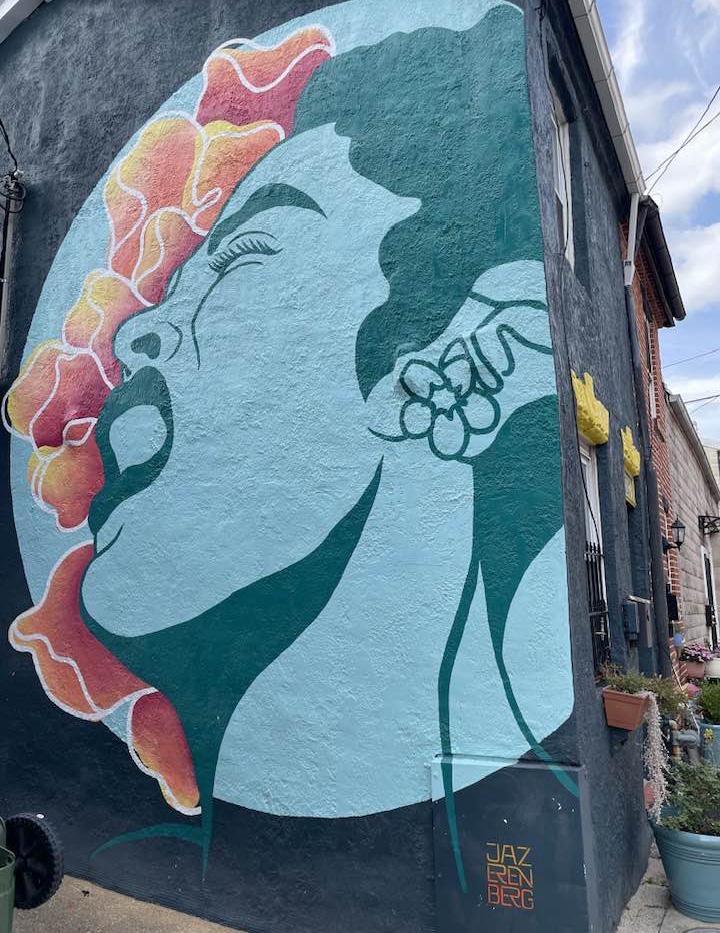
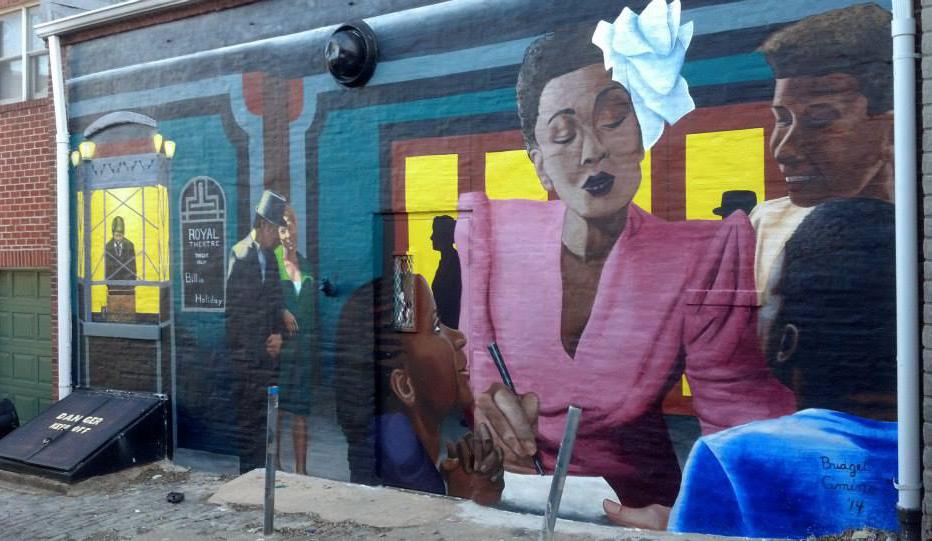
One of the Billie Holiday murals at “Lady Day Way” on South Durham Street in Southeast Baltimore, where Holiday spent part of her childhood. Photo via the Baltimore Billie Holiday Project’s Facebook page.
work with some of the churches. So, you know, again, play the song according to the music, learn to read the music, play John Philip Sousa,” while at the same time being pulled toward innovation by the city’s musical bounty.
Billie Holiday came up in the confluence of these scenes. Her father, Clarence Halliday, played banjo in multiple Baltimore bands, including Eubie Blake’s, along with Elmer Snowden—”the premier banjo player, bar none, by 1920,” in Dr. Jackson’s words. Snowden and Halliday had attended school together and, as early on as 11 and 12 years old, played as itinerant musicians on Druid Hill; Elmer Snowden later said he was Billie’s godfather, or that Clarence Halliday had asked him to be. Though it is unclear how much her parents maintained contact, Billie knew her father was a musician, and “these would have been stories that would have inspired her and encouraged her thoughts about local musical culture,” says Jackson. Toward the end of their time in Baltimore, Billie’s mother Sadie Harris opened a restaurant on Argyle Avenue, near Pennsylvania Avenue, in a zone that would have been the premier place to purchase records. All
this made a deep impression on the young Billie Holiday. “Holiday’s always noted for rhythm and timing in her delivery,” says Jackson. “That was the sense of rhythm and movement that’s coming from some of these historic Baltimore communities. So I think of that as very much like a crucial foundation for her.”
Holiday is not the only jazz great to emerge from Baltimore’s robust musical tradition. Numerous musicians who innovated and pioneered jazz in the pre-bebop era also had their roots in the city, including Eubie Blake and Elmer Snowden, who drove the tunes and sounds of early jazz, and Chick Webb and Cab Calloway, who ushered in the rhythmic and stylistic innovations of the big band era. For Derek Price, there’s a clear throughline running through these major names in forming the city’s musical identity. “Eubie Blake was the foundation,” says Price, “Chick Webb was the rhythm, Cab Calloway was the showman presentation, and Billie Holiday was the emotional connection to that whole legacy.”
Yet the imprint Baltimore made on these legendary figures is often erased from their memory. Jackson thinks this erasure might
One of the murals at “Lady Day Way.” Photo via the Baltimore Billie Holiday Project’s Facebook page.
be connected to a broader trend in American cultural history. “There’s sort of an unusual amnesia about Maryland’s place in American national history,” he says. “And so I think the same thing has happened sometimes with Frederick Douglass”—who also spent his childhood in Fells Point—”and then also Billie Holiday as Baltimoreans, or people whose artistic skills evolved in the context of this city.”
Many of these musicians’ legacies have been absorbed by the sheer centripetal force of New York City, which by the mid-20th century had become the Northeast’s jazz hotspot. Eubie Blake was one of Baltimore’s first and foundational musical figures, but “as soon as he plays in Atlantic City, as soon as he is managing a club in New York, it’s sort of like there’s no more Baltimore connection,” says Jackson. The same thing happened to Elmer Snowden, who became a part of the house band at Smalls Paradise—one of the only well-known (and integrated) Harlem nightclubs owned by an African American— and whose best-known record is titled Harlem Banjo, despite having honed his skills on the instrument in those early Baltimore bands. “It seems to me,” thinks Jackson, “that we could slightly shift our Northeast model and think about the Chesapeake as the gestation for Philadelphia and New York,” with many talented Chesapeake musicians sowing the seeds of musical innovation elsewhere. “And, you know, certainly you can follow the Baltimore musicians as they make those moves.”
These Chesapeake roots, for instance, can be traced in Billie Holiday’s artistry. Her speech and her delivery, for which she was renowned, carry different dimensions of the Black Chesapeake vernacular. “The classic one is always how we would pronounce T-O, which is more like T-E-W or T-U-E,” says Jackson, “and you hear her holding on to that,” particularly in her definitive recording of the jazz standard “All of Me.”
Just as Holiday always held on to parts of her Baltimore roots, Baltimore is now finding new ways to hold on to her. In 2017, Dr. Jackson founded the Billie Holiday Center for Liberation
Arts (BHCLA) at Johns Hopkins, aiming to foster connections between the university and the city’s African-American communities. Jackson decided to name the BHCLA after Holiday because “we want to do everything that we can to honor the work of Black women. … We’re living in a community where the heads of household, the major breadwinners, the leadership is almost completely shifting now to Black women. And we want to always do as much as we can to honor this.” But there was also a sense of reparation, embedded in the BHCLA’s mission, in choosing Holiday as the namesake. “We definitely wanted to have as much to do with the arts as we possibly could,” Jackson explains. “But she’s this figure who is completely extraordinary, completely original, completely singular, and—you couldn’t say erased from her origins or her hometown, but where there’s this separation that’s taking place that I think is in need of repair.” The BHCLA has contributed extensively to the knowledge of Baltimore’s jazz legacy and Billie’s place in it, mapping the places that are a part of Holiday’s history. Most recently, Dr. Jackson presented a trove of photos linking Holiday’s childhood and the early-20th-century Baltimore jazz scene in the traveling exhibit The Birth of Jazz in Baltimore, which was showcased at the Baltimore Museum of Art in 2023.
Other Baltimore institutions are also including Holiday in their legacy-building. At the Eubie Blake National Jazz Institute and Cultural Center, Executive Director Derek Price views his work as “making these connections and continuing to ensure that people understand, historically, how Baltimore has created this Black ecosystem and impacted music throughout.” The Eubie Blake Center boasts a mural with Billie’s image, and one of its spaces is named the Billie Holiday Lounge and Garden. Furthermore, the BHCLA and the Eubie Blake Cultural Center often partner with each other and with other Baltimore organizations to bolster appreciation for Baltimore’s place in American cultural history.
Holiday has also inspired public memory projects across the city. One is a statue on
Pennsylvania Avenue, commissioned to the sculptor James Earl Reid. Reid did not attend the unveiling ceremony, which took place in 1985: the city had excluded two panels on the pedestal depicting a child with its umbilical cord attached (a reference to Holiday’s song “God Bless the Child”) and the lynching of an African-American man (a reference to Holiday’s “Strange Fruit,” a landmark song in the civil rights struggle).
Dr. Jackson thinks the suppression of the panels also “had something to do with the controversy over Holiday as a figure, these politics of respectability, and how she might be connected to the city.” The two panels were finally added to the statue in 2009, restoring Reid’s vision for his work nearly 25 years after it was installed.
Another tribute to Holiday is sited on the 200 block of South Durham St., where Holiday lived at numbers 219 and 217. There, a blockwide effort has been transforming the street into Lady Day Way since 2012, when resident Steve Schwei found out Holiday had lived on the block and resolved to honor her by turning that stretch of South Durham into “Billie’s block.” Schwei and a group of neighbors, in conjunction with the Upper Fells Point Improvement Association (UFPIA), applied for a grant from PNC Bank, with
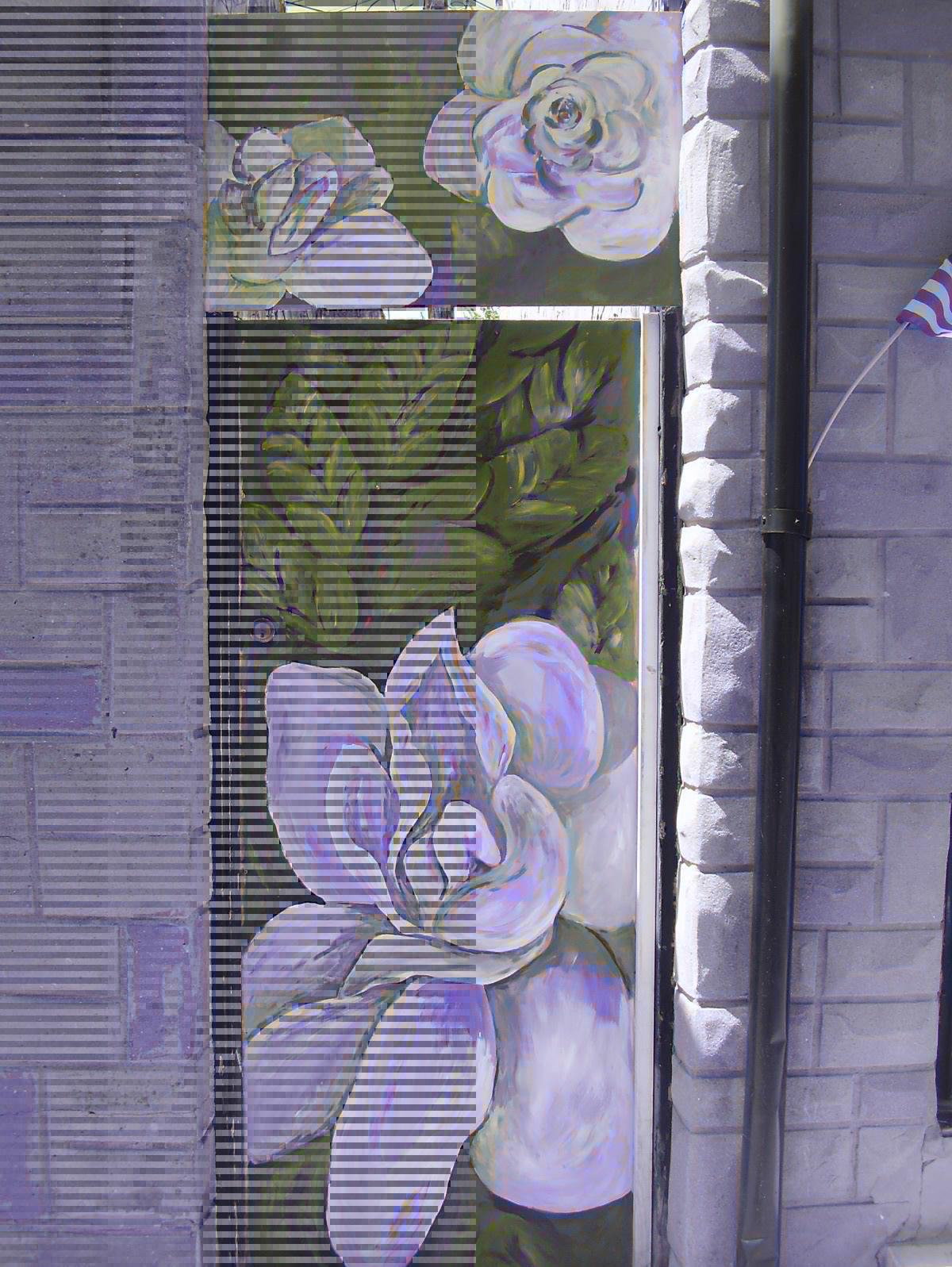
which they have been able to complete more than five murals (the newest of which was finished in November of 2025), one mosaic, and 11 painted screens—a traditional craft of Southeast Baltimore, for which they engaged the work of Baltimore’s screen painting guild— honoring Billie Holiday.
The work on Lady Day Way is far from done, says Lisa Knickmeyer of the UFPIA. On the docket is a welcome sign for Lady Day Way, which will hopefully entice more visitors. “That block itself is an alley street, so it’s not very visible to the public, and there’s not even a stoplight or anything, so it’s definitely easy for people to miss it,” says Knickmeyer. They are in the midst of a permitting process to get the sign installed, but permitting is almost always the hardest part. In fact, Knickmeyer says the block got its name because they originally wanted to spell “Lady Day Way” in cobblestones in the pavement, “but it was pooh-poohed by the [Department of Transportation] because they said that you can’t have writing on the streets.” (That didn’t stop the neighbors from going down to the DOT yards and salvaging Belgian block refuse, which they ended up installing in “these really kind of corny diamonds and squares down the
One of the painted window screens, a traditional Southeast Baltimore craft, honoring Billie Holiday’s memory and her signature gardenias at “Lady Day Way” on South Durham Street. Photo via the Baltimore Billie Holiday Project’s Facebook page.
middle of the street because that’s all [the DOT] would do.”) The UFPIA is also looking to engage Stuart Hudgins, a multimedia artist, to do a black-and-white outdoor photo installation on the block.
The neighbors of Lady Day Way are aware of their block’s history—and also of its traumatic place in Holiday’s childhood. As a child, Holiday was sexually assaulted at 219 South Durham St.; she and her mother relocated to number 217 after the incident. “You don’t want to celebrate that,” stresses Knickmeyer, “but we want to celebrate, to honor her presence, … give her the respect and attention that she may not have gotten when she was here.” The current dwellers of 219 and 217 know the history of their homes, and are engaged in ongoing efforts to preserve it. “We’re still working really hard to continue,” says Knickmeyer. “Somehow, the block just never feels like it’s quite there yet. We’re always working on trying to figure out how we can make it really look like a destination and celebrate her. And it’s just not quite there.”
Nonetheless, Billie’s Baltimore roots are already drawing visitors and acolytes to the city. In mid-March of 2026, D.C.-based jazz vocalist changamiré came to Baltimore for a weekend to promote her recording “Seeking Billie,” a tribute to Holiday, including an earlymorning meetup at Lady Day Way to appreciate the murals. Knickmeyer says changamiré was the one to find and contact the neighbors to collaborate with them.
The excitement around Holiday mirrors a renewed excitement for Baltimore, which in recent years has shaken off a decades-long reputation as a dangerous city in decline. “One of the reasons why she is so indelible from the idea about the city is that she is the city for all of its highs and lows,” says Dr. Lawrence Jackson. “To get to Billie Holiday—not just her art, but the human being Billie Holiday—requires a delicate process of acknowledgement, attribution, and retribution. Certainly, she can’t be interpreted, contained, or defined with one version of an ideology that would say, ‘Oh, it’s a figure of benevolence and magnanimity. It’s a figure of
turpitude and despair.’ And you often find that conflict in most of the works that are devoted to her,” much as there is a similar conflict in depictions of Baltimore.
As it finds new ways to rebuild its identity, Baltimore has embraced one of its most notable daughters—not just to claim her name, but to honor it in new and ambitious visions for the city’s cultural and artistic future. These visions are rooted in a sense of living history, but another, equally important part of it, thinks Derek Price, is that Billie embodies the city’s aspirations. “She’s giving you permission to express yourself authentically. … I really think that’s like a foundational thing that everybody takes from her,” he says. “She’s incredibly comfortable and self-confident in her own organic powers of expression. I think that you do see that in some ways is the triumph of what’s taking place in the city and will continue to take place in the city.”
The authors would like to thank Dr. Lawrence Jackson, Mr. Derek Price, and Ms. Lisa Knickmeyer for their time and generosity in their interviews for this article.
This article is a version of a program that will air during the Billie Holiday Birthday Broadcast on April 7th, at 3 PM. The program will feature the complete interviews with Dr. Jackson, Mr. Price, and Ms. Knickmeyer, along with much of the referenced music, to draw a portrait of the early Baltimore jazz scene in which Holiday grew up. Tune in—and stay tuned—on April 7th to celebrate what would have been Lady Day’s 111th birthday, all day on WKCR.
MEET A MEMBER
WFostering Friendships: Reflecting with Ella and McKenna
by Solène Millsap
e meet on Futter Field, where Georgia, Programming Director emeritus, is seated on a black chair. McKenna and Ella are lounging on the grass around her, describing a recent concert experience and laughing together. It is rather warm for March.
wow, I've just made all these new friends, but now I'm shipped off to Connecticut and I hope they're still my friends when I get back. And we were lucky. And then we were still friends.
SM: That's beautiful. So you've clearly been involved for a very, very long time because that was so long ago.
Solène Millsap: So you both are very dear, long-time, tenured individuals at the station with a rich history of involvement. First, can you tell me about how you've come to know one another through the station?
McKenna and Ella, in unison: So. [Laughs]
McKenna Roberts: Okay, Ella and I met officially in the spring of 2024…
Ella Presiado: No, I actually met you before that. You just don't remember. I met you at fundraising.
MR: Okay. I would say Ella and I really started to get to know each other during the news coverage of the 2024 Gaza Solidarity encampments at Columbia. We spent some intimate time together during that. And then Ella disappeared to Connecticut that summer to work at a summer camp. And the fall after that, we really became close friends.
EP: I remember that spring, right before I left for Connecticut, or actually right before McKenna went home, before coming back to New York for the summer, and before I left for Connecticut, we sat in the park and I was like,
MR: Yeah, no one really remembers that. [Jokingly] It's archaic.
SM: But, no, actually, like, were you the type of people that joined, like, right off the rip your freshman year? And what roles have you each had throughout the time?
EP: I joined later than McKenna because I didn't join until the fall of my sophomore year. And first, I was just programming randomly. I think I was. My first show was a Tennessee border show, actually. And it was when McKenna was the American head, and I remember DMing her on Slack being like, what do I play? And I was like, who even is McKenna?
MR: Who even is McKenna?
EP: And then that spring, I started doing Monday Morningside, which is like a variety News and Arts talk show on Monday mornings. And that was really fun, but it's a lot of work.
SM: You were like Dick Cavett vibes.
EP: Yeah, that's exactly my vibe.
MR: It was a lot of work.
EP: And then I was part of the news coverage team in the spring. And then I came back in the fall. I was programming Cereal Music regularly, and then I was elected Publicity Director. And now I am not Publicity Director anymore because my tenure is over.
MR: I actually knew about KCR pretty early into my freshman year at Barnard. I remember seeing the table at the club fair that September, and I could not, for the life of me, figure out how to join. I could not find how to join Slack. I thought about DMing the Instagram account and just felt too eager and a little embarrassed by doing that, so it kind of slipped my mind. And then I think over winter break, I emailed Ted, who was Student Life Director at that point, and I sent a really
professional email, being like, “I would love to help advance the mission of KCR. Please let me know how I can get involved.” I was part of the first group of students to get licensed to program that semester, and when you first join the station, there's kind of an expectation to pay some dues and program the not-so-soughtafter time slots. I programmed Night Train a couple of times, which is one to five a.m on Wednesdays. Soon after that, I discovered that I like having a normal sleep schedule and couldn't really do that. I started programming the weekly bluegrass show, The Moonshine Show, on Sundays instead.
SM: That one's so fun.
MR: That was really fun. And then I was chosen to be American department head at the end of that semester, actually. I didn't really feel qualified to do it, but Izzy passed it on to me. That summer, I feel like I started to get to know the station a bit more in-depth. And that's how I got to know Maria Shaughnessy, who was Program Director at that time, and I feel like being friends with people who were at the station during the pandemic gave me access to a much richer oral history of the station.
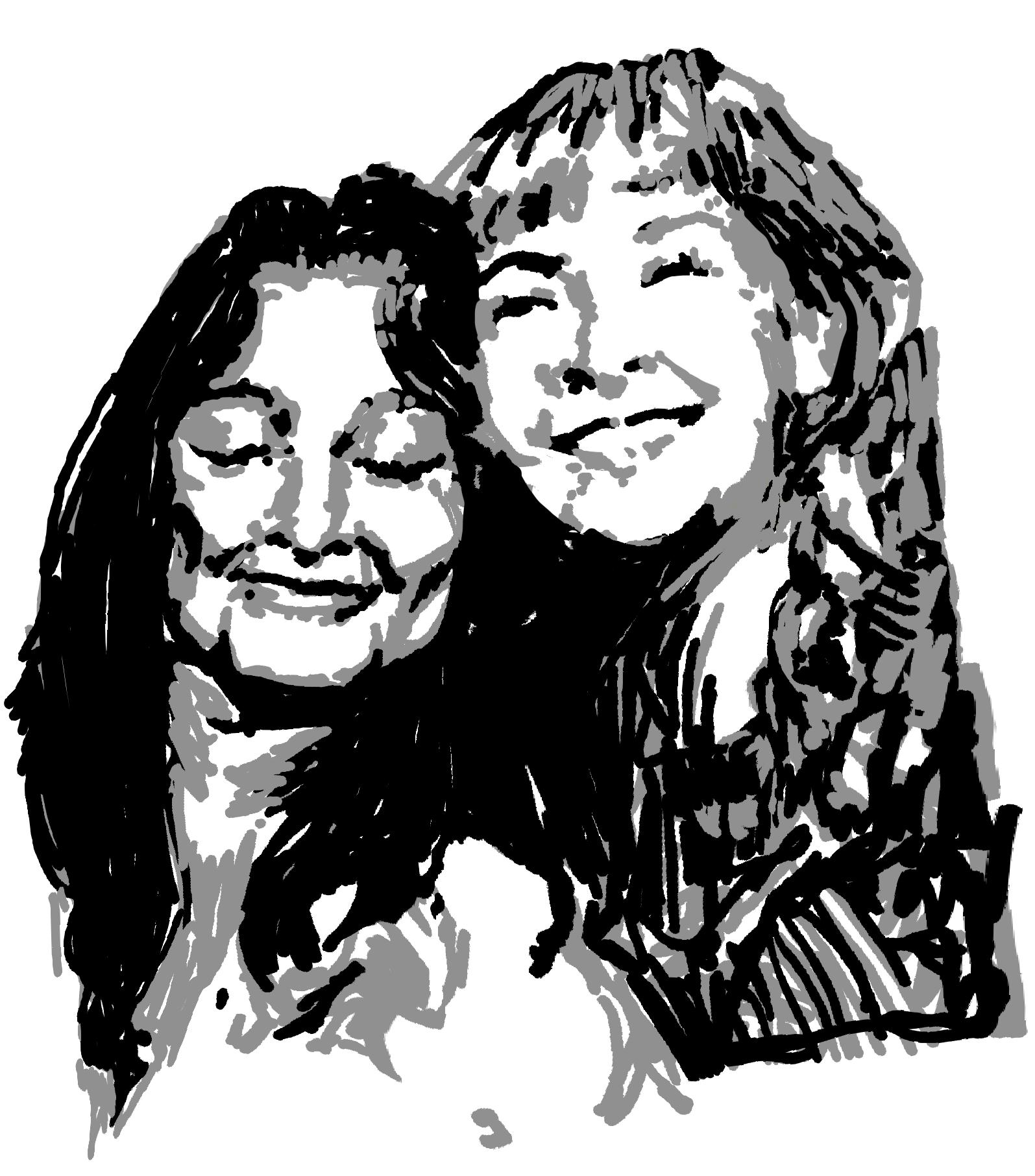
Illustration by Jonah Stockwell
Before I studied abroad, I was just getting involved with Live Constructions and really wanted to develop a knowledge of audio engineering and sound. And luckily, at that time, the live sound at the station was spearheaded by Leni Bryan, Sarah Barlyn, and Kalen Richardson. They were the people who restarted Live Constructions after it had paused during the pandemic. And they were just a group of really skilled, self-taught, student engineers. They brought some really amazing bands like Godcaster and Laveda to the station. I wanted to learn from them, and I think that really solidified how much KCR was like an avenue to interact with an underground music scene in New York. So when I came back from being abroad, I became Head of Engineering. That's kind of where I've left off my involvement at the station.
SM: How would you describe the role of KCR in your college experience?
EP: I think joining KCR, and I did not know this when I was a sophomore and was at the club fair table, was the critical juncture of my college career. I think KCR has been the place that has seen me through the most change and has brought me the most fulfilling relationships throughout my college career. And I think it was so important to have a space for that activity of programming and learning so much about music, but also the physical space of KCR is so special to have because I think a lot of college students don't have a third space like this to be around. There are always people there, and MOO has seen me in some of my most emotionally turbulent times, but also moments of such joy. If those walls could talk.
MR: I think it was really special to have a place on campus that kind of felt like all mine, a physical space that I knew very intimately. I love sifting through the record library, and the tech cabinets, and knowing exactly where every cable belongs. I'm not a musician myself, but I think just like the vast expansion of the language, I have to talk about music, which
really changed how I engage with all kinds of art and media. I also just value the medium of radio so much. I think I'll probably be a lifelong radio lover. There's a certain mythology about doing college radio, and I'm really glad that I got to participate in that. I think I'll end up feeling a lot more fondness for my time at KCR than Barnard College or Columbia University in the grand scheme of things.
EP: McKenna and I are doing this interview together because KCR is our origin story. I’ll just say again, the most important friendships I've made in my adult life have been at KCR.
SM: Will you speak a bit more about your friendship?
EP: McKenna and I, when I think about us really becoming friends, were kind of at a crucial moment in my life. I had just quit the rowing team, and a lot of change was happening for me at that time. I was very intimidated by McKenna because she was this, like, very selfassured, knowledgeable person about KCR and life in general. And then she studied abroad, and we were still able to maintain a friendship to the extent that I visited her in Dublin, which was a magical time during spring break.
MR: When I was in Dublin, I was programming at Trinity College Dublin’s radio station, too, which was such a special thing. I feel like radio has really been the through line of our friendship. I brought her as my date to the Trinity FM formal.
EP: We need to have a KCR formal.
SM: We do. We need to talk about that separately.
MR: Can I just say, if Ella said she was intimidated by me when we first met, I would say I felt similarly. During coverage of the encampments in 2024, there was a period where we were all just incredibly anxious and really unsure of ourselves at that moment. I
remember Ella saying something like, “We're all doing something we've never done before, let's just be easy on ourselves.” From that moment on, I felt like Ella was one of the most level-headed people I had in my life. I repeat that phrase to myself all the time.
EP: I feel like now you're the level-headed one.
MR: It’s because I have a job. I’m employed. [they both laugh]
MR: One last thing that I'll say about Ella and I's friendship is that we can't finish this interview without talking about our other halves, Ian and Casey.
EP: Ian and Casey.
MR: The four of us are really…we're family at this point, and we have spent so much of the last year together. I was really anxious about coming back to school after being abroad, and they all graciously agreed to meet me for kind of an impromptu road trip in California. After that, I knew that we had a really special thing going. There's no story of Ella and me at KCR without those two. Over the last four years, our relationship to the station has inevitably changed, but I hope that we’ll always have a place like KCR where, after the bar, we can meander over to and listen to music really wildly on the loudspeakers and dance together. Our lives will feel really different without having access to a space like that, but at least we’ll have each other.
MR: The relationship that Ella and I have with you and some of the other underclassmen at the station feels really similar to how we felt with people like Maria and Sarah, and just these intergenerational friendships that are sometimes hard to sustain without being in similar classes. But KCR really fosters relationships like that.
EP: My friendships with [former programmers] Georgia, Tanvi, Ben, and Natalie—these people who have since graduated changed my life in so many ways. During our last General Body Meeting, the only parting words I could give were that KCR changed my life. It sounded dramatic and cheesy, but I'm always very happy to be dramatic and cheesy. Especially about the place and people who have given me so much.
SM: I love it. I'm so grateful to know you both.
We pause and look around. Georgia has left to return to work, and McKenna begins to point out the intergenerational connection between many individuals at the station. I began recording again.
Ella is the outgoing Publicity Director at WKCR and has been a regular host of Monday Morningside and Cereal Music throughout her time at the station.
McKenna is the former Head of Engineering and Head of the American Department. She engineers for Live Constructions and, once in a blue moon, programs in the American Department.
Solène is the Station Manager and the Thursday afternoon host of Extended Technique.
Sin Fronteras
Jazz Alternatives
Nueva Canción
Som do
Special Broadcasts
SPECIAL BROADCASTS
Soul Festival
Thursday, April 2, 3PM - Friday April 3, 5AM
Tune in for our fourteen-hour celebration of the history of soul music and all its derivatives–we’ll be playing the best of soul, R&B, disco, funk, and more! Featuring special sets from Ayanna Heaven, Sharif Abdus-Salam, and Deacon Strange, live performances from incredible rising singer-songwriter Estephanie and Columbia student Hannah Carter, and a special edition of Offbeat with a grab bag of deep dives into the wonderful subgenres of the soul music artform.
Billy Holiday Birthday Broadcast
Tuesday, April 7, all day
April sees more recurring birthday broadcasts celebrating the lives of jazz icons than any month at WKCR, beginning with “Lady Day” Billie Holiday (1915–1959), one of the most celebrated vocalists of the 20th century.
Tito Puente Birthday Broadcast
Monday, April 20, all day
We are so excited to introduce a broadcast in honor of “El Rey de los Timbales” Tito Puente (1923-2000), a legendary songwriter, bandleader, and record producer of the Latin jazz and mambo styles. Born in Spanish Harlem and introduced to music by the radio, Puente’s influence was felt both locally and internationally.
Charles Mingus Birthday Broadcast
Wednesday, April 22, all day
WKCR celebrates the life and legacy of bassist, composer, and bandleader Charles Mingus (1922–1979). Mingus, a virtuosic musical thinker, blurred the lines between composition and improvisation, addressed social injustices in his work, and engaged with every facet of jazz.
Ella Fitzgerald Birthday Broadcast
Saturday, April 25, all day
Another favorite of WKCR’s April birthday broadcasts and our second vocalist of the month, Ella Fitzgerald (1917-1996) was a fixture of jazz and American music for over half a century, working alongside the greatest musicians of her day and touching listeners around the world with her song and warmth.
Duke Ellington Birthday Broadcast
Wednesday, April 29, all day
Almost nobody left as big a mark on jazz as Duke Ellington (1899-1974). A remarkable pianist, Ellington led his own jazz orchestra for some 50 years, and his prolific compositional practice is remembered today in the form of frequentlyperformed and highly popular standards.
THEMED SHOWS
SUNDAY PROFILES
Sundays 2:00-7:00 PM
Kris Kristofferson
April 5
Host: Ben Rothman
TBD
April 12
Hosts: Emma Lacy, Stella Manyan, Rachel Smith, and Hadassah Weinmartin
TBD
April 19
Host: Sid Gribetz
WKCR’s iconic Sunday Profile host, Sid Gribetz, returns with a five-hour broadcast diving into the life and work of a jazz great.
Charles Tyler
April 26
Host: Rachel Smith
Featuring guests Barry Wallenstein and Cisco Bradley.
Show Listings
SATURDAY NIGHT AT THE OPERA
Saturdays 9:00 PM - 12:30 AM
Mussorgsky’s Khovanshchina
April 4
Host: Simon Reich
Handel’s Solomon
April 11
Host: Winni Xu
Gluck’s Ipheginie en Tauride
April 18
Host: Simon Reich
JAZZ
Daybreak Express, Mon.-Fri. 5-8:20am
Out to Lunch, Mon./Tues./Thurs./Fri. 12-3pm
Jazz Alternatives, Mon.-Fri. 6-9pm
The core of our jazz offerings, these three programs span the entire range of recorded jazz: everything from New Orleans jazz, jazz age, swing era, bebop, hardbop, modal, free, and avant-garde. Hosts rotate daily, offering an exciting variety of approaches, some of which include thematic presentation, artist interviews, or artist profiles. On the first Wednesday of every month, Jazz Alternatives becomes “The Musician’s Show” and is hosted by a professional working musician.
Birdflight, Tues.-Thurs. 8:20-9:30am
Archival programs from the late Phil Schaap, one of the world’s leading jazz historians, producers, and an NEA Jazz Master, who hosted this daily forum on the music of Charlie Parker for about 40 years.
Now's The Time*, Fri. 8:20-9:30am
The newest show from WKCR Jazz is dedicated to jazz as a living art form and features the music of young, upand-coming musicians pushing the genre forward.
Traditions in Swing, Sat. 6-9pm
Archival programs from the late Phil Schaap. This awardwinning Saturday night staple presents focused thematic programs on jazz until World War II. Schaap presents the music, much of it incredibly rare, from the best sound source—often the original 78 issue.
Phil Lives*, Mon. 3-5am
Selections of archival programs from late Phil Schaap. This show features interviews, tributes, and portions of longform programs.
Jazz ‘til Dawn, Sun. 4-6 AM
An early Sunday morning jazz program, limitless in era and style.
CLASSICAL
Cereal Music, Mon.-Thurs. 9:30am-12pm
An entirely open-ended classical show to start your weekdays.
The Early Music Show, Fri. 9:30am-12pm
Dedicated primarily to European medieval, Renaissance, and baroque music before c. 1800.
Extended Technique*, Wed. & Thurs. 3-6pm
WKCR’s first interdepartmental show (in the New Music and Classical departments) dedicated to contemporary classical music. Under the direction of the New Music and Classical departments, this program is dedicated to experimental classical music.
Afternoon Classical, Fri. 3-6pm.
Two hours of unrestricted classical music selections followed by one hour dedicated entirely to the music of J.S. Bach.
Saturday Night at the Opera, Sat. 9pm-12:30am.
One of NYC’s longest running opera shows, Saturday Night at the Opera features one opera in its entirety, with time for history and commentary, each week.
NEW MUSIC
Afternoon New Music, Mon. & Tues. 3-6pm
Our daytime new music program features a wide variety of music that challenges boundaries and subverts categorizations. Shows include everything from seminal new music compositions to the most challenging of obscure deep cuts and new releases.
Transfigured Night, Tues./Thurs. 1-5am and Sat. 2-6am
Our overnight explorations into the world of new music, Transfigured Night rewards our late night listeners with a wide range of sounds and experimental music.
Workaround*, Fri. 9-10pm
WKCR presents live sets from local professional and student DJs.
Live Constructions, Sun. 10-11pm
This weekly program features a live in-studio performance or a previous performance recorded at WKCR.
* Indicates show was created after January 2022
LISTINGS FOR LISTENERS
Honky Tonkin’, Tues. 10-11pm
One of WKCR’s longest-running American music programs, Honky Tonkin’ focuses on country music from the 1930s through the 1950s.
Tuesday’s Just as Bad, Tues. 11:30pm - Wed. 1am
For the first hour, Tuesday’s Just as Bad explores the world of blues prior to World War II. In the final half hour, hosts turn to the post-war years.
Night Train, Wed. 1-5am
All aboard! One of two overnight programs in the American Department, Night Train rolls through the post-war R&B and soul tradition, from the genre’s emergence in the 1940s and ‘50s through the funk revolution in the ‘70s. Shows often feature extended live recordings and concerts.
Offbeat, Fri. 1-5am
Offbeat exposes undiscovered, underplayed, or up-andcoming new hip hop artists, including experimental instrumental artists not typically played on mainstream hip hop radio.
Across 110th Street, Sat. 12-2pm
Across 110th Street airs soul, funk, and dance music from the 1960s through the ‘80s and ‘90s.
Something Inside of Me, Sat. 2-4pm
WKCR’s Saturday afternoon blues show, Something Inside of Me focuses on electric and post-war styles.
Hobo’s Lullaby, Sat. 4-6pm
Rooted in the folk revival of the 1950s and ‘60s, Hobo’s Lullaby airs American folk and traditional music styles from the early 20th century through the present day. Shows feature old staples like Leadbelly, Elizabeth Cotton, and Woody Guthrie through contemporary stalwarts like the Carolina Chocolate Drops.
Notes from the Underground, Sun. 12:30-2am
Notes from the Underground showcases contemporary hip hop and rap music with an emphasis on emerging and experimental artists. The program also hosts local and visiting artists for interviews, freestyles, and guest curation.
Amazing Grace, Sun. 8-10am
Greeting listeners on Sunday morning, Amazing Grace shares the African-American gospel tradition.
The Moonshine Show, Sun. 10am-12pm
On the air for nearly 60 years, The Moonshine Show showcases the American Bluegrass tradition, from the earliest roots in vernacular string-band music, the genre’s pioneers in the 1940s and 50s and advancements in the 60s and 70s, through the leading innovators of today.
The Tennessee Border Show, Sun. 12-2pm
The Tennessee Border Show highlights the singersongwriter tradition, from Hank Williams and Townes Van Zandt to Lucinda Williams.
LATIN
Caribe Latino, Mon. 10pm-12am
Caribe Latino features the diverse, upbeat music from Latin communities in the Caribbean. Popular Latin rhythms such as Salsa, Merengue, Bachata and Latin Jazz take center stage throughout the program.
Urbano Latinx, Tues. 12-1am
From salsa and merengue to Latin punk rock, Urbano Latinx airs contemporary sounds from Latin America, the Caribbean, and the diaspora.
Sin Fronteras*, Wed. 12-3pm
Occupying the time slot of Out to Lunch on Wednesday afternoons, Sin Fronteras explores the tremendous and growing tradition of Latin Jazz.
Nueva Canción, Wed. 10-11pm
Nueva Canción explores protest music created throughout Latin America during the 1960s and ‘70s, on its own and in the context of protest music from other countries and during time periods.
Som do Brasil, Wed. 11pm - Thurs. 1am
From samba and bossa nova to MPB, Som do Brazil features the enchanting sounds and rhythms of Brazil.
Sonidos Colombianos, Fri. 10-11pm
Sonidos Colombianos presents music from Colombia. The bilingual musical tour includes not only cumbia, but also the guitar-based bambuco from the Andean region, the harp llanero music from the Eastern Plains, the marimba-infused currulao from the Pacific Region, and the accordion-driven vallenato of the North Atlantic Coast.
* indicates show was created after January 2022
LISTINGS FOR LISTENERS
The Mambo Machine, Fri. 11pm - Sat. 2am
The Mambo Machine is the longest running salsa show in New York City. The program plays a wide spectrum of Afro-Latin rhythms perfect for dancing.
El Sonido de la Calle*, Sun. 2-4am
The Latin companion to Sunday morning’s Notes from Underground, El Sonido de la Calle highlights the diverse world of contemporary Spanish-language hip hop and dance music.
IN ALL LANGUAGES
The Celtic Show, Mon. 12-1am
Music from across the island of Ireland throughout the era of recorded music, particularly focusing on traditional folk and vernacular music forms.
Coordinated Universal Time, Mon. 1-3am
Coordinated Universal Time brings listeners the latest cut of music from across the globe, especially highlighting music that does not get attention in America.
The African Show, Thurs. 10pm-12am
The longest running African music radio show in the United States, The African Show brings listeners a variety of music from the entire continent of Africwa.
Middle Eastern Influences, Fri. 12-1am
Middle Eastern Influences features selections from the Middle East and North Africa, with particular attention on traditional forms.
Sounds of Asia and Couleurs Antillaises, Sat. 6-8am
Previously Sounds of China, Sounds of Asia explores the recorded musical traditions and innovations of Asia and the Pacific Islands. Couleurs Antillaises features music from Haiti and the French-speaking Carribean. These shows alternate in the Saturday morning timeslot so each airs every two weeks.
Eastern Standard Time, Sat. 8am-12pm
One of New York’s most popular Reggae programs, Eastern Standard Time captures listeners with the hypnotic sounds of Reggae and Jamaican dance music.
Field Trip, Sun. 6-8am
Field Trip focuses on the music and practice of field recordings: music recorded outside of a studio. This definition is expansive and includes everything from released recordings to street music documented by WKCR.
Raag Aur Taal, Sun. 7-9pm
Raag Aur Taal (which means “melody and rhythm”) explores the classical musical heritage of South Asia.
Back in the USSR, Sun. 11pm-12am
Back in the USSR features music from Eastern Europe, East Asia, and Central Asia, from the mid-20th century through the present.
NEWS & ARTS
Monday Morningside*, Mon. 8:30-9:30am
WKCR’s morning news broadcast, Monday Morningside features segments on events around Morningside Heights and upper Manhattan. All episodes are available as podcasts on Spotify.
News and Arts Program, Sun.-Thurs. 9-10pm
These programs form the core of our News and Arts programming. On Sundays, “Soundstage” features a live reading of a play; on Mondays, “Late City” offers retrospective coverage on local cultural happenings; on Thursdays, “Playlist Profiles” characterize a person through music. As news is constantly evolving, note that these programs are subject to change and preemption.
SPECIAL BROADCASTS
Sunday Profile, Sun. 2-7pm*
This five-hour program dedicated to a longform, researched profiles of a pioneering artist, label, or musical movement. Originally known as “Jazz Profiles,” this show has expanded its scope; today, it may feature any of the musical traditions represented by WKCR’s programs.
* indicates show was created after January 2022
CLASSICAL
TReview: A Month of Music at St. John the Divine
by Charlie Kusiel King
ake a left out the door of WKCR and another onto West 114th Street. Down the other end of the block on Amsterdam Avenue, hang a right, and in just a few steps, you’ll be looking up at the greatest stoop on the Upper West Side: the steps of the Cathedral of St. John the Divine. On any given day, from morning till night—and often after—students and neighbors can be found sprawled out, enjoying a coffee and basking in the sun. It is all too often, however, that I find that many of my colleagues at Columbia University have never actually entered the Cathedral, despite the facade being a regular rendezvous. Even fewer seem to be aware of the Cathedral’s extraordinary musical programming, taking place nearly every week.
My first encounter with music at St. John the Divine was in September 2024, when I sauntered in and found myself in the center of Janet Cardiff’s mesmerizing sound art installation The Forty Part Motet, a piece which reworks Thomas Tallis’ 1573 choral masterpiece Spem in Alium. Tallis’ work, composed for forty independent voices, was recorded by Cardiff with each singer mic’d individually. The Forty Part Motet then amplifies each part through a separate speaker, together arranged in a large circle. Listeners can then move throughout the space, putting their ear to a speaker to hear a single voice, or remain in the center, which emulates the experience of witnessing the fully fleshed out choir.
I returned to the Cathedral last July for an architectural tour, but it wasn’t until this February that I would see a formal concert at St. John the Divine.
Silence and Sound: Arvo Pärt’s Music for Strings (February 20)
As I have repeatedly expressed in previous On Air articles, during my regular programming at the station, and to practically anybody who will listen, Arvo Pärt is among my favorite composers, and an individual whose work means an extraordinary amount to me. I jumped at the chance, then, when I heard that a weekend of performances would be occurring in St. James Chapel at the Cathedral of St. John the Divine, featuring a program of his music.
Under the baton of Music Director James Blachly, the Experiential Orchestra presented three concerts, including both well-known works of Pärt, such as Cantus in Memoriam Benjamin Britten and Da pacem Domine, and those lesser known, including two US premieres: Sequentia (2014) and Orient & Occident (2000).
Ahead of the series, I had the extraordinary opportunity to host Michael Pärt, Arvo’s son and co-founder of the Arvo Pärt Center outside Tallinn, Estonia, on my regular Thursday Cereal Music program. Over an hour on the air, we spoke broadly about his view on the importance of his father’s work and the mission of the center. Mr. Pärt also informed listeners of his excitement of hearing the Experiential Orchestra perform. His father, he expressed, seeks very specific performers for his music, and the Experiential Orchestra is an ensemble that, for the past several years, has served as a great collaborator and interpreter of his vision. Indeed, upon hearing the performance myself, there could not have been a better pairing of ensemble and composer. The
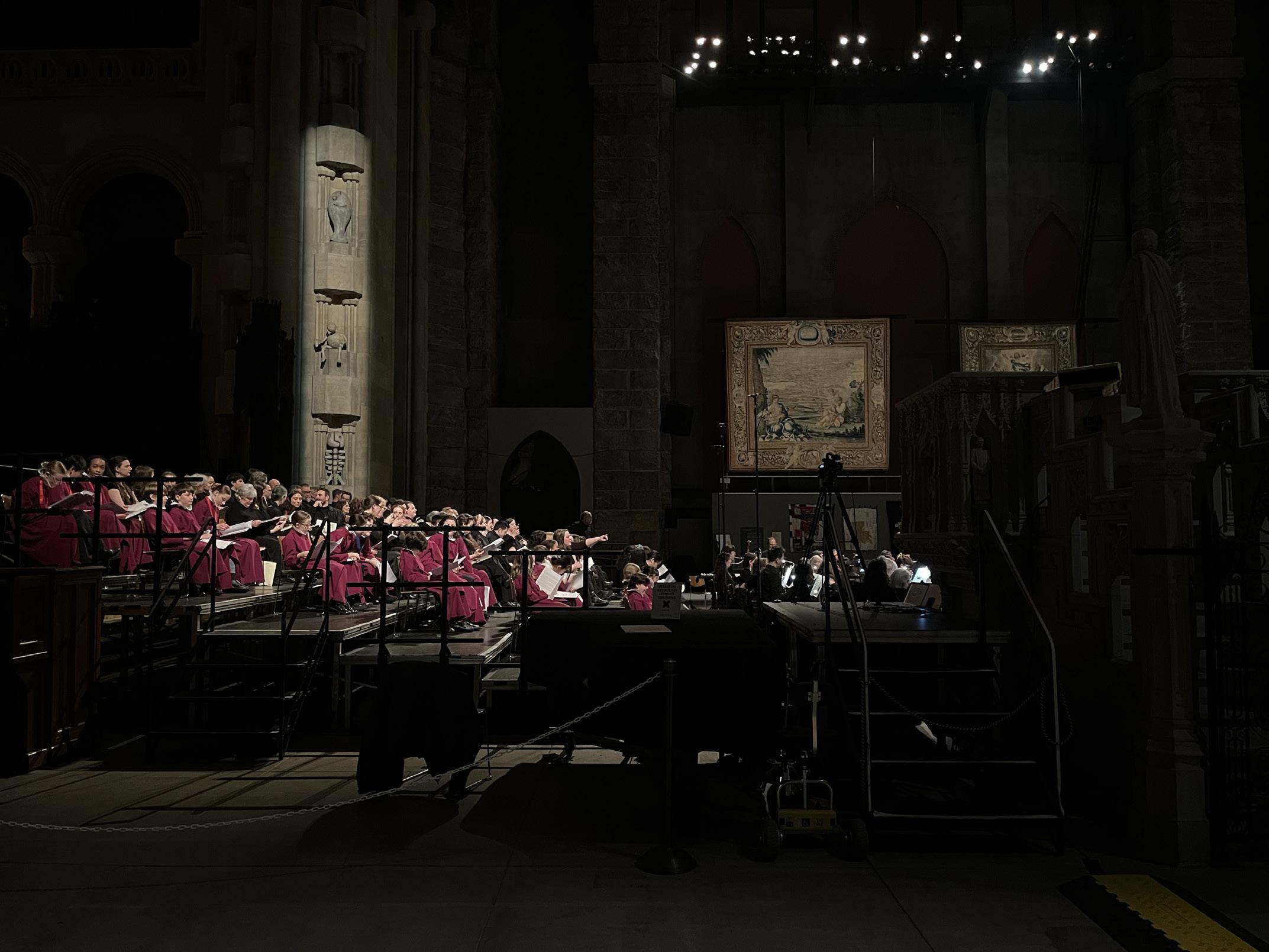
The Choirs of the Cathedral of St. John the Divine, pictured before Brahms’ Ein Deutsches Requiem
Experiential Orchestra performed Arvo Pärt’s music, itself wide-ranging and strenuous, with immense grace and an ease like breathing. Pärt’s work places an unusually heavy demand on the individual performer, with exposed parts—intensified by the acoustic nature of St. James Chapel—perpetually forcing ensemble members to walk a tightrope. Members of the small orchestra, bound together by Blachly, made it seem effortless. At the forefront of Pärt’s music is a unique tie between early and contemporary music, and so the choice of mezzo soprano Meg Bragle to sing his Vater Unser was superb. Bragle, with the help of Blachly and the orchestra, brought to life a sublime and delicate interpretation of the work.
During our conversation, Michael Pärt also spoke on the selection of St. John the
Divine as a venue for the performances. “It is incredibly important to have the right space,” he told me. “The silence needs to reverberate from that [which] was before, and keep you in that space… this sacred space lends itself in the most beautiful way… When you go to conduct a piece, your tempo and the spirit of the piece are directly related to the space. The smaller the acoustic, the less you can play with the tempo, and the bigger the acoustic, the more room it gives you to slow yourself down, and this slowing down is one of the fundamental pillars of my father’s music. This process allows the listener to have a connection from one moment to another, through the acoustic bonding it together. So, I’m very much looking forward to it, in this very unique space, especially in the New York area.”
Brahms Requiem (March 7)
Only a few weeks later, still feeling inspired, I found myself once again at the Cathedral. A line of concertgoers spilled out the door, down the steps, and onto the sidewalk of Amsterdam Avenue. Inside, the nave of the largest cathedral in the northern hemisphere
was filled in its entirety with chairs for a soldout performance of Johannes Brahms’ Ein Deutsches Requiem by the resident Choirs and Orchestra of the Cathedral of St. John the Divine under the baton of Music Director Kent Tritle. If Arvo Pärt’s music requires silence and intimacy, Brahms’ requiem facilitates a supreme sense of community and life, a
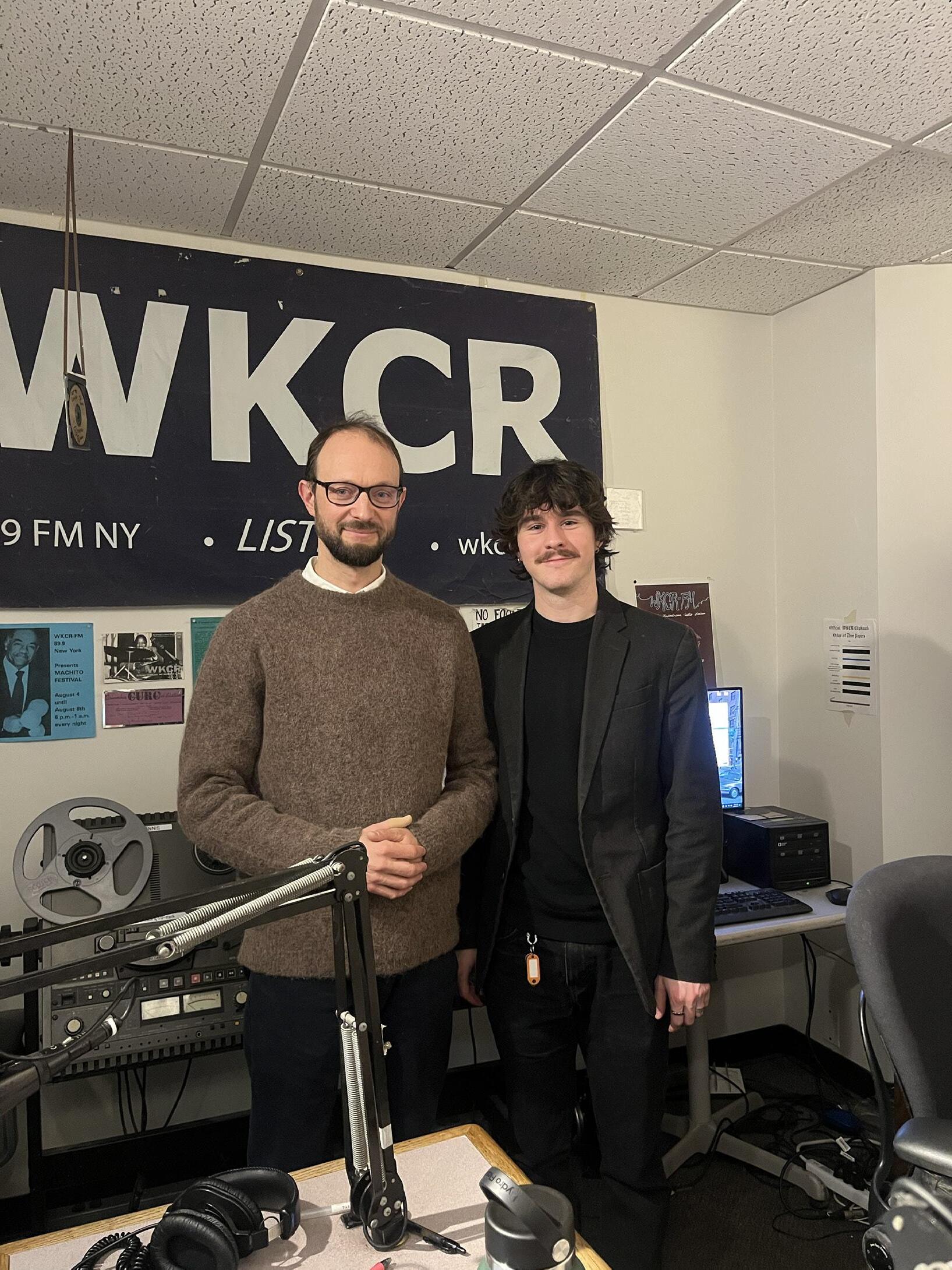
Charlie and Michael Pärt at WKCR
sentiment certainly fulfilled in this gathering. Brahms’ German Requiem was preceded in performance by two short works–a decision I was at first wary of. Brahms’ work, from my point of view, stands so well independently that any additional insertions on the program could only take away from it. However, these doubts were quickly dispelled. The poignant theme of Brahms’ requiem—a lament composed not for the dead, but those left living—was exhibited throughout the entire concert, the presentation of the space itself, and, of course, in the hundreds of people gathered to hear the music.
First was Carlos Simon’s 2015 Elegy: A Cry from the Grave, an immediately moving work dedicated to “those who have been murdered wrongfully by an oppressive power; namely, Trayvon Martin, Eric Garner, and Michael Brown.” Simon, a composer new to me, left a palpable mark on the audience with Elegy, conjuring something far more powerful than its five-minute runtime may have suggested. The work, in this arrangement for string orchestra, filled the vast cathedral with a deep and resonant warmth. Under Tritle, Elegy fulfilled not only the solemnity necessitated in its dedication, as well as in the wake of two brutal murders at the hands of federal law enforcement in Minnesota, but brought an impression of authentic comfort prefiguring Brahms’ masterpiece.
Directly following was the second movement of Jean Sibelius’ Symphony No. 3 in C Major, Op. 52. To hear even an excerpt from this piece, criminally overshadowed by its two predecessors, was a treat in itself. The Orchestra of the Cathedral, now in its full force as an ensemble, exhibited an impressive ability to swap styles from the Contemporary to the Classical while maintaining the same evocative sound, again reinforced and made all the more powerful by the building itself.
Brahms’ Ein Deutsches Requiem featured soprano Susanna Phillips and baritone Joseph Parrish in a performance led by Tritle that could only be described as profound; the intentionality of Brahms’ fabled requiem was
given far more than its due diligence by the Orchestra and Choirs of St. John the Divine. Moreover, after witnessing this titan of romantic composition at the cathedral, the exact type of space for which it was composed, it is difficult to imagine as a listener ever feeling satisfied again with the work in a modern, “acoustically sound” concert hall.
“Brahms himself had wished for this publisher to entitle this A Human Requiem rather than A German Requiem,” wrote Tritle in his program notes (cleverly titled “Kent’s Fireside Chat”) for the performance. “The scripture passages he chose to set embrace the mourner, confirm the triumph of life over death, and grant a vision of the return of the saints at the last day.” Indeed, as the final chords of the work rang out and the audience got to their feet in applause, a sense of life there was, and exiting the Cathedral of St. John the Divine after some hundred minutes of music, all the sunny afternoons spent with friends and community on its grand staircase felt beautifully affirmed.
After the performance, I spoke with The Very Reverend Winnie Varghese, who had given brief addresses before both concerts I attended. To see the Cathedral sold-out that night, she told me, was meaningful to her and to all those who find a home in the space. St. John the Divine is a community, as we witnessed both nights, for all people.
I, for one, will be going back for another performance very soon. The Cathedral of St. John the Divine’s music programming schedule can be found at www.stjohndivine.org/music.
Charlie Kusiel King is Program Director, the regular host of Thursday Cereal Music, and a frequent host of Friday’s The Early Music Show (both 9:30am-12pm).
Deep Cuts In Greenpoint: A Rainy Day At Record Grouch
by Jack Serpick NEW MUSIC
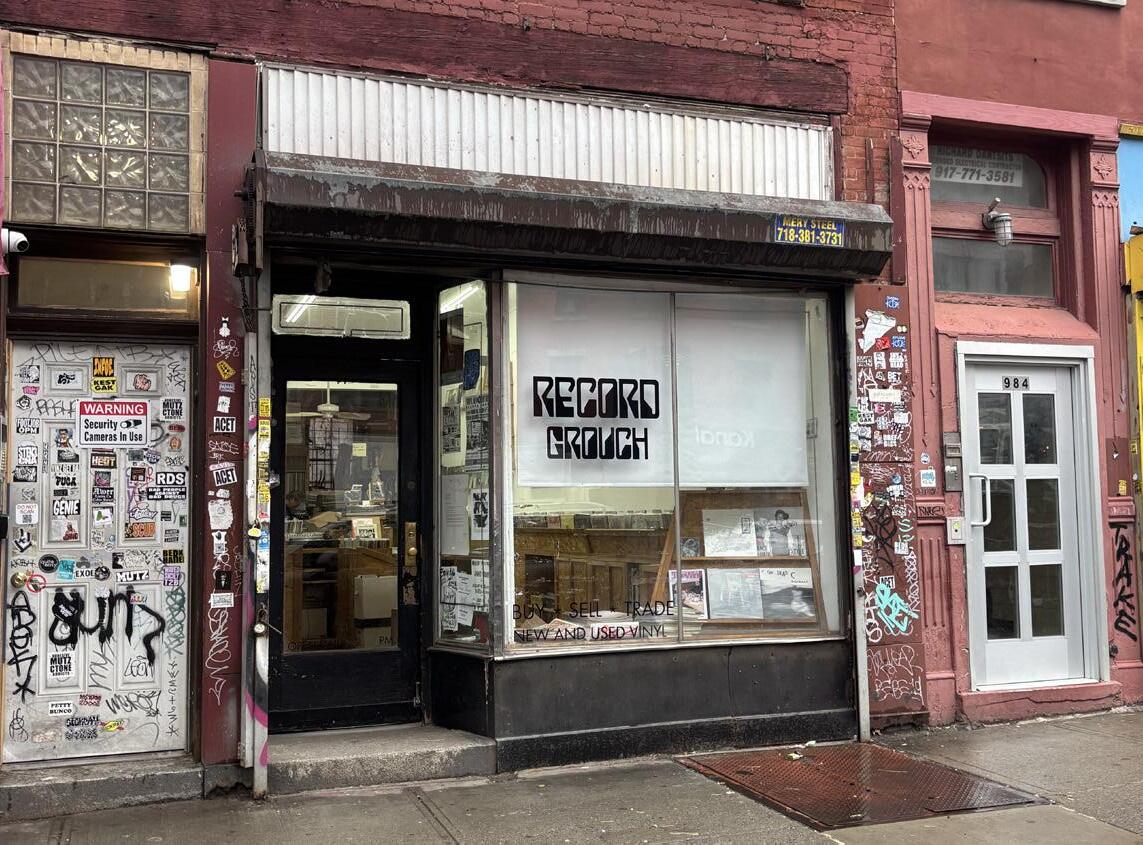
I’ve always thought Brooklyn record stores to be perpetually crowded, but the entire time I was at 986 Manhattan Avenue, only one other person came in: a mailman, dropping off a relatively short stack of what seemed to be junk mail. To be fair, the day I made the trek was a particularly rainy (even haily) one and Greenpoint felt almost like a ghost town. But the weather outside only added to the cozy atmosphere inside the small, 16-year-old gem.
Record Grouch has a subtly fashionable and purposefully rustic vibe that kept me exploring. The more I browsed, the more I realized the intentionality of everything in the shop. Take the stylishly simple floors, which consist of exposed and worn wooden subflooring–it’s the same material that the shelves are made out of and, if you squint your eyes, you could think you’re in a warehouse. It’s a hipster’s record store, Brooklyn through and through.
After a quick scan of the joint, I sat on the floor and began going through the CD collection, which held a number of notable indie jams; I was immediately drawn to TV on the Radio’s first EP, Young Liars, then noticed their sophomore, Return to Cookie Mountain, and snagged it. The shelves are organized to flow from characters like TV on the Radio and The Walkmen, to earlier and more pivotal artists like David Bowie. Eventually, I came across Syd Barrett’s Opel and decided, though early in my visit, it would be my final CD purchase. Still, I browsed through the rest of the shelves whose contents were obscure, though not exactly expansive. I quickly understood what Record Grouch gravitates towards and it’s not the mainstream.
Some of the more impressive selections,
both CD and Vinyl, were ones like Techno/ Dance and Soundtrack Scores. I later learned that the spot is known mostly for “contemporary experimental” music. The most captivating collection, however, was not one to be listened to at all, but one to be read: the publication collection. After venturing across the subflooring in the cramped minimalistic shop, I found myself lost in an assortment of The Wire magazines and the like. It was a truly astonishing collection in both size and content. Searching for an orientation of sorts, I decided to go up to the man at the desk in the back, who was occupied, sorting new arrivals.
The man’s name is Simon Henderson and he’s awesome. He’s got silver hair, those artsy glasses with the clear frames, and an ethnically ambiguous accent that I’ve been grappling with since I left the store. When I asked him to tell me about how and why Record Grouch has accumulated such an impressive collection of publications, he hits me with a “that’s probably more of a question for the owner who does all the ordering of that stuff.”
But, to my luck and exuberance, he continues with an incredibly thoughtful response, “I think because a lot of the music that we specialize in is somewhat outside the mainstream, the way that it’s written about formally tends to be the way that people hear about it and can provide context…I think it sort of goes back to the culture of the 80s and even earlier with free jazz publications, when that scene was publishing their own stuff because they weren’t getting written about in mainstream outlets–a lot of it being sort of contemporary classical. There’s a more formal approach to some of the coverage.”
He’s on a roll: “It sort of splits the difference between the underground punk rock culture of kids just doing it and not really thinking too much when writing about it and the more formal kind of conservatory approach, which ends up doing exactly the same thing, but just from a much more institutional approach.”
When I ask him to tell me about the most obscure or rare items in the store, his nerdy face lights up as he says, “I think we get rare and interesting stuff all the time, whether it be The Earwigs’ hardcore 7-inches that have been out of print since like 1982 or obscure Belgian drone metal records that were never really distributed in the US. We have a bunch of sealed 60s and 70s stuff at the moment.”
the desk and across the subflooring to the collection The Wire magazines which I browsed earlier. He calls them “the bible of all things” and adds, “I don’t tend to read a ton of fanzines. I tend to read more books. So I’m not entirely familiar with a lot of these. I’m not sure.”
After a solid minute of silent bowsing, Henderson pulls out Joe Carducci’s Enter Naomi: SST, L.A. and All That and prefaces, “If you’re fond of the terribly hardcore, this is a great book about the early LA hardcore scene.
Joe Carducci was the label manager at SST for a long time. [The book] is framed around this woman, Naomi Peterson, who was a female photographer at the time in that scene.”
The Earwigs from Orange County–not to be confused with the later band, Earwig from Columbus, Ohio–have a massive underground cult following and the price of their rare vinyls has skyrocketed since the band’s inactivity. Its place on the shelf is a hefty testament to Record Grouch’s commitment to the high-end underground, in-line with the rest of their collection of exceptional finds.
Henderson continues, “On the fanzine side, we have stuff like 8090 VAG, which is a new fanzine by a guy called Lasse Marhaug, who is a Norwegian musician and designer. This is the first edition of this fanzine that we ordered directly from him and he’s someone who, whether it be design or performance, is sort of peppered throughout a lot of the catalog of music that we cover.”
I soon realized that I wouldn’t be able to leave without something to read, so I asked Henderson for a recommendation. His excitement then brought him out from behind
He goes on, “She [photographed] a lot of the early grunge, Seattle bands who ended up out east. It’s an interesting sort of snapshot of early 80s LA hardcore and sexual politics...It’s very informative about the way that women were treated in the in the scene and everything that [Peterson] had to go through to survive it.”
A couple years ago, Curducci himself came into Record Grouch and spoke. Henderson remembers, “I think there’re a few choices of words where you’re like, ‘yeah, you maybe wouldn’t write that now.’ He’s definitely a boomer, but the overarching tone describes this incredible, talented woman who put up with a ton of shit and took it all on the chin and internalised a lot of it and had her struggles and survived.”
I stacked the book on top of my two discs from earlier and, though there were many more rare finds to explore, I had to scram; Record Grouch’s daily 7 pm closing time was fast approaching. On my way out, I knew I’d be back soon.
Record Grouch
Photo by Jack Serpick
Maxim Koretsky, Programmer: Impossible to pick one but my top four in no particular order! Justice at Red Rocks on 5/25/2025, Mk.Gee at The Stone Pony on 6/3/2025, Jamie XX at some warehouse in DTLA on 7/30/2024 opening night of his "The Floor" residency, Red Hot Chili Peppers at Bill Graham on 12/14/2017
Emma Lacy, Jazz Head: March 27, 2025: Cécile McLorin Salvant at Carnegie Hall with her quartet and The Knights performing orchestral arrangements by Darcy James Argue. Chris Thile also made a guest appearance.
McKenna Roberts, Programmer: Every Ragas Live I've been to at Pioneer Works has been the best collective experience. Such a rare thing to be with so many wonderful strangers, and we’ve been lucky to be part of it since its inception! I also saw Smerz live in October for their Big City Life tour.
Sam Seliger, Former Program Director: I'd have to pick two: Concha Buika at Summerstage in Central Park in 2019. She was absolutely on fire and her band was so tight. The crowd was super into it and it was a really wonderful moment of togetherness. BrAnCh trio (Brandon Ross, Angelica Sanchez, Chad Taylor) at Roulette, 2023. Three absolutely incredible musicians in perfect collaboration. Each moment was entirely new and contained an entire world of sound. It was refreshing and transformative, like an ice bath, but also almost spiritual.
Simon Reich, Classical Outreach Manager: Marin Alsop conducting Dvořák’s New World Symphony in Plzen, Czech Republic, June 28, 2025. She conducted the second piece in the concert, and while the orchestra was good at first, I was so stunned at how the sound she got out of them was unmistakably different—and worlds better— than the other conductor. And it was a student orchestra!
Sophia Woo, Head Engineer: Beyoncé's Cowboy Carter … no explanation needed.
Lila Ablimit, Programmer: Yeah Yeah Yeahs at Forest Hills, Rina Sawayama at Terminal 5 … both so lively, everything concerts should be.
Phi Deng, Former New Music Head: Maruja at Market Hotel!!
Iris Eisenman, Head Archivist: Japanese Breakfast at Brooklyn Paramount and Death Grips!!!
Ted Schmiedeler, Former Station Manager: WuTang Clan at Knockdown Center 08/10/2023 The Wu in a small, packed venue playing all their classics from the ‘90s? With old heads who knew every lyric? And it’s free? Absolutely electric, bombastic, time-travel-esque show. Cindy Lee at Brooklyn Paramount 11/15/2025 Downright devastation and mesmerizing beauty. Moved emotionally, some would say spiritually, more at this show than perhaps any other large human gathering. The Guitarplaying to die for that sounded better in person than the already stellar recordings.
AROUND THE What best concert you’ve been
Maddie Gibson, Programmer: Japanese Breakfast at El Museo del Barrio 3/22/25 - One of the most intimate concert experiences I have ever been to. If I remember correctly, this was a play/concert on the day she was releasing her most recent album, so this was also the first time I listened to it. The lighting and songs were so beautiful, I think I spent half of the concert in tears. I got front row, and after the concert, I was able to talk with Michelle, and the 15-year-old fangirl inside of me was freaking out (you can see my friend and me in her Instagram post too).
Sara Carson, Business Manager: Kenny Garrett’s set at Newport Jazz!
Leila Travaglini, Programmer: Peter Cat Recording Co. in Philadelphia 2024 Sept!!
Merielen Espino, Latin Head: Surf Curse at The Smell in DTLA 2017. It was a $10 concert I was totally not allowed to be at, but it was the peak of the alternative music scene in Los Angeles so I could not miss it.
Ella Presiado, Former Publicity Director: Godspeed You! Black Emperor at Pioneer Works. Hours of entirely instrumental awesomeness that brought to me tears multiple times. There were beautiful visuals that were playing from tapes that audibly clicked as they spun through out the show. Such a beautiful detail! Also Pioneer Works is a 10/10 venue that sometimes reminds me of a church.
Bonus fun answer: Smerz at Knockdown. They played Big City Life from top to bottom. More amazing visuals. Just magical!
Noel Siegert, Programmer: I saw Mdou Moctar in a nearly empty (maybe 30 people max) university auditorium in Lyndon, VT during winter of 2022. The band was incredible, it was super loud and echoey in this big, empty auditorium. About 10 of us stood right up at the front by the stage dancing, which the band really seemed to enjoy. Mdou would laugh and point to us, especially after playing a big riff and letting it reverberate … he acknowledged each of us at the end, and came out for an encore of a couple more songs. The funniest part was I saw him again the next night in a packed house in Burlington, but he didn’t come out for an encore then! Honorable mention: Arturo O’Farril & the Afro-Latin Jazz Orchestra in Hanover NH, some time pre-covid. Mind blowing.
Thomas Preston, Programmer: Fat Freddy's Drop, Berlin 2016. A quintessential jam band on a hot summer's evening ... I've been listening to them for 17 years or so (and have seen them live 3 times).
Hadassah Weinmartin, Director of Operations: This is a difficult question but I will say Domi and JD Beck on their first tour in Philly 2022, Robert Glasper at Pittsburgh Jazz fest 2024, Ragas Live 2025, and The Ravi Shankar Ensemble and The Town Hall this past month (March 2026)!
Charlie Kusiel King, Program Director: Truly an impossible question, but if I had to pick a few… The Cleveland Orchestra playing Shostakovich’s Tenth Symphony at Severance Hall, April 2022. Floating Points at the Knockdown Center, March 2025. Justice at Stage AE, June 2025. Ragas Live at Pioneer Works, October 2025. The Budapest Festival Orchestra playing Mahler’s Third Symphony at Carnegie Hall, February 2026 (with Casey!)
Casey Lamb, Former Station Manager: I have seen LCD Soundsystem at this point quite a few times and it is always incredible and always changes up. As far as Mahler’s Third with the Budapest Festival Orchestra and Ivan Fischer, I concur with Charlie it was truly a transcendent performance. Cameron Winter at Carnegie Hall was pretty cool too.
Francisco Javier Reyes, Programmer: Modern Life Is War at 538 Johnson Avenue in Brooklyn in ‘07. Frank Ocean played a festival at Randalls Island in 2012-ish and I caught his set from a balcony in East Harlem. Radiohead around that same time back-to-back in Newark. Recently: John Zorn at Roulette in ‘24; Xiu Xiu at Le Poisson Rouge also in ‘24; last year’s Ragas Live was a pinch me moment between getting to host a slot and being there for more than half of it.
Ian Pumphrey, Former NARTS Head: Swans at Music Hall of Williamsburg on September 29, 2023. Definitively the loudest concert I’ve ever been to and one of the most memorable live shows of my life.
June Frankel, Publicity Director: LCD Soundsytem in December. Everyone was dancing it was so fun.
Solène Millsap, Station Manager: There’s this charming neighborhood in LA called Frogtown, tucked between Silverlake and Glendale, where lies a tiny venue called Zebulon, where I saw ML Buch in the summer of 2024. I stood inches away from Buch and her friend Molina, while they projected sounds with such discernment and presence; she’s quite a genius and just incredible live.
Dear On Air Guide readers,
For the last year or so, on the first of every month, I’ve spent hours hunched over in a chair, my eyes an inch away from a computer screen as I carefully twitch a block of text into the perfect space. If this sounds like I’m lamenting, I might be, but only partially. This magazine has been my pride and joy for as long as I’ve been at its head. Still, it would be unfair to categorize it as mine, or really as anyone’s. I’ve seen people flit in and out of the doorway for meetings, faces present for two minutes that I’ll never see again. I’ve seen people sit down in the same seat, tucked behind the drumset, for seven straight months, where they suggest an article on something I’d never heard of before, but I’m all the better for it. I’ve recognized the intricacies of people’s faces—sketching them out in painstaking detail, quietly dropping the drawings off at the office to be picked up by them, and silently doing so again and again each month. I’ve contributed my own articles to this magazine, four in total now. Three articles were long diatribes on folk rock in the 1960s (something you can hear me chatter about on Hobo’s Lullaby every other week). Only one article was an attempt at poetics—capturing our fundraising efforts through live drawings, which brought me right back to studying faces. Portraiture was the very beginning of my involvement with the Guide, and I’ve always loved it most.
Many times I’ve trudged through rain, weaving my way through crowds on Broadway, catching my breath in the station, trying to get some last minute photographs of Around the Station answers scrawled on the white board. Sometimes there’s a show to program in three hours, a few graphics to draw, and the monthly issue due that night—it seems there’s never been a dull moment with the On Air Guide. The magazine was revived three years ago by dedicated leaders at the station, including my predecessor, Ale Díaz-Pizarro, and I’m happy to say that I’m leaving my position excited at all that this magazine still has to offer and the fantastic articles that await.
If this is anything like my sendout emails, it's apt to bring up the weather. Like the changing tides of spring, this season introduces another warm breeze of change—to the magazine. Or something like that?
Long live radio (and the magazines that support it), McCartney Garb
This newsletter is 100% off the charts exceptional! Thank you for the programming, the quality of the writing, and for being a beacon of light for those independent radio lovers out there like me!
In NYC, there are so many orgs needing support and I'm a supporter of WBGO, WNYC, and WQXR. As a 2-time alumnus of CU/TC and a current doctoral student, I never really gave WKCR the attention it deserves, but now you are on my daily "must listen" list and I hope to support your efforts when I'm able!
Again, sincere thanks!
Dean
J. Fusto
SUPPORT WKCR
TOP 5 REASONS TO DONATE TO WKCR
1. You’d be helping a student-run, listener-funded, and volunteer-based radio station continue to bring you the absolute best in what radio has to offer. Music, arts, news, and sports— we’ve got the works!
2. You wouldn’t be a free-rider anymore.
3. WKCR donations are tax-deductible (so make sure you donate before tax season). For more info on that, or anything else business-related, email business@wkcr.org
4. Being “the Original FM,” our equipment is getting a bit old. Thanks to your donations, we were able to retire Buzz, the hamster that ran the wheel powering us. But our new hamster, Roach, needs to start saving for retirement... can you blame him?
5. Isn’t On Air cool? Without proper funding, projects like this can’t come to fruition and, if they do, don’t make it very long. Donate to allow the little On Air minions to stay in the job.
HOW TO DONATE TO WKCR IN 4 STEPS
BY MAIL
Step 1: Locate your nearest checkbook
Step 2: Indicate “WKCR” as payee and fill out as usual
Step 3: Mail check to CU Gift Systems, 622 West 113th Street, MC 4524, New York, NY 10025
Step 4: ...and VOILÀ! Just like that, you have become a WKCR supporter!
ONLINE
Step 1: head to www.wkcr.org
Step 2: Click the yellow “DONATE TO WKCR” banner at the top of the page
Step 3: Fill out the form in the giving portal and enter your information...
Step 4: ...and VOILÀ! Just like that, you have become a WKCR supporter!
WKCR also accepts checks to our direct address. Just follow the same steps listed above but mail the check to: 2920 Broadway, New York, NY 10027
Did you know you can make recurring donations to WKCR when you donate online?
Just indicate your frequency preferences on the giving portal when prompted!
On Air 's Managing Editor is McCartney Garb
Layout Editor is Ella Werstler
Copy Editors are Olivia Callanan & Jem Hanan
The editorial team for this issue was Jasper Dabbs, Jonah Stockwell, Kitty Speer, & Emma Lacy
Special thanks to Casey Lamb, Ella Presiado, Emma Lacy, Francisco Javier Reyes, Hadassah Weinmartin, Ian Pumphrey, Iris Eisenman, June Frankel, Leila Travaglini, Lila Ablimit, Maddie Gibson, Maxim Koretsky, McKenna Roberts, Merielen Espino, Noel Siegert, Phi Deng, Sara Carson, Simon Reich, Sophia Woo, Ted Schmiedeler, & Thomas Preston