Building digital infrastructure systems for research virtualisation (platformisation):
Transforming scientific knowledge production capabilities and practices by digitally reshaping research communities and communication
26 March 2026
Virtualisation
Visualisation
Visibility
Valorisation
Prof Luci Abrahams, LINK Centre,
University of the Witwatersrand, Johannesburg
Analytical perspective: Promoting research virtualisation, and transitioning to visualisation, to visibility and to research value (the 4V’s)
The NREN and RREN landscape for African universities (infrastructure for virtualisation, strengths and weaknesses)
The shift towards digital research platforms in African countries creating the basis for virtualization and multi-party collaborative computation to make scientific breakthroughs
Domain specific use cases (biodiversity and climate change, digital humanities, health surveillance) from Egypt, Nigeria, South Africa illustrate importance of data and visibility
Discussion on pivoting to data-science-as-a-service (DaaS) as means to advancing university-based research production
Digital research infrastructure design thinking
• Digital research infrastructure, including national and regional research and education networks (NRENs and RRENs), provide the conduits for storing and analysing research data and sharing a range of outputs from traditional scholarly publications to contemporary data virtualisation and visualisation.
• Filling the pipes with valuable content relies on what research communities produce and on funding of the regional and global interconnection of academic and research networks. The digital infrastructure and the research content are only valuable when they create meaningful effects in the development of fauna, flora, human society and economies, each of these having the broadest range of meaning.
• In the large African research system, NRENs and RRENs service universities, colleges and science institutions, and research networks at regional scale. They connect research teams globally and promote open access to knowledge.
• Trends show advances in platformisation services in dominant areas of African research production, including climate change and health surveillance, both data intensive fields of study relevant to continental-scale innovation.
Meaning of the four V’s
• The 4V’s is an interpretation of the characteristics of research production in the 2020's (reward for production, reward for sharing, visibility leads to value, visibility has to be made simple)
• Virtualisation: Data science applications and data analyticsas-a-service (DAaaS), indigenous AI enablement and AI-as-aservice (AIaaS), digital twins and virtual research environments (VREs) for example virtual laboratories that offer functional virtualisation or multi-science platforms
• Visibility: Visibility of data sets, visibility of data analysis, visibility of artefacts, visibility of publications, open science, visibility of coomercialisation or socialisation potential
• Valorisation: Value of knowledge, social value, societal value, economic value
Empowering research through digital platforms (South Africa)
SMCRI (marine, coastal)
EFTEON (environment)
SAPRI (polar)
University research institutes
SARChI
NuMeRI (nuclear med)
DIPLOMICS (omics)
DIGITAL RESEARCH INFRASTRUCTURE (TENET/SANReN) The FOUR V’s
SAPRIN (population health)
HSRC (social)
DSI/NRF Centres of Excellence
Science Councils
SADiLaR (language)
BIOGRIP (biogeochem)
Virtualisation
Visualisation
Visibility
NCNSM (nano)
NSRF (solar)
BBSA (biodiversity)
Valorisation ❑ Multiple domains of research production
Empowering research through digital platforms (Africa)
ASREN (Arab States)
Infrastructure
The four V’s
Country level NRENs LIBSENSE collaboration of academic libraries and NRENs
UbuntuNet Alliance (SADC, EAC)
DIGITAfrica
WACREN (West African states)
Upanzi (DPI network operated from CMU-Africa, Rwanda)
Institutions and domains
eduroam WiFi service
AFRINIC
Data Science Nigeria (data science and artificial intelligence)
AfriGEOSS for earth observation research
Region Internet Registry ECRI (Environment and Climate Change Research Institute (Egypt)
AFRICA-WIDE DIGITAL
RESEARCH INFRASTRUCTURE
… ENABLES …
❑ Virtualisation
❑ Visualisation
❑ Visibility
❑ Valorisation
Six domains of research production
❑ Biodiversity and climate change
Network for Digital Humanities in Africa
Zewail City of Science, Technology and Innovation (Egypt) (renewable energy, nanoscience, informatics
COPPHA
Open access health publishing
❑ Digital humanities, learning and development
❑ Energy science and innovation
❑ Health surveillance and promotion
Research platforms
❑ Mathematical, statistical, computational and data sciences
❑ Computational analysis, fabrication or manufacturing
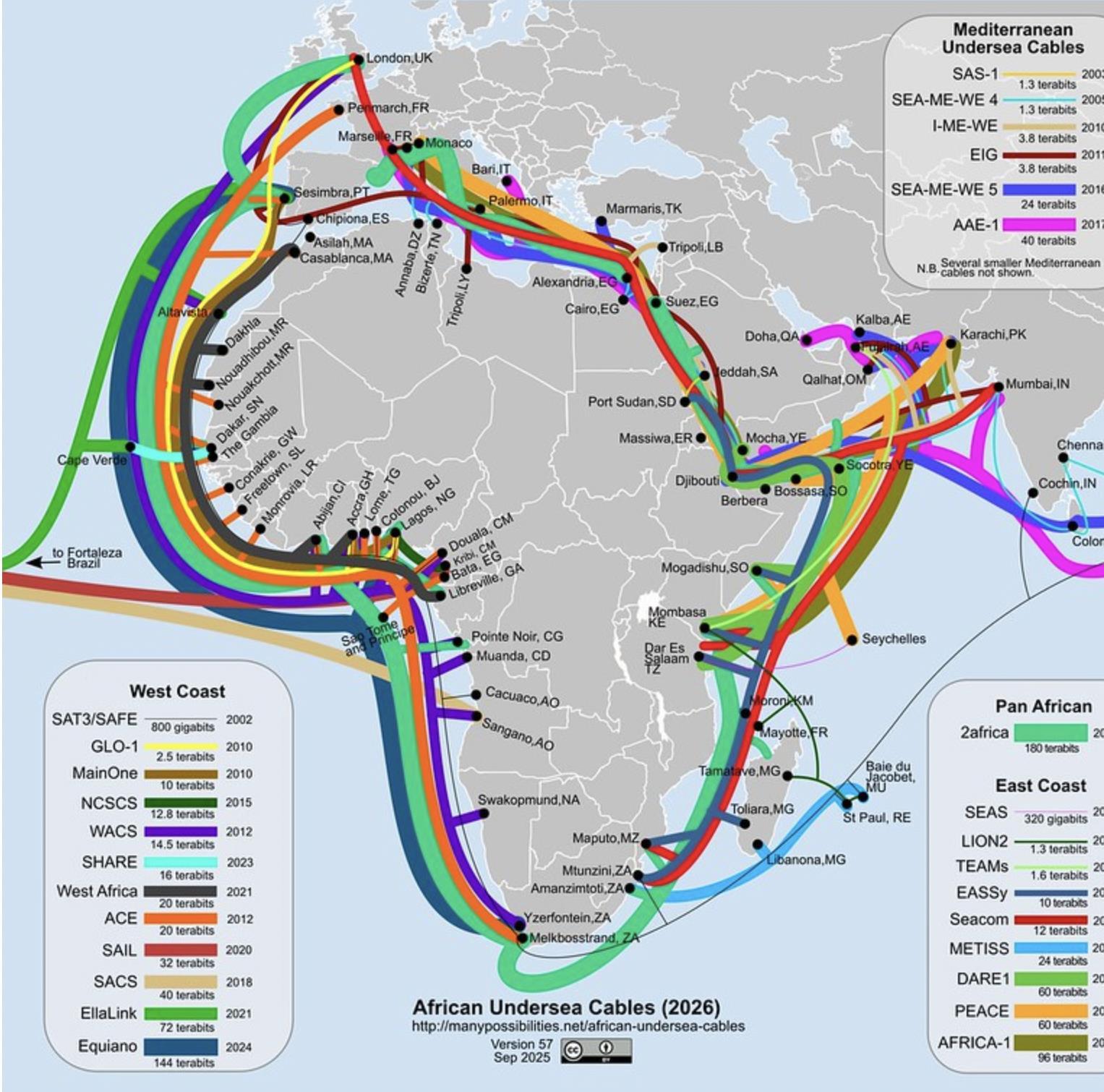
• Google AI analytics suggests that USD1.3 billion was invested in undersea cable infrastructure annually over the period 2015 – 2024
• The AfricaConnect3 investment is estimated at USD40.5 million 2019 –2023
• NRENs in 20 African countries delivering reliable Internet to universities and research institutions
• TENET estimates that ZAR3 billion has been invested in SANReN and TENET infrastructure since 2007, including ZAR1 billion in undersea cable infrastructure, with ZAR2 billion being direct investment in research infrastructure
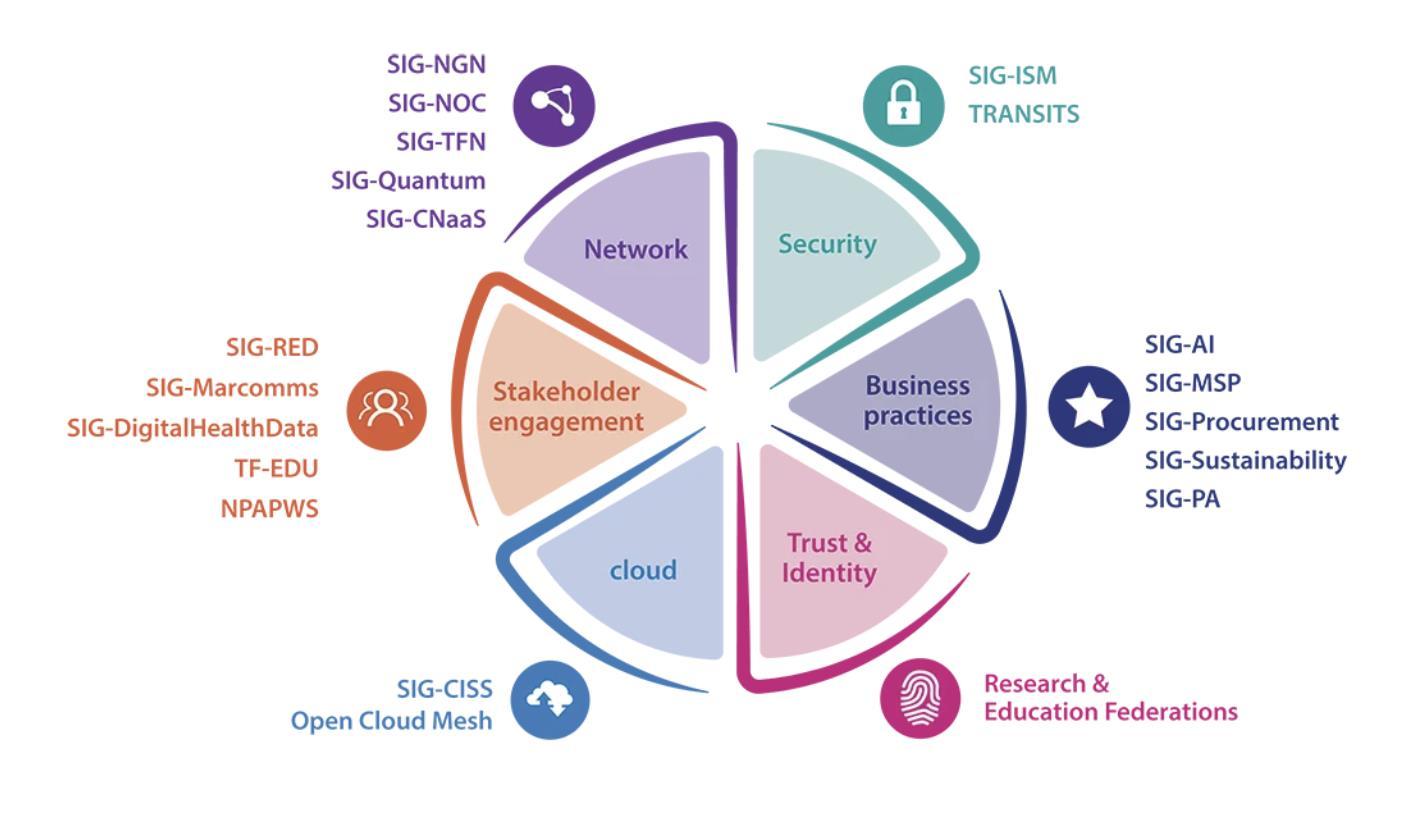
Source: GÉANT, no date. https://community.geant.org/wpcontent/uploads/2026/03/GEANT-Community-Thematic-Areas-graphic-2026.png
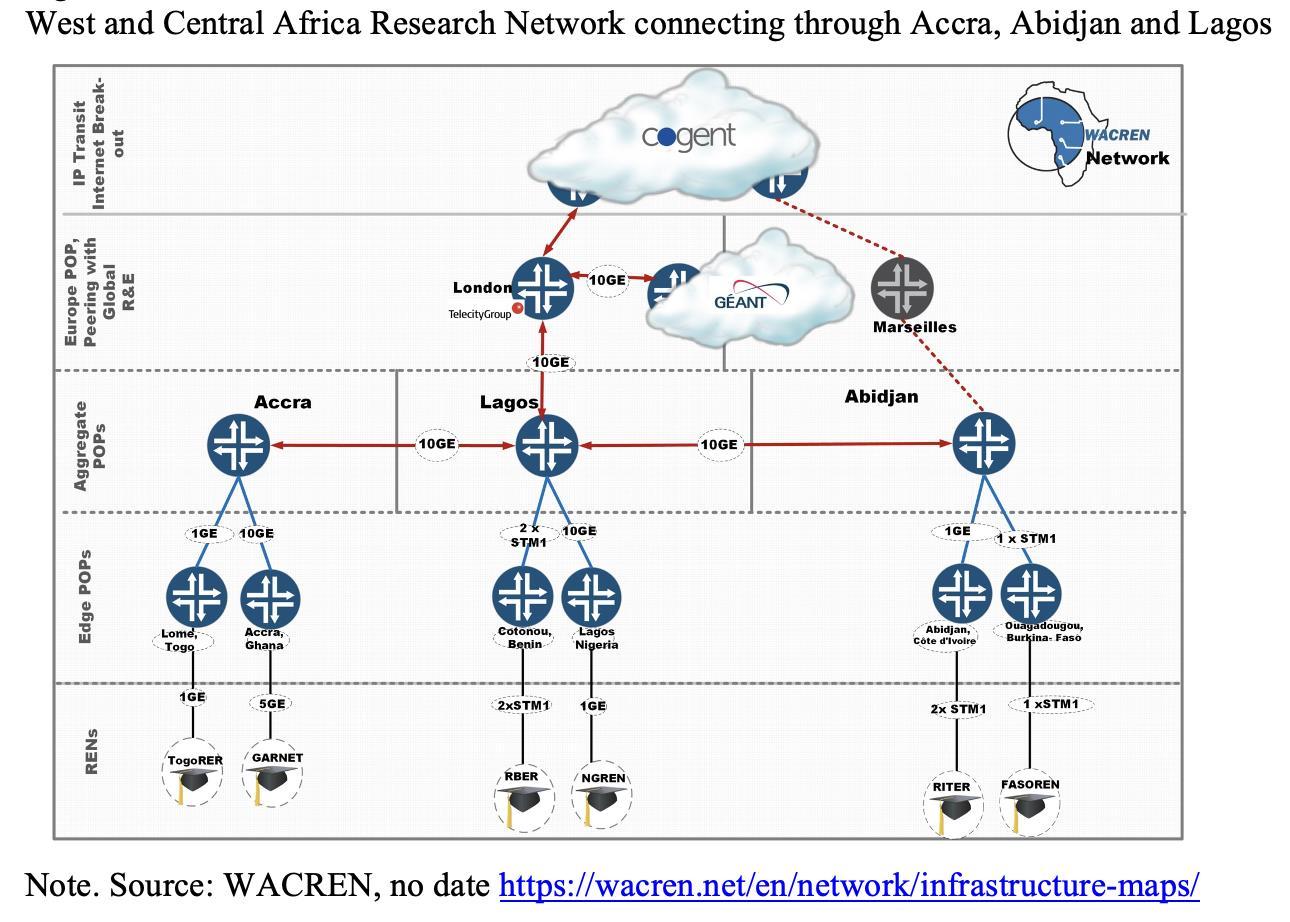
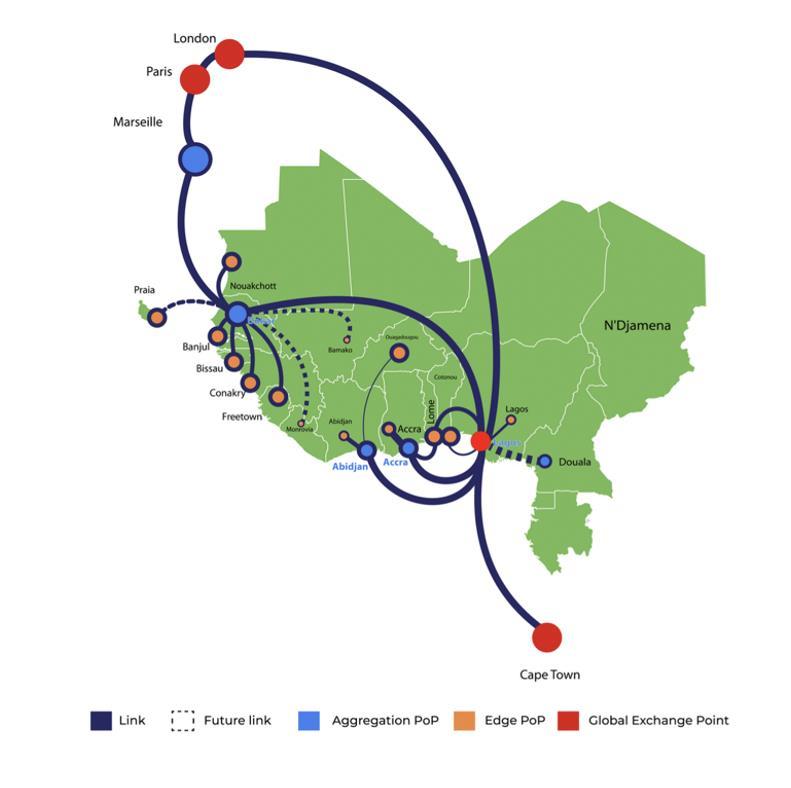
Aggregation points of presence (PoP) for WACREN climate change research initiative
Abidjan, Accra, Dakar, Doula, Marseille
WACREN provides network and connectivity services, cloud services, and trust and identity services, it sees itself as more than an ISP for universities. Amongst its initiatives, it plans to establish a regional climate monitoring platform of weather stations integrated with Internet of Things (IoT) gateways and a climate data portal https://wacren.net/en/news/wacren-connects-sixnew-countries-and-sets-foundation-for-climateprogramme/. It also sets the scene for other innovative services to other African research communities, creating a platform ecosystem for 21st century research in Africa.
New platformisation initiatives DIGITAfrica https://www.digitafrica.eu/ University of Ngaoundere (Cameroon), Strathmore University (Kenya), University Cheikh Anta Diop (Senegal) and UCT (South Africa)
Source: WACREN, no date. https://wacren.net/en/news/wacren-connects-sixnew-countries-and-sets-foundation-for-climate-programme/
Sciences, social sciences and digital humanities domains
Domain Selected Pan African and National Institutions Creating Research Visibility and Commercial or Social Innovation Research Value
• African BioGenome Project (ABP)
Biodiversity and climate change
Digital humanities, learning and human development
• Alliance for Collaboration on Climate Change and Earth Systems Science (ACCESS) @ CSIR, South Africa
• Desert Research Centre, Cairo, Egypt
• Hub for Multilingual Education and Literacies (HuMEL), Wits University. South Africa
• Lelapa AI, Rosebank, South Africa
• Masakhane African Languages Hub, Nairobi, Kenya
• Network for Digital Humanities in Africa, virtual hub
• ABP led by Science for Africa Foundation, Kenya
Health surveillance and health promotion
Energy science and innovation
• African Pathogen Genomics Archive
• Africa Centres for Disease Control and Prevention, Addis Ababa, Ethiopia
• Coalition for Open Access Publishing of Public Health in Africa (COPPHA) led by WACREN, Accra, Ghana
• Engineering Research Institute and New and Renewable Energy at the Zewail City of Science, Technology and Innovation, Cairo, Egypt
• Photovoltaic Research Lab, CSIR, South Africa
Mathematical, statistical, computational and data sciences
Computational analysis, fabrication or manufacturing
• Artificial Intelligence and Machine Learning Organization of Nigeria (AAIMLON)
• NICIS Data Intensive Research Initiative of South Africa (DIRISA)
• NBE Institute for Nanoscience and Informatics (INI) at Zewail City, Egypt
• National Centre for Nano-structured Materials (NCNSM), South Africa
• Significant, large datasets on biodiversity and climate change
• Relates to the viability of agricultural, bulk infrastructure and human development systems
• Promoting African language resources and technologies (ALRT) for multiple uses
• The foundations for apps to translate educational and health content into multiple African languages
• Significant, large public health datasets
• Virtual epistemic communities of researchers sharing knowledge and building public health capability
• Research collaboration and shared knowledge can make energy futures research more efficient, potentially more commercialisable at scale
• Multiple university-based centres and research networks engaged in the study and practice of data science
• Potential for creating a cross-continental capability in data-science-as-a-service
• Computational analysis and modelling as input to creating nano structured materials
Sciences, social sciences and humanities (institutions and resources)
Domains Biodiversity and Climate Change
• Desert Research Centre, Egypt
• WACREN 6-country climate change initiative
Digital Humanities, Learning and Human Development
• South African Estuaries Information System (SAEIS)
• Observations Database (ObsDB).
• Climate Action Platform Africa (CAP-A)
Digital infrastructure and platforms
Platform design and governance
• SAEON's Open Data Platform and Observations Database
• Global Ocean Observing System
• APIs, Data Management Platform
• Climate information as a distributed model of data hosting, data analytics and advocacy
• Digital Humanities Association of Southern Africa
• CoE Human, HuMEL (Wits)
• CSIR Voice Computing, other divisions
• AfricArXiv Open Science Webinar Series
• Multi-lingual models for African language resources (Language Resource Catalogue)
• HSRC Scoping of Human Resource Development Observatory
• Africa CDC
• African Centre of Excellence for Inequality Research
• CoE Human, SAPRIN, ACEIR and DataFirst
• Medical Research Council
• African literary metadata (ALMEDA), Uppsala Universitet
• SADiLaR Interactive Web portal
• NFVS Archives (analogue)
• Collections at various institutions (analogue)
• Interdisciplinary digital humanities projects
• Africa CDC Epidemic Intelligence Weekly Reports
• Mpox continental response plan 2.0
• South African National HIV Prevalence, Incidence and Behaviour Survey SAPRIN Individual Surveillance Episodes Dataset
• DataFirst Open Data Infrastructure
• AOSIS online courses
• OpenSTEM Africa Virtual Laboratory, operates from Ghana = onscreen instruments biology (virtual microscope, spirometer, human heart), chemistry (titration, flame test, calorimetry), physics (fine beam tube, spring mass system, electrical circuits)
• Computational modelling and data visualisation-as-a-service (CMDVaaS)
• Knowledge-as-a-service (KaaS)
Sciences, social sciences and humanities (institutions
and resources)
Domains Energy Science and Innovation
Creators and Users
• Centres for renewable energy, photonics and smart materials, Zewail City Cairo, SARChI in Energy Materials, Solar Thermal Energy Research Group, SU
• CIMERA; CRSES; Energy Research Centre, CSIR
• Photovoltaics Research Group; SANEDI; CCT; SARETEC
Mathematical, Statistical, Computational and Data Sciences
• Upanzi network (Rwanda, Morocco, Botswana, South Africa)
• HSRC CESTII, CREST, SU; NACI; DataFirst
• Centre for Applied Data Science, SPU; Wits Machine Intelligence and Neural Discovery Institute (MIND); several university entities
• CHPC; DIRISA; NITheCS, AAIMLON Nigeria (WA)
• Creating and testing digital public infrastructure (DPI) building blocks
Virtualisation in Hybrid Computational Analysis, Fabrication or Manufacturing
• NBE Institute for Nanoscience and Informatics (INI), Zewail City
• iThemba LABS
• NCNSM RI Materials Characterisation Facility
• Wits Centre of Excellence in Strong Materials
Datasets/resources/pro jects/content
• Many creators offer only limited content, mainly information and grey literature
• Mainly websites
Digital infrastructure and platforms
Platform design and governance
• Energy virtual laboratories and research environments (EVLREs)
• Data analytics + visualisation-as-aservice (DAVaaS)
• CeSTII Annual R&D Survey
• SAKnowledgebase
• Energy and data efficient AI models
• Hosting and support services, knowledge sharing and advocacy
• Paper/web-to-platform transition
• CeSTII R&D Survey platform
• DataFirst Open Data Portal
• NACI STI indicators portal
• Innovation-surveys-as-a-service (ISaaS)
• Data analytics + visualisationas-a-service (DAVaaS)
• Future data libraries, modelling libraries, software libraries, design libraries
• Nano design, modelling and fabrication
• Mainly websites
• Virtualisation API laboratory
• Virtual research environments as a service (VREaaS)
Cross-cutting themes: Inclusiveness and interdisciplinary innovation
• Women scientists participating in and shaping the science system
• Advancing the visibility of women researchers, in African research networks, in knowledge domains, in science leadership
• Value realisation matrix, value realisation register that enables the science community to monitor and measure/evaluate value and inclusiveness
• Perform public science at scale by front-loading required financial investment
• Address cross-institutional, cross-continental, global (BRICS) collaboration
• Reduction of the marginal cost of research collaboration over time
• Data science is critical to the long-term sustainability of research data platforms and communication
• Need to build capacities for disciplinary, multi-, and interdisciplinary communities of researchers with the data science communities to mobilise research-based knowledge
Platforms can facilitate using applications of AI tools and techniques in research production
virtualisation
• Discriminative AI = useful for classification tasks, models trained on extensive, annotated datasets
• Generative AI = using tools for natural language processing and computer vision to engage in analytics (and writing) EG. Mostly.AI; Kaggle platform for synthetic data
• Visual Paradigm Online templates including generative AI tools
• Canva designs including generative AI tools
• Xmind for mind maps; many AI-based tools
• Institutional AI policy = conditions under which AI should or should not be used in research production = who is a researcher, who is an author
• COPE = Committee on Publication Ethics codes of practice for scholarly writing
• Transparency a key requirement for ethical and responsible use
• Training in AI-enabled research techniques
• Training in exploration and appropriate use of AI tools
• Training in ethics of responsible AI use in research production and publishing
Summary of action points of applications of the four V’s
• Virtualisation: All major research operations are virtualised for collaborative research (with internal and external teams). Major studies and research resource management processes are virtualised including research design, research operational planning, experiments, data analytics, next generation research resource management (RRM) systems for people, research teams and research financial reporting
• Visualisation: Dashboards and other visual tools (image libraries, models, policy flowcharts, mind maps, catalogues, use case diagrams, other = applied to specific research problem
• Visibility: Public visibility of survey data sets, visibility of analytical reports, visibility of publications, open data and open science promotes reuse and knowledge sharing for social benefit (example GeoGebra open content for secondary mathematics education) and commercial benefit (example open APIs in the fintech sector).
• Valorisation: Assessing the social, societal and economic value of knowledge contribution = audit/directory of research value
Global trends across Africa (WACREN), BRICS (RedCLARA), ASEAN (SEA-RUN),
Acknowledgement: Mark Burke for diagram design
• Decision-making
• Structures, procedures and instruments
• Data governance
• Ethics and policy oversight
• Technical governance
• Heterogeneous research teams with diverse needs
• Range of institutions and actors
• Varying levels of human resource capabilities and capacities
• Range of data sharing practices no-one-size-fits-all
• Publications and knowledge resources in multiple formats
• Interoperability requirements, specifications and standards
• Metadata design and practice, common data catalogues and formats
• Unique persistent identifiers, repositories and principles
• Services to support the research data management life cycle
• Small-scale and large-scale investments
• Computational and data processing power
• Grid and cloud computing
• Federated architecture
• Software development, data analytics-as-a-service (DAaaS)
• Interconnected infrastructure
• Network services
• Accommodate growth in demand
Building shared virtual research spaces
Design approach
i. weaving what already exists into shared space(s) through a landscape mapping exercise;
ii. mapping key concentrations of research production and funding at institutional level;
iii.apply a discipline-relevance/value framework to confirm key domains and projects for platformisation, next-gen RRM;
iv.address the cross-cutting issues;
v. elaborate on high-level platform design pivoting to virtualization, data analytics/modelling and visualization as a service;
vi.build interdisciplinary research and innovation good practice.
• Internal decision-making on mobilising digital research infrastructure towards research platforms
• Internal decision-making towards mobilising next generation research resource management (RRM) systems
• Collaborative engagement with key research partners and networks including fellow universities, Africa and global partners, DSI, Afretec, African Open Science Platform, DIGITAfrica, TENET/SANReN, other
• Collaborative engagement with research community broadly in high data science domains: eg biodiversity and climate change; digital humanities, learning and human development; health surveillance and promotion; energy science and innovation; mathematical, statistical and computational data sciences
• Engagement at events such as the Regional Open Science Dialogue in Southern Africa and the ZA-REN conference OPEN DISCUSSION