Education Resource What We Do Not See
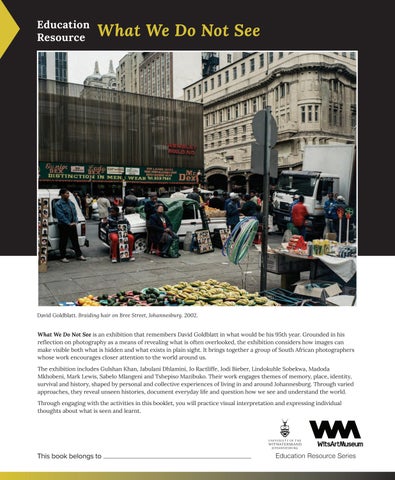
David Goldblatt. Braiding hair on Bree Street, Johannesburg. 2002.
What We Do Not See is an exhibition that remembers David Goldblatt in what would be his 95th year. Grounded in his reflection on photography as a means of revealing what is often overlooked, the exhibition considers how images can make visible both what is hidden and what exists in plain sight. It brings together a group of South African photographers whose work encourages closer attention to the world around us. The exhibition includes Gulshan Khan, Jabulani Dhlamini, Jo Ractliffe, Jodi Bieber, Lindokuhle Sobekwa, Madoda Mkhobeni, Mark Lewis, Sabelo Mlangeni and Tshepiso Mazibuko. Their work engages themes of memory, place, identity, survival and history, shaped by personal and collective experiences of living in and around Johannesburg. Through varied approaches, they reveal unseen histories, document everyday life and question how we see and understand the world. Through engaging with the activities in this booklet, you will practice visual interpretation and expressing individual thoughts about what is seen and learnt.
This book belongs to
Education Resource Series
Ways of seeing: Looking beyond what is visible David Goldblatt (born Randfontein 1930, died Johannesburg 2018) lived in Johannesburg for most of his life. He was a self-taught photographer who documented the structures, people and landscapes of South Africa for over 70 years. Describing his work, he said “I was drawn not to the events of the time, but to the quiet and commonplace where nothing ‘happened’ and yet all was contained and imminent”. His work is published in many books and he exhibited widely locally and internationally. What We Do Not See showcases some of the work he made in Johannesburg over the span of seven decades. David Goldblatt once shared a story about an experience while he was photographing along the N1 between Johannesburg and Cape Town, near a farm next to the highway. A car stopped nearby and the passengers sat talking for a while. Then the man got out and walked over to him. He explained that he and his wife had recognised Goldblatt from a television documentary they had watched a few weeks before. They had decided to stop because his wife felt they could not just drive past without greeting him. They spoke briefly before the man returned to his car. As he left, he turned back and said: “I understand what you do. You show us what we do not see.”
Let’s look closely: Engaging with artworks mean we need to slow down and look carefully. What we notice first is often only part of the story. Through observation and perspective, we begin to see how meaning is built in an image. WORK IN PAIRS. Each person chooses one of the two photographs by David Goldblatt. Start with your first impression. What do you notice immediately? Now look more carefully and list what you can see in the image. If you look longer, do new details emerge?
David Goldblatt. A street trader waiting to sell food to workers completing the construction of this office park, 2001.
Consider: •
What do you notice about the person/people present? And what do you notice about the environment?
•
What might be happening beyond the frame? And how does the photograph show us what we do not normally see?
Share your thoughts with your partner.
GLOSSARY TERMS Observation: The act of carefully looking at something in order to notice details. Perspective: The position or point-of-view from which something is seen.
David Golblatt. Squatter camp, slimes dam and the city from the southwest, Johannesburg. 2003.
2
How to look at photographs: The object A photograph is made when light reflected from objects enters a camera and is recorded by a sensor or film. The light exposure affects how light or dark the final image is. A photograph is not only a record of what is visible, but also a constructed interpretation of the world. Photographers make decisions about what to include, what to exclude, and how to frame the image they are creating. These choices shape the meaning of the image. The photographs in this exhibition are not neutral records of reality. They are carefully formed images produced by the photographer’s choices about subject, light, framing, timing, and point of view (POV). The POV influences how we see the subject and how we understand the space within the image. What we see is always influenced by these choices, and what is not shown can be just as important. Absence, like presence, can carry meaning and can suggest wider social, historical, and human contexts beyond the frame. When working with the medium of photography, the photographer considers the following: •
Composition: How elements are arranged within the frame to guide attention and create meaning.
•
Framing: What is included in the image and what is left out. It does not refer to the physical frame.
•
Light: How natural or artificial light shapes visibility, mood, and contrast
•
Angle: The position from which the photograph is taken (above, below, or from the side).
•
Focus: What is sharp or blurred, and how this directs attention
•
Foreground / background: How spatial layers create relationships within the image
•
Subject matter: Does the subject matter convey a particular context or point-of-view that the person making the image is trying to portray
•
Moment: The specific instant chosen by the photographer, which can suggest a wider story beyond the frame
Let’s draw: Choose one artwork from the exhibition. Redraw it using a simple grid to help you look closely at the composition. This is not about making a perfect drawing. It is about careful looking. As you draw, think about: •
What is in the foreground (front), middle ground, and background (back)?
•
What stands out first when you look at the image?
•
What is placed where in the frame, and why might that matter?
Now notice your own looking: •
What do you see first?
•
Where does your eye move next?
•
How does the composition guide your attention across the image?
3
GLOSSARY TERMS Point of view (POV): In photography, POV refers to the position from which a photograph is taken — for example, at eye level, from a low angle, or from a bird’s-eye view. This perspective shapes how viewers perceive the subject, space, and relationships within the image. Medium: The form, material and process an artist uses to make an artwork
Homes as archives of memory, history, and change: Jabulani Dhlamini Jabulani Dhlamini (born Warden 1983) is a photographer and educator whose work explores memory, history, and everyday life in South African communities. He studied photography at the Vaal University of Technology and the Market Photo Workshop and is the project manager of the photography school Of Soul and Joy, where he is actively involved in photographic education and mentorship. He has participated in several local and international exhibitions. In this series, he explores people’s homes in Soweto, where he lived for a time. He returns to houses that he first photographed in 2019, recording how they change over time. These photographs show homes not only as physical structures, but as living records of people’s lives. Changes in paint, structure, and decoration become visible markers of time, memory, and lived experience. His interiors explore how homes function as archives of memory and history.
Jabulani Dhlamini. Habo Tshepang/ Katleho, Khumalo Street, Phiri Soweto. 2019
Jabulani Dhlamini. Habo Tshepang/ Katleho, Khumalo street, Phiri, Soweto. 2025
Jabulani Dhlamini. Habo Tshepang/ Katleho, Khumalo Street, Phiri Soweto. 2019
Jabulani Dhlamini. Habo Tshepang/ Katleho, Khumalo Street, Phiri Soweto. 2025
GLOSSARY TERM Archives: Collections of records or memories that preserve history.
Let’s reflect: Jabulani Dhlamini suggests that homes can be read as monuments shaped by apartheid spatial design, while also being spaces that people continuously reshape through everyday life. •
Look closely at the pairs of photographs. What details suggest personal identity, care, or survival?
•
How is a home shown as a place of history in these images?
•
Now think about your own home. What parts of it reflect the people who live there and the way they live? What details would someone notice if they visited for the first time?
4
The city as a shifting image: Jo Ractliffe
Jo Ractliffe. Simmonds Street cnr Market Street; Rissik Street; Pritchard Street; JOHANNESBURG CENTRAL. 2004
Jo Ractliffe (born Cape Town 1961) is a photographer and educator whose work explores landscape, urban space, violence and memory. She taught photography at Wits University and the Market Photo Workshop. Her work has been exhibited widely in South Africa and internationally. In INNER CITY WORKS, (1999 - 2004) Ractliffe uses an adapted toy camera, a Holga, to photograph Johannesburg in ways that embrace blur, movement, and uncertainty. Her intention, she says, was ‘to capture a city in flux during a time of urban renewal and regeneration, and to counter stereotypical perceptions of the city as a place of crime, filth and decay.’ The Holga creates softness and unpredictability, challenging photography as fixed documentation and showing that we never see the whole picture. The city she presents is not stable or fixed. Buildings, streets, and people appear between clarity and obscurity. Rather than offering a single way of seeing Johannesburg, her work suggests a city that is experienced in fragments and moments.
Let’s discuss: Jo Ractliffe’s photographs suggest that the city is never still. It shifts depending on where you stand and how you look. The scale of the prints approximates that of a car window and what you would see as you drive past. Stand in front of Jo Ractliffe’s photograph Simmonds Street cnr Market Street; Rissik Street; Pritchard Street; JOHANNESBURG CENTRAL and take a moment to look carefully. What is the first thing you notice? Look at the orientation of the photograph. Is it portrait (upright) or landscape (horizontal)? How does this affect the way you see the city?
We usually expect buildings to appear upright. In the photograph above can you spot a building that appears to be lying on its side? How does this change the way you look at the image?
Look again, even more carefully. What details stand out to you? What parts of the image feel familiar? What parts seem unusual or unexpected?
Why do you think the artist chose to show the city in this way? What ideas or feelings might they be trying to communicate?
GLOSSARY TERMS REFLECTION: Art allows us to see the world differently. It does not only show us what something looks like. It asks us to think about how we are looking, and how images shape what we understand as reality.
Landscape: A view or picture of the natural or built environment, such as mountains, rivers, cities, or towns. Urban space: Places in a city or town, including streets, buildings, parks, and public areas where people live, work, and interact. Blur: A photographic effect where part or all of an image appears out of focus or unclear. Blur can be caused by movement or by using a slow shutter speed, and can be used to show motion or create a particular mood.
5
Seeing from above: Jodi Bieber Jodi Bieber (born Johannesburg 1966) is a photographer whose main focus is the social realities of contemporary life in South Africa. Her work often engages with gender, politics, and identity. She trained at the Market Photo Workshop and has worked internationally as a documentary photographer, published several books, won numerous awards and participated in many exhibitions locally and internationally.
Jodi Bieber. Zoo lake. 2022
Let’s map movement: Jodi Bieber often explores how people move through the city and how perspective changes what we see. Think about your own journey to Braamfontein today. Draw a simple map of your route from home to the museum. •
Where did your journey start?
•
What places did you pass through?
•
Where were there changes in movement, speed, or activity?
Bieber’s photo essay, A Love Letter to Johannesburg, 2022-2023, includes images that shift between different distances and viewpoints. At times, she works close to her subjects, focusing on people and lived experience. At other times, she steps back to show the city from above, using a drone to give an alternative perspective. Writing about her work, she says: “This body of work is both a homage to you the city I have loved as home for my whole life and a protest against the accelerating decay of this miraculous place. I am photographing you from the sky. Places I remember from my youth, places I frequent now, places where personal memories resonate powerfully with your rich history. Why the sky? I like its serenity, calmness and quietness. I share space with the birds. This shift in perspective reminds me that there are many ways to see the one you love.” These shifts in perspective change how we understand the city. From afar, the city can appear softened, ordered or simplified. Up close, it becomes more complex, detailed, and layered with human activity. Her work shows that photography is shaped by the physical position of the camera. POV influences meaning. This encourages us to think about how perspective changes what we notice, and how photographs can shift between the personal, the immediate, and the abstract depending on distance.
GLOSSARY TERM Contemporary: Present day, current.
6
Memory, absence, and personal history: Lindokuhle Sobekwa
Lindokuhle Sobekwa. Farm workers outside the supermarket, 2019
Lindokuhle Sobekwa. Dominique trying on a new dress, 2016
Lindokuhle Sobekwa (born Katlehong 1995) is a photographer whose work explores themes of memory, loss, family, migration, and personal history. He began his photographic journey through the Of Soul and Joy photography programme in Thokoza in 2012 and, in 2015, received a scholarship to study the Foundation Course at the Market Photo Workshop in Johannesburg. A member of Magnum Photos since 2022, Sobekwa is the recipient of numerous awards, including the 2023 FNB Art Prize and the 2025 Deutsche Börse Photography Foundation Prize. His photobook I carry Her photo with Me was published in 2024. He has exhibited locally and internationally. His photo essay, Daleside: Static Dreams, 2020, is a collaboration with Cyprien Clément-Delmas that examines race, class, and belonging in a small South African town. He writes: ’I first visited Daleside when my mother was employed there as a domestic worker. At the time the white dominated area seemed like an isolated place, a ghost town. It is a place I have always had unresolved issues with and a curiosity about...’ The photographs are not only about what is visible in the frame, but also about what is missing: relationships, distance, memory, and emotional experience. Daleside becomes a space where personal history and social structures meet. This reflects what we do and do not see of the emotional, social, and historical layers of everyday life as it is revealed through photography.
Let’s think, pair, share: Photographers do not simply record reality.
They make deliberate choices that shape meaning.
As you look at the photographs above, remember that your response also plays a role in how meaning is made: •
Choose one of the photographs and indicate what emotions or mood do you think the photograph conveys? What in the image makes you feel this way?
•
Sobekwa’s work often explores absence and separation. Is there anything that feels missing from this photograph? How does this affect the way you understand the image?
•
Think about a place that is important to you. How do your memories and experiences influence the way you see that place?
7
GLOSSARY TERMS Absence: What is we do not see, what is not present, but still affects meaning in the image. Frame: The edges of the photograph; what the photographer chooses to include or exclude.
DOCUMENTARY PHOTOGRAPHY: Photography that records real life, people, and places, often to tell social or personal stories
Time, trust, and representation: Madoda Mkhobeni Madoda Mkhobeni (born Soweto 1983) is a photographer whose practice is grounded in long-term engagement with people and communities in Johannesburg. He studied at the Market Photo Workshop. His photo essay, Trolley Pullers, ongoing since about 2012, moves beyond quick observation to capture complexity and depth. Rather than capturing a single passing moment, he spends time building relationships with the people he photographs. Through this approach, his photographs become more than images, they form part of a living archive, shaped by trust, time, and shared experience. Trolley Pullers challenges common assumptions. The people he photographs are not shown as stereotypes, but as individuals with histories, responsibilities, and hopes. His photographs encourage us to think carefully about representation, allowing us to reflect on how people are seen and how time and connection can shape that seeing.
Madoda Mkhobeni. Tsvangirayi sitting by his self-made box house in Newtown before the land was developed, circa 2008
GLOSSARY TERMS Observation: Looking carefully at something in order to notice details and better understand it. Assumptions: Ideas or beliefs that are accepted as true without having all the facts or evidence to prove them. Stereotypes: Simplified ideas about a person, group, or place that are often based on assumptions rather than reality. Stereotypes do not show the full complexity of people and can lead to misunderstanding or unfair judgments. Representation: The way someone or something is shown, described, or portrayed in an image or artwork.
Madoda Mkhobeni. Brighton under the highway bridge in Newtown, 2011.”
Let’s see and feel: Photographs do not only show us what something looks like. They invite us to imagine, feel, and understand what another person might be experiencing. They allow us a chance to connect. Choose one photograph above and spend a quiet moment looking at it. •
What do you feel when you look at this image?
•
What might this person be feeling that we cannot see?
•
What part of their story might be unseen in this moment?
8
Living, seeing, and being seen: Sabelo Mlangeni Sabelo Mlangeni (born Saul Mkhize [formerly Driefontein], 1980) lives and works in Johannesburg and is known for photographs that show everyday life and explore community, belonging, and shared experience. He spends long periods with the people he photographs, sometimes weeks, months, or even years, building trust and understanding daily life from within the community rather than from a distance. The photo essay Men Only, 2008–2009 shows life in the George Goch Hostel in Johannesburg. Built during apartheid for migrant labourers and mine workers, many similar hostels still exist today. Over time, these buildings became homes for men working in different jobs in Johannesburg, such as security guards and taxi drivers, many of whom live far from their families. These spaces carry difficult histories of apartheid, separation, and inequality. They are often viewed through stereotypes of violence or hardship. However, Mlangeni’s photographs also reveal intimate scenes from everyday life: cooking, resting, talking, and sharing space. By spending time living in the hostel, he moves beyond quick judgments to show the routine and humanity of the people who live there.
Let’s write a story: Photographs can be the beginning of a story, not the full story. We only see one moment, but we can imagine what comes before and after. Sabelo Mlangeni. Abangani, 2008
Choose one photograph from this series on exhibition. Create a short story by writing a paragraph or a few sentences that imagine life beyond the photograph. Think about: •
Who do you think this person is?
•
Where are they living or working? What might a normal day in their life look like?
•
What are they thinking or feeling in this moment? What might they be hoping for or worried about?
GLOSSARY TERMS Belonging: A feeling of connection, acceptance, or being part of a place, group, or community.
Sabelo Mlangeni. Mans tehuis, 2008.
Migrant labourers: Workers who move from one place to another, often from rural areas to cities, to find employment.
9
The city in motion: Mark Lewis Mark Lewis (born Klerksdorp 1954) is based in Johannesburg. His practice is rooted in observing the changing city and the ways people move through urban space and how it is shaped by constant activity, complexity, and transformation. He has published several books, most notably the series Wake up, this is Jo’burg, with writer Tanya Zack. His photo essay Jeppe, 2018 - 2026 is a product of years he has spent in the inner city. Writing about his work, he said, ‘In the 1980s, when the inner city (then known as ‘town’) was leading the charge towards mixed race living, I lived in an apartment on Jeppe Street – now Rahima Moosa Street. The city then moved to a very different beat. This important street heading west out of the city gives this area its local naming of ‘Jeppe’ or ‘GP’. And a new tide of experimentation has swept through the city streets. Now, a short drive from my Melville home takes me back to these city streets where my camera bears witness to a surprising transfiguring of ‘town’. A transnational economy of fast moving, fast fashion pumps through the public space and every building. Through my lens I’m seeing a new charge – of Johannesburg’s remaking as an African metropolis.’ Lewis invites us to experience a collection of individual photographs as a single compilation that feels noisy and overwhelming. The image creates a sense of visual intensity and accumulation, where individual photographs merge into a new collective whole, almost like wallpaper across a wall of Wits Art Museum. His practice invites a closer attention to how urban spaces are experienced and organised, and how ordinary street-level moments can point to wider social and economic networks that are not immediately visible.
Let’s practise interpreting an image together:
Look closely at the amassed body of work by Mark Lewis. Write your answers to the following questions in the space provided. Share your answers with the group when you are finished.
Mark Lewis. Jeppe. 2025 - 2026
•
What do you see in the work? List as many details as possible.
•
How is your eye guided across the work? Where do you look first, and where does your attention move next?
•
How do you think this work has been compiled?
•
What might this combination of images suggest about the city or subject?
•
Why do you think the photographer chose to present this as a compilation rather than as separate images?
•
Which details become more meaningful when you spend more time looking?
•
How do the different images relate to each other? Do they show similarity, contrast, repetition, or change?
•
How does this artwork make you feel?
10
11
Belonging and connection: Gulshan Khan Gulshan Khan (born Ladysmith 1983) is a photojournalist and visual artist whose work explores memory, belonging, and justice through intimate documentary photography. She trained at the Market Photo Workshop, where she now teaches. She is a National Geographic Explorer and former freelance journalist for Agence France-Presse, and her work has been shown across the world. The photographs in this exhibition, made during 2024 – 2025 in the south and west of Johannesburg, form part of The Things We Carry with Us, a long-term, ongoing project that began in 2017. The project traces histories of Islam in Southern Africa using the lens of the Indian Ocean slave trade, political exile, resilience, racial segregation and love. Returning to these stories of her ancestors, she seeks to create a meaningful addition to the archive, preserving memory and legacy for future generations. Through warm and carefully observed images, Khan documents Islamic cultural traditions while reflecting on the resilience, faith, and connection that continue across generations. Her work asks: what does it means to carry culture across imposed geographies? What is lost in displacement—and what refuses to be lost? It considers how spirituality becomes infrastructure, how faith becomes a technology of survival, and how community becomes a form of resistance.
Gulshan Khan. Jaamia Lawrence (Sarlie) leads the An-Nur Ladies Thikr group in recitation during the Moulood festivities at the Bosmont Masjid, Johannesburg on October 21 2023. 2003
Her photographs invite deep reflection on the ways people carry history, culture, and belonging through communal worship and remembrance.
Let’s describe: Use your fingers to create a viewfinder by making an “L” shape with each hand and bringing them together to form a rectangle. •
•
Hold this frame up and look at one photograph in the exhibition. Spend time looking closely at the image and become acquainted with the details within it. Focus on one small part of the photograph and notice what changes when you isolate it. What details become visible when you look more slowly and carefully?
Gulshan Khan. Yaseen Salie performs the Ratiep during the Ratiep at the Malay Festival, a fundraiser for one year old Amalia Adams who was diagnosed with Dandy Walker Syndrome in Florida, Johannesburg on July 27, 2024. 2024
12
Identity, memory, and the “Born free” generation: Tshepiso Mazibuko Tshepiso Mazibuko (born Thokoza 1995) trained at the Market Photo Workshop and was a recipient of the Tierney Fellowship Award. Her work explores how young people understand themselves in post-apartheid South Africa.
The title of her photo essay, Ho tshepa ntshepedi ya bontshepe, 2017-2018 is a Sesotho proverb meaning ‘to expect something that will never happen’. Mazibuko reads this proverb in the paradox of the term “born free”, as an illusion that places youth born after 1994 in a position of temporal “freedom”. She questions what this means in everyday life within a society still shaped by inequality and history. She uses this idea to reflect on the gap between expectation and lived experience. Her work is also personal, exploring how she understands herself through photographing others. As she writes, ‘it is a process of finding pieces of herself in the people she photographs.’ Tshepiso Mazibuko. Sharon, Thokoza, 2017-2018.
Let’s notice light and shadow:
Photographers use light and colour to guide our attention and to shape mood, emotion, and meaning. Using a pencil, lightly draw arrows directly onto or beside the images in this section to show: •
Where you think the light is coming from
•
Where the light is strongest or most visible
•
Where the light is being blocked or softened Tshepiso Mazibuko. Linda, Thokoza, 2017- 2018.
You can also use simple labels such as: •
Direction of light source
•
Focal point (where your eye goes first)
•
Areas in shadow (darkest tones)
GLOSSARY TERM Temporal: Relating to time or how things change over time.
13
Photography, seeing and interpretation
In South Africa, photography has played a powerful role in documenting history, particularly during apartheid, and continues to reflect social realities and lived experiences today. Choosing to photograph subjects not usually highlighted can show realities that are not always immediately seen or acknowledged. Images can challenge stereotypes, question power, and offer different ways of understanding people and place. Photographs are not neutral. They are shaped by the photographer’s choices, including where they stand, what they include, and what they leave out. These decisions influence how people, places, and events are represented. Many photographers work closely with communities over time, building trust and creating images that reflect lived experience with care and responsibility. This approach moves beyond simple documentation towards a more thoughtful and engaged way of seeing. Photography is also a process, not only an image. It involves looking, waiting, selecting, and sometimes returning to the same place or people over time. Photographers make hundreds of decisions before and after the moment the shutter is pressed. Editing, sequencing, and the presentation of images also shape how meaning is formed. At the same time, photography raises important questions: •
Who is behind the camera?
•
Whose story is being told?
•
How are people represented?
Understanding these questions helps us read photographs more critically and recognise how meaning is shaped through seeing. If you want to learn more about South African and African photography, visit the Photography Legacy Project https://www.plparchive.com/
14
Looking Again
Throughout What We Do Not See, the photographers in this exhibition invite us to look more carefully at the world around us. Their photographs explore memory, identity, community, history, and everyday life in and around Johannesburg. Together, the artworks remind us that photographs can reveal what is often overlooked, unnoticed, or left unseen. As you moved through the exhibition, you may have noticed that meaning changes when we spend more time looking. Small details can begin to tell larger stories about people, place, and lived experience. Each person that visits the exhibition also brings their own memories and understanding, which shapes how they make meaning of an image.
Let’s find: Choose one photograph from the exhibition that you found
meaningful.
Record the details of your selected artwork below: Artist’s name: Artwork title: Date: Materials used: Dimensions: Now spend a quiet moment looking before you answer. •
What makes this image important or meaningful to you?
•
What do you think this image is asking you to notice?
•
What question does this photograph leave you with?
15
What We Do Not See A reflection on what we have seen As you leave the exhibition, take a moment to reflect on what you have experienced. Has your understanding of what it means to “see” changed through this exhibition?
Has your thinking shifted about what a photograph shows, and what it leaves out?
Have any photographs changed the way you think about the city and people in it, or made you feel good or bad about the city?
Let WAM know what you think WAM would like to know what you have learned during your visit to this exhibition. Share your reflections on What We Do Not See on WAM’s Facebook page or Instagram: Facebook: https://www.facebook.com/witsartmuseum Instagram: @witsartmuseum_wam The exhibition is supported by the David Goldblatt Legacy Trust www.whatwedonotsee.co.za #witsartmuseum #whatwedonotsee@wam #photographyexhibition
EXHIBITION WEBSITE
This education resource was written by Brenda Goldblatt, Fiona Rankin-Smith and Bougaard, and edited by Julia Charlton. It was produced by Wits Art Museum in 2026 to accompany the exhibition What We Do Not See, curated by Brenda Goldblatt and Fiona Rankin-Smith. Unless otherwise stated, the photographs are courtesy of the artists. Design and layout by HotHouse South Africa
Education Resource Series