

Broad-Based Black Economic Empowerment, (B-BBEE)
Carnegie Diversifying the Academy, (CDTA)
Disability Rights Unit, (DRU)
Diversifying The Academy, (DTA)
Early- to Mid-Career Academic Transitions (EMCAT)
Employment Equity, (EE)
Female Academic Leadership Fellowship, (FALF)
Gender Equity Office, (GEO)
Key performance areas (KPAs).
Mid-Career Academic Transitions, (EMCAT)
Sexual Orientation, Gender Identity, Expression, and Sex Characteristics, (SOGIESC)
Transformation and Employment Equity Office, (TEEO)
Transformation Steering Committee, (TSC)
Transformation Implementation Committee, (TIC)
Vice-Chancellor’s Employment Equity Funds, (VCEEF)
Deputy Vice-Chancellor: People Development and Culture
Greetings to all of you as members of the Wits Community!
2025 was once again a busy and productive year for the Transformation and Employment Equity Office (TEEO). After reviewing our transformation pillars in 2023 and 2024, we consolidated our strategy in 2025 through an expanded public engagement focus; ongoing institutional redress initiatives to diversify the academy; the promotion of equity and inclusion; anti-discrimination work; social justice advocacy; and compliance-related imperatives such as Broad-Based Black Economic Empowerment (B-BBEE) and Employment Equity (EE) planning In addition, we completed the largest institutional cultures survey in Wits’ history and have shared these findings and recommendations with all of you. We have also integrated these recommendations into the planning, implementation, and roll-out of our 2033 institutional strategy This will, without a doubt, involve contributing to institutional change processes and upholding the fundamental principles of academic freedom, maintaining institutional autonomy, and fulfilling our role as an anchor institution that models active citizenship through external engagement with multiple publics
In more than 30 years since we transitioned to democracy, Wits has made significant strides to reflect the changing nature of our society, to be responsive to the vexing questions of our time, to act as a vibrant public institution, to reflect the composition of South African society, and to demonstrate our commitment to social transformation, justice, and the public good These values commit us to being a diverse, equitable, inclusive, and people-centred university grounded in our city, regional, national, and international contexts. We are compelled to harness our intellectual capital to reduce inequality, strengthen democracy, improve governance, and cultivate the nascent ethical leadership within our communities. I extend my appreciation to the TEEO and to all of you who continue to hold these values at the core of our institution’s vision and mission, making Wits one of the premier institutions in our country, our continent, and across the globe
Enjoy the read!
Prof Garth Stevens Deputy Vice-Chancellor: People Development and Culture
Executive Summary of the Transformation and Employment Equity Office (TEEO) Annual Report
Executive Summary: Transformation Office Annual Report 2025 The Transformation and Employment Equity Office (TEEO) at the University of the Witwatersrand serves staff, students, leadership, and external social justice partners as a hub for equity, inclusion, healing, peacebuilding, and cultural change. This 2025 Annual Report, the Office’s second consolidated edition, defines the year as one of consolidation and strategic maturation Building directly on the foundational 2024 report, it illustrates how transformation has evolved from policy and compliance toward embedded praxis, deeper institutional culture change, human-centred management, and a stronger public-engagement mandate, all aligned with Wits Strategy 2033 and the six Transformation Pillars adopted in 2024: Diversifying the Academy; Expansion of Knowledge Archives; Institutional Cultures; Institutional Naming, Visual and Spatial Redress; Language Diversification, Multilingualism and Translanguaging; and Public Engagement
In 2025 transformation work moved from aspiration to lived institutional reality Programmes matured, governance structures gained traction, context-specific initiatives proliferated across faculties and units, and the interconnections between the pillars became tangible The report is candid: progress is real and accelerating, yet full institutionalisation remains a multi-year journey requiring sustained commitment
The six Transformation Pillars now constitute the organising framework for all equity and inclusion work at Wits The trajectory has shifted from historical redress and compliance toward proactive advocacy, inclusive institutional cultures, language justice, Global South-centred knowledge production, and purposeful public engagement.
Governance balances central oversight with distributed agency. The Transformation Steering Committee (TSC) aligns strategies across social justice units (TEEO, Gender Equity Office, Disability Rights Unit) and reports to University Forum and Council
The Transformation Implementation Committee (TIC) oversees Vice-Chancellor’s Employment Equity Funds and monitors equity spending. Thirty-four Transformation Committees operate across faculties, schools, divisions, and support units; while their potential to drive change is undeniable, functionality remains uneven, with stronger resourcing and closer partnership with local management now urgent
The Transformation Community of Practice (TCoP) emerged as the standout governance innovation of 2025. This cross-campus forum surfaced lived experiences and diagnosed systemic barriers, revealing institutional fragmentation, cultures of fear and retaliation, unsustainable emotional labour borne by marginalised staff, equity implementation gaps, and punitive performance-management practices. From these engagements arose seven strategic priorities: strengthening governance, building capability, improving coherence, resourcing committees, deepening data use, enhancing communication, and embedding accountability through human-centred management
We extend our profound gratitude to Carnegie Corporation of New York, a pivotal strategic partner whose sustained funding has been instrumental in incubating and scaling innovative approaches to diversifying the academy at Wits Carnegie’s visionary support has underpinned the development of the Monitoring, Evaluation, Learning and Planning (MELP) framework, provided critical resources for testing and refining ideas with high potential for equity and inclusion impact, and enabled the University to move boldly from conceptualisation to measurable institutional change
The flagship Carnegie Diversifying the Academy (CDTA) programme invested R11 49 million across 31 grants in 2025, bringing cumulative investment since inception of phase 3 to R33.80 million. Over 55% of total funding has supported Lecturer-level appointments, with substantial portions also directed to Postdoctoral Fellows and Senior Lecturers Active grantees supervised Masters and PhD students during the year, confirming the programme’s role as the University’s primary academic pipeline instrument.
In 2026 CDTA will enter the final year of its third grant phase; the tremendous multi-phase support Carnegie has provided over nearly a decade has delivered extraordinary value, catalysing permanent appointments, research productivity, and a more representative academic community. This sustained partnership has also sparked the conceptualisation of a comprehensive DTA Tracer Study scheduled for 2026, which will track long-term career trajectories and institutional impact of CDTA-supported academics.
Career milestones included promotions and permanent appointments for, among others, Professor Kagiso Pooe, Dr Khosi Radebe, Dr Matsidiso Sello, and Dr Chia-Yu Chen. The Early- to Mid-Career Academic Transitions (EMCAT) leadership programme supported 27 participants with mentoring, conflict management, portfolio retreats, and public-engagement training, creating what participants called “collegial spaces” that restore purpose and voice Operational refinements of the programme further strengthened trust and efficiency
Complementing CDTA, the Carnegie Africa Diaspora Programme continued to forge transformative connections with leading institutions in the Global North and across the continent. Through Distinguished Visiting Fellowships, joint supervision arrangements, high-impact co-authored publications (particularly in Astrophysics and Business Sciences), grant-writing capacity building, and public lectures, the programme has significantly enhanced Wits’ supervision capacity and international research networks. Ongoing collaborations seeded through this initiative promise enduring benefits for both academics and postgraduate students in the years ahead.
The strategic enablement provided by a partner of Carnegie Corporation’s calibre cannot be overstated: it has aligned external philanthropic investment directly with Wits’ institutional priorities, amplified scarce internal resources, and accelerated progress toward a more equitable and globally competitive academy
The Wits 100 Cultures Study was completed and its findings socialised in August 2025. Covering seven domains (brand and reputation; people and culture; diversity, equity and inclusion; teaching and learning; research and innovation; place and partnerships; management and governance), the study will guide culturechange interventions over the next three to five years.
The Naming, Visual and Spatial Redress reference group began its work in 2025.
The Language Diversification, Multilingualism and Translanguaging programme, funded by a R2 5 million DHET grant, trained 164 academics in multilingual pedagogy, standardised multilingual letterheads and signage, and provided South African Sign Language interpreting at major events Emphasis remained on isiZulu, Sesotho, and SASL. The priority now is to transition from grant-funded projects to sustainable institutional structures and staff-development pathways.
The Social Justice Programme delivered 46 formal workshops plus numerous informal engagements, with strongest demand from Health Sciences, Humanities, and Residence Life Initiatives included the Madoda Sabelani healthy-masculinities series, Diversity Seminars for Occupational Therapy students, and the Trans/Gender Diverse Support Group (co-run with GEO and GALA) In partnership with the UNESCO Chair, the Office trained 90 teachers from feeder schools on anti-discrimination and bullying prevention, extending Wits’ transformation expertise into communities and supporting SDG 4
Forty-three cases of bullying, discrimination, and conflict were formally reported The Office is shifting toward alternative dispute resolution; the Social Justice Manager completed accredited mediation training in 2025, with plans to establish trained student and staff mediator cohorts
Wits submitted a new five-year Employment Equity Plan aligned with the 2025–2030 Sectoral Numerical Targets. The student profile (75% African, 61% women) reflects a strong pipeline. Academic and professional staff diversity has improved at junior and middle levels; senior leadership and disability representation (currently 1.4%) require accelerated succession planning.
B-BBEE performance was strong in enterprise and supplier development (46 78% of spending to Blackowned suppliers), socio-economic development, and board representation. Skills development, senior gender equity, and disability inclusion remain focus areas
TEEO describes itself as an “office of praxis” operating in the “third space” between academic and professional domains and across multiple stakeholders. This positioning enables it to broker relationships, surface unspoken realities, and translate insight into practical change MEL-P feedback loops, TCoP diagnoses, and the Wits 100 Cultures Study now directly shape programming. The Office is increasingly theorising its work through book chapters, journal articles, media features on EMCAT and CDTA, and peerlearning forums, positioning Wits as a thought leader among South African anchor universities
The report is frank about constraints: a small office facing high demand, uneven committee functionality, resistance, emotional labour, grant dependency, and policy–systems misalignment Yet momentum is unmistakable.
Strategic future priorities are:
Implement Wits 100 Cultures Study recommendations university-wide
Embed multilingualism as permanent institutional infrastructure beyond DHET funding
Scale CDTA and mentoring ecosystems with grant-writing and leadership pathways.
Run a DTA tracer study.
Launch Social Justice Champions network and “Bully-Free Zone” campaign; expand mediation capacity Deepen residence, clinical space, and feeder-school partnerships
Accelerate senior-level and disability equity through structured succession planning and inclusive leadership development
These interconnected efforts are moving Wits toward the just, inclusive, African, and globally engaged university envisaged in Strategy 2033. The consolidation achieved in 2025 has created stronger foundations; the next phase is to make transformation the way Wits works—embedded, human-centred, and inseparable from institutional excellence.

The 2025 Transformation and Employment Equity Annual Report (TEEO) report builds on our 2024 Transformation Annual Report. The 2025 Transformation report shows the consolidation and strategic maturation of transformation work at the University of the Witwatersrand In our 2024 report, we share with you who we are, why we do the work we do, what work we do and how we are evolving and learning (for more information regarding this please click here).
In this report, we highlight our transformation initiatives of 2025. Our report is aligned with the University’s transformation pillars and guided by the 2033 Strategic Plan of Wits University
While we have distinct six transformation pillars, they are inter-connected and support the university’s overall transformation efforts Distinct from the 2024 Annual Report is a new section in which Transformation Committees across the university share the work they are doing in their specific contexts. The approach we have taken is to learn through doing and in this way to build our praxis This approach has allowed us to work with needs and to work within the dymanic context of the different spaces within the university. The voices from the different contexts from Transformation Committees allow us to share how we are deepening our transformation journey across diverse spaces within the university What colleagues share is an indication of the specific transformation initiatives required in their spaces, how these are developing and how connection is stimulated and the transformation community built
As you navigate the report, we invite you to collaborate, partner and grow with us in discovering ways to enhance and contribute to creating a more inclusive and safe university environment
We remain committed transformation advocates, activists, scholars and professionals who are invested in doing care, peacebuilding and healing work. As we work on doing transformation, we engage and grow with our university community, fellow advocates for positive and inclusive change and our connection across our multiple stakeholders
We believe our work has become even more important during this time given the changes in a global context where efforts to advance diversity, equity and inclusion are increasingly contested, including significant rollbacks in parts of the United States in recent years We continue to advocate for the importance of building a society built on progressively shared values that build friendships and peaceloving, internationally connected nations.
Although we are a small office, we actively engage with networks of social justice and safe zone allies. We are committed to working collaboratively and creating safe, inclusive spaces for reflection, learning, and transformative transitions that deepen our practices and praxis
We recognise our transformation work is cyclical in nature, which allows us to learn, unlearn, do and undo as we participate in reflexivity in our learning and doing.
E: neo.mahlako1@wits.ac.za
E: elton.ackers@wits.ac.za
E: Antonia Wadley@wits ac za
E: lethu.kapueja@wits.ac.za
E: ntebo mampane@wits ac za
We are guided by the Transformation Pillars adopted by the university in 2024 These pillars are:
Pillar 1: Diversifying the Wits Academy
Pillar 2: Expansion of Knowledge Archives
Pillar 3: Institutional Cultures
Pillar 4: Institutional Naming, Visual and Spatial Redress
Pillar 5: Language Diversification, Multilingualism and Translanguaging
Pillar 6: Public Engagement
Public Engagement or Community Engagement is a new transformation pillar and signals the University’s interest in being inward orientated and outward public facing in thinking about transformation not only as related to the internal change within the university but also in relation to the University’s role in society. Diversifying the academy; Institutional Cultures; and Language diversification, multilingualism and translanguaging are pillars strongly related to the internal transformation of Wits University community. It speaks to redress in relation to EE and B-BBEE, building a culture of inclusivity and demonstrating this inclusivity through language diversification, a long-standing matter tied up with the Apartheid architecture of our society.
Institutional Naming, Visual and Spatial Redress while particularly concerned about the significance of naming buildings and translating this into visual representations and redress; we are also concerned about the space and place we occupied within the city of Johannesburg and the Gauteng region as our immediate location. This pillar signals both our internal and external orientation and our commitment to contribute simultaneous to both to us on campus visual and spatial redress and our surroundings. Expansion of Knowledge Archives in a similar way extends the knowledge archives not only to Wits’ internal archives but recognises the presence of archives in all spaces within our society and the importance of their preservation (For more information on the details of each Transformation Pillar click HERE). Given the scope and scale of the work related to the Transformation Pillars, the focus during 2025 was on continuing and deepening ongoing work in for example Diversifying the Academy while initiating work in new areas such as the Public Engagement Pillar The Expansion of Knowledge Archive is one of the pillars where work still needs to be initiated. While the Naming, Visual and Spatial Redress reference group has been constituted, the work in this reference group needs to be developed and will be reported in future.











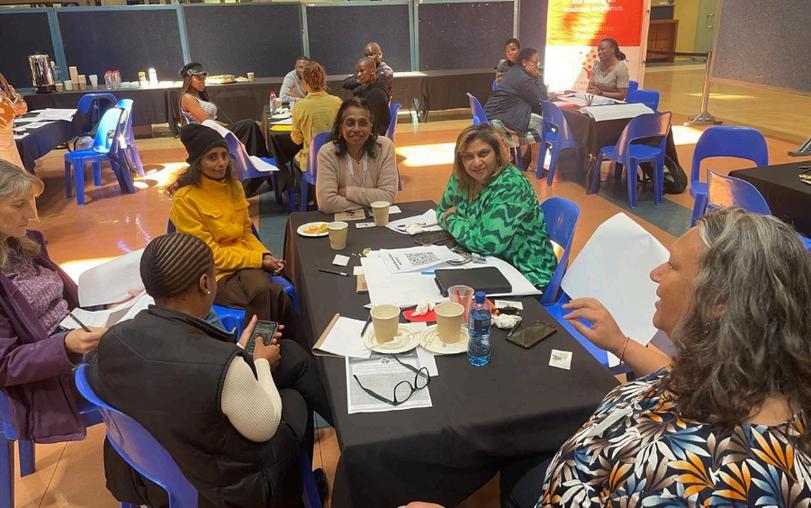
We have 34 Transformation Committees across the university, spanning Faculties, Schools, Departments and Divisions, and including academics, professional and support staff, as well as students Transformation committees play a crucial role in advancing the Transformation agenda and promoting the Transformation Pillars within the University. (For more information refer to the Terms of Reference of Transformation Committees)
We have conducted numerous workshops with Transformation Committees from various areas, including the School of Public Health; the Faculty of Health Sciences, the Faculty of Commerce, Law and Management; Wits Library; the Faculty of Science and School of Education. These workshops focus on Inducting the committees and raising awareness about key transformation policies, values and their role in driving transformation. There is a need to further strengthen these transformation committees, as they have the potential to promote the transformation agenda in a more nuanced and contextualised manner, working in partnership with management and other key stakeholders in their specific areas of the University. A strong relationship between transformation committees and their management is vital for fostering inclusivity, collaboration and a positive, and healthy university culture The university’s Transformation governance structures include the Transformation Implementation Committee (TIC) and the Transformation Steering Committee (TSC)
The TIC is responsible for overseeing the disbursement, monitoring and evaluation of equity funding, while the TSC focuses on ensuring the alignment of transformation strategies and operations across social justice partners, such as the Gender Equity Office,

the Disability Rights Unit and the Transformation Office, in consultation with the university’s various stakeholders represented within the structure. These structures submit reports to the University Forum (UF) and the University Council
Strategic discussions that took place in the Transformation Steering Committee (TSC) during 2025 focused on five key areas. Firstly, enhancing the composition and representation on Transformation Committees to ensure that all University role players are able to engage on transformation related to their context Secondly, the importance of induction of new transformation committee members in relation to their role and responsibilities.
Thirdly, the training of committee members which assist committee members to engage within their contexts for example on emotional intelligence and intercultural communication. Fourthly, discussions on the issues prevalent within the university such as bullying in the workplace, Fifthly, discussions related to the work in all social justice offices such as Transformation, Gender Equity and the Disability Rights Unit for transformation committees to remain updated on social justice support and interventions across the university.
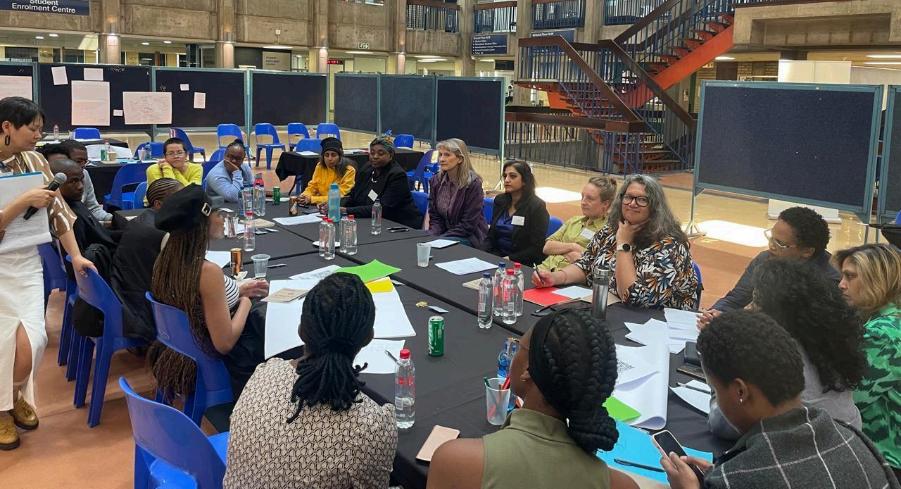
The first TCoP meeting of the year took place on 09 June 2025. The focus of the discussion was Employment Equity at the University, with attention to factors that enable or constrain progress across different contexts in the University
The meeting included updates on the work of the TEEO The second TCoP meeting took place on 17 November 2025. The focus was on the changing nature of the University, the broader state of transformation in higher education, and reflections emerging from the 2025 Institutional Cultures Study. These discussions contributed to internal conversations on key transformation priorities and on how transformation committees could collaborate more effectively in areas relating to dignity, safety, and institutional culture Participants included members of Transformation Committees, together recipients of Diversifying the Academy grant recipients. This was the first opportunity for DTA recipients to engage directly with Transformation Committees to reflect on their experiences and observations of transformation at the University
Objectives of this event include:
To provide a platform for academics to reflect on the current state and future trajectory of the University, fostering a shared understanding of its evolving role and challenges.
To discuss the roles of the Transformation Committees, ensuring their role and reporting is effectively integrated into the 2025 institutional report and future reports.
To generate and discuss emerging strategies for diversifying the academy, moving beyond current approaches to identify new ideas and needs that will shape future programs.
The workshop highlighted areas where equity implementation practices vary across the institution Discussions pointed to the importance of strengthening consistency in the inclusion of transformation representatives in recruitment processes, improving transparency in promotion pathways, and enhancing mechanisms for monitoring equity commitments. External factors, including visa-related delays for international candidates, were also noted as contextual constraints on diversification efforts
The TCoP workshop was a celebration of the transformation award recipients of 2025 Transformation Awards The Individual Award was won by Mr Ronnet Diale for his personal agency in fostering a welcoming and inclusive environment through his role. The Individual Award was also won by Mrs J de Gouveia who was praised for her transformative impact in the Adult Education and Training Initiative for the insourced staff The group award was won by the Faculty of Health Sciences Transformation and Wellness Committee. This was the first time a transformation award was won by a Transformation and Wellness Committee It demonstrates the possibilities and power of collaboration
It was also an acknowledgement of the work taking place in transformation committees across the institution. The workshop created space for constructive reflection on structural dynamics, lived experiences, and pathways toward more coherent and coordinated transformation practice A number of areas were identified by the TCoP for further work:
Institutional fragmentation: With over 50 transformation-related structures across the University, levels of functionality and capacity vary. While some units operate robustly, others face challenges related to continuity and resourcing These discussions highlighted the importance of strengthening system-enabled support, reducing reliance on individual effort, and ensuring that transformation work is sustainably embedded within institutional structures
Trust and leadership dynamics: Participants reflected on the need to strengthen psychologically safe working environments Discussions highlighted concerns related to management practices, the experience of performance management processes, and the importance of ensuring that staff can raise concerns through clear, trusted, and supportive channels
Emotional workload: Participants noted that this largely unrecognised labour places increasing pressure on staff wellbeing, reinforcing the need for clearer role boundaries, training, and institutional support mechanisms.
Student reality disconnection: Participants reflected on the need for institutional systems, curricula, and support mechanisms to continue evolving in response to the changing composition and needs of the student body
Exemplary practice exists: The Faculty of Health Sciences’ literacy and numeracy programme for insourced workers demonstrates what transformation looks like when grounded in dignity, collaborative design, and sustained institutional commitment This initiative serves as a benchmark for future work.
Strategic priorities were identified by the TCoP. These are:
1. Strengthen transformation governance and reporting - Enhance coordination across structures, clarify mandates, and support consistent representation.
2. Cultivate human-centred management culture - Develop reflective leadership practices, including feedback mechanisms such as 360-degree evaluations, and strengthen the integration of transformation competencies within leadership KPAs.
3 Expand transformation capability and support - Build on existing mentorship and coaching initiatives, strengthen access to trauma-informed training, and foster peer-support mechanisms.
4. Evolve performance management systems – Review and refine outcomes to ensure developmental intent, and explore the use of equity-responsive indicators.
5. Strengthen recruitment and retention pathways - Further align recruitment protocols with transformation objectives and enhance monitoring and reporting tools within HR processes
6. Invest in student inclusion and belonging - Deepen practices that support cultural humility, expand flexible learning approaches, and strengthen mechanisms for incorporating diverse student voices
7 Build institutional coherence - Integrate TCoP insights into annual reporting processes and continue to facilitate cross-faculty learning and knowledge-sharing.
The discussions underscored the importance of continued alignment across systems, leadership practices, and institutional capabilities in order to deepen the impact of transformation initiatives This report provides both diagnosis and pathway on strengthening governance architecture, supporting staff sustainably, and aligning institutional systems with transformation values. The event reaffirmed the importance of system-level coherence, accountability, and a shared understanding that transformation is a collective institutional responsibility embedded in core academic and administrative work.
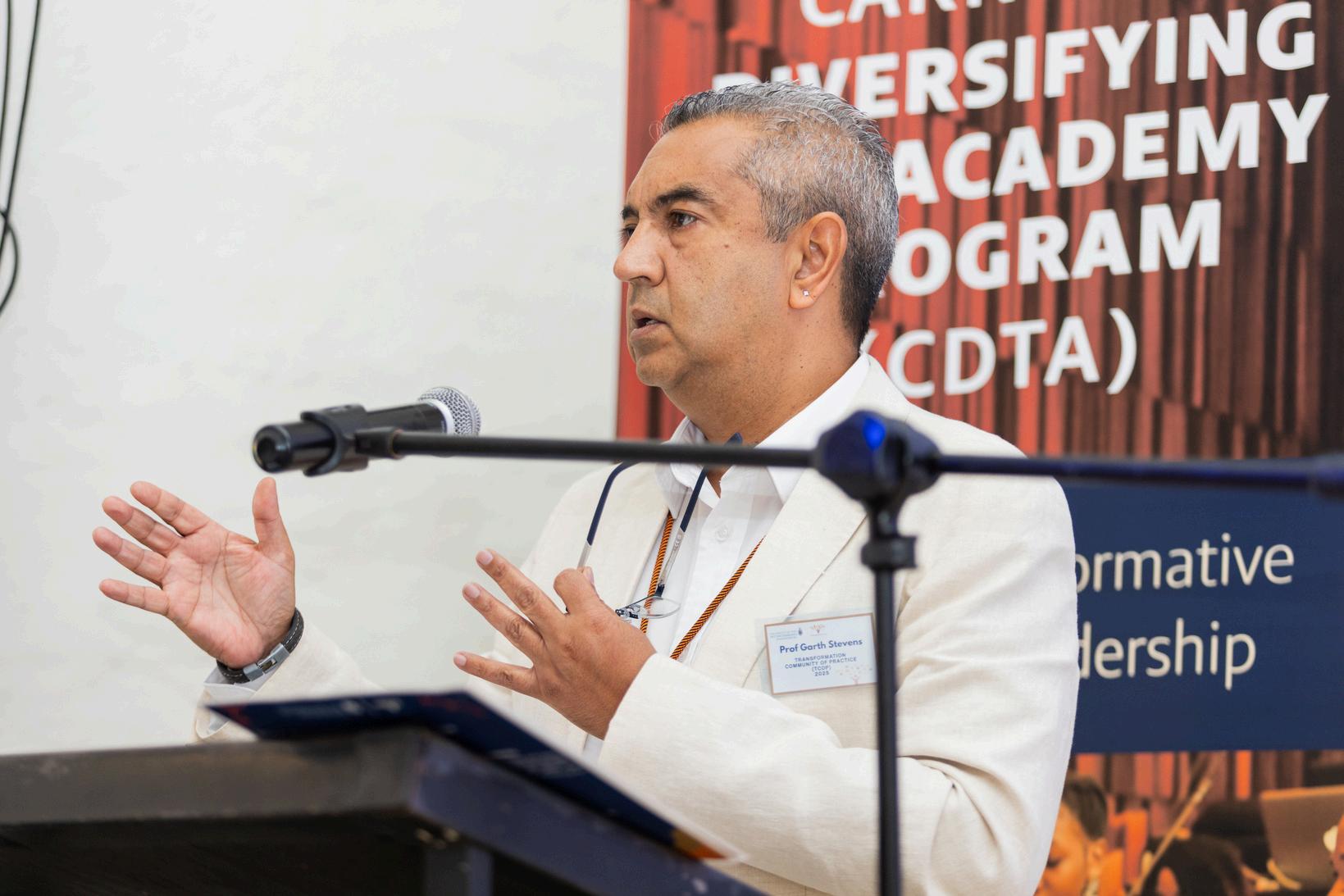
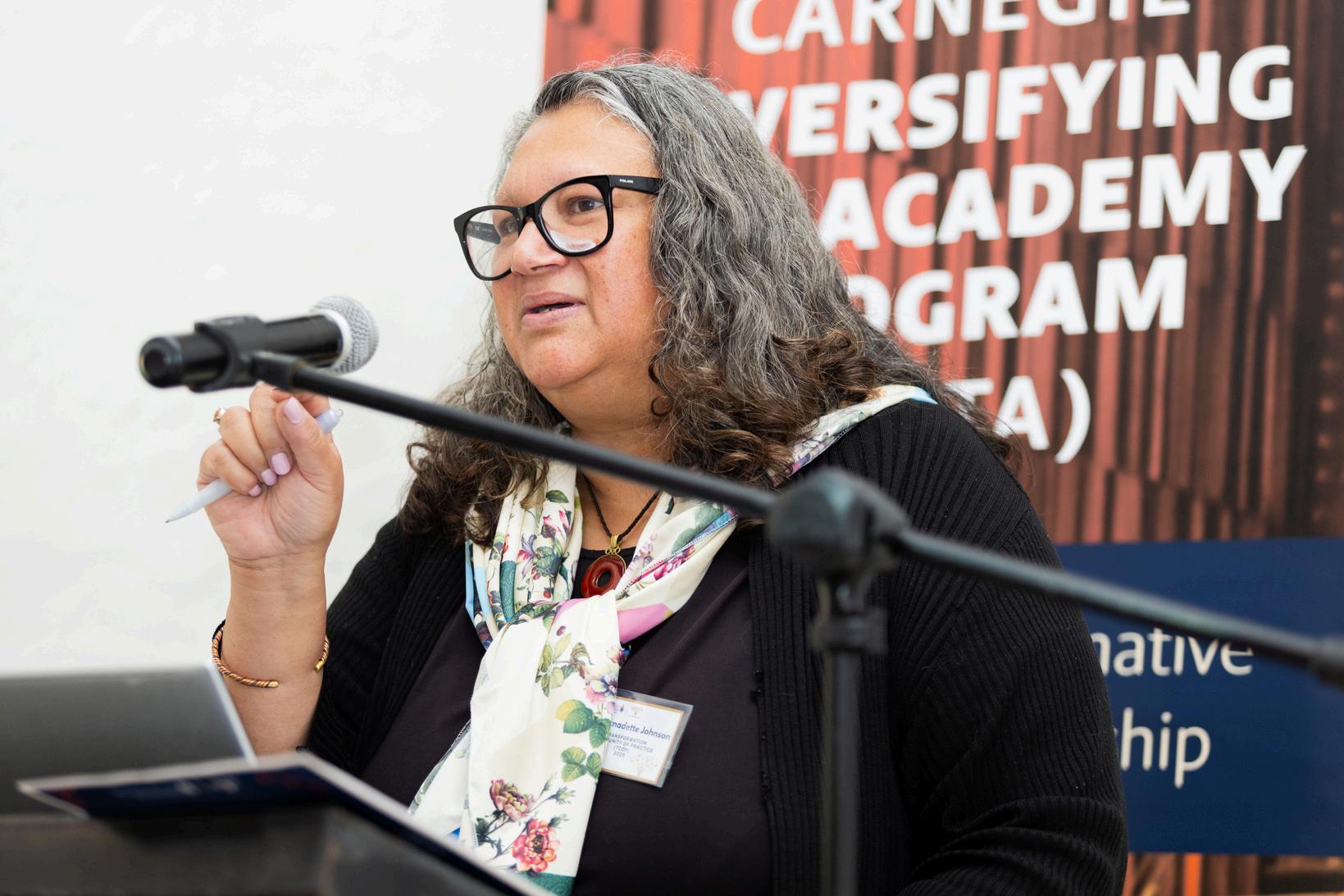
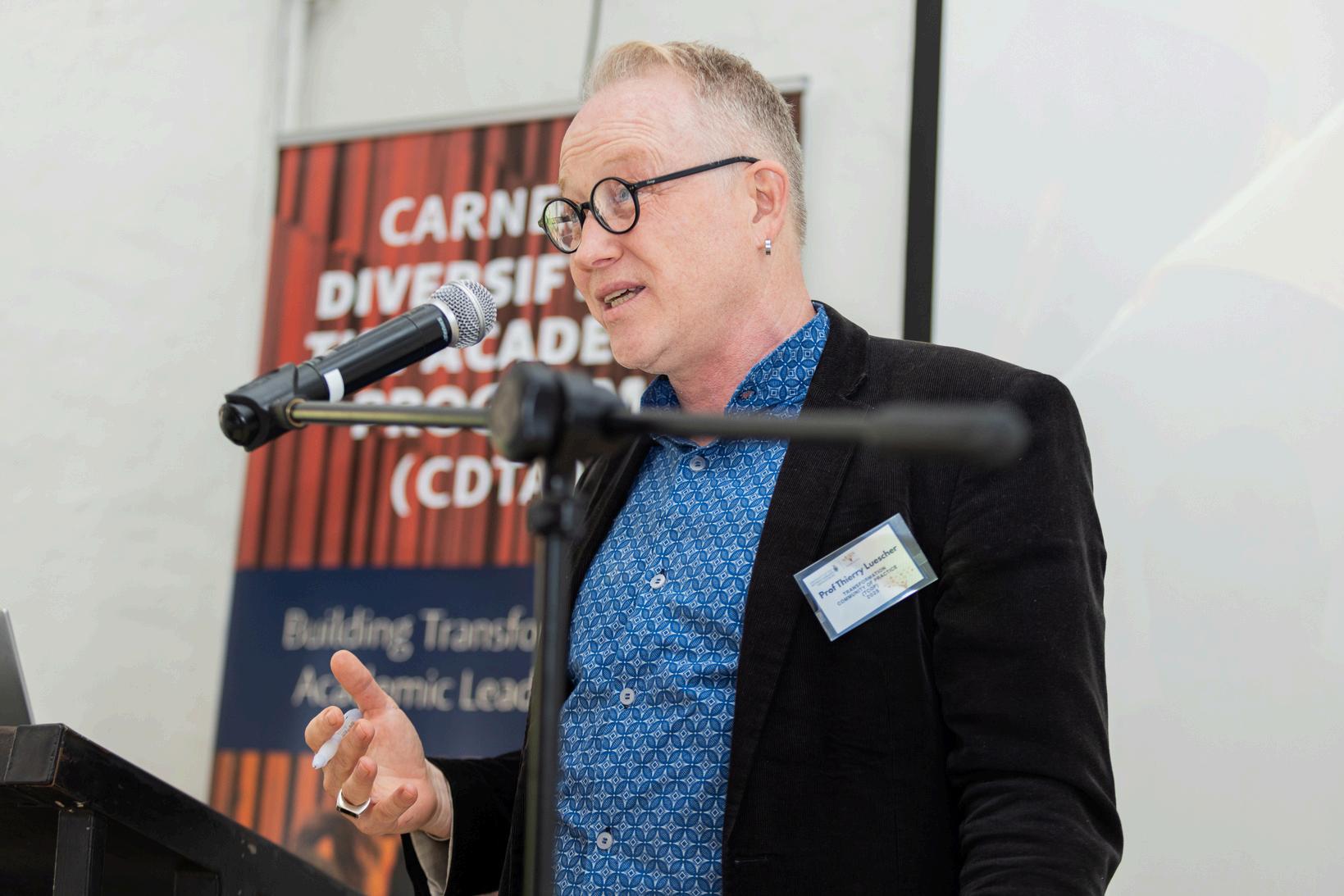
The Transformation Office is currently structured around focus areas which are captured diagrammatically below.
While the work of the Transformation and Employment Equity Office (TEEO) is guided by the Transformation Pillars, programmes have been developed to support the implementation of the pillars. These programmes include: Diversifying The Academy (DTA) & Africa Diaspora, the Social Justice and Ethics Programme, Employment Equity Development and Broad Based Black Economic Empowerment.
Funder: Carnegie Corporation of New York.
Partners: Wits Centre for Learning & Teaching Development (CLTD) and the Wits Research Office.
TEEO staff involved: Mr. Lethu Kapueja (Equity Grants Manager), Prof. Antonia Wadley (Head of Academic Support & Coaching), and Ms Ntebo Mampane (CDTA Administrator)
Overview
DTA invested R11.49m across 31 grants in 2025, with Enabling Grants driving delivery by value and volume New Appointment, Postdoctoral, and Doctoral awards completed the pipeline Since inception, cumulative investment stands at R33.80m, concentrated at lecturer level where the effect on progression and equity is strongest.
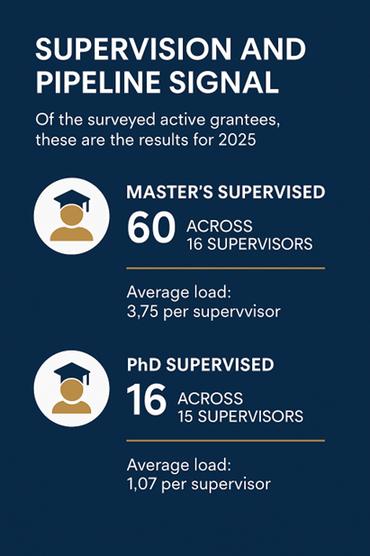
Active grantees reported supervision of at least 60 Masters students and 16 PhD candidates. Master’s supervision carries the main load and is the quickest lever to grow the near-term feeder pool PhD i i i t
The portfolio aligns with the new Transformation Pillars and Wits 2033 priorities on people and culture, social impact, and a stronger Global South pipeline
Delivery improvements this year include confidential Dean’s letters routed directly to TEEO, a unified support-letter template with dual sign-off, and a controlled extension window of up to four months for close-out spending on Doctoral and Enabling Grants. These changes strengthen review integrity, clarify endorsements, and give projects a predictable finish
Programme support extended well beyond funding. Group mentoring and targeted workshops focused on intercultural communication, public engagement, conflict management, and identity as scholars EMCAT Round 2 concluded in June, with strong participant feedback on leadership growth and belonging. Notable grantee milestones included promotions in CLM, a senior appointment at NICD, and a PhD completion leading to a research post at the University of Johannesburg. Adding a dedicated CDTA Administrator, Ntebo Mampane, stabilised events, grant administration, and grantee communications.
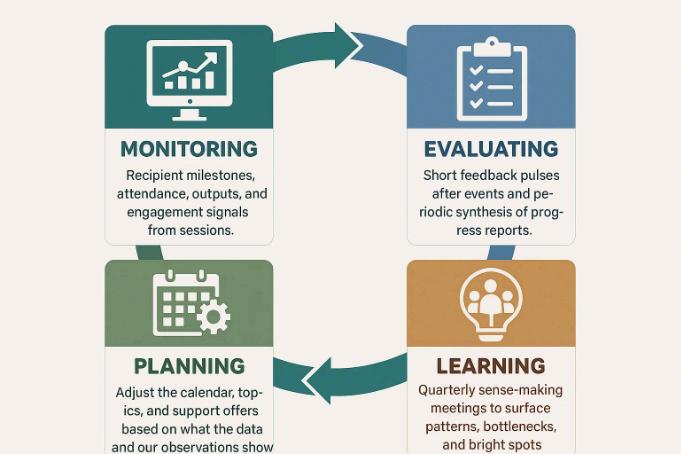
Our lessons are drawn from multiple sources of observation and data: progress reports, event feedback, cohort reflections, TIC inputs, and survey insights The MEL-P Framework anchors this cycle We monitor milestones and outputs, evaluate with rapid feedback pulses, learn through quarterly sense-making reports and observations, and plan by adjusting calendars, content, and support. This keeps CDTA evidence-led, people-centred, and tightly aligned to Wits’ transformation and equity goals
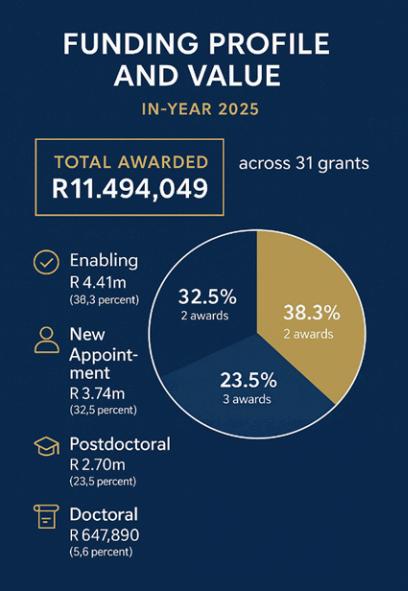
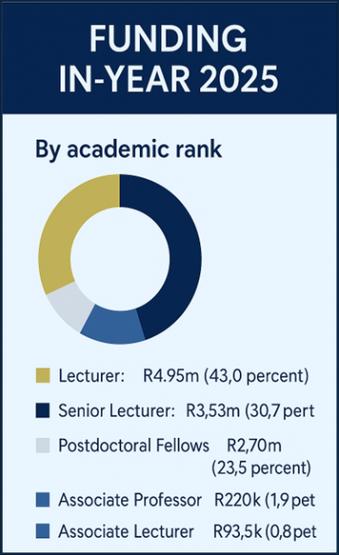
Together, the charts show that CDTA’s 2025 funding mix aligns with where people sit in the pipeline. By grant type, most money goes to Enabling and New Appointment awards, and by rank the largest shares land with Lecturers and Senior Lecturers. The identical 23.5 percent for Postdoctoral funding in both graphics confirms a consistent investment at that stage Very small shares reach Associate Professors and Associate Lecturers, which fits the programme’s aim to concentrate resources where progression gains are highest. The Doctoral slice appears in the grant-type view but not in the rank view, since the latter tracks staff ranks rather than student status
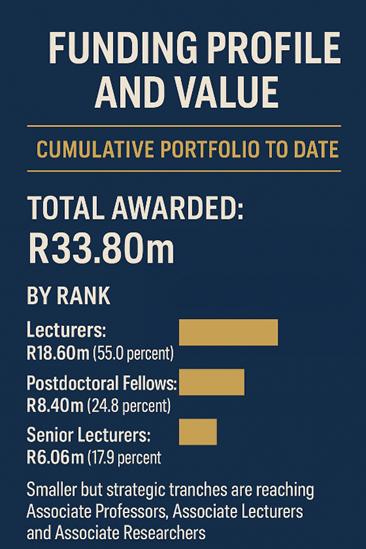
This cumulative view below shows that our long-run investments track the same priorities seen in the inyear charts. Of the R33.80m awarded to date, over half has gone to Lecturers (R18.60m, 55 percent), reflecting our focus on the rank with the greatest progression and equity gains Postdoctoral Fellows account for a quarter (R8.40m, 24.8 percent), building the future hiring pool, and Senior Lecturers receive 17 9 percent (R6 06m) to support promotion trajectories Smaller but purposeful funding reach Associate Professors, Associate Lecturers, and Associate Researchers to address specific gaps. In short, the cumulative portfolio confirms a consistent pipeline strategy from postdoc through lecturer and into senior ranks
What this mix enables:
Enabling Grants turn near-term potential into tangible outputs and real progression. They’re the everyday engine that helps academics finish papers, lock in data, and present credible promotion files. The same support sharpens proposals for external funding and lifts departmental equity by moving strong candidates across the line.
New Appointment Grants do the steadying work in that first, fragile two years They give equity candidates the opportunity to join Wits, and room to set up a research rhythm, assemble small teams, and get teaching into balance Postdoctoral Grants widen the future hiring pool
They draw promising researchers into Wits labs and research entities, build collaborative projects, and position the university to deliver on Wits 2033’s aim to be a continental home for postdocs.
Doctoral Grants secure the first rung of the ladder. They help candidates survive the costly early phase, complete on time, secured lecturer roles
Together, these four instruments build a clean pathway from doctoral entry to independent scholar, while growing a diverse cadre of academics who can win grants, publish, and teach well
Supervision and pipeline signal
Of the surveyed active grantees, these are the results for 2025:
What this means:
Masters supervision is the main load-bearer
Most grantees are carrying sizeable Masters cohorts. This is the quickest way to expand the pipeline because Masters students convert to PhD at higher rates when they feel supported, see visible research teams, and can plug into small grants for data and writing
Treat Masters as your near-term feeder pool. Prioritise well-structured group supervision, short methods clinics, and writing sprints. The payoff is faster throughput, more co-authored outputs, and a larger pool of PhD-ready candidates within 12–18 months.
A smaller subset of supervisors holds the heavier PhD supervision loads. That creates risk if those few are overstretched or move institutions.
Newer grantees carry more Masters students per person
Recent reports show higher Masters counts per supervisor. However this may change with more grantee reports being received. However, it does point to a trend that fits disciplines with large coursework Masters intakes It can be productive if managed well, since it seeds the PhD pipeline, but it is risky for an early career academic career if everyone hits proposal and ethics milestones at once.
In 2025, our grantees reflected on four theme that they require for support.
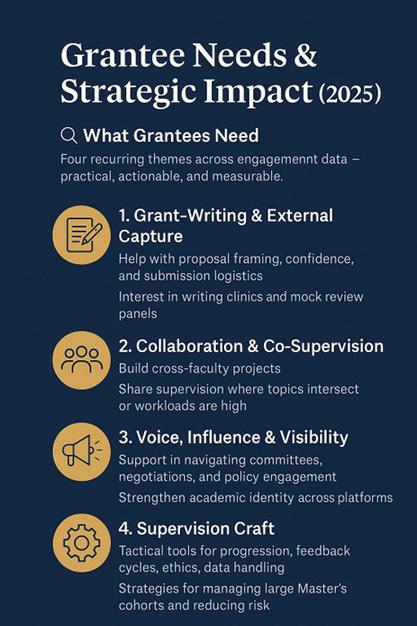
Grantees want help turning ideas into fundable proposals The asks are practical: framing the problem, matching it to a call, building the right budget, and getting the submission mechanics right.
Confidence grows when people see examples, write in short sprints, and test arguments with a friendly but exacting audience Programming regular grant writing retreats, and mock review panels that score against real criteria will assist in building their fundraising confidence
There is appetite to build projects that cut across Schools and to share supervision where topics overlap or workloads are unmanageable
This spreads risk, moves scholarship across silos, and gives students a more rounded team Practically this translates to offering a simple brokering function: a rolling matchmaking list of topics and methods, a quarterly pitch hour or and small seed funds tied to joint outputs or cosupervision agreements.
People want to speak with more impact in committees, negotiate for resources, and translate research into policy-ready messages They also want a clearer academic identity online and in public forums Grantees requested workshops on chairing meetings, grant contract negotiation, and developing policy briefs. Pair this with a profile overhaul aligns bios, Google Scholar, ORCID, and departmental pages.

Supervisors are asking for tactics that move students through milestones on time, especially in large Masters cohorts. The needs cluster around feedback rhythms, ethics clearance, data handling, and managing risk when projects stall The grantees requested lightweight toolkit, with milestone planners, feedback templates, an ethics checklist, and a 30-60-90 day escalation path. Back this with group writing sessions and methods clinics that absorb routine issues at scale
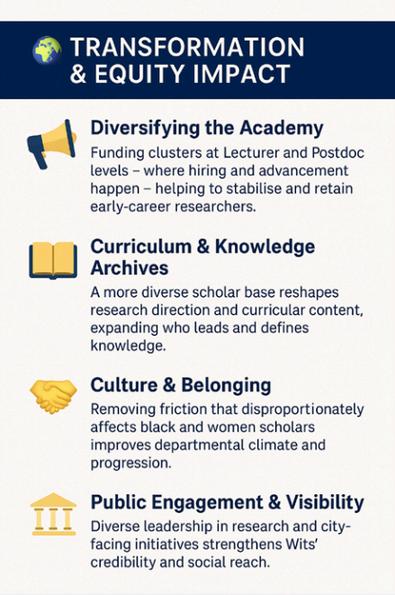
This graphic translates the funding profile into transformation results First, “Diversifying the Academy” highlights why the portfolio clusters at lecturer and postdoc levels: these are the hiring and promotion points, so investment here stabilises early-career scholars and strengthens retention.
“Curriculum and Knowledge Archives” signals the downstream effect. As the scholar base diversifies, research agendas and course content shift, widening who produces and defines knowledge.
“Culture and Belonging” points to the everyday conditions that shape progression.
When we remove friction that disproportionately affects Black and women scholars, departments become healthier and promotion pathways open
Promotions and career milestones (2025)
Advancing our grantees’ careers is a core CDTA outcome. In 2025, some of our recipients reached important milestones:
Assoc Prof Kagiso “TK” Pooe moved from Senior Lecturer to Associate Professor in CLM. He credits the Alumni Diaspora and CDTA programmes, including an enabling grant, for accelerating his outputs and visibility.
Dr Khosi Radebe was promoted to Senior Lecturer in CLM in July 2025, following confirmation in March 2024 She notes CDTA’s direct and indirect support in reaching this milestone.
Dr Matsidiso Sello completed her PhD and transitioned to a research role at UJ’s Centre for Social Development in Africa, highlighting CDTA’s comprehensive financial and mentoring support
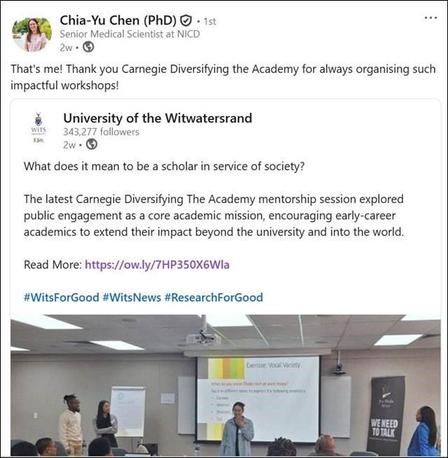
Dr Chia Yu Chen advanced to Senior Medical Scientist at NICD, citing CDTA’s contribution to technical upskilling and science-communication coaching.
The second Enhancing Mid-Career Academic Transitions (EMCAT) programme came to a close in June This programme, which launched in 2022, is a collaboration between the TEEO, CLTD and the Research Office. The programme supports mid-career academics as they transition into Higher Education leadership, including leadership in academic citizenship, teaching and learning, and research The last two rounds of EMCAT have been funded from the CDTA programme.
Our grantees often provide feedback to the programme through formal evaluation processes as well as workshop reviews Here are some notable comments:
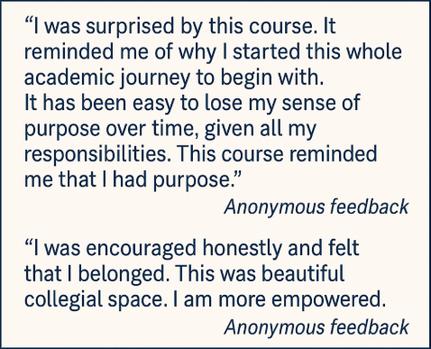
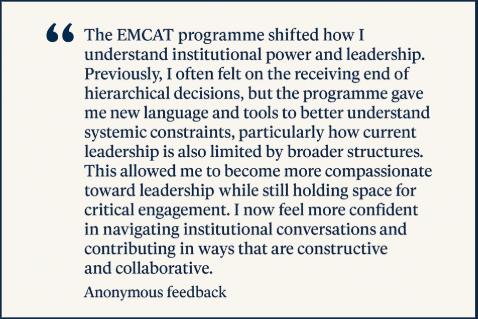
For the full report on the EMCAT programme, click HERE
UCL–Wits Public Voices Fellowship Residency | 17–21 March 2025
The Transformation and Employment Equity Office, which houses CDTA, co-led the Johannesburg residency that trained six early-career researchers in public engagement, research communication, and community collaboration. The design and facilitation emphasised inclusive, ethically grounded science communication, aligning with South Africa’s Science Engagement Strategy.
Participants gained practical tools from publics-mapping and media training to site visits that grounded research in community realities, strengthening their ability to translate scholarship for broader audiences For Wits, the residency deepened international collaboration with UCL and showcased institutional strengths like the Origins Centre and the Wits Health HUBB.
A clear shift from “outreach” to co-creation. Fellows highlighted the regenerative effect of working with communities, and the programme surfaced the need for university frameworks that recognise public scholarship in promotion and reward.
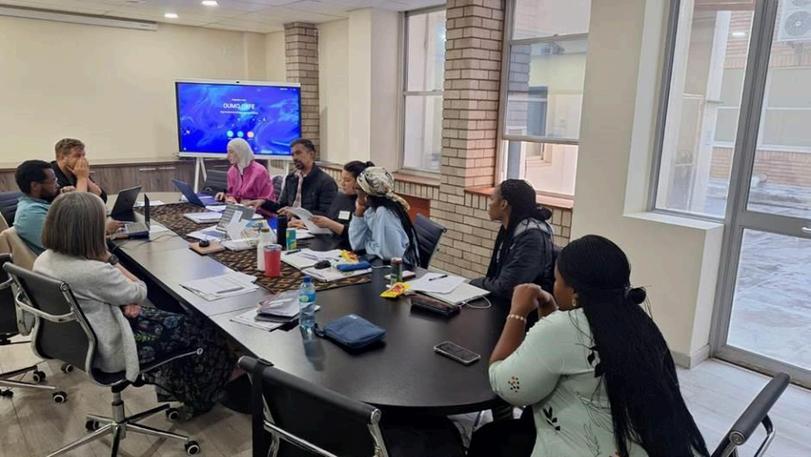
Public Engagement as a Core Academic Mission | CDTA Mentorship Session, 8 September 2025
This was a CDTA group mentorship session that reframed public engagement as integral to scholarly identity and practice, building on prior work on intercultural communication and difficult relationships at work.
Fellows mapped their “publics,” identified engagement routes by discipline, and connected engagement to tangible career gains such as visibility, recognition, innovation, and real-world impact For Wits, it reinforced an institutional message; excellent scholarship plus strong engagement anchors the University in society.
The facilitators pushed beyond rhetoric Participants treated publics as co-creators, linked engagement to solving overlapping social and environmental crises, and explored alternative models to sustain research beyond shrinking donor funds
Please find the article HERE
First African Cyber Law Conference (ACLC) | 4–5 Feb 2025
Dr Nomalanga Mashinini CDTA grantee, project lead, and one of very few black women shaping this
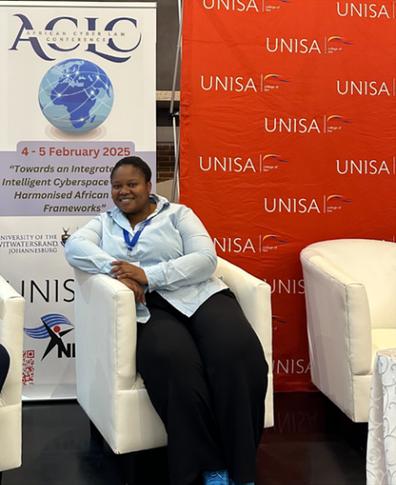
Dr Mashinini used her CDTA grant to push a critical research agenda into the public square She convened the first ACLC to address AI, image rights, data exploitation, and the legal architectures that will govern Africa’s digital future The conference was not an add-on to her research It was the engine that pulled scholarship, regulation, and
The grant underwrote core elements of her leadership and research delivery It gave her the room to organise, publish, and network at scale, and it signalled institutional backing for a field where African voices are often downstream of global agendas
Participants gained a multidisciplinary forum and majority-women keynotes. They left with contacts across law, policy, and tech and with concrete questions to take back to courts, classrooms, and labs For Wits, the event positioned the university at the centre of an emerging field and strengthened ties across Africa, the UK, and India
Big first-edition momentum. Eighty-five abstracts, more than sixty delegates, and a deliberate inclusivity that matched the subject matter Most of all, a black woman scholar led the agenda and set a roadmap to grow ACLC into an annual fixture that advances African leadership in cyber law.
Please find the article HERE
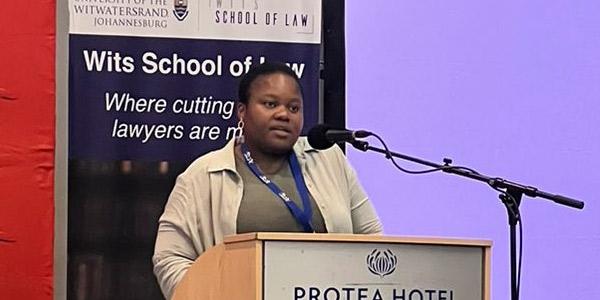

In 2025 we welcomed Ntebo Mampane to the team as CDTA Administrator Her appointment closed a critical capacity gap and sharpened our day-to-day delivery across events, grants administration, and grantee communications. Ntebo anchors the full cycle of events planning and delivery She supports colleagues across the office to scope agendas, manage logistics, coordinate suppliers, and capture post-event learnings so each gathering improves the next. This shared service approach has made our events more consistent, timely, and on-budget, while freeing programme leads to focus on content and stakeholder engagement.
Clear, responsive grantee communications now run through a single channel Ntebo issues call and induction notices, captures grant codes and procedural updates, and responds to routine queries, routing complex cases to the Programme Manager The result is fewer missed messages, faster resolutions, and a better grantee experience.
We’ve introduced three practical upgrades that make applications stronger, reviews more secure, and spending timelines more workable.
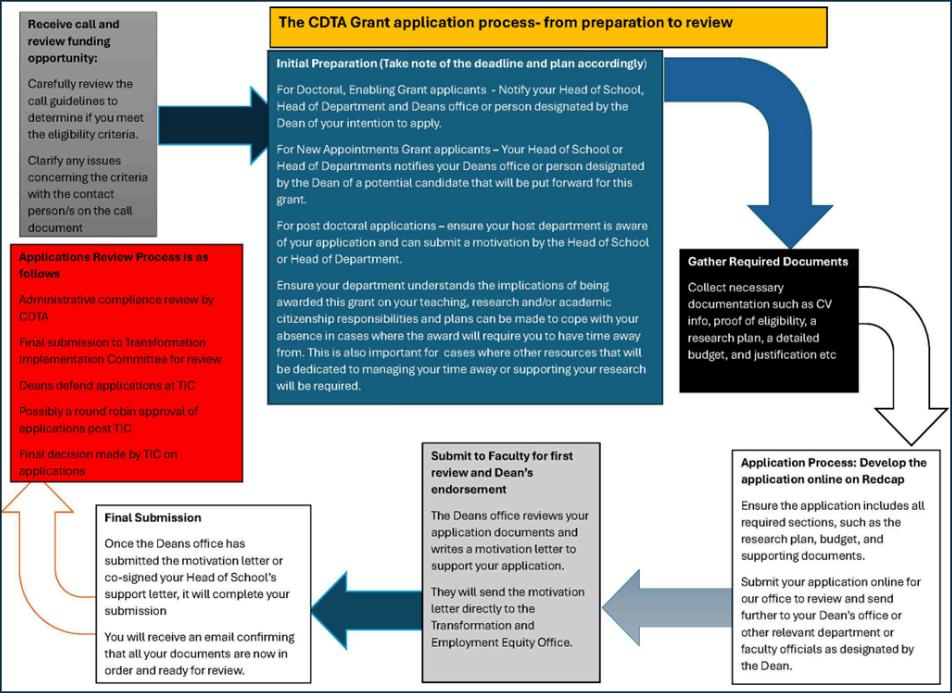
Our grant application process is depicted below:
The CDTA Grant application process - from preparation to review
Receive call and review funding opportunity:
Carefully review the call guidelines to determine if you meet the eligibility criteria
Clarify any issues concerning the criteria with the contact person/s on the call document.
Applications Review Process is as follows
Administrative compliance review by CDTA
Final submission to Transformation Implementation Committee for review
Deans defend applications at TIC
Possibly a round robin approval of applications post TIC
Final decision made by TIC on applications
(Take note of the deadline and plan accordingly)
For Doctoral, Enabling Grant applications - Notify your Head of School, Head of Department and Deans office or person designated by the Dean of your intention to apply
For New Appointments Grant applicants - Your Head of School or Head of Departments notifies your Dean’s office or person designated by the Dean of a potential candidate that will be put forward for this grant
For post doctotlra applications - ensure your host department is aware of your application and can submit a motivation by the Head of School or Head of Department
Ensure your department understands the implications of being awarded this grant on your teaching, research and/or academic citizenship responsibilities and plans can be made to cope with your absence in cases where the award will require you to have time away from This is also important for cases where other resources that will be dedicated to managing your time away or supporting your research will be required
Submit to Faculty for the first review and Dean’s endorsement
Once the Dean’s office has submitted the motivation letter or co-signed your Head of Scholl’s support letter, it will complete your submission
You will receive an email confirming that all your documents are now in order and ready for review
The Dean’s office reviews your application documents and writes a motivation letter to support your application
They will send the motivation letter directly to the Transformation and Employment Equity Office.
Gather Required Documents
Collect necessary documentation such as CV info, proof of eligibility, a research plan, a detailed budget, and justification etc
Application Process: Develop the application online on Redcap
Ensure the application includes all required sections, such as the research plan, budget, and supporting documents
Submit your application online for our office to review and send further to your Dean’s office or other relevant department or faculty officials as designated by the Dean
To administer this process better, we have introduced the following in 2025:
- Confidential Dean’s letters of support
Deans can now submit their motivation letters directly to the Transformation and Employment Equity Office. This preserves confidentiality during faculty-level endorsement and streamlines the handoff into central review. Final submissions are completed once the Dean has sent the confidential letter or co-signed the Head of School’s support letter
- Unified letter of support template with dual sign-off
A standard letter of support now includes a clear space for the Head of School’s endorsement and an explicit Dean’s endorsement. Where both leaders agree, the letter can be co-signed to present a single, aligned institutional view of the applicant’s case
- Extension window for project spending
Doctoral and Enabling Grant holders may request up to four additional months to complete spending already in progress. The policy allows a two-month initial extension, with a possible further two months on request Extensions remain discretionary, and any funds still unspent at the end of the extension return to the central budget.
These changes protect sensitive faculty assessments, reduce back-and-forth at submission, and create a predictable runway for close-out spending. They also align with the budgeting guidance that requires signed faculty endorsements and clear, line-item justifications for all costs, with any re-budgeting approved before implementation
For more details, please see the grant application booklet on this LINK
CDTA events and support
Whole group mentoring sessions & workshops
Topics for group sessions are informed by issues our team hears in group sessions, inductions, coaching, and progress reports. This year we heard from multiple people that they were struggling with interpersonal relationships at work Additionally, we were asked about what makes up academic citizenship, how to incorporate it, report it, and capture it for promotion
These topics informed this year’s sessions:
Induction sessions provide our first interaction with new recipients. We have learnt that this is a great moment to share both information about the programme, but also an embodied experience of the support, co-created learning, and conversations typical in the programme We allocate a portion of the session to thinking in groups and then together about the transformation they wish to see within themselves and the institution over the period of their grant Each conversation, including these induction conversations, provides opportunity to invite recipients to actively and vibrantly locate themselves in their desired change, as enhancing agency is one of the core philosophies from our Monitoring, Learning, Evaluating & Planning framework and values of the CDTA programme
Dr Mmope is an intercultural communication specialist with a PhD from Stellenbosch on the topic. She is a coach, facilitator and speaker and had recently taken up a new position as Chief Director: People, Training & Development at the Provincial Training Institute of the Western Cape Government when she facilitated a mentoring session Recipients were asked to bring their communication and interpersonal challenges, for us to talk about and work through. Our key learnings were about being clear, intentional and proactive with our communication as we relate to colleagues and develop teams.
This session was informed by engagements during the Wits-UCL Public Voices workshop earlier in the year that suggested that more mentorship on this academic mission was needed. This also fits with the Community Engagement Pillar Dr Bernadette Johnson (Director of the TEEO) and Professor Mondli Hlatshwayo (an expert in Labour Studies and Worker Education from University of Johannesburg and longtime collaborator in activism and engaged research) facilitated the workshop, drawing from decades of experience and also their recent article Johnson & Hlatshwayo (2025). Anchor Universities and Communities: The power of community engagement. South African Journal of Higher Education, Vol 39 (2). The questions we worked with were: who am I becoming as a scholar, and who am I serving through my
The session was covered in this Wits News article: Public engagement as a core academic mission
Public engagement will continue as mentoring series topic next year.
PhD candidates and postdoctoral fellows have quarterly group mentoring sessions These provide a space to share challenges particular to the path and to draw on the wisdom of the group to navigate these challenges logistically and personally in new ways Topics have included: work-life balance, supervisor/collaborator relationships, and funding. Questions that were reflected upon and explored this year included:
What are your anchors during this period of your career?
What are you saying yes to? What are you saying no to?
Who are your publics? (A re-visit and deepening of the question from the Community Engagement group session)
2025 EMCAT activities
Activities this year included the academic portfolio writing retreat where participants had dedicated writing time and excercises to complete their portfolio for promotions, grant writing, awards or fellowships
The retreat was captured in the Wits News article:
‘I am the golden thread’
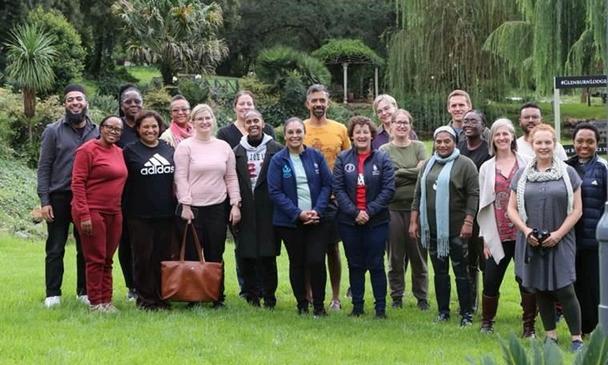
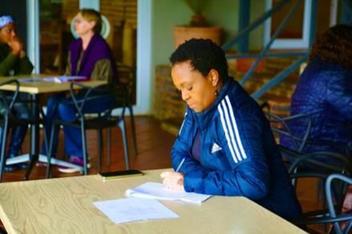
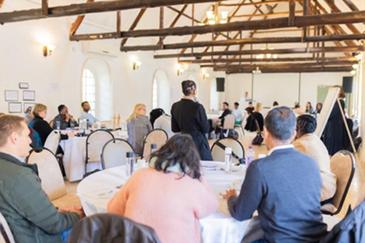
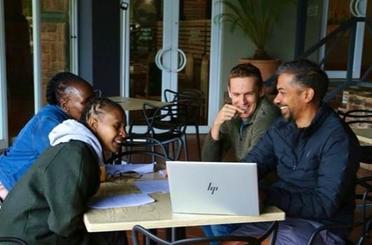

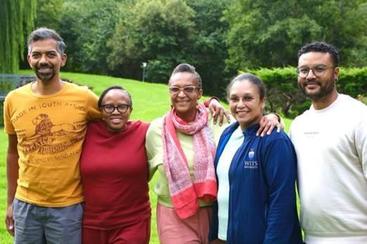
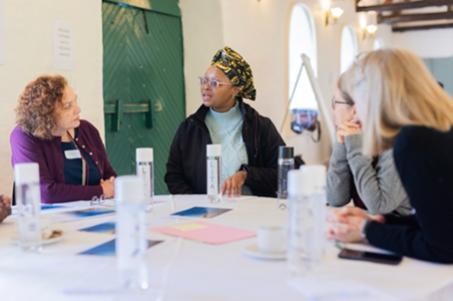
recipients on the EMCAT programme at the portfolio retreat (all pictures here are from the retreat)
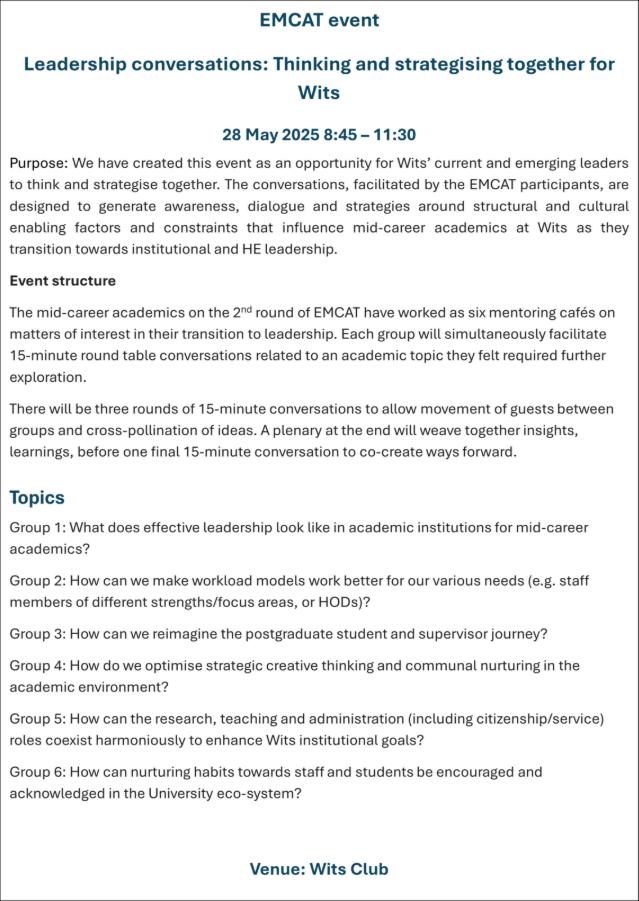
Additionally, the programme culminated in the Conversation event hosted by recipients and leadership within Wits. The invitation (below) shows the format of the day, which centered around positively framed questions to support cconversations exploring potential solutions between recipients and visitors
Themes and discussions that emerged included the role of culture and human connectedness in creating positive working environments, the need for relational leaders who can build relationships across the university, and ways to encourage and measure excellence beyond typical measures of productivity.
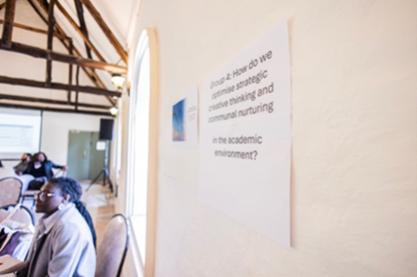
A Wits News article covered the event. The article was also picked up by the Daily Higher Education News.
Being intentional about our learning in 2025 has assisted the growth of the programme and its people In the graphics below we have captured some of these lessons:
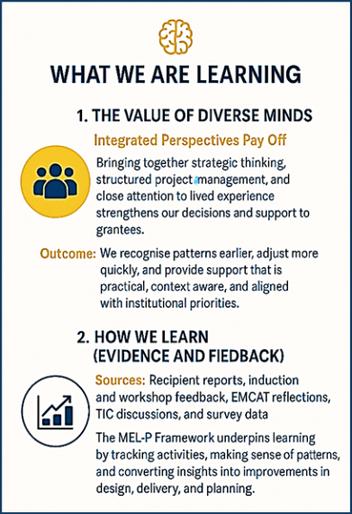
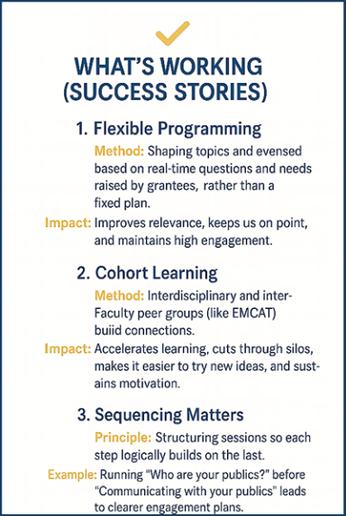
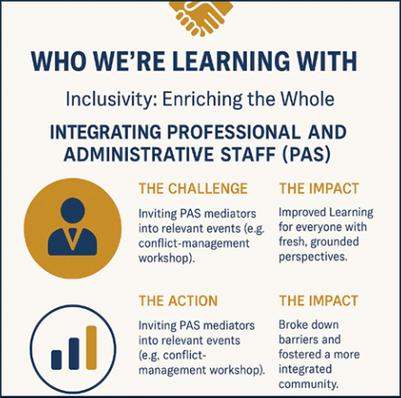
Below are the learnings we will consider as we refine the programme further:
Keep the flexible core, with clearer signposting of learning pathways so people can see how topics connect
Intentionally sequence events to build understanding and skills over time. Keep growing cohort-based learning, with peer mentoring that crosses Schools and Faculties. Make inclusive participation the default, especially for PAS staff who contribute to culture, systems, and student success.
Use the MEL-P Framework to keep tightening the loop from data to decisions We’ll capture feedback more consistently, test small improvements quickly, and document shifts in belonging, capability, outputs, and collaboration.
MEL-P in practice
In the next reporting cycle, we commit to continue with implementing our reporting and learning framework:
Personal reflections on who we are becoming Our work requires constant reflection, rethinking and growing, and re-engaging in order to deliver the best quality for our program beneficiaries as well as our own professional development. This growth, or otherwise known as “becoming” is captured eloquently below by the CDTA Team:
Toni:
My seven-year tenure as a coach at Wits laid the foundation for a significant expansion of my professional practice. This shift began at the end of 2024 when I achieved accreditation as a mediator, an achievement I quickly put into practice by completing my first university mediations this year The transition immediately illuminated the deep alliance between these two disciplines. Both coaching and mediation are fundamentally grounded in curiosity, deep listening, and the crucial capacity to discern the values and needs that lie beneath people’s stated positions
These skills are absolutely essential for anyone navigating effective leadership. Drawing on this integrated expertise, I now see a clear path to contribute meaningfully to leadership development across Wits, in Higher Education, and in the broader society by sharing and embedding these practices that foster understanding, dialogue, and deep connection I am becoming a practitioner of relational leadership
Lethu:
My time with the Carnegie Diversifying the Academy Programme at Wits University has marked a significant evolution in my professional approach, transforming my focus from operational excellence to strategic social innovation in higher education The initial phase of the programme required absolute fidelity to its founding principles and high standards. This meant developing and implementing robust management systems, ensuring meticulous attention to detail, strict adherence to governance systems, and unwavering transparency in communication.
he Carnegie Programme brought to Wits, ensuring its eachable and ran like a perfectly calibrated machine
ext generation of African academics, demanded a pivot ocus shifted sharply to the beneficiaries themselves My e’s horizon, recognizing the imperative for our fellows to workforce and science marketplace
nnovator in higher education I work alongside the team ely ideate and practically implement initiatives that solve n policy and practice. This involves taking established guidelines and creatively tying together resources, technology, and mentorship to make the entire ecosystem work better, even within the inevitable constraints of funding and resources. This growth journey reflects a transition from being a custodian of the Programme’s structure to being an architect of its longterm, global impact

My journey within the Carnegie Diversifying the Academy Programme has been defined by continuous growth and an active expansion of my responsibilities. While I began with foundational administrative duties, I have successfully evolved my position into a core support function that drives operational stability. Currently, I take ownership of critical workflows, from managing end-to-end event logistics to serving as the primary liaison for grantees.
n to ensuring high-quality service delivery and operational I am eager to leverage this deep operational understanding to ake on more complex project management challenges, and articipants
Carnegie Africa Diaspora Project at Wits University: Outputs, outcomes, and impact Jan–Dec 2025
Overview
This report consolidates quantitative outputs and qualitative outcomes across all participating faculties and hosts of Distinguished Fellows of the Africa Diaspora Program. It draws on hosts reports, progress updates, and information from Wits University’s Research Output Collection System. The programme has advanced Wits’ research output and supervision capacity, built grant-writing skills, delivered teaching and seminars, and staged public lectures that broadened reach.
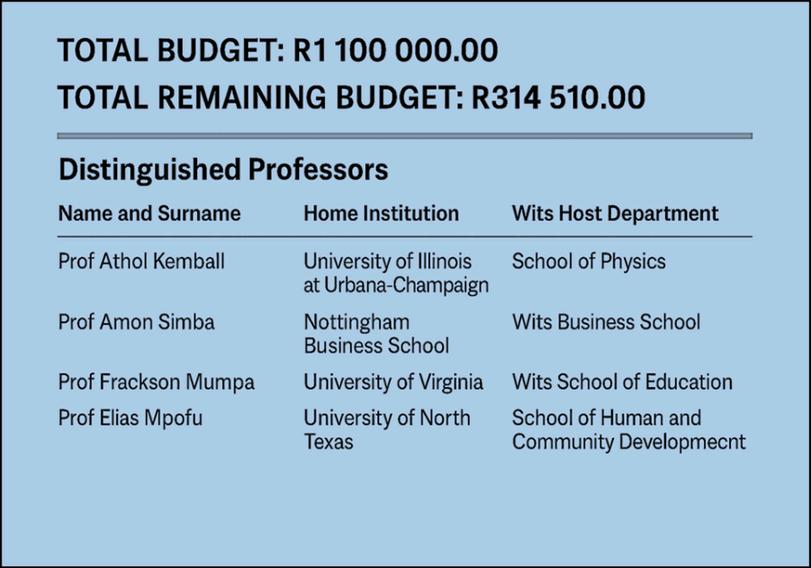
1) Publications co-authored with Wits faculty in high-impact peer-reviewed journals
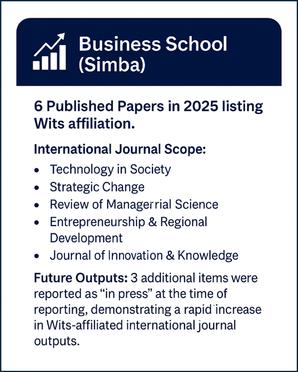
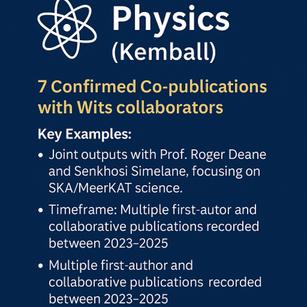
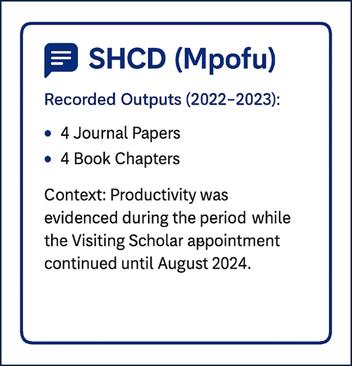
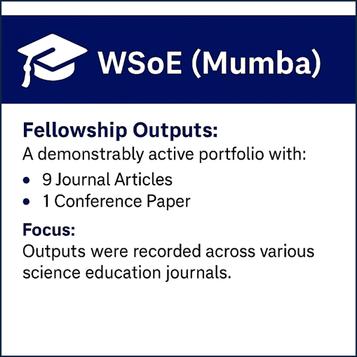
Impressive targets were achieved for the Physics Department through Prof Athol Kemball, strong publication volume for Wits Business School (WBS) through Prof Amon Simba, with Wits affiliation on all listed 2025 papers Additional outputs recorded for School of Human and Community Development (SHCD) and Wits School of Education (WSoE) fellows during their association periods.
2) Grant-proposal capacity building, with at least four new proposals co-developed
This metric was substantively achieved in aggregate, with countable proposals from Physics and WBS, and structured grant-writing programmes in WSoE that led to increased submissions
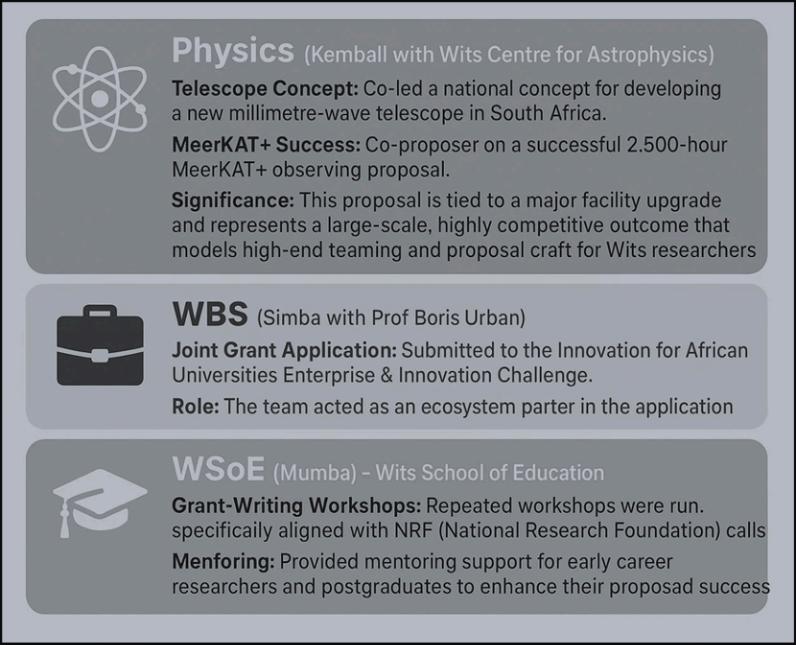
Impact: Researchers gained practical proposal skills, exposure to facility-scale bids, and pathways to multi-institutional partnerships, improving Wits’ positioning for future national and international calls.
Fellows delivered admirable results on this metric through a mix of masterclasses, guest teaching, methods workshops, seminars, and curriculum work Formal semester-coded courses are recorded in plans for WSoE and in practice at WBS through for-credit contexts
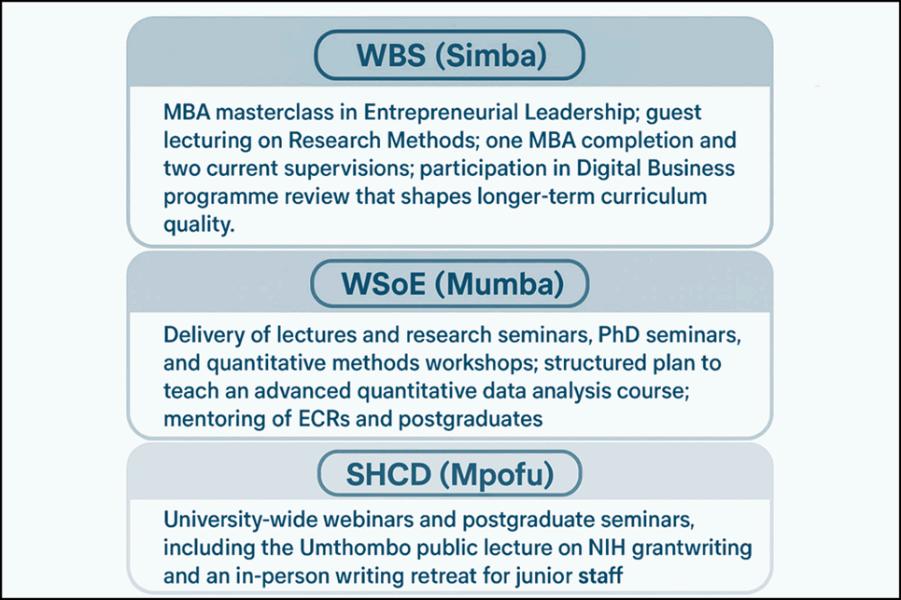
Impact: The teaching blend raised methodological competence, embedded grant-craft into postgraduate training, and contributed to course and programme refreshes that will outlast the grant period.
4) Four Master’s graduates during the grant
WBS (Simba): One MBA completion recorded, with two further MBA supervisions in progress.
WSoE (Mumba): One Masters completion is recorded
5) Public lecture and additional dissemination
This target was achieved through formal public lectures and School-wide events.
Physics (Kemball): Formal welcome event and public lecture hosted by the Wits Centre for Astrophysics on 23 November 2023.
SHCD (Mpofu): Umthombo Public Lecture on NIH grant writing and multiple School seminars and webinars across 2021–2023
Impact: These public events-built community around priority research areas, showcased international expertise, and attracted early-career scholars into mentorship and writing pipelines
The Jan–Dec 2025 period for the Carnegie Africa Diaspora Project at Wits University reflects a highly productive engagement that has successfully met its primary strategic objectives.
Through the collaborative efforts of Distinguished Fellows and host faculties, the University has achieved tangible growth in high-impact research outputs, most notably in Astrophysics and Business, while significantly strengthening institutional grant-writing capacity.
Wits 100 Cultures Study: Past Reflections and Future Directions for 2033 was an Institutional Cultures study concluded in 2025 For more information regarding Institutional Cultures Study click HERE The first seminar on Institutional Cultures took place during August 2025 The aim of the first seminar was to socialise the Wits community into the findings of the study. This is a first study of its kind at Wits and will be able to inform the work we do over the next three to five years on building inclusive institutional cultures. The study has identified key areas around which recommendations for further work has been clustered. This includes:
Brand and Reputation
People and Culture
Diversity Equity and Inclusion
Teaching and Learning
Research and Innovation
Place and Partnerships
Management, Leadership and Governance
Wits University continues to advance its commitment to language justice and inclusive institutional culture through the strengthening of Pillar 5: Language Diversification, Multilingualism and Translanguaging
This pillar positions multilingualism as a transformative resource that enhances teaching, learning, research, administration, and social cohesion. Grounded in the principles of equity and inclusion, the work seeks to redress the historical dominance of English in higher education while expanding the use of African languages and South African Sign Language (SASL) across the institution
Strategic Framework and Funding
The Language Policy Project is supported by a R2 5 million DHET grant (2024–2026) to advance isiZulu, Sesotho, and SASL across faculties The initiative is implemented by the Hub for Multilingual Education and Literacies (HUMEL) and focuses on five key areas:
Multilingual Pedagogy
Recognition and Certification
SASL Inclusion
Multilingual Signage
Public Engagement and Advocacy
Key Achievements in 2025
159 scholars participated in workshops on language diversification, multilingualism, and translanguaging in relation to curriculum development across the university For their participation, they received recognition and certification
As part of demonstrating the university’s commitment to language diversification and multilingualism, multilingual departmental letterheads standardized in isiZulu and Sesotho
The project contributed to South African Sign Language (SASL) Interpreting at university events.
Multilingual Signage was implemented at two major campus entrances as part of enhancing multilingual messages across the university campuses.
Language Acquisition Workshops were delivered across the university for academics.
Multilingual Pedagogy Trainings were conducted, engaging 164 academics from across the university.
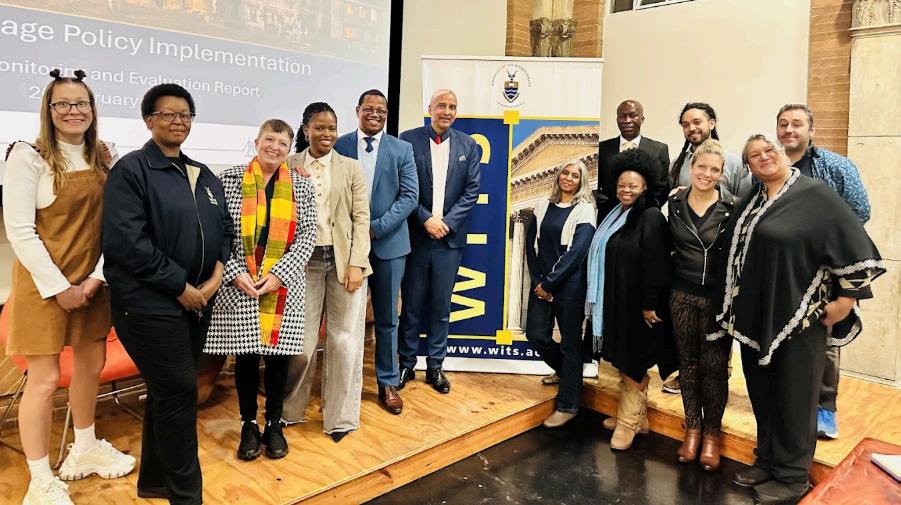
Under the language pillar, a number of innovative programmes were also delivered. These include the following:
Conversational Competence Courses: Short courses for staff and students to build everyday communication in isiZulu and Sesotho
Translanguaging Pedagogy: Faculty-based workshops supporting lecturers integrating multiple languages into teaching and assessment
Certification Pathways: Recognition in isiZulu, Sesotho, and SASL to incentivize uptake and acknowledge competence
Multilingual Communications: Expanded signage and visual representation of languages across campus.
What we are working on
To sustain momentum and deepen impact, the following priorities have been identified:
Strengthening the implementation of the Language Pillar by:
Expand course-level multilingual pedagogy with enhanced lecturer support and student feedback Extend multilingual signage and SASL support across additional university spaces.
Expanding the implementation of the language pillar beyond the DHET project.
The 2025 implementation cycle showed that multilingualism at Wits has begun to gain real traction The DHET-funding came at a time when the university had already started broader institutional conversation about the implementation of language justice, cultural inclusion, and how the University communicates.
As the University looks ahead, it is increasingly clear that the momentum created through the DHET project cannot be sustained by grant funding alone The next phase requires a gradual shift from isolated initiatives to a more coordinated and supported institutional approach. To guide this transition, a Concept Note is being prepared for the Language Policy Reference Group Its purpose is to outline practical steps that strengthen what is already working, while ensuring that multilingualism continues to grow responsibly and at a pace the institution can support.
The focus will be on building meaningful internal structures that allow faculties to participate more actively, improving governance so that implementation is more consistent, and expanding staff development opportunities in African languages and SASL where there is demand. Enhancing the visibility of multilingual communication across campuses will remain important, and the University will explore ways to make this more systematic without creating undue pressure on existing resources
A key learning from the past year is that progress depends on a broader network of people, not only a small group of specialists. Strengthening internal capacity, through faculty champions, administrative support, and clearer roles, will help ensure continuity without overextending the institution.
The public engagement pillar has been strengthened by the university’s adoption of a Community Engagement Framework. For more information click HERE.
The research office who has led the development of the Community Engagement Framework, has started a process of recording all community engagement research at the university. For more information click HERE
As has been discussed above as part of the Diversifying the Academy Programme, the Transformation Office has started a programme on public engagement with scholars as part of exploring their identity and skill set of academics. Another area in which the Transformation Office has demonstrated its commitment to Public Engagement is by extending its work to the benefit of schools. The focus of this initiative started with Wits Feeder Schools.
Working with Feeder Schools: Extending Social Justice to Communities
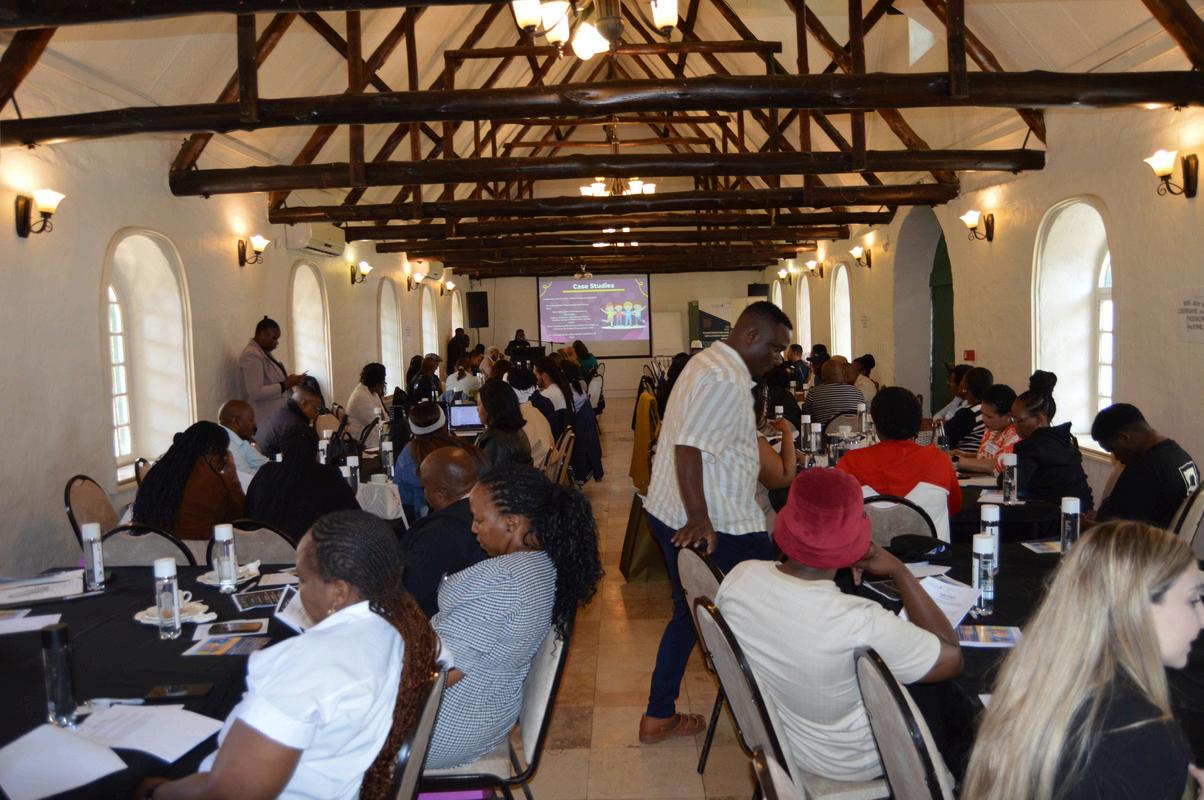
On 17 October 2025, TEEO in partnership with the UNESCO Chair on Teacher Education for Diversity and Development; Professor Ruksana Osman who is always the Senior DVC at Wits, Student Recruitment Office as part of the Registrar’s Division and the Gender Equity Office, delivered a workshop on Social Justice and Anti-discrimination in Schools. Ninety teachers from a range of schools attended Some of the schools represented included:
Waterstone College, Alexandra Secondary, Greenside High School, Reddam House Befordview, King’s College, Athlone Girls High School, UJ Academy, Parktown Boys High School, St Davids Marist Inanda, St Dunstans College, SAHETI, Oprah Winfrey Leadership Academy, National School of Arts, Fumana Secondary School and Kibler Park Secondary.
The aims of the events were to:
Share the accumulated knowledge and experience from the TEEO and the Gender Equity Office’s social justice awareness-raising, case management investigations, and mediation work on diversity matters such as bullying and gender-based violence. Contribute to Sustainable Development Goal 4, "Quality Education," aligning with the UNESCO Chair’s focus on inclusive and equitable quality education and promoting transition from schooling to university.
The event enabled the TEEO and its collaborators to disseminate its learnings on diversity, culture, and inclusion to in-service teachers and principals; facilitate discussions and collaborations among educators from different schools and institutions to address common challenges and provide actionable strategies and frameworks for educators to implement within their schools to promote inclusivity and equity.
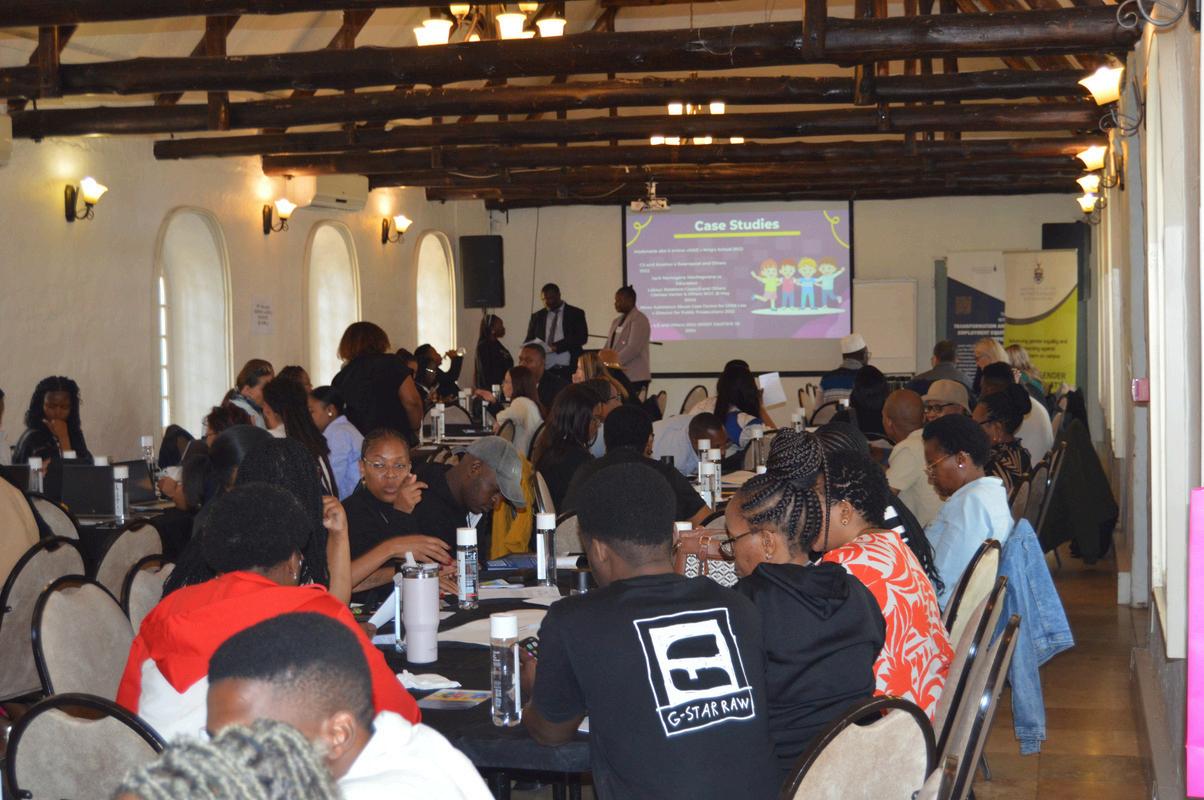
In 2025, the Social Justice Programme (SJP) at the University of the Witwatersrand experienced a year of consolidation and growth With the appointment of Thembekile Madondo as Manager: Diversity, Ethics & Social Justice, and the completion of the Wits 100 Culture Survey, the team deepened its reflection, strengthened its systems, and expanded its practice throughout the university. The complementary strengths of Ciaran Heywood (institutional memory) and the new manager (fresh perspective) delivered both continuity and innovation
Operating under the Transformation & Employment Equity Office (TEEO) and in alignment with the university’s Strategy 2033 and the Six Transformation Pillars (2024), SJP advanced an institutional culture focused on empowerment, safe and restorative practices, multilingual inclusion, and translating policy commitments into everyday experience
At a glance:
Facilitated 58+ workshops and engagements across university spaces
Strengthened the handling of discrimination and bullying cases
Implementation of the DHET funded Language Policy
Supprted Gender Inclusivity
Efforts through TransSupport Group
Facilitated Positive masculinity dialogues (Madoda Sabelani)
Fostered partnerships & coordinated joint initiatives with internal & Extenal Partners
The programme delivered more than 59 workshops transformation consultations across faculties, residences, and support units, strengthening a culture of respect, ubuntu and inclusion through dialogues on diversity, cultural intelligence, bullying prevention, healthy masculinities and inclusive leadership Casehandling systems were improved through confidential consultations, advisory support, enhanced recordkeeping and an interim online reporting platform, with a full case-management system scheduled for launch in October 2025. Community-focused offerings expanded with a new Diversity Seminar Series, Madoda Sabelani positive masculinity dialogues, and a Trans/Gender Diverse Support Group.
Implementation of the DHET-funded Language Policy advanced significantly through multilingual signage, updated templates, translanguaging workshops, conversational language courses, SASL interpreting support and the introduction of certification pathways. The programme contributed to sector-wide learning through DHET Social Inclusion Workshops and transformation forums, while leadership capacity was strengthened through mediation accreditation and HERSSA leadership training Partnerships deepened across the university, with collaborative initiatives involving GEO, WCCO, GALA Queer Archives, CCDU, the Office of Student Success and the Disability Rights Unit
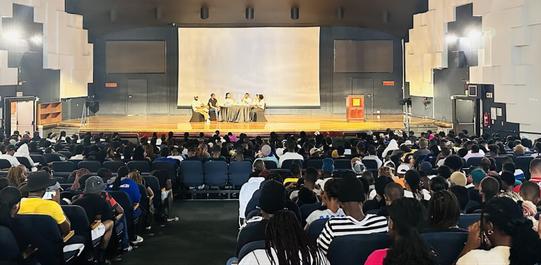

The Social Justice Programme (SJP) is designed to strengthen the university’s commitment to a respectful, inclusive, and accountable community. By setting clear objectives that prioritise the prevention and fair handling of bullying and discrimination, promote diversity and belonging, and expand access through multilingual engagement, the programme lays a firm foundation for meaningful culture change. These objectives are intended to translate into tangible impact: a campus climate where policies are understood and applied consistently, where trust and psychological safety deepen, and where staff and students experience a stronger sense of connection to the institution. Through sustained visibility, practical resources, and a commitment to shared values, the programme aims to shape an environment where every member of the university community feels supported and recognised.
In 2025, the TEEO through the SJP facilitated 45 recorded workshops across faculties, departments, and external partners. Workshops for example took place in the Faculty of Health Sciences, Humanities, and Residence Life recorded the highest number of engagements, reflecting particularly strong participation and interest from these faculties/ units. Notably, the high engagement in Health Sciences and Humanities corresponds with the higher number of bullying and discrimination cases reported in these faculties during 2025. This trend may reflect increased awareness and willingness to report, but it may also point to underlying systemic issues that require sustained attention.
The workshops reflect a strategic and responsive approach to advancing social justice within the university community Thematically, the sessions addressed a broad spectrum of issues including bullying and discrimination, diversity and cultural intelligence, institutional culture and belonging, mental wellness and masculinities These themes were not only relevant to lived experiences of students and staff, but also aligned with the university’s transformation pillars.
Targeted sessions such as “Madoda Sabelani” (masculinities), “Empowered to Lead” (student leadership), and “Workplace Bullying” (staff well-being) demonstrate a nuanced effort to address specific social dynamics and institutional challenges. The inclusion of mental‑health and transformation labs further signals a commitment to fostering inclusive, reflective, and values driven spaces.
In the next section, we provide in depth coverage of three core themes: Bullying & Discrimination; Diversity; Madoda Sabelani; and support for gender diverse students
In alignment with Wits’ commitment to building an inclusive institutional culture, the Transformation Office implemented a series of awareness initiatives to promote understanding of the Prevention and Eradication of Bullying Policy and the AntiDiscrimination Policy and Procedures. These initiatives advance the University’s transformation priorities and support a respectful, collegial, and accountable working and learning environment.

The SJ Team facilitated 28 induction and introductory sessions for staff and students across faculties, schools, and divisions. These sessions formed part of the broader Social Justice Programme’s education and prevention work and highlighted:
The University’s zero-tolerance stance on bullying, discrimination, and abuse of power; The roles and responsibilities of all community members in upholding ethical and professional conduct;
The available reporting and support mechanisms through the Social Justice and Ethics Office; and, Guidance on distinguishing robust engagement from conduct that infringes on dignity or creates a hostile environment.
Additionally, 6 sessions were specifically designed to address bullying and discrimination in depth These focused engagements used case examples, scenario-based dialogue, and reflection activities to unpack concepts such as microaggressions, cyberbullying, unconscious bias, and power dynamics in academic and workplace settings.
Through these awareness activities, the TEEO strengthened the visibility and understanding of institutional policies, enhanced early prevention capacities, and empowered staff and students to recognise, report, and challenge harmful behaviours The initiatives directly contribute to cultivating a safe, equitable, and compassionate University culture in which everyone can thrive.
Theme: Inclusive Engagement and Identity Awareness
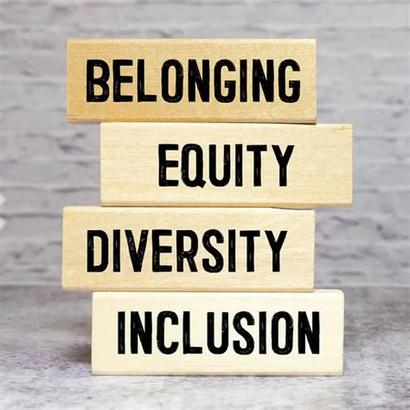
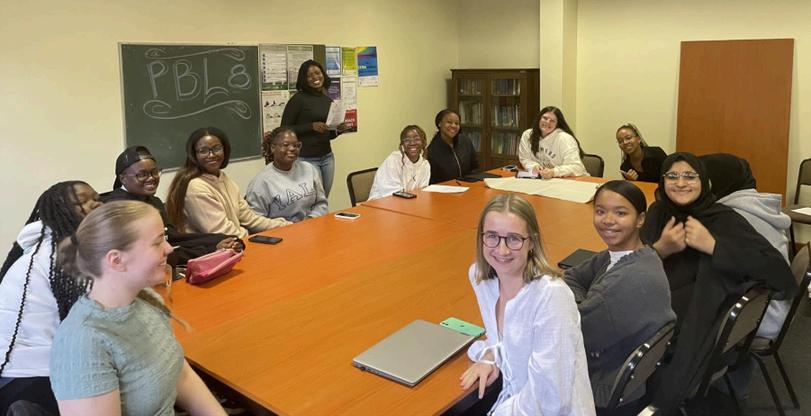
The Diversity Seminars are a flagship initiative of the Transformation Office, designed to foster inclusive engagement and identity awareness within the university community.
The team partnered with the Occupational Therapy (OT) Department from the Faculty of Health Sciences (FHS) to deliver these seminars with a dual focus: supporting first-year students in their transition to university life through a diversity lens, and preparing fourth-year OT students for their clinical placements by equipping them with the tools to navigate diverse environments with empathy and cultural intelligence.
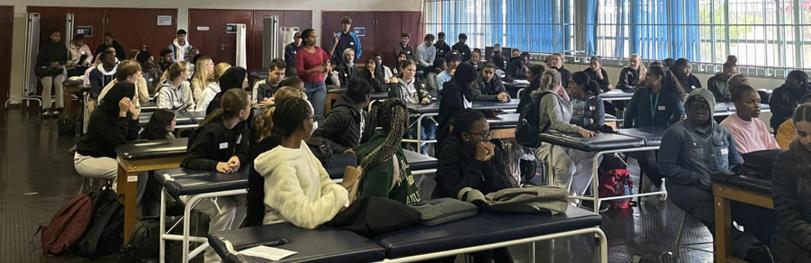
Objectives
Promote inclusive engagement and respectful collaboration across diverse identities
Address intersectionality in relation to race, gender, religion, language, education, and socio-economic status
Equip participants with tools for navigating difference with empathy and intelligence
Create a space for open dialogue without fear of judgment or punitive outcomes.
Seminar Structure
Each seminar was structured around four key modules:
Transformation in Context – Understanding the historical and institutional backdrop of transformation Power, Positionality & Privilege – Exploring how social identities shape access, voice, and influence. Communication in Diversity – Developing skills for inclusive, respectful, and effective communication Cross-Cultural Intelligence – Building awareness of cultural norms, values, and practices across communities
The sessions were interactive, using: Group discussions; Scenario-based learning; Reflective exercises; Peer-led facilitation
Impact and Reflections
Participants reported increased self-awareness and empathy, a deeper understanding of how identity shapes experience, and greater confidence in engaging across difference. Many expressed a renewed sense of belonging and a shared responsibility for transformation The seminars were praised for their depth, accessibility, and relevance to both academic and social life on campus.
The Diversity Seminars 2025 were a vital step in cultivating a university culture grounded in Ubuntu, equity, and collective care. They continue to serve as a model for inclusive engagement and are integral to the broader transformation agenda at Wits.
The Madoda Sabelani Series is a transformative engagement initiative hosted by Wits University, aimed at foregrounding and building healthy cultures of masculinities in university spaces. The name Madoda Sabelani translates to “Men, Let’s Respond,” signalling a call to action for the University community to reflect, engage, and evolve around what it means to be a man in the 21st century context. The 2025 series built on previous years’ successes, deepening its focus on mental health, social justice, and inclusive identity formation. The objectives of the project are as follows:
Create safe spaces for vulnerability, healing, and dialogue
Address mental health issues such as depression, suicide, and emotional repression among men.
Challenge toxic masculinity and promote healthy, respectful expressions of manhood Foster community through shared narratives and peer-led support.
Integrate gender justice into broader transformation efforts.
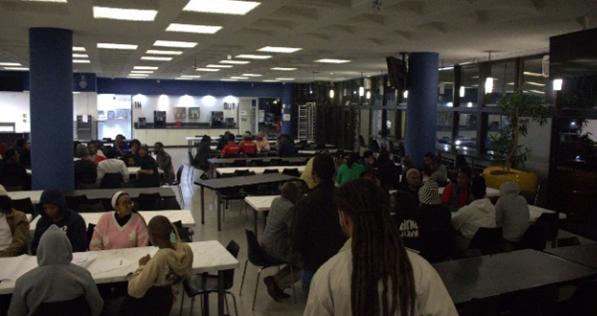
Key Themes from 2024–2025
Emerging from participant reflections and case studies:
Masculinity as a social construct shaped by family, media, and cultural norms.
Social pressures such as “indoda must be a Hilux/Bakkie” (provider, protector, emotionless)
Men as survivors and harmers, which is exploring trauma, accountability, and healing.
Mental health and wellness, including therapy, self-care, and emotional literacy
Alternative masculinities stories of men who defy traditional norms.
Boyhood, brotherhood, and manhood developmental stages and their emotional impact
Education’s role in shaping gender norms and promoting transformation
Community contexts rural, urban, and cosmopolitan masculinities.
Reclaiming dignity and pride in masculinity through non-violent, empathetic expressions.
Engagement Format
Case Studies focused on family dynamics and socialisation
Breakaway Groups for peer-led reflection and storytelling.
Interactive Activities such as boxing, soccer, and games to attract participation and reframe masculinity through fun and movement.
Role-play and empathy exercises to foster cross-cultural understanding
Discussion of emergent research, including a study led by Prof Malose Langa on the impact of the Madoda Sabelani program.
Venues and Dates
Held across four campuses in May 2025: (Pictures to be included)
06 May – East Campus, Main Dining Hall
08 May – West Campus, KNK Dining Hall
13 May – West Campus, Convocation Dining Hall
15 May – Education Campus, Reith Hall
Participants in the Madoda Sabelani Series reported experiencing greater emotional openness and selfawareness, alongside a deepened sense of solidarity and shared responsibility. The engagements fostered increased understanding of how masculinity intersects with mental health and social justice, highlighting the importance of inclusive spaces that encourage vulnerability and challenge harmful norms. Widely praised for its inclusive facilitation and dynamic format, the series was recognised not only as a mental health intervention but also as a powerful mechanism for cultural transformation within the university community.
Plans for future iterations include:
Expanding the series to include Bafazi Sabelani—a parallel engagement exploring womanhood in the 21st century university.
Deepening collaboration with researchers and student leaders
Scaling the model to other institutions and communities.
The commitment to coordinating the Trans/Gender diverse support group is part of the university supporting members of the LGBTIAQ+ community. People continuously affirm how valuable the space is for them and eagerly show up to sessions The Social Support Group is a welcoming and affirming space, which facilitates social support for Trans/Gender diverse individuals within and beyond the Wits University community. Part of what attracts people to attend this space is due to the historic commitment that the TEEO has had towards advocating for the LGBTIAQ+ community and the work that has been done to affirm this commitment. The social support group is hosted every second Thursday from 3:00 to 5:00 PM, and is open to students, staff, and members of the public This initiative is run in partnership with the Gender Equity Office (GEO) and GALA Queer Archive Going forward, we will strengthen our collaborations with the GEO and GALA in this area.
Provide a safe, inclusive environment for sharing experiences and building community.
Encourage peer support, emotional expression, and solidarity.
Offer a platform for identity-affirming dialogue and mutual care.
Promote mental health and well-being through connection and visibility
The group has helped its attendees build community, reduce isolation, foster a sense of belonging, and contributed to a more inclusive campus culture. It continues to serve as a vital space for healing, empowerment, and advocacy for gender-diverse individuals.
Quarterly Universities South Africa (USAf) transformation forums sustained sector alignment, while Gauteng-based bilaterals moved from information sharing to joint problem-solving; notably, Wits and Tshwane University of Technology hosted two peer-to-peer sessions focused on practical implementation
We contributed to a sector workshop aligning universities to national frameworks on social inclusion, disability and GBV, with additional sessions on sexual harassment, bullying and the GRPBMEA Policy Framework, informing our local implementation plans and benchmarks
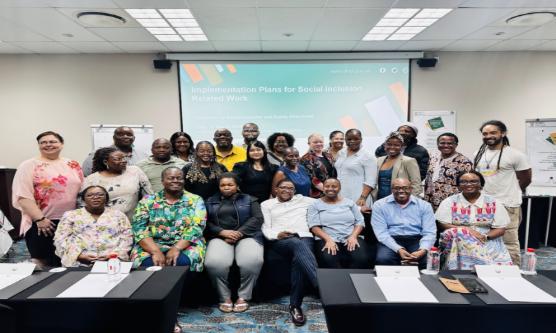
To strengthen early-resolution pathways, the Social Justice Manager completed accredited Mediator Skills training, increasing in-house ADR capability and reducing reliance on external facilitation for appropriate matters.
Team-led gestures, Women’s Day recognitions (including a CRO-hosted lunch), Spring Day and birthday acknowledgements, inclusive prayer groups, and Heritage Day celebrations showcasing cultural regalia and shared foods signalled dignity, appreciation and belonging in daily work life.
The combined effect of public engagement, partnerships, accredited skills growth and intentional culture signals positioned Wits as a collaborative, outward-looking institution that learns with the sector while serving its community more effectively; in short, transformation is lived through relationships, practice and accountability on campus and beyond
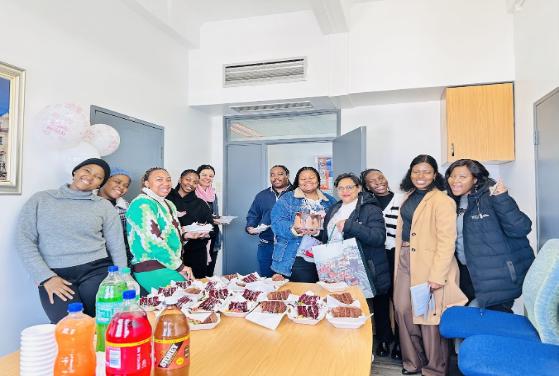
The Social Justice Programme serves as an in-between space that complements existing university processes-both a hub for social innovation and a source of practical support. By ethically handling bullying and discrimination cases and offering alternative dispute resolution, we continue to work towards reduced harm and foster a more collegial work culture. By advancing inclusion and language access, we aim strengthened belonging across diverse cultures and races. Most importantly, we make Wits’ transformation pillars tangible in everyday experience
Wits’ transformation is strongest when policy, leadership and daily practice move together The SJP connects these layers: we clarify routes to help that are clear and fair, equip managers and teams with practical tools, normalise multilingual inclusion, and translate evidence into improvement.
Our commitments for the next cycle are clear:
Campus-wide Transformative Workshops and Dialogues
Transformation Lab Series (Belonging, What is Transformation? and Faculty Transformation Committees Roles)
Healing and Gender Dialogues Expansion (Madoda Sabelani & Babafazi Sabelani)
Launch of Social Justice Champions Programme
Anti-Bullying Visibility and “Bully-Free Zone” Campaign
Train-the-Trainer and Facilitator Capacity Building
Strengthening Collaborative Social Justice Team and Partnerships
Our work is grounded in the belief that transformation is not an event but a daily practice, built through conversations that matter, accountability that is real, and a culture that honours dignity. This has meant holding space for difficult truths, and supporting colleagues and students through moments of vulnerability, conflict, and healing
Our Social Justice team represents a diverse and active community. We are growing to include represenation from different key communities in the university. The development of our Social Justice Champions program represents a commitment to include students in our office, sharing skills and rooting our activations in that which is relevant to the youth at the university. Here are reflections from the core Social Justice Team:
SJ practitioners' personal reflections

Joining the Transformation Office in February 2025, as a Diversity, Ethics, and Social Justice Manager marked a defining turning point in my professional path Stepping into a complex environment mid-flow required swift adaptation: learning the terrain, absorbing the institution’s layered histories, and orienting myself to the emotional, cultural, and operational weight of the work. One of my earliest commitments was to bring clarity and order to bullying and discrimination cases
Strengthening documentation, refining systems, and aligning processes helped ensure that every report was handled with care, fairness, and consistency.
Those first months stretched me, but they also steadied me, revealing the kind of practitioner I was growing into.
As the first point of contact for colleagues and students reporting bullying or discrimination, I quickly discovered that this work extends far beyond statistics People arrive carrying fear, disappointment, uncertainty, and often deep hurt. Listening with empathy, holding their stories with dignity, and responding with steadiness has become one of the most profound responsibilities of my role. These encounters have shown me that bullying is never just an isolated act; it reflects the culture that shaped it Every case teaches something about what we nurture, what we allow, and what we overlook as an institution.
Standing at this frontline has sharpened my understanding of transformation. I see more clearly how personal agency flourishes when people feel genuinely supported, yet also how their progress depends on the institution’s readiness to create safe and enabling conditions. Real transformation emerges in this balance; where individual courage meets organisational responsibility. My work is situated precisely in that intersection
At the same time, I have been navigating my own internal terrain: the quiet self-doubt that comes with entering a new sector as a Black woman, the desire to create space for others without diminishing myself, and the hope of belonging even while facilitating it for the broader community. This inner journey has unfolded alongside the external work of building systems, strengthening the programme, and positioning transformation as a sustained, principled endeavour. It has required courage, humility, and the willingness to hold tension between care and accountability, empathy and firmness, vulnerability and leadership.
Through this journey, I am becoming someone who understands that true transformation is not linear, neat, or fully controllable It is lived It asks for relevance rather than perfection, for consistency rather than performance. It moves us from compliance to culture, from policy to practice, from rhetoric to lived experience. In this work, I am learning to guide change that honours our history while shaping a more belonging-centred future; one conversation, one decision, and one restored sense of dignity at a time

Personally, holding this position has been an immense privilege. Being part of the conversations and creating space to discuss real challenges and simultaneously build healthy institutional cultures has been incredibly meaningful An integral part of the way we do this work is to create spaces for dialogue wherein we too learn from that which people share. It is an honor to do this work Part of doing this work also means acknowledging the challenges people face and carry.
As we navigate an era of poly-crisis, many are carrying tremendous weights of existing in an unjust system and world It is integral that we use these positionalities to create meaningful and deep-rooted change that translates into the lived experience of members of the university community and beyond. In this,I appreciate that our office is an office of praxis, wherein we learn and grow through the work that we do and we continuously evolve.
Through projects like the trans support group and the diversity seminars we create spaces wherein we reflect, engage and create action towards positive change. This is rooted in the understanding of Transformation as an ever changing horizon that we continually walk towards. We grow and adapt with the work itself and share it beyond the university. An example from my experience is the Madoda Sabelani series. The program has continuously grown and adapted over the past three, responding to what the students raise and grapple with It is dynamic and honors the experience and awareness that students have already, affording them human dignity and allowing them to nurture each others growth. The impact goes beyond the events themselves
From the Wits Madoda Sabelani series I was able to create a similar discussion with high school students.
The investigations and mediations office deals with all requests for mediation and investigations that are referred through by the social justice committee through the Prevention and Eradication of Bullying Policy within the University, Anti-Discrimination Policy and Procedures, Integrity Hotline, and other ad hoc requests for investigation. The office is further responsible for facilitating the mediation that parties have consented, by ensuring that the relevant mediator is appointed and providing spaces and facilities for mediation. Accredited mediators are appointed by the TEEO. Forty-three disputes were reported. These range from formal complaints, informal complaints, requests for advice, group complaints, and mediation
Three cases were referred for investigation. The investigation in two of these cases found a basis for bullying These cases were referred to the Employee Relations office to institute disciplinary hearings. All these cases involved Professional and Administrative staff.
In relation to the anti-discrimination policy and procedure, three cases were investigated involving a student and member of staff. The case was referred to the legal office for the consideration of the investigation report and to initiate processes on their end
Four cases, which came to the TEEO via the Integrity Hotline, were referred for investigation.
Cases that are referred to the TEEO are managed through two policies, namely, the Anti-Discrimination Policy and Procedure and the Prevention and Eradication of Bullying within the University The AntiDiscrimination Policy and Procedure dictates that when our office is in possession of all the relevant information, the investigation may proceed.
Feedback to the question what did you take away from the session, from a team mediation process had the following interesting responses: “Talking things through helps”; Always listen to the other person and seeing their perspective”; “Team work also involves supporting each other's weaknesses”; Curiosity eliminates judgement”; and “I saw how we all actually want the same thing ”
While recognising EE’s importance, the University notes that it’s implementation must be balanced against broader economic challenges, social impact, quality standards and other institutional priorities
Employment Equity (EE) ensures that the University’s workforce reflects the demographics of South Africa while advancing institutional excellence.
2025 has been a milestone in the higher education sector with the introduction of the new Employment Equity Regulations and Sectoral Numerical Targets, gazetted on 15 April 2025 and effective from 1 September 2025 These regulations require all designated employers to adopt a five-year Employment Equity Plan (1 September 2025 – 31 August 2030), aligned to sector-specific targets for race, gender, and disability
Importantly, Wits understands that transformation cannot be limited to staff demographics. The student profile plays a crucial role in shaping the academic pipeline, succession planning, and ultimately the future workforce. The EE agenda, therefore, aligns closely with student access, success, and throughput.
The student profile indicates positive developments in Employment Equity planning Black students comprise 75% of the South African student body, reflecting national demographics. Women constitute 61% of South African students overall
The University of the Witwatersrand enrolled a total of 43 675 students, with 41% registered in postgraduate programmes and 59% at undergraduate level South African students made up the majority of enrolments, accounting for 37% of postgraduate and 58% of undergraduate registrations, reflecting the University’s strong national footprint and commitment to access
International students represented a smaller but important component of the student body, contributing 4% of postgraduate and 2% of undergraduate enrolments. This balanced profile supports Wits’ strategic focus on academic excellence, transformation, and global engagement, while maintaining priority access for South African students
International students constitute 6% of enrolments, which represents the University’s commitment to redress and internationalisation
This strong progression in student representation creates the potential to improve Black and women’s representation in the academic pipeline through, for example mentorship, internships and succession planning.
1.1 Academic Profile
Wits staff profile in relation to academics show progression in the following ways:
The Academic demographic profile across Grade 4 to Grade 9 reflects a workforce with notable diversity strengths, particularly in the middle to junior level categories where representation of Black and female academics are steadily increasing
Grade 7 to Grade 9 show strong progress toward workforce diversification, with Grade 8 demonstrating one of the most balanced profiles across demographic categories.
Wits staff profile in relation to professional staff show progression the following ways:
The Professional Administration profile indicates a strong and progressively diversifying profile across Grade 1 to Grade 17, with notable growth in Black representation and female participation particularly within the middle to junior level categories (Grade 6 to Grade 12).
The demographic distribution demonstrates a broad mix of gender and race across most levels, indicating that inclusive recruitment practices, internal mobility, and well-structured development pathways are contributing to an increasingly representative administrative cohort
Building on this foundation, the University is well positioned to further enhance representation at senior administrative levels through strengthened succession planning, targeted leadership development, reinforcing a positive and sustainable trajectory towards greater diversity, inclusion, and institutional transformation
Our Focus and the Road Ahead
The University remains committed to strengthening its transformation trajectory by advancing several priority areas that will shape our focus going forward Key efforts include enhancing the representation of Women and Black employees within senior and executive leadership levels to align with national sector targets, while also deepening institutional support for disability inclusion as we work to move beyond the current 1.4% representation toward the 3% threshold.
Work needs to be done on the development of a structured succession planning framework for academic and professional staff to ensure a sustainable and diverse leadership pipeline across the institution.
In addition, dedicated strategies are being advanced to retain scarce and critical skills, particularly in disciplines such as Engineering and Health Sciences to support continuity reduce turnover and enable
The University has achieved economic transformation through strong procurement and development initiatives It exceeded targets for inclusive procurement, with 46 78% of spend directed to Black-owned suppliers and 24.79% to Black women-owned suppliers, fostering greater participation of historically disadvantaged businesses.
Enterprise and Supplier Development contributions were exceptional, reaching 64 52% for supplier development and 21 98% for enterprise development, far surpassing minimum requirements and have contributed to growth, sustainability and job creation. Governance transformation is evident with 57 69% Black representation on the (board) Council, while socio-economic contributions accounted for 4.43%, supporting individual upliftment.
These achievements reflect meaningful progress in empowering Black businesses and promoting diversity, though further improvements in skills development, gender equity, and disability inclusion are needed for holistic transformation The University remains committed to contributing to Economic Transformation through, for example, B-BBEE.
Our Transformation work offers the opportunity for us to work across the university’s structures, multiple stakeholders, and different categories of staff, such as the Professional Administrative and Academic staff. This open space we think of as the “in-between” space Here we can discuss cross-cutting issues, create a community of practice, test ideas for change, and explore solutions to concerns
We are excited to keep strengthening our work in 2026 We intend to deepen our work by creating more spaces for engagement; learning about transformation from doing transformation; and strengthening our collaborations and partnerships Our strategic intent remains, contributing to Wits for Good and a caring, peaceful and inclusive society