List of Tables
Table
Table

Table
Table
The following are acknowledged for their contribution to this work:
• Our funders Deutsche Gesellschaft für Internationale Zusammenarbeit (GIZ).
• The members, secretariat and Board of SANEA for their support and vision
• The staff at WITS African Energy Leadership Centre and Researching Education and Labour Centre for this partnership and extensive expertise
• The BRICS Business Council for assisting with methodology and insights
• The Project Advisory Committee for their insights and guidance
• The Energy and Water SETA for their support and help and for taking forward some of the findings
• The people who attended the various workshops and meetings for their time and input, we relied on your collective experience and wisdom
The South African National Energy Association (SANEA) in partnership with the Wits Business School’s African Energy Leadership Centre (AELC), the University of Witwatersrand’s Centre for Researching Education and Labour (REAL) and with the support of the South African BRICS Business Council proposed the development of a South African Energy Skills Roadmap to support a Just Energy Transition in South Africa. The project is funded by Deutsche Gesellschaft für Internationale Zusammenarbeit (GIZ).
It was acknowledged that there are many existing initiatives completed or underway that address skills in the energy sector, however there are gaps in that there is not one cohesive initiative, the broader energy sector is not fully covered, and the longer-term skills are not adequately considered.
The primary objective of the project was therefore to develop a comprehensive energy and related skills roadmap, identifying new skills and competencies that will be needed in the energy sector in the future because of the energy transition.
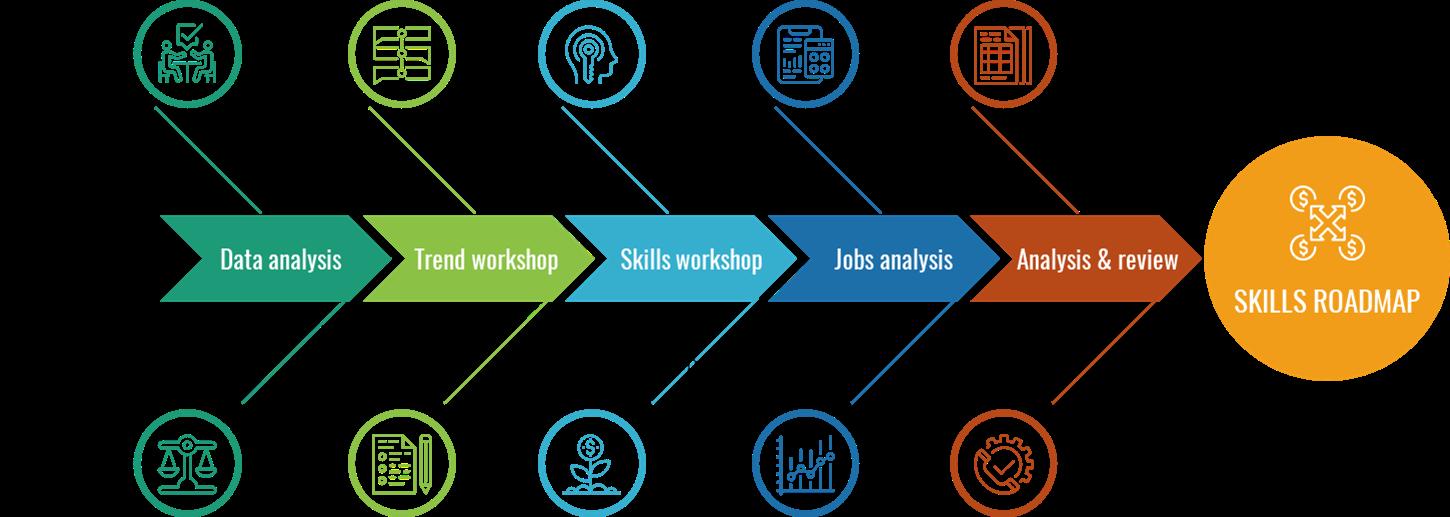
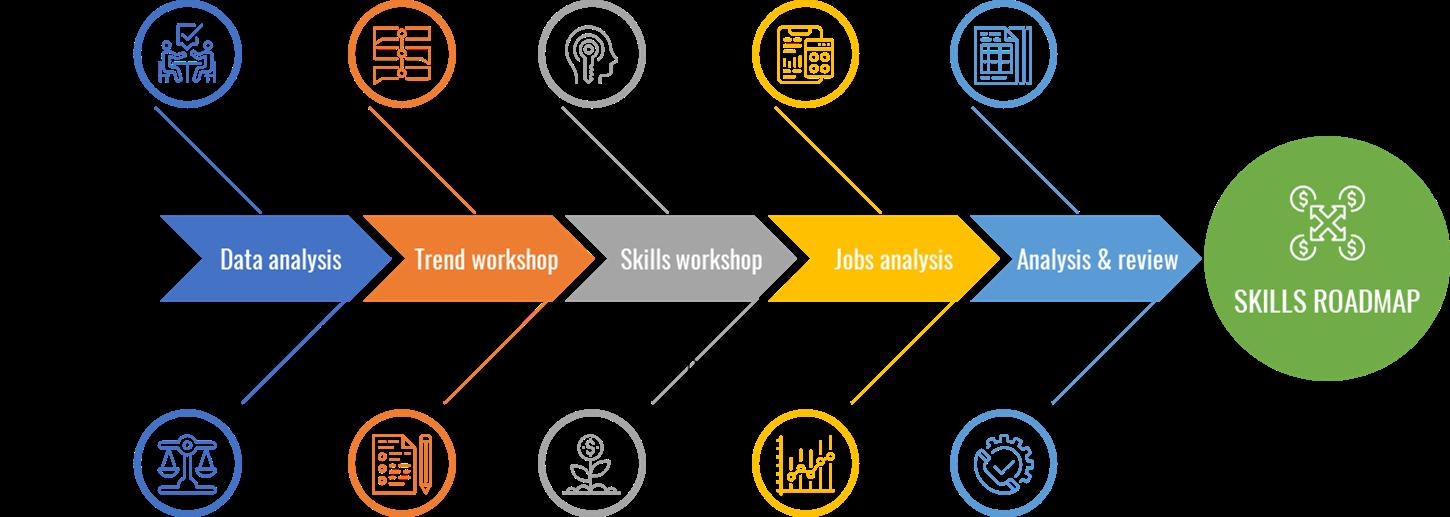
The project was executed over three phases to answer key questions in the development of a roadmap. The methodology used was a combination of various approaches customised to suit the South African context and energy sector. The detailed process followed is shown in the fish diagram below which culminated in the energy skills roadmap.
This assessment was carried out in Phase 1 of the project and involved identifying and analysing over 200 documents on skills in the South African energy sector over the last 5 years. This avoided duplication; built on existing findings; identified gaps and informed the development of a long-term roadmap of future energy skills.
The work was categorised into four groupings namely Decarbonisation; Decentralisation; Digitalisation and Market structure.
It was concluded that the energy sector is being driven by a number of key trends both global and local. These have critical implications for skills development as not only will current jobs be impacted, but new occupations and skills will be needed.
Skills requirements for the energy system necessitates an ecosystem and integrated approach and acknowledgement the transformative process that is occurring over time and local geographic areas. Siloed approaches need to therefore be avoided to maximise any opportunities and build any trade-offs into decision making.
To determine the future skills requirements, it is critical to predict what future trends will impact on the sector, as well as how various energy players will react to them. This was done at the global level as well as the national level.
Global Meta trends transforming the world were identified in phase 1 of the project as well as from the political, economic, social, technical, legal and environmental dimension analysis undertaken by SANEA in the development of the South African Energy Risk Report, (2022) which also considers global impacts.
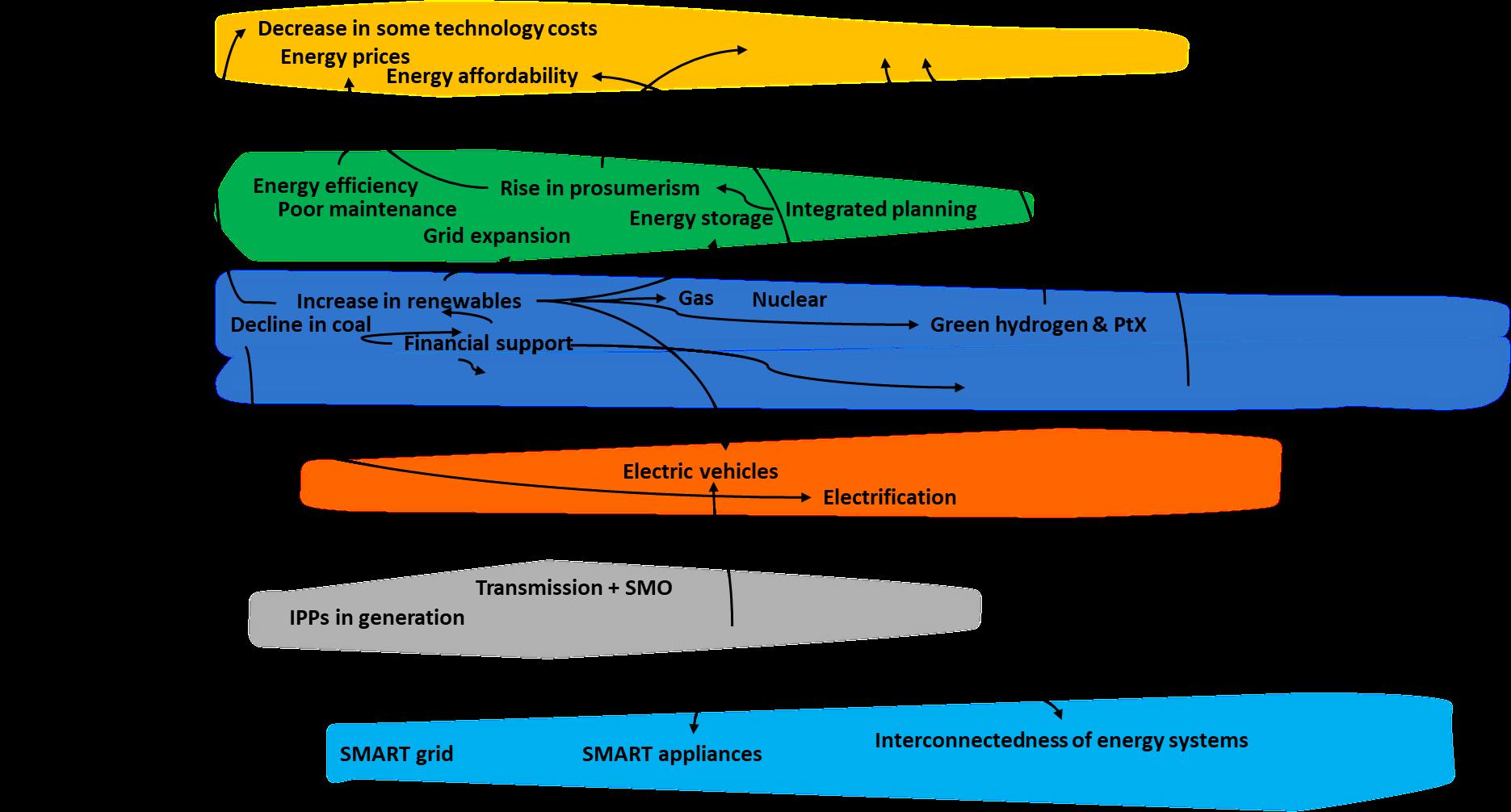
A series of workshops held with industry players identified critical trends up until 2050. These trends were consolidated into clusters and prioritised. The additional global trends of automation (including robotics) and Artificial Intelligence (AI) were also identified as being impactful on the energy sector although not necessarily direct energy technologies. These trends are detailed below as well as how they change in terms of rate of change over the time period up until 2050.
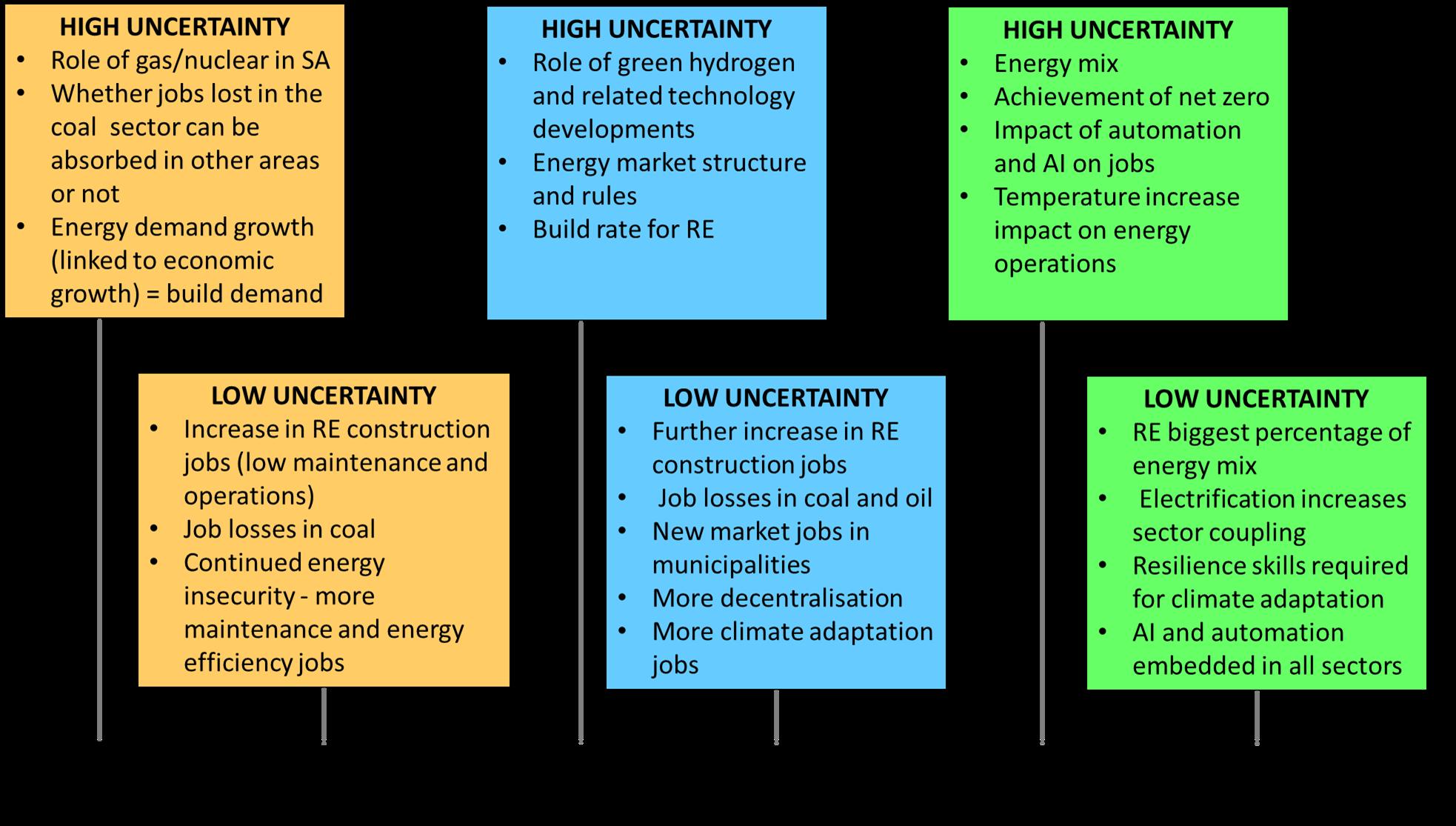
It is clear that the energy sector in South Africa is in crisis and faces a great deal of uncertainty in developing a skills roadmap as a result. To deal with the uncertainties, a set of scenarios was developed, and a set of no-regret actions identified. The scenarios and trends were used to identify uncertainties as they could play out over time and impact skills demand and provisioning. By analysing the trends as well as uncertainties in the energy sector as identified by SANEA in their South African Energy Risk Report, uncertainties that will impact skills supply and demand were identified.
The impact of these trends on occupations and skills was analysed per trend and a comprehensive analysis of the various occupations that will be needed over time was carried out. The following emerged:
● The shift to decarbonisation and electrification is being reflected in the increased demand for a wider variety of jobs, including outside the energy sector.
● This has resulted in the emphasis on only techno-economic jobs shifting to include a socioeconomic and just transition emphasis as well.
● The private sector is employing specialists in future areas such as green hydrogen to inform policy and clients that will shape the trajectory. The public sector tends to be more focused on current jobs and issues.
● The decentralisation and automation/AI trends are resulting in a shift in the types and locations of jobs from more technical to more construction jobs.
● The emerging energy markets are driving new types of jobs and where they are located geographically and sectorally, e.g. from a central utility to a municipality etc.
● Consideration needs to be given to transversal skills that can be used across various national initiatives such as infrastructure development.
To ensure that the labour market’s demand and supply were met, the implications of the energy trends on the education sector were also examined. This included the consolidation of all the current energy-related degrees, diplomas, short courses etc. currently offered in South Africa. The following conclusions were drawn:
● There is an adequate supply of traditional energy qualifications at the university level (number of qualifications not the number of graduates).
● Traditional energy education is not adequately supplying specialisations such as qualifications in renewables or clean energy.
● It is unclear if post-school curricula and education quality are responding adequately or appropriately to future demand.
● Community and Technical Vocational Education and Training (TVET) colleges are not responding to nor providing appropriate training for current and future local demand e.g., solar in the Northern Cape.
● The skills pipeline from basic education is poor. This is having an impact on the throughput of students in the relevant courses at the tertiary education level.
Skills planning is a critical issue given the integrated and systemic nature of the sector. If adequate and timely skills planning for the energy sector is to be realized, attention should be given to the following:
● The need for flexibility given the uncertainties. This is currently not adequately considered.
● Acknowledge occupation demand and skills along the transition time continuum, not just current and end goals.
● Consider the ecosystem of activity, this being the broader energy sector value chain and geographical location.
● Include skills planning upfront in sector and development plans - not ‘tagged on’ at the end.
● A single accountable entity for skill planning is required that would include government, industry, academia and civil society (at all levels) to avoid duplication and ensure that the enabling jobs are adequately provisioned.
Considering all the data, analysis and conclusions, of the following recommendations are made to facilitate implementation, a critical consideration in the South African context.
Uncertainty and trends
Multi-dimensional approach to skills development
● Develop a more detailed set of scenarios and impacts on jobs to acknowledge the nuances of each scenario on jobs and locations e.g. Northern Cape etc.
● Track uncertainties to feed into flexibility of the skills planning.
The South African skills roadmap will need to have a coherent vision and concurrently work on the following:
● Reskilling and upskilling adults to be better equipped to navigate the energy transition at various points in the energy value chain.
● Aligning the energy skills development system with the anticipated labour force needs of the future, with a particular focus on jobs to support a just energy transition. This involves sophisticated anticipatory skills development and working with labour market intelligence, as well as the strengthening of skills system innovations across the energy value chain and its associated ecosystem i.e. not to be relegated to a narrow band of technical skills only. It also involves investing in a skills development capacity and building new types of skills and specialisms.
● Resourcing foundational skills development throughout the education system to improve the adaptive capacity of the broader workforce. This involves curriculum transformation, teacher capacity development in the schooling and post-schooling system (especially also TVET and community educator competencies), restructuring employer-provider (demand-supply) relations, and expansion and diversification of learning pathways (currently the skills for green jobs arena is dominated by highskills learning pathways).
● The skills plan will need to offer national-level strategic support and locallevel alignment with emerging priorities and opportunities. Mediating between national to local is critical as the roadmap unfolds. The focus should be on capacitating governments and national entities but also consider bottom-up skills processes that could be driven and/or informed by local affected communities.
Occupation and skills
Implications for the education sector
Skills planning
● Development of an occupation and skills atlas.
● Undertake an employee workplace-based survey to develop clearer ideas on workplace-based learning needs.
● Undertake skills ecosystem mapping in high-impact areas (either decrease or increase in jobs).
● ‘Soft’ skills need to be identified and accommodated across various job levels.
● Consideration needs to be given to transversal occupations and skills that can be used across various national initiatives such as sector and infrastructure development plans.
● To investigate energy transition-related student throughput (graduations) vs employer demand.
● Curriculum review of energy transition-related course content for relevance / specialisms (especially within critical hotspot geographical areas).
● Understanding learning pathways in the energy sector through a focused and detailed study of how job seekers can progress within the energy sector. This should include the streams of work associated with core jobs that are going to be impacted by or required to transition South Africa’s energy sector.
● To review or research to better understand how to enhance partnerships to provide education and training.
● The skills implementation plan should be driven by one accountable entity, yet include government, industry, academia and civil society (at all levels) to avoid duplication, that enables jobs to be adequately provisioned, and is responsive to ever-changing uncertainties.
● Cross-SETA collaboration and coordination to support skills provisioning for the energy transition.
● Develop and implement an energy just transition skills implementation plan and a skills hub that can coordinate skills planning processes (governance, time, cost, research).

AELC Wits Business School’s African Energy Leadership Centre
AI Artificial Intelligence
BRICS Brazil, Russia, India, China, South Africa
DHET Department of Higher Education and Training
DMRE Department of Minerals Resources and Energy
EWSETA Energy and Water Sector Education and Training Authority
GIZ Deutsche Gesellschaft für Internationale Zusammenarbeit
ICT Information and Communications Technology
IEA International Energy Agency
ILO International Labour Organisation
IPPs Independent Power Producers
IRENA International Renewable Energy Agency
IRP Integrated Resource Plan
OFO Organising Framework for Occupations
PCC Presidential Climate Commission
PESTLE Political, economic, social, technical, legal and environmental
PtX Power-to-X products
PSET Post-school Education and Training
PV Photovoltaics
RE Renewable Energy
REAL University of Witwatersrand’s Centre for Researching Education and Labour
REIPPP Renewable Independent Power Producer Programme
SADC Southern African Development Community
SANEA South African National Energy Association
SMART Specific, measurable, achievable, relevant, and time-bound
TVET Technical Vocational Education and Training
UN United Nations
Wits University of the Witwatersrand
South Africa is located on the southern tip of Africa and has one of the largest economies on the continent. Table 1 provides an overview of South Africa’s current and future energy transition landscape (Climate Investment Funds 2020, Stats SA 2022a, and TIPS, 2022)
Table 1: Summary of South Africa’s current and future energy landscape
Coal (65%), crude oil (18%), renewables and waste (11%), gas (3%), nuclear (2%) and geothermal (1%)9
Unemployment rate 35% (2022b)7 Electricity market Industrial sector (51%), transport (26%), commerce & public sector (11%), residential (7%), and agriculture (2%)9
Employed in the energy sector 59,000 (2021) [electricity]8 % of population with access to electricity 85% (2019)1,2 [Urban, 88%; Rural, 79%]2
Main economic sectors Mining, transport, energy, manufacturing, tourism and agriculture6 Future energy mix 43% coal and 34% wind and solar by 203010


The South African National Energy Association (SANEA) in partnership with the Wits Business School’s African Energy Leadership Centre (AELC), the University of the Witwatersrand’s Centre for Researching Education and Labour (REAL) and with the support of the South African BRICS Business Council proposed the development of a South African Energy Skills Roadmap to support a Just Energy Transition in South Africa. The project is funded by Deutsche Gesellschaft für Internationale Zusammenarbeit (GIZ).
It is acknowledged that there are many existing initiatives completed or underway that address skills in the energy sector, however there are gaps in that there is not one cohesive initiative, the broader energy sector is not fully covered, and the longer-term skills are not adequately considered.
The primary objective of the project is therefore to develop a comprehensive energy and related skills roadmap, identifying new skills and competencies that will be needed in the energy sector in the future as a result of the energy transition.
The project also aims to identify strategies to ensure that the right skills are in place when they are needed, as well as the identification of those skills that will no longer be needed or will be needed at much lower levels in the future because of the energy transition, and the development of strategies that will reorient and reskill.
This work is in support of the Just Energy Transition Frameworks as developed by the Department of Minerals Resources and Energy (DMRE) as well as the Presidential Climate Commission (PCC). Both have stated that skills are essential and need to be assessed.
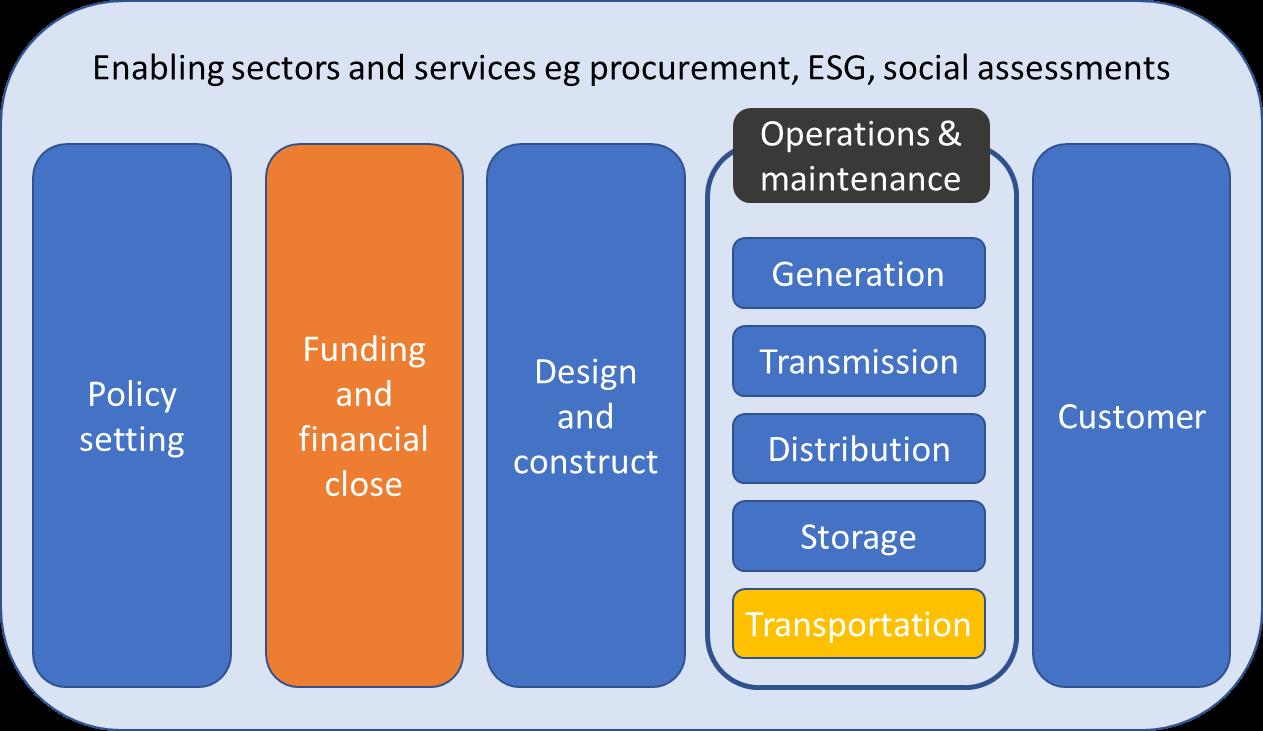
The approach was informed by defining the scope of the work which covers South Africa over a period up until 2050 and encompasses the electricity and related and/or supporting sectors. This approach was taken in order to ensure that the ecosystem required to support the Just Energy Transition was recognised and skilled appropriately to provide an enabling environment. The value chain illustration of the scope is detailed in the figure below:
The project was executed over three phases to answer key questions in the development of a roadmap. The methodology used was a combination of various approaches and customised to suit the South African context and energy sector. The detailed process followed is shown in the fish diagram below which culminated in the energy skills roadmap.
99
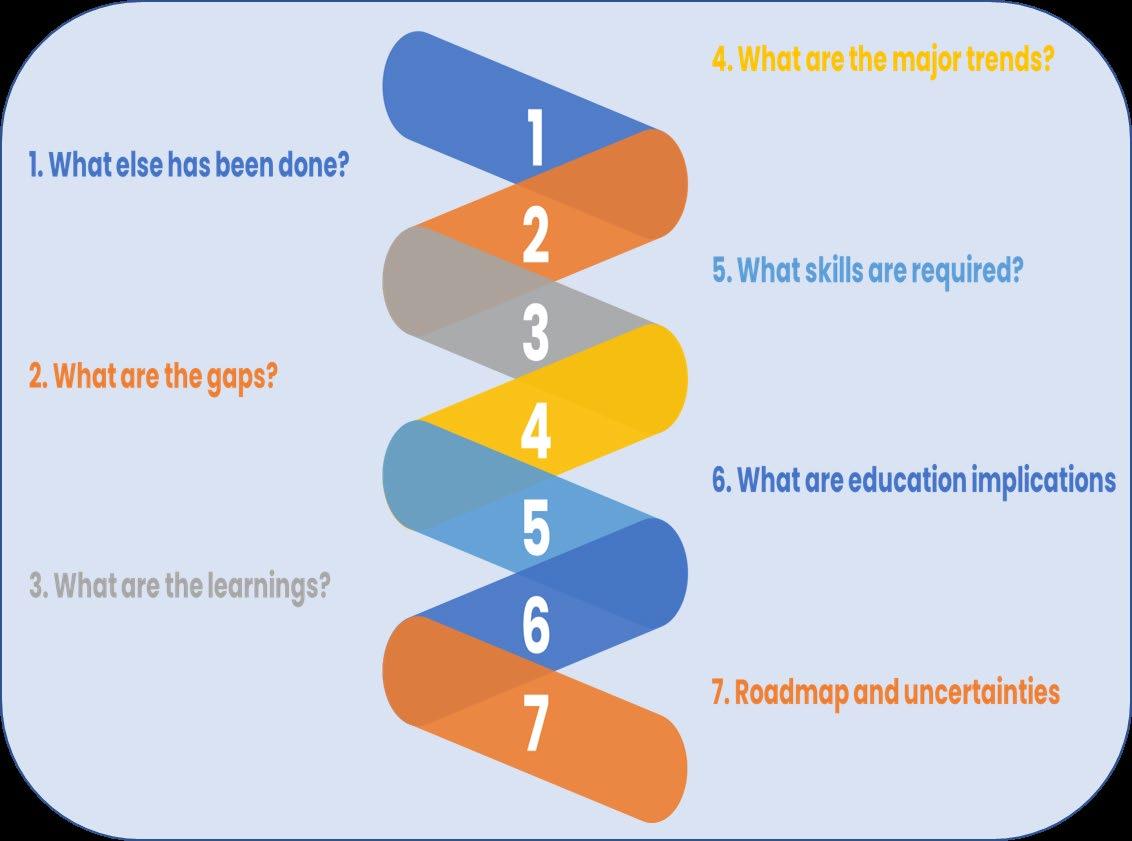
Figure 2: Questions to be answered
The project has been executed in three phases namely:
Phase 1: Set up and define a detailed scope of work. In this phase the scope was to:
• Set up a database of projects related to this initiative.
The intent was to include as many people working in the area as possible, to ensure the work was adding value and not a duplication of effort SANEA

• Conduct interviews and get stakeholder input into the scope and objectives and confirm the gaps.
• Set up an Advisory Committee of active stakeholders working in this area.
• Develop a baseline dataset of current skills categories and training facilities.
• Develop a list of experts and interested and affected parties.
Phase 2: Developing the energy skills roadmap. In this phase the scope was to:
• Hold a series of workshops with representatives from government, labour, affected communities and business to validate the baseline data from Phase 1.
• Hold three workshops with interested and affected parties to develop the baseline data for emerging jobs in the energy sector in South Africa.
• The first two workshops to identify trends utilising the database of projects and analysis thereof.
• The third and fourth workshops on skills identification and implications for the education system. Input data from an analysis of job adverts over the last year in South Africa that related to the energy sector and information on the current energy sector education system through an analysis on providers.
• Hold a final workshop to develop a set of recommendations for business, government etc as well as to identify additional work.
• Analyse to link trends to ways of work plus implications for jobs and skills and skills provisioning as well as emerging themes.
• Hold a final validation workshop.
• Write a report and publish.
• Set up a virtual ‘Impact Community.’
Phase 3: Communication and dissemination of results. In this phase the aim is to widely disseminate the report through seminars, publications and targeted events.
The overall process across three phases is detailed in the figure below:
This assessment was done in Phase 1 of the project and involved identifying and analysing over 200 pieces of work done on skills in the energy sector over the last five years. This was done to avoid duplication, build on existing findings, identify gaps, and to inform the development of a long-term roadmap of future energy skills for South Africa.
The work conducted was categorised into the following major themes: Decarbonisation, decentralisation, digitalisation and market structure.
The analysis found the following:
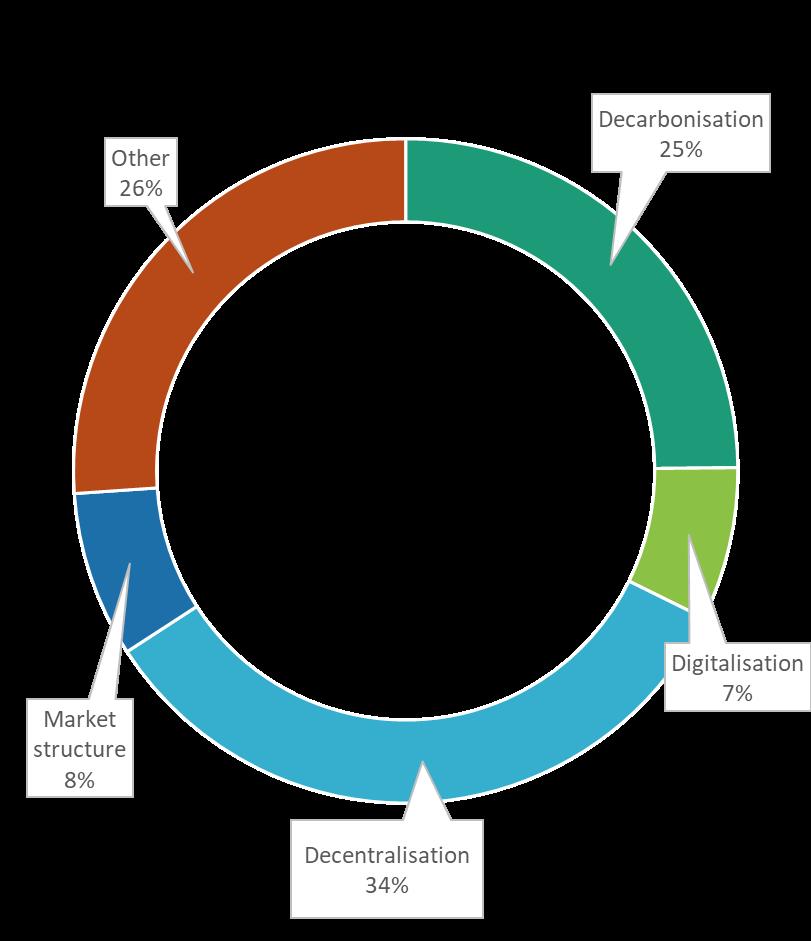
Figure 4: Distribution of data sources across the 4 themes
The data gathered in this phase of the work represents the collation of a significant body on work done in South Africa on energy skills. The Energy and Water SETA have provided a repository where this data, as well as any future work can be stored in one place and shared with researchers and other interested and affected parties.
ENERGY SKILLS ROADMAP - Energy & Water SETA (ewseta.org.za)
The literature gathered was analysed for the following:
● What occupations, skills (hard and soft) and knowledge had been identified (see section on skills demand for results)?
● Policy issues and recommendations.
● Technology issues and choices (see section on meta trends below for results).
The policy issues across the report were analysed to identify what policy was mentioned the most often, as a gauge of importance. This result is detailed below:
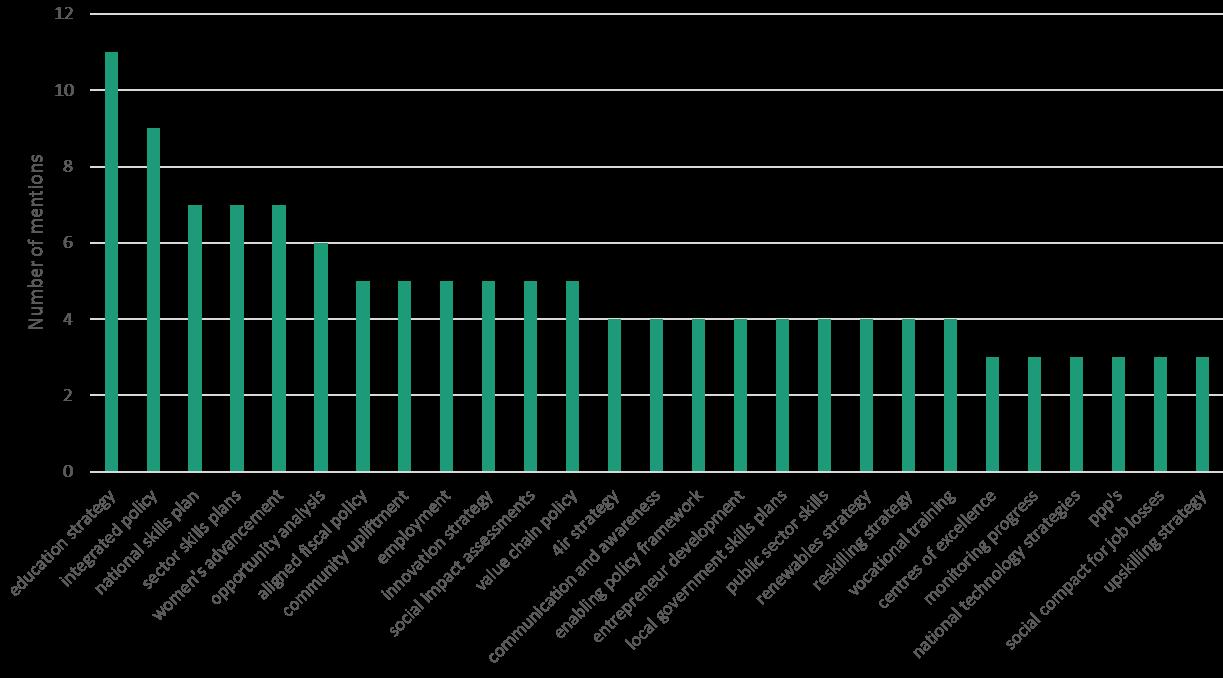
Figure 5: Number of mentions of policy across the relevant publications
The outcome of this analysis is detailed below and it was concluded that:
● No common vision of the future and therefore the transition steps required are either not adequately dealt with or are fragmented.
○ This is due to the fact that many of the studies are based on single technologies and not an integrated picture or even along specific value chains.
○ Data on current numbers and types of jobs is not available.
○ Projections are oftentimes not grounded in hard data or extrapolated from a single technology or project base.
● Skills studies are often technology not market or opportunity driven.
● Skills studies do not consider the skills required in the new system e.g. municipalities now having to deal with new technologies and markets.
● Occupations are techno-economic centric and too generic (e.g. not classified at occupation level as per the Department of Higher Education and Training’s (DHET) Organising Framework for Occupations (OFO).
● Some skills are cross-cutting and transversal across different occupations e.g. Information and Communications Technology (ICT).
● Skills requirements are too generic and have not been devolved to the lowest level – which affects those most severely impacted by the transitioning of the sector e.g. technicians.
● ‘Soft’ skills are key enablers but do not receive attention e.g. leadership and critical thinking, and skills required for integrated policy formulation.
● Regional differences are not always considered e.g. specific skills requirements in Mpumalanga where the mining workforce will be affected by mine closures.
● Sector coupling implications (positive and negative) are not always considered.
This is graphically represented in the figure below:
To determine the future skills requirements, it is critical to predict what future trends that will impact on the sector are, as well as how various energy players will react to them. This was done at the global level as well as the national level
Global Meta trends transforming the world were identified from phase 1 of the project as well as from the political, economic, social, technical, legal and environmental (PESTLE) dimension analysis undertaken by SANEA in the development of the South African Energy Risk Report, which also considers global and national impacts (MacColl, 2022, EWSETA, 2022, SANEA 2022. WEF 2022,). .
This analysis also drew on the energy experts group which is utilised as part of the SANEA Energy Risk Report process.
The figure below illustrates these trends as they pertain to the energy sector.
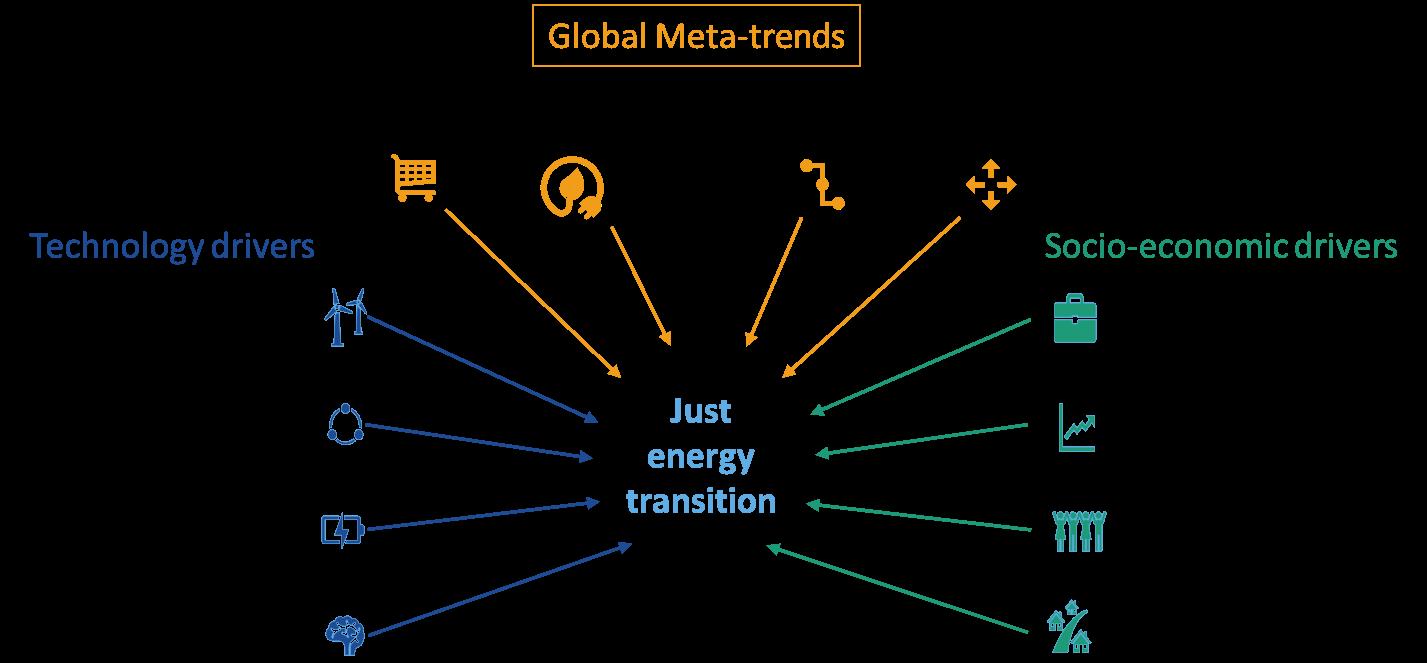
Overall these trends are driving the energy transition towards a low carbon future. The issue of how this transition is a just one that leaves no-one behind is critical in the South Africa context and is interwoven into all the analysis and recommendations made in the report.
The additional global trends of automation (including robotics) and Artificial Intelligence (AI) were also identified as being impactful on the energy sector although not necessarily direct energy technologies (Ahmadab et al, 2021). These trends are covered in the next section.
Given South Africa’s national context, it was identified that there is an overarching trend on ensuring transitions are equitable, just and sustainable, together with a further set of cross cutting/overarching trends and issues including financial drivers.
From the Phase 1 desktop study, the Phase 2 workshops and the jobs survey, a set of meta trends or drivers of the energy system in South Africa and therefore of skills requirement. were identified with some being divided into sub-trends as follows:
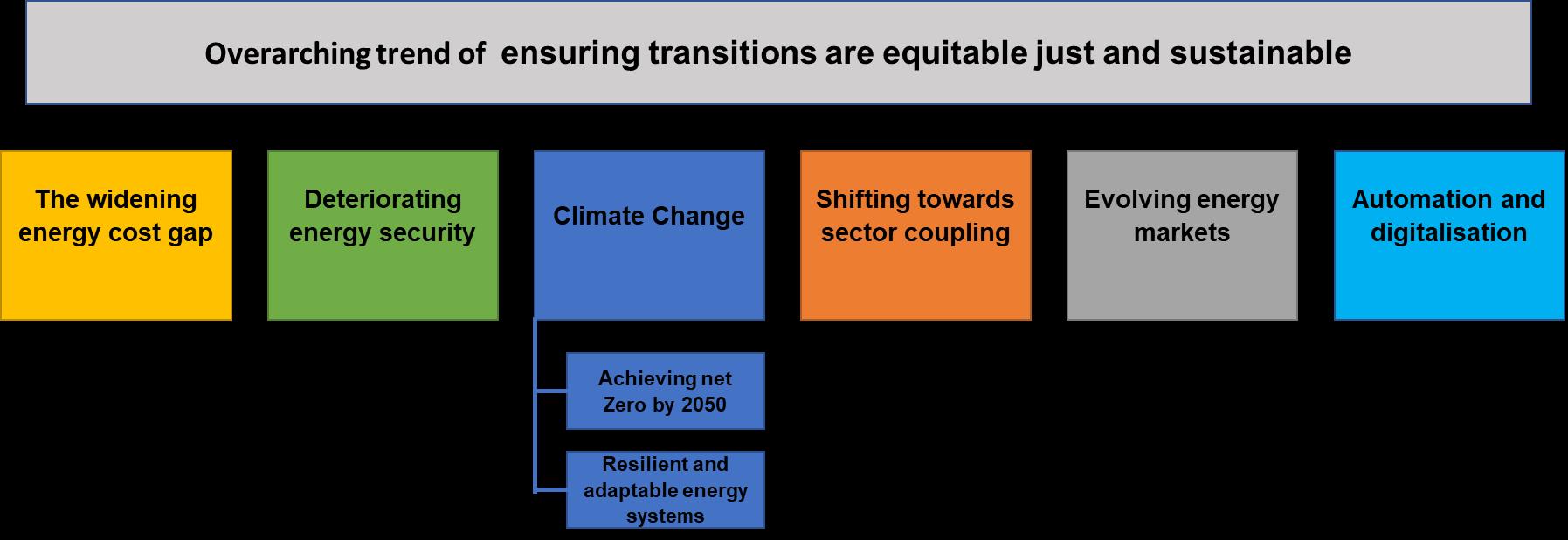
Figure 8: Top trends impacting the energy system in South Africa
widening energy cost gap
This trend is a critical aspect in the South African context as it refers to not only energy as a driver of the economy and energy affordability, but also the distribution of income across a population as measured by the Gini coefficient. In 2021, South Africa had the highest inequality in the world, emphasising the need for an equitable, just and sustainable energy transition (Stats SA, 2018). This trend therefore shows a major tension between energy costs and a variety of socio-economic issues, despite declining renewable energy technology costs. It means that innovation around how to make energy access more affordable to low-income groups will be essential (Sarkodie and Adams, 2020)

Definition Energy costs are in some cases declining, such as renewable energy technology costs, but overall energy prices are rising and volatile e.g., recent electricity price hikes, and fuel price volatility (Githahu, 2023, Woosey, 2021). This has implications for the energy choices business are taking in managing their energy security and costs and adjusting their business models. It also impacts poor households who may have access to energy services but cannot utilised them due to affordability issues (stats SA, 2018). Rising and volatile energy costs not only impact the economy but also government policy choices and the overall fiscus if economic growth is dampened as a result.
Time horizon

Probability of occurring
What it is impacted by Energy prices are impacted by various factors out of the control of any one country in most cases. These include:
● Global energy prices.
● Declining technology costs for some technologies e.g., renewables.
● Geopolitical shifts.
● Operational costs.
What it impacts The widening energy gap has an impact on a broad range of issues including:
● Investor confidence.
● Economic growth.
● Affordability.
● The ‘justness’ of the energy transition.
● Widening gap between ‘haves’ and the ‘have nots’ (disenfranchised), leading to social ills.
● The incentive to adopt energy efficiency practices.
Actions or mitigation required In order to slow and ultimately decrease this gap both government and public sectors as well as energy consumers will need to play a role:
● Promotion of energy efficiency, particularly in poor communities.
● Government to incentivise and subsidise where appropriate.
● Enabling private sector / prosumers 1 to enable resale of excess energy.
● Localisation where competitive.
● Investigation of alternative fuels (incl. green fuels).
Given the importance of energy in economic growth this trend is of particular concern as it has knockon implications that are significant for future growth and development and decarbonisation efforts. From
1 “Prosumerism is the increased involvement of customers in the production process, typified by the use of customer feedback and direct design requests in high-tech industries like computer-aided manufacturing systems and the rise of customisation in both goods and services markets” (Alderete, 2017, p1).
an electricity point of view this has been declining since 2008 and for oil has been impacted by recent decisions around refineries in the country (Eskom 2022, SANEA 2022).
Table 3: Deteriorating energy security
Trend: Deteriorating energy security
Definition
Time horizon
Energy security is defined by the IEA as “uninterrupted availability of energy sources at an affordable price and long-term energy security mainly deals with timely investments to supply energy in line with economic developments and environmental needs and short-term energy security focuses on the ability of the energy system to react promptly to sudden changes in the supply-demand balance” (IEA, 2022).
Probability of occurring
What is it impacted by
What it impacts
Short term energy security is impacted by:
● Lack of finance and skills.
● Poor maintenance or Inadequate/bad quality maintenance
● Lack of planning.
● Poor governance.
● Human behaviour.
Long term energy security is impacted by:
● Changes in technology and associated prices.
● Changes in policy impacting on energy mix and timeous decision making
● Lack of planning.
● Poor implementation.
Both long- and short-term security impacts:
● Adequacy of infrastructure e.g., grid constraints or lack of available generation.
● Economic growth.
● Investor confidence.
● Productivity.
● Ability to meet net zero carbon commitments.
● Affordability.
● Rise of prosumerism.
Actions or mitigation required
The actions required to address this trend will require extensive action over an extended period of time including:
● Adequate and adaptive planning.
● Enabling policy.
● Accessing adequate financing.
● Focus on implementation.
● Quality and timely maintenance.
● Management of sabotage.
● Strengthening and expanding the electricity grid and to make it specific, measurable, achievable, relevant, and time-bound (SMART) including a shift away from physical networks to smaller standalone networks.
Achieving net zero carbon emissions by 2050
Achieving net-zero carbon emissions by 2050 is a global objective (UN, 2023). Each country in their Nationally Determined Contributions (NDC’s) detail what they think they can achieve and by when. South Africa provided an update of this at COP 26 where it was highlighted that South Africa would need financial and technological support to reach net zero, as well as adaptation measures (Republic of South Africa, 2021a).
The timing of the transition to a low carbon economy must be in a manner that is socially just and sensitive to the potential impacts on jobs and local economies. It is in this context that engagements at global forums such as the G20 refer to ‘Energy Transitions’ and not ‘Energy Transition’ as a recognition that countries are different, and their energy transition paths will also be different due to varying local conditions. Integrated Resources Plan of South Africa 2019–20301
Given that energy comprises a large proportion*n of greenhouse gas (GHG) emissions in South Africa, this trend has a significant impact on the energy sector.
In particular, the declining use of fossil fuels as defined in the Integrated Resource Plan (IRP) and implications for the economy, as well as opportunities for more renewables, green hydrogen and Power-to-X (PtX) products in the longer term (DMRE, 2019) and Republic of South Africa, 2021b).
The Department of Mineral Resources and Energy (DMRE) as well as the Department of Environmental Affairs (DEA) and the Presidential Climate Commission (PCC) as well as other related government departments are all working on Just Transition Frameworks, required policy and enabling environments, including mechanisms for accessing funding etc (DMRE, 2022b, PCC, 2022 and Republic of South Africa 2021c)
Definition The United Nations Net-zero Climate Coalition defines net-zero as “cutting greenhouse gas emissions to as close to zero as possible, with any remaining emissions re-absorbed from the atmosphere, by oceans and forests for instance” (United Nations, 2023).
Time horizon
Probability of occurring
What is it impacted by
Whether or not South Africa is able to reach net zero carbon emissions by 2050, is impacted by a number of factors including:
● Energy consumption patterns.
● Implementation of energy efficiency and demand side management.
● The electricity mix (renewables, storage, gas, nuclear, coal).
● Green hydrogen and PtX production or importation.
● Financial support such as grants and concessional financing etc.
● The degree of electrification of the economy.
● Economic growth.
What it impacts
Actions or mitigation required
This trend has a wide-ranging impact on the entire country and every sector, but particularly the energy sector. Some of the impacts include:
● Cost of energy and therefore the cost of doing business, and energy affordability,
● South Africa’s competitiveness in global markets,
● The need for supporting infrastructure e.g., ports and pipeline
The actions required are identified in various policy documents and is predicated on the support of developed countries, particularly funding and technology transfer:
● Decisions on the pathway for a transition to cleaner fuels, including the role of gas as a transition fuel.
● This means updating the IRP and Integrated Energy Plans (IEP) that should be regularly updated every 2 years as a minimum.
● Extension of the current IRP to 2050.
● Integration of government policy, including incentives and taxes, trade issues, education, innovation systems and planning,
● National funding plan for implementation of the Just Energy Transition Investment Plan.
● Cost abatement curves.
Changes in the climate will be exacerbated in South Africa, as it is a climate hotspot. If infrastructure is not resilient and adaptive, it will result in less energy security, higher energy costs and socio-economic implications (Climate and Development Knowledge Network, 2022 and IEA, 2022c).
Table 5: Climate change: Resilient and adaptable energy systems
Definition
Time horizon
Climate change adaptation is defined as “adjustments in ecological, social or economic systems in response to actual or expected climatic stimuli and their effects. It refers to changes in processes, practices and structures to moderate potential damages or to benefit from opportunities associated with climate change” (UNFCCC, 2023).
Climate resilience is defined as “the capacity of a system to continue to function despite disturbances, either by recovery to its original condition or by some degree of transformation that changes components in a system or the relationships between components in a system” (Vasseur and Jones, 2015).
Probability of occurring
What is it impacted by
What it impacts
Adaptation and resilience will be impacted by:
● Increased climate disasters impacting on energy infrastructure
● Mass migration impacting on planning and infrastructure needs
● Access to resources
● Regional actions and geopolitics
Adaptation and resilience impact:
● Energy security
● Energy affordability
● Universal access
Actions or mitigation required Actions required include:
● Create awareness to lessen climate change impact
● Adaptation is integrated into planning
● Funding for infrastructure adaptation/new infrastructure
● Modelling for energy and climate impacts, and associated research into early warning systems (disaster risk management)
● Overlaying energy and climate modelling to optimise resource use and spatial planning

Sector coupling is driven ultimately by decarbonisation efforts and therefore climate change. It reinforces the global trend of sectors becoming less distinct and overlapping other sectors. In the energy sector, sector coupling is a result of end use electrification of sectors that previously used other energy sources, such as the transport sector shifting to electric vehicles (CCEESEM, 2022 and IRENA, 2022).
Definition Sector coupling is defined as “the electrification of energy demand while reinforcing the interaction between electricity supply and end-use” (CEESEM, 2022).
Time horizon
Probability of occurring
What is it impacted by
What it impacts
Sector coupling is impacted by:
● Decarbonisation targets
● Carbon taxes
● Cost of energy
● Innovation
● SMART technologies that allow for the integration of new electricity, utilising or producing technologies into the overall system
Sector coupling impacts:
● Carbon emissions
● Infrastructure requirements
● Business models of incumbent companies
● Demand for electricity and associated demand patterns
Actions or mitigation required
The following actions are needed:
● Enabling and integrated policies
● Creation of adequate infrastructure
● Review of grid operation standards etc
A global trend that has been happening since the 1990’s is the move away from large centrally controlled electricity systems to decentralised smaller systems.
This has been driven by technology and policy, and means that the electricity market has many more players and a set of rules around trading. It can also mean a reduction in regulation (Baral, 2021)
Table 7: Evolving energy markets
Definition Energy markets are defined as “a market handling process specifically with the trade and provision of energy, which may refer to the electrical energy market or other energy resources” (Mousavi et al, 2021).
Time horizon
Probability of occurring
What is it impacted by The rate and pace of change of energy markets are impacted by:
● Government policy.
● Market size.
● Technology trends.
● Decentralisation model adopted
● Investor confidence.
What it impacts Changes in energy markets can impact:
● Energy cost.
● Changes in energy market structures e.g. market and system operators.
● A shift in where risk is managed.
● Funding, and funding risk appetite.
Actions or mitigation required Actions required include:
● Policy changes to enable the market.
● Development of market rules.
● Risk assessments.
● Structural changes in energy players to incorporate trading functions.
● New service providers developed for the variety of energy and related markets.
Automation and digitalisation are global trends that are happening at a fast pace. They are driven by the need to optimise and reduce costs. Both will have a significant impact on the energy system Digitalisation is needed for SMART energy systems and automation, which will impact on the nature and type of energy jobs. (Ahmadab et al, 2021 and IEA, 2017)
Table 8: Automation and digitalisation
Definition The definitions of automation and digitalisation are interlinked. According to Makeitfuture (2022), “digitisation mostly aims to support work digitally, [while] automation can make it possible to carry out this work independently. Automation can only take place on the basis of digitalisation. It can be seen as the next step in the technological and digital transformation of our time.”
Time horizon
Probability of occurring
What is it impacted by Automation is impacted by:
● Global trends and need to remain competitive.
● Social/labour concerns regarding potential job losses. Digitalisation is impacted by:
● Level of investment in new technologies.
● Cost and available funding.
● Coupling to other sectors e.g. buildings and transport etc (IEA, 2017).
What it impacts Automation and digitalisation impact on:
● Increase in interconnectedness of energy systems.
● Improvements in safety, productivity, accessibility and sustainability of energy systems.
● New business models.
● New policy required.
● Available jobs and types of jobs.
Actions or mitigation required Actions required are:
● SMART technologies adopted.
● Energy system management.
● Innovation systems.
● Skills development in this new area.
These trends, although articulated separately, are all interconnected and overlap in key areas such as policy and innovation. It is shown in the trends above, what the estimated duration of the trend is as well as the estimated rate of change of that trend happening over the period 2022-2050.
It must however be noted that these trends will change in impact, pace of change and probability over time, as well as be impacted by the changes happening in the other top energy trends identified and other shifts that are global or national in nature. A consolidated picture of these trends and sub-trends is detailed below.
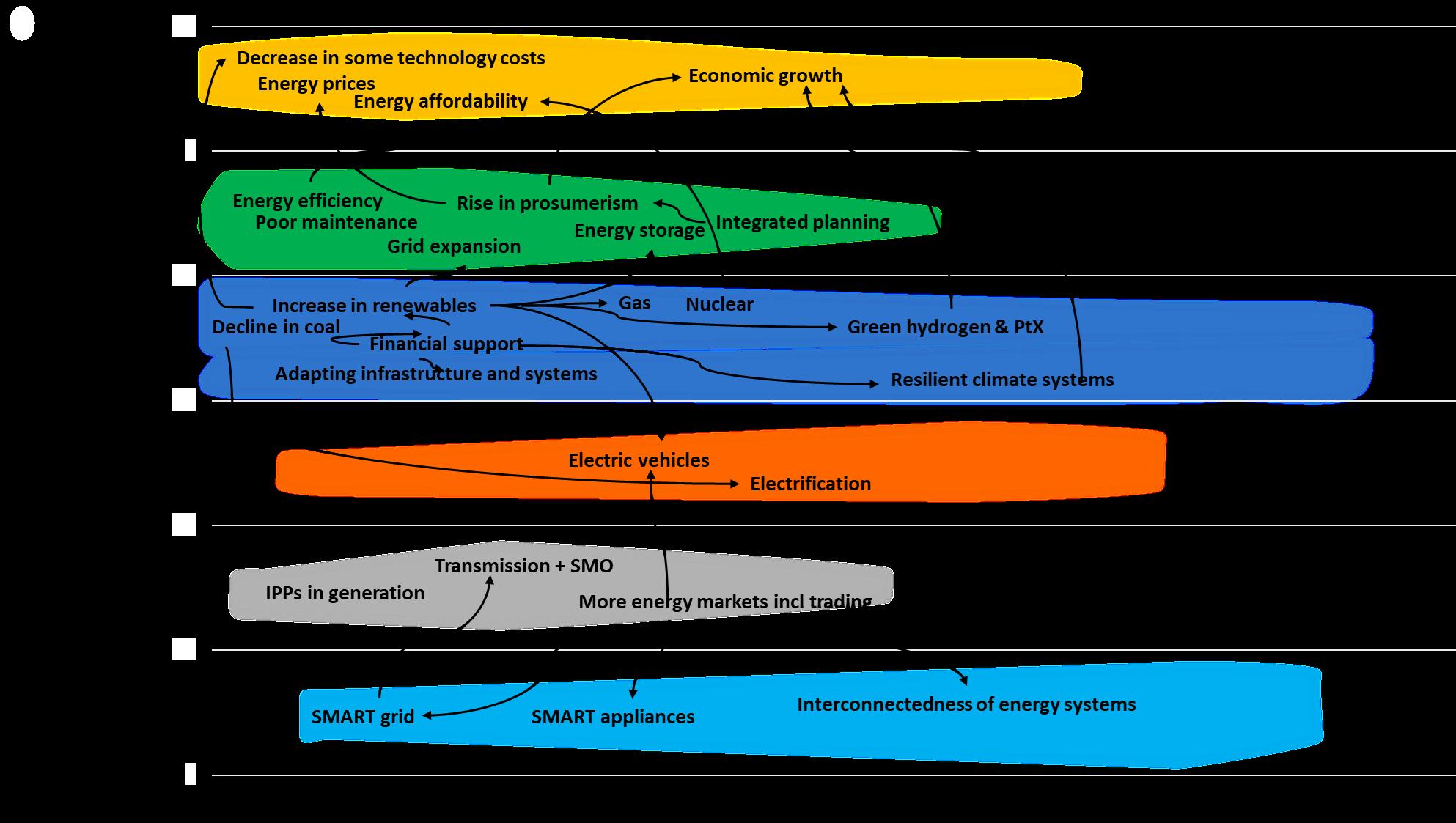
Figure 9: Consolidated trends picture to 2050
This figure shows the complexity of the landscape as well as the inter-relatedness of the issues. The central role of renewable energy is clear as well as where some key decisions will need to be taken that can change the energy sector fundamentally. It also shows how central energy security is to all the other issues and how until it is resolved, some of the other trends will be difficult to address as it is so impactful on not only the energy system but economic growth and the country itself. Automation and digitalisation are also key drivers from a skills perspective as they will result in a decline in jobs over time.
Given that skills planning has uncertainty embedded in it, it is critical to identify the different uncertainties. The International Renewable Energy Agency (IRENA, 2021) identified four major types of misalignments in skills planning for renewable energy, as outlined below:
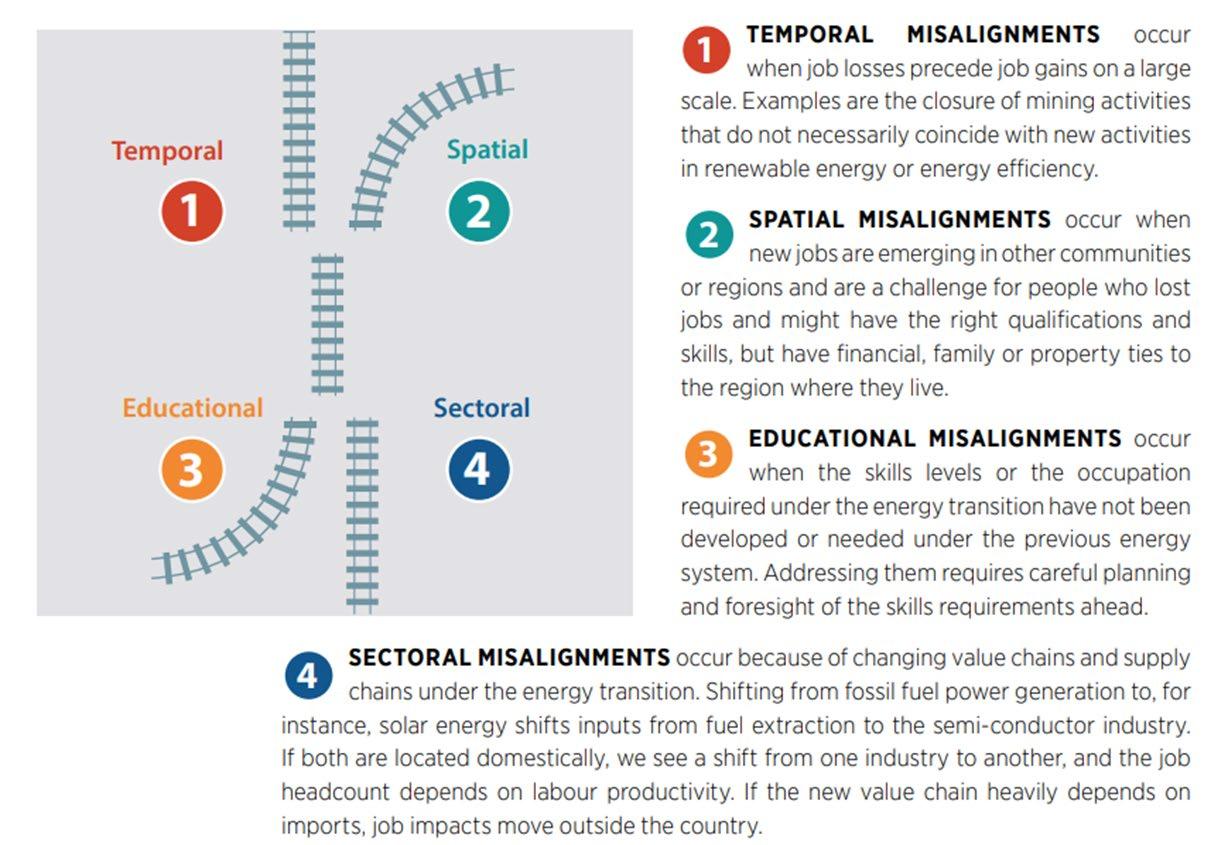
Figure 10: Misalignments in renewable energy skills development (from IRENA, 2021)
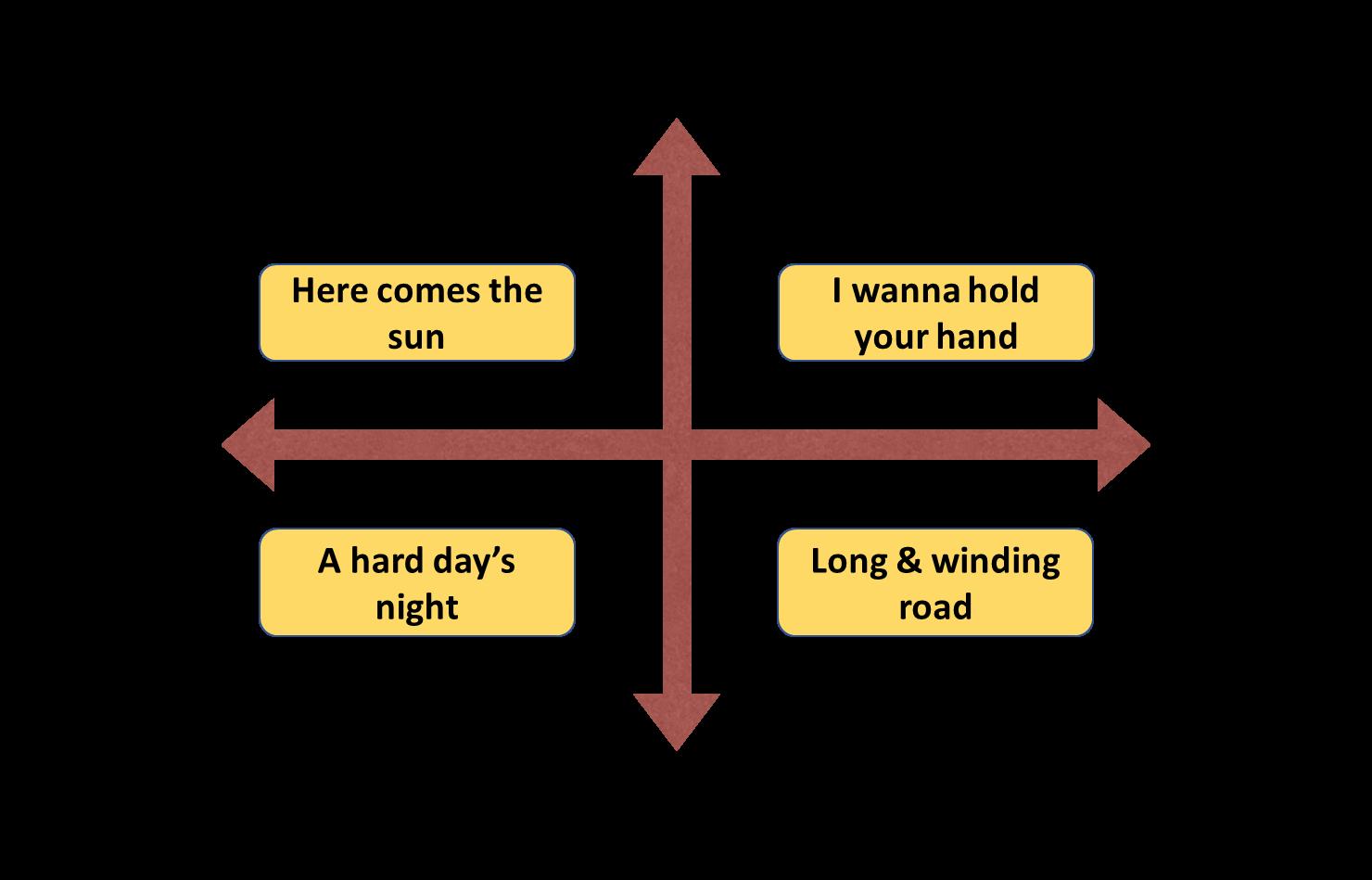
These misalignments contribute to a broader set of uncertainties that impacts skills planning. In order to assess the various uncertainties and risks that may occur over the next 30 years, a set of scenarios were developed. These scenarios allow for analysis of plausible futures that may play out, and how this will impact the key driving forces that will impact the sector in each of these futures and therefore what skills would be required. Two major uncertainties were used as the scenario extremes, namely policy (enabling and as a barrier) and economic growth (high and low). This allowed for the identification of four distinct scenarios (inspired by Beatles songs):
● Here comes the sun (high economic growth and enabling policy).
● I wanna hold your hand ((high economic growth and policy barriers).
● A hard day’s night (low economic growth and enabling policy).
● A long and winding road (low economic growth and policy barriers).
Using the scenarios, no regret options can also be identified i.e., skills that are needed in every scenario no matter what. Skills that only occur in one or two of the scenarios could be developed locally as a risk mitigation measure, or imported internationally, if necessary. Therefore, a skills strategy can be put in place that is risk (positive and negative) based. Detailed storylines were developed for each of the scenarios as detailed below:

The country is growing at >5% GDP per annum and as a result the demand for energy is rapidly increasing. Government has reviewed and integrated policy to maximise investment in the energy sector by reducing red tape, putting in place one stop shops for bundled licencing and approvals and integrating policy across all relevant departments. Due to high levels of climate financing, Eskom coal plants are shut down early and replaced with renewable energy, storage and gas in the early part of the period as a transition fuel. Finished petroleum products are imported into the country. Sasol converts its plants to green hydrogen and PtX products over time and green hydrogen and PtX investment increases significantly. Investors bring in much needed investment and climate financing. Localisation increases and SMART systems, prosumerism and open markets are in place by 2050,
I wanna hold your hand

The country is growing fast but cannot keep up with energy demand as policy development and implementation are very slow. Investors have projects but cannot get licencing and other approvals in place. As a result, there is a huge growth in self generation and prosumers as they scramble to get energy to meet their growing demands. Some companies are moving their plants just across the border to take advantage of available power in the region. Given the policy uncertainty oil refineries close and finished petroleum products need to be imported putting pressure on port infrastructure. Gas investment does not happen due to policy uncertainty, but modular renewables do as they are not dependent on as many government approvals and can be put in place quickly. Eskom stays vertically integrated and so more wheeling takes place, cutting Eskom out of the picture. Green hydrogen begins but due to policy barriers does not reach its full potential.

The country is experiencing very slow economic growth of 1% and government is putting in place enabling policy to try and stimulate the economy through investment in clean energy. The country has received extensive climate funding and is replacing its coal fleet with renewables, taking advantage of the slow growth to invest in the grid and SMART technologies. Self generation and prosumers are growing albeit slowly. Green hydrogen is being strongly promoted and barriers to investment taken away. Energy security improves due to the slow growth and replacement of the old, coal fleet, Net Zero is achieved by 2050. Eskom is split into 3 companies and new players enter the market which is well run and enables energy trading across the country. Eskom is however still experiencing financial difficulties as their revenues decline.

The country is in a major slump, GDP is less than 1% or negative and energy demand has fallen reducing revenue and seriously compromising the going concern status of SOE’s. Government is slow to develop policy and implement it and does not consult widely, so policy is not business friendly, constraining economic growth and energy development. Investment has been hard to source; coal plants have had their lives extended and it is unlikely South Africa will meet its NDC commitments. Only a few IPPs have been added and Eskom remains vertically integrated, so an energy market has not developed despite serval attempts to set it up inside Eskom. Energy security is a major problem with ongoing loadshedding and prosumerism has exploded with everyone deciding to source their own energy. There is no money for investment in the grid, SMART or additional renewables for green hydrogen.
Figure 12: Detailed storylines for each of the energy scenarios
The changes in the key driving forces for each scenario are detailed in the table below.
Table 9: Key driving forces for each energy scenario
Using the scenarios, it is evident that there are a few areas where there are synergies across the scenarios (three or more) and where no regret options in terms of skills can be taken. These are as follows:
● Renewable energy (and by association Grid and SMART).
● Energy efficiency (and by association SMART).
● Prosumerism (and by association renewables).
● Finance.
● Energy security especially, in the near term.
There are those areas where there are low requirements across the scenarios where decisions will need to be taken as to whether or not skills are required to be developed or not. This category could also include when they should be developed to make sure they are either available when needed or developed too early and there are no jobs available. These include: gas, nuclear, market, and green hydrogen and PtX.
There are those areas that are declining in terms of skills namely coal and oil. Finally there are skills required to make the transition just, no matter what the scenario: Socio-economic analysis, and innovation.
These uncertainties change over time, as seen in the scenarios above. High and low uncertainties over the three time periods assessed are illustrated below:

This section provides an overview of the current energy sector labour market, reviews current and future energy job demand, implications on the world of work and the post-school education system. It is important to understand the current labour market to assess the likely impact a just transition will have on the world of workoccupations and skills likely to go into decline, those that require upskilling or reskilling, and ‘new’ jobs.
Data gathered through document research, the workshops and job advert analysis provided detailed insights into current and future occupation and skills requirements (demand). These are presented against each of the identified trends, as well as the implication of the trend on the world of work.
To ensure that the energy system can be adequately resourced during the transition process, it is also important to understand the implications the current and future occupation and skills requirements will have on the country’s post-school education and training (PSET) system.
In this regard, a detailed identification and analysis of current energy related courses offered in the country was undertaken. This illustrates current education provision, and when correlated with current and future employer occupation and skills demand it is possible to identify areas that are adequately covered, or where skills gaps exist. An assessment of supply versus demand on the PSET system is presented by core trend.
In 2019, it was estimated that 41 million people were employed globally in the energy sector, with an additional 24 million indirect employees involved in e.g. vehicle manufacture and energy efficiency (IEA, 2022).
The figure below illustrates the global employment profile by energy sector in 2019. It indicates the main sectors of employment are end use vehicles (21%), oil and gas (18%), energy efficiency (17%) and power generation (17%) (IEA, 2022).
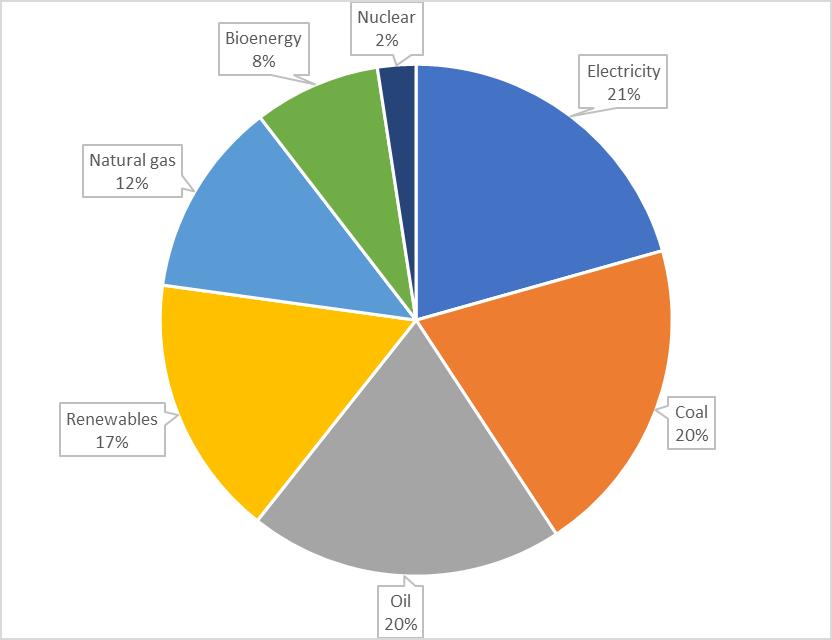
Source: Derived from IEA (2022).
Figure 14: Global energy employment profile, by sector (2019).
In comparison, Africa’s energy sector employment profile illustrates some differences to the global profile (see the figure below). Most notably, is the dominance of the oil and gas sector as an employee (41% of total employed). However, in the sectors of energy efficiency and end of use vehicles, the continent employs significantly less than the global average. This indicates a focus on fossil fuel and power generation activities as the main employers, with fewer employees involved in clean energy. This is the reverse for Central and South America, Europe, China, India and Asia Pacific (IEA, 2022).
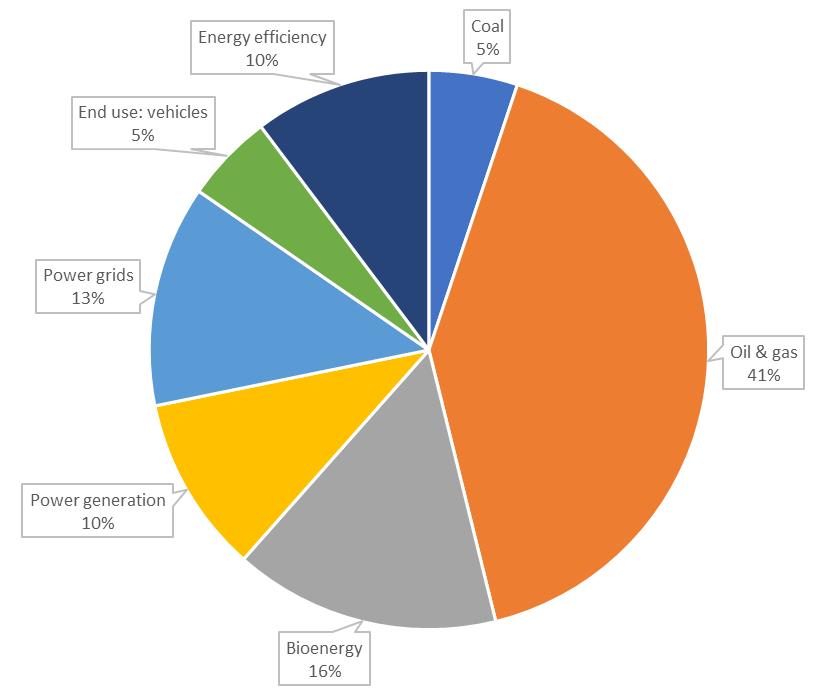
Source: Adapted from IEA, 2022.
Figure 15: Africa energy employment profile, by sector (2019).
Regarding global renewable energy sector employment, an estimated 12.7 million people were employed directly and indirectly in 2021 (IRENA, 2022). Solar dominates employment numbers (34% of total employed), followed by liquid biofuels (19%), hydropower (19%) and wind energy (11%) (IRENA, 2022). In Africa, an estimated 320,000 people were employed in the sector in 2020, of which 23% were in southern Africa (Kamer, 2022)
In terms of employment trends in the global energy sector, the IEA (2022) suggests that clean energy transitions and decarbonisation of energy are the predominant trends reshaping global energy employment. For example, it is estimated that 50% of total energy workers are employed in clean energy, which indicates the significant growth in this area (IEA, 2022). This is corroborated by IRENA (2022), who suggest employment in the renewable energy sector continues to grow, and has grown by 10% since 2012. Most growth is in solar photovoltaics (PV), bioenergy, hydropower and wind power.
By 2030, this transition to clean energy is predicted to generate approximately 10.3 million new jobs (from 2021) globally (Wallach, 2022), with energy efficiency, cars, power generation, grids, bioenergy and end-use renewables all gaining over 1 million new jobs (see Table below). As a counterbalance, most job losses in this transition are going to be witnessed in coal and oil and gas, as fossil fuel demand decreases (Wallach, 2022).
Table 10: Estimated job gains/ losses associated with the transition to clean energy (2021-30)
Source: Adapted from Wallach (2022).
Other employment trends identified for 2022 include (IEA, 2022):
● 60% of the workforce is employed in construction of new projects e.g., building power plants, bringing oil wells online and laying pipelines, manufacturing cars, carrying out efficiency retrofits and installing efficient electric heat pumps.
● The need to transfer fossil fuels workers to low-carbon sectors and activities. With energy decarbonisation employment opportunities set to grow and outweigh the decline in fossil fuel jobs.
From a skills level perspective the IEA (2022) notes that the sector, in the main, requires higher-skilled workers, with jobs in research and development for new projects on the increase.
Gender is also a core dimension of employment in the sector. The percentage of women employed is considered to be relatively low at 22%-25%, in comparison to other sectors (IEA, 2022; Trace, 2020). In sub-Saharan Africa women are estimated to comprise less (16%-20%) than the global average in the sector (Stolar, 2021). Within the renewable energy sector, it is suggested that percentage is slightly higher, at 32%, and likely due to the more multidisciplinary nature of the sector (IRENA, 2019).
Drawing on the various statistics on the number of people employed per main energy sector in South Africa, it can be estimated that 667,300 people are directly and indirectly employed across the sector. The coal, and oil and petroleum sectors employ the most people. The Figure below provides an overview of estimated employment split by the energy sector in South Africa. It should be noted that employment figures in South Africa’s energy sector, especially renewable energy, are not always easy to ascertain. Renewable energy is often presented as potential rather than current employment (Hermanus, 2022; Meridian Economics, 2018).
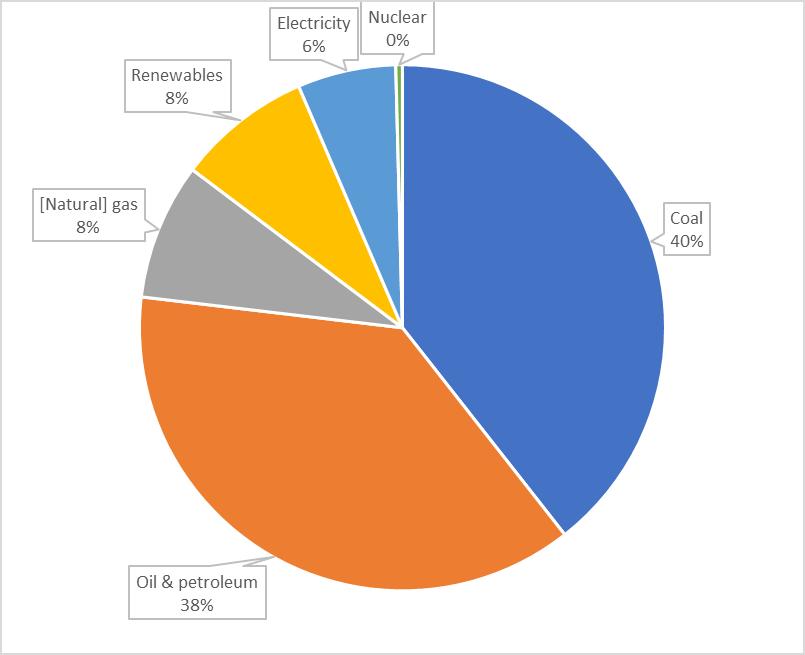
Sources: Rennkamp and Bhuyan (2017), DMRE (2022), Hako (2022), Hermanus (2022), IRENA and ILO (2021), Sapia, (2019), Skidmore (2021), Statista (2022), StatsSA (2022a).
While it could be assumed that a transition to cleaner and renewable energy will have begun to realise the predicted job losses in coal, and the oil and petroleum sectors (discussed further under Climate change - achieving net zero by 2050 in the section below), this has not necessarily been the case. For example, for the period 2012 to 2019, the coal mining sector saw an increase of 17,100 jobs (Khumalo, 2021), and the oil and petroleum sector continued to employ 1.5% of the country’s total workforce in 2019 (SAPIA, 2019). While jobs in these two sectors appear to remain stable, the decrease over time in coal-fired power plants could see employment in the coal sector decline by almost 50% by 2050 (Okunlola et al., 2019).
This increase however, has not been witnessed in the electricity sector, which has seen a decline of approximately 4,500 jobs since 2012 (StatsSA, 2022a). Some of these losses may be attributed to the impact of Covid-19 (Jenkin et al., 2021). While this decline is an overarching trend within the electricity sector, Eskom - who are a major employee - have to the contrary increased their employee numbers from 30,000 to 40,000 between 2008-2019, yet productivity has decreased (Anon, 2019). In an interview with Eskom’s 2019 Chief Operating Officer, Oberholzer indicated that the utility does not have the funds to retrench people, as it is too expensive to do so. If they were to retrench people, this would see major job losses of between 10,000 – 14,000 people (Anon, 2019). Given this large-scale impact, the utility finds itself in a difficult situation. One of the solutions is to improve performance through optimising the workforce, or to transition those currently in Eskom (who have immense experience, knowledge and skills) to other industries that have a positive outlook, e.g., renewables.
While current renewable energy employment figures are estimates for solar and wind Renewable Independent Power Producer Programme (REIPPP) projects only (see Table 11 above), the sector is considered to have vast employment potential (Okunlola et al., 2019), with much emphasis placed on potential job creation. Research suggests that a scale up in renewables could see a 40% increase in jobs in the sector by 2030 - the equivalent of 580,000 job years, and 1.2 million along the renewable energy value chain (Okunlola et al., 2019).

For a skills roadmap it is useful to understand where along a sector’s value chain jobs currently sit, as it is these jobs that are most likely to be impacted by a just transition of the sector. These are highlighted, where identified, in the Table below:
Table 11: Predominant activities associated with jobs in South Africa’s energy sectors
Energy sector
Coal
Electricity
[Natural] gas**
Nuclear
Predominant job activities
The majority of jobs in this sector are associated with coal mining and transportation (Patel et al., 2020).
A variety of jobs are associated with the generation, transmission and distribution of electricity. These include those involved in customer services, engineering, environment and safety, finance and management, human resourcing, maintenance and operations, marketing, performance and works planning, and property management (Eksom, 2023).
While the exploration and extraction of gas is not a major activity in South Africa, it is considered an area of significant employment potential as exploration companies set up offices in South Africa to exploit the country’s gas reserve potential (MOGA, 2018).
Currently most jobs in the sector are associated with the operation of the Koeberg nuclear power plant (Rennkamp and Bhuyan, 2017).
Oil & petroleum (liquid fuels) Retail forecourts and convenience stores employ the majority (52%) of people in the sector, followed by financial and business services (12%), agriculture (11%), transport (5%) and mining (4%) (Sapia, 2019).
Renewables
The majority (80%) of jobs registered under REIPPP in 2020 occurred in construction, which provides less permanent employment, and can be experienced in peaks and troughs, which are often linked to funding cycles. The remainder of the jobs are predominantly permanent, and within operations and maintenance IRENA and ILO (2021).
With regards to gender, the majority of employees in the South African electricity and gas sectors are male, with 35% of women making up the electricity workforce, and 26% in the gas sector (StatsSA, 2022a). This correlates with, although could be considered slightly higher than, the global average for women in the broader energy sector (22%-25%) (IEA, 2022; Trace, 2020), and higher than the subSaharan energy sector (16%-20%) (Stolar, 2021). However, within the renewable energy and oil sectors, women make up as little as 10% of REIPPP projects (IRENA and ILO, 2021) (compared to the global average of 32% (GETI, 2021, IRENA, 2019)) and less than 15% in the oil sector (Patel et al., 2020).
From a justice and/or decent work perspective, monthly earnings could be indicative of fair pay within the sector. The estimated average monthly earnings for employees in the electricity, gas and water supply sector was estimated at R44,279.00 2 per month (StatsSA, 2022). The highest across all sectors. This is significantly higher than, for example, the manufacturing (R19,994.00/month), construction (R19,775.00/month), and Wholesale and Retail (R15,747.00/month) (StatsSA, 2022). Jobs drawing the highest salaries in this sector are involved in ‘manufacturing coke oven products, petroleum refineries,
2 This excludes bonuses and overtime (StatsSA, 2022).
and processing of nuclear fuel’ (BusinessTech, 2022). Within the electricity sector, monthly wages can vary significantly, with average monthly salaries within Eskom ranging from e.g., R6,030.00 per month for a general worker, and R48,220,00 per month for a Senior Supervisor (Indeed, 2022). It is possible that these higher than average monthly earnings are related to the level of education and skills required (Jenkin et al., 2021).
Aside from nuclear employee incomes illustrated above, the rest are situated within or are inextricably linked to the fossil-fuel sector. Which correlates with the ‘enormous number of jobs’ in carbon heavy sectors in South Africa, such as coal mining and the liquid fuels sectors (Burger, 2022, Cannard, 2020) (see Figure 15 above). As a result, the trend to shift towards net zero by 2050 through a reduced reliance on coal and liquid fuels will have both opportunities and risks for those currently employed in the sector. This is explored in more detail below.
This section outlines the potential shifts and changes in the labour market that could be experienced should and when the trends identified in Section 2 are realised. This is done through the lens of how each identified trend will impact the world of work in South Africa’s energy sector, with a particular focus on occupations and core jobs impacted. This reflection on the world of work in turn informs the likely occupations and skills required along a short, medium and long-term time horizon. Such an understanding can inform the planning and provisioning of education and training to develop a 250,000 strong or more workforce (Burger, 2022) that has the capacity and capabilities to respond to the trends and requirements to transition the energy sector to one that is just, sustainable and resilient.
This overview is presented within the current labour market context - one in which fossil-fuel-related jobs are the most dominant, yet energy policy and vision requires a significant shift to decarbonisation and net-zero by 2050. Given that decarbonisation of the sector requires a major shift away from and/or reduction of fossil-fuels in the country’s energy mix, this will have significant implications on current jobs in the oil and gas, and coal sectors. In turn a growth in clean and renewable energy provides an opportunity for those currently employed in fossil-fuel sectors to potential transition to these growth sectors, and the creation of new jobs. This context is reflected and acknowledged in the implications of the identified trends in the world of work tables below.
It is important to note that while interpreting the list of occupations along the time horizon that these are indicative of those likely to be most in demand in a given period, but this will depend on various scenarios (e.g. recognition of gas in the energy mix) and rate of implementation.

Time horizon
Impact on the world of work
Minor occupation groups
● Increased energy prices impact vulnerable households - policy makers need to ensure protection measures e.g., laws and subsidies to mitigate social impact of rising prices.
○ High prices can result in theft or an inability to pay (SADC, 2020). Energy safety nets can be considered to support low-economic communities with schemes like free basic electricity. In addition, the implementation of theft protection mechanisms need to be put in place. Individuals will be required to advise and implement such mechanisms.
● An increase in the price of electricity can have a short-term negative impact on workers in all economic sectors, notably those that are energy intensive e.g. industrial (chemical and petrochemical, and iron and steel) and mining sectors (DMRE, 2022a). However, increased prices can lead to an optimisation in energy use resulting in cost savings and therefore job retention. Vulnerability to energy price shocks will require:
○ Employers to improve management or control of energy consumption, and implement energy efficiency policy and reduction activities, and
○ Householders to better understand and reduce their energy usage.
● Government officials (advisors) and regulators are required to develop and implement energy sector master plan(s) to recognise universal access to reasonably priced electricity, develop and advise on electricity tariffs, enable the trading of privately produced energy to generate income, and to incentivise energy efficiency practices, especially in energy intensive industries.
● Legislators and Senior Officials
● Managing Directors and Chief Executives
● Professional Services Managers
● Mathematicians, Actuaries and Statisticians
● Finance Professionals
● Social and Religious Professionals
● Sales, Marketing and Public Relations Professionals
● Legal Professionals
● Regulatory Government Associate Professionals
● Legal, Social and Religious Associate Professionals
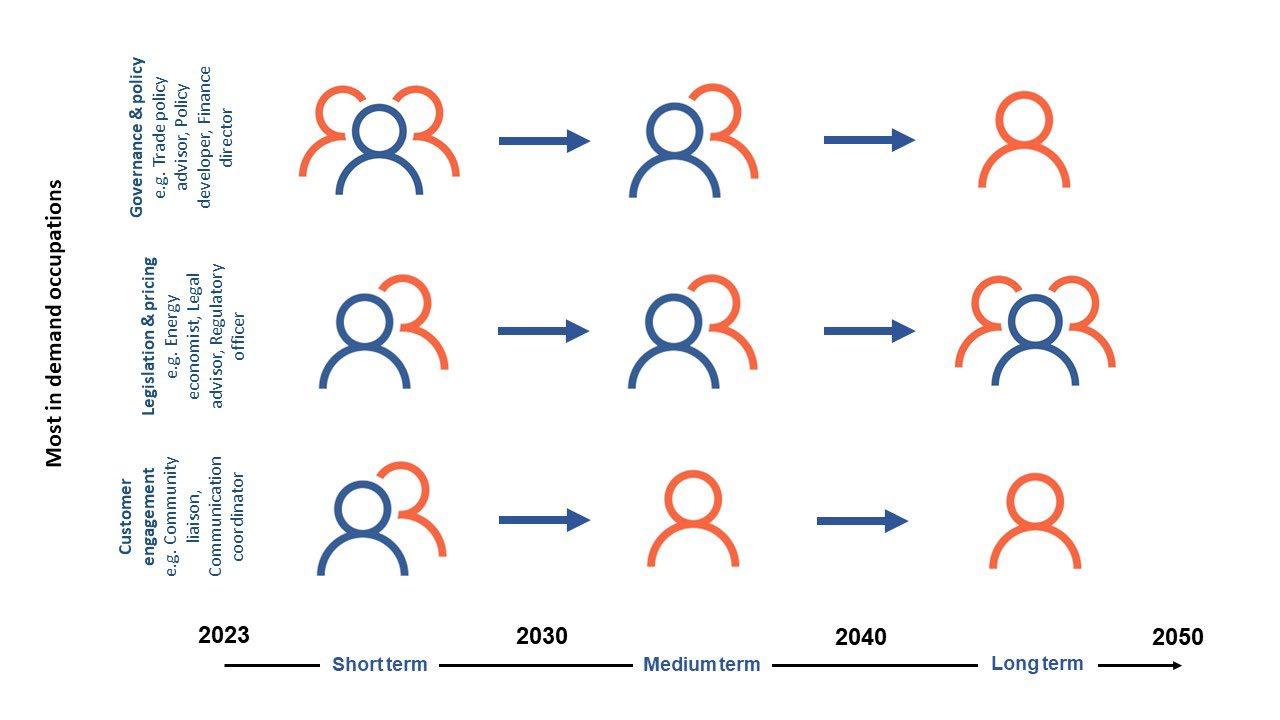
The most in demand occupational groups associated with this trend are those involved in governance and policy, legislation and pricing, and customer engagement. Given the urgent need to deliver affordable and universal electricity access initial focused policy and implementation is required in the short term. While these roles will also be required long-term, the extent of the activity, and therefore employment demand for e.g., policy advisors will decrease.
The reverse is the case for those involved in legislation and pricing, who while being involved in informing policy will become more active in implementation, such as developing appropriate legislation and regulation, or pricing structures. In the case of occupations involved in customer engagement, these occupations are likely to be most active in the short terms, as community liaisons engage with energy users to determine affordability challenges and implementation plans.
Source: Author derived.
Figure 17: Most in demand occupations for the widening energy cost gap
NOTE: Human icons present an illustration of scale of demand from one person suggesting the group of occupations will be in demand but not in large numbers, and six people denoting large occupation demand and large numbers of individuals required to implement or mitigate a trend.
Time horizon
Impact on the world of work
Minor occupation groups
● To transform the generation of electricity into an effective and efficient operation that the country’s businesses and population can rely on, good leadership and management, union negotiation; policy development; planning, implementation (including quality control) and monitoring; risk mitigation (including security); financing; coordination and core maintenance skills are required (Peyton, 2022).
○ Given the need for maintenance skills (an estimated shortfall of 40,000 artisans in the country), emphasis on electrical / maintenance technician and planning training is critical (accredited / certified) (Alphonsus et al., 2021).
○ Recruitment of skilled personnel, including former Eskom personnel, to work with current permanent teams to resolve urgent issues and to transfer skills to permanent staff (Gerber, 2022).
● With the transmission grid facing constraints there is a need to expand the grid, to incorporate renewables and mini grids (see Climate changeachieving net zero by 2050 trend below). This will require individuals with the knowledge and skills to seek investment; finance, coordinate and implement the expansion. It is likely that these skills will be required in more decentralised nodes of activity e.g., districts and municipalities (see the evolving energy markets trend below).
● Legislators and Senior Officials
● Managing Directors and Chief Executives
● Mathematicians, Actuaries and Statisticians
● Engineering Professionals
● Architects, Planners, Surveyors and Designers
● University and Higher Education Teachers
● Vocational Education Teachers
● Finance Professionals
● Legal Professionals
● Physical and Engineering Science Technicians
● Process Control Technicians
● Financial and Mathematical Associate Professionals
● Sales and Purchasing Agents and Brokers
● Machinery Mechanics and Repairers
● Electrical Equipment Installers and Repairers
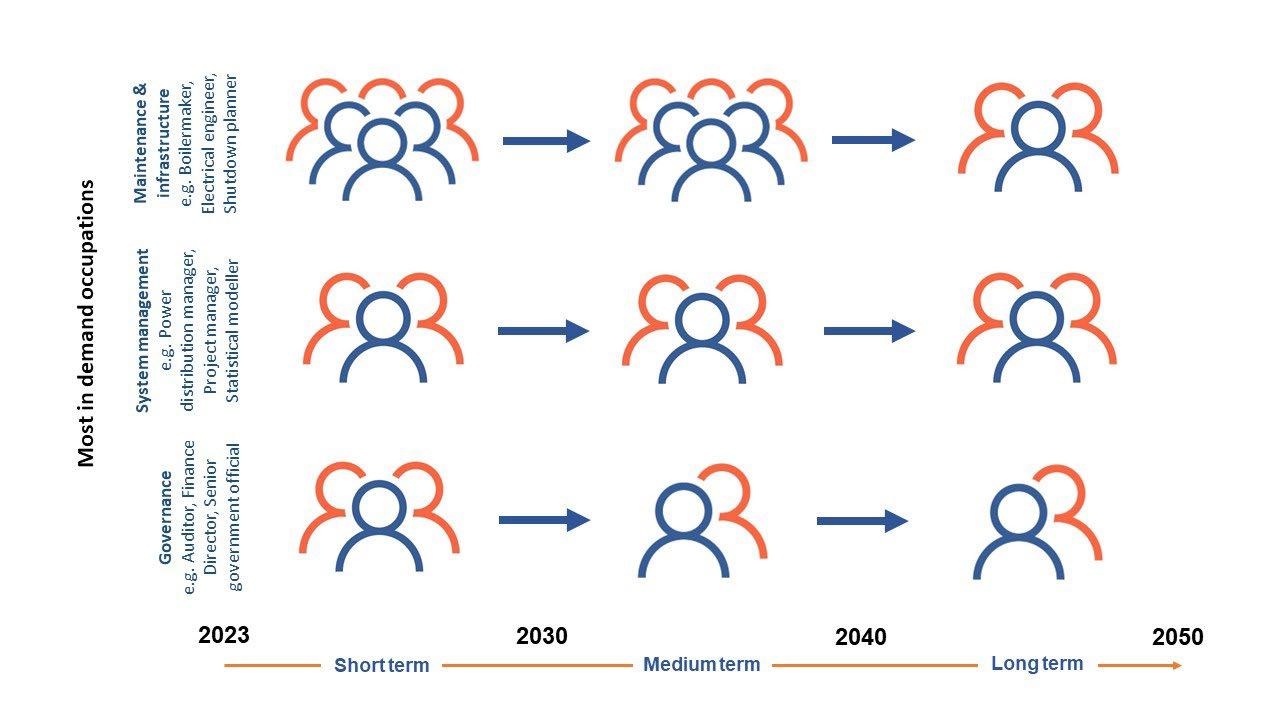
The most in demand occupational groups associated with this trend are those involved in maintenance and infrastructure, system management, and governance. Given the current electricity crisis and need to reduce breakdowns there is and will be an immediate large-scale need for those involved in maintenance and repair of power generation plants and infrastructure. Into the medium term offline planned maintenance will remain critical, not only for Eskom, but also IPPs and large energy users, such as mining and manufacturing. As the initial critical large-scale maintenance and repair activities are
completed, standard maintenance planning and implementation activities and roles will be require to ensure levels of efficiency and output are maintained. The same trajectory of demand is expected for those involved in managing the energy system, however, it is anticipated that not as many individuals within management and operations will be required as those involved in maintenance and repair. Regarding governance, these roles are critical in the immediate short-term for steering South Africa’s energy system out of the current crisis, this includes e.g. senior ministers, chief operating officers, finance directors, auditors and energy specialists. While still required in the medium and long term, the intensity of demand should drop off.
Source: Author derived.

Time horizon

Impact on the world of work
● A transition to low- and net zero carbon will require a change in the country’s energy mix, new technologies, new energy pathways and revised cohesive plans, aligned policy, new operating and integration models and new employment pathways. This will present new work opportunities, likely an increase in jobs (estimated 180,000 jobs by 2035 and 468,000 jobs by 2050 via decarbonisation of the energy sector), but also timing and employment risks. Long-term transition planning, guidance and financing is critical (Burger, 2022; Cozzi and Motherway, 2021; Hanto et al., 2021; Okunlola et al., 2019), and requires up to date, aligned and clear vision and policy e.g. Integrated Resource Plan (IRP) (Creamer, 2022; Evans, 2021).
● This significant shift will require a detailed review of current education and skills provisioning in the country and how it aligns with short, medium and long term skills demands. This is likely to result in the refinement and development of new education programmes, courses, research and curricula (Heppelthwaite et al., 2022).
Shift from fossil fuels / decarbonisation:
● A shift away from and reduction in use of fossil-fuels will result in reduced employment and affect local communities associated with coal mining and logistics, and most likely the oil and gas sectors too (Patel et al., 2020; Skidomore, 2021) 3
o The shift away from coal is estimated to result in significant job losses in the sector - 48% by 2050 (Montmasson-Clair 2021; Okunlola et al., 2019). This shift will affect management and professional, process operators, maintenance personnel and artisan, truckers and clerical personnel working in these sectors. While most of these occupations listed are likely to find alternative employment outside these sectors, coal miners and process operators will be the most affected and/or unlikely to find like-for-like positions. Approximately 80,000 coal miners and 120,000 value chain jobs are at risk. This is compounded by 80% of the coal workforce having a matric or less. Therefore education, upskilling and reskilling will be critical to ensure e.g. coal miners can easily move into other sectors (Burger, 2022; Gatticchi, 2020; Hanto et al., 2021; Montmasson-Clair, 2020; Patel et al., 2020).
o This shift will also have an impact on the localisation of jobs e.g. from Mpumalanga to Northern Cape (solar PV). There is a need to ensure no one is left behind e.g. alternative job provisioning in current location, or relocation is considered, well planned and targeted in communities that are impacted (Cozzi and Motherway, 2021; Hanto et al., 2021; IRENA and ILO, 2021).
o Skills will be required in labour force and community stakeholder engagement and negotiation to realise a just transition for this sector of the workforce and associated communities (Patel et al., 2020).
o Decommissioning or retrofitting of coal-fired plants will require unique skills and knowledge, as well as upskilling of the current coal-fired power workforce (EWSETA, 2021; Meridian Economics, 2018).
3 Due to the numerous strands of occupation and skills considerations and contexts, this report cannot do the impact on fossilfuel jobs justice. However, the authors wish to acknowledge the significant work undertaken in this area in the COBENEFITS project (see e.g., Okunlola et al., 2019), the Presidential Climate Commission (see e.g., PCC, 2022) and TIPS (see e.g. Montmasson-Clair, 2020 and 2021).
Minor occupation groups
Renewable energy (solar, wind, biomass):
● The growth of the renewable energy sector will require the necessary jobs and skills to fulfil the sector's growth potential, including jobs in planning and strategy, research and development (R&D), technology manufacture, installation and construction, operations, management and maintenance, sales and marketing, and associated clerical and technical work. Increasing the share of renewables will increase employment opportunities (Cozzi and Motherway, 2021; Okunlola et al., 2019), with this demand partially substituting the decline in coal-related jobs (Hanto et al., 2021). While predictions for renewable energy job creation numbers vary, the following have been suggested: Wind (130,000 direct and in- direct up to 2030) (Burger, 2022).
● Currently there is a scarcity of specialist renewable energy technical and managerial skills. This will require the education, training and upskilling of e.g. engineers and technicians to shift into renewables (BusinessTech, 2022a; Altgen, 2021).
● There is likely to be a shift away from corporate monopolies to privatisation and decentralisation. More responsibility will fall on local municipalities to procure, negotiate and set tariffs, trade and manage the electricity generated within their jurisdictions (see the Evolving Energy Markets trend below).
Clean energy (automotive, industry, green hydrogen, nuclear)
● Clean energy, such as efficiency, new technologies and automotive will require new roles or upskilling of the existing workforce in industry to manufacture, procure, install, maintain and monitor low-emission products e.g. electric vehicles, appliances and technologies e.g. green hydrogen (Cozzi and Motherway, 2021).
Energy efficiency:
● See the widening energy cost gap trend above.
● Legislators and Senior Officials
● Managing Directors and Chief Executives
● Business Services and Administration Managers
● Sales, Marketing and Development Managers
● Manufacturing, Mining, Construction and Distribution Managers
● Life Science Professionals
● Engineering Professionals
● Architects, Planners, Surveyors and Designers
● University and Higher Education Teachers
● Vocational Education Teachers
● Finance Professionals
● Sales, Marketing and Public Relations Professionals
● Legal Professionals
● Social and Religious Professionals
● Physical and Engineering Science Technicians
● Mining, Manufacturing and Construction Supervisors
● Process Control Technicians
● Sales and Purchasing Agents and Brokers
● Regulatory Government Associate Professionals
● Sheet and Structural Metal Workers, Moulders and Welders
● Machinery Mechanics and Repairers
● Electrical Equipment Installers and Repairers
● Mining and Construction Labourers
The most in demand occupational groups associated with achieving net zero carbon emissions by 2050 are those involved in policy and planning, legislation, governance and management, design and implementation, operations and maintenance, education and awareness.
The most recognised shift over time associated with this trend will be a decrease in jobs associated with coal mining and oil and gas in the medium to long term, and the exponential demand in renewable and clean energy jobs from the short term.
The increase in renewable and clean energy jobs are however somewhat different e.g. for renewables there is an expected short term demand of construction and installation associated jobs, which will shift to operations and maintenance in the medium to long term.
In the case of clean energy, and green hydrogen and biofuels the exponential growth in design, construction and operations is likely to be realised in the medium to long term, with short term activities focused on policy and strategy development.
Energy efficiency on the other hand mirrors the occupation demands of the energy insecurity trend, in the sense that much emphasis is placed on operations and maintenance, as well as education and training of the individuals entering these roles.
Given that South Africa is an energy intensive country, these occupations will be in both high demand and require large numbers to ensure consistent and effective maintenance and repair throughout the short, medium and long term.


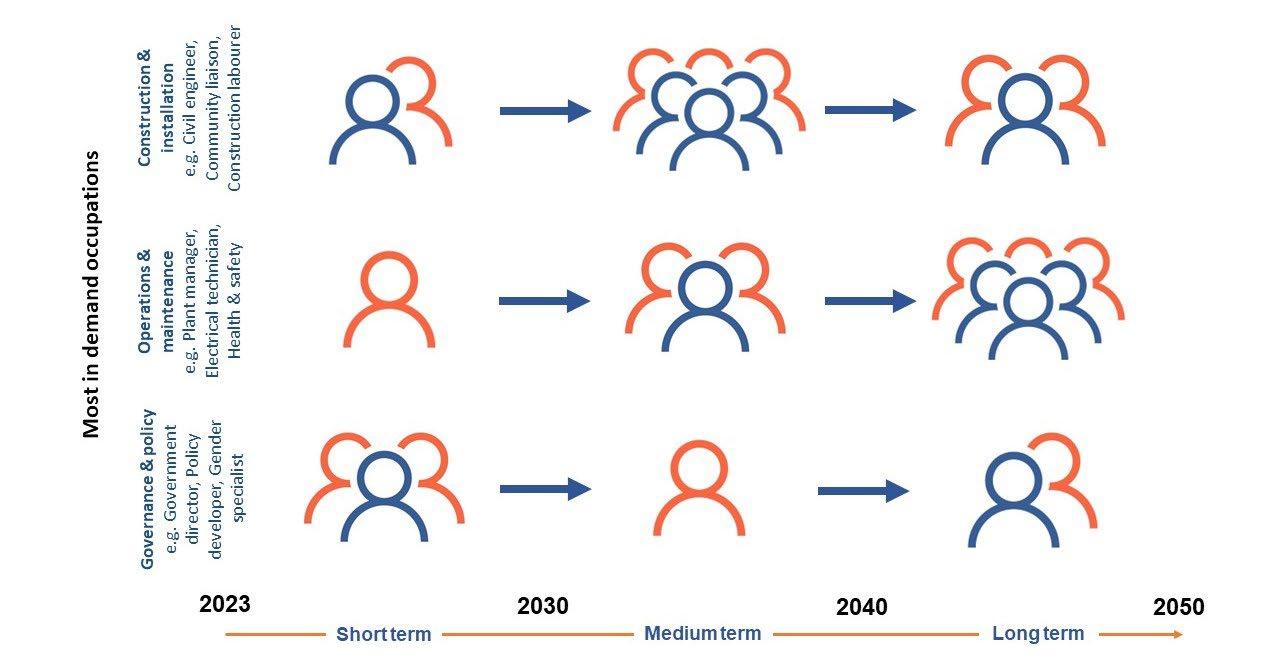
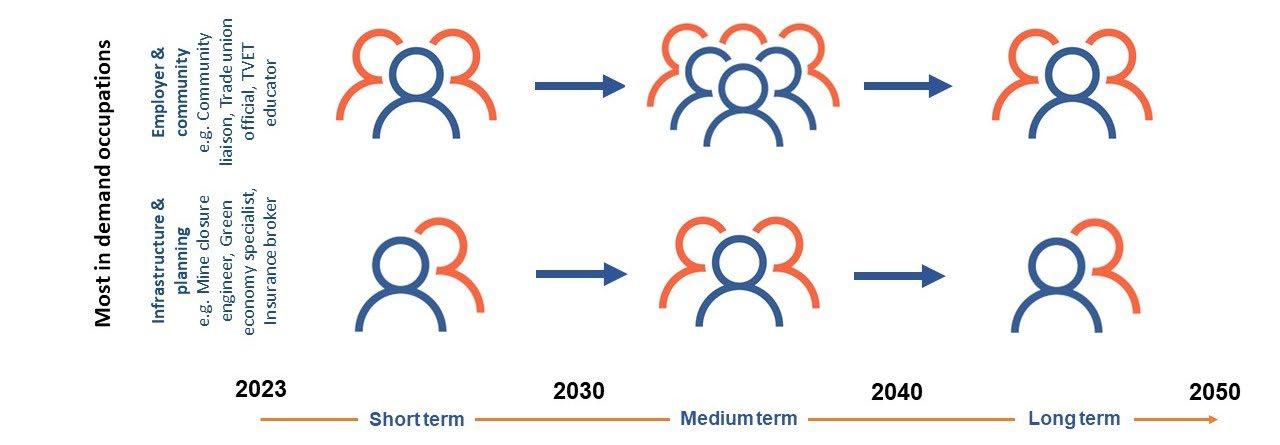
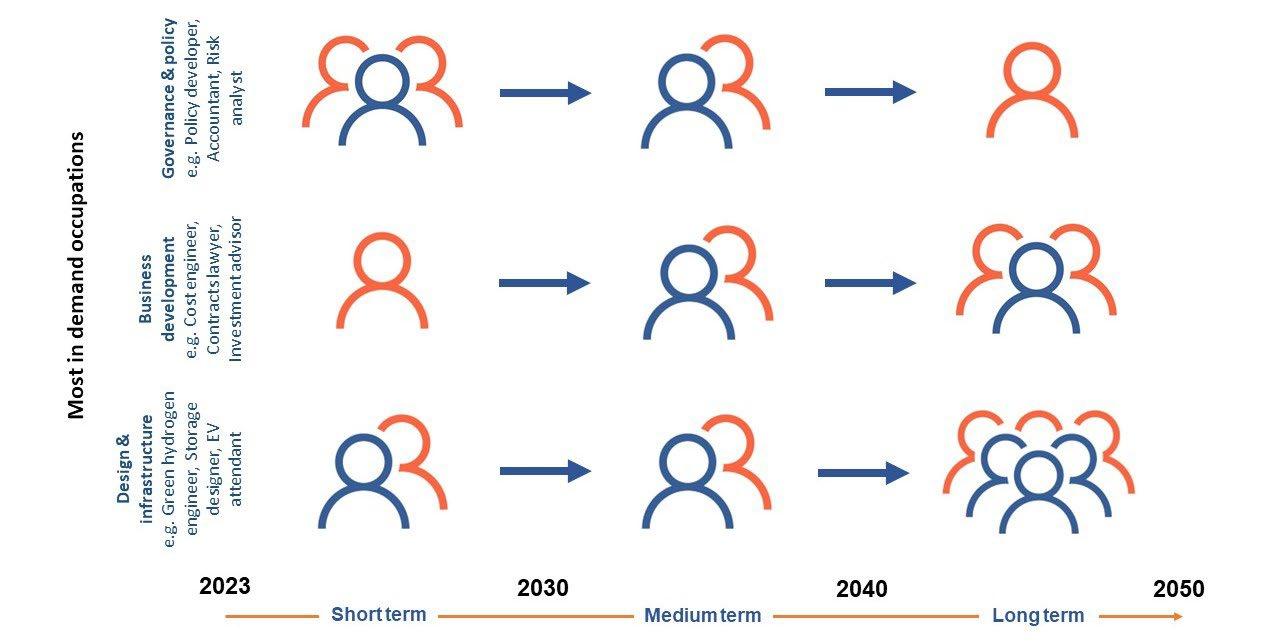

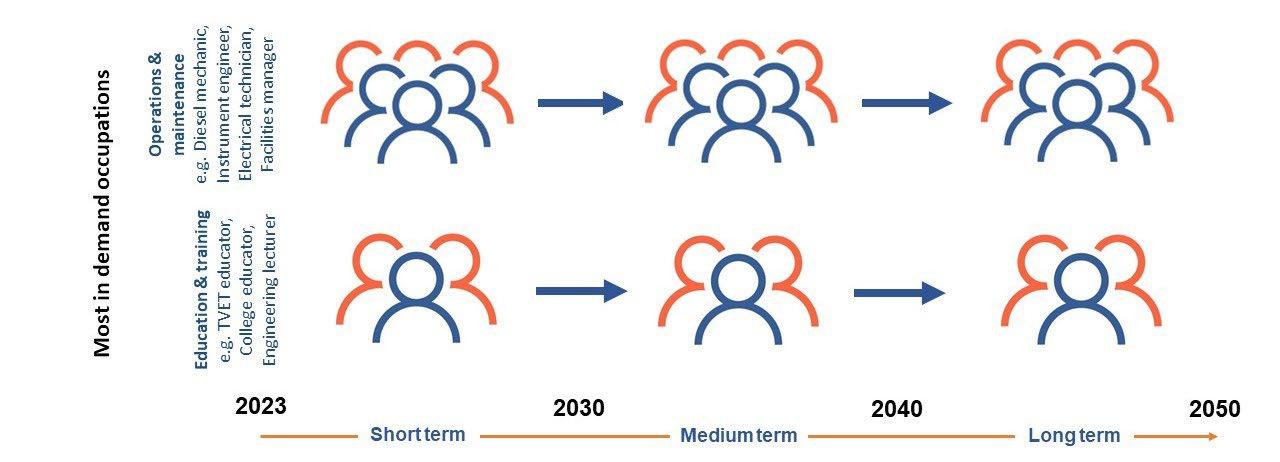
Source: Author derived.
Figure 19: Most in demand occupations for climate change – achieving net-zero
Time horizon
Impact on the world of work
Minor occupation groups
● Climate change and environmental degradation pose economic growth and employment challenges, and risks will become more significant in the medium- to long-term. However, if appropriately managed and mitigations are put in place, climate change and the associated impacts can create new work opportunities, and secure current jobs (EESI, 2021; ILO, 2023).
● Occupations in the energy sector will be required to develop and implement disaster risk and adaptation strategies and interventions, including integration into current plans. This includes review of current infrastructure, risk management, strategic thinking and problem solving, forecasting and modelling, and actuarial analysis at all levels of government.
● Current and future infrastructure plans (including smart cities, urban design and spatial planning) will require individuals to adequately review plans to ensure infrastructure is resilient and can withstand climatic shocks e.g. droughts and floods.
● To ensure adequate buy-in to mitigation strategies and interventions, personnel and stakeholder awareness will be critical, and requires education practitioners to undertake this role.
● In addition to the above a core component of resilience will be a shift towards more renewables and adopting energy efficiency practices (see the climate change: Achieving net zero carbon emissions by 2050 trend above).
● Managing Directors and Chief Executives
● Physical and Earth Science Professionals
● Mathematicians, Actuaries and Statisticians
● Life Science Professionals
● Engineering Professionals
● Architects, Planners, Surveyors and Designers
● University and Higher Education Teachers
● Finance Professionals
The most in demand occupational groups associated with this trend are those involved in policy and planning, and education and awareness. In comparison to the other trends, it is unlikely that large numbers of individuals will be in demand to fulfil the activities to adapt the energy sector to one that is climate resilient. However, for those involved, these are most likely to be of a high-skill level, such as climate and environmental scientists and advisors, and urban and regional planners. These occupations will be in higher demand in the short term as the government and the sector responds to climate change mitigation targets. In the medium and long term, these occupations will continue to be in demand, however they are more likely to be involved in monitoring and reporting, updating strategy and implementing policy. This trend will also require the skills and knowledge of climate change and environmental educators to raise awareness around climate change and its impacts on the energy system, and associated mitigation interventions. This will be crucial for considered government and industrial sector policy.
Source: Author derived.
Figure 20: Most in demand occupations for climate change – resilience
Table 16: Impact of shifting towards sector coupling on the world of work, occupations and skills
Trend: Shifting towards sector coupling
Time horizon
Impact on the world of work
Minor occupation groups
● The electrification of the economy will have a significant impact on jobs, as new technologies, innovative industrial processes and rules are rolled out and energy-consuming sectors e.g., buildings, transport and industry become interconnected with the energy sector. Initially the impact will be felt in the electricity sector, due to the expansion of renewables, but will shift into the other sectors as renewables and clean energy interventions are adopted by energy consuming sectors (Appunn, 2018; IRENA, 2022a).
Also see the climate change: Achieving net zero carbon emissions by 2050 trend above (renewable energy and clean energy [electric vehicles, green hydrogen]) above, and automation and digitalisation trend below.
● Legislators and Senior Officials
● Manufacturing, Mining, Construction and Distribution Managers
● Professional Services Managers
● Engineering Professionals
● Electrotechnology Engineers
● Finance Professionals
● Sales, Marketing and Development Managers
The most in demand occupational groups associated with this trend are those involved in policy and planning, and operations and implementation. Initial occupational emphasis will be placed in policy and planning, as the energy sector becomes more integrated – through the electrification of the economy –into other sectors, such as transportation and agriculture. This will require policy and planning integration to assess the implications and requirements of a more integrated, electrified economy. Over the medium and long term, this emphasis will switch to local manufacturing opportunities and associated occupations involved in implementing the electrification of the economy, with emphasis on e.g., enhanced storage, electric vehicles, and electronics. As the economy becomes more electrified, the more in demand operational and maintenance-related jobs will become.
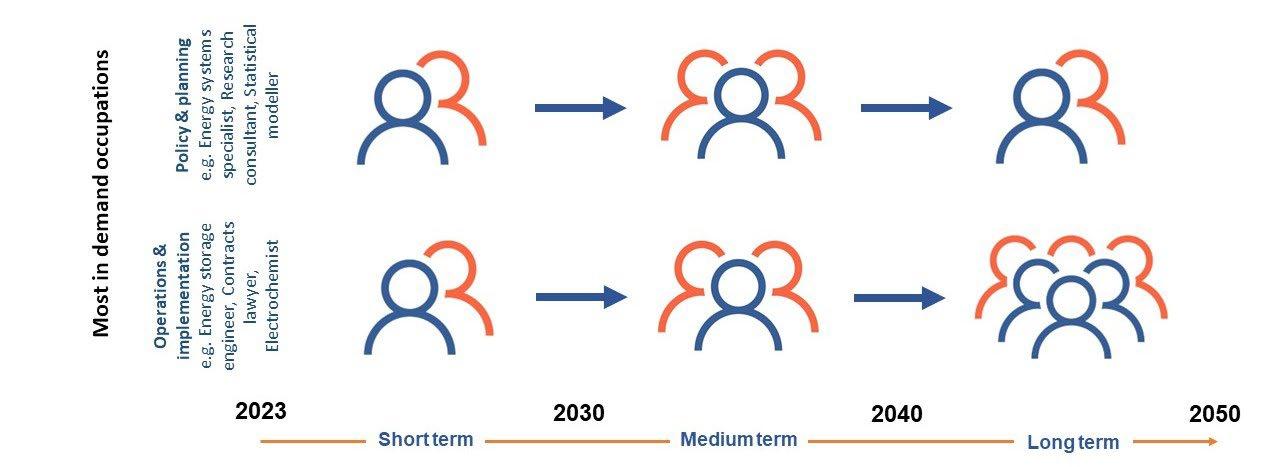
Source: Author derived.
Figure 21: Most in demand occupations for sector coupling

Time horizon
Impact on the world of work
Minor occupation groups
● An expansion in renewables will require a shift in the market to one that is more decentralised and privatisation of activities (DMRE, 2022a). With a shift towards more privatisation and decentralisation, more responsibility will fall on local governments to procure, negotiate and set tariffs, trade and manage the electricity generated within their jurisdictions. Electricity may be generated by the municipalities themselves, Independent Power Producers (IPPs) or cooperatives.
● Support will be required to build local government, IPPs and cooperative capabilities to generate, procure and deliver electricity. In the case of local governments, this will require adequate leadership, governance, strategic direction, management and coordination of projects and technical knowledge and skills (SA Government, 2022).
● Cooperatives provide an opportunity to create local employment, especially in rural areas, through not only electricity generation, but also through service provision. Therefore, awareness of such opportunities needs to be made known, and they require the collective capabilities to respond to the localised demand (ILO, 2013).
● Legislators and Senior Officials
● Managing Directors and Chief Executives
● Business Services and Administration Managers
● Sales, Marketing and Development Managers
● Retail and Wholesale Trade Managers
● Engineering Professionals
● Electrotechnology Engineers
● Vocational Education Teachers
● Finance Professionals
● Administration Professionals
● Sales, Marketing and Public Relations Professionals
● Database and Network Professionals
● Legal Professionals
● Sales and Purchasing Agents and Brokers
● Regulatory Government Associate Professionals
● Client Information Workers
● Numerical Clerks
The most in demand occupational and skills groups associated with this trend are those involved in legislation and policy, governance and management, and operations and maintenance.
With the demand for increased energy security and a growing shift to renewables, emphasis will be placed on implementing decentralised models of energy generation, transmission and distribution.
As such, provincial and local municipalities will be undertaking the roles previously the sole domain of Eskom, this will include e.g., electricity trading, substation management, mini-grid planning, design and maintenance, grid integration, and customer sales. Initial emphasis, however, will be placed on policy, strategy and design, which will also require regulatory expertise. In the mid- to long term emphasis will shift to implementing the decentralised model, increasing local capacity to fulfil the varied activities and maintaining mini- grids.
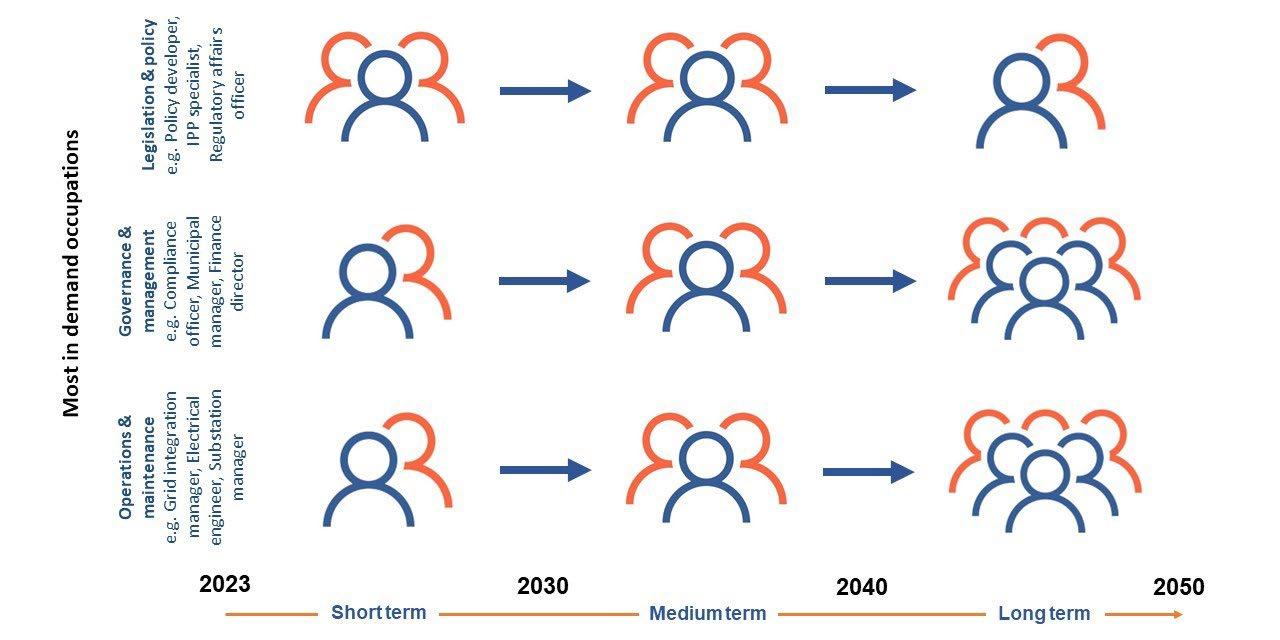
Source: Author derived.
Figure 22: Most in demand occupations for evolving energy markets
Time Horizon

Impact on the world of work
● Automation, digitalisation and technological changes will significantly impact and disrupt jobs through the need for new work systems, processes and procedures. This will result in the creation of new jobs, job displacement or the need to adapt current jobs to adopt digital and automation technologies. This in turn will require extensive and continuous upskilling, reskilling and retraining (Chui, Lund and Gumbel, 2018; EWSETA, 2021; IEA, 2017; Torkington, 2023).
○ Examples of job displacement include those involved in routine, predictable and repetitive tasks, unsafe work environments or where automation replaces humans e.g. truck drivers replaced by fully autonomous cars and trucks (Careers in Energy, 2023; IEA, 2017).
● Policy developers in the energy and coupled sectors should participate in broader government and industry discourse to prepare and manage the sectors for a digital transition (IEA, 2017).
● The implementation of a digital infrastructure will require specialist ICT skills (high levels of specific digital skills are needed), such as coding and cybersecurity, while across the sector all employees will require generic ICT skills for more basic or broad tasks and to operate digital and automation technologies and machinery e.g. use of automation and digital devices and sensors to diagnose issues and optimise electricity generation operations (AISC, 2022; AIS, 2019; IEA, 2017).
● It is imperative that labour market, demographic, and skills supply and demand assessments are undertaken within the energy and related sectors to temper job loss fears, and to identify sector specific opportunities. Otherwise job losses and skills gaps will begin to arise as the evolution of technology outpaces the number of individuals trained, this could be exacerbated by education curricula being dated, and youth (who do not have access to computers) not developing digital skills (DHET, 2022; IEA, 2017).
● An increase in digitalisation can impact skills supply, with e-learning becoming more prominent. As such, the sector and/or associated education and training providers will need to invest in upskilling educators and digital infrastructure (EWSETA, 2021).
Minor occupation groups
● Legislators and Senior Officials
● Managing Directors and Chief Executives
● Manufacturing, Mining, Construction and Distribution Managers
● Information and Communications Technology Service Managers
● Engineering Professionals
● Electrotechnology Engineers
● Architects, Planners, Surveyors and Designers
● University and Higher Education Teachers
● Vocational Education Teachers
● Software and Applications Developers and Analysts
● Database and Network Professionals
● Physical and Engineering Science Technicians
● Process Control Technicians
● Information/Communications Technology Operations and User Support Technicians
● Machinery Mechanics and Repairers
● Electrical Equipment Installers and Repairers
● Electronics and Telecommunications Installers and Repairers
The most in demand occupational groups associated with this trend are those involved in design and implementation, legislation and policy and education and training. As indicated automation and digitalisation will have a significant impact on all jobs in the sector. While this may lead to a decrease in jobs associated with menial and repetitive tasks over the short and medium term, it is clear that all employees will require upskilling, and new jobs will emerge in a rapidly changing technical world. As all jobs will require some form of upskilling and IT training throughout their careers much emphasis will be placed on not only educating ICT of the future, but also those in the work place. As the sector becomes more automated and digitised, the demand for educators and trainers, especially in the workplace will grow significantly over the medium and long term. In the case of design and implementation new jobs are already emerging, however new (and in some cases yet unknown) jobs will increase exponentially over the mid- to long term, in particular those involved in automation and robotics. Current in demand occupations, such as application and software developers, data analysts and scientists, ICT programme managers and network architects are expected to increase in demand over the mid- and long term, especially as the electrification of the sector becomes more prevalent.
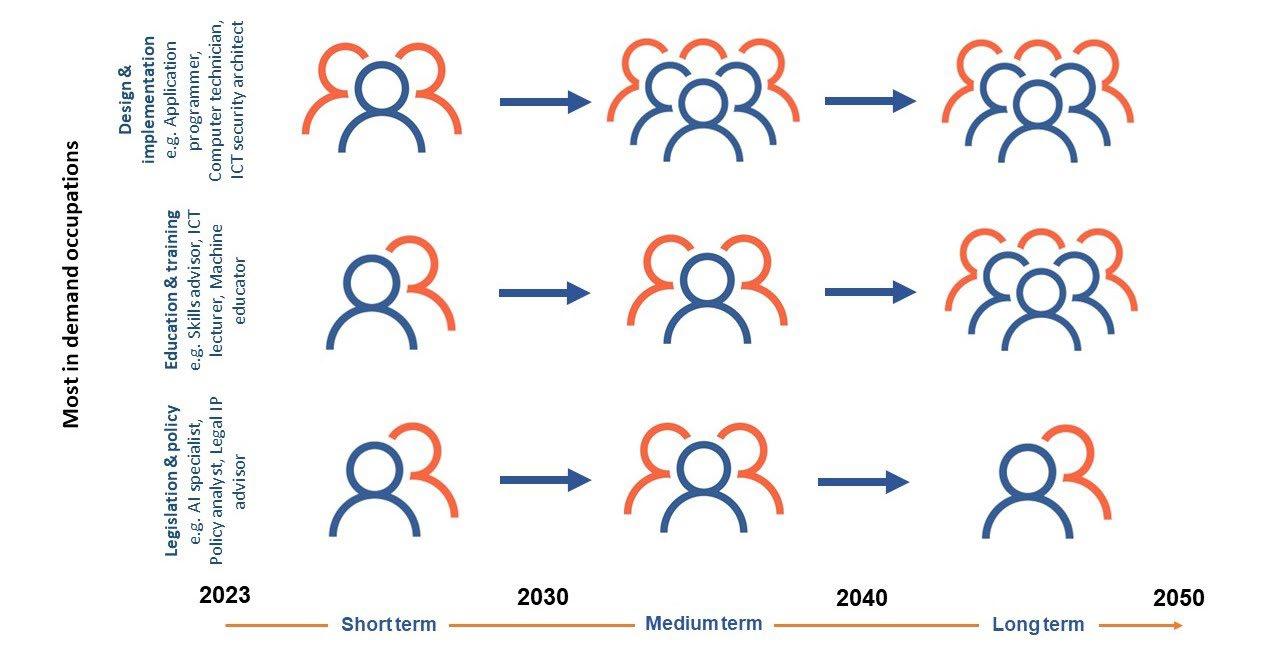
Source: Author derived.
Figure 23: Most in demand occupations for automation and digitalisation
Key Occupations
Drawing on the impact of the trends on the world of work, the following Top 10 occupations emerged as key to maintaining, enhancing and transitioning the sector across generation, distribution, transmission and consumption:
● Electrical Engineer
● Policy Consultant / Officer / Planner
● Power Distribution Engineer
● Energy Specialist
● Programme or Project Manager
● Electrical Engineering Technician
● Environmental Scientist
● Statistical Modeller
● Maintenance Technologist
● Process Design Engineer
The figure below illustrates these top 10 occupations within the context of other most commonly cited occupations in demand. It is interesting to note that while traditional energy engineering and technician jobs are cited, there is much demand for operational, management, finance, legal, environmental and social jobs.
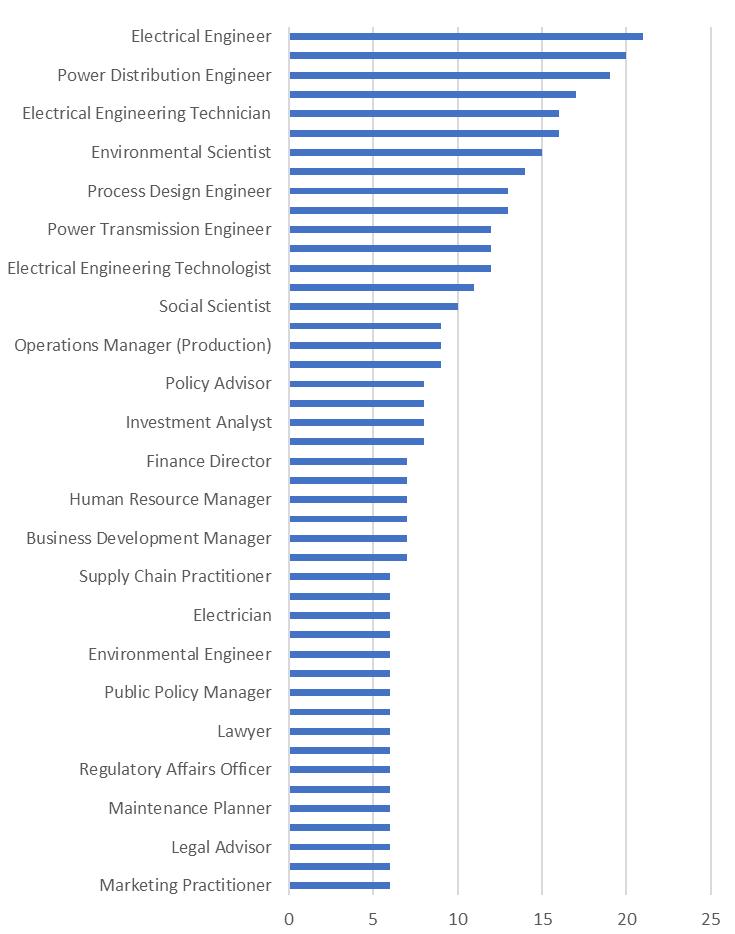
Occupation demand across the trends illustrates different occupations are required to mitigate or respond to the trends, for example environmental scientists are important to deliver a low carbon energy sector, and a resilient and adaptive energy system. There are, however, occupations that are transversal and required across all trends, notably policy professionals, energy specialists and programme or project managers. The figure below illustrates how the top 10 most in demand occupations are distributed across the trends.
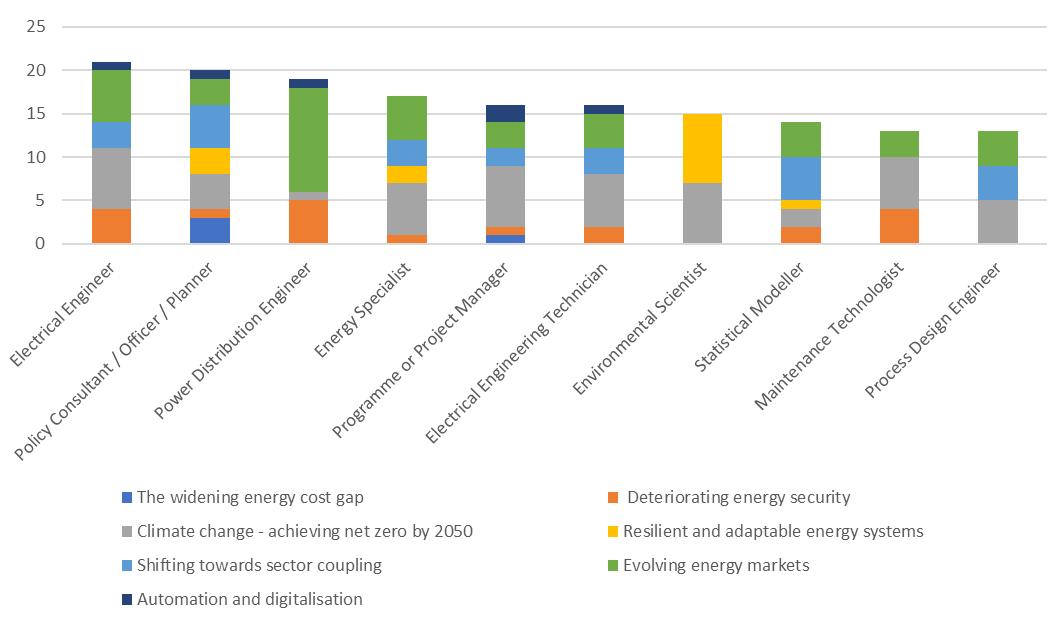
Figure 25: Top 10 most in demand occupations, by trend
Of occupations identified, those listed in the Table below are deemed critical for South Africa’s economic reconstruction and recovery plan (DHET, 2022, 2022a), and therefore require intervention to ensure the energy system is resilient and can effectively transition in a just and sustainable manner.
Those highlighted in red are recognised as being the Top 10 hard-to-fill occupations by the Energy and Water Sector Education and Training Authority (EWSETA).
This list also correlates with recent research undertaken by Michael Page Africa, a recruitment agency, which listed the most in-demand jobs and skills in South Africa. Their findings are set within the context of these jobs also being in international demand, resulting in global companies poaching South Africans with this experience (Ebrahim, 2022). Therefore, retention of these skills is critical to sustaining and fulfilling the transition of South Africa’s energy sector.
Table 19: Energy sector transition occupations listed as critical
• Actuary
• Agricultural Engineer / Technician
• Air-conditioning & Refrigeration Mechanic
• Applications Programmer
• Biotechnologist
• Business Development Officer
• Chemical Engineer / Technician
• Chemist / Chemistry Technician
• Civil Engineer / Technician
• Climate Change Scientist
• Computer Network & Systems Engineer
• Construction Project Manager
• Corporate General Manager
• Customer Service Manager
• Data Management Manager
• Data Scientist
• Draughtsperson
• Economist
• Electrical Engineer / Engineering Technician
• Electrical Equipment Mechanic
• Electronic Engineer / Technician
• Energy Engineer / Technician
• Engineering Manager
• Environmental Manager / Scientist
• Geologist
• Geophysicist
• Forensic Accountant
• Information & Communication Technology (ICT) Systems Analyst
• ICT Security Specialist
• Industrial Designer
• Industrial Engineer / Technician
• Instrument Mechanician
• Integrated Manufacturing
Source: DHET, 2022, 2022a; EWSETA, 2021.
• Line Process Control Technician
• Investment Advisor / Analyst / Manager
• Lift Mechanic
• Manufacturing Operations Manager
• Manufacturing Technician
• Market Research Analyst
• Mechanical Engineer / Technician
• Mechatronics Technician
• Meteorologist
• Metallurgist
• Microbiologist
• Millwright
• Mineralogist
• Mining Engineer
• Organisational Risk Manager
• Physicist
• Policy & Planning Analyst / Manager
• Product Assembler
• Programmer Analyst
• Project Manager
• Purchasing Officer
• Refrigeration Mechanic
• Quality [Systems[ Controller / Manager (Manufacturing)
• Quantity Surveyor
• Research & Development (R&D) Manager
• Safety Inspector
• Software Developer
• Solar Photovoltaic (PV) Service Technician
• Supply & Distribution Manager
• Transportation Electrician
• Wind Turbine Power Plant Process Controller
It is also worthwhile acknowledging that the energy sector is a multidisciplinary field; this calls for a complex knowledge and skills base which must realise the importance of management, communication, leadership, environmental and other skills. For example, there is a great demand for skills, from engineering and environmental skills to energy economics.
Drawing on the desktop, research, job advert analysis and workshops the top 10 most commonly cited technical and ‘soft’ skills cited are detailed in the table below.

Table 20: Top 10 most commonly cited technical and ‘soft’ skills
skills
Research & Development (R&D)
Legal & Regulatory
Financial
ICT
Monitoring & Evaluation
Renewable Technology Installation
Renewable Technology Operations
Procurement
Renewable Technology Maintenance
Policy Development
Project management
Communication
Agility
Emotional Intelligence
Mentoring
Community Outreach
Critical Thinking
Decision Making
Problem Solving
These most commonly cited skills are presented in in the figures below in relation to the broader set of skills, by trend theme.
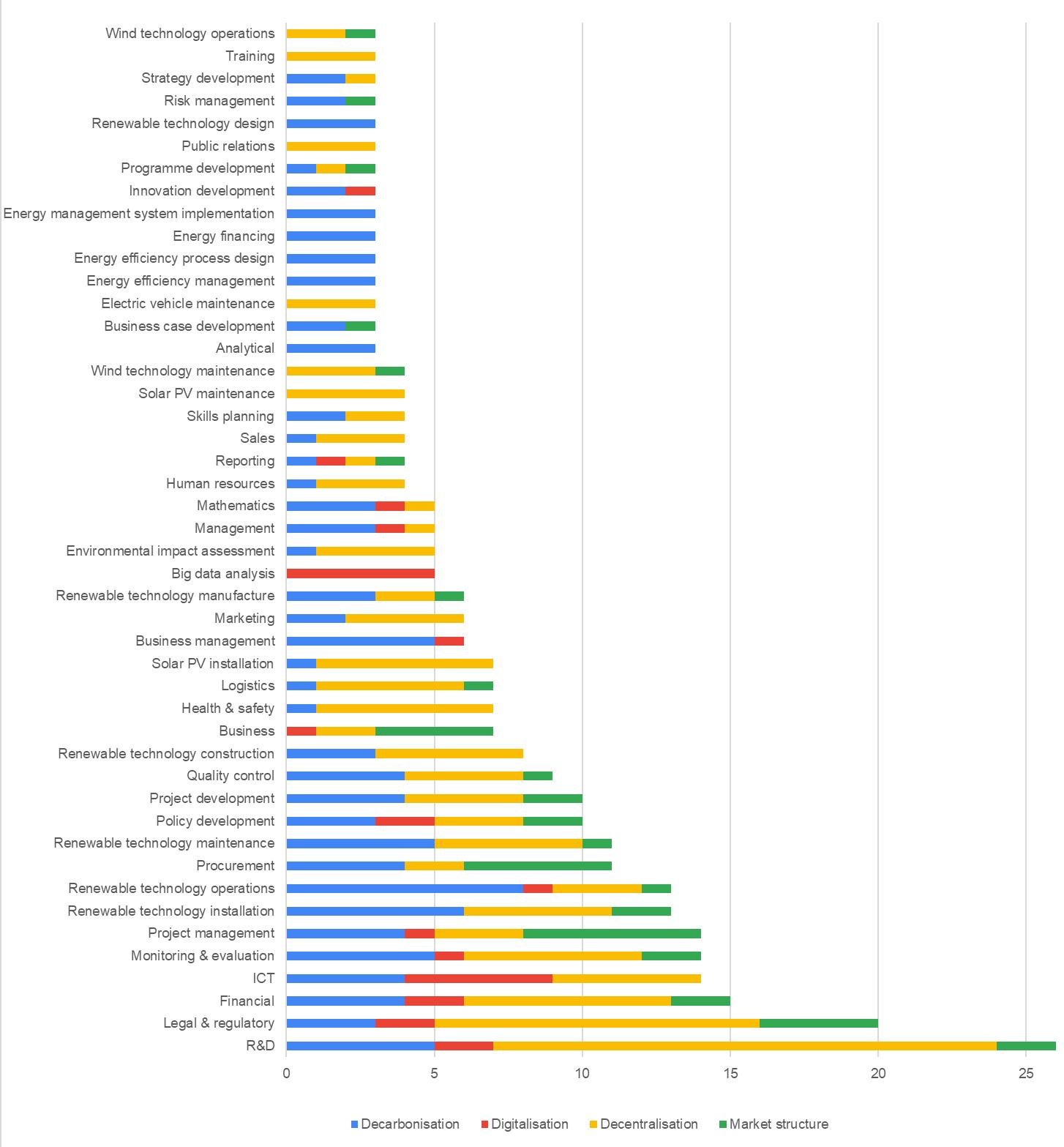
igure 26: Most commonly cited technical skills
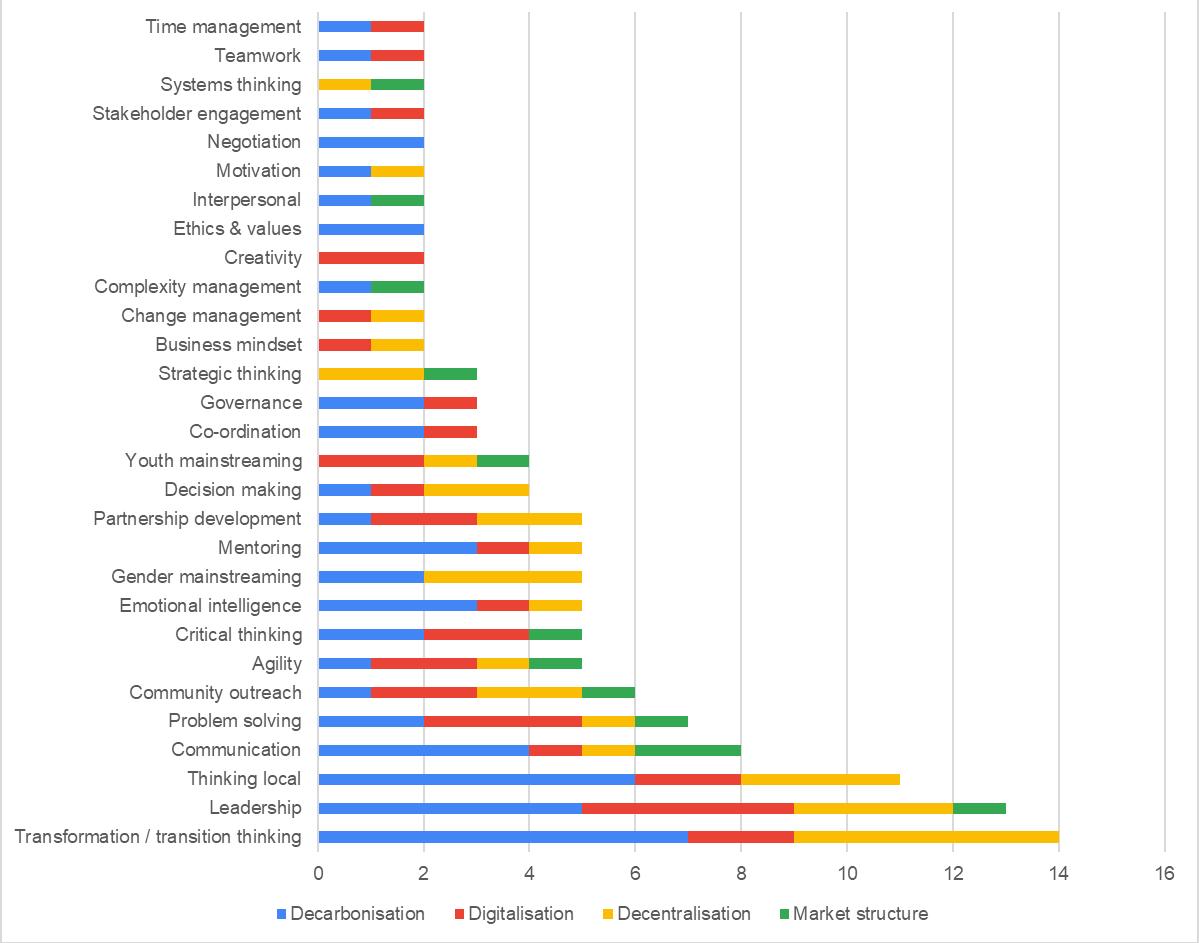
Of the core skills listed, the following are deemed as critical skills gaps by EWSETA (2021):
● Technical (job specific)
● Financial management
● Computer literacy
● Management
● Advanced IT and software
● Leadership
● Occupational health and safety skills
● Project management
● Communication
● Problem-solving.
According to EWSETA (2021), these are skills gaps identified by employers in the energy sector and are therefore critical to resolve to ensure a job or tasks are adequately performed.
Jobs and skills considerations
To determine the core jobs required to transition the sector over the short-, medium- and long-term, the jobs presented above, are also listed as those most likely to be in most demand along the transition time continuum. These are proposed based on likely core activities and task requirements for a particular trend e.g. a high demand for construction-related jobs and skills during the initial stages of ramping up of renewable energy solutions.
While there will be peak pockets of jobs and skills demand, it should also be noted that in most instances a particular job or skill will be required for the full duration of the time horizon. Likely peaks, levelling out and transitioning of jobs along the time horizon need to be recognised e.g.:
● Most significantly fossil-fuel-related jobs will decrease between 2023 and 2030. This will have implications for skilling, reskilling, and upskilling. Planning to mitigate these job losses is therefore critical and needs to be very well planned and considered.
● With the shift away from fossil-fuels towards more renewable and clean energy, the initial demand for design, construction and installation-related jobs will be high. This will be followed by more operations, maintenance and evaluation jobs to ensure installed infrastructure and the associated system is effectively managed and maintained. Installation, Repair and Maintenance is an important emerging area that has significant implications for local enterprise development and community skills development. The increased demand for renewable and clean energy jobs is likely to require an increase in specialisms at various skill levels, and not necessarily new jobs e.g. specialist green hydrogen or energy storage engineers and technicians (Wits REAL, 2022). Policy and strategy implementation needs to be cognisant of these demands.
● Policy-related jobs (including policy development, management and implementation; research and analysis; and topic specialists) are critical short term occupations. In this regard, one of the most important considerations is the need for more integrated policy, and policy implementation. this has implications for skilling, Rosenberg et al 2016, found that the competencies required to drive sustainability in government were clustered as technical, relational and transformational
competencies for: making the case; integrated sustainable development planning; strategic adaptive management and expansive learning; working across organisational units; working across knowledge fields; capacity and organisational development; and principle-based leadership. Policy developers need to be knowledgeable, networked and aware of activities within and associated with the sector to ensure policy is relevant, systems-oriented and conducive to implementation. To achieve the intended goals set out in policy and strategy, it is imperative that there is adequate human and financial resourcing within government to roll out and implement policy.
● Financial and governance-related jobs are also critical in the short-term. As the sector begins to transition it requires financial support and investment to do so. Upskilling and reskilling of current finance employees with sustainability knowledge and the business case for a just transition of the energy sector. To this end, the ethical governance of expenditure and investment is core, and requires individuals with an ethical mindset, and a public and private sector that is capable of and accountable to delivery.
● Decentralisation of the energy system will significantly impact the district and local municipal workforce. Activities, once the domain of Eskom, will become the responsibilities of local governments e.g. energy planning, integration, distribution, trade and maintenance. The upskilling of the current workforce and employment of more energy-related staff will be critical. This will require human resource practitioners within the local government to be knowledgeable of these new job demands and associated skills requirements.
● As indicated previously, a transformative energy sector requires the acknowledgement of a broader set of jobs and skills beyond the techno-economic. The role of social scientists (e.g. anthropologists, sociologists, gender specialists, community development co-ordinators, environmental education and inclusivity specialists, social workers, and trade union officials) will grow over time, with initial emphasis on dealing with affected communities, whether due to mine closures or the citing of new renewable and clean energy facilities.
● Given the need for the upskilling and reskilling of the current workforce, or the production of new graduates into areas of growing job demand, there is a critical need for suitably knowledgeable and capable post-school educators (university, TVET and community college, and work based educators). This is discussed in more detail in the following section.
Skills planning and anticipation is critical early on in discussions - not as an add on at the end of technical, policy or strategy development. Skills planning should:
● Consider the long-term employment impact of the transition, which depends on the scenarios, power mix assumptions, development models and scaling assumptions (site, technology, energy sub-sector) (Meridian Economics, 2018). This also includes acknowledging issues of uncertainty and probability (including scenarios).
● Recognise jobs and skills along the expanded, broader value chain and time horizon.
● Be cognisant of streams of work and connected f jobs required at certain points and activities along the time horizon e.g. construction, policy development and automation.
● Acknowledge the geographical impact and required jobs especially given many of the impacts of mine closures and renewable technologies are and will be in rural areas. This will require the need to seek alternative work for those who lose their jobs, or to develop local capacity to support
new activities. This will require the training and upskilling of local communities to support new opportunities (Wits REAL, 2022).
● Discussion and decision-making should include different actors groups - government (national, provincial and local), industry and business (large and small, commercial and informal), academia and research, and civil society (e.g. NGOs).
● Requires transparent disclosure of employment numbers by different actor groups, using standardised employment metrics and categorisation methods (Meridian Economics, 2018). Job numbers should be cognisant of trade-offs and the realities of the wider renewable and clean energy job demand.
This section provides an overview of the current energy-related courses offered in South Africa, and reviews these against the jobs and skills required to transition the sector. The purpose of this is to establish whether the education system is able to adequately support the provisioning of skills (supply) for the sector’s transition, and where gaps exist, or adaptations may be required.
This section provides an overview of the courses identified by level of qualification. Just over 1,000 courses were identified. These capture courses provided by recognised public and private universities and colleges, and popular private training providers. It should be noted that while the search was extensive, such an exercise will not be able to identify all courses offered. Those not captured are likely to be short courses offered by private or civil society organisations. The Top 10 most commonly offered energy-related courses are:
1. Electrical / Electronic [Engineering]
2. Mechanical Engineering
3. Chemistry
4. Engineering Studies [and Related Design]
5. Chemical Engineering
6. Electrical Infrastructure Construction
7. Environmental [and Geographical Science]
8. Science and/or Technology Education
9. Biotechnology
10. Biochemistry
This suggests that traditional engineering and science-related disciplines are well represented across PSET, with a range of qualification levels offered for these. The Figure below illustrates the diversity of courses offered, with a focus on courses with more than five offerings across the PSET system, by qualification level. For a detailed list of energy-related courses offered in South Africa see Appendix 2.
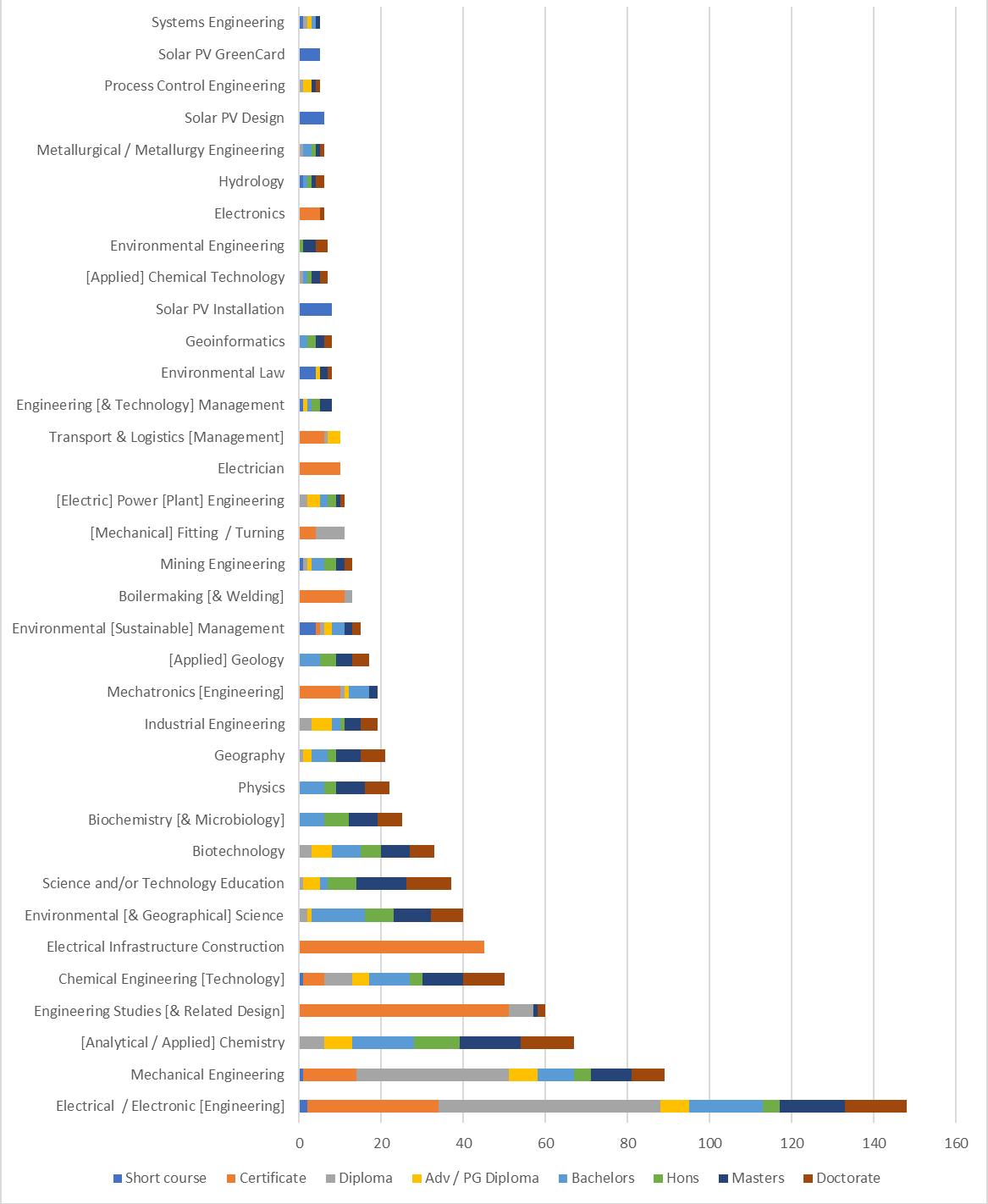
28: Current energy-related courses with more than five offerings across the post-school education and training system (PSET), by qualification level
Regarding Electrical / Electronic [Engineering] the most prominent level of qualification is at the Diploma and Certificate level (offered by TVET colleges and Universities of Technology). It is also well represented at under- and postgraduate level across Traditional Universities and Universities of Technology.
It can also be noted, that with the shift in emphasis and need to supply the growing renewables energy sector with appropriate skills and knowledge these institutions are beginning to offer short specialist courses on the topic. For example, Stellenbosch University's Centre for Renewable and Sustainable Energy (CRSE) offers a variety of short courses on wind, storage and energy systems. The University of Pretoria’s Centre for New Energy Systems, on the other hand, focuses its short courses on energy market operation, management and optimisation.
Universities of technology, as would be expected, have picked up the baton to deliver renewable energy technology skills needs with, for example, the Durban University of Technology (DUT) and the South African Renewable Energy Technology Centre (SARATEC) at the Cape Peninsula University of Technology (CPUT), offering a number of renewable energy technology installation and technical courses for wind, solar and grid connection.
Most of the country’s TVET colleges focus on traditional electrical engineering, installation and infrastructure certificates, with few placing explicit emphasis on renewable energy or energy efficiency. Very few, if any, appropriate courses are offered by community colleges.

A review of the course offerings also suggests the growing emergence of short courses. This is being driven by current employer demand and the deteriorating energy sector demand. Courses vary, and range from energy auditing, planning and management, to financing of energy projects, electrical engineering and renewable technologies design, installation and maintenance (wind and solar).
Given the current energy insecurity issues, there is increasing demand for solar design and installation skills, and the skills system is responding to this through the provisioning of solar PV short and accreditation courses. Another example of the short course offering responding to the future energy sector is that of green hydrogen and renewables, with many introductory courses on these topics identified.
In reviewing the courses offered versus sector and transition demand (in relation to the trends) it is possible to determine where skills provisioning is well covered, and where gaps exist, per trend:
Core areas of occupation demand Gaps
● Legislation and regulation
● Leadership and management
● Forecasting and modelling
● Financial
● Community / user liaison
● Sales and marketing
● Specialisation in energy-related legislation and regulation, financials, forecasting and modelling and sales and marketing.
● Inadequate supply of energy-related leadership, energy integration and management courses, especially at university level.
Core areas of occupation demand Gaps
● Legislation and regulation
● Leadership and management (incl. good governance)
● Mathematics and statistics
● Electrical and process engineering and associated technical
● Financial and investment
● Sales
● Maintenance and repair
● Security
● While courses on public sector management and governance exist, access and uptake need to be encouraged and increased.
● Inadequate supply of maintenance, repair and non-electrical technical (e.g. mechanical, boilermaker) courses at TVET and community colleges.
Core areas of occupation demand Gaps
● Legislation and regulation
● Leadership and management (incl. good governance)
● Forecasting and modelling
● Business development
● Sales and marketing
● Policy development and implementation
● Manufacturing, mining, construction and distribution management and labour
● Environmental and climatic science and research
● Electrical / electronic, mechanical, civil, process and design engineering and associated technical
● Site planning and surveying
● Science / technology, engineering, environmental and social education
● Financial and investment
● Community and stakeholder liaison / research
● Maintenance and repair
● Engineering education
● Engineering and technical specialisms (renewables [solar, wind, bio] and clean energy [green hydrogen]) are lacking at all levels of education, especially in key affected geographical areas.
● While sales and marketing, management, financial and investment, and policy development courses exist, there is a need to provide renewable and clean energy specific courses and curricula.
● Life and entrepreneurial skills for affected local communities.
● Short courses to upskill and reskill current employees to adapt to changing and new knowledge areas e.g., renewables, green hydrogen, climate change impacts (introduction, opportunities and considerations).
● Post-school engineering-related educator courses / upskilling.
Core areas of occupation demand Gaps
● Leadership and management
● Forecasting and modelling
● Urban and rural planning
● Environmental and climate science
● Environmental and social impact
● Finance and investment
● Engineering, physical and social science education
Core areas of occupation demand
● Legislation and regulation
● Leadership and management (incl. good governance)
● Policy development
● Manufacturing, mining, construction and distribution management (electrification)
● Forecasting and modelling
● Electrical and process engineering and associated technical
● Financial and investment
● Sales and marketing
● Maintenance and repair
● Electric vehicle and green hydrogen
Core areas of occupation demand
● Government legislation and regulation
● Local public sector leadership and management (incl. good governance)
● Business administration
● Financials and investment (incl. trade)
● Sales
● Public relations
● Public sector educators
● Client Information Workers
● More specific climate science / energy nexus higher level courses.
● Leadership and management knowledge upskilling on climate impact on the sector.
● Climate finance (higher level and short courses).
● Higher-level climate / engineering science educator courses.
Gaps
● Higher-level specialisms in electric vehicles, green hydrogen, integrated energy systems.
● Upskilling of leadership, management, sales and marketing, and policy developers on sector coupling implications and opportunities.
Gaps
● Upskilling of local government leadership and management on energy provision and good governance.
● Upskilling of human resource professionals on energy-sector job requirements to employ an increased number of local government energy jobs.
Also see the widening energy cost gap and deteriorating energy security trend education gaps above.
Core areas of occupation demand Gaps
● Legislation and regulation
● Leadership and management
● Information and technology management and operation
● Software and application development
● ICT engineering and associated technical
● ICT data management and analysis
● Digital sales and marketing
● Data and network security
● Automation and robotics
● Electrical and automated machinery installation and maintenance
● ICT, automation and robotics educators
● Automation and robotics engineering at university and TVET level.
● Accredited ICT and automated machine installation and repair.
● Short courses for leadership, management and policy developers on impact of digitalisation and automation on the sector.
The presentation of provisioning gaps above provides an indication of the main gaps between occupational demand and education supply. This suggests that the PSET system needs to consider responding to the sector’s transition demand as follows:
● Offering specialist degree courses at undergraduate and postgraduate levels (currently specialisms are offered at postgraduate level). Specialisms would include renewables (solar, wind, biomass), clean energy (electric automotive, green hydrogen), and automation and robotics. These specialisms can be determined in consultation with employers and sector specialists and advisors.
○ This includes updating and adapting current e.g. engineering, physical and social science, business science and administration, public sector management, and law courses and curricula to cover topics such as renewables, clean energy, energy efficiency and climate change.
● Increasing the number of energy-system specific technology maintenance and repair courses at TVET and community colleges.
● Upskilling leadership and management (public and private), policy developers, sales and marketing professionals, and educators on specific topics (e.g. sector coupling, climate change impacts, energy markets).
● More broadly, short courses on e.g. computer literacy, organisation and project management [incl. good governance], finance management, client and stakeholder communication and engagement should be offered to the sector.
● Ensure there is adequate supply of good PSET educator courses (university lecturing, TVET and community college teachers) in engineering (e.g. electrical / electronic, automation and robotics, civil, mechanical, bio/chemical), climate change environmental science, public sector management, policy development and delivery.
● Considered planning of what is offered locally by TVET and community colleges to support local communities to adapt to the transition e.g. e.g. away from coal, or to respond to new employment opportunities e.g. solar in the Northern Cape.
While the focus above has been on PSET, one of the major challenges facing energy skills supply in South Africa is the matric pass rate i.e. the number of individuals who can enter the PSET system. Therefore, while there may be adequate skills provisioning for e.g. electrical engineering and associated technical professions, if the number of individuals enrolling and graduating from these courses is low, this impacts on the availability of adequately educated and skilled individuals to fulfil demand. While this report does not provide a detailed assessment of graduates per course, it is worth noting that an estimated only 45% of those who start school in South Africa matriculated (Cloete, 2022). Of those that wrote the National Senior Certificate (matriculated) in 2021, 36% achieved a bachelors pass i.e. could enter university (O’Regan, 2022). This suggests that the pipeline for individuals to fulfil the sector’s transition and future demand is pressured. Not only does this indicate not enough learners are able to enter relevant fields and levels of study, but for those that do graduate, they will be in demand across all sectors of the economy. This being especially the case for those with transferable knowledge and skills e.g. accounting, business studies, economics, geography, life and social sciences, mathematical literacy, mathematics and physical science and ICT.
Given the poor basic education pipeline, it is therefore highly recommended that both national government and the broader energy private sector places emphasis and invests in improving the provisioning of basic education (e.g. infrastructure and teacher quality), and the matric pass rate to ensure the adequate supply of good quality learners into the PSET system.
Taking into consideration all the findings and analysis conducted in this research, a set of conclusions were identified to help guide future work. These conclusions are detailed below
Uncertainty and trends
● The energy sector is being driven by a number of key trends both global and local. These have critical implications for skills development as not only will current jobs be impacted, but new occupations and skills will be needed.
● Skills requirements for the energy system necessitates an ecosystem approach and acknowledge the transformative process that is occurring over time and local geographic areas. Siloed approaches need to therefore be avoided to maximise any opportunities and build any trade-offs into decision making.
● The energy sector is in crisis and faces a great deal of uncertainty in developing a skills roadmap as a result. This means that flexibility and contingencies need to be built into any skills roadmap as well as continual tracking of the environment as uncertainties unfold.
Occupations and skills
● The shift to decarbonisation and electrification is being reflected in the increased demand for a wider variety of jobs, including outside the energy sector. This has resulted in the emphasis on only techno economic jobs shifting to a socio-economic and just transition emphasis.
● The private sector is employing specialists in future areas such as green hydrogen in order to be able to develop policy and drive the trajectory. The public sector is focused more on current jobs.
● The decentralisation and automation/AI trends are resulting in a shift in the types and location of jobs from more technical to more construction jobs for example in renewables.
● The emerging energy markets are driving new types of jobs but also where they are located geographically and sectorally, e.g. from a central utility to a municipality etc.
● There is adequate education supply for traditional energy jobs at university level (number of courses not number of graduates).
● Traditional energy education is not supplying adequate specialisations e.g. specific renewable technologies or clean energy.
● It is unclear if curriculum and education quality are responding adequately or is appropriate for future demand.
● Community and TVET colleges are not responding to or providing appropriate training for current and future demand e.g. solar in the Northern Cape or job decreases in Mpumalanga.
● The pipeline from basic education is poor and this is impacting the throughput of students in the relevant courses at tertiary education level.
Skills planning
● Skills planning needs to be flexible given the uncertainties and this is currently not considered adequately.
● Skills planning needs to be done with a building an ecosystem (geographical and sectoral) mindset and not once off siloed interventions.
● All sectors need to be included in skills planning for the energy sector to avoid duplication, and to ensure that the enabling jobs in the ecosystem are all adequately provisioned.
This section pulls together all the analysis into a set of critical considerations and recommendations as to the way forward.
The table below outlines some key recommendations on future work and implementation actions for each consideration identified through this work. This is a critical set of recommendations given the timeframes involved and the need to begin implementation that is tracked and reported on as soon as possible.
Uncertainty and trends
Multidimensional approach to skills development
Occupation and skills
Implications for the education sector
Skills planning
Recommendation
● Develop a more detailed set of scenarios and impact on jobs to acknowledge the nuances of each scenario on jobs and locations e.g., Northern Cape etc.
● Track uncertainties to feed into flexibility of skills planning.
The roadmap will need to have a coherent vision, concurrently work on following:
● Reskilling and upskilling adults to be better equipped to navigate the energy transition at various points in the energy value chain.
● Aligning the energy skills development system with the anticipated labour force needs of the future, with particular focus on jobs to support a just energy transition. This involves sophisticated anticipatory skills development and working with labour market intelligence, as well as the strengthening of skills system innovations across the energy value chain and its associated ecosystem i.e. not to be relegated to a narrow band of technical skills only. It also involves investing in skills development capacity and building of new types of skills and specialisms.
● Resourcing foundational skills development throughout the education system to improve the adaptive capacity of the broader workforce. This involves curriculum transformation, teacher capacity development in the schooling and post-schooling system (especially also TVET and community educator competences), restructuring employer-provider (demand-supply) relations, and expansion and diversification of learning pathways (currently the skills for green jobs arena is over-dominated by highskills learning pathways).
● The skills plan will need to offer national level strategic support and local level alignment with emerging priorities and opportunities. Mediating national to local is critical as the roadmap unfolds. Focus should be on capacitating governments and national entities but also consider bottom-up skills processes that could be driven and/or informed by local affected communities.
● Development of an occupation and skills atlas.
● Undertake an employee workplace-based survey to develop clearer ideas on workplace-based learning needs.
● Undertake skills ecosystem mapping in high impact areas (either decrease or increase in jobs).
● ‘Soft’ skills need to be identified and accommodated across various job levels.
● Consideration needs to be given to transversal occupations and skills that can be used across various national initiatives such as sector and infrastructure development plans.
● To investigate energy transition-related student throughput (graduations) vs employer demand.
● Curriculum review of energy transition-related course content for relevance / specialisms (especially within critical hotspot geographical areas).
● Understanding learning pathways in the energy sector through a focused and detailed study of how job seekers can progress within the energy sector. This should include the streams of work associated with core jobs that are going to be impacted by or required to transition South Africa’s energy sector.
● To review or undertake research to better understand how to enhance partnerships to provide education and training.
● The skills implementation plan should be driven by one accountable entity, yet include government, industry, academia and civil society (at all levels) to avoid duplication, that enabling jobs are adequately provisions, and is responsive to ever-changing uncertainties.
● Cross-SETA collaboration to support skills provisioning for the energy transition.
● Develop and implement an energy just transition skills implementation plan and a skills hub that can coordinate skills planning processes (governance, time, cost, research)
Ahmadab, T., Zhang,D., Huangae, C. Zhanga, H. Daia, N. and Songa, Y. and Chen, H. (2021). Artificial intelligence in sustainable energy industry: Status Quo, challenges and opportunities . Journal of Cleaner Production, Volume 289, 20 March 2021, 125834. Available at: https://www.sciencedirect.com/science/article/abs/pii/S0959652621000548
AIS. (2019). ESI generation: Skills forecast 2019. Australian Industry Standards (AIS). Available at: https://www.australianindustrystandards.org.au/wp-content/uploads/2020/08/UEP-SF-FULL-2019.pdf
AISC. (2022). National overview: Digital skills. Australian Industry and Skills Committee (AISC). Available at: https://nationalindustryinsights.aisc.net.au/national/digital-skills
Aldereta, M. (2017). The age of prosumerism: Some micro-economic analysis. Journal of Theoretical and Applied Electronic Commerce Research, 12(3) http://dx.doi.org/10.4067/S071818762017000300002
Altgen. (2021, May 10). Exploring the gap between skills and the renewable energy industry. Available at: https://www.altgen.com/2021/05/10/exploring-the-gap-between-skills-and-the-renewable-energyindustry/
Amaglobeli, D., Hanedar, E., Hong, G. and Thévenot, C. (2022, June 7). Response to high food, energy prices should focus on the most vulnerable. International Monetary Fund (IMF). Available at: https://www.imf.org/en/Blogs/Articles/2022/06/07/blog-response-to-high-food-prices
Appunn, K. (2018, April 25). Sector coupling: Shaping an integrated renewable energy system. Journalism for the Energy Transition. Available at: https://www.cleanenergywire.org/factsheets/sectorcoupling-shaping-integrated-renewable-power-system
Baral, U. (2021). The New Wave of the Decentralized Energy Market. Power October 2021. Available at: https://www.powermag.com/the-new-wave-of-the-decentralized-energy-market/
Block, D., Laxton, D., Zvikomborrero, B., Kamohi, L., Ramashia, F., Kanwa, L., Mashatola, N., Bob, T., Moyo, T., Semenya, A. and Van der Westhuizen, B. (2022, July 4). The impact of poor policy implementation by the government of the republic of South Africa of service delivery. Regenesys . Available at: https://www.regenesys.net/reginsights/the-impact-of-poor-policy-implementation-by-thegovernment-of-the-republic-of-south-africa-on-service-delivery/
Burger, S. (2022, June 8). Just transition holds opportunities, but also risks for South Africa’s liquid fuel value chain. Engineering News. Available at: https://www.engineeringnews.co.za/article/just-transitionholds-opportunities-but-also-risks-for-south-africas-liquid-fuel-value-chain-2022-06-08
BusinessTech. (2022, January 16). The job sectors with the highest average salaries in South Africa. BusinessTech. Available at: https://businesstech.co.za/news/finance/550874/the-job-sectors-with-thehighest-average-salaries-in-south-africa/
BusinessTech. (2022a, November 5). South Africa is betting big on solar and wind - but there’s a big problem. BusinessTech. Available at: https://businesstech.co.za/news/energy/639641/south-africa-isbetting-big-on-solar-and-wind-but-theres-a-big-problem/
Byström, J. (2019). The impact of electricity prices on the number of workers: A study in the Swedish manufacturing industry. Master’s thesis, Umeå Universit, Sweden. Available at: https://docs.google.com/document/d/11QuvzLxyorm5SxJ4nH_P2GWBBP_xYoJG/edit#
Canard, J. (2020, July 27). Renewable energy must become a public good. Daily Maverick. Available at: https://www.dailymaverick.co.za/article/2020-07-27-renewable-energy-must-become-a-public-good/
Careers in Energy. (2023). Working in digitisation and automation in energy. Available at: https://careersinenergy.ca/plan-your-future/working-in-digitization-and-automation-in-energy/
Central Eastern European Sustainable Energy Network. (2022). What is sector coupling and what are its benefits? Available at: https://ceesen.org/en/2022/06/30/what-is-sector-coupling-and-what-are-itsbenefits/#:~:text=End%2Duse%20sector%20coupling%20involves,power)%20to%20run%20electric% 20vehicles.
Chui, M., Lund, S. and Gumbel, P. (2018, March 2013). How will automation affect jobs, skills, and wages? McKinsey & Company. Available at: https://www.mckinsey.com/featured-insights/future-ofwork/how-will-automation-affect-jobs-skills-and-wages
Climate and Development Knowledge Network. (2022). Fact Sheet Southern Africa - The IPCC’S Sixth Assessment Report Impacts, Adaptation Options and Investment Areas for a ClimateResilient Southern Africa. Available at: https://cdkn.org/sites/default/files/202203/IPCC%20Regional%20Factsheet_Southern%20Africa_Web.pdf
Climate Investment Funds. (2020). Supporting Just Transitions in South Africa. Available at: https://www.cif.org/sites/cif_enc/files/knowledgedocuments/supporting_just_transitions_in_south_africa.pdf
Cloete, R. (2022, January 13). Combating South Africa’s alarming dropout rate. Skills Portal. Available at: https://www.skillsportal.co.za/content/combating-south-africa%E2%80%99s-alarming-dropout-rate
Cozzi, L. and Motherway, B. (2021, July 6). The importance of focusing on jobs and fairness in clean energy transitions. International Energy Agency (IEA). Available at: https://www.iea.org/commentaries/the-importance-of-focusing-on-jobs-and-fairness-in-clean-energytransitions
Creamer, T. (2022, July 14). IRP 2019 implementation to continue while plan is reviewed, consulted and updated. Engineering News. Available at: https://www.engineeringnews.co.za/article/irp-2019implementation-to-continue-while-plan-is-reviewed-consulted-and-updated-2022-07-14
DHET. (2022). Finalisation of the critical skills list: Technical report. Department of Higher Education and Training. Pretoria, South Africa.
DHET. (2022). Skills strategy: Support for the South African economic reconstruction and recovery plan. Department of Higher Education and Training. Pretoria, South Africa.
DMRE. (2019). Integrated Resource Plan 2019. Department of Mineral Resources and Energy (DMRE). Available at: http://www.energy.gov.za/IRP/2019/IRP-2019.pdf
DMRE. (2022a). The South African Energy Sector Report 2021. Department of Mineral Resources and Energy (DMRE). Available at: www.energy.gov.za/files/media/explained/2021-South-African-EnergySector-Report.pdf
DMRE. (2022b). Department of Mineral Resources and Energy Annual Performance Plan for 2022 –2023. Available at: https://static.pmg.org.za/2022-23_APP__Master_Doc_29_March_2022_with_signatures.pdf
DMRE. (2022c). Nuclear energy. Department of Mineral Resources & Energy (DMRE). Available at: https://www.energy.gov.za/files/esources/nuclear/nuclear_back.html#:~:text=Its%20first%20commerci al%20nuclear%20power,employs%20about%202%20700%20people
Ebrahim, N. (2022, December 25). The most in-demand jobs and skills in South Africa: Report. News24. Available at: https://www.news24.com/fin24/economy/the-most-in-demand-jobs-and-skills-in-southafrica-report-20221225
Economist Intelligence Unit [EIU] (2023 ). Energy outlook 2023 Surviving the energy crisis. Available at: https://www.eiu.com/n/campaigns/energy-in2023/?utm_source=google&utm_medium=ppc&utm_campaign=industries-in2023&gclid=Cj0KCQiA8aOeBhCWARIsANRFrQHRwF0uKvNzMKfdKK9XbBsaVzURa4_ZKZoBwRlPi HMJSq-QVVTKahAaAs6bEALw_wcB#mktoForm_anchor
EESI. (2021). Fact sheet: Climate jobs 2021. Environmental and Energy Study Institute (EESI). Available at: https://www.eesi.org/papers/view/fact-sheet-climate-jobs ernational Energy Agency (IEA). Available at: https://www.iea.org/topics/energy-security
Eskom. (2022). Medium Term System Adequacy Outlook. Available at: https://www.eskom.co.za/wpcontent/uploads/2022/10/Medium-Term-System-Adequacy-Outlook-2023-2027.pdf
Eskom. (2023). Vacancies. Available at: https://secapps.eskom.co.za/sites/recruitment/Pages/Vacancies.aspx?&&p_SortBehavior=0&p_Create d=20230116%2009%3a04%3a42&p_ApplicantDepartment=HV%20Plant&&PageFirstRow=1&&View= {92F05D3C-4D6B-4DF5-A3E2-9B1648EDAB83}
Evans, J. (2021, November 8). The real deal with renewable energy in South Africa: Unpacking the suite of options. Daily Maverick. Available at: https://www.dailymaverick.co.za/article/2021-11-08-the-realdeal-with-renewable-energy-in-south-africa-unpacking-the-suite-of-options/ EWSETA. (2021). Sector skill plan 2022/23. Energy and Water Sector Education & Training Authority (EWSETA). Available at: https://ewseta.org.za/sector-skills-plan-2022-23/
Gatticchi, G. (November 5, 2020). As many as 120,000 jobs at risk in SA in shift to renewable energy. Business Day. Available at: www.businesslive.co.za/bd/national/2020-11-05-as-many-as-120000-jobsat-risk-in-sa-in-shift-to-renewable-energy/
Gerber, J. (2022, November 20). Work under way to stop power cuts, says Presidency after Stage 5 load shedding announced. News24. Available at: https://www.news24.com/news24/southafrica/news/work-under-way-to-stop-power-cuts-sayspresidency-after-stage-5-load-shedding-announced-20221120
GETI. (2021). The Global Energy Talent Index report 2021: Opportunity from uncertainty. Global Energy Talent Index (GETI). Available at: https://f.hubspotusercontent30.net/hubfs/3277184/Gated%20PDFS/GETI_Report_2021.pdf?utm_cam paign=GETI%202021&utm_medium=email&_hsmi=105783925&_hsenc=p2ANqtz_jKh4WbmxMNZqfsNBor5U8qpPk28RJTG3FGQ4ZPegTBKiUieg4dFIMndfMpqqfPh1XpH8iuo5UXHODbl3bx0Zm5Wpyg&utm_content=105783925&utm_source=hs_auto mation
Githahu, M. (2023, January 13). Nersa's approval of 18.6% electricity price hike for Eskom a 'very bitter pill to swallow.' IOL. Available at: https://www.iol.co.za/capeargus/news/nersas-approval-of-186electricity-price-hike-for-eskom-a-very-bitter-pill-to-swallow-cac660e3-8efc-4850-9085-33de6a78c30f Hako, N. (2022, March 10). Research outlines key findings on the role of gas in South Africa’s energy transition. ESI Africa. Available at: https://www.esi-africa.com/southern-africa/research-outlines-keyfindings-on-the-role-of-gas-in-south-africas-energy-transition/ Hanto, J., Krawielicki, L., Krumm, A., Moskalenko, N., Löffler, K., Hauenstein, C., and Oei, P. (2021). Effects of decarbonization on the energy system and related employment effects in South Africa. Environmental Science & Policy, 124, 73-84. Available at: https://doi.org/10.1016/j.envsci.2021.06.001
Hermanus, L. (2022). Employment metrics in South Africa’s electricity value chains: Creating a basis for coherent discourse and decision-making. [Policy Brief 4/2022]. Trade & Industrial Policy Strategies (TIPS). Available at https://www.tips.org.za/policybriefs/item/download/2251_9b4d44b9398c6c56e6b5aeaf86f2c293
IEA, (2017). Digitalisation and energy. International Energy Agency (IEA). Available at: https://www.iea.org/reports/digitalisation-and-energy
IEA. (2022). Energy security: Reliable, affordable access to all fuels and energy sources. Int
IEA. (2022). World energy employment. International Energy Association (IEA). Available at: https://iea.blob.core.windows.net/assets/a0432c97-14af-4fc7-b3bfc409fb7e4ab8/WorldEnergyEmployment.pdf
IEA. (2022c). Climate Resilience. International Energy Agency (IEA). Available at: https://www.iea.org/reports/climate-resilience
ILO. (2013). Providing clean energy and energy access through cooperatives. International Labour Organisation (ILO). Available at: https://www.ilo.org/wcmsp5/groups/public/---ed_emp/--emp_ent/documents/publication/wcms_233199.pdf
ILO. (2023). Why does climate change matter for employment? International Labour Organisation (ILO). Available at: https://www.ilo.org/global/topics/green-jobs/areas-of-work/climate-change/lang en/index.htm
Indeed. (2022). Eskom Holdings Limited salaries in South Africa. Available at: https://za.indeed.com/cmp/Eskom-Holdings-Limited/salaries
IRENA and ILO. (2021). Renewable Energy and Jobs: Annual Review 2021. International Renewable Energy Agency (IRENA) and the International Labour Organisation (ILO). Available at: https://www.ilo.org/wcmsp5/groups/public/ dgreports/ dcomm/ publ/documents/publication/wcms_823807.pdf
IRENA. (2019). Renewable energy: A gender perspective. International Renewable Energy Agency (IRENA). Available at: https://www.irena.org/publications/2019/Jan/Renewable-Energy-A-GenderPerspective
IRENA. (2022). Renewable energy and jobs: Annual review 2022. International Renewable Energy Agency (IRENA). Available at: https://www.ilo.org/wcmsp5/groups/public/ dgreports/ dcomm/documents/publication/wcms_856649.pdf
IRENA. (2022a). Sector coupling: A key concept for accelerating the energy transformation. International Renewable Energy Agency (IRENA) Coalition for Action. Available at: https://mc-cd8320d4-36a1-40ac83cc-3389-cdn-endpoint.azureedge.net/-/media/Files/IRENA/Coalition-forAction/Publication/IRENA_Coalition_sector_coupling_2022.pdf?rev=e228888a1cea417ebbef42cb69e 99c89
Kamer, L. (2022). Renewable energy employment in Africa 2020, by region. Statista. Available at: https://www.statista.com/statistics/1297534/renewable-energy-employment-in-africa-by-region/
Khumalo, S. (2021, September 14). Mining sector shed 23 000 jobs between 2012 and 2019 as gold lost its glitter. News24. Available at: https://www.news24.com/fin24/companies/mining-sector-shed-23000-jobs-between-2012-and-2019-as-gold-lost-its-glitter-20210914
MacColl, B. (2022). Personal communication. Electric Power Research Institute, Palo Alto California.
Makeitfuture. (2022). What is the difference between digitalization and automation? Available at: https://www.makeitfuture.com/automation/difference-between-digitalization
Marin, G. and Vona, F. (2017). The impact of energy prices on employment and environmental performance: Evidence from French manufacturing establishments. Sustainability Seeds. Available at: https://www.sustainability-seeds.org/papers/RePec/srt/wpaper/0717.pdf
Marwala, T. and Mpdei, L. (2022, November 29). If we want to fix our economy, we must increase university graduation rates. Daily Maverick. Available at: https://docs.google.com/document/d/11QuvzLxyorm5SxJ4nH_P2GWBBP_xYoJG/edit#
Meridian Economics. (2018). An overview of the employment implications of the South African power sector transition. [Briefing paper]. South African Wind Energy Association (SAWEA). Available at: https://sawea.org.za/wp-content/uploads/2018/07/Employment-implications-SA-power-sectortransition_final.pdf
MOGA. (2018). Marine, oil and gas career landscape. Marine, Oil & Gas Academy (MOGA). Available at: https://moga.saoga.org.za/careers
Montmasson-Clair, G. (2020). A case for renewable energy in South Africa’s post-lockdown economic recovery stimulus package. [Policy brief 13/2020]. Trade & Industrial Policy Strategies (TIPS). Available at:
www.tips.org.za/images/TIPS_Policy_Brief_A_case_for_renewable_energy_in_South_Africas_post_lo ckdown_economic_recovery_stimulus_package_May_2020.pdf
Montmasson-Clair, G. (2021). Making sense of jobs in South Africa’s just energy transition: Managing the impact of a coal transition on employment. Trade & Industrial Policy Strategies (TIPS). Available at: www.tips.org.za/images/Policy_Brief_Making_sense_of_jobs_in_South_Africas_just_energy_transition _Managing_the_impact_of_a_coal_transition_on_employment_April_2021.pdf
Mousavi, F., Nazari-Heris, M., Mohammadi-Ivatloo, B. and Asadi, S. (2021). Energy market fundamentals and overview. Chapter 1 in: Energy Storage in Energy Markets, Uncertainties, Modelling, Analysis and Optimization 2021, Pages 1-21. Available at: https://www.sciencedirect.com/science/article/pii/B9780128200957000054
O’Regan, V. (2022, January 21). South Africa’s matric pass rate improves slightly to 76.4% despite ‘extremely difficult circumstances.’ Daily Maverick. Available at:
https://www.dailymaverick.co.za/article/2022-01-21-south-africas-matric-pass-rate-improves-slightlydespite-extremely-difficult-circumstances/ Okunlola, A., Jacobs, D., Ntuli, N., Fourie, R., Borbonus, S., Nagel, L. and Helgenberger, S. (Eds). (2019). Future skills and job creation through renewable energy in South Africa: Assessing the cobenefits of decarbonising the power sector. COBENEFITS. Available at: https://www.cobenefits.info/wpcontent/uploads/2019/03/COBENEFITS-Study-South-Africa-Employment.pdf
Patel, M., Makgetla, N., Maseko, N. and Montmasson-Clair, G. (2020). Sector jobs resilience plan: Coal value chain. Trade & Industrial Policy Strategies (TIPS). Available at: https://www.westerncape.gov.za/110green/files/atoms/files/Final%20Sector%20Jobs%20Resilience% 20Plans%20for%20Coal%20Value%20Chain%202020_0.pdf
Peyton, N. (2022, November 16). Eskom says maintenance work could worsen load shedding for a year. BizCommunity. Available at: https://www.bizcommunity.com/Article/196/693/233560.html
Presidential Climate Commission. (2022). A Framework for a Just Transition in South Africa. Available at: https://pccommissionflow.imgix.net/uploads/images/A-Just-Transition-Framework-for-South-Africa2022.pdf
Renkamp, B. and Bhuyan, R. (2017). Chapter 14: The social shaping of nuclear energy technology in South Africa, in D. Arent (Editor), The Political Economy of Clean Energy Transitions. Oxford University Press, Oxford, United Kingdom. Available at: https://academic.oup.com/book/16547/chapter/172511860
Republic of South Africa. (2019, February 14). Renewable energy programme attracts R209.4 billion to SA economy. Available at: https://www.sanews.gov.za/south-africa/renewable-energy-programmeattracts-r2094-billion-sa-economy
Republic of South Africa. (2021a). First nationally determined contribution under the Paris Agreement Available at: https://unfccc.int/sites/default/files/NDC/202206/South%20Africa%20updated%20first%20NDC%20September%202021.pdf
Republic of South Africa. (2021b). Hydrogen Society Roadmap for South Africa. Available at: https://www.google.com/search?q=hydrogen+society+roadmap+south+africa&rlz=1C1RFPM_enZA90 2ZA902&oq=hydrogen+society+roadmap&aqs=chrome.1.69i57j35i39j0i512j0i22i30l4j0i390.7808j0j15 &sourceid=chrome&ie=UTF-8
Republic of South Africa. (2021c). Climate Change Bill. Available at: https://www.gov.za/sites/default/files/gcis_document/202203/b9-2022.pdf
SA Government. (2022). The national government handbook: South Africa 2022. Available at: https://www.yesmedia.co.za/the-national-government-handbook/ SADC. (2020). Regional indicative strategic development plan (RISDP) 2020–2030. Southern African Development Community (SADC). Available at: https://www.sadc.int/document/sadc-regionalindicative-strategic-development-plan-risdp-2020-2030
Sapia. (2019). The economic contribution of the downstream oil industry to South Africa in 2019: Executive summary presentation. South African Petroleum Industry Association (SAPIA). Available at: https://www.sapia.org.za/wp-content/uploads/2022/04/SAPIA_Economic-Impact-Assessment.pdf
Sarkodie, S. and Adams, S. (2020). Electricity access and income inequality in South Africa: Evidence from Bayesian and NARDL analyses. Energy Strategy Reviews 29. Available at:
https://nordopen.nord.no/nordxmlui/bitstream/handle/11250/2669830/Sarkodie.pdf?sequence=4&isAllowed=y
Sihlobo, W. (2021, September 20). Poor implementation is a major issue for policy credibility in South Africa’s agriculture. Agricultural Economics Today. Available at: https://wandilesihlobo.com/2021/09/20/poor-implementation-is-a-major-issue-for-policy-credibility-insouth-africas-agriculture/
Skidmore, Z. (2021, November 3). COP26: South Africa to receive $8.5bn to end coal use. Mining Technology. Available at: https://www.mining-technology.com/news/south-africa-partnership-coalreliance/
Smart Energy International. (May 15, 2019). Skills shortages in South Africa. Smart Energy International www.smart-energy.com/industry-sectors/energy-grid-management/skills-shortages-in-south-africa-2/
Statista. (2022). Number of people employed by South Africa’s coal mining industry from 2011 to 2021. Available at: https://www.statista.com/statistics/1311307/south-africa-coal-mining-employment/
StatsSA. (2018). Overcoming Poverty and Inequality in South Africa an Assessment of Drivers, Constraints and Opportunities. Available at: https://www.statssa.gov.za/wpcontent/themes/umkhanyakude/documents/South_Africa_Poverty_and_Inequality_Assessment_Repo rt_2018.pdf
StatsSA. (2022). Quarterly employment statistics (QES): June 2022. Statistics South Africa (StatsSA). Available at: https://www.statssa.gov.za/publications/P0277/P0277June2022.pdf
StatsSA. (2022a). Electricity, gas and water supply industry, 2021. Statistics South Africa (StatsSA). Available at: https://www.statssa.gov.za/publications/Report-41-01-02/Report-41-01-022021.pdf
Stolar, S. (2021, June 14). USAID empowering women in Africa’s energy sector. The Borgen Project. Available at: https://borgenproject.org/women-in-africans-energysector/#:~:text=Gender%20and%20the%20Energy%20Sector%20Studies%20by%20the,to%2020%2 5%20of%20the%20general%20power%20sector%20workforce
TIPS. (2022). Employment metrics in South Africa’s electricity value chains: Creating a basis for coherent discourse and decision-making. Available at: file:///C:/Users/wpoul/Downloads/TIPS_WWF_SA_Just_Urban_Transitions_Policy_Brief_Employment _Metrics_in_South_Africas_Electricity_Value_Chains%20(1).pdf
Torkington, S. (2023, January 10). These are the 4 skills you’ll need in the workplace of the future. World Economic Forum. Available at: https://www.weforum.org/agenda/2023/01/skills-jobs-future-workplace/ Trace, S. (2020, October 29). Increasing women’s participation in the energy sector: Addressing the challenges. Energy and Economic Growth. Available at: https://www.energyeconomicgrowth.org/blog/increasing-womens-participation-energy-sectoraddressing-challenges
UNFCCC. (2023). Adaptation and Resilience. United Nations Framework Convention on Climate Change. Available at: https://unfccc.int/topics/adaptation-and-resilience/the-bigpicture/introduction#:~:text=Adaptation%20refers%20to%20adjustments%20in,opportunities%20assoc iated%20with%20climate%20change
United Nations. (2023). For a livable climate: Net-zero commitments must be backed by credible action. Available at: https://www.un.org/en/climatechange/net-zero-coalition
Vasseur, L. and Jones, M. (2015). Adaptation and resilience in the face of climate change: protecting the conditions of emergence through good governance. Available at: https://sustainabledevelopment.un.org/content/documents/6579124-VasseurAdaptation%20and%20resilience%20in%20the%20face%20of%20climate%20change.pdf
Wallach, O. (2022, March 25). How many jobs could the clean energy transition create? World Economic Forum. Available at: https://www.weforum.org/agenda/2022/03/the-clean-energy-employment-shift-by2030/
Wits REAL. (2021). Linking education and work in the South African energy and water supply sectors . Centre for Researching Education and Labour (REAL), University of the Witwatersrand and the Energy and Water Sector Education and Training Authority (EWSETA), Johannesburg, South Africa.
Wits REAL. (2021). Linking education and work in the South African energy and water supply sectors. Energy and Water Energy Education and Training Authority (EWSETA). Johannesburg, South Africa.
Wits REAL. (2022). An assessment of skills supply and demand for renewable energy, energy efficiency and regional energy integration in the SADC region. International Labour Organisation (ILO). Unpublished.
Woosey, J. (2021, March 4). Here’s how South African fuel prices have changed in the last 10 years. IOL. Available at: https://www.iol.co.za/motoring/industry-news/heres-how-south-african-fuel-priceshave-changed-in-the-last-10-years-5acb2415-3cf9-47df-8923-3a06c8b07bd9
World Economic Forum (WEF). (2022). Global Risk Report, 2022. Available at: https://www.weforum.org/reports/global-risks-report-2022/
Time horizon

Impact on the world of work
Minor occupation groups
● Increased energy prices impact vulnerable households - policy makers need to ensure protection measures e.g., laws and subsidies to mitigate social impact of rising prices.
○ High prices can result in theft or an inability to pay (SADC, 2020). Energy safety nets can be considered to support low-economic communities with schemes like free basic electricity. In addition, the implementation of theft protection mechanisms need to be put in place. Individuals will be required to advise and implement such mechanisms.
● An increase in the price of electricity can have a short-term negative impact on workers in all economic sectors, notably those that are energy intensive e.g. industrial (chemical and petrochemical, and iron and steel) and mining sectors (DMRE, 2022a). However, increased prices can lead to an optimisation in energy use resulting in cost savings and therefore job retention. Vulnerability to energy price shocks will require:
○ Employers to improve management or control of energy consumption, and implement energy efficiency policy and reduction activities, and
○ Householders to better understand and reduce their energy usage.
● Government officials (advisors) and regulators are required to develop and implement energy sector master plan(s) to recognise universal access to reasonably priced electricity, develop and advise on electricity tariffs, enable the trading of privately produced energy to generate income, and to incentivise energy efficiency practices, especially in energy intensive industries.
● Legislators and Senior Officials
● Managing Directors and Chief Executives
● Professional Services Managers
● Mathematicians, Actuaries and Statisticians
● Finance Professionals
● Social and Religious Professionals
● Sales, Marketing and Public Relations Professionals
● Legal Professionals
● Regulatory Government Associate Professionals
● Legal, Social and Religious Associate Professionals
Types of priority occupations required for the transition.
Also see the Climate change: Achieving net zero carbon emissions by 2050 trend, in particular energy efficiency (to reduce energy costs).
2023 - 2030 (Short term)
● Community Liaison Officer
● Communication Coordinator
● Energy Broker
● Energy Economist
● Lawyer
● Legal Advisor
● Legal Analyst
● Policy Advisor
● Policy and Planning Manager
● Policy Consultant / Officer / Planner
● Policy Development Manager
● Pricing Clerk / Analyst / Estimator
● Public Policy Manager
● Regulatory Affairs Officer
● Trade Policy Advisor
2031 - 2040 (Medium term)
Carry over of occupations listed in the short term, plus an increased focus on the following:
● Finance Director
● Finance Manager
● Financial Market Dealer
● General Accountant
● Programme or Project Manager
● Security Advisor
● Security Guard
● Security Safety and Emergency Services Manager
2041 - 2050 (Long term)
Carry over of occupations listed in the short and medium term, plus an increased focus on the following:
● Auditor
Impact on the world of work
● To transform the generation of electricity into an effective and efficient operation that the country’s businesses and population can rely on, good leadership and management, union negotiation; policy development; planning, implementation (including quality control) and monitoring; risk mitigation (including security); financing; coordination and core maintenance skills are required (Peyton, 2022).
○ Given the need for maintenance skills (an estimated shortfall of 40,000 artisans in the country), emphasis on electrical / maintenance technician and planning training is critical (accredited / certified) (Alphonsus et al., 2021)
○ Recruitment of skilled personnel, including former Eskom personnel, to work with current permanent teams to resolve urgent issues and to transfer skills to permanent staff (Gerber, 2022).
● With the transmission grid facing constraints there is a need to expand the grid, to incorporate renewables and mini grids (see Climate change - achieving net zero by 2050 trend below). This will require individuals with the knowledge and skills to seek investment; finance, coordinate and implement the expansion. It is likely that these skills will be required in more decentralised
Minor occupation groups
nodes of activity e.g. districts and municipalities (see the evolving energy markets trend below).
● Legislators and Senior Officials
● Managing Directors and Chief Executives
● Mathematicians, Actuaries and Statisticians
● Engineering Professionals
● Architects, Planners, Surveyors and Designers
● University and Higher Education Teachers
● Vocational Education Teachers
● Finance Professionals
● Legal Professionals
● Physical and Engineering Science Technicians
● Process Control Technicians
● Financial and Mathematical Associate Professionals
● Sales and Purchasing Agents and Brokers
● Machinery Mechanics and Repairers
● Electrical Equipment Installers and Repairers
Types of priority occupations required for the transition
2023 - 2030 (Short term)
Maintenance and infrastructure:
● Boilermaker / welder
● Construction Manager
● Control & Instrumentation Engineer
● Electric Power Generation Engineer
● Electric Substation Operations Manager
● Electrical Engineer
● Electrical Engineering Technician
● Electrical Engineering Technologist
● Electrical Design Engineer
● Electrical Inspector Construction
● Electrical Inspector Lines
● Electrician
● Electronic Engineering Technician
● Engineering Manager
● Fossil Power Plant Process Operator
● Instrument Mechanician (Industrial
2031 - 2040 (Medium term)
Carry over of occupations listed in the short term, plus an increased focus on the following:
● Boilermaker Educator
● Electrical Technician Educator
2041 - 2050 (Long term)
Carry over of occupations listed in the short and medium term
Instrumentation & Process Control)
● Linesman
● Maintenance Planner
● Maintenance Technologist
● Mechanical Engineer
● Mechanical Engineering Technologist
● Metre Technician
● Operations Manager (Production)
● Pipe Fitter
● Power Distribution Engineer
● Power Generation Operations Manager
● Power Systems Engineer
● Power Transmission Engineer
● Process Operator System management / operations:
● Cost Engineer
● Cost Modelling / Industry Analyst
● Debtors Manager
● Energy Specialist
● Environmental and Occupational Health Inspectors and Associates
● Finance Director
● General Accountant
● General Manager Public Service
● Health and Safety Officer / Coordinator / Professional
● Human Resource Manager
● Independent Power Producer (IPP) Specialist
● Internal auditor
● Investment Advisor
● Investment Analyst
● Investment Research Analyst
● Municipal Manager
● Planning & Development Manager
● Policy Advisor
● Policy Consultant / Officer / Planner
● Power Distribution Manager
● Power Distribution Planner
● Procurement Administrator / Coordinator / Officer
● Procurement Manager
● Programme Evaluator
● Programme or Project Manager
● Property Portfolio and Asset Manager
● Prosecutor
● Quality Assurance / Systems Auditor
● Research and Evaluation Analyst
● Security Advisor
● Security Guard
● Senior Government Official
● Shutdown Coordinator / Planner
● Statistical Modeller
● Supply Chain Practitioner
Impact on the world of work
● A transition to low- and net zero carbon will require a change in the country’s energy mix, new technologies, new energy pathways and revised cohesive plans, aligned policy, new operating and integration models and new employment pathways. This will present new work opportunities, likely an increase in jobs (estimated 180,000 jobs by 2035 and 468,000 jobs by 2050 via decarbonisation of the energy sector), but also timing and employment risks. Long-term transition planning, guidance and financing is critical (Burger, 2022; Cozzi and Motherway, 2021; Hanto et al., 2021; Okunlola et al., 2019), and requires up to date, aligned and clear vision and policy e.g. Integrated Resource Plan (IRP) (Creamer, 2022; Evans, 2021).
● This significant shift will require a detailed review of current education and skills provisioning in the country and how it aligns with short, medium and long term skills demands. This is likely to result in the refinement and development of new education programmes, courses, research and curricula (Heppelthwaite et al., 2022).
Shift from fossil fuels / decarbonisation:
● A shift away from and reduction in use of fossil-fuels will result in reduced employment and affect local communities associated with coal mining and logistics, and most likely the oil and gas sectors too (Patel et al., 2020; Skidomore, 2021) 4
o The shift away from coal is estimated to result in significant job losses in the sector - 48% by 2050 (Montmasson-Clair 2021; Okunlola et al., 2019). This shift will affect management and professional, process operators, maintenance personnel and artisan, truckers and clerical personnel working in these sectors. While most of these occupations listed are likely to find alternative employment outside these sectors, coal miners and process operators will be the most affected and/or unlikely to find like-for-like positions. Approximately 80,000 coal miners and 120,000 value chain jobs are at risk. This is compounded by 80% of the coal workforce having a matric or less. Therefore education, upskilling and reskilling will be critical to ensure e.g. coal miners can easily move into other sectors (Burger, 2022; Gatticchi, 2020; Hanto et al., 2021; Montmasson-Clair, 2020; Patel et al., 2020).
o This shift will also have an impact on the localisation of jobs e.g. from Mpumalanga to Northern Cape (solar PV). There is a need to ensure no one is left behind e.g. alternative job provisioning in current location, or relocation is considered, well planned and targeted in communities that are impacted (Cozzi and Motherway, 2021; Hanto et al., 2021; IRENA and ILO, 2021).
o Skills will be required in labour force and community stakeholder engagement and negotiation to realise a just transition for this sector of the workforce and associated communities (Patel et al., 2020).
o Decommissioning or retrofitting of coal-fired plants will require unique skills and knowledge, as well as upskilling of the current coal-fired power workforce (EWSETA, 2021; Meridian Economics, 2018).
Renewable energy (solar, wind, biomass):
● The growth of the renewable energy sector will require the necessary jobs and skills to fulfil the sector's growth potential, including jobs in planning and strategy, research and development (R&D), technology manufacture, installation and construction, operations, management and maintenance, sales and marketing, and associated clerical and technical work. Increasing the share of renewables will increase employment opportunities (Cozzi and Motherway, 2021; Okunlola et al., 2019), with this demand partially substituting the decline in coal-related jobs (Hanto et al., 2021). While predictions for renewable energy job creation numbers vary, the following have been suggested: Wind (130,000 direct and in-direct up to 2030) (Burger, 2022).
● Currently there is a scarcity of specialist renewable energy technical and managerial skills. This will require the education,
4 Due to the numerous strands of occupation and skills considerations and contexts, this report cannot do the impact on fossil-fuel jobs justice. However, the authors wish to acknowledge the significant work undertaken in this area in the COBENEFITS project (see e.g. Okunlola et al., 2019), the Presidential Climate Commission (see e.g. PCC, 2022) and TIPS (see e.g. Montmasson-Clair, 2020 and 2021).
Minor occupation groups
training and upskilling of e.g. engineers and technicians to shift into renewables (BusinessTech, 2022a; Altgen, 2021).
● There is likely to be a shift away from corporate monopolies to privatisation and decentralisation. More responsibility will fall on local municipalities to procure, negotiate and set tariffs, trade and manage the electricity generated within their jurisdictions (see the Evolving Energy Markets trend below).
Clean energy (automotive, industry, green hydrogen, nuclear)
● Clean energy, such as efficiency, new technologies and automotive will require new roles or upskilling of the existing workforce in industry to manufacture, procure, install, maintain and monitor low-emission products e.g. electric vehicles, appliances and technologies e.g. green hydrogen (Cozzi and Motherway, 2021).
Energy efficiency:
● See the widening energy cost gap trend above.
● Legislators and Senior Officials
● Managing Directors and Chief Executives
● Business Services and Administration Managers
● Sales, Marketing and Development Managers
● Manufacturing, Mining, Construction and Distribution Managers
● Life Science Professionals
● Engineering Professionals
● Architects, Planners, Surveyors and Designers
● University and Higher Education Teachers
● Vocational Education Teachers
● Finance Professionals
● Sales, Marketing and Public Relations Professionals
● Legal Professionals
● Social and Religious Professionals
● Physical and Engineering Science Technicians
● Mining, Manufacturing and Construction Supervisors
● Process Control Technicians
● Sales and Purchasing Agents and Brokers
● Regulatory Government Associate Professionals
● Sheet and Structural Metal Workers, Moulders and Welders
● Machinery Mechanics and Repairers
● Electrical Equipment Installers and Repairers
● Mining and Construction Labourers
Types of priority occupations required for the transition
2023 - 2030 (Short term)
Shift from fossil fuels / decarbonisation:
● Benefits Manager
● Business / Community / Disability Liaison Officer
● Campaign Organiser
2031 - 2040 (Medium term)
Carry over of occupations listed in the short term, plus an increased focus on the following:
Shift from fossil fuels / decarbonisation:
2041 - 2050 (Long term)
Carry over of occupations listed in the short and medium term.
● Climate Change Analyst
● Climate Change Scientist
● Communication Coordinator
● Corporate Communication Manager
● Economic Advisor
● Economic Consultant
● Education Specialist
● Education Training and Skills Development Manager
● Employee Relations Advisor
● Employment Relations Officer
● Energy Economist
● Energy Specialist
● Environmental Scientist
● Environmentalist
● Finance and Insurance Consultant
● Green Economy Specialist
● Human Resource Manager
● Journalist
● Labour Dispute Enforcement Agent
● Lawyer
● Legal Advisor
● Local Economic Development Manager
● Local Economic Development Specialist
● Mine Overseer (Projects)
● Mineral Resources Manager
● Mining Engineer
● Mining Manager
● Policy and Planning Manager
● Policy Consultant / Officer / Planner
● Policy Development Manager
● Principal Disputes Referee
● Programme or Project Manager
● Public Policy Manager
● Risk / Planning / Review / Analyst
● College Lecturer
● Environmental Educator
● Mine Closure Engineer
● Mine Closure Manager
● Programme Evaluator
● Research and Evaluation Analyst
● TVET Educator
● University Lecturer
● Skills Development Strategist
● Social Scientist
● Statistical Modeller
● Trade Union Official
● Urban and Regional Planner
Renewable energy (solar, wind, biomass, marine):
● Business Consultant
● Business Development Manager
● Chemical Engineer
● Chemical Engineering Technician
● Circular Economy Specialist
● Civil Construction Worker
● Civil Engineer
● Civil Engineering Technician
● Civil Engineering Technologist
● College Lecturer
● Construction Engineer
● Construction Manager
● Construction Project Manager
● Construction Site Manager
● Contract Manager
● Contracts Lawyer
● Contracts Officer
● Control & Instrumentation Engineer
● Corporate General Manager
● Cost Engineer
● Director (Enterprise / Organisation)
● Draughtsperson
● Electrical Design Engineer
● Electrical Engineer
● Electrical Engineering Technician
● Electrical Engineering Technologist
● Electrician
● Employee Relations Advisor
● Energy Economist
Renewable energy (solar, wind, biomass, marine):
Carry over of occupations listed in the short term, plus an increased focus on the following:
● Biochemical Engineer
● Biochemical Engineer
● Biofuels Processing Technicians
● Biofuels Production Manager
● Biofuels/Biodiesel Technology and Product Development Managers
● Compliance Officer
● Engineering Educator
● Environmental Educator
● Maintenance Planner
● Maintenance Technologist
● Marine Engineer
● Marine Engineering Technologist
● Marketing Practitioner
● Property Portfolio and Asset Manager
● Sales and Marketing Manager
● Sales Representative
● Science Educator
● Waste Management Practitioner
● Wave Energy Specialist
Renewable energy (solar, wind, biomass, marine):
Carry over of occupations listed in the short and medium term, plus an increased focus on the following:
● Biomass Power Plant Manager
● Bioprocess Engineer
● Energy Specialist
● Energy Storage Advisor
● Energy Storage Engineer
● Energy Storage Technician
● Environmental Engineer
● Environmental Manager
● Environmental Scientist
● Finance Director
● Finance Manager
● Financial Business Analyst
● Financial Markets Investment Advisor
● Financial Markets Practitioner
● Fossil Power Plant Process Controller
● Grid Integration Manager
● Health and Safety Officer / Coordinator / Professional
● Human Resource Manager
● Independent Power Producer (IPP) Specialist
● Instrument Mechanician (Industrial Instrumentation & Process Control)
● Investment Advisor
● Investment Analyst
● Lawyer
● Mechanical Engineer
● Mechanical Engineering Technologist
● Operations Manager (Production)
● Pipe Fitter
● Policy Consultant / Officer / Planner
● Pollution and Waste Manager
● Power Distribution Engineer
● Power Generation Operations Manager
● Power Systems Engineer
● Power Transmission Engineer
● Process Design Engineer
● Procurement Administrator / Coordinator / Officer
● Procurement Manager
● Programme or Project Manager
● Proposal Engineer
● Quantity Surveyor
● Regulatory Affairs Officer
● Renewable Energy Engineer
● Renewable Energy Manager
● Renewable Energy Specialist
● Renewable Energy Technologist
● Research and Development Manager
● Research Consultant
● Risk / Planning / Review / Analyst
● Safety, Health, Environment and Quality (SHE&Q) Practitioner
● Social Scientist
● Solar Business Development Manager
● Solar Photovoltaic Engineer
● Solar Photovoltaic Installer
● Solar Photovoltaic Specialist
● Solar Photovoltaic Technologist
● Statistical Modeller
● TVET Educator
● University Lecturer
● Wind Energy Operations Manager
● Wind Energy Specialist
● Wind Turbine Engineer
● Wind Turbine Technologist
Clean energy (automotive/ transportation, industry, green hydrogen, gas/ nuclear):
● Business Consultant
● Business Development Manager
● Circular Economy Specialist
● Contract Manager
● Contracts Lawyer
● Contracts Officer
Clean energy (automotive/ transportation, industry, green hydrogen, gas/ nuclear):
Carry over of occupations listed in the short term, plus an increased focus on the following:
● Automotive Engineer
● Automotive Engineering Technician
Clean energy (automotive/ transportation, industry, green hydrogen, gas/ nuclear):
Carry over of occupations listed in the short and medium term, plus an increased focus on the following:
● Electric Vehicle Station Attendant
● Corporate Communication Manager
● Corporate General Manager
● Cost Engineer
● Electrical Design Engineer
● Electrical Design Technician
● Energy Economist
● Environmental Engineer
● Environmental Manager
● Environmental Scientist
● Finance Director
● Finance Manager
● Financial Business Analyst
● Financial Markets Investment Advisor
● Financial Markets Practitioner
● Green Hydrogen Analyst
● Green Hydrogen Specialist
● Health and Safety Officer / Coordinator / Professional
● Human Resource Manager
● Investment Advisor
● Investment Analyst
● Lawyer
● Mineral Economist
● Nuclear Energy Engineer
● Nuclear Energy Technologist
● Nuclear Engineering Technician
● Nuclear Physicist
● Nuclear Power Plant Process Controller
● Nuclear Power Plant Process Operator
● Operations Manager (Production)
● Policy Consultant / Officer / Planner
● Process Design Engineer
● Process Design Technician
● Proposal Engineer
● Radiation Control/ Nuclear Monitoring Technician
● Civil Construction Worker
● Compliance Officer
● Construction Engineer
● Construction Project Manager
● Construction Site Manager
● Electrical Educator
● Electrical Engineer
● Electrical Engineering Technician
● Electrical Engineering Technologist
● Electrician
● Engineering Educator
● Engineering Manager
● Fuel Cell Engineer
● Fuel Cell Technician
● Green Hydrogen Business Development Manager
● Logistics Manager
● Maintenance Technologist
● Marketing Practitioner
● Pipe Fitter
● Power Systems Engineer
● Procurement Administrator / Coordinator / Officer
● Procurement Manager
● Programme or Project Manager
● Quality Assurance / Systems Auditor
● Safety, Health, Environment and Quality (SHE&Q) Practitioner
● Sales and Marketing Manager
● Sales Representative
● Social Scientist
● Supply Chain Practitioner
● Electric Vehicle Station Manager
● Green Hydrogen Marketing Practitioner
● Radiation Protection Expert
● Regulatory Affairs Officer
● Renewable Energy Specialist
● Research and Development Manager
● Research Consultant
● Risk / Planning / Review / Analyst
Energy efficiency:
● Air-conditioning and Refrigeration Mechanic
● Auditor
● Boiler and Pipe Insulation Worker
● Boilermaker
● Business Consultant
● Campaign Specialist
● Climate Change Analyst
● Climate Change Scientist
● College Lecturer
● Control & Instrumentation Engineer
● Corporate Communication Manager
● Diesel Mechanic
● Digital Media Designer
● Digital Media Specialist
● Electric Power Generation Engineer
● Electric Power Plant Operator
● Electrical Educator
● Electrical Engineer
● Electrical Engineering Technician
● Electrical Engineering Technologist
● Electrical Foreman
● Electrician
● Electronic Engineering Technician
● Energy Efficiency Manager
● Energy Efficiency Specialist
● Energy Efficiency Technician
● Energy Engineer
● Energy Engineering Technologist
Energy efficiency:
Carry over of occupations listed in the short term
Energy efficiency:
Carry over of occupations listed in the short term
● Energy Specialist
● Engineering Educator
● Engineering Maintenance Manager
● Engineering Manager
● Engineering Teacher
● Environmental Manager
● Environmental Scientist
● Facilities Manager
● Finance Director
● Finance Manager
● Financial Business Analyst
● Fossil Power Plant Process Controller
● Fossil Power Plant Process Operator
● Fossil Power Plant Process Technician
● Graphic Artist
● Instrument Mechanician (Industrial Instrumentation & Process Control)
● Insulating Contractor
● Insulation Installer
● Internal auditor
● Machine Operator
● Maintenance Planner
● Maintenance Technologist
● Mechanic
● Mechanical Engineer
● Mechanical Engineering Technologist
● Metre Technician
● Millwright
● Operations Manager (Production)
● Power Station Attendant
● Procurement Administrator / Coordinator / Officer
● Procurement Manager
● Programme or Project Manager
● Quality Assurance / Systems Auditor
● Safety, Health, Environment and Quality (SHE&Q) Practitioner
● TVET Educator
● University Lecturer
Time horizon
Impact on the world of work
Minor occupation groups
● Climate change and environmental degradation pose economic growth and employment challenges, and risks will become more significant in the medium- to long-term. However, if appropriately managed and mitigations are put in place, climate change and the associated impacts can create new work opportunities, and secure current jobs (EESI, 2021; ILO, 2023).
● Occupations in the energy sector will be required to develop and implement disaster risk and adaptation strategies and interventions, including integration into current plans. This includes review of current infrastructure, risk management, strategic thinking and problem solving, forecasting and modelling, and actuarial analysis at all levels of government.
● Current and future infrastructure plans (including smart cities, urban design and spatial planning) will require individuals to adequately review plans to ensure infrastructure is resilient and can withstand climatic shocks e.g. droughts and floods.
● To ensure adequate buy-in to mitigation strategies and interventions, personnel and stakeholder awareness will be critical, and requires education practitioners to undertake this role.
● In addition to the above a core component of resilience will be a shift towards more renewables and adopting energy efficiency practices (see the climate change: Achieving net zero carbon emissions by 2050 trend above).
● Managing Directors and Chief Executives
● Physical and Earth Science Professionals
● Mathematicians, Actuaries and Statisticians
● Life Science Professionals
● Engineering Professionals
● Architects, Planners, Surveyors and Designers
● University and Higher Education Teachers
● Finance Professionals
Types of priority occupations required for the transition
Also see the climate change: Achieving net zero carbon emissions by 2050 trend above, and for modelling and analysis see the automation and digitalisation trend below).
2023 - 2030 (Short term)
● Actuary
● Campaign Organiser
● Climate Change Analyst
● Climate Change Scientist
● Climate Change Specialist
2031 - 2040 (Medium term)
Carry over of occupations listed in the short term, plus and increased focus on the following:
● Communication Coordinator
2041 - 2050 (Long term)
Carry over of occupations listed in the short and medium term, plus and increased focus on the following:
● Civil Engineer
● Climate Finance Specialist
● Energy Economist
● Energy Specialist
● Environmental Educator
● Environmental Scientist
● Environmentalist
● Finance and Insurance Consultant
● Investment Analyst
● Policy Advisor
● Policy and Planning Manager
● Policy Consultant / Officer / Planner
● Policy Development Manager
● Public Policy Manager
● Remote Sensing Technicians
● Resource Economist
● Risk / Planning / Review / Analyst
● Statistical Modeller
● Trade Union Official
● Urban and Regional Planner
● Engineering Educator
● Environmental Engineer
● Financial Markets Practitioner
● Grid Integration Manager
● Grid Integration Specialist
● Remuneration and Benefits Specialist
● Safety, Health, Environment and Quality (SHE&Q) Practitioner
● Social Scientist
● Supply Chain Practitioner
● Tax Professional
Time horizon
Impact on the world of work
● Civil Engineering Technician
● Civil Engineering Technologist
● Construction Project Director
● Construction Site Manager
● Corporate Services Manager
● Environmental Manager
● Work Site Engineering Technician
Minor occupation groups
● The electrification of the economy will have a significant impact on jobs, as new technologies, innovative industrial processes and rules are rolled out and energy-consuming sectors e.g., buildings, transport and industry become interconnected with the energy sector. Initially the impact will be felt in the electricity sector, due to the expansion of renewables, but will shift into the other sectors as renewables and clean energy interventions are adopted by energy consuming sectors (Appunn, 2018; IRENA, 2022a).
Also see the climate change: Achieving net zero carbon emissions by 2050 trend above (renewable energy and clean energy [electric vehicles, green hydrogen]) above, and automation and digitalisation trend below.
● Legislators and Senior Officials
● Manufacturing, Mining, Construction and Distribution Managers
● Professional Services Managers
● Engineering Professionals
● Electrotechnology Engineers
● Finance Professionals
● Sales, Marketing and Development Managers
Types of priority occupations required for the transition. Also see the climate change: Achieving net zero carbon emissions by 2050 trend above (renewable energy and clean energy [electric vehicles, green hydrogen]) above, and automation and digitalisation trend below.
2023 - 2030 (Short term)
● Renewable Energy Specialist
● Renewable Energy Specialist
● Research and Development Manager
● Research Consultant
● Risk / Planning / Review / Analyst
● Statistical Modeller
● Proposal Engineer
● Public Policy Manager
● Regulatory Affairs Officer
● Policy Advisor
● Policy and Planning Manager
● Policy Consultant / Officer / Planner
● Policy Development Manager
● Mineral Economist
● Green Economy Specialist
● Financial Business Analyst
● Financial Markets Investment Advisor
● Energy Economist
● Energy Specialist
● Energy Storage Advisor
● Electric Vehicle Specialist
● Electrical Design Engineer
● Cost Modelling / Industry Analyst
● Circular Economy Specialist
● Business Consultant
2031 - 2040 (Medium term)
Carry over of occupations listed in the short term, plus and increased focus on the following:
● Supply Chain Practitioner
● Procurement Administrator / Coordinator / Officer
● Procurement Manager
● Programme or Project Manager
● Power Distribution Manager
● Power Systems Engineer
● Process Design Engineer
● Process Design Technician
● Mining Manager
● Fuel Cell Engineer
● Fuel Cell Technician
● Financial Markets Practitioner
● Energy Storage Engineer
● Energy Storage Technician
● Engineering Educator
● Environmental Engineer
● Electrochemist
● Compliance Officer
● Construction Manager
● Contract Manager
● Contracts Lawyer
● Contracts Officer
● Business Development Manager
2041 - 2050 (Long term)
Carry over of occupations listed in the short and medium term, plus and increased focus on the following:
● Operations Manager (Production)
● Logistics Manager
● Facilities Manager
● Electronic Engineering Technician
● Electrical Engineer
● Director (Enterprise / Organisation)
● Corporate General Manager
Impact on the world of work
Minor occupation groups
● An expansion in renewables will require a shift in the market to one that is more decentralised and privatisation of activities (DMRE, 2022a). With a shift towards more privatisation and decentralisation, more responsibility will fall on local governments to procure, negotiate and set tariffs, trade and manage the electricity generated within their jurisdictions. Electricity may be generated by the municipalities themselves, Independent Power Producers (IPPs) or cooperatives.
● Support will be required to build local government, IPPs and cooperative capabilities to generate, procure and deliver electricity. In the case of local governments, this will require adequate leadership, governance, strategic direction, management and coordination of projects and technical knowledge and skills (SA Government, 2022).
● Cooperatives provide an opportunity to create local employment, especially in rural areas, through not only electricity generation, but also through service provision. Therefore, awareness of such opportunities needs to be made known, and they require the collective capabilities to respond to the localised demand (ILO, 2013).
● Legislators and Senior Officials
● Managing Directors and Chief Executives
● Business Services and Administration Managers
● Sales, Marketing and Development Managers
● Retail and Wholesale Trade Managers
● Engineering Professionals
● Electrotechnology Engineers
● Vocational Education Teachers
● Finance Professionals
● Administration Professionals
● Sales, Marketing and Public Relations Professionals
● Database and Network Professionals
● Legal Professionals
● Sales and Purchasing Agents and Brokers
● Regulatory Government Associate Professionals
● Client Information Workers
● Numerical Clerks
Types of priority occupations required for the transition
Also see the deteriorating energy security trend above.
2023 - 2030 (Short term)
● College Teacher
2031 - 2040 (Medium term)
2041 - 2050 (Long term)
● Compliance Officer
● Construction Manager
● Contract Manager
● Contracts Lawyer
● Contracts Officer
● Corporate Services Manager
● Cost Engineer
● Cost Modelling / Industry Analyst
● Economist
● Electric Power Generation Engineer
● Electric Substation Operations Manager
● Electrical Design Engineer
● Electrical Educator
● Electrical Engineer
● Electrical Inspector Construction
● Energy Economist
● Energy Engineer
● Energy Specialist
● Engineering Educator
● Finance Director
● Financial Markets Investment Advisor
● General Manager Public Service
● Grid Integration Manager
● Human Resource Manager
● Independent Power Producer (IPP) Specialist
● Investment Advisor
● Investment Analyst
● Lawyer
● Legal Advisor
● Local Economic Development Manager
● Municipal Manager
● Planning & Development Manager
● Policy Advisor
● Policy and Planning Manager
● Policy Consultant / Officer / Planner
● Policy Development Manager
● Power Distribution Engineer
Carry over of occupations listed in the short term, plus and increased focus on the following:
● Billing Administrator / Representative / Officer
● Billing and Settlement Plan (BSP) Manager
● Debtors Manager
● Electrical Engineering Technician
● Electrical Engineering Technologist
● Electrician
● Electronic Engineering Technician
● Energy Broker
● Energy Engineering Technologist
● Energy Storage Specialist
● Environmental Educator
● Financial Market Dealer
● Financial Markets Practitioner
● General Accountant
● Internal auditor
● Maintenance Planner
● Maintenance Technologist
● Marketing Practitioner
● Municipal Finance Manager
● Operations Manager (Production)
● Power Distribution Manager
● Power Distribution Technician
● Power Generation Operations Manager
● Procurement Administrator / Coordinator / Officer
● Procurement Manager
● Programme Evaluator
● Property Portfolio and Asset Manager
● Quality Assurance / Systems Auditor
● Sales and Marketing Manager
● Sales Representative
● TVET Educator
Carry over of occupations listed in the short and medium term.
● Power Distribution Planner
● Power Systems Engineer
● Power Transmission Engineer
● Pricing Clerk / Analyst / Estimator
● Process Design Engineer
● Process Operator
● Programme and Project Manager
● Public Policy Manager
● Regulatory Affairs Officer
● Research and Evaluation Analyst
● Security Advisor
● Security Guard
● Shutdown Coordinator / Planner
● Small Business Consultant / Mentor
● Social Scientist
● Statistical Modeller
● Supply Chain Practitioner
Impact on the world of work
● Automation, digitalisation and technological changes will significantly impact and disrupt jobs through the need for new work systems, processes and procedures. This will result in the creation of new jobs, job displacement or the need to adapt current jobs to adopt digital and automation technologies. This in turn will require extensive and continuous upskilling, reskilling and retraining (Chui, Lund and Gumbel, 2018; EWSETA, 2021; IEA, 2017; Torkington, 2023).
○ Examples of job displacement include those involved in routine, predictable and repetitive tasks, unsafe work environments or where automation replaces humans e.g. truck drivers replaced by fully autonomous cars and trucks (Careers in Energy, 2023; IEA, 2017).
● Policy developers in the energy and coupled sectors should participate in broader government and industry discourse to prepare and manage the sectors’ for a digital transition (IEA, 2017).
● The implementation of a digital infrastructure will require specialist ICT skills (high levels of specific digital skills are needed), such as coding and cybersecurity, while across the sector all employees
Minor occupation groups
will require generic ICT skills for more basic or broad tasks and to operate digital and automation technologies and machinery e.g. use of automation and digital devices and sensors to diagnose issues and optimise electricity generation operations (AISC, 2022; AIS, 2019; IEA, 2017).
● It is imperative that labour market, demographic, and skills supply and demand assessments are undertaken within the energy and related sectors to temper job loss fears, and to identify sector specific opportunities. Otherwise job losses and skills gaps will begin to arise as the evolution of technology outpaces the number of individuals trained, this could be exacerbated by education curricula being dated, and youth (who do not have access to computers) not developing digital skills (DHET, 2022; IEA, 2017).
● Skills supply will also be impacted by an increase in digitalisation, with e-learning becoming more prominent. As such, the sector and/or associated education and training providers will need to invest in upskilling educators and digital infrastructure (EWSETA, 2021).
● Legislators and Senior Officials
● Managing Directors and Chief Executives
● Manufacturing, Mining, Construction and Distribution Managers
● Information and Communications Technology Service Managers
● Engineering Professionals
● Electrotechnology Engineers
● Architects, Planners, Surveyors and Designers
● University and Higher Education Teachers
● Vocational Education Teachers
● Software and Applications Developers and Analysts
● Database and Network Professionals
● Physical and Engineering Science Technicians
● Process Control Technicians
● Information and Communications Technology Operations and User Support Technicians
● Machinery Mechanics and Repairers
● Electrical Equipment Installers and Repairers
● Electronics and Telecommunications Installers and Repairers
Types of priority occupations required for the transition
2023 - 2030 (Short term)
● Applications Programmers
● Back-End Developer
● Cloud Computing Specialist
● Computer Engineering Mechanic / Service Person
● Computer Network Professionals
● Computer-Aided (CAD) Designer
2031 - 2040 (Medium term)
Carry over of occupations listed in the short term, plus and increased focus on the following:
● Artificial Intelligence (AI) / Machine Learning Specialist
● Automation Engineer
● Automation Engineering Technician
● Blockchain Specialist
2041 - 2050 (Long term)
Carry over of occupations listed in the short term and medium term, plus new currently unknown specialisms.
● Control & Instrumentation Engineer
● Data Centre Operator
● Data Processing Manager
● Data Scientist
● Database Analyst
● Database Architect
● Database Designer and Administrator
● Database Security Expert
● Digital Execution Manager
● Digital Media Specialist
● E-commerce Specialist
● Front-End Developer
● Full Stack Engineer
● Human Resource Manager
● ICT Developer
● ICT Educator
● ICT Programmer
● ICT Security Architect
● ICT Security Specialist
● ICT Systems Architect
● Internet Developer
● Legal Advisor
● Machine Educator
● Metre Technician
● Policy Analyst
● Policy and Planning Manager
● Policy Consultant / Officer / Planner
● Policy Development Manager
● Public Policy Manager
● Social Media Specialist
● Skills Development Strategist
● Software Engineer
● Software Technician
● Technical ICT Support Services Manager
● Technopreneur
● Web Editor / Designer
● Drone Operator
● Electrical Engineer
● Electrical Engineering Technician
● Electrical Engineering Technologist
● Grid Integration Manager
● Instrument Mechanician (Industrial Instrumentation & Process Control)
● Power Distribution Engineer
● Power Systems Engineer
● Power Transmission Engineer
● Product Manager
● Programme or Project Manager
● Robotics and Production Automation Engineer
● Robotics and Production Automation Technician
● Sales Representative
2: Detailed list of identified energy system-related courses offered by South Africa’s post-school education and training system
It should be noted that while every effort was made to ensure the accuracy, relevance and up-to-date nature of the courses listed the authors acknowledge that this list is not all-inclusive.
Figure 19:List of energy system-related courses
Course title / topic
Mpumalanga University
Environmental Science BSc, MSc
Nelson Mandela University
Chemical Process Technology Dip
Electrical Engineering BSc
Environmental Management BSc
Geography & Environmental Science
BA / BSc
Mechatronic Engineering HCert
Mechatronics BEng
Photovoltaic Technology & Systems Short course
Renewable Energy Artisan HCert
Renewable Energy Finance & Policies Short course
Renewable Energy Technology Short course
Wind Energy Technology & Systems Short course
North West University
Environmental Science BSc
Biochemistry & Microbiology MSc, PhD
Chemical Engineering PhD
Education: Science & Technology Med, PhD
Electrical Engineering BSc, MEng, PhD
Electromechanical Engineering BSc
Environmental Management Short course
Geography MSc, PhD
Geography & Environmental Science BSc, MSc, PhD
Mechanical Engineering Meng, PhD
Mechatronic Engineering BSc
Nuclear Science & Technology PG Dip, MSc, PhD
Systems Engineering Short course
Rhodes University
Education: Science & Technology PGCE, PG Dip, BEd Hons, MEd, PhD
Biochemistry & Microbiology BSc, Hons
Biotechnology BSc Hons, MSc, PhD
Chemistry BSc, Hons, MSc
Environmental Law LLM
Environmental Science BA / BSc, Hons, MSc, PhD
Geography BA / BSc, Hons, MA / MSc, PhD
Geology BSc, Hons, MSc, PhD
Physics & Electronics
Sefako Makgatho Health & Sciences University
Biotechnology
BSc, Hons, MSc, PhD
BSc, Hons, MSc, PhD
Chemistry BSc Hons, MSc, PhD
Environmental Management & Toxicology
Stellenbosch University
Biochemistry
Chemical Engineering
Chemistry
Earth Science
Electrical & Electronic Engineering
BSc
BSc Hons, MSc, PhD
PGDip, BEng, MEng
BSc, Hons, MSc, PhD
BSc, Hons, MSc, PhD
BEng, MEng, PhD
Engineering PhD
Environment Management
Geography & Environmental Studies
PGDip
MSc, PhD
GeoInformatics BSc, Hons, MSc, PhD
Integrated Demand Side Technologies Short course
Mechanical Engineering
Molecular Biology & Biotechnology
PGDip, BEng, MEng
BSc
Physics BSc, MSc, PhD
Power Systems & Operation
Smart Grid Communications
PGDip, MEng
Short course
Smart Grid Technology Short course, PGDip, MEng
Sustainable Development Dip, PGDip, MPhil
Sustainable Development Law LLM
Transport & Logistics
University of Cape Town
Atmospheric Science
Biochemistry
Bioprocess Engineering
PGDip
BSc Hons
BSc
MSc, PhD
Catalytic Process Engineering MSc, PhD
Chemical Engineering
BSc
Chemical Engineering Education PhD
Chemistry BSc, MSc
Climate Adaptation Short course
Climate Change & Sustainable Development
MSc / MPhil
Climate Change Mitigation in Developing Countries Short course
Electrical Engineering
BSc, MSc, PhD
Energy Efficiency & Sustainability Short course
Engineering Education PhD
Environment, Society & Sustainability
Environmental & Geographical Science
Environmental Engineering
Environmental Humanities
Environmental Law
MSc / MPhil
BA / BSocSc / BSc, Hons, MA / MSc, PhD
PhD
MPhil
PG Dip, LLM
Law of Mineral & Petroleum Extraction & Use LLM
Marine & Environmental Law
Mechanical & Mechatronic Engineering
PG Dip, LLM
BSc
Mechanical Engineering
BSc
Mechatronics BSc
Nuclear Power BSc Hons
Ocean & Atmosphere Science BSc, MSc
Power Plant Engineering Dip
Tertiary Chemistry Education MSc
University of the Free State
Climate Sciences BSc
Chemistry & Biochemistry BSc
Geography & Environmental Science BSc
Geography & Life Sciences BSc
Science & Technology Education Med, PhD
University of Johannesburg
Science Education (STEM) BEd Hons
Analytical Chemistry Dip
Applied Renewable Energy Short course
Applied Solar Energy Short course
Biochemistry MSc, PhD
Biochemistry & Botany BSc
Biochemistry & Chemistry BSc
Biotechnology MSc
Chemical Engineering BEng, Hons
Chemical Engineering Technology Meng, PhD
Chemistry BSc Hons, MSc, PhD
Electrical & Electronic Engineering
BEng, MEng, PhD
Electrical Engineering Dip, BEngTech, Hons
Energy Studies BSc Hons, MSc, PhD
Energy Studies
Engineering Management Meng / MSc, PhD
Geography & Environmental Management BSc
Green Building Applications Short course
Green Building Legislation Short course
Heat & Mass Transfer Short course
Industrial Engineering
BEngTech, Hons, Meng, PhD
Mathematics, Science, ICT & Technical Education MEd
Mechanical Engineering BEngTech, Hons, Meng, PhD
Micro & Nanoelectronics Engineering MEng
Mine Surveying BEngTech, Hons
Mining Engineering BEngTech, Hons
Science Education MEd
Science Education (STEM) BEd Hons, MEd
Social Impact Assessment (SIA) Short course, MA
Sustainable & Smart Cities & Regions Masters
Sustainable Energy MEng
Sustainable Mining MEng
Technology Education (STEM)
BEd Hons
Transport Management Adv Dip
Urban Sustainability Management
University of KwaZulu Natal
Applied Chemistry
Biochemistry
Bioresources Systems
Short course
BSc
BSc, Hons, MSc, PhD
MSc, PhD
Bioresources Systems PhD
Chemical Engineering
Chemical Technology
Chemistry
Chemistry & Chemical Technology
Community development
BScEng, MSc, PhD
MSc, PhD
BSc Hons, MSc, PhD
BSc
BA Hons, MA, PhD
Development Studies BA, Hons, MA, PhD
Electrical Engineering
Electronic Engineering
Engineering Access
Environmental & Earth Science
Environmental Engineering
BScEng, MSc, PhD
BScEng, MSc, PhD
BSc
BSc
MSc, PhD
Environmental Law LLM
Environmental Science
Geography
Geography & Environmental Management
Geological Science
Geology
Hydrology
Industrial & Applied Biotechnology
Land Surveying
Life & Earth Sciences
Mechanical Engineering
Mechatronics
Physics
BSc, Hons, MSc, PhD
BSc, MSc, PhD
BSocSc
BSc
BSc Hons
BSc, Hons, MSc, PhD
BSc
BSc, MSc
BSc
BScEng, MSc, PhD
MSc
BSc, Hons, MSc, PhD
Quantity Surveying MSc
Remote Sensing & Hydrology
Science Education
Urban & Regional Planning
Waste & Resources Management
University of Limpopo
Short Course
BEd Hons, Med, PhD
BA Hons, MA, PhD
MSc
Chemistry BSc Hons
Chemistry MSc, PhD
Environmental & Resource Studies
BSc
Geology BSc
Geology BSc Hons
Geology MSc, PhD
Mining Geology
Physical Science
Science & Technology Education
Science Education
Technology Education
BSc Hons
BSc
BEd
BEd Hons, Med, PhD
BEd Hons, Med, PhD
University of Pretoria
Applied Science Chemical Technology
Applied Science Electrical, Electronic & Computer Engineering
Applied Science Environmental Technology
BSc Hons, MSc
MSc
BSc Hons, MSc
Applied Science Geotechnics MSc
Applied Science Mechanics
Applied Science Mining
Biochemistry
BSc Hons, MSc
BSc Hons, MSc
BSc, Hons, MSc, PhD
Bioengineering MEng
Biotechnology
Chemical Engineering
BSc, Hons, MSc, PhD
BEng, Hons, MEng, PhD
Chemical Technology PhD
Chemistry
Coal Preparation
Electrical Engineering
Electronic Engineering
BSc, Hons, MSc, PhD
Short course
BEng, Hons, MEng, PhD
BEng, MEng, PhD
Electronics PhD
Energy Management
Energy Optimisation Tools
Energy Policy & Electricity Market Operation
Engineering & Environmental Geology
Engineering & Environmental Geology
Engineering & Technology Management
Engineering & Technology Management
Engineering Management
Environmental Engineering
Environmental Law
Environmental Management & Regulation
Generator Technology
Geography
Geography & Environmental Science
Geoinformatics
Geological Site Investigation Techniques for Engineers
Geology
Geotechnical Engineering
Geotechnical Engineering Practitioner
Hydrogen Fuel Cell Systems
Land Rehabilitation: Reclamation & Restoration
Life Science Education
Mechanical Engineering
Short Course
Short Course
Short Course
BSc, MSc, PhD
BSc Hons
BEng Hons
BSc Hons
MSc
BEng Hons, MEng
Short course, LLM / MPhil
Short course
Short course
MSc, PhD
BSc / BSocSc, Hons
BSc, Hons, MSc, PhD
Short course
BSc, Hons, MSc, PhD
BEng Hons, MEng
Short course
Short Course
Short course
BEd Hons
BEng, Hons, MEng, PhD
Mechanics PhD
Metallurgical Engineering
Meteorology
Microelectronic Engineering
Mine Closure & Land Rehabilitation
Mining Engineering
Physics
BEng
BSc, Hons, MSc
MEng
Short course
BEng, Hons, Meng, PhD
BSc Hons, MSc
Power System Protection in Smart Grid Environments
Practical Electrical Wiring
Programme in Asset & Maintenance Management
Programme in Blasting Engineering
Programme in Engineering Management
Programme in Environmental Management
Programme in Maintenance Management
Project Management for the Mining Industry
Recent Advances in Environmental Law
Renewable Energy: Distributed Generation
Short course
Short course
Short course
Short course
Short course
Short course
Short course
Short course
Short course
Short course
Science & Mathematics Education PhD
Science Education
Sustainable Management
Technical & Operational Surface Mining Excellence
Technological Entrepreneurship & Innovation
Technology & Innovation Management
Technology Education
Transport Engineering
MSc
Short course
Short course
Short course
MEng
BEd Hons
MEng UNISA
Applied Mathematics & Physics
Chemistry & Applied Mathematics
BSc
BSc
Chemistry BSc Hons, MSc, PhD
Chemistry & Physics
Chemical Engineering
BSc
Dip, BTech Hons
Chemistry Education MEd, PhD
Engineering MEng, PhD
Engineering Technology in Civil Engineering Adv Dip
Electronic Engineering
Dip, BTech, BTech Hons
Electrical Engineering in Telecommunications Adv Dip
Environmental Management
Environmental Science
Environmental Law & Environmental Management
MSc, PhD
MSc, PhD
Short course
Environmental Law & Liabilities for the Regulated Community Short course
Geography MSc, PhD
Human & Environmental Issues
Intermediate Phase Natural Science & Technology Education Adv Dip
Life Science Education MEd, PhD
Mechanical Engineering Dip, Adv Dip
Mining Engineering Dip, Adv Dip
Natural Science Education MEd
Physics MSc, PhD
Physics Education MEd, PhD
Programme for Environmental Educators
Science Education
Short course
MEd, PhD
Senior Phase Natural Science Education Adv Dip
Technology Education
University of Venda
MEd, PhD
Agricultural & Rural Engineering
Chemistry
Walter Sisulu University
Analytical Chemistry
Electrical Engineering
Environmental Studies
Mechanical Engineering
University of the Western Cape
Accelerator & Nuclear Physics
Analytical chemistry
Applied Chemistry
Applied Geology
Biotechnology
Chemical Science
Chemistry
Environmental chemistry
Environmental Law
Geography
Geography & Environmental Studies
Inorganic Chemistry
Nanochemistry
Nanophysics
Organic Chemistry
Physical chemistry
BSc
BSc, Hons, MSc, PhD
Dip
Dip, Adv Dip
BSc, Hons
Dip, Adv Dip
BSc Hons
BSc
BSc
BSc, MSc, PhD
BSc, Hons, MSc, PhD
BSc, Hons, MSc
PhD
BSc
LLM, PhD
BA, Hons, MA, PhD
BA, Hons, MA, PhD
BSc
MSc
MSc
BSc
BSc
Physics PhD
Physics Education
Science Education
University of the Witwatersrand
Biochemistry
Biotechnology
Chemical Engineering
Chemistry
Electrical Engineering
Environmental & Geographical Science
Environmental Engineering
Industrial Engineering
Introduction to Offshore Oil & Gas Platforms/Pipelines
Introduction to Oil & Gas Production
Management in the Field of Energy Leadership
Mechanical Engineering
Mining Engineering
Nanotechnology of Oil & Gas
Physics
Systems Engineering
Cape Peninsula University of Technology
Analytical Chemistry
PhD
BEd Hons, MEd, PhD
BSc, Hons, MSc
BSc, Hons
PG Dip, BSc, MSc, PhD
BSc, Hons, MSc, PhD
PG Dip, BSc, MEng, PhD
BA / BSocSc / BSc, Hons, MA / MSc, PhD
MEng, PhD
BSc, MEng, PhD
Short course
Short course
BSc
PG Dip, BSc, MEng, PhD
BSc, MSc, PhD
Short course
BSc, MSc, PhD
BSc, MSc
Dip Adv Dip, MSc, PhD
Biotechnology Dip
Chemical Engineering Dip, Adv Dip, BEngTech, MEng, DEng
Electrical (Power Systems) Dip
Electrical Engineering Dip, BTech Hons, MEng, DEng
Electrical Engineering (Smart Grid)
MEng
Energy MEng
Engineering Management PG Dip, MEng
Environmental Management Dip, Adv Dip
Facility Management Adv Dip
Industrial Design Adv Dip
Industrial Engineering Dip, Adv Dip
Mechanical Engineering Dip
Mechanical Engineering MEng, DEng
Mechanical Engineering (Mechatronics) Dip, Adv Dip
Mechanical Engineering (Renewable Energy) Adv Dip
Solar PV GreenCard
Solar PV Installer Course
Wind Energy for Engineers & Technicians
Short course
Short course
Short course
Wind Energy for Generalists Short course
Wind Turbine Service Technicians Short course
Cape Peninsula University of Technology
Design Technology Adv Dip
Electrical Engineering Dip, BEng, MEng, DEng
Engineering Technology Dip, BTech
Engineering Technology
Logistics & Transportation Management Adv Dip
Mathematics for Engineering Technology
HCert
Mechanical Engineering Dip, BEng, BEng Hons, MEng, DEng
Renewable Energy Technologies
HCert
Technology Education BEd
Durban University of Technology
Biotechnology Adv Dip, BAppSc, Hons, MAppSc, PhD
Chemical Engineering MEng
Chemical Engineering DEng
Electric Power Engineering
Electrical (Heavy Current)
BEngTech, Hons
BTech
Electrical Engineering MEng, DEng
Electronic Engineering
Engineering Technology
BEngTech, MEng, DEng
BEngTech
Planning Large Scale Grid-Connected Photovoltaic Short course
Power Engineering BEngTech Hons
Power Engineering (Heavy Current)
Small Scale Grid-Connected Photovoltaic
Solar Photovoltaic Fundamentals
Mangosuthu University of Technology
BEngTech
Short course
Short course
Analytical Chemistry Dip, Adv Dip
Chemical Engineering Dip, Adv Dip
Community extension
Electrical Engineering
Mechanical Engineering
Surveying
Tshwane University of Technology
Analytical Chemistry
Biotechnology
Chemical Engineering
Chemistry
Electronic Engineering
Dip
Dip
Dip
Dip
Dip
Adv Dip, PG Dip, MAppSci, PhD
Adv Dip, PG Dip, MAppSci, PhD
Adv Dip, PG Dip, MAppSci, PhD
HCert, Dip, Adv Dip, PG Dip, BTech, Hons, MEng, PhD
Energy Efficiency MEng
Environmental Science
Dip, Adv Dip
Geography Dip,
Industrial Engineering
Mechanical Engineering
Metallurgical Engineering
Systems Engineering
Vaal University of Technology
Analytical Chemistry
Biotechnology
Chemical Engineering
Electronic Engineering
Energy Efficiency
Environmental Science
Industrial Engineering
Mechanical Engineering
Power Engineering
Process Control Engineering
Green Solar Academy
Financing of PV Systems
Green PV Designer Exam
Green PV Installer Exam
Principles of PV Systems
PV GreenCard Assessment
PV Mounter
PV Off-grid Technician
PV*Sol Design School
SAPVIA PV Assessment
Solar 101
Dip, Adv Dip, PG Dip, BTech, Hons, MEng, PhD
HCert, Dip, Adv Dip, PG Dip, BTech, Hons, MEng, PhD
Dip,
Dip, PG Dip
Dip, Adv Dip, PG Dip, MAppSci, PhD
Dip, Adv Dip, PG Dip, MAppSci, PhD
Dip, Adv Dip, PG Dip, MEng, DEng
Dip, Adv Dip, PG Dip, MEng, DEng
MEng
Dip
Dip, Adv Dip, PG Dip, MEng, DEng
Dip, Adv Dip, PG Dip, MEng, DEng
Dip, Adv Dip, PG Dip, MEng, DEng
Dip, Adv Dip, PG Dip, MEng, DEng
Short course
Short course
Short course
Short course
Short course
Short course
Short course
Short course
Short course
Short course
Solar Power Designer for Commercial PV Systems
Solar PV Installation
MANCOSA
4IR & Automation
Introduction to Robotics & Programming
Monash University
Short course
Short course
Short course
Short course
Civil Engineering
Electrical & Electronic Engineering
Mechanical Engineering
Nepoworx Solar Academy
PV GreenCard
Powerpro
PV GreenCard
PQRS
Solar PV Design & Install (Beginner)
Solar PV Design & Install (Intermediate)
Solar PV Products & PV Systems Sales
Qualitas Career Academy
Electrical Engineering
BEng
BEng
BEng
Short course
Short course
Short course
Short course
Short course
Certificate
Electrician Certificate
Sintech
Solar Design & Installation
Solar Training Centre
SF Food & Energy (Agri-voltaic)
Solar Installers
SSEG Technical & Financial
SUNCybernetics
PV GreenCard
Terra Firma Academy
Energy Management Fundamentals
The Knowledge Academy
Robotic Process Automation
Varsity College
Civil Engineering
Boland TVET College
Short course
Short course
Short course
Short course
Short course
Short course
Short course
BEng TVET colleges
Electrical Engineering Diploma
Electrical Infrastructure Construction Certificate
Engineering & Related Design Certificate
Buffalo City TVET College
Electrical Artisan training
Electrical Engineering Certificate
Electrical Infrastructure Construction Certificate
Engineering & Related Design Certificate
Mechanical Engineering Certificate
Mechatronics Certificate
Capricorn TVET College
Chemical Engineering Certificate
Electrical Engineering Certificate
Electrical Infrastructure Construction Certificate
Engineering & Related Design
Certificate
Mechanical Engineering Certificate
Mechatronics Certificate
Process Plant Operation
Certificate
Transport & Logistics Certificate
Central Johannesburg TVET College
Boilermaking Diploma
Electrical Engineering (Heavy Current) Diploma
Electrical Engineering (Light Current) Diploma
Engineering & Related Design: Electrical Certificate
Engineering & Related Design: Fitting & Turning Certificate
Engineering & Related Design: Motor or Welding Certificate
Mechanical Engineering Diploma
Coastal TVET College
Electrical Engineering Diploma
Electrical Infrastructure Construction Certificate
Electronics Artisan training
Engineering & Related Design (Automotive/Fabrication/Fitter & Turner) Certificate
Mechanical Engineering Diploma
Welding / Boilermaking Artisan training
College of Cape Town for TVET
Electrical Engineering Diploma
Electrical Infrastructure Construction Certificate
Engineering & Related Design Certificate
Engineering Studies Diploma
Mechanical Engineering Studies Certificate, Diploma
Transport & Logistics Certificate
Eastcape Midlands TVET College
Certificate of Competency (Government Ticket) Certificate
Electrical Artisan training
Electrical Infrastructure Construction Certificate
Electrical Trade Diploma
Electrical/Electronic Engineering Diploma
Electronics (Light / Heavy Current) Certificate
Engineering & Related Design Certificate
Fitting & Machining Diploma
Mechanical Engineering Studies Diploma
Mechatronics Certificate
Ehlanzeni TVET College
Electrical Engineering Diploma
Electrical Infrastructure Construction Certificate
Mechanical Engineering Diploma
Ekurhuleni East TVET College
Basic Electrical Certificate
Dual System Pilot Project: Electrical Artisan training
Electrical Engineering
Electrical Engineering (Light / Heavy Current) Diploma
Electrical Infrastructure Construction Certificate
Engineering & Related Design Certificate
Mechanical Engineering Diploma
Mechatronics Certificate
Process Plant Operation Certificate
Elangeni TVET College
Electrical Engineering Diploma
Electrical Infrastructure Construction Certificate
Engineering & Related Design Certificate
Mechanical Engineering Diploma
Esayidi TVET College
Electrical Engineering Certificate
Electrical Engineering (Light / Heavy Current) Diploma
Electrical Infrastructure Diploma
Engineering & Related Design Diploma
Mechanical Engineering Diploma
Transport & Logistics Diploma
False Bay TVET College
Competency Based Modular Training Artisan training
Electrical Engineering Certificate
Electrical Infrastructure Construction Certificate
Fitting &Turning Certificate
Mechanical Fitting Certificate
Programming & Robotics Certificate
Trade Level Tests Artisan training
Transport & Logistics Certificate
Welding Application & Practices Certificate
Flavius Mareka TVET College
Chemical Engineering Certificate
Electrical Diploma
Electrical Engineering Certificate
Electrical Infrastructure Construction Certificate
Engineering & Related Design Certificate
Engineering Studies Certificate
Transport & Logistics Level Certificate
Gert Sibande TVET College
Chemical Engineering Certificate
Electrical Engineering Certificate
Electrical Infrastructure Construction Certificate
Electrician Artisan training
Engineering & Related Design Certificate
Engineering Studies Certificate
Mechanical Engineering Certificate
Mechanical Fitter Artisan training
Mechatronics Certificate
Welder Artisan training
Goldfields TVET College
Electrical Engineering Diploma
Electrical Infrastructure Construction Certificate
Engineering & Related Design
Certificate
Mechatronics Certificate
Ikhala TVET College
Electrical Engineering Diploma
Electrical Infrastructure Construction Certificate
Engineering & Related Design Certificate
Ingwe TVET College
Electrical Engineering Diploma
Electrical Infrastructure Construction Diploma
Engineering & Related Design Diploma
Mechanical Engineering Diploma
King Hintsa TVET College
Electrical Infrastructure Construction Certificate
Engineering Diploma
Engineering & Related Design Certificate
King Sabata Dalindyebo TVET College
Artisan Development Programme Diploma
Electrical Engineering Certificate
Electrical Infrastructure Construction Certificate
Engineering & Related Design Certificate
Mechanical Engineering Diploma
Lephalale TVET College
Electrical Engineering Diploma
Electrical Infrastructure Construction Certificate
Engineering Related & Design Certificate
Mechanical Engineering Diploma
Letaba TVET College
Engineering Studies Diploma
Electrical Infrastructure Construction Certificate
Electrician Artisan training
Engineering & Related Design Certificate
Transport & Logistics Certificate
Lovedale TVET College
Electrical Engineering Studies Artisan training
Electrical Infrastructure Construction Certificate
Engineering Certificate
Engineering & Related Design Certificate
Welding Artisan training
Majuba TVET College
Boilermaker Artisan training
Chemical Engineering Diploma
Electrical Engineering Diploma
Electrical Engineering (Light / Heavy Current) Certificate
Electrical Infrastructure Construction Certificate
Electrical Technician Artisan training
Electrician Artisan training
Electro-Mechanician Artisan training
Engineering & Related Design
Certificate
Mechanical Engineering Diploma
Mechanical Technician Artisan training
Welder Artisan training
Maluti TVET College
Electrical Engineering Diploma
Electrical Infrastructure Construction Certificate
Engineering & Related Design Certificate
Mechanical Engineering Diploma
Mnambithi TVET College
Electrical Engineering Diploma
Electrical Infrastructure Construction Certificate
Electrician Artisan training
Mopani South TVET College
Electrical Engineering Diploma
Mechanical Engineering Diploma
Motheo TVET College
Electrical Studies Certificate
Electrical Engineering (Light / Heavy Current) Diploma
Electrical Infrastructure Construction Certificate
Electrician Artisan training
Engineering & Related Design Certificate
Mechanical Engineering Diploma
Transport & Logistics Certificate
Mthashana TVET College
Electrical Engineering Diploma
Electrical Infrastructure Construction Certificate
Engineering Studies Diploma
Mechanical Engineering Diploma
Nkangala TVET College
Electrical Infrastructure Construction Certificate
Electrical Engineering Diploma
Engineering & Related Design Level Certificate
Mechanical Engineering Diploma
Northern Cape Rural TVET College
Boilermaking Artisan training
Electrical Skills programme
Electrical Engineering Diploma
Electrical Infrastructure Construction Certificate
Mechanical Engineering Diploma
Northlink TVET College
Boilermaking Artisan training
Electrical Certificate
Electrical Engineering (Light / Heavy Current) Diploma
Engineering & Related Design Certificate
Mechanical Fitter & Turner Diploma
Orbit TVET College
Diesel Mechanic Artisan training
Electrical Diploma
Electrical Engineering Learnership
Electrical Infrastructure Construction Certificate
Electrician Artisan training
Electronics Learnership
Engineering & Related Design Certificate
Fitting & Turning / Boilermaking Diploma
Mechanical Learnership
Port Elizabeth TVET College
Dual System Pilot Programme (Plumbing & Electrical) Artisan training
Electrical Engineering Diploma
Electrical Infrastructure Construction Certificate
Engineering & Related Design Certificate
Mechanical Engineering Diploma
Mechatronics Certificate
Sekhukhune TVET College
Electrical Engineering Diploma
Electrical Infrastructure Certificate
Engineering & Related Design Certificate
Mechanical Engineering Diploma
South Cape TVET College
Boilermaking Certificate
Electrical Certificate
Electrical Infrastructure Construction Certificate
Engineering & Related Design Certificate
Fitting & Turning Certificate
South West Gauteng TVET College
Chemical Engineering Diploma
Electrical Engineering Diploma
Electrical Infrastructure Construction Certificate
Electrician Certificate
Electronics Certificate
Engineering & Related Design Certificate
Environmental Education, Training & Development Practice Certificate
Environmental Practice Certificate
Mechanical Engineering Diploma
Welding Application & Practice Certificate
Taletso TVET College
Electrical Engineering Diploma
Electrical Infrastructure Construction Certificate
Engineering & Related Design Certificate
Mechanical Engineering Diploma
Thekwini TVET College
Electrical Diploma
Electrical Engineering Diploma
Electrical Infrastructure Construction Certificate
Engineering & Related Design
Certificate
Mechanical Diploma
Tshwane North TVET College
Electrical Engineering Diploma
Electrical Infrastructure Construction Certificate
Engineering & Related Design Certificate
Mechanical Engineering Diploma
Tshwane South TVET College
Basic Engineering Hand Tool Theory & Skills Short courses
Electrical (Light / Heavy Current) Diploma
Electrical Infrastructure Construction Certificate
Engineering & Related Design Certificate
Engineering Machines Short courses
Mechanical Engineering Learnership
Mechanical: Fitting & Machining Diploma
Mechanical: Fitting & Turning Diploma
Mechatronics Learnership
Umfolozi TVET College
Electrician Artisan training
Umgungundlovu TVET College
Electrical (Heavy Current) Diploma
Electrical Infrastructure Construction Certificate
Engineering & Related Design Certificate
Mechanical Engineering Diploma
Mechatronics Certificate
Technology & Computer Science Robotics Certificate
Vhembe TVET College
Chemical Engineering Certificate
Electrical Infrastructure Construction Certificate
Engineering & Related Design Certificate
Mechanical Engineering Certificate
Vuselela TVET College
Boilermaker Artisan training
Electrical Engineering Certificate
Electrical Infrastructure Construction Certificate
Electrician Artisan training
Engineering & Related Design Certificate
Mechanical Engineering Certificate
Waterberg TVET College
Electrical Infrastructure Construction Certificate
Engineering & Related Design Certificate
West Coast TVET College
Electrical Infrastructure Construction Certificate
Engineering & Related Design Certificate
Western College for TVET
Electrical Infrastructure Construction Certificate
Engineering & Related Design Certificate
Engineering Certificate of Competency
Certificate
Engineering Studies Certificate
Installation Rules & Specialised Installation Rules (Wireman’s Licence)
Free State CET College
Certificate
Community education & training colleges
Basic Electricity Certificate
North West CET College
Basic Mechanical Certificate
070800