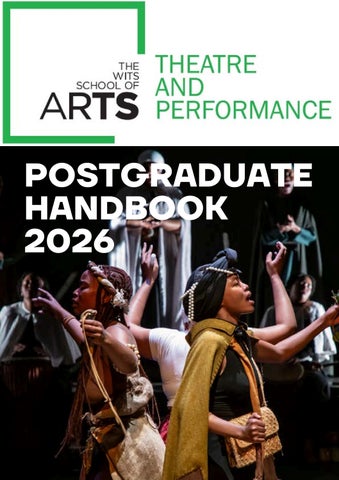
POSTGRADUATE HANDBOOK 2026
Please read this handbook in conjunction with the Faculty of Humanities ‘Application to Graduation’ document and all other important documentation on the TAP Postgraduate Ulwazi Course Site
Sources & Acknowledgements Department of Fine Arts Postgraduate Handbook 2021 compiled by Prof. Sharlene Khan (with thanks) Department of Theatre and Performance Postgraduate Programmes Theatre and Performance 2020/2021 compiled by Prof. Samuel Ravengai Various official Wits websites & Wits News announcements Photos by Zivanai Matangi
Contents
1 2 3 4 5 6 7 8 9 10 11 12 13 14 15 16 17 18 17 18
Follow us on Social Media (p.4) Welcome from the Head of Department (p.5) & WSOA Student Council (p.6)
Vision and Values (p.7) TAP & Wits Theatre Administrative Staff (p.8) TAP Academic Staff and Supervisors (p. 9 - 11) Course Structure (p.12 - 15) The Postgraduate Experience (p. 15) Course Timelines (p. 16) The Proposal Process (p.17) Postgrad Seminar Series & Pecha Kucha Symposium (p.18) Occupational Heath and Safety (p. 19) Venue bookings, Wits Theatre & TAP Rehearsal Spaces (p.19) Supervision (p.20 - 21) Ethics Clearance (p.22) Ethics Training (p.23) Postgraduate Support on Campus (p.24) The Wits Writing Centre (p.25) Plagiarism, Referencing and Turnitin (p.25) Ulwazi and Other Useful Links (p.25) Applying for Postgraduate Study at TAP (p.26 - 29)
Follow us on social media
TikTok @wosa_tap
Instagram @wsoa_tap Facebook @WSOA Department of Theatre and Performance Join our TAP postgrad whatsapp group
Join our TAP students whatsapp group
4
Welcome to TAP! Welcome to the Theatre and Performance Department! Embarking on a postgraduate degree, can at once be a dream, and a nightmare. Self-actualisation, agency, knowledge as empowerment, practice as making and research as sustainability is the achievable dream, just as student debt, the barrage of theory as a headache, and the exactitude and demand of rigour might be nightmares… In fostering a postgraduate culture in the TAP department, and within the school through seminars, supervision and collegial support, we hope to help you find balance and the tools needed to fulfil the dream, while hopefully alleviating any nightmares through dialectic tactics like sharing knowledge bases and/or simply conversation. This important handbook lays out information and resources which contribute to that fostering and nurturing of such scholarship, so please do engage with it, and with the staff and your peers as you embark on or continue this journey. I have a sincere commitment to the postgraduate space because of my own histories of development as a postgraduate scholar in research and creative practice. My own experience of postgraduate study mostly taught me the discipline to commit to self-study , which provided me with an awareness to the dialectic of the self that engendered resilience. You might have noticed the use of dialectic as a kind of emanatory currency of the social exchange, despite the self, and it is again in the conversations with others that we learn, of others and of ourselves. To quote previous TAP HOD Fiona Ramsay, “TAP’s aim is to extend the reach of the field of the arts, and theatre and performance specifically; to embrace embodied experience and knowledge and to teach through creative practice as a form of research to produce cultural and other knowledge” (Ramsay cited in TAP PG handbook; 2023). I imagine that to extend this reach is also an extension of the self as researcher – as scholar – as artist - practitioner – not as merely terms but in action with others – in dialogue with others. In my capacity as incoming HOD for Theatre and Performance and also as WSOA Graduate Studies Chair; I wish all WSOA and TAP PG scholars a year to dream, to dream with others and to make the nightmare lessen through scholarship, research, practice and of course, through developing collegial and artistic networks of support.
Dr. Myer Taub HEAD OF DEPARTMENT
5
WSOA COUNCIL The Wits School of Arts Council is committed to fostering an environment that prioritises student well-being, inclusivity, and academic excellence. We strive to ensure that every student’s voice is heard and their needs are met, providing support, resources, and opportunities for growth. Our mission is to create a community where creativity thrives, diverse perspectives are celebrated, and all students are empowered to succeed in their artistic journey.
Wsoastudentcouncil23@gmail.com
6
Vision and Values
Our Vision
Through advancing excellence in research, teaching and learning, the Theatre and Performance Department combines critical inquiry with artistic practice in ways that encourage transformative engagement with our contemporary urban, African and global contexts. We aim to produce graduates who are informed and critically aware practitioners and consumers of the arts, conscious of their cultural identity and socio-political environment, and invested in decoloniality, sustainability and ecology. We advocate for agency to instill academic freedom and to create work that speaks to our diversity, gender, race, ethnicity, disability, and internationalisation. While making and viewing this work, we are obliged to critically engage with it and to be honest about it to produce knowledge and to improve it. In creative practice and orthodox research, we value continuous, processoriented improvement, collaboration, co-direction, co-publication, interdisciplinarity and shared ownership of our intellectual property and space. We commit to be guided by these ideals in our interaction with one another as we continue to build our artistic and academic community.
Our Values
Integrity | Accountability | Excellency | Collegiality Academic freedom | Critical engagement | Initiative Teamwork | Service Focus | Inclusivity / Diversity Interpersonal Relationships | Reliability / Dependability Continuous / Process improvement | Collaboration
7
TAP & Wits Theatre Administrative Staff Name
Position
Contact
Isana Maseko and Neka Da Costa
TAP Postgraduate Coordinators
Isana.Maseko@wits.ac.za Neka.DaCosta@wits.ac.za
Maud Maphali
WSOA Postgraduate Administrator
Maud.Maphali@wits.ac.za
Lebo Mabonda
TAP Administrator
relebogile.mabonda1@wits.ac.za
Prof. Sharlene Khan
Chair of WSOA Postgrad Committee
Sharlene.Khan@wits.ac.za
Dr. Myer Taub
TAP Head of Department
Myer.Taub@wits.ac.za
Prof. Dr. Rene Smith
Head of School, Wits School of the Arts
HOS.WSOA@wits.ac.za
Malcolm Purkey
Wits Theatre Consultant Director
Malcolm.Purkey@wits.ac.za
Lerato Sekele
Wits Theatre Operations Manager
Lerato.Sekele@wits.ac.za
Julian August
Wits Theatre Techical Manager
Julian.August@wits.ac.za
Hlomohang “Spider” Mothetho
Wits Theatre Production Manager
Hlomohang.Mothetho@wits.ac.za
Lindani Mxumalo
Wits Theatre Stage Services Manager
Lindani.Mxumalo@wits.ac.za
Magdeline Molubi
Wits Theatre Wardrobe Officer
Magdeline.Molubi@wits.ac.za
Kabelo Pakwe
Wits Theatre Front of House Officer
kabelo.pakwe@wits.ac.za
Dee Pillay
Wits Theatre Workshop Assistant
Dee.Pillay@wits.ac.za
8
TAP Academic Staff & Supervisors
9
Dr. Myer Taub (PhD) Dr. Myer Taub is an award-winning South African academic, multidisciplinary artist, dramatist and innovator. His research focus includes theatre and ecology, performance as intervention, urban narratives and theatre making.
Prof. Dr. Samuel Ravengai (PhD)
Prof. Dr. Samuel Ravengai is a performer trainer and teaches playwriting and directing for which he has been invited to share his praxis at various universities including University of Birmingham, University of Cote d’ Azur and various festivals including Harare International Festival of the Arts and National Arts Festival (Makhanda). His notable publications include a Palgrave Macmillan book, Theatre from Rhodesia to Zimbabwe: Hegemony ,Identity and a Contested Postcolony (2021) book chapters in The Palgrave Handbook of Theatre Censorship (2025), Routledge Handbook of African Theatre and Performance (2024) and The Palgrave Handbook of Theatre and Migration (2024). He is the current Editor in Chief of South African Theatre Journal and is launching his latest Cambridge University Press book titled Decolonising African Theatre (2024). He is on the Editorial Board of Intellect Performing Ethos Journal.
Dr. Dalia Farah (PhD)
Dr Dalia Saleh Farah is an academic and a professional scenographer. Her creative research and publications focuses on the intersection of performing arts, sustainability, and cultural transformation, examining how theatre and scenography contribute to social and environmental consciousness. Additionally, her work delves into intermediality and decoloniality, investigating how performance and visual storytelling challenge dominant narratives and advocate for social reformation. A professional scenographer since 1999, she has collaborated with national and international theatre ensembles, bringing her academic insights into practice. Visit her website at www.dalia-farah.com.
Dr. Kgafela oa Magogodi (PhD) Dr Kgafela oa Magogodi is a Storyteller, Playwright, Director, Poet, Musician and Theatre Activist and theorist. He holds a PhD in Creative Writing, and he works full-time at the WITS School of Arts where he teaches practicums about Playwriting, Directing and Spoken Word Theatre. His theatrical work has taken shape over three decades of experimental workshops on professional stages and within arts institutions, directing student casts supported by professionals at the Wits University Drama School, New York University, University of the Northwest, Mmabana Arts and Culture Foundation, the Market Theatre Laboratory and Funda Centre. Magogodi has presented scholarly and artistic works in Namibia, Senegal, Uganda, Zimbabwe, throughout Europe and the United States of America. He has held fellowships at the Literariches Colloquim (Berlin,) the Afrikan Freedom Station (Johannesburg) and the Ecole Cantonale d’Art du Valais (Switzerland.). He has featured in scholarly publications as well as popular media where he emerged as an independent voice who engages critically with Afrocentric performance theories.
TAP Academic Staff & Supervisors
10
Kamogelo Molobye (MA) Kamogelo Molobye is an artist and thinker whose main intention is to challenge and develop creative, professional and new modes of knowledge production. Key to his work and interest is developing critical and reflexive skills within emergent arts and performance institutions. Kamogelo’s research interests include gender, sex and sexuality studies, queer studies, performance studies, cultural studies, feminist and womanist discourse, and choreographic practice and language.
Prince Lamla (Hons) Prince Lamla’s research interest lies in African storytelling as a means of decolonizing theatre through the exploration and cultivation of directing, theatre-making, and theatrical performance in a global context. His interest also revolves around identity. There are multiple ways of viewing identity, however, from his perspective, he is interested in identity as perceived through a cultural lens. He seeks to deliberate, contribute and offer an alternative to what is already available in the field of theatre and performance.
Gavin Matthys (MA) Gavin Matthys’ research interest lies in the psychosomatic experience of the world, and in excavating the historical archives that sculpt our embodied experiences. Thus, he is interested in exploring the ontological lived experience(s) which constitute the individual. His nucleus interest resides particularly within the embodied expression of the voice towards communication and meaning making. He is engaging the personally unique and symbiotic relationship between the inner and the outer environment, working towards an optimal equilibrium of present and past.
Neka Da Costa (MA) Néka Da Costa is a director, collaborator, theatre maker and academic whose research focuses broadly on creating and critiquing inclusivity and accessibility in the theatre and performance field, particularly for marginalised and/or queer communities. She considers herself a creative, a teacher and a researcher interested in radical teaching and learning scholarship and practice. She is currently designing theatre making pedagogies which centralise and prioritise difference and disability within the broader context of decoloniality and the acknowledgement of intersectional identities in contemporary South Africa.
TAP Academic Staff & Supervisors
11
Smangaliso Ngwenya (MA) Smangaliso Ngwenya is a multidisciplinary artist, researcher, and founder of Isifiso SakaGogo Performance Theatre. The essence of all his offerings, research and writing is rooted in dance and movement initiated in the embodied, moving, dancing black body. This is towards investigating epistemologies and pedagogies in the black African experience and documentation of African dance.
Sinenhlanhla Zwane (Hons) Sinenhlanhla Q. Zwane is a young designer, theatre practitioner and entrepreneur. Her current research interests lie in Cultural Policy and Management where she offers a lens into ways of access to art culture and art production in rural and developing communities. Her bona fide passion for the arts has led to the birth of her own novelty business, Konke Mo(ve)ment Art (Pty) Ltd, which focuses on arts and social development for women and youth in rural and disadvantaged communities in Newcastle, Northern KwaZulu-Natal and the surrounds.
Isana Maseko (MA) Isana is a performing artist, theatre maker, and an arts academic with interest in somatic, embodied approach(es) to performance, with a focus on the use of body and voice within African-based paradigms. Research interest sits within the Afrocentric, PostColonia and Pan-Africanist views on the use of body and voice in performance. Latest academic offering: Karina Lemmer, Marth Munro & Isana Maseko, 2024: Our Decolonial Conversations with Performance Voice Training in Higher Education in the South African Pluriverse, Voice and Speech Review.
12
Course Structure
The Bachelor of Arts Honours in Theatre and Performance is a degree is a one-year (full time) or two years (part time) program which offers students the opportunity to receive specialised training in the field of Theatre and Performance while completing a research essay. BATAP Honours students are required to complete the following:
WTAP41112A Long Essay on an Approved Topic (about 8000 words in length, under the guidance of a supervisor). This course is a full year course primarily structured as independent research and writing, done by the student with guidance from their assigned supervisor. There are no weekly classes for this course, but students must attend a series of online writing/research workshops via MS Teams throughout the year to assist them with the content and structure of their Long Essay. The ONLY outcome of this course is a Long Essay, which is a theoretically-informed academic paper. The Long Essay must be based on research in an area related to the field of Theatre and Performance, or related to a staff member’s areas of expertise within that field, and is to be considered independent research, although conducted under close supervision. Students are required to submit a onepage expression of interest to the Long Essay Coordinator early in the first semester, so that their research question can be identified, and an appropriate supervisor can be assigned.
AP T A B o u n r o H AFATAP40 s ATAP40 F A
Two professional electives (4 x courses, 2 per semester): choose from the list of courses offered below: WTAP4098A Design IVA WTAP4099A Design IVB WTAP4100A Directing IVA WTAP4101A Directing IVB WTAP4090A Movement IVA WTAP4091A Movement IVB WTAP4088A Performance Studies IVA WTAP4089A Performance Studies IVB WTAP4078A Writing IVA WTAP4108A Writing IVB WTAP4130A Musical Theatre IVA WTAP4131A Musical Theatre IVB
NOTE: The BATAP Honours can be enrolled in full time (1 year) or part time (2 years). Either way, however, students must complete their two professional electives with the 4th years, so honours students will need to be available to join these classes during the day, following the TAP timetable. Therefore, if you wish to study this course part time, it is recommended that you follow one of these two options in terms of structure: Option 1: Year 1: both professional electives (4 x practical courses, 2 per semester) Year 2: long essay only OR Option 2: Year 1: 1 professional elective (2 x practical courses, 1 per semester) Year 2: 1 professional elective (2 x practical courses, 1 per semester and the long essay)
Course Structure
13
rs by e t s Ma ursewor k
The MATAP by Coursework and Research Report offers students the option of combining coursework with independent research. All MA by Coursework students must complete three 500level modules and a Research Report. The coursework (all 3 courses combined) constitutes 50% of the final mark and the Research Report the other 50%. At least 2 of the 3 required MA level courses must be completed within the Department of Theatre and Performance.
COURSE CODES & MODULE DESCRIPTIONS: WTAP7032A Radical Theatre Research (Semester 1) This module is intended to build up a critical and theoretical framework which students would then make use of to formulate their creative and/or written report/final paper. The course comprises of an intense ‘boot camp’ with staff in the first quarter in which MA candidates are introduced to the research and practice expertise within the department. Here they are orientated within the department and school and are given inputs on research and writing guidelines/techniques. A post-‘boot camp’ writing retreat in order to formulate/consolidate research questions. Theatre theory inputs in the form of master class sessions, seminars, lectures, and practical inputs across the semester.
WTAP7030A Critical Practice: Revising/Devising (Semester 1) This course enables theatre makers to create and experiment with new and exciting modes and models of theatre practice within the context of Johannesburg. This is achieved through working in an atmosphere that encourages choice, rigorous critical attention, skills enrichment, reflection and creativity. The student will work with experienced theatre practitioners who will share their creative approaches through practicums, workshops, and exchanges.
o C
ACA18
The course allows for varied approaches to the creation and conceptualising of theatre work in Johannesburg, and assumes that students have proficiencies in some of the following areas playwriting, performance, voice, choreography, physical theatre, musical theatre, design, directing, and dramaturgy.
WTAP7031A Critical Practice: Performance (semester 2) This course integrates a critical theoretical component with the praxis of performance. It explores several key aspects of contemporary critical performance practice, including the role, process and function of the performer. The course interrogates the traditional pedagogical practices, which prioritise Western canons above non-western perspectives in relation to the contemporary role and function of the performer. It emphasises the city of Johannesburg as a site of creative practice and considers how location (post-colonial /post-apartheid Johannesburg / South Africa / Africa) informs the choices, skills and a critical discourse of performance.
WTAP7003A/WTAP004A/ WTAP7005A Research Report This course can be enrolled in either part time or full time to allow students to complete their research report. The Research Report. NOTE: The MA by Coursework can be enrolled in full time (1 year) or part time (2 years). Either way, however, students must complete the first year of coursework modules full time before enrolling into the research report part time.
LENGTH OF RESEARH REPORT: 10 000- 12 000 words (with Creative Research project) 20 000 – 30 000 words (without Creative Research project) (1 x reader; 1 x internal examiner [can be supervisor]; 1 x external examiner)
Course Structure WTAP8004A / WTAP8002A The Masters by Dissertation in the field of Theatre and Performance can be undertaken with or without a creative project. The course code is the same, and students will decide which pathway to take under the guidence of their supervisor.
MA by Dissertation (no creative project) Students who have sufficient expertise in their proposed field of research within Theatre and Performance may obtain a Masters degree by independent research under the guidance of an approved supervisor. The outcome of this degree is a standalone research dissertation. This course can be completed full time (1 year) or part time (2 years), although part time study is recommended as most full time students do not finish their research within one year. LENGTH OF DISSERTATION: 45 000 - 50 000 words
(1 x reader; 1 x internal examiner [cannot be the supervisor but can be within the dept/school]; 1 x external examiner)
MA by Dissertation (with creative project) This degree is aimed at students who have considerable professional experience and who wish to produce a practical/creative project as a substantial component of their MA research. The written, theoretically grounded component of the research (a dissertation) shall be weighted 50% of the final mark, and the creative project will constitute the other 50%. This course can be completed full time (1 year) or part time (2 years), although part time study is recommended as most full time students do not finish their research within one year. LENGTH OF DISSERTATION: 20 000 – 25 000 words (with Creative Research project)
(1 x reader; 1 x internal examiner [cannot be the supervisor but can be within the dept/school]; 1 x external examiner, not from the University)
14 rs by e t s Ma sertatio s
Di
n
ARA12 CREATIVE PROJECT CREATIVE PROJECT STIPULATIONS STIPULATIONS The creative project component of the MA by Coursework and Research Report and the MA by Dissertation with Creative Project will be assessed in conjunction with a written framing document which academically contextualises the work, and a viva/oral interview with the examiners after the creative project has been showcased / submitted. The assessment of the creative project usually takes place prior to the submission of the final dissertation, unless it is a written script / archive which will be submitted alongside the final dissertation. The Creative Project component shall comprise of: a) A creative project which may take the form of a theatrical and/or site-specific performance, a design project, a series of workshops, the directing of a play, an installation, and/or the writing/devising of a play; or any other approved creative/practical project within the field; but which informs or forms part of the inquiry. b) A written framing document of not more than 10 pages in length, which shall be made available to both the internal and external examiner(s) at least 48 hours before the commencement the final assessment of the creative project. This document could be a section/extension of the research proposal which frames the creative project. c) A permanent record (retainable documentation) of the creative project which may take the form of photographs, slides audio recordings, a written description, and/or video recordings. Such permanent record must be made available for review or assessment to examiners
Course Structure
n Theatre i D r m o h f a r P Pe n c AFATHPR8
&
ATHPR8 0
2 AF 0 DA A
e
The Theatre and Performance department offers a PhD in the field of Theatre and Performance. The PhD is the highest qualification which a student can earn by conducting independent research under supervision, and requires your previous qualification to be a Masters degree, NQF level 9. The thesis is required to make a recognisable contribution to new knowledge in the field of study, and must be of a publishable standard. In the Wits School of Arts (WSOA) there is no coursework component to a PhD degree. The PhD degree in TAP can be by research only or it can be a PhD by Creative Work, which encompasses a creative project or component as essential to the research itself. As such ‘research’ is broadly defined in the latter in terms of both a central creative component derived from ongoing discursive and field research and critical thinking in conjunction with a written, discursive exploration of the topic. The duration of a doctoral degree is normally 3-5 years full-time and 4-6 years part-time. LENGTH OF DISSERTATION: 75 000 – 85 000 words (2 readers and 3 x examiners)
The Postgraduate Experience Each postgraduate process, regardless of level of study, has similar milestones that students must achieve: 1. Proposal (panel presentation and submission) 2. Ethics clearance process 3. Creative Project presentation (only if electing to do a creative project as part of the research) – honours not included 4. Final submission of research Each of these processes has their own requirements and administrative hoops to jump through at Faculty level, so students should be prepared to engage in a long (but rewarding) postgraduate journey.
15
Course Timelines
16
The Proposal Process 1
Meet with your supervisor
(a) Discuss the topic, its scope, theoretical framework, proposed methodology and a preliminary reading list (b) Decide on deadlines for submissions of drafts, (c) Agree on modes of communication and feedback, (d) Supervisor will inform you of procedures and Faculty deadlines, (e) Sign a supervisor – student “contract” or MOA (f) Make sure to keep a record of dates and some notes on your consultations with your supervisor (g) Draft your proposal and be sure to stick to your deadlines with your supervisor. Note that you may need to draft it 3 – 4 times before it is ready for presentation.
2
Arrange your proposal presentation
Once you have a solid draft of your proposal that you and your supervisor are happy with, your supervisor will identify an appropriate reader(s), and together you will set a date for the panel presentation where you will present your research proposal. Your proposal draft should be sent to the readers at least 1 week prior to your panel presentation.
3
Present your proposal
You will present your proposal to a panel of readers, staff and other postgraduate students. You are expected to summarise your proposal and communicate the ideas and trajectory of your research. Readers, panellists and staff will have an opportunity to ask questions and make comments, which you will need to take note of. 3.You will present your proposal to a panel of readers, staff and other postgraduate students. You are expected to summarise your proposal and communicate the ideas and trajectory of your research. Readers, panellists and staff will have an opportunity to ask questions and make comments, which you will need to take note of.
The Research Proposal, submitted either internally to TAP (honours) or externally to Faculty (Masters and PhD), is a document that introduces and frames your inquiry to seek approval to continue with the research. It requires a substantial amount of work and has to meet specific requirements regarding structure and content. There is a useful guide to proposal preparation on the Faculty of Humanities website. Remember that TAP follows the Harvard style of referencing and citation.
4
Implement Revisions
At MA and PhD level, the readers will then write readers reports which recommendations for changes. At this point, the readers may decide that the proposal is accepted, accepted with recommendations, or that it needs to be reworked before it can be submitted. It is therefore necessary to schedule your proposal presentation for at least one month before the Faculty deadline, so that there is enough time to implement rewrites and revisions. Honours students follow a similar, but simplified process.
5
Submit final proposal
The revised proposal must be approved by the Reader and supervisor. Once the final proposal is approved for submission, your supervisor will assist you to submit all the required documents to Faculty, including a Proposal Submission form, a letter of support from your supervisor, the proposal itself and the readers reports.
6
Apply for ethics clearance
Once the proposal has been approved, students can then apply for Ethics Clearance, and begin the actual research and creative project work which builds towards the final dissertation or creative project.
17
Postgrad Seminar Series & Pecha Kucha Symposium
TAP Postgrad Seminar Series
During the first semester of each year, the TAP department will run weekly seminars and workshops which are directed at supporting students’ research, writing and critical thinking around artistic practice and academic scholarship. These seminars are compulsory for Honours Long Essay students, and are voluntary for MA and PhD students. They are student-centred and informal, and we highly recommend attending them no matter where you are in your process. The seminar programme is devoted to TAP-specific methodologies and aspects of postgraduate academic writing, include the writing of abstracts, proposals, literature reviews, research questions, chapter outlines/mind-mapping and ethics protocols, among others. Seminars and workshops run by members of staff within the TAP department draw strongly on their practices within the field of theatre and performance and are oriented towards practice and its relationship to artistic research. Students are expected to read prescribed texts and participate in the seminar / workshop discussions and activities. A detailed schedule will be shared.
Pecha Kucha Symposium
Pecha Kucha (Japanese for chit chat) is a quick and engaging visual presentation format which streamlines and simplifies knowledge and ideas. Pecha Kucha limits presentations to 20 slides, with 20 seconds of commentary or explanation per slide. This translates to roughly six minutes per presenter. Read more about the format here: https://www.pechakucha.com/ There will be a Pecha Kucha. Symposium at the end of the first semester. Every honours, MA and PhD student is expected to present their ideas, research or aspects of their work. Honours students should treat this moment as preparation for their proposal presentations prior to the June exam period, and MA/PhD students can use this as a moment to share their process to date. Each student will be at a different point in their postgraduate journey, so not only will this symposium provide a platform for students to articulate their research and process, but they will receive supervisor, staff and peer feedback as the research progresses. Participation in this Pecha Kucha session is compulsory. Students should book their slot through the TAP postgraduate coordinator once the bookings become available.
18
Occupational Health and Safety It is the policy of the University of the Witwatersrand, insofar as is reasonably practicable, to comply with the Occupational Health and Safety Act No 85 of 1993 (and its regulations) as well as allied OHS&E related legislation, standards, and requirements to which the University subscribes. The University is committed to providing and maintaining, as far as is reasonable practical, a healthy, safe and risk-free working learning environment. The Wits School of Arts is committed to undertaking our part in complying with the University OHS&E policies. On a very immediate level, this means being aware of how your practice may at times inadvertently harm people in and around the School and surrounding environment. Should you have any queries about whether your work does present a risk, please discuss this with your supervisor or course coordinator. In case of emergency, contact the Safety Officers in your area.
SAFETY OFFICERS Theatre and Performance Department (WSOA 2nd floor) Myer Taub (myer.taub@wits.ac.za) and Gavin Matthys (gavin.matthys@wits.ac.za) Theatre and Performance Department Es'kia Mphahlele Building (EM7, EM9 and EM16) Kamogelo Molobye (kamogelo.molobye@wits.ac.za) Wits Theatre Complex and Nunnery Julian August (julian.august@wits.ac.za)
Venue Bookings For bookings in EM7, EM9 or EM16 studios, sign up on the booking sheets outside each studio. For queries, contact Kamogelo.Molobye@wits.ac.za For bookings in the Wits Theatres for showcasing your Creative Project research, consult with your supervisor, then email Lerato.Sekele@wits.ac.za and cc the postgraduate coordinator We use doodle (an online booking system) for students to book rehearsal space in the WSOA spaces (Studio 1 and 2 and room 120), and the Mezzanine, Mezzanine Annex and SRC Du Plessis venues. Instructions for doodle are posted on the TAP whatsapp group.
Please note that the Wits Theatres are managed by theatre staff who are professionally trained to operate lighting, sound, set-building and sewing equipment. Please do not enter a Wits theatre venue without the supervision of the allocated venue manager, and do not operate the equipment without permission, supervision and the appropriate training to do so. In addition to our Wits Theatre venues, postgraduate students have access to our Wits Theatre Workshop and Wardrobe to borrow props, set and costumes for your creative projects towards your degree. Please note that students are not permitted to operate the machinery in the workshop and should consult Lindani Mxumalo (Lindani.Mxumalo@wits.ac.za) with any set-oriented requests. Should you require any assistance from the Wits wardrobe, contact Maggie Molubi (Magdeline.Molubi@wits.ac.za) or visit the wardrobe during their office hours to borrow items. All equipment and items must be loaned out and returned timeously. Rehearsal spaces, equipment and facilities are provided by the Department of Theatre and Performance and Wits School of Arts for the use of students registered for the undergraduate degrees, BATAP Honours, MA by Research (and Creative Project) and PhD (with Creative Project) students. These are partially funded by a portion of the fees that each student pays to study. The equipment, facilities, rehearsal spaces and materials belonging to the Theatre and Performance department and the Wits School of Arts and may only be used for work that is made towards the degree for which a student is registered and may not be used for private or commercial work.
Wits Theatre Venues & TAP Rehearsal Spaces 19
Supervision
WHAT IS SUPERVISION? SUPERVISION? WHAT IS
Supervision is a key aspect of your postgraduate experience. Usually students work with one supervisor from the TAP department over the course of their Honours, MA and PhD studies, but in some cases, there is a second cosupervisor (this is usually on request when there is a specialist research area that needs to be guided by an expert academic). Supervision is usually arranged by the student, and we recommend that you arrange meetings once or twice a month with your supervisors, depending on your needs as a student, and the availability of your supervisor. All supervisors in the department partake in active professional theatre and performance projects, undergraduate teaching responsibilities and administrative commitments, so the timing of meetings and feedback expectations need to be managed accordingly. Please note that supervisors are not expected to give detailed corrections for drafts, or corrections in terms of language and style (although some may choose to do this). The kind of feedback that can be expected is geared more towards shaping the discipline-specific content and technical aspects of your creative work and writing. We would like to emphasize the dialogical nature of the postgraduate programmes, as one where you, as much as your supervisors, lead the process of your degree. You are expected to work independently on your practice and research. You need to keep up with deadlines (set by you, your supervisor or faculty) and manage your time between seminars/workshops, rehearsals, research and writing as well as your life and work commitments. Supervision meetings and regular feedback on both your creative practice and your writing is a Faculty expectation – should you feel that you are not getting adequate assistance in this regard, you should speak to your supervisor in the first instance, or, thereafter, to the TAP postgraduate coordinator. This can also be reported on in the yearly MA/PhD reports (which are confidential and sent directly to the Faculty administration) – keep an eye out on your student email for these. Your supervisor also has expectations of meeting with you regularly and seeing work – set timeframes, expectations and deadlines with your supervisor, and attempt to meet these. When you feel you are not able to, revisit these with your supervisor and renegotiate when, as they say, ‘life happens’. Be realistic around your goals – while you may feel you are ready to hand in, your creative work or writing may be saying something else. Your supervisor is there to act as a first critical response – they are not there to hamper you, but they pre-empt queries that your external readers /examiners may have that may prevent you from completing your degree. It is, thus, necessary for you not to ignore your supervisor’s feedback as simply opinion or commentary but take it as the first critical external voice that you need to take note of as critical interrogation. Your supervisor will also fill in a yearly report on your progress – in most cases they try to give objective feedback on how your progress went that year and explain if there were any delays that warranted (or if they pre-empt any warranting) extensions. They are also expected to notify Faculty if there has not been sufficient engagement or progress from a student. To make the most out of supervision meetings, you might want to consider writing a report on the meeting, what was discussed (major points) and the outcomes decided as well as the next scheduled date of meeting and email that to your supervisor for both their and your records. Another helpful method is to audio record – if your supervisor permits this – your consultation sessions with them so that you can hear the feedback more than once. You may be surprised how much you don’t hear the first time around. Most importantly, find a relationship that best works for you and your supervisor – remember, your supervisor wants you to succeed, but you are not their only student! You cannot expect feedback on a draft or chapter in under four weeks. You also cannot expect supervisors to be chasing after you for work – for postgraduate students with busy professional and home lives we try to craft a program of support while leaving as much room for you to work, study and live. The onus is, thus, on you to remain in contact with your supervisor. The postgraduate coordinator will be in contact, however, should you begin missing important milestones or timeframes (no participation in Pecha Kucha presentation, research proposal not presented or submitted on time; being alerted by supervisors that no contact has been established since registration for a semester; no end-of-year report submitted etc) to check-in with you. Please ensure that you read and sign the MOA Statement of Principles for postgraduate supervision before you commence your research process.
20
Supervision
HOW ARE SUPERVISORS SUPERVISORS ALLOCATED? ALLOCATED? HOW ARE
In the first few weeks of your program, you will be asked to submit a one-page expression of interest (which is almost like an extended abstract for your research). This document should be written in academic language and should provide a brief overview of what you would like to DISCOVER through the process of your research. It should include your proposed research question (and sub questions), a small expansion on your research topic and – if you are enrolled for an PhD or MA by Research with a Creative Project – an outline of your proposed creative project and how it will help you to answer your research question. Lastly, this document should include an initial bibliography with at least 5-10 readings you are engaging with or plan to engage with. You can also have a look at our staff profiles and suggest a preferred supervisor that you’d like to work with, depending on your research interest. Once the expression of interest has been submitted, the TAP department will meet and allocate supervisors based on 1) expertise in the area of interest of each postgraduate student 2) capacity of staff to take on supervision. Once supervisors have been allocated, the postgraduate coordinator will put you in touch with your supervisor so that you can arrange your first meeting.
21
Ethics Clearance The University insists that all its research be conducted following the very highest ethical standards. Research integrity in general is a cornerstone of high-quality research. All researchers, including staff and students, need to seek ethics clearance before any research is conducted, particularly if the research involves human participants (in the form of interviews, focus groups, performances, subjects of study etc). If one fails to obtain ethical clearance before the research is started (at proposal stage), then this may lead to a breach of research integrity, articles not being published and students being barred from graduating. The University’s Ethics Committees are registered with the National Health Research Ethics Council (NHREC) of the Department of Health. As such, we fully subscribe to the document entitled Ethics in Health Research. Supervisors must assist you to apply for ethics clearance and assist you to fill in and create the necessary forms and supporting documentation such as Participant Information Sheets, Consent forms, interview questions etc. Even if your research does not involve human participants, you will need to apply for an Ethics Waiver. You can only apply for ethics clearance once your approved proposal has been submitted.
Honours & MA by Coursework
MA by Dissertation and PhD
Honours and MA by Coursework students need to apply for Ethics Clearance internally via our WSOA Ethics Committee. Applications are submitted to the WSOA postgraduate administrator. The dates for each monthly WSOA ethics meeting will be shared via the TAP Postgraduate Ulwazi site.
MA by Research, MA by Research and Creative Project and PhD students must apply for Ethics clearance through Faculty online using the Ethics Management System (EMS). Please visit this website for more information and a user guide on how to apply for ethics clearance using EMS: https://www.wits.ac.za/research/researchersupport/research-ethics/
Research on Wits and its people Should you want to conduct research about the University or want to use the University community as research participants then you will have to discuss the project initially with the Assistant Registrar, Ms Nicoleen Potgieter, who can be reached at: Nicoleen.Potgieter@wits.ac.za (more information here) Students or staff currently registered with the University of Witwatersrand, Johannesburg for Hons, Masters or PhD degree wanting to conduct research by either using Wits students or staff data need to apply to the University Deputy Register’s Office for permission to conduct the research.
You are not allowed to continue with your research until you have ethics clearance, so please work this administrative process into your timelines with your supervisor.
22
Ethics Training The ethics application form (question 10.2) asks about research ethics training that you have received. There are a number of options for completing research ethics training – for example, ethics workshops are run by the University Research Ethics Committee, or research ethics training may be completed online. Applicants are required to provide evidence of research ethics training in order to receive an ethics clearance certificate. This is an NHREC requirement. Please provide details of research ethics training completed within the past 3 years. For Honours and MA by Coursework, applicants may complete one of the suggested courses detailed below, or some other training course. A certificate must be provided however. In the case of a waiver application, for school level applications training is strongly recommended but not required. For MA by Dissertation and PhD, applicants may complete one of the suggested courses detailed below or else provide details of ethical input as part of a research methodology course (but please indicate the course code, dates of attendance and give some detail about the course). There are three options for Ethics Training at Wits:
1
Wits Ethics Training Online Workshop
A research ethics training workshop entitled: ETHICS IN RESEARCHAND APPLYING FOR ETHICS CLEARANCE, is run throughout the year through the Postgraduate Affairs Office of the University. This workshop has two components. PART 1 (3 hours) comprises formal training on research ethics, with a particular emphasis on social science research. This training is content based. There is a formal written assignment following this workshop. Successful completion of this assignment will allow participants to receive a Certificate of Competence in Research Ethics. PART 1 (1 hour) describes how to apply for ethics clearance to the University Research Ethics Committee (Non- Medical) or to school ethics committees. This workshop will be relevant to Honours, Masters, PhD students as well as staff dealing with human subjects in their research projects. The workshop will be run online on MS Teams. For information, contact Mokgaetsi.madubanya@wits.ac.za Dates for these sessions will be posted on the TAP Postgraduate Ulwazi site.
TRREE (Training and Resources in Research Ethics Evaluation)
2
This is an online ethics training resource. Ethics training can be completed free of charge on the TRREE website - https://elearning.trree.org/ You only need to complete Module 1 (EN): Introduction to Research Ethics. You will need to register on the system to complete the training. You can download the notes for reading later. It takes 2-3 hours to complete the module. There is a quiz at the end of module with MCQ questions; you must obtainat least 70% at the first try. To obtain a certificate after completion of Module 1: while logged in, return to the home screen and click on Module 1 (EN) again; the system will open up a page with objectives for the module; scroll down and you should find your certificate under the heading 'Training Material'.
3
Macquarie University
This is an online ethics training resource. It is more suited to humanities and social science projects. Ethics training can be completed free of charge on the website https://ethicstraining.mq.edu.au/ You will need to register on the system to complete the course. It takes an estimated 2-3 hours to complete the module. There is a quiz at the end of each section with MCQ questions. If you fail one section, you may take the quiz in that section again, but you can only do so after 24 hours. You must correctly answer 2/3 of the questions in each section to pass that section. After all sections have been passed, you can print a certificate for the ethics training.
23
WSOA (Fine Arts) Creative Research Seminars 2026 The Department of Fine Arts is running Creative Research Seminars in the first semester, which TAP students are welcome to join, but please book in advance by emailing the lecturer running the session (name.surname@wits.ac.za). THURSDAYS 09:00 - 12:00 (EM7) Thurs, 20 February, 9.00-12.00: Developing a research question (workshop) (Prof Sharlene Khan) [for MA and PhD students only] Thurs, 27 February, 9.00-12.00: Elements of a research proposal (Prof Sharlene Khan) Thurs, 6 March, 9.00-12.00: What is the relationship between practice and writing in a practice-based degree? (Dr Zen Marie) Thurs, 13 March, 9.00-12.00: Research ethics (Prof Sharlene Khan) (suggested for all new PG students) Thurs, 20 March, 9.00-12.00: Literature reviews for creatives (Prof David Andrew) (suggested for all Hons students) Thurs, 10 April, 9.00-12.00: Writing an abstract (Dr Akhona Ndutza) (suggested for all Hons students) Thurs, 17 April, 9.00-12.00: Proposal writing (Dorothee Kreutzfeldt) (MA students only) Thurs, 24 April, 9.00-12.00: Documenting your practice (Earl Abrahams)
Wits Postgraduate Association (PGA) The Postgraduate Association (PGA) is a body that works closely with different stakeholders to advocate for the needs of all postgraduate students. It acts as a resource that provides support and services to PG students and promotes academic leadership and excellence. There are three pillars that the 2020/2021 PGA prioritizes: 1. Accountability and Transparency 2. Personal and Intellectual Integrity 3. Upholding the community of Scholars
Postgraduate
The principles that the PGA hopes to lead with are: ·Inclusivity ·Transformation ·Diversity
Postgraduate Support on Campus Humanities Graduate Centre The Humanities Graduate Centre provides the ultimate interdisciplinary environment for postgraduates with doctoral fellows from: ·The Schools ·Departments ·Centres ·Institutes The Centre also has space for masters and honours students and is a networking hub – linking junior postgraduates with senior PhDs. It is a space that offers mentorship, workshops, and space for postgraduates to study. Please visit their website for more information: https://www.wits.ac.za/hgc/
Postgraduate Affairs Office The Postgraduate Affairs Office is an initiative of the University Research Office to promote a public face for postgraduate studies at Wits. Its brief is to improve the overall quality of the postgraduate experience across all five faculties and for focused strategic thinking about the implementation of the vision to establish a research intensive University with 45% postgraduate students. The Postgraduate Affairs Office’s role includes: Development of appropriate initiatives which will enhance the University’s strategic goals of increasing recruitment and success of postgraduate students; formulating policy on graduate studies; implementing the Postgraduate Cross-Faculty Symposium; designing and implementing generic courses and research support workshops for graduate students; designing and implementing writing retreats for graduate students; promotion of a public face for postgraduate studies at Wits. All information concerning postgraduate opportunities will be advertised and sent via ULWAZI using your official student email address. Contact - Senior Administrator: Lucille Mooragan Lucille.mooragan@wits.ac.za
24
The Wits Writing Centre The Wits Writing Centre (WWC) is a free and confidential service open to any Wits student of staff member who wants to work on their writing. We welcome anyone who would like to write better. Any draft can be brought to the WWC, including essays, plans, drafts, practice exam answers and creative, nonacademic writing. Some of our most successful consultations are with students who are already good writers, but who nevertheless realize the value of an attentive reader. All of us struggle with our writing sometimes. WWC consultants will not edit or write for you. They will help you to decide what you want to say, in your own words, to successfully reach your particular readers. Sometimes this means working with you to learn the conventions of your discipline. In all cases WWC consultants will endeavour to help you develop, focus, and frame your thinking so as to achieve your intentions. Currently our services are entirely online and the consultation process operates through emailed letters and annotated drafts. Last year we found significant advantages to this letter writing method, because we are forced to put our ideas, and our thoughts about our thinking, into written form in correspondence with another. Sometimes, without thinking too hard, clients began to sort out their problems and ideas themselves as they wrote to the consultant or responded to their queries. If you would like to try a consultation, fill in the WWC cover letter which includes a brief description of your writing concerns, and send the completed cover letter with your draft to writingresponse.WWC@wits.ac.za. Your cover letter and draft will then be sent to a writing consultant who should respond to you within three working days. To download and complete the cover letter, please visit: https://www.wits.ac.za/students/wits-writing-centre/
FACULTY OF HUMANITIES POSTGRADUATE SERVICES Visit this site for all postgraduate related queries including those related to: ·Registrations queries ·Amendments ·Proposal submissions ·Research report submissions ·Extensions ·Special concessions ·Fees reversals, as well as all other postgraduate related queries And to download important postgraduate forms needed at each milestone of your degree.
Plagiarism, Referencing & Turnitin Reports The University views academic plagiarism as an offense. Please familiarise yourself with what constitutes academic plagiarism by reading the Wits Plagiarism Policy and ensure that you use the Harvard Referencing system for referencing and citation. Turnitin Reports Wits uses an online plagiarism report generator called Turnitin, which automatically scans your document and generates a plagiarism report. You are required to submit a Turnitin Report with your proposal/thesis/dissertation/research report. When you are ready to submit, let your supervisor know and they can help you submit it on an Ulwazi submission site to generate a Turnitin report. Please do not leave this for the last minute of your submission as these large documents with many changes can take up to a day to generate a report.
Ulwazi Wits uses Ulwazi (Canvas) as their online Learning Management System. This is the primary platform through which we will communicate important announcements, share information about workshops and seminars and archive postgraduate forms for easy access. Ulwazi is linked to your Wits email, so please check both regularly. Click here for information about how to set up Ulwazi. Click here to self-enrol on the TAP Postgrad Ulwazi site.
Other useful links Counselling and Career Development Unit Transformation Office Gender Equity Office Student Representative Council Student Accommodation Disability Rights Unit Wits Library South African Qualifications Authority Financial Aid and Scholarships Administration Bursary Links More on Ethics
25
Applying for Postgraduate Study at TAP 26 The first step for any application for postgraduate study at Wits University begins online. You will need to fill in an online application, and provide all the documents required by the university – these include a CV, certified degree certificates and academic records, SAQA certificates, certified copies of your ID etc. You will create a profile on the application portal, and must check this portal for updates and communication from the University. International students should also familiarise themselves with their specific application process, which includes extra steps like allowing sufficient time to procure SAQA certificates or study permits. Click here for more information. Once your application is complete on the online system and you have paid the application fee, it will be sent through to the Theatre and Performance department, at which point, we will set up an interview with you to discuss your research interests and professional/academic trajectory. At the point of the interview, the TAP department may request additional documentation, audition footage or a portfolio of creative work, depending on the requirements of the program you are applying for and your specific area of interest. Once you have been interviewed, TAP will communicate their decision on your application to Faculty, who will then make an offer through your application portal. Should you receive an offer, you will need to accept it on the portal before you can register for the degree. Correspondence with applicants during the application process is by email. Applicants are advised to only submit an email address that is accessed regularly. We do not take responsibility for correspondence and information - such as proposed dates for the interviews/auditions - not received by applicants and sent to the email address furnished. For more information and to apply, click here.
BA Honours in Theatre and Performance (NQF level 8)
To qualify for this programme, a minimum of 65% must be obtained in a BA degree (NQF level 7) in Theatre and Performance, Dramatic Arts, Theatre Design, Acting, Creative Writing, Theatre History, Dance, Physical Theatre / Movement, Interdisciplinary Cultural Studies, Visual or Performing Arts or any other creative arts related field. In addition to the application documents required by Faculty, the following supporting documents must be provided for consideration in the Bachelor of Arts (Honours) in Theatre and Performance programme: 1. Application fee 2. All former academic transcripts of prior degrees (should show that the undergraduate degree was completed and that the student does not owe fees to their previous institution) 3. All prior qualification certificates 4. A comprehensive Curriculum Vitae (maximum 2 pages) detailing all professional experience and including all qualifications and/or training certificates. CV should also detail examples of achievement or recognition in the professional theatre and performance industry and/or formal or informal involvement in academic or research activities (including teaching, conferences and publications). 5. Two letters of reference 6. A recent academic writing sample of work (for example, an essay or research report) which gives a good reflection of your academic writing capacity and your understanding of academic writing conventions such as providing comprehensive definitions, application of key terminology, case study analysis, in text citation and referencing etc. 7. A short letter of motivation (maximum 1 page) reflecting on why you want to apply for the BA Honours degree at Wits in the Department of Theatre and Performance and how this relates to your personal and career trajectory and history. Give us an idea of how this degree will develop your current artistic or creative practice. Please also include which TWO professional courses you would like to study and why – see options on next page. 8. A statement of interest (maximum 1 page) which details your intended research topic for your Long Essay (see next page)
Applying for Postgraduate Study at TAP
sional s e f o Pr lectives E The BA Honours in Theatre and Performance requires students to choose TWO professional electives (four courses, two per semester) from this list. Ensure that you list and justify your two preferred electives in your motivation letter.
ent of m e at teres t t S In
WTAP4098A Design IVA WTAP4099A Design IVB You will be asked to supply a portfolio of work which demonstrates your visual literacy, practical design/drawing skills or creative thinking. WTAP4100A Directing IVA WTAP4101A Directing IVB You will be asked to supply a director’s treatment of a provided play text to demonstrate your directorial competency. WTAP4078A Writing IVA WTAP4108A Writing IVB You will be asked to provide a sample of creative writing (poetry, play, story etc) WTAP4090A Movement IVA WTAP4091A Movement IVB Requires an additional audition WTAP4088A Performance Studies IVA WTAP4089A Performance Studies IVB Requires an additional audition WTAP4130A Musical Theatre IVA WTAP4131A Musical Theatre IVB Requires an additional audition
BA Honours in Theatre and Performance also requires students to complete a Long Essay of 8000 words which will be supervised by one of our TAP staff members. The Long Essay can be research on a topic of your choice, as long as the research is focused within the field of Theatre and Performance. As part of your application, you will need to write a one-page statement of interest which should be written in formal academic language and should provide a brief overview of what you would like to DISCOVER or INVESTIGATE through the process of your Long Essay research. It should include your proposed research question (and sub questions), an expansion on your research topic and why it is important, and an initial bibliography with at least 5 readings you are engaging with currently as you prepare for honours study.
Please note that even if your application is reviewed positively, we will require you to attend an in-person or online interview / audition to comply with departmental processes. As Honours students join our 4th year professional BATAP cohort, we have one intake per year, in January/February. 27
Applying for Postgraduate Study at TAP 28 Master of Arts in Theatre and Performance (NQF level 9)
The Theatre and Performance department offers two Masters programmes: 1. MA by Coursework in the field of Theatre and Performance – this degree requires you to attend classes throughout. You need to enroll in coursework in the first semester and deliver a creative project and research report as your final submission in the second semester. 2. MA by Dissertation in the field of Theatre and Performance (with or without a Creative Project. a) with a Creative Project (this choice acknowledges the intersections between creative practice and research, requiring you to explore a research question through some form of creative practice alongside or as part of the research dissertation) b) without a Creative Project (this choice is a conventional MA Research degree which requires you to produce a standard research dissertation) Please be clear about which of these MA programme(s) you are applying for in your supporting documents. Your previous qualification must be Honours or Honours equivalent (NQF level 8) and you must have achieved 65% and above to be accepted into MA study. In addition to the application documents required by Faculty, the following supporting documents must be provided for consideration in the Masters in the field of Theatre and Performance programmes:
1. Application fee 2. All former academic transcripts of prior degrees (should show that the undergraduate and honours degree was completed and that the student does not owe fees to their previous institutions) 3. All prior qualification certificates 4. A comprehensive Curriculum Vitae (maximum 2 pages) detailing all professional experience and including all qualifications and/or training certificates. CV should also detail examples of achievement or recognition in the professional theatre and performance industry and/or formal or informal involvement in academic or research activities (including teaching, conferences and publications). 5. Two letters of reference 6. A recent academic writing sample of work (for example, an essay or research report) which gives a good reflection of your academic writing capacity equivalent to Honours level and your understanding of academic writing conventions such as providing comprehensive definitions, application of key terminology, case study analysis, in text citation and referencing etc. 7. A short motivation letter (maximum 1 page) reflecting on why you want to apply for the Master of Arts degree at Wits in the Department of Theatre and Performance and how this relates to your personal and career trajectory and history. Give us an idea of how this degree will develop your current artistic or creative practice. 8. A statement of interest (maximum one page). This document is a one-page concept document or extended abstract. It should be written in formal academic language and should provide a brief overview of what you would like to DISCOVER or INVESTIGATE through the process of your Masters research. It should include your proposed research question (and sub questions), a concise expansion on your research topic and –if you are intending to include a creative project or creative research – an outline of your proposed creative project and how it will help you to answer your research question. This document should include an initial bibliography with at least 5-10 readings you are engaging with currently as you prepare for Masters study. TIP: This document should focus on answering these questions: What is your research interest and how can you develop a creative research question around it? (remember, a research question is not yes or no and must be clear and focused). How do you envision this research as or with a creative component (if applicable)? How do you imagine the dissertation unfolding in relation to the practice? Is the research more experimental or traditional? Who are some of the key theorists/theoretical positions or readings that you are hoping might inform your study? 7.Any other relevant supporting documents such as a creative writing sample (script), performance or directing showreel, online portfolio or website showcasing your creative practice to date, or anything else which you feel may strengthen your application. Please note that even if your application is reviewed positively, we may still require an interview to comply with Faculty processes. Depending on our supervisory capacity, we have several intakes for MA applications in January and June, but we highly recommend you begin in January. Please adhere to the closing dates listed on the programme website.
Applying for Postgraduate Study at TAP PhD in the field of Theatre and Performance (NQF level 10)
The Theatre and Performance department offers a PhD in the field of Theatre and Performance. The PhD is the highest qualification which a student can earn by conducting independent research under supervision, and requires your previous qualification to be a Masters degree, NQF level 9. The thesis is required to make a recognisable contribution to new knowledge in the field of study, and must be of a publishable standard. In the Wits School of Arts (WSOA) there is no coursework component to a PhD degree. The PhD degree in TAP can be by research only or it can be a PhD by Creative Work, which encompasses a creative project or creative component as essential to the research itself. As such ‘research’ is broadly defined in the latter in terms of both a central creative component derived from ongoing discursive and field research and critical thinking in conjunction with a written, discursive exploration of the topic. The duration of a doctoral degree is normally 3 years full-time and 4-5 years part-time.
In addition to the application documents required by Faculty, the following supporting documents must be provided for consideration in the PhD in the field of Theatre and Performance (whether traditional or creative): 1. Application fee 2. All former academic transcripts of prior degrees (should show that the undergraduate, honours and MA degrees were completed and that the student does not owe fees to their previous institutions) 3. All prior qualification certificates 4. A comprehensive Curriculum Vitae (maximum 2 pages) detailing all professional experience and including all qualifications and/or training certificates. CV should also detail examples of achievement or recognition in the professional theatre and performance industry and/or formal or informal involvement in academic or research activities (including teaching, conferences and publications). 5. Two letters of reference 6. A letter of motivation for studies in the Theatre and Performance Department at Wits (maximum 1 page) 7. A copy of your MA research report/dissertation as a sample of your academic work 8. A 3-page concept document / preliminary proposal identifying the proposed area of research enquiry and specific research questions. This preliminary proposal should illustrate the applicant’s familiarity with the literature and current debates in the field of Theatre and Performance. It should also demonstrate how the research will endeavour to create / contribute new knowledge to the field. 9. In the case of a Ph.D. by Creative Work, the concept document (which must indicate how the research emanates from the locus of the creative component’s ideas) must be accompanied by a portfolio of creative work/performance/scripts, etc. NOTE: All PhD applications are reviewed by a central admissions committee within the Wits School of Arts (you can indicate who you would like to be supervised by if you have had already approached a supervisor at WSOA). Applications for PhD studies are accepted throughout the year.
RECOGNITION OF PRIOR LEARNING (RPL) RECOGNITION OF PRIOR LEARNING (RPL)
Wits University and the Wits School of Arts recognises prior learning and professional experience of applicants and assesses these towards the admission of applicants into undergraduate or postgraduate study or towards the granting of exemption, full or partial credit of one or more courses. Prior learning is recognised as having been acquired through formal, non-formal or informal routes. No applicant under the age of 26 may apply for RPL. RPL will be considered for the BATAP Honours and Masters in Theatre and Performance postgraduate programmes only. If you are interested in finding out more about applying for RPL in the Department of Theatre and Performance, please contact the TAP Postgrad Representative or WSOA Postgrad Chair.
29