Other contributors: Ziyaad Dangor, Sue Williams, Ekene Nweke, Pascaline Fru
CONTACT INFORMATION
Cluster A (School of Clinical Medicine) MMed/PG Research Coordinators:
Anaesthesiology: Mr Moses Kebalepile
Tel: 011 488 4344 (w)
Forensic Medicine: Dr Craig Keyes
Surgery:
Tel: 011 489 1656 (w)
Dr Ekene Emmanuel Nweke
Tel: 011 717 2801 (w)
Orthopaedic Surgery Division:
Dr Maxwell Jingo
Tel: 011 717 2202
Paediatric Surgery Division:
Associate Prof Juan Scribante
Tel: 082 882 9938
Acting Head – Cluster A: Prof Maeyane Moeng
Cluster B MMed/PG Research Coordinator:
Cluster B Coordinator: Dr Oludoyinmola (Doyin) Ojifinni
Tel: 011 717 2813 (w)
Head – Cluster B: Prof Mboyo-Di-Tamba Vangu
Cluster C MMed/PG Research Coordinator:
Cluster C Coordinator: Dr Evelyn Lumngwena
Tel: 011 717 2810 (w)
Family Medicine: Dr Deidre Pretorius
Tel: 011 717 2477
Head – Cluster C: Prof Lawrence Chauke
Email: Moses.Kebalepile@wits.ac.za
Email: Craig.Keyes@wits.ac.za
Email: Ekene.Nweke@wits.ac.za
Email: Maxwell.Jingo@wits.ac.za
Email: Juan.Scribante@wits.ac.za
Email: Maeyane.Moeng@wits.ac.za
Email: Oludoyinmola.Ojifinni@wits.ac.za
Email: Mboyo-Di-Tamba.Vangu@wits.ac.za
Email: Evelyn.Lumngwena@wits.ac.za
Email: Deidre.Pretorius@wits.ac.za
Email: Lawrence.Chauke@wits.ac.za
Office of the Head of School: Prof. Mboyo-Di-Tamba Vangu (acting HOS)
Tel: 011 717 2038 (w)
Email: Rita.Kruger@wits.ac.za
Link to all Faculty PG Research forms below. ALL FORMS MUST BY TYPED. https://www.wits.ac.za/health/research/research-office/postgraduate-research-support/protocols research/
SOCM DEPARTMENTS WITHIN EACH CLUSTER
Herewith the Departments & Divisions within each Cluster of the SOCM:
CLUSTER A
Anaesthesiology
Pain Medicine
Critical Care
Forensic Medicine
Surgery
General Surgery
Breast/Endocrine
GIT
Trauma
Vascular
Cardiothoracic Surgery
Orthopaedic Surgery
Paediatric Surgery
Plastic Surgery
Urology
SOCM Centres & Units
Steve Biko Center for Bioethics
Palliative Care
Rural Health
CLUSTER B
Internal Medicine
Cardiology
Clinical Haematology
Dermatology
Endocrinology
Gasstroenterology
Geriatrics
Infectious Diseases
Medical Oncology
Nephrology
Pulmonology
Rheumatology
Neurosciences
ENT
Neurology
Neurosurgery
Ophthalmology
Psychiatry
Child & Adolescent Psychiatry
Forensic Psychiatry
Neuropsychiatry
Unit for UG Medical Education Psychology
Donald Gordon Medical Centre
Radiation Sciences
Diagnostic Radiology
Medical Physics
Nuclear Medicine
Radiation Oncology
Radiobiology
CLUSTER C
Family Medicine
Clinical Associates
Emergency Medicine
Family Medicine
Rural Health
Sports and Exercise Medicine
Obstetrics & Gynaecology
Gynae Oncology
Infertility
Maternal & Fetal Medicine
Urogynaecology
Paediatrics & Child Health
Cardiology
Community Paediatrics
Endocrinology
Gastroenterology
Haematology/Oncology
Infectious Diseases
Neonatology
Nephrology
Neurology
Pulmonology
BACKGROUND
This document is a guide from the School of Clinical Medicine (SOCM) for registrars from all clinical disciplines on aspects of the MMed research report. This document should be read in conjuction with the Faculty & Senate standard orders relating to higher degree registrations. This includes information on protocol development & submission, ethical approval, data collection, write-up, examination and Faculty support during the process of doing your MMed research project
Please note the following important information:
• You have to register for the staff bursary annually prior to the academic registration.
• You have to register for the research degree every year until you have completed both the coursework and the research report. Failing to do so will result in your clinical time not being considered for the period you were not registered for.
• In the Faculty of Health Sciences, the percentage weighting of the research report for the MMed programme is 30%
• You should decide on a topic for your MMed research report within the first year of your registrar tenure. The Faculty require you to have your MMed research protocol approved within the first two years of registration.
• You should plan to do the bulk of your work for the MMed research project after the first 12-18 months of your junior registrar tenure. We strongly advise you to complete the MMed research report prior to applying for final College of Medicine South Africa (CMSA) examination You will not be allowed to register as a specialist with the HPCSA if the degree has not been completed. Completion time of the MMed degree is N+1, thus you only have an additional year after the registrar rotation in which to complete your MMed research component.
• It is compulsory to attend and receive a certificate of completion for a Research Methodology & Techniques Course, run either within your Cluster/Department/Division or the Wits Faculty of Health Sciences (contact Shae Lazarus, Courses.Health@wits.ac.za), prior to submitting your protocol for assessment.
• For PG students who registered from 1st July 2022, it is also compulsory to complete a basic ethics course prior to submitting for ethical approval (see below).
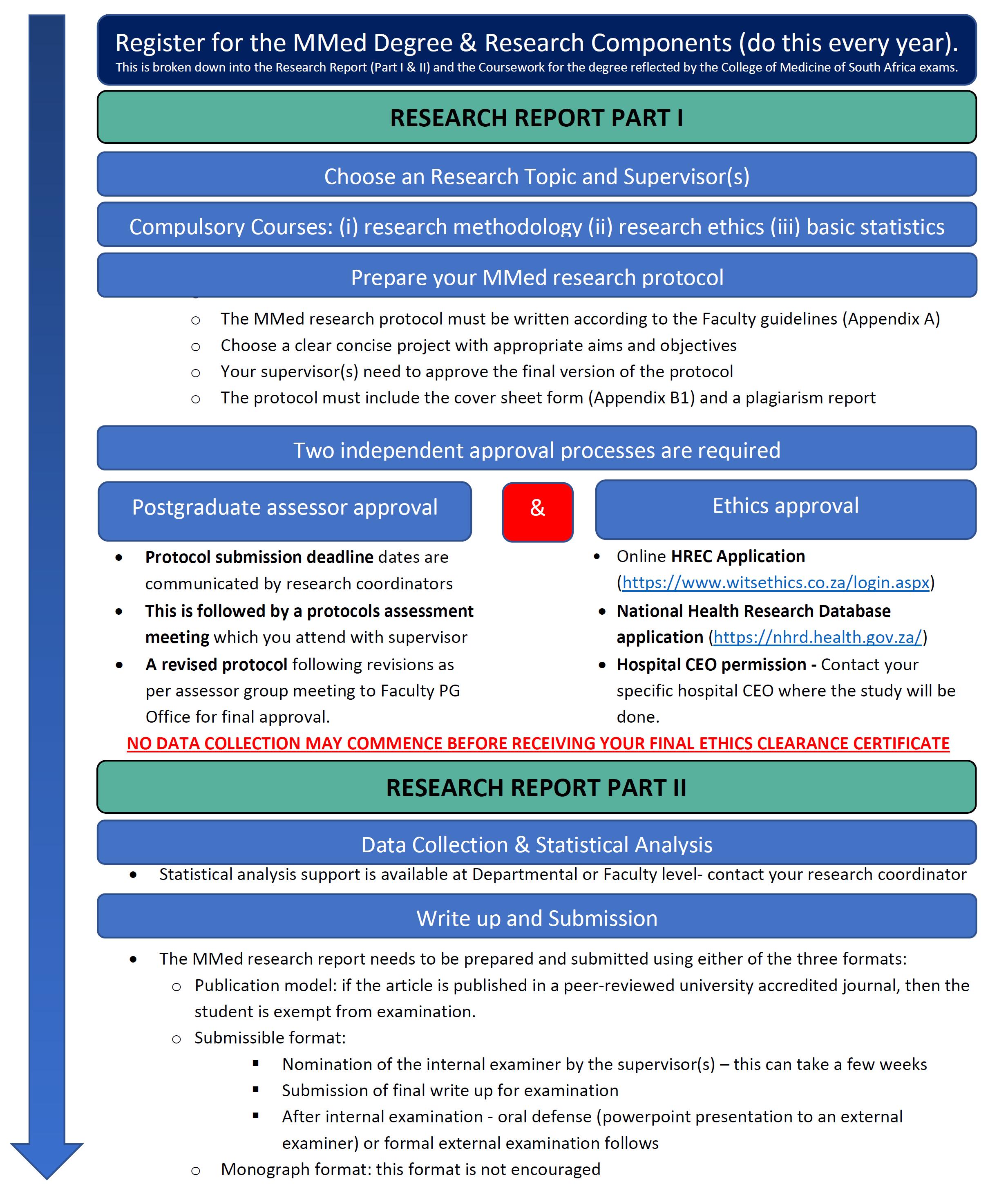
• Two independent approval processes have to be followed before you can commence with your research project (also see MMed research process flow diagram below):
The MMed research protocol must be presented to and approved by the appropriate assessor group as a subgroup of the Faculty Graduate Studies Committee (FGSC)
Ethical approval must be obtained from the University of the Witwatersrand Human Research Ethics Committee (HREC) prior to initiation of the research Even if your MMed research project may be covered by Supervisor’s ethics approval, the Human Research Ethics Committee (HREC) must be notified of your study.
• In some Departments, registrars get a research block during registrar training. Check specific requirements within your Department pertaining to a research block. Ideally, this time should be spent collecting data, data analysis and/or write-up of your MMed research report/manuscript for publication.
• The SOCM has a MMed Research Fund to support registrar MMed research. Specifically, applications can be made to support conference registration, journal article processing charges (APCs) or research related funding required to support the MMed research project budget. See SOCM MMed Research Fund below.
PRIOR TO INITIATION OF RESEARCH
Registration
It is imperative to register every year by the end of January at the Postgraduate Office (Phillip V Tobias Building, 2nd Floor, Cnr York & Princess of Wales Terrace, Parktown) for your MMed research components. The research report is broken down into Research Report Part I and Research Report Part II, and the coursework for the degree reflected represents the primary and final College of Medicine of South Africa (CMSA) exams.
Research Report Part I includes the compulsory courses (research methodology, basic statistics and ethics), protocol assessment and ethical approval from the HREC (or HREC declaration form if ethics was not required) Research Report
Part II includes data collection, statistical analysis, write-up of the report and final research report submission. Each of the MMed specialities have a unique Research Report registration code. Should you wish to change your clinical discipline, for e.g. from General Surgery to Cardiothoracic Surgery, it is compulsory to notify the PG Office and the HPCSA. If your MMed research project is not related to your new clinical discipline, you will have to start a new MMed research project within your new division/discipline. If your MMed research project is relevant to the new discipline and thus transferable, you have to submit a letter of support from your supervisiors and your new divisional head approving the transfer of the project and ensure that you are registered for the unique Research Report registration code related to your new discipline
Specifically, you may not submit your research protocol to the Protocol Assessment Committee or your final MMed research report for examination unless you have registered for the Research Report component during each year of registrar training Hence, your MMed research report documents will not be processed if you are not registered.
Research methodology course & basic statistics course
Research methodology and basic statistics courses are compulsory for completion of Part 1 of the Research Report and required for research protocol submission for assessment The Faculty of Health Sciences run online research methodology courses throughout the year and some Departments within the SOCM also run in-house research methodology courses biannually that are in line with all Faculty requirements. These courses will help to guide you through the various aspects of developing, implementing and writing up a MMed research report. Both courses have an assessment that has to be passed in order to you to receive your certificate of completion. Please also see Appendix A1 for information on the Structured PhD MMed MDent courses, including contact details for these courses
Basic training in research ethics
Candidates must complete basic training in research ethics within the last 3 years. This is also a requirement when submitting for ethics approval from the Human Research Ethics Committee (HREC) at the University of the Witwatersrand. An example of basic ethics training that is accepted by the National HREC is the free TRREE online certificate (Module 1); this can be accessed via the website: https://elearning.trree.org/login/index.php
RESEARCH PROJECT & PROTOCOL
Project ideas
There are two options to choose a research topic for a MMed Research Report: Projects on offer
Department or Division Heads may have projects that they would like to supervise as priority research within their units. These are projects that aim to address ‘gaps’ in the current body of knowledge within their field of interest. The following applies:
• You should ask the head of unit or consultants of the department of interest if he/she has any projects on offer If you decide to take up one of these projects, please note that the head of unit or consultants who offered the project will usually become one of the supervisors on your project.
Self-initiated project
You may have a research question/idea of your own that you wish to pursue for your MMed Research Report. The following applies:
• Your research project title/idea should not be duplicating research objectives currently being undertaken or conducted in the recent past within your Department/Division/School Check this with your research coordinators.
• Embarking on a clinical trial involves investment with regard to insurance and is not recommended.
• Approval of a self-initiated idea is required by potential supervisors and has to be relevant to your clinical discipline.
• You are responsible for getting permission to do your project from the person who heads the unit in which you wish to conduct your research project and identify a supervisor
Supervisor(s)
We advise that you approach two supervisors to assist you with your MMed Research Project, although this is not compulsory. If possible, one should be an expert in the field in which your project will be undertaken All your supervisors must hold an equivalent qualification to the degree being supervised, i.e. a Masters-level degree
Type of Research that is acceptable (as per Faculty PG Booklet)
a) A Clinical Audit
This would be a review of topics in clinical medicine with prospective or retrospective collection and analysis of data from clinical cases or an existing database.
b) A Review of the Literature
This would be acceptable provided it is a comprehensive review of the literature with extraction and extrapolation of data or is a meta-analysis using recognised research methods or is a formal systematic
literature review or scoping review along the lines of the Cochrane Collaboration or the Joanna Briggs Institute (JBI).(http://www.cochrane.org/resources/handbook/; https://jbi.global/)
c) Research Study (this is the most commonest option chosen)
This would be a retrospective or prospective study involving laboratory-based research and/or clinical intervention and would constitute the traditional type of research report or manuscript write-up
d) Contract Research
An analysis of cases collected in contract research projects may be suitable for presentation in a research report. These should not normally represent a small sub-analysis of a much larger study. Formal permission would be required from the sponsor to present the data as a research report.
e)
In Exceptional Circumstances: A Case Study
This would be acceptable in certain circumstances, such as in extremely unusual or rare cases, if important contributions have been made to the investigation, understanding or management of the case(s), or if the presentation is accompanied by an additional clinical audit or a systematic review of the literature.
Guidelines for the size and level of a MMed research project
• The scope of the project should be limited and intended primarily to demonstrate acquaintance with and understanding of the methods of research, i.e. the scientific method.
• The research is not required to produce a unique contribution to the scientific literature, athough originality is desirable and will increase the likelihood of publishing your data
Writing and submitting a MMed research protocol
• The MMed research protocol must be written according to the Faculty guidelines (see Appendix A2). It should outline the scope of the research report and include a clear and concise title, as well as the name(s) and qualifications of the supervisor(s). Briefly, the research protocol in entirety should not exceed 10 typed pages. It should be typed in 12 point either Arial or Times New Roman script with 1.5 line spacing (including the references). The page limit does not include questionnaires that should be placed in an appendix. Proposals may be rejected if they are too long (more than 5 pages over stated length).
• A clear research question and/or hypothesis must be developed in the protocol following a critical assessment of the relevant literature. It is the responsibility of the candidate to ensure that the draft version of the protocol is submitted to the supervisor(s) for revisions and editing, and that supervisor revisions/recommendations are incorporated in the final version of the protocol prior to submission.
• A full list of protocol submission deadlines and assessment dates per Department can be viewed on the Faculty Almanac and are usually circulated by the research coordinators and/or department heads All forms pertaining to protocol submission and assessment are attached under Appendix B
• It is the responsibility of your supervisor(s) to approve the final version of the protocol, after which you may submit the electronic copy of your protocol to the relevant research coordinator (contact details above) and the Post Graduate Office.
• Submission of your protocol should include the following documents discussed in more detail below: protocol coversheet, plagiarism report, recommendation of appointment of supervisors, HREC declaration, Research Methodology Course certificate, Basic Statistics Course certificate.
• The protocol cover sheet form (see Appendix B1) that needs to be signed by the candidate and supervisor(s) and registration confirmed by the Postgraduate Office.
• The Recommendation of Appointment of Supervisors form (see Appendix B2) and the Principles of Postgraduate Supervision form (see Appendix B3) must accompany your protocol submission.
• The Human and Animal Research Ethics Declaration form (Appendix B4) must be included with your protocol submission specifying that you are aware of ethics requirements for your project.
• Also, this submission must include a plagiarism report (generated by Turnitin). If your protocol passes the plagiarism check, it will be assessed at the next Protocol Assessor Group Meeting. For more information on plagiarism and/or generating a plagiarism report, please contact your research coordinator(s). Herewith the link and guidance (Appendix B6) for generating a HSC-SCMD-PG Similarity Report 2026 in the School of Clinical Medicine: https://ulwazi.wits.ac.za/courses/82138 The process since 2025 is that students should email ulwazihelp@wits.ac.za and they will be added to a HSC Similarity Report-2026 for submission to Turnitin
• Deadline dates for submission of protocols cannot be extended – this means no late submissions will be accepted.
The Protocol Assessor Group Meeting
• The MMed research protocol must be presented to and approved by the relevant assessor group as a subgroup of the Faculty Graduate Studies Committee. This assessment happens at Departmental level.
• The candidate’s MMed research protocol will only be assessed if both the candidate and at least one of his/her supervisors attend the assessor group meeting.
• In addition to evaluating the protocol, the Assessor Group will confirm proof of completion of the above mentioned courses (research methodology and ethics).
• The assessor group has to indicate on your assessment form that your Human and Animal Research Ethics Declaration form (Appendix B4) indeed accompanies your protocol
• The assessor group will make one of the following overall recommendations following asssement of your protocol:
i. Revision of the protocol to the satisfaction of the Supervisor (NB: if HoD approval is also required, please specify) (Candidate: a revised electronic copy of the protocol, list of corrections with page numbers and Supervisor approval letter – submit electronically to PG Office).
ii. Revision of the protocol to the satisfaction of the Assessor Group/Chair (Candidate: a revised electronic copy of the protocol, list of corrections with page numbers, Supervisor approval letter –submit electronically to PG Office and PG Office to forward to the Assessor Group Chair).
iii. Revision of the protocol and resubmission of the revised protocol to the next Assessor Group Meeting (Candidate: a revised electronic copy of the protocol, list of corrections with page numbers,
Supervisor approval letter – submit a revised electronic copy of the protocol to PG Office and to school/department assessor group administrator).
iv. Candidate goes ahead (no revision required)
• The final approved protocol (following recommended revisions by the Assessor Group) must be submitted to the Health Sciences Postgraduate Office for approval by the Faculty Graduate Studies Committee.
• The Faculty will generate a letter confirming approval which is sent to your WITS email address. This letter is required for HREC applications.
• NOTE: A student is not allowed to proceed with their research prior to approval from the FGSC and, where applicable, the Human Research Ethics Committee (Wits).
PLEASE NOTE THAT A NEW SUBMISSION PROCESS FOR RESEARCH, PROTOCOLS & EXAMINER NOMINATIONS
TOOK IMMEDIATE EFFECT IN JULY 2025. (see Appendix C15)
PLEASE READ the FHS AI Guideline for Students, which can be found at https://www.wits.ac.za/health/faculty-services/staff-and-student-downloads/. Note the REQUIREMENT TO DECLARE THE USE OF AI by signing and submitting the form in Appendix B.
ETHICS APPLICATIONS AND OTHER APPROVALS
Applying for Ethics
• Human research ethics clearance must be obtained prior to starting any clinical study data collection
• As with all research, and particularly as your MMed research is for degree purposes, you have to submit it to the University of the Witwatersrand Human Research Ethics Committee (HREC) (Medical) for approval. Ensure that you use the correct HREC (Medical) form specific to the year that you are applying in (https://www.wits.ac.za/research/researcher-support/research-ethics/ethics-committees/). Please note that this in an online application process.
• Research projects may be covered by Supervisor’s ethics approval if the proposed research has been previously approved, however the HREC (Medical) should be notified that you will be doing your research project under your supervisor(s)’ approved HREC certificate. Any HREC certificate is only valid for five years.
• Your supervisor should check and sign your original application, whereas the final signature has to be that of the Academic Head of Department or your Cluster/Departmental research coordinator before submitting to the HREC (Medical) online.
NOTE: A student is not allowed to proceed with their research prior to approval from the FGSC and , if applicable, the Wits Human Research Ethics Committee (Medical).
Registration on the National Health Research Database
• All research performed in a hospital needs to be registered on the National Health Research Database (NHRD) The NHRD can be assessed at https://nhrd.health.gov.za/. Other resources including instruction manuals and the relevant contact details can be found at https://nhrd.health.gov.za/Home/Resources
Hospital CEO Approvals
• After submitting an NHRD application, you have to contact the respective hospital’s CEOs for permission letters. This process differs depending on the hospital. For example, at Chris Hani Baragwanath Academic Hospital (CHBAH) the protocol should be accompanied by a letter addressed to Head of Department for permission. This is then sent to the Medical Advisory Committee (MAC) for CEO approval
• For CEO Approval from Charlotte Maxeke Johannesburg Academic Hospital (CMJAH), the CMJAH Research Committee has streamlined CEO approvals for PG students. Please find the flow diagram of this process attached (Appendix A4)
• For Rahima Moosa Mother and Child Hospital Approval for research, the application process is outlined in the attached document (Appendix A5) and the link to the Research Approval Form is as follows: https://form.123formbuilder.com/1265499
• Even though you can submit your ethics application while awaiting CEO approval, the HREC (Medical) needs the CEO permission letter(s) before the final ethics clearance certificate is issued for your particular study.
NHLS Pathology Data Access
• For NHLS pathology data access, please comply with NHLS requirements. You can submit a request via the NHLS Academic Affairs and Research Management System (AARMS): https://aarms.nhls.ac.za/NHLS_AARMS/Public/Default.aspx.
• The NHLS academic officer’s details are as follows:
Dr Babatyi Malope-Kgokong (PhD)
National Manager, Academic Affairs and Research
National Health Laboratory Service
Tel: 011 386 6155 | Cell: 082 604 4206
babatyi.kgokong@nhls.ac.za |www.nhls.ac.za
Approval from the gatekeeper of an existing database
• If your study will access an existing database for data collection purposes, the HREC (Medical) would also require a letter of approval from the gatekeeper to use this database.
DATA COLLECTION & STATISTICAL ANALYSIS
Data Collection
• Consult your supervisor(s) and/or research coordinator once you start your data collection to guide you as to how to collect your research data in a format that will simplify data analysis thereafter.
• You are responsible for your own data collection and management.
• It is compulsory to collect your data on REDCap as the Faculty approved data management software.
• Data can also be collected on Excel/Departmental database/AARMS (NHLS)/etc. and/or exported as a single Excel datasheet for analysis with one variable per column and one patient per line.
• In all cases of data collection, please ensure that you are POPIA compliant.
• Continuous variables should be captured as actual numbers (e.g. age in years); thus avoid categorizing continuous data (e.g. young/young adults/adults/middle-aged/elderly) during data collection.
• Ensure that you are collecting data as outlined and approved in your HREC application. Should you require additional information/data/variables, please apply to the HREC for an amendment of your existing ethics approval.
Statistical analysis
• Basic statistics is usually required for MMed research data analysis. It is essential that you are involved in your own data analysis, with the guidance or assistance of a biostatistician. You may not just submit your data to a statistician for analysis.
• One-on-one in-person Biostatistical Consultations are available through the Faculty of Health Science’s Research Office and this information is regularly distributed via emails and courses. Face-to-face consulations are available at the Philip V Tobias Building, Chris Hani Baragwanath Academic Hospital, Helen Joseph Hospital and Rahima Moosa Mother and Child Hospital with prior arrangement
• Consultations need to be booked in advance.
To request a Biostats consulation:
- Email consultations.HSRO@wits.ac.za
- Complete the online form: HSRO Biostats Appointment Request Form
The biostatisticians contact details:
- Mr Anteneh Yalew (Anteneh.Yalew@wits.ac.za)
- Dr Clarence Yah (clarence.yah1@wits.ac.za)
- Prof Elena Libhaber (Elena.Libhaber@wits.ac.za)
• Some departments run their own statistical courses and/or data analysis workshops. Please liaise with your research coordinator for more information.
• The following statistical software and training thereof is available through the Faculty of Health Sciences (Courses.Health@wits.ac.za):
- Statistica. Individual licences can be purchased and installed using a valid Wits, NHLS, MRC, NICD or RMPRU email address Payment can be made using either an internal requisition, a direct payment at the fees office, or via EFT (https://tools.health.wits.ac.za/software/).
- STATA A link to the STATA software can only be downloaded and run when you are connected to the Wits network, either directly or via the VPN software. The VPN software can also be downloaded using your Wits login credentials (https://tools.health.wits.ac.za/software/).
• You are strongly advised to seek biostatistics guidance when analysing your data.
WRITING UP YOUR FINAL RESEARCH REPORT
Format of the Research Report (see also the Faculty PG Booklet)
The MMed research report needs to be prepared and submitted using either of the two formats below:
a. Publication Model with protocol – data from your research is published in a peer-reviewed university accredited journal and then submitted to Faculty. This method exempts the student from internal or external examination. See the relevant forms & specific format information for these submissions to Faculty below and under Appendix C (C10-C14)
b. “Submissible” format with protocol – if an article has been submitted for publication but has not yet been accepted for publication OR if an article has not yet been submitted for publication then the “submissible format” is used. The article (submission-ready) accompanied by the journal’s instructions to authors would be submitted for examination with the appended approved protocol See the specifc format for these submissions to Faculty below.
c. Monograph format – this format is not encouraged by the SOCM. Should you wish to write a monograph please inform your research coordinator and refer to the Faculty Postgraduate Information Pack.
For either format a or b above, the following apply:
(i) The STUDENT must be first author of the submitted/published paper.
(ii) The paper must be accompanied by a letter signed by the supervisor/s stating the role played by the candidate in the writing of the paper and how much of the work reported in the paper was performed by the candidate.
For the Publication Model, the following apply:
(i) The paper must be accepted by a peer-reviewed university accredited journal (i.e. a publication acceptable for RINC funding)
(ii) The paper must have been published or accepted for publication after the date of registration of the candidate for the degree.
(iii) “In press” articles will be accepted but must be accompanied by a letter from the journal stating that the article has been accepted for publication.
(iv) The format for a submitted article or an article “In press” must be as follows:
• Title page including all authors, and degree
• A declaration stating that the contents of the paper are the original work of the author
• In the case of multiple authors, a letter signed by all co-authors stating the contribution of the candidate to the paper
• Dedication
• Acknowledgements
• Table of Contents
• The PDF reprint of the paper as submitted to the journal (must be a high-quality reprint) including all figures and tables and their legends For in-press articles, refer to point (iii) above
• Appendix to include ethics clearance certificate (or HREC declaration form if ethics was not required), the Faculty protocol approval letter, plagiarism/turnitin report, a copy of the letter of acceptance by a DHETaccredited journal in the case of 'in press' articles, and other relevant approval documents (e.g. updated title)
For the “Submissible” format with protocol, the following apply:
(i) The name of the journal to which the article is to be submitted must be provided (peer reviewed, university accredited journal) as well as the journal’s instructions to authors.
(ii) In submission to examiners, the paper must be accompanied by the approved research protocol, which would have an extended literature review.
(iii) The format for a “submissible” article submitted for examination must be as follows:
• Title page including all authors, and degree
• A declaration stating that the contents of the paper are the original work of the author
• In the case of multiple authors, a letter signed by all co-authors stating the contribution of the candidate to the paper
• Dedication
• Acknowledgements
• Table of Contents
• Authors guidelines for the intended journal
• Draft article ready for submission including all figures and tables and their legends (and conforming in style to the author guidelines for the intended journal
• Appendix to include ethics clearance certificate (or HREC declaration form if ethics was not required), the Faculty protocol approval letter, plagiarism/turnitin report and other approval documents (e.g. updated title).
SOCM affiliations on publications & implications
Affiliation on publications
• Your first affiliation when submitting for publication has to be the University as follows: 1Department of ., School of Clinical Medicine, Faculty of Health Sciences, University of the Witwatersrand.
• Subsequent affiliations to the hospital where you work and/or where the study was conducted may follow.
• Corresponding authors are expected to use their Wits email addresses.
Implications of affiliations
• For your article to be eligible for reimbursement or payment of article processing fees (APCs), your first affiliation has to be the SOCM, Faculty and University as outlined above.
• Incorrect affiliations will have RINC implications, specifically on how they are distributed to your Department, SOCM and the Faculty.
Proof reading & English language editing
Proof reading and english language editing services are available throught the office of the SOCM HOS.
SUBMITTING FOR EXAMINATION & THE EXAMINATION PROCESS
PLEASE NOTE THAT A NEW SUBMISSION PROCESS FOR RESEARCH, PROTOCOLS & EXAMINER NOMINATIONS TOOK IMMEDIATE EFFECT IN JULY 2025. (see Appendix C15)
Submitting for Examination:
For published manuscripts or manuscripts accepted for publication (in press)
• As mentioned above, this method exempts the student from internal or external examination. However, if you and/or your supervisors have already initiated the Faculty examination process prior to final journal acceptance of your manuscript, the examination process has to be followed.
• For final Faculty submissions, follow the format outline above for the ‘Publication model’ and submit it together with final submission forms attached under Appendix C (C10-C14)
For unpublished reports/manuscripts:
• Once your report/manuscript draft is complete, your supervisor(s) will review it and suggest changes required.
• Following HOD approval, your supervisor(s) will submit a confidential Nomination of Examiners form to Faculty for approval and this should be submitted at least six weeks prior to your final report submission Only once your Nomination of Examiner(s) has been approved may you submit your report for examination to the PG Office of the Faculty, including all the necessary documents required (Appendix C)
• The internal examination process takes three weeks.
• After internal examination (see below), the student will be expected to present their research for “oral defence” to an external examiner, as detailed in the next section.
• To be included in an upcoming oral defence session, your internal examination report has to be completed and received by the Faculty PG Office six weeks prior to the oral defence date.
• On passing the oral defence, a final report after corrections will be required to be submitted to Faculty.
All the Faculty of Health Science’s forms pertaining to nomination of examiners, final research report submission for examination and final submission for graduation are attached under Appendix C
The Examination Process
Internal Examination
• An internal examiner is responsible for marking the MMed research report and will prepare a written report. The report is to be marked using the FHS Marking Rubric. The report will include a percentage mark for the work
• Supervisors and the Academic Head of Department will nominate the internal examiner.
• The form for the nomination of the internal examiner will be submitted to the Postgraduate Office for approval two months prior to the submission of the research report.
• The internal examiner needs to be approved by the Faculty Graduate Studies Committee EXCO
• The internal examiner will be given a deadline to complete marking and will submit the written report to the Faculty PG Office
• Candidates who’s outcome givin by the internal examiner is either “substantial amendments” and/or “reexamination” will not be eligible to participate in the oral defence but will have to address the recommendations made by the internal examiner for his/her approval before continuing the examination process of then being examined by an external examiner’
Oral Defence
• After internal examination is complete, there will be an oral powerpoint presentation to an external examiner.
• The oral defences will be undertaken on specific dates and ‘batched’ by Cluster or by Department
• The Postgraduate Office will coordinate the process and publish oral defence dates 2026 Oral defence dates (with submission deadlines) are as follows: 17/18 April (2 March), 18/19 June (30 April), 13/14 August (30 June), 12/13 November (30 September)
• The oral defence presentation will be open to any member of the Faculty (including supervisors and internal examiners)
• There will be one external examiner present per oral defence session to moderate all the MMed research presentations for that session
• The external examiner will be nominated by the Faculty in consulation with relevant Department(s) and will be approved by either the Faculty Graduate Studies Committee EXCO or the Head of School and Assistant Dean
• The external examiner will be sent all the MMed research reports scheduled for oral defence, including the internal examiner’s report prior to the presentation
• The oral defence for each candidate will consist of a 10-minute presentation to the examiner followed by 5 minutes of question time.
• Based on the oral defence and internal examiner’s report, the external examiner will make a final decision on the outcome of the research report.
• Students who pass the oral defence will have 4 weeks within which to make corrections and submit their final report
Registrations prior to 2020
• For registrars that registered prior to 2020, the following forms of internal and external examination will be in effect:
o Internal and “Batch” external examiners, where external examiners are nominated by Departments for a term to examine all MMed research reports submitted in that period
o Individual internal and external examiners may be nominated in specific instances.
o Registrar may choose to be examined by the internal examination/oral defence route.
SOCM MMED RESEARCH FUND
Background
• The SOCM has set aside a nominal amount of funding specifically to aid and support MMED research within the School. It is not a guaranteed source of funding
• The Head of School, SOCM Cluster heads and the SOCM Senior Operations Manager will review the amount available at the start of the year and allocate a portion to the SOCM Graduate Studies and Research Committee (GSRC) to fund registrar conference attendance and sundry research costs The balance of the funds will remain in the School account and will be managed by the HOS group for promoting research related activities in the School, such as journal article processing fees
• The approval of MMed research funding applications will be managed by a sub-committee of the SOCM GSRC.
• There will be four deadlines per annum (March, May, July, September).
Eligibility
• The SOCM MMed research fund is intended to support postgraduate MMed research within the Wits SOCM.
• Applicants may only apply for funding if their research proposals have been approved by the Departmental Assessor Group and HREC clearance has been obtained
• A successful applicant may reapply in subsequent years, with preference given to first-time applicants
Categories that will be funded only include the following
• Conference registration for presenters (not travel)
- Up to a maximum of R10,000.00* (local) or R20,000.00* (international)
- Proof of accepted abstract for a conference presentation is required
- Invoice for registration fee, conference workshops and gala dinner to be included. No spouse expenses will be covered.
• Research-related funding to support an MMed research project budget
- Up to a maximum of R40,000.00*
- A typed detailed budget is required with the application.
- Motivation letter signed by HOD.
- This may include funding for blood tests, laboratory reagents and/or consumables; specialist software licenses not already covered by the University or Faculty.
- Funding will not be provided for any minor or major equipment, laptops or stationary.
• Remote study location
- Catering request for participants interviews will be considered on a case by case basis up to a maximum of R1,000.00.
- Petrol will be funded on a case by case basis using the SARS tax free rate of R4.95 per kilometer.
- Funding is also be available for data and airtime.
- Funding will not be provided for printing, office rentals, flights and accommodation.
• Funding above the maximum budgetary amounths may be approved at the discretion of the SOCM GSRC MMed-Fund sub-committee.
Guidelines for applicants to the MMed Research Fund
• The forms pertaining to the MMed Research Fund can be accessed via this link: SOCM MMed Fund Application
• Follow the Guidelines (see Appendix E1) and complete the online application form.
• Enquiries to be sent to Boipelo.Kgosinkwe@wits.ac.za .
OTHER FUNDING OPPORTUNITIES VIA WITS FUNDING PORTAL: https://www.wits.ac.za/funding-portal/
SOCM.HSRO.2022|GSRC2026 vs1.0 - Last updated: 14/01/2026
1. APPENDIX A –Compulsory Courses, Guidelines on Contents of the Research Proposal, SOCM Ethics Submission Checklist & CMJAH CEO Approval Process
Structured PhD MMed MDent Courses (A1)
FHS Guidelines (hyperlink) on Contents of the Research Proposal (A2)
SOCM Ethics Application Submission Checklist (A3)
CMJAH CEO Approval Process for PG students (A4)
Rahima Moosa Mother and Child Hospital – Research Approval Form (A5)
2. APPENDIX B – Forms for MMed Protocol Submission
Protocol Coversheet (B1)
Recommendation of Appointment of Supervisors (B2)
Statement of principles for postgraduate supervision (B3)
Human and Animal Research Ethics Declaration (B4)
Plagiarism Declaration (B5/C4)
Generating a plagiarism report (B6)
Please click paperclip icon in the left/right pane to access attachments.
Please click paperclip icon in the left/right pane to access attachments
Nomination of Examiners – for supervisors only (C1)
• Form 1
• Form 2
• Form 3
• Guidelines for supervisors nominating examiners
• Examiners CV template
Certificate of submission for Examination - signed by Student (C2)
Certificate of submission for Examination - signed by all Supervisor(s) (C3)
Plagiarism Declaration (B5/C4)
Supervisor(s) Report (C5)
Post examination/Graduation:
Final Submission (ETD) Thesis, Dissertation or Research Report (C6)
Certificate of Final Submission for Graduation signed by supervisors (C7)
Certificate of Final Submission for Graduation signed by candidate (C8)
Final Submission Checklist (C9)
For submissions via publication only:
Declaration by Student and Co-authors Agreement for Published Papers
Submitted for Examination Purpose (C10)
Certificate of Final Publication Submission for Graduation - signed Candidate (C11)
Certificate of Final Publication Submission for Graduation - signed Supervisor (C12)
Guidelines – Format - Publication in Lieu of a Research Report (C13)
Submission by Publication (Checklist) (C14)
Please click paperclip icon in the left/right pane to access attachments.
Please click paperclip icon in the left/right pane to access attachments.
4. APPENDIX D – Additional Forms for changes to MMed
Application for change of approved title (D1)
Application for change of approved Supervisor(s) (D2)