An assessment of skills supply and demand for renewable energy, energy efficiency, and regional energy integration
28th October 2022
6.1.3
6.3.
6.3.1
Acknowledgements
This report was commissioned by the International Labour Organisation (ILO) with funding from Swedish International Development Agency (SIDA) and undertaken by the University of the Witwatersrand’s Centre for Researching Education and Labour (REAL). This report builds on and acknowledges the work originally undertaken by the Centre for Energy, Environment and Engineering Zambia (CEEZ).
We acknowledge the contribution of the ILO reference group, including the ILO and the Kafue Gorge Regional Training Centre, in guiding the project, all survey and interview respondents who provided valuable input, and the participants of the validation workshop for sharing their insights on the findings and recommendations.
Abbreviations
AFUR African Forum for Utility Regulators
DBSA Development Bank of Southern Africa
CEEEZ Centre for Energy, Environment and Engineering Zambia
CO2 Carbon dioxide
GDP Gross Domestic Product
GIZ Deutsche Gesellschaft für Internationale Zusammenarbeit
RAERESA Regional Association of Energy Regulators for Eastern and Southern Africa
RE Renewable energy
REI Regional energy integration
REIPPP Renewable Independent Power Producer Programme
RERA Regional Energy Regulators Association of Southern Africa
SACREEE SADC Centre for Renewable Energy and Energy Efficiency
SADC Southern African Development Community
SAPP Southern African Power Pool
SESA Skills for Energy in Southern Africa
SOLTRAIN Southern African Solar Thermal Training and Demonstration Initiative
TVET Technical Vocational Education and Training
UNEP United Nations Environment Programme
Wits REAL University of the Witwatersrand, Centre for Researching Education and Labour
Glossary
Apprenticeship: the systematic long-term training for a recognised occupation, taking place within an undertaking or under an independent craftsman, and it should be governed by a written contract of apprenticeship and be subject to established standards (ILO, 1962).
Core work skills: the ability to learn and adapt; read, write, and compute competently; listen and communicate effectively; think creatively; solve problems independently; manage oneself at work; interact with co-workers; work in teams or groups; handle basic technology; and lead effectively as well as follow supervision (ILO, 2020).
Curriculum: a description of what, why, and how well students should learn systematically and intentionally. The curriculum is not an end in itself but a means to foster quality learning (UNESCO IBE, 2011).
Decent work: the availability of employment in conditions of freedom, equity, human security, and dignity. It involves opportunities for work that are productive and delivers a fair income, security in the workplace and social protection for families, better prospects for personal development and social integration, freedom for people to express their concerns, organise and participate in the decisions that affect their lives and equality of opportunity and treatment for all women and men (ILO, 2006).
Demand side management programmes: consists of focused, deep, and immediate training required, such as the brief curtailment of energy-intensive processes used by a utility’s most demanding industrial customers, and programmes that are broad, shallow, and less immediate such as the promotion of energy-efficient equipment in residential and commercial sectors (IEA, 2022a).
Energy Management System (EMS): automation systems that collect energy measurement data from the field and make it available to users through graphics, online monitoring tools, and energy quality analysers, thus enabling the management of energy resources (Segatto et al., 2018).
Energy efficiency (EE): the ratio of output or useful energy or energy services or other useful physical outputs obtained from a system, conversion process, transmission, or storage activity to the input of energy (IPCC, 2019).
Equipment design: a form of human engineering that is concerned with the design of work tools, home appliances, and machines of all kinds, including their displays and controls (APA, 2022).
Gender equality: refers to the equal rights, responsibilities, and opportunities of women and men and girls and boys. Equality does not mean that women and men will become the same but that women’s and men’s rights, responsibilities, and opportunities will not depend on whether they are born male or female (United Nations, 2001).
Green economy: an economy that results in improved human well-being and social equity while significantly reducing environmental risks and ecological scarcities (UNEP, 2010).
Green jobs: refers to work in agricultural, manufacturing, research and development (R&D), administrative, and service activities that contribute substantially to preserving or restoring environmental quality. Specifically, but not exclusively, this includes jobs that help to protect ecosystems and biodiversity; reduce energy, materials, and water consumption through high-efficiency strategies; decarbonise the economy; and minimise or altogether avoid the generation of all forms of waste and pollution (UNEP, 2008).
Green and/or clean technology: a technology that improves the resource or energy efficiency of production to sustainable levels, reduces waste or increases the use of non-polluting, renewable resources (Strietska-Ilina et al., 2011).
Informal economy: refers to all economic activities by workers and economic units that are – in law or practice – not covered or insufficiently covered by formal arrangements. The informal economy does not cover illicit activities (OECD/ ILO, 2019).
Just transition: can be understood as the conceptual framework in which the labour movement captures the complexities of the transition towards a low-carbon and climate-resilient economy, highlighting public policy needs and aiming to maximise benefits and minimise hardships for workers and their communities in this transformation (Rosemburg, 2010).
Learning pathway: a sequence of activities with designated goals to help students build up their knowledge or skills in a subject area (Yang et al., 2010).
Low carbon energy: energy that is generated using lower amounts of carbon emissions such as wind, solar, hydro, or nuclear power. These alternative energy production methods are better for the planet as they release less carbon into the atmosphere (Moses, 2020).
Occupation: refers to a set of jobs whose main tasks and duties are characterised by a high degree of similarity. A person may be associated with an occupation through the main job currently held, a second job, a future job, or a job previously held (ILO ISCO, 2008).
Potential labour force: includes people that are not in employment available but not seeking and those seeking but not available (Gammarano, 2019).
Public-private partnership: an arrangement whereby the private sector provides infrastructure assets and services traditionally provided by the government, such as hospitals, schools, prisons, roads, bridges, tunnels, railways, and water and sanitation plants. Cases where the private operator has some responsibility for asset maintenance and improvement are also described as concessions (IMF, 2007).
Renewable Energy (or Clean Energy) (RE): is energy from sources that are naturally replenishing but flow-limited; renewable resources are virtually inexhaustible in duration but limited in the amount of energy that is available per unit of time (IEA, 2022b).
Regional Energy Integration (REI): refers to the support of energy security through integrated markets and crossborder infrastructure development (Montmasson-Clair and Deonarain, 2019).
Skill: the ability to carry out a manual or mental activity acquired through learning and practice. The term “skills” is used as an overarching term for the knowledge, competence, and experience needed to perform a specific task or job (ILO, 2015).
Skills demand: the aggregation of employer skills needs, which indicate either skill sets required to carry out assigned jobs properly or people with such skill sets (Mori, 2019).
Skills development: the full range of formal and non-formal vocational, technical, and skills-based education and training for employment and/or self-employment, including pre-employment and livelihood skills training; vocational education and training and apprenticeships; education and training for employed workers, including workplace training; and employment-oriented and job-related short courses (ILO, 2020).
Skills gap: a situation in which the skills level of an employee or group of employees is lower than that required to perform the job, or the type of skill does not match the job requirements (ILO, 2021).
Skills supply means either people with sufficient skills to perform assigned jobs or those with qualifications corresponding to each occupation (Mori, 2019)
Skills shortage: a situation in which certain skills are in short supply, for example, where the number of job seekers with certain skills is insufficient to fill all available job vacancies (ILO, 2021).
Southern African Development Community (SADC): is a regional economic community comprising 16 member states that aim to promote sustainable and equitable economic growth and socio-economic development through efficient, productive systems, deeper cooperation and integration, good governance, and durable peace and security; so that the region emerges as a competitive and effective player in international relations and the world economy (SADC, 2022).
Technical and Vocational Education and Training (TVET): initial or continuing education and training provided by schools, training providers, or enterprises that impart the skills, knowledge, and attitudes required for employment in a particular occupation, or group of related occupations, in any field of economic activity (ILO, 2015).
Executive summary
The SADC region relies heavily on energy produced from coal and water and has grappled with an energy crisis over the years, seen through insufficient and inefficient energy supply. This crisis is mostly a result of a changing climate, including droughts, outdated infrastructure, and the depletion of natural resources. These natural resources include coal and gas, and their use for power generation further contributes to climate change, who’s impacts are being faced globally. There has therefore been a desire and a call to shift towards renewable energy (RE) in the SADC region, which has the resources and conditions to make this shift. This is driven by the SADC Protocol on Energy and the various national policies. The SADC Protocol on Energy (SADC 20) identifies a number of strategic plans over the last 10 years which build on previous policies. These include “the Regional Energy Access Strategy and Action Plan 2020 to 2030 (SADC, 2020), the Renewable Energy and Energy Efficiency Strategy and Action Plan 2016 to 2030 (SADC, 2016), the SADC Industrial Energy Efficiency Programme and the development of the Regional Gas Master Plan” (SADC, 1996).
Implementation has occurred at different rates in the various member states, and the 2018 SADC Renewable Energy and Energy Efficiency Status Report states that “Since 2015, SADC Member States have greatly increased their commitment to renewable energy and energy efficiency, including important innovations to stimulate mini-grids and distributed renewable energy” (SADC, 2018). This is also the case in regional integration as per the SADC Regional Indicative Strategic Development Plan (RISDP) 2020–2030 (SADC 2020) and through the Southern African Power Pool (SAPP) and its regional electricity plans, trading platforms, and policy and regulatory alignment initiatives (SAPP, 2017) together with the SADC Regional Electricity Regulatory Association (RERA, 2022).
This transition to RE, however, needs to be just, thereby ensuring that the current workforce is protected and that the skills ecosystem is prepared not only to respond to current demands but those required to transition to a more just and resilient energy system.
Research aim and purpose
The main aim of the research was to provide an analysis of renewable energy RE, energy efficiency (EE), and regional energy integration (REI) skills development needs in relation to the set of skills demanded by employers and those currently available in Zambia and the SADC region. Therefore, this report’s purpose is to build on and enhance the insights garnered in Phase 1 and develop recommendations to inform KGRTC’s skills development strategy, including priority courses and areas of focus, and potential partnerships.
Research approach
The framing of the approach adopted aimed to set the context within which the skills are identified and therefore proposed. This contextual understanding is critical for framing the current and future (i.e., transition direction) energy system status and trends within the SADC region. This contextual assessment provided a grounding to better understand the skills currently supplied and in demand along the SADC region’s energy value chain. Based on this, an interpretation of the potential gaps between skills supply and demand (for RE, EE, and REI, and where feasible, recognising country variation) provided indicative priority skills areas of focus for consideration and refinement by the KGRTC in their skills and course development strategy.
A number of mechanisms were used to gather insights and data to inform the research and findings. These being: 1) drawing on the Phase 1 research and findings, 2) developing broad overview case studies for 6 selected countries (Botswana, Mauritius, Namibia, South Africa and Zimbabwe), 3) a skills supply and demand survey, and 4) interviews with key informants in the selected countries.
Main findings
Emerging energy trends across the SADC region
The SADC region has a vast array of energy-related policies to support the significant increase in RE in the sector. These policies include, at the SADC level, national energy policies, EE strategies and legislation, and RE policies and legislation. These policies set a platform for REI to be achieved in the region supported by the Southern African Power
Pool (SAPP) (SAPP, 2017). The policies further serve as a guideline with regard to what skills will be required for an RE transition to take place.
The need for a more efficient energy sector in the SADC region is evident due to the increasing levels of energy insecurity. Load shedding is a phenomenon faced across the region as a result of depleting resources, e.g., coal, vandalism, poor/lack of infrastructure maintenance, and drought. Energy insecurity has resulted in a number of countries relying on the importation of electricity, which may impact the economy if importation costs are more expensive than local supply. A further concern that has been highlighted in the region is the lack of and/or slow implementation of rural electrification initiatives, resulting in a larger proportion of the population (who are based in rural areas) lacking access to electricity.
These challenges have led to a significant emphasis on the adoption of RE, with solar PV dominating the market and, to a lesser extent, wind technology. An additional recent focus has been on green hydrogen (produced by RE) in Namibia and South Africa. In 2018, the SADC Renewable Energy and Energy Efficiency Status Report (SADC 2018) reported that “the SADC region had 21,760 MW of installed renewable energy capacity as of mid-2018, of which 15,996 MW was hydropower.”
The SADC and national policies link back to industrial development and regional or national development plans, emphasising the key role energy plays in development and investment.
Issues of gender equality are becoming more prominent in the sector, with a desire to have more women actively involved in the sector. The survey revealed that women are increasingly enrolling in energy courses in the region, although men tend to dominate the more technical and task-intensive courses and roles. The various SADC documents refer to required skills or skills development to some extent, particularly when there are new policy directions, but direct links are not made in all policies or strategies.
Energy value chain hotspots across the SADC region
The SADC region has a variety of hotspots (areas or activities of significance) and change drivers that can both impact the implementation of RE systems and create opportunities for the adoption of RE; these include:
1. Dependence on coal in countries such as Botswana, South Africa, and Zimbabwe. This means that as these resources deplete or are not aligned with the drive to net zero by 2050, these countries will be forced to realign their energy supply to more renewable and/or other lower-carbon electricity sources. A shift to RE, however, puts the current workforce at risk as their skills may no longer be relevant. This risk highlights the need to focus on reskilling and upskilling if a just energy transition is to take place.
2. A narrow dependence and focus on solar PV as an RE source results in neglecting other forms of RE, such as wind, geothermal, tidal, and bioenergy. The neglect of the other forms of RE, therefore, means that the skills being supplied in the region mostly focus on solar and hydro energy, significantly reducing the potential of the sector to increase the percentage of RE in the energy mix through other technologies. This may also impact the longer-term production of green hydrogen (Namibia and South Africa).
3. A prevalence of energy insecurity faced across the region. Load shedding, power shortages due to old or poorly maintained infrastructure, severe droughts, and depleting resources all result in not being able to supply sufficient electricity to meet the demand. As the sector transitions into more RE, there is a need to ensure that RE technology is available when needed. The region currently has a shortage of local manufacturing industries supplying RE technology, resulting in a dependence on imports.
4. There is a high desire by countries in the SADC region to achieve energy security and therefore reduce their reliance on the importation of energy. Interestingly, however, all countries aspire to increase their energy exportation capabilities, which raises the question of who will import the energy that the countries plan to export, especially if the entire region achieves energy security. This finding, therefore, calls for a realignment of energy security goals to ensure that there is not an oversupply of electricity - with all the financial impacts this would bring. This can be achieved through the SAPP planning process, which will highlight these risks and help inform decision-making at a national level. An updated regional plan will also give better guidance for skills provisioning due to course content being realigned to suit demand.
5. Increasing green hydrogen aspirations can raise the region’s economic status and enhance energy security. Namibia and South Africa have set in motion plans to integrate green hydrogen into their economic activities. These plans, therefore, raise the demand for additional renewable energy provision and green hydrogen skills at all levels of the energy skills ecosystem, from, e.g., technicians and installers to maintenance personnel and project managers. This may impact the availability of these skills in the electricity sector.
6. Universal access to electricity is a core area of concern in most SADC countries, particularly rural electrification, which can be very low. This means that local rural enterprises and household economies are inhibited in their ability to grow and/or contribute to national economies.
7. In some SADC countries, such as South Africa and Zambia, the energy intensity of some sectors, e.g., mining and large-scale industry, is a notable area of high energy use. These sectors, in particular, are affected by energy insecurity, access, and cost. As such, EE initiatives in these sectors are critical.
Skills supply and demand
Energy skills demand
The analysis of the energy skills demands in the SADC region revealed that there is an overwhelming focus on RE. Solar PV is by far the most dominant, with the exception of South Africa and Namibia (both exploring wind at a large scale, some of which in Namibia will be allocated to the production of green hydrogen) and Mauritius (energy efficiency) to some extent. While EE appears extensively in policy and energy planning, there are low implementation levels and demand for those skills. REI is even more unexplored, as evident from the stakeholder mapping conducted with few of the respondents representing REI.
Despite the lack of focus on areas such as EE, there is an underlying demand for it in the region for energy security, affordability, and climate change reasons. Participants in the study revealed that macro institutions such as the government drive the labour markets to a large extent. For example, the current focus of government planning is on construction instead of operations and maintenance, driving the demand throughout the sector. Although poor and failing infrastructure denotes the need for EE-related and maintenance skills as well as the anticipated new plant.
Emerging evidence suggests that the nature of job changes due to the transition to RE and/or alternative energy futures will likely require an increase in specialisations and not necessarily new jobs.
Energy skills supply
A short course culture is emerging in the SADC region. This is being driven by urgent sector demand, response to a dynamic and changing economy, and shifts in policy focus, e.g., to solar energy, and the rapidly changing nature of technology and knowledge in the sector. These short courses, however, tend to focus on single skill sets (e.g., solar PV installation) as opposed to streams of work. As a result, a learner of, e.g., a short solar PV installation course may face challenges if they need to switch to wind or the green hydrogen sector.
The findings suggest that very few women are undertaking energy-related courses, with only about 20% completing the courses. There was no clear evidence of programmes focused on women, especially rural women. This suggests the need for skills planning to be more explicit in its focus on attracting women to the sector.
Across the board, RE dominates supply and demand, again with an emphasis on solar. Within RE, a gap needs to be filled regarding research and development (R&D), construction and installation, operations and management, and maintenance. Maintenance is a critical skill requirement, yet only a few courses focus on maintenance.
Regarding the provisioning of skills focus for KGRTC consideration, Table 1 provides an overview of indicative priority areas for skills development by energy theme.
Table 1: Proposed priority course areas of focus
Priority course area
Energy
RE technology installation, construction, management, and maintenance (solar PV, wind, storage)
RE financial modelling, analysis, and investment
RE technology sales, marketing, and customer services
Social science associated with RE technology e.g. community liaison
Energy auditing, monitoring, and reporting (industry, business, and public service)
Maintenance and repair of machinery, equipment, and appliances
Procurement of low energy / EE machinery, equipment, and appliances
Regional power system modelling, policy, financing, planning, and implementation
Regional energy regulation and governance
Rural electrification within and across the region (policy, planning, implementation)
Conclusion and recommendations
It is acknowledged that a realignment of skills is imperative for a just transition of the region’s energy system to effectively take place across the SADC region. This study provides a broad indicative overview of the region’s energy sector to inform the KGRTC’s skills development and provisioning strategy. The following recommendations are made for consideration:
Skills supply recommendations:
• Adopt a multi-dimensional approach to skills development, which requires a vision beyond being a training provider. This means understanding the training requirements within the contextual (political, economic, social, technological, and environmental dimensions) of the region and how this links to education and broader social development.
• Adopt bottom-up (place-based) models of skills development that take local communities into account.
• Visioning training beyond a single job to consider related work streams, occupations, and skills.
• Proposed priority areas for course development (see Table 1 above).
• For training delivery, take innovative modalities of working into consideration.
KGRTC as a Centre of Excellence and its role in championing a stronger and more coordinated SADC energy skills system:
• Adopting a vision beyond being a training provider (see the adoption of a multi-dimensional approach to skills development above).
• To champion regional standards and accreditation processes to ensure courses offered are globally and regionally credible.
• To act as a central regional hub to coordinate and facilitate energy skills development in the region and as a knowledge repository and hub on energy skills in the region.
• To leverage strategic international, regional, and in-country partnerships to develop, implement, and evaluate skills development to transform the energy system in the region.
Development of a broader SADC regional energy skills roadmap:
Building on this research and the recommendations proposed to the KGRTC, a proposed recommendation for the ILO would be to facilitate and coordinate the development of an energy skills roadmap to support energy transformation across the SADC region. This could include:
• Further research to better understand the full spectrum of SADC country energy-related skills ecosystems, their alignment and gaps between countries, and the time frame in which they will be needed;
• Consultation with key role players in the region to inform the development of the roadmap; and
• Development of the roadmap, accompanied by a financial plan to ensure delivery and occupational atlas for priority occupations.
1. Introduction
The International Labour Organisation (ILO) is supporting the Kafue Gorge Regional Training Centre (KGRTC) in implementing the Skills for Energy in Southern Africa (SESA) Project. The overall objective of SESA is to “increase uptake of Renewable Energy (RE), Energy Efficiency (EE), and Regional Energy Integration (REI) interventions in Southern Africa, leading to a more sustainable and low-carbon energy mix” through skills development and the establishment of Public-Private Development Partnerships in Zambia and the South African Development Community (SADC) region. Within this context, an assessment of skills supply and demand for RE, EE, and REI has been commissioned to assist KGRTC in developing a skills development strategy targeting the Southern African Development Community (SADC) region.
The main objective of the assessment is to provide an analysis of RE, EE, and REI skills development needs in relation to the set of skills demanded by employers and those currently available in Zambia and the SADC region. Insights garnered from this assessment are used to identify gaps, opportunities, and specific skills needed to inform KGRTC’s future positioning in RE, EE, and REI within the SADC region.
The work has been undertaken in two phases:
• Phase 1: A desk-based (including literature) review and Zambian case study undertaken by the Centre for Energy, Environment and Engineering Zambia (CEEZ); and
• Phase 2: Additional six SADC country case studies, surveys, and interviews to gather further data and insights from key informants and employees in the region and an enhanced understanding of education and training provision.
The purpose of this report (the outputs of Phase 2) is to build on and enhance the insights garnered in Phase 1 and to develop recommendations to inform KGRTC’s skills development strategy, including priority courses and areas of focus, and potential partnerships. The intention is, therefore, to position the KGRTC as a Centre of Excellence in the provisioning of skills for RE, EI, and REI in the SADC region.
This report is presented in five sections. Following the introduction, the methodology and literature review underpinning the study are presented. This is followed by a presentation of the case summaries for the six countries, survey and interview findings, and associated discussion. The final section presents the conclusion and recommendations for consideration.
2. Methodology
This section provides an overview of the research approach adopted for this project and the research methods and tools used. The framing of the approach adopted aims to set the context within which the skills are identified and therefore proposed. This contextual understanding is critical for framing the current and future (i.e., transition direction) energy system status and trends within the SADC region. This contextual assessment provides a grounding to better understand the skills currently supplied and in demand along the SADC region’s energy value chain. Based on this, an interpretation of the potential gaps between skills supply and demand (for RE, EE, and REI, and where feasible, recognising country variation) provides indicative priority skills areas of focus for consideration and refinement by the KGRTC in their skills and course development strategy.
2.1 Research approach
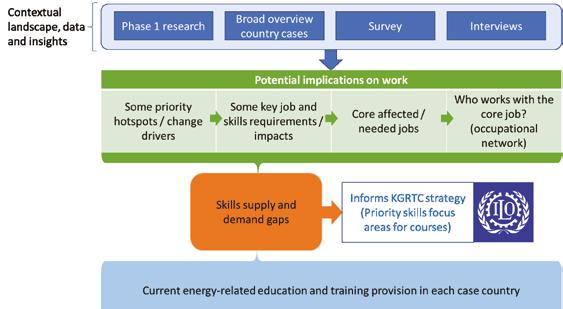
In framing the approach to this study, researchers first reviewed the data and literature reports produced in Phase 1. From this foundation, the team then planned Phase 2, which built on the Phase 1 findings, and involved stakeholder mapping, country mini-case studies, surveys, and interviews in the six selected countries. The six countries were identified based on the need to build on the information collected in Phase 1, which focused on Zambia. The selection was based on selecting from English-speaking countries within SADC, the networks and contacts available and known to Wits REAL and its energy specialists, and in consultation and final agreement with the ILO. Figure 1 provides an overview of the research approach; the methods are explained in further detail below.
2.1.1 Review of Phase 1 reports and data
The focus of Phase 1 has been included in the research approach. Phase 1 involved a comprehensive literature review of energy issues and some data reflecting demand and supply issues across some SADC countries, with an intense focus on Zambia. This review helped the study to identify research gaps and assisted in key areas to focus on. The Phase 1 outputs were first reviewed prior to undertaking the surveys and interviews. The data produced also provided complementary data that supported data collected in Phase 2.
Figure 1: Overview of project methodology
2.1.2 Country selection and stakeholder identification
The study targeted RE, EE, and REI stakeholder organisations in six SADC Member States, namely Botswana, Namibia, South Africa, Mauritius, Zambia, and Zimbabwe.1 The selection of these six countries was mainly based on their geographical positioning. Zimbabwe, Botswana, and Namibia are neighbours to Zambia, where KGRTC is, making it more visible to potential trainees from these neighbouring countries. Hence these countries are most likely to be the main catchment area for KGRTC. South Africa is a major player in RE, EE, and REI in the SADC region and hence was included in the sample as it is a key contributor to the understanding of the industry and regional skills needed in RE, EE, and REI. The countries also house the relevant RE, EE, and REI international, continental, and regional organisations that include:
• SADC Secretariat (Botswana);
• SADC Centre for Renewable Energy and Energy Efficiency (SACREEE), Regional Energy Regulators Association of Southern Africa (RERA) (Namibia);
• African Forum for Utility Regulators (AFUR), African Union Development Agency-New Partnership for Africa’s Development (AUDA-NEPAD), Development Bank of Southern Africa (DBSA), European Union (EU) delegation, Deutsche Gesellschaft für Internationale Zusammenarbeit (GIZ) (South Africa);
• Regional Association of Energy Regulators for Eastern and Southern Africa (RAERESA) (Zambia); and
• Southern Africa Power Pool (SAPP) (Zimbabwe).
The above organisations were also targeted in this assessment to provide their RE, EE, and REI skills needs and those of their many members.
In addition to the above, in the case of South Africa, they are a major player in RE, EE, and REI in the SADC region, and in the case of Mauritius, they were selected as having informed EE policy and 100% universal electricity access. Given the short time frame to conduct the research, the selection was also based on language, with five of the six (except Mauritius) being English-speaking. The selection of these six countries provided useful insights into the SADC region.
The study stakeholder sample consisted of 404 stakeholder organisations from both supply (education and training) and demand (government, industry) stakeholders within the six identified countries as well as regional bodies and funders (Annexure A). These stakeholder organisations were sent surveys and/or approached for interviews to gather data and insights. Table 2 below indicates the number of stakeholder organisations in the study sample (from both Phase 1 and Phase 2) by country and skills supply or demand.
or neutral
1 SADC comprises a total of sixteen member states: Angola, Botswana, Comoros, Democratic Republic of Congo, Eswatini, Lesotho, Madagascar, Malawi, Mauritius, Mozambique, Namibia, Seychelles, South Africa, United Republic Tanzania, Zambia and Zimbabwe.
Table 2: Study sample by number of stakeholder organisations
Stakeholders were further categorised according to themes within the energy sector, namely RE, EE, and REI, and skills demand or supply. Table 3 illustrates how the categorisation was done, using one of the countries (South Africa) as an example:
Table 3: Types of information gathered per stakeholder in South Africa
Information/category
Note that in the case of South Africa, 7 institutions deal with both RE and EE and hence are reflected under both those categories in the table above. Annexure A categorises stakeholder organisations by RE, EE, and REI for all 6 countries.
Other information captured per stakeholder as depicted in the comprehensive database included:
1. A sub-category of activities, e.g., within renewable energy, whether the organisation’s activity involves solar, wind, etc.
2. Type of entity, e.g., a private company or industry association.
3. Contact details, including (where feasible) a named individual, job title, email, and phone number.
4. Other / notes may be useful when engaging with the stakeholder or informing the research.
2.1.3 Overview country case studies
An overview case study was developed for each of the six selected countries (Botswana, Mauritius, Namibia, South Africa, Zambia, and Zimbabwe) based on a desktop analysis. The cases offered the study clear entry points at country level and helped to locate the countries more explicitly within the study. The cases aimed to develop the contextual sociopolitical and socio-technical context of skill formation. This desktop work reviewed the policy context and a high-level review of value chains. The review encompassed demand, both in terms of current industrial development trajectories and in terms of expanded and more responsive outlooks. This expanded value chain work helped to surface tentative key lock-ins (unsustainable hotspots) and significant change drivers in the country’s energy value chain. The detailed cases of each country are presented in Annexure B and will provide useful follow-up information to the KGRTC. An assessment of the implications for skills was also included.
However, a summary of each case study, focusing on emerging implications for the world of work, is presented within the report’s findings.
2.1.4 Survey
The survey focused on the supply and demand side skills and the dynamics underpinning skill formation. It was administered using REDCAP. The survey was administered to all stakeholders within the database sample (300 with valid email addresses).
2.1.5 Key stakeholder interviews
Two interview schedules were developed to capture supply- and demand-side insights. See Annexures C and D. The questions asked aim to elicit more nuanced examples of skills issues from within the countries, including around the coordination between key actors in the energy sectors and transitions. All interviews were recorded and fully transcribed.
The choice of interviewees began with organisations that had SADC/multi-country reach, with final numbers determined by the research team’s ability to reach the stakeholders in each country.
2.2 Data analysis
The data was analysed using thematic analysis. These themes cut across the RE, EE, and REI activities. Using these themes, together with some additional themes, we aimed to establish sets of codes for each theme for each activity. This informed our data analysis.
The relationship between supply and demand is iterative and often contingent on coordination and planning.
2.3 Limitations
While every effort was made to produce a study with coherent internal validity, we acknowledge some limitations:
1. The countries represent a small sample in SADC, with a focus on English-speaking countries. It is recognised that non-English speaking countries can also provide relevant data and insights.
2. Accessing the relevant people remotely is difficult, and the team was reliant on addresses and information available online.
3. Despite the scope being limited to English-speaking countries, in the case of Mauritius, the language of the survey was a barrier to some participants who were more comfortable with French.
To address these limitations, the research team brought in additional assistance to email and call stakeholders to ensure as representative a response rate as possible.
3. Review of literature underpinning this study
This section explores the literature that formed the conceptual foundation of this study. This comprises work on the expanded value chain for energy, understanding concepts linked to demand and supply of skills, and finally, the type of transition needed for an equitable and just transition.
3.1 Contextual overview of energy within SADC
The demand for electricity worldwide was projected to grow at an annual rate of 2.7% for the period 2007-2015, slowing down to 2.4% a year for the period 2015-2030 as economies mature and the generation and supply of electricity become more efficient. Over 80% of the growth between 2007 and 2030 is expected to be in non-OECD countries, with the demand in these countries expected to grow by 3.3% a year from 2015 to 2030. Noting changes in the composition of power, the most promising growth markets are emerging economies, where new capacities have to be established to meet the growing electricity demand (IEA, 2019).
Recent reports from the IEA in 2022 indicate that in 2021 the growth was 6% but is projected to revert to 2.4% in 2022. The IEA does, however, caution that the energy sector is one with high levels of uncertainty. The IEA also predicts that renewable power will grow by more than 10% in 2022 (IEA, 2022).
Even though Africa produces just 2% of global energy-related carbon dioxide (CO2) emissions, the continent is disproportionately on the front line regarding the effects of the world’s changing climate. That said, Africa’s growing urban populations will require more energy and power for industrial production, air conditioning, and expanding transport use. It is estimated that Africa’s energy demand will grow twice as fast as the global average over the next two decades (IEA, 2019).
With more than 600 million people (43% of the continent’s population) in Africa lacking reliable access to electricity and a heightened awareness of the vulnerability of the continent to climate change, there is a growing interest in the role that RE, EE, and REI can play in contributing to a green and just transition and broader sustainable development in Africa (World Bank, 2021). This is especially the case where fossil fuels have substantially contributed to GDP, and economies now need to adjust and diversify.
SADC countries are able to tap into substantial renewable energy resources across the region. However, they need to consider climate change issues with respect to hydro generation, given the region’s proclivity for droughts (Sikuka, 2016). Many SADC countries have energy, climate, and industrial policies that envisage substantial growth in the use of renewable energy over the next few decades (see Section 4.1 ‘Country overview case studies’). However, slow policy implementation, investor confidence, and low economic growth rates have hindered the uptake of renewable energy (SADC, 2018). This is exacerbated by many SADC countries having low to very low energy access rates in rural areas (SADC 2018). Renewable energies have the potential to bring modern energy services to these areas through the deployment of mini-grids or home systems, with associated job creation opportunities. This, however, means that different business models and operational practices need to be put in place to ensure the long-term sustainability of these initiatives (Kovandova, 2019).
There is a gap between existing skills, technological developments, and emerging practices in transitioning to a lowcarbon future. This necessitates a focus on reskilling, technology transfer, and education and training for a just transition. In addition, adequate country-specific skills substitution is necessary to foster a low-carbon energy portfolio. In this regard, partnerships between African countries and international development agencies focus on strategies for equipping Africans (especially youth) with skills in fields that promote a green economy. Such strategies need to creatively overcome any resistance to the transition due to lost employment opportunities in fossil fuel-based energy production, e.g., coal, and changes in economic structure.
While SADC countries have protocols on industrial policy for the energy sector, employment and labour, education, and training, there have not been many integrated projects to overcome sluggish growth and unemployment. However, respective member states have been making important shifts in their energy mixes. Despite a shift to modern and more efficient energy sources over this period, the continent’s current policies aren’t enough to put it on track to meet its development needs and provide reliable and modern energy services for all. For example, Africa has the richest solar resources on the planet but has installed only 5 gigawatts of solar photovoltaics (PV), accounting for less than 1% of global capacity (IEA 2019). With the right policies, solar could become one of the continent’s top energy sources. Natural gas could correspond well with Africa’s industrial growth drive and as a transitional fuel for renewable energy support and the need for a reliable electricity supply. Today, the share of gas in sub-Saharan Africa’s energy mix is among the lowest in the world. Africa is home to more than 40% of global gas discoveries so far this decade. However, investment in gas needs to be balanced with most SADC countries’ aspirations to be net zero by 2050.
Africa’s rich natural resources are not limited to sunshine and other energy sources. Its major reserves of minerals, such as cobalt and platinum, are crucial for clean energy technologies, which means the continent holds some of the key ingredients for global energy transitions, such as battery storage (IEA 2019).
SADC countries also have the potential to tap into new global markets around green hydrogen and other clean molecules through the utilisation of their renewable energy resources. Some countries like Namibia and South Africa have already started exploring this avenue. If the use of renewable energy expands to include hydrogen production, then not only will additional skills be needed, but also more extensive supporting infrastructure (Shah, 2021).
These developments and potential require regional integration of energy systems and associated infrastructure like ports, water, and other inputs and export hubs. SADC’s Regional Infrastructure Implementation Plan and SAPP activities begin to lay out the requirements for this regional integration. However, the report was completed in 2012, so the context has changed considerably. The SADC Regional Indicative Strategic Development Plan (RISDP) 2020–2030 (SADC 2020) and SAPP’s regional electricity plans (SAPP, 2017) have reinforced this as a necessity. Country-level policies do the same (see case studies below). However, the plans and policies have not fully recognised the additional requirement for renewable energy to produce, modify, and/or directly export green hydrogen.
This discussion sets the context for the mini-country case studies, which provide more specific contextual information, and the discussion on the energy value chain.
3.2 An expanded value-chain approach to RE, EE, and REI
The value chain view considers value creation and appropriation aspects, which can be understood as arising through a ‘value constellation’ and ‘value grid.’ Under this view, firms are arranged in a way that goes beyond the linear view of managing supply and demand relations (Holweg & Helo, 2014). Considerable additional value can be captured if firms think and work across value streams in non-linear ways. Rosenberg et al. (2020) reflect on the importance of extending standard linear industry value chains. In reflecting on coal mining value chains, they argue that several ‘values’ such as local development and recycling were added to the standard industry value chain, not because they occur, but because, according to sector policies, they should occur hence helping to highlight possibilities for latent jobs (jobs that are not yet visible on current industry value chains). Their expanded value chain analysis highlighted the importance of recognising innovation, regulation, and other enabling functions as vital dimensions of industry value chains.
Using the case of South Africa and its electricity sector, it is possible to illustrate how the country’s electricity value chain operates in a non-linear manner within the SADC region (see Figure 2).
Source: Author adapted from DMRE (2022).
Eskom’s value chain is vertically integrated, generating, transmitting, and distributing electricity. It dominates the production of electricity in the country and also supplies the SADC region. An integrated grid connects the Southern African Power Pool (SAPP), which comprises South Africa, Botswana, Eswatini, Lesotho, Mozambique, Namibia, Zambia, and Zimbabwe (DME, 2021). It also imports electricity from Lesotho, Mozambique, Zambia, and Zimbabwe and exports to Botswana, Eswatini, Lesotho, Mozambique, Namibia, Zambia, and Zimbabwe (Department of Mineral Resources and Energy, 2021). The electricity generated by Eskom and IPPs, combined with imports from neighbouring countries, is supplied in bulk to distributors, i.e., large metropoles and other municipalities, and is also distributed to industrial, commercial, residential, and other customers. Eskom owns and operates several coal- and gas/diesel-fired, hydro and pumped storage power stations, as well as one nuclear power station. Using this information, an expanded value chain for South Africa’s energy was developed (see Figure 3). This includes value drivers steering the energy sector towards a low-carbon future that recognises the need for clean, reliable power, insulation against fuel price volatility, reduction of the risk of regulation impact, and potentially lower long-term energy costs. This value chain also recognises that there can be a bi-directional flow of electricity (indicated by bidirectional arrows from distributed or self-generation back into the grid), with consumers becoming prosumers. This value chain can apply to any of the countries considered in this study.
Eskom Municipal
Figure 2: South Africa’s electricity value chain
3.3 Understanding demand, supply, and skills anticipation
This research is central to distinguishing between occupations, jobs, and skills and understanding their relationship. Broadly an occupation is defined by the set of jobs it requires, and a job is defined by the set of skills it requires. Figure 4 presents this distinction and the conceptual orientation followed in this research.
A set of jobs whose main tasks and duties are characterised by a high degree of similarity
A set of tasks and duties carried out buy one person for particular employer
The ability to carry out the tasks and duties of a given job
Figure 4: Relationship between skill, job, and occupation underpinning the study
The distinction between jobs and skills is important because the labour market dynamics of ‘greening’ the economy are and will be complex in the future. The notion of ‘greening’ the economy will require the identification of particular occupations, jobs, and skills. Below are four commonly expected impacts of ‘greening’ on occupations:
Figure 3: South Africa’s expanded energy value-chain
Core green occupations
Changing occupations
New skills need across occupations
Newly emerging occupations
Some existing occupations are already focused directly on energy technologies, often with a high degree of specialisation, such as environmental managers or engineers, but may require specialisation in certain areas, e.g., renewable energy or new markets.
Within some existing occupations, emerging environmental challenges and opportunities are resulting in a requirement for new skill sets that differ significantly from those required for more traditional work in these occupations. For example, the installation of solar water heaters overlaps with more traditional plumbing work but differs in the specifics of its core skills requirements.
These are existing occupations that do not focus on environmental issues but require supplementary skills as environmental issues emerge or are acknowledged in a particular area of work. An example may be the incorporation of sustainable investment considerations for a Fund Manager.
Here the requirement is for people with new skills in roles that amount to new occupations. This group is extremely difficult to deal with in existing skills planning frameworks since the occupations are yet to be defined. In many instances, the skills are still emerging in response to new demands. The research for this group is qualitative as anticipatory approaches to skills planning seek to clarify what these occupations will be or look like in the near or medium term. Examples include Carbon Accountants, Market Traders, Sustainability Managers, and Chief Sustainability Officers.
Skills anticipation means ‘assessing the prospects on the labour market and the potential imbalance between the demand for and supply of skills’ and ‘refers to activities to assess future skills needs in the labour market in a strategic way, using consistent and systematic methods’ (ILO, 2015, p. 3). Despite the existence of extensive tools and institutions for skills anticipation, as well as numerous institutions for social dialogue and stakeholder engagement, researchers and policy makers argue that the SADC region is plagued by a ‘skills gap’ which presents an inadequate supply of the needed skills in energy. A number of issues are associated with anticipating skills demand and supply, as follows:
• Skills demand: Aggregations of employer-specified data and analysis of labour force surveys, which give snapshots and can give some (limited) insights into current and future skills demand needs, and trends over time (Allais, 2022). These do not assist in developing a picture of how requirements for work may change, particularly within the context of responses to changes in the world of work and the environmental crisis (of which energy is a significant theme).
• Skills supply: Processes for qualification development as well as for accreditation of part-qualifications are long and cumbersome. To date, the national qualifications framework’s rules are that short programmes can only be accredited as a ‘part qualification,’ constituted by credits within a full qualification (Allais, 2022). The rationale for this is to address the proliferation of part qualifications that do not lead to a full qualification, as well as qualifications of extremely varied sizes. However, it creates the unintended consequence of negating the possibility that industry associations can determine the need for a short programme, get it accredited, and enable the graduate to access a specific opportunity in the workplace. The effect has been that the formal qualifications requirements lead to planning based on where qualifications exist rather than where demand is emerging.
But the biggest problem is a conflation of time horizons in our current systems, particularly in so far as to demand analysis, qualification design, and funding come together. All the data systems we have for skills anticipation cannot provide information about skills needs beyond current and emerging skills. Policy responses to identified current and emerging skills should lead to short-term, immediate interventions. And yet, our systems prevent short-term responses because of the relationship between the qualifications system, the occupational systems, the quality assurance requirements, and the funding levers. And yet, the same data is used to inform medium to long-term planning. This means that our medium to long-term planning is extrapolated from current and emerging demand; it also means that our occupational qualifications tend to be narrow (Allais, 2022).
It is important to note that sustainability transitions like the energy transition place specific challenges on identifying future skills as they require anticipatory systems that envision a ‘reformed/expanded’ value chain and reformed production and consumption processes – otherwise, we are predicting skills needs with traditional modes of production and consumption (thus replicating the unsustainable status quo). This has presented a huge global challenge for skills anticipation systems, and authors writing about the energy transition reflect on how current anticipatory systems have failed us and hampered the green transition (Rosenberg et al., 2020). Currently, skills anticipation is being conceptualised and enacted within traditional modes of production and planning.
3.4 Skills transition to a low-carbon, equitable, and just future
Traditional notions of the transition to a greener economy have always drawn critique as they centre on a notion of sustainability driven by corporate and political interests to foster the sustainable economic growth of capitalism. Mohamed and Ramsarup (2019) argue that this discourse remains too closely aligned to current systems, not considering potential limits to growth, as well as presenting an oversimplification of the systemic scope of the green transition and misplaced optimism. Clarifying what a transition to a greener economy or a just energy transition will involve has been surrounded by ambiguity and remains a contested terrain. Furthermore, it has been a descriptive and normative discourse used mostly by policy analysts and often as an empty signifier. In Africa, tensions and contradictions between technocentric and more radical approaches (such as ‘just transitioning’), which call for structural transformation, can also be discerned in the embryonic green economy discourse within SADC. In addition, the implications of jobs that will be lost need to be carefully considered and managed.
Any study focused on the energy transition in Africa needs to consider environmental justice and how it may intersect with other dimensions of economic and social justice. Gender inequality is now widely acknowledged as a central aspect of development. Besides being a right, gender equality is also an end in itself (ILO, 2015a). The pursuit of gender equality is grounded on recognising that it is not just an intrinsic value and a right in itself, but also instrumental in achieving economic growth and poverty reduction. Energy is a critical input in the daily lives of many women, who need energy for their household chores, such as cooking, or for productive uses that enable them to contribute to the household income while confining them to certain types of occupations. They may also use energy for rural industry needs, such as milling grains. In developing countries, women play a vital role as energy producers and as managers of energy security for the household. Yet, relative to men, they have less access to productive assets such as land and technology and services such as financing and agricultural extension programmes. There is growing evidence that increasing access to modern energy services can make a significant difference in women’s lives for their health, time use, education, and income generation.
Energy is also a key requirement for economic development. The provision of reliable modern energy for industrialisation is critical not only for lower carbon emissions but also for new non-energy jobs that increase energy demand and economic benefit. This is recognised in the SADC Regional Infrastructure Development Plan and the SADC Regional Indicative Strategic Development Plan (SADC 2020) Without economic growth, the technological turnover of a plant is very slow and expensive. Onyango (2021) found that across various SADC countries, “... for a 1% increase in energy use, the growth of the economy rose by 19.07 percent (p=0.027), holding other factors constant. This implies that economic growth grows as consumption of energy rises significantly.” Therefore, if energy security and the required skills are not addressed, there will be not only climate-related implications but economic ones as well.
In summary, this review of literature underpinning the research attempts to provide a foundation for how skills are considered to transition to a just, resilient, and sustainable economy and society. Skills need to be reframed as a continuum from approaches that focus on counting present-day energy transition (green) jobs to activities focused on eradicating a dependence on fossil fuels, to more circular economies and to transform our economy from inequality towards racial, gender, and class equality (Ramsarup, 2022). Understanding the skills required to transition is a slow, long-term endeavour that requires multilevel engagement with hidden structures and mechanisms, including history and power relations, as socio-economic lock-ins often have deep historical roots. To understand the skills and capabilities needed to support the transition to a sustainable and renewable energy sector in the SADC region, an understanding of the necessary changes at multiple analytic levels, which are related to all the other levels in the transitioning system, is required (Rosenberg et al., 2020).
The literature review provides a basis for the analysis of data across the data sets gathered in the research, which the findings are presented in the next section.
4.
Emerging findings
This section presents the findings from Phase 1, the country mini-case studies, key stakeholder interviews, surveys, and supply-side provisioning analysis. The section that follows this provides a discussion on the overarching emergent findings, which in turn inform the recommendations and conclusion.
4.1 Selected overview country case studies
Overview case studies for each selected country (Botswana, Mauritius, Namibia, South Africa, Zambia, and Zimbabwe) were developed using Phase 1 and new desktop research data. The full case studies can be found in Annexure B. Case study summaries for each of the selected countries are presented below, with a focus on electricity. Each captures the following:
• Key demographic, economic, and current and future energy market statistics and data.
• Some key energy legislation and policy and indicative potential implications on work associated with this policy.
• Some key country-specific energy value chain hotspots (areas or activities of significance) and indicative potential implications on work associated with these.
• An overview of indicative current energy-related education and training provisioning within the country. This element is discussed further in the section on ‘Skills demand and supply reflections.’ Detailed findings on the provisioning of education and training and demand for each selected country are presented in Section 4.4, ‘Skills demand and supply.’ Lists of identified and accredited education and training courses provided in each of the selected countries are presented in Annexure E.
Case summary: Botswana
Botswana is a landlocked country in the centre of southern Africa. Its neighbours are Namibia, South Africa, Zimbabwe, and Zambia. Table 5 provides an overview of Botswana’s current and future energy transition landscape and the implications this may have on work.
Table 5: Summary of Botswana’s current and future energy landscape, with a focus on electricity and potential work implications
Introduction
Population
GDP
2,34 million (2022)4
US$ 17,61 billion (2021)2
Unemployment rate 26% (2021)4
Employed in the energy sector
2,427 (2021) [Electricity, gas & air conditioning supply]15
Main economic sectors Service (65%), industrial (28%), and agricultural (2%) sectors3
Some key energy legislation and policy
National Energy Policy (NEP) (2021)
Botswana’s National Energy Efficiency Strategy (NEES) (2018)
Primary energy supply
Electricity market
2,730 million KWh (2018)1
Coal (80%), gas (10%) gas, and RE (10%)7
Commercial sector (34%), households (31%), mining (25%), and public sector (10%)11
% of the population with access to electricity 70% (2019)1,7
Future energy mix
[Urban, 88%; Rural, 28%]7
RE (at least 15%) by 2030, and 50% by 20368
Potential implications on work
Some key job and skills requirements/impacts Core affected/needed jobs
Increase in RE jobs and EE, women a focus. Energy security, affordability, and access are also a priority
Improving overall efficiency in the country by removing barriers
Coal base shifting to renewable energy jobs
Electrical machinery, equipment, and appliance installers
Energy auditor
Renewable Energy Strategy for Botswana (2018)
Republic of Botswana Off-grid Solar Action Plan (2018)
Lower carbon energy solution implementation and localisation
Enhance universal energy access and rural development
RE construction jobs
Operations manager
Maintenance
Solar PV installers and maintenance
Project manager
Who works with the core job? (occupational network)
Mining (coal) plus transport, local businesses around the coal plant
Installers
Operations director/manager
Systems engineer/technician
Electrical engineer/technician
Machine operators
Data analyst (carbon emissions etc.)
Environmental officer (industry)
Procurement manager
Finance manager
Climate change manager
Procurement manager
Finance manager
Community liaison manager
Some priority hotspots
Reliance on domestic coal for local electricity generation7,8
Potential implications on work
Some key job and skills requirements/impacts Core affected/needed jobs
Coal and related job losses, but the RE transition is expected to take several years as the country plan shows >50% coal in 2040.
Unreliable utilities performance (poor financial and operational performance)5,6,8
Limited and dispersed electrification and low household access to electricity, especially in rural areas5,7,14. Also, poor payment which hinders distribution10
Limited government / institutional support and investment, policy, and regulatory framework to pursue RE5,8,9,12,13; Exacerbated by lack of capacity to connect RE to the electricity grid12
More operations and maintenance jobs or upskilling required
Enhanced strategy and financial capacity required to plan and roll out the energy access plan (off-grid and grid expansion)
Improve regulatory frameworks to manage private sector participation in RE.
Require improved understanding of RE feasibility, permitting processes, and grid absorption from renewables.
Coal mine staff (50 000) (miners and mining engineers)
Coal power station and OEM staff
Community liaison officer
Plant operator
Power station and grid engineer
Financial manager
Electrical engineer
Artisan and installer
Planner and modeller
Policy/strategy developer
Policy developer
Policy director)
Regulatory manager/advisor
Legal advisor
Who works with the core job? (occupational network)
Coal trucker
Mining inspector
Procurement manager
HR manager
Project manager
Community liaison officer
Procurement manager
HR manager
EIA specialist
Financial planner
Business development manager
Risk assessor
The majority of the energy-related courses being offered in Botswana are certificates and short courses. The short courses and certificates focus on electrical components, such as electrical installation and electrical engineering. At undergraduate and graduate levels, the energy-related courses are tailored towards engineering, e.g., energy engineering and environmental engineering. These courses cover aspects of RE and EE. Green building courses are also provided. The RE courses are focussed on solar PV, with no evidence of other forms of RE being offered. Additionally, there were no energy courses with an REI focus being offered.
Sources: Adepeju (2022)9; African Energy Portal (2022)7; Arnoldi (2021)5; BPC (2018)11; IRENA (2021)8; Kgosiemang (2020)12; Macrotrends (2022)2; Nwanosike (n.d.)10; Rabasoma (2022)13; Raditholo (2019)14; SADC (20205, 20211); Standard Bank (2022)3; Statistics Botswana (202115, 2022)4; USAID (2021)7; World Bank (2022)2
The insights gathered indicate that the country will go through a major energy transition over the next decade, given that it currently has a high coal base, both locally generated and imported from South Africa. The country’s policy is to diversify mostly through the deployment of solar PV, but rural electrification is at low levels, and the country will need to focus on implementation and energy efficiency to improve affordability. This means new skills across the entire value chain. Training institutions in the country will be able to provide some of the required skills but may not be able to cope with the volume required should implementation ramp up according to policy aspirations.
Overview of current energy-related education and training provisioning
Case summary: Mauritius
Mauritius is an island located in the Indian Ocean, about 900km east of Madagascar. It is made up of an archipelago of several islands. Table 6 provides an overview of Mauritius’ current and future energy transition landscape and the implications this may have on work.
Table 6: Summary of Mauritius’ current and future energy landscape, with a focus on electricity and potential work implications
Introduction
Population
GDP
1.3 million (2021)2,6
US$ 11,16 billion (2021)4
Unemployment rate 10% (2021)7
Employed in the energy sector
Main economic sectors
Some key energy legislation and policy
Long-term Energy Strategy and Action Plan (2009)
2,600 (2021)
[Electricity, gas, steam, and air conditioning Supply]7
Financial and insurance activities (14%), manufacturing (notably textiles) (13%), wholesale and retail (12%), public service (7%), and real estate (6%)5
Potential implications on work
Some key job and skills requirements/impacts
Some key skills required for the successful implementation of this plan include EE planning and monitoring, RE site setup and operations, enforcement of key marketing strategies, garnering finances, and ensuring gender inclusion at all levels.
Total electricity production 2,882 million KWh (2020)2
Electricity market Households (39%), commercial (33%), and industrial (27%)3
% of the population with access to electricity
100% (2019)1,2
[Urban, 100%; Rural, 100%]2
Future energy mix 60% renewables by 20303
Renewable Energy Roadmap 2030 for the Electricity Sector (2019)
National Biomass Energy Framework (in progress)
Skills will be required to establish a green energy industry, accelerate the share of RE in the electricity mix, phase out the use of coal in electricity generation by 2030, and increase EE by 10% by 20303
Energy security, climate change, and link to power to produce products like green ammonia.
Core affected/needed jobs
Director
Operations manager
RE project manager
Operations manager
Material/bioenergy engineer/technician
Who works with the core job? (occupational network)
Finance manager
RE specialist
Legal advisor
Energy marketing professional
Gender expert
Electrical / RE engineer/ technician
Community liaison/training officer
Agriculture biomass specialist
Transport and logistics manager
Procurement manager
Finance manager
SADC (2021).
Some priority hotspots
While the country does produce its energy, it has an import dependency of almost 87%. These imports are fossil fuels, notably oil and coal8,9,10,11
Potential implications on work
Some key job and skills requirements/impacts
This will require, where feasible, the increase of local RE production and for imports to switch to lowercarbon alternatives and be as efficient as possible.
Core affected/needed jobs Who works with the core job? (occupational network)
RE engineer and technician
Plant operator
Energy trader
Procurement manager
Hydroelectric power generation affected by rainfall fluctuations3
To mitigate issues associated with hydro, skills in weather forecasting, climate change, and planning are critical. In addition, other RE sources will be required, e.g., solar and wind energy (see above).
Only 5% of the energy sector workforce is women12
Low use of smart and RE technologies to improve EE and increase RE use by businesses and households13
There’s a need to increase and incentivise the number of women entering the sector and to enhance RE, EE, and REI training/skills development and provisioning.
This needs the introduction/ incorporation of EE technology knowledge and skills in businesses and the public sector. Includes understanding of EE and RE opportunities and solutions.
Hydropower engineer (affected)
Hydrologist
Meteorologist
Climate change scientist
RE (see above)
Need to improve EE through improved installation and maintenance, e.g., of air conditioners, in businesses and public sector13,14
Requirements to upskill and increase the number of individuals with various machinery, tools, and appliances to improve EE in businesses and the public sector.
Electrician
Construction worker
Electric grid controller
Transmissions engineer
Marketing officer
Field officer
Planners and modellers
Environmental scientist
Planner and modeller
Risk assessor
RE (see above)
Gender integration specialist Government officer
Power company manager
Community liaison officer
Educator (higher and basic education)
Energy management supervisor
Business development manager
Community trainer/liaison officer
RE marketer
EE educator/trainer
Electrical engineer/ technician
Building maintenance manager
Operations manager
Heads of departments (business, public service)
Environmental / sustainability officer
Energy auditor
Operations manager
RE technician
Environmental/sustainability officer
HR manager
Overview of current energy-related education and training provisioning
Academic institutions in Mauritius mostly offer high-level skills training for RE, with bachelor’s degrees in energy-related courses being widely offered. Diplomas and Certificates are also offered by TVET colleges. Energy programmes focus on electrical installations and engineering. The majority of the courses have an RE and EE focus, with no evidence of REI courses being provided.
Sources: Aumeeruddy (2020)12; Energy Efficiency Management Office (2022)14; ILO (2018)13; Imrichova and Beedassy (2020)10; MEPU (20203, 20229); Richard (2021)11; SADC (20202, 20211); Statistics Mauritius (20218, 2021a7, 20226, 2022a5); World Bank (2022a)4
Mauritius is moving away from fossil fuels to RE, thus shifting its skills base in generation and requiring new skills in systems operations and grid operations. The policy environment is well structured, as is the supply of training and education pipelines to facilitate this. Their long-term planning does, however, need to be updated to reflect the current context.
Case summary: Namibia
Namibia is located southwest of Southern Africa and is bordered by Angola, Zambia, Botswana, and South Africa. Table 7 provides an overview of Namibia’s current and future energy transition landscape and the implications this may have on work.
Table 7: Summary of Namibia’s current and future energy landscape, with a focus on electricity and potential work implications
from South Africa (coal-derived), and 45% renewables (Hydro (93%), solar (4%), wind (3%)), and fossil fuels (7%)
rate 22% (2021)3 Electricity market Households (35%); transport (30%); agriculture, forestry, and fishing (17%); commercial and public services (8%); and industry (7%)13 Employed in the energy sector 3,278 (2018) [Electricity, gas, and related industries]5
of the population with access to electricity
(2021)3 [Urban, 75%; Rural, 35%]2,10 Main economic sectors Manufacturing (11%), wholesale and retail (10%), mining and quarrying (8%), agriculture and forestry (4,5%), and electricity and water (4%)4
National Renewable Energy Policy (2017)
National Policy for IPPs in Namibia (2018)
Key skills required for the successful implementation of this policy include experts, financial experts to secure and manage funding, and community engagement skills.
National Energy Efficiency Strategy (in progress)
Energy security, risk mitigation, and investment will be key to implementing this policy.
Director (with RE expertise)
Solar PV expert
Green hydrogen expert
Hydroelectric power expert
Community liaison officer
Legal advisor
Finance manager
Financial manager
Lawyer
RE-related engineer
Energy security, affordability, lower emissions, and resource use will be key components for implementation.
National Electrification Policy (in the final draft)
Need for policy and strategy finalisation and implementation to enhance electricity access, with a focus on rural electrification. It will also require mobilisation of funding.
Electrical/mechanical engineer
Project manager
Building/operations manager
Rural electrification director
Energy regulator
Business liaison manager
Community liaison officer
Project manager
Procurement officer
Standard-setting association manager
Communications manager
Green building architect
Procurement officer
Energy auditor
Project manager
Design technician
RE engineer
Planning power distribution engineer
Surveyor
Legal counsel
Environmental specialist
Electrical engineer
Community liaison officer
Shift away from a reliance on imported power (coalbased) to locally generated RE6,8,9,14,15. However, this shift is compounded by slowness in taking advantage of abundant RE sources, and limited government funds and capacity to manage/implement RE technologies8,16
This will require individuals who can promote, construct, install, operate, and maintain RE technologies.
RE engineer/technician
Energy trader
Who works with the core job? (occupational network)
Electrician
Construction worker
Electric grid controller
Marketing officer
Community liaison officer
Legal advisor
Transitioning from a fragmented centralised distribution system to a hybrid decentralised model with multiple electricity generators and suppliers10,11,17
Drought conditions impacting on hydro generation17
If Namibia is to exploit RE fully, it will need an expanded and integrated grid that can handle multiple generators and suppliers.
Skills in other RE technologies will be required, e.g., solar and wind energy and the capability to monitor climatic conditions to inform/ mitigate hydropower provision.
Electrical engineer
Transmission and distribution construction manager
Transmission and distribution construction technician and labourer
Hydropower engineer
Hydrologist
Meteorologist
Electrical engineer/ technician
Limited household electricity access in rural areas, and no energy access strategy in place2,10,11. This is compounded by the high cost of energy supply18
Need for policy and strategy development and implementation to enhance electricity access, with a focus on rural electrification. It will also require mobilisation of funding.
Rural electrification director
Energy regulator
Large-scale emphasis on green hydrogen and PtX6,7,12
There will be a need to introduce technologies and skills to construct, operate and maintain green hydrogen projects.
Green hydrogen project coordinator
System operator
Regulatory advisor
Legal advisor
Procurement officer
Customer service operator
Water treatment attendant
Overhead lines engineer
IT engineer
Transmissions engineer
Legal personnel
Risk assessor
Project manager
Design technician
RE engineer
Planning power distribution engineer
Surveyor
Legal counsel
Environmental specialist
Electrical engineer
Community liaison officer
Process engineer
Business development manager
Electrolysis expert
Hydrogen expert
Solution expert
Sales director
Finance director
Legal advisor
Procurement
Overview of current energy-related education and training provisioning
A variety of service providers, from universities to TVET and community colleges, exist in Namibia. The education and training vary from electrical engineering degrees and master’s in RE to vocational electrical training and short courses on solar PV. There is no evidence of green hydrogen courses being offered, which is a gap that may need to be filled as the country looks to transition to green hydrogen.
Sources: Africa Energy Commission (2021)13; Erastus (2020)14; Heita (2022)8; How et al. (2018)18; Malsang (2022)7; Ministry of Mines and Energy (201620, 202211); Mnyupe (2021)15; Namibia Statistics Agency (20195, 20224); Republic of Namibia (2021)6; Richardson (2022)12; SADC (20202, 20211), Shidhika (2018)16; Shipunda (2022)9; US ITA, 202110; World Bank (2022d17,2022e3).
Namibia has a comprehensive policy environment and appears to be implementing its policy in earnest. Its main drivers are decarbonising their energy mix and reducing dependence on South Africa for electricity imports. In addition, they have put in place strategies and processes to enable the country to accelerate energy generation capacity projects. Efforts are moving fast to exploit their good renewable energy resources to produce green hydrogen and other clean molecules for export. This will have a significant impact on Namibia’s economy. Although they have good skills and education infrastructure and processes in place, they may need to rely on imported skills given the small population of the country and the pace at which they are moving. Good procurement skills are, therefore, essential.
Case summary: South Africa
South Africa is located on the southern tip of Africa and has one of the largest economies on the continent. Table 8 provides an overview of South Africa’s current and future energy transition landscape and the implications this may have on work.
Table 8: Summary of South Africa’s current and future energy landscape, with a focus on electricity and potential work implications
Introduction
Population 60.6 million (2022)4
62,94billion (2022)5
Unemployment rate 35% (2022b)7
Total electricity production 239,459 million KWh (2020)1
Primary energy supply Coal (65%), crude oil (18%), renewables and waste (11%), gas (3%), nuclear (2%), and geothermal (1%)9
Electricity market
Employed in the energy sector 59,000 (2021) [electricity]8 % of the population with access to electricity
Main economic sectors Mining, transport, energy, manufacturing, tourism, and agriculture6
Future energy mix
Industrial sector (51%), transport (26%), commerce & public sector (11%), residential (7%), and agriculture (2%)9
85% (2019)1,2 [Urban, 88%; Rural, 79%]2
43% coal and 34% wind and solar by 203010
Integrated Resource Plan (IRP) (2019)
Need for good governance, leadership, and coordination to implement the policy to ensure optimal energy consumption and production to meet social needs. In addition, implementation requires integrated energy planning, which in turn requires data and analysis.
Energy security, policy implementation, IPP procurement and management, and new markets are required to implement IRP.
Directors (national and provincial government) See IRP hotspot/change driver below
Planner and modeller
Energy-related engineer
Policy maker
Project manager
Communication manager
Procurement manager
Financial manager
Lawyer
White Paper on Energy Policy (1998)
South African National Efficient Energy Strategy (NEES) (2006)
The strategy requires individuals with the skills to develop energy efficiency plans, monitor and report energy efficiency within operations, and identify energy efficiency solutions.
Some priority hotspots
While South Africa is endowed with coal deposits, emphasis is being placed on shifting away from coal extraction and use to mitigate the effects of climate change10,14,15. Will have significant potential job losses in the coal sector14
The expansion of South Africa’s Renewable Independent Power Producer Programme (REIPPP) and the need to significantly upscale RE. This will require a market shift to more privatisation and decentralisation9
Potential implications on work
Some key job and skills requirements/impacts
This shift will result in reduced employment in the coal sector and the need to identify alternative sources of employment for those involved in the sector. Engineers and service functions can be easily reskilled or redeployed.
Utilities manager
Operations/buildings manager
Standards setting association manager
Communication manager
Green buildings architect
Procurement manager
Electrician/maintenance technician
Core affected/needed jobs Who else will be impacted?
Coal mine staff (50 000) (miners and mining engineers)
Coal power station and OEM staff
While South Africa has an Integrated Resource Plan (IRP), it is dated. It will be reviewed and updated in 202319. In addition, the future energy mix and focus is complex, much debated, and unclear20,21
With this comes the need for individuals who can procure technologies, contractors, and specialist services (e.g., maintenance) either privately or through government tender processes. With a shift towards privatisation/decentralisation, more responsibility will fall on local governments to procure, negotiate and set tariffs, trade, and manage the electricity generated within their jurisdictions.
RE procurement officer
Coal procurement officer
Coal trucker
Mining inspector
It is a requirement that the country’s IRP should be updated every two years to recognise developments, trends, and shifts of emphasis in the sector. This should be supported by a clear and aligned energy vision and policy, incl. industrial, climate change, and relevant sectors, e.g., transport.
Electricity regulator (tariff setting, planning, and monitoring)
Legal advisor
Chief financial officer (CFO)
IPP project manager
Environmental/social impact assessors
Project manager
Electricity transmission system planning engineer
Electricity power cost estimator/assessor
Legal expert (tariff setting and negotiations)
Environmental scientist
Lawyer
Regulatory advisor
Director: Service provision (local government)
Director: Electricity (national and provincial government)
Energy systems modeller
Energy economist
Environmental scientist
Policy/strategy developer/ advisor
Risk analyst
Project manager
South Africa’s energy system is vulnerable and insecure. The governmentowned utility Eskom has challenges, e.g., debt, infrastructure (ageing and failing, theft, and capacity), limited maintenance, corruption, and collusion2,3,9,11,12. Much of the above has led to forced power cuts (‘load shedding’) which have impacted the economy11,12,13
Equitable access to energy at affordable tariffs16. Enduser inability to pay and/or electricity theft2
To transform electricity generation into an effective and efficient operation that the country’s businesses and population can rely on will require good leadership and management, union negotiation, monitoring, risk mitigation and planning, and core maintenance skills. With the transmission grid facing constraints, there is a need to expand the grid. This will require new investment and companies to coordinate the expansion.
Affordability is a key issue and can result in theft or inability to pay. Energy safety nets can be considered to support poor communities with schemes like free basic electricity.
Maintenance technician
Electrical engineer/technician
Operations manager
Health & safety officer
Security personnel
Transmission system design engineer
Community liaison officer
Energy pricing manager
Economist
South Africa’s economy is energy-intensive, with the industrial sector (notably chemical, petrochemical, and iron and steel) and mining sectors being the largest consumer of energy9. Need to improve management or control of energy consumption in industry17
To minimise energy intensity and optimise energy usage (and associated carbon emissions) industry needs to adopt/improve its in-factory EE measures. This requires individuals who can, e.g., develop, monitor and report on in-house energy management programmes, implement electrical demand control mechanisms, maintain and upgrade machinery, and identify EE technologies.
(Systems) engineering manager
Operations/building manager
Grid design engineer
Specialised grid maintenance technician/artisan
Energy-related engineer
Grid operator
Communication manager
Financial manager
Security manager
Safety officer
Regulatory advisor
Lawyer
Utilities operator
Electrical engineer
Process technician
Mechanic (e.g., electrical, diesel)
Environmental sustainability officer
Energy assessor
Procurement manager
Overview of current energy-related education and training provisioning
Of South Africa’s 26 public universities (traditional and universities of technology), 6 of the traditional offer electrical engineering degrees, while most universities of technology offer electrical engineering BTech degrees and national diplomas. However, with the shift in emphasis and need to supply the growing renewables energy sector with appropriate skills and knowledge, these institutions are beginning to offer short specialist courses on the topic. For example, Stellenbosch University’s Centre for Renewable and Sustainable Energy (CRSE) offers a variety of contemporary short courses on wind, storage, and energy systems. On the other hand, the University of Pretoria’s Centre for New Energy Systems focuses its short courses on energy market operation, management, and optimisation. The universities of technology, as would be expected, have picked up the baton to deliver renewable energy technology skills needs with, for example, the Durban University of Technology (DUT) and, notably, the South African Renewable Energy Technology Centre (SARATEC) at the Cape Peninsula University of Technology (CPUT), offering a number of RE technology installation and technical courses for wind, solar and grid connection. Most of the TVET colleges focus on traditional electrical engineering, installation, and infrastructure certificates, with few placing emphasis on renewable energy or energy efficiency explicitly. The area of most activity in short course offerings is in the private college and academy space. Courses vary and range from energy auditing, planning, and management to financing of energy projects, electrical engineering, and renewable technologies design, installation, and maintenance (wind and solar). Two unique provisioning offerings are those offered by the University of Witwatersrand’s Business School’s African Energy Leadership Centre (AELC), which is one of the few to focus on the strategic management of energy, and Sarawak Energy, which specialises in short courses which focus on energy transmission skills such as street lighting maintenance, switchboard testing and laying of underground cables (to name a few).
Sources: Africa News (2022)13; Caboz (2019)11; Creamer (2022)19; DMRE (201910, 20229, 2022a18); Evans (2021)20; Kan et al., (2020)17; Largue, (2022)22; Montmasson-Clair (2021)14; National Planning Commission (2018)16; News24 (2022)3; Njini et al., (2019)15; Niselow (2019)12; SADC (20202, 20211); SA Government (2020)6; StatsSA (20224, 2022a5, 2022b7, 2022c8).
There is overwhelming evidence emerging from the research that there is a need to accelerate and deepen restructuring and privatisation of the energy sector and markets in South Africa to attract the required private sector investment in RE. Furthermore, information from research points to the need for the strengthening and extension of the electricity transmission line to allow connectivity of electricity capacity earmarked to be built in areas that are away from the existing transmission grid. Emerging data also points to an urgent need to improve and strengthen the planning of new electricity capacity, transmission, and investment. In this regard, there is increased pressure on the government to update the current Integrated Resource Plan (IRP). These trends also point to the need for the development and or deployment of specialised procurement, electricity grid design capabilities, and planning skills.
Case summary: Zambia
Zambia is a landlocked country located in the northern region of southern Africa. Its neighbours include Malawi, Mozambique, Zimbabwe, Namibia, Angola, the Democratic Republic of Congo, and Tanzania. Table 9 provides an overview of Zambia’s current and future energy transition landscape and the implications this may have on work.
Table 9: Summary of Zambia’s current and future energy landscape, with a focus on electricity and potential work implications
National Energy Policy (2019)
Renewable Energy Feed-in Tariff Strategy (2017)
An increase in RE and EE are key policy measure. This means that new electricity generation has access to the grid. The shift to renewables may result in job losses at thermal plants. In addition, there needs to be an alignment with / revision of other pieces of energy legislation.
By putting feed-in tariffs in place, RE technologies will have good business cases for financing. The subsidy should be phased out over time as the energy becomes competitive.
Energy-related engineer/ technician
Electrician
Pricing manager
System operator
Energy economist
Procurement officer
Lawyer
Financial manager
Project manager
Procurement manager
Financial manager
Negotiator
Regulatory advisor
Some priority hotspots
Requirement for speeder increase and uptake in RE and an increase in private participation to meet this shift10,11. Compounded by challenges associated with implementing a RE energy feed-in tariff due to lack of agreement7,9
Impact of droughts on the generation of hydropower. Resulting in load shedding, which is having an impact on the economy6,8,14
Lack of a regulatory framework to guarantee the security of investments. Amongst others, this impacts electrification efforts, especially in rural areas (see below)2,11
Potential implications on work
Some key job and skills requirements/impacts
Regulators and licensors will be required to enable the shift towards RE.
Core affected/needed jobs
RE electrical engineer
Regulatory advisor
Low rural electricity access, with low ability to pay for electricity2,7,9,14 Compounded by poor governance, funding, and a transmission investment plan9,13
Access to finance inhibiting universal energy access, with high upfront capital costs, with non-cost reflective tariffs hindering investments2
Credit risks associated with RE investment12
The mining sector is a significant and growing consumer of energy15,16
Skills in other RE technologies will be required, e.g., solar and wind energy and the capability to monitor climatic conditions to inform/mitigate hydropower provision.
Capacity building and project and policy implementation support are required (including consultation). There is also the challenge associated with tariff agreements and poor governance. This requires financing on-grid connections and private investment in off-grid renewables. The latter requires the need for more effective leaders and managers. The situation would also benefit from increased access to funding.
The combination of these two issues makes it difficult to find sustainable business models without subsidies from the government.
Hydropower engineer
Hydrologist
Meteorologist
Electrical engineer
Electrical engineer
Policy developer
Planning and modelling engineer
Who works with the core job? (occupational network)
Procurement manager
HR manager
Finance/investment manager
Project manager
Planning and modelling engineer
Risk assessor
Climate change / environmental scientist
Regulatory advisor
Community liaison officer
Funding/investment manager
Lawyer
Project manager
Sustainable business models need to be found that provide economic uplifting together with energy provision for long-term sustainability. Subsidisation or grants for upfront capital costs.
EE measures will be critical to ensure cost regulations for the mines and also the security of supply. Some mines may decide to self-generate, so additional skills will be required to do so.
Energy-related engineer
Energy economist
Policy developer
Community liaison officer
Energy-related engineer
Energy economist
Policy developer
Community liaison officer
Electrical engineers
EE managers
Operational managers
Communication manager
Planner and modeller
Financial/investment manager
Communication manager
Finance/investment manager
Regulatory advisor
Mining engineer
Regulatory advisor
Environmental/sustainability officer
Procurement officer
Energy auditor
Overview of current energy-related education and training provisioning
Zambia has a very strong educational network offering degrees and master’s at the university level to a variety of short courses at TVET and community colleges. RE, REI, and EE are covered. Given that many private sector players are also involved in these areas, the demand should grow for these offerings. Many of the courses are demand driven for a particular market, either the utility or consumers or potential IPPs or self-generators.
Sources: African Power Platform (2021)10; Imasiku and Ntagwirumugara (2021)16; Macrotrends (2022a)4; Ministry of Energy (2022)7; Ngoma (2021)11; Phiri et al. (2021)15; Reuters (2019)8; SADC (20202, 20211); Shalubala (2022)9; Smith (2022)12; Standard Bank (2022a)6; Stritzke et al. (2021)13; UNECA (2021)14; World Bank (2022f5, 2022g14); Zambia Statistics Agency (2022)3
Zambia is struggling with the security of supply not only because of climate impacts but also sub-optimal infrastructure. They are committed to transitioning to higher levels of renewable energy and have a strong educational capacity to train the required increase in competent energy market participants. This will, however, require funding or other financial mechanisms to maintain the level of support required.
Case summary: Zimbabwe
Zimbabwe is a landlocked country in the centre of southern Africa. Its main neighbours include South Africa, Botswana, Zambia, and Mozambique. Table 10 provides an overview of Zimbabwe’s current and future energy transition landscape and the implications this may have on work.
Table 10: Summary of Zimbabwe’s current and future energy landscape, with a focus on electricity and potential work implications
(2022)5
(8%)
National Energy Policy (2012) In order to ensure the successful implementation of this policy, there will be a need to enhance skills in EE and energy diversification through the increased promotion of RE and sufficient energy governance.
Finance manager
Energy-related engineer/ technician
Marketing manager
National Renewable Energy Policy (2019)
Biofuels policy of Zimbabwe (2020)
Skills in RE implementation and management will be required to meet the draft increased EE measures target of 70% by 2030.
Skills required to leverage sugar cane bagasse and jatropha as sources of biofuels.
Project manager
Finance/investment manager
National Energy Efficiency Policy (in progress)
Some priority hotspots
While Zimbabwe is endowed with large deposits of coal, its coal plants are in various states of disrepair, providing an opportunity to transition to and scale uptake of RE through adaptation of legislative framework mitigating land use issues which can lead to delays in incentivising for RE due to high production costs, and improved training of technical personnel8,9,10,11,13
Significant and unsustainable level of government debt inhibiting investment in big electricity generation projects / infrastructure5,12
Access to finance is limited, with minimal participation by local banks in the sector. Seen as a perceived risk by investors. Also, a lack of access to funding limits levels of borrowing2,8
Skills and capacity required to develop a strategy to deliver the policy, which include the development of codes of practice, EE specification, and standards.
Potential implications on work
Some key job and skills requirements/impacts
Skills in RE planning, legislation, installation, operation, integration, and marketing to increase uptake are needed.
Material/biomass engineer/ technician
RE engineer/technician
RE construction/installation manager
Community liaison officer
Regulatory advisor
Agriculture specialist
Transport and logistics manager
Procurement manager
Finance/investment manager
EE strategy specialist
Regulatory advisor
Skills will be needed to curb the country’s debt and secure project funding.
Core affected/needed jobs
Project manager
Finance/investment manager
EE educator/trainer
Operations manager
Electrical engineer
Who works with the core job? (occupational network)
RE engineer/technician
Marketing manager
Community liaison officer
Regulatory advisor
Planner and modeller
Access to finance has implications for energy security. Risk increases cost, so financial managers are a critical resource
Finance/investment manager
Finance minister/director
Central bank governor
Risk assessor
Planning and modeller
Financial/investment manager
Planner and modeller
Energy-related engineer
Policy developer
Risk assessor
Demand often outstrips local supply. This deficit results in loadshedding12
Perennial droughts reduce power hydropower generation capacities8
To transform electricity generation into an effective and efficient operation that the country’s businesses and population can rely on will require good leadership and management, monitoring, risk mitigation and planning, and core maintenance skills.
Maintenance technician
Transmission system design engineer
Low electrification rate and inequality in the provision of electricity, particularly within rural areas. Exacerbated by soaring electricity tariffs. No mechanisms in place to subsidise electrification for rural communities2,8,10,14
Skills in other RE technologies will be required, e.g., solar and wind energy and the capability to monitor climatic conditions to inform/mitigate hydropower provision.
There is a need to enhance skills that promote rural electrification with affordable tariffs for rural communities.
Hydropower engineer
Hydrologist
Meteorologist
Electrical engineer
Rural electrification director
Project manager
Limited EE skills, information, and awareness are needed to achieve increased efficiency measures with a draft target of 70% by 20306,7,15
Skills and capacity building in EE requirements, equipment, and information dissemination will be required to implement the policy.
Project manager
Operations/building manager
Electrical engineer/ technician
Operations manager
Health & safety officer
Security personnel
Grid design engineer
Specialised grid
maintenance technician/ artisan
Energy-related engineer
Grid operator
Planning and modelling engineer
Risk assessor
Climate change / environmental scientist
RE engineer/technician
Planning power distribution engineer
Surveyor
Lawyer
Regulatory advisor
Environmental scientist
Community liaison officer
Security officer
Mechanical/electrical engineer/technician
Procurement officer
Energy auditor
Environmental/ sustainability officer
EE educator/trainer
The two main Zimbabwean universities (the University of Zimbabwe and the Midlands University) offer bachelor’s and master’s degrees in RE. On the other hand, the universities of science and technology offer, in the main, energy efficiency bachelor’s degrees, while the Institute of Capacity Development offers short courses on the financial management of energy projects. Private providers also focus on short courses on solar power design, off-grid and solar power for municipalities, and installation.
Sources: Chipango (2020)10; Dzobo (2020)7; Farirai et al. (2020)15; Kumar (2021)14; Lloyds Bank (2022)5; Mawire (2021)6; Madya (2022)16; Mutasa (2021)8; Njenda et al. (2021)11; Sibanda (2022)12; SADC (20202, 20211); US ITA (2022)9; ZimStat (20223, 2022a4); ZPC (2022)13
*An estimated 0.3% of the population (15 years and above) work in the electricity, gas, steam, and air conditioning supply sector (ZimStat, 2021). Based on an estimated population of 15.1 million in 2022, this suggests 45,300 people work in this sector.
Overview of current energy-related education and training provisioning
The research indicates that Zimbabwe lags in efforts aimed at promoting not only investment in renewable energy but also in ensuring that there is energy integration and adoption of energy-efficient technologies and methods. In addition, there seems to be a dire need to put in place strategies aimed at enhancing the development of energy efficiency skills and awareness. Capacity and capability are required to significantly improve the population’s access to electricity.
Case studies summary
All selected countries have up-to-date (or under review) policies in the energy space. Some are weak in terms of specific targets or not comprehensive enough (see the point on grid below). There is more emphasis on RE than on EE, and policy implementation is slow. Some progress in the electricity sector has been clearly laid out in the SADC Renewable Energy and Energy Efficiency Status Report (SADC, 2018). Coordination and synergies across industrial, economic, and skills policy were difficult to trace. However, it is clear that countries are not always adopting an integrated policy approach when it comes to skills development and the systemic nature of the change required, which will be essential for good policy development and implementation.
All selected countries have energy insecurity issues, with most experiencing load shedding. Insecurity is also linked to concerns about supply from South Africa which has non-performance plant issues and a reliance on coal. The latter is of concern for those wishing to shift away from fossil fuels as a source and impacts their electricity availability. This highlights the need for increased investment in electricity generation and the required skills that policy dictates will, in all likelihood, be for solar PV and, in some countries, wind together with grid construction skills. Although it did not come out strongly in the case studies, energy efficiency skills are essential in managing energy security and improving affordability.
All selected countries expressed their wish to improve their energy security in their long-term plans. Several countries have included in their plans actions to develop energy for export, reinforcing the need for regional energy integration activities (see case studies). Given that the market is small, with South Africa being the exception, not all countries will be able to realise their ambitions. In addition, while a number of the countries studied have funding, there are gaps, e.g., in funding plans, committed funding, and implementation. This includes Zimbabwe, which has funding for a renewable energy fund and two new coal units at Hwange power station (Sibanda, 2021), Namibia, which have funding for its first large-scale vertically integrated green hydrogen plant using wind energy (Malsang, 2022; Richardson, 2022) and South Africa which received pledges for over $8billion (USD) towards a just energy transition (Bloemberg, 2022). Skills in terms of accessing financing, project management, procurement, and design will all, therefore, be needed. Imports and exports also require a trading platform, which will require energy trading skills and knowledge, as well as ‘softer’ skills, i.e., negotiation and contracting skills.
The shift seen at the policy level in the country’s energy ministries is closely aligned with their national climate change and carbon emission reduction commitments. It is also worth noting that all the case countries recognise the need for net zero carbon emissions but do not necessarily commit to this. It is referred to in conditional terms; in other words, net zero can be achieved with international financial support, technology deployment, skills programmes, etc. (see case studies).
Some countries, such as South Africa, Botswana, and Zimbabwe, are more dependent on coal than others. Given that Africa is said to contribute only approximately 3% of global carbon emissions, some want to continue to run current coal plants to the end of their useful life. The transition away from coal also has significant job loss and skills implications.
Most of the selected country’s energy-related policies promote a radical shift away from fossil fuel energy towards an energy mix dominated by RE, making some shifts to increase the number of renewables in their relative energy mixes. In the relevant policy documents, there is some differentiation between large-scale grid-connected and small-scale RE, including off- and micro-grid. There is, however, limited data on renewables that individual or small-scale businesses and other organisations are installing, such as rooftop PV, but some information on rural off- or mini-grid programmes. More detailed data and analysis are required to identify the appropriate skills programmes for the sometimes very different skills required for grid planning, design, and connection.
• Except for South Africa, most of the case study countries focus on solar PV and little on wind or solar. Given this narrow focus on Solar PV, this has big implications for skills development.
• Namibia and South Africa are advanced in terms of green hydrogen and other clean molecules as part of their renewable energy ambitions. This has implications for the quantum of skills needed and competition for them in the market, especially as the global market is driving demand, and skills are mobile.
The grid operation and maintenance and grid expansion needed to accommodate increased energy generation and renewables is mentioned in a number of country policy documents. However, it has low priority, and little or no investment is made in the planning, design, and expansion of such grids. This results in (or will) significant network problems currently experienced in these countries. This indicates a need for grid planning and design-related interventions and skills. These countries include South Africa, Zambia, and Namibia. Engineering jobs, modellers, and system operators will primarily be impacted.
While evidence of IPPs being brought into the market is acknowledged, it is very slow in most countries; therefore, electricity markets and deregulation are not big drivers, with the exception of South Africa. This will have to, as a necessity, change over time as IPPs and other actors enter the market. Where markets are changing, there is an increasing need for regulators that understand more open markets, power purchase agreements, etc. This means training for regulators on these new markets, pricing methodologies, and changing roles in a different market is required.
The skills implications associated with the trends and policy ambitions highlighted above often refer to skills at a very high level, although some do provide for skills development programmes. Some skills development programmes are comprehensive but focus on technologies rather than the enabling environment, e.g., procurement, project financing, etc. (aka the expanded value chain). There is minimal focus on education and training provisions for lower skill levels and community learning.
Table 11 below indicates (highlighted cell) the identified hotspots (areas of significance in terms of impact, activity, or ambition). These are drawn from the country’s case studies.
Table 11: Indicative hotspots (areas of significant impact or activity) by selected country
Limited and dispersed electrification (especially in rural areas)
Transitioning to increased use of RE
Limited understanding / use of RE technologies
Limited / slow support, investment and capacity for RE
Limited / dated policy and regulatory framework for RE
Limited / constrained grid connction capacity for RE
Significant emphasis on green hydrogen
Emphasis of biofuels
Hydro electric power affected by rainfall fluctuations
Limited understanding / use of EE technologies
Improvements required in EE (industry, business, public sevice)
Limited number of women in the energy sector workforce
Hotspot
Botswana Mauritius Namibia South Africa Zambia Zimbabwe
This suggests that the areas of most significance across the selected countries are:
• All, except for Zimbabwe, have ambitions and/or are in the process of transitioning to increased RE, with Botswana and South Africa’s coal dependency (aka climate change) one of the key catalysts for them. While Zimbabwe, on the other hand, is still favouring coal in its energy policy.
• While these ambitions exist, there are inhibitors to RE transitioning, and uptake, notably limited or slow support, investment, and capacity for RE, with some countries (Botswana, South Africa, and Zambia) suggested to have limited or dated IRPs or regulatory frameworks to expedite and support the transition.
• Four of the six countries had notable energy insecurity issues due to utility performance due to, e.g., corruption, lack of funding, poor maintenance, fluctuating hydropower, etc.
• For those countries relying on hydropower (Botswana, Namibia, and Zambia), drought and/or fluctuating rainfall significantly affected the capacity to deliver electricity.
• Most of the selected countries have policies or recognise the need to improve EE. In the case of Mauritius, this is a significant area of activity (industry and public service). In the case of Zambia and South Africa, their economies are energy intensive (mining and large industry), and given levels of energy insecurity in these countries; EE becomes paramount in these sectors. What did emerge is that most countries required heightened awareness and understanding of EE, e.g., procurement, planning, and monitoring.
• A significant area that emerged from this analysis was the poor universal access to electricity, particularly in rural areas.
Some areas of significance were country-specific, such as green hydrogen for Namibia and South Africa, hydropower for Botswana, Namibia, and Zambia, biomass in Namibia, and EE and gender equality within the energy sector for Mauritius.
These hotspots are aligned with some of the core change drivers for action and implementation, e.g., a shift away from coal or the lack of economic (industrial and household) activity in rural areas due to limited access to electricity. The most significant change drivers are often reflected in policy. While RE and EE are acknowledged in most policies, the issue is around the ability (financial, capacity, and willingness) to implement the policy.
This assessment provides a useful reflection on what energy ‘subject’ areas of focus should be considered to inform skills development (and courses) offered by the KGRTC, noting that some may be country-specific, such as skills associated with green hydrogen (Namibia and South Africa, and however, that skills training on maintenance (infrastructure and machinery [energy efficiency]) are critical across the board. What is also clear is the need to consider leadership skills and knowledge development, with particular reference to an improved understanding of RE opportunities and implementation thereof, policy development and implementation (with emphasis on expanded/decentralised systems due to RE uptake, rural electrification, and IRPs/consolidated energy strategy). Running alongside these leadership areas of focus would be the necessary areas of knowledge and skills associated with implementation to support, e.g., regulatory advisors (drafting legislation, tariff setting) and planners and modellers. Many of these latter areas are core for REI.
4.2 Survey findings
The purpose of the survey was to establish what respondents understood to be the current nature of demand for skills in RE, EE, and REI and the supply of skills development programmes available to meet that demand. The demographics of the respondents are provided, followed by their involvement across the three energy themes. The section provides a review of the skills demand and supply responses. It should be noted that while 84 responses were received, not all respondents answered all questions. As a result, the insights presented only reflect the completed responses.
4.2.1 Respondent overview
Most responses received were from South Africa (22%), followed by Namibia (20%), Zimbabwe (15%), Zambia (15%), Botswana (10%), and Mauritius (4%). The respective types of organisations that responded to the survey are presented in Figure 5 below, with Energy Service Companies and Small and Medium Enterprises (SMEs) constituting the majority of the organisations that responded. Training providers (private and public) jointly formed 20% of the responding organizations. The majority (29%) of the respondents came from small organisations (Table 12), followed closely by large organisations (26%).
Figure 6 provides details on the specific RE areas that respondents are involved in. Within RE, there is a high prevalence (75%) of respondents in solar energy. Some respondents (21%) acknowledged involvement in wind energy. Survey respondents did not indicate involvement in sub-sectors such as hydroelectric power. This finding corresponds with other RE findings in the region, which reflect that solar energy initiatives rank high in Africa, with the continent having significant potential for successful solar projects. Between 2010 and 2020, solar energy projects accounted for 60% of RE investments in Southern Africa, representing approximately USD 13.5 billion (IRENA & AFDB, 2022). Wind energy project investments ranked second at 35% (USD 7.8 billion).
Figure 5: Organisation type associated with survey respondents
Table 12: Size of responding organisations
With regard to respondent involvement in EE, 24 of the respondents stated that they worked broadly across EE (Figure 7), while 14 and 9 stated that they worked in energy management systems and demand-side and load management, respectively. A few respondents (3) within EE worked in/on transmission and distribution losses. Within REI, 15 of the respondents (Figure 8) were operating in grid integration. Other respondents acknowledged involvement in areas such as quality control, standards, and policy.
Figure 6: Respondent involvement in RE
Figure 7: Respondent involvement in EE
Figure 8: Respondent involvement in REI
Looking across the 3 themes RE, EE, and REI, the overlaps in the areas that respondents work in substantiate the point, as per the literature review, that the expanded energy value chain is dynamic and that it involves a mix of activities across the value chain and are therefore integral in the transition towards a low carbon economy. Considerable additional value can be captured if organisations and individuals think and work across value chain activities in non-linear ways.
4.2.2 Respondent insights on skills supply
Respondent insights reflect the different types and mechanisms of education and training provisioning used by employees and education and training providers.
The data suggests that a considerable amount of energy-related formal skills programmes are provided in the region ranging from certificates to post-doctoral qualifications. Certificates are, however, the most commonly offered programmes in RE, EE, and REI, with 17, 14, and 7 respondents stating that their institutions offered energy certificates, respectively (Figure 9). Additionally, organisational-based training is widely offered in the SADC region. For RE, continuing professional development and on-the-job training were the most offered forms of training by organisations (26 respondents), while on-the-job training was the main programme offered in EE (27 respondents). Induction-type training was the least popular type of training for both RE and EE (Figure 10). A similar trend was evident for REI, with continuing professional development and on-the-job training being organisations’ main forms of training (Figure 11).
9: Number of respondents providing formal qualifications
Induction-type
Company-based training
Mentoring
On-the-job training
Continuing professional development
Figure 10: RE and EE training provided by respondents
Figure
11: REI training provided by respondents
Alongside formal and informal skills, provisioning ‘add-on’ services are also provided. Figure 12 suggests that across RE, EE, and REI courses offered, the most common forms of ‘add on’ support are coaching and mentoring and academic support (e.g., writing and/or research skills).
12: Add-on support provided by respondents
The survey further asked respondents to indicate if teachers/trainers had a formal teaching qualification with an energy-related background. The majority of the respondents indicated that their institutions had between 0 to 20 trainers with formal qualifications. Figure 13 indicates that the trainers mostly had an RE background, followed by EE and, lastly, REI (supported by 20, 17, and 14 respondents, respectively).
Figure
Figure
TRAINERS WITH A FORMAL QUALIFICATION
Figure 13: Number of trainers with formal qualifications
The survey further sought to determine the participation of women in energy-related training. It was found that of the trainees completing energy courses, women mostly accounted for up to 20%, with RE courses dominating (Figure 14).
Figure 14: Percentage of female trainees completing energy-related courses
Respondents were also asked to compare their training infrastructure, e.g., classrooms and equipment, to those used by other entities in the energy sector currently and in the next five years. The majority of respondents (57%) were of the view that their current training infrastructure was equitable to that offered elsewhere in the sector (Figure 15). Looking five years into the future, respondents (48%) still felt that training infrastructure would be equal across the board. Yet, there was an increase in the number of respondents who were of the view that training infrastructure would be below industry standard (Figure 16). The survey, however, did not delve into the potential reason for this decline.
PERCENTAGE OF RESPONDENTS
BELOW INDUSTRY STANDARD
EQUAL TO INDUSTRY STANDARD
ABOVE INDUSTRY STANDARD
CURRENT STATE OF TRAINING INFRASTRUCTURE
Figure 15: Current state of training infrastructure within the energy sector
PERCENTAGE OF RESPONDENTS
BELOW INDUSTRY STANDARD
EQUAL TO INDUSTRY STANDARD STANDARD
ABOVE INDUSTRY
5 YEAR PROJECTION OF TRAINING INFRASTRUCTURE
Figure 16: Five-year projection of the state of training infrastructure within the energy sector
In summary, the survey findings indicate that formal education and organisational-based training are provided and acknowledged by respondents. It was evident that gender inclusion in the sector is low, with women only forming approximately 20% of graduates. Further, significant focus is placed on solar energy, which speaks to a gap in the demand and supply of courses/skills related to other forms of renewable energy, such as green hydrogen, geothermal, and bioenergy.
It should be noted that the survey results are indicative and broad. Therefore, further research is undertaken in areas of significance or interest to better understand some of the findings.
4.3
Interview findings
Interviews were undertaken across the six selected countries with key stakeholders representing a broad range of regional and international development agencies, government, public and private education and training providers, research institutions, and NGOs. The purpose of the interviews was to delve deeper into the contextual and future landscape of energy provision and consumption in the SADC region and to unpack the current and future associated skills supply and demand requirements.
Interviewees commented that it is important for energy and related policy to be integrated and comprehensive, well planned, and implemented to ensure the right signals are sent to the market in order to allow and enable the timely development of required skills. Several interviewees felt that government policy and education infrastructure were lagging reality on the ground. As a result, disparate and siloed skills interventions are taking place due to a lack of coordination at a national or regional level. This could mean that national plans cannot be implemented as the integrated skills picture is not, in many cases, in place. Key skills required in relation to this coordination and management weakness would be executive awareness and training, including leadership development, to ensure direction setting and implementation are carried out in a considered and timely manner. This would also require policy development and non-technical skills such as problem-solving, critical thinking, and systems analysis across the value chain.
A key outcome of this research is that the full and expanded energy value chain and associated skills need to be considered. Interviewees suggested that this is not always the case, with an emphasis often placed on technological and infrastructure construction training and skills. Interviewees highlighted that, e.g., finance, procurement, project management, markets, and trading training and skills are also required to enable the transformation of the energy system. Regarding infrastructure, it was noted that training and skills are required for operations and maintenance, as these are not always considered. This is particularly the case in current situations where infrastructure failure is the cause of load shedding. In addition, future skills requirements are broad and need artisan and vocational programmes with practical training opportunities to be in place to really have a social impact. This is due to the fact that extensive operations and maintenance skills are required and would include technician jobs as well as artisans, who benefit from vocational training and certification on specific technologies and procedures. This is especially the case for the construction, operation, and energy efficiency implementation of new renewable energy technologies.
Interviewees indicated that the skills required to transition will not always be new skills. For example, at the engineering level, it may be that only specialist skills are required (upskilling), and given that the number of people required to run a renewable plant is low, experience skills and not necessarily graduate (theoretical) skills are needed. These up- and re-skilling requirements should be in conjunction with a base set of critical skills spread across several projects or plants, primarily high-level jobs such as engineers. While not all required skills will be new, there will be an increased need relating to the shift to renewables. This would include a need for additional grid skills that will be critical for expansion and integration requirements as well as dealing with climate change adaptation. This shift will also mean decommissioning fossil-fuel-powered plants, which will require specific knowledge and skills, e.g., environmental skills to ensure legal compliance and social skills that would need to work with local communities and businesses to develop a social plan. Transitioning will also require the critical recognition of standards and OEMs-specific training and where this will take place. It is likely that those involved in standards and OEMs will be mobile and, therefore, will need to be where the opportunity for employment arises. It is critical to ensure that standards are put in place so that retraining does not have to be done in order to comply with different standards of accreditation bodies. Regional course or qualification accreditation bodies could be considered to assist with the setting of these standards. In addition, many OEMs require certified training on their equipment, so understanding what baseline training is and what is OEM-specific is essential.
Interviewees raised a number of issues about either skills not being ready when needed or that people do have the skills but are not able to find work. For example, in South Africa, should the IRP be realised by 2030, 1,800 to 2,200 people in low-level wind construction jobs will be needed per year, which would take 15 years at the current training rate. This suggests that governments should consider incentives for training to ensure training and skills demand is met. Currently, interviews indicate that there is a lack of government support for training development in the energy sector.
Linked to the adequacy and timeliness of skills provisioning and availability is the concern that skills pathways are not in place from the school level to tertiary education and work-related learning. This is exacerbated by a lack of access to tertiary education. As a result, future energy skills requirements may not be filled or be made available at the appropriate time. This may result in the need to import skills which undermines efforts to maximise local employment development and the associated socio-economic benefits. In addition, individuals imported to undertake a task or activity will not necessarily impart their knowledge and skills. Therefore, overcoming this challenge in short to medium term will be difficult. Some interviewees suggested that to mitigate a shortage, ‘train the trainer programmes’ are required, especially in TVET and community colleges, to achieve the desired number and quality of training required to transition the sector and meet capacity demands.
As a concluding comment, many of the interviewees noted the importance of partnership and how partnerships had assisted in delivering their work. In addition, partnerships have been used to move quickly and cover more issues or geographical reach. From the perspective of skills provision, partnerships at all levels of training are also needed, i.e., universities with TVET colleges, private providers, etc.
4.4. Skills provisioning findings
This section presents the results of an assessment undertaken of skills provisioning in each of the selected countries. Energy skills supply data was gathered from each country’s National Qualification Authority (NQA) websites (Figures 17 and 18 and Annexure E). There were, however, some limitations seen through Zimbabwe not yet having an NQA website and Mauritius having very few courses listed on their NQA website. To counter these limitations, the study went a step further to collect, via desktop search, energy-related course data from each country’s universities, colleges, TVETs, and NGO websites (see Figure 19 and Annexure F). It is recognised that while not all provisioning can be captured, these findings provide a robust indication of energy-related skills provisioning across the selected case countries. Information gathered has enabled insights to be presented on the variability of the types, length, and institutions offering the courses, and where feasible across the RE, EE, and REI themes.
A review of the NQA data on accredited courses offered suggests that the current energy skills supply in the selected countries varies considerably (see Figure 17). South Africa has the majority (60) energy courses, with certificate courses dominating the list. Botswana, Mauritius, and Namibia also have an evident dominance of Certificate courses. On the other hand, Zambia has more bachelor’s degree energy courses (9 out of 16 of the energy courses listed). Graduate courses are uncommon, with only South Africa and Zambia having master’s and Doctoral courses related to energy. It is estimated that the majority (85%) of the courses on offer have a direct link to RE, and REI has the least (7%) representation among the energy courses (Figure 18). This reflects a large gap that exists regarding ensuring energy security and efficiency and the development and sustainability of integrated power systems.
The energy-related course data from various websites paint a different picture. Short courses dominate the SADC region’s energy skills supply side (Figure 19), as they represent most of the courses offered in Botswana, South Africa, Zambia, and Zimbabwe. These short courses mostly last for a specific period of days and tend to be practical in nature. On the other hand, certificates are the most offered types of energy courses in Namibia, while bachelor’s degrees seemingly dominate the skills supply in Mauritius. Zambia offers the most energy-related courses (151), followed by South Africa (111). The NQA and other websites all reflect very low numbers of graduate programs being offered in the region.
Masters
PhD
Botswana Mauritius
South Africa Namibia Zambia
Figure 17: Number of energy courses derived from NQA websites
Figure 18: Thematic representation of energy courses listed on NQA websites
Figure 19: Number of energy-related courses derived from a variety of country websites
These findings indicate that short courses are becoming increasingly popular in the SADC region as they offer an opportunity for trainees to gain practical RE skills quickly and can be a favourable method of upskilling. Short courses can lead to a workforce that is not easily able to transition due to the job-specific nature of the courses, i.e., they do not follow specific streams of work. Lastly, there is currently a strong focus on hydro and solar PV in the region, with little to no skills being offered on other forms of RE, such as biomass, wind, geothermal, and tidal for coastal areas. This lack of diversity in RE skills provision, therefore, speaks to a gap that will need to be filled by education and training providers as well as the potential RE skills they need to focus on. Additionally, courses with an EE and REI focus are in short supply, and there are very few courses related to energy policy, leadership, and management.
Botswana
Mauritius
Namibia
South Africa
Zambia
Zimbabwe
5. Emerging insights and lessons
In the section, insights emerging from across the different data sets are provided. Since skill formation is complex, the relationship between supply and demand is regarded as iterative and contingent. The insights presented are framed to include supply-demand and coordination. Although presented separately, it should be recognised that the relationship between the three dimensions is relational.
5.1 Supply versus demand insights
Drawing on the findings presented above and a review of the accredited and additional courses identified, it is possible to provide an overview of skills provisioning and demand across the selected SADC countries. While based on a set of selected SADC countries, the information presented in the tables below provides useful, indicative overviews of the synergies and potential gaps between skills provisioning and demand for RE (Table 13), EE (Table 14), REI (Table 15) and overarching RE, EE, and REI (Table 16).
Note: Interpreting the tables
• The columns titled ‘skills demand’ reflects the type and level of skills demand identified. Where a skill is similar to or correlates with a course(s) offered, it is listed against the identified course/course theme listed in the ‘skills supply’ column. Where a skill has been identified but a course was not identified, this indicates a potential gap between skills demand and supply.
• The columns titled ‘skills supply’ indicated accredited and other energy-related courses identified by country. The latter is indicated by a highlighted cell under the country column against the course/course theme.
Table 13: An indicative comparison of renewable energy skills supplied (by country) and in demand
Skills associated with the following
RENEWABLE ENERGY
Installation of technologies (solar, wind, biogas, storage
Civil engineering for RE infrastructure
Electrical engineering for RE installation, operations and maintenance
Environmental and social impact assessments (new/upgrades)
Business development (solutions strategy, cost structuring negotiations)
Health and safety (new builds, upgrades, decommissioning
Procurement (contracts and purchase agreements, cost control, procedures etc)
Leadership (strategy, risk management, negotiation, problem solving)
Quality assurance (turkey, procurement, data analysis, management)
supply Country
Indicative list of courses provided, by theme
Energy & climate change
Sustainable energy
Energy policy
Energy management/utilisation
Energy project management & evaluation
Energy (project) planning & evaluation
Energy project financing & investment
Energy infrastructure project finance
Renewable energy technology procurement
Energy leadership
Renewable energy turnkey OA/OC management
A comparison of supply and demand tables illustrates some striking reflections. The first is that traditional engineering disciplines are well covered across the selected countries, yet demand requires more specialised engineering and/or technician-related knowledge and skills, e.g., hydropower, green hydrogen, solar PV, and renewable engineering. It is likely that these are covered within the curricula of the traditional degrees, diplomas, and certificates, but it is also possible that traditional education provision may not be keeping pace with the changes required within the engineering and technical fields and including either more in-depth information on emerging technologies or supplemental courses and qualifications.
As seen from the list of courses by theme, RE dominates. However, within RE, there is an overriding focus on solar and wind technologies and, to a lesser degree, hydro. The emphasis of these courses tends to be on installation, operations, and systems. While the region tends not to have a large RE manufacturing base, the engineering and technical courses could provide the knowledge and skills to undertake research and development to inform the manufacture or assembly of appropriate technologies that are context-specific, as well as inform the feasibility and viability of technologies. While the construction of RE is a critical component, especially if the country’s RE ambitions are to be met, there are few courses specific to this element of generation. It may, however, be that construction is incorporated into installation. Another significant gap is courses offered in RE technology maintenance. Taking the full expanded energy value chain approach into account, the research suggests that there are no obvious courses offered on community liaison for RE projects or RE sales, marketing, and customer support. Aside from South Africa and Zambia, most of the selected countries are lacking in the range of skills provisioning that is required.
Regarding EE, most courses provided are of a technical (engineering/technician) nature with reference to installation and maintenance. Bar a few examples; most maintenance and repair courses are offered in South Africa and Zambia. Energy auditing and monitoring is a key skill within EE; however, few of the identified courses covered this topic, with nearly all of the courses related to this theme offered in South Africa. Few dedicated courses are offered on EE for operations management. It may be that these skills are offered elsewhere, e.g., in environmental officer courses. The procurement of new technologies is a notable mechanism for reducing energy use, e.g., the purchases of low-energy lighting or A-star-rated equipment and appliances. Yet no specific course on the procurement of EE machinery, equipment, and appliances could be found for industry, the public sector, or businesses. Given that a number of the countries in SADC have energy-intensive economies, basic skills in maintenance and repair, monitoring and auditing, and procurement for EE would therefore be considered a great need.
Very few courses are offered on REI in the region. Those that are could be considered more generic energy-systemsrelated skills or knowledge required to inform and implement REI. Most of these courses are offered in South Africa. The most specific course that speaks to this topic, albeit for renewables, is a course on Renewable Energy Integration offered in Zambia. It should be noted that quite a few of the skills required for REI, such as leadership, planning and modelling, strategy and policy development, and project implementation, are also required in the other themes. These are covered in overarching skills and supply-demand tables. Of the generic courses, the most common is energy project development, which is predominantly offered in South Africa and Zimbabwe. Given that project management is critical for project development and implementation, this is an obvious gap in the region. There will also be a need for regulatory skills as competition is introduced into the electricity markets as well as trading and system operations in a market environment. Very few courses covering these aspects are available.
While there is a dominance in technical skills supply, a considerable element of demand focuses on non-traditional technical skills such as management, planning, investment, policy development, leadership, and environmental management. These are paramount skills in the generation, transmission, and use. Emerging skills demand, i.e., reflecting the expanded value chain, are human-related and recognise the impact and need to acknowledge the rights and considerations of employees and communities affected by decommissioning, new construction, and expansion of RE technologies. These types of skills include customer services, social impact assessment, and community liaison in affected areas.
5.2 Supply landscape insights
Some of the insights emerging from the supply landscape could be reiterated as follows:
• An analysis of the survey and courses offered per selected country suggest that a short-course culture is emerging. This is being driven by urgent sector demand, response to a dynamic and changing economy, and shifts in policy focus, e.g., to solar PV, and the rapidly changing nature of technology and knowledge in the sector. While these short courses can be accredited or unaccredited, the data revealed high levels of unaccredited training, largely driven by industry needs and outside/donor funding, e.g., training courses offered by Southern African Solar Thermal Training and Demonstration Initiative (SOLTRAIN). This reveals a picture of a reactive education and training landscape that responds in an ad-hoc and fragmented way, an uncoordinated skills ecosystem not being developed.
• A more coordinated approach that focuses on building a forward-looking and more holistic (i.e., not just technical) skills ecosystem is emerging. This will involve large-scale provider training, which is necessary so programmes can be up-scaled and moved away from the ad hoc, fragmented donor/outside funded current approaches, which are evident, especially in Zimbabwe and South Africa. It will also involve addressing the critical need for training the trainer programmes, especially at TVET and community college levels, as many activities will shift to local municipal and district levels (i.e., the energy system is becoming more disaggregated and decentralised).
• There is a need to think and plan in terms of work streams rather than single jobs. As learning pathways into these jobs remain unclear, there is a need to encourage both lateral and vertical learning and work transitioning. To support these non-linear transitions, people need to be trained for a stream of work, i.e., once an individual wants to move on from being a solar PV technician, what can they move onto e.g., supervisor or engineer? Streams of work are connected jobs that have common core knowledge (see the broader overview case studies), and planning, in this way, promotes lateral transitions. This will, however, require a number of complementary education and training interventions to support learning and work transitioning.
• Linked to the above is the need for supply to consider the provisioning and connecting of skills across the broader expanded energy value chain. This includes the urgent need to meet the demands of OEMs with standardisation of training programmes, accreditation, and specialised training for different OEM requirements, given the fact that a number of skills are based on specific OEM technologies.
• Although almost all the policy documents identified in the country mini-case studies (see Annexure B) speak to the inclusion of women and, in some cases, youth, this has not been translated into an increased number of women working in the energy sector (IFC, 2019). While the survey suggests women are undertaking energyrelated courses (see Figure 14), only 20% are completing the courses. No clear programmes focused on women, especially rural women - and as indicated previously, the energy transition will see a shift to more localised rural opportunities for job creation and need. This suggests the need for skills planning to be more explicit in its focus on attracting women (and youth) into education and training and, therefore, the sector.
• An important finding on education and training infrastructure emerged, which worryingly suggested that respondents felt that appropriate training infrastructure is likely to be on the decline (see Figures 15 and 16) over the next five years. With the need to expand the number of people entering the sector to facilitate the energy transition and a shift that is likely to require more technical and digital competencies, it will be critical that current supply infrastructure and equipment is maintained, expanded, and keeps up with technical and digital trends, and mirrors the technical needs of demand. In addition, infrastructural developments need to be well considered, i.e., where will people be needed, who will be needed, and when? This should aid in determining the suitable mechanisms for education and training delivery and local physical supply infrastructure.
5.3 Demand landscape insights
Some of the insights emerging from the demand landscape could be reiterated as follows:
• Systems and institutions for analysing labour demand are weak, and there is evidence of skills anticipation that is led largely by policy and macroeconomic job projections. A couple of interviewees highlighted this difficulty. Although skills anticipation and planning are increasingly prioritised, national or sectoral structures and organisations that analyse current and emerging labour market requirements are difficult to identify. This has presented a picture across countries that governments are moving too slowly, and the nature of demand is driven by big industries in the sector. This is evidenced in the interviews and survey, both of which highlighted that government planning is lagging developments on the ground. For example, it was identified that the current energy focus is on construction rather than operations and maintenance and that planning and skills forecasting is a significant issue.
• Overwhelmingly there is a prioritisation of RE compared to EE and REI. This can also be seen in the SADC work progress review (SADC, 2018). Solar PV is by far the most dominant, with the exception of South Africa and Namibia (both exploring wind) and Mauritius (energy efficiency) to some extent. The survey data clearly highlights this. EE is considered in all the selected countries at the policy level but does not appear to receive the same amount of attention as RE. REI is even less so, as it requires policy reformulation, market development, trade, policy development, and knowledgeable leadership. The issue of grid integration was raised in the interviews and the survey (see Figure 6), where it was highlighted that only 18% of respondents work on grid issues. These are complex macroeconomic work areas requiring high levels of coordination and planning.
• With reference to the nature of demand being projected, there are two major areas of focus with differing skills requirements, these being:
• Skills required for the development and implementation of large-scale energy generation of RE connected to the main grid; and
• Off-grid generation capacity, including the planning and design of mini-grid energy generation.
• Market regulation and management
This has implications for the nature and spread of skills required to successfully execute these projects or programmes, especially given many of the applications are and will be mostly localised in rural areas and will often require the training of local communities to do basic operation and maintenance. Given the nature of the technologies required, the need for high-level engineering jobs will shift in the value chain. They will be required in the upstream stages of the value chain, such as design and construction, rather than just operations, where mid-level and lower-level skills, e.g., artisans and operators (mid-level) and artisan assistants and ‘handymen’ (lower level) will be needed. In the case of artisans, their role and need will be critical, given the increase in the construction, implementation, and maintenance of new RE plants and technologies. Such occupations would include welders, electricians, fitters and turners, and other similar-related jobs. This trend was echoed in the interviews and the survey, which shows that there will be a deficit of skilled suppliers in RE, given the quantum of anticipated increase.
• Demand across the value chain was not clearly evident across the countries of mini-case studies, surveys, interviews, and course provisioning. The types of jobs articulated the most were largely technical jobs, e.g., engineers and technicians. However, through the interviews and country case studies, a more nuanced understanding of a broader set of supporting and enabling skills was identified, such as financial, procurement, regulation, and legal. However, while identified, they did not emerge as a priority and were poorly articulated or very broadly defined. This illustrates that much of the policy and research is siloed (e.g., focusing on one component of the energy value chain), too high level (e.g., referencing RE or EE and not being more specific as to type, e.g., solar or wind), and most importantly, did not acknowledge the skills and occupations required to support key technological jobs to implement their work. Something highlighted in this research and intimated in the country mini-case studies through the identification of occupational networks associated with needed and or affected jobs associated with country-specific value chain hotspots and change drivers.
• Emerging evidence suggests that the nature of changes to jobs due to the transition to renewables and/or alternative energy futures is likely to require an increase in specialisations, and not necessarily new jobs, for example, specialist hydrogen engineers or future forecasting data analysts to interpret the impact of potential increased droughts on the supply of hydropower (as witnessed in Zambia, for example). This is reflected in the survey data through the number of short courses offered in RE to meet industry demand. These short courses suggest a ‘topping up’ of skills, e.g., for an electrician to work with solar PV, other than new jobs that may require a more theoretical long-term period of academic study. This is supported in the interviews, which also identified that experience is a preference (that can be upskilled) rather than creating new jobs.
• The focus remains on current models of production and consumption, which are also overwhelmingly in the formal sector; methodologies for surfacing future jobs beyond this type of demand modelling were few and unclear. This also suggests that current and short-term emerging demand was the main focus, with little robust and detailed medium- to long-term skills anticipation. In addition, this situation is perpetuated with a focus on singular RE solutions, e.g., solar PV, or technical skills, e.g., engineers. Therefore, with the currently available information, it is impossible to ascertain whether the current levels of training identified in Section 4.4 will meet the needs going forward and when these skills will be needed. In some cases, the ‘horse has bolted’ prior to adequate skills planning, as is the case with green hydrogen, which has rapidly entered the frame within the industry in South Africa and Namibia (see broad overview country case studies), yet very few if any adequate skills planning or courses have been put in place to understand the broader set of skills and jobs required to meet these ambitions and the additional RE required (see courses offered by country in Annexure E).
It should also be noted that many skills demands require some form of specialism – either to reflect the stage in the value chain or the energy technology, or there are a general set of skills and knowledge required within different energy fields. Some of the skills and knowledge are detailed below:
• Procurement: Legal, processes, methods, assessments, financials, for human resources, services, and technologies.
• Community liaison (social impact): Gender, youth, cultural sensitivities, human rights.
• REI: legal and financial advisory, design, planning, and modelling.
• Leadership: Complex and strategic thinking, systems thinking, problem-solving, decision-making, consultation/ negotiation, and risk assessment.
• RE (solar, wind, hydro, and geothermal): design (including R&D and circularity), planning, manufacture, installation, operation and management, maintenance, decommissioning (including recycling).
• EE: Solution research and assessment, procurement, monitoring and reporting, and maintenance.
• Integrated policy development.
6. Looking forward: Recommendations to inform a skills strategy
The following section provides an overview of the recommendations proposed to inform the KGRTC’s skills development strategy and provisioning. However, it is important to reiterate that much more work is required to present a more comprehensive study of a just energy transition to get clearer perspectives. In light of this, the recommendations below provide a guide and considerations to inform how a skills strategy could position the centre as a leader within the SADC region.
6.1 Recommendations per energy theme
The general response to the energy transition reflects a reactive, limited, adaptive response. While there are pockets of innovation, they are fragmented and reactive to an emergent national need. This reactive approach has already created scenarios where skills needed were unavailable, and had to be imported. This is indicative of a system that lacks forward planning.
While all selected countries reflected energy ‘policies were in place,’ coordination between industrial, economic, environmental, and skills policy at a country level showed clear gaps. None of the countries reported clear skills plans, skills policies, or strategies that complemented their energy policy and targets (see detailed country case studies in Annexure B). This clearly suggests that skills development is seen as separate or an ‘add-on’ to technological processes, resulting in the gaps between supply and demand (as highlighted above). While coordination nationally was difficult to discern, coordination across the region reflected even larger gaps and requires more attention and understanding to nuance the specific skills requirements. Some of this does emerge in the case studies, which through the identification of the value chain hotspots and change drivers and implications on work, the ministerial and government leadership in transitioning the energy system will be paramount.
Coordination and cooperation by education and training stakeholders across the system within countries and the selected countries was difficult to ascertain or identify. Planning and proper sequencing of energy capacity building activities at a country level and across the region emerged as an area for urgent action. Educational stakeholders across educational sub-sectors will need to work together.
An important coordination role that was clearly absent in the findings is the role of leading regional standards and accreditation processes. This is an important process to ensure the standards are globally and regionally credible so that skills development is properly accredited and transferable (this relates to the comment regarding OEMs above).
The energy transition is driven by a jobs narrative; as such, this remains dislocated from a strong sustainability foundation and imperative which is evidence of an uncoordinated energy transition.
6.1.1 Renewable energy
A number of SADC countries are dependent on fossil fuels to generate electricity. This has resulted in most identifying the need to shift to RE, which is recognised in the policy. However, in a number of instances, while recognised in policy, implementation is slow due to, e.g., lack of funds, a country being seen as an investment risk, political agendas, and will. Most policy emphasises an increased uptake in solar PV and wind technologies, with some expanding this to include other technologies.
Observations made on skills supply vs demand are:
• The majority of the courses provided in the region fall under RE, with courses such as electrical installation and engineering being popular.
• There are very few undergraduate courses in RE, and they are dominated by short courses with a focus on solar PV and installation, to a lesser extent, wind power.
• The emphasis of these courses tends to be on installation, operations, and systems.
• Very few courses on other RE, e.g., biogas, geothermal, and hydropower.
• Countries such as South Africa and Zambia offer the widest variety of RE courses across education types.
• Zambia has a strong focus on hydropower, with high supply and demand.
Recommendations therefore include:
• Specialist post graduate Maters and PhD’s focussed on RE should be initiated.
• The development of more formal RE qualifications (as opposed to short courses).
• Given the current hydropower bases that more courses for hydropower be developed or the Zambian offering expanded to accommodate additional students.
6.1.2 Energy efficiency
Only South Africa and Mauritius have explicit EE policies, with Zambia and Zimbabwe’s EE policies in development. Countries with a large mining and manufacturing base are energy intensive, e.g., Zambia and South Africa, and therefore a reduction in energy consumption, and consequently the adoption of EE practices, is critical. EE is also key for reducing cost and increasing energy security and resilience, especially in SADC countries suffering from insecure and vulnerable energy supplies, e.g., brought on by extensive load shedding.
Observations on skills supply vs demand include:
• In comparison to RE, few courses explicitly target EE in the region.
• Most EE courses offered are technical and focus on installation and maintenance.
• There is a gap in EE courses for operations management, e.g., planning, auditing, and monitoring, and procurement of energy-saving machinery, equipment, and appliances for industry and the public sector.
• EE may be a component of some technical courses offered (requires further investigation), e.g., electrician.
• EE is not explicitly in demand but is likely to be embedded in other subjects, e.g., energy management.
• Most maintenance and repair courses are offered in South Africa and Zambia.
Recommendations therefore include:
• Specialist post graduate Maters and PhD’s focussed on EE should be initiated.
• Training in standards setting for EE to be put in place, as well as for policy makers, this can be linked to the national Centres for Cleaner Production and Consumption.
• Energy efficiency should be built into related courses such as construction etc.
6.1.3 Regional energy integration
A critical component of REI is the adoption of a systems approach to incorporating RE into distribution and transmission systems. While some countries may acknowledge this, it is poorly articulated within the SADC region, with efforts focused on siloed activities. Another key component of REI is rural electrification across the region and the critical need for increased access. Another significant component of REI is coordination and planning. Some of the insights emerging from the coordination and planning landscape could be reiterated as follows:
Observations on REI skills supply vs demand include:
• Very few regional policies, systems planning, and integration courses are offered. Evidence of REI courses is mostly in South Africa, Zambia, and Zimbabwe.
• No specific courses were identified for rural electrification across the region.
• Overarching skills such as policy development, leadership, planning, etc., are likely to be offered via other avenues, e.g., MBAs, and business and public sector degrees. Little explicit for REI.
Recommendations therefore include:
• Specialist post graduate Maters and PhD’s focussed on REI including grid and system planning and operation be
initiated. These must include a level of depth on sustainability issues as well as markets and contracting.
• Training on the integration and optimisation of national infrastructure and policy is also a key part of the training value chain.
• Regional training on modelling should be urgently promoted. They are available and skills in this area are in high demand both in the private and public sectors.
6.2 Skills supply recommendations
6.2.1. Multi-dimensional approach to skills development
The formation of a strategic institution or hub to inform, anticipate, coordinate, and integrate skills, needs, and plans for a just energy transition in Southern Africa is complex. It needs a vision beyond being a training provider. While this means understanding different types of training needs, features of training, how much and for whom, and inter-relationships between different types of training and training providers, it also requires an understanding of the structure of the economy and labour markets, governance and funding, links to general and higher education and broader social development. This is the role of education, training, and development; a centre like KGRTC should seek to lead and coordinate as a hub within SADC. Such a ‘Skills Hub for Just Transitioning and the Future of Work’ would focus on foresight and integrating the skills intelligence work being done in pockets in the region. It would support crosssectoral and proactive national-level strategic planning for skills relevant to the economic diversification and sustainable economies required to ensure just transitions.
A multi-dimensional approach to skills development is required. This is crucial to distributive justice within the Just Energy Transition and to position the KGRTC as a regional leader. This will require a multi-dimensional skills strategy, which could include the following:
1. Reskilling and upskilling existing adult workers, so they are better equipped to navigate the energy transition. This will involve skills analyses to identify detailed and country-nuanced demand, putting in place substantive shortand longer-term training programmes, recognition of prior learning, promotion of labour market policies, and the creation of new job opportunities, especially with lower levels of foundational skills, digital innovation, and more.
2. Aligning the energy skills development system with the anticipated future labour force needs, with a particular focus on jobs to support a just energy transition. This involves sophisticated anticipatory skills development and labour market intelligence, as well as strengthening skills system innovations across the energy value chain and its associated ecosystem, i.e., not to be relegated to a narrow band of technical skills only. It also involves investing in skills development and capacity and building of new types of skills and specialisms.
3. Ensuring foundational skills through the education system to improve the adaptive capacity of the broader workforce. This involves curriculum transformation, teacher capacity development in the schooling and postschooling system (especially also TVET and community educator competencies), restructuring employerprovider (demand-supply) relations, and expansion and diversification of learning pathways (currently, the green skills arena is over-dominated by high skills learning pathways).
4. The skills strategy will need to offer national-level strategic support and local-level alignment with emerging priorities and opportunities. The centre should investigate how it can work with governments but also consider bottom-up skills processes that could be driven and/or informed by locally affected communities.
Importantly, skills development for the just energy transition is a key enabling factor and should be given added impetus through mechanisms that can successfully and proactively bridge the skills system in its planning and implementation mechanisms. Therefore, the KGRTC needs to envision its skills strategy with this broad, forward-looking perspective to make it a leading skills entity.
6.2.2 Proposed priority areas for course development
Regarding the provisioning of skills focus for KGRTC consideration, Table 17 provides an overview of indicative priority areas for skills development by energy theme.
Table 17: Proposed course areas of focus and priority
Priority course area
Energy
RE technology installation, construction, management, and maintenance (solar PV, wind, storage)
RE financial modelling, analysis, and investment
RE technology sales, marketing, and customer services
Social science associated with RE technology e.g. community liaison
Energy auditing, monitoring, and reporting (industry, business, and public service)
Maintenance and repair of machinery, equipment, and appliances
Procurement of low energy / EE machinery, equipment, and appliances
Regional power system modelling, policy, financing, planning, and implementation
Regional energy regulation and governance
Rural electrification within and across the region (policy, planning, implementation)
6.2.3. Visioning training beyond a single job: Streams of work
Training beyond a single job will mean the centre needs to consider key streams of work, which connect lateral and vertical jobs and where people can transition to. So, design training forms a mindset of a stream of work that has core knowledge but that enables people to transition between related jobs.
It will also be important to consider the multiple levels of a skills ecosystem, including the work streams that key occupations are associated with, e.g., who they work with. In workplaces, people work in teams or clusters. Engaging any change within a workplace involves considering people in a core job and the people this job works with (see the country case studies), as tasks are often distributed in workplaces. To ensure that sustainable change is effected in workplaces, it is suggested that jobs within a cluster and shared work environment are considered, and how training impacts the different jobs roles within this cluster.
6.2.4. Bottom-up models of skills development that take communities into account
It is recommended that the KGRTC acknowledge any energy transition in the SADC region and cannot leave behind communities affected by changes to the energy system, e.g., a shift from coal mining to renewables and people outside the formal labour market. It, therefore, needs to focus extensively on bottom-up models of skills, drawing from local and place-based models, as each location has its characteristics, issues, capabilities, and capacity. Drawing inspiration from focused economic development zones, focused skills development zones could be piloted with the intention that they can be scaled and replicated across different contexts as appropriate. By integrating work opportunities related to locally relevant value chains and skills development, greater support for work-integrated learning and transitioning from learning to work and/or livelihood creation could be enhanced. These skills development zones could support the capacity development of lecturers and trainers in local TVET, and community colleges, new course and curriculum development based on local demand and opportunities, better quality learning and ultimately enhanced employability of graduates, and importantly maximise linkages across types of skills development providers, including work-integrated learning and formal learning programmes. This will, in turn, strengthen employer-provider relations and the relevance of courses offered. This work would also focus on developing integrated learning pathways that support the progression of young learners, community members, and workers requiring up- and re-skilling in the context of energy transitions.
6.2.5 Innovative modalities of working
Another consideration is for the KGRTC to investigate new ways of working given the modalities of working and the demand for more specialised training as follows:
• Training that avoids travel and associated costs can be considered. Examples include more online training, especially on theoretical subjects that do not require, e.g., practical demonstrations.
• Training on demand processes rather than very structured programmes, for example, for OEM requirements. This may require that trainers are trained across a variety of subjects so they are more flexible and will not have low-demand periods.
• Send lecturers to central areas where training is needed (models of mobile training, blended or hybrid).
6.3. KGRTC as a Centre of Excellence and its role in championing a stronger, more coordinated SADC energy skills system
Currently, skills development supporting the transition can clearly be characterised as reactive, limited, and adaptive. Although ‘policies are in place,’ there is no clear coordination - no clear skills plan, skills policies, or strategies to complement energy policy and targets. Furthermore, it is difficult to ascertain coordination by education and training stakeholders across the system.
There is hence a role for KGRTC in championing a more coordinated, proactive approach to skills development that can support the transition (strengthening the system through anticipating, coordinating, and integrating skills needs and plans).
This will need:
1. A centre vision beyond being a training provider: This means understanding different types of training needs, features of training, how much and for whom, and inter-relationships between different types of training and training providers; it also requires an understanding of the structure of the economy and labour markets, governance and funding, links to general and higher education and broader social development.
2. Championing regional standards and accreditation processes: This is an important process to ensure the standards are globally and regionally credible so that skills development is properly accredited and transferable.
3. KGRTC to play a centralised coordination, facilitation, and knowledge hub role: This means the KGRTC could play a critical facilitating role as an intermediary for skills development. In this role, the KGRTC could also serve as a repository for what is happening in the SADC region or as a research hub. The KGRTC could also connect local initiatives in line with international processes and best practices through partnerships in key areas.
6.3.1 KGRTC partnerships
Implementation of key partnerships will be critical for the KGRTC’s implementation strategy. The database created through this research offers a good spread of key stakeholders across the selected countries. Figure 20 presents a partnership framework that could guide the KGRTC’s mapping of stakeholders:
RESEARCH
Partners to help identify demand trends, new ways of work, emerging skills.
FLEXIBILITY
Partners that can share resources and facilities and help smooth demand spikes
NEW SKILLS
Partners that can co-create or bring new skills offerings and funding.
Figure 20: Proposed partnership framework
STANDARDS AND ACCREDITATION
Partners that can help standardize and accredit courses (incl international)
An illustrative list of potential partners (Table 18) identified during the country mini-case studies and interviews are categorised below into the various elements of the partnership model.
Table 18: Potential initial KGRTC partnership entities for consideration
Organisation
Association of Municipal Electricity Utilities (AMEU)
Electrical artisan and engineering technician training
Clean Energy Research Centre, University of Botswana Renewable energy research
Renewable Energy & Energy Efficiency Institute (REEEI)
Renewable Energy & Energy Efficiency Institute (REEEI)
Policy setting, research, and training
South African Renewable Energy Technology Education Centre (SARETEC) Renewable energy installation training
RES4Africa
PIESA
Power Africa
Microgrid and off-grid renewable energy installation training, as well as a middle manager and executive training
Original Equipment Manufacturers (OEMs) Training on their equipment
African Union Development Agency (AUDA) Energy planning and modelling, as well as trading
International Atomic Energy Association (IAEA) Regional Centre of excellence on Energy planning and modelling as well as trading
International Renewable Energy Association (IRENA and International Energy Agency (IEA)
AIR Academic Initiative for Renewables
Florence School of Regulation and potential Africa School of Regulation
Modelling tools (open source) New skills
Tertiary education institution, which offers training on energy, electricity regulation
Country
South Africa
Botswana
Mauritius
South Africa
Italy
(Virtual)
South
Abu Dhabi. United Arab Emirates
France
Italy
6.4 Broader SADC regional energy skills roadmap
Building on this research and the recommendations proposed to the KGRTC, a proposed recommendation for the ILO would be to facilitate and coordinate the development of an energy skills roadmap to support energy transformation across the SADC region. It is suggested that this activity includes the following:
• Builds on the research undertaken to inform the KGRTC skills development strategy.
• Undertakes further research to better understand the full spectrum of SADC country energy-related skills ecosystems (including political, economic, social, technological, and environmental dimensions). Including areas of alignment and gaps between countries.
• To hold a workshop or series of SADC regional workshops with key role players, e.g., the SADC Secretariat (Botswana); SADC Centre for Renewable Energy and Energy Efficiency (SACREEE), Regional Energy Regulators Association of Southern Africa (RERA) (Namibia); African Energy Leadership Centre (AELC); African Forum for Utility Regulators (AFUR) (South Africa); KGRTC, Regional Association of Energy Regulators for Eastern and Southern Africa (RAERESA) (Zambia); and Southern Africa Power Pool (SAPP) (Zimbabwe) to:
• Present an overview of energy transformation in the region and the associated skills ecosystems; and
• Consult on the alignment of regional energy transformation activities to inform the development of the roadmap.
• Development of a SADC regional energy skills roadmap, including, e.g., priority activities, occupation and skills priorities, and core partnerships to implement the strategy and timelines. The roadmap should be supported by the following:
• A financial plan to ensure delivery (including finance access); and
• An occupational atlas for priority occupations, which includes a detailed listing of priority occupations required to transform the SADC region’s energy system to one that is just, resilient, and sustainable. For each occupation, the associated definition, skills, knowledge, and qualifications required are presented.
References
Adepeju, A. (2022, January 7). African Development Bank’s SEFA to provide $1m in support of Botswana’s energy transition. BizWatch Nigeria. Available at: https://bizwatchnigeria.ng/african-development-banks-sefa-to-provide1m-in-support-of-botswanas-energy-transition/#:~:text=The%20Sustainable%20Energy%20Fund%20for%20 Africa%20%28SEFA%29%20%28bit.ly%2F3JQ7ilg%29%2C,grant%20to%20facilitate%20Botswana%E2%80%99s%20 transition%20to%20clean%20energy
Africa Energy Commission. (2021). Namibia. African Union and AFREC Energy. Available at: https://au-afrec.org/en/ southern-africa/namibia
Africa Energy Portal. (2022). Botswana. Available at: https://africa-energy-portal.org/country/botswana
Africa News. (2022, May 17). South Africa: Battling shortfall of generating capacity, Eskom announces load shedding. Africa News. Available at: www.africanews.com/2022/05/16/south-africa-battling-shortfall-of-generating-capacityeskom-announces-load-shedding//
Allais, S. (2022). Beyond ‘Supply and Demand’: Moving from Skills ‘Planning’ to Seeing Skills as Endogenous to the Economy
Aumeeruddy, A. (2020, July 14). New skills for new jobs. United Nations Development Programme. Available at: https:// www.undp.org/mauritius-seychelles/blog/new-skills-new-jobs
APA. (2022). APA Dictionary of Psychology: Equipment Design. Available at: https://dictionary.apa.org/equipment-design Arnoldi, M. (2021, August 27). Irena guides Botswana govt on its immense renewable energy potential. Engineering News. Available at: https://www.engineeringnews.co.za/article/irena-guides-botswana-govt-on-its-immense-renewableenergy-potential-2021-08-27/rep_id:4136
Bloemberg. (2022). South Africa’s government wants access to $8.5 billion climate financing money. BusinessTech. Available at: https://businesstech.co.za/news/business/609624/south-africas-government-wants-access-to-8-5billion-climate-financing-money/
BPC. (2018, August 31). Presentation on electricity supply in Botswana. China Business Forum, Botswana. Available at: https://www.gobotswana.com/sites/default/files/china_mission_bpc_presentation_27_august_2018.pdf
Caboz, J. (2019, March 18). Poor maintenance and management decisions are still at the heart of load shedding crisis: Here’s why. Business Insider South Africa. Available at: www.businessinsider.co.za/maintenance-behind-eskomblackouts-2019-3
Chipango, E. (2020, January 14). How politics and poverty affect electricity provision in Zimbabwe. The Conversation Available at: https://theconversation.com/how-politics-and-poverty-affect-electricity-provision-in-zimbabwe-127755 Creamer, T. (2022, July 14). IRP 2019 implementation to continue while plan is reviewed, consulted and updated. Engineering News. Available at: https://www.engineeringnews.co.za/article/irp-2019-implementation-to-continuewhile-plan-is-reviewed-consulted-and-updated-2022-07-14
DME. (2021). The South African Energy Sector Report. South African Department of Mineral Resources and Energy. Available at: http://www.energy.gov.za/files/media/explained/2021-South-African-Energy-Sector-Report.pdf
DMRE. (2018). Integrated Resource Plan 2019. Department of Mineral Resources and Energy (DMRE). Available at: http:// www.energy.gov.za/IRP/2019/IRP-2019.pdf
DMRE. (2022). The South African Energy Sector Report 2021. Department of Mineral Resources and Energy (DMRE). Available at: www.energy.gov.za/files/media/explained/2021-South-African-Energy-Sector-Report.pdf
DMRE. (2022). Industrial energy efficiency. Department of Mineral Resources and Energy (DMRE). Available at: https:// www.savingenergy.org.za/programmes/index.html
Dzobo, O., Tazvinga, H., Chihobo, C. and Chikuni, E. (2020). The adoption of energy efficiency and a policy framework for Zimbabwe. Journal of Energy in Southern Africa 31(3). Available at: http://www.scielo.org.za/scielo.php?script=sci_ arttext&pid=S1021-447X2020000300001
Energy Efficiency Management Office. (2022). Guidelines: Installation and maintenance of air conditioners. Available at: https://eemo.govmu.org/Documents/awareness/Guidelines%20-%20Installation%20and%20Maintenance%20 of%20Air%20Conditioners.pdf
Erastus, N. (2020, February 25). Namibia scraps energy monopoly. The Namibian. Available at: https://www.namibian.com. na/198402/archive-read/Namibia-scraps-energy-monopoly
Evans, J. (2021, November 8). The real deal with renewable energy in South Africa: Unpacking the suite of options. Daily Maverick. Available at: https://www.dailymaverick.co.za/article/2021-11-08-the-real-deal-with-renewable-energy-insouth-africa-unpacking-the-suite-of-options/
Farirai, F., Nyoni, S. and Chiwaye, N. (2020, October). Status of energy efficiency in Zimbabwe and the region. [Presentation]. Zimbabwe National Energy Efficiency Policy Stakeholder Workshop. Available at: https://www.researchgate.net/ publication/352653041_STATUS_OF_ENERGY_EFFICIENCY_IN_ZIMBABWE_AND_THE_REGION
Gamble, J. (2022). ‘Occupation,’ labour markets and qualification futures. Journal of Vocational Education & Training, 74(2), pp.311-332.
Gammarano, R. (2019). Persons Outside the Labour Force: How Inactive are they Really? ILOSTAT. Available at: https:// ilostat.ilo.org/persons-outside-the-labour-force-how-inactive-are-they-really/#:~:text=The%20potential%20 labour%20force%20includes,in%20accessing%20employment%20is%20explicit
Heita, J. (2022, March 15). Namibia’s N$3,4b electricity import bill in 2021. EagleFM. Available at: https://www.eaglefm. com.na/news/namibias-n34b-electricity-import-bill-in-2021/
Holweg, M., & Helo, P. (2014). Defining Value Chain Architectures: Linking Strategic Value Creation to Operational Supply Chain Design. International Journal of Production Economics, 147, 230–238.
How, A., Lopes, J. and Kroes, G. (2018). Technical market review: Country Profile: Namibia. DNV-GL and Climate Technology Centre & Network: Available at: https://www.ctc-n.org/system/files/dossier/3b/country_profile_-_ namibia.pdf
IEA. (2019). Africa Energy Outlook 2019. International Energy Association. Available at: https://www.iea.org/reports/africaenergy-outlook-2019
IEA. (2022a). Glossary. International Energy Association. Available at: https://www.eia.gov/tools/glossary/index.php?id=D IEA. (2022b). Renewable Energy Explained. International Energy Association. Available at: https://www.eia.gov/ energyexplained/renewable-sources/
IEA. (2022c). Africa Energy Outlook 2022. International Energy Association. Available at: https://www.iea.org/reports/ africa-energy-outlook-2022
IEA. (2022d). Electricity market report. International Energy Association. Available at: Electricity Market Report - July 2022 – Analysis - IEA
IEA. (2022e). Zambia. International Energy Association. Available at: https://www.iea.org/countries/zambia
IFC. (2019). Energy2Equal: Empowering Women in Africa’s Renewable Energy Sector. International Finance Corporation, World Bank Group. Available at: https://www.ifc.org/wps/wcm/connect/news_ext_content/ifc_external_corporate_ site/news+and+events/news/energy2equal-africa
ILO. (1962). Vocational Training Recommendation. Available at: https://www.ilo.org/dyn/normlex/fr/ f?p=NORMLEXPUB:55:0::NO::P55_TYPE,P55_LANG,P55_DOCUMENT,P55_NODE:REC,en,R117,/Document
ILO. (2006). Decent work. United Nations Economic and Social Council. Available at: http://www.ilo.org/global/topics/ decent-work/lang--en/index.htm
ILO. (2015). Anticipating skill needs for green jobs: A practical guide. Available at: https://www.ilo.org/wcmsp5/groups/ public/---ed_emp/---ifp_skills/documents/publication/wcms_564692.pdf
ILO. (2015a). Gender Equality and Green Jobs: Policy Brief. International Labour Organisation. Available at: https://www.ilo. org/wcmsp5/groups/public/---ed_emp/---emp_ent/documents/publication/wcms_360572.pdf
ILO. (2018). Skills for green jobs in Mauritius. International Labour Organisation (ILO). Available at: http://ilo.org/wcmsp5/ groups/public/---ed_emp/---ifp_skills/documents/publication/wcms_706879.pdf
ILO. (2018). Skills for green jobs in Mauritius. International Labour Organisation (ILO). Available at: http://ilo.org/wcmsp5/ groups/public/---ed_emp/---ifp_skills/documents/publication/wcms_706879.pdf
ILO. (2020). Skills Development and Lifelong Learning. Resource Guide for Workers’ Organizations. International Labour Organisation. Available at: https://www.ilo.org/wcmsp5/groups/public/---ed_emp/---emp_ent/documents/ publication/wcms_761035.pdf
ILO. (2021). Changing demand for skills in digital economies and societies: Literature review and case studies from lowand middle-income countries. Available at: https://www.ilo.org/wcmsp5/groups/public/---ed_emp/---ifp_skills/ documents/publication/wcms_831372.pdf
ILO ISCO. (2008). Concepts & Definitions. Available at: https://ilostat.ilo.org/resources/concepts-and-definitions/ classification-occupation/
Imasiku, K. and Ntagwirumugara, E. (2021). Sustainable energy supply and business collaborations for sustainability, resilience and competitiveness in the Zambian copper industry after Covid-19. Journal of Energy in Southern Africa, 32(1). Available at: http://dx.doi.org/10.17159/2413-3051/2021/v32i1a8362
IMF. (2007). Manual on Fiscal Transparency: Glossary. International Monetary Fund. Available at: https://www.imf.org/ external/np/pp/2007/eng/101907m.pdf
Imrichova, J. and Beedassy, S. (2020, June 10). Three reasons why energy transition is important for Mauritius COVID-19 economic recovery. United Nations Development Programme (UNDP). Available at: https://www.undp.org/ mauritius-seychelles/blog/three-reasons-why-energy-transition-important-mauritius-covid-19-economic-recovery IPCC. (2019). Annex I: Glossary [van Diemen, R. (ed.)]. In: Climate Change and Land: an IPCC special report on climate change, desertification, land degradation, sustainable land management, food security, and greenhouse gas fluxes in terrestrial ecosystems [P.R. Shukla, J. Skea, E. Calvo Buendia, V. Masson-Delmotte, H.-O. Pörtner, D. C. Roberts, P. Zhai, R. Slade, S. Connors, R. van Diemen, M. Ferrat, E. Haughey, S. Luz, S. Neogi, M. Pathak, J. Petzold, J. Portugal Pereira, P. Vyas, E. Huntley, K. Kissick, M. Belkacemi, J. Malley, (eds.)].
IRENA. (2021). Energy profile: Botswana. International Renewable Energy Agency (IRENA). Available at: https://www.irena. org/IRENADocuments/Statistical_Profiles/Africa/Botswana_Africa_RE_SP.pdf
IRENA and AfDB. (2022). Renewable energy market analysis: Africa and its regions. International Re Kan, K., Mativenga, P. and Marnewick, A. Understanding energy use in the South African manufacturing industry. Procedia CIRP, 91, 445-451. https://doi.org/10.1016/j.procir.2020.02.197
Kgosiemang, T. (2020, March 16). Botswana’s water and energy sectors extremely poor: Report. Weekend Post. Available at: https://www.weekendpost.co.bw/24971/news/botswanaaes-water-and-energy-sectors-extremely-poor-aereport/newable
Kovandova, E. (2019). A New Business Model for Sustainable Rural Electrification. Center for Development Alternatives. Available at: A New Business Model for Sustainable Rural Electrification - Centre for Development Alternatives (cda. co.ug)
Kumar, R. (2021). Zimbabwe Data Portal: Goal 7: Affordable and Clean Energy. ZimStat. Available at: https://zimbabwe. opendataforafrica.org/tzqised/goal-7-affordable-and-clean-energy
Largue, P. (2022, June 9). No clear plan for South Africa’s life after coal. Power Engineering International. Available at: https://www.powerengineeringint.com/renewables/strategic-development/no-clear-plan-for-south-africas-life-aftercoal/
Lloyds Bank. The economic context of Zimbabwe. Available at: https://www.lloydsbanktrade.com//en/market-potential/ zimbabwe/economical-context
LSE. (2022). Biofuels policy of Zimbabwe (BPZ). Grantham Research Institute on Climate Change and the Environment, London School of Economics (LSE). Available at: https://climate-laws.org/geographies/zimbabwe/ policies/biofuels-policy-of-zimbabwe-bpz#:~:text=The%20Biofuels%20Policy%20of%20Zimbabwe,biodiesel%20 from%20jatropha%2C%20until%202030
Macrotrends. (2022). Botswana GDP 1960-2022. Available at: https://www.macrotrends.net/countries/BWA/botswana/ gdp-gross-domestic-product
Macrotrends. (2022a). Zambia GDP 1960-2022. Available at: https://www.macrotrends.net/countries/ZMB/zambia/gdpgross-domestic-product
Madya, N. (2022). Renewable energy laws and regulations Zimbabwe 2023. ICLG.com. Available at: https://iclg.com/ practice-areas/renewable-energy-laws-and-regulations/zimbabwe
Malsang, I. (2022, May 22). Namibia heads to Europe to market its sunshine. Taipei Times. Available at: https://www. taipeitimes.com/News/biz/archives/2022/05/22/2003778582
Mawire, W. (2021). Zimbabwe’s national energy efficiency policy zero draft to undergo validation. Green Business Gazette Available at: https://www.gbg.co.zw/2021/05/18/zimbabwes-national-energy-efficiency-policy-zero-draft-toundergo-validation/#:~:text=According%20to%20the%20ministry%2C%20the,Income%20economic%20status%20 by%202030
MEPU. (2020). Energy observatory report 2020. Ministry of Energy and Public Utilities (MEPU) and Energy Efficiency Management Office. Available at: https://eemo.govmu.org/Communique/Final%20Energy%20Observatory%20 Report%202020.pdf
MEPU. (2022). Renewable energy roadmap 2030 for the electricity sector: Review 2022. Ministry of Energy and Public Utilities, Mauritius Renewable Energy Agency, Central Electricity Board, and Energy Efficiency Management Office.
Ministry of Energy. (2022). Energy sector. Ministry of Energy Zambia. Available at: https://www.moe.gov.zm/?page_ id=2198
Ministry of Energy and Power Development. (2020). Biofuels policy of Zimbabwe. Available at: https://www.zera.co.zw/ Biofuels_%20Policy_of_Zimbabwe.pdf
Ministry of Mines and Energy. (2016). National Integrated Resource Plan 2-16 for the electricity supply industry in Namibia Government of the Republic of Namibia. Available at: https://www.ecb.org.na/images/docs/Noticeboard/ ELECTRICITY%20SECTOR%20NATIONAL%20INTEGRATED%20RESOURCE%20PLAN%20(NIRP)%202016%20 Version%201.pdf
Ministry of Mines and Energy. (2021). National electrification policy: Final draft. Available at: https://www.ecb.org.na/ images/docs/Policies/National%20Electrification%20Policy%20-%20Final%20-%202021215.pdf
Ministry of Mines and Energy. (2022). Electricity division. Available at: https://mme.gov.na/directorates/energy/electricity/ Mnyupe, J. (2021, November 4). Namibia’s energy transition: Moving from policy to climate action. The Namibian Available at: https://www.namibian.com.na/6215025/archive-read/Namibias-energy-transition--Moving-frompolicy-to-climate-action
Mohamed, N. and Ramsarup, P. (2019). Green economy transitions and skills: Global and South African perspectives Routledge.
Montmasson-Clair, G. (2021). Making sense of jobs in South Africa’s just energy transition: Managing the impact of a coal transition on employment. Trade & Industrial Policy Strategies (TIPS). Available at: www.tips.org.za/images/Policy_ Brief_Making_sense_of_jobs_in_South_Africas_just_energy_transition_Managing_the_impact_of_a_coal_transition_ on_employment_April_2021.pdf
Montmasson-Clair, G. and Deonarain, B. (2019). Regional integration in southern Africa: A platform for electricity sustainability. Trade & Industrial Policy Strategies (TIPS). Available at: https://unctad.org/system/files/non-officialdocument/unda1617ld02_electricity_SA_en.pdf
Mori, J. (2019). Dynamic skill formation in Vietnam: Beyond a ‘skill mismatch’ paradigm. [Doctoral dissertation], Cardiff University, United Kingdom.
Moses, M. (2020). What is Low Carbon Energy? EDF Energy. Available at: https://www.edfenergy.com/for-home/ energywise/low-carbon-energy#:~:text=Low%2Dcarbon%20energy%20is%3A,less%20carbon%20into%20the%20 atmosphere
Mutasa, R. (2021, November 19). Africa Energy Futures: Zimbabwe. DLA Piper. Available at: https://www.dlapiper.com/ en/africa/insights/publications/2021/11/africa-energy-futures/africa-energy-futures-zimbabwe/#:~:text=In%20 2021%2C%20energy%20supply%20in,%2C%20geothermal%2C%20biofuels%20and%20biomass.
Namibia Statistics Agency (2019). Namibia labour force survey 2018 report. Available at: https://d3rp5jatom3eyn. cloudfront.net/cms/assets/documents/Labour_Force_Survey_final_-_2018.pdf
Namibia Statistics Agency. (2022). Gross domestic product: First quarter 2022. Available at: https://nsa.org.na/page/ publications/
National Planning Commission. (2018). Energy. [NPC Economy Series]. Department of Planning, Monitoring and Evaluation (DPME). Available at: www.gov.za/sites/default/files/gcis_document/201802/npc-energy-paper.pdf
News24. (2022, October 10). Weekend wrap-up. News24. [Email].
Nicelow, T. (2019, March 24). Load shedding through the years and how Eskom has struggled to keep the lights on. Fin24 Available at: www.news24.com/fin24/Economy/Eskom/sunday-read-load-shedding-through-the-years-and-howeskom-has-struggled-to-keep-the-lights-on-20190324
Njenda, T., Munochiveyi, M., Marufu, T. and Chirodza, J. (2021). Potential, Prospects and Challenges Associated with the Implementation of Photovoltaic Solar Energy in Zimbabwe. South Florida Journal of Development, 2 (3). https://doi. org/10.46932/sfjdv2n3-034
Njini, F., Cohen, M., & Vecchiatto, P. (2019). Renewables in, coal out: South Africa’s energy forecast. Renewable Energy World. https://www.renewableenergyworld.com/wind-power/renewables-in-coal-out-south-africas-energy-forecast/ Nwanosike, S. (n.d.). EEDC decries poor payment culture for electricity supply in the South-East. The Herald. Available at: https://www.herald.ng/eedc-decries-poor/ OECD/ILO. (2019). Tackling Vulnerability in the Informal Economy. OECD Publishing, Paris. Available at: https://www.oecd. org/fr/publications/tackling-vulnerability-in-the-informal-economy-939b7bcd-en.htm
Onyango, R. (2021). Energy use and economic growth in the Southern African Development Community (SADC). [Master’s
degree]. University of KwaZulu-Natal, Durban. Available at: https://researchspace.ukzn.ac.za/xmlui/bitstream/ handle/10413/20143/Onyango_Rebecca_Beth_Akinyi_2021.pdf?sequence=1&isAllowed=y
Phiri, J., Malec, K., Kapuka, A., Maitah, M., Appiah-Kubi, S., Gebeltová, Z., Bowa, M. and Maitah, K. (2021). Impact of agriculture and energy on CO2 emissions in Zambia. Energies, 14 (8339). https://www.mdpi.com/19961073/14/24/8339
Rabasoma, K. Solar thermal technology in the Botswana energy mix: Issues and prospects. [Poster]. Clean Energy Research Centre, University of Botswana. Available at: https://www.researchgate.net/publication/359942433_Solar_ Thermal_Technology_in_the_Botswana_Energy_Mix_-Issues_and_Prospects
Raditholo, G. (2019). The energy sector of Botswana: Vision, action plan and investment opportunities. Africa Energy Market Place Round 3. [Presentation], 25-26 June 2019. Available at: https://africa-energy-portal.org/sites/default/ files/2019-07/Botswana%20AEMP%20Presentation.pdf
Republic of Namibia (2021). Namibia’s updated nationally determined contribution. Available at: https://www4.unfccc.int/ sites/SubmissionsStaging/NationalReports/Documents/5823401_Namibia-NC4-1-Namibia%20-%20NC4%20-%20 Final%20signed.pdf
RERA. (2022). Regional Energy Regulators Association. Available at: RERA – Regional Energy Regulators Association (rerasadc.com)
Reuters. (2019, December 12). Zambia’s power supply deficit worsens as water levels sink. Reuters. Available at: https:// www.reuters.com/article/us-zambia-electricity-idUKKBN1YG1DZ
Richard, N. (2021, November 19). Over the last five years, how has the energy mix changed, and what have been the key drivers? DLA Piper. Available at: https://www.dlapiper.com/fr/africa/insights/publications/2021/11/africa-energyfutures/africa-energy-futures-mauritius/ Richardson, E. (2022, May 20). Green energy to drive economic growth. Energize. Available at: https://www.energize.co.za/ article/green-energy-drive-economic-growth Rosemberg, A., (2010). Building a just transition: The linkages between climate change and employment. International Journal of Labour Research, 2(2), p.125. Rosenberg, E., Ramsarup, P. and Lotz-Sisitka, H. (2020). Green skills research in South Africa: Models, cases and methods Routledge.
SADC. (1996) SADC protocol on energy. Southern African Development Community (SADC). Available at: https://www. sadc.int/document/protocol-energy
SADC. (2018). SADC 2018 Renewable energy and energy efficiency status report. Southern African Development Community (SADC).Available at: 2018 SADC Renewable Energy and Energy Efficiency Status Report - REN21 SADC. (2020). Regional indicative strategic development plan (RISDP) 2020–2030. Southern African Development Community (SADC).Available at: SADC Regional Indicative Strategic Development Plan (RISDP) 2020-2030 | SADC SADC. (2021). SADC sectoral statistics database 2020. Southern African Development Community (SADC). Available at: https://www.sadc.int/sadc-statistics/sadc-sectors-2020-web-long-version-4-december-2021infra SADC. (2022). Southern African Development Community: Towards a common future. Southern African Development Community (SADC). Available at: https://www.sadc.int/member-states
SAPP. (2017). SAPP Pool Plan. Southern Africa Power Pool (SAPP). Available at: SAPP Pool Plan 2017 Main Volume_0.pdf Segatto, M., de Oliveira Rocha, H., Silva, J., Paiva, M. and Cruz, M. (2018). Telecommunication technologies for smart grids: Total cost optimization. Advances in Renewable Energies and Power Technologies (pp. 451-478). Elsevier. Sibanda, P. (2022, April 30). 60% of Zim has never known electricity. News Day. Available at: https://www.newsday. co.zw/2022/04/60-of-zim-has-never-known-electricity/ Sikuka, J. (2016). Challenge of balancing competing water, energy needs in SADC. Available at: Challenge of balancing competing water, energy needs in SADC | Knowledge for Development (sardc.net)
Shah, O. (2021). Africa Hydrogen Economy: Untapped potential for green hydrogen supply. Available at: Africa hydrogen economy: untapped potential for green hydrogen supply (h2bulletin.com)
Shalem, Y. and Allais, S. (2018). Linking knowledge, education and work: Exploring occupations. Working paper. Available at: https://hsrc.ac.za/uploads/pageContent/1044864/Linking%20Knowledge%2011Nov20%20LowRes.pdf[13].pdf
Shalubala, C. (2022, March 9). Pace at which Zambia is transitioning to renewable energy worrisome – Johnstone. News Diggers! Available at: https://diggers.news/business/2022/03/09/pace-at-which-zambia-is-transitioning-torenewable-energy-worrisome-johnstone/
Shidhika, F. (2018). Solar energy for rural development. Proceedings of the conference on solar power systems for Namibia, 16-18 May.
Shipunda, S. (2022, April 14). Namibia and energy transition. Energy Central News. Available at: https://energycentral.com/ news/namibia-and-energy-transition
Smith, T. (2022, May 4). $15.5m Investment into Zambia’s first renewable energy buyer. ESI Africa. Available at: https:// www.esi-africa.com/renewable-energy/15-5m-investment-into-zambias-first-renewable-energy-buyer/ Standard Bank. (2022). Botswana: Economic and political overview. Available at: https://www.tradeclub.standardbank. com/portal/en/market-potential/botswana/economical-context Standard Bank. (2022a). Zambia: Economic and political overview. Available at: https://www.tradeclub.standardbank.com/ portal/en/market-potential/zambia/economical-context#
Statistics Botswana. (2022). 2022 Population and housing census: Preliminary results v2. Available at: https://www. statsbots.org.bw/sites/default/files/publications/2022%20Population%20and%20Housing%20Census%20 Preliminary%20Results.pdf
Statistics Mauritius. (2021). Digest energy 2020. Available at: https://statsmauritius.govmu.org/Pages/Statistics/By_ Subject/Energy_Water/Energy_Water.aspx
Statistics Mauritius. (2021a). Labour force, employment and Labour force, employment and unemployment: Year 2021 highlights. Available at: https://statsmauritius.govmu.org/Pages/Statistics/ESI/Labour/Labour/LF_Emp_ Unemp_1Qtr21.aspx
Statistics Mauritius. (2022). Population and vital statistics: Republic of Mauritius, Year 2021 highlights. Available at: https:// statsmauritius.govmu.org/Pages/Statistics/ESI/Population/Pop_Vital_Yr21.aspx
Statistics Mauritius. (2022a). National accounts estimates (2018-2022): June 2022. Available at: https://statsmauritius. govmu.org/Pages/Statistics/ESI/National_Accounts/NA/NAE_Jun22.aspx
StatsSA. (2022, July 28). 60,6 million people in South Africa. Department of Statistics South Africa. Available at: https:// www.statssa.gov.za/?p=15601
StatsSA. (2022a, September 6). South African GDP declines by 0,7%. Department of Statistics South Africa. Available at: https://www.statssa.gov.za/?p=15728
StatsSA. (2022b, June 1). South Africa’s youth continues to bear the burden of unemployment. Department of Statistics South Africa. Available at: https://www.statssa.gov.za/?p=15407
StatsSA. (2022c). Quarterly employment statistics. Department of Statistics South Africa. Available at: https://www. statssa.gov.za/publications/P0277/P0277March2022.pdf
Strietska-Ilina, O., Hofmann, C., Haro, M. and Jeon, S. (2012). Skills for green jobs: A global view. International Labour Organisation. Available at: https://www.ilo.org/global/publications/ilo-bookstore/order-online/books/ WCMS_159585/lang--en/index.htm
Stritzke, S., Trotter, P. and Twesigye, P. (2021). Towards responsive energy governance: Lessons from a holistic analysis of energy access in Uganda and Zambia. Energy Policy, 148. https://doi.org/10.1016/j.enpol.2020.111934
United Nations. (2001). Gender mainstreaming: Strategy for promoting gender equality, 1. Office of the Special Advisor on Gender Issues and Advancement of Women, United Nations.
UNECA. (2021). Regulatory review of the electricity market in Zambia: Towards crowding-in private sector investment. United Nations Economic Commission for Africa. Available at: file:///C:/Users/nicol/Downloads/Regulatory%20 Review%20of%20the%20Electricity%20Market%20in%20Zambia%20(1).pdf
UNEP/ILO/IOE/ITUC. (2008). Green Jobs: Towards Decent Work in a Sustainable, Low-Carbon World. Available at: https:// www.ilo.org/wcmsp5/groups/public/---ed_emp/---emp_ent/documents/publication/wcms_158727.pdf
UNEP. (2010). Driving a Green Economy through public finance and fiscal policy reform. United Nations Environment Programme. Available at: https://www.greengrowthknowledge.org/sites/default/files/downloads/resource// Driving_a_GE_through_public_finance_and_fiscal_policy_reform_UNEP.pdf
UNESCO IBE. (2011). Curriculum. Available at: http://www.ibe.unesco.org/en/glossary-curriculum-terminology/c/ curriculum-plural-curricula
USAID. (2021). Botswana: Power Africa fact sheet. Available at: https://www.usaid.gov/powerafrica/ botswana#:~:text=POWER%20AFRICA%20FACT%20SHEET%20Power%20Africa%20has%20supported,and%20 explains%20Power%20Africa%27s%20involvement%20in%20the%20country
US ITA. (2021). Namibia: Energy. United States of America Department of Commerce and International Trade Administration. Available at: https://www.trade.gov/country-commercial-guides/namibia-energy
US ITA (2022). Zimbabwe: Country commercial guide: Energy. Unite United States of America Department of Commerce and International Trade Administration. Available at: https://www.trade.gov/country-commercial-guides/zimbabweenergy
The World Bank. (2021). Energy Progress Report. Available at: Tracking SDG 7 | Progress Towards Sustainable Energy (esmap.org)
The World Bank. (2022). GDP (current US$): Botswana. Available at: https://data.worldbank.org/indicator/NY.GDP.MKTP. CD?locations=BW
The World Bank. (2022a). Data: Mauritius. Available at: https://data.worldbank.org/country/mauritius
The World Bank. (2022b). Access to electricity (% of population): Mauritius. Available at: https://data.worldbank.org/ indicator/EG.ELC.ACCS.ZS?locations=MU
The World Bank. (2022c). Namibia. Available at: https://data.worldbank.org/country/namibia
The World Bank. (2022d). Namibia. Available at: https://data.worldbank.org/country/namibia
The World Bank. (2022e). The World Bank in Namibia: Overview. Available at: https://www.worldbank.org/en/country/ namibia/overview
The World Bank. (2022f). Unemployment, total (% of total labour force) (modelled ILO estimate): Zambia. Available at: https://data.worldbank.org/indicator/SL.UEM.TOTL.ZS?locations=ZM
World Bank. (2022g). Electricity service access project. Availability at: https://projects.worldbank.org/en/projectsoperations/project-detail/P162760
Yang, F., Li, F. and Lau, R. (2010). An open model for learning path construction. International Conference on Web-Based Learning (pp. 318-328). Springer, Berlin, Heidelberg.
Zambia Statistics Agency. (2022). Population. Available at: https://www.zamstats.gov. zm/?playlist=2f357cd&video=9d4f479
ZimStat. 2021. Third quarter quarterly labour force survey 2021. Zimbabwe National Statistics Agency (ZimStat). Available at: http://www.zimstat.co.zw/wp-content/uploads/publications/Economic/Employment/Labour_Force_ Report_2021.pdf
Zimstat. (2022). 2022 Population and housing census: Preliminary report on population figures. Zimstat, Harare. ZPC. (2022, May 6). Power column Q1 2022. Zimbabwe Power Company. Available at: https://www.zpc.co.zw/ articles/2022/05/06/power-column-q1-2022
ANNEXURES
Annexure A: Study sample
by
organisation, energy sector and skills supply and demand
Note: This is our understanding of the role of each stakeholder.
South Africa
Acwa Power Sol Africa Bokpoort CSP Power Plant
African Energy Leadership Centre
African Forum for Utility Regulators (AFUR)
Name of Institution
Durban University of Technology, Energy Technology Station
Enel Green Power
Energy & Water Sector Education & Training Authority (EWSETA)
Energy Cybernetics
Environmental Learning Research Centre (ELRC), Rhodes University
Supply Environmental Assurance (Pty) Ltd
G
GEO-NET SOUTH AFRICA (PTY) LTD
Independent Power Producers Association (IPP)
Name of Institution
IPP Office of South Africa
Kabi Solar
Kerstel Renewable Energy
Kopuga Wind Farm- Red Cap Energy Pty Ltd
KVM Energy Projects
Kwikbuild Cement
Lerole Power Operations & Maintenance
Libalele Energy
Limpopo Network Cabling
Loeriesfontein 2 Wind Farm
Micropower Modulek
Mineral Council South Africa
demand,
Demand
Demand
Demand
Demand
Demand
Demand
Demand
Demand
Demand
Demand
Demand
Demand Mining Africa
National Business Initiative
National Cleaner Production Centre (South Africa)
National Energy Regulatory Authority (NERSA)
National Nuclear Regulator (NNR)
Nelson Mandela University
NEPAD Business Foundation
NERSA
Nordex Energy South Africa
Northern Industrial Power Suppliers
Nuclear Energy Corporation of South Africa (NECSA)
Energy
Demand
Demand
Demand
Demand
Supply
Demand
Demand
Demand One Smar Power SA
Gas
systems
Pele Green Energy
Demand
Demand
Demand Perfect Power
Philco Green energy
Portfolio Committee on Mineral Resources and Energy
Power Measurement & Distribution
Renewable Energy Entrepreneurs Forum South Africa
Rensol Africa
Res 4 Africa Foundation
SA National Energy Development Institute (SANEDI)
Demand
Demand
Demand
Demand
Demand
Demand
Demand
Supply Sasol
Demand
Sephaku Cement
Demand SIDP
Name of Institution
Solar & Power
Solar Training Centre SA
Solco Solar
South Africa Energy Program (SAEP)
South Africa Renewable Energy Technology Centre (SARETEC)
South Africa Wind Energy Association
South African Energy Storage Association (SAESA)
South African Photovoltaic Industry Association
South African Renewable Energy Technology Centre
South African Sugar Association (SASA)
South African Wind Energy Association (SAWEA)
South West Gauteng College
Southern Africa Energy Program (SAEP)
Southern African Energy
SP Wind
Stellenbosch University, Centre for Renewable & Sustainable Energy Studies (CRSES)
Sustainable Energy Africa
The Department of Trade, Industry and Competition
The South African Chamber of Commerce and Industry
Tongaat Hullet
Tshwane University of Technology
Umoja Rope Access (PTY) LTD
UNISA, Electrical Engineering
University of Cape Town, Energy Resource Centre
University of Fort Hare
University of Johannesburg, Electrical and Electronic Engineering Science
University of Pretoria, Centre for New Energy Systems (CNES)
University of the Witwatersrand, Centre for Researching Education & Labour (REAL)
University of Western Cape (UWC)
Wildlife & Environment Society of South Africa
Western TVET College
Energy
Energy
Energy
Energy
Energy
Efficiency
Efficiency
Energy
Energy
Energy
Efficiency
Energy
Energy
Energy
Demand
Supply
demand
Demand
Supply
Demand
Demand
Demand
Supply
Demand
Demand
Supply
Demand
Demand
Demand
Supply
Demand
Demand
Demand
Demand
Demand
Demand
Supply
Supply
Supply
Supply
Supply
Supply
Supply
Supply
Supply
Zambia
of
Geological Society of Zambia
Alliance Ginnery
Association of Zambian Mineral Exploration Companies
China Nonferrous Metals Corporation (CNMC)
Choma Trades
Copperbelt Energy Corporation (CEC)
Copperbelt University (CBU)
David and Shirtliff
Electrical Maintenance Lusaka
Enel Green Power
Energy and Environment Research Group
Energy Regulation Board (ERB)
Federation of Small-Scale Miners Associations of Zambia
Botswana Institute of Technology Research & Innovation (BITRI)
Botswana Investment & Trade Centre (BITC)
Botswana Power Corporation
Botswana University of Science and Technology
Debswana Diamond Company
Department of Skills Development
Dept of Energy Botswana
Dust-A-Side
Galane Gold (Pty) Ltd
Gem Diamonds
Demand
Demand
Demand
Supply
Demand
Demand
Demand
Demand
Demand
Demand
Supply
Demand
Demand
Demand
Demand
Demand
Demand
Supply
Demand
Demand
Demand
Demand
Demand
Supply
Demand
Demand
Supply
Demand
Supply
Demand
Demand
Demand
Demand
Giyani Metals Corp
Group R Mining & Exploration
Hytec Hydraulics Botswana
Jindal Africa
Khoemacau Copper Mining (Pty) Ltd
Kwena Concrete Products
Lucara Diamond Corporation
Matsiloje Portland Cement
Mega Brick (PTY) Ltd
Minergy Coal (Pty) Ltd
Morupule Coal Mine Ltd
Mount Burgess Mining
Multotec Botswana
Palapye Technical College
Pan African Trading and Cement Products (Pty) Ltd
Panda Bricks
PPC Botswana
Sandfire Resources Ltd
Sephaku Cement Lichtenburg
Shumba Energy
Solahart Botswana
Solar City Botswana Pty Ltd
Solar Industries Association of Botswana (SIAB)
Solar International Botswana
Sugar Industries
Sustainable Energy Botswana
Tlou Energy
University of Botswana
Mauritius
Mauritius Sugar Syndicate
Alteo Limited
University of Mauritius
Mauritius Institute of Education
Efficiency
Efficiency
Energy
Demand
Demand
Demand
Demand
Demand
Demand
Demand
Demand
Demand
Demand
Demand
Demand
Demand
Supply
Demand
Demand
Demand
Demand
Demand
Demand
Demand
Demand
Demand
Demand
Demand
Demand
Demand
Supply
Demand
Demand
Demand
Supply
Supply
ADP Group
AEE – Institute for Sustainable Technologies
Africa Renewable Energy Initiative (AREI)
African Energy
African Union Development Agency - New Partnership for Africa`s Development (AUDA-NEPAD)
African Women in Energy and Power (AWEaP)
Alliance for Rural Electrification (ARE)
Energy Storage
Department of Energy Efficiency Management Office
Eepro Renewable Energy Project
GIZ
International Hydropower Association (IHA)
Juwi Renewable Energies (Pty) Ltd
Power Institute for East and Southern Africa (PIESA)
Regional Association of Energy Regulators for Eastern and Southern Africa (RAERESA)
Regional Energy Regulators Association of Southern Africa (RERA)
SADC Centre for Renewable Energy and Energy Efficiency (SACREEE)
SegenSolar (Pty) Ltd
Southern African Power Pool Co-ordination Centre (SAPP)
USAID/Southern Africa Regional
World Energy Council African Network
Annexure B: Full selected country overview case studies
COUNTRY CASE STUDY: Botswana
The intention of this case study is to provide a current and future transition landscape of the energy sector in Botswana. This overview will provide an understanding of key current and future energy policies, drivers, supply chain hotspots and trends within the country and therefore the potential implications these dimensions will have on current and future energy occupations, jobs and skills within the country.
Introduction
Botswana is a landlocked country in the centre of southern Africa. Its neighbours are Namibia, South Africa, Zimbabwe and Zambia. Its gross domestic product (GDP) for 2021 was US$ 17,61 billion - an increase of 18% on 2020 (Macrotrends, 2022; World Bank 2022). The main economic sectors contributing to the country’s GDP are the service (65%), industrial (28%) and agricultural (2%) sectors. Diamond mining and processing in particular contribute significantly to the country’s economy. Expanding sectors include tourism and transportation (Standard Bank, 2022).
Botswana’s estimated population size in 2022 is 2,34 million (Statistics Botswana, 2022). While Botswana is regularly ranked as a well governed and transparent African country, it has one of the highest levels of inequality, and suffers from high unemployment and a lack of skilled labour. In 2021, an estimated 26% of the population was unemployed, with youth not in education or employment at 39% (Statistics Botswana, 2021).
Statistics Botswana (2021) indicates that in Q4 of 2021, the Electricity, Gas and Air Conditioning Supply Sector employed 2,427 people.
Legislation and policy
Energy policy
Botswana’s energy sector was governed by the Botswana Energy Master Plan (BEMP), which as it was last reviewed in 2002 was replaced by a National Energy Policy (NEP) in 2021 developed by the Ministry of Mineral Resources, Green Technology and Energy Security (Republic of Botswana, 2021). The overall goal of the policy is “to provide energy security for the country and to improve access to reliable and adequate supply of energy in order to facilitate a sustainable and low carbon economic development”. The policy contains 20 policy statements including for electricity, liquid fuels and then separately for coal and coal bed methane: solar and wind energies, biomass and biofuels and energy efficiency and demand management. There is no policy statement with regards to skills and human resource capacity, but the role of women is mentioned.
The country has no Energy Act and so the NEP outlines the regulatory instruments that apply to various parts of the sector as detailed below:
Subsector Guiding statutory instrument
Electricity Electricity Supply Amendment Act, BERA Act and BPC Act
Oil and Gas Oil and Gas Bill, Safety Guidelines, and BERA Act
The NEP also sets the energy objectives for the country as:
• To diversify the national energy mix by promoting renewable energy sources, especially solar and clean coal technologies;
• To support the modernisation and expansion of energy infrastructure to meet the growing energy demand;
• To ensure equitable access to modern energy forms by the industry, rural communities and the disadvantaged groups;
• To provide effective governance and improved overall management of the energy sector;
• To ensure cost recovery for energy supply and delivery through adoption of cost-reflective tariffs and efficient modes of supply and delivery;
• To establish an effective and sustainable energy research and development platform that encourages innovation and promotes development of local skills;
• To facilitate effective stakeholder engagement in the development of the sector;
• To improve service delivery and facilitate private sector investment in the energy sector;
• To minimise the impacts of energy supply and consumption on the environment through increase of renewable energy in the supply mix and improved efficiency in energy use;
• To mainstream gender, age and socio-economic status issues in energy development programmes;
• To provide reliable energy statistics to inform policy making and planning; and
• To proliferate regional and international cooperation in energy trade and overall development of the sector.
The NEP recognises the potential for renewable energy in the country and the existing, albeit very small, contribution of distributed generation, mostly solar. It also acknowledges that it has not explored wind power in enough detail and that this is a gap that needs to be addressed. Energy is regulated through the Botswana Energy Regulatory Authority (BERA) which was established under the Botswana Energy Regulatory Act 2016. BERA is the authority for electricity, petroleum products, coal, natural gas, bio-energy, solar energy, renewable energy resources and other energy sectors (Republic of Botswana, 2016a).
In 2019, both a Renewable Energy Strategy for Botswana and Botswana’s National Energy Efficiency Strategy (NEES) were developed. The aim of the latter is to improve overall efficiency in the country by removing barriers. The outcomes of these strategies aided in the preparation of the NEP (Republic of Botswana, 2021).
Climate change and environmental policy
Botswana has only submitted one Nationally Determined Contribution (NDC) in 2016 and did not submit an update in 2021 ahead of COP26 as did most other countries. In the 2016 document it states that “Botswana intends to achieve an overall emissions reduction of 15% by 2030, taking 2010 as the base year.” (Republic of Botswana, 2016b).
A draft Climate Change Response Policy was published in 2017 where energy is a key sector. It states that “....the policy will:
• Promote and facilitate access to appropriate technologies for GHG emission reductions across major economic sectors such as transport, industry and mining.
• Promote the development of low-carbon economic development pathways, market-based strategies and cooperation agreements across all major economic sectors outlining plans and programs relevant to each sector on their mitigation pathway.
• Facilitate investment and access to clean technologies such as solar energy and wind power for domestic, industrial and commercial purposes.
• Promote the development of guidelines including reporting mechanisms for transition of society to green economy, sustainable energy consumptions and production patterns.
Botswana has a National Climate Change Strategy and Action Plan (NCCSAP) which was finalised in 2018. The strategy recognises energy as a priority mitigation sector as well as the need for skills development to assist with the changes (Republic of Botswana, 2018).
Industrial policy
Botswana’s third Industrial Development Policy IDP 2014-2028 drives the growth in export markets, primarily in areas where there is existing effort. Energy is mentioned as a secondary sector that enables economic growth but not as a growth sector in of itself. Skills are specifically mentioned as a challenge and reference made to other government policy which encourages skills development. The Botswana Economic Diversification Unit has a Medium to Long-term Strategysupporting the diversification of the economy to lessen the dependence on minerals extraction. Thematic areas of focus have been identified:
• Sectoral Development and Business Linkages;
• Export Development and Promotion;
• Investment and Finance;
• Quality Control, Standards and Production;
• Technology Development, Innovation and Transfer;
• Research and Development; and
• Entrepreneurship Development (Republic of Botswana, 2014).
Current energy supply and distribution
Botswana’s energy system is characterised by unreliable power supplies and high service costs (Arnoldi, 2021). Currently, nearly all of Botswana’s electricity is generated from domestic coal resources (African Energy Portal, 2022; USAID, 2021). The vast majority of the country’s electricity (98%) is generated from two coal-fired power plants, with a minimal amount from two diesel generators (Republic of Botswana, 2020; US ITA, 2021). In 2019, it had a total installed capacity of 993 MW (USAID, 2021), of which 80% is derived from coal, 10% gas and 10% renewables (solar) (USAID, 2021). Statistics depending, Botswana meets its electricity demand through importing approximately 54% of its electricity (4th quarter of 2021), with South Africa’s state-owned entity Eskom being the primary supplier (at 41% of imported electricity (African Energy Portal, 2022; BPC, 2018; Rabasoma, 2022; Raditholo, 2019; Ramaphane, 2022). The remaining imports in 2021 were from Zambia, Mozambique and the Southern African Power Pool (SAPP) (Ramaphane, 2022). Current capacity includes: two coal-fired power stations (435 MW), and two backup diesel power plants (160 MW) (Mosekiemang, 2022).
While Botswana relies on imports to meet demand, it has been increasing its local production capacity since 2009, when imports contributed 84% of supply (Raditholo, 2019).
The current capacity of the two coal-fired plants have faced technical challenges, resulting in closures for repairs (remediation) or with one of their plants operating as of July 2021 at 29% capacity (Mosekiemang, 2022; US ITA, 2021). The inability to deliver full capacity is estimated to cost the government US$160 000 per annum to import power (Ramaphane, 2022). In 2018, it was estimated that Botswana produced 2,730 million KWh of electricity (SADC, 2021).
Botswana does have some installed renewable energy capacity (12.2 MW in 2020), all generated from solar (African Energy Portal, 2022). This is low and is estimated to be in the region of 2.5% - 6% of total energy supply (IRENA, 2021; Yashim, n.d). This is primarily used for solar water heating and small-scale electricity generation using photovoltaic (PV) technology in rural areas (US ITA, 2021).
BPC generation
Botswana Energy Regulatory Authority (BERA) Regulator IPP generation
Sothern African Power Pool (SAPP) Import/export BPC transmission BPC customer services & supply
Source: Author adapted from Raditholo (2019).
Figure 1 illustrates Botswana’s’ electricity supply value chain.
Botswana Power Corporation (BPC) (Wholly owned by Government of Botswana)
Figure 1: Botswana’s electricity supply industry
Main role players
While there a number of stakeholders are involved in Botswana’s energy sector, those listed in Table 1 highlight some of the main role players.
Table 1: Some key role players in Botswana’s energy system, by energy theme
Organisation
Botswana Energy Regulatory Authority (BERA)
Botswana Power Corporation (BPC)
Botswana Power Corporation Workers Union
Clean Energy Research Centre, University of Botswana
Ministry of Mineral Resources, Green Technology & Energy Security (MMGE)
Southern African Power Pool (SAPP)
Some notable energy sector projects and initiatives
In January 2022, the African Development Bank approved a US$1 million grant to facilitate Botswana’s transition to clean energy. The aim of the project is to provide technical assistance for the government to close critical gaps in policy, and regulatory and legal frameworks. Project outputs, notably a national grid code, electricity cost of service study and licensing framework, will contribute to the country’s Integrated Resources Plan (IRP) (Adepeju, 2022).
In 2021, Power Africa signed a mega solar Memorandum of Intent (MoI) with the Botswana and Namibia governments, the International Finance Corporation, the International Bank of Reconstruction and Development (World Bank) and the African Development Bank to develop and produce 2-5 GWh of solar power output by 2041 (US ITA, 2021).
Tesla (a US-based Elon Musk entity) has set up 6 PV plants for the tourism industry, with one in the Okavango Delta, with additional projects planned for the tourism sector (US ITA, 2021).
Current energy demand
Botswana’s peak power demand (600 MW in winter) outstrips supply (Mosekiemang, 2022), as such the country relies on coal and imported petroleum products from South Africa and imports up to 15% of its electricity from neighbouring countries (as noted above) (Arnoldi, 2021). Energy consumption in 2016 was estimated at 3,636 billion kWh (CIA, 2022). While energy sources are available, not everyone has access to electricity. In 2019, it was estimated that 70% of Botswana’s population had access to electricity, with 88% in urban and 28% in rural areas (Africa Energy Portal, 2022; Raditholo, 2019). However, issues of provision to those who consume this electricity has its challenges, most notably poor payment, which hinders distribution company service delivery (Nwanosike, n.d.).
Energy sales in 2017 (the most recent reliable figures identified) provide an indication of which sectors consume the most energy in Botswana, with the commercial sector at 34% being the highest user, followed by households at 31%, mining at 25% and the public sector (10%) (BPC, 2018).
26% of final total energy consumption is from renewable energy (IEA et al., 2022). An estimated 50% of this is used by households and 0.1% by industry (IRENA, 2021).
Economic, environmental and social hotspots
Table 2 highlights key current economic, environmental and social impacts associated with Botswana’s energy sector. These are presented as ‘hotspots’ of significance along the energy value chain. The value of identifying ‘hotspots’ is that these indicate areas for transformation and therefore areas where occupations, jobs and skills are required to implement transformation and transitioning of the country’s energy system.
Table 2: Some of the main economic, environmental and social hotspots along Botswana’s energy value chain
Reliance on coal for local electricity generation (IRENA, 2021).
Use of emergency diesel power plants to augment power shortages resulting in high operational costs (Tabane, 2022).
Improved understanding of renewable feasibility, permitting process and grid absorption from renewable energy sources (Arnoldi, 2021).
Limited government /institutional support to pursue renewables, and therefore failing to access abundant renewable energy opportunities (Kgosiemang, 2020; Rabasoma, 2022).
Poor regulatory frameworks to manage private sector participation in renewables (Arnoldi, 2021).
Lack of capacity to connect renewable energy to the electricity grid (Kgosiemang, 2020).
No local manufacturing of renewable energy technologies (Kgosiemang, 2020).
15% system losses (Raditholo, 2019).
BERA’s lack of autonomy to hold utilities to account for poor financial and operational performance (Arnoldi, 2021).
Only 70% of the population has access to electricity (Africa Energy Portal, 2022; Raditholo, 2019).
Government financial constraints resulting in a decrease in tariff subsidisation, compounded by an Inadequate tariffsetting structure (Arnoldi, 2021; Tabane, 2022).
Increase in electricity prices by 5% from April 2022 (Tabane, 2022a).
Government installed solar water heaters no longer operational - poor quality, improper installation and/or insufficient maintenance (Rabasoma, 2022).
Lack of clear energy efficiency policy (Rabasoma, 2022).
High costs to purchase renewable energy and energy efficiency technologies (Kgosiemang, 2020).
Projected energy supply and demand
Botswana developed its first Energy Master Plan in 2014 which focused on some key areas as follows:
• “Promotion of solar energy by the Botswana Government.
• Integration of grid and non-grid technologies.
• Encouragement of research and development with regard to renewable energy sources.
• Identification of an appropriate institutional framework for rural electricity using renewable energy.
• Development of strategies for removing the barriers to widespread use of renewable energies.
• Promotion of women and children’s welfare through the provision of PV power generation (lighting) (Republic of Botswana, 2014).
In 2016, the ministry responsible for energy had its title changed to Ministry of Mineral Resources, Green Technology, and Energy Security (MMGE) as a signal that it wanted to begin to further exploit the country’s abundant renewable energy resources. The country’s Integrated Resource Plan was issued in 2020 and considered a number of scenarios up until 2040 addressing:
Costly electricity imports (Tabane, 2022).
6,235 million Mt CO2 (CIA, 2022)
• “Demand side measures.
• Energy efficiency improvements.
• Electricity supply options from domestic and regional sources”.
The selected scenario which allows self-sufficiency as a country, will see the contribution of coal generation decreasing from 99% to 61% (even with new coal and coal-bed methane projects planned) and increases in gas, and renewables with the latter contributing at least 15% by 2030, and 50% by 2036 (IRENA, 2021).
Demand side measures will also be taken and the longer term objective is to export power from the country (Republic of Botswana, 2021).
Figure 2: Botswana’s future energy mix trends
Implications for jobs, occupations and skills
The following table illustrates the potential current and future transition industrial policies, energy supply and demand and hotspots implications on occupations, jobs and skills in Botswana in relation to the key energy themes. The elements listed indicate the areas that will require adequate human resourcing in the form of occupations and jobs, and the skills to effectively and efficiently undertake and maintain these activities.
Energy theme
Legislation and policy
Renewable energy Institutional capacity required to recognise renewables benefits.
Development and implementation of policy and incentives for renewable applications.
Economic, environmental and social transformation hotspots
Job creation through local manufacture of renewable technologies.
Regional energy integration Need to consolidate rural electrification activities.
Improved and updated energy policy required.
Energy efficiency Development and implementation of clear energy efficiency policy and targets.
Policy to encourage user energy efficiency.
Electricity import planning and negotiations.
Establishment of a transparent grid code (BERA).
Future energy supply and demand
Government procurement of good quality renewable technologies.
Adequate skills for installation and maintenance of renewable technologies.
Enhanced user understanding of renewables benefits.
Off-grid and microgrid installation and maintenance
Enhance human capacity to connect renewables to the grid.
More consistent, and costeffective tariff structure required.
Market mechanisms and trading
References
Adepeju, A. (2022, January 7). African Development Bank’s SEFA to provide $1m in support of Botswana’s energy transition. BizWatch Nigeria. Available at: https://bizwatchnigeria.ng/african-development-banks-sefa-to-provide1m-in-support-of-botswanas-energy-transition/#:~:text=The%20Sustainable%20Energy%20Fund%20for%20 Africa%20%28SEFA%29%20%28bit.ly%2F3JQ7ilg%29%2C,grant%20to%20facilitate%20Botswana%E2%80%99s%20 transition%20to%20clean%20energy
Africa Energy Portal. (2022). Botswana. Available at: https://africa-energy-portal.org/country/botswana
Arnoldi, M. (2021, August 27). Irena guides Botswana govt on its immense renewable energy potential. Engineering News Available at: https://www.engineeringnews.co.za/article/irena-guides-botswana-govt-on-its-immense-renewableenergy-potential-2021-08-27/rep_id:4136
Botswana Energy Regulatory Authority. (2022). Botswana. Available at: https://www.bera.co.bw
BPC. (2018). Presentation on electricity supply in Botswana. Botswana - China Business Forum, 31 August. Available at: https://www.gobotswana.com/sites/default/files/china_mission_bpc_presentation_27_august_2018.pdf
CIA. (2022). Botswana: Energy. United States of America Central Intelligence Agency (CIA). Available at: https://www.cia. gov/the-world-factbook/countries/botswana/#energy
IEA, IRENA, UN Statistical Division, World Bank and WHO. (2022). Tracking SDG 7: The energy progress report: Botswana Available at: https://trackingsdg7.esmap.org/country/botswana
IRENA. (2021). Energy profile: Botswana. International Renewable Energy Agency (IRENA). Available at: https://www.irena. org/IRENADocuments/Statistical_Profiles/Africa/Botswana_Africa_RE_SP.pdf
Kgosiemang, T. (2020, March 16). Botswana’s water and energy sectors extremely poor: Report. Weekend Post. Available at: https://www.weekendpost.co.bw/24971/news/botswanaaes-water-and-energy-sectors-extremely-poor-ae-report/ Macrotrends. (2022). Botswana GDP 1960-2022. Available at: https://www.macrotrends.net/countries/BWA/botswana/ gdp-gross-domestic-product
Mosekiemang, K. (2022, May 31) BPC to export electricity to SADC beginning 2026. Weekend Post. Available at: https:// www.weekendpost.co.bw/34559/business/bpc-to-export-electricity-to-sadc-beginning-2026/
Nwanosike, S. (n.d.). EEDC decries poor payment culture for electricity supply in South-East. The Herald. Available at: https://www.herald.ng/eedc-decries-poor/
Rabasoma, K. Solar thermal technology in the Botswana energy mix: Issues and prospects. [Poster]. Clean Energy Research Centre, University of Botswana. Available at: https://www.researchgate.net/publication/359942433_Solar_Thermal_ Technology_in_the_Botswana_Energy_Mix_-Issues_and_Prospects
Raditholo, G. (2019). The energy sector of Botswana: Vision, action plan and investment opportunities. Africa Energy Market Place Round 3. [Presentation], 25-26 June 2019. Available at: https://africa-energy-portal.org/sites/default/ files/2019-07/Botswana%20AEMP%20Presentation.pdf
Ramaphane, R. (2022, May 10). Electricity generation: One step forward, two steps backward. Weekend Post. Available at: https://www.weekendpost.co.bw/34359/business/electricity-generation-one-step-forward-two-steps-backward/ Republic of Botswana. (2014). Industrial Development Policy for Botswana. Available at: https://vdocuments.net/ download/republic-of-botswana-government-paper-no-botswanas-position-in-world-competitiveness
Republic of Botswana. (2016a). Botswana’s Energy Regulatory Authority Act. Available at: http://www.bera.co.bw/ downloads/BERA_ACT_13_of_2016.pdf
Republic of Botswana. (2016b). Botswana’s Intentionally Nationally Determined Contribution. Available at: https://unfccc. int/sites/default/files/NDC/2022-06/BOTSWANA.pdf
Republic of Botswana. (2018b). National Climate Change Strategy for Botswana. Available at: https:// climateknowledgeportal.worldbank.org/sites/default/files/2021-05/15721-WB_Botswana%20Country%20ProfileWEB%20%281%29.pdf
Republic of Botswana. (2020). Integrated resource plan for electricity for Botswana. Available at: http://www.bera.co.bw/ downloads/Electricity/Abridged%20IRP%20Report%20Botswana%2016%20November%202020.pdf
Republic of Botswana. (2021). National Energy Policy. Available at: http://www.bera.co.bw/downloads/National%20 Energy%20Policy%20Final%20April%202021.pdf
SADC. (2021). SADC sectoral statistics database 2020. Southern African Development Community (SADC). Available at: https://www.sadc.int/sadc-statistics/sadc-sectors-2020-web-long-version-4-december-2021infra Standard Bank. (2022). Botswana: Economic and political overview. Available at: https://www.tradeclub.standardbank. com/portal/en/market-potential/botswana/economical-context
Statistics Botswana. (2022). 2022 Population and housing census: Preliminary results v2. Available at: https://www. statsbots.org.bw/sites/default/files/publications/2022%20Population%20and%20Housing%20Census%20 Preliminary%20Results.pdf
Tabane, T. (2022, February 22). Gov’t support electricity price increase beyond 2022. Weekend Post. Available at: https:// www.weekendpost.co.bw/33625/business/govt-support-electricity-price-increase-beyond-2022/
Tabane, T. (2022, January 11). Electricity prices could go up. Weekend Post. Available at: https://www.weekendpost. co.bw/33183/news/electricity-prices-could-go-up/
Yashim, E. (n.d.). Botswana aims for 15% of electricity supply from renewable energy by 2030. The Herald. Available at: Botswana Aims For 15% Of Electricity Supply From Renewable Energy By 2030 (herald.ng) USAID. (2021). Botswana: Power Africa fact sheet. Available at: https://www.usaid.gov/powerafrica/ botswana#:~:text=POWER%20AFRICA%20FACT%20SHEET%20Power%20Africa%20has%20supported,and%20 explains%20Power%20Africa%27s%20involvement%20in%20the%20country US ITA. (2021). Botswana: Country commercial guide. United States of America Department of Commerce and International Trade Administration. Available at: https://www.trade.gov/botswana-country-commercial-guide
The World Bank. (2021). Climate Risk Country Profile: Botswana. Available at: https://climateknowledgeportal.worldbank. org/sites/default/files/2021-05/15721-WB_Botswana%20Country%20Profile-WEB%20%281%29.pdf
The World Bank. (2022). GDP (current US$): Botswana. Available at: https://data.worldbank.org/indicator/NY.GDP.MKTP. CD?locations=BW
COUNTRY CASE STUDY: Mauritius
The intention of this case study is to provide a current and future transition landscape of the energy sector in Mauritius. This overview will provide an understanding of key current and future energy policies, drivers, supply chain hotspots and trends within the country and therefore the potential implications these dimensions will have on current and future energy occupations, jobs and skills within the country.
Introduction
Mauritius is an island located in the Indian Ocean, about 900km east of Madagascar. It is made up of an archipelago of several islands. It is classified as a high middle income country, with a low (0.2% of the population) poverty headcount (World Bank, 2022b). The country’s GDP was estimated at US$ 11,16 billion in 2021 (World Bank, 2022). The main economic sectors contributing to the GDP are financial and insurance activities (14%), manufacturing (notably textiles) (13%), wholesale and retail (12%), public service (7%), and real estate (6%) (Statistics Mauritius, 2022c).
Mauritius population in 2021 sat at just under 1.3 million (Statistics Mauritius, 2022), of which 59% lived in rural areas (World Bank, 2022). The unemployment rate in Q1 2021 was almost 10%, with a youth unemployment rate for the same period at 31.5% (Statistics Mauritius, 2021b).
The energy sector, while pretty stable, is dependent on imports, which are predominantly fossil fuels. It is estimated that the sector employs approximately 2,000 people (0.4% of total employment), of which women represent approximately 5% (Aumeeruddy, 2020).
Employment statistics produced by Statistics Mauritius (2021b) suggest that 2,600 people were employed in the Electricity, Gas, Steam and Air Conditioning Supply sector.
Legislation and policy
Energy policy
In 2007, a document entitled “Outline of the Energy Policy 2007- 2025: Towards a Coherent Energy Policy for the Development of the Energy Sector in Mauritius” was published, following which work was done on a long-term energy strategy covering the period 2009 to 2025 (Republic of Mauritius, 2007). This strategy was adopted in 2008 and the Longterm Energy Strategy and Action Plan finalised as a “blueprint for the development of the energy sector”. This long-term strategy and action plan is very comprehensive and covers all aspects of energy in Mauritius including:
• Energy security.
• Energy efficiency.
• Markets.
• Regulatory and legislative requirements.
• Technology specific strategies including various renewable energies.
• Energy financing including carbon finance.
• Gender.
• Education and skills development specifically for energy efficiency and through R&D in other areas.
The overall objectives of the strategy were defined as follows:
• Reduce our vulnerability with regard to imported fossil fuels and their volatile prices;
• Promote economic growth and job creation;
• Democratise energy supply;
• Secure affordable energy to consumers;
• Ensure the financial sustainability of the electricity utility; and
• Promote long-term sustainable development in line with the concept of “Maurice Ile Durable”.
The strategy outlines an energy security objective of 35% self-generation by increasing the share of renewable energy in the electricity mix by 2025. Since the introduction of the strategy Mauritius has introduced a Green Energy Scheme for Cooperatives in 2017, set up the Mauritius Renewable Energy Agency (MARENA) and introduced various measures to promote small scale generation including around the grid code, net-metering and feed-in tariffs (MARENA, 2022).
Regarding renewables, a Renewable Energy Roadmap 2030 for the Electricity Sector was published in 2019, with the aim of achieving a target of 35% of renewable energy by 2025 with scenarios to reach 40 % by 2030 (MEPU, 2022). A review of initiatives since its publication was published in 2022 (see MEPU, 2022). Linked to the delivery of renewable energy, the government is in the process of developing a National Biomass Framework, which will encourage more landowners in Mauritius to engage in the production of renewable energy from biomass sources, such as bagasse, and to ensure a more equitable contribution from the sugarcane industry to support small farmers (Richard, 2021).
The government also committed to putting an Energy Efficiency Act in place as a very important pillar of the strategy, given the national circumstance and need for energy security. This act was promulgated in 2011 and allows for the establishment of an Energy Efficiency Management Office to promote energy efficiency and raise awareness about its importance (Republic of Mauritius, 2011).
Climate change and environmental policy
Mauritius’s climate action is governed by the Climate Change Act of 2021. The Act establishes the various institutional and consultative mechanisms required in light of the Paris Convention as well as a National Climate Change Adaptation Strategy and Action Plan, National Climate Change Mitigation Strategy and Action Plan and National Inventory Report (Republic of Mauritius, 2021).
Mauritius in its second Nationally Determined Contribution (NDC) submitted in 2021, has committed to reducing GHG emissions by 40% in 2030. The energy sector emits the biggest proportion of the emissions. The country has set sector mitigation targets for energy, transport, waste and Industrial Processes and Product Use. Other commitments made include:
• The production of 60 percent of energy needs from green sources by 2030.
• The total phasing out of use of coal before 2030 and the development of the biomass framework.
• An increase in energy efficiency by 10 %, based on the 2019 figures.
A National Climate Change Adaptation Policy Framework has been developed given the country vulnerability to the impacts of a change in climate. The NDC makes specific reference to building skills for adaptation (Republic of Mauritius, 2021).
Industrial policy
The country’s industrial policy is outlined in the Industrial Policy and Strategic Plan for Mauritius 2020-2025. The plan mentions energy several times in the context of energy security as well as the competitive advantage this gives the country. It is also very focussed on skills development for all facets of country competitiveness in the context of industrialisation, including energy (Republic of Mauritius, 2020).
Current energy supply and distribution
Total electricity production in 2020 was 2,882 million KWh (SADC, 2021), of which 39% is sourced from coal, 37% fuel oil and diesel, and 24% from renewables (MEPU, 2020; Statistics Mauritius, 2021). The Central Electricity Board (CEB) produces about 40% of the country’s energy from 4 thermal power stations and 10 hydroelectric plants (CEB, 2019; MEPU, 2020; US ITA, 2020). 60% of energy purchased is from Independent Power Producers (IPPs) who mainly generate renewable energy, of which an estimated 55% (384 GWh) is from sugarcane waste (bagasse) (CEB, 2019; Cunden, Hassan and Lollchund, 2021; MEPU, 2020; US ITA, 2020). Other forms of renewable energy generation include solar (5% = 145.7), hydro (4% = 115.8 GWh), landfill gas (1% = 24.8 GWh), and wind (1% = 18.1 GWh) (MEPU, 2020; Statistics Mauritius, 2021).
While the country does produce its own energy, it has an import dependency of almost 87% (MEPU, 2020; Statistics Mauritius, 2021). These imports are predominantly fossil fuels e.g., oil and coal (Imrichova and Beedassy, 2020).
The government supports and encourages international competitive bidding for most of its power projects, favouring joint ventures between the local private sector and international firms (US ITA, 2020). In addition, a variety of tax incentives are provided to encourage the generation of renewable energy e.g. VAT exemption on solar PV projects, accelerated income tax depreciation provision for investment in green technology, exemption from land conversion tax for renewable energy projects, and tax decisions from investments in solar equipment for businesses and households (US ITA, 2020).
Main role players
While there are a number of stakeholders in Mauritius’ energy sector, those listed in Table 1 highlight some of the main role players.
Figure 1 provides an overview of Mauritius’ institutions and stakeholders in the electricity sector.
Figure 1: Institutions and stakeholders in Mauritius’ electricity sector
Standards, certification of products and registration of persons
MARENA
Table 1: Some key role players in Mauritius’ energy system, by energy theme
Some notable energy sector projects and initiatives
The Mauritius government, and the Central Electricity Board, have been encouraging the financing and development of PV power plant projects through international bidding and joint ventures with the local private sector and international companies. Some of these projects include the construction of solar farms, and installation of PV rooftop systems on low-income households (Richard, 2021).
Introduction, in 2021, of two new energy schemes to reduce the country’s dependence on fossil fuels and to decrease greenhouse gas emissions by 40% by 2030, include the Central Electricity Board’s Renewable Energy Scheme for Charging of Electric Vehicles (see below), and Renewable Energy Scheme for Public Enterprises (APO Group, 2021).
In addition to government incentives to encourage renewable energies investment, the government has initiated a programme to incentivise the use of electric vehicles. This includes a 5% excise duty on electric vans of up to 180 kW for the transport of goods being removed, owners of electric vehicles being allowed to install PV systems no exceeding 10 kW to charge their vehicles and to export excess to the grid. This also includes the phasing out of subsidies and incentives for the import of diesel buses, the subsidy for the purchase of electric buses to be increased, and the procurement of electric buses by the Mauritian government (US ITA, 2020).
Current energy demand
Total energy consumption in 2021 was 814 ktoe, of which 2% was renewables (Statistics Mauritius, 2021). Peak power demand in 2020 was 8.1MW (MEPU, 2020), with electricity consumption equating to 232,000 toe, of which households consumed the most at 39% of total electricity consumed, followed by commercial (33%), and industrial (27%) (MEPU, 2020).
In 2019, 100% of the population had access to electricity, including both rural and urban areas (SADC, 2020 and 2021, WorldBank, 2022a). This is substantially higher than most SADC countries.
Economic, environmental and social hotspots
Table 2 highlights key current economic, environmental and social impacts associated with Mauritius’ energy sector. These are presented as ‘hotspots’ of significance along the energy value chain. The value of identifying ‘hotspots’ is that these indicate areas for transformation and therefore areas where occupations, jobs and skills are required to implement transformation and transitioning of the country’s energy system.
Table 2: Some of the main economic, environmental and social hotspots along Mauritius’ energy value chain
Generation (production)
The energy sector accounted for the largest share of total GHG emissions (70%) in 2020 (Statistics Mauritius, 2021a).
Electricity production generates 2,187 kt CO2 emissions (MUPE, 2020).
Reliance on imported fossil fuels to meet energy requirements (Imrichova and Beedassy, 2020; MUPE, 2020; Richard, 2021)
Need to transition to local energy production (over 80% of energy is imported) (Imrichova and Beedassy, 2020).
Hydroelectric power generation affected by rainfall fluctuations (MUPE, 2020).
Inadequate plan to deal with renewable energy wastes e.g. solar cells, batteries and PV panels (Richard, 2021).
Only 5% of the energy sector workforce is women (Aumeeruddy, 2020),
Transmission (delivery)
System losses of almost 7% in 2019 (CEB, 2019a).
Capacity of existing national electricity grid to take up increased power generated from renewables (Richard, 2021).
Only 5% of the energy sector workforce is women (Aumeeruddy, 2020),
Use (consumption)
Increasing digital economy requires secure electricity supply (MRIC, 2020).
Low use of smart technologies to reduce energy use (Richard, 2021).
Low use of renewable energy technologies by businesses and households (ILO, 2018).
Opportunities to improve energy efficiency through improved installation and maintenance e.g. of air conditions, in businesses and public institutions (Energy Efficiency Management Office, 2022; ILO, 2018).
Projected energy supply and demand
As detailed above. Mauritius’s long-term energy strategy outlines an energy security objective of 35% self-generation by increasing the share of renewable energy in the electricity mix by 2025 (Republic of Mauritius, 2008). The state-owned utility Central Electricity Board (CEB) publishes an integrated electricity plan, but the latest one (Integrated Electricity Plan 2013-2022) ends in 2022 and it is assumed that a new version is currently underway (Republic of Mauritius, 2013). The Renewable Energy Roadmap 2030 was reviewed in 2022 given that the Ministry of Energy and Public Utilities announced in 2021, that they were intending to phase out coal and increase the share of renewable energy in the mix to 60% by 2030. This roadmap includes bringing on more IPP’s, a biomass strategy and electric vehicle charging stations (MEPU, 2022).
Implications for jobs, occupations and skills
The following table illustrates the potential current and future transition industrial policies, energy supply and demand and hotspots implications on occupations, jobs and skills in Mauritius in relation to the key energy themes. The elements listed indicate the areas that will require adequate human resourcing in the form of occupations and jobs, and the skills to undertake and maintain these activities effectively and efficiently.
Energy theme Legislation and policy
Renewable energy Implementation of electric vehicle policy and incentivisation.
Implementation of new renewable energy generation schemes to encourage smart cities.
Institutional and regulatory changes.
Implement a renewable energy roadmap.
Development and implementation of a national Biomass Framework
Development and understanding of energy fiscal measures to incentivise uptake of renewable energies.
Energy integration Policy to increase energy security and transition to local production
Increase share of renewable energy in the energy mix to 40%.
Preparation and implementation of a national grid code.
Policy to attract women into the sector.
Economic, environmental and social transformation hotspots
Financing / joint ventures of renewable energies.
Fair and transparent tariff setting and technical adaptation skills capacity
Installation of solar PV lowincome households.
Encourage use of clean energy.
Future energy supply and demand
Installation, operation and maintenance of renewable energy technologies e.g. solar and wind.
Installation, operation and maintenance of battery energy storage.
Need to shift to locally produced renewables, to reduce significant fossil fuel imports
Financing of new projects.
Energy efficiency
Increase in digitalisation / smart cities and associated occupations and skills.
Manufacture, implementation and maintenance of smart technologies.
Increase the number of women in the energy sector.
To promote awareness of efficient use of energy in business and public institutions.
Improved installation and maintenance of e.g. air conditions.
Undertaking of energy audits (need for energy auditors).
Improved understanding of labelling of appliances
Increase in local energy production.
References
Aumeeruddy, A. (2020, July 14) New skills for new jobs. United Nations Development Programme. Available at: https:// www.undp.org/mauritius-seychelles/blog/new-skills-new-jobs
APO Group. (2021, October 22). World Energy Day 2021: Mauritius aims to decrease greenhouse gas emissions by 40% by 2030. The Guardian. Available at: https://guardian.ng/apo-press-releases/world-energy-day-2021-mauritius-aimsto-decrease-greenhouse-gas-emissions-by-40-by-2030/
CEB. (2019). About us. Central Electricity Board. Available at: https://ceb.mu/company-profile/about-us
CEB. (2019a). System losses / maximum demand. Central Electricity Board. Available at: https://ceb.mu/fact-sheets/ system-losses--maximum-demand
Cunden, T., Hassan, N. and Lollchund, M. (2021). Analysis of wind energy resources for the island of Mauritius using concepts of thermodynamics. Advances in Intelligent Systems and Computing, 1299, 735-748. https://doi. org/10.1007/978-981-33-4299-6_60
ILO. (2018). Skills for green jobs in Mauritius. International Labour Organisation (ILO). Available at: http://ilo.org/wcmsp5/ groups/public/---ed_emp/---ifp_skills/documents/publication/wcms_706879.pdf
Imrichova, J. and Beedassy, S. (2020, June 10). Three reasons why energy transition is important for Mauritius COVID-19 economic recovery. United Nations Development Programme (UNDP). Available at: https://www.undp.org/ mauritius-seychelles/blog/three-reasons-why-energy-transition-important-mauritius-covid-19-economic-recovery International Energy Agency. (2022). Mauritius - Countries and Regions. Available at: https://www.iea.org/countries/ mauritius
MARENA. (2022). About us. Available at: https://www.marena.org/
MEPU. (2020). Energy observatory report 2020. Ministry of Energy and Public Utilities (MEPU) and Energy Efficiency Management Office. Available at: https://eemo.govmu.org/Communique/Final%20Energy%20Observatory%20 Report%202020.pdf
MEPU. (2022). Renewable energy roadmap 2030 for the electricity sector. Ministry of Energy and Public Utilities (MEPU). Available at: https://ceb.mu/files/files/publications/RENEWABLE%20ENERGY%20ROADMAP%202030%20FOR%20 THE%20ELECTRICITY%20SECTOR.pdf
MRIC. (2020). Mauritius: Africa’s hub for business and investment. Mauritius Research and Innovation Council (MRIC). Available at: https://foreignpolicy.com/wp-content/uploads/2020/11/Mauritius_report_2020.pdf
Republic of Mauritius. (2008). Long-Term Energy Strategy 2009 – 2025. Available at: https://sustainabledevelopment. un.org/content/documents/1245mauritiusEnergy%20Strategy.pdf
Republic of Mauritius. (2011). Energy Efficiency Act. Available at: https://www.cidb.mu/wp-content/uploads/2019/05/ ENERGY-EFFICIENCY-ACT-2011.pdf
Republic of Mauritius. (2013). Integrated Electricity Plan 2013-2022, Available at: https://www.ceb.mu/files/files/ publications/IEP2013.pdf
Republic of Mauritius. (2020). Industrial Policy and Strategic Plan for Mauritius 2020-2025. Available at: https://unctad.org/ system/files/official-document/gdsinf2020d5_en.pdf
Republic of Mauritius. (2021). Climate Change Act. Available at: http://extwprlegs1.fao.org/docs/pdf/mat204415.pdf
Republic of Mauritius. (2021). Update of the Nationally Determined Contribution of the Republic of Mauritius. Available at: https://unfccc.int/NDCREG
Republic of Mauritius. (2022). Renewable Energy Roadmap for the Electricity Sector 2030 - 2022 Review. Available at: https://www.ceb.mu/files/files/publications/RENEWABLE%20ENERGY%20ROADMAP%202030%20FOR%20 THE%20ELECTRICITY%20SECTOR.pdf
Richard, N. (2021, November 19). Over the last five years, how has the energy mix changed, and what have been the key drivers? DLA Piper. Available at: https://www.dlapiper.com/fr/africa/insights/publications/2021/11/africa-energyfutures/africa-energy-futures-mauritius/
SADC. (2020). Regional indicative strategic development plan (RISDP) 2020–2030. Southern African Development Community (SADC).Available at: SADC Regional Indicative Strategic Development Plan (RISDP) 20202030 | SADC
SADC. (2021). SADC sectoral statistics database 2020. Southern African Development Community (SADC). Available at: https://www.sadc.int/sadc-statistics/sadc-sectors-2020-web-long-version-4-december-2021infra
Statistics Mauritius. (2021). Digest energy 2020. Available at: https://statsmauritius.govmu.org/Pages/Statistics/By_ Subject/Energy_Water/Energy_Water.aspx
Statistics Mauritius. (2021a). Environment statistics: Year 2021 highlights. Available at: https://statsmauritius.govmu.org/ Pages/Statistics/ESI/Environment/Env_Yr20.aspx
Statistics Mauritius. (2021b). Labour force, employment and Labour force, employment and unemployment: Year 2021 highlights. Available at: https://statsmauritius.govmu.org/Pages/Statistics/ESI/Labour/Labour/LF_Emp_ Unemp_1Qtr21.aspx
Statistics Mauritius. (2022). Population and vital statistics: Republic of Mauritius, Year 2021 highlights. Available at: https:// statsmauritius.govmu.org/Pages/Statistics/ESI/Population/Pop_Vital_Yr21.aspx
Statistics Mauritius. (2022a). National accounts estimates (2018-2022): June 2022. Available at: https://statsmauritius. govmu.org/Pages/Statistics/ESI/National_Accounts/NA/NAE_Jun22.aspx
US ITA. (2020). Mauritius: Country commercial guide: Energy. United States Department of Commerce and International Trade Administration. Available at: https://www.trade.gov/country-commercial-guides/mauritius-energy US ITA. (2021). Mauritius: Country commercial guide: Market overview. United States Department of Commerce and International Trade Administration. Available at: https://www.trade.gov/country-commercial-guides/ mauritius-market-overview#:~:text=The%20most%20important%20sectors%20of,energy%2C%20and%20 education%2Ftraining World Bank. (2022). Data: Mauritius. Available at: https://data.worldbank.org/country/mauritius World Bank. (2022a). Access to electricity (% of population): Mauritius. Available at: https://data.worldbank.org/indicator/ EG.ELC.ACCS.ZS?locations=MU World Bank. (2022b). GDP (current US$): Mauritius. Available at: https://data.worldbank.org/indicator/NY.GDP.MKTP. CD?locations=MU
COUNTRY CASE STUDY: Namibia
The intention of this case study is to provide a current and future transition landscape of the energy sector in Namibia. This overview will provide an understanding of key current and future energy policies, drivers, supply chain hotspots and trends within the country and therefore the potential implications these dimensions will have on current and future energy occupations, jobs and skills within the country.
Introduction
Namibia is located in the south-west of Southern Africa, and is bordered by Angola, Zambia, Botswana and South Africa. In 2021, its Gross Domestic Product (GDP) was US$12.24 billion (World Bank, 2022). The main economic sectors contributing to national GDP are manufacturing (11%), wholesale and retail (10%), mining and quarrying (8%), agriculture and forestry (4,5%) and electricity and water (4%) (Namibia Statistics Agency, 2022).
Namibia’s population in 2021 was an estimated 2,6 million (World Bank, 2022). Namibia has a high poverty rate, with almost 65% of the population experiencing poverty. This is compounded by an unemployment rate of 22% (2021), with most unemployment experienced in rural areas, and among women and young people (43% of youth) (Lloyds Bank, 2022; World Bank, 2022).
According to a labour survey undertaken in 2018, an estimated 3,278 people were employed in the Electricity, Gas and Related Industries sector (Namibia Statistics Agency, 2019).
Legislation and policy
Energy policy
Namibia’s electricity industry is regulated through the Electricity Act 4 of 2007 through which was established the Electricity Control Board (ECB) to provide for the requirements and conditions for obtaining licences for the provision of electricity; to provide for the powers and obligations of licensees; and to provide for incidental matters. More importantly one of the key objectives of the board in terms of Section 1(a) of the Act is to “exercise control over and regulate the provision, use and consumption of electricity in Namibia” (Republic of Namibia, 2007). This policy refers to the need to grow human resource capacity and awareness across most of the energy sources mentioned.
The ECB, in line with the provision/s of the Electricity Act 4 of 2007, is constantly tasked by the Minister of Mines and Energy to update the National Integrated Resource Plan (NIRP). The 2017 NIRP is the latest iteration which provides a detailed analysis of the Namibian energy supply industry, projected future energy demand, summarises all project deliverables and presents the recommended base case expansion plan, as well as the implementation plan (USAID, 2017). The NIRP is going through a process of updating under the Harambee Prosperity Plan 2021-2025 (HPPII, 2021).
A National Energy Policy (NEP), published in 2017 builds on the White Paper on Energy Policy (1998), which is deemed the country’s first energy policy. The NEP recognises and promotes the need for:
• The energy sector to focus on local energy resources;
• Secure, reliable and competitively priced energy;
• To attract international investigation in the oil and gas sectors, and to increase local actors in this sector;
• Access to affordable and reliable electricity services, both via the national electricity grid and off-grid technologies (Ministry of Mines and Energy, 2017).
Namibia’s National Renewable Energy Policy, adopted in 2017, provides an overarching renewable energy policy framework. The policy seeks to enable access to modern, clean, environmentally sustainable, and affordable energy services for all Namibians, and aims to make renewable energy a powerful tool for the government of Namibia to meet its short- and long-term national development goals. The policy’s objectives are:
1. Making renewable energy a vehicle for expanded access to affordable electricity in Namibia;
2. Confirming the commitment of Namibia’s government to renewable energy;
3. Boosting investor confidence in the growth of renewable energy in Namibia;
4. Creating an enabling environment for renewable energy development in Namibia;
5. Accelerating renewable energy sector growth and enhancing value chains in the sector; and
6. Enabling greater participation of Namibians in the renewable energy sector.
The policy specifically refers to the development of human resources for the renewable energy sector (Republic of Namibia, 2017).
Towards the end of 2021, a draft National Electrification Policy was published. The policy acknowledges that access to electricity is an issue, particularly in rural Namibia. As such, there is a need for affordable access to electricity as a key requirement for socio-economic development. The policy proposes an ambition to achieve universal access by 2040, through private sector service providers partnering with the government to deliver electricity services to all. Local RE is considered a key component of this delivery (Ministry of Mines and Energy, 2021). A policy also currently in progress, is the development of Namibia’s National Energy Efficiency Strategy.
Climate change and environmental policy
The National Policy on Climate Change for Namibia was finalised in 2011. The policy outlines a framework that recognises the country’s vulnerability to changes in the climate and unpacks adaptation measures whilst acknowledging its need to develop and its natural resources (renewable energy) that can be of benefit to the country.
The policy specifically references skills as one of the key objectives namely: “To enhance capacities and synergies at local, regional and national levels and at individual, institutional and systemic levels to ensure successful implementation of climate change response activities.” and goes further under its guiding principles to include “Awareness generation, education, training and capacity building” as a specific principle.
The policy references a national strategy on “Sustainable energy and low carbon development” which:
• Promotes renewable forms of energy (wind, solar, biogas etc.) at all levels to reduce Greenhouse Gases (GHG).
• Formulates and enacts energy conservation legislation and audit standards.
• Promotes Green technology, practices and standards.
• Ensures reduction and control of harmful emissions through regulatory programmes (Republic of Namibia, 2011).
In its Nationally Determined Contribution (NDC) which was updated in 2021, Namibia committed to (conditionally) reduce greenhouse gas emissions by “at least 91% of business-as-usual scenarios” by 2030. Of that, approximately 11% will come from energy, given that Namibia still imports power and nearly all of which is renewable energy to replace imports and grow to meet future demand. There is also a focus on transport with an uptake in the use of hydrogen, electric vehicles and efficiency improvements (Republic of Namibia, 2021).
Namibia is far advanced with hydrogen and has plans with its partner Hyphen Hydrogen Energy to export hydrogen requiring a significant increase in renewable energy 5-6 GW of renewables, 3GW of electrolyser capacity and resulting in a reduction of 5-6 mT/a of CO2 (Malsang, 2022).
Industrial policy
Namibia’s industrial policy is guided by Namibia’s Vision 2030 and a series of National Development Plans, which aim to develop Namibia to industrialised country status, developed by her own human capacity. Areas identified as requiring attention are:
• Incentives for industrialisation.
• Small business development.
• Skills.
• Innovation, research and development.
• Financing.
• Regional integration.
The focus on skills is to ensure localisation and the growth of the SME sector in the country, but energy was not specifically highlighted (Republic of Namibia, 2015).
Current energy supply and distribution
Along with its roads, rail, air and telecommunications infrastructure, energy supply and distribution are considered relatively well developed (US ITA, 2021), however, currently demand outstrips supply. This situation is compounded by the country’s reliance on imported power, with 50% - 60% imported, with the majority from South Africa’s state-owned entity, Eskom (Heita, 2022; Shipunda, 2022; US ITA, 2021a). This imported electricity is at a cost, with NamPower paying US$18,8 million per month (Heita, 2022).
In 2018, Namibia produced 1.3 million KWh of electricity (SADC, 2021). The majority of the electricity generated in 2020 was renewable, of which 93% was from hydropower (approximately 1,436 GWh), 4% solar, and 3% wind (Africa Energy Commission, 2021; IEA, 2022; IRENA, 2021).
Biomass e.g., wood-based coal production is low, due to large areas being desert, with coal usage predominantly used in traditional rural households. Namibia does not have sources of oil, coal or natural gas from which to generate electricity (Africa Energy Commission, 2021).
Local generation is operated by the government owned NamPower, which has a monopoly on the generation and transmission of electricity (Ministry of Mines and Energy, 2022; US ITA, 2021a). NamPower’s operating capacity is 496 MW, of which 67% is hydroelectric, 24% coal, and 9% diesel (US ITA, 2021). The distribution of electricity is very fragmented, with several players (Ministry of Mines and Energy, 2022). Figure 1 illustrates the structure of Namibia’s electricity supply sector.
To mitigate its reliance on power imported from South Africa (which has its own economic and energy generation challenges), the Namibian government has entered short-term power purchasing agreements with utilities in Botswana, Zambia, Zimbabwe, the Democratic Republic of Congo (DRC), and Mozambique (US ITA, 2021a).
The issues of supply are further compounded by consumer energy tariffs that are not cost-reflective, with tariffs historically being capped. This limited NamPower’s ability to generate an income, and invest in new infrastructure (US ITA, 2021a). As NamPower is a monopoly this is a constraint on current supply and distribution. In recognition of this, the country adopted, in 2019, a modified single buyer framework which allows independent power producers (IPPs) to directly sell electricity to larger users. As such, the Namibian energy system is in a state of transition from a centralised model dominated by one large utility to a hybrid decentralised model with multiple electricity generators and suppliers (US ITA, 2021a).
Source: Author adapted from Ministry of Mines and Energy (2017).
Figure 1: Structure of Namibia’s electricity supply industry
Main role players
While there are a number of stakeholders in Namibia’s energy sector, those listed in Table 1 highlight some of the main role players.
Table 1: Some key role players in Namibia’s energy system, by energy theme
Notable energy sector projects and initiatives
The following initiatives are indicative of some large-scale projects that intend to transform Namibia’s energy system, including generation for more self-reliance, and access to electricity:
• The government’s Rural Electrification Programme’s emphasis is to expand the electricity supply infrastructure to rural areas to improve the socio-economic conditions of Namibians in these areas. The intention is through this programme, citizens will be incentivised to contribute to economic development (Ministry of Mines and Energy, 2022).
• The Namibian government has made a commitment to develop green hydrogen as a renewable energy source (United Nations, 2022). In 2021, it announced funding to an estimated value of NS$9,4 billion to develop the country’s first large-scale vertically integrated green hydrogen plant situated in the Tsau/Khaeb National Park. The plant will be developed by Hyphen Hydrogen Energy, a joint venture between Nicholas Holdings (British) and Enertrag South Africa. Operations are set to begin in 2026, with Hyphen having the right to operate for 40 years. An estimated 15,000 direct construction and 3,000 operational jobs are to be created, with 90% being procured locally (Malsang, 2022; Richardson, 2022).
• Southern Corridor Development Initiative (SCDI) is a government infrastructure investment initiative, in the / Kharas region. Through investment in renewable energy plants, green hydrogen ammonia assets, rail and port concessions and nearby mining ang agricultural hubs, the initiative intends to have a transformative impact on the country’s economy (Mnyupe, 2021).
• In 2021, Power Africa signed a mega solar Memorandum of Intent (MoI) with the Botswana and Namibia governments, the International Finance Corporation, the International Bank of Reconstruction and Development (World Bank) and the African Development Bank to develop and produce 2-5 GWh of solar power output by 2041 (US ITA, 2021).
Current energy demand
Electricity consumption in 2019 was estimated at 4,08 TWh (IEA, 2022). As indicated previously, electricity demand (peak is over 600 MW) outstrips supply (496 MW) (US ITA, 2021a). To meet this supply gap, as indicated, electricity is imported (see above). A notable characteristic of Namibia’s energy supply, and therefore use, is that in 2020, an estimated 56% of the population had access to electricity (World Bank, 2022), with an estimated 75% of urban households having access, and 35% in rural areas (SADC, 2020, US ITA, 2021a, World Bank, 2022).
Energy consumption by sector in 2018 was dominated by households (35%); transport 30%; agriculture, forestry and fishing (17%), commercial and public services (8%), and industry (7%) (Africa Energy Commission, 2021). Regarding industry access to electricity, until recently large power users have had to procure their energy from NamPower. However, in February 2020, the Electricity Control Board announced that large power users e.g. distributors could bypass NamPower and purchase 30% of their energy requirements directly from independent power producers. The intention of this move is to reduce the country’s reliance on imported power (Erastus, 2020).
Economic, environmental and social hotspots
Table 2 highlights key current economic, environmental and social impacts associated with Namibia’s energy sector. These are presented as ‘hotspots’ of significance along the energy value chain. The value of identifying ‘hotspots’ is that these indicate areas for transformation and therefore areas where occupations, jobs and skills are required to implement transformation and transitioning of the country’s energy system.
Table 2: Some of the main economic, environmental and social hotspots along Namibia’s energy value chain
Generation (production)
Over 50%-60% reliance on energy supply from South Africa, whose economy and energy capacity are constrained (Mnyupe, 2021; US ITA, 2021a).
Electricity imported from South Africa comes from coal-powered fire stations (Shipunda, 2022).
Short-term power supply arrangements with several Southern African countries (US ITA, 2021a).
Slowness in taking advantage of abundant renewable energy sources (Heita, 2022).
Needed technology and engineering skills in the country are limited and underdeveloped (How, Lopes and Kroes, 2018).
Limited government funds and capacity to manage mini-grid technologies (Shidhika, 2018).
Foreign investment in the energy sector is very limited (How et al., 2018).
Transmission (delivery)
Very fragmented distribution system (Ministry of Mines and Energy, 2022).
Volatile exchange rates and pricing (US ITA, 2021a).
Drought conditions impacted the economy through lower electricity and water generation which had repercussions on industrial production (World Bank, 2022a).
High cost of energy supply (How et al., 2018).
Use (consumption)
Less than 10% of rural households have access to electricity (US ITA, 2021a).
Poor cost-reflective consumer energy tariffs (How et al., 2018; US ITA, 2021a).
3,958 million Mt CO2 emissions from consumption of energy (CIA, 2020).
Projected energy supply and demand
Namibia’s first National Integrated Resource Plan (NIRP) was published in 2013, updated in 2016 and a new version is expected in 2022. The long-term goal of the country is to be self-sufficient and thus reduce its reliance on imports and the 2016 plan reflects this ambition. After consideration of the scenarios and sensitivity analysis the focus areas for the plan were identified as:
• Secure access to short-term rental generation by 2018 or, if available at better terms, guaranteed access to power markets for electricity imports.
• Install fossil-fuel base load generation by 2021.
• Continue programs to install solar PV.
The Minister of Mines and Energy has indicated that the new revision of the NIRP will aim at 70% renewables by 2030, which is quite a significant shift, but that base load plant, storage etc will still be required. This is in line with the country’s Renewable Energy Policy of 2017 and the NDC of 2021, both of which were published after the NIRP was finalised in 2016. The Minister also stated that by 2028, 80% of electricity demand will be met by local plants, thus further reducing the need for imports. Namibia as part of its economic recovery plan has been actively pursuing green hydrogen projects which will require further investment in renewable energy (Mare, 2021).
Implications for jobs, occupations and skills
The following table illustrates the potential current and future transition industrial policies, energy supply and demand and hotspots implications on occupations, jobs and skills in Namibia in relation to the key energy themes. The elements listed indicate the areas that will require adequate human resourcing in the form of occupations and jobs, and the skills to undertake and maintain these activities effectively and efficiently.
Energy theme Legislation and policy
Renewable energy Development and implementation of the country’s energy transition and green hydrogen policy and/or legislation.
Implementation of the Harambee Prosperity Plan (HPPII).
Incentivisation to manufacture, install and operate renewable energies.
Economic, environmental and social transformation hotspots
Market research and feasibility studies
Investor engagement & negotiation to implement renewable energy policy.
Creation of local jobs in installation, operation and maintenance of renewable technologies.
Need for small-scale solutions for rural poor.
Future energy supply and demand
Construction of new power stations
Manufacture / installation of new plant equipment and related systems.
Increased technology and engineering skills to be increased.
Hydrogen/green ammonia production.
Energy integration
Energy efficiency
Demand-side management solutions.
Development and implementation of a hybrid decentralised model.
Implementation of rural electricity expansion programme.
Linkage with Climate Change and Industrial Policy
Incentivise energy efficiency in industry e.g. mining to reduce energy consumption
Electricity network upgrades.
Increased household access to electricity (notably rural areas).
Investment needs and capacity to manage large mini grids.
Manufacture / installation of transmission and distribution equipment.
Need to develop and implement commercially competitive tariffs.
Refurbishment of turbines and related equipment
Manufacture / installation of systems control equipment
References
Africa Energy Commission. (2021). Namibia. African Union and AFREC Energy. Available at: https://au-afrec.org/en/ southern-africa/namibia
CIA. (2022). The World Factbook: Namibia. United States of America Central Intelligence Agency (CIA). Available at: https://www.cia.gov/the-world-factbook/countries/namibia/#energy
Elston, L. (2022). Namibia stakes its future on the green hydrogen market. Energy Monitor. Available at: https://www. energymonitor.ai/tech/hydrogen/namibia-stakes-its-future-on-the-green-hydrogen-market
Erastus, N. (2020, February 25). Namibia scraps energy monopoly. The Namibian. Available at: https://www.namibian. com.na/198402/archive-read/Namibia-scraps-energy-monopoly
Heita, J. (2022, March 15). Namibia’s N$3,4b electricity import bill in 2021. EagleFM. Available at: https://www.eaglefm. com.na/news/namibias-n34b-electricity-import-bill-in-2021/
How, A., Lopes, J. and Kroes, G. (2018). Technical market review: Country Profile: Namibia. DNV-GL and Climate Technology Centre & Network: Available at: https://www.ctc-n.org/system/files/dossier/3b/country_profile_-_ namibia.pdf
HPPII. (2021). Pillar 4: Infrastructure development: Project details: Update National Integrated Resource Plan by 2021 Harambee Prosperity Plan: Performance Delivery Unit. Available at: https://hppii.gov.na/projects/update-nationalintegrated-resource-plan-by-2021/
IEA. (2022). Namibia. International Energy Agency. Available at: https://www.iea.org/countries/namibia
IRENA. (2021). Energy profile: Namibia. International Renewable Energy Agency (IRENA). Available at: https://www.irena. org/IRENADocuments/Statistical_Profiles/Africa/Namibia_Africa_RE_SP.pdf
Malsang, I. (2022, May 22). Namibia heads to Europe to market its sunshine. Taipei Times. Available at: https://www. taipeitimes.com/News/biz/archives/2022/05/22/2003778582
Mare, H. (2021) Integrated Resource Plan expected in 2022. Confidente. Available at: https://confidentenamibia.com/ integrated-resource-plan-expected-in-2022/
Ministry of Mines and Energy. (2017). National energy policy. Available at: https://mme.gov.na/files/publications/fd8_ National%20Energy%20Policy%20-%20July%202017.pdf#:~:text=Overview%20of%20Namibia%E2%80%99s%20 Energy%20Sector%20Namibia%E2%80%99s%20energy%20sector,the%20electricity%2Fthermal%20subsectors%2C%20as%20per%20their%20specific%20roles
Ministry of Mines and Energy. (2021). National electrification policy: Final draft. Available at: https://www.ecb.org.na/ images/docs/Policies/National%20Electrification%20Policy%20-%20Final%20-%202021215.pdf
Ministry of Mines and Industry. (2022). Electricity division. Available at: https://mme.gov.na/directorates/energy/ electricity/
Mnyupe, J. (2021, November 4). Namibia’s energy transition: Moving from policy to climate action. The Namibian Available at: https://www.namibian.com.na/6215025/archive-read/Namibias-energy-transition--Moving-frompolicy-to-climate-action
Namibia Statistics Agency (2019). Namibia labour force survey 2018 report. Available at: https://d3rp5jatom3eyn. cloudfront.net/cms/assets/documents/Labour_Force_Survey_final_-_2018.pdf
Namibia Statistics Agency. (2022). Gross domestic product: First quarter 2022. Available at: https://nsa.org.na/page/ publications/
Republic of Namibia. (2007). Electricity Act 4 of 2007. Available at: https://www.lac.org.na/laws/annoSTAT/Electricity%20 Act%204%20of%202007.pdf
Republic of Namibia (2011). National Policy on Climate Change. Available at: http://www.un-gsp.org/sites/default/files/ documents/national_policy_on_climate_change_for_namibia_20111.pdf
Republic of Namibia. (2015). Namibia’s Industrial Policy. Available at: https://www.atf.org.na/cms_documents/c1dnamibianindustrialpolicy.pdf
Republic of Namibia. (2017). National Renewable Energy Policy. Available at: https://www.mme.gov.na/files/ publications/03f_National%20Renewable%20Energy%20Policy%20-%20July%202017.pdf
Republic of Namibia (2021). Namibia’s Updated Nationally Determined Contribution. Available at: https://www4.unfccc.int/ sites/SubmissionsStaging/NationalReports/Documents/5823401_Namibia-NC4-1-Namibia%20-%20NC4%20-%20 Final%20signed.pdf
Richardson, E. (2022, May 20). Green energy to drive economic growth. Energize. Available at: https://www.energize.co.za/ article/green-energy-drive-economic-growth
Shidhika, F. (2018). Solar energy for rural development. Proceedings of the conference on solar power systems for Namibia, 16-18 May.
Shipunda, S. (2022, April 14). Namibia and energy transition. Energy Central News. Available at: https://energycentral.com/ news/namibia-and-energy-transition
Stiles, G. and Murove, C. (2018). SADC renewable energy and energy efficiency status report 2018. Renewable Energy Policy Network for the 21st Century (REN21), United Nations Industrial Development Organisation (UNIDO) & Southern African Development Community (SADC) Centre for Renewable Energy & Energy Efficiency (SACREEE). Available at: https://energypedia.info/wiki/Publication_-_SADC_Renewable_Energy_and_Energy_Efficiency_Status_ Report_2018
Trading Economics. (2021). Namibia GDP. Available at: https://tradingeconomics.com/namibia/gdp
United Nations. (2022, May 4). Launch of UN Energy Compact Action Network. United Nations Communications. Available at: https://namibia.un.org/en/183041-launch-un-energy-compact-action-network#:~:text=Launch%20of%20 UN%20Energy%20Compact%20Action%20Network%2023,transition%2C%20starting%20with%20Nigeria%2C%20 Santiago%2C%20Namibia%20and%20others
USAID. (2017). Namibia’s National Integrated Resource Plan: The ECB role. [Presentation], 1 September 2017. Available at: https://pdf.usaid.gov/pdf_docs/PA00X13P.pdf
US ITA. (2021). Namibia: Country commercial guide: Market overview. United States of America Department of Commerce and International Trade Administration. Available at: https://www.trade.gov/country-commercial-guides/namibiamarket-overview
US ITA. (2021a). Namibia: Energy. United States of America Department of Commerce and International Trade Administration. Available at: https://www.trade.gov/country-commercial-guides/namibia-energy World Bank. (2022). Namibia. Available at: https://data.worldbank.org/country/namibia World Bank. (2022a). The World Bank in Namibia: Overview. Available at: https://www.worldbank.org/en/country/namibia/ overview
COUNTRY CASE STUDY: South Africa
The intention of this case study is to provide a current and future transition landscape of the energy sector in South Africa. This overview will provide an understanding of key current and future energy policies, drivers, supply chain hotspots and trends within the country and therefore the potential implications these dimensions will have on current and future energy occupations, jobs and skills within the country.
Introduction
South Africa is located on the southern tip of Africa. Its gross domestic product (GDP) in 2021 was US$62,94 billion (World Bank, 2022a). The main economic sectors contributing to the country’s GDP are mining, transport, energy, manufacturing, tourism and agriculture (SA Government, 2020).
In 2022, South Africa’s population was estimated at 60,6 million (StatsSA, 2022). About 67% live in urban areas (World Bank, 2022). In terms of employment levels, unemployment is high, at 35% of those who could be economically active (as of Q1 2022) (StatsSA, 2022a, 2022b).
By the end of 2021, South Africa’s electricity sector employed 59,000 people (Stats SA, 2022c).
Legislation and policy
Energy policy
The White Paper on the Energy Policy of the Republic of South Africa was finalised in 1998 and the overall policy goals outlined in the White Paper are:
• Increasing access to affordable energy services .
• Improving energy governance.
• Stimulating economic development.
• Managing energy-related environmental and health impacts.
• Securing supply through diversity (Department of Minerals and Energy, 1998).
The White Paper on the Energy Policy makes provision for the development of a National Integrated Energy Plan (IEP), and in terms of the National Energy Act, 2008 (Act No,34 of 2008). The Act mandates the Minister of Energy to develop and publish the IEP in the Government Gazette. The purpose or objective of the IEP is to provide a roadmap of the future energy landscape for South Africa which guides future energy infrastructure investments and policy development. The National Energy Act requires the IEP to have a planning horizon of no less than 20 years (Department of Energy, 2016). Eight key objectives were identified for consideration during the integrated energy planning process:
• Objective 1: Ensure security of supply;
• Objective 2: Minimise the cost of energy;
• Objective 3: Promote the creation of jobs and localisation;
• Objective 4: Minimise negative environmental impacts from the energy sector;
• Objective 5: Promote the conservation of water;
• Objective 6: Diversify supply sources and primary sources of energy;
• Objective 7: Promote energy efficiency in the economy; and
• Objective 8: Increase access to modern energy.
The South African National Efficient Energy Strategy (NEES) of 2006, derives its mandate from the White Paper on the Energy Policy (1998). The policy’s objective is to provide the nation with wider access to energy services, by various means, whilst ensuring that the environmental impacts of energy conversion and use are minimised as far as possible (Department of Energy, 2006). The strategy set out an overall energy intensity reduction target of 12% by 2015, to be achieved with the following sectoral energy efficiency improvement targets: Industry and mining (15%), Commercial and public buildings (15%), Residential (10%), Transport (10%), and the Power generation sector (15%) (DoE, 2006).
In the same year as NEES, the South African Electricity Act of 2006 (SA Government, 2006) was promulgated. It provides a legislative framework for the regulation of the generation, transmission and trading of electricity within the country. The Act mandates the National Energy Regulator (NER) the custodian and enforcer of the national electricity regulatory framework:
• To provide for licences and registration as the manner in which generation, transmission, distribution, trading and the import and export of electricity are regulated; and
• To provide for matters connected therewith.
The South African government’s main policy framework on renewable energy can be traced back to the government’s White Paper on Renewable Energy of 2003, which laid the foundation for the promotion of renewable energy technologies such as solar, hydro, biomass and wind. Through this policy document, a ten-year target of how renewable energy technologies could diversify the country’s energy mix and secure cleaner energy was set. The objectives of the White Paper on Renewable Energy of 2003 were to:
• Ensure that an equitable level of national resources was invested in renewable technologies;
• Direct public resources to implementation of renewable energy technologies;
• Introduce suitable fiscal incentives for renewable energy; and
• Create an investment climate for the development of the renewable energy sector (Department of Minerals and Energy, 2003).
In 2009, the Department of Energy issued the Electricity Regulation Act (ERA), Electricity Regulations on New Generation Capacity (Department of Energy, 2009). These regulations outlined the regulation of entry of Independent Power Producers (IPP’s) into the market and the energy planning process and the development of the Integrated Resource Plan (IRP), which was promulgated in 2011. As the IRP determines the electricity energy mix for South Africa, it determines a large proportion of the environmental, social and economic impact in South Africa. The IRP has set a target of 17 800 MW of renewable energy to be achieved by 2030 in respect of the electricity generation mix over a twenty-year period. Within this 20-year planning horizon, about 5000 MW were planned to be operational by 2019, with a further 2000 MW expected to come online by 2020. Implementation of the IRP 2010 is carried out through Ministerial Determinations, which are regulated by the Electricity Regulations on New Generation Capacity based on the Electricity Regulations Act No. 4 of 2006 (DMRE, 2019). The regulation of electricity from renewable sources also falls under the jurisdiction of National Energy Regulator of South Africa (NERSA) which is one of the three regulators established under the National Energy Regulator (Act No. 40 of 2004) (NRA) (Fontana et al., 2021).
While the White Paper on Energy Policy (1998) provides the overarching policy framework on renewable energy, the main driver for renewable energy projects in South Africa remains the Renewable Energy Independent Power Producer Procurement Programme (REIPPPP) launched on 3 August 2011 by Department of Energy (DoE) currently known as the Department of Mineral Resources and Energy (DMRE)). The REIPPPP is a competitive tender process that has been designed to facilitate private sector investment into renewable energy generation in the Republic of South Africa (Fontana et al., 2021).
The Electricity Regulation Amendment Bill, published for comment in 2022, will form part of the ERA. The bill proposes the establishment and functions of a Transmission System Operator (TSO) and a multimarket structure which allows trading including willing buyer/seller trading, bilateral trading and regulated trading through a central purchasing agency. In an attempt to stimulate investment in the sector, the DMRE announced in 2021 that organisations can build 100MW of electricity generation without a licence, but they must comply with codes and be registered.
Climate change and environmental policy
A Climate Change Bill was approved by Cabinet and submitted to parliament for debate in 2022 which aims to:
• “Enable the development of an effective climate change response and a long-term, just transition to a low-carbon and climate-resilient economy and society for South Africa in the context of sustainable development; and
• Provide for matters connected therewith” (SA Government, 2022).
The Carbon Tax Act 15 of 2019 came into effect on 1 June 2019 which gives effect to the polluter-pays-principle for large emitters and incentivises the adoption of lower carbon technologies (SA Government, 2019). In 2022 the tax has been set at R144 per tonne of CO2e but does currently exempt the national electricity utility due to prior levies and also give trade exposure allowances for highly impacted entities (National Treasury, 2022).
Industrial policy
South Africa has released a series of National Industrial Policy Action Plans (IPAP) which outline the focus for the country in terms of economic development and trade. The Minister of the Department of Trade, Industry and Competition (DTIC) stated that some of the priorities for 2022 would be to intensify industrialisation and build an inclusive economy. One of the tactics is to expand local manufacturing and energy plays a key role both as an enabler and one of the localisation opportunities (DTI, 2018)
From a policy and strategy perspective, South Africa has a comprehensive energy policy required to enable not only a smooth transition from reliance on fossil fuels to renewable energy, but also to build enough energy capacity needed for economic growth. The country also has clear implementation strategies, however, there seems to be a lack of capacity or willingness, both at political and bureaucratic level to implement adopted policies. Project procurement, and implementation delays reflect some capacity and capability challenges the country is faced with. Having said that, there are however dissenting views regarding the country’ s energy policy framework.
Current energy supply and distribution
While the provision of electricity in South Africa has its challenges, it is acknowledged as still having a well-developed electricity network (DMRE, 2022). In 2020, an estimated 239.5 million KWh of electricity was produced in South Africa (SADC, 2021). Most is generated from coal (65% of total primary energy supply in 2018). Other sources of energy supply include crude oil (18%), renewables and waste (11%), gas (3%), nuclear (2%) and geothermal (1%) (DMRE, 2022). As South Africa lacks significant oil and natural gas reserves, most is imported (90% oil and 88% natural gas) from Saudi Arabia, Nigeria and Angola; and Mozambique respectively (DMRE, 2022).
Eskom, a state-owned entity, generates, transmits and distributes about 90% of South Africa’s electricity (DMRE, 2022). Its primary energy baseload comprises 15 coal-fired power stations, and one nuclear power station (Eskom, 2021; Winning, 2021). In addition to these two primary sources, South Africa has a peaking operating unit, whose mandate is to optimally produce power during peak demand. These stations providing this are hydroelectric, hydro pumped storage and gas turbine stations (CRSES, 2018; Eskom, 2021). In addition to this generation, 5% of electricity is imported from Lesotho, Mozambique, Zambia and Zimbabwe; and some is purchased for Independent Power Producers (IPPs) (Shikwambana, Mhangara and Mbatha, 2020). Eskom also exports electricity to Botswana, eSwatini, Lesotho, Mozambique, Namibia, Zambia and Zimbabwe.
Electricity generated by Eskom or an IPP (including imported power) is either distributed in bulk to municipalities or directly to industry, the commercial sector and residential customers (DMRE, 2022). Figure 1 illustrates South Africa’ electricity generation, transmission and distribution value chain.
Source: Author adapted from DMRE (2022).
Figure 1: South Africa’s electricity, generation, transmission and distribution value chain
South Africa has an estimated total power generating capacity of 52MW, of which about 83% is from fossil fuels (93% coal), and 17% from renewable energy (mainly solar, wind and nuclear) (Shikwambana et al., 2020). As of June 2022, Eskom has an installed capacity of 50 022 MW (Eskom, 2022). Renewable IPP’s comprise an estimated 52% onshore wind power energy supply capacity, 36% solar photovoltaic (PV) and 9% concentrated solar power (CSP) (DMRE, 2022).
Main role players
While there are numerous stakeholders in South Africa’s energy sector, those listed in Table 1 highlight some of the main role players.
Table 1: Some key role players in South Africa’s energy system, by energy theme
Southern African Association for Energy Efficiency
Some notable energy sector projects and initiatives
One of the key projects for scaling the implementation and update of renewable energy in the country is the Renewable Energy Independent Power Producer Procurement Programme (REIPPPP), established in 2010. The intention of this programme is to generate additional electricity through private sector investment (DMRE, 2022). According to the IPP office’s Quarterly report published on 31 December 2021, 6 323 MW of electricity had been contracted from 92 RE Independent Power Producers and 5 661 MW of electricity generation capacity from 85 IPP projects since the inception of the programme.
Current energy demand
While South Africa has one of the highest rates of access to electricity in sub-Saharan Africa, it faces chronic shortages due to an ageing and failing infrastructure (DMRE, 2022; Shikwambana et al., 2020). As a result, demand outstrips supply, resulting in the government’s practice of enforced power cuts - referred to as ‘loadshedding’. Loadshedding is often attributed to power station breakdowns (poor maintenance and ageing machinery) and lack of capacity (fulfilling power infrastructure construction commitments) (Caboz, 2019; Niselow, 2019). It has been estimated in 2022 (to date June) load shedding has cost the South African economy R500 million per load shedding stage (Africa News, 2022).
South Africa’s industrial sector (at 51%) consumes the most energy in the country, followed by transport (26%), commerce and the public sector (11%), residential (7%), and agriculture (2%) (DMRE, 2022). The largest consumers of energy in the industrial sector are the chemical and petrochemical (29%), iron and steel (13%), and mining and quarrying sectors (DMRE, 2022).
Most of the industrial sector’s energy is sourced from gas (29%), renewables (22%), electricity (22%), coal (21%), and petroleum (6%). The mining sector is the largest consumer of electricity (DMRE, 2022). The picture is different for the transport sector, which sources most of its energy from liquid fuels (83%) and coal (17%) (DMRE, 2022). For the third largest consumer of energy, the commercial and public sectors, most energy is sourced from petroleum-based products (63%), electricity (34%) and coal (3%) (DMRE, 2022).
Residential demand presents a different picture to other sectors, in that 76% of energy is sourced from electricity, 12% renewables, 7% geothermal, and 5% coal (DMRE, 2022). While these statistics allude to energy accessed by households, not all households in South Africa have access to energy. An estimated 85% percent of the population have access to electricity, of which 88% of urban households have access, and 79% rural (SADC, 2020 and 2021). For those not having access to electricity, an estimated 8% use wood and 3% paraffin for cooking (Statistics SA, 2020). These figures are not homogenous, access can vary from urban to rural and province to province, for example, 75% of the rural population has access to electricity (The World Bank, 2020), and 77% of households in Limpopo province used wood during summer and winter for cooking (Adeeyo, Edokpayi, Volenzo, Odiyo and Piketh, 2022).
Economic, environmental and social hotspots
Table 2 highlights key current economic, environmental and social impacts associated with South Africa’s energy sector. These are presented as ‘hotspots’ of significance along the energy value chain. The value of identifying ‘hotspots’ is that these indicate areas for transformation and therefore areas where occupations, jobs and skills are required to implement transformation and transitioning of the country’s energy system.
Table 2: Some of the main economic, environmental and social hotspots along South Africa’s energy value chain
Power sector responsible for about 41% of the country’s total annual GHG emissions (Montmasson-Clair, 2021)
Estimated 400m tonnes CO2 emissions associated with burning of coal (Ritchie and Roser, 2020)
Acceleration of climate change (Shikwambana et al., 2020)
Air pollution leading to increasing in respiratory health problems in neighbouring coal-fired power station communities (Shikwambana et al., 2020)
Cost of switching to diesel-fired peaking stations costing c. R11 billion per annum (Lehana, 2022)
Bird fatalities associated with wind power technologies (Ralston-Paton, Smallie and Ramalho, 2017)
Significant potential job losses due to intended shift away from coalpotential 108,000 jobs associated with production and transportation of coal at risk ((Montmasson-Clair, 2021). Does not consider associated household economies.
Loadshedding since 2007 due to failure in building new power stations, power station deterioration and poor maintenance (Caboz, 2019; Niselow, 2019)
Transmission network infrastructure vulnerable to weather and climate (Majodina, Botai and Rautenbach, 2018)
Environmental impacts associated with construction, e.g., bird fatalities (Debe, 2018)
Equitable access to energy at affordable tariffs (National Planning Commission, 2018).
Industrial process emissions, notably from the heavy industry sector, such as mining (McSweeney and Timperley, 2018)
Poor management or control of energy consumption in industry (Kan, Mativenga & Marnewick, 2020)
Industry and SME earning losses due to inconsistent energy supply (SMEs provide employment to 8 million) (IOL, 2019)
Due to no access and/or cost of electricity household use of alternative fuels e.g. firewood and paraffin which can be hazardous to health when used indoors (Jenkin and Mudombi, 2018).
Projected energy supply and demand
Projected energy supply
In terms of the IRP 2019, energy supply is projected to increase from the current 58,095 to 77,834 megawatts (MW) by 2030, a mix of 43% coal, and 34% renewable energy (mainly solar and wind) (DMRE, 2019).
South Africa’s formally stated energy policy is that of striving for a diversified energy mix that reduces reliance on a single or a few primary energy sources. In pursuant of this objective, the government plans to replace planned decommissioning of coal power plants with renewable energy sources over the next twenty years of so (DMRE, 2019). As mentioned above, the targeted energy mix over time is 43% coal and 34% wind and solar by 2030 as the country transitions from fossil fuel to renewable energy. Government policy on the future energy mix as contained in the 2019 IRP the South African government intends to transform the energy mix from the current installed capacity of 71% coal and 7.2% wind and solar in 2018, to 43% coal and 33.8% wind and solar in 2030 (IRP 2019). The plan envisions an additional 14,400 megawatts of power being produced from wind, 6,000 megawatts from solar plants and 2,500 megawatts from hydropower by 2030 (Njini et al., 2019).
Table 1 shows a total of 22,200 megawatts of planned renewable energy generation capacity over a period of twelve years, ending 2030. Table 1 also shows that at the beginning of 2018 the country had 8,862 megawatts installed capacity of renewable energy already, and 2,4776 megawatts under construction (DMRE, 2019).
Table 1: Planned energy projects between 2018 and 2030
Source: (DMRE, 2019).
Projected energy demand
Figure 2 provides three scenarios of electricity demand over a period of seventeen years based on average annual economic growth (GDP). First scenario depicted by the blue upward sloping line shows a scenario when annual average GDP growth is 3.18%, assuming that the structure of the economy remains the same. Under this scenario average annual electricity demand growth of 2.0% by 2030 and 1.66% by 2050 is realised. On the other hand, scenario two, assumes an annual GDP growth of 4.26%. but with significant structural changes in the economy and scenario three assumes GDP growth of 1.26% until 2030 (DMRE, 2019).
Challenges identified to implement transition to planned energy mix
The challenges that could be faced in meeting these objectives include lack of investment and/or investor confidence, the inability to scale up implementation of new projects and slow economic growth which would curtail the need for the generation. South Africa deposited its first Nationally Determined Contribution (NDC) with the UNFCCC in October 2015 and the updated mitigation NDC was finalised in 2021 and submitted ahead of the Glasgow meetings at COP 26 in 2021. The mitigation targets are between 2025 and 2030, and are a range from 398 to 614 Mt CO2–eq. The upper range of the proposed 2030 target range represents a 28% reduction in GHG emissions from the 2015 NDC targets. While South Africa has accessed about USD 2 billion a year in 2018 and 2019, the draft updated NDC proposes access to four times the amount annually by 2030 to meet adaptation and mitigation needs.
The transition away from fossil fuels will also require shifts in skills levels and types of skills and occupations as well as many other socio-economic implications due to geolocation issues, amongst others. Ensuring that is a just transition will mean that consideration of these issues needs to be integrated into planning and solutions found, in conjunction with impacted people and communities.
In addition, there have been major delays in the approval of new renewable projects due to lack of coordination by the existing procurement system and willingness to address Eskom’s refusal to sign new power purchase agreements with winning bidders, along with ligation by losing bidders and outstanding regulatory approvals (Maeko, 2022). For example, the government currently has two open bid windows of 2,600MW each for renewable energy that have yet to be implemented, the emergency power procurement programme, which was announced in 2021 and was scheduled expected to add 2 000MW to the grid by July this year, has also been delayed by litigation and disputes. The delays, it is argued, form a major part of energy problems faced by the country currently (Maeko, 2022).
Furthermore, some of the challenges are associated with the country having lost credibility when it comes to its renewable energy programme. And this is due politics, rampant corruption, mismanagement and policy uncertainty, which it is claimed has led to the country’s globally respected renewable energy programme brought to its knees (Bungane, 2019).
Implications for jobs, occupations and skills
The following table illustrates the potential current and future transition industrial policies, energy supply and demand and hotspots implications on occupations, jobs and skills in South Africa in relation to the key energy themes. The elements listed indicate the areas that will require adequate human resourcing in the form of occupations and jobs, and the skills to effectively and efficiently undertake and maintain these activities.
Energy theme
Renewable energy
Energy integration
Legislation and policy
Development and implementation of decarbonisation roadmap and pathways.
Development and implementation of green hydrogen policy and legislation.
Foresight and planning to respond shift in skills from fossil fuels to lower carbon technologies.
Industrial policy alignment with renewable / transformative energy mix
Policy to incentivise and support global value chain competitiveness.
Transition to localisation.
Economic, environmental and social transformation hotspots
Incentivise and recognise energy transformation to create jobs / improve sustainable livelihoods.
Opportunities to enhance women and youth in renewable opportunities
Future energy supply and demand
Need occupations and skills to ramp up renewable energy transition (manufacture, operations and maintenance).
Energy storage installation, operations and maintenance.
Significant increase in green hydrogen e.g. electrolysis and Power to X (Ptx) technologies
Energy efficiency
Policy to acknowledge and incentivise maintenance
Assisting with the prevention of load shedding including improved maintenance and operations
Mitigate and avoid significant price increases by improving productivity and efficiency
Management of the energy system to meet new energy mix.
‘Softer skills’ such as problem solving, critical analysis and thinking to bring about innovation and transformation thinking.
Demand side interventions and linkages to emerging sectors that are likely to be couple with the electricity sector e.g. transport and electric vehicles
Digitalisation will play a key role in reducing negative environmental impacts.
Integration of SMART technologies.
Digitalisation will play a key role in reducing consumption.
References
Adeeyo, R., Edokpayi, J., Volenzo, T., Odiyo, J. and Piketh, S. (2022). Determinants of solid fuel use and emission risks among households: Insights from Limpopo, South Africa. Toxics, 10 (67). https://doi.org/10.3390/toxics10020067
Africa News. (2022, May 17). South Africa: Battling shortfall of generating capacity, Eskom announces load shedding. Africa News. Available at: www.africanews.com/2022/05/16/south-africa-battling-shortfall-of-generating-capacityeskom-announces-load-shedding//
Bungane, B. (2019, February 11). Challenges surrounding South Africa’s renewable energy programme. ESI Africa Available at: https://www.esi-africa.com/renewable-energy/op-ed-challenges-surrounding-south-africas-renewableenergy-programme/
Caboz, J. (2019, March 18). Poor maintenance and management decisions are still at the heart of load shedding crisis: Here’s why. Business Insider South Africa. Available at: www.businessinsider.co.za/maintenance-behind-eskomblackouts-2019-3
CRSES. (2018). Hydro energy. Centre for Renewable & Sustainable Energy Studies, Stellenbosch University. Available at: www.crses.sun.ac.za/files/services/schools/hydro_energy/Hydro%20Energy%2018%20Final.pdf
Debe, X. (2018). Environmental impacts integrated assessment of the KwaZulu-Natal electrification programme: A case study of Ndumo Gezisa 132/22kv multi-circuit power line. Masters thesis, University of Pretoria. Available at: https://repository.up.ac.za/bitstream/handle/2263/70558/Debe_Environmental_2018. pdf?sequence=1&isAllowed=y
Department of Minerals and Energy. (1998). White Paper on the Energy Policy for South Africa. Available at: https://www. gov.za/sites/default/files/gcis_document/201409/whitepaperenergypolicy19980.pdf
Department of Minerals and Energy. (2003). White Paper on the Renewable Energy Policy of the Republic of South Africa. Available at: https://www.gov.za/sites/default/files/gcis_document/201409/261691.pdf
Department of Energy. (2005). Energy efficiency strategy of the Republic of South Africa. Available at: https://www.gov.za/ sites/default/files/gcis_document/201409/energy-efficiencystrategy051.pdf
Department of Energy. (2009). Electricity Regulation Act, 2006 Electricity Regulations on new Generation Capacity. Available at: https://www.gov.za/sites/default/files/gcis_document/201409/32378721rg9116.pdf
Department of Energy. (2016). Draft Integrated energy plan. Available at: http://www.energy.gov.za/files/IEP/2016/ Integrated-Energy-Plan-Report.pdf
DMRE. (2019). Integrated Resource Plan 2019. Department of Mineral Resources and Energy (DMRE). Available at: http:// www.energy.gov.za/IRP/2019/IRP-2019.pdf
DMRE. (2022). The South African Energy Sector Report 2021. Department of Mineral Resources and Energy (DMRE). Available at: www.energy.gov.za/files/media/explained/2021-South-African-Energy-Sector-Report.pdf
Department of Trade and Industry. (2018). Industrial Policy Action Plan. Available at: https://www.gov.za/sites/default/ files/gcis_document/201805/industrial-policy-action-plan.pdf
Eskom. (2021). Peaking power stations. Available at: www.eskom.co.za/eskom-divisions/gx/peaking-power-stations/ Eskom. (2022). Weekly system status report: 2022 week 25 (20/06/2022 – 26/06/2022). Available at: https://www.eskom. co.za/wp-content/uploads/2022/06/Weekly_System_Status_Report_2022_w25.pdf
Fontana, L., Khumalo, M., & Dladla, Y. (2021, August 10). The Renewable Energy Law Review: South Africa. The Law Reviews https://thelawreviews.co.uk/title/the-renewable-energy-law-review/south-africa#:~:text=As%20 already%20noted%2C%20the%20current,in%20the%20rooftop%20solar%20market.
Kan, K., Mativenga, P. and Marnewick, A. Understanding energy use in the South African manufacturing industry. Procedia CIRP, 91, 445-451. https://doi.org/10.1016/j.procir.2020.02.197
IOL. (2019, December 10). Five factors that small businesses face during loadshedding. Available at: https://www.iol.co.za/ business-report/companies/five-factors-that-small-businesses-face-during-loadshedding-38983137
Jenkin, N. and Mudombi, S. (2018). Green jobs: Unlocking and retaining jobs in the alien vegetation added value chain through industrial symbiosis: Case study on wood pellets. Trade and Industrial Policy Strategies (TIPS). Available at: www.tips.org.za/research-archive/sustainable-growth/green-economy/item/3493-unlocking-and-retaining-jobsin-the-alien-vegetation-added-value-chain-through-industrial-symbiosis-case-study-on-wood-pellets
Lehana, L. (2022, March 15). South Africa faces additional costs of R15 billion towards load shedding challenge. Full View. Available at: www.fullview.co.za/top-stories/item/17367-south-africa-faces-additional-costs-of-r15-billiontowards-load-shedding-challenge
Maeko, T. (2022, July 7). Renewable energy projects need better coordination. Business Day https://www.businesslive. co.za/bd/national/2022-07-07-renewable-energy-projects-need-better-co-ordination/
Majodina, M., Botai, J. and Rautenbach, H. (2018). The vulnerability of the South African electricity transmission network infrastructure to weather and climate: A review. Journal of Energy in Southern Africa, 29 (4). http://dx.doi. org/10.17159/2413-3051/2018/v29i4a4748
McSweeney, R. and Timperley, J. (2018, October 15). The carbon brief profile: South Africa. Carbon Brief. Available at: www.carbonbrief.org/the-carbon-brief-profile-south-africa/
Montmasson-Clair, G. (2021). Making sense of jobs in South Africa’s just energy transition: Managing the impact of a coal transition on employment. Trade * Industrial Policy Strategies (TIPS). Available at: www.tips.org.za/images/Policy_ Brief_Making_sense_of_jobs_in_South_Africas_just_energy_transition_Managing_the_impact_of_a_coal_transition_ on_employment_April_2021.pdf
National Planning Commission. (2018). Energy. [NPC Economy Series]. Department of Planning, Monitoring and Evaluation (DPME). Available at: www.gov.za/sites/default/files/gcis_document/201802/npc-energy-paper.pdf
National Treasury. (2022). 2022 Budget Speech. Available at: http://www.treasury.gov.za/documents/national%20 budget/2022/speech/speech.pdf
Nicelow, T. (2019, March 24). Load shedding through the years and how Eskom has struggled to keep the lights on. Fin24. Available at: www.news24.com/fin24/Economy/Eskom/sunday-read-load-shedding-through-the-years-and-howeskom-has-struggled-to-keep-the-lights-on-20190324
Njini, F., Cohen, M., & Vecchiatto, P. (2019). Renewables in, coal out: South Africa’s energy forecast. Renewable Energy World https://www.renewableenergyworld.com/wind-power/renewables-in-coal-out-south-africas-energy-forecast/
O’Neill, A. (2022). Total population of South Africa 2027. Statista. Available at: https://www.statista.com/ statistics/578867/total-population-of-south-africa/
Ralston-Paton, S., Smallie, J. and Ramalho, R. (2017). Wind energy’s impacts on birds in South Africa: A preliminary review of the results of operational monitoring at the first wind farms of the Renewable Energy Independent Power Producer Procurement Programme in South Africa. BirdLife South Africa. Available at: www.birdlife.org.za/wpcontent/uploads/2018/06/Wind-Energy-and-Birds-Impacts.pdf
SA Government. (2006). Electricity Regulation Act 4 of 2006. South African Government. Available at: https://www.gov. za/documents/electricity-regulation-act#:~:text=to%20provide%20for%20licences%20and,provide%20for%20 matters%20connected%20therewith
SA Government. (2019). Climate Change Act. Available at: https://www.gov.za/sites/default/files/gcis_ document/201905/4248323-5act15of2019carbontaxact.pdf
SA Government. (2020). Official guide to South Africa 2019/20. Department of Government Communication and Information Systems. Available at: www.gcis.gov.za/content/resource-centre/sa-info/official-guide-southafrica-201920
SA Government. (2022). Climate Change Bill. Available at: https://www.gov.za/sites/default/files/gcis_document/202203/ b9-2022.pdf
Shikwambana, L., Mhangara, P. and Mbatha, N. (2020). Trend analysis and first time observations of sulphur dioxide and nitrogen dioxide in South Africa using TROPOMI/Sentinel-5 P data. International Journal of Applied Earth Observation and Geoinformation, 91 https://doi.org/10.1016/j.jag.2020.102130
StatsSA. (2020). General household survey 2020. Statistics South Africa. Available at: www.statssa.gov.za/publications/ P0318/GHS%202020%20Presentation%202-Dec-21.pdf
StatsSA. (2022, July 28). 60,6 million people in South Africa. Department of Statistics South Africa. Available at: https://www.statssa.gov.za/?p=15601
StatsSA. (2022a). After two years, GDP returns to pre-pandemic levels. Statistics South Africa. Available at: www.statssa. gov.za/?p=15440
StatsSA. (2022b). Key statistics: The people: Population. Statistics South Africa. Available at: www.statssa.gov.za
StatsSA. (2022c). Quarterly employment statistics. Department of Statistics South Africa. Available at: https://www. statssa.gov.za/publications/P0277/P0277March2022.pdf
Winning, A. (2021, December 1). South Africa’s Eskom CEO sees end to the crisis in shift from coal. Reuters. Available at: www.reuters.com/markets/commodities/south-africas-eskom-ceo-sees-end-crisis-shift-coal-2021-12-01/
The World Bank. (2020). South Africa: Access to electricity (% of population). Available at: https://data.worldbank.org/ indicator/EG.ELC.ACCS.ZS?locations=ZA
The World Bank. (2022). Urban population (% of total population): South Africa. Available at: https://data.worldbank.org/ indicator/SP.URB.TOTL.IN.ZS?locations=ZA
The World Bank. (2022a). GDP (current US$): South Africa. Available at: https://data.worldbank.org/indicator/NY.GDP. MKTP.CD?locations=ZA
COUNTRY CASE STUDY: Zambia
The intention of this case study is to provide a current and future transition landscape of the energy sector in Zambia. This overview will provide an understanding of key current and future energy policies, drivers, supply chain hotspots and trends within the country and therefore the potential implications these dimensions will have on current and future energy occupations, jobs and skills within the country.
Introduction
Zambia is a landlocked country located in the northern region of southern Africa. Its neighbours include Malawi, Mozambique, Zimbabwe, Namibia, Angola, Democratic Republic of Congo and Tanzania. Its gross domestic product (GDP) in 2021 was estimated at US$21.20 billion (Macrotrends, 2022). In 2021, the main sectors contributing to national GDP were services (54%), and industrial (40%) - of which the mining sector is a significant contributor to the economy (Standard Bank, 2022). While the agriculture sector represents only 3% of national GDP, it is the backbone of the economy, employing approximately 50% of the workforce (Standard Bank, 2022).
Zambia’s population in 2021 was estimated at 18.4 million (Zambia Statistics Agency, 2022), of which an estimated 45% lived in urban areas, and 55% rural (O’Neill, 2022a). Unemployment, in 2020, was estimated at 13%, with youth unemployment being notably high at 25% (Standard Bank, 2022; World Bank, 2022a).
Legislation and polic
The Zambian Electricity Act No:11 of 2019, is the overarching legislative and regulatory framework for electricity generation, transmission and distribution in the country. The act establishes and apportion responsibilities and roles to a number of well-defined institutions and government functionaries in the regulation of the industry. (Zambia Electricity Act No:11, 2019).
Energy policy
Before Zambia announced its National Energy Policy 2019 (NEP, 2019) in 2020, the energy sector was governed by the Energy Regulation Act; the Electricity Act; the Petroleum Act; and the Rural Electrification Act. It was recognised that these pieces of legislation had deficiencies and thus the National Energy Policy was developed to supplement these Acts. The NEP states that the objective is “to achieve optimal energy resources utilisation to meet Zambia’s domestic and nondomestic needs at the lowest total economic, financial, social, environmental and opportunity cost and establish Zambia as a net exporter of energy.”
The NEP outlines policy measures for increasing renewables, energy efficiency, increasing private participation in the energy sector and specifically mentions the need to “enhance human resource capacity in the energy sector”. There is also an implementation plan which allocates responsibilities for implementation and sets a 5-year review period (Republic of Zambia (2019). As a mechanism to accelerate the uptake of renewable energy production, in line with NEP, a Renewable Energy Feed-in Tariff (REFI) Strategy was published in 2017. The strategy is to deploy renewable energy production through private participation for increased access to clean energy services (SACREEE, 2019).
Energy efficiency is a key policy measure as is ensuring that new electricity generation has access to the grid. The implementation of NEP will also require that other pieces of energy legislation are revised including the Petroleum Management Act and the Rural Electrification Act. This is aligned with Zambia Vision 2030 (Republic of Zambia, 2006) which is underpinned by universal access and an increase in the share of renewable energy in the energy mix.
Climate change and environmental policy
Zambia has a National Climate Change Policy which was issued in 2016, with the objective of “providing a framework for coordinating climate change programmes in order to ensure climate resilient and low carbon development pathways for sustainable development towards the attainment of Zambia’s Vision 2030 (Republic of Zambia, 2006).” The Policy speaks to adaptation and resilience, mitigation and low carbon growth and education and skills development (Republic of Zambia, 2016)
Zambia submitted its second Nationally Determined Contribution (NDC) in 2021. In this version they did not change their 2016 conditional pledge of “reducing Greenhouse Gas (GHG) emissions by 25% by 2030 against a base year of 2010 under the Business As Usual (BAU) scenario with limited international support1 or by 47% (38,000 Gg CO2 eq.) with substantial international support.” They focused on three major sectors with respect to mitigation namely, forestry, agriculture and energy (renewable energy and energy efficiency). In the 2021 version, the transport, liquid waste and coal sectors were added.
Adaptation measures related to water are critical for the energy sector given its reliance on hydro power, and forestry and agriculture are also large water users. The need for assistance with capacity building is mentioned (Republic of Zambia, 2021b).
In 2021 the National Climate Change Learning Strategy was announced. Its objectives are stated as:
• Raise awareness and strengthen climate change knowledge.
• Build individual and institutional capacity in climate change mitigation and adaptation.
• Mainstream climate change learning into national priority sector policies and systems.
The strategy covers the priority sectors, all levels of education, the public and private businesses (Republic of Zambia, 2021c).
Industrial policy
Zambia’s National Industrial Policy was released in 2018, vision is to help facilitate sustainable growth and employment creation by 2027, and it identifies 8 priority areas for focus to drive industrialisation, in order to grow the economy and create jobs. Leading sectors of the economy identified by the government which have potential to help speed up economic growth and employment creation, include construction, agriculture, tourism, education, ICT, energy and health. For energy there are targets for increased Foreign Direct Investment in renewable energy, the provision of energy for key industries and the risk of climate change (Republic of Zambia, 2018a).
Current energy supply and distribution
In 2019, Zambia produced an estimated 14.9 million KWh of electricity (SADC, 2021). The country’s installed generation capacity in 2021 was 3,357 MW, of which 83% was from hydro, thermal (9% coal, 5% heavy fuel oil) and 3% solar (MoE, 2022; UNECA, 2021). Thermal energy is generated from a 300 MW coal plant, 110 MW heavy fuel oil plant and cumulative 80 MW emergency diesel plants (UNECA, 2021).
Zambia’s electricity market is structured as a single-buyer market model with the state-owned entity ZESCO acting as the main off-taker and bulk retailer of electricity (MoE, 2022; UNECA, 2021) (see Figure 1). ZESCO owns about 75% of generation capacity - which is almost exclusively hydropower plants (UNECA, 2021). Independent Power Producers (IPPs) contribute 25% to electricity generation and operate their own assets, selling their electricity to ZESCO through Power Purchase Agreements (PPA) (MoE, 2022; UNECA, 2021). Renewable energy production has been on the increase due to government and private sector initiatives, with most mini grids concentrated in rural areas (UNECA, 2021).
Zambia has a unique (in comparison to other African markets) electricity market model, in that it involves two private transmission and distribution service entities, namely the Copper Belt Energy Company, and the North Western Energy Company. Both operate networks in mining provinces (UNECA, 2021).
As with South Africa, due to an estimated power deficit of 810 MW in 2020, the country has implemented persistent load shedding since 2015 impacting the economy (UNECA, 2021).
Source: Adapted by author from (UNECA, 2021).
Main role players
While there are a number of stakeholders in Zambia’s energy sector, those listed in Table 1 highlight some of the main role players.
ZESCO ZESCO
ZESCO
Copperbelt Energy Company (CEC)
Copperbelt Energy Company (CEC)
South Africa Power Pool (imports) South Africa Power Pool (exports)
Western Energy Company (NWEC)
Figure 1: Structure of the Zambian electricity supply industry
Table 1: Some key role players in Zambia’s energy system, by energy theme
Notable energy sector projects and initiatives
One of the Ministry of Energy’s key programmes is the Rural Electrification Programme, which aims to increase access to electricity in rural areas (MoE, 2020). The Rural Electrification Authority implements the programme, which covers grid extension, solar energy, mini-hydro power plant projects (MoE, 2020).
Linked to the Rural Electrification Programme, The Zambian Ministry of Energy, with funding from the World Bank, began to implement an Electricity Service Access Project in 2018. The purpose of the project is to increase access to energy in rural areas through three activities:
• The financing of on-grid connections through a subsidised programme, financing of critical distribution network reinforcements and extension through applying low-cost technologies;
• Funding of required upstream activities to enable private sector investment in rural off-grid electrification; and
• Capacity building and project implementation support (World Bank, 2022).
Current energy demand
Zambia’s demand for energy is increasing, this is predominantly due to the growth of the mining sector. The mining sector is the country’s largest consumer of energy (51% of total electricity consumed), followed by households (33%) (MoE, 2022; UNECA, 2021).
In 2019, it was estimated that only 43% of the population had access to electricity, with 80% of the urban population having access, and only 14% of the rural population (SADC, 2020 and 2021).
Economic, environmental and social hotspots
Table 2 highlights key current economic, environmental and social impacts associated with Zambia’s energy sector. These are presented as ‘hotspots’ of significance along the energy value chain. The value of identifying ‘hotspots’ is that these indicate areas for transformation and therefore areas where occupations, jobs and skills are required to implement transformation and transitioning of the country’s energy system.
Table 2: Some of the main economic, environmental and social hotspots along Zambia’s energy value chain
Impact of droughts on hydroelectric production due to below-normal rainfall resulting in electricity deficit (Standard Bank, 2022; UNECA, 2021).
Transition to renewables not happening as quickly as it could (Shalubala, 2022).
Credit risks associated with renewable energy investment (Smith, 2022).
Persistent load shedding (UNECA, 2021).
Poor sector governance and regulatory framework (UNECA, 2021).
Poor governance impacting electrification efforts (Stritzke, Trotter and Twesigye, 2021).
Transmission and distribution loss rates of 5% and 10% respectively (UNECA, 2021).
Poor transmission investment plan (UNECA, 2021).
Implementation of grid code is a challenge (UNECA, 2021).
Challenges with implementing a renewable energy feed-in tariff due to lack of agreement on who should perform the role of off-taker (MoE, 2022, Shalubala, 2022).
Very low population access to electricity (MoE, 2022).
Only 8% of the rural population has access to electricity (Shalubala, 2022; World Bank, 2022c).
Poor funding for rural electrification (Shalubala, 2022).
Mining sector consumes a large amount of energy for their operations (Phiri et al., 2021).
Increasing demand in Zambian minerals leading to increase in energy demand (Phiri et al., 2021).
Impact of load shedding on economic production (UNECA, 2021).
Projected energy supply and demand
Zambia’s electricity demand is projected to increase from the 2018 figure of 2,194 MW to 4,247 MW by 2025, whilst installed capacity is projected to double over the same period, that is from 3000MW to 6000MW (Getinvest, 2022).
The Zambian Ministry of Energy produced a Strategic Plan for 2018-2021 where it outlines some of the intended developments in the energy sector.
In the section related to future developments, it is stated that “the installed electricity generation capacity needs to be increased by at least 1,000 MW, with a view of matching the economic growth of the Nation by 2021.” The Ministry also states it envisages that at least 10% of this growth should come from renewable and alternative energy resources and that they would like to become a net electricity exporter for the region. Reference is made to the Rural Electrification Programme, and the need to strengthen and which will support not only rural electrification but also new power supply. Their stated objectives are:
• Enhance production and distribution of electricity.
• Enhance supply of petroleum products.
• Enhance promotion of renewable and alternative energy.
• Improve energy sector management.
• Enhance Human Resources Capacity.
• Enhance Operational Systems.
• Enhance resources mobilisation and management.
• Improve Institutional infrastructure (Republic of Zambia 2018b).
The Zambian Government announced in March of 2021 that it was starting development of its first ever Integrated Resource Plan (IRP). It is anticipated that this will take 15 months and will cover the required electricity plan for the next 30 years. The intent is to diversify the current energy mix to better serve customers and deal with various risks such as climate change and includes transmission planning. Republic of Zambia (2021a). The inception report for the study outlines the objective of the work as:
“To develop a thirty-year (30) IRP for a sustainable electricity investment strategy for generation and transmission infrastructure that will ensure universal access to clean, reliable and affordable electricity at the lowest total environmental, social, economic and financial cost consistent with local, national and regional development goals. The IRP will also include implications arising from demand-side management (DSM) and pricing.”
In order to complete the work, a number of work-streams were put in place namely: Technical
• Demand Assessment and Forecasting.
• Generation Resource Assessment and Planning.
• Transmission Infrastructure Planning.
• Distribution Infrastructure Planning.
• Power Procurement, Financial Mobilisation, and Market Structure. Supporting
• Climate Resilience.
• Environmental Impacts.
• Gender, Social Inclusion, and Safeguarding.
• Communications and Stakeholder Engagement.
• Monitoring, Evaluation & Learning”.
The approach has ensured that capacity and skills development is incorporated into the process. (Republic of Zambia 2021b).
Implications for jobs, occupations and skills
The following table illustrates the potential current and future transition industrial policies, energy supply and demand and hotspots implications on occupations, jobs and skills in Zambia in relation to the key energy themes. The elements listed indicate the areas that will require adequate human resourcing in the form of occupations and jobs, and the skills to undertake and maintain these activities effectively and efficiently.
Energy theme
Renewable energy
Energy integration
Energy efficiency
Legislation and policy
Policy and transition to implement programmes to mitigate climate change impact, including renewable energy.
Need to strengthen energy policy and integrate it with other sector policy e.g. mining
Need to develop transmission investment plans and clear network development targets.
Capabilities to implement expansion of rural electricity access expansion.
Enhanced regulatory framework development and implementation.
Policy and transition to implement programmes to mitigate climate change impact, including energy efficiency.
Economic, environmental and social transformation hotspots
Financing and mitigation of financial renewable energy investment risk.
Need to transition towards a cleaner energy mix.
Improved governance of the energy system.
Rural electrification for rural economic development
Future energy supply and demand
Attracting women into the sector.
Diversification of the energy mix.
Ability to negotiate grid access contracts.
Policy, finance and implementation capacity to achieve 60% rural electrification by 2030.
References
Macrotrends. (2022a). Zambia GDP 1960-2022. Available at: https://www.macrotrends.net/countries/ZMB/zambia/ gdp-gross-domestic-product
MoE. (2020). Annual Report 2020. Ministry of Energy (MoE). Available at: https://www.moe.gov.zm/wp-content/ uploads/2022/04/Annual-Report-2020-MINISTRY-OF-ENERGY.pdf
MoE. (2022). Energy sector. Ministry of Energy (MoE). Available at: https://www.moe.gov.zm/?page_id=2198
O’Neill, A. (2022). Gross domestic product (GDP) in Zambia 2027. Statista. Available at: https://www.statista.com/ statistics/457690/gross-domestic-product-gdp-in-zambia/
O’Neill, A. (2022a). Urbanisation in Zambia 2020. Statista. Available at: https://www.statista.com/statistics/455963/ urbanization-in-zambia/#:~:text=Urbanization%20in%20Zambia%202020&text=In%202020%2C%20more%20than%20 44.63,in%20urban%20areas%20and%20cities
Parker, D. (2022, March 30). Green energy transition presents ‘unparalleled’ opportunity for Zambia. Engineering News Available at: https://engineeringnews.co.za/print-version/green-energy-transition-presents-unparalleled-opportunityfor-zambia-2022-03-30
Phiri, J., Malec, K., Kapuka, A., Maitah, M., Appiah-Kubi, S., Gebeltová, Z., Bowa, M. and Maitah, K. (2021). Impact of agriculture and energy on CO2 emissions in Zambia. Energies, 14 (8339). https://www.mdpi.com/19961073/14/24/8339
Republic of Zambia. (2006). Vision 2030. Available at: https://www.nor.gov.zm/?wpfb_dl=44
Republic of Zambia. (2016) National Climate Change Policy. Available at: https://leap.unep.org/countries/zm/nationallegislation/zambia-national-policy-climate-change-2016#:~:text=The%20Zambia%20National%20Policy%20 on,towards%20the%20attainment%20of%20Zambia’s
Republic of Zambia. (2018a). National Industrial Policy. Available at: https://www.zda.org.zm/wp-content/ uploads/2020/09/National-Industrial-Policy.pdf
Republic of Zambia. (2018b) Ministry of Energy Strategic Plan for the period 2018-2021. Available at: https://www.moe. gov.zm/irp/
Republic of Zambia. (2019). National Energy Policy. Available at: https://www.moe.gov.zm/wp-content/uploads/2022/04/ The-National-Energy-Policy-2019.pdf
Republic of Zambia. (2021a). Zambia Launches Process to Develop Integrated Resource Plan for the Energy Sector. Available at: https://www.moe.gov.zm/irp/?p=49
Republic of Zambia. (2021b). Integrated Resource Plan Inception Report. Available at: https://www.moe.gov.zm/irp/ Republic of Zambia. (2021c). Nationality Determined Contribution for the Republic of Zambia. Available at: https://unfccc. int/sites/default/files/NDC/2022-06/Final%20Zambia_Revised%20and%20Updated_NDC_2021_.pdf
Republic of Zambia. (2021d). National Climate Change Learning Strategy. Available at: https://www.uncclearn.org/wpcontent/uploads/2021/04/FINAL-DraftNCCLS-3-National-Climate-Change-Learning-Final-Drafts9.pdf
SACREEE. (2019). Renewable energy feed-in tariff (REFIT): Zambian case. 1st SADC Industrial Energy Efficiency Conference, 16-17 May 2019, Namibia. Available at: https://www.sacreee.org/sites/default/files/event_profile/ attachs/Musalia_L..pdf
SADC. (2021). SADC sectoral statistics database 2020. Southern African Development Community (SADC). Available at: https://www.sadc.int/sadc-statistics/sadc-sectors-2020-web-long-version-4-december-2021infra Shalubala, C. (2022, March 9). Pace at which Zambia is transitioning to renewable energy worrisome – Johnstone. News Diggers! Available at: https://diggers.news/business/2022/03/09/pace-at-which-zambia-is-transitioning-torenewable-energy-worrisome-johnstone/ Smith, T. (2022, May 4). $15.5m Investment into Zambia’s first renewable energy buyer. ESI Africa. Available at: https:// www.esi-africa.com/renewable-energy/15-5m-investment-into-zambias-first-renewable-energy-buyer/
Standard Bank. (2022). Zambia: Economic and political overview. Available at: https://www.tradeclub.standardbank.com/ portal/en/market-potential/zambia/economical-context#
Stritzke, S., Trotter, P. and Twesigye, P. (2021). Towards responsive energy governance: Lessons from a holistic analysis of energy access in Uganda and Zambia. Energy Policy, 148. https://doi.org/10.1016/j.enpol.2020.111934
UNECA. (2021). Regulatory review of the electricity market in Zambia: Towards crowding-in private sector investment United Nations Economic Commission for Africa. Available at: https://repository.uneca.org/handle/10855/46746
World Bank. (2022). Population, total: Zambia. Available at: https://data.worldbank.org/indicator/SP.POP.
TOTL?locations=ZM
World Bank. (2022a). Unemployment, youth total (% of total labour force ages 15-24) (modelled ILO estimate): Zambia Available at: https://data.worldbank.org/indicator/SL.UEM.1524.ZS?locations=ZM
World Bank. (2022c). Electricity service access project. Availability at: https://projects.worldbank.org/en/projectsoperations/project-detail/P162760
COUNTRY CASE STUDY: Zimbabwe
The intention of this case study is to provide a current and future transition landscape of the energy sector in Zimbabwe. This overview will provide an understanding of key current and future energy policies, drivers, supply chain hotspots and trends within the country and therefore the potential implications these dimensions will have on current and future energy occupations, jobs and skills within the country.
Introduction
Zimbabwe is a landlocked country in the centre of southern Africa. Its main neighbours include South Africa, Botswana, Zambia, and Mozambique. Its gross domestic product (GDP) in 2021 was US$9.9 billion (ZimStat, 2022). In 2020, the main economic sectors contributing to the country’s GDP were services (50%), industry (36%) - notably miningand agriculture (8%) (Statista, 2022). While agriculture contributes less to total GDP compared to services and industry, it employed 66% of the population in 2019 (Lloyds Bank, 2022).
Zimbabwe’s estimated population in 2022 is 15.1 million people, with 32% living in urban areas (World Population Review, 2022). While figures vary, it is suggested that Zimbabwe’s unemployment rate could be as high as 80%, with 70% of the population living below the poverty line (Lloyds Bank, 2022).
An estimated 0.3% of the population (15 years and above) work in the electricity, gas, steam and air conditioning supply sector (ZimStat, 2021). Based on an estimated population of 15.1 million in 2022, this suggests 45,300 people work in this sector.
Legislation and policy
The Zimbabwean Electricity Act (Chapter 13:19) enacted in 2002 is the overarching energy legislation in the country which governs electricity generation, transmission and distribution (Republic of Zimbabwe, 2002).
Energy policy
Zimbabwe’s National Energy Policy was published in 2012 and outlines five major policy principles namely:
• “To increase the access of all sectors of the economy to affordable energy through the optimal use of available energy resources and diversification supply option.
• To stimulate sustainable economic growth by promoting competition, efficiency and investment in the sector
• To improve the institutional framework and governance in the energy sector.
• To promote research and development in the energy sector.
• To develop the use of other renewable energy sources of energy to complement conventional sources of energy”.
The policy covers the demand side with a focus on the five sectors with the highest demand, namely agriculture, industry and mining, commerce and services, transport, and urban and rural households. Energy efficiency is promoted
but also energy substitution, especially the use of fuelwood in domestic households. On the supply side there is a focus on the efficient and clean use of coal (and coal bed methane), pricing of petroleum products, the potential for gas, the introduction of Independent Power Producers (IPP’s) and diversification of local energy supplies, particularly renewables. Cross cutting themes and institutional arrangements are also covered Republic of Zimbabwe, 2012).
There is also a drive to reform the electricity market and a set of actions to unbundle the incumbent through to privatisation in the longer term are outlined. This needs to occur whilst ensuring reliable and affordable electricity and introducing IPPs, all of which requires changes to the Electricity Act of 2002 and within Zimbabwe Energy Regulatory Authority (ZERA) processes to provide for feed-in-tariffs etc. ZERA was established under the Energy Regulatory Authority Act of 2011 (Republic of Zimbabwe, 2011).
The policy refers to putting in place a new Rural and Renewable Energy Act that will allow a Rural Energy Fund to be put in place. Given that access to energy remains a challenge in rural areas of the country. Reference is also made to a new Energy Management Act to define roles and responsibilities and collect energy related data. The policy refers to gender but does not have a dedicated section on education or skills development.
Subsidiaries under the NEP, include a:
• National Renewable Energy Policy (NREP) (2019);
• National Energy Efficiency Policy (NEEP) (draft) (2021); and
• Biofuels Policy of Zimbabwe (BPZ) (2020).
The National Renewable Energy Policy (NREP) was published in 2019. The policy outlines actions to be taken to enable a market including regulations where applicable, addresses barriers to entry to that market and sets targets in line with the first Zimbabwean Nationally Determined Contribution (NDC) of 2015) (Republic of Zimbabwe, 2015 and 2019a). The targets set for renewable energy (including solar water heaters and biogas) are:
There is a detailed set of incentives outlined, as well as regulatory measures to ensure quick approvals etc, power purchase agreement (PPA) issues and roles and responsibilities of the various parties involved. The grid required is also mentioned as a key enabler.
One of the barriers identified in the policy is that of a lack of skills including in R&D, local manufacturing, developing and operating renewable technologies and the design and operation of mini grids. A lack of training was identified as the cause. In the policy, there is a section dedicated to “promote skill development and build capacity in the renewable energy sector” as follows:
“Objectives to promote skill development and technology transfer in the country. These include the following:
• To engage in collaborations and partnerships with other countries to promote technology transfer and sharing of technical knowledge and resources.
• To set up training institutes to impart vocational training to the local workforce.
• To collaborate with universities and technical institutions to impart quality training to the workforce.
• To promote participation of youth in the skill development and training programs and encourage employment in the RE sector.”
The Energy Ministry is then further tasked to:
• “Initiate steps for collaborations and partnerships with other countries to stimulate skill development and technology transfer in relevant RE technologies.
• Design training programs after discussions with industry players and thought leaders in the sector to meet the requirements of skilled labour base.
• Design specific plans to encourage higher participation of youth in the capacity building measures and training programs with a view to encourage employment in the RE sector.
• Collaborate with Universities and technical institutions to design training programs for the workforce” (Republic of Zimbabwe, 2019a).
Linked to the National Renewable Energy Policy (2019), is a Biofuels Policy of Zimbabwe, which was launched in 2020. The intention of the policy is to foster the production, use and sustainability of the liquid biofuels sector in the country, notably the production of ethanol from sugar cane, and biodiesel from jatropha (LSE, 2022; Ministry of Energy and Power Development, 2020).
The country also has a draft National Energy Efficiency Policy (NEEP) (2021) to support the adoption of a comprehensive energy efficiency strategy. There will be provision for the framework to set targets relating to various energy efficiency measures in the residential, commercial, mining, transport, agriculture and industrial sectors. It also includes the promotion of capacity building, standards, and codes of practice and energy efficiency specifications for equipment, systems and processes (Mawire, 2021).
Climate change and environmental policy
Zimbabwe has a National Climate Change Response Strategy which addresses all facets of climate change and how to deal with them. It has 7 strategic pillars covering adaptation, mitigation, institutional arrangements etc. It references skills as a cross cutting enabler and has objectives to a) “Build capacity to conduct comprehensive vulnerability assessments and develop appropriate response models. b) Develop mechanisms to mainstream climate change adaptation and disaster risk management into development programmes.” Additional objectives refer to “a) Enhance the teaching and learning of climate change at all levels of education (formal and informal). b) Provide relevant training on climate change issues to educators and practitioners working with communities’’ (Republic of Zimbabwe, 2015).
There is also a Zimbabwe Climate Policy (2016) which outlines a “pathway towards a climate resilient and low carbon development economy in which the people have enough adaptive capacity and continue to develop in harmony with the environment.” The policy addresses climate change in some key sectors including energy, agriculture, industrial processes, waste, land use, land cover and forestry (Republic of Zimbabwe, 2016).
Zimbabwe has submitted two Nationally Determined Contributions (NDC’s). In the second one submitted in 2021, the country conditionally commits to a 40% reduction in emissions up from the 33% (against the business-as-usual baseline) in the first NDC in 2015. An expansion of sectors from just energy in 2015 to now also include waste, industrial processes and product use and the agriculture, forestry and other land-use sectors as well as an expansion of reported greenhouse gases. In addition, the NDC outlines adaptation measures and references the National Adaptation Plan Roadmap. (Republic of Zimbabwe, 2021).
Industrial policy
The Zimbabwe National Industrialisation Policy 2019-2023 is aimed at economic recovery and has an integration theme for various sectors that are central to the Zimbabwean economy namely: agriculture, mining, manufacturing and services. The importance of localisation and beneficiation rather than export of raw material is highlighted. It is acknowledged that this will require R&D as well as skills development. Solar energy is identified as an area of growth. In addition, the policy recognises the need for secure and green energy and has measures to encourage the private sector to develop their own energy sources and go off the grid or sell into the grid as an IPP. The need for skills is recognised especially in emerging technologies and there is an objective for “Developing and funding manpower development programmes to equip local people with skills that are suitable for the emerging industries” of which solar is recognised as one. A skills audit is planned as well as seeking development partners to help grow skills in relevant sectors (Republic of Zimbabwe, 2019b).
Current energy supply and distribution
Zimbabwe produced an estimated 9.24 million KWh of electricity in 2017 (SADC, 2021). Figures on the split between fossil-fuel derived and renewables in Zimbabwe’s energy mix varies considerably, with statistics suggesting a relatively high renewable energy share of 38% in 2016 and 72% in 2021 (IRENA, 2018; Kumar, 2021). Mawire (2021) suggests a mix of 70% hydropower, 29% coal and the rest other renewables.
Zimbabwe imports little energy and is largely energy self-sufficient at 90% of total supply IRENA, 2021). Some energy is exported e.g. to NamPower in Namibia (ZPC, 2022). While the country is considered self-sufficient the country suffers from supply challenges due to a lack of coal stocks and low plant availability, resulting in power stations closing e.g., for 142 days in the first quarter of 2022 (ZPC, 2022).
As with South Africa and Zambia, Zimbabwe has a power supply deficit which results in regular load shedding during peak hours. To mitigate this deficit Zimbabwe does import power from its neighbours, however this barely offsets the balance (Sibanda, 2022).
Main role players
The Zimbabwe Power Company is one of the country’s main producers of energy, with an installed capacity of 1,960 MW (ZPC, 2022a). They operate four coal-fired power stations, a thermal and one hydro power station. In the first quarter of 2022 70% of their power was generated from their Kariba Power Station, 29% from Hwange and small thermals contributed 1% (ZPC, 2022). The Zambezi River Authority (ZRA) is responsible for the operation and maintenance of the Kariba Dam Complex (ZRA, 2022).
While there are a number of stakeholders in Zimbabwe’s energy sector, those listed in Table 1 highlight some of the main role players.
Table 1: Some key role players in Zimbabwe’s energy system, by energy theme
Some notable energy sector projects and initiatives
In 2022, the United Nations approved and launched a US$45 million four-year programme to transform Zimbabwe’s renewable energy sector. The purpose of the project is to encourage private sector and financial market investment in renewable energy in the country through the establishment of a Renewable Energy Fund (REF) (Tena, 2022).
Sinohydro is currently constructing units 7 and 8 at Hwange coal fired power station which will add 600 MW installed capacity. Talks about another 2400MW for Bakota hydro project are underway with Zambia (Sibanda, 2021).
Current energy demand
Zimbabwe has installed electricity capacity of 1 936MW made up of 920 hydro power and the balance of 1016 MW generated from fossil fuel from four coal power plants, only 838MW of the installed capacity is available or supplied compared to a demand of 2200 MW (Hwange, Bulawayo, Harare and Munyati) (CT Mzezewa and Murove, 2017). The country has no significant installed renewable energy capacity connected to the national transmission grid, that is outside the hydro power (Huwange, Kariba etc).
Total electricity consumption in 2019 was estimated at 7,41 TWh (IEA, 2022). In 2019, only 41% of Zimbabwe’s population was estimated to have access to electricity (Chipango, 2020; SADC, 2020 and 2021), of which 85% of the urban households have access, and 20% rural (SADC, 2020). With limited access, there is a need to meet increased energy demand, of which renewables are seen as a critical solution (Njenda et al., 2021).
Peak demand in 2022 was estimated at 2,200 MW per day, while the country only produces 1,200 MW per day. This deficit has resulted in loadshedding (as indicated above) (Sibanda, 2022).
Economic, environmental and social hotspots
Table 2 highlights key current economic, environmental and social impacts associated with Zimbabwe’s energy sector. These are presented as ‘hotspots’ of significance along the energy value chain. The value of identifying ‘hotspots’ is that these indicate areas for transformation and therefore areas where occupations, jobs and skills are required to implement transformation and transitioning of the country’s energy system.
Table 2: Some of the main economic, environmental and social hotspots along Zimbabwe’s energy value chain
Current and up to date data on potential demand is difficult to find therefore planning and forecasting is problematic.
Significant and unsustainable level of government debt inhibiting investment in big electricity generation projects / infrastructure (Lloyds Bank, 2022; Sibanda, 2022).
Low coal stocks and power stations operating under capacity (ZPC, 2022).
Expansion delays to power stations predominantly due to Covid-19 pandemic (ZPC, 2022).
Low rate of renewable energy adoption (Chipango, 2021).
Renewables are sometimes seen as a threat to energy stability and protection (Njenda et al., 2021).
Vandalism of energy infrastructure (Chipango, 2021).
Unstable energy grids (Njenda et al., 2021).
Lack of information on energy poverty (Chipango, 2021).
Electricity consumption has declined since 1990 by 18% (IEA, 2022).
High poverty rate (urban and rural) (World Bank, 2022).
Just over half of the population has access to electricity (Kumar, 2021).
Very low access to electricity in rural areas (Sibanda, 2022).
Sale of fake solar panels due to need for energy (Mambondiyani, 2022).
Lack of energy efficiency skills, information and awareness (Farirai et al., 2020).
Projected energy supply and demand
In 2021, Zimbabwe relied primarily on hydropower (70%), coal (29%) and renewables. The government has through various policy interventions announced its intention to diversify their energy mix given the decline in coal investment levels and the risk associated with climate change on hydropower. At present the country cannot meet the demand for electricity more than a third of the time, especially during periods of peak demand. Imports and/or rationing of electricity therefore occurs (Sibanda 2021).
The NERP sets out targets for achieving installed renewable energy capacity at 16% of overall electricity supply by 2025, and 26.5% by 2030. These targets exclude the large hydropower stations already operating in the country (Madya, 2022).
The national utility the Zimbabwe Electricity Supply Authority (ZESA) announced in 2021 that it had plans to buy 500MW of solar PV. In the same year the government announced its National Development Strategy covering 2021-2025 which has objective to:
• “Increase power supply from the current installed capacity of 2317 MW to 3467 MW by 2025;
• Create an Independent System and Market Operator (ISMO) to assist in generation resource planning and buying of power from generators; and
• Construct an additional 280 km of the electricity transmission and distribution network by 2025.”
In January 2022, Zimbabwe announced that with support from the African Development Bank, that they were embarking on a programme of work for the energy sector in the country to be complete in 2024. The scope of the project will be to amongst other things, develop an integrated resource plan. As part of the plan, resource assessments will be conducted as well as looking at the grid and interconnectors with the Southern African Power Pool (SAPP) and the required enabling regulations (including energy efficiency) and tariffs. As per the policies mentioned above there will be a focus on renewable energy and the introduction of IPP’s into the market.
Implications for jobs, occupations and skills
It is important to provide the Zimbabwean electricity generation and supply context within which this assessment is made. It is clear from the desktop study, that currently the country has little installed renewable energy capacity, that is excluding household’s rooftop solar panels. There are however a number of pipeline renewable electricity generation projects which will translate into a future skills gap as the pipeline becomes build projects.
The following table illustrates the potential current and future transition industrial policies, energy supply and demand and hotspots implications on occupations, jobs and skills in Zimbabwe in relation to the key energy themes. The elements listed indicate the areas that will require adequate human resourcing in the form of occupations and jobs, and the skills to undertake and maintain these activities effectively and efficiently.
Energy theme Legislation and policy
Renewable energy Improved understanding of contribution of renewables to current energy mix.
Development of strategy that compliments and acknowledges renewable energy and energy efficiency.
Energy integration
Energy efficiency
Promoting power investment in co-generation through incentives.
Ensure independence of tariff setting
Top level government capability.
Increase electricity supply capacity.
Development of an energy efficiency detailed plan on how to meet the planned targets.
Development of policy to acknowledge process improvements.
Integration of energy efficiency targets into the industrial policy
Economic, environmental and social transformation hotspots Future energy supply and demand
Build technically skilled individuals STEM, renewable energy and ICT.
Manufacture of renewable technologies to create jobs and mitigate sale of fake solar panels.
Opportunities to see renewable energy technology installation in rural areas as an economic and poverty uplifting mechanism
Economic investment critical for improving energy system.
Increase electricity supply allocation.
Enhanced capability to manufacture, install, operate and maintain renewable technologies.
Identification of suitable renewable technology solutions to meet demand.
Securing of funding and skills to provide on the job training
Need to set cost-effective purchase prices.
Improve energy affordability.
Increased access to electricity is critical, especially in rural areas.
Stable and appropriate grid and grid operations and maintenance
Inclusion of energy efficiency on the roll out of electrification programmes to support affordability drives
Need to fill gaps / areas of concern around energy efficiency behaviour, information and awareness, skills, measurement, and management
References
African Development Bank. (2021). African Development Fund Energy sector reform support – Technical Assistance Project Country: Zimbabwe Project Appraisal Report. Available at: https://www.afdb.org/en/documents/zimbabweenergy-sector-reform-support-technical-assistance-project-project-appraisal-report
Chipango, E. Constructing, understanding and interpreting energy poverty in Zimbabwe: A postmodern perspective. Energy Research and Social Science, 75. https://doi.org/10.1016/j.erss.2021.102026
Farirai, F., Nyoni, S. and Chiwaye, N. (2020, October). Status of energy efficiency in Zimbabwe and the region. [Presentation]. Zimbabwe National Energy Efficiency Policy Stakeholder Workshop. Available at: https://www.researchgate.net/ publication/352653041_STATUS_OF_ENERGY_EFFICIENCY_IN_ZIMBABWE_AND_THE_REGION
IEA. (2022). Zimbabwe. International Energy Agency (IEA). Available at: https://www.iea.org/countries/zimbabwe
IRENA. (2021). Energy profile: Zimbabwe. International Renewable Energy Agency (IRENA). Available at: https://www.irena. org/IRENADocuments/Statistical_Profiles/Africa/Zimbabwe_Africa_RE_SP.pdf
Kumar, R. (2021). Zimbabwe Data Portal: Goal 7: Affordable and Clean Energy. ZimStat. Available at: https://zimbabwe. opendataforafrica.org/tzqised/goal-7-affordable-and-clean-energy
LSE. (2022). Biofuels policy of Zimbabwe (BPZ). Grantham Research Institute on Climate Change and the Environment, London School of Economics (LSE). Available at: https://climate-laws.org/geographies/zimbabwe/policies/ biofuels-policy-of-zimbabwe-bpz#:~:text=The%20Biofuels%20Policy%20of%20Zimbabwe,biodiesel%20from%20 jatropha%2C%20until%202030
Lloyds Bank. The economic context of Zimbabwe. Available at: https://www.lloydsbanktrade.com//en/market-potential/ zimbabwe/economical-context
Madya, N. (2022). Renewable energy laws and regulations Zimbabwe 2023. ICLG.com. Available at: https://iclg.com/ practice-areas/renewable-energy-laws-and-regulations/zimbabwe
Mambondiyani, A. (2022, April 29). A climate change-fueled energy crisis is creating a market of fake solar panels in Zimbabwe. Daily Beast. Available at: https://www.thedailybeast.com/a-climate-change-fueled-energy-crisis-iscreating-a-market-of-fake-solar-panels-in-zimbabwe
Mawire, W. (2021). Zimbabwe’s national energy efficiency policy zero draft to undergo validation. Green Business Gazette Available at: https://www.gbg.co.zw/2021/05/18/zimbabwes-national-energy-efficiency-policy-zero-draft-to-undergovalidation/#:~:text=The%20country%20is%20characterised%20with,region%20after%20Mozambique%20and%20 DRC
Ministry of Energy and Power Development. (2020). Biofuels policy of Zimbabwe. Available at: https://www.zera.co.zw/ Biofuels_%20Policy_of_Zimbabwe.pdf
Njenda, T., Munochiveyi, M., Marufu, T. and Chirodza, J. (2021). Potential, Prospects and Challenges Associated with the Implementation of Photovoltaic Solar Energy in Zimbabwe. South Florida Journal of Development, 2 (3). https://doi. org/10.46932/sfjdv2n3-034
Republic of Zimbabwe. (2002). Electricity Act. Available at: https://www.zera.co.zw/wp-content/uploads/2019/09/ electricity_act.pdf
Republic of Zimbabwe. (2011). Energy Regulatory Authority Act. Available at: https://www.zera.co.zw/wp-content/ uploads/2019/09/Energy_Regulatory_Act_Chapter_1323.pdf
Republic of Zimbabwe. (2012). National Energy Policy. Available at: Zimbabwe National Energy Policy Republic of Zimbabwe. (2015). National Climate Change Response Strategy. Available at: https://drmims.sadc.int/sites/ default/files/document/2020-03/2015_National_Climate_Change_Response_Strategy.pdf
Republic of Zimbabwe. (2016). National Climate Policy. Available at: http://newfour.ncuwash.org/wp-content/ uploads/2017/08/Zimbabwe-Climate-Policy-2016.pdf
Republic of Zimbabwe. (2019a). National Renewable Energy Policy. Available at: https://www.zera.co.zw/National_ Renewable_Energy_Policy_Final.pdf
Republic of Zimbabwe. (2019b). Zimbabwe National Industrial Development Policy 2019-2023. Available at: http:// extwprlegs1.fao.org/docs/pdf/zim203917.pdf
Republic of Zimbabwe. (2021). Zimbabwe Revised Nationally Determined Contribution. Available at: https://unfccc.int/ sites/default/files/NDC/2022-06/Zimbabwe%20Revised%20Nationally%20Determined%20Contribution%202021%20 Final.pdf
SADC. (2020). Regional indicative strategic development plan (RISDP) 2020–2030. Southern African Development Community (SADC).Available at: SADC Regional Indicative Strategic Development Plan (RISDP) 2020-2030 | SADC SADC. (2021). SADC sectoral statistics database 2020. Southern African Development Community (SADC). Available at: https://www.sadc.int/sadc-statistics/sadc-sectors-2020-web-long-version-4-december-2021infra
Sibanda, G. (2021). Zimbabwe: Zesa Plans to Generate Affordable Electricity. Available at: https://www.herald.co.zw/zesaplans-to-generate-affordable-electricity/
Sibanda, P. (2022, April 30). 60% of Zim has never known electricity. News Day. Available at: https://www.newsday. co.zw/2022/04/60-of-zim-has-never-known-electricity/
Statista. (2022). Zimbabwe: Share of economic sectors in gross domestic product (GDP) from 2010 to 2020. Available at: https://www.statista.com/statistics/455310/share-of-economic-sectors-in-the-gdp-in-zimbabwe/
Tena, N. (2022, January 16). $45M programme to power up Zimbabwe’s renewable energy drive. ESI Africa. Available at: https://www.esi-africa.com/industry-sectors/finance-and-policy/45m-programme-to-power-up-zimbabwesrenewable-energy-drive/
World Bank. (2022). GDP (current US$): Zimbabwe. Available at: https://data.worldbank.org/indicator/NY.GDP.MKTP. CD?locations=ZW
World Bank. (2022). The World Bank in Zimbabwe. Available at: https://www.worldbank.org/en/country/zimbabwe/ overview
World Population Review. (2022). Zimbabwe population 2022 (live). Available at: https://worldpopulationreview.com/ countries/zimbabwe-population
ZimStat. 2021. Third quarter quarterly labour force survey 2021. Zimbabwe National Statistics Agency (ZimStat). Available at: http://www.zimstat.co.zw/wp-content/uploads/publications/Economic/Employment/Labour_Force_ Report_2021.pdf
Zimstat. (2022). 2022 Population and housing census: Preliminary report on population figures. Zimstat, Harare.
ZPC. (2022, May 6). Power column Q1 2022. Zimbabwe Power Company. Available at: https://www.zpc.co.zw/ articles/2022/05/06/power-column-q1-2022
ZPC. (2022a). About us. Zimbabwe Power Company. Available at: https://www.zpc.co.zw/about-us
ZRA (2022). About us, Zambezi River Authority. Available at: https://www.zambezira.org/about-us
Annexure C: Supply-side interview schedule
Skills Needs Assessment for Renewable Energy/Energy Efficiency/Regional Energy Integration
This research project aims to identify ways to improve skills development programmes, which cater to the energy industry. It examines how and which skills can most effectively contribute to successful sustainable transitions and future development of companies. The analysis will be based on data and feedback from stakeholders in six SADC countries: Mauritius, South Africa. Botswana, Namibia, Zambia and Zimbabwe.
Date of interview:
Interviewee name:
Interviewee email address:
1. Please tell us about the type of organization that you work in and its role in the energy sector in your country. Discuss its size, as well as the duration of its existence.
2. What kinds of skills development programmes does your organization provide in order to meet the skills demand of the energy sector? Describe the skills development programmes in terms of their relevance to the renewable energy/ energy efficiency/regional energy integration sub-sectors. Then for each sub-sector, describe the skills development programmes by type (i.e. formal, informal, mentorship, etc.) and level (i.e. certificate, diploma, degree, etc.).
3. What is your role in the organisation? Elaborate your answer by describing your responsibilities, the type and level of education that you have.
4. What would you say are currently the key challenges in relation to the supply of energy skills in your country?
a. Access to tertiary education institutions
b. Outdated curricula /course materials
c. Lack of access to international trends and good practice in the RE/EE/REI industry
d. Lack of practical training
e. Lack of sponsorship
f. Technological infrastructure at institutions of learning
g. Alignment of teaching and learning with RE/EE/REI sector skills demand
h. Research and Development of RE/EE/REI sector skills demand and supply requirements
i. Others (specify)?
5. What do you anticipate will be the key issues in relation to the supply of energy skills in your country over the next 5-years?
a. Access to tertiary education institutions
b. Outdated curricula /course materials
c. Lack of access to international trends and good practice in the RE/EE/REI industry
d. Lack of practical training
e. Lack of sponsorship
f. Technological infrastructure at institutions of learning
g. Alignment of teaching and learning with RE/EE/REI sector skills demand
h. Research and Development of RE/EE/REI sector skills demand and supply requirements
i. Others (specify)?
6. Does the current skills profile of employees in your organization allow your organization to meet the training needs of the energy sector?
7. If not, what skills are in short supply among educators and trainers in your organization?
8. Does your organization provide in-house skills development programmes to meet the need for skills that are currently in short supply among educators and trainers? Describe the skills development programmes in terms of type (i.e. formal, informal, mentorship, etc.), level (i.e. certificate, diploma, degree, etc.) and where you outsource them from.
9. How does your organization determine which skills development programmes to provide? Name some of the key drivers of change that influence this.
10. If your organization does not provide in-house training, does it send its educators and trainers for skills development programmes in other institutions? Name these institutions according to type (i.e. university, TVET college, etc.). In the event that your organization acquires skilled educators and trainers from outside your country, please specify which countries and institutions they predominantly come from.
11. What do you regard as the biggest obstacles to the delivery of skills development programmes for educators and trainers in your organization?
12. What partnerships, if any exist between your organization and other stakeholders in order to meet current and future energy skills supply?
13. What kind of additional support does your organization require in order to ensure that educators and trainers are adequately capacitated to deliver the skills development programmes needed for the energy sector?
14. Of the educators and trainers participating in skills development programmes, what proportion would you estimate have an existing energy related qualification/energy related learning background, and are expanding their existing skills set?
15. What do you anticipate will be the main education and training related occupations needed in the next 5-years in order to transition towards a low-carbon future?
16. Is there any other comment you would like to make before we close the discussion?
Annexure D: Demand-side interview schedule
Skills Needs Assessment for Renewable Energy/Energy Efficiency/Regional Energy Integration
This research project aims to identify ways to improve skills development programmes, which cater to the energy industry. It examines how and which skills can most effectively contribute to successful sustainable transitions and future development of companies. The analysis will be based on data and feedback from stakeholders in six SADC countries: Mauritius, and South Africa. Botswana, Namibia, Zambia and Zimbabwe.
Date of interview:
Interviewee name:
Interviewee email address:
1. Please tell us about the type of organization that you work in and its role in the energy sector in your country. Discuss its size, as well as the duration of its existence.
2. What kind of renewable energy, energy efficiency or regional energy integration-related activities take place in the organisation, if any?
3. If your organization does not carry out any energy-related activities, does it carry out activities to support organizations working in the energy sector? Describe these activities.
4. What is your role in the organisation? Elaborate your answer by describing your responsibilities, and the type and level of education that you have.
5. What would you say are currently the key challenges concerning meeting the demand for energy skills in your country?
a. Access to tertiary education institutions
b. Outdated curricula /course materials
c. Lack of access to international trends and good practices in the RE/EE/REI industry
d. Lack of practical training
e. Lack of sponsorship
f. Technological infrastructure at institutions of learning
g. Alignment of teaching and learning with RE/EE/REI sector skills demand
h. Research and Development of RE/EE/REI sector skills demand and supply requirements
i. Others (specify)?
6. What do you anticipate will be the key issues in meeting the demand for energy skills in your country over the next 5-years?
a. Access to tertiary education institutions
b. Outdated curricula /course materials
c. Lack of access to international trends and good practices in the RE/EE/REI industry
d. Lack of practical training
e. Lack of sponsorship
f. Technological infrastructure at institutions of learning
g. Alignment of teaching and learning with RE/EE/REI sector skills demand
h. Research and Development of RE/EE/REI sector skills demand and supply requirements
i. Others (specify)?
7. What are the main sets of skills currently in demand in your organization?
8. For which sets of skills is the supply of skills sufficient to meet current demand, and for which sets of skills is supply insufficient to meet current demand?
9. Does your organization provide in-house skills development programmes to meet the need for skills that are currently in short supply? Describe the skills development programmes in terms of type (i.e. formal, informal, mentorship, etc.), level (i.e. certificate, diploma, degree, etc.) and where you outsource them from.
10. How does your organization determine which skills development programmes to provide? Name some of the key drivers of change that influence this.
11. If your organization does not provide in-house training, does it send its employees for skills development programmes in other institutions? Name these institutions according to type (i.e. university, TVET college, etc.). If your organization acquires skilled employees from outside your country, please specify which countries and institutions they predominantly come from.
12. What do you regard as the biggest obstacles to the delivery of skills development programmes in your organization?
13. Of the individuals participating in skills development programmes, what proportion would you estimate have an existing energy related qualification/energy related learning background, and are expanding their existing skills set?
14. What do you anticipate will be the main occupations needed in the next 5-years in order to transition towards a lowcarbon future?
15. What partnerships, if any exist between your organization and other stakeholders in order to meet current and future energy skills demand and supply? What further support does your institution need from the stakeholders like government or international co-operating partners to meet skills development needs?
16. Is there any other comment you would like to make before we close the discussion?
National Certificate: Electrical Engineering: Electrical Distribution RE National Certificate
National Certificate: Electrical Engineering: Electrical Generation RE National Certificate https://saqa.org.za/documents/nlrd-documents/all-qualifications-and-partqualifications
National Certificate https://saqa.org.za/documents/nlrd-documents/all-qualifications-and-partqualifications
National Certificate: Electrical Engineering: Renewable Energy RE
National Certificate: Electrical Engineering: Switchgear Manufacturing RE National Certificate https://saqa.org.za/documents/nlrd-documents/all-qualifications-and-partqualifications
National Certificate: Electrical Infrastructure Construction: Engineering RE National Certificate https://saqa.org.za/documents/nlrd-documents/all-qualifications-and-partqualifications
National Certificate https://saqa.org.za/documents/nlrd-documents/all-qualifications-and-partqualifications
National Certificate https://saqa.org.za/documents/nlrd-documents/all-qualifications-and-partqualifications
National Certificate https://saqa.org.za/documents/nlrd-documents/all-qualifications-and-partqualifications
National Certificate https://saqa.org.za/documents/nlrd-documents/all-qualifications-and-partqualifications
National Certificate https://saqa.org.za/documents/nlrd-documents/all-qualifications-and-partqualifications
National Certificate https://saqa.org.za/documents/nlrd-documents/all-qualifications-and-partqualifications
National Certificate https://saqa.org.za/documents/nlrd-documents/all-qualifications-and-partqualifications
National Certificate https://saqa.org.za/documents/nlrd-documents/all-qualifications-and-partqualifications
National Certificate https://saqa.org.za/documents/nlrd-documents/all-qualifications-and-partqualifications
Level 7 Bachelor of Electrical and Electronic Engineering RE
Level 7 Bachelor of Engineering in Civil and Environmental Engineering RE
Level 7 Bachelor of Engineering in Mechanical Engineering RE
Level 7 Bachelor of Civil Engineering RE
Level 7 Bachelor of Electrical Engineering RE
Level 7 Bachelor of Electromechanical Engineering RE
Level 7 Bachelor of Engineering (Honours) Mechatronics Engineering RE
Level 7 Bachelor of Engineering in Mining Engineering RE
Level 7 Bachelor of Science in Bioenergy Science RE
TVET Data
Certificate in Electrical Engineering RE
RE
RE
EE
EE
EE
Level 4 Certificate in Electrical Engineering
Level 6 Diploma in Civil Engineering
Level 6 Diploma in Hydro Power Technology and Management
Level 6 Diploma in Maintenance Management of Electrical and Mechanical Equipment
Level 4Craft Certificate in Electronic Systems Maintenance and Repair
education and training courses provided
Annexure F: Identified individual country
(Source: Variety of websites)
Note: These lists are indicative and illustrate the main education and training identified through desktop research. It is likely that some courses have not been identified through this process
Traditional universities
Botswana International University of Science and Technology
https://engineering.biust.ac.bw/
https://engineering.biust.ac.bw/ Mechanical, Energy & Industrial Engineering
https://engineering.biust.ac.bw/
Botswana International University of Science and Technology
Botswana International University of Science and Technology
This is a 5 year programme which is concerned with the study and application of electricity, electronics, and electromagnetism. During the first year, the students are introduced to mathematics, physics, writing skills, and computing. In the subsequent years, the students learn basic electrical and electronic concepts. Towards the end of the programme, fine points of various areas of Electrical and Electronics Engineering are investigated.
The Department of Civil and Environmental Engineering offers Bachelor of Engineering Degrees in Civil and Environmental Engineering. This is a five-year degree programme providing students with detailed courses in structures, construction materials, geotechnics, water and wastewater management, environmental engineering and transportation
Graduate students explore areas, through research, such as Flow Dynamics and Controls, Computational Mechanics and Design, Energy and Thermal Sciences, Renewable Energy Technologies, Advanced Power Production and Advanced Engineering Material
The programme aims at providing technical understanding, knowledge and expertise in conventional and renewable energy sources taking the social and environmental aspects into consideration. It is designed to equip graduates with the necessary knowledge, problem solving and technical skills in order to address problems in energy engineering and environmental management.
The fellowship provides an opportunity to acquire new skills, broaden one’s horizon and offer a platform for transiting into cross-disciplinary areas such as renewable energy.
The programme aims to meet the increasing demand for technicians with cross-disciplinary skills, particularly in the field of control systems, electrical machines, networks, power systems and instrumentation.
Bachelors
University of Mauritius, Faculty of Engineering, Department of Electrical and Electronic Engineering
Master of Science in Sustainable Energy Engineering with Environmental Management
University of Mauritius, Doctoral School Renewable energy
Postdoctoral Fellowship in Renewable Energy
Université des Mascareignes, Faculty of Sustainable Development and Engineering Energy
Bachelor of Engineering (Hons) Electrical and Electronic Engineering
The course aims at ensuring that graduates understand the fundamentals underlying the physical operation, analysis, design and maintenance of electrical and electronic circuits and systems, principles of electrical machines and including power electronics. An important part of this subject will be devoted to the design and implementation of renewable energy systems that include Photovoltaic and Wind Power production.
Bachelors
Université des Mascareignes, Faculty of Sustainable Development and Engineering Energy Efficiency & Renewable energy
Bachelor of Science (Hons) Electrotechnics and Renewable Energy
The course aims to meet the increasing demand for technicians with cross-disciplinary skills, particularly in the field of control systems, electrical machines, networks, power systems and instrumentation.
Efficiency Bachelors
Université des Mascareignes, Faculty of Sustainable Development and Engineering Energy
Bachelor of Science (Hons) Electrical Engineering and Automation
The objective of this course is to produce graduates in Civil Engineering with qualifications satisfying the criteria of the CRPE (Council of Registered Professional Engineers) of Mauritius in order to be eligible for registration as Trainee Engineer in view of ultimately seeking registration with the CRPE for the title of Registered Professional Engineer.
Bachelors
Université des Mascareignes, Faculty of Sustainable Development and Engineering Energy Efficiency
Graduates can be employed at junior levelThe course aims to meet the increasing demand for technicians with cross-disciplinary skills, particularly in the field of control systems, electrical machines, networks, power systems and instrumentation.
National Trade Certificate in Electrical General (Level 2)
Electrical Trade Theory International Training College –Lingua (ITCL)
Certificate in Electrical and Electronic Engineering (Level 4) Monitronic Success College
Diploma in Electrical and Electronic Engineering (Level 5) Monitronic Success College
Certificate in Electrical Installation (Level 4) Monitronic Success College
Diploma in Electrical Installation (Level 5) Monitronic Success College
Certificate in Construction Engineering (Level 4) Triumphant College CC
Certificate in Construction Engineering (Level 4) Triumphant College CC
Diploma in Construction Engineering (Level 6) Triumphant College CC
Certificate in Electrical and Electronics Engineering (Level 4) Triumphant College CC
Diploma in Electrical and Electronics Engineering (Level 5) Triumphant College CC
Diploma in Electrical and Electronics Engineering (Level 6) Triumphant College CC
National Trade Certificate in Electrical General (Level 3) International Training College –Lingua (ITCL)
TVET colleges
https://www.nvtc.edu.na/index.php/courses
Certificate To equip students with essential vocational skills that can help them to economically sustain themselves
https://www.nvtc.edu.na/index.php/courses
Certificate in Electrical Engineering (N1-N3) (Modular Qualification of Namibia Trade Testing Centre) Nakayale Vocational Training Centre
http://onghavtc.com/courses.html
Training on servicing, maintenance, installations, repairs of electrical systems to enable the trainees to join a workforce
http://kayec.org/electrical-general/
https://www.ovtc.edu.na/index.php/courses
The course is designed to provide the practical skills and theoretical knowledge required to enable successful trainees to enter the job market at Artisan level in Namibia and other countries in the world.
https://www.ovtc.edu.na/index.php/courses
The course is designed to provide the practical skills and theoretical knowledge required to enable successful trainees to enter the job market at Artisan level in Namibia and other countries in the world.
https://www.ovtc.edu.na/index.php/courses
The course is designed to provide the practical skills and theoretical knowledge required to enable successful trainees to enter the job market at Artisan level in Namibia and other countries in the world.
https://rvtc.edu.na/index.php/courses
The course is designed to provide the practical skills and theoretical knowledge required to enable successful trainees to enter the job market at Artisan level
https://www.vvtc.edu.na/index.php/courses
The course is designed to provide the practical skills and theoretical knowledge required to enable successful trainees to enter the job market at Artisan level
(NQF
https://www.vvtc.edu.na/index.php/courses
The course is designed to impart skills on how to use and maintain tools and instruments, carry out basic electrical circuit analysis, demonstrate and apply knowledge of high frequency circuits, among others.
The course is design to provide the practical skills and theoretical knowledge required to enable successful trainees to enter the job market at Artisan level in Namibia and other countries in the world.
Certificate
https://namvoc.edu.na/#
https://namvoc.edu.na/#
https://www.wvtc.edu.na/trades
Eenhana Vocational Training Centre (EVTC)
National Vocational Certificate in Solar Equipment Installation and Maintenance (Level 1)
Eenhana Vocational Training Centre (EVTC)
National Vocational Certificate in Solar Equipment Installation and Maintenance (Level 2)
National Trade Certificate in Electrical General Level 2 Military School –Osona Base (NDF -VTC
National Trade Certificate in Electrical General Level 3 Military School –Osona Base (NDF -VTC
Namibian Institute of Mining and Technology (NIMT)
National Vocational Certificate in Electrical Engineering (Electrical General) (Level 3
Namibian Institute of Mining and Technology (NIMT)
National Vocational Certificate in Electrical Engineering (Instrumentation) (Level 3)
Namibian Institute of Mining and Technology (NIMT)
National Vocational Certificate in Electrical Engineering (Millwright) (Level 3)
Rundu Vocational Training Centre
Certificate in Electrical General Level 1-3
NamVoc Vocational Institute
NamVoc Vocational Institute
Windhoek Vocational Training Centre (WVTC) Energy Efficiency Certificate Not available
Certificate in Electrical General (Modular qualification of Namibia Trade Testing Centre) N1 –N3
NTTC
Certificate in solar equipment, installation and maintenance (Level 1-3)
National Vocational Certificate in Electrical General Level 1
This is an 8 week course aimed for Engineers who have already completed their underground programme and are willing to learn developments and regulations in the energy industry, investigate energy use in commercial and industrial contexts.
This is a 5 day courses for Engineers, technologists and technicians active in the energy sector to learn about the harvesting of energy from wind using different types of systems and machines
This course is for individuals active in the energy sector to learn more about renewable energy production, storage and transmission systems.
This is a 5 day course aimed for any person to make them aware of major factors that determine Energy Storage selection and sizing, and receive various case studies to use for benchmarking.
Bachelor
Bachelor
For Renewable and Sustainable Energy Studies, Stellenbosch University
For Renewable and Sustainable Energy Studies, Stellenbosch University
Center For Renewable and Sustainable Energy Studies, Stellenbosch University
https://www.crses.sun.ac.za/files/studies/short- courses/2021/Energy%20Storage%202021_BB_ without%20link.pdf BSc in Electrical Engineering UCT, Wits, UJ and UKZN
This is a four year degree where students are required to work for a period of 12 weeks in order to complete their qualification.
https://www.wits.ac.za/course-finder/undergraduate/ ebe/electrical-engineering/ (BSc) Honours in Energy Studies UJ Energy integration
This is a post grad course on topics such as Energy Policy Formulation and the International, Geographical and Political aspects of Energy
Bachelor
Bachelor
https://www.uj.ac.za/faculties/science/geography/ Pages/Energy-Honours.aspx B Eng. Electrical Engineering UP ,NWU
Similarly to BSc degree, students are also required to do vacation work for 12 weeks to obtain the qualification
Bachelor
This is a 5 day course for individuals who already have a knowledge in the energy sector.
http://engineering.nwu.ac.za/electrical-electronic-and- computer-engineering Renewable Energy Technology
This course is practically orientated for electricians interested in becoming good PV installers. The course takes about 8 Days (100hrs) for 10 Credits
This is a 5 day course aimed at people interested in understanding the fundamental principles of solar PV technologies. The trainees will learn the various applications of PV systems, PV cell technology, the various components used in a PV installation, factors affecting the efficiency of a PV system and the economics of PV systems.
This course is for electricians and other role players in the energy sector wanting to learn more small and medium sized grid-connected solar PV installations
This course is for anyone in the energy sector interested in large scale grid-connected solar PV installations. The facilitator will take the trainees through all steps necessary in order to achieve an optimal PV installation. This includes the explanation of all tools and systems required for the installation as well as how the various components of a solar PV plant are installed.
This is a 5 day course for Newly hired engineers and technicians, Engineers looking to improve their skillset and update their knowledge on the most recent developments within Wind Energy and managers wanting to know all aspects of the wind industry
Course for any employee in a Wind Energy organisation. Employees at companies and organisations working together with wind energy companies. No technical knowledge is needed for this course
Short course
Renewable energy
Wind Energy for Generalists Energy Climate Academy Training, South African Renewable Energy Technology Centre (SARETEC)
This is a 1 year programme where an in-service training must be done in order to obtain the qualification.
UJ,UNISA
CUT,UNISA,UJ
https://www.energymanagementfundamentals.co.za/
Aimed at Facilities Managers, Building Efficiency Champions and their team members who are keen to enhance their facilities’ environmental, social and financial performance.
This course is participants who deal with energy in their organisation, the course will enable participants to identify energy saving opportunities, make purchasing decisions of which technologies and products can benefit your organisation
This is a 4 year degree or it can be done in 5 years for extended programme
http://www.ewc.edu.za/courses_engN4N6.htm
This is a course for post matric students to learn to in order to be qualified as Electricians. Students need to do an apprenticeship in order to get technical training.
This is a course for post matric students to learn to in order to be qualified as Computer Technician, Electronics Technician after completion of the apprenticeship.
This course is for Electricians to learn how to Identify and use Resistors, identify and use capacitors, inductors, diodes, oscilloscopes and rectification of circuits.
Short course
https://www.icdtraining.com/en/about/contact-us
https://www.sarawakenergy.com/careers/training
https://www.sarawakenergy.com/careers/training
https://www.sarawakenergy.com/careers/training
Short course in Energy Project Planning & Evaluation Institute for capacity Development
https://www.sarawakenergy.com/careers/training
Institute for capacity Development
Short course in Energy Planning & Sustainable Development Institute for capacity Development
https://www.sarawakenergy.com/careers/training Short course in Financing of Energy Projects Institute for capacity Development
https://www.sarawakenergy.com/careers/training Short course in Energy and Climate Change Institute for capacity Development
https://www.sarawakenergy.com/careers/training
https://www.sarawakenergy.com/careers/training Energy Efficiency Technician (Energy Audit Technician)
https://www.sarawakenergy.com/careers/training
https://www.sarawakenergy.com/careers/training
https://www.sarawakenergy.com/careers/training
This course covers all the basics of solar from a non-technical perspective. No calculations, no pre-knowledge needed
https://www.sarawakenergy.com/careers/training
Short course Hands-on training for PV installers: What’s essential when installing PV systems, practically taught in 2 days.
Central College of Johannesburg
of Johannesburg
https://www.sarawakenergy.com/careers/training
Comprehensive 5-day course on grid-tied PV systems with battery back-up. Start with the basics and climb to professional level in only one week. 5 CPD points and endorsed installation training under the PV GreenCard programme.
https://www.sarawakenergy.com/careers/training
Masterclass on design of roof-mounted PV systems in the range of 10 to 1000 kWp.
https://www.sarawakenergy.com/careers/training
system sizing in 30 minutes: How to use software for professional quotes
https://www.sarawakenergy.com/careers/training
Understand the various financing options, tax advantages and cost savings for end clients in South Africa
https://www.sarawakenergy.com/careers/training
Offers basic and advanced trainings for any purpose, e.g. a solar crash course for the sales team or practical installation training for your new technicians
https://www.sarawakenergy.com/careers/training
course is a 5-Day Compact PV Solar Training Course that provides participants with everything they need to know about solar PV. It is 5 days of training covering all important topics.
https://www.sarawakenergy.com/careers/training
https://www.sarawakenergy.com/careers/training
https://www.sarawakenergy.com/careers/training
https://www.sarawakenergy.com/careers/training
https://www.sarawakenergy.com/careers/training
https://www.sarawakenergy.com/careers/training
https://www.sarawakenergy.com/careers/training
https://www.sarawakenergy.com/careers/training
https://www.sarawakenergy.com/careers/training
The objective of this course is to understand how to measure and verify how to save energy savings through various energy efficiency stages
https://www.sarawakenergy.com/careers/training
https://www.sarawakenergy.com/careers/training
the implementation of the company’s environmental policy and strategy by changing employee`s energy behaviour
To give participants a broader knowledge of the wind industry to understand the relationship between the different aspects of the wind energy industry.
https://www.saretec.org.za/wind/
For employees and managers in the industry, who want a broader knowledge of the wind industry to understand the relationship between the different aspects. Improve the knowledge of Wind Energy in general, allowing for better communication between department and towards partners and customers
https://www.saretec.org.za/wind/
You will be able to formulate, analyse, audit, and exercise management and organisation according to applicable rules and standards in the operation & Maintenance of offshore Wind Farms
https://www.saretec.org.za/wind/
This course is designed to give insight into different steps involved in developing a wind farm.
https://www.saretec.org.za/online-training/solar/
interactive training course, hosted by SARETEC trainers and international Solar PV experts.
https://www.saretec.org.za/online-training/solar/
3-day interactive training course, including a home work exercise hosted by SARETEC trainers and international Solar PV experts.
The aim of the course is to educate students in modern Electrical and Electronics engineering principles as well as lifelong professional growth and a dynamic range of careers as professional engineers and technologists.
Copperbelt University, School of Engineering, Department of Electrical Engineering Energy
Copperbelt University, School of Engineering, Department of Electrical Engineering Energy
Copperbelt University, School of Engineering, Department of Electrical Engineering Energy
Copperbelt University, School of Engineering, Department of Electrical Engineering
Copperbelt University, School of Engineering, Department of Electrical Engineering
Bachelor of Engineering(with Honors ) Electrical Electronics
Universities of Technology Private universities and colleges
Bachelors Not Available
Bachelor of Science in Electrical and Electronics Engineering Gideon Robert University Renewable Energy
The aim is to produce graduates competent in design, development, building, testing, improving, and maintenance of mechanical and thermal tools and equipment such as power plants, engines, trains, cranes, manufacturing plants, vehicles, construction equipment, mining equipment, domestic equipment, engineering structures, and many similar others.
Mulungushi University Energy Efficiency Bachelors
Bachelor of Engineering in Mechanical Engineering
The course deals with the study and real-world application of electricity, electronics and electromagnetism.
Mulungushi University Energy Efficiency Bachelors
Bachelor of Engineering in Electrical and Electronics Engineering
The aim of the course is to produce skilled executives in Oil and Gas Management and make them familiar with this field of engineering and its markets.
To provide knowledge and technical skills for new and experienced distribution systems operators to comprehend concepts and techniques of power systems operations management and the use of SCADA systems in distribution systems operations
Short course
Kafue Gorge Regional Training Centre Regional Energy Integration
Kafue Gorge Regional Training Centre Regional Energy Integration
To provide technical skills and best practice concepts and techniques of power systems operations management aimed at promoting safe and reliable operation of electricity distribution systems
Kafue Gorge Regional Training Centre Regional Energy Integration Short course
To provide Course participants with technical theory and practice in order to enable them to comprehend the principles of operations of a large hydro power station
Short course
Kafue Gorge Regional Training Centre Regional Energy Integration
The course is designed to give a background of turbine and design and general understanding. This is built up to details of turbine selection, operation and maintenance
Short course
Kafue Gorge Regional Training Centre Regional Energy Integration
To provide participants with modern concepts and practical techniques involved in MV switchgear operations and maintenance; demonstrate principles and safe working practices in the operation and maintenance of switchgear including safe isolation from live power systems. The course involves practise, tours to designated power stations, and substations
Short course
Kafue Gorge Regional Training Centre Regional Energy Integration
The relationship between operation and maintenance, maintenance and product quality, achieve high plant availability and containment of costs will be handled. The course includes tours to designated plants and departmental planning units in utilities.
To provide Course participants with technical theory and practice in order to enable them to comprehend the principles of operations of Hydropower Plants using simulators as a mimic of control room operations.
To provide Course participants with technical theory and practice in order to enable them to comprehend the principles of operations of the power system and causes of faults and principles of protection
To provide Course participants with a broader understanding of the principles of operation of turbines, generators, transformers and transmission lines and an appreciation of power system reliability factors, in particular in generating stations.
To provide Course participants with technical theory and practice in order to enable them to comprehend the principles of operations of substations and the general maintenance of substations
Short course
Kafue Gorge Regional Training Centre Regional Energy Integration
The course takes the participants from an overview of breakers and switchgears. It then focuses on issues of safety, measurement and protection and general operations and maintenance.
Short course
Kafue Gorge Regional Training Centre Regional Energy Integration
The course lays out thermal power plant operation and maintenance techniques from fundamentals. It builds knowledge in different areas of the whole range of operational processes
Short course
Kafue Gorge Regional Training Centre Regional Energy Integration
Thermal Power Plant Operations and Maintenance (TPPOM)
To train personnel to carry out maintenance, routine checks and fault finding on DC Battery Systems. They shall also learn, to trouble shoot various faults on battery charging systems.
To provide participants with modern concepts and practical techniques involved in distribution line maintenance; demonstrate principles and safe working practices in the construction, maintenance and operation of distribution lines and their isolation from live power systems
To provide participants with technical theory and practice in order to enable them to prepare, plan and conduct inspections, tests and maintenance of generators and their associated equipment.
To provide participants with modern concepts and practical techniques involved in maintenance and troubleshooting of distribution systems; demonstrate principles and safe working practices in the operation and maintenance of distribution systems including safe isolation from live power systems.
Short course
Maintenance and Troubleshooting of Distribution Systems (MTDS) Kafue Gorge Regional Training Centre Regional Energy Integration
To provide Course participants with technical theory and practice in order to enable them to comprehend the principles of maintenance management. The program includes practical demonstrations in the Kafue Gorge Power Station for the course participants to be acquainted with maintenance practices
Short course
Maintenance Planning and Scheduling (MPS) Kafue Gorge Regional Training Centre Regional Energy Integration
To provide participants with practical techniques and concepts involved in overhead lines maintenance, safe working practices in the construction and maintenance of overhead lines, procedures related to both live and dead line situations and, principles of safe operation and isolation from live overhead lines
Short course
Kafue Gorge Regional Training Centre Regional Energy Integration
The RCM courses aims to provide course participants with technical knowledge on physical assets and their effective upkeep. The course consists of classroom and hands-on training in theory and application of current technology and practices, including safety precautions; mechanical and electrical tests and measuring instruments, to determine applicable and effective maintenance for each equipment failure.
Short course
Kafue Gorge Regional Training Centre Regional Energy Integration
To provide participants with practical techniques and concepts involved in transmission line maintenance, safe working practices in the construction and maintenance of transmission lines, procedures related to both live and dead line situations and, principles of safe operation and isolation from live transmission power systems. The course involves laboratory work, tours to designated power stations.
Short course
Kafue Gorge Regional Training Centre Regional Energy Integration
To provide the electrical generation, transmission and distribution industry with highly skilled and competent human resource to the satisfaction of end-users in the area of SCADA Systems Management. This will enhance the management of the entire power networks to the satisfaction of both suppliers and consumers. The course includes tours to substations, control centres, and installations where participants can practice on SCADA equipment
The program includes a lot of practicals in the KGRTC process laboratory on FESTO and MECMAN training modules and demonstrations at the Kafue Gorge power station for the course participants to be acquainted with actual equipment and procedures.
This course is designed for practicing professionals involved with engineering design field and for those interested in computer aided design for electricity applications. The aim of the course is to introduce participants to the best practice information, skills, and concepts related to drafting and design with CAD. Special attention will be paid to sketching, measurement, field planning, multi-view drawing, auxiliary views, working drawings, sectional views, orthographic drawings along with AutoCAD tools and commands.
The course aims at providing the participants with key concepts in CJT that will enable them to operate with confidence in a highly changing world in all sectors of the industry.
The Dip HTM course has been designed to develop school leavers or better qualified individuals for a professional career at diploma level to be experts in power generation projects and have proficiency in related power systems as well in transmission and distribution
To provide participants with modern concepts and practical techniques in design and construction of power distribution systems. Participants shall be exposed to isolation and safe operation procedures on live and deadlines.
https://www.kgrtc.org.zm/docs/KGRTC-Course- Handbook-4.pdf Electricity Distribution
The EDNM course provides participants with the fundamental understanding of modern practices in power distribution network management for business continuity and sustainability. It presents an introduction to the various types of distribution network configurations, equipment and loads.
course
Distribution Lines Design and Construction (DLDC)
https://www.kgrtc.org.zm/docs/KGRTC-Course- Handbook-4.pdf Emergency Restoration Systems (ERS)
The ERS course presents an opportunity for participants to gain relevant experience on application of the ERS Towers technology in electricity industry
To provide Course participants with technical theory and practice in order to enable them to comprehend the principles of energy management and conservation of energy equipment in industry.
To provide participants with technical theory and hands on practice in order to enable them to prepare, plan and manage the maintenance of generators and their associated equipment
To provide Course participants with technical theory and practice in order to enable them to comprehend the principles of operations of hydraulics turbines and governors.
course
course
Energy Efficiency and Management (EEM)
Short course
Kafue Gorge Regional Training Centre Regional Energy Integration
Fluid Flow and Centrifugal Pumps (FFCP)
Short course
Short course
Kafue Gorge Regional Training Centre Regional Energy Integration
Kafue Gorge Regional Training Centre Regional Energy Integration
This course has been designed to develop local capacity to deal with all issues related to contract management for successful, accelerated and sustainable hydropower development with greater confidence, clarity and impact.
To provide trainees with technical theory and practice in order to enable them to perform the mechanical design of supported transmission and distribution lines using specialized software
The MSTI course has been designed to prepare personnel involved in prepayment metering installation and management. The course is based on the Single Phase Pre-Wired Prepaid Meter Installation, and is expected to streamline and technically enhance both theoretical knowledge and practical skills of target trainees in the prepayment metering technology
The MDSDP course is designed to provide personnel with the fundamental understanding of electric circuit analysis with application to power distribution systems.
The partial discharge test course is intended to help companies detect the insulation or material breakdown before it occurs so that a preventive and corrective action can be done before the equipment fails. It helps evaluate high voltage equipment performance. With the various testing methods on partial discharge, it is possible to determine when equipment is likely to fails. T
The management of physical assets like power plants, power transmission and distribution networks, buildings, etc. is critical to the economy of many countries. How we manage physical assets determines the efficiency of companies and how competitive they are in the market.
Short course
Design of Transmission and Distribution Lines (MDTDL)
Modern Distribution System Design and Planning (MDSP)
To provide participants with technical theory and hands on practice in order to enable them manage distribution systems using the latest technological methods. Course participants shall also learn the procedures required for the provision of good customer service and in the long –term integrity of the networks. The course includes tours to substations, control centres, and installations
The PQMS course is designed to equip course participants with skills to mitigate the ever growing deficiency of quality power. The course focuses on all aspects quality in a power supply chain. It emphasises the requirements needed to overcome different disturbances in power systems and the areas where quality may be compromised together with the available mitigation factors.
To provide participants with practical techniques and concepts involved in power system planning. The training shall expose participants to new computer programmes used in the planning process
https://www.kgrtc.org.zm/docs/KGRTC-Course- Handbook-4.pdf Power Systems Protection (PSP)
The course is intended to give the participants the knowledge required to learn and work in electrical power system with sufficient knowledge of protection systems and schemes. The programme is structured to give the participants the rare opportunity to learn and implement the schemes in the laboratory and on real plant.
The program is designed to provide Course participants with technical competency on automation of substation supervisory control. The centralized and unmanned SCADA (Supervisory Control and Data Acquisition) system featuring computers was developed and adopted mainly for the distribution substations (HV/LV substation which supplies distribution feeders). Automation of substation supervisory control has made great contribution to the improvement of productivity, efficiency and immediate restoration of outages.
To provide course participants with technical theory and practical knowhow necessary for developing a hydropower plant. The Small Hydropower Development (SHD) course intends to harmonize the required knowledge and skills ranging from feasibility studies to basics in operation and maintenance of hydropower plants. The course will give detailed insight on site, overall scheme and equipment selection criteria, financial and economic appraisals as well as project construction management.
https://www.kgrtc.org.zm/docs/KGRTC-Course- Handbook-4.pdf Surveying for
The SEUA course has been designed to provide participants with technical and knowledge and practice on application for surveying technical to electricity utility infrastructure management.
To provide participants with practical techniques and concepts involved in design, construction and safe working practices in power transmission systems. Participants shall be exposed to isolation and safe operation procedures on live and deadlines.
The Basic Line Work (BLW) course is designed to provide practical technical skills and best practices in line inspection and maintenance to employees with little experience in electrical installation
The Distribution Power System Design and Operation (DPSDO) course is designed to help course participants and their utilities or companies to be able to design and maintain substations, safely work with distribution protection devices, configure relays, operate power systems under normal, abnormal and emergency situations; and apply supervisory and Customer management skills in distribution power system networks
Short course
Distribution Power System Design and Operation (DPSDO)
The Design and Optimization of Power Lines (DOPL) course is designed to help course participants and their utilities or companies to appreciate the roles transmission design and construction in Power systems. I
To provide Course participants with technical theory and guidelines for the inspection and surveillance of earth and concrete dams. The program provides hydrologic engineering information used in the design, construction and operation of dams and reservoirs.
The Divers and Rescue-Scuba Diving (DRSD) course is intended for personnel involved in under-water installations, inspections, recoveries and similar specialized undertakings for electricity utility companies. The DRSD course has been specially tailored as a foundation course in the series of intensive professional divers and recue training courses at KGRTC
Short course
Kafue Gorge Regional Training Centre Regional Energy Integration
Divers and Rescue–-Scuba Diving IMCA Certified (DRSD)
There is a dire need for know-how and practical knowledge on auditing, inspection, monitoring and evaluation in renewable energy projects. The ECREP course has been designed and developed to prepare participants to perform comprehensive compliance assessments of all types in accordance with internationally and nationally acceptable standards and practices.
Short course
Kafue Gorge Regional Training Centre Regional Energy Integration
Environmental Compliance for Renewable Energy Projects (ECREP)*
The HDPP course has been designed and developed to provide a platform for personnel involved with hydropower dam operations and maintenance to share experiences and solutions to the many challenges faced with the dams across their lifespan.
To provide Course participants with technical theory and practice in order to enable them comprehend safety and fire risk management in an industrial environment. The program includes visits to some industries and the Kafue Gorge power station
The impact of water hyacinth and siltation in water reservoirs for hydropower applications require concerted effort among stakeholders including management teams of utilities, policy makers researchers and the general public. The MWHSR course has been designed to raise awareness and a call to action among Environmentalists, Policy Makers, Researchers, and industry practitioners to alleviate the socioeconomic impacts and costs of water hyacinth and siltation in reservoirs for hydropower applications
The Electricity Appreciation for Nontechnical Personnel (EANTP) training programme has been designed for non-technical managers and supervisors of electricity utility organisations. The purpose of the EANTP course is to introduce the delegates to the jargon of electricity production and trading in order to help them interact and communicate with stakeholders with greater confidence, clarity and impact.
The Standardisation of the Electricity Supply Chain (SESC) training programme has been designed to enhance interaction and communication among stakeholders with greater confidence, clarity and impact. The course provides insight into electricity generation, transmission, distribution and supply as well as the issues related to tariffs and coordination of public awareness on environmental and social aspects
The organization is working to promote vocational education and training for the use of solar technology in rural areas in order to improve the decentralised supply of energy
Data not available
Traditional universities Mechanical and Electrical Eng. degrees have RE/EE modules. BSc Energy and Power covering RE/EE. MSc in RE also covering EE. University of Zimbabwe
https://ww5.msu.ac.zw/programmes-2/
Data not available
https://scoutafrica.net/full-list-of-courses-offered-at-university-of-zimbabwe/ BSc Hons Fuels and Energy
This programme covers heavy current, overhead power lines as well as domestic, civil and industrial industries. Furthermore, it also covers light current in the form of digital and electronics in the communications, industrial electronics and sound engineering fields, as well as instrumentation. This programme integrates academic knowledge and theory with practical skills and values.
https://www.icdtraining.com/en/about/contact-us
Institute for Capacity Development Regional Energy Integration Short course Data not available
Community education, NGOs & training colleges Short course in Analysis & Planning of Investment Projects in the Energy Sector
https://www.icdtraining.com/en/about/contact-us
https://www.icdtraining.com/en/about/contact-us
https://www.icdtraining.com/en/about/contact-us
https://www.icdtraining.com/en/about/contact-us
https://www.icdtraining.com/en/about/contact-us
Short course Data not available
Short course Data not available
Short course Data not available
Short course Data not available
Short course Data not available
Institute for Capacity Development Regional Energy Integration
Regional Energy Integration
Short course in Energy Auditing
Institute for Capacity Development
Short course in Analysis & Planning of Investment Projects in the Energy Sector
Institute for Capacity Development Regional Energy Integration
Short course in Energy Project Planning & Evaluation
Institute for Capacity Development Regional Energy Integration
Short course in Fundamentals of Energy Infrastructure Project Finance
Short course Data not available https://www.icdtraining.com/en/about/contact-us
Institute for Capacity Development Regional Energy Integration
Short course in Financial Management of Energy Projects
https://www.icdtraining.com/en/about/contact-us
Short course Data not available
Renewable Energy
Institute for Capacity Development
Short course in Financial Management of Energy Projects
Short course Data not available https://www.icdtraining.com/en/about/contact-us
Institute for Capacity Development Renewable Energy
Short course in Financial Management of Energy Projects
https://www.icdtraining.com/en/about/contact-us
Short course Data not available
Renewable Energy
Short course Data not available https://www.icdtraining.com/en/about/contact-us
https://www.icdtraining.com/en/about/contact-us
https://www.icdtraining.com/en/about/contact-us
Short course Data not available
Short course Data not available
Institute for Capacity Development
Short course in Financial Management of Energy Projects
Institute for Capacity Development Energy Efficiency
Short course in Financial Management of Energy Projects
Renewable Energy
Institute for Capacity Development
Short course in Financial Management of Energy Projects
Institute for Capacity Development Regional Energy Integration