2026 STUDENT HANDBOOK
Student film screening (2nd year BAS)
4. Masters by Coursework................
Degrees by Research

1 Wits & SoAP

Welcome from the HoS
The Department of Architecture (now School of Architecture and Planning) was founded in 1922 and is among the oldest on the African continent.
The intellectual heritage of theory and practice was established by the architect Professor G.E. Pearse who published the ground-breaking work Eighteenth Century Architecture in South Africa (1933). He was the first Professor of Architecture in South Africa, and his seminal work and measured drawings set the standard for architectural studies in the country. In a similar historical vein, the architect Rex Martienssen is recognised as one of the founders of the Zerohour Group and was linked to the introduction of the modern movement in architecture to South Africa. We recognise Lionel “Rusty” Bernstein (B. Arch 1936),
the anti-apartheid activist and member of the South African Communist Party and ANC, who was charged with high treason in 1956. Gilbert Herbert (B. Arch 1947), the Baker Scholar for 1947, produced the central history of modernism in the country, Martienssen & the International Style (1974). We also recall Denise ScottBrown, whose work with the historian Robert Venturi and architect Steven Izenour, Learning From Las Vegas (1972), changed the face of modern architectural practice and education in the middle of the twentieth century with reverberating influences that continue today. Clive Chipkin (1929–2021), a Wits graduate of 1954, produced the key architecture volumes on the city, Johannesburg Style and Johannesburg Transition
In 1959 the Department of Architecture, together with the Department of Fine Arts
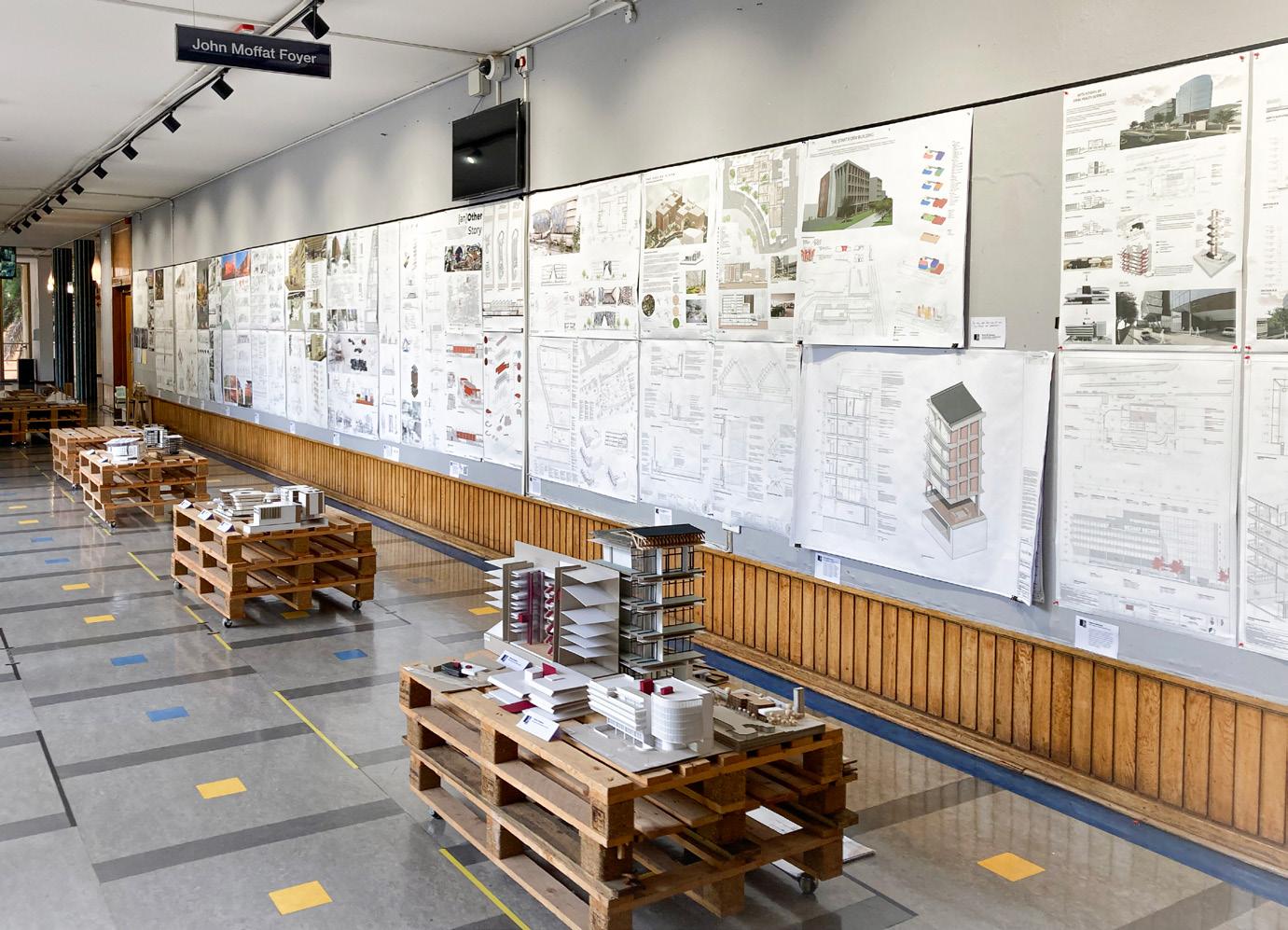
BAS Hons exhibit; photo: G. Gantner
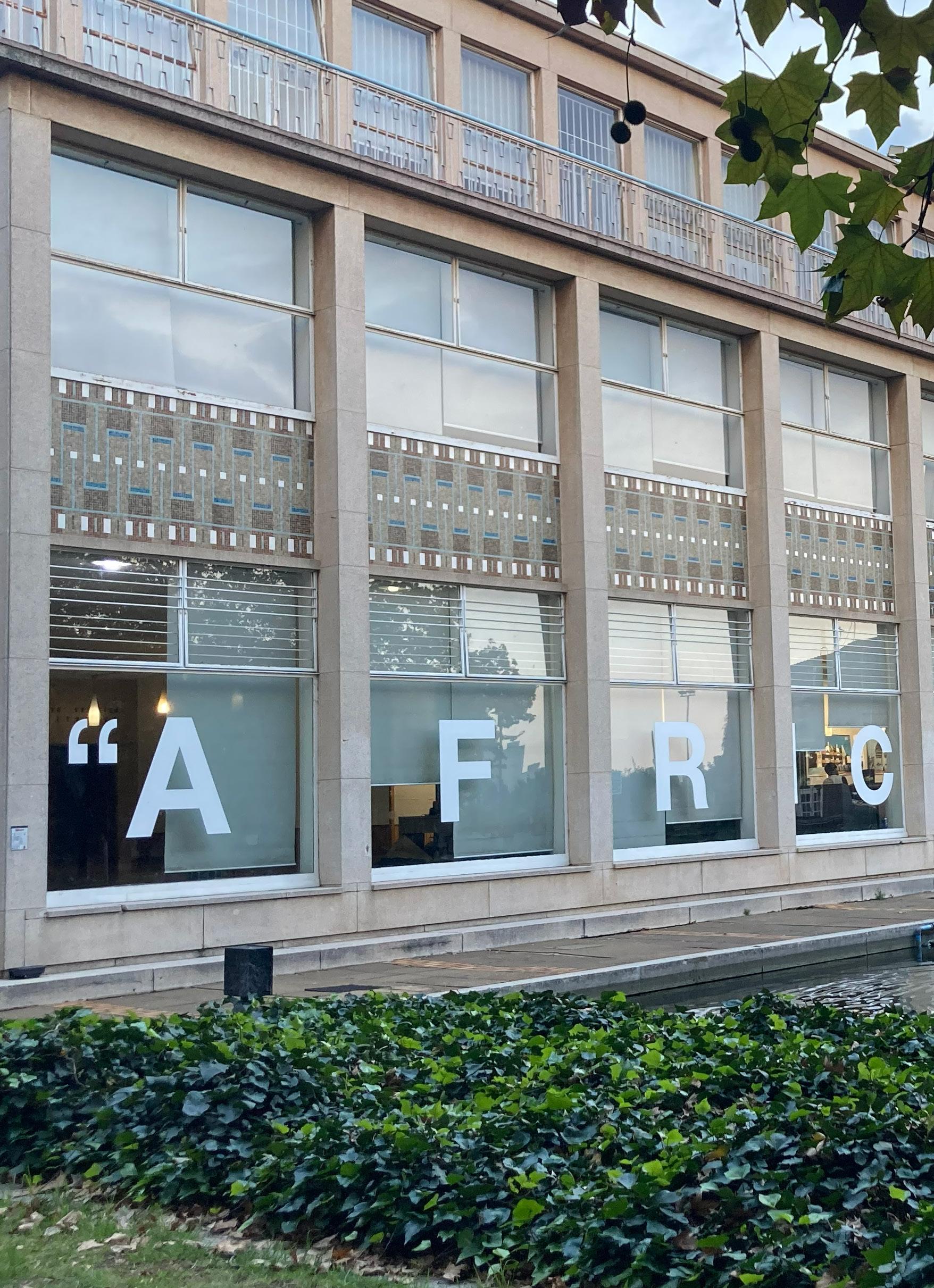
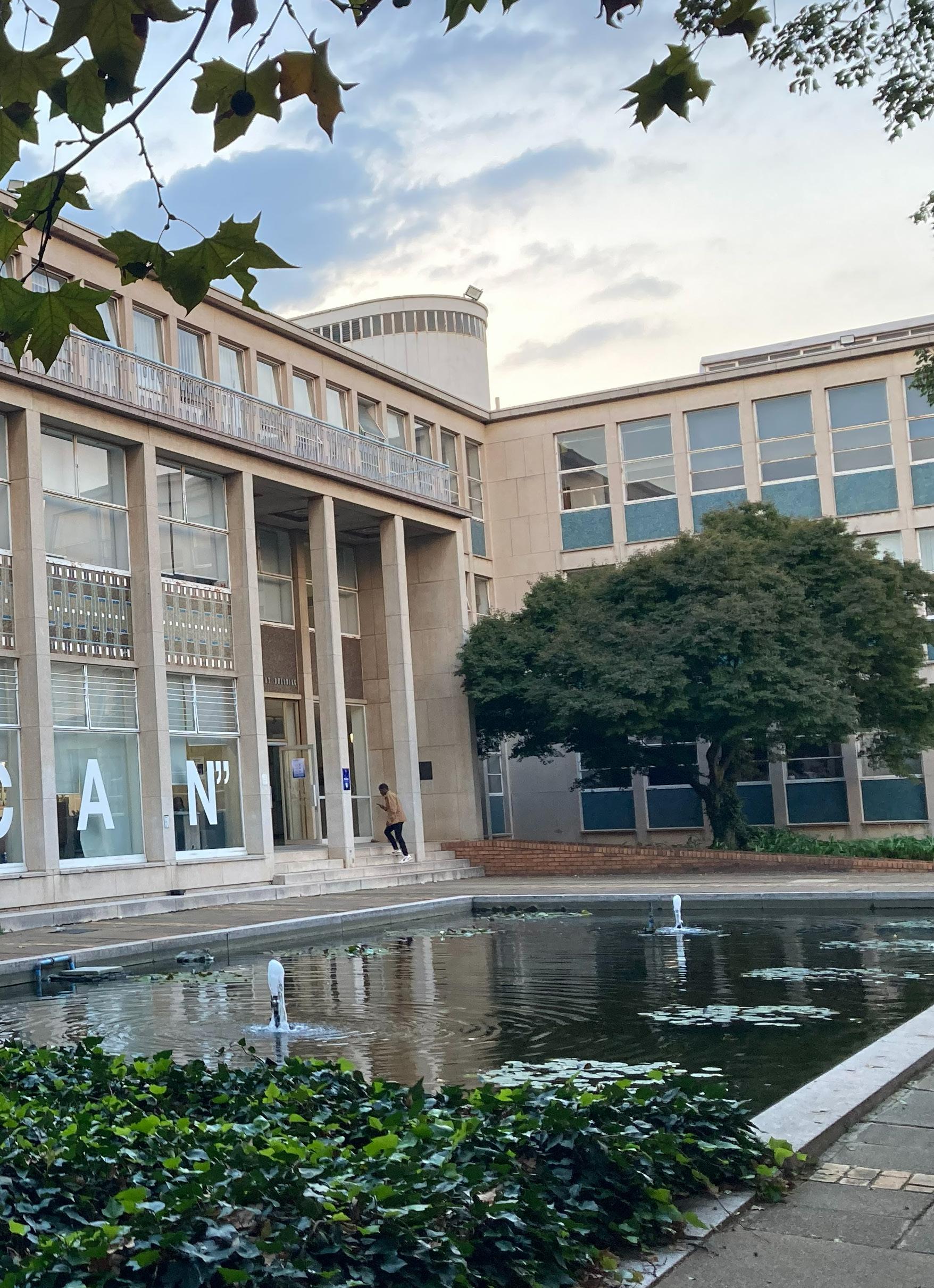
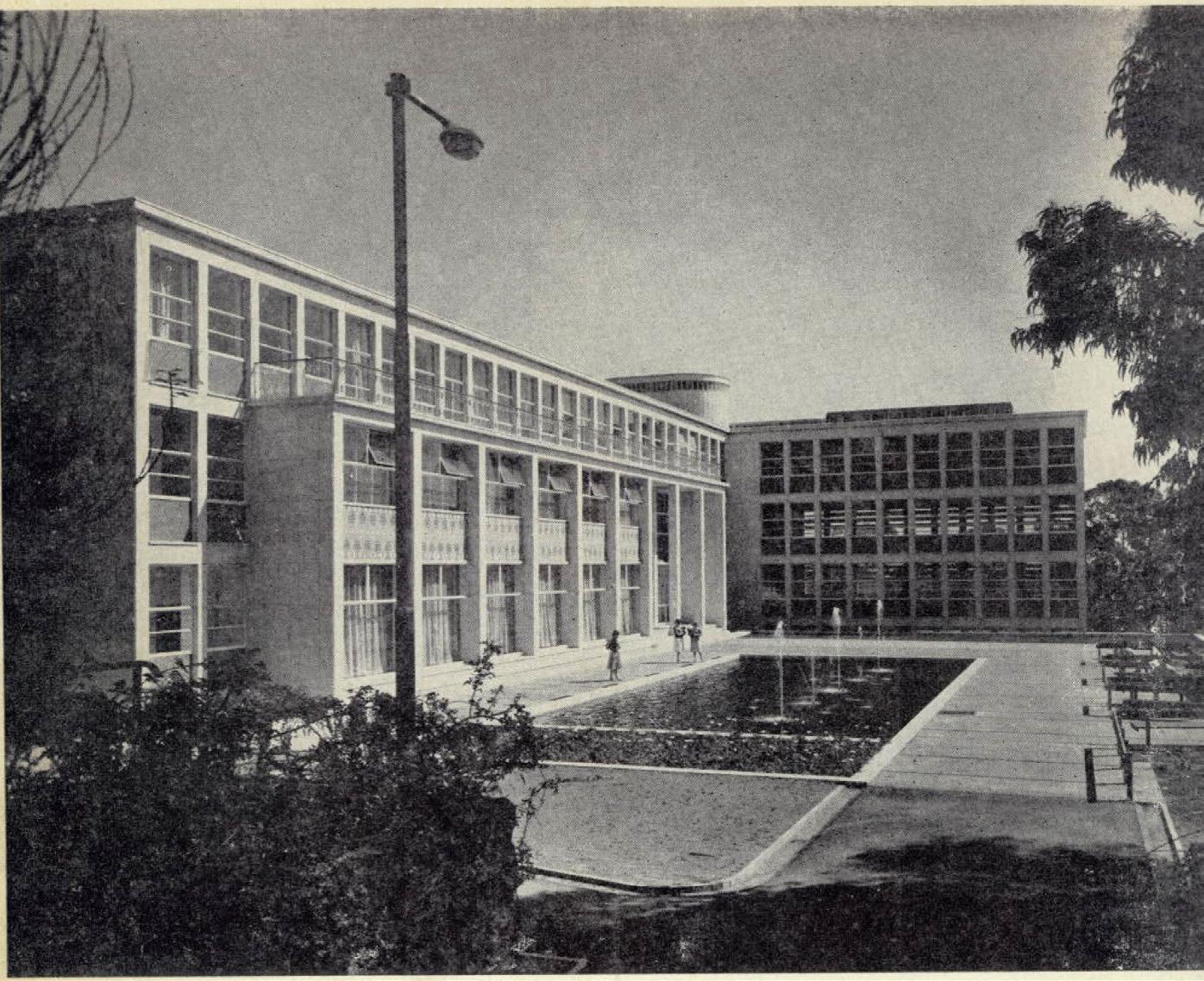
moved into what is still our current home, designed by Professor John Fassler, after whom our gallery is now named, in association with the staff members of the Department at the time. The John Moffat Building was the first of the buildings to be completed in the University’s post-war building programme, and is named after a Johannesburg architect who bequeathed a small fortune to the university.
Urban planning at Wits traces its origins to the 1938 Congress on Town Planning held by Architectural Students’ Society of the University of the Witwatersrand. In 1942, the then Faculty of Architecture introduced a part-time post graduate Diploma in Town Planning. The Department of Architecture introduced the country’s first full time Bachelor’s degree in Planning in 1965, and a separate Department of Town and Regional Planning was formed in 1967. Further degrees were introduced in the 1980s and 1990s, setting up the current offerings of both undergraduate and postgraduate study.
In 2001, the former departments of Architecture and Town and Regional Planning amalgamated to form the School of Architecture and Planning. The School maintains the studio-based tradition which is now almost 90 years old, and is among the most widely recognised in Africa.
With a view to equipping students to shape the future in our professions, and to contribute to the sustainable growth of their communities, SoAP’s intensive curricula, in addition to its research centres, explore the emergent territories of knowledge in these fields. Existing and future scholars and practitioners, operating in national and international arenas, are convened at our School to explore the full spectrum of current trends in design and planning, to find solutions to the challenges of global
urbanism, urbanisation and urbanity, in balance with the diverse natural ecologies.
At SoAP, from the time of enrollment, students are immersed in lectures on ecological design and planning, on technology and innovation in the built environment, attending colloquia on critical theory and debating the discourses related to policies, spatial studies, urban management and governance. Underpinning our ethos as a School is an intent of influencing policy through advocacy and research, particularly in urban spatial transformation, sustainable development, affordable housing provision, social justice, and the right of all citizens to access the city. This learning experience enables students to develop the necessary skill-set essential for success in architectural and planning practice, and to understand important ethical issues, adopting an imaginative engagement with what is pertinent to our contemporary context.
We are proud of our century-long history, and are confident that today’s students will continue to shape the professions of architecture and urban planning for centuries to come.
Welcome to Wits.
Prof. Mfaniseni Fana Sihlongonyane Head of School
Transformation at Wits
At Wits University, transformation is understood as a process essential to sustained academic excellence – through continuous assessment and renewal in the support services, as well as through teaching, learning, research and social engagement undertaken by the University.
Transformation at Wits refers to processes of change in our curricula so that it reflects diverse sources of the best forms of knowledge from within South Africa, Africa and across the world as well as the use of different teaching methodologies, diversification of the demographic profile of both our staff and students without compromising on merit, qualifications and standards as well as an inclusive institutional culture which is characterized by a nurturing, supportive and inclusive environment necessary for the realization of academic excellence. An Executive Statement on Accelerating Transformation
has been issued by the Vice Chancellor, with a strategic plan based on three premises: that a broad definition of transformation is necessary at Wits; that “colour-blind” interactions represent a deeper problem than overt racism; and that it is necessary to remain cognisant of the constraints and trade-offs involved in driving a transformation agenda.
The School maintains a standing Transformation Committee, which seeks to proactively address some of the difficult challenges posed by the inequalities of South African society. Through the Committee, the School takes measures to assist students in need where possible, investigates teaching methods that can unlock various ways of learning, and explores the decolonisation of our curricula. More information about the University’s transformation policy can be found at the Transformation Office available at https:// www.wits.ac.za/transformationoffice/
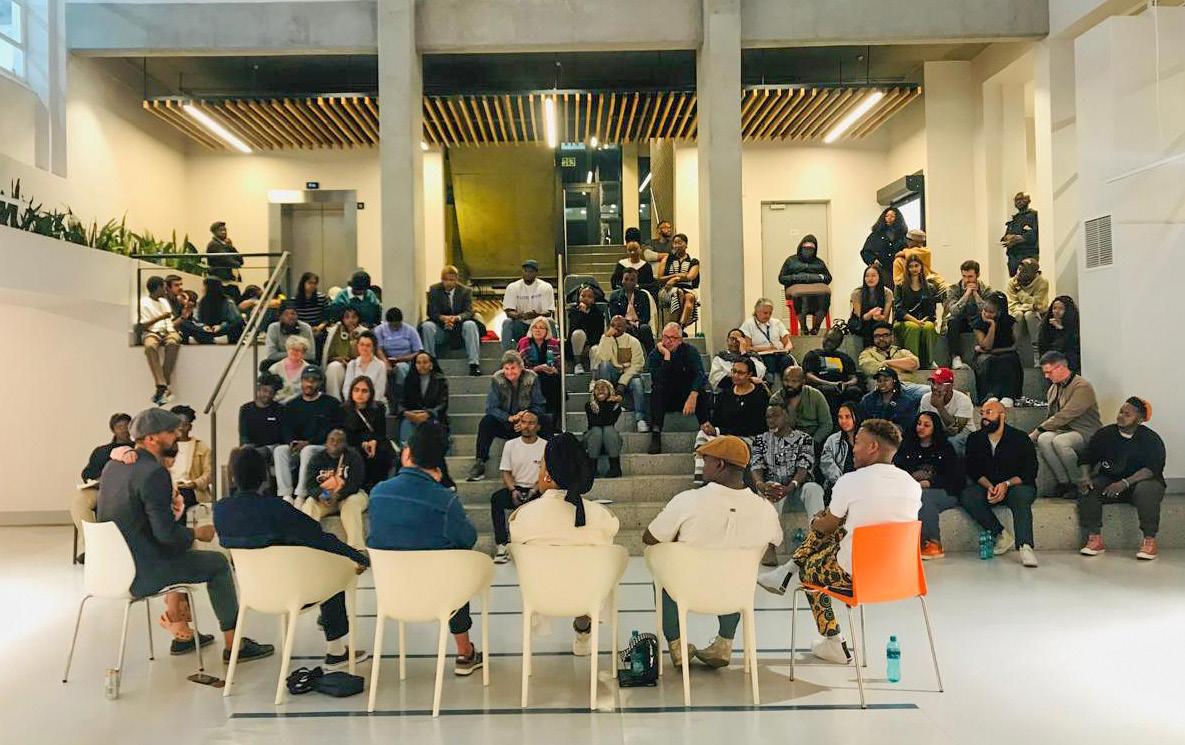
SoAP cultural event; photo byL. Francis

Finding Your Way
Support services offered by the university are outlined in the Student Life & Support section of this handbook.
Timetables of classes will be made available by the School based on your degree programme.
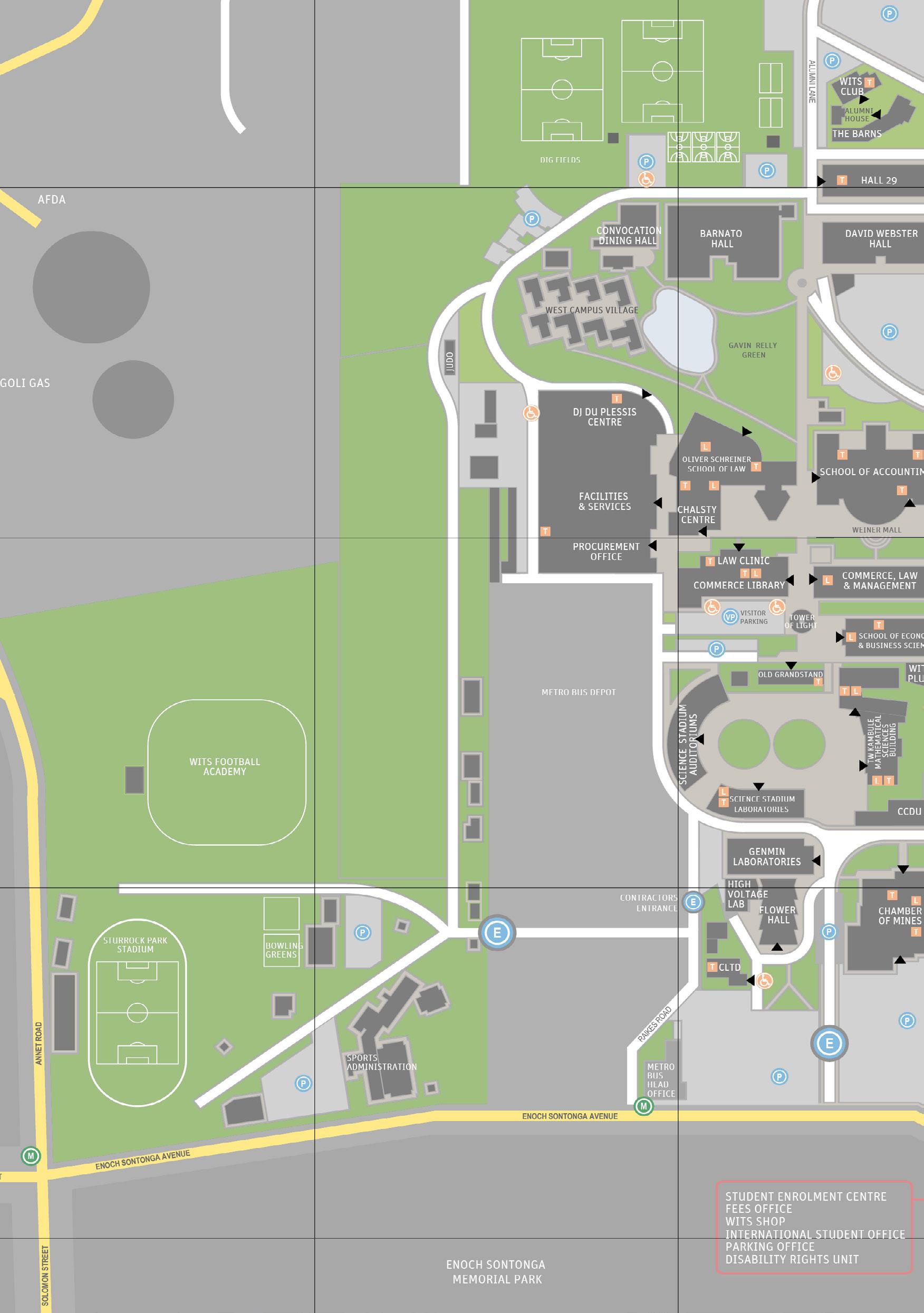
Most postgraduate and many undergraduate courses are offered from our own John Moffat Building and Extension, but larger lecture courses are often held elsewhere on campus. Timetables often use the abbreviations listed to the right to indicate the building venue.
Wits has easy access to public transport in on the north side of campus, with a Rea Vaya (bus rapid transit) station just oustide the Yale Road gate. On the east side of campus in Braamfontein, taxis are readily availbale and the Rea Vaya and Gautrain are a short walk away.
Braamfontein has become a student housing hub, with a lot of activities and amenities tailored to student needs. Students are encouraged to occasionally get off campus and experience what Johannesburg has to offer.
Building Abbreviations:
ARM African Rainbow Minerals Building (formerly Chamber of Mines)
B Biology Building
BPB Bernard Price Building
CB/ RSB Robert Subokwe Block (formerly Central Block)
CCDU Counselling & Career Development Unit
CLM Commerce, Law & Management
DDC DJ Du Plessis Centre
DWH David Webster Hall
FH Flower Hall
GLS Geology and Mining
H Hillman Building
JM John Moffat Building
JME John Moffat Extension
NWE North West Engineering Building
OLS Oppenheimer Life Sciences
OMS Old Mutual Sports Hall
P Physics Building
RW Richard Ward Building
SMH Solomon Mahlangu House (formerly Senate House)
SWE South West Engineering Building
UB Umthombo Building
WB Wartenweiler Library Basement
WSOA Wits School of Arts
WSS Wits Science Stadium
Wits Great Hall
Wits Campus Map


Yale Telescope (storage)

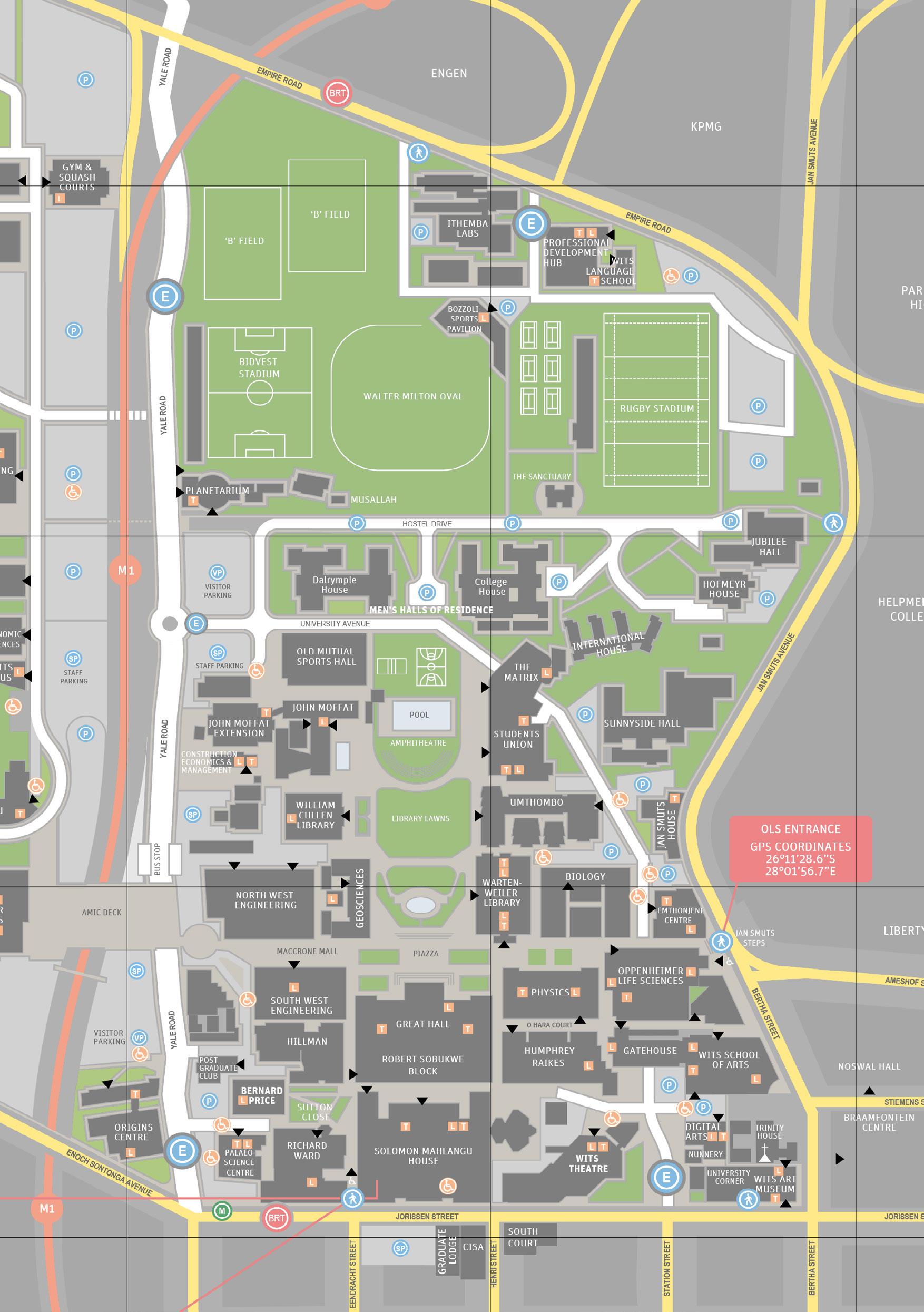
John Moffat Building (JM) Construction Economics & Management
John Moffat Extension (JME)
Wits Bus Service
Wits runs a regular bus service between campuses and residences, with daily service and a stop near the School at the Amic Deck on Yale Road. More information can be found on their website:
https://www.wits.ac.za/students/ wits-bus-service/ Registration
Registration procedures are outlined in section 5 of the Rules and Syllabuses book, and are also posted online at: https://www.wits.ac.za/registration/
Important times and dates are listed under the Engineering and the Built Environment tab on the same website.
Students who are admitted or readmitted on conditions may be subject to additional requirements to maintain their registration. In these cases, students will be informed by both the Faculty and the School, and must agree to the conditions before registration will be allowed.
Fees & Finances
Fee payments have deadlines which may affect registration, so students are advised to be up to date on all issues surrounding their fees and finances.
Current fees, deadlines, and financial aid opportunities can always be found on the Wits website at: https://www.wits.ac.za/ study-at-wits/student-fees/
The Wits Fees Booklet (available at this website) also outlines the dates fees must be paid by; dates fees become non-refundable if a student deregisters; and
outlines additional ‘redirected fees’ charged to students per course. Specific line items for redirected fees change from year to year in response to course needs and updated costs, but the breakdown always follows the principles outlined below.
Tuition fees are determined per credit, and are fees which pay into the general Wits operational systems to run the academic programmes offered.
Aside from tuition fees, some other fees are charged specifically by the School.
Computer fees are charged only to courses in which students are likely to use specific software, the licensing of which comes at a cost to the School. The School takes the total costs of software licensing, and distributes it amongst the courses charged based on a which software is likely to be used in which course, and the number of students in each of those courses, in order to distribute the cost as accurately as possible. Computer fees are non-refundable.
Excursion fees are charged only to specific courses, and are ring-fenced fees meant to fund field trips and excursions which come at an additional cost to the School, above and beyond what the tuition fees cover. Unused excursion fees are reimbursable to students at the end of an academic year only if no excursion happened in that course during the academic year. Students who choose not to attend excursions that do happen are not eligible for refunds.
Fees labeled Notes fees in the Wits Fees Booklet are not only for notes; the full fee title is ‘Notes, course packs and e-learning.’ Of these, the School mainly charges only for ‘e-learning.’ These fees cover the costs of our Citrix remote server, which allow students to access the computing power and software licenses at
Wits from anywhere, using only an internet connection. Each course that is charged a computer fee is also charged an e-learning fee; the cost is distributed evenly across each student in all of these courses based on expected enrollment numbers. Notes and e-learning fees are non-refundable. Lab fees cover general consumables for laboratories. In the School’s case, ‘laboratory’ refers to the workshop and s’Fanakalo maker space. These costs are assigned only to courses likely to use these facilities, and are used to provide personal protective equipment and minor items necessary to make the workshop spaces functional.
Student Accommodation
Students who live beyond a 45km radius of campus are eligible to apply to rent places in University-owned residences. Accommodation details can be found on the Campus Housing & Residence Life website:
https://www.wits.ac.za/accommodation/
It is important to be able to travel to and from accommodation well into the evening, as many students work late on campus; not all campus housing units are on the same Wits campus, so for those who obtain housing, it is best to make sure this is doable.
For off-campus options, students are encouraged to seek housing on the Private Student Accommodation website listed above, and look for units near the Wits campus.
Please note that there are many places advertising student accommodation in residential neighbourhoods which are operating illegally, without proper land
use rights from the City of Johannesburg. Specifically, any property on a Residential 1 land use (the zoning class used for single-family housing) that is housing more than 6 students on the same property must be in possession of a Consent Use Permit for a student commune from the City of Johannesburg. Properties on Residential 3 or 4 land uses allow for higher numbers of people, and thus would be compliant if normal building regulations and other land rules are satisfied. It is advisable to check the website above or ask the management about their permits before entering a lease. Illegally operating communes should be avoided and reported to proper authorities.
Budgeting for Other Costs
In addition to the university fees, students should expect other academic expenses to be incurred. The School has made every effort to reduce the needs, but the degree requirements and work involved often involves other minor expenses throughout the year, such as printing, model-making material (especially for architecture students), and other general supplies.
These costs will vary depending on the specific courses taken, but the School advises that at a minimum, students budget annual academic expenses per their respective degrees as follows:
BAS year 1: R 6,000
BAS year 2: R 6,000
BAS year 3: R 7,000
BSc URP all yrs: R 5,000
BAS Hons: R 9,500
BSc URP Hons: R 5,000
PGDip: R 5,000
M.Arch [Prof]: R 12,000
MSc DP: R 5,000
MUD: R 7,000
MUS: R 5,000
School Facilities
Our Facilities
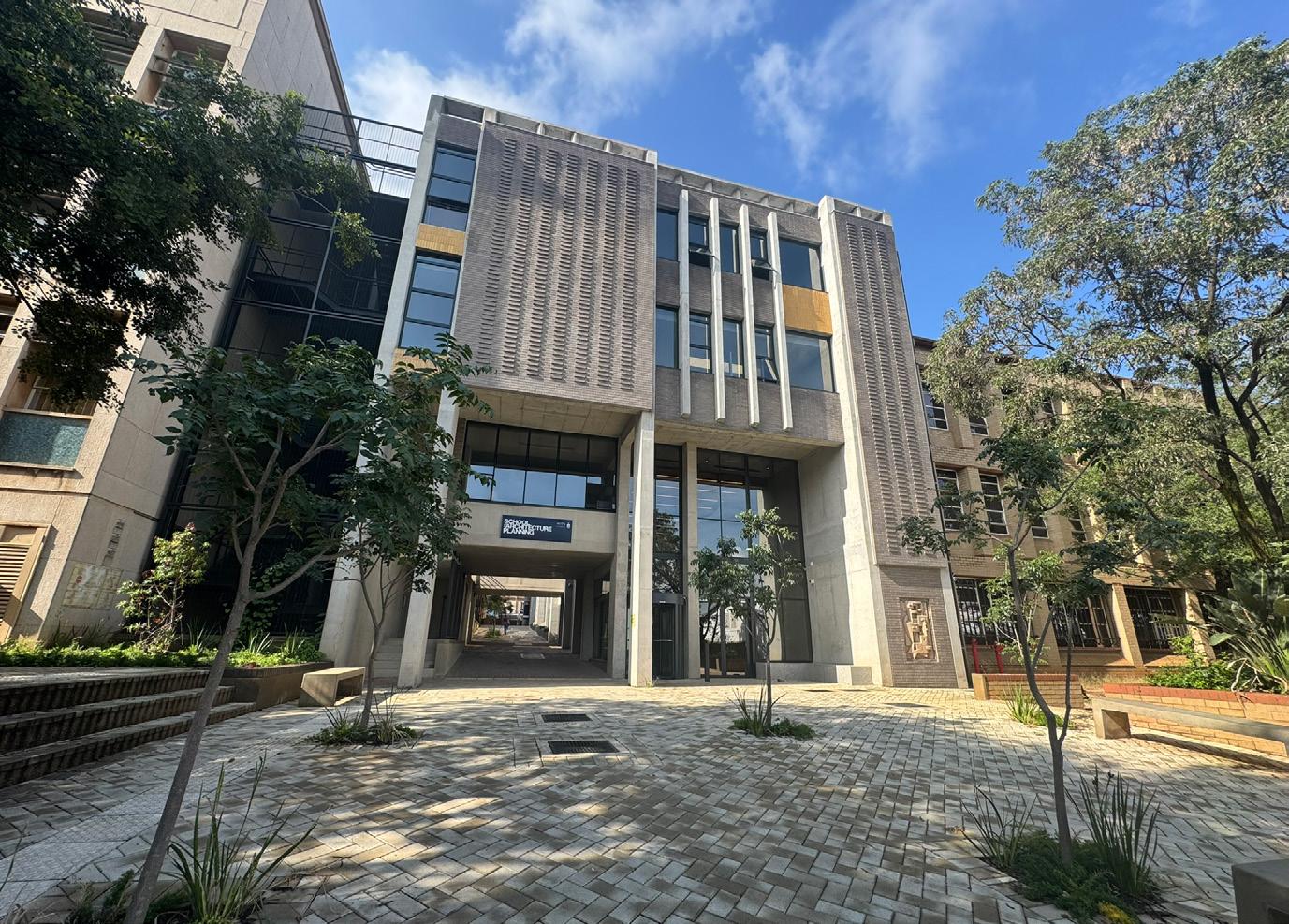
The Department of Architecture has been situated in the John Moffat Building on the Wits East Campus since 1959. The building is considered a work of Modern movement heritage. In the mid-1970s, a second building, connected to the John Moffat Building (JM), and called the John Moffat Extension (JME), was built to provide substantially larger studio spaces. As most studios moved out of the John Moffat Building and into the JME, some of the former studio spaces within the historical building were converted to offices and seminar rooms. A further addition to the complex shared between the School of Architecture and Planning and the School of Construction Economics & Management (CEM) was added in the late 2000s, though this building is used almost exclusively by CEM.
Now complete, the second phase of rennovations to the Built Environment
precinct - an integrated Built Environment Precinct, with a new link building to connect CEM, John Moffat, and JME. The new scheme prioritises social spaces, shared breakaway spaces for CEM and SoAP, and provides accommodation for new computer labs and studios.
The complete project for the upgrades to the built environment precinct is a phased approach. The final phase will add two stories to JME, and will expand studio spaces. The timeline of the final phase is not yet determined.
Classrooms
Although the School’s home is the John Moffat Building and Extension, it does not have exclusive use of them. The primary lecture halls are booked centrally by the university, and thus these are open for use from any programme which reserves them. These rooms are all located off the main
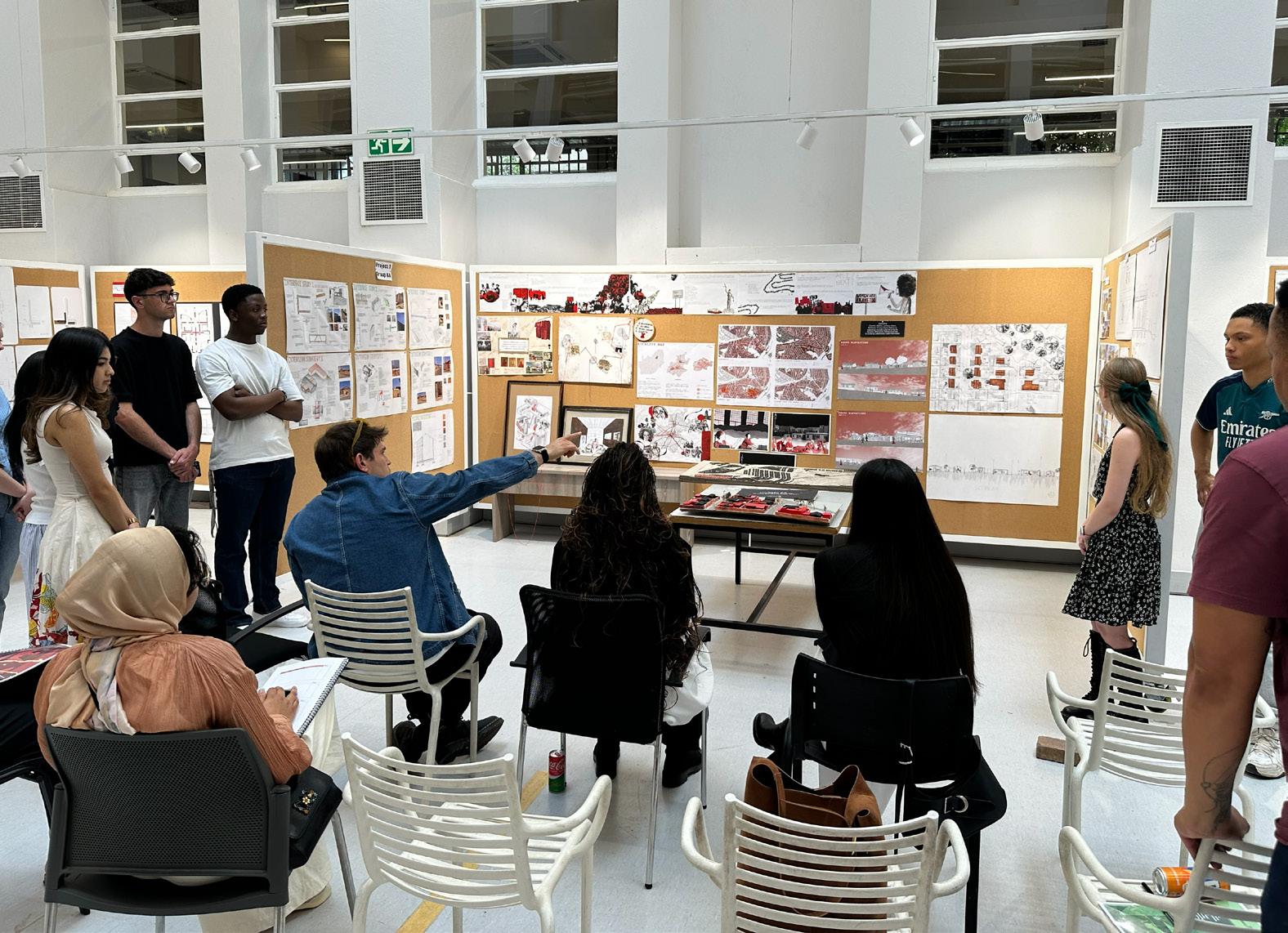
1st year BAS crit; photo: J. Makhubu
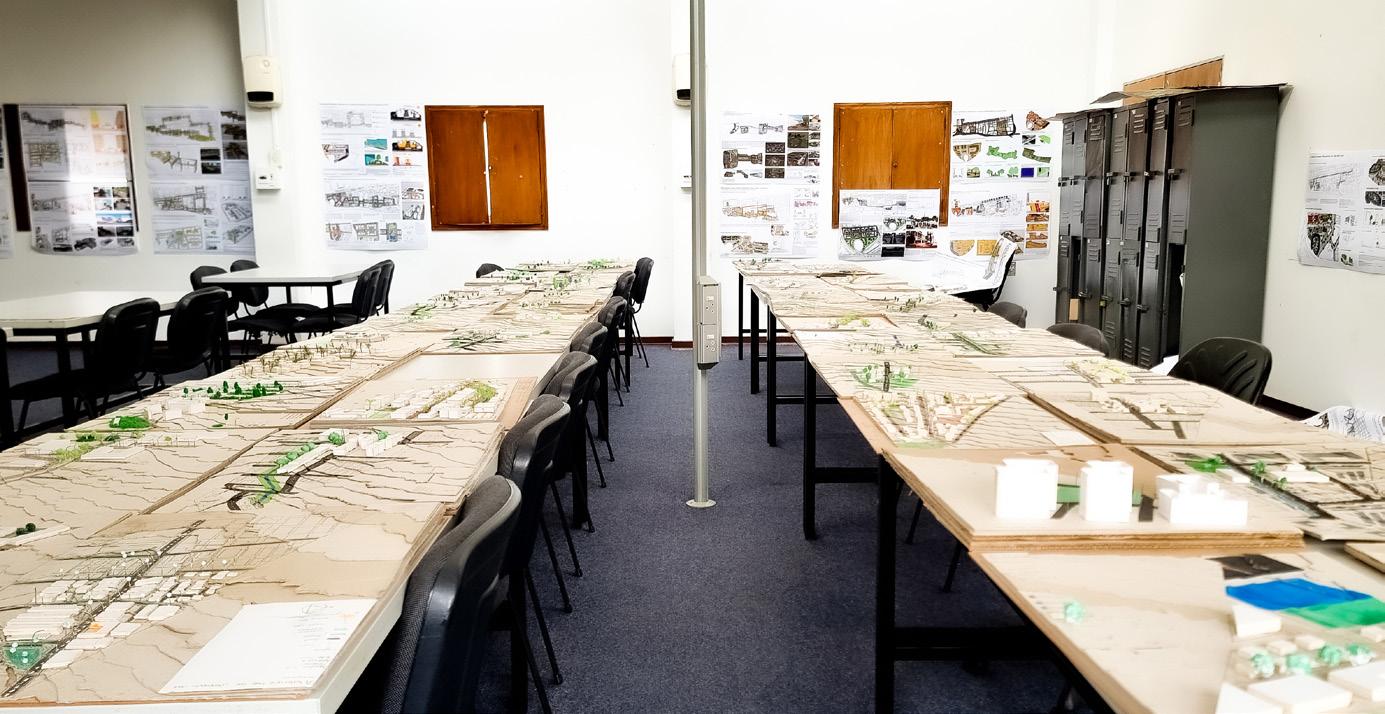
foyer on the ground floor of John Moffat:
• A1 (the Dorothy Suskind Auditorium)
• A2 (lecture hall)
• A3 (lecture hall)
The remaining classroom venues are for the exclusive use of the School of Architecture & Planning, unless reserved by an external entity and approved by the Head of School. Students may occasionally work in these spaces if there is no scheduled class at the time, but this should be done responsibly; take care of the facilities and do not leave rubbish behind.
These include smaller classrooms such as:
• A4: JM, lower ground floor, north wing.
• PGSR (Postgraduate Seminar Room): JM lower ground floor, central wing.
• FFSR (First Floor Seminar Room): JM 1st floor, north wing.
• OSR (Old Seminar Room): JM 2nd floor, room 231, central wing.
• NSR (New Seminar Room): JM 2nd floor, north wing.
• Level D Seminar Room
Pin-up Spaces & Studios
Many new pin up spaces have been added in the new Link Building. Including the new Atrium space which can host large examinations and exhibitions with its folding wall system.
In the lower ground floor of the John Moffat Building, there is a shared postgraduate studio which is reserved for Masters students in architecture and the urban planning disciplines.
Two studios are also reserved for urban planning students on the second floor of John Moffat. Because these were formerly known as Town and Regional Planning studios, they go by the abbreviation TRP1 and TRP2.
The John Moffat foyer (the main lobby) is also used for pin-ups and events.
Planning studio
The Built Environment Precinct
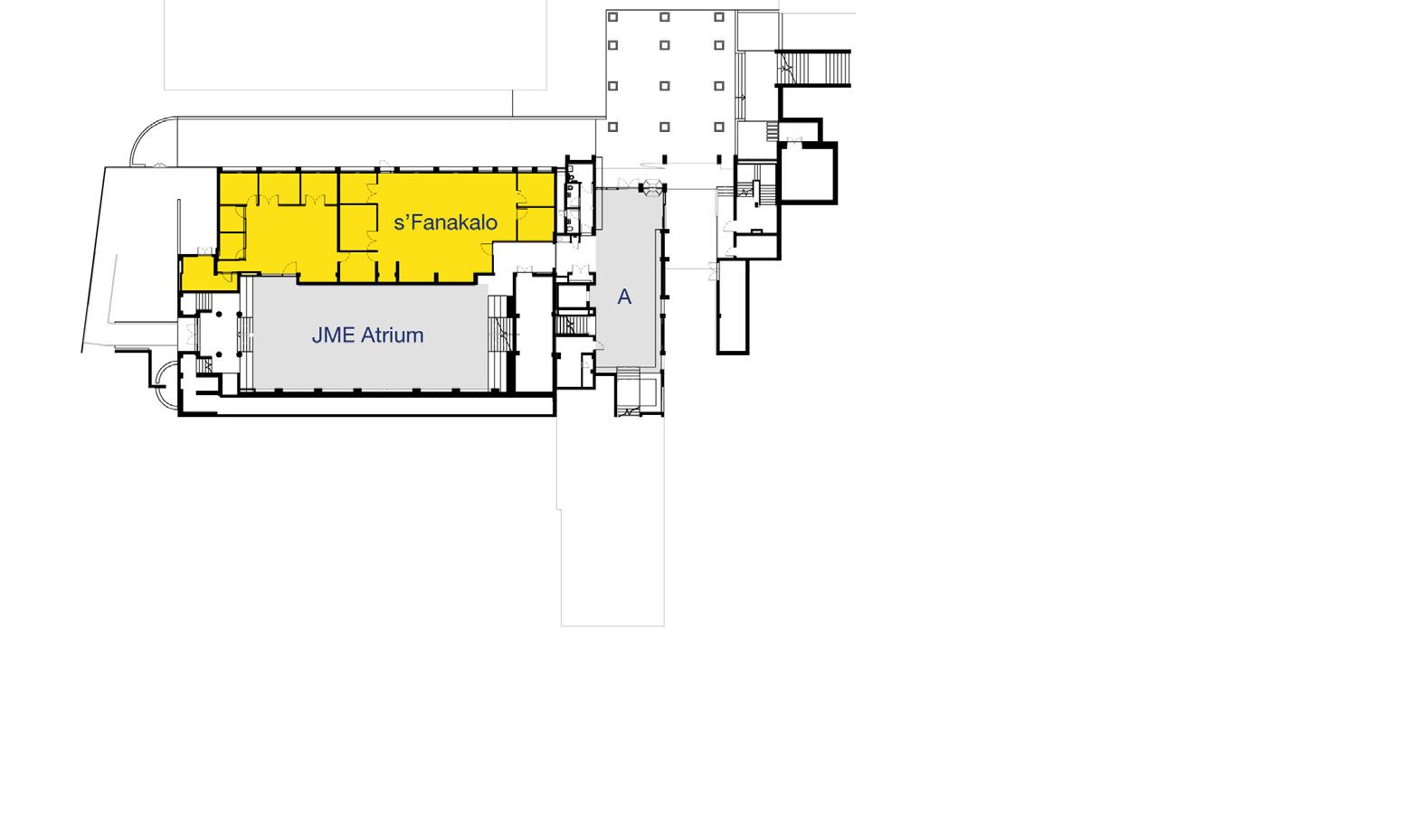
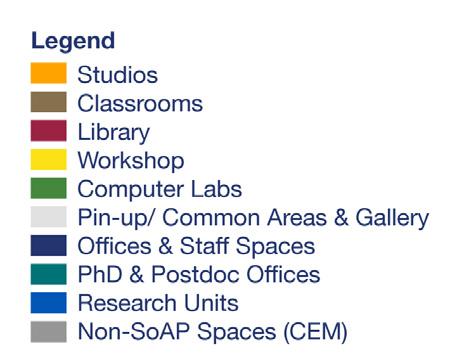
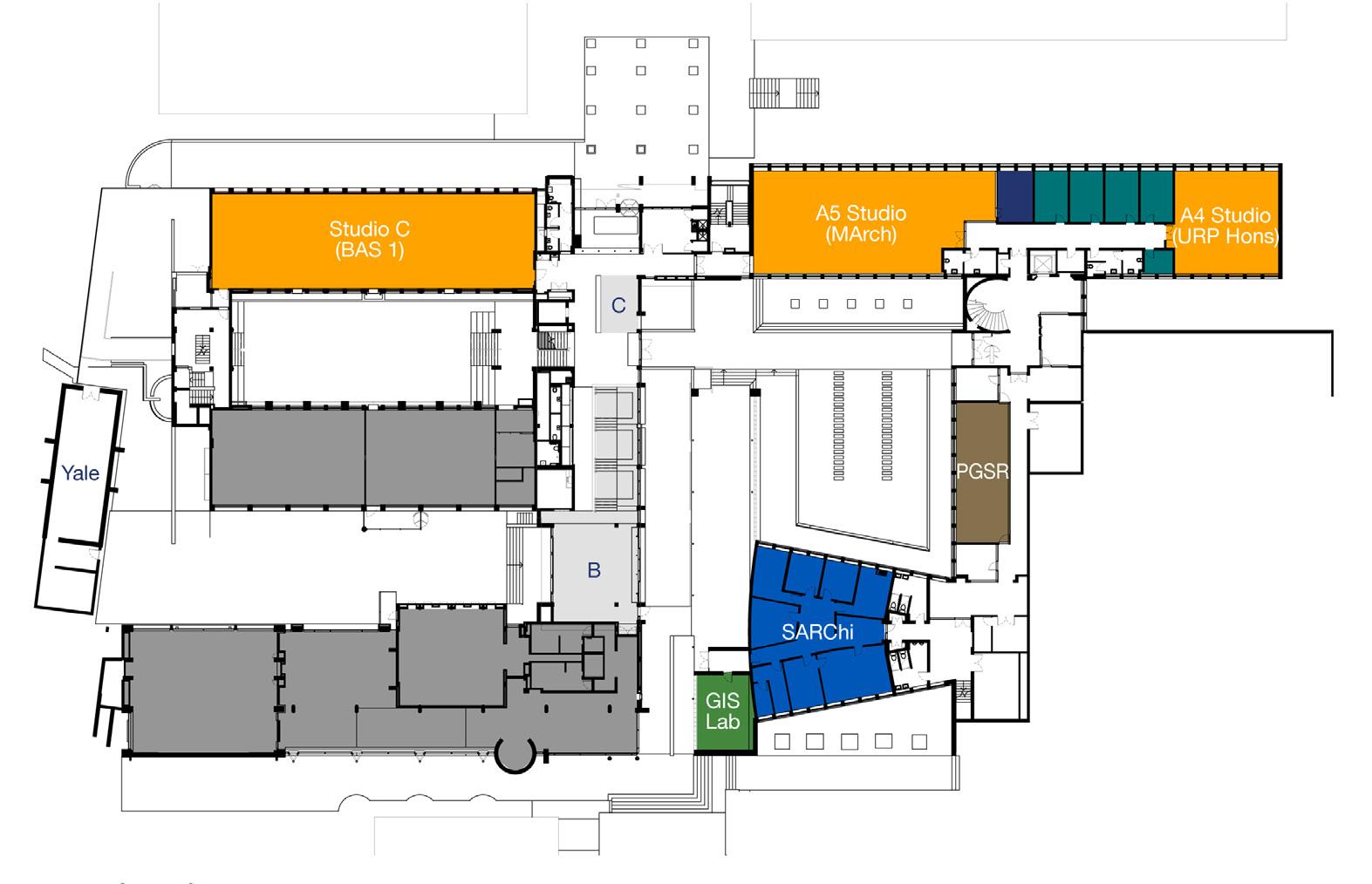
JME Level A
JM Lower Ground Floor / JME Levels B & C
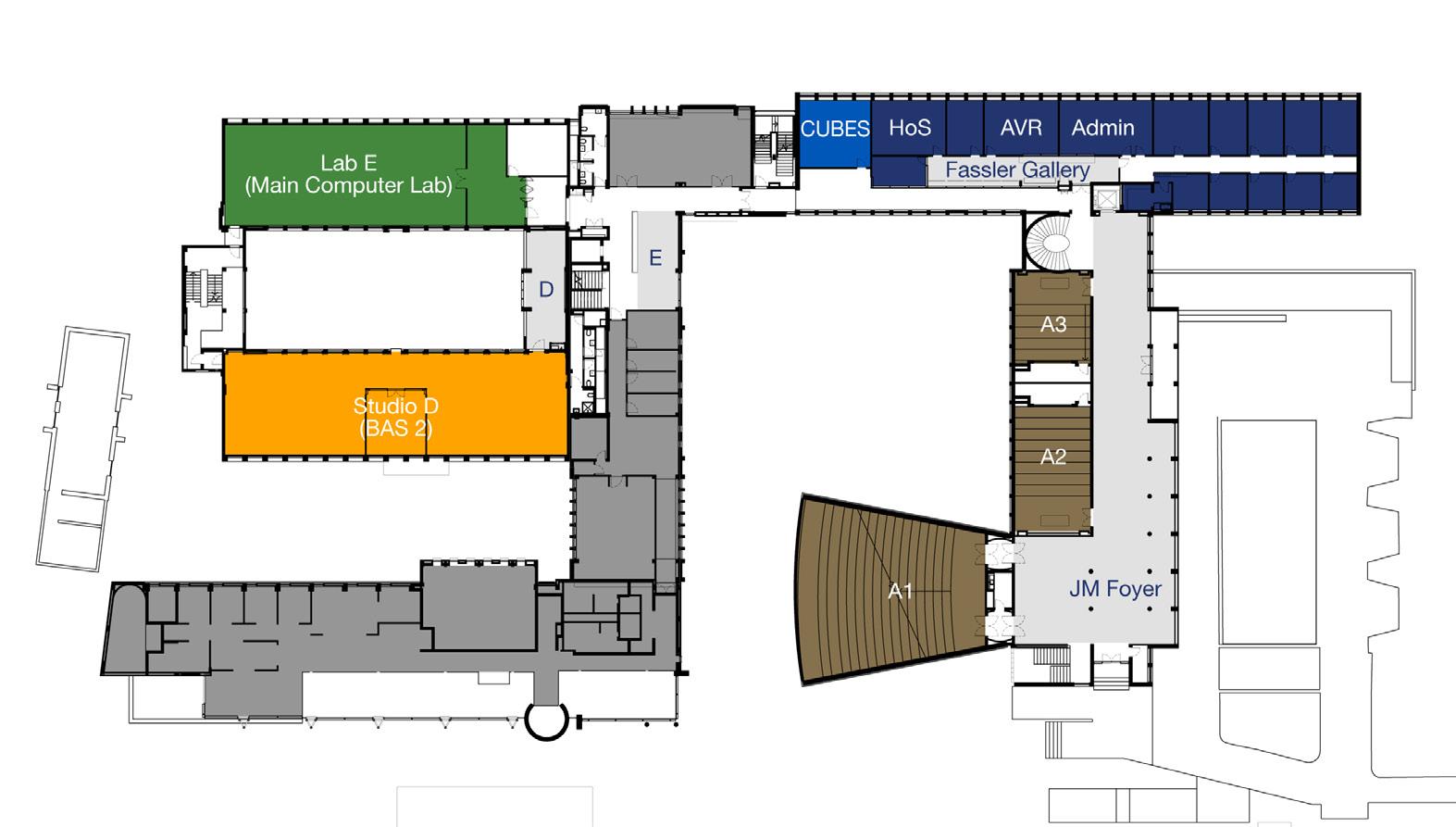
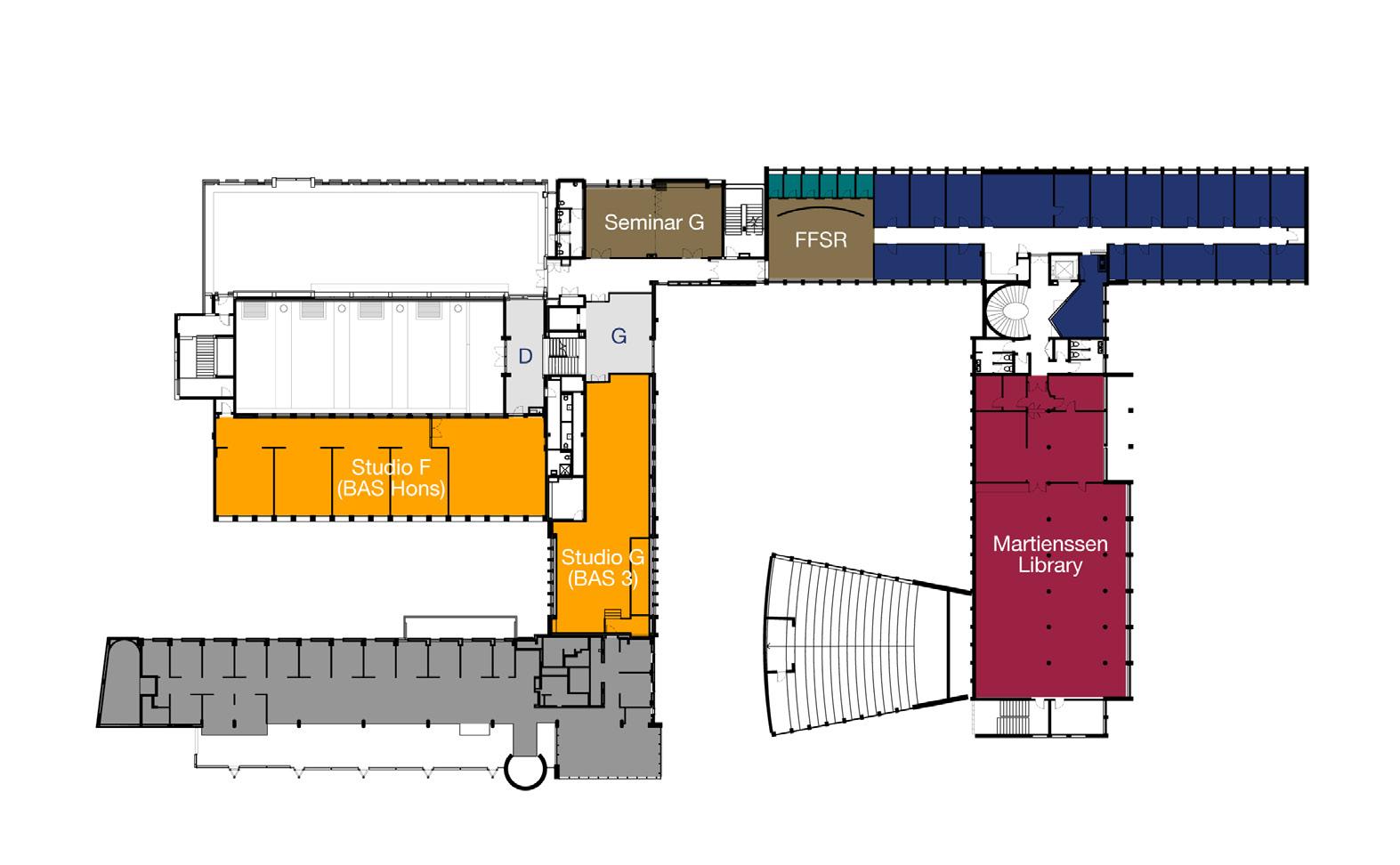
JM Ground Floor / JME Levels D & E
JM First Floor / JME Level F
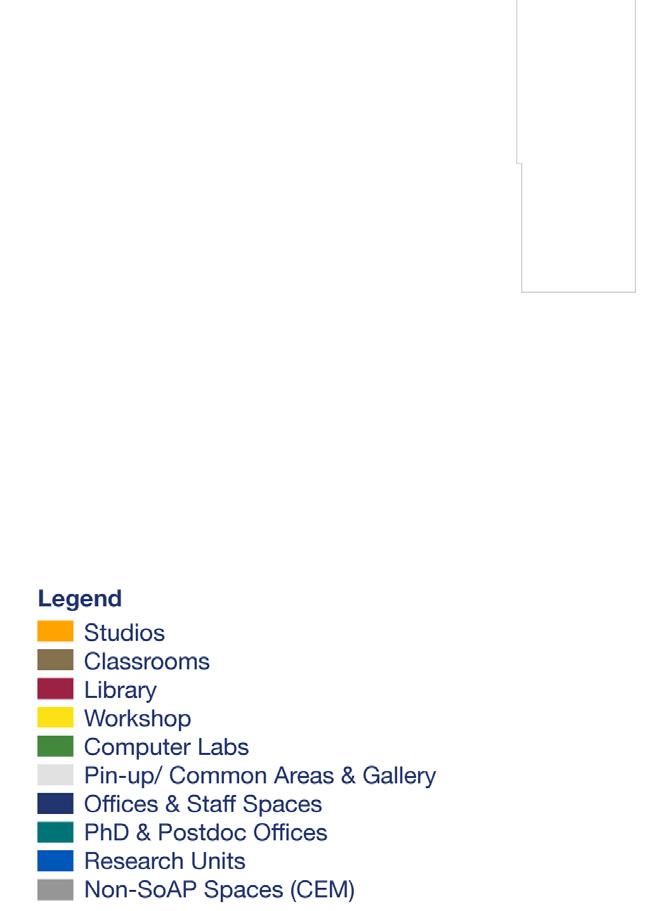
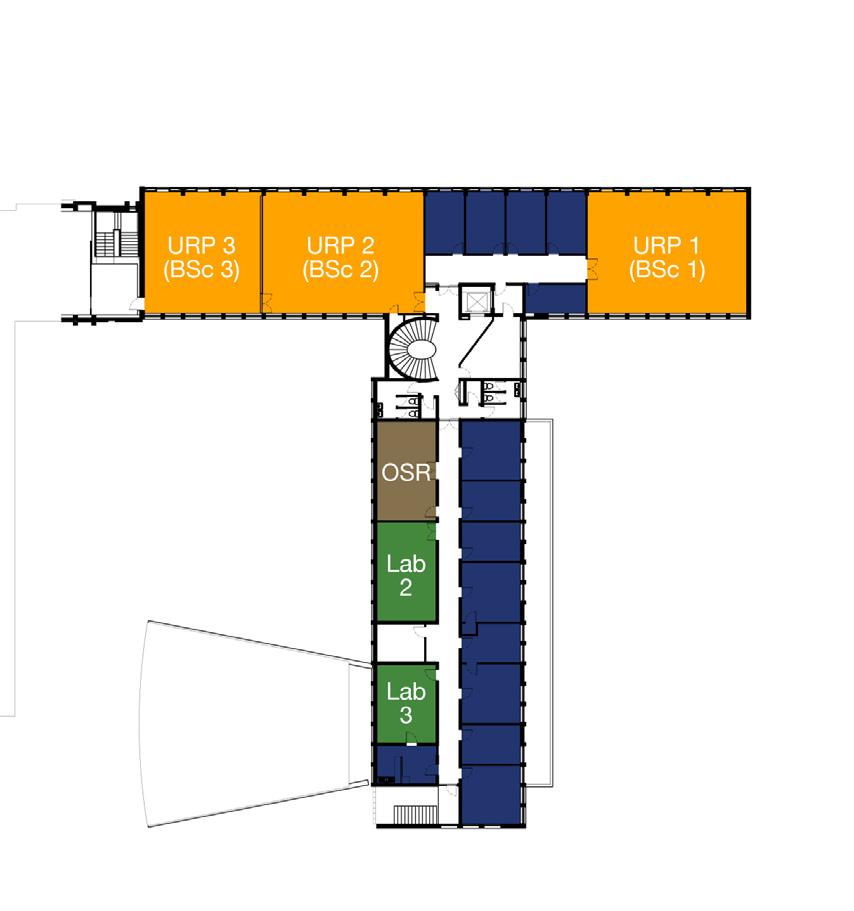
JM Second Floor
School of Architecture and Planning; photo by J Breytenbach

s’Fanakalo [we make]
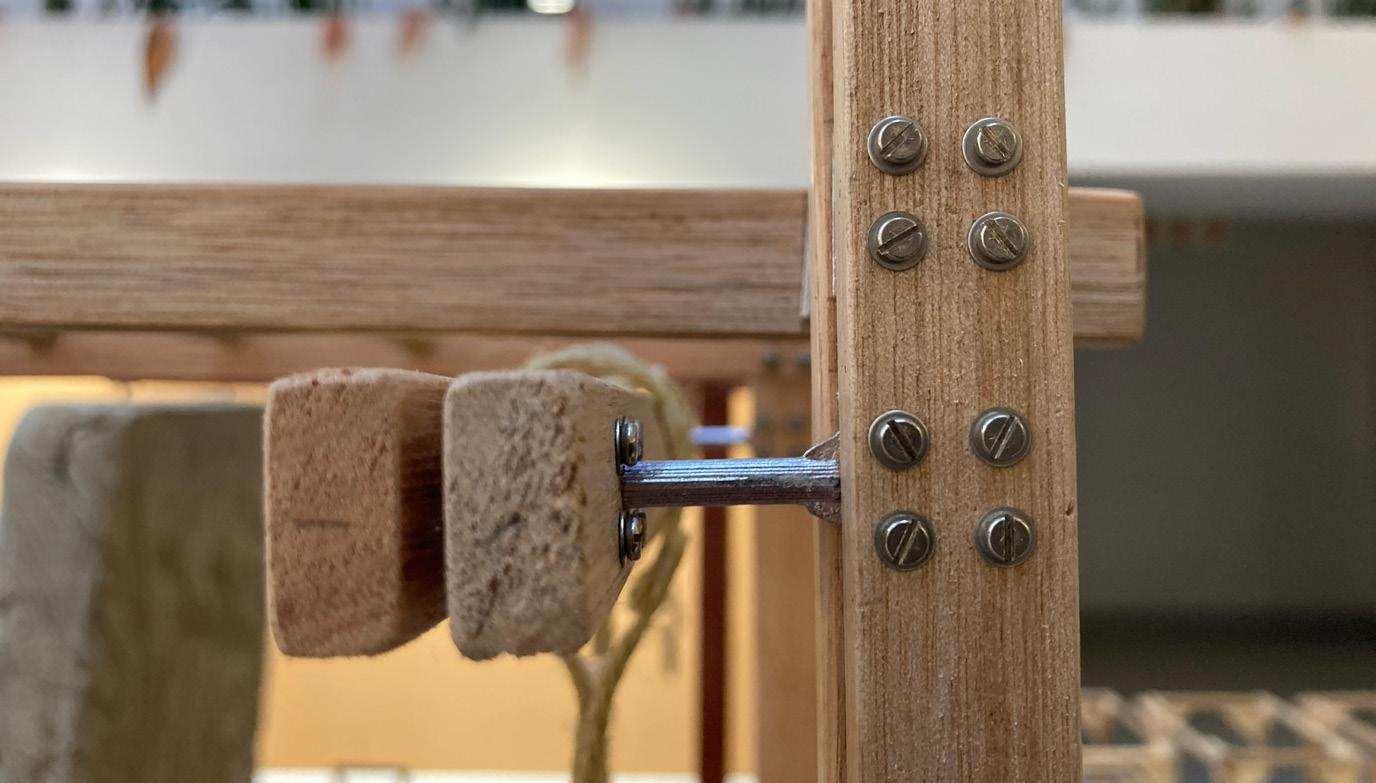
The s’Fanakalo makerspace is located on Level A in the John Moffat Extension. It consists of a digital lab containing a variety of 3D printers, laser cutters, printing presses and a CNC (computer-numerical-controlled) milling machine, as well as a traditional woodworking and metalworking equipment. The s’Fanakalo makerspace also explores interdisciplinary research, such as the relationship between architecture, visual arts, filmmaking and open source technology.
Making is integral to the teaching and learning at the School and serves as an extension to the design, construction, structures and representation studios. The aim of the makerspace is to facilitate fabrication and production as a critical thinking tool, a way of developing embodied understandings of design processes from conception to realisation, construction technologies, materials, and processes of making.
More information can be found on the s’Fanakalo Ulwazi site, accessible to registered students.
s’Fanakalo Staff & Access
s’Fanakalo is enabled by three academic staff members. Workshop staff have experience in model making, fabrication and fine arts, and will support and assist students in finding solutions to their representation and fabrication concerns.
The staff supervise and train students on the use of particular machinery. Due to capacity issues, some machinery may have restricted use, and students are advised to consult with the s’Fanakalo staff ahead of time to make arrangements and book appointments.
Due to health and safety concerns, access to any of the equipment is only granted after students have completed training in the relevant machinery and can demonstrate that they can use it safely and correctly. Access to the machinery and equipment will be by appointment only. Staff will have dedicated time slots which students may book in advance.
Material Bank & Sample Library
The digital fabrication lab contains a model material bank which has a wide range of offcuts of cardboards, coloured paper, Perspex, balsa, polystyrene, MDF, Masonite, Corex and styrene. These materials are donated by students when they have unwanted materials, unneeded surplus or offcuts and are used and distributed to undergraduate students, free of charge on the basis of need. The digital fabrication lab houses a material sample library with a wide variety of laser cutting materials, from cardboards to specialist plastics and timbers.
Equipment
The s’Fanakalo maker space has a range of equipment and machinery available, which students may use under supervision and with appropriate training, which is offered by the staff, including:
Digital Fabrication Laboratory
• 1x CNC milling machine;
• 1x SLA 3d printer;
• 3x 3d filament printer;
• 1x 3d powder printer;
• 3x laser cutters;
• 1x vinyl cutter;
• 2x etching presses;
• 1x light box;
• 1x rotatory cutter;
• 1x guillotine;
• 1 x large cutting table, steel rulers,
• T-squares and cutting knives.
Timber and Metal Workshop
• 2 wood turning lathes;
• 4 x band saws;
• 2x table saws;
• 3x pedestal drills;
• 1x thicknesser;
• 1x jointer;
• 1x compressor and spray equipment;
• 1x arc welder;
• 1 x oxy acetylene torch;
• 3x bench grinders;
• 2 x belt sanders;
• Various power tools & hand tools.
Student project; photo by L. Francis
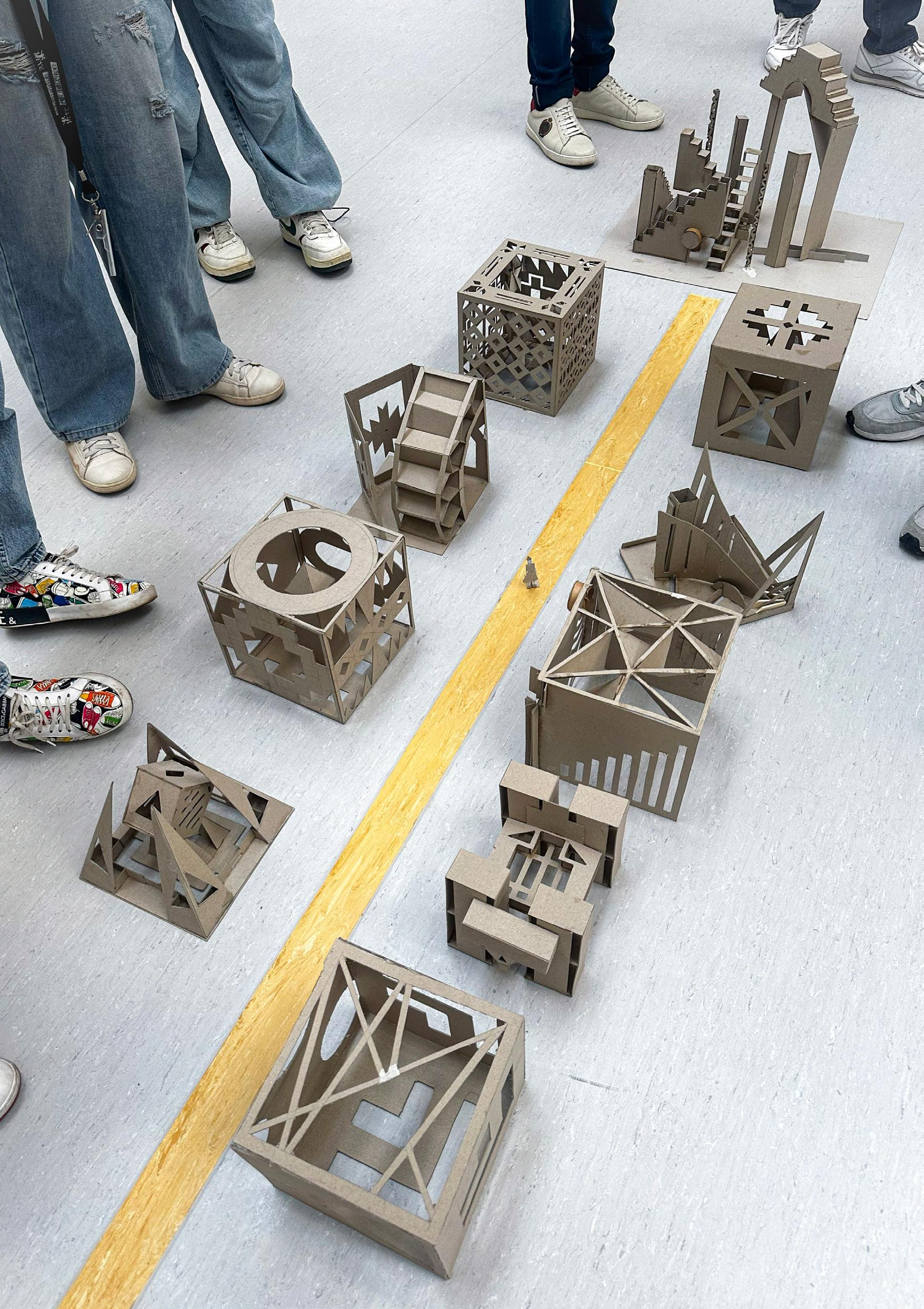
2nd year BAS student work; photo by L. Francis
Computer Labs
There are four computer labs in the John Moffat Building and Extension, three of which are designated for students of the School (the fourth is designated for students from the School of Construction Economics & Management). The three designated for the School of Architecture & Planning, including the Main CAD Lab, Computer Lab 2 and Computer Lab 3, have the same software installed on all machines, allowing students to utilise any one of them if another lab is full or in use.
In all computer labs, the rules which students must abide by are posted in visible areas. These rules exist not to be overly restrictive, but to preserve the professional nature of the labs, maintain the equipment, and provide security. It is important to note that use of the computer labs is a privilege granted to students when they enroll, but not an absolute right. Thus, anyone found to be in violation of any of the rules of use may have their privileges revoked and will be prohibited from using the computer labs.
The Main CAD Lab, contains 109 computers, and is only open to students from the School of Architecture & Planning; students from other disciplines or guests are not allowed inside. Regardless of the status of physical access to the Main CAD Lab, login access will always be available remotely using the Citrix Remote Access system (see the next section for details).
The Main CAD Lab may be used for teaching larger classes. If this occurs, a timetable of when the lab is in use by courses will be posted at the entrance to the lab, and on Ulwazi.
The Main CAD Lab has both standard-size and large-format scanning and printing capabilities. The office of the School’s IT
officer is located at the entrance to the lab, and assistance may sometimes be available. However, students should not rely on the continuous presence of the IT officer, and must plan to complete printing or other IT-related tasks well ahead of time to avoid problems or backlogs.
Computer Lab 2 (The Small CAD Lab) is located on the second floor of the John Moffat Building, in the south wing, room 229. It is open daily during academic terms from 08:00-16:30, and has 25 computers. It is generally not used for teaching purposes, so use is not restricted during opening hours.
Computer Lab 3 (The GIS Lab) is also located on the second floor of the John Moffat Building, in the south wing, room 226. It is also open daily during academic terms from 08:00-16:30, and has 20 computers, but is sometimes used for teaching purposes, particularly in the urban planning programmes, so use is restricted during teaching times. A timetable is posted at the entrance. Although the full suite of architectural software is available on machines in this lab, it is the only lab with ArcGIS installed on the computers, and for that reason students needing ArcGIS capabilities take priority in this lab.
Software common to the architecture and planning disciplines is licensed for use on all computers, including:
• ArcGIS (only in the Main & GIS Labs)
• Adobe Creative Suite
• AutoCAD
• IES
• Maya
• Microsoft Office Suite
• Revit
• Rhino
• SketchUp
Interactive Touch Screens
The Clevertouch 85” interactive screen is a state-of-the-art display designed for classroom collaboration and engagement. Its large 85-inch touchscreen enables teachers to deliver interactive lessons, showcase multimedia content, and facilitate group work with ease. With 4K resolution, built-in speakers, and seamless software integration, the Clevertouch screen provides a versatile platform for teaching and learning. Its intuitive interface and advanced features support a range of pedagogical approaches, from whole-class instruction to small-group work and individualized learning. It is installed in the Masters studio, 3rd year Architecture Studio, and Honours Architecture Studio.
Online & Hybrid Learning
Since the introduction of hybrid teaching, the School has invested heavily in the infrastructure and tools to facilitate online and hybrid learning. The use of drawing platforms such as Miro or Padlet enable presentations to be made and critiqued online if the project type or conditions require.
Unless specifically informed otherwise, students should assume that access to the Wits campus will be necessary throughout the year, despite the possible hybrid forms of teaching and learning. Each course will structure its learning methods according to the content and type of activities undertaken. There will not be a “one size fits all” approach; rather, lecturers will communicate the teaching & learning methods on a course-by-course basis.
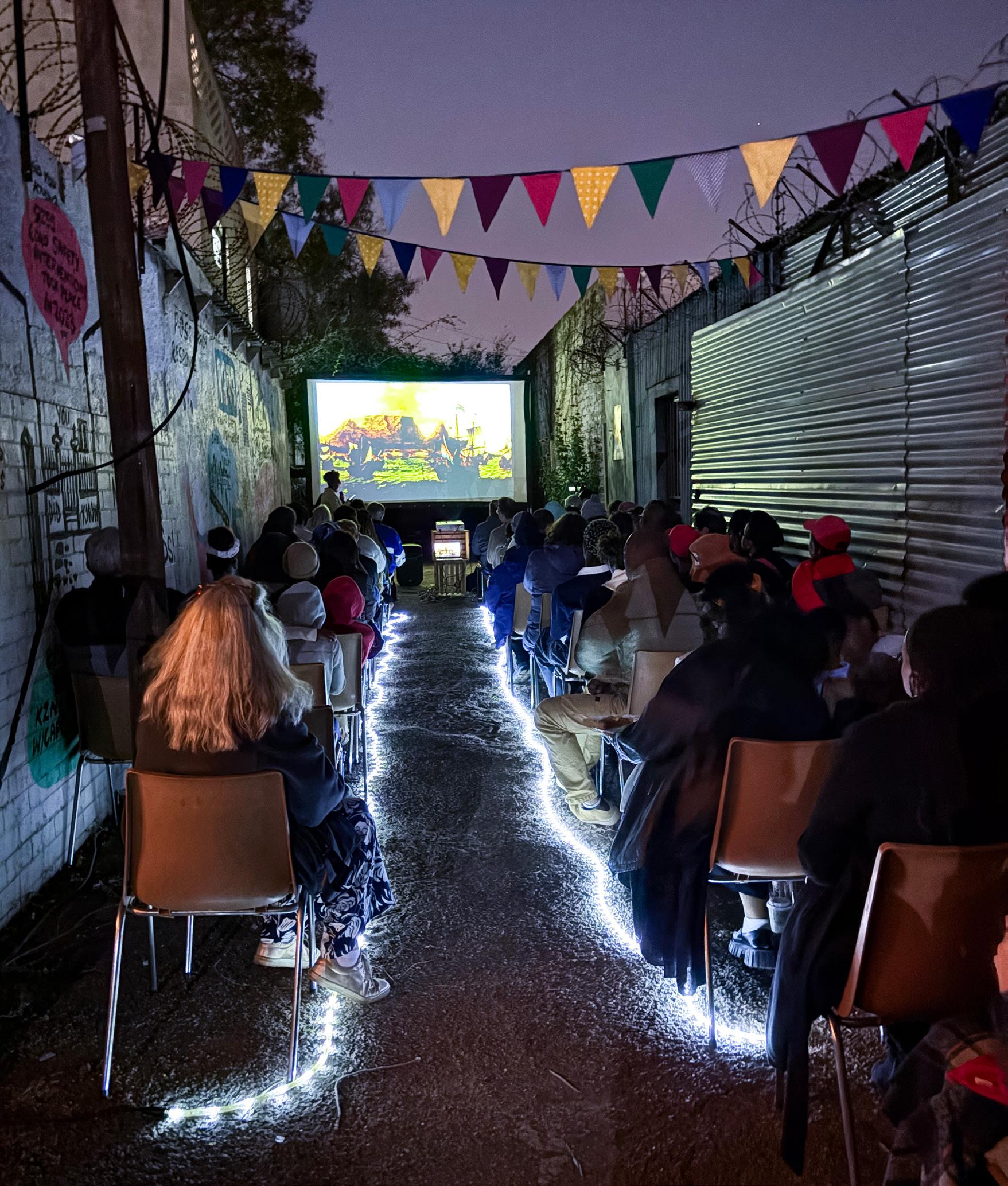
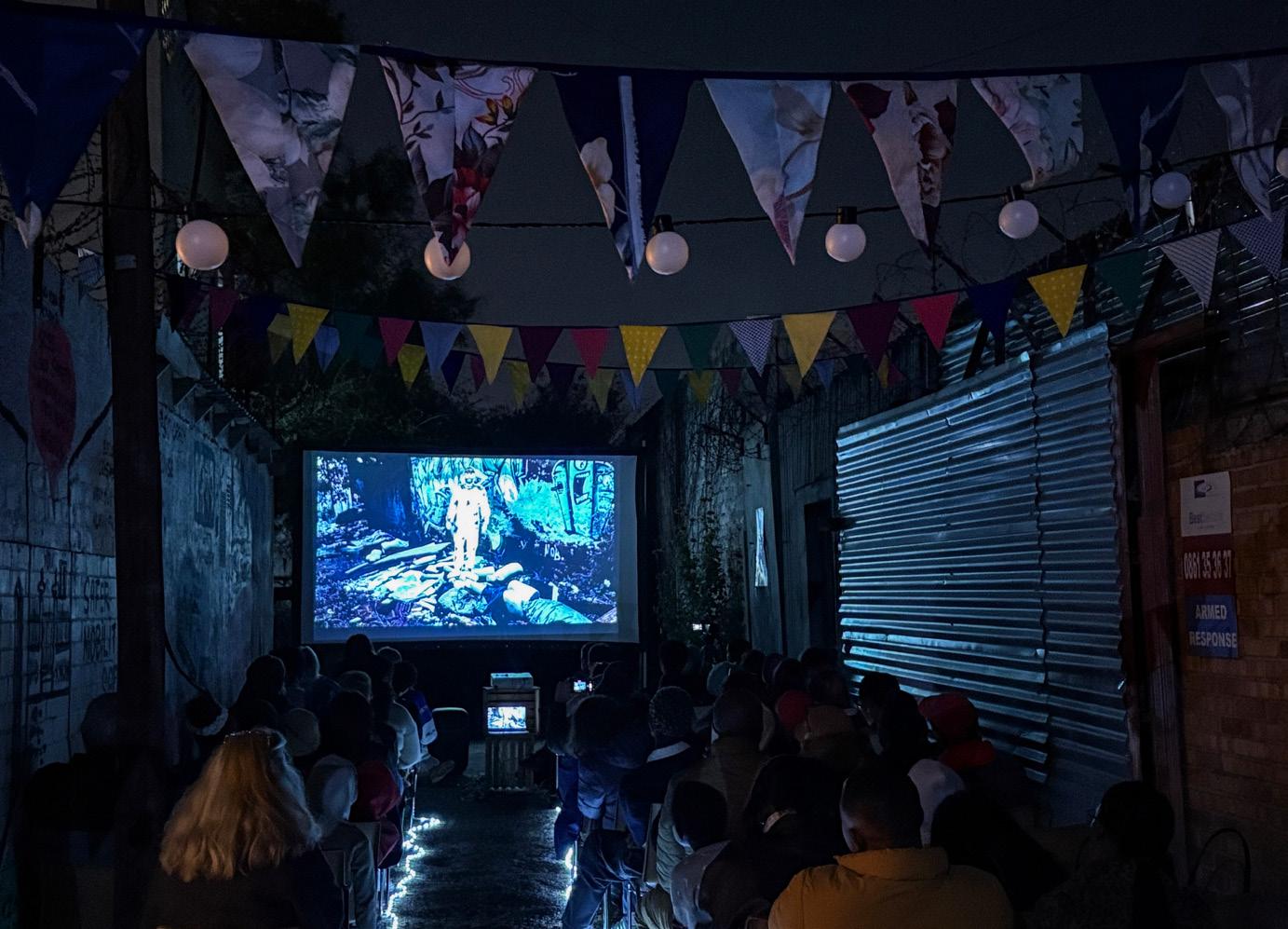
Student film screening (2nd year BAS); photo: B. Stone Johnson
To facilitate online learning, students will need to use online or free installed software on their personal devices. Most commonly, this includes Ulwazi (online), Microsoft Teams (online or installed as an app), and Miro (online or installed as an app).
While each lecturer may have their own methods, and the onus is on the student to know the protocols for each and every course, the School does make efforts to streamline the different tools that can be used for online teaching and learning, so that students do not get overwhelmed with new methods, apps, or software. The School will also maintain remote access to the SoAP server, so that students can log into a Wits computer and access all the software installed on it from anywhere using the Citrix Remote Access system (see the Citrix Remote Access section).
The School also recognises that it is important for students and staff alike to maintain some kind of balance between academic activities and their personal lives – something which can get complicated when studying or working from home. For this reason, the School continues to run a regular timetable of classes, similar to what would happen in face-to-face teaching, even if some courses remain predominantly online. Students are encouraged to connect to live streams whenever possible, and to use the timetable as a guide for planning your studies. The availability of content online should not be used as a reason to skip live-streamed lectures, tutorials or other events; it should be used as a backup plan in case problems occur, and as an archive of study material.
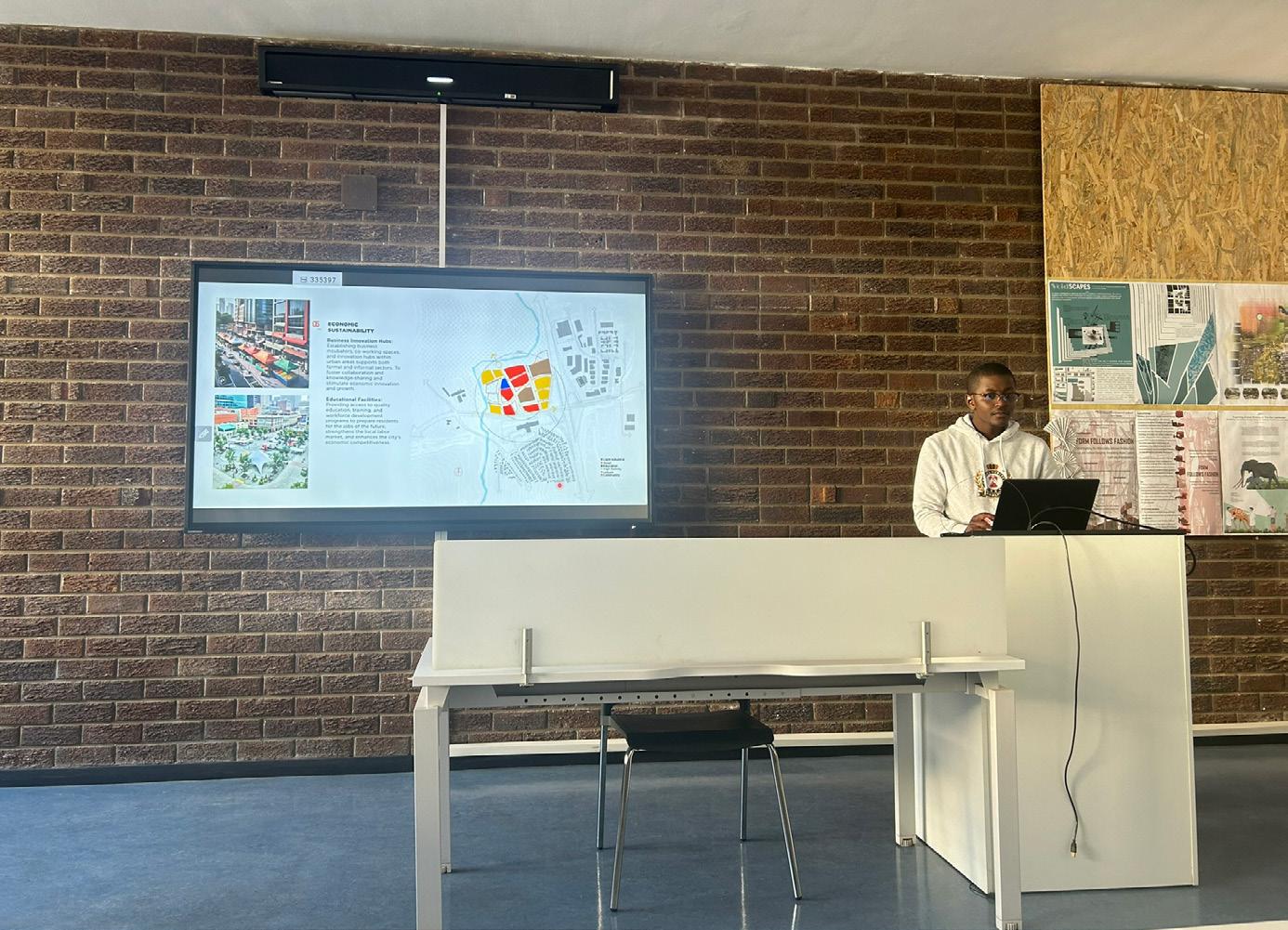
M.Arch student presenting; photo by H. Judin

Ulwazi means “knowledge” or “information” in seSotho, isiXhosa and isiZulu, and is the Canvas Learning Management System unique to Wits. Each course run at Wits has an Ulwazi site, which allows access to course information. The courses will automatically show up on a students’ profile once registered, and are a digital repository of course documentation.
In addition to the sites for each course, the School maintains a SoAP Student Affairs Ulwazi page. This page is used to post relevant announcements, provide links to important documents, references, policies, and to be a hub of information for students. Although many relevant links and documents are given to incoming students during Orientation Week, students do not often realise the value of them or the importance of the information contained in them until well into their studies. The SoAP Student Affairs Ulwazi site acts as a repository of this information, which students can access at any time, and should use as a first point of contact when questions arise. To log into Ulwazi, either click on the Ulwazi image above, or go to: https://ulwazi.wits.ac.za/
Citrix Remote Access
A remote networking lab is active in the School, using Citrix software. The Citrix Virtual Lab enables students to access the School’s software and computing power remotely, as if sitting in a physical lab, using only an internet connection. Thus, students may use tablets or affordable laptops with poorer specs to log onto a machine housed within the School via the internet. This then allows the computing power of the host machine to be utilised, regardless of the specs of the device used by the student. It also allows full access to the Wits and SoAP network, so that software licenses can be accessed remotely to complete digital assignments.
Currently, 100 licenses of Citrix are available, so that up to 100 students at a time can access the School’s server remotely, with the ability to use the School’s software licenses from any device. To log on to Citrix, go to:
https://apps.mech.wits.ac.za/vpn/index. html
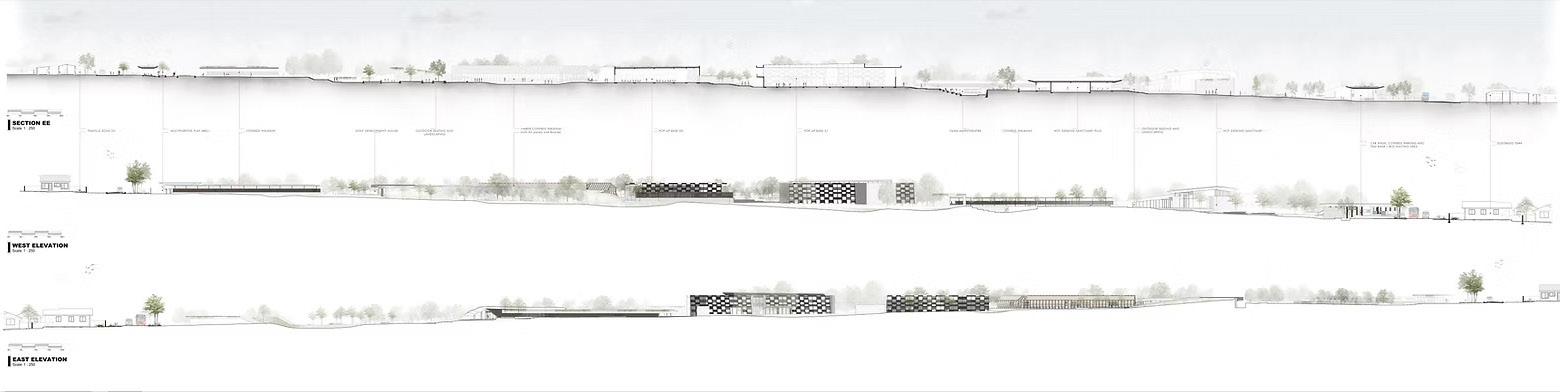
Student work: D. Maluleke
Social Media & Youtube
Please follow our public channels below: Events and Public Lecture Programme: https://www.wits.ac.za/soap/events/
Facebook: Wits University - School of Architecture and Planning
Instagram: @witssoap

X: https://x.com/witssoap

YouTube: https://www.youtube.com/ channel/UCEcGU9KkVKUa8ErYP45cruw
Printing & Material Costs
Online and digital forms of presentation and submissions have helped reduce printing costs over the years, but some printing and material costs are unavoidable. Anticipated student costs in this regard are outlined in the Fees and Finances section.
The School would like to emphasise that expensive forms of printing, such as large format, glossy paper stock, do not improve marks. Although presentations are expected to be of a high level of craft, exploratory representation need not be constructed of or printed on expensive materials.
Additionally, students should budget for access to approximately 10GB of data per month from anywhere to facilitate uploads or downloads from anywhere. Whether this is shared, part of a larger wifi package, or an individual out-of-pocket cost will depend on the students’ living environments. The School encourages students to make use of the Wits campus wifi as much as possible, so that individual costs can be kept to a minimum. However, some uploading and downloading from home, sometimes of large files, is unavoidable.
Laptop Guide
Students are encouraged, but not required, to have their own laptops. The presence of the Citrix remote server allows even older, lower-powered laptops to be used to access the School’s on-campus computing power (as long as there is an internet connection), but many students will find it more convenient to use software loaded directly on their laptop than using it remotely via Citrix. If looking to purchase a new laptop, the recommended specs are given in the infographic at right.
2026 Laptop guide
what to look for if purchasing a laptop for your studies

FAQ
Do I need my own laptop?
No, but it can be useful to facilitate your work exibliity, and we highly recommend that students purchase their own laptops once registered if they have the resources to so.
What if I cannot purchase a laptop?
Don’t worry. First, check prices for the minimum specs given at right; the lighter the specs, the cheaper the laptop will usually be. If that is not an option, you can make plans to use the computer labs in our building, one of which is open to registered students 24/7, though access may be restricted at times teaching is happening inside the main lab.
What good is a laptop if I don’t have software licenses?
The School provides licenses for the software students typically use in their disciplines. Other programmes can be accessed using your laptop at home and connecting through our remote access system. This allows you to log in to a computer at Wits from anywhere, and use the software installed on it. It requires an internet connection.
How will I know which laptop is right for me?
Use the guide at right to determine the necessary specs. As an educational institution, the School does not make brand name recommendations, but can advise on the specs. For further questions, you may contact our IT administrator by emailing: steven.blumberg@wits.ac.za
Operating system:
Windows 11 (64-bit) for all students.
Specs
We do not advise buying an Apple Macbook or iMac; the School has no support available for iOS.
Processor (minimum specs):
For Architecture & MUD: Intel i7 or AMD Ryzen 7 or 9. For all other programmes: Intel i5 or i7, or AMD Ryzen 7
RAM:
16GB minimum for all students; 32GB recommended for Architecture & MUD.
Hard drive:
500GB SSD (not HDD): minimum for all students (up to 1TB optional).
Screen size & resolution:
15.6 inch: minimum recommended screen size. 1920x1080 (Full HD): rminimum resolution.
Graphics card:
For Architecture & MUD: NVIDIA 2GB minimum (4GB recommended) Any standard graphics card for all other programmes.
Research & Practice
Library & Archive
The School has an in-house branch library, the Martienssen. The Martienssen Library, also referred to as the Architecture Library, is located within the John Moffat Building The library is currently staffed by four personnel responsible for supporting the Faculty’s teaching, learning, and research activities, with a particular focus on SoAP and CEM. The library is closed on public holidays and during the winter and summer vacation breaks. The Martienssen is open during the following hours:
Monday-Thursday 08:00- 21:00
Friday 08:00- 17:00
Saturday 08:00-12:30
Sunday closed
Outside of academic terms, the library closes at 17:00 on weekdays and is closed on weekends.
In addition to providing access to books and journals both in print and online,
the Martienssen Library offers a formal Information Literacy Programme for UG students. This programme is structured into eight modules, with integrated assessments conducted through Ulwazi. To support student learning, the library team has developed a dedicated LibGuide comprising eight essential units designed to equip undergraduates with key information literacy skills.
In addition, the library has developed a dedicated PG training programme to support PG students and researchers throughout their research journey. The programme is facilitated by knowledgeable library staff who offer expert support in research discovery, applying FAIR/CARE principles in data management, providing scholarly publishing advice, and guiding the preservation of research outputs. The primary aim of the programme is to equip postgraduates and researchers with advanced information literacy skills to efficiently locate, evaluate, and utilise
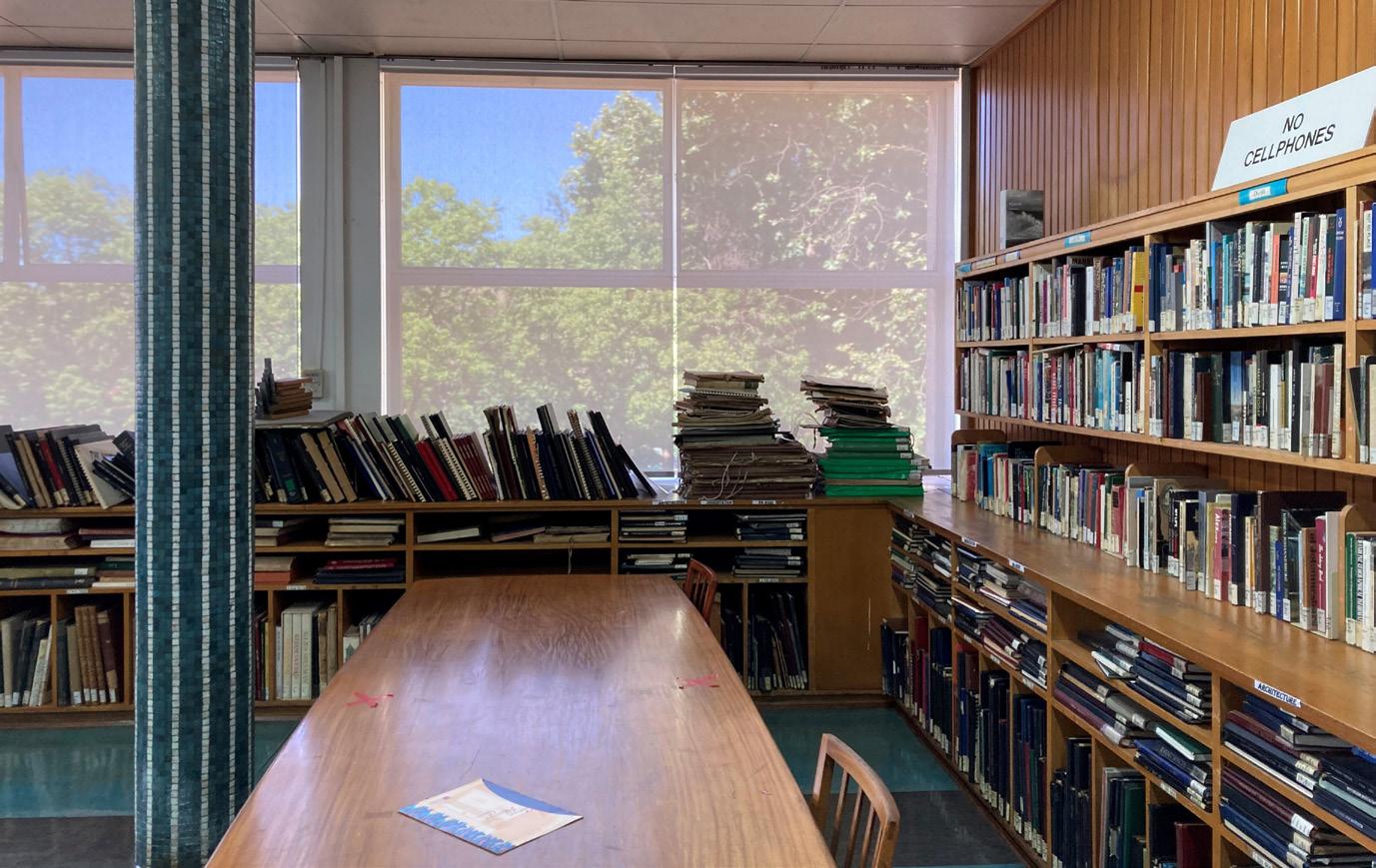
Martienssen Library; photo by G. Gantner
library resources for research and scholarly writing. It also seeks to foster independent research, ethical information use, and the development of critical thinking and analytical abilities.
To further support PG success, the library has introduced a proactive Training Calendar offering monthly, multidisciplinary, and subject-specific training sessions. These sessions are designed to address gaps in advanced research literacy, academic writing, data management, and scholarly communication. This initiative directly supports Wits University’s broader objectives of enhancing PG success, increasing research throughput, and strengthening a culture of research excellence.
Research Units & Labs
The School is has a strong reputation for research, and is the host of three specialised research units.
Campus Innovation Lab
The Campus Innovation Lab (CIL) is a practice-oriented design and research entity within the School, which can undertake consulting projects, specific commissioned research, and other professional activities. It leverages the expertise within the School to assemble teams on an ad-hoc basis. CIL is also a revenue-generating entity for the School; income earned goes towards funding teaching and research activities by staff.
John Moffat Building SA Architectural Record Nov 1959
CUBES
Located in the School, CUBES brings together staff, postdocs, interns and students who are concerned with how the material realities of cities affect urban citizens and marginalised people. CUBES engages built environments at different scales to explore access to urban goods and spaces and to understand contestations over urban spatial and political orders. CUBES creatively builds on emerging synergies in teaching and research within the School and beyond. It integrates grounded research with pedagogy (involving students of different degree programmes) and civic engagement, advocacy and other forms of activism.
CUBES’s flagship initiative, the City Studio, is currently in its 4th iteration. City Studios are area-based commitments. In a three-year cycle, research, engagement/ activism and pedagogy are closely linked through collaborative data-collection and analysis, workshops, exhibitions, design-build initiatives and publication. The Kelvin-Alexandra Frankenwald City Studio is currently in its third year. CUBES is a partner, alongside the School, the Chair in Spatial Analysis and City Planning (SA&CP) and the Gauteng City Region Observatory (GCRO), in the weekly Faces of the City Seminar series. This runs online or blended on most Tuesdays at 4pm during term time.
For more information on CUBES, see: https://www.wits.ac.za/cubes/
Theory & Practice
The fields of architecture and planning are constantly evolving. Theory and Practice is a series of programmes aimed at bringing practitioners in architecture and planning, and scholars, together in order to teach and learn about current practices. The School prides itself on curricula that equip students to perform in the economy, with relevant and transact-able skills. Essential to this commitment is a dialogue with the professions, requiring discussion on changing trends and collaborative partnerships between academia and practice so that the university becomes a primary facilitator in promoting innovation.
The School’s Theory and Practice programmes include exhibitions, seminars, colloquia, and student competitions. SoAP has a dedicated curatorial team to work on regular exhibitions of student work and practitioners in the fields of architecture and planning.
Fassler Gallery
A small gallery space in the foyer next to the School’s reception was established in 2002, and named after the architect John Fassler, who was Head of School for 20 years from 1948-1968. The gallery’s design includes transparent walls and rotating panels; coupled with it’s prime position in the building, it is specifically designed to encourage casual interaction with students on a daily basis. Exhibits rotate throughout the year, and formal events are often scheduled to correspond with a new exhibit opening. Students are encouraged to attend these events and browse the exhibits as part of their education. For larger exhibitions, the John Moffat Foyer becomes an extension of the gallery.
Exhibitions
Making is an important part of what we do as designers and researchers in the architectural and planning disciplines. We encourage students to feel comfortable with the communication of their ideas.
The lessons learnt from presenting and
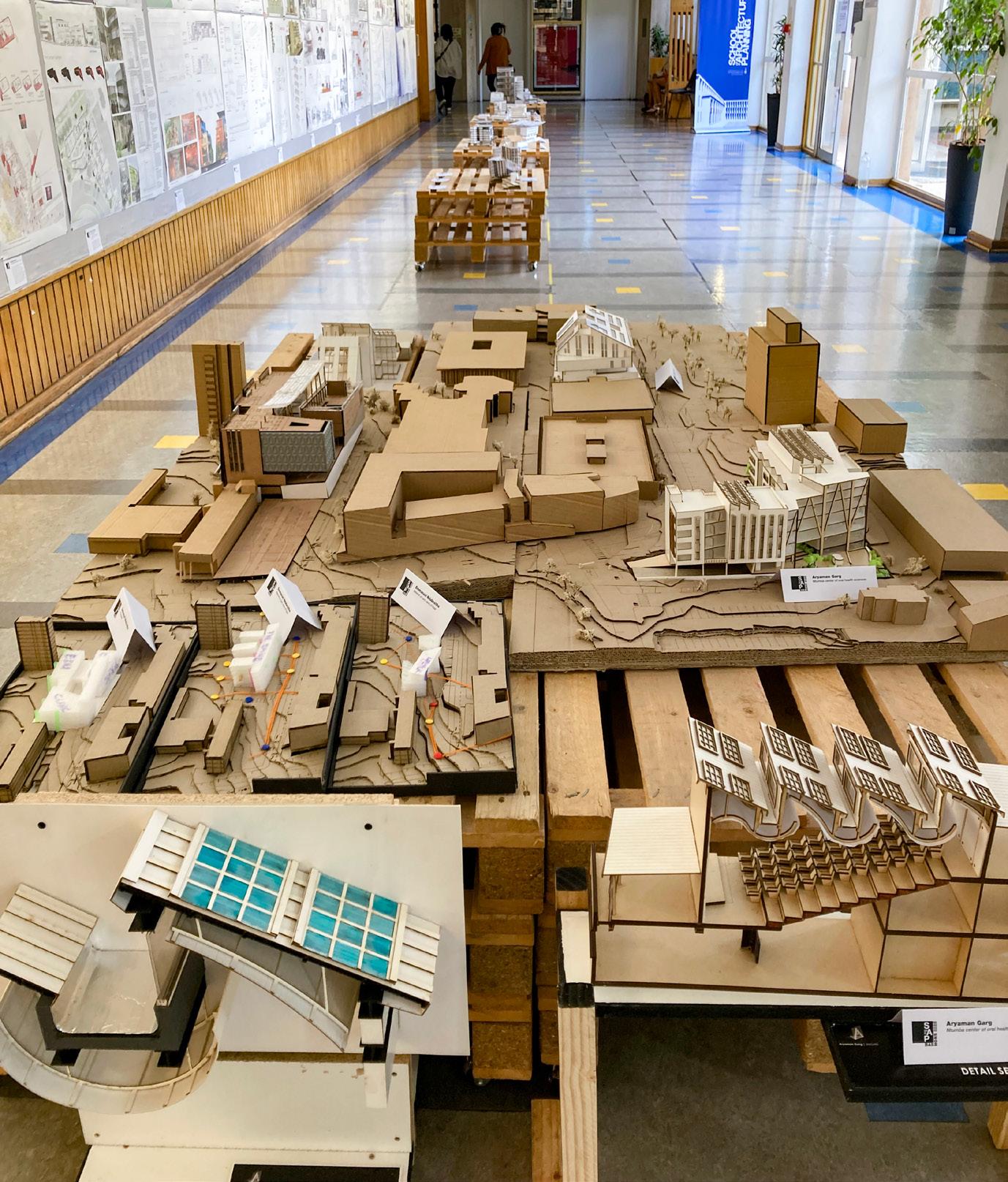
representing a cohesive body of work are important for an architect and planner’s skill set. Regular School pinups and exhibitions enable students to curate, present, see and compare one other’s work, as well as showcasing the work to a wider public. We also host exhibitions from practitioners around the world in the John Moffat Foyer
BAS Hons Exhibit. Photo: G. Gantner
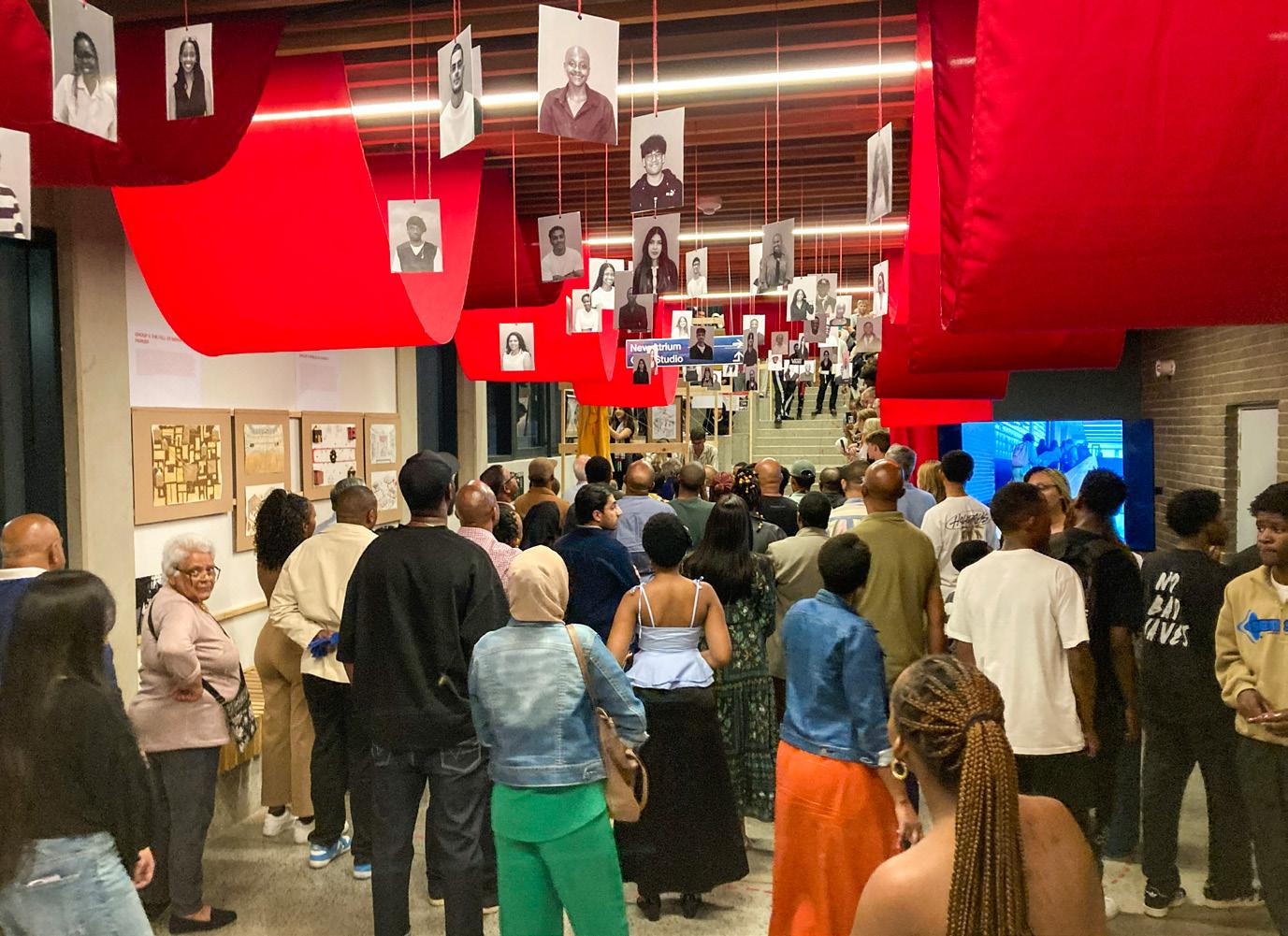
and Fassler Gallery, and more recently through digital platforms. This exposes the students to the cutting edge architectural, planning and urban design work presented by leaders in these fields.
From 2020 onwards, in response to the COVID-19 pandemic, the usual ways of presenting on paper have been greatly diversified and use of various digital methods and multimedia has expanded. The School’s online platforms support multiple ways of presenting. Over and above the presentation of digital architectural and planning posters, students are able to experiment with alternative media as part of their presentations. These platforms have a presence which is accessible locally and globally, so student exhibitions can be viewed globally.
To see the latest online exhibitions, or an archive of past exhibits, go to:
https://www.wits.ac.za/ soap/theory-and-practice/ exhibitions-theory-and-practice-series/
At the end of each academic year, the tradition has been to have an exhibition of the work of the graduating students. In recent years this has been expanded to an All School Exhibition, showcasing the work of architecture and planning programmes across the undergraduate and postgraduate degrees. This event allows students to connect with professionals who come to see the work done at Wits.
With a commitment to an ethos of sustainable practice, the exhibition stands are handmade from recycled materials by students and staff.
1st year BAS exhibit. Photo: G. Gantner
Urban Dialogues
The Urban Dialogues is a week-long annual event hosted by the School which promotes critical reflection, research, and professional engagement in the urban and built environment disciplines. Running during the first week of quarter 2 each academic year, the Urban Dialogues features intensive coursework, site visits, presentations, academic events, exhibits, and public lectures, creating a buzz of activity that creates a stage for interdisciplinary discussions, innovative initiatives, and collaborative works.
During the week, the participating degree programmes (BSc Hons URP, PG Dip, MUD, MUS, MSc DP, PhD) stray from their normal timetable and run a block timetable on-campus, offering students an opportunity to conduct extended site visits
or field research, engage with students in other related disciplines, mingle with invited professionals, gain exposure to work within the disciplines, and become central players in the culture of critical inquiry within the School. Students are advised to block out the entire week in their calendars to take advantage of the variety of activities offered during the week.
Through the public events, the Urban Dialogues give professionals, academics, and anyone generally interested in African urbanism a way to engage with the School, find future collaborators, and participate in the ongoing conversations about the disciplines.
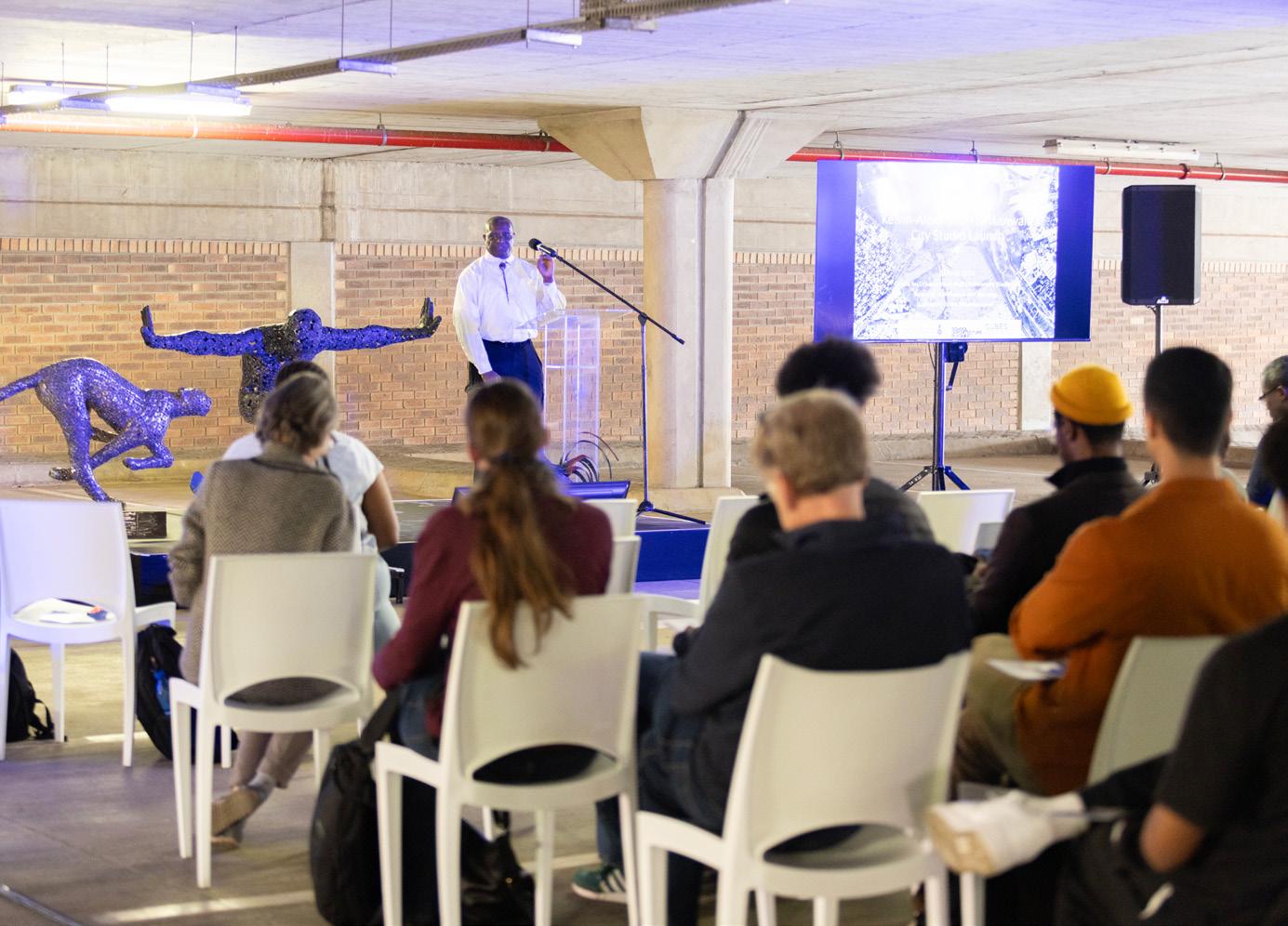
City Studio event; photo by P. Moreira
School Staff
Administrative Staff
Undergraduate Administrator
Nozipho Khambule nozipho.khambule@wits.ac.za
Postgraduate Administrator
Veronica Fisher veronica.fisher@wits.ac.za
Clerical Assistant
Batseba Qwabe batseba.qwabe@wits.ac.za
IT Manager
Steven Blumberg steven.blumberg@wits.ac.za
Programme Coordinator
Cezanne Henney cezanne.henneyi@wits.ac.za
School Administrator
Motsei Choabi motsei.choabi@wits.ac.za
Research Coordinator
Lerato Nkosi lerato.nkosi@wits.ac.za
Bookkeeper
Zakiyyah Ayob zakiyyah.ayob@wits.ac.za
SARChi Programme Administrator
Thammy Jezile Senior Secretary thammy.jezile@wits.ac.za
Academic Coordinators
Coordinators and degree convenors are academic staff members responsible for the implementation of academic activites in their respective portfolios. Students may not regularly interact with them, but they are a point of contact if major issues arise.
Head of School
Mfaniseni Fana Sihlongonyane
BA PGCE, MSc, PhD Professor mfaniseni.sihlongonyane@wits.ac.za
Architecture Programme Director
Garret Gantner
BSAS, M.Arch, PrArch, LEED AP Senior Lecturer garret.gantner@wits.ac.za
Urban Planning Programme Director
Neil Klug
MSc, MUD, NatDipTRPL, PhD Senior Lecturer neil.klug@wits.ac.za
School PG Coordinator
Richard Ballard BSS, BSS Hons, PhD Professor richard.ballard@wits.ac.za
BAS Convenor
Brigitta Stone Johnson
BAS, M.Arch, PhD
Senior Lecturer Brigitta.Stone@wits.ac.za
BSc URP Convenor Muhammed Suleman BSc, MPhil Lecturer muhammed.suleman@wits.ac.za
BAS Hons Convenor
Kirsten Döermann Dipl.-Ing, M.Arch, PhD, PrArch Senior Lecturer kirsten.doermann@wits.ac.za
BSc URP Hons Convenor
Amanda Williamson
BA, BA, MA, MTRP, MSAPI Senior Lecturer amanda.williamson@wits.ac.za
PGDip & MSc DP Convenor
Tsepang Leuta
BSc, MA, PhD Senior Lecturer tsepang.leuta1@@wits.ac.za
M.Arch (Prof) Convenor
Hilton Judin BA, BArch, PhD
Adjunct Professor hilton.judin1@wits.ac.za
MUD Convenor
Ludwig Hansen
B.Arch, M.Arch, PrArch Senior Lecturer ludwig.hansen@wits.ac.za
MUS Convenor
Mncedisi Siteleki BSc, MSc, PhD Lecturer mncedisi.siteleki@wits.ac.za
Other Academic Staff
In addition to the academic coordinators, academic staff lead all courses taught in the School. They may also be supported by sessional staff (not listed), who are often practicing professionals taking on a minor teaching load. Academic staff have numerous roles beyond teaching, and may not always available; students are advised to make appointments to meet with a staff.
Dirk Bahmann
B.Arch, PrArch Lecturer dirk.bahmann@wits.ac.za
Edward Brooks BAS, B.Arch, PrArch Lecturer edward.brooks@wits.ac.za
Sarah Charlton
B.Arch, M.Arch, PhD sarah.charlton@wits.ac.za
Alexia Cocolas
B.Arch, M.Arch Lecturer alexia.cocolas@wits.ac.za
Paul Devenish BSc, M.Arch Lecturer paul.devenish@wits.ac.za
Kylie Dickson B.Arch Lecturer kylie.dickson@wits.ac.za
Nabeel Essa BAS, B.Arch, MALU Lecturer nabeel.essa@wits.ac.za

Sandra Felix
BAS, B.Arch, PhD, PrArch Lecturer sandra.felix@wits.ac.za
Liale Francis
BAS, BAS Hons, M.Arch, PrArch Lecturer liale.francis@wits.ac.za
Fiona Garson B.Arch Lecturer fiona.garson@wits.ac.za
Philip Harrison BSocSc, MTRP, PhD, MSAPI, TRP Professor philip.harrison@wits.ac.za
Brendan Hart BAS, B.Arch, MPhil, PrArch Lecturer brendan.hart@wits.ac.za
Marie Huchzermeyer BL, MUD, PhD Professor marie.huchzermeyer@wits.ac.za
Kavita Jivan BAS, BAS Hons, M.Arch, PrArch Lecturer kavita.jivan@wits.ac.za
Sundeep Jivan BAS, B.Arch, PrArch Lecturer sundeep.jivan@wits.ac.za
J. Makhubu & student parent; photo by G. Gantner
Nqoblie Lombo
BAS, BAS Hons, M.Arch Lecturer nqobile.lombo@wits.ac.za
Sechaba Maape
BAS, BAS Hons, M.Arch, PhD Senior Lecturer Sechaba.Maape@wits.ac.za
Jabu Makhubu BTech, MUD Lecturer jabu.makhubu@wits.ac.za
Nkosilenhle Mavuso BSc, BSc Hons, MUD Lecturer nkosilenhle.mavuso@wits.ac.za
Avish Mistry
B.Arch Lecturer avish.mistry@wits.ac.za
Solam Mkhabela BAS, MCPUDE, PhD Senior Lecturer solam.mkhabela@wits.ac.za
Katlego Mothapo
BAS, BAS (Hons), M.Arch Lecturer katlego.mothapo@wits.ac.za
Mawabo Msingaphantsi BSc Hons, BSc Lecturer mawabo.msingaphantsi@wits.ac.za
Mark Schaerer
B.Arch, MUD, PrArch Lecturer mark.schaerer@wits.ac.za
Caron Schnaid
B.Arch, MBA, PrArch Lecturer caron.schnaid@wits.ac.za
Anita Szentesi
BArch, MA, PrArch, ARB Part 3 Lecturer anita.szentesi@wits.ac.za
Patricia Theron BSc, BSc Hons, M.Arch, PhD, PrArch Lecturer patricia.theron@wits.ac.za
Gustavo Triana-Martinez B.Arch, M.Arch, M.AA, PrArch Lecturer gustavo.triana@wits.ac.za
Tahira Toffah
BAS, BAS Hons, M.Arch, MSc USP, PrArch Lecturer Tahira.Toffah@wits.ac.za
Rules & Procedures
Rules & Syllabuses
The Faculty rules relating to the degree are outlined in the Faculty of Engineering and the Built Environment Rules and Syllabuses book is the primary reference for rules, requirements and procedures relating to the BAS degree. It is therefore essential that students familiarise themselves with it. It is available online at:
https://www.wits.ac.za/students/ academic-matters/rules-and-syllabuses/
This handbook is not a comprehensive list of all rules, regulations, processes and procedures. Students should refer to the Rules and Syllabuses book for all official policies related to the degree. Specifically, the Rules and Syllabuses outlines the following related to the some of the School’s degree offerings:
• Admission rules in section 2.2.1.1;
• Curriculum information in section 2.2.2.2;
• Exceptions to supplementary exam rules in section 2.2.2.8;
• Progression rules in section 2.2.3.1;
• Exclusion rules in section 2.2.4;
• Prerequisites and co-requisites in section 2.3;
• Expected degree outcomes in sections 4.1.1 (Bachelors), 4.1.2 (Honours), and 4.1.3 *Masters);
Rules which apply to the Faculty as a whole also apply to the BAS programme. These are not listed in depth in this handbook, but can be found in the Rules and Syllabuses book, and students should be aware of them. Ignorance of policies is not considered a valid excuse for not following them. The onus is on the student to abide by all rules and regulations at Wits.
Code of Conduct
Students are expected to maintain a high level of professional integrity in both their behaviour and work while at Wits. The university has a code of conduct to which students are expected to adhere, and may impose disciplinary processes on students who do not comply with it.
The full code of conduct can be found on the Student Affairs Ulwazi site, and here:
https://www.wits.ac.za/media/wits-university/students/documents/2026%20 Student%20Code%20of%20Conduct. pdf
Following the recent conditional legalisation of recreational marijuana, some Wits students have demonstrated a misunderstanding of the law’s provisions. Although the possession of small amounts of marijuana for personal use may be legal, it remains illegal to deal, sell to others, or consume in public areas or outside one’s private residence. Because Wits is a public university, the entire Wits campus - including residence halls - is public land and therefore the use of marijuana is illegal anywhere on the Wits campus.
Students are also reminded that smoking of any kind in public buildings is strictly prohibited; this includes all Wits facilities.
Plagiarism& Academic Misconduct
It is expected that students produce original work, without reverting to unauthorised copying or outside assistance. This is an extremely important subject which students sometimes struggle to grasp; it is therefore important (and required) to inform yourself about plagiarism, how to avoid it, and how to properly reference outside sources.
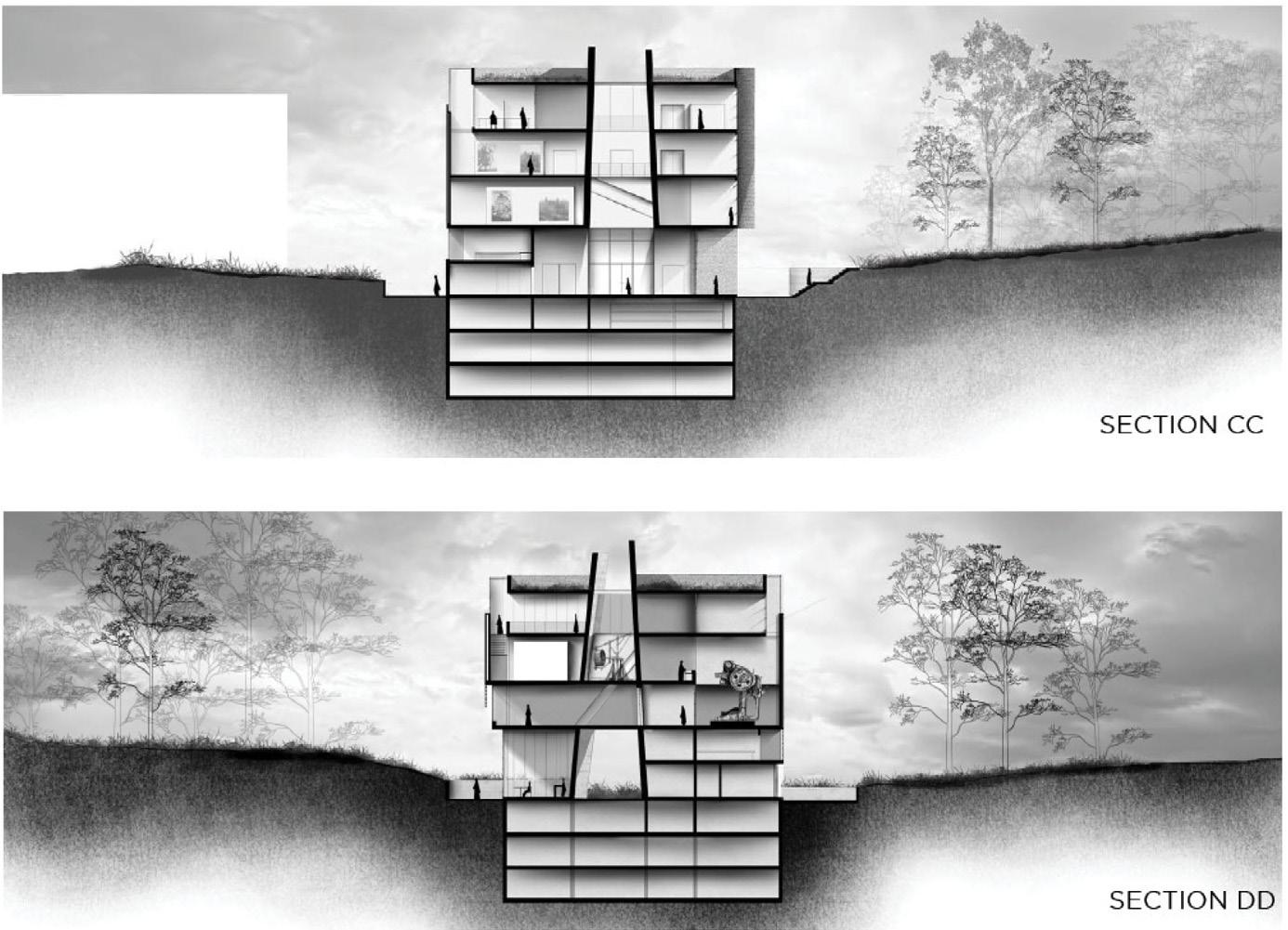
Students will be asked to sign a plagiarism declaration at the beginning of each year, verifying that they are aware of the issues, understand the policy, and commit themselves to abiding by ethical behaviour.
Plagiarism can apply to both written and visual work, including design work, and is considered a serious academic offense. The university has a strict policy regarding plagiarism that all students are expected to be ware of; students are required to hold themselves accountable for avoiding plagiarism. Any submission suspected to be plagiarised will be dealt with according to the severity of the case per those regulations.
Using precedents and invoking peer learning is encouraged, but in these circumstances, sources must be cited, and it must be made clear which work is of he student’s own authorship and which work,
imagery, or aspect of a presentation comes from someone else.
While efforts to teach acceptable referencing and citation methods are made, ultimately, it is the responsibility of the student to implement appropriate ethics and tactics when it comes to research, citations, and referencing of others’ work. This is a serious academic issue, and should be treated as such. The academic staff at the School sincerely urge students to educate themselves around these issues. The Wits Academic Misconduct policy can be found on the Student Affairs Ulwazi site, and here:
https://www.wits.ac.za/media/ wits-university/about-wits/documents/ Academic-misconduct-policy.pdf
Student work: I. Panagiotides
Artificial Intelligence
Learning to use artificial intelligence appropriately, ethically, and consistent with high professional standards is an imporant part of the learning process undertaken by students.
Retaining command over generative artificial intelligence (GAI) requires both an exploratory use of the tools available, but also (and especially) a critical examination of the results, fact-checking of information, and editing or post-processing to ensure ethical compliance, veracity of detail, and critical expression. Doing so requires an understanding of the subject matter being presented; merely presenting GAI-generated content does not constitute knowledge or understanding on its own. Generally, students are advised to use GAI tools only to augment work generated by themselves; GAI should never be used as substitute for content generation or in place of actual knowledge and understanding.
The School has devleoped generic rules for the appropriate use of GAI, which are inlcuded as part of the School’s Assessment Policy. For clarity and emphasis, these rules are also listed below:
• Generative Artificial Intelligence (GAI) may be used only within the rules and considerations outlined below. These rules and consideration apply to all forms of all forms of output, including, but not limited to:
- written work;
- image production of any form;
- design and/or construction work; - conceptual intentions.
• Where GAI tools are used, the onus is on the student to ensure that GAI is used ethically and within normal guidelines of ethical professional standards. Use of GAI outside of ethical use may be considered
plagiarism.
• GAI-created content may be used to augment work initially produced or prompted by the student. Unless otherwise noted in the course outline or assessment instructions, GAI may not be used as a substitute for original ideation.
• GAI-created content must be clearly contextualised as part of the relevant scholarly work being assessed.
• Unless otherwise specified in the course outline or assessment instructions, GAI output must be reviewed and substantially edited or post-processed by the student, to an extent that the final material may be considered of the student’s own primary authorship.
• Data, published information, or ideas carrying copyrights must be fact-checked by the student, and the root source cited appropriately.
• Unless otherwise specified in the course outline or assessment instructions, the means and methods of use of GAI must be clearly indicated on any submission or assessment, and documentation must include, where appropriate:
- a summary explanation of procedures undertaken, prompts used, and other relevant details of the generation process, included as part of the original submission;
- a summary explanation of the results obtained from these processes, and how they are used in the final output, included as part of the original submission;
- in the case of written output, a detailed record of the interaction, to be availed upon request; - in the case of design-based or other visual representation, a record of the
iterative process and interim output produced during the process, to be availed upon request.
• Lecturers may expand on the rules of GAI use, or prohibit such use, within each course as specified in the course outline.
• If a student is suspected of using GAI in ways not consistent with the rules outlined above, in the course outline, or in an assessment brief, that student may be subject to additional methods of assessment as deemed appropriate by the Lecturer for the purpose of verifying the student’s authorship and/ or knowledge of the relevant subject matter.
If these generic rules are complemented, edited, or otherwise altered by lecturers within each course or for each assessment within a course, course outline or assignment brief will clearly list the alternative guidelines to be applied.
Assessment Policy
All courses abide by the School’s Assessment policy, which is a set of principles, guidelines, and rules to be used in the assessment of student work and issuing of marks. The Assessment Policy is applied to all courses in the School, though lecturers may introduce additional criteria or alternative structures to their course rules if they are clearly indicated in the course outline.
Students should familisarise themselves with this policy in case certain provisions are needed. The Assessment Policy outlines protocols for common issues such as absences and late submissions, marking procedures, GAI use, and other practical matters students may need to refer to from time to time. The complete policy, is available on the Student Affairs Ulwazi site here:
https://ulwazi.wits.ac.za/courses/20267/ pages/academic-resources
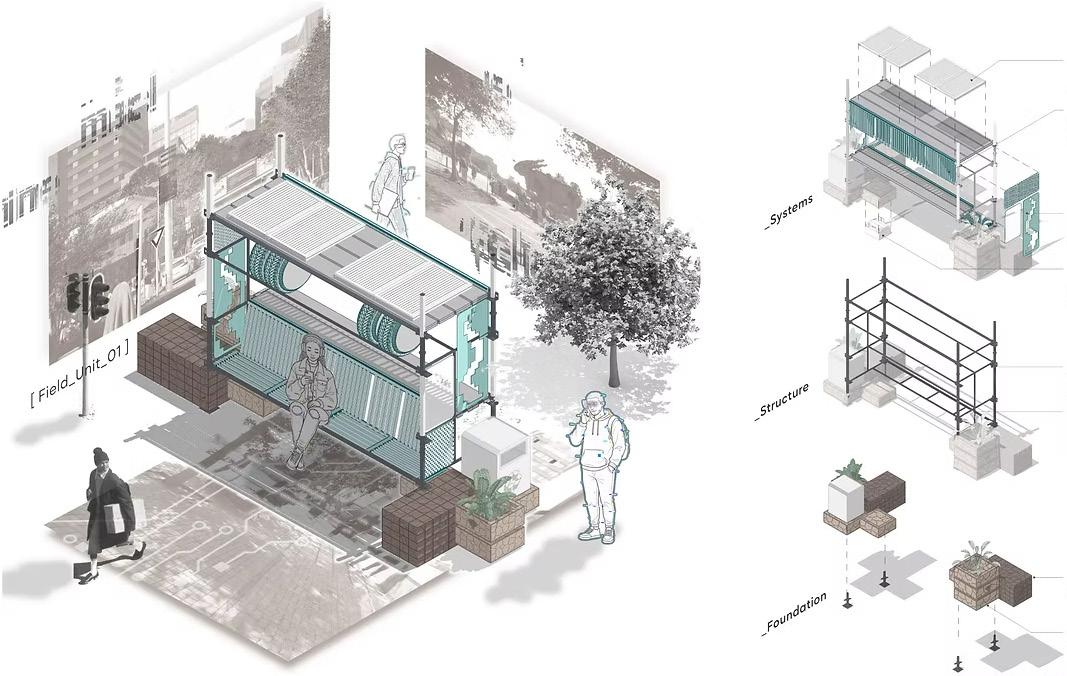
Student work: L. du Plessis
Deferred Exams
In extraordinary circumstances only, subject to rigorous criteria, students may be allowed to defer a final exam. The criteria are published by the Faculty and are updated from time to time. Students should familiarise themselves with the criteria, as not all requests for deferred exams are granted. A deferred exam is not an extension of time due to poor preparation by the student; it is an emergency plan B in case of serious, document-able problems on exam day.
Requests for deferred exams must be lodged as soon as possible after the exam, and in all cases within three days of the exam in order to be considered. Requests are made to the Faculty, not to the School, and there are specific protocol which need to be followed. Submitting a request does not guarantee acceptance, and if a deferred exam is granted, the student forfeits the possibility of a supplementary exam.
Ignorance of the application process for deferred exams is not an excuse for missing an exam or missing an application deadline. The onus is 100% on the student to adhere to the appropriate procedure. Neither individual lecturers within the School, nor the Head of School’s office, will negotiate requests for deferred exams under any circumstances; the School abides by the Faculty’s decisions on deferred exam applications. Requests cannot be made more than 3 days after a specific incident occurs.
For further information on the criteria and procedure of applying for deferred exams, go to:
https://www.wits.ac.za/exams/ deferred-examinations/
Course Marks & Results
Students are issued marks reports at the end of each academic year unless a hold is placed on receipt of marks. Holds are usually placed due to outstanding fees.
Common Course Results Abbreviations
The marks reports can contain abbreviations which may not be easily understood, the most common of which are below:
PASS Passed
FAIL Fail
FABS Fail by absence
FNQL Fail: did not qualify for exam
FCOM Failed a component
FSUB Fail on sub-minimum requirement
WDEF Wait: deferred exam granted
WSP1 Wait: supp exam granted
WSP2 Wait: sealed supp granted
Course Result Abbreviations Explained
PASS / Passed means you passed the course.
FAIL / Fail means you failed the course by achieving a mark of less than 50%.
FABS / Fail by absence means you failed the course by being absent from the exam. The final mark is recorded as zero, and having a FAB on your record triggers a number of other problematic issues regarding the outcome and permission to re-register. Students are often unaware of how badly a FAB affects their registration; this should not be taken lightly and should be avoided at all costs.
FNQL / Fail: did not qualify for exam means you were excluded from the exam. Similar to FAB, this result gets recorded as a zero and triggers other problematic issues.
FCOM / Failed a component means you failed at least one required component of a
course. In this case, your course mark may be above 50%, but you do not gain credit for the course until the failed component is passed. You would be required to register for the course again the following year, but will be required to take only the component that was failed. If you achieve a passing mark, the marks from the other components the previous year will be applied alongside your new component mark, and this will get recorded as the final mark of the course.
FSUB / Fail on a sub-minimum requirement means you failed an assessment within the course that was required to be passed in order to gain credit for the course. In this case, your final course mark may be above 50%, but if you fail the required assessment, the final mark is irrelevant; you still fail the course. This outcome requires one to repeat the course.
WDEF / Wait: deferred exam granted means your results cannot yet be determined because you are yet to write a deferred exam.
WSP1 / Wait: supp exam granted means you failed the course but are being granted the opportunity to write a supplementary exam. Ultimately, the outcome of the supplementary exam will determine the final results.
WSP2 / Wait: sealed supp granted means you failed the course and may or may not be eligible for a supplementary exam, depending on the outcome of one or more deferred exams. Since supplementary exams and deferred exams are both written at the end of the year, you are granted the opportunity to write a supp, but it will only be marked if the outcome of the deferred exams allows eligibility for the supp.
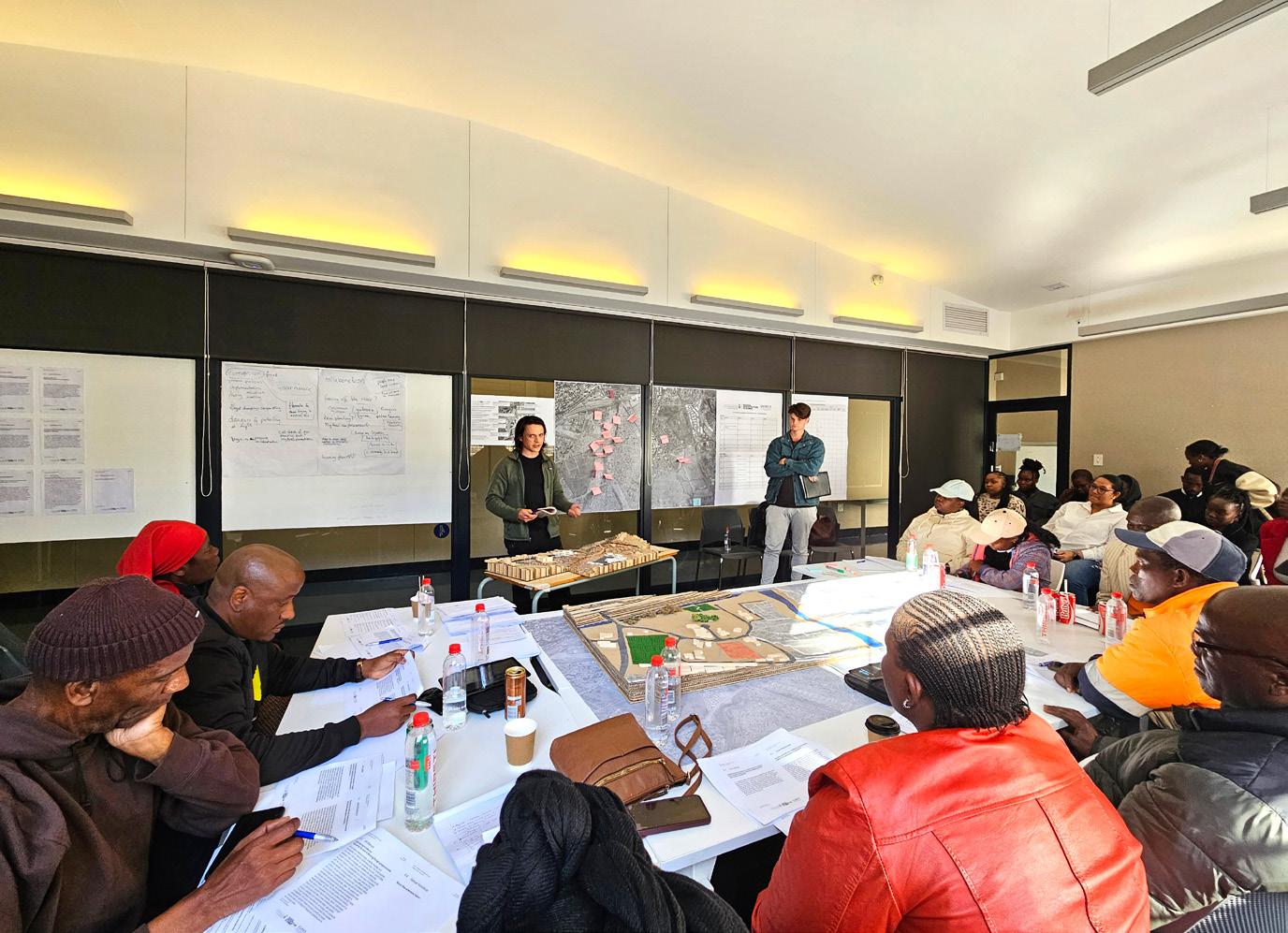
Student presentation: J. Breytenbach & L. Jasper
Year Outcomes
Outcome Abbreviations
In addition to the course results, the marks report will give an overall outcome for the year. These also have abbreviations, the most common of which are listed below:
Q Qualified
QD Qualified with distinction
PCD Permitted to proceed
PSC Proceed on special curriculum
RET Must return to year of study
M1C Readmitted on conditions
M2C Readmitted on conditions
MBA MRNM but exclusion waived
MBP May proceed on conditions
MBR May return on conditions
MXL Mid-year exclusion
MRNM Minimum requirements not met
WAIT Outcome is not yet determined.
Outcomes Explained
The abbreviations above do not always create a clear picture of what the outcome means. They are explained in greater detail below.
Q / Qualified means a student has met all the requirements of the entire degree programme. It is issued when a student is ready to graduate.
QD / Qualified with distinction means a student is ready to graduate first class, with a weighted average mark of 75 or greater.
PCD / Permitted to proceed means a student has completed all the requirements of the current year of study and can take the full curriculum of the next year of study.
PSC / Proceed on special curriculum means the student has passed the core requirements to clear the current year of study, but cannot take a full credit load in the next year of study, either because there is a failed course to repeat in the
lower year, or because some higher year courses have already been pulled down and successfully completed.
RET / Must return to year of study means the student has not met the requirements to clear the current year of study, either because too many credits from that year are outstanding, or the design or construction courses from that year still need to be successfully completed.
M1C / Readmitted on conditions means a student was excluded, applied for readmission, and readmission was granted by the first Wits Readmission Committee (WRC1). This readmission comes with conditions specified by Faculty and possibly additional conditions by the School.
M2C / Readmitted on conditions is the same as M1C, except readmission was granted by the second WRC.
MBA / Minimum requirements not met; exclusion waived means the outcome of the year is MRNM, which results in exclusion from the degree programme, but the School is aware of unusual and difficult circumstances which led the student’s under-performance, and the Faculty board of examiners has therefore decided to waive the appeal/readmission requirement which would otherwise have been required
MBP May proceed on conditions means the student may advance to the next year of study, but conditions will be placed on their continuance. These conditions must be met or a student will be deregistered.
MBR / May return on conditions means the student has been excluded from the degree programme, but has had the requirement to appeal to be readmitted automatically waived, and must return to the same year of study to complete outstanding courses. Conditions will be placed on the
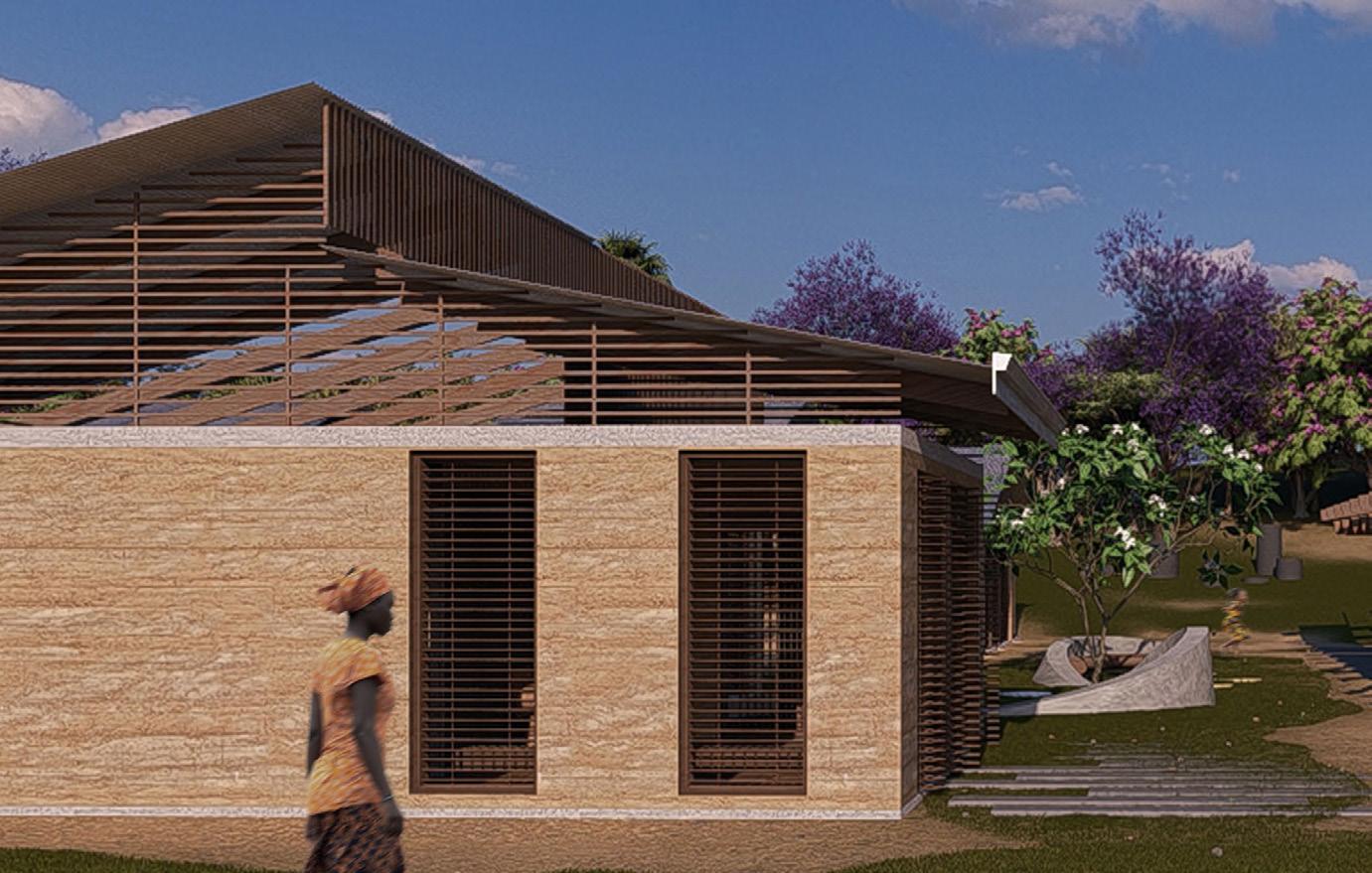
registration, and if these conditions are not met, the student will be deregistered.
MXL / Mid-year exclusion means the student has already violated the conditions of readmission by the end of the first semester, and thus will be excluded. Students in this situation will automatically be de-registered from semester 2 courses.
MRNM / Minimum requirements not met means the student has not met the minimum requirements to remain in the degree programme. A student with this outcome will be excluded from the degree programme and could need to apply to be readmitted. Readmission is subject to approval of the application by a Faculty committee.
WAIT means either an outcome is not yet determined, or there is a hold on the release of marks. This typically only happens due to incomplete coursework or pending academic misconduct cases.
Progression Rules
Progression through the programme is subject to rules outlined in the Faculty of Engineering and the Built Environment Rules and Syllabuses book, subsection 2.2.3.1 and section 14. In some cases, courses have prerequisites which must be passed in order to enroll in a higher year course; these are also presented in the Rules & Syllabuses.
In some cases, subject to the approval of the degree convenor, students may be allowed to ‘pull down’ minor courses from a higher year of study if they have satisfied any prerequisites and the School has not defined any co-registration courses that the student is ineligible for. The School is not required to allow a student to pull down higher-year courses; this is a privilege granted to students only with approval and based on a reasonable expectation that the student will be able to perform well in the courses being pulled down.
Student project: S. Mkhize
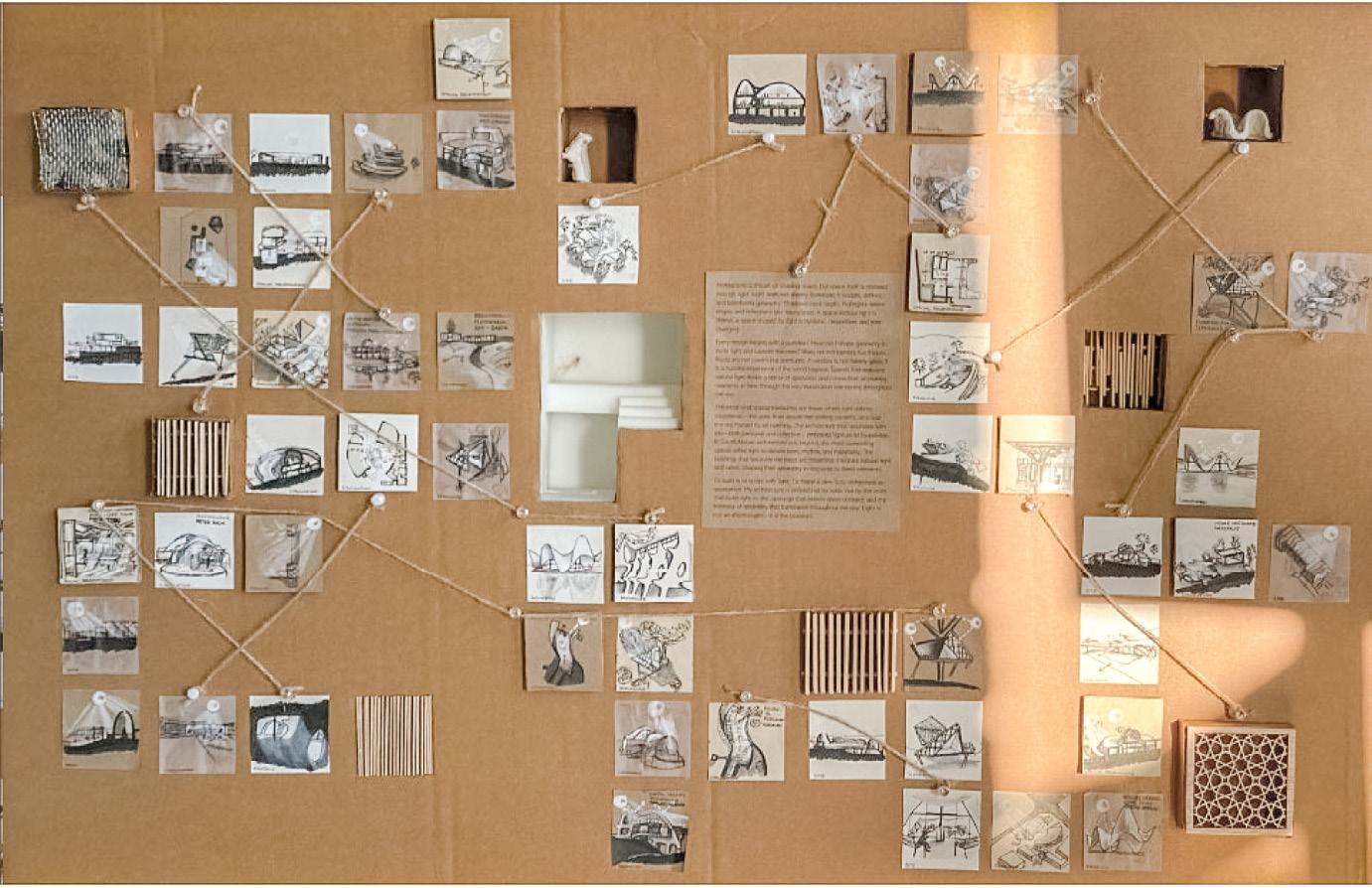
Exclusion
Students who fail to perform at an expected level are subject to exclusion from the degree programme based on rules outlined in the Rules and Syllabuses book, subsection 2.2.4.1.
Exclusion can be a serious setback in one’s academic studies. To be readmitted following exclusion, one must appeal to the Faculty and provide evidence that whatever reasons cause the previous problems have been sufficiently resolved. Students are advised to consult with their lecturers as soon as possible if major problems with their studies arise, in order to avoid this.
Supplementary Exams
Within certain parameters, if an undergraduate student fails one or two courses in a year, they may be eligible for supplementary exams, often called ‘supps’ for short. The purpose of these is to allow students who have a reasonable chance to pass the affected courses, but performed poorly on the main exam, to get a second chance o improve their exam performance and pass.
Not all courses offer supplementary exams, and not all conditions allow one to remain eligible for supplementary exams. For many courses in which the final assessment is a compendium of work done throughout the course, and on a specific timeline, supplementary exams are not offered. This includes most design- and construction-related courses.
See the following page for details. Note that supplementary exams are not offered in postgraduate courses.
Student work: L. Jalla
UG Supplementary Exam Eligibility
is their a failure by absence (FABS) or exclusion (FNQL) in any course?
which year of study is the student in? 1 2 3 is the failed course being repeated?
less than 3 now, but total will depend on the outcome of a deferred exam
does the failed course(s) offer a supp?
Sealed supp
Student can write a sealed supp which will be marked if eligibility criteria are met following the deferred outcome
how many courses were failed? 1 2 more than 2
is the weighted average mark of all courses 50% or higher?
is the weighted average mark of all courses 50% or higher?
YES
are any of the failed course being repeated?
1 or none both of the 2
do(es) the failed course(s) offer a supp?
Supp exam(s)
Student is eligible for the supplementary exams only in the course(s) which offers it/them.
is the sum of the failed courses at least 80%?
No supp exams
Student is not eligible for any supplementary exams.
Disciplines & Courses
Pathways in Architecture
The Bachelor of Architectural Studies (BAS) programme is a gateway to a potentially diverse field of professional career paths, both within the architectural discipline or peripheral to it. From the onset, students are immersed in comprehensive lectures and design laboratories that are grounded in critical thinking and investigation of building component assembly processes: deign, culture, construction, structures, technology, sustainable environment concepts, history, and theory. The students are taught collaboratively by staff and practitioners who bring the latest trends in building design, construction, and technology to the studio in a pedagogical process that combines theory and practice.
The word Architect is a legal term. Only those who have gained professional registration within a specific category may legitimately call themselves Architects. This process is governed by the South African Council for the Architectural Profession (SACAP), which is an independent body operating with a mandate from the Ministry of Public Works of the South African government. Other countries have similar bodies, but may have different criteria.
SACAP
SACAP offers registration as candidates (those who have completed the academic criteria but not the experience criteria and/or exams) and as professionals in categories of Architectural Technologist, Senior Architectural Technologist, and Architect. The category of Professional Architect (PrArch) is the most rigorous and generally holds the highest professional esteem, but the other categories also have specific and important roles to play in the profession.
Those wishing to eventually become a registered Professional Architect will need to satisfactorily complete the BAS degree, and then set their sites on moving towards the two postgraduate degrees in architecture, the Bachelor of Architectural Studies with Honours [BAS (Hons)] and the Master of Architecture [M.Arch] degrees.
The BAS Honours Degree
To become eligible for the BAS (Hons) degree, students from the BAS will need to work in the profession for at least one year, in addition to meeting all the academic criteria for admission. Strong performance in the BAS degree at Wits plus a year of work experience may automatically qualify students for the BAS (Hons) degree at Wits based on the BAS (Hons) admission criteria.
Masters Degrees
Wits offers two types of Master of Architecture degrees. The M.Arch (Professional) is a nationally and internationally professionally accredited degree which gains eligibility as a Candidate Architect with SACAP and, upon completion of experience requirements and professional exams, as a Professional Architect.
Another M.Arch degree, the Master of Architecture by Research, is offered for those seeking to pursue research and receive a higher qualification, but not specifically interested in professional registration with SACAP. The M.Arch (Research) degree offers a high degree of flexibility for students to propose their own topic of study. Wits also offers Masters degrees outside the direct realm of architecture, which can be pursued following the BAS (Hons) qualification.
BAS
Bachelor of Architectural Studies
The BAS is a 3-year, full-time course of study covering a broad base of creative, practical and professional thinking. Graduates qualify with the South African Council for the Architectural Profession (SACAP) as a Candidate Architectural Technologist. BAS graduates need to gain at least one year of professional experience within the discipline in order to qualify for admission to the BAS (Hons) degree.
non-registration option
SACAP C.Arch.T. Candidate Architectural Technologist BAS allows eligibility

Minimum 1 year professional experience
Completion of a year of work experience in the discipline leads to eligibility to apply for the BAS (Hons) degree or registration as a Pr.Arch.T
work experience may allow eligibility for registration option without further study
BAS Hons
Bachelor of Architectural Studies w/ Honours 1-year, leading to qualification as a Candidate Sr. Architectural Technologist & eligibility for a suite of Masters-level degrees.
BAS (Hons) in high standing opens eligibility for nonprofessional options options beyond the Pr.Arch path
M.Arch [Prof]
Master of Architecture (Professional)
1-year, professionally accredited degree leading to qualification as a Candidate Architect with SACAP.
MUD
Master of Urban Design
2-year part-time programme leading to eligibility for registration with UDISA.
M.Arch [Res]
Master of Architecture (by Research)
1-year, non-professional research degree on a proposed topic of study.
MUS
Master of Urban Studies
1-year or 2-year part-time degree with interdisciplinary specialties.

SACAP Pr.Arch.T Professional Architectural Techologist
UDISA C.UD Candidate Urban Designer
SACAP C.Arch Candidate Architect
Minimum 2 years integrated work experience
An M.Arch degree, combined with completion of the required professional experience allows eligibility for the Professional Architect exams.
SACAP Pr.Arch Professional Architect M.Arch allows eligibility as dual registration dual candidacy
UDISA Pr.UD Professional Urban Designer
These include the Master of Urban Design (MUD) and the Master of Urban Studies
The MUD degree, in combination with an M.Arch (Prof), leads to candidacy as an Urban Designer with the Urban Design Institute of South Africa (UDISA). UDISA is not a professional body with a mandate from the Ministry of Public Works like SACAP is; it is only a voluntary professional association. However, some professionals find that Professional Urban Designer qualification leads to some additional career opportunities.
The MUS degree is a single non-professional qualification requiring one of five different areas of specialisation:
• Sustainable & Energy Efficient Cities
• Urban Politics & Governance
• Urban Studies
• Housing & Human Settlements
• Urban Research
Levels of Professional Registration
With the BAS degree, one becomes eligible to register as a Candidate Architectural Technologist (C.Arch.T) with SACAP and, following one year of documented work experience and the successful completion of a professional exam, registration as a Professional Architectural Technologist (Pr. Arch.T) Registering in this category allows one to take on certain responsibilities within the profession. Registration in this category is not required to gain eligibility for the BAS (Hons) degree.
Upon graduation with an M.Arch (Prof), one is eligible to register with SACAP as a Candidate Architect (C.Arch). SACAP requires Candidate Architects to gain, document, and submit reports about relevant professional experience they are gaining under the supervision of a Professional Architect (Pr.Arch). Once
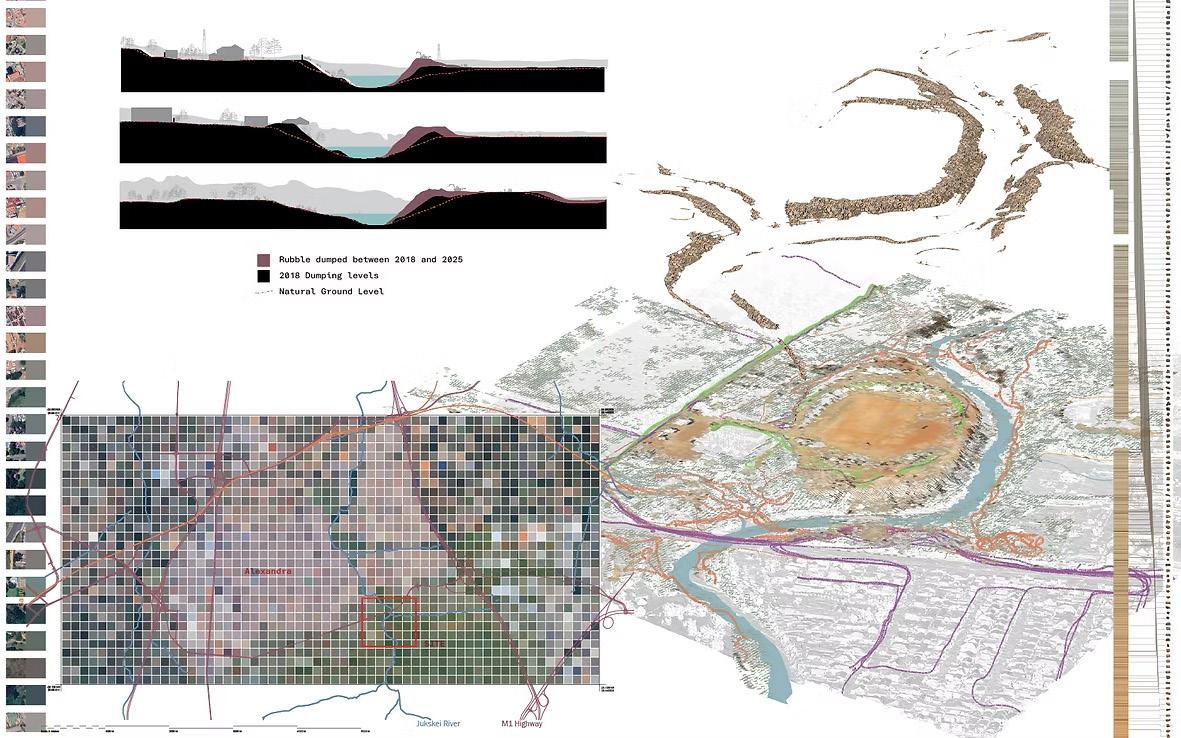
Student project: J. Breytenbach
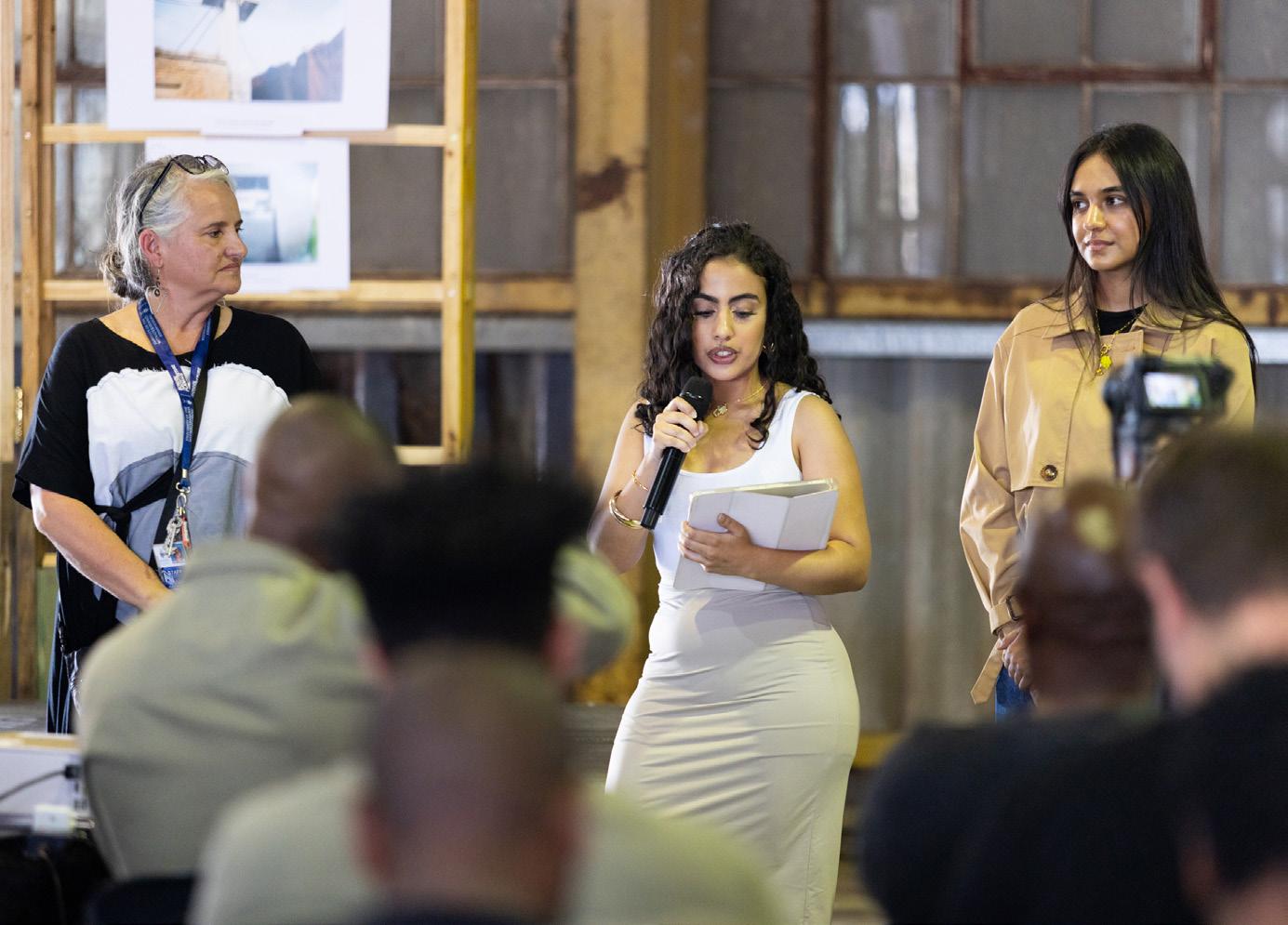
these requirements are completed, one becomes eligible to sit for the professional registration exams which, if completed successfully, unlock the Pr.Arch category of registration.
The typical journey to becoming a Professional Architect will last a minimum of 7-8 years, though it could take longer than that depending on one’s circumstances. Complete information on the professional registration categories can be found on SACAP’s website: https://www.sacapsa.com
International Accreditation
To ensure quality and consistency of professional competence, professional bodies around the world require professional degree programmes to be accredited by their national body (SACAP
in South Africa) and in some cases, by international bodies.
The entire sequence of architecture degrees (BAS, BAS Hons, M.Arch [Prof]) are validated by SACAP nationally, and by the Commonwealth Association of Architects (CAA) internationally.
SACAP and the CAA are part of an international agreement called the Canberra Accord that recognises university qualifications as equal across all jurisdictions of the signatory bodies. These includes 34 countries, mostly in Africa, the Pacific and the Caribbean, but also including Australia and the UK, as well as national professional accreditation bodies of Canada, China, South Korea, Hong Kong, Mexico, and the USA. Details of the Canberra Accord can be found on their website: http://www.canberraaccord.org
Student presentation: L. Jallah
Pathways in Planning
Urban planning is the technical and political process of organising and regulating the development and design of urban space and land use, with the objective of maximising public welfare.
The increasing importance of urban centres as drivers of development and a means of poverty alleviation has resulted in increased interest in urban planning and its potential to maximise the benefits of cities. Urban planners work in a variety of professional roles in both the public and private sectors: in housing, infrastructure development, project management, land use management, local economic development, spatial (regional) planning, and transport planning.
The BSc URP is also an excellent springboard for other public sector-related careers (especially in local government) as it provides exposure to the policy making process and the regulatory framework governing many state organs. However, the multi-disciplinary nature of the programme necessitates a large amount of reading on a diverse range of fields, such as: geography, sociology, economics, civil engineering, politics and law. Thus pursuing a career in planning requires a high level of curiosity and motivation.
Candidates must have a strong grasp of language, as planning work involves a great deal of reading, writing and presentations. The URP programme also involves mapping as a core component of the curriculum. However, this is not creative drawing but merely a translation of verbal language into graphic language and candidates do not need prior training in technical drawing or any artistic field.
SACPLAN
In South Africa urban planning can be practiced at several different levels, depending on experience, educational background and registration with the South African Council for Planners (SACPLAN).
SACPLAN is the statutory council responsible for regulating the planning profession, and gaining familiarity with it’s structure and criteria is important for all students of urban and regional planning.
Postgraduate Degrees
To obtain registration as a Professional Planner, the highest registration category with SACPLAN, one must first complete the BSC URP (Hons) degree. Students who obtain a minimum average mark of 60% in their third year of study in the BSc URP are eligible to for this degree.
Though not required for professional registration, obtaining a higher degree will often be useful in the career of an urban planner. Students who have obtained the BSc URP with Honours are eligible to apply for a number of Masters degrees offered by Wits. Students who possess an Honours’ degree from cognate disciplines can enroll initially in the PG Dip and then do a Masters in Development Planning in order to obtain professional registration.
The Master of Science in Development Planning (MSc DP) is a one-year course of study based on coursework and research which may help prepare students who wish to move into development planning.
The Master of Urban Design (MUD) degree, in combination with an the BSc URP (Hons), leads to candidacy as an Urban Designer with the Urban Design Institute of South Africa (UDISA). UDISA is not a professional body with a mandate
BSc URP
Bachelor of Science in Urban & Regional Planning
The BSc URP is a rigorous, 3-year, full-time course of study covering a broad base of professional, theoretical and practical thinking.
BSc URP degree students are eligible for registration with SACPLAN as a Student Planner.
entry into without UG planning degree
PG Dip
Postgraduate Diploma in Planning 1-year, full-time, for non-URP backgrounds to gain eligibility for the MSc DP.
MSc DP
Masters of Science in Development Planning
1-year full-time, leading to qualification as a Candidate Professional Planner.
eligibility for higher degrees
MUD
Master of Urban Design
2-year part-time programme leading to eligibility for registration with UDISA.
MUS
Master of Urban Studies
1-year full-time or 2-year part-time degree w/ interdisciplinary specialties.
PhD
Doctor of Philosophy in Town & Regional Planning 2-3 years, by research.
BSc URP enrollment allows registration as
SACPLAN SP Student Planner

BSc Hons URP
BSc w/ Honours in Urban & Regional Planning 1-year, leading to qualification as a Candidate Professional Planner and for admission to several Masters degree programmes.
SACPLAN CPP
Candidate Professional Planner
Min. 2 years practical training in specific planning competency areas gains eligibility to register as a Professional Planner
UDISA Pr.UD Professional Urban Designer
MUS fields of study
SACPLAN PP Professional Planner
Sustainable & Energy Efficient Cities
Housing & Human Settlements
Urban Politics & Governance
Urban Management
Urban Research
from the Ministry of Public Works like SACPLAN is; it is only a voluntary professional association. However, some professionals find that Professional Urban Designer qualification leads to some additional career opportunities.
The Master of Urban Studies (MUS) degree is a single non-professional qualification requiring one of five different areas of specialisation:
• Sustainable & Energy Efficient Cities
• Urban Politics & Governance
• Urban Studies
• Housing & Human Settlements
• Urban Research
Regardless of the subject matter of the lower degrees, students may also pursue a path towards a Doctor of Philosophy (PhD), something that more and more professionals are moving towards, particularly those with an interest in teaching. A PhD allows for in-depth research on a self-chosen topic pertinent to the field of study.
Levels of Professional Registration
SACPLAN offers an entry-level registration category - Student Planner - which can be activated while one is enrolled in the BSC URP degree, prior to graduation.
Upon graduation from the undergraduate programme, one becomes eligible for registration as a Candidate Assistant Planner or Candidate Planner. These candidacies lead to registration as an Assistant Planner or Planner, respectively, once specific work experience is satisfied and a registration exam is passed.
Because the Planner category is of a higher level than Assistant Planner, most people who graduate from the BSc URP degree will opt for candidacy in the Planner category, although the work experience requirements to convert from candidacy to full registration are more stringent in this category.
Most people enter the BSc URP degree with the aim of obtaining SACPLAN’s highest registration, Professional Planner. Doing so requires coming back for the BSc URP with Honours degree, followed by at least two years of specific work experience, and successful examination with the registration board. It is important for students to be aware of these requirements, since it will help them to choose their career paths appropriately.
If a Master of Urban Design (MUD) degree is also pursued following the BSc Hons URP, candidates may also be eligible for registration with the Urban Design Institute of South Africa (UDISA). UDISA is a private organisation, not a legally mandated professional body like SACPLAN, but may nevertheless be beneficial to a career path in which urban planning and urban design intersect.
Complete information on the professional registration categories can be found on SACPLAN’s website: https://www.sacplan.org.za
Information about UDISA can be found on their website: https://urbandesigninstitute.co.za/
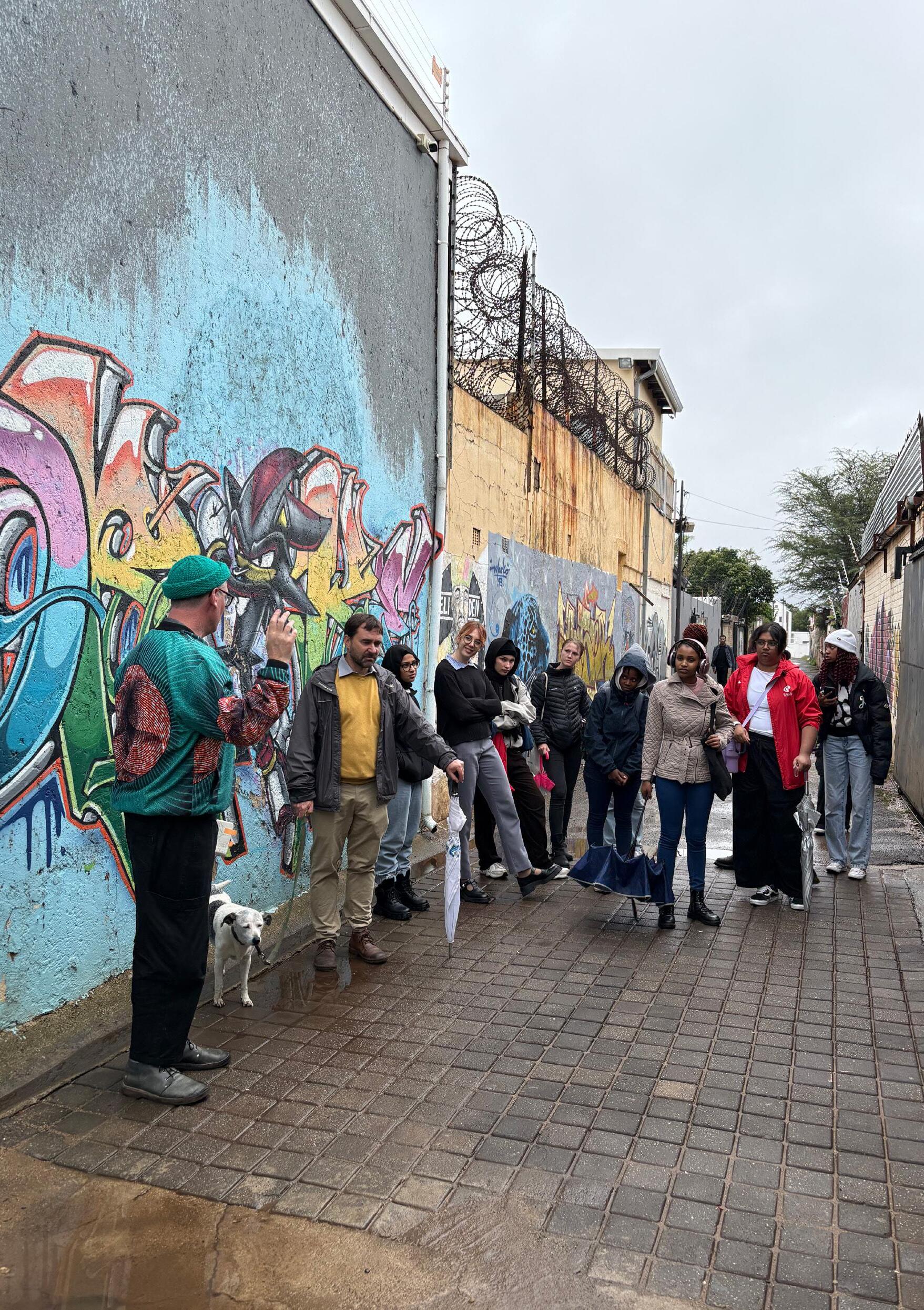
Student field trip; photo: B. Stone Johnson
Course Descriptions
APPM1000A
Applied Mathematics
7 credits, semester 1
Prerequisite: none
Vector algebra, systems of coplanar forces, transversely loaded beams, frameworks, centres of gravity.
APPM1023A
Mathematical Techniques for Planners
18 credits, full year
Prerequisite: none
This course begins by contextualizing the study of mathematical techniques in terms of the requirements of planning. The unit then provides review of area and volume; rate, ratio and proportion, percentage, density, straight line graphs, indices and Logarithms, logarithmic graphs. The unit provides an introduction to graphic literacy, least squares and polynomial interpretation. It also provides an introduction to concepts from surveying as well as introduction to financial mathematics.
APPM2019A
Quantitative Methods for Planners
12 credits, semester 2
Prerequisite: none
This course has arisen out of the need to describe aspects of the real world in such a way that its behaviour can be explained and predicted. Mathematical modelling is the key to production of mathematical equations which describe phenomena and systems. Foundation skills required to analyse data sets and build predictive models from given data sets are developed in this course. Emphasis is placed on understanding proportions and significance of components of data, and on developing the necessary computer skills in the analysis and presentation of data. Students are expected to develop
skills in communication of the concepts and methods of statistical analysis and model building. This course covers the following topics: basic statistical analysis including graphical representations of data and statistical summaries of data, probability distributions, random variables, confidence intervals, hypothesis testing, significance testing, linear regression and linear correlation.
ARPL1000A
Architectural Design & Theory I
60 credits, full year
Prerequisite: none
Co-registration: ARPL1001A
This course is an introduction to design theory and lays the foundation of architectural thinking by presenting conceptual design principles, architectural elements, contextual influences, basic space-making and collaborative engagement. Emphasis is placed on the development of design processes and methods of production to explore architectural possibilities.
ARPL1001A
Theory & Practice of Construction I
30 credits, full year
Prerequisite: none
Co-registration: ARPL1000A
This course provides an introduction to basic building technology, materials and National Building Regulations, roles and responsibilities of architects, technical drawing, the building processes in domestic contexts, elementary services of water supply, sewerage reticulation and electrical supply, an introduction to topography, basic survey techniques and soil conditions and services related to specific soil conditions.
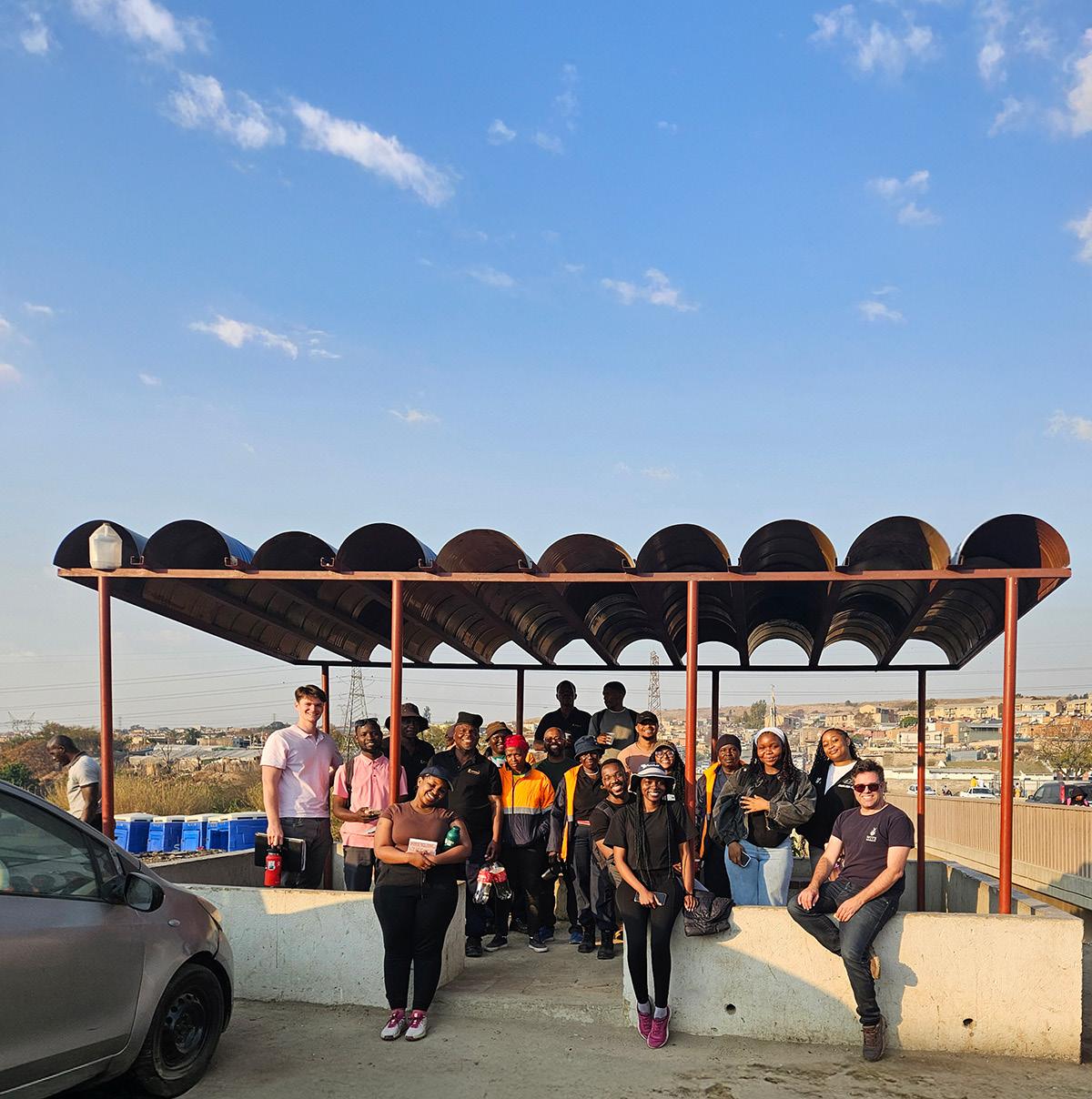
ARPL1015A
Intro to Environmental Interpretation
24 credits, semester 1
Prerequisite: none
This course directs the attention of students to their living environments, and to the physical, cultural, social, political & economic factors that are shaping the nature of these environments. The course introduces the student to different living environments shaped within cultural contexts. It introduces students to graphic & other visual skills that are used in interpreting settlements & presenting plans.
ARPL1016A
Intro to Settlement Form & Design
24 credits, semester 2
Prerequisite: none
This course introduces different types of settlements in urban and rural areas, the shape (or morphology) of these settlements, the idea of urban environmental design, the various elements that comprise a settlement, the different urban components and basic design elements with a focus on the development of graphic communication and the application of digital technologies.
Student-built patrollers shelter in Alexandra
ARPL1025A
Two & Three Dimensional Computer
Aided Design & GIS
12 credits, semester 1
Prerequisite: none
This course introduces Computer Aided Design (CAD) and Geographic Information System (GIS).Students are required to use these tools, techniques and technologies for practical application in their courses and projects.
ARPL1028A
Design Representation I
10 credits, semester 1
Prerequisite: none
This course introduces forms of design and architectural representation and production. Through measured, free-hand, and creative forms of visual representation, the course introduces the fundamentals of descriptive geometry, three-dimensional representation drawings, principles of perspective drawing, and various methods of producing illustrative and rendered means of visual representation.
ARPL1026A
Identity and Society I
18 credits, semester 1
Prerequisite: none
This course is an introduction to the theoretical and conceptual foundations of Sociology. It locates the discipline’s key concerns with the relationship between individuals and the social context, and examines sociological debates around modernity, social change and identity. This will be achieved by an in-depth exploration of the ideas of central classical theorists. The course also aims to develop students’ content knowledge, and reading and writing skills.
ARPL1029A
Digital Applications in Architecture I
10 credits, semester 2
Prerequisite: none
This course introduces digital architectural production and uses contemporary industry-relevant software in the architectural discipline as tools for both architectural design and representation.
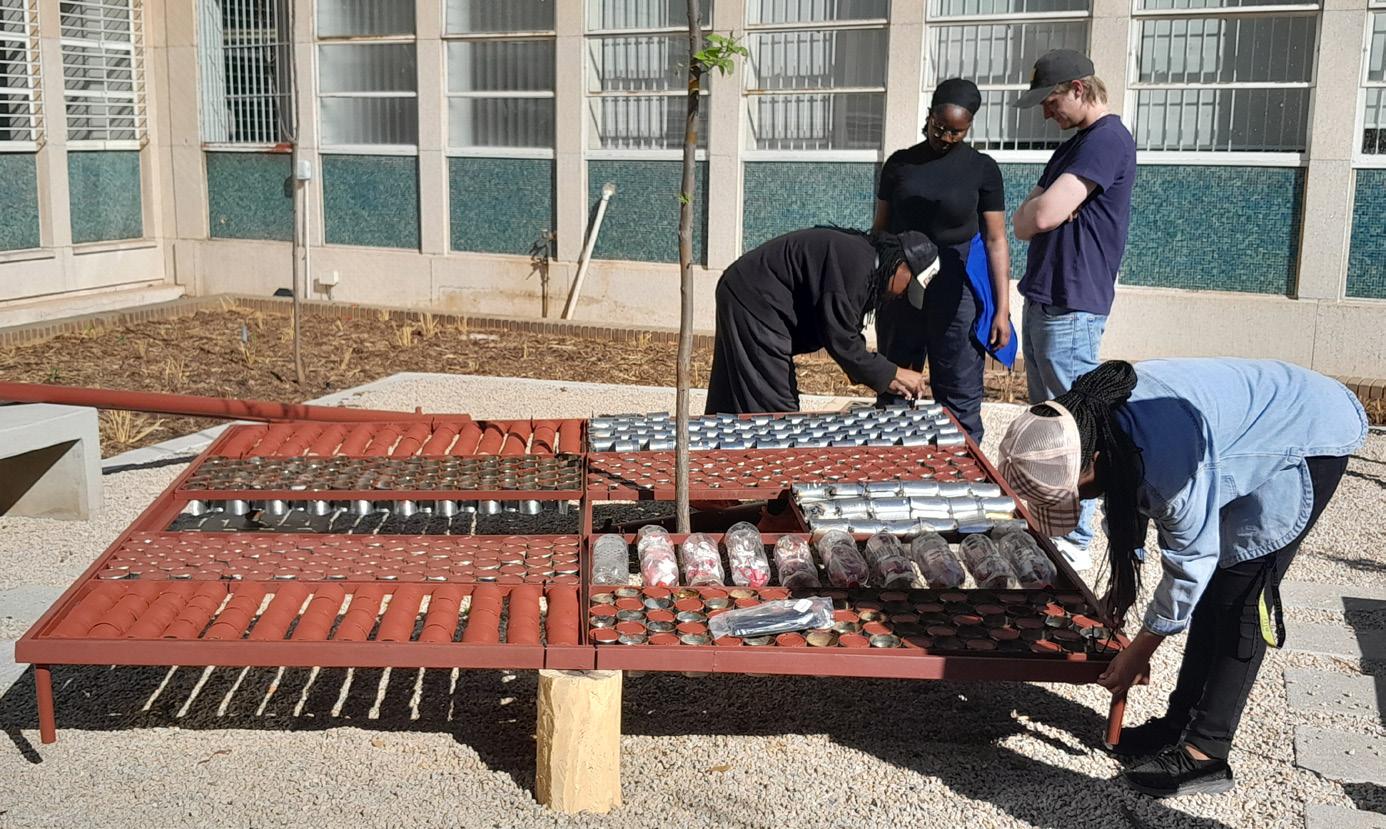
Design-build project; photo by P. Moreira
ARPL1030A
Building Ecology
7 credits, semester 2
Prerequisite: none
This course introduces theoretical underpinnings of, and design approaches to, the harmonious and interdependent relationship of the natural and built environment. It explores the interconnectedness of design and socio-ecological systems, and critically examines the influences and effects of various scales of planning, design and building on approaches to sustainability.
ARPL1031A
Histories & Theories of Architecture I
8 credits, semester 1
Prerequisite: none
Co-registration: ARPL1032A
This course explores the foundations of spatial culture as found in human habitation before “settlement,” and the nature of early settlements, landscapes and ritual spaces.
ARPL1032A
History of Settlement, Architecture & Planning
12 credits, semester 2
Prerequisite: none
This course explores settlements and architectural productions in Africa and in other parts of the world. A selection of settlements, architectural design, art objects, and spatial ensembles from different periods of time in Africa, Asia, Europe, and Latin America are used to show that urban and regional planning and architectural programmes are continuously evolving along with human experiences in temporal and in physical spaces.
ARPL2000A
Architectural Design & Theory II
60 credits, full year
Prerequisite: ARPL1000A, ARPL1001A
Co-registration: ARPL2002A
This course explores the development of sustainable architectural approaches in myriad contexts through an integrated presentation of theory, practical analyses and creative design processes. Topics include theory of place-making and the role of ecological, cultural and socio-economic considerations form core tenets of design and analysis projects developed in response to natural systems, urban influences, topography, and the integration of building and landscape across small-scale, mixed-use and multi-unit housing buildings.
ARPL2002A
Theory & Practice of Construction II
30 credits, full year
Prerequisite: ARPL1000A, ARPL1001A
Co-registration: ARPL2000A
This course introduces framed structures (timber, steel and concrete), cladding systems, services related to framed structures and relevant National Building Regulations. It has three components: building climate focuses on thermal concepts and principles; passive and active energy system; use of solar charts and shading diagrams and an introduction to a range of building materials and structural systems; services focuses on plumbing, fire and electrical reticulation; and relevant national building regulations: focusing on the development and the preparation of technical documentation.
ARPL2006A
Planning for Housing, Services, Infrastructure & Transport 12 credits, semester 2
Prerequisite: APPM1023A
This course introduces topics in relation to both rural and urban areas: national and provincial policies in relation to the above; service delivery options; financing and institutional arrangements (e.g. public-private partnerships and municipal service delivery agreements); the contribution of services and infrastructure to local economic development; inter-sectoral co-ordination; concepts such as corridors, nodes, densification; and basic principles of project management and urban land economics.
ARPL2012A
Histories & Theories of Architecture II 20 credits, full year
Prerequisite: ARPL1031A, ARPL1032A
This course explores architecture and its codification until the roots of modernism. The architecture of dynastic, religious and imperial centres of power in relation to technological developments, new materials, religious and aesthetic ideals are examined and the course has four distinct periods in the history and theory of architecture
ARPL2013A
Introduction to Land Management 18 credits, semester 1
Prerequisite: none
The course introduces land management incorporating different forms of land legal issues (cadastre, general plan, deeds registry, boundaries, rights etc.); land uses (categories, relationships between uses, thresholds etc.); land use management (zonings, schemes etc.); different approaches to land use regulation; and, technologies used in the management of land - including Geographical Information Systems (GIS), satellite-linked survey systems, aerial photos and remote sensing; relationships between land use, densities, services and transport. It introduces the challenges and critiques of formal property ownership, rights of users of land vs owners, land uses and transactions outside of and unrecognized by the formal system. The dynamics underlying informal land processes, their implications and management challenges are considered. The course explores the consequences and implications of alternative practices in recent urban land management studies.
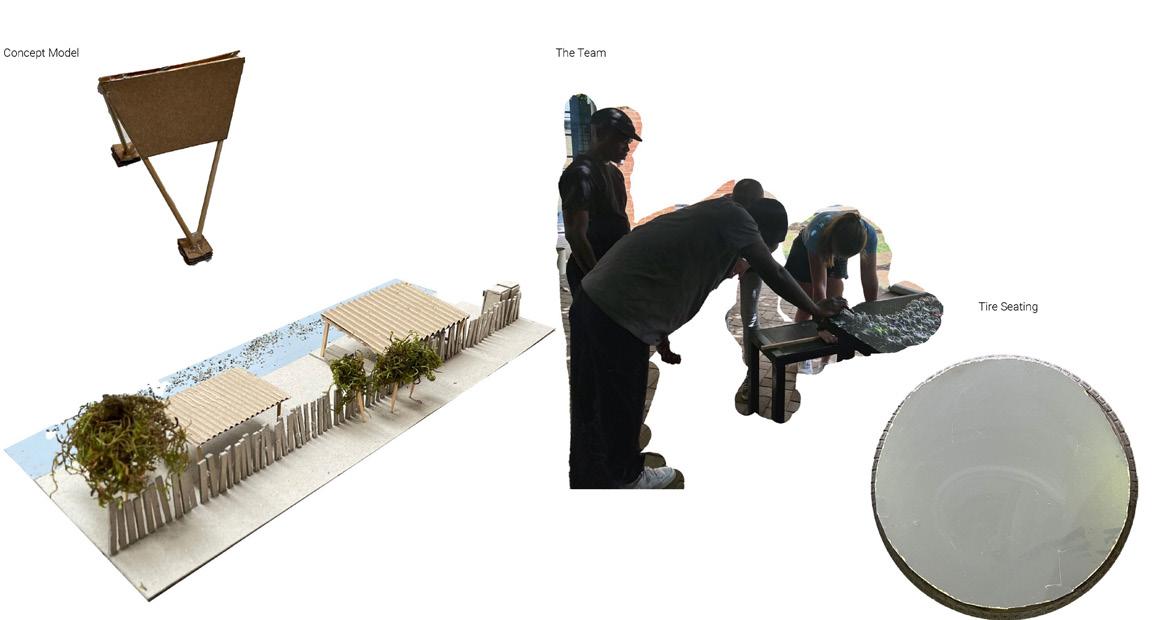

Student project: S. Mkhize
ARPL2015A
Contemporary Design & Environmental Issues in South Africa
18 credits, semester 2
Prerequisite: ARPL1014A, ARPL1015A & ARPL1014A
This course focuses on concepts of live-ability and environmental quality; the public realm and privatisation of space; inner-city redevelopment; heritage and conservation; and urban form, including concepts and approaches such as the new urbanism and the compact city. These are addressed in relation to South Africa and Johannesburg in particular.
ARPL2017A
Histories, Theories & Futures of Planning
12 credits, semester 2
Prerequisite: none
The course introduces the idea and practice of planning as it evolved from the nineteenth century to the present day in South Africa and internationally. The course covers different histories of planning, illustrating both its successes and failures and the extent to which it has been shaped different contexts and factors. The intellectual basis of planning and the developments regarding theory from modernism, pragmatism, post- modernism and the impacts of collaborative and insurgent planning are reviewed. International histories and theories are interrogated from a South African perspective, examining changes in planning and the city from apartheid to post-apartheid contexts. Remove as this is an outcome of the course.
ARPL2018A
Introduction to Environmental Planning & Sustainable Development
12 credits, semester 1
Prerequisite: none
The course provides a critical perspective on the notions of “the environment,” “sustainability,” ”sustainable development” and the “sustainable city“ and focuses on the relationship between the environment and urban development. It introduces students to the fundamentals of ecology, the notions of sustainability, and sustainable development, and, inter alia, the overall concepts of and tools associated with Environmental Assessment (EA), Integrated Environmental Management (IEM) and Strategic Environmental Assessment (SEA). Remove as this is an outcome of the course.
ARPL2019A
Design Representation II
10 credits, semester 1
Prerequisite: ARPL1028A
Intermediate forms of design and architectural representation and production. Through targeted design/representation projects, the course focuses on design and creative production through a selection of representational media.
ARPL2020A Digital Applications in Architecture II
10 credits, semester 2
Prerequisite: ARPL1028A, ARPL1029A
This course focuses on intermediate digital architectural production and elaborates on the use of contemporary industry-relevant software to create intermediate forms of architectural production, preparing for advanced methods of architectural design and representation.
ARPL2021A
Introduction to Structures
7 credits, semester 1
Prerequisite: none
This course introduces structural systems in the architectural and building construction fields, presents a survey of
structural types and their relationship to the design of buildings. A conceptual introduction to structural principles is presented and their influences on architectural design is analysed.
ARPL3002A
Small Office Practice
7 credits, semester 1
Prerequisite: none
This course focuses on the concept of professionalism, architect/client relationships, consultant teams, small-scale contracting, contract without bills of quantities, elementary estimating, computer packages, certificates and final accounts, forms of architectural practice, financial planning, taxation, staffing, standard documents, managing projects and marketing professional services.
ARPL3005A
Architectural Design & Theory III
70 credits, full year
Prerequisite: ARPL2000A, ARPL2002A
Co-registration: ARPL3031A
This course explores the conceptual and technical development of varied and complex architectural projects by using a pluralistic approach to architecture and a range of design approaches and methodologies. The ability to holistically complete an architectural project is emphasised through the integration of building systems with cohesive conceptual, technical, aesthetic and sustainability objectives.
ARPL3010A
Comparative Planning Systems
12 credits, semester 1
Prerequisite: none
This course focuses on the different systems and forms of planning across the world. It illustrates the contextuality of planning, and different possibilities for future planning practice in South Africa.
It relates comparative planning systems to different forms of government, and traditions of planning. The course makes extensive use of Internet searches.
ARPL3021A
Histories & Theories of Architecture III
20 credits, full year
Prerequisite: ARPL2012A
This course explores architectural histories and theories since modernism. It surveys both built and imagined architecture and how social emancipation, globalisation and media have characterised its production. The course extends knowledge of recent architecture and builds critical skills.
ARPL3027A
Regional Planning & Local Economic Development
12 credits, semester 1
Prerequisite: ECON1002A, ECON1003A
This course introduces students to planning at supra-local scales (ie. regional, national transnational) and to the theories and practices of regional and local economic development as they have evolved inter-nationally and in the South African context. It locates changing ideas about regional and local economic development within theories and approaches to development. The course provides a historical overview of the histories and traditions of regional planning and local economic development internationally and with reference to South Africa, but largely focuses attention on contemporary approaches.
ARPL3028A
Development Policy & Processes in South Africa
12 credits, semester 1
Prerequisite: ARPL2006A
This course introduces students to the rationale for public policy, the policy-making process, frameworks of policy analysis,
decision-making models, and current trends in the policy-making environment internationally and in South Africa. Through close examination of current policy frameworks, the course provides an introduction to key policy issues that affect planning and development in Southern Africa, such as urbanisation & informal settlement, land tenure and governance in rural areas, land reform and land restitution, developmental local governance, the developmental effects of HIV/Aids and gender and development.
ARPL3030A
Graphic and Spatial Communication
12 credits, semester 1
Prerequisite: ARPL1025A & ARPL2015A
This course requires students to apply the use of mapping, graphic and presentation tools/techniques acquired in previous years. It introduces and develops the skills of plan and framework interpretation at various scales ranging from the precinct and ward levels to national scales. Content assists students with honing graphic communication, using maps to analyse and communicate complex issues and dynamics, translating social, economic and political data onto readable maps, graphs and graphic inputs, articulating and illustrating spatial change and transformation.
ARPL3031A
Theory & Practice of Construction III
33 credits, year-long
Prerequisite: ARPL2000A, ARPL2002A
Co-registration: ARPL3005A
This course focuses on the design development and detail design of large-scale and complex building types, detailed consideration of services and building infrastructure, sustainable construction and design as a way to improve the environmental and
maintenance performance of buildings through designing with the natural environment, climate, comfort, energy, water, resources, efficient structures, materials, daylighting and landscaping. It emphasises the application and adherence to the relevant national building regulations and introduces industrialised building systems, specifications, approaches to environmental control and performance modelling & the preparation of detailed technical documentation.
ARPL3032A
The Politics of Planning & Housing
30 credits, fully year
Prerequisite: ARPL2006A
This courses addresses two key themes and the relationship between them. The first theme focuses on city governance and the politics of this, addressing theories of urban regimes, urban governance, participation, social movements and political mobilisation. The second theme explores housing theories, concepts and debates, and low income housing policy and practice, particularly in SA. The course connects urban politics with housing in exploring issues of power in urban development (in governance, urban land and the property market, for example), and the implications of this for planners. The course includes a project focused on building research skills.
ARPL3033A
Local Planning & Urban Design
18 credits, semester 2
Prerequisite: ARPL2015A, ARPL1025A, & ARPL2013A
This course develops students’ theoretical and practical skills in local physical planning and urban design. It introduces students to the economic, social, political and institutional factors that influence urban design. Topics include urban design process, urban
revitalisation, gender and design, public safety, participatory design, principles of layout, pedestrians and vehicles and open space networks and landscapes, land use management as well as site development specifications. It focuses on developing concepts of urban design appropriate to African cities, including those relating to the upgrade of in-situ informal settlement, low income housing, regeneration of decaying inner-cities, design for informal activity, design and management of edge cities and design response to cultural diversity. The course includes a project which involves the use of appropriate digital technologies.
ARPL3034A
Integrated Development Planning
24 credits, semester 2
Prerequisite: none
This course has two components: The theoretical component focuses on
the different approaches to integrated planning and international precedents, planning in relation to ‘developmental local government’, the historical development and legal basis of the South African Integrated Development Plan (IDP) and a critical review of integrated development planning practice in South Africa The practical component consists of a project that introduces students to the IDP process, the integration of planning and institutional processes and the linkages between key sectors such as transportation and land use and economy and the environment. The project involves the preparation of a planning framework for a selected municipal area, critical engagement with the regional context, key issues and relevant development approaches situates the project within a broader conceptual framework drawn from international and local literature.
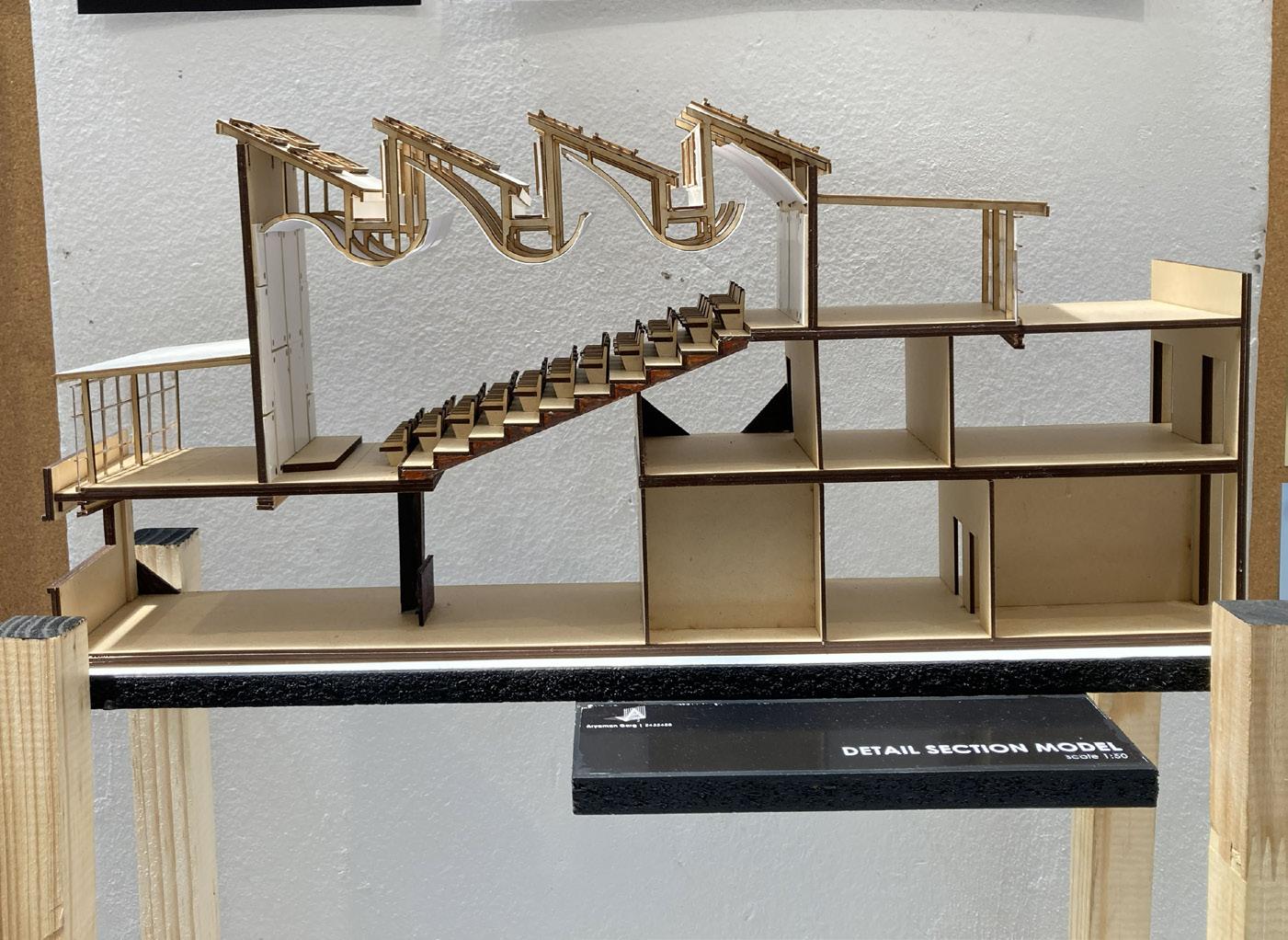
Student model: A. Garg
ARPL4000A
Advanced Design Studio
45 credits, semester 1
Prerequisite: none
Co-registration: ARPL4005A
Studio course addressing an aspect of contemporary architectural and/or urban design.
ARPL4001A
Design Studio
45 credits, semester 2
Prerequisite: none
Co-registration: ARPL4003A
Contemporary design studio in the fields of housing, urban design or architecture.
ARPL4002A
Contemporary Architectural Theory
18 credits, semester 2
Prerequisite: none
Theoretical readings of and research into architecture drawn from the fields of critical theory, cultural studies, gender issues, urban studies, post-colonial theory etc. Research Methods.
ARPL4003A
Advanced Theory & Practice of Construction
18 credits, semester 2
Prerequisite: none
Co-registration: ARPL4001A
Design and construction implications of environmental sustainability requirements; renewable resources (solar energy and passive design, daylighting, rainwater harvesting); energy, water, environmental and resource conservation in architecture; confronting construction and design related issues in the context of limited material, financial and energy resources; developing employable skills and providing employment.
ARPL4004A
Advanced History of Architecture & Urbanism
18 credits, semester 1
Prerequisite: none
Interrogation of modern architecture and urbanism, with emphasis on the developing world; comparisons between local and other international contexts. Historical research methods.
ARPL4005A
Research Project
36 credits, semester 1
Prerequisite: none
Research in a particular field of architecture - history/technology/theory or professional practice, including field, archival and/or laboratory work.
ARPL5004A
Cities, Development & Planning
20 credits, semester 1
Prerequisite: none
This course explores the main dynamics and processes shaping cities in the contemporary era and the key challenges they face by examining both the international literature and the literature in the South African context. Major international development agendas for urban development, and their implications for urban planning, the evolution of approaches to urban development and the way they have been framed by development thought is discussed and contemporary approaches are evaluated.
ARPL5005A
Spatial Planning, Transport & Infrastructure
30 credits, semester 1
Prerequisite: none
This course has two components. 1) Spatial planning processes: Focuses on spatial concepts and principles of spatial
planning, as well as various processes and theories of spatial change and requires the development of a local level spatial plan, including spatial analysis, spatial policies, design and implementation, issues such as land tenure, settlement layout and morphology and land use management.
2) Sustainable transportation and infrastructure: Introduces students to issues dealing with the impact of urban land use and form and other factors on sustainable transport, types of transport and finally transport policies and their implementation. Urban infrastructure will introduce students to the principles of bulk infrastructure provision such as potable water supply, storm water and waste water provision as well as roads and side walk construction. It also deals with the relationship between urban form and infrastructure provision in terms of sustainable infrastructure, and costings.
ARPL5007A
Technologies & Techniques in Planning 10 credits, semester 1
Prerequisite: none
This course introduces candidates to procedural and analytical techniques used in planning and involves the practical application of appropriate technologies, including Geographic Information Systems (GIS), Internet, and computer packages for data analysis and the presentation of graphics.
ARPL5008A
Planning, Environment & Sustainability 20 credits, semester 2
Prerequisite: none
This course has two components.
1) The concepts of sustainability and sustainable development are introduced, a critical perspective provided and the notion of the “sustainable city” is covered.
2) Environmental planning introduces
candidates to ecological fundamentals, environmental ethics, the idea of environmental risk and the basics of environmental and resource economics. The various forms of environmental management and planning, including Environmental Impact Assessment (EIA), Integrated Environmental Management (IEM), and Strategic Environmental Assessment (SEA) are covered.
ARPL5009A
Urban & Regional Economic Development
20 credits, semester 2
Prerequisite: none
The course provides candidates with concepts, knowledge and tools in economic development for analysing and understanding the dynamics of local and regional economic development and engages theoretical approaches for the understanding of urban economics, local economic development and regional development. Candidates must assimilate the dynamics of location, distribution and spatial organisation of economic activities and their implications for the configuration of urban forms and human development at local, regional and national levels.
ARPL5010A
Integrated Development Planning 20 credits, semester 2
Prerequisite: none
This course is project based and has two components.
1) The theoretical component deals with different approaches to integrated planning and international precedent, planning in relation to ‘developmental local government’, the historical development and legal basis of the South African Integrated Development Plan (IDP), and a critical review of integrated development planning practice in South Africa.
2) The practical component introduces
candidates to the IDP process, the integration of planning and institutional processes, the linkage between key sectors such as transportation and land use, and economy and the environment. The project involves the preparation of a planning framework for a selected municipal area.
ARPL5011A
Planning Law
20 credits, semester 1
Prerequisite: none
This course involves an in-depth study of certain relevant areas of the law against the background of the history, general principles and sources of our legal system. Relevant legislation, such as the South African Constitution and those dealing with spatial development, environmental management, and housing, as well as court decisions are the point of departure. Candidates should acquire an understanding of the basic principles of South African law, knowledge of the law relevant to urban and regional planning, as well as an ability to read, interpret and apply relevant legislation and case law in practical situations.
ARPL5012A
Professional Practice & Ethics
10 credits, semester 1
Prerequisite: none
This course introduces candidates to the planning profession and assists in preparing them for the ‘world of work’. Through discussion-based sessions, they consider the historical development of the planning profession in South Africa, what it means to be a professional, as well planning ethics. Candidates are exposed to the professional bodies and acquire an understanding of the current job market, and different forms of practice. Their existing skills are enhanced through practical exercises in skills required of entry level planners.
ARPL7001A
Advanced Digital Applications
9 credits, semester 1
Prerequisite: none
Co-registration: ARPL7003A
Introduction to specialised computer applications appropriate to architecture, e.g. desktop publishing, programs for specialised technical analysis, programs for specialised research, professional practice, etc.
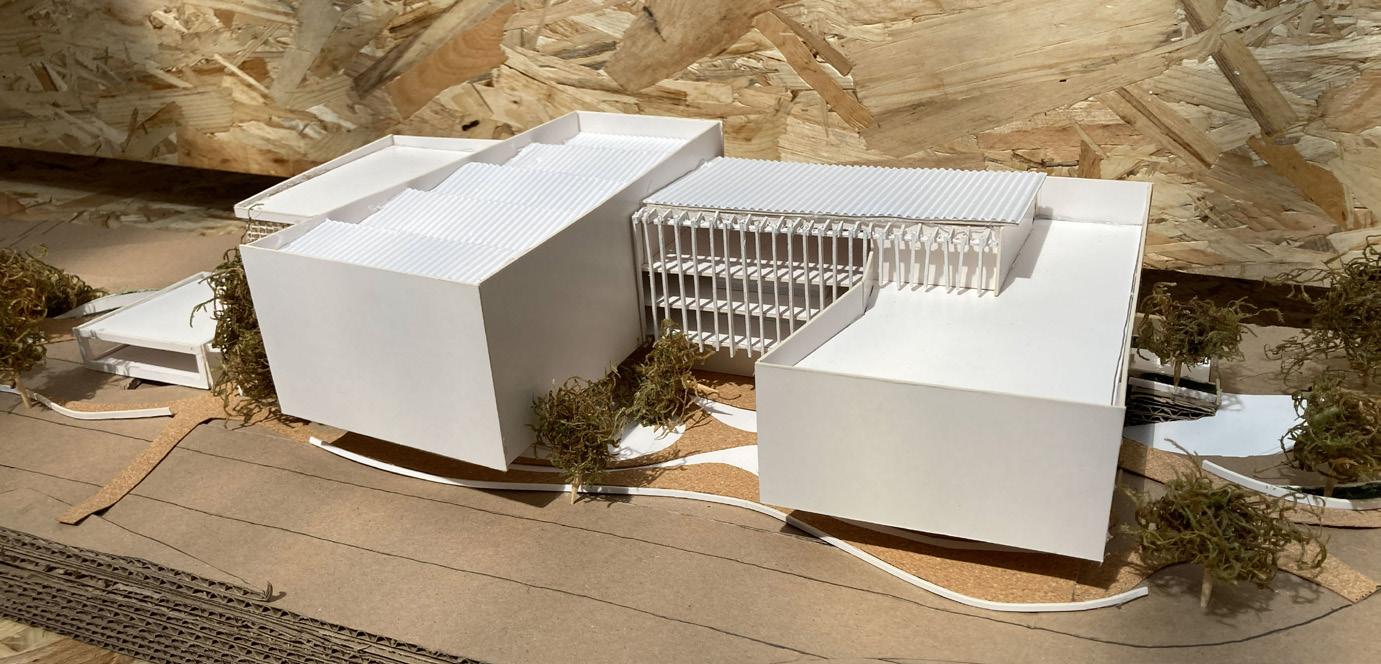
Student model: S. Riccardi
ARPL7002A
Simulated Office Practice
45 credits, semester 1
Prerequisite: none
Co-registration: ARPL7003A
Applying the principles of professional practice in the context of a functioning simulated office; forming and establishing business associations; office organisation and management; marketing; business plans and feasibility studies; design and working drawings; schedules and related contract documents; the tender process; community facilitation and training; appropriate communication techniques and computer applications; site meetings and instructions; and final accounts.
ARPL7003A
Architectural Design & Discourse
90 credits, full year
Prerequisite: none
Supervised, integrated research and design on an independently motivated topic approved by the Senate. This topic is required to include research, design and technical components.
ARPL7010A
Understanding Cities of the South 20 credits, quarter 1
Prerequisite: none
This course focuses on understanding the many forces that shape cities of the south, which includes development processes (legal, economic (formal and informal), governance issues, environmental issues, transport, land use, infrastructure, services etc.), power and politics (macro-economics, structural adjustment, questions of sovereignty, gender, poverty, inequality etc.) and the discourses of modernity, globalisation and post-colonialism.
ARPL7011A
Urban Design Theory & History
20 credits, quarter 2
Prerequisite: none
This course focuses on urban design paradigms and theories and urban morphologies including that of premodern, modern, colonial and post-colonial cities (focusing on cities of the south).
ARPL7030A
Municipal Planning
20 credits, semester 1
Prerequisite: none
This course focuses on municipal planning within the context of ‘developmental local governance’ and includes municipal powers, structure and functions, municipal finances, the international experience with municipal planning, the history and theory of integrated development planning, planning process, sectoral plans and integration of these plans, the planning and delivery of municipal infrastructure, project packaging, performance management and is linked to a project, and may include a service learning component.
ARPL7032A
Environmental Planning & Sustainable Development
20 credits, quarter 3
Prerequisite: none
This course has two components and covers various forms of environmental management and planning, including Environmental Impact Assessment (EIA), Integrated Environmental Management (IEM), and Strategic Environmental Assessment (SEA).
1) The first component introduces and provides a critical perspective on the concepts of sustainability and sustainable development and with the notion of the “sustainable city.”
2) The second component, environmental
planning introduces candidates to ecological fundamentals, environmental ethics, the idea of environmental risk and. Thereafter the course deals with the basics of environmental and resource economics
ARPL7034A
Specialisd Topics in Planning
20 credits, full year
Prerequisite: none
This course focuses on a range of theories relevant to understanding specialised topics in the planning field.
ARPL7040A
Research Methods
10 credits, semester 1
Prerequisite: none
The course familiarises candidates with research methods, articulation of research questions and identification of types of data (qualitative or quantitative), the different methods of data collection, with an additional emphasis on conducting surveys, approaches to analysing both qualitative and quantitative data. In particular candidates will gain an applied understanding of statistics in analysis of quantitative data through the use of statistical programs.
ARPL7041A
Architectural Professional Practice
36 credits, semester 1
Prerequisite: none
Managing medium to large-scale complex building projects, from inception to completion; including appropriate contracts; managing community based projects in a developmental context; the implications of information technology and globalisation on architectural practice; introduction to marketing; introduction to project management and sub-contracting; laws of arbitration and of sectional title and their application. The law in relation
to architectural practice: environment; conservation; heritage, general principles of contract, company law and partnership, tax law. Protection of property rights. Professional responsibilities.
ARPL7044A
Community Participation in Urban Governance
20 credits, semester 1
Prerequisite: none
The course critically engages with development and planning theories, ‘good governance’ discourses and political literature (from the local to the global levels), and question them in particular through the study of the practices of community participation and the various types of challenges these practices entail with a particular focus at empowering students to communicate their findings to different audiences, using different methodologies and in particular graphic devices.
ARPL7048A
Democratic Theory
20 credits, full year
Prerequisite: none
This course examines some key issues and developments in democratic theory . The first component covers basic questions about democracy: its definition, history, rival traditions, justification and key problems and the second component examines a range of democratic models, techniques and arenas. The historical theory and practice of democracy and proposals for extending and deepening democracy in the future is covered.
ARPL7049A
Politics, Governance & the City
20 credits, semester 2
Prerequisite: none
This course provides theoretical as well as practical responses to questions
on governance, policy implementation decisions, the role of business on urban settings and the power of residents associations in urban governance. In addition, theories of urban regimes, urban governance, participation, social movements and political mobilisation will be presented and their relevance for African cities debated through different case studies.
ARPL7050A
The Making of Urban South Africa
20 credits, semester 2
Prerequisite: none
The course explores through a series of questions, the social, political & economic history of urbanization in South Africa from the late 19th to the late 20th centuries, and considers the consequences of these processes on the contemporary state of cities and towns with a central focus is the Witwatersrand, but it also examines parallel and especially divergent processes in Cape Town, Durban, East London, Bloemfontein, Port Elizabeth and Pretoria.
ARPL7051A
State, Violence, Movements
20 credits, semester 2
Prerequisite: none
This course explores the relationship between the form of the state, violence, and collective forms of action (in particular social movements), as well as forms of resistance through the experience of South Africa, contextualising and relating this to changing patterns of collective action, resistance and violence globally. Theoretical questions and debates about power, resistance, forms of political engagement, struggle and organising, and strategies for effecting change (inter alia) will be engaged through relevant case studies.
ARPL7052A
Technologies & techniques for the Built Environment
10 credits, semester 1
Prerequisite: none
The course introduces procedural and analytical techniques used in planning and involves the practical application of appropriate technologies, including Geographic Information Systems (GIS), computer based mapping and computer packages for data analysis and the presentation of graphics.
ARPL7054A
Energy for Sustainable Cities
20 credits, block Q2-3
Prerequisite: none
The course covers five key topics:
1) Global and urban energy mix and challenges
2) Urban scale EE and RE strategies
3) Operational building-scale EE and RE strategies
4) Embodied energy strategies
5) Markets, policies, programmes, legislation and institutional structures.
ARPL7055A
Energy Efficiency & Renewable Energy for Buildings
20 credits, block Q3
Prerequisite: none
The course covers five key topics:
1) Motivation, brief and assessment tools for EE and RE for buildings
2) Integrated design concept for EE and RE for buildings
3) Design development in EE and RE for buildings
4) Procurement and post-occupation monitoring for EE and RE integrated buildings
5) EE and RE retrofit for existing buildings
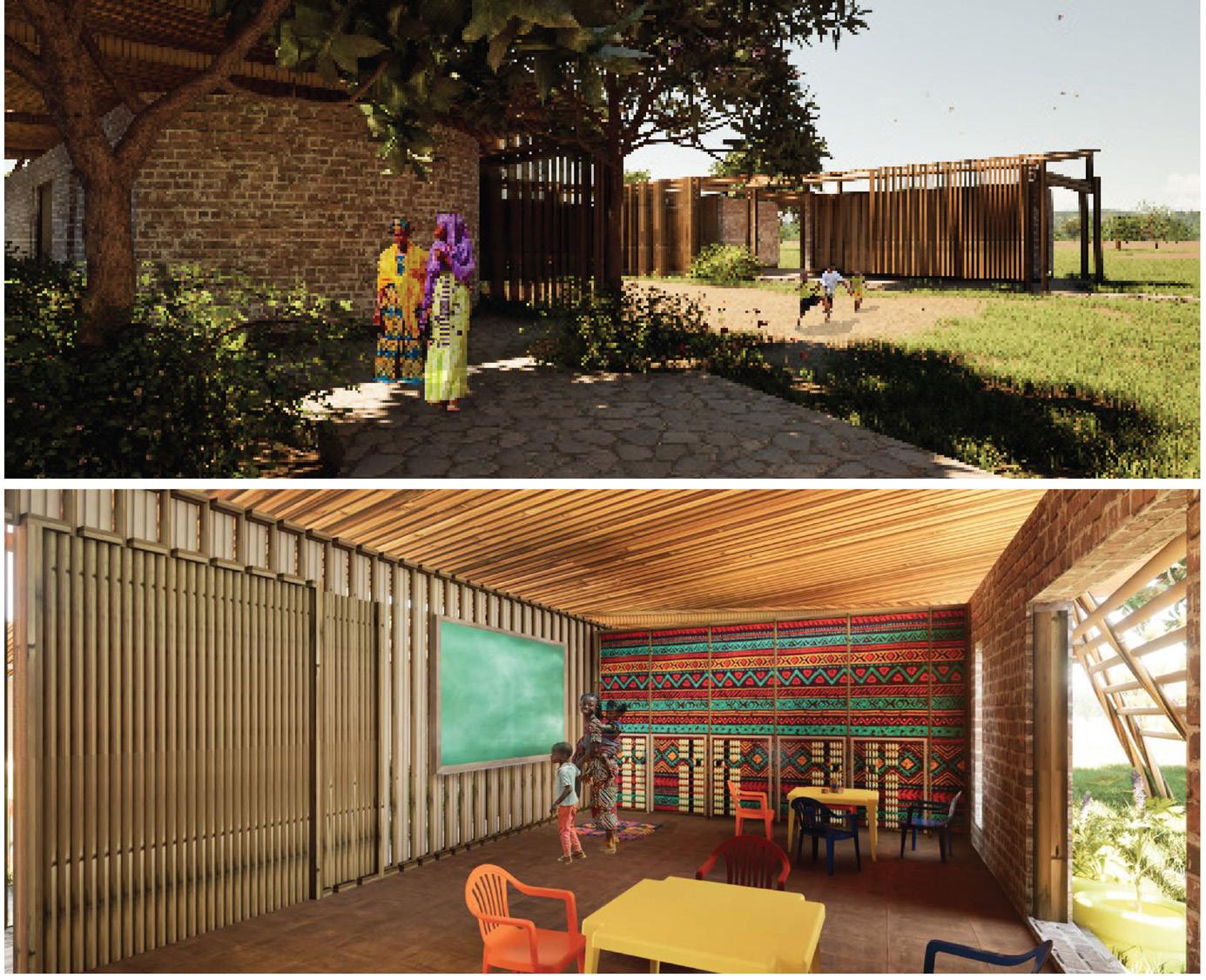
ARPL7057A
Urban Design Professional Practice
10 credits, quarter 3
Prerequisite: none
The course introduces candidates to tools, strategies and regulation in preparation of an urban design project: eg. town planning regulations, different forms of implementation (eg. public/private partnerships), procedural development, coding and conservation guidelines, and developmental rights. Candidates are exposed to project management and dispute resolution and issues related to running an urban design practice, such as forms of practice, concepts around professionalism, and professional bodies and ethics. Part of the course is also devoted to reviewing building contracts and dealing with issues of sub-contracting.
ARPL7063A
Governance & Municipal Planning
20 credits, Semester 1
Prerequisite: none
This course focuses on municipal planning within the context of ‘developmental local governance’ and covers the following topics: municipal powers; structure and functions; municipal budgeting systems; the international experience with municipal planning; South African forms of planning; planning process; sectoral plans and integration of these plans; the planning and delivery of municipal infrastructure; project packaging; and performance management.
Student work: K. Pretorius
ARPL7071A
Theory & Practice of Urban Management
20 credits, Semester 1
Prerequisite: none
This course introduces the field of urban management through four critical dimensions: managing the politics of policy, managing change in participatory ways, effecting relevant integration, and navigating between theory and practice. This course cuts them to four dimensions and engages critically with the urban economy. This interactive course explores its themes through case studies of urban management practice in selected cities across the world, with an emphasis on the Global South. Through a local field trip and engagement with urban managers, the course connects candidates with real life praxis in a reflective manner. It allows candidates to develop their own position on urban management and provides a critical frame for the remaining modules in the MUS (Urban Management) field.
ARPL7072A
In-Situ & Incremental Human Settlement Development
20 credits, begins 2024.
Prerequisite: none
This course enables candidates to engage constructively with unplanned and incremental housing and human settlement approaches from the perspective of physical, social and governance challenges. It does so through the analysis of local, regional and international examples. The course enables candidates to critically consider the role of temporary solutions against mainstream and alternative entry points to a trajectory of permanence for unplanned occupation and adaptation, whether of land or existing buildings. Candidates will gain a critical understanding of relevant infrastructure and incremental
construction processes, incremental finance mechanisms that support this, as well as applicable human rights, land regularisation and tenure approaches.
ARPL7073A
Theory & Practice of Housing & Human Settlements
20 credits, Quarter 2.
Prerequisite: none
This course enables candidates to engage critically with housing and human settlements policy in all its dimensions and components from historical, economic and theoretical angles with a local, regional and international perspective. It addresses diverse forms of housing from individual to collective. It assists candidates to understand and apply global agendas and the concepts these promote, such as inclusion and sustainability. The course covers housing finance regimes and the regulatory environment for state and private sector housing finance. Candidates will gain a core understanding of the entire policy cycle. This incorporates policy implementation, challenges of appropriate capacity building in human settlements institutions, policy analysis and evaluation as well as the long term management and maintenance of housing stock, for instance through lease agreements.
ARPL7074A
Theory, Politics & Governance of Extended Urbanism
20 credits, Semester 1
Prerequisite: none
This course supports candidates in actively building conceptual insights relevant to the diversity of urban contexts across the globe. It involves candidates in theoretical critique and concept development, focusing on (a) extended urbanisation, (b) city regions, and (c) the diverse, fragmented, and dispersed form of urban settlements on city edges. The
implications of this for urban governance is also covered. The course develops skills in linking empirical evidence and research to evolving concepts. It focuses on a particular context, examining the complex ways in which actors and organisations involved in urban development operate. Core skills in the ethics of urban development policy through pedagogy and practice are covered, which support the engaged and collaborative production of urban knowledge, policy, and interventions.
ARPL7075A
Urban Design & Discourse
60 credits, Full year
This course synthesizes the theoretical work, design work, and research methods learned in the coursework of the degree into an individual thesis project considered to be a research report. The complete project is therefore the culmination of the degree programme.
ARPL7077A
Transforming City Studio 20 credits, Quarter 3
Prerequisite: none
Using design to explore decolonial narratives and advance fundamental rights, this studio introduces students to processes of citizen engagement, assessments and analysis of utilitarian and socio-ecological infrastructural needs in under-resourced or environmentally challenging settlements in the African context. It asks students to develop strategic and physically-implementable interventions appropriate to city-making processes in the global South.
ARPL7078A
Accessible City Studio 20 credits, Quarter 2
Prerequisite: none
The course is a core design studio in the MUD programme intended to develop design thinking and skills. As the first of the required
studios, it deals with standard practices in the profession and applies them to a project of moderate complexity. An understanding of the actors, processes, and design approaches in the urban design profession is emphasised.
ARPL7079A
Global City Studio 20 credits, Quarter 4
Prerequisite: none
The course intends to expose students to urban design issues in contexts which differ from those typically found within South African cities, and prepares students for regional or global practice.
ARPL7080A
Sustainable City Studio 20 credits, Quarter 1
Prerequisite: none
The course intends to develop a systemsthinking approach to design by considering ecological and infrastructural considerations in urban environments, and the design consequences thereof. An interdisciplinary approach to urban design and related disciplines is emphasized.
BUQS3028A
Property Development for Planners 18 credits, semester 1
Prerequisite: none
This course includes urban and regional planning, urban economics & the property development industry. Topics include: an appreciation of the property development industry in relation to planning and urban development; its size & role in the economy; the structure of the development industry, its participants & their roles & responsibilities; financing of property developments; relationships between property investment, capital markets & property practices; urban economics & the user market; property development processes; market analysis & feasibility.
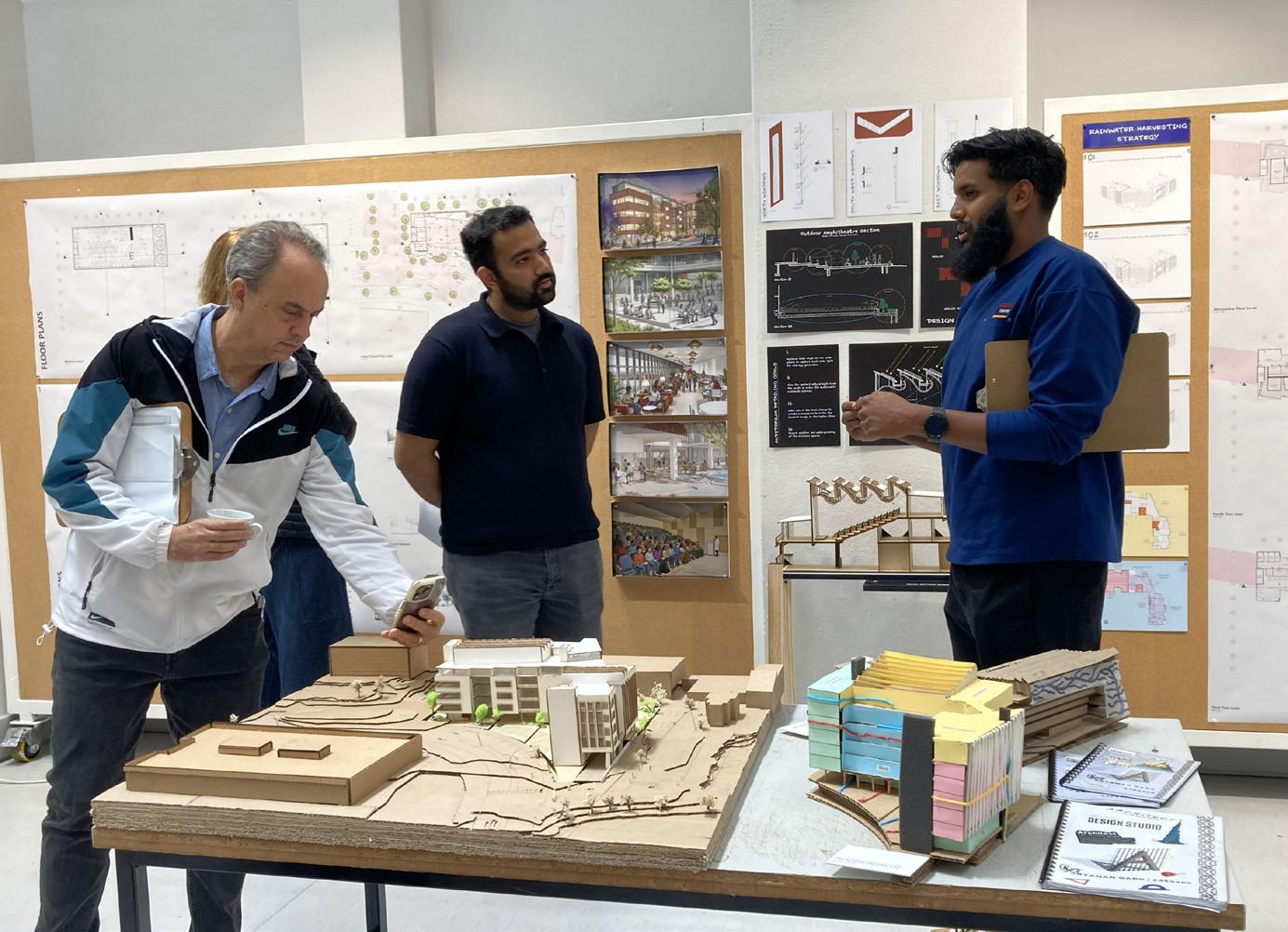
CIVN1005A
Intro to Civil Engineering Infrastructure
12 credits, semester 1
Prerequisite: none
This course provides students with an overview of civil engineering infrastructure and how it relates to the socio-economic conditions in South Africa and includes the following topics: an overview of civil engineering, development and infrastructure; the relationship between infrastructure provision and country income level and investment; the description and application of civil engineering infrastructure (e.g. water resources, water quality and supply, transportation and storm water) and associated issues (e.g. land use and problem soils); and an overview of existing South African guideline books for infrastructure provision.
CIVN2018A
Civil Engineering Theory I
7 credits, semester 2
Prerequisite: APPM1000A or APPM1027A
This course applies the principles of static equilibrium and structural analysis to determine forces and deflections in simple structural systems. Topics include: Loading and structural load paths, the diagramming of shear, moment, and axial forces, and the analysis of trusses.
CIVN3029A
Civil Engineering Theory II
7 credits, semester 1
Prerequisite: CIVN2018A
This course focuses on common building materials and their application in structural systems. It investigates material properties and behaviour, limit states design, and construction methods.
Student crit (A. Garg); photo: G. Gantner
CIVN3030A
Civil Engineering Theory III
7 credits, semester 2
Prerequisite: CIVN2018A
This course explores more complex, but common structural systems in buildings. It considers material properties, types of structural foundations and connections, and the structural design of beams, columns and slabs. It further provides an understanding of geotechnical information and its relevance for structural design is presented.
ECON1002A
Economic Concepts IA
18 credits, semester 1
Prerequisite: none
Microeconomics: The economic problem; demand and supply; market equilibrium; elasticity of demand and supply; markets in action; utility and demand; production and costs; market structures and factor markets.
ECON1003A
Economic Concepts IB
18 credits, semester 2
Prerequisite: none
The courses develop and extend knowledge of concepts covered in Economic Concepts IA. It also develops the theoretical basis for entry into Economic Studies II. Course content includes: consumer theory and price theory; market structure; international economics; Keynesian aggregate demand and aggregate supply theory; fiscal and monetary policy; theories of migration; human capital; labour market discrimination; growth and development; and trade integration.
GEOG 1003A
Geography for Planners
24 credits, full year
Prerequisite: none
The course will cover geomorphology; the geology and archaeology of Greater Johannesburg; rural development; Southern African climate. Related practical techniques will also be covered; in addition to map reading and basic research techniques. Practicals will apply to the material covered in the theoretical aspects of the course; and in specific cases these will be linked to studio work being undertaken in the BSc Urban and Regional first year programme.
POLS7036A
The State in Africa
30 credits, semester 2
Prerequisite: none
This course debates the genesis and the development of the African state. It has been viewed as the main vehicle of modernisation, as the instrument of a new ruling class, as underdeveloped, overdeveloped, kleptocratic, patriarchal, predatory, collapsed and ineffectual. This course also explores the tensions that exist between those views of the state in Africa that perceive it to be inherently authoritarian and moreover disengaged from society and those arguments which support the adoption by African countries of liberal democratic constitutions derived from advanced industrial societies. The theoretical explorations are routed in the investigation of particular national case studies which are to be decided upon.
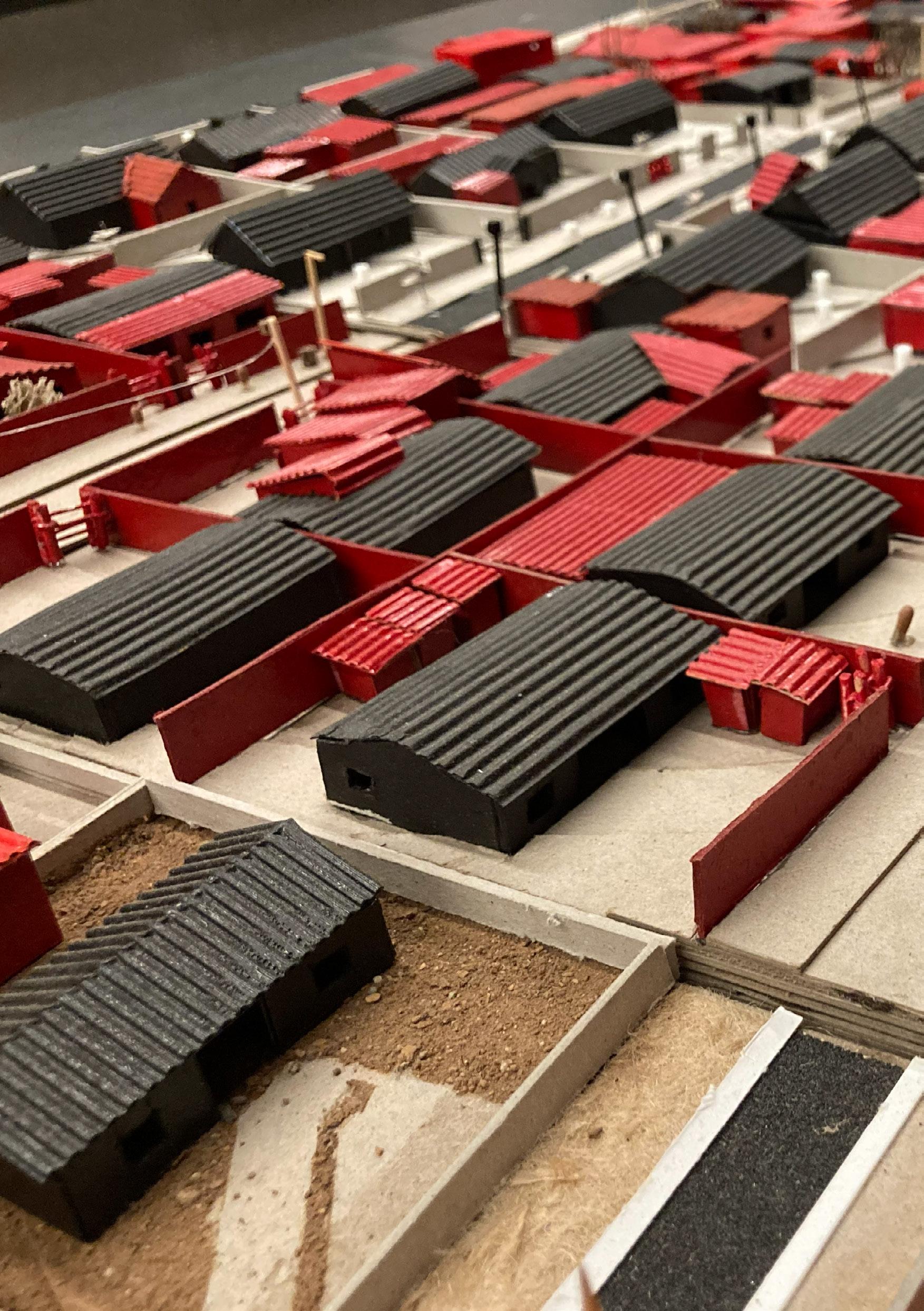
Student work: First year group model
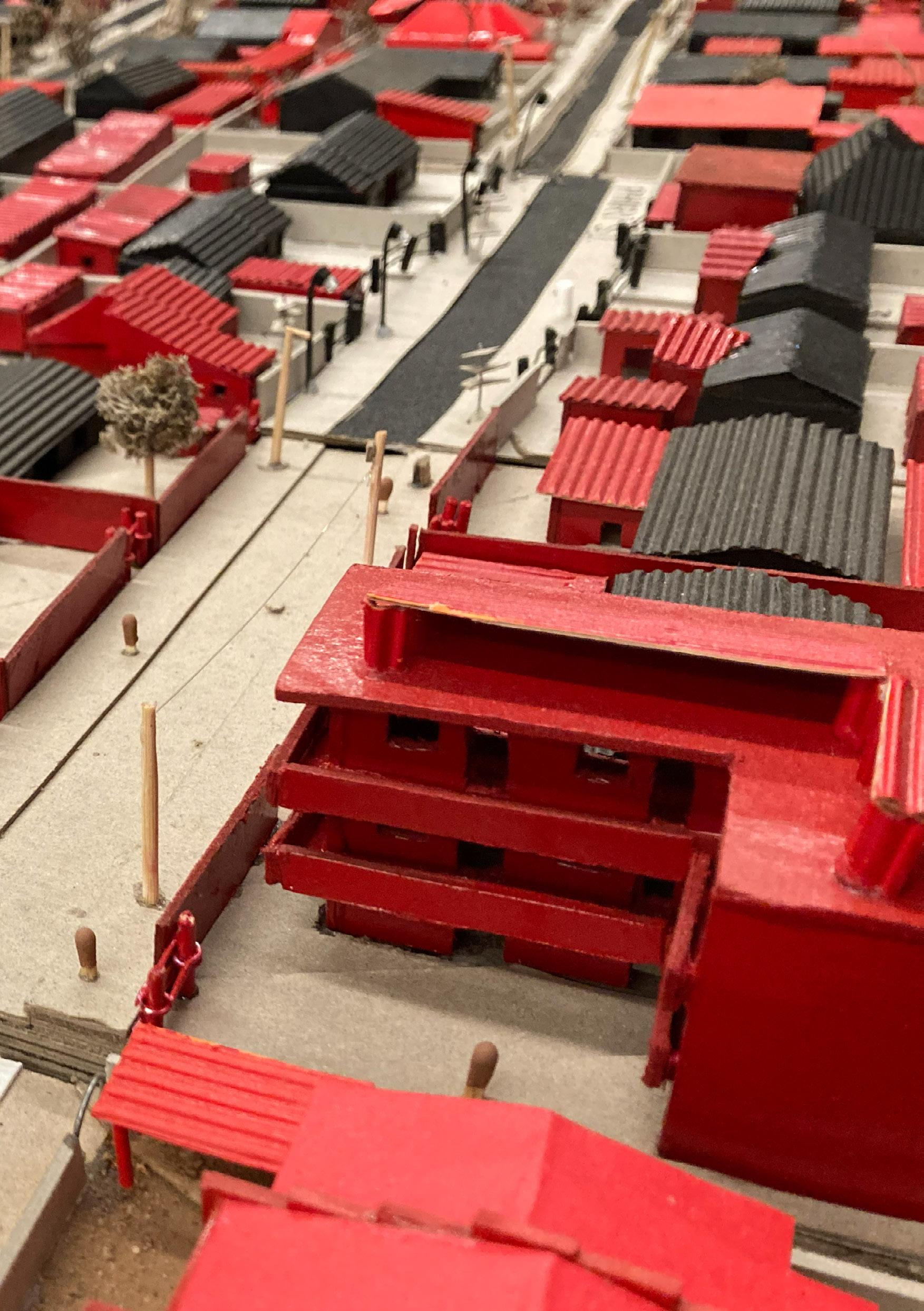
Undergraduate Degrees 2
BAS Degree
Curriculum
Overview
The Bachelor of Architectural Studies (BAS) programme is a three-year, full-time course of study offering a gateway to a potentially diverse field of professional career paths, both within the architectural discipline or peripheral to it.
The BAS programme is structured to produce graduates who can participate across a broad field of professions in both the larger design and construction industries. Due to the integration of courses and emphasis on coordinated application of skills, part-time studies are not available, although in exceptional circumstances it may be possible to spread some years of study over more than one year, with appropriate planning and approval by the degree convenor.
A coordinated suite of Architectural Design and Theory and Theory and Practice of Construction courses form the core of the degree programme. Additional courses in Histories and Theories of Architecture, visual representation techniques, structural considerations in building, and entrepreneurial and management skills make up
supporting courses which are expected to be applied in the design work. While all courses include lectures and seminars, the bulk of the learning takes place in a design studio environment, in which students undertake design projects and around which the entire pedagogy revolves. In the studios, the BAS programme offers the unique opportunity of one-on-one consultation with lecturers twice per week as the primary teaching and learning methods. The coursework is supported in the School by exhibits of professional and artistic work, as well as lectures by practising architects both nationally and internationally.
The qualification provides the basis for further study in architecture and related disciplines. It is the typical minimum entry requirement for the second professionally qualifying degree in architecture, the Bachelor of Architectural Studies with Honours, which, in turn, prepares the learner for a Master of Architecture. The BAS also qualifies graduates for the Higher Diploma in Development Planning or for Honours degrees in related disciplines
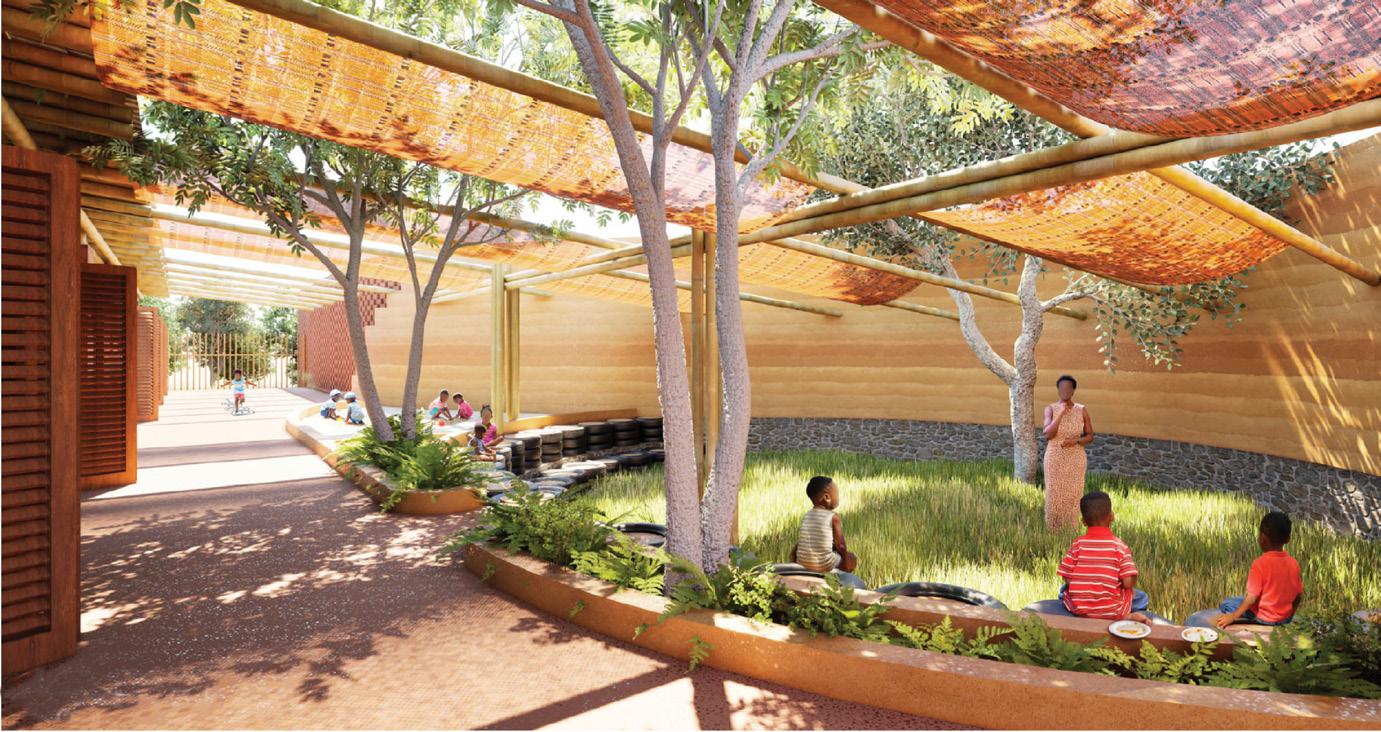
Student work: I. Panagiotides
Strategic Objectives
The BAS is set up as the first academic course towards students becoming professionally registered architects, a qualification which also requires the BAS Hons and MArch (Prof) degrees. However, while this is a core focus, it is recognised that the nature of the architectural profession is in a state of perpetual flux and is likely to evolve and change even more rapidly in the near future. This therefore requires a broad base of skillsets which can be easily transferred to what might currently be seen as only marginally related to architecture.
Because the BAS degree is both a stepping stone to higher study and, potentially, a terminal degree for those registering as an Architectural Technologist with SACAP, much emphasis is placed on developing core knowledge around construction. However, the School’s approach to construction is not simply one of technical know-how. Rather, it is one in which a holistic view of design problemsolving is taken, integrating broad concepts of systems thinking, social and cultural appropriateness, and the balance between emerging technologies and an economy of means. While these skills are centred around design and construction within the programme, as foundational skills, they are potentially crosscutting to myriad disciplines and areas of specialisation which graduates may pursue in the future.
As the profession faces new challenges in the form of AI, the School’s approach to teaching remains one of strengthening critical design thinking, working with methodologies which encourage students to think beyond form and meet the ecological, social and cultural challenges ahead.
Pedagogy & Transformation
In first year, students are introduced to basic principles of architecture and introduced to new content and approaches. Some of these are inspired by indigenous knowledge systems, Afro-futurism, and narrative/mythology.
In first-year design, the a model of teaching sees the learning experience as a ritual aimed at reconciling the student with values aligned with an ecological consciousness or systems approach. This notion of setting out values makes students appreciate the multiplicity of their own personal views and allows them to create avenues to form a collective vision. The studio also focuses on narrative as a teaching tool: students are often required to ‘create a world’ through a narrative (that they collectively produce in some cases) and contrast these alternative worlds with our current reality.
Students are encouraged to draw from their personal experiences, which in many cases aligns with the content being taught.
In other years of the BAS, although not as explicitly done as in the first-year courses, the curriculum also includes new and alternative knowledge forms. Students are asked to question the appropriateness of modern design, and indigenous knowledges are presented as counterbalances to industrial thinking. Examples of extraordinary design ingenuity by indigenous peoples, rarely documented as architecturally significant by predominantly western sources, are explored.
Design projects each highlight specific factors to be considered which are relevant to local contexts. First, appropriate climatic responses are explored through design, familiarising students with African climatic contexts, how vernacular buildings
have adapted to them, and how this may differ from European and North American criteria, despite much of the literature about sustainability coming from those parts of the world. This is continued in the second-year design studios, in which climate, cultural, and social influences are introduced as subjects of study in design processes.
In the final year, students are introduced to the democratisation of space, exploring relationships between buildings and public space, how buildings can activate public
space and how buildings can contribute to the city. Students interrogate the colonial project and reflect on what it means to design in a South African context today.
Architecture can reproduce inequality. To question this, the content addresses marginalised content and transnational innovation from a rights perspective. Projects are located respectively on works by women architects; global modernism; the model township; and transnational media.
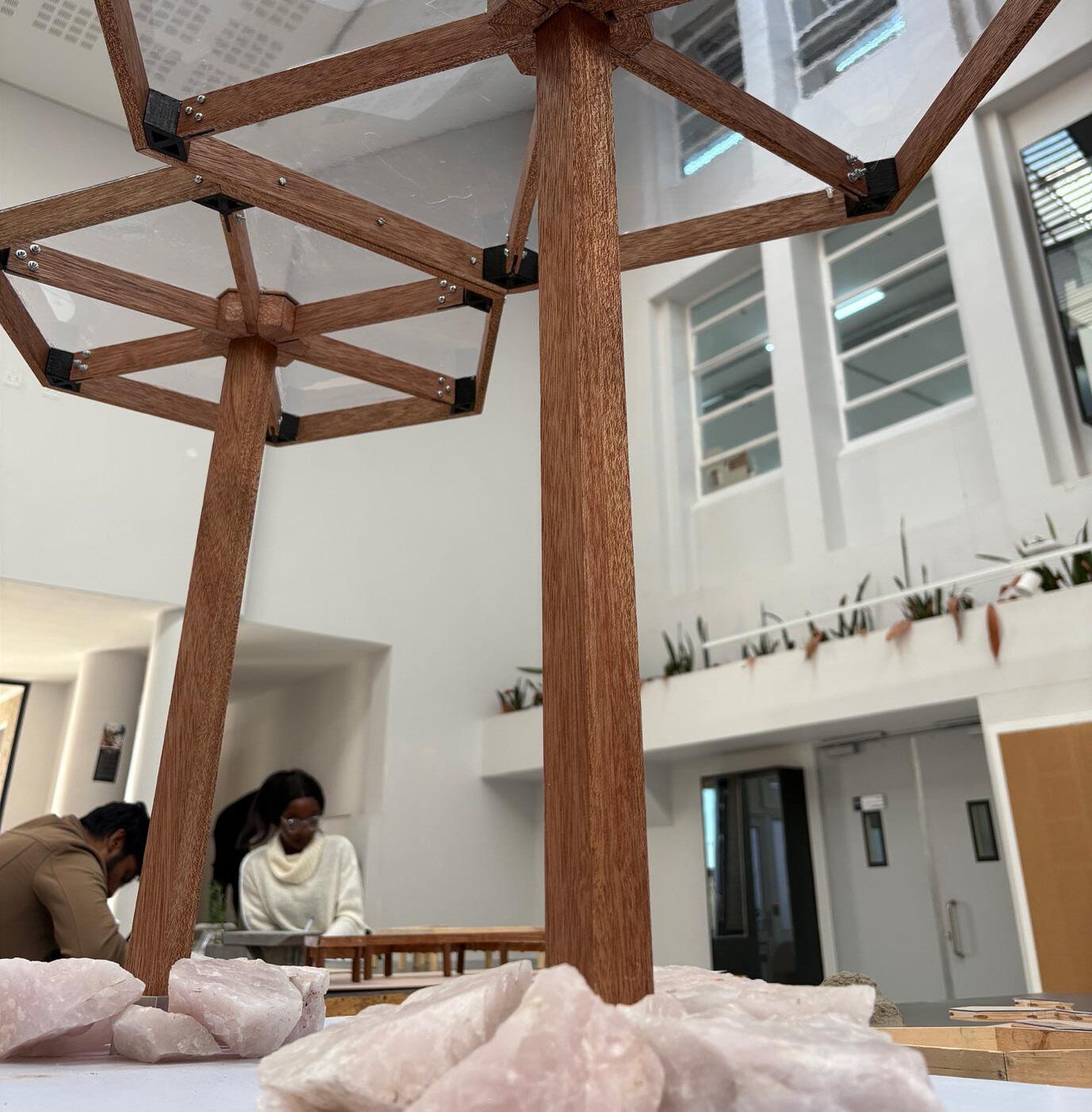
2nd year BAS work; photo: B Stone Johnson
Prerequisites & Requirements
Entry criteria for the degree can be found on the Wits website:
https://www.wits.ac.za/coursefinder/undergraduate/ebe/ architectural-studies/
All three years of design studios in the BAS have a sub-minimum requirement for the final integrated oral assessment (portfolio review). This means that if a student fails the integrated oral assessment, he/she fails the course, regardless of that arithmetic total for the final mark. This strategy was put into place for a few reasons. First, not every design project covers all objectives of the course, so it is theoretically possible to pass each project or assignment without demonstrating a mastery of all the course objectives. Second, and more prominently,
BAS Prerequisites
Lower-year prerequisite course(s)
ARPL1000A Architectural Design & Theory I, & ARPL1001A Theory & Practice of Construction I
ARPL1000A Architectural Design & Theory I, & ARPL1001A Theory & Practice of Construction I
ARPL1030A Histories & Theories of Architecture I, & ARPL1031A History of Settlement
ARPL1028A Design Representation I
ARPL1028A Design Representation I, &
ARPL1029A Digital Applications in Architecture II
ARPL2000A Architectural Design & Theory II, & ARPL2002A Theory & Practice of Construction II
ARPL2012A Histories & Theories of Architecture II
ARPL2000A Architectural Design & Theory II, & ARPL2002A Theory & Practice of Construction II
it protects against students moving through the programme based on the strength of less complex semester 1 work and/ or group work, without mastering the outcomes expected in more complex and/ or solo projects in semester 2.
Individual course prerequisites are listed below.
Degree Outcomes
• The qualifying learner is able to present material using effective and appropriate visual techniques in two and three dimensions.
• The qualifying learner will have a grounding in certain fields of knowledge, and will develop critical, analytical thinking to appreciate, research and interpret existing knowledge.
Higher-year course
ARPL2000A Architectural Design & Theory II
ARPL2002A Theory & Practice of Construction II
ARPL2012A Histories & Theories of Architecture II
ARPL2019A Design Representation II
ARPL2020A Digital Applications in Architecture II
ARPL3005A Architectural Design & Theory III
ARPL3021A Histories & Theories of Architecture III
ARPL3031A Theory & Practice of Construction III
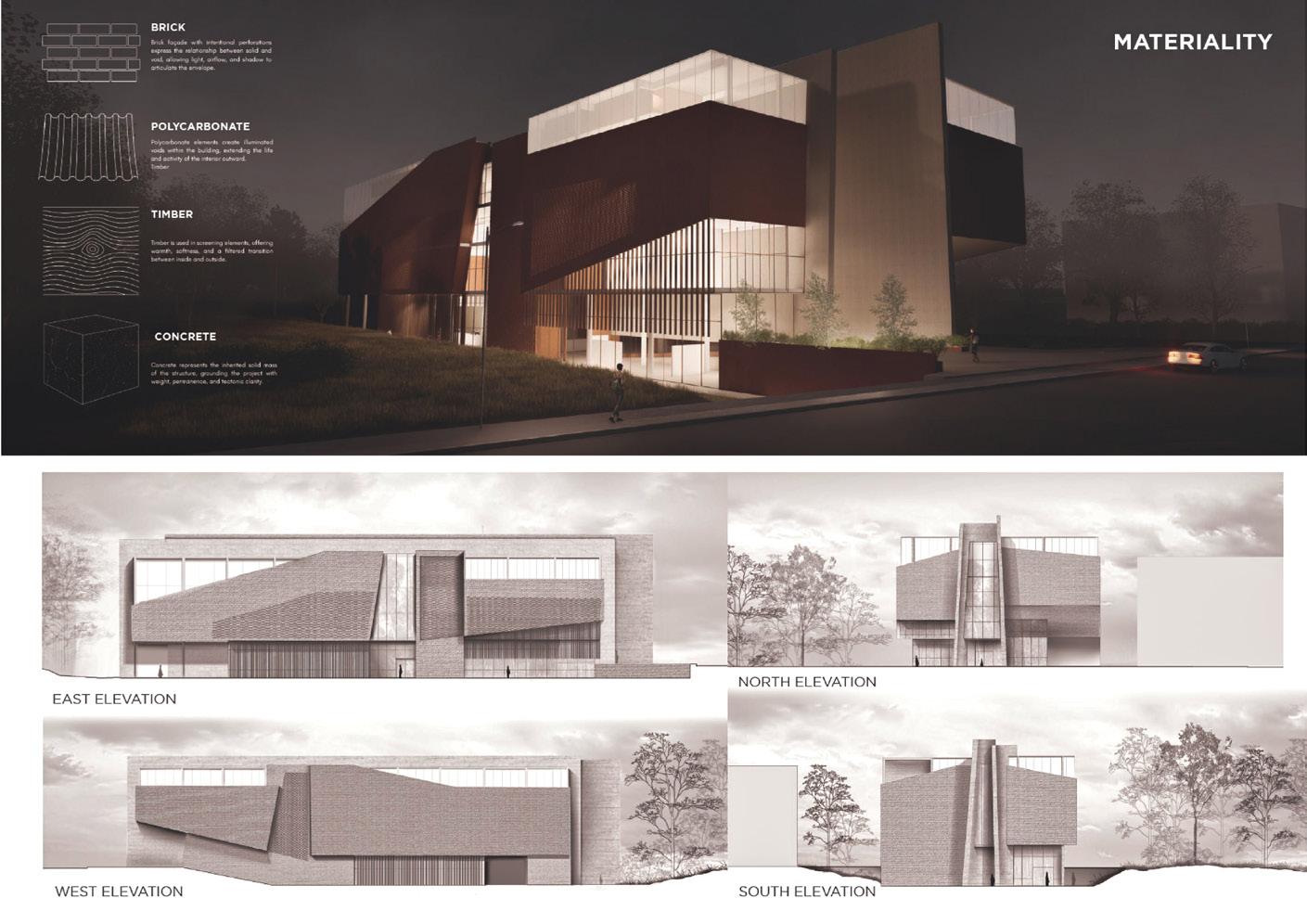
• The qualifying learner shows design and problem-solving competencies
• The qualifying learner is able to communicate appropriately and effectively
• The qualifying learner has the capacity for independent thought and practice.
• The qualifying learner has experience working in groups with peers and he/she has worked directly with communities in a consultative role.
• The qualifying learner is familiar with current technological knowledge in the field of study and its related disciplines.
• The qualifying learner has developed an understanding of the wider social and natural systems that impact on the field of study, and has developed an appreciation for cultural and aesthetic diversity.
• The qualifying learner reflects and acts on a wide range of learning strategies, both existing and innovative. The learner is encouraged to reflect on his/her professional and ethical relationship with communities and individuals.
• The qualifying learner is exposed to career opportunities both within an entrepreneurial and academic context.
• The qualifying learner exhibits the capacity for critical, independent thought.
Student project: I. Panagiotides
BSc URP Degree
Curriculum
Overview
The Bachelor of Science in Urban and Regional Planning BSc (URP) programme is a three-year, full-time course of study. It is a gateway to the BSc URP Honours degree, which is the professional degree accredited by the South African Council for Planners (SACPLAN). Part-time studies are not available although in exceptional circumstances it may be possible to spread some years of study over more than one year, with appropriate planning and approval by the degree convenor.
The BSc URP degree offers its graduates an array of potential opportunities in the professional world, within planning and outside of it. The undergraduate programme is designed to give students a strong theoretical understanding of the discipline, together with design, spatial and strategic planning skills, and the associated practical skills.
In a context of increased technological change, rapid urbanisation, social transformation and a changing natural environment, planning is about managing spatial change and creating places with meaning and quality. Therefore, in each year of study, students engage in lectures, seminars and studios dealing with core planning subjects that range from the design of urban spaces and principles of place-making in a culturally diverse context, to policies for the planning and management of entire spatial regions.
Strategic Objectives
Urban planning, also called town, city and regional planning and development planning, is a dynamic profession that works to create more sustainable, equitable, healthy, convenient and attractive
places for present and future generations.
The BSc URP Undergraduate degree is the first step for students wishing to become professional planners. However, given the ever-changing nature of the world we live, the degree also provides students with the skills to be able to work in a broader field. While planners often work in government and private planning or multi-disciplinary consultancies, they can also be employed by large companies, including those with property portfolios and by NGOs and research organisations. Through our programme students also engage with other fields, including geography, economics, property studies, sociology, applied mathematics and statistics, and civil engineering.
The approach of the school is to provide students with a holistic tool-set that can be further sharpened by demand or by a student’s personal interests, in sectors related to housing, governance, policy development, geography, property, urban design, transport, or the environment. Within the degree, these fields are used to build a strong foundation for future planners who need to think across these fields and sectors, and individually, these skills allow students to cut across a myriad of disciplines and areas of specialization within the built environment and beyond.
Pedagogy & Transformation
The BSc URP aims to produce skilled professionals who are able to operate intelligently and ethically within complex and changing environments. The focus is therefore on developing critical thinking and problem-solving abilities, and on the close, interactive relationship between theory and practice. The importance of
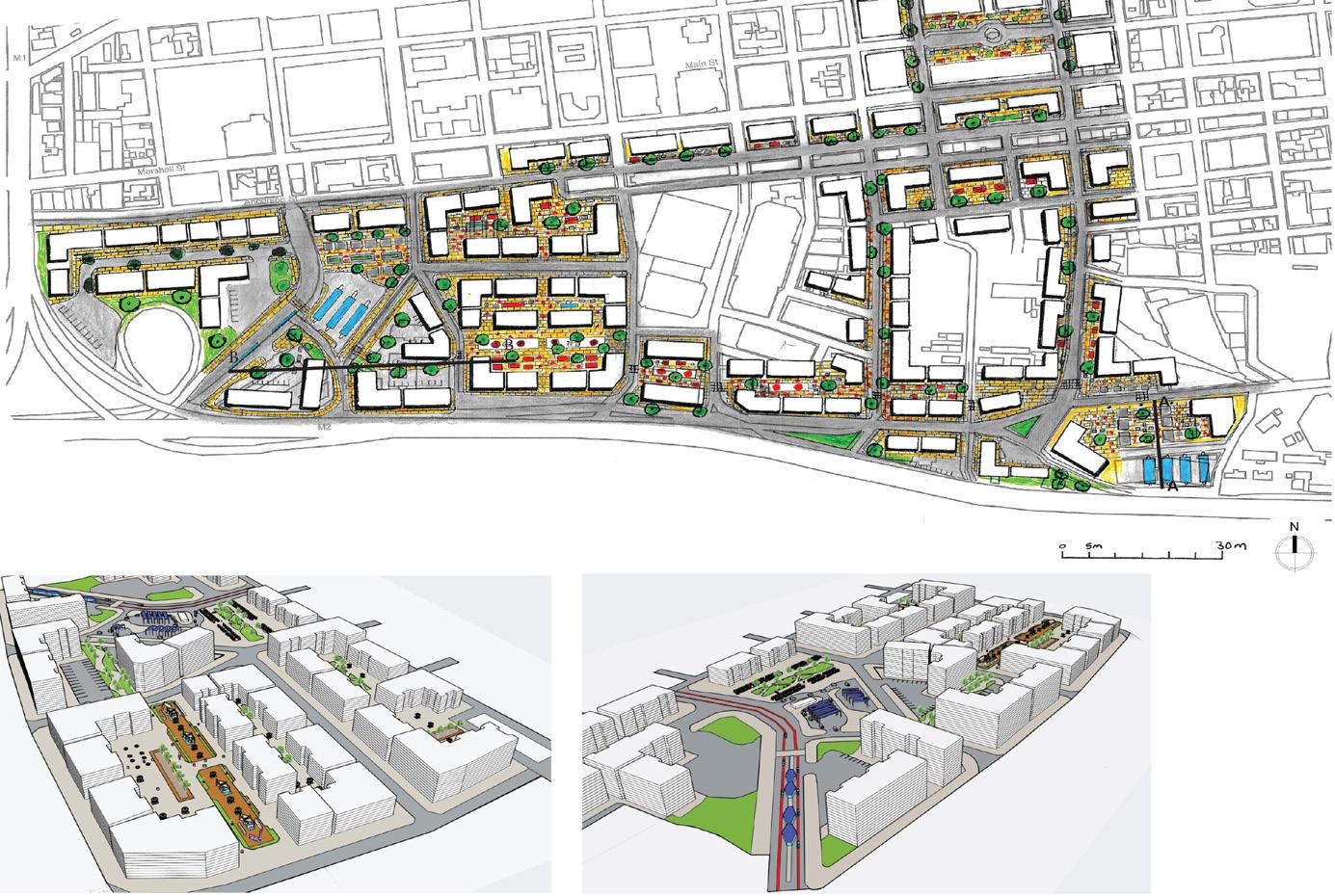
theory, as the intellectual foundation of all planning activity, is stressed in the teaching courses for all years of study, but we also stress the link between theory and practice, and several courses develop this theory-practice link in topic-based courses. The degree aims to develop reflexive practitioners, who can think critically about their work, but who go beyond analysis and critical thinking to constructive and creative responses to problems. The teaching approach includes a considerable emphasis on problem-based learning. We thus aim to provide a balance between critical capacity, substantive understanding, practical skills, and creative approaches.
Planning is an evolving discipline and set of practices that is both contextual and informed by global ideas and processes. The BSc URP therefore has a strong emphasis on the contextual and on the global. Hence it pays attention to what planning means within the South African context, and to understanding the nature
of the local context, but locates this within international planning thought and ideas, and introduces students to comparative planning systems in both the developed North and developing South. The degree explores and encourage students to pursue planning practices and theories that are sensitive and appropriate to the rich complexity of contemporary urban, rural and regional contexts within South Africa and elsewhere. In particular, the degree strives to provide quality education that is appropriate to the needs of a rapidly urbanising country, and a continent facing enormous developmental challenges.
The BSc URP includes elements that respond to some of the big contemporary trends shaping urban and regional development and planning – climate change, social and spatial inequality, and technology change. There is a particularly strong emphasis on social equity: the courses encourage students to consider how planning can contribute to social,
Student work: N.B. Mkhize
political, economic and spatial justice. We see planning as going beyond the production of plans and thus include courses which consider governance, the politics of urban development, and the processes needed to enable implementation, including the importance of working across disciplines, sectors, spheres of government, and with stakeholders and community groupings outside of government.
The spatial focus of planning is seen as important in the BSc URP, thus many courses emphasise this dimension, and there are courses on urban design, spatial concepts and land use management, amongst others. The degree also recognises the importance of the integrative nature of planning, and the relationship between planning and governance, and this is reflected in the curriculum. The Programme is also acutely conscious of the problems and possibilities attaching to the future development of the country. There is thus a growing emphasis in both theory and practice on development and developmental processes.
The first year of the BSc URP provides a foundation in which students do courses on local design and history of settlement. The two design courses are run in the form of two semester long studios. In addition, students do courses in sociology, geography and maths. Students are intensively supported in first year through tutoring in critical think, writing, drawing, design, and software applications.
The second year of the BSc URP focuses on ‘town planning’, on physical planning at a local and suburb scale, with two large semester long studio courses. The year includes courses focused on local physical planning and concepts related to it, including on land management;
environmental design; environmental planning; engineering infrastructure; planning for housing, services and transport. Students also take a course on applied mathematics and statistics, and on CAD and GIS, developing their IT related skills. In addition, students do courses on economics and on the history and theory of planning. Support to students in terms of critical thinking and writing skills also continues.
In the third year of study, courses focus on the developmental planning, with a focus on policy, the regional scale of planning and regional and local economic development, integrated development planning, comparative approaches to planning, urban economics, and reinforcement of graphic skills in planning. In addition, there is an opportunity for specialisation in urban design, housing or urban politics.
Prerequisites & Requirements
Entry criteria for the degree can be found on the Wits website: https://www.wits.ac.za/coursefinder/undergraduate/ebe/ urban-and-regional-planning/
The BSc URP has a substantial number of prerequisites, as well as some co-requisites, which makes many early-year courses critically important for a normal progression through the degree programme. The integrated co-requisite courses come in the third year of study only, after a student has built a compendium of relevant skills and begins to implement them in design and integrated planning projects.
Individual course prerequisites and co-requisites are listed below.
BSc URP Prerequisites
Lower-year prerequisite course(s)
APPM1023A Mathematical Techniques for Planners
ARPL1032A History of Settlement
ECON1002A Economic Concepts 1A, & ECON1003A Economic Concepts 1B
ARPL2006A Planning for Housing, Services Infrastructure & Transport
ARPL2006A Planning for Housing, Services Infrastructure & Transport
ARPL1025A 2 and 3-Dimensional CAD & GIS, & ARPL2013A Intro to Land Management, & ARPL2015A Contemporary Design & Environmental Issues in South Africa
ARPL2012A
Histories & Theories of Architecture II
ARPL2006A Planning for Housing, Services Infrastructure & Transport
BSc URP Co-requisites
Concurrent course 1
ARPL3033A
Local Planning & Urban Design
ARPL3034A - Integrated Development Planning
Higher-year course
ARPL2006A Planning for Housing, Services Infrastructure & Transport
ARPL2015A Contemporary Design & Environmental Issues in South Africa
ARPL3027A
Regional Planning & Local Economic Development
ARPL3028A Development Policy & Processes in South Africa
ARPL3032A
The Politics of Planning & Housing
ARPL3033A
Local Planning & Urban Design
ARPL3021A
Histories & Theories of Architecture III
ARPL3034A
Integrated Development Planning
Concurrent course 2
ARPL3030A
Graphic & Spatial Communication
ARPL3027A - Regional Planning & Local Economic Development, &
ARPL3028A - Development Policy & Processes in South Africa
Degree Outcomes
The qualifying learner is able to:
• Demonstrate a knowledge and understanding of fundamental concepts and principles, and recognise that scientific knowledge and understanding are changeable.
• Access, evaluate and synthesise scientific information, and generate scientific information.
• Demonstrate key scientific reasoning skills.
• Communicate scientific understanding in writing, orally and using visual,
symbolic and/or other forms of representation.
• Solve scientific problems.
• Demonstrate effective Information and Communication Technology (ICT) skills.
• Work effectively as a member of a team or group in scientific projects or investigations.
• Apply scientific knowledge and ways of thinking to societal issues, taking into account ethical and cultural considerations.
• Manage and organise their learning activities responsibly.
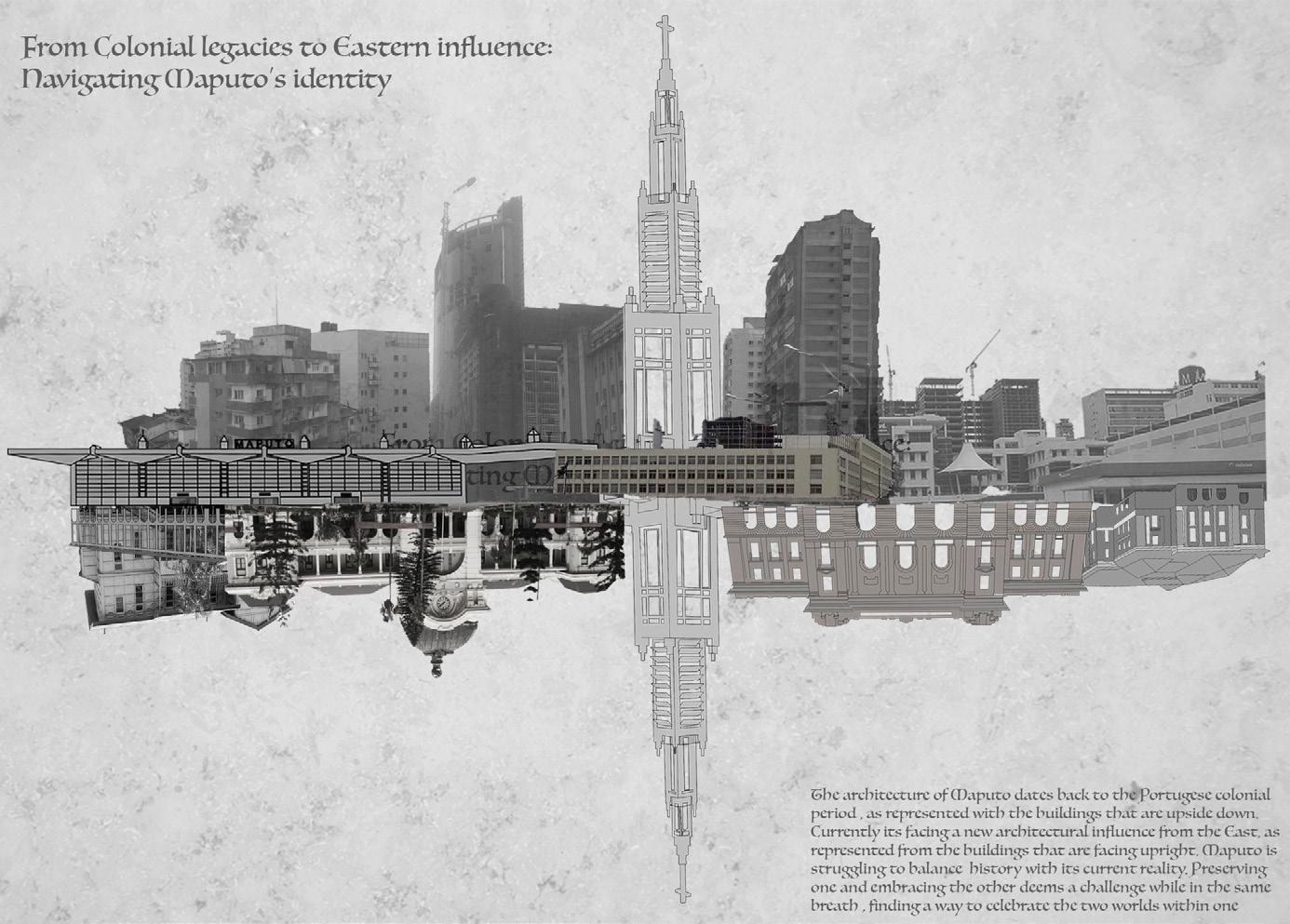
Student work: L. Nkumishe
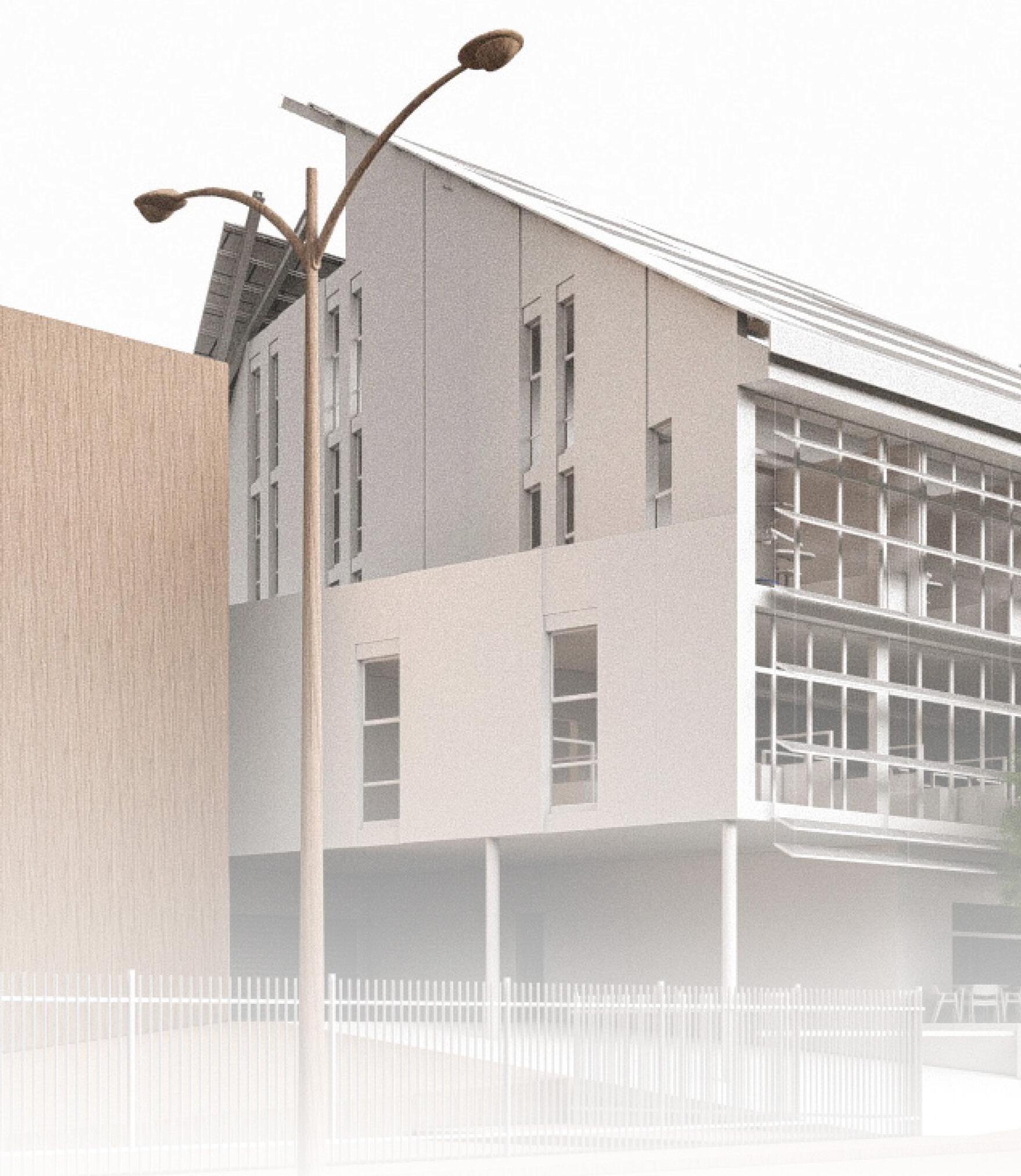
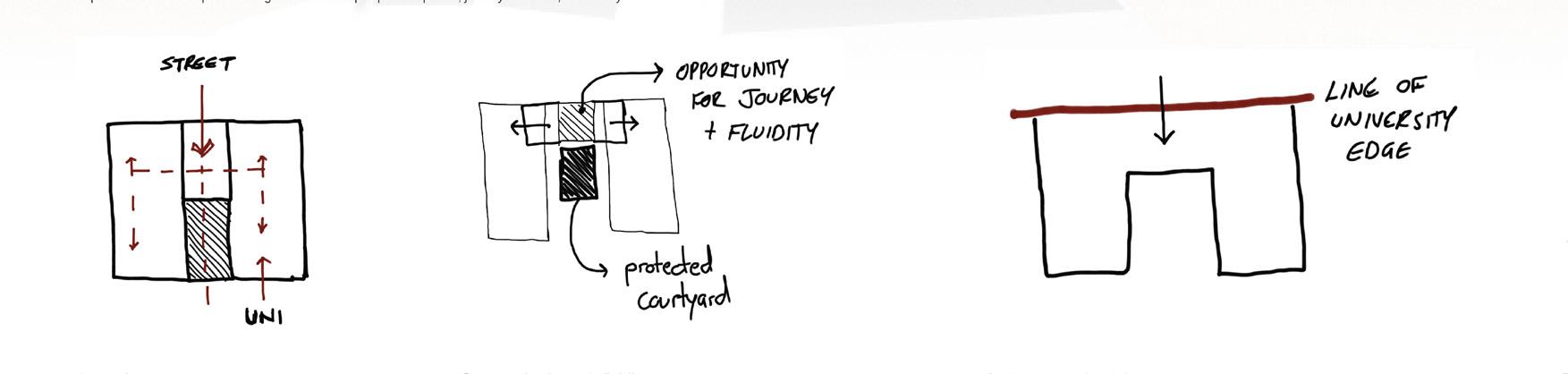
Student project: T. Kruger
Honours & PG Diplomas
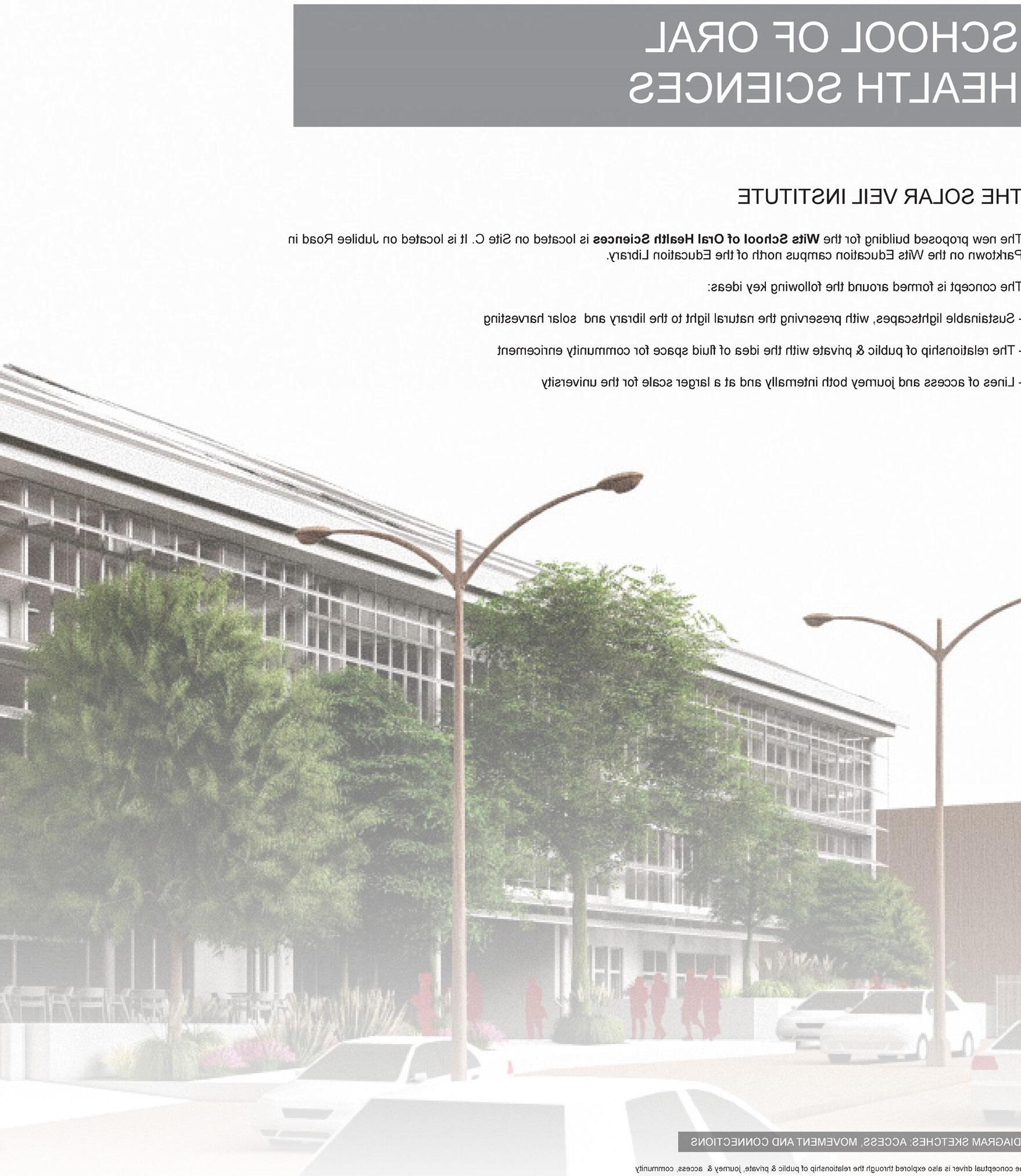
3
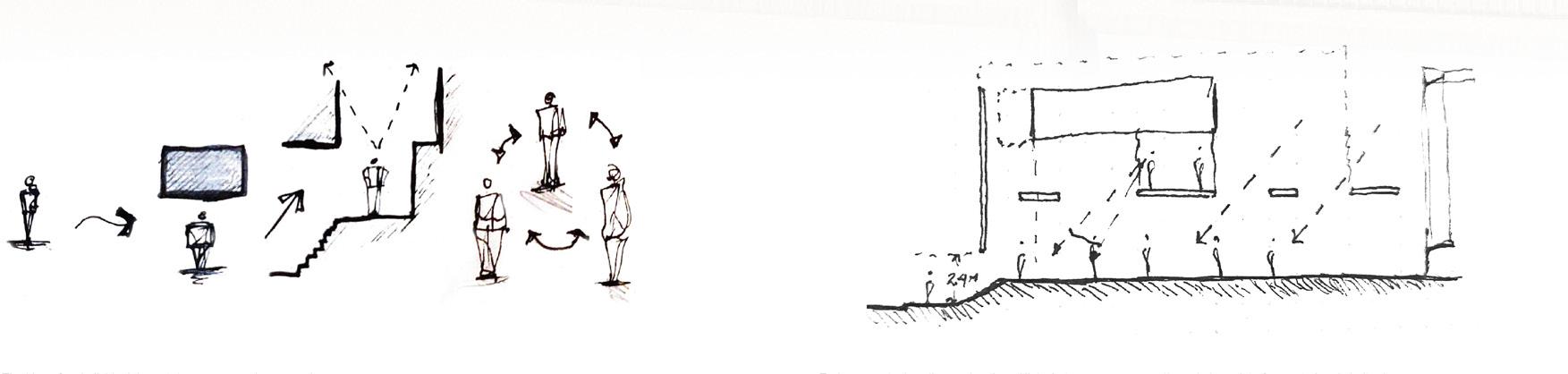
BAS Hons Degree
Curriculum
BAS Hons programme code: FHA00
Course Code & Title
ARPL4000A Advanced Design Studio 45 Sem 1 N. Essa
ARPL4004A Advanced History of Architecture & Urbanism 18 Sem 1 B. Hart
ARPL4005A Research Project 36 Sem 1 K. Doermann
ARPL4001A Design Studio 45 Sem 2 G. Gantner
ARPL4002A Contemporary Architectural Theory 18 Sem 2 P. Theron
ARPL4003A Advanced Theory & Practice of Construction 18 Sem 2 E. Brooks
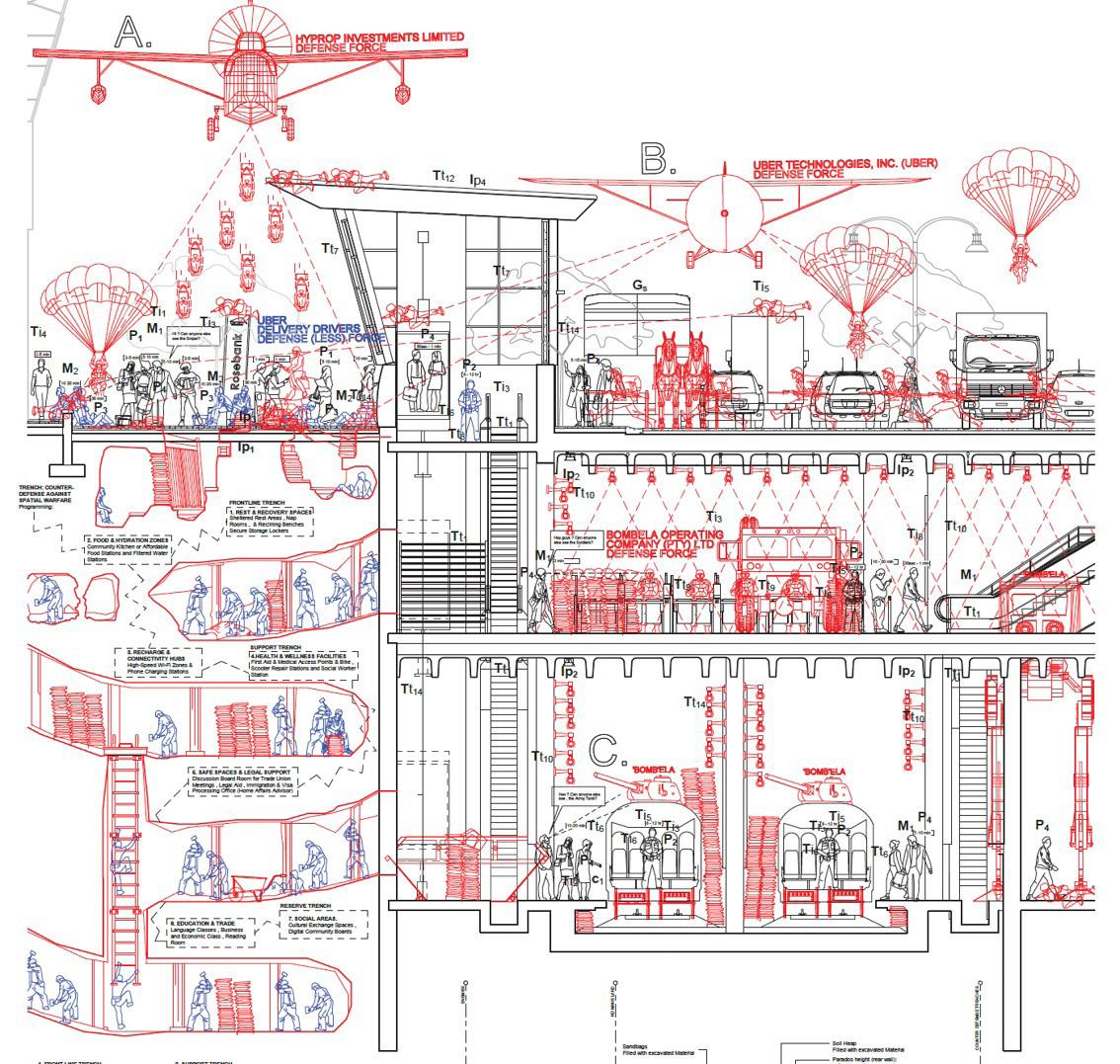
Student work: L. Siganagana
Overview
The Bachelor of Architectural Studies Honours (BAS Hons) is the first year of a two-year PG programme, followed by the MArch (Prof), which is the professional degree leading to candidate status as a Professional Architect.
It is an integrated suite of six courses run over two semesters, developing a portfolio of speculative spatial propositions and critical arguments in context. The course content relates research-based design to history and theory and understands the development of complex buildings as a challenge to consider construction as an extended design task. Here technical skills require an advanced level of understanding structure, systems and materiality that is necessary for innovative and relevant design proposals and their performance within urban complexity.
The strength of the degree lies in the range of approaches to which students are exposed, with influences and expertise from a large range of architectural practices and academics. These range from the fields of design, research, and experimental practice to conservation, urban design and sustainability. Students relook at how we share changing spaces as architects and urban designers in the contemporary African city and beyond. The programme seeks students that are problem-solving, rigorous, imaginative, critical, and experimental. Graphic communication skills are crucial, work is on a fluid spectrum of analogue and digital production.
The BAS Hons is intended as a full-time course of study. Part-time studies may be arranged upon special request, breaking the programme over two years. However, these must be approved in advanced by the degree convenor
Strategic Objectives
The suite of six courses support students in developing the theoretical, technical and design skills that will be required in their independent master’s thesis. Each design studio is paired with a substantial other core course: Advanced Design works in tandem with the Research Project in semester one, and the design of a complex building runs in parallel with the Advanced Theory & Practice of Construction in semester 2. In this way, students are exposed to the integrated thinking required to develop complex architectural projects.
The semester one studio runs as an elective, with students able to choose one of several topics offered by academic staff that relates to their research interests. Since a year (or more) of professional practice experience is an entry requirement to the BAS Hons degree, the placement of this design/research nexus in semester one is a deliberate attempt to bring students back into a more exploratory and intellectually engaging space.
Students learn about research methods in the Research Project course, using them to undertake research related to their design studio projects. The efforts culminate in both a report, presenting the research, and a more typical architectural design presentation in the studio.
In the second semester, the integration shifts to the technical side of architecture, with the design studio and construction course working in tandem to produce a complex design and set of working drawings. Between the two semesters, students will have essentially covered the expected skill set required of them in the higher MArch (Prof) degree to which this qualification is an entry requirement, albeit with considerably more guidance from academic staff.

Thematically, the work is strongly focused on the contemporary African context, within a critical, global framing of environmental, socio cultural, economic issues. The history course in semester one and the theory course in semester 2 complement the understanding of design as a discourse, and the development of an argument. The strength of the degree is in the range of approaches that students are exposed to, through access to a highly experienced and qualified set of lecturers, with expertise ranging through design, research, experimental practice, conservation, urban design and sustainable construction. Through this wide range of encounters students are able to make informed choices about their supervisors and topics for master’s work in the following year.
Pedagogy & Transformation
In the six BAS Hons courses, students are further sensitised to the various social, cultural, economic and environmental complexities in South Africa, with a strong focus on understanding embedded histories. In the advanced design studio, students and lecturers explore the role of spatial practice in the process of urban transformation, and change. These parameters are unpacked through prescribed readings and guest lectures both locally and internationally. The intention is to tie reflections and interventions on the social, economic, political, and cultural dimensions of the built environment into integral parts of multi-layered
Student project: S. Haffejee
arguments that link intellectual propositions to urban issues, shared infrastructure, public space, architectural typologies and design details.
The Research Project as a course is closely linked to the design investigation and aims to build an understanding of the potentials and methods of design research. Architecture is considered as a knowledge source that is informed by, and informs, diverse ways of understanding space, use, technology and programme. It is also informed by theoretical positions that might range from status quo positions (architecture as an instrument of capital, state or other interests) to critical ones (architecture as an arena for protest or compensatory actions). The research project complements and supports the advanced design studio by offering the students a possibility to focus on seminal
aspects of their design concept, deepen their understanding on those focus areas and have the opportunity to apply and transfer their research findings to the design process.
The understanding of architecture in context changes scales in the second design course, where a complex building with public programme intersects with the design of construction. This is taking the design development into more complex structural systems and addresses environmental considerations from a technical angle that does expand.
In history, there is an emphasis from the beginning that history is a subjective understanding and critique of the past and that multiple points of view and understandings are critical. The lecture content looks at the full social and economic spectrum of Johannesburg’s spatial and architectural
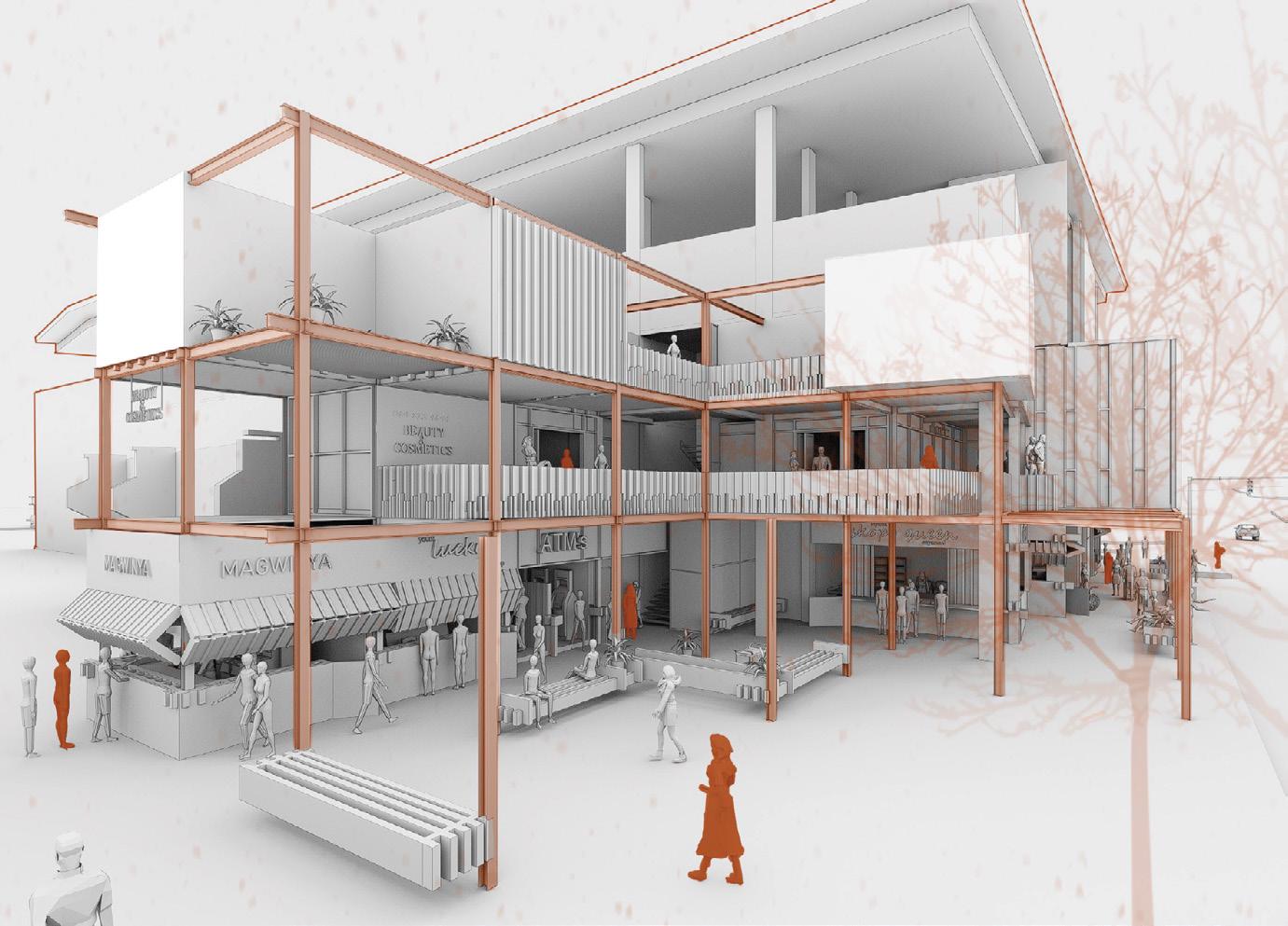
Student project: T. Malematsa
history, looking at issues of race, segregation, power, etc. as continuous themes. Seminars and readings often deal with issues such as the representation of South African history and develop through installations the students prepare in groups into discussions around public monuments and memorials, and the movements which are organised around and about them.
The theory course aims to make theories and ideas in contemporary architecture beyond the Western canon accessible to students through readings and discussion. The course eventually guides the students’ development of critical thinking, reading and writing practice. Albeit a standalone course with clearly framed outputs, it prepares the review of literature and theoretical development of an argument in the subsequent thesis year.
Prerequisites & Requirements
Entry criteria for the degree can be found on the Wits website:
https://www.wits.ac.za/course-finder/ postgraduate/ebe/bashons/
Aside from the entry criteria, there are no individual course prerequisites; however, co-registration of ARPL4000A and ARPL4005A in semester one, and ARPL4001A and ARPL4003A in semester two is expected. Students should consult with the degree convenor before planning any irregular course of study which does not abide by those pairings.
The two design studios (ARPL4000A and ARPL4001A) normally carry a sub-minimum requirement for the final integrated oral assessments; a student must pass the final assessment in order to pass the course.
Degree Outcomes
• The qualifying learner has developed an understanding of a broad range of fields of knowledge appropriate to the discipline of architecture, and critical analytical thinking to appreciate, research, interpret, refine and modify existing knowledge.
• The qualifying learner has a working knowledge of and skills in the methodology/s and practice of architectural research.
• The qualifying learner shows general design and problem solving competencies and is able to apply them in a number of specialist applications.
• The qualifying learner is familiar with current technological knowledge in the field of study and related disciplines.
• The qualifying learner is able to communicate appropriately and effectively.
• The learner is able to present material using effective and appropriate visual techniques in 2 & 3 dimensions.
• The qualifying learner demonstrates self-directed, independent thought and practice.
• The qualifying learner has experience in group work with peers and is able to worked directly with communities in a consultative role.
• The qualifying learner has developed an understanding of the wider social and natural systems which impact on the field of study and has developed an appreciation for cultural and aesthetic diversity.
• The qualifying learner reflects and acts upon a wide range of learning strategies, both existing and innovative.
BSc Hons URP Degree
Curriculum
BSc Hons URP
ARPL4014A Advanced Planning Thought
ARPL4027A Integrated Planning Project
ARPL4028A Research Design for Planners
ARPL4029A Research Report
ARPL4030A Planning Law
ARPL4031A Professional Practice and Ethics
Q1 M.F. Sihlongonyane
Sem 1 M. Suleman
Sem 1 R. Ballard
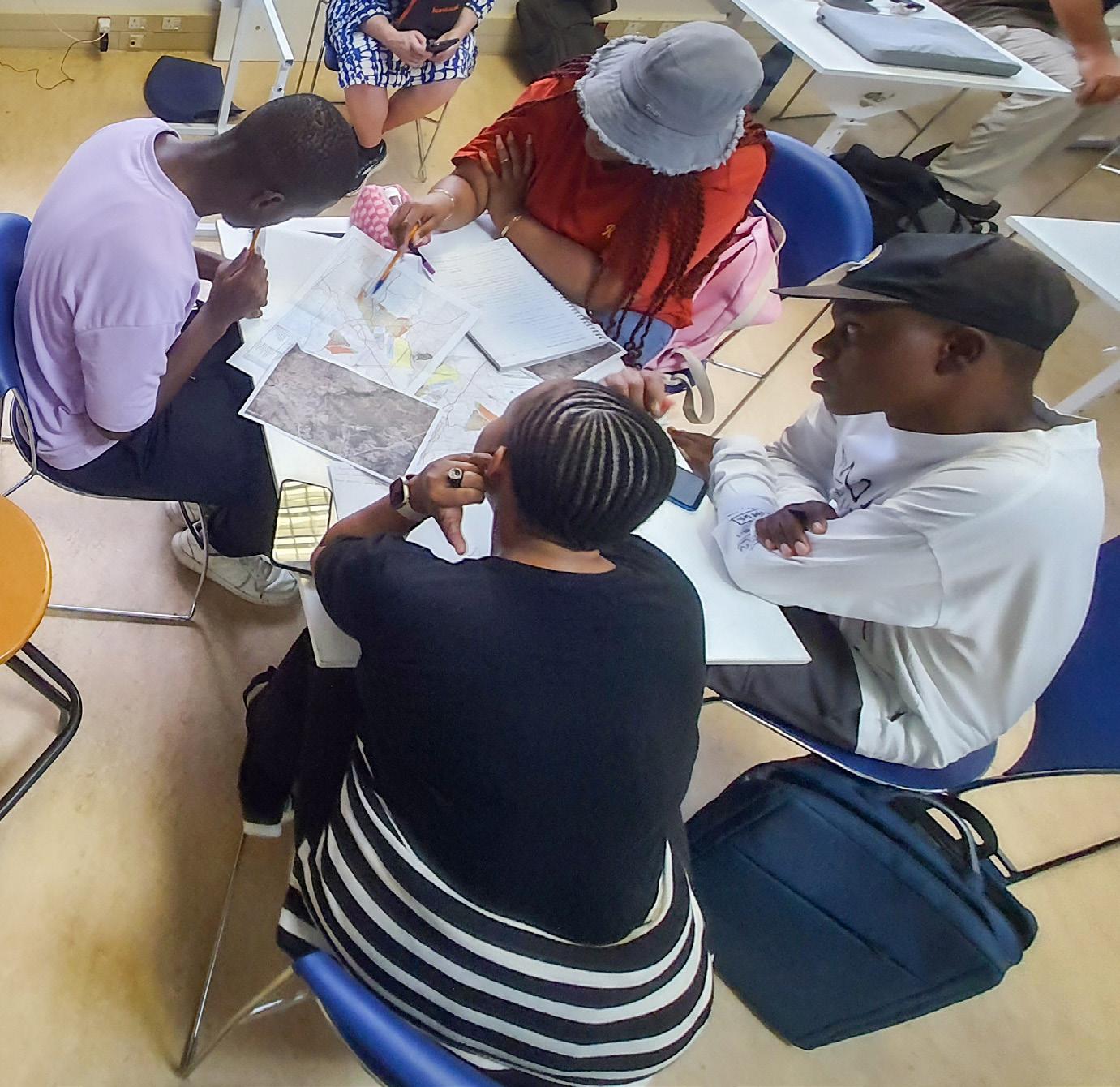
Planning studio; photo: M. Suleman
Overview
The Bachelor of Science with Honours in Urban and Regional Planning (BSc Hons URP) is the second of two degrees leading to a professional qualification in planning. It is accredited by the South African Council for Planners (SACPLAN), and graduates can register as professional planners after two years of work experience.
It is a year-long full-time degree after the 3 year BSc (URP), and can provide entry to the MSc (Development Planning), Masters in Urban Studies, and the MSc (URP) by research.
The degree is designed to equip students with the necessary critical, practical, research and professional skills for a career in planning
Strategic Objectives
The Honours programme aims to deepen and enhance students’ conceptual and applied skills in planning, and to build their professional and research capacities. It builds on and extends learning from the undergraduate BSc URP. The degree comprises six courses plus a major research report. In the first semester, students undertake coursework, including on research methods, where they develop a research proposal which provides the basis for the research report in the second semester.
An integrated planning project, allowing students to apply their cumulative understanding of theory and practice, forms a major part of the coursework. This studio course involves the preparation of a spatial framework, but also focuses on specific spatial issues and brings planning down to a precinct level, including a strong African cities component.
The degree includes courses of direct significance to the profession: professional practice and ethics, planning law, and advanced planning theory. The planning theory course as well develops students’ ability to reflect critically on the nature and role of planning, its varied orientations and philosophies, and their implications for practice.
The second semester of the course is devoted to a substantial research project, which develops candidates’ capacity to research an issue independently, to synthesise knowledge in an area, undertake field research, analyse findings, and write up an extended report.
Pedagogy & Transformation
The BSc Hons URP, as the final year of a professional degree, aims to produce graduates with a set of abilities, skills, ethics, attributes and orientations. These are embodied in the design of the Honours courses, which build on the outcomes of the undergraduate degree:
Critical thinkers who integrate questioning, analysis, synthesis, interpretation, inference, and inductive and deductive reasoning in the promotion of sustainable and contextually appropriate action for planning.
Culturally sensitive graduates who demonstrate knowledge, understanding, and skill in providing knowledge to diverse individuals, communities and populations.
Effective communicators who demonstrate proficient professional communication with interdisciplinary team members to build relationships that promotes person- and relationship-centred decisions for planning.
Ethical decision makers who demonstrate moral, disciplined and legal conduct in practice with the ability to work with a wide variety of people.
Contextual innovators who are responsive to issues in context using the appropriate theoretical and technical knowledge to foster planning that promotes mutual respect, dignity and choice.
Adept and adaptable graduates who can research, negotiate, use technology, write and report/present professionally with sensitivity to different viewpoints.
Courses combine or selectively use a variety of educational methods as appropriate, including lectures, seminars, workshops, group-work, presentations, case studies, field trips, creative project work, fieldwork, essays, reports, podcasts and more. Professionals from practice are brought in to reflect on their experience. Questions of ethics, integrity and the ethical commitments of planning are central to courses on professional practice, and on research methods.
The planning theory course focuses on content that traverses significant schools of thought concerning planning as a set of practices with a professional orientation. It covers theoretical and philosophical traditions of advocacy, participatory politics, justice, integration. It pays attention to debates in academic and popular discourse around decoloniality, major changes in the working environment [the rise of artificial intelligence, for instance], the dimensions of transformation and re-imagining the city as well as scrutiny of planning profession in a post-pandemic era.
A major field trip to another city, often outside of South Africa, exposes students to the reality of African urban contexts and the challenges facing planning,
including in contexts with different histories of colonisation and post-independence trajectories. In the project related to this trip, students are challenged to formulate integrative, strategic and context– appropriate urban development proposals responsive to local institutional environments and capacities. The groundwork for this is laid through an in-class exploration of pre-colonial, colonial and post-colonial urban genealogies, debates on the notion of what constitutes an ‘African City’, and key sectoral lenses on contemporary cities such as urban governance, economies, land and infrastructure, environmental issues and urban mobility. Throughout these discussions, issues of inclusion, inequality and power are threaded.
The research design and research report courses enable students to develop their own research topic and to carry out the appropriate research. Students usually undertake research of significance for spatial transformation, considering issues such as informality, inclusion, township economies, inner city dynamics, development on traditional land, public space; the effects of plans and policies aimed at transforming cities, towns and rural areas, and spaces within them; questions of integrated governance, and more. Research reports are examined individually by a range of examiners from academia and practice, bringing to bear a varied insights and experiences. Students are encouraged to think critically about their research findings and its implications through oral examination processes.
Prerequisites & Requirements
The degree admits only students with a BSc (Urban and Regional Planning) from Wits as it is seen as a part of a four-year suite of degrees towards professional accreditation. Applicants should have a minimum of 60% average in their 3rd year BSc (URP). Students with lower marks are encouraged to gain at least a year of work experience and are required to submit a written assignment which will be assessed for admission into the degree. Further information can be found here: https://www.wits.ac.za/coursefinder/postgraduate/ebe/ bschons-urban-and-regional-planning-/
Aside from the admission, there are no prerequisites within the course of study.
Degree Outcomes
The qualifying learner :
• Has an advanced integrative understanding of development and planning issues important to the South African context.
• Has knowledge of how to manage complexity and uncertainty within a changing temporal, socio-economic, political and environmental context as a professional planner, across scales ranging from the local to the national.
• Is able to cope with and plan within South Africa’s diverse social and cultural dynamics.
• The qualifying learner has an advanced understanding of planning as part of wider social, political, cultural, administrative, economic and natural systems, and their operating and financial characteristics.
• Can research, analyse and interpret information in different ways and can effectively communicate its significance to different types of audience.
• Has been prepared both for the next stage of his/her career, whether it be professional, entrepreneurial or in some other field, and to meet the demands of continuing professional and life-long development.
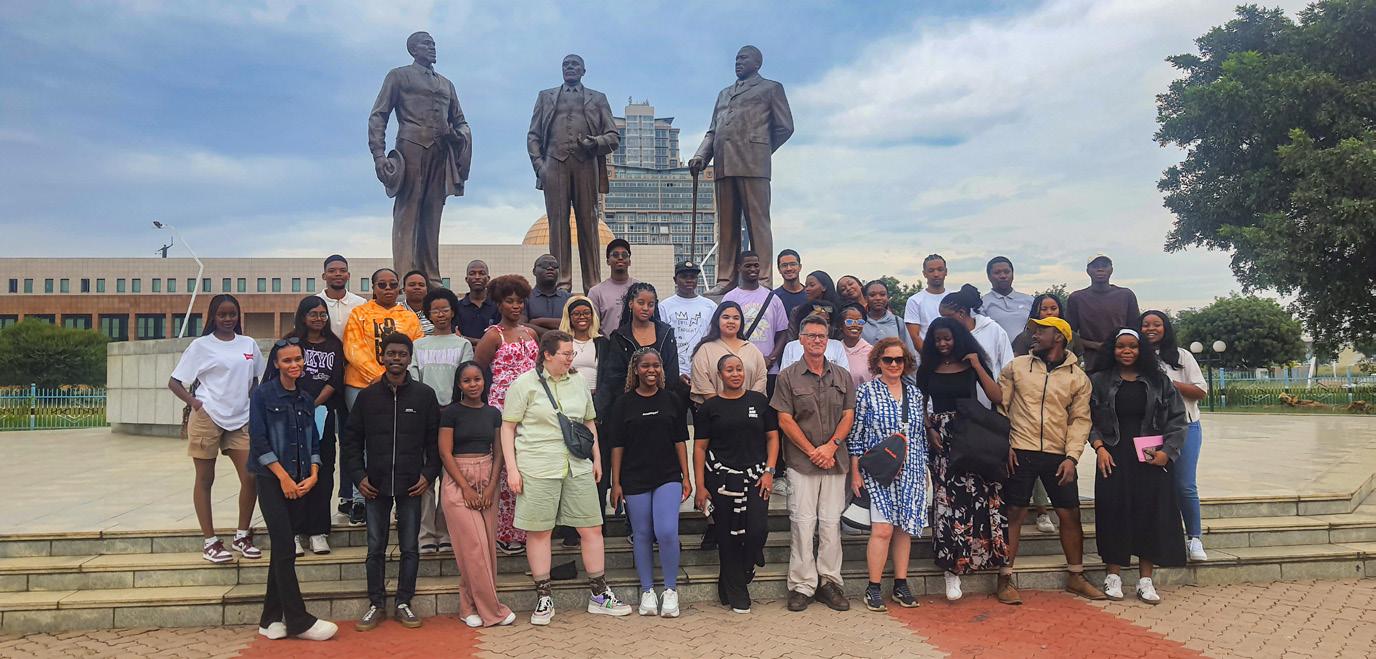
PGDip URP Degree
Curriculum
Course Code & Title
ARPL5004A Cities, Development and Planning 20 Q1 R. Ballard
ARPL5005A Spatial Planning, Transport & Infrastructure 30 Sem 1 M. Msingaphantsi
ARPL5007A Technologies & Techniques of Planning 20 Q2 M. Siteleki
ARPL5008A Planning, Environment & Sustainability 20 Sem 2 T. Leuta
ARPL5009A Urban and Regional Economic Development 20 Q4 R. Ballard
ARPL5010A Integrated Development Planning 20 Sem 2 A. Williamson
ARPL5011A Planning Law 20 Q2 E. Makoni
ARPL5012A Professional Practice and Ethics 10 Q1 A. Williamson
Total Credits 160
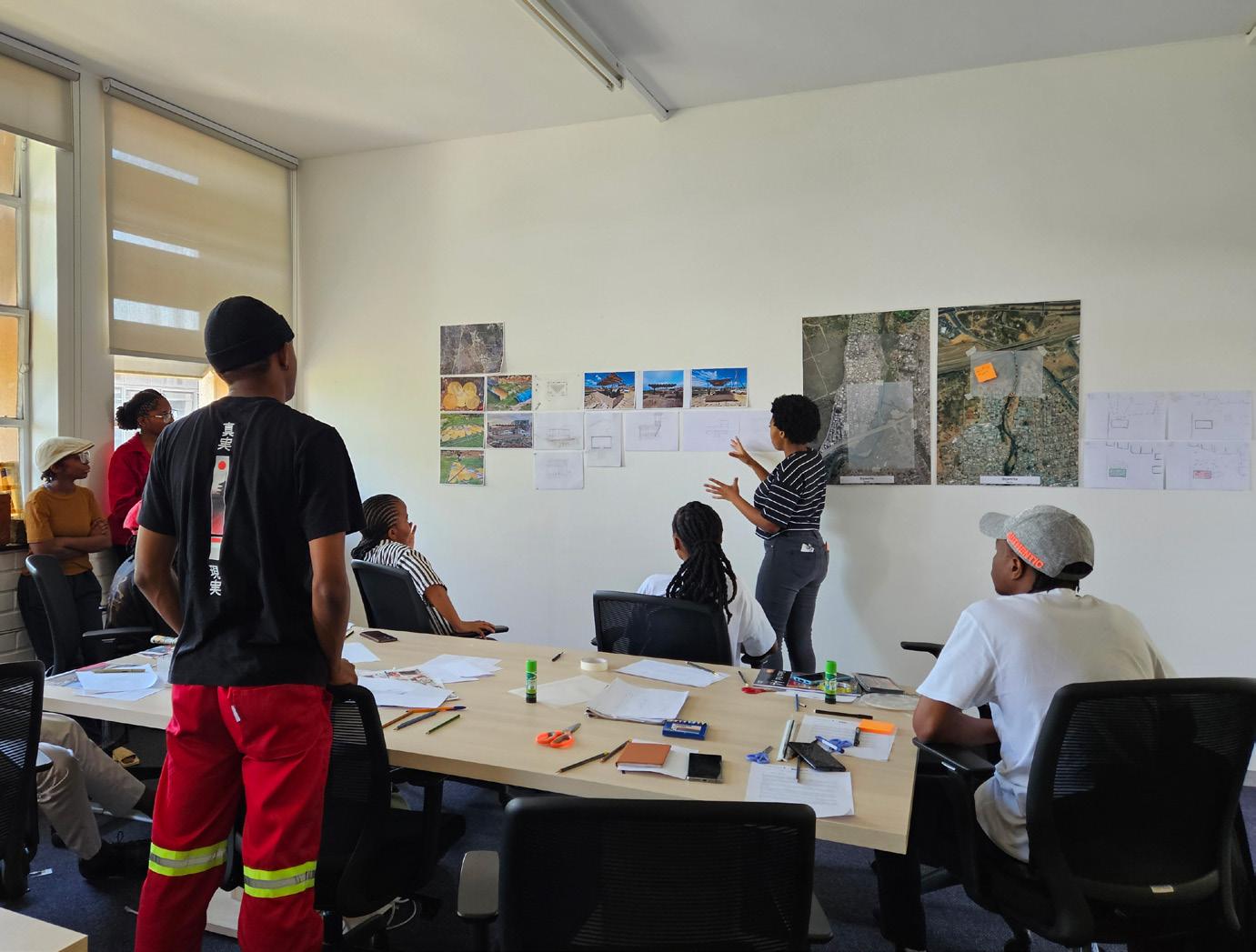
City Studio presentation; photo by P. Moreira
Overview
The Postgraduate Diploma in Planning (PGDip) is a one-year (full time) or two-year (part time) programme that introduces learners from diverse non-planning backgrounds to basic data collection, interpretation and problem-solving across a range of fields. Topics covered include the use of relevant mapping and modelling technologies (such as GIS), planning law, spatial planning (to produce a township layout), integrated development planning (producing a spatial development framework), and a theoretical understanding of the development context in the Global South.
Completing this rigorous and grounded programme can provide entry into various Masters degrees, including the MSc in Development Planning, which enables graduates to become professionally accredited members of the South African Council of Planners (SACPLAN)
The PGDip is ideal for individuals with backgrounds in Geography, Sociology, Civil Engineering, Property Studies (and many other cognate disciplines) who are passionate about cities or fascinated by the complexity of urban systems and development in general. It provides a truly multidisciplinary learning environment with lively debates and diverse perspectives
Strategic Objectives
The Post Graduate Diploma in Planning recognises the multi-faceted nature of planning practice and seeks to leverage learners’ existing knowledge and experience to create innovative responses to development challenges. The programme focuses on imparting technical skills, critical thinking, understanding of
context within the Global South and sound knowledge of legislation and procedures that pertain to planning practice.
The course on Integrated Development Planning (IDP) forms the core of the programme and provides a practical means to tie together skills learned in other courses (on spatial planning, planning law and graphic technologies) to create a spatial development framework and an integrated development plan, which are key planning instruments that are legally mandated for all municipalities in South Africa.
Certain courses, such as Planning Practice and Ethics, Technologies & Techniques of Planning, and IDP, are aimed at up-skilling students and providing immediate benefits to their performance if they are already in practice. Others, such as Cities Development & Planning, use seminars and presentations to critically engage students and prepare them for undertaking research in subsequent masters programmes.
Pedagogy & Transformation
The Postgraduate Diploma in Planning enrolls candidates from various disciplines and as is designed facilitate their transition into the urban planning profession. Although graduates from this programme are eligible to apply for various sub-disciplines in the field of urban planning (such as urban design and urban management) particular emphasis is placed on core urban planning skills. Courses such as Planning Law and Technologies & Techniques aim to ground students in the procedural and technical aspects of planning practice whereas other courses, such as Cities, Development & Planning, push students to
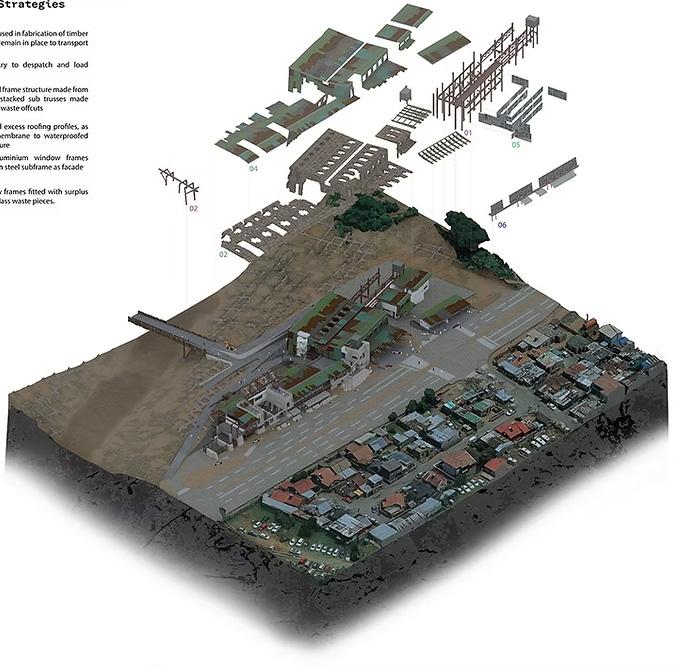
beyond their current context by considering trends in historical and international contexts.
The curriculum also includes projectbased courses in each semester (Spatial Planning, Transport & Infrastructure, and Integrated Development Planning), which allow students to integrate what they have learned in other courses to produce (a) a township layout and (b) a spatial development framework. As such, students leave the programme with a portfolio of work at two vastly different scales and with capabilities in site planning, land use management and spatial planning.
Prerequisites & Requirements
The PGDip is intended to allow candidates from varying backgrounds access to the urban planning profession through higher studies. Entry criteria for the degree can be found on the Wits website: https://www.wits.ac.za/course-finder/ postgraduate/ebe/pgdip-planning/
Aside from the entry criteria, there are no individual course prerequisites.
Student work: J. Breytenbach
Degree Outcomes
• The learner is competent to identify, evaluate and solve problems within the ambit of the field of development planning. The learner is familiar with relevant theoretical paradigms, concepts and procedures.
• The qualifying learner has been exposed to the management of uncertainty within a changing temporal, socio-economic, political and environmental context.
• The qualifying learner is able to cope with South Africa’s diverse social and cultural dynamics.
• The qualifying learner is able to operate under supervision in a normal range of development planning situations.
• The qualifying learner understands
planning as part of wider social, political, cultural, administrative, economic and natural systems, and their dominant operating and financial characteristics.
• The qualifying learner can investigate analyse and interpret information in different ways and can communicate its significance to different types of audience.
• The qualifying learner has been prepared for the next stage of his/ her career, whether in an academic, entrepreneurial or community context, and to meet the demands of lifelong development.
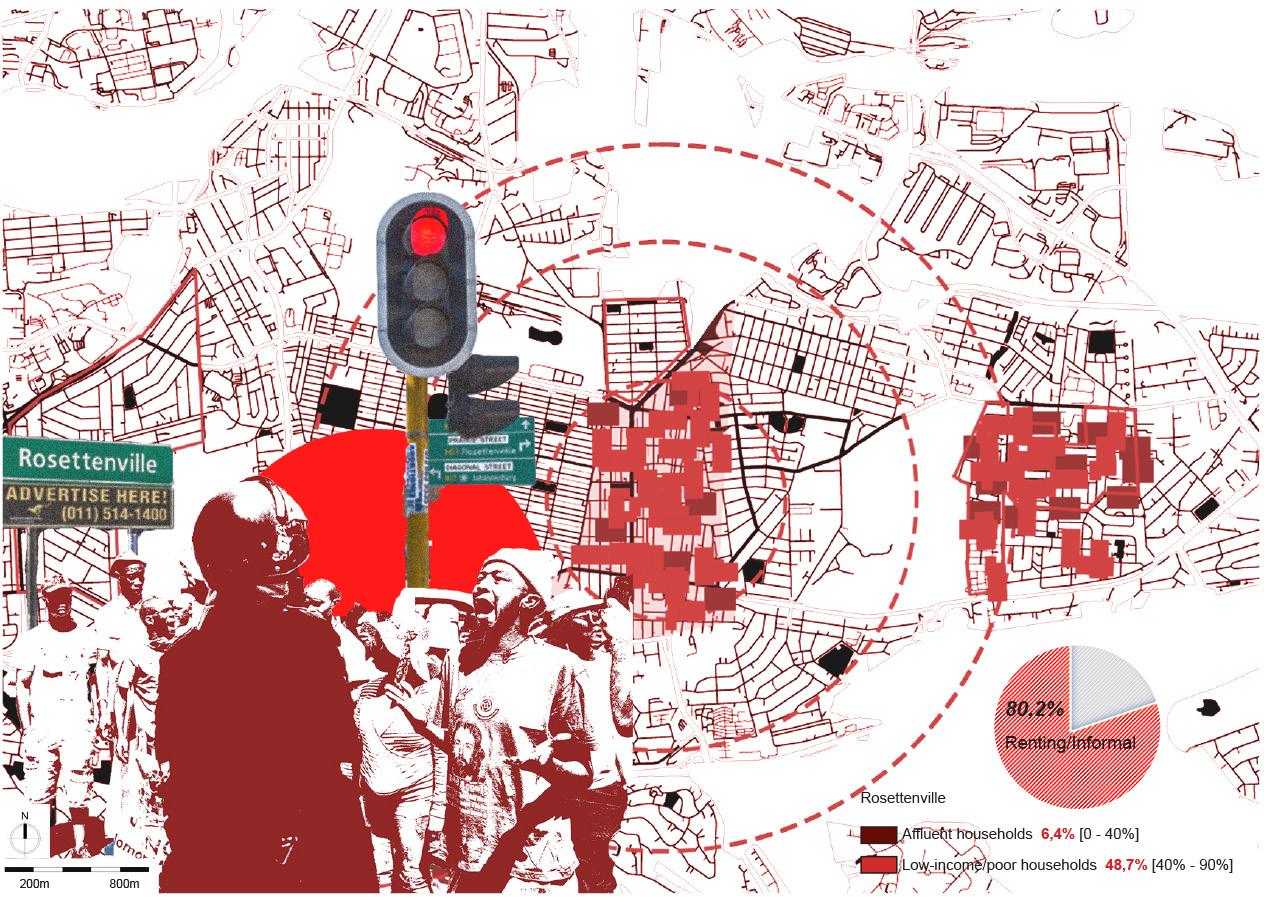
Student work: T. Sengwane & M. Masuku
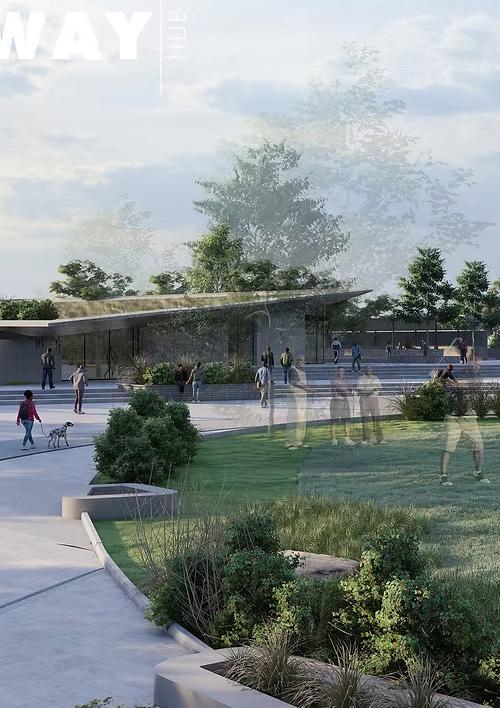
Student project: D. Maluleke
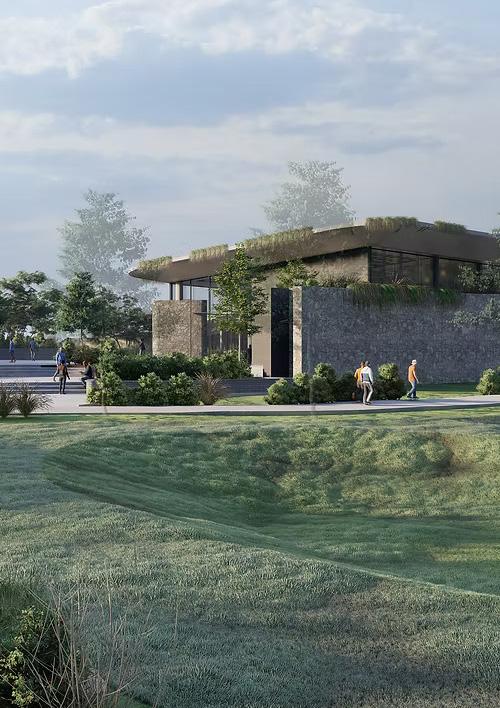
4 Masters by Coursework
Curriculum
ARPL7001A Advanced Digital Applications 9 Sem 1 G. Triana
ARPL7002A Simulated Office Practice 45 Sem 1 S. Jivan
ARPL7003A Architectural Design & Discourse 90 Full year H. Judin
ARPL7041A Architectural Professional Practice 36 Sem 1 S. Jivan
Total Credits 150
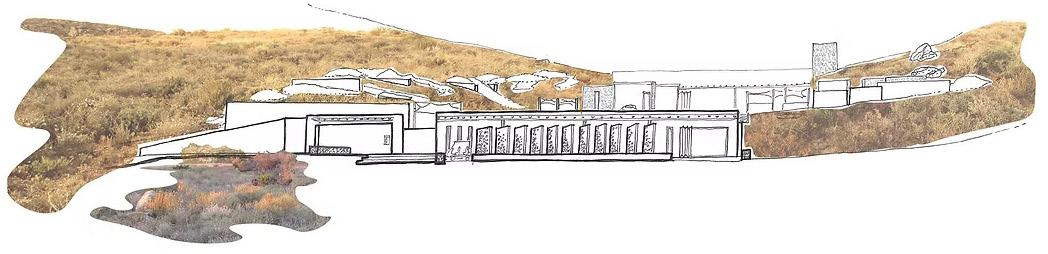
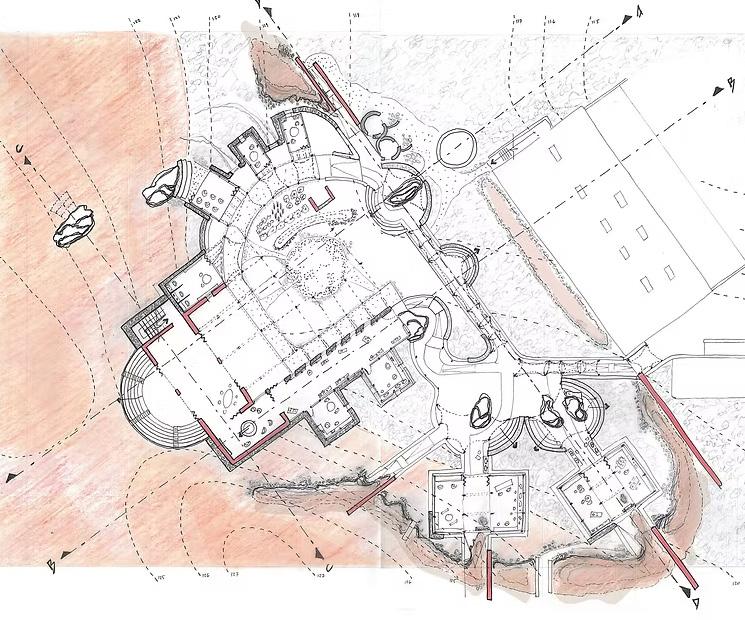
Student project: A. Maré
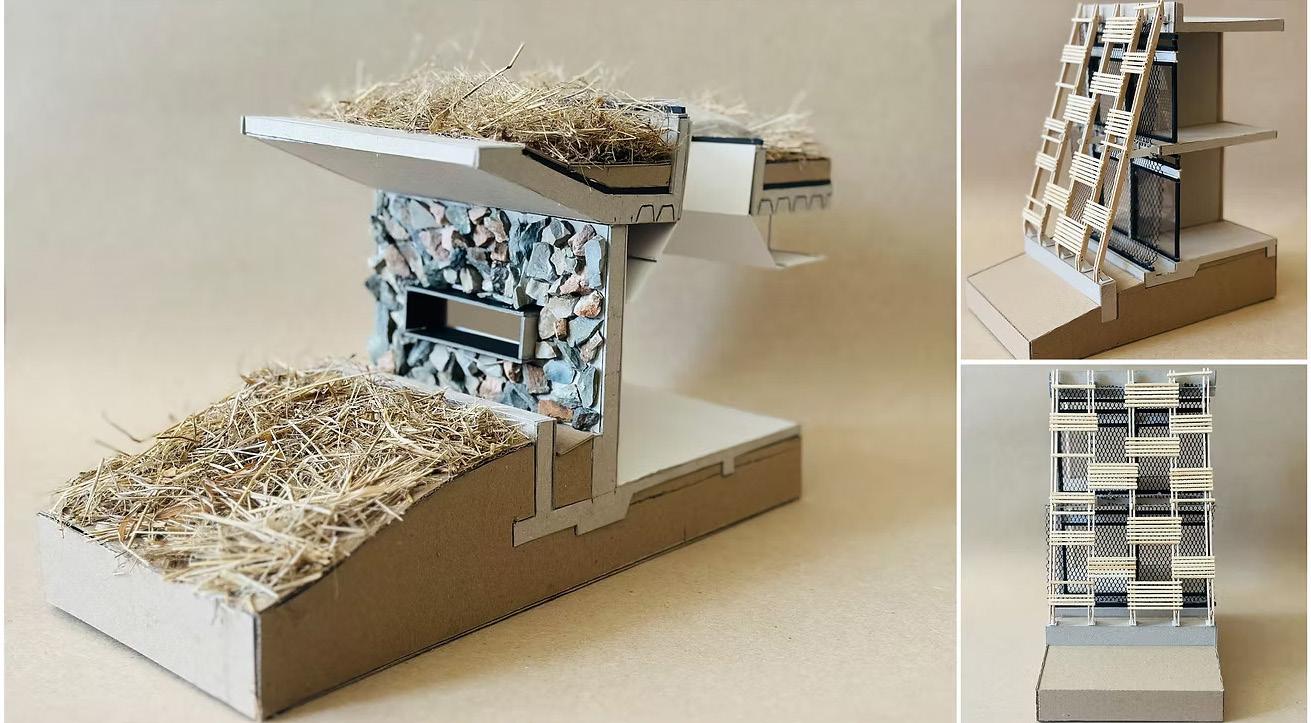
Overview
The Master of Architecture Professional [MArch (Prof)] is the culmination of the architectural program which facilitates creative production of an architectural research report integrating theory, research, analysis, design and systems technology. Working independently in close collaboration with their architectural peers in a dedicated studio, each student puts forward and investigates a personal position about architecture. A building proposal is produced under close supervision of diverse professional architectural staff and structured in such a way that it supports architectural experimentation and life-long professional development. Each supervisor brings unique perspectives and experiences out of a wide range of philosophies and interests. The Research Report is more than a complex building project; incorporating aspects of architecture that are urgent, exciting and thoroughly engaged with all aspects of our social, cultural and political context in South Africa.
Strategic Objectives
The aim of the Architectural Design and Discourse studio is to facilitate the production of an architectural research report, integrating theory, research, design and systems technology. The professional practice, simulated office and advanced digital design courses, together with the discourse studio, are all concerned with the consolidation and deepening of architectural knowledge and the integration of professional practice and law, based on research and theoretical knowledge that are the primary measure of preparedness to enter the architectural profession as a Candidate Architect.
The degree programme reinforces in students the essential professional skills of independence, self-motivation and time management, as these are crucial for successful completion of the course and in their future as architectural professionals. Students work independently while maintaining close collaboration with their architectural peers. This helps students avoid isolation, engage more deeply in the subject, share design processes and
Student work: D. Maluleke
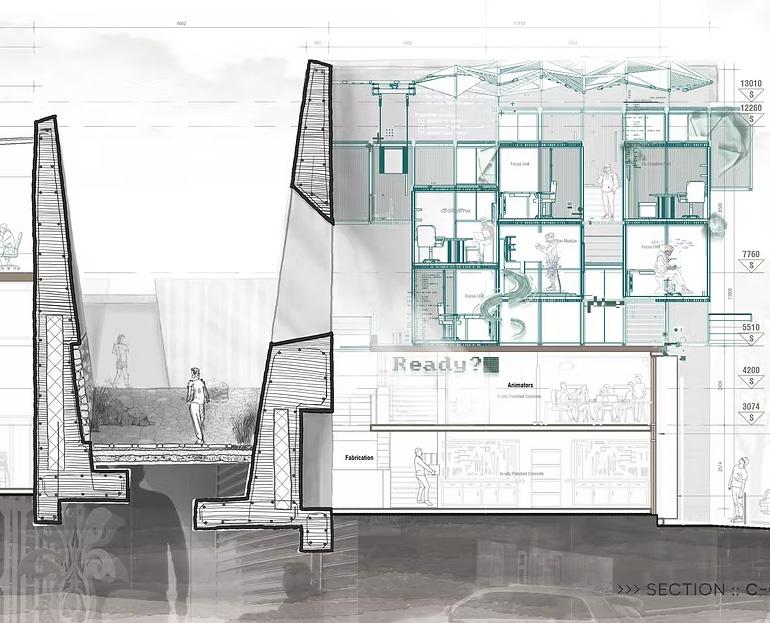
learning experiences, and enables the steady production of work. Architecture is a profession that requires collaboration with a wide range of other professionals and specialists.
A first semester cluster of courses covering advanced digital applications and aspects of entrepreneurship and professional practice support the students’ dissertation development, and integrated exercises in each of these courses (described in 2C.2.3f below) feeds into the research report, placing the entire suite of courses into a coherent package.
Support courses conclude at the end of semester 1, leaving the entire second semester to develop the final design, technology and completed research report. The final examination process includes the submission of the research report, a full set of examination drawings, and a formal presentation to the examination jury comprising of an external academic / professional architect and an internal academic staff member.
Student project: L. du Plessis
Pedagogy & Transformation
For the MArch (Prof), transformation can be assessed through developments with students, supervision, examiners and architectural output. This is increasingly visible in the rich range of research reports and projects that have emerged, with students taking on discourses, contexts and buildings reflective of their concerns and communities rather than solely academic expectations.
Independent choice of research topics and projects continues to be central to the MArch programme, allowing students themselves to direct and drive the current range of subjects being taken up in architecture research reports.
Examiners in MArch (Prof) are representative of a diverse range of professional architects and academics who can engage more directly with new students.
Prerequisites & Requirements
Entry criteria for the degree can be found on the Wits website: https://www.wits.ac.za/course-finder/ postgraduate/ebe/march-professional/
Aside from the entry criteria, there are no individual course prerequisites. Per Faculty rules, research reports submitted in the Architectural Design & Discourse course may be subject to minor amendments, major amendments, re-examination, or outright failure, if outcomes are not satisfactorily met in the final assessment.
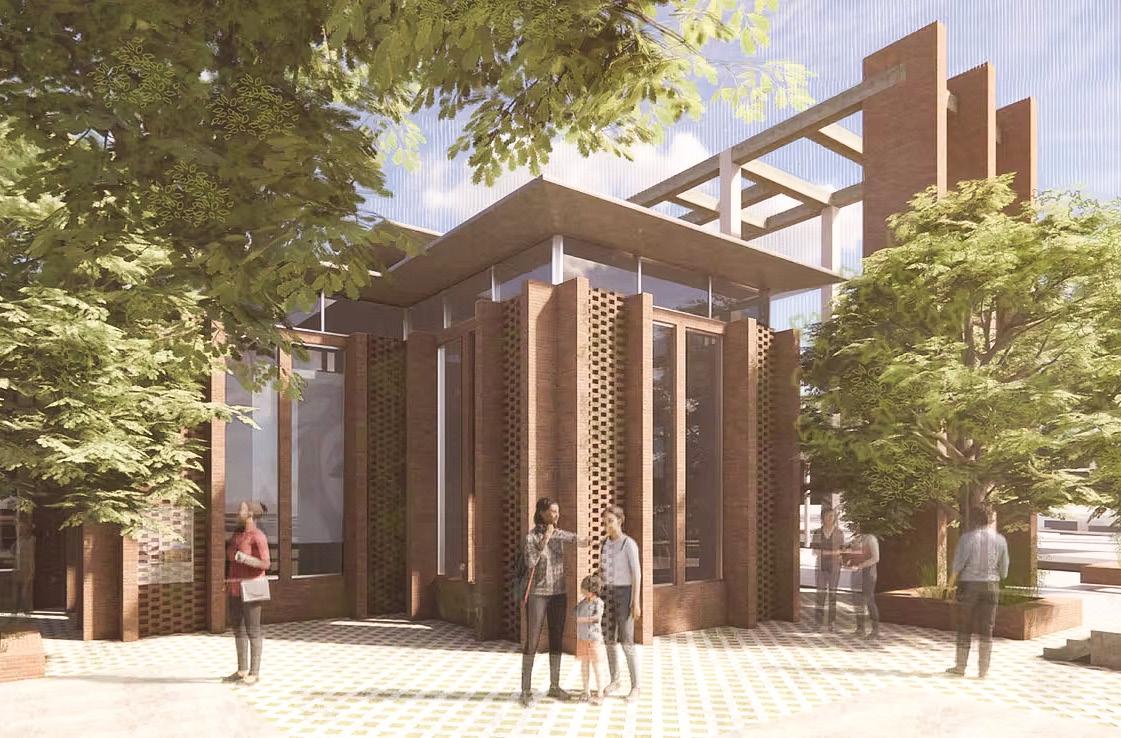
Student project: S. Jawodeen
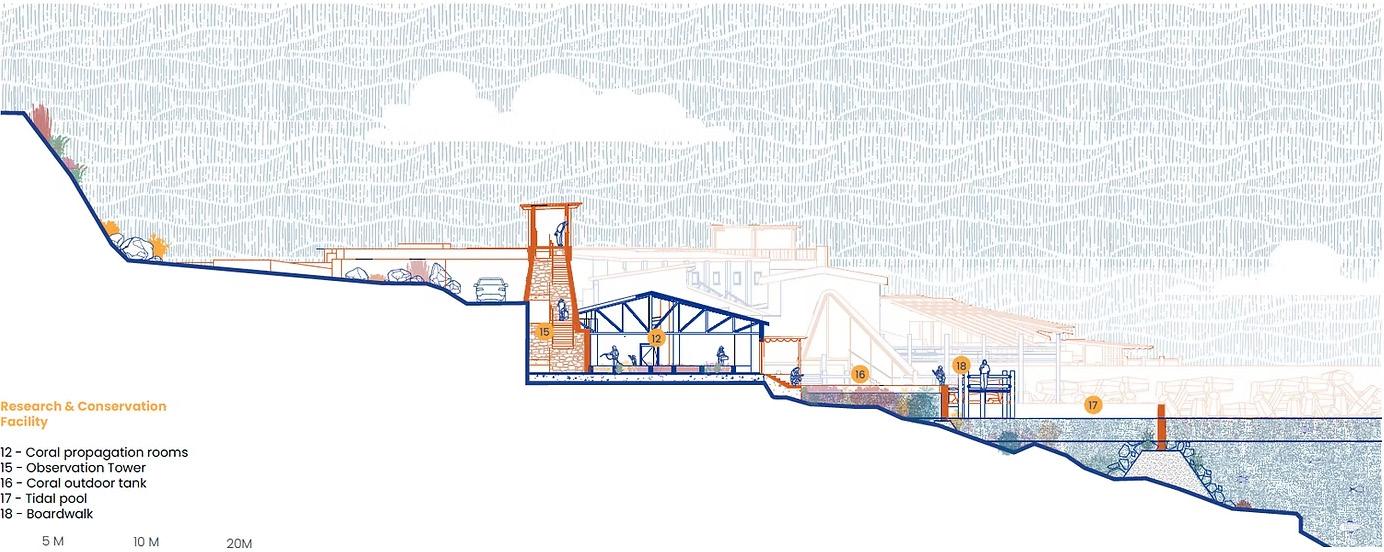
Degree Outcomes
• The learner is competent to identify, evaluate and solve problems within the ambit of the specialization, and within the context of overall architectural considerations. He/she is required to demonstrate a high level of responsibility and ethics, both within the immediate environment of the problem, and with regard to society as a whole.
• The learner is required to operate effectively both as a responsible member of a team and as a team leader. He/she is required to work with communities in both research and problem solving scenarios, and is required to operate effectively and sensitively in such contexts.
• The learner is required to have extensive communication skills in written, oral, graphic and IT media. He/she is required to use these skills to establish authority in the field of architecture and the area of specialization.
• The learner is required to locate all of his/her decision making and proposals within the wider social, legal, economic, intellectual and environmental contexts.
• The learner will have developed a high level of self-management with a critical awareness of personal values.
• The learner is required to have extensive skills and knowledge in the area of data collection, analysis, organization and evaluation.
• The learner Is exposed to a range of sophisticated learning strategies, and is expected to make informed decisions on those employed;
• The learner will have built on his/her existing knowledge of technology and is able to evaluate the application of technology in relation to wider local and global environmental concerns.
• The learner Is required to act responsibly and professionally, with full regard to the needs and aspirations of the society within which he/she operates;
• The learner has considerable cultural and aesthetic awareness, and is required to enhance and apply this within the area of specialization;
• The learner is exposed to career opportunities both within an entrepreneurial and academic context.
Student project: J. Edgar
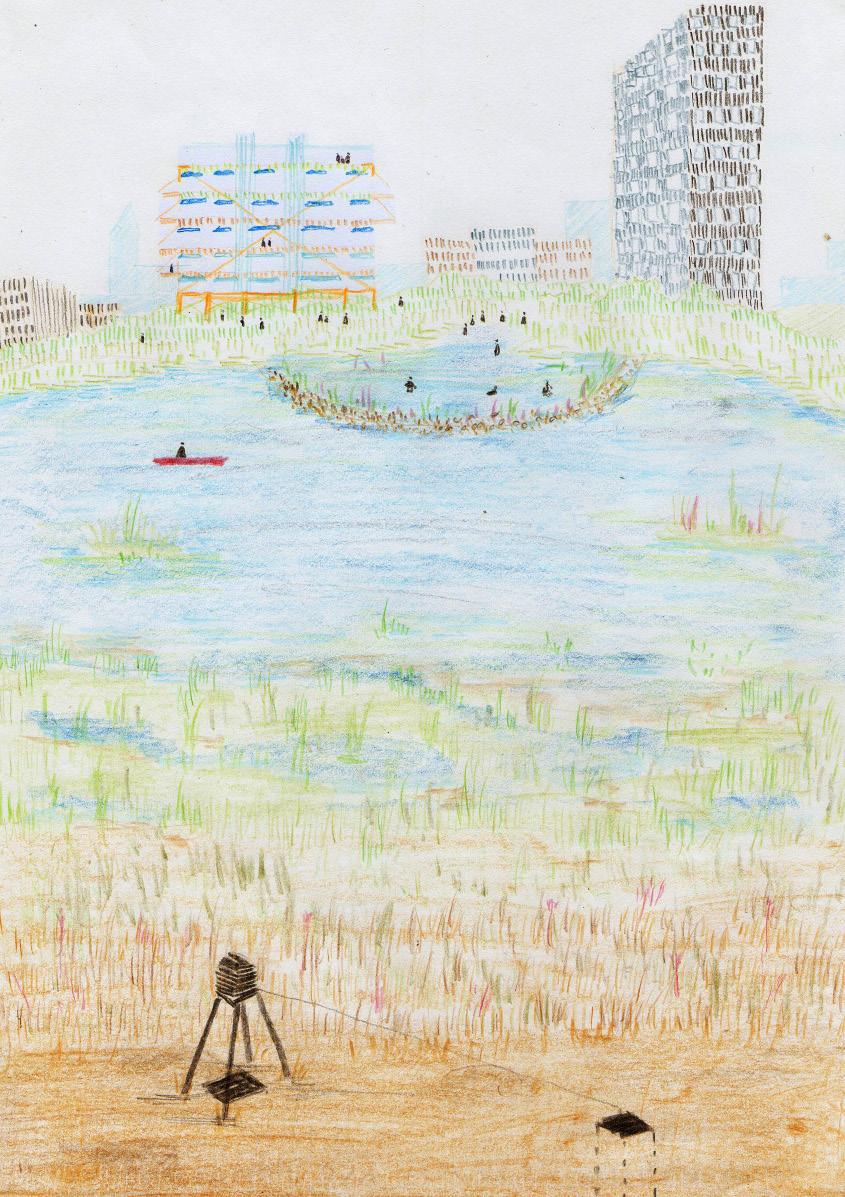
Student drawing: D. Powell
MSc DP Degree
Curriculum
MSc
Course
& Title
ARPL7029A Philosophies, Theories & Methodologies of Development Planning 20 Q1 M.F. Sihlongonyane
ARPL7040A Research Methods
ARPL7044A Community Participation in Urban Governance
ARPL7063A Governance & Municipal Planning
ARPL7064A Research Report
ARPL7074A Theory, Politics & Governance of Extended Urbanisation
Q1 M. Huchzermeyer
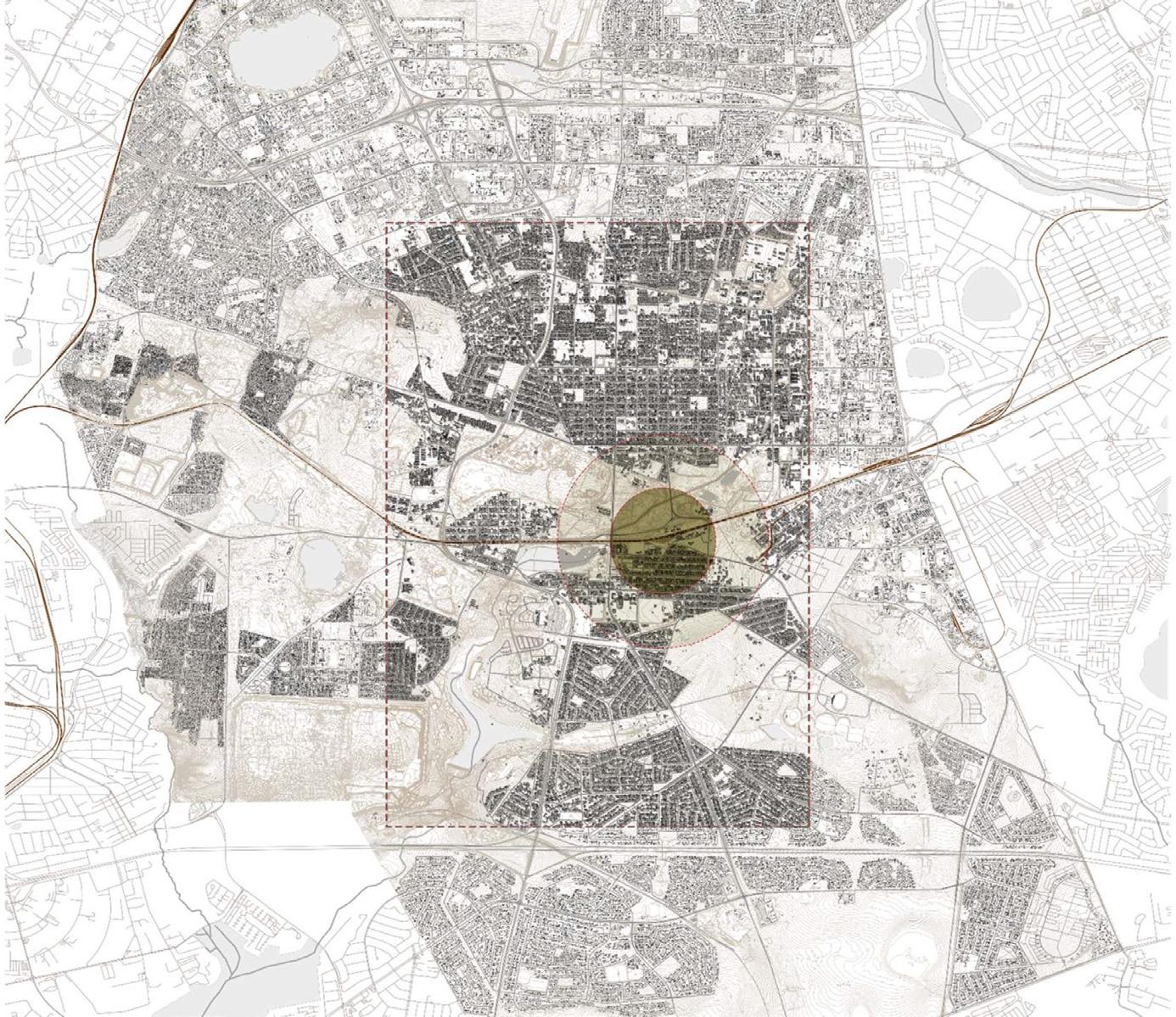
Student project: D. Powell
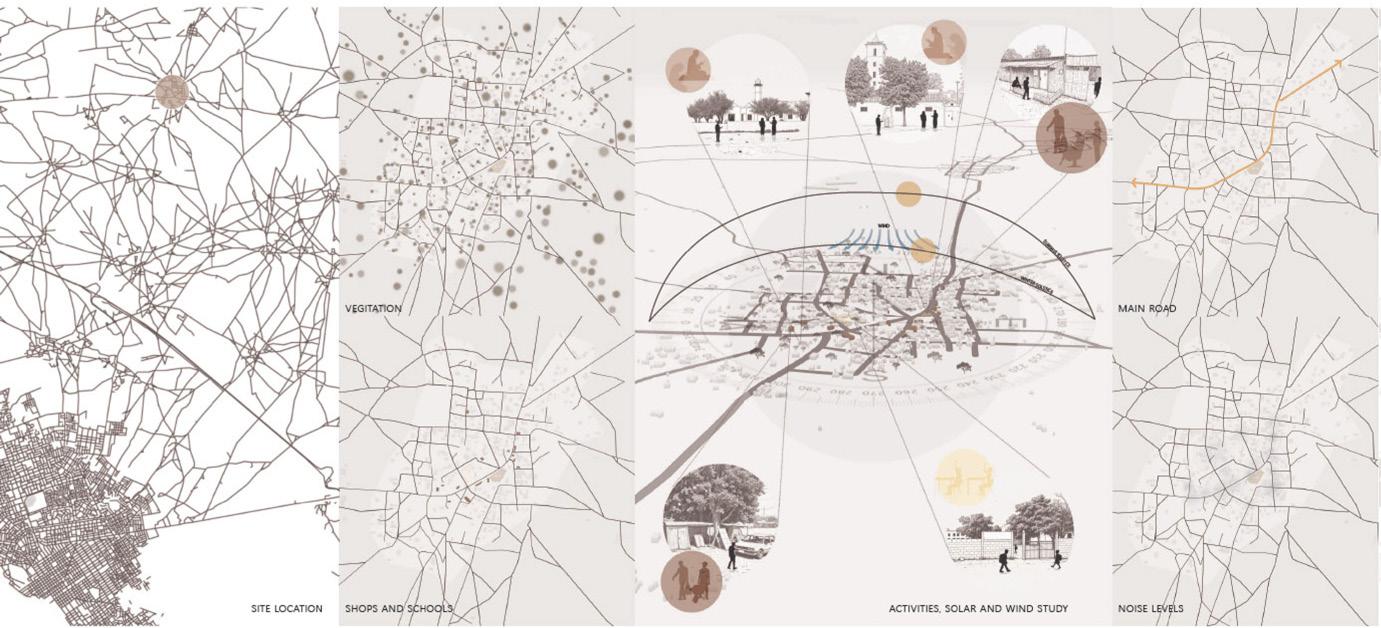
Overview
The Master of Science in Development Planning (MSc DP) is a one-year, full time course of study enabling graduates to register as professional planners with SACPLAN once they have completed the degree and have acquired at least two years’ relevant work experience.
The degree is designed to enable students holding the Postgraduate Diploma in Planning to qualify as professional planners. Students with a four-year undergraduate/ Honours degree that is accredited for professional registration by SACPLAN may also undertake the degree.
The qualification gives students the opportunity to develop a critical awareness of the social, economic and management issues underlying socio-economic change; build their critical, analytical, and integrative skills for resolving human and environmental development challenges; enhance their knowledge for informed decision and policy-making on development issues; as well as providing operational skills pertinent to working in the public, private or community domains; and practical research experience and opportunities for reflection.
Strategic Objectives
The MScDP stresses the interdisciplinary diagnosis/analysis and prognosis for planning issues across all scales, and it provides graduates with an interdisciplinary base from which to approach the diverse issues involved in development planning. The objective of the programme is to ensure that learners have the knowledge and skills to conduct research and, in a professional capacity, guide processes of change in urban and rural domains. Its purpose is also to educate and train planning practitioners, researchers, scholars and policy makers.
The program begins with coursework on topics such as research design, governance and community participation which prepare candidates for the work they will do during their research fieldwork and in their professional practice. These are interdisciplinary courses and their classes have students from diverse professional backgrounds. In contrast, ARPL7029 (Philosophies, Theories & Methodologies of Development Planning, is exclusively offered in the MSc DP and has been a core component of the degree for over
Student work: L. Jalla
a decade. Components of this course attempt to grapple with how perspective and positionality can impact a development planner’s approach to practice. It covers key topics including evidence-based policy making, critical information synthesis and effective deliberation of complex development, particularly at the local and national scales in South Africa and abroad. In 2023 a new course, the ‘Theory and Politics of Extended Urbanisation’ will be introduced and added to the programme. This course, which is developed in conjunction with University College London, is grounded in research that members of staff in the school and focuses on key challenges facing cities in the Global South.
Pedagogy & Transformation
Through coursework, the degree provides a critical understanding of, key issues affecting cities in the global south, politics and government community participation and extended urbanisation. Emphasis is placed on expanding the theoretical and philosophical foundations of planning praxis. The course titled “Philosophies, Theories and Methodologies of Development Planning” looks at different contemporary and historical approaches to planning – classic, communicative, justice, political economy and structuralism amongst others – and aims to enhance reflection and research in policy analysis and preparation.
The degree includes five compulsory courses and a research report that accounts for 50% of the degree. Students may choose their electives from a range of courses relevant to the field, subject to the approval of the degree convenor. These include courses offered within the
School (please see the MUS degrees for possible courses), as well as those offered in other Schools at Wits. The compulsory courses for the MSc DP are all offered in the first semester (February to June) and are organised to allow students to be on campus for one and a half days a week, plus an additional four days (one day every two weeks February to April) for the Research Methods course. The research report for the MSc DP can be submitted in mid-October for November oral examination, or end February the following year, for May oral examination.
Prerequisites & Requirements
Entry criteria for the degree can be found on the Wits website:
https://www.wits.ac.za/coursefinder/postgraduate/ebe/ msc-development-planning/
Aside from the entry criteria, the following rules may also apply at registration:
• A candidate may be permitted, with approval, to replace one or more of the above courses with one or more masters courses that are relevant to the field of Development Planning.
• Graduates of the BSc URP(Hons) programme who have completed ARPL4014A may be permitted to replace ARPL7029A with an equivalent masters course approved by the degree convenor.
• In exceptional circumstances, a candidate, who lacks the necessary skills relating to development planning which are covered in the Postgraduate Diploma(Planning) may be required to complete up to three courses from the Postgraduate Diploma (Planning).
Degree Outcomes
• The learner is competent to identify, evaluate and solve problems within the ambit of the field of development planning. The learner is familiar with relevant theoretical paradigms, concepts and procedures.
• The qualifying learner has a knowledge of how to manage uncertainty within a changing temporal, socio-economic, political and environmental context.
• The qualifying learner is able to cope with South Africa’s diverse social and cultural dynamics
• The qualifying learner is able to operate independently, but within applicable professional, ethical and legal frameworks and to reflect on how
this affects her/his roles as a planner. He/she has been prepared for the next stage of his/her career, whether it be professional, entrepreneurial or in some other field, and to meet the demands of continuing professional and life-long development.
• The qualifying learner understands planning as part of wider social, political, cultural, administrative, economic and natural systems, and their operating and financial characteristics.
• The qualifying learner can research, analyse and interpret information in different ways and can communicate its significance to different types of audience.
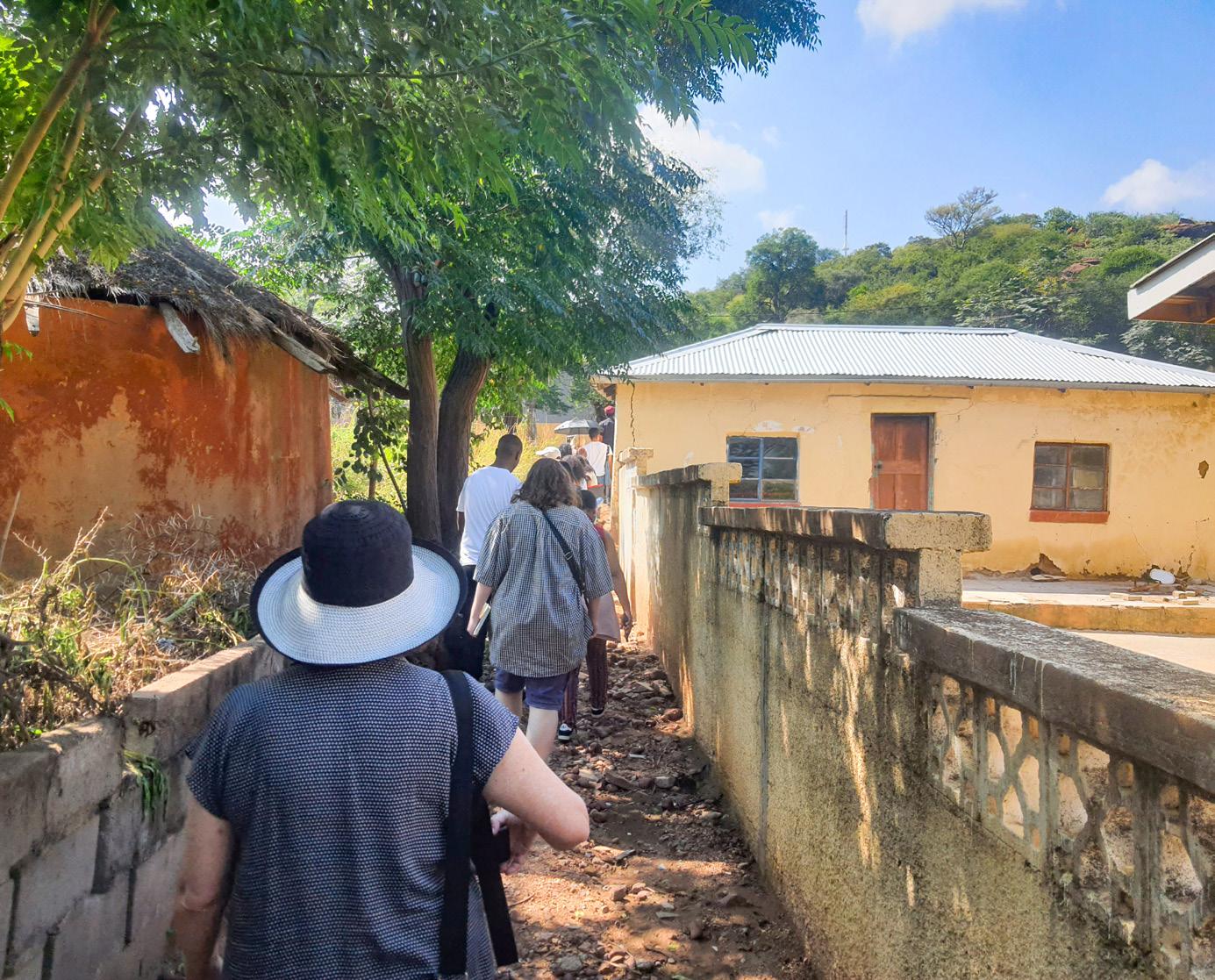
Student site visit
MUD Degree
Curriculum
MUD First Year (part-time)
ARPL7010A
ARPL7011A
ARPL7078A
ARPL7077A
ARPL7079A
ARPL7057A
MUD Second Year (part-time)
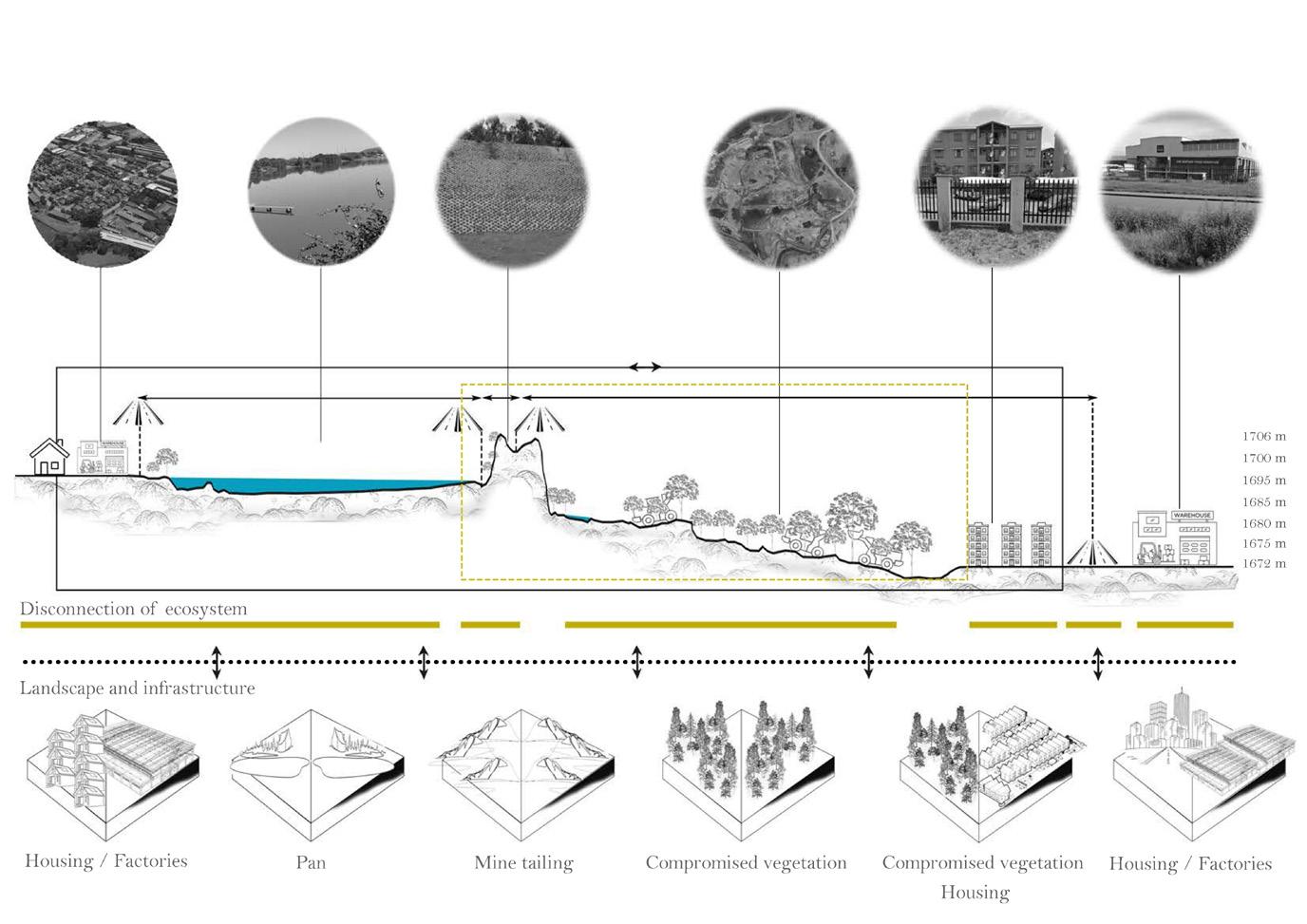
Student project: M. Moidi
Overview
The MUD qualification is a two-year part-time programme in urban design. The focus is on the design of cities in South and Southern Africa, drawing from other precedents globally. In a diverse and complex context, urban design relates closely to architecture, planning and landscape architecture, and other disciplines, to produce a unique focus on the design of spaces for people. In the diversity and complexity of our cities there is a need to understand how spaces operate socially, culturally, politically and economically in order to design places for people.
The degree has a number of core theoretical courses which are practically applied in design studios. The core courses introduce students to understanding cities of the global south, in order to appreciate the context within which we design. The theories and histories of urban design provide the tools, precedents, examples, and appreciation of urban design in cities through time. Professional Practice allows students to develop an understanding of how to run an urban design practice, as well as of the mechanisms, regulations and procedures required for the implementation of projects. The core courses are applied in practical ways in urban design studios where the student is exposed to projects involving the preparation of designs in response to context. Research forms a large part of the programme.
Strategic Objectives
The MUD programme aims (through a number of courses, studio sessions and research) to enable students to develop a comprehensive understanding and a set of skills needed for addressing
complex urban challenges. This set of skills enables students to work at a certain prescribed level and to gain experience in what is an increasingly demanding built environment profession. Students should, at the conclusion of the two-year programme, demonstrate their combined knowledge base of urban design, theory, functional planning, technical development, programming, environmental responsiveness, graphic skills and writing abilities at a high level of sophistication and independence. As an end product, students should have a comprehensive portfolio of work, manifested in the MUD Research Report.
The broader aim of the MUD Programme, through the studio and research environment and with guidance from tutors, is to equip students with the skills to create appropriate urban environments, to create an urbanity that is both an expression of dignified human values and a context for human activity and development. Through a design-orientated process and theoretical discourse, students will address the interrelated environmental, behavioural, and cultural issues that underlie the organisation of our cities. Students will be called upon to direct sensitivity, imagination, intellect, and increasingly levels of professional judgement to the physical significance of these fundamental issues in designing a coherent urban environment for people.
Urban design, and the development of a design methodology across all scale levels, and its underlying theoretical base, will be the focus for the Studio and Research Courses. The programme, therefore, is based on the following intentions:
• To stimulate the enquiry into the urban condition, addressing it through creative design solutions and reporting on it through a comprehensive research process;
• To strengthen intellectual growth and the capacity to develop creative and responsible solutions to unique and changing urban challenges;
• To ensure that the student acquires the individual capabilities and confidence in their design methodology for the practice of urban design;
• The production of a self-motivated urban design research report, integrating theory, research, design, technology, analysis, representational skills, and proposed implementation.
The three MUD studio courses look at settlement making to test and explore different ways of reading and communicating the city structured by three interrelated themes:
• Accessible City Studio: situating an accessible definition of urban design;
• Transforming City Studio: presenting a transformative approach to an African context;
• Global City Studio: locating relevance in cities of the South.
Pedagogy & Transformation
South African cities remain racially segregated, resulting in different constructed realities. In the quest to understand how space is perceived, the studios probe what forms, powers and flows create the city in our specific context. This probing lays a foundation for developing an approach with the required skills to ‘read’ the city and intervene appropriately.
Urban design is about spaces for humans and non-humans and their co-existence on earth as a holistic system. Therefore, the comprehension and guidance of how and why space is designed, considers multiple networks. The MUD city studios aim to explore these networks in preparing future professionals to engage in African contexts.
Studios are structured to embrace constant change. Dealing with fluidity requires multiple skills. Among other things, this would be the understanding of culture, access to the (in)formal and multiple, overlaying networks and power structures, negotiation between bottom-up and top-down approaches, and modes of representation beyond an abstract top-down masterplan, massing model, or a typical diagrammatic street section.
The course has a pluralistic approach to the teaching of urbanity and urban design. Students have opportunities to become well acquainted with a wide range of approaches and methodologies. The course does not seek to impose any singular design philosophy, but rather encourages in each student the development of an individual approach to design, based on clear and well-reasoned arguments resulting in a comprehensive Research Report.
Prerequisites & Requirements
Entry criteria for the degree can be found on the Wits website:
https://www.wits.ac.za/coursefinder/postgraduate/ebe/ master-of-urban-design/
There are no individual course prerequisites within the degree.
Degree Outcomes
• The qualifying learner is competent to frame, evaluate and address questions creatively and responsibly within the ambit of specialization, and with regard to society as a whole.
• The qualifying learner is required to operate effectively both as a responsible member of a team and as a team leader. He/she is required to work collaboratively with communities and other groups, and is required to operate effectively and sensitively in such contexts.
• The qualifying learner has a high level of self-management and self-motivation with a critical awareness of personal values is required in this programme.
• The qualifying learner is required to have extensive skills and knowledge in the area of data collection, analysis, organization and evaluation. He/ she demonstrates critical, analytical thinking to interpret, extend and modify existing bodies of knowledge. He/she is able to evaluate different methods of data manipulation within a range of scenarios, and understands the social and academic consequences of choice of method.
• The qualifying learner is expected to have extensive communication skills in written, oral, graphic and IT media. He/she is required to extend these skills to establish authority in the field and area of specialization.
• The qualifying leaner is required to build on his/her existing knowledge of technology to meet the demands of the area of specialization, and to be able to make responsible choices in relation to wider local and global environmental concerns.
• The qualifying leaner is required to locate all of his/her decision making and proposals within the wider social, legal, economic, intellectual and environmental contexts.
• The qualifying learner is exposed to a range of sophisticated learning strategies, and is expected to make informed decisions on those employed.
• The qualifying learner is required to act responsibly as a professional, with full regard to the needs and aspirations of the society within which he/she operates.
• The qualifying learner has considerable cultural and aesthetic awareness, and is required to enhance and apply this within the area of specialization.
• The qualifying learner is exposed to career opportunities both within an entrepreneurial and academic context.
• The qualifying learner exhibits the capacity for critical, independent thought.
MUS Degree
Overview
The MUS is a one-year full-time or two-year part-time programme which has four functional fields, each with its own curriculum. Across the different fields, students connect in a common ‘Urban Studies’ cohort through a shared induction programme, a common foundational course, and a common research methods course. A collaborative course with University College London is offered either as a requirement or an elective, depending on the field of study.
The five study areas are described briefly below, and in more depth later in this section.
MUS Urban Management (UM) includes dedicated core courses on the theory and practice of urban management, and on governance and municipal planning. It shares elective courses with other master’s offerings in the School.
MUS Urban Governance and Politics (UPG) includes a core course located in the Department of Political Studies, and a
course in community participation in urban governance. It has electives in History and Economics as well as from within the School.
MUS Sustainable & Energy Efficient Cities (SEEC) involves two dedicated, specialised courses in energy efficiency of cities and of buildings, as well as a variety of electives from within the School.
MUS Housing & Human Settlements (HHS) (not offered in 2023, but applications are open for 2024 with a new course offering) includes dedicated courses on the theory and practice of human settlements, and on in-situ and incremental settlements development. It has a variety of electives from the School, as well as from civil engineering.
MUS Urban Research (UR) has two curriculum options (quantitative vs qualitative). Core courses include the extended urbanisation course noted above. The purpose of this field is to prepare research-interested candidates for study at PhD level.
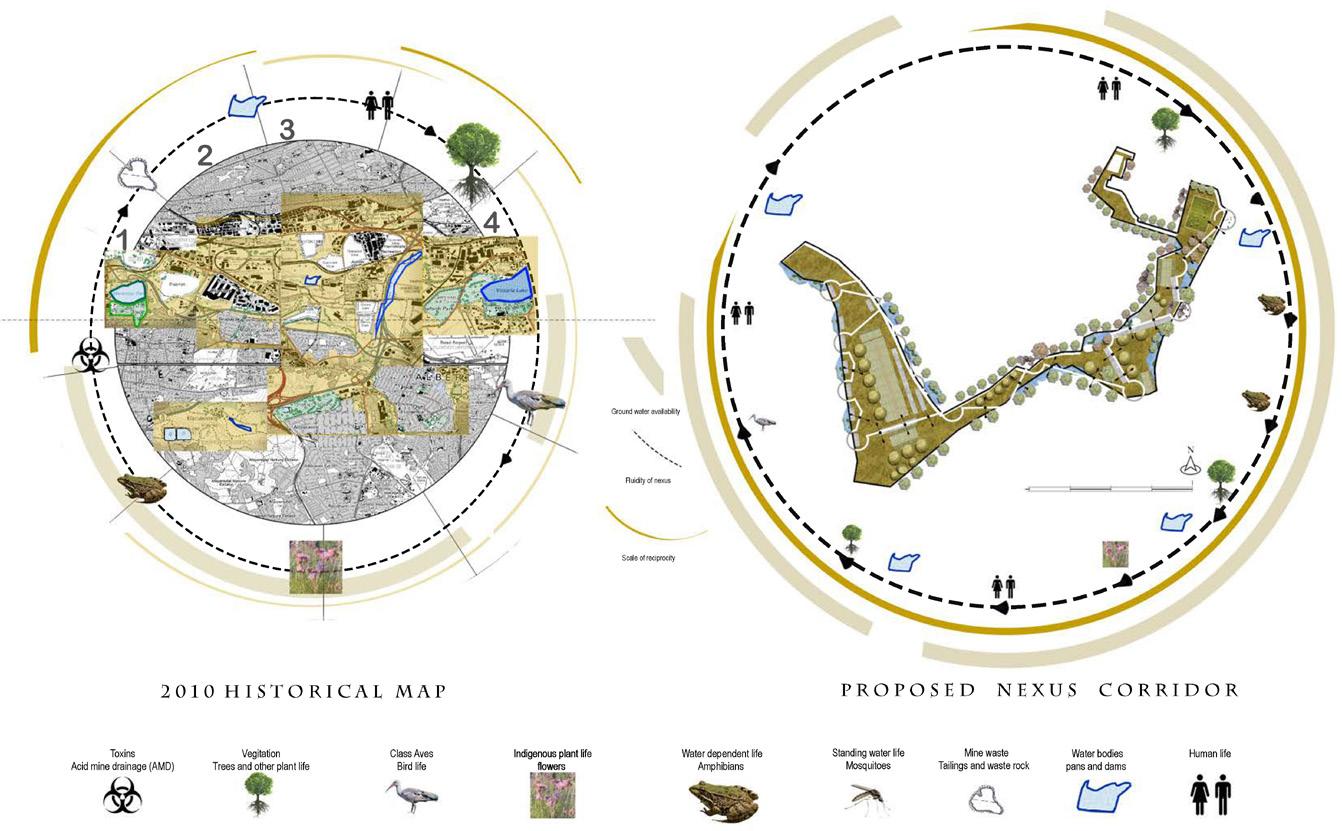
Student work: M. Moidi
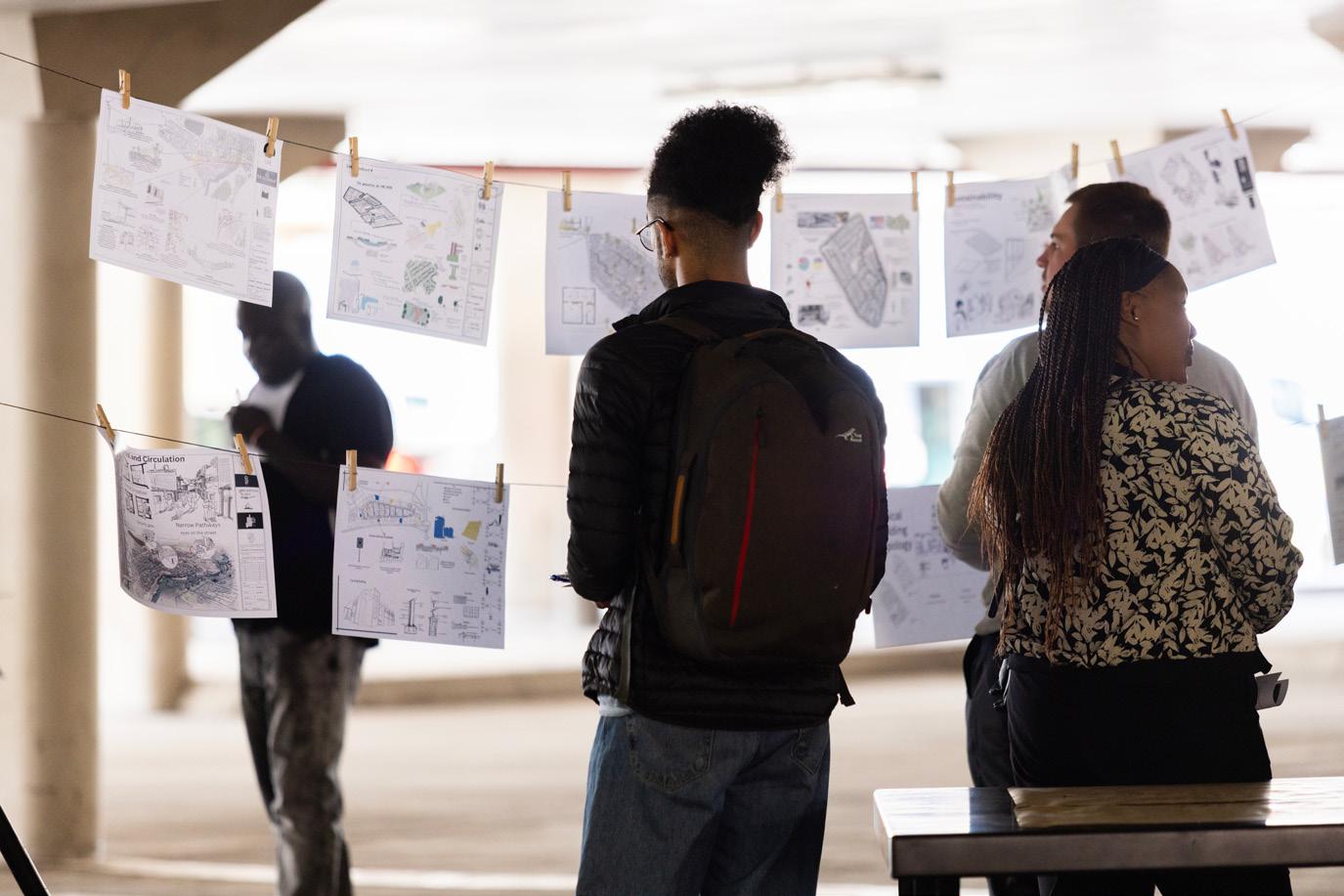
Strategic Objectives
The different fields in the MUS offer a range of interdisciplinary urban studies at master’s level, organised under one degree. All students in the MUS, apart from MUS [UR], take two common courses, one of which is an intense first-semester course focused on understanding the many forces that shape cities of the South. These forces include development processes (legal, economic – both formal and informal - governance issues, environmental issues, transport, land use, infrastructure, services etc.), power and politics (macro-economics, structural adjustment, questions of sovereignty, gender, poverty, inequality etc.), as well as the discourses of modernity, globalisation and post-colonialism.
The aims of the course include developing students’ understanding of and ability to reflect critically on the major policy
perspectives and debates on urban development and urban planning in the current era, and to provide a sense of the key theoretical debates concerning the ‘urban’ in the global South.
The second course common course to all MUS students (excepting the MUS [UR]), also in the first semester, focuses on research methods. In addition to introducing students to different forms of research, data-gathering and ethical issues, the course prepares students in a structured and systematic way to design and formulate their own significant research project, which they produce in the second half of the year under individual supervision.
In each of the fields, further core courses provide a more specialised understanding of the relevant theories, debates and approaches applicable to that field.
City Studio exhibit; photo by P. Moreira
Pedagogy & Transformation
The MUS takes a particular interest in perspectives from the Global South, exploring debates, theorisations and empirical work about and from diverse contexts in less developed, often rapidly urbanising but economically constrained parts of the world. These and other analyses of cities originating from more economically, socially or politically dominant locales draw attention to the power relations that underpin city trajectories as well as understandings of them. Through the various specialisation fields, a wide variety of issues and contexts are explored, creating a platform for deep research and rich professional engagement.
The courses in the various fields adopt a variety of pedagogic approaches including
lectures, seminars, projects and supervised independent research. In several courses students’ investigate allocated topics, synthesising the material either through group-work or independently, and presenting this to the rest of the class for collective engagement and debate.
Skills in research, analysis, oral presentation and debating are developed. In addition, students are actively coached in scholarly writing techniques and how to develop, substantiate and structure a coherent argument, through frequent short exercises and written feedback as well as longer essay assignments. In some courses there are excursions to field sites, and several courses bring in the expertise of specialist academics and practitioners.
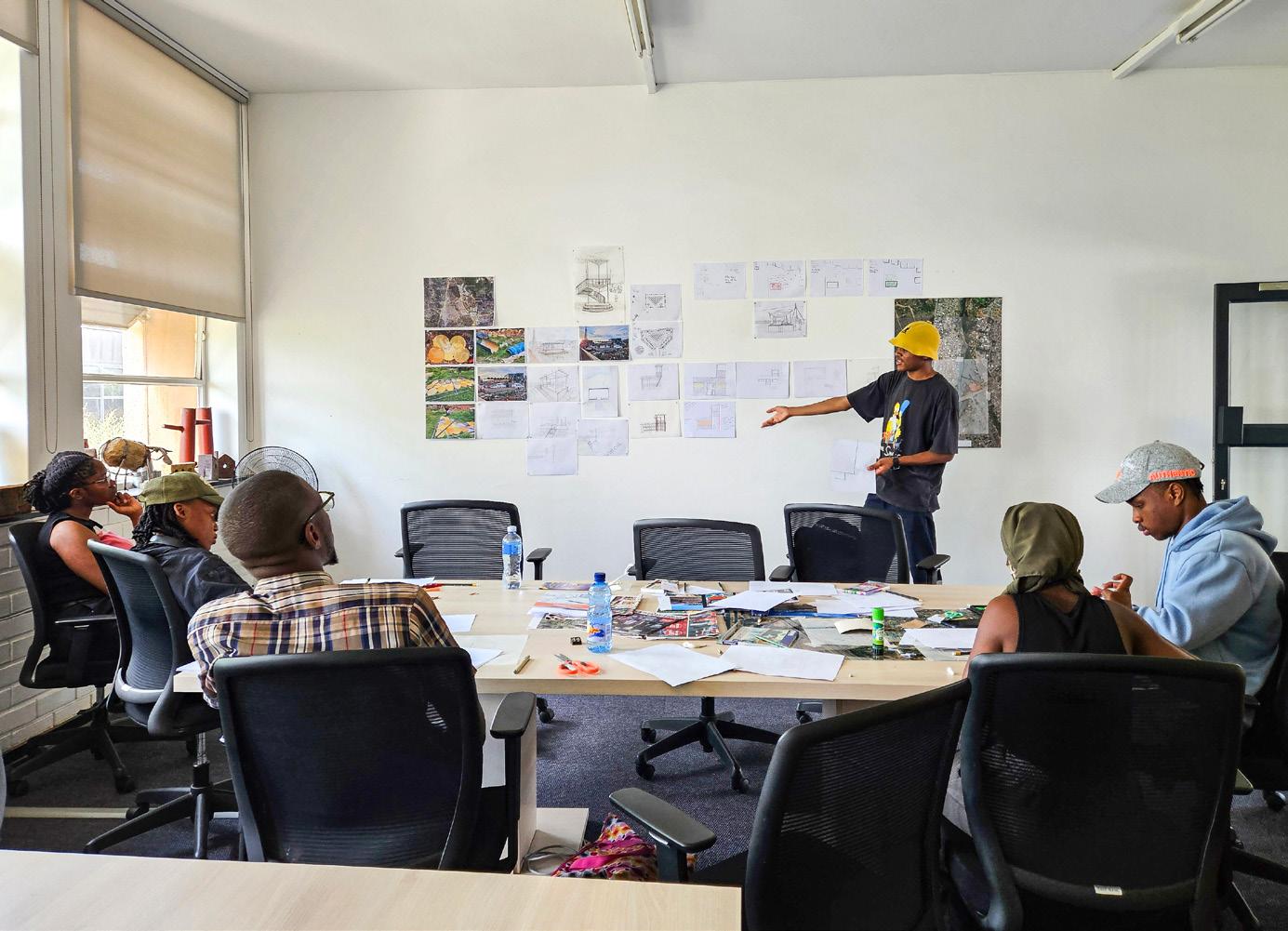
City Studio presentation; photo by P. Moreira
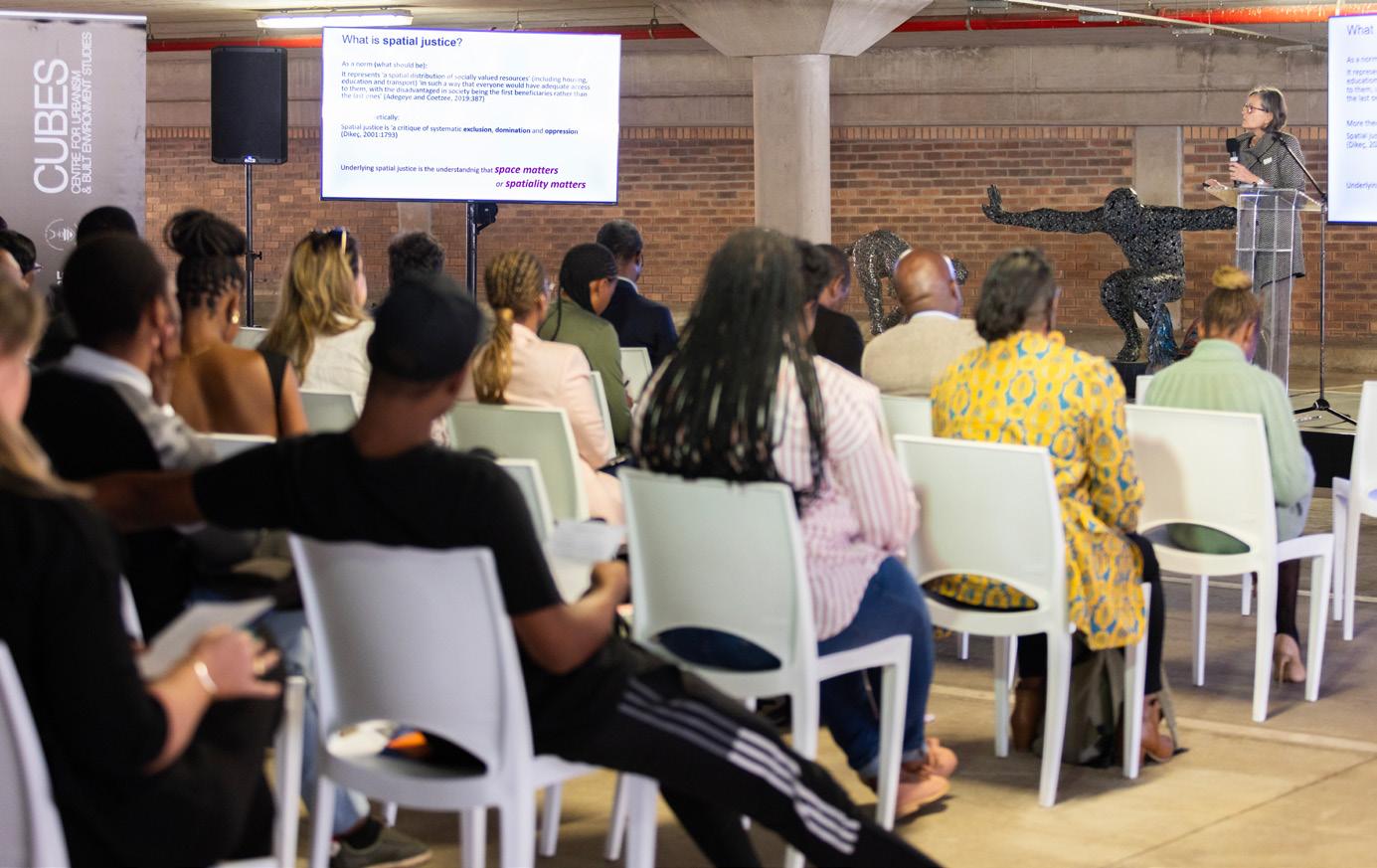
Prerequisites & Requirements
Entry criteria for the degree can be found on the Wits website: https://www.wits.ac.za/coursefinder/postgraduate/ebe/ master-of-urban-studies/
Aside from the entry criteria, there are no individual course prerequisites.
Degree Outcomes
The qualifying learner:
• is familiar with relevant theoretical paradigms, concepts, material for his/ her area of specialisation;
• is competent to identity and formulate a research question, evaluate and solve problems within the ambit of the research area;
• is required to operate effectively in an academic environment with peers and supervisors. Where appropriate to the research area, the learner is required to interact effectively with communities and other groups and individuals outside the academic arena;
• is required to have extensive communication skills and the ability to produce material of an internationally acceptable standard;
• is able to operate independently, but within applicable professional, ethical and legal frameworks and to reflect on how this affects her/his roles as a city specialist. He/she has been prepared for the next stage of his/ her career, whether it be professional, entrepreneurial or in some other field, and to meet the demands of continuing professional and life long development.
City Studio lecture; photo by P. Moreira
Housing & Human Settlements [MUS (HHS)]
The Master of Urban Studies in Housing & Human Settlements [MUS (HHS)] aims to develop practical, managerial, analytical, and spatial skills, as well as social and cultural sensitivities, to meet housing challenges in the unevenly developing world.
Students are offered the unique opportunity to engage with housing issues from a multi-disciplinary, internationalist perspective. One of the two field-specific core courses covers theoretical, conceptual, social, technical, managerial,
legal, financial and planning aspects of housing and human settlements. The second core course engages constructively with unplanned and incremental settlements, from the perspective of physical, social and governance challenges. The field includes an elective chosen from a range of courses offered in the school and beyond.
Through the substantial research component, students are given the opportunity to critically explore a particular aspect of their interest in housing. Students are taught and supervised by a multi-disciplinary team of scholars.
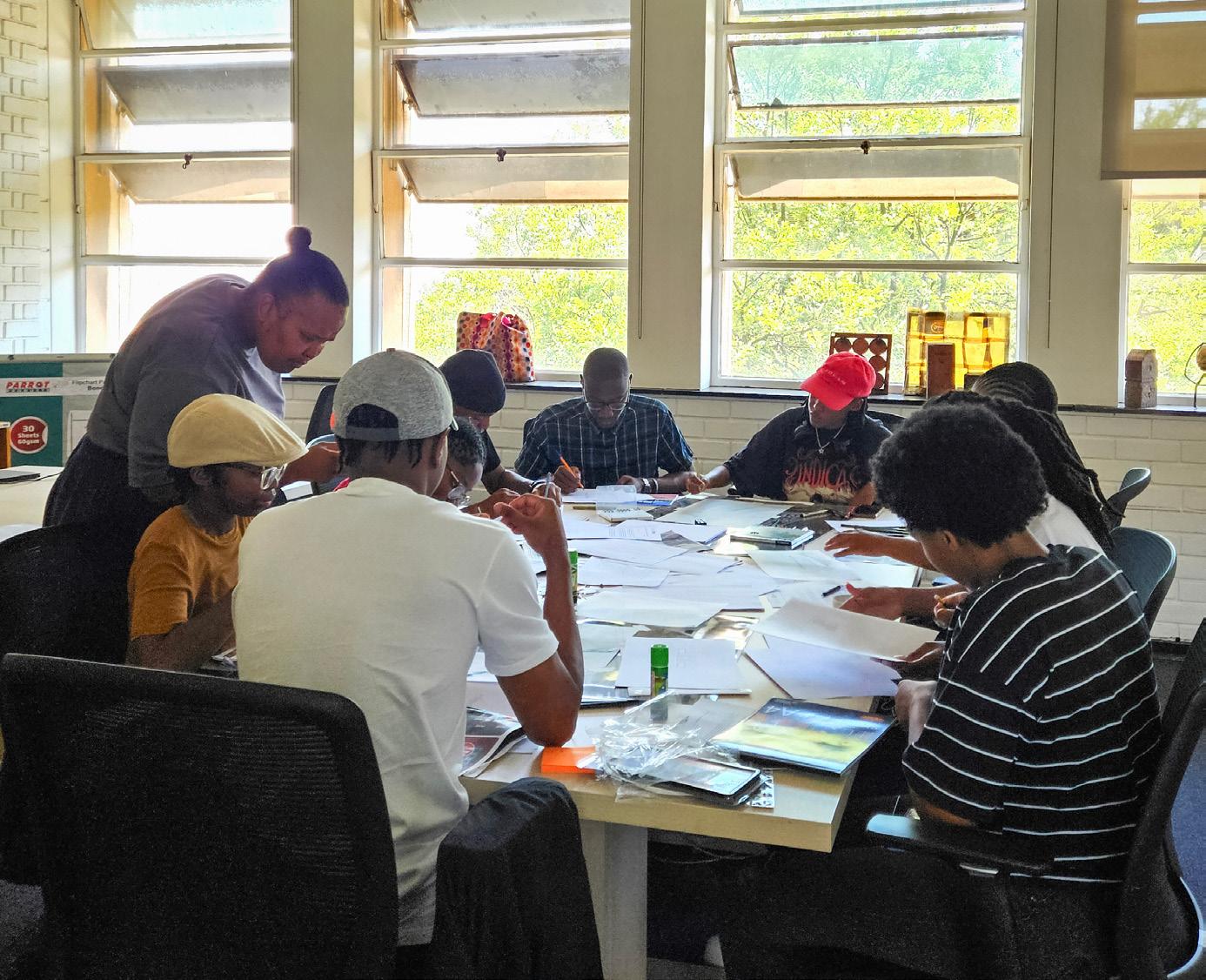
City Studio; photo by P. Moreira
Elective Courses
Note: a candidate who lacks the necessary GIS and graphic skills to complete required courses may also be required to complete part or all of ARPL7052A Technologies & Techniques for the Built Environment.
Sustainable & Energy Efficient Cities [MUS (SEEC)]
The Master of Urban Studies in the field of Sustainable Energy Efficient Cities [MUS (SEEC)] qualification is a one year full-time (or two-year part-time) programme on sustainability and energy studies with a focus on cities, settlements, buildings and architecture.
As the centres of human habitation as well as production and consumption, cities and their respective built environments pose a double-edged sustainability dilemma for humanity with regard to challenges versus intervention, adaptation and mitigation opportunities. Graduates of this qualification can therefore expect to play a significant role in the transition processes towards greening cities, economies, markets, consumption and lifestyles in the South Africa, regionally and globally as well as facilitating related transformations of policies, regulations and institutional structures.
Based on a multi-disciplinary approach, the programme admits students with honours-level qualification in diverse disciplines including the built environment, engineering, social sciences, humanities and natural sciences.
The course starts early to mid-February and ends with submission of the research report for examination mid-December, or one year later if registered on a part-time basis. This degree is offered mostly on a block release. However, one of the core courses ‘Understanding Cities of the South’ is offered once a week in the first semester, and the elective course ‘Environmental Planning and Sustainable Development’ is offered once a week in the second semester.
In the second year of the part time route, part-time candidates have to complete the Research Methods course which is offered one full day every two weeks for the first quarter of the year. There are several research progress presentations on research report scheduled across the remainder of the year.
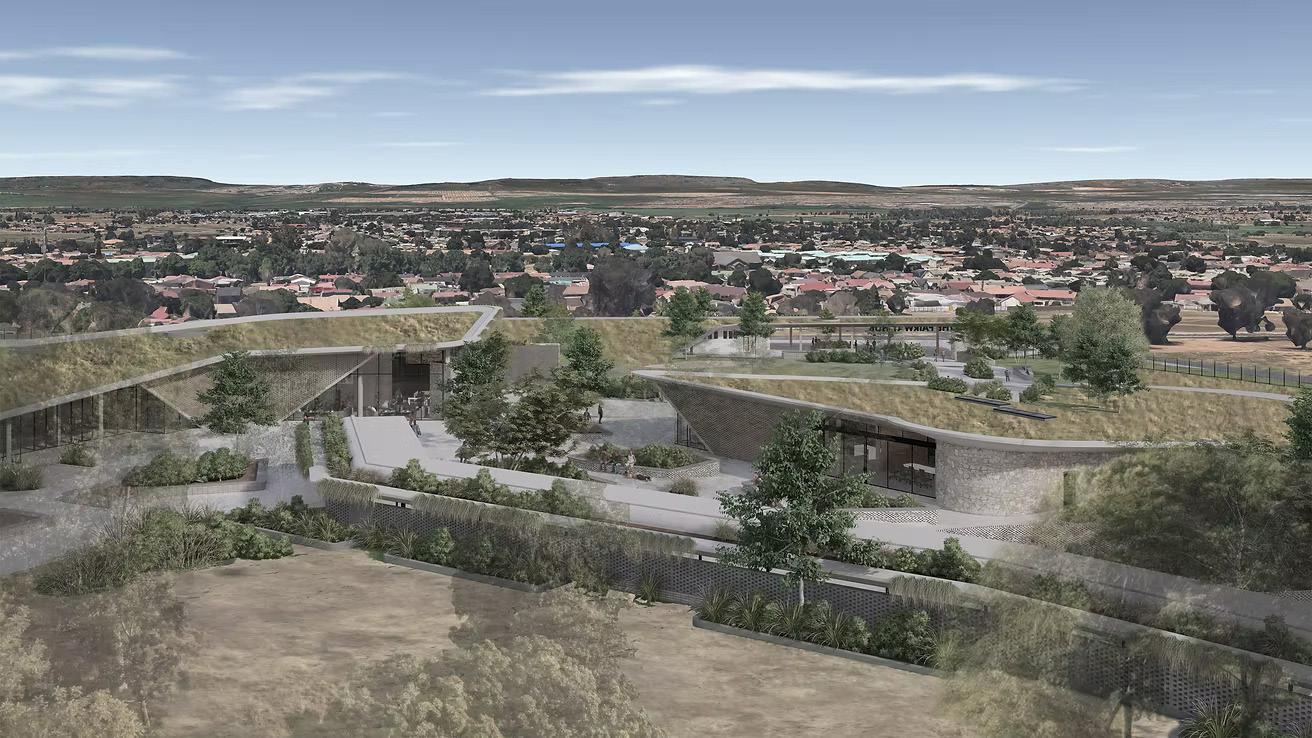
Student work: D. Maluleke
MUS (SEEC) First Year (part-time) programme code: FCA16
Course Code & Title
Required Courses
ARPL7010A Understanding Cities of the South
ARPL7054A Energy for Sustainable Cities
ARPL7055A Energy Efficiency & Renewable Energy for Buildings
Elective Courses (20 credits required):
ARPL7032A Environmental Planning and Sustainable Development
ARPL7052A Techniques & Technologies of Planning
ARPL7060A Sustainable City Studio
ARPL7071A Theory & Practice of Urban Management
BUSA7494A Energy for Future Cities
Duration Lead Lecturer
Q1 R. Ballard
Q2 P. Theron
Q3 S. Maape
Q3 T. Leuta
N/A (not offered in 2026)
Q2 L. Tshuma
Q4 M. Paschini
MUS (SEEC) Second Year (part-time)
Course
Note: a candidate who lacks the necessary GIS and graphic skills to complete required courses may also be required to complete part or all of ARPL7052A Technologies & Techniques for the Built Environment.
Urban Management [MUS (UM)]
The Master of Urban Studies in Urban Management MUS (UM) is a one-year, full time or two-year part time degree. It responds to challenges associated with rapid urbanisation processes by providing practice-oriented knowledge and innovative skills to graduates who have a drive for urban transformation. This programme introduces the field of urban management through four crucial and cross-cutting dimensions:
• Politics and policy of the urban
• Understanding complex urban systems
• Managing change processes
• Co-producing knowledge between theory and practice
Addressing, analysing and responding to these four dimensions is significant for engagement with the urban. MUS (UM) seeks to educate and train planning or built environment practitioners,
researchers, scholars and policy makers who can integrate the knowledge of and skills in urban policy, development and management and the planning, urban and social sciences in general, in order to foster transformative urban strategies that enable cities to function more efficiently and effectively.
In line with global commitments such as the Sustainable Development Goals (SDGs) and New Urban Agenda as well as other global agendas which tackle developmental and urban challenges in a cross-sectorial manner, the MUS (UM) stresses the interdisciplinary diagnosis/ analysis and prognosis of urban issues across all scales. It provides graduates with an interdisciplinary theoretical, methodological and practical base from which to approach the diverse issues involved in urban development. It promotes an understanding of the complex urban processes and effective interventions that can contribute to the development of well-managed sustainable, inclusive and resilient cities.
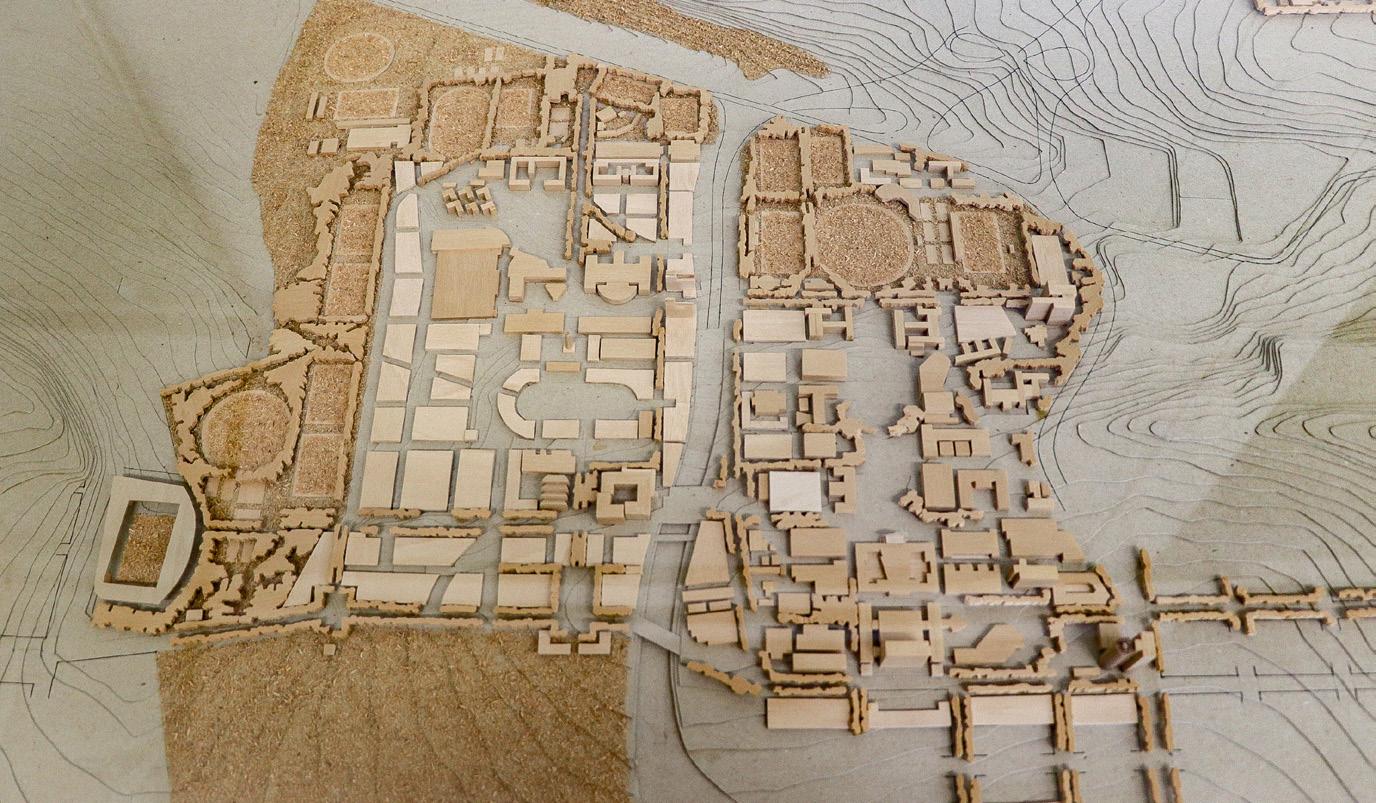
Wits masterplan model
MUS (UM) First Year (part-time)
Course Code & Title
Required Courses
ARPL7010A Understanding Cities of the South
ARPL7071A Theory & Practice of Urban Management
programme code: FCA16
Credits Duration Lead Lecturer
20 Q1 R. Ballard
20 Q2 L. Tshuma
ARPL7063A Governance & Municipal Planning 20 Q3 R. Padarath
Elective Courses (20 credits required):
ARPL7074A Theory, Politics & Governance of Extended Urbanisation 20 Sem 1 P. Harrison
ARPL7032A Environmental Planning & Sustainable Development 20 Q3 T. Leuta
CIVN7020A Project Management in Developing Areas 20 Sem 2 TBD
ARPL7044A Community Participation in Urban Governance 20 Q3 TBD
Total first year (part-time) credits 80
MUS (UM) Second Year (part-time)
Course Code & Title Credits
ARPL7040A Research Methods 10 Q1 M. Huchzermeyer
ARPL7053A Research Report 90 Full Year T. Letuta
Note: a candidate who lacks the necessary GIS and graphic skills to complete required courses may also be required to complete part or all of ARPL7052A Technologies & Techniques for the Built Environment.
Urban Politics & Governance [MUS (UPG)]
Cities – where most of the world’s population now lives – are increasingly a focus of research, of public debate, and of changing public policy. The MUS (UPG) develops a multi-disciplinary, theoretical and practical understanding of cities of the South. It focuses more specifically on issues of urban governance, local democracy and politics.
Students are offered the unique opportunity to engage with urban issues from a multi-disciplinary, international perspective. The coursework covers theoretical, conceptual, social, managerial, political and planning aspects of city studies and includes electives that deepen the engagement in specialised areas.
Through the substantial research component, students are able to critically explore a particular aspect of their interest in urban studies, urban politics and governance. Students are taught and supervised by a multi-disciplinary team of scholars, primarily located in Urban Planning and Political Studies. All of the academic staff involved in this field of study have both an excellent research record, and experience in various cities as professionals and/or as activists.
The degree is aimed principally at candidates interested in a research or academic career. It will also assist those who look to working with all kinds of local, national or international agencies concerned with urban affairs.
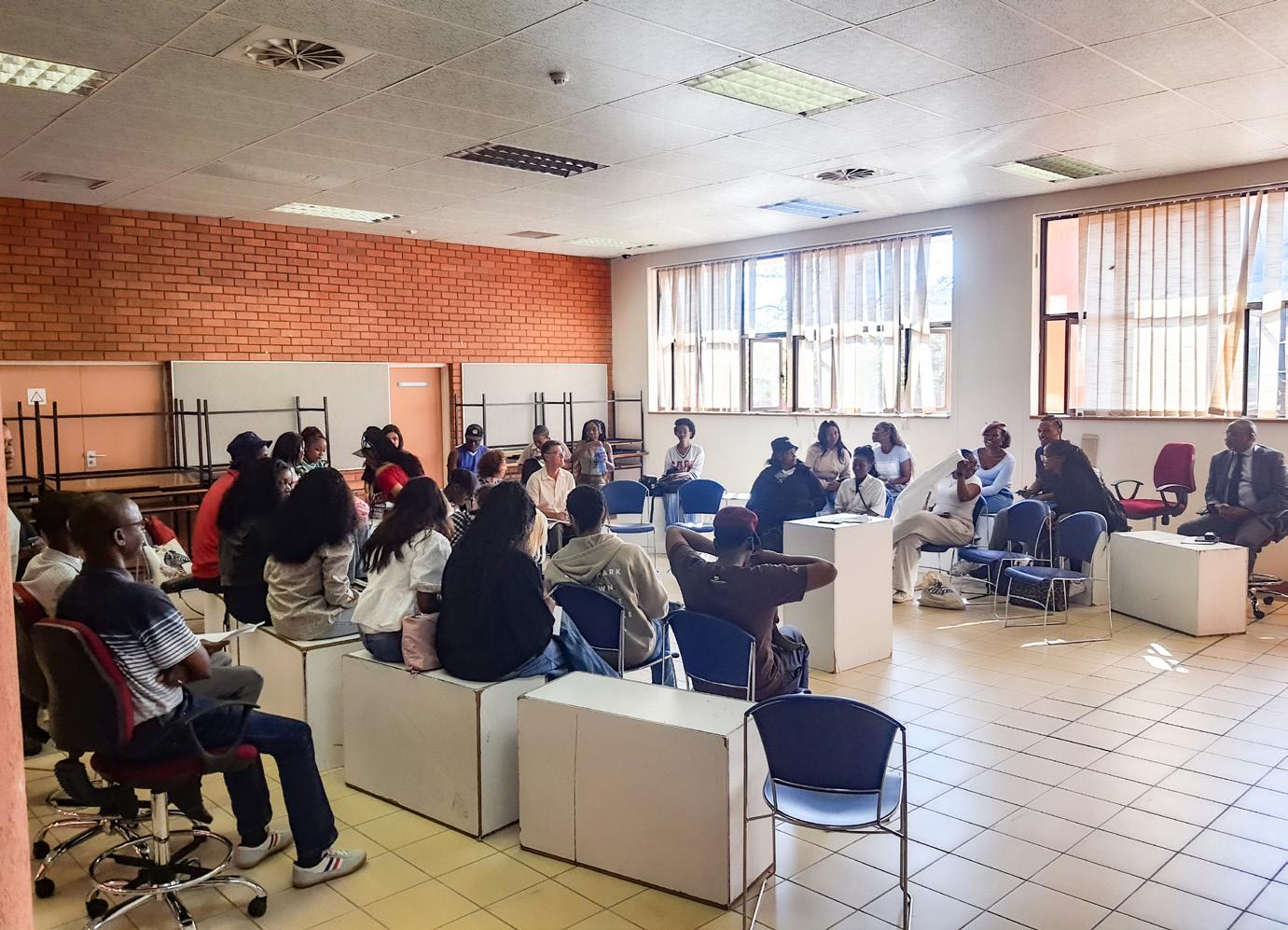
City Studio event
MUS (UPG) First Year (part-time) programme code: FCA16
Course Code & Title
Required Courses
Lecturer
ARPL7010A Understanding Cities of the South 20 Q1 R. Ballard
ARPL7048A Democratic Theory 20 Sem 1 D. Glaser
ARPL7074A Theory, Politics and Governance of Extended Urbanisation 20 Sem 1 P. Harrison
ARPL7044A Community Participation in Urban Governance
Possible replacement courses for any one of the above
ARPL7050A The Making of Urban South Africa
Q3 S. Charlton
Sem 1 N. Nieftagodien
ARPL7046A Political Economy of Development 25 Sem 1 J. de Matos Ala
ARPL7073A Theory and Practice of Housing and Human Settlements 20 Q2 M. Huchzermeyer
ARPL7063A Governance and Municipal Planning 20 Q3 R. Padarath
ARPL7049A Politics, Governance & the City 20 Sem 2 (Not offered in 2026)
ARPL7051A State, Violence, Movements
Sem 2 (Not offered in 2026)
POLS4063A The State in Africa: Democratisation & Crisis 30 Sem 2 K. Breckenridge
MUS (UPG) Second Year (part-time)
ARPL7040A Research Methods
ARPL7053A
Q1 M. Huchzermeyer
Note: a candidate who lacks the necessary GIS and graphic skills to complete required courses may also be required to complete part or all of ARPL7052A Technologies & Techniques for the Built Environment.
Urban Research [MUS (UR)]
The Master of Urban Studies in Urban Research [MUS (UR)] is conceptualised as developing and extended research skills, primarily in preparation for future doctoral studies in broad area of urban studies, urban development, and urban planning. The degree has two core courses providing a thorough grounding in key urban issues, before inviting a specialisation (through elective courses), in either quantitative or qualitative research methods.
Through this combination of coursework and self-propelled research, the MUS (UR) is intended to prepare candidates for research-based careers, the development of niche knowledge not offered in the other MUS specialisations, or for further research in a PhD.
The MUS (UR) offers two options for elective courses, allowing students to customise their coursework to best meet their intended area of research.
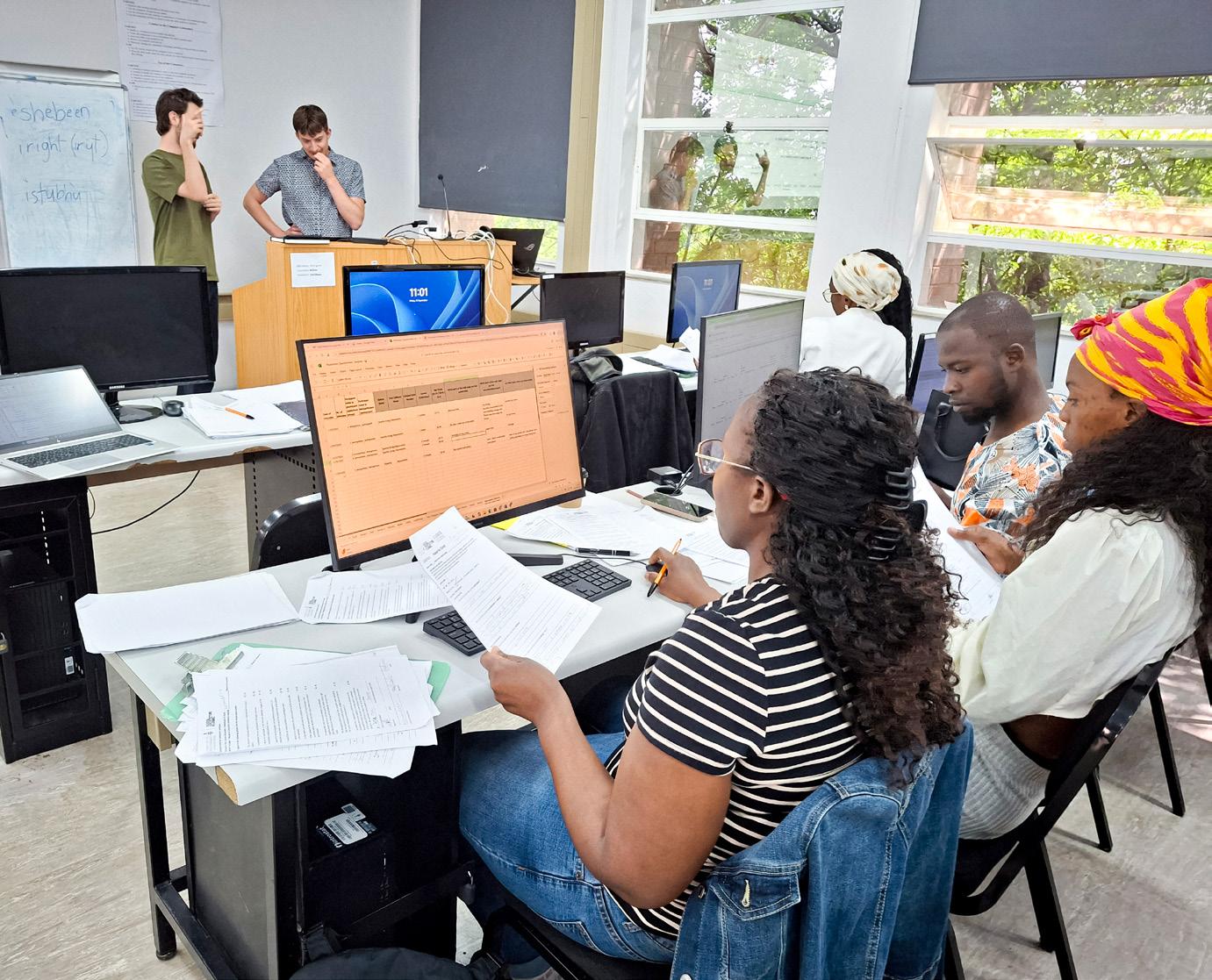
Student research process
MUS (UR) programme code: FCA16
Course Code & Title
Required Courses
ARPL7010A Understanding Cities of the South 20 Q1 R. Ballard
ARPL7074A Theory, Politics and Governance of Extended Urbanisation 20 Sem 1 P. Harrison
ARPL7053A Research Report 90 Full year T. Leuta
Elective Courses (option 1: 50 credits)
SOSS7070A Advanced Statistics for Demographic Survey & Analysis 30 Full year M. Phiri
+ any ARPL courses at Masters level totalling 20 credits 20
Elective Courses (option 2: 50 credits)
ARPL7040A Research Methods 10 Q1 M. Huchzermeyer
+ any ARPL courses at Masters level totalling 40 credits 20 Total credits 180
Note: a candidate who lacks the necessary GIS and graphic skills to complete required courses may also be required to complete part or all of ARPL7052A Technologies & Techniques for the Built Environment.
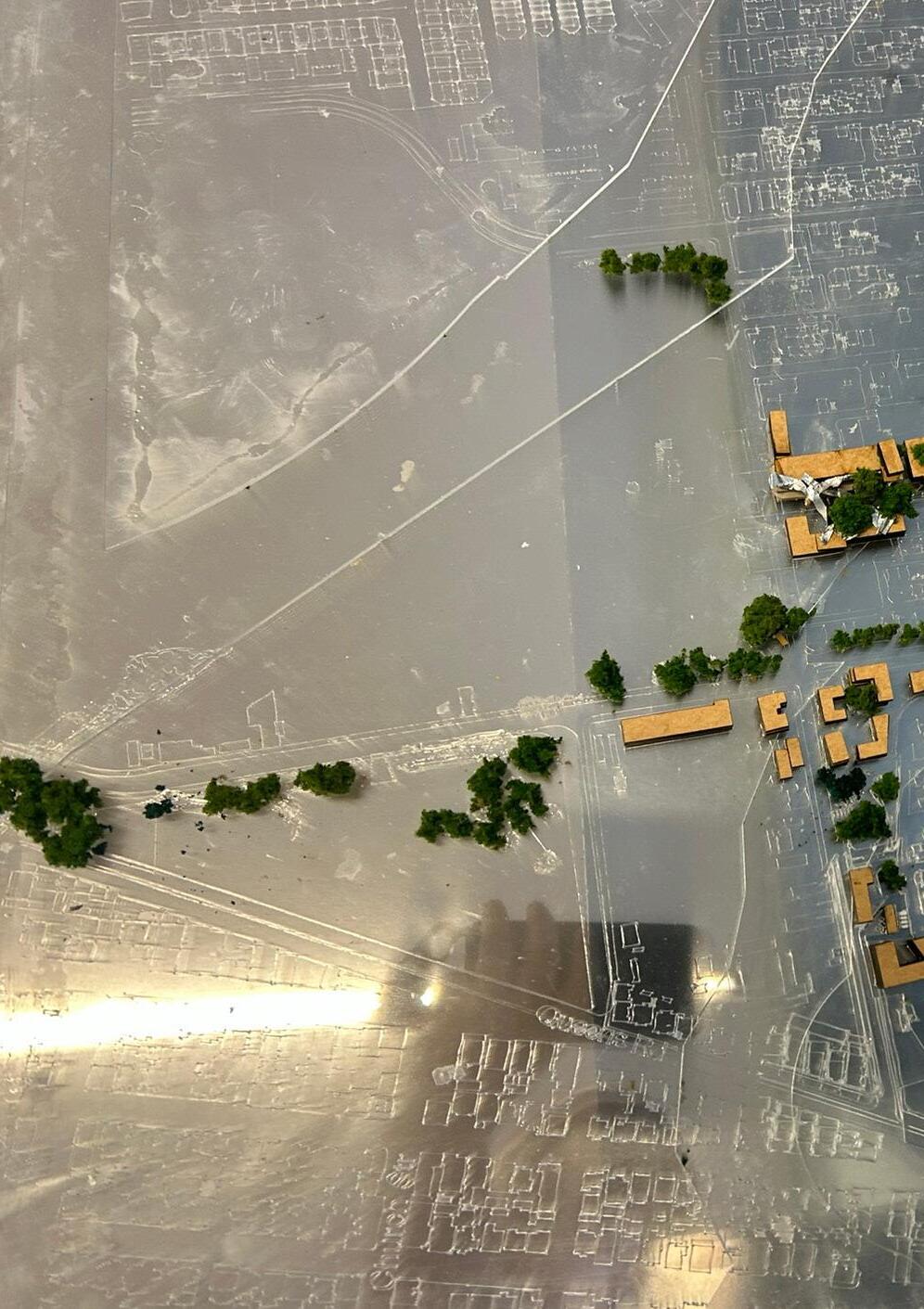
Student project:
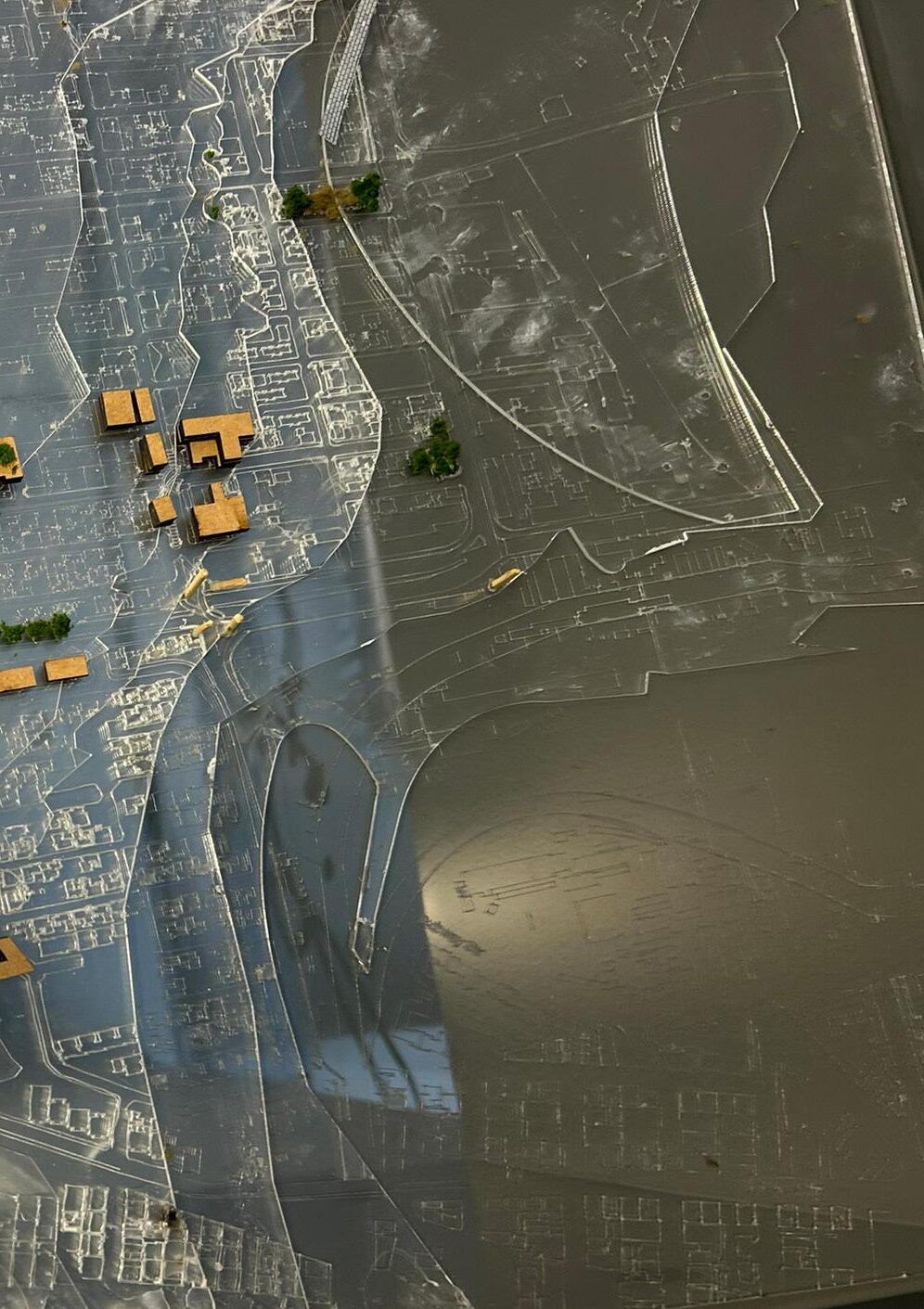
PG Degrees by Research 5
Curriculum
Programme code: FRA00
Masters degrees by coursework are completed through independent study on a topic of the students’ choice, as approved by an appropriate supervisor. Thus, there are no specific courses required.
Overview
The Master of Architecture by Research (M.Arch [Res]) is a one-year, non-professional, research-based degree allowing the learner to clarify and extend the body of knowledge of architecture through focused research on an aspect of this field. The qualification does not lead to additional professional recognition, but benefits society by enhancing the knowledge of the discipline of architecture.
Strategic Objectives
The M.Arch [Res] provides value to the learner by enhancing career opportunities in an academic environment, leading to the possibility of studying further at a Doctoral level. Other career opportunities are opened up through increased status as an authority or consultant within the built environment professions and through recognition of the qualification in the wider community.
Pedagogy & Transformation
The degree does not involve coursework; it is fully reliant on the candidate’s self-directed course of independent study, as approved through a research proposal
process. The School is equipped to supervise Masters and PhD by research with expertise in the area of architectural, urban and planning theory and sustainable development.
Prerequisites & Requirements
Entry criteria for the degree can be found on the Wits website: https://www.wits.ac.za/course-finder/ postgraduate/ebe/march-research/
Admission to the School for this degree depends on the availability of a supervisor from within the staff who is capable of and willing to supervise in the area of study. Interested candidates are encouraged to look at the staff list to consider who might be able to provide appropriate supervision in the candidate’s particular area of interest. Aside from admission, there are no formal prerequisites.
Degree Outcomes
• The learner is competent to identify, evaluate and solve problems within the ambit of the research area, and is required to demonstrate a high level of responsibility and ethics both within the immediate context of the problem, and with regard to society as a whole.
• The learner is required to operate effectively in an academic environment with peers and supervisors. Where appropriate to the research area, the learner is required to interact effectively with communities and other groups and individuals outside the academic arena.
• The learner is required to have
extensive communication skills and the ability to produce material of an internationally acceptable standard.
• The learner will have built on his/her existing knowledge of technology and is able to evaluate the application of technology in relation to wider local and global environmental concerns.
• The learner will be able to locate his/ her decision-making and proposals within wider social, legal, economic, intellectual and environmental contexts.
• The learner will have developed a high level of self-management with a critical awareness of personal values.
• The learner is required to have extensive skills and knowledge in
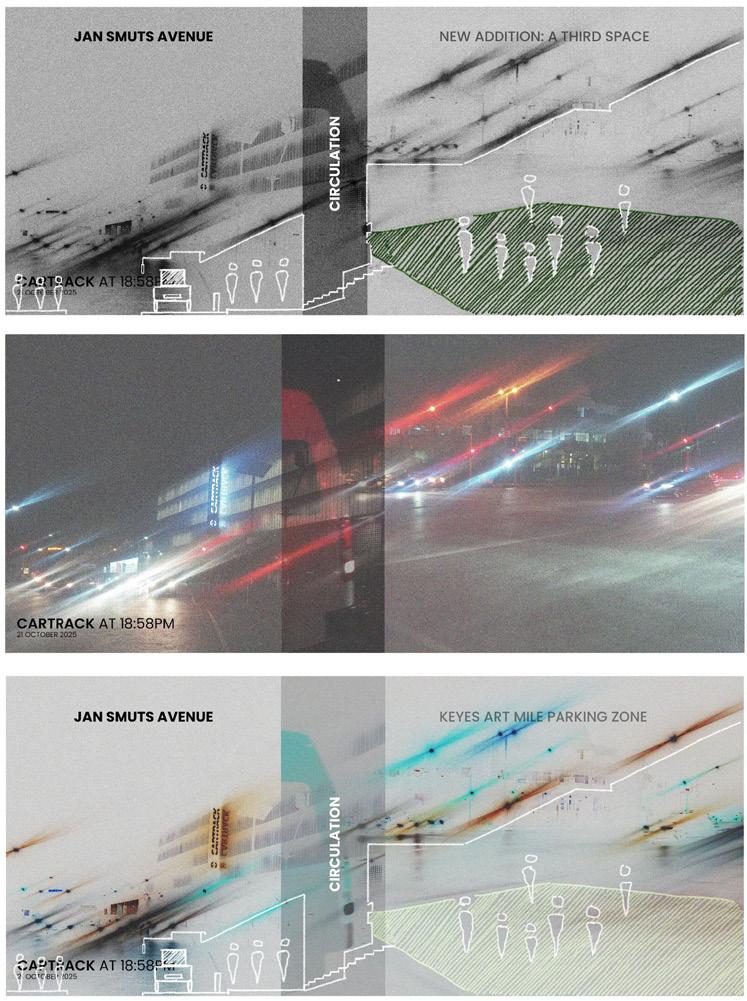
the area of data collection, analysis, organization and evaluation.
• The learner is exposed to a range of sophisticated learning strategies, and is expected to make informed decisions on those employed. The learner is required to act responsibly and professionally, with full regard to the needs and aspirations of the society within which he/she operates. The learner has considerable cultural and aesthetic awareness, and is required to enhance and apply this within the area of specialization. The learner is exposed to career opportunities both within an entrepreneurial and academic context.
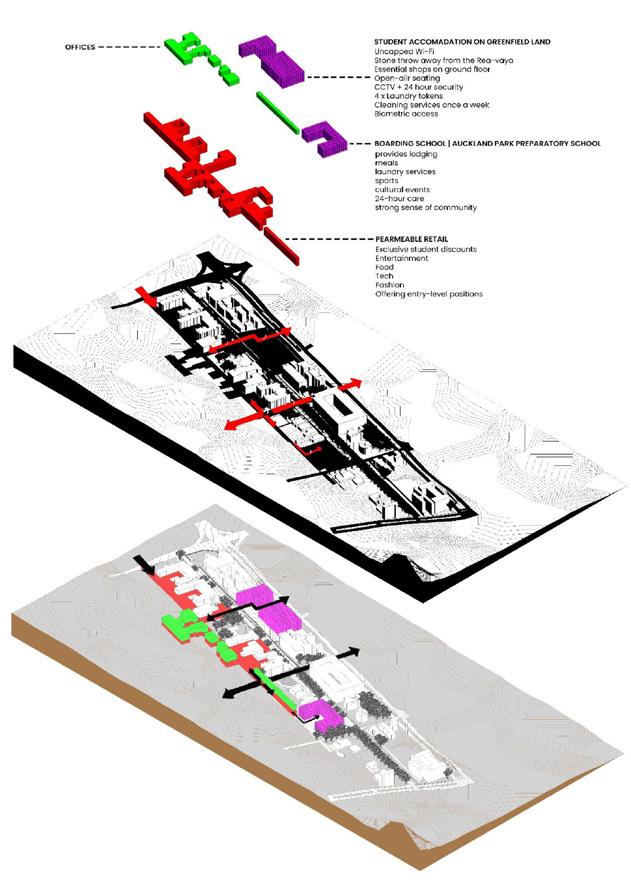
Student work: N.K. Ntatleng
MSc URP [Res] Degree
Curriculum
Programme Code: FRA02
Masters degrees by coursework are completed through independent study on a topic of the students’ choice, as approved by an appropriate supervisor. Thus, there are no specific courses required.
Overview
The Master of Urban & Regional Planning by Research (MSc URP [Res]) is a one-year, non-professional, research-based degree allowing the learner to clarify and extend the body of knowledge of urban planning and related fields through focused research on an aspect of this field. The qualification does not lead to additional professional recognition, but benefits society by enhancing the knowledge of the discipline of architecture.
Strategic Objectives
The MSc URP [Res] provides value to the learner by enhancing career opportunities in an academic environment, leading to the possibility of studying further at a Doctoral level. Other career opportunities are opened up through increased status as an authority or consultant within the urban planning professions and through recognition of the qualification in the wider community.
Pedagogy & Transformation
The degree does not involve coursework; it is fully reliant on the candidate’s self-directed course of independent study, as
approved through a research proposal process. The School is equipped to supervise Masters and PhD by research with expertise in the area of urban and planning theory and sustainable development.
Prerequisites & Requirements
Entry criteria for the degree can be found on the Wits website:
https://www.wits.ac.za/course-finder/ postgraduate/ebe/msc-urban-and-regional-planning-by-research/
Admission to the School for this degree depends on the availability of a supervisor from within the staff who is capable of and willing to supervise in the area of study. Interested candidates are encouraged to look at the staff list to consider who might be able to provide appropriate supervision in the candidate’s particular area of interest.
Aside from admission, there are no formal prerequisites.
Degree Outcomes
• The qualified learner is able to:
• Identify, evaluate and solve problems within the ambit of the research area, and demonstrates a high level of responsibility and ethics both within the immediate context of the problem and about society as a whole. Also, he/she is familiar with relevant theoretical material for his/her area of specialisation.
• Operate effectively in an academic environment with peers and supervisors. Where appropriate to the research area, interact effectively
with communities and other groups and individuals outside the academic arena.
• Produce material of an internationally acceptable standard has extensive communication skills.
• Evaluate the application of planning technology about broader local and global environmental concerns by building on his/her existing knowledge of planning technology.
• Locate his/her decision making and proposals within broader procedural and social, legal, economic, intellectual and environmental contexts.
• Develop a high level of self-management with a critical awareness of
personal values.
• Interpret and apply extensive skills and knowledge in the area of data collection, analysis and organisation.
• Expose a range of sophisticated learning strategies, and make informed decisions on their employment. Also, he/she is required to act responsibly and professionally, with full regard to the needs and aspirations of the society within which he/she operates. Further, has considerable cultural and environmental awareness, and is required to enhance and apply this within the area of specialisation. Expose career opportunities both within an entrepreneurial and an academic context.
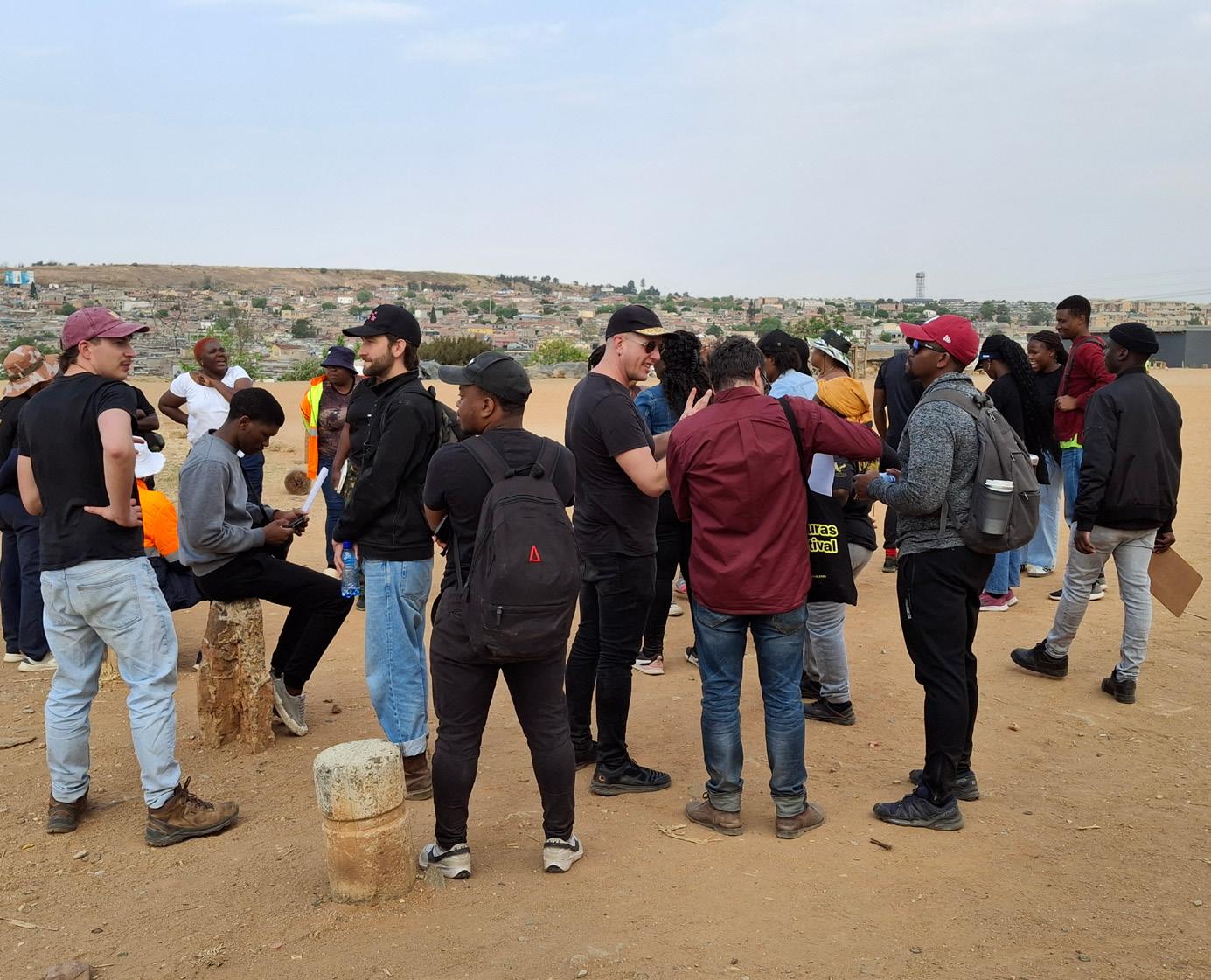
City Studio field research
PhD Degree
Overview
The degree of Doctor of Philosophy (PhD - programme code FDA00) is a research degree under supervision and examination is by thesis alone. The Doctor of Philosophy degree (PhD) may be conferred in any of the following specialisations: Architecture (FD005), Urban and Regional Planning (FDA06). The minimum period of study is two years full-time; a part-time option is available over four years. Registration may be extended for not more than 2 years beyond the normal time span.
In line with the mission of “a leading African research-intensive university,” Wits requires students to make an original contribution to knowledge. While the primary guidance to PhD candidates is provided by the PhD supervisor fellow PhD candidates and other faculty provide a network of support and interaction. Candidates are expected to actively participate in the PhD Colloquia. These are compulsory workshops
distributed throughout the first semester, which constitute the Doctoral Research Design. These are complemented by workshops offered by the Postgraduate Office that are distributed throughout the year.
Strategic Objectives
The PhD programme, which spans Architecture, Planning and a variety of interdisciplinary fields, aims aim to produce top-quality social scientists and designers who can engage with the conceptual foundations of architecture and urban planning and employ robust and appropriate in their research. The programmes prepare students for a variety of careers in academia, international organisations, urban planning, community development, national and local governmental institutions, to name a few.
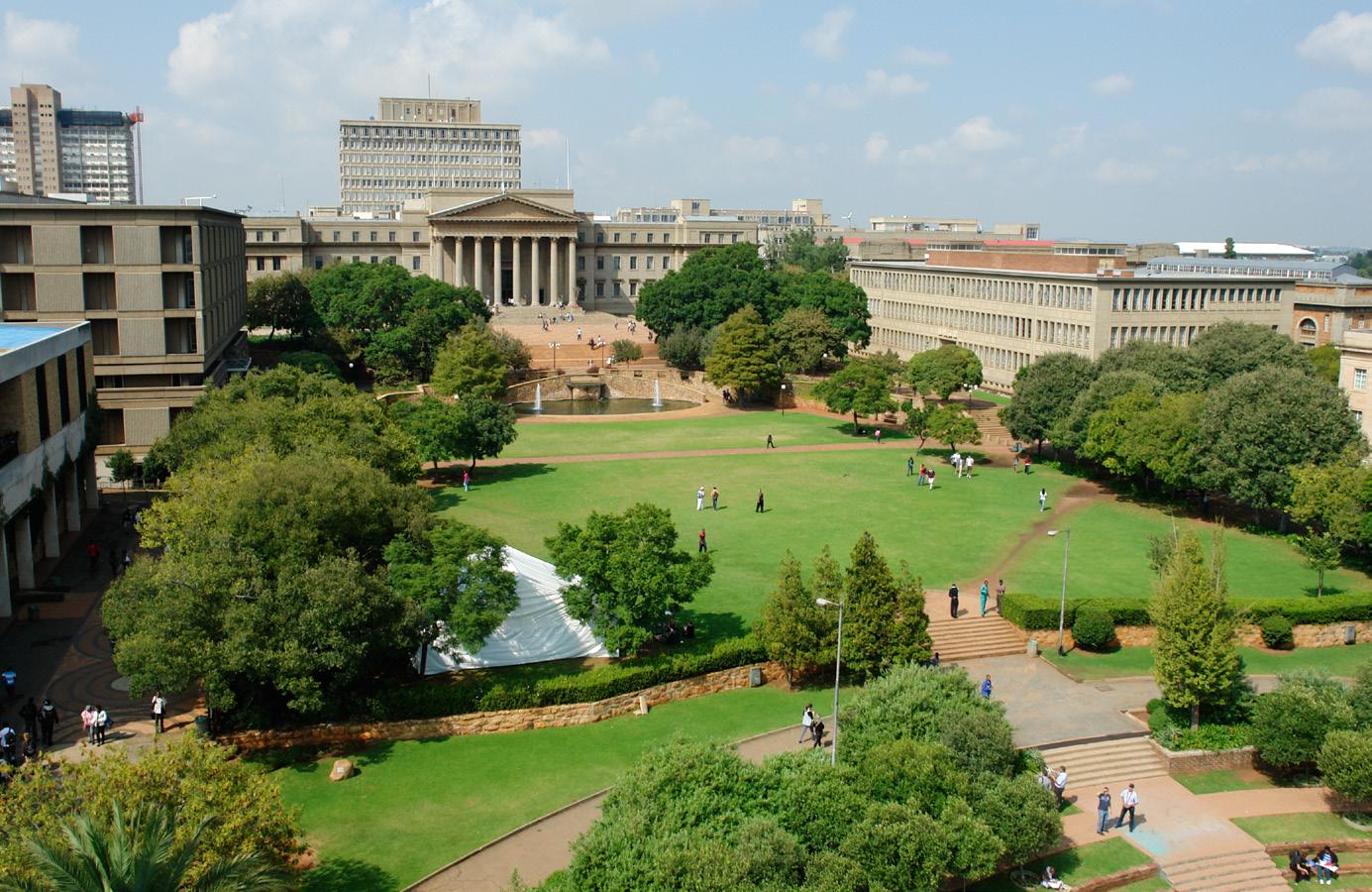
Wits Library Lawns
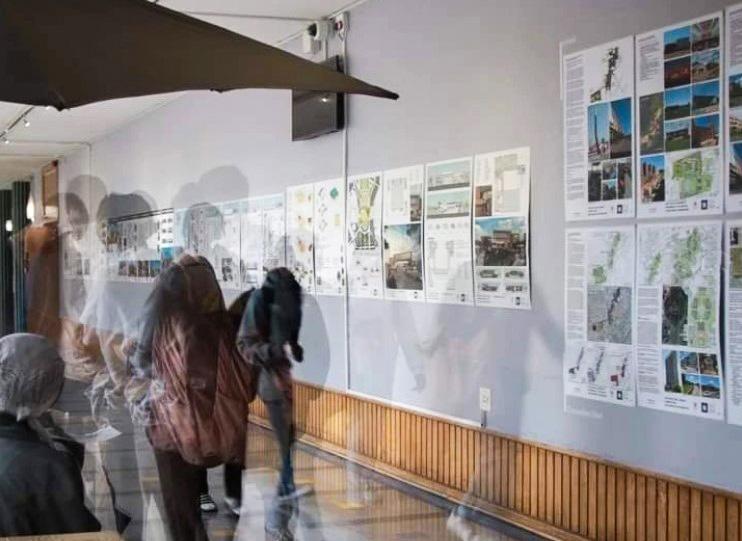
Prerequisites & Requirements
Entry criteria for the PhD can be found on the Wits website:
https://www.wits.ac.za/coursefinder/postgraduate/ebe/ phd-architecture-and-planning/
Candidates who possess a 70% average from a master’s degree by coursework or by research are eligible to apply. A candidate registering for the first time for the degree may register at any time. A candidate is required to submit a research proposal to the Faculty Board by no later than six months from the date of first registration.
Admission to the School for this degree depends on the availability of a supervisor from within the staff who is capable of and
willing to supervise in the area of study. Interested candidates are encouraged to look at the staff list to consider who might be able to provide appropriate supervision in the candidate’s particular area of interest. SoAP can discuss applicants’ research ideas and preliminary proposals at their discretion. Once eligibility as supervisor availability has been established, the candidate will be invited to submit a formal application.
Aside from the entry criteria, there are no individual course prerequisites. However, applicants need to have a recognised master’s degree, and must demonstrate that they have the necessary competencies in research methodology, and have the research experience required for the completion of an independent research degree.
Interested candidates must send the
following to the Postgraduate Coordinator for pre-assessment:
• A CV, academic transcripts, academic referees, & certified copies of degree qualifications and an ID or passport;
• Any previous research papers;
• A preliminary 4-5 paged proposal. The purpose of the proposal is to make a case for the research to be undertake, and it will need to show that the applicant has the ability to identify a pertinent research question, has at least an initial grasp of the relevant literature and has some of the necessary competencies in research methodology and practice that are required for the completion of an independent study research degree.
The proposal should include:
• Introduction/Background to the topic of interest;
• Outline of the essential background literature;
• Rationale of the proposed research, with reference to the intended practical and theoretical contributions;
• Key question/s to be addressed and the main objectives of the research;
• Approach to be taken in doing the project, including a preliminary outline of the proposed research design and data generation and analysis methods;
• References. Research which involves human participants must undergo ethics review by the University Ethics Committee. Candidates must ensure compliance with the University Ethics in Research policy prior to engaging in any research. Ethical clearance is valid for two years of receiving it, with the possibility for a two-year renewal. The rules for the degree of Doctor of Philosophy (PhD) are published in the
University Rules and Syllabuses for Degrees and Diplomas offered in the Faculty of Engineering and the Built Environment.
Degree Outcomes
• The learner is competent to identify, evaluate and solve problems within the ambit of the research area, and is required to demonstrate a high level of responsibility and ethics both within the immediate context of the problem, and with regard to society as a whole.
• The learner is required to operate effectively in an academic environment with peers and supervisors. Where appropriate to the research area, the learner is required to interact effectively with communities and other groups and individuals outside the academic arena.
• The learner is required to have extensive communication skills and the ability to produce material of an internationally acceptable standard.
• The learner will have built on his/her existing knowledge of technology and is able to evaluate the application of technology in relation to wider local and global environmental concerns.
• The learner will be able to locate his/ her decision-making and proposals within wider social, legal, economic, intellectual and environmental contexts.
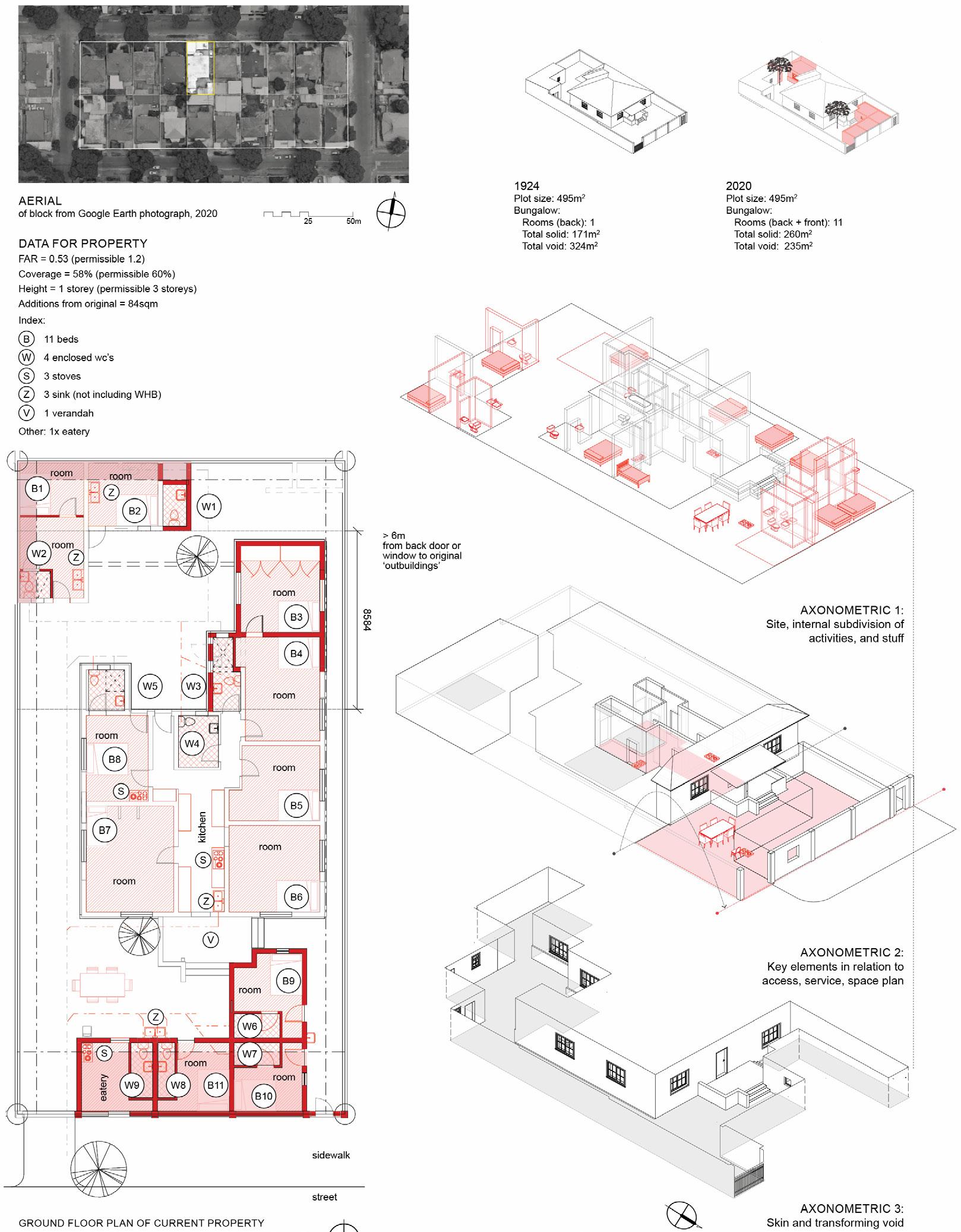
PhD work: K. Doermann
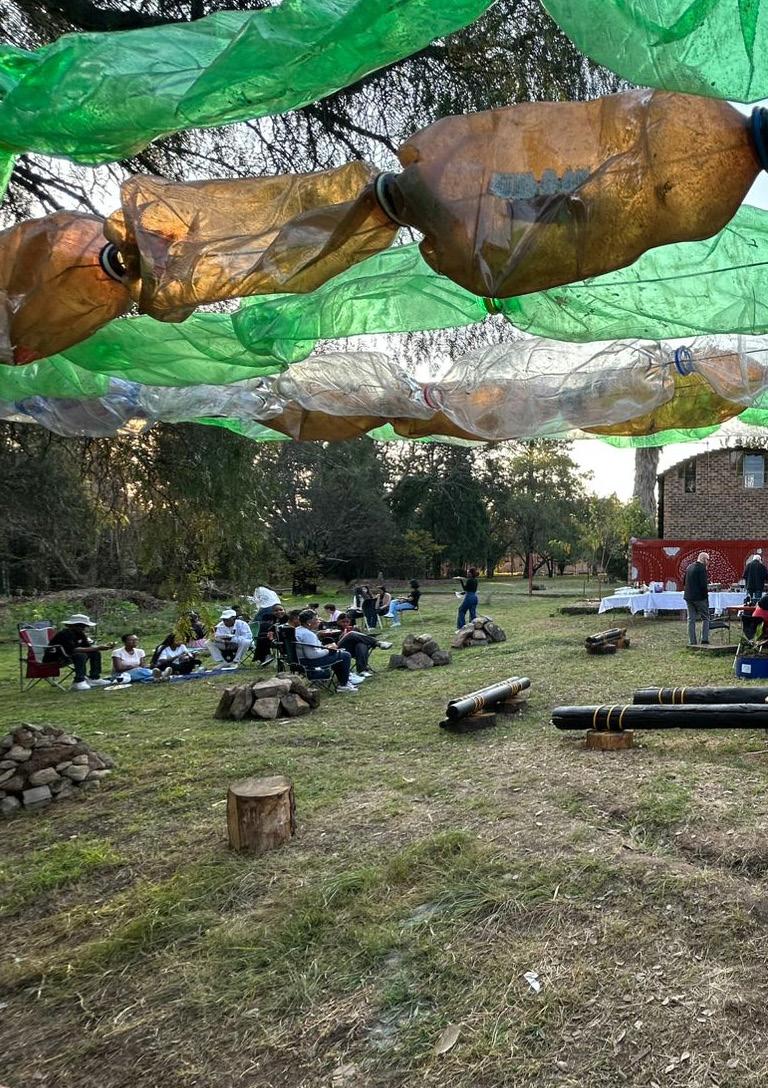
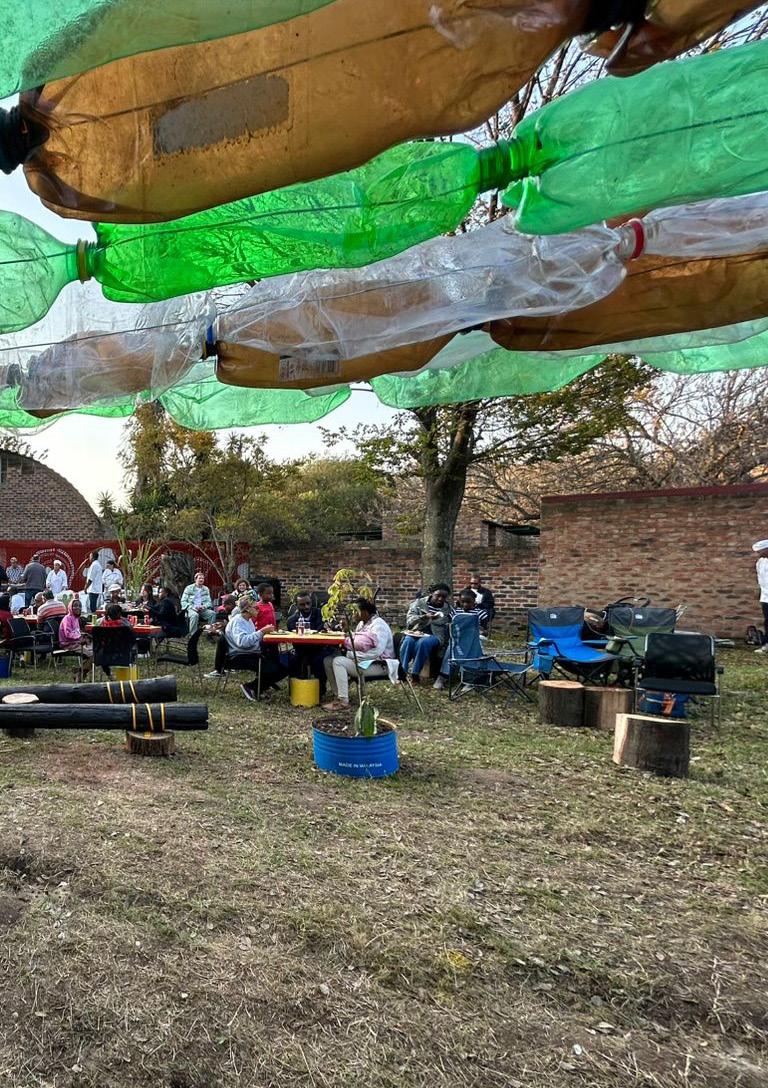
6 Student Life & Support
Navigating Student Issues at Wits
Have a suggestion?
Wits Vuvuzela www.witsvuvuzela.com
Have a problem?
for a course? for public expression? for Wits as a whole?
Voice of Wits 88.1 FM
www.vowfm.co.za
Contact your lecturer See your course outline for contact info and office hours
Wits Writing Centre
Wartenweiler Library 011 717 4125 wits.ac.za/students/
Faculty Office
Wits ARM Building, Ground floor 011 717 7602
amelda.vanvuuren@wits.ac.za @
Degree Conveners
BAS: Brigitta Stone Johnson
BSc URP: Muhammed Suleman
graffiti wall between Matrix & Umthombo for the degree programme?
BAS Hons; Kirsten Dörmann
BSc Hons URP: Amanda Williamson
PGDip: Tsepang Leuta
M.Arch: Hilton Judin
MSc DP: Tsepang Leuta
MUD: Ludwig Hansen
for the School?
Student Representative Council (SRC)
Use your class reps as your voice on the Wits SRC
MUS: Mncedisi Siteleki
PhD: Richard Ballard
Head of School: Prof. Mfaniseni Fana Sihlongonyane
To contact, make an appointment with: Cezanne Henney Programme Coordinator
John Moffat, room 21 011 717 7424 @ cezanne.henney@wits.ac.za
unsure about the degree programme?
academic issues generally lost? don’t understand your marks? struggling with language? have a learning disability? problems with your registration?
if you missed a submission, refer to the Assessment Policy...
Wits Law Clinic
Law Clinic (West Campus) 011 717 8562 www.wits.ac.za/lawclinic/
Disability Rights Unit (DRU) Solomon Mahlangu House, 1151 011 717 9154
www.wits.ac.za/disability-rights-unit
absent from class?
non-academic issues
EMERGENCY!
not feeling well?
feeling nervous, sad or overwhelmed?
Wits Protection Services
various posts, HQ in Central Block 011 717 4444 or 011 717 6666 (not specified - visit in person or call) @
physically ill?
safety or security concern?
Campus Health and Wellness Centre
The Matrix, LG flr 011 717 9111 or 011 717 9113 www.wits.ac.za/campushealth
CCDU
CCDU Building (West Campus) 011 717 9140 or 011 717 9132 info@ccdu@wits.ac.za @
CNS
Solomon Mahlangu House, 1st flr 011 717 1717 ITstudenthelp@wits.ac.za @
ICAM
Solomon Mahlangu House, rm 045 011 717 1830 www.icam.wits.ac.za
International Students Office
student visa issues?
IT problems? difficulty finding a place to live? problems with your ID card? legal problems?
due to a disability?
trouble getting around?
between Wits facilities?
Solomon Mahlangu House, G flr 011 717 1054 studysa.international@wits.ac.za @
Central Accommodation Office
Solomon Mahlangu House, rm 045 011 717 9172 accommodation@residence.wits.ac.za @
Wits Inter-campus Bus Service
(no set location) 011 717 1794 transport.services@wits.ac.za @
Security
The entity charged with security on campus is Wits Protection Services (WPS), which is headquartered in Robert Sobukwe block, room 1, but many staffed posts on the Wits campus.
While the School makes all possible efforts to maintain complete security, including through swipe-card access to certain spaces and rotational WPS security guards inside the building, full security, especially from petty theft, cannot be guaranteed. Students are to keep valuables on their persons at all times, or in the lockers provided inside their studios.
To report crime or request a 24 hour escort service, call:
Wits Protection Services: (011) 717 4444 or (011) 717 6666
Wits Crisis Helpline
Mental health can a be a challenge for many students. If you are feeling depressed or feeling overwhelmed, know that you are not alone, and help is always available. It is extremely important to seek help should you feel that you need it.
Wits maintains a free, 24-hour emergency helpline. We hope you will never need this resource, but if you do, don’t hesitate to use it:
Wits Crisis helpline: 0800 111 331
During business hours, you may also walk in, no questions asked, to the Counselling and Career Development Centre, for an immediate consultation with a mental health expert. See the next section for details on the CCDU.
CCDU
The Counselling and Career Development Unit (CCDU) provides a welcoming and safe space to students, to enhance their well-being and contribute to their academic success. Based on an ethos of studentcenteredness, the Unit is staffed by a small but dedicated team of professionals inclusive of psychologists, social workers, careers educators, life coaches and administrators who offer a variety of supportive and empowering services to the student community. The following services are available through the Counselling & Careers Development Unit:
• Career Services: career development through career counselling/education, psychometric career assessments and personal development workshops
• Therapy Services: one-on-one counselling and/or group therapy, trauma debriefing and psycho-education in the form of workshops and talks.
• HIV/AIDS Education and Support Services: holistic interventions and programmes for students affected and infected by HIV/AIDS.
• Learn for Life: a structured programme that provides psychosocial learning and life skills development for students through the facilitation of group processes, presentations, workshops and trainings.
• Graduate Recruitment: a programme that facilitates contact between students and prospective employers through the organisation of career exhibitions, company presentations, and foyer interview
For more information, please visit: https://www.wits.ac.za/ccdu
Campus Health
The Campus Health & Wellness Centre (CHWC) is a registered medical practice offering a wide variety of health services to Wits students and staff members. The services are convenient, accessible, caring and cost-effective. This is likely to be the first port of call for students experiencing illness.
The CHWC can be found on the lower ground floor of the Matrix. Further details can be found on their website:
https://www.wits.ac.za/campus health
Although the COVID-19 pandemic has largely subsided, Wits maintains an online COVID-19 portal, featuring updated information. You can find the portal here: https://www.wits.ac.za/covid19/
Gender Equity Office
The Gender Equity Office (GEO) is a holistic, autonomous and integrated office that deals with all aspects of gender based harm and the advancement of gender equity. Gender-Based Harm (GBH) includes the following:
• Sexism / unfair discrimination based on gender or sexual orientation;
• Sexual harassment, sexual assault and rape;
• Abuse of power and conflict of interest based on sexual/romantic relationships.
GEO offers its services free of charge to all staff members and students of the University, and provides the following services:
• Collects and tracks all GBH-related complaints across the university and
analyses trends to inform and improve intervention initiatives;
• Provides a safe and confidential space with full-time counselling support to complainants and victims of GBH;
• Confidentially advises complainants and victims of GBH of their options;
• Oversees an independent disciplinary procedure for formal complaints against staff or students accused of GBH;
• Engages actively in advocacy around gender equality.
For more information, visit their website: https://www.wits.ac.za/students/geo/
Disability Rights Unit
The University endeavours to make the learning environment a rich and rewarding one and continually strives to improve all aspects of accessibility – physically, technologically and socially. The Disability Rights Unit (DRU) serves students who have a documented physical, medical, learning and/or psychological conditions; or in cases where professionals have verified that the person needs individualised services to overcome severe disadvantages.
The DRU is able to assist students with the following disabilities: visual; physical; hearing; learning; psychological; speech; chronic illness & painful conditions; seizure disorders. Students with temporary disabilities may request services for the period during which they are disabled.
More information can be found on the DRU website:
https://www.wits.ac.za/ disability-rights-unit
Academic Support
Office Hours
Office hours are specific times academic staff have set aside to be available for students to drop in for consultation and/ or assistance related to their classes. Prior to the COVID pandemic, these were times the academic staff were always available in their offices; however, due to remote and hybrid learning, and an generally more flexible approach to on-campus versus virtual activities, office hours may now be either in-person or conducted remotely via Teams.
Students who are unavailable during posted office hours may make an appointment with the relevant lecturer. In most cases, students will find this easier than trying to rearrange a schedule around the posted office hours. However, in making an appointment, students are expected to follow normal professional protocols, meaning last-minute requests or requests which do not take into consideration the lecturer’s schedule may be denied.
ADU
Unique to the Faculty of Engineering & the Built Environment, the Academic Development Unit (ADU) offers various forms of academic support for our students
The ADU was established in an effort to boost student success rates and provide assistance for anyone in the Faculty of Engineering & the Built Environment who might be struggling academically. Some specific support may be given on a case by case bases as issues arise, but the ADU also has ongoing means of supporting students in courses that have proven to be particularly challenging. In the School, this includes several programmes and offerings,
such as:
• additional tutoring in mathematics where needed;
• building critical writing skills through writing workshops and tutorials;
• providing assistance for students who may be vulnerable or susceptible to academic struggles;
• assisting with time management.
Students are encouraged to seek assistance from the ADU if they feel overwhelmed or intimidated by their coursework, or fell otherwise academically challenged. The ADU is located in the Chamber of Mines Building, 3rd floor, East Wing. They may also be contacted at the phone number or email address below.
aid.adu@wits.ac.za (011) 717 7062 or (011) 717 7035
More information can be found on the ADU website: https://www.wits.ac.za/ebe/ teaching-and-learning/
Wits Writing Centre
The Wits Writing Centre (WWC) is a free and confidential service open to any Wits student of staff member who wants to work on their writing. It typically focuses on postgraduate students.
Any draft can be brought to the WWC, including essays, plans, drafts, practice exam answers and creative, non-academic writing. WWC consultants will not edit or write for a student; they will help students decide what they want to say, in their own words, to successfully reach their particular readers. Sometimes this means working to learn the conventions of your discipline. In all cases, WWC consultants will endeavour
to develop, focus, and frame thinking so as to achieve writing intentions.
More information can be found on their website:
https://www.wits.ac.za/students/ wits-writing-centre/
DLU
The Development & Leadership Unit (DLU) division of Student Affairs provides co-curricular development opportunities for students across all faculties that have a desire to develop themselves personally, socially and professionally.
Through the creation of a vibrant developmental student experience, the DLU strives to develop and incubate a generation of change makers and innovators who contribute to the shaping of a better society, locally, nationally and globally.
Through Customised Programming, Experiential Learning Offerings, and Critical
Engagements, the DLU builds spaces to grapple with ideas of excellence, innovation, collaboration, impact, diversity, and leading in relation to others.
More information can be found on their website:
https://www.wits.ac.za/students/ development-and-leadership-unit/
School Prizes
The School offers a number of annual prizes to students, funded through donations by outside entities. In some years, not all prizes will be issued if there is no project which clearly fulfills the criteria. The list of prizes is indicated on the following page.
Previous years’ prizewinning work can be viewed on the School’s website:
https://www.wits.ac.za/ archplan/theory-and-practice/ exhibitions-theory-and-practice-series/
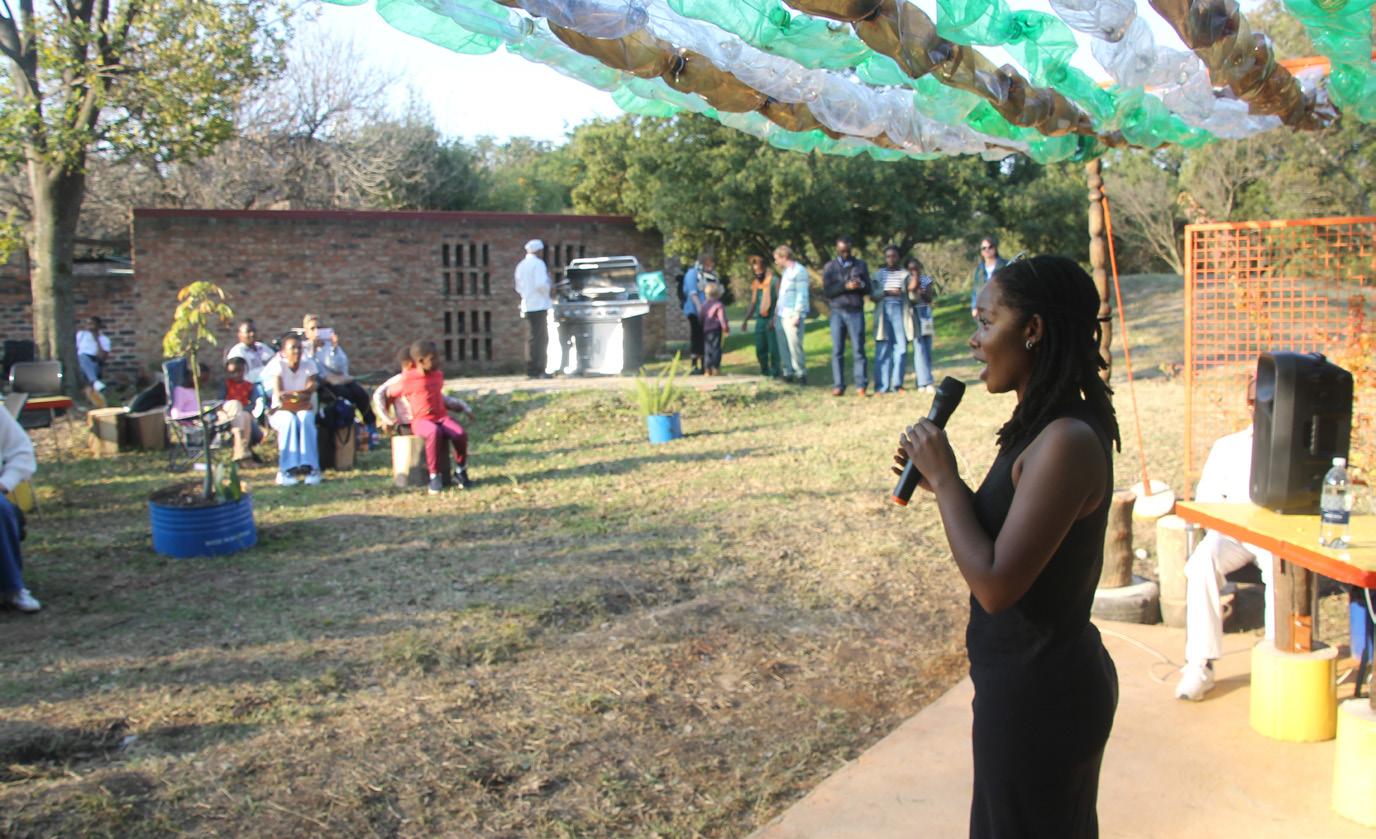
Student presentation & event: O. Mokoe
Undergraduate Prizes
Undergraduate Design Prizes: Architecture
Name of Prize Awarded for
South African Institute of Steel Construction
Undergraduate Prize
Aluminium Federation of South Africa Prize
MDS Architecture Prize
Gauteng Institute for Architecture 1st Year Award
Gauteng Institute for Architecture 2nd Year Award
Gauteng Institute for Architecture 3rd Year Award
The Bachelor of Architectural Studies student who develops the best design detailing involving steel construction.
The Bachelor of Architectural Studies student who, in any year of study, submits the best design related to the appropriate use of aluminium.
The student who submits the best design project for a commercial or institutional building in the final year of study for the Bachelor of Architectural Studies degree.
The 1st year Bachelor of Architectural Studies student who demonstrates the most rigorous design processes leading to well-resolved designs.
The 2nd year Bachelor of Architectural Studies student who most convincingly demonstrates a body of design work responding to the specific contexts of its place.
The Bachelor of Architectural Studies graduand who submits the most comprehensively resolved body of design work in the course 'Architectural Theory and Design.'
Undergraduate Design Prizes: Urban Planning
Name of Prize Awarded for
Azza A Arif Award
Planning Representation Prize
The BSc Urban and Regional Planning student with the most improved mark in design.
For the best performance in Urban Design & Graphic Representation courses taken towards the Bachelor of Science degree in Urban and Regional Planning
Undergraduate Academic Prizes: Architecture
Name of Prize Awarded for
Joint Building Contracts Committee BAS Prize
The best student in the Small Office Practice course.
Undergraduate Academic Prizes: Urban Planning
Name of Prize Awarded for
1st Year Planning Prize The best student performer in the first year by overall weighted average mark.
2nd Year Planning Prize The best student performer in the second year by overall weighted average mark.
3rd Year Planning Prize The best student performer in the third year by overall weighted average mark.
Moses Nzama Khaizen Mtileni Memorial Planning Prize
Moses Nzama Khaizen Mtileni Memorial Theory Prize
Integrated Planning Prize
The Bachelor of Science in Urban Regional Planning graduand who obtains the highest distinction in the Politics of Housing and Planning course.
The Bachelor of Science in Urban and Regional Planning student who obtains the highest mark in the Histories, Theories and Futures of Planning course.
The best performance in the ‘Integrated Development Planning’ course taken in the Bachelor of Science in Urban & Regional Planning.
Jessie McGavin Prize The best student in any year of study in the course leading to the degree of Bachelor of Science in Urban and Regional Planning.
Postgraduate Prizes
Postgraduate Design Prizes: Architecture
Name of Prize Awarded for
South African Institute of Steel Construction
Postgraduate Prize
UDISA Prize
Corobrick Brick Award
Corobrick Design Awards
Corobrick Student of the Year Award
The BAS Honours student who develops the best design detailing involving steel construction.
The Master of Urban Design student who produces the most thoroughly resolved thesis design project.
The Master of Architecture (Professional) student in the course Architectural Design and Discourse project, for the best use of brick.
The second and third top students in the Master of Architecture [Prof] in the course Architectural Design and Discourse.
The top student in the Master of Architecture [Prof] in the course Architectural Design and Discourse.
Postgraduate Academic Prizes: Architecture
Name of Prize Awarded for
David Haddon Memorial Prize
Joint Building Contracts Committee M.Arch Prize
Marcus Holmes Book Prize
Gauteng Institute for Architecture M.Arch Award
South African Council for the Architectural Profession Award
South African Institute of Architects Award
The best student in the course ‘Architectural Professional Practice.’
The Best Student in the Simulated Office Practice’ course.
The BAS Hons student who most thoroughly develops historical documentation in a history or theory course
The Master of Architecture [Prof] graduand who most convincingly demonstrates the correlation between critical enquiry and design resolution through the interrelationship of research documentation to architectural representation.
The top student in the Master of Architecture [Prof] programme who graduates with distinction.
The top student based on academic achievement over in the BAS Honours and M.Arch [Prof] with a minimum average of 70% over the two years of study.
Postgraduate Academic Prizes: Urban Planning
Name of Prize Awarded for
John Muller Memorial Theory Prize
John Muller Memorial Research Prize
South African Planning Institute Prize
Johannesburg Book Prize
VBH Town Planning Prize
SoAP PGDip Academic Staff Prize
SoAP MSc DP Academic Staff Prize
SoAP MUS Academic Staff Prize
Scholarships
The MSc Development Planning student who obtains the highest mark for the Planning Theory course.
The MSc Development Planning student who obtains the highest mark for the Research Report.
The best student in the Postgraduate Diploma in Planning programme by overall weighted average mark.
The student who achieves the highest wieghted average mark in the Bachelor of Science Honours degree in Urban and Regional Planning.
For the best performance in the ‘Integrated Development Planning’ course taken towards the Bachelor of Science Honours degree in Urban and Regional Planning.
The graduating PGDip student whose performance is judged to be the most meritorious based on the weighted average.
The graduating MSc DP student whose performance is judged to be the most meritorious based on the weighted average.
The graduating MUS student whose performance is judged to be the most meritorious based on the weighted average.
Name of Prize Awarded for Felicia May Johnston Scholarship
Two-year scholarship awarded to an architecture student in any year.
Student Voices
Student Support
Architecture student life is recognised as particularly demanding and may sometimes feel overwhelming in its intensity. The academics and administrators are mindful of the work and life pressures on students and will advise where requested with regard to creating lighter workloads through reducing coursework loads or deregistration, referrals to campus health resources, and mentorship suggestions.
Students are encourage to use their elected class representatives to bring issues to the attention of the programme directors and Head of School where relevant. It is, however, important that students themselves actively navigate these pressures. Students should not take on too much, particularly in relation to part time work, family obligations, or daily travel.
Some of the more common support mechanisms offered to students are outlined here. For information on general Wits student issues and resources, consult the ‘Students’ section of the website: https://www.wits.ac.za/students
Communication
Students will receive a Wits student email address (ending in @students.wits.ac.za) to which formal communication from the School and the University will be sent to. Any information conveyed by email will be assumed to have been received and read within a reasonable time (typically within one working day), and thus it is important for students to check this email daily. Students are also to use their official Wits email addresses to contact lecturers, rather than messaging apps, and should not call them directly unless previously agreed.
Class Representatives
Each incoming class elects two class representatives who can attend programme meetings and pass issues of common concern on to lecturers, course convenor and programme directors. Two of the class representatives also sit on the National Architectural Student committee that is convened by the South African Council for the Architectural Profession (SACAP).
Informal communication from academic staff may sometimes go to the class reps for dispersal or feedback from their respective classes. Students should make sure they are in touch with their class reps and know how to contact them.
SRC
The Student Representative Council (SRC) is the elected student government body at Wits, and the primary student interface with the Vice Chancellor’s office and senior leadership of the University. Students are encouraged to bring any issues concerning students generally to their elected SRC representatives.
The SRC has an office in the Matrix, and can be contacted by phone at: (011) 717 9206
More information is also available on the SRC page on the website: https://www.wits.ac.za/students/src/
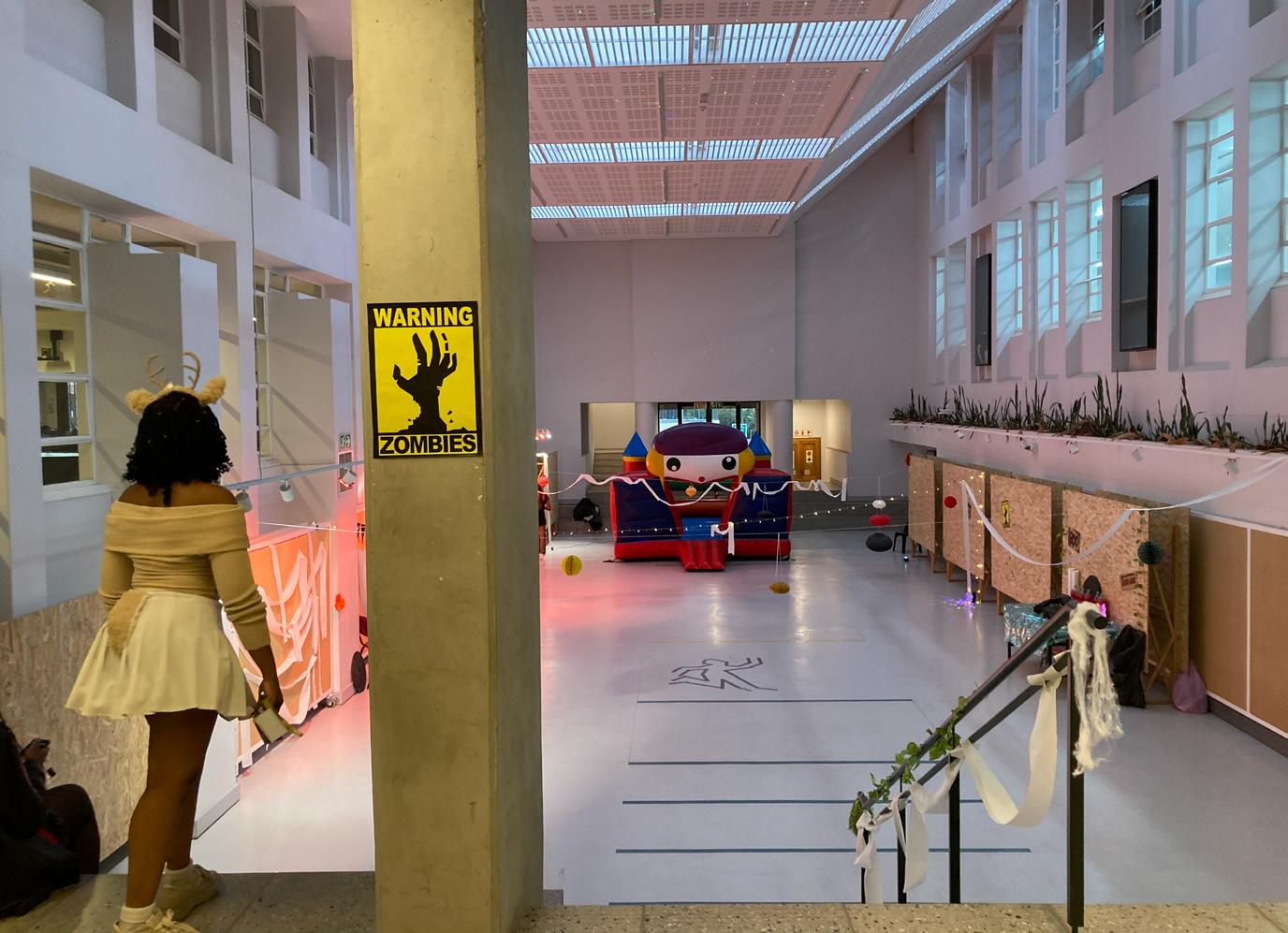
Tips from Witsies
“Architecture is a demanding degree however it is very important to have friends/ peers who you can chat to and bounce ideas off. Even though the lectures give you a lot of information it is important to have friends that support you in tough times and help you grow, studio is where you will learn the most outside of the lecture room. Work smart to ensure that you have a balanced life of social and work activities. This goes hand in hand with time management skills. Setting deadlines and goals can ensure a productive work ethic instead of working aimlessly.”
-BAS Hons student
“With some creativity, perseverance, withstanding the long hours and the ability to edit your work constantly without being
too precious, you have the recipe to success! Don’t be too hard on yourself and learn to love making mistakes... It is solely what makes you grow, also don’t forget to save!”
-BAS Hons student
“Studying Architecture is the simply the art of mastering time management. Once you have mastered that, your life is easier to balance. Start the assignment as soon as you get it! Planning, prioritizing and becoming involved in tasks is essential to excel in the course. Here are four items I always carry on me: a diary / sketchbook; a tape measure/ laser measurer; a scale ruler; a pen. Have fun and try your best!”
-BAS Hons student
“There are a lot of group work projects
Student Halloween party; photo by G. Gantner
throughout the year and making enemies will not be favorable for you as you never know who you might need help from in the long run so please be kind to one another, you will all experience the same struggles!”
-3rd year BAS student
“At the end of the day you are designing for people, so spend time interacting with people who are not in your degree and use this time and space to explore different ideas and cultures that you have not been exposed to previously. In order to do this, it is key to work consistently and manage your time effectively so that you don’t find yourself continuously rushing to make deadlines. Whether you get a 75 or 58 doesn’t really matter in the greater scheme of things, how you perform in this degree isn’t what defines you so go do other things too!”
-3rd year BAS student
“Don’t be afraid to ask questions and talk about your projects in class, you are all there to learn and often the best teachers you will have are those learning by your side. Do not fight your lecturers, create a dialogue. If you are getting frustrated take a breath and remember it isn’t personal, but subjective. No one will judge you for not knowing about a topic, and you can still converse about something you do not have background knowledge on as an instinctual process. The most important thing to do while studying is keep an eye out for topics that you genuinely enjoy and gravitate towards. Your personal interests are important and make you who you are, embrace them.”
-3rd year BAS student
“Take your time, breathe. The deadlines can be daunting but we all create at our own pace, don’t rush the process, put in the hours and your work will pay off. Remember to take time exploring the things you love; your best ideas will come from all sorts of places that may have nothing to do with architecture. Allow yourself to get out from behind the computer every once in a while, it’ll do wonders for your creative energy. Most importantly, trust in yourself. It is very easy in this degree to get consumed by the pressure and believe that you aren’t capable of creating good work. You might end up putting emphasis on what your tutors say and trying to create what they want you to rather than what you’d like to. You are more capable than you think, trust in your own abilities and creative identity and stand by it, it’s your strongest asset.”
-BAS Hons student
“You’re going to have to be able to adapt and process a lot of information very quickly. Work begins from day one and you will be thrown into the deep end with the required tools and your best friend - your imagination. It’s okay not to be perfect, you have every right to set high standards for yourself but being a perfectionist will blind you when you have deadlines. If you find yourself conjuring up realistic expectations for your work that are impossible to achieve within your time limit, then you need to stop, breath and re-evaluate the big picture and do what is necessary to achieve a good outcome for your project. You can always continue to improve on a project but there will be times when you need to let go of over thinking and accept that you have done your best. Persevere and never give up. Every architecture student wanted to quit after being overwhelmed with work but what you need to understand and remember is that if you did not have
the ability to overcome any obstacle then it wouldn’t have been in your way. Lastly, don’t forget about your life outside of architecture, you owe it to yourself to enjoy every second, so find a balance between studying and doing the things you love but ensure you make awesome memories doing both”
-BAS Hons student
“Your work will be criticized while studying Architecture. Don’t let negative feedback hinder what you are creating. It’s not always easy but this feedback is part of the process. There is always going to be something you can improve on. You are here to learn and constructive criticism forms part of studying and practicing Architecture. Justify your work in a respectful manner. Hear and understand how a crit affects your work. Respond to a crit logically. Use what you learn from feedback (whether it be positive or negative) to make yourself a better Architect and designer. Never give up!”
-BAS Hons student
“Use every opportunity that you have to do further your creativity. It may seem a waste of time, amidst all the deadlines and recovering from sleepless nights, but try to surround yourself with as much ‘architecture’ and ‘design’. Get a mentor, whether it be someone in second or third year, or even in post grad and above. Mentors can really give you good advice, and lead you in the right direction.”
-3rd year BAS student
“Architecture school will show you the delicate balance between art and engineering, it’s important to remember why you enjoy what you are doing so you don’t lose yourself in the rush. It is imperative to make an effort to sleep properly (all nighters are not a good idea), eat healthily, and maintain a regular exercise regime. You want your entire frontal cortex working when you’re planning buildings. The course is demanding but if you work consistently and thoughtfully, you will excel. Ask your lecturers the questions you think everyone else knows the answers to, chances are your classmates are
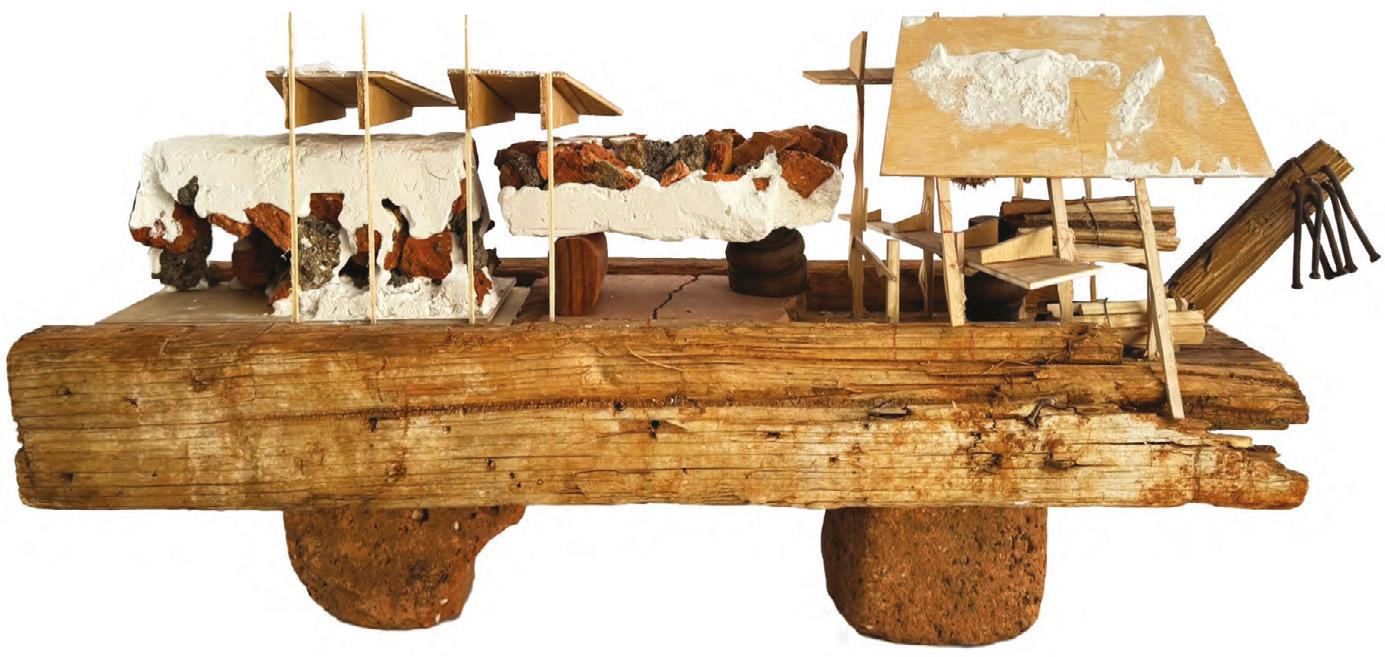
work: J. Breytenbach
Student
Contact Info
Undergraduate Enquiries:
Nozipho Khambule
Undergraduate Administrator
nozipho.khambule@wits.ac.za (011) 717-7623
Postgraduate Enquiries:
Veronica Fisher
Postgraduate Administrative Officer
veronica.fisher@wits.ac.za (011) 717-7623
Administrative Enquiries:
Motsei Choabi
School Administrative Manager
motsei.choabi@wits.ac.za (011) 717-7727
Head of School Enquiries:
Cezanne Henney
Programme Coordinator
cezanne.henney@wits.ac.za (011) 717-7424
Registration Enquiries:
Amelda Van Vuuren
Faculty Officer, Regsitrar’s Office
Engineering & the Built Environment
amelda.vanvuuren@wits.ac.za (011) 717-7006
Physical Address (School):
School of Architecture & Planning
John Moffat Building
University of the Witwatersrand East Campus
1 Jan Smuts Avenue
Braamfontein
Johannesburg 2000
South Africa
Physical Address (Faculty):
Faculty of Engineering & the Built Environment
Chamber of Mines Building University of the Witwatersrand West Campus
1 Jan Smuts Avenue
Braamfontein
Johannesburg 2000
South Africa
Website: https://www.wits.ac.za/soap/

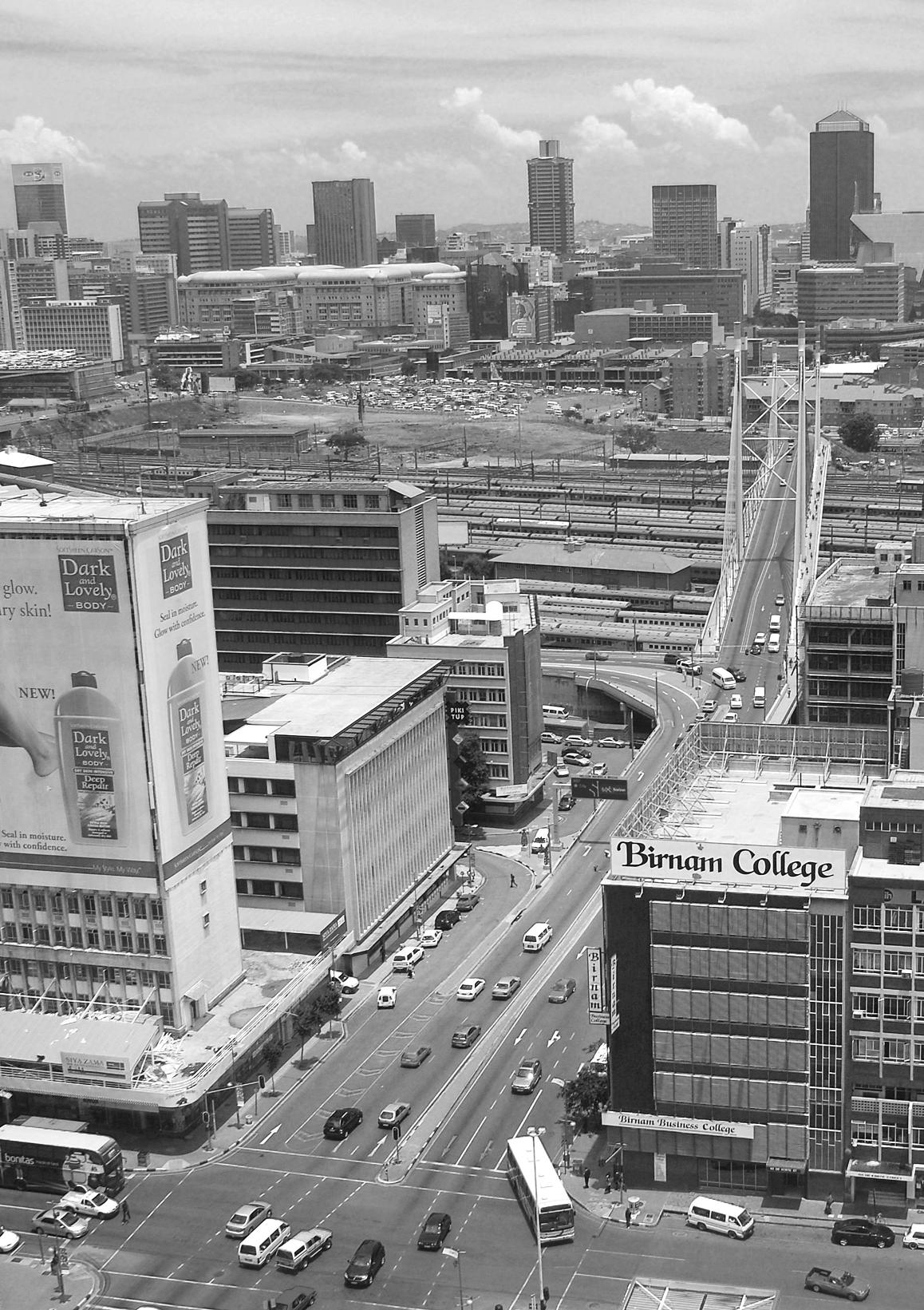
Wits Great Hall