


Third Iteration of the Towards Critical Apartheid Studies Conference 29 – 31 July 2026
Humanities Graduate Centre, Wits University, and Online
Dear Friends,
We are so excited to welcome you to the third iteration of the Towards Critical Apartheid Studies conference, held under the theme: Apartheid after South Africa: Legacies, Logics, and New Frontiers. If you’re new here, this conference is part of a postgraduate student-led project at the University of the Witwatersrand, now in its third year, dedicated to creating space for critical dialogues on the legacies, continuities, and futures of apartheid both in South Africa and globally.
This year, we explore how apartheid and its logics have travelled and adapted beyond their original South African context. Our central question asks: In what ways does apartheid appear in other regions, and how do these manifestations relate to or differ from the South African case? What new insights can these connections, entanglements, and comparisons offer?
We are honoured to bring together international scholars, artists, activists, and practitioners from South Africa, the continent, Palestine, and beyond. Together, we critically engage with apartheid as not only a historical system but as a living, global paradigm shaping societies, institutions, and everyday life.
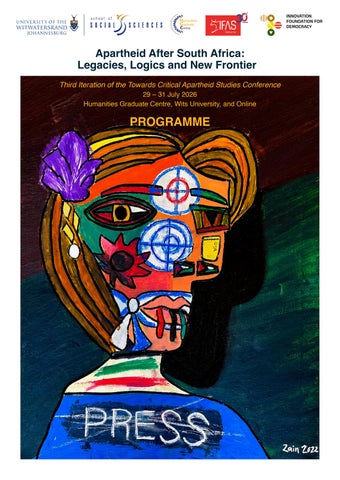
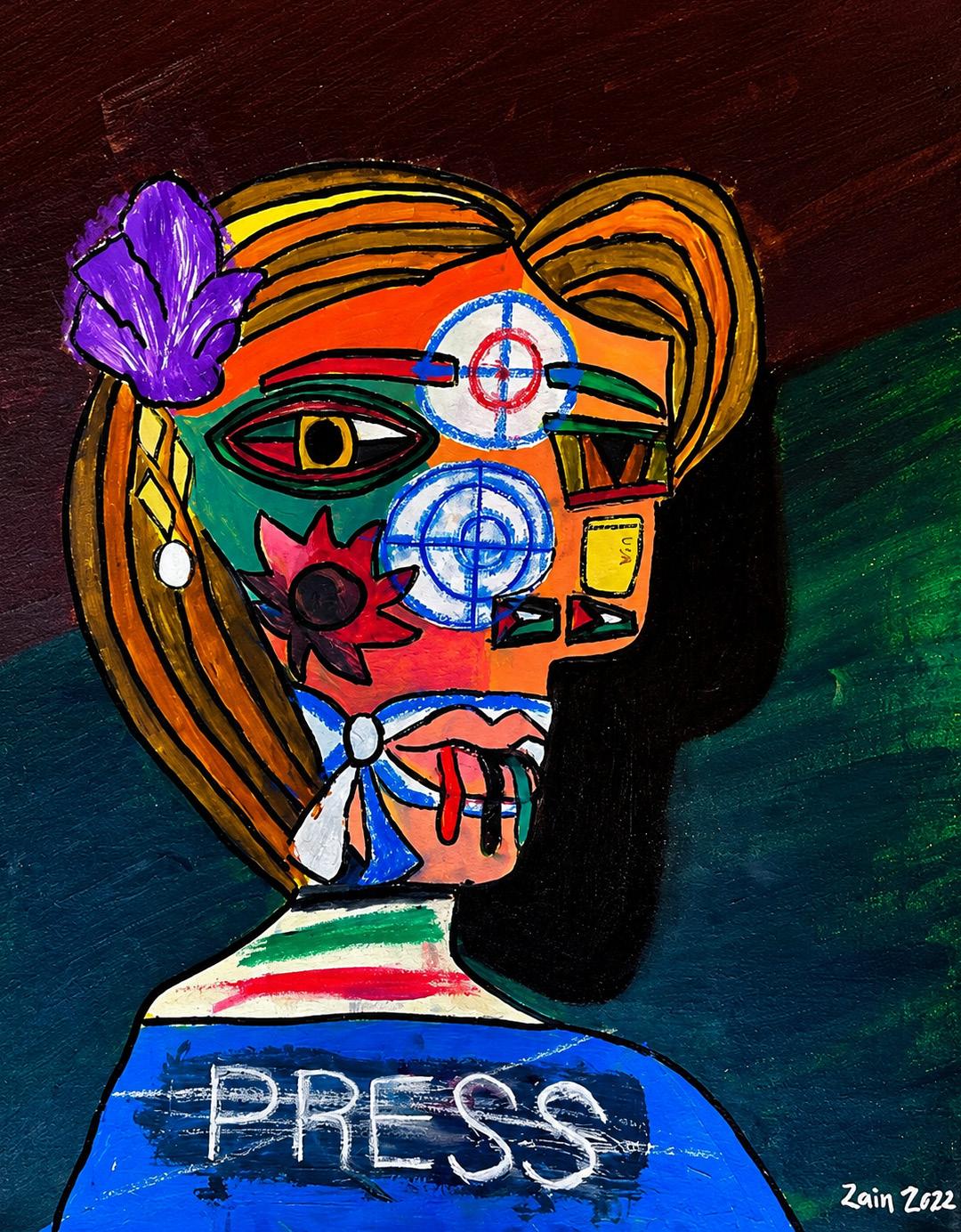
The cover artwork by Zain Majeed, “The Martyr”, from the ‘Artists Against Apartheid’ collection, evokes the age of surveillance , silence and epistemicide in which we find ourselves. What can be said, and what cannot be said remains lingering implicitly. In contending with this, we envision this conference as an open space for dialogue-indaba where we confront uncomfortable truths and foster critical discourse on apartheid and settler colonialism. The final image, on page 30, by Mikayla Boorany, titled “An etch of our better dream” invites us to imagine new futures. It challenges us to consider the collective action, care, and persistence demanded to build them. This will be a new ethic of solidarity that transcends walls, borders and binaries, guided by a renewed political and ethical praxis and a vision of an alternate globality.
Welcome, and thank you for joining us!

All conference sessions will take place at the University of the Witwatersrand, Braamfontein Campus, at the Humanities Graduate Centre. This is at the South West Engineering Building.
Please refer to the map below for key venues:
• South West Engineering Building
- Registration Desk: Ground Floor Foyer
- Plenaries & Keynotes: Seminar Room 10
- Parallel Sessions: Faculty Boardroom (Ground Floor)
- Exhibition & Posters: SW Engineering Foyer
• South West Engineering Building Atrium
- Lunch & Coffee Breaks
- Artistic Interventions: SW Engineering Building Atrium (Ground Floor)
Campus Map:
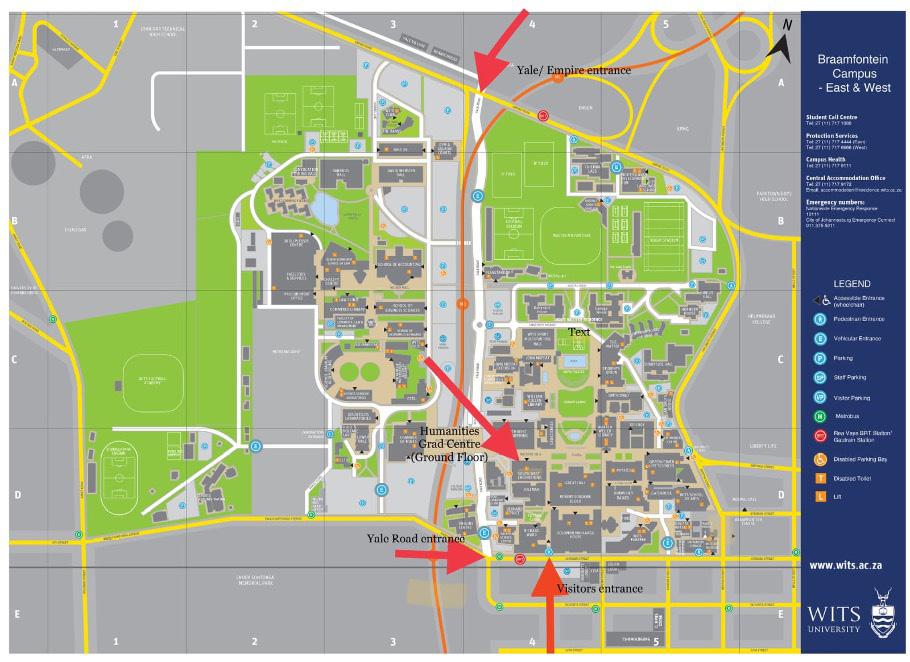
Coming by car: You will need to get through Wits security. Please bring ID and let them know you are coming to the Humanities Graduate Centre. The closest entrance to us is on Yale Rd, cnr Enoch Sontonga, but you can also enter on Yale Rd off Empire Rd. There is a visitor’s parking. Please allow enough time to find parking
Coming on foot/Uber: Please bring your ID. The best entrance to come through is Sutton Close on Jorissen Rd, about 100 m down from Origins Centre. Let the security know you are coming to the Humanities Graduate Centre.
Accessibility: All venues are wheelchair accessible. Please contact the Registration Desk for any additional assistance.
Wi-Fi:
Network: Wits-Guest
Username: 966w5
Password: m2Tc4o9g
Emergency Contact:
Conference Helpdesk: [+27(0)79-831-2919]
Campus Security: [+27 (0)11 717 4444 / 6666]
Wednesday, 29 July 2026
Time Session
08:30-09:00 Arrival and registration
09:00-09:15 Opening and Welcome
09:15-09:45 Keynote 1
Prof. Loren Landau, University of the Witwatersrand- African Centre for Migration & Society
Q&A (15 minutes)
10:00-11:30 Panel 1 (Seminar Room)
Beyond Borders: Structural Exclusion, Global Apartheid, and Community Resistance
Chair: Dr Tshepiso Maleswena
11:30-11:45 Break
11:45-13:00 Panel 2 (Seminar Room)
Apartheid, Settler Colonialism, and Resistance: Comparative Perspectives from South Africa and Palestine
Chair: Gwinyai Taruvinga
13:00- 14:00 Lunch
14:00-15:30 Seminar Room
Roundtable 1: Wits Centre for Diversity Studies
Extremist Mythologies as Segregationist Systems in the Contemporary World
15:30-15:45 TEA
15:45-17:00 Panel 3 (Seminar Room)
CUNY School of Law, MADRE, and Foundation for Human Rights
Modernizing the Definition of Apartheid in International Law: Gender, Colonialism, and Contemporary Applications
17:00-18:30 Artistic Intervention 1 (The Atrium)
Dr Stacy Hardy, Wits/Creative Writing
Details/ Other
Prof. Ben Scully
Associate Professor of Sociology, Assistant Dean of Humanities
Topic: An Apartheid of Uncertainty: Emerging Divisions in an Unsettled World
Chair: Dr Gwinyai Taruvinga
Dr Jasmine Cannon-Ikurusi - From Structural Exclusion to Social Justice: Understanding Modern Apartheid Systems Through Lived Experience and Community Resistance
Dr Devansh Shrivastava (Online)- Institutional production of property as a spatio-legal relation: Policy responses to spatial polarization in India.
Dr Chioma Njoku - Examine the current global apartheid trends, challenges, and opportunities for Africans in the face of borderless narrative culture deception of the global north.
Humairaa Mayet - Apartheid as Sign: Semiotic Regimes of Power in South Africa and Palestine
Mxolisi Nomdletshe – Settler Colonialism in South Africa and Occupied Palestine: Two Sides, Same Coin Minted in 1948
Dr Savo Heleta & Dr Naiefa Rashied – A Tale of Two Apartheids: The Role of Higher Education in Entrenching systems of Oppression in South Africa and Israel.
Chair: Prof. Nicky Falkof
• Dr Ekaterina Zibrova
• Dr Hannelie Marx Knoetze
• Dr Kudzaiishe Vanyoro
• Mr. Nkululeko Sibiya
• Dr Paola Prandini
Wendy Isaack (Chair), South African human rights lawyer and gender justice expert (in person)
Discussants:
Prof. Lisa Davis, Professor of Law, CUNY School of Law; ICC Special Adviser on Gender and other Discriminatory Crimes (online)
Prof. Kirby Anwar, Visiting Professor of Law, CUNY School of Law (Online)
Huma Saeed, Afghan women’s rights activist and researcher (online)
Randa Siniora, Palestinian human rights lawyer and Director, Women’s Centre for Legal Aid and Counselling (online)
Zaid Kimmie, Executive Director, Foundation for Human Rights (in person)
Dreaming a Future Hillbrow: Youth Performance, AI, and the Afterlives of Apartheid
*Format: A 20–30 minute choral and musical performance combining spoken text, polyphonic voice, chant, song, rhythm, and movement.
Wednesday, 29 July 2026 17:00-18:30
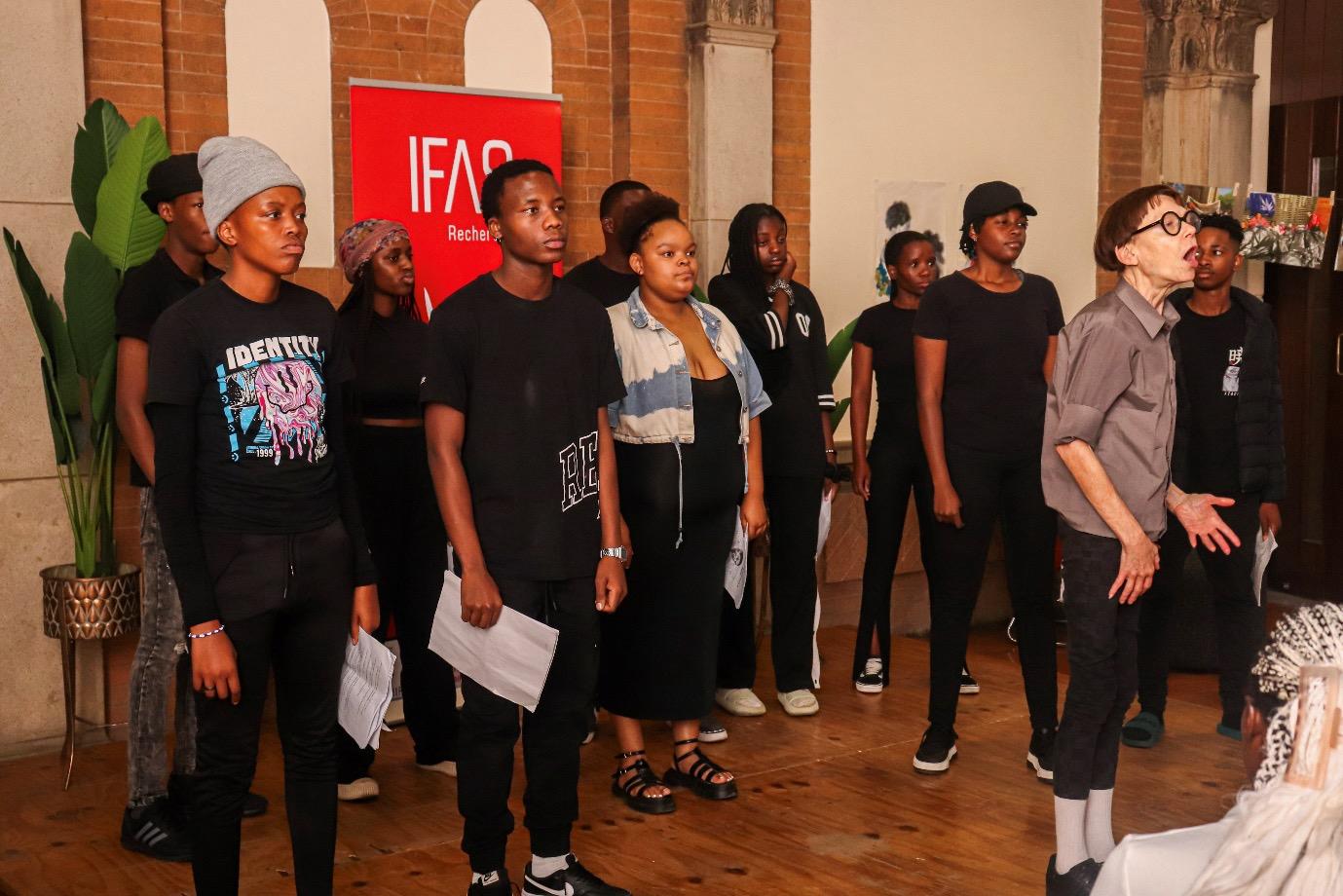
Image by Ndumo Ntuli
PROJECT DESCRIPTION:
A Season in Hell/Hillbrow is a youth-led performance project developed through the Long Poem Project, a collaboration between the Wits Creative Writing Department, the Windybrow Arts Centre, Wits student volunteers, and Hillbrow youth. Since 2024, the project has collectively reimagined major literary works as contemporary South African long poems, creating performances that bring canonical texts into contact with the urgencies of inner-city youth life. Following earlier reworkings of Aimé Césaire and Vicente Huidobro, this new iteration turns to Arthur Rimbaud’s A Season in Hell, rewriting it through the languages, histories, desires, and political realities of Hillbrow. This presentation will take the form of a 20–30 minute choral and musical performance combining spoken text, polyphonic voice, chant, song, rhythm, and movement. Through this collective form, Hillbrow youth explore what “hell” might mean in the unfinished present of post-apartheid Johannesburg. The project asks how apartheid’s spatial and social logics persist in the inner city, where abandonment, xenophobia, exclusion, gendered violence, and urban neglect continue to shape everyday life. Rather than treating hell as only a theological or literary idea, the performance reframes it as a political condition: a name often imposed on racialized, migrant, and poor communities forced to live within the afterlives of segregation and inequality.
At the same time, the work resists the lazy projection of “hell” onto Hillbrow. It asks who has the power to name certain places as fallen, dangerous, or irredeemable, and what happens when young people speak back to those narratives through performance, lyric experiment, and collective imagination. Created in the spirit of June 16 and in dialogue with longer histories of youth rebellion, the piece treats performance as a mode of refusal, testimony, and re-description: a way of exposing the structures that condemn while insisting on beauty, humour, solidarity, and invention as part of daily survival. A further dimension of the project is its engagement with artificial intelligence as both medium and object of critique. Working from the participants’ rewritten texts, we will invite the youth to use AI image-generation tools to dream a future Hillbrow. This digital layer will include surreal urban tableaux shaped by their visions of the city’s future, both utopian and dystopian; alternate maps of Hillbrow generated from memory, fear, desire, and possibility; and false official images, such as invented state notices, planning documents, warning posters, and bureaucratic visual regimes, which can then be disrupted by the young people’s own counter-imaginaries. Rather than serving merely as illustration, these AI-generated materials will extend the performance’s inquiry into naming, visibility, surveillance, and the politics of representation. In relation to the conference theme, they also open questions about AI’s double life: as a technology increasingly implicated in systems of classification, control, and exclusion, but also as one that can be redirected through collective artistic practice toward speculative, insurgent, and alternative imaginaries.
Bringing together literary adaptation, youth performance, and AI-generated visuality, A Season in Hell / Hillbrow offers a practice-based meditation on apartheid after South Africa: not only as historical memory, but as an enduring and mobile logic that continues to shape urban space, value, mobility, and human worth. At the same time, the work insists that those most often consigned to the margins are also makers of language, image, music, and futurity. In this sense, the performance speaks directly to the conference’s concern with apartheid’s legacies, its new technological frontiers, and the search for alternative imaginaries of resistance.
Thursday 30 July 2026
Time Session
08:30-09:00 Arrival and registration
09:00-10:30
Parallel Session
Panel 4A (Seminar Room)
Care, Gender, and Justice: Reimagining Healing and Resistance after Apartheid
Chair: Tshegofatso Mangwedi
Panel 4 B (Boardroom)
Performing Memory, Representation, and Exclusion: Arts-Based Approaches to Apartheid’s Afterlives
Chair: Dineo Mtetwa
10:30-10:45 TEA BREAK
10:45-12:00 Panel 5A (Seminar Room)
The Passageworks Project
Professor Ari Sitas in conversation with Gwen Ansell, Chaired by Dr Phillippa Yaa de Villiers
Panel 5B: Boardroom
The Body as Canvas: Reading Apartheid through Gender/State as Praxis
Chair: Dr Fikile Masikane
12:00-13:00 Lunch
13:00-13:45 Keynote 2
Dr Jamil F. Khan, Johannesburg Institute for Advanced Study
Details/ Other
Nobantu Shabangu- Whose Justice Matters? Afro-Feminism, Collective Care, and Restorative Justice Addressing Sexual Violence: Insights from a Women-led After-School Program in Rural Mpumalanga
Kagiso Noxolo Mokua– Apartheid Beyond South Africa: Rethinking Global Inequality as Structured Separation.
Smangele Amanda Mwelase– Governing Care in Unequal Systems: Apartheid Logics in Maternal Health and Knowledge Recognition in South Africa (with Comparative Insights from Kenya)
Nojenda Z. Ndungane - The afterlives of apartheid as technologies of legibility: Reading the Life Esidimeni tragedy
Nomfundo Ncanana- Rehearsing Against Apartheid: A Practice-Led Playback Theatre Inquiry into Disability, Memory, and Representation
Dr Tebogo Radebe- Exploring the use of Process Drama in dialogues on Race and Memory among black ‘Born Frees’ of South Africa
Shaifali Bramdev- What is a synonym for race?
Q&A (15 min)
14:00-15:30 Panel 6A (Seminar Room)
Decolonising Representation: Black Life, Visual Culture, and Everyday Resistance in South Africa
Chair: Thembinkosi Khosa
Panel 6B (Boardroom)
Algorithmic Apartheid and Digital Borders: New Frontiers of Segregation, Surveillance, and Access
Chair: Smangaliso Mkhuma
The Passageworks Project involves a 500-page artbook (of six volumes), 312 images and a musical album of enormous range. The work was created by a collective of artists assembled by Professor Ari Sitas, poet, librettist, musician and esteemed sociologist. Engaging with digital modes as well as the concrete object, the project brings the past and the future together in new ways. Thematically, it explores art, craft, politics, identity, the archive and imagination.
The Decolonising Gender Kollective
• Rachel Kongolo
• Kholo Ndotshayisa
• Mila Mabhongo
Topic: Apartheid, again: A reflection on repetition as methodology
Chair: Karabo-Maya Rodwell
Mzwanele Tshishonga – Ukuhlonipha as a photographic methodology: How can Bra Andrew Tshabangu’s refusal of normative documentary photography conventions be understood as a decolonial option to ways of representing black life?
Lathi-Tha Buhlungu - ‘Obu bomi nam bobam’: ooMakhulu’s negotiation of romantic love in apartheid South Africa
Siyavuya Mfenqa (Online) - The Cinematic Fetishisation of The Township in Post-Apartheid South Africa
Lenhlohonolo Seokwe (Online) – The Digital Frustum: Quantitative Metrics of Algorithmic Apartheid and the Erosion of Democratic Participation
Dr Prince Muzuwa – The Globalization of Apartheid Governance: How Mechanisms of Segregation, Surveillance, and Spatial Control Shape Contemporary Power Structures.
Lebogang Tswelapele Chauke – Mapping (In)Accessibility: Digital Borders, Cultural Exclusion and the Afterlives of Apartheid in South Africa’s State-Funded Theatre
16:00-18:30 Artistic Intervention 2 (The Atrium) Nhlanhla Michael Dhlamini
Trésors des Poubelles Reimagined: Excavating Apartheid’s Digital Afterlives from Johannesburg
Trésors des Poubelles Reimagined: Excavating Apartheid’s Digital Afterlives from Johannesburg by Nhlanhla Michael Dhlamini
30 July 2026, 16:00-18:30
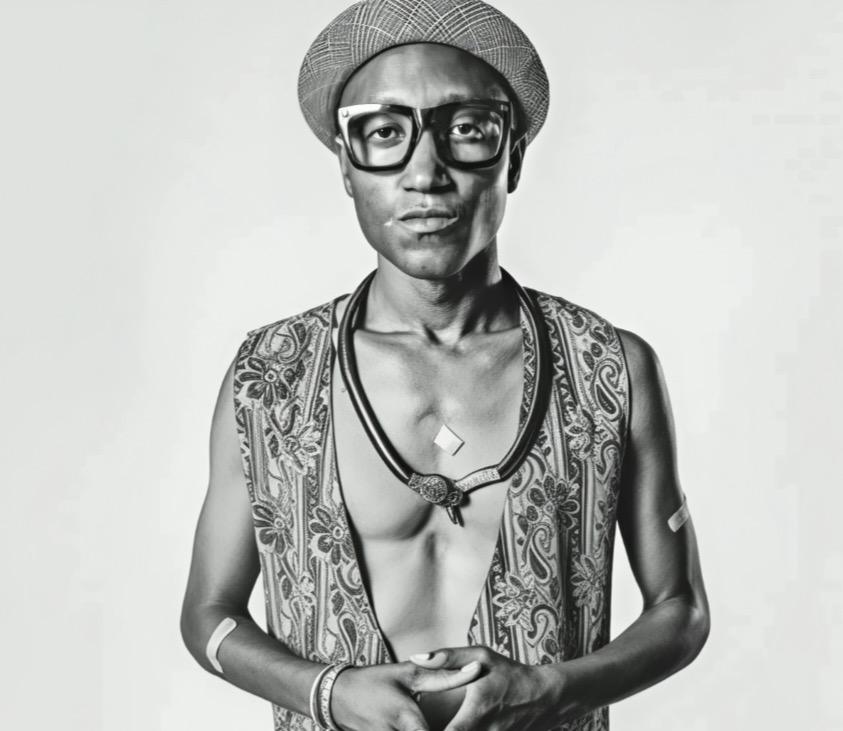
Trésors des Poubelles Reimagined is a research-creation session situated in Johannesburg that interrogates the persistence of apartheid as both a historical structure and a living infrastructure. Developed in dialogue with archival materials from the Cinémathèque Afrique and grounded in South African visual histories, the project treats the archive not as a stable record, but as a site of ongoing struggle over memory, erasure, and visibility. Working with discarded and degraded film materials that might be understood as the residual matter of apartheid’s visual economy, the project mobilises artificial intelligence and extended reality (XR) to reprocess these fragments into unstable, speculative forms. These immersive technologies systems are intentionally trained on incomplete and biased datasets, foregrounding how contemporary algorithmic systems inherit and extend earlier regimes of racial classification, spatial segregation, and epistemic exclusion. In this sense, the work traces a continuum from apartheid’s bureaucratic and cartographic logics to present-day forms of data governance, predictive surveillance, and digital bordering.
This live artistic intervention is an Afri-Sci archival performance that brings together Nhlanhla Michael Dhlamini and Andile Nzuza in a speculative exploration of resistance, memory, and African cinematic heritage. Combining immersive XR, AI-generated moving image, live performance, sound, dance, and storytelling, the work draws on lived experiences to reimagine the archive as a living site of decolonial imagination. Performed through the personas of the Cybershaman Griot and contemporary archive artisans, the intervention traces the digital afterlives of apartheid while activating African science fiction as a methodology for liberation. Audiences will experience VR excerpts, film, performative lecture, wearable sculptures, and experimental installation, culminating in a call to action for the official Trésors des Poubelles Reimagined XR premiere at the Fak’ugesi African Digital Innovation Festival. The performance asks how archival memory can become a space for collective resistance and the creation of new African futures.
This intervention asks: what forms of Black and decolonial imagination can emerge when Johannesburg is approached not only as a site of memory, but as a laboratory for resisting algorithmic apartheid in the present?
Nhlanhla Dhlamini is a South African interdisciplinary artist, filmmaker, XR designer, and AI researcher whose practice explores Afrofuturism, archival intervention, digital memory, and speculative storytelling. Working across film, immersive installation, performance, and artificial intelligence, Dhlamini investigates how technology can reactivate forgotten histories and imagine alternative African futures. His ongoing research project, Trésors des Poubelles Reimagined, reinterprets African audiomyvisual archives through AI, extended reality (XR), and myth-science, creating immersive experiences that challenge colonial narratives and apartheid’s digital afterlives. Presented as part of the Towards Critical Apartheid Studies (TACS) conference, his work bridges artistic practice, critical theory, and experimental media to examine surveillance, memory, repair, and decolonial futures. Dhlamini’s practice has been developed through collaborations with international cultural institutions and archives, positioning African speculative media as a powerful methodology for rethinking history, technology, and social transformation.
Contact Details
nhlanhladhlamini@gmail.com
Katlehong, Johannesburg, South Africa
Friday 31 July 2026
Time Session
08:30-09:00 Arrival and registration
09:00-10:30
Parallel Session
Panel 7A (Seminar Room)
Global Afterlives of Apartheid: Fanonian Critique, Compartmentalization, and Diasporic Solidarity
Chair: Buntu Makhedama
Panel 7B (Boardroom)
Apartheid, Gender, and Solidarity: Entanglements and Expansions
Chair: Tana Magkoka
10:30-10:45 TEA
10:45-12:15 Panel 8A (Seminar Room)
Ghosts of Belonging: Language, Memory, and Legibility in the Afterlives of Apartheid
Chair: Moshibudi Motimele
Panel 8B (Boardroom)
Masculinity, Memory, and Resistance: Performing Identity in Post-Apartheid South Africa
Chair: Nomfundo Ncanana
12:15-13:00 Lunch
13:00-14:30 For Air & The Weight of Sound
The Beloved Collective:
Pertunia Msani, Thabo Rapoo, Andisiwe Mpinda and Nondumiso Lwazi Msimanga
14:30-15:00 Closing Remarks and Departures
Details/ Other
Busisiwe Dyonase - On National Culture/The Pitfall of National Consciousness
Dr Stephanie Tilley, Prof Mlamuli Hlatshwayo, Dr Nokulunga Shabalala- The Echoes of Apartheid: Diasporic Wars and Pan-African Solidarity
Roshan Dadoo – South Africa and Palestine Reflections on Apartheid Entanglement and Solidarity in Action
Jessie Waldman, Toward a More Expansive Understanding of Apartheid in the Crimes against Humanity Treaty: Gender and Colonial Domination
Wendy Isaack and Kefaya Khraim –Deferred & Disremembered: Dealing with Race and Gender under Apartheid Regimes - Reelections on South Africa and Palestine
Shirley Gunn: Before the fires and after the fire draft flye
Ziyaad Dockrat & Humairaa Mayet - The Haunting Afterlives of Apartheid
Dr Addamms Mututa (Online) - Semiotics of Non-Apartheid: Senescence as Epistemic Zero point
Shongile Myeza - One Team, One Country, One Masculinity(?): Exploring Hybrid Masculinity Among South African Male Rugby Players
Kabelo Mokgehle - When Gathering Becomes Threat: Black Male Assembly, and the afterlife of Swart Gevaar
Ntlahla Sikwana- “We sing as we remember”: Amagwijo the Afterlives of Apartheid
For Air & The Weight of Sound by The Beloved Collective, is an experimental meditation on grief and the violence carried by the air we breathe. The Beloveds consult with the air within, through and around them asking why does the pull of gravity on sound feel so powerful, when the mass of sound is considered negligible as a force; in the workings of the world? How does silence in the form of (self-) censorship gain such energy as to drag our throats on the ground? What kind of servitude chokes our intestines or misshapes our spirit –conjuring remembrances of umthakathi nokuthakathwa kubandlululo? How do we learn to move differently in the still-lives and afterlives of apartheid’s violences?
Samukelo Ndlovu, Rheyna Pattni, Qhawekazi Mahlalela
Friday, 31 July 2026 13:00-14:30
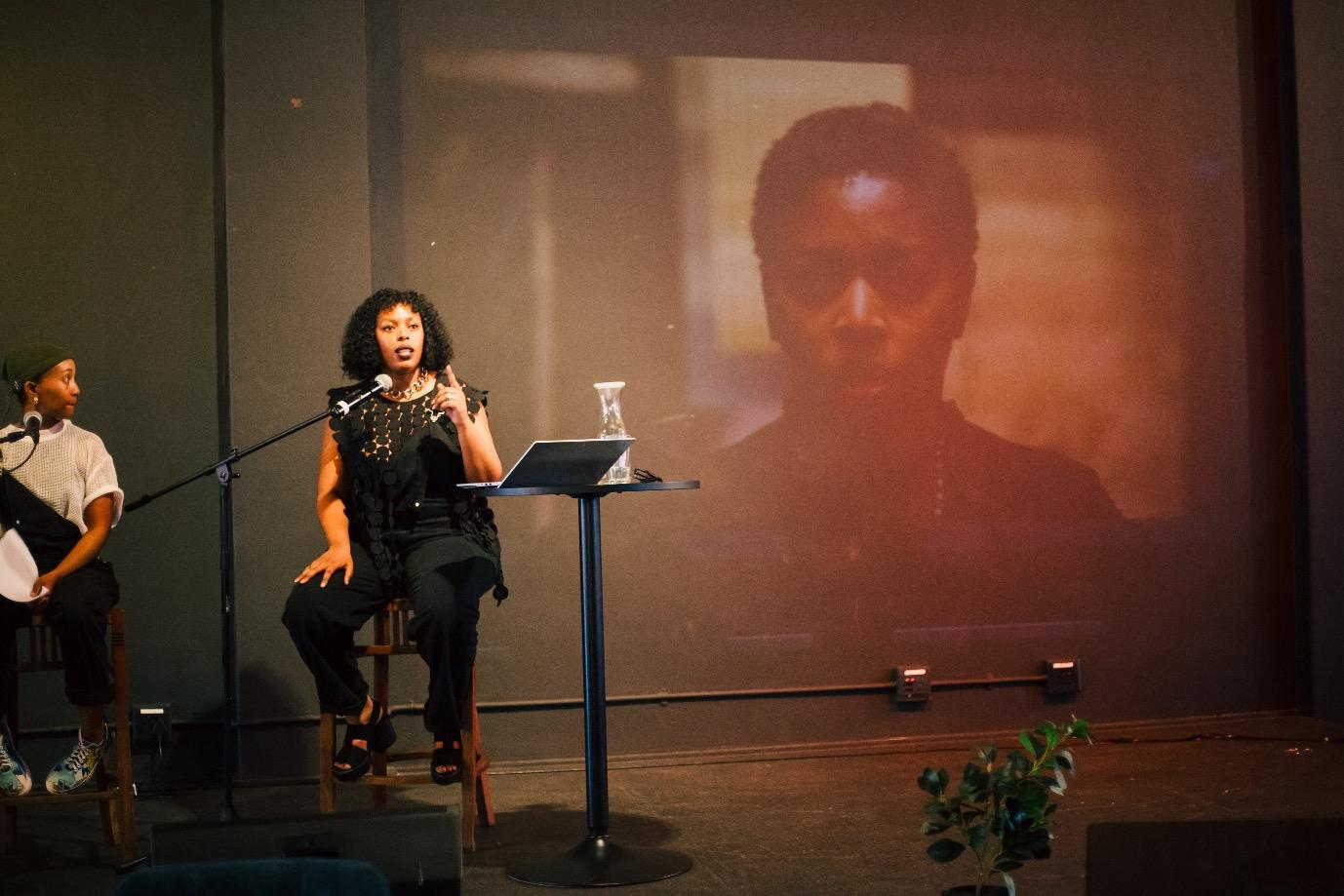
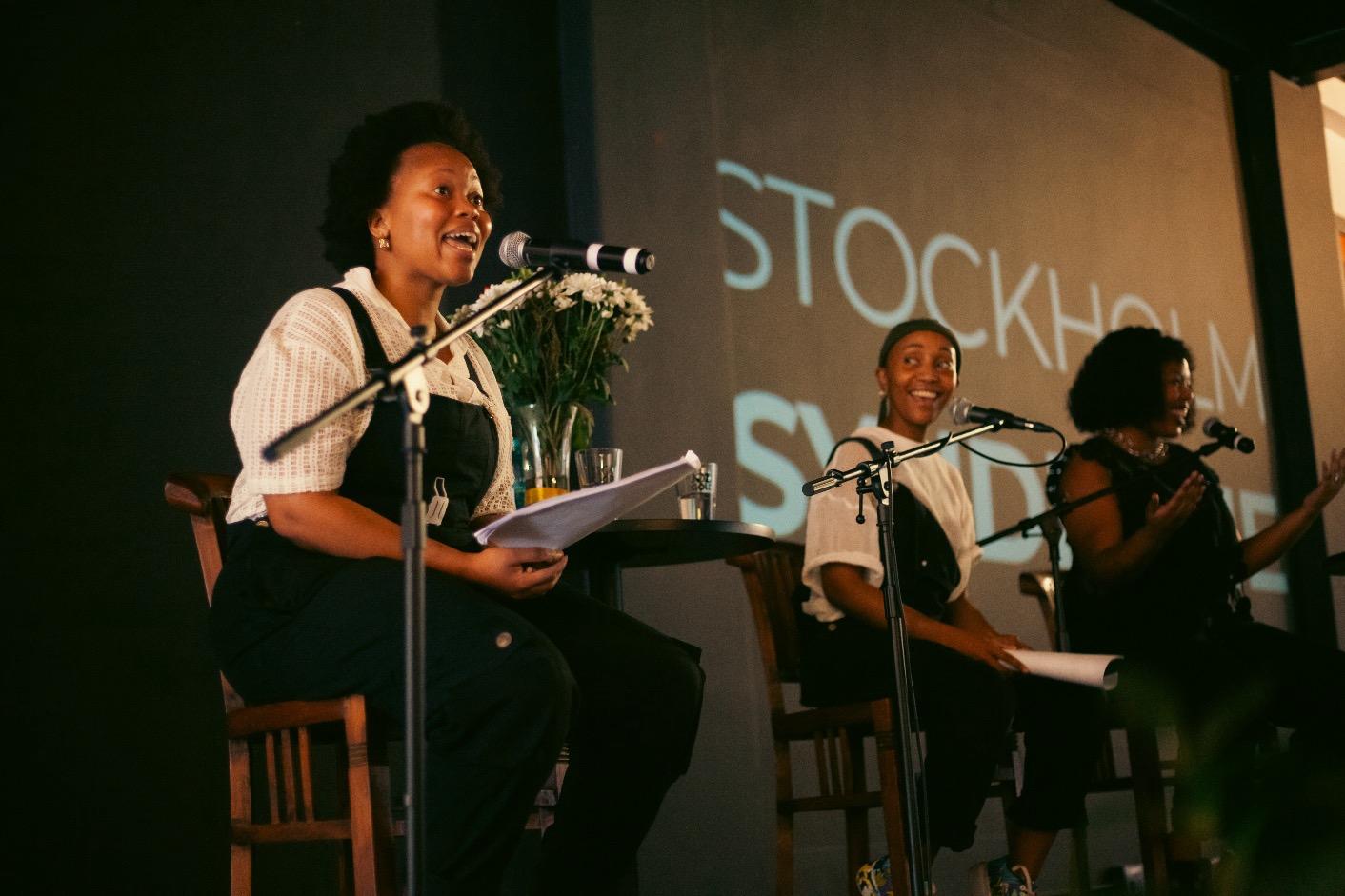
The Beloved Collective:
Pertunia Msani, Thabo Rapoo, Andisiwe Mpinda and Nondumiso Lwazi Msimanga
For Air & The Weight of Sound by The Beloved Collective, is an experimental meditation on grief and the violence carried by the air we breathe.
The Beloveds consult with the air within, through and around them asking why does the pull of gravity on sound feel so powerful, when the mass of sound is considered negligible as a force; in the workings of the world? How does silence in the form of (self-) censorship gain such energy as to drag our throats on the ground? What kind of servitude chokes our intestines or misshapes our spirit –conjuring remembrances of umthakathi nokuthakathwa kubandlululo? How do we learn to move differently in the still-lives and afterlives of apartheid’s violences?
The Beloved Collective is a configuration of multi-disciplinary artists brought together by Nondumiso Lwazi Msimanga to attend to moments of experimentation. The Beloveds are izithandwa zabantu who pursue a kind of poetry outside the bounds of disciplines and their disciplining norms. The Collective leans into experimentation through works of process, imisebenzi, of a moment, unrepeatable and experiential. They move in slow seasons of non-work and delight in performances that transgress expectations of the artists’ individual modes. Theirs’ is an unravelling of the mysteries of creativity, as a work of love.
Third Iteration of the Towards Critical Apartheid Studies Conference
Date: 29 – 31 July 2026
Venue: University of the Witwatersrand, Humanities Graduate Centre

Speaker 1: Prof. Loren Landau, University of the Witwatersrand and Oxford
Title: An Apartheid of Uncertainty: Emerging Divisions in an Unsettled World
Bio: Loren B Landau is Research Professor at the University of the Witwatersrand’s African Centre for Migration & Society and co-director of the Wits-Oxford Mobility Governance Lab (MGL). A political scientist by training, his interdisciplinary scholarship explores mobility, multi-scale governance, and the transformation of socio-political communities across the Global South. Through the Atlas of Uncertainty and other initiatives, he his research considers questions of urbanity, xenophobia, representation, and the global political economy of knowledge. Publications include, The Humanitarian Hangover: Displacement, Aid, and Transformation in Western Tanzania (Wits Press); Forging African Communities: Mobility, Integration, and Belonging (Palgrave); I Want to Go Home Forever: Stories of Becoming and Belonging in South Africa’s Great Metropolis (Wits Press); Contemporary Migration to South Africa (World Bank); and Exorcising the Demons Within: Xenophobia, Violence and Statecraft in Contemporary South Africa (UN University Press/Wits
2:

Bio: Jamil F. Khan (they/them) is a scholar, researcher, author and PhD in Critical Diversity Studies. Their work uses creolisation as a framework for queering race, while exploring themes of belonging, stigma, social construction, and the making of abject societal figures. Their sociopolitical memoir ‘Khamr: The Makings of a Waterslams’ has been awarded the 2021 Humanities and Social Sciences Award for Best Biography, as well as the 2021 University of Johannesburg Debut Prize for South African Writing in English. They are a Research Fellow at the Johannesburg Institute for Advanced Study.
This roundtable, inspired by the logics of South African apartheid as a segregationist hegemonic system, seeks to examine the emergence of populism and extremism, along with their causes and consequences in the contemporary world. Drawing on thoughtful contributions from a forthcoming edited collection entitled Extremist Mythologies, the contributing authors will share critical analyses of their lived experiences of extremism in Brazil, Russia, South Africa, and Zimbabwe. From the phobic-centred rhetoric of former Brazilian president Jair Messias Bolsonaro to Robert Mugabe’s dictatorial rule in Zimbabwe, this discussion invites us to a transdisciplinary conversation on how extremist regimes adopt somewhat ‘similar’ myths in enforcing exclusionary social, political and economic ideologies. Grounded primarily on a discursive lens, the proposed panel will also examine the Indigenous anti-war resistance since the Russian invasion of Ukraine, as well as ongoing Afrikaner supremacist survivalism, which coexists with the anti-migrant movement Operation Dudula. Although differing in terms of their participants’ social representations, the panel will show how both phenomena contribute to the legitimisation of xenophobic and exclusionary forms of violence. More than a forum for the dissemination of distinct academic approaches to past and present sociopolitical complexities, this is a decolonising call for the co-construction of imaginaries that may foster emergent and more just futures.
Modernizing the Definition of Apartheid in International Law: Gender, Colonialism, and Contemporary Applications
This panel centers on a co-authored paper by Lisa Davis (CUNY School of Law; ICC Special Adviser on Gender and other Discriminatory Crimes) and Kirby Anwar (CUNY School of Law). The paper engages ongoing negotiations toward a draft Crimes Against Humanity treaty and proposes a revised definition of apartheid that reflects both its historical roots and contemporary manifestations. The paper argues that the current draft definition, which is limited to racial domination, is insufficient to capture modern systems of oppression. It proposes a formulation recognizing apartheid as a system of domination “on race, gender, or other grounds of colonial discrimination,” thereby addressing longstanding omissions in international law. Drawing on consultations with South African, Palestinian, Afghan, and international advocates, the paper situates apartheid within its colonial origins while emphasizing its continued relevance in contemporary contexts. A central contribution of the paper is its analysis of intersectional oppression. It demonstrates how existing formulations risk fragmenting lived experiences by treating racial and gender domination as separate systems, rather than recognizing how they operate together within a single regime.
Humairaa Mayet
Mxolisi Nomdletshe
Roshan Dadoo
Dr Savo Heleta
Dr Naiefa Rashied
Wendy Isaack
Kefaya Khraim
Nobantu Shabangu
Dr Devansh Shrivastava
Dr Chioma Njoku
Smangele Amanda Mwelase
Kagiso Noxolo Mokua
Lehlohonolo Seokwe
Dr Prince Muzuva
Lebogang Tswelapele Chauke
Mzwanele Tshishonga
Lathi-Tha Buhlungu
Siyavuya Mfenqa
Ntokozo Zulu
Ziyaad Dockrat
Addams Mututa
Nojenda Ndungane
Busisiwe Dyonase
Dr Stephanie Tilley
Prof Mlamuli Hlatshwayo
Dr Nokulunga Shabalala
Nomfundo Ncanana
Dr Tebogo Radebe
Shaifali Bramdev
Shongile Myeza
Kabelo Mokgehle
Ntlahla Sikwana
Dr Stacy Hardy, Creative Writing/Windybrow Centre
Nhlanhla Michael Dhlamini
The Beloved Collective: Pertunia Msani, Thabo Rapoo, Andisiwe Mpinda and Nondumiso Lwazi Msimanga
The Decolonising Gender Kollective: Rachel Kongolo, Kholo Ndotshayisa and Mila Mabhongo
Prof Nicky Falkof (University of the Witwatersrand, WICDS)
Dr Paola Prandini, Wits Centre for Diversity Studies (WICDS)
Dr Ekaterina Zibrova (University of the Witwatersrand WICDS)
Dr Hannelie Marx Knoetze (University of Pretoria)
Dr Kudzaiishe Vanyoro (University of the Witwatersrand WICDS)
Mr Nkululeko Sibiya (University of the Witwatersrand)
Dr Paola Prandini (University of the Witwatersrand WICDS)
Chair: Nicky Falkof is a Professor of Media Studies at Wits. She currently holds the NRFDST SARChI Chair in Critical Diversity Studies and is the Director of the Wits Centre for Diversity Studies. Her books include The Devil Made Me Do It: Understanding Occult Crime in South Africa, Worrier State: Risk, Anxiety and Moral Panic in South Africa and Anxious Joburg: The Inner Lives of a Global South City. Nicky.Falkof@wits.ac.za
1. Dr Ekaterina Zibrova (PhD in Psychology), associate researcher, Wits Centre for Diversity Studies, University of Witwatersrand. Dr Zibrova studies Indigenous perspectives on decolonisation and the construction of Indigenous identity in Russia. Her areas of academic interest include critical diversity literacy and politics of identity. Dr Zibrova is a representative of the Evenki People (Northeast Siberia). Postdoctoral Fellow, Wits University (2023-2024); Non-Resident Fellow, Russia Program, George Washington University (2023-2024); Spencer Foundation Grantee (2025-2027); Visiting Fellow, DialogBüro Vienna Fellowship Program (2025). Also, Dr Zibrova is an independent diversity strategist and practitioner. ekaterina.zibrova@wits.ac.za
2. Hannelie Marx Knoetze is an Associate Professor in the Department of Communication Science at Unisa. She is an Executive Editor of Communicatio: South African journal for communication theory and research. Her research interests encompass popular culture, representation, identity, critical studies in whiteness, and decolonisation, with particular focus on South African media landscapes. She has contributed chapters to media studies textbooks and published in various scholarly journals. Starting with her PhD thesis comparing constructions of whiteness in South African and Flemish soap operas, her work on whiteness has expanded to examine belonging, zef-culture, ignorancemaking, contemporary manifestations of romanticising the Boer. Marxh1@unisa.ac.za
3. Dr Kudzaiishe Peter Vanyoro is an NRF Y-Rated scholar, researcher, lecturer, and critical diversity practitioner. His interdisciplinary work spans media studies, critical diversity studies, gender and sexuality, queer African studies, migration, decolonial thought, and cultural politics. He has taught across multiple Media Studies and Critical Diversity Studies courses at Wits University and has published widely on black queer life, media representation, critical diversity literacy, race, masculinity, and postcolonial African identities. His research has been recognised by institutions including the National Research Foundation (NRF), the South African Sociological Association (SASA), and the Queer African Studies Association (QASA). Beyond academia, he works as a facilitator and consultant on diversity, gender, sexuality, and social justice for universities, NGOs, and organisations, including MTN South Africa, Shell South Africa, the SABC, and the Bill & Melinda Gates Foundation. He has recently co-edited a special issue titled ‘Conversations on Conviviality and Critical Diversity Literacy: Overlaps, Tensions, and Gray Areas’ in the International Journal for Critical Diversity Studies with Dr Sayan Dey. kudzaiishe.vanyoro@wits.ac.za
4. Nkululeko Sibiya is a newly minted PhD holder in Media Studies from Wits University. He is currently an adjunct academic at Unisa and is co-founder of Black Intellectual Praxes, a Pan-Africanist social welfare NPO & journal exploring revolutionary Black praxes and multidisciplinary issues in Africa and the Global-South. His work focuses on extreme speech, anti-migrant politics and includes a book chapter in WhatsApp in the World: Disinformation, Encryption, and Extreme Speech titled Exclusionary Politics and Its Contradictions: Peddling Anti-Immigrant Sentiments through WhatsApp in South Africa as well as a journal article in Comunicazione Politica titled Anti-Migrant Sentiments in the Global South Fringe Platforms and the Paradoxes of Exclusionary Politics in Post-Colonial South Africa. sibiyankululeko@gmail.com
5. Dr Paola Prandini is a postdoctoral research fellow and lecturer at the Centre for Diversity Studies at the University of the Witwatersrand in South Africa. She is also a postgraduate lecturer at the University Eduardo Mondlane and at the Pedagogical University of Maputo, both in Mozambique. Dr Prandini is an award-winning professional and has an extensive record of academic, activist and pedagogical work. She is the author of several books, including the bilingual publication Blood of My Blood. Her work bridges scholarship, public engagement and social justice praxis in transnational contexts, focusing on critical studies of whiteness, educommunication, gender and decolonisation studies. paola.dinizprandini@wits.ac.za
Lisa Davis, Professor of Law, CUNY School of Law; ICC Special Adviser on Gender and other Discriminatory Crimes
Kirby Anwar, Visiting Professor of Law, CUNY School of Law
Wendy Isaack, South African human rights lawyer and gender justice expert (in person)
Huma Saeed, Afghan women’s rights activist and researcher (online)
Randa Siniora, Palestinian human rights lawyer and Director, Women’s Centre for Legal Aid and Counselling (online)
Zaid Kimmie, Executive Director, Foundation for Human Rights (in person)
Humairaa Mayet
The logics of apartheid transcend the case of South Africa, appearing in regimes of racialised governance and spatial segregation, but much of this remains anchored in the geopolitical, institutional, and legal, leaving underexplored the symbolic infrastructures through which apartheid is produced, normalised, and contested. This paper closes this gap by advancing a semiotic analysis of apartheid, examining how domination does not operate merely through material structures, but seeps into systems of meaning, organising identity, political possibility, and space. Utilising a semiotic framework, this paper develops a comparative analysis of South Africa and Palestine as semiotic regimes of apartheid. In both contexts, domination has depended upon bureaucratic classifications of national and racial identity, cartographic fragmentations, discursive narratives of civilisation and security, and elaborate symbolic systems used to naturalise hierarchy and separation. These sign systems render exclusion intelligible and legitimate, embedding the logics of apartheid within administrative, cultural, and political practices. Simultaneously, anti-colonial movements in South Africa and Palestine have generated counter-semiotic practices in order to contest dominant structures of meaning. From alternative cartographies and narratives of liberation to protest slogans and visual culture, these interventions destabilise the semiotic order through which apartheid sustains itself. A semiotic analysis of these struggles reveals how resistance does not merely operate through political mobilisation but through the rearticulation of collective imaginaries, signs, and symbols. By placing South Africa and Palestine in dialogue, this paper argues that apartheid is a travelling semiotic formation within global networks of settler colonialism. This approach illuminates how regimes of segregation are maintained through the production of meaning as much as through military and politico-legal force. In so doing, this paper contributes to Critical Apartheid Studies by foregrounding the symbolic architecture through which the logics of apartheid endure, emphasising the semiotic dimensions of anti-apartheid resistance.
Mxolisi Nomdletshe
SETTLER COLONIALISM IN SOUTH AFRICA AND OCCUPIED PALESTINE: TWO SIDES, SAME COIN MINTED IN 1948
In 1948, Israel was formally formed as a modern state by Zionist occupation forces following the displacement of Palestinians during the Palestinian Nakba. During the same year, the apartheid system was formalised in South Africa after an electorate victory by the Nationalist Party (NP). This study seeks to unearth the similarities and differences between Apartheid South Africa and Israel in occupied Palestine. Drawing from settler colonial theory, this study analyses apartheid as a travelling force of domination that centres both contemporary Palestine and historical South Africa. Using the year 1948 as the tipping point, taking into consideration the formalisation of apartheid in South Africa as well as Nakba in Palestine, both cases are situated by the study within settler colonial theory as a framework. Additionally, this study adopts a historical and contemporary analysis to explain how both systems of domination are rooted in land dispossession, population control, and groupdifferentiated citizenship. The study is based on a qualitative historical approach which draws upon settler colonial theory. This approach is employed as a tool to analyse the historical context as well as modern iterations of Apartheid South Africa and Palestine. The study argues that in both cases, apartheid operates as a political system that seeks to maintain subjugation through separation, militarised control, and judicial system. Additionally, this study further recognises key differences in historical patterns and forms of resistance in both contexts. Most importantly, the study contributes to
the ongoing debate on apartheid as a global phenomenon and emphasises the continued relevance of the South African experience in contemporary forms of domination.
Key words: Apartheid, South Africa, Palestine, Dispossession, Nakba, Domination
Roshan Dadoo
South Africa and Palestine reflections on Apartheid entanglement and solidarity in action
This paper will firstly focus on the historical engineering of systems of racial capitalism and apartheid, referencing ‘inter-racist solidarity’. Political ties between South Africa and Zionism predate the creation of Israel. It originated in the early years of the 20th century in the friendship between British Zionist leader and later first President of Israel Chaim Weizmann and South African Field Marshal and later Prime Minister Jan Smuts. Secondly, I will draw out the long history of solidarity between the peoples subjugated to systems of apartheid in South Africa and Israel that continue as exemplified by referencing the Palestinian BDS Movement consciously modelling their 2005 call on very same call we made on the international community, based on mobilising people’s power to pressure states and corporations. Secondly, South Africa’s case against Israel at the ICJ under the genocide convention. I will point out the contradictions where South Africa, having taken the ICJ case, is still continuing to fuel the genocide, illegal settlements, military industrial complex and system of apartheid by exporting coal to Israel. I will argue that true solidarity requires a consistent application of international law and implementation of legal obligations
Dr Savo Heleta & Dr Naiefa Rashied
A tale of two apartheids: The role of higher education in entrenching systems of oppression in South Africa and Israel
This paper examines the instrumental role of higher education in supporting, facilitating and entrenching apartheid systems of oppression in South Africa and Israel. Through a comprehensive review of the existing literature about apartheid and higher education in these two settings, the paper critically and systematically examines parallels and features in higher education. The paper explores what they represent, how they impact higher education and broader societies where the institutions are located, and how they have shaped and continue to influence and shape the thinking within and through higher education. The findings illustrate that in apartheid South Africa and Israel, the state has shaped higher education policies and practices linked to the propagation of supremacist ideologies, segregation, dehumanisation, repression, and othering. At the same time, most universities and much of academia in both settings have participated in all this not because they were coerced by the state, but largely because many higher education leaders, administrators and academia believed in and were/are committed to settler colonial and apartheid ideologies. The paper ends with a discussion about the role of international academic boycotts in challenging the complicity of higher education in apartheid oppression and othering in both countries, and the importance of sustained global campaigns to dismantle apartheid policies, practices and coloniality, and decolonise higher education.
Wendy Isaack & Kefaya Khraim
Deferred & Disremembered: Dealing with Race and Gender under Apartheid RegimesReelections on South Africa and Palestine
Wendy Isaack Senior Gender Justice & International Law Fellow MADRE Kaaya Khraim Advocacy Unit Manager Women’s Centre for Legal Aid & Counselling The 2026 year presents an opportunity to reflect on the international crime of apartheid, specifically the gender dimensions thereof, as first introduced and implemented in South Africa in 1948. As negotiations at the United Nations on a treaty on Crimes Against Humanity progress, questions have emerged around the definition of apartheid, reparations and enforcement as contained in the draft treaty. Further and more urgent
questions are ways and means to contribute to efforts to end the flagrant impunity enjoyed by Israeli authorities in their enforcement of the apartheid regime in Palestine, also since 1948. That such practices continue despite the Advisory Opinion issued by the International Court of Justice in July 2024 declaring Israeli occupation of Palestinian territory illegal, calling for its end and the termination of apartheid policies and practices, require focused attention. To contribute to these global efforts, this paper considers the limits of South Africa’s transitional justice process, its failure to address structural violence, gendered harm and the enduring impunity gap as evidenced with ongoing proceedings of the Khamphepe Commission of Inquiry. The primary concern is the extent to which accountability processes in South Africa failed to consider women’s experiences and to determine methods to ensure that this does not happen in Palestine where the Israeli apartheid regime is in force. Reflecting on how black South African women survived under the racist regime of dispossession and repression; the paper details how the Israeli regime successfully exported the apartheid system and has, over more than 70years successfully executed, with extensive economic and military support of global north States, an apartheid regime of domination, dispossession and expulsion of the Palestinian people with profound gendered impacts on Palestinian women and girls. The fundamental issues the paper seeks to address is the fact that full appreciation of what happened to black South African women under the apartheid regime matters today; and must be central to gender justice advocacy efforts calling for an updated definition of apartheid globally. Framed as a call to action, now, more than ever, it is time for the South African government and feminist lawyers and activists to lead in the struggle for accountability for apartheid crimes, in South Africa and Palestine. Leadership of the Africa region confronting apartheid has deep roots, notably through the UN Special Committee Against Apartheid established by the General Assembly in November 1962, which facilitated the end of the apartheid regime in South Africa. In the final analysis, we have a history of countering apartheid regimes, and as beneficiaries of international solidarity action, the elaboration of this new Convention on Crimes against Humanity requires our robust engagement and direct intervention once again for the benefit of humanity.
Jessie Waldman (The Foundation for Human Rights (in partnership with MADRE)
Toward a More Expansive Understanding of Apartheid in the Crimes against Humanity Treaty: Gender and Colonial Domination
While apartheid has traditionally been understood as a system of racial separation and segregation, significantly less attention has been paid to its intersections with gender-based violence and other forms of discrimination experienced by Black women. Black women endured multiple and overlapping forms of discrimination tied simultaneously to their race or perceived race, and gender. Black women’s suffering has not been adequately recognised in legal discourses on apartheid and was marginalised in the Truth and Reconciliation Commission process. In 2024, the UN General Assembly agreed to develop the Convention on Prevention and Punishment of Crimes Against Humanity, a landmark opportunity to place the crime of apartheid on the same legal footing as genocide and war crimes, and to establish frameworks for prevention, prosecution, corporate accountability, and victim participation. As the drafting process advances toward diplomatic conferences in 2028 and 2029, civil society organisations, including the Foundation for Human Rights and MADRE, advocate for an updated and inclusive definition of apartheid that incorporates gender and colonial domination as grounds of discrimination and repression. Current developments in Afghanistan illustrate the growing relevance of this debate. Based on extensive witness testimony, the People’s Tribunal for Women of Afghanistan has documented how the Taliban systematically excludes women and girls from education, work, and public life, in a system Afghan activist have explicitly named gender apartheid. In 2025, the International Criminal Court issued arrest warrants against two Taliban officials for gender persecution against women, girls and LBGTQIA+ persons. This marks the first recognition of crimes against humanity based on gender by an international court of law. Meanwhile, Palestinians are living under a system of apartheid, where women experience specific disadvantages ranging from from sexual violations to a lack of access to maternal healthcare. Expanding the definition of apartheid to include gender and colonial domination would acknowledge the intersecting and compounding experiences of discrimination inherent to apartheid, as well as the enduring and uneven impact of apartheid policies in contemporary South Africa. It would also strengthen the convention’s capacity to address ongoing systems of oppression and domination in Afghanistan, Palestine and beyond.
Nobantu Shabangu
Whose Justice Matters? Afro-Feminism, Collective Care, and Restorative Justice Addressing Sexual Violence: Insights from a Women-led After-School Program in Rural Mpumalanga
In a small town of Mpumalanga called eSizameleni exists an afterschool program run by the women of the community. The land lies beautiful and bare except for small houses at the bottom of a beautiful mountain range. Right at the top of this mountain, a symbol of the Boer victory looms large; a monument maintained annually by the white youth who haul large rocks, paint them white and position them neatly on the mountain so that from kilometres away the symbol boldly announces that times have changed but colonial dominion has not. This paper reflects on a mental healthcare research project and focuses on workshops conducted for the organisation which manages complex cases that go beyond homework assistance such as food insecurity, abuse, grief, and bereavement. Typically, the women employ multiple roles: surrogate mothers, social workers, and educators despite their own limited education. With little resources, the organisation relies on inherent African cosmology and relational ethics. In child neglect and sexual abuse cases, empathy and compassion are shown to parents while helping them change harmful beliefs, rather than shaming or judging. Additionally, accountability in child abuse cases is facilitated through continuous dialogue with parents, resulting in a complementary and preferred process. For the people of eSizameleni, the court system is frequently regarded as a disruptive influence of European policing rather than a means of resolution, leading to an overall unfavourable perception therefore traditional healers assume a central role in mediation. As an applied arts practitioner, the workshop was designed to foster critical reflection, creative engagement, and relaxation. Participants highlighted the significant need to address intergenerational trauma arising from diverse socio-political challenges rooted in Apartheid. Subsequently, the workshop was self-revelatory and a reckoning for how distanced I had become from my own Zulu culture and ancestral roots that emphasise collective care.
Jasmine Cannon-Ikurusi
From Structural Exclusion to Social Justice: Understanding Modern Apartheid Systems Through Lived Experience and Community Resistance
The concept of apartheid is often historically situated within the South African context; however, systems of structural exclusion, segregation, and unequal resource distribution continue to exist globally in both visible and invisible forms. This paper explores apartheid not solely as a historical system of governance, but as a continuing global paradigm that manifests through contemporary socio-economic structures, migration regimes, and unequal access to opportunity. Drawing on community-based leadership experience and grassroots engagement, this paper examines how modern forms of systemic exclusion operate within urban environments in the United Kingdom and beyond. Through the lens of social mobility, employment inequality, and structural barriers faced by minority communities, the research highlights how systems of segregation can evolve into institutionalised patterns of marginalisation that limit access to economic participation, political voice, and social inclusion. The paper also explores the relationship between policy frameworks, economic structures, and community-level realities, analysing how marginalised communities navigate and resist systemic inequality through grassroots organisation, leadership development, and social enterprise. Particular attention is given to the role of community-led initiatives, storytelling, and youth leadership programmes in challenging entrenched systems of exclusion. By connecting academic theory with lived experience and community practice, this contribution seeks to broaden the discourse on apartheid as a global phenomenon. It argues that understanding apartheid’s legacy requires examining how contemporary systems reproduce similar dynamics through modern institutions and governance structures. Ultimately, this paper proposes that dismantling these systems requires not only policy reform but also community empowerment, leadership development, and the amplification of marginalised voices. By centring lived experience and grassroots solutions, the discussion aims to contribute to emerging frameworks for justice, equity, and social transformation in the 21st century.
Dr Devansh Shrivastava
Institutional production of property as a spatio-legal relation: Policy responses to spatial polarization in India.
Scholarship on property-making in South Asia that links property-making and grounded bureaucratic practices in shaping inclusions and exclusions from property rights claims remains underexplored. This paper investigates how public institutions apply institutional logic, interpret and decide on property transfers applications in urban conflict settings of South Asia. It performs socio-legal analysis of seventeen case laws and ethnography of policy to study the institutional production of property in urban conflict settings. The paper argues that public institutions in spatially polarized settings produce property as a spatio-legal relation. This relation embeds property-making to the sociospatial dynamics of segregation while internalising and institutionalizing the logic of segregation into the working of law. The paper utilizes the case study of Disturbed Areas Act, enacted in 1991 to prevent ghettoization by sanctioning immovable property transfers between communities.
Dr Chioma Njoku
Examine the current global apartheid trends, challenges, and opportunities for Africans in the face of borderless narrative culture deception of the global north. African regions from the colonial era have been known as the puppets of the WEST from time immemorial. Various African regions were divided alongside interests savaging for her natural resources. Ironically, stereotyping Africa as underdeveloped has been the order of the day, and such a narrative is peddled unapologetically. This inquiry intends to “examine the current global apartheid trends, challenges, and opportunities for Africans in the face of borderless narrative culture deception of the global north.” Generally, the work will investigate how the global north extends their borders into African sovereign territories; assess how discriminatory visa policies create a stratified global mobility system that disproportionately restricts African movement; examine the global north’s conflict with intra-African migration protocols; and identify feasible opportunities for Africans to bypass Western barriers for development. Anchoring on framing and gatekeeping theories, the work will adopt a qualitative research design of focused group discussion (FGD). 36 people spread across four groups of 9 individuals will be selected and sampled within South Africa, Ghana, Nigeria, and Kenya. The interview guide will be used as the instrument for data collection. Data collected will be transcribed and analyzed thematically to bring dominant frames and how they interact with the current realities of Africans in media narratives for public opinion. The expected results should reflect the dangers of the current African dilemma and the best approach to leverage in resolving the current trends. Applicable media strategies should be integrated to help build strong border control within Africa. Tight measures to balance immigration policies should be advocated for. Reliable policies to mitigate excessive land acquisition culture should be implemented to avoid apartheid tendencies in African regions. Lopsided immigration policies affecting the free movement of Africans should be curtailed in diplomatic engagements. Stringent policy documents to curtail WESTERN encroachment in African territorial engagements in the African Union and ECOWAS should be redressed.
Keywords: apartheid, trends, opportunities, challenges, and borders.
Governing Care in Unequal Systems: Apartheid Logics in Maternal Health and Knowledge Recognition in South Africa (with Comparative Insights from Kenya)
More than three decades after the formal end of apartheid, persistent inequities in maternal health care in South Africa signal not merely gaps in service delivery, but the endurance of apartheid as a governing logic structuring access to care. This paper advances a theoretical argument that contemporary maternal health systems operate through what can be understood as apartheid logics: spatialised, racialised, and epistemic forms of differentiation that regulate both the distribution of
care and the legitimacy of knowledge. Drawing on an interpretivist approach, the paper engages policy analysis, critical literature, and emerging field-based insights from South Africa and Kenya to examine how maternal health is governed within pluralistic systems of care. Building on scholarship in structural violence (Farmer, 2004), medical pluralism (Janzen, 1978), and epistemic injustice (Fricker, 2007), the analysis demonstrates how biomedical dominance within health systems continues to marginalise Indigenous and community-based forms of knowledge. These exclusions are not incidental, but are embedded within institutional arrangements that reproduce hierarchies of credibility and authority. In this sense, maternal health systems can be read as sites of epistemic apartheid, where the regulation of knowledge mirrors broader historical logics of separation and control. Comparative insights from Kenya further illustrate how these dynamics are not confined to South Africa but reflect broader patterns in postcolonial health governance. By conceptualising maternal health through the lens of apartheid as a travelling and adaptive paradigm, the paper contributes to critical debates on the global afterlives of apartheid. It shifts the analytical focus from material access alone to the governance of knowledge and care, arguing that meaningful health systems reform requires confronting both spatial inequities and epistemic hierarchies. In doing so, it calls for more contextually grounded and epistemically just approaches to maternal health policy and practice.
Kagiso Noxolo Mokua
This paper argues that apartheid should not be understood solely as a historically bounded system confined to South Africa, but as a broader global paradigm that continues to shape how inequality is organized in the present. Rather than treating apartheid as an exceptional or closed chapter, the paper demonstrates how its core logics—segregation, control, and unequal access to resources— remain embedded in contemporary systems of governance across different regions of the world. Drawing on political economy, critical race theory, and global governance studies, the paper examines three key sites: the unequal global distribution of COVID-19 vaccines, the expansion of militarized and fortified border regimes in the Global North, and extractive economic infrastructures across the Global South. Across these contexts, a shared pattern emerges in which populations are hierarchically ordered and selectively included or excluded. This process, described as differential inclusion, allows certain groups to participate in global systems under tightly controlled conditions, while others are marginalized, contained, or rendered disposable. Importantly, the paper resists using apartheid as a loose or purely metaphorical concept. Instead, it grounds its analysis in the specific institutional, legal, and spatial mechanisms that defined apartheid in South Africa, including enforced territorial segregation, restricted mobility, and differentiated citizenship. By tracing how these features are reconfigured globally, the paper shows how apartheid-like logics have adapted to contemporary forms of capitalism and governance. The paper concludes by proposing a conceptual shift: apartheid should be understood not as an aberration of modernity, but as one of its constitutive features. This reframing opens new pathways for critical scholarship and strengthens the basis for political interventions aimed at confronting persistent global inequalities.
Lehlohonolo Seokwe
The Digital Frustum: Quantitative Metrics of Algorithmic Apartheid and the Erosion of Democratic Participation
As neoliberal authority appears to loosen under the pressure of intensifying authoritarianisms and resurgent ethno-nationalisms, the South African experience of apartheid serves as a “ground zero” for theorising how these crises manifest in the digital age. This paper provides a quantitative assessment of “digital apartheid” by measuring the Democratic Inclusion Variance (DIV), a statistical model designed to track how biometric and algorithmic systems create “cartographies of exclusion” that disenfranchise specific populations. Rather than viewing artificial intelligence as a neutral tool, this study treats it as an adaptable logic that often automates a foundational right to grab, seize, and capture. The paper utilises a dataset of diverse infrastructures to calculate the Participation Gap, using regression analysis to show how predictive policing and algorithmic governance
correlate with a measurable drop in civic engagement within high-surveillance zones. Furthermore, the study introduces the “Biometric Throttling” index to quantify how digital borders and biometric control function as modern pass laws, effectively regulating bodies and movements to prevent the democratic assembly of marginalised groups. Finally, the paper applies a computational linguistic analysis to the swart gevaar or great replacement theories that shape the Trump-MAGA movement, measuring how these ideologies are amplified by algorithms to legitimise a hyper-patriarchal white supremacist order. By identifying these new frontiers, the paper argues that the transition into an algorithmic era has enabled insidious forms of control that fundamentally threaten the innovation foundation for democracy. The study concludes by proposing alternative technological imaginaries, quantifiable metrics for resistance and refusal that aim to subvert these evolving structures of power.
Keywords: Algorithmic Governance; Biometric Control; Predictive Policing; Cartographies of Exclusion; Alternative Technological Imaginaries
Dr Prince Muzuva
The globalization of apartheid governance: How mechanisms of segregation, surveillance, and spatial control shape contemporary power structures
The paper contends that apartheid is not only a historical phenomenon specific to South Africa but also a dynamic and flexible paradigm of governance whose underlying logics of segregation, spatiality, and regulation of bodies have traversed diverse global political and institutional landscapes. Rather than dying off with the formal demise of apartheid in South Africa, the underlying logics of apartheid have been reconstituted within contemporary frameworks of border control, surveillance technologies, and unequal allocation of resources. The paper utilises Settler Colonial Theory as an overarching theoretical framework to understand the persistence of apartheid’s underlying logics of spatial domination and population regulation through diverse legal, technological, and institutional mechanisms. Settler Colonial Theory is an overarching theoretical framework that can be utilised to understand the persistence of apartheid’s underlying logics of spatial domination and population regulation through diverse legal, technological, and institutional mechanisms. The paper utilises a qualitative comparative research design to understand the underlying mechanisms of apartheid’s persistence within contemporary frameworks of border control, surveillance technologies, and unequal allocation of resources. The paper utilizes international reports, state policies, and academic literature to understand the underlying mechanisms of apartheid’s persistence within contemporary frameworks of border control, surveillance technologies, and unequal allocation of resources. The preliminary findings of the paper reveal that contemporary frameworks of digital borders, surveillance technologies, and unequal allocation of global resources exhibit an uncanny resemblance to apartheid’s underlying regulatory mechanisms.
Keywords: Apartheid governance; global segregation; surveillance regimes; border control; settler colonial theory.
Lebogang Tswelapele Chauke
Mapping (In)Accessibility: Digital Borders, Cultural Exclusion, and the Afterlives of Apartheid in South Africa’s State-Funded Theatre
This paper investigates how apartheid’s spatial, bureaucratic, and racialised logics continue to shape access, participation, and mobility within South Africa’s state-funded theatre system, even in the democratic era. These state-funded theatres were established under apartheid as regional control mechanisms of cultural governance continue to remain powerful institutional sites where the afterlives of apartheid are both reproduced and contested. Despite their mandate to serve diverse publics, these institutions continue to be structured by inherited administrative architectures, funding logics, digital infrastructures, and cultural gatekeeping practices that regulate who enters, participates in, or benefits from the national cultural sphere. Drawing on my ongoing research project, (In)Accessibility: Exploring the Possibilities of Democratizing State-Funded Theatre in
South Africa, this paper employs a mixed-methods approach that combines policy analysis, online interviews, surveys, and digital ethnography. I argue that contemporary barriers, such as financial, geographic, linguistic, algorithmic, and institutional, map directly onto apartheid’s historical patterns of spatial segregation and economic dispossession. New digital technologies, such as online application portals, data-driven ticketing systems, and algorithmically mediated visibility on social media, introduce fresh layers of exclusion that appear neutral yet functionally reproduce old patterns of separation. By situating state-funded theatre within transnational theoretical debates on digital borders, algorithmic governance, and the global expansion of apartheid logics, this paper highlights how institutional infrastructures can quietly reanimate past forms of domination. South Africa’s state theatres thus offer a crucial microcosm for examining how apartheid travels through bureaucratic codes, technological systems, and cultural policy mechanisms that extend beyond the stage. The paper concludes by proposing alternative models for democratizing access through communitydriven cultural governance, indigenous knowledge frameworks, and redistributive digital strategies that challenge scarcity-based institutional logics. Ultimately, the paper asks: What might an antiapartheid future for state-funded theatre look like in an algorithmic age, and how might reimagining these cultural institutions illuminate broader global struggles against evolving forms of segregation and control?
Ukuhlonipha as a photographic methodology: How can Bra Andrew Tshabangu’s refusal of normative documentary photography conventions be understood as a decolonial option to ways of representing black life?
This essay seeks to posit photography as a language that is not fixed but rather a tool with the ability to adapt to different dialects and vernaculars. It will further speak to how this adaptation introduces alternatives within the broader documentary photographic lexicon, and how these alternatives start to function as decolonial options in the representations of black life and black people. Particularly, it foregrounds Bra Andrew Tshabangu’s photographic essay: Hostel Interiors (Tshabangu, 2018) as a departure from normative documentary image conventions that situate blackness and black people only in particularly limited ways. It analyses his critique of the Apartheid spatial program of hostels for migrant workers through a closer look at the architecture juxtaposed with how its inhabitants interact with the space. The photo essay also stands as a contemporary look at the legacy of these spaces, which is of great interest to this study. It will discuss how the notion of ukuhlonipha is employed by Bra Andrew extensively throughout his work as a strategic methodology to defy the art form’s conventions, but also how this approach allows for the great consideration and sensitivity that can be seen and heard throughout his images. This text links Bra Andrew’s visual language with sincerity to his vernacular way of being, as a refusal to adopt a language imposed by photographic norms, but to instead introduce a fervent vocabulary that actively challenges ways of seeing within the photographic sphere.
Lathi-Tha Buhlungu
‘Obu bomi nam bobam’: ooMakhulu’s negotiation of romantic love in apartheid South Africa
This paper argues that although apartheid violence permeated Black life in unthinkable ways, ooMakhulu- who in my study, were young women living in Gugulethu during apartheid show how an insistence to live regardless, renders this power inabsolute. Central to this argument is illuminating the vibrant ways in which ooMakhulu attempted to live fulfilling lives and resisted through their romantic engagements, consumption of art and the construction of their identities. In line with Ndebele’s (1986) Rediscovery of the Ordinary, I am interested in foregrounding the ordinary lives of ooMakhulu, which are often overlooked in favour of “the spectacular”. Ndebele (1986, 143) defines “the spectacular” as the dramatic and often violent events such as “the massive pass raids, mass
shootings and killings, mass economic exploitation the ultimate symbol of which is the mining industry”, which are easily recognised. On the contrary, “the ordinary” goes beyond the spectacle “to deliberately break down the barriers of the obvious… forcing us to pay attention to the necessary detail” (Ndebele 1986, 152). My interest is in this “ordinary” and the complex and all-embracing mundane stories that reveal the full humanity and subtle resistance of ooMakhulu (Ndebele 1986, 156). This is especially important when writing about ooMakhulu whose written narratives are often centred around their roles as caregivers, sources of comfort and stability and homemakers. I do not wish to distance ooMakhulu from these roles, but what I have found is that their lived experiences transcend this. Theoretically, first I engage silence, and the silence that I was met with when trying to discuss romantic engagements with ooMakhulu as something that is generative, rather than an indicator of lack. I then engage love as ilifa (inheritance) which informs the love scripts of ooMakhulu and as central to their identity-formation. Lastly, I foreground the unbounded worlds of ooMakhulu through their engagement with art. This research was conducted in a township called Gugulethu in Cape Town. The participants in this research include ooMakhulu who self-identify with this term, between the ages of 60-75. Data collection included the use of semi-structured interviews, participant observation and audio recordings with each participant.
Siyavuya Mfenqa
The Cinematic Fetishisation of The Township in Post-Apartheid South Africa
In the post-apartheid South African cinema, the township remains a contested representational space, often portrayed as a site of hardship and as a visually monetised cinematic image. Jordache Abner Ellepen (2007, p. 118) addresses this tension in his analysis of the “cinematic township”. Current scholarship has yet to fully confront how township cinema can expose the aftermath of apartheid’s legacy while risking the reduction of lived suffering to aesthetic shorthand. This paper draws on Ellapen’s (2007) work and Gavin Hood’s film Tsotsi (2006) as primary sources to scrutinise how township representation continues to be shaped by the colonial laws of apartheid that initially produced these spaces. The paper’s analysis situates Tsotsi within the legal and economic framework of township construction, with particular attention to the 1913 Native Land Act, which intensified land dispossession, and the Unemployment Insurance Act of 1949, which excluded black workers from state protection and contributed to the normalisation of township joblessness and economic hardship (Feinbe, 1993). The paper also explores the Bantu Education Act as part of the same regulatory system that deprived black people of educational mobility and narrowed access to professional employment, thereby systematically stranding them in the township. In the film, these historical dynamics are not explicitly articulated as policy. Instead, they are visualised through cramped interiors, train stations and rail lines, multilingual dialogue, township tropes, and the stark contrast between densely populated township spaces and expansive suburban settings. Collectively, these cinematic choices demonstrate how Tsotsi translates legislative history into atmosphere, mobility, and everyday constraint. Drawing on Ellapen and Homi K. Bhabha’s (1984) concepts of hybridity, colonial mimicry, and the Third Space, this paper contends that Tsotsi interprets the township as a politically charged space of contradiction, constructed by hardship, aspiration, violence, and cultural innovation.
Ntokozo Zulu
Is Language the New Pass Law? Identity and the Politics of Belonging in Post-Apartheid South Africa
This paper engages with comparative reflections on “other apartheid” formations by examining how logics of exclusion persist in post-apartheid South Africa in informal, socially mediated forms. It argues that while apartheid is not being reproduced in a direct or equivalent sense, its regulatory logics around classification, surveillance, and belonging reappear in transformed ways that require
careful, context-sensitive analysis. Focusing on contemporary moments of xenophobic mobilisation such as #Abahambe, the paper shows how exclusionary practices are unevenly and selectively applied. These mobilisations target poor and informal African traders, particularly street vendors, whose visibility and economic precarity render them vulnerable to removal and public hostility. In contrast, more economically undocumented actors, including foreign-owned formal businesses such as large retail operations, are rarely subjected to comparable forms of collective targeting. Within these dynamics, language emerges as a key mechanism of classification. The inability to speak isiZulu is frequently read as a sign of foreignness, exposing individuals to harassment, or exclusion. Crucially, this extends beyond non-nationals, as South African citizens particularly Venda and Tsonga speakers are also misrecognised as outsiders and subjected to similar forms of policing. Belonging is thus not secured through formal citizenship alone but is continually negotiated through everyday linguistic performance. Drawing a cautious analogy with apartheid-era pass laws, the paper does not suggest equivalence, but instead highlights how logics of identification, regulation, and exclusion persist in decentralised and socially enforced forms. It argues that language operates as an informal “pass,” structuring access to space, safety and economic participation. In doing so, the paper contributes to debates on comparative apartheid frameworks by demonstrating how exclusionary logics travel, mutate, and persist in post-apartheid social life, while demanding careful attention to historical specificity and lived experience.
Ziyaad Dockrat & Humairaa Mayet
The Haunting Afterlives of Apartheid
What is a nation? That which is built as much on shared memories as on shared forgetting (Renan). This offers a critical entry point into the afterlives of apartheid in South Africa. This paper argues that apartheid does not only persist through economic and spatial continuities, but through regimes of national forgetting that structure the post-apartheid present. Instead of a closed historical episode, apartheid continues to endure as a spectral formation whose ghostly presences continue to organise belonging, legitimacy, and visibility/ subjectivity. Drawing on the concepts of hauntology and spectral archives, this paper analyses post-apartheid South Africa as a space inhabited by myriad unresolved histories that have not disappeared, but have been selectively displaced. The 1994 transition to democracy was amplified by narratives of national rebirth, reconciliation, and resolution. These narratives remain tethered to forms of forgetting that render the structural continuities of apartheid less legible while preserving its architectures of privilege, racialised economies, and spatial arrangements. Here, whiteness operates as a haunting presence, not simply an identity category but an infrastructure of endurance, persisting through institutional authority, property regimes, and urban segregation. These spectral formations are overtly visible in the persistence of entrenched inequality and spatial divisions. Conversely, national discourse frames apartheid as a completed past instead of an ongoing condition. In line with Renan’s conception, this paper suggests that the post-apartheid nation is constituted through the dual movement of remembering liberation while forgetting the unfinished nature of the dismantling of apartheid structures. The result is a political presence riddled with ghostly archives, absences that govern land, justice, mobility, and recognition. Reading apartheid through its afterlives rather than its formal culmination contributes to Critical Apartheid Studies by proposing memory and forgetting as key mechanisms through which apartheid travels across time. We argue that apartheid persists as an atmosphere, a narrative of hauntology, and a presence within the contemporary nation-state.
Addamms Mututa
Semiotics of Non-Apartheid: Senescence as Epistemic Zero point
This paper is initialized on the following questions: What is the logic of apartheid in post-apartheid South Africa? And what is its materiality now? The discussions that follow propose senescence as an Object for post-racial epistemology. It argues that the logic of apartheid in contemporary times is not predicated on its existence but on a lack of a Sign for its non-existence. It thus proposes non-apartheid as terminology for this disjuncture, and also an epistemic zero point. The article first discusses the concepts of apartheid and post-apartheid, and then uses senescence as a nascent
material (Object) for semiotic critique of non-apartheid as a Sign. To this new epistemological trajectory, a critique of Rolie Nikiwe’s Nothing for Mahala (2013) will be done to exemplify this reasoning.
Keywords: Post-apartheid, post-apartheid, post-race, apartheid, South Africa
The afterlives of apartheid as technologies of legibility: Reading the Life Esidimeni tragedy
This paper argues that apartheid persists in post-apartheid South Africa not only through material inequality and spatial segregation, but also through what I call technologies of legibility, systems of governance that determine whose lives are recognisable/expandable and deserving of care. Focusing on the Life Esidimeni tragedy, where more than 140 mental healthcare users died after being transferred from state care to unregulated NGOs, the paper examines how Black life continues to be rendered administratively invisible within democratic South Africa. Rather than approaching Life Esidimeni solely as a failure of healthcare governance, this paper reads the tragedy as part of the afterlives of apartheid violence. It argues that the deaths reveal the persistence of racialised systems of abandonment, and differential care inherited from apartheid’s bureaucratic logic. Drawing on Christina Sharpe’s notion of wake work, Ruth Wilson Gilmore’s concept of organised abandonment, and Black feminist theories of care, the paper explores how the state’s management of Black suffering operates through bureaucratic procedures that render certain populations disposable while obscuring the violence of that disposability through administrative language. At the same time, the paper attends to the practices of mourning and ethical witnessing that emerged in the wake of the tragedy. Framed through what I term a poetics of care and refusal, these practices are read as forms of resistance against the state’s attempt to reduce Black death to paperwork and institutional error. By theorising apartheid as a technology of legibility, the paper contributes to critical debates on the global afterlives of apartheid and asks how democratic governance continues to organise visibility and abandonment in ways that sustain the unequal distribution of life and death.
Keywords: Apartheid afterlives, Structural Violence, Poetics of care and refusal, Life Esidimeni
On National Culture/The Pitfall of National Consciousness
Guided by Frantz Fanon’s The Wretched of the Earth, particularly Chapter 4, “On National Culture” / “The Pitfalls of National COnsciousness,” this analysis reads apartheid South Africa not as an historical aberration but as a crystallised form of settler colonial rule whose afterlives structure the present. Fanon insists that colonialism produces a compartmentalized world - geographically, economically, and psychically - maintained through violence and racialized hierarchy. Apartheid exemplified this with brutal clarity: land dispossession, migrant labor, Bantustans, and state terror produced a black working class rendered surplus except as exploitable labor, while whiteness functioned as accumulated property. Fanon’s central warning concerns decolonization. Political independence without economic rupture gives rise to a national bourgeoisie that inherits the colonial state rather than dismantling it. In South Africa, the negotiated transition enacted precisely this trap: formal racial desegregation coupled with the preservation of settler capital, private property regimes, and global capitalist integration. The ANC-led state critiqued through Fanon appears less as a vehicle of popular sovereignty than as a mediating class apparatus, translating mass struggle into managerial governance while disciplining revolutionary possibility. Contemporary South Africa (defined by inequality, mass unemployment, spatial apartheid, carceral repression, and constant service delivery revolts) confirms Fanon’s diagnosis. The violence of apartheid has not disappeared, it has been redistributed through market logic, debt, policing, and slow social death. Fanon helps us see that this is not a failure of leadership or policy but a structural outcome of ‘liberation’ without land, and culture without material transformation. A Fanonian reading thus demands not nostalgia for 1994 but a renewed project of popular revolutionary humanism, rooted in the dispossessed, against both racial capitalism and its postcolonial managers.
Dr Stephanie Tilley, Prof Mlamuli Hlatshwayo, & Dr Nokulunga Shabalala
The Echoes of Apartheid: Diasporic Wars and Pan-African Solidarity
The insatiable and parasitic nature of colonialism broke Africa and the African Diaspora. Apartheid, as an agent and extension of colonialism, extends beyond South African borders as a historical system, social logic and mindset. Although apartheid is often understood as something imposed and maintained by traditional communities of power, specifically White racialized people, these logics have also materialized within our own African Diaspora and have produced misunderstanding, rejection, belittling, and social stratification among ourselves. These fractures manifest in the forms of xenophobia and diasporic tensions and wars. With this understanding, we approach apartheid not only as a South African system, but as a global crisis negatively impacting our Diasporic community. As scholars who are children of Africa and the African Diaspora and who are committed to PanAfrican solidarity, we situate this work as an analytical and political intervention seeking to enhance a more complete understanding of one another while resisting extractive, capitalistic, consumeristic and nationalistic mentalities. Our paper examines the lived experiences of Black internationals within South Africa and the fragmented relationships between Black South Africans and Black Americans. We explore how Global North and Global South political dynamics, media narratives and inherited colonial and apartheid logics shape how these communities understand and connect to one another.
By engaging the African Diasporic communities between South Africa and the United States, we use a critical comparative analysis that honors convergence and distinction. It is our goal to explore how our African Diaspora communities can have deeper kinsmanship and social sanctuary among, between, across each other when shared histories are interrogated and when understanding and connection are centered across differences.
Nomfundo Ncanana
Rehearsing Against Apartheid: A Practice-Led Playback Theatre Inquiry into Disability, Memory, and Representation
This practice-led research report documents the first iteration of The Journey of Perception: A Playback Theatre Date, an inclusive arts residency bringing together seven participants across disability and linguistic difference. Through Playback Theatre, participants generated and performed personal narratives, positioning embodied storytelling as a method of knowledge production. Engaging the conference theme of apartheid as a global paradigm, this research reframes disability exclusion within the arts as part of enduring logics of segregation, regulation, and controlled visibility. While apartheid is often historicised as a South African system, its structuring principles persist in contemporary cultural institutions that continue to marginalise disabled bodies, languages, and modes of expression. In this context, the absence of disabled artists from mainstream performance spaces reflects not incidental exclusion, but an ongoing ordering of whose bodies may appear, move, and be represented. Drawing on reflexive accounts from the Project Lead, Research Analyst, and facilitators, the report examines how Playback Theatre disrupts these logics by creating a space where memory, history, and representation are collectively reconfigured. Through gesture, sign, and embodied improvisation, participants surface lived experiences of marginalisation while actively re-authoring them in performance. Informed by applied drama, disability studies, and ubuntu philosophy, this practice-led inquiry positions inclusive theatre as a counter-archive that resists inherited systems of exclusion and reimagines relationality beyond segregation. The work of the Beautiful Hands ensemble demonstrates how performance can interrupt apartheid’s lingering structures by centring those historically excluded from narrative authorship.
Keywords: practice-led research, Playback Theatre, apartheid, disability arts, memory, representation, South African Sign Language, applied drama
Dr Tebogo Radebe
Exploring the use of Process Drama in dialogues on Race and Memory among black ‘Born Frees’ of South Africa
This research project examines the use of Process Drama in creating dialogue about race and memory among Black Born Frees in South Africa. Process Drama was used as a dialogue facilitation tool, which involved both participants and a facilitator in role. The study further unpacks how process drama impacted participants’ attitudes on race and memory. Reflective practice is employed to interrogate how Process Drama creates empathy, to enable reflection on lived experiences, to lead to an examination of stereotypes around race and memory through constructive dialogue. The research focuses on the facilitation of improvised, episodic scenes and creation of images structured around themes of race and memory leading to post 1994 democratic South Africa. From the facilitation process, it emerged that improvisation in the dramatic action enables dialogue by allowing the participants to raise each other’s awareness by sharing various perspectives and understandings.
Using a Process Recording as a tool for analysing the facilitator in action the paper makes a case for performative writing as way to present the process and findings of the research. The method of allowing the participants voices to be heard and validated began a process of healing psychological and emotional wounds among the black born frees.
Keywords: Process Drama, Process Recording, Black Born Free, dialogue, Applied Drama
Shaifali Bramdev
What is a synonym for race?
Race is constructed in complex ways. It exists in everyday forms of classification, shaped by political, societal and self-identification. Both globally and locally, race continues to structure lived experience while remaining unstable in its definition. The title of my paper, What is a synonym for race?, originates from one of the questions posed within a series of experimental interactive installations developed as part of my Masters in Visual Arts project titled Race in post-Apartheid South Africa: Landscape and construction. Taking place in a study cubicle, a gallery and a further site, these installations explore how gesture, representation and spatial environment evoke varied responses and perspectives to the complexity of race. Drawing upon how race is deeply embedded in both ontology and epistemology yet remains nuanced in its understanding, this paper highlights how race is historically constructed and continually rearticulated. Although grounded in a post-Apartheid South African context, many responses extended beyond the local towards global paradigms of classification and power. Responses generated through the installations point to race as a construct that is both recognisable and unstable, shaped through context and interpretation. Whilst my theoretical framing is mainly based in fields of History of Art and Anthropology, the practical component of this project speaks to the ongoing and situated ways in which race is encountered and understood. Through spatial, procedural and consequential behaviours, this paper reflects on these installations and the discursive and constructed environments that form around the topic of race.
Shongile Myeza
One Team, One Country, One Masculinity(?): Exploring Hybrid Masculinity Among South African Male Rugby Players
Historically, the Springboks symbolised segregation and an exclusionary male preserve; however, democracy and the emergence of the Rainbow Nation ideal reconfigured the organisation into “One Team” representing “One Country” through transformation and integration. Still, discussions and literature on the Rainbow Nation rarely moved beyond economic and political issues to address
nuanced interactions and inequalities among South Africans’ intersecting identities. Through an exploratory qualitative research design, this study examined the multicultural and intercultural interpretation of the Rainbow Nation, its influence, and (in)effectiveness through a gendered lens by asking: Was there an emerging hybrid masculinity due to discourses surrounding racial integration and the Rainbow Nation among South African male rugby players? Using Hybrid Masculinity Theory and Bhabha’s hybridity, this study explored complex dynamics of resistance, conformity, and creativity among masculinities previously ranked in the apartheid system. Semi-structured, in-depth interviews were conducted with seven male players from various teams, who were recruited using a purposive convenience sampling strategy. The resulting transcripts were analysed using Critical Discourse Analysis. The study found that while players exhibited some characteristics of nonhegemonic masculinity, a hybrid masculinity emerged as they constructed a male arena accessible only through gender capital. This excluded women and alternative gender identities, while the “good man” ideal masked internal hierarchies of ability and class between masculinities. This finding paralleled the interculturalist Rainbow Nation, which also created a national arena that proclaimed equality between South Africans while constructing the “South African-proper” - attainable only by those with socioeconomic standing, cultural capital, and linguistic repertoire - thereby obscuring structural inequalities and excluding foreign nationals. The findings suggest that if any reimagining of the Rainbow Nation is to become relevant, a multilevel praxis of the idea is required that promotes equality among cultural groups, sexual and gender identities, and (dis)abilities in South Africa, rather than (re)producing superficial hybrid identities that stabilise existing hierarchies.
Kabelo Mokgehle
When Gathering Becomes Threat: Black Male Assembly, and the afterlife of Swart Gevaar
The apartheid-era ideology of swart gevaar (black danger) constructed the assembly of Black men as inherently threatening to social and political order. This paper brings together role theory, as developed by Moreno (1937), and performance ethnography, to examine how this historical narrative continues to shape contemporary perceptions of Black male gatherings in South Africa. Through a performance ethnography lens, such assemblies are understood as embodied and performative social spaces, where identity, solidarity, and agency are expressed through movement, spatial occupation, and clothing choices. Simultaneously, role theory shines the light on how Black men are often constrained within fixed roles, particularly that of “threat”, which are socially imposed and institutionally reinforced through policing, media representation, and public perception. Drawing on examples such as township protests, informal economic sites and its traders, and everyday social gatherings, the paper argues that these spaces are frequently misread through a residual fearbased script that limits the recognition of more complex roles, including those of citizen, worker, artist, and community member. By integrating these frameworks, the study highlights the tension between performed multiplicity and imposed role fixation, and points toward the potential of Applied Arts practices to disrupt fixed roles, expand role repertoires, and reclaim Black male assembly as a site of creative, social, and civic agency.
Ntlahla Sikwana
“We sing as we remember”: Amagwijo the Afterlives of Apartheid
This paper focuses on amagwijo as a way of understanding and challenging the ongoing effects of apartheid. Instead of treating amagwijo as just cultural songs or traditions, I view them as living practices through which people create and share knowledge. These songs come from histories of labour, struggle, and collective action in South Africa, and they continue to speak to present-day conditions shaped by inequality and exclusion. Using oral histories and performance analysis, I argue that amagwijo act as a kind of archive. However, this archive is not written down or fixed in the past. It is performed through singing, movement, and group participation. In this way, memory is
kept alive and active. I draw on the idea of ukwakumkanya, which understands time as something where the past, present, and future are connected. When people perform amagwijo, they are not just remembering apartheid they are bringing those histories into the present and giving them new meaning. This paper connects to the theme “Alternative Imaginaries: From Analog to Algorithm” by showing how amagwijo offer a form of resistance that is grounded in the body, voice, and collective experience. While apartheid systems relied on separating and controlling people, amagwijo bring people together and allow them to express shared experiences in powerful ways. This challenges both past and present systems that try to control movement, identity, and expression. In the end, I argue that amagwijo are not just something to study they are also a way of thinking. They help us understand how apartheid continues to shape society today, and how people continue to resist it through everyday practices of singing, remembering, and actively being together.
The Body as Canvas: Reading Apartheid through Gender/State as Praxis
We propose that Apartheid is not just confined to one place and one era, it manifests in different forms. Through the analytical lens of apartheid as an organised form of institutionalised oppression and praxis across the world, and of Apartheid as an historical event in South Africa, we will argue for the existence of a gendered apartheid on bodies expressed through the historical and sociopolitical contexts of Southern Africa. We will trace how “rule by law” codifies subjugation, creating a masculine state that enforces necropolitical control. The analysis will extend to how these legal frameworks shape education and society. The aim of this theoretical route is to continue the work of understanding the deep-rooted echoes of apartheid that pervade societies all over the world.
We are thrilled to announce that we’ll be recording a special podcast on the sidelines of the conference! Join us for a series of engaging 10–15-minute conversations, where speakers, artists, and guests reflect on their work, their experiences, and the pressing questions of our time.
Want to listen in? Catch all episodes here:
shorturl.at/s3sqN or scan QR Code
And if you’d like to participate, let our host Tshegofatso Mangwedi (1343689@students.wits.ac.za) know—you could be featured in an upcoming episode!
Don’t miss out on these dynamic, thought-provoking discussions that extend the conference beyond the walls of the Humanities Graduate Centre. Be part of the conversation!
Join the Bernard Magubane Reading Group!
Are you interested in exploring the legacies of apartheid, the political economy of South Africa, and the thought of one of the continent’s most important intellectuals? The Bernard Magubane Reading Group meets monthly for vibrant discussions on key texts that shape our understanding of race, class, and resistance in Southern Africa and beyond.
Whether you’re a student, researcher, or simply curious, you’re welcome to join us! Our meetings are friendly and informal—come share your thoughts or just listen in.
Interested in joining or want more info?
Send us an email at: towardsapartheidstudies@gmail.com Or RSVP here:
shorturl.at/Cfji5
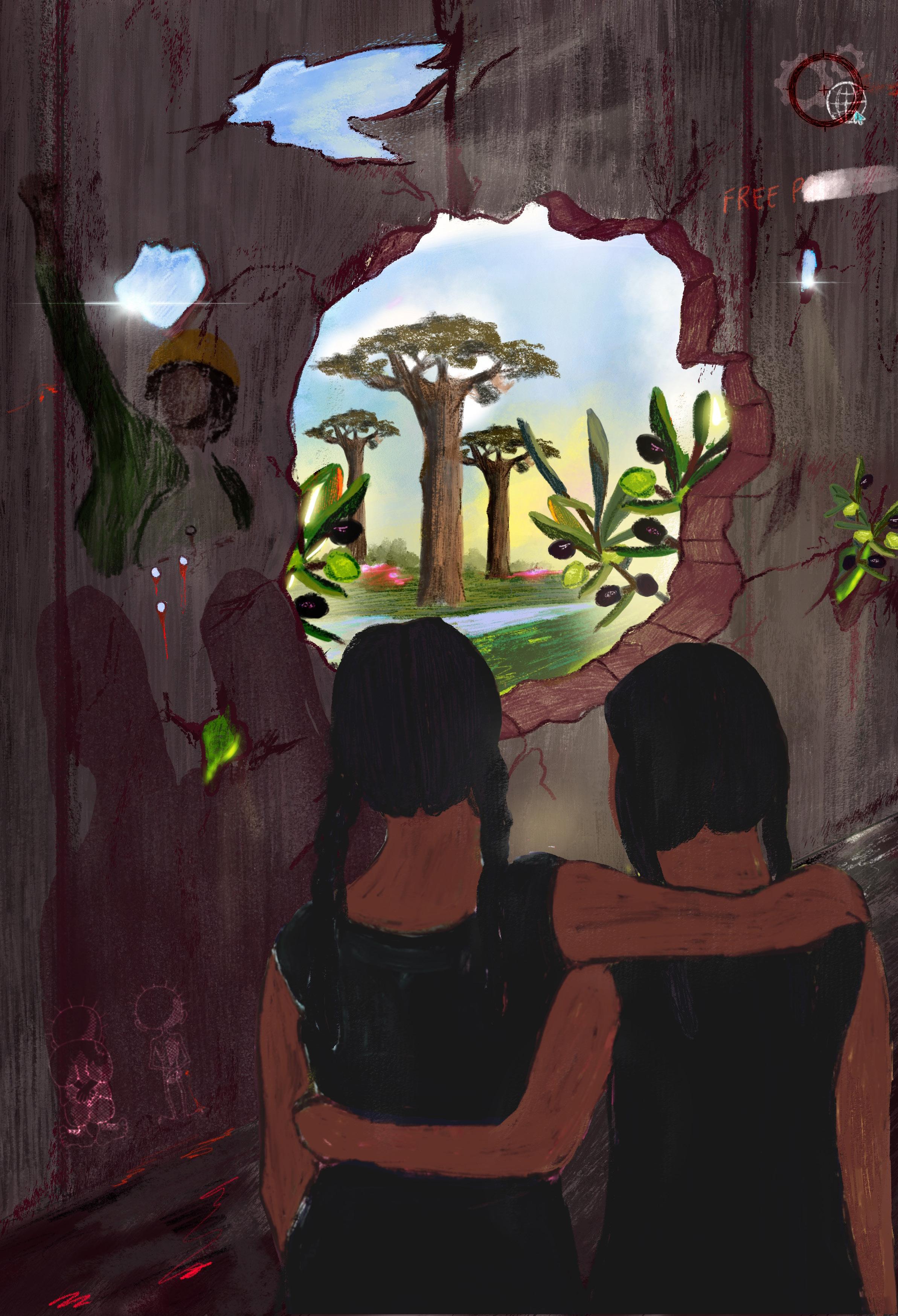
Mikayla Boorany
“An Etch of Our Better Dream”
If you would like to get in touch, please send an email at
towardsapartheidstudies@gmail.com
You can also follow us on Twitter: owards_Critical_Apartheid_Studies @TowardsC_A_S
Instagram @towards_critical_apartheid_s_
Subscribe on our YouTube Channel: @Critical Apartheid Studies
And also listen to recent episodes on Spotify podcast: The Critical Apartheid Studies Podcast