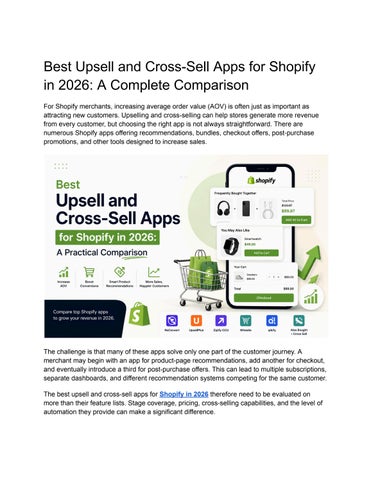
Best Upsell and Cross-Sell Apps for Shopify in 2026: A Complete Comparison For Shopify merchants, increasing average order value (AOV) is often just as important as attracting new customers. Upselling and cross-selling can help stores generate more revenue from every customer, but choosing the right app is not always straightforward. There are numerous Shopify apps offering recommendations, bundles, checkout offers, post-purchase promotions, and other tools designed to increase sales.
The challenge is that many of these apps solve only one part of the customer journey. A merchant may begin with an app for product-page recommendations, add another for checkout, and eventually introduce a third for post-purchase offers. This can lead to multiple subscriptions, separate dashboards, and different recommendation systems competing for the same customer. The best upsell and cross-sell apps for Shopify in 2026 therefore need to be evaluated on more than their feature lists. Stage coverage, pricing, cross-selling capabilities, and the level of automation they provide can make a significant difference.
Upsell vs. Cross-Sell: What Is the Difference? Upselling and cross-selling are often grouped together, but they serve different purposes. An upsell encourages a customer to purchase a higher-value version of the product they are already considering. For example, a customer looking at a three-person tent might be encouraged to choose a larger six-person tent instead. A cross-sell, on the other hand, recommends another product that complements the original purchase. In the camping example, sleeping bags or a camping stove could be suggested alongside the tent. The mechanics behind the two strategies are therefore different. Upselling generally involves presenting a higher-value alternative at the point when a customer is making a purchase decision. Cross-selling typically involves product recommendations, frequently-bought-together widgets, bundles, or related-product suggestions. Many apps are capable of handling both, but they are not necessarily equally strong at each. Merchants should understand which approach an app is designed to support before choosing it.
The Problem With Using Multiple Apps As a Shopify store grows, merchants often add applications whenever they discover a new gap. For example, a store might use one app for cart recommendations, another for post-purchase offers, and another for checkout promotions. Each application may perform its individual task effectively, but the overall system can become difficult to coordinate. There may be several dashboards, separate subscriptions, and different systems deciding what products should be recommended. This does not mean that using multiple apps is always wrong. A specialist application can make sense when a merchant has a specific requirement that another tool does not address. The important point is to understand whether the store is intentionally building a technology stack or simply adding applications whenever a gap appears. A full-funnel approach attempts to solve this problem by covering multiple stages with a connected recommendation system.
Which Shopify Apps Cover the Customer Journey? One of the most important differences between the apps compared in the document is stage coverage.
The customer journey can include five important areas: ● ● ● ● ●
Product page Cart Checkout Post-purchase Email
Wiser AI is identified as the only app in the comparison that covers all five stages using one engine. Selleasy, ReConvert, and Bold AI Upsell each cover four stages, although checkout access is limited by Shopify Plus requirements for two of them. AfterSell focuses primarily on checkout and post-purchase. Fast Bundle concentrates on bundling and cart-based selling, while Vitals offers upselling as part of a much broader collection of eCommerce tools. This makes stage coverage an important factor when comparing applications. A tool that performs exceptionally well at one stage may not be the right choice for a merchant looking for a complete customer journey.
Quick Comparison of the Seven Apps The document divides the seven applications into different roles. Wiser AI is positioned as the full-funnel AI solution. It offers a free plan followed by $9-$49 per month plans and does not charge commissions on upsell revenue. Selleasy is described as a free starter option, with plans beginning at Free / $8.99 per month. It is positioned as an accessible way for merchants to test upselling and cross-selling. ReConvert is the post-purchase specialist. Its pricing starts at $4.99+ per month and includes a 0.75% commission on upsell revenue. AfterSell is positioned as the Plus Powerhouse, starting from $34.99 per month with a flat-fee structure. Fast Bundle focuses heavily on bundling and starts at Free / $19.99 per month. Bold AI Upsell & Cross-Sell is presented as a broad AI solution, with pricing ranging from $25-$500 per month. Vitals is an “everything app” rather than a dedicated upsell solution, starting at $29.99 per month.
Cross-Sell Mechanics Matter
Stage coverage tells merchants where an application works, but it does not necessarily explain how effective its cross-selling approach is. Frequently-bought-together recommendations and bundles or mix-and-match functionality are two important cross-selling mechanisms. Fast Bundle and Selleasy are identified as particularly cross-sell-focused applications because bundling and frequently-bought-together recommendations are central to their functionality. Wiser AI and ReConvert also support cross-selling beyond the traditional product-page experience. Their capabilities extend into post-purchase and email, allowing merchants to continue recommendations after customers move further through the buying journey. AfterSell, in contrast, is primarily built around upselling and checkout. While it has cross-selling capabilities, the document suggests that cross-selling should not be the primary reason to select it.
A Closer Look at the Top Four The comparison highlights four applications in particular: Wiser AI, Selleasy, ReConvert, and AfterSell.
Wiser AI Wiser AI is positioned as the most balanced option among the four. Its primary distinction is that it treats the product page, cart, checkout, post-purchase, and email as parts of one connected system. Its recommendation engine uses real-time browsing behavior together with purchase-pattern data. The system is described as becoming more accurate as a store accumulates orders, without requiring merchants to manually create rules for every recommendation. Wiser AI is best suited to merchants looking for a single dashboard rather than an expanding collection of subscriptions. Its pricing includes a free plan followed by $9-$49 monthly plans, with no commission regardless of upsell volume. The document does note that it is a newer entrant, meaning its review base is still developing compared with longer-established competitors.
Selleasy Selleasy is positioned as an accessible starting point for merchants who want to test upselling and cross-selling before committing a larger budget.
It offers strong cross-selling mechanics, a usable free tier, and live support during setup. However, its recommendation approach is described as more rules-based than adaptive, and checkout upsells require Shopify Plus.
ReConvert ReConvert specializes in the post-purchase experience. Its core idea is that the thank-you page can be used for more than simply confirming an order. Its drag-and-drop editor supports one-click upsells, reorder prompts, and surveys. This makes ReConvert particularly suitable for stores that already have product-page and cart upsells and want to improve the post-purchase stage. One important consideration is its commission structure. In addition to the plan fee, ReConvert charges a commission on upsell revenue, which becomes more noticeable as order volume increases.
AfterSell AfterSell focuses on depth rather than broad coverage. Its strength is the checkout experience, particularly for Shopify Plus merchants. It uses native Shopify Checkout Extensibility so offers can appear as part of checkout rather than relying on a popup layered over the experience. The application also provides A/B testing and per-offer revenue attribution. AfterSell is therefore best suited to Shopify Plus merchants with meaningful sales volume who need detailed control over the checkout stage.
Other Notable Options Fast Bundle is the most cross-sell-native option in the comparison. Bundling and AI-suggested pairings are central to its offering. It supports mix-and-match offers, volume discounts, BOGO promotions, and Shopify POS. Its main limitation is that it does not cover the post-purchase stage. Bold AI Upsell & Cross-Sell provides broad AI-driven recommendations across product pages, carts, checkout, and post-purchase. It is positioned as a mid-tier alternative for stores seeking broad coverage without moving to a premium full-funnel solution. Vitals takes a different approach. It is not a dedicated upsell application. Instead, upselling is one of more than 40 marketing and eCommerce tools available within the platform. This can
make it useful for very early-stage stores looking for broad functionality, although its dedicated upsell capabilities are described as shallower than those of specialist applications.
How Should Shopify Merchants Choose? There is no single application that is automatically right for every store. The document suggests thinking about the merchant's current situation and monthly order volume. For stores shipping under 100 orders per month, Wiser AI or Selleasy can be used to validate the concept because both offer free plans. For stores handling 100 to 2,000 orders per month, Wiser AI can be considered when the goal is to bring every stage under one AI engine. If the merchant only wants to optimize the thank-you page, ReConvert is a more specialized option. For stores handling 2,000+ orders per month, Wiser AI's flat pricing can remain attractive, while AfterSell can make sense for Shopify Plus merchants specifically looking for checkout-native functionality.
What Should You Prioritize? When comparing upsell and cross-sell applications, three factors stand out. First, look at stage coverage. Determine whether the application works across the product page, cart, checkout, post-purchase, and email. Missing stages can mean missed opportunities. Second, examine pricing at scale. A low monthly price may look attractive initially, but commissions can become increasingly significant as sales volume grows. Compare flat fees with percentage-based charges before making a decision. Third, examine what the AI actually does. Some tools may automate recommendations, while others still depend heavily on manually created rules. Merchants should determine how much configuration the technology genuinely eliminates.
Final Thoughts The Shopify upsell and cross-sell landscape has expanded beyond simple product recommendations. Merchants now have options ranging from dedicated bundling tools and post-purchase specialists to broad AI-powered solutions and all-in-one eCommerce applications.
The right choice depends on the store's objectives. A merchant focused primarily on bundles may prefer Fast Bundle. A store looking to optimize the thank-you page may find ReConvert more suitable. Shopify Plus merchants requiring detailed checkout control may prefer AfterSell. Stores looking for broad functionality may consider Vitals. For merchants who want a connected approach across the customer journey, Wiser AI stands out in the comparison because it covers product page, cart, checkout, post-purchase, and email through one system. Ultimately, merchants should avoid choosing an application based solely on ratings or individual features. The more useful questions are: How much of the customer journey does it cover? How does its pricing behave as the store grows? And how much manual work does its AI actually remove? Those factors provide a clearer way to determine which upsell and cross-sell solution fits a Shopify store in 2026.