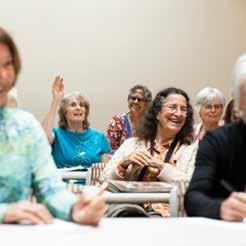
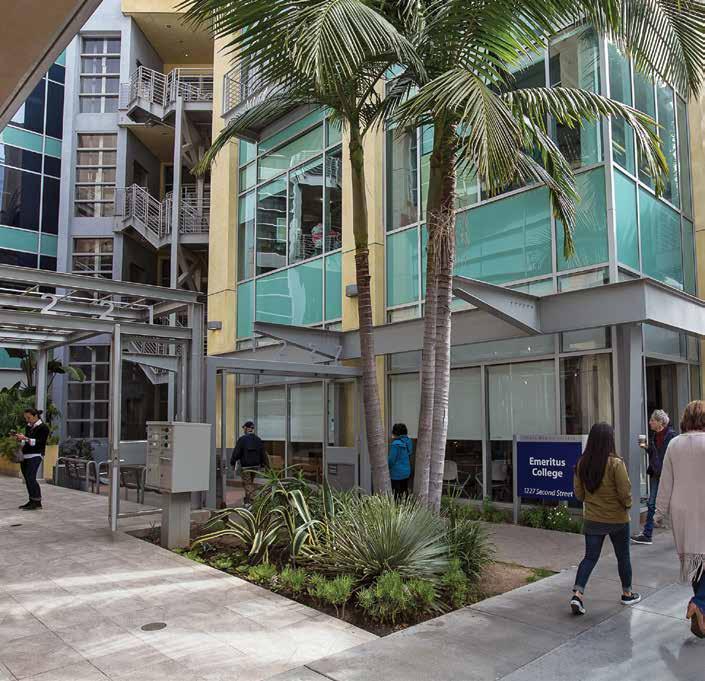
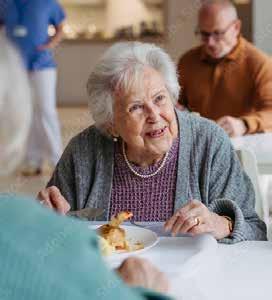
SMC Emeritus, a program of Santa Monica College for adults 55+, offers over 160 FREE classes at the Emeritus Campus and convenient locations throughout the community, including Malibu. Come acquire new skills, learn healthy living strategies, express your artistic side, and meet others who share your interests. We are currently offering in-person, online, and hybrid classes.
FREE classes for anyone with a California address. Tell your friends and families!
smc.edu/emeritus Office: 1227 Second St., Santa Monica
SANTA MONICA COMMUNITY COLLEGE DISTRICT BOARD OF TRUSTEES: Dr. Nancy Greenstein, Chair; Dr. Sion Roy, Vice Chair; Dr. Luis Barrera Castañón; Anastasia Foster; Dr. Margaret Quiñones-Perez; Dr. Tom Peters; Rob Rader; Sophia Manavi, Student Trustee; Kathryn E. Jeffery, Ph.D., Superintendent/President
PRESIDENT & CEO: Molly Davies, LCSW
EDITOR: Kelli Stauning, MS
CONTRIBUTING WRITERS:
Barbara Browning
Kerry Burnight, PhD
Miriam Caiden, PhD
Molly Davies, LCSW
Nikki Davis, MBA
Miles McNeeley, LCSW
Laura Mosqueda, MD
Ellen Satkin, LCSW
Yelena Solovyeva
Kelli Stauning, MS
Rachel Tate, LCSW
ART DIRECTOR: Kelli Stauning, MS
SPECIAL THANKS: Santa Monica Daily Press Julie Sorochinsky ABOUT RELEVANT! The 2026 Relevant! Westside Guide for the 50+ is published by Wise & Healthy Aging. Relevant! is available online at wiseandhealthyaging.org. Our headquarters is located at 1527 4th Street, Santa Monica, CA 90401 (310) 394-9871.
IMPORTANT
Wise & Healthy Aging is a 501(c)(3) nonprofit community-based, social services organization. To distribute the Guide free of cost, we sell advertising space. Paid listings do not imply a recommendation or endorsement of products or services by Wise & Healthy Aging.
CHAMPIONING AGING
Aging is a hot topic these days. Whether it’s about how to look and feel younger, or how to live longer and healthier, we’re flooded daily with messages about how we can defy time and add years to our lives.
But the truth is: aging is a natural, lifelong journey for all of us—one that can bring real challenges, but also great opportunities for growth. So instead of trying to turn back time or measure ourselves against impossible ideals, what if we chose to champion aging by focusing on what we can meaningfully influence?
In our 2026 edition of Wise & Healthy Aging’s Relevant! Westside Guide for the 50+, we are excited to present some ways and expert insights to help you stay strong, connected, and joyfully engaged, wherever you are on your aging journey.
For starters, one of our writers encourages travel as a great way to explore, connect, and engage with the world. Given the importance of social connections for mental and physical health, adventuring to sights unseen can connect us to places, people and experiences that can spark new energy and joy at any age (p. 8).
Think it’s too late to start exercising? Think again. More and more science is telling us that strength training is one of the most important things we can do after the age of 50 and that we can actually build muscle with the right approach to exercise and nutrition, meaning small changes starting now – can make a huge difference (p. 22).
Just as physical health is critical for well-being, so is feeling valued and staying socially connected. And for Los Angeles Times columnist, Steve Lopez, who is profiled in our cover story, that means you need to matter to someone and have a sense of purpose, whether you choose to retire, semiretire or reinvent yourself in a second career (p. 18).
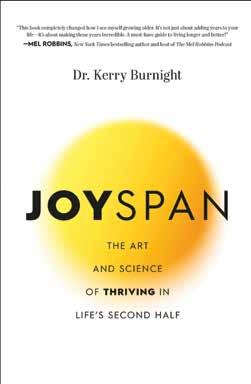
Equally important, says one of our guest authors, Kerry Burnight, PhD, is the experience of wellbeing and satisfaction or “joyspan,” shedding new light on how we can continue to “grow and become” as we age (p. 25).
With more people living longer than ever before, nothing seems more critical than finding ways to champion aging. This issue of Relevant! offers some great ways to help you do just that.
On that note, I’d like to extend my thanks to Cypress Equity Investments, Fraser Communications, RAND Corporation and Waymo for their generous sponsorship of the magazine, enabling us to provide our Relevant! Westside Guide for the 50+ free to the community.
Your fellow champion on the aging journey,
Molly Davies, LCSW
President & CEO, Wise & Healthy Aging
They say life’s a trade-off - when you’re young, you’ve got more energy and time but you’re low on funds.
Later, you may have more money but less stamina. For those of us in the Boomer and Gen X generations, globe-trotting often took a backseat to the Big Three: marriage, mortgage and munchkins. But, if you ask someone over 50 what they wish they’d done more of, the answer is almost always the same: “Travel.”
UP IN THE AIR
Book Early… Because You Never Know
Booking in advance can save countless headaches. Once, I reserved a condo in Chicago a year in advance. Six months later, a global pop superstar announced her concert for that same weekend. “With planning, there was no “Bad Blood.”
Don’t Skip the Classics
Don’t believe online trends telling you certain popular tourist attractions are “overrated.” If you’ve waited decades to see the Eiffel Tower or Machu Picchu, go see them for yourself and decide whether it was worth it.
PLANES, TRAINS, OR THE LOVE BOAT
When it comes to travel, how you get there is half the story. A budget flight with no legroom to get halfway around the world may not be a good start to your travel adventure.
Getting there and loving the ride
Flying is fast, but airports demand stamina. Trains let you slow down and take the scenic route. Cruises are relaxing and let you explore new ports almost daily without unpacking!
To Hotel or Not to Hotel?
Hotels and resorts are perfect if you want fresh towels daily, a concierge who knows the best eateries, Loyalty points, airport shuttles, and on-site dining. Vacation rentals are ideal for longer stays, traveling with family, or just wanting the comforts of home.
Timing Is Everything
Want to stretch your budget and avoid crowds? Plan for travel off-season. That dreamy trip to Guadeloupe? Try early December instead of Christmas week. Fewer crowds, better prices, same ocean.
LOST IN TRANSLATION
On a trip in Jamaica, I asked a local what time the city bus would arrive. He smiled warmly and said, “Soon come, come soon.” That phrase could mean five minutes... or two hours on “island time.”
Reboot Your Outlook (not Microsoft)
By the time we hit our 50s, we know what we like. But seasoned travelers know the most valuable thing you can bring on any trip is an open mind and comfortable walking shoes.
Travel requires letting go of schedules, familiar foods, and the urge to Google for “Starbucks near me.” So, taste the food, and discover new flavors.
GREAT EXPECTATIONS
Beware of the vacation transformation fantasy where you book the trip and imagine yourself scaling castle stairs, biking through vineyards, and looking fabulous in those white linen pants that never left your closet.
Know Thyself Before You Go (Before You Sign Up for a 14-Day Trek)
If you’re not a hiker at home, you won’t magically become one for the Santiago de Compostela hike in Galicia. Before you book a group tour, take the time to research and call the company. Ask: How many steps are there? Is there an elevator?
And then there’s public transportation. Sure, it’s efficient and cost-effective in places like New York City or Seoul - but have you tried carrying a suitcase down three flights of stairs to the Metro?
So, if you are worried about your back and tricky knees, budget for ride-shares, taxis, or consider a tour that caters to all mobility levels and find accommodation close to restaurants, attractions, and elevators.
The World Is Not ADA-Friendly (Nothing Personal)
In many places, elevators are luxuries, ramps are rare, and handrails are for decoration. That stunning medieval town perched on a hill? Gorgeous. But you’ll have to actually climb the hill to appreciate it. San Marino? Think “Stairmaster with a view.” Santorini? Hope you like donkeys.
So don’t be afraid to find out about accessibility in that charming village. Call the hotel and ask if their “accessible room” has a ramp and that there’s an elevator (that works).
TRAVEL SAFETY 101
When we were younger, we worried about finding the best gelato and cheapest hostel. Now, we are thinking about the nearest hospital, travel insurance, and a safe ATM within hobbling distance of the hotel. Here’s your pre-travel checklist:
Register with STEP
The Smart Traveler Enrollment Program (STEP) via travel.state.gov lets the U.S. Embassy know where you are in case things go sideways - like political unrest or natural disasters.
Know the Political Climate (Not Just the Weather)
Check the U.S. State Department’s travel advisories before you book. It’s one thing to be caught in the rain. It’s another to be caught in a revolution.
Cell Service
Having cell service abroad ensures you can quickly contact loved ones, and access translation and navigation tools without delay, reducing stress and increasing safety during your trip. Check with your carrier about international add-on services.
Photocopy Your Passport
Scan it, then email it to yourself and your trusted emergency contact. Bring a printed copy with you and keep it separate from your passport.
Share Your Itinerary
Send your day-by-day plans to a friend or family member. Include flight numbers, hotel address, email, and website, and any excursions that involve zip lines, volcanoes, or boats and print a copy for yourself. Wi-Fi isn’t always guaranteed.
THELMA & “WHINEY” LOUISE
Traveling with friends can be magical—or a stress test. One friend wants to hike a volcano; another wants to sip cocktails in a hammock. I’ve learned to ask upfront:
• Early riser or night owl?
• Planner or go-with-the-flow?
• Vacation = relax or see everything? Then, compromise, split days, and reconvene for cocktails. Travel magnifies quirks, so patience is key.
EAT, PRAY & TRAVEL INSURANCE
Rome. Train station. Midday. I’m minding my own business and that’s when a woman cradling a newborn in her left arm tried to pickpocket me with her right. Cute decoy, sneaky hands.
If it can happen in the Eternal City, it can happen anywhere. But before you decide on a staycation let’s talk about how to travel safely, smartly, and stylishly - with your wallet and dignity intact.
Scam Game(s)
Over fifty? You’re officially a prime target. Here are the classics:
• Baby Scam – A crying baby and a flustered mother. You’re distracted. Your wallet and/or phone disappears.
• Bracelet Peddler – A stranger hands you a bracelet (or flower) and harasses you for money.
• Shoe Shiner – Who “accidentally” drops an item in front of you and when you tell him, he offers you a shoeshine. Don’t pick it up. Keep walking.
Stay alert, especially in crowded spaces.
Travel Gear for the Grown
• Invest in an anti-theft bag. Slashproof straps and locking zippers.
• Get an RFID wallet. Protect your credit cards, debit cards, and IDs from electronic pickpockets
• See the sights lite. One credit card, one ID, and a small amount of cash. Keep the rest in the hotel safe.
• Split up your stuff. If traveling with a partner, divide medications, cards, and documents between bags. If one bag vanishes, you’re not stuck negotiating with a Nicaraguan pharmacist using hand gestures and Google Translate.
Travel Insurance
Remember when you thought travel insurance was for older people? Now you’re one of them.
Good travel insurance can cover:
• Emergency medical care (including air evacuation which is extremely expensive and not covered by Medicare)
• Trip cancellations and delays
• Lost or stolen luggage
• That accidental snorkeling mishap that didn’t seem risky at the time
• Chronic condition(s), get a plan that knows what that means and buy it right after booking
THE PACKER
Getting through TSA used to be simple. But now? One wrong item in your carryon and suddenly you’re the star of your very own Dateline International episode. What’s perfectly legal in California - can land you in real trouble in countries like Japan, Singapore, or the UAE-United Arab Emirates.
Even simple snacks can get you flagged. Beef jerky in Australia, contraband. Gum
in Singapore - chew it and you’re flirting with a fine or worse. So, take a moment to find out what’s banned in your destination country.
As for medications, you’ll want the original prescription bottles, a printed medication list, and a note from your doctor if you take anything strong enough to raise an eyebrow abroad.
Now let’s talk cankles – where your ankles and calves swell somewhere over Greenland on an overnight flight. Compression socks may not be sexy, but they’re a godsend for circulation.
Lastly, throw together a first aid kit. Have something for headaches, motion sickness, stomach drama, and a few bandages.
SUMMARY
Traveling at 50+ isn’t about catching upit’s about fully showing up.
The world is still big, beautiful, and welcoming - so pack your stretchy pants, trust your instincts, and get going because the best time to see the world is now.
Check out travel with Wise & Healthy Aging at: wiseandhealthyaging.org/adventures
EDUCATION
1527 4th St., 2nd Floor
Santa Monica, CA 90401 (310) 394-9871
wiseandhealthyaging.org/club-wise
Emeritus – Santa Monica College 1227 2nd St.
Santa Monica, CA 90401 (310) 434-4306
smc.edu/emeritus
FREE lifelong learning classes designed for those 55+ but open to all adults. Many classes offered fully online and most in-person classes are also 100% livestreamed.
FITNESS
1527 4th St., 1st Floor
Santa Monica, CA 90401 (310) 394-9871
wiseandhealthyaging.org/club-wise
Santa Monica Family YMCA 1332 6th St. Santa Monica, CA 90401
OLDER ADULTS
Claude Pepper Senior Citizen Center
1762 S. La Cienega Blvd.
Los Angeles, CA 90035 (310) 559-9677
laparks.org/scc/claude-pepper
1527 4th St., 1st Floor
Santa Monica, CA 90401 (310) 857-1527
wiseandhealthyaging.org/club-wise
Culver City Senior Center 4095 Overland Ave. Culver City, CA 90232 (310) 253-6700 culvercity.org
Felicia Mahood Multipurpose Center
11338 Santa Monica Blvd. Los Angeles, CA 90025 (323) 937-5900
laparks.org/multipurpose/felicia-mahood
Gunther-Hirsh Family Center
330 N. Fairfax Ave. Los Angeles, CA 90036 (323) 761-8800
jfsla.org
BAR Center at the Beach 201 Ocean Front Walk Venice, CA 90291 (323) 937-5900
jfsla.org
Malibu Senior Center
Pico - Robertson
Family Resource Center 8838 W. Pico Blvd. Los Angeles, CA 90035 310-247-0864
jfsla.org
Westchester Senior Center
8740 Lincoln Blvd. Los Angeles, CA 90045 (310) 649-3319
Westchester.SCC@lacity.org
PARKS / RECREATION CENTERS (listed by city)
Beverly Hills
Beverly Gardens Park
23 blocks along Santa Monica Blvd. Beverly Hills, CA 90210 285-1000
Coldwater Canyon Park 1100 N. Beverly Dr. Beverly Hills, CA 90210 (310) 285-1000
Greyston Mansion & Gardens
905 Loma Vista Dr. Beverly Hills, CA 90210 (310) 285-1000
La Cienega Community Center/Park 8400 Gregory Way Beverly Hills, CA 90210 (310) 285-1000
RECREATION CENTERS
(310) 393-2721 www.ymcasm.org
Beverly Hills Active Adult Club (BHAAC)
471 S. Roxbury Dr. Beverly Hills, CA 90212 (310) 285-6840
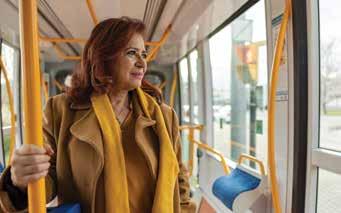
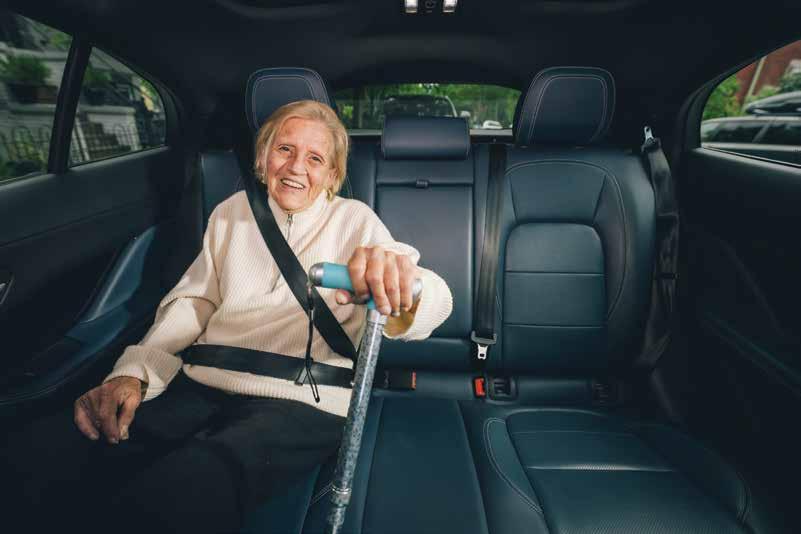
For aging Angelenos who are unable to drive, it can be challenging to get around L.A. Now, Waymo’s autonomous ridehailing service is giving them the same independence as driving, with an added sense of safety.
Waymo provides on-demand, 24/7 rides across 120 square miles of LA County, from Santa Monica to Echo Park.
“Waymo provides a discrimination-free, judgment-free ride that is controlled by me where I get to choose the music, I get to choose the temperature, if I want the windows up or down,” said Bill Meyerchak, an Angeleno who cannot drive due to a disability and said Waymo changed his life. “The more seniors that get in Waymo autonomous vehicles, the faster seniors will be able to have freedom in society.”
Waymo is designed to be constantly vigilant, drive smoothly, follow traffic laws, and protect the safety of passengers and all road users, including cyclists and pedestrians.
Waymo’s app includes accessible features such as audio cues throughout the ride, screen-reader support, a setting to minimize walking time, and adaptive app navigation with turn-by-turn walking directions.
Julie Finger, a 90-year-old Waymo rider in Los Angeles, says the service can bring a new sense of freedom and independence to Angelenos in their golden years.
“I definitely believe that Waymo would be a great help for older adults,” Julie said. “When they see more of us going in there, using Waymo, they’ll be encouraged because they’re also adventurers.”
Moving forward, together
Waymo is a proud supporter of Wise & Healthy Aging
AGING WELL
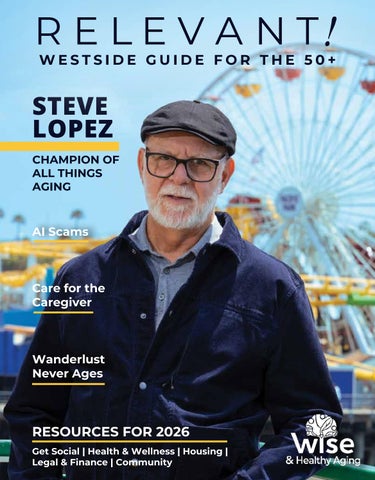
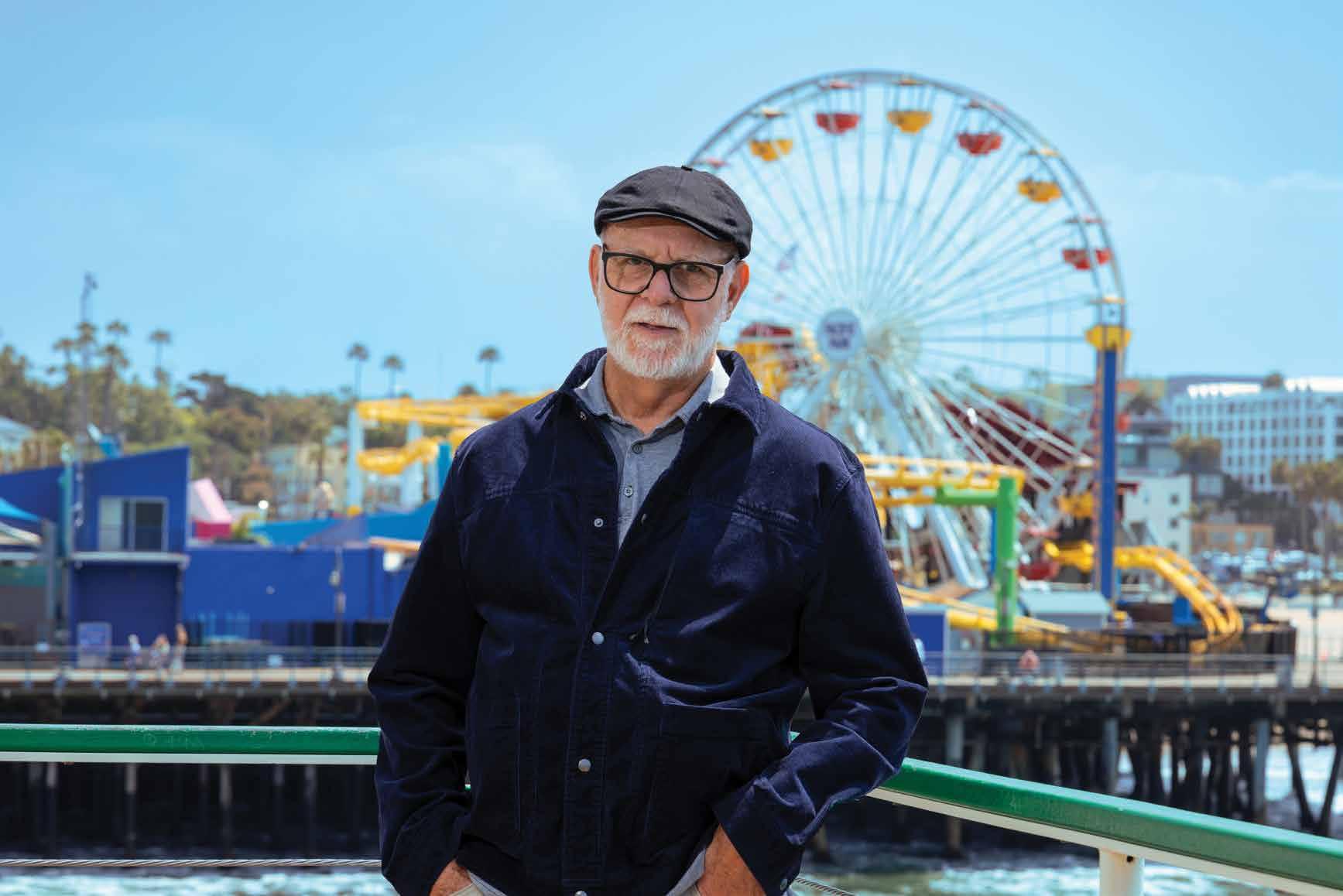
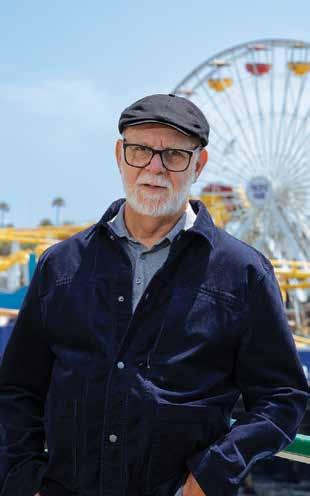
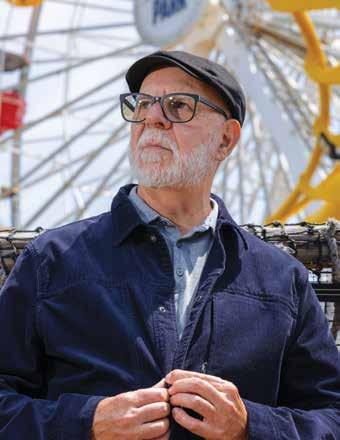
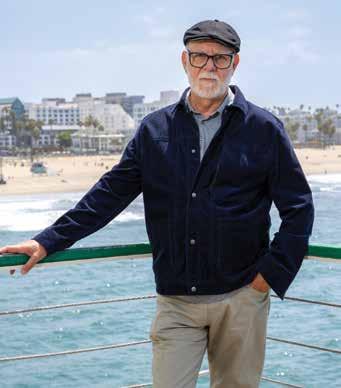
Steve Lopez is a California native who has spent over two decades at the Los Angeles Times. A true metro columnist, Lopez has captured the voices of Angelenos from every walk of life—telling their stories with insight and empathy while holding officials and institutions accountable as he examines the major issues shaping our times.
Lopez has earned more than a dozen national journalism awards and been a Pulitzer Prize finalist four times. His latest book, Independence Day: What I Learned About Retirement from Some Who’ve Done It and Some Who Never Will, dives into what it really means to find purpose later in life. He’s also the author of The Soloist, inspired by his columns about Nathaniel Ayers—a gifted Juilliard-trained musician who was unhoused when the two met. The story became both a Los Angeles Times and New York Times bestseller, won the PEN USA West Award for Literary Nonfiction, and was later made into a DreamWorks film starring Jamie Foxx and Robert Downey Jr.
With such an extensive body of work and a career marked by success, there’s little that this veteran journalist hasn’t covered. That is, until Lopez was close to turning the big seven-zero (70) and began thinking about the pros and cons of retiring.
“I couldn’t decide on whether or not to retire,” Lopez explains. “So, I happened to be talking to my book agent, and he suggested I spend a year doing what I already do—but focus on people who
have retired, to see whether they’re happy or have regrets. Then I could decide for myself.”
It worked. By the end of that year, Lopez decided he wasn’t ready to retire. Instead, he transitioned to part-time at the Los Angeles Times and, in January 2023, launched Golden State—a new column devoted entirely to the topic of aging.
“I was aging. And I thought, ‘Finally, I’m an expert on something.’ And there’s so much to cover—everything from how we will pay for our housing and healthcare, to looking at ways to build new phases of our lives,” Lopez explained.
Fast forward to nearly three years of indepth reporting on the challenges and triumphs of aging, and what does Lopez see as the top three issues he hears from older adults?
“Where will they live? How will they pay their bills? And who will care for them?” he says. “Under each of those questions are six to 10 subtitles—but those are the big ones that remain unresolved.”
And many of his columns have taken on these issues by telling the story of the older person impacted—caregiver, scam victim, nursing home resident, older immigrant—to name just several.
“A lot of people I hear from don’t have much income other than Social Security, and, if they lose any percentage of that, they could be in big trouble,” he says. “And I don’t see a lot of progress on dealing with any of those challenges. I mean, we just don’t have it figured out.”
BRIDGING THE GENERATIONS
Even amid the persistent challenges of aging, Lopez finds inspiration in the fresh ideas and cross-generational thinking that comes from the people he interviews. When he first started writing about aging, he said Paul Irving, a Senior Adviser and aging scholar at the Milken Institute, advised him not to think of his column as being only for older people.
“When I asked him why, he explained that young people are the answer,” Lopez recalls. “Because Irving said that whether they go into real estate, or financial services, or healthcare, or anything gerontology related, it’s a huge job growth field given the unprecedented
aging group of people in the U.S. and in the world, and we have great needs that can only be addressed by younger generations.”
This “unprecedented aging group” is, of course, the baby boomer generation, those born between 1946 and 1964, who will have reached age 65 and older by 2030, making up 21% of the U.S. population and just shy of that at 20.6% in California.
INTERMINGLING THE GENERATIONS
Taking Irving’s advice a step further, young people may also be the answer in helping Lopez expose some of the stigmas around aging, especially when both young and old-er have so much to learn from each other.
“The idea that older people are kind of useless, that when you hit a certain age, you have nothing to contribute, is one of the reasons that I’ve done a few
The happiest retirees are people who matter to somebody and have a sense of purpose.
columns on intergenerational programs like Heart of Los Angeles (or HOLA) Eisner Intergenerational Orchestra, where you have an orchestra where a 14-year-old violinist sits next to a 70-year-old cellist. And in that duo, each has something to teach the other,” Lopez says. “There just isn’t enough mingling of those different generations.”
AGING WITHOUT GETTING OLD?
While the issues surrounding aging only continue to give Lopez something to write about, so too do the ways that older adults are reinventing what it means to age, whether they choose to retire or not. Lopez’ own way—for now—is via the “hybrid” plan, as he calls continuing to work part-time.
“My generation is doing it differently than previously. It’s no longer, you’re 65, here’s a gold watch’ and you retire . . .” Lopez says. “Now we’ve re-written the rules of retirement, partly because the labor force has shrunk, partly because some employers in some industries don’t want to let go of the institutional knowledge older people have, partly because people are hit by inflation, high housing and healthcare costs, so they don’t want to 100% quit working, and they go part-time like I’m doing.”
Many retirees Lopez meets, however, are genuinely happy, financially “in a good way,” and are finding purpose in
volunteer work, from mentoring teens to delivering meals or beautifying their neighborhoods.
“I always notice people older than me volunteering. And given all the institutions in LA and the great need for people to fill the gaps that city, county, state, and the federal government are not addressing, I’m inspired and hope to write more about that,” Lopez reflects.
While retirement can free you up to volunteer, start a second career, become a world-traveler, or see more of your grandkids, it is also a “complicated transition in life,” according to retired professor Nancy Schlosberg, EdD, professor emerita at the University of Maryland College Park who Lopez interviewed in 2022.
“She summarized it well by saying that the happiest retirees are people who matter to somebody and have a sense of purpose,” Lopez says.
NOT DONE VS. JUST GETTING STARTED
The late Norman Lear, legendary writer and producer behind more than 100 television shows, including All in the Family, told Lopez in his mid-90s that he’d never given retirement a moment’s thought, but was always working on several projects that got him up out of bed each day thinking about what he wanted to do next.
“Now that may be easy to say if you’re a famous TV producer for three quarters of a century,” Lopez says. “But I think there’s a good lesson there for all of us. Just find something that gets you out of bed and indulge it, give yourself to it.”
Others find that reason to get out of bed after fully retiring, as they now have time to pursue new interests, and maybe even reinvent themselves in the process. Lopez cites Morrie Markoff, who ran an air conditioning and appliance company before he retired and was featured in a couple of Lopez’ columns, living to be 110 and holding his first art show at 100 before publishing his first book at 103. Lopez also draws inspiration from Pete Teti, a 101-year-old former teacher he wrote about who creates computerdriven art using fractal technology and still hikes regularly in Griffith Park.
IT’S ALL ABOUT SOCIAL CONNECTIONS
For Lopez, aging well isn’t just about staying intellectually stimulated or staying physically active, but might be even more about maintaining strong social connections.
“I’m reading a book about a guy who went to five countries that have off the charts longevity and it’s about how the common denominator was strong social connections, community engagement and involvement,” Lopez says.
Just find something that gets you out of bed and indulge it, give yourself to it.
Along these same lines, he’s also excited about the U.S. POINTER Study, which tracked over 2,000 people between the ages of 60 and 79 in five locations for two years, who did not have dementia but had the risk factors (family history, cardiovascular disease, poor diets and sedentary lifestyles). During the 2-year study, participants kept to a regimen of physical activity, cognitive exercise, healthy diet and social engagement. Half the group had coaching, and the other half stuck to the regimen on their own.
“They found that both groups’ cognitive acuity got sharper over those two years without taking medication,” Lopez says. “And so, look, there’s no cure for dementia, but this is encouraging news that living a relatively healthy lifestyle, staying physically active, eating well, avoiding some of the risk factors, getting enough sleep, are all important, but that maintaining connections to family, to friends, to community, to causes, being engaged, can be good for your overall health.”
And what’s good right now for Lopez’ overall health is to continue working “hybrid,” and enjoying the liberation that comes with aging in not having to figure out things like “making the TV in the living room get the same signals and programs as the one in the den.”
“I’ve liberated myself from things I cannot fix. I hire somebody,” he says with a laugh, pointing to his two guitars. “I feel lucky and I’m looking forward to more time to play.”
GET STRONG, AGE STRONG
By Kelli Stauning, MS
Aging doesn’t sideline you—sitting still does. The older we get, the more dangerous inactivity becomes. Muscle mass diminishes, balance slips, and independence vanishes one skipped workout at a time.
Here’s the truth: exercise is the single most powerful tool you have to stay strong, sharp, and active as you age. Every walk, stretch, or weight lifted isn’t just movement – it’s rebellion against decline.
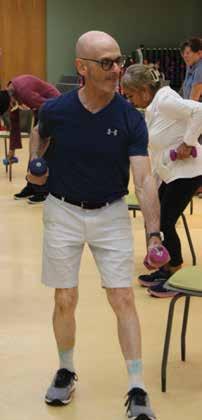
Josh Silver, a volunteer fitness instructor at Wise & Healthy Aging, is one such rebel. As a person who just turned 70, he knows first-hand the kind of changes your body goes through as you age and is on a mission to teach older adults how to get and stay strong.
“The biggest change is that your body loses strength, and as it does, it can affect your posture, your balance, your bone density – all of which can make you more prone to accidents like falling,” Josh says. “The activities of daily living from getting dressed to getting in and out of a car, are all based on strength and balance, so keeping fit is the key to maintaining your independence.”
But if you’re over 50 and finding yourself struggling to exercise, you’re not alone. Fear of injury, health challenges, or the thought of walking into a gym full of 20-somethings can be intimidating. And the biggest one, according to Josh – is the belief that you get weaker as you age and think it’s too late to start exercising.
“Not so,” says Josh. “I’m living proof that strength and fitness can improve as you age. I’m stronger now than I was in my 30’s.”
While it is true that we do start losing muscle after the age of 30, strength training is the only way to preserve it. So, if you don’t see yourself lifting heavy barbells, the good news is that you don’t need a gym full of equipment to stay strong. Resistance bands, light weights, or even bodyweight exercises like squats and push-ups help preserve muscle, protect your joints, and make everyday tasks—like climbing stairs or carrying
groceries—feel easier.
Equally important are balance and flexibility. Simple practices like stretching, yoga, or tai chi can improve stability and reduce the risk of falls, one of the biggest threats to independence. Pair this with regular walking, swimming, or biking to keep your heart healthy and your energy high.
“Tiny habits that you can start doing at home matter, like doing toe raises while you are brushing your teeth or squeezing a squishy ball while you’re watching TV,” Josh says.
Every walk, stretch, or weight lifted isn’t just movement –it’s rebellion against decline.
“I tell my class to practice picking up tiny things on the floor, like a pencil or a coin. All of this helps you to be more flexible, agile and coordinated.”
And don’t forget – food fuels your strength. Eating enough protein, calcium, and vitamin D, along with staying hydrated, keeps your body resilient.
Most importantly, consistency matters more than intensity. You don’t have to exercise for hours—just 20 to 30 minutes of movement most days can make a world of difference.
Getting older doesn’t mean slowing down—it means being intentional about how you care for your body. The real secret to maintaining independence isn’t luck or genetics—it’s strength. Strong muscles, flexible joints, and a steady sense of balance are what keep you active, capable, and confident. So, keep moving, keep strengthening, and keep connecting with others. Independence isn’t just about living longer—it’s about living stronger.
RETHINKING WHAT IT MEANS TO THRIVE IN LATER LIFE
By Kerry Burnight, PhD
Anyone who says “age is just a number” hasn’t reached the high numbers. Aging is not easy, and “forever young” is not a plan. Regardless of how many burpees you can do or protein smoothies you chug; the passing of time brings challenges. Roles that you relished change, words on menus seem to shrink, necks sag, diagnoses arise.
On the other hand, aging is not the downhill slide that people believe it is. A multibillion-dollar anti-aging industry profits when you feel awful about yourself and fear aging like the plague.
The tragedy of aging is not that we will all grow old and die, but that aging has been made unnecessarily, and at times excruciatingly, painful and humiliating. Aging does not have to be this way.
I taught geriatric medicine and gerontology for 18 years at the University
of California, Irvine School of Medicine. At UCI’s Senior Health Center, I had a frontrow seat to observe people, and their families, navigate old age. What struck me most was the radical differences in how people experienced their own aging process. For some, it’s a frustrating, degrading, painful trajectory of decline. For others, there is visible delight, spirituality and joy in their eighth, ninth, and 10th decades.
When it comes to longevity, the primary focus has been lifespan, the length of life. More recently though, the scope has expanded beyond years of life to years of life in good health, or health span.
A long life, even a long life in good health, doesn’t mean much if you don’t like your life.
This is a welcome shift, but there’s a catch. A long life, even a long life in good health, doesn’t mean much if you don’t like your life. As geriatrician Dr. Louise Aronson observes: “We’ve added a couple of decades, essentially an entire generation, on to our lives, and we haven’t figured out how to handle that.”
To thrive in old age means to live a fulfilling, purposeful and satisfying life despite the challenges that accompany aging. It involves maximizing physical health, cognitive function, emotional wellbeing, social connections, and a sense of meaning. Thriving doesn’t mean being free of all health problems or challenges; rather, it emphasizes resilience, adaptability and the ability to find joy and value in life. People don’t thrive in longevity by mistake or luck. People who thrive in longevity actively maximize the quality of their lives. But how?
I scoured the findings of 35 years of empirical testing on psychological wellbeing in longevity. The deeper I dug into the findings, the more I recognized a profound underlying pattern that consistently groups into four essential elements.
1. Grow: They continue to expand and explore.
2. Connect: They put time into new and existing relationships.
3. Adapt: They adjust to changing and challenging situations.
4. Give: They share themselves.
Regardless of your current age, you hold one of two mindsets: aging as decline or aging as continued growth.
Each of these elements is non-negotiable for wellbeing in longevity, and you can improve in each area. What we’ve been missing is a practical vocabulary and approach to maximizing the quality of our long lives. It’s not enough to have a long lifespan and health span; we want what I call a long joyspan.
Joyspan, or the experience of wellbeing and satisfaction in longevity, matters because without it, long life is a drag.
The American Psychological Association defines joy as the feeling that arises from a sense of wellbeing or satisfaction. Experiencing joy is different from feeling happy, as happiness comes and goes and is often dependent on external circumstances. Joy can be experienced even in adversity.
More akin to contentment than to ecstasy, joy may show up in the form of a smile, but many times it does not.. One older woman looking at the trees through her window may be lonely and miserable, while a different older woman looking at the same trees may be experiencing great joy.
The decline mindset believes everything gets worse as you grow older and then you die. Sadly, this mindset is the most
prevalent. The growth mindset sees aging as a time of continued progress in becoming who you are, recognizing not only the challenges and losses of growing older but the opportunities and strengths.
Take my 81-year-old neighbor Dee. A few days ago, I saw her on her front porch while I was walking the dogs, and she waved me over so she could tell me all about her sore hands, the “absolute drivel” on TV, and how bad the hot weather makes her feel. Because Dee sees her life as a downward freefall, she’s stopped showing up for it. She does not pursue her former interests, reach out to friends, or challenge herself. The long hours spent in her recliner have seriously weakened her legs, which she blames on the curse of being old.
Our conversations never involve topics beyond her discomfort. Despite our many conversations, Dee doesn’t know anything about me other than the fact that I have two golden retrievers. There isn’t any space for me to share my life,
because her life, as miserable as she finds it, is the topic that dominates her mind. Dee holds a decline mindset.
I often run into another neighbor, Joan, who walks the same loop I do. She is 82 and radiant. Soon after our middle daughter was diagnosed with a brain tumor, I saw Joan and she noticed right away that something was off. She asked me what was going on in a way that felt safe for me to share. She listened intensely, then suggested ways to adjust to this “new normal.” Joan has had so many new normals. Always very interested in something – a new plant she’s potted, a new recipe, an interesting book, an upcoming art exhibit – Joan has a growth mindset.
Growing older is about, well, growing, about becoming. Joan knows that interior strengths can continue to develop throughout life. I once told Joan how much I admire her attitude, and she laughed, saying: “I find life fascinating. I’m still growing now, just as I have in every other phase of my life.”
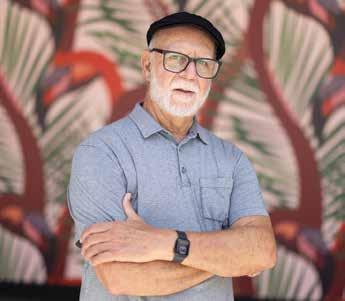
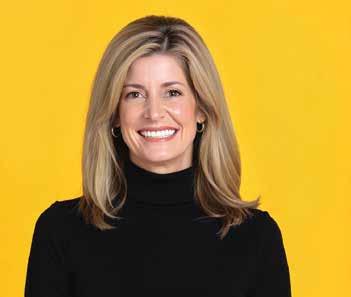
Kerry Burnight, PhD, America’s Gerontologist, and author
of the New York Times best-selling book, Joyspan: The Art and Science of Thriving in Life’s Second Half.
drkerryburnight.com
EXCELLENCE FOR YOU.
We’re honored to be recognized for providing high-quality care to our communities. This commitment to your well-being is at the heart of our award-winning care.
For more information, visit providence.org/saintjohns
HEALTHCARE
COMMUNITY CLINIC
Yo San University Community Clinic 13315 W. Washington Blvd. Los Angeles, CA 90066 (310) 577-3006 yosan.edu
HEALTHCARE SERVICES
Cancer Support
Community Los Angeles 1990 S. Bundy Dr. Ste. 100 Los Angeles, CA 90025 (310) 314-2555 cancersupportla.org
Los Angeles County Public HealthOffice of Senior Health 3530 Wilshire Blvd., 8th Floor Los Angeles, CA 90010 (213) 351-7825 publichealth.lacounty.gov/aging
Westside Family Health Center 3861 Sepulveda Blvd. Culver City, CA 90230 (310) 450-2191 wfhcenter.org
HOSPITALS/ MEDICAL CENTERS
Find a Health Center on findahealthcenter.hrsa.gov
Cedars-Sinai 8700 Beverly Blvd. Los Angeles, CA 90048 (310) 423-3277 cedars-sinai.org
Kaiser Permanente West Los Angeles Medical Center 6041 Cadillac Ave. Los Angeles, CA 90034 (323) 857-2000 kp.org/westlosangeles
Providence Saint John’s Health Center 2121 Santa Monica Blvd. Santa Monica, CA 90404 (310) 829-5511 providence.org/saintjohns
Ronald Reagan UCLA Medical Center 757 Westwood Plaza
Los Angeles, CA 90095 (310) 825-9111 uclahealth.org
UCLA Santa Monica Medical Center 1250 16th St
Santa Monica, CA 90404 (310) 825-9111 uclahealth.org/santa-monica
MEDICARE AND MEDI-CAL
Covered California (800) 300-1506 coveredca.com
Determine eligibility and apply online for Medi-Cal
Employee’s Health Insurance Services, Inc. P.O. Box 27 Del Mar, CA 92014 (858) 481-8990 ehisinc@sbcglobal.net
Medi-Cal (800) 541-5555 benefitscal.com
Medi-Cal Managed Care Health Care Options (800) 430-4263
Office of the Ombudsman (888) 452-8609 healthcareoptions.dhcs.ca.gov
Didi Hirsch Mental Health Services 4760 S. Sepulveda Blvd. Culver City, CA 90230 (310) 390-6612 didihirsch.org
Los Angeles County Department of Mental Health
24/7 Suicide and Crisis Lifeline dial 988
Access Line (800) 854-7771
Outpatient Services General Intake (310) 966-6509 dmh.lacounty.gov
Los Angeles County Department of Mental Health - Genesis Program 550 S. Vermont Ave., 6th Floor Los Angeles, CA 90020 (213) 351-7284
Geriatric Evaluation Networks Encompassing Services Intervention Support (GENESIS)
Clare Matrix 909 Pico Blvd. Santa Monica, CA 90405 (866) 452-5273 clarematrix.org
MENTAL HEALTH SERVICES (CONT.)
Wise & Healthy Aging
Peer Counseling
1527 4th St., 2nd Floor Santa Monica, CA 90401 (310) 394-9871, Ext. 289 wiseandhealthyaging.org/ peer-counseling
Network of Care for Behavioral Health
Online information portal for people concerned with behavioral health. losangeles.networkofcare.org
SPECIALIZED CARE
Gonda Diabetes Center
UCLA 200 Medical Plaza, Ste. 530 Los Angeles, CA 90095 (310) 825-7922 uclaheatlh.org
Mary S. Easton Center for Alzheimer’s Disease Research and Care at UCLA 710 Westwood Plaza, Room C-224 Los Angeles, CA 90095-1769 (310) 794-3665
eastonad.ucla.edu
West Los Angeles VA Medical Center 11301 Wilshire Blvd. Los Angeles, CA 90073 (310) 478-3711
VA Greater Los Angeles Healthcare System
Eligibility/Enrollment Questions (888) 816-0803
Pharmacy (800) 952-4852
(301) 496-5248
nei.nih.gov
MAKING EVERY DOCTOR’S VISIT COUNT
By Laura Mosqueda, MD
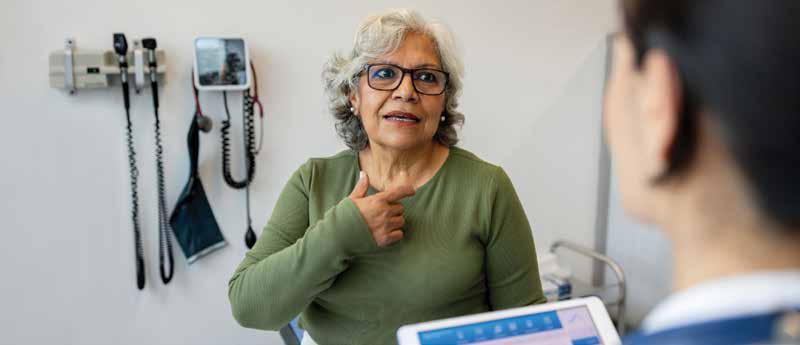
For some, a doctor’s visit is a comforting chance to talk with a trusted professional who knows you well. For others, it’s a nerve-wracking ordeal that leaves you confused, frustrated, or feeling like you forgot half of what you wanted to say. The good news? With a little preparation, you can turn any visit into a smooth, productive experience — and even leave feeling confident about any next steps.
Here are some insider tips to help you get the most out of your appointment.
BEFORE YOU GO: BE PREPARED
• Pick your top two priorities. Take time to decide on your two most important health concerns or questions. Your doctor may have their own top two priorities which may not be the same as yours. So, write yours down and bring your list.
• Organize medications. Put all your prescriptions, over the counter medications and supplements, in a bag and bring them with you. Make sure to write how often you take “as needed” medications. This helps prevent dangerous interactions or duplicate prescriptions.
• Bring your numbers. Blood pressure, weight, blood sugar, or anything else you’ve been tracking are invaluable information for your doctor. Even small changes can be important.
• Ask a trusted companion. A family member or caregiver may notice changes in memory, mobility, or mood that you might not. Ask if there’s anything they think should be addressed, and if so, add it to your list.
DURING THE VISIT: SPEAK UP
• Start with your top two priorities. Right at the start, tell the nurse or medical assistant who takes you to your exam room your top two concerns. Then, tell them again to the doctor within the first two minutes of your visit.
• Keep your explanations clear. Explain your concerns clearly to help your doctor understand your issue quickly. Practice a short, focused summary at home.
• Take notes or bring a loved one. Either take notes yourself or bring a spouse, adult child, or friend who can jot the important things down, ask questions, and help you remember the discussion, especially if medications or complex instructions are involved. Even when we’ve got great memories, it’s not always easy to hear and remember all the important things, especially when we’re not feeling well.
• Display your medications. Lay them out for staff to review. Ask whether you
AFTER THE VISIT: FOLLOW THROUGH
• Act promptly. Schedule recommended screenings, follow up with specialists, start exercise or physical therapy programs, or make dietary changes. Timely action keeps you on track.
• Watch for side effects. Pay attention to side effects of medications, particularly when a new one is started. Sometimes the benefit outweighs the hassle of a minor side effect, but sometimes the side effect is too much to bear. Make any decision to discontinue a medication with input from your doctor.
• Use the electronic health care portal. You might find this annoying to use the
still need each one, or if any could be causing side effects like fatigue, dizziness, or low blood pressure.
• Summarize your understanding. At the end of the visit, repeat your next steps back to the doctor to ensure that you are both aligned and agree.
• Clarify follow-up. Make sure you know if you need lab tests, referrals, immunizations, or future appointments.
first few times, as it becomes familiar you may find that it’s a great way to communicate with your healthcare team. Patient portals can also be invaluable for tracking lab results and keeping all your health information in one place.
The bottom line is that a doctor’s visit doesn’t have to be overwhelming. With preparation, clear communication, and follow-through, you can take control of your health — stay independent longer and feel confident in your care.
THERE MUST BE
15 WAYS TO LEAVE YOUR CLUTTER
Throw it away, Jay
Take it to the curb, Herb
Drop it in the can, Jan.
Just listen to me, Bring it to the alley, Sally Put it in the bin, Ken And set yourself – free.
Remember to recycle, Michael
Don’t have to be a collector, Hector Learn new ways to be free.
Give it up, Chuck You can let it go, Flo
Enjoy your space, Grace You’ll have time to just be.
Sign up for the workshop, mate
You don’t want to wait, Kate Meet friends along the way, Fay And you’ll set yourself - free!
by Ellen Satkin, LCSW
WISE Offers Help and Support for the 50+ to Declutter
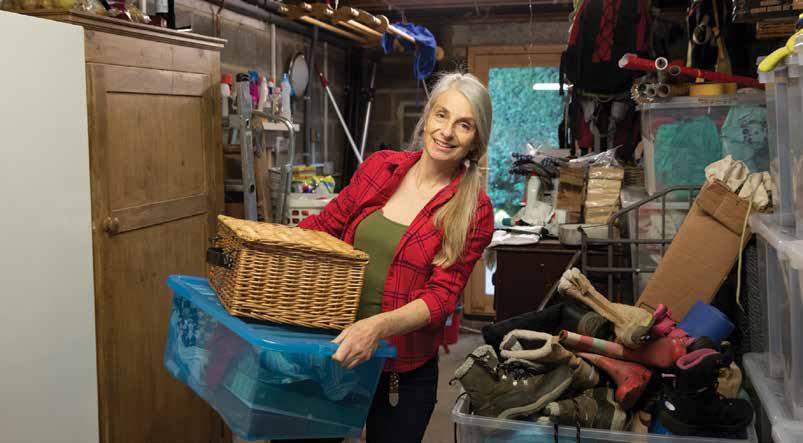
If you or someone you care about is struggling with excessive clutter, Wise & Healthy Aging holds a 15-week inperson workshop and support group called ‘From Collecting to Decluttering’ (C2D), several times each year.
The C2D workshop creates a supportive, engaging community for older adults as they work to gain control of all their “stuff.”
“People in the group know that they are not alone, and feel respected, heard and understood as they work to deal with letting go of their clutter,” says Anat Louis, PsyD, Vice President of Care Management at WISE.
As a full-service advertising agency based in Los Angeles, we help brands unlock new possibilities by cutting through the noise, earning customer loyalty, and driving action through smarter strategies—not bigger advertising budgets—even in the toughest and most competitive markets. From automotive to financial services to wellness to packaged goods, we’ve partnered with clients nationwide, helping them uncover insights that lead to bold ideas and measurable impact.
CHANGING MINDS AND HABITS: MARKETING GOOD HEALTH
By Kelli Stauning, MS
We all know the basics of better health: eat better, exercise more, quit smoking, make healthier choices. The challenge isn’t knowing what to do— it’s finding the motivation and support to follow through and then turning those changes into lasting habits.
This is where the power of behavior change marketing (BCM) comes in. It goes beyond traditional advertising to promote health and wellness by tapping into psychology and science to help people take meaningful action in their lives.
“There’s a very thoughtful process that’s involved in convincing people to change their behavior and improve their health,” says Renee Fraser, who holds a PhD in social psychology and leads Fraser Communications, the marketing firm she founded in 1998 to help drive positive change. “We work to find out what motivates people to make changes – whether that’s to quit smoking or prevent diabetes—and then figure out how to reach them in a compelling way.”
One example of Fraser’s many public health campaigns is their work to address the opioid crisis. Her team developed campaigns for both the State of California and Los Angeles County that not only raised awareness about the severity of the issue but also helped people understand how addiction starts and how they could address it.
“Knowing that one in three opioid deaths in California were adults over the age of 50, we launched focus groups to learn more,” Fraser says. “We found that many had been prescribed opioids after surgery, and as their ongoing use began to feel normal, it quietly evolved into dependency.”
The multi-media campaign that followed illustrated how everyday people could slip into dependency, how it would escalate to a crisis, and how they could get help.
“We challenged the stereotype of what people typically envision as a drug addict on the street,” said Fraser. “It was relatable without being pedantic or inducing any guilt or shame.”
Getting Results
Creating a campaign that motivates people to take action for their health is one thing—knowing whether it actually changes behavior is another. Measuring that impact means tracking the key performance indicators tied to each campaign.
“Depending on the goals, that might include the number of people who visit a clinic to stop smoking, order a nicotine patch, watch an educational video, visit a website, or engage with social media content,” Fraser explains.
One example is BrightLife Kids, a free statewide program that provides virtual behavioral health coaching for parents and caregivers of children ages 0–12. Fraser’s team launched a multimedia, multilingual campaign to build awareness and trust in the program in January 2024. The results have been phenomenal: more than 280,000 families have signed up in less than two years—clear evidence that the campaign’s approach is effectively reaching communities across California.
Guide by your side
In Fraser’s view, the secret sauce for successfully marketing positive change is to be a “guide by your side” rather than a “sage on a stage.”
“Taking charge of your health isn’t like following a recipe and doing what you’re told. It’s about understanding your personal needs and actively learning more about them so you can take the steps to improve your health,” says Fraser. “Our campaigns strive to help you do that.”
That same “guide by your side” philosophy extends beyond her marketing work. Fraser also hosts The Dr. Renee Fraser Show, a radio program featuring thought-provoking conversations with experts across many diverse fields, designed to engage and empower her listeners.
The show airs on KRTH-101 FM--or go to frasercommunications.com and click on ‘radio show’ for current and past shows.
STAYING ON YOUR FEET: SIMPLE TIPS TO AVOID FALLING
By Miriam Caiden, MSG PhD
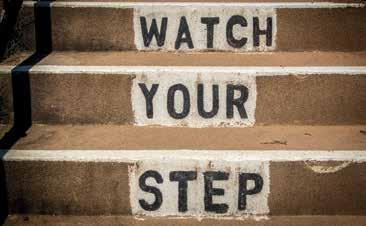
As we age, staying steady on our feet becomes more important than ever. Falls are one of the leading causes of injury among older adults — but the good news is, most falls can be prevented! With a few smart habits, home adjustments, and regular checkups, you or your loved one can greatly reduce your risk and keep your independence for years to come.
Why Falls Matter
Every year, one in four adults over 65 experiences a fall, according to the Centers for Disease Control and Prevention (CDC). Falls can lead to serious injuries like fractures or head trauma, but even when there’s no physical injury, the fear of falling can cause people to cut back on their activities — which in turn can lead to muscle weakness, balance problems, and even more falls.
Preventing falls isn’t just about safety — it’s about maintaining your freedom, confidence, and quality of life.
1. STAY ACTIVE AND KEEP MOVING
Exercise is one of the best ways to stay steady. Regular movement helps maintain strength, balance, coordination, and flexibility.
Try activities like:
• Walking or gentle aerobics to build stamina.
• Tai chi, which improves balance and body awareness.
• Strength training with light weights or resistance bands to keep muscles strong.
• Stretching to maintain flexibility.
If you’re unsure where to start, ask your doctor about physical therapy or fall-prevention exercise programs in your community.
2. MAKE YOUR HOME FALL-PROOF
Most falls happen at home, so small adjustments can make a big difference:
• Remove tripping hazards such as loose rugs, cords, or clutter.
• Improve lighting—especially along hallways, stairs, and bathrooms.
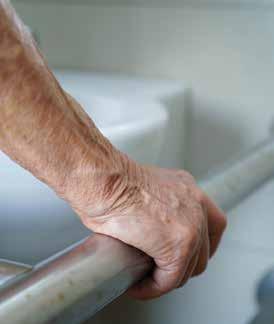
• Install grab bars near the toilet and shower, and handrails on both sides of stairs.
• Add non-slip mats in bathrooms and kitchens.
• Keep frequently used items within easy reach to avoid climbing or stretching.
Tip: Do a “fall safety walk-through” with a family member, friend, or occupational therapist.
3. GET YOUR VISION AND HEARING CHECKED
Good balance depends on what you see and hear. Schedule eye and hearing exams at least once a year. Make sure your glasses are the right prescription and that you wear them consistently. Poor depth perception or untreated hearing loss can both increase the risk of tripping or losing balance.
4. REVIEW YOUR MEDICATIONS
Certain medications — or combinations of them — can cause dizziness, drowsiness, or low blood pressure. Bring all your prescriptions, supplements, and over-the-counter medications to your doctor or pharmacist for a medication review. Sometimes, adjusting the dosage or timing can make a big difference in stability.
5. CHOOSE THE RIGHT SHOES
Your footwear plays a bigger role in balance than you might think. Look for shoes that are:
• Low-heeled with non-slip soles
• Supportive and properly fitted
• Easy to put on (Velcro straps can help) Avoid walking in socks, floppy slippers, or shoes with smooth soles that can slide on slick surfaces.
6. MANAGE HEALTH CONDITIONS
Chronic conditions like diabetes, arthritis, or neuropathy can affect balance, coordination, and strength. Managing these conditions with your healthcare provider’s help is key to preventing falls. If you feel dizzy or unsteady, talk to your doctor — never assume it’s “just part of getting older.”
7. USE ASSISTIVE DEVICES WHEN NEEDED
There’s no shame in using a cane or walker — they’re tools for independence, not signs of frailty. Make sure any mobility aid is properly fitted and that you’re trained in how to use it safely. Physical or occupational therapists can help you choose and adjust the right device.
8. STAYING CONFIDENT AND CONNECTED
Preventing falls isn’t just about safety — it’s also about confidence. Strong social connections can be one of many protective factors for falls because being socially active often means more movement, better balance, less isolation, better mental health—all of which contribute to a lower fall risk.
Remember: the goal isn’t just not to fall — it’s to keep living fully, independently, and joyfully.
Creative
Meals
Comforting,
Respite
Dementia and memory care support
SUPPORT SERVICES
ADULT DAY CENTER
Elder Well
Adult Day Program
1529 Wilshire Blvd.
Santa Monica, CA 90403 (310) 310-8313
1527 4th St., 2nd Floor
Santa Monica, CA 90401 (310) 394-9871 wiseandhealthyaging.org/adult-day
Daily socializing with peers in a safe, enjoyable environment with trained and caring staff (a Veterans benefit).
CARE MANAGEMENT
Independence at Home
3800 Kilroy Airport Way, Ste. 100 Long Beach, CA 90806 (866) 421-1964 IndependenceAtHome.org
Jewish Family Service LA
330 N. Fairfax Ave. Los Angeles, CA 90036 (877) 275-4537 jfsla.org or services@jfsla.org
1527 4th St., 2nd Floor
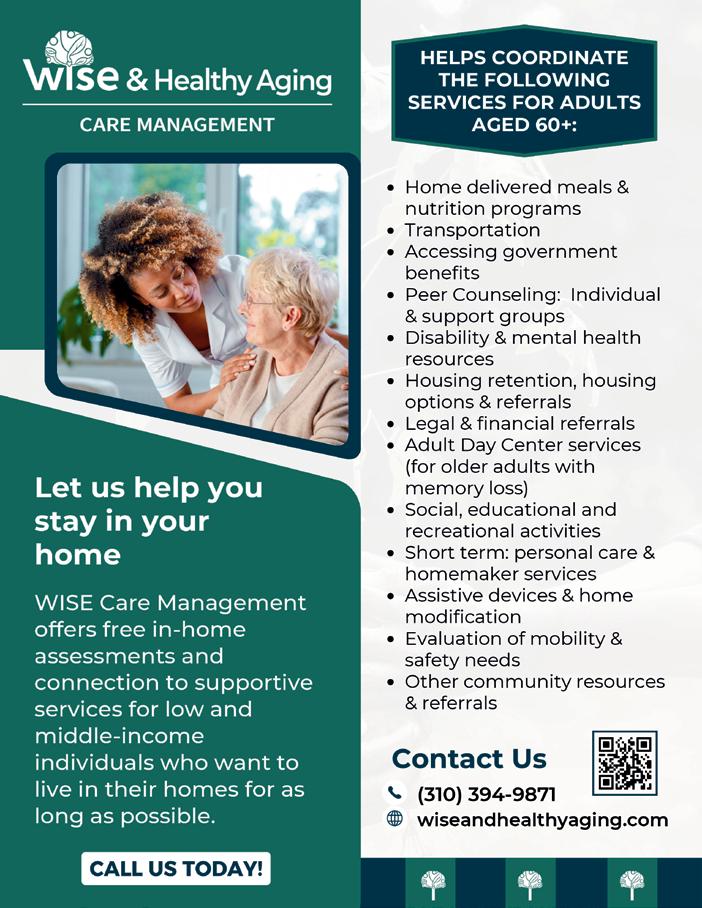
Santa Monica, CA 90401 (310) 394-9871 wiseandhealthyaging.org/ care-management
Services to support “aging in place” for disabled adults and seniors.
CAREGIVER RESOURCES
Alzheimer’s Association
California Southland Chapter 3415 S. Sepulveda Blvd., Ste. 500 Los Angeles, CA 90034 (323) 309-8821 and (800) 272-3900 24/7 alz.org/socal
Alzheimer’s Los Angeles
4221 Wilshire Blvd., Ste. 400 Los Angeles, CA 90010
California Telephone Access Program 425 W. Broadway #105 Glendale, CA 91204 (800) 806-1191 californiaphones.org
Affordable Connectivity Program (877) 384-2575 getinternet.gov
HOSPICE
To find Hospice visit medicare.gov
CEMETERY & FUNERAL SERVICES
Cemetery and Funeral Bureau Office (916) 574-7870 cfb.ca.gov
City of Santa Monica Woodlawn Cemetery, Mausoleum & Mortuary (FD #2101) 1847 14th St. Santa Monica, CA 90404 (310) 458-8717
woodlawn.cemetery@santamonica. gov
Hillside Memorial Park and Mortuary 6001 W. Centinela Ave. Los Angeles, CA 90045 (310) 641-0707 (800) 576-1994 hillsidememorial.org
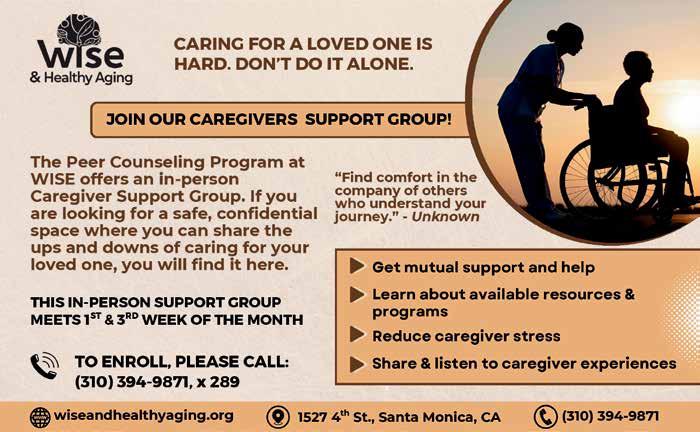
CAREGIVING IS HARD, SO DON’T DO IT ALONE
By Barbara Browning
Being a caregiver is an act of love—but let’s be honest, it can also be exhausting. When you’re caring for someone around the clock, it’s easy to feel overwhelmed, isolated, or unsure if you’re doing enough. You give so much of yourself every single day, yet as you deal with the challenges of taking care of your loved one, it can feel like no one really gets what you’re going through. You think you have to do it all yourself. The good news? You don’t!
Joining a caregiver support group can be one of the most powerful steps you take— for your health, your peace of mind, and your ability to keep caring with love. It’s a place where you can make new friends that understand your fears and anxieties from the heart because they know from personal experience what you are going through. You are no longer alone.
“I don’t know where I’d be without it,” says Ken Ripoll, who cares for his wife living with dementia and has found strength and support through one of Wise & Healthy Aging’s Caregiver Support Groups. Ken also brings his wife to WISE’s Adult Day Center, giving both of them their own safe place for support and care. “The people in my group have become like family,” he says. “We share our ups and downs, and everyone is there to pick each other up.”
WHAT YOU’LL FIND IN A SUPPORT GROUP
Think of it as a safe space where people “get it.” You can talk openly about what you’re feeling, whether you’re sad, frustrated, or exhausted, and find others will be nodding along because they’re going through it too.
FIND UNDERSTANDING AND EMOTIONAL RELIEF
A support group offers a safe, judgmentfree space to share your struggles, frustrations, and small victories with people who truly understand. In fact, some studies report that feeling socially supported can reduce the link between caregiving and psychological distress.
LEARN NEW COPING STRATEGIES
In these groups, caregivers exchange practical tips—from managing medications to finding resources like respite care or navigating medical appointments. Learning from others’ experiences can make daily challenges easier and help you feel more confident and capable.
RECONNECT AND REDUCE ISOLATION
Caregiving often leads to social withdrawal. Support groups rebuild connections, giving you a sense of belonging and friendship that can boost your emotional—and even physical— health. Research shows that staying socially connected can lower your risk of illness and improve overall well-being.
CARE FOR YOURSELF, TOO
Perhaps most importantly, support groups remind you that your well-being matters too. They help you find balance, set boundaries, and practice self-care—so you can keep showing up for the person you love without losing yourself.
TAKE THE NEXT STEP
Support groups remind you that your well-being matters too.
HOW TO KNOW IF A SUPPORT GROUP CAN HELP?
ASK YOURSELF:
• Do you feel alone or cut off from friends and family?
• Do you struggle to find any time just for yourself?
• Do you sometimes feel guilty or wonder if you’re doing enough?
• Do you find yourself asking, how long can I keep this up?
IF YOU SAID YES TO EVEN ONE OF THESE, YOU’RE NOT ALONE—AND A SUPPORT GROUP COULD BE EXACTLY WHAT YOU NEED.
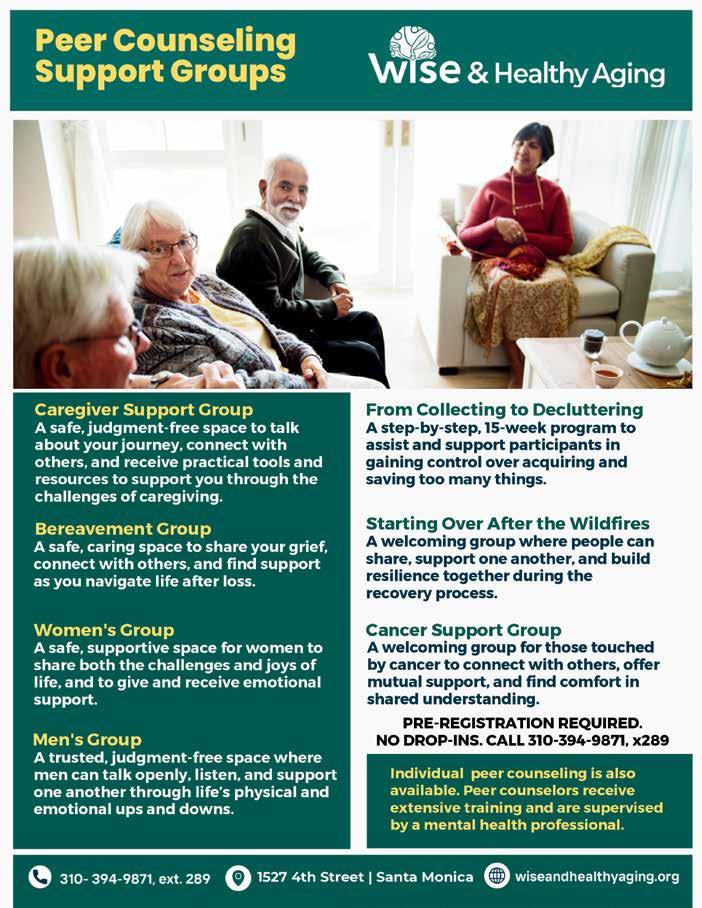
You don’t have to face caregiving alone. Join one of our Caregiver Support Groups and connect with others who truly understand what you’re going through. Share your story, learn new strategies, and find comfort in community. Because when caregivers support each other—everyone benefits. To get more information or to join, call (310) 394-9871, ext. 289.
S ETERNAL MEADOW
friendly alternative to traditional burial
With traditional burial practices each year, millions of pounds of concrete burial vaults, metal from caskets, and toxic embalming fluid are placed in the ground that are either imperishable or hazardous. In green/natural burial, only caskets made of decomposable materials such as wood or wicker with no lacquers or metals, organic burial shrouds, and biodegradable urns are used. There are no cement vaults encasing caskets and no toxic embalming fluid is used. Woodlawn ’s green/natural burial section is Eternal Meadow. Consisting of native Southern California grasses and wildflowers, Eternal Meadow also provides habitat for the region ’s native birds and pollinator insects, like the endangered Monarch butterfly. Green burial nurtures the natural growth cycles of the meadow, fosters a greater union with nature, and is a meaningful way to honor the life of a loved one.
FINANCIAL & LEGAL
ENERGY / UTILITY ASSISTANCE
City of Los Angeles - Utility Tax Exemption Unit P.O. Box 53233
Los Angeles, CA 90053 (844) 663-4411
City of Malibu’s Senior Citizen Utility Tax Exemption 23825 Stuart Ranch Rd. Malibu, CA 90265 (310) 456-2489, ext. 223
City of Santa Monica’s Billing Office - Utility Fee Waiver 1717 Fourth St., Room 150 Santa Monica, CA 90401 (310) 458-8224
Low-income customers may qualify for a waiver of the fixed bimonthly fee portion of the City’s water and sewer.
Los Angeles County Treasurer and Tax Collector
(Utility User Tax Senior Citizen Exemption)
500 W. Temple St., Room 462 Los Angeles, CA 90012 (213) 893-7984 ttc.lacounty.gov
Los Angeles Department of Water and PowerLow Income Discount Rate P.O. Box 515407, Room L63 Los Angeles, CA 90051 (800) 906-4651 ladwp.com/lowincome
Southern California Edison CARE Program (discount electric rates) (800) 447-6620 sce.com/care
Energy Assistance (free appliances and installation) (800) 205-8596 sce.com
Medical Baseline Allowance (discounts on electronic life support equipment) (800) 655-4555 sce.com/medicalbaseline
SoCal Gas
CARE Program (20% discount on monthly gas bill) (800) 427-2200 socalgas.com/assistance/care
Energy Savings Assistance Program (no-cost energy-saving home improvements and repairs) (800) 331-7593 socalgas.com
Low-Income Home Energy Assistance Program (utility bill assistance) (866) 675-6623 (916) 263-1402 (TDD/TTY) socalgas.com
FIDUCIARY SERVICES
To find a Financial Planner visit letsmakeaplan.org
RKO Fiduciary Services, LLC 149 S. Barrington Ave., #840 Los Angeles, CA 90049 (310) 453-4203 info@fidservices.com
INCOME TAX COUNSELING
California State Controller’s OfficeProperty Tax Postponement (800) 952-5661 sco.ca.gov/public_services.html
State of CaliforniaFranchise Tax Board (800) 852-5711 ftb.ca.gov
Provides discounted home phone and cell phone services to eligible households.
Medi-Cal Dental Program (800) 322-6384 dhcs.ca.gov
Dental Services are currently provided as one of the many benefits under the Medi-Cal program.
Department of Public Social Services
11110 W. Pico Blvd. Los Angeles, CA 90064 (310) 258-7400 dpss.lacounty.gov
Programs offered at this location; CalWORKs, CalFresh, General Relief, Medi-Cal, and START.
LIC BENEFITS
Go Direct (877) 874-6347 godirect.org
U.S. Department of the Treasury requires electronic payments.
Federal Housing AdministrationHousing Counseling Agency Locator (800) 569-4287
LEGAL
Bet Tzedek Legal Services
3250 Wilshire Blvd. 13th Floor
Los Angeles, CA 90010 (323) 939-0506 bettzedek.org
Disability Rights California (Free legal services for the disabled) (213) 213-8000 disabilityrightsca.org
Legal Aid Foundation of Los Angeles 1550 W. 8th St.
Los Angeles, CA 90017 800-399-4529
Santa Monica Office: 1640 5th St., Ste. 124
Santa Monica, CA 90401 (310) 899-6200 lafla.org
Los Angeles County - Dispute Resolution Program dcba.lacounty.gov/countywideDRP The Los Angeles County Dispute Resolution Program provides LA County residents with an alternative to resolve disputes without having to engage with the formal judicial system.
Los Angeles County Registrar/Recorder (800) 201-8999
lavote.gov
The Recorder’s Office is responsible for recording legal documents that determine ownership of property, as well as maintaining files of birth, death, marriage and real estate records for Los Angeles County.
Public Counsel
610 S. Ardmore Ave. Los Angeles, CA 90005 (213) 385-2977 publiccounsel.org Public Counsel provides a wide variety of legal services to low-income individuals, nonprofits and small businesses.
State Division of Workers’ Compensation
320 W. 4th St., 9th Floor
Los Angeles, CA 90013 (213) 576-7335 (800) 736-7401 (Information and Assistance Unit) dir.ca.gov/dwccommunity-resources.
BAR ASSOCIATIONS
Beverly Hills Bar Association 9420 Wilshire Blvd., Ste. B100 Beverly Hills, CA 90212 (310) 601-2422
bhba.org
Culver Marina Bar Association 15303 Ventura Blvd., #900 Sherman Oaks, CA 91403 (310) 853-2907
Los Angeles County Bar Association 444 S. Flower St., Ste. 500 Los Angeles, CA 90071 (213) 627-2727 lacba.org
Santa Monica Bar Association
2461 Santa Monica Blvd., #529 Santa Monica, CA 90404 (310) 450-9289 (310) 581-5163 (Arbitration) smba.net
CONSUMER PROTECTION
California Department of Real Estate
320 W. 4th St., Ste. 350 Los Angeles, CA 90013 (877) 373-4542
dre.ca.gov
Department of Consumer Affairs
- California Bureau of Automotive Repair (BAR) 6001 Bristol Parkway Culver City, CA 90230 (310) 410-0024
bar.ca.gov
The BAR Field Office will answer general consumer questions and complaints and help identify locations of licensed Smog Check stations.
Los Angeles County Department of Consumer Business Affairs
- Small Claims Advisors (800) 593-8222 dcba.lacounty.gov
Free help for Small Claims Court litigants is available to individuals and businesses suing or being sued in a Los Angeles County Small Claims Court.
Medical Board of CaliforniaPhysician and Consumer Information Unit (800) 633-2322 mbc.ca.gov
License Verification, General Licensing, Application and Complaint Information for health care consumers.
CRIMINAL/CIVIL LAW
California Victim Compensation Board (CalVCB) (800) 777-9229 victims.ca.gov Helps pay bills and expenses that result from certain violent crimes.
Los Angeles City Attorney’s Victim Assistance Program 251 E. 6th St. Los Angeles, CA 90014 (213) 215-5048 helplacrimevictims.org
Law Office of Los Angeles CountyPublic Defender (213) 974-2811 (800) 801-5551 (TDD) pubdef.lacounty.gov
Santa Monica City AttorneyConsumer Protection Division 1685 Main St., Room 310 Santa Monica, CA 90401 (310) 458-8336 (310) 458-8696 (TDD) smconsumer.org
LAWYER REFERRAL SERVICE
SMART LAW - Information Line (866) SMARTLAW smartlaw.org Lawyer Referral Service
The State Bar of CaliforniaLawyer Referral Service 845 S. Figueroa St. Los Angeles, CA 90017 (213) 765-1000 calbar.ca.gov
LICENSING & COMPLAINTS
Attorney Complaint Hotline (The State Bar of California) (800) 843-9053
calbar.ca.gov
State of California - Civil Rights Department
320 W. 4th St., 10th Floor Los Angeles, CA 90013 (800) 884-1684 (800) 700-2320 (TTY) civilrights.ca.gov
The Department of Fair Employment and Housing protects Californians from employment, housing and public accommodation discrimination, and hate crimes.
Opt-out from unsolicited mail, pre-approved credit card and insurance offers (888) 567-8688 OptOutPrescreen.com
Los Angeles Department of Building and Safety (LADBS) 1828 Sawtelle Blvd. West Los Angeles, CA 90025 311
ladbs.org File a complaint regarding code violations.
Los Angeles Housing DepartmentRent Stabilization Ordinance (RSO) 1200 W. 7th St. Los Angeles, CA 90017 (866) 557-7368
lahd.lacity.org
The Rent Stabilization Ordinance protects tenants from excessive rent increases.
U.S. Postal Inspection Service (877) 876-2455
uspis.gov Report mail-related crime
Utilities Fraud Hotline (California Public Utilities Commission) (800) 649-7570
cpuc.ca.gov File a complaint about your phone, water, or electric company.
NOTARY PUBLIC
California Secretary of StateLos Angeles Office 300 S. Spring St., Room 12513 Los Angeles, CA 90013 (213) 897-5310
sos.ca.gov
PROBATE
Probate Division of the Los Angeles Superior Court 111 N. Hill St., Room 429 Los Angeles, CA 90012 (213) 974-5471 lacourt.org/probate
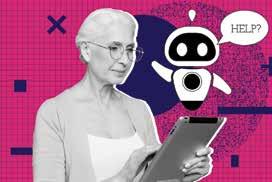
AI AND THE NEW AGE OF FRAUD
By Miles McNeeley, LCSW
Most of us feel fairly savvy when it comes to spotting scams these days. We know the routine — let unknown calls go to voicemail, hang up on suspicious numbers, double-check email addresses, and never click on strange links. After years of warnings and public awareness campaigns (or maybe learning from our own experience), we like to think we can see a scam coming.
But here’s the unsettling truth: the scams we once knew how to avoid are evolving faster than ever. And the reason? Technology — especially artificial intelligence (AI).
Back in the 1990s, the internet changed everything, giving scammers new ways to reach millions of people at once. Fast-forward to late 2022, when AI burst onto the scene and in just a short time, revolutionized how we work, create, and communicate — and, unfortunately, how criminals commit fraud.
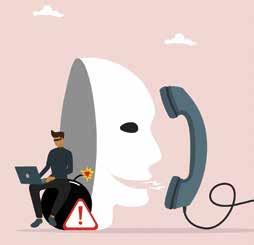
Today, scammers are using AI to build convincing fake websites, craft sophisticated emails, and even clone voices and faces. With just a few seconds of recorded speech or a handful of online photos, they can create audio and video that sound and look disturbingly real.
Behind much of this activity are bots — automated programs that can act like people online. These AI-powered bots can send thousands of personalized phishing emails, chat with victims on social media or dating sites, and even impersonate customer-service agents or family members in real time. Unlike the clumsy scams of the past, bots can adapt during a conversation, respond naturally, and operate around the clock. They’re tireless, fast, and capable of running hundreds of scams simultaneously — all without a human scammer typing a word.
The result? Fraud that’s more personal, more believable, and far harder to detect.
WHAT ARE THE LATEST AI SCAMS?
VOICE CLONING
Imagine this: you answer the phone, and the voice on the other end sounds exactly like your daughter, spouse, or best friend — frantic and pleading for help. You’d do anything to protect them, right?
That’s exactly what scammers are counting on. Using artificial intelligence, criminals can now clone a person’s voice with startling accuracy. All they need are a few seconds of recorded speech — pulled from social media posts, voicemail greetings, or even a quick phone call — to generate a convincing replica.
Once they have it, they use that fake voice to trick victims into sending money through wire transfers, gift cards, cryptocurrency, or other untraceable payments. The emotional realism makes these scams especially dangerous — and heartbreakingly effective.
DEEPFAKE SCAMS
You can hardly believe it — that dating app your granddaughter convinced you to try actually led to someone amazing. They were kind, attentive, and you really seemed to click. Before long, you were exchanging photos, chatting on the phone, and feeling a genuine connection.
Then came the pitch: a can’t-miss opportunity to invest in cryptocurrency — but you would have to act fast or miss the opportunity. It wasn’t until after you’d handed over a chunk of your savings that you realized the painful truth. The “person” you’d been falling for wasn’t real at all, but an AI-generated identity created by a scammer.
Unfortunately, this kind of fraud is becoming more common. Advances in artificial intelligence now allow scammers to create hyper-realistic faces, voices, and even video chats that disguise who they really are — using these tools not just for romance scams or investment schemes, but also for fake job offers, and tax fraud.
PHISHING EMAIL ATTACKS
Phishing has long been a go-to trick for stealing sensitive information — and AI has made it far more dangerous. Today’s scammers use AI to scrape personal details from social media and other sources, then generate highly convincing, personalized emails that often slip past spam filters. The result is a message that looks and sounds like it was written just for you, increasing the chance you’ll click a link, open an attachment, or hand over passwords or financial data.
HOW OLDER ADULTS CAN STAY SAFE FROM AI SCAMS
1. Slow down before reacting
If you get a call, text, or email that feels urgent — especially one asking for money or personal information — pause. Scammers thrive on panic. Take a deep breath, hang up, and verify the story before doing anything.
2. Verify the source.
If someone claims to be a loved one in trouble, call them back directly using their known number. Or contact another family member to confirm their whereabouts before sending money.
3. Don’t trust what you see or hear. AI can now clone voices and faces with startling realism. A familiar voice or video call doesn’t guarantee the person is who they claim to be. Always doublecheck through another channel.
4. Be skeptical of investment “opportunities.”
Whether it’s cryptocurrency, real estate, or a “can’t-miss” financial deal — if it sounds too good to be true, it almost always is. Consult a trusted financial advisor before making any investment.
5. Strengthen your digital defenses.
• Use strong, unique passwords and enable two-factor authentication
• Keep software, browsers, and antivirus programs up to date.
• Don’t overshare on social media — scammers mine personal posts for clues to impersonate you or loved ones.
6. Check email details carefully. Look for subtle misspellings, unusual phrasing, or slightly altered addresses (like “paypal@secure-paypal.com”). AIgenerated phishing messages can look eerily authentic, so trust your instincts if something feels off.
7. Never pay with gift cards, cryptocurrency, or wire transfers. Legitimate organizations and government agencies never request payment using these methods. These are red flags for scams.
8. Talk about scams openly. Fraudsters rely on shame and silence. Share suspicious experiences with friends, family, or local senior centers — staying informed is one of the best protections.
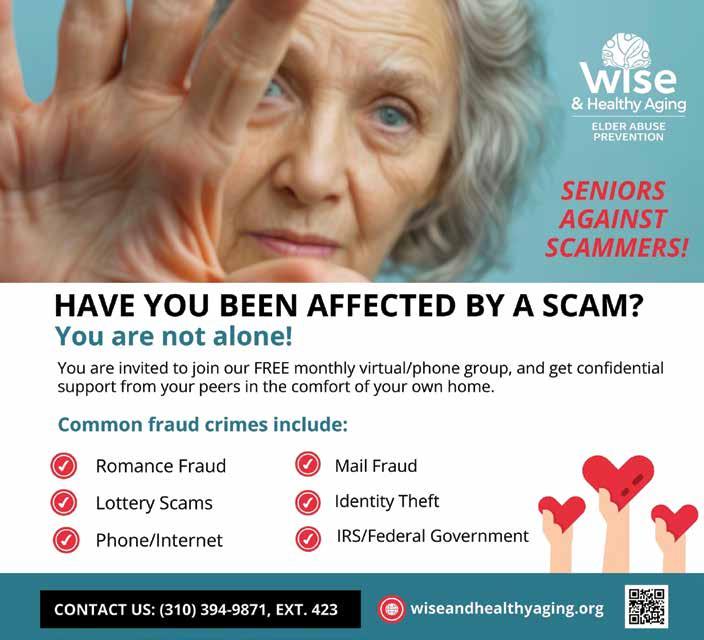
• Join Wise & Healthy Aging’s Seniors Against Scammers support group by calling: 310-394-9871 ext. 423
9. Report scams right away. If you suspect fraud, contact your bank, credit card company, or local law enforcement.
• Report scams to the FTC (reportfraud. ftc.gov) or the FBI Internet Crime Complaint Center (ic3.gov).
• Call the National Elder Fraud Hotline if you need further assistance at: 833-372-8311
ELDER JUSTICE
Created by Wise & Healthy Aging and funded in part by the City and County of Los Angeles Area Agencies on Aging.
Recognizing the Signs…
PHYSICAL ABUSE
• Unexplained signs of injury like bruises, welts, scars, broken bones or sprains
• Over or under medication
• Broken eyeglasses
• Signs of being restrained, like rope marks on wrists
• Caregiver’s refusal to allow you to see the person alone.
• Drug overdose or apparent failure to take medication regularly.
• Physical or chemical
EMOTIONAL ABUSE
• Threatening, belittling, or controlling caregiver behavior that you witness
• Someone isolates an elder; refusing to allow access to visitors, mail, phone, etc.
• Uncharacteristic behavior such as withdrawal or changes in alertness
SEXUAL ABUSE
• Bruises around breasts or genitals transmitunexplained y ERS ation s g , bedding k riate ditions ater; , elder place
FINANCIAL EXPLOITATION
• or unauthorized withdrawals from the elder’s accounts
• Sudden changes in the elder’s condition
• Items or cash missing from the household
• Suspicious changes in wills, power of attorney, titles, and policies
• Addition of names to the elder’s signature card at the bank
• Unpaid bills or lack of medical care, although the elder has money to pay for them
• Financial activity the elder couldn’t have done, (ATM withdrawals by a bedridden account holder)
• Unnecessary services, goods, or subscriptions
• Unusual change in spending habits
SCAMS
• Constant phone calls from various phone numbers
• Elder/adult suddenly wiring money
• Large accumulation of lottery mail
• Elder/adult secretive about a relationship with someone they have not met in person
How to
Repor t Abuse or Ne glect
• Dial 911 to report elder abuse or neglect to the Police NOW if the abuse is immediate and life-threatening.
• Elder Abuse Hotline Call (877) 477-3646 to report allegations of abuse when you are unsure of where to call.
• Adult Protective Services, County of Los Angeles Call (888) 202-4248 if you suspect elder abuse in the community Call (213) 351-5401 if you are outside of Los Angeles Count
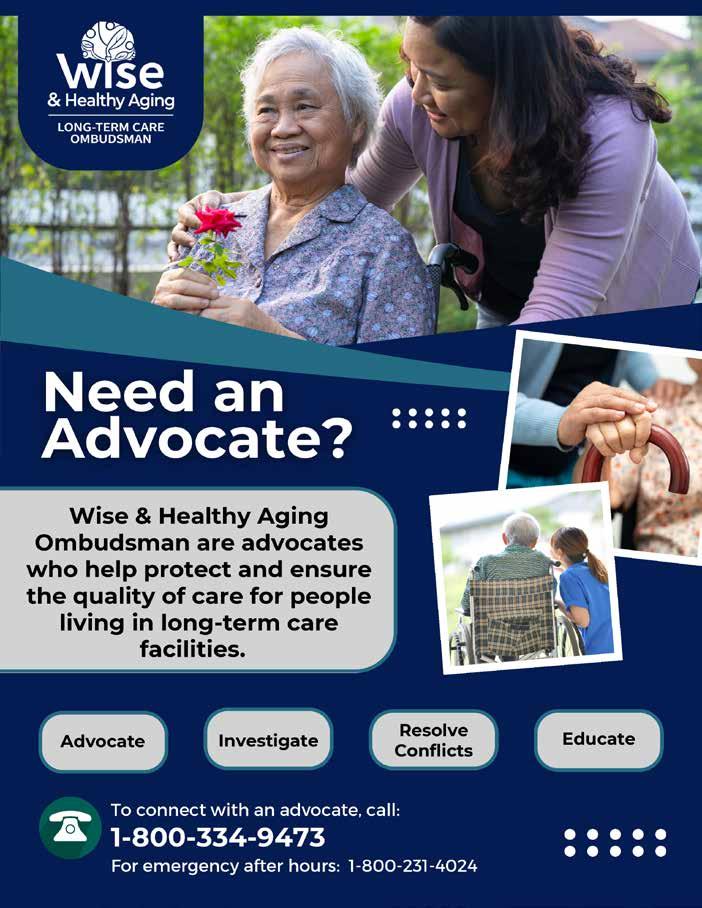
• Long-Term Care Ombu at Wise & Healthy Call (800) 334-9473 suspect abuse occurrin at a skilled nursing, or board and care facilit wiseombudsman.o
• National Elder Fraud Assistance with reportin at federal, state and and referrals to frau (833) 372-8311.
GENERAL INFORMATION
• City of Los Angeles Department of Aging aging.lacity.org (213) 482-7252
• County of Los Angeles Aging & Disabilities Department Information & Assistance ad.lacounty.gov (800) 510-2020
• Los Angeles County Information and Referral: 211la.org or Dial 211
• City of Los Angeles Information & Referral lacity.gov/myla311 (213) 473-3231
LEGAL ASSISTANCE
• Bet Tzedek Legal Services www.bettzedek.org (323) 939-0506
R ESOU RCE S
• California State Attorney General ag.ca.gov (800) 952-5225
• Legal Aid Foundation of Los Angeles (800) 399-4529
• Los Angeles City Attorney’s Elder Abuse Hotline (877) 477-3646
• Los Angeles County Bar Assoc. Lawyer Referral & Information Smart Law smartlaw.org (213) 243-1525
• Los Angeles County District Attorney Elder Abuse Section (213) 257-2290
• Los Angeles County Public Administrator/ Public Guardian (213) 974-0515 CANHR State Bar yer Referral Service 474-1116
MENTAL WELLNESS
• County of Los Angeles Department of Mental Health, Older Adult Services ACCESS Center (Help regarding hoarding and other mental health issues) (800) 854-7771
• National Suicide Prevention Lifeline (800) 273-8255 or Dial 988
• 24-Hour Friendship Line (For those who are lonely and need to talk) (800) 971-0016
• LA Found help for when a loved one goes missing due to a wandering from dementia lafound.lacounty.gov (883) 569-7651
• Wise & Healthy Aging Elder Abuse Support Groups wiseandhealthyaging.org (310) 394-9871
TIC VIOLENCE
National Domestic Violence Hotline: (800) 799-7233
mestic Violence Hotline uthern California 978-3600
llers may receive help 3 languages
E – Victim Information
Everyday ervice by the Los Angeles County Department otify you when the status inmate changes.) 846-3452
• Los Angeles County District Attorney Victim Assistance (800) 380-3811or (626) 927-2500
da.lacounty.gov/victims
MEDICARE OR MEDI CAL FRAUD
• California Attorney General Bureau of Medi-Cal Fraud & Elder Abuse (800) 722-0432
Online complaint form oag.ca.gov/dmfea
• Center for Health Care Rights/California Health Advocates cahealthadvocates.org
• Health Insurance Counseling and Advocacy Program (HICAP) Medicare and healthcare counseling (800) 434-0222
• Department of Health Services for Medi-Cal fraud (800) 822-6222
• U.S. Health & Human Services TIPS Hotline to report Medicare fraud (800) 447-8477
SOCIAL SECURITY ADMINISTRATION
• Fraud Hotline (800) 269-0271 SSA.gov
CREDIT CARD FRAUD
• If you are a victim of identity theft, or want to avoid becoming a victim, call these agencies to freeze new accounts being opened in your name Also, for disputes regarding your credit record.
Concerns regarding licensed and unlicensed contractors cslb.ca.gov (800) 321-2752
• Los Angeles County Department of Consumer and Business Landlord/tenant issues, housing discrimination, consumer complaints dcba.lacounty.gov (800) 593-8222
Do:
Protecting yourself
• Stay active with your local senior center It can be a valuable source of information.
• Plan for your care as you age. Identify reliable people who can provide assistance if needed.
• Review your regularly. Be extremely cautious when selecting “trustworthy” individuals to help manage your when needed.
• Participate in community activities Volunteering is a great way to have contact with others and make friends
• Use the resources in this guide to get support.
DoN’T:
• Don’t put preparing your future physical and needs
• Don’t accept personal care from anyone in exchange for property or assets without a lawyer or trusted advocate to witness the transaction.
• Don’t allow others to keep details of your from you.
• Don’t give out personal or information to people you don’t know, especially over the phone.
• Don’t sign legal documents that you do not understand.
HOUSING RELATED
EMERGENCY HOUSING
Culver City Homeless Info Line (310) 253-6767
Los Angeles County Information Services 211 211la.org
Saint Joseph’s Center 204 Hampton Drive Venice, CA 90291 310-396-6468 stjosephctr.org
HOME MODIFICATIONS
City of Los Angeles Housing Department - Handyworker Program (213) 808-8803 (866) 557-7368 (Toll-free) Free minor home repairs and safety devices.
HOUSING ASSISTANCE
Los Angeles Housing and Community Investment Department lahd.lacity.org Affordable Housing Roster and Resources
The British Home 647 Manzanita Ave. Sierra Madre, CA 91024 (626) 355-7240 rosario@britishhome-ca.us.
Facility Locator Map wiseombudsman.org/map
The British Home is a non-profit, Assisted Living retirement home for all seniors. Our campus encompasses almost three acres of beautiful gardens and well attended landscape surrounding seven separate cottages, each with their own unique charm and story to tell.
Retirement Community for all.
DEMYSTIFYING AFFORDABLE HOUSING
By Yelena Solovyeva Santa Monica Housing Authority
Few policy topics spark as much discussion as housing affordability. It has been debated for decades in city halls, state legislatures, and Congress – and it’s just as likely to come up around the family dinner table. Maybe the concern is that the grandkids will never be able to buy a home, or questions about whether the city should expand affordable housing. Whatever the angle, most people have strong feelings about what “affordable” should mean.
Here in Santa Monica, the City is committed to helping residents—especially older adults—stay rooted in the urban coastal community they love. A variety of affordable housing options are available, including programs that extend well beyond traditional Section 8 housing.
AFFORDABLE AND BELOW MARKET HOUSING OPTIONS
Affordable and below market rate housing properties are privately owned and operated but must keep rents below market levels for the long term. Sometimes the entire building gets designated as affordable, while at other times only some of the units in a building are designated as affordable.
Because these properties are built with combined local, state and federal resources, the City or County housing authority must ensure that these apartments are filled. In Santa Monica, the Santa Monica Housing Authority (SMHA) manages the Below Market Housing (BMH) waitlist, which connects eligible applicants to upcoming vacancies. City residents and people who work in Santa Monica receive priority, but anyone who meets the income criteria may apply. For example, a two-person household can earn up to $121,220 and still qualify.
Households that already have a tenantbased voucher, such as Section 8, which covers a large portion of the rent, are also encouraged to apply. These vouchers allow residents to access homes they might otherwise not be able to afford. To learn more or apply, visit santamonica. gov/housing-bmh.
LOW INCOME HOUSING
HUD-Funded Voucher Programs
Several federally funded programs through the U.S. Department of Housing and Urban Development offer HUD Funded Vouchers. The most familiar is the Housing Choice Voucher (HCV)
program, commonly known as Section 8, which provides rental assistance to very low and low-income households renting in the private market.
Project-based vouchers are specific housing units. For example, Santa Monica Housing Authority has a contract with three senior communities for residents age 62 and older, and a recently completed development that provides 57 supportive housing units for individuals who were formerly homeless or at risk of homelessness.
UNIQUE TO SANTA MONICA
Preserving Our Diversity (POD) Program
Recognizing that the rising cost of renting an apartment was making it harder for long-term residents to stay in their homes, the City created the Preserving Our Diversity (POD) program. This initiative provides monthly cash assistance directly to low-income seniors, giving them flexibility to use the funds toward rent or other essential living expenses.
The program helps long-time Santa Monicans, many of whom have contributed to the city’s unique character for decades, maintain their stability and independence. More information is available at santamonica.gov/housingseniors by searching “Preserving Our Diversity.”
Housing is expensive and these are current programs and ways to make housing more affordable. To learn more about affordable housing options on the Westside check out the Housing section of this guide.
NURSING HOME CHECKLIST
The following are markers of good care.
GENERAL INFORMATION
Medicare certified?
Medicaid (Medi-Cal in CA) certified?
Offers the needed level of care or special services (dementia, ventilator, rehabilitation)?
Bed available?
Located close enough for friends and family to visit?
Is the nursing home listed on The National Nursing Home Watch List? Check the stateby-state list at nursinghomeabuseadvocate. com/watchlist/
Check the violation status of any California nursing home at callongtermcarecompare. org or cdph.ca.gov
APPEARANCE OF RESIDENTS
Residents are clean, appropriately dressed for the season or time of day.
Residents are well groomed.
LIVING SPACES
The nursing home is free from overwhelming, unpleasant odors.
The nursing home appears clean and well kept.
The temperature in the nursing home is comfortable.
The nursing home has good lighting.
Noise levels in the dining room and other common areas are comfortable.
Smoking is not allowed or is restricted to certain areas.
Furnishings are sturdy, yet comfortable and attractive.
STAFF
The relationship between the staff and the residents appears to be warm, polite and respectful.
Staff knocks on the door before entering a resident’s room and refers to residents by name. All staff wear nametags.
The nursing home has a training and continuing education program for all staff.
The nursing home does background checks on all staff.
The guide on your tour knows the residents by names and is recognized by them.
There is a full-time registered nurse (RN) in the nursing home at all times other than the administrator or director of nursing (required for SNFs with 100+ beds).
Staff appear to be assisting residents.
Certified nursing assistants (CNA) work with a reasonable number of residents.
CNAs are involved in care planning meetings.
There is a full-time social worker on staff.
The nursing home’s management team has worked together for at least one year.
Staff open to your questions.
RESIDENTS’ ROOMS MENUS AND FOOD
Residents may have personal belongings and/or furniture in their rooms.
Each resident has storage space (closet and drawers) in their room.
Residents have access to a telephone and television.
How many residents to a room?
Water pitchers can be reached by residents.
There are policies and procedures to protect resident’s possessions.
HALLWAYS, STAIRS, LOUNGES & BATHROOMS
Exits are clearly marked.
There are quiet areas where residents can visit with friends and family.
The nursing home has smoke detectors and sprinklers.
All common areas, residents’ rooms, and doorways are designed for wheelchair use.
There are handrails in the hallways and grab bars in the bathrooms.
Residents have a choice of food items at each meal. (Ask about whether favorite foods are served.)
Nutritious snacks are available upon request.
Staff helps residents eat and drink at mealtimes, if help is needed.
ACTIVITIES
Residents, including those who are unable to leave their rooms, may choose to take part in a variety of activities.
The nursing home has outdoor areas for resident use and staff helps residents go outside.
The nursing home has an active volunteer program.
Check out the posted activities calendar.
SAFETY AND CARE
The nursing home has an emergency evacuation plan and holds regular fire drills.
Residents get preventive care, like a yearly flu shot, to keep them healthy.
Residents may still see their personal doctors.
Care plan meetings are held at times that are convenient for residents and family members to attend whenever possible.
The nursing home has corrected all deficiencies (failure to meet one or more federal or state requirements) on its last state inspection report.
FINANCIAL CONSIDERATIONS
Cost per month
Insurance contribution
Medicare contribution
Medi-Cal contribution
Make note of other things you observe on your visit!
BOARD AND CARE, ASSISTED LIVING, SKILLED NURSING… WHAT’S THE DIFFERENCE?
By Rachel Tate, LCSW
When it’s time to explore long-term care for yourself or a loved one, the number of choices can feel overwhelming. You may be asking:
• What level of care is really needed?
• What type of setting would feel most comfortable?
• What’s the difference between “board and care,” “assisted living,” and “skilled nursing”?
Understanding the differences between these options can make it much easier to find the right fit for safety, support, and quality of life.
SKILLED NURSING FACILITIES (SNF)
If medical or rehabilitation care is needed, a Skilled Nursing Facility (SNF) sometimes called a nursing home or post-acute care facility, may be the best option.
SNFs provide 24-hour licensed nursing care and rehabilitation services, helping residents recover from illness, injury, or surgery while addressing both medical and social needs.
In California, SNFs are licensed and regulated to provide comprehensive care. If after a hospital stay or doctor recommends this type of care, your insurance or Medicare plan may give you a list of approved facilities to choose from. Whenever possible, ask questions about payment and insurance coverage
before admission. If there’s a chance the stay might become long-term, make sure the SNF accepts Medi-Cal.
Every SNF is required to tailor care to individual needs and preferences. Before choosing a facility, it’s a good idea to ask about:
• The strength of their rehabilitation or therapy programs
• Activities and social opportunities
• How they accommodate personal preferences
Transitioning to a SNF whether shortterm or long-term can be stressful. Knowing your needs and preferences will be respected can make the process much smoother.
ASSISTED LIVING AND BOARD & CARE FACILITIES
If ongoing medical care isn’t the main concern, you may be looking at assisted living or board and care facilities instead. In California, these are licensed as Residential Care Facilities for the Elderly (RCFEs). They provide help with daily activities like meals, bathing, or medication management, but not 24-hour skilled medical care.
These communities come in many shapes and sizes:
• Smaller homes (often called board and care homes) usually care for up to six residents in a residential neighborhood setting. They often provide a warm, family-like atmosphere and personalized care.
• Larger assisted living communities can house dozens or even hundreds of residents. These offer more social and recreational options, making them a great choice for people who enjoy group activities and social engagement.
When comparing options, think about both care needs and personality fit.
It’s also important to review each facility’s admission agreement carefully. This document explains what services are included in the base rate, and what might cost extra (for example, transportation to outings, assistance for those with higher care needs). Make sure you understand all costs before signing.
HELPFUL TIPS
• Consult with their doctor about the person’s medical and care needs to determine the right type of facility. Some conditions cannot be managed at certain facility types.
• Match the care to the person. Focus on the resident’s needs and preferences, not just what family members hope for them.
• Ask questions. Tour several facilities, talk with staff, and meet other residents if possible.
• Get help if you need it. If you’re feeling unsure or need guidance, you can reach out to your local LongTerm Care Ombudsman Program. Ombudsmen are advocates for residents and families, and they can answer questions, help resolve concerns, and guide you through what to expect. Contact with the Ombudsman is confidential.
Visit wiseombudsman.org for more information and to access our facility locator map to help with your search.
COMMUNITY RESOURCES
ANIMAL CARE & CONTROL
Animal Control (Beverly Hills) (310) 285-7387
Animal Services (Culver City) (310) 837-1221
City of Los Angeles - Department of Animal Services
221 N. Figueroa St., Ste. 600 Los Angeles, CA 90012 (888) 452-7381 laanimalservices.com
Department of Animal Care and Control (County of Los Angeles) (818) 991-0071 animalcare.lacounty.gov
Santa Monica Police Department - Animal Control Unit (310) 458-8595
DISABILITY SERVICES
Americans with Disabilities Act (ADA) Information Line (800) 514-0301 (833) 610-1264 (TTY) ada.gov
California State Department of Rehabilitation (DOR) Westchester Branch: 5120 Goldleaf Circle Los Angeles, CA 90056 (323) 298-2529 (562) 584-8265
City of Culver CityDisability Services (310) 253-6716 culvercity.org
Disability Community Resource Center 12901 Venice Blvd. Los Angeles, CA 90066 (310) 390-3611 dcrc.co
Disability Rights California
350 S. Bixel St., Ste. 290 Los Angeles CA 90017 (213) 213-8000 (866) 833-6712 (Toll-free) (877) 669-6023 (TTY) disabilityrightsca.org
Westside Regional Center 5901 Green Valley Circle, Ste. 320 Culver City, CA 90230 (310) 258-4000 westsiderc.org
EMERGENCY SERVICES
Los Angeles County Specific Needs Disaster Registry snap.lacounty.gov Register online to enhance the efficiency of first-responder agencies to assist you or a loved one with disabilities in an emergency.
Los Angeles Fire DepartmentCommunity Emergency Response Team (213) 893-9840 cert-la.com
The Community Emergency Response Team (CERT) program is an all-risk, all-hazard training.
Social Security Administration 11500 W. Olympic Blvd., Ste. 300 Los Angeles, CA 90064 (800) 772-1213 (800) 325-0778 (TTY) ssa.gov
New Section:
State Disability Insurance
State Disability Insurance Program 888 S. Figueroa St., Ste. 200 Los Angeles, CA 90017 (800) 480-3287 edd.ca.gov/disability
TRANSPORTATION
Access Services (213) 270-6110 (800) 883-1295 Reservation Line accessla.org
Provides shared ride, curb-to-curb transportation to serve individuals with disabilities throughout Los Angeles County.
Metro Reduced Fare Office - Senior Transit Access Pass (TAP) Card (213) 680-0054 metro.net
Beverly Hills Dial-A-Ride Shuttle (310) 275- 2791
Beverly Hills Taxi Coupon Program (310) 981-9318 beverlyhills.org
City of Beverly HillsTransportation Planning 455 North Rexford Dr. Beverly Hills, CA 90210 (310) 285-1128
transportation@beverlyhills.org
Call 9-1-1 when there is a lifethreatening emergency that requires the immediate response of emergency services such as police, fire or paramedic.
Department (310) 281-2700
Department (310) 550-4951
Department (310) 253-5925
Department (310) 837-1221
Department (310) 317-1802
Department (310) 456-6652
Department (310) 458-8652
Department (310) 458-8491
Department (310) 575-8569
Department (310) 444-0701
TRANSPORTATION (CONT.)
City of Culver City Transportation Department
4343 Duquesne Ave.
Culver City, CA 90232 (310) 253-6500 culvercity.org
Culver City - Dial-A-Ride Program (310) 253-6716 (310) 253-6580 (Schedule a Ride)
Culver City Bus
4343 Duquesne Ave.
Culver City, CA 90232 (310) 253-6510 (310) 253-6500
Culver City Taxi Coupon Program 4095 Overland Ave.
Culver City, CA 90232 (310) 253-6716
Culver City Mobility & Traffic
Engineering - Parking Permit Program
9770 Culver Blvd.
Culver City, CA 90232 (844) 357-4995
Department of Motor Vehicles
Culver City Office
11400 Washington Blvd.
Culver City, CA 90066 (800) 777-0133
dmv.ca.gov
City of Los Angeles
Department of Transportation
100 S. Main St., 10th Floor
Los Angeles, CA 90012 (213) 972-8470
ladot.lacity.org
LADOT Transit Services Cityride Program
P.O. Box 866003
Los Angeles, CA 90086 (310) 808-7433
ladottransit.com/cityride
The program offers participants reduced costs for individuals age 65 or older and qualified persons with disabilities in the City of Los Angeles and select areas of Los Angeles County.
Santa Monica Department of Transportation 1685 Main St. Room 115
Santa Monica, CA 90401 (310) 458-8291 santamonica.gov
Department of Motor Vehicles
Santa Monica Office 2235 Colorado Ave.
Santa Monica, CA 90404 (800) 777-0133
dmv.ca.gov
Santa Monica Bus Lines (Big Blue Bus) 1444 4th St.
Santa Monica, CA 90401 (310) 451-5444 bigbluebus.com