Washington International School
3100 Macomb St. NW Washington, DC 20008
June 9, 2021
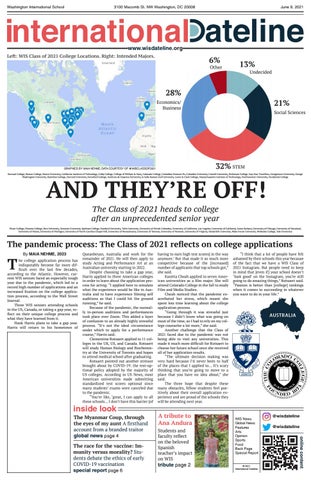
www.wisdateline.org Left: WIS Class of 2021 College Locations. Right: Intended Majors.
6%
Other
13% Undecided
28% 21%
Economics/ Business
Social Sciences
32% STEM
GRAPHICS BY MAIA NEHME; DATA COURTESY OF @WISCLASSOF2021
Barnard College, Boston College, Brown University, California Institute of Technology, Colby College, College of William & Mary, Colorado College, Columbia-Sciences Po, Columbia University, Cornell University, Dickinson College, Gap Year Travellers, Georgetown University, George Washington University, Hamilton College, Harvard University, Haverford College, Instituto de Empresa University, la Salle Ramon Llull University, Lewis & Clark College, Massachuasetts Institute of Technology, Northwestern University, Occidental College
AND THEY’RE OFF! The Class of 2021 heads to college after an unprecedented senior year
Pitzer College, Pomona College, Rice University, Sewanee University, Spelman College, Stanford University, Tufts University, University of British Columbia, University of California, Los Angeles, University of California, Santa Barbara, University of Chicago, University of Maryland, University of Miami, University of Michigan, University of North Carolina Chapel Hill, University of Pennsylvania, University of Toronto, University of Vermont, University of Virginia, Vanderbilt University, Wake Forest University, Wellesley College, Yale University
The pandemic process: The Class of 2021 reflects on college applications
T
By MAIA NEHME, 2023
he college application process has indisputably become far more difficult over the last few decades, according to the Atlantic. However, current WIS seniors faced an especially tough year due to the pandemic, which led to a record high number of applications and an increased fixation on the college application process, according to the Wall Street Journal. Three WIS seniors attending schools in the US, Canada, or taking a gap year, reflect on their unique college process and what they have learned from it. Hank Harris plans to take a gap year. Harris will return to his hometown of
Queanbeyan, Australia and work for the remainder of 2021. He will then apply to study Acting and Performance Art at an Australian university starting in 2022. Despite choosing to take a gap year, Harris applied to three American colleges in order to learn about the application process for acting. “I applied here to simulate what the experience would be like in Australia and to have experience filming self auditions so that I could hit the ground running,” he said. Because of the pandemic, the normally in-person auditions and performances took place over Zoom. This added a layer of confusion to an already highly stressful process. “It’s not the ideal circumstance under which to apply for a performance course,” Harris said. Clementine Rotsaert applied to 11 colleges in the UK, US, and Canada. Rotsaert will study Human Biology and Biochemistry at the University of Toronto and hopes to attend medical school after graduating. Rotsaert pointed out another stressor brought about by COVID-19: the test-optional policy adopted by the majority of US colleges. According to US News, most American universities made submitting standardized test scores optional since many students’ exams were canceled due to the pandemic. “You’re like, ‘great, I can apply to all these schools… I don’t have this barrier [of
inside look
The race for the vaccine: Immunity versus morality? Students debate the ethics of early COVID-19 vaccination special report page 6
A tribute to Ana Andura Students and faculty reflect on the beloved Spanish teacher’s impact on WIS
tribute page 2
“I think that a lot of people have felt ashamed by their schools this year because of the fact that we have a WIS Class of 2021 Instagram. But people need to keep in mind that [even if] your school doesn’t ‘look good’ on the Instagram, you’re still going to do amazing things,” Rotsaert said. “Passion is better than [college] rankings when it comes to succeeding in whatever you want to do in your life.”
WIS News Global News Features Arts Opinion Sports Food Back Page Special Report
© 2021 International Dateline
@wisdateline @wisdateline
online content
The Myanmar Coup, through the eyes of my aunt A firsthand account from a branded traitor global news page 4
having to earn high test scores] in the way anymore.’ But that made it so much more competitive because of the [increased] number of applicants that top schools got,” she said. Kanitta Cheah applied to seven American universities as a film major. She will attend Colorado College in the fall to study Film and Media Studies. Cheah noticed that the pandemic exacerbated her stress, which meant she spent less time learning about the college application process. “Going through it was stressful just because I didn’t know what was going on most of the time, so I had to rely on my college counselor a lot more,” she said. Another challenge that the Class of 2021 faced due to the pandemic was not being able to visit any universities. This made it much more difficult for Rotsaert to choose her future school once she received all of her application results. “The ultimate decision making was very hard because I’d never been to half of the places that I applied to… It’s scary thinking that you’re going to move to a place that you have no idea about,” she said. The three hope that despite these many obstacles, fellow students feel positively about their overall application experience and are proud of the schools they will be attending next year.
INTERNATIONAL DATELINE
tribute
2
JUNE 2021
ANA ANDURA 1955 - 2021 By MAIA NEHME, 2023 Spanish teacher Ana Andura would spot a blooming blush pink peony outside of the Greenhouse and kneel down next to it. Careful not to crush the flower, she would pull out her camera and snap a photo. The next day, she would share the image with her students, reminding them of the importance of appreciating the little things in life. Andura, who taught at WIS for 23 years, passed away in early May after a long struggle with cancer. She is survived by her husband, Ernesto Hugo Berbery, her daughters, María Luz and Ingrid Berbery, and her sister, María Inés Andura Little. In addition to being an excellent teacher, Andura was well known around campus for her vivacious and cheery disposition. She embraced every aspect of life, from devoting time to photograph nature, to hosting annual Carnival celebrations, to teaching her fellow faculty members yoga. The following are personal testimonies from Andura’s fellow faculty members, current students and alumni, reflecting on her positive impact on the WIS community. Anna Martinelli-Parker, Class of 2020: Students at WIS can sometimes be reluctant to participate in higher level language classes and reluctant to give their all to the work that we do in the IB. But she was always super willing to dedicate time to individual students, to really push students, not in this nasty way, but you knew that she wanted the best for you. That was where she was coming from, not because she wanted good teaching evaluations or anything like that, but because she genuinely cared about you and she genuinely cared about you learning the material.
Her memorial service at WIS was really wonderful. We passed around the microphone and told stories about Ana and our remembrances of her. It was very personal and funny and heartfelt. The Spanish department released two dozen butterflies at the end of it. That was poignant and she would have loved that. I think the butterflies represented her love for nature and her characteristic of stopping to take in the beauty of something small.
DESIGN TECHNOLOGY TEACHER, LANCE BALDWIN
Baeza: She took the metro to come to the school and I took the metro too, so almost every morning we would meet at the Cleveland Park station. One thing that I appreciated is that she was always sharing with me what she was reading. And I would share with her what I was reading. So it was always a pretty meaningful conversation about literature and books and new authors. Martinelli-Parker: It’s easy to get out of the habit of reading for pleasure as you get older. I don’t want to say she really pushed against that with me, but she definitely helped me by giving me recommendations of things to read, even things in English as well. She helped keep up that love in me. I do a lot more reading for fun now than I did five years ago, which is a bit of a shock to me. So just keeping up that love for reading and that appreciation for literature, I can credit to her.
Spanish Teacher Teresa Baeza: In her classes, there were some objects, like a talking stick that they were using for discussions. The objects, the songs that they sang, everything that she did was visually linked to the teaching. So it was like the artifacts would help you remember what she taught. And I think that was very important because learning is very physical for some students.
“She strove to find the beauty in everyday objects and occurrences. So she stopped and she took pictures of flowers. She stopped and smelled flowers. She took a lot of pleasure in the beauty that surrounds us, if we only look for it. Since she passed, I have made a concerted effort to think more about the positive things in my life, and avoid thinking and talking about the negative things in my life.”
“She was always very enthusiastic, and she always saw the positive side. I don’t think I’ve ever seen her in a bad mood. Overall, she really appreciated life and everything that it has to offer. So she put her all into trying to transfer that mentality to us. She would always bring us candy and postcards from the places she’d visited and just little things that would show that she really cared.”
DESIGN TECHNOLOGY, TEACHER LANCE BALDWIN
ALEJANDRO GONZALEZ, CLASS OF 2020
Baldwin: It’s hard to quantify how much it meant for WIS to lose two strong and unique teachers in basically a year’s time: Mara Wilson and Ana Andura. They had an outsized influence on a lot of what makes WIS special. It’s just a real loss to our school and our community. And I want you to understand, I smiled a lot during this interview because I really have great memories of Sra. Andura, but it’s so sad to me that she couldn’t teach for a couple of more years and retire and travel around the world with her husband. She was a truly wonderful woman and she is the most positive person I’ve ever met. I can say that honestly and easily.
Luana Dos Santos, Class of 2023: She always tried to make us gain an appreciation for Latin American culture, since the Spanish curriculum is so focused on Spain. I remember all of us being in class, we were reading a book and she was playing this YouTube video of people playing the drums. I remember she was really excited about it and she really cared about Latin American culture. COURTESY OF @ANAANDURA
She had told me, ‘I love teaching, but in two years or so, I want to retire and I want to travel for the rest of my life. I will devote my life to traveling, to go to Spain and see my family, and then go to Argentina, and here in the United States, and read a lot.’ She had plans for her life. It was really hard for me, thinking about how alive she had been, how many plans she had had even after retiring that she never got to fulfill. Ramallo:
COURTESY OF TERESA BAEZA
Ramallo: In the Greenhouse, there is the Chinese department, the French department, Spanish, History, and Geography. Every single day, she was very friendly with everybody in the Greenhouse. There was no distinction between the Spanish people or the other foreign language people and the other people.
SPANISH TEACHER, ANTONIO RAMALLO
We used to go to the GALA Hispanic Theater [a DC performing arts center focused on telling Latinx stories]. Every time that we went, she wanted to be sure that the students not only would appreciate the literary or the language part of the theatre, but she wanted to be sure that the students would appreciate the artistic part of the theatre. And she would do anything from dancing to moving to acting out what the book was like. This is one of the most impressive parts for me, how she wanted to transmit
this passion and to be sure that the students appreciate the literary value, the Spanish language value, and the artistic value of whatever they were going to see there.
COURTESY OF MARIA LUZ BERBERY
INTERNATIONAL DATELINE
wisnews
3
JUNE 2021
‘What’s your story?’ New assembly speaker series Stalé Studios: A WIS founded sheds light on systemic inequalities By MAIA NEHME, 2023 clothing brand
G
rades 9 and 10 Assistant Principal Allison Ewing implemented a new assembly speaker series this year based on the central question, ‘what is your story?’ Speakers have tackled tough topics ranging from systemic racism to gender identity through the lens of their insightful personal experiences. Shortly before the start of the school year, Ewing connected with several identity clubs about hosting assemblies over Zoom. One concern she often heard was that students felt overwhelmed due to the pandemic. However, “they didn’t want to feel an additional responsibility that if they don’t [lead an assembly,] then it doesn’t happen at all.” Ewing invited guest speakers to talk at assemblies once a cycle to take the pressure off of those student groups. While choosing who to invite, she has prioritized selecting speakers from diverse backgrounds. “I think we underestimate a lot of times the value that one’s identity has [even though] it’s how we connect with people. [For example,] ‘oh, you like the color purple, that’s my favorite color.’ And now, you’re lifelong [friends]. If a favorite color can do that, then shared identities can be even stronger,” Ewing said. One speaker in particular who stood out to Ewing is Dr. David Fakunle, who spoke at the first assembly of the school year. Fakunle is an artist, researcher, and teacher at the University of Florida and the Johns Hopkins Bloomberg School of Public Health. Ewing explained that “he is the one who set the tone for why it’s important to tell your story.” Fakunle focuses on the uses of art, specifically storytelling, in the public health field. “By encouraging people to acknowledge their own story you [can] help improve someone’s mental health, someone’s emotional health, which could also lead to improvements in their behavior, such as recovering from substance abuse, alcohol abuse, whatever the case may be,” Fakunle said. Fakunle has been fascinated by sto-
A ta l e o f two proms
The WIS administration recently organized two prom celebrations for the Class of 2021 in order to make up for the several events cancelled due to the pandemic, namely junior prom, Valentine’s Day candy grams, Senior Prank Day, and more. The first event, “Let’s GLOW,” took place Saturday, May 22 on Tregaron’s campus and included a photo booth, food trucks, colorful strings of light, and a raffle. For the second event on Wednesday, May 26, students dressed up in their formal prom attire and took group photos at the Kennedy Center.
ries since he was nine years old and first met Mary Carter Smith, a renowned griot (Black storyteller). At a museum event, he told a story that he had originally heard on Smith’s radio station, “Griot for the Young and the Young at Heart.” Smith approached him after the event and invited him to tell stories on her show. Because he’s been publicly speaking from such a young age, Fakunle doesn’t prepare his speeches in advance, and his talk at the WIS assembly was no exception. Instead, he thinks of what key takeaway he wants the audience to have after listening to his speech. “Everyone comes with perceptions, and a lot of times they’re misperceptions. They affect how we think, how we feel, and how we interact with other beings. That is what leads to so much of the pain that is experienced in our society. We have to change that. So, where do you start? You start by telling your story,” Fakunle said. Ewing also felt moved by Dr. Edward Carson, who spoke at the February Black History Month assembly. Carson is the Dean of Multicultural Education at the Governor’s Academy, where he recruits diverse faculty members and creates new policies to increase inclusion. Additionally, he is a historian and an activist. During the assembly, Carson honed in on the importance of allyship between people of different cultural identifiers in order to tackle forms of oppression like systemic racism. “We need to look around at our spaces and ask ourselves, ‘who are we inviting over to dinner? Who is sitting at the table?’ If we’re finding that there are folks who are absent, we need to correct that. If we’re not in proximity with folks who are different from us, then we don’t understand their pain,” Carson said. Carson first began reflecting on the need for interracial allyship in driving change when he was a high schooler in Montgomery, Alabama. “The levels of segregation and white supremacy that existed at my high school [didn’t sit] well with me. I had teachers who would make comments about how Black and white folks shouldn’t get married… I thought, ‘you know what? I am going to be the kind of teacher, the kind
of social justice agent for my students, that I’ve never had,’” Carson said. After Carson’s speech at the assembly, senior Vanessa Schor noticed an issue in one of her History textbooks about the civil rights movement. One section of the textbook included different perspectives on the causes of the movement. The majority of the cited historians were white men. “The whole point of historiography is to have a breadth of perspectives so you can understand events from different viewpoints, [but] it seemed like there was a voice missing,” Schor said. After noticing the lack of representation in the textbook, she reached out to her IB History HL teacher, Don Boehm. Schor doesn’t know if she would’ve emailed Boehm if she hadn’t heard Carson speak during the assembly. “I definitely felt like his words resonated with me, [like] what he was saying about keeping your teachers and your peers accountable for what you’re learning, especially when it comes to history,” Schor said. Schor’s suggestion for Boehm was to read alternate perspectives from Black historians on the civil rights movement and compare them to the viewpoints in the textbook. Boehm was surprised and frustrated by Schor’s email, but when he spoke to her in person, he understood that “it was not her intent to call me out. It was her desire to raise concern… she [wanted] to start discussions and look at things through a critical lens.” Boehm chose to share supplementary readings from Black historians with the class. He also bought new texts on the civil rights movement for next year’s history class, which include more diverse perspectives. Boehm hopes that students will continue following Carson’s advice and holding their teachers accountable for their education. “I think I speak from my whole department [in hoping] that we continue to cultivate a classroom atmosphere where kids can follow their personal [and] political interests,” he said. “This allows them to meet that mission that [Carson] was encouraging them to strive for.”
STALÉ STUDIOS WEBSITE IS LIVE 05/19/21
QUENTIN MARET WILLIAM WILLIAMSON
By ABBY BOWN, 2023
T
he machines have started anew. For a few weeks they’ve been gathering dust, but the metronomic thumping of their needles is echoing off the walls of the basement once again. In the center of the room, William Williamson sits in front of his embroidery machine, paying close attention to each stitch. He’s embroidering a hoodie for his company, Stalé. Stalé is a “digital studio” founded by sophomores Quentin Maret and William Williamson. “It’s a display of beautiful artwork by creative minds,” Maret described. “Stalé” comes from the word “stale”, meaning no longer fresh, and adds irony to the name. Plus, the acute accent over the last “e” gives the brand a French flair, both founders’ second language. The company has two distinct parts. “There’s the business aspect where we are selling the garments, and we have the other artistic aspects where we share art through different mediums,” Maret explained. The company covers multiple forms of art. “Currently our main focus is on prints and clothing, as well as Quentin with his photography,” Williamson said. Stalé’s wide scope of art combined with its required knowledge of entrepreneurship make for a heavy workload. Plus, Williamson and Maret are going through the entire process on their own. They start with planning their ideas and designs, producing the item, uploading it to the website, selling the item and finally shipping it. Luckily, Williamson and Maret have a system. “Quentin’s role currently is setting up the website whereas mine is producing the clothing,” Williamson said. “[But] we generally can switch around roles and it’s pretty fluid.” Their roles often take into account who has access to what. Williamson has the embroidery machine and Maret has the materials for screen printing.
Read more at wisdateline.org/category/features
COURTESY OF THE CLASS OF 2021
INTERNATIONAL DATELINE
globalnews JUNE 2021
dc news
4
WIS community weighs in on D.C. statehood after House vote By CAMILA LEVEY and ALEK DANIELYAN, 2022
Across the city, lawns are scattered with “Statehood for the People of D.C.” signs while cars with “Taxation without Representation” license plates drive by. Amid the D.C. statehood bill being passed in the House of Representatives, along with the consequent debate in the Senate, many Washingtonians have raised their voices on the issue. When Washington, D.C. was founded in 1790, it was immediately established to serve solely as the United States capital, justifying its lack of statehood at the time. However, it has taken on a greater significance than just the nation’s capital. Over the last 230 years, its citizens created their own culture in the city. Although D.C. has a unique identity and rich history, just like the 50 states, D.C. residents don’t enjoy the same rights. Most notably, residents pay more in taxes to the Federal government than 22 states and pay the most taxes per capita, yet receive no votes in Congress. “As a kid, [I] learned about the American revolution, and one of the core tenants of that was no taxation without rep-
COURTESY OF PINK BARRIO
D.C.’s license plates sport the age-old saying “Taxation Without Representation.”
resentation,” Junior Saul Meyer-Fong said. “I wondered why D.C. people didn’t get to vote even though I knew my parents had to pay taxes.” The sentiment that Washingtonians do not have adequate representation is widespread among many generations and residents. “It’s interesting because I just moved to D.C… [I thought] ‘Oh my gosh, I’m going to lose my representation.’ In my mind, I was giving something up,” IB Economics teacher Elke Gannon said.
These feelings of insufficient representation while still being taxed explain why an overwhelming 86% of D.C. residents encourage governmental approval of D.C. statehood. One issue stemming from D.C.’s lack of statehood is that the numbers of COVID-19 vaccines were initially insufficient as the district is considered a territory despite its large population. “We haven’t had the advocacy that we need in terms of our representatives advocating for our population or for our area in
those types of state level systems,” Gannon said. Many residents also take into consideration the political implications of making D.C. a state. 76.36% of Washingtonians are registered Democrats, according to the District of Columbia Board of Elections. If D.C. statehood is passed, the addition of at least three D.C. Congressmen will allow the Democratic party to increase control of both the House of Representatives and the Senate, the latter of which is currently evenly split between Democrats and Republicans. “The [Republican] party is trying to cling onto a Senate majority or a strong minority,” Meyer-Fong said. “Having the voices of people played with as political pawns is unfair and it shouldn’t continue.” Ultimately, the battle for statehood in Washington is far from over. Meyer-Fong weighed in on the long-term arguments for D.C. statehood, explaining that it is un-American. “If you want to stick to the core ideas that America was founded on, I think that D.C. statehood is a must… just because a certain party in Congress thinks D.C. is partisan doesn’t mean we shouldn’t get statehood.”
The Myanmar Coup, through the eyes of my aunt By NAOMI BREUER, 2024 Police stations aflame. Bombs thrown at army trucks. Civilians taking to the street to fight for democracy. Sniper bullets aimed at their heads. This is the reality of the military coup d’état in Myanmar. It came February 1, after the National League for Democracy (NLD) won the 2020 nationwide elections by a landslide in November. But the military, known as the ‘Tatmadaw,’ were fixated on calling it “election fraud.” I had a chance to chat with my aunt, Mimieux (Mimi) Myint Hpu about the situation. Auntie Mimi has always been active in campaigning for democracy in Myanmar (formerly known as Burma). After lobbying to Congress and the United Nations, and working with the US Committee for Refugees following a nationwide protest for democracy in 1988, she was branded as a “traitor to the state” by the military junta group. Myanmar was never one nation. The different regions and ethnic groups were separate kingdoms, until the British came and colonized them as one in the 1800s. After forming the people’s army and gaining independence in 1947, Myanmar’s founding fathers were assassinated while writing the constitution. Imagine, my aunt
COURTESY OF MIMI MYINT HPU
Mimi in 1989, the year she was branded as a traitor by the Military Junta.
told me, James Madison, John Adams and ing. People were starting to finally have George Washington assassinated, before hope for normalcy, since the AstraZeneca finishing the US Constitution for the na- vaccine was on its way. “We were all cleantion they had fought so hard for. ing up and getting ready to open our busi Only in 2011 did the country begin to ness on February 1, and guess what haptransition to quasi-civilian rule and a de- pened? The coup happened,” she said. mocracy, with the opposition NLD party Every day, she hears about the killings and the military starting to work together and brutality happening on the streets, for the first time. The 2020 elections were and she says it’s “heartbreaking.” I know only the third elections after the start of she’s passionate about this since she’s this transition. The NLD won the elections been flooding my WhatsApp with links to by a landslide, as they did in 2015. They articles and long messages about how she had been talking about removing the ar- feels. “I have so much to say but I don’t my’s guaranteed 25% of parliament seats, want to inundate you,” read one of her and the army felt threatened and seized messages. total power again with the coup d’état. “It’s just miserable, because [the mili Mimi and her husband Patrick own a tary has] no control on the ground. I don’t restaurant in Bagan, a fairly rural part of think [the generals] know how bad things Myanmar. They are currently remaining are on the ground,” she said. there to be away from the turmoil in cit- The internet has been a benefit for this ies, where protesting civilians have been generation of protestors in Myanmar. It clashing with police and soldiers, resulting has allowed Generation Z to become more in hundreds of casualties. “We can’t tell politically aware, leading them to come how it’s going to end up. It’s a freefall,” together more and stand up for what they Mimi said. believe in. Civilian lifestyles have been signifi- “They can see for themselves. They cantly affected by the coup. All mobile in- don’t have to believe the military’s brainternets have been shut washing. And there’s down, because the mililess inter-racial, intary does not want pro- “We were all cleaning up and ter-religious discriminatestors to communicate getting ready to open our tion,” she said. with each other. “We are business on February 1, and This is also the fortunate to still have first time the major ethguess what happened? The the internet because we nic groups in Myanmar have a business and ours coup happened.” are really intertwining is fixed [to the wall]. But and uniting. Many peoMIMI MYINT HPU ple within the country even then, ours shuts down at midnight and have mixed ethnicities comes back on at 8 or 9 in the morning,” and can’t be defined by one word, like nuMimi said. merous students at WIS. The virtual private network she is “They’re coming together with the using, however, cuts in and out. It even ethnic groups. My mom is Karen [Chriscrashed during our interview, and I called tian] and my dad is Bamar-Shan [Buddhist]. her back twice before the connection re- So there are many of us who are all mixed,” turned. she said. “You can’t say you’re German or The coup is not the only issue citi- you’re Burmese, you [are] everything,” she zens are facing, with the pandemic caus- referred to me, also of mixed ethnicity. ing additional stress. My aunt’s restaurant In order to make a difference, my aunt has not been open since the start of the said people in the US should lobby the govpandemic, like many other businesses in ernment, journalists, Association of SouthMyanmar, especially Bagan, where tourism east Asian Nations (ASEAN) countries and is the main industry. So, to have some in- the UN Security Council to not support the come, my aunt started to teach English to military government in Myanmar. They students online. should impose sanctions and encourage Mimi and Patrick also have a shop in peaceful negotiations. Yangon, the biggest city in the country, “[Tell them] to not support this miliwhich they had to close, due to protests tary conduct that is not accepted by people and shootings occurring around it. at all, that’s oppressive and that’s killing This is not what they had been expect- people daily,” she said. “[And we must]
“
COURTESY OF MIMI MYINT HPU
Mimi with her husband Patrick near protestors this year. Protests have been occurring regularly across Myanmar since the military coup on February 1.
train them to be more honorable. An army cannot run a country, [but] maybe civilians can run a country.” My aunt hopes that the international community will stand by the people of Myanmar. “Recognize the government that the Burmese people recognize,” she said. She wants other countries to learn from this as well, and learn to listen to different types of people and ethnic groups. “The world should pay attention to the voices of all the parties in the country,” she said. “Not just who has the guns and who has [seized] power in the government.”
COURTESY OF MIMI MYINT HPU
Mimi with her students in the NLD in 2016. The leaders of the NLD were taken hostage during the military coup on February 1, 2021.
INTERNATIONAL DATELINE
features JUNE 2021
5
‘Psychological Fear’: Asian community at WIS reflects on anti-Asian violence Content warning: this article contains quoted strong derogatory language that targets Asians and Asian Americans. By ABBY BOWN, 2023
A
little girl of five years splashes around in a public pool in the New Mexican summer heat. Someone asks her how she can swim and see through her eyes at the same time. A twenty-year-old woman is walking down a street in New York. Someone yells at her to go back to her country. She’s terrified and crosses to the other side. A woman of thirty carries pepper spray wherever she goes. Her family tells her not to take the metro to work; they’re scared that she could be attacked because she’s Asian. These three women are WIS faculty members Allison Ewing, Susan Chung Fontaine, and Hongli Holloman, respectively. Assistant Principal for Grades 9 and 10 Allison Ewing’s mother’s family emigrated from China to the Hawaiian Islands. “My great-grandmother was sold as a slave by From left to right: High school English teacher Susan Chung Fontaine is Korean, Assistant Principal for Grade 9 and 10 Allison her family back in China to pay for her fa- Ewing is half-Chinese and Chinese language teacher Hongli Holloman is fully Chinese. These three women have been signifither’s funeral, and the family that bought cantly impacted by the Atlanta shooting that left six Asian women dead. her emigrated to Hawaii,” Ewing explained. the history of anti-Asian racism and events food Upper School English teacher Susan on it,” Chung Fontaine said. Chung Fontaine’s parents were immigrants IB Math teacher Eugene Wang, Chi- occurring today. “Whenever there’s a crisis nese, experienced first hand the impact of or a scenario where there is pain or eco- Support with your dollar: from Korea, and she grew up in New York. Chinese teacher Hongli Holloman is this negative rhetoric when he was travel- nomic suffering, people look for a scape- The best Asian American fully Chinese and grew up in China. “I had ing. “People were pointing fingers or just goat, and I think Trump directed that at restaurants in the DMV my college education in China, [and] came intentionally walking away or name-call- Asian Americans in an effort to win reelecto the United States after college. So I’ve ing,” he said. “Or the worst thing that hap- tion,” Pan said. By ROSE BOEHM, 2022 pened was people spitting on you.” This continuous discrimination has been here for many years,” she explained. However, Wang made it difficult for Wang and Chung Fon The three women’s acknowledges that taine to retain and show off their cultures. Asian heritage has often there’s a distinct dif- “There’s only a group of people you can pushed them headfirst “People were pointing fingers ference between the share these cultural values [with] and the into the oncoming traffic or just intentionally walking racism that Asian men tendency for immigrant children [growing of hateful Asian bigotry. away or name-calling or the and women face, es- up] in America is to try to be assimilated “Even growing up, people worst thing that happened pecially in the media. into the American mainstream culture,” - I’ll use the slurs - they was people spitting on you.” “Asian females are be- Wang said. called you, ‘ch**k’, ‘ch**g ing sexualized more Consequently, Chung Fontaine doesn’t ch**g’, all of those types EUGENE WANG and more... and on the express her Korean culture very much. “I Banh Mi D.C. Sandwich: of slurs,” Chung Fontaine other hand, you look don’t think I wear it on my sleeve,” she Banh Mi D.C. is a Vietnamese restaurant said. And for many Asian women, these at the Asian male [who’s been] emasculat- said. that serves the perfect banh mi with fresh While these Asian Americans face dis- french bread, delectable meats, fresh pickfeelings of oppression and marginaliza- ed,” he said. The sexualization and fetishization crimination almost everywhere, WIS can led vegetables and mayonnaise to top it tion came to a head after the Atlanta spa of Asian women stem from colonization. be a safe haven for some of them. “WIS off. Located in Arlington, these are a cheap shooting that left six Asian women dead. “I was really sad. And then comes fear and “White sexual imperialism, through rape has been really incredible in terms of being lunch treat. and war, created the hyper-sexualized ste- welcoming, and engaging in dialogue,” Ew- Suggestion: Combination sandwich with the frustrations,” Holloman said. Holloman adds that just being per- reotype of the Asian woman,” according to ing said. meats like paté, my favorite addition (pic However, Chung Fontaine feels slight- tured above). ceived as Asian can put her at risk. “When author Sunny Woan. This sexualization continues to have ly differently, acknowledging that WIS you hear people being attacked in the street, [when] they think they are Asian, a large impact on Asian women today. doesn’t have a lot of Asian diversity. “I Tony Cheng Seafood Restaurant: or they think they are Chinese,” she said, “When you grow up in a racist society, definitely feel safe. But I’m aware of being Even before COVID, Chinatown was strugyou’re not conscious and aware that these one of the few,” she said. “that adds a lot of psychological fear.” gling to maintain its Chinese culture, This fear has forced Chung Fontaine ideas permeate your mind, or they did [in] which makes it especially important to and Holloman to take strong precautions. mine,” Chung Fontaine said. support Tony Cheng’s. They serve a variBoth carry pepper spray on their person. Additionally, the alleged motive of ety of traditional Chinese American dishes “Every day, I actually have pepper spray the Atlanta mass shooter was an inability that hit the spot. attached to my keychain, it’s in my pock- to control his sex addiction, which he was Suggestion: Grab anything from the carts, et,” Holloman said. “I don’t bring it out in previously treated for. Many believe that and you’ll be delighted! the motive of the crime was strongly conschool. But it travels with me.” While there has been some debate nected to the sexualization of Asian womover whether this shooting is considered en. Similarly, the depiction of Asian men a hate crime, Ewing, Chung Fontaine, and Holloman are all in agreement. “My first in movies and TV shows had a large effect thought was that it was a hate crime. And on Wang when he was a teenager. “One that has now culminated in a massacre,” of the struggles growing up as an Asian in America is you don’t see role models,” Chung Fontaine said. Sophomore Zachary Pan agrees. Wang explained. “[It’s] very rare besides a “There are news sources that have not few stereotypical martial arts actors.” But no matter how you slice it, there’s called it a hate crime, even though, if like 90% of the victims are Asian-Americans discrimination from every angle. “It’s unwhen Asian Americans are 5% of the popu- fair either way,” Wang said. Though exacerbated by the COVID-19 lation, that’s a telling sign that it really is a pandemic, anti-Asian racism is not a new hate crime,” Pan said. Sakuramen: DATA COURTESY OF MARY HASTINGS MOORE Sakuramen is located in a basement in Pan’s mother is Chinese-American. phenomenon, with roots in immigration and legislation since Adams Morgan. While the space is quaint, Her parents fled from the 19th century, But despite these differences, all four the ambiance is comforting, just like the China after siding “Every day, I actually have pepper according to the faculty members have similar hopes for restaurant’s ramen. The ramen is served in with the Nationalists, spray attached to my keychain.” Washington Post. the future of America and its anti-Asian very large bowls, making it a perfect split who lost in their civil This discrimi- racism. “I want it to be less prejudiced, less for two that still allows one to explore the war against the ComHONGLI HOLLOMAN natory legislation biased, less racist, I want justice for people depths of the flavor. Sakuramen also has a munist Party. “They resulted in the cre- who’ve done wrong, I want accountability variety of vegetarian options. had to flee to Taiwan and that was the last bastion of democracy ation of Chinatowns, Asian communities for people who act on their hate,” Chung Suggestions: Gyoza is the perfect appetizer within white-dominated towns intended Fontaine said. “When there is injustice, be and the tonkotsu red can never go wrong! in China,” he said. Chung Fontaine, Pan, and Holloman to protect the marginalized group. Wash- vocal and stand with those who are victimall note that former president Donald ington D.C.’s Chinatown, a small section ized [and] persecuted.” Kadhai: However, Holloman highlights the re- Kadhai is a Bethesda Indian restaurant Trump’s statements about the “China vi- east of downtown D.C., has experienced rus” and the “Kung Flu” had a significant increasing gentrification within the last 30 cent Asian hate crimes’ one silver lining. that is perfect for takeout or delivery. They impact on the rise of Asian hate crimes. “I years, as authentic Asian-owned business- She characterizes the recent increase in serve a variety of delectable dishes that are media coverage as “attention being paid to easy to order on a busy school night. think it’s giving a green light to people who es continue to close down. have that prejudice and bias to just act out There is a clear connection between the so often ignored.” Suggestion: Flavorful Vegetable Korma.
“
“
6
JUNE 2021
INTERNATIONAL DATELINE
specialreport
The race for the vaccine: Immunity versus morality? By OLIVIA YOUNG, 2022
W
IS high school students have managed to acquire their vaccine shots due to the increasing availability of doses for younger people in the DMV area. However, there is doubt over whether healthy teenagers should be among the first to transition back to ‘normal.’ There is also controversy over those who may have sped up their vaccine process through dishonesty. Since April 19, Pfizer is the only vaccine approved for those between the ages of 16-17. It consists of 2 shots, administered 21 days apart. The Food and Drug Administration (FDA) has also recently approved the Pfizer vaccine for those between the ages of 12 and 15. The prospect of vaccination immediately led many upperclassmen to try and receive the vaccine. “My dad really wanted me to get vaccinated, just so I could be safe,” junior Olivia Matuschek said. After hearing from her neighbors of a CVS that often had spare shots around closing time, Matuschek decided to pay it a visit. However, she found that they only had Moderna, which is just approved for those over the age of 18. Nonetheless, the first CVS recommended another, where Matuschek managed to get the last shot of the day. “[I] was really lucky,” Matuschek, who is now fully-vaccinated, said. However, she does admit that, “the way I got vaccinated was… maybe not a normal experience.” Dishonesty is another pressing issue on the topic of vaccination. Examples of this include lying about fake conditions or exaggerating how at risk someone is from the virus in order to receive the vaccine slightly earlier. Matuschek argues that being dishonest is “taking advantage of the system.” With more students getting vaccinated, many have wondered whether WIS should mandate vaccines for eligible students in the upcoming school year. “If you’re able to get vaccinated, then I definitely think that we should encourage [vaccination], but I’m not sure if a mandate…is a good idea because I know some
COURTESY OF WIS HIGH SCHOOL STUDENTS
people will have strong [allergic] reactions [to the vaccine],” said Matuschek about the hypothetical situation. Matuschek revealed her relief at getting vaccinated, saying that “COVID has affected me a lot and I would rather get back to normal as soon as possible.” Junior Zach Roberts, who has spent the majority of the school year online, was able to get the vaccine earlier than most people his age. Having been a lifeguard for the past three summers, the State of Maryland qualifies Roberts as an essential health worker. After his dad got him an appointment through the Department of Health, Roberts drove an hour and a half away to Regency Stadium in Waldorf, Maryland. Roberts received his first dose of Pfizer on March 21, and does not regret it. “I feel better about hanging out with
people than before because I’m [no longer at as much of] a risk,” Roberts said. The vaccine allows him to begin the process of returning to ‘normal.’ “I still wear a mask everywhere… until everyone is vaccinated or a certain threshold [is reached],” Roberts said about the loosening of COVID-19 precautionary measures. But being fully-vaccinated has certainly eased a certain worry in him about interacting with the outside world. Like Roberts, junior Maya Lopez drove a few hours away to acquire her first dose. The only appointment she found was at a CVS at the University of Virginia, in Charlottesville, over 100 miles away. “I wanted to save [the vaccine] for other people [first],” Lopez said , despite qualifying for an earlier vaccination due to a chronic condition. D.C. has been allowing 16 and 17 year olds with medical condi-
tions to receive the vaccine since March 1, which was over a month before Lopez received her first dose. Reflecting her optimism, Lopez saw the benefits of her visit to Charlottesville. “It was cool, because it turned into a little college tour,” she said. On the other hand, senior Ester Luna had a very different vaccination experience. Instead of receiving Pfizer like the other WIS students, Luna benefitted from the fact that she was now 18 and eligible to receive the one-dose Johnson & Johnson (J&J) vaccine. On a casual Friday evening, Luna learnt from her grade group chat that a mass vaccination initiative was happening at the Arlington Ethiopian community center, with no pre-registration or Virginia residency requirements. Excited, Luna travelled there the following day to get her one and only shot. “I trust the people who developed it and I understand the concerns with it being recalled…but as many people have said, the odds of getting COVID are exponentially higher,” Luna said regarding the fact that the Johnson & Johnson vaccine was recently recalled then reinstated over the potential but statistically unlikely risk of blood clots. “[Being fully vaccinated] is not an excuse to become more lenient with mask wearing and social distancing. People are getting lulled into a false sense of security [with vaccines] which shouldn’t be the case at all because just when you start to let go and be less cognizant of the danger is probably when you’re going to get [the virus],” Luna said. She believes that restrictions should only be loosened when completely safe. This is especially relevant to her case, as there is no set date for reaching full immunity with the J&J vaccine. “[WIS] should strongly consider [mandatory vaccination],” Luna said, despite attending university next year. She believes that this would benefit the community, and many colleges are already enforcing this obligation. Overall, the increase in the numbers of student vaccinations paints a strong picture of hope for the future of the WIS community.
Optimism for the 2021-2022 WIS athletic season
COURTESY OF CHERYL TANSKI AND WIS ATHLETIC DEPARTMENT
Left: students participate in socially distanced and masked cross country practices. Right: WIS’s golf club practices off-campus during the pandemic.
By PHILIP HE, 2022 Many cross country runners haven’t heard the starting gun in nearly a year. Most soccer players haven’t heard the starting whistle in over a year. Due to COVID-19, students were unable to have a WIS athletic season, leaving a gaping hole in their lives. Basketball player and junior Josue Ochaita hasn’t played competitive basketball since February of 2020. His experience is relatable to many student athletes. For some such as Ochaita, sports served as an escape from everyday life. “Basketball helped to get a lot off my mind from stress and school,” Ochaita said. “I was hoping that we would still have a season so when I heard [the season was cancelled], I was pretty disappointed.” While WIS held sports practices during
the fall and spring to keep athletes active, Ochaita felt that the competitiveness and impact in actual games was missing. “It just isn’t the same,” Ochaita said. “While playing at practice is fun, it doesn’t have the special feeling of an actual game.” While Ochaita remains disappointed with the season cancellation, he is confident that next year there will be a competitive season. With the new vaccine roll-out and easing COVID guidelines, sports are slowly returning back to normal. Cross country runner and junior Mila Martin notes that being able to go to a cross country meet is a sign that there will be an athletic season next year. Her optimism is mirrored by other athletes like soccer player and junior Yannick Tanyi. “I think we will definitely have a season next year,” Tanyi said. “Everything will
go back to normal.” Athletic Director Floreal Pedrazo has already begun talks with other PVAC schools, and as of right now, sports events have already been scheduled. However, the pandemic is likely to still have an effect on sports. With COVID guidelines constantly evolving, mask mandates and crowd restrictions remain obstacles in the way of a typical season. Despite this, Pedrazo urges students to remain in high spirits. While a mask mandate will be decided closer to the next season depending on PVAC and District of Columbia State Athletic Association (DCSAA) guidelines, Pedrazo is working on new ideas to make sure students can view sporting events. “We are exploring the option of finding ways to stream the games,” Pedrazo said.
“We can set up cameras so people can log in and watch the games.” Additionally, sports practices have increased optimism in terms of safety. According to Pedrazo, many athletes have already gotten vaccinated and thus far, no positive cases have been reported due to WIS sports and few have been reported in general. If an athletic season were to happen next year, safety guidelines would be a priority. With the WIS athletic department working hard to ensure a safe competitive season next year, a more promising situation is starting to form. “Students should be optimistic,” Pedrazo said. “I think the season will happen, and if it doesn’t happen in the traditional way, we are going to find ways to still do it safely.”
INTERNATIONAL DATELINE
JUNE 2021
ZOOMING INTO A POST-PANDEMIC WIS
7
Update on the IB Cafe By ROSE BOEHM, 2022
ROSE BOEHM/INTERNATIONAL DATELINE
The IB Cafe is currently open on Thursdays and Fridays for juniors and seniors.
timeline
Reflecting on the efforts for an open gradebook ISU members spent the last four years lobbying the WIS administration to make the switch to an open gradebook, a change which will be implemented in the 20212022 school year.
2017-2018 school year 1. Torin O’Brien presented to ISU with information she had gathered about open gradebooks at WIS and surveys sent out to her grade
2018-2019 school year 1. O’Brien and the new ISU presidents (Lulu Moore and Marianna Ioannou) continued the efforts to push for open gradebooks 2. Discussions within ISU: • Having updates between progress reports and report cards • Possibly having monthly updates during advisory 3. Met with admin to share the alter- natives to a fully open gradebook
2019-2020 school year 1. O’Brien and Jakobi Haskell (ISU presidents) made it a priority to have more discussions with admin about the possibility of having open gradebooks or a similar alternative 2. Discussions within ISU: • Possibly having percentage values on the progress reports 3. Meetings with admin: • Shared student opinions on open gradebook (in support and against) • Discussed having updates between progress reports and semester report cards
2020-2021 school year 1. WIS implemented the grade updates between progress reports and semester report cards 2. This year’s ISU had the goal of continuing conversations with admin to discuss open gradebooks 3. Discussions within ISU: • Student opinions gathered by ISU members suggested that there were mixed feelings about the grade updates • Including GPA on the progress reports 3. Met with Upper School Principal Sarah Polland • Introduced possible aspects an open gradebook could consider • OnCampus structure and access • Would it put pressure on teachers COURTESY OF RILEY CONTEE
WIS reopened the IB Cafe on April 5, a definitive step towards post-COVID normalcy. The sweet smell of the muffins and the taste of an ice cold, energizing coffee welcomed back seniors and introduced juniors to one of the benefits of being upperclassmen. The IB Cafe has not made its full return. For the entire 2020-2021 school year, the cafe only operated on Thursdays and Fridays. While students were notably excited, Frehiwot Setegn, the cafe’s barista, was the most enthused. “I was so happy. That’s my second home,” Setegn said. “I know the seniors. I don’t know the juniors. I just want to meet you guys.” COVID constraints have not let Setegn meet all of the current juniors. Meeting everyone and interacting with students is really important to her, so she hopes that changes soon. “In August or September, you’re going
to be [coming five days a week] and then I’m going to meet you guys more than this year,” Setegn said. Junior Jack Huffard agrees that the limited days a week make it difficult to really enjoy the IB Cafe. “Only having it Thursday and Friday is like a reward for that end of the week, but then also it’s sad you can’t have it Monday through Wednesday,” Huffard said. The juniors have only been first introduced to the IB Cafe. Huffard thinks its reopening is more normal for seniors. However, either way, it does encourage normalcy at WIS. “My normal was different than like a 12th grader’s normal would be… But it makes you feel like more of an adult,” Huffard said. The IB Cafe is an important stepping stone to normalcy at WIS, especially for juniors and seniors. As conditions continue to improve, Setegn and Huffard, like many community members, look forward to next year’s cafe operation.
Suzanna’s SCOOP
Looking back on a pandemic school year By BEKA TATHAM, 2022 The usually packed Davies Hall is sparsely populated, every second seat marked “Do Not Sit Here.” Middle schoolers take to the field with pool noodles, a now necessary tool for maintaining a six foot distance. Each class period ends with Clorox and disinfectant wipes. Tregaron Campus is littered with casual reminders that school life has been uprooted by the COVID-19 pandemic. In an academic year characterized by COVID, Dateline took the opportunity to speak with Head of School Suzanna Jemsby on the impact of the pandemic on the 2020-21 year, and look ahead to future plans as WIS attempts to find its footing in a post-pandemic world.
completely. So we are assuming there will be no physical distancing in place and high schoolers will be mostly vaccinated. I look forward to having everyone back in August, and all being well. Is there a situation where we wouldn’t all be back in person next year? I have four tracks in mind for next year. One is the worst: we go back into distance learning, if there’s a new variant or something. Two is the six foot distance, what we have now: it’s red cohort, blue cohort. Three is the three foot distance, which we can make work by August, it’s just a matter of scheduling. The final is no distancing, and we are all back by August. The hard work now is creating the three foot scenario, just in case distancing stays in place.
Looking back on the past year, how would you summarize WIS’s COVID response? Looking at our campus, I think we’ve done as well as we could. We were one of the earliest schools to get back, and we had a plan that unwittingly I think worked quite well; we decided one week on, one week off. The hybrid system means we have five days of school each week. A lot of schools are struggling to do that, and are shortening their days. So I think we’ve done as best we can to deliver a normal school year, obviously with half the students at home.
Would pooled testing continue into next year? The medical advice on that is unclear at the moment; do we need to continue testing if people are vaccinated? We have been lucky since we are getting tested through a medical study, but that study finishes at the end of this school year. Of course we have to make the right decision for health reasons, but the medical advice is unclear as to whether we need to continue testing those who are vaccinated. We will continue to test those who are unvaccinated, for sure.
How do you think the cohort system impacted the school community? It’s so sad. I think about plays, and musicals, and concerts — it’s unfortunate to only have half of the student body at any given point. But I think it was the only way to do it, given the restrictions on us for classroom size and six foot distance. I wish we could have done it with more students more of the time, but Tregaron is a tricky campus, with small rooms.
How do you feel about WIS in comparison to other schools in the area in regards to opening fully? Some of these other schools have had the space all along, so I’m surprised they didn’t open fully sooner. I think WIS has actually been in school more than these other schools, even if they finish up these last few weeks on campus. I wish we had more space, but teachers at WIS don’t have their own classrooms, so there aren’t empty rooms. We desperately need the new science building, but that won’t impact this year, of course.
What would have to happen for WIS to move to join the two cohorts? First of all, the transmission rate in D.C. has to drop below 15 cases for several days, so we know that it’s not a high transmission. If the transmission rate is steadily below 15, we can reopen Tregaron with three foot distance (vs. the current six foot distance), which gives us more flexibility. That is a case scenario for August, where we have to maintain three foot distance. However, given that public schools will struggle space wise to adopt three foot distance, I suspect that distance regulations will disappear
What do you think has been the most difficult part of hybrid for the faculty and the students, and how do those experiences differ? So for the faculty, no one was ever taught to become a teacher to teach online and in person at the same time. The teachers almost found it easier to be completely home, and have all the students at home, because it was just one modality. To have to do both, the teachers have just been
amazing, they’ve been truly heroes in all of this. I would say for the students, I would observe that for the weeks that you’re at home there is a lot of sitting, and a lot of time at Zoom. It’s easy to “zoom out,” and for the learning to become rather abstract. I’m sure there are students that have engaged less because they’re not physically there. We know that school is designed, at least at WIS, to be in person — and I can’t wait to get back to it. Do you think there will be any leniency from the school as students adjust to being back full time next year? If there is one thing I would say in all of this, maybe to a fault, WIS has really kept the pressure on. We don’t believe that students have been learning less in this time. I know that some schools have had community days where they haven’t been learning. Ultimately, we have the IB to answer to, so we’ve kept the pressure on. We like to hold people to high standards; the students have been amazing and have performed exceptionally well in spite of all of this. So, I can’t imagine there will be a conversation about being lenient. However, of course we will look out for students who are struggling, and I know that number has grown a bit during COVID. How do you think WIS students have upheld COVID guidelines outside of the classroom? I probably don’t want to know. I will tell you that the sheer lack of spread within the WIS community gives me great faith that students took it seriously. There was not a call with students or parents where we didn’t say “please take this seriously.” I think it’s a very purposeful and academic-orientated school, and people put the ability to come to school high up on their reasons to keep safe. But I’m sure there are things happening that I would rather not know about. Particularly to be at your age and not be able to see friends as you wish must be highly frustrating. Relative to what I’m hearing from other schools, I think students have been highly respectful. It will be very clear if there is a superspreader event; we can prove that in half an hour of testing, which no other school can. This conversation has been edited for length and clarity. To check out the rest of this article, go to wisdateline.org.
INTERNATIONAL DATELINE
opinions
8
JUNE 2021
This Pride month, stop assuming your friends are straight Disclaimer: here the word “gay” describes anyone attracted to the same gender, regardless of whether they are attracted to other genders as well. By ELISE NAFTULIN, 2022
E
veryone’s conditioned to believe that being straight is what’s normal — that being gay sets people apart. At WIS, much of this heteronormativity exists in the form of homophobic comments that do immeasurable damage to closeted students. June, Pride Month, is a great time for WIS’s student body to change. Because it has to. When a girl and a guy are best friends, we wonder when they’ll start dating. We don’t think twice about two girls. When we watch movies, we expect the opposite-sex stars to end up together, and we’re usually right on target — think Ron and Hermione. Katniss and Peeta. Han and Leia. Peter and MJ. Bella and Edward. James Bond and his various love interests. Pretty much every rom-com to hit the mainstream. Even the cars in “Cars” and the toys in “Toy Sto-
ry” are straight. When celebrities come out, it’s a big deal, and there are suddenly news stories dedicated entirely to their queerness. Ultimately, we’re supposed to assume people are straight, which makes non-straightness stand out wherever it exists. Of course, gay people are heteronormative too. The assumption of straightness is so entrenched in our society that nobody can single-handedly destroy it. But the problem worsens when heteronormativity slips into blatant homophobia. If everybody’s straight, then homophobia is harmless, right? Even in our liberal bubble, people assume their friends are straight and won’t be hurt by homophobic comments. One in six members of Gen Z identify as LGBTQ, according to a Gallup poll from this year. Only two-thirds of Gen Z participants reported being exclusively hetero-
sexual in a 2017 Ipsos Mori study. If you assume your friends are all straight, you may very well be wrong. A homophobic joke isn’t worth that risk. If someone is closeted, homophobia actively hurts them. When you’re closeted, any homophobia, however subtle, fills you with anxiety. When your friends are homophobic, your self-esteem plummets. They seem to hate who you are. It doesn’t matter if they say they support gay people, because their actions consistently show otherwise. Homophobic jokes stop being ‘just jokes.’ You’re always afraid of outing yourself, because you’re worried your friends will abandon or hurt you if they find out. You feel trapped. And at every turn, a heteronormative society reinforces that feeling. Books. Movies. TV shows. News articles. Music. Social media. You are surrounded by reminders that you stand out,
so you try your hardest not to. You laugh at all your friends’ jokes. The cycle continues. No one deserves to feel that way. Plenty of people do. But WIS students can help break that cycle. This Pride Month, I’m calling upon WIS students to recognize their own heteronormativity. Students: consider whether you make comments at the expense of gay people, and fight the assumptions that make those comments seem acceptable. Make it clear in your treatment of gay people that you support your friends no matter how they identify. Closeted students need to know there is a place for them at WIS.
international dateline June 2021 Editorial Board
Editor-in-chief Saul Pink Managing Editors Nicolas Greamo Anders Westerman Publications Editor Beka Tatham MS Dateline Student Adviser Rose Boehm
WIS News Maia Nehme Sophie Racine Global News Camila Levey Sports Jonathan Baunsgaard Philip He Opinion Elise Naftulin
Marketing Managers Features Rani Kumar Abby Bown Natalie Sanchez Emily Muenzer Faculty Adviser Alexandra Wilding
Arts Naomi Breuer
Print Design Abby Bown Maia Nehme Beka Tatham
Food Julia Dell’Ariccia Back Page Jonas Tomkin
International Dateline is a publication of the student body and therefore has a responsibility to reflect student, school, and community affairs. It will strive to inform, entertain, and inspire its readers in a broad, objective, and accurate manner.
Dateline also provides an open forum for the opinions of the student body, Dateline staff, the faculty, the school administration, and people in the community. Dateline staff editorials reflect the opinion of Dateline’s editorial board. Over 50% of the editorial board must support the opinion. Editorials do not reflect the opinions of individual writers.
COURTESY OF CLARA MELLO AND SOPHIA NEHME
From left to right: Past student Anna Zettelmeyer and current senior Clara Mello at D.C.’s Pride Parade in 2019. Soldiers marching in the parade. Someone smiling and laughing at the parade. Two people kissing in front of a Great Britain pride float. WIS Seniors (and past students Sam Savada-Stevenson and Zettelmeyer) posing with rainbow flags, socks, and shirts.
Submit a letter to the editor: Go to wisdateline.org or scan the QR code on page 1. “Submit a letter to the editor” will appear in the top right corner of the screen. Letters must be under 250 words and can address any issue concerning Dateline or WIS.
New law in Alabama targets transgender youth and punishes doctors By FEDERICO OPERTTI, 2022 Under a new law in Alabama, which is currently passing through to the House of Representatives, transgender individuals under the age of 19 cannot be treated with hormonal therapy or sex transition surgery. This law, called the Vulnerable Child Compassion and Protection Act, makes such procedures felony offenses. Alabama senators voted on a 23-4 split to approve it and the law will be sent to the state’s House of Representatives for final approval. With the two bills in place, it would become a felony for medical professionals to use the medically proven way to treat transgender people under the age of 19. Violators could face either up to 10 years in prison or a 15 thousand dollar fine. The bill also requires teachers to inform the parents of a transgender child about their identity, regardless of whether the child consents. Medical policy regarding gender dysphoria should not be decided by lawmakers, particularly those who have moral issues opposing the individuals
they are legislating. The false idea being proposed is that the bill will ultimately help transgender teens, and have a positive impact on them, despite there being overwhelming evidence to the contrary. Limiting the ability of individuals with gender dysphoria to seek medically accurate help leads to higher depression and suicide rates among those demographics, according to a 2015 Yale study. The idea that transgender people cannot safely transition to the gender identity they identify with is demonstrably false, as is outlined in a 2016 report from the American College of Osteopathic Pediatricians on how to best treat transgender youth. The study concluded that “reparative therapy,” the act of trying to pressure youth with feelings of dysphoria to be comfortable in their sex assigned at birth, is ineffective and has no scientific backing. Additionally, the American Psychoanalytic Organization, UK’s National Health Service, and American Psychological Organization have affirmed that being transgender is valid and that transition is the
best way to alleviate stress from gender dysphoria. Around 80% of transgender people’s symptoms of dysphoria and physiological issues significantly improved after gender reassignment surgery, according to a long term study from Dr. Hassan Murad of the Mayo Clinic College of Medicine. Moreover, a cooperative Cornell June 2017 meta analysis of transgender studies found that of the 56 analysed studies, 52 of them showed positive results for transgender people after surgery, and 4 studies showed mixed or no results in either favor. Out of all the case studies, no study found that transition had a negative impact on the individual. The senators who are deciding this legislation are not respecting the medical consensus, but rather making decisions from the reactionary belief that being transgender is wrong. “We must protect vulnerable minors who do not have the mental capacity to make life-altering decisions of this caliber,” said state Senator Shay Shellnut, the sponsor of the bill. However, not allowing doctors to use
the widely accepted treatments for transgender teens is what really hurts children. Legislating a group based on a fictional idea about gender identity and maturity is not the medically proven way to treat transgender teens. Clearly, the denial to treat and help transgender people comes from a dated notion that transgender people are better off when they are forced into the gender they were assigned at birth, rather than accepted as who they are. The senators’ alleged desire to protect the transgender teens stems from a false belief about what is best for transgender teens, juxtaposed with the medical consensus on the issue. In comparison to Alabama, D.C. lawmakers have enabled medical professionals to properly treat individuals with gender dysphoria, no matter their age. This legislation allows doctors to adequately treat transgender teenagers, and allows them to express who they really are through their preferred gender identity, ultimately lowering transgender suicide rates.
INTERNATIONAL DATELINE
opinions
9
JUNE 2021
Why neutral isn’t good enough: WIS’ inadequate response to Derek Chauvin trial Content warning: this article contains quoted strong derogatory language used to target Black people. By ABBY BOWN, 2023 Ping. My phone lights up with an email notification, subject line “WIS: Head’s Update | The Derek Chauvin Trial.” It’s from Head of School Suzanna Jemsby. I open the email, scanning through the contents. A few sentences stick out and I pause, then go back to the top, reading more thoroughly this time. One thought races through my head: “That’s it?” WIS’ response to the Derek Chauvin trial is inadequate, and the WIS community, specifically students who’ve faced racism at school, deserve better. It is important to note that I am white, therefore I don’t have personal experiences of racism or oppression that factor into my commentary on WIS’ response. I do have white privilege, which impedes my ability to fully understand the experiences of people of color. Almost a year prior to Jemsby’s email, George Floyd, a Black man accused of using a counterfeit twenty dollar bill in Minneapolis, was murdered at the hands of then-Officer Derek Chauvin on May 25, 2020. Jemsby sent out a school-wide email six days after Floyd’s death acknowledging the event and outlining her hopes for the future. “I hope, as I am sure you do, that these tragedies will ultimately prove instructive, rather than destructive, and that we can move forward as a society that recognises and is willing to work toward a world where no individual is made to feel ‘less than’ because of identity or beliefs,” she wrote. The verdict of Derek Chauvin’s trial, which began on March 29, 2021 and concluded on April 19, did just that by allowing for a step towards justice for George Floyd. Chauvin was found guilty of second-degree murder, third-degree murder and manslaughter. Jemsby plainly said to me in a later interview that she believes that justice was served. “I believe the guilty verdict to be the right one,” she said. And yet, WIS, as an institution, did not acknowledge the impact of this verdict in the fight against police brutality and systemic racism. “It is often inappropriate for the school to advocate for one position or another,” Jemsby wrote in the schoolwide email, before the verdict was announced. While the email said that WIS would
timeline
2021
2020
May 25 George Floyd is killed
May 26 Derek Chauvin is fired from MPD
May 29 Derek Chauvin is charged
Jemsby sends out schoolwide email
Jury selection is complete with 1 black Jemsby sends out Trial concludes with Jury selection Jemsby begins for Derek woman, 3 black men, two multiracial Head Update email Chauvin convicted announces Mara women and 9 white people Chauvin trial of all charges Wilson Fund
offer support to the community in response to the trial’s verdict, it specifically said that the school would not give a stance. At the bottom, the email provided resources for conversations within families, and left it at that. Jemsby explained to me that WIS’ neutral stance does not reflect its moral compass. “I think hopefully that’s implicit in a lot of this, that WIS believes in [the] decency of human beings,” Jemsby said. But why should it be implicit? Explicit statements become necessary when students are facing racism inside and outside of the community. The Instagram account Black@WIS sheds light on racist experiences at WIS. The account, which started after the rise in Black Lives Matter protests in May and June 2020, shared anonymous statements from students and alumni that discuss racism they’ve faced at WIS and problems with the school’s racial education. One post from a current student in 2020 highlights the treatment of their hair. “Every time I wore my natural hair, I turned into some sort of petting zoo. Friends, classmates, and even teachers would touch my hair repeatedly, often out of nowhere… this made me hate my natural hair which is why I straightened it constantly to avoid being gawked at in the classroom,” the post said. Another post from a WIS alumna defines what being Black at WIS means. “In my experience, being Black at WIS means knowing your white and POC classmates have a social media group where they say [n-word] and [n-word]-lover,” the post said. It’s experiences like these that make implicitness a luxury that WIS cannot afford in taking steps towards building an anti-racist community. Despite the lack of an explicit statement, Jemsby said that WIS is taking many steps to demonstrate its anti-racism and diversity goals. After posts started emerging on the Black@WIS Instagram, Jemsby required all
A note from the outgoing editors
DAVID ALLEN/INTERNATIONAL DATELINE
Left to right: Seniors Anders Westermann, Nicolas Greamo and Saul Pink.
March 23
May 31
December
faculty to read through the posts and reflect on each one. She explains that a faculty member said that they saw themselves in one of the posts and was working to do better. In addition, WIS created a new administration position, the International-mindedness, Diversity and Inclusion (IDI) Director in February, 2021. Previous Director of Co-Curricular Programs, Lisa McNeill, assumed the position. The work that WIS is doing shows the school’s commitment to creating racial equality and diversity, but its school-wide communications do not reflect these steps. In light of this disconnect, WIS’ response to the Derek Chauvin trial is disappointing. The past backlash that WIS has received from students and alumni over racist experiences should lend it to make a more thought out, sided statement that demonstrates its anti-racism. Instead, the school opted to take a neutral stance. The irony of this neutral stance is that WIS has a sizable Black Lives Matter (BLM) banner, on the Tregaron Conservancy’s front gate.
April 19
April 19
May 24
Two months later: Ping. My phone lights up with an email notification, subject line “WIS: IDI Work and the Mara Wilson Fund.” It’s from Head of School Suzanna Jemsby. The email outlines a fund named after art teacher Mara Wilson, who passed away in January 2020. Wilson was committed to diversity and worked to create a more equitable Washington, D.C. through teaching in D.C. public and charter schools, and spear-heading minimester activities that took students to other wards of the city. The Mara Wilson fund aims to “support initiatives at the School that increase awareness about racial inequities,” according to Jemsby’s email. The fund currently sits at $100,000. While the fund is striving to change underlying issues of racism at WIS, it was founded by the Class of 2020. Furthermore, the aforementioned BLM sign was erected by students. Students are at the root of these demonstrations of anti-racism. It’s the administration’s turn.
MILA MARTIN/INTERNATIONAL DATELINE
This Black Lives Matter sign hangs on the Tregaron Conservancy front gate.
When the three of us first started writing for Dateline as freshmen, the publication had just recently gotten a website, print editions were a rarity, and our social media was nonexistent. Many people on campus didn’t even know WIS had a newspaper. In ninth and 10th grade, Dateline established a routine. We’d pack into room B4 in the mansion basement every Monday, passing around an unhealthily large can of jelly beans and discussing the big stories of the week. But in March of our junior year, right before we took over the leadership of Dateline… Well, you know what happened. Dateline’s routine changed. In our senior year, we didn’t have a single in-person meeting in B4. It wasn’t all bad, though. In many ways, the COVID-19 pandemic was a blessing in disguise: Dateline got to cover the biggest story it had ever seen. In 2020, the pandemic presented us with a disconnected readership that we had to draw in. We worked to use social media, email newsletters, and print editions to reach new readers. And most importantly, we tried to produce accurate coverage of the pandemic to keep our audience informed. Dateline has become an archive for this crazy year at WIS: starting with the March 10, 2020 headline “WIS Prepares for Long-term Virtual Learning” all the way to “COVID Vaccine Rollout Underway at WIS” from April 7, 2021.
Now, as vaccinations bring hope and we begin to turn the corner on the pandemic, our readers and staff are ready to move onto the next big story. The three of us will find our next big story outside of WIS. We’re all lifers — we’ve been at WIS since kindergarten. As we move on to college, we’ll be exposed to a whole new world of stories. We’ve been so lucky to witness the transformation of Dateline over the last four years into a more legitimate publication — with a staff of over 20 dedicated students producing content of various forms, from print to video to social media. We would like to thank our devoted adviser Alexandra Wilding and our driven new editorial staff for taking the lead on this final print edition. Our new Managing Editors, Rose Boehm and Beka Tatham, are the perfect people to continue improving Dateline over the next year. Hopefully, in future years, the three of us will return to Dateline’s basement hub to find a diligent team of journalists eating jelly beans and talking about the stories of the week. This print edition marks the end of this big story and the beginning of the next. Saul Pink Editor-in-chief Nicolas Greamo and Anders Westermann Managing Editors
INTERNATIONAL DATELINE
wisnews JUNE 2021
ms dateline brief
Reminiscing on Eugene Wang’s year at WIS By JULIA DELL’ARICCIA, 2022 Sitting at his desk in room B1, Eugene Wang reviews an exam with his 11th grade IB HL Math students. He goes on to tell them he won’t be returning to WIS next year. Wang was new to WIS at the beginning of the 2020-2021 school year, after moving from teaching at a British boarding school in China. Like many members of the WIS community, Wang has an international background. He moved from China to Rhode Island at 14 years old and then to Canada at 19, where he studied mathematics at the University of Waterloo. Wang began his career working in computer programming and graphic design. Now he teaches three classes at WIS: 11th grade IB HL Math Analysis and Interpretations, ninth grade regular math and 11th grade Theory of Knowledge. Wang emphasizes building relationships with his students. “There needs to be a mutual trust [between students and teachers]. Sometimes it takes a month or two to be established but once it is, everything becomes a lot easier,” he said. His students have definitely picked up on his philosophy. “The beginning of the year was sort of awkward but now Math is one of my favorite classes, and it is really easy to talk to him because he is my EE sponsor,” junior Michelle Hobdari said. Wang has taught his students crucial skills over the course of the past year. “I am now able to be much more self-sufficient,
Madeline Gondek reflects on her time at WIS: ‘I’ve grown so much’
which with [hybrid] learning is an important skill,” Nadim Mottu said, another one of Wang’s 11th grade math students. Wang promotes learning outside of just the mathematical realm. “He talks about just being efficient in the way that you do anything really because time is your greatest asset now and there’s only a shortage of it, unfortunately,” Hobdari said. This style of teaching has worked well in Wang’s eyes and his students’ progress is a testament to that. “The 11th grade Analysis classes are the most rewarding because of how much growth I have seen in less than a year,” Wang said. As previously noted, Wang’s hopes for his students expands past their performance in the disciplines he teaches. “I want to see the joy in learning from students... I want to see them focus on what interests them,” he said. After WIS, Wang plans to move back to China and reunite with his wife. “The first goal is to be with my family but professionally, my next school is likely to be a British IB school,” Wang said. Despite physically leaving WIS, there are aspects he would like to bring with him. “I would like to bring a piece of the basement math heaven in the Mansion — Mr. Buck’s classroom — with me,” Wang jokes. “I wish to take away the family feeling WIS has,” he said. “All the way from Ms. Jemsby to the individual students; all of the events which bring students and teachers and families together are what I am going to miss the most.”
By ZOE MOSKOWITZ, 2026
Departing science teacher Kate Strangfeld delves into culinary life outside WIS Upper and Middle School science teacher Kate Strangfeld will leave WIS to embark on a new chapter. Strangfeld will receive her masters from Harvard University, then move to San Antonio, Texas, where her husband will complete his medical residency. Before Strangfeld departs WIS, I sat down with her to explore an aspect of her life largely unknown to students. Strangfeld runs a food Instagram called Kate Cooks that boasts 12 thousand followers. Strangfeld brings color and seasonal flavors together into practical recipes that she uses during the school week. How did you first get into cooking? I got interested in food in high school because I was a pretty picky eater. My family wasn’t super into cooking, so it was my way of eating what I enjoyed. And then, in college between my sophomore and junior year, I went to culinary school. It’s called the Natural Gourmet Institute, and it’s a school that focuses on nutrition, a lot of vegetarian, vegan cuisine. How did you get interested in bringing your food to Instagram or a blog? I did an internship at the White House after college, for Michelle Obama’s Let’s Move campaign. From there, I was able to talk to a lot of people at Epicurious. People told me this is a really hard industry to get into. At that point Instagram wasn’t really a thing. I didn’t know if this made sense to do as a career, so I went into teaching. A year and a half ago, I decided to actually create an Instagram and hone in on my
photography and blogging. Then, from there it’s just been growing. What recipes do you focus on most for your account? I’m focused on practical recipes that are weeknight meals. I’ve always been a huge lover of the farmers market. I went to school in Vermont for college, and from there, I learned a lot about local food. Since I’ve been in D.C., I’ve gone to the Dupont Farmers Market every weekend. Then having it be practical. And trying to have a decent amount of nutrient dense foods, veggies, fruits. Where do you draw inspiration from? It really varies. Sometimes inspiration is based on color, and I see some sort of color from an ingredient I really like and think about complimentary colors or contrasting colors. Another is, maybe I [find] two really interesting ingredients in the market and I think, ‘Okay, what would pair well with them,’ and that just comes with expertise and time of thinking about like, ‘Oh, this is a traditional pairing,’ or maybe, ‘this is more of a unique pairing.’ Answers edited for length and clarity. Strangfeld will continue to blog and write recipes on her website and instagram. She’s looking for someone to help her out with the back end of her blog and instagram, so if you’re interested in food blogging, photography, and recipe development, reach out to her on her instagram or via email. Listen to the full podcast at wisdateline.org/category/features
MILA MARTIN/INTERNATIONAL DATELINE
By ROSE BOEHM, 2022
10
Madeline Gondek has had many roles in the WIS community: teacher, director, and adviser. In light of her leaving this year on her new and unknown adventure, it is time to look back and take a moment to appreciate her journey over the last four years. “I feel like I’ve grown so much as a teacher, but also as a person in education,” Gondek said. WIS was her first teaching job. However, her start at the school was largely unexpected. “I was actually hired at WIS two days before I had to be there.” In her time at WIS she has learned a lot not only from her fellow colleagues and teachers, but also from the students. For instance, she spoke about how “every year you have a new batch and you need to figure out class dynamics.” Aside from being a teacher, another special aspect of WIS that she thoroughly enjoys is directing the middle school musicals. “Class is very structured, but in rehearsal, it’s all of a sudden like, ‘let’s play with this,’” Gondek said, outlining the differences between being a teacher and a director. Being a director of both the plays and the musicals is a huge component of Gondek’s role in the WIS community. However, it is a completely different dynamic from teaching. Gondek gets to step down from being a teacher and really collaborate with her students to create a final product. “I think that’s my favorite part of just continuing to build those connections and growing and helping students grow and helping myself grow as well,” Gondek said. Gondek’s dual roles as both teacher and director have led her to form strong connections on a variety of levels with multiple students, teachers, and the rest of the community. Because of this, many are sad to see her go, but are excited to see her off on to the new chapter of her life.
After five years at WIS, Meredith Moore turns a new leaf By ELEKTRA GEA-SERETI, 2024
COURTESY OF KATE STRANGFELD
Meredith Moore is embarking on a new journey after five years at WIS to teach fulltime psychology at St. Dunstan’s, a school outside of London. During her time at WIS, Moore was a high school chemistry teacher, teaching both Chem 1 and Chem 2, as well as IB Chemistry. She was also an IB Psychology teacher. Outside of academics, she was often a choreographer in plays and musicals. Moore always had a knack and passion for teaching. While attending college in 2004 and keeping up with both psychology and chemistry courses, Moore began to teach pre-k, kindergarteners, and first-graders. Later she taught theater in middle school and high school. She also taught chemistry in high school, something she brought over to WIS. As for psychology, it was the class that she first began teaching at WIS. Psychology was a subject that clicked with her from the start and continues to push her thinking. “Humans are very unique, and follow their own beat and I like unpacking, ‘why is that?’” Moore said. Moore adds that psychology is a fairly new field, growing and changing every day, discoveries happening left and right, which made her want to be a part of it. While psychology clicked immediately, chemistry wasn’t the same for Moore. “Chemistry kicked my butt. I failed it in
high school one semester, so that was fun. But I really liked it conceptually,” Moore said, laughing slightly. Moore went on to add that she liked chemistry because of the patterns. “Once you know how to do something, the patterns are there. So knowing what to predict in a reaction, how much, and all these kinds of nuances,” Moore said. Psychology, on the other hand, is more of a wild card, an aspect she finds intriguing. Changing schools and getting a fulltime psychology job at St. Dunstans is an extremely unique opportunity. Not only is it a chance to grow and experience new perspectives and cultures, but Moore may also have the opportunity to create a research program. “They love the idea of my research background, so if you think about the stereotypical [Extended Essay] research paper or [Internal Assessments] in science. They really like my background in that so I can grow a research program potentially at the school,” Moore said. Starting a new adventure is also a challenge, but Moore finds it essential and beneficial. She believes it is something we should all try and do, and even if it doesn’t work out, it’s still worth the experience. “I think it’s time for me, professionally, to try something new. And you never know until you try,” Moore said. “So even if this fails, and it’s not the right fit, or I just don’t like it, it’s okay because I just tried. The worst that happens is I come back.”
INTERNATIONAL DATELINE
arts
11
JUNE 2021
A ‘bittersweet moment’ for IB art students after a year of pandemic challenges By NAOMI BREUER, 2024
H
ybrid learning forced IB Art students this year to create most of their pieces from home. This was something never done before. Unlike last year, however, this year’s seniors were able to showcase their work at an in-person, rather than virtual, event. The pandemic left a large impact on how students completed their artwork. Throughout most of the course, they were working from home. Senior Clara Mello switched to digital platforms, which had its pros and cons. “I’ve always been interested in Adobe Illustrator and Photoshop, so it wasn’t a huge deal to me to have to use those,” she said. “I do like making pieces by hand [though]. [But] I couldn’t do that at home because I
NAOMI BREUER/INTERNATIONAL DATELINE
IB artwork displayed in the AAA Building. Despite the ongoing pandemic, WIS allowed students this year to have an in-person exhibition.
don’t have the space.” Having to create art from home forced students to rethink their approaches to art projects. Senior Vanessa Schor went into the course with “a lot of grand ideas,” but had to scale back once the pandemic hit last March. “The limitations pushed us to consider a lot more options that might not have come up if we weren’t in quarantine,” she said. The biggest difference for senior Kseniya Rozhkova was having to organize her materials and where she would get them from before starting to create her pieces. “At school you see materials lying around you, which inspires you to use them, whereas at home, you really have to come up with them from the beginning,” Rozhkova said. Not being in the same space as her peers and getting inspired by them caused Rozhkova to do more research into professional artists for inspiration. “You see someone working on something that might cause you to think of an idea, whereas at home it’s a little bit harder to [do that],” Rozhkova said. On April 27, students had a chance to showcase their work to the community in person. Parents, students and teachers were invited to walk through the exhibition in the AAA Building and listen to the students explain what went behind each piece. The seniors described the exhibition as almost like pre-COVID times, with the exception of masks. The food for the event was located outside, which was different from prior years, so people could take off their masks to eat outside. Schor believes it was definitely worth having other people appreciate and understand her hard work and hopes that all
Middle school club spotlight The Diverse Reads Club: The Diverse Reads Club is a new club that gives middle school students a chance to read about different cultures, religions, races, genders, sexual orientations, and more. The sponsors are Research and Media Specialist Lauren Olson and Middle School English Humanities teacher Lauren Wright, who both have a love for books and the world they take the reader to. “The world is a better place when you can see yourself in a book,” Olson said. “[This club] is a piece of a giant puzzle or mosaic that contributes to us as an educational institution in living up to our [middle school] mission,” Wright said. The club has just finished reading National Book Award finalist “Look Both Ways” by Jason Reynolds. This book is a story told as students walk 10 blocks from school back home. In that walk home, the reader learns about the relationships, general lifestyle, and discrimination faced by the characters. “[In this book] you see yourself in a character fully or you see yourself in part of the character. That’s one of the wonderful things about the author, Jason Reynolds, that he does this in my opinion, flawlessly,” says Wright. Roots and Shoots: Many middle school students have seen Roots and Shoots before the COVID pandemic, where they sold cookies and other snacks during break. They are persevering through the pandemic, creating fundraisers like Change for Change, a house competition to raise money to donate to D.C. Diaper Bank, Martha’s Table, and Greater Washington Community Foundation to continue to make a difference. Science teacher Amy Tong-Meisels is the sponsor for this Jane Goodall-initiated
senior classes will get that experience as well. “I honestly wasn’t expecting to enjoy explaining my art that much, but I think there’s some sort of satisfaction of being able to share your work with people,” she said. Mello also enjoyed being able to share her work and observe what her peers had been working on. She did note that it was strange having to interact with so many people at the same time after so long. “It was hard to adjust to. Especially because now, with less COVID restrictions, people are getting more relaxed about it. It’s overwhelming to have it all happen at once,” she said. Now that the showcase is over, and IB Art is finished, students have mixed emotions. “It’s definitely a relief. But there are missed opportunities, especially from the constraints of the pandemic. A lot of people didn’t have the opportunity to do
everything that they wanted to do and so there might be some disappointment,” Schor said. This is a bittersweet moment for Mello, since this was one of her favorite classes, where she got to express herself in a fun way. “It’s an outlet,” she said. “But it’s nice, because I don’t have a sixth exam, so I don’t have to worry about that anymore.” Rozhkova is also relieved to have the work for IB Art finished. “It feels nice to be done, but it’s a little sad that I’m currently not working on anything new,” she said. Schor is proud of all the work her peers have put into creating their art, and is happy that she has now “crossed the finish line” and is able to see the “fruit of [her] labor.” “It’s a bittersweet moment because it is the capstone of all of your art making,” she said. “Even if you did have things that you want to continue exploring, it’s the end of your exploration.”
ms dateline brief
ms dateline brief
By OLIVIA RAZ and EILEEN MALONEY CUNNINGHAM, 2026
NAOMI BREUER/INTERNATIONAL DATELINE
IB Art students created a virtual exhibition last year through the platform Artsteps to display their final art portfolios.
club. Roots and Shoots’ main goal is “for the benefit of all living things, whether that’s plants, animals, humans, and in turn the environment,” Tong-Meisels said. The club is more than just a simple club that helps the environment. It also empowers students to help and shows them that they can make a change; a little thing can go a long way. “The basic thing is that you can make a difference. That’s what the motto says, you can make a difference, you have the power to create change,” she said. The club has faced some challenges during COVID but has continued being involved in projects that have helped the WIS community. “We’ve done cleanup in the Tregaron Conservancy, helping refugees, we did fundraising for that. Most recently we did a lot of fundraising behind the Australian bushfires. And then this year we did, we just finished Change for Change,” Tong-Meisels said. She later hinted about an upcoming project. STEAM Community Coordinator Jaime Chao-Mignano came to talk to Roots and Shoots about the wastage of pens and markers and other school supplies. “[Chao-Mignano] wants to team up with Roots and Shoots to see if we can have something like an area or a bin where we recycle the materials,” Tong-Meisels said. The club is figuring out next steps, so the middle school should expect something new from Roots and Shoots soon. The Roots and Shoots club is persevering through the pandemic and is ready to make a change, this time through partnership with the Design Lab. Roots and Shoots and Diverse Reads are making a difference in both our school and our world. By helping to realize the middle school motto: “Explore, Empathize, Connect and Create,” these clubs work to strengthen the WIS community.
COVID couture: Students’ fashion evolutions from March 2020 onwards By ZOE MOSKOWITZ, 2026 COVID-19: a time of transformation for many. With the everlasting quarantines in place, students have taken this newfound time to themselves for self improvement. In this process, many note that they have also found a new sense of style through experimentation. WIS has been in both distance and hybrid learning since March 2020, which has given students ample time to explore new styles. There are many variations of this shift; some changed their preferred choice of inspiration, while others have changed their preferred style completely. Seventh-grader Elsa Sjöberg illustrates how quarantine has given her the time and freedom to experiment with different articles of clothing. She has chosen to fall back on more comfortable clothing. “I’ve only worn jeans once,” Sjöberg said. Mood is also a factor of this comfortable clothing shift, especially during the pandemic. “My mood does reflect my style, for example if I’m not feeling the best I’ll wear something more chill and comfortable,” seventh-grader Carina Gonzalez said. During COVID, many students have struggled with mental health. In fact, the New York Times gathered testimonies from mental health professionals from all over the world and conducted many studies to determine the correlation between student’s mental health and the pandemic. “Young people ranked the lowest in psychological well-being,” according to a sur-
vey done in Europe with 30 thousand people. Many have agreed that their mood is a huge contributor to clothing choice. Usually, teens prefer to be comfortable in bad moods, thus demonstrating why sweatpants and sweat suits have become increasingly trendy in the past year. In addition, Zoom is another escape from uncomfortable clothing. Since Zoom only shows one’s torso and up, people can wear pajama pants or sweatpants. However, when WIS implemented the hybrid model, clothing styles shifted.“I try to have cuter outfits [at school] because I’m only there for a week,” Sjöberg said. People want to save time and energy to pick out an outfit they like when they go out. Because of this, people tend to not put too much effort in their outfits when they’re in virtual school. However, now, when people do get the opportunity to dress up or wear something other than sweatpants, many take it in order to have some more variety in their day to day life. Even though there had been a shift in style for some, many say the places they shop at remained the same over the pandemic. “The stores remain the same, but what I buy is a bit different,” Sjöberg said. Specific brands have recently been popularized, especially over the course of the pandemic. Stores with more affordable clothing and fast shipping have come to light. However, trends will come and go and people have seen how quickly one year can change everything, so the future of fashion will continue to be a mystery.
Diverse reads: b o o k r e c o m m e n d at i o n s n s • • •
The Vanishing Half by Brit Bennet: discusses biracial identity and the complexities of being white-passing during the 20th century -- historical fiction The Prophets by Robert Jones Jr.: the story of a secret gay love in the antebellum South -- historical fiction and romance novel Middle Sex by Jeffrey Eugenides: an intersex protagonist discovers three generations of mutated genes in his family -- coming of age
INTERNATIONAL DATELINE
backpage
12
JUNE 2021
Introducing the 2021-2022 ISU Cabinet
CARTOON BY ELLA BOWN
In a 2022 dominated ISU cabinet, spirit coordinators Juan Peltier and Quentin Maret are the only underclassmen. Left to right: Enrico Vittori, Beka Tatham, Siddharth Kalra, Ander Petri-Hidalgo, Quentin Maret and Juan Peltier.
New ISU Cabinet CO-PRESIDENTS ANDER PETRI-HIDALGO BEKA TATHAM TREASURER ENRICO VITTORI
SECRETARY SIDDHARTH KALRA SPIRIT COORDINATORS QUENTIN MARET JUAN PELTIER
2022 GRADE REPS OLIVIA MATUSCHEK NADIM MOTTU NATALIE SANCHEZ 2023 GRADE REPS JOOST ALMEKINDERS
MAIA NEHME ELENA VALENTE 2024 GRADE REPS ANTONIO GIORGIANNI CHLOE HALLAERT ROBERT HENEGHAN
CARTOON BY ABBY BOWN
Newly appointed treasurer Enrico Vittori’s (left) campaign posters were eerily similar to last year’s candidate, Tommaso Forni (right).
TEACHERGRAM: Exposing the secret lives of WIS faculty
Guy Neal taking a *very* specific route home on his new Italian bike...
Middle School Teachers Sonia Chintha and Alexandra Wilding when their sixth grade class runs away to Grill.
John Munt getting ready for his first post-pandemic night on the town.
summer playlist
Pam Joos celebrating the University of California schools announcing their test blind admissions policy.
Charles Gueboguo submitting a photo of his glasses for the TOK Exhibition.
COURTESY OF WIS FACULTY PUBLIC INSTAGRAM ACCOUNTS