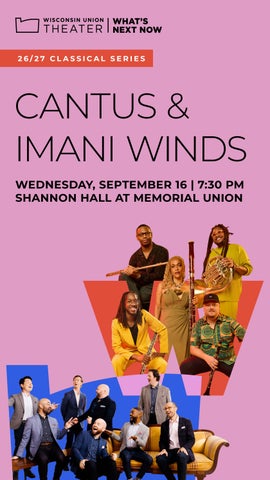
26/27 CLASSICAL SERIES
CANTUS & IMANI WINDS WEDNESDAY, SEPTEMBER 16 | 7:30 PM SHANNON HALL AT MEMORIAL UNION
Welcome to the Wisconsin Union Theater! Please silence all devices before the start of the performance. We appreciate your help in maintaining a quiet hall that is conducive to music-making and listening. Non-gendered and accessible restrooms are located outside the Shannon Hall entrance. Men’s and women’s restrooms are located down the stairs of the Shannon Hall lobby, and upstairs behind the balcony seating area. If you have questions about our spaces or accommodations we can offer to make your theater experience more comfortable, please ask an usher for assistance. Please note that photo or video recording is not allowed during the performance.
2
TABLE OF CONTENTS Click below to jump to a section: Wisconsin Union Directorate Performing Arts Committee. . . . . . . . . . . . . . . . . . . . . . 4 Program . . . . . . . . . . . . . . . . . . . . . . . . . . . . . . . . . . . . . . . . . . 5 Program Notes . . . . . . . . . . . . . . . . . . . . . . . . . . . . . . . . . . . 6 Artist Bio. . . . . . . . . . . . . . . . . . . . . . . . . . . . . . . . . . . . . . . . . 13 Donors. . . . . . . . . . . . . . . . . . . . . . . . . . . . . . . . . . . . . . . . . . . 17 Coming Up at the Theater. . . . . . . . . . . . . . . . . . . . . . . 19 Theater Staff. . . . . . . . . . . . . . . . . . . . . . . . . . . . . . . . . . . . . 21
3
PROGRAMMED WITH THE PERFORMING ARTS COMMITTEE The Wisconsin Union Directorate Performing Arts Committee (WUD PAC) is part of the Wisconsin Union Directorate, a student leadership development program central to the Wisconsin Union’s purpose of supporting students through community, connection, and belonging. WUD PAC plays a crucial role in curating the Wisconsin Union Theater’s annual season of performing arts. The students work closely with full-time advisors and mentors on building a season that offers artistic excellence, diversity, and community. Programming choices are inspired by students’ fresh ideas that challenge perspectives while also honoring what has paved the road to today and tomorrow. In addition to programming the Wisconsin Union Theater’s season, WUD PAC students are given their own budget to create and design original events. Staff advisors help them go from vision to execution over the course of the academic year, and students practice skills in fiscal responsibility, time management, decision making, community service, and much more. WUD PAC is open to any UW–Madison enrolled student, and it is free to join. Students interested in joining WUD PAC should email performingarts@union.wisc.edu or DM their Instagram account, @wudpac.
4
MY ANCESTORS SPEAK Valerie Coleman (b. 1970)
Red Clay & Mississippi Delta (2009)
Robert Lowry, arr. Stephen Caracciolo (1826–1899)
How Can I Keep from Singing? (1868)
Gloria Estefan, arr. Yosvany Estepe Diaz (b. 1957)
Mi Tierra (My Homeland) (1993)
Tōru Takemitsu (1930–1996)
Vocalise II from Wind Horse (1961)
Chen Yi (b. 1953)
Feng (1998) Introduction Rondo
Traditional, arr. Jeff Scott
Rocking Jerusalem
I NTERMISSION
Traditional, arr. Jeff Scott
Mr. Banjo
Miriam Likelike, arr. Marsha Schweitzer (1851–1887)
Kuʻu Ipo I Ka Heʻe Puʻe One (My Sweetheart in the Rippling Hills of Sand)
Angélica Negrón (b. 1981)
Left (text by Mara Pastor, trans. Carina del Valle Schorske) (2026)
Alex Weiser (b. 1989)
My Ancestors Speak (text by Anna Margolin, trans. Alex Weiser) (2026)
Balm in Gilead
5
PROGRAM NOTES MY ANCESTORS SPEAK In My Ancestors Speak, Alex Weiser sets two texts on Jewish heritage: a biblical genealogy and a Yiddish poem by American Rosa Lebensboym (known by her pen name Anna Margolin) that juxtaposes proud Old-World imagery with embarrassing relatives. Together, they show three distinct moods of ancestry that permeate this evening’s concert: the first ancient, religious, but esoteric; the second nostalgic and proud, but blinkered; and the third realistic, but all too human. As the composers grapple with their own cultural and musical inheritance, their ancestry provides by turns wisdom, strength, pride, and compassion.
VALERIE COLEMAN Red Clay & Mississippi Delta In the last decade, Valerie Coleman has been recognized as one of the top living American composers, winning commissions from The Philadelphia Orchestra, Carnegie Hall, the Metropolitan Opera / Lincoln Center Theater, the Library of Congress, and other prestigious organizations, and earning praise for deftly merging Western classical music with music of the Black community. But she has not always enjoyed such an abundance of opportunity: Innately entrepreneurial, she co-founded Imani Winds more than a quarter-century ago as a vehicle for performance and composition at a time when her identity-conscious style was often construed as too niche. Her short quintet Red Clay & Mississippi Delta (2009) combines “the idea of musical scherzo with living in the South,” according to the composer, in homage to her maternal heritage from the Delta region. Rather than borrow the classical form directly, the work’s lighthearted mood mirrors the humor of scherzo (which historically meant “joke”
6
in Italian), while the instruments wind through virtuosic “bluesy riffs” meant to recall the sonic iconography of the American South: juke joints, casino boats, and early jazz. Not shy about “wailing” runs, Coleman eschews nostalgia for realism in her take on musical ancestry.
ROBERT LOWRY “How Can I Keep from Singing?” (arr. Stephen Caracciolo) A product of the Second Great Awakening, during which evangelical camp meetings spread a revivalist spirit across 19th-century America, the Baptist minister Robert Lowry became the most prominent composer of the Sunday School movement. Lowry’s music combined the camp songs of his youth, with their characteristic refrains (or “choruses”) that allowed everyone to join in, with popular parlor song, helping pioneer gospel music (some academics now refer to this as “white gospel” to differentiate it from the better-known, spiritual-infused Black gospel). Compiled in Sunday School hymnals and popularized by gospel singer Ira D. Sankey, Lowry’s nostalgic music has become so widely known that it is sometimes considered American folk music—notably by Pete Seeger, who recorded “How Can I Keep from Singing?” As an emblem of shared Christian heritage, the song has opened up to wider reimagination. Here, choral conductor and composer Stephen Caracciolo eliminates the simple verse-chorus form, creating a more through-composed work. His arrangement gives special emphasis to the penultimate line, “Since love is Lord of heav’n and earth,” shifting Lowry’s message of faith through struggle to one of compassion and fellowship.
7
GLORIA ESTEFAN “Mi Tierra” ("My Homeland") (arr. Yosvany Estepe Diaz) “Mi Tierra,” the title track of Gloria Estefan’s third studio album—her first entirely in Spanish—has become an anthem for Latin American immigrants and especially the Cuban diaspora. In her version, the singer conveys nostalgic longing for her Cuban homeland, backed by a salsa band of horns, piano, and percussion that provides a sonic memento of dancing in pre-Revolutionary Cuban nightclubs. In this a cappella arrangement by Cuban American composer and music theorist Yosvany Estepe Diaz, the low voices keep the Latin rhythms going with the help of claves and hand shakers. In the context of the other hymns and spirituals on this concert, this reverent choral version adds an almost-religious gravitas as many voices come together to express the common, universal experience of loss and longing felt by immigrants living in a new land.
TŌRO TAKEMITSU Vocalise II from Wind Horse Takemitsu’s Vocalise II from Wind Horse—one of three “wordless” vocalises from this five-movement a cappella work—raises the question of whose ancestors speak. Almost entirely self-taught, the Japanese composer became a darling among the Western avant-garde of the mid-20th century, whose members valued his music’s emphasis on environment, silence, and indeterminacy. These features were not abstract inventions, however, but drawn from deep-rooted concepts in Japanese traditional music. Still, Takemitsu’s music was never simplistically Japanese either: The title Wind Horse, for example, refers to a ritual among Tibetan nomads who tie cloth to sticks and let the wind point the way to their next destination, an apt analogy for Takemitsu’s musical indeterminacy (he compared his approach to form to the discoveries of wandering in a
8
garden). Three quarters of the way through Vocalise II, after experimental sustained vowel sounds, the melody of the Bantu lullaby “Abiyoyo” emerges (the sub-Saharan African song was transcribed and disseminated by Pete Seeger in the 1950s, a possible source for Takemitsu). The beautiful, lulling tune—meant to ward off the evil monster Abiyoyo by chanting its name—becomes a serendipitous discovery of the abstract vocalism and, like the Tibetan ritual of the work’s title or the avant-garde aesthetics of the West, suggests that cultural resonances can transcend national identities, especially in the esoteric ears of an autodidact like Takemitsu.
CHEN YI Feng Chinese-born American composer Chen Yi showcases a bi-musicality that brings together Western classical music and Chinese music. She began learning violin and piano at a young age in Beijing but was sent to work on a farm as a laborer during the Cultural Revolution, where she only performed revolutionary songs publicly. After the Central Conservatory of Beijing reopened, she attended in 1977 before immigrating to the US for a doctorate in composition at Columbia University. According to Chen, “The character ‘feng’ in Chinese means ‘wind’ or ‘the winds,’ and also ‘view,’ ‘folk songs,’ ‘style,’ and ‘manner.’ I used the five standard Western wind instruments to sound the Eastern feeling of the winds in the quintet Feng.” Across the work’s two movements, Chen seems to hint at Chinese traditional instruments: The Introduction’s opening oboe line, which bends out of pitch at the end, resembles a hulusi, while unison pairings of the flute and oboe or flute and clarinet suggest a dizi, a transverse wooden flute with an internal membrane that adds a continuous reedy buzzing. Motivic repetition organizes the work, such as the undulating low voices of the Rondo that reappear in new transformations, following Western aesthetic ideals.
9
TRADITIONAL Three Spirituals (arr. Jeff Scott) A member of Imani Winds for two decades, French hornist, composer, and educator Jeff Scott writes what he calls “urban Classical music,” which “lives at the intersection of European classical traditions and African American cultural expression.” His arrangement of three spirituals for choir and wind quintet demonstrates this intersection. More than accompanying the choir, the wind quintet adds symphonic atmosphere, emotional depth, and commentary, transforming the spirituals into a mini-drama. The first expresses the joy of redemption; the second, in Cajun Creole, describes a proud “mulatte” (“mulatto”) who defiantly wears his hat askew and “struts like a millionaire”; and the last speaks to the restorative power of the Holy Spirit. Transformations like Scott’s have long shaped the history of spirituals. Prior to the American Civil War, so-called “folk spirituals” were disseminated orally in praise houses, camp meetings, and as work songs, and often were part of ring shouts—a West African ritual of spirit possession by the ancestors that merged with the Pentecostal belief in the descent of the Holy Ghost. After the Civil War, “arranged spirituals,” popularized especially by the Jubilee Singers of Fisk University, became choral-concert mainstays, although their hard edges were softened to fit Western classical conventions. By using the wind quintet to breathe a new spirit into these arranged spirituals, Scott returns them to their community of origin.
MIRIAM LIKELIKE “Kuʻu Ipo I Ka Heʻe Puʻe One” (“My Sweetheart in the Rippling Hills of Sand”) (arr. Marsha Schweitzer and Chris Foss) Hawaiian song (also called mele, although the Indigenous term has wider implications for chant, song, poetry, and hula) emerged as a genre in the middle of the 19th century that combined Sunday School hymnody from missionaries, popular 19th-century parlor song, and Hawaiian traditions.
10
Among the most prominent composers were members of the royal family known as “Nā Lani ‘Ehā” (“The Heavenly Four”): King David Kalākaua, Queen Lili‘uokalani, Prince William Pitt Leleiohoku, and Princess Miriam Likelike. In this song, arranged by longtime bassoonist of the Honolulu/ Hawai‘i Symphony Marsha Schweitzer and Cantus member Chris Foss, the lyrical focus on an absent lover combines the sentimentality of parlor song, the repeating chorus from Sunday School hymns, and the gentle, tasteful melody and harmony of mele. With references to the local landscape, it creates a nostalgic reverence for a place that was already undergoing a process of transformation from outside influences and the loss of Indigenous Hawaiian rule.
ANGÉLICA NEGRÓN Left (text by Mara Pastor, trans. Carina del Valle Schorske) Puerto Rican composer and multi-instrumentalist Angélica Negrón brings together electronic, Western classical, and Puerto Rican music into her own idiosyncratic synthesis, having composed music “for voices, orchestras, ensembles, and film as well as robots, toys, and plants,” as she stresses on her official website. Along with her activities as a composer—she has written works for the Los Angeles Philharmonic, Opera Philadelphia, and Roomful of Teeth, among many others—she also performs solo shows and co-founded the tropical electronic band Balún. She has provided production and arrangement for pop albums including Rosalía’s Lux. Themes of migration, absence, and belonging run throughout many of her works. Artists will provide additional notes from the stage.
ALEX WEISER My Ancestors Speak In this newly commissioned work that lends its name to tonight’s concert, Alex Weiser returns to what he considers his perennial themes: cultural inheritance, sanctity, and the
11
transience of life. A Pulitzer Prize finalist in music, he has written opera, chamber music, and orchestral works, and he advocates for new music throughout New York City, leading festivals and concert series. He also works as the director of public programming at the YIVO Institute for Jewish Research, a nonprofit organization dedicated to the study and recovery of Yiddish language and culture, and many of his works draw on that rich yet little-known literary canon. Artists will provide additional notes from the stage.
12
ARTIST BIOS CANTUS Samuel Bohlander-Green, Bass Jacob Christopher, Tenor Chris Foss, Bass Rod Kelly Hines, Baritone Alex Nishibun, Tenor Paul John Rudoi, Tenor Paul Scholtz, Tenor Jeremy Wong, Baritone Now in its 32nd season, the “engaging” (New Yorker) lowvoice ensemble Cantus is widely known for its trademark warmth and blend, innovative programming, and riveting performances of music ranging from the Renaissance to the 21st century. The Washington Post has hailed the Cantus sound as having both “exalting finesse” and “expressive power” and refers to the “spontaneous grace” of its music making. The Philadelphia Inquirer called the group nothing short of “exquisite.” As one of the nation’s few full-time vocal ensembles, Cantus has come to prominence with its distinctive approach to creating music. Working without a conductor, the members of Cantus rehearse and perform as chamber musicians, each contributing to the entirety of the artistic process, creating programs that give voice to shared human experiences. As the Star Tribune has written, “The main hallmark of the Cantus sound has always been sheer quality and an unbroken belief in the special way that vocal music has of warming and invigorating the human spirit.” Cantus enjoys a vigorous schedule of national and international touring, in addition to home concerts in Minneapolis-Saint Paul, Minnesota. Cantus has performed at Lincoln Center, the Kennedy Center, UCLA, San Francisco Performances, Yale's Schwarzman Center, Tanglewood, and Bravo! Vail Valley Music Festival. Cantus also makes all of its home concerts available online. This pandemic-prompted innovation has brought the ensemble’s programs to audiences spanning 50 states and 16 countries.
13
Cantus records for the UK-based Signum Classics label, which has released the popular COVID-19 Sessions, Manifesto, Fields of Wonder, Alone Together, the holiday album Into the Light, and, in August 2026, The Secret Letter. Cantus also has a deep catalog of recordings released on the group’s eponymous label. Committed to the expansion of the vocal music repertoire, Cantus actively commissions new music and seeks to unearth rarely performed repertoire for low voices. Cantus has received commissioning grants from New Music USA, the National Endowment for the Arts, Chorus America, American Composers Forum, and Chamber Music America. In 2023, Cantus was honored with the Alice Parker Fund Award from Chorus America that recognizes the exemplary work of an ensemble that respectfully and authentically presents works incorporating Black and Latinx traditions and experiences. In line with Cantus’ ongoing commitment to fostering new works for tenors, baritones, and basses, the ensemble has partnered with composer and former Cantus bass Timothy C. Takach and Graphite Publishing on the Cantus Choral Series, distributing Cantus’ signature arrangements and compositions for ensembles everywhere to perform and enjoy. Cantus has a rich history of collaborations with other performing arts organizations, including the Minnesota Orchestra, Saint Paul Chamber Orchestra, the Boston Pops, The King’s Singers, Chanticleer, the Swingles, the Canadian Brass, Sweet Honey in the Rock, Lorelei Ensemble, Theater Latté Da and the James Sewell Ballet. The ensemble is heard frequently on both classical public radio nationwide and on SiriusXM Satellite Radio. Integral to the Cantus mission is its commitment to preserve and strengthen music education in schools. Cantus works with more than 5,000 students each year in master class and workshop settings across the country and has been in residence in 31 Minnesota high schools throughout the 15-year history of their awardwinning High School Residency program. In the 2023-24 season, Cantus deepened its commitment to students by creating the High School Mentorship program, which offers Cantus artists in residence at one Twin Citiesbased high school for the entirety of the school year. Cantus has also broadened its work by launching a yearly, statewide festival in partnership with American Choral Directors Association Minnesota catered to high school
14
tenor and bass singers. Additionally, the ensemble hosts a biennial Cantus Commission Competition to encourage the creation of new repertoire through cash prizes, a performance, recording, and potential publication of winning composers.
IMANI WINDS Mark Dover, Clarinet Monica Ellis, Bassoon Brandon Patrick George, Flute Mekhi Gladden, Oboe Kevin Newton, French Horn Celebrating nearly three decades of transformative music-making, the GRAMMY®-winning and four-time nominated Imani Winds has led both a revolution and an evolution of the wind quintet. Known for their dynamic playing, adventurous programming, imaginative collaborations, and impactful outreach, they have inspired audiences of all ages around the globe. Imani Winds’ repertoire bridges the traditional and the contemporary, featuring core chamber works, reimagined arrangements, and newly commissioned pieces by both renowned and rising composers. Their programming reflects the urgency and diversity of our times, amplifying stories and voices too often left unheard. Their 2024 release, BeLonging, a collaboration with composer Andy Akiho exploring the issue of mass incarceration, earned a 2025 GRAMMY® nomination. Other recent highlights include a double quintet by Arturo Sandoval featuring Boston Brass; Jessie Montgomery’s work inspired by her great-grandfather’s migration north; and Carlos Simon’s tribute to African American icons. These works are part of the ensemble’s ongoing Legacy Commissioning Project, encompassing dozens of world premieres. Now in their 29th touring season, Imani Winds regularly appears on major chamber music series and at leading performing arts centers and summer festivals, including Carnegie Hall, The Kennedy Center, Chamber Music
15
Northwest, Banff Centre, and Chautauqua Institution. Internationally, their reach extends across Asia, Europe, South America, Australia, and New Zealand. Education is central to Imani Winds’ mission. Appointed in 2021 as the Curtis Institute of Music’s first ever Faculty Wind Quintet, they also lead residencies and masterclasses nationwide, reaching thousands of students annually at institutions such as the University of Chicago, Eastman School of Music, and Duke University. In 2010, they launched the Imani Winds Chamber Music Festival, an acclaimed summer program nurturing the next generation of professional musicians through mentorship, master classes, and entrepreneurial training. In 2019, they deepened their mission by founding the Imani Winds Foundation, followed by the creation of Imani Winds Media, a record label spotlighting artists of color. Its first release, Jeff Scott’s Passion for Bach and Coltrane, won a GRAMMY® in 2024. Imani Winds’ deep connection to jazz is reflected in collaborations with legends such as Wayne Shorter, Paquito D’Rivera, and Jason Moran. Their multidisciplinary project Josephine Baker: A Life of Le Jazz Hot! featuring jazz vocalist René Marie earned rave reviews in cities across the U.S. Their 2021 album Bruits (Bright Shiny Things) was nominated for a 2022 GRAMMY® Award for Best Chamber Music/Small Ensemble Performance. Gramophone praised the ensemble’s “hot rapport [that] churns with conviction throughout.” With recordings on Koch, Naxos, Blue Note, and Warner Classics, including a celebrated arrangement of The Rite of Spring and their 2006 GRAMMY®-nominated album The Classical Underground, Imani Winds is frequently featured on NPR, BBC, SiriusXM, and in publications such as The New York Times and The Philadelphia Inquirer. One of their most meaningful honors is a permanent installation in the classical music section of the Smithsonian National Museum of African American History and Culture, a fitting tribute to their enduring impact on the American musical landscape.
16
THANK YOU TO OUR GENEROUS DONORS Margaret Alferi & Eugene Kim
Rae Erdahl
Allisanne Apple
Evjue Foundation
Mohamed Bacchus
Deborah Fairchild
Jeanne Bell & Robert Bell
Hildy Feen
Bennett Berson & Rebecca Holmes
Jeffrey Fritsche & Carol Fritsche
James Bigwood & Jay Cha
Deirdre Garton
Brittingham Trust
Stephanie Golan & Alan Dean
Michael Brody & Elizabeth Ester
Michelle Gregoire & Tim Gregoire
Daniel Burrell Jr & Jenice Burrell
John Heaton Justin Hein & Paige Hein
Courtney Byelich & David Cober
Brent Helt John Hirsh & Lynnette Tenorio
James Carlson Charles Cohen & Christine Schindler
Seth Hoff Matthew Huston
Janet Cohen
Carol Hyland
George Cutlip
Arnold Isaacs & Kathleen Isaacs
Mary Crosby Dane Arts
Kate Kingery
Heather Daniels & Alan Hiebert
Diane Kostecke & Nancy Ciezki
André De Shields
Kathleen Kotnour
Kelly DeHaven & David Cooper
Iris Kurman & Seth Dailey
Mark Dettmann & Cathleen Dettmann
Lawrence Lieb
Jaimie Dockray & Brian Dockray
Christopher Louderback
Jonathan Lipp & Susan Lipp
Elizabeth Douma
Edward Manuel & Marian Holton-Manuel
Margaret Douma & Wallace Douma
J Gail Meyst Sahney & Vinod Sahney
17
Glenda Noel-Ney & William Ney
Richard Schwartz & Greta Schwartz
Nancy Oppenheim
Thomas Smith
Ann Pehle
Elizabeth Snodgrass
Lisa Pfaff
Polly Snodgrass
Nicholas Pjevach
Monica St Angelo & Mark Levandoski
Philip Raleigh & Jonathan Ament
Mark Stanley & Krista Stanley Andrea Stein
Jared Ramthun & Carly Ramthun
Andrew Stevens & Erika Stevens
M Thomas Record Jr & Voula Kodoyianni
Barbara Susman & Millard Susman
Deborah Riese
Kimberly Svetin & Todd Svetin
John Rothschild & Rachel Rothschild
Elizabeth Van Ness
Sharon Rouse
Rachel Waner
Ralph Russo & Lauren Cnare
Glenn Watts & Jane Watts
Peter Ryan
Kathleen Williams
Joshua Rybaski
Janell Wise
Morgan Sachs
Wisconsin Arts Board
Beth Schaffer & Steven Schaffer
Debbie Wong
Carol Schroeder
Donors as of June 2026
18
COMING UP IN THEATER THE POISONER* A play by M. M. Haney Developed & directed by Lee Sunday Evans Co-produced by Uncommon Productions and the Wisconsin Union Theater
October 8, 9, 10 | 7:30 PM Play Circle
ACADEMY OF ST MARTIN IN THE FIELDS CHAMBER ENSEMBLE November 20 | 7:30 PM Shannon Hall Program: Strauss, Korngold, Mendelssohn
CANADIAN BRASS December 4 | 7:30 PM Shannon Hall
Discounted tickets for students and Wisconsin Union Members at all performances presented by the Wisconsin Union Theater. *All ticket proceeds will go to the André De Shields Fund.
19
20
WISCONSIN UNION THEATER Elizabeth Snodgrass, Director Julie McDougall, Arts Business and Operations Specialist Kate Schwartz, Artist Services Manager George Hommowun, Assistant Director of Theater Event Operations Zane Enloe, Production Manager Jeff Macheel, Technical Director Heather Macheel, Technical Director Sean Danner, Assistant Director of Ticketing and Patron Services Drew Alvarez, Box Office Manager Ted Harks, Arts Ticketing Website Systems Administrator STUDENT STAFF Ava Conrad, Rentals Assistant Victoria Walker, Lead House Manager Matt Wisotsky, Bolz Center for Arts Administration Intern WISCONSIN UNION DIRECTORATE PERFORMING ARTS COMMITTEE Kalia Gordon, Director Lincoln Dillavou, External Relations Associate Director Josiah Jenkins, Programming Associate Director Lulia Ghidewon, Programming Associate Director Kai Kurokawa, Marketing and Outreach Associate Director Ava Conrad, Production Associate Director
Wisconsin Union Theater 800 Langdon St. Madison, WI 53706
608-262-2202 (Main Office) 608-265-ARTS (Box Office) theater@union.wisc.edu uniontheater.wisc.edu