Wisconsin Economic report Mixed Economy Will Continue in 2026
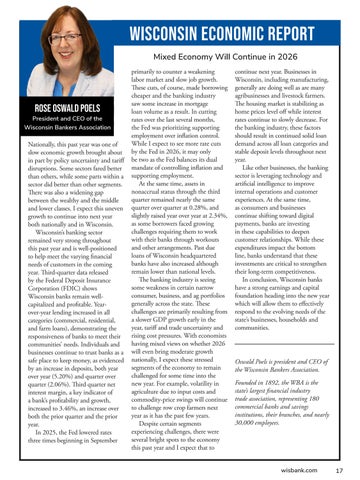
Rose Oswald Poels President and CEO of the Wisconsin Bankers Association
Nationally, this past year was one of slow economic growth brought about in part by policy uncertainty and tariff disruptions. Some sectors fared better than others, while some parts within a sector did better than other segments. There was also a widening gap between the wealthy and the middle and lower classes. I expect this uneven growth to continue into next year both nationally and in Wisconsin. Wisconsin’s banking sector remained very strong throughout this past year and is well-positioned to help meet the varying financial needs of customers in the coming year. Third-quarter data released by the Federal Deposit Insurance Corporation (FDIC) shows Wisconsin banks remain wellcapitalized and profitable. Yearover-year lending increased in all categories (commercial, residential, and farm loans), demonstrating the responsiveness of banks to meet their communities’ needs. Individuals and businesses continue to trust banks as a safe place to keep money, as evidenced by an increase in deposits, both year over year (5.20%) and quarter over quarter (2.06%). Third quarter net interest margin, a key indicator of a bank’s profitability and growth, increased to 3.46%, an increase over both the prior quarter and the prior year. In 2025, the Fed lowered rates three times beginning in September
primarily to counter a weakening labor market and slow job growth. These cuts, of course, made borrowing cheaper and the banking industry saw some increase in mortgage loan volume as a result. In cutting rates over the last several months, the Fed was prioritizing supporting employment over inflation control. While I expect to see more rate cuts by the Fed in 2026, it may only be two as the Fed balances its dual mandate of controlling inflation and supporting employment. At the same time, assets in nonaccrual status through the third quarter remained nearly the same quarter over quarter at 0.28%, and slightly raised year over year at 2.34%, as some borrowers faced growing challenges requiring them to work with their banks through workouts and other arrangements. Past due loans of Wisconsin headquartered banks have also increased although remain lower than national levels. The banking industry is seeing some weakness in certain narrow consumer, business, and ag portfolios generally across the state. These challenges are primarily resulting from a slower GDP growth early in the year, tariff and trade uncertainty and rising cost pressures. With economists having mixed views on whether 2026 will even bring moderate growth nationally, I expect these stressed segments of the economy to remain challenged for some time into the new year. For example, volatility in agriculture due to input costs and commodity-price swings will continue to challenge row crop farmers next year as it has the past few years. Despite certain segments experiencing challenges, there were several bright spots to the economy this past year and I expect that to
continue next year. Businesses in Wisconsin, including manufacturing, generally are doing well as are many agribusinesses and livestock farmers. The housing market is stabilizing as home prices level off while interest rates continue to slowly decrease. For the banking industry, these factors should result in continued solid loan demand across all loan categories and stable deposit levels throughout next year. Like other businesses, the banking sector is leveraging technology and artificial intelligence to improve internal operations and customer experiences. At the same time, as consumers and businesses continue shifting toward digital payments, banks are investing in these capabilities to deepen customer relationships. While these expenditures impact the bottom line, banks understand that these investments are critical to strengthen their long-term competitiveness. In conclusion, Wisconsin banks have a strong earnings and capital foundation heading into the new year which will allow them to effectively respond to the evolving needs of the state’s businesses, households and communities.
Oswald Poels is president and CEO of the Wisconsin Bankers Association. Founded in 1892, the WBA is the state’s largest financial industry trade association, representing 180 commercial banks and savings institutions, their branches, and nearly 30,000 employees.
wisbank.com
17