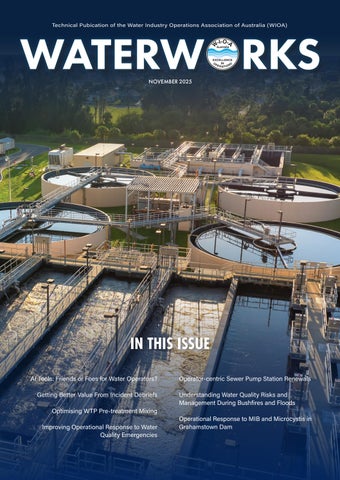
WaterWorks | November 2025

Page 1


WATERWORKS

IN THIS ISSUE

AI Tools: Friends or Foes for Water Operators?

Getting Better Value From Incident Debriefs

Optimising WTP Pre-treatment Mixing

Improving Operational Response to Water Quality Emergencies

Operator-centric Sewer Pump Station Renewals

Understanding Water Quality Risks and Management During Bushfires and Floods

Operational Response to MIB and Microcystis in Grahamstown Dam

MESSAGE FROM THE EDITORIAL PANEL

Welcome to the November 2025 edition of WaterWorks. Thisisthetechnicalpublicationof theWaterIndustry OperationsAssociationof Australia(WIOA)andisproduced bi-annually.

WaterWorks includes operationally focused articles and technical information and enjoys a wide distribution across the water industry.

Included in this edition is an editorial by David Sheehan (Senior Water Quality & Regulatory Advisor, Coliban Water, and member of the WaterWorks editorial panel) with some practical and pragmatic insights into the future use of artificial intelligence (AI) in the water industry.

A highlight of the November 2025 edition is the article by Netramani Sagar, Hanna May and Kathryn Linge (Chem Centre), who present the outcomes of a Water Research Australia (WaterRA) research project on the impacts of bushfires and storms/floods on source water quality. This included a survey of Australian water utilities and regional councils

to understand how risks to water quality are managed during extreme events. The survey asked respondents to assess current and future risk of extreme events to drinking water quality, rank water quality parameters in terms of highest concern, and describe their current management practices for bushfires and storms/ floods.

Additional operationally focused articles in this edition: Improving operational response to water quality emergencies, operatorcentric sewer pump station renewals, optimising mixing for coagulation and flocculation processes, response to an MIB and Microcystis event in a surface water reservoir and getting better value from incident debriefs.

Editorial Panel

Kathy Northcott, Technical SpecialistWater, Veolia ANZ

David Sheehan, Senior Water Quality & Regulatory Advisor, Coliban Water

Kerin Szemes, Water and Waste Water Treatment Plant Operator, Fitzroy River

Dean Barnett, CEO, WIOA

About this publication

WaterWorks is the technical publication of the Water Industry Operations Association of Australia (WIOA). It is published twice yearly. WIOA does not assume responsibility for opinions or statements of facts expressed by contributors or advertisers.

Advertising & Production

WIOA, PO Box 1080 Mountain Gate VIC 3156 | Email: info@wioa.org.au

Website: wioa.org.au

Contributions Wanted

WaterWorks welcomes the submission of articles relating to any operations area associated with the water industry. Articles can include brief accounts of one-off experiences or longer articles describing detailed studies or events. Submissions may be emailed to: info@wioa.org.au

AI TOOLS: FRIENDS OR FOES FOR WATER OPERATORS?

Virtually not a day goes by without another news article being published about how AI will deliver us all a bright future, or, alternatively, will bring about the end of civilisation as we know it. So, in amongst all hype and the doom-and-gloom, what it is the likely impact of AI tools on water operators; will it be good, or will it be bad?

Right up front, I would like to state that I don’t have a background in IT, and I am also not a data scientist, so I am very much coming from the perspective of an operational user of these tools.

A very simplified explanation of AI Tools is that they are typically very large databases that, when queried, or asked a specific question, use sophisticated algorithms to produce a detailed answer to that question. These algorithms are usually based on what are known as large language models (LLMs) that look for patterns in the data within the database to produce answers. Not surprisingly, the quality of the answer is highly dependent on the quality of the data in the database, and on how “clever” the algorithm is.

As a very simple example, say you wanted an AI tool to write you a poem about much your dog likes going to the beach, and the

first AI tool you use has a database that contains poems from a hundred books of poetry. It might produce a reasonable poem. Then you use a second tool that has a database that contains poems from two thousand books of poetry; the expectation would be that you should get a betterquality poem from this tool. The other option, of course, is that you could just pay a poet $200 to write the poem (or do it yourself).

A strong contender for a future wordof-the-year is “workslop”, which is the term that is being used for some of the AI content that is being generated. There are recent examples where some firms have been using AI tools to write sections of reports, and outputs have contained references to books that have never existed, or unknown authors. This just reinforces the old saying rubbish in, rubbish out. A fun game is to type in a question about a subject that you know a lot about and see what you get back. Sometimes, the answers are really good; sometimes they can be quite amusing.

This obviously paints a rather dim picture of AI tools, but I have been lucky enough to see some demonstrations of some

really cool water-industry specific AI tools that, for example, can be used to model or predict the impact of water network shutdowns on various customers across the network, or model likely sites for sewage spills within wastewater networks. The reason that they tend to be good tools is because they are underpinned by very industry-specific algorithms and have been trained on relevant datasets.

So, what does any of this mean for a water operator?

It can be predicted, with a reasonable level of confidence, that for the foreseeable future that the job of a water corporation will remain the harvesting of raw water, treating it to a drinking water standard, piping it to customers, collecting it as wastewater, and then treating it again.

AI tools might provide information on when a pump might fail, but it will be an operator who will be out there fixing it. These tools may also predict when a water main might fail, but, again, it will be an operator out there repairing the main on a Saturday afternoon.

AI tools definitely have an important place in the future of the water industry, they will help operators do their jobs more efficiently, and they will also provide greater insights into the vast amounts of data the water industry produces, but they will not replace manual tasks that can only be completed by capable operators.

The final cautionary notes are that there needs to be a level of understanding of what information the AI tools that are being used have been trained on, as that will help provide a level of confidence in the answers provided by the tool, and that, at the moment, AI tools cannot replace good critical thinking about an issue; only capable water operators can provide that.

NEON ® ONE

Reagentless Free and Total Chlorine Measurement with pH Compensation

The NEON® ONE platform is a versatile and intelligent water quality monitoring system, designed for precise measurement, seamless automation, and real-time data access. Whether drinking water, swimming pools, industrial water treatment, or process control, NEON® ONE delivers reliable and scalable solutions tailored to your application. With its modular architecture, NEON® ONE allows flexible sensor integration, multiple communication options, and advanced automation functions – ensuring efficiency, accuracy, and ease of operation.

Features:

 Wide Parameter Coverage – Supports free chlorine, total chlorine/biocides, pH, ORP (Redox), conductivity, sulfite and flow & temperature (FT) to meet diverse application requirements

 Sensor Calibration & Automated Validation

 Minimal Maintenance with ASR® Cleaning

 High-Precision Sensor Technology

 Expandable to include external sensors

Applications:

 Industrial and Process Water

 Drinking Water

 Food and Beverage

 Swimming Facilities

GETTING BETTER VALUE FROM INCIDENT DEBRIEFS

Sallyanne Bartlett,WaterQPlus,Bendigo,Vic,Australia

Marty Hancock,WaterRA, Adelaide, SA, Australia

Introduction

Water Research Australia (WaterRA) identified a need for research into the critical decision-making (CDM) processes used by water industry operators in challenging situations, such as emergency and incident response. This is an area of the Australian water industry that has received little attention, despite a growing body of evidence indicating the influence of human factors on water quality incidents.

Hence, the initiation of the Lessons from Experienced Operators project. This was an industry funded research project managed through WaterRA. The project aimed to capture the experience of water industry operators, to understand CDM processes used by operators when faced with emergency and incident scenarios.

Using tried and tested CDM models to describe frontline worker critical reasoning, the project developed tools and training guidance to:

• capture operator stories,

• develop case studies, and

• generate training resources which could be used to share lessons learned from

incident debrief sessions, as well as develop operator CDM.

Background theory and models

For this work a modified decision ladder (DL) Template critical reasoning model has been used (Figure 1), which shows the decision-making activities an individual moves through when encountering a challenging situation.

Figures 1 and 1a show the modified DL Template, with the ‘state of knowledge’ (i.e. the already learned and ‘known’ information) shown as ovals, and the ‘processing of new information’ as rectangles. The modified DL Template decision-making process starts with situation analysis, moves through knowledge-based reasoning at the top, and then down the righthand side (planning and execution), as shown by the arrows.

The modified DL Template is further supported by three decision-making models, as shown in the following figures:

• Situation analysis - This study applied the three-level model of situation analysis, used previously in studies

relating to field and control room operators (Figure 2).

• Knowledge-based reasoning –Three levels of reasoning - skills, rules, knowledge (SRK) model, shown in Figure 3.

• Planning and execution - This study looked at a planning and execution model for rapid response scenarios. Responders will adapt their hierarchy of control (incident control, frontline, small teams) across three simultaneous activities: leadership, accountability, and communication (Figure 4).

The Lessons from Experienced Operators project Literature Review

The first phase of the project involved a background literature review of the CDM theory (see Figures 1 to 4). Following this, a desktop review of international and Australian water industry literature was carried out to describe:

• Real-world international examples of frontline workers’ CDM.

• Selected examples were presented to demonstrate the decision-making

Figure 1 and 1a: Modified Decision Ladder (DL) Template (Lilburne 2019)

Class Instructions

Sweep 1 - Incident Identification

Sweep 2 - Timeline & decision points

Sweep 3 - Deepening

Sweep 4 – ''What if" queries

• Identify an incident

• Ask for an overview

• Repeat back the incident

• Construct a timeline

• Record decision points, major events

• Ask clarifying questions

• Ask questions to understand the incident

• Use the timeline for clarification

• Repeat back comments

• Use ‘what if’ questions

• Ask what another person might have done

• Ask what mistakes might have been made

Table 1: Critical decision-making interview template.

Listen for

An incident where the participant played a clear role

Aha! moments, gaps in the story, gaps in the timeline, anomalies Flags: I just knew, It felt right, I guess, Something felt wrong, Ive seen it before

Critical cues, implications of things noticed, strategies, anomalies

• Other possible courses of action

• Difference between expert and novice

• Possible errors

• Critical cues, implications of things noticed

Figure 3: Three levels of reasoning, SRK, Embrey (2005).
Figure 4: Planning & execution, activities and modes of organising, adapted from Schakel and Wolbers (2019).
Figure 2: Three levels of situation analysis, (Endsley, 1995).

process and the human factors that supported or hindered the outcomes.

• Australian water industry case study examples were then presented in the context of the decision-making models.

Operator Critical Decision-making (CDm) Interviews

The second phase of the project involved a series of interviews with experienced water industry operators. From the interviews, the aim was to gain ideas and perspectives on how operators acquire and apply skills, knowledge, and experience on the job.

A CDM interview technique was used to conduct the interviews (Table 1) and Qualitative Data Analysis (QDA) was used to interpret the content of the transcripts based on the decision-making models.

This phase of the project resulted in the creation of a case study template and the presentation of example case studies. This was to illustrate the effectiveness of operational knowledge capture and knowledge transfer using the CDM interview and QDA coding technique.

Developing Case Studies

The final phase of the project involved the development of a case study and training resource guidance report. This included how to use the CDM interview technique, such as for incident debrief and lessons learned sessions, as well as QDA analysis and interpretation of interview notes and transcripts. Also included was how to adapt the QDA coding technique to create case studies using the case study template.

Finally, the project produced a guide on how to use the case study template. Case studies can then be used as training resources. These training resource tools and templates are presented as Appendices in the training guidance report.

Example Case study from CDm Interview

The case of the pesky crystals

This case study was developed from an Operator CDM Interview, contextualised to the knowledge -based reasoning area of the modified DL Template.

Overview

An area supervisor was sent to investigate an after-hours alarm

On-call operator received a plant critical alarm. They knew the problem was serious, but could not attend due to another plant issue, and referred the alarm to the area Supervisor.

The Supervisor knew due to hot weather there would be a high demand for water.

The Supervisor decided to turn the plant on to see what was happening.

The Supervisor decided that there was a problem they couldn’t solve on their own, and turned the plant off and then contacted the duty operator.

The duty operator knew from history that there was a potential blockage, and a hot water flush of the system was required.

[After reinstating the alum dosing system] the duty operator checked the clarifier to make sure it was not beyond recovery.

To restart the plant the duty operator reduced the plant flow rate to minimise the impact on the clarifier if the pH remained high.

Once the plant was running again a drop-down test against the flow confirmed the dose rate was correct.

Continued to monitor the plant before leaving the site; once at home continued to monitor it remotely in case there were any further issues with the system.

indicating a drinking water treatment plant had shut down due to high dosed water pH to the clarifier. The supervisor was called because the on-call operator was already busy addressing a problem at another plant. After several failed attempts to reinstate the onsite pretreatment alum dosing system, it became clear to the supervisor that they would need expert operator assistance to solve the alum dosing problem.

The supervisor contacted the operator who was usually on-duty during working hours at that site (i.e. the duty operator). Working as a team, the supervisor and the duty operator quickly established that the alum dosing system was blocked with crystals. They worked together to perform a hot water flush and reinstated the dosing system in a manner that protected the clarification process.

The supervisor and duty operator remained on site to monitor the process to ensure that it was operating effectively. After leaving site, with the understanding the on-call operator was still addressing a major issue at another site, they both monitored the water treatment plant remotely, overnight, to ensure a quick response if further issues emerged.

Projected future state.

Potential future state(s).

Generate options. Rule-based behaviour.

Select options.

Knowledge-based behaviour, rule-based behaviour.

Select options. Knowledge-based behaviour.

Gaps, and priorities that need addressing, generate options. Knowledge-based behaviour.

Select options. Knowledge-based behaviour.

Assess against goals. Skill and rule-based behaviour.

Assess against goals. Skill and rule-based behaviour.

Table 2: Timeline and Decision points - mapping operator knowledge and actions to knowledge-based

Timeline & Decision Points

Table 2 is a summary of the key timeline events as discussed in the CDM interview, contextualised according to the modified DL Template – knowledgebased reasoning (KBR).

Discussion of the incident

Factors identified as supporting KBR was the supervisor’s site-based knowledge and understanding of the assets ‘I didn't want to go any further [with the initial troubleshooting actions]. Because I knew I would turn the clarifier over, which would, take us hours to repair’

The three operators involved in the situation all knew the criticality of the situation they faced. They knew the hot weather at the time created a huge water supply demand, and there was only a limited time that the plant could be shut down before treated water storages would be critically low. This knowledge supported their ability to project future states, be aware of potential future states, and assess these for acceptability against goals.

This situation demonstrates the importance of having confidence in your team culture. The criticality of this support is highlighted in the statement ‘it was a good team effort that [the duty operator] was able and willing to answer the phone and come back in after he'd finished for day. And I was much appreciative of his extra knowledge of the specifics of this site’.

Lessons Learned

The supervisor highlighted a less experienced operator probably would have tried more times to restart the plant. In doing so, this would have allowed more out of specification water to

enter the clarifier that may have led to the complete loss of the clarifier. The supervisor’s experience allowed for the quick assessment of the situation to determine that the corrective action was not working and to immediately shut the plant down.

The duty operator emphasised the importance of training less experienced operators about watching trends to predict operational performance.

In the CDM interview the duty operator discussed the value of a learning environment that allows for new operators to start applying their troubleshooting, problem-solving and critical thinking skills at a water treatment plant that is reasonably robust and forgiving.

Conclusion

The Lessons from Experienced Operators project has developed a method for capturing experienced operator stories, which can be used develop CDM case studies that demonstrate how to interpret a workplace emergency or incident scenario by the key decisions made.

The format of the case study template allows an operational situation to be examined through a framework based on known, tested, and verified decisionmaking models that have proven useful across many industries. Case studies can be developed into training resources, offering a way for trainers to engage learners in real life workplace scenarios, demonstrating the link between theory and formal training to workplace practical experience. They illustrate the CDM skills, and the type of decisions

experienced that operators are required to make during emergencies and incidents.

References

Embrey, D. (2005) Understanding Human Behaviour and Error. Human Reliability Associates.

Endsley, M.R. (1995) Towards a theory of situation awareness in dynamic systems, Human factors, 37(1), 32-64.

Lilburne, C. M. & Hassell, M. E. (2019) Modifications to the Decision Ladder to match frontline workers’ critical decision making. Proceeding of the Human Factors and Ergonomics Society 2019 Annual Meeting.

Schakel, J. K., & Wolbers, J. (2021). To the edge and beyond: How fast-response organizations adapt in rapidly changing crisis situations. Human Relations, 74(3), 405-436.

Further Information

The full report for WaterRA project 1139 - Water Operations Technical Competency Benchmark and the training resources mentioned this article are available to members organisations on WaterRA’s website.

OPTIMISING WTP PRE-TREATMENT MIXING POWER INPUTS BY REFERENCE TO THE G-VALUE

Overview

This article will help you optimise water treatment plant (WTP) coagulation and flocculation performance and energy consumption by using the mean velocity gradient (G-value) as a mixing power reference for full scale operation or jar testing assessments.

WTp pre-treatment processes

WTPs are most effective at removing turbidity, colour, and natural organic matter if the contaminants are bound into solids that can be settled, floated, or filtered out. The sequential processes of flash mixing (chemical addition for charge neutralisation) and flocculation (agglomeration of small particles into larger ones) are used to bind particles and capture colloidal and soluble contaminants at most WTPs.

The g-value as a measure of mixing power input

The selection of appropriate power input is very important for flash mixing and flocculation.

For flash mixing - power input that is too low reduces mixing performance, which can adversely affect coagulation and increase chemical consumption. Power input that is too high wastes energy.

For flocculation - power input that is too low can inhibit floc formation. Power input that is too high can break flocs. Both conditions usually have a negative impact on filter performance and hence filtered water quality.

The G-value (mean velocity gradient) is a measure of mixing power intensity. It is calculated as Power per unit Volume, corrected for fluid viscosity, with a square root thrown in for good measure (Figure 1).

To calculate the G-value for a tank with a mixer installed, you’ll need to know:

• The mixing power (in Watts). For the calculation to be accurate, P should be the power the mixing blade is imparting to the water. This may be significantly less than the input power to the motor, particularly for small motors with high ratio gearboxes, which are commonly used in flocculators.

• The water temperature. Use a reference book or an internet search to look up the viscosity of water at your measured temperature. There are a number of different units of viscosity in common use, so make sure you use a value in Pascal seconds (Pa.s). Viscosity will be about 0.001 for water at 20 °C, higher if the temperature is colder than 20 °C (more viscous) and lower if the temperature is warmer than 20 °C (less viscous).

• The tank volume (in cubic metres). The depth from the tank invert to the overflow weir crest usually provides a sufficiently accurate water depth estimate, to multiply with your tank surface area to calculate volume of the mixing chamber.

How much power is going into the water?

There are a few ways of estimating the shaft power of the mixers installed:

Method 1: Ask the propeller supplier

For flash mixers you can often contact the supplier of the propeller and ask for data showing the relationship between the propeller rotation rate and the power imparted to the water. This is by far the easiest and most accurate method of estimating the shaft power. If your flash mixer is geared down – which they often are for larger diameter tanks – remember to use the propeller shaft speed, not the motor speed.

For flocculators, the paddles are usually heavily geared down, are often custom made and may look like picket fences or rakes rather than traditional propellers. You may need to use one of the other methods to estimate the shaft power in this case.

Method 2: Use power readings from the starters in the motor control centre (MCC)

Figure 1: The formula for the g-value.
Figure 2: The power Number equation.

Depending on the type of motor starters you have, you may be able read motor current or power directly from the starter. Motor power readings are usually accurate enough for relatively powerful, fast rotating, direct drive flash mixers, but can significantly overestimate shaft power for low powered, heavily geared flocculators.

Method 3: Use a clamp meter (tong tester)

If you can’t read the motor current straight from the starter, you may be able to measure it from the power cables while the motor is running. As for Method 2, this method may significantly overestimate the shaft power for low powered, heavily geared flocculators.

Method 4: Use the power number equation based on the shape of the propeller

If you’re mathematically inclined, you can use the power number equation for propellers (see Figure 2).

Method 5: Use the drag equation for flocculator paddles

If you have custom made picket fence type flocculator paddles, you can use the drag equation to estimate the power imparted to the water by each component

of the paddle. This is mathematically quite complex, so we haven’t described this method in this paper. You may prefer to use one of the simpler methods described above instead.

Sample calculations of g-values

Let’s look at an example of a WTP with the following characteristics:

• Maximum instantaneous feed flow: 50 ML/day (2083 m3/hr, 579 L/s feed on 24-hour basis)

• Water temperature: 20 °C, viscosity 0.001 Pa.s

• Flash mixing: single 20m3 tank, 22kW (motor power) variable speed mixer

• Flocculation stage 1: six trains of 60m3 each, each with 1.1kW (motor power) variable speed paddle flocculator

• Flocculation stage 2: six trains of 60m3 each, each with 1.1kW (motor power) variable speed paddle flocculator

Flash mixer g-value calculation

Let’s say the propeller supplier advised us the power absorbed by the flash mixer at 50Hz is 18.4kW. The supplier also gave us some shaft power data at reduced speeds (see Table 1).

Figure 3 gives the G-Value calculation for the flash mixer, where G - 959 s-1

The detention time in the flash mixing tank at peak feed flow (2083m3/hr) is 20m3 / (2083m3/hr) = 35 seconds.

A reputable reference for WTP design, Water Treatment Plant Design (AWWA 2005), recommends a velocity gradient (G) of 600-1000s-1 be sustained for a period of 10-60s for flash mixing. So, our calculated detention and G-value are consistent with the design guidelines.

The detention time in the flash mixin (2083m3/hr) = 35 seconds.

A reputable reference for WTP desig recommends a velocity gradient (G) of flash mixing. So, our calculated dete guidelines.

However we may want to try reducing power consumption, and improve plant energy efficiency, by testing the flash mixer in service at G = 600s-1 rather than 1000s-1.

However we may want to try reducin efficiency, by testing the flash mixer in s

In this case, 600 = √ ���� 0 001 20

P = 7200W = 7 2kW

P = 7200W = 7.2kW.

If G=600s-1 proves effective in service, the supplier’s data for the propeller suggests we could reduce the flash mixer speed to about 36Hz, and save 11.2kWh per hour, all day every day.

Flocculator g-value calculations

Now for the flocculator, let’s say we read the shaft power from the flocculator VSD at 50Hz at 900 W. We know the shaft power is proportional to the cube of flocculator speed, so we can calculate shaft

Figure 3: Flash mix
Figure 3: Flash mixer g-value calculation example.
Figure 4: Flocculator g-value calculation example

power at reduced speeds (see Table 2).

Figure 4 gives the Flocculator G-Value calculation, where G - 122 s-1

The detention time in each of the six 60m3 flocculation tanks at peak feed flow (2083m3/hr) is 6 x 60m3 / (2083m3/hr) = 10.4 minutes.

For flocculation, AWWA (2005) recommends a velocity gradient (G) of 20-70s-1 be sustained for a period of 10-30min. Commonly, declining G-values are used in successive flocculation stages. For example G = 60, 45, 30 s-1 for three sequential stages or G = 50, 25 s-1 for two sequential stages.

Our calculated G-value (Figure 4) is higher than the AWWA (2005) design guidelines, so we could try reducing the flocculator speed to achieve 50s-1 for the first stage of the two-stage system.

If G=25s-1 proves effective in service, the shaft power data for the flocculator suggests we should run the motor at about 18Hz.

If the calculation is below the recommended speed for the motor, we may need to increase the gearbox ratio to decrease the flocculator speed at the minimum motor speed or run the stage 2 flocculator at G=31s-1 at 58W shaft power at 20Hz to avoid changing the gearbox.

To further optimise the flash mixer and flocculators, conducting laboratory jar testing with equivalent G-values and detention times could also be trialled.

Conclusions

The mixing power optimisation approach:

1. Gather technical information about your pre-treatment systems to enable you to calculate detention times and mixing power inputs for the full-scale plant.

2. Assess the need to adjust mixing of flash mixers and flocculators in the full-scale plant, to improve coagulation or flocculation performance and/or energy efficiency.

3. Compare the G-Values of your jar testing method, to make sure you accurately simulate the full-scale plant mixing conditions.

References

For flocculation, AWWA (2005) recommends a velocity gradient (G) of 20-70s-1 be sustained for a period of 10-30min Commonly, declining G-values are used in successive flocculation stages For example G = 60, 45, 30 s-1 for three sequential stages or G = 50, 25 s-1 for two sequential stages.

Optimising the mixing of your pretreatment (coagulation and flocculation) systems is important for:

Water Treatment Plant Design, American Water Works Association, 2005.

Our calculated G-value (Figure 4) is higher than the AWWA (2005) design guidelines, so we could try reducing the flocculator speed to achieve 50s-1 for the first stage of the two-stage system.

For flocculation, AWWA (2005) recommends a velocity gradient (G) of 20-70s-1 be sustained for a period of 10-30min Commonly, declining G-values are used in successive flocculation stages For example G = 60, 45, 30 s-1 for three sequential stages or G = 50, 25 s-1 for two sequential stages

In this case, 50 = √ ���� 0 001 60

P = 150W

P = 150W

• Ensuring you achieve the best coagulation and floc formation,

• Improving dissolved metals and organics treatment in raw water,

Our calculated G-value (Figure 4) is higher than the AWWA (2005) design guidelines, so we could try reducing the flocculator speed to achieve 50s-1 for the first stage of the two-stage system.

If G=50s-1 proves effective in service, the shaft power data for the flocculator suggests we should run the motor at about 28Hz.

• Enhancing filter performance,

If G=50s-1 proves effective in service, the shaft power data for the flocculator suggests we should run the motor at about 28Hz.

In this case, 50 = √ ���� 0.001 . 60

• Improving energy efficiency of your treatment plant.

For the stage 2 flocculators, we could further reduce the motor speed to achieve 25s-1.

P = 150W

In this case, 25 = √ ���� 0 001 60

For the stage 2 flocculators, we could further reduce the motor speed to achieve 25s-1

If G=50s-1 proves effective in service, the shaft power data for the flocculator suggests we should run the motor at about 28Hz.

P = 38W

For the stage 2 flocculators, we could further reduce the motor speed to achieve 25s-1.

If G=25s-1 proves effective in service, the shaft power data for the flocculator suggests we should run the motor at about 18Hz

In this case, 25 = √ ���� 0 001 60

P = 38W

P = 38W

If the calculation is below the recommended speed for the motor, we may need to increase the gearbox ratio to decrease the flocculator speed at the minimum motor speed or run the stage 2 flocculator at G=31s-1 at 58W shaft power at 20Hz to avoid changing the gearbox

If G=25s-1 proves effective in service, the shaft power data for the flocculator suggests we should run the motor at about 18Hz.

To further optimise the flash mixer and flocculators, conducting laboratory jar testing with equivalent G-values and detention times could also be trialled

If the calculation is below the recommended speed for the motor, we may need to increase the gearbox ratio to decrease the flocculator speed at the minimum motor speed or run the

Table 1: Shaft power data from mixer supplier.
Table 2: Calculated shaft power vs speed.

25-26 March, 2026

2026 VIC Water Industry Operations Conference & Exhibition

Bendigo Exhibition Centre, VIC

24-25 June, 2026

2026 QLD Water Industry Operations Conference & Exhibition

9-10 September, 2026

2026 NSW Water Industry Operations Conference & Exhibition

Newcastle Racecourse, NSW

Gold Coast Sports Precinct, QLD

BEGINNING WITH THE END IN MIND: OPERATOR CENTRIC SPS RENEWALS

Introduction

Renewals projects are commonly viewed as necessary for one of two reasons: the need to replace infrastructure at the end of its design life, or the need to upgrade assets to meet increased capacity demands. However, renewal projects also present a valuable opportunity to reassess site conditions and incorporate improvements in safety, operability, and accessibility.

A future-ready asset begins with a clear understanding of its intended function. Therefore, beginning with the end in mind is key to any asset improvement we do. Designers must go beyond simply applying standards - they need to consider how the asset will perform under real-world conditions, particularly during extreme events. Building resilience into the design is essential to ensure long-term functionality and reliability.

managing growth and renewals

The City of Logan is experiencing rapid growth, with greenfield expansion and brownfield redevelopment placing increasing pressure on Logan Water’s existing infrastructure. Much of the brownfield network, built during Australia’s post-war boom (1960s–1980s), is now approaching the end of its design life. This convergence of ageing assets and new development demands has created what’s often referred to as the ‘infrastructure cliff’.

To continue delivering reliable water and wastewater services, while funding new infrastructure, Logan Water needed to rethink its approach to renewals. Enter the Logan Water Partnership—a collaboration between Logan Water, Downer, WSP, and Stantec—established to deliver future-ready infrastructure that is aligned with the city’s sustained growth. Now celebrating 15 years, the partnership has evolved to deliver not

only technical excellence, but also broader community and operational benefits.

An operator-centric philosophy

Logan Water’s partnership model spans the entire asset lifecycle, fostering collaboration across disciplines that traditionally operate in silos. One of its most valuable outcomes has been bridging the gap between textbook design and operational practicality.

Asset engineers and designers, working closely with the Logan Water operations and maintenance personnel, have ensured the root cause of a problems is understood and addressed, not just the effect or symptom. This engagement ensures design efforts are targeted where they matter most, supporting routine and reactive maintenance. The insights of operators allow for smart and safer solutions that directly addresses concerns of the end user.

Figure 1: Spanns Road pump Station layout.

Operator-centric case study

The Spanns Road Sewage Pump Station (SPS) is a terminal facility that was (initially) within the Beenleigh wastewater catchment, conveying flows directly to the Beenleigh Wastewater Treatment Plant (WWTP). This SPS is a 14.2m deep, 9.5m diameter wet well, with an ultimate capacity of 380L/s, which was constructed in 2007 (refer to Figure 1).

Due to capacity constraints at the Beenleigh WWTP, a new transfer strategy was developed to redirect flows from the Spanns Road SPS to the Loganholme WWTP - supporting a more centralised treatment approach for much of Logan’s sewerage catchment.

A renewals-based study was undertaken to identify the upgrades required to enable this

redirection. The design process was shaped by close collaboration with operational staff, ensuring the solution addressed real-world challenges. This partnership approach enabled the integration of operator-focused enhancements, delivering practical, safe, and efficient outcomes.

Operational Resilience

Inlet hydraulics:

The previous inlet structure was designed with an encased dropper pipe, leading to a central hollow column, which discharged the flow out each side in a direction parallel to the pump line (refer to Figure 2). This arrangement did not promote a smooth flow profile to the cycling duty pump, which increased the chance of air entrainment, poor performance and blockages. These risks were all exacerbated as it is a terminal

pump station receiving a high level of grit and rags.

To address these issues, the inlet was redesigned with a dropper pipe that delivers flow axially to the pumps, allowing for the integration of a knife gate valve within the wet well.

Computational Fluid Dynamics (CFD) modelling and a review of operating levels were used to optimise the design and mitigate risks commonly associated with drop structures, such as odour generation.

Flow balancing:

As a function of the flow diversion, with multiple pumps now pumping to a common inlet at the WWTP, a single flowmeter at the discharge point was no longer feasible. The previous methodology involved cross checking the existing flowmeter at the discharge end against the wet well levels and pump operation in SCADA – this introduces unnecessary risks. As a result, a new flowmeter was installed at the pump station, providing the ability for instantaneous flow balancing and flow pacing to optimise system wide pumping.

Bypassing and Isolation:

The existing pump station setup had an emergency bypass connection point; however, it required confined space entry inside the valve chamber for operation and connection. It also warranted a significant length of pipework, as it was not near the nominated bypass pump setup position.

Contingency planning was undertaken to develop a preferred bypass strategy. As a result, the proposed solution was to cut in a new bypass connection to the rising main downstream of the valve chamber, with a buried bypass line back to where the bypass pumps would be set up. The new bypass connection point provided safe access for operators at ground level and removed any requirement for confined space entry when bypassing was occurring.

maintainability and Accessibility

Flood levels:

To address climate-related risks, flood modelling was updated and contingency scenarios were workshopped to guide

Figure 4: Cover upgrades.
Figure 2: Spanns Road pump Station Inlet. Figure 3: Schematic of WATSOL Sewer Comb section view.

infrastructure placement and redundancy measures. Fortunately, the wet well’s top slab sits above the 1% Annual Exceedance Probability (AEP) level, providing inherent flood resilience. The switchboard location was revised, and a termination box was added adjacent to the wet well to manage pump cables more safely. This simple addition significantly reduces manual handling risks during pump removal.

Emergency overflow relief:

Historically, the emergency overflow screening structure for this catchment was located within a Queensland Rail corridor, limiting access during critical events. To eliminate this operational risk, a new screening device, with dedicated access, was integrated into the pump station design. Traditional static screens require manual cleaning post-event, which is labour-intensive and unpleasant.

To improve safety and efficiency, a selfcleansing screening device - the WATSOL Sewer Comb, supplied from Drapper Environmental Consultants (refer to Figure 3), was installed in a nearby upstream maintenance hole. This system uses static combs and a hydrostatically actuated ball valve to capture solids during overflow events. Once flows subside, the retained

material is conveyed back to the WWTP inlet screens, reducing operator workload and environmental impact.

Lifting:

The existing monorail crane was at the end of it’s design life, and did not have the lifting capacity to cater for the new ultimate sized pumps. Rather than a like for like replacement, a new jib crane was installed for increased functionality.

Access covers:

The original access cover setup relied on rope netting as fall from heights risk mitigation. This was a significant deficiency which was addressed with modernised replacements (refer to Figure 4).

The existing covers, and the opening of the wet well and chambers, were designed to cater for a four-pump solution. Following a review of the future hydraulic requirements, two pumps were adequate in a duty/standby configuration, meaning the openings were effectively oversized. Logan Water worked with a local supplier, Mass Products, to develop a tailored solution to minimise the size of the opening, using fixed panels to minimise the size of the hinged opening to reduce manual handling and fall from heights risk exposure. Pump cable hooks

were also relocated to the suitably designed frame, based on operator pump lifting procedures.

Operator and Public Safety:

The Spanns Road SPS is situated in open parkland, adjacent to residences (refer to Figure 5). To provide a safe working environment and reduce public exposure to site risks the pump station was provided with site fencing and programmable smart locks to control access and move away from the typical daisy chain setup.

What is scalable?

Including those who control and operate the infrastructure ensures the efficient delivery of improvements that not only meet serviceability requirements, but can also resolve operability issues and safety concerns of the end user. Common areas of focus, as highlighted through this case study, include:

• Improving access conditions

• Improving lifting arrangements

• automating manual tasks

• enhancing redundancy measures.

Logan Water’s operator centric approach has been adopted widely, ensuring a sustainable renewals program for both water and wastewater infrastructure can continue to be delivered.

Acknowledgements

The authors would like to acknowledge the support of key operations and design staff from the Logan Water team including but not limited to, Scott Dicker, Dean Baker, Col Barton, Mick Westaway, Bill Smith and Angus Heares. The support from suppliers Drapper Environmental Consultants and Mass Products was also important to the success of the project.

Figure 5: SpS proximity to nearby residents.

IMPROVING OPERATIONAL RESPONSE TO WATER QUALITY EMERGENCIES

Introduction

Impacts of increasingly complex networks, climate change and changing regulatory expectations are no doubt being felt across the water industry.

Yarra Valley Water (YVW) is no exception, having experienced two major water quality (WQ) incidents within a year across 2020 and 2021 – during the COVID pandemic.

The first incident followed a power outage at a critical primary treatment facility, leaving more than 250,000 Melbourne households under a precautionary Boil Water Advisory, lasting three days.

The second occurred when a drinking water reservoir drained, causing widespread depressurisation. This impacted customers in Sherbrooke and surrounding areas. This time, a Do Not Drink notice was issued – and again, the event stretched over several days.

These events highlighted a key gap – that WQ knowledge was limited to a few people. During WQ incidents, the same people were relied on heavily, often for days on end. It was clear something needed to change.

Context

YVW provides water and sewer services to more than two million people across Melbourne’s northern and eastern suburbs. YVW distributes treated drinking water, which is supplied by Melbourne Water.

The incidents described above highlighted the need for resources available to respond after hours, particularly for multi-day events. This led YVW to formalise an after-hours roster dedicated to WQ. The roster was implemented with recruitment from across the organisation via expressions of interest.

In addition to formalisation of the after-hours roster, emergency response documentation and guidance is continually

updated. This ensures YVW has a consistent and repeatable approach to managing and recovering from WQ emergencies.

Implementing After Hours Roster

The WQ roster consists of a one in six week rotation and requires staff to be available to respond to WQ issues after hours and on weekends. The roster complements existing after hours roles including an Incident Controller, Service Response representative and Network Duty Officer.

Prior to the roster being stood up, everyone was provided with some initial training which included:

• An overview of the WQ Emergency Response Plan – a key document which includes guidance for how to respond to different issues related to WQ. This includes disinfection failure, widespread depressurisation, widespread complaints and E. coli detections.

• Our regulatory reporting requirements

Figure 1: DmS (Distribution management System) example.

to Department of Health.

• How to access and analyse results from the lab sampling program.

• How to request flushing or sampling work with contractors.

• Guidance on working with Service Response to manage customer notifications.

• How to use DMS (Distribution Management System, Figure 1) to visualise the location of customer complaints and find relevant works causing WQ issues.

New members receive one on one training and support prior to their first rostered week. This includes reviews of previous incident response and documentation, such

as Section 22 reports and risk assessments. A “buddy” system ensures a new member has someone for backup if needed during their initial rostered period.

Ongoing management and Continuous Improvement

There is ongoing support and development for rostered staff. Each Thursday, an operational handover meeting provides a debrief from the previous week and an opportunity for learning. This meeting is for people on the WQ roster, but others interested in WQ are encouraged to attend as a learning opportunity.

The handover covers any exceedance or incident response from the week prior, as well as:

• Mock incidents, including E. coli. detection and widespread customer complaints (Figure 2).

• Peer to peer learning sessions on topics including incident case studies and opportunistic pathogens.

• Training from the YVW WQ Specialist on relevant topics including PFAS and regulatory reporting.

• Water Operations updates on any laboratory or operational changes.

• Summary of any changes and improvements to Emergency Response documentation.

A summary of the E. coli detection mock incident is provided in Figure 2. Smaller groups worked together on completing each of these tasks.

This was an excellent opportunity for both rostered and non-rostered members to experience what an incident is like and evaluate their skills in a low-pressure environment.

During the debrief, everyone had a chance to provide feedback on YVW plans and processes, which meant gaps could be identified and documents updated where required.

This also promotes open conversation and a culture of continuous improvement within the group.

Documentation and Systems Uplift

Continually updating relevant emergency response documentation is a key part of supporting the WQ roster and ensuring consistency of decision making. The WQ Emergency Response Plan includes:

• Catchment to meter risk assessment templates for a variety of incidents.

• Sample exceedance limits and response actions.

• Decision making framework for assessing and responding to widespread depressurisation and backflow events.

• Guidance for risk assessing WQ complaint clusters to determine whether to classify as widespread.

Catchment to meter risk assessments includes details across source water quality, treatment performance, network

Figure 3: Email notifications for multiple WQ complaints.
Figure 2: Example of a mock incident scenario (E-coli detection).

performance and any relevant sampling results. Risk assessment templates include detailed guidance and useful links to find information for each part of the assessment.

Several email notifications (as shown in Figure 3) have been created to automatically notify staff about clusters of WQ and no water / low pressure complaints. Notifications provide a quick summary of relevant complaints and enable early investigation into cause, followed by rapid implementation of mitigation actions.

Staff Feedback

Feedback from staff (Figure 4) indicates a strong willingness to be part of the roster now and into the future. The opportunities for learning and development as well as the supportive culture are rated highly.

Conclusion

After facing some challenging WQ emergencies, particularly in 2020 and 2021, YVW set about making improvements with dedicated WQ resourcing on an after-hours roster, and enhanced documentation.

The benefits of these improvements have been:

• Uplift in WQ knowledge across the business with more trained staff available to respond to incidents.

• Better fatigue management during emergencies.

• A reliable and consistent response to WQ issues from staff who are supported in a positive environment.

Acknowledgements

The authors would like to thank everyone (see photo below) involved in the WQ roster for their continued dedication to learning and their commitment to ensuring the supply of safe drinking water to YVW customers.

Call for Editorial panel members

We are seeking volunteers to join the WaterWorks editorial panel.

The Editorial panel oversees the production of the WaterWorks technical journal, the bi-annual publication exclusive to WIOA members.

How to get involved

Please email your interest to info@wioa.org.au or scan the QR code for more information:

Figure 4: Feedback from staff regarding improvements to emergency and incident response.

A NATIONAL SURVEY TO UNDERSTAND SOURCE WATER QUALITY RISKS AND MANAGEMENT DURING BUSHFIRES AND FLOODS

NetramaniSagar, Scientist, Research and Innovation, ChemCentre

Hanna May, SeniorScientistandTeamLeader,EnvironmentalChemistry,ChemCentre

KathrynL.Linge, Senior Scientist, Research and Innovation, ChemCentre

Introduction

The frequency of extreme weather events, including floods, storms, and bushfires, has intensified globally over the recent decades, primarily due to climate change. These extreme events can directly impact drinking water quality, both in terms of commonly measured water quality indicators, as well as the possible introduction of contaminants of emerging concern into catchment runoff. Increased unpredictability in the characteristics of drinking source waters may compromise the ability of water quality managers to make informed decisions during extreme events. Hence, accurate and timely analysis of key water quality indicators is important in mitigating risks as, without reliable analysis, water quality managers lack relevant information to assess and model risks to drinking water safety.

In this study, we reviewed existing knowledge of the impacts of bushfires and storms/floods on source water quality and then surveyed Australian water utilities and regional councils to understand how risks to water quality are managed during extreme events. The survey asked respondents to assess current and future risk of extreme events to drinking water quality, rank water quality parameters in terms of highest concern, and describe their current management practices for bushfires and storms/floods.

key analytes to characterise changes in source water quality

Table 1 summarises the key analytes identified that characterise changes in source water quality after both bushfire and flood, considering both the impact on treatment

processes and health risk post-treatment. Of the 55 analytes or indicators identified, 24 were for flood only, 17 were for bushfire only, and 14 were for both bushfire and flood. These analytes are classed into physical and chemical parameters, nutrients, pesticides, disinfection by-products, cyanotoxins, pathogens, trace elements, cations and anions, and other.

Survey Respondents

Eighteen water utilities and regional councils participated in the survey, serving populations that ranged from 3300 to greater than five million. The approximate coverage of the population for each state estimated from survey responses is shown in Figure 1. Most respondents reported their main water source as surface water followed by groundwater. Six respondents reported the use of desalinated water, while only two

reported use of recycled water. In the last five years, the drinking water quality of four respondents was impacted by one bushfire event, while six had been impacted by two bushfire events. All water utilities reported drinking water quality being impacted by multiple storm or flood events each year. Most respondents had experienced between two and six events each year, while one utility reported 20-50 storm/flood events in the last five years.

Current Risk and preparedness

All respondents considered bushfires and storms/floods as a risk to drinking water supplies, particularly considering water quality, quantity, and infrastructure. As an example of bushfire related risk, one respondent reported that a rainforest in a sub-tropical catchment was impacted by bushfire for the first time in 2019, and this

Figure 1: Estimated coverage of population for each state based on survey responses.

Class

Physical and chemical parameters

Nutrients

Disinfection by-products (DBPs)

Alkalinity

Biochemical & Chemical oxygen demand

Dissolved organic carbon

pH

Total dissolved solids

Turbidity

UV-absorbing compounds

Colour

Total Nitrogen

Phosphorous

Herbicides such as 2,4-Dichlorophenoxyacetic acid (2,4-D), atrazine, simazine, diuron, glyphosate, MCPA, dicamba, metolachlor, sulfometuron-methyl, metsulfuron-methyl, metamitron, hexazinone Flood/Fire

Insecticides such as chlorpyrifos, diazinon, dimethoate, methylparathion, N,N-diethyl-mtoluamide (DEET), imidicloprid, indoxacarb

Pesticide-Synergists such as n-Octyl bicycloheptene dicarboximide (MGK-264) and o-Phenylphenol

Bromodichloromethane

Bromoform

Chloroform

Dibromochloromethane

Cyanotoxins Cylindrospermopsin

Microcystin

Saxitoxin

Pathogens

Cryptosporidium spp.

E. coli & Enterococci – faecal indicator bacteria

change in susceptibility was attributed to climate change. As an example of storm/ flood related risk, one respondent indicated that all their drinking water treatment plants source water from rivers, which means the entire water supply system is at risk during flood events that impact multiple waterways during the same event.

The major impacts on quality of source waters during bushfires were increased turbidity and increased mobilisation of sediments and contaminants, including metals and fire suppressants, in post-fire runoff. During storms/floods, the major

concerns for source water quality were the mobilisation of contaminants, including pathogens such as Cryptosporidium spp., and E. coli, increases in nutrients and organic matter, high turbidity (in one case more than 10,000 NTU), and high colour. Changes in water quality from both fires and storms/ floods made source water more difficult to treat or even untreatable, particularly for water supply systems which had minimal or no water treatment plants that treat water using filtration-based processes.

When asked about their current level of

all except one respondent

Aluminium (Al)

Antimony (Sb)

Arsenic (As)

Barium (Ba)

Boron (B)

Cadmium (Cd)

Chromium (Cr)

Cobalt (Co)

Copper (Cu)

Iron (Fe)

Lead (Pb)

Lithium (Li)

Manganese (Mn)

Mercury (Hg)

Nickel (Ni)

Selenium (Se)

Tin (Sn)

Titanium (Ti)

Vanadium (V)

Zinc (Zn)

and Anions Calcium (Ca)

Magnesium (Mg)

Potassium (K)

Sodium (Na)

Chloride

Nitrate

Phosphate

Sulfate

Per- and polyfluoroalkyl substances (PFAS)

Polyaromatic hydrocarbons (PAHs)

had at least some plans for water quality monitoring during extreme events (Figure 2). Six respondents reported that they had fully developed plans that had been revised and informed by actual bushfires; the number of respondents who had done the same after storms/floods was eight.

Immediate and Longer-term Water Quality Concerns

Respondents were asked about their immediate and longer-term water quality concerns, and to rank their level of concern for the key analyte classes identified (Table 1).

preparedness,
Table 1: key analytes to characterise changes in source water quality from bushfires and/or storms/floods.

Following a bushfire, water quality issues/challenges are typically observed after the first significant rainfall after the fire event, and these impacts particularly affect water reservoirs (rather than rivers), where sediment runoff and turbidity persist. Highest immediate (days-weeks) concerns were turbidity or colour, dissolved organic carbon (DOC), biological oxygen demand (BOD) or chemical oxygen demand (COD), pathogens, and disinfection by-products (DBPs), followed by nutrients, metals, and algal toxins (Figure 3). Other specific chemicals or chemical classes that were identified as being of immediate concern were hydrocarbons, PFAS, DOC, increased potential for DBP formation, and ensuring there was adequate free chlorine in the network, due to the increased chlorine demand generated by source waters.

Highest concerns in the longer-term (weeks-months) following bushfires were turbidity and colour, DBPs, DOC, BOD or COD, and to a lesser extent nutrients, algal toxins, pathogens and metals, with the risk of eutrophication and subsequent algal blooms being specifically mentioned by six respondents. Other issues identified included taste and odour in drinking water, low dissolved oxygen in water supplies, fire retardants/contamination from the emergency response agencies, PFAS, temporary increases in trihalomethanes (THMs) and novel DBPs, hydrocarbons, and chemical by-products from bushfire.

For storm/flood events, the analytes of highest immediate concern were pathogens, turbidity or colour, DOC, BOD or COD and DBPs, followed by nutrients, metals,

and pH of the source waters (Figure 4). Immediate water quality concerns following storms or flooding are focussed on the microbial safety of drinking water, either from the additional load of pathogens present in affected source waters, or from challenges to treatment and disinfection due to higher turbidity or DOC loads. Other immediate concerns were hydrocarbons, taste and odour compounds, and a broad concern about contamination sources such as sewer overflow, farm run-off, and drums of chemicals in the source waters and potential ingress of contaminants into the distribution system.

In the longer-term, analyte classes of highest concern were pathogens, DBPs, turbidity or colour and nutrients, followed by algal toxins, DOC, BOD or COD and the pH of source waters (Figure 4). Other longer-term concerns included taste and odour compounds, ensuring there was adequate free chlorine for elevated DOC concentrations, salinity and bromide for some systems, and changes in algal growth and algal toxins.

Changes to monitoring During a Fire or Flood

Sixteen of the eighteen participating water utilities said that they changed their water sampling regime during and after a bushfire event, with the most frequent modification being increased frequency or extent of sampling, followed by changes to the analytes being tested compared to normal.

Figure 2: preparedness for water quality monitoring during (a) bushfires and (b) storms/flood.
Figure 3: Analyte classes of concern immediately after a bushfire event, and in the longer term

Changes to monitoring were dependent on bushfire severity, and the scale and intensity of any subsequent rainfall events, with the safety of staff paramount.

Nine of the eighteen participating water utilities said that they changed their water sampling regime during a storm or flood event, while four said they only modified their sampling regime if the flood had impacted system integrity or if a source water changed drastically. One respondent noted that the storm events they experienced were typically short and that it was often unsafe to send staff out to sample during the storm event, meaning that additional monitoring was not undertaken. Online monitoring was considered important, given the potential lack of access or safety concerns if dams were spilling, and its ability to rapidly identify changes in raw water quality. The most common change to monitoring reported was increasing the frequency or extent of sampling, with the only reported change to analytes being additional monitoring of pathogens.

Using collected data to inform operational decisions

The information gathered during the additional sampling during and after bushfires was most frequently used to

optimise treatment processes, make decisions about which water source to use, and to identify potential contamination or health impacts. The information gathered from additional sampling during and after floods was most frequently used by water utilities to ensure treatment plant operators were prepared for changes in source water quality, optimise treatment processes, make decisions about which water source to use, and to identify potential contamination or health impacts. It was also mentioned that the collected water quality data was used to determine whether the community should be issued with water conservation or boil water alerts.

Acknowledgement

This study was conducted as part of Water Research Australia project 1152, with financial support from Coliban Water, Icon Water, Department of Health (Victoria), Melbourne Water, SA Water, Seqwater, South East Water, TasWater, Water Corporation of Western Australia, and Water NSW. We thank the 18 survey respondents for sharing their experience regarding management of drinking water supply during extreme events such as bushfires and floods/storms.

Advertise in WaterWorks

We have advertising spots available in our next issue. WaterWorks is WIOA's technical publication, produced bi-annually. It includes operationally focused articles and technical information and enjoys a wide distribution across the water industry.

Scan the QR code for more information, or email info@wioa.org.au

Figure 4: Analyte classes of concern immediately after a storm/flood event, and in the longer term.

HUNTER WATER’S OPERATIONAL RESPONSE TO 2-METHYLISOBORNEOL (MIB) AND MICROCYSTIS INCIDENT IN GRAHAMSTOWN DAM

Introduction

Grahamstown Dam supplies raw water to Grahamstown WTP, Hunter Water’s largest WTP, to supply drinking water to a population of 400,000 people in the Lower Hunter region of NSW (Figure 1). Grahamstown WTP uses conventional treatment processes which includes coagulation / flocculation, sedimentation, filtration, pH correction, disinfection, and fluoridation.

A Powdered Activated Carbon (PAC) dosing facility is located at Grahamstown Dam immediately downstream of the raw water offtake and 5 km north of Grahamstown WTP. This Dam and associated WTP are critically important to Hunter Water as it is not possible to meet customer demand outside of winter without extraction from this source, which can meet up to 75% of Hunter Water’s water supply requirements on a high-usage day.

The 2024 mIB and microcystis event

Cyanobacteria blooms can produce objectionable taste and odour compounds, such as 2-methylisoborneol (MIB), and toxins that can pose potential health hazards to freshwater systems and supply of safe drinking water. Historical data shows that presence of elevated MIB levels in Grahamstown source has typically been an uncommon occurrence (Figure 2).

However, during February through to May 2024, elevated levels of 2-methylisoborneol (MIB) and Microcystis were detected in raw water supplied from Grahamstown Dam to the WTP. MIB and Microcystis levels were increasing from February 2024 onwards. The ADWG

operational guideline limit for presence of total geosmin and MIB level in treated water is 10 ng/L, however, when MIB levels in treated water exceeded 5 ng/L, customers began to notify Hunter Water of earthy/ musty tastes and odours.

Ongoing monitoring for MIB showed detections of 41 ng/L in Grahamstown raw water, and 14.4 ng/L in Grahamstown treated water (highest detected during this incident) on 27th March 2024, with 11 customer complaints received by Hunter Water (Figure 3). On 28th March, Hunter

Figure 1: Overview of Hunter Water’s Drinking Water Supply System.

Water received further 14 customer complaints, with presence of elevated MIB of similar levels in drinking water samples. In total, 39 complaints were received up to 28th March 2024, which was valuable feedback from customers.

Cyanobacteria monitoring results

Elevated levels of Microcystis were detected in Grahamstown raw water on 21st March exceeding ADWG health alert level trigger of 6,500 cells/mL. On 4th March, 14th March and 2nd April, elevated levels of Microcystis were detected in Grahamstown raw that exceeded ADWG trigger of 2,000 cells/mL for health notification level (Figure 4).

WaterNSW was notified of these detections, who then notified other members of the Regional Algal Coordinating Committee (RACC) of the Hunter region. No algal scum was observed in Grahamstown Dam during this event by Hunter Water’s Dams and Catchments Rangers during their surveillance visits.

There were two significant rain events in Grahamstown Dam catchment area in April and May during this incident. Samples collected following these rain events showed lower MIB levels possibly due to increased dilution factor resulting in overall reduced adsorption of MIB to sediments and suspended solids.

It is, however, noted that during other MIB incidents for Grahamstown Dam, higher levels of MIB were observed following significant rain events possibly due to noticeable run-off from Grahamstown Dam catchment entering the Dam and mixing the elevated levels of MIB from the bottom sediments throughout the entire water column.

Thus, MIB levels can be unpredictable in water samples following significant rain events potentially due to complex environmental factors and processes impacting the sediments, ecosystem and water quality of the dam.

No algal toxins were detected in any of six (6) samples that were taken to be analysed for a wide range of cyanotoxins and saxitoxins (Figure 4 and Figure 5). The results showed that Microcystis population in Grahamstown Dam was dominated by the nontoxigenic Microcystis. This finding signalled that nontoxigenic strains can be more prevalent than the toxigenic strains in the environment, and the Microcystis population can be predominantly made up of the non-toxic genotype. The continued non-detection of algal toxins meant this incident was ultimately classified as an aesthetic issue (Moderate incident due to elevated levels of MIB resulting in several customer complaints).

Known MIB producing cyanobacteria Oscillatoriales, Pseudanabaena, Planktothrix and Phormidium were observed in Grahamstown source during the MIB incident, which

Figure 2: Historical mIB Levels in grahamstown Raw water
Figure 3: mIB Levels in grahamstown Raw and Treated Water.
2-Methylisoborneol (MIB) in Grahamstown Raw -West Main

qualitatively correlated with elevated MIB levels. MIB levels along with its extracellular fraction started to rise when multiple genera of known MIB-producing cyanobacteria were observed at once in Grahamstown raw and/or Dam sampling locations (Figure 6). There was no noticeable correlation between Microcystis and MIB levels in Grahamstown raw during this incident.

Operational response

Hunter Water commenced PAC dosing on 28th March with a target dose rate of 20 mg/L and issued a media release that PAC dosing had commenced to improve aesthetic water quality and the water was safe to drink. Prior to PAC dosing commencement, Hunter Water had received 39 customer complaints for earthy/musty taste and odour.

During the PAC dosing period of 28th March and 24th May 2024, Hunter Water received 21 intermittent customer complaints (Figure 3) and accordingly PAC dosing rates were further reviewed against MIB levels and adjusted as necessary. During February to May 2024, average MIB levels in raw and treated water samples were 25 ng/L and 4 ng/L, respectively. Highest MIB level in Grahamstown raw water during this event was detected at 54.9 ng/L on 29th March. Geosmin was generally not present in the vast majority of sample results and whenever present, it was observed in low levels.

process investigations and optimisation

Hunter Water conducted a thorough appraisal of treatment processes at Grahamstown WTP. The processes were optimised based on the monitoring results. The intracellular MIB was removed by conventional treatment processes and the extracellular MIB (about ~75% of total MIB) was adsorbed by PAC.

Hunter Water’s approach to the management of this “Moderate” incident involved development of plans based on the most likely and worst-case outcome. Due to the unprecedented scale of concurrent Microcystis and MIB levels, the management of the incident was challenging. There were

GrahamstownRaw22/04 SampleCollectedforAlgal ToxinsAnalysis-ToxinsNOT Detected

GTownRaw&CWT25/03 samplestestedforalgal toxins-ToxinsNOT Detected

GTownRaw21/03 sampletestedforalgal toxins-ToxinsNOT Detected

GrahamstownRaw& CWT24/04Samples CollectedforAlgal ToxinsAnalysis-Toxins NOTDetected

Microcystis Levels in Grahamstown Raw and Dam Locations -Feb to May 2024

GrahamstownRaw22/04

SampleCollectedforAlgal ToxinsAnalysis-ToxinsNOT Detected

GrahamstownRaw&CWT 25/03SamplesCollectedfor AlgalToxinsAnalysis-Toxins NOTDetected

GrahamstownRaw21/03

SampleCollectedforAlgal ToxinsAnalysis-ToxinsNOT Detected

GrahamstownRaw&CWT 24/04SamplesCollectedfor AlgalToxinsAnalysisToxinsNOTDetected

uncertainties about the variability in MIB levels as well as changes required to PAC dosing rates and whether toxins would be produced. A decrease in the customer complaints was noticed after PAC dosing had commenced, hence the operational response was effective in addressing the aesthetic issue.

Referring to guidance literature for treatment of algal toxins was helpful in identifying that chlorination is a robust

barrier for the destruction of Microcystins (if it had been detected in Grahamstown raw water) and that the oxidation of Microcystins can be achieved by maintaining a chlorine residual of 0.5 mg/L and a contact time of 30 minutes (equivalent to a chlorine contact time of 15 min.mg/L) while pH remains below 8.

To help understand the performance of algal cell removal rates through the WTP sedimentation tank and inform future

Figure 4: microcystis Levels (Cell Count) in grahamstown Dam and Raw Sampling Locations.
Figure 5: microcystis Levels (Biovolume) in grahamstown Dam and Raw Sampling Locations.

upgrades for the removal of algal cells and more efficient recovery of backwash water, samples from settled water flowing from sedimentation tank to filters, and backwash recovery water were collected during this incident.

Microcystis was not detected in any of the settled water samples but was detected in low levels (45 cells/mL) in one of the backwash recovery water samples. Low levels of algal cells (up to 665 cells/mL representing 2% of algal cells detected in corresponding raw water samples) were detected in two out of three settled water samples when elevated levels of algae cells (up to 35,500 cells/mL) were present in raw water. Up to 28% of algae cell levels observed in raw water were detected in all three backwash recovery water samples.

Conclusions

• Geosmin events in Grahamstown source have been observed in the past but, MIB events have generally been rare. The presence of elevated levels of both MIB and Microcystis in Grahamstown raw water during February to May 2024 was an uncharacteristic event for Grahamstown Dam.

• Customer complaints commenced at MIB concentrations near 5 ng/L in treated water, which is below ADWG guideline value of 10 ng/L.

• Hunter Water proactively managed the incident by commencing PAC dosing, informing the customers about it by

issuing a statement to local media, and closely liaising with NSW Health on the ongoing steps being taken to manage the incident to keep the customer complaints to a minimum.

• Dosing of PAC was effective in removing earthy and musty taste and odour of MIB in drinking water supplied by Hunter Water. Customer complaints were significantly reduced after PAC dosing commenced.

• MIB levels were not correlated with rain events. Both lower and higher MIB levels were observed following rain events.

• Known MIB producing cyanobacteria Oscillatoriales, Pseudanabaena, Planktothrix and Phormidium were observed in Grahamstown source during the MIB incident, which qualitatively correlated with elevated MIB levels.

• Despite elevated levels of Microcystis observed, no algal toxins were detected in Grahamstown source. This finding signalled that non-toxigenic strains were prevalent in the Grahamstown Dam, and the Microcystis population was made up of the non-toxic genotype.

• Hunter Water’s “Cyanobacteria Contingency Plan for Potable Water Sources” has been updated to maximise safe and reliable output for managing future severe MIB and Microcystis events.

Figure 6: mIB producing Cyanobacteria Oscillatoriales, pseudanabaena, planktothrix and phormidium in grahamstown Source.

Developing and updating Process Flow Diagrams (PFDs), Piping and Instrumentation Diagrams (P&IDs) and treatment plant schematics

GeoFlow TM Australia’s Leading Dewatering Tubes

Dewater sludges and fine silts

Mining, industrial, marine & municipal solutions

High strength geotextiles - precludes rainwater ingress

Low operating costs, high filling rates & odour mitigation

Stock available across Australia

Turn static files into dynamic content formats.

Create a flipbook