A Story of Disruption, Resilience, and Community Resolve
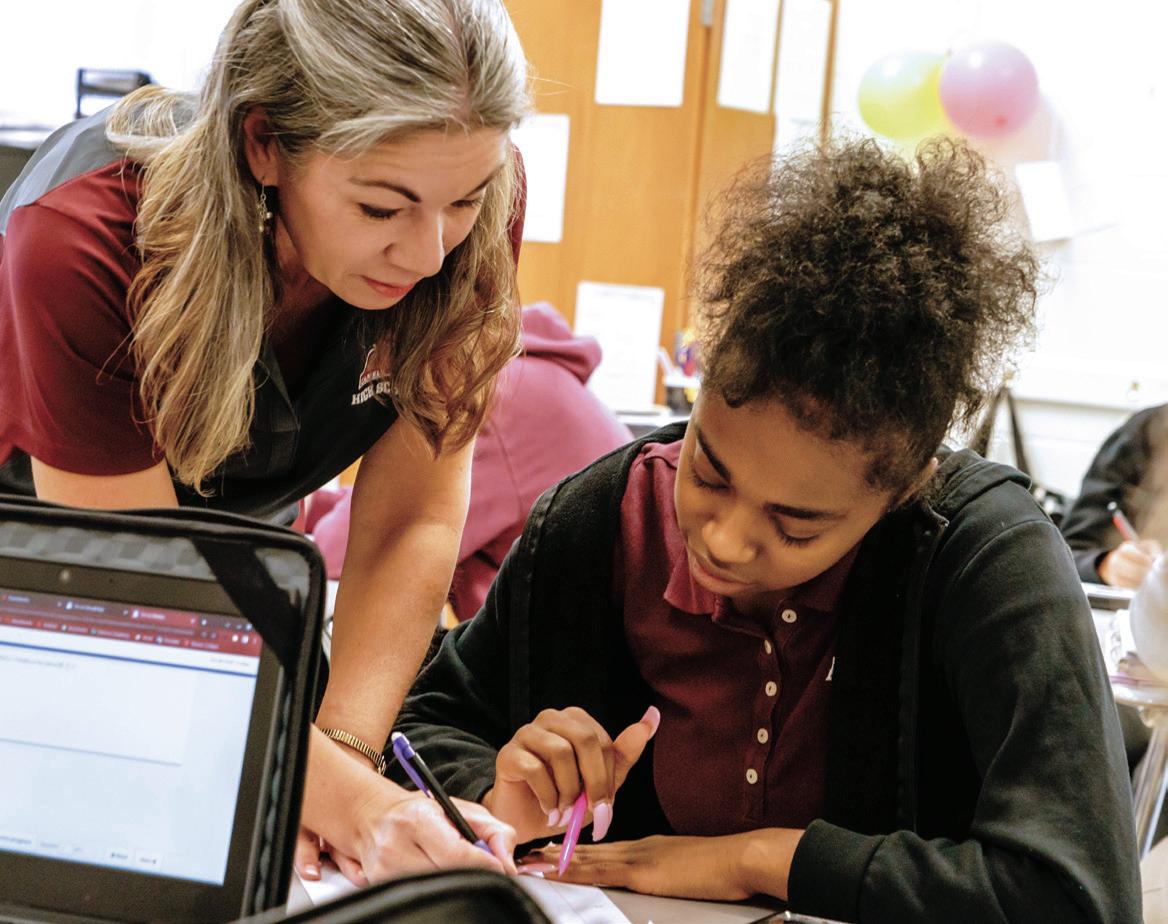
Today, if your child is at school, a teacher was there first— unlocking the door, preparing the lesson, readying the room for what’s possible.
No matter what’s happening anywhere else, inside the classroom there is learning and laughter, curiosity and growth, respect and responsibility.
Across Winston-Salem/Forsyth County, educators carry more than time allows, yet still create a steady place in an unsteady world.
For every student, from the littlest learners to those taller than they are, educators are there— guiding, challenging, encouraging, shaping confidence, and nurturing resilience.
Educators are the balance that keeps us right. They are there for our children. And we will be there for them.
In 2025, Winston-Salem/Forsyth County Schools faced one of the most serious financial disruptions in district history. The consequences extended beyond budgets and balance sheets, affecting classrooms, staffing, morale, and community trust.
What followed was neither easy nor without tension. At times, the situation felt overwhelming. Yet the true character of this dedicated and future-focused community emerged. This report honors that work and that generosity, while telling a story that ultimately inspired new partnerships committed to exceptional public education for every child in Forsyth County.
Through All In For Our Schools a bold and coordinated civic effort philanthropy, business, government, faith communities, families, and educators each lived into their highest purpose. Together, we stabilized classrooms, supported educators, addressed considerable debt, and restored a healthier path forward for nearly 49,000 students. Just as importantly, we discovered what is possible when a community aligns around its children.
Your generosity turned anxiety into assurance. You reminded a generation of students and their educators that their community sees them and is willing to fight for their future. Because of you, our schools stand on steadier ground, and hope has returned to hallways. What began as an emergency response has now become lasting civic infrastructure that will support our community commitment to public schools and children. The All In For Our Schools Fund, stewarded by our newly emerged Education Foundation, will be the place where we continue to invest long term in educators, students, and innovation.
This work continues, as it must. But today we take a breath and express our immense gratitude.
To the foundations that offered early courage, to the individual donors who are the heartbeat of local philanthropy, to the businesses that stepped up, to the congregations that prayed, to the families who jumped into action and mailed checks with big love, and most of all, to the educators who never stopped believing, we thank you for everything you did and will continue to do.
Marni Eisner ExecutiveDirector Education Foundation
LaTida Smith President The Winston-Salem Foundation
Dr. Don Phipps Superintendent Winston-Salem/Forsyth County Schools
WS/FCS Futures Fund $7,253,656.92 Education Foundation Classroom Supplies Fund
$1,549,527.91
WS/FCS Student Success Fund $868,972.87 Bookmarks’ Every Shelf, Every Student Fund $36,035.57
What happened? As with most issues in public finance, the answer is complex.
“You could feel it in the building—uncertainty, hesitation, and the strain of trying to plan without knowing what was coming next.”
—WS/FCS Principal
State auditors and independent reviews found that Winston-Salem/Forsyth County Schools’ financial crisis stemmed from a combination of overspending, underbudgeting, and weak financial practices that accumulated over multiple years. Over $40 million in overspending was attributed to outdated accounting systems, misaligned staffing costs, and repeated budget overrides. Key contributing factors included the use of temporary federal pandemic relief funds to support ongoing expenses, as well as long-term underfunding of public education by the state.
Importantly, investigators found no evidence of fraud or personal misuse. Rather, the issues reflected systemic errors in financial management, compounded by declining enrollment and shifting state and federal funding during and after the COVID-19 pandemic.
These challenges came to a head in the 2024–2025 fiscal year, when critical breakdowns accelerated the deficit. The district employed more staff than state funding supported, carried forward unaccounted invoices from the prior year, and did not fully adjust spending after receiving a lower-than-requested county allocation. At the same time, key expenses were underbudgeted, including approximately $12 million for substitute services and rising charter school payments. Bad news just kept coming, all of it revealing breakdowns in process and oversight.
While clarity alone about the magnitude could not resolve the problem, and immediate relief from local and state government did not materialize, it allowed the community to come to terms with reality and engage constructively in shaping a path forward. Over time, positive momentum began to take hold first in conversations, then in public meetings, and ultimately in collective action.

With every local news update and emotional school board meeting, it became painfully clear that financial instability in a public school system is never abstract. It affects classrooms, staffing, operations, educator confidence, and community trust. Teachers and school leaders navigated uncertainty while continuing to support students who were caught in the middle. Families worried about their children’s educational success, program reductions, and the future of their teachers and schools.
Morale already fragile after years of pandemic disruption was tested once again. The crisis became not only financial, but deeply emotional. As overwhelming as the debt was on paper, the worry was even heavier on hearts.
Yet alongside the worry emerged a shared resolve. The challenges were real, but would they define the future?
The mistakes made were yesterday’s news. What would be tomorrow’s headline?
Citizens and organizations answered with a clear declaration of intent:
This response was both passionate and pragmatic. Systemic corrections in processes, safeguards, and oversight were essential. But alongside these reforms remained a formidable mathematical reality: stabilizing the district’s financial position had a hefty price-tag attached, and it would require significant private support.
The community came to understand this. And something extraordinary began to unfold.

“At some point, you stop asking whose fault it is and start asking what it’s going to take to fix it. We’re talking about our kids and schools. What’s more important?”
—Community Member
Public finance challenges naturally generate frustration and concern. Contentious and confused feelings about the school system’s budget crisis abounded. The debt became bigger and clearer and the district had shortfalls in the 2025 –2026 budget that would have significant impacts on the current school year. Any community-launched initiative required a mission that was clear, focused, and trustworthy.
When WS/FCS announced a nearly 50% reduction in school supply budgets, the implications were immediate. Classrooms still had to function. Teachers still had to teach. Students still had to learn. Would all of this now happen with more stress and fewer resources?
In response, local leaders formed the Education Collaborative, a broad coalition to stabilize learning environments during this period of financial disruption. The Collaborative united civic, philanthropic, business, education, literacy, equity, and faith partners, including the Education Foundation, The WinstonSalem Foundation, Kate B. Reynolds Charitable Trust, Z. Smith Reynolds Foundation, Greater WinstonSalem Inc., Forsyth Technical Community College, Action4Equity, Bookmarks, Love Literacy, Forsyth Futures, Love Out Loud, Crossnore Communities for Children, Knollwood Baptist/Faith in the City, the Industrial Areas Foundation (IAF), Thriving Together, and various communications partners.
The Collaborative shared a simple but urgent mission: Ensure that classrooms remain places of joy, stability, and excellence — regardless of budget constraints.
Partners created a centralized platform for community support at AllInForOurSchools.org, providing transparent access to verified district needs, targeted giving opportunities, school wish lists, and community fundraising efforts.
Rather than positioning philanthropy as a substitute for public funding, the campaign framed private investment as a stabilizing bridge during a defined period of financial recovery a distinction critical to donors, policymakers, and district leadership alike.
Giving pathways were structured to make sense, to make an immediate impact for students today, and to make certain that the financial health of our public schools would be safe and sound for the students of tomorrow.

The campaign’s first focus was delivering targeted, practical relief:
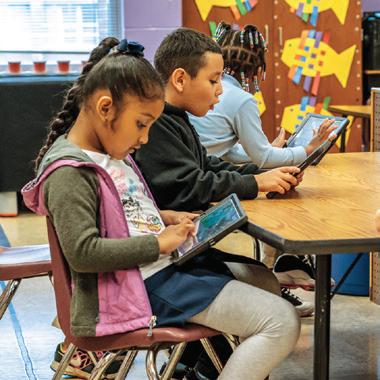
Community donors closed the classroom supply gap across all WS/FCS schools, funding essentials such as printer paper, ink, art materials, lab kits, notebooks, and instructional tools. A $500,000 initial investment from Mike and Wendy Brenner accelerated momentum, and a $400,000 gift from Modern Automotive helped the fund surpass its $1.4 million goal.
The Student Success Fund addressed essential needs that are often invisible, including health assessments, ESL translation services, background checks for volunteers, classroom resources, music programs, and transportation support.
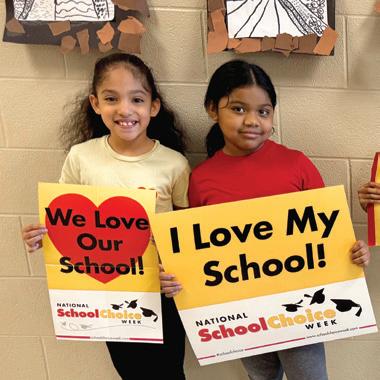
Led by local nonprofit Bookmarks, this literacy initiative placed essential books directly into classrooms and school libraries.
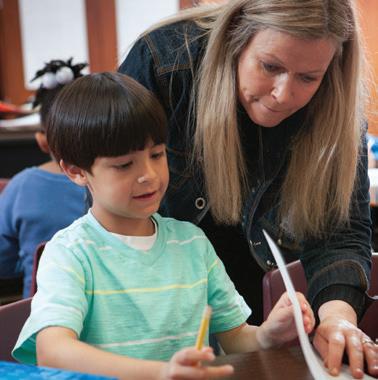
Through regularly updated wish lists, community members responded to verified needs requested by individual schools.
The campaign extended beyond fundraising, creating new opportunities for volunteering, partnership, and advocacy. Parents, faith organizations, businesses, and residents activated what their hearts were inspired to do. Underlying every initiative was a shared recognition:
When schools face instability, the entire community feels the impact.
“It felt good seeing exactly where the help was going, and how quickly it came. The impact was real.”
—Parent
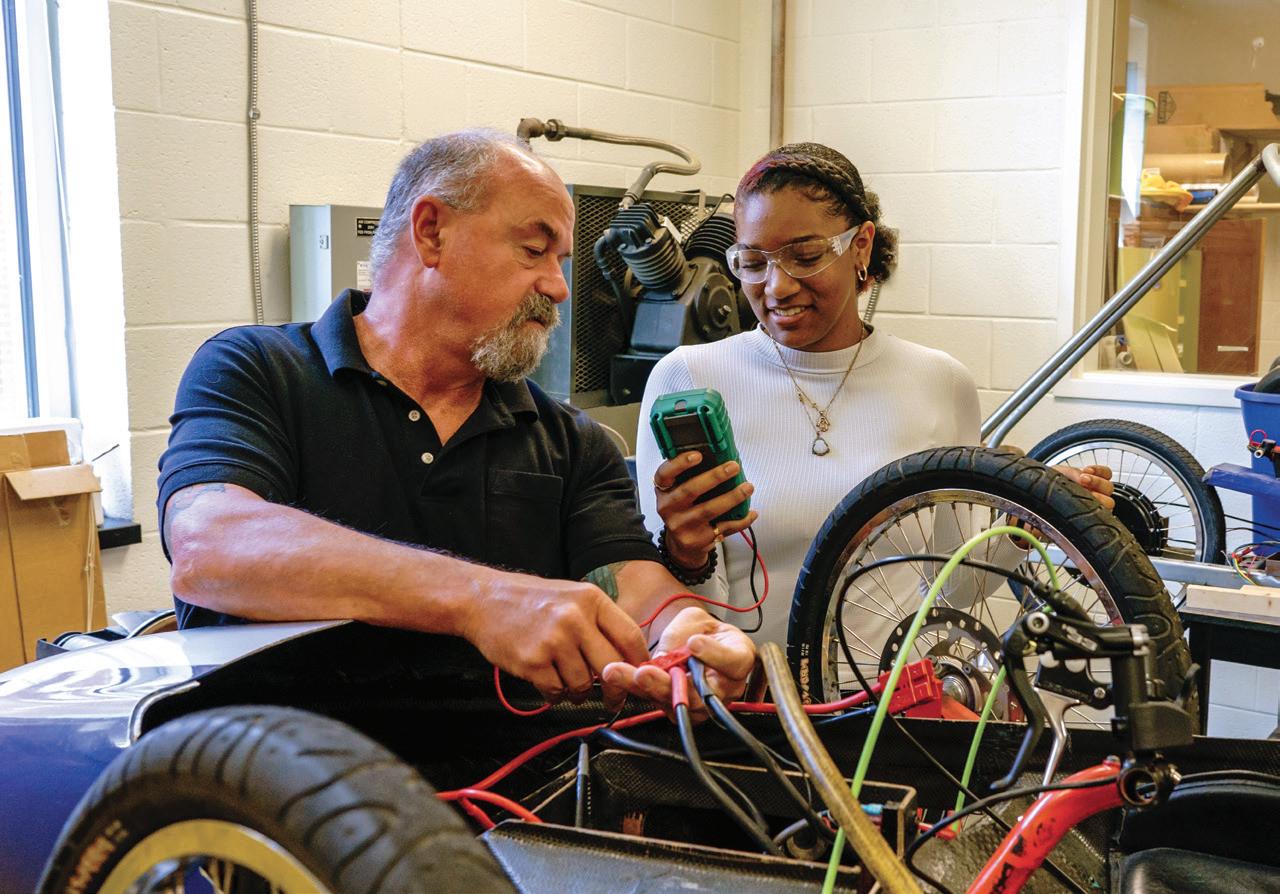


“The support from the community saved us. It’s hard to teach when you feel like you’re on a sinking boat.
All In For Our Schools threw teachers a lifeline and also gave us the confidence to believe things could and would improve.”
—Teacher
While classrooms required immediate stabilization, the community also confronted a second urgent challenge: reducing accumulated financial obligations from the 2024–2025 fiscal year.
The WS/FCS Futures Fund, established by The Winston-Salem Foundation, created a direct pathway for private support dedicated exclusively to debt reduction for external creditors.
Forsyth County approved the reallocation of funds to pay down $9 million of the district’s initial obligation to the North Carolina Department of Public Instruction. In addition, community contributions enabled the timely full repayment of the remaining $3.4 million to prevent additional interest burdens, marking a pivotal recovery milestone.
Momentum continued as Forsyth County Commissioners approved a resolution allowing conditional forgiveness of up to $5,026,336.90 in debt owed by WS/FCS to the county, contingent on privately raised funds being used, dollar-for-dollar, to repay the district’s obligations to the North Carolina Department of Public Instruction and other creditors.
By November 2025, the Futures Fund had generated approximately $4 million, contributing to the broader campaign total of $5.8 million across all funds from more than 330 donors. Community resources were strategically applied to reduce obligations to the state, county, and key vendors, driving substantial reductions in liabilities that once approached $40+ million. By March 2026, just six months from the campaign’s launch, the Futures Fund had reached over $6.6 million, with dollars continuing to eliminate outstanding vendor debt.
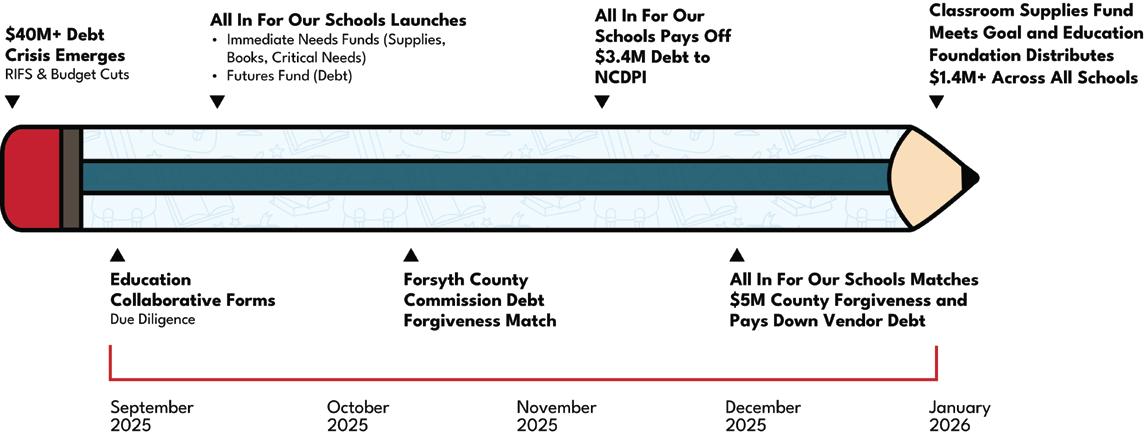
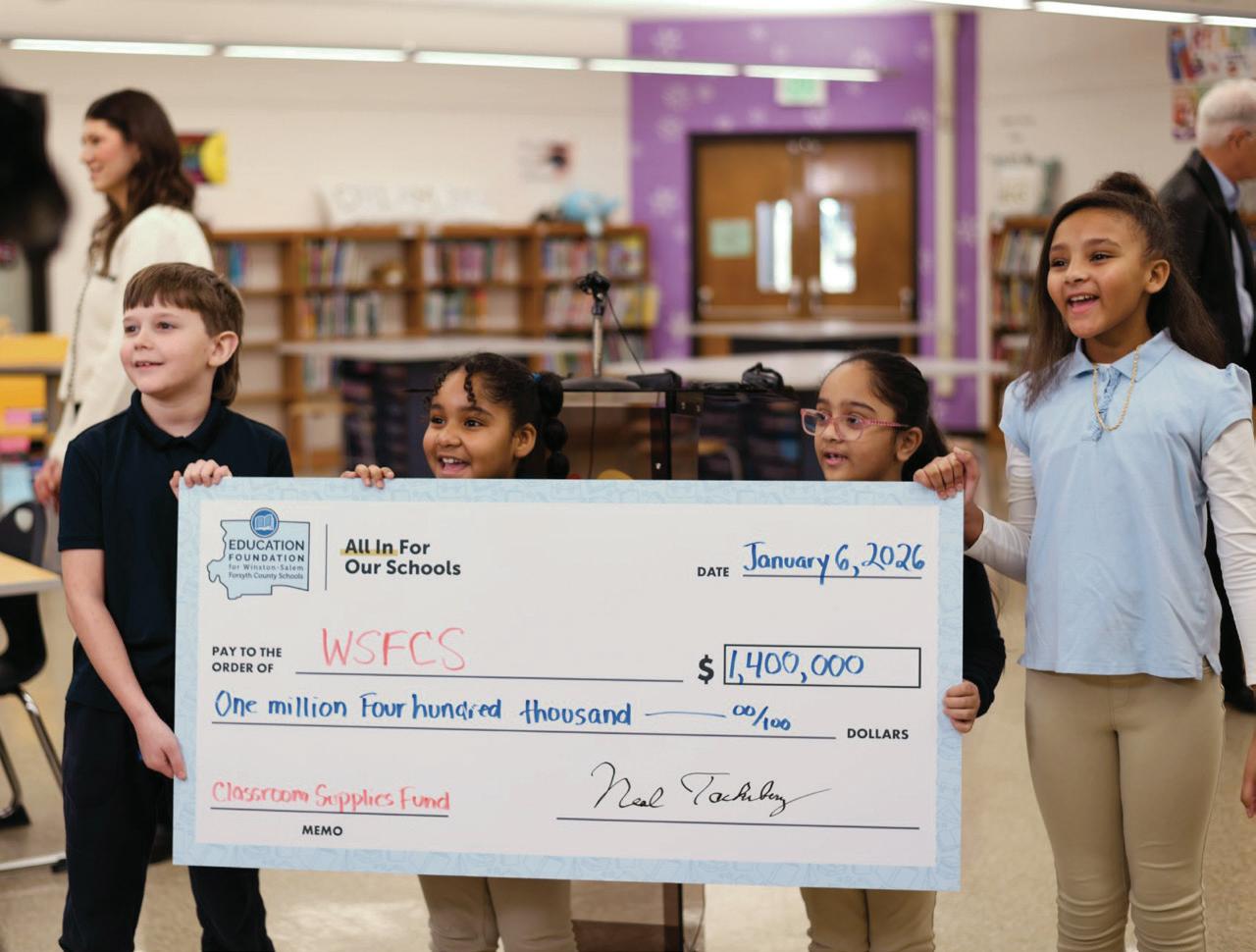
As of April 30, 2026, the district’s remaining 2024–2025 debt had been reduced from over $40M+ to less than $2 million, progress achieved through sustained generosity, disciplined planning, and strengthened oversight.
All In For Our Schools is a “success begets success” story, one in which the community chose to clear the path forward for our children, our most important asset.
“It was incredible how generosity began to turn anxiety into assurance. You could feel hope returning to the hallways.”
—Principal
When Catty Moore stepped in as Interim Superintendent of Winston-Salem/Forsyth County Schools in late May 2025, she entered a system under intense scrutiny and strain, with trust shaken from all directions. Moore approached reality head on. She acknowledged the seriousness of the situation, articulating the failures and preparing the way for immediate correction, as hard as that would be. At the same time, she focused on stabilizing dayto-day operations and bringing greater transparency to the budgeting process. Her candid leadership helped move conversations from uncertainty toward accountability, creating space for the community response that followed.
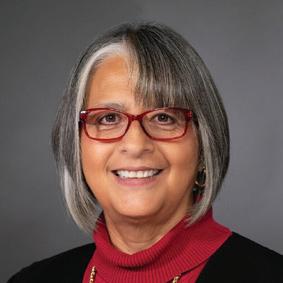
“When you don’t have the money, you have to make decisions and choices, and they’re going to be hard and they’re going to hurt. I have infinite hope that whoever comes into this role next will be able to continue the rebuilding of trust and confidence that’s needed.”
—Catty Moore, Interim Superintendent


“I tried to shield kids from the stress, but they felt it. What mattered most was being steady for them, even when things weren’t steady for us.”
—3rd Grade Teacher
This recovery was neither simple nor immediate. Yet the progression of the community’s response tells a powerful story:
Frustration became concern.
Concern became action.
Action became progress.
Progress became stability. Stability now becomes our obligation.
The crisis served as an uncomfortable but important episode of community education, deepening our understanding of how enrollment influences funding, how different funding streams operate, and why predictability and long-term planning are essential to financial resilience. This knowledge became part of our recovery.
In North Carolina, public schools rely on a layered budgeting system: the state funds most staffing based on enrollment, counties provide local support, and federal dollars fund targeted programs. If enrollment shifts, expenses outpace projections, or if onetime funds are used for ongoing costs, gaps can quickly emerge.
This moment reinforced the critical importance of strong financial stewardship, accurate forecasting, and clear accountability. It also renewed our shared sense of responsibility, showing that together we can achieve the outcomes our teachers, students, and community deserve.
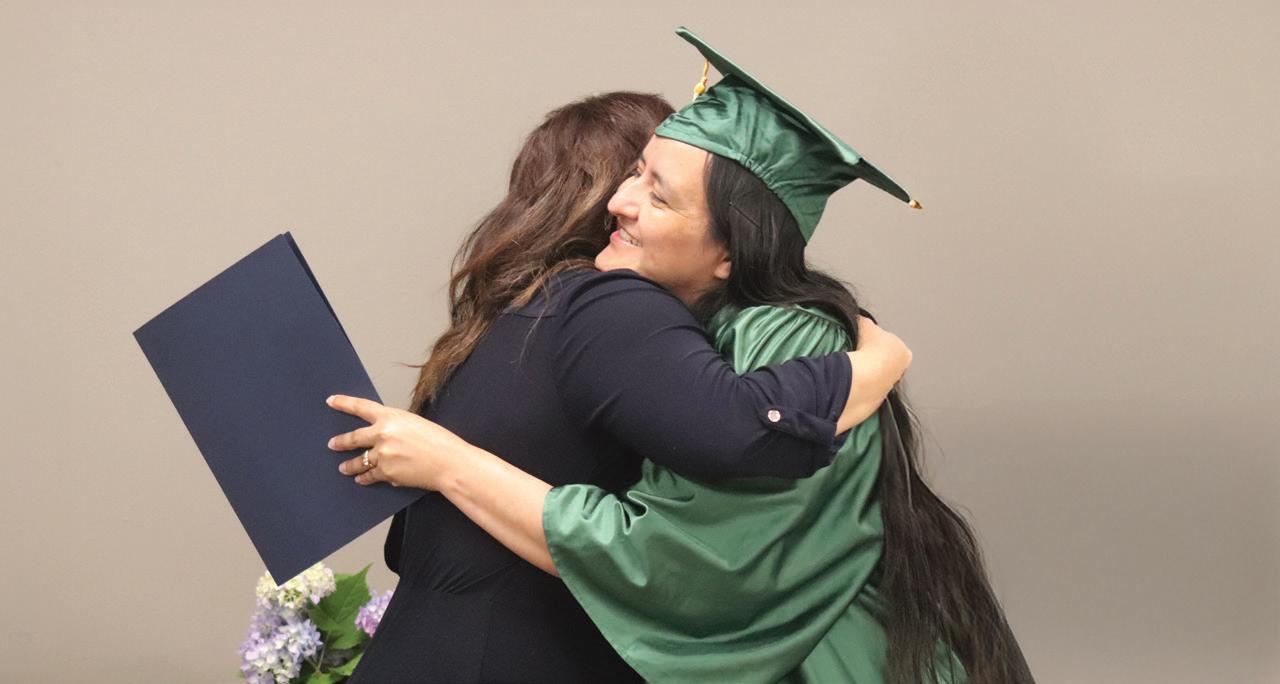
The most enduring impact of All In For Our Schools cannot be measured solely in dollars raised or debts reduced, as dramatic as that story is. Its lasting significance lives in outcomes that are even more essential.
• Educators feel supported rather than isolated.
• Families are regaining confidence in stability.
• Community leaders and policy-makers witnessed unprecedented alignment.
• New collaborative infrastructure remains.
• Donors saw measurable, system-wide impact.
Because confidence, too, is a form of capital.
And this community is rebuilding it.
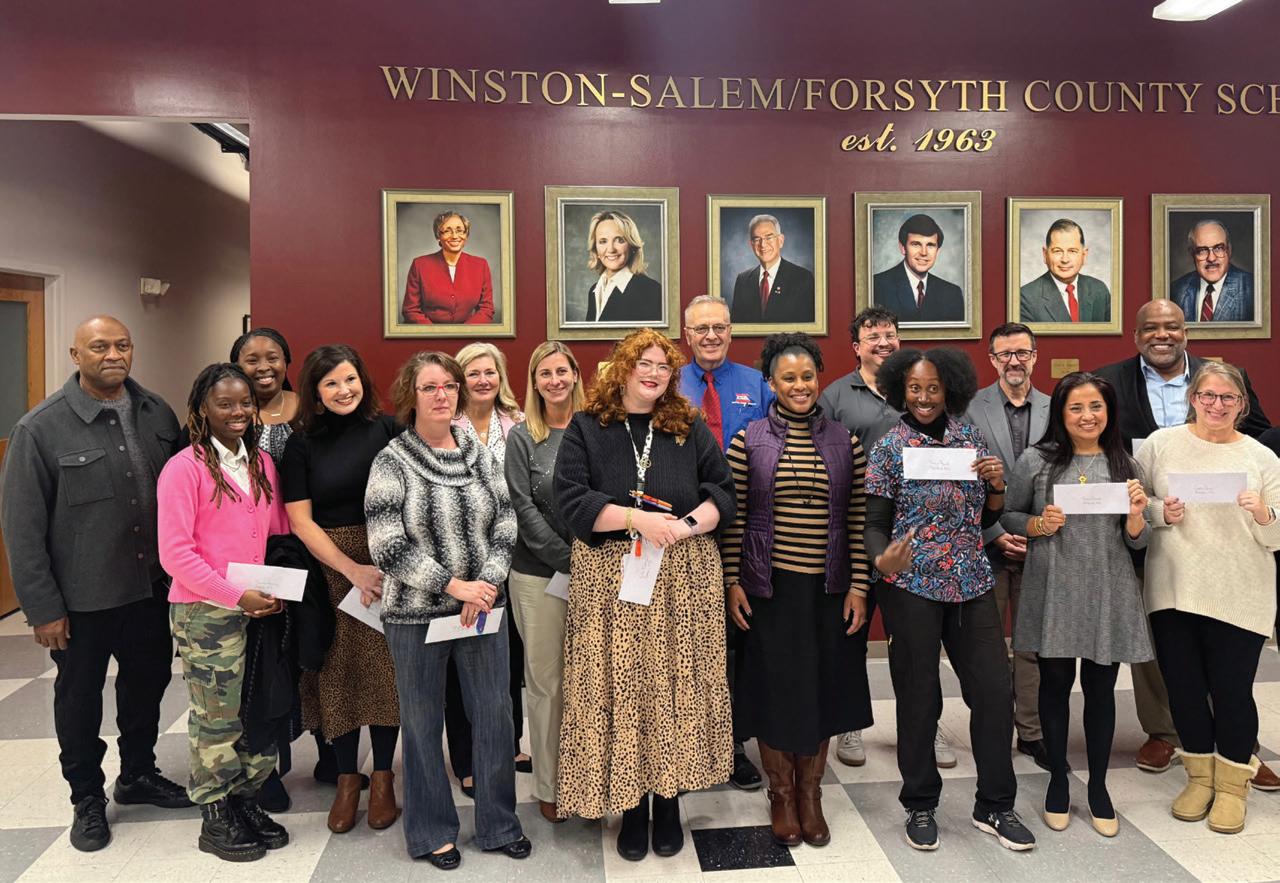
What we learned through All In For Our Schools is that when every sector of a community lives fully into its purpose, extraordinary things become possible for children. Philanthropy, business, and government came together to mobilize resources, leadership, trust, and long-term commitment in service of our public schools and the future of Forsyth County. And the newly emerged Education Foundation became a powerful conduit for community action, demonstrating what is possible when people are given a trusted way to support public education.
What began as the Education Foundation Classroom Supplies Fund has now evolved into the long-term All In For Our Schools Fund — our community’s ongoing pathway for engagement and investment in students, educators, and schools. While the district has allocated budget funds to eliminate the debt within the next school year, every additional private dollar raised allows district resources to go where they are needed most: our children.
Together, we moved beyond the crisis. Now, we must continue leveraging this newfound collaborative commitment by investing consistently and generously so our teachers, classrooms, and schools can move from recovery toward the joy, stability, and growth trajectories every child deserves.
To the foundations, businesses, organizations, educators, families, and individuals your support arrived at a moment defined by complexity and uncertainty. You invested because the stakes were real. Your generosity protected classrooms, stabilized operations, and accelerated reform. Most importantly, you affirmed an essential truth: Public schools are a shared right and a shared responsibility.
Yes, the work continues. But the foundation is stronger. The partnerships are deeper. And the path forward is clearer. Thanks to an amazing community that stood strong.
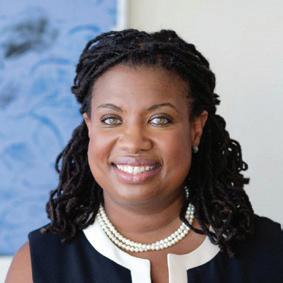
“May this story guide us and inspire others to remain All In For Our Schools, for every teacher and every student, and all of us who depend on their success.”
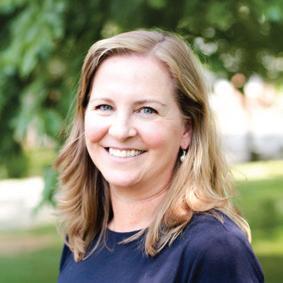
“Showing up in a moment of crisis speaks to the strength of this community. Now we must be ready for sustained commitment. Our schools deserve our engagement in every season, not just during the storms.”
—Marni Eisner