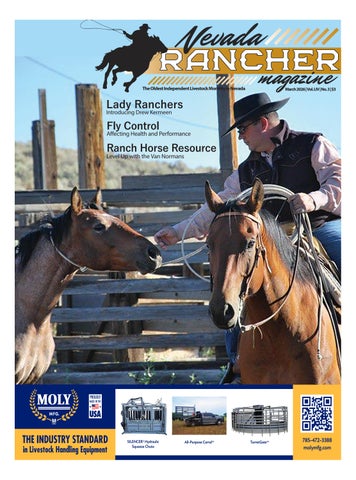
Nevada Rancher March 2026 Edition

Page 1


SILENCER® Hydraulic Squeeze Chute

Feeder Sale, Friday February 20th 3050 head from 93 consignors

Sale was way heavy to heifers this week and still none being bought for replacements. Higher, higher, higher, that’s the trend. Strong buyer attendance and the internet was more active this sale than 2 weeks ago.

Broken mouth bred cows up to $3300 yesterday, which seems like a lot but 5 weight steers bringing up to $2900 so maybe those cows are a bargain. They say young bred cows are supposed to be worth 2 5wt steers bring, that’s $5800 but bred cows in our region are no where close to that. If that formula is correct then $3300 broken mouth cows probably a pretty good buy. When steers were bringing $500 a head bred cows were $900 to $1200.

Next feeder sale March 20th. Several buyers have asked when we will be selling our personal charX ranch calves, they will be in the March 20th sale. Expecting 6000 plus for that auction. If you are wanting to consign cattle to that auction please let Us know and if you want them advertised on our FACEBOOK PAGE send videos,and or pictures to 661 305 2699. Thank you buyers, sellers and our awesome crew for another great sale at Nevada Livestock Marketing . See you next month!

Nevada Livestock

PS If you need char bulls please reach out to me, I’ll be going to the Cowman’s Kind Bull Sale March 3rd. They have been strong supporters of our market and their bulls hold up well in big country.

250 Bulls Sell at Spring Cove Ranch

Lot 3 - Spring Grant 23N DOB 01/15/25

Lot 86 - Spring Cove Warbucks 54N DOB 01/26/25 REG 21353087 SIRE: Pine View Warbucks L114

CED+9 BW+.7 WW+88 YW+151 Milk+32 CW+71 Marb+1.23 Rib+1.17 $M+101 +$C+359

SAL E E V E RY TU E S D AY

May the Luck be with you!

March in Nevada is a season of transition. Winter’s grip may still be felt in the mornings, but longer days and improving weather signal that spring work is just around the corner. For many of our state’s ranching families, this is a month of preparation — checking calving pastures, monitoring late-winter body condition, lining up supplies, and watching the skies for the moisture that will shape the rest of the year. Across much of the West, drought recovery remains uneven. Snowpack and early

Subscribe today for Just $16 per year! (775) 623-5011

spring storms will play a critical role in determining forage production, grazing plans, and stocking decisions in the months ahead. As always, flexibility is one of the greatest strengths of Nevada producers.

February was full of bull sales and travel for the magazine. As we kick off Ranch Rodeo season, horse sale time and Spring work- I hope the best of luck to you and yours! Do you still need a 2026 calendar? We have plenty! Call the office.

Please enjoy this edition! - Ashley

Read back issues digitally: issuu.com/winnemuccapublishing7 www.greatbasinsun.com

The Nevada Rancher (ISSN 0047-9489) (USPS #003-257)

Published monthly at Winnemucca Publishing, 1022 S. Grass Valley Road, Winnemucca, NV 89445

Call us toll free at (866) 644-5011

Periodical Postage Paid at Winnemucca, 89445

• Nevada Cattlemen’s Association Update

• Obituaries-Remembering our Loved Ones

• Jackson Mountain Homemmaker’s-Irish Recipes

• Podcast Feature-Ty and Ronda Van Norman

ON THE COVER:

Ty Van Norman, Podcast Column Feature.

The beauty of a podcast is it doesn’t demand extra time; it fits into the margins of real life. People listen for different reasons. Some tune in for education. Others for encouragement. Ty and Ronda Van Norman are well known for their prestigious horsemanship and quality horses.

The Ranch Horse Resource is featured on Page 16.

Their website will be updated soon with more information about how someone can work with them: RanchHorseResource.com

Listen now on Youtube, follow and join their groups on Facebook.

President: Peter Bernhard

Publisher & Editor: Ashley Buckingham

Sales Representative: Ashley Buckingham

Office Manager: Tracy Wadley

Graphic Design:

Ashley Buckingham

Joe Plummer

Emily Swindle

Jen Anderson

Contributors

Martin Paris

Randi Johnson

Heather Smith-Thomas

Kirstin McSharry

The Nevada Rancher does not assume responsibility for statements by advertisers nor products advertised within, and The Nevada Rancher does not assume responsibility for opinions expressed in articles submitted for publication. The publisher reserves the right to accept or reject advertising or editorial material submitted for publication. Contents in The Nevada Rancher may not be reproduced, in whole or in part, including, but not limited to original contents and original composition of all ads (layout and artwork) without prior written permission. Subscription rate: $16.00 per year. All content copyrighted, March 2026.

POSTMASTER: Send address changes to: The Nevada Rancher, Winnemucca Publishing, 1022 S. Grass Valley Road, Winnemucca, NV 89445

Lee, Owner:
Roping and Squeeze Chutes, Smarty and Heelomatic Roping Dummies in Stock. S&S TACK SHOP 559-779-5856

March Roundup

What a strange winter we have had so far. Those brand-new snow boots may have to stay in the closet until next winter. The most recent Drought Monitor has only about 2% of Nevada in a severe drought, but those mountains sure could use a fresh coat of white stuff.

NCA leadership recently attended the National Cattlemen’s Beef Association Convention in Nashville, Tennessee. As always, there were plenty of issues discussed and a lot of good takeaways. I’d like to reflect on some of the wins the cattle industry is racking up.

Starting on the public lands front, we successfully ended the Bureau of Land Management’s Public Lands Rule, which would have placed conservation use on par with other

multiple uses. We also saw the U.S. Forest Service’s “Roadless Rule” be upended in Congress, which will now allow greater access for permittees to reach portions of their allotments and enable firefighters to get where they need to go to protect critical resources.

New grazing regulations out of the Bureau of Land Management are on their way that will allow greater flexibility in grazing management. Dozens of new categorical exclusions have come online that will allow permittees to construct common sense range improvements without layers of environmental review and bureaucratic red tape. Both the BLM and U.S. Forest Service are also aggressively working on re-permitting vacant grazing allotments across the West.

There are nine separate pieces of legislation currently introduced in Congress that the NCA is working

Recap on the Roundtable

Nevada Cattlemen’s Association

I have just returned from Nashville and the National Cattlemen’s Beef Association (NCBA) convention. I am aware that not everyone reading this is a supporter of NCBA, but it remains an effective avenue to influence what happens in Washington. Starting with the D.C. update –Head of NCBA Ethan Lane, along with NCBA and Public Lands Council (PLC) staff talked about Farm Bill priorities that were included in the Big Beautiful Bill (BBB). They discussed the increase in protein and whole food that was a major part of the new Dietary Guidelines for Americans and NCBA’s contribution to that effort. I thought that they spent way too much time talking about the Fair Label Act and fake meat, because it has become obvious that no one wants to eat that stuff, but I have to agree that it is important to accurately and clearly label it so that no one believes that they are getting real meat if they buy it. Next, they updated us on the progress being made to protect the US cattle herd from the New World Screw

hard to get across the finish line. These pieces of legislation include everything from additional grazing flexibilities and Endangered Species Act reform to retooling the Equal Access to Justice Act to put a stop to the endless litigation from radical environmental groups aiming to destroy animal agriculture. Please stay tuned throughout the year as we hope these proposals begin to move forward.

In other areas of the cattle industry, March is National Nutrition Month and what a better way to celebrate than with a new inverted food pyramid featuring a with a big ol’ ribeye and package of ground beef at the very top. There is no doubt that a concerted effort is underway to get Americans to eat real food instead of what Robert Kennedy Jr. refers to as “nutrient-free” food. It’s nice to see what we already know finally getting some recognition: beef is one

of the healthiest, nutrient dense, and real foods out there.

But the wins don’t stop there. Did you know that 84% of fed cattle are grading Choice or higher, and 12% are grading Prime? At this rate, we are getting close to phasing out Select grades altogether. The quality of beef being produced is a testament to the work that all of you do on your operations and is a major reason why beef demand continues to climb off the charts. All of this is topped off by record-breaking cattle markets and what appears to be a shift to El Nino and wetter weather at some point this year.

While there are still plenty of things to work on and fix, it would be pretty half-glass-full attitude not acknowledge some very important things happening within our industry that recognizes the work you all do, as well as cattle’s positive impact on our diets and environment.

Worm and the efforts in Mexico to push it back South. Another improvement with respect to taxes includes changes to the Estate Tax and depreciation.

In the Public Lands arena, important improvements have been made in the following areas: NEPA, WOTUS, ESA, Grazing Permits, Roadless Rule & Fire. There have been many regulatory rollbacks and more than a dozen grazing specific bills. NCBA staff is working hard to ensure that these changes last beyond the Trump Administration.

Next, we participated in a PLC sponsored roundtable discussion with senior staff at BLM and US Forest Service. We talked about the increased ability to use categorical exclusions to allow projects like building fences and water improvements on allotments. In most cases, these projects can now move forward without lengthy environmental reviews.

After the PLC roundtable, we attended the NCBA Region VI meeting. Region VI includes CA, NV, UT, AZ, NM, and HI. Jeff Young from Ensign Ranches is the representative for Region VI, and I have no doubt that he will do a good job and be open to any input that we might

have. The meeting included updates on local issues from each state.

A resolution was passed in the Live Cattle Marketing Committee meeting to include breeding and cull cattle in the Livestock Risk Protection (LRP) program. It will be interesting to see how that works if it comes to fruition. I can see using such a tool to manage risk in those years when we have extra feed and we’re feeding open cows until early spring.

As always, the CattleFax update was well attended and interesting. Cattle and beef supplies will be smaller in 2026, particularly in the first half of the year, but they expect expansion to begin in 2027. Expansion is expected to be slow, and prices are expected to remain strong for at least a couple more years. However, they believe that prices are at or near cyclical highs. The market is expected to remain volatile, and the Mexican border situation is a wildcard. Meteorologist Matt Makens expects to return to El Niño by summer, increasing the odds of a wet summer for our region.

Secretary of Health and Human Services Robert F. Kennedy Jr. was interviewed during one of the General Sessions. He spoke about the chronic disease epidemic of Americans and the toxic food environment that has contributed to it. He

strongly believes that the new food pyramid, which prioritizes proteins and whole foods, is the key to improving the health of Americans. According to him, it is backed by the best available science.

Another item of interest is that 93% of the candidates supported by the NCBA Political Action Committee (PAC) won their races. This undoubtedly creates significant influence. Candidates from both parties who are friendly to the cattle industry are included. When the political pendulum swings (and we all know that it will) NCBA will have less political influence, but it will still have enough to make a significant difference.

With respect to the leadership at NCBA, Gene Copenhaver is the new president, and the two people next in line are ranchers from Oregon and Idaho. Gene was at our 2024 Nevada Cattlemen’s Convention in Fallon and I’m sure many of you had a chance to visit with him. He has a stocker cattle operation in western Virginia and has a background in Ag Finance. I have visited with Gene on multiple occasions and am confident that he will hear and consider our input.

That’s more than enough for now.

The Diet Factor

What happens to most people when they go on a diet and successfully lose weight? They gain the weight back – and then some. There is a reason for that. It’s called the Diet Factor.

In the cave man days, it was extremely important for people to maintain good body condition – the more the better. Survival depended on it. Thin, hard-keeping people didn’t last long.

Remarkably, the human body recognizes a loss in body condition and will do its best to restore it. As a result, we become extremely feed efficient. Fat that took years to store up in the first place can be restored in a fraction of the time once it has been lost. That’s the Diet Factor.

The same is true for cows. Cows that live off the fat on their back during the winter months will quickly regain the lost condition once they have ample forage resources. I have heard of cows gaining over five pounds per day on nothing but spring grass.

Research shows that thin cows coming out of winter experiencing a positive plane of gain into the calving season will have a much higher conception rate than fat

cows that are experiencing a negative plane of gain because they had been fed and pampered through the winter.

The Diet Factor has tremendous value. However, you cannot take advantage of it if you are not calving in sync with nature and/or your best forage resources. Your cows need to be gaining weight prior to calving. Nor can you take advantage of the diet factor if you have high-maintenance cows, because they are unable to store up enough fat during the growing season.

Unfortunately, most of today’s cow-calf producers have the wrong kind of cows because they have been focused on the wrong thing. For the past 40+ years, they have been single-mindedly focused on increasing pounds per cow – at the expense of pounds per acre. This has created tall, high-input, late-maturing cows that need to be fed to stay in production.

In nature… the wild ruminants store up energy in the form of body fat during the growing season. They rely on that fat to get them through the winter. Prior to giving birth to their young, they are rapidly replacing the fat they lost over the winter. Nature’s way is not only the best way; it is also the most profitable way.

Small Town Things

There’s cupcakes in the post office, sign hung in the doorway, “Come in and join us! Angie retires today!”

You can rent the movie theater and throw a block party, Tombstone,on VHS, playing one night only!

Broadway has got a road block, swather taking up both lanes,

There are more people on floats than watching the 4th of July parade,

The school is half empty the first day of fair week, The whole football team calls in sick opening day of deer hunting,

Everyone knows everyone, its a trope but it is true, Safeway moved 40 years ago and they still call this location “new.”

Someone says “well, we need the moisture!” every time it rains, There’s a horse trailer parked at the baseball field, just small town things.

NEW LISTINGS:

Cross L Ranch, Railroad Valley, Nevada

*3,314 deeded acres *Water Rights *Winter and Summer Range *339,266 acres of BLM to run cattle on *1500-1800 tons per year (to feed and sell)

*Cattle and Equipment Included *several home for the help and new home for ranch manager

$12,000,000

Segura & Fish Creek Ranch, Tonopah, Nevada *1,075 acres *support 450-500 head of cattle & 2,500+ sheep *500,000 contiguous BLM land, AUMs for both cattle and sheep with over 1,186,411 acres with 250,725 operating acres *Two 120 acre pivots and a 60 acre pivot *diesel powered wells *50 acres gravity fed irrigation from a pond *1,000 tons of feed annually *sheep pens *home $8,000,000

Old Lynn Farm, Railroad Valley, Nevada

*113 acres water rights *Permit 27491 for 111.08 ac. ft. *Permit 38565 for 368.92 ac. ft. *Newer pivots *Small house *Great Starter Farm $479,000 Make offer!

Wildhorse Ranch, North Elko County, Nevada

*Owyhee River Watershed *4,500 contiguous acres with 3116 acre feet of water rights plus 908 supplemental water rights *native grasses *runs 600+ cow calf pairs *summer ground for 1,5001,700 head of yearlings *private land $8,000,000

2623 N Canyon Road, Lamoille, Nevada *3.68 acres *Corner Lot *Fenced and cross fenced *perfectforlivestock/horses*naturalgrasses *smaller corrals *old single wide *large shed *bunkhouse *Amazing views of the Majestic Ruby Mountains. $350,000

Log Home on the Jarbidge River, in historic Jarbidge, Nevada

Updated cabinets, countertops, appliances, and custom built-ins for storage, new flooring runs throughout, with updated walls, backsplash, and finishes. Soaring ceilings and new Pella windows and doors flood the space with natural light. The layout includes a spacious open living area, 2 bedrooms, 2 bathrooms, and laundry area in the hallway. Plus a connex provides extra storage for ATVs, snowmobiles, and yard tools.

11 Acres - Godchaux Road *Paradise Valley Junction *Ag-residential District *Breathtaking Views *Build your Dream Home *30 minutes north of Winnemucca. $20,000

Fly Control Should Start Early

Warm weather brings flies. Large populations of biting flies can adversely affect health and performance of cattle.

Dr. Alec Gerry, Professor and Extension Specialist in Veterinary Entomology (University of California, Riverside) says mild winters can extend the fly season. To determine when it is economically important to control them, there are some guidelines for horn flies and stable flies. “We’ve used the rule of thumb of 5 or more stable flies per leg. The way scientists count them is to note the number of flies on the outside of one leg and the inside of the opposite leg, which would essentially be one full leg from one view,” says Gerry.

“Recently I was involved in studies that suggest that even an average of one fly per leg can cause cattle to bunch--to try to get away from flies. This stress leads to economic cost. They are not eating, they are not comfortable, not lying down and resting. The economic threshold for horn flies is somewhere between 200 and 500 flies per animal, depending on the breed and size of the animal; there will probably be loss of production--less weight gain.” In hot weather, stress and

energy expended fighting flies may also elevate body temperate more and lead to heat stress.

Since horn flies develop in manure pats, conditions for fly development are always present. Stable flies develop in buildup of organic material such as piles of old hay around big bale feeders, wasted feed such as silage or hay mixed with urine and feces. “Precipitation has a dramatic impact on the suitability for stable fly breeding and development. Rain in spring/early summer often leads to more stable flies,” says Gerry.

There are multiple ways to try to control flies. “Horn flies spend most of their adult life on cattle. To control horn flies you can use one of various insecticide ear tags. These contain a number of different chemicals, in various chemical classes, some of which your horn flies may be resistant to. Many of the horn flies today are resistant to commonly used chemicals like permethrin,” he says.

“Monitor the effectiveness of ear tags if you use them. If they don’t seem to be working, you need to switch to something else the next time you put ear tags in—and not just a different ear tag. Make sure it is in a different chemical class. If we keep using ear tags with the same chemical,

over and over, the flies develop resistance to that chemical. It’s best to rotate the classes as best you can.”

There are other methods of controlling horn flies, including pour-on or sprays and the traditional dust bags and oiler-rubs. There are also some feed-through products that inhibit growth of immature horn fly larvae in fresh manure.

Stable flies are much more challenging to control than horn flies because they only come briefly to the animal a few times during the day to take a blood meal. Then they rest on bushes, fences or some other surface. “Ear tags are not effective for stable flies, but they can be controlled to some extent with insecticide sprays,” says Gerry.

“Since they feed on the legs and lower body of the animal, apply spray liberally to the legs and underside. For pasture cattle, if the grass is tall it wipes that material off the legs,” he says.

Another control for stable flies is to clean up any piles of old hay; spread those around so they dry out.

Face flies are a problem because they spread pinkeye. Most fly tags won’t control them; tags containing a pyrethroid work better because they have some repellent action.

Gerry is creating a website that lists all insecticides available, how they can be used, and what kind of formulations they have. You can search by animal— such as cattle—and type of pest flies, and the insecticides that are registered for use on cattle to control those flies. It lists all the feed-through products, pour-ons, ear tags, etc.

All insecticides have an IRAC (Insecticide Resistance Action Committee) code that indicates what class it’s in. “You can look for products that have a different code than the one you recently used. That’s the best way to select products for rotations so you don’t inadvertently choose one with a different name that turns out to be the same chemical as the one you just used,” he says.

The insecticide data base called Vet-Pest-X, is also something producers can utilize, to look up insecticides. “A USDA multi-state research group that consists of every veterinary entomologist in the U.S. has developed an Extension website that also might be helpful,” says Gerry.

“On that website we have information on pest management for all species, from all the universities and USDA facilities in the U.S. All bulletins, pest notes, etc. can be found on that website.”

National Veterinary Entomology Extension and Education: https://www.veterinaryentomology.org/ Pesticide Database - insecticides by animal commodity and pest to be controlled: https://www.veterinaryentomology.org/vetpestx

Courtesy Photo

Spring Cattle Work CHECKLIST

Vaccines

Minerals

Antibiotics

Needles: (Size)

Syringes: (Type and Size)

Syringe Repair Kit: (Gaskets, Tubes, Rings, etc.)

Wormer & Applicator

Ear Tags: (Brand, Color, Size, Custom?)

Ear Tag Applicator and back up

Branding Iron and Heat Source (Remember to Fill Your Propane)

Scour Control Meds or Bolus

Bolus Gun

Screw Worm Spray

Sharp Knife and Knife Sharpener

Banding Equipment/Bands

Dehorning Equipment

Featuring: Drew Kermeen

Drew Kermeen of Sheridan, California works as a Construction Project Manager, but her life outside of work revolves around horses and cattle.

“Though I was not born into a ranching or horse family, I have been riding most of my life,” she says. Most of her background has been “in showing, rodeo and exploring the emigrant wilderness horseback.” Helping at a few brandings growing up “sparked my love for ranching and working cows.”

Her roping career started just four years ago while starting her

mare. Since then, she’s continued to push herself and build confidence in the arena.

Her most memorable moment is simple and honest: “Roping a live one off my horse for the first time. I’m sure it wasn’t pretty but I was smiling from ear to ear.”

When it comes to horses, there’s

no hesitation about her favorite. “To date my favorite horse is my current mount Rosanne, she’s witty and pretty but also has the confidence and talent to do just about anything I ask of her. She has taught me so much.”

Drew credits the women around her for shaping her path. “I cannot honestly pick just one person.

I have been lucky enough to be surrounded by the most talented, wonderful and supportive horsewomen who have and continue to inspire me everyday.”

Outside of riding and roping, she enjoys “painting, traveling, building things and spending time working on my property.” To clear her head after long days

on the job site, she heads outside. “Riding my horse to watch the sunset after a long day at work. Or escaping to the mountains.”

Her future goals reflect both ambition and balance. “Continuing to challenge my roping skills and horsemanship, to also work less and enjoy life more, to inspire and be inspired.”

Her favorite quote sums up her mindset: “Anyone can pray for rain. Better get busy diggin’ a well…”

And if she could give advice to her younger self? “Confidence

is the ability to trust yourself. Everything is going to work out better than you ever imagined.” And if she could give advice to her younger self? “Confidence is the ability to trust yourself. Everything is going to work out better than you ever imagined.”

About the Column:

The Lady Ranchers Column founded by Kirstin McSharry a fellow female cowboygal, with the purpose to highlight those ranching women. Dedicated to highlighting the experiences, perspectives, and contributions of women in the community. Showcasing stories about the roles women play on ranches — from hands-on work with livestock and horses to leadership in ranch operations, family life, and community involvement. This column celebrates the real-life ranching journeys of female ranchers, offering insight,

inspiration, and recognition for their work in a traditionally male-dominated industry.

To get in touch or to nominate someone for a feature email Kirstin at kirstinmcsharry@yahoo.com

Joshua Petersen 1976-2025

Joshua D. Petersen was born on Dec. 29, 1976, to Jon and Suzie Laurance-Petersen. With the exception of a brief time during his freshman year of high school, Josh spent his entire life in Harney County, a place

that shaped him and that he, in turn, gave so much back to.

Josh was a true ranch kid through and through. From a young age, he loved the work, the animals, and the rhythm of ranch life. It wasn’t just something he did, it was who he was. His dream was simple and honest: one day to have a place of his own. Some of his fondest memories were spent hunting alongside his dad and his grandpas Charlie and Everett, moments that stayed close to his heart throughout his life.

When asked who his best friends were, Josh never hesitated. He would say Toby Moss, Benny Calloway, HC Vogler, and Clinton Tyler—hands down. Loyalty mattered deeply to Josh, and those friendships meant the world to him.

In 1999, Josh married Susan Barlow, and together they welcomed the two greatest joys of his life, his children, Shyanne and Maurice. Being their dad was his proudest role. Though he and Susan divorced in 2015, his love and dedication to his kids never wavered.

In 2016, Josh married the love of his life, Alesa Wyllie. Together, they built a home full of love, laughter, and purpose. They continued raising Shyanne and Maurice

and also opened their hearts and home to Alesa’s nephew, Treyvon, who lived with them for several years. As a family, they spent countless hours traveling to rodeos, raising 4-H and FFA animals, and making memories that will last forever.

Josh adored his kids and Treyvon. He loved hunting, fishing, and spending time in the shop with the boys, tinkering and building whatever idea came to mind. Not long ago, Josh told his mom that he was sad they were growing up so fast and that he worried they wouldn’t need him anymore. That humble worry says everything about the kind of father he was. He was incredibly proud of the young adults his children were becoming.

Josh also found great joy in giving back to his community. He proudly served as a rodeo announcer for many events over the years, including Cinnabar Mountain Playdays, Pee-Wee Rodeo, High School Rodeo in Burns, team branding events, and the Harney County Fair Parade. He especially took pride in organizing and managing the annual mutton bustin’ at the Harney County Fair, where his love for kids and youth rodeo truly shined.

For ten years, Josh worked at Fairview Trucking as a truck driver. One of his

proudest moments was being trusted with a brand-new truck—handed the keys and the responsibility that came with it. He earned that trust through hard work and integrity.

Above all else, Josh was a kind and loving human being. He would drop whatever he was doing if someone needed help. He didn’t do it for recognition—he did it because that’s just who he was.

Josh passed away on Nov. 8, 2025. He is survived by his wife, Alesa; his children, Shyanne Petersen and Maurice Petersen; his parents, Jon Petersen and Suzie Laurance; his sister, Kimberly Tuning; his nieces, Ali and Tymber; his great-nephew, Tuff; his great-niece, Chasey; and a large extended family who loved him deeply.

Josh leaves behind a legacy of kindness, hard work, loyalty, and love—a legacy that lives on in his family, his community, and the countless lives he touched. He will be missed more than words can say, but he will never be forgotten. A memorial gathering will be held at a later date in the spring- Josh’s favorite time of year. Donations in Josh’s name can be made to the memorial account in his name at Old West Federal Credit union which will be donated to a youth rodeo fund.

parents, Gene and Jody.

Jim C. Christison passed away peacefully with his family by his side on December 31, 2025, after a lengthy illness.

He is survived by his wife of forty years, Tara, his two children, JD and Camille (Ben), his brother Vic (Doris), and his sister Sue.

He was preceded in death by his

Jim was a fifth-generation cattle rancher in Humboldt County, Nevada, where he worked alongside his family from a young age.

He was an accomplished horseman, occasionally participating in reined cow horse competitions.

He and Tara organized popular reined cow horse clinics in Winnemucca, led

by experts in the field. Jim served for many years as a member of the Humboldt County Ag District #3 and was known for his foresight in envisioning the betterment of Rodeo Board events.

He also served as a board member of the Golconda Rural Fire District.

Jim devoted his life to raising cattle and constantly improving his ranches and rangelands to preserve the natural order and lifestyle of ranching for future generations.

In 2016, he was formally recognized and honored by the USDA Farm Service Agency for his years of service on the Nevada state committee.

Deeply rooted to the land, he also played a steady, behind-the-scenes role in the local gold mining community, attending meetings, working for a balanced approach to development, and maintaining good relations between ranching and mining interests.

Jim was a talented artist, working primarily in oil paints and pastels.

He studied with Western artist James Reynolds in Sedona, Arizona; renowned American sculptor and painter George

Carlson in Saint Maries, Idaho; and colorist Sergei Bongart in Rexburg, Idaho. Jim’s work was displayed at galleries in Carson City, Reno, South Lake Tahoe, and Sun Valley, Idaho.

He also taught art classes at his home in Golconda, plein air classes locally, as well as many workshops at Lowry High School in Winnemucca.

Jim taught both of his children to paint and to appreciate art and he was very proud of both of them and the lives they created for themselves.

An exhibition of his artwork is being planned for later this year.

Jim left an indelible impression on his extended family of nieces and nephews, who called him a “true original,” and enjoyed visiting him on his ranch in Nevada’s high desert.

He traveled out of the country just once when he accompanied his motherin-law, Margie Townsend, on one of her many trips to Ireland. He will be deeply missed.

Donations in Jim’s memory may be made to curepsp.com.

Jim Christinsen

Always be Learning and Always be Sharing.

Podcast Feature of the Month

In a world that rarely slows down, podcasts have quietly become one of the most practical ways to keep learning without adding another obligation to the calendar. They meet people where they already are — in the pickup driving to town, horseback checking cattle, in the barn cleaning stalls, on an early morning walk, or winding down at the end of a long day.

That’s the beauty of a podcast. It doesn’t demand extra time; it fits into the margins of real life.

People listen for different reasons. Some tune in for education. Others for encouragement. Many simply appreciate hearing thoughtful conversation in a world full of noise. Podcasts allow you to learn directly from

experienced voices — often in a format that feels more like sitting across the table than sitting in a classroom. Research consistently shows that

practical and accessible in modern arenas, while preserving the principles that have shaped many good hands in the Great Basin.

What Inspired Ty and Ronda to Start Ranch Horse Resource?

The inspiration behind Ranch Horse Resource is rooted in a simple philosophy: always be learning, and always be sharing.

Ty Van Norman is a lifelong rancher and horseman influenced by many respected horsemen — including his dad, Bill Van Norman; his grandfathers, Charlie Van Norman and Ray Hunt; along with many seasoned stockmen from the Great Basin. Years spent horseback, along with a lifetime in the horse breeding business, stand as witness to what works — and what doesn’t.

people retain more when they learn through story and conversation. Audio content also allows listeners to multitask while absorbing ideas, making it one of the most efficient ways to grow in skill and mindset without stepping away from work or family responsibilities.

For horsemen and women in particular, podcasts fit naturally into the rhythm of ranch life. Long drives, hours in the saddle, and time spent doing hands-on work create space for listening — and for thinking.

The right podcast doesn’t just pass the time. It sharpens perspective. It reinforces fundamentals. It challenges assumptions. And sometimes, it reminds you why you started in the first place.

This month’s podcast feature is brought to readers with the hope to impliment the Ranch Horse Resource’s simple philosopy: Always be learning and always be sharing.

As Spring season kicks off, ranch rodeo competitions, brandings, turn-out and the excitement of new growth, what better way to go into this new season, than with a new confidence and outlook on yourself!

Ranch Horse Resource with Ty and Ronda Van Norman was born from authenticity — and from a desire to make horsemanship and roping

Ronda recognized both the value of that knowledge and the growing gap between practical ranch experience and the many who are riding without that foundation. She helped shape the idea into a platform. The goal was clear: deliver usable, experience-backed horsemanship and roping instruction directly to working cowboys, competitors, and serious learners — on their schedule.

Ranch Horse Resource grew from a desire to preserve feel-based horsemanship while making it accessible in today’s digital world.

What Can Listeners Expect?

Listeners can expect weekly episodes filled with short, practical tips and useful resources they can apply right away:

Practical horsemanship principles Roping tips for both the arena and the ranch.

Mental preparation and thought processes that help riders elevate their performance.

Straightforward guidance for identifying and correcting everyday horse training issues.

Stories and conversations shaped by life in the sagebrush and along the barbed wire — practical, honest, and often entertaining.

The podcast is direct, honest, and grounded. It takes the philosophical phrases that circulate in equine arenas and breaks them down into real-world application.

Episodes frequently emphasize preparation — preparing the young horse with a solid foundation and preparing the rider to understand the situation in front of them. The central message is consistent: level up your horsemanship and roping by building a strong foundation for both you and your horse.

What Can Readers Expect in the Newsletter?

The Ranch Horse Resource newsletter extends the voice of the podcast into written form. Readers can expect:

“Tack room talk” reflections drawn from real ranch lessons

Practical riding and roping tips that expand beyond what’s covered in the podcast

Quiet encouragement from a faithbased perspective

Occasional ranch-house touches — recipes, music, and cultural notes from the Western way of life

The newsletter reads less like marketing and more like a thoughtful note from someone who understands the long day horseback — and the thirst for refreshment in words. It blends horse resources, mindset, and encouragement in a way that resonates with working cowboys and cowgirls alike.

In a crowded podcast landscape, Ranch Horse Resource sets itself apart by staying anchored in

authenticity. It delivers steady, practical, experience-driven instruction shaped by tradition and tested by real ranch situations — and the real pressures of life.

The Business Side of Ranch Horse Resource

The podcast itself is a free resource. We started it to share practical horsemanship and roping knowledge — and honestly, we would still do that even if there were no business attached. Preserving tradition, passing along what we’ve learned, and giving back to the ranching community truly matter to us.

That said, we were also intentional about building something that could generate income through coaching.

If a listener wants to go beyond the free content, we offer virtual coaching. They can send in a video of their riding footage and schedule a onehour call with Ty.

In one conversation, he can help someone see what they’re missing. Most of the time, it’s a small adjustment — one thing to work on.

We’ve found that most riders don’t need a ton of information thrown at them. They need someone who can see what they can’t — someone to help them prioritize what to try and adopt the mindset to support it.

The podcast introduces people to the foundation. Coaching fills the gap by helping them put it into practice in their particular situation.

Some book a single call. Others who are serious about improving schedule several and work progressively.

The website will be updated soon with more information about how someone can work with us:

RanchHorseResource.com

Listen now on Youtube, follow and join their groups on Facebook.

team wor ks dir ectl y with you to develop the best solution for your far m, r anch,

710 Grass Valley Rd | Winnemucca, N V 894 45 775- 623-5053| 775-304-1503 | ronsseed@gmail.com

Your Seed, Fertilizer & Chemical Headquarters for Nevada

Orchard Grasses

Tall Fescue

Italian

Grass

Teff Grass

Mountain Meadow Brone

Smooth Brome

Annual Rye Grass

Perennial Rye Grass

Climax Timothy New

PASTURE MIXES

Ron’s Elite

Ron’s Pasture

Horse Pasture

University w/ No Clover

Ron’s Dryland Mix

Ron’s Rangeland Mix GRAINS

Ron’s

Manhattan

California’s livestock marketing leader

The Parnell family

CALIFORNIA REPRESENTATIVES

Jake Parnell 916-662-1298

Walter Schalla, Manager .... 719-252-6607

George Gookin ....................... 209-482-1648

Rex Whittle............................... 209-996-6994

Mark Fischer ............................ 209-768-6522

Kris Gudel .................................. 916-208-7258

Steve Bianchi .......................... 707-484-3903

Jason Dailey ............................. 916-439-7761

NEVADA REPRESENTATIVES

Tod Radelfinger 775-901-3332

Bowdy Griffin ........................... 530-906-5713

Brett Friend ............................... 510-685-4870

WEDNESDAY WEEKLY SCHEDULE

Butcher Cows 8:30 a.m.

Cow-Calf Pairs/Bred Cows 11:30 a.m.

Feeder Cattle ......................................... 12 p.m.

AUCTION MARKET 12495 E. STOCKTON BLVD., GALT, CA Office 209-745-1515

Fax 209-745-1582

Website/Market Report www.clmgalt.com

Web Broadcast www.lmaauctions.com

Top Consignments from throughout California and Nevada will be Showcased in these Specials:

SPECIAL FEEDER SALES WEDNESDAY, MARCH 18 WEDNESDAY, APRIL 15

FEEDER SALES

EVERY WEDNESDAY Join Us Ringside at 12 p.m.

PAIR & BRED COW SALES WEDNESDAY, JUNE 24 SATURDAY, JULY 25

CALL TO CONSIGN TO THESE WESTERN VIDEO MARKET SALES:

March 10 – Turlock. CA

– Broadcast Live from Turock Livestock Auction Yard –CONSIGNMENT DEADLINE: MARCH 2

April 10 – Cottonwood, CA

CONSIGNMENT DEADLINE: MARCH 26

May 1 – Coalinga, CA

– Broadcast Live from Harris Ranch Resort –CONSIGNMENT DEADLINE: APRIL 23

May 20 – Galt, CA

– Broadcast Live from Cattlemen’s Livestock Market –CONSIGNMENT DEADLINE: MAY 12

Turn static files into dynamic content formats.

Create a flipbook