Prime Central London spent the second quarter of 2026 moving in two directions at once. Tenant registrations across our prime network rose 25% year-on-year; sales applicants fell by more than a tenth. One market was flooded with demand that translated into only modest pricing power. The other had thinner demand than a year ago, and completed more sales with it.
That paradox explains almost everything else about the quarter. The buyers who remained were not browsing. They viewed more, deliberated longer, scrutinised everything, and moved fast when the price was right. This quarter we traced the pricing journey of the last two years of our prime sales: when sellers cut, by how much, and what it cost them to wait. The findings are unambiguous. Decisively repriced homes sold within a whisker of their final asking figure, while a growing share
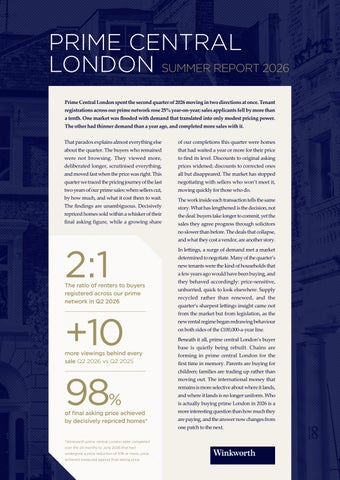
2:1 98% +10
The ratio of renters to buyers registered across our prime network in Q2 2026 more viewings behind every sale Q2 2026 vs Q2 2025 of final asking price achieved by decisively repriced homes*
of our completions this quarter were homes that had waited a year or more for their price to find its level. Discounts to original asking prices widened; discounts to corrected ones all but disappeared. The market has stopped negotiating with sellers who won’t meet it, moving quickly for those who do.
The work inside each transaction tells the same story. What has lengthened is the decision, not the deal: buyers take longer to commit, yet the sales they agree progress through solicitors no slower than before. The deals that collapse, and what they cost a vendor, are another story.
In lettings, a surge of demand met a market determined to negotiate. Many of the quarter’s new tenants were the kind of households that a few years ago would have been buying, and they behaved accordingly: price-sensitive, unhurried, quick to look elsewhere. Supply recycled rather than renewed, and the quarter’s sharpest lettings insight came not from the market but from legislation, as the new rental regime began redrawing behaviour on both sides of the £100,000-a-year line.
Beneath it all, prime central London’s buyer base is quietly being rebuilt. Chains are forming in prime central London for the first time in memory. Parents are buying for children; families are trading up rather than moving out. The international money that remains is more selective about where it lands, and where it lands is no longer uniform. Who is actually buying prime London in 2026 is a more interesting question than how much they are paying, and the answer now changes from one patch to the next.
PRIME SALES SUMMER MARKET
The Quarter in Transactions
By every measure of intent, the sales market was smaller this quarter than a year ago: fewer applicants, fewer valuations, fewer homes coming to market. By the measure that matters, it was busier. Completions across our prime network held firm over the first half and gathered clear pace through the second quarter: more sales, from less stock, against a backdrop in which transaction volumes across prime London edged higher on the year, even as the first half as a whole remained below 2025 levels. In Knightsbridge, where prices have adjusted furthest, transactions across the patch were up by around a quarter on last year.
What changed was not the number of buyers but their seriousness. The average home we sold this quarter took around ten more viewings to reach exchange than it would have a year ago. Buyers took weeks longer to commit, yet once agreed, deals moved through solicitors no slower than before. The lengthening is in the decision, not the legals. Buyers are comparing everything, and committing only where value is beyond argument. When it is, they compete: a house
off King’s Road in Chelsea, priced correctly from launch, drew fifteen viewings and sold on the strength of them.
“Prices in Knightsbridge have come down to the point where buying here simply makes sense again, and buyers have noticed,” says Christian Lock-Necrews, Managing Director of our Knightsbridge & Chelsea office. “The right house, on the right street, at the right price always works.”
The quarter’s most telling feature was what finally sold: a substantial share of our completions were homes first launched a year or more ago, at last transacting at corrected prices. The market is clearing its backlog. It is digesting, not merely declining. Not everything moved: smaller flats below £1m remained the hardest work in the network, with investor demand still largely absent. And completed deals had to survive a more fragile journey. Collapses now come deep into conveyancing rather than at survey, and a fallen sale typically costs a vendor around four months and roughly 3% on price, with no guarantee of a resale. Protecting an agreed deal has rarely been worth more.
Sellers are taking more time when choosing an agent, and looking for reassurance that there’s a clear strategy, rather than simply opting for
the highest valuation or the lowest fee.
Guy Steenkamp, Sales Manager, Winkworth South Kensington & Earl’s Court
The Price of Getting It Right
We traced every price reduction across two years of our prime sales: when it was made, and what followed. The pattern is stark. Homes priced correctly from the outset, nearly half of everything we sold, achieved around 95% of asking in a little over five months, without a single reduction. A token trim of less than 5% bought almost nothing: those homes took over three months longer and fared no better against their final price. But homes repriced decisively, by 10% or more, sold at over 98% of their final asking figure. Once the price genuinely met the market, the market paid it, almost to the pound. In June alone, the proportion of sold prime properties across the market that had previously been reduced was over 50%*.
The sharpest finding concerns timing. Sellers who repriced within their first three months gave up almost exactly the same total discount as those who waited more than six, but found their buyer months sooner. The discount is
the same whenever you make it. The delay is pure lost time. Homes eventually withdrawn from sale told the same story in reverse: most had cut too little, too late, long after buyers had moved on. A late reduction does not rescue a listing. Yet the market still rewards getting it right first time: around one in eight of our sales this year exceeded its asking price. The correction is concentrated in stock that launched ambitiously; homes priced to the market from the outset are still achieving it. Sellers appear to have worked this out. “Sellers are taking more time when choosing an agent, and looking for reassurance that there’s a clear strategy, rather than simply opting for the highest valuation or the lowest fee,” says Guy Steenkamp, Sales Manager at our South Kensington & Earl’s Court office, where a growing share of instructions now arrive as second opinions from homes that failed to sell elsewhere. “Exposure isn’t the challenge: properties reach buyers through the portals. The difference is pricing strategy, presentation and the quality of advice from the outset.”
The discount is the same whenever you make it, the delay is pure lost time.
Who is buying in prime central London
Five years ago, the typical prime central London buyer was international, discretionary and paying cash. Today, across much of our network, seven in ten buyers are domestic, and it is family money. “Our archetypal buyer right now is someone who lives in the UK, buying for their children — wealthy, but not mega-wealthy by prime central London standards,” says Rob Oatley, Director of our Pimlico & Westminster office. “Pimlico offers value, and that’s drawing domestic buyers in.”
The international demand that remains has reorganised, patch by patch. Knightsbridge & Chelsea stays our most international market: a genuinely global pool, British alongside Gulf, European and Asian buyers. In South Kensington, the Lycée Français continues to draw French families buying within its catchment, alongside Italians with longestablished ties. In Notting Hill, the story is American, and generational. “Young Americans are settling in London and their parents are purchasing homes for them,” says Charles Erwin, Director of our Notting Hill office. “And older Americans, whose children have settled here, are looking for a London base to be close to family.” Kensington and Paddington & Bayswater, meanwhile, remain predominantly domestic, needs-driven markets.
And across the network, chains have returned to a market that once ran on cash. “Buyers are making offers before they’ve exchanged on their own sale, to tie the two together,” says Erwin. “People want to avoid an expensive period of renting.” Trading up within the areas they know, sequencing purchases like the rest of the country: needs-based demand in its purest form. When a Portobello Road house sold over asking this summer through two of our offices working one buyer between them, it was the pattern of the quarter in a single sale.
American family money, buying for children settling here, and to be near them.
French families in the Lycée catchment; Italian buyers with long-established
NOTTING HILL
SOUTH KENSINGTON &
catchment; long-established ties.
HYDE PARK
KNIGHTSBRIDGE & CHELSEA
The network’s most international patch, British buyers alongside a global pool.
Seven in ten domestic. UK parents buying for their children.
EARL’S COURT
PIMLICO & WESTMINSTER
PRIME LETTINGS SUMMER MARKET
Demand Without Urgency
Tenant demand across our prime network rose by a quarter on last year, the second consecutive quarter of substantial annual growth, much of it the kind of demand that once would have bought. But volume of demand did not translate into urgency.
Tenants arrived in numbers and behaved like buyers: comparing widely, negotiating firmly, and walking away from anything they judged fully priced. The result was a market working harder for broadly similar outcomes: completed lets across the network came in essentially level with last year, even as registrations surged.
Get the price right, though, and the market moved at pace: freshly instructed homes across our offices let at their full asking rent in a median of just over two weeks. The
realism that now governs the sales market applies equally here. Accurately priced stock commands its price and finds its tenant fast; ambition sits unviewed. Activity also drifted down the price spectrum, with the mid-market doing the quarter’s heavy lifting while the very top moved more slowly. “Over £2,000 a week it’s really quiet,” says Lock-Necrews. “It’s not that the properties are wrong; some have let before at 20% more. It’s that fewer people can afford them.” His threshold is telling: £2,000 a week sits almost exactly where the new Renters’ Rights Act stops applying. Below that line, tenancies now carry the flexibility the legislation was designed to give them; above it, the old contractual certainties remain — and the two sides of the market are beginning to behave differently as a result.
The Landlord Equation
Supply, meanwhile, recycled rather than renewed. Our instructions rose against last year, but more than half were properties returning to the market rather than genuinely new landlord stock, while appraisal activity, the truest signal of landlord intent, fell.
The hesitation is legislative before it is financial: the Renters’ Rights Act remains landlords’ dominant concern, though so far it has produced more threats of selling than actual sales. “Landlords want an agent who knows the rules and knows the patch,” says Harriet Darlow, Lettings Manager at our Paddington & Bayswater office, where the Act’s early months have been steadier than many feared. What landlords are buying, increasingly, is navigation. The offices that can provide it are winning stock in a market where the genuinely new landlord is the scarcest commodity.
Divergence in Applicant Demand: Sales vs Lettings
Nearly two tenants now register for every buyer across our prime network
*Sales and lettings applicant registrations, Winkworth prime central London offices, indexed to Q2 2025 = 100
Over
£2,000 a week it’s really quiet. It’s not that the properties are wrong; some have let before at 20% more.
It’s that fewer people can afford them.
Christian Lock-Necrews,
Managing Director at Winkworth Knightsbridge & Chelsea
LOOKING AHEAD
AUTUMN MARKET OUTLOOK
The quarter closed with the market’s central uncertainty changing shape rather than lifting. A change of Prime Minister, already in motion as it ended, was complete by mid-July. The political question is settled; the fiscal one is not. A summer of property-tax speculation lies between here and the autumn Budget, and if the last three years have taught prime central London anything, it is that speculation itself carries a cost: buyers and sellers can price a legislated tax, not a rumoured one. Clarity, whenever it arrives, will itself lift a weight from the market. Beneath the noise, the fundamentals point to a steadier second half than sentiment suggests. Interest rates are on hold, the spring’s pressures have eased, and the market’s engine does not wait for Budgets: domestic, needs-driven buyers moving because life requires it. Realistic pricing has proved it can create competition in any conditions; correctly priced stock is selling, ambitious stock is not. That discipline will hold whatever the autumn brings.
For expert insight in your area, contact your local office:
What we’re seeing is a new shape to demand in prime central London before a more consistent increase — real variation from one area to the next, but rising commitment from the buyers who are there. After a decade of price reductions, particularly the last 24 months, the value is becoming unarguable. The challenge is whether last year’s lessons are learnt and the economic kite-flying avoided. With a fresh approach in Whitehall and a Chancellor with deep Treasury experience, there is reason to hope for steady improvement — prime fringe buyers moving inwards to realise the value opportunity, and London’s international appeal enduring the mistakes of the past.
Dominic Agace, CEO Winkworth Franchising
The market is not waiting for perfect conditions. It has stopped expecting them, and it is moving anyway.