The first quarter of 2026 was defined by a market adjusting to a new reality. Across Prime Central London, activity continued, but only where pricing expectations had genuinely reset. Buyers remained present and purposeful, sellers grew more realistic, and the deals that completed reflected a market increasingly driven by need rather than opportunity.
Sales agreed across our six PCL offices held essentially flat year-on-year, a quietly significant result given the headwinds. But the effort required to achieve each transaction increased materially. Fewer vendors came forward for valuations, applicant numbers dipped modestly, and viewings softened: yet the deals still landed. The market’s pipeline narrowed at every stage, but conversion at the sharp end improved. Where pricing was right, committed buyers acted.
The shape of demand shifted noticeably. The domestic, needs-based buyer: typically
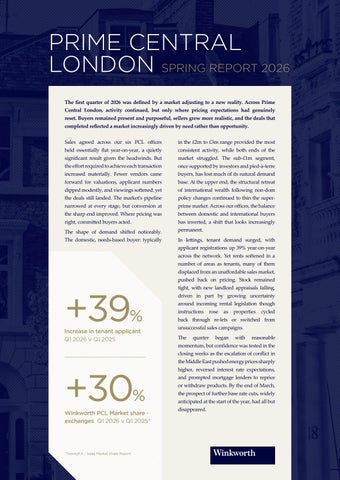
+39%
Increase in tenant applicant Q1 2026 v Q1 2025
+30%
Winkworth PCL Market shareexchanges Q1 2026 v Q1 2025*
in the £2m to £3m range provided the most consistent activity, while both ends of the market struggled. The sub-£1m segment, once supported by investors and pied-à-terre buyers, has lost much of its natural demand base. At the upper end, the structural retreat of international wealth following non-dom policy changes continued to thin the superprime market. Across our offices, the balance between domestic and international buyers has inverted, a shift that looks increasingly permanent.
In lettings, tenant demand surged, with applicant registrations up 39% year-on-year across the network. Yet rents softened in a number of areas as tenants, many of them displaced from an unaffordable sales market, pushed back on pricing. Stock remained tight, with new landlord appraisals falling, driven in part by growing uncertainty around incoming rental legislation though instructions rose as properties cycled back through re-lets or switched from unsuccessful sales campaigns.
The quarter began with reasonable momentum, but confidence was tested in the closing weeks as the escalation of conflict in the Middle East pushed energy prices sharply higher, reversed interest rate expectations, and prompted mortgage lenders to reprice or withdraw products. By the end of March, the prospect of further base rate cuts, widely anticipated at the start of the year, had all but disappeared.
PRIME SALES SPRING MARKET
Where deals completed in Q1, they followed a consistent pattern. Sellers who had absorbed the market’s message and priced accordingly found willing buyers. Those who held firm found themselves waiting, sometimes indefinitely. The gap between these two experiences widened through the quarter, and much of our offices’ energy was spent bridging it.
The pricing conversation has moved on. Reductions of 2 to 3 percent are no longer enough to generate traction. Across our network, the adjustments producing results were typically 5 to 15 percent off asking, and on properties that exchanged, achieved prices averaged roughly 8% below asking, a widening from a year earlier. This is not unique to our patch: across wider Prime Central London, the majority of sales in Q1 required at least one asking price reduction before transacting, and average discounts are running at their widest levels since 201819. In parts of Knightsbridge and South Kensington, values in some cases sit 20 to 30 percent below what current owners originally paid. Christian Lock-Necrews, Director at Winkworth Knightsbridge & Chelsea, described the environment plainly:
“The only way to get activity is through absolutely brutal pricing. Unless you have something particularly unique, it struggles without it.” Yet he also noted a potential turning point: buyers are beginning to recognise how much value has returned to the neighbourhood, and where pricing looks sensible, some are starting to act.
The type of buyer sustaining the market has become clearer. Discretionary purchasing has all but stopped. Josh Grinling, Director at Winkworth Kensington, observed: “Nobody is buying for fun anymore. Stamp duty makes every purchase a huge decision, and people know that if they buy now they could be stuck there for some time.” What remains is a core of needs-based demand: families relocating, professionals in financial services and private equity, and parents purchasing for children, particularly in the £2m to £3m range where family wealth support remains a significant factor.
The one-bedroom market has lost its natural buyer base almost entirely. Just 15% of our prime Q1 exchanges were one-bed properties, down from over a third a year ago. The investors who once dominated this segment have retreated in the face of
The
only way to get activity is through absolutely brutal pricing. Unless you have something particularly unique, it struggles without it.
Christian Lock-Necrews, Director, Winkworth Knightsbridge & Chelsea
Exchanges by Bedroom Mix
Q1 2025 vs Q1 2026
higher borrowing costs and diminished tax incentives, while the post-Covid flexible worker who might once have taken a small central London flat is no longer in the market. Two-bedroom homes now account for half of all completions, reflecting a market that has migrated toward practical, liveable space.
At the very top end, the picture is equally challenging: transaction volumes above £5m fell sharply across Prime Central London in Q1, with available stock in that bracket continuing to build as demand thinned.
In Notting Hill, Charles Erwin, Director of Sales at Winkworth Notting Hill, captured the frustration: “We have good houses on, but people just aren’t moving. Even a year ago there would have been bids on these properties.” He noted that a four-bedroom family house priced at around £1,250 per square foot was approaching levels more commonly associated with the fringes of prime, an illustration of how repricing is
Buyers are about, but they are sensible and educated and not prepared to overpay. They will wait. And vendors who don’t have to sell are happy to let a property sit empty for a year.
Arabella Roupell, Director at Winkworth South Kensington & Earl’s Court
redefining value perceptions in parts of PCL.
The standoff between those who need to act and those who can afford to wait shaped much of the quarter. Average marketing-toexchange times lengthened by around 20% year-on-year. Arabella Roupell, Director at Winkworth South Kensington & Earl’s Court, summed up the dynamic: “Buyers are about, but they are sensible and educated and not prepared to overpay. They will wait. And vendors who don’t have to sell are happy to let a property sit empty for a year.” When the two sides do meet, progression tends to be purposeful. But those meetings are happening less frequently.
Despite these conditions, Winkworth’s share of PCL sales exchanges rose year-on-year. In a market that increasingly rewards honest pricing advice and the willingness to have difficult conversations with vendors, that shift feels meaningful.
Achieved Price Percentage
Q1 2025 vs Q1 2026
Q1 2025Q1 2026
Average discount from asking Achieved as % of asking
PRIME LETTINGS
SPRING MARKET
The lettings market in Q1 was defined by speed. The sharp rise in tenant demand outlined above translated into a market where well-priced properties in good condition are letting so quickly that nothing sits on the books long enough to build a visible pool of choice. Lettings instructions rose over a quarter year-on-year, yet at any given moment the shelves feel bare.
Robert Oatley, Director at Winkworth Pimlico & Westminster, described the pace:
“As soon as we bring something on, it lets. There is essentially no stock sitting with us, as long as the pricing isn’t over the top.” In Pimlico, every tenancy that came to an end opened a conversation about whether the landlord might sell instead, a reflection of how closely intertwined the two markets have become.
Despite that volume of demand, tenants are not paying at any price. Across our offices, the tone has shifted from the urgency of recent years to something more considered. Rental growth across Prime Central London has turned negative on an annual basis for the first time since the post-pandemic surge, and asking rents in parts of South Kensington have been reduced by 10 to 20 percent from their peaks. Rents remain well above prepandemic levels, so this is a correction from a high watermark rather than a cause for alarm, but the frantic escalation of 2023 and 2024 has clearly given way to a more stable footing. At the top end, properties at £2,000 or more per week struggled to attract the interest they once did, mirroring the structural thinning seen in upper-end sales as non-domiciled and second-home tenants have stepped back.
As soon as we bring something on, it lets. There is essentially no stock sitting with us, as long as the pricing isn’t over the top.
Buyers are about, but they are sensible and educated and not prepared to overpay. They will wait. And vendors who don’t have to sell are happy to let a property sit empty for a year.
Robert Oatley, Director at Winkworth Pimlico & Westminster
Arabella Roupell, Director at Winkworth South Kensington & Earls Court
Anything priced correctly and in decent condition is fine. But anything that needs work is victim to real pickiness from tenants.
Lucinda Richardson, Director at Winkworth Notting Hill
Landlord confidence is more fragile than the activity levels suggest. Fewer owners are entering or returning to the market, and the conversations have changed. Arabella Roupell, Director at Winkworth South Kensington & Earl’s Court, noted a growing preoccupation with legislative change: “There are a lot of conversations now about landlords waking up to what the new regulations mean for them. It is front of mind in a way it was not a year ago.” For those who remain committed, the returns are still there, particularly where properties are wellpresented and competitively priced. But the mood has shifted from confidence to caution.
In Notting Hill, Lucinda Richardson, Director and Head of Lettings at Winkworth Notting Hill, echoed the theme of quality-led demand: “Anything priced correctly and in decent condition is fine. But anything that needs work is victim to real pickiness from tenants.” That selectivity reflects a market where tenants now have options. With more stock flowing through and rents correcting, the urgency that characterised 2023 and 2024 has faded. Tenants no longer need to accept compromises to secure a home, and they know it.
The lettings market is functioning well on the surface, but its foundations are shifting. The landlords who make the system work are facing a growing list of reasons to question their commitment: legislative reform that increases compliance obligations, diminished tax incentives, higher borrowing costs eroding margins, and a rental market that no longer delivers the automatic growth of recent years. For many, the calculation is changing. How that plays out over the coming quarters will shape PCL lettings more profoundly than any single measure of demand or supply.
Lettings Market Snapshot
Q1 2025 vs Q1 2026
LOOKING AHEAD SUMMER MARKET OUTLOOK
The outlook for Q2 carries both reasons for caution and, in places, for quiet encouragement. Interest rate expectations have shifted materially since the start of the year, with further cuts now unlikely in the near term. For a market already grappling with stamp duty at punitive levels, the incoming High Value Council Tax Surcharge on properties above £2m from 2028 adds yet another layer of cost to prime ownership, and its shadow is already beginning to influence buyer calculations. The seasonal lift that spring typically brings may be more muted than usual. But the repricing that has made this quarter so demanding is also creating the conditions for the next phase of activity, particularly as price per square foot in parts of PCL approaches levels that buyers from neighbouring markets would once have considered out of reach.
For expert insight in your area, contact your local office:
Taxation continues to weigh heavily on the PCL market and is often proving too great a cost in an uncertain environment, meaning we are not yet seeing the safe haven benefits that have supported prime London demand in previous periods of global uncertainty.
But PCL continues to undergo a fundamental change. As the pricing gap with neighbouring areas closes, prime central is looking increasingly affordable for the domestic, needs-based buyers of those markets. Traditionally, when this gap narrows, demand resurges in PCL. With prices per square foot now comparable, we are seeing early signs of this, with values flattening in some neighbourhoods after last year’s declines.