Summer Issue 2026
The Sentinel Wings Over Water Research Institute - Quarterly Newsletter
WOWRI MISSION Research Building on 40+ years of monitoring data to inform effective management Outreach Strengthening community involvement and sharing our findings Education Preparing the next generation to carry on this vital work
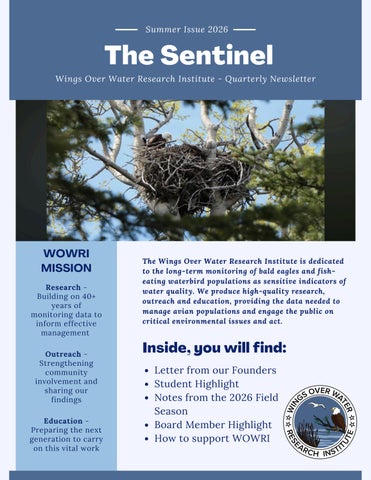
The Wings Over Water Research Institute is dedicated to the long-term monitoring of bald eagles and fisheating waterbird populations as sensitive indicators of water quality. We produce high-quality research, outreach and education, providing the data needed to manage avian populations and engage the public on critical environmental issues and act.
Inside, you will find: Letter from our Founders Student Highlight Notes from the 2026 Field Season Board Member Highlight How to support WOWRI
Letter from our Founders By Jennifer Day and Dr. Bill Bowerman Dear Friends, Colleagues, and Supporters, Welcome to the very first issue of the Wings Over Water Research Institute newsletter! We are thrilled to begin this journey with you and share our vision for an organization dedicated to the long-term monitoring of bald eagles and fish-eating colonial waterbirds as sensitive indicators of water quality. Through high-quality research, education and outreach, we can better understand the health of bird populations and the ecosystems they depend on—and engage communities in finding solutions to critical environmental challenges. We founded Wings Over Water Research Institute because we believe good science is essential to protecting clean water and the aquatic ecosystems that sustain us all. WOWRI was created to help ensure that critical research and monitoring programs have the resources needed to collect globally important data year after year. Our work builds on long-term studies dating back decades, some beginning in the 1920s and 1940s, that document changes in avian populations and the threats affecting individuals, colonies and entire ecosystems. Our goal is to create a sustainable model for funding environmental research while supporting the next generation of scientists and citizen scientists who will carry this work forward. By investing in both data and people, we can strengthen our ability to understand—and protect—the waters and wildlife upon which we all depend. One of our greatest priorities is looking beyond the immediate moment. Environmental change often happens gradually, and understanding those changes requires consistent observation over many years.
Jennifer Day
Dr. Bill Bowerman
Long-term monitoring can help us recognize trends, measure restoration success, identify emerging problems, and provide the scientific information needed to make informed conservation decisions. We also believe the best science is collaborative. We look forward to building partnerships with researchers, universities, government agencies, Indigenous communities, conservation organizations, local communities, volunteers and others who share our commitment to healthy ecosystems. By bringing together knowledge and perspectives, we can accomplish far more than any one organization could do alone.
"We founded Wings Over Water Research Institute because we believe good science is essential to protecting clean water and the aquatic ecosystems that sustain us all." As WOWRI grows, we hope to become a trusted source of research and information while creating opportunities for people to connect with bald eagles and the many fish-eating waterbirds that inspire us. Through this newsletter, we will share project updates, introduce our partners, highlight discoveries and explore the issues shaping the future of these remarkable birds and the waters they call home. This is only the beginning, and there is much work ahead. We are deeply grateful to everyone who has supported our vision and helped Wings Over Water Research Institute get off the ground. Thank you for joining us at the start of this adventure. We look forward to sharing the journey—and the discoveries—with you. With gratitude and excitement, Bill and Jennifer Founders Wings Over Water Research Institute
Student Highlight Riley Cornwell Calvin University Grand Rapids, MI This summer, I often found myself handling small herring gull chicks or drawing blood samples and dissolving into complete awe of the current moment. Each second, I was living out a dream I had held since I was a kid. Working under Professor Keith Grasman’s research project, supported by Calvin University and the Great Lakes Restoration Initiative (GLRI; funding from the US Environmental Protection Agency through the US Fish and Wildlife Service and collaboration from the Michigan Department of Environment, Great Lakes, and Energy), I got to be a part of a valuable conservation project while also launching and fulfilling my dream. Myself and two other students, under the tutelage of Grasman, spent the summer evaluating health endpoints in colonial waterbirds to understand trends in persistent organic pollutants in the Great Lakes. Early in the summer, we collected herring gull and Caspian tern eggs for chemical analysis, as well as measured embryonic viability. Later in the field season, we measured growth, ran immune tests, and evaluated productivity in 3and 4-week-old chicks. Our lab time was spent analyzing blood samples for immune response, processing eggs for chemical analysis, and eventually analyzing data for time trends of specific health endpoints. In addition to my work with colonial waterbirds, I accompanied WOWRI founders Bill Bowerman and Jennifer Day on one of the Bowerman lab’s “eagle climbs.” After Dr. Michael Wierda, WOWRI co-chair of science and education, climbed up to safely retrieve an eagle chick from its nest, I had the opportunity to handle the eaglet while Bowerman measured growth, sexed the chick, and took feather and blood samples for contaminant analysis. As an undergraduate student at Calvin University, studying to earn a B.S. in biology and in biochemistry, I
gained valuable skills in participating in Grasman’s research. I learned field and lab protocols universal to scientific research, statistical analyses crucial in any compelling argument, and professional scientific writing connecting statistical conclusions to social relevance. I can now claim skills in efficient teamwork, the handling of avian species, drawing blood samples, statistics and scientific writing, ecotoxicological knowledge, and countless other areas. Most significantly, this research has helped me narrow down a career plan after I finish my bachelor’s degrees. Those skills, along with guidance from Grasman in regard to graduate programs, are the foundation for pursuing a PhD in conservation biology or environmental toxicology. While I am still early in the process of finding and applying to research labs, my search is highly narrowed down because of my experience this summer. I have looked into labs in Vancouver, BC, and Fairbanks, Alaska, that monitor mercury contamination in seal species, as well as avian toxicology labs in Ontario and different wildlife ecology and conservation labs in Wyoming, Montana, and Oregon. All of WOWRI’s various research rojects in ecotoxicology and wildlife conservation are valuable contributors to the countless labs globally committed to protecting the natural world, and participating in Grasman’s research has readied me to continue protecting wildlife in whatever career I pursue. I will continue to work in Grasman’s lab as I finish my final two years of undergraduate education, learning more from GLRI, Calvin University, and WOWRI on how I can steward nature’s biological wonders.
Notes from the 2026 Field Season The 2026 Field Season Has Concluded The Scientific Work Continues WOWRI research teams have completed the 2026 field season, concluding months of intensive monitoring across Michigan's forests, rivers, lakeshores, and islands. Crews climbed nest trees exceeding 90 feet to examine bald eagle nestlings, collect blood and feather samples, record growth measurements, and assess nesting success. Similar monitoring efforts were conducted on herring gull colonies across Lakes Michigan and Huron. Photographs from the season are now available in the Gallery section of our website. While the field crews have returned home, the most important scientific work is only beginning. Findings from the Field This year's monitoring revealed bald eagle observations that warrant continued attention. Researchers documented lower than expected productivity in portions of Michigan's bald eagle population, including fewer successful nests, reduced numbers of eaglets in some territories, delayed nesting attempts, and several nest failures. Whether these findings reflect normal annual variation or an emerging concern can only be determined through sustained, long-term monitoring. Preliminary findings from our colonial waterbird research also raised concerns. Researchers observed ongoing immunosuppression and elevated rates of egg infertility and embryonic mortality in herring gulls at three colonies located in ecosystems contaminated with PCBs, dioxins, and emerging contaminants such as PFAS. A cross-billed herring gull chick was also documented in Saginaw Bay.
"It is concerning that we are still seeing these deformities and embryonic mortality today at PCB and dioxin contaminated sites," said Dr. Keith Grasman, WOWRI affiliated researcher from Calvin University. Researchers also noted a significant decline in Caspian terns, a state-threatened species, in Saginaw Bay. Only 8 nests were recorded on Channel-Shelter Island in 2026, compared to 100 to 150 nests observed in the same location between 2021 and 2023. The Work Ahead The field season generated hundreds of biological samples that will now undergo extensive laboratory analysis. Blood and feather samples will be tested for environmental contaminants, including mercury, PFAS, and other persistent chemicals, while genetic analyses will provide information relevant to population health, relatedness, and disease susceptibility.
Notes from the 2026 Field Season - continued This process requires considerable time. Chemical analyses typically take six to twelve months to complete due to specialized testing and quality assurance requirements, and DNA sequencing often follows a similar timeline. Once complete, this data will be integrated with more than six decades of historical monitoring records to identify long-term environmental trends. "Our work doesn't end when the field season ends," said Dr. William Bowerman, WOWRI affiliated senior research scientist. "Collecting samples is only the first step. Careful laboratory analysis, statistical evaluation, and comparison with historical records are what transform those samples into science that informs conservation and environmental management."
Why Long-Term Monitoring Matters "This research has demonstrated for decades that birds are among our earliest indicators of environmental change," said Jennifer Day, Executive Director and CEO of the Wings Over Water Research Institute. "Protecting these longterm datasets is just as important as protecting the birds themselves. Without sustained funding, we risk losing the ability to detect emerging threats before they become larger environmental or public health problems." Long-term monitoring remains one of the greatest challenges in environmental science. Many wildlife studies receive funding for only a few years, limiting researchers' ability to detect the gradual changes that unfold over decades. WOWRI's bald eagle monitoring program, built on more than 65 years of continuous observation, represents an exceptionally rare scientific resource for understanding ecosystem recovery, contaminant exposure, and the overall health of the Great Lakes. WOWRI will continue to share updates as laboratory results become available over the coming year, with comprehensive findings to follow scientific review and analysis.
WOWRI Board Member Highlight Dr. Michael Wierda Utah State University Dr. Michael Wierda is the Pesticide Safety Education Program (PSEP) Director at Utah State University. Through USU PSEP, his work focuses on helping the public understand the environmental and health concerns associated with pesticides—including how pesticides move, work, persist, and break down in our bodies, communities, and environment. Michael earned his Ph.D. in Environmental Toxicology from Clemson University, where he studied legacy pollutants in Michigan’s aquatic ecosystems through research involving bald eagles. Before beginning his doctoral studies, he attended Grand Rapids Community College and Northern Michigan University in Marquette, Michigan. Originally from Grand Haven, Michigan, Michael now serves as a tenured faculty member at USU.
His path into raptor research began when Dr. Bill Bowerman visited Northern Michigan University to present his work on bald eagles. One conversation sparked Michael’s interest and ultimately led to a research assistant position with Bowerman, who later became his Ph.D. mentor at Clemson. What began as a mentorship developed into a lasting friendship and a career-long connection to bald eagle research. Michael’s journey as a climber began under the mentorship of Teryl Grubb, who climbed for Bowerman for three decades. Teryl’s expertise, generosity, and kindness had a lasting influence on Michael. Today, climbing to access bald eagle nests remains one of the most challenging—and rewarding—parts of his year. “Climbing is exhausting, and every nest presents its own unique and entertaining puzzle. But the best part of the day is cresting the nest and seeing the eaglets. They spread their wings and stand as tall as they can, trying to look as tough as possible. It’s adorable.” When he’s not working, Michael’s passions keep him connected to the outdoors. He enjoys hiking in the mountains, fly fishing, and spending time in nature. “It is truly an honor to have the support of USU and the opportunity to work with WOWRI and bald eagles”, shared Dr. Wierda.
New Book Spotlights WOWRI Researchers — And Gives Back WOWRI is pleased to share news of a newly released book from WOWRI friend Dr. Carl Palazzolo – celebrating bald eagles and featuring 174 high-quality photographs alongside extensive research and commentary. The publication highlights the contributions of two members of our organization's network, Dr. Bill Bowerman and Dr. Mike Weirda. Notably, all proceeds from the book's sales benefit organizations dedicated to eagle conservation, including WOWRI. Each purchase directly supports the ongoing efforts of our organization and others in this field. Dr. Palazzolo is currently undertaking a book tour in support of the publication. WOWRI co-founder Jennifer Day has attended several of these events, where she has had the opportunity to speak on behalf of WOWRI and share our mission with attendees. These sessions have proven to be a valuable platform for raising awareness of our work within the broader conservation community.
ALL PROCEEDS GO TO ORGANIZATIONS DEDICATED TO WORKING WITH EAGLES, INCLUDING WOWRI!
Support Long-Term Environmental Monitoring WOWRI's research is only possible because of sustained, long-term investment — and as a newly established nonprofit, we rely on philanthropic support to keep that work going. Visit our website to Donate Now!
Your contribution helps fund:
wingsoverwaterri.org
Field seasons, including nest monitoring, sample collection, and equipment for climbing and surveying remote sites Laboratory analysis of contaminants such as mercury, PFAS, and PCBs Genetic research supporting population health and disease studies Training opportunities for the next generation of environmental scientists Continued public education and data sharing with resource management partners
For information on how to support our mission, contact us at jennifer@wingsoverwaterri.org
Every dataset we collect builds on more than four decades of continuous monitoring — a resource that cannot be recreated once lost. Your support helps ensure this work continues uninterrupted, preserving our ability to detect environmental threats before they become larger problems.
Stay Tuned ... WOWRI is launching a podcast! Listen in to learn more about fish-eating waterbirds and their importance as indicators of environmental health. More info to come!
Wings Over Water Research Institute
For more information, visit our website: wingsoverwaterri.org Email: Jennifer@wingsoverwaterri.org
WOWRI is a fiscally sponsored project of Social and Environmental Entrepreneurs (SEE), Inc.