THE WINE MERCHANT. An independent magazine for independent retailers
Issue 161, September 2026
Cat of the month: Basil Basil’s of Reigate
Footfall has declined – but indies can play to strengths Report produced by Liberty Wines says merchants have reasons to be positive despite seeing customer numbers fall
I
ndependent wine merchants are being urged to maintain their focus on recruitment, retention and premium
positioning after new research found that falling customer numbers – rather than lower spend per visit – are the main drag on sales. Liberty Wines’ 2026 independent offtrade report, based mainly on card-spend analysis covering more than 120 leading independents as well as its own insights, shows overall spend in indies fell 5% between March 2024 and March 2026, although it remains 20% above 2019 levels. Performance varies sharply by business: more than 40% of merchants increased sales over the past two years, while 26% achieved growth of more than 10%. The report identifies customer loss as the most pressing problem facing the channel. Shopper numbers fell 9% over the two-year period, although spend per visit increased. It argues that the merchants achieving the strongest results are generally those adding customers, and that growth depends on giving shoppers more reasons to visit through range, service, events, tastings and communication. Liberty warns against responding to the downturn by competing more aggressively with supermarkets on price. Its analysis suggests independents are retaining a
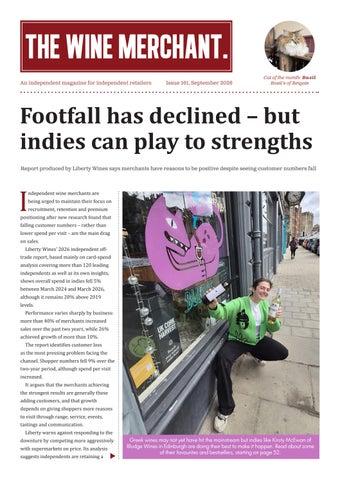
Greek wines may not yet have hit the mainstream but indies like Kirsty McEwan of Bludge Wines in Edinburgh are doing their best to make it happen. Read about some of their favourites and bestsellers, starting on page 52.
NEWS
Inside this month 4 comings & Goings New merchants take the plunge in Ealing, Kettering and Stevenage
Falling sales – but grounds for hope stronger quality proposition even as wine prices rise.
13 bright ideas Wishing you a merry Crispmas from The Grape Escape, Cheltenham
17 the burning question What have been the biggest hits for independents this summer?
24 merchant profile We’re off to Gateshead to meet the creators of Victor Indigo November
30 rob hoult Is it really possible to hate a wine? Well, the customer is always right
32 italian reds Jacob Stokes considers some challengers to the big names
44 buyers trip to tuscany Cecchi invites us back for a fourth visit, knowing indies will be wowed
56 make a date There are lots of tastings coming up, and you should go to some of them
63 Q&A: doug wregg Les Caves chief plied Melvyn Bragg with sulphurous Frascati
spending customers, many of whom have similar income profiles to those spending substantially more each month. Spain and South Africa have gained share in still wine, the report says, with smaller advances for Greece, Georgia and Germany,
The report says customers in the
while Champagne, English sparkling
independent sector are “getting better
wine and Provence rosé remain strong.
wine in the bottle”, with more of the
Liberty says this supports the case for
increase in retail price feeding through to
broad, distinctive ranges rather than more
the wine itself once duty, EPR, margins and
conservative selections.
exchange rates are taken into account. It
Liberty Wines CEO Tom Platt says: “The
concludes that a quality-led strategy offers
report gives us huge confidence for the
better prospects than chasing low-price
long-term future of indies. We know there
volume.
are challenges, but the fundamentals are
There are encouraging signs in the
strong: competing on quality is proving
profile of the independent shopper. The
far more resilient than competing on
average customer has become younger
price, indies continue to attract a younger,
since 2019, while spending power has
engaged consumer and there are affluent
remained broadly stable. The report
consumers visiting indies who can be
highlights an opportunity to increase
persuaded to spend more.”
frequency and spend among lower-
• Analysis: pages 14-15
Wood steps down after sex conviction Douglas Wood, who set up WoodWinters – the Scottish wine wholesaler with
under the current management team. Director Rodney Doig says:
shops in Edinburgh, Inverness and
“WoodWinters Wines & Whiskies can
Bridge of Allan – has resigned his
confirm that Douglas Wood has resigned
directorship of the company, having
from his position as director with
been found guilty of sexual assault.
immediate effect.”
Wood has not been given a custodial
He says the team is “fully focused on
sentence but will do 250 hours’ community
maintaining the high standards of service,
service and has been added to the sex
expertise and professionalism upon which
offenders’ register for two years.
the business has built its reputation”,
WoodWinters will continue its wholesale, import and retail operation
adding that “a management buyout process is currently underway”.
THE WINE MERCHANT MAGAZINE winemerchantmag.com 01323 871836 Instagram/Bluesky: @WineMerchantMag Unit 52 Newhaven Enterprise Centre, Denton Island, Newhaven, East Sussex BN9 9BA Editor and Publisher: Graham Holter graham@winemerchantmag.com Assistant Editor: Claire Harries claire@winemerchantmag.com Reporter: Jacob Stokes jacob@winemerchantmag.com Advertising: Sarah Hunnisett sarah@winemerchantmag.com Accounts: Naomi Young naomi@winemerchantmag.com Admin and reader liaison: Charlotte Gingell charlotte@winemerchantmag.com The Wine Merchant is circulated to the owners of the UK’s 1,021 specialist independent wine shops. Produced in Sussex by East Print. © Graham Holter Ltd 2026 Registered in England: No 6441762 VAT 943 8771 82
THE WINE MERCHANT september 2026 2
A TALE OF TER ROIR
Louis Jadot Bourgogne Côte d’Or A label born from the imagination of art students at Central Saint Martins London, capturing the soils, landscape and Climats of the Côte d’Or in a single design. Sourced from vineyard plots between Marsannay and Maranges, this is a Burgundy with a beautiful depth combined with great freshness and intense fruit. A rare departure in Louis Jadot’s history, only a select few wines have ever carried a label different to the house’s own. Created exclusively for the UK’s independent wine merchants, this special Bourgogne Côte d’Or label brings together a great Burgundy wine and a distinctive contemporary design, in equal measure. Contact Hatch Mansfield, the exclusive UK distributor of Louis Jadot. info@hatch.co.uk | www.hatchmansfield.com
THE WINE MERCHANT september 2026 3
Broadway Cellars expanding already Broadway Cellars has opened in Oundle Wharf, in a unit previously occupied by Amps Wine Merchants. This is the second shop for the company which launched just last November in St Ives, Cambridgeshire. Broadway Cellars is part of Stephen James Inns, which brings together a small group of independent venues including The Elm at Abbots Ripton and The Pheasant at Keyston. Jack Baldock oversees the wine buying for the group and has managed the expansion into the new shop. “We opened in Oundle on June 11,” Baldock says, “and I’ve been there for the most part, but now we have my colleague Samantha [McKendry] on board, I can have a couple of days in the week to go over to the other sites.” Unlike the St Ives shop and bar, Oundle Wharf is strictly retail only, but Baldock says they have plenty of tasting events planned. “We’ll do one on the last Thursday of every month. We’ll have different themes, hosted by myself or Samantha. They’ll be
The Oundle site was previously occupied by a branch of Amps
informal – just a small group of people getting together to taste a few wines.” Over the past few months, Baldock says he has increased his supplier base to include Alliance and Mentzendorff. “We also work with a few local producers and we buy a rosé direct from Essex,” he adds. Amps continues to trade from its main
Hastings Wine & Coffee closure
here would require a huge amount of
After 18 months of trading, Hastings
• Following the closure of Vino wine
Wine & Coffee closed in August.
bar and shop on the Isle of Man in May,
time and energy. It would almost feel like starting over again.”
Owners Darren and Rachel Tickner
the business now trades entirely online
posted a statement saying: “Despite trying
with a focus on home delivery across the
• A premises licence is being considered by
lots of different ideas, we’ve never quite
island. Owned by hospitality and retail
Mid Suffolk district council for a wine shop
hit the numbers we needed to make things
group Heron & Brearley, Vino opened in
and bar in Needham Market, Suffolk. The
work.
Douglas in 2015 under the management of
branch in the Northamptonshire town.
proposed business will trade as The Wine
“The first heatwave this summer really
Heath Craig. The company cited “ongoing
Room and set up shop in the high street
brought that into focus, with our numbers
challenges across the trade” and the end of
premises currently occupied by Hamilton
dropping by almost half overnight and
its lease as the main reasons for the closure
Smith estate agents.
they’ve not recovered. Rebuilding from
of the premises.
THE WINE MERCHANT september 2026 4
Are you a shop? Yes, we are now Importer Ealing Wine Cellars will enter
Bacchus “I can sell with a bigger margin than other retailers might be able to because I have the advantage that I direct import most of the wines on my shelves. “We have 25 wineries that we work with,
the retail arena in October. Owner
mostly from France and Italy, though we
Caroline Brangé has secured a site on
are continuing to grow.
Bond Street, Ealing, which was home to
“I will need to use other UK suppliers,
City Radio Stores for almost a century.
but most of my friends are salespeople and
Brangé has been waiting a while to
some of them have also started their own
reach this stage of her journey. “When I registered the business and came up with
wine importing businesses.” Brangé says that 70% of her business
the name Ealing Wine Cellars back in 2020,
comes from supplying fine dining
my original idea was to open what we call
restaurants and the rest is accounted for
a cave à manger – a sort of wine bar/shop
with private client sales and consultancy
where you can grab a bottle off the shelf,
work. “We are a wine importer first and
pay corkage and have it on site with cheese
foremost and the shop is just bringing a
and charcuterie,” she says.
fourth sales channel to what we already
“I couldn’t find the right site, so I just
do,” she adds.
parked it and continued doing what I knew
Although she has licensing in place for
best, which was selling wine to restaurants,
both off and on-trade, she is keen to hold
because that’s what I’d done for 10 years
off on the cave à manger model for a while.
for Flint and for Armit, in various roles.”
“I anticipate that people will be asking me
The current office, which will relocate
if they can drink on site, but I think it’s
to the new store, is very near Ealing
really important to establish the retail part
Broadway and Brangé explains that, thanks
of it so that people come to us first rather
to Google Maps and good SEO on her
than thinking about Waitrose or Majestic,”
website, she receives several enquiries on a
she says.
weekly basis from people thinking she is a retailer anyway.
“I will be running a series of events though and of course I’ll have
“The concept was kind of proven
winemakers coming over in the
before I even had a physical shop,” she
winter, so we can do winemaker
says, “so it makes a lot of sense to just
events.”
pay a little more in rent than I was
footfall.
When the hanging shop sign was stolen from The Artisan Wine & Spirits Company in Salisbury, owners Lizzie and Thom responded with a promotional series on Instagram. The “kidnapped” and newly christened “Hangy McSignface” was seen enjoying rum on a beach in Barbados, a bottle of Citadelle gin outside Château de Bonbonnet and a negroni in Rome. Then there was the scuba diving in the Maldives and the camel-riding in Egypt. Wiltshire police caught the culprits and a replacement sign was commissioned and in place by the beginning of June.
Are you taking the turbo?
Presenting wines by style can often be more problematic than simply arranging them by country of origin. Where does “rich and smooth” end and “full and juicy” begin? Dan’s, the Dalston retailer and bar, can offer a little inspiration. It simplifies its chalkboard with headings including “textural white”, “easy red”, “elite red”, “serious skinsy” and “turbo piss”. It goes down well in Hackney. Anyone want to give it a go in the Cotswolds?
Wonky and fragrance-free
for my original office space and have a shopfront with a high
Signing off in the Maldives
Caroline Brangé of Ealing Wine Cellars
THE WINE MERCHANT september 2026 5
Our friends at Vino Gusto in Bury St Edmunds deserve credit for telling it like it is in their T&Cs for tasting events. “We adore our wonky old building,” they warn customers. “All we regret is that the staircase to our first floor WC and tasting room is not forgiving and as such rules us out from being accessible.” Then, an even more important announcement: “We kindly ask attendees not to wear strong aftershave or perfume. This sounds like a silly request, but we try and keep our tasting room as a controlled environment so that only the wine fumes invade our nostrils.” Quite right!
THE INDEPENDENT now ADVANTAGE Restaurant takes top billing A monthly column from Alliance Wine/ H2Vin exploring practical, creative ways independents can sell smarter - covering everything from fine-wine offers to pricing tweaks and experiential events
Hometipple in Walthamstow has welcomed the Macchina restaurant as a permanent fixture following chef Hayley Meredith’s kitchen residency. “We kept being asked for more food, to
W
e have talked about consolidation before: fewer orders to place each month, fewer deliveries to chase, fewer invoices to pay and less stock to put away – without giving up price, service or quality. Have you considered how you buy from each supplier? Like salmon before the run upstream, our wines gather in three European consolidation warehouses, then travel to the UK on larger shipments. For the busy retailer, that means lower costs, less admin and a smaller environmental impact. Order ex-works, or piggyback your DPD/IBD orders on our containers, and you gain favourable pricing, quick lead times and an industry-leading range. Take France: Champagne, Picpoul, Vin de France, Chablis and Sancerre, all in mixed pallets from one source rather than shipped individually. One invoice, one delivery, one order to put away. It works the same elsewhere: Prosecco and Pinot Grigio arriving with Gavi and Valpolicella from Italy; Rioja and Albariño with Cava, Verdejo and even Mendoza Malbec or New Zealand Sauvignon Blanc from Spain. This service saves considerably against shipping from producers directly – not by compromising on quality or price point, but because the efficiencies stack: lower per-bin stockholding, improved cash flow, reduced shipping costs, and fewer suppliers to administer. None of which asks you to narrow your range – our portfolio is broad and deep enough to cover it, whatever your shelves need. To learn more, please contact Alex Baudouin, head of independent off-trade: alex.baudouin@alliancewine.com.
Ned Llewellyn Alliance/H2Vin sales director – off-trade
be open later, that sort of thing, and so we’ve moved much more now towards being a restaurant with a wine shop rather than a wine shop with a restaurant,” says owner Mikey Studer. The new sign says Macchina at Hometipple. “I think that a straight-up wine shop with just pure retail probably only really works in certain areas. When you’re in a large city with lots of different places that you can go, you need to have another revenue stream.
Diners have the advantage of selecting any wine from the shelves to drink with their meal without paying the usual restaurant mark-up. “It’s just a £15 drink-in addition. We don’t call it corkage, but effectively that’s what it is,” says Studer. “It’s difficult to explain to customers the value for money that they’re getting because you don’t want to start calling out your neighbours or other people within the industry for the really big margins they work with because everybody’s got to do what they need to survive. “We have a bottle of rosé on the shelf at £13, so that’s £28 to drink-in. I know for a fact that it’s in a restaurant in west London for £60 a bottle. But you can’t really point that out, because the restaurant industry is struggling enough as it is.”
“We found that people’s budgets have
Kettering gets a people would come in and buy two or three Bhatnagar boost got smaller. We’ve definitely lost custom to supermarkets and multiples. Where
bottles of £15 wine, they’ve now reduced
that budget and decided that they might as
Sufficiently Suffonsified Cheese & Wine
well just be buying it from a supermarket.
is set to open in Kettering next month.
“A friend of mine said to me the other
This may be the first shop for Tracy
day: ‘If I was going to buy a £10 bottle of
Bhatnagar, but she has previous experience
wine, I probably wouldn’t go to a wine
working for an indie wine retailer.
shop anyway because I’d want to go there
“I took my WSET Levels 2 and 3 a few
for something a bit more special.’ So
years ago, and I remember decades ago
even though we do sell wine at that price,
joking about having my own cheese shop,
customers are not necessarily thinking of
so that’s always been in the back of my
us for that sort of purchase. If it’s just a
mind,” she says.
bottle of £10 wine, they might as well get it with their grocery shop.” The refurbishment has expanded
When relocating from St Leonards, East Sussex to Kettering for her husband’s work, Bhatnagar became increasingly
seating capacity to 60 covers, which
frustrated with the job market and a friend
meant condensing the wine range and
suggested she start her own business.
reconfiguring the shelving.
She was also inspired by the success of
“We changed the construction of the
Mark Plummer’s cheese and wine shop,
shelves, which allowed us to fit more wine
Salon, in St Leonards. “I just thought, ‘yes,
into a smaller area,” says Studer, “and
now is the time’. I worked for Mark when
we culled quite a few lines that weren’t
he had his previous shop on Kings Road in
necessarily selling quite as well as some
the town, around the time I was doing my
of the others, but without being too brutal
WSET, so that connection goes way back,”
and while still trying to maintain a kind of
she says.
appropriate range.”
THE WINE MERCHANT september 2026 6
Bhatnagar got the keys to the premises
COMING DOWN THE LINE Hot topics that could impact independent wine merchants
By WSTA chief executive
Miles Beale
Extra revenue must not come from duty As I write, MPs are preparing to return to Westminster for the resumption of Parliament on September 1 after an unusual summer. New prime minister Andy Burnham has had a busy six weeks, making a series of policy announcements while the Commons has been in recess. The autumn budget will take place on October 28, earlier than last year, but against a similarly difficult economic backdrop. Conflict in the Middle East is keeping energy prices high, fuelling inflation and putting pressure on interest rates and government borrowing costs. Combined with increased defence spending, a VAT cut on electricity bills and business rate support for pubs and live music venues, new chancellor John Healey is likely to need extra revenue – despite commitments not to raise income tax, VAT or employees’ NI. Tracy Bhatnagar will open Sufficiently Suffonsified Cheese & Wine in October
in early August and is busy kitting it out. “I
they have some long-standing relationships
want to make it look nice, but I don’t want
with some of the growers and they have
to spend thousands and thousands,” she
a good range of wines priced at the lower
says. “I’ve just had a quote in for a serve-
end as well. I really don’t know what the
over counter display unit, which I think
sweet spot is going to be for people here,
will be about 1.5 metres long – that’s a
so I want to make sure I have wines at a
decent size, but not crazy, and I expect that
price point for everybody.
will dictate the amount of cheese that I’m carrying at any given time.” The wine range will have a Spanish emphasis. “I’ve decided I want to be
and cheese boards as well as monthly tastings.” Bhatnagar notes that while the town centre is currently “not very vibrant,” she is
exclusively Spanish, but I do spend a lot
optimistic that change is on the way.
particularly Ribera del Duero wines. “I’m excited about introducing people to
Businesses have absorbed enough extra costs. If the government wants to maximise revenue and stimulate growth, cutting duty is the sensible course. The WSTA will shortly be asking members to contact their MPs.
“My plan is to offer wines by the glass
Eurocentric,” Bhatnagar says. “It won’t be of time in Spain and I love Spanish wine,
Alcohol duty must not be the answer. Government policy is to increase excise duty annually with inflation, yet receipts have fallen since the 2023 reforms, despite duty rising by at least 20% for most wines and 18% for spirits and beer.
“Two weeks before we moved here a really nice coffee shop opened on Market Street and they’ve done very well and
some regions and grapes that don’t seem
already opened another place around the
to make it across the Channel really.”
corner, in Market Square. That has queues
So far Bhatnagar plans to work with
to the door. It makes me think that there
Indigo as well as A&A Wines. “They have
are people willing to come into the town
an almost exclusively Spanish portfolio –
centre if there’s something to come for.”
THE WINE MERCHANT september 2026 7
Meanwhile, the Welsh government has appointed Exchange for Change to run its Deposit Return Scheme. That is welcome, but Wales still intends to include glass from launch on October 1, 2027. Businesses have little time to prepare, while costs, labelling arrangements and interoperability remain unclear. Some companies warn they may have to delist products in Wales. Much still needs resolving.
Find out more at wsta.co.uk
St Vincent digs a little deeper St Vincent in Shrewsbury has opened a
While access to the newly named Vin’s Cellar Shop means descending steps
alongside the 130-strong range of wines
leading underneath the building, the shop
from around the world, Graze & Grape
is far from dingy. The well-lit, modern and
will be specialising in British cheese and
positively airy space is now home to a
charcuterie.
range of 500 wines.
separate shop underneath its original bistro and wine bar. Alexis Hill, who opened the business in 2024, says the decision to expand was easy. “It’s the same landlord, and at some point in time they had converted the cellar into two separate retail units,” he says. “Hospitality is very difficult at the moment and we have had good weeks and
A spokesperson for the group says that
“It’s been lovely this summer,” says Hill. “It doesn’t get any natural light and it stays at a constant 10 or 12 degrees, so it’s been perfect.”
QR codes will tell story of the wines
“We are championing local farmers and produce and we’ll have some English wines as well,” he says. “There will be six wines of the month available by the glass, and customers can choose any bottle from the cellar room to drink in and take home what they don’t finish. “We don’t really see the need for a corkage charge – the idea is if you’re going
bad weeks – it’s been a crazy couple of
Graze & Grape is set to open its doors in
to sit there and drink the wine, then you’re
years.
Stevenage Old Town this month.
probably going to order some charcuterie
It is the latest venture for The Stevenage
“So with the property being directly
as well, so we’re not going to lose out.
underneath the restaurant, it was a bit of a
Hospitality Group which already has a
“We won’t know what the retail and
no-brainer to take it on. Once we’ve closed
traditional pizzeria, a tapas bar and a
on-trade split will be until we open,” he
the shop for the day we can still sell wine
smokehouse in the Hertfordshire town’s
continues, “but the dream is: come in and
to people from the restaurant and bar.”
high street.
pick up a takeaway charcuterie box and grab a bottle of wine and take it home and share it with your partner. “We’re going to offer a full takeaway service on the charcuterie and the cheeses, and pair it with the wine. “We’re also going to launch a wine club, which will again pair with the cheeses and meats, delivered monthly, with a magazine.” Manager Maddie, armed with WSET Level 3, will be on hand to talk about the wines, but customers will be free to explore for themselves as every wine will have its own QR code which can be scanned to reveal more information about the wine, the grower and the region. Many of the 30-second videos will be supplied by the producers, but the rest will be put together by Maddie. Every bit of space is being utilised, including the roof, which will be planted with herbs and edible flowers and house beehives so the company can sell its own honey. In addition, the business has two mobile horsebox bars ready for private hire and to attend Christmas fairs, craft markets and
Alexis Hill opened St Vincent in Shrewsbury in 2024
food events in the surrounding areas.
THE WINE MERCHANT september 2026 8
Get your own copy of The Wine Merchant Subscribe for just £85 at winemerchantmag.com
SUSTAINABILITY. WITHOUT THE SPIN.
Sustainability is becoming part of doing business. But where do you start? EPR. Packaging. Carbon. Certification. Reporting. Regenerative. Organic. Biodynamic. For an independent business, sustainability can feel like an ever-growing list of regulations, responsibilities and decisions often without the time, resources or in-house expertise to work out what you actually need to do. What applies to your business? Who can you ask? And where do you start? Sustainability in Drinks 2026 brings the people who understand these issues together in one place. Come with questions and leave with practical answers, useful contacts and a clearer idea of what matters for your business.
Meet producers, experts and solution providers. Ask questions. Challenge the thinking. Leave better informed. SUSTAINABILITY IN DRINKS 2026 | 20 October | Christ Church Spitalfields, London BOOK YOUR TICKET sustainabilityindrinks.com
THE WINE MERCHANT september 2026 9
Relocation allows for new kitchen Via Vigna in Gorleston-on-Sea, Norfolk, has relocated and rebranded. The southern Italian wine specialist, opened in 2023 by Tim Edwards, closed its doors in August and will reopen in Norwich next month as Emilio’s. “I was looking for a bigger space so that I can add a kitchen,” says Edwards. “I have evolved the business from being a merchant and a bar to being a café, bar and New Clerkenwell indie has opened
merchant, bringing more food into the mix. “As well as antipasti boards and zucchini
Hair salon pop-up doing a partnership with the pizza guy gets its own home around here – and we can use one of the and burrata sandwiches, I’m going to be
outbuildings in the garden to host.”
July saw the opening of a new wine bar
Named for Edwards’s great-grandfather,
and bottle shop in Clerkenwell, London.
Emilio’s will have a range of around 60
Sommelier Raku Oda formerly worked
Italian wines, with 80% of those focused
for The Fat Duck before launching Ebi,
on southern regions.
which began life as a pop-up at his wife’s hair salon in Islington. “My motto is ‘good wine from everywhere’,” says Oda. “My experience, particularly in international restaurants, is I want to choose equally widely from
Corkk ready to pop in Winchester
everywhere. I don’t choose to work only
English wine specialist Corkk has plans
with natural or organic wines – of course
to open in Winchester.
there are absolutely great wines from
Owned by Jonathan Piggins, the company
these categories, but there are also many
already operates two hybrid venues in
great wines from producers who face very
Tunbridge Wells and Canterbury.
severe or challenging conditions in terms of winemaking.” Currently the wine range sits at 150 and Oda says he is working with 10 suppliers and is open to extending that list.
Despite objections from a number of local residents, Winchester city council granted licensing approval last month for the premises on Great Minster Street. Corkk plans to sell English wine to drink in or take away, plus coffee, tea, snacks and
• One of north London’s best-loved indie
other cold food.
wine shops has closed after 43 years. Longtime employee Andy Smith and wife Naomi
• Finley’s in Hoxton, east London, will close
acquired Mill Hill Wines from founders
in October unless owner Sia Smith can find
Laurence and Christine Hanison in 2017.
a buyer before she relocates to her home
The couple ran the shop until its operating
country of Australia. Smith launched the
company, Praedbrook Ltd, entered creditors’
wine bar and shop, which specialises in wine
voluntary liquidation in August.
from female-led producers, in 2022.
THE WINE MERCHANT september 2026 10
Two icons from the hill of Hermitage Biodynamic pioneers of the Rhône Valley, M. CHAPOUTIER has been crafting exceptional wines from the hill of Hermitage for generations. This pair captures the appellation at its finest: a richly aromatic white and a powerful, spice-laden red, each grown on some of the estate's most prized parcels. Hermitage Chante-Alouette 94 Points, James Suckling (2021 vintage) Named after the hunting lodge perched on top of the hill of Hermitage. Drawn from three plots on the hill - alluvial soil 'Le Méal', clay-gravel 'Les Murets' and loess and granite 'L'Ermite' - this 100% Marsanne combines the unique character of each parcel. Partial ageing in 600 litre demimuids results in a beautiful example of Hermitage white.
Hermitage Monier de la Sizeranne Organic and biodynamic, named after the Monier family, who previously owned vines on the hill of Hermitage. Maurice Monier de Sizeranne created an early version of braille - one reason Chapoutier still features braille on its bottles today. From fruit grown in the Les Bessards, Le Méal and Les Greffieux plots, vinified in concrete vats before 85% is aged in French oak for 18 months.
Contact Hatch Mansfield, the exclusive UK distributor of M. CHAPOUTIER. info@hatch.co.uk | hatchmansfield.com
G C F EXC LUS IV E ’ S
AUTUMN TASTINGS
MANCHESTER - 6 TH OCTOBER / BRISTOL - 7 TH OCTOBER
JOIN US TO DISCOVER A CURATED PORTFOLIO OF OVER 100 WINES, INCLUDING: Christmas parcel selections Our Wine Merchant Top 100 award-winning wines A dedicated range of No & Low options Key seasonal wines for the autumn and festive trading period This is an excellent opportunity to taste our latest releases, explore bestselling and award-winning wines, and discuss opportunities for the crucial Christmas season. RSVP REQUIRED - Please contact ontrade.uk@lgcf.fr
WE L OOK FORWARD T O WE LC O MI N G YO U ! THE WINE MERCHANT september 2026 11
MANCHESTER
Venue: Castlefield Rooms, 18-20 Castle Street, Manchester. M3 4LZ Date: Tuesday 6th October Time: 12:00pm – 5:00pm
BRISTOL
Venue: The Engine Shed, Station Approach, Redcliffe, Bristol BS1 6QH Date: Wednesday 7th October Time: 12:00pm – 5:00pm
TRIED & TESTED
Pfaffl Wien 2 Zweigelt/Pinot Noir 2025
Joseph Mellot Le Troncsec Pouilly-Fumé 2025
There’s only gentle oak on this Viennese blend – just
Many indies dispense Sauvignon Blanc through gritted
20% is aged in used barriques – but the vanilla is
teeth but Le Troncsec is one you can sell with a smile.
as unmistakable as the squashy black cherries that
It’s the texture of the wine that grabs you: all that
dominate the palate. Of course we served it chilled –
fine lees ageing adds a lovely weight to a wine that
we’re not animals – and that way the sweeter elements
balances stone-fruit richness with lively minerality.
were kept in check. A cool wine for autumn afternoons.
Most wines claim to be versatile; this one really is.
RRP: £18.50
RRP: £26.25
ABV: 14%
ABV: 13.5%
Daniel Lambert Wines (01656 661010)
Hatch Mansfield (01344 871800)
daniellambert.wine
hatchmansfield.com
Saint-Mont Vignes Retrouvées 2023
Domaine Clavel Cordélia Chusclan 2022
The “rediscovered vines” in question are Gros
A plump and juicy iteration of Côtes du Rhône Villages
Manseng, Petit Courbu and Arrufiac, which supply the
for those who want richness and ripeness in their
fruit for this arresting blend from the foothills of the
southern red blends. But there’s a darker force at
Pyrenees. Described by Top 100 judges as a “wake-
work here too, with a liquorice sort of character, and
you-up wine”, it has a pithiness and pungency that not
it’s enough to keep it all in balance. Unpretentious,
all will love, but we kept going back for more.
easygoing fare from a long-established family estate.
RRP: £13.99
RRP: £15-£16
ABV: 12%
ABV: 14.5%
Cachet Wine (01482 638877)
Les Grands Chais de France (07789 008540)
cachetwine.co.uk
lgcf.fr
Domaine Lafage Moutou 2024
Odulìn Ribolla Gialla 2024
Moutou is from Lafage’s first regenerative vineyard,
Stefano Girelli does it again with another crowd-
in Côtes Catalanes, where a compound called biochar
pleasing white that feels about £5 underpriced. This
conserves water and improves the overall health of
time he’s in Venezia Giulia, exploring an old local
the vineyard. It’s a wine which defies its origins in
variety called Ribolla Gialla, and doing all his usual
more ways than one: stormy and lean with squeezes
tricks to preserve the purity of the harvest. No rough
of pomegranate and mulberry, fistfuls of flowers and
edges at all: just playful, lemony fruit, a suggestion of
earth, flickering with green pepper and wormwood.
white flowers and some spicy undertones.
RRP: £26.99
RRP: £13-£14
ABV: 13.5%
ABV: 13%
Hallgarten & Novum Wines (01582 722538)
North South Wines (020 3871 9210)
hnwines.co.uk
northsouthwines.co.uk
Scions of Sinai Granietsteen 2025
Errazuriz Villa 2022
Granietsteen is from Sinai Hill, one of three major
dog and that’s perhaps fitting for a wine that crams
hills in Lower Helderberg. It’s an absolute rocket of
so many varieties into the blend: Syrah, Cabernet
joy, launching through the palate with a mix of steel,
Sauvignon, Carmenere, Malbec and Grenache, from
salt and citrus peel. There’s the trademark squelch
the Aconcagua DO. The wine itself is surprisingly light
of Stellenbosch yellow fruit on the mid palate, which
on its feet, with red fruit and cinnamon stealing the
drops off before the wine exits the earth’s atmosphere.
limelight, and deeper, earthier elements lurking below.
RRP: £44
RRP: £29.99
ABV: 12.5%
The full bottle weighs almost as much as a small
ABV: 13.5%
Flint Wines (020 7582 2500)
Hatch Mansfield (01344 871800)
flintwines.com
hatchmansfield.com
THE WINE MERCHANT september 2026 12
ight ideas br
81: Crispmas
Anthony Davies The Grape Escape, Cheltenham
In a nutshell: A pairing of five wines with
that half the room will always hate prawn
five different styles and flavours of crisps.
cocktail flavour, no matter which brand or
Customers rank the pairings and vote for
texture of the crisp. People either love it or
their favourite match.
hate it, so it’s our bête noire.”
Tell us more.
Crisps aren’t just for Christmas, so
“It’s something that we’ve been doing
presumably this event has a year-round
since we opened over 10 years ago. The
appeal?
idea came from an evening with friends
“Yes, we did the Crispmas thing for a hen
who asked me to recommend wines to
do last weekend. We were chuffed to bits
go with some crisps. We had so much fun
because the Scampi Fries and German
doing that and I wrote it up on the wine
Riesling won – it was a match made in
blog I had at the time. It got such a good
heaven.
response that as soon as we opened The
“The more fun you can have with wine,
Grape Escape we knew it would be a fun
the more people engage with it and I think Have you ever had any really surprising
thing to do. “At some point, just because it was an
the feedback we get certainly mirrors that.”
flavour matches?
annual thing, we came up with the pun
“People tend to like meaty flavours and
There always seems to be new crisp
Crispmas and we always do it on the
big red wines. A few years ago we did
flavours appearing, so this will never
Sunday halfway between last Christmas
McCoy’s flame-grilled steak with some
get old.
and the next one.”
Marietta Cellars Zinfandel and that went
“There’s always something new, and a
down a storm. Generally, people like big
couple of weeks ago on holiday in the
You had some special guests this year …
red wines so they tend to choose those as
Loire Valley we found a brand called Brets.
“We were talking to Ingrid [Bates] from
their favourites. Personally, I like really
They have flavours including tartiflette,
Dunleavy Vineyards about Crispmas
bright, fresh white wines with really spicy
carbonara, camembert and a doner kebab
and she mentioned that Monster Munch
flavoured crisps, but they seem to split the
flavour. They were really good and we
goes really well with her sparkling wine,
room a bit more.”
would happily do a joint thing with them.”
guest pairing. She suggested we also ask
Are there any no-go areas?
What crisps do you stock at the
Ben Franks from Canned Wine Co. We
“We enjoy searching for the weirdest and
moment?
know Ben well and thought, the more the
most wonderful flavours that we can get
“Two Farmers, which are quite local to us,
merrier.
hold of. The only thing that we can’t do is
and we have what we call pub snacks, like
“On the day, Ben’s Old Vine Garnacha
prawn cocktail flavour. We think prawn
Mini Cheddars and Scampi Fries. Currently
paired with Walkers Bangers & Mash was
cocktail with Chablis or Sancerre is one
our favourites are Awesome Oinks from
the winning combination.”
of the best pairings, but the problem is
Golden Wonder.”
so we asked her to come along and do a
Anthony wins a WBC gift box containing some premium drinks and a box of chocolates. Tell us about a bright idea that’s worked for you and you too could win a prize. Email claire@winemerchantmag.com
THE WINE MERCHANT september 2026 13
ANALYSIS
Action points for indies Liberty Wines’ latest independent off-trade report paints a picture that shows that independents’ sales are under pressure – yet plenty of merchants are growing. The research points to six areas where independents can still find momentum, and where their natural strengths really matter
The winners are still winning The brutal truth is that independent wine sales are down. But that is arguably not the most interesting take-away from the research. Spend across the sector has slipped over the past two years, yet the report makes clear that this is not a story of universal decline. More than 40% of the independents in the sample increased sales, and many grew strongly. That shifts the conversation away from whether independent wine retail still has its place and towards why some businesses are making it work better than others. The report says there is “no simple answer” to the gap between stronger and weaker performers, but keeps returning to familiar themes: quality, range, communication and attracting new customers. It’s a fairly uniform picture across the UK: regional performance varies only modestly. The much bigger differences are between individual merchants. A difficult market, in other words, is not necessarily an excuse for decline – nor a guarantee of it.
The real problem is fewer customers Customers are not mainly responding to harder times by putting less in the basket. The bigger issue is fewer people shopping with independents. The report calls the decline in customer numbers “by far the largest cause of falling
Quality beats a race to the bottom
spend”. Spend per visit has actually risen, but not enough to compensate for the people who have disappeared. The strongest merchants,
There is reassurance here for merchants wondering whether rising prices make
meanwhile, tend to be the ones gaining
the independent model untenable. The report’s answer is no – provided the extra
customers.
money genuinely buys better wine.
That makes this less a pricing problem
Bottle prices have risen sharply across supermarkets and independents. But the
than a relevance problem. The answer is not
research argues that a bigger share of the increase in independents reaches the
simply persuading a loyal core to buy a more
wine itself, rather than being swallowed entirely by tax, transport, margins and
premium bottle. Merchants need more reasons
currency movements.
for occasional shoppers, lapsed customers and
“In independents, money spent on the wine in the bottle has increased 60p
newcomers to walk through the door.
since 2019,” the report says. “In supermarkets, however, it has fallen 1p. If quality
The remedies will be obvious to most indies:
increases with price, paying more seems justified and consumer trust is earned. If
tastings, events, good staff, lively communication
the price rises but quality does not, it is unsurprising if shoppers don’t return.” The implication is pretty clear: independents should resist imitating supermarkets. Provenance, individuality and quality remain the trump cards.
THE WINE MERCHANT september 2026 14
and a range with enough personality to give people something worth talking about. The data suggests these are not optional extras.
Don’t chase volume. Sell fewer but better Nobody can pretend the volume story is good news for business. People are drinking less wine, and independents are selling fewer bottles than at the pandemic peak. But the report argues that this is a structural shift across the market, not a specific failure of independents. In fact, quality-focused channels are holding up better. The report says independents have outperformed supermarkets on volume, while the premium on-trade has also fared better than the rest of hospitality. Its conclusion is that “quality, rather than price, delivers stronger sales”. There is another positive for indies. More alcohol is being consumed at home than 15 years ago, cushioning the off-trade from some of the wider decline in drinking. That does not restore lost volume, but it does offer some protection. The message is not to chase volume. Selling fewer, better bottles to engaged customers is more sustainable than fighting for low-margin sales.
The independent customer is getting younger It’s sometimes assumed that specialist wine merchants fixate on an older demographic. The data says otherwise. The average independent customer has become younger since 2019, and is younger than the typical shopper using national specialists or online-only wine retailers. The average age for indie customers is 55. The customer base remains affluent. That combination – younger and financially comfortable – is one of the report’s most encouraging findings. There is a useful quirk in the spending data. Customers spending under £20 a month with independents are not necessarily less affluent than those spending much more. The report identifies “a huge opportunity” to encourage these lighter users to visit more often and spend more. That suggests the task is less about finding an entirely new wealthy audience and more about deepening relationships with people already within reach. A younger shopper who buys one interesting bottle occasionally may have plenty of potential to visit indies more often. The challenge is making the shop relevant often enough that occasional becomes habitual.
No need for indies to play it safe The younger customer does not appear to be demanding a safer, narrower wine list. If anything, the trends point in the opposite direction. Champagne, English sparkling wine and Provence rosé remain big draws, but the still-wine picture is more adventurous. Spain and South Africa are gaining ground, while Greece, Georgia and Germany are also improving. Australia shows renewed interest too. The report links this to consumers’ willingness to seek out “quality, distinctiveness and value”. The same pattern appears at varietal level. Mencía, Monastrell, Touriga Nacional and Saperavi are benefiting from a broader appetite for discovery, while Godello is edging into territory long dominated by Albariño. Even within the classics, there is movement: Piedmont is a bright spot in Italy, while Burgundy and Beaujolais continue to pull strongly in France. For independents, this may be the best news in the report. Genuine specialism in wine, rather than aiming to tick every commercial box, is part of a good indie’s DNA. A range that feels personal, surprising and well explained can often be one of the strongest reasons to visit.
DAVID PERRY
I effectively interviewed him. As soon as I could, I scribbled some notes and eventually, back home in Shaftesbury, included them in a typed-up, 30-page travelogue with tasting notes and photographs. I return to it occasionally, more often
Irregular Thoughts Strawberry feels forever imprinted in my memory of Châteauneuf-du-Pape
during strawberry season.
O
ne topic I often talk to customers about is the need, or not, for a grand cru Châteauneuf. There is
a big difference between Perrin’s offer in Tesco (£21-£28) and Daniel’s (around £70). My view is that there are probably five or six wines that stand head and shoulders above the rest, so why not officially differentiate them? Daniel’s view was that, yes, there are some top wines and, yes, he would, modestly I think, put Vieux Télégraphe in there at number five. But setting up a grand cru would piss off a lot of his friends and neighbours. And while he can sell everything he makes at a premium price, why bother? I still have a soft spot for VT. The last lot I had was an older vintage from our late friend and colleague Graham of New Forest Wines. We had it on sale one Christmas. I wanted some for myself, so every time someone bought a bottle we put the price
Galets, galets galets galets
up. We kept putting the price up but it kept selling and I didn’t get any. I do still have a
I
magnum of Télégramme under the stairs at home though.
t is funny what sparks a memory. This
the complex flavours of his wines. We both
time of year I generally have a few
agreed there was a note of strawberry,
Incidentally, we sell Les Olivets by Roger
strawberries in my lunch box. I tend to
but not just normal strawberry. Daniel
Sabon. I visited their winery too, and at just
graze throughout the day rather than stop
suggested that it was the strawberry at the
over £30 it is pushing the top tier, but still
for lunch.
bottom of the punnet that was a bit squishy
at a not unreasonable price. I explain this
but definitely not rotten.
to customers who think all Châteauneuf-
Occasionally a strawberry can be a bit battered and squishy but all the
At that moment I knew exactly what he
du-Pape is the same: so why is it a tenner
more delicious for that. Every time that
meant. He wasn’t being at all pretentious.
more? Also, with up to 17 different grape
happens I am transported to La Crau,
It jumps to my mind whenever I have a
varieties to use, how can they all be the
the famous lieu-dit on the plateau of
squishy strawberry. I was also thrilled
same?
Châteauneuf-du-Pape, covered in galets
that, without prompting, Daniel mentioned
roulés. I had the great good fortune
liquorice. The reason I was so happy about
to visit Vieux Télégraphe with Jeremy
this is that it is a faint tone I quite often
Thorman Hunt in 2014 and, due to the
find but have yet to meet anyone who
transport circumstances, found myself
agrees with me, and I was ridiculed for it
being driven by owner Daniel Brunier from
by my daughter, Alice. Ha! When will she
Châteauneuf-du-Pape back to his other
learn that Daddy is always right?
winery in Gigondas. Part of our conversation revolved around
We were together in his car for probably an hour, during which time, I’m afraid,
THE WINE MERCHANT september 2026 16
Another memorable thought from M.
Every time someone bought a bottle of Vieux Télégraphe we put the price up. But it kept selling and I didn’t get any
Brunier came when we talked about global markets. His wines sell mostly in France, the US and the UK. They go all over the world, though. He had an interesting view:
?
THE BURNING QUESTION
the Chinese have a taste educated by tannin and can enjoy young, harsh wines.
Which wines sold particularly well for you this summer?
�
All the oranges have been doing brilliantly this summer, as a quirkier alternative to rosé. We have had the delicious Finca El Molar Macabeo from Bodega y Viñedos Propio in Manchuela on by the glass and it has flown out. We’ve also been surprised by how well our Dolomite Cabernet Franc by the Raats Family has been going. We’ve had a sprinkle of rain in the Lakes recently, so customers like to move from the white for a little more comfort in the red. We’ve served it with a slight chill and our mixed platter.
The Americans, on the other hand, have a palate educated by sugar, which is probably unnatural. I think I agree. Nowadays, though, I think the new Chinese middle classes are more Americanised. We laugh at the idea of them buying show-off wines and mixing them with Coca-Cola. We forget, though, that
”
the equivalent emerging nouveau riche of the Victorian industrial revolution would
Jenni Hutchinson * Champagne winner * Lake District Wine, Keswick, Cumbria
spend a month’s income on a pound of Chinese tea and then ruin it with milk and sugar – plus ça change!
M
y notes also mention that Daniel scoffed at the newish village appellation of Plan de Dieu with
a Gallic shrug, explaining that most of the area needed irrigation. I wonder how that is working out now … Having tasted the 2011 and 2012 reds and the 2012 and 2013 whites at the
�
Our on-tap Vinho Verde has been the clear number one this summer. Honestly, if I took it off tap right now there’d be a riot! Surprisingly, Kakhuri No 8, a Georgian orange wine, has also sold loads. On the sparkling side, our Crémant du Jura Brut from Domaine Désiré is the top seller, with the Lambrusco Salamino di Santa Croce from Cantina di Soliera close behind. The Vinho Verde is our house wine by the glass, and it’s one of the wines you can redeem Wine Miles on for a free bottle. But really, people just love it.
”
winery, we enjoyed magnums of 2004 red
Stephanie DiCamillo Wine & Such, London
and 2008 white with lunch. This was 2014, remember.
�
Chillable reds, Vinho Verde and English rosé have definitely been our big three. I’ve been banging the drum for chilled reds for a while, so it’s been brilliant seeing customers get on board. Our Light & Bright section is the perfect home for anything juicy, crunchy and delicious with a chill. At a recent “all chilled reds” tasting, it was great pouring someone a glass straight from the fridge, watching them look slightly suspicious, and then seeing the penny drop.
The whites were a revelation. Jeremy enthused that they were much better value than white Burgundy, although still out of reach of most pockets. The thing he said that has stuck with me, though, is that white Châteauneuf pairs with the foods others can’t touch: asparagus and
”
egg, for example. That’s something I still tell customers, although I have no practical
Evelyn Wordsworth-Sewell Vino Gusto, Bury St Edmunds
experience as I don’t really like asparagus and can’t afford white Châteauneuf. It is funny how the taste of a strawberry can bring back so much. It helps having 30 pages of transcribed notes to hand. Twelve years later, we still sell the current vintages of eight of the wines from that trip. Similarly, the taste of Beaumes-de-Venise brought back memories of my breakfast in Condrieu. Same trip, previous day; another time, maybe. David Perry is the owner of Shaftesbury Wines in Dorset
�
This summer the chilled reds have been selling very well and also the traditional-method sparkling wines from Portugal, particularly the Caves São João sparkling red. It’s elegant and smooth with crunchy tannins and great with a barbecue. The Vinho Verde-style wines have also been really popular, especially the whites with the slight sparkle and the orange wine styles from this region.
”
Marta Bowers VinedMe at Walsingham, Norfolk
Champagne Gosset The oldest wine house in Champagne: Äy 1584
THE WINE MERCHANT september 2026 17
DUNCAN MCLEAN Northabout I might have the blue boiler suit blues. But at least I have some lovely mackerel
F
rom the earliest days of our shop in the 1850s up to the second world war, the staff wore long white aprons, usually topped by a black waistcoat, white shirt and tie for the men, and a smart blouse for the women. These days I don’t think anyone but waiters at the Ritz would work in such a ge- up: I’ve seen high court judges dressed less formally. About the time of the second world war, photos show staff wearing white coats of the type I think of as lab coats. Dentists used to wear them, though my dentist these days prefers blue scrubs like George Clooney sported in ER. He needs all the help he can get to look anything like George Clooney. Since the rebirth and redesign of our shop 20 years ago, we’ve worn a succession of aprons, mostly denim, with the shop’s name stitched across the top. They’re smart and necessary – given the cheese-wrangling side of our business – and come with multiple pockets ideal for stashing away waiter’s friends, corks, order notes, cheese wrappers, pencils and pens, and half-eaten biscuits that have to be concealed quickly when a customer comes in. Yesterday a customer came in wearing a different kind of uniform, one that gives identity not just to a band of work colleagues, but to a big chunk of the Orkney population: a blue boiler suit. I don’t know if these were initially worn by folk on fishing boats and then picked up by farmers, or if it was the other way around, but they’re ubiquitous: the uniform of membership of one of the islands’ most venerated vocations. Most folk wear a T-shirt under them,
though in summer male wearers often go bare chested. We have one farmer customer who leaves his open almost to the navel all year round. Lovely. In winter they’ll be topped by a padded tartan shirt, and, if the wearer is working on the roads or with freight, a yellow hi-vis waistcoat. They’re a strong marker of identity and class, reminiscent of the red hats of MAGA supporters – though certainly not with the same political implications. A multipocketed denim apron might seem like a sturdy piece of workwear in a shop, but compared to a blue boiler suit, it might as well be a frilly tutu. Such is the identification with our islands, that Portwest, one of the world’s biggest producers of industrial workwear, has a special blue boiler suit called the S816 Orkney Coverall: “Combining top performing Kingsmill fabric, with a polyester wadding liner, this rugged garment protects against the coldest of conditions.” I have to say, I don’t remember anyone coming in the shop wearing anything featuring quilted polyester insulation. That risks being seen as the garb of southern softies. Well, Portwest are based way down south in Yorkshire. The band I’m in sing a song about all this: I was up at Birsay Farmers buying poison for the rats The guy at the till said “Hey beuy, you can’t come in dressed like that” I thought I looked quite snazzy from my head down to my shoes
THETHE WINEWINE MERCHANT MERCHANT september May 20252026 18
Then I realised my problem: no blue boiler suit blues (Fiddle solo.) Well I live out in the country, and I drive a big white van I can feed the kye and caa the yowes but that don’t mean a damn Cause if you do not have the uniform then there’s nothing you can do You’re an outcast from society: blue boiler suit blues
S
o, yesterday a retired seaman came into the shop wearing a blue boiler suit, and holding an orange plastic bucket. He grinned. “Got a present for you, beuy.” “Oh aye? What’s that, Sandy?” “I ken how you like fresh mackerel.” “Love it.” “Well, out on the east side they’re as thick as fleas on a mangy dog. Some good year for mackerel. So I brought you a dozen.” “Wow, that’s amazing. Thank you.” “And they’re gutted. So all you need to do is press some oatmeal onto them then throw them in a frying pan.” “I’ll do that as soon as I get home, Sandy. Well, maybe not all of them, but a couple anyway. That’s tea sorted!” He turned to go. “Hold on,” I said, “I’ll have to give you something as a thank you.” “Ach no need, I just do it for the fun of it.” “Something in exchange.” “There’s really no need. But …” He scratched his hairy chest through the open front of the boiler suit. “I suppose, if you twist my arm …” “Tell me!” “If you have a nice Austrian Grüner Veltliner, that would be good with my mackerel would it no? Something with high acidity to cut through the fattiness of the fish, maybe from the Kamptal, though it would have to be a cooler microclimate. I see you’ve got one from Weingut Barbara Öhlzeltis there, maybe that would do the job. If that’s all right with you.” I wrapped up the bottle and he stuffed it into the capacious pocket of his boiler suit, and left. Duncan McLean is proprietor of Kirkness & Gorie, Kirkwall
Sponsored feature
Sponsored feature
EVREMOND E VO LV E S Domaine Evremond, the Kent-based sparkling wine estate established by Champagne Taittinger and Hatch Mansfield, is releasing Classic Cuvée Edition II. Chef de Caves Alexandre Ponnavoy gives an update on how the project continues to develop and mature This is the second edition of Domaine Evremond. How does it differ in style and profile from Edition I? The Classic Cuvée is an evolving range. Every edition is built around the blend of a recent harvest, complemented by perpetual reserve wines that bring consistency and depth to the wine. With Classic Cuvée Edition II, Domaine Evremond continues its pursuit of expression through the meeting of Chardonnay, Pinot Noir and Pinot Meunier with the chalky Kent terroir, shaped by a strong oceanic influence. Classic Cuvée Edition II fully embraces this contrasting climate, where inland freshness meets maritime softness and coastal winds. It reveals the chalky soils of Chilham, scattered with flint, through a mineral, saline and intense expression, giving the wine a unique signature and a remarkable sense of verticality. What are the main differences between working in Champagne and working in southern England? There are many differences between these two regions. However, I would say that the main common ground between our two estates is the use and mastery of the traditional method to produce world-class sparkling wines, as well as the use of the same grape varieties despite very different growing conditions. Champagne benefits from a continental climate and an exceptional diversity of soils. By contrast, southern England has an oceanic climate with soils primarily composed of chalk and flint. These major differences allow each region to express its own distinctive identity. Harvest management and winemaking protocols are also specific, particularly to manage naturally high acidity levels and
the phenolic bitterness that can be found in English vintages.
know that this terroir still has much more to reveal.
Does Evremond feel like it’s a sister to the Taittinger wines, or more like a distant cousin? Champagne Taittinger is a wine of blending, drawing its identity from a mosaic of terroirs. Domaine Evremond, by contrast, is an estate wine, expressing its singularity through the chalky soils of Kent at Chilham – and created to demonstrate that England can produce sparkling wines of outstanding quality with a distinctive signature of their own.
Can you elaborate on why you think that’s the case? The vines are still young: the first plantings date back to 2017. Chardonnay, Pinot Noir and Pinot Meunier generally begin to produce fruit of exceptional quality between 15 and 25 years of age. The finest expressions of a terroir rarely emerge from the very first vintages. The estate is still learning its terroir. Even with Taittinger’s expertise, it takes many harvests to fully understand the differences between individual plots, refine picking dates, optimise winemaking decisions and adapt viticultural practices. The reserve wines will gain in complexity. The initial Classic Cuvée Edition I is based on the 2020 vintage, incorporating reserve wines from 2019. Edition II comprises the 2021, 2020, and 2019 vintages. Over the years, the library of reserve wines will grow, enabling the creation of blends with greater nuance and depth. What I find fascinating about this project is the opportunity through the various editions of Domaine Evremond’s Classic Cuvée to witness the birth not merely of a new cuvée, but of an entire estate, and to unravel all its subtleties. In the short term, we will see a noticeable improvement in the consistency and complexity of the cuvées; in the medium term, the vines will reach a more interesting stage of maturity and the estate’s style will become more clearly defined; and in the long term – likely the point at which we can truly assess Domaine Evremond’s full potential – the results will become fully apparent.
Have you been surprised by anything in your Evremond journey? We embarked on the Evremond adventure without any intention of comparing the two projects. Instead, we drew on our expertise to develop the tools and facilities best suited to the domaine’s vision. By avoiding comparisons, we were able to enjoy complete creative freedom in shaping Domaine Evremond’s stylistic, architectural, agronomic and oenological identity. It was essential not to create a copy of any of our other estates. Will we notice further refinements in the coming years? I believe we are only at the beginning of what promises to be a remarkable story for Domaine Evremond. Through Editions I and II, we have shown that it is possible to produce a sparkling wine that is joyful, highly precise, mineral-driven, full of energy and beautifully expressive in its fruit. At the same time, we
THE WINE MERCHANT september 2026 19
GRAHAM HOLTER
and chefs. We provide work for designers, builders, plumbers … the list goes on. In our 16 years, we have provided countless staff with a range of transferable, social and life skills which they have deployed at university, in vocational endeavours and their future careers.
Editorial There’s a lovely unit available for a wine shop. But do the sums add up?
“Like all of our fellow independents we therefore make a valuable contribution to the local economic ecosystem.” Mo then talks about how indies like Carruthers & Kent add to the general local feelgood factor, for residents and businesses alike. The economic value of these things is hard to measure, but everybody notices when it’s gone.
A
little retail unit – previously selling
will have to do for free. Loan interest. We
women’s clothes – has become
haven’t got a van. And then there’s the
Wines that taste of nothing. But why?
available in my small Sussex town.
licensing application. Let’s hope nobody
On the subject of things that are gone:
I’d quite like someone to turn it into a wine
objects, though of course somebody will.
how’s your sense of taste been this summer?
shop, please.
One evening, a few weeks ago, I
Let’s do the sums to help out the next tenant. The rent is £1,000 a month.
Indies: an underreported success story
brought home about 10 wines to try. I
Business rates £175. Electricity: maybe
It sometimes seems that running a
knew something about most of them and
£250. Water: £40. Broadband: £60.
profitable independent wine shop requires
expected to make enthusiastic notes. But
Insurance: £125. Waste collection: £75.
defying the laws of physics as well as
the first wine did nothing for me, nor for
Some sort of allowance for an alarm and
economics. And yet across the country,
those around me, and we moved on to a
card terminal connectivity: £65. Routine
resourceful entrepreneurs find a way.
second. Bland; forgettable. So we forgot it,
repairs and maintenance: let’s say £85. So before we even get started, the basic monthly occupancy cost is £1,875.
Many businesses don’t merely survive – they thrive. But the indie wine success
and poured wine number three. You get the picture, I’m sure. Everything
story is underreported. Policymakers
we tried seemed flat and lifeless. I gave
Now let’s begin trading. They’ll open
don’t seem to appreciate what such
up on the tasting and retrieved a reliable
five days a week. We’ll be optimistic and
businesses bring to the economy, or to
white and a notoriously flavoursome red.
say they’ll achieve sales of about £15,000
their communities. So they see no reason
Again, the essence had been sucked out of
a month – around £700 a day. That will be
to frame their decisions accordingly.
both, but by what mysterious force? I mentioned this a week later to
going some, in this town, especially with no
Mo O’Toole of Carruthers & Kent in
employees to help out, but that’s the aim.
Newcastle has shared a long letter she’s
someone who sells wine to restaurants for
sent to her MP Catherine McKinnell
one of the bigger importers. “It’s been like
gross profit. They’ll buy it for £7,500 and
making these kinds of points. After listing
that all summer,” he confided. “Everything
sell it for £10,000 including VAT.
They need wine to sell, at a healthy 40%
some of the irritants facing indies – such
is flat. Which is not ideal when you’re
So far we’ve ignored monthly costs like
as Brexit, high duty, VAT, EPR, the DRS
pouring samples for clients and you only
EPOS, accountants, packaging, breakages
etc – she outlines the contribution made
get one chance with each wine.”
and marketing. We’ll hope that £750 can
by businesses like the one she runs with
There’s a lot of pseudoscience
cover all of that for now.
Claire Carruthers.
Let’s add everything up. Hooray! Our
She mentions the premium nature of
surrounding this stuff, and not much real evidence, though we know that falling
tenant can make an annual profit of
the food and drink they sell, and its lesser
atmospheric pressure can impact a wine’s
£28,500. That’s assuming eight hours of
environmental impact than mass-market
taste, as can high humidity, which can alter
graft a day, six days a week (one when
alternatives. She moves on to jobs. “In
our perception of aroma.
closed), with one week off. It works out
addition to our own staff, we contribute to
at £11.64 an hour – less than the National
the employment of a much larger cohort
a bit hot and bothered in this summer’s
Living Wage and the Real Living Wage.
within our area,” she says.
heatwaves. If that’s the case, I might have
Have we left anything out? Yes –
“Our supply partners include farmers,
shopfitting and signage, which a friend
bakers, butchers, chocolatiers, pâtissiers
THE WINE MERCHANT september 2026 20
It’s just as plausible that we’ve all been
to raise my game because, by the sound of things, next year will be even warmer.
Rising Stars
O
nce Upon a Vine joined Leeds’s vibrant wine
Astral Brown
Once Upon a Vine, Leeds
It was while working there that Astral first got
scene eight years ago when Simon Cocks
interested in wine. She says: “I found out that a
opened the first site in Horsforth. Last
colleague had his WSET Level 3 and when we were
November saw the addition of the Wetherby shop and a
working behind the bar together, he’d tell me some
Headingley branch is imminent.
really interesting wine facts and I thought it was really
Astral is currently part-time at Horsforth and hopes to
cool. I’ve always liked learning things, so when I saw
go full-time when Headingley opens and split her time
this job opportunity at Once Upon a Vine, I just thought
between the two stores.
it would be great.”
Simon says: “Astral came to us when I was ill a couple
Astral also has a part-time role at Waterstones, which
of years back and I didn’t
not only suits her love of literature,
meet her for the first three
but has given her ideas about future
months of her employment
events in the shop, which she hopes
as I was in hospital. I was so
to implement when the Headingley
pleased that she was one of
branch opens.
the new members of our team
She says: “A lady who works at
when I came back to work, and
the Wetherby site has started doing
I’m proud to be helping her
a book club with the customers.
through her journey into the
I’ve been wanting to do one at
wine trade.
Horsforth for a while now, but
“She is incredibly bubbly,
I think I’m going to wait until
fun-loving and smart.
Headingley, and then I could
Customers love her energy, as
combine my two loves.”
do the rest of our team. Astral
It’s obvious that Astral also has
is still learning about wine,
a skill that can’t be taught. She’s
but she’s always keen to offer
clearly a people person, and it
suggestions based on the wines
would be fair to say that the city
she’s tasted, and she’s gained
itself is her third love.
a loyal following of customers
She says: “I’ve lived in Leeds for
who come in seeking her out
seven years now and I consider
for advice. She’s equally happy
it home. The people are so
pottering around on a quiet Tuesday afternoon as she is
friendly and there is a real sense of community. There
racing around slinging glasses of wine on a busy Friday
are some lovely regulars that I get to see here, and
night – always with a smile on her face.”
they just make my day. We’ll often get people saying
Moving to Leeds from her hometown of Nottingham,
‘I’m sorry, I don’t know anything about wine’, and we’re
via Newcastle University, Astral worked at Friends
like ‘that’s absolutely fine, no one’s expecting you to.
of Ham, a wine bar that Simon also had a previous
The fact you’ve walked in here and you feel
professional connection with. Astral says: “That was
comfortable to browse and to ask – that’s
quite a cool thing to find out later on. It was like it was
amazing.’ And that’s the environment we want
meant to be.”
to create.”
Astral wins an 180th anniversary magnum of Champagne Devaux Cuvée D courtesy of Liberty Wines
If you’d like to nominate a Rising Star, email claire@winemerchantmag.com
THE WINE MERCHANT september 2026 21
BITS & BOBS
Favourite Things
Bosses at Majestic Wine told staff to don disguises to buy bottles of Champagne at Sainsbury’s – to cash in on a Nectar card double deal. Managers were told to dispatch staff
Kyla Bromhead Beets, Edinburgh
Favourite wine on my list
Magpie
Majestic staff told to shop in disguise
Less oak means falling barrel sales
on undercover missions to grab as much
French barrel makers are facing a
Bollinger Special Cuvée as possible.
second straight year of decline as
Sainsbury’s is selling the fizz to Nectar
weaker wine and spirits markets cut
card holders for £45 – 25% off its £60 price
demand at home and abroad, according
– but if you buy six, you get another 25%
to new figures from the Fédération des
off, making each bottle less than £34.
Tonneliers de France.
Majestic sells the Champagne for £65.
The federation said total revenue fell
About 100 bottles were bought before
11.7% in 2025-26, after a 9.5% decline
I love the Félicette Lightspeed, which tastes like juice. It’s great for this summer, being chillable and lush.
bosses called a halt. must buy booze from wholesalers, not
revenue down 13.9% overseas and 6.9% in
Favourite wine and food match
supermarkets or other retailers. It is
the domestic market.
I would choose to serve the above wine with angel food cake, or baked cheesecake, or any cake really. I am rather partial to cake in general!
By law, licensed shops such as Majestic
thought the bottles will now be given to
Favourite wine shop
The Drinks Cabinet in Aberdour, Scotland. It’s a gorgeous wine shop, just near the beach and next to the castle walls. The staff are lovely and you can enjoy gorgeous food.
Global production of wine and spirits has declined, consumer habits are changing,
The Sun, August 26
and climate pressures are affecting wine producers. At the same time, many wineries are making lighter styles and in some cases using less oak than in the past. Vinetur, August 19 • Vagabond Wine, the wine bar chain backed by Majestic, has acquired its “dream location” to open a new bar in Brighton in the autumn. It is the brand’s first venue outside London in five years.
Bolly Special Cuvée was on offer in Sainsbury’s
The Drinks Business, August 11 • Drewry’s latest World Container Index rose 4% to $4,526 per 40ft box, with carriers restricting capacity. Long-haul shipments remain the concern. (Drewry)
Favourite wine trade person
Well, this may upset some people as they are all great and could be classed as favourites. But now that I have to pick, it has to be John Murphy from Liberty Wines (after Mike Stewart who just upped and left me! No harm done Mike!)
in export markets than in France, with
staff as gifts.
Favourite wine trip
I was lucky enough to visit the Barossa Valley in South Australia when I was 25. Those were the days! My best friend lives quite close to the valley, so we spent many a day trawling the wineries (or rather more crawling around the wineries). Luckily for us, her soon-to-be betrothed agreed to drive because she said she would only marry him if he did. He and I had no idea if she was serious, so he decided not to risk it. And yes, they are still married.
the previous year. The drop was sharper
Updates from the supply chain
• Brent crude is back above $90 a barrel after fresh US-Iran tensions and disruption in the Strait of Hormuz. Higher fuel and insurance costs could create surcharges on new world wine shipments. (Reuters) • The pound is around $1.36 and €1.17, cushioning both dollar freight bills and euro wine purchases. (Reuters)
THE WINE MERCHANT september 2026 22
• Champagne’s earliest-ever harvest follows frost losses of around 30%, with heat and drought shrinking the crop further. Smaller French yields could mean firmer 2027 ex-cellar prices. (Reuters) • The UK’s EPR regime is now feeding real costs into glass, cardboard and other packaging, with glass charged at £192 per tonne for 2025-26. For a typical wine bottle, that can mean roughly 8p-12p for the glass alone. (DEFRA)
Italian business snaps up Jascots
Hughes from the UK, Weiran Liu from
QUIZ TIME
China, Gabriella Macari from the US, Tiago Macena from Portugal, Jake Skakun from Canada and Sue Tolson from Hungary.
Henkell Freixenet’s UK subsidiary
Archer, who has worked for Cambridge
Freixenet Copestick has announced
Wine Merchants, Moët Hennessy UK
it has sold Jascots Wine Merchants to
and Harrods, produced a research paper
Italian food and beverage company
examining the potential for generative AI
Compagnia del Gusto Holding.
to help wine businesses write compelling
Through the company’s British arm CDGH
descriptions for labels.
UK, it will assume full responsibility for
With Flying Füchs
Hughes, who now works in finance
Jascots’ administrative and sales teams as
alongside wine consultancy, explored wine
well as all commercial assets.
and empire through the work of Joseph
According to Freixenet Copestick, it will
Conrad and Rudyard Kipling.
also forge a new relationship between the
The Drinks Business, August 20
company and CDGH, with both businesses entering into “a strategic partnership to strengthen their premium wine distribution capabilities across the UK ontrade sector”.
Chateau Denmark Hill on the way Denmark Hill in Camberwell is about to
Harpers, August 3
become the first British railway station
New MWs study AI and empire
to produce a wine from vines grown on
The Institute of Masters of Wine has
the rail tracks, have yielded enough grapes
announced seven new MWs, taking the
to make Chateau Denmark Hill’s first
number worldwide to 427.
vintage.
its property. The 30 Bacchus vines, planted by the Camberwell Society just metres away from
1. Champagne began its 2026 harvest earlier than ever before. On what date did the first official picking start? (a) July 29 (b) August 12 (c) August 24 (d) September 1 2. Which of these French appellations does not permit Sauvignon Blanc? (a) Menetou-Salon (b) Reuilly (c) Saint-Bris (d) Vouvray 3. Put these four Italian wine regions in order from north to south: Barolo – Chianti Classico – Etna – Soave 4. Which variety did 14th century Duke of Burgundy Philip the Bold call “a very bad and very disloyal” grape when ordering its removal from the region? 5. Which country has the larger vineyard area? (a) New Zealand (b) England (c) Switzerland (d) Uruguay Answers on page 57
The Drinks Business, August 3
They are Alice Archer and Owain
corkage were you on the ZOOM ?
by Brett excellent
work this summer, wine merchants !
chilled red wine
is now officially a thing !
sparkling sherry and here at the wine marketing board we're ready to go with our next phase of
is going to be this autumn's tik tok flavour sensation !
improbable ideas !
protein prosecco
has tested well in focus groups ...
next – meet the dirty
chablis !
applying a hair dryer as you decant has a surprising effect on flavour
(we should think)
THE WINE MERCHANT september 2026 23
3.passi
so. you all know what to do !
now i'll sign off and enjoy this delicious
chocolate orange wine
good luck everyone !
Merchant Profile
Wine on the Tyne Four years ago, Charlotte was an accountant and her wife Lorrie worked in construction. But after catching the wine bug, the couple took the plunge in a railway arch in Gateshead and Victor Indigo November was born. As Nigel Huddleston discovers, things have been going pretty well since then – even if their dog gets most of the credit
T
here’s a board behind the bar at
call us Vin [to rhyme with tin] or Vin [the
Victor Indigo November honouring
correct French pronunciation].”
the employee of the month, an
accolade that’s permanently bestowed on Rayna the dog.
“Nobody’s called us Victor’s,” says Lorrie, “which I’m quite pleased about.” The couple have created a chic hybrid
that side of the business took off. Charlotte and Lorrie were first-timers in the wine industry: Lorrie had careers in construction and support work, while Charlotte was a chartered accountant.
As the Gateshead shop and bar’s chief
wine store and bar with a French focus
greetings officer, she plays a key role in
and dreamy blue branding in a railway
I was as interested in wine as I thought I
“I’d already done WSET Level 2, to see if
shaping both the vibe and direction of
arch, five minutes’ walk from Gateshead
was,” Charlotte says. “It just cemented for
the business founded by married couple
town centre – and not much further over
me that I wanted to do something in wine –
Charlotte and Lorrie Fenwick in March
a footbridge that takes passing trade over
but I just wasn’t sure what.
2023.
the Tyne into the heart of Newcastle.
“At the same time, we wanted to share
“We do a lot of our business meetings
Every now and then a train trundles
on walks with Rayna,” says Lorrie. It was
overhead into Newcastle station from the
jobs in the week and then just see each
on one of these that names for the new
south towards Middlesbrough. VIN has a
other at weekends.”
business were kicked about, when the
couple of micropubs, a tattoo parlour and a
Lorrie initially planned to keep her job
ingenious use of the phonetic alphabet
“football shirt social club” as neighbours.
and help out in the shop and bar, but that
spelling of the French word for wine
“We looked at a few places in Newcastle
sprang into view.
but we just didn’t feel anything,” says
our life, rather than go out and do different
soon changed. “We did a soft launch,” says Charlotte,
“We always knew we were going to focus
Charlotte. “But when we walked into the
“and the next day Lorrie handed her notice
on France and wanted there to be a nod to
arch … they’re light and spacious, a blank
in. We decided if we were both going to do
that,” says Charlotte, “but we didn’t want a
canvas, you can do what you want with
it, we had to be all-in.”
French name in case people thought it was
them. We just thought, ‘this feels like the
the kind of pretentious place where people
place’.”
scowl at you if you can’t pronounce the
VIN has added a second, unconnected
Lorrie, did your construction background come in useful in fitting the
name of a grape. It tells people what we are
unit next door in the past few months to
place out?
but that we’re not taking it too seriously.”
serve as a dedicated events and private
Lorrie: I think so, because we only wanted
The lightbulb moment hasn’t come
hire space, having been surprised by how
to spend money where we had to spend money, the things that were important like
without shortcomings, however. “It can be tricky when you’re on the phone because people think you’re just spelling the name out phonetically, rather than just that it’s the actual name,” says Lorrie. “When you’re giving out the email address it’s like, ‘Victor Indigo November … but spelt out’,” adds Charlotte. “Most people
Arches are light and spacious, a blank canvas. You can do what you want with them THE WINE MERCHANT september 2026 25
the fridges and the wine displays, some of the furniture, but everything else I just made. It also meant we could change our minds if we wanted to. It wasn’t a case of “this is what it’s going to look like”. It meant we could be quite flexible, once we got into the space and understood it a
little bit more. I had some skills but I’m not a carpenter or a joiner. But I would say I’m handy. I can watch a video and work it out. Charlotte’s got a more artistic eye. When I’d done the bones of the benches [in the tasting room], I was happy they were done, but Charlotte was, like, “they don’t look finished”. So I just elevated them a little bit.
We didn’t think our own events were going to be a big part of what we did. But every time we put one on, it would sell out
Charlotte: As an accountant, I’m quite risk-
out, sometimes within 45 minutes. People were asking if we’d do them again because they’d missed tickets. The trouble was we’d have to close to do them, so we were never going to do more than one a month when we just had the shop. It became clear quite quickly that we needed a dedicated events space and the only way to do that was to have a second space or move somewhere bigger.
averse. I’ve always got the numbers in the
What was the attraction of the site?
Ultimately, we decided we didn’t want to
back of my head. It just made sense to do
Charlotte: We didn’t really know about
leave where we were. Our neighbour told
a lot of it ourselves without it costing us
this area but we live in Gateshead and got
us she was going to hand back the keys
a fortune. We didn’t want to go in with a
a magazine with the local council news in
and we thought, we’re never going to get
highly geared business and have to charge
it through the letterbox. Axis, the bar next
another opportunity to get a unit next
customers really high margins. Gateshead
door, and Microbus, at the top of the street,
door.
is not one of the most affluent areas in the
had just opened and there was a little piece
Lorrie: We’ve got a lot of love from
region and we wanted to be affordable.
on them and about how the council were
Gateshead because they want to draw
We also didn’t want to make somewhere
really behind the area. We came down just
people here and there are plans for a big
that was showy and Instagram-ready. We
to have a look and had a drink outside Axis.
development in the old listed town hall two
wanted to build something that felt a little
It just seemed like there was a nice vibe –
minutes up the road. It’s going to take a lot
more rustic and had heart.
and it was much less risky than Newcastle
of time but the money to improve things
Lorrie: I was working at a farm that had an
because the rents were cheaper.
seems to be there, and the will from the
old barn that was going to be pulled down.
council.
There was a lot of wood, pallets that had
How did the addition of the second unit
Charlotte: Already in the time we’ve been
been there for years that had weathered
come about?
here it’s changed a lot. That’s one of the
really beautifully with all these different
Charlotte: When we started we didn’t think
reasons we wanted to stay here, because
colours. They became the bar. The window
our own events were going to be a big part
we believe it’s an up-and-coming area
benches were old cattle dividers that were
of what we did, just an occasional add-on,
that’s going in the right direction.
just going to end up in landfill.
but every time we put one on, it would sell
Lorrie: There’s a lot of good stuff happening in Gateshead but there’s still a lot to do. Do you deploy the new unit for overspill for the bar or is its use ring-fenced? Charlotte: We use it for our own wine tasting events and hire it out for private parties, and corporate events and tastings. We do food pop-ups with a private chef who comes in a couple of times a quarter. How often does that mean it’s used in practice? Charlotte: It varies but we try and squeeze all the events together if we can, because it makes more sense for us to have an event on Thursday, Friday and Saturday than to go Friday-Friday-Friday, from a staffing point of view and in terms of cleaning and stocking the fridges. So we tend to push them together and have a little break where we can reset for the next set.
Charlotte (left) and Lorrie Fenwick
THE WINE MERCHANT september 2026 26
Your own tasting roster features unusual and quirky themes, things like Orange is the New Blanc and Ewe-phoria [around cheeses made from sheep’s milk]. Charlotte: We specialise in France. Probably about 60% of the range is French, as are all of our cheeses and provisions, so the events have always been French-led. They’ve always been more of a deep dive into something and it gives us the chance to come up with some quirky things. We try to make them informal or fun, about the stories behind the wines and taking people on a little journey, rather than “what can you smell, why does the wine taste like this?” Lorrie: People are quite surprised; they say they’ve never been to tastings like ours. People often like the idea of going to a wine tasting but they can feel like they won’t know anything or it will be a bit highbrow. We just want people to come in and enjoy some wine, and we’ll tell them some fun facts. It takes the pressure off. Where do the themes come from? Charlotte: Sometimes we’ll taste a wine and think it’s got a great hook and look at what we can put with it, to build a tasting around a group of wines. Other times, we’ll be out on a dog walk and a daft name will come to us and we’ll think it will make a good tasting. Cru Do You Think You Are? was very much a name before it was a tasting. Some of them are around external events. We’ve done a couple of tastings around International Women’s Day which are very popular. We’ve done the Tour de France a few times. France Versus the World is an important one that came about because of the Paris Olympics and is one of the only formats we repeat. We did a Champagne tasting, because I’m a big Taylor Swift fan, and I just really wanted to do an event called Champagne Problems. Lorrie: Some people got that it was a Taylor Swift song, but others were just intrigued as to what it was all about. The name engaged people and you can tell them about how there are so many different Champagne styles, and we’re going to try
The Heaton Moor store can seat 120
loads and work out which ones you like.
wine shop opening”, all the suppliers
The first event we did in the tasting room
started calling us. But we were absolutely
was a Brets crisps tasting: Simply the Brets.
winging it at first.
It sold out in 10 minutes, so we put it on the next night as well. A lot of the things
You said Gateshead isn’t on the
we’ve done have been about food pairing
prosperous side. Do your prices reflect
but not taking it too seriously. We’ve done
that?
crumpets with Bovril and Châteauneuf-du-
Charlotte: I think so. It’s hard, and getting
Pape; honestly it works. People still talk
harder, to source French wines sub-£10.
about that one.
The vast majority of our wines are between
Charlotte: Brets crisps are huge. A lot of
£10 and £20. The most expensive wine
people know them from holidays in France.
we sell is £55. We don’t have a market for
We absolutely love them, so when we found
£70-£80 bottles of wine. We use the shelf
we could get them in the UK we started
space for other things. Most of our sales are
stocking them and it snowballed. We’ve
around the £15 mark.
got nine flavours and we can’t keep hold of them some weeks.
is brilliant because it gives us access to so
What else excites you or your customers
many interesting wines that aren’t sold
apart from France?
Why the specialism in France?
anywhere else in the area. We work with
Charlotte: We’ve got wines from Argentina,
Charlotte: It’s what we like. We love visiting
Hallgarten, Daniel Lambert, Richmond,
Australia, Austria, Greece, Spain, Italy,
France; we love the language, the food, the
Enotria, North South. We get some great
Portugal, the US and Croatia, but it tends
culture. The vast majority of what we drink
wines from Graft as well.
to be more the kind of things that people
is French – and that’s where we fell in love
expect than it is with France. We didn’t
with wine. But we also felt there wasn’t
Was it a steep learning curve, coming
want to put people off who were looking
anywhere locally that was doing French
from non-wine work backgrounds?
for a Vinho Verde.
wine justice. Everywhere has wines from
Charlotte: One of the hardest things, that
France but it tends to be the usual suspects.
we were perhaps naïve about, was that
but also try to have French-adjacent
We’ve got wines from all the big regions,
we didn’t know anybody to float ideas
stuff, things we’d choose to drink if we
but also from places such as Savoie,
past, even about things like till systems
were drinking outside of France, such
Corsica and Jura. The by-the-glass list has
or glasswashers. We were just baffled
as Clare Valley Riesling, for example, or
things that people are familiar with, like
by it and we never thought about how
our Croatian red, which is made with
Chardonnay or Sauvignon, but there’ll also
challenging that might be. It was a lot of
Frankovka, or Mencía from Spain.
be something really quirky and unusual
internet sleuthing really, looking for wines
like a Jacquère or a Mondeuse from Savoie.
we had known and loved and trying to
Do you buy any wines direct?
work out who imported them.
Charlotte: It might be something we do in
How do you source that variety? Charlotte: We work with a lot of suppliers
Why was Yapp the first name on your
and it can be hard to manage that with the
supplier list?
size that we are, but it’s important and
Charlotte: We went to Châteauneuf-du-
worthwhile because it means we get the
Pape in 2019 and visited Domaine Boisson.
diversity of the range. If we just wanted to
We loved the wine we tasted, and the
stock Burgundy and Bordeaux we could
woman who served us just wrote down
pick one supplier and it would be nice and
Yapp on a piece of paper. They had a really
easy. We’ve probably got 15 suppliers and
strong Rhône range and at the time we
it keeps growing.
launched that was probably what we drank most of, so I knew that was the perfect
Any favourites among them? Charlotte: We’ve always worked with Yapp.
place to start. I don’t know how I came across Boutinot,
They were the first name on the list for us.
but when I did it was perfect because we
We’ve worked with Boutinot from day one
had this entire shop to stock and they had
and they are still a big part of the range.
everything. Then, once The Wine Merchant
We work with Vindependents now, which
put out an article saying “there’s a new
THE WINE MERCHANT september 2026 28
We’ve got a lot of the usual suspects
the future but we’ve never had the capacity
The brand identity seems very strong.
Charlotte: We didn’t know what to expect;
in terms of storage – or probably the brain
Was that a conscious decision?
it was finger in the air. It’s been really good.
capacity to get our heads around it. The
Charlotte: Yes, I think so. I always worry
We’ve still got a lot of areas we can grow
size we are doesn’t really justify it, unless
the brand isn’t strong enough, so it’s nice to
into but we’ve always been able to pay
we did wholesale, which at the minute we
hear that. We decided on blue and picked
our bills, we’ve always been able to make
don’t.
two colours that accent each other and ran
a profit, we were able to pay ourselves a
them through everything. Otherwise you’re
salary almost from the beginning, and now
Is ecommerce on your radar?
picking a new colour every time you do
we’ve got a team of three members of staff.
Charlotte: All our wines are on the website
an Instagram post or a web page. A lot of
From that point of view, it’s successful.
and we do get a few orders but it’s not a big
customers come into the tasting room and
We’re here, we’re doing what we wanted
chunk of what we do. The vast majority of
say they love the blue, but it’s just the same
to do and we’re not tearing our hair out
our sales are face-to-face.
as next door where they’ve never noticed
looking for cash. From my point of view,
Lorrie: We find that some people use the
it. But we want each space to feel like it’s
as an accountant, those are the metrics
website before they come in, to find out
ours without being a carbon copy. They’ve
I’m looking for. I’m not sure what Lorrie’s
what we have and then they know exactly
each got their own personalities.
looking for ... Lorrie: I just love that you’re happy. I don’t
what they want when they get here. Charlotte: The website absolutely serves
Has business met your expectations?
need any more than that.
its purpose but it’s something we’re still working out. Neither of us had worked in wine or hospitality, or run our own business. Some things we’ve taken to really well and others are still a bit of an unknown, and ecommerce is one of those. It’s never got to the point where it’s the next job. Now that we’ve finished the tasting room maybe it will be. It is a potential growth opportunity. What’s the balance of drink-in versus take-home? Charlotte: It is more bar-led, but it changes, and we focus on both parts of the business equally. When we opened it was clear there was a real appetite for the bar but we never took our eye off the shop. We really believe in that and it’s the future-proofing of the business. It will take longer to build up but it will grow year on year as we gain people’s trust and more people know we’re here. At the minute, the bar is probably a good 65%. Lorrie: Wine flights are super-popular. We do a Flight of the Month where we look at a specific region or producer. Sometimes it’s a story about a particular grape. It means we can put three wines in front of people that they’d normally never get to try side by side. We get people coming back cap
because they know it’s going to change every month and they know it’s going to be good.
The business has been profitable from the beginning for Charlotte and Lorrie
THE WINE MERCHANT september 2026 29
ROB HOULT
and replaced it for him. His reply was “oh, we drank it all, still”. I guess what this feeds in to is the old phrase “the customer is always right”, coming from either Cesar Ritz, Harry Selfridge or some other client-focused entrepreneur around the turn of the 20th
Another Thing Hate seems a very strong word for a perfectly lovely Alsatian Pinot Gris
century. But why should the customer always be right? In my experience a great deal of customers are wrong, but only in the sense that they don’t really know what they are looking for or have trouble articulating the thought of what they (and I include myself in this) actually want. When I’m a shopper I will have an idea of what I’m after but there are experts in
H
every field that know a lot more than I
your thing. I’m not even talking about
someone who works there. (Who am I
19 Crimes. I’m on about a deep-seated,
kidding, I reckon we are all very judgy
absolute and no-redeeming-features
when confronted by our peers, including
hatred of a wine.
when reading something like this, too.)
ave you ever hated a wine? I don’t
do, so I’m always prepared to listen and
mean disliked. I’m not talking
learn. Even if I’m in another wine shop I
about a wine that really wasn’t
would never presume to know more than
Nothing makes me happier, though,
After three decades of tasting and
than to be genuinely “sold” something,
drinking wine I cannot recall a wine I have hated. I’ve disliked plenty, disagreed on the
A Turckheim tantrum
merits of a lot, but not one wine has caused
told me the other week how much they
something I have discovered was not what I wanted, but was what I needed, despite
me to feel actual hatred. The reason I ask is because a customer
to willingly hand over my money for
I may not always be right, but I’m never
how poorly I may have initially described
wrong.
it. Because the true skill in retail isn’t just to give the customer what they think they
enjoyed a bottle of Caves de Turckheim
This chap’s real problem was that his
Grand Cru Brand Riesling and they were
next request was for me to recommend
want purely because they are “always
after another one.
another bottle of wine. Well, I couldn’t
right”. It is to work out what it is they
“I’m afraid I’ve sold out, but I do have the
really, because he hated a wine I absolutely
actually need and want; to essentially be
equally excellent Grand Cru Pinot Gris from
love, so it would seem that we are on very
able to tell them that they are wrong.
them, though.”
different wavelengths, taste-wise.
“I took a bottle of that as well last time.
If we don’t do that, we run the risk of
The Turckheim Grand Cru Pinot Gris is a
giving the customer something they don’t
genuinely exceptional wine. It also happens
want and, despite the fact they asked for
“Hated it?”
to be genuinely silly value, costing under
it, the blame for it being wrong will still
“Hated it!”
£13.70 ex VAT to buy in. I’ve enjoyed it
fall at our door. Our customers aren’t
“Hated?”
countless times and featured it to great
always right, but most of the time they are
“Yep, hated it.”
sales success in many tastings over the
absolutely lovely – and, sometimes, they
The conversation continued a little
years. So the grandstanding by this chap
are misguided about their hatred for a
longer and I mentioned my never having
meant that really my opinions on taste,
particular wine.
hated a wine, but this chap was adamant.
quality and value were now redundant, and
Even when his girlfriend suggested that
I was very much stuck for what to suggest.
hate might be a little harsh, he was not for
I did tell him that I would talk about him
backing down. This slightly performative
at a tasting that night, and most likely write
hatred felt like a bit of a flex and it wouldn’t
about him too, in a friendly way, and I like
be the first time that a gentleman has tried
to keep my promises.
Hated it!”
to show off and assert his supposedly great
By the way, I asked this chap why he
wine wisdom in my shop. Alas, it is my
didn’t bring back the offending bottle, I
shop, and so it’s my rules, and that means
could have checked whether it was faulty
THE WINE MERCHANT september 2026 30
Rob Hoult owns Hoults Wine Merchants in Huddersfield
It is my shop, and so it’s my rules, and that means I may not always be right, but I am never wrong
Classics vs challengers The appeal of Italy’s red wines is not usually down to grape variety alone, but to a sense of place. So it’s logical to explore established Italian regions in search of less celebrated wines – and there are plenty of them, argues Jacob Stokes
S
eeing native Italian red varieties outside the
stronger and less shakeable than almost anywhere
country’s borders still feels like a slightly
else. This means that the varieties it has nurtured
unsettling novelty. There’s something about
into stardom have inevitably carried a strong whiff
Italy’s indigenous treasure that feels weirdly
of their homeland with them. So much so that
sovereign. Especially when compared with France,
when Sangiovese finds itself in Mendoza, as it has
which has seen most of its natives blown out
done for more than century, or Nebbiolo settles
across the globe to be reinterpreted, reestablished
in Yarra, or, in Estampa’s case, when Aglianico
and in some cases even renamed.
and Teroldego set up shop in Colchagua, the
But it’s no secret that the credentials of Italian
expressions are almost entirely unrecognisable.
and other Mediterranean varieties, with centuries
I’m too young to remember whether this was
of hot, rain-shy summers under their belts, are
the case in the early days of other transnational
now rightly being explored by producers across the
experiments. But if the ever-so-well-documented
globe as inspiration for planting vines more suited
Super Tuscan rise is a case study to learn from, the
to their respective growing environments.
answer would be no.
Gradually, climate change will reshape which varieties are truly international, with watersensible Mediterranean selections likely climbing to the top of the list. It’s something that has already begun naturally.
I
nstead, it seems that, in the absence of international examples to diversify our databank, our sensory perception of what the
likes of Sangiovese or Nebbiolo should be isn’t
Grenache in particular is proving its worth as a
entirely based on varietal character alone, but
variety that can sustain a range of styles at high
on an interweaving of place and variety that has
levels of quality, often under intense climatic
become impossible to untangle.
pressure.
So, if the impression Italy leaves on its native
These initiatives are absolutely essential, not just
varieties actually undermines their success abroad,
for sustainability, but also for producing the level
then Italy might always do Italy best. Surely, then,
of quality and stylistic precision now expected by
it makes sense to push consumers deeper into the
consumers. After all, a warming climate and an
underexplored diversity and detail within its own
increasing preference for lighter, lower-ABV styles
boundaries, at least at first.
aren’t exactly compatible.
Italy’s world-leading abundance of talent means
But despite all of this, Italy itself seems to impart a character on its wines in a way which feels
that for every champion, there are dozens of challengers waiting in line for a shot.
THE WINE MERCHANT september 2026 33
Italian reds from Jeroboams Trade Few countries reward exploration quite like Italy. From the refined elegance of Chianti Classico to the power and complexity of Brunello di Montalcino, it remains one of the most exciting and dynamic categories in the Jeroboams Trade portfolio. Representing around a third of the range, Italy is a longstanding specialism, shaped by decades of relationships with family-owned producers whose wines combine authenticity, individuality and a genuine sense of place.
For more information: jeroboamstrade.co.uk or telephone 020 7288 8888
The four reds featured here offer a snapshot of what makes Italian wine so compelling today: historic estates, pioneering winemakers and a shared commitment to quality. From the prized terroirs of Panzano to the rolling hills of Montalcino, they reflect the balance Jeroboams seeks between benchmark classics and more adventurous discoveries, united by character, craftsmanship and a strong sense of origin.
Fattoria Casaloste Chianti Classico 2022
Castello dei Rampolla Sammarco 2020
An organic estate in Panzano, one of Chianti Classico's most prized villages. Founded by Giovanni Battista d'Orsi and Emilia d'Orsi in the early 1990s, Casaloste has become one of the area's standout producers through lowintervention winemaking and a focus on Sangiovese.
One of Tuscany's great pioneering estates. Biodynamic since 1994, Castello dei Rampolla created Sammarco in 1980 and remains a benchmark for Cabernet-based Tuscan wine.
"Expressive and nicely layered ... savoury and earthy with impressive complexity."
95 points, Antonio Galloni, Vinous
91 points, Antonio Galloni, Vinous
"All finesse … dark fruit, graphite, incense and new leather. What a beauty."
ABV: 13.5% RRP: £70
ABV: 14% RRP: £27.95
Podere Le Ripi Amore e Magia Brunello di Montalcino 2020
Bakkanali Rosso Toscana Sangiovese IGT 2022
A biodynamic estate in Montalcino known for its radical high-density vineyards and low-intervention approach. Winemaker Sebastian Nasello crafts some of the region's most characterful and distinctive Brunellos.
An exciting collaboration led by Podere Le Ripi's Sebastian Nasello. Whole-bunch Sangiovese from Monte Amiata, fermented with wild yeasts and aged in concrete for maximum freshness and purity.
"Wild strawberry, lavender and cedary spice … floral-laced wild berry fruits framed by grippy tannins." 93 points, Eric Guido, Vinous ABV: 13.5% RRP: £90
"Gorgeous, wild nose of sweet raspberry … lively, energetic and unpolished." 17+ points, Walter Speller, JancisRobinson. com ABV: 13.5% RRP: £29.95
THE WINE MERCHANT september 2026 34
Montalcino A challenge from within
Y
ou’d be justified in asking how, after
creating wines with a clear, modern identity.
alluding to challengers, our first stop is
As a good example of just how endearing
Montalcino, a region which has long dwelt
this style can be, I remember sitting with four
in Italy’s highest echelons. Well, that’s because
merchants in Cecchi’s new Montalcino outpost last
Montalcino is a champion now challenging itself.
year, tasting its Rosso and Brunello. The Brunello
The traditional way to look at Montalcino is as a
was exactly as we expected: world-class. It was
parent of two children: Brunello and Rosso. Now,
objectively the better wine: more complex, more
parents aren’t supposed to have favourites, but
intense, more dynamic and more serious.
just like we know that we aren’t supposed to wake
Yet the Rosso was preferred by everyone. And
ourselves with alarms each morning and sit in
when it came to dinner that evening, it was the
front of screens for eight hours a day, humans have
Rosso that anchored the table all night, with the
a habit of ignoring what is right.
Brunello left wondering how its once awkward
And Montalcino is no exception, with Brunello being the A-side of the siblingship for all of its
little brother grew to be so charming. Long may it continue.
existence, with access to the best sites, oldest vines and highest levels of cellar education. It was
Seek out:
a genetic roulette that left Rosso less equipped for success and, in the eyes of its parent, an
• Podere Le Ripi Sogni e Follia Rosso di
afterthought.
Montalcino, RRP £35 (Jeroboams)
Rosso has therefore lacked confidence over the years; sometimes a simple fruity wine pumped
• Le Ragnaie Rosso di Montalcino, RRP
out for cash flow, sometimes a clumsy Brunello
£35 (Justerini & Brooks)
imitator with undue structure and power, and, more rarely, a truly brilliant balance between the
• Cecchi Aminta Rosso di Montalcino,
two. This made the exploration of Rosso a bit of a
RRP £35 (Vinexus)
nightmare for consumers. But with the market sending a clear demand for freshness and elegance in recent years, and no obvious reason to alter Brunello’s all-conquering nature, Rosso has become Montalcino’s catalyst for capture. As is habitual for Brunello, producers are now setting out with a specific vision for their Rosso too. Through more precise site selection, dedicated earlier harvest dates and the use of vessels such as concrete and amphora in the cellar, producers are
THE WINE MERCHANT september 2026 35
From Valpolicella to Amarone For more than 250 years, Masi has been rooted in Valpolicella. Its mastery of native varieties, single vineyards and the ancient art of appassimento makes it a natural reference point for the region’s distinctive red wines
Rooted in Valpolicella
M
asi’s story begins in 1772, with the Boscaini family’s first harvest in Vaio dei Masi, a valley in the heart of Valpolicella Classica. Seven generations later, that connection with the region remains fundamental to the business. For retailers, the Masi range provides a useful way to illustrate the journey from the generous fruit and freshness associated with Valpolicella to the concentration, complexity and ageing potential of Amarone. Central to both is Corvina, prized for its perfume, body and characteristic cherry flavours. Masi has also played an important role in reviving Oseleta, an old Veronese variety rediscovered by the company in the 1980s. Its thick skins and high tannin content bring colour, structure and concentration. Oseleta now features in several of Masi’s wines.
The art of appassimento The defining leap from Valpolicella to Amarone comes through appassimento, the traditional Veronese technique of partially drying grapes after harvest. At Masi, selected bunches are laid on traditional bamboo racks, or arele, in naturally ventilated drying rooms. They remain there for at least 100 days during the winter, gradually losing water and concentrating colour, aromas, flavour and texture. Masi has spent decades studying and refining the process through its Technical Group, while retaining the slow rhythms of the traditional method. It is this transformation that gives Amarone its remarkable combination of richness and dry finish – not simply greater power, but layers of flavour and texture that distinguish it from conventionally vinified reds.
A step up in structure Masi Toar Valpolicella Classico Superiore 2022 (RRP £26.50) Toar demonstrates how substantial and serious Valpolicella can be without losing the accessibility that makes the category appealing. Corvina provides generous cherry fruit, while Oseleta adds extra tannin, colour and intensity. The result is a dark, structured but approachable red, with cherry and blueberry aromas, ripe berry fruit and notes of vanilla, cinnamon and clove, finishing long and dry. For merchants, it occupies a useful position: a recommendation for customers looking beyond lighter Italian reds towards something richer, while stopping short of Amarone’s weight and price. It works particularly well with roasted or grilled meats, game and mature cheeses.
Amarone at its most complete Masi Riserva di Costasera Amarone della Valpolicella Classico DOCG Riserva 2019 (RRP £67) Riserva di Costasera is a flagship expression of Massi’s appassimento expertise. Its name refers to the slopes facing the evening sun and
THE WINE MERCHANT september 2026 36
overlooking Lake Garda, where the exposure favours ripening. Corvina, Rondinella and Molinara are joined by Oseleta. Prolonged appassimento is followed by at least three years’ maturation in wood. The 2019 combines super-ripe fruit and cooked cherry with cinnamon, vanilla, cloves and sweet spice, while retaining the dry, persistent finish that is central to fine Amarone. Masi suggests a cellaring potential of 30 to 35 years. Rather than presenting it simply as a powerful red, merchants can position Riserva Costasera as a wine for special dinners, gifting and the cellar.
Taking the idea further Masi’s willingness to apply its Veronese expertise elsewhere is neatly illustrated by Masi Tupungato Passo Doble Tierra Soleada 2023 (RRP £18.95). Produced at its organic estate in Mendoza’s Uco Valley, it combines Malbec with lightly dried Corvina, which undergoes a second fermentation with the Argentine wine. It is a meeting of Mendoza and Veneto, but also evidence that, after more than 250 years, Masi continues to find new possibilities in the techniques and grapes that have defined its history.
In association with Berkmann Wine Cellars For more information about Masi wines visit berkmann.co.uk or call 020 7609 4711
Gattinara and Valtellina The prince and princess of Nebbiolo
T
here’s a regal quality to Piedmont: wine
than twice the length of mainland Italy.
of kings this, queen of wines that; even
On average, 1,400-plus hours of labour are
the name Nebbiolo is thought to derive
required per hectare, around four to five times
from the Latin term nobile, meaning noble. You
more than necessary in Barolo, for example.
might contest Barolo and Barbaresco’s king- and
Everything must be done by hand; monorail
queendom over Italian wine generally, but in terms
systems are used to transport grapes and
of Nebbiolo they’re the undeniable throne-sitters.
equipment down to the valley floor in the absence
Begging the question: where would one find a
of tractors and mechanisation.
fitting prince and princess?
Cultivation of Nebbiolo, known locally as
First, Alto Piemonte. Rather surprisingly, in
Chiavennasca, is practised only on the sun-
the 19th century, the iron-rich volcanic hills of
drenched, south-facing side of the valley and
Gattinara actually had more Nebbiolo planted
offers an exploration of style through five DOCG
than the Langhe, and its wines more highly prized
subzones: Maroggia, Sassella, Grumello, Inferno
than those of both Barolo and Barbaresco. Records
and Valgella, each with distinct personalities.
from the 16th century show that vineyards here
It’s this exploration of specific terroir which
were effectively classified according to quality long
makes Valtellina so exciting. From the lean and
before formalised French cru systems.
intensely mineral Sassella to the more powerful
Despite this pedigree, Gattinara has been left
and smoky Inferno, Valtellina is testament to how
in the shadows. A region that once had around
sensitive Nebbiolo is to its surroundings. And, in
600 hectares under vine now has fewer than 100.
Pinot fashion, how beautifully it translates these
But it hasn’t lost its quality potential and stylistic
differences.
identity.
But more generally, as displayed in the generic
Unlike in Barolo and Barbaresco, where
Rosso di Valtellina DOC and Valtellina Superiore
alkaline marl soils (a combination of limestone
DOCG wines, the Valtellina expression of Nebbiolo
and clay) encourage power and intensity, Alto
is consistently more ethereal and delicate than
Piemonte is home to the only volcanic Nebbiolo
anywhere in the world. Expect crushed rock, red
on the planet. Gattinara pairs its acidic mixture of
fruit and flowers galore, with ABV rarely above 14%.
sedimentary rocks from Monte Rosa, granite and iron-rich volcanic porphyry with altitude-induced
Seek out:
temperature fluctuations and gentle Alpine breezes to create Nebbiolo which is haunting rather than
• Travaglini Gattinara Selezione, RRP
flaunting: more elegant and perfumed than its
£45 (Astrum Wine Cellars)
Langhe neighbours. Leaving Gattinara and heading just over two
• Antoniolo Gattinara Riserva San
hours north east, past Lake Como and into the Alps
Francesco, RRP £70 (FortyFive10/Bat &
of Lombardy, we find our next Nebbiolo successor.
Bottle)
Valtellina is the epitome of heroic viticulture; here, on the right bank of the Adda valley at altitudes
• Dirupi Olé! Rosso di Valtellina, RRP £36
of up to 800 metres, Nebbiolo vines are moored
(Passione Vino)
on dizzyingly steep dry-stone terraces which can reach gradients of 70 degrees. The total length of
• Arpepe Valtellina Superiore Sassella,
dry-stone walling in Valtellina is 2,500km, more
RRP £47.95 (Tutto Wines)
THE WINE MERCHANT september 2026 37
Barbagia Cannonau Italy’s Grenache frontier
I
n the rugged wilderness of Sardinia’s highest
Sardinia’s Cannonau offering with the creation of
mountain range, Barbagia gets its name from
the Cannonau di Sardegna DOC. This permitted
the Roman statesman Cicero, who called
plantings in every corner of the island, bringing
this area of Sardinia the Land of Barbarians
the prevailing, often mediocre, style under one
after indigenous tribes fiercely resisted Roman
umbrella classification.
occupation.
The move meant that Barbagia therefore had
The constant revolts and skirmishes meant that
either to conform and make wines that fitted the
Roman dominion over this territory was largely
regional image, or forge a path of its own. Both
nominal, preserving the dialects and traditions
options have persisted to some extent, splitting
which still endure today.
the styles available into two camps, with many
It’s also Italy’s most historically significant
producers still using the island-wide DOC because
Cannonau region, with locals, perhaps
of its commercial viability and consistency with
unsurprisingly, claiming that the variety is actually
domestic preferences.
indigenous to their hills rather than Garnacha
But the truth of it is that this DOC is an insult
imported from Aragon. What we do know for sure,
to Barbagia and its rich heritage of Cannonau
though, is that Barbagia, specifically the town of
cultivation. In response, the Mamojà association
Mamoiada, had around 55ha of vines in 1855.
was formed in 2015, dedicated to protecting and
But in 1972, a decision was made to homogenise
promoting the unique identity of Mamoiada wines. Some producers have instead opted to use the IGT Barbagia classification, which is paradoxically far more precise than the all-encompassing DOC. Mamoiada, specifically the wines of Mamojà members, offers a wonderful journey through Cannonau from single sites, known as ghiradas, where vines, in many cases more than 100 years old, express the subtleties of six delineated zones across the region. It’s true that Barbagia wines aren’t abundant in the UK just yet, but the ones that lend themselves to freshness and transparency have the character to rival anything from France and Spain, with the best truly deserving of a spot in the top tier of Italy’s modern red-wine landscape. Seek out: • Esole Ghirada Garaunele Barbagia Rosso, RRP £42 (Winetraders)
THE WINE MERCHANT september 2026 38
How does Tombacco balance respect for tradition with the need to innovate and meet the tastes of modern consumers? For us at Tombacco, wine is much more than a product; it is a way of telling Italy’s story. Every bottle should introduce people to a region, its history, its people and the traditions that make it unique. Italy’s wine heritage has been shaped by centuries of culture and craftsmanship, and our responsibility is to preserve it while keeping it relevant to today’s consumers. Innovation does not mean changing a wine’s identity; it means enhancing it through thoughtful viticulture, modern winemaking and contemporary communication. Today’s consumers are looking for authenticity, provenance and meaningful experiences. That is what we aim to offer: a journey across Italy, one region and one bottle at a time. Primitivo di Manduria has become one of southern Italy’s most recognised red wine styles. What makes your new Ala Rossa Primitivo di Manduria a distinctive expression of the appellation, and what character did you want to express? Our ambition was to present one of southern Italy’s most iconic wines in a way that is true to its origins. Primitivo di Manduria is naturally generous, expressive and full of character. Our interpretation emphasises its richness and depth while retaining balance and elegance, creating a wine that is approachable and versatile at the table. Every Italian region has its own identity, and Primitivo reflects Puglia particularly well.
‘Wine is a way of telling Italy’s story’ Veneto-based Vinicola Tombacco is a family-owned business with more than a century of winemaking heritage. It showcases Italy’s diverse regions, indigenous varieties and wine styles, always with a strong focus on quality and sustainability. Cristian Tombacco is its owner and winemaker
winemaking tradition for centuries, with a personality defined by vibrant natural acidity, firm tannins and excellent ageing potential. It offers consumers the chance to discover something genuinely different, which is precisely what makes it compelling. In recent years, we have seen growing interest in wines with a real sense of place. Raboso offers exactly that: an alternative to more familiar international varieties, with freshness, character and impressive versatility at the table. What inspired the decision to create a sparkling version of Raboso? Our sparkling interpretation came from a desire to reveal a different side of its personality while remaining true to its origins. Its naturally vibrant acidity and lively fruit make it particularly well suited to a lightly sparkling style that is fresh, energetic and unexpectedly versatile. We believe its appeal comes from its individuality. It was not created to follow
Indigenous varieties are fundamental to Italy’s identity. How important is it for Tombacco to preserve and promote varieties such as Raboso, and what does this grape offer? Italy is home to an extraordinary diversity of indigenous grape varieties, and we believe this heritage is one of the country’s greatest strengths. Preserving grapes such as Raboso means protecting not just a variety, but also the culture and traditions of the place it comes from. Raboso has been part of Veneto’s
THE WINE MERCHANT september 2026 39
a trend, but to offer a fresh perspective on one of Veneto’s most distinctive varieties. What excites you most about the future of Italian red wines? I believe the future of Italian wine lies not in becoming more uniform, but in celebrating what makes each region distinctive. Consumers are increasingly seeking wines with a strong sense of place, compelling stories and lesser-known grape varieties. That presents a significant opportunity for Italy. As producers, our responsibility is to protect that heritage while embracing innovation with balance and purpose. If we continue to communicate Italy through its wines, every bottle can become an invitation to experience the culture, landscapes and traditions that make the country unique. In association with UK importer Lanchester Wines lanchesterwines.co.uk 01207 521234
Italy: red alert for indies Alliance Wine, SWA Fine Wine Merchant of the Year 2026, has built a formidable Italian portfolio. Buyer Beans Boughton MW picks out six themes shaping Italian red wines and the opportunity for independents
What makes Italian red wine so exciting right now? Italian whites are enjoying a deserved surge of interest, but the reds are another big opportunity. Diversity is their advantage: indigenous varieties, distinctive regional identities and endless room for discovery. Styles are becoming fresher, more approachable and lighter in alcohol, without losing character. Il Borghetto’s biodynamic, concrete-aged Montigiano shows how: unmistakably Sangiovese, uncompromising, yet an easy recommendation.
Which producers are challenging convention within Italy’s established regions?
Chiara Drocco of Cascina Adelaide
Riecine and San Polino challenge
What makes Italy’s classic reds – Barolo, Brunello and Chianti Classico – so timeless?
convention by stripping away intervention
It’s a paradox: they stay timeless by evolving. The best producers are custodians of
rather than chasing novelty. Riecine
centuries-old stories, never prisoners of them. At medieval Castello di Meleto, sensor-
champions pure Sangiovese, fermenting
led monitoring has cut spraying by 30%, while parcel-by-parcel vinifications in the new
plot-by-plot in concrete with ambient
winery sharpen site expression. At Cascina Adelaide, Chiara Drocco farms only top cru
yeasts, preserving freshness and site
plots below the town of Barolo. She respects what Barolo must be, yet her delicate touch
expression. In Montalcino, San Polino
is winning awards – and gives you an approachable Barolo customers will drink any day.
has farmed biodynamically from day one and keeps pushing regenerative practice ecosystems. Both feel progressive precisely
Which Italian regions are ones to watch right now, and why?
because their innovation is rooted in place
Etna already commands serious attention,
– and both give you an on-the-ground story
and it still has further to run. Altitude,
to tell.
day-night temperature swings, volcanic
further, treating its vineyards as living
soils and Nerello Mascalese give reds with perfume, tension and freshness. Tornatore is one of the longestestablished winemaking families on the northern slopes. They capture the terroir faithfully, without the stony minerality and unresolved tannin that put off first-time Etna drinkers – which makes it a great Etna listing. Terroir is all-important for Tornatore
Harvest time at San Polino
THE WINE MERCHANT september 2026 40
Which Italian reds offer great quality and value for everyday drinking?
BOOK REVIEW
Feudo Antico’s Montepulciano d’Abruzzo combines generous cherry fruit, supple
ITALIANITY
tannins and unoaked purity. In Veneto, ILatium Morini’s family-made Valpolicella is bright, fragrant, juicy and just 12.5% ABV. Both are unmistakably Italian, foodfriendly and full of character, yet accessible enough for midweek drinking and repeat purchase rather than special occasions.
writers and, importantly, have a talent for storytelling. There are many entertaining anecdotes about Italian winemakers, producers and restaurateurs, including some very big cheeses, such as Angelo
by Andrea Lonardi MW and Jessica Dupuy
Gaja. The structure of the book, which
Greenleaf Book Group £40
bored. You read a story about the old-timer
consists mostly of one- or two-page essays on a theme, helps. There’s no chance to get that Lonardi struggled to win over in Sicily, then it’s on to the tale of his friendship with two Italians with whom he did the MW
T
books about wine, which lack the human
consists of a series of short articles
element.
by people in the trade, mostly North
Any up-and-coming appellations collectors should be watching? Nizza DOCG is one to watch: it is to Barbera what Barolo is to Nebbiolo. A standalone appellation only since 2014, it is repositioning Barbera as a serious, age-worthy wine rather than simply an everyday red. Strict yields, 100% Barbera and extended ageing give concentration,
There are some surprising pieces of
Americans, explaining what Italian wine
information. Dolcetto was an easy sell in
means to them. As I read it, I thought I could
Piedmont in the past. Barbaresco, on the
have contributed a good one.
other hand, used to be an “afterthought”,
I would have written about the time I Olim Bauda: rising star of Nizza DOCG
course. Italianity is therefore unlike many
he excellent final chapter of Italianity
and “was given away for free” by
attended the wedding reception of my
producers “as an incentive for a minimum
MotoGP-loving Italian former student in
purchase”. Perhaps my caper with the
a winery in Campania. It left me with a
plastic mug in Tokyo was not such a faux
confused memory of bottles of sparkling
pas after all.
Fiano shared on a terrace, silly amounts
The book has a few flaws. I don’t like the
of Aglianico drunk over dinner, and an
title, for one thing. The word Italianity is
excited man repeatedly rising to his feet
taken from the Italian word Italianità, which
and toasting the newlyweds. It was the best
is “Italian-ness”. Italianity is supposed to
wedding I’ve ever been to.
mean the culture of Italian wine, but I don’t
I’d also have told the story of the bottle
think it sounds right in English. It’s a made-
of Barbaresco I drank out of a plastic mug
up word that recalls a spell in Harry Potter.
in my flat in Tokyo, just because I really
Half of the book is written in Italian,
wanted a great wine and couldn’t be
which is only really a good thing if you
bothered to buy a glass.
speak or are studying that language. I
freshness and cellar potential. Olim Bauda
Italianity could be the best
thought the section about
was an early champion; its Nizza Riserva,
book about wine that I’ve ever
whites didn’t quite attain the
made only in exceptional vintages, shows
read. It was so good, in fact,
heights of the chapters on red
how compelling the appellation can be, and
that I put to one side a novel
wine, although it could just
it is keenly priced for a fine-wine listing.
by the American thriller writer
be that I prefer drinking reds,
Douglas Preston.
as reflected by the fact that
Beans Boughton MW will be hosting a special masterclass in London on October 7 with the theme of Italy Rediscovered: Classics, Icons & Hidden Gems. To register, contact Alex Baudouin: alex.baudouin@alliancewine.com.
Italianity is largely the work of two people, Andrea
Italianity inspired me to buy a bottle of Chianti Classico.
Lonardi, a Master of Wine,
I read Italianity twice, so
and Jessica Dupuy. More
it must be pretty great. It
than half of the book is
contains many pictures,
devoted to a discussion
which are always a
of what the writers call
welcome addition to
the red wine spine of
any book about wine,
Italy, comprising Piedmont’s Nebbiolo,
and some of the writing shows real flair. It’s
Alpine grapes like Corvina, Sangiovese in
rather well priced too. Given the quality of
Tuscany and Nerello Mascalese on Mount
the publication, I’m even willing to overlook
Etna. There’s a chapter about whites,
the fact that Andrea Lonardi doesn’t
another which deals with the future of
consider the flavour of cherries to be one of
Italian wine, and the aforementioned final
the defining characteristics of Italian reds.
section written by lovers of Italy. Lonardi and Dupuy are both very good
THE WINE MERCHANT september 2026 41
Michael Walker
Ferrari Trento: The Art of Mountain Sparkling Wines Ferrari Trento pioneered the sparkling wines we know now as Trentodoc. More than 120 years after it was formed, it still creates memorable cuvées that respect, and are inspired by, their mountain terroir
F
errari Trento’s story begins in 1902, when Giulio Ferrari set
The business changed hands in 1952, when Ferrari, who had no
out to prove that the mountains of Trentino could produce
children, chose local wine merchant Bruno Lunelli as his successor.
traditional-method sparkling wines to rival the best from
The Lunelli family remains in charge today, with the third
Champagne.
generation overseeing a producer that has grown considerably
It was a bold idea at the time. Ferrari was among the first to recognise the potential of Chardonnay in the region, planting the
without losing its focus on bottle-fermented sparkling wine. Ferrari Trento’s vineyards make the most of Trentino’s altitude
variety extensively and laying the foundations for what would
and marked shifts between warm days and cool nights, with
eventually become Trentodoc – Trentino’s traditional-method
Chardonnay at the heart of the range and Pinot Noir also playing
sparkling wine appellation.
an important role. There is a strong environmental thread too. All Ferrari-owned vineyards have been certified organic since 2017, while growers supplying the company are encouraged to work under its Vigneto Ferrari protocol, covering soil health, biodiversity and sustainable mountain viticulture. Today the range stretches from approachable non-vintage Trentodoc to long-aged prestige cuvées such as Giulio Ferrari Riserva del Fondatore – but the basic proposition remains much as Giulio Ferrari envisaged it more than 120 years ago: serious Italian sparkling wine with its identity firmly rooted in the mountains. In association with Ferrari Trento UK distribution is through Liberty Wines
The Lunelli family. From left: Alessandro, Camilla, Marcello and Matteo
THE WINE MERCHANT september 2026 42
Ferrari Maximum Blanc de Blancs
Ferrari Maximum Rosé
Made entirely from hand-harvested
Pinot Noir brings extra weight and fruit to
Chardonnay, Blanc de Blancs is the crispest
Maximum Rosé, balanced by the finesse of
expression in Ferrari’s Maximum range.
Chardonnay. The result is a Brut Trentodoc
Vinified in steel and aged for at least 24
with an attractive antique-pink colour and
months on its lees, it combines freshness
fine, persistent bubbles. The aromas lean
with a little autolytic complexity. The
towards citrus and peach, with the palate
colour is a bright, intense straw yellow,
broader and more enveloping than the
while the nose brings together ripe fruit,
Blanc de Blancs. Extended bottle ageing
bread crust and hazelnut. On the palate it
contributes a subtle yeasty note to a long,
is clean and finely drawn, with citrus notes
persistent finish without overwhelming
becoming more apparent towards the finish,
the fruit. First produced in 2002, this is the
alongside a distinct mineral character. A
more gastronomic of the two Maximum
Brut Trentodoc at 12.5% abv, it was first
wines, with enough structure and vinosity to
produced in 1991.
carry it comfortably beyond the aperitif.
Ferrari Perlé 2019
Ferrari Perlé Magnum 2018
Perlé is Ferrari’s vintage Chardonnay
The 2018 Perlé in magnum shows a slightly
Trentodoc, first produced in 1971 and
richer side of the cuvée. The growing season
conceived as a step up in complexity and
was productive and relatively wet, though
ageing potential. The 2019 spent a minimum
higher vineyards retained excellent acidity
of 48 months on its lees. It comes from a
thanks to greater day-night temperature
year in which slow ripening and the contrast
differences. This release received at least 57
between warm days and cool nights helped
months’ lees ageing and has a dosage of 5g/l.
maintain acidity in the mountain-grown
Golden in colour, with slow, refined bubbles,
fruit. Aromatically it is particularly lively:
it offers russet apple, white peach and honey
grapefruit, lemon and orange blossom lead
alongside sponge cake, almond and fresh
into rhubarb, smoke and mineral notes.
butter. There is plenty of creaminess on the
The palate is taut and energetic, with saline
palate, but the wine remains balanced by
freshness, good length and a finish that
freshness, minerality and an emerging citrus
brings together toast and bright lemon.
character that carries through the finish.
THE WINE MERCHANT september 2026 43
AMINTA Montalcino
C
ecchi is a fairly large wine company which increasingly acts like a collective of smaller ones. For The Wine Merchant’s fourth buying trip, we paid a first
proper visit to Cecchi’s newest estate, in Montalcino. Aminta, as it’s been christened, is tiny by Cecchi standards: just six hectares, spread across three plots. And yet it’s a logical extension of the family’s wider project, which started in 1893. Cecchi now has five estates, each with its own winemakers making their own decisions. The company’s aim is not to impose a centralised style, but to allow its mosaic of terroirs to sing. At Aminta, there’s been no rush to make this happen. The estate was acquired in 2018 but its first wines under its new name were not released until 2025. The priority was to delve deep into the soil and map out the land, a task that was carried out in partnership with a local university. All three vineyards are classified as Brunello di Montalcino and all three have galestro soils – Tuscany’s famous crumbly, schist-andclay combination. But there are subtle variations between each site. Cantina, the vineyard we visit in the early evening, is rockier than the others and its 30-year-old vines tend to produce wines with structure and power. Grapes grown at Caselle, by contrast, usually have a fruitier character. Each vineyard’s wines are vinified separately. There’s a hot spring close to Cantina and the remains of a Roman bath on the edge of the vineyard. A fossilised whale was unearthed nearby. Cecchi has made a key discovery of its own: this is a place where Sangiovese can thrive, sending its roots down as far as 10 metres into the ground in search of volcanic nutrients. Any Cabernet Sauvignon vines the company inherited here have gradually been replaced. We’re informed, as we climb the gentle slope to the 380-metre summit, that Italy sustains nearly 200 types of Sangiovese. Details like this remind us that, for Cecchi, viticulture is a precision business. Aminta Rosso di Montalcino 2024 A bright, fragrant and easy-drinking “baby Brunello”, made with the same winemaking principles as its more expensive sibling. Aged in concrete for nine months, it’s supple and silky. Aminta Brunello di Montalcino 2021 Still youthful and still developing, but the distinctive rosehip and black cherry fruit is very much to the fore. You can sense the elegance and polish of the wine even though the tannins are crunchy.
THE WINE MERCHANT september 2026 44
ANOTHER CHAPTER IN THE TUSCAN ADVENTURE This summer The Wine Merchant took another group of indies to Tuscany, in partnership with Cecchi. It was a chance to see how its newest estate – Aminta, in Montalcino – is fitting into the wider family business, based in Chianti Classico
THE WINE MERCHANT september 2026 45
Val delle Rose Samma Cabernet Franc 2020 Maremma is something of a Cab Franc hotspot and Samma is a worthy ambassador. The wine announces itself with a classic green pepper aroma and wafts of herbs, but there’s also a blackcurrant richness you wouldn’t expect in the Loire. “A lovely mouth feel,” says Vince Fusario of Luvians. “It’s dry and sweet at the same time.” Val delle Rose Ciliegiolo 2021 Ciliegiolo is a bigger-berried relative of Sangiovese that was traditionally blended, but Andrea is getting excellent results with his single-varietal version, with
VAL DELLE ROSE
its pronounced black cherry and plum notes. It’s a
Maremma
blend of concrete and tonneaux-aged wines. “A few producers are making young Ciliegiolo, but for us it’s
A
important that we bottle after a few years,” he says. nyone looking for an example of a state-of-the-art winery could spend a useful couple of hours at Cecchi’s Maremma facility, which is now 15 years old but gleams like it’s just
been inaugurated. Oenologist Andrea Fioriello guides us on a whistle-stop tour of the facility and in all honesty it’s hard to keep up with the torrent of technical detail. “This winery helps us to make modern wine,” he tells us, explaining how the systems are largely geared towards short macerations and minimal skin contact. “From a computer we can control all the processes and achieve a lot of extraction in two or three days. It means we can use one tank four times during harvest.” As an alternative to pumping over, Andrea recovers CO2 from tanks where fermentation is complete and sends a big carbon dioxide bubble into vessels where grapes are still being vinified. “It breaks the cap, so it’s another way to extract,” he says. “We don’t
VILLA CERNA Chianti Classico
have to use any pumps.” We get a brief look at the lab, where every wine from every tank is analysed, before heading down into the cellar. We inspect the 400 barriques and 100 tonneaux but find our attention drifting towards the concrete vessels, which are increasingly favoured by Andrea over stainless steel. “It’s important to us to preserve the
O
ur visit concludes back at base: Cecchi’s impressive headquarters in Castellina. It overlooks Primo Colle, the first hill that visitors to Chianti Classico see if they
approach from the south.
typicity of the fruit,” he says. “We try not to use too much oak. We have more freshness and concrete is a
It’s an opportunity to spend some time with Andrea Cecchi, the fourth-generation owner whose attention to detail, and
good way to age wine.”
willingness to play the long game in his business dealings, guide Val delle Rose Cobalto 2024 Always one of the favourites among indie visitors, this ambitious Vermentino is a blend of wines that
the company’s ethos. First, we descend into the cellar with winemaker Miria Bracali, whose responsibility it is to assess every wine in every
have been fermented and left on lees in amphora, oak
tank before working out which ones to blend, and in what
and stainless steel. In the cellar we try its individual
proportions. The matrix of possibilities this presents – for
components: the oaked wine has power and aroma;
Chianti Classico, Riserva and Gran Selezione wines – is mind-
the amphora wine has sapidity and minerality; and the stainless steel wine freshness and purity.
boggling. But she has an intimate knowledge of the parcels she’s working with.
THE WINE MERCHANT september 2026 46
MERCHANT FEEDBACK “I often say that Sangiovese is a chameleon,” she says. “It’s so sensitive to the soil, to the terroir in general, that you can recognise the provenance.” She pours us a tank sample of a wine destined to be labelled as Villa Rosa Gran Selezione – another Castellina estate that joined the Cecchi group in 2015. It’s from the Casetto vineyard, near “a special cypress grove”, and there’s already a distinct herbal influence. Miria is a fan of her temperature-controlled tanks, which help avoid the problems that Chianti winemakers can sometimes experience with stuck fermentations. “I don’t like to push tannins,” she says, discussing her winemaking style. “I wet the cap of skins just for a few minutes in the day because that way you can extract colour but not get green tannins. “For me, wine mustn’t be heavy, because you can tire very soon.”
Tuscany has been a slightly neglected part of our range in recent years, so it was a great opportunity to revisit and taste a broad selection of wines from across the region. I thoroughly enjoyed the trip. It was great to see Maremma and taste wines from a DOC I’m not that familiar with. I enjoyed getting to know the Vermentinos; I think they could work well with our customers. I also loved the opportunity to taste a range of Chiantis, from different estates and vintages. Sangiovese takes a lot of getting to know. I loved the breadth of wines we tasted from the one grape. I was also interested by Cecchi themselves – clearly a company that reinvests and keeps pushing forward, experimenting and innovating. Can Cecchi wines do well in the UK independent trade? I’ll let you know in a few months! Many of their wines are commercially attractive, and I hope they’ll reinvigorate colleagues’ and customers’ interest in Tuscany. Kate Goodman Reserve Wines, Manchester
She’s excited by what nature provides every autumn. “We have to pursue the character of the harvest,” she says. “You can’t have exactly the same wine year after year.” Cecchi Storia di Famiglia Chianti Classico 2024 “This is the most successful wine we produce in Chianti Classico,” says Andrea Cecchi. “We want elegance and approachability. We don’t want a big structure, so we only age a small portion of the wine in oak.” It’s fresh, lively and fruity and great value at around £17 on the shelf. Villa Rosa Ribaldoni Chianti Classico 2021 One of the estate’s single-vineyard bottlings, with classic, slightly savoury and balsamic notes joining the plums and violets, this was a big hit with our travelling indies. Tonneaux ageing adds some spice and hints of
The Ribaldoni Chianti Classico DOCG stood out for me, as did the Valle delle Rose Rosamante Morellino di Scansano. My favourites were actually the two Vermentinos: the Cobalto Vermentino Maremma Toscana DOC Superiore and the Lobelia Toscana IGT Bianco. Alongside those, Gli Amici Rosso di Montalcino DOC was the stand-out for value at entry level, and La Mora Morellino di Scansano DOCG remains a firm favourite. I was surprised by the sheer number of wines Cecchi produces, and how consistent the quality is across every winery in the group. I was genuinely impressed by the value on offer across so much of the range. I think Cecchi wines can do well in the independent trade. It’s a crowded market, and Cecchi’s strength is really in the depth behind the wines, the family, the subregions, the history, so that needs championing. Jamie Dawson Cork & Cask, Edinburgh
cedar. Another plus point is the contemporary label, which the group describes as pretty stunning. Villa Cerna Chianti Classico Riserva 1988 The group enjoys the current 2021 release and the opportunity to taste this 38-year-old from the library is too good to pass up. “That’s amazing,” says Robert Wattie of Fairview Wines. “It’s kept both its fruit and its acidity.” The wine was made with a 20% component of white grapes. “Very bright and very lively still,” adds Robert.
Thanks to Cecchi for funding our visit In the UK, the wines are usually shipped direct to merchants, with sales handled by Vinexus. For more information contact Cecchi export director Francesco Vitulli: fvitulli@cecchi.net or Gaetano Alabiso at Vinexus: gaetano@vinexus.co.uk.
My ambitions for the trip were to learn about the Cecchi family of wines and understand their style and ethos with the aim of being able to share that with my clients. Each of the estates that we visited had its own approach to the winemaking. I was most intrigued by the wines from Val delle Rose. Some of the wines that really stood out for me were Morellino and also the Vermentino. I was very impressed with the Chianti Classico range and it was fantastic to revisit such a famous region with a fresh palate. I believe that Cecchi has a valuable place in the UK’s Tuscan offering, with their tradition of winemaking and their quest to always be advancing and growing. Robert Wattie Fairview Wines, Midhurst, West Sussex
THE WINE MERCHANT september 2026 47
ASK
Phoebe
Phoebe Weller of Valhalla's Goat in Glasgow is our unregulated agony aunt
The English are revolting, and so are the Scots Dear Phoebe
Ah’ve a wee shoap in a wee toun and we’re in Sassenach season. They Southerners are amok wi their Chelsea Tractors an their oot-the-box tweed (wee Mary’s outfitters is gaun lik a tap!) an their jawin fur onyhin “local an biodynamic”. I show em ma treats fae Jura but they’re fu o demands fur “gloopy pet nats”. Ah tell em the tide has turned on the Skittery Naturals but they’re oan aboot a bar in Peckham and michty! they’re sae fast an furious! Won’t calm doon wi their snappin an
“Keep gaun, lads – Clarkson’s Farm’s jist ower the ither side o’ yonder dual carriageway”
yappin. Ah’m sick o it, and just want to drink ma Kagami in peace. Do ah tell em
and “Belters!!” My suggestions of Cornas
“more traditional British wines”. I
to get tae?
(or even a St Joseph!) are ridiculed
explain our selection of Welsh rarities,
Hamish, Machrihanish
with claims I am a “wank jobbie” and
maen nhw’n dweud ein bod ni’n
needling enquiries for rather more
siarad cachu. They say we just ferment
Dear Hamish
keenly priced bottles that would “dae
rain and sheep’s milk, followed by
With industry and farming down the pan,
the joab”. They treat basic manners like
“English Sparkling Wine literally beats
what, now, have we to offer except good
an English conspiracy. Is it possible to
Champagne in blind tastings”. Rydyn
Scottish hospitality? Doesn’t sound like
bar entry for anyone with an accent
ni’n deall e’n barod!
you’re Doing Your Bit, buddy. Tug the
north of Carlisle?
Myfanwy, Mumbles
forelock, prostrate yourself and give them
Julian, Moreton-in-Marsh
some of wee Mary’s neep uisge-beatha. I find a little tartan ribbon and a bowl of Mrs Tilly’s tablet at the till means I can hike the prices up immeasurably. HTH, Phoebe
Dear Julian
Dear Myfanwy
I met a traveller from an antique land,
Try dealing with them all the time, mate.
who said: two vast and trunkless legs of
It’s like their mouths are only good for filth.
stone stand in the desert. Near them, on
HTH! Phoebe
the sand, half sunk a shattered visage lies, whose frown, and wrinkled lip, and sneer
Rowdies are playing Do I turn a blind eye Buckfast and loose to Midland menace?
of cold command, tell that its sculptor well those passions read which yet survive, stamped on these lifeless things, the hand that mocked them, and the heart that fed.
Dear Phoebe
Dear Phoebe
And on the pedestal, these words appear:
Iechyd da! My shop is on the Welsh
“My name is Ozymandias, King of Kings;
merchants in a picturesque, nay idyllic
coast, a prime target for weekenders
look on my Works, ye Mighty, and despair!”
Cotswold village. Of late, the shop has
crossing the border from the Midlands.
Nothing beside remains. Round the decay
been subsumed by a gaggle of rowdy
I hear them trying to pronounce the
of that colossal Wreck, boundless and bare
Scots, bursting through the door with
street names with a smirk before
the lone and level sands stretch far away.
shrill, aggressive demands for “Buckie”
entering and asking why I don’t carry
I am one of the highest ranking wine
THE WINE MERCHANT september 2026 48
HTH! Phoebe
The Winemaker Files: Sebastián Zuccardi
‘We are mountain people’ Zuccardi’s story began in 1963 when Alberto Zuccardi planted the family’s first vineyard to demonstrate an irrigation system he had invented. It laid the foundations for his son, José, and grandson Sebastián, to take Zuccardi to its place in the highest reaches of Argentinian wine production – literally. In association with Hatch Mansfield
Our home is Mendoza. The mountains define the identity of our wines, providing the landscape, the climate, the water and the soils in which we grow our vineyards. But they also shape who we are. We are mountain people. Our character, our way of life and the way we think about wine are all deeply connected to the Andes. The Uco Valley is an extraordinary place; it teaches us something new every day. We came to this region 20 years ago in search of the mountain’s influence. One of the greatest challenges, and fascinations, of this place is that the soils can change dramatically over just a few metres. This encouraged us to study the soils in depth, to understand how they influence vine growth, water retention, ripening and ultimately the style of the wines.
is the origin of the grapes. The journey begins with broader regional expressions at the base of the pyramid and progresses towards increasingly precise and indivisible places at its peak. I have no doubt that Malbec is the grape variety that most faithfully and transparently expresses the extraordinary diversity of the Uco Valley. It is an exceptional variety in terms of its ability to adapt to different conditions.
In 10 years, 14 Zuccardi wines have received 100-point scores from international critics. This is first and foremost an acknowledgement of the place where we cultivate our vineyards. The greatest recognition is that this corner of the world is capable of making wines at the very highest level. It reflects confidence in our family’s ability to reveal the potential of this place through our journey, dedication and work.
We represent our wine hierarchy as a pyramid. The defining factor at each level
My understanding of the Malbec grape changed when we arrived here in the Uco Valley. I realised it was possible to make a very different style of Malbec from the traditional one. In the winery, year after year, we have gradually undressed the wines, removing the influence of oak so that the character of each place can emerge with greater clarity.
Zuccardi Concreto Malbec
José Zuccardi Malbec
Zuccardi Regiones Chardonnay
A very special wine for us because it marked a turning point in the way Malbec came to be perceived in Argentina.
A tribute to my father, José. Without the work of both him and my grandfather, I would not be making the wines I make today.
Made with a selection from the most calcareous soils in Paraje Altamira and Gualtallary, it offers a profile that differs significantly from the more classical style associated with Mendoza. We harvest early, ferment with whole bunches and handle it entirely in concrete. It clearly expresses our interpretation of Malbec from these remarkable places.
With this wine, we express a somewhat more traditional interpretation of Malbec. The fruit comes from the same origins as Concreto, but from a different selection of soils. For José, we choose deeper soils. The winemaking is more classical, with fermentation in concrete vessels followed by two years of ageing in oak foudres.
Zuccardi Regiones expresses the Uco Valley from a broader regional perspective. For each variety, we select the areas where we believe it expresses itself at its very best.
RRP £35
RRP £39.50
THE WINE MERCHANT september 2026 49
We are living through a remarkable moment for Argentinian wine. There is still so much left to discover, and we must continue deepening our understanding of each place through viticulture and winemaking. The future is incredibly promising.
RRP £20.80
The Chardonnay comes from vineyards in Tupungato at an altitude of 1,250 metres. Half of the wine is fermented and aged in concrete vessels and the other half in used French oak barrels. We want to preserve the natural freshness and purity of these highaltitude sites.
JACOB STOKES
you like, but until you feel that soil in your hand, you just don’t have an idea.” But knowing that most consumers don’t want to jump on a plane just to start understanding South African wine, Albert says the first step in breaking the Western Cape down is through an idea he calls the
First Press There are two Cs in the Cape – even if they are the wrong way around
two Cs. For this, you need to imagine two backward Cs, or crescents, placed over two sections of the Western Cape. First, the outer C is placed along the Cape Folds to separate the coastal region from the continental Breede River valley regions of Robertson and Worcester, with the second C placed across the granite outcrops within the coastal region to help
Ahrens’s two-crescent theory
delineate key areas and hopefully inform prevailing styles. To explain the first outer C simply, Albert says: “No matter where you are, if you’re on the Cape Town side of the Western Cape and you look east, you’re always looking at the Cape Folds, rendering everything to the west of the mountains as the coastal range.” In Stellenbosch, Cape Fold mountains such as Simonsberg and Helderberg are made from the ancient Table Mountain sandstone formation, which sits on a bed of granite. The soils derived from this formation, like those seen in the Polkadraai
F
Hills, for example, are therefore highly
or August’s South Africa feature, I
Darling through the eyes of two excellent
weathered, nutrient-poor and heavily
jumped at the chance to get into the
young winemakers, on the suspicion that
influenced by sandstone and granite.
nitty-gritty of Chenin’s relationship
readers might know less about these places
with key Cape stomping grounds. Perhaps
than, say, Stellenbosch or Swartland.
As for the C delineating the granite outcrops from the Cape Folds, it starts
the most appealing task in the entire trade
But one conversation lingered in my
in Stellenbosch with the Bottelary Hills,
for me. Blinded by excitement, though, one
mind long afterwards: the one I had with
expands up to the 500-million-year-old
thing I didn’t account for was how word-
Albert Ahrens from Ahrens Family Wines. It
Paarl Mountain, continues into Swartland
thirsty such a pilgrimage would be.
was a conversation that saw Albert have to
with the Paardeberg and finishes with the
In typically South African fashion, as
pull over to the side of the road for half an
rolling granite hills of Darling towards the
I began interacting with producers and
hour to avoid any signal dropouts affecting
coast.
exploring their views, they would, without
the coherence of his explanation.
It’s important to stress that this
hesitation, refer me further down the
The discussion transcended Chenin
framework is exactly that: a framework,
line to their mate and their mate’s mate,
in any given region pretty quickly and
not a comprehensive answer. It’s then up
who might be able to offer even more
steered instead towards the matter of
to stakeholders to incorporate every other
originality. A dangerous proposition for
communicating the Cape effectively to
element beyond mountains and ocean, and
someone who has no self-control with such
consumers, something Albert has been
every other complexity that might make
matters. So, inevitably, what started as a
dedicated to for a long time.
up a wine’s identity. But at least by starting
functional tunnel of information – think
J
a conversation, which is what Albert does
Charles Bronson in The Great Escape – ended up more like a commercial quarry, dazzling with endless ores of Steen. In the end, the feature covered Paarl and
ust to give an idea of what Albert is all
so expertly, we begin to engage with the
about: he called his recent first trip to
intricate journey of terroir at the level the
the Loire an “eye-opener”, saying: “You
Cape warrants – one that is so masterfully
can look at maps and taste the wines all
THE WINE MERCHANT september 2026 50
translated by Chenin.
Over 10 years, the Carmen DO has revived Chile’s viticultural heritage through historic varieties and close work with small growers.
Carmen DO is now 10 years old. What was the idea behind the creation of the range? Carmen DO was created as a tribute to the producers who have preserved Chile’s viticultural heritage through old vineyards, ancestral varieties and traditional winemaking practices passed down through generations. Crafted in small quantities from heritage grapes such as Semillón, Cinsault, País, Carignan and Garnacha, with an artisanal and minimalintervention approach, the wines express not only the character of their origin and variety, but also the human stories behind vineyards – many over a century old – that give each wine a unique and distinctive identity. The wines are closely connected to old vineyards and growers across Chile. How important are those relationships to the identity of Carmen DO? They are fundamental. Behind every Carmen DO wine there are people, stories and knowledge that have often been passed down through generations. In regions such as Itata and Maule, producers have preserved old vineyards and traditional varieties that form an important part of Chile’s winemaking heritage. Without their dedication, many of these vineyards might not exist today. For us, working closely with the growers is not simply about sourcing grapes. We learn from their knowledge of the vineyard and the place, and that becomes part of the identity of the wine. As winemakers, we also have a responsibility to give these producers greater visibility and recognition. Why was it important for Carmen DO to focus on varieties such as Semillón, Cinsault, País, Carignan and Garnacha? Because these varieties tell an important part of Chile’s story. They have a long history in the country and are closely connected to traditional vineyards and regions, but they have not always received the recognition they deserve. Semillón in Apalta, Cinsault in Itata, and País, Carignan, and Garnacha in Maule let us explore very different expressions of Chile. They also give us the opportunity to work with old, dry-farmed vineyards and
From unique vineyards in Apalta, Maule and Itata, it produces wines with a true sense of origin. Head winemaker Ana Maria Cumsille explains more Sponsored feature Wines are imported by Schenk Family UK schenkfamily-wine.co.uk
A decade of Carmen DO traditional forms of viticulture. For me, the important thing is not that these are less familiar varieties. It is that they have something genuine to say about where they come from. If we can make wines that show their freshness, balance, personality and character, then we can demonstrate their relevance to Chilean wine today. Carmen DO combines respect for tradition with some quite adventurous winemaking. How do you decide when to preserve a tradition and when to reinterpret it? For me, it always starts with understanding the vineyard and the variety. We need to know what makes that place special before deciding how to work with it in the winery. I believe in intervening as little as possible, but minimal intervention does
The four still wines in the Carmen DO range
THE WINE MERCHANT september 2026 51
not mean doing less. It means observing more carefully and making precise decisions about when to intervene and, importantly, when to step back. The important thing is that the winemaking should support the identity of the place rather than impose a style on it. Looking back, what do you think the project has achieved that you are most proud of? I am most proud that Carmen DO has helped to show a different side of Chilean wine. When the project began, the idea was to explore Chile’s diversity through its regions, vineyards, and grape varieties, and to give greater visibility to lesser-known places and varieties. Over the past 10 years, we have worked with old vineyards and producers in different parts of the country and made wines with a very clear sense of place. For me, that is the greatest achievement – demonstrating that Chile has so much more to offer than the varieties and regions with which it is traditionally associated. I am also proud that the project has continued to evolve. We are still learning from these vineyards and looking for new ways to express them, while remaining faithful to the philosophy with which Carmen DO began.
Our greatest from Greece
Four indies select their favourites and bestsellers from a country regarded as one of the planet’s most exciting wine hotspots
Kirsty McEwan, Bludge Wine
Kirsty McEwan Bludge Wine, Edinburgh
I
believe my customers who are loving Greek wines are early adopters. It’s such a popular holiday destination at
the moment, and customers are keen to bring a little bit of that holiday spirit back into their lives with the wines they’re choosing. For a long time, I think we in the UK heard Greek wine and thought of piney retsina without considering the wide range of variety this exciting, untapped wine region has to offer. My customers are loving the fresh, crisp whites I have at the moment. They’re the perfect accompaniment for the picky tea summer we’ve been experiencing in Edinburgh. Customers who were perhaps stuck in a Sauvignon Blanc rut have been branching out and loving Vilana, and the Vinho Verde die-hards are switching to Savatiano (minus the resin!) It’s great for customers who are looking to drink a little less but a little better, nestling on the shelves between the £12£17 mark.
Jack Baldock Broadway Cellars, St Ives, Cambridgeshire
G
reek wine, to me, is one of the most exciting categories in the wine world right now. While the more traditional regions and styles still command the spotlight, Greece is quietly producing wines of remarkable quality and
individuality. I think there are over 300 different indigenous varieties, which is absolutely mind-boggling. While I have only been exposed to a few, I feel I am only just starting to scratch the surface on Greek wines, and I personally can’t wait to keep on discovering more. It’s probably the wine region we’ve been asked about more than any other over the past few months, with customers returning from their holidays having discovered Greek wines for themselves. In fact, no word of a lie, a customer asked me for a Greek wine while I was writing this! It’s clear that once people experience these wines in their natural surroundings, they’re keen to rediscover them back home. I think what makes Greek wine so exciting is its authenticity. Rather than following international trends, many producers have embraced their native grapes and unique terroirs, creating wines that feel fresh, distinctive and unmistakably Greek. From the volcanic vineyards of Santorini to Naoussa and the hills of the Peloponnese, there is an incredible diversity of styles. Within our range, Greek wines are perfect for customers looking to move beyond the familiar. We have everything from sparkling
Kirsty’s picks • Boutari Kretikos Vilana, Crete (£11.95, Boutinot) • Papagiannakos Old Vine Savatiano, Markopoulo (£16.95, Boutinot)
Xinomavro from the north to sun-dried sweet wines from Crete. If you enjoy crisp Sauvignon Blanc but fancy something with more texture and minerality, Assyrtiko is the answer. For lovers of elegant, dry rosé, a Liatiko rosé from Crete offers delicate wild strawberry and pomegranate flavours with refreshing acidity and a savoury finish, an excellent alternative to Provence. Lovers of Nebbiolo should explore Xinomavro, with its fragrant red fruit, savoury complexity and ageworthy structure. Fans of rich Rhône reds will find plenty to enjoy in Agiorgitiko, offering generous dark fruit, spice and silky tannins.
Jack’s picks • Kir-Yianni The North Assyrtiko (£20, Liberty Wines) • Lyrarakis Kedros Liatiko Rosé (£19.50, Thorman Hunt) • Kanakaris Agiorgitiko (£20, Liberty Wines)
THE WINE MERCHANT september 2026 53
Nish Patel Shenfield Wine Co, Essex
W
hen I was asked to talk about our Greek wine offering, I had to laugh: we didn’t have one. Yet Richard and Penny on the team had been nudging me to find something worth listing, and Richard was keen
to retaste an Assyrtiko from a trade tasting. This felt like an excuse for a proper deep dive. Greece has around 300 native grape varieties, but only a handful have made real inroads in the UK, notably Assyrtiko and Xinomavro. That’s an opportunity: plenty of headroom for a merchant willing to do the homework. Our tasting featured five Assyrtikos, a Xinomavro rosé, a red Xinomavro and an Agiorgitiko. The bottles looked smart on the shelf. The one thing I’d like more of is backlabel storytelling. As with Portuguese wines, unfamiliar varieties reward context. Tasting notes or food pairings would help customers take the leap. The Assyrtikos were a mixed bag. Several lacked the acid, grip and zip I’d want from a benchmark dry white: pleasant, rather than exciting. A useful reminder that site and producer matter as much as the grape name. The Santo Santorini stood out. It was a genuine treat, gorgeous and long, though at £40 it needs a story to sell it. It was with the reds where things got interesting, though. The Naoussa Cuvée Villages Xinomavro was savoury and traditional – Greece’s answer to Nebbiolo or Pinot Noir. The Kanakaris Agiorgitiko was the crowd-pleaser, juicy and darkfruited with smooth tannins and a long finish. Richard and Penny disagreed over which to list: Penny liked the Xinomavro for typicity, Richard the Agiorgitiko for approachability. Both had a fair case. The rosé was an outright win. Having already sold three or four cases as a oneoff at our spring tasting, there was clear proof of appetite. Greek wine doesn’t have big demand from customers yet, and Assyrtiko alone won’t change that on this showing. But with a proven rosé and two reds we’re genuinely excited about, we’ve got enough to make a real start, and a much clearer eye for what to look for next time. I began a little embarrassed that we had no Greek wine listed. I’m finishing this looking forward to changing that.
Nish’s picks • Santo Santorini Assyrtiko (£40, Walker & Wodehouse) • Kir-Yianni Xinomavro Rosé (£18, Liberty Wines) • Kir-Yianni The Naoussa Cuvée Villages Xinomavro (£21, Liberty Wines) • Kanakaris Agiorgitiko (£20, Liberty Wines)
THE WINE MERCHANT september 2026 54
Greek wine deserves a spot alongside the
will find plenty to love here: juicy red fruit,
classics. Gavalas Natural Ferment Assyrtiko
herbs, spice, lively acidity and a savoury
is made from Santorini’s star grape and
edge. It’s a red that’s as happy served
County Down
fermented using naturally occurring
slightly chilled as it is with a plate of food.
G
wild yeasts. It has all the freshness and
That’s really where Greek wine comes
reek wine is something a little
acidity the island is famous for, but with
into its own. Instead of another Sauvignon,
different. Perhaps that’s the best
extra texture, complexity and character.
try Assyrtiko. Instead of reaching
thing about Greek wine: it doesn’t
Think citrus, stone fruit, herbs and that
automatically for Pinot or Nebbiolo, give
unmistakable salty, volcanic edge.
Xinomavro a go. You might have to practice
Rosalyn Magee Magees Wine, Crossgar,
taste like everywhere else. At a time when wine drinkers are
If you’re usually drawn to Chablis,
increasingly looking beyond the familiar
Sancerre or mineral-driven white
grapes and regions, Greece has a treasure
Burgundy, this is where we’d point you
chest of indigenous varieties waiting to
instead. It has that same serious, food-
be discovered. These aren’t international
friendly feel, but with a personality that is
grapes planted somewhere sunny and
completely Santorini.
given a Greek label, they’re wines that genuinely taste of where they come from. Assyrtiko is a brilliant example of why
For red drinkers, Xinomavro offers
saying the grape variety, but chances are you’ll want a second glass once you do.
Rosalyn’s picks • Thymiopoulos Xinomavro (£19.95, Keeling Andrew)
something equally exciting. Fans of
• Gavalas Natural Ferment Assyrtiko
Nebbiolo, Pinot Noir or lighter Italian reds
Santorini (£52, Alliance)
THE WINE MERCHANT september 2026 55
MAKE A DATE
Wines of Greece Highlights Tasting Around 104 wines from 35 Wines of Greece campaign wineries will be available at this informal self-pour tasting. For more information, contact anny@ westburycom.co.uk. Monday, September 28 The Balcony Room Swan London 21 New Globe Walk London SE1 9DT
The Jolly Merchants Tasting Independent producers from central and eastern Europe and the Mediterranean will be pouring wines based largely on indigenous grape varieties. The line-up covers Greece, Bulgaria, Romania, Slovenia, Hungary, Austria and Croatia, with an emphasis on food-friendly wines, freshness and moderate alcohol. Reserve a place by emailing team@ thejollymerchants.co.uk. Tuesday, October 6 The Embassy of Bulgaria 186-188 Queen’s Gate London SW7 5HL
GCF Exclusive’s Autumn Tastings An opportunity to explore new releases as well as the company’s most popular wines from the French-owned business. Les Grands Chais de France offers wines from its own estates all across France, in addition to wines from partner producers – including many from beyond French borders. The tasting will also include no and low-alcohol options and seasonal wines
tailored for the autumn and Christmas trading period. RSVP to ontrade.uk@lgcf.fr. Tuesday, October 6 Castlefield Rooms, 18-20 Castle Street Manchester M3 4LZ Wednesday, October 7 The Engine Shed, Station Approach Redcliffe Bristol BS1 6QH
Bordeaux Grands Crus Classés Tasting Recent and older vintages will be poured by a group of leading Bordeaux châteaux. The line-up includes Château BranaireDucru, Château Canon, Château Canon La Gaffelière, Château Gazin, Château Guiraud, Château Léoville Poyferré, Château Montrose, Château Pontet-Canet, Château Rauzan-Ségla and Château Smith Haut Lafitte. Pre-registration is essential: nathalie@ otaria.co.uk. Thursday, October 8 Church House London SW1P 3NZ
Assemblage Buyers Days Buyers can book private tasting slots and select wines from the Assemblage portfolio in advance. Two sessions each day will cover Assemblage services including staff training, masterclasses, wine-fair representation, consultancy and portfolio tastings. Each day will end with an informal Champagne networking event. Places can be requested by emailing maud@assemblagelimited.com.
THE WINE MERCHANT september 2026 56
Monday & Tuesday, October 12 & 13 Champagne & Fromage 22 Wellington Street London WC2E 7DD
Alto Adige Trade Tasting Registration: aloisel@hopscotch.one. Monday, October 12 Shoreditch Arts Club 6 Redchurch Street London E2 7DD
Wines of South Africa Trade Tasting More than 70 exhibitors from across the Cape will take part in this event. The programme includes a masterclass, a Cap Classique x Coravin bar, South African food and wines from producers including Steenberg, Simonsig, Klein Constantia, Reyneke, De Wetshof and Thistle & Weed. Contact elona@winesofsa.com. Tuesday, October 13 The Lindley Hall 80 Vincent Square London SW1P 2PB
The Wine Business Network An evening for members of the wine trade to meet and exchange ideas. A guest-speaker session is planned, with details to be announced. Places are limited. Register via emmanuelle.martin@wineowners.com. Thursday, October 15 Fero Lounge 22 Ganton Street London W1F 7BU
Great Greek Wines
Davy’s Autumn Tasting
Forty wineries from Greece and Cyprus are heading for London’s South Bank. Yiannis Karakasis MW will lead the Greek Terroirs: An In-depth Exploration masterclass from 10am to 11.30am, followed by the walk-around tasting from noon to 5pm. Register interest in the masterclass via vinocial@effitsournava.com.
More than 230 wines will be available, with a particular focus on ranges for the festive season and winter months. Contact angusc@davy.co.uk.
Monday, October 19 OXO2 Level Two, Oxo Tower Wharf Barge House Street London SE1 9PH
Essential Guide to Italian Wine
Sustainability in Drinks Now in its third year, this exhibition and conference focuses on sustainability across the drinks sector. The programme includes exhibitors, workshops, talks, a keynote address and panel discussions, alongside products and services aimed at improving sustainability in the industry. Registration is via sustainabilityindrinks. com. Tuesday, October 20 Christ Church Spitalfields Commercial Street London E1 6LY
QUIZ TIME Answers to questions on page 23 1. (b) August 12 2. (d) Vouvray 3. Soave – Barolo – Chianti Classico – Etna 4. Gamay 5. (a) New Zealand
Tuesday, October 20 Vintners’ Hall Upper Thames Street London EC4V 3BG
Daniele Cernilli, aka DoctorWine, will launch the XIII edition of The Essential Guide to Italian Wine 2027. Italian producers will take part in a trade and press walk-around tasting from 2pm to 7pm, with a consumer session from 6pm to 7pm. A masterclass is also planned, with details to be announced. To reserve a place, email giusy@giusyandreacchio.com or pr@ doctorwine.it. Wednesday, October 21 The Royal Horseguards Hotel & One Whitehall Place, 2 Whitehall Court London SW1A 2EJ
Saison Wines x MJ Wine Cellars Trade Tasting Find new, organic and “superb-value” wines at this joint tasting for indies. Mags Janjo (Weingut Mama, Austria), Marie Adler (Weingut Marie Adler, Germany) and Cedric Guy (Domaine de Bon Augure, France) will be present. Email dt@saisonwines.com. Tuesday, September 29 DVine Cellars 1 Voltaire Rd, London SW4 6DQ
THETHE WINEWINE MERCHANT september 2026 MERCHANT june 2025 57
Unbottling with Rachel Gibson MBACP
Navigating redundancy What do you do? When meeting people socially, or in a networking environment for the first time, one of the questions we are usually asked is about our jobs and what we do for a living. In our culture, our work is often near the top of the list of things that define us. It helps create the identity we project to others, underpins our self-worth and shapes our ambitions and lifestyles. Losing our job, for any reason, can be devastating. Stress, worry and anxiety can quickly pile up in our minds and it can have a truly destabilising effect on our wellbeing. Financial worries may well be our first priority. Will I find a new job (that pays enough)? Will it affect my relationship and my family life? We may have built friendships and a secure support system with our colleagues at work that will be impacted. Will other people judge me? We may feel a sense of shame, exposure and tremendous personal responsibility. Imposter syndrome could start to creep in as our self-esteem takes a heavy bruising. Even if you are currently working, the fear of redundancy or bankruptcy in the future can still be mental torture. Feeling at risk of losing your job, or your business, can create untold distress, and many of us will not share these feelings with anyone. Instead, we hold these painful feelings inside ourselves, impacting our mental health, but also our physical wellbeing. Therapy is a safe and confidential space to release some of those feelings without fear of judgement, and to give some shape to the new reality we face. It is an opportunity to rebuild an inner core of self-confidence, make a plan and focus on what you really want. You may find yourself at a crossroads and discover you actually want to take a completely different path in your career. Most importantly, therapy is a place to strengthen your mental wellbeing and find the courage to step back out into the world, whatever that role may look like. Rachel is an integrative counsellor and a member of the British Association for Counselling & Psychotherapy. She formerly ran Wine Utopia in Winchester. She offers ongoing online counselling sessions at the reduced rate of £35 per 50 minutes, so mention this article. Email rachel@rachelgibsoncounselling.co.uk or visit rachelgibsoncounselling.co.uk
SUPPLIER BULLETIN
hatch mansfield New Bank House 1 Brockenhurst Road Ascot SL5 9DL 01344 871800
“I think the number one rule is, be a pleasure to work with. It comes down to people.” Patrick McGrath MW, CEO, Hatch Mansfield
info@hatch.co.uk www.hatchmansfield.com
MORE THAN A SUPPLIER
Hatch Mansfield
At Hatch Mansfield we know that being a great supplier isn’t just about the incredible wine. It’s also about the support we give you.
hatchmansfield
It’s a philosophy that shapes how we work with every account: from the person who picks up the phone to those who travel the country to meet you and understand what your business needs. It’s why we make a big effort to get the basics right: orders arriving on time; invoices correct; and support that extends well beyond a simple transaction.
THE PEOPLE BEHIND YOUR WINE
We want indies to choose us not just for what’s in the bottle, but for the people who bring it to them. info@hatch.co.uk
AWIN BARRATT SIEGEL WINE AGENCIES 28 Recreation Ground Road Stamford Lincolnshire PE9 1EW 01780 755810 orders@abs.wine www.abs.wine
@ABSWines
THE WINE MERCHANT september 2026 58
schenk family uk Unit 5, The E Centre Easthampstead Road Bracknell RG12 1NF
Rich, award-winning reds from Puglia
01753 521336
www.schenkfamily-wine.co.uk
@schenkfamilyuk
richmond wine agencies
NEW AGENCY – Bodega Viña Alta, Mendoza Bodega Viña Alta is located in San Martin, just east of Mendoza in the Maipu subregion, which is lower in altitude than the Uco Valley and the subregion of
The Links, Popham Close Hanworth TW13 6JE 020 8744 5550
Gualtallary.
Mark Isham, head of RWA: mark@richmondwineagencies.com
Together they have steered the production towards an innovative, modern and
Tim Hawtin, south west & London: tim@richmondwineagencies.com Julia Langshaw, north of the UK: julia@richmondwineagencies.com Monika Kent, north of UK and other regions monika@richmondwineagencies.com
The bodega has been in the family for 60 years and extends over 100ha. It used to produce fruit for a co-operative – but in 2016 started to make its own wines. The estate is run by Valentina Ludica, and her children Emiliano and Candela. minimal-intervention approach, producing some different ranges of more approachable wines and also using some of their native varieties. The estate operates with dry farming practices, utilising the irrigation from the Andean Acquia systems to catch snowmelt. Herbicides and chemical inputs are avoided, natural biodiversity is maintained around the vineyard. Wines (from left): Cabernet Franc, Malbec, Chardonnay, Malbec Rosé
THETHE WINEWINE MERCHANT september 2026 MERCHANT june 2025 59
SUPPLIER BULLETIN
ALIVINI Alivini Company Ltd Units 2-3, 199 Eade Road London N4 1DN
The aristocratic soul of Tuscany since 1877. A gold standard of power, elegance, and grace.
020 8880 2526 london@alivini.com Scan to discover our useful links and more!
Distributing Italian Excellence to the UK since 1975
Every indie. Every month. The Wine Merchant is the only publication devoted entirely to the independent trade. If your wines deserve to be part of what we write about, contact sarah@winemerchantmag.com
THE WINE MERCHANT september 2026 60
For more information, please contact our Italy Brand Manager at Jo.Moody@fells.co.uk
Fells Fells House, Station Road Kings Langley WD4 8LH 01442 870 900 For more details about these wines and other wines from our awardwinning portfolio from some of the world’s leading wine-producing families contact: info@fells.co.uk
www.fells.co.uk
ST ITALY’S FINE lio... ortfo join the Fells P
@FellsWine je_fells
liberty wines
Introducing our four new Australian producers
020 7720 5350
Named Best New Winery at the 2027 Halliday Wine Companion Awards, Decades is an exciting project owned by acclaimed winemaker Steve Flamsteed and brewer Brad Rogers, producing single-vineyard Chardonnay and Pinot Noir in Tasmania’s Coal River Valley.
order@libertywines.co.uk www.libertywines.co.uk @liberty_wines
A “master of minimalism” in the winery, Luke Lambert has something of a cult following for his single-vineyard Yarra Valley Nebbiolo – a pure expression with lifted aromatics, supple fruit, and fine tannin structure. Adrian Rodda is a rising star whose classy cool-climate wines are defined by an impressive vitality and purity of fruit, capturing the essence of the single sites and old Chardonnay vines he works with in Beechworth. Patrick Sullivan makes outstanding single-vineyard Gippsland Chardonnay from ancient volcanic soils. Believing that great wine is grown, not made, sustainability and a hands-on approach in the vineyard remain cornerstones of his philosophy. Discover these new wines and many more at our Australia Tasting in London on 29th September. Please email events@libertywines.co.uk for more details.
THE WINE MERCHANT september 2026 61
SUPPLIER BULLETIN
hallgarten wines Mulberry House Parkland Square 750 Capability Green Luton LU1 3LU 01582 722 538 sales@hnwines.co.uk www.hnwines.co.uk @hnwines
mentzendorff Driven by the same spirit of curiosity that has shaped the House of Delamain for generations, Folio Natura is a bold new expression inspired by the richness, diversity and beauty of Grande Champagne, Cognac’s Premier Cru.
The Woolyard 52 Bermondsey Street London SE1 3UD 020 7840 3600
Crafted from a rare blend of three grape varieties, Folio Natura brings a fresh, contemporary twist to the Delamain style while staying true to the House’s heritage and exceptional savoir-faire. Authentic, approachable and full of character, it opens up exciting new moments to enjoy Delamain and offers a new way to discover its world.
info@mentzendorff.co.uk www.mentzendorff.co.uk
Discover Folio Natura from September.
THE WINE MERCHANT september 2026 62
Q&A “I had a bottle of sulphurous Frascati with Melvyn Bragg!” Doug Wregg Les Caves de Pyrene
What job would you be doing if you weren’t in the wine trade? I would like to write full time. I am working on a book about the nature and neuropsychology of taste. I trained to be a teacher – I wouldn’t mind teaching English literature at sixth-form level. How do you relax? Listening to music, mainly progressive rock from the 1970s. Pure nostalgia. When I can afford to, I go to the theatre. I enjoy the immersive quality of the best plays.
What’s your most treasured possession? I am not materialistic and consequently tend not to invest in objects. I reserve my “treasuring” for family and friends, if that doesn’t sound too corny. I do have a lot of books, and I can’t imagine living somewhere not surrounded by them. What’s your proudest moment? The respective births of my son and daughter. Not that I did the heavy lifting. Professionally speaking, it was six months after our company opened Terroirs Wine Bar in Charing Cross. After a very long lunch, I left an already packed restaurant at 6pm. When I looked down the street, I saw customers queuing right to the end of the block (not for a table, just to come and have a drink in a natural wine bar). I was so happy that we had followed through on a random conversation, taken a risk to open the UK’s first natural wine bar, and that it had turned into a conspicuous success.
Born in New York, Doug joined the wine trade after graduating in English at Oxford University. Starting as a restaurant manager and then becoming a sommelier, he has been one of the team at Les Caves de Pyrene, the specialist in organic and biodynamic wines, since 1995. He is the company’s marketing director as well as a buyer. What’s the first wine you remember drinking? A bottle of sulphurous Frascati with Melvyn Bragg (name drop) in an Oxford restaurant. I was terrified of having to order a wine under the basilisk gaze of the wine waiter and effectively closed my eyes and stuck a metaphorical pin in the wine list. It tasted like nectar, but in hindsight was foul.
opinions on wines, which are based upon an amalgam of science and personal preference. We do a podcast together and he’s definitely the voice of reason in it. I like Alice Feiring – she writes fearlessly and with no little humour.
contains the soundtrack to my schooldays. Just finished Arrested Development, which managed to be consistently inventive and hilarious. Breaking Bad was also addictive. I have been addicted to Family Guy for years and can quote chunks of dialogue. Do you have any sporting loyalties? Scotland (as I am half Scottish) for rugby, football and any team sport, so I am used to living with chronic disappointment and witnessing defeat snatched from the jaws of victory. I have followed Liverpool through their triumphs and disasters for over 50 years. For cricket, I have a strange soft spot for New Zealand.
What’s the best book you’ve recently read? Anna Karenina was on the bucket list. It’s what long hot summer days on the balcony sipping mint tea were designed for.
Who’s your favourite music artist? Marillion – the Steve Hogarth era. In the autumn, I am hoping to go to a gig taking place at the same venue where I saw them for the first time 46 years ago. Also, Pink Floyd, Wishbone Ash and Dire Straits.
Give us a TV recommendation. I am rewatching Life on Mars. It’s funny, clever, always keeps you guessing. Plus, it
Who’s your favourite wine critic? Jamie Goode – he writes clearly and concisely, and I greatly respect his
THE WINE MERCHANT september 2026 63
What’s your biggest regret? That I never learned how to play an instrument. Air guitar doesn’t count! Who’s your hero? There are so many people that I admire, especially those who devote themselves selflessly to helping others – nurses, teachers … those who want to protect the planet by educating us about it (for example, David Attenborough). Any hidden talents? I have a stupid memory. I forget names and faces immediately but can remember the name and vintage of a wine that I served to a customer over 30 years ago. What’s your favourite place in the UK? Scarista on the Isle of Harris in the Outer Hebrides. I got married on the beach there, a huge curve of cockleshell sand facing due west, with the Atlantic in all her playful moods rolling in. If we could grant you one wish, what would it be? That my generation won’t screw up the planet for my children’s generation.