Year 9 Options Future Focus
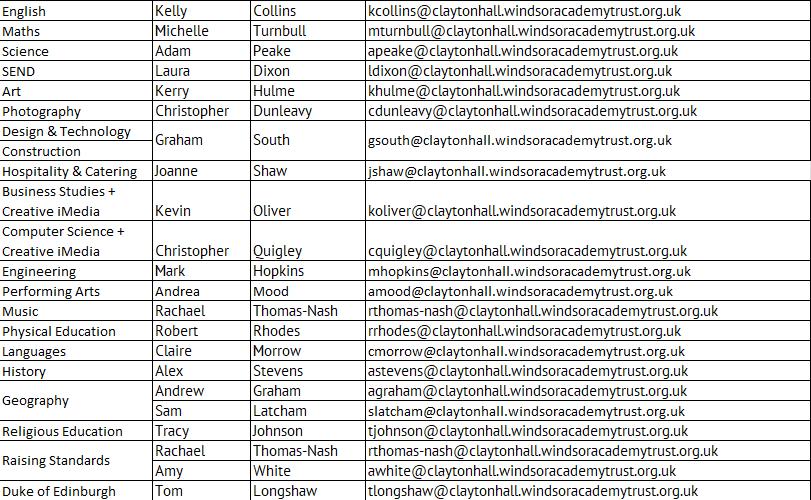
Subject Contact Information
Combined Science
100% Examination
Students have Chemistry, Biology and Physics lessons with specialist teachers. They will sit 6 examinations in year 11. Biology paper 1 and 2, Chemistry paper 1 and 2, finally Physics paper 1 and 2. At the end of the course they will receive a double grade that constitutes two GCSEs. Throughout the course students will complete required practical's alongside other investigations to build their scientific skills. The course for each Science is divided into topics which cover a broad area of the natural and physical world to give all students an understanding of how the world works.
Careers
The vast world of careers in Science and Science related subjects allow students to aim for highly paid careers from pharmaceuticals and medicine to engineering and research. Science also shows that our students are able to think critically and problem solve in all situations. Almost 10% of high pay banking jobs are taken by students pursuing science for their ability to think on their feet. Those pursing Science further can also give themselves the edge on other candidates when looking for graduate business roles who are looking for young people with problem solving abilities and adaptability.
Triple Science 100% Examination
100% examinations
Students have Chemistry, Biology and Physics lessons with specialist teachers. They will sit 6 examinations in year 11, each of which is 1 hour and 45 minutes. Biology paper 1 and 2, Chemistry paper 1 and 2, finally Physics paper 1 and 2. At the end of the course they will receive one GCSE for each science (3 x GCSEs). Throughout the course students will complete required practicals alongside other investigations to build their scientific skills. This course is perfectly suited for those who enjoy science and who are thinking of taking A Level Science. The extra content in separate science will be taught in an option block to give students the best opportunity at achieving top grades.
Careers
The vast world of careers in science and science related subjects allow students to aim for highly paid careers from pharmaceuticals and medicine to engineering and research. Almost 10% of high pay banking jobs are taken by students pursuing science for their ability to think on their feet. Those pursing further can also give themselves the edge on other candidates when looking for graduate business roles who are looking for young people with problem solving abilities and adaptability.
www.aqa.org.uk
www.aqa.org.uk
Science Options
Subject information
GCSE Art
60% Coursework 40% Exam
60% Coursework 40% Exam
Pupils are given time to develop a range of 2D and 3D visual language skills including drawing, painting, print making and 3D. These initial studies will help to provide pupils with the skills they need to produce the best possible work for the coursework element. As part of the course you will be required to use your direct experiences, observations and imagination to develop ideas for your work. You will be expected to investigate research, identify, react to art, craft and design and make critical judgments using specialist vocabulary. A range of media for working in two and three dimensions will be explored, reviewed, modified and refined as it progresses to a final outcome.
Careers
This course will help those interested in the specialist areas of art in fashion, communication, theatre, graphics, textiles, fine art, 3-dimensional design, product design, architecture, digital media etc.
GCSE Business Studies
100% Examinations
The Business specification is exciting and innovative and allows students to explore business activities for themselves. Students will focus on the methods to start and run a successful enterprise.
Working successfully as a group is a vital part to any business and students will demonstrate transferrable skills, such as communication and teamwork, by completing a range of challenges as teams.
To make learning more relevant, employers will be engaged to support and give input to lesson topics. Real world examples will give students the opportunity to see for themselves, how businesses operate.
Careers
Throughout our lives, we take on a combination of business roles from customer, to employee, to manager, even to employer and possibly owner. Ultimately, we will all be involved in business. Overall, this course provides students with valuable skills for any future career choices and indeed, valuable life skills for becoming independent.
GCSE History
GCSE Geography
100% Examinations 100% Examinations
100% Examinations (Y11)
GCSE MFL
French & Spanish
GCSE History allows students to develop and extend their knowledge and understanding of key events, periods and societies in British and wider world history. This course allows students to engage in historical enquiry and develop as independent learners and reflective thinkers. Students develop the ability to ask relevant questions about the past, to investigate issues critically and to make valid historical claims by using a range of sources in their historical context. They will develop an awareness of why people, events and developments have historical significance. Students will study the following units; 'Crime and Punishment Through Time (1000 – Present day)' with a case study of 'Jack the Ripper and the Whitechapel area', 'American West, Elizabeth I and Weimar and Nazi Germany'.
Careers
History helps you to develop a range of skills such as how to investigate, analyse, debate and communicate information. History will help those interested in careers in journalism, management, law, politics, research and archaeology.
The course aims to build upon the work that you will have done in earlier years and introduce you to new ideas and skills.
The course aims to build upon the work that you will have done in earlier years and introduce you to new ideas and skills. The course studied will be WJEC Eduqas GCSE
GEOGRAPHY Specification B. It will involve the study of 3 inter-related Units: Changing Places -Changing Economies, Changing Environments and Environmental Challenges. The course will help you to develop a number of useful, transferable skills, ranging from fieldwork and research to analysis and report writing. Studying Geography will also help you to develop your ICT and numeracy skills. The course involves two fieldtrips to contrasting areas, one to study Physical Geography and the other Human Geography.
The course studied will be WJEC Eduqas GCSE Geography Specification B. It will involve the study of 3 inter-related Units: 'Changing Places - Changing Economies', 'Changing Environments' and 'Environmental Challenges'. The course will help you to develop a number of useful, transferable skills, ranging from fieldwork and research to analysis and report writing. Studying Geography will also help you to develop your ICT and numeracy skills. The course involves two fieldtrips to contrasting areas, one to study Physical Geography and the other Human Geography.
Careers
For many jobs it is a real help if you have taken GCSE Geography. The subject will allow you to acquire and develop a variety of useful, transferable skills. Combining GCSE Geography with other GCSE courses could lead you to jobs like designing buildings, working in the leisure industry, joining the police or armed services, selling and marketing products, working in civil aviation or work in the increasingly important area of environmental monitoring and conservation.
The course is divided into four skill areas: listening, speaking, reading and writing. Students will take a final examination in all four skills. This will take place at the end of the course in Year 11. Each examination is worth 25% of the total grade.
The course is divided into four skill areas: listening, speaking, reading and writing. Students will take a final examination in all 4 skills. This will take place at the end of the course in Year 11. Each examination is worth 25% of the total grade. Careers
The government now recognises that learning a foreign language to GCSE level is vital as part of a broad and balanced curriculum and a foreign language forms part of the EBacc* qualification. The ability to communicate in a foreign language can lead to a wider range of career opportunities. Students in most other EU countries study two foreign languages to examination level, so a qualification in a language is becoming increasingly important to ensure equality of opportunity for British people. All students at Clayton benefit from the study of one foreign language and it will be beneficial to those considering a career with an international dimension – as a holiday rep, in the travel industry, secretarial or translation work in a multinational company and banking. A GCSE Modern Foreign Language is also now considered invaluable by universities.
GCSE Computer Science
2 x Examinations
2x Examinations 1 internal task
This course will provide students with the opportunity to create applications that run on mobile devices and operate on the web. In addition, they will learn the fundamental concepts around creating software applications. This course has been designed to help pupils build up the skills necessary to break into the gaming, mobile and web-related industries.
Please note that Computer Science bears no similarity to ICT and those choosing Computer Science should excel at Maths (as both subjects are logic-based).
Careers
The growth in the use of mobile devices and web-related technologies has exploded resulting in new challenges for employers and employees. This course, the only one supported by Microsoft, has been designed specifically to provide the foundation of skills and knowledge necessary for pupils to progress into the gaming, mobile and webrelated industries.
Tech Award
Level 1/2 Construction
50% Skills assessment 50% Exam
Level 1/2
Constructing the Built Environment (equivalent to one GCSE 9-1 grade) allows pupils to gain skills and knowledge linked to working in the Construction industry. This qualification also promotes the development of wider employment skills emphasising the importance of appropriate conduct, behaviour and communication skills within the construction sector.
The Construction course will help you develop a range of skills and knowledge to be able to work within the Construction industry and progress onto level 2/3 courses at College or with industry training providers.
Careers
There are a wide number of job opportunities including Bricklayer, Plumber, Joiner, Carpenter, Plasterer, Roofer etc.
Even if a career in Construction is not followed, there are a variety of transferable skills that you will learn on the course.
This course provides students with the opportunity to use computers in a creative way. The course is based around the media industry and challenges students to apply their skills in creating professional products.
In addition, they will learn about how computers are used to create various media-based products; like websites, animations and games. This course has been designed to help pupils build up the skills necessary to break into the media world and apply their ICT skills in related industries.
Careers
This course leads to various careers in Media and ICT. Examples include; Editors, Graphic Designers, Camera Operators, Magazine Journalists, Video Editors and Film Producers.
GCSE Design Technology
Engineering
50% Coursework & 50% Exam
50% Coursework 50% Exam
GCSE Design Technology combines a wide range of subjects and life skills in a creative and practical way. It allows students to develop problem solving skills and encourages students to use and apply technical knowledge from all areas of the curriculum. The GCSE qualification has strong links with Maths, Science and Engineering encouraging students to design and make new products for an ever- changing world. Students will study a range of materials including wood, metal, plastics, paper, textiles, carbon fibre and electronics. They will be given the opportunity to select these materials to solve a range of design challenges which are in context to the world around us. Practical work will be used to inspire students to explore materials and processes, they will be encouraged to work independently and take creative risks to design and develop products and prototypes.
Careers
D&T is widely recognised as providing students with the transferable skills and critical thinking that are important in many areas of employment such as architecture, engineering, graphic design, web design, electrical engineering, textiles design, car design, animation, furniture making and industrial design. Students contemplating any practically based hands-on learning course can benefit from studying the new Design Technology GCSE.
Website www.ocr.org
60% Coursework 40% Exam
60% Coursework & 40% Exam
The Vocational Award in Engineering is aimed at learners who have a passion for STEM (Science, Technology, Engineering and Maths). Students will learn about a range of material groups. For example, polymers, alloys, composites and timbers giving an understanding as to why they were chosen for every day engineered items. Students will become familiar with practical processes through theory and practical methods depending on the availability of the equipment. This includes, secondary machining, casting, welding and CNC methods such as laser cutting. Students will develop a sound understanding of mechanical and electrical systems as Engineers typically branch off into one field or the other. For the exam, students will need to have a good understanding of density, young’s modulus, pressure, ohm's law, ratio and mechanical advantage. For coursework students will be required to design and manufacture a solution of a given brief set by AQA.
Careers
The Engineering sector currently employs 15.5 million workers in the UK and is responsible for one quarter of all of the countries GDP. The shortage of workers in this field means that Engineers enjoy an above average pay and good job security. One of the biggest sectors in Engineering is manufacturing.
60% Controlled Assessment & 40% External Examination
1 NEA practical set by the exam board
The Eduqas Level 1/2 Technical Award gives learners the opportunity to develop understanding in areas of hospitality, catering operations, nutrition, menu planning and food safety, alongside practical cooking and preparation skills.
There is one controlled assessment (NEA) completed during the course: Hospitality & Catering in Action – NEA (60%) This involves responding to a board-set practical brief, researching the given theme, planning suitable dishes, carrying out practical cooking to meet the requirements, analysing outcomes and evaluating the final dishes in relation to the brief. The externally assessed written exam counts for 40% of the qualification.
For this, students need a strong knowledge and understanding of hospitality and catering principles, including nutrition, food safety, environmental impact, and the workings of the hospitality industry.
Careers
Food industry careers are diverse; Nutritionist, Food Technologist, Dietician, Home Economist, Chef, Food Buyer, Baker, Restaurant Manager, Hospitality Manager etc.
2 x Internal Assessments (60%) & 1 x External Assessment (40%)
The BTEC Tech Award in Performing Arts/ Performance is an introduction to the life and work within the industry, from a performers perspective. You explore the sector by studying 3 Exam Units:
1) Component 1 focuses on a set performance piece where you analyse and evaluate the various performance techniques that have been involved to lift it from 'page to stage'.
2) Component 2 focuses on you choosing one of the following 3 pathways: acting/dance or musical theatre. You develop performance skills before then showcasing your work for a live audience. There is also a written portfolio that accompanies this unit.
3) This is the terminal 'paper' for the qualification and involves you receiving a brief with a given theme/ stimulus to create your own original performance work from.
DETAILS of ASSESSMENT: Regular attendance is essential as 60% of the assessment takes place during timetabled sessions. The external paper fulfills the remaining 40% of the qualification.
A level courses (Performance Studies, Theatre Studies, Film studies etc.) or vocational routes such as BTEC National Diploma (equivalent to 3 A levels). Past students have also gone into more traditional areas such as law, counseling, teaching and coaching.
BTEC Tech Award in Performing Arts-Production Performance p (Production)
GCSE Photography
60% Coursework & 40% Exam
2 x Internal Assessments (60%) & 1 x External Assessment (40%)
The BTEC Tech Award in Performing Arts/ Production runs alongside the course on the left but with a focus on the production aspect of the industry. It should be noted, however, that you will be expected to do some performance work to prepare you for life, ie. Interviews. You will get to explore:
• Design skills required by designers, relevant to the performance discipline being studied, such as: costume, set, props, masks, makeup, lighting or sound design.
• Developing specific skills and techniques associated with these design areas.
• Analysing, evaluating and enhancing your skills further.
DETAILS OF ASSESSMENT: Regular attendance is essential in this course as 60% of the assessment takes place during timetabled sessions. If you are not there, your progress cannot be mapped and evidenced and therefore you are very likely to fail.
Careers
A level courses in Production Design for, Theatre, Film Studies etc. or continue the vocational route, progressing onto the BTEC National Diploma (equivalent to 3 A levels). Performing Arts courses open doors to a vast variety of careers, including hundreds of jobs within the industry itself (which is one of the biggest employers in the country). Just look at the credits of any film to see the vast choice!
The first year course provides an opportunity for students to gain a wider perspective of the skills and processes surrounding photography. The first year will develop technical knowledge and understanding of photography including printed photography, digital photography, photo montage, black and white photography, colour photography and computer manipulated photography.
As part of the course students will be required to produce a digital sketchbook of studies based around a set project. Students will be expected to investigate, research, identify, react, and make critical judgments using specialist vocabulary. A range of techniques using lens based media will be used including film, video and animation.
Careers
This course will help those interested in the specialist areas of photography, fashion, communication, theatre, graphics, textiles, fine art, 3 dimensional design, product design, architecture, digital media etc.
Physical Education
2 x Examinations Y11 worth 60%
Students will be placed on one of the two following pathways. These are not easy options –there is a substantial amount of written classwork which will be classroom based and homework for this course.
Practical performance, 3 sports 30% 1 x written coursework 10%
GCSE PE
Students will develop their knowledge and understanding of how a healthy, active lifestyle contributes to the growth and development of the skeletal, muscular, cardiovascular and respiratory systems. Students will also develop their knowledge and understanding of Physical Education and physical activity, in relation to balanced healthy lifestyles and sport psychology.
2 x Examinations Yr 11 worth 60%
Practical Performance x 3 sports 30%
1 x Written Coursework 10%
Students will learn about development of the skeletal, muscular, cardiovascular and respiratory systems; balanced healthy lifestyles and sport psychology. They will also study issues such as commercialisation, sporting behaviour and performance enhancing drugs.
Practically, students will be assessed in three sports from a specified list of possible choices with one being a team sport, one an individual and the final either team or individual.
Practically, students will be assessed in three sports. Students must attend at least 2 extra-curricular clubs each week to contribute to their practical score.
Note: This is not an easy option – there is a substantial amount of written classwork and homework for this course. Of the 5 timetabled lessons, 3 will be classroom based written work and 2 will be practical.
Cambridge National Sport Studies
1x Examination Yr 11 worth 40%
1 x Written Centre-Assessed Task worth 20%
Practical Performance x 2 sports worth 40%
Students must attend at least 2 extra-curricular clubs each week to contribute to their practical score
GCSE MUSIC
Coursework Composition 30%,
Performance 30%,
Written Exam: Understanding Music 40%
The study of music at GCSE is open to all students regardless of their musical experience or expertise.
Students will develop compositional techniques using a variety of software Musescore and Garageband. They will be required to produce 2 compositions, which have already been studied in Years 7 & 8 and will be further developed at GCSE level. Students will perform between 4 and 6 minutes of music on their chosen instrument or voice. This must include at least one solo and one ensemble.
Entry Requirements:
It is important to be able to play/learn an instrument or sing to participate on this course.
Careers
Future Pathways: A-Level PE or BTEC (National) Sport development & coaching
Careers: Sports Coaching; Teaching; Nutrition; Physiotherapy; Sports Medicine; Sports Science; Leisure Industry; Sports Psychology.
Students will study contemporary issues in sport and how they impact different sporting activities. Practically, students will develop skills as a performer in two different sports and as a leader in one sport. One of the compulsory components requires participation in an outdoor adventurous activity.
You may be interested in this if you want an engaging qualification where you will use your learning in practical, real-life situations, such as; understanding contemporary issues in sport and how they impact on different sporting activities, applying your skills as both a performer in two different sporting activities and as a leader in one sporting activity, how to be a sports leader, through using your initiative to solve problems and making decisions when dealing with rapidly changing conditions and situations, understanding the relationship between sport and the media and applying this to real life examples, How to evaluate and interpret the different ways in which sport is represented by the media, applying your skills to participate in an outdoor and adventurous activity in a natural setting and environment. This qualification will complement other learning that you’re completing for GCSEs or vocational qualifications at Key Stage 4 and help to prepare you for further study. More information about this is given below
Future Pathways: A level PE (GCSE pathway only) or BTEC (National) Sport Development & Coaching Careers: Sports Coaching; Nutrition; Physiotherapy; Sports Medicine; Sports Science; Leisure Industry; Sports Psychology
www.edexcel.com
Future Pathways: A-Level PE or BTEC (National) Sport development & coaching
Continue with A level/BTEC qualifications in Music, Music Technology or Performing Arts. Entrance to dance, drama and music colleges. Any courses specialising in musical theatre. Courses in sound engineering, technology and journalism in the arts.
Any job in the Arts Industry (One of the UK’S biggest employers)
Careers: Sports Coaching; Teaching; Nutrition; Physiotherapy; Sports Medicine; Sports Science; Leisure Industry; Sports Psychology.
100% examination
Students will consider different beliefs and attitudes to religious and non-religious issues in contemporary British society. Students study two components: Component 1 - Christianity and Buddhism, their beliefs, teachings and practices. Students will refer to scripture and sacred texts and will study the influence of both religions on individuals, communities and societies. Component 2 - Thematic studies: religious, philosophical and ethical studies, currently 'Life, Peace and Conflict', 'Crime and Punishment', 'Relationships and Family'. Students will consider different arguments, and their impact and influence in the modern world. They will study different perspectives on the issues studied, within and/or between religions, as well as non-religious views. Students will apply their knowledge of religion to the issues studied.
Careers GCSE Religious Studies
This course aims to prepare students for adult life in a pluralistic society and global community. They will develop analytical and critical thinking skills, the ability to work with abstract ideas, leadership, and research skills, all of which will help prepare them for further study or training, and a wide range of careers.
Website www.ocr.org www.aqa.org.uk
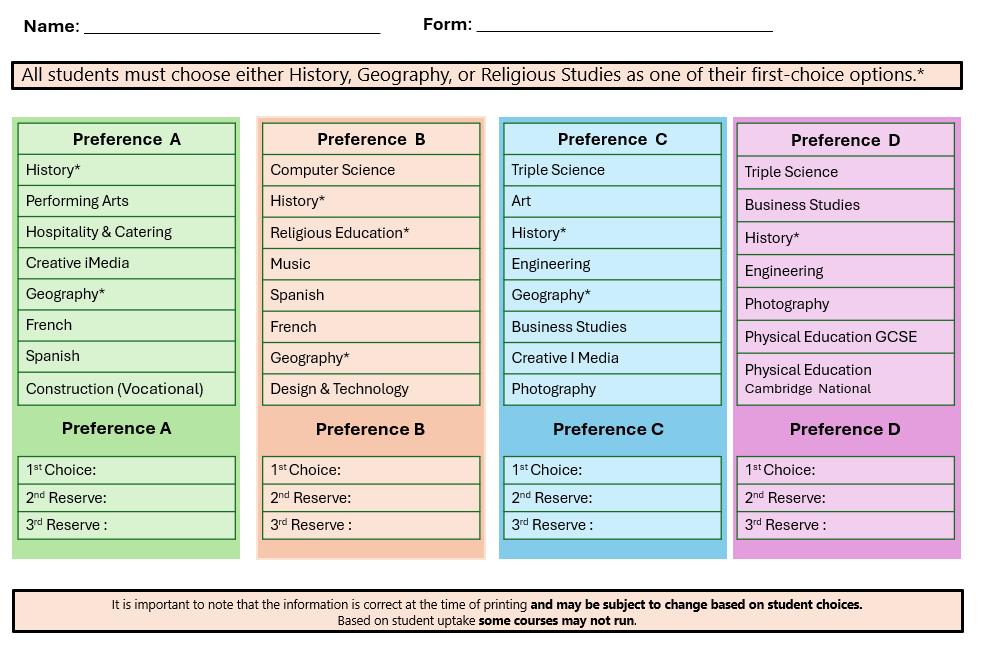
All students must choose either History, Geography, or Religious Studies as one of their first-choice preferences.*
Preference A
History*
Performing Arts
Hospitality & Catering
Creative iMedia
Geography*
French
Spanish
Construction (Vocational)
Preference A
1st Choice: French
2nd Reserve: History
3rd Reserve : P Arts
Preference B
Computer Science
History*
Religious Education*
Music
Spanish
French Geography*
Design & Technology
Preference B
1st Choice: History*
2nd Reserve: Music
3rd Reserve : Geography
Preference C
Triple Science
Art
History*
Engineering
Geography*
Business Studies
Creative I Media
Photography
1st Choice: Engineering 2nd Reserve: Business 3rd Reserve : Art Preference C 1st Choice: PE GCSE 2nd Reserve:
Please ensure that all spaces are filled
3rd Reserve : History Preference D
Students will study a total of 9 GCSE’s- English Literature, English Language, Maths, Dual Science (2 GCSE’s) and 4 preference qualifications (A,B,C & D)
The student above has selected French, History*, Engineering, and Physical Education as their 1st choices. The student has selected their required humanities subject, (History, Geography or RE) in column B (History*).
If a student's first-choice subject cannot be assigned, we will consider their second or third reserve subjects as alternatives, processing these options in the order they appear—second reserve first,
Students will study a total of 9 GCSE’s- English Literature, English Language, Maths, Dual Science (2 GCSE’s) and 4 preference qualifications (A,B,C & D)