While the otters have been keeping our spirits up through the winter months at Langford Lakes, it is in the spring and summer that our nature reserves awaken to their full glory (p4). Wiltshire is a very special place for meadows: did you know that we have 55% of the UK’s remaining unspoilt chalk downland and 25% of our surviving floodplain meadows?
This makes Wiltshire one of the best places to see butterflies, with over 40 of the UK’s 59 species here to be spotted. I’m setting myself a personal challenge to see as many as possible this butterfly season: why not join me?
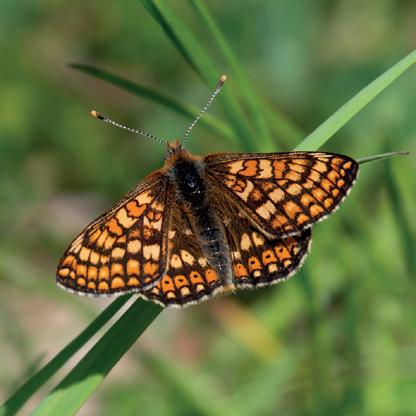
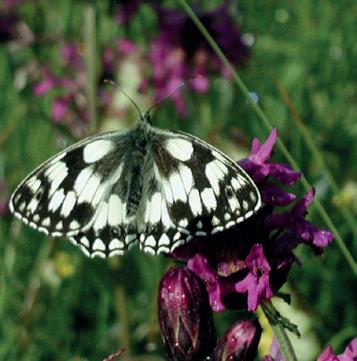
Our ancient wood pasture landscapes are also important for butterflies, and in this edition we time-travel back through 35 years of conservation in the Braydon Forest (p12), celebrating the living legacy of Paul Darby, who continues to volunteer with us today. The Trust’s Jonny Cooper now facilitates the Braydon Forest farmer cluster, helping local landholders turn around the fortunes of farmland birds and Marsh Fritillary butterflies.
This edition is full of young people at the beginning of their involvement with the Trust, from our Blue Influencers like the ‘Swindon Snakes’ creating ponds in schools (p10) to

our Naturally Connected Young People, part of a national Wildlife Trust initiative to connect disadvantaged 11–16-year-olds with nature to improve their wellbeing (p22). Four of our new Trainees share insights into what it’s like to take the leap into practical conservation and swap laptops (or in one case, chef’s knives!) for laser levels and chainsaws (p20).
I’m sure I’m not alone in being inspired by Robert Macfarlane’s ‘Is a River Alive?’ and the growing movement of river guardians who are giving our precious rivers a voice. Do consider joining our Water Guardians initiative to act as the eyes and ears of our local rivers and brooks; learn more at wiltshirewildlife.org/waterguardians.
Finally, a special mention to the members of our new Legacy Society, whom I had the great pleasure to meet for tea at the start of March overlooking the lake at Lower Moor.
Thank you all for the many ways in which you support Wiltshire’s wildlife; I hope it gives back to you in spades this summer.
Wiltshire Wildlife Magazine
Editors
Rebecca Clay
Emma Garry
Becki Mckinlay
Design
Inkcap Design
Printed on paper produced from responsibly managed forests. Recycled paper.
Printed in Wiltshire by Mail and Print mailandprint.co.uk
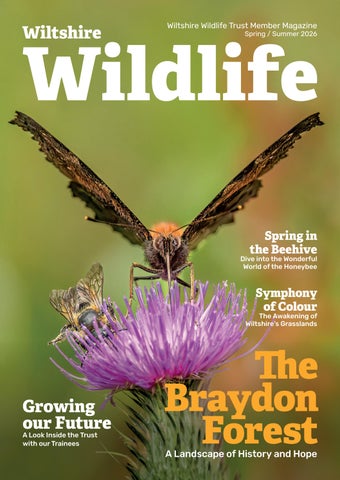
Front Cover photo
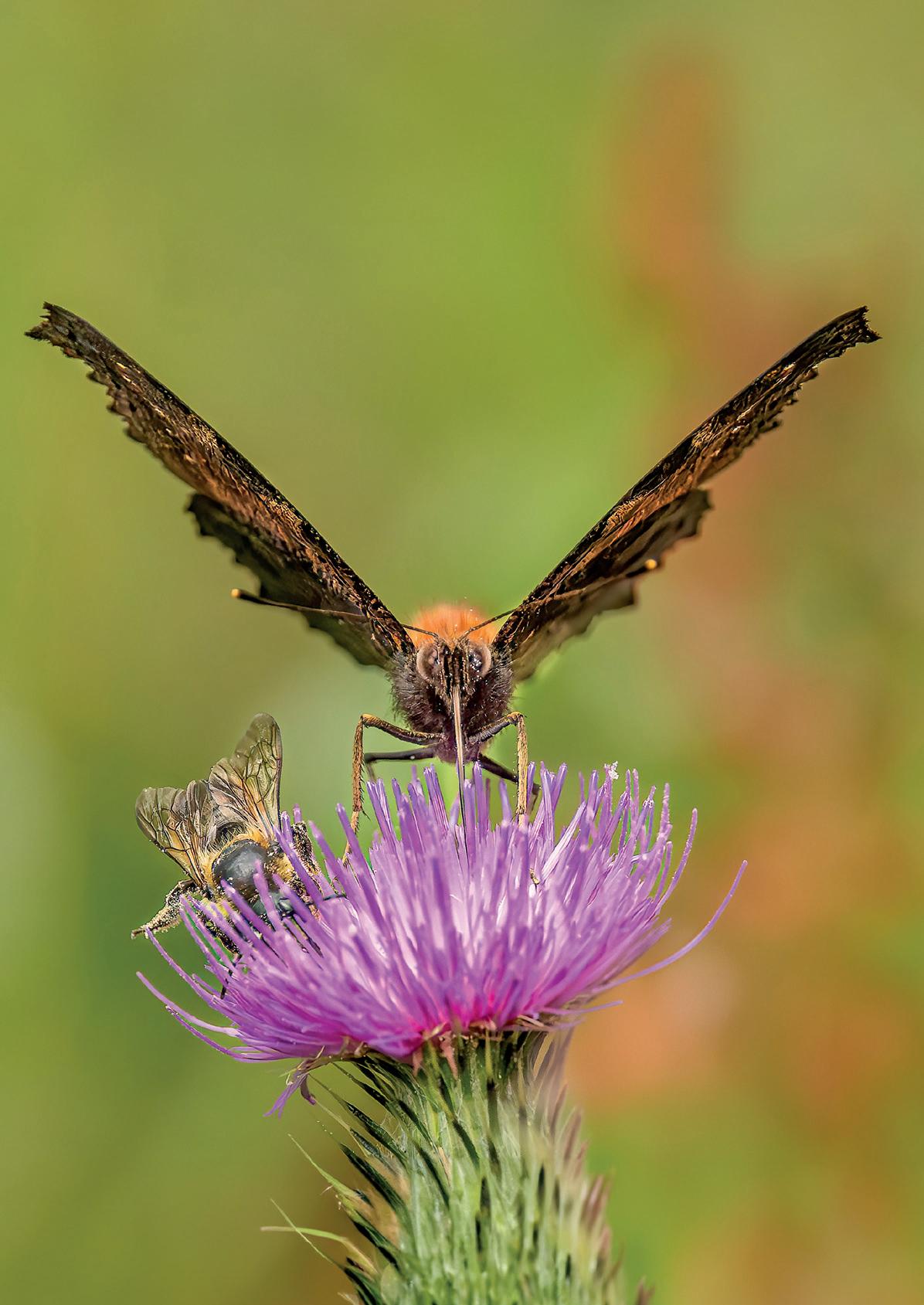
Butterfly and Bee at Lower Moor Farm by Rob Willis
Jo Lewis CEO Wiltshire Wildlife Trust
As spring arrives, the lengthening days and shifting sunlight signal a major change. While we welcome the relief from winter’s chill, Wiltshire’s flora treats this extra light as a biological command to wake up and bloom.
The key to spring’s timing isn’t air temperature, which can fluctuate wildly, but a more reliable signal: the duration of daylight. This phenomenon is known as photoperiodism
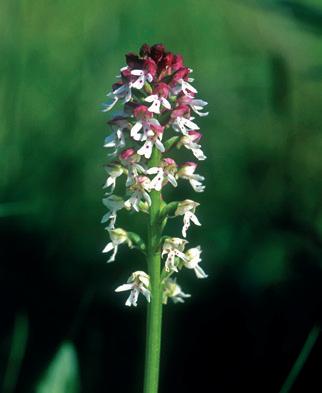
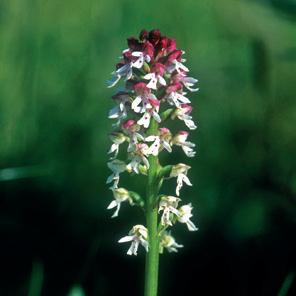
Inset: Burnt-tip Orchid
Plants are excellent timekeepers, and though they can’t see daylight, they can still respond to it. They contain light-sensitive proteins called phytochromes, which can switch between two forms and control everything from germination to leaf-shape to flowering. At the beginning of the day a plant is full of the inactive phytochrome , and over time the red light from the sun slowly converts this protein into the active phytochrome PFR. Over the course of the night, this slowly breaks back down into PR. By measuring how much PFR remains at dawn, the plant knows how long the preceding night was and cleverly compares this to their innate
circadian rhythm to work out the length of daylight.
Plants respond to these levels differently; short-day plants flower when nights are long, while long-day plants flower when nights are short. Some short-day plants flower in the autumn, like chrysanthemums. Most of our plants in the UK are long-day plants, and as the days grow longer, more active phytochrome builds up and has less time to break down during the shorter night, eventually signalling to the plant to begin flowering. Each plant has different levels, allowing them to flower at different times and avoid competition.
For many of our iconic spring flowers, such as wood anemones, daffodils and earlyblooming orchids, the increasing build-up of active phytochrome as the days lengthen is the trigger that breaks dormancy and brings buds and blossom. They flower quickly and early, completing their life cycle before the overhead canopy of trees or the dense growth of summer grasses steal the sunlight.
This colourful awakening is apparent in the contrasting beauty of Wiltshire’s precious grasslands, each managed slightly differently, yielding different hues.
Our Northern Hay-cut Meadows
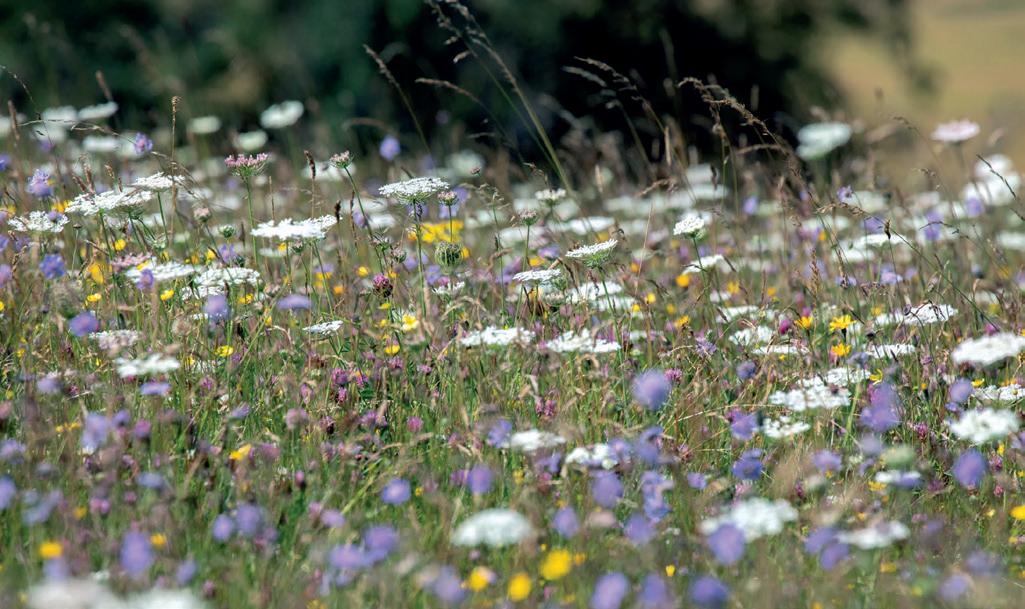
As you explore the grasslands and river valleys of North Wiltshire, you will encounter classic hay meadows. These fields are traditionally left to grow tall and lush through the spring and early summer before being cut for hay in late summer. This encourages a magnificent display of flowering plants that stretch for the light.
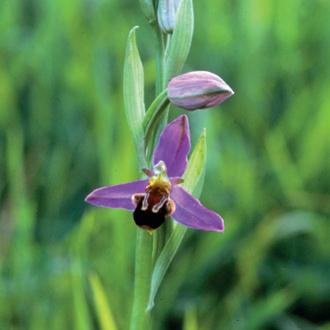
The Bee Orchid resembles a female bee in appearance and smell to attract male bees for pollination.
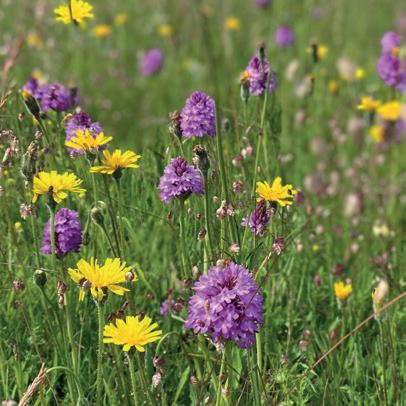
In May and June, these meadows become a dense, towering tapestry. The dominant colour is often a rich, heady yellow from the cheerful clusters of Meadow Buttercup and Yellow Rattle, which help thin out vigorous grasses, allowing other species to thrive. Interspersed are the bold strokes of Common Sorrel, adding plumes of rusty red and pinkish-purple into the landscape.
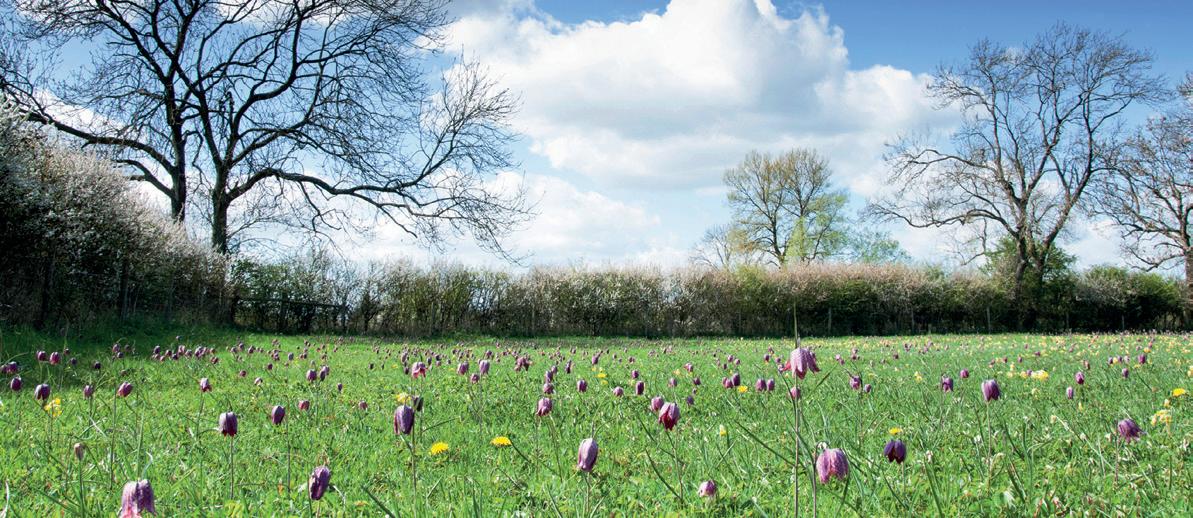
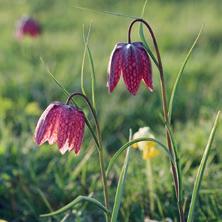
One particular jewel is the Snake’s Head Fritillary, found in full glory at Clattinger Farm Meadow at our Lower Moor Nature Reserve. Their beautiful, trumpeted purple checkerboard heads provide quite the show in May and June. Once a common sight, unfortunately with the decline of hay meadows, displays like that at Clattinger have become rare.
Our Southern Grazed Meadows
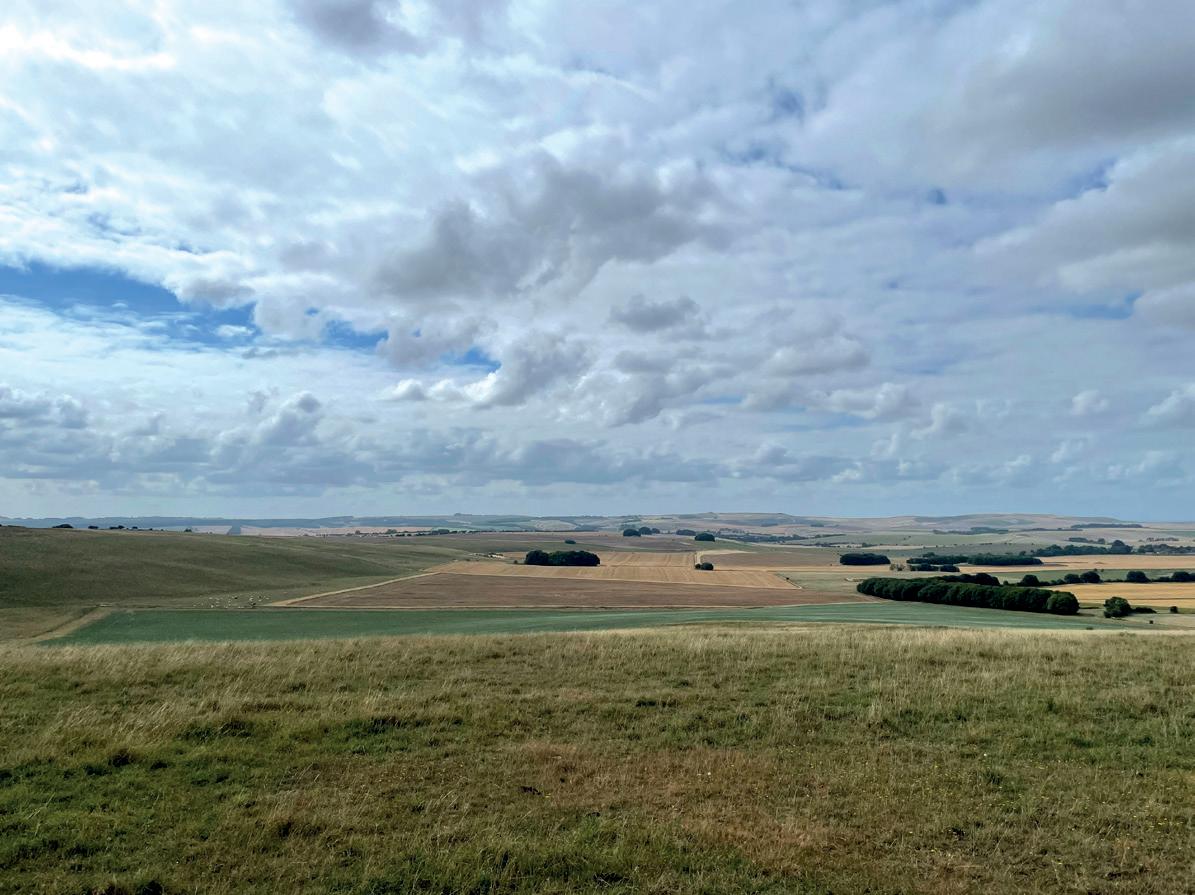
Move southwards in the county, especially onto the ancient chalk downlands of Salisbury Plain and Cranborne Chase, and the landscape subtly changes. Here, our meadows are often grazed by sheep or cattle for longer periods. During the winter months, sheep graze the meadows to ensure that butterflies and low-growing wildflowers can flourish when spring arrives. As the seasons shift to summer, cattle take over, creating a diverse landscape of long and short grass that provide the perfect habitat for insects and rare plants.
The colour palette here is more diffused and closer to the ground, but no less stunning. Early spring brings the delicate, indigo beauty of the Chalk Milkwort, often followed by the intense yellow of Common Bird’s-foot-trefoil, with the gentle violet of Harebells and Scabious nodding along through the grasses.
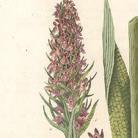
The most famous of the flowers, the orchids, are spectacular. Perhaps the most striking is the Pyramidal Orchid, which can be found in abundance at Coombe Bissett Down Nature Reserve. Bursting forth in late spring, its dense flower head forms a distinctive cone, or pyramid, of intense rose-pink or fuchsia that adds a dramatic splash of colour across the otherwise yellow-green slopes. This species thrives in the alkaline, well-drained soil of the chalk, flourishing in the short, open sward maintained by grazing animals. The stunning Bee Orchid crops up in irregular years and adds a touch of brown, pink, and white, perfectly mimicking a buzzing insect to attract pollinators. This grazed environment creates colour, but also complexity, offering a subtle diversity of flora that requires a closer look to appreciate its brilliance.
These grasslands, whether hay-cut or grazed, are not just pretty; they are the vibrancy of our landscape brought to life by the stunning flora and the fauna they support.
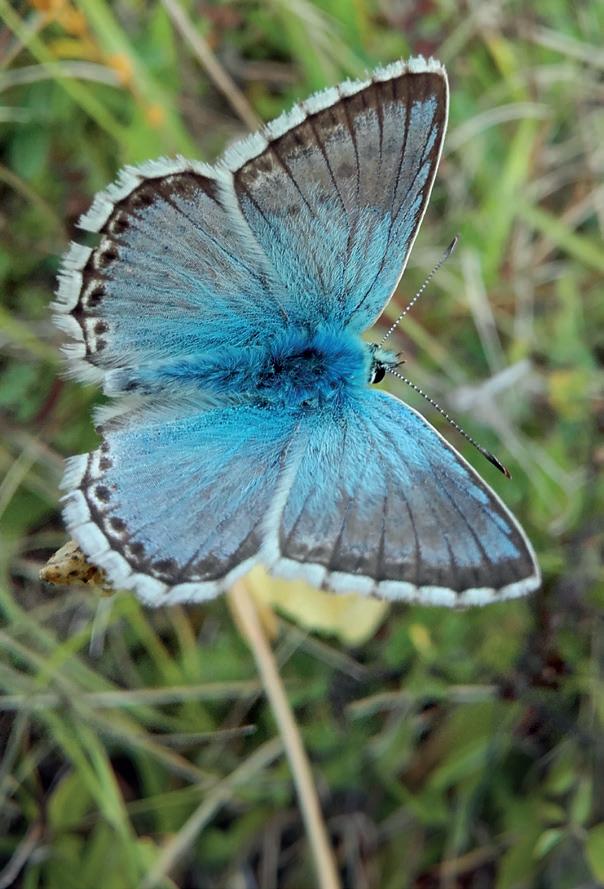
They are crucial for climate resilience, acting as carbon sinks, locking carbon away in deep, undisturbed root systems. Their dense swards slow rainwater runoff, helping to filter water and prevent flooding. They are the foundation for our invertebrates: a single species-rich chalk meadow can host over 40 species of grass and wildflowers, providing the necessary pollen and nectar for bees, butterflies, and moths. The Marsh Fritillary Butterfly, a UK priority species, depends almost entirely on the Devil’s-bit Scabious, a flower often only found in these meadows, while the iconic blue butterflies of the chalk slopes each have their own species of vetch that they favour – Horsehoe Vetch for the Adonis and Chalkhill Blues, Kidney Vetch for the Small Blue.
The spring awakening on our grasslands is a fragile spectacle that should act as a reminder to us that the conservation of these landscapes is not just about holding onto history, but protecting a space filled with colour and life. Our work ensures that every spring, this glorious light-driven symphony plays again.
Where and when to see Wiltshire’s rare orchids
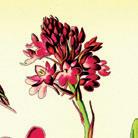
Pyramidal Orchid
• Late spring summer
• Cockey Down near Salisbury, Coombe Bissett Down near Salisbury, Echo Lodge Meadows near Malmesbury, Ham Hill near Marlborough
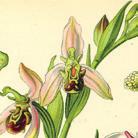
Orchid
• Late spring summer
• Blakehill Farm near Cricklade, Coombe Bissett Down near Salisbury
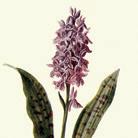
Common Spotted Orchid
• Spring
• Cloatley Meadows near Hankerton, Coombe Bissett Down near Salisbury, Jones’s Mill near Pewsey
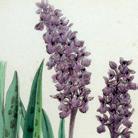
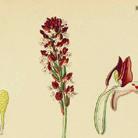
• Spring
• Dunscombe Bottom near Salisbury, Morgan’s Hill near Calne
Southern Marsh Orchid
• Spring
• Jones’s Mill near Pewsey, Landford Bog near Salisbury, Penn Wood near Calne
Burnt Orchid
• Spring
• Clattinger Farm part of Lower Moor Farm near Oaksey, Coombe Bissett Down near Salisbury
Use our spotter guide to find out the best places and times to see rare orchids. Why not get up close and take a photo and share with us on social media – but please take care as these plants are rare and delicate! Instagram @wiltswild | Facebook /WiltsWild

Fern Kenyon-Hamp Senior Ecologist

Carrie Starbuck Director of Nature Recovery
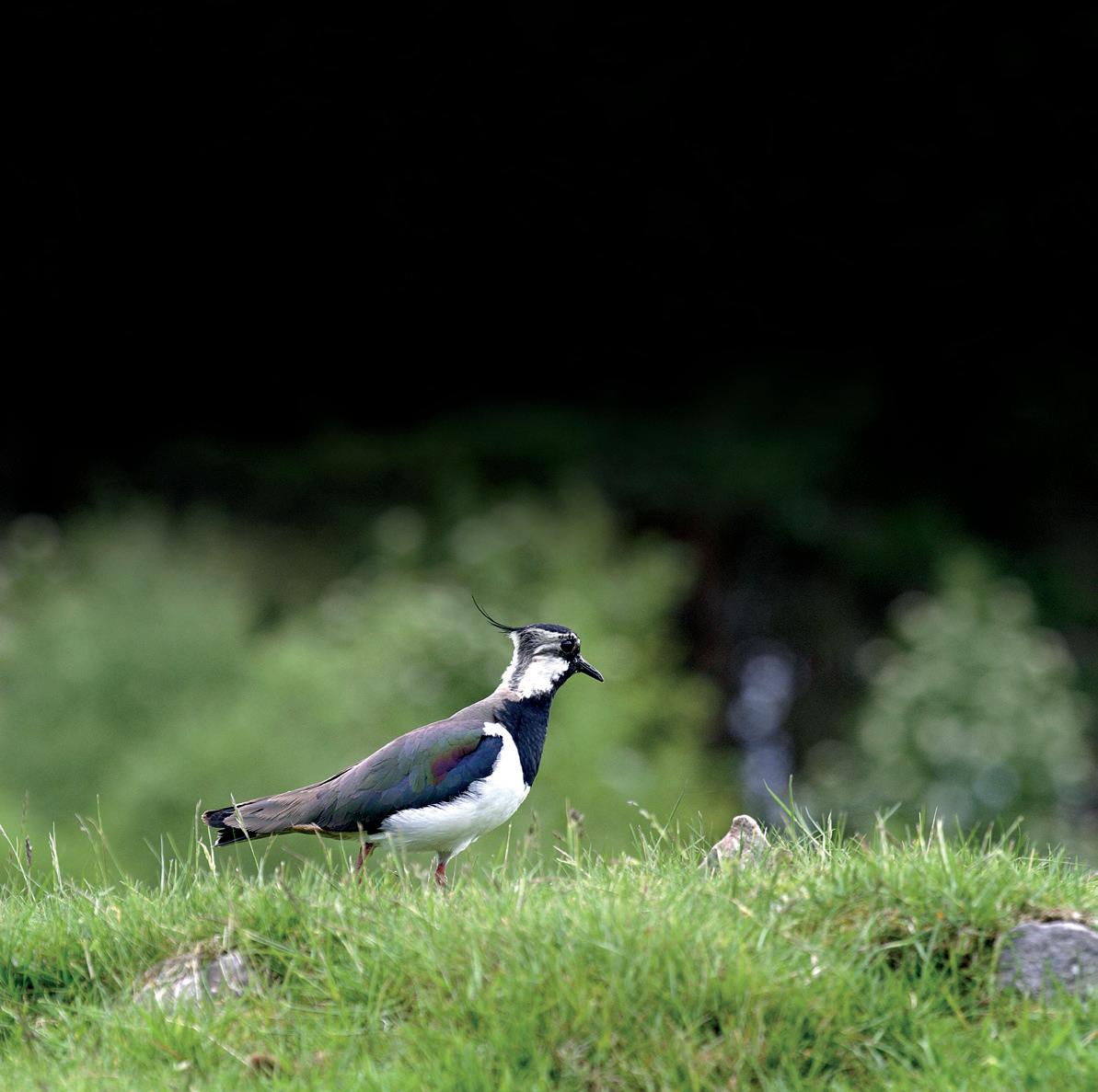
Launched in July 2025, the Chalkland Revival Project was funded through the Farming in Protected Landscapes programme and brought together farm clusters across the North Wessex Downs National Landscape to support coordinated nature recovery. Spanning over 40,000 hectares across Oxfordshire, Berkshire, Hampshire and Wiltshire, this initiative united five farm clusters – Southern Streams, The Cleres, Wessex Downlands, Wessex and Coombes, and the Ridgeway Cluster – with a singular vision: to restore
nature while championing the future of sustainable farming. The project aimed to reverse declines in farmland wildlife, improve habitat quality, and enhance community engagement and knowledge sharing.
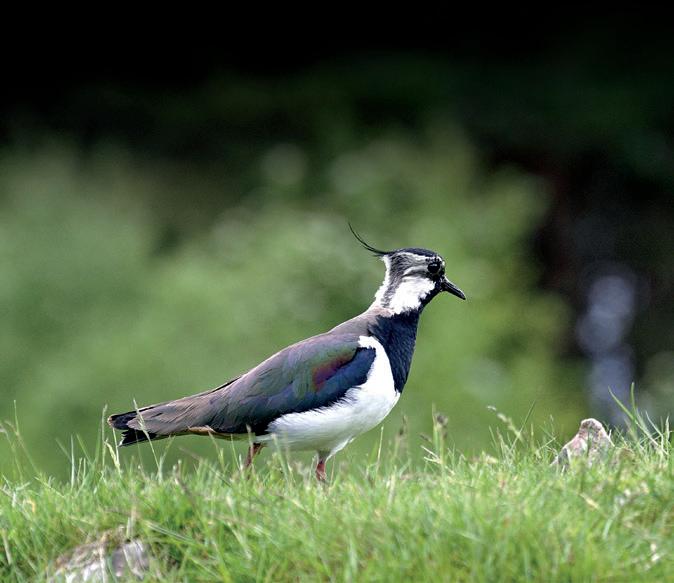
At the heart of the project was the protection of iconic but vulnerable species of farmland birds like the Lapwing. These ground-nesting birds face a gauntlet of threats that make successful breeding a rare victory. To
address this, the project implemented a number of protections designed to safeguard the birds from egg to fledgling. This work complements Project Peewit, a wider Trust project dedicated to securing the future of Lapwing populations.
Lapwings nest in open fields, meaning their eggs and chicks are highly vulnerable to ground predators like foxes and badgers. Chalkland Revival funded the installation of predator-proof fencing, creating safe zones where Lapwing parents could hatch their broods without the
constant threat of predators. Habitat is just as important as protection. By creating areas of varied vegetation heights, the project provided chicks with places to hide from aerial predators, while still allowing them access to the damp ground they need for foraging.
In a landscape shared with the public, even well-intentioned visitors can unfortunately cause harm. Nesting birds view dogs as a significant threat; a dog running around can cause a parent bird to abandon its nest, leaving eggs cold or exposed. To raise awareness, signage was installed at key access points, educating dog walkers on the
importance of staying to paths and keeping dogs on leads during the critical nesting season.
The name ‘Lapwing’ relates to the way the birds fly – zigzagging through the skies.
For farmland birds, the most dangerous time of year isn’t the height of winter, but late winter into early spring. This period is known as the hungry gap. By this time, the natural bounty of autumn – berries in the hedgerows, fallen seeds in the woodland, and grain in the fields - has been exhausted or has rotten away. Yet the
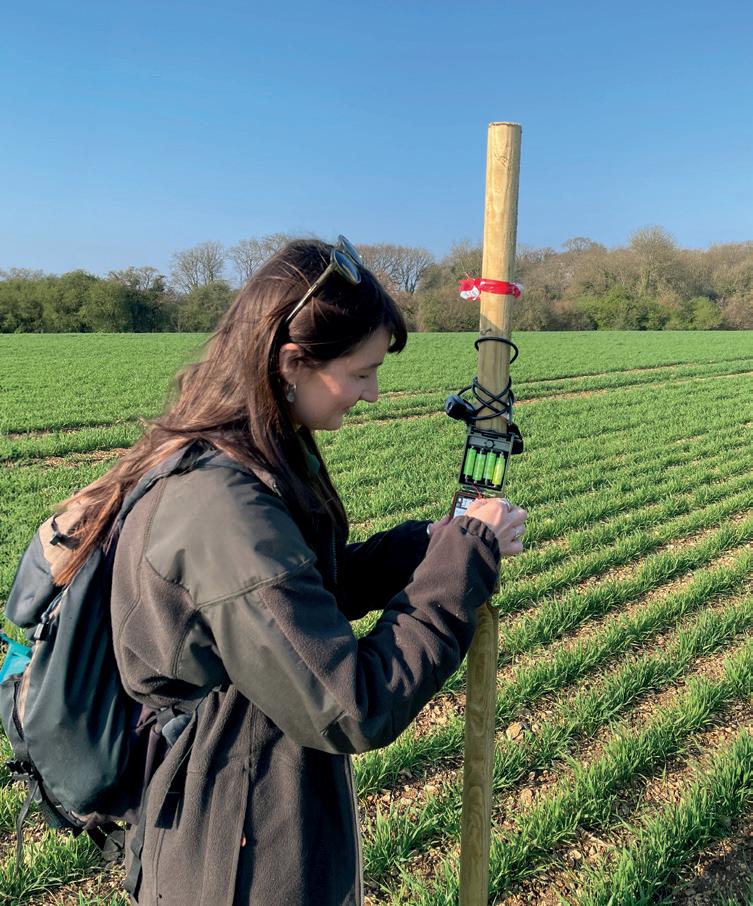
“Across the project area, more than 60 acoustic monitors were deployed on farms to capture the soundscape of the chalklands.”
new growth of spring and the emergence of insects are still weeks away. The project distributed over 50 bird feeders and around 23 tonnes of feed across farms, providing an additional food source for farmland birds.
Across the project area, more than 60 acoustic monitors were deployed on farms to capture the soundscape of the landscape. These small devices record bird calls over time, allowing us to build a detailed picture of which species are present, when they are active, and how populations may be changing. Acoustic monitors were strategically positioned across over 60 farms in order to build a baseline of bird data across the landscape. Farmers and facilitators were trained to install and manage the equipment, helping to build local skills and ensure that monitoring can continue well beyond the life of the funded project. The resulting data provides a baseline for farmland birds across the North Wessex Downs and is a powerful way to track if there is an increase in calls from farmland birds over time - indicating whether our collective efforts are making a difference.
The project explored the “field to fork” potential of wild venison, seeing deer less as a problem and more as a part of our local food system. By partnering with the Soil Association, we explored how high-quality, local venison can move from the woods and farmland to our kitchens and cafes.
Together, these strands of coordinated management, peer leadership, and local food point towards a more integrated approach to deer across the chalk landscape. One that recognises ecological limits, respects the realities of land management, and seeks solutions that work for nature, farmers, and communities alike.
The project looked beneath the surface to uncover lost wetlands across the farmed landscape. Desktop mapping by the Trust’s Water Team identified historic ponds and opportunities for wetland creation across the farm clusters.
These ‘ghost ponds’ and wet areas have huge potential to support wildlife, improve water quality, and increase resilience to floods and drought, offering a pipeline of future habitat creation across the chalk landscape.
Successful nature recovery is never achieved in isolation; it thrives on shared expertise, trust and collective action. Learning and collaboration sat at the heart of Chalkland Revival, with a programme of events that brought farmers, facilitators, conservationists, and local communities together to exchange ideas, test approaches, and reflect on
what was working.
These included a kick-off event bringing all five clusters together, practical training in deer management, a public engagement event focused on sustainable venison, and a wrap-up gathering where data from all 60 acoustic monitors was shared and discussed. Together, these moments created space not just to share results, but to build confidence, relationships, and a shared understanding of what landscape-scale working can achieve.
This work has been led by farmers and delivered through the commitment of five farm cluster facilitators. Their local knowledge, relationships, and persistence have been critical in turning a large, ambitious idea into practical action on the ground.
Chalkland Revival was designed to be a start rather than an endpoint. As the initial project phase draws to a close in spring 2026, the
collaboration it has created will continue. The clusters and partners are now building on this foundation to develop a longer-term, multi-year programme - strengthening what works, addressing challenges, and continuing to support farmer-led nature recovery across the North Wessex Downs National Landscape.
Find out more about how you can help protect farmland birds on our blog at wiltshirewildlife. org/blog/protecting-groundnesting-birds


Dan Moden Education and Wellbeing Officer and Blue Mentor
a
Connecting the next generation to our blue spaces is key for the future of conservation and protection of our waterways. The Blue Influencers Scheme is a transformative national initiative that empowers young people to become leaders in environmental social action, ensuring their voices are heard in the fight for nature’s recovery. For a landlocked county like ours, this scheme is particularly important; it challenges the idea that blue conservation only happens on the coast. By appointing our first Blue Mentor in Swindon, the Trust is dedicated to showing young people that the brooks, streams, and ponds in their own urban spaces are just as vital and worth protecting as the open ocean.
The Blue Influencers Scheme funds 22 Blue Mentor posts across England, empowering young people to lead environmental social
“The brooks, streams, and ponds in their own urban spaces are just as vital and worth protecting as the open ocean.”
action projects. After the first phase of the project in Salisbury and Trowbridge, in April 2025, the Trust appointed its first Blue Mentor for Swindon. The appointment proved timely, coinciding with the annual Blue Influencers conference in Derbyshire. This allowed for networking with established mentors and learning about their projects, highlighting the scale of the task ahead, but also providing a wealth of ideas and possibilities.
The first priority for the project was to understand the “blue heart” of Swindon. While a cursory glance at an OS map highlighted obvious blue spaces like Coate Water, Mouldon Lake, and Lydiard Park on the town’s fringe, the mission required finding water closer to the schools in the centre. Exploratory bike rides throughout the summer revealed a network of waterways, slowly revealing Swindon’s wilder side.
The next step was to form partnerships with site wardens and local authorities. Collaboration with the Trust’s Swindon Conservation Lead, Neil, helped identify key sites like Rivermead and Hagbourne Copse Nature Reserve. Local wardens at Seven Fields and Hreod Burna Urban Forest, alongside Parish Council staff, also offered enthusiastic support. It became clear that Swindon possesses an abundance of blue spaces perfectly suited for youth-led conservation.
With the necessary groundwork established,
the focus shifted to recruiting young people for the project. While the scheme primarily targets those aged 10–14, the programme remains flexible; for instance, we were pleased to be approached by and bring on board a sixth-form group from Churchward School. Initially, there was a sense of uncertainty about how young people from urban areas might respond to a nature-based project. Questions arose as to whether they would care about environmental social action if they did not already feel a strong personal connection to the natural world.
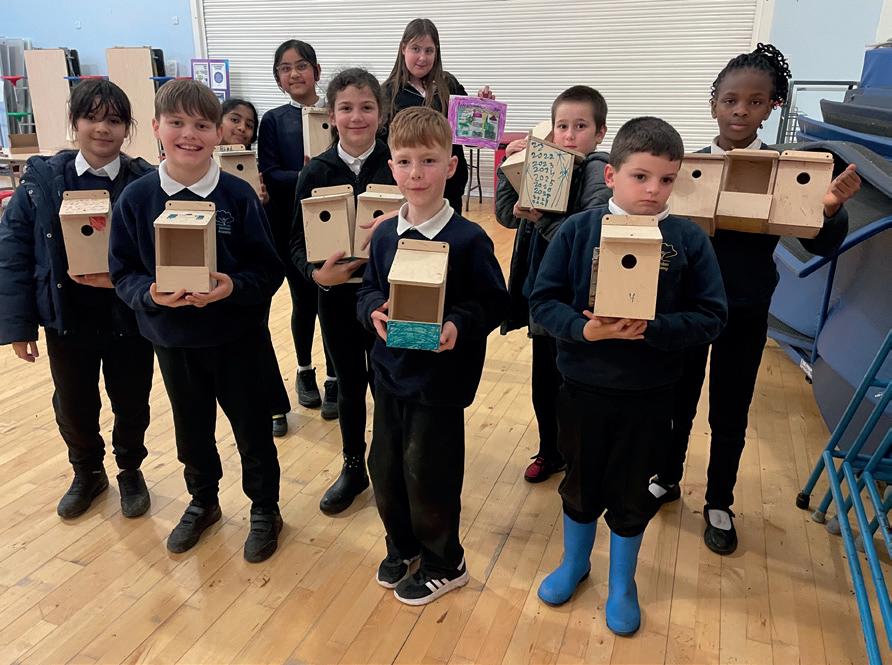
We aimed to wow the students by bringing nature into the classroom, working with tactile objects such as skulls, feathers, snakeskins, and preserved frogs and newts. The response was unwaveringly positive as the students were fascinated by the objects. Any anxieties regarding a lack of interest were quickly dispelled by their engagement and curiosity; it became clear that these students found nature innately interesting. When presented with the challenges facing our waterways and the chance to take direct action, the students were incredibly receptive and wanted to get stuck in.
Those initial meetings have blossomed into several successful projects benefitting both the environment and the community. At Swindon Academy’s Alton Close site, the students have transformed their Forest School area with the creation of a new pond and a willow arch. At Hagbourne Copse, the Churchward Sixth Formers have cleared
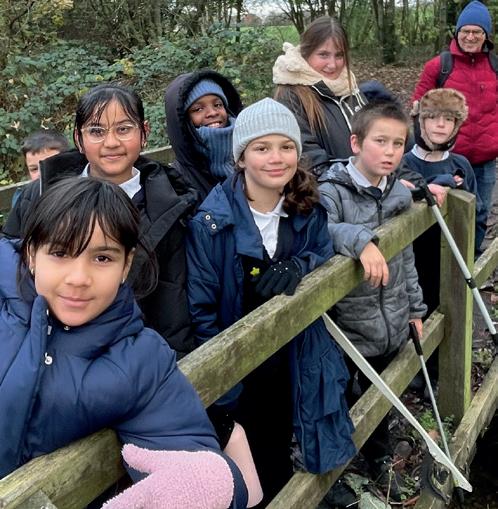
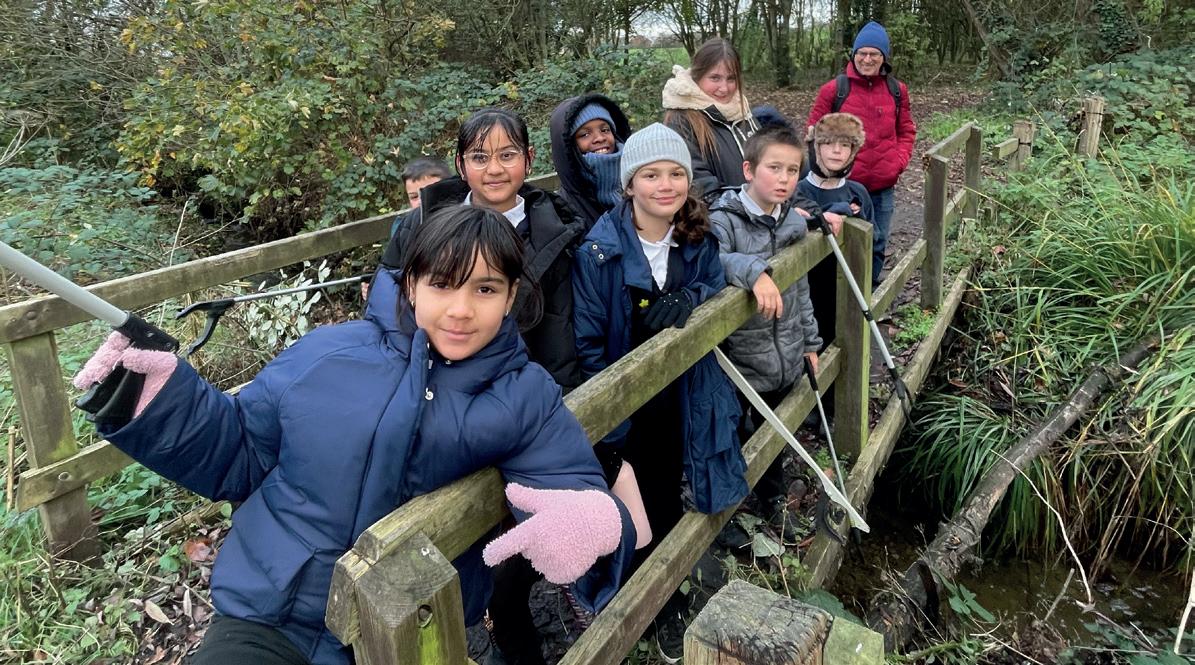
a clogged pond and helped weave a willow fence to improve the reserve for people and wildlife. Simultaneously, the selfnamed ‘Swindon Snakes’ group from Swindon Academy’s Beech Avenue cleared significant amounts of litter from their local brook, and worked in partnership with the team at Hreod Burna Urban Forest to protect a badger sett by building a dead hedge.
Beyond physical improvements to watercourses, these projects create a connection between the young people and the natural world. In a Christmas card message to the Trust, one of the Swindon Snakes, Akshara, wrote: “I hope this blue adventure will never end.” If the Trust, our volunteers, and young people continue to protect Wiltshire’s nature together, there is no reason why it should ever have to.
Pupils from Swindon Academy’s Beech Avenue with some of their Blue Influencers projects
You don’t need to be part of a formal scheme to make a difference. Whether you have a garden, a local park, or a nearby stream, there are simple ways to ensure Wiltshire’s waterways thrive for generations to come.
One of the most impactful ways to help is by joining our Water Guardians initiative. These volunteers act as the eyes and ears of our local rivers and brooks. By regularly patrolling a specific stretch of water, you can help us record wildlife sightings and identify and report issues like sewage leaks or chemical runoff, fly-tipping or invasive species early.
Learn more at wiltshirewildlife.org/water-guardians

Written by Emma Garry Marketing and Communications Officer
Contributors: Paul Darby, Volunteer; Nick Self, Conservation Lead – North
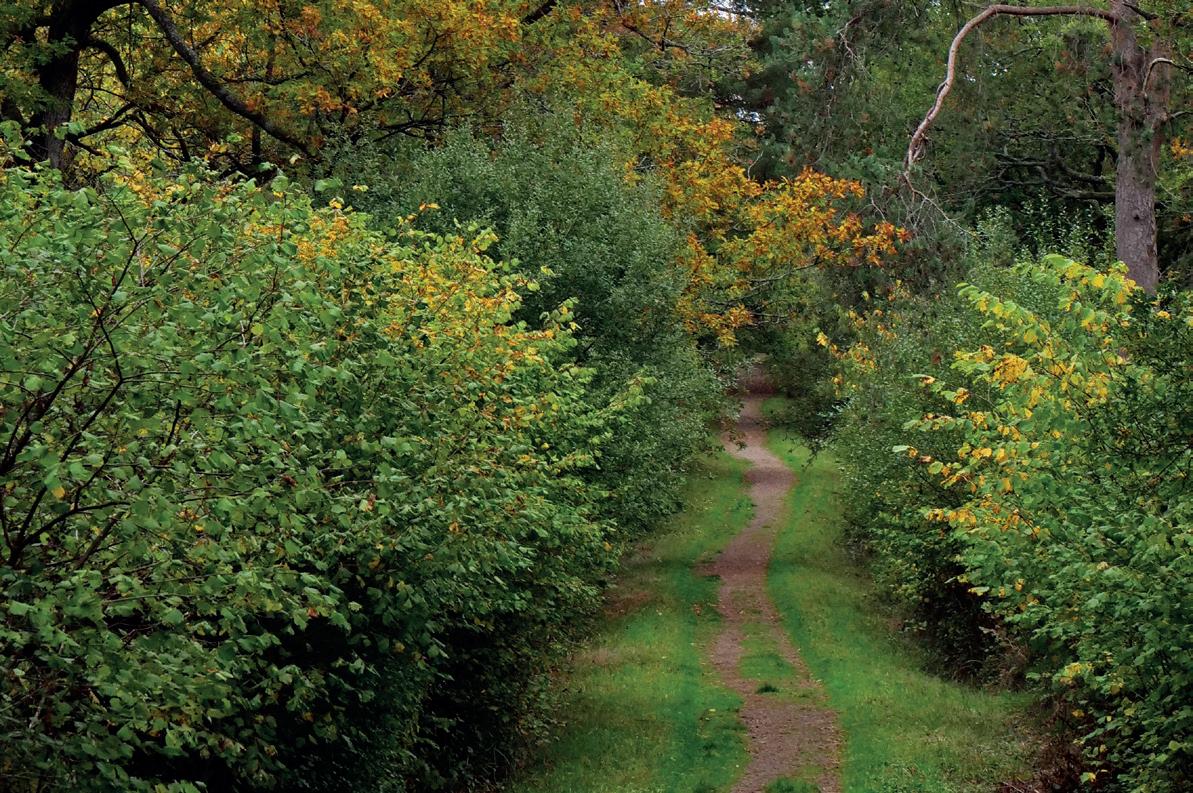
Celebrating 35 years of innovation, partnership, and restoration in Wiltshire’s ancient landscape.
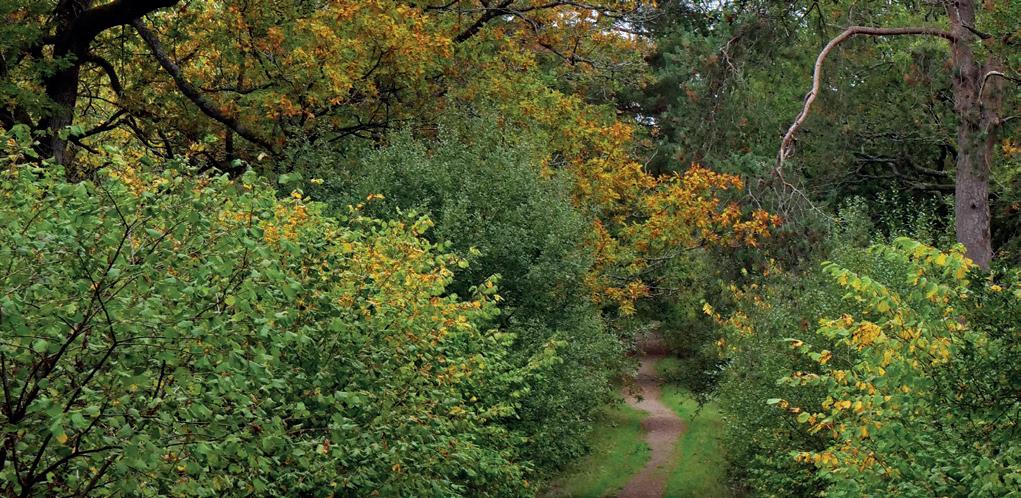
In the heart of north Wiltshire, between Malmesbury and Swindon, lies a rich tapestry of habitats steeped in history. Once a Royal Hunting Forest, the Braydon Forest contains sections of ancient woodland that have endured for centuries. However if you are picturing the dense canopy that usually comes to mind when you think of a forest, you might be surprised to see meadows, farmland, and hedgerows as well.
It might help to learn that the term forest originally described an area in which deer were protected by special laws, not necessarily the vast woodland we associate with the word today. This definition enables us to better understand the Braydon Forest for what it is; as a mosaic of habitats and areas, shaped over time by both the natural and human world.
Fragments of history that have stood the test of time, the Braydon Forest
is home to areas of ancient woodland that have existed since at least the 17th Century. Though no longer covering the wide areas of land they once did, the conditions curated at these sites over centuries means they remain home to unique flora and fauna, including the nationally significant Wild Service Tree and Small-leaved Lime, and a number of rare butterflies.
Developed over hundreds of years through traditional management, flower-rich grasslands boast a wealth of rare flora and support an abundance of insects, small mammals and birds. However the development of agricultural practices means that in recent years these precious habitats have become some of the most threatened in the UK. The Braydon Forest holds a number of these meadows, several of which are now Trust-owned reserves, while others have been the focus of collaborative restoration projects past and present.
Given the rich history and conservational significance of the Braydon Forest, it is perhaps no surprise that it is an area never far from the Trust’s consciousness. The last year saw us mark 35 years since the first Braydon Forest Countryside Management Project – a pioneering project that achieved significant milestones for nature in the 1990s and has left a lasting legacy for our work today.
Thanks to its complex blend of natural habitats, the Braydon Forest was identified as one of the most important areas in the county for wildlife. However, given its proximity to Swindon, and with several other towns and villages falling inside the area, it is as much characterised by
people as it is by nature. The rapid growth of Swindon and nearby towns brought the area into sharp focus as development swallowed up land at a time when more people wanted to enjoy the countryside around them. The challenge arose: how to facilitate access to the countryside while ensuring the necessary safeguards were in place to protect it? These questions remain at the forefront of our thinking today.
Beyond the urban fringes, the landscape is shaped by agriculture. Flora mapping in the 1980s and 90s revealed a wealth of intact flowerrich meadows, born out of years of traditional farming practices. However, shifts in supply and demand forced farming to undergo huge changes. As a result, meadows were being lost to artificial fertilisers and modern management. It became
“Flora mapping in the 1980s and 90s revealed a wealth of intact flowerrich meadows, born out of years of traditional farming practices.”
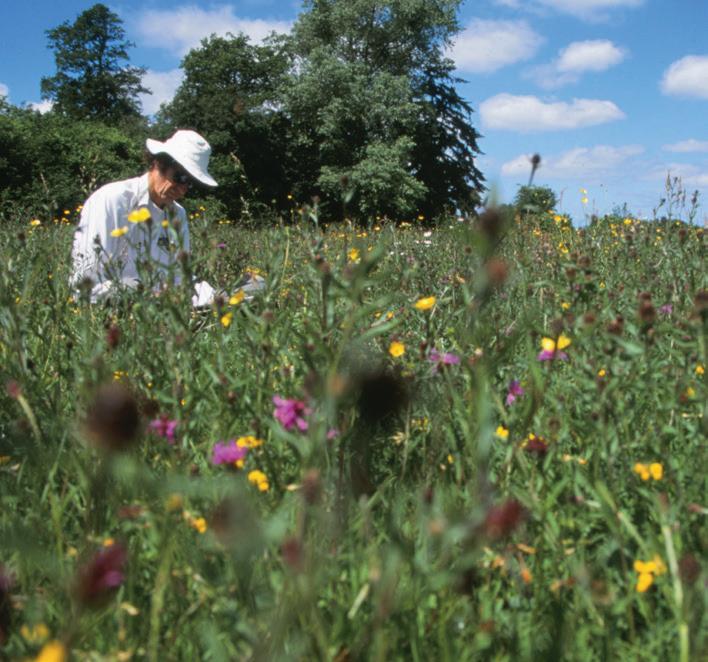
apparent that there was a need to work with landowners to identify solutions both for them and naturea priority that remains to this day.
Time also brought change to woodland practices. Where once the woods of the Braydon Forest supplied neighbouring towns and villages with firewood and building materials, alternative resources gradually took over. This meant that the process of coppicing which had provided sustainable habitat management slowly disappeared, leaving increasingly dark, dense woodland unable to support the same richness of life.
Having identified the challenges, the Trust sought a new way of working through the Braydon Forest Countryside Management Project. The aim was to promote sympathetic management of woods, meadows and hedges, alongside creating new initiatives to enhance people’s enjoyment of the countryside. The key to the success of it all? Partnership working.
Left: Recording wildlowers and grasses at Cloatley Meadows
Below: Searching for minibeasts at Emmett Hill
Bottom: An education group at Ravensroost
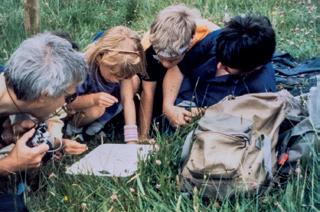
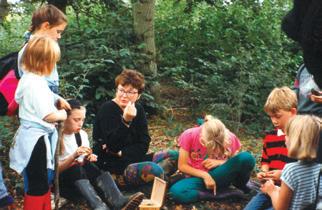
Now a pillar of our work in the Trust, the original Braydon Forest Project was perhaps the first to recognise the importance of partnerships to achieve nature’s recovery at landscape scale. Central to the success of the project was collaboration with funders, local government, other organisations, and most importantly, landowners. While acknowledging that our reserves in the area provided key havens for wildlife, the Project recognised the need to focus on the areas beyond our reserves in order to create protected wildlife corridors. This meant working with landowners to improve their meadows, hedgerows and woodland for nature in a financially sustainable way.
Alongside education, the Trust offered practical advice to landowners on obtaining grants and other assistance. The launch of the Countryside Stewardship Scheme in 1992 gave landowners financial incentives to manage grasslands and hedgerows less intensively to encourage wildlife. Small grants were also available to landowners through the Braydon Forest Project
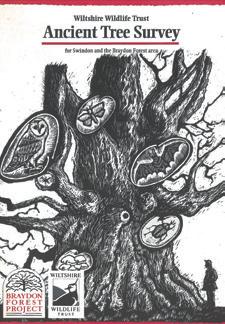
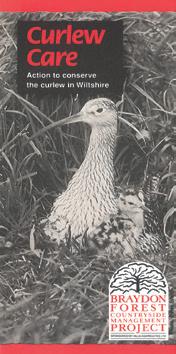
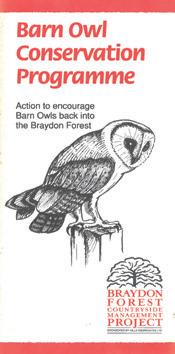
to encourage sympathetic land management. This project laid the foundation for the Trust’s continued work with landowners across the county.
The Braydon Forest Project also used its platform to undertake speciesspecific citizen science projects.
Curlew: In 1994, in partnership with the Wiltshire Ornithological Society, the Trust surveyed the area for Curlew, providing vital insight into the breeding challenges of a farmland bird in sharp decline. Locals reported sightings, and landowners were encouraged to protect nests. This mirrors our Project Peewit today, highlighting the ongoing plight of our county’s farmland birds.
Barn Owls: In 1997, through the Braydon Forest Barn Owl Conservation Programme, the Trust worked with the community to record sightings, improve hunting habitats, and build nest boxes to prevent this precious creature from vanishing from our countryside.
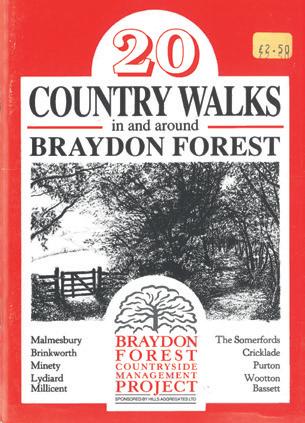
The final thread to the Braydon Forest Project was improving access for local residents to the countryside surrounding them, an area that remains a core priority to our work today. The project supported the delivery of activities and events designed to appeal to as many people as possible.
Schools and community groups undertook practical conservation workshops, and guided walks opened up the landscape to a new audience.
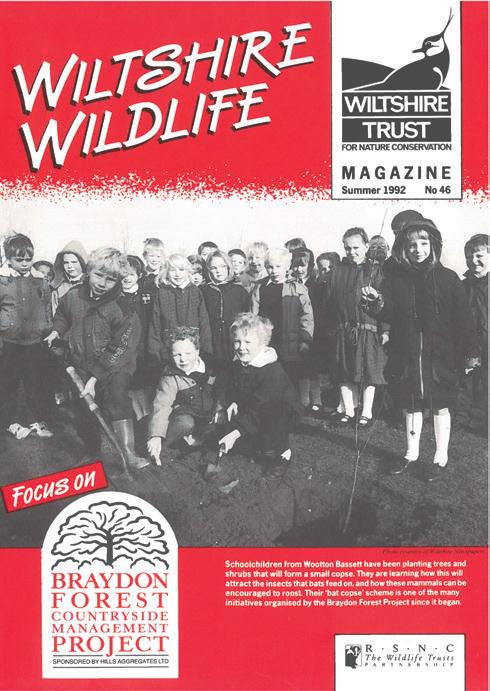
Our Summer 1992 Wiltshire Wildlife Magazine noted that just two years into the project, well over 1000 people had taken part in project activities.
The publication of 20 Country Walks in and around the Braydon Forest gave locals a pocket guide to explore short circular loops from Malmesbury across to Swindon, helping the countryside feel that bit more accessible. By offering this route into nature, the Project encouraged the local community to share in the Trust’s vision for the Braydon Forest as a space in which both wildlife and people could flourish for years to come.
Fast forward a few years and the Braydon Forest came to the fore of the Trust’s thinking once again as it was named one of the first ‘living landscapes’ in the UK. It was then included as part of a wider Living Landscapes project spearheaded by The Wildlife Trusts. The goal was to create one of the biggest conservation plans in British history, seeking to restore natural areas on a vast scale by reconnecting fragmented habitats.
Our plan remains the same today: to restore habitats, work with landowners to create nature corridors between Trust-owned sites, and engage with our local communities. The Braydon Forest is central to our vision to see nature restored at scale across the county. We hope to see habitats revived and connected so that wildlife returns in abundance.
We also hope to see greater connection between people and the natural world: a passion for nature ignited in young people through work with schools and alternative provision; walking and cycling connectivity improved across the area; and opportunities for locals to get involved in practical conservation and citizen science
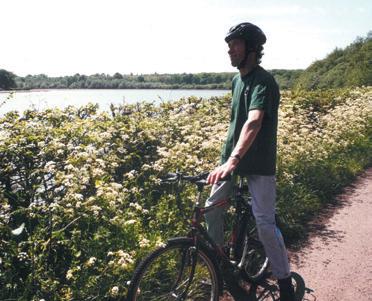

A special thanks goes to Paul Darby (pictured above on his trusty bicycle!) for his vast knowledge of the Braydon Forest that inspired this article. As one of our Braydon Forest Project Officers, and then in other roles with the Trust, Paul made a significant contribution to our work there and beyond, and has left a legacy that is felt now and will be for years to come.
Do you want to support the wildlife of the Braydon Forest? Look out for our upcoming Birds of the Braydon Forest fundraising appeal!
projects. Engaging the local community is the only way that we will see lasting change for nature, as actions taken now are then carried throughout generations.
Achieving sustainable transformation for the Braydon Forest, however, lies beyond the capabilities of the Trust alone. True restoration on this scale demands a unified movement across regional and national landscapes. Just as the pioneering partnerships of the Braydon Forest Project in the 1990s set a new standard for conservation, our current work must look to serve as a blueprint for the future.
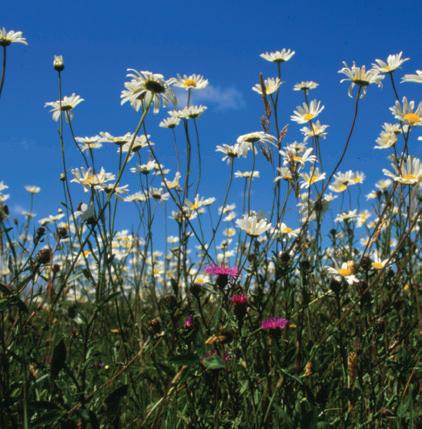
By weaving together the threads of ancient history, regenerative agriculture, and community passion, we can create a resilient tapestry of life for nature and people. We envision a future where wildlife thrives alongside people, where ancient woodlands and flower-rich meadows flourish once more. This shared vision – rooted in collaboration and sustained by joined-up thinking – is the key to ensuring this landscape remains a vibrant sanctuary for generations to come.
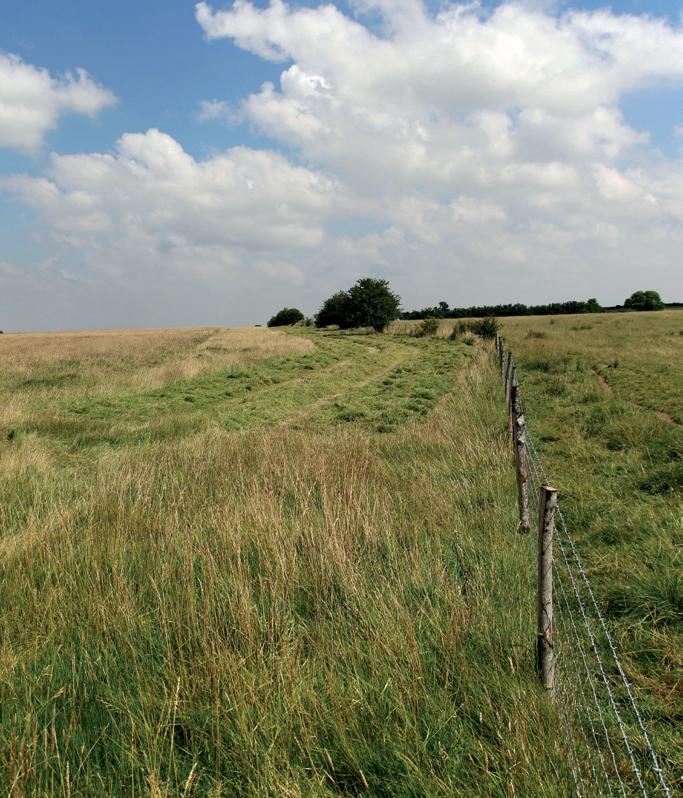

Freshwater Delivery Manager
In 2024, Wiltshire Wildlife Trust took on the management of the farmland at Great Chalfield, near Melksham, which is owned by the National Trust. This site is host to almost the full spectrum of river and wetland features.
It starts at the hydrological beginning: crystal clear water bubbling up from a large spring behind the manor house, originating from a limestone aquifer in a layer of permeable stone laid down in the Jurassic period. After filling up the medieval fishpond, the spring joins the Chalfield Brook, which flows westerly to meet the Lenton Brook at Withy Bed. These small headwater streams are so important to the landscape, yet they are increasingly fragile and prone to dry spells due to the water abstraction that supplies water to the nearby villages.
Our 49-year lease for the land marks the beginning of a mission to reverse artificial changes across the site and build a climateresilient landscape. We have begun by restoring two ghost pondsfeatures that appear on maps from
the 1800s but have been lost to agricultural intensification and natural sedimentation.
In a clever bit of ecological detective work, our team utilised existing man-made land drains to our advantage. By blocking an outflowing drain, water is now being retained in one of the ponds, even during the summer.
The Lenton Brook currently bears the scars of the past, as it was artificially straightened and pushed to the side of the floodplain to make farming easier. However, much like the ghost ponds, the shadow of its original channel remains etched into the land, presenting a unique opportunity to utilise a new river restoration technique.
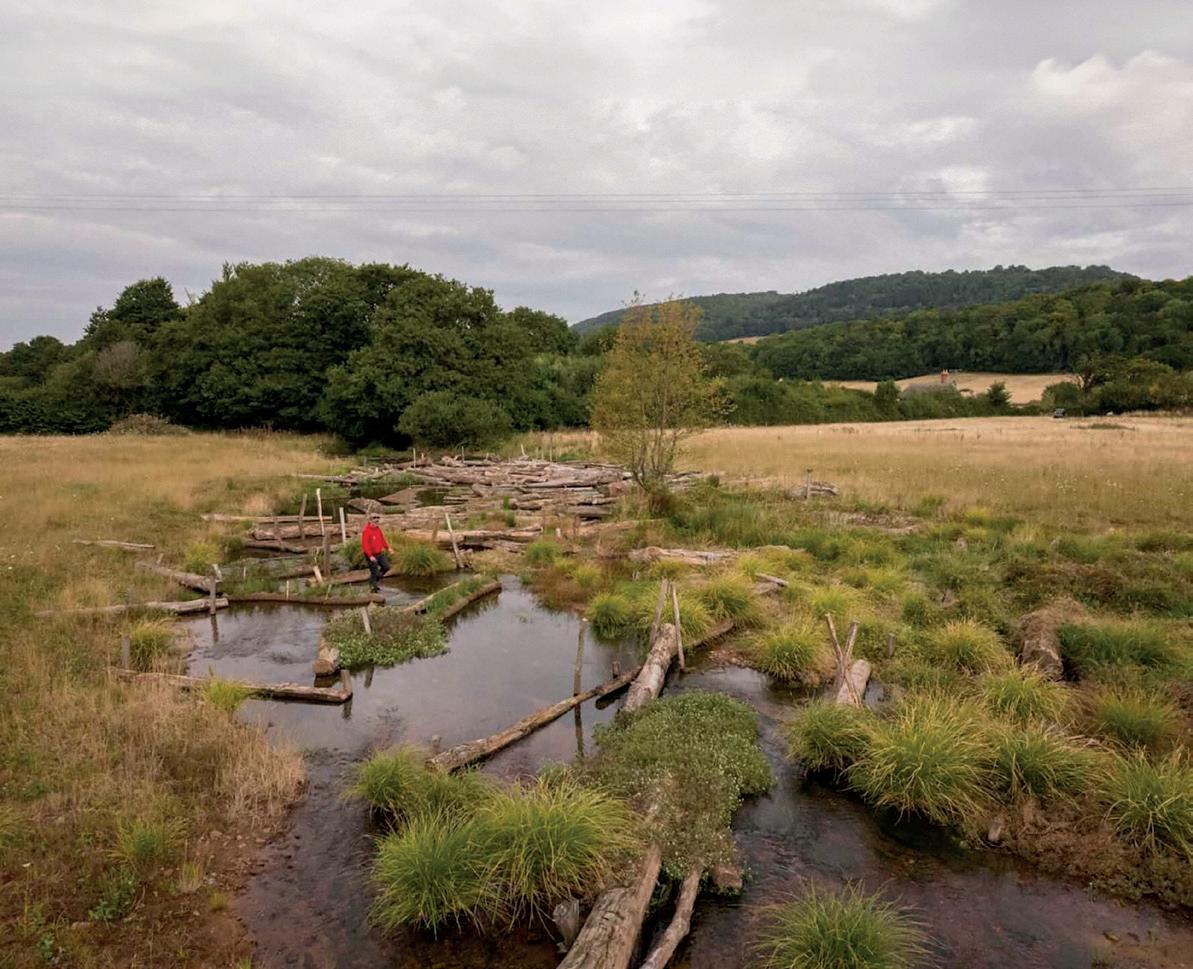
Unlike projects that excavate to form a new channel, Stage 0 Restoration aims to use minimal intervention to allow the river to return to a more natural state. By selectively felling trees along the bank and floodplain and leaving them partially submerged, we create ‘baffled flows’ which use the river’s own energy to carve a new path
Felling trees into the main channel and along the floodplains creates a baffled flow. This helps to create the conditions needed to restore the river’s natural path:
across the floodplain. Once the river is following it’s new course, gravel from the old channel is spread along the new banks, seeding it with aquatic invertebrates which form the base of the food chain and are crucial to river health.
Upstream, the team are creating 1.2 hectares of new floodplain scrapes. These are designed to fill using high water levels in winter, and retain water year-round, eventually developing into reedbeds – an increasingly rare habitat in the UK.
Through creating this new wetland habitat, we hope to welcome back rare species that have largely been lost, such as the Water Rail and Reed Warbler. And by restoring this mosaic of ponds, streams, and scrapes, we will create a cohesive, naturally functioning landscape that benefits everything from the tiniest larvae to the people who enjoy this special place.
Learn more about our award winning Water Team and their work at wiltshirewildlife.org/ waterteam
Reducing the river’s energy downstream
As water hits the fallen timber, the smooth flow is broken-up. This friction slows the velocity of the water. By reducing the river’s energy, you lower the risk of erosive flooding downstream in towns and cities.
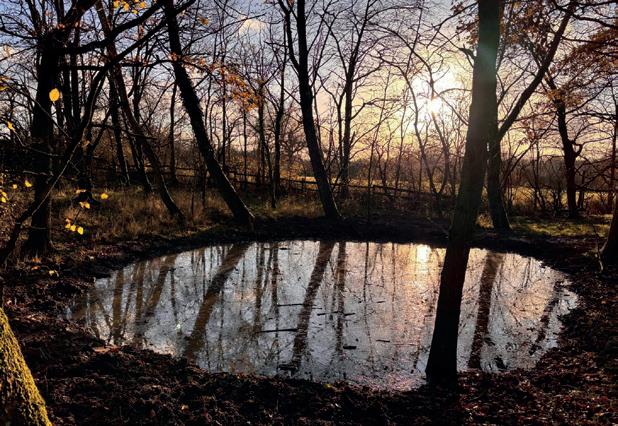
Above: Two restored ghost ponds at Great Chalfield
This image: The Stage 0 restoration at the National Trust estate in Holnicote is now fully developed and providing the template for the proposed restoration at Great Chalfield
© James Beck National Trust Images
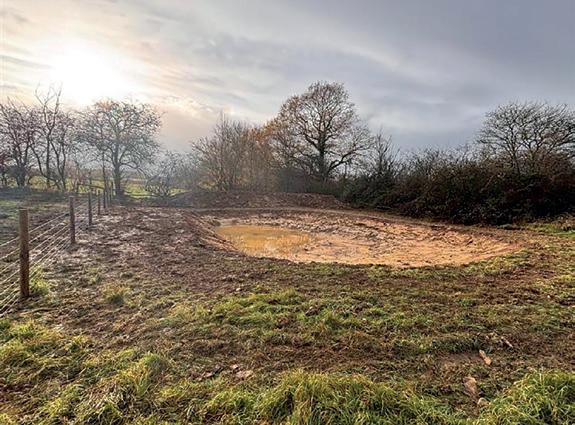
To learn more about ghost ponds, visit wiltshirewildlife.org/blog/ghost-ponds
pools and eroding banks
At the same time, when a tree trunk deflects the current toward an opposite bank or down toward the riverbed, the concentrated energy causes the water to carve away at specific spots, creating deeper pools, eroding banks, and re-wiggling the river. The gravel that gets picked up by the flow is then deposited further downstream, creating shallower areas of clean gravel for salmon to spawn, or wet marginal areas for vegetation. These new features then help to create baffled and turbulent flows of their own, to further create and maintain new diverse habitats.
Re-connecting the river
Eventually, the water may find a weak point in the bank, spilling out onto the floodplain during high rain, which re-connects the river to its natural soaking grounds, creating diverse and rich grasslands.
Contributor: Terri Fosker
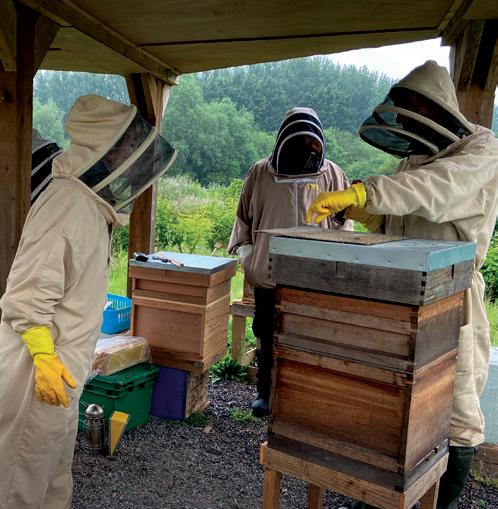
Wiltshire Wildlife Trust Lead Beekeeper and Education & Wellbeing Officer at Lakeside Care Farm
SPECIES FOCUS: HONEYBEE
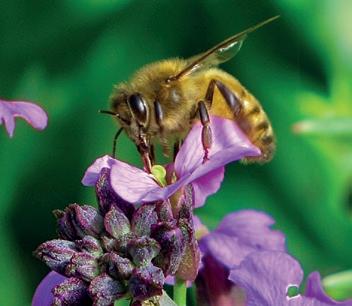
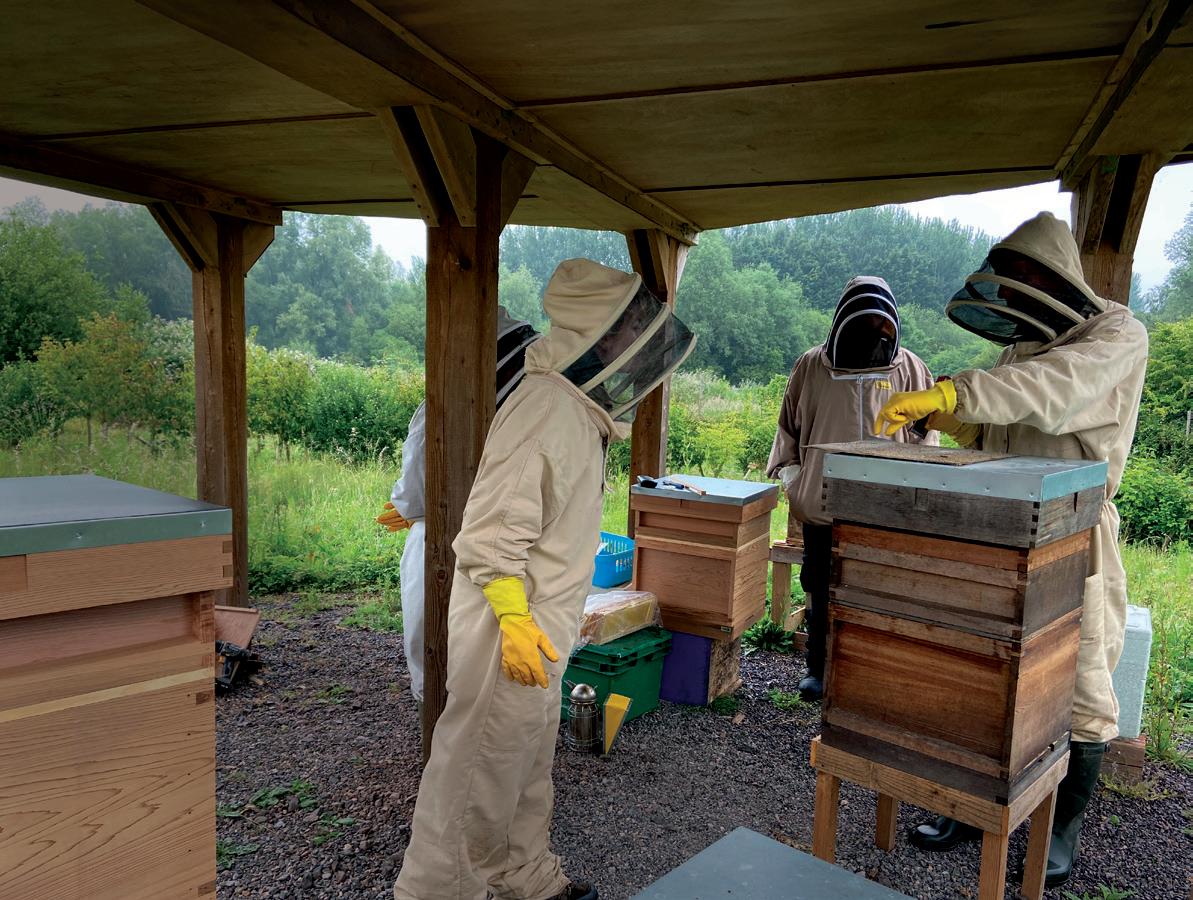
Spring is a wonderful time of year to bring students from the Care Farms to visit our apiaries for a beekeeping experience. They help with hive inspections, learn how to tell the difference between the worker, drone and queen bees, and spot different stages of development of the emerging bees. Honeybees are fascinating; there is so much to learn about how they communicate and work together.
Most people don’t realise that honeybees don’t hibernate. They spend most of winter inside the hive in a tightly packed insulating cluster around the queen, generating heat by vibrating their wing muscles to maintain a core temperature of approximately 33-36°C. The whole cluster moves together inside the hive to their food source, and on warmer days bees will go out on short cleansing flights to maintain hive hygeine.
On mild sunny days in late winter or early spring, you might see honeybees foraging on snowdrops and crocuses for nectar, or pollenrich dandelions. As hedgerows and fruit trees burst into blossom, the colony’s strength boosts. From then on, worker bees make continuous visits to nectar-sources as far as 3 miles away.
The Honeybee’s GPS Bees communicate food locations by sharing nectar tastes and performing dances that determine direction and distance. The most well-known is the Waggle Dance. This uses the sun’s position to calculate direction, while the duration of the “waggle” indicates distance. For example, if a bee waggles her abdomen while walking 45° from the sun for 3 seconds, she is telling foragers to fly in that direction for 3 kilometres. This information spreads quickly, and off they go!
Inside the hive, a healthy queen lays around 2,000 eggs per day. She selects whether eggs are fertilised (female workers) or unfertilised (male drones). As drones are only needed for reproduction, most eggs are fertilised to keep the colony strong. By summer, the colony can reach 60,000-70,000 bees.
You can support bees in your garden by planting pollen and nectar-rich flowering plants, leaving dandelions and clover to flower, and provide a safe water source – like a dish filled with pebbles, so they can drink without falling in.
There are more hints and tips on how to make your garden pollinator friendly at wiltshirewildlife.org/actions
Each December we host a very special event –our Volunteer Awards. This event celebrates the extraordinary people who give their time to support the Trust’s mission. This year, over 100 volunteers gathered at Devizes Town Hall – our largest turnout ever.

The evening featured special guest speaker Michael Malay, author of Late Light. He spoke movingly about how volunteers are driving nature’s recovery and inspiring a sense of hope, describing their work as a profound gift to the natural world.
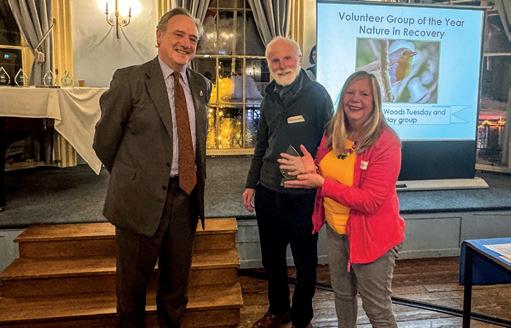
The ceremony acknowledges our volunteers across seven categories, beginning by recognising volunteer groups aligned with our two core strategic goals:
Nature in Recovery
Winners: The Green Lane Woods Tuesday and Sunday Groups. True stalwarts of woodland care with a 30-year legacy, and stars of a recent episode of BBC’s Countryfile.
Connecting People with Nature
Winners: The Adult Wellbeing Voluntary Support Assistants, who help hundreds of people across Wiltshire find solace through our wellbeing programmes.
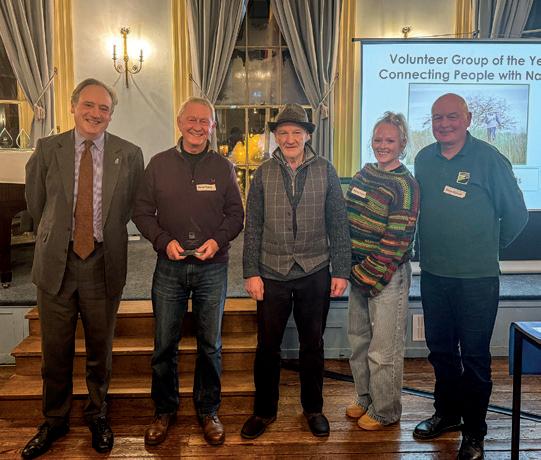
The High Sheriff of Wiltshire, Martin Nye, presented the Volunteer of the Year awards to individuals who go above and beyond:
Nature in Recovery: Georgina Carver, for her unwavering reliability and adaptability.
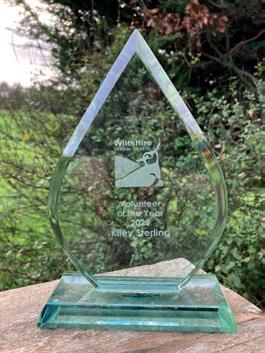
Connecting People with Nature: Kiley Sterling, for inspiring a passion for wildlife in the next generation at Green Lane Woods.
In the Volunteer Task Leader category, Chris Cossey was chosen for coordinating a groundbreaking hedgehog survey at Clouts Wood.
The Special Recognition Award went to Dave Bates, for his dedication to conservation at Lower Moor Farm.
One of the night’s most moving moments was the Young Volunteer Award, won by Dexter PainterCoates, whose knowledge and enthusiasm for nature inspires everyone around him.
The evening culminated in the High Sheriff’s Award for exceptional service, presented to Richard Death, Warden of The Devenish. Richard has volunteered for 35 years in roles ranging from fundraising to task leading. He received a standing ovation, testament to his impact.
We would like to extend a huge thank you and well done to every nominee and winner – you are the force behind the Trust.
For more information about how you can volunteer with the Trust and make a difference for nature visit wiltshirewildlife.org/volunteering

Wiltshire is a place of breathtaking landscapes, from sweeping grasslands to meandering crystal clear chalk streams and wetlands to dappled ancient woodlands. It’s a backdrop that inspires wonder and demands dedication to protect. However, a career in conservation is notoriously tough to break into. Wiltshire Wildlife Trust is proud to offer a hands-on traineeship program to help create pathways into conservation, providing both inspiration and practical training to our newest recruits.
But what is it really like to swap a datadriven office, a university lecture hall, or even a professional kitchen for the depths of habitat management? We spoke to our newest trainees - Elena, Stefan, Yang, and Alexandrato capture the reality of finding your feet in the conservation world.
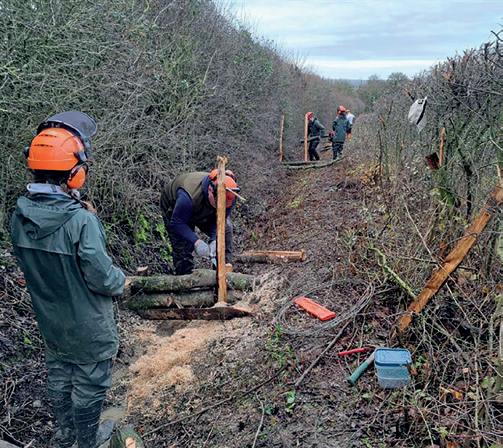
For many, the path into conservation isn’t a straight one. Elena, our Woodland Management Trainee, spent years in data roles before taking a leap (as she describes it) into sustainability. Similarly, Yang, our Nature Recovery Trainee, bid farewell to seven years working in partnership management at universities to follow her heart towards nature recovery. For Alexandra, our
Chalk Trainee, the journey was one of longterm persistence. While working full-time, she spent six years studying Biology with the Open University; she shares: “I was fortunate enough to live alongside the Rangers on Brownsea Island for a few years. They guided me through the local flora and fauna and cemented my passion for the sector.”
Despite her degree, Alexandra faced the industry’s catch-22: needing countless volunteer hours and expensive certifications just to get an entry-level foot in the door. “This left me feeling quite disappointed after working so hard,” she admits, “the Wiltshire Wildlife Traineeship was the perfect way to finally jump in.”
If there is one thing that unites our trainees, it’s the discovery that conservation is just as much about people as it is about nature.
Yang was struck by the scale of our Education and Wellbeing Team, noting the emphasis the Trust puts on connecting people with the nature they are working so hard to protect. Elena felt the community spirit immediately, finding both colleagues and volunteers “kind and patient” as she practiced new skills. Stefan, who transitioned from our Lower Moor Care Farm, found that tasks he once perceived as repetitive were transformed into fascinating lessons
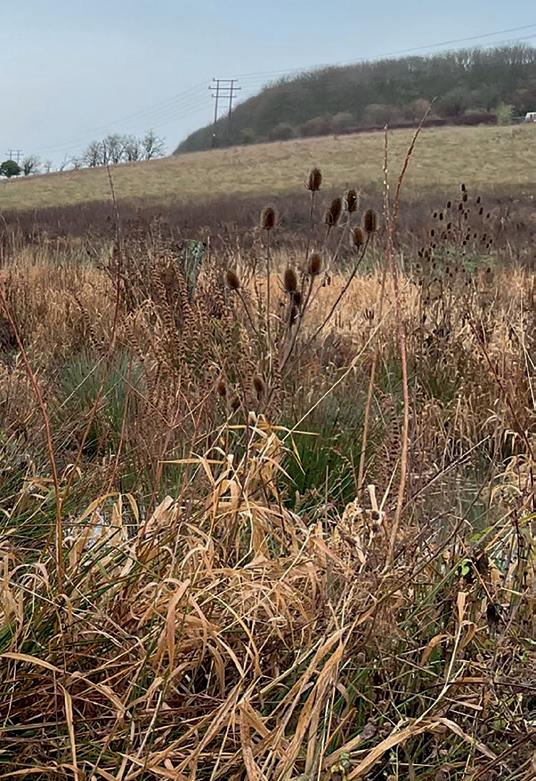
in ecology under the mentorship of our Conservation and Estates Leads.
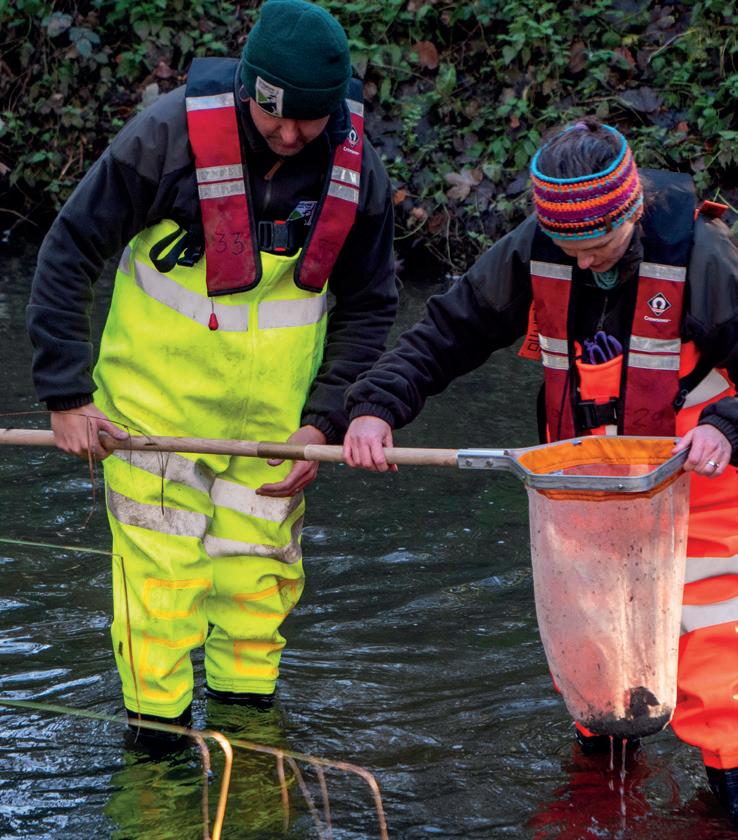
For Alexandra, the surprise was in the vast change in her environment. “Prior to this, I was a chef,” she says. “It has been such a stark contrast from being in a kitchen all day to being outside, cutting back scrub and checking reserves. I love that each day is completely different!”
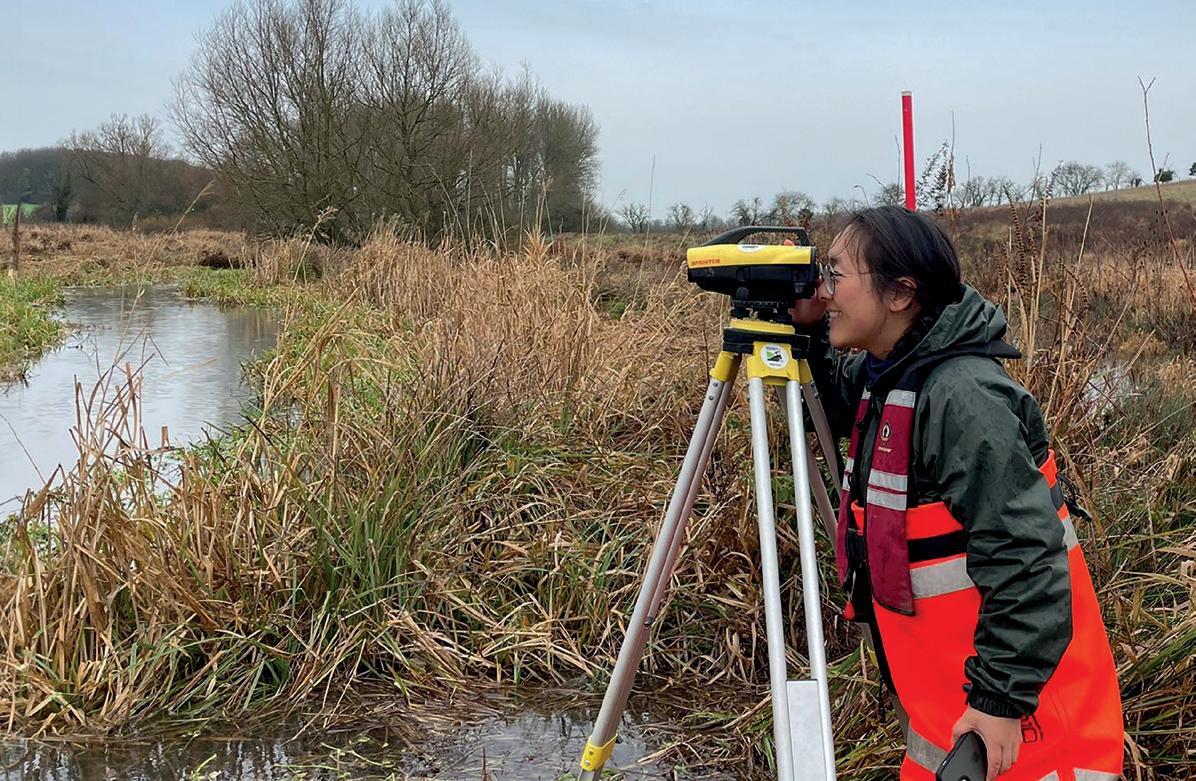
The day-to-day life of a trainee is a whirlwind of new sensations and learning to use different equipment. For Yang, that meant mastering a Laser Level to measure underwater topography. For Elena, it was building confidence with a wide range of power tools.
The learning curve can be intimidating, especially when heavy machinery is involved. Alexandra recalls the challenge of her Chainsaw Crosscutting training. “I had never done anything like it before, so it was quite intimidating. However, the trainees who had already completed the course helped relieve my anxieties and gave me the confidence I needed for the assessment.”
Meanwhile, Stefan has been busy coppicing hazel to encourage growth for local butterflies, all while keeping his eyes peeled for a personal milestone: “I hope to see my first Adder this year!”
As our trainees settle their roots, they are already looking towards a future in nature and conservation. Yang is excited about the Great Chalfield partnership focused on regenerative farming, while Elena finds fulfilment in the long-term legacy of protecting established woodlands.
For Alexandra, the traineeship is the first step on a career path she spent years trying to build. Building on the confidence gained from her studies, and now receiving on-thejob guidance, she, and her fellow trainees, are creating a landscape where people and nature flourish in harmony.
The stories of our trainees, from long days of clearing scrub to the quiet satisfaction of a successful harvest mouse survey to the professional relationships they are building, paint a vivid picture of life at the Trust. They are bringing their fresh energy and perspective to our mission, ensuring the resilience of wildlife on our reserves and beyond, and making a difference in helping us communicate our vision for a wilder Wiltshire. The future of Wiltshire’s landscapes is, quite clearly, in excellent hands.
Our Traineeships are made possible with The National Lottery Heritage Fund, thanks to National Lottery players.
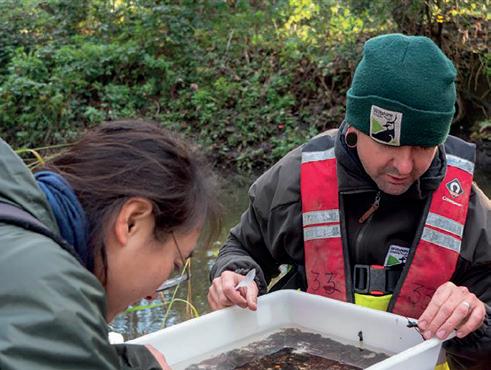
For many, winter is a time to slow down, but for our teams the work to restore our landscapes and connect people with nature never stops. Here’s a snapshot of what’s been going on over the last few months.

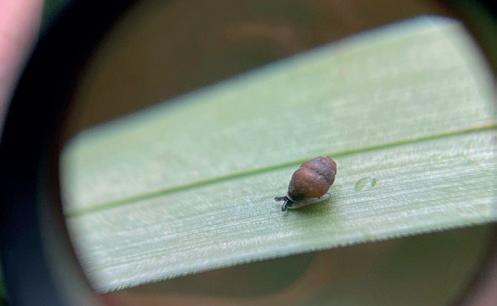
Desmoulin’s Whorl Snail is a tiny, rare wetland species found in calcareous habitats. Despite European declines, we’ve had sporadic sightings at Jones’s Mill, and in 2025, it was recorded for the first time at Smallbrook Meadows. This discovery highlights the success of the Wylye “re-wiggling” project in helping this elusive species thrive.
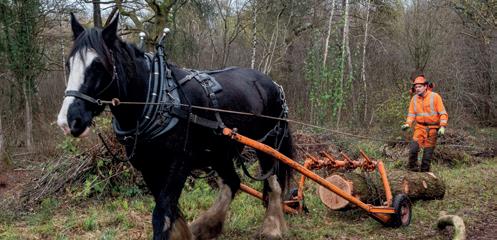
Before Christmas, Ravensroost Wood received some special assistance with woodland maintenance. Funded by the National Lottery Heritage Fund, Wessex Working Horses carried out horse logging to extract timber with minimal disruption to this SSSI’s delicate ecology. This centuries-old method allows for timber extraction in wet or steep areas where heavy machinery would cause damage. By utilising these traditional, sympathetic management techniques, the Trust is ensuring the protection of sensitive habitats while keeping rural heritage skills alive.
For a full list of our trust events please visit the website wiltshirewildlife. org/events
Our Swindon Community Wellbeing Programme supports those facing mental health challenges or isolation through 12-week nature-connection courses. Nature is a vital tool for recovery, which participants experience through activities like mindfulness and bird ringing, with one participant noting: “It’s helped me feel very relaxed and stress free.” To ensure lasting impact, we provide follow-on support to help participants continue to engage with local community groups and nearby green spaces.
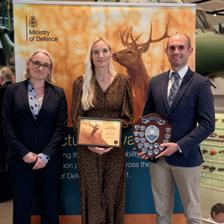
Our Water Team won the Ministry of Defence Environmental Enhancement Sanctuary Award for the West Chisenbury river restoration and wetland creation project. A collaboration with the Defence Infrastructure Organisation, this project addressed phosphorus pollution and habitat restoration on the highly designated Hampshire Avon. The award recognised the project’s national significance as a model for large-scale conservation.
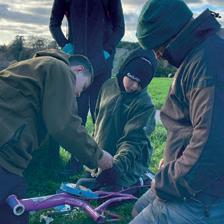
As one of five ‘pathfinder Trusts,’ Wiltshire Wildlife Trust is spearheading the Naturally Connected Young People (NCYP) project. This three-year, Prudence Trust-funded initiative connects disadvantaged 11-16 year-olds with nature to improve their wellbeing. Our first-year focus involves pioneering school and youth group programs across Salisbury, Swindon, Trowbridge, and rurally isolated communities. Over the next two years, we will share these learnings to help other Trusts nationwide develop successful youth natureconnection programs.
Alongside delivery nature’s recovery and connecting people with the natural world, we are committed to protecting your personal data. We have updated our Privacy Policy to reflect changes in our data practices. This new policy provides greater transparency on how we collect, use, and protect your information, ensuring we comply with current UK data protection laws, including GDPR. We encourage you to read the full Privacy Policy on our website: wiltshirewildlife.org/privacy-policy
Earlier this year, supporters gathered at Lower Moor Farm to launch our Legacy Society – an event dedicated to thanking those who leave a gift to us in their Will. It was a beautiful reflection of the Trust: people connecting over their shared love for wildlife.
Much of our work requires long term thinking. Habitats take time to recover, species need space and stability to thrive. Gifts left in Wills are a way supporters can help us plan with confidence for the years ahead. These gifts allow our specialist teams to manage the county’s landscapes as complex systems. From ecological monitoring to habitat restoration, they fund essential work, ensuring that our teams remain on the ground, delivering for nature and people year after year.
Thank you to all our Corporate Members who are helping us create a sustainable future for wildlife and people.
Most legacy gifts are unrestricted, reflecting the trust our supporters place in us. This flexibility allows us to act decisively – whether launching urgent conservation projects, managing our reserves, or securing land for nature. In an era of uncertain grant funding, these gifts provide the stability that we need to thrive.
Legacies help keep our work - and Wiltshire’s wildlife - going.
We know that making or updating a Will can feel like a big step. We offer a free Will-writing service for members through trusted legal partners.
While there is no obligation to include a gift to the Trust, doing so can be tax-efficient as gifts to charities are exempt from inheritance tax. Whether you are providing for loved ones or
supporting a cause close to your heart, a gift in your Will can leave a positive legacy.
For many, a legacy gift is a natural extension of their life’s passion – a way to keep caring for the landscapes special to them. Our recent Legacy Society event captured this spirit; conversations moved from fond memories to a shared hope for the future. Every gift, regardless of size, joins the collective effort to keep Wiltshire wild, accessible, and thriving for generations to come.
To find out more about our free Will writing service and our Legacy Society events contact fundraising@wiltshirewildlife.org
Gold:
Silver: Knorr Bremse, Platinum Motor Group

Bronze: Center Parcs, Challenge Sustainability, Clegg Associates, Holiday Cottages, Quick Move Now, Wessex Water, Wilton House
Small Business: 1st Aid 4 Fencing, Energy Saving Experts, Liddington Mortgages, Xtreme Mowing














for all.