2025-26
How your support is making it possible for wildlife and people to flourish in harmony
Inside 03 A Word from our Chief Executive and Chair 04 Our Collective Impact
06 Goal 1 06 1.1 30% of land in positive management for nature 08 1.2 Species abundance and diversity increasing
14 Goal 2 14 2 .1 1 in 4 people taking meaningful action to drive nature's recovery locally and nationally 14 2.4 Nature and climate at the heart of decision-making locally and nationally
10 1.3 Natural processes being restored
15 2.2 Health and wellbeing of people improved through their engagement in and with nature
10 1.4 Nature-based solutions being used to address the climate and water emergencies
16 2.3 Opportunities for all children and young people to nurture a lasting interest in nature
11 Sustainability: Our Carbon Impact
18 Financial Report
12 Thank You
2 | Wiltshire Wildlife Trust
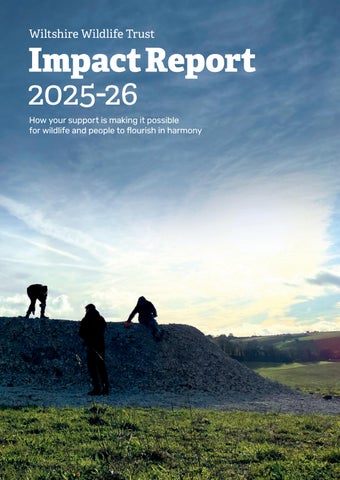
A Word from our Chief Executive No, our striking front cover image is not a new Long Barrow burial site! It’s a Butterfly Bank at our Coombe Bissett chalk downland reserve, created with Cambridge University so we can study how sheltered microclimates can protect our chalkland butterflies from climate extremes. This summer the heat records have been smashed all over again, and climate resilience is front of mind. This year, our volunteers have been plug-planting the butterfly banks with carefully selected wildflowers, just as they have hand-planted over 1,260 Devil’s-bit Scabious for Marsh Fritillary Butterflies at our Jones’s Mill reserve. Yet again, I am struck by the hours of dedication given by our volunteers in all weathers!
"Our advice has shaped action for nature across 80,000 hectares of farmland – twice the size of the Isle of Wight!"
Also out in all weathers is our Education Team, hosting a record-breaking 148 school visits and engaging more than 6,800 children this year. Our new Rangers group for young teenagers is the latest stepping stone in our ‘Youth Pathway’ from Wildlife Watch groups to Young Ambassadors, aiming to nurture a lifelong love of nature. We’ve introduced nature immersion sessions for disadvantaged young people who are ‘new to nature’, in a nationally leading programme, which earlier this year I got to experience first-hand. It was moving to hear one young person, with no garden of his own, talk with pride about ringing young barn owl chicks and making a bird box for his grandfather. The reach of our partnerships for nature continues to grow. With our support, farmers have been identifying ‘ghost ponds’ – long since drained or lost from the landscape – and now we are planning to reinstate over 100. Our advice has shaped action for nature across 80,000 hectares of farmland – twice the size of the Isle of Wight! The times may be uncertain, but I take great encouragement from this Impact Report, and I hope you do too. It’s your support that makes it possible.
Chair's Foreword Bringing nature back isn’t just nice-to-have; it’s essential for our health and wellbeing, economy and food supply, clean water and air, climate resilience, flood protection, and much more. That’s why this Trust operates at ever increasing scale across Wiltshire and Swindon to support nature-friendly farmers, local communities and businesses to create thriving landscapes and townscapes for wildlife, farming and people. Partnership is key to amplifying our impact and achieving the successes you see in this report. With farmer clusters and river groups we’re connecting across landscapes to restore natural processes and species abundance. With local communities and schools we’re bringing wildlife back to where people live and restoring their health and wellbeing. With the two Councils, Natural England, National Trust and Wessex Water we’re convening the Wiltshire and Swindon Local Nature Partnership to plan and deliver
joined-up action for biodiversity, climate and people across the county. Together we’re making a difference. As a growing charity and employer we face the same challenges that global economic volatility brings to all organisations. We’re keeping sharp focus to make sure our activities, income and costs align strongly with our strategic priorities, and sometimes we have to take tough decisions. Thanks to our generous members, volunteers and funders, the calibre and professionalism of our staff, plus the wisdom and scrutiny of our trustees, our finances remain healthy so we continue to deliver amazing outcomes for nature and people.
Impact Report | 2025-26 | 3
Our Strategy to 2030
Our Collective Impact
Goal 1 Nature Recovery
Behind every statistic listed here lies a massive collective effort. Supported by the kindness of our donors and the dedication of our staff and volunteers, these figures demonstrate a journey towards restored ecosystems, resilient wildlife, and communities more connected in the natural world.
By 2030, nature will be in recovery in Wiltshire and Swindon, with habitats, species and natural processes being restored at scale. To achieve this we need: 1.1 30% of land in positive management for nature
Goal 1
1.2 Species abundance and diversity increasing
Volunteers helped us plant c. 24,000 trees with Trees For Climate in Swindon
1.3 Natural processes being restored 1.4 Nature-based solutions being used to address the climate and water emergencies
Goal 2 Connecting People with Nature By 2030, people will be taking action for nature and benefitting from nature in their lives. To achieve this we need: 2.1 1 in 4 people taking meaningful action to drive nature’s recovery locally and nationally 2.2 Health and wellbeing of people improved through their engagement in and with nature 2.3 Opportunities for all children and young people to nurture a lasting interest in nature 2.4 Nature and climate at the heart of decision making locally and nationally
Our Delivery Teams
Our power lies in our people. Our staff are the professional experts and practical workforce providing the scientific grounding and long-term vision to drive the change needed for a flourishing, wilder Wiltshire.
4 | Wiltshire Wildlife Trust
The Conservation and Land Management Team are the custodians of our 40+ nature reserves. Their ecological expertise along with practical management and maintenance ensures that our sites remain accessible and habitats continue to be protected and thrive across the county. The Farming Team look after our conservation
We received over 9,822 donations Goal 2
Our social media content was seen by over 2.1 million people £341,991 secured from nine Legacy Gifts
We have 15,378 active members grazing herds. This entails all husbandry and transporting them between reserves, as well as working with local graziers where we need more livestock to support our conservation grazing operation. Comprised of specialist ecologists, the Nature Recovery Team conduct species monitoring, provide land management
expertise, facilitate green finance and Biodiversity Net Gain projects, and work with farmers and landowners across the county and beyond. The Water Team are dedicated to restoring and protecting Wiltshire and Swindon's river catchments, chalk streams and wetlands to improve aquatic biodiversity. They design and implement
19,000
hectares opportunity mapped for pond and wetland potential
80,141
Devil's-bit Scabious plug planted at Jones's Mill
hectares of land managed for wildlife by the Trust
new parcels of land recorded for the WSBRC Nature Reserve Woodland Inventory Project, working closely with The Wiltshire History Centre and Wiltshire Botanical Society
15
79 nature based projects designed, with the potential of:
2,500+
people engaged with our Education programmes - 6,838 children and 3,027 adults
people taking action through our engagement events and activities
volunteers registered - a 17.5% increase from last year
natural flood management and river enhancement projects with partners to ensure our blue corridors are resilient and healthy. The Wiltshire and Swindon Biological Records Centre (WSBRC) serves as the county's local environmental records hub, collecting, and managing data on wildlife and habitats. The team provide the high-
151
165ha
new or improved habitat
60+
acoustic monitors deployed across farmland sites, including Great Chalfield, contributing farmland bird data to the Biological Record Centre
650m
of River Biss enhanced and 395 water quality samples collected by volunteers
983
Biodiversity Units
1,276
children and young young people participating in people benefitted our Youth Pathways programme from time at our (Wildlife Watch, Rangers, Care Farms Work Experience, and Young Ambassadors)
% +17.5
3,241
6,500
1,396
ponds created for Great Crested Newts and 52 ponds eDNA surveyed, 25 found presence of newts
9,865
1,260
hectares of land under Wiltshire Wildlife Trust advice
+14%
16,708
hours contributed by our volunteers - a 14% increase on last year! That's 321 hours a week, equivalent to nine full time staff members
quality ecological mapping required to protect biodiversity and guide nature recovery efforts. Through structured programmes, the Adult Wellbeing Team offer a gateway for people to experience the benefits of being out in nature, providing a safe space for individuals struggling with mental health or social isolation, enabling
£26m
for nature friendly farmers
1,439
people supported our advocacy and campaigns
+19%
148
school visits and events run by our Education Team - 26 more than last year, a 19% increase
them to connect with both the natural world and others. The Youth, Education and Wellbeing Team deliver outstanding provision to thousands of children and young people across Wiltshire and Swindon, from school visits to small group and 1-1 support. Our Care Farm Teams provide exceptional support to young people
122
participants across 9 different Adult Wellbeing programmes
through their holistic, child-led alternative education provision at The Willows, near Melksham, and Lakeside, at Lower Moor Nature Reserve. Our Engagement Team deliver our events and activities, support our volunteers, lead our youth pathways programme and manage our cafes and visitor experience across our reserves.
Impact Report | 2025-26 | 5
Goal 1
1.1
By 2030, nature will be in recovery in Wiltshire and Swindon, with habitats, species and natural processes being restored at scale
30% of land in positive management for nature
North Wiltshire and Swindon
Wessex Working Horses have been horse logging at Ravensroost in the Braydon Forest thanks to funding from the Heritage Lottery Fund. The use of horses in woodland management is centuries old, providing a way to carry out essential maintenance with minimal disruption to this Site of Special Scientific Interest (SSSI). At Lower Moor Farm near Oaksey, year one of our Wilding Lower Moor project has delivered important baseline surveys for bats, birds, insects and botanical interest. These results are shaping our delivery plans for year two, where we’ll be rewetting meadows and planting trees to support climate resilience. We’ll also be enhancing our visitor infrastructure with improved access and the planned addition of a new bird hide. In Swindon, our Swindon Forest Meadows work continues to go from strength to strength. Funded by Swindon Borough Council and the Great Western Community Forest, we helped to plant a living labyrinth of 80 green and red oaks as a memorial to the Second World War in Lydiard Park. The team have also planted a new Coppice Orchard, which will produce a range of wood for different purposes such as Willow for weaving, Hazel for making fencing hurdles and bean rods, and Sweet Chestnut for fencing. 6 | Wiltshire Wildlife Trust
Above: Tree planting at Lydiard Park in Swindon Inset: Jo Lewis WWT CEO, with Secretary of State Emma Reynolds
Below: Horse Logging at Ravensroost
Central and South Wiltshire
At Jones's Mill near Pewsey, our volunteers have cleared encroaching scrub from the fen, opening up areas to allow more light. To enhance ecological resilience and biodiversity we have expanded conservation grazing at the reserve. Livestock selectively grazing and trampling the ground creates a diverse sward which benefits wildflowers and invertebrates. At Coombe Bissett Down near Salisbury, our Butterfly Banks (featured on the front cover), which were built as part of an innovative research project in 2024 creating climate resilient spaces for vulnerable butterfly
species, have this year been planted by staff and volunteers. By introducing a carefully chosen, diverse selection of native wildflower plug plants, we are fast-tracking the creation of critical nectar sources and larval food plants. The banks allow us to study how tailored microclimates can buffer pollinators against changing weather patterns and will remain a vibrant, fluttering focal point of the reserve for years to come.
Beyond Our Reserves
Our work extends beyond our reserves through partnerships with farmers and landowners. Following on from the Chalk Species Revival project, we have delivered further work to connect nature corridors along the Wansdyke. The Heart of Wiltshire's Chalkland Project, funded by the Big Chalk Nature Recovery Fund, delivered habitat restoration across 120 hectares, collaborating across 13 separate land parcels with multiple landowners, including the Pewsey Downs National Nature Reserve and the Pewsey Downs Farmer Group. This work delivered 36 hectares of scrub clearance and the installation of grazing infrastructure across 60 hectares to support conservation grazing. The targeted planting of plug plants will improve the floral diversity of the chalk grassland and improve the habitat for chalkland species, while joining up ecological corridors to enable better connectivity for nature across the landscape.
Great Chalfield During the last year, we have planted over 11,000 trees, creating new silvoarable systems, closed canopy woodland, wood pasture and hedgerows across the estate. We are also developing a Stage Zero restoration project, reconnecting the brooks and streams with their natural floodplains to create thriving wetland systems. Together, these habitats are creating important wildlife corridors through a productive farmed landscape while demonstrating how farming and nature recovery can work hand in hand. Our surveys and acoustic monitoring have continued, building a robust ecological baseline against which we can measure change over time. From soil health and pollinators to farmland birds and mammals, we are tracking how wildlife responds as the landscape evolves. Alongside this, we are collaborating closely with neighbouring landowners and building a local network to test, share and champion regenerative farming practices far beyond the estate.
"Over 50 acoustic monitors were deployed to capture data on farmland birds to inform land management." Below: Chalk Revival Lapwing plots
Funded by North Wessex Downs National Landscape's Farming in Protected Landscapes programme, our Chalkland Revival Project delivered species protection and landscape-scale conservation. The project looked to boost Lapwing populations through installing over 50 bird feeders and predator-prevention fencing. Wetland mapping identified over 100 opportunities to reinstate lost wetlands and ponds onto farmland, and a Deer Management Action Plan and venison market study were created. Project Peewit was established in 2023 to reverse the decline of Lapwing populations. This year, the Project delivered significant landscape-scale impact by expanding its geography and data-driven insights. Around 130 pairs of Lapwing were monitored using methods including bioacoustic monitoring and bird ringing across 45 sites in the Braydon Forest, Cranborne Chase, and the North Wessex Downs. This data has been used to map populations, support and advise landowners, and measure the success of habitat interventions. The project has worked with farm clusters across Wiltshire to enable landowners to deliver a coordinated effort to create optimal conditions across breeding grounds. Furthermore, the project expanded its monitoring and interventions into the south of the county, including the Wylye Valley. By blending conservation science with farmer-led collaboration, Project Peewit is establishing the resilient, connected landscapes Wiltshire’s Lapwings need to thrive. Impact Report | 2025-26 | 7
Goal 1
Species abundance 1.2 and diversity increasing Rare Moth Recorded at Ramsbury Meadow
The discovery of the Crescent Moth at Ramsbury Meadow, Ramsbury, is one of only ten sightings in Wiltshire since 2016. This species lives in the damp, marshy fringes of the rivers and its presence on the reserve highlights the importance of protecting our river border habitats. By expanding recording across our sites, we are developing a better picture of the species that rely on our land: this allows us to refine the management of our sites to ensure fragile populations thrive and move off of the critical list.
Species Increasing in Range
Two colonies of Brown Hairstreak in the north and the south of Wiltshire are dispersing as they find more suitable habitats. In the South, we are seeing them appear in new locations, such as Cockey Down and Ham Hill Nature Reserves, where they haven't been recorded before. This success is down to careful and sympathetic management of hedgerows and scrub.
Discoveries of the Desmoulin’s Whorl Snail
Last year we discovered the tiny Desmoulin's Whorl Snail (DWS) at Smallbrook Meadows, Warminster. To better understand the rare DWS populations, a team of dedicated eagle-eyed volunteers contributed 150 hours to intensive, targeted surveys across the county, leading to us successfully identifying the presence of DWS at a second location at Jones’s Mill in Pewsey. Both populations were discovered on our own nature reserves, providing powerful evidence that our habitat management is successfully safeguarding this highly threatened species by our teams.
Rare Flora Thriving at Lower Moor
The rare Stonewort found in Mallard Lake at Lower Moor, near Oaksey, were the initial reason for the designation of the lake as a SSSI. Stonewort is a pioneer species – one of the first species to move into newly created wetlands. Until recently, it was thought that as a wetland becomes more established, succession 8 | Wiltshire Wildlife Trust
Above: Brown Hairstreak Butterfly
"The discovery of the Crescent Moth at Ramsbury Meadow is one of only ten sightings in Wiltshire since 2016." Below: Crescent Moth Image courtesy of Somerset Moth Group by Steve Chapple
takes place and these species get outcompeted by more dominant plants and start to decline. However, a recent survey by the Environment Agency revealed that despite the expected changes to the lake (which the Trust acquired in 2007), the rare Stonewort is still prevalent, suggesting that the low nutrient, high calcium conditions it favours haven't ended and so it continues to thrive.
Restoring Habitats for Great Crested Newts
Our commitment to enhancing aquatic biodiversity has seen the successful restoration of 15 ponds this year across Wiltshire under the Natural England District Level Licensing scheme. To ensure the health of these newly created habitats, our team conducts three-month health checks on restored sites. The recent eDNA testing data showed that of the 52 ponds delivered by the Trust to date, 48% (25 ponds) have tested positive for Great Crested Newt presence. This shows that our habitat restoration efforts are delivering measurable impact, successfully expanding the range of this rare, protected species.
Habitats for Bats at Green Lane Woods
At Green Lane Woods, Trowbridge, tree veteranisation work – where deliberate roost holes are cut into dying trees to
create bat habitats – is starting to pay off. Within just six months of creation, three bat species (Noctule, Brown Long-eared, and Bechstein’s) were detected investigating the new features.
Above left: Great Crested Newt (handled under license) Above right: Duke of Burgundy Butterfly
The Duke of Burgundy at Morgan’s Hill
Our ongoing commitment to the speciesrich chalk grassland of Morgan’s Hill, near Calne, has yielded a critical breakthrough in the conservation of the Duke of Burgundy Butterfly. As a result of successive chalkland projects, our recent monitoring efforts led to the discovery of a breeding colony – a goal 10 years in the making. We can now accurately map the egg-laying areas of the site. This data informs our management plan for the reserve and our future work in enhancing the nature corridor along the Wansdyke, allowing us to protect and create the specific micro-habitats essential for larval development.
Species Recording
Wiltshire and Swindon Biological Records Centre
WSBRC delivered a range of Bioacoustics Monitoring across the county. They deployed 201 devices across 113 sites, surveying a vast landscape of 15,786 hectares. These cuttingedge bioacoustics collated an incredible 27,026 hours of sound recordings, which were analysed to identify bird species and map activity. By sharing these insights directly with local landowners, we have pinpointed the highest-value habitats for birds on their land, while establishing an ecological baseline to measure and guide the success of future conservation management practices and projects.
"We are looking beneath the surface by Species at Great Chalfield counting At Great Chalfield, we are tracking wildlife earthworms from soil to sky to see exactly how the land is and testing reacting to our work. We mix classic hands-on soil structure." surveys – like searching for harvest mouse
Our work to deliver species abundance and diversity is often measured through monitoring and recording on our reserves. Our heartfelt thanks goes out to our teams of volunteers and the county recorders who help us understand how populations of species are performing across our sites.
nests, checking dormouse tunnels, and counting skylarks, plants, and pollinators – with modern tech like wildlife sound recorders and eDNA testing. We are looking beneath the surface by counting earthworms and testing soil structure to check underground health. All of this data gives us the ecological baseline we need to check that nature-friendly farming practices are making a difference for species abundance. Impact Report | 2025-26 | 9
Goal 1
1.3
Natural processes being restored
Expertise in Nature’s Recovery
As part of the Natural Environment Investment Readiness Fund (NEIRF) project, our Nature Recovery Team worked with 15 landholders to develop a range of investmentready projects. The team provided the technical advice needed to create new income streams that reward farmers and landowners for restoring nature. By making investment potential easy to understand, we’ve given them the tools to help nature recovery pay for itself.
and create micro-habitats for local aquatic wildlife.
Above: New wetland scrapes on the Lambrok Stream
Floodplain Reconnections
Great Chalfield: Financing Wood Pasture and Wetlands
At Great Chalfield, three Biodiversity Net Gain projects have been made market ready to help advocate for the commercial viability of green finance, as well as raising funds for further restoration work on the estate. By registering these units and engaging active buyers, we are providing a case for habitat creation to be recognised as a verified income stream.
Restoring Natural River Processes at Widbrook Woods
To restore natural river processes and enhance the habitat of the River Biss at Widbrook Wood near Bradford on Avon, dedicated volunteers contributed 36 hours of hands-on time to construct five woody debris structures across a 650-meter stretch of the river. These features mimic natural wood fall, safely altering water flows to clear sediment
1.4
"We are tracking species that we hope to see recover alongside the landscape."
Below: Constructing leaky dams
The team delivered floodplain reconnection work at Park Farm near Trowbridge by excavating two new wetland scrapes along the bank of the Lambrok Stream. This allowed the stream to naturally spill into its floodplain to reduce downstream flood risks while creating a rich habitat for wading birds and amphibians. The Wylye Valley Landscape Recovery project is one of the country's most ambitious chalk stream restoration programmes, working with more than 20 landowners across 22km of river and floodplain. Having successfully completed the development phase, the partnership is now progressing through the final stages of Defra's approval process to unlock delivery funding. The project aims to reconnect the river with its floodplain, restore natural processes and create a thriving landscape for wildlife, farming and people.
ature-based solutions being used to address N the climate and water emergencies
Natural Flood Management
As part of the Wiltshire Rural Run-off Project, the Water Team, along with our Trainees, have installed 4 leaky dams at Teffont Evias and a further 9 at Elm Farm, Foxham, with designs for an additional 35 dams and a detention pond at Elm Farm finalised and ready to be created. In collaboration with Wiltshire Council, three road grips were installed at Teffont Magna to divert surface run-off into a natural wooded basin. These installations will undergo rigorous
10 | Wiltshire Wildlife Trust
monitoring to ensure they perform as intended during heavy rainfall events. We have been developing a comprehensive longterm Climate Resilience Plan to safeguard our nature reserves against the growing impacts of extreme weather and the changing climate. By identifying key vulnerabilities across our landscapes, this strategy outlines the adaptations required to restore natural processes, secure fragile habitats, and build true climate resilience into the land.
Sustainability
Our Carbon Impact Alongside developing nature-based solutions to adapt and become more resilient to a changing climate, the Trust is working to reduce its greenhouse gases (GHG) emissions to help reduce the impact of climate change and global heating. Our Carbon Reduction Plan sets out how we will cut our carbon footprint. Most of the tracking relies on activitybased data (e.g. litres of fuel used), however our purchases are estimated based on financial spend. Actions to reduce emissions in key areas including energy and purchasing are supported by our staff Sustainability and Carbon Reduction Group. In 2026, we are developing a pathway to map out our emissions reduction.
What do we measure?
We use tools developed by the The Wildlife Trusts, which evolve with best practice, to monitor our progress toward net-carbon zero by 2030. We measure emissions using the globally recognised framework for greenhouse gas which has 3 scopes: Scope 1: Direct Emissions Scope 2: Indirect Energy Emissions Scope 3: Indirect Value Chain Emissions Greenhouse gases are converted into a standard unit of global warming potential: tonnes of carbon dioxide equivalent (tCO2e).
Results
These results cover April 2024 to March 2025. We are currently finalising our 2025-26 data. Our 2024-25 GHG emissions are estimated to be 1,538 tCO2e, down by 167 from last year’s 1,705. For context, Wiltshire and Swindon’s total GHG emissions for 2023 were estimated to be 3.8 million tCO2e¹ (source DESNZ Local Authority GHG Emissions 2023). Emissions from buying goods and services (e.g. trees we buy for planting and contractors providing landscape activity) reduced by 261 tCO2e in 2024-25. This decrease is mainly due to a reduction in spending.
Wiltshire Wildlife Trust’s Refrigerants 2024-25 0.07% Operations Scope 1 / 0.52 tco e (Day-to-Day) Emissions 2
Fuel for equipment 0.12% Scope 1 & 3 / 0.89 tco2e Source: DESNZ Local Authority GHG Emissions 2023.
Wiltshire Wildlife Trust 2024-25 emissions This report is created a year in arrears.
Annual tCO2e emissions compared to baseline and previous year Greenhouse Gas Emissions
2019–20 (baseline)
2023–24
2024-25
234
268
307
From purchased goods & services
709
448
From conservation grazing
801
728
783
Total
1,035
1,705*
1,538
From (day-to-day) operations
*Increase over baseline total followed inclusion of purchased goods and services
The Trust’s energy emissions were reduced by purchasing renewable wind/hydro energy and using electricity generated by Wiltshire Wildlife Community Energy (WWCE) owned solar panels at Langford Lakes. During 2024-25 the WWCE owned solar rooftop panels on Trust buildings generated 14,705 kWh, with an estimated 7,353 kWh used onsite. A free energy survey of the Brockbank Centre at Langford Lakes in November 2025 has provided a list of actions that we are in the process of implementing to help us further reduce our energy use in the building. Travel is a significant contributor to emissions and as part of reducing this and helping more people access our nature reserves, we’ve added public transport and active travel options to the ‘Know before you go’ information on our website. Our staff Sustainability and Carbon Reduction Group have also created a sustainable catering checklist to help us serve healthy, nature-friendly food and drink. Carbon reporting is complex – you can read more on our blog at wiltshirewildlife.org/sustainability
Water 0.14%
Scope 3 / 1.06 tco2e
Waste 0.89%
tCO2e (tonnes of carbon dioxide equivalent)
Scope 3 / 6.70 tco2e
Energy 2.96%
Purchased goods 32.70%
Purchased services 26.61 %
Travel 36.51%
Scope 1, 2 & 3 / 22.33 tco2e
Scope 3 / 201.05 tco2e
Scope 3 / 247.09 tco2e
Scope 1 & 3 / 275.84 tco2e
1
Impact Report | 2025-26 | 11
Thank You Our work is only possible with the support of our incredible donors, members and volunteers. In 2025/6, the generosity of individuals, families and many organisations has enabled us to manage our reserves, connect people with nature, and help nature recover. From local communities participating in our Love Your Local Nature Reserve appeals, to our partners working with us on projects like Chalkland Revival, our watchword of partnership is evident in all those who give their time and money to ensure Wiltshire Wildlife Trust achieves its goals by 2030 – for nature, for everyone. Thank you so much for your continued support.
Members
Corporate Members and Partners
We have over 15,000 members across Wiltshire and Swindon – together you are the foundation of everything we do as a charity. Whether you joined us this year or have been supporting us for decades, from our life members to our Wildlife Guardians, collectively you are making an impact – thank you.
Corporate Members and Partners 1st Aid4Fencing Animal Friends Biocharged Compost Center Parcs Challenge Sustainability Clegg Associates Cotswold National Landscapes Cranborne Chase National Landscape Crappers and Sons Ltd Department of Environment Food and Rural Affairs Energy Saving Experts Ltd Enterprise Mobility Environment Agency Ernest Cook Herman Miller Hills Waste Solutions Knorr Bremse
Volunteers Our incredible volunteers enable us to do so much more – from supporting our education, wellbeing and engagement activities to managing our reserves. We simply couldn’t achieve nature’s recovery or meet as many people without you. Thank you for your commitment and energy.
12 | Wiltshire Wildlife Trust
Liddington Mortgages MJ Church National Trust Natural England North Wessex Downs National Landscape OCU Group Platinum Motor Group Quick Move Now Swindon Borough Council Titan Tents Travel Chapter / Holiday Cottages UKDP Well City Salisbury Wessex Water Wilton House Wiltshire Council Wiltshire Wildlife Community Energy Xtreme Mowing
Main photo: Volunteer group at Green Lane Woods Inset: Lapwing in flight
Trusts and Grants
Legacy Donors
Armed Forces Covenant Fund Trust Big Chalk Nature Recovery Fund Big Give The Ernest Cook Trust Fulmer Charitable Trust GD Herbert Charitable Trust Groundwork Tesco Stronger Starts Heritage Lottery Fund The Inchcape Foundation Jack Lane Charitable Trust Medlock Charitable Trust Natural England Investment Readiness Fund National Lottery Awards for All Environmental National Lottery Reaching Communities Neighbourly, Coop COP Fund and Southern Community Fund Prudence Trust Samuel William Farmer Charitable Trust The Swire Charitable Trusts Verdon-Smith Charitable Trust Wiltshire Council Warminster Area Board Wiltshire Council Community Conversations
In grateful memory of the donors who left a gift to the Trust in their Wills: John Clipson Betty Folkard Helen Howard Archibald Kent Mary Loveless Patricia Nicholson Josephine Richards Ian Gary Sutton Dr E Tanner
Donors and In Memoriam Whether you gave to an appeal, raised funds on our behalf through school or sporting events, or chose the Trust when celebrating a life through an in memory collection, your donations help Wiltshire Wildlife Trust to achieve all the things you have read in this year’s report. Thank you.
Community Groups Calne Re:connecting Group Ramblers Association Rotary Club Salisbury Songways Concert St Thomas’, Salisbury Swindon Beer Festival
We also share grateful thanks to those individuals and organisations who wish to remain anonymous.
Impact Report | 2025-26 | 13
Goal 2
2.1
By 2030, people will be taking action for nature and benefitting from nature in their lives
1 in 4 people taking meaningful action to drive nature’s recovery locally and nationally
Inspiring Action for Nature in our Communities
Connecting communities to the natural environment is essential for long-term nature recovery. Our events and campaigns forge this connection, empowering people to take meaningful action to protect it. This year, participation in 30 Days Wild grew with over 1,000 Wiltshire residents signing up for the month-long June initiative. Campaigns like this drive immediate connection to nature and inspire long-term conservation commitment. Country Comes to Town, held in Chippenham in 2025, attracted over 1500 attendees. This annual event allows us to engage the community in our local work while also showcasing our work across the county, leading to greater understanding and support for our conservation efforts. Our Bioblitz event at Langford Lakes merged public engagement with species monitoring. Working with the county recorders, Wiltshire Mammal Group, and Wiltshire Ornithological Society, we enhanced our biological records for the site and demonstrated how citizen science projects can help wildlife. In Melksham, we hosted Community Conversations free family events at the Forest Community Centre and Garden to spark at-home nature engagement. We also led outdoor learning sessions at Rivermead Primary School and empowered local volunteers to manage the community garden, ensuring a lasting legacy.
2.4
Above: Nature-based crafts at Country Comes to Town
"Country Comes to Town, held in Chippenham in 2025, attracted over 1,500 attendees." Below: CEO Jo Lewis with MPs at Chalk Streams event in Westminster
We launched Love Your Local Nature Reserve, a series of community focused appeals. Following pilots at Smallbrook Meadows (Warminster) and Widbrook Woods (Bradford on Avon) in summer 2025, we expanded to Bay Meadows (Marlborough) in spring 2026. As well as raising funds, the appeals connected residents to their nearby reserves to inspire long-term local stewardship. Last year, we also introduced interactive nature trails at Lower Moor Farm and Langford Lakes. Following illustrated characters around the reserves, these trails guided families through local habitats and wildlife, encouraging pledges for nature to inspire action beyond the visit.
Nature and climate at the heart of decision-making locally and nationally
Speaking Up for Nature
Our advocacy work this year centred on encouraging our community to influence policy and protect our most vulnerable habitats. With The Wildlife Trusts, we empowered nearly 400 people in Wiltshire to contact their MP about the Planning and Infrastructure Bill, calling to have section 3, which potentially undermines current nature protections, scrapped. Successful lobbying meant that substantial amendments to the Bill were secured.
14 | Wiltshire Wildlife Trust
Save Our Chalk Streams is a multiyear campaign working with other Trusts and The Wildlife Trusts to raise a collective voice to protect these globally rare ecosystems. Our CEO, Jo Lewis, joined cross party MPs in the House of Commons, placing chalk streams at the heart of the political conversation. We also encouraged our supporters to help suggest changes to the National Planning Policy Framework to enhance protections for chalk streams.
2.2
Health and wellbeing of people improved through their engagement in and with nature
Increasing Connection to Nature and Others
2025-26 was a year to build on the strengths of our existing Wellbeing programmes. Our Men’s Wellbeing Programme, funded by Wiltshire Council, saw three new daytime groups and an evening group created. In each group, at least 7 men attended multiple sessions, with the majority reporting increased mental wellbeing and nature connectedness, and many joining our followon group. Ben, one of the participants, became a Volunteer Support Assistant (VSA) for the new evening group: In his 60s, Ben has struggled with his mental health for most of his life; he was referred to the programme by a social prescriber. “Joining the Men’s Wellbeing Group was really helpful, I liked the practical aspects,” he says. Ravensroost Wood brought out the natural storyteller in Ben, which then became a main feature of each session. Ben was invited to become a VSA for the upcoming evening group, helping staff deliver sessions and support participants. He believes it is “doing something useful and feeling there is a purpose” that is so powerful about what the programme offers. Drawing on his storytelling, Ben has now set up a historic walking tour business. He’s also keen to continue being involved in the men’s programme, and to broaden his role. In summing up what the programme has meant for him he says: “A place where we can grow together.”
Above: Wild Transitions at the Harbour Garden, Trowbridge
"A place where we can grow together"
Below: Men's Wellbeing participants
Having secured funding for a further four years from The National Lottery Community Fund, our Swindon Community Wellbeing Programme welcomed three cohorts this year. All participants saw an increase in feelings of connectedness to nature, others and the community. A high proportion of participants went on to join other community events, groups, or volunteering, demonstrating the wider social value of the programme. In partnership with the Defence Gardens Scheme, Wild Transitions provides bespoke nature-based therapy for armed forces service leavers and veterans. Funded by the Armed Forces Covenant Fund Trust, this year saw the final cohort of veterans complete the course, along with three family days, which enabled participants to share the benefits of the programme with their loved ones. A veteran-led volunteer group has now been created to maintain the Harbour Garden at Green Lane Wood, a lasting legacy of the programme. Following its first three years of delivery, thanks to funding from The National Lottery Community Fund, Well-City Salisbury – a partnership between ArtCare, Wessex Archaeology, Wiltshire Creative, and the Trust – has secured an additional three years. This year saw the Trust partner with local artist Emma Kerr for a course using creativity to encourage participants to notice the wonders of winter and improve wellbeing. Impact Report | 2025-26 | 15
Goal 2
2.3
Opportunities for all children and young people to nurture a lasting interest in nature
The Youth Education and Wellbeing (YEW) Team reached an extraordinary 6838 children and 3027 adults through their work in 2025/6. Alongside their alternative education and school provision, they have seen a huge growth in school holiday programmes, with partnerships established to take part in large scale family events at Longleat and Bowood House. While the children learnt through the nature-based activities on offer, staff were able to share the work of the Trust with parents and guardians.
Blue Influencers
Our Blue Influencers programme, part of a wider scheme funded by the Ernest Cook Charitable Trust, broached new ground this year as we worked with 6 schools and 1 youth group in Swindon. This phase of the scheme empowered 66 young people to improve the rivers and ponds in their local areas, equipping them with new confidence and opportunities to take action for nature. One of our sixth form participants reflected: "If there are opportunities to help the environment, it is easy to make a difference."
Naturally Connected Young People
The Trust was selected as one of five ‘Pathfinder Trusts’ for the first year of Naturally Connected Young People, a 16 | Wiltshire Wildlife Trust
Above: Blue Influencers from Lawn Manor School, Swindon
"Through Blue Influencers, we have equipped 66 young people with the confidence and opportunities to take action for nature." Below: Forest School Leader training
national project with The Wildlife Trusts, funded by the Prudence Trust, which aims to connect young people from disadvantaged backgrounds to nature to improve their wellbeing. We worked with 26 students from 2 secondary schools in Salisbury and Trowbridge, all of whom were ‘new to nature,’ giving them the opportunity to meaningfully connect with nature for the first time. We have also worked with a group of young carers and a rural youth group. The programme has enabled all the young people to view nature in a new way, laying the foundations for them to continue engaging with it; one young person was overjoyed having built a bird box: “I can’t believe we made this… I can’t wait to show my grandpa and put it in his garden so we can see the birds.”
Forest School Training
The YEW Team also trained 15 adults to become qualified Forest School Leaders, serving to extend our influence so that as many children as possible have the opportunity to connect with nature. This training not only impacts the children who will benefit from it, but also the adults being trained, with one reflecting, “this training has changed my life.” The demand for our training is so high, from 2026 we will offer two courses per year, further extending our reach.
Care Farms
Our Care Farms provide a lifeline for young people aged 5-19 with social, emotional and educational needs. This year, 151 young people from 51 schools and 4 local authorities received 1-1 support from our dedicated team. Students engaged in nature-based and farming-related activities alongside emotional guidance, providing opportunities for social interaction and skills-building. For some students, this provides respite in the week that enables them to continue in school, for others, they are able to transition back into mainstream education having spent time out. Over the past year, 79 students transitioned out of the Care Farms, with 36 to mainstream schools and the rest to other settings; this is our highest number of transitions back into school in a single year.
"He was met with kindness and reassurance every single time."
Right: The Willows Care Farm Below: Work experience at Green Lane Woods
One student, T, who is autistic and has ADHD, has been able to start at a new school after 2 years at The Willows. His Mum said of his time there: "From the beginning, the team created an environment where T felt completely safe, understood, and accepted. They took time to get to know him as an individual, recognising his needs, his strengths, and what brought him joy. T absolutely thrived in the outdoor setting. Being surrounded by nature, animals, and open space gave him a sense of calm and freedom that is often hard to find elsewhere. It became a place where he could just be himself.
Youth Pathway and Careers Development
Alongside our YEW Team, our Engagement Team have been working to develop a Youth Pathway that nurtures a lifelong love for nature, ranging from our Wildlife Watch groups (ages 3–11) to Rangers (11-16), Work Experience (14-18) and our Young Ambassadors programme (18-25). This year saw the introduction of our Rangers group in Trowbridge, a follow-on from Wildlife Watch for young people aged 11-16, giving them hands-on experience in practical conservation and species monitoring. In the summer, we also welcomed two groups of students from local secondary schools for a week of work experience at Green Lane Woods and Langford Lakes, equipping them with practical skills and sparking an interest in the conservation sector. Our careers development focused on creating four practical Traineeships, funded by the National Lottery Heritage Fund. This year’s Trainees came from varied backgrounds – professional cheffing, university, banking and even one of our Care Farms. They have gained invaluable practical training, experience and inspiration to set them up for careers protecting nature, wildlife and landscapes.
What stood out most was how the staff supported him through more challenging moments. His meltdowns were handled with such patience, compassion, and skill. At no point did I ever feel he was judged, rejected, or misunderstood. Instead, he was met with kindness and reassurance every single time, which helped him feel secure and respected. Every member of staff was warm, caring, and incredibly dedicated. Their consistency and genuine empathy built a strong sense of trust, and T formed meaningful connections that he still talks about today. Because of this support T has been able to start a journey confidently at a new school. The Willows Care Farm gave T not just care, but a place where he felt he truly belonged. He misses it deeply, which says everything about the positive impact it had on him."
Impact Report | 2025-26 | 17
Financial Summary 2026 Treasurer's Statement Financial stewardship at Wiltshire Wildlife Trust is about enabling impact. Our responsibility is to protect the Trust’s financial resilience while using our resources wisely to deliver our ambitions for nature and people across Wiltshire and Swindon. During 2025/26 we continued to turn our strategy to 2030 into action, investing in our nature reserves, landscape-scale partnerships and work with communities. This requires careful choices about where our resources can make the greatest and most lasting difference. Income increased to £6.63m and expenditure totalled £6.40m, generating an overall surplus of £0.30m for the year. Total funds increased from £18.48m to £18.78m at 31st March 2026. The Trust’s liquidity remains strong, with cash balances rising to £2.96m (from £2.14m) and net current assets increasing to £3.71m from £3.20m). The Trust remains financially resilient, supported by a strong balance sheet and appropriate reserves. That strength
gives us the capacity to take a long-term view and, where appropriate, to invest purposefully rather than simply preserve resources. Our funding model must also continue to evolve. Restricted grants remain vital, while unrestricted income from members, supporters, donors and legacies gives us the flexibility to respond to opportunities and sustain the capabilities on which successful conservation depends. We will continue to broaden our sources of income and develop partnerships capable of attracting additional investment into nature’s recovery. Our aim is simple: financial resilience with purpose — safeguarding the Trust for the future while putting its resources to work where they can achieve the greatest impact.
Julian Crawford, Treasurer, Wiltshire Wildlife Trust Limited
These financial statements contain information summarised from the full statutory Trustees Annual Report and Financial Statements for the year ended 31 March 2026. The full accounts were audited by Sumer Auditco Limited and received an unmodified audit opinion. To allow for a full understanding of the financial affairs of the charity, the full accounts can be requested free of charge from the charity's registered office or accessed online at wiltshirewildlife.org or from Companies House.
18 | Wiltshire Wildlife Trust
Consolidated Statement of Financial Activities (including income and expenditure account) for the Year Ended 31 March 2026 Unrestricted funds
Restricted funds
Year ended 31.03.2026
Year ended 31.03.2025
Income from: Donations and legacies
£ 1,282,151
£ 37,743
£ 1,319,894
£ 1,204,849
Charitable activities
3,266,121
1,687,332
4,953,453
4,773,983
Other trading activities
162,721
271
162,992
149,380
Investments
124,685
-
124,685
124,048
Other
40,634
29,734
70,368
35,144
4,876,312
1,755,080
6,631,391
6,287,404
Expenditure on: Raising funds Recruiting new members 187,416 187,416 Fundraising, donations and legacies 210,920 210,920
154,707 250,736
Charitable activities Nature is in Recovery 1,580,869 1,445,850 3,026,719 People are taking Action 2,404,392 260,473 2,664,865 Member Support 313,004 313,004
2,723,682 2,542,694 326,015
Total expenditure
5,997,834
Total income
4,696,601
1,706,323
6,402,923
72,993
-
72,993
(419,645)
Net income
252,704
48,757
301,461
(130,075)
Transfers between funds
200,092
(200,092)
-
-
Net movement in funds
452,796
(151,335)
Net gains / (loss) on investments
301,461
(130,075)
Reconciliation of funds: Total funds brought forward 4,725,315 13,753,313 18,478,628
18,608,703
Total funds carried forward
18,478,628
5,178,111
13,601,978
18,780,089
Consolidated Balance Sheet for the Year Ended 31 March 2026 2026
Group
2025
2026
Charity
2025
Fixed assets Tangible assets
£ 2,227,234
£ 2,221,347
£ 2,227,234
£ 2,221,347
Heritage assets
10,363,253
10,375,253
10,363,253
10,375,253
Investments
368,545
362,269
378,545
372,269
Mixed motive investments – Properties
2,015,000
2,215,000
2,015,000
2,215,000
Mixed motive investments – Biodiversity credits
86,305
86,305
86,305
86,305
15,060,337
15,260,174
15,070,337
15,270,174
Current Assets Stocks and work in progress
249,125
234,480
249,125
234,480
Debtors
883,133
1,267,479
883,133
1,267,479
Cash at bank and in hand
2,955,903
2,156,546
2,955,903
2,138,319
4,088,161
3,658,505
4,088,161
3,640,278
Creditors: amounts falling due within one year
(368,409)
(440,051)
(378,409)
(438,403)
Net current assets
3,719,752
3,218,454
3,709,752
3,201,875
Total assets less current liabilities
18,780,089
18,478,628
18,780,089
18,472,049
Total net assets
18,780,089
18,478,628
18,780,089
18,472,049
Capital Fund Restricted nature reserves 11,648,012 11,708,447 11,648,012
11,708,447
Other Funds Restricted funds 1,953,966 2,044,866 1,953,966
2,044,866
Unrestricted funds: General funds 2,112,517 1,588,678 2,112,517 Designated capital funds 2,015,000 2,215,000 2,015,000 Designated other funds 1,050,594 921,637 1,050,594
1,582,099 2,215,000 921,637
Charity Funds
18,780,089
18,478,628
18,780,089
18,472,049
Impact Report | 2025-26 | 19
Impact Report 2025-26 Editors Rebecca Clay Emma Garry Becki Mckinlay Design Inkcap Design Print Printed on paper produced from responsibly managed forests. Recycled paper. Printed in Wiltshire by Mail and Print mailandprint.co.uk Front Cover photo Volunteers and staff working on the Butterfly Banks at Coombe Bissett Down Nature Reserve
Wiltshire Wildlife Trust
Patron Robert Floyd Chair Phil Heads
Council Members Julian Barlow (to Nov 2025) Julian Crawford Charles Fattorini (to Nov 2025) Richard Gantlett Tim Gilson Fiona Goff Melanie Henry Dagmar Junghanns Piers Maynard Sylvia Wyatt Chief Executive Joanna Lewis Senior Leadership Team Jennifer Davies - Director of Finance and Operations Damian Haasjes - Director of Education and Wellbeing Leo Henley-Lock - Director of Conservation and Land Management (Maternity Cover) Becki Mckinlay - Director of Fundraising and Engagement Carrie Starbuck - Director of Nature Recovery Sam Stork - Director of Conservation and Land Management (Maternity Leave) Registered Office Elm Tree Court, Long Street, Devizes, Wiltshire SN10 1NJ Tel: 01380 725670 wiltshirewildlifetrust.org Registered Charity Number 266202 Company Registration Number 730536
Wiltshire Wildlife Trust