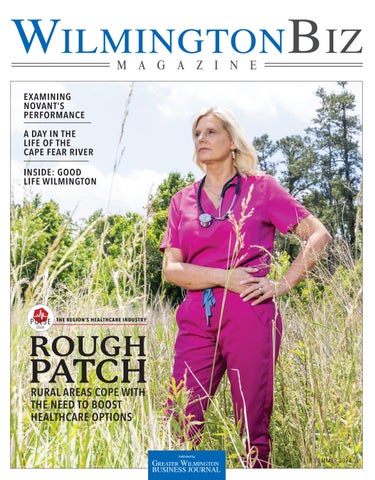
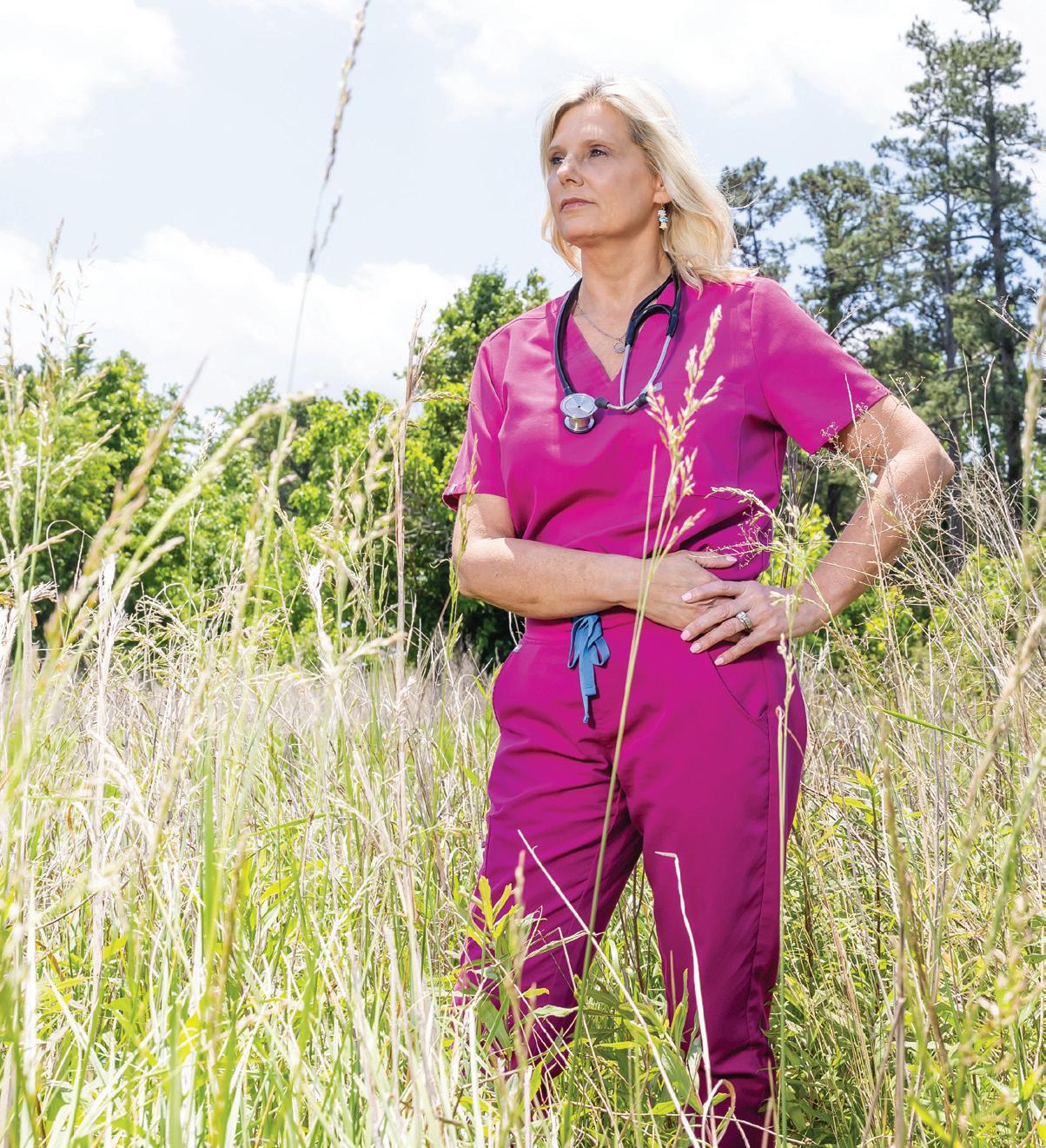
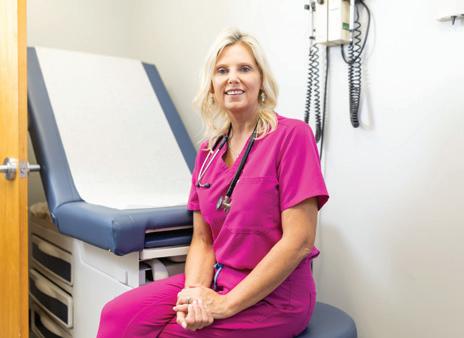
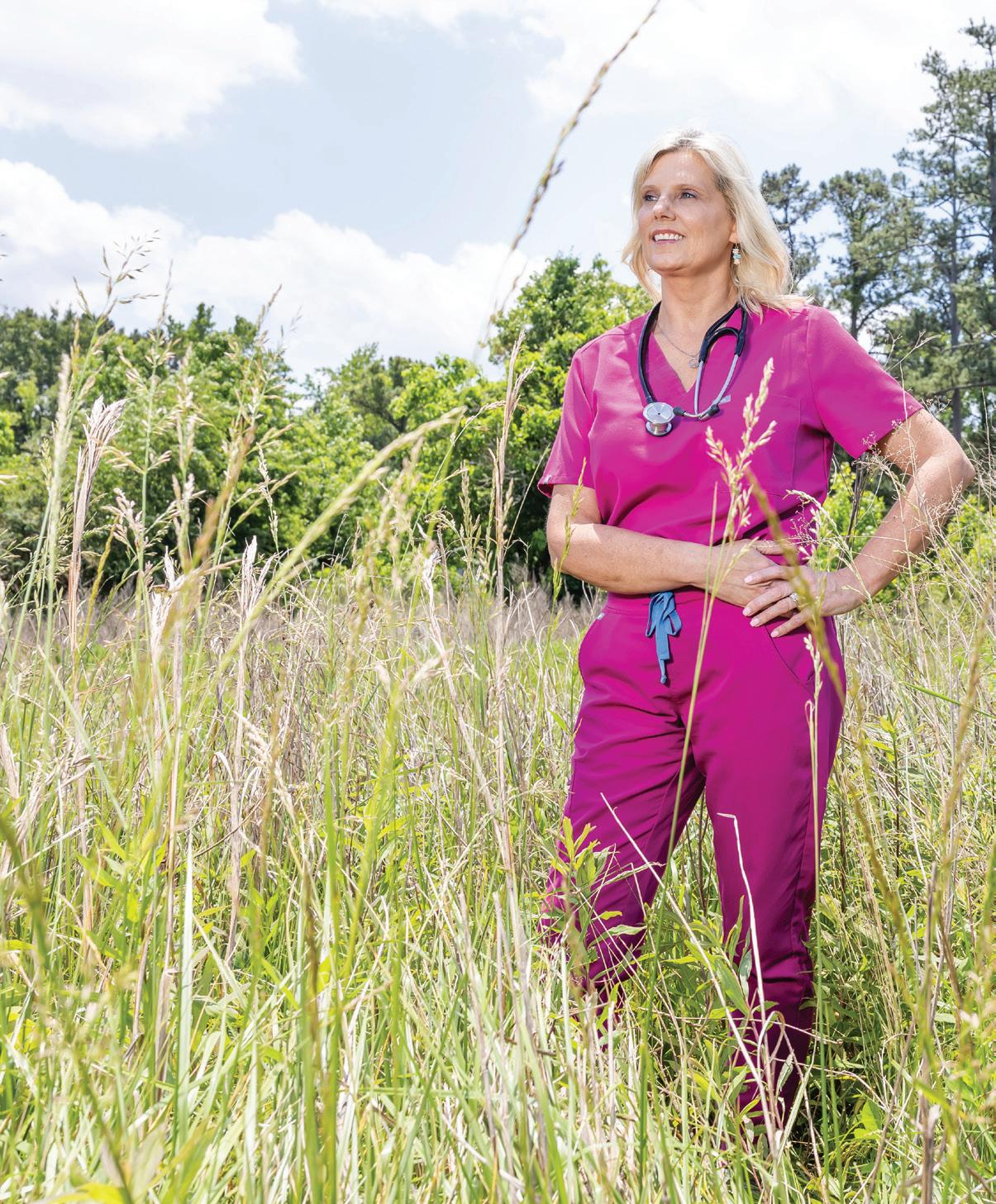
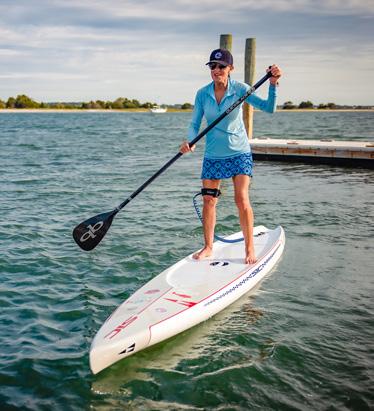
Photographer Madeline Gray took this issue's cover shot of Jodie Hall, a nurse practitioner at the rural medical clinic Maple Hill Medical Center, a facility of Black River Health Services. A story about rural healthcare challenges starts on page 38.
MADELINE GRAY
MADELINE GRAY is a freelance documentary photographer based in Wilmington with a master’s degree in photojournalism. In this issue, Gray photographed crabber Luke Ingraham for a story about a day in the life of the Cape Fear River (PAGE 19); Harrelson Center chief Meade Van Pelt (PAGE 26) ; and the cover and inside photo of Jodie Hall, a nurse practitioner in rural Pender County (PAGE 38) madelinegrayphoto.com and @madelinepgray on Instagra m
TERAH HOOBLER
TERAH HOOBLER is a Wilmington-based freelance photojournalist with over 16 years of experience in photography and art. Hoobler photographed Stephen Burnett, co-founder and chairman of Koolbridge Energy (PAGE 16) ; new president and CEO of Lower Cape Fear LifeCare Karen Brubaker Miller (PAGE 97); and UNCW Chancellor Aswani Volety (PAGE 100). terahhoobler.com
RANDALL KIRKPATRICK
RANDALL KIRKPATRICK moved from New Jersey to Leland in March 2022 with his wife. During his 20 years in the PR field, he also wrote business stories for The New York Times, Business Journal of New Jersey and NJ Biz. Kirkpatrick talked to healthcare professionals about challenges in the region’s rural areas (PAGE 38)
CIERRA NOFFKE
CIERRA NOFFKE is a reporter for the Greater Wilmington Business Journal who covers tech and healthcare. She previously covered the broadband and home internet industry for CNET. Noffke wrote about how Novant Health has been performing during the five years since the healthcare organization bought New Hanover Regional Medical Center (PAGE 32) and UNCW’s plan to create a medical school (PAGE 100) .
IDISLOCATED MY RIGHT ELBOW WHEN I FELL ON A SIDEWALK IN NEW YORK CITY.
Not the best day I’ve ever had, but also not the worst. Except for the pain. I wouldn’t recommend it – maybe consider childbirth first.
But on the bright side, the emergency room at New York City’s Lenox Hill Hospital, a short distance away from where I ate the pavement on Madison Avenue, provided top-notch care. I’d say the same for a recent ER experience I had at Novant Health New Hanover Regional Medical Center. In both instances, the facilities provided what I needed in a fast, efficient and caring manner.
But looking at the big picture, overall hospital performances aren’t my expertise. That’s why we need reporters – to ask the important questions and paint an unbiased, informative picture of health.
In the Pulse healthcare section of this issue of WilmingtonBiz Magazine, reporter Cierra Noffke takes a detailed look (page 32) at the performance of Novant Health NHRMC since Novant closed on its purchase of the hospital in 2021. The feature includes perspectives from people who do know what they’re talking about when it comes to whether Novant Health NHRMC, which was previously owned by New Hanover County, is meeting expectations.
Also in this issue’s Pulse section, those on the frontlines talked to freelance writer Randall Kirkpatrick about the plight of rural areas when it comes to healthcare needs (page 38), and a UNC Health official shares his take on his healthcare system’s bid to build a hospital in Wilmington (page
12). Additionally, we present a look at the planning stages of a new medical school moving forward at UNCW (page 100), and we introduce you to the new CEO and president of Lower Cape Fear LifeCare (page 98).
Outside of the healthcare-focused section, reporter Emma Dill follows a day in the life of what could be described as Wilmington’s backbone – the Cape Fear River (page 19). And Beth Klahre writes about the head of The Harrelson Center in downtown Wilmington, a nonprofit campus that serves as a services backbone (page 26).
You’ll find even more information about your community within these pages, including a special section, Good Life, focused on retirement (pages 45-96).
As for me, my elbow seems to be healing nicely, but like the stories on the following pages, I try not to take anything for granted.
When Alex Turner and his son started playing with Lego bricks together last year, the 3-year-old got a little frustrated.
“He goes like, ‘I can't do it, Daddy. I can’t do this.’ And I said, ‘Yes, you can; you can do anything you want with Legos,’” Turner said.
Turner and Scott Saxton own the Wilmington franchise of Bricks & Minifigs, a chain that serves as an authorized reseller of Lego minifigures, sets, bricks and accessories.
Display sets at the Wilmington store, located at 1305 Floral Parkway, include the character Charmander (shown right), a reptilian Pokémon. With some help from Saxton, it took Turner about a week and a half to build Charmander.
The grand opening of the local store took place March 28.
“It was something that the area just didn’t have,” Turner said, “somewhere for people to congregate and do something simple, like build Legos without being charged an arm and a leg.”
B iz B it ES
photo by NATE SMITH
BEHIND THE NUMBERS
4.3 AVERAGE LENGTH OF STAY FOR VISITORS TO NEW HANOVER COUNTY LAST YEAR
TOURISM OFFICIALS MARK
LOCAL STATS AT TRAVEL RALLY
BY CECE NUNN
NEW
HANOVER COUNTY WELCOMED JUST under 5 million visitors last year, tourism officials said at a recent event.
Kim Hufham, president and CEO of the Wilmington and Beaches Convention & Visitors Bureau, shared the number during an update on the state of local tourism at the CVB’s 2026 Travel Rally Day Breakfast & Celebration. Held at the Cameron Art Museum in conjunction with National Travel & Tourism Week in May, the event highlighted the area’s strengths and some of the industry professionals who have made their mark.
While some 2025 numbers for the Wilmington area won’t be available until August, Hufham pointed to 2024 tourism statistics as reminders of the industry’s role.
“The economic impact in 2024 of tourism here in New Hanover County was $1.14 billion, which represents an increase of 1.5% over 2023,” Hufham told attendees. “It generated approximately $79.34 million in state and local tax receipts, and it represented a $326.79 savings to each of our citizens here in New Hanover County.”
Citing one of the 2025 tourism numbers that officials do have, Hufham said the region’s room occupancy tax exceeded $25.5 million last year, setting a new benchmark.
Other 2025 markers were measured by Placer.ai. That data showed that last year, visitors stayed an average of 4.3 days, with the busiest single day of the year coming as no surprise: Saturday, July 5, 2025.
In addition to the state-of-tourism update, Hufham announced local tourism award winners.
Two of the people who have made their mark on the area’s tourism industry are Cassandra and Dan Tollens, real estate investors who have purchased, restored and updated Carolina Beach and Kure Beach motels. They received the Jane Peterson Tourism Legacy Award, named after the CVB's first executive director.
The couple’s properties include The Boardwalk Inn, Carolina Beach Inn, Carolina Beach Motel and Seabirds Motel at Kure Beach.
“Dan and Cassie are a breath of fresh air for Pleasure Island. Their innovation and hard work have not gone unnoticed in the Kure Beach community. They are the business model of the future for motels in our town,” said Kure Beach Mayor Allen Oliver.
$40,000,000 School district equipment replacements and improvements
$56,332,402
$53,855,851 New elementary school at Riverlights
6. $8,170,527 Program management and contingency
7. $7,625,000 Porters Neck Elementary building addition
Sources: New Hanover County, New Hanover County Schools, Brunswick County, Lightcast
SOUND OFF
THE LINK BETWEEN HEALTHCARE ACCESS AND ECONOMIC DEVELOPMENT
WHEN POLICYMAKERS THINK OR TALK ABOUT ECONOMIC DEVELOPMENT,
they tend to focus on what they can link directly to economic activity: highways, ports, taxes, broadband and, of course, recently, housing.
There is, however, a long list of attributes that firms and individuals care about when choosing a new location, and different parties are going to assign different weights to each of these attributes. A piece of infrastructure, perhaps less visible but as important in the long run, is the adequacy of healthcare supply.
According to the N.C. Office of Rural Health, 93 counties in the state are designated as Health Professional Shortage Areas (HPSAs) for primary care. Large portions of the state also face shortages in mental health and dental providers. These designations show substantial gaps in access to care, based on provider supply, population needs, poverty levels and health outcomes, such as infant mortality and chronic disease burden.
This means millions of North Carolinians live in communities where it is difficult to find a primary care doctor, a mental health provider or even basic dental services.
While this is, of course, a healthcare problem, it has both shortand long-term economic consequences. Locational decisions are a function of a bundle of attributes, and economic growth happens through both the
MOUHCINE
GUETTABI
attraction and retention of firms and of individuals and entrepreneurs. Firms care about cost minimization and about the amenities they can provide to their workers and therefore care about healthcare. Similarly, individuals also care about a bundle of attributes, but the cost and availability of care are frequently front and center.
Communities with limited access tend to experience several negative economic consequences. National surveys show that workers delay care or go without it entirely when care is too expensive or hard to come by, leading to worse health outcomes, more missed workdays, reduced productivity and higher expenditures for individuals, firms and communities in the long run.
Families think twice about relocating to areas where specialty care could require hours of travel. Employers, in turn, face higher barriers to hiring and retaining the workforce they need.
The broader link between investments in health systems and economic activity is well established through job creation and labor productivity.
Healthcare is a form of human capital investment that drives broader economic performance. Importantly, at the local level, healthcare institutions often function as anchor employers,
supporting not only doctors and nurses but also generating significant secondary and tertiary effects that create economic activity along the supply chain.
The uneven distribution of healthcare access means that communities with high HPSA scores are effectively operating at a disadvantage, which means they are competing for employers and workers without one of the most basic prerequisites for long-term economic vitality: reliable access to care.
We already understand this dynamic when it comes to the more visible components of economic development. We don’t expect regions to attract investment without adequate transportation infrastructure. Yet, we often view healthcare investments as social investments that are separate from an area’s economic vitality and attractiveness.
In high-growth areas like the Wilmington metropolitan area, the issue is dynamic as population growth continually puts pressure on the adequacy of resources.
It will be important to ensure the healthcare workforce and physical infrastructure keep pace with that growth. Failure to do so risks creating new access constraints even in otherwise economically vibrant regions. Over time, those constraints can begin to shape where firms expand and where households choose to locate.
Mouhcine Guettabi is a regional economist with UNCW’s Swain Center and an associate professor of economics at UNCW’s Cameron School of Business.
SOUND OFF M Wilmington’s Growth A Hospital Built to Match
ORE FAMILIES ARE PLANTING ROOTS HERE. MORE SENIORS ARE RETIRING HERE. DEMAND FOR HEALTHCARE IS EXCEEDING CAPACITY. THESE ARE JUST A FEW REASONS WHY UNC HEALTH IS PROPOSING TO BUILD A NEW COMMUNITY HOSPITAL AT SOUTH 17TH STREET AND SHIPYARD BOULEVARD.
As a member of this community and leader of UNC Health’s Southeast Coastal region, I’ve spent years listening to residents, clinicians, employers and civic leaders. The message has been consistent: This region’s growth is real. Healthcare options need to keep pace for our community to continue to thrive and be a place to attract new business and more opportunities for future generations.
UNC Health’s proposed community hospital for Wilmington is the latest part of our journey as a state-owned, not-forprofit, academic health system with a mandate and commitment to help improve the health and wellbeing of North Carolinians.
Since announcing our intent to expand primary and specialty care services, my phone has been ringing nonstop from people in Wilmington and the greater Cape
ERNIE
BOVIO
Fear region. The news has been met with excitement as people want more healthcare, more access to primary care and specialty care, and they want a choice, without having to drive two hours for that alternative.
It’s no surprise that business leaders are among the most enthusiastic. They understand what strong healthcare infrastructure means for talent attraction and regional growth. Here’s why this matters:
SUPPLY THAT CAN MEET DEMAND
Wilmington’s population grew 8.5% from 2020 to 2024, and in the next five to seven years, New Hanover and the surrounding counties will approach a million residents. This growth will require more medical facilities, which is why our state’s own 2026 Medical Facilities Plan highlights a need for 225 additional beds in New Hanover County.
Furthermore, across our population in Wilmington, adults 65 and older now make up nearly one in five residents. As a community grows older and larger, care needs become increasingly complex. Wouldn’t it be great for our community if there were multiple healthcare systems
making investments to build more capacity, to recruit more primary and specialty care physicians and advanced practice providers? The case for a new community hospital here is a recognition of this incredible growth and need that we’ve heard.
CHOICE IS GOOD FOR CARE
Business leaders know that competition leads to better service, higher quality and better outcomes. Healthcare is no different. Before relocating to Wilmington, I was with UNC Health in Wake County, where there were a number of very high-performing healthcare organizations competing, and it certainly made everyone’s service level and quality better, because it had to be. When there’s robust healthcare infrastructure with more doctors being recruited and more services being provided, families have an alternative; businesses can attract more talent and communities grow. That’s what this proposed hospital is about.
GREATER COMMUNITY INVESTMENT
UNC Health’s expansion means a long-term commitment to the Cape Fear region backed by a statewide system. We take a local approach. In plain terms: There are no distant shareholders, just local stakeholders. Every dollar goes back into patient care, research, education and community health. We already run a rural family medicine residency partnership in Pender County, designed to train physicians who stay in underserved
areas. We selected our proposed site for the new hospital because it’s centrally located and large enough for future growth. We’re thinking about this for the long term because future generations and businesses need that sort of commitment.
ACCOUNTABLE TO OUR COMMUNITY
Throughout this process, we’ve been guided by residents, business leaders and civic voices across the region. This is an inflection point for Wilmington, and we need to take advantage of this opportunity as a community. Now is the time.
When I imagine what the future holds, I think of growing families having high-quality obstetrics and gynecology services. Working adults aging well with shorter wait times for cardiology, orthopedics and urology. And in life’s hardest moments – from a cancer diagnosis to an unexpected trip to the emergency department –my neighbors having care close to where they live and work, right here in Wilmington.
I’m proud to be part of UNC Health and the more than 56,000 teammates providing care from the mountains to the coast. But I’m most excited for the opportunity to bring this care closer to home.
At the end of the day, this is about the people who live right here – the families building their lives, the seniors aging in place and the workers helping this region grow. Our community deserves a choice for healthcare in the region, and UNC Health promises to grow with you.
Ernie Bovio is regional president of the southeast coastal market for UNC Health and a Wilmington-area resident.
CROWD SOURCING
REACTIONS, OPINIONS AND QUOTABLES FROM
“ A MONORAIL TO CONNECT downtown, Mayfair, beaches, UNCW, hospital and a train station to Raleigh, Fayetteville, Myrtle Beach. Start building reliable clean public transportation instead of building more roads, gas stations, car washes and dealerships.” - ELIZABETH WOODSIDE
“ BETTER TRAFFIC FLOW and roads. More planned walkable centers of activity.”- EMILY KAPLAN
“ CATCHING THE INFRASTRUCTURE UP with the building of apartments, shopping centers and condos/townhouses. Our roads, schools, hospitals, public safety, parking and utilities cannot handle the large influx of people. Make the developers plan for the infrastructure as much as they plan for the people!”- JOY INGALLINERA
“ PARKING ” - DONNA DUSCHEK
“NEW LEADERSHIP ” - HARRISON PALMER
“ LOWER COST OF LIVING , more sidewalks, more public transportation options.” - ANASTASIA BUSACCO
“NOT ANOTHER tax hike”- JUDY BORTZ
“AFFORDABLE HOUSING ” - ALLEN HOLLOWELL
LINKEDIN POLL: @WILMINGTONBIZ
WHAT'S ONE THING THAT WOULD MAKE WILMINGTON A BETTER PLACE TO START OR GROW A BUSINESS? 10% HOUSING GROCERIES
IF YOU HAD THE POWER, WHAT COST OF LIVING WOULD YOU IMMEDIATELY REDUCE?
“ IT’S CONSERVED FOREVER. It’s permanently protected, and it’s no longer able to be developed.” -JESICA BLAKE, ASSOCIATE DIRECTOR OF THE N.C. COASTAL LAND TRUST, IN A STORY ABOUT NORTH CAROLINA ASSUMING OWNERSHIP OF SERENITY POINT, AN AREA OF NEARLY 100 UNDEVELOPED ACRES ON TOPSAIL ISLAND
SIGN UP FOR DAILY NEWS UPDATES AND SUBSCRIBE TO THE GREATER WILMINGTON BUSINESS JOURNAL AT WILMINGTONBIZ.COM
DIGEST
LIVE OAK BANK PULLS OUT OF STATE INCENTIVE PLAN
Live Oak Bank has terminated a state incentive agreement that would have paid the company $1.5 million for hitting specific investment and hiring targets.
North Carolina’s Economic Investment Committee approved the termination of Live Oak’s $1.5 million Job Development Investment Grant (JDIG) in May. Under the grant, which was awarded in 2022, the company promised to add 204 jobs and invest $25 million in its midtown Wilmington campus over five years.
While the company has exceeded the investment requirement by investing $47 million in its campus, Live Oak was set to fall 30 jobs short of the initial hiring goal, according to Claire Parker, the company’s managing director of corporate communications.
Wes Sutherland, the company’s chief accounting officer, formally
requested the termination of the state grant in a letter dated Feb. 20 to the Economic Investment Committee.
“This decision was driven by a combination of macro-economic factors and internal strategic refinements, which have resulted in a lower headcount than originally projected in our JDIG application,” Sutherland wrote. “Given that these changes mean Live Oak no longer requires state incentive funding to support the project, and in keeping with our fiscal responsibility to the state and to Live Oak’s stakeholders, we believe it is appropriate to formally discontinue the grant at this time.”
The company has 837 full-time employees in North Carolina, with 752 employees based in Wilmington, company officials said.
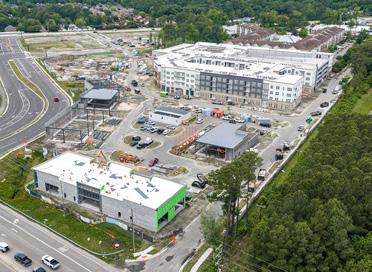
Center Point, a major mixeduse development under construction near the intersection of Eastwood and Military Cutoff roads, announced its first commercial tenants recently.
Totaling more than 13,000 square feet, the new leases include eatery Burtons Grill & Bar, locally owned businesses Nest Interiors and Blended Shoes + Apparel, men’s clothing store Thompson’s of Wilmington and bagel chain Jeff’s Bagel Run, according to a news release.
The leases are part of Center Point’s first phase, which includes more than 32,000 square feet of retail space and is currently under construction. Center Point is a joint venture between Charlestonbased firm The Beach Company and Wilmington-based Swain & Associates.
Photo
photo by CECE NUNN
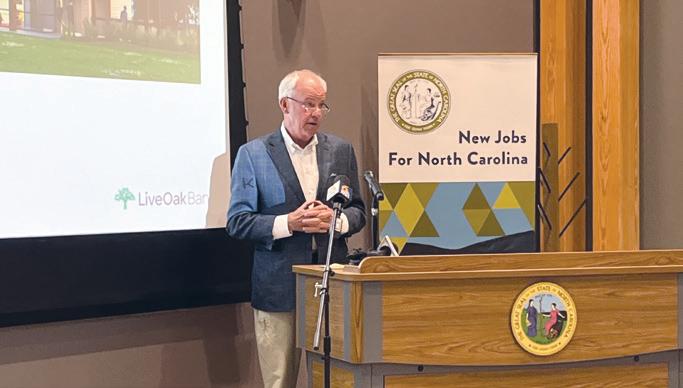
Live Oak Bank CEO and Chairman Chip Mahan announces the bank's jobs plan in 2022.
BUNDLES OF ENERGY
BY VICKY JANOWSKI
WHEN HURRICANE FRAN HIT THE WILMINGTON AREA IN 1996, PAUL DENT LOST POWER AT HIS HOME. The event started the path to eventually work with Stephen Burnett and others at Koolbridge Energy on an energy management system for homes to better switch between power sources on both good and bad weather days.
“The Smart Load Center (SLC) is a very intelligent residential energy management system,” Burnett, chairman of locally based Koolbridge Energy, said about
the company’s product. “It has a microcontroller inside of the panel box with embedded algorithms and artificial intelligence. The SLC has the unique and patented capability of capturing two incoming sources of energy and distributing that energy simultaneously on a circuit-by-circuit basis. It will always make the best decisions for the users, automatically, that will help lower costs and improve everyday comfort based on certain factors like weather conditions and/or battery status. It will always select the most cost-effective energy source.”
Koolbridge recently took home the honor of Coastal Entrepreneur of the Year. The top award was part of the Greater Wilmington Business
Journal’s and the University of North Carolina Wilmington Center for Innovation and Entrepreneurship’s annual CEA awards.
Burnett talks about Koolbridge’s growth in this recent Q&A. To read more from the interview, go to WilmingtonBizMagazine.com.
HOW DID YOU AND COFOUNDER AND CHIEF SCIENTIST PAUL DENT GO FROM AN IDEA AFTER A POWER OUTAGE IN HURRICANE FRAN TO DECIDE TO PURSUE A PRODUCT?
“Dr. Dent is a Ph.d. electrical engineer. He is also a prolific inventor
photo by TERAH HOOBLER
STEPHEN BURNETT, KOOLBRIDGE CHAIRMAN & CO-FOUNDER
with almost 400 U.S. patents in his name. When his power went out for 11 days after Hurricane Fran, he knew that there had to be a better solution, probably an electrical solution. He knew that the electrical panel box was the central nervous system of a home and that it had not changed much at all over the last 100 years. He thought of a way that could probably improve it and that would also fit well with the renewable energy trend. … I knew that Paul was one of the most prolific inventors in the world for wireless/cellular technology and met with him to see if he might want to help me patent a mobile phone app idea that I had. He was very interested in my mobile app idea, and agreed to help, but he said, ‘Stephen, I just retired from Ericsson and have filed two patent applications around some novel solar technology. Would you like to help me build a business around them?’ It was a good time for me, so I said, ‘Yes!’”
WHAT IS THE CURRENT MARKET FOR IT AND WHAT DO YOU SEE FOR ITS FUTURE GROWTH?
“The current market for the Smart Load Center is solar installation and distribution companies, as well as new homebuilders and utilities. I can envision the Smart Load Center being in at least 1 million homes across the U.S., with or without solar panels, in our future growth. That would be less than 1% market penetration since there are over 140 million homes in the U.S.”
HOW HAS THE COMPANY CHANGED OVER THE YEARS?
“The company has changed mostly with the product itself and with our patent portfolio. We
C - SUITE CONVO
now have 35 U.S. granted patents that cover inventions such as the Smart Load Center, but also a transformerless, pure sine-wave, 99% efficient inverter and smart addressable electrical power outlets.
Initially we had a 100-amp, 16-circuit, 20-amp max per circuit breaker panel box with four fuses, but only eight of the circuits could switch from utility to a renewable energy source using the patented second bus bar. It was a very limited product. … We were able to take that product from a working prototype to what is today a commercially viable, much more robust product with the help of Dave Sturdy and The Sturdy Corporation right here in Wilmington.
I met with Dave Sturdy and The Sturdy Corporation almost three years ago now, even though I’ve known him for over 50 years. We met at UNCW when we were both students there. Dave and his team of expert engineers have taken the Smart Load Center and dissected it layer by layer by layer and rebuilt it. They have taken it from a 100-amp panel box with limited capabilities to two products: a 125-amp and 200amp load centers that both have up to 60-amp circuit breaker capability anywhere in the panel box. Also, all 16 circuits can switch simultaneously in the 125-amp box and all 32 circuits can switch simultaneously between two or more sources of energy in the 200-amp box.”
ARE THERE SOLAR
ENERGY
TRENDS
THAT HAVE OR ARE NOW A FACTOR IN KOOLBRIDGE’S FOCUS?
“In the past, most solar installation companies installed only solar panels with no battery backup. Hurricanes are now becoming more intense and knocking out power, plus ice storms are becoming worse.
A large percentage of homeowners cannot use their solar power by law when there is a utility outage, since the solar power is fed back to the grid and utility workers could get electrocuted. Many solar installation companies are now offering solar panels with battery backup like the Tesla Powerwall. Our Smart Load Center works very well in this scenario, and the trend is moving in the backup power direction. Utilities also like the feature of adding backup power and giving them the ability to control and use that backup power when they need it. Our Smart Load Centers can give the utilities access and the ability to control the backup power with the homeowner’s permission.”
WHAT DO YOU SEE AHEAD FOR THE COMPANY?
“I envision utilities, solar installation and distribution companies and new homebuilders becoming more and more interested in our Smart Load Center being used with battery backup. The utility grid is becoming older and older, and it’s not able to manage power as well as it used to. The grid is under intense stress due to the emergence of data centers (AI) and EV charging. Homes are becoming smarter. Managing EV chargers and other new residential products is becoming more difficult. Power outages are becoming more of the norm with major hurricanes and ice storms. There is a problem with managing a home’s energy in the smartest way possible and we help with that solution.
I also can envision some type of exit event for our shareholders. We have looked at different options over the past several years but haven’t narrowed anything down yet. Whatever we do, though, we will do our best to make sure that it is in the best interests of our shareholders.”
Working Waters
BY EMMA DILL | PHOTOS BY DANIELLE DESNOYERS , MADELINE GRAY & NATE SMITH
Across a single day on the Cape Fear River, work, recreation, commerce and conservation collide
While just a stretch of the 200-mile-long Cape Fear River runs through the Wilmington area, it serves as a backbone – not only geographically, but economically, supporting the port, livelihoods and recreation that define the region. The river links the Port of Wilmington with the ocean, bringing in vessels from around the world, and serves as a centerpiece of the local tourism industry. It’s also faced challenges in recent years, including contamination from per- and polyfluoroalkyl substances (PFAS), runoff pollution from upstream farms and the threat of water removal from a proposed inter-basin transfer. From dawn to dusk, the Cape Fear River plays an evolving role in the lives of those who live in the Wilmington region.
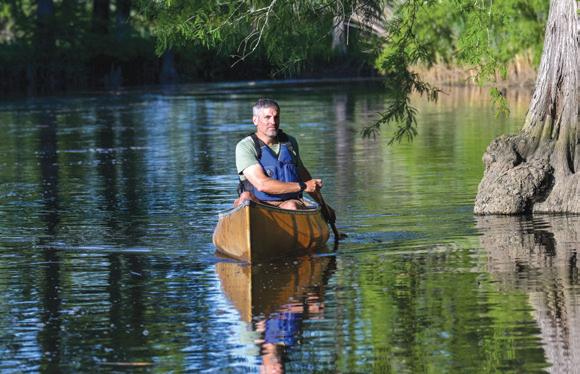
photo by MADELINE GRAY
Time: First light
Shifting Sands
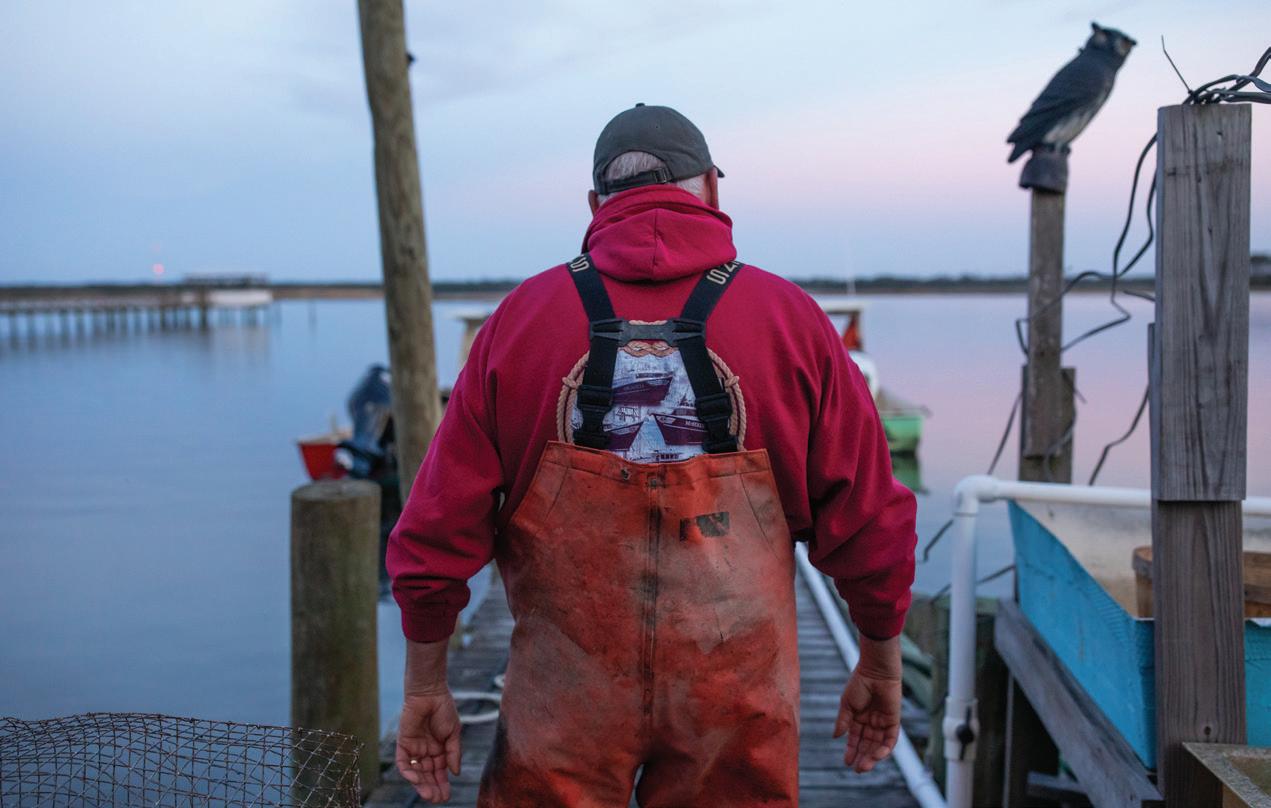
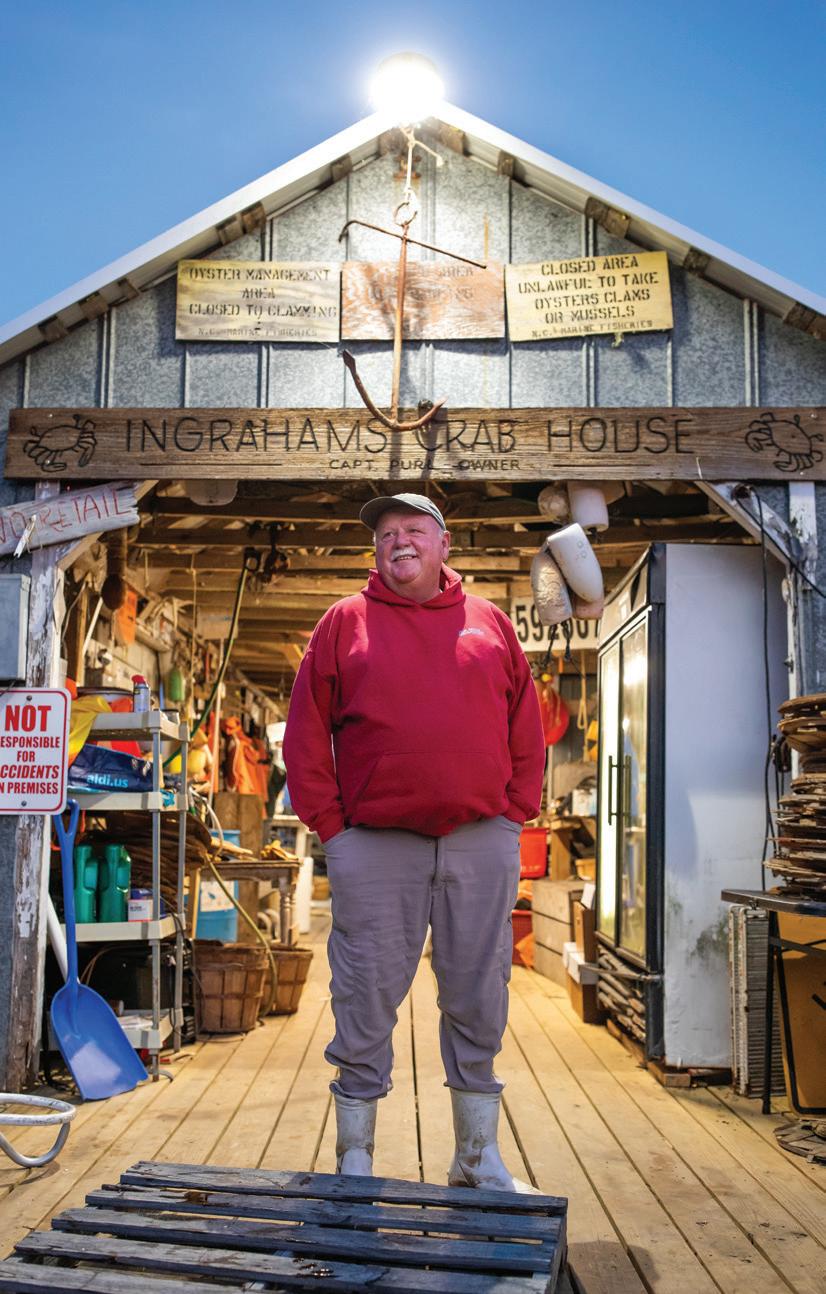
When the crabbing and fishing are good, Luke Ingraham’s anticipation of getting out on the Cape Fear River sometimes keeps him up at night.
“Back when there was a lot of stuff to catch, I couldn’t even sleep to make sure I got up the next morning,” he said. “I didn’t want to miss it.”
On a typical day, Ingraham said he wakes up at 4 a.m. and goes out on the water around daylight. Most days during the spring and summer, he crabs in the Cape Fear River, Ingraham said, and when the crabbing isn’t good, he fishes in the ocean.
This spring, he’s been fishing much more than usual. Ingraham said he believes maintenance dredging in the Cape Fear River’s main channel over the winter disrupted the crab’s normal cycles. During a recent day on the water in May, Ingraham said he caught around seven bushels of crabs. Normally, he’d catch about 25 bushels, he said. The number of crabs in a bushel varies by the size of the crab and can range from five to seven dozen.
“I don’t understand it,” he said. “Never seen nothing like it.”
Crabbing runs in Ingraham’s family. His father was a crabber and passed the vocation down to him. At 16, Ingraham got his commercial fishing license, allowing him to sell what he caught, and he’s been at it ever since. Today, Ingraham sells his crabs to Seaview Crab Company in Wilmington and Blackburn Brothers Seafood in Carolina Beach, among other customers.
Ingraham said he worries about how future dredging, including the proposed deepening of the Port of Wilmington and its adjacent channel, could affect the crab populations. He also has concerns about the impacts of PFAS on the river’s marine life.
“It just kills the habitat for the little stuff,” Ingraham said. “It doesn’t matter how many babies hatch in the river or anywhere. If they can’t live in the environment they’re hatched in, it’s just not going to work.”
photo by MADELINE GRAY
Time: 5:45 a.m.
Rowing at Dawn
Launching their boats for a 5:45 a.m. practice time on weekdays, members of the Cape Fear River Rowing Club can be among the first people out on the Cape Fear River.
Some days the river is glassy and calm, said Allison Potter, the group’s head coach, while other times the wind stirs up the river. Potter rowed in college and joined the local rowing club in 2009.
The group practices early to avoid windier conditions that tend to crop up later in the day, Potter said. They typically row in a large loop that takes them south from their launch point behind Wilmington Marine Center down to a cove in the river and then back up to the club’s dock.
The rowers stay out of the river’s main channel, Potter said, sticking to areas protected by marshy islands. They often share the river with ships heading to or leaving the Port of Wilmington, tugboats and crabbers or fishermen.
For Kim Futrell, the club’s president, the camaraderie of rowing, the workout it offers and the beauty of the river keep her coming back to the sport.
“You can literally be out there and have the sun on one side and the moon on the other side at the same time,” she said. “It’s just absolutely peaceful and gorgeous.”
by
photos
MADELINE GRAY
Time: Mid-morning
A Protecting the River
s the Cape Fear Riverkeeper, Kemp Burdette spends a fair bit of his time on the river and its tributaries, but not as much as he’d like to.
“I spend a lot of time on my laptop, just writing emails, responding to citizen concerns, writing public comments, talking to partner groups, reading legal decisions, reading scientific articles,” he said.
Burdette leads Cape Fear River Watch, a nonprofit that aims to protect and improve water quality in the Cape Fear River Basin – an area encompassing more than 9,000 square miles.
Founded in 1993 by residents concerned about water quality, the group continues to lead local advocacy and public education efforts related to key issues facing the river. With limited time and resources, Burdette said it’s become important to prioritize.
“We kind of try to triage,” he said. “So, we try to say, ‘What things are the biggest threats to the Cape Fear?’”
Today, that includes contamination by PFAS and emerging contaminant 1,4-Dioxane and runoff pollution from large-scale farms or concentrated animal feeding operations located in counties upstream from Wilmington. In 2019, a consent order between Cape Fear River Watch, upstream chemical company Chemours and the N.C. Department of Environmental Quality required Chemours to address its sources of PFAS and river pollution. Contamination remains an ongoing issue, Burdette said.
The group has also raised concerns about the proposed deepening of Wilmington’s harbor and river channel and opposed an inter-basin transfer request from Fuquay-Varina. The proposal would transfer more than 6 million gallons per day from the Cape Fear River basin to the Neuse River basin to address Fuquay-Varina's projected water shortages.
photo by NATE SMITH
Towing the Boats
by NATE
The crews at McAllister Towing of Wilmington help maneuver large ships into and out of the Port of Wilmington and other docking berths on the Cape Fear River.
According to Glenn Turbeville, the towing company’s general manager, it typically takes a ship about three hours to travel up the river to the port.
A local river pilot calls the towing company about an hour after he boards the ship to guide it up the river. McAllister crews will then wait an hour before heading out to meet the ship, Turbeville said.
“We get (the boats) when it’s time to slow them down,” he said. “It’s a very slow and controlled evolution once we get alongside and have the tugs made up.”
The tugboats help the ships maneuver into the berths at the port and help turn them, if needed. Each crew is made up of a deckhand, an engineer and a captain. The crews rotate working on call 24 hours a day for two weeks, and
then they’re off for one week.
“We get a phone call whenever they’re passing Southport, and then we know that we have an hour to get down here and leave the dock,” said Joseph Newton, an engineer with the company, about being on call.
Tim Boyd, a tugboat captain with McAllister Towing, said he’s watched the Port of Wilmington grow and boat technology evolve since getting his captain’s license in 1980.
Alex Benton, a deckhand, said he came to work for McAllister Towing after working at the port. He said he likes the schedule and being on the river.
Turbeville said they’ve seen a shift in the type of ships coming into the port. They no longer see the massive neoPanamax ships.
“It was kind of like an event when they first started coming, just because of the size and because of the extra crews you had to put on,” he said about the large ships. “Now, we’re back to like it used to be.”
photo
SMITH
Time: Sunset
Bringing the Coastal Vibe
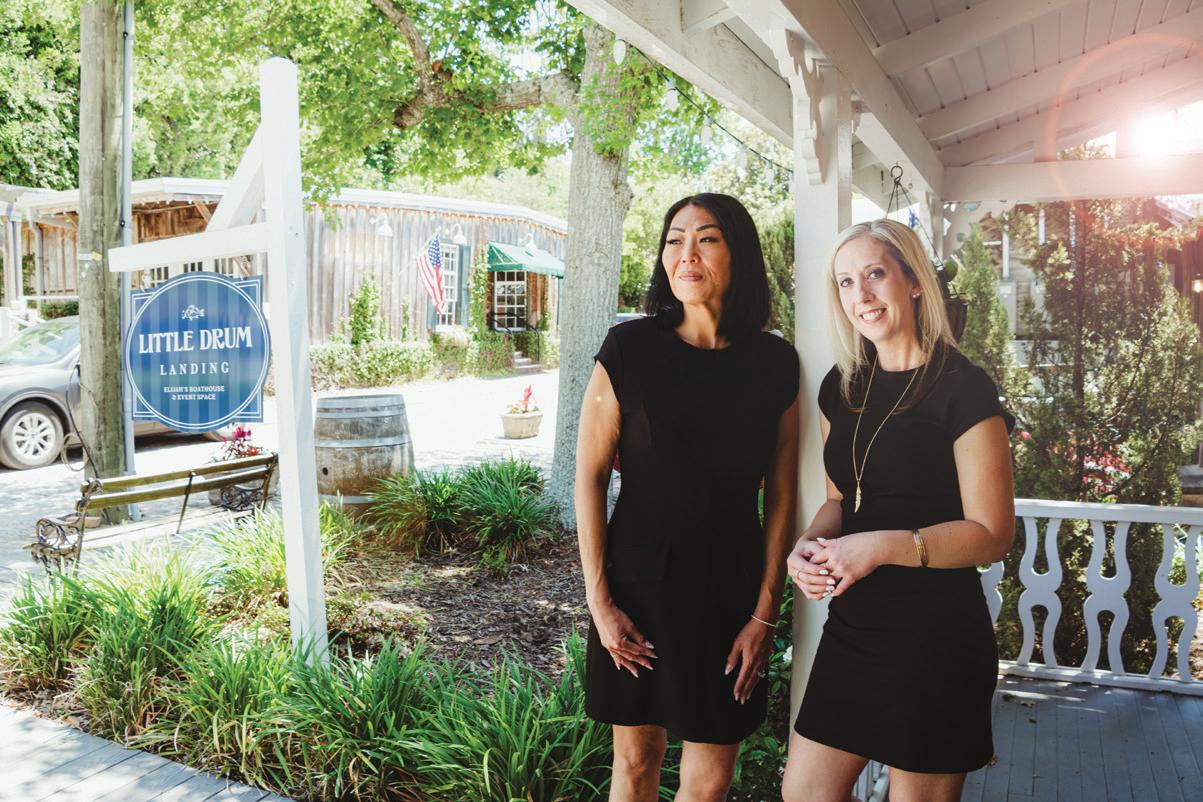
Little Drum Landing’s proximity to the Cape Fear River is one of the biggest draws for those renting out the event venue, according to Jodi Stine and Lindsey Miller, the facility’s event coordinators.
Situated near the southern end of downtown Wilmington’s Riverwalk, the venue offers both indoor and outdoor space, with views of the riverfront, the Cape Fear Memorial Bridge and the Battleship North Carolina.
Most of the venue’s events take place in the evening, Miller said, as guests look to take advantage of the oftenvibrant sunsets over the Cape Fear River.
“People want to use that sunset for their backdrop,” Stine said.
The venue hosts over 100 events each year, with spring and fall – peak wedding season – being its busiest times. Last year, Wilmington’s wedding industry generated an estimated $90.4 million in revenue for local vendors and businesses, according to The Wedding Report, an industry research group.
Stine said Wilmington is increasingly becoming a destination city for couples, especially those who want a wedding with a coastal aesthetic. If they don’t want to deal with sand, she added, Little Drum Landing pitches itself as an alternative to the beach.
photo by DANIELLE DESNOYERS
Time: Evening
Fueling an Economic Engine
Ship arrivals set the schedule at the Port of Wilmington, said Brian Clark, executive director of the N.C. State Ports Authority.
“Whether it’s nights or weekends or holidays, if a ship’s going to call,” he said, “then we’re going to accept that ship and handle the cargo.”
Many container ships that call at the port are in and out in one day. Ships transporting general cargo operate on more sporadic schedules and can dock for days at a time, depending on what they’re carrying.
Once a ship docks, its cargo is unloaded, some of it by crane, and transferred onto a truck or a railcar to be brought to its final destination.
From a volume standpoint, forest products are the largest cargo type moving through the port, Clark said, which includes wood chips, wood pellets, dimensional lumber, pulp and paper. The port is also seeing increasing growth in refrigerated cargo, including perishables like bananas, pineapples and grapes, along with pharmaceutical components.
As of May, neo-Panamax ships were not calling on the Port of Wilmington like they have previously. Clark said the shipping line ZIM, which had brought neo-Panamax vessels to the port, paused their service to some East Coast ports, including Wilmington, due to a drop in customer demand.
“Consumer sentiment is down,” Clark said. “People are not buying as much as they used to buy, and … the costs have gone up. (That) could be driven by tariffs, but spending in general in the U.S. is down.”
Port officials are also pushing for a deepening of the harbor from its current depth of 42 feet to 47 feet. The harbor deepening aims to make the port more competitive and accessible to larger ships in the future.
one group involved in coordinating the loading and unloading of ships at the Port of Wilmington. Others include the port’s operations team, shipping companies and longshoremen.
photos c/o N.C. PORTS Crane operators are
M on the Way
Help Meade Van Pelt aims to build partnerships and meet a surge in needs
BY LAURA MOORE | PHOTO BY MADELINE GRAY
eade Van Pelt has been the executive director of The Harrelson Center since December 2016. Now, after nearly a decade at the helm, Van Pelt continues to gain momentum.
In March, she received The Cardinal Award from the state’s auditor, Dave Boliek. The honor recognizes exceptional North Carolinians who advance government transparency, improve efficiency and safeguard taxpayer dollars, state officials said. Van Pelt also received the Dogwood Award from the state attorney general after Hurricane Florence in 2018 and the Service Before Self award from the local district attorney in 2019.
After helping guide the final phases of transforming The Harrelson Center nonprofit campus from a former law enforcement center into a “thriving community” of human services work, Van Pelt said the center’s focus is now on the social determinants of health.
According to Van Pelt, the most relevant of those determinants include housing, transportation and medical needs, all of which The Harrelson Center’s Help Hub is geared toward.
Established more than 10 years ago, the Help Hub provides financial assistance, housing navigation and healthcare assistance to community members in need.
“The Help Hub offers front door, side door, back door assistance with 40 partnerships to help those on Medicaid, the underinsured and the uninsured, which clearly has an effect on someone’s health,” Van Pelt said.
After adding the Housing Navigator program to the Help Hub in 2025, Van Pelt determined that the Cape Fear region needs a network with a consistent
structure to help those in need of safe, permanent housing.
“The Help Hub is a place to walk into any day of the week (without an appointment), which is a really big deal, and that is the advantage of having a Harrelson Center and reflects how fortunate we are to have this in our area,” Van Pelt said.
She said that help is needed more than ever, unfortunately, as the organization has seen a drastic increase in the number of people seeking help.
In 2026, among all those who came to the Help Hub, 49% had never asked for financial assistance before, according to Van Pelt. In the first quarter of 2026, 900 people needed help.
That’s why Van Pelt wants to work with partners in government, pre-K through higher education and corporations to advocate for change and create publicprivate partnerships to do so.
If there are too many people dealing with health and housing issues, “then it is never going to work, and I don’t know how to achieve a healthy, happy community,” Van Pelt said.
She said the center needs funders to support change.
“We need financial support and volunteers, so we can support (our partners) and the clients they serve,” Van Pelt said.
Another ongoing focus of Van Pelt’s work is volunteerism. She is working with the Volunteer Leadership Lab to create an online hub for volunteer opportunities.
The online platform would allow all of The Harrelson Center’s partners to post their volunteer opportunities. By the end of the year, Van Pelt hopes to launch a website where volunteers looking to share their time and expertise can match with these opportunities.
Another way The Harrelson Center is supporting its partners is through its Nonprofits Mean Business
program, which focuses on advocacy and education for leadership in the mission workplace.
Using donor engagement, the organization hopes to help nonprofits contract and hire professionals where they are needed most, “just as much as any other business would.” Van Pelt highlighted the importance of the “back office of every organization,” especially regarding the finance and accounting sectors of nonprofit agencies.
“We want to provide services that will elevate our partners to meet the needs of their clients and create a point of access for people of every socioeconomic position,” Van Pelt said.
She said the goal of the program is to create a culture of collaboration, resilience and connection.
“It is essential to bring value to organizations and the culture itself,” Van Pelt said.
By helping build capacity among the nonprofits themselves, Van Pelt is working to create stability and sustainability among partners, she said.
“Whether it is re-entry after incarceration, immigrants and refugees, foster children, domestic violence or justice advocacy, there is an amazing network of dedicated individuals, and we don’t need them pitted against each other,” Van Pelt said. “It is about building a community that is sustainable and breaking down barriers, both long-term barriers and new barriers that are being created.”
Meade Van Pelt was part of last year’s WilmingtonBiz 100 as a Connector. This year’s group will be highlighted in the December issue of WilmingtonBiz Magazine.
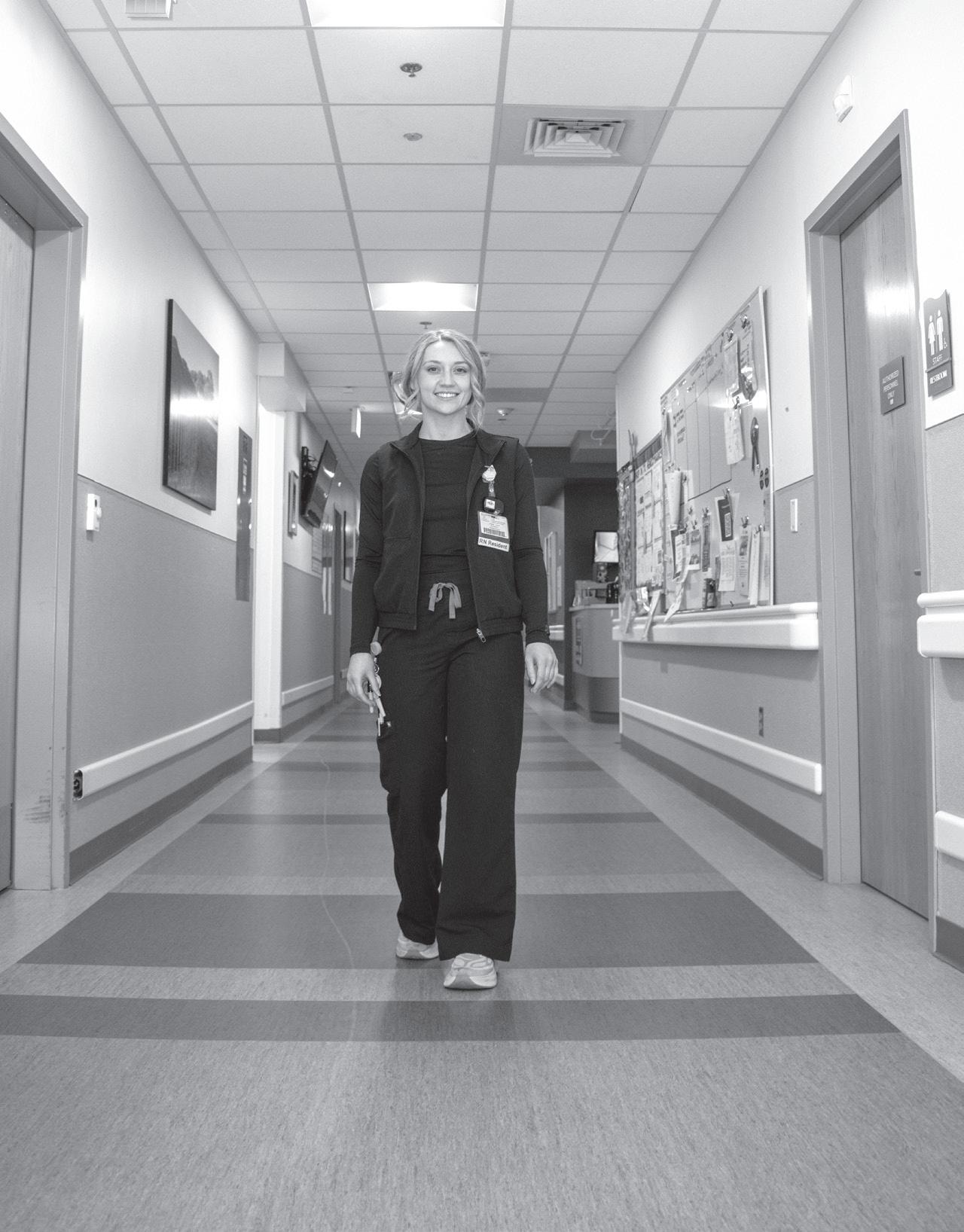
Novant Health nurse resident Isabella Lennon does clinical rounds. photo by DARIA AMOATO
Anatomy of a Hospital Sale
BY CIERRA NOFFKE
STAKEHOLDERS WEIGH IN ON NOVANT HEALTH'S FIRST FIVE YEARS AS OWNER OF NHRMC
IN 2022, AFTER REPORTEDLY WAITING OVER FIVE HOURS FOR CARE, A 77-YEAROLD WOMAN DIED IN THE EMERGENCY DEPARTMENT OF NOVANT HEALTH NEW HANOVER REGIONAL MEDICAL CENTER, THE REGION’S LARGEST HOSPITAL.
The incident prompted an investigation from the Centers for Medicare and Medicaid Services (CMS), which threatened to terminate Novant Health NHRMC’s Medicare contract following an inspection of the facility.
CMS restored the hospital to good standing after a reinspection found that immediate patient safety concerns had been resolved, but for many, the incident was a flashpoint moment in the hospital’s recent history, and for some, questions remain over whether the sale of the previously county-owned hospital to Novant Health was a mistake or not.
As the region’s flagship hospital, NHRMC shoulders an enormous burden: In many cases, it is the sole hospital for residents in need of specialized services nearby, especially those in neighboring rural areas.
Five years have passed since former state Attorney General Josh Stein signed off on the multibillion-dollar sale of the 823-bed hospital to Winston-Salem-based Novant Health.
The Asset Purchase Agreement (APA), which finalized the sale in 2021, included several specific obligations that Novant was required to uphold over the following five years and for the duration of its ownership.
Since then, population growth has continued in the region – leading the State Medical Facilities Plan to identify a need for 225 additional beds in New Hanover County – and competitors such as UNC Health and Columbus Regional Healthcare System have begun inching into a Novantdominated market.
The question remains: As the caretaker of the area’s largest hospital, how has Novant Health delivered on its promises to bring high-quality care to residents? And how will it respond to a region where the needs keep growing?
NAVIGATING ROUGH SEAS
Novant Health found itself in difficult waters immediately after the purchase.
“Doing a major acquisition and integration in the middle of a pandemic is probably not something I suggest people do again,” said Laurie Whalin, president of Novant Health NHRMC and of acute care operations for Novant Health’s Coastal Region.
Nursing shortages led to the hospital relying heavily on travel nurses – over 400 at the pandemic’s peak, according to Amy Akers, chief nursing officer for Novant Health’s coastal region.
Rob Zapple, the only county commissioner to vote against the sale of the hospital to Novant in 2020, said that the travel nurse reliance contributed to a perceived cultural shift at the hospital.
He also pointed to leadership instability. Including Whalin and an interim leader, Novant Health NHRMC has hired four presidents since taking over the hospital.
“You just took an institution that was incredibly stable and incredibly popular in New Hanover County and made it feel unstable within our community,” Zapple said.
“Even pre-Novant, things were still stretched thin, but the culture was different,” said Phil Brown, former chief physician executive at NHRMC and now senior adviser for strategic health initiatives at the University of North Carolina Wilmington. “As a community hospital, we took care of our friends, neighbors and families, and there was a pride of being part of the organization that did that, no matter where inside the organization you worked.”
Novant Health NHRMC’s hospital safety grade from Leapfrog – an independent nonprofit watchdog organization – fell from a B to a C in fall 2024. CMS inpatient and overall star ratings remained at 2 out of 5. Both metrics showed a rise in hospital-acquired conditions, including falls and foreign objects retained after surgery.
According to Katie Stewart, director of healthcare ratings at Leapfrog, hospital grades are calculated through a combination of self-reported survey data and CMS data. As
photo by DARIA AMATO
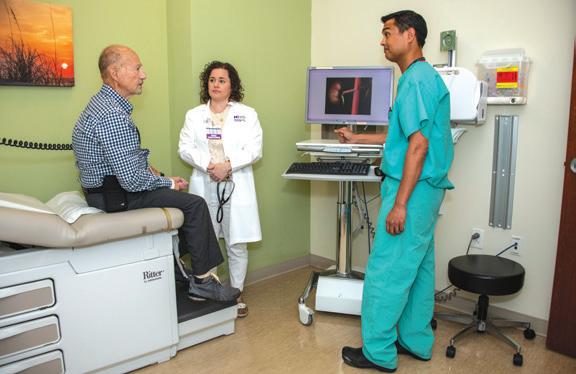
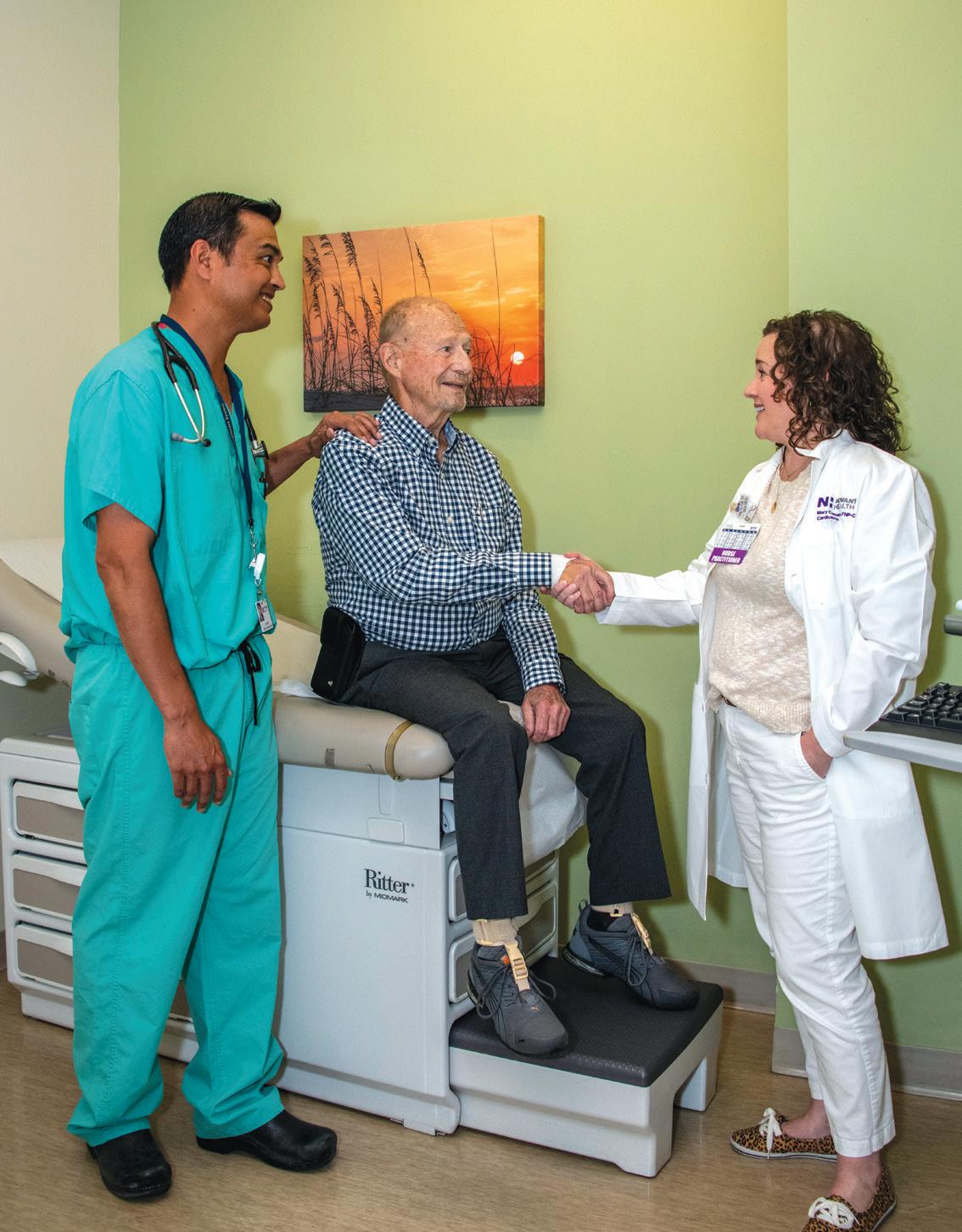
Physician Sunil Iyer and family nurse practitioner Mary Cameron check in with patient Marshall C. Evans Jr., who recently had renal deviation surgery with Iyer at the Novant Health Heart & Vascular Institute in Wilmington.
SOME REQUIREMENTS OF THE APA FROM THE SALE INCLUDE:
NOVANT MUST PROVIDE AN ANNUAL REPORT TO THE PUBLIC SHOWING COMPLIANCE WITH THE REQUIREMENTS OF THE SALE.
STATUS: Whalin points to the hospital’s performance “dashboard,” as well as public updates to county commissioners, which she said she’s open to making an annual event.
NOVANT WILL USE REASONABLE BEST EFFORTS TO EXPAND THE SYSTEM’S LEVEL OF HEALTH CARE TO PEOPLE WHO CANNOT PAY. NOTABLY, THE STATE ATTORNEY GENERAL REVISED THIS LANGUAGE TO NOTE THAT IT IS NOVANT’S DUTY TO CHARITY AND INDIGENT CARE IS NOT LIMITED TO “REASONABLE BEST EFFORTS.”
STATUS: Under Novant, charity care went up to 300% of the federal poverty level at the hospital, Whalin said. Additionally, Novant Health NHRMC also employs mobile units and community health workers and established Michael Jordan Family Medical Clinics in underserved neighborhoods, Whalin said.
NOVANT MUST USE ALL REASONABLE BEST EFFORTS TO PUT THE HOSPITAL IN THE TOP 10% NATIONALLY IN PATIENT SATISFACTION
STATUS: Whalin said the hospital is "approaching top decile performance in a number of areas, including nurse communication and communication regarding medication," and seeing consistent improvement across others. Its CMS patient survey score is still at 2 out of 5 stars.
NOVANT WILL SPEND $30 MILLION A YEAR TO EXPAND NEW HANOVER’S GRADUATE MEDICAL EDUCATION PROGRAM
STATUS: Novant and UNC Health jointly govern the medical school partnership at Novant Health NHRMC, and related training programs go through a shared board that approves annual budgets.
NOVANT WILL SPEND MORE THAN $2.5 BILLION ON CAPITAL EXPENDITURES TO INVEST IN ITS HEALTH CARE BUSINESSES IN THE REGION, PLUS $600 MILLION IN ROUTINE CAPITAL EXPENDITURES
STATUS: According to Whalin, Novant Health has already committed $2 billion in healthcare investments in the region, with more major projects still to come.
CMS data lags (data for NHRMC was collected from 2024), ratings don’t always reflect immediate progressions in hospital quality.
When Jon Martell, a retired chief medical officer from Hilo Medical Center in Hawaii, checked into Novant Health NHRMC for gallbladder surgery in 2024, he said staff ignored standard pre-surgery steps and blocked his attempts to call a Rapid Response Team. The experience prompted him to start the Cape Fear Five Star Project, a nonprofit organization advocating for improved care and transparency at the hospital.
“They were basically promising that they could deliver what UNC or Duke would deliver,” Martell said of Novant Health’s acquisition commitments. “And if you make that promise to a community, the community expects you to deliver.”
“We are dedicated to delivering safe and high-quality care because that's what our patients deserve,” Whalin said in an email in response. “Our dedication is not motivated by third-party rating systems or organizations but driven by our purpose to create a healthier future.”
Whalin maintains that the hospital quality standards have improved significantly in recent years. “Having been here through that entire period and beyond, we are not the same hospital,” she said.
Whalin maintains that as both Leapfrog and CMS ratings include lagging indicators, they do not reflect “the hospital we are today.”
“Our real-time quality data tells a very different story,” she said.
To highlight progress to county commissioners on the fifth anniversary of Novant’s ownership of the hospital, Novant Health NHRMC leaders praised reductions in hospital-acquired infections and
improved cardiac surgery outcomes.
In May, CMS upgraded the hospital to three stars, citing improvements in mortality, safety of care and timely and effective care.
Martell, however, is skeptical that the CMS upgrade will be permanent. “CMS looks at outcomes; Leapfrog looks at the process,” he said. “Anybody who has any background in process management knows that you don’t get the outcomes unless you get the process right.”
Leapfrog scores indicate that NHRMC has yet to improve its processes, Martell said, specifically its communication, which includes staff responsiveness, communication about medicines and discharge information.
According to Leapfrog, overall staff responsiveness has improved since the spring of 2024, although it remains 79 out of 100, below the national average of 82 for hospitals surveyed.
“If your staff responsiveness –how the staff responds to patient inquiries, patient needs – if that’s in the bottom 25%, you’re really going to struggle,” he said.
Stewart said that hospital ratings don’t always require many resources to improve and that changes typically start with leadership initiative.
“When we see hospitals really making improvements, it starts with leadership,” she said. The response to a bad grade shouldn’t be, ‘The data is old’ or ‘The methodology is flawed.’ It should be, ‘This is what we’re going to do moving forward,’ and making that known to the public and to their providers.”
“Novant Health as a system does very well. This round, they have seven As, five Bs and this one C: New Hanover,” she added. “So, the question is: What are they doing that
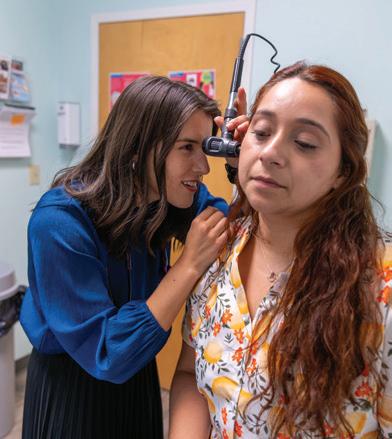
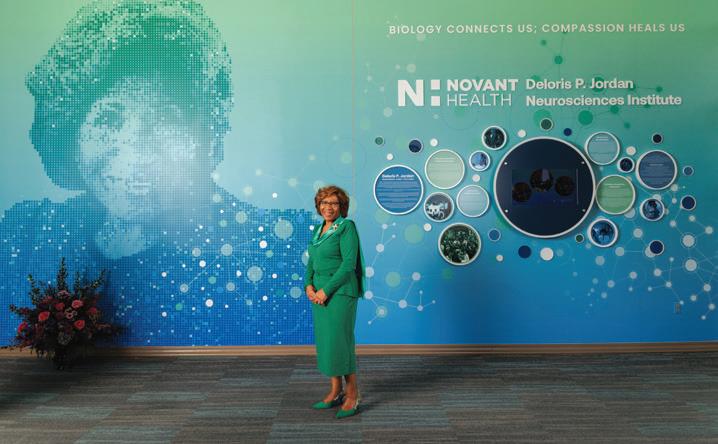
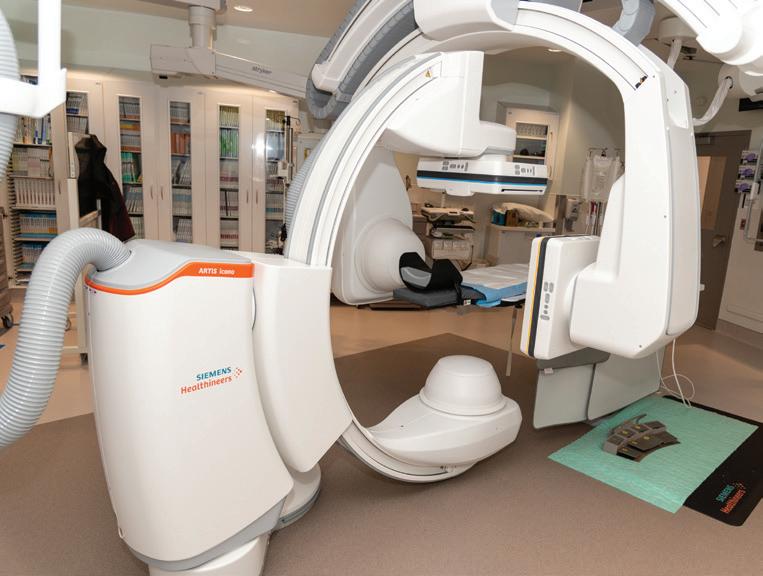
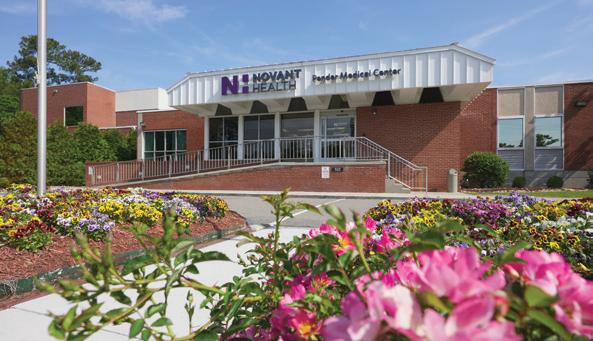
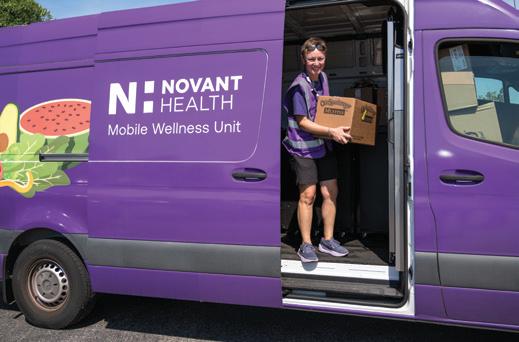
OPPOSITE PAGE: (from top left) Novant Health Pender Medical Center resident Hannah Hulshult; Deloris P. Jordan at the opening of Novant’s new Neurosciences Institute named in her honor; new neurology diagnostic equipment; Novant held a local Community Baby Shower in May; Novant Health Pender Medical Center; Novant’s Mobile Wellness Unit
photos c/o Novant Health
works at their other hospitals, and how can they carry that over to New Hanover?”
CREATING A HEALTHCARE MONOLITH
The sale of the county-owned hospital was controversial, although decision-makers argued a larger financial partner was essential to sustain ongoing healthcare commitments.
“The conclusion, which was correct, is that it was not a sustainable model for the long run,” said Spence Broadhurst, co-chairman of a 21-member Partnership Advisory Group that was assembled to review proposals from top contenders, including Novant Health, Atrium Health, Duke Health and UNC Health.
Novant’s proposal stood out, Broadhurst said, for its alignment with the existing culture at NHRMC. Additionally, Novant’s proposal included a long-term partnership among Novant Health, UNC Health and the UNC School of Medicine to expand the school of medicine’s existing presence at NHRMC.
“Everything about Novant felt like it was New Hanover Regional Medical Center on a bigger scale,” Broadhurst said. “Their philosophy, everything we dug into, felt that way, and I personally
still feel that way.”
The $1.5 billion sale came with substantial obligations: a $2.5 billion investment into regional healthcare infrastructure, $600 million in routine capital investments, plus the establishment of the New Hanover Community Endowment fund.
As a result, Novant Health is now the region’s largest employer and held 96% of the healthcare market share in Wilmington as of 2024, according to KFF, a nonprofit health policy research organization.
Novant Health’s regional network expands through Brunswick County, home to longtime Novant Health Brunswick Medical Center, and in Pender County, with the Novant Health Pender Medical Center, which it absorbed ownership of in 2023, plus the 66-bed Novant Health Scotts Hill Medical Center.
In early 2026, Novant’s board approved a master facility plan, committing over $1 billion in new infrastructure in the area, including a new 120-bed heart and vascular patient tower on South 17th Street, an 80,000-square-foot expansion to a heart and vascular medical office and a new 60-room physical rehabilitation hospital.
According to Whalin, Novant Health has now committed $2 billion of the $2.5 billion investment outlined
in the APA, not including a proposed 20-bed hospital in Leland nor the proposed freestanding emergency department that would be built in Carolina Shores.
“I will be honest, being part of a large healthcare organization like Novant has not always been easy,” said Bill Smith, lead physician of Novant Health’s heart and vascular institute. “But we could not have had the growth, sustained the growth that we’ve had, or maintained the amount of energy and investment in the next generation, without Novant, without a large, financially stable corporate partner who does support and understand this market.”
STEPS FORWARD
Despite Novant Health’s regional expansions, the need for healthcare continues to grow and has been identified by competing providers like UNC Health, which recently announced plans to propose a community hospital in Wilmington.
Ernie Bovio, former president of Novant Health’s Coastal region, announced his departure from the organization earlier this year – after accepting a position as regional president of UNC Health’s Southeast Coastal Region.
“Novant is working very, very hard
Novant Health announces a $1 billion expansion plan, including a new 120-bed
and is making some great investments, but they’re just not keeping up,” he said. “Wouldn’t it be great to have another healthcare system making investments, building capacity and bringing in more physicians to serve the growing community?”
UNC Health’s proposal was directly supported by Wilmington Health, a physician-owned practice led by CEO Jeff James, who emphasized that the practice knows “patients are interested in choice.”
For Zapple, more healthcare options are essential to improving overall health in the county: He points to the 17-year life expectancy gap identified by the Cape Fear Collective and the Coastal Journalism Hub. According to the data, the gap exists between a predominantly affluent neighborhood and a lowerincome neighborhood in Wilmington and, to Zapple, is evidence of strained healthcare resources in the community.
“They’ve done a lot in the community that we’re thankful for,” said Zapple, of
Novant Health, “and adding this next layer of a little bit of competition here, I think, will help them use these new assets even better.”
As for how Novant Health and the hospital will respond to increased market competition, Whalin believes Novant is still uniquely positioned to serve area residents best.
“I’m not concerned about anybody else’s plans,” Whalin said of the region’s broadening healthcare landscape. “I think healthcare access for patients is always a good thing. I’m committed to it. But I think Novant is meeting that need.
“We generated the need for those beds,” she said of the 225 beds identified in the State’s Medical Facilities Plan.
“New Hanover County needs inpatient beds like today, and we can put those beds in circulation the fastest.”
Novant Health plans to submit its own CON application for those beds, Whalin said, as part of the proposed heart and vascular tower.
“ “
Everything about Novant felt like it was New Hanover Regional Medical Center on a bigger scale. Their philosophy, everything we dug into, felt that way, and I personally still feel that way.
SPENCE
BROADHURST
co-chairman
of a 21-member Partnership Advisory Group
Novant Health nurse resident Isabella Lennon does clinical rounds
photo by DARIA AMATO
Chronic Gaps
Nurse practitioner Jodie Hall stands outside of the Maple Hill Medical Center, a Black River Health Services facility in the Maple Hill community, which straddles the border of Pender and Onslow counties.
MORE RURAL COUNTIES GRAPPLE WITH SHORTAGES IN HEALTHCARE
BY RANDALL KIRKPATRICK | PHOTO BY MADELINE GRAY
ROUGHLY 100 YEARS AGO, WELL BEFORE THE COUNTIES OF BRUNSWICK AND PENDER WERE THE FAST-GROWING LOCALES THEY’VE BECOME IN THE PAST 25 YEARS, THEY WERE SLEEPY AREAS DOTTED MAINLY WITH FARMS, SMALL TOWNS AND ALMOST NO DOCTORS.
In fact, Brunswick County was served by two physicians, William Goley of Shallotte and J. Arthur Dosher of Southport, who typically set out on horse-and-buggy, 200-mile-a-week treks to treat patients. Dosher in particular demonstrated where “modern” medical care might go, performing surgeries on his kitchen table and keeping patients in recovery in the basement of his Southport home.
Brunswick County Health Services was formed in 1924 with the goal of building a public hospital; Brunswick County Hospital, the precursor to Dosher Memorial Hospital, opened in 1930 with funding from the Duke Endowment, local taxes, bond levies and donations. Dosher and Goley were the first two doctors at Dosher Memorial Hospital, a critical access hospital.
Today, Dosher’s dining room table surgical procedures have been replaced by a host of advancements, such as telehealth-driven improvements such as round-the-clock access to neurologists for stroke patients and orthopedic surgery utilizing robotic arm assist. Incorporating state-of-the-art technology is important, but only a partial solution to rural healthcare problems.
The complex healthcare issues facing rural communities in the Wilmington-area counties of Brunswick and Pender revolve around several, often interlocking factors. They include rising overall costs, the threat of reduced Medicare and Medicaid funding, uninsured and underinsured residents, transportation from more remote areas and chronic doctor shortages.
Simple, foolproof solutions simply don’t exist, but hospitals, clinics, nonprofits and health and human services departments in both counties have had to adopt innovative approaches and a collaborative philosophy of “we’re all in this together.” For example, mental health and behavioral services demand flexibility to ensure viable patient access.
Lack of insurance and transportation challenges are just two of several related factors, said Rakhee Patel, regional adult clinical director for Wilmington-based Coastal Horizons. The nonprofit provides evidence-based substance use, mental health, crisis intervention, justice and wellness services to people in need. Patel oversees adult behavioral services in Brunswick, Pender, Bladen and Columbus counties.
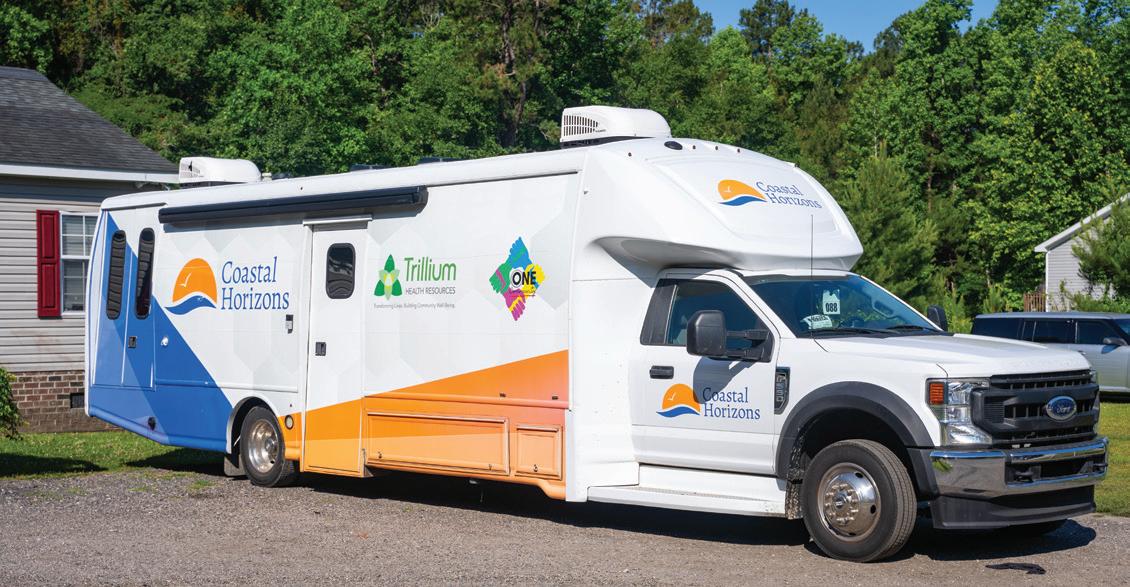
“In 2023, we opened a mobile health clinic in Navassa for residents in the north Brunswick County area,” she said. “It was definitely slow going at first, but some of that is a natural function of building community trust. We were able to do that, and we’ve now been able to add primary care services.
“But you know we had to keep in mind that there are transportation challenges. Brunswick is a large county; it’s not unusual for people to drive 30 minutes just to get to their scheduled appointment, so we don’t want that to be a barrier to services. Also, many of our community partners are on Medicaid, so one option that we might utilize is Medicaid-connected transportation.”
Patel points out that Coastal Horizons is seeing who she terms the
ACROSS THE COMMUNITY,WE HAVE TO RECOGNIZE THE IMPORTANCE OF CONTINUOUS MENTAL HEALTH AND WELLNESS. ... THE CHALLENGE IS TO HELP OUR RESIDENTS LEARN THE RESOURCES THAT ARE AVAILABLE, INCLUDING PROVIDERS, THEIR SERVICES AND FEES. THE REALITY IS THAT WE STILL HAVE A SHORTAGE OF DOCTORS IN OUR MORE RURAL AREAS.
“ “
DAVID HOWARD
Brunswick County’s health director
“most complex individuals,” meaning those who are higher risk, dealing with a constellation of issues that might include active substance use, more significant mental health and medical issues and sometimes homelessness.
One of the key attributes of Coastal Horizons’ program is the linked aspects of privacy and comfort level, explaining that “people find out that when they come in for their appointment at a mobile clinic, they know they’re not going to sit in a waiting room. We also will commonly connect them with a peer support specialist, someone who has genuine lived experience in either the mental health or substance abuse areas.”
Telehealth is another option for patients facing common obstacles that make in-person appointments problematic, Patel said.
“This mode allows our community partners to have true continuity of care
if their provider – whether a therapist, psychiatric or primary care provider – is unavailable on-site,” she said.
David Howard, Brunswick County’s health director, agrees that mental and behavioral health is a must-have component of the overall health of the adult and child populations in the county.
“Across the community,” he said, “we have to recognize the importance of continuous mental health and wellness.
“That means improving access to treatment and levels of professional or paraprofessional care, or peer-led programs,” he added. “The challenge is to help our residents learn the resources that are available, including providers, their services and fees. The reality is that we still have a shortage of doctors in our more rural areas.”
Additionally, the department offers a range of programs and services for various populations, including children’s and women’s health, diabetes programs and nonemergency medical transportation. A comprehensive health clinic in Bolivia offers programs such as family planning, women’s preventive health, immunizations and tuberculosis screening.
The chronic shortage of doctors that Howard alludes to in rural areas hampers the quality of and access to care. But promising initiatives designed to build a sustainable system could increase access to primary care doctors, officials said. One of those is a family medicine residency program, launched in 2025, affiliated with Novant Health Pender Medical Center in Burgaw.
For the residency program, the hospital partners with Black River Health Services, a clinic started over 50 years ago with three locations in Pender County and a higher ratio of uninsured and underinsured patients.
Ruth Glaser, president of Novant Health Pender Medical Center, highlights the 2022 grant the hospital received that helped the rural residency program get rolling in training and retaining doctors in their high-need area. Glaser said retaining residents starts with the act of “having them do
their training in a less hectic training environment, appealing to those who grew up in a small town or a rural environment.”
“And it’s true that a resident can make a difference in the lives of underserved people who will benefit from expanded care they may not have experienced before,” she said. “There is, in fact, research supporting that wherever you train is where you stay.”
Black River Health Services, in addition to its status as a Federally Qualified Health Center (FQHC) LookAlike, is a nonprofit family practice, offering affordable, accessible primary care, mental health services and a Medical Access program. This program opens the doors for underserved, uninsured or Medicare/Medicaid patients, officials said.
Black River Health Services CEO Lee Ann Amann communicates a vibe of community commitment – and to the underserved population that she said “deserves affordable, compassionate care” – with a stern side-eye for the habitually threatened dilution of programs such as Medicaid. Practices like Black River Health Services function in an environment where Medicaid’s
presence is underestimated.
Three of many fast facts: Medicaid covers 1 in 4 North Carolinians, which equates to 3 million people; 50% of all births in the state are covered by state Medicaid; and in many rural counties, more than half of the population has health coverage through state Medicaid.
“Children mainly are on Medicaid,” Amann said. “We want all children to be healthy, so we need an attitude transformation in America that it is, you know, a right?”
Not surprisingly, she has similarly strong words when making the case for rural hospitals and health facilities.
“So many families want to move to a less-populated area,” Amann said, “but what if there is insufficient health care coverage? What about delivering a baby in a rural area without an obstetrician? Or if you have a heart attack?”
Black River Health Services is supported by an 11-person, volunteer board led by Martha Highsmith, an Atkinson native who spent nearly 40 years in education and ministry, including serving as senior pastor of the Yale University campus church, before returning to Castle Hayne in 2017.
“Just as Black River holds a patient-
RURAL PHYSICIAN SHORTAGE
NUMBER OF PRIMARY CARE PHYSICIANS PER 10,000 RESIDENTS
PENDER COUNTY: 3.17
BRUNSWICK COUNTY: 4.61
NORTH CAROLINA: 7.74
NEW HANOVER COUNTY: 9.02
Source: UNC Cecil G. Sheps Center for Health Services Research
centered approach to rural health, our board is focused on being good stewards,” she said. “The thing about rural health is it’s medicine, but it’s all about relationships.”
Looking back and looking ahead, she recalls seeing her farmer dad looking up in the sky, trying to suss out what the clouds, weather and wind he was experiencing meant: a coming storm, a passing front or even a tornado.
“Remembering that,” she said, “it’s somehow like the process we go through as we try to figure out what all the change and challenges in rural health actually mean. There’s a lot of turmoil within rural health, and it’s incredibly worthwhile to understand it.”
Coastal Horizons Mobile Clinic offers primary care and mental health services at revolving locations throughout Brunswick, Bladen and Columbus counties.
photo by LOGAN BURKE
TRENDS TO WATCH
As in years past, the Wilmington area’s healthcare demands are on the rise, and providers are preparing to meet that demand by expanding their footprints. At the same time, they are branching out into new communities. Other endeavors have revolved around providing better sleep data, addressing local substance use concerns and securing new leaders.
- STAFF REPORTS
1
GROWING PAINS
As the Wilmington area’s population grows, the need for more healthcare facilities expands along with it.
One recent example: One of the area’s largest independent healthcare providers, Wilmington Health, recently purchased land near The Pointe at Barclay with plans to construct a new 64,000-square-foot medical office.
Deed records show the healthcare provider purchased nearly 5 acres in the Midtown Park office area for $5.2 million. The project, called Midtown II, will bring a range of clinical and diagnostic services under one roof, according to Brian Voth, Wilmington Health's chief development officer.
“Midtown II will feature advanced imaging capabilities, including CT and MRI, a fullservice, highly automated laboratory and modern clinical space designed to support both urgent care and specialty services,” Voth said.
The facility will also include dedicated space for clinical research.
2
BRANCHING OUT
While providers are seeking bigger footprints, they’re also growing their footprints in other communities.
In one case, an independent primary and urgent care practice based in Wilmington, Dawson Med, has established a presence in northern Brunswick County. The practice acquired Batish Family Medicine, a primary care provider located in Leland.
Beginning April 1, Dawson Med at Leland began operating in the building that formerly housed Batish Family Medicine at 304 Village Road NE.
According to physician Umar Bowers, co-founder and medical director of Dawson Med, the transition retained the entire team that formerly worked for Batish Family Medicine.
Bowers said talks about expanding to Leland started a little over a year ago.
“With all of the growth happening from large systems in and around Brunswick County, there should still be the counterbalance of independent primary care,” he added, “delivering that level of healthcare to Brunswick County residents in a manner that either they’ve been accustomed to or are looking for.”
SLEEP PRESCRIPTIONS 3
The science of sleep keeps people up at night, but advancements appear to be more than just a dream.
In May, Wilmington-based sleep technology company Nuream earned an NC IDEA SEED grant, which grants up to $50,000 to early-stage companies.
Nuream CEO Rob Cooley previously told the Business Journal that prospective grant funding would be used to advance the company’s core product – a fabric-sensor pillowcase to collect sleep data – and its go-tomarket strategy.
“We want to be in the commercial market about a year from now with our first pillowcase, plus a SaaS (softwareas-a-service) model with a dashboard and clinical informatics and predictive analytics,” Cooley said in an April interview.
Nuream’s aim is to collect accurate sleep data through minimally invasive electroencephalogram (EEG) technology, which measures the brain’s electrical activity. Using the data, the goal is to create dashboards that provide insights into users’ sleep patterns and long-term sleep trends.
In another sign of momentum, Nuream was one of 10 startups tapped for an accelerator program.
SUBSTANCE ABUSE AID
In recent years, local governments have been grappling with ways to provide substance use treatment.
This year marked the opening of New Hanover County’s only health treatment center offering medical detox, crisis stabilization and transitional housing under one roof since the closing of The Harbor, a state-funded detox facility, in 2022.
The Stabilization and Recovery (STAR) Center is a 14,000-squarefoot facility at 1605 Robin Hood Road near Novant Health New Hanover Regional Medical Center. The center has 16 inpatient beds and a two-bed transitional housing unit for men. The project is a joint effort from New Hanover County, Leading Into New Communities (LINC) and RHA Health Services.
RHA Health Services, in partnership with healthcare management company Trillium Health Resources, is operating the medical detox portion of the facility, while LINC, a nonprofit that provides transitional housing and case management services primarily for individuals returning from prison, oversees the transitional housing program for men.
LEADERSHIP CHANGES
Both Novant Health and Lower Cape Fear LifeCare are two local healthcare entities that have experienced changes at the top this year.
In March, UNC Health announced that Ernie Bovio, who had served as president of the Novant Health Coastal Region since 2024, was named the regional president of UNC Health’s Southeast Coastal Region. (Read about Bovio’s view on healthcare competition and UNC Health’s proposal to build a hospital in Wilmington on page 12.)
Laurie Whalin, president of Novant Health New Hanover Regional Medical Center (NHRMC), was selected to serve in an “interim expanded leadership role,” Novant officials said in a news release.
Bovio previously served as president of UNC Health Rex in Raleigh before becoming president of Novant Health Coastal Region and Novant Health NHRMC.
In April, Lower Cape Fear LifeCare announced that the organization had named Karen Brubaker Miller as its next president and CEO following a national search process. (Read more about Miller on page 97.)
Welcome to Good Life Wilmington, the guide for retirement living in Southeastern North Carolina.
Whether you’re looking for a new place to land, are new to the Wilmington area or have been here for a while, Good Life is a place to find out how to live your best version of the retirement years.
Here we share info about the neighborhoods around the region, as well as rapidly expanding health and wellness options.
And once you’re here, you’ll want to know how to make the most of it – from food festivals to cultural offerings and clubs to connect with.
What makes up a Good Life means different things to different people, so the pages ahead detail a range of resources to inform and engage.
While this is an annual issue, Good Life Wilmington info continues year-round through its website (goodlifewilmington. com) as well as its weekly email newsletter. You can subscribe to receive the newsletter on the website.
Through it, you can find out the latest on things to do in the area, what to know
on topics from real estate to restaurants and rundowns on places to live, dine and explore.
And have questions about the area? Submit them to editor@wilmingtonbiz.com, and we’ll answer them throughout the year. But first, take some time checking out this year’s Good Life issue and find out about:
• Homes + Communities: Get a roundup of 55+ neighborhoods on page 66.
• Health + Wellness: Read about the latest announcements on expanding medical facilities and specialties on page 70.
• Things to Do: Take note of learning and cultural opportunities on page 86.
• Food + Drink: Find out about the latest restaurants to open on page 88.
Cheers, and enjoy living the Good Life .
Vicky Janowski, Editor Wilmington Media + Marketing vjanowski@wilmingtonbiz.com
Real estate broker Sherri Ingle, with Intracoastal
works with homebuyers who are new to the area and helps them figure out how to get acclimated.
by Danielle Desnoyers
Realty, often
Photo
Welcome to You’ve moved to the Cape Fear – now what? Wilmington
More than 70,000 people have moved to the Wilmington metro area in the past five years, If you’re one of them, or someone making the transition now, unpacking the boxes is just the first step to embracing the coastal lifestyle.
“If you are new to the area, make an effort to meet your neighbors –exchange numbers. People in close proximity can be helpful if you ever find yourself in crisis,” advised Sherri Ingle, a real estate broker with The Rising Tide Team at Intracoastal Realty.
A Realtor since 2008, Ingle has worked with many homeowners who landed in the area and had to get the lay of the land.
Besides asking for recommendations on everything from restaurants to doctors to landscapers, a common question from new residents is often how to meet people, Ingle said.
“I always encourage them to get involved with local organizations that peak their interests,” she said.
“Get involved with the community,” Ingle added. “Azaela Festival is a great way to get started and a way to connect with locals and learn more about Wilmington and surrounding communities.”
Transitioning from another area might mean a new pace and new social
landscape, but it doesn’t have to be overwhelming. Here are some ways to start getting acclimated.
EXPLORING THE AREA
The region covers a diverse mix of neighborhoods and scenes.
The Wilmington metro area includes the population center of New Hanover County, the sprawling and fast-growing Brunswick County and still largely rural but also growing Pender County.
While Wilmington has the most residents, Leland is the second-most populous municipality, followed by Oak Island.
The region includes one university, two community colleges, a movie studio, farmland, waterfront homes and historical downtown buildings.
Bald Head Island, accessible by ferry and without car traffic, contains some of the most expensive homes sales in the state. Meanwhile undeveloped barrier islands also dot the area, reachable by boat or kayak.
One of the easiest ways to explore the region is to split it up geographically.
Historic Downtown Wilmington:
Fanning out from the Cape Fear River, downtown Wilmington combines 18th-century seaport history alongside modern apartment buildings. The 70 blocks of downtown’s commercial district include locally owned restaurants, boutiques, bars and tourist shops. A stroll down the nearly 2-mile wooden Riverwalk is a good place to start to take you between the two bridges.
Midtown Wilmington: A loosely defined area, midtown represents the central location of the city,
encompassing the medical services cluster at and around Novant Health’s main 17th Street campus and retail enclaves of Independence Mall and The Pointe at Barclay.
North Brunswick: With 850 square miles of land, Brunswick County is the largest county of the three. It runs from near downtown Wilmington south to the South Carolina state line. Along the way, a number of large neighborhoods – from Brunswick Forest to St. James – draw retiree populations. A fast-growing center of the county is on the northern side. Across the Cape Fear Memorial Bridge from Wilmington, homes and commercial development have sprung up around the Leland area.
Beach areas: A buffet of beach experiences will depend on which direction you head toward the ocean. For a rundown of the different ones, turn to the beach guide on page 7.
SETTING UP HOUSE
For utilities and municipal services: Most of Wilmington is serviced by Duke Energy for electricity. Also within the city limits, the city government offers bundled trash, recycling and yard waste collection services.
In New Hanover County outside city limits, residents contract with private haulers like Waste Management or GLF.
Cape Fear Public Utility Authority (CFPUA) is the primary water and wastewater provider for Wilmington and New Hanover County.
In Brunswick County, drinking water is provided largely by Brunswick County Public Utilities and the Brunswick Regional Water & Sewer (H2GO).
Welcome to Wilmington
And most Pender County residents get their water and sewer services from the county’s Pender Water & Sewer.
For homes using natural gas, Piedmont Natural Gas is a regional provider.
As far as driving around the area goes, new residents have 60 days to register their vehicles and get a North Carolina driver’s license. Appointments are available online weeks in advance on the state’s DMV site (ncdot.gov/dmv) to help avoid wait times.
UNIQUE TO THE COAST
For those moving to the coast for the first time, there is a slight learning curve to preparing for hurricane season. Living in Southeastern North Carolina means keeping an eye on weather reports between June and November.
• Before storm season: Besides supplying hurricane readiness kits, residents also should check homeowners or renters insurance policies and flood insurance; document their homes before storm season; and trim any dead or weak tree branches that hang over roofs.
• Assembling storm supplies should include preparing for the possibility of losing power if staying home during a hurricane, and that means a gallon of water per person and per pet a day; highprotein and shelf-stable food that doesn’t require cooking; flashlights, headlamps and spare batteries; and a supply of critical prescription medications.
• Know the terms: Under a watch, a tropical storm or hurricane conditions are possible within 48 hours. Under a warning, a tropical storm/hurricane conditions are expected within 36 hours.
• If needed, New Hanover and Brunswick counties are mapped out by evacuation zones based on storm surge risk. The “Know Your Zone” system and maps are available at ncdps.gov.
• Returning home: Don’t walk or drive through flood waters, which could hide hazards. Once you return, walk around the outside to check for loose power lines (but do not touch), gas leaks and structural damage. If you smell gas or if there is structural damage, do not enter until local officials have declared it safe. If clearing debris, be careful not to block roadways, fire hydrants and utility boxes. Local officials will provide information on how to properly dispose of debris.
BEACH BY BEACH
Staff Reports
A guide to checking out the coastal towns
Southeastern North Carolina’s beach towns have unique identities. While they all share the Atlantic waves and sandy stretches, deciding which one to spend a day at depends on the atmosphere you’re seeking. There’s boardwalks and arcades for the grandkids, quiet stretches for beachcombers, upscale menus or fish markets for seafood fans and a range of shopping options.
Here is a roundup of some popular area beach towns and what you might find in each of them.
file photo by T.J. Drechsel
BEACH WRIGHTSVILLE
GETTING THERE : Wrightsville Beach is in New Hanover County, accessible by Eastwood Road over the Heide Trask Drawbridge. The nearly 5-mile barrier island has 44 public beach access points, a roughly 2.5-milelong popular walking path and active commercial streets.
PARKING: Paid parking is enforced between March 1 and Oct. 31, 9 a.m.7 p.m. for many locations and until 8 p.m. in some areas. Check parking area signs for hours and instructions for paying.
Standard/nonpremium area rates: $5 an hour or $25 for a full day
Premium area rates: $6 an hour or $30 for a full day
Town park option: If you park at the Wrightsville Beach Municipal Complex, which includes the town park, the first two hours are free. For more info on parking areas as well as an interactive map that shows real-time capacity, go to townofwrightsvillebeach.com/163/ Parking
THINGS TO DO:
Johnnie Mercers Fishing Pier for either fishing or to walk out 1,200 feet out over the ocean
23 Salisbury St.
Wrightsville Beach Museum of History to learn about the island history inside a preserved, turn-ofthe-century beach cottage
303 West Salisbury St.
Info: wbmuseumofhistory.com
Wrightsville Beach Scenic Tours & Water Taxi to explore the waterways by boat for sunset cruises, birdwatching excursions and narrated local history tours
109 Causeway Drive
Info: wrightsvillebeachscenictours.com
RESTAURANTS TO TRY:
Oceanic, 703 S. Lumina Ave.
Located at the Crystal Pier, the Oceanic’s menu features fresh coastal seafood and seating overlooking or on the pier above the ocean.
South Beach Grill, 100 S. Lumina Ave. Serving the island for over three
decades, this cozy landmark includes locally sourced, farm-to-table Southern coastal cuisine.
La Duna Paradiso, 275 Waynick Blvd. in the Trailborn Surf & Sound hotel
This newer restaurant combines coastal Italian dining with North Carolina local seafood and organic produce from local purveyors.
STORES TO STOP IN:
Lighthouse Beer & Wine, 220 Causeway Drive
Featuring an open-air beer garden for hanging out, Lighthouse also has a curated selection of wines and craft beers for picking up on the way home.
Roberts Grocery, 32 N. Lumina Ave.
A Wrightsville Beach staple, Roberts is the island’s oldest store and has beach necessities as well as popular treats like its Roberts Famous Chicken Salad and shaved ice.
Hallelu, 84 Waynick Blvd.
Featuring women’s clothing, jewelry and shoes, this boutique offers a trendy stop to shop while at the beach.
BEACH CAROLINA
GETTING THERE: Carolina Beach offers a nostalgic and laid-back vibe, with its historical seaside boardwalk, ice cream shops and local boutiques. The New Hanover County beach town is about 15 miles away from Wilmington and the main thoroughfares of South College and Carolina Beach roads lead you to it.
PARKING : Paid parking in Carolina Beach is enforced from March 1 through Oct. 31 between the hours of 9 a.m. and 8 p.m.
Standard on-street parking: $5 per hour
Standard parking lots: $6 an hour or $25 for a full day
Premium parking lots: $7 an hour or $35 for a full day (enforced yearround)
On street parking: $5 an hour
Info: carolinabeach.gov/249/Parking THINGS TO DO:
Carolina Beach Boardwalk for a pedestrian-only stroll along wooden walkways featuring ocean views and local gift shops. It also serves as a
Federal Point History Center to explore indoor exhibits detailing the lower Cape Fear region’s local history, a research library and archives
1121-A N. Lake Park Blvd.
Info: federal-point-history.org
Carolina Beach State Park houses
hiking trails, a marina, camping and overlooks of the Cape Fear River
1010 State Park Road
Info: ncparks.gov
RESTAURANTS TO TRY:
Havana’s Restaurant, 1 N. Lake Park Blvd.
Set inside a 1916 craftsman beach cottage, this casual seafood restaurant includes indoor or outdoor patio seating.
Cape Fear Boil Company, 1140 N. Lake Park Blvd., Unit F
Cape Fear Boil provides customers with seafood steam pots to-go or as well as catering.
Soul Flavor, 716 N Lake Park Blvd., Unit 3
Along with global-inspired dishes, Soul Flavor’s menu also features vegetarian and vegan options as well.
STORES TO STOP IN:
CB Surf Shop, 209 S. Lake Park Blvd
Offers a selection of comfortable resort wear, sun protection and casual footwear
Salty Chic Boutique, 107 N. Lake Park Blvd.
This retail shop carries trendy women’s apparel, resort footwear, beach towels and an array of coastal accessories and jewelry.
Seaside Shenanigans, 201 N. Lake Park Blvd.
This is a stop to discover coastalthemed home decor, unique gifts, handcrafted keepsakes and beachside treasures tucked inside Celtic Creamery.
photo
c/o Wilmington and Beaches
BEACH KURE
GETTING THERE: Kure Beach blends into the sound end of Carolina Beach – Carolina Beach, Kure Beach and Fort Fisher make up what’s known as Pleasure Island. Beyond Kure Beach, the commercial districts fade out and lead to a Civil War historic site, a state aquarium (currently closed for a multi-year renovation) and landing spot for a ferry ride to Southport.
PARKING: Paid parking in Kure Beach is enforced from March 15 through Sept. 30, 8 a.m.-6 p.m.
Standard rates: $6 an hour or $25 for a full day for all town lots and on-street spaces
Weekly passes: available for $125 For more info on parking areas as
well as to pay for spaces online, go to townofkurebeach.org/parking.
THINGS TO DO:
Kure Beach Fishing Pier for a stroll along a historic wooden pier that stands as the oldest on the Atlantic coast
Atlantic Avenue and K Avenue
Fort Fisher State Historic Site includes an outdoor walk along an trail encircling the historic remains of a major Civil War earthen fort.
1610 Fort Fisher Blvd. S.
Fort Fisher State Recreation Area to admire protected salt marshes and local bird-watching spots via visitor areas and flat trails tucked away from the main surf 1000 Loggerhead Road
RESTAURANTS TO TRY:
Freddie’s Italian Restaurant, 105 K Ave.
Located next to the town pier, Freddie’s serves family-recipe Italian cuisine in a cozy pub atmosphere.
Jack Mackerel’s Island Grill, 113 K Ave.
Also steps from the pier, Jack Mackerel’s specializes in coastal seafood, Caribbean-influenced fare and prime rib nights.
Riverview Restaurant, 1121 N. Lake Park Blvd.
Located on the Blakeslee Air Force Recreation Area in Fort Fisher but open to the public this restaurant sits beside the Cape Fear River with sunset views.
file
photo by Jacob Reinwand
TOPSAIL
GETTING THERE : About an hour north of Wilmington, up U.S. 17, Topsail Beach offers a quieter escape from heavily visited beach towns in the area during the summer.
PARKING: Paid parking is enforced from March 1 through Oct. 31. Oceanfront lots: Enforcement runs from 9 a.m. to 5 p.m., at a rate of $6 an hour (up to 4 hours) or $30 for a full day.
South end parking lot (premium lot): Enforcement runs from 6 a.m. to 9 p.m., at a rate of $7 an hour (up to 4 hours) or $35 for a full day. For more parking info, go to topsailbeachnc.gov/Visitors/PublicAccesses-and-Parking.
THINGS TO DO:
Jolly Roger Pier for a walk down an 850-foot oceanfront landmark that offers a flat, stable surface for enjoying panoramic Atlantic views
BEACH
803 Ocean Blvd.
Missiles and More Museum to explore historical exhibits detailing the island’s unique secret missile program 720 Channel Blvd
Patio Playground for an afternoon of 1950s-style miniature golf 807 S. Anderson Blvd.
RESTAURANTS TO TRY:
The Breezeway Restaurant, 634 Channel Blvd.
Operating as an island landmark since 1949, this family-owned waterfront institution serves Southern fried seafood and spectacular sunset views over the sound.
Beach Shop and Grill, 701 S. Anderson Blvd.
A spot for fine dining, Beach Shop’s bistro cuisine menu highlights seasonal food and an award-winning
wine list.
Cora's Isle-End Deli, 712 S. Anderson Blvd.
This deli is good for a lunch stop or to-go pickup with sandwiches, homemade salads and quick bites.
STORES TO STOP IN:
South End Outfitters, 627 S. Anderson Blvd.
This store carries premium coastal apparel brands, footwear, sunprotection clothing and outdoor accessories.
Topsail Island Trading Company, 722 S. Anderson Blvd.
A must-visit local shop for visitors, it’s known for its expansive menu of homemade fudge as well as coastal gifts and home décor.
Gift Basket of Topsail Island, 702 S. Anderson Blvd.
This gift shop also includes a variety of beach souvenirs, books and coastal holiday ornaments.
photo courtesy of Greater Topsail Chamber of Commerce and Tourism
Cape Fear Region Overview
New Hanover, Brunswick and Pender counties cover nearly 2,000 square miles in Southeastern North Carolina –including some of the fastest-growing areas in the state. Here are some quick facts about the region.
NEW HANOVER COUNTY
POPULATION
Total Area (square miles) 191.5
Population (2025 census estimates) 245,959
Population (2020 base) 225,704
Population growth (2020-25) 9%
HOUSEHOLDS
Total households (2020-24) 104,856
Housing units (2025) 128,402
Owner-occupied housing unit rate (2020-24) 61.4%
Median value of owner-occupied housing units (2020-24) $387,800
Median gross rent (2020-24) $1,417
Building permits (2025) 2,332
INCOME
Median household income (2020-24, in 2024 dollars) $75,166
Persons in poverty 11.7%
GOVERNMENT
New Hanover County Government 230 Government Center Drive Wilmington, NC 28403 (910) 798-7311 nhcgov.com
Amenities: Accessible fishing pier, picnic shelters, boat ramp for kayaks and small boats
BRUNSWICK COUNTY POPULATION
Total Area (square miles) 191.5
Population (2025 census estimates) 174,702
Population (2020 base) 136,695
Population growth (2020-25) 27.8%
HOUSEHOLDS
Total households (2020-24) 69,124
Housing units (2025) 116,023
Owner-occupied housing unit rate (2020-24) 84.6%
Median value of owner-occupied housing units (2020-24) $349,800
Median gross rent (2020-24) $1,351
Building permits (2025) 4,457
INCOME
Median household income (2020-24, in 2024 dollars) $77,024
Persons in poverty 9%
GOVERNMENT
Brunswick County Government 30 Government Center Drive NE Bolivia, NC 28422 (800) 442-7033
brunswickcountync.gov
Town of Leland
102 Town Hall Drive Leland, NC 28451 (910) 371-0148
townofleland.com
Town of Oak Island 4601 E. Oak Island Drive Oak Island, NC 28465 (910) 278-5011
oakislandnc.gov
City of Boiling Spring Lakes 9 East Boiling Spring Road
Boiling Spring Lakes, NC 28461 (910) 363-0025
cityofbsl.org
COUNTY PARKS
Here are some of the county’s parks. Go to brunswickcountync.gov/367/ Parks-Recreation for a full list.
Brunswick Nature Park , 2601 River Road
Amenities: 911 acres of undeveloped wilderness, kayak/canoe launch site, picnic pavilion, hiking and biking trails
Leland Community Park , 1490 Village Road NE
Amenities: Baseball fields, community building, paved walking path
Ocean Isle Beach Park, 6483 Old Georgetown Road
Amenities: Tennis courts, four pickleball courts, baseball and softball fields, dog park, amphitheater, multipurpose field
PENDER COUNTY
POPULATION
Total Area (square miles) 191.5
Population (2025 census estimates) 72,111
Population (2020 base) 60,203
Population growth (2020-25) 19.8%
HOUSEHOLDS
Total households (2020-24) 25,291 Housing units (2025) 34,743
Owner-occupied housing unit rate (2020-24) 82.7%
Median value of owner-occupied housing units (2020-24) $299,000
Median gross rent (2020-24) $1,106 Building permits (2025) 833
INCOME
Median household income (2020-24, in 2024 dollars) $80,396 Persons in poverty 10.4%
GOVERNMENT
Pender County Government
805 S. Walker St. P.O. Box 5 Burgaw, NC 28425 (910) 259-1200
pendercountync.gov
Town of Burgaw 109 N. Walker St. Burgaw, NC 28425 (910) 259-2151
burgawnc.gov
Town of Surf City P.O. Box 2475
Surf City, NC 28445 (910) 328-4131
surfcitync.gov
COUNTY PARKS
Here are some of the county’s parks. Go to pendercountync.gov/576/ Parks-Recreation for a full list.
Hampstead Kiwanis Park , 586 Sloop Point Loop Road
Amenities: 53 acres with athletic fields, walking trail with fitness stations, picnic area
Millers Pond in Rocky Point, 12762
US Hwy. 117
Amenities: 7-acre pond surrounded by a half-mile walking trail, fishing, kayaking, picnicking
L Down by the Water
iving by the water is what attracts many people who move to the coast.
But the dream of waking up to ocean waves or marsh vistas comes with some caveats and things to know about waterfront homeownership.
It also puts pressure on local and state regulators to balance construction with natural impacts.
Pender County officials, for example, recently created a category for “coastal neighborhoods” in its comprehensive plan that “provides unique single-family housing options near natural coastal habitats.”
Such areas are located east of U.S. 17 and are generally close to estuarine waters, according to the plan. “Much of the area within this category includes established neighborhoods with a low to medium density development pattern. Low-impact development methods are encouraged for new development to reduce stormwater runoff impacts and support adjacent coastal surface water quality.”
The recommendation applies directly to communities like Hampstead, an unincorporated area along U.S. 17 that has 38 miles of coastline along the Intracoastal Waterway.
To those who advocate for the area’s businesses and tourism, coastal neighborhood category methods make sense.
“We need to protect the environment that attracted us to beautiful Pender County,” said Tammy Proctor, executive director of the Greater Topsail Area Chamber of Commerce and Tourism.
In some cases, land trusts have taken oceanfront property off the development table, such as the N.C. Coastal Land Trust’s purchase last year of nearly 100 acres on Topsail Island. The group recently transferred ownership of the undeveloped land to the state.
Because of the Wilmington area’s exposure to tropical storm- and hurricane-related damage from wind and flooding, coastal homeowners also have
to be aware of insurance as a part of their costs.
Residents of New Hanover County beaches faced a 16% homeowners insurance rate increase last year, and another 15.9% increase this year, based on the latest negotiated increase by state regulators.
According to an analysis from LendingTree based on N.C. Department of Insurance data from 2024, the average cost of homeowners insurance in the state's 25 largest municipalities is nearly $2,400. Overall, the report states that average homeowners insurance rates in North Carolina have increased by 44% between 2020 and midApril 2025.
The cost of insurance rises dramatically for coastal and beach areas, with Wilmington residents paying an average of about $7,200 a year for home insurance, according to LendingTree.
“Wilmington is growing fast and in a catastrophe-prone coastal area. That means more exposure. Historically, North Carolina was a little bit lower on rates, so now it’s catching up all at once. That’s why you’re seeing such sharp increases instead of gradual ones,” said Monique Hroncich, a licensed insurance agent working for Wilmington-based The Huneycutt Group.
Homeowners insurance policies do not cover flood damage.
“If you live in a flood plain, near a river or if you live near the coast, you should consider purchasing flood insurance for your home,” the state insurance department advises.
When looking at homes, buyers can put the addresses into the N.C. Flood Risk Information System (fris.nc.gov) to see if a property’s flood risk.
And when looking to build a home, the Coastal Area Management Act, or CAMA, dictates permitting rules near defined areas such as coastal wetlands, estuarine waters and the coastal shoreline.
But the additional considerations – from permitting to building materials – are worth it for some homeowners who think the tradeoff is worth it for the locale.
158 S. Beach Road, Figure Eight Island
photo c/o of Intracoastal Realty
6313 Sea Mist Court
Waterway Neighborhoods
Here are just some of the communities in the area with waterway views.
Landfall
This 2,200-acre gated community near Wrightsville Beach includes homes on the Intracoastal Waterway. With about 2,000 homesites, the neighborhood development started in 1987. Within its gates, there are sub-neighborhoods and a country club with 45 holes of golf as well as tennis and pickleball courts. Overall, the neighborhood is made up of three main areas that include custom home sites, patio home communities and villa communities and condominiums. The main areas are Landfall I, Pembroke Jones Park and Landfall II. landfall.org
Figure Eight Island
This exclusive, 1,300-acre private barrier island is located just north of Wrightsville Beach and is surrounded by the Atlantic Ocean and the Intracoastal Waterway. Accessible only via a private, guarded swing bridge, the neighborhood holds nearly 500 luxury homes. The private Figure Eight Island Yacht Club provides dining, tennis and a pool. figureeightisland.org
St.
James
Spanning over 6,000 acres along the Intracoastal Waterway near Southport, St. James is a gated community in Brunswick County. The neighborhood includes a full-service, 475-slip marina. The community contains custom single-family homes, townhomes and villa complexes, as well as 81 holes of golf, fitness centers and tennis facilities. stjamespoanc.org
South Harbour Village
South Harbour Village is on Oak Island’s mainland section. The neighborhood includes a variety of property types including condos, townhomes, patio homes, custom homes, estate homes and boat slips. The South Harbour Marina also has restaurants, small businesses and a chapel. shvassociation.com
River Bluffs
This 300-acre-plus riverfront community is along the Northeast Cape Fear River in Castle Hayne. Homes range from low-maintenance cottages to multi-million- dollar custom waterfront estates. There is an emphasis on environmental preservation, with over a third of the development’s natural landscape intact. Amenities include a marina with boat slips for rent, a half-mile elevated riverwalk, a fitness center, tennis and pickleball courts and a beach-entry swimming pool. riverbluffsliving.com
photo c/o of Intracoastal Realty
Neighborhoods
A growing number of communities are tailoring to residents who are 55 and older, including single-family homes, apartment complexes and independent living facilities. H ere are some in the tri-county area.
Inspire at Brunswick Forest 6146 Liberty Hall Drive, Leland, NC 28451 (910) 756-5714
inspirebrunswickforest.com
Description: An active adult community with one- and twobedroom apartments for rent in Leland
Amenities: Resort-style pool, fitness center, clubhouse, arts spaces and more
Nearby offerings: Restaurants include Farmhouse Kitchen, Pizzetta’s Pizzeria and Brunswick Beer and Cider
Description: A premier, agerestricted 55+ neighborhood featuring low-maintenance, singlefamily ranch homes built for active adults
Amenities: Resort-style clubhouse, outdoor pool, fitness center, pickleball and tennis courts, and dedicated lifestyle director
Nearby offerings: Located near the Brunswick Riverwalk, Cape Fear National Golf Course and a short drive to Southport beaches and downtown Wilmington
Cambridge Village of Wilmington 1019 Cambridge Village Way, Wilmington, NC 28405 (910) 239-6500 cvsliving.com/wilmington
Description: An upscale, resortstyle independent living and active
adult rental community focused on holistic wellness and optimal living
Amenities: Heated indoor saltwater pool, Cambridge Fitness center, full-service Village Restaurant & Pub, movie theater, on-site salon/spa, and weekly housekeeping
Nearby offerings: Close to the Mayfaire Town Center shopping area as well as Wrightsville
Description: A luxury, independent senior living continuing care retirement community on a scenic 58-acre campus in northern New Hanover County
Amenities: Indoor saltwater pool,
hobby shop, community garden, Central Bark dog park, library and dining venues such as the Magnolia Room and Tavern on the Pond
Nearby offerings: Positioned close to the Porters Neck Country Club and local shopping centers
The Enclave at Riverlights (Del Webb Wilmington) 4216 Riverlights Drive, Wilmington, NC 28412 (910) 909-4031 riverlightsliving.com
Description: A 55+ age-restricted active adult neighborhood that is one part of the master-planned riverfront community of Riverlights
Amenities: Exclusive 55+ clubhouse, zero-entry pool, fitness facility, tennis and pickleball courts, plus access to communitywide 38-acre lake trails
Nearby offerings: Marina Village waterfront shopping and dining, Club Golf Indoor and access to the Cape Fear River
Turtle Bay of Southport
5090 Turtle Bay Drive, Southport, NC 28461
(910) 457-4563
premierhomesnc.com
Description: A boutique, lowmaintenance 55+ active adult community of single-family patio homes and duplexes
Amenities: Low-maintenance landscape packages, walking paths, neighborhood social clubhouse and community gathering spaces
Nearby offerings: Located minutes from the historic Southport waterfront dining, local boutiques, Southport Marina and Oak Island beaches
Oak Grove at Blake Farm
49 North Assembly Drive, Wilmington, NC 28411 (910) 776-4288
oakgroveatblakefarm.com
Description: A new, coastalinspired active adult community offering upscale one- and twobedroom apartment homes
Amenities: Resort-style swimming pool, fitness and wellness studio, resident great room, rooftop lounge, golf simulator, courtyard fire pits and a dedicated pet park
Nearby offerings: Situated in the growing Scotts Hill medical and
retail corridor off U.S. 17; close to the upcoming Blake Farm commercial hub
Trinity Grove
631 Junction Creek Drive, Wilmington, NC 28412 (910) 442-3000
trinitygrove.net
Description: A faith-based, nonprofit senior living community managed by Lutheran Services Carolinas that utilizes a neighborhood-style design to offer short-term rehabilitation, 24-hour skilled nursing care and specialized memory care
Amenities: Therapy gym, internet café, full-service hair salon/ barbershop, an on-site chapel, secure courtyard gardens, restaurant-style dining and an outdoor children’s playground for visiting family members
Nearby offerings: Situated in southern New Hanover County near the Myrtle Grove and Monkey Junction areas; a short drive from Carolina Beach, Halyburton Park and the Novant Health New Hanover Regional Medical Center corridor
Assisted Living Options
Good Life Wilmington’s sister publication, the Greater Wilmingt on Business Journal, publishes an annual list of local assisted living and independent living facilities. The list is based on voluntary surveys sent to facilities in New Hanover, Brunswick and Pender counties.
Places that do not submit answers aren’t included, so this is not a comprehensive list below, but it does include details about many of the region’s options. The list is ranked and listed in order below by the number of residents at each facility as of November 2024. The Business Journal will publish an updated list in its annual Book on Business publication. For more info, email editor@wilmingtonbiz.com.
Type of residents accepted: Independent Services offered: Fine dining; meal delivery service; leisure and concierge services; regular housekeeping and linen service; 24-hour security staff; cutting edge hobby shop, village garden, transportation to shopping, grocery stores and doctor appointments; a 24-hour Resident Care Center & Licensed Home Care Agency; fitness center with indoor pool, salon services, auditorium; discounted green fees at neighboring golf courses
Year founded: 1988
Cambridge Village 75 Cavalier Drive Wilmington, NC 28405 (910) 239-9500
cambridgevillageofwilmington.com
No. of residents: 250
No. of units: 219
Type of residents accepted: 65+ independent adults who are ready to enjoy a maintenance-free, all-inclusive apartment style residency. Residents with care needs have options for care available all within the community. Services offered: Hybrid senior living community with multiple on-site healthcare partners; allinclusive resort-like rental includes $400 credit for dining, pub, room service, smoothie bar and salon; transportation, housekeeping, Wi-Fi, fitness and saltwater pool, hot tub and steam room with 30 classes/week also included; studio, one and twobedroom apartments Year founded: 2015
Carolina Bay at Autumn Hall
630 Carolina Bay Drive, Wilmington, NC 28403
(910) 769-7500
carolinabayatautumnhall.com
No. of residents: 193
No. of units: 158
Type of residents accepted: Independent living, assisted living, memory care and rehab Services offered: Planned continuing care retirement community with flexible meal options, 24-hour emergency response, weekly maid service, on-site healthcare and rehab, life enrichment programs, wellness center, scheduled transportation and spa/salon Year founded: 2015
Brightmore of Wilmington Independent Living
2324 S. 41st St., Wilmington, NC 28403 (910) 350-1980
brightmoreofwilmington.com
No. of residents: 137
No. of units: 136
Type of residents accepted: Seniors who desire a community atmosphere offering 24-hour security with other amenities and nonmedical services as
well as access to additional services if or when needed
Services offered: Rental retirement living with studio, one and twobedroom apartments with full kitchens and porches; monthly fee includes utilities, cable, Wi-Fi, chefprepared meals, housekeeping and flat linen service, emergency call, transportation and complete enrichment/wellness program with social activities and classes Year founded: 1997
Champions Assisted Living at The Davis Community 1007 Porters Neck Road, Wilmington, NC 28411 (910) 686-6462
thedaviscommunity.org
No. of residents: 100
No. of units: 120
Type of residents accepted: Offers assisted living and memory care to seniors in a community environment with the look and feel of home; campus offers a continuum of care Services offered: Continuum of care in an all-inclusive community that includes private suites and private bath, personal care, medication administration, 24-hour nursing professionals, meals and snacks,
photo
c/oCambridge Village
Homes + Communities
housekeeping, laundry services, medical transportation, activities, church services and wine socials, membership to Wellness Pavilion, WiFi and DIRECTV Year founded: 1999
The Commons at BrightmoreAssisted Living and Memory Care
2324 S. 41st St., Wilmington, NC 28403 (910) 335-2945
brightmoreofwilmington.com
No. of residents: 92
No. of units: 100
Type of residents accepted: Residents who need more moderate to substantial assistance with activities of daily living Services offered: Hands-on personal care for individuals who are medically stable but need help with meals, bathing, grooming and medication administration and management; transportation; 24-hour staff, daily housekeeping and laundry service, three meals per day and snacks, beauty/ barber shop, social activities; secure memory support area with an enclosed safe courtyard; on-site therapy with gym and services Year founded: 2003
Type of residents accepted: For residents that require individualized assistance with daily living, memory support, rehabilitation or skilled nursing Services offered: Assisted living, memory support, rehabilitation, skilled nursing Year founded: 2015
The Kempton at Brightmore 2298 S. 41st St., Wilmington, NC 28403 (910) 332-6899
brightmoreofwilmington.com
No. of residents: 62
No. of units: 54
Type of residents accepted: Assisted living levels 1-3 with mild to moderate needs for assistance Services offered: Assisted living and Alzheimer’s care to individuals with mild to moderate needs in private apartments Year founded : 2003
Options Medical More
By Cierra Noffke
With growth comes the need for additional health services
| Photo by Daria Amato
More medical facilities and providers have been added to the area in recent years. And there’s potential for that to continue as more patients move to the region.
Novant Health New Hanover Regional Medical Center operates the area’s flagship 823-bed hospital on South 17th Street. But the health system also is building in other parts of the county.
“We really need to push services out to where people live and to our small community facilities,” said Laurie Whalin, president of NHRMC and acute care operations for the Novant Health Coastal Region.
This year, the region is expected to welcome a 250,000-square-foot Novant Health hospital in Scotts Hill, an ambulatory surgery center in Leland, a midtown outpatient clinic and an expanded MedNorth campus downtown among its new healthcare facilities.
Following Novant Health’s 2021 acquisition of the hospital, Novant committed to investing $2.5 billion to expand the region’s health care infrastructure as part of the purchase agreement with New Hanover County.
Whalin said the organization is well underway to completing that benchmark. “We’re on the trajectory of really committing to about $2 billion of that $2.5 billion in five years’ time,” Whalin said earlier this year.
Novant Health is not the only major provider in the area. MedNorth has made a commitment to underserved communities, and physician-led Wilmington Health has operated locally since 1971. But Novant has helmed the expansion of medical services in the region and established itself as the region’s biggest employer.
In February, Novant Health’s board approved an additional $1 billion for future projects – including a proposed 120-bed heart and vascular patient tower on South 17th Street – signaling that the region’s health care expansions are far from over.
Wilmington Health this spring recently purchased land in midtown Wilmington near The Pointe at Barclay with plans to construct a new 64,000-square-foot medical office building on the site.
The project will bring a range of clinical and diagnostic services under one roof, according to Brian Voth, Wilmington Health’s chief development officer.
“Midtown II will feature advanced imaging capabilities, including CT and MRI, a full-service, highly automated laboratory and modern clinical space designed to support both urgent care and specialty services,” Voth said. “The facility will also include dedicated space for clinical research, reinforcing our commitment to advancing care and bringing new treatment opportunities to our patients.”
The 66-bed Scotts Hill hospital is Novant Health’s
largest expansion project in the area and will fulfill an important need for residents of northern New Hanover and Pender counties, who have long had to travel to South 17th Street for care.
The hospital is designed to be a “one-stop destination” for healthcare needs with a surgical focus: It has eight operating rooms and six procedure rooms, as well as a 60,000-square-foot medical office building that opened in 2024 and includes a cancer center with medical and radiation oncology.
The facility has also been designed with capacity for future growth, hospital officials said, with plans to eventually build additional medical office buildings on the Pender County side of the land.
“We have a tremendous opportunity at Scotts Hill to meet the community needs,” said Grant Rush, president of the Novant Health Scotts Hill Medical Center. “Not just in Scotts Hill, but our communities in Hampstead and further north.”
Closer to the flagship hospital on South 17th Street, Novant Health’s midtown outpatient clinic is slated to open this year, and several new projects have been announced for completion in the next five to seven years.
The 153,000-square-foot outpatient clinic, located in a former Verizon call center off Shipyard Boulevard in Wilmington, is expected to open the first two floors by the end of the year, featuring a variety of services, including an OB/GYN clinic and a pharmacy. The third floor, featuring infusion therapy, is slated to open in 2027.
Pending state approval, Novant Health’s recently announced $1 billion investment could bring three medical expansions to the area. The health system announced plans to construct a new 60-room physical rehabilitation hospital on Wrightsville Avenue, a new 120-bed heart and vascular (HVI) patient tower on South 17th Street and a second 80,000-square-foot heart and vascular medical office on Physicians Drive.
Additionally, Novant outlined plans to renovate two floors of NHRMC, including endoscopy and surgical services, to optimize clinical spaces.
In Brunswick County, Novant Health is opening the doors of its 16,000-square-foot ambulatory surgery center in Leland this summer.
The new ambulatory center will have two operating rooms, two procedure rooms and specialists who offer a range of surgical procedures.
The county also houses Novant Health Brunswick Medical Center, which Novant Health opened in 2011 as a 74-bed facility in Bolivia to replace a previous hospital building in Supply.
To keep up with the region’s growth, Novant announced in October plans to update the Bolivia hospital by adding an expanded MRI suite and a cardiac catheterization lab. That announcement also included the news that Novant filed for a certificate
of need to build a new 20-bed hospital along U.S. 74/76, as well as a freestanding emergency department near Carolina Shores.
Columbus Regional Healthcare System filed its own certificate of need for a 30-bed hospital in Delco, just miles from Novant’s planned hospital.
Columbus Regional Healthcare, a Whiteville-based provider, has been expanding into the region since 2022 and held a groundbreaking ceremony for a 68,000-square-foot ambulatory surgery center near the Brunswick Forest community in December.
The steady population increase could lead to another new community hospital, but who will build it depends on state regulators.
Earlier this year, the North Carolina State Medical Facilities Plan identified a need for 225 beds in New Hanover County. As a result, health systems are showing interest to fulfill that need.
In May, UNC Health officials said they plan apply for a community hospital on a 62-acre proposed site on the southeast corner of South 17th Street and Shipyard Boulevard in New Hanover County.
UNC Health’s proposed community hospital would offer a range of specialties, including emergency care, cardiology, oncology, OBGYN and more. The proposal still requires state approval through North Carolina’s certificate of need (CON) process, and state regulators would hold a public hearing later this summer.
The exact size of the proposed hospital has not yet been finalized, though Ernie Bovio, regional president of UNC Health’s Southeast Coastal Region, said that "a lot of it's dependent upon the physician support" and that UNC Health will apply for "a big chunk" of the identified 225 beds.
“With the growth that’s taken place, the population density and the projected growth,” he said, “there really needs to be more capacity, more access and more choice and an alternative.”
Area Physician Groups & Southeastern NC Hospitals
On these pages are directories of list of local doctor offices and area hospitals , according to info from voluntary surveys compiled in late 2025. Groups in New Hanover, Brunswick and Pender counties that did not respond to the surveys are not included below. For more info, email editor@wilmingtonbiz.com.
Specialties: Cardiology, family and internal medicine, gastroenterology, endoscopy center, general surgery, surgical oncology, maxillofacial surgery, plastic surgery, neurology, oncology, orthopedics, pediatrics and pediatric specialties, psychiatry, pulmonary and sleep medicine, rheumatology and more Hospital affiliation: Novant Health NHRMC and Novant Health Brunswick Medical Center
Wilmington Health 1202 Medical Center Drive, Wilmington, NC 28401 (910) 341-3300 wilmingtonhealth.com
No. of local doctors: 125
No. of NP/PAs: 153
No. of nurses: 151
Specialties: Primary care services through family medicine, internal medicine, OB/GYN and pediatrics departments; urgent care services; including Today’s Cares, Today’s Care Pediatrics, Today’s Care+ and Urgent Care in Jacksonville; specialty care services ranging 35+ specialties, as well as a state-of-the-art endoscopy and surgery center, as well as ambulatory surgery center Hospital affiliation: Not listed
Gregory Bebb and Elizabeth Weinberg are surgeons with independently owned Wilmington Surgical Associates.
No. of local doctors: 67
No. of NP/PAs: 54
No. of nurses: 45
Specialties: Advanced orthopedic and spine care, innovations in musculoskeletal health, comprehensive solutions for conditions affecting bones, muscles and joints; operates across 18 locations, offering a wide range of services including orthopedic clinics; physical therapy and hand therapy centers; orthopedic urgent care; walk-in access to specialized orthopedic care for acute injuries; ACR-accredited MRI facilities
Hospital affiliation: Novant Health, Novant Health NHRMC Orthopedic Hospital, Brunswick Surgery Center, Wilmington SurgCare, Dosher Memorial Hospital, Novant Health Brunswick Medical Center, Onslow Memorial Hospital, The Surgical Center of Morehead City, Carolinas East, and Carteret Health Care
Hospital affiliation: Novant Health NHRMC, Novant Health Brunswick Medical Center, Novant Health Pender Medical Center, Dosher Memorial Hospital
North American Partners in Anesthesia
2131 S. 17th St., Wilmington, NC 28401 (910) 442-1100 napaanesthesia.com
No. of local doctors: 32
Specialties: Anesthesiology with subspecialty training in pediatrics, cardiothoracic, regional/pain management, neurosurgical and critical care medicine
Hospital affiliation: Novant Health NHRMC, Cape Fear Hospital, Novant
Scotts Hill Surgicenter, Dosher Memorial Hospital, Novant Health Pender Medical Center, Brunswick EmergeOrtho ASC
UNC Health Children’s
Wilmington
2131 S. 17th St., Wilmington, NC 28401
(910) 667-7360 | med.unc.edu/ pediatrics/specialty care
No. of local doctors: 35
No. of NP/PAs: 31
No. of nurses: 72
Specialties: Pediatric: cardiology, critical care, endocrinology, gastroenterology, hematology/ oncology, inpatient services, neonatology, neurology, neurosurgery, nephrology, newborn care, pulmonology, rheumatology
Hospital affiliation: Novant, UNC Health Children's-Chapel Hill, UNC Health Southeastern, Onslow Memorial Hospital, Naval Medical Center Camp Lejeune, Columbus Regional Health System
Wilmington Eye
1729 New Hanover Medical Park Drive, Wilmington, NC 28403 (910) 763-3601
wilmingtoneye.com
No. of local doctors: 27
No. of NP/PAs: 1
No. of nurses: 21
Specialties: Ophthalmology
Hospital affiliation: Wilmington Eye Surgery Center, Novant Health NHRMC
and treatment of digestive and liver diseases including colorectal cancer screening
Wilmington Surgical Associates
2739 Iron Gate Drive, Wilmington, NC 28412 (910) 763-7363
Wilmingtonsurgical.com
No. of local doctors: 6
No. of NP/PAs: 3
No. of nurses: 3
Specialties: General and abdominal surgery, minimally invasive surgery (robotic and laparoscopic), breast, surgery, oncologic surgery, bariatric surgery, colon surgery, vein and wound care, skin surgery
Hospital affiliation: Novant Health NHRMC
Coastal Vascular Institute PA 1411 Physicians Drive, Wilmington, NC 28401 (910) 343-0811
Dosher Memorial Hospital 924 N. Howe St., Southport, NC 28461 (910) 457-3800 | www.dosher.org
No. of licensed beds: 25
No. of physicians: 75
No. of local staff: 425
Affiliation: None-Independent
Novant Health New Hanover Orthopedic Hospital 5301 Wrightsville Ave., Wilmington, NC 28403 (910) 667-8100 | NovantHealth.org
No. of licensed beds: See Novant Health NHRMC listing
No. of physicians: See Novant Health
NHRMC listing
No. of local staff: See Novant Health
NHRMC listing
Affiliation: Novant Health
Hilary Hafeken plays pickleball during a class Pickle & Taps in Wilmington
Down Time
For staying active, the area has many indoor and outdoor recreational activities that take advantage of local facilities. Here are just a few ideas to get out and about.
PICKLEBALL
House of Pickleball
115 Kay Todd Road, Leland, NC 28451 (910) 253-7780 houseofpickleball.com
This indoor pickleball facility features 12 dedicated courts. House of Pickleball, or HOP, has over 800 paid members and more than 16,000 occasional members who play the fast-growing sport.
This golf resort features six dedicated outdoor hard pickleball courts equipped with permanent lines and nets. Located next to the Pavilion at Beau Rivage, the facility offers court reservations, league play, corporate team-building events and easy access to equipment rentals, food and drinks at the resort's poolside Tiki Bar.
This indoor pickleball venue features 10 permanent hard courts,
including eight standard and two championship-sized courts optimized for tournament play. The climatecontrolled facility offers leagues and a bar serving local beers and snacks.
GOLF
Landfall Country Club
800 Sun Runner Place, Wilmington, NC 28405 (910) 256-8411 countrycluboflandfall.com
This private, member-owned club is located within a gated community just minutes from Wrightsville Beach. It features 45 holes of championship golf designed by Pete Dye and Jack Nicklaus, alongside tennis, fitness and dining facilities.
Wilmington Municipal Golf Course
photo by Madeline Gray
311 Donald Ross Drive, Wilmington, NC 28409 (910) 791-0558 | wilmingtonnc.gov
Designed in 1926 by Donald Ross, this historic 18-hole public course provides a classic golf experience. Open yearround, it offers a challenging yet accessible layout that serves both local residents and visitors to the Wilmington area.
Cape Fear National at Brunswick Forest 1281 Cape Fear National Drive, Leland, NC 28451 (910) 383-3283 brunswickforest.com
Located inside the Brunswick Forest community, this 18-hole championship course was designed by Tim Cate. The facility offers dailyfee play and features a challenging Scottish-Pinehurst look with heavily undulating greens and pristine coastal landscaping.
MARINAS
Port City Marina 10 Harnett St., Wilmington, NC 28401 (910) 251-6151 | portcitymarina.com
This protected, full-service deepwater marina is located in historic downtown Wilmington along the Cape Fear River. It features over 200 floating concrete wet slips capable of accommodating boats up to 400 feet.
Situated on the Intracoastal Waterway near the Wrightsville Beach drawbridge, this full-service marina provides access for transient and local boaters. It features a 300-plus-foot floating dock, a full-service fueling station and is located near waterfront dining.
This yacht club offers launching points for recreational boating and private fishing. Located near Masonboro Inlet, it provides its members with robust amenities, direct ocean access and wet or dry slip options.
This outdoor venue serves as the official home for the Wilmington chapter of the Premier Bocce Association. Launched for seasonal league play, the social league hosts games, bringing together casual players and teams looking for a mix of friendly competition.
Town Center Park
11 E. Second St., Ocean Isle Beach, NC 28469 (910) 579-2166 | ncbrunswick.com
Located by the Museum of Coastal
Carolina, this community park features a dedicated outdoor bocce ball court alongside a promenade walking trail and an outdoor performance stage.
Spanning 35 acres in Brunswick County, this regional district park offers public outdoor recreation amenities including a dedicated bocce ball area and shuffleboard courts.
This indoor axe-throwing bar features dedicated throwing lanes where trained “Axperts” provide safety and technique coaching. The venue hosts formal leagues four times a year and offers a selection of craft beers, wine and ciders.
This destination blends axe throwing with a massive board game library and classic pinball. The venue offers competitive local leagues as well as a wide selection of regional craft beers and family-friendly beverages.
by
photo
Jeff Nass Photography
Port City Marina, located in downtown Wilmington along the Cape Fear River
Newcomers Riding Wave the of
By Randall Kirkpatrick | Photos by Madeline Gray
Joan and Jay Phillips accelerated their move from Connecticut to Leland, which was originally planned for 2022, to coincide with retirement. As usual, life intersected with their “firm” plans in unexpected ways.
“We decided in 2020 to purchase our land to build our home in the Waterford community,” said Joan Phillips, a former teacher and principal. “We loved the community with its interlacing canals but actually didn’t see the land in person. … We saw it via drone video.”
They traveled to the Brunswick County town of Leland in spring 2021.
“I found our prospective neighbor, called her up and said, ‘I’m your new neighbor!’ When I had told her we were coming down, she said she would get everyone on the street together, and we’d have a cookout, where we could meet all the neighbors, which we did,” Joan Phillips said.
The Phillipses are part of a wave of recent retirees who chose Southeastern North Carolina as their next stopping point.
The state of North Carolina has been experiencing rapid growth for more than 50 years. In the Cape Fear region, for Brunswick and Pender counties in particular, the trend is even faster and shows few signs of slowing.
For new residents like the Phillipses, who moved into their new home in October 2022, it also meant getting connected to their new zip code.
Joan Phillips began kayaking several times a week within the community, while Jay Phillips found a fairly competitive age 50-and-over softball league, joined the golf club at nearby Magnolia Greens and began playing pickleball at the House of Pickleball. Both enjoyed hiking and took that up together, not only locally but in Western North Carolina.
Joan Phillips also progressed from being a member of the North Brunswick Newcomers Club to becoming the club’s activities director.
Some of the Newcomers Club’s events she initiated or helped put together include a tasting history tour in Carolina Beach, a Moores Creek National Battlefield tour, a chartered fishing trip and a single ladies’ brunch at downtown Wilmington restaurant Seabird.
For many people who’ve relocated or returned to northern Brunswick County, living close to Cape Fear
Community College in downtown Wilmington and UNCW is a huge advantage, creating a refreshing learning atmosphere.
This proximity also translates into easily accessible concerts, theatrical performances, lectures and cultural happenings, as well as courses available for mature students through programs like UNCW’s Osher Lifelong Learning Institute. The institute is a university-led and member-supported organization that provides lifelong learning opportunities for adults 50 and over. Courses typically fill up quickly.
The growth for both Brunswick County and the northern Brunswick town of Leland in part reflects attraction to four-season activities, coastal/recreational living (with four beaches within 30 minutes or less) and the city of Wilmington’s multifaceted cultural and dining appeal.
Recent Census population estimates reflect this pipeline.
Brunswick County grew by 4.7% between 2024 and 2025, making it the fastest-growing county in the state, according to new Census population estimates released this spring. Pender County’s population, meanwhile, grew by about 3%, the second-fastest in the state.
In comparison, New Hanover County, the region’s population center that houses more than three times the residents as Pender, continues to experience a less dramatic growth rate – seeing 1.1% growth between July 2024 and July 2025.
The Census update showed that Brunswick County, which added nearly 8,000 residents over the year, was the sixth-fastest growing county in the U.S.
Sheer speed and impressive population surges are, to an extent, strong indicators of economic development health, but they’re not the whole story. The windburn from such rapid growth can manifest in fairly predictable ways, such as infrastructure shortfalls, overcrowded schools and traffic congestion.
Those who track and analyze such growing pains, including regional economist and University of North Carolina Wilmington professor Mouhcine Guettabi, see how infrastructure and other concerns can emerge. Hyperfast growth will do that.
“I always joke,” Guettabi said, “that all of us would rather live in a community that’s growing than one that’s declining. However, as we all know or will eventually learn, that pain is felt most acutely through infrastructure issues.
Members of the North Brunswick Newcomers Club take a tour and participate in a tasting event at End of Days Distillery in Wilmington.
Things to Do
“And so, one of the challenges that the area has experienced with this incredibly rapid growth everyone has witnessed is that infrastructure needs have lagged behind.”
In Pender County, the inprogress Hampstead Bypass is one of the higher-profile, higher-priority infrastructure projects in motion that, when complete, promises to ease chronic traffic congestion.
Brett Weaver, a RE/MAX Essential real estate broker based in Hampstead, is cautiously optimistic about the ultimate benefits of the bypass but noted that the estimated completion date is 2030.
“It’s frustrating to see the –let’s call it moderate – pace of construction of this project,” she said. “I’d like to see incentives to speed up that pace. In the Northeast, for instance, I don’t believe the idea of taking six years for this to open would be acceptable. Then again, looking back at the amazing growth that’s occurred in Wilmington, these are issues that aren’t unsolvable; they just need to be addressed smartly.”
Like Brunswick County, Pender County is experiencing very strong growth. The warehouse whale that splashed into the county’s economic development pond was and is Amazon. The e-commerce leader has two facilities in the county; the larger, which broke ground in March
2025, is a 3.2 million-square-foot robotics-based fulfillment center, while the other is a last-mile delivery center. The larger facility is touted as the state’s largest and most technologically advanced robotics fulfillment center. Perhaps most importantly, the center is scheduled to employ over 1,000 people.
Regional economist Guettabi said, “More than anything, their (Amazon’s) choosing this locale is a signal. Meaning, when a company of this global force could locate anywhere in the country or anywhere in the world, and chooses your community, it signals that there are powerful community attributes that their research team has identified. And yes, that can impact future locational decisions.”
To maximize the sustainability of growth in Brunswick and Pender counties, long-term planning is essential, he said. One of the more significant vehicles in planning for a region’s growth, Guettabi said, are undertakings such as Pender County’s 2030 Strategic Plan. The plan identifies five major goals and executable strategies. Those strategies include supporting schools and education – the county currently has just three traditional high schools; enhancing public safety – the county is undergoing an emergency services merger; and
growth and infrastructure planning – key initiatives include creating an engineering department and drafting a water and sewer infrastructure master plan. They also include improving communication, such as standardizing information at board meetings, and internal development and retention, which would be steps to make salaries in government more competitive.
Former UNCW provost Denise Battles is another example of those contributing to the population increase in Brunswick. Battles returned to the Wilmington area in August with her husband, Mike, after a decade in the State University of New York system. They especially appreciated the opportunities and familiar stimulating vibe of living close to a college. She has become an enthusiastic participant in the Newcomers Club; her prior experience as a geologist brought an extra dose of interest in the club’s recent visit to the area’s National Weather Service station.
“Yup,” Battles said with a smile, “I’m one of those people who literally wanted to know what the site elevations were relative to hurricane risk. I didn’t want us to move into a house that was less than 22 feet above sea level — we're at about 15 feet, close enough. You can say we’re in a lower-risk locale, but then again, our brethren in Asheville credibly thought the same thing. So we’re aware of hurricanes and just in general concerned about general drainage issues.”
In their new community of Waterford in Leland, she said, there is a solid core of active older residents.
“We love the outdoors and the appeal of having a place with water everywhere,” Battles said.
“Setting aside spaces for recreation is essential for the quality of our lives. Combined with all that greater Wilmington has to offer – striking that balance of cultural, entertainment and educational – with the natural beauty we’re surrounded with … we’re in a unique position to do that here in Brunswick County.”
Members of the North Brunswick Newcomers Club (left to right) Bonnie Wolf, Robi Lorio, and Vinny Lorio participate in a tasting event at End of Days Distillery in Wilmington.
WIDESPREAD PANIC AT LIVE OAK BANK PAVILION AT RIVERFRONT PARK
Performance Venues
The region features entertainment venues large and small that house local productions as well as touring music acts and plays. Here are some of the places to check out performances.
Entertainment: The Airlie Summer Concert Series with live music outdoors runs from June to late August or early September Other attractions: Formal gardens, walking trails, views of Bradley Creek, 10 acres of freshwater lakes, azaleas, the 480-year-old Airlie Oak, N.C. Birding Trail location, Bottle Chapel, Butterfly House (May-Sept.), Art Exhibit (Jul.-Dec.), seasonal events such as Blooms & Brews, The Airlie Oyster Roast and Enchanted Airlie
Live Oak Bank Pavilion at Riverfront Park 10 Cowan St., Wilmington, NC 28401 (910) 343-3614 | livenation.com/ venue/KovZ917A0DZ/live-oak-bank-
pavilion-events
Entertainment: National live performances, civic events, rentals 2026 lineup: Upcoming shows include Lauren Daigle (June), Lord Huron (June), Darius Rucker (June), Jimmy Buffett’s Coral Reefer Band (July), Bob Dylan (July), James Taylor (September), Foreigner (September), The Doobie Brothers (October)
Thalian Hall Center for Performing Arts
PO Box 371, Wilmington, NC 28402 (910) 632-2241 | thalianhall.org
Entertainment: Main Attractions series, Opera House Theatre Company season, Thalian Association Community Theatre season, Big Dawg Productions season, film festivals, Cinematique and Techmoja Theatre and Dance Company season 2026 lineup: Upcoming shows
include The Outsiders (June), West Side Story (August), Live and Let Die: The Music of Paul McCartney (October), Donna Washington (October), Celtic Angels (November)
CFCC’s Wilson Center
703 N. Third St., Wilmington, NC 28401 (910) 362-7999 wilsoncentertickets.com
Entertainment: National Broadway tours, national and international concerts, comedy and other performing arts events, including local renters
2026-27 lineup: Graham Nash (August), The Oak Ridge Boys (August), Brit Floyd (August), Pixies (September), Waitress (October), The Book of Mormon (October)
Cameron Art Museum
photo c/o Live Oak Bank Pavillion at Riverfront Park
3201 S. 17th St., Wilmington, NC 28412 (910) 395-5999
cameronartmuseum.org
Entertainment: Port City Music Festival (June), Live! at CAM Café, The Collection Exhibit (August) Top exhibits/attractions: Rotating exhibitions in two wings of the museum, situated on 9.2 acres that include the PNC USCT Park featuring the Boundless sculpture, a large Whirligig, nature trails, pond and a Civil War historic site
Entertainment: Live Nation-booked concerts, civic events and rentals at an outdoor stage overlooking Greenfield Lake 2026 lineup: Upcoming shows include Wilco (July), Umphrey's McGee (July), Rhiannon Giddens (July), The Wallflowers (August), ZZ Top (September)
Hannah Block Historic USO/ Community Arts Center
120 S. Second St., Wilmington, NC 28401 (910) 341-7860 wilmingtoncommunityarts.org
Entertainment: Performing and visual art shows and classes, World War II museum, Orange Street Pottery, film festivals and more; Thalian Association Community Theatre season, Voices in Community Choir, USO Show & Dance (November)
UNCW Kenan Auditorium 601 S. College Road, Wilmington, NC 28403 (910) 962-2515 | uncw.edu/ seahawk-life/arts/presents
Entertainment: Kenan Auditorium Presents, UNCW Seahawk FAM; other performances
Entertainment: Special events include jazz concerts, history lectures, free community events, a Christmas open house and more; open daily for tours; also features rotating exhibits focused on fine art, history, historic preservation and design arts
Entertainment: A 1,500-seat performing arts facility at Brunswick County Community College 2026 lineup: Upcoming shows include Sea Notes Choral Society: Celebrate 1776-2026 (June), Frankie Valli Tribute (October), VAN The Band - Van Morrison Tribute (October)
GREENFIELD LAKE AMPHITHEATER
CFCC'S WILSON CENTER
photo c/o Wilson Center
photo c/o Greenfield Lake Amphitheater
Wheel-throwing class at Leland Cultural Arts Center
Continual Learning
Enrichment courses abound locally, from cultural lectures to art workshops, there’s a range of options to stay busy and make new connections while picking up a new skill.
Description: Airlie Gardens is a 67acre public garden owned by New Hanover County.
Classes: The garden offers regular guided bird walks and guided history tours as well as a regular Hops & Talks event with Airlie’s environmental educators talking about garden animals while patrons enjoy Mad Mole Brewing pints.
Osher Lifelong Learning Institute (OLLI) at UNCW 601 S. College Road, Wilmington, NC 28403 (910) 962-3195 | uncw.edu/olli
Description: OLLI at the University of North Carolina Wilmington provides tailored noncredit educational programs, lectures and multi-session courses for adults seeking continuing enrichment.
Classes: Programs feature subjects such as the Intensive Poetry Workshop, global policy roundtables through Great Decisions, historical
surveys of American art and local ecological explorations such as Nature Poetry: From Pastoral to Ecopoetry.
Cameron Art Museum 3201 S. 17th St., Wilmington, NC 28412 (910) 395-5999 cameronartmuseum.org
Description: The Cameron Art Museum (CAM) provides high-quality cultural exhibitions and year-round educational opportunities for adults through its dedicated Pancoe Education Center.
Classes: Studios feature hands-on creative weekends, including Painting Shorebirds, Mixed Media Painting, Sculpting with Pinch Pots and Tickled Blue-Cyanotype Printing workshops. Generative creative writing sessions are also regularly offered directly inside the museum galleries.
Leland Cultural Arts Center 1212 Magnolia Village Way, Leland, NC 28451 (910) 383-0553 | townofleland.com
Description: Run by the town of
Leland, this northern Brunswick County complex features a gallery, a pottery studio, a large multi-purpose room and custom classrooms designed for fine arts and community integration.
Classes: Visual and functional art workshops for adults include stained glass construction using the classical copper foil method, decals on clay, wheel throwing, flower arranging and themed painting classes such as Painting like Georgia O’Keeffe.
Brunswick Community College (Southport Center)
701 N. Lord St., Southport, NC 28461 (910) 755-7300 | brunswickcc.edu
Description: While the main campus resides in Bolivia, BCC runs its continuing education arts and trades programs out of its historic Southport Center facility.
Classes: The adult enrichment roster features intensive technical art mediums, including beginning metal sculpture, segmented woodturning, advanced silver jewelry making, fiber shibori dyeing and multi-level pottery wheel and handbuilding courses.
file photo
Cape Fear Community College
411 N. Front St., Wilmington 100 Industrial Drive, Burgaw 621 N.C. Hwy. 210 (910) 362-7000 | cfcc.edu
Classes: Adults can enroll in community enrichment courses at CFCC’s campuses, including hobbyist welding, commercial craft brewing and photography courses. The main downtown campus offers marine captain licensing classes as well as wood boatbuilding. In the 10-week commercial craft brewing program, students explore the science and history of brewing while training directly under industry professionals
to master the full "grain to glass" process. Meanwhile, the historic wooden boatbuilding program utilizes hand tools, joinery, and full-scale lofting on the shop floor to teach traditional techniques. All community enrichment classes are affordable and require preregistration through the Union Station campus office.
New Hanover County Senior Resource Center
2222 S. College Road, Wilmington, NC 28403 (910) 798-6400 | nhcgov.com
Description: Operated by New Hanover County, this resource center serves older adults with a lineup of lifelong learning, creative arts and wellness programs designed to promote an active lifestyle.
Classes: The center features dedicated studio space for continuous adult workshops including specialized watercolor painting, acrylics and knitting circles.
Wrightsville Beach Parks and Recreation
1 Bob Sawyer Drive, Wrightsville Beach, NC 28480 (910) 256-7925
townofwrightsvillebeach.com
Description: Based out of the Wrightsville Beach Park complex, this municipal department provides year-round indoor and outdoor recreational coursework, fitness classes and specialized athletic programs.
Franklin Square Gallery
130 E. West Street, Southport, NC 28461 (910) 457-5450
franklinsquaregallery.com
Description: Housed in a historical 1904 schoolhouse building in downtown Southport, this gallery is operated by the Associated Artists of Southport.
Classes: The gallery hosts multi-day workshops led by visiting regional artists, focusing on mediums such as watercolor on canvas and plein air landscape painting. It also offers multi-week studio classes.
Classes: The center provides continuous group sessions including local heritage and history roundtables, beginner woodcarving, basic computing and digital safety and more.
photo c/o Cameron Art Museum
PAINTING CLASS AT CAMERON ART MUSEUM
FRESH FLAVORS
The Wilmington area’s culinary scene is a vibrant one. There’s the coastal menus expected of a beach city, but global flavors and fine dining are also part of the mix. Award-winning restaurants and bars dot the region and are ever evolving. Here are some of the latest additions to the food and drink scene, from Feast Wilmington’s Unwrapped newsletter (feastwilmington.com).
Medi Bowl from Nil's Mediterranean Cuisine
photo by Megan Deitz
EASTERN MIX
Nil’s Mediterranean Cuisine
114 Market St.
Nil’s Mediterranean Cuisine in downtown Wilmington was the third Nil’s location for chef Tan Uckan and his wife, Semra, who also operate Nil’s restaurants in Fuquay and Angier, North Carolina. The menu includes Mediterranean staples such as falafel and shakshuka, as well as tapas and kebabs. “We’re offering a little bit of an upscale, modern fusion of Mediterranean food with a lot of Turkish flavors,” chef Uckan said. He and his family are from Turkey and were “born next to the sea,” so Wilmington was a natural fit for them to take up residence and open a new Nil’s location.
Overall, Tan Uckan has a why not approach to it all.
“This part of North Carolina is growing up (in regards to) food, and why not?” he said. “This location came up, and I didn’t want to miss the opportunity.”
ITALIAN RIVIERA TO WILMINGTON
Fortuna Cucina Italiana 414 Arboretum Drive, Suite 130
Evoking the easy rhythm and glamour of the Italian Riviera, Fortuna Cucina Italiana recently opened its open doors with a vision that is equal parts elevated dining destination and neighborhood gathering place.
The concept is led by restaurateur Giorgios Bakatsias along with chef and partner Chris Lewnes, and general manager Salvatore Catania, whose combined experience spans Michelinstarred kitchens, luxury hospitality projects and decades of restaurant development throughout the Southeast.
Bakatsias, originally from a small village in Greece, is the founder of the Giorgios Lifestyle and Hospitality Group, which operates nearly 20 concepts throughout the Triangle and Wilmington. For Lewnes, the road to Wilmington began in New York.
The menu balances Italian tradition with coastal Carolina influence, featuring dishes like local flounder
Francese, head-on shrimp with salsa verde and scampi butter, tuna from the Outer Banks, local snapper and clams and a grilled Branzino rarely found in the Wilmington market.
SIP AND STAY
Bean There Café 2148 Wrightsville Ave.
While there’s no shortage of coffee shops in Wilmington, Bean There Café was born out of a different idea: to create the kind of café Wilmington doesn’t already have. For chef and owner Chris Hollingsworth, that means not only a thoughtfully crafted coffee program, but one that is complemented by made-from-scratch food in a space designed to feel welcoming.
Hollingsworth said that while there are plenty of places to get great coffee, the food options at many coffee shops are limited to baked goods brought in from other locations rather than baked fresh on-site, and most do not offer made-to-order breakfast and lunch options.
One standout is the pistachio latte, made with pistachio milk and housemade pistachio syrup.
“Everything is technically house-made and baked fresh daily,” Hollingsworth said.
TAKING FLIGHT
Concorde Espresso Bar 8121 Market St.
The owners of downtown Wilmington’s Concorde Espresso Bar this year closed on a Porters Neck building that’s slated to become a second location for the popular coffee and cocktail bar.
Concorde Espresso Bar LLC purchased the property at 8121 Market St. for more than $1.8 million, according to a deed. According to state records, the entity is managed by Ace and Jamie Alfalla, the husband-and-wife team behind Alfalla Hospitality Group.
Jamie Alfalla said she was “excited to bring a more immersive Concorde jetthemed experience to the area – think elevated aviation vibes, the same great
coffee-to-cocktails transition (open daily starting early, reservations after 3 p.m.), and something we know Porters Neck locals will love.”
The first Concorde location launched in 2023 at 215 S. Front St. in Wilmington, opening after Alfalla Hospitality Group took over the Front Street Inn in 2021 and renovated the space, transforming it into a boutiquestyle hotel. The hospitality group also owns Sugo Italian Steakhouse at Hotel Ballast and the Graystone Inn, a historic bed-and-breakfast that was damaged in a fire in November.
CHEF POWERHOUSE
VOYCE Bistro 11 Market St.
Just beyond a storefront window, a wall is on fire – not literally, of course. It blazes with fiery reds, electric purples and wild yellows in a large-scale floral print inside 11 Market St., where patrons dine at the recently opened VOYCE Bistro.
“I wanted to run the mural the whole length of the wall, but my husband said we needed to break it up,” said Angela Rhodes, owner of VOYCE, along with her husband and two-time James Beard Award nominee chef Keith Rhodes.
At 1,500 square feet, with structural bones dating to 1901, the historical building beside the Alton Lennon Federal Building – once home to the deli Stuffedwich – has been whisked into modernity once again. The result is an intimate, inviting space a stone’s throw from the Riverwalk that, according to its website, “celebrates the art of casual, coastal cuisine infused with Caribbean flavors.”
Small plates such as oven-roasted Dirty South oysters, buttermilk-fried Ipswich clams and North Carolina seafood chowder join entrees and sandwiches, including pan-roasted fish of the day, jerk shrimp roll, a blue lump crab cake sandwich and a Wagyu cheeseburger.
“We took inspiration from the classic French bistro and remixed it with a touch of soul,” Angela Rhodes said. “The result is warm, inviting and reflective of the food and the people behind it.”
Wilmington Brewing Company co-owner John Savard pours a pint of local brew.
LOCAL BREWERIES
The area’s brewery scene has been bubbling up for years and has grown into popular neighborhood spots in Brunswick and Pender counties, beyond the original brewery hub in Wilmington.
Wilmington Brewing Company
824 S. Kerr Ave., Wilmington, NC 28403 (910) 769-0293
wilmingtonbrewingcompany.com
Size of brewhouse (in barrels): 35.0
Sample of brews: Tropical Lightning IPA, Blair’s Breakfast Stout, Jalapeño Saison
Brewery amenities: Taproom, food trucks, family and pet friendly Event space description: 5,000-square-foot taproom with games, patio seating and lounge areas, weekly food trucks, run club, specials and more
Sample of brews: Galloping Gose, King Tide Koisch, Evacuation Plan Double IPA, Acerbic Ecstasy IPA, 910 Pale Ale, Hay Bale Cream Ale
Brewery amenities: Taproom, outside and inside seating, regular events, food trucks, homebrew shop and club: Broomtail Coffee Shop in the momings and Brewery Taproom in the afternoons
Event space description: Private room, two large TVs, food prep area, regular food trucks, coffee and brewery taproom available with bartenders and baristas
Brewery amenities: Taproom and outdoor beer garden under the Cape Fear Memorial Bridge; live music, food trucks, special events, markets, tours, games family and dog friendly Event space description: Seating indoors for 120 and outdoors for 100
Sample of brews: Hey Zay Hazy IPA, Coastline Kölsch, Swingbridge Breakfast Stout, Barnacle Bill’s Brown Ale
Brewery amenities: Taproom and brewery, live music and food trucks, beer garden, outdoor games
Event space description: Roughly 1,600 square feet of taproom space
Front Street Brewery
9 N. Front St., Wilmington, NC 28401 (910) 251-1935
FrontStreetBrewery.com
Size of brewhouse (in barrels): 10.0
Sample of brews: Port City IPA, Tiny Tim's Christmas Ale, Dram Tree Scottish Ale, Original Pilsner, Riptide Raspberry Wheat Ale Brewery amenities: Brewpub; restaurant with outdoor seating; Event space includes in house catering and taproom
Event space description: 3,000 square feet, available for parties up to 100 people
Burgaw Brewing
103 S. Wright St., Burgaw, NC 28425 (910) 530-0077 burgawbrewing.com
Size of brewhouse (in barrels): 10.0
Sample of brews: A lager-focused brewery with other styles that rotate through; flagship is the 103 Lager, a German Helles
Brewery amenities: Full-service restaurant with outdoor Biergarten and Event space two doors down Event space description: The Annex at Burgaw Brewing is a 40-50 person event space two doors down from the brewery
Makai Brewing Company
5850 Ocean Hwy W., Ocean Isle Beach, NC 28469 (910) 579-2739 | makaibrewing.com
Size of brewhouse (in barrels): 3.5
Sample of brews: Carolina Tropical IPA, Mango Reef Blonde Ale, Coral Bay Kolsch, Kamanawanalel’ya Juicy IPA, Fire Knife Double IPA
Sample of brews: Lil Fish West Coast IPA, Ocean Crest American IPA, Hazy D NEIPA, Mas Elote Mexican style Lager, Intracoastal Blonde, Kooky Coconut Porter
Brewery amenities: Beer garden, tap room and event venue
Event space description: Variety of indoor and outdoor event venues can host up to 200
Savard Beer & Board
121 S. Front St., Wilmington, NC 28401 (910) 399-4300
savardbeerandboard.com
Size of brewhouse (in barrels): 10.0
Sample of brews: Pub ales and Lagers, including StrataSphere Surfer Session IPA and Bikini Line Blonde Ale
Brewery amenities: Live surfboard
shaping and glassing on site; Brewery right Inside the taproom; Private event room and an Airbnb upstairs
Event space description: The “offshore” room is available to reserve and rent
Good Hops Brewing
811 Harper Ave., Carolina Beach, NC 28428 (910) 512-6697
goodhopsbrewing.com
Size of brewhouse (in barrels): 7.0
Sample of brews: Hurricane Haze, Pirates I.V. Koisch, Boardwalk Brown, El Dorado Drift, Productive Porter, Seltzers and more 15 taps of rotating beers
Sample of brews: Rehder's Red, Saison, Belgian Blond, Flytrap IPA, West Coast IPA, rotating seasonals and special releases
Brewery amenities: Taproom, outdoor beer garden, to-go beer, live music, food trucks, local art, dog friendly
Event space description: Space can be reserved for gatherings and events, but brewery does not close to the public; contact for private group tours and tastings
Ironclad Brewery
115 N. Second St., Wilmington, NC 28401 (910) 769-0290
Brewery amenities: Operates as brewery and event venue, taproom, wedding venue.
Event space description: 9,600 square feet of event space and available for a variety of events
Food Festivals Lineup
The area plays host to food and drink festivals throughout the year, from regional dishes to international fare. Here are some of them to explore.
N.C. Blueberry Festival
This annual celebration in downtown Burgaw highlights the significance of blueberries in Southeastern North Carolina. It includes artisan vendors, fresh local blueberries, children’s activities, food trucks, beer and wine, live music, a blueberry recipe contest, and more.
When: June 20, 2026
Where: 106 E. Wilmington St., Burgaw Info: ncblueberryfestival.com
Lighthouse Beer and Wine Festival
Beer and wine samples flow at this annual event benefitting the Carousel Child Advocacy Center. Live music and food round out the day.
This year marks the 45th anniversary of the Brunswick County festival of all things oysters. Visitors can experience a variety of foods, crafts, contests, children’s activities and musical performances as well as the event’s signature oyster shucking contest.
When: Oct. 17-18, 2026
Where: Town Center Park, 11 E. 2nd
St., Ocean Isle Beach
Info: ncoysterfestival.com
St. Stanislaus Polish Festival
This annual fall festival offers authentic Polish food such as pierogi, stuffed cabbage and kielbasa, along with traditional music, dancing and Polish wares for sale.
When: November 2026
Where: St. Stanislaus Catholic Church, 4849 Castle Hayne Road
Info: ststanspolishfestival.org
Taste of Wrightsville Beach
The festival showcases Wrightsville Beach’s diverse fare with over 40 local cuisine, beer, wine and spirit tasting booths. Celebrity judges rate their favorite dishes, and participants choose the People’s Choice Awards.
This festival celebrates Latin American flavors, featuring food vendors, traditional dances and free lessons.
When: Nov. 14-15, 2026
Where: Ogden Park, 615 Ogden Park Drive
Info: facebook.com/FestivalLatinoILM
Beer, Bourbon & BBQ Festival
A day-long event of more than 60 beers, over 40 bourbons and barbecue for tastings, with games and live music to round out the festivities.
When: March 2027
Where: Live Oak Bank Pavilion, 10 Cowan St.
Info: wilmington.beerandbourbon. com
Feast Wilmington
A weekend of showcasing the area’s culinary and beverage scene. It features tastings from top local restaurants, craft breweries and live music.
When: March 20-21, 2027
Where: Live Oak Bank Pavilion, 10 Cowan St.
Info: feastwilmington.com
Wilmington Greek Festival
Saint Nicholas Greek Orthodox Church hosts an annual food and cultural festival in May. The weekend-long festival includes food, traditional music and dancing, church tours, a marketplace and cooking demonstrations.
When: May 2027
Where: Saint Nicholas Greek Orthodox Church, 608 S. College Rd. Info: facebook.com/ StNicholasWilmington
photo c/o NC Blueberry Festival
photo by Matt Ray Photography
LEADING WITH CARE LEADING WITH CARE
KAREN BRUBAKER MILLER BRINGS DECADES OF LEADERSHIP TO LIFECARE
BY BETH A. KLAHRE | PHOTO BY TERAH HOOBLER
Following a nationwide search, Karen Brubaker Miller was named president and CEO of Lower Cape Fear LifeCare this spring, becoming just the fourth CEO in the organization’s 46-year history.
Miller brings more than 30 years of experience in nonprofit healthcare, including 17 years in C-Suite roles.
She’s taking over the position from Gwen Whitley, who was named the head of the organization in 2016 and retired in March. Whitley’s retirement came after working for Lower Cape Fear LifeCare for nearly two decades and guiding the organization through many years of growth and achievement.
Miller was not actively seeking a new position when a recruiter contacted her. She had spent six months traveling back and forth to her hometown in coastal Georgia, caring for her mother during a recurrence of cancer. After her mother died, she realized she was open to opportunities that would let
her do the work she loved and stay closer to home.
“When the door opened at Lower Cape Fear LifeCare, I was delighted to join an incredibly high-performing organization,” she said. “After just three months, I am very proud to be part of this organization. Everyone is deeply invested in our mission, going above and beyond, because it matters. This work is important.”
Wilmington-based Lower Cape Fear LifeCare offers hospice, palliative care, dementia support, grief counseling and community education for patients and families facing serious illness and end-of-life challenges.
Miller was raised by parents who instilled a sense of service from an early age. Her father was an audiologist and head of the local Lions Club, and her mother was an English teacher. It was an easy decision for her to choose Davidson College, a private liberal arts college in Davidson known for encouraging lives of service. While earning her bachelor’s degree in psychology, she discovered a passion for social work. She later earned a master’s degree in social work from Florida State University. In 1996, she became a licensed clinical social
worker.
Miller’s first position after college was at the former Allen Park VA Medical Center in Michigan.
“It was a great learning experience working with disabled vets, hearing their stories and personal accounts,” she said. “It was also my chance to learn the ropes.”
Over the years, Miller progressed from a social worker at United Hospice in Atlanta to leadership roles, including COO of Good Samaritan Hospice in Roanoke, Virginia, and CEO of Hospice of the Golden Isles in Brunswick, Georgia. Most recently, Miller was president and CEO of Montgomery & Prince George’s Hospice in Rockville, Maryland.
Like her previous executive positions, Miller was responsible for all aspects of operations – financial management, strategic planning, compliance and growth – while ensuring the nonprofit remained a good financial steward of its resources.
Each role shaped Miller’s leadership approach, she said.
“There is something about coming up through the ranks,” Miller said. “I appreciate the medical aspects of hospice, but I also approach leadership from a broader, 360-degree perspective. We are more than our bodies –we have emotional, social and spiritual needs. I see that complexity in everyone, and I bring that understanding to my leadership role in a natural way while leveraging the talents of my team. Together we can do great things.”
As she settles into her new role, Miller said her starting point is understanding the community’s needs.
“As a charity hospice provider, we evaluate first, thoughtfully assessing needs and gaps. We aim to serve as a strong center of excellence, offering an array of services that impact quality of life,” she said.
Currently, the organization is seeing growth in both palliative and dementia care. “These programs occupy a unique place in the world of healthcare,” Miller said. “They are a bridge in the healthcare system, allowing us to walk alongside patients in hospitals, at home and in our clinics in Wilmington and Robeson County. The heart, compassion and love we bring is special and sets us apart.”
Miller said she plans to continue to grow palliative care services. In addition, with $5 million from the New Hanover Community Endowment, LifeCare will also administer The Guiding an Improved Dementia Experience (GUIDE) Program, a Medicare initiative launched in July 2024.
Looking further ahead, Miller hopes to expand LifeCare’s geographic reach while building on the services in place.
“We will not stray from what we do well,” she said. “I also want to see more education because there are misconceptions about hospice and palliative care. Both can have a meaningful impact on quality of life and the support patients and families receive. Most patients come to hospice too late, but when patients connect earlier, they live better.”
Even after heartbreaking days, Miller said she goes home at night knowing she made a difference in the world.
“That’s why I’ve stayed with it for so long,” she said. “It means something. It’s an incredible experience to change lives.”
Training Ground
What’s
next for a UNCW medical school
BY CIERRA NOFFKE | PHOTO BY TERAH HOOBLER
On May 21, the UNC System Board of Governors gave the University of North Carolina Wilmington the green light to begin planning a medical school.
The decision marks the beginning of a multi-year journey, which, if completed, could help transform regional healthcare.
The standalone medical school was proposed in April by UNCW Chancellor Aswani Volety as a solution to a statewide shortage of physicians. The medical school would feature a distributed clinical model, consisting of built-in pipelines for medical students to work alongside local providers.
“We’ve simply got to produce more doctors for us to meet the needs of New Hanover County and Southeastern North Carolina, including in the rural areas where you’re not seeing a sufficient number of doctors,” UNCW Board of Trustees member Dane Scalise, who is also a New Hanover County commissioner, said in April.
In addition to an accredited four-year medical degree program, UNCW is also proposing an accelerated threeyear track, which, according to Volety, is intended to reduce debt burden for qualified students and create an accelerated workforce pathway.
Here’s what to know about the UNCW proposal and the last time officials created a medical school in North Carolina.
THE PROPOSAL
ENROLLMENT: about 60 students initially, expanding to 120
MODEL: Distributed clinical
TRACK: Standard 4-year and an accelerated 3-year option
FUNDING: Philanthropy, state support, tuition
TOTAL BUDGET: TBD
LOCATION: Near existing health education facilities on UNCW’s campus
Source: UNCW
Instead of a traditional clinical model, the proposed medical school will be a distributed clinical model that allows students to train and rotate across a collaborative network of healthcare sites in the region, rather than relying on a single teaching hospital. According to Volety, local healthcare providers such as Dawson Med, Novant Health New Hanover Regional Medical Center and MedNorth have expressed support for the project.
An example of a medical school following
ESTIMATED TIMELINE
MAY 2026:Board of Governors approval
JULY-AUG. 2026: Hire founding dean
JULY-DEC. 2026: Begin business planning SEPT. 2026: Hire leadership teams DEC. 2026: LCME candidate status
While the submitted timeline describes milestones from 2026 to 2033, Volety said the process, from planning to preliminary accreditation and to graduation of the charter class, could take more time, possibly 10 years. After the UNC Board of Governors approved UNCW’s Request to Establish, an application that included metrics such as student demand,
SEPT. 2028: Hire faculty
AUG. 2029: LCME preliminary accreditation
a distributed clinical model includes the Sam Houston State University College of Osteopathic Medicine in Conroe, Texas, which includes over 200 sites from Corpus Christi to Texarkana.
As for how the project will be funded, Volety cited a mixture of philanthropic support, state and federal funding and tuition as the general makeup, with $100 million expected to come from donations.
The entire budget – and exactly where the facilities will be located – is not yet known.
AUG. 2031: LCME provisional accreditation
AUG. 2029: Enroll first class (projected about 60 students)
workforce alignment and return on investment, UNCW’s next steps are to hire a founding dean through a national search and prepare for accreditation through a self-study.
The Liaison Committee on Medical Education (LCME) is an independent, national accrediting body for educational programs at schools of medicine in the United States.
ECU COMPARISON
MAY 2033: Graduate first class AUG. 2033: LCME full accreditation
In addition to ensuring a medical program is meeting national standards, LCME accreditation allows potential eligibility for federal grants and programs, like Title VII funding.
Prospective medical schools conduct an LCME self-study, which must be submitted within 18 months after being admitted to “applicant” status by the LCME.
Establishing a medical school isn’t a quick procedure. The path of East Carolina University’s Brody School of Medicine is an example. ECU first established a one-year medical school, with students matriculating to UNC Health in 1972. The one-year medical school was authorized by the General Assembly in 1965, leaving seven years for funding and planning.
In 1975, the General Assembly granted ECU funds to establish a fouryear medical school, with a charter class of 28 students admitted in 1977. In 2021, ECU announced a joint operating agreement with Vidant Health, including the 974-bed Vidant Medical Center, where medical students complete clinical
training and residency programs.
Volety said tuition could likely be in line with ECU and University of North Carolina at Chapel Hill. Those medical schools charge about $22,200 and $35,000 per semester for in-state tuition, respectively, according to each school’s office of student affairs website.
Volety said the UNCW medical school’s distributed clinical model could help reduce costs compared with a traditional model.
“When you look at the Wilmington area, Southeast North Carolina in general, it is growing a lot faster than the rest of the state,” Volety said, “and therefore the need is going to grow.”
moment
BY MEGHAN CORBETT |
CULTURAL HUB TAKES ROOT IN WILMINGTON’S BROOKLYN ARTS DISTRICT
PHOTOS BY MEGAN DEITZ
Located in the heart of downtown Wilmington, Avenue B is the brainchild of husband-andwife Christopher and Tabrina Watson. Described as a curated wine, cocktail, music and food space at 724 N. Fourth St., the establishment opened to the public in March.
“Avenue B is really a reflection of the overlap between my husband and myself – it represents a kind of full-circle moment shaped by the things we’ve each experienced and the things we’ve always loved most about life,” Tabrina Watson said. “My husband comes from a background in the music industry and design, while my own path has been rooted in the culinary arts, particularly pastry, wine and cheese. When those worlds intersect, they naturally create something larger than their individual parts.”
The Brooklyn Arts District appealed to the couple for several reasons.
“We were drawn to The Brooklyn Arts District because of its strong sense of creativity and community,” Tabrina Watson said. “We found an energy in the neighborhood emitted from the businesses and residents alike that aligns closely with what we envisioned for Avenue B – a space where music, visual arts, hospitality and conversation can coexist organically. More than anything, it felt like a neighborhood where Avenue B could grow authentically and become part of the cultural fabric rather than simply occupy a storefront.”
The most important part of Avenue B is that the people who gather there make it what it is, and that is all by design, she said.
“Most importantly to us, we believe the people within a space are what ultimately define it,” she said. “We’ve seen beautifully designed businesses struggle, while far more modest places become deeply meaningful because of the community cultivated within them.
At the end of the day, the atmosphere is created by the people who gather there, and we feel incredibly fortunate for our team, artists and guests who have helped shape Avenue B into what it is becoming.
She said they’d love for residents and visitors alike to see Avenue B as more than just a wine-and-cocktail bar.
“It’s really intended to be a gathering space – somewhere to discover local and touring artists, connect with people and slow down a bit,” she said. “Whether someone comes for a jazz set, an exhibition opening or just a quiet drink in the courtyard, we hope it feels memorable and inviting.”
With the warmer summer months ahead, Avenue B, which opened in the spot previously occupied by Bottega Art & Wine, offers outdoor seating.
“Our vision for the space was not overly pre-prescribed,” Tabrina Watson said. “Much like life, in general, we find what is good and build upon it. The courtyard and outdoor bar in particular have become major focal points for us this season, especially as someone who tends to be very plant-centric and drawn to natural environments.”
The Watsons said they are excited about what the future holds for Avenue B, with expanded offerings and events.
“Looking ahead, we’re especially excited to expand our culinary program with the introduction of curated small
plates and a gourmet cheese counter by the end of 2026,” Tabrina Watson said. “The offerings will be designed to encourage discovery, introduce guests to new flavors and challenge the palate in an approachable, inviting way –thoughtful and particular without ever feeling pretentious.”
Open Thursday through Saturday with live music, schedules of upcoming artists can be found on Avenue B’s website (avebilm.com/events).
“In addition to our standing cadences, including Friday jazz, and a songwriter series on Thursdays, we will be hosting a roster of independent and touring artists from an extended footprint,” Tabrina Watson said. “This summer, we’re launching Pup & Paint, a community-focused event series we’re especially excited about. On Sundays, free of charge, guests can bring their dogs in to create their very own ‘pawcasso’ paintings. Each pup creates two small pieces – one for the owner to take home and another that we’ll feature in a year-end doggie art exhibition and silent auction.”
She said 100% of the proceeds from Pup & Paint artwork will go toward supporting local animal rescue organizations.
There are also opportunities for pop-ups and workshops, such as the previously held pasta-making class and the raw bar Thursday event. The most up-to-date events can be found on Avenue B’s Facebook page, where new artists will be announced, and links for special events will be posted.
“Where disciplines intersect –music, design, food and thoughtful service – we began to uncover a deeper common thread: human experience and connection,” Tabrina Watson said. “It’s our way of bringing together the elements that have shaped us both and translating them into an experience that feels thoughtful, welcoming and accessible.”
For more restaurant news, sign up for the bi-weekly Feast Unwrapped email newsletter by going to FeastWilmington.com.
Salsa Story
Wilmington Latin Dance students practice salsa dancing in May at The Studio Collective, 5629 Oleander Drive in Wilmington.
The Studio Collective, which is owned by Wilmington Latin Dance founder Summer McPherson, is a 2,000-square-foot venue used by Wilmington Latin Dance and others in need of space, including dance fitness classes, social dance events and theater groups.
“I think the vibrant energy and the joy of the movements and the music, as well as the social connection, are a big draw to why people want to learn it and why they enjoy it,” she said.
The social events offer a different and fun approach to going out, McPherson said.
She said those who have grown up in the Latin culture are able “to connect with their culture through music and dance and get to meet others and share it that way.”