Wilmington B iz M A G A Z I N E
OUT
OF THE
WOODS
LOCAL COMPANIES TAKE SUSTAINABILITY EFFORTS TO THE NEXT LEVEL
LOCAL MINDS INVENT
VESSELS OF KNOWLEDGE Published by
Greater Wilmington
BUSINESS JOURNAL
JOBS IN THE WORKS FALL 2026
w i l m i n g t o n b i z m a g a z i n e . c o m
S U M M E R 2022
1
2
WilmingtonBiz
M A G A Z I N E
Dogwood Brings TowneBank to Wilmington. Dogwood State Bank and TowneBank are joining hands and hearts to combine teams of extraordinary bankers across North and South Carolina. TowneBank, like Dogwood, understands banking with a heart.
Steve Jones President, TowneBank Carolinas TowneBank.com/DogwoodTeam | Member FDIC w i l m i n g t o n b i z m a g a z i n e . c o m
919-863-2263 FA L L 2026
3
4
WilmingtonBiz
M A G A Z I N E
w i l m i n g t o n b i z m a g a z i n e . c o m
FA L L 2026
5
CONTENTS WilmingtonBiz
M A G A Z I N E
|
FA L L
2 0 2 6
|
V O L U M E
I X
|
I S S U E 3
2026 ECONOMIC IMPACTS
30
WAYS TO SUSTAIN
36
MATERIAL CONCERNS
40
ECONOMIC TRENDS
42
BIG PROJECTS
64
BUOYING RESEARCH
70
IN PROFILE: KATRINA KNIGHT
74
LOCAL INVENTORS
47 2026
WWMB
WOMEN WHO MEAN BUSINESS MARKETIN G SECTION
6
WilmingtonBiz
M A G A Z I N E
CONTENTS WilmingtonBiz
M A G A Z I N E
|
FA L L
2 0 2 6
|
V O L U M E
I X
|
I S S U E
3
D E PA R T M E N T S
26
9 13 15 16 21 23 26 40 80
LETTER FROM THE EDITOR BIZ BITES BEHIND THE NUMBERS SOUND OFF THE DIGEST C-SUITE CONVO WITH JHANIQUA PALMER FEAST: BREAKFAST IN BURGAW ECONOMIC TRENDS THE TAKEAWAY
ON THE COVER
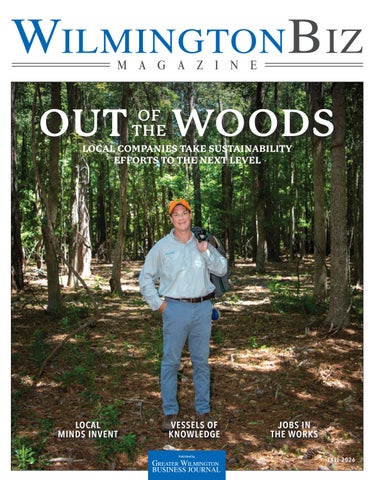
64 For this issue's cover, Daria Amato photographed Bailey Evans, shown measuring a pine tree, for "The Business of Sustainability" on page 40. Evans leads Green Assets, a firm that manages almost a quarter million acres of forestland in the Southeast for carbon credits.
74 w i l m i n g t o n b i z m a g a z i n e . c o m
FA L L 2026
7
8
WilmingtonBiz
M A G A Z I N E
LETTER FROM THE EDITOR
t h e JOB CREATORS
A
recent report placed Wilmington among the top cities nationally when it comes to job growth over the past decade. The city ranked fifth among the 150 largest metro areas in the U.S. for percentage growth of total employment (29.6%) between 2015 and 2025, according to a September report from Economic Leadership, a Shallotte-based research group. And that bump wasn’t just in the early part of the decade. Wilmington continued to see 16.4% employment growth since 2019. Breaking that down, white-collar jobs grew 26.2%, and service-sector jobs grew 12% since 2019, placing Wilmington third and second nationally in those categories, respectively. Behind the stats are the people filling the jobs and people creating the jobs. But who are they, and what are they doing? This year’s economy-focused WilmingtonBiz Magazine issue pulls back the curtain on some of them. Those include major expansions, such as 1,000-plus Amazon jobs in the pipeline or hundreds more added at GE Vernova (read about those and other project updates on page 42) and homegrown inventions that led
w i l m i n g t o n b i z m a g a z i n e . c o m
to manufacturing activities (turn to page 74 to see some of the innovative projects). A la Myth Busters, Built Environments (profiled on page 36) runs its mechanical testing lab on Wright Street to test materials and products under stress. And in the waterways off the coast, faculty, staff and students will embark on more research-driven trips now that Wilmington’s two higher education institutions are getting newly built vessels (find out more on page 64). Throughout the area’s business sectors, innovation looks different from different angles, but throughout the following pages you can learn about those and see where the next batch of jobs might come from.
VICKY JANOWSKI, EDITOR vjanowski@wilmingtonbiz.com
FA L L 2026
9
Wilmington B iz
CONTRIBUTORS
M A G A Z I N E
FA L L 2 0 2 6 – $ 4 . 9 5
D A R I A AMATO DARIA AMATO is a native New Yorker and School of Visual Arts graduate. Throughout her 30 years of experience, she has photographed a range of editorial, advertising, company branding, and corporate clients in addition to music, fashion, portraiture, weddings and still life. Amato has been recognized by The Society of Publication Designers and Graphic Design USA and received an Optima Design Award for best cover photography. Amato photographed the issue’s cover of Green Assets CEO Bailey Evans and for “The Business of Sustainability” (PAGE 30). She also photographed UNCW’s Jay Styron on the R/V Osprey (PAGE 64).
EMMA D I L L EMMA DILL covers economic development and commercial real estate for the Greater Wilmington Business Journal. She moved to Wilmington from her home state of Wisconsin in 2020 and previously covered local government and development issues for the StarNews. For this issue, she writes about economic development trends from the year (PAGE 40), shares updates on major regional projects (PAGE 42) and dives into new research vessels coming to UNCW and CFCC (PAGE 64).
Publisher
Rob Kaiser rkaiser@wilmingtonbiz.com
President
Robert Preville rpreville@wilmingtonbiz.com
Editor
Vicky Janowski vjanowski@wilmingtonbiz.com
Managing Editor
Cece Nunn cnunn@wilmingtonbiz.com
Reporters
Emma Dill edill@wilmingtonbiz.com Cierra Noffke cnoffke@wilmingtonbiz.com
Vice President of Sales & Marketing Matthew Coleman mcoleman@wilmingtonbiz.com
S e n i o r M a r k e t i n g C o n s u lta n t Craig Snow
M a r k e t i n g C o n s u lta n t s Alexis Alphin Jillian Hon Heather Cunningham
Events Director
Jamie Merrill jmerrill@wilmingtonbiz.com
A s s i s ta n t E v e n t s D i r e c t o r
MADELINE G R A Y MADELINE GRAY is a freelance documentary photographer based in Wilmington. With a master’s degree in photojournalism, her work is regularly featured in local and national publications. She enjoys spending time in places that are off the beaten track and collaborating to share the diverse stories found there. Gray photographed Atlantic Packaging’s Wes Carter (PAGE 30) and Built Environment’s test lab (PAGE 36). madelinegrayphoto.com and @madelinepgray on Instagram
Alec Hall ahall@wilmingtonbiz.com
Art Director - Editorial Suzi Drake art@wilmingtonbiz.com
Art Director - Marketing Tara Weymouth tweymouth@wilmingtonbiz.com
M e d i a C o o r d i nat o r s
Tara Sestanovich tsestanovick@wilmingtonbiz.com Lindsay Podraza lpodraza@wilmingtonbiz.com
Office Manager
David Taylor dtaylor@wilmingtonbiz.com
C E C E NUNN CECE NUNN has been writing and editing for nearly 30 years, currently working as managing editor and residential real estate reporter for the Greater Wilmington Business Journal. She talks with Good Shepherd Center executive director Katrina Knight in the WilmingtonBiz 100 profile (PAGE 70) and features area inventors turned manufacturers (PAGE 74).
10
WilmingtonBiz
M A G A Z I N E
Director of Feast Wilmington Jessica Maurer jmaurer@wilmingtonbiz.com
Contributing Photographers
Daria Amato, Madeline Gray, Aris Harding, Terah Hoobler, Jacob Reinwand, Peyton Zino
Subscribe
To subscribe to WilmingtonBiz Magazine,visit wilmingtonbiz.com/subscribe or call 343-8600 x201. © 2026 SAJ Media LLC
w i l m i n g t o n b i z m a g a z i n e . c o m
FA L L 2026
11
PARK & PARTAKE Chow Town,
12
WilmingtonBiz
Wilmington’s first food truck park, officially opened its doors in early August, bringing to life a community-oriented concept that has been two years in the making. The brainchild of co-founders Zeke Nathans and Dynh Le, Chow Town, 1101 N. Fourth St., is intended to spotlight the city’s growing mobile food scene. Nathans is a general contractor, and Le is an entrepreneur who got his start in the beauty business and now owns four Tap Tea Bar locations locally. They first met when Nathans did the construction for Le’s downtown Tap Tea Bar location. Nathans said that while working on construction projects, he and his co-workers often look for food trucks to visit on their lunch breaks. “I feel like they care the most about their food, because most of the time the people who operate the food trucks also own the truck,” Nathans said. “So, they like to have the best food they can, right? I’ve also been to food truck parks around the country, and I just figured Wilmington is a good place to do it.” M A G A Z I N E
BizBites BEHIND THE NUMBERS |
SOUND OFF |
THE DIGEST
|
C-SUITE CONVO
BRANCHING OUT: The
Live Oak Climber is one of the features for children and families at the new Cape Fear Museum of History & Science, drawing attention to live oak trees as one of the state’s most famous natural features. The museum’s new three-story facility at 230 Grace St. opened in August. “We’re basically doubling our exhibit space ... and we are tripling our education space,” said museum director Kate Baillon. The new museum is part of Project Grace, a partnership between the private, Wilmington-based development company Cape Fear Development and New Hanover County to redevelop a county-owned block into a new museum, new main branch of the New Hanover County Public Library and potentially private residential and commercial space. The 95,000-square-foot public portion of Project Grace cost $77 million, but the finishing touches for the Grace Street museum alone, designed by architecture firm LS3P and built by Monteith Construction, cost $21.5 million of the total.
photo by PEYTON ZINO
w i l m i n g t o n b i z m a g a z i n e . c o m
FA L L 2026
13
14
WilmingtonBiz
M A G A Z I N E
NUMBERS $669.6M
NORTH CAROLINA
BEHIND THE
BizBites
bond to fund school improvements in New Hanover County, it will be the single largest bond referendum approved by county voters. Officials say it would reshape the county’s school system for decades. The New Hanover County Board of Commissioners and the New Hanover County Board of Education agreed last November to pursue the bond to fund capital improvements in New Hanover County Schools. They include Phase I of New Hanover High School’s $230 million master facility plan and the construction of new schools. Although districtwide enrollment has declined in recent years, officials say growth has been uneven, with some schools exceeding capacity while others have room available. “The bond is about refreshing our infrastructure, not for the next couple of years, but for the next several decades,” said Christopher Barnes, superintendent of New Hanover County Schools. “What we’re wanting to do is to move from being reactive to emerging needs to being proactive for what’s happening in the future.” If the bond is approved, the tax increase is now estimated to be onehalf cent ($0.005) per $100 of assessed value, or $5 a year for property valued at $100,000. The forecasted increase dropped after the New Hanover Community Endowment announced it would grant $116 million to the county over 10 years for school capital projects approved by the school district’s finance, capital and bond joint committee. The endowment grant, contingent on voters greenlighting the bond this fall, would be the endowment’s single largest commitment to date since the endowment’s creation after the sale of New Hanover Regional Medical Center in 2021. Brunswick County voters will consider a $349.6 million school bond referendum this fall, which would fund the construction of a new elementary school and a new high school. “We are out of seats in quite a few of our schools,” said Brunswick County Schools superintendent Dale Cole. By Cole’s estimation, the county educates close to 400 students in modular trailers. Brunswick County’s school bond was trimmed down from $409 million, a decision made possible by the removal of an additional elementary school. County officials project an increase of about 2.15 cents per $100 of assessed value in 2027, rising in stages to a cumulative increase of about 5.47 cents by 2031, with the caveat that the actual tax impact could be lower depending on growth in the county’s tax base. w i l m i n g t o n b i z m a g a z i n e . c o m
INPATIENT DAYS OF CARE: 5M
PROJECTED DAYS OF CARE: 6M
WILMINGTON
TAXABLE VALUE OF
DOWNTOWN PROPERTY *
2021 2022 2023 2024 2025
$788.1m $723m $780.9m $740m $1.18b
*IN THE CENTRAL BUSINESS DISTRICT
WILMINGTON MSA
IF VOTERS SAY YES TO A $320 MILLION GENERAL obligation
TECH JOB POSTINGS (JULY)
268
POSTINGS
30.7%
YEAR-OVERYEAR CHANGE
WILMINGTON
BY CIERRA NOFFKE
LICENSED BEDS: 20,854
STATEWIDE NEED FOR NEW ACUTE CARE BEDS: 1,758 (225 IN NEW HANOVER)
TOTAL OF THE SEPARATE SCHOOL BONDS ON AREA BALLOTS IN NOVEMBER
SCHOOL BONDS AIM TO UPDATE FACILITIES IN 2 COUNTIES
STATEWIDE HOSPITAL ACUTE CARE SNAPSHOT
UNCW FALL
STUDENT ENROLLMENT
2026
20,556
2025
19,895
2024
18,848
Sources: 2026 State Medical Facilities Plan, Wilmington Downtown Inc., NC Tech, UNCW
FA L L 2026
15
BizBites
VISITORS DON’T JUST SPEND; THEY CAN, AND DO, BECOME RESIDENTS
L
AST MONTH, THE N.C. DEPARTMENT OF COMMERCE RELEASED VISITOR SPENDING DATA. IN PENDER COUNTY, WE EXPERIENCED A SLIGHT INCREASE IN VISITOR SPENDING. Visitor spending impacts our economy. The dollars visitors spend on lodging, dining and entertainment return significant tax revenue to our local economy, provide thousands of jobs and
T A M M Y PROCTOR
support tourism-related businesses. The travel and tourism industry directly employs more than 1,050 in Pender County. The employment impact is even greater in New Hanover and Brunswick counties, in which more than 7,250 and 6,035 work in the hospitality
2 025
VIS I TO R SPEN D I NG BY COU N TY SOURCE: VISIT NORTH CAROLINAECONOMIC DEVELOPMENT PARTNERSHIP OF NORTH CAROLINA
16
sector, respectively. The personal income this generates in all three counties adds nearly $620.4 million. That’s millions of dollars to purchase homes, cars, groceries and more. In the greater Topsail area, during our “peak season” summer months, our population swells to more than 85,000 people per week. That’s more than the year-round resident population of all of Pender County. We locals groan about traffic. We complain about the visitor who doesn’t understand how a roundabout func-
BRUNSWICK
TOTAL: $1.24B LODGING: $306M FOOD & BEVERAGE: $383M RECREATION: $185M RETAIL: $113M TRANSPORT: $257M
WilmingtonBiz
M A G A Z I N E
tions. We moan when we can’t dine at our favorite restaurants on a Saturday. Yet, their visits channel revenue into the community. This is my mantra when I find myself “inconvenienced.” My temporary inconvenience is good for our overall economic health. Visitor spending is profitable for residents too. According to state data, visitor revenue saves each taxpayer $230.46 per resident in Pender County. In Brunswick, the savings per resident is significant at $509.37, and in New Hanover, the savings is $344.60 per resident. Besides, I love talking to visitors about all our region has to offer: our natural resources, our history and our sense of community. I love listening to their vacation experiences and the joy they feel over the things we take for granted. Many of us started our Eastern
NEW HANOVER
TOTAL: $1.2B LODGING: $311M FOOD & BEVERAGE: $383M RECREATION: $154M RETAIL: $90M TRANSPORT: $267.5M
PENDER
TOTAL: $203M LODGING: $51M FOOD & BEVERAGE: $64M RECREATION: $31M RETAIL: $18M TRANSPORT: $39M
PHOTO BY SUZI DRAKE
SS O OU UN ND D OFF
BizBites
CROWDSOURCING REACTIONS, OPINIONS AND QUOTABLES FROM OUR ONLINE SOUNDING BOARDS
O N FA C E B O O K . C O M / W I L M I N GT O N B I Z READER POLL: THE WILMINGTON AREA HAS SEEN AN INFLUX OF NEW GAS STATION-CONVENIENCE STORE CHAINS IN RECENT MONTHS. WHICH ONE IS YOUR FAVORITE AND WHY? “ I MEAN I’M GLAD THAT WAWA IS HERE and all … Sheetz was a nice addition as well but I’m not really sure that we need one on every corner or in every vacant space. I mean … we went through this in the last decade with mattress stores and storage units and car washes. Now it’s vape shops and convenience stores … But why don’t we have a Buc-ee’s?” –SUZANNE HOSKINS “ WE ARE PRETTY CIRCLE K LOYAL due to their cheap slushees and fountain drinks.”–BRETT BURCHAM WEAVER “ SHEETZ-BEST, cleanest restrooms! Good food!” –IOMA W. HOBBS “ Hands down it’s HAN-DEE HUGO’S!” –LAURA PAUL SMITH
“ WAWA. LOVE THEM! Been going to them for years in other states.”–SUZEN GREENE “ WE NEED A QT INVASION. Best gas station in America”–K.C. MORRIS “ WAWA BEST COFFEE, Sheetz best food”–MICHAEL ALLEN BUMGARDNER
X POLL: @WILMINGTONBIZ
ARE WILMINGTON WAGES KEEPING UP WITH THE COST OF LIVING?
Tammy Proctor is executive director of the Greater Topsail Area Chamber of Commerce and Tourism.
YES
85.7%
14.3%
W I L M I N GT O N B I Z . C O M “ WE’RE DEDICATED TO BUILDING THE INNOVATION COMMUNITY IN WILMINGTON ACROSS THE BOARD.
NORTH CAROLINA
TOTAL: $37B TOURISM EMPLOYMENT: 230,997 STATE TAXES GENERATED: $1.4B LOCAL TAXES GENERATED: $1.3B STATE/LOCAL TAX SAVINGS PER RESIDENT: $243.67
NO
VED
North Carolina residency as visitors. We visited. We fell in love with the coast, the rivers and the sense of community. And we relocated. Some retire here. Some start businesses here. Some visitors relocate their businesses to our region. Some visitors become residents who volunteer and contribute to our nonprofits. Regional growth has been a hot topic of conversation – not only in Pender County, but in New Hanover and Brunswick counties as well. While growth challenges us, it’s better than living in a declining or depressed area where public services suffer, homes are difficult to sell, educational institutions suffer and jobs are lost. Our visitors may become tax-paying homeowners, shoppers, business owners, church members and volunteers because we live in a vibrant, growing region. The COVID-19 pandemic brought many visitors to the greater Topsail area who wanted to remove their families from larger cities. Many of them found they could work remotely at the beach. Many never returned to city life. Therefore, “inconvenienced” or not, we welcome our visitors – regardless of whether it’s just for a weekend, a week, a month or a lifetime. Visitors have value.
We’re not focused only on tech entrepreneurs or only on youth – we’re really looking to build that funnel.”
-HEATHER MCWHORTER, DIRECTOR OF THE CENTER FOR INNOVATION AND ENTREPRENEURSHIP (CIE) AT UNCW. ACCORDING TO THE CENTER'S ANNUAL REPORT, 300 ENTREPRENEURS GAINED SUPPORT FROM CIE DURING FISCAL YEAR 2026. SIGN UP FOR DAILY NEWS UPDATES AND SUBSCRIBE TO THE GREATER WILMINGTON BUSINESS JOURNAL AT WILMINGTONBIZ.COM
w i l m i n g t o n b i z m a g a z i n e . c o m
FA L L 2026
17
18
WilmingtonBiz
M A G A Z I N E
SOUND OFF
BizBites
THE AREA’S JOB AND WAGE GROWTH: ARE THEY TELLING SIMILAR STORIES?
N
ORTH CAROLINA’S LABOR MARKET HAS PERFORMED WELL. AS OF JUNE, TOTAL NONFARM EMPLOYMENT IN THE STATE STOOD 11.3% ABOVE ITS PRE-PANDEMIC LEVEL, A PERFORMANCE THAT RANKS 7TH AMONG ALL STATES. THAT IS A STRONG NUMBER BY ANY STANDARD, AND THE LOCAL STORY: WILMINGTON’S IS EVEN STRONGER, BUT SLIGHTLY MORE COMPLICATED. Wilmington has consistently outpaced North Carolina. Over the past four years, the metro has never ranked worse than 4th among North Carolina’s 15 metro areas in employment growth, and in 2021 and 2022, it was the fastest-growing metro in the state. Its post-pandemic average annual growth rate, 4.14%, is more than double its pre-pandemic pace of 1.9%, an acceleration exceeded by only one other North Carolina metro – Raleigh. The area’s population has grown accordingly, from roughly 423,000 residents in 2020 to nearly 493,000 in 2025. Where that growth is coming from adds an important qualification. Education and Health Services has grown 72.3% in the Wilmington region since 2019, more than double the pace of any other local sector and well ahead of where healthcare employment ranks among industries statewide.
MOUHCINE GUETTABI Some of that figure is real growth, and some of it is an accounting artifact. The hospital’s sale during this period moved a large block of jobs off the government payroll and onto the private Education and Health Services sector. Government, as a result, is the only major sector in the region with negative cumulative growth since 2019, and the healthcare sector’s growth rate is correspondingly inflated by the same transaction. Even with that qualification, healthcare employment in the region is still expanding faster than any other sector, but the 72.3% figure overstates how much of that growth reflects new hiring rather than jobs that simply changed columns. The wage data provide us with an additional lens through which we can understand the area’s evolution. Wilmington has posted the fastest cumulative wage growth of any North Carolina metro since 2019. Its average weekly earnings rose 52%, from $742 to $1,129, with the metro currently holding the 5th-highest wage level among the state’s 15 metros. Over the most recent 12 months, that wage growth paused, with the average weekly wage dipping 1% even as the statewide average rose 1.8%. While the recent wage growth softening is not cause for concern, it
w i l m i n g t o n b i z m a g a z i n e . c o m
is worth noting alongside the sector composition point above. Wage growth and employment don’t always move in lockstep, but they are both important since they give us complementary pieces of information. Wilmington’s overall position, strong job growth, strong cumulative wage growth and a wage level solidly in the upper half of the state remains a good one. Wilmington’s growth is impressive and perhaps more importantly, it goes well beyond the tourism and construction industries the region is usually associated with. Healthcare, even after accounting for the hospital sale, is playing a significant role in that growth. The wage picture tells much the same story, as Wilmington has the fastest cumulative wage growth in the state since 2019, and a wage level that now ranks in the top third of North Carolina’s metros. The reclassified jobs and the wage pause are footnotes to a strong run for Wilmington's labor market. Population here is still growing faster than nearly anywhere else in North Carolina, and whether wages keep pace with that growth will say more about the region’s economy than either number does on its own. Mouhcine Guettabi is a regional economist with UNCW’s Swain Center and an associate professor of economics at UNCW’s Cameron School of Business. He’s slated to share more details about the region’s economy Oct. 1 at UNCW’s Economic Outlook Conference, which is part of the Spark ILM event. For event details, go to sparkilm.com. FA L L 2026
19
20
WilmingtonBiz
M A G A Z I N E
BizBites
A R O U N DU P O F R E C E N T NE WS FILE PHOTO
DIGEST THE
RENDERING C/O YMCA OF SOUTHEASTERN NC
FIRM PLANS TO EXPAND FACILITY
CREWS BEGIN BUILDING MAJOR EXPANSION OF MIDTOWN YMCA
F
lorida-based 4th Dimension PropConstruction started this summer on the YMCA of Southeastern North Carolina’s $15 million midtown Wilmington expansion. The project will include transforming the midtown location’s existing 16,000-square-foot facility at 709 George Anderson Drive into a 48,000-square-foot, full-service community wellness center with an eight-lane pool and other features. Crews began site work in August, with construction expected to be complete about 15 months after the start. “More than 15 years ago, our Y realized that it could no longer effectively support and serve our community from just one location on Market Street,” said Dick Jones, president and CEO of the YMCA of Southeastern North Carolina, at a groundbreaking ceremony at the end
of July. “As our community continues to grow, the Y needs to keep pace with that growth.” About 10 years ago, the Y partnered with Temple Baptist Church to offer services at one of its properties, before buying the midtown Wilmington site from the church for the expansion. In addition to the pool, the expanded Midtown YMCA is set to include: • Expanded childcare and youth development classrooms • Dedicated group exercise studios • Community meeting and gathering spaces • Senior wellness areas • Three locker rooms • Expanded parking • A covered outdoor “airnasium” featuring a full-size basketball court, three pickleball courts, futsal goals and multi-purpose recreation space
TO STAY I N T H E LO O P O N T H E L AT E ST AR E A B U S I NE S S HA P P EN IN GS , CHECK OUT OUR DA I LY A F T ER NOON NE W S L E T T E R . S I G N U P AT WILM IN GTON BIZ.COM .
w i l m i n g t o n b i z m a g a z i n e . c o m
Brunswick County officials in August approved Victaulic’s plan to expand its Leland Innovation Park facility, a measure that will allow the company to grow local capabilities and create new jobs. The proposed 230,000-square-foot addition would more than triple the company’s current 108,135-square-foot facility at 2010 Enterprise Drive NE in Leland. It will expand the facility’s manufacturing and warehouse capacity and house new automation equipment to support product lines for commercial, industrial and missioncritical builds, according to Victaulic officials. The Pennsylvania-based company makes mechanical pipe joining, flow control and fire protection products and currently employs around 500 people at its Brunswick County facility. The expansion will create jobs, ranging from production and labor positions to office-based opportunities, officials said.
$1.26
BILLION
Anticipated cost of infrastructure projects in Novant Health’s local master facility plan for the coming years Source: Novant Health
FA L L 2026
21
22
WilmingtonBiz
M A G A Z I N E
BizBites
C-SUITE C O N V O
A
A RETURN T O L E A D
SSUMING THE ROLE OF CEO OF THE YWCA LOWER CAPE FEAR IS A FULL-CIRCLE MOMENT FOR JHANIQUA PALMER, WHO JOINED THE ORGANIZATION IN 2019 AS COORDINATOR OF ITS GRANDPARENT SUPPORT NETWORK. NOW, NEARLY EIGHT YEARS AFTER FIRST WALKING THROUGH THE DOORS OF THE WILMINGTON ORGANIZATION, PALMER HAS RETURNED TO LEAD IT INTO ITS NEXT CHAPTER. Palmer talks about the YWCA’s mission and current capital projects in this recent Q&A. To read more from the interview, go to WilmingtonBizMagazine. com. WHAT MADE YOU WANT TO TAKE THE YWCA LOWER CAPE FEAR CEO ROLE?
“The YWCA’s mission has always resonated deeply with me because it reflects both my personal and professional journey. In 2019, I came to the YWCA seeking a place where I could feel empowered after experiencing pay inequity in my career. What I found was an organization committed to creating opportunities, advancing equity and uplifting women. That experience left a lasting impact on me. When the opportunity arose to serve as CEO, it felt like a chance to return to an organization that had
delegate. These experiences broadened my perspective, strengthened my leadership and deepened my commitment to advancing equity and justice.” HOW WOULD YOU DESCRIBE THE LOCAL GROUP’S CURRENT MISSION AND OVERALL FOCUS GOING FORWARD?
JHANIQUA PALMER CEO, YWCA LOWER CAPE FEAR
invested so much in my growth and to give back in a meaningful way. I wanted to continue the work of empowering women and families while expanding the organization’s impact throughout our community.” WHAT’S BEEN YOUR TIE TO YWCA?
“I began my journey with YWCA Lower Cape Fear as the coordinator for the Grandparent Support Network, a program founded by Evie Nicklas. Evie became far more than a supervisor; she became a mentor, role model and dear friend. … Through my years at the YWCA, I had the privilege of building meaningful relationships with the families we served. … Later, I had the opportunity to serve at YWCA USA, our national office, which was one of the most transformative experiences of my life. I worked alongside nationally recognized advocates, attended the 60th anniversary of the March on Washington, helped create national convenings, supported the National Board of Directors and attended the United Nations Commission on the Status of Women three times as a
w i l m i n g t o n b i z m a g a z i n e . c o m
“The YWCA Lower Cape Fear’s mission has always been rooted in empowering women, strengthening families and building a more equitable community. As we look toward the future, our focus is centered on three key priorities: strengthening childcare, expanding supportive programs for women and families and revitalizing our Aquatics Center.” THE LOCAL YWCA HAS BEEN WORKING ON A $10 MILLION CAPITAL FUNDRAISING CAMPAIGN IN RECENT YEARS. WHAT IS THE FUNDING FOR, AND WHERE DOES THE CAMPAIGN STAND NOW?
“Our capital campaign has evolved to focus on one of our community’s most valued resources: the YWCA Aquatics Center. We are incredibly grateful for the generosity and support we have already received from donors, partners and community members who share our vision for the future. The Aquatics Center has served generations of families since it was built in 1979. Today, we are focused on raising the funds necessary to renovate and modernize the facility so that it remains safe, accessible and sustainable for generations to come. These improvements will allow us to continue providing wellness, recreation and lifesaving water safety opportunities to our community for years ahead. At the same time, we remain FA L L 2026
23
BizBites committed to supporting the programs that directly impact women, children and families every day. We continue to welcome donations for initiatives such as the Grandparent Support Network’s holiday assistance program, which has been generously supported by First Presbyterian Church for many years, as well as childcare scholarships that help families access high-quality early childhood education, as well as our Early Parenting Programs and our expansion of the Grandparent Support Network in Columbus County.” ONE OF THE MORE VISIBLE PROJECTS UNDER THIS IS THE CURRENT AQUATICS CENTER RENOVATION. WHAT ARE THE DETAILS OF THAT PROJECT?
“The project began on Aug. 2 and is focused on enhancing both the functionality, accessibility and sustainability of the facility and the overall experience for our members. To date, we have completed extensive retiling of the pool, removed trees and begun site preparation for a new climate-controlled storage building. This new structure will safely house the pool bubble and tarp, helping to protect these valuable assets and extend their lifespan. Additional improvements include rough-in work for electrical, plumbing and HVAC systems, as well as addressing long-standing infrastructure concerns. One important accomplishment has been identifying the source of flooding during heavy rain events, allowing us to implement solutions that will better protect the facility. We have also repaired and patched concrete throughout the building to improve safety and appearance. While construction is underway, we are especially grateful for our partnership with New Hanover County Parks & Gardens at Echo Farms. Through their generosity and collaboration, our members continue to enjoy access to high-quality aquatic facilities without interruption.”
24
WilmingtonBiz
M A G A Z I N E
w i l m i n g t o n b i z m a g a z i n e . c o m
FA L L 2026
25
Khristen Hunter (from left) and Cheyenne Jones at Patty's Place
COMFORT
T 26
FOOD WilmingtonBiz
M A G A Z I N E
PATTY’S PLACE: A DREAM COME TRUE FOR KHRISTEN HUNTER
A
BY BETH A. KLAHRE | PHOTOS BY PEYTON ZINO
s a young girl, homemade biscuits and gravy was one of the first dishes that Khristen Hunter’s mom, Patty, taught her to cook.
Last December, Hunter’s lifelong love of cooking and a $1 million prize package she received through the nationwide Own Your Own competition after the original winner withdrew led to Patty’s Place. She was able to create the modern diner serving Southern-style brunch by transforming two buildings at 106 and 108 W. Courthouse Ave. in Burgaw. “I was speechless,” Hunter said when she learned she had emerged as the winner of Own Your Own after the original winner opted not to move forward. “This was something I dreamed about my entire life.” Hunter’s first call was to her mom, the restaurant’s namesake, and her dad, her biggest cheerleader. Along with the prize, Hunter was awarded a team of designers from Chris Cahill Interior Design, restaurant equipment from Jacobi-Lewis Co. and a construction crew from Masonboro Construction Co. to work with on the transformation. “The buildings needed a lot of love. They had not been occupied for years,” Hunter said. Hunter’s journey to owning a restaurant began when she saw an advertisement for Own Your Own on Facebook. “So, I clicked on it,” she said. w i l m i n g t o n b i z m a g a z i n e . c o m
Wilmington-based entrepreneur Richard Johnson launched Own Your Own after starting Burgaw Now in 2018 as a town revitalization project. Burgaw Now was formed to invest in businesses that revitalize the town. Before Own Your Own, Burgaw Now sparked two new establishments in Burgaw: Fat Daddy’s in 2020 and Burgaw Brewing in 2023. Twenty-four finalists, selected from a pool of 500 applicants, competed in the Own Your Own cook-off in the Burgaw town square in October 2023. Open to the public, over 200 community members crowded the heart of the town. A volunteer group of 30 residents, along with official judges and Johnson, taste-tested the dishes and selected the final 12. The contestants faced challenges at three local restaurants, which narrowed the field to six, who then presented business plans and financial statements to the judges. While Hunter was one of the six finalists, she did not win the contest that day, later hearing the news that she would be an Own Your Own recipient from Johnson because of the winner’s withdrawal. She then focused on her vision for Patty’s Place. “I wanted to open my own restaurant to see my food put smiles on faces,” she said. “I had been running other people’s restaurants my entire life. Now I wanted to take that knowledge and turn it into my own well-oiled machine.” Hunter decided Patty’s would serve brunch and lunch all day long. “I wanted to be the restaurant where people start their FA L L 2026
27
day on a positive note with good food, fresh coffee, signature lattes and great company,” she said, not to mention that breakfast is her personal favorite meal of the day. “I started thinking about how to bring the heart of the home to every plate,” she said. “Our open kitchen concept gives Patty’s a modern diner-style feel. It’s a cozy atmosphere; everyone feels right at home and very comfortable from the moment they walk in the door. It’s a home-awayfrom-home vibe.” The menu, developed by Hunter and her co-owner/partner, Cheyenne Jones, includes traditional breakfast plates like omelets and eggs Benedicts, plus playful items such as pancake tacos. Hunter said she uses as many local products as possible in her crowd-pleasers, like her savory green onion and cheddar waffle, topped with fried chicken, hot honey, green onions, cheese and bacon. “It’s truly a fan favorite,” she said. On Jan. 5, Hunter and Jones ceremoniously cut the ribbon to Patty’s Place. The restaurant opened with general manager Catherine Tedder, Hunter’s best friend of 12 years, who relocated from Virginia to help Hunter run the business, and kitchen manager Ivey Pace. Originally from Climax, North Carolina, and most recently living in Wilmington, Hunter relocated to Burgaw to open Patty’s Place. “There are a lot of great restaurants in Wilmington, but nothing like Patty’s Place,” Hunter said. “Patty’s is a place to come and relax and enjoy the small-town vibe. Take a break from the busy city and enjoy our homemade food, grab a coffee and go explore all of Burgaw’s shops and stores within walking distance.” As Hunter prepares the heirloom recipes she grew up with on the family farm, she is building her own legacy. It’s more than just the great food. “Becoming a part of the fabric of the Burgaw community was a lot of fun,” she said. “Getting to see my staff and customers always so happy and enjoying themselves is the best. At Patty’s Place, you’re not just a customer; you’re family.” For more restaurant news, sign up for the bi-weekly Feast Unwrapped email newsletter. Subscribe at FeastWilmington.com.
28
WilmingtonBiz
M A G A Z I N E
Jay Styron, assistant director for marine operations at UNCW's Center for Marine Science, is shown on the university's new research vessel, R/V Osprey. The new boat is expected to take the research UNCW can do to the next level.
30
WAYS TO SUSTAIN
36
MATERIAL CONCERNS
40
ECONOMIC TRENDS
42 64 70 74
BIG PROJECTS BUOYING RESEARCH BIZ 100 PROFILE LOCAL INVENTORS
ECONOMIC I M PA C T S 2 0 2 6 photo by DARIA AMATO
w i l m i n g t o n b i z m a g a z i n e . c o m
FA L L 2026
29
E CO N O M I C I M PA C T S 2 0 2 6
THE BUSINESS OF SUSTAINABILITY
T
BY CIERRA NOFFKE
WO WILMINGTONROOTED COMPANIES ARE RAISING THE STAKES ON SUSTAINABILITY.
Both Atlantic Packaging, a packaging solutions firm, and Green Assets, a land management and consulting firm, are embracing strategies that integrate sustainability directly into their business models. Beyond a one-time solution, each firm is betting on the eventual evolution of each industry – and the market’s role in putting a price on sustainability.
CLOSING THE LOOP ON PACKAGING
Atlantic Packaging, which has been operated by three generations of a North Carolina family, has evolved from a small weekly newspaper to one of the largest privately owned packaging firms in the country. Led by company president Wes Carter, the firm produces packaging materials from stretch film to shrink sleeves, corrugated cardboard to cartons. And it has taken a hard stance in its approach to sustainability, according to Carter. While the firm certainly plays a hand in developing single-use products, like stretch wrap, it has also committed to maximizing the use-cases of its products, creating sustainable alternatives and evolving the packaging industry from the inside out, Carter said. “Industry can create incredible benefits, but industry has also created a lot of unintended consequences that we are facing today,” he said. “My perspective is, industry is the only mechanism that can actually shift these things as well.”
30
WilmingtonBiz
M A G A Z I N E
According to Caroline DeLoach, Atlantic Packaging’s director of sustainability, the company uses two core principles in its approach: 1) to use as little material as possible and 2) to create closed loops wherever possible. Atlantic Packaging takes a “circular economy” approach, instead of a traditional linear approach, DeLoach said. Instead of using resources to create products that are disposed of after a single use, the firm focuses on keeping materials in circulation longer, whether through reuse or recycling. “Within life cycle thinking (LCT) of any given product, you can assess the water use, the energy use, the greenhouse gas footprint, the waste potential, the ecotoxicity, and sometimes these things can stand at odds with each other,” DeLoach said. “There’s rarely just one ‘most sustainable’ option. I wish that it were that simple.” Carter added that the firm rarely uses a “black-and-white” approach to packaging solutions. “This is super nuanced,” he added. “Certain types of plastic are incredibly efficient. … In those cases, we’re not focused on replacing them; we’re just focused on closed loops. There are other areas like e-commerce, where that’s low-hanging fruit to migrate to more natural materials like fiber-based materials.” Atlantic Packaging launched its core sustainability initiative, A New Earth Project, in 2021, with the mission of ridding “the world’s oceans, lakes and rivers of plastic pollution.” Through collaboration and research, A New Earth Project aims to find sustainable packaging solutions for common single-use packaging products. The catalog includes items such as fiber-based zip ties, water-activated tape and
photos c/o ATLANTIC PACKAGING
Some of Atlantic Packaging’s sustainable packaging solutions include Fishbone paperboard carriers for cans and bottles (clockwise from top right), Ibis Cycles fiber-based, recyclable packaging, Sway seaweed-based packaging and FibreStrap paper cable ties.
w i l m i n g t o n b i z m a g a z i n e . c o m
FA L L 2026
31
32
WilmingtonBiz
M A G A Z I N E
E CO N O M I C I M PA C T S 2 0 2 6 Wes Carter, president of Atlantic Packaging, at the company’s corporate headquarters in Wilmington
seaweed-based Sway Polybags, intended as a replacement for plastic. DeLoach said Atlantic Packaging occupies a middle ground in the supply chain, meaning it can draw from a variety of suppliers while staying data-informed and impartial. “That gives me a kind of academic honesty with our customers to talk about the sustainability merits of different kinds of packaging,” she said, “instead of feeling beholden to spinning a sustainability story about a specific material because we happen to make it.” DeLoach is optimistic about the potential of policies to improve the industry, pointing to California’s extended producer responsibility (EPR) program under California State Senate Bill 54, which puts the
financial and physical responsibility for managing single-use products and waste on the companies that sell or import them. The program comes with incentive bonuses and penalty fees for companies. “I’m a big believer in the ability for policy to make change, but I’m even more of a believer in marketbased policy being able to make change,” said DeLoach. “And that’s what excites me about EPR. … It’s creating economic incentives, and that’s big.” Carter said, “We’re not going to create a sustainable packaging supply chain that is adjacent to the current packaging supply chain. What we can do is harmonize around values, … identify technologies that we can integrate with the current supply chain, and over six, eight, 10 years, we won’t create a new supply
w i l m i n g t o n b i z m a g a z i n e . c o m
”
photo by MADELINE GRAY
Industry can create incredible benefits, but industry has also created a lot of unintended consequences that we are facing today. My perspective is, industry is the only mechanism that can actually shift these things as well. WES CARTER president of Atlantic Packaging
FA L L 2026
33
E CO N O M I C I M PA C T S 2 0 2 6
chain; we’ll evolve the current one.”
A PRICE ON CONSERVATION
The forests of the Southeast are also known as the country’s “wood basket,” as they contain hundreds of tree species and produce over half the country’s timber. Another firm based in Wilmington, Green Assets, is working to preserve parts of those forests by turning them into carbon projects for landowners. According to Green Assets CEO Bailey Evans, the firm manages almost a quarter million acres of forestland in the Southeast for carbon credits. Green Assets works with plenty of landowners who own older forests, Evans said, and there’s been new interest from landowners seeking a legacy commitment. If a landowner wants to keep land in the family for the next 200 years, engaging in a carbon credit project can ensure the land stays green and protected for decades, he said. The company was founded by Hunter Parks in 2010, after Parks successfully used his own family land to complete a carbon offset project. “Because of that experience, he founded Green Assets, and our tagline is that we like working with landowners because we own land,” Evans said. “We know what the experience is like to sit across the table from someone pitching you an environmental project.” In 2015, the company announced it had completed the first-ever compliance-grade avoided conversion carbon offset project in the United States, covering roughly 3,700 acres near Charleston, South Carolina. After Parks died in a plane crash off the Outer Banks in 2022, Evans, then vice president, stepped into the CEO role to continue Parks’ legacy. For Evans, carbon credits are a type of “conservation finance,”
34
WilmingtonBiz
allowing landowners to reap monetary benefits from their land without converting it into a timber forest. When a landowner agrees to an avoided conversion project, or a commitment to keeping land forested, they sign a conservation easement legally bound to the land’s deed. “That’s a pretty big step for landowners to do conservation easements,” Evans said. “It often gets underplayed.” Green Assets designs the entire carbon project, collects data and works with registered third-party auditors to ensure the data complies with a myriad of standards. Crews gather forestry data by taking a carbon inventory or measuring trees within a certain diameter around each plot of land. “Once we collect that data, we have to quantify the carbon that’s stored on-site and model the forest growth moving forward to figure out how many metric tons of carbon dioxide equivalent are stored on the property and will be stored on the property as the forest grows,” Evans said. The verification process typically takes a year, Evans said, to meet the industry’s rigorous compliance standards. Auditors must remeasure every plot to verify each project, and then the projects move through a carbon crediting program that issues the carbon credits. As for who pays, Evans said Green Assets shoulders the cost of the project – which means it will only reap benefits if the project is successful. “The whole point of doing that was basically to say to the landowner, ‘We understand that this is a big commitment for you, and we want to demonstrate that we have some skin in the game here,’” Evans said. “We have a 100% success rate because of that business model,” he added. “We’ve never judged a project that’s not going to be able to be seen M A G A Z I N E
all the way to the very end.” Green Assets also offers “improved forest management projects” targeted toward landowners who want to keep foresting their land while generating carbon credits with practices that reduce logging impact and can yield longer-term wood products. “We’re proud supporters of the forest products industry,” Evans said. “It’s important that mills are fed with high-quality wood, but certain landowners might not want to (harvest) on a scale that would be required to generate the amount of income that they were hoping for, and that’s where carbon (credits) can come into play.”
ROOTED RESPONSIBILITIES
From grassy marshlands abundant with life to its rich forestlands, the Southeast harbors many well-known natural elements, including thousands of species of trees, birds, fish, plants and animals. While Atlantic Packaging, which, as a privately run firm, doesn’t have to report its sustainability impact or indirect greenhouse gas emissions, Carter said it does so because of a moral fortitude established by his grandfather and an obligation to the place he once called home. “The whole awakening around the impact that industry is having, the plastic pollution crisis and how it’s affecting our oceans, is a direct derivative of growing up at Wrightsville Beach,” he said. “If it weren’t for Wilmington and Wrightsville Beach, would any of this be happening? I doubt it.” Similarly, Green Assets takes responsibility for properly conserving hundreds of acres of forest land, primarily privately owned. While both industries continue to evolve and the responsibility of sustainable packaging and conserved land grows, those studying the problem say one thing remains true: The work is far from over.
E CO N O M I C I M PA C T S 2 0 2 5
”
Bailey Evans is head of Green Assets, a Wilmington-based company that creates sustainable conservation projects. photo by DARIA AMATO
w i l m i n g t o n b i z m a g a z i n e . c o m
It’s important that mills are fed with high-quality wood, but certain landowners might not want to (harvest) on a scale that would be required to generate the amount of income that they were hoping for, and that’s where carbon (credits) can come into play.
”
BAILEY EVANS, CEO of Green Assets
FA L L 2026
35
E CO N O M I C I M PA C T S 2 0 2 6
THIS PAGE: Principal engineer Luke Snyder runs a test in the lab at Built Environments in Wilmington. OPPOSITE PAGE: Technical specialist Mel Vanterpool (from left) and Jarrett Davis, Built Environments' principal building scientist, prepare to shoot a two-by-four at a plywood wall.
36
WilmingtonBiz
M A G A Z I N E
E CO N O M I C I M PA C T S 2 0 2 6
W EAT H E R WISE
COASTAL FORCES SHAPE BUILDING SCIENCES PRACTICE BY ERIC WILLIAMSON | PHOTOS BY MADELINE GRAY
W
hen Built Environments relocated to Wilmington, the firm’s partners weren’t looking for the lazy tranquility one hopes for when on vacation. Instead, they sought sultry heat. They wanted to understand whipping coastal winds and punishing precipitation – the kind that tropical storms produce. That’s because how materials degrade can reveal a lot about how they can be improved. “We specifically chose the Wilmington market because it does fall within Climate Zone 3A, which is a coastal warm-humid climate,” said Jarrett Davis, who joined Built Environments in 2023 to lead the company’s building science practice. “There’s not a lot of product research in that climate zone, but there are a lot of structures here that get weatherized pretty severely.” Built Environments has provided building science, material testing and code compliance consulting for 25 years, ever since principal materials scientist Steve Doggett founded the company in Minnesota. “There are very few manufacturers that understand fully how their own materials and products work, whereas we know their shortfalls and their benefits out in the real world on jobsites,” Doggett said. “That’s why the original Built Environments was formed, to make buildings better.” He said the 15-employee company is just as comfortable on a jobsite, retrofitting a high-end beachside property, for example, as it is recreating some of the coast’s most intense weather conditions in the great indoors. The company operates an A2LA-accredited ISO/IEC 17025 mechanical testing laboratory on Wright Street. The year-old facility has expanded Built Environments’ in-house capabilities, Doggett said. “We’re able to simulate that hurricane wind (and) rain and perform structural and impact testing on wall assemblies, roof assemblies and glazing assemblies,” he said. “There are certain requirements that those windows and doors need to meet as far as wind ratings and pressure w i l m i n g t o n b i z m a g a z i n e . c o m
ratings and things of that nature.” Standard Glass Co.-Glass Depots, of Wilmington, is currently testing a new glazing system using Built Environments’ stress testing, the partners said. One method involves what’s called a “large missile cannon.” “We take 8-foot two-by-fours, and we shoot them at assemblies, so they have to withstand that impact,” Davis said. “It’s pretty cool to see, I’m not going to lie.” In many cases, the lab can run a full, wall-scale test of a product in a matter of weeks or months, whereas “it might take midrange manufacturers years,” Doggett said. “We’re nimble. We can cut that time in half.” The lab also develops intellectual property. Doggett, for example, shares a patent with Sustant LLC, of Minnesota, on a fastener patch to increase the air and water tightness within building envelopes. “We have too many ideas and not enough time,” he said. But the partners noted that they or their fellow principals – of which the company has four total, including a principal engineer and a principal codes and standards expert – could be anywhere on a given day, including in the courtroom providing expert testimony in contentious insurance cases. “Let’s say there is a fire on a structure,” Davis said. “We can analyze all the specific materials within that assembly FA L L 2026
37
E CO N O M I C I M PA C T S 2 0 2 6
– an exterior wall or something like that – because there are loads that require certain heat release. And so, we can measure each one of those materials, if need be, to say if this was likely or not a code-approved assembly.” Despite what can be inferred in a lab, the partners said nothing beats learning from how materials change over time under real-world strain. Take, for instance, the curious case of the creaking condo. “We recently had a customer that came to us trying to assess a sound issue of a roof. It was making noises that no one could explain or account for. How do you tackle something like that?” Doggett asked rhetorically. “There’s really no generally agreedupon methodologies.” The problem turned out to be a faulty installation of a commercial roof system. “The building in this particular case was not local,” he said. “In the initial installation, the commercial roofing contractor installed the wrong fasteners in the wrong locations into the deck, and essentially the solar radiation was causing the building to move quite substantially early in the morning when the sun initially hit that assembly after a quite cool evening, causing the threads on the fasteners to kind of jump within the material, within the metal.” Built Environments designed an effective repair methodology that was within budget, the partners said. “We get the bizarre,” Doggett said. “I will say that’s something that has stayed the same over 25 years.” The partners said they are hiring, and that Cape Fear Community College is one of their main recruiting grounds. Davis and Doggett look for talented people who can understand traditional methodologies yet are open to on-the-job training and new understandings, they said. After all, it’s not just weather that can ruin a building. “My favorite saying is,” Davis said, “‘What are the eight most expensive words in construction? That’s how my daddy used to do it.’”
38
WilmingtonBiz
M A G A Z I N E
w i l m i n g t o n b i z m a g a z i n e . c o m
FA L L 2026
39
TO WATC H
TRENDS
TRENDS
I
n 2026, economic development trends impacting the Wilmington region encompass a range of sectors and areas of growth potential, from a roadmap for investment at the Port of Wilmington to new industrial spaces, competing healthcare systems and the extension of water and sewer pipelines. –EMMA DILL
40
WilmingtonBiz
1
2
FILM AT RISK?
PORT PLANNING
When state legislators approved a $34 billion budget this summer, it included updated incentives for Wilmington’s film industry, which has lagged in recent years. Local legislators touted the updated incentives to keep film crews in North Carolina and Wilmington amid competition from other states. But officials with the N.C. Department of Commerce, which administers the film grant program, have said all the state’s film grant funds are committed through 2029. Commerce officials have said the funding structure likely means the state will not be able to award any significant film grants to new productions until then. The new state budget increased the maximum state grant for a feature film from $7 million to $20 million, and the maximum state grant for a TV series or scripted streaming service series rose from $15 million to $25 million per season. It also included a new microbudget production grant fund of about $1.2 million annually for North Carolina-based productions with budgets between $50,000 and $1.5 million, along with a new 5% bonus for production companies investing $80 million or more across multiple productions within 24 months.
The N.C. State Ports Authority released a new strategic plan this year to guide the organization over the next five years. Amid recent impacts from global shipping and trade shifts, port officials say the plan offers a roadmap for growth. The plan identifies four focus areas. For the port’s container segment, that includes becoming a preferred port by North Carolina businesses and the cold gateway of the Mid-Atlantic. On the general cargo side, the plan includes increasing bulk cement, fertilizer and forest product volumes and seizing breakbulk opportunities, such as growing paper, project cargo, lumber and steel. N.C. Ports is targeting average annual container growth of 12%, resulting in about 337,000 TEUs in 2031, and 54,000 refrigerated TEUs annually. The organization is also targeting a year-over-year increase in general cargo volumes of 7%. Port officials say the plan would position N.C. Ports to generate $19 billion in annual economic output by 2031. A proposal to deepen Wilmington’s harbor from 42 feet to 47 feet is also moving ahead. The U.S. Army Corps of Engineers issued a final report this year on the $1.35 billion proposed project, moving it up the federal approval ladder.
M A G A Z I N E
TRENDS
3
4
5
BUILDING SPACE
HEALTHCARE POTENTIAL
PIPELINE SUPPORT
Industrial buildings continue to rise across the Cape Fear region, catering to businesses large and small. Small-bay or flex space is planned or under development on several sites. In Leland Innovation Park, the first of three small-bay buildings being developed by Canvasback Capital is nearing completion. Trey Echols, a partner with Canvasback Capital, said the project meets the needs of Brunswick County’s business and population growth. The roughly 5,000-square-foot individual flex spaces could house a mix of users, Echols added, ranging from small businesses to indoor sports users. In northern New Hanover County, flex spaces are rising as construction moves forward on a handful of new business parks. That includes Wrightsboro Business Park, which includes 17 buildings with 5,100 square feet each, and Wilmington Industrial Park, with 250,000 square feet across nine buildings. Spaces geared toward larger users are also in the works. Earlier this year, Samet Corp. broke ground on a 160,000-square-foot industrial building in Navassa – the company’s second large-scale building on the site. Work also continues on Wilmington Trade Center, a 13-building master-planned industrial park.
Plans for a local medical school and new proposals from competing healthcare systems could bring new investment and jobs. In May, the UNC System Board of Governors authorized the University of North Carolina Wilmington to begin formal planning for a medical school with a four-year medical degree program and an accelerated three-year track. UNCW Chancellor Aswani Volety has said the school will help meet a physician shortage. As of press time, UNCW was looking for a founding dean and preparing for the accreditation process. Meanwhile, three healthcare systems are competing for the 225 acute care beds identified as needed in New Hanover County. Proposals from UNC Health, Atrium and Novant could bring millions in investment and create healthcare jobs in the area. UNC Health is proposing a 150bed hospital, with a cost of more than $850 million, while Atrium Health is proposing a 42-bed, $395 million hospital. Novant Health is proposing an addition of 225 beds to Novant Health New Hanover Regional Medical Center as part of the hospital’s proposed $236 million, seven-story heart and vascular tower.
New Hanover County officials recently marked the completion of a project that extended water and sewer lines into the county’s last frontier – areas in the northern part of the county that remained unserved by public water and sewer. The years-long effort, completed in partnership with Cape Fear Public Utility Authority (CFPUA) with state funding, aimed to support the county’s long-term needs. That included creating opportunities for economic development. The project, for example, provided service to the county’s I-40 Coastal Commerce Park and, according to county officials, could help accommodate future residential development in the area with reduced infrastructure costs. CFPUA is also embarking on a $400 million replacement of Wilmington’s Southside Wastewater Treatment Plant. Currently, the Southside Plant is rated to treat up to 12 million gallons per day (MGD) of wastewater. The replacement will expand Southside’s capacity to 16 MGD. It will also include upgraded filtration technology and wastewater treatment methods. In Brunswick County, expansion and upgrades are set to be completed this year at the Northwest Water Treatment Plant.
w i l m i n g t o n b i z m a g a z i n e . c o m
FA L L 2026
41
E CO N O M I C I M PA C T S 2 0 2 6
Growth Ahead
BY EMMA DILL
BIG PROJECTS HAVING OR SET TO HAVE MAJOR LOCAL IMPACTS
photo by TERAH HOOBLER
B
UILT ALONGSIDE THE RUNWAY AT WILMINGTON INTERNATIONAL AIRPORT, FRONTIER SCIENTIFIC SOLUTIONS’ 530,000-SQUARE-FOOT NORTH AMERICAN HEADQUARTERS BUILDING SERVES AS A HUB FOR THE COMPANY’S PHARMACEUTICAL LOGISTICS OPERATIONS.
Frontier Scientific, which provides temperature-controlled storage and transportation for the life sciences sector, announced its plans for the new facility in November 2024. The company began moving in this summer, according to Frontier CEO Steve Uebele, and so far, has invested $200 million in the site. Frontier’s headquarters building is one example of a recent project expected to bring significant investment or job creation to the Wilmington region.
FRONTIER SCIENTIFIC SOLUTIONS
STATUS: FIRST PHASE COMPLETE | $200 MILLION INVESTMENT Frontier employs just under 50 people at its Wilmington facility, according to Uebele, and expects to hire additional employees through the end of this year and into 2027 as operations grow at the new facility. The company operates three weekly flights from ILM to Shannon Airport in Ireland. There, Frontier has an approximately 70,000-square-foot facility that serves as its
42
WilmingtonBiz
M A G A Z I N E
headquarters for Europe, the Middle East and Africa, creating a “strategic connection between two growing life-sciences regions on either side of the Atlantic,” Uebele wrote in an email to the Business Journal. More growth could be in the future for the Wilmington facility, which was developed with future expansion in mind. The company has the ability to grow the current facility and access to additional property that could accommodate approximately 1.1 million to 1.5 million additional square feet of pharmaceutical-grade facilities, according to Uebele.
E CO N O M I C I M PA C T S 2 0 2 6 photo c/o AMAZON
AMAZON
STATUS: NEARING COMPLETION 1,100+ JOBS ON THE WAY Two Amazon facilities are preparing to open this fall near the New Hanover-Pender county line. Built on the site of the former BASF vitamin plant, the robotics fulfillment center encompasses more than 3 million square feet across the building’s four-and-a-half floors and is expected to create more than 1,000 full-time jobs. The nearby delivery station facility in Pender Commerce Park could create more than 100 full-time positions. Hiring began this summer for the facilities, and both are on track to open before the holidays, according to company officials. Specialized robots work alongside humans in the fulfillment center to sort, pick and pack customer orders, company officials have said. At the same time, the delivery station will serve as a local hub for last-mile package delivery. The projects represent a major investment from Amazon in the Wilmington area and could have spillover impacts across the region, according to regional economist and UNCW professor Mouhcine Guettabi. Amazon’s local footprint could help draw other employers to the region, including firms that support Amazon’s supply chain. Amazon’s presence could also put pressure on other local sectors to raise wages amid the new competition for workers, Guettabi said.
rendering c/o GE VERNOVA
GE VERNOVA
STATUS: INVESTMENT ONGOING $50 MILLION INVESTMENT 250+ JOBS ADDED SINCE 2022 GE Vernova Hitachi Nuclear Energy announced in October 2022 plans to add 485 employees to its Castle Hayne campus over the next five years. Since late 2022, the company has added
more than 250 people, according to spokesman Jon Allen. GE Vernova announced a $50 million investment in the local facility last year aimed at enhancing safety, quality and productivity and launching its next-generation nuclear fuel design, a component of the company’s BWRX-300 small modular reactor. The investment also aimed to expand automation at the plant, which has
w i l m i n g t o n b i z m a g a z i n e . c o m
manufactured nuclear fuel since 1968. “This growth reflects increasing activity across our business from construction of the BWRX-300 small modular reactor in Canada to opportunities we are advancing in the U.S. and Europe, as well as continued demand for our fuels and services to support the existing global reactor fleet,” Allen wrote in an email to the Business Journal. Also in 2022, the company lauded an upcoming $200 million Natrium Fuel Facility. Global Nuclear FuelAmericas, a GE-led joint venture, and TerraPower announced plans to build the facility, which would be jointly funded by TerraPower and the U.S. Department of Energy. Although initially slated to start construction in 2023, the company is still working with stakeholders to “align technical, regulatory and construction readiness activities before establishing a firm construction start timeline” for the project, according to Allen. FA L L 2026
43
44
WilmingtonBiz
M A G A Z I N E
E CO N O M I C I M PA C T S 2 0 2 6
rendering c/o EPSILON ADVANCED MATERIALS
EPSILON ADVANCED MATERIALS STATUS: IN DEVELOPMENT POTENTIAL $650 MILLION INVESTMENT, 500 JOBS
India-based graphite manufacturer Epsilon Advanced Materials is working toward finalizing plans for its proposed Brunswick County facility, according to Bill Early, executive director of Brunswick Business & Industry Development. Epsilon officials are tentatively on track to break ground on the project in early 2028, Early added. Epsilon officials did not respond to questions about the project’s status and timeline in August. In 2023, Epsilon officials announced plans to build a 1.5-million-square-foot facility – a $650 million investment expected to create 500 jobs – in Brunswick County’s MidAtlantic Industrial Rail Park. Once set to break ground in early 2026, officials said in January they needed to get additional “regulatory clarity” before finalizing the project’s timeline. Early said the company is currently working through a multi-year qualification process for the new plant, which customers require. Graphite manufactured at the local plant is expected to be used in lithium-ion batteries for electric vehicles, and, Early said, company officials see an opportunity to serve a growing data storage sector. Epsilon is eligible for up to $3.4 million in state Job Development Investment Grant (JDIG) funding over 12 years. The grant remains active, but no payments have been made so far, according to Department of Commerce officials. Epsilon’s first grant year is 2026, with the firm’s first annual report due next year. The company has until December 2028 to meet its job targets. w i l m i n g t o n b i z m a g a z i n e . c o m
FA L L 2026
45
46
WilmingtonBiz
M A G A Z I N E
MARKETING SECTION
WOMEN WHO MEAN BUSINESS
2026 WOMEN WHO MEAN BUSINESS
|
MARKETING SECTION
47
WOMEN WHO MEAN BUSINESS
48
2026 WOMEN WHO MEAN BUSINESS
MARKETING SECTION
| MARKETING SECTION
MARKETING SECTION
WOMEN WHO MEAN BUSINESS
2026 WOMEN WHO MEAN BUSINESS
|
MARKETING SECTION
49
WOMEN WHO MEAN BUSINESS
50
2026 WOMEN WHO MEAN BUSINESS
MARKETING SECTION
| MARKETING SECTION
MARKETING SECTION
WOMEN WHO MEAN BUSINESS
2026 WOMEN WHO MEAN BUSINESS
|
MARKETING SECTION
51
WOMEN WHO MEAN BUSINESS
52
2026 WOMEN WHO MEAN BUSINESS
MARKETING SECTION
| MARKETING SECTION
MARKETING SECTION
WOMEN WHO MEAN BUSINESS
2026 WOMEN WHO MEAN BUSINESS
|
MARKETING SECTION
53
WOMEN WHO MEAN BUSINESS
54
2026 WOMEN WHO MEAN BUSINESS
MARKETING SECTION
| MARKETING SECTION
MARKETING SECTION
WOMEN WHO MEAN BUSINESS
2026 WOMEN WHO MEAN BUSINESS
|
MARKETING SECTION
55
WOMEN WHO MEAN BUSINESS
MARKETING SECTION
MARIA DE LOURDES L. STURCHLER, MD, EDD, HMDC J2V MD Wellness & Aesthetic Institute
WHAT ARE YOU FOCUSED ON IMPROVING THIS YEAR?
J2Vmd.com Maria.Sturchler@J2Vmd.com 561-596-6498 @J2V_MD
WHAT IS ONE THING YOU WISH MORE PEOPLE UNDERSTOOD ABOUT YOUR INDUSTRY?
My overall health and wellbeing, and my relationships with my closest family members. WHAT IS ONE CHALLENGE YOU ARE PROUD OF NAVIGATING?
Overcoming impostor syndrome and betting on myself.
The importance of trusting experts with a rigorous scientific training background. WHAT HABIT, RULE, OR ROUTINE HELPS YOU PERFORM WELL?
I find myself saying, "I've got this!" when I'm faced with obstacles.
58 56
2 0 2 64 W O M E N W H O M E A N B U S I N E S S
| MARKETING SECTION
WOMEN WHO MEAN BUSINESS
MARKETING SECTION
THOMAS CONSTRUCTION GROUP Deanna Rabon (l), Kristen Casselberry (r) WHAT IS YOUR TEAM FOCUSED ON IMPROVING THIS YEAR? We’re strengthening
our company-wide QA/QC program with clearer standards, stronger field verification, and a shared commitment to quality. WHAT IS ONE CHALLENGE YOUR TEAM IS PROUD OF NAVIGATING? Creating clearer
processes and better documentation that help our teams be more collaborative. WHAT IS ONE THING YOUR TEAM WISHES MORE PEOPLE UNDERSTOOD ABOUT YOUR INDUSTRY? Construction takes more than
technical expertise. Curiosity, enthusiasm, and strong relationships are also important. WHAT HABIT, RULE, OR ROUTINE HELPS YOU PERFORM WELL? Consistent follow-through.
It keeps our teams aligned and builds accountability.
ThomasConstructionGroup.com Marketing@ThomasConstructionGroup.com 910-799-2295 @ThomasConstructionGroup
AMANDA MACLEOD & NICOLE WHITESIDE Bolton & Menk WHAT IS YOUR TEAM FOCUSED ON IMPROVING THIS YEAR?
Advancing design expertise and delivering resilient, community-focused solutions. WHAT IS ONE CHALLENGE YOUR TEAM IS PROUD OF NAVIGATING?
Growing from 3 to 13 professionals while maintaining a collaborative culture. WHAT IS ONE THING YOUR TEAM WISHES MORE PEOPLE UNDERSTOOD ABOUT YOUR INDUSTRY?
Great design comes from understanding how people experience spaces. WHAT HABIT, RULE, OR ROUTINE HELPS YOUR TEAM PERFORM WELL?
Shared site visits, & continuous learning.
Bolton-Menk.com Nicole.Whiteside@Bolton-Menk.com; Amanda.MacLeod@Bolton-Menk.com 910-599-9080 @BoltonMenk 2 0 2 64 W O M E N W H O M E A N B U S I N E S S
|
MARKETING SECTION
59 57
WOMEN WHO MEAN BUSINESS
58
2026 WOMEN WHO MEAN BUSINESS
MARKETING SECTION
| MARKETING SECTION
MARKETING SECTION
WOMEN WHO MEAN BUSINESS
2026 WOMEN WHO MEAN BUSINESS
|
MARKETING SECTION
59
WOMEN WHO MEAN BUSINESS
60
2026 WOMEN WHO MEAN BUSINESS
MARKETING SECTION
| MARKETING SECTION
MARKETING SECTION
WOMEN WHO MEAN BUSINESS
2026 WOMEN WHO MEAN BUSINESS
|
MARKETING SECTION
61
WOMEN WHO MEAN BUSINESS
62
2026 WOMEN WHO MEAN BUSINESS
MARKETING SECTION
| MARKETING SECTION
w i l m i n g t o n b i z m a g a z i n e . c o m
FA L L 2026
63
E CO N O M I C I M PA C T S 2 0 2 6
The University of North Carolina Wilmington's new research vessel, R/V Osprey, arrived at UNCW's Center for Marine Science at the beginning of September. photo c/o PATRICK CARROLL
64
WilmingtonBiz
M A G A Z I N E
E CO N O M I C I M PA C T S 2 0 2 6
Course
Change
BY EMMA DILL
UNCW AND CFCC MODERNIZE THEIR RESEARCH AND TRAINING VESSELS
T
wo vessels arriving in Wilmington this fall could help shape the next generation of marine research and technology training at the University of North Carolina Wilmington and Cape Fear Community College. The newly built R/V (Research Vessel) Osprey, which arrived at UNCW’s Center
for Marine Science in early September, replaces the R/V Cape Fear. At CFCC, a new vessel slated to arrive in mid-November will replace the college’s R/V Cape Hatteras. The vessels are each purpose-built with research and workforce development needs in mind, officials say. At UNCW, the R/V Cape Fear was a repurposed commercial fishing boat, said Jay Styron, assistant director for marine operations at the university’s Center for Marine Science (CMS). The university purchased the vessel in 1997 and retrofitted it for research. “The R/V Cape Fear is coming up on
w i l m i n g t o n b i z m a g a z i n e . c o m
38 years old, and it’s reached the end of its useful life for us,” Styron said. “The science that we did back when we got it compared to the science now has totally changed.” The new $7.5 million ship has a wet and dry lab and is equipped with features that can help map the seafloor and look at what’s happening in the water column. It’s also equipped to handle more sophisticated electronics, CMS executive director Ken Halanych said. UNCW’s new vessel is larger – 78 feet long versus the 65-foot R/V Cape Fear – and nearly double the width. It has a maximum speed of 24 knots – double the former vessel’s top speed. “A lot of the places our researchers want to go are out on the edge of the Gulf Stream and the shelf break, and that’ll be 50 to 80 miles offshore,” Styron said. “So, you can imagine you’re spending a lot of time just transiting on a slow boat. The faster you can get to your station, that’s (more) time scientists have to actually do their science.” Part of the vessel’s increased speed comes from its design – it’s a catamaran versus the former monohull boat. With its parallel hulls, a catamaran offers more stability, especially in the shallow, sometimes choppy ocean off the coast of Wilmington, Halanych said. “The catamaran design is just much more stable,” Halanych said, “and makes it easier for the scientists to work.”
FA L L 2026
65
E CO N O M I C I M PA C T S 2 0 2 6
BA LA N C I N G AC T Kameron Knight, captain of CFCC’s R/V Cape Hatteras, likes to describe the vessel that the college has had for more than a decade as either a really tiny ship or a really big boat. “She’s a beast,” Knight said about the 135-foot-long vessel. “She can go and stay for a long time. She carries a lot of fuel. She can carry a lot of food … and she can do a lot of things.” But the ship is overkill for the college’s needs, said Shawna Rowe, CFCC’s marine technology program director. The vessel primarily supports the four- to seven-day offshore cruises that are part of the marine technology program’s curriculum. The new vessel has been a long time coming, Rowe said. She remembers hearing discussions about designing a new ship for the college when she was a student in the early 2000s. That project never came to fruition, she said, and in 2013, CFCC purchased the R/V Cape Hatteras when Duke University retired the vessel. The R/V Cape Hatteras was intended to fill a gap while CFCC designed its next vessel, but finding funding for the project took longer than expected, Rowe said. In 2023, the state legislature allocated $7 million to CFCC for the project, and officials awarded the contract in June 2025, according to Knight. “That’s the unique thing here is that we get to start with a new vessel that’ll be in operation for decades to come,” said Brandon Guthrie, CFCC’s senior vice president of academic affairs, “and really will be designed and cater to what the workforce wants to see out of our graduates.” At 86 feet long, the new vessel – a catamaran made out of aluminum – will have less space than the R/V Cape Hatteras. The new ship can accommodate 40 passengers for day trips and 24 for overnight trips, while the R/V Cape Hatteras could accommodate up to 27 people for an extended period, Knight said. “That was certainly a very tricky and delicate balance we wanted to maintain,” he said, “with being able to get a certain amount of racks on there so that we don’t have to run this boat constantly.” The new vessel will be twice as fast as the R/V Cape Hatteras, Knight said, which could allow the ship to take advantage of shorter windows of clear weather to get onto the ocean. The smaller vessel is also expected to have lower maintenance and dry-docking costs than the R/V Cape Hatteras.
S T U DY I N G T H E C OA S T From studying shipwrecks and examining waterquality issues to surveying the ocean floor for sand deposits to fuel beach nourishment, the R/V Cape Fear and a handful of other small vessels based at CMS have supported a range of marine research. One such project involves monitoring water and
66
WilmingtonBiz
M A G A Z I N E
E CO N O M I C I M PA C T S 2 0 2 6
photos c/o UNCW
photo by DARIA AMATO
The University of North Carolina Wilmington uses research vessels for a variety of projects, including the network of buoys (one is shown in the photo in the top left corner) maintained by UNCW's Coastal Ocean Research and Monitoring Program. At the bottom right, Jay Styron, assistant director for marine operations at UNCW's Center for Marine Science, captains the university's new research vessel, R/V Osprey.
weather conditions using buoys along the Atlantic Coast. UNCW’s Coastal Ocean Research and Monitoring Program (CORMP) maintains a network of buoys, spanning from Jacksonville, North Carolina, to Florida. The buoys collect a range of information about marine weather conditions, including air temperature, humidity and wind speed, along with wave information and data about the surrounding ocean, said Lynn Leonard, director of CORMP and the associate director of research and innovation at CMS. A range of users, including the National Weather Service, port authorities, river pilots and
fishermen, use the real-time data to gauge conditions along the coast, and researchers use the data to study ocean trends, according to Leonard. The new vessel’s size and speed will help make it easier to maintain the buoy network, Leonard said. The buoys are swapped out once a year for service, and while the R/V Cape Fear could carry just one buoy at a time, the new ship can carry several. The ship’s larger range will also allow UNCW to service more buoys without relying on other partners along the coast for help. “From a logistical standpoint, that is going to make things so much easier. It’s going to be much more efficient for us because we don’t have
w i l m i n g t o n b i z m a g a z i n e . c o m
UNCW R/V OSPREY TOTAL PROJECT COST: $7.5M BUILDER: All American Marine CONSTRUCTION START DATE: May 2025 LENGTH: 78’ BEAM/WIDTH: 27’8” DRAFT: 6’ MAX SPEED: 24 knots RANGE OFFSHORE: 150 nm PASSENGER CAPACITY: 32
FA L L 2026
67
E CO N O M I C I M PA C T S 2 0 2 6
photos c/o CFCC
Cape Fear Community College officials also expect to welcome a new CFCC research vessel this year (shown under construction at far right). The new vessel will be twice as fast as the existing R/V Cape Hatteras (shown docked at bottom left). An aluminum catamaran, the CFCC boat that's on the way means the school gets to start "with a new vessel that’ll be in operation for decades to come,” said Brandon Guthrie, CFCC’s senior vice president of academic affairs, “and really will be designed and cater to what the workforce wants to see out of our graduates.”
CFCC VESSEL TOTAL PROJECT COST: ~$8M BUILDER: Midship Marine CONSTRUCTION START DATE: October 2025 LENGTH: 86.6’ BEAM/WIDTH: 28’ DRAFT: 5.5’ MAX SPEED: 18-20 knots RANGE OFFSHORE: TBD PASSENGER CAPACITY: 24 (overnight trips)
68
WilmingtonBiz
to spend quite as much time at sea,” Leonard said, “and we’ll be better poised for rapid response.” Leonard sees the vessel as a catalyst for collaboration across UNCW and beyond. Halanych said he expects researchers from other universities, along with federal and state agencies, will want to use the vessel for their research. “This is going to be a go-to vessel,” he said, “not just for UNCW, but for people who want to study what’s going on in this region of the Atlantic Coast.”
WO R K I N G O F F S H O R E It’s rare for a marine technology program at the community college level to have its own vessel, Rowe said, but for CFCC, that plays a key M A G A Z I N E
role in preparing students for a career in the marine technology field. An offshore trip is built into every semester, Rowe said, and each trip has a different mission that teaches students new skills, from collecting water and sediment samples to using various oceanographic instruments. That experience prepares students for a range of careers. “Our graduates walk out the door knowing that if they’re signing up for an offshore job, they can say they know what they’re signing up for, and that is very, very valuable,” Rowe said. “Having a vessel that is available to us to make sure that our students are ensured that piece of their education is vital to the industry continuing to want our graduates.”
w i l m i n g t o n b i z m a g a z i n e . c o m
FA L L 2026
69
70
WilmingtonBiz
M A G A Z I N E
E CO N O M I C I M PA C T S 2 0 2 6
PROVIDING SHELTER & BEYOND KATRINA KNIGHT HELPS STEER ORGANIZATION T O M O R E H O M E L E S S S E R V I C E S S O LU T I O N S
T
BY CECE NUNN | PHOTO BY ARIS HARDING
he struggles Katrina Knight’s parents faced as children and young adults inspired their daughter to find ways to help others. “My dad had experienced going without and being hungry and having to start working at age 12 to support his mother because she was a single mom in the 1930s and ’40s,” Knight said. Meanwhile, her mother faced serious health problems as a baby, to the point where relatives thought they would have to let her go for good. “The family would tell a story about how her uncle went home one night and said, ‘You know, I’ve held that baby for the last time. She’s not going to make it until tomorrow.’” Lucky for Knight, her mother survived, and Knight’s parents passed on the lessons from their different challenges to their daughter. Knight, who has been the executive director of Wilmingtonbased nonprofit organization Good Shepherd Center for 22 years, was also lucky enough not to face the same kind of adversities nor ever go without the essentials herself, she said. But when Knight worked for a St. Louis-based housing resources group after earning her master’s degree in
w i l m i n g t o n b i z m a g a z i n e . c o m
1999 from Washington University, she hadn’t anticipated leading an organization that operated homeless shelters as a career. The reason for that, she said, was because she had been on the front lines and seen many such shelters turn people away. “I saw them being too restrictive … sometimes discriminatory,” Knight said. “I didn’t really have examples of homeless shelters where I would have aspired to go into that line of work necessarily, and so I thought there was about a 0% chance that I was a fit for Good Shepherd, and vice versa.” But it became clear during her interview that she and the organization might align after all. “I was asking a lot of tough questions of them (the board of directors),” she said, including inquiring why they were building a night shelter at that time. Knight went on to ask board members, “Is it just because there’s an unmet need (for overnight safety) or is there more to it? … And to their credit, very quickly their response was, ‘We don’t even know what you mean. If you’re saying there’s more that we could do by these people, we want to hear more. … We would be open to learning more, and if you’re the one who comes here, we will support you in making that happen,’” Knight said. Those who believe in the mission of the center have been making things happen for more than 40 years. In 1983, concerned residents
created a soup kitchen in downtown Wilmington to feed the homeless. With a lot of help, including funding from other organizations and churches, the initiative evolved into today’s center, one of the largest providers of homeless services in the Wilmington area. In addition to feeding people in need, the center’s current programs, according to its website, include the Sgt. Eugene Ashley Center, providing transitional and permanent supportive housing for veterans and men with disabilities; a day shelter with access to showers, clothing, transportation and on-site health services; and a night shelter with about 120 beds for homeless men, women and families with children. Good Shepherd opened the first phase of SECU Lakeside Reserve, which holds 40 apartments, in 2017, followed by the second in 2019. Center officials created the project “expressly to house chronically homeless people with the most significant disabilities, folks who have lived in the woods, folks who have slept in their car in the park for years,” Knight said, adding that these would be people who would remain homeless and be unable to regain and hold onto stable housing “without a really intentional housing-plusservices intervention.” SECU The Sparrow, a more recent housing development led by Good Shepherd Center, started welcoming residents in June this year.
FA L L 2026
71
E CO N O M I C I M PA C T S 2 0 2 6
The apartment complex on Carolina Beach Road has 32 units of supportive housing for chronically homeless people with significant disabilities. Support for the project came through a competitive funding opportunity from the N.C. Housing Finance Agency through the Supportive Housing American Rescue Plan (SHARP) program, according to a Greater Wilmington Business Journal story. Additional major investment came from the city of Wilmington, which donated a former fire station site to the project and contributed capital and pre-development support. The State Employees’ Credit Union Foundation provided a $2 million challenge grant to help the project move forward. “Many people know Good Shepherd Center for our shelter and meal programs,” Knight said in May, “but supportive housing is one of the most effective tools we have to end homelessness for neighbors with the greatest barriers to stability.” Subsequent Good Shepherd Center boards have continued the support promised when members interviewed Knight more than two decades ago, she said. “Over and over again, I have seen different iterations of this board say, ‘If not us, then who?’ And if there’s a chance that this will be meaningful in the lives of the people we are striving to serve,” Knight said, “then it is worth trying to do the hard thing.”
Katrina Knight was part of last year’s WilmingtonBiz 100 as a Connector. This year’s group will be highlighted in the December issue of WilmingtonBiz Magazine.
72
WilmingtonBiz
M A G A Z I N E
w i l m i n g t o n b i z m a g a z i n e . c o m
FA L L 2026
73
E CO N O M I C I M PA C T S 2 0 2 6
Sound Ideas
LOCAL COMPANIES SOLVE PROBLEMS WITH THEIR OWN CREATIONS BY CECE NUNN
G
uitar players come to a Pender Countybased business for solutions.
Since 2000, Mojotone, a manufacturing firm headquartered at 137 Worth Beverage Drive in Burgaw, has supplied handcrafted amplifiers, cabinets, pickups and other guitar components to enthusiasts and celebrities worldwide. Led by CEO Michael McWhorter, the company moved into a nearly 50,000-square-foot facility on a 6.3-acre site in 2018 and has about 60 employees. Mojotone is one of the Wilmingtonarea companies that have found solutions by inventing their own products or improving on existing ones. “We’ve got a building full of manufacturers that happen to be guitar players, and then guitar players that have learned how to be manufacturers,” McWhorter said during a recent tour of his building. “People here are always coming up with ideas or really looking to solve problems, and that’s how we approach it. We don’t just look for trends and make a product based on a trend, but we ask, ‘How can we solve a problem?’” Take, for example, the guitar part called a pickup, a device on an electric guitar that
74
WilmingtonBiz
M A G A Z I N E
converts a player’s string vibrations into the sound the musician wants to make. It’s more complicated than that, but one thing that rings true among guitar players is that single-coil pickups (where a coil of fine copper wire is combined with magnets) produce a hum that players have learned to live with, McWhorter said. “That was the problem we went after with our Quiet Coil series pickups,” he said. “When we were trying to solve this problem of the hum – everybody just deals with it, but they shouldn’t have to, and we should be able to make a hum-canceling single coil that actually sounds like a single coil. That has the same tone as Stevie Ray Vaughan, Eric Clapton, Jimi Hendrix.” Mojotone has worked with Vaughan’s former guitar tech, René Martinez, to create different guitar products, including the René Martinez Quiet Coil Texas Strat Pickup. Martinez also worked with John Mayer and other musicians. “What we did with René is we basically voiced a Quiet Coil pickup for that kind of Texas Blues sound like Stevie Ray Vaughan, which, of course, René knows so well,” McWhorter said. “He helped us come up with the tonal aspects of that pickup set.” Another Wilmington-area inventor and creator, Tom Carter, has used Mojotone as
E CO N O M I C I M PA C T S 2 0 2 6
Mojotone has worked with famous guitarist Stevie Ray Vaughan’s former guitar tech, René Martinez (pictured), to create different guitar products, including the René Martinez Quiet Coil Texas Strat Pickup. photo c/o MICHAEL MCWHORTER w i l m i n g t o n b i z m a g a z i n e . c o m
FA L L 2026
75
76
WilmingtonBiz
M A G A Z I N E
E CO N O M I C I M PA C T S 2 0 2 6
”
We 3D-printed the first model of it, prototyped it, tested it and did a Kickstarter in November of 2020. We hit our goal in three-and-a-half hours. TOM CARTER, CoopWorx co-founder
file photo by DARIA AMATO
w i l m i n g t o n b i z m a g a z i n e . c o m
”
a distributor for a product he and his son developed – the MagSlide, a magnesium guitar slide. Guitarists move slides along guitar strings to create a gliding sound. In recent years, Carter has also been focusing on CoopWorx, a company he founded with his daughter, Kate Stinson, in 2020. The firm manufactures feed and water silos for chickens. CoopWorx came about when Stinson was showing Carter the feeders she used for her own chickens. “She had a barn full of these old, cheap feeders … and she said, ‘I can’t find a feeder I like,’” Carter said. “And I’m looking at them and the way they’re designed, and it was like, ‘Why would you even design them this way?’” He said they were basically containers with flat tops that sat on the ground. “Chickens could roost on it, and then the feed trough was on the outside so they would scratch the feed out. Mice and rats could get into it. … It would get wet when it rained. I said, ‘Let’s make a list of everything the perfect feeder would have.’” With industrial designer Brad Forrest, of Cary-based Idea Logic, Carter and Stinson spent a year developing it. “We 3D-printed the first model of it, prototyped it, tested it and did a Kickstarter in November of 2020,” Carter said. “We hit our goal in three-and-a-half hours.” The goal with his inventions is to make products that make life easier, Carter said. “Our whole thing is how can we make it simpler and easier for the customers to feed and water their chickens,” he said. The backyard chicken industry exploded in 2025, Carter said, when egg prices shot up to record levels. “We had to hire six new people last year to help us build them because orders were coming FA L L 2026
77
78
WilmingtonBiz
M A G A Z I N E
E CO N O M I C I M PA C T S 2 0 2 6
in literally quicker than we could produce them,” he said. These days, Carter said, “It’s pulled back to a little more of a normal pace, which is a good thing.” Both McWhorter and Carter see the Cape Fear region and Wilmington area as fertile ground for inventions and entrepreneurship, including products and ideas coming out of the University of North Carolina Wilmington’s Center for Innovation and Entrepreneurship (CIE). “And now with people using AI to help develop concepts for products and things, I think it opens up a lot of opportunity,” Carter said. Another example of a product by a Wilmington-based company is the Boreas Monitoring System, which provides weight-based monitoring for cryogenic tanks. Boreas Monitoring Solutions unveiled its first cryogenic tank monitoring system, the CryoScout, three years ago, and its second, the CryoGuardian, last year. The company installs its monitoring system in cryogenic labs throughout the U.S. and Canada. The Boreas Monitoring System was designed by CEO Will Baird, his father William Baird III and Chad
Johnson, who formerly owned and operated Wilmington Reproductive Laboratories. The cofounders developed the idea for the monitoring system based on decades of combined lab experience and frustration with the limitations of existing tank monitoring systems on the market, Will Baird said. After a few years of development, they received their patent. The company continues to grow, Will Baird said in September. He said the Wilmington area and its resources deserve some of the credit. “Wilmington offers a great quality of life for a headquarters supporting a new product invention, and great resources for entrepreneurs with NEW (the Network for Entrepreneurs in Wilmington) and the CIE,” he said. In Wilmington and beyond, say local inventors, opportunities for improvement – the roots of invention – abound. “If you look around, there’s usually a better way to do most anything,” Carter said, “if you spend time thinking about it.”
Boreas Monitoring Solutions, led by Will Baird, unveiled its first cryogenic tank monitoring system, the CryoScout, three years ago.
file photo by MADELINE GRAY
w i l m i n g t o n b i z m a g a z i n e . c o m
FA L L 2026
79
THE TAKEAWAY
DISC-O FEVER
THROW & BEHOLD: Disc golf players travel to Good Hops Brewing at 811 Harper Ave. in Carolina Beach to take advantage of its award-winning course. Using rules and scoring similar to golf, disc golf is a flying-disc game where players aim to get their disc in elevated metal baskets, often dodging trees and other natural obstacles. The Good Hops course “is very well designed, with a few intricate, tight fairways that add just the right amount of challenge,” said Stephanie Hamlett (not pictured), a longtime disc golfer and Carolina Beach resident. “The 80
WilmingtonBiz
M A G A Z I N E
course is great for all skill levels and is a fantastic addition to an already amazing little island.” The Good Hops course ranked No. 9 out of the 25 best disc golf courses at breweries for 2026 based on course ratings from disc golfers on UDisc, a disc golf app. “This course keeps racking up the accolades, as it also landed at No. 7 on UDisc’s list of the 50 Best Short Disc Golf Courses,” UDisc’s website states. “That means you can play it in about half an hour, leaving plenty of time for another round.” photo by JACOB REINWAND