2026 Residential Real Estate WilmingtonBiz Magazine
Wilmin G ton B iz MAGAZINE
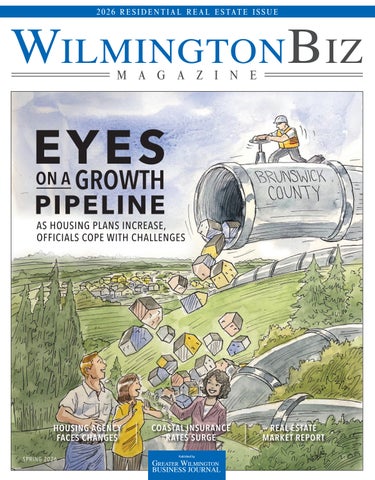
EYES GROWTH PIPELINE ON A
AS HOUSING PLANS INCREASE, OFFICIALS COPE WITH CHALLENGES
DANIELLE DESNOYERS
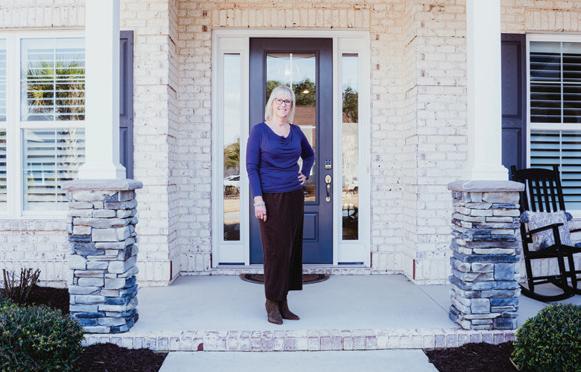
DANIELLE DESNOYERS is a Wilmington-based photographer specializing in documentary and portrait photography. She studied photojournalism at American University in Washington, D.C., and has worked in Egypt, Vietnam, Cambodia, India and the U.S.-Mexico border. She photographed Realtor Robin Hackney ( PAGE 24 ) and insurance agent Monique Hroncich for a story on coastal home insurance rates ( PAGE 28 ).
CIERRA NOFFKE
CIERRA NOFFKE is a reporter for the Greater Wilmington Business Journal, covering tech and health care for the publication. She previously covered the broadband and home internet industry for CNET. She earned her bachelor’s degree in English from the University of North Carolina Wilmington and also obtained a Master of Arts in English from UNCW. Noffke wrote about what’s driving home insurance increases at the coast ( PAGE 28 ).
CECE NUNN
CECE NUNN has been writing and editing for nearly 30 years, currently working as managing editor and residential real estate reporter for the Greater Wilmington Business Journal. In this issue, Nunn wrote about from the Wilmington Housing Authority ( PAGE 36 ), detailed a county’s growth struggles ( PAGE 18 )and shared a snapshot of leading housing stats ( PAGE 43 ).
MARK WEBER
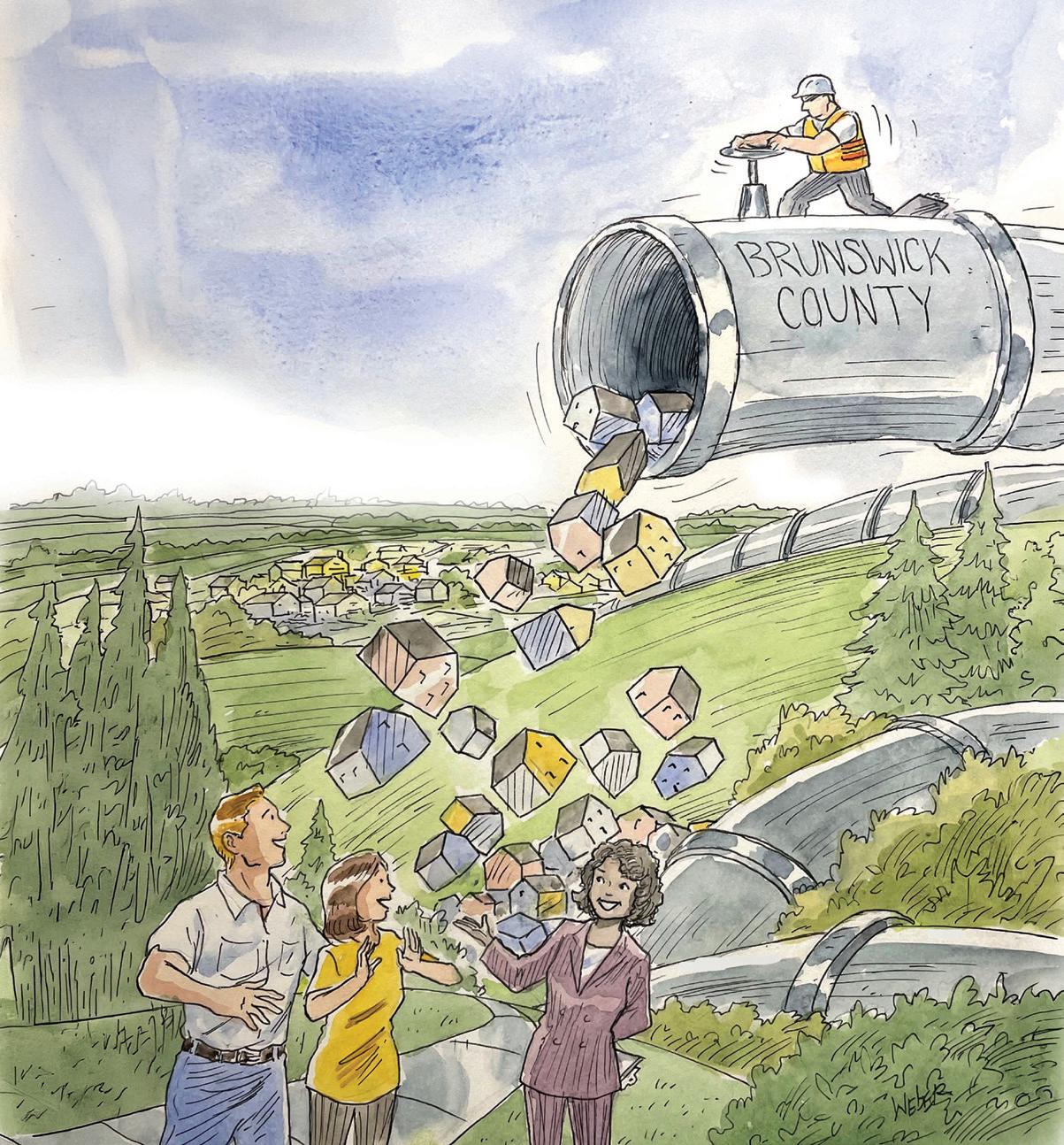
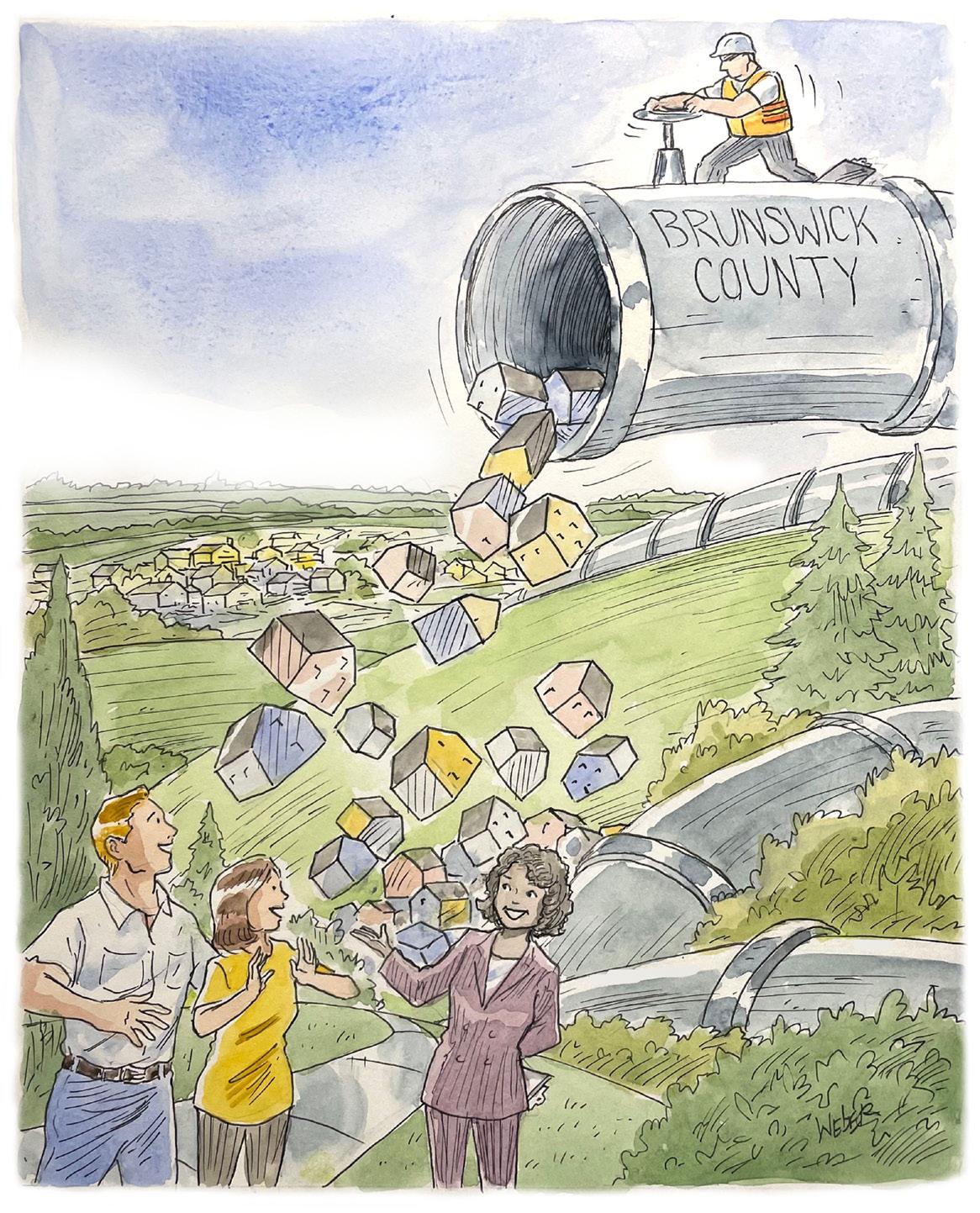
MARK WEBER is an illustrator and fine artist based in Wilmington. His work has appeared in the Greater Wilmington Business Journal, WILMA, New York Times, The Atlantic, Wall Street Journal, Rolling Stone and Highlights for Children, to name a few. He maintains a studio at ACME Art Studios in the Brooklyn Arts. Weber illustrated this year’s cover about Brunswick County’s housing pipeline. weberillustration.com and markweberart.com
EXPECT THE TYPICAL CONVERSATIONS TO CENTER AROUND INFRASTRUCTURE, INCENTIVES AND WORKFORCE AVAILABILITY.
But housing – regional workforce or affordable housing, in particular – also can come into play.
As Amazon’s vice president of worldwide economic development, Holly Sullivan led the team that evaluated more than 200 bids from cities pitching to house the Seattle-based company’s second corporate headquarters.
Part of that process in 2017 included visits to top contenders (with Arlington, Virginia, ultimately becoming the site for HQ2).
“When I was doing our second headquarters search nationally and met with 20 different locations … the No. 1 issue that every single major metro told us is their No. 1 challenge is affordable or workforce housing,” said Sullivan, who spoke as a panelist at the Business Journal’s Power Breakfast in March along with David Gray, CEO of FedUp Foods, and Steve Uebele, CEO of Frontier Scientific Solutions.
To acknowledge one impact of what happens when drawing thousands of employees to a city, the company launched its Housing Equity Fund in 2021.
With an additional infusion in 2024, the $3.6 billion fund is aimed at creating or preserving affordable housing units in the areas around Amazon’s largest corporate offices – the Puget Sound, Arlington and Nashville, Tennessee –where the infusion of high-paying jobs has the potential to skew the housing market for other residents.
“Through that fund, so far, we’ve been able to preserve 32,000 affordable units in those three locations, and we’re looking at other opportunities around the country,” Sullivan said.
The Amazon fulfillment center under construction in the Wilmington area – slated to
open later this year on U.S. 421 – is estimated to create 1,000 jobs. So, the Amazon effect on housing here might not be as large compared to the Arlington area, where more than 8,000 corporate and tech employees now work at HQ2.
But it’s still top of mind for some local housing officials, including Marlowe Foster, president and CEO of Cape Fear Habitat for Humanity, who asked the panel how much discussion occurs around affordable housing and affordable housing stock when they’re looking to locate team members to the area.
It’s a topic Foster said he has talked about with Sullivan, who also sits on the New Hanover Community Endowment, which has affordable housing as one of its investment strategy areas.
“How can we be that good partner and steward of the community to ensure that our impact, our long-term impact, is positive and doesn’t detract from what's already there?” Sullivan said at the talk. “I think it’s a very important issue, Marlowe, and it’s a complex issue. Sometimes there’s too much regulation around it, quite frankly, that doesn’t allow those corporate partnerships to come to fruition.”
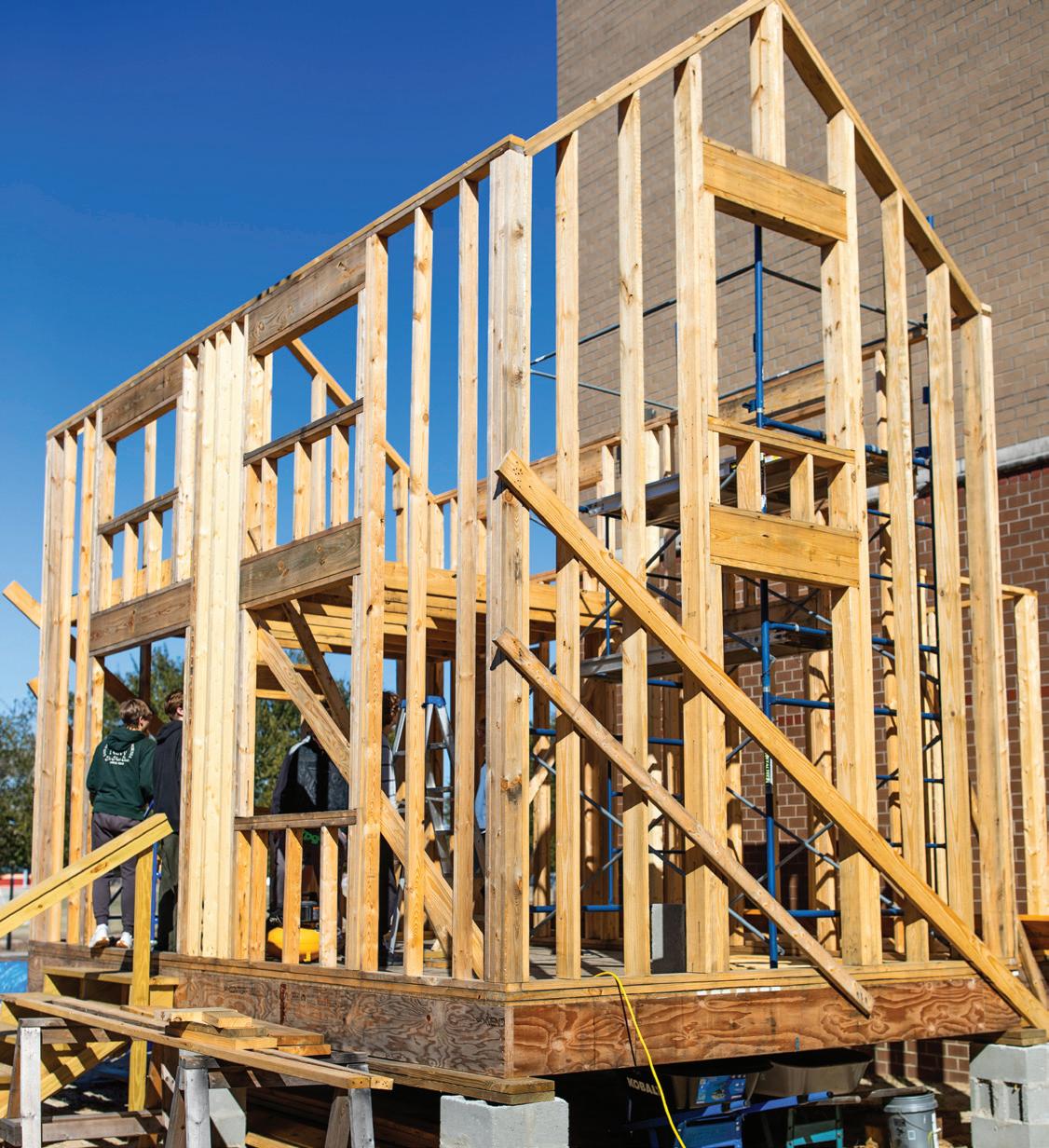
Students work on building a tiny house during their carpentry class at Ashley High School, a course included in the New Hanover County Schools’ Career and Technical Education offerings. Officials said CTE programs are designed to prepare students for a post-graduation pathway, including college or direct entry into the workforce.
The CTE carpentry teacher at Ashley, Hugh Hirth, has been teaching for 20 years. He said he has seen teenagers’ career hopes and training lead to results.
“I have former students who own and operate their own company,” Hirth said. “I have many students working for general contractors that have been part of my program and part of my class.” - Cece Nunn
SOUND OFF | BEHIND THE NUMBERS | THE DIGEST | C-SUITE CONVO
photo by MADELINE GRAY
SOUND OFF
W WE CAN'T CALL IT THE PORT CITY AND IGNORE THE PORT
ILMINGTON PROUDLY REFERS TO ITSELF AS THE PORT CITY.
It is one of several nicknames that reflect our history, our waterfront and our connection to the Cape Fear River. But being the Port City requires more than a label. It requires a commitment to maintaining the harbor infrastructure that keeps our port competitive.
In February, the N.C. Division of Coastal Management issued an objection to the Wilmington Harbor Navigation Improvement Project, the proposed effort to deepen our harbor from 42 to 47 feet. Because this issue is complex, technical and highly consequential for our region, it is important to provide context about why the Greater Wilmington Chamber of Commerce has been engaged, what is at stake and why this project matters.
The Port of Wilmington is one of North Carolina’s most important economic assets. It supports thousands of direct and indirect jobs across transportation, logistics, warehousing, manufacturing, agriculture and retail. It connects North Carolina businesses to global markets and serves as a critical gateway for imports and exports moving through our state’s supply chain network. The economic impact extends far beyond New Hanover County.
For that reason, support for ongoing and future phases of the Wilmington Harbor Navigation Improvement Project remains a clear
NATALIE
ENGLISH
priority in the chamber’s advocacy and legislative agenda at the federal, state and local levels. Maintaining the port’s competitiveness is not a short-term initiative. It is a long-term economic strategy.
At a recent meeting of the Ports, Waterways and Beaches Commission, the U.S. Army Corps of Engineers outlined several important findings after more than three years of study and environmental review.
The project would preserve approximately 550 acres of highquality freshwater wetlands and enhance an additional 120 acres on Eagle Island while also removing 120 acres of invasive plant species (phragmites). The Corps reported a cost-benefit ratio of 1.3, with projected shipping cost savings of up to 23% per 12,500 TEUs (20-foot-equivalent unit) vessel.
Accommodating larger vessels would also mean fewer ships traveling the Cape Fear River, which could result in comparable or reduced bottom disturbance and erosion.
The Corps also addressed concerns related to groundwater and salinity. Using one of the most sophisticated groundwater models available and working with national experts, the analysis concluded that dredging would not introduce new salinity flows into regional aquifers.
In fact, groundwater naturally flows toward the river. The most significant factor influencing aquifer conditions remains groundwater pumping.
Additional mitigation measures would improve fish passage upstream at Cape Fear Locks and Dams 1 and 2, with mitigation benefits expected to exceed potential impacts.
This work did not happen overnight. The U.S. Army Corps of Engineers conducted extensive environmental analysis through the Draft Environmental Impact Statement process, coordinated with federal and state agencies, convened technical working groups and incorporated multiple rounds of public input.
We respect the Division of Coastal Management’s responsibility to protect coastal resources. Environmental stewardship is a shared priority for our community. Many of our members live and work along the lower Cape Fear River and understand the importance of protecting water quality and sensitive habitats.
However, raising significant objections at this late stage after years of technical collaboration and environmental review creates uncertainty around a project that has been carefully studied.
Infrastructure projects of this scale require long-term planning and predictability. When uncertainty is introduced late in the process, it can slow investment, complicate logistics planning and signal instability in an intensely competitive marketplace.
Ports operate in a highly competitive environment. Shipping
lines make decisions based on efficiency, reliability and cost. If Wilmington cannot accommodate larger, fully loaded vessels, cargo will shift to other East Coast ports that are prepared to do so.
This is not an argument for ignoring environmental concerns. It is an argument for resolving them thoughtfully and efficiently. North Carolina has repeatedly demonstrated that economic growth and environmental stewardship can move forward together.
The chamber supports continued good faith collaboration between the U.S. Army Corps of Engineers, the Division of Coastal Management and the N.C. Ports Authority to clarify remaining technical questions and move toward resolution.
Wilmington’s future competitiveness depends on maintaining the infrastructure that supports our economy. The Port of Wilmington is not simply a local asset. It is a statewide engine of commerce and opportunity. If we intend to remain the Port City, we must also be willing to invest in the port that makes that identity possible.
We call on statewide leaders and elected officials to work with the DEQ and the N.C. Ports Authority to resolve this objection and keep the Wilmington Harbor Navigation Improvement Project moving forward.
We also encourage members of the business community across North Carolina to make their voices heard. If your company relies on efficient supply chains, global markets or the jobs supported by our port, now is the time to engage. Contact your legislators, share why the Port of Wilmington matters to your business and urge continued support for this critical infrastructure investment.
Natalie English is president and CEO of the Greater Wilmington Chamber of Commerce.
CROWD SOURCING
WHAT BUSINESSES DO YOU THINK WILMINGTON NEEDS MORE OF?
“ANOTHER COSTCO on the south end. Past Monkey Junction or before Oleander.” - GREG BRUTON
“WILMINGTON NEEDS a public driving range!”- MIKE CLEM
“SOMETHING THAT brings more than seasonal jobs.” - JL LJ
“WE NEED MORE STORAGE units, mattress stores, breweries and car washes. Definitely!” - SUZANNE HOSKINS
“TECH (INCLUDING FINTECH) . With the crazy cost of living, we need more white-collar positions that recent grads and young professionals can get. I’d love to see a TechHUB incubator space, perhaps on the LiveOak campus, ahem. On the other side of that coin we need to support home grown local business owners!” - JONATHAN Q BRIDGES
“TURN KMART into a big nightclub.” - SHANE SIX
The Business Journal received hundreds of answers to this reader question on Facebook. Read more of the responses on page 13 of the commercial real estate side of this issue.
X POLL: @WILMINGTONBIZ
UTILITIES
“WE LOOK FORWARD TO BUILDING A THRIVING COMMUNITY where individuals and families can build generational wealth and a community. This development will become far more than a place to call home – it will be a place where hope is nurtured, opportunity grows and a stronger, more resilient community will flourish."
- CAPE FEAR HABITAT FOR HUMANITY CEO AND PRESIDENT MARLOWE FOSTER ON HIS ORGANIZATION’S PLANS TO BUILD A MIXED-INCOME PROJECT
BEHIND THE NUMBERS
FUNDING FOR NEW WATER CONNECTIONS MEDIAN PROPERTY TAXES
17 MILLION $ IN NORTHERN NEW HANOVER COUNTY
STATE AWARDS ADDITIONAL FUNDS TO COMBAT PFAS CONTAMINATION
BY EMMA DILL
STATE OFFICIALS VISITED WILMINGTON’S Sweeney
Water Treatment Plant on March 5 to mark $17 million in funding to the Cape Fear Public Utility Authority for new water connections in several northern New Hanover County neighborhoods affected by PFAS contamination.
Gov. Josh Stein and N.C. Department of Environmental Quality (NCDEQ) Secretary Reid Wilson discussed the funding and the impacts of PFAS, or per- and polyfluoroalkyl substances, on the region during their visit.
Wilson said the funding is “a real step forward” to connecting residents who currently rely on private wells with high levels of PFAS, or per- and polyfluoroalkyl substances, to an extended Cape Fear Public Utility Authority (CFPUA) water main. Wilson noted that PFAS has been linked to serious health issues.
“We know that the most effective way and the fairest way to protect public health is to stop contamination at the source by setting limits on the discharges that can come into waterways,” he said, “but we’re not there yet, so in the interim, we need to make sure that we are providing resources to communities so that they can upgrade their infrastructure and remove PFAS and other harmful chemicals from their water supply.”
More than 300 homes will benefit from the connections, according to a news release.
As of February, CFPUA had received $27.4 million for water main extensions, including $16.7 million from state reserve funds and $9.7 million in grant funding administered by NCDEQ, according to Cammie Bellamy, a public information officer with CFPUA.
The week of March 2, CFPUA received letters of intent for an additional $7.3 million from the federal Emerging Contaminants in Small or Disadvantaged Communities program, administered by the N.C. Division of Water Infrastructure. The funding announced March 5 included the previously awarded $9.7 million and the $7.3 million award, according to Bellamy.
The water main extension project is in the early design phase and is expected to be completed in mid-2028, according to Bellamy.
$2,596
FASTEST GROWING COUNTIES (2023-2024)
HOUSING
10,820
10,836
21,656
DIGEST
A ROUNDUP OF RECENT RESIDENTIAL REAL ESTATE NEWS
NONPROFIT PUTS 1,040 ACRES UNDER CONSERVATION EASEMENT
A nonprofit organization announced recently that it had acquired and recorded a state-led conservation easement on more than 1,040 acres in Brunswick County.
The acres, which include forested wetlands, Carolina bays and sand ridges that support several rare plant and animal communities, are between the towns of Boiling Spring Lakes and St. James, according to a February news release from Unique Places to Save.
“The Boiling Spring Wilderness connects two adjacent conservation areas – Orton Plantation, owned and managed by The Nature Conservancy and the State of North Carolina’s Boiling Spring Lakes Plant Conservation Preserve – creating a nearly 10,000-acre conservation landscape,” the release stated. “Linking large conservation areas is critical to ensuring rare plants and animals have sufficient habitat available and supports effective land management
strategies, such as invasive species removal and habitat restoration techniques.”
The release stated that the project – funded by a nearly $3.7 million grant from the N.C. Land and Water Fund –also helps protect local water quality in alignment with Unique Places to Save’s mission “to restore and conserve natural and working lands and aquatic resources,” according to the release.
Unique Places to Save officials said the Boiling Spring Wilderness protects the headwaters of Orton Creek and the wetlands that overlay the Castle Hayne Aquifer, which provides water to thousands of Brunswick County residents.
“Boiling Spring Wilderness demonstrates what is possible when conservation organizations partner with willing landowners to achieve multiple, lasting outcomes,” said Christine Pickens, executive director of Unique Places to Save, in the release.
TO GROW AREA FOOTPRINT
Mungo Homes is expanding in the Wilmington region with the opening of River Tide Farms, its first community in the Brunswick County town of Bolivia.
When Scott Bowser started as Wilmington market president for the Columbia, South Carolina-based homebuilder in October 2019, the company had closed 47 homes in the local market that year.
“Last year, we ended up at a record year of 352 closings in Wilmington,” Bowser said.
The growth reflects the company’s broader expansion strategy. Mungo Homes’ Wilmington-area portfolio includes the upcoming Avenue One in Castle Hayne; East Wynd in Hampstead; and Indigo at Abbey Preserve.
%
PERCENTAGE THAT MULTIFAMILY HOUSING MADE UP OF NEW PERMITTING ACTIVITY IN NHC IN 2024
Source: UNCW Swain Center
photo c/o MUNGO HOMES
photo c/o UNIQUE PLACES TO SAVE
C - SUITE CONVO GRANT GAMEPLAN
A
FTER
SERVING AS INTERIM PRESIDENT AND CEO FOR ABOUT A YEAR, SOPHIE DAGENAIS OFFICIALLY BECAME THE NEW HANOVER COMMUNITY ENDOWMENT’S HEAD OFFICIAL IN MID-FEBRUARY.
Dagenais previously served as vice president of programs and grants for the endowment, formed from proceeds of New Hanover Regional Medical Center’s sale to Novant Health in 2021. Dagenais talks about the grantmaking fund’s next steps in this recent Q&A. To read more from the interview, go to WilmingtonBizMagazine.com.
WHAT ARE YOUR MAIN PRIORITIES AS THE NEW CEO OF THE ENDOWMENT?
“As CEO, I build on the strong foundation my board has established. From that foundation, I see my role as fundamentally one of building: building an institution, building trust and building a brand defined by reliability, impact and integrity. At the same time, I am responsible for stewarding public resources with discipline and accountability. My priorities reflect both dimensions of that responsibility. First, I am committed to strengthening a cohesive, mission - aligned team, because a strong institution begins with a strong, supported staff dedicated to New Hanover County. I will also work to establish a consistent and trusted presence in the community, one defined by partnership, transparency and alignment with the county’s long-term aspirations. This includes
SOPHIE DAGENAIS
demystifying our mandate, explaining our founding documents and ensuring clarity in our grantmaking and decision-making.
Another priority is to honor our mandate by deploying our grant budget in full and in strategic alignment. That means listening to community voices and investing in strong partners across our pillars and maintaining disciplined stewardship of resources. In all this work, I am guided by three essential lenses of philanthropy: data, responsiveness and innovation. Data ensures accountability; responsiveness recognizes that urgent needs cannot wait; and innovation fuels long-term progress.
Finally, with my board, my team and the guidance of our community advisory council, I aim to build an institution that can stand the test of time. We are nonpartisan and focused on long-term systems strengthening, not short-term wins. That requires investing not only in strong programs but in the broader infrastructure –people, systems and partnerships – that makes lasting progress possible.
This way of thinking, from
BY CIERRA NOFFKE
programs to permanence and from activity to architecture, is rooted in our founding documents and the vision of those who created this endowment.”
HOW DO YOU ENVISION THE ENDOWMENT SHAPING
THE REGION OVER THE NEXT FIVE YEARS?
“Five years is not long when working toward population - level outcomes or transformational change. Meaningful improvements in health, education, economic mobility and community safety require sustained, long - term investment. But five years is enough to help shape our trajectory.
Over the next five years, we can strengthen our infrastructure for lasting change by supporting aligned, multi - sector collaboratives and improving how data is used and shared. We’ll remain both strategic and responsive. Our eyes are on the long horizon, but we can also address urgent needs as they arise. Responsiveness is not separate from transformation; often, it enables it. Along the way, we may make early, significant, high - impact grants that show what coordinated action can achieve.
We will invest alongside system leaders, including government, schools, health care organizations and nonprofits, in the priorities they identify as most urgent, because alignment makes every dollar more impactful. We may not claim transformational outcomes in five years, but we can strengthen systems, fill gaps, build trust and establish ourselves as a steady partner for long - term progress.”
YOU STARTED YOUR WORK WITH THE ENDOWMENT IN
NEW HANOVER COMMUNITY ENDOWMENT PRESIDENT & CEO
JANUARY 2025. AFTER OVER A YEAR OF WORKING WITH THE COMMUNITY, WHAT HAVE YOU IDENTIFIED AS THE COMMUNITY’S BIGGEST NEEDS AND CONCERNS?
“Several needs come up again and again. We consistently hear of challenges with accessing health care and having the workforce needed to deliver it; the pressure of finding affordable housing and maintaining stable, vibrant neighborhoods; gaps in education and youth opportunity; the strain on child care and family supports; concerns around community safety, re-entry and trauma - informed services; and economic mobility and workforce development.
Our county has strong public leadership, committed nonprofits, engaged educators and active partners across sectors. The issue is not lack of effort, nor lack of will. The
opportunity is alignment: ensuring that these strong assets work more cohesively toward shared outcomes.”
I
N DECEMBER, THE ENDOWMENT ANNOUNCED AN ENTREPRENEURSHIP AND INNOVATION ECOSYSTEM ASSESSMENT, LED BY THE UNIVERSITY OF NORTH CAROLINA AT CHAPEL HILL. IS THERE A TIMELINE OR LATEST UPDATE ON THAT ASSESSMENT? WHAT IMPLICATIONS DOES THE ASSESSMENT HAVE FOR THE BUSINESS COMMUNITY?
“One of our goals is to help ensure New Hanover County is a place where the economy is vibrant for all. To support that goal, we’ve identified innovation and entrepreneurship as key priorities.
In December, we announced that UNC-Chapel Hill’s Innovate Carolina
team would conduct a countywide entrepreneurship and innovation ecosystem assessment. The contract is now finalized, and the work will begin in the coming days, running from March through August.
The assessment will examine the people, organizations and assets that support innovation in New Hanover County. It will identify strong industry sectors, benchmark us against peer regions, and analyze how founders, investors and mentors connect. The findings will guide our future strategies and investments in innovation and entrepreneurship as part of our broader community development efforts.
The business community will be directly engaged, and the assessment will help shape targeted investments aimed at unlocking capital, supporting startup growth, expanding opportunity and positioning the region to attract long - term public and private investment.”
BY CECE NUNN | ILLUSTRATION BY MARK WEBER | PHOTO BY MADELINE GRAY
As plans for thousands of homes pour into Brunswick County, officials confront infrastructure pause
M reckoning GROWTH
IKE FORTE MOVED TO BRUNSWICK COUNTY FROM NEW JERSEY MORE THAN 20 YEARS AGO, SETTLING DOWN IN A HOME IN BOILING SPRING LAKES.
“It’s a great community. It really is,” Forte said of the central Brunswick County city, which has an estimated population of about 7,000. “I never wanted to live in an HOA or a POA development. My wife loves to garden – that’s her peace. She’ll sit out there for 10 hours on a Saturday playing in her garden (and able to do what she wants with it). And if I were in an HOA, POA, she wouldn’t be allowed to do that.”
But in his elected position as chairman of the Brunswick County Board of Commissioners, Forte looks beyond Boiling Spring Lakes to a big-picture view of growth in the rapidly expanding county. The board he leads governs unincorporated Brunswick County, which includes a large chunk of the county’s total 850 square miles.
This broader view becomes more pressing given the county’s growth rate. In September last year, state officials announced that Brunswick County was again the fastest-growing county in North Carolina, with a 24% population increase from 2020 to 2024.
The variety of community options throughout the county, its low taxes and its coastal weather are among the factors attracting thousands of new residents each year, with developers responding to that demand in kind.
“I moved here in 2005, and I will be the first person to tell you, this is not the Brunswick County I moved to 20 years ago,” Forte said. “It has changed, but I can’t stop it statutorily.”
Forte clarified that state law sets specific limits on what local governments can prohibit regarding development rights.
“Our previous county attorney stated it at almost every meeting that statutorily, we cannot say no if they (developers and property owners) meet all the standards and all the zoning and everything. … We will get
MORE HOUSING ON THE WAY
A Brunswick County government data dashboard on residential development since 2015 tracks the status of residential units in the pipeline.
APPROVED RESIDENTIAL DEVELOPMENTS
147 APPROVED UNITS
60,918 APPROVED UNITS BUILT
8,066 APPROVED UNITS UNDER CONSTRUCTION
1,297 PROPOSED DEVELOPMENTS
11 PROPOSED UNITS
16,506
Source: Brunswick County as of March 13
MIKE FORTE chairman of the Brunswick County Board of Commissioners MANY OF THOSE HOMES WON’T SHOW UP FOR 15 TO 20 YEARS, IF EVER.
sued, and we will lose,” he said.
However, rapid expansion has brought challenges. Among the latest growth hurdles for Brunswick County is a recent sewer capacity conflict between state and county officials that has halted some development.
At the heart of the dispute: the N.C. Department of Environmental Quality’s handling of a state statute that calculates available wastewater capacity for new sewer line extension permit applications.
An existing “80/90 rule” requires officials governing wastewater systems to begin planning for expansion when those systems reach 80% capacity and to have construction permits in place before reaching 90% capacity.
A statute adopted in 2023, however, allows a wastewater treatment system in the state’s fastestgrowing counties, like Brunswick, “to allocate future flows up to 115% of its existing hydraulic capacity under certain conditions with a signed contract for the expansion of its wastewater treatment system,” according to state officials.
The hold on Brunswick wastewater connection permit applications, they said, “resulted from an inspection by the DEQ Division of Water Resources (DWR) that showed all of Brunswick County’s future obligated wastewater flows as part of inter-local agreements were not being reported on applications for sewer extensions for future developments.”
They said DWR requested that the county “submit a proper accounting of the amount of wastewater capacity that had already been obligated. New information showed the county’s future obligated flows were above permitted capacity, and there were no approved speculative limits for an expansion.”
According to the county’s development dashboard as of March 13, Brunswick officials had approved nearly 61,000 residential units since 2015.
Forte doesn’t think it’s a fair assumption that all of those units will
come to fruition.
“Many of those homes won’t show up for 15 to 20 years, if ever,” he said.
In a statement to the media in February, the county staff wrote, “Brunswick County is not out of sewer capacity at the Northeast Brunswick Regional Wastewater Treatment Plant nor at the West Brunswick Regional plant. Brunswick County also has several expansion projects that are either under construction or are in the planning or permitting stages to further increase capacity at our plants to anticipate future growth in our sewer system. … Currently, DEQ’s change only affects future applicants for any new sewer line extension permit requests. Any projects that have already received their sewer line extension permits are not affected.”
County officials have been in regular contact with N.C. DEQ, they wrote, providing data and information to work toward a solution.
“There is not an estimated time or date that this issue will be resolved, but we believe we now have a path forward for the Northeast Wastewater Treatment Plant,” the county statement said in February, “and staff is submitting the necessary information to resume line extension permitting.”
The statement said Brunswick officials didn’t find out about the process change until the state began denying certain permit applications.
“Based on DEQ’s advice, we requested that DEQ hold off on reviewing any new applications they have received. If these applications were not placed on hold, they would be denied at the end of the applicable 45-day review period, and the applicants would have to forfeit their permit fees. DEQ advised us that permits on hold would not necessarily forfeit the fees (unless they were ultimately denied),” the statement read.
State officials said in an email that N.C. DEQ’s Division of Water Resources was continuing to work
Hill Rogers, of Jackey's Creek Investors LLC, is working on an upcoming residential and commercial development called Jackey's Creek in Leland. He's optimistic about the availability of Brunswick County sewer plant capacity when his project needs permits, which won't be for another year, he said in March.
with Brunswick County “to address future obligated wastewater flows and current capacity at its treatment plants. In addition to working to identify ways to move the permitting process forward for sewer connections, DWR has been working with the county to improve their future wastewater allocation tracking to facilitate future permitting, and to identify additional flow available due to unrealized development projects.”
They said DWR had identified a permitting process to move applications forward for permits for connections to Brunswick County’s Northeast Brunswick Regional Wastewater Treatment Plant.
“The Northeast WWTP is a facility that has an expansion plan in process with DWR,” they wrote.
Projects that would connect to the West Brunswick Regional Water
Reclamation Facility, however, were still on hold as of March 16 “until Brunswick County completes a comprehensive accounting of future sewer capacity allocations for new development for this facility,” the email stated.
As of press time, Brunswick County officials were scheduled to meet with DWR officials on March 19 to discuss this issue and their assessment.
Despite the lingering challenges, plans for more residential real estate growth are far from at a standstill in some parts of the county.
Jackey’s Creek, a more than 1,440acre master-planned community that could hold 6,000 residential units and multiple commercial buildings, is in the works between U.S. 17 and N.C. 133. Its developers would need connections to the Northeast
Brunswick Regional Wastewater Treatment Plant, and they are optimistic that the sewer permitting issue won’t affect their timeline.
“I don’t think we’d be making sewer applications for another year,” said Hill Rogers, broker in charge at Cameron Management and a managing member of Jackey’s Creek Investors LLC, the entity that currently owns the 1,440 acres.
Conversely, other developers have shifted plans related to hundreds of homes farther south in the county because of uncertainty about the sewer permitting process.
Waterway, a development that could include 1,100 homes in a mix of housing types, is ready for sewer permitting for its first phase, but its developers are focusing instead on another part of the project –dredging an existing marina – for the
time being.
East West Partners is developing the Waterway community, a project on 400 acres in and near Southport, along with Bald Head Island Limited. Waterway needs to connect to the West Brunswick Regional Water Reclamation Facility.
As of Feb. 16, the county’s expansion plan for the West Brunswick facility would double its capacity, from 6 million gallons per day (MGD) to 12 MGD, according to county staff.
Meanwhile, the clock is ticking for developers who previously counted on getting those connections sooner.
“The timing problem is more drastic for many others in Brunswick County,” said Chad Paul, CEO of Bald Head Island Limited. “We have plenty to do and plenty to work on before we actually need to have flow. There are a lot of developers that are out of business in the next 30 days if they don’t get their flow.”
Paul said it’s really an issue between Brunswick County and the state.
“The issue is the interpretation of the 2023 legislation regarding how you determine sewer allocation, and we are up to our eyeballs working collaboratively with everybody involved,” he said. “In my opinion, there is no villain here. This is, ‘How do we deal with the growth in Brunswick County collaboratively and equitably with everybody involved?’ And we are spending our resources and our time on that collaborative effort.”
Some in the county’s residential real estate industry say they agree with those who think Brunswick’s infrastructure needs to keep pace with, not chase, development.
“People want to move here because of the lifestyle, because they can go fishing, because they can enjoy the waters, but if we start polluting those waters, and we don’t pay attention to the ecological impacts of not having enough stormwater and sewage capacity … we’re going to end
up in a tangled mess,” said Pete Key, a Brunswick County real estate broker and president of the Brunswick Environmental Action Team.
Key, who is a broker with Hank Troscianiec & Associates, a KW Innovate firm, said he has spoken with county commissioners about the area’s infrastructure needs before.
“When I go and talk to those guys, I’m constantly bringing up how we need to be ahead of this. I mean, how are we paying for this? And they keep saying, the tax revenue. And, you know, tax revenue is not, in my opinion, the right answer because you’re waiting on the houses to be in place with people living in them,” Key said. “You’re borrowing from a future that hasn’t occurred yet, and if you’re chasing it, it’s just going to cause issues down the road that can be avoided. … If you have thoughtful, planful planning going on, from the county standpoint, you’re going to plan ahead and you’re going to put that infrastructure in ahead of time.”
Key’s colleague and real estate team leader, Hank Troscianiec, has seen the issue firsthand from both government and business perspectives.
“I used to serve on the board of commissioners for the city that I live in, in Boiling Spring Lakes. And the stereotypical drum that was beaten was, ‘Well, he’s a Realtor; of course he wants to develop, develop, develop,’” Troscianiec said. “And my feeling has always been progress is not measured by rooftops but how you do those rooftops. … If you don’t do it the right way, then in the end, you’re shooting yourself in the foot because people go, ‘There is Brunswick County, but, man, that place is overpopulated, and they’ve got major issues.’”
Concerns that growth in the county was getting ahead of itself spurred a couple of county commissioners to try to take action in March. Brunswick County Board of Commissioners member Pat Sykes voted, along with commissioner Randy Thompson, to “freeze the review of any development
”
PEOPLE WANT TO MOVE HERE BECAUSE OF THE LIFESTYLE , BECAUSE THEY CAN G O FISHING , BECAUSE THEY CAN ENJOY THE WATERS , BUT IF WE START POLLUTING THOSE WATERS, AND WE DON’T PAY ATTENTION TO THE ECOLOGICAL IMPACTS OF NOT HAVING ENOUGH STORMWATER AND SEWAGE CAPACITY … WE’RE GOING TO END UP
IN A TANGLED MESS .
”
PETE KEY
a Brunswick County real estate broker and president of the Brunswick Environmental Action Team
applications it has already received and to hold on accepting any more project applications until the issue with the state concerning sewer extension applications is resolved,” according to a March 2 commissioners’ meeting recap by county staff.
The motion was defeated by a 3-2 vote after county staff explained that, under both state law and the county’s Unified Development Ordinance, a development moratorium cannot be enacted without a public hearing. They also said such a moratorium would apply to commercial and industrial projects, thereby halting developments that would otherwise create jobs.
“I’m not against the growth now, but I’m against it not being handled appropriately and safely for the citizens,” said Sykes, a Southport resident, “because they’re the ones who are going to have to pay down the road.”
CONNECTIONS REAL ESTATE
ROBIN HACKNEY EXPANDS
HER FRIENDS AND FAMILY PLAN R
BY ERIC WILLIAMSON
PHOTO BY DANIELLE DESNOYERS
obin Hackney so valued home that she made real estate her career, and she brought along as many of her friends and family as possible.
Hackney’s latest venture is a high-profile partnership between her family-owned, recently rebranded Horizon Realty Group and Howard Hanna Allen Tate, a larger real estate company that’s also family owned.
“They’re in 14 states and have 500 offices and 15,000 agents from Michigan, New York, all the way down to Savannah, Georgia,” said Hackney, the branch leader and broker in charge. “So, we can pretty much help anybody do anything they need.”
That “we” includes her older son, Deans Hackney III, who, after about a decade with the former Hackney & Co. is a partner in the new franchise. He concentrates on the commercial side of the business, which includes development services all over the Southeast.
Hackney’s husband, Deans Hackney Jr., runs the related Horizon Homes custom homes arm of the family enterprise. In 2024, the power couple was inducted into the Wilmington-Cape Fear Home Builders’ Hall of Fame for their years of helping clients, often retirees, fulfill their custom-build visions.
Robin Hackney translates client needs and preferences into livable space, whether that’s starting from scratch or sourcing an existing home.
Deans Hackney III keeps an eye out for under-realized properties. He said he’s found his lane in the family industry, though he’s not afraid to ask his parents’ advice. Likewise, “We’re
not shy about giving it,” his mom said with a laugh.
But the family associations don’t stop there. After Deans Hackney III got married last year, his wife, Ginny, became a real estate agent.
“So, it has kind of come full circle,” Robin Hackney said.
The circle is wide enough to include friends too. While her other son, Clay, opted for restaurant work and freelance creative pursuits, her “third child,” Alexander Coffey, a neighbor and friend of the siblings since youth, also works for Horizon Homes.
With all those close interpersonal connections, does familiarity breed contempt?
“Fortunately, we don’t really have that going on, and I think it is because we’re all kind of diverse,” Robin Hackney said. “We all bring different qualities to the business. I feel like we are a collaboration, not a my-way-or-the-highway kind of company.”
Horizon Realty Group, it’s worth noting, also has experienced agents with no Hackney family connections and is actively looking to expand its fold.
Robin Hackney first joined the biz with help from her friend Phyllis York Brookshire.
“My best friend’s father had a large commercial real estate company, York Properties. And when we were in college at Chapel Hill, he opened a real estate brokerage company,” Robin Hackney said. “So, between our junior and senior year of college, we took the real estate course and got our real estate licenses.”
Another friend got her interested in home appraisals, so she also learned that side of the business as Deans Hackney Jr. obtained his MBA from Wake Forest University. The couple relocated to Wilmington, where his work with developer Doug Cameron Echols awaited.
“Doug, unfortunately, passed
PROFILE
away (in 2006), had kidney failure,” Robin Hackney said. “We loved it here and just decided that we would stay and continue in the industry that brought us here.”
She worked as an appraiser for a savings and loan, as well as for Prudential and Intracoastal Realty, before forming Hackney & Co.
As their boys grew, the parents encouraged them to swing hammers. The family joined together for the Cape Fear Habitat for Humanity Builders Blitz in 2012.
“They were in high school, and we brought them on board to help us build two homes in seven days,” Hackney recalled. “They got a full experience of start to finish, build a house as fast as you can.”
The idea that work and family don’t have to be opposing concepts continues to expand under Howard Hanna Allen Tate. Hackney’s best friend, York Brookshire, in fact, worked there first.
“She has been with Allen Tate for 18 years,” Robin Hackney said. “She and I were on a girls’ trip, and we started talking shop. She mentioned the affiliate program, and it just sort of clicked.”
The reason the partnership is a good fit, the Horizon owner observed, is that the organizations have similar values.
“Even though they are a very large company, the way they approach their agents, their training, all of that is like a family company,” she said.
That’s given Robin Hackney the feeling that she’s still very much mid-career.
“Their company has so much resource material, and just everything that they offer for an agent, that learning, has been very inspirational,” she said. “In most worlds, I would be considered later in my career. I feel like I’m new to the business again, which has been fun.”
BY
FILE PHOTO
MEGAN DEITZ
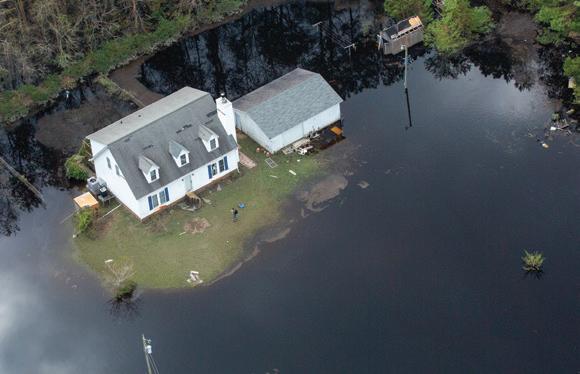
Pender County flooding is shown from Hurricane Florence in 2018.
COST COAST OF THE
AS INSURANCE RATES CONTINUE TO TREND UP, PROSPECTIVE HOMEOWNERS WEIGH PROPERTY PRICE TAGS
BY CIERRA NOFFKE
Like most Wilmington residents, Monique Hroncich knows the toll of high homeowners insurance all too well.
As a licensed insurance agent working for Wilmington-based The Huneycutt Group, a boutique insurance brokerage, homeowners rates play a central role in determining the premiums that Hroncich gives to her clients.
In fact, homeowners insurance can determine whether a homebuyer will purchase a home at all, Hroncich said, and prospective homebuyers call her multiple times a week to compare homeowners insurance rates with monthly mortgage costs. Over the past six months,
JUMPS OVER THE YEARS
HERE ARE RECENT HOMEOWNERS INSURANCE RATE INCREASES, INCLUDING THE REQUESTED STATEWIDE RATE INCREASES BY THE N.C. RATE BUREAU AND THE FINAL SETTLED INCREASES FOR THE STATE AND FOR HOMES LOCATED IN THE REGION'S BEACH AREAS (TERRITORY 120*).
Hroncich has had several clients opt out of purchasing a house because the insurance rates are too high.
“People aren’t buying because they can’t afford the house,” Hroncich said. “They can’t afford the insurance.”
Residents of New Hanover County beaches faced a 16% homeowners insurance rate increase last year, and another 15.9% increase this year, based on the latest negotiated increase by state regulators.
As rates creep upward and the region braces for surging premiums, many homeowners – and prospective homeowners – fear that coverage may become drastically unaffordable in years to come.
Coastal Florida has often served as one of the worstcase scenarios for homeowners’ insurance markets, as premiums have skyrocketed due to mounting rebuilding
*Territory 120 includes beach areas in New Hanover, Brunswick, Carteret, Onslow and Pender counties. **The most recent rate increase request of 42.2% was settled as a smaller increase spread out over two separate bumps in 2025 and 2026. DATE EFFECTIVE REQUESTED STATEWIDE RATE FINAL TERRITORY 120 FINAL STATEWIDE
WHAT’S NEXT FOR RATES IN
2026
HOMEOWNERS IN WILMINGTON'S BEACH AREAS FACE AN INSURANCE RATE INCREASE OF 15.9% THIS YEAR UNDER THE TERMS NEGOTIATED BY THE STATE DEPARTMENT OF INSURANCE WITH THE N.C. RATE BUREAU IN 2025. THOSE RATES COVER PRIMARY RESIDENCES. IN NOVEMBER, THE RATE BUREAU ALSO REQUESTED A 68.3% STATEWIDE RATE INCREASE FOR DWELLING INSURANCE POLICIES, WHICH COVER NONOWNER-OCCUPIED PROPERTIES, SUCH AS RENTALS AND VACATION HOMES. THE RATE INCREASES ARE PROPOSED FOR IMPLEMENTATION OVER TWO YEARS.
N.C. INSURANCE COMMISSIONER MIKE CAUSEY SET A HEARING DATE FOR MAY 4 , THOUGH THE DEPARTMENT OF INSURANCE AND THE RATE BUREAU CAN NEGOTIATE A SETTLEMENT AT ANY POINT. NO SETTLEMENT AGREEMENT HAD BEEN REACHED REACHED AS OF PRESS TIME.
costs after major hurricane damage. While Florida hasn’t quite become “uninsurable,” various news outlets have reported that major insurers such as Farmers Insurance have either stopped writing new policies or significantly reduced coverage in the state, leaving many concerned about the future of property insurance.
In 2023, after Nationwide filed a notice with the N.C. Department of Insurance that it wouldn’t be renewing over 10,000 homeowners insurance policies in the state, due to weatherrelated losses, many residents feared that the state was on the path to a homeowners insurance disaster.
While homeowners insurance is high – and likely to continue to increase – North Carolina’s coastal homeowners insurance market is still a ways off from becoming uninsurable, in part thanks to the stabilizing efforts of the residual market. Still, the burdens of high homeowners premiums continue to ripple across the state.
According to an analysis from LendingTree based on N.C. Department of Insurance data from 2024, the average cost of homeowners insurance in the state’s 25 largest municipalities is nearly $2,400. Overall, the report states that average homeowners insurance rates in North Carolina have increased by 44% between 2020 and mid-April 2025.
The cost of insurance rises dramatically for coastal and beach areas, with Wilmington residents paying an average of about $7,200 a year for home insurance, according to LendingTree.
“Wilmington is growing fast and in a catastrophe-prone coastal area,” Hroncich said. “That means more exposure.
“Historically, North Carolina was a little bit lower on rates, so now it’s catching up all at once,” she added. “That’s why you’re seeing such sharp increases instead of gradual ones.
North Carolina’s insurance market has long depended on three main organizations to keep the insurance market steady: the N.C. Rate Bureau, N.C. Department of Insurance and the residual market.
North Carolina is one of the only states that uses a centralized rate bureau
to set insurance rates for homeowners, auto and workers compensation. The N.C. Rate Bureau, which is not affiliated with the Department of Insurance, consists of a 12-person board that represents insurance companies that file justifications for proposed rate increases.
This setup means that insurance companies cannot independently increase statewide rates without first filing a notice and justification for the increases. Those proposed rates are then subject to review by the state’s insurance commissioner, Mike Causey.
“I work hard every day to fight on behalf of the consumer,” he said recently, “to hold down insurance rates as low as possible and still keep the insurance companies in business so they don’t pull out, and we end up like some of these other states.
“Affordability is always a concern,” Causey added, “but a bigger concern would be if we don’t have any companies to write coverage at all.”
The rising costs of materials and labor have driven up both insurance premiums and reinsurance costs, which is the insurance an insurance company buys to make certain it can remain solvent enough to pay claims.
In North Carolina, for example, Progressive has more than doubled its homeowners rates, according to the LendingTree data, potentially because the company incurred disproportionate losses from claims payments, said Robert Bhatt, a licensed insurance agent and analyst for LendingTree.
“We saw an uptick in natural disasters (in North Carolina),” said Bhatt. He added that a combination of catastrophic events and rising inflation compounded the costs of rebuilding and repair.
“Any rate change request that we make is based off of data that we’ve received directly from the insurance company,” said Jarred Chappell, chief operating officer of the Rate Bureau. “So, they tell us exactly what they’ve paid on claims. … We compile all that together and use it to figure out what the rate should be at any given time.”
Chappell explained that rate increases vary by territory, depending on factors such as input from catastrophe
models, population density or historical rate increases.
However, an important feature of the state’s insurance system is a general statute known as “Consent to Rate,” which allows an insurance company to raise or lower your individual premiums at its discretion, even when statewide or regional rates increase. That means that your premium may be lower or higher than the territorial rate increases negotiated by Causey.
That’s an important consideration in the face of so much uncertainty in the homeowners insurance market: As rate increases continue to climb, the determining factor in how much your premium will be lies largely in your insurance carrier’s hands and in the history of your home.
A key player keeping North Carolina’s insurance market stable, especially when it comes to wind and
homeowners insurance, is the state’s FAIR Plan and Coastal Property Insurance Pool, which acts as the state’s residual market, filling in gaps that private insurance companies may not be able to fill.
The residual market consists of the N.C. Joint Underwriting Association (NCJUA), which oversees the FAIR Plan covering the state’s inland counties, and the N.C. Insurance Underwriting Association (NCIUA), which oversees the Coastal Property Insurance Pool covering the state’s 18 coastal counties. NCJUA and NCIUA are also known as “insurers of last resort.”
Created in 1969 by the General Assembly, NCJUA and NCIUA are among the largest insurers in the state, despite not being insurance companies in the traditional sense. Neither organization is a government agency, and neither receives
HISTORICALLY, NORTH CAROLINA WAS A LITTLE BIT LOWER ON RATES, SO NOW IT’S CATCHING UP ALL AT ONCE. THAT’S WHY YOU’RE SEEING SUCH SHARP INCREASES INSTEAD OF GRADUAL ONES. “ “
government funding, though both organizations have remained fiscally strong in the face of natural disasters and rising rebuilding costs.
“When we were in Florence, we actually settled 90% of our claims within 60 days, and out of both companies, almost 100,000 claims,” CEO Gina Hardy said, referring to the 2018 hurricane that caused widespread flooding and damage in Southeastern North Carolina.
Under the terms of the associations, the underwriting associations are required to set base rates for homeowners insurance 15% above the increases approved by the insurance commissioner. As a result, premiums through the underwriting associations may be higher than what a private insurance agent might offer.
Even so, NCJUA and NCIUA remain popular options for homeowners, especially the
MONIQUE HRONCICH insurance agent with The Huneycutt Group
organizations’ wind and hail insurance policies, which Hardy said they cover extensively.
A popular option, according to Hroncich, is to buy homeowners insurance from a private carrier and add wind and hail coverage through the underwriting associations, which can lower overall premiums without reducing coverage.
To keep the programs stable in the face of hurricanes, storm damage and rising costs, NCJUA and NCIUA rely on a combination of low operating expenses, statutory 15% increases in homeowners insurance (5% for wind) and reinsurance, including the use of catastrophe bonds.
“In years where we have low or little hurricane activity, any profits that we have would be transferred over to our surplus,” Hardy said, “and we would save that surplus to pay future claims.”
She said that catastrophe bonds and surplus funds support a resiliency funding pool, which the organization has put $70 million towards for the current cycle.
The resiliency funding pool is heavily focused on a fortified roofing program spearheaded by NCIUA, which plays an important role in mitigating stormrelated damage and subsequent rate increases. The grant program offers eligible homeowners in the Outer Banks up to $10,000 and coastal residents up to $6,000 to install a “fortified” roof, or a storm-resistant roof with a sealed roof deck and ring-shank nails, which strengthen the roof against wind and water damage.
According to a study by the Institute for Advanced Analytics at N.C. State University, the fortified roofs led to a 34.5% reduction in reported claims. In fact, Hroncich herself applied and was approved for a fortified roof.
While the fortified roofing program has demonstrated effectiveness, and the underwriting associations fill an important gap in coverage, residents are still shouldering the pressure of rising homeowners insurance costs, Hroncich said.
To mitigate the costs of premiums, Hroncich said her clients are taking on the risk of property damage themselves by opting for higher deductibles or lower premiums with less coverage.
“Sometimes I’ll even have to explain to people, ‘Yeah, that’s great, the premium’s lower than mine, absolutely. But do you have what you need? Is your house properly insured? Is it in comparison to what the market rate is right now to rebuild?’” she said.
While homeowners reckon with rising insurance costs, the state’s Department of Insurance must balance affordability with the pressures insurance carriers face to stay solvent in a tense housing insurance market.
“For most companies that write homeowners insurance, for every $1 they’re taking in, they’re paying out almost $1.30 in claims,” Causey said. “So, you tell me how long they’d stay in business to keep up that model.”
TRENDS TO WATCH
The area’s residential real estate market exhibits some ongoing trends even as some slight shifts occur when it comes to mortgage rates and buyer profiles. As in previous years, the region’s number of homes for sale – its inventory – has been increasing in 2026. The overall market seems to be balanced, industry leaders say, but they’re keeping their eyes on buyer demographics and how mortgage rate changes might impact the market in years to come.
BY CECE NUNN
INVENTORY ON THE RISE 1
Realtors say housing inventory has been increasing in the Wilmington area.
In January, the latest report from Cape Fear Realtors as of press deadline, active home sale listings rose 14% compared to January 2025.
Manda Price, the 2026 president of CFR, said increases in inventory appear to be continuing.
“We track them daily, and we’re seeing the same trend right now,” she said in February.
According to the National Association of Realtors, the nation’s inventory of existing homes for sale rose 3.4% from January to the same month in 2025.
While a variety of factors is likely driving inventory additions, life circumstances are probably major contributors, Price said.
“I think that there have been some people who were sitting pretty comfortably on a lower (interest) rate, but life is demanding for different reasons for them to move,” she said, “and so you’re seeing more inventory enter the market.”
WHO HAS THE POWER? 2
Balance is a good thing, residential real estate experts contend.
Price said the Wilmington home sale market is moving closer to buyer-seller equilibrium after some years of hectic competition and rapid appreciation.
“I think we’re moving a little towards balanced, and you know, that’s a good place to be for both parties,” she said in February.
Realtors are noting examples on both the buyer and the seller side in parts of the Wilmington market.
“You’re seeing a little more seller concessions. You’re seeing a little more negotiations on the close-to-sale price ratio,” Price said. “So, there are opportunities for buyers today that didn’t quite exist in the same way during the COVID frenzy.”
Meanwhile, many homeowners still hold substantial equity from past price gains.
“They’re in a really good place,” she said of homeowners. “And so, I don’t feel like it’s a win-lose for anybody. It feels very win-win.”
3
BUYER PROFILES
In its buyer profile study released in November, the NAR found that the share of first-time homebuyers dropped to a low of 21%, while the typical age of firsttime buyers climbed to an all-time high of 40.
The survey of buyers and sellers covered transactions between July 2024 and June 2025, according to NAR.
Jessica Lautz, NAR deputy chief economist and vice president of research, stated in a release, “The share of firsttime buyers in the market has contracted by 50% since 2007 –right before the Great Recession. The implications for the housing market are staggering. Today’s first-time buyers are building less housing wealth and will likely have fewer moves over a lifetime as a result.”
Locally, equity-rich baby boomers continue to make the lifestyle decision to move to the region.
Price also pointed out that single women are starting to outpace single men in the profile of the first-time homebuyer.
4
MORTGAGE RATE UPS AND DOWNS
In late February, national news outlets carried headlines about mortgage rates dipping below 6%, the lowest since 2022.
Local Realtors warned that predicting the future impact of such mortgage news on the Wilmington-area market is impossible.
“Ideally, the reduction should bring out some more buyers who didn’t qualify previously, especially when rates were 7%+,” wrote the leaders of the Brunswick County Association of Realtors in February. “Having said that, we would need inventory to meet the demand should the buyer pool increase considerably, and it could.”
They said they hope the rate decrease would help those looking for workforce housing.
“And at the end of the day, 5.98% is still considered a low interest rate for a mortgage when compared to the past 50 years of mortgage rates,” the BCAR officials said.
5
ONGOING OUTER LUXURY
Higher-priced luxury sales are continuing to occur in nontraditional parts of the tricounty region of New Hanover, Brunswick and Pender counties. In Brunswick County, for example, the exclusive Bald Head Island community typically sees the highestpriced sales. But in January, according to the Brunswick County Association of Realtors, a different trend emerged from a compilation of Hive Multiple Listing Service stats. Of the 31 homes that sold for $1 million or more in January, the top eight in terms of prices were located in other areas, including the largest sale, which was a $4.5 million home in Ocean Isle Beach, according to BCAR’s report.
Asked why she thinks this was the case, Cynthia Walsh, CEO of the Brunswick County Association of Realtors, said, “I feel like this speaks to inventory and the amount of homes for sale, even and especially in a luxury market.”
BRINGING HOUSING HOME the
Wilmington Housing Authority tackles a long list of necessities and improvements
BY CECE NUNN | PHOTO BY MADELINE GRAY
Instead of retiring, Janet James continues to work at a Wilmington-based manufacturing company out of necessity.
The 71-year-old lives in one of the Wilmington Housing Authority’s 16 communities. She said she’d like to see her unit updated soon and for the trash to be removed from nearby streets.
“We just want to live decent, like everybody else,” James said in early March.
James had just attended a town hall meeting held by Wilmington Housing Authority (WHA), where officials addressed residents’ questions about rent adjustments required by the federal government. They also fielded questions about trash in WHA’s Jervay Place neighborhood, explaining that a maintenance worker dedicated to cleaning up Jervay was slated to start April 1.
But the housing authority’s list of tasks goes well beyond picking up litter. WHA, a public agency established in 1938 and tasked with providing housing to low- to moderate-income residents, is embarking on major renovation and redevelopment projects at multiple properties across Wilmington.
At the same time, the agency is also working to instill confidence in its residents, said Tyrone Garrett, the housing authority’s CEO.
The problems the WHA and its board of directors are confronting didn’t happen overnight, Garrett said, and they won’t be solved in a few days, weeks or necessarily even 18 months.
“It’s going to take us a little bit longer to get there, but as long as we’re on the right path, I think that’s what people need to know and understand about our organization – that we’re going in the right direction now,” he said. “We’re looking back at our past and our history and saying, ‘Hey, let’s make the necessary changes to move forward.’”
HILLCREST REDEVELOPMENT
Built during World War II, the homes off Dawson Street in WHA’s Hillcrest neighborhood are long past their useful lives.
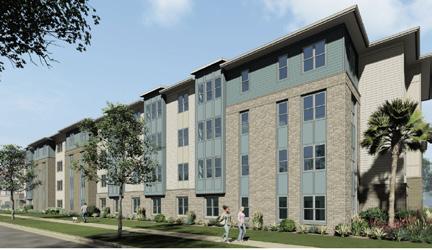
WHA plans to demolish the buildings and redevelop the neighborhood as a mixed-income community using private equity financing in a Low-Income Housing Tax Credit (LIHTC) model. The redevelopment project, to be built in four phases, is set to include more than 500 units upon completion.
During the first phase, crews will construct a four-story, 84-unit apartment building with an elevator for older adults.
“That kind of takes care of the residents that really are still remaining here at Hillcrest,” Garrett said.
New Hanover Community Endowment
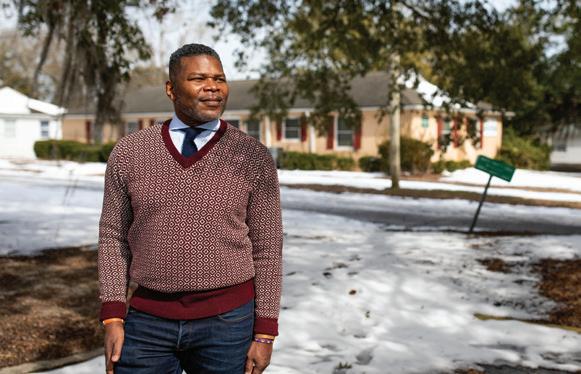
Tyrone Garrett, CEO of the Wilmington Housing Authority, is shown in WHA's Hillcrest community, which is on the books to be redeveloped.
officials announced in October that they had awarded WHA a grant of $5.7 million for the senior rental units.
Garrett said the authority works to keep residents in their same communities during and after redevelopment projects.
“I’m not going to ask someone 90 years old to pack up and relocate to someplace else,” he said, “because the level of anxiety, I found, really takes a toll on families and on those residents.”
CONTROLLING OPERATIONS
Another major renovation project will take place at Jervay. Last year, the authority bought Jervay Place back from LIHTC developer Telesis Corp. in an $18.8 million deal. But, Garrett explained, $16.3 million of that figure was part of a promissory note the WHA wrote off in the transaction, so the authority only had to come up with $2.5 million.
“We scraped that up (the $2.5 million) as best we could to purchase that,” he said, so that the WHA would have complete control over the property.
“I really prefer to have total control of the properties that we have. Now, in some instances, we might not be able to do that. We might have to have a third party,” Garrett said, “but wherever there’s the possibility for the housing authority to control everything operationally on a daily basis, we’re going to do that.”
He recounted an episode last summer as a major factor, when a water main broke at one of WHA’s properties. “The water main was broken for three or four days. We found out about it by getting a call from the news media,” Garrett said. “And that was uncomfortable for me, and it was uncomfortable for my board. So, the
(WHA) Board of Commissioners has allowed the administration to take on that approach and say, ‘Hey, whatever we build, whatever we have in our portfolio, let’s try our best to manage it.’”
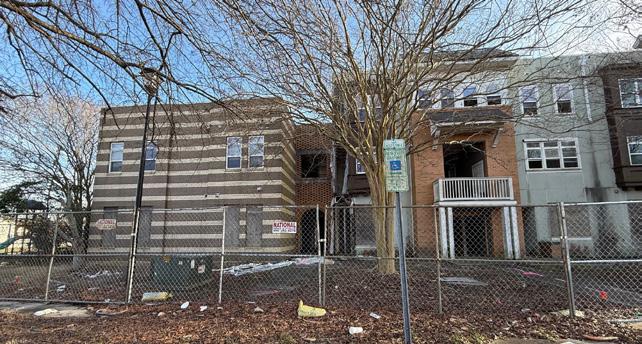
Hurricane Florence, which dumped up to 30 inches of rain on some parts of Wilmington in September 2018, caused heavy damage to 18 townhomes at Jervay under its previous ownership. As of March this year, the townhomes remained unusable and fenced off, surrounded by litter. Moving forward, Garrett said, the townhomes will be demolished and replaced with an 80-unit, multistory apartment building, and the housing authority will build an additional 90 units on another segment of the Jervay property.
“So, Jervay actually becomes not only a rehab project, but also a
UPCOMING PROJECTS
THE FOLLOWING ARE THE FOUR MAJOR REHABILITATION AND REDEVELOPMENT
PROJECTS WILMINGTON HOUSING
AUTHORITY IS UNDERTAKING IN THE COMING MONTHS AND YEARS.
HILLCREST
ADDRESS: 1402 Meares St. (rendering above)
PLANS : Redevelopment, with 84 new units of senior housing in the first of four phases; 584 new units total in a mixedincome community upon completion
EST. COST: $65 million+
SOLOMON TOWERS
ADDRESS : 15 Castle St.
PLANS : Rehabilitate existing 150 units
EST. COST: $30.3 million
HOUSTON MOORE
ADDRESS : 1601 S. 13th St.
PLANS: Redevelopment, with 200 new units in two buildings in the first phase, 50 senior housing units in phase 2
EST. COST: $65.4 million
ROBERT S. JERVAY PLACE
ADDRESS: 1088 Thomas C. Jervay Loop
PLANS: Rehabilitate 82 units and build 86 new units
EST. COST: $21.5 million for the new construction, $50,000 per unit for the rehab
SOURCE: WILMINGTON HOUSING AUTHORITY
Damaged townhomes in the Jervay community are set to be demolished.
redevelopment project,” he said.
CRITICAL
HOUSING TYPE
Garrett joined WHA in 2022 with more than 20 years of experience as a senior executive in public housing and government. Before WHA, he was CEO of the District of Columbia Housing Authority (DCHA), where he led a $2 billion plan to preserve, stabilize and redevelop the DCHA portfolio.
When he got to Wilmington, among other issues, Garrett inherited a major mold crisis that had forced 150 WHA residents out of their homes and into hotels for 18 months. Some WHA board members laid the groundwork by working to secure additional funding to address the crisis, which needed a clear plan, Garrett said.
“Ambitious as it was, it took about six months once we had the funding in place to get us where we needed to be,” and residents back into their units, he said.
Problems are bound to come up, but what the WHA does to provide affordable housing in Wilmington is critical, officials say. That includes administering a federal housing voucher program, which provides rent subsidies for income-eligible households renting from the private market.
About 1,550 people reside in WHA’s own communities, and the authority has about 1,500-1,700 people on waiting lists across all
its properties, Garrett said. Some of the waiting lists are closed “because we have that many people,” he said.
Over half of the people who rent housing in the Wilmington area are spending more on rent than they can afford, meaning an amount well over the affordable threshold of 30% of their income.
“We’ve got a lot of people who are just kind of living paycheck to paycheck,” said Suzanne Rogers, director of housing for Cape Fear Collective, a separate organization from WHA.
Cape Fear Collective also provides some affordable housing options in Wilmington, including a portfolio of about 92 homes.
“There’s a mismatch between what the local wages are for a large number of our community and what the housing cost is,” Rogers said.
That means the rehabilitation of existing affordable and workforce housing units and the addition of more, as WHA is doing with some of its projects, are critical tasks.
“In terms of housing, every unit helps,” said Clayton Hamerski, former chair of nonprofit advocacy group Cape Fear Housing Coalition, “and so bringing more units online and improving the livability in those units – it’s a huge help to our housing market, to the quality of life, to our residents.”
photo by CECE NUNN
MEMBERS OF THE CURRENT WILMINGTONBIZ 100 SHARE ADVICE ON FOSTERING AN INNOVATION MINDSET. THIS YEAR’S GROUP WILL BE ANNOUNCED IN THE FALL.
TO SEE THE FULL GROUP, VISIT WILMINGTONBIZ100.COM.
How do you encourage innovation within your team or organization?
BEAU GUNN
OWNER, BEAU GUNN PRESENTS
“ BY STAYING OUT OF THEIR WAY! I HAVE LEARNED OVER THE YEARS THAT FRESH IDEAS AND PERSPECTIVES OFTEN COME FROM THE NEWEST MEMBERS OF THE TEAM. THE BEST WAY I HAVE FOUND TO INNOVATE AND STAY RELEVANT IS TO LISTEN TO THE NEWEST IDEAS AND TO TRY TO IMPLEMENT THE ONES THAT MAKE SENSE.”
JANET KANE CEO, CAPE FEAR REALTORS
“INNOVATION REQUIRES FREEDOM TO TRY NEW THINGS AND TO MAKE MISTAKES WITHOUT WORRY OF ‘FAILURE.’ OUR STAFF CELEBRATES CREATIVITY, NEW IDEAS, AND IF SOMETHING GOES IN A DIRECTION WE HADN’T ANTICIPATED, WE CELEBRATE WHAT WE LEARNED AND WHAT WE WILL DO DIFFERENTLY GOING FORWARD. THE MANTRA I SHARE WITH OUR STAFF AND MEMBERS IS THAT ‘WE FIND BLAMELESS SOLUTIONS.’”
ALEXIS HUNTER
EXECUTIVE, STRATEGIC RELATIONSHIPS & FOUNDATION, WILMINGTON HEALTH
“HEALTH CARE CONSTANTLY CHANGES. OUR INDUSTRY IS OFTEN AT THE MERCY OF CIRCUMSTANCES OUTSIDE OF OUR CONTROL. WE ARE CONSISTENTLY EMPOWERED TO THINK OF NEW IDEAS, INNOVATIVE OPTIONS AND ARE EVENT INCENTIVIZED TO IMPLEMENT GAME CHANGERS EACH YEAR. AT ALMOST EVERY MEETING, EMPLOYEES ARE ASKED, ‘WHAT ARE WE DOING DIFFERENTLY?’ WE ARE ENCOURAGED TO EVOLVE, TO GROW AND TO CHANGE SO THAT WE DON’T GROW STAGNANT IN OUR EFFORTS TO SUPPORT PATIENTS IN THE AREA.”
SEAN DESMOND
PRESIDENT & CEO, NCINO
“MY JOB IS ENSURING WE RECOGNIZE THE MOMENT WE’RE IN AND STEER WHERE THE MARKET IS HEADED. INNOVATION MUST TIE DIRECTLY TO OUR MISSION AND ALIGN WITH OUR STRATEGY. RANDOM INNOVATION DOESN'T MOVE US FORWARD. WHAT WORKS IS CREATING AN ENVIRONMENT WHERE OUR BEST PEOPLE SHARE KNOWLEDGE, CHALLENGE EACH OTHER AND HOLD EACH OTHER ACCOUNTABLE. WHEN YOU GET THAT CHEMISTRY RIGHT – STRATEGIC CLARITY PLUS CURIOSITY PLUS CONSTRUCTIVE CHALLENGE – YOU CAN INNOVATE AT SPEED.”
TRAVIS CORPENING
EXECUTIVE DIRECTOR, YOUNG MOGUL DEVELOPMENT GROUP
“I ENCOURAGE INNOVATION BY INTENTIONALLY PRESENTING ISSUES OR OPPORTUNITIES FOR THEM TO DEVELOP CRITICAL THINKING SKILLS . FOR EXAMPLE, FOR MY STUDENTS, I WILL PROVIDE STEM-BASED SCENARIOS FOR THEM TO PLAN A SOLUTION FOR AS A TEAM. ONE OF SCENARIOS PRESENTED THEM WITH THE CHALLENGE OF CREATING A BRIDGE OUT OF CARDBOARD AND OTHER MATERIALS TO HELP SAVE PEOPLE IN A COASTAL TOWN FROM FLOODING. WE HAVE USED LEGOS, DRONES AND MORE TO EXPOSE STUDENTS TO THE WORK IN EMERGENCY SERVICES AND PUBLIC COMMUNICATION.”
BUILT TO LAST
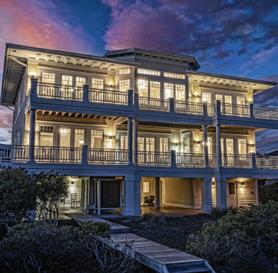
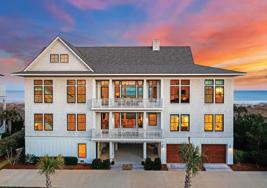
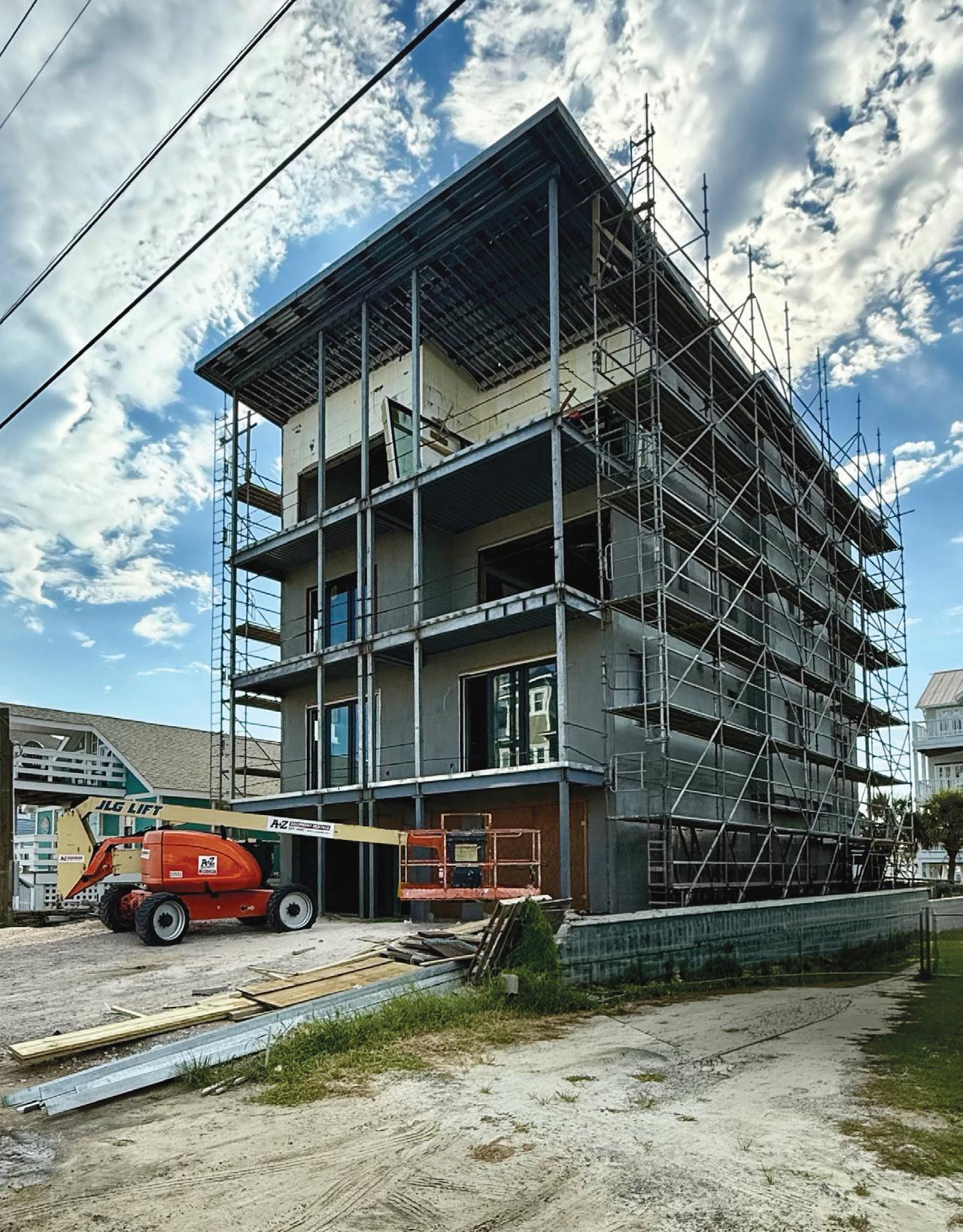
THE HOUSE AT 1211 CAROLINA BEACH AVE. ISN’T YOUR STANDARD, WOOD-FRAME BEACH DWELLING.
The 5,200-square-foot custom structure with three stories above the garage is fully concrete, said homebuilder Todd Piper. It was about a month or so away from being finished in March, said Piper, who owns Tidal Wave Construction.
Originally from Yorktown, Virginia, Piper moved to the coast because of his love of surfing and attended the University of North Carolina Wilmington, where he graduated in 2006.
His own home, also in Carolina Beach, is concrete, and
his 1211 Carolina Beach Ave. client wanted the same hardy materials.
“The problem is in North Carolina, it’s an extremely harsh environment, especially on wood-frame houses,” Piper said. “As houses get bigger and taller, we start to run into a problem with the strength of them.”
Concrete, meanwhile, lasts lifetimes, according to Piper, and is perfect for a homeowner who wants a beach house that can be passed down through generations.
“It’s never going anywhere, ever,” he said of 1211 Carolina Beach Ave. “The island will disappear, and that house will still be there, without a doubt.”