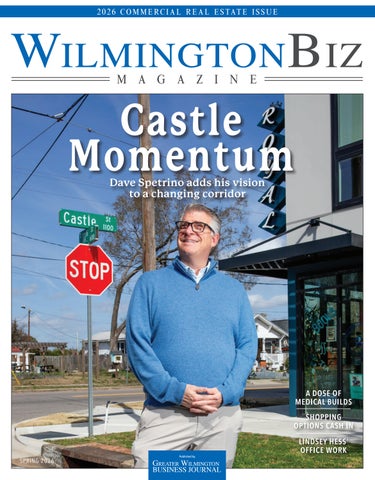
Castle Momentum
Dave Spetrino adds his vision to a changing corridor
A DOSE OF MEDICAL BUILDS SHOPPING OPTIONS CASH IN
LINDSEY HESS’ OFFICE WORK





expansion 'targets' more wilmington consumers
MINNEAPOLIS-BASED RETAILER TARGET REPORTED A DECLINE IN SALES AND PROFITS IN MARCH.
At the same time, company officials also “offered a solid annual profit outlook that was better than Wall Street had been projecting” and said they believe “net sales will grow every quarter this year,” according to an ABC News report.
That could be good news for a company expanding in Wilmington.
As of press time, Wilmington Target fans were still waiting to hear when the area’s second location of the department store, under construction in the Monkey Junction area off Carolina Beach Road, might open.
I remember hearing rumors about a second Wilmington Target about two or three years after the first Target opened off Market Street in 1998. A Target and a new movie theater were supposed to be coming to the Monkey Junction area. But the junction got new apartments in the movie theater spot, and the Target rumor died down.
Although its origins date back to a fellow who opened a dry goods store in Minneapolis in 1902, the first four Target-branded stores opened in Minnesota in 1962.
My kids have been going to Target since they were babies, and it seems like trips there always delighted them. We’d always get popcorn at the little canteen before a Starbucks was installed in its spot. There was always something more interesting, more fun about a Target trip, even though it offers the same type of items that other stores have.
According to a March post on Target’s website, the company plans to open 30 new stores this year, including a 148,000-square-foot location that is expected to employ about 160
people in Fuquay-Varina. The post also said Target is on track to build more than 300 new stores by 2035 “as we aim to serve even more consumers.”
The post describes more stores as a win in the company’s effort to create both shopping destinations and fulfillment hubs.
“With every grand opening, as we get closer to more consumers, we also improve our ability to deliver what guests need, when and where they need it,” according to the post.
I don’t know if my teenagers “need” more clothes, but for my 17-year-old, the clothes are her favorite part of Target. “And the swimsuits especially,” she said. “They’re cheap and cute.”
You can read more about changes at the shopping center where the second Target is underway in the story “Centers of Change” on page 34.
In the meantime, as we wait for opening day in Monkey Junction, these midtown residents (the teenagers and I) will still have to travel “all the way to Market Street” for a Target fix.

CECE NUNN, MANAGING EDITOR cnunn@wilmingtonbiz.com

DARIA AMATO
DARIA AMATO is a native New Yorker and School of Visual Arts graduate. Throughout her 30 years of experience, she has photographed a range of editorial, advertising, company branding and corporate clients in addition to music, fashion, portraiture, weddings and still life. Amato photographed local office space expert Lindsey Hess of Cape Fear Commercial ( PAGE 26 ), McKinley Building Corp. President Chad Hodges ( PAGE 40 ) aBIZ MAG nd Castle Street business owners Corey and Phallin Scott ( PAGE 23 ). dariaphoto.com

MADELINE GRAY
MADELINE GRAY is a freelance documentary photographer based in Wilmington. With a master’s degree in photojournalism, her work is regularly featured in local and national publications. In this issue, her work includes the cover photo of developer Dave Spetrino for a story about Castle Street ( PAGE 20 ), award-winning local chef Dean Neff ( PAGE 50 ) and social shooting club Sanctum 1791 ( PAGE 53 ). madelinegrayphoto.com and @madelinepgray on Instagram

BETH A. KLAHRE
BETH A. KLAHRE retired from a major Pennsylvania chocolate manufacturer. Now relocated to Southport, she spends her time writing and has been published locally and nationally. She is learning to play the harp, loves walking the beach with her dog and serves on the board of directors of Friends of the Library Southport & Oak Island. She talked with local office space expert Lindsey Hess (PAGE 26).

EMMA DILL
EMMA DILL , a Wisconsin native, graduated from the University of Minnesota in 2019 with a journalism degree. She covers commercial real estate and economic development for the Greater Wilmington Business Journal. In this issue, she wrote about Castle Street and the busy corridor’s changes ( PAGE 20 ) and how local shopping centers have been evolving lately ( PAGE 34 ).
P ublisher
Rob Kaiser rkaiser@wilmingtonbiz.com
P resident
Robert Preville rpreville@wilmingtonbiz.com
e ditor
Vicky Janowski vjanowski@wilmingtonbiz.com
M anaging e ditor
Cece Nunn cnunn@wilmingtonbiz.com
r e P orters
Emma Dill edill@wilmingtonbiz.com
Cierra Noffke cnoffke@wilmingtonbiz.com
V
ice P resident of s ales & M arketing
Matthew Coleman mcoleman@wilmingtonbiz.com
s enior M arketing c onsultant
Craig Snow
M arketing c onsultants
Alexis Powers
Jillian Hon
Fawn Carey
Heather Cunningham e V ents d irector
Jamie Merrill jmerrill@wilmingtonbiz.com
a ssistant e V ents d irector
Alec Hall ahall@wilmingtonbiz.com
a rt d irector - e ditorial
Suzi Drake art@wilmingtonbiz.com
a rt d irector - M arketing
Tara Weymouth tweymouth@wilmingtonbiz.com
M edia c oordinator
Tara Sestanovich tsestanovich@wilmingtonbiz.com
o ffice M anger
David Taylor
dtaylor@wilmingtonbiz.com
d irector of f east W il M ington
Jessica Maurer jmaurer@wilmingtonbiz.com
c ontributing P hotogra P hers
Daria Amato, Danielle Desnoyers, Madeline Gray
s ubscribe
To subscribe to WilmingtonBiz Magazine,visit wilmingtonbiz.com/subscribe or call 343-8600 x201. © 2026 SAJ Media LLC

HEADS UP
As part of Cape Fear Museum of History & Science’s move to Project Grace, workers recently installed the seats and equipment for a new digital dome theater. Wilmington-based nCino pledged $160,000 over 10 years for the theater, one portion of the $77 million, 95,000-square-foot new museum, which is slated to open this summer. Similar to a planetarium, the 60seat theater’s content will expand beyond celestial objects to also project shows on history and science, museum officials said. As of early March, work on the theater was finished and interior building construction was largely complete, said museum director Kate Baillon, adding that exhibitions were to start being installed later in March. More than 46,000 people visited the Cape Fear Museum last year at its longtime Market Street spot. Museum officials are estimating about a 30% increase in visitation after the new facility opens. “We are excited, it is becoming a tangible reality,” Baillon said. “We are looking forward to sharing the space with the public later this year.” - Vicky Janowski
B iz B I tes

photo c/o NEW HANOVER COUNTY, OFFICE OF COMMUNICATIONS
WE
TSOUND OFF
NEED MORE ENTREPRENEURS WE DON'T NEED MORE JOBS
HE WORKFORCE IN THE UNITED STATES IS ESTIMATED AT ROUGHLY 170.6 MILLION AMERICANS AS OF MARCH. FOR MANY DECADES, ECONOMIC DEVELOPMENT HAS CENTERED ON ONE PRIMARY OBJECTIVE: ATTRACTING JOBS, OFTEN AT THE EXPENSE OF UNDERSTANDING HOW LOCAL ECONOMIES ACTUALLY FUNCTION.
Cities have competed for large employers, offered incentives and invested heavily in recruitment strategies aimed at attracting companies to their regions. While this approach has produced growth, it has also created a structural blind spot, one that is especially relevant for rapidly growing communities like Wilmington and the broader Cape Fear region.
The modern economy is no longer dominated solely by centralized employment. It is increasingly powered by entrepreneurs, independent earners and multi-income stream workers. Today, nearly 82% of small businesses are sole proprietors, meaning millions of people are creating their own jobs rather than working for someone else. This workforce represents more than 30 million Americans and well over 17% of the current workforce.
In the modern economy, entrepreneurship is no longer a marginal segment of the workforce; it is increasingly becoming the workforce

GIRARD
NEWKIRK
itself. The future of economic growth is not being built solely by large employers, but by a distributed network of small business owners, independent workers and entrepreneurs operating within our neighborhoods.
When we examine the full composition of today’s workforce, a clearer picture begins to emerge. When combining small business owners, freelancers, gig workers and independent operators, more than 78% (134 million people) of the American workforce is no longer exclusively employee based. This signals a fundamental shift in how people earn, produce and participate in the economy. In my book, “Newkirknomics,” I describe this transformation as the MISEconomy, the Multi-Income Stream Economy, where individuals are no longer defined by a single job, but by a portfolio of income-generating activities. This is not a temporary trend. It is a structural evolution of the economy itself.
If Wilmington, New Hanover, Brunswick and Pender counties want to build a more resilient and inclusive economy, the question must shift: How do we create and support more entrepreneurs?
This is the foundation of what I call the Neighborhood Economy, the layer of economic activity made up of small businesses, microenterprises, freelancers and local service providers
that shape our daily lives.
And in the Cape Fear region, this sector is already significant. New Hanover County alone is home to more than 14,000 small businesses, while Brunswick County, one of the fastestgrowing counties in North Carolina, has seen rapid growth in new business formation alongside its population boom. Across the three-county region, thousands of residents are participating in the local entrepreneur economy, whether through full-time businesses, side ventures or independent work.
But growth alone does not guarantee that economic opportunity is distributed evenly or that local businesses are positioned to benefit. That’s where the gap exists.
The Neighborhood Economy is not emerging; it is already existing in plain sight, but the problem is that most cities are not organized to support it. In Wilmington, we see this clearly. There is no shortage of entrepreneurial talent. Every neighborhood across New Hanover, Brunswick and Pender counties has individuals with ideas, skills and ambition. But too often, these entrepreneurs operate in isolation, without access to structured pathways that help them move from idea to income to sustainable enterprise. If we are serious about building a stronger regional economy, we must focus on building what I call the entrepreneur pipeline. This means creating clear pathways for individuals to move through stages of business development – from aspiring entrepreneur to emerging business to stable, revenuegenerating enterprise and eventually job creation. Without this pipeline, many entrepreneurs remain stuck in informal or undercapitalized activity.
But a strong pipeline alone is not enough. Entrepreneurs need infrastructure.
In the Cape Fear region, we have important entrepreneur support organizations that have collaborated to establish the Coalition with organizations like the Small Business Center Network, SBTDC, Genesis Block Foundation, Network for Entrepreneurs in Wilmington and UNCW’s Center for Innovation and Entrepreneurship. These organizations play a critical role –but they are often operating without a fully coordinated system that maps and connects entrepreneurs across the region. What’s needed is a more integrated approach (shared systems and infrastructure), one that ensures entrepreneurs can easily access coworking spaces, commercial kitchens, training programs and incubation environments that help them scale.
At the same time, in the Cape Fear region, there is significant capital flowing through our community.
Local governments, hospitals, universities and major employers collectively spend hundreds of millions of dollars annually on goods and services. Yet only a small percentage of that spending consistently reaches local small businesses. This is where one of the greatest opportunities lies: the procurement spending of community-based organizations. If even a modest portion of institutional purchasing were redirected toward local businesses, it could create stable revenue streams and allow entrepreneurs to scale.
The future of Wilmington’s economy will not be exclusively defined by the companies we recruit. It will be defined by the entrepreneurs we develop, the businesses we support and the systems we build to help local talent thrive.
CROWD SOURCING
Wilmington entrepreneur and author Girard Newkirk is the co-founder and CEO of Genesis Block. REACTIONS, OPINIONS AND QUOTABLES FROM OUR ONLINE

WHAT BUSINESSES DO YOU THINK WILMINGTON NEEDS MORE OF?
“IT WOULD BE NICE to have an IKEA, Cheesecake Factory, some higher end places to shop like an Apple Store/Gucci/Rolex/Tiffany’s; nicer places like Charlotte has inside their mall…” -ALLISON REEVES
“ANOTHER BOWLING Alley, IKEA, Apple Store!” -DEBBIE BOWEN DIVERS
“WHY DON’T we have a Popeyes?” -STEPHANIE SNYDER
“ANYTHING BUT A brewery or storage units.” -AMBER BOWENS
“DOWNTOWN GROCERY store.” -DORIAN CROMARTIE
“FREE SHUTTLE to the Beach from remote parking lots.”
- DARRELL SHELDON
“MIND YOUR OWN .... that’s the business Wilmington needs more of!” -STEVE WATKINS
“ DODGE BALL Arena” -KELLY ANNE DENNIS
The Business Journal received hundreds of answers to this reader question on Facebook. Read more of the responses on page 10 of the commercial real estate side of this issue.

LINKEDIN POLL: @WILMINGTONBIZ
WHAT TYPE OF DEVELOPMENT DO YOU THINK THE WILMINGTON REGION COULD BENEFIT FROM THE MOST?

RETAIL +
INDUSTRIAL / MANUFACTURING
WILMINGTONBIZ.COM
“IT’S DIFFICULT TO FIND UNDEVELOPED PROPERTY , but really the intent of it from Flossie Bryan was to keep it as green space, and we have a chance to do that.” - HARRISON MARKS, EXECUTIVE DIRECTOR OF THE COASTAL LAND TRUST, ON THE GROUP BUYING 60 ACRES OFF INDEPENDENCE BOULEVARD, KNOWN AS THE FLOSSIE BRYAN TRACT, FROM NEW HANOVER COUNTY FOR $3 MILLION.
SIGN UP FOR DAILY NEWS UPDATES AND SUBSCRIBE TO THE GREATER WILMINGTON BUSINESS JOURNAL AT WILMINGTONBIZ.COM
SOUND OFF
PERMITTING TRENDS TELL A TALE
THE WILMINGTON METROPOLITAN
AREA’S GROWTH HAS BEEN DOCUMENTED AND MEASURED IN A LOT OF DIFFERENT
WAYS.
This piece discusses the construction boom, how it is distributed across the three counties and the less frequently discussed variation within them.
BRUNSWICK BOOM
Brunswick County is the undeniable story of this era. In 2018, it authorized roughly 1,700 residential units. By 2023, that number had exploded to 6,552 units, which is almost four times higher in just five years.
The most recent data, covering 2025, shows the county permitting approximately 4,457 units. That is below the 2023 peak but still at a level that would have been unimaginable a decade ago and that far exceeds what either of its neighbors is producing.
The story within Brunswick is equally striking: Leland, the town just across the Cape Fear River from Wilmington, has alone accounted for over 8,400 permitted units since 2018, making it one of the fastest-growing municipalities in North Carolina by any measure.
NEW HANOVER DENSITY
New Hanover County tells a different but equally important story.
It is the most urbanized and land-constrained of the three counties. It saw a strong surge in permitting through 2022, topping out at 3,327 units, before entering a clear declining phase.

MOUHCINE
GUETTABI
By 2025, the county authorized only 2,332 units, which is about a 30% drop from the pandemic-era peak.
What stands out is New Hanover’s housing mix.
The share of single-family construction is much lower there than in Brunswick or Pender. About 49% of its permits since 2018 have been for single-family units, compared with roughly 87% in Brunswick and more than 90% in Pender.
This is a direct reflection of Wilmington’s density pressures and the growing importance of multifamily development for meeting housing demand.
STEADY PENDER
Pender County is the largest county in land area but the smallest in permit volume.
It began reporting data to the Census Bureau only in 2022. In the four years since, it has authorized almost 3,800 units.
Its annual totals have been remarkably stable, ranging from about 830 to 1,100 units per year. This points to a market that is growing steadily but has not yet entered the rapid expansion that Brunswick experienced in the early 2020s.
Recent employment gains and business establishment growth suggest that Pender may soon become a more significant player, since it is not only adding jobs but also seeing an increase in wages.
WHAT DOES ALL OF THIS MEAN IN PRACTICE?
It means school systems are absorbing new students each year. It also means road networks are now carrying higher levels of daily traffic, and that municipal water and sewer systems, emergency services and public parks are seeing higher demand than in the past.
The pace of permitting is a leading indicator, and the actual construction, occupancy and service needs tend to follow 12-24 months later.
The pressure visible in Brunswick’s infrastructure today aligns with permits pulled in 2022 and 2023. The permits issued in 2025 will show up in local service demand in the next couple of years.
None of this is an argument for or against growth.
The Cape Fear region continues to attract new residents for reasons that include coastal quality of life and relative affordability compared with larger metros.
The construction industry is responding to those population trends.
Growth of this scale, and the duration over which it has occurred, creates coordination challenges for a region made up of three counties with different tax bases and service structures.
Understanding the location and type of new housing activity is an important step toward planning for the pressures that follow.
Mouhcine Guettabi is a regional economist with UNCW’s Swain Center and an associate professor of economics at UNCW’s Cameron School of Business.

BEHIND THE NUMBERS
9.75

PRICE TO BUY GREENVILLE LOOP ROAD LAND FOR A PARK
CITY, COUNTY LEADERS PONY UP FUNDS FOR PARKLAND PURCHASE
BY EMMA DILL
NEW HANOVER COUNTY AND WILMINGTON leaders in February unanimously approved an interlocal agreement to acquire 25 acres for a proposed park off Greenville Loop Road.
The votes by the Wilmington City Council and New Hanover County Board of Commissioners came soon after the Jan. 29 announcement of a $7.7 million grant for the project from the New Hanover Community Endowment. That grant was contingent on the $1 million in separate commitments agreed to by both the city and the county.
The $9.75 million purchase of the land at 6325, 6335, 6341 and 6345 Greenville Loop Road closed in mid-March, according to deed records.
Hawke said city staff identified the four parcels as a potential park site in March 2025. The site, which is made up of four adjacent tracts, was appraised at nearly $10.1 million, she said.
It could take millions of dollars and several years to get a park up and running on the largely undeveloped site, according to Hawke.
“Even with, I would say, nominal amenities, you’re probably looking at at least $10 million in additional investment to have the correct infrastructure in place to be able to open it up and have bathrooms and parking and even some of the base things that you need in order to have a fully functioning park,” Hawke told the Wilmington City Council.
According to the terms of the interlocal agreement, the city would be responsible for the park’s development, operations and maintenance, along with related costs. Additionally, the county would assist the city and the endowment in developing plans for activating the property as a park and would be included in the park’s name and signage.
$31.2 MILLION (Q3 2024 vs Q2 2025) HELP WANTED
As part of the grant from the endowment, the site must be activated as “a park and community-informed recreational amenity within five years of the grant,” according to a letter from the endowment to the city included in the council’s agenda. “If this requirement is not met, the city must return the full amount of the grant to the endowment within 30 days of the five-year term.”
5.8" JAN. 31-FEB. 1, 2026 THE MOST SINCE 1989’S RECORD SNOWFALL OF 15.3 INCHES: DEC. 22-23, 1989
N.C. FILM AND ENTERTAINMENT GRANTS REBATES APPROVED IN 2025 FOR FILMING PROJECTS IN THE AREA MANUFACTURING EMPLOYMENT SOUTHEASTERN NC
MILLION



DIGEST
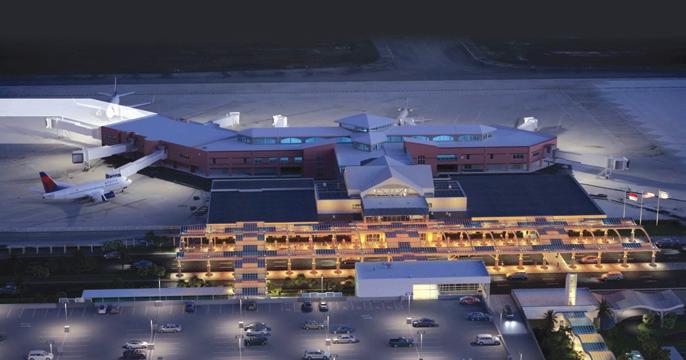
ILM PLANS $243M IN CAPITAL PROJECTS
groundwork for future growth, with plans for a terminal expansion, an expanded baggage area and airfield improvements slated for the coming
The proposed capital projects, investment in the airport’s adjacent business park, are expected to result
million at ILM, according to airport director Jeff Bourk, who provided an update in mid-March during a joint meeting of the New Hanover County
and 1.8 million passengers overall. It also had an estimated net operating income of just over $6 million, Bourk said.
According to Bourk’s presentation, passenger forecast models project that ILM will see between 1.1 million and 1.5 million enplanements by 2045.
Work is already well underway on the second phase of a $134 million project that includes the reconfiguration of roads around the airport, the construction of the airport’s first parking garage, along with an updated terminal entrance and a longer, straightened curbfront.
The parking garage is under construction and slated for completion in October, Bourk said.

GE Aerospace is investing $60 million in its Wilmington plant in 2026, as part of a $1 billion investment in sites across the U.S. to accelerate jet engine production, the company announced in March.
More than $275 million of the $1 billion is earmarked for upgrading defense engines and components and “helping to strengthen the U.S. defense industrial base to deliver at pace for the warfighter's evolving needs,” according to a company press release.
The Wilmington site will continue to produce engine components for narrowbody and widebody aircraft, as well as for military fighter jets and ships.
Over the past three years, GE Aerospace has announced plans to invest more than $300 million at its North Carolina sites, with more than $135 million set aside for its Wilmington site, according to a company spokesperson.
In 2025, the airport saw more than 907,000 enplanements, or individual passengers boarding an aircraft, a 67% increase in enplanements from 2019, according to Bourk's presentation,
Other proposed capital projects include a 25,000-square-foot terminal expansion to add four new gates, a runway resurfacing project and an increased footprint for baggage facilities.
Rendering c/o ILM
Photo c/o GE AEROSPACE
Castle Gains Attention
Infill projects and small businesses push the street’s evolution
BY EMMA DILL | PHOTOS BY MADELINE GRAY & DARIA AMATO
After living in Charlotte for 10 years, developer and Wilmington native Trey Galarde wanted to get back to the Port City. He found his chance on Castle Street.
Galarde, vice president of Hallmark Building Corp., is leading the company’s development of The Ollie, a mixed-use project with 24 apartments proposed at 1315 Castle St. The project, which is moving through its final phases of permitting, is set to break ground this spring, Galarde said.
He notes similarities between Wilmington’s Castle Street – a historically Black-owned business corridor lined with an eclectic mix of stores and residential blocks – and emerging Charlotte neighborhoods like NoDa.
“Over the past 10 years, we’ve seen a few different corridors just like Castle Street come from where Castle Street is now,” Galarde said, “to (become) these really vibrant, walkable areas that people just love being in, especially the millennial crowd.”
This momentum is evident along Castle Street, where mixed-use infill projects like The Ollie are becoming increasingly prominent on its eastern end, a traditionally residential area near the growing Cargo District. These new developments are slated to bring both new residents and new small businesses to Castle’s ever-evolving streetscape. As the area changes, some there say they want to make sure the neighborhood’s character remains.
BETTING BIG ON CASTLE
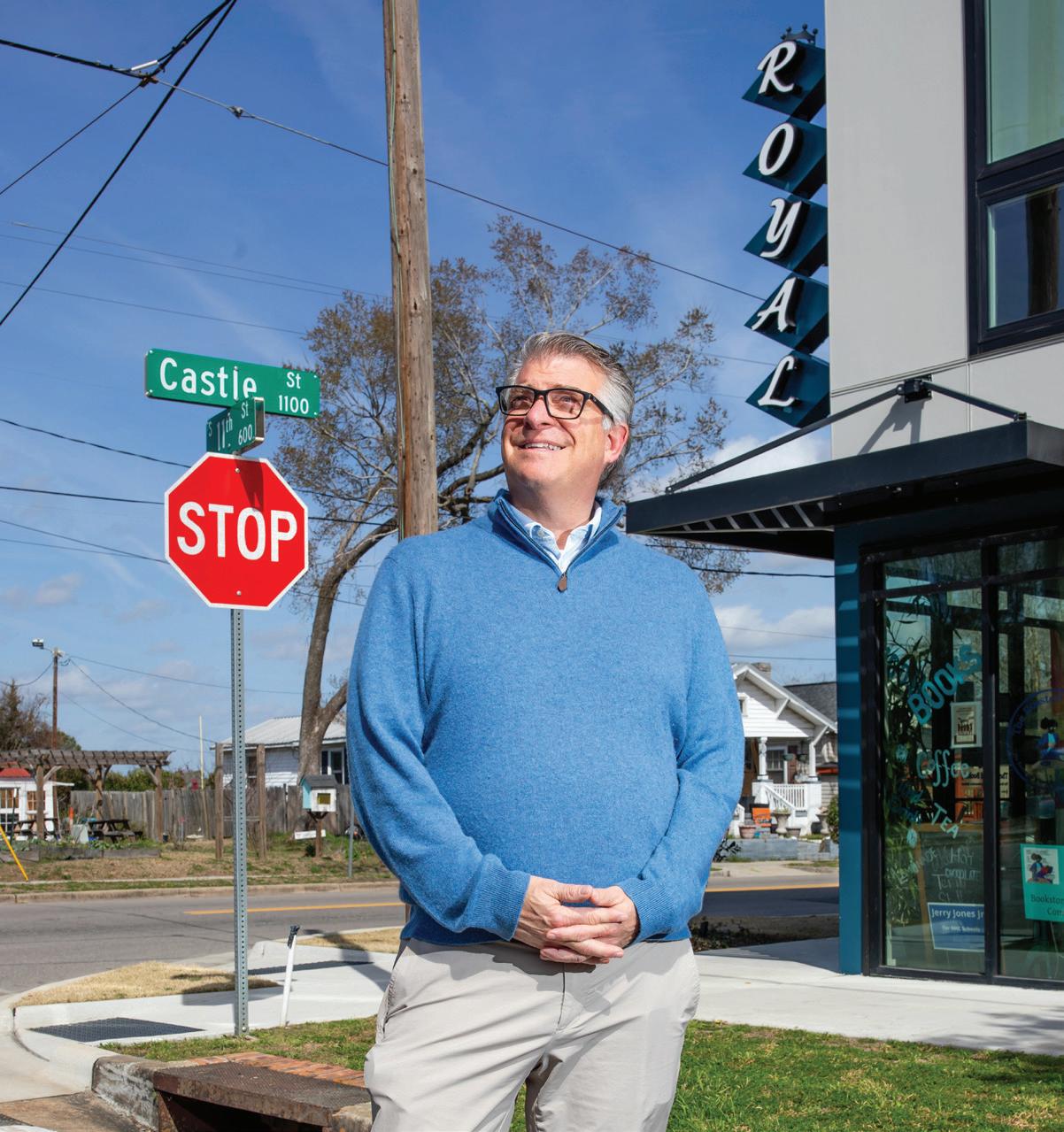
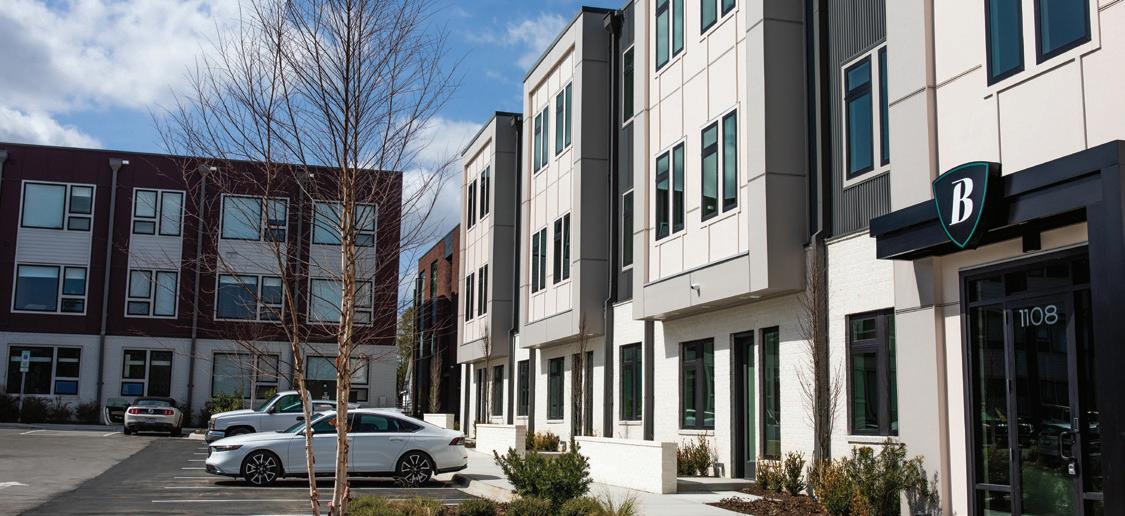
One of the biggest changes in recent years came with the construction of Midcastle, a four-building complex with 98 apartments and more than 4,200 square feet of ground-floor commercial space at 1110 Castle St.
Dave Spetrino developed the project after winning a bid for the 1.5-acre property. Before opting to sell the land, the city of Wilmington tried for years to find a partner to redevelop the site, which previously housed a bus facility, into a community center or affordable housing.
Spetrino had been banking on the site’s development when he built The Crown, another mixed-use project, at 919 Castle St. When the city’s plans didn’t materialize, Spetrino said, he decided to develop it himself.
Castle Street’s widespread mixed-use zoning, an opportunity zone designation on stretches of the street and tax incentives helped make it an attractive project, Spetrino said.
Local developer Dave Spetrino stands outside Midcastle, a mixed-use complex he recently completed on Castle Street. Spetrino has developed other projects in the Castle Street corridor.
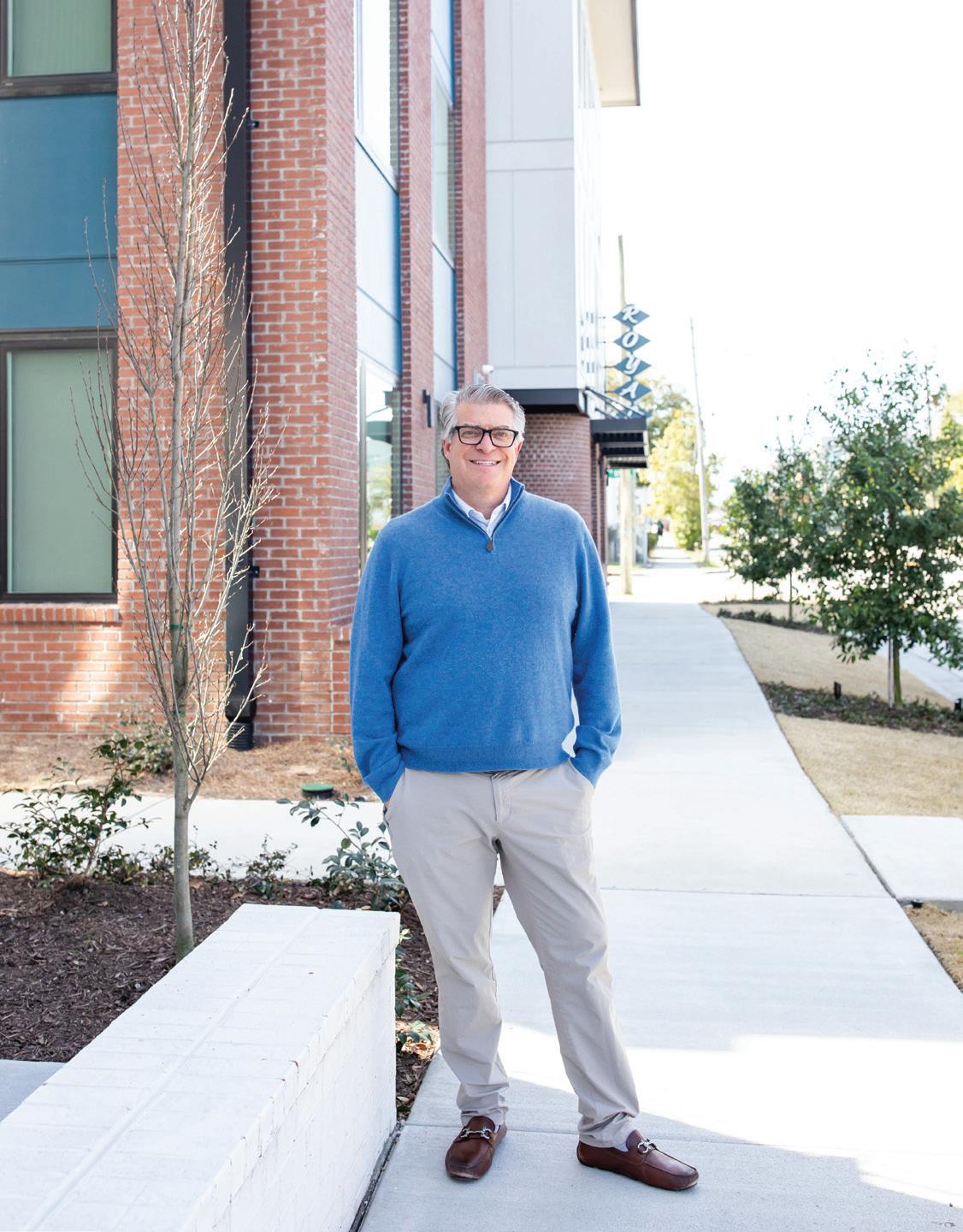
Each building has its own personality and its own name and its own kind of vibe. ” ”
DAVE SPETRINO Midcastle developer
Midcastle broke ground in early 2024, and work on the final building wrapped up earlier this year.
“Each building has its own personality and its own name and its own kind of vibe,” Spetrino said during a recent tour of the property.
In addition to apartments, Midcastle’s commercial spaces house The Roasted Bookery, a bookstore and cafe, and crafting studio Craft Cabana. Other spaces are currently being upfitted for new tenants.
Hannah Hickman is growing her business, Sacred Salon and Studio, in one of those spaces. Hickman’s specialty is hair extensions, so she plans to create a cozy, intimate aesthetic for her clients.
“I want them to feel like they’re just hanging at a friend’s house,” she said.
Martha Bass also plans to establish her hair salon, Orange Blossom Studio, on the ground floor of Midcastle. Bass said she hopes foot traffic will help boost the salon’s visibility.
For Lizzie Hourigan, her storefront space will house her business, Glimmers Recreational Therapy. Hourigan uses recreational therapy to support clients of all ages with physical, social, emotional and cognitive needs.
“I really needed a space that was just my own,” she said.
In the corridor, Spetrino is also working on another project, called The Hudson, on a vacant lot at 512 Castle St. Construction is set to begin this spring, and the project will include 15 one-bedroom apartments and nearly 1,900 square feet of commercial space.
“Within five blocks of each other, we have all this investment,” Spetrino said. “I’m real comfortable with Castle today, because failure is not going to be an option.”
A CHANGING STREETSCAPE
In 1990, Brian Ownbey lived at the corner of Castle and Third streets, giving him a front row seat to watch Castle Street change. After moving to Raleigh, Ownbey remembers
returning to Wilmington to browse antiques in the Castle Street Arts and Antiques District.
“For a while, that little district did really well,” he said, “but over time, the businesses changed. I think people aged out; a lot of people retired.”
When Ownbey opened Modern Love, a vintage shop, on Castle Street about two-and-a-half years ago, there was one antique store left. Now, there are none, he said, as the street’s retail makeup remains in flux.
“As long as I’ve known Castle Street, it’s always been in a state of going up and coming down,” Ownbey said. “It’s starting to do well, and then it just kind of tapers off.”
When Matt Keen moved Gravity Records to Castle Street in 2014, a gravel lot bordered his store near the corner of Castle and South Sixth streets.
The next year, Urban Oasis, a mixed-use project with 11 apartments, went up on the lot, and as more businesses trickled into the area, Keen sensed that Castle Street was changing. Shortly after he moved to Castle Street, Luna Caffè opened nearby, and then the former Second Skin Vintage came to the street.
“These are cool hip things,” Keen said. “And people think, ‘Oh, my cool hip thing should be over there.’”
MoMentum Companies owner Terry Espy has helped bring new businesses into the Castle Street corridor over the years, including a yoga studio and Castle Street Kitchen. Espy and her husband also own Station No. 2, an event venue near the corner of South Fifth Avenue and Castle Street.
“Years ago, when we said we were going to do the event space in the firehouse, we would hear people go, ‘Oh, I don’t know about Castle Street,’” Espy said. “It’s kind of the opposite now.”
She recently listed Jester’s Cafe for sale at 607 Castle St. So far, it’s seen a lot of activity.
“We’re not sure who it is yet, but it’s got to be somebody who
understands the history,” she said, “and where it’s going.”
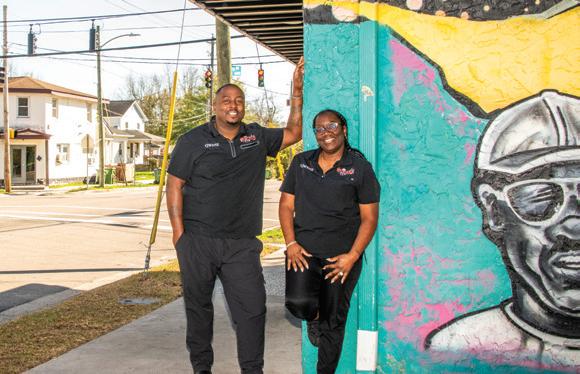
Corey and Phallin Scott opened their restaurant, On Thyme, on Castle Street in 2022. They bought the building at 918 Castle St. in 2021 and opened an addition in February that added 1,400 square feet of space, along with a new bar, more seating, an expanded prep kitchen and waiting area.
While the Scotts considered moving to another building to accommodate their larger footprint, they decided to stay on Castle to invest in their building and business. The addition incorporates a bold black-and-red color scheme and photos of R&B and hip-hop celebrities behind the bar.
“It just gives you that homey, relaxed feel,” Corey Scott said. “If you have a long day, come in, have a good time, a good vibe, good food, good music and just like a good atmosphere. That’s what we’re trying to go for.”
SHAPING THE CORRIDOR
Over the years, architect Rob Romero has brought his own style to buildings in the Castle Street corridor. His first project in the area, still one of his favorites, is the building at the corner of Castle and South Seventh streets that houses the nonprofit Kids Making It.
From there, Romero worked with Cargo District developer Leslie Smith on designing the district’s first buildings. Romero designed the buildings that house local businesses End of Days Distillery, Mess Hall and The Rift, along with residential projects like The Crown and two of the four buildings at Midcastle.
He’s also worked with Galarde on plans for The Ollie and on other infill projects such as The XII, a mixed-use 18-unit apartment complex slated for a former church at 1201 Castle St.
“There’s an aesthetic that works with what I like to do,” Romero said. “Something about Castle feels like you can go where you want.”
Galarde has another project in the works just off Castle at 609
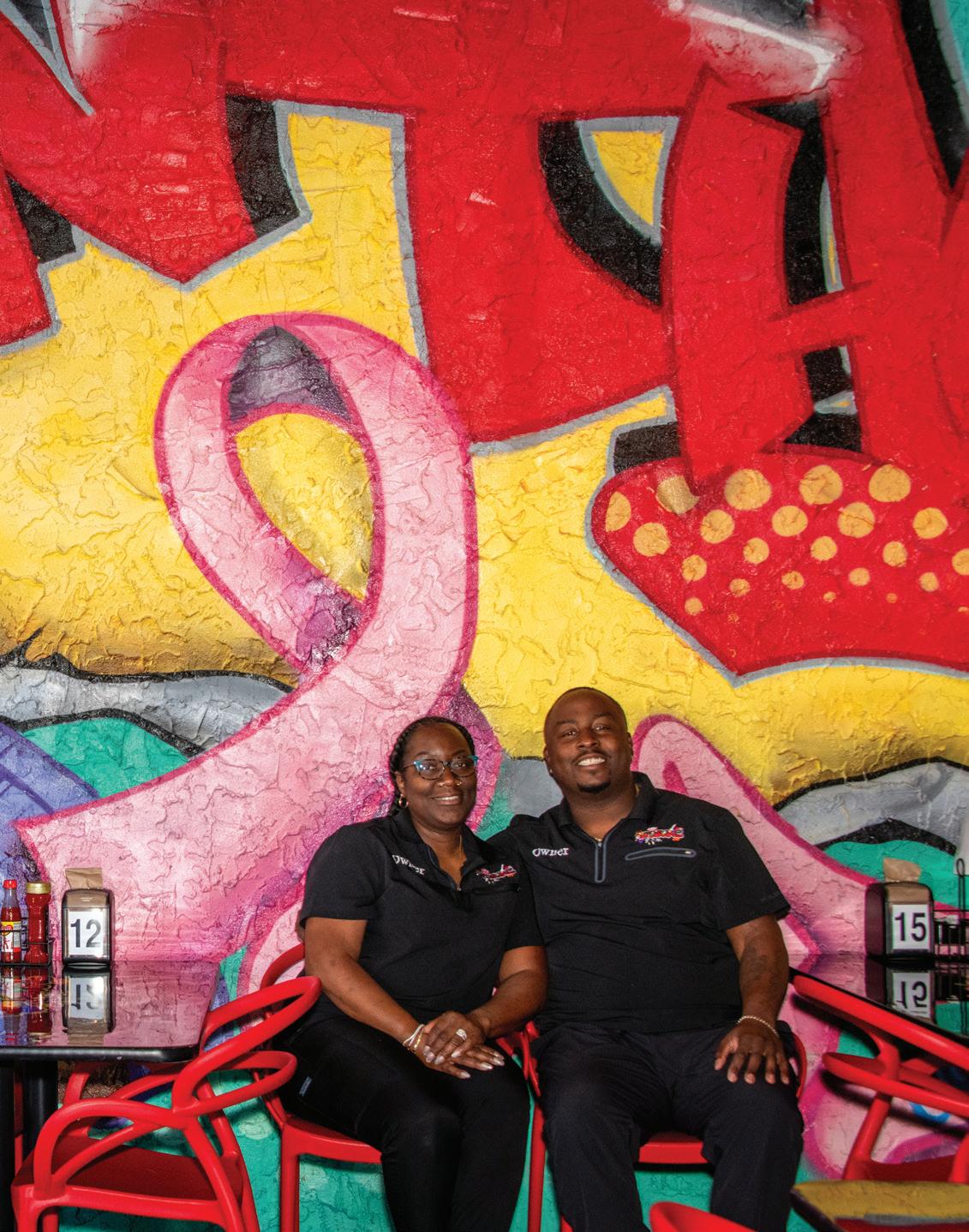
Phallin and Corey Scott opened their restaurant, On Thyme, at 918 Castle St. in 2022. The couple recently completed an addition that added 1,400 square feet to their business.
With 98 apartments, Midcastle is one of the biggest recent projects to come to the Castle Street corridor. Its commercial space houses The Roasted Bookery and Craft Cabana, with other small business tenants on the way.
S. 16th St., featuring 10 townhomes with rooftop terraces and commercial space. Galarde said investment from Spetrino and other builders in the area gave his company the confidence to bet on Castle Street.
“Without his anchored development right there, I don’t think any of this other development would have really been happening,” Galarde said, “or it would have been a lot slower to happen.”
When Hallmark Building Corp. initially began eyeing its return to Wilmington, Galarde said, the company worked with real estate agents to identify up-and-coming neighborhoods – like those they focused on in Charlotte – and settled on Castle Street and the Cargo District.
One of those brokers is Adam Hashem, the broker in charge at East Atlantic Realty. He’s carved out a niche in helping buyers find off-market deals along Castle Street. Everything is for sale, Hashem said, and everyone has a number.
“Everybody knows where Castle Street’s going; even the residents that have been there for many years, they know what they’re sitting on,” Hashem said. “They want to see credibility. They want to see that they’re getting good amounts for their property.”
According to Hashem, he’s developed credibility in the corridor from his work on previous sales. Sometimes the off-market sales stem from conversations with homeowners; other times they come from word of mouth in the neighborhood.
SIDE EFFECTS OF GROWTH
Anthony Durrett, the owner of Sip N’ Chill Lounge at 614 Castle St., said that as new development and residents come into the neighborhood, he wants to ensure the corridor’s history is preserved.
Durrett grew up in Charlotte, where he remembers seeing the city’s primarily Black neighborhoods affected and changed by gentrification. He sees the potential for gentrification on Castle Street and said the area has a chance to navigate change proactively.
Durrett said preserving the history of Castle Street should be a priority, along with providing fair opportunities for businesses in the area, especially for minority business owners. He sees a need for more collaboration and unity between business owners in the area.
“We should be one,” he said. “No matter what category you fall in, the main objective is to get as many people to the street as possible. That should be the goal.”
Castle Street Collective officially formed as a nonprofit in 2023. Current
board president and area resident Bobby Croghan said the group aims to bring new people to Castle, along with supporting businesses and creating community events.
“We are excited to see residential growth because it just brings a new energy to Castle Street,” Croghan said, “and we welcome new residents as their presence supports local businesses to create a more vibrant, inclusive community.”
As more people move into the area, the collective, which is made up of residents and business owners, is working to address potential issues stemming from growth, such as a lack of parking, bicycle and pedestrian safety issues and sidewalk maintenance, Croghan said.
The group also wants to develop a better dialogue with developers bringing new projects to the street to improve communication among residents, business owners and their new neighbors.
“We want the community to stay kind of quirky. We want creative development. We want artwork incorporated into the community,” Croghan said. “We want to make sure that those developers aren’t putting up something that … doesn’t play into the vibrancy of the neighborhood and the diversity of people and business types.”
WATCHER MARKET
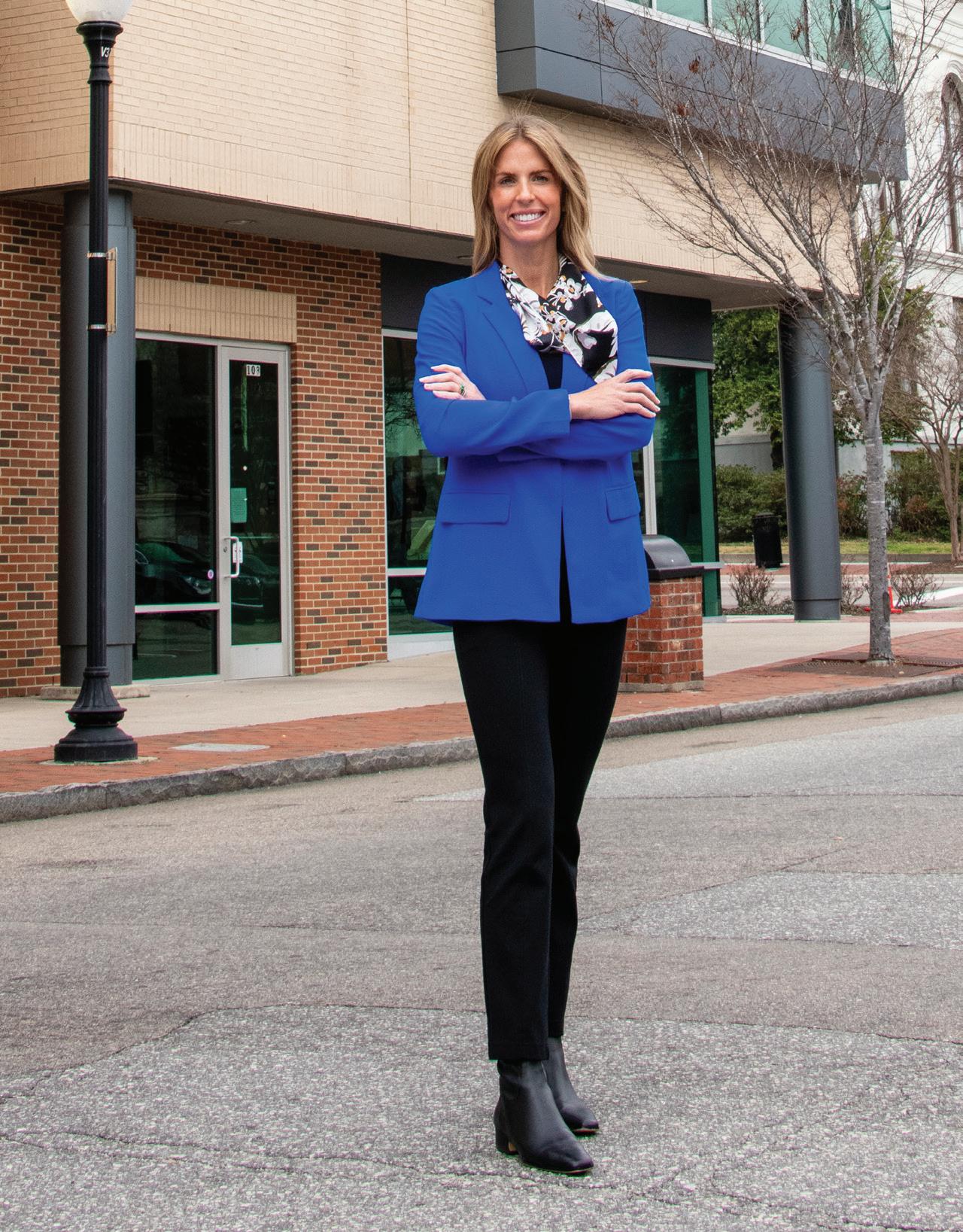
lIndsey Hess bRIngs a numbeRs backgRound to Real estate
BY BETH A. KLAHRE
PHOTO BY DARIA AMATO
Lindsey Hess, senior vice president of brokerage at Wilmington-based commercial real estate firm
Cape Fear Commercial, was always drawn to real estate.
“I knew I wasn’t built for the residential side of real estate, but I liked financial analysis and investment analysis,” she said. Her instincts served her well. Hess recently earned the Society of Industrial and Office Realtors’ designation of office specialist, one of the more prestigious designations in commercial real estate. Based on experience and deal volume, the SIOR designation is widely considered a standard of excellence in commercial real estate.
Hess, a native of Syracuse, New York, was recruited to play tennis at the University of North Carolina Wilmington, where she earned a bachelor’s degree in finance and accounting.
After graduation, Hess took a role with PricewaterhouseCoopers in New York City on the auditing side of the public accounting firm. “It was a great first-year-out-ofcollege experience, but I quickly learned it was not for me,” she said.
In 2007, she relocated to Atlanta for a position with Trimont Real Estate Advisors as a fund analyst in commercial asset management. Hess worked on ground-up condo development and redevelopment projects within a private equity fund sponsored by Lehman Brothers.
One year later, as the economy and market shifted, and deal returns declined, Hess returned to Wilmington. Her parents had relocated there after their retirement, and Hess found the opportunity to join Cape Fear Commercial as a property manager and financial analyst. She was one of two property managers
on staff and the only financial analyst. During that time, Hess built a strong foundation in leasing, working with both landlords and tenants.
“The property management side isn’t always glamorous, but it was incredibly rewarding. It laid the groundwork for where I am today,” she said.
As the company grew over the next 18 years, Hess wore many hats, including asset manager, development associate and director of finance.
Today, the company has nearly 60 employees across brokerage, property management, development and construction.
Hess has worn every hat in the company, other than construction. In 2018, she pivoted from the development side to a larger role, strictly on the brokerage side of the business.
“And Wilmington became home,” she said.
Hess specializes in investment sales and Class A office properties. During her tenure, she has completed about 370 transactions totaling over $213 million in sales and leasing volume. Last year, her volume exceeded $44 million.
Hess cites her background in finance as a distinct advantage, bringing a unique perspective to the acquisition and disposition of income-producing assets.
“I’ve been lucky enough to have a lot of repeat business,” she said of her clients, which include owners, investors, landlords, tenants, buyers and sellers of commercial real estate. “I take a broad perspective when looking at deals, analyzing beyond the basics, considering what works today as well as the long-term plan – five to 10 years from now.”
Hess is well-versed in the Wilmington market and its office space. She said she sees opportunity in Wilmington’s size, a relatively smaller market, which allows a

PROFILE
broader focus when working deals. “This includes complex commercial analysis, evaluating highest and best use scenarios to help clients navigate their options and make well-informed, strategic decisions,” she said.
Hess was recently involved in the $15 million sale of 101 N. Third St., an office building in downtown Wilmington. She had participated in the entire life of the asset, assisting with the acquisition of the site, followed by the development of the building and subsequent leasing, and ultimately selling the 69,000-square-foot, five-story, Class A office building.
“CFC (Cape Fear Commercial) offered guidance and advice throughout the entire process,” she said.
Hess, along with Paul Loukas and Julia Lackey, also of Cape Fear Commercial, are currently leading the leasing efforts at city-owned Skyline Center, 929 North Front St., in downtown Wilmington. In the past 24 months, the team has leased approximately 95,000 square feet in the building, with at least 15 leases signed since marketing efforts began in 2023.
Looking ahead, Hess said she believes the Wilmington market is strong.
“I am involved in the market day to day. I understand who’s looking, what’s available, what’s becoming available,” she said. “Leasing has remained robust, particularly on the office side. Tenants are more intentional about the effective use of their space.”
Sales started picking up in late 2025 and early 2026.
“We are coming out of a market where people were hesitant, waiting to see what happens with interest rates,” Hess said, “and we are now moving to a much more active investment market.”

BY CIERRA NOFFKE | PHOTO BY DANIELLE DESNOYERS
HOW THE CAPE FEAR REGION’S HEALTH CARE INFRASTRUCTURE IS CATCHING UP
ANY KNOW SOUTH 17TH STREET BEST AS HOME
M BUILDING GROWTH FOR
TO THE AREA’S FLAGSHIP 823-BED HOSPITAL, NOVANT HEALTH NEW HANOVER REGIONAL MEDICAL CENTER, BECAUSE FOR DECADES IT WAS THE NEAREST PLACE RESIDENTS COULD TRAVEL FOR MAJOR MEDICAL SERVICES.
Following Novant Health’s 2021 acquisition of the hospital, Novant committed to investing $2.5 billion to expand the region’s health care infrastructure as part of the purchase agreement with New Hanover County.
That’s a commitment that Laurie Whalin, president of NHRMC and acute care operations for the Novant Health Coastal Region, says the organization is well underway to completing.
“We’re on the trajectory of really committing to about $2 billion of that $2.5 billion in five years’ time,” Whalin said in February.
Novant Health is not the only major provider in the area. MedNorth has made a commitment to underserved communities, and physician-led Wilmington Health has operated locally since 1971. But Novant has helmed the expansion of medical services in the region and established itself as the region’s biggest employer.
The expansion is needed as the region and surrounding counties continue to grow, Whalin said. “We really need to push services
out to where people live and to our small community facilities,” she said.
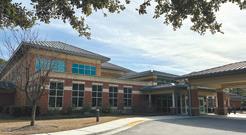
This year, the Cape Fear region is expected to welcome a 250,000-squarefoot Novant Health hospital in Scotts Hill, an ambulatory surgery center in Leland, a midtown outpatient clinic and an expanded MedNorth campus downtown among its new health care facilities.
In February, Novant Health’s board approved an additional $1 billion for future projects – including a proposed 120-bed heart and vascular patient tower on South 17th Street – signaling that the region’s health care expansions are far from over.
SCOTTS HILL CAMPUS
The 66-bed Scotts Hill hospital, set to open in June, is Novant Health’s largest expansion project in the area and will fulfill an important need for residents of northern New Hanover and Pender and counties, who have long had to travel to South 17th Street for care.
“With the exception of the upcoming (heart and vascular institute) tower, building a hospital from scratch is probably the biggest thing I’ve done,” said Ken Williamson, senior design and construction manager at Novant Health, who previously worked on the glass pedestrian bridge across South 17th Street and ICU renovations at NHRMC.
The hospital has been decades in the making.
According to broker Mike Nadeau, of Creative Commercial Properties, a group of physicians, under the limited liability company SENCA Properties, purchased
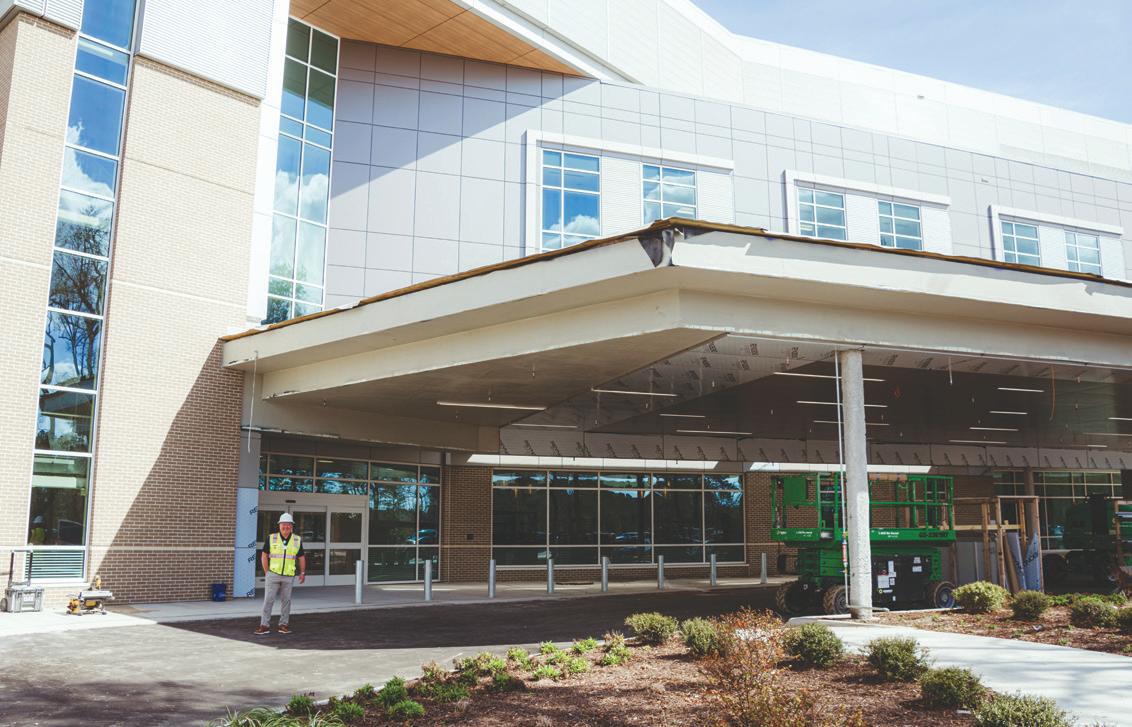
CONSTRUCTION IS WRAPPING UP ON THE NEW NOVANT HEALTH SCOTTS HILL MEDICAL CENTER, WHICH IS
various parcels of land in Scotts Hill in the early 2000s, amassing more than 240 acres.
In 2007, NHRMC purchased 27 acres in Scotts Hill, straddling the Pender County and New Hanover County boundaries, from SENCA Properties for $5 million, according to property records, with the intention of eventually building a hospital on the site. In 2015, NHRMC opened a 30,000 square-foot emergency department on the land to improve capacity at the 17th Street campus.
The hospital project didn’t start moving forward until after Novant Health acquired NHRMC. Novant filed a certificate of need to build the community hospital in 2020, which the state approved in 2021, according to state records.
The hospital is designed to be a “one-stop destination” for health care needs with a surgical focus: It has eight
operating rooms and six procedure rooms, as well as a 60,000-square-foot medical office building that opened in 2024 and includes a cancer center with medical and radiation oncology.
“Everyone’s very glad to have these services nearby,” said Nadeau, who lives in Hampstead just beyond Scotts Hill. “It just was always dreaded to drive down to 17th Street for everything, every visit, every appointment and every test.”
Construction began in 2023, with an initial estimate of $210 million. Due to rising labor and construction costs, the price rose to $294 million, according to state filings.
“Anybody can do your regular standard construction, but when it comes to medical construction, especially acute care, there are a lot more requirements, state and federal,” said Williamson. “It’s an enhanced form of construction.”
Williamson said the project’s size
“ “
The HVI tower is a watershed project for the community, for sure. There’s a major need for cardiovascular care. It’s really going to bea signature piece of the Medical Center once
it’s completed.
KEN WILLIAMSON senior design and construction manager at Novant Health (pictured above)
also prompted the N.C. Department of Transportation to become involved to ensure minimal disruption to traffic on U.S. 17.
Including the 60,000-square-foot medical office building in Scotts Hill, which cost $48 million, overall costs are estimated at $342 million, according to a Novant Health spokesperson.
The facility has also been designed with capacity for future growth, according to Williamson, with plans to eventually build additional medical office buildings on the Pender County side of the land.
“We have a tremendous opportunity at Scotts Hill to meet the community needs,” said Grant Rush, president of the Novant Health Scotts Hill Medical Center. “Not just in Scotts Hill, but our communities in Hampstead and further north.”
IN-TOWN EXPANSIONS
Closer to the flagship hospital on South 17th Street, Novant Health’s midtown outpatient clinic is slated to open this year, and several new projects have been announced for completion in the next five to seven years.
The 153,000-square-foot outpatient clinic, located in a former Verizon call center off Shipyard Boulevard in Wilmington, is expected to open the first two floors by the end of the year, featuring a variety of services, including an OB/GYN clinic and a pharmacy. The third floor, featuring infusion therapy, is slated to open in 2027.
Pending state approval, Novant Health’s recently announced $1 billion investment could bring three medical expansions to the area.
The health system announced plans to construct a new 60-room physical rehabilitation hospital on Wrightsville Avenue, a new 120-bed heart and vascular (HVI) patient tower on South 17th Street and a second 80,000-square-foot heart and vascular medical office on Physicians Drive.
Additionally, Novant outlined plans to renovate two floors of NHRMC, including endoscopy and surgical services, to optimize clinical spaces.
“The HVI tower is a watershed project for the community, for sure. There’s a major need for cardiovascular care,” said Williamson. “It’s really going to be a signature piece of the Medical
Center once it’s completed.”
DOWNTOWN CAPACITY
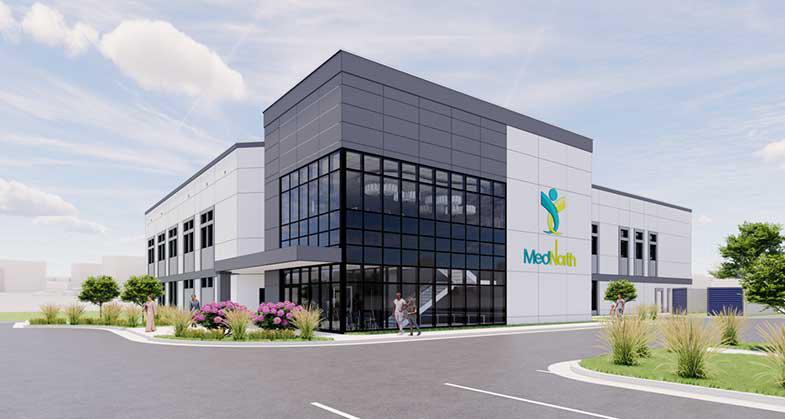
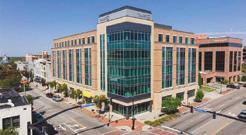
Downtown Wilmington’s most long-awaited medical expansion is coming this spring: After 25 years of operating at 925 North Fourth St., MedNorth is adding 35,000 square feet to its campus downtown.
“Our main focus, part of being a federally qualified health center, is to ensure access for patients that may not have access anywhere else,” said Althea Johnson, CEO of MedNorth.
MedNorth has managed operations in its existing 16,000-square-foot building despite growing patient and care needs, primarily due to the high costs of expansion, Johnson said.
The clinic has been renovated six times to optimize the current space creatively, said Johnson.
“We have done all we could do in 925 (North Front) besides knock the walls down,” she said.
The new campus will open its doors this spring, following a grand opening on April 2, and will feature exam rooms and operatory rooms, teaching spaces and flexible clinical
MEDNORTH IS BUILDING A TWO-STORY MEDICAL BUILDING AT THE CORNER OF NORTH THIRD AND BLADEN STREETS.
spaces. Thomas Construction Group announced in January that it would also begin renovations on the existing building after the new campus opens.
“We think that we will be one of the best one-stop shops in town,” Johnson said.
BRUNSWICK DEVELOPMENTS
Over in the region’s fastest-growing county, Novant Health is opening the doors of its 16,000-square-foot ambulatory surgery center in Leland this summer. As officials plan for more facilities in the county, residents can expect more health care infrastructure closer to home.
That means more prospective work for general contractors such as Thomas Construction Group.
“When I first got here, maybe 15% of our work was health care, and now we’re about 50% health care as a company,” said Chris Thorn, operations director at Thomas Construction Group, who joined the company in 2022. “And a lot of that has come from Novant projects.”
The new ambulatory center will have two operating rooms, two procedure rooms and specialists who offer a range of surgical procedures.
“When we build a building, that’s just the tip of the iceberg,” Thorn said. “They need really talented people to work there – nurses, doctors – and what’s so cool is the community is really banding together to keep the best talent here locally.”
The county also houses Novant Health Brunswick Medical Center, which Novant Health opened in 2011 as a 74-bed facility in Bolivia to replace a previous hospital building in Supply.
To keep up with the region’s growth, Novant announced in October plans to update the Bolivia hospital by adding an expanded MRI suite and a cardiac catheterization lab. That announcement also included the news that Novant filed for a certificate of need to build a new $251 million, 20-bed hospital along U.S. 74/76, as well as a freestanding emergency department near Carolina Shores.
Days apart from Novant’s certificate of need filing for the hospital, Columbus Regional Healthcare System filed its own certificate of need for a 30-bed hospital in Delco, just miles from Novant’s planned hospital. Both applications are awaiting state response.
Columbus Regional Healthcare, a Whitevillebased provider, has been expanding into the region since 2022 and held a groundbreaking ceremony for a 68,000-square-foot ambulatory surgery center near the Brunswick Forest community in December, which Thomas Construction is building.
“Given our rapid growth as a health system, we are positioned to grow regionally as an organization while affording choice to one of the fastest growing regions in the country,” Columbus Regional officials said in a statement. “Our expansion is designed to meet those rising demands.”

CENTERS CHANGE
BY EMMA DILL
AREA’S MAJOR SHOPPING OPTIONS CONTINUE TO EVOLVE
With new retailers and proposed development, shopping centers across the Cape Fear region are slated to see changes this year. The retail evolution comes as both new and longtime shopping centers aim to serve the needs of the region’s growing population. Here is a roundup of recent additions and projects in the pipeline.
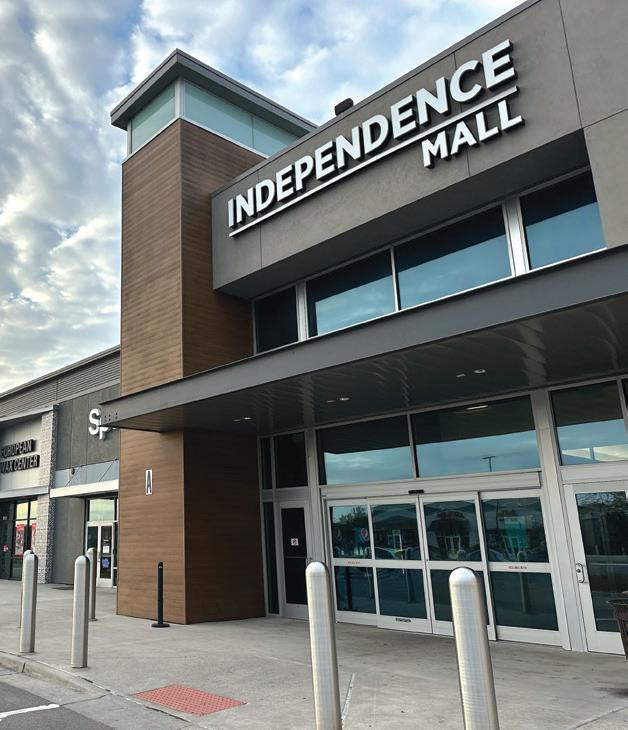
INDEPENDENCE MALL
3500 OLEANDER DRIVE
OWNER: 4th Dimension Properties
SQUARE FOOTAGE: More than 800,000 square feet
DESCRIPTION: Independence Mall opened in 1979 as Wilmington’s first fully enclosed shopping mall. The mall’s footprint has evolved over the years with the addition of a new wing in the early 2000s. More recently, former mall owner Rouse Properties added grocery store tenant Lidl to the mall and worked to bring new dining and retail concepts into outparcels near the mall.
WHAT’S NEW: Independence Mall has a new owner. In August, Florida-based 4th Dimension Properties acquired much of the mall in a more than $50 million deal. The purchase did not include anchor tenants Belk and Dillard’s, which own their buildings.
Felix Reznick, principal with 4th Dimension Properties, said his firm aims to fill any vacant retail spaces and bring in new uses that could appeal to a range of customers. So far, a handful of new leases have been signed, including a new Build-A-Bear kiosk and Jeff’s Bagel Run. The N.C. Aquarium at Fort Fisher also has plans to establish an 8,000-squarefoot mini aquarium inside the mall while the aquarium is closed for a $75 million renovation and expansion project this year.
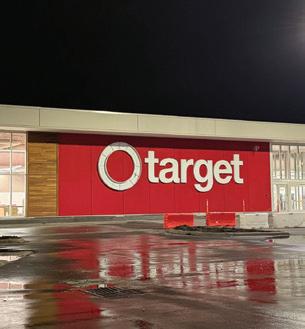
THE VILLAGE AT MYRTLE GROVE
5521 CAROLINA BEACH ROAD
OWNER: Big V Property Group
SQUARE FOOTAGE: More than 74,000 square feet
DESCRIPTION: The Village at Myrtle Grove is a retail hub for a growing Carolina Beach Road corridor. Big V Property Group purchased the Home Depotanchored shopping center, located at the corner of Carolina Beach Road and Piner Road, in 2016. The center is home to several retail buildings, with tenants that range from national chains to local restaurants and retailers. A handful of vacant outparcels are also primed for new development within the retail hub.
WHAT’S NEW: The shopping center is slated to get its second anchor later this year, with a new 128,000-square-foot Target that’s currently under construction. Alongside the Target store, Big V Property officials have converted the footprint of a former Staples store, which closed in 2023, into three retail spaces. Rack Room Shoes plans to lease about half of that space, according to officials with Big V Property Group.
The shopping center has also seen several new leases in the last year, including fitness training gym F45, hair salon Supercuts, UPS Store and restaurant chains such as Playa Bowls and Chipotle.
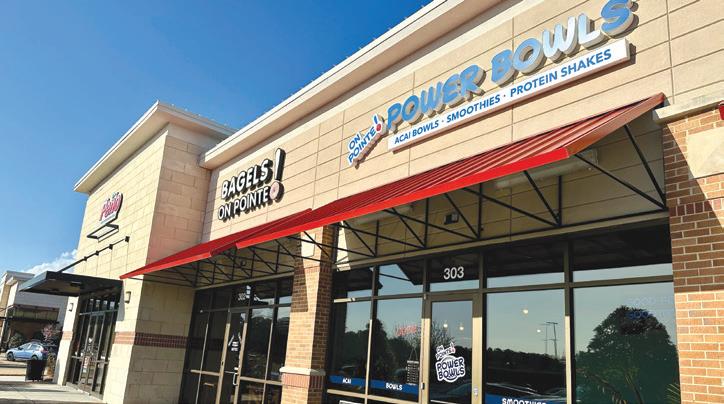
THE POINTE AT BARCLAY
1450 BARCLAY POINTE BLVD.
OWNERS: Cameron Management and Collett Capital
SQUARE FOOTAGE: 150,000 square feet
DESCRIPTION: The Pointe at Barclay, a 150-acre master-planned development at the intersection of Independence Boulevard and South 17th Street, broke ground in 2016. Anchored by The Pointe 14 movie theater, the project includes seven additional buildings occupied by a mix of retail and restaurant tenants. Beyond its retail space, a Home2 Suites by Hilton hotel opened in 2024, while residential construction continues to boom nearby. The Pointe owner Cameron Management and Charlotteheadquartered firm Childress Klein,
LELAND SHOPPING CENTERS
for example, partnered to develop the 405-unit Element Barclay and 286-unit Element Barclay Station in 2018 and 2023, respectively.
WHAT’S NEW: More residential units are coming to The Pointe.
Cameron Management and Childress Klein submitted plans late last year for Element at Barclay Flats, an apartment complex with 290 units. Eventually, the developers have said they expect to build another complex with roughly 300 units. Plans have also been submitted for a 72-unit townhome project in the area.
The Children’s Museum of Wilmington acquired the last vacant parcel at The Pointe at Barclay in October. Museum officials have said they’re still planning for potential uses for the property.
As residential growth continues to boom in Leland, retail and commercial growth have followed. Along U.S. 17, shopping centers of various sizes have developed and grown in recent years. They include Leland Town Center, Waterford Village, Westgate Marketplace and The Villages at Brunswick Forest.
WHAT’S NEW: A new shopping center, called Leland Village, is taking shape near Brunswick Forest. The more-than-130,000-square-foot shopping center will be anchored by a 50,000-square-foot Publix grocery store, along with junior anchors Marshalls and Ulta Beauty.
New tenants have also landed at Leland Town Center, including an O2 Fitness and a Texas Roadhouse. Nearby in Waterford Village, a Tru by Hilton hotel opened in 2023, while planning is underway for a new Hampton Inn, among other commercial projects. Jackey’s Creek, a more-than-1,440-acre master-planned community, was annexed into the town of Leland last fall. The project is slated to include 6,000 residential units, an elementary school and multiple commercial buildings.
MAYFAIRE TOWN CENTER
6835 CONSERVATION WAY
OWNER: CBL Properties
SQUARE FOOTAGE: 610,000 square feet
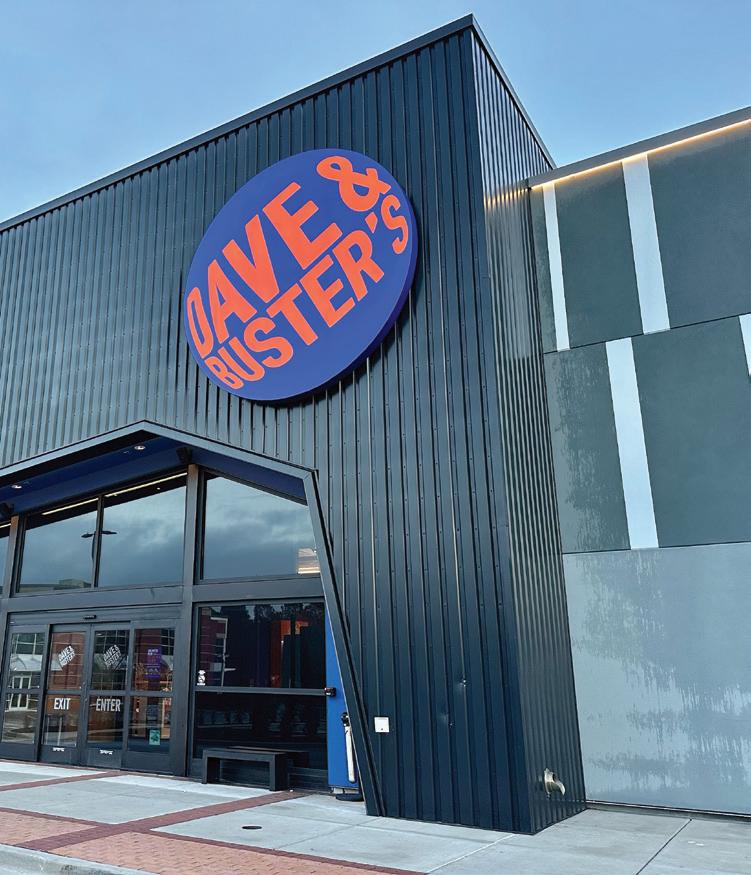
DESCRIPTION: More than 20 years ago, the first stores in Mayfaire Town Center opened their doors off Military Cutoff Road. The shopping center has evolved over the years with the addition of thousands of square feet of retail space, along with nearby office, hotel and residential development. In recent years, a series of nationally recognized retailers have also signed onto the center’s tenant mix.
WHAT’S NEW: Last year, Dave & Buster’s became one of Mayfaire Town Center’s newest tenants. The
adult arcade and restaurant chain has a footprint of approximately 22,000 square feet. The center has also added a series of upscale retailers that aim to elevate the tenant mix, according to Mayfaire officials. Such brands include Madewell, which opened last year, along with Free People, Aerie and J. Crew Factory. A store location of national ice cream brand Ben & Jerry’s opened in February this year.
The hotel Element Wilmington at the town center opened its doors in 2025. The six-story hotel has 139 rooms. It was built through a partnership between Mayfaire Town Center’s owner, CBL Properties, and Chattanooga-based Vision Hospitality Group.
HANOVER CENTER
3501 OLEANDER DRIVE
OWNER: Harbour Retail Partners and Perform Properties
SQUARE FOOTAGE: More than 300,000 square feet
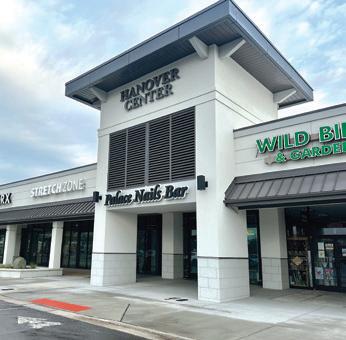
DESCRIPTION: One of Wilmington’s oldest suburban malls, Hanover Center opened in 1956 at the corner of Independence Boulevard and Oleander Drive. The retail center, anchored by Harris Teeter, was developed by Hugh MacRae II. The MacRae family owned it for more than 60 years.
In 2019, Harbour Retail Partners acquired the shopping center in a $51 million deal. Hanover Center’s major retail tenants include O2 Fitness, Drift Coffee & Kitchen, Great Outdoor Provision Co., Hobby Lobby, Books-A-Million and Office Depot.
WHAT’S NEW: Construction is ongoing on an approximately 14,000-squarefoot space that’s being leased by national retailer Boot Barn. The Boot Barn space will occupy a portion of the 37,000-square-foot footprint previously occupied by SteinMart, with Homesense, which opened in 2023, taking up the rest. Other recent leases include Family Dollar and Qdoba Mexican Eats.
The Helmsman, a 262-unit apartment complex located behind Hanover Center, began leasing its first units in late 2023. The multifamily project is located on 7 acres originally slated for Hanover Center. Last year, the complex changed hands in a nearly $72 million deal.


TRENDS TO WATCH
Office, retail and industrial space are in demand across the Wilmington market, according to local brokers. New construction in the industrial market includes flex spaces that range in size from a few thousand to hundreds of thousands of square feet. Meanwhile, the retail and office markets are evolving as they grow into new submarkets to meet the demand that stems, in part, from ongoing residential growth.
BY EMMA DILL
INDUSTRIAL FOCUS
A handful of small- and mid-sized industrial projects have started taking shape as developers aim to meet market demand.
Cal Morgan, owner of commercial real estate appraisal firm JC Morgan Co., said he sees a limited supply of small flex units in the market, with properties selling or leasing quickly once they come online.
Several projects have popped up in northern New Hanover County. The developers of Wrightsboro Business Park, which broke ground in late 2025, plan to construct 17 buildings with 5,100 square feet each, hitting a “sweet spot” for the market, according to Will Leonard, senior vice president with Cape Fear Commercial.
Nearby, Maritime West Business Park is set to hold 19 buildings ranging from 10,000 to 30,000 square feet, while Wilmington Industrial Park is planning nine roughly 20,000-squarefoot buildings.
In Leland, Canvasback Capital purchased land in Leland Innovation Park for two buildings, which developers plan to divide into small bay warehouse or flex spaces.
RETAIL
As of the first quarter of 2026, the retail vacancy rate in the Wilmington market was 1.4%, according to CoStar. That’s lower than the five-year average of 1.8% and the 10-year average of 2.2%.
Keith Austin, a senior vice president with Cape Fear Commercial, said the region’s strong population growth and tourism factor into the retail demand.
The area’s retail centers continued to evolve in 2025, said John Gavin, an associate broker with Cameron Management, with new owners and national brands.
In August, for example, Floridabased 4th Dimension Properties acquired Independence Mall in a more than $50 million deal, while new national chains continued their push into Wilmington retail centers.
At Hanover Center, a build-out was ongoing as of press time for national retailer Boot Barn, while a Target was nearing completion at The Village at Myrtle Grove. At Mayfaire Town Center, adult arcade Dave & Buster’s opened its doors in 2025.
OFFICE DEMAND 3
Office space remains in high demand across the Wilmington region, especially small-scale spaces and medical offices, according to Austin.
Companies began downsizing their offices during the COVID-19 pandemic’s work-from-home era, and the trend stuck, Austin said. As some employees continue to work from home or in a hybrid environment, there’s increased demand for smaller office spaces.
While there have been some large-scale office leases signed in the last year, such as engineering firm McKim & Creed’s more than 22,000-square-foot lease in Skyline Center, Gavin said many of the office leases in the market range between 2,500 and 5,000 square feet. Gavin also sees demand for more Class A office space.
There’s also high demand for medical offices, according to Austin. Demand is so high that some medical users have considered converting traditional office space or even former retail space into medical offices.
SUBMARKET SPRAWL 4
As the Wilmington area grows, some commercial products are expanding outside of the areas where they’ve traditionally been concentrated.
Many of Wilmington’s medical offices, for example, are located along South 16th and 17th streets, near Novant Health New Hanover Regional Medical Center. Austin said he’s seeing demand for medical office space in the Mayfaire submarket along Military Cutoff Road and Ogden and Porters Neck.
Gavin said he sees midtown Wilmington as an emerging submarket, with various ongoing or recently completed commercial projects. That includes Novant’s conversion of a former Verizon Wireless call center into an outpatient clinic and the completion of The Offices at Iron Gate.
The northern parts of New Hanover County are also seeing an uptick in retail leasing, as residential development increases in the area. One of the last remaining undeveloped areas in New Hanover County, the area has also been ripe for new industrial projects.
SPACE ON THE WAY 5
A handful of large-scale projects promise to bring new square footage to the market. In the Mayfaire area, the mixed-use project Center Point is slated to bring 33,000 square feet of retail space to the corner of Military Cutoff and Eastwood roads. Openings for the retail tenants, which will include a curated mix of boutique retail, dining and lifestyle offerings, are expected for winter 2026 through early 2027. Also on Military Cutoff, The Avenue is set to bring a new hotel and thousands of square feet of retail space.
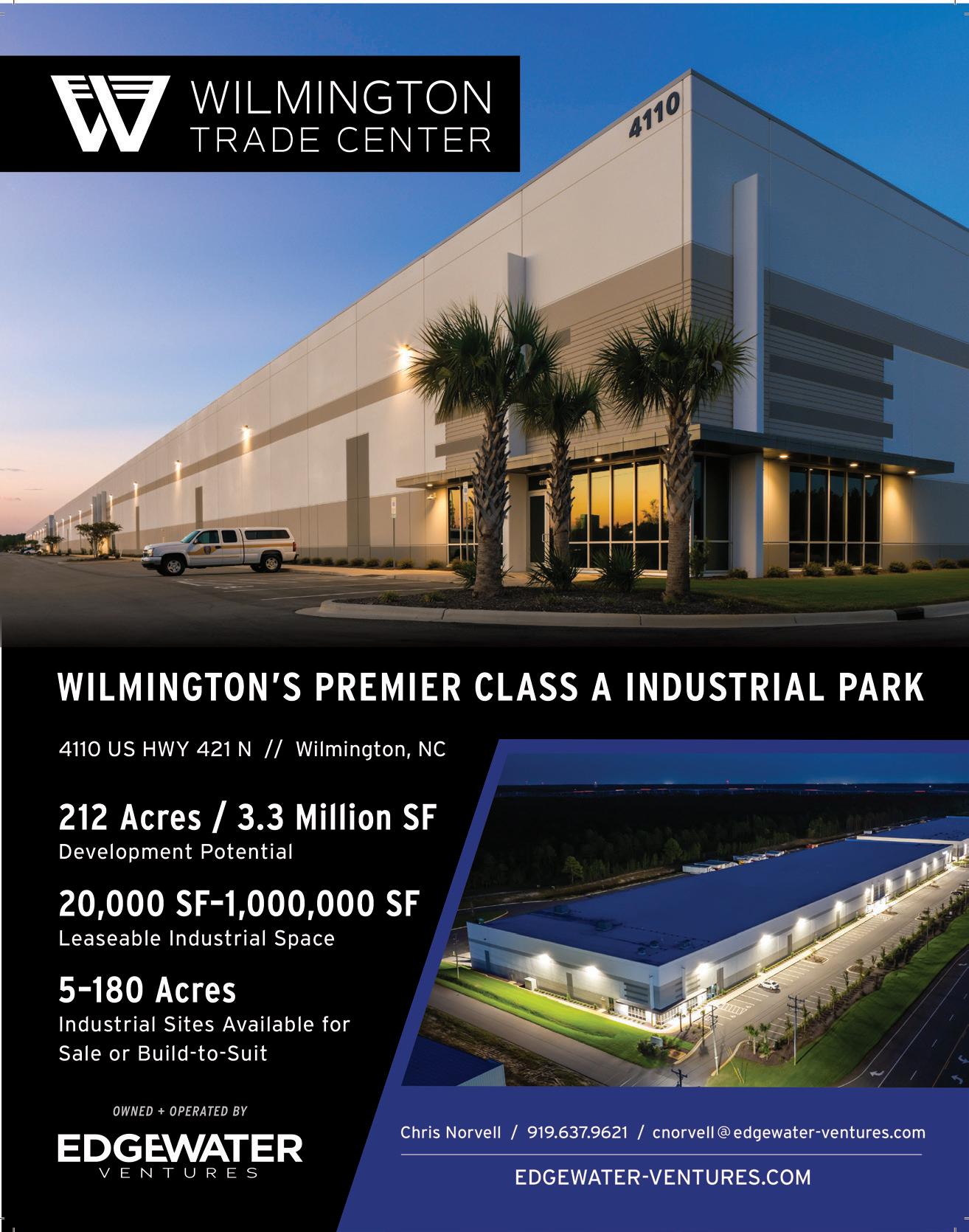
Several large-scale industrial projects are also in the works. At Wilmington Trade Center, a master-planned industrial park off U.S. 421, crews recently wrapped up work on one 153,000-squarefoot building while also breaking ground on another. In Navassa, Samet Corp. recently broke ground on a 160,000-square-foot industrial building that’s slated for completion later this year.
STRUCTURAL VALUE
Chad Hodges leads McKinley Building to greater heights
BY ERIC WILLIAMSON | PHOTO BY DARIA AMATO
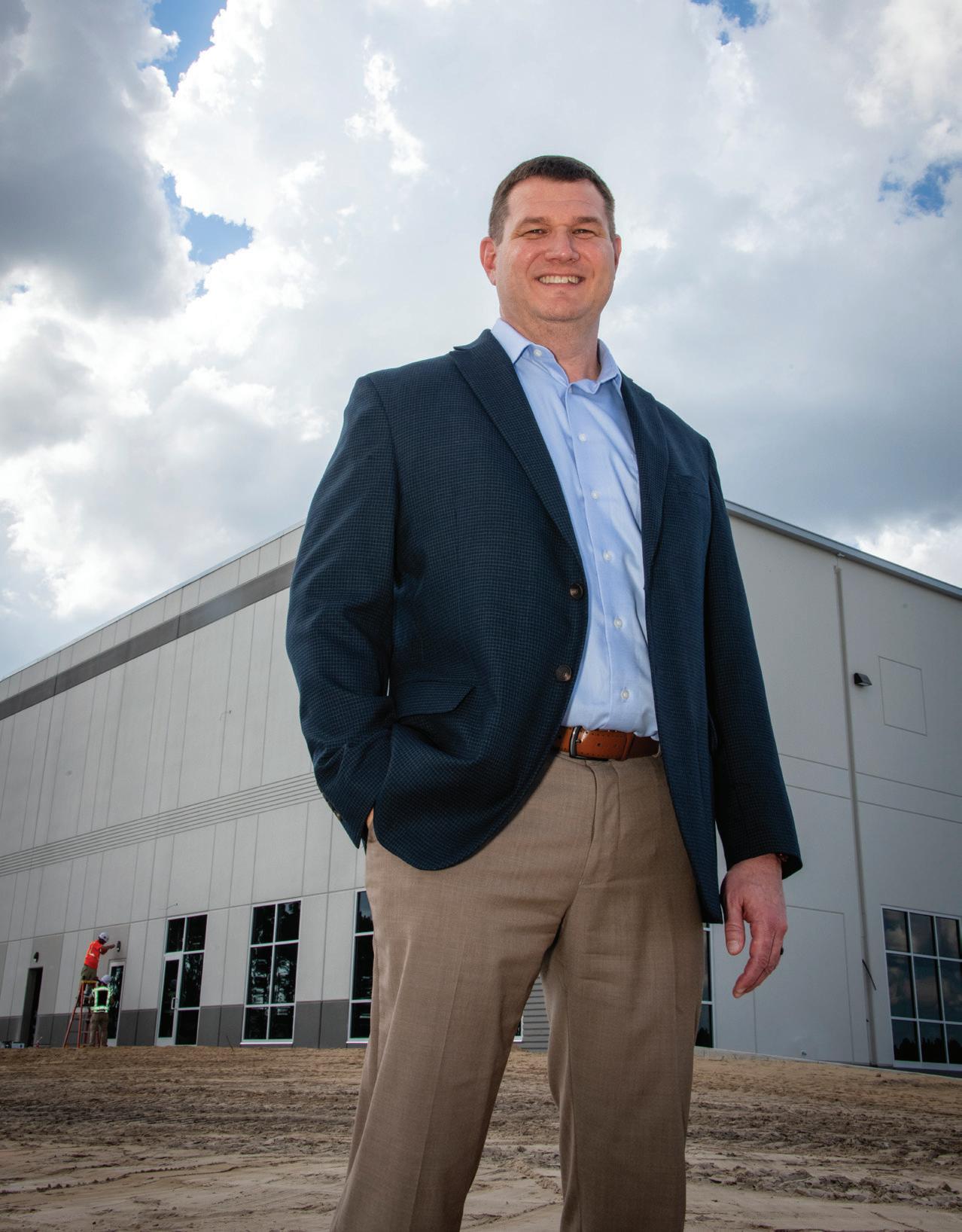
Construction involves trust based on a series of steps. At times, what can rise from the nothingness of an empty lot is not just a reliable building, but a landmark. In the Wilmington area, McKinley Building Corp. has earned its place in the skyline.
“If you ride up and down U.S. 421 on either side of the road, a lot of those buildings, almost every one that you see, McKinley Building has been a part of over the years,” said the company’s president, Chad Hodges.
The firm has built hundreds of buildings in the Wilmington area. Recent work include the 20,000-square-foot Coastal Horizons administrative building, a new Subaru dealership for Parkway Automotive and buildings at the Wilmington Trade Center industrial park.
Hodges said that behind each project is a set of philosophies for moving forward. They’re as foundational to him and the company as the concrete foundations they pour, he said.
“Everybody has a role, and everybody has a process,” Hodges said. “One of the things we talk about here is having clear expectations. It
is really important on all levels. When you meet with a client for the first time, you’ve got to have clear expectations about what they want. That trickles down to our superintendent that we put on the jobsite. People can perform as long as they know what is expected.”
Hodges borders on over-communicating, he said, if it means verifying everyone is on the same page. He also listens.
“The guys that are building the jobs, they will have some of the best ideas when it comes to efficiencies and how something should be laid out,” he said.
McKinley is an organization that emphasizes relationships, starting with faith and family, Hodges said. “It’s really important for our guys to be home at night,” he said. “So, we’re not a contractor that’s stretched across the state and living out of hotels. This is our home area.”
Hodges promotes McKinley’s core values –the F.I.R.S.T, with the first letter “F” standing for “faith and family.” Hodges said his mentor, McKinley founder Ken Dull, reinforced those values with clients with what he calls “The Grocery Store Test.”
“If you were a client of ours that we built a project for, even if it were years later, and we saw each other in the grocery store, are you going to duck and head the other way? No, we would run up to each other like old friends,
excited to catch up with one another and find out how things have been,” Hodges said. “Without a shadow of a doubt, in our community, I know that is what McKinley Building Corp. is known for.”
Hodges became president of McKinley Building in October 2024, but that, too, was a process. Dull tapped Hodges to be his successor, though he wanted Hodges to serve first as chief operating officer so he could gain a more holistic view of operations.
Hodges held that position for about 18 months before transitioning into the presidency. Dull, meanwhile, has stayed on as chairman of the company he founded 34 years ago.
Hodges was a project manager at McKinley for 16 years. He and the construction industry persevered through multiple uncertainties, including the Great Recession and the COVID-19 pandemic.
“One of the things I like to say is you can’t be head coach from the press box,” Hodges said.
His cost estimating, scheduling and client operations contributed to McKinley’s sustained growth. They’ve developed corporate headquarters, big-box retail and health care spaces, car dealerships and multifamily housing, among many other types of projects.
Hodges joined McKinley from John S. Clark Construction Co. His first employer after graduating with a construction management degree from East Carolina University in 1998 was Miller Building Corp.
“I’m not necessarily sure that the Chad back then would have said, ‘Oh yeah, one day I’ll be a president of a commercial general contractor,’” he acknowledged.
But these days, he feels equally comfortable working directly with banks and insurance companies, for
example, as he does a jobsite.
Hodges’ first job was working as a greenskeeper for a golf course as a teenager. Being the youngest member of the team, he had to drive the most decrepit tractor-mower.
“By the end, I could take that tractor anywhere on the golf course that any of the power steering, fourwheel drive tractors could – I just had to go about it a different way,” he said. “I would like to say I knew that course like the back of my hand.”
But, he said, even though his industry involves trade skills, it’s important to keep a growth mindset.
“Construction, you will never learn like the back of your hand,” Hodges said. “Some of the methods of how a building goes up, yes, those things will never change. But the tools that you have, the people that you interact with, everything is a continuing education.”













other fish to fry
LOCAL CHEF HATCHES FREE FISH MARKET FOR THE PUBLIC
BY DAVID L. FREDERIKSEN
PHOTO BY MADELINE GRAY
Amission to nourish and sustain a community.
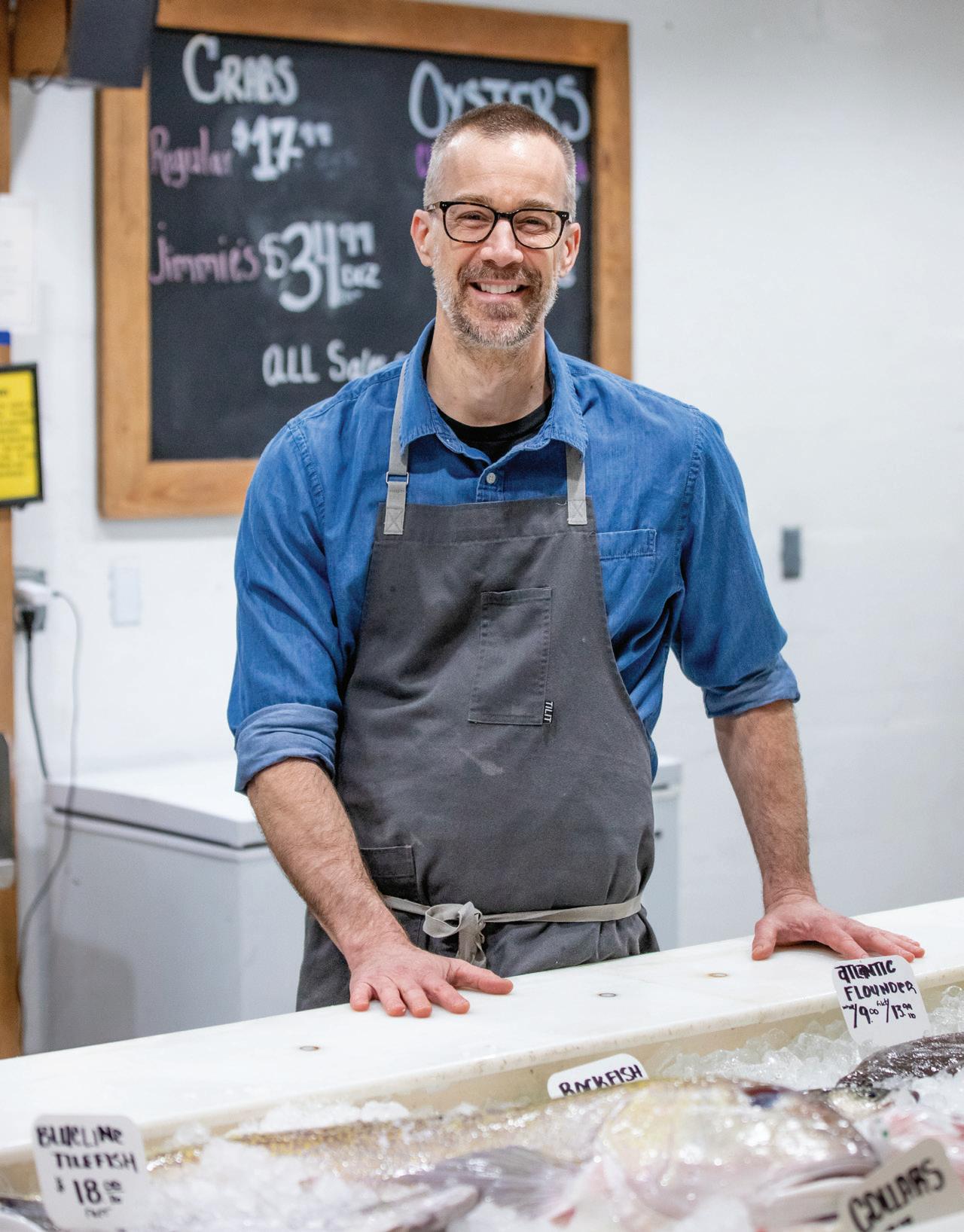
That message runs strong, in one way or another, along a stretch of Castle Street in Wilmington, where Zora’s Market & Kitchen sits snugly beside Mt. Moriah United Holy Church, their concrete slabs nearly joining and rooflines almost touching.
Zora’s, at 1411 Castle St., is the newest venture from Dean Neff, a lauded chef who owns Seabird restaurant with his wife, Lydia Clopton. Here, in addition to selling premium, locally sourced seafood, they give away fish – free, once a week – as part of a mission to offer residents access to safe, sustainable seafood.
“Wouldn’t it be great to have a resource in the community for people who are looking for sustenance fish protein to be able to find it and know where it’s from and know that it’s clean, safe and healthy?” Neff said.
Neff – a semifinalist for the 2026 James Beard Foundation Outstanding Chef Award (this year’s winners were not yet announced as of press time) – first posed this question several years ago while serving on an advisory board at Duke University, where his concern for safe fish intersected with research into Cape Fear River pollution.
From that work, the idea for a local fish bank with safe, farm-raised fish was hatched.
Neff said he took the concept to the University of North Carolina Wilmington’s Aquaculture Program, home to a pilot commercial-scale fish hatchery and nursery capable of raising about 70,000 black sea bass to the advanced fingerling, or juvenile fish, stage.
“They were like, ‘We absolutely
love this idea. We’re going to do everything that we can to make it happen,’” Neff said.
Unlike wild-caught fish, farmraised fish are spawned and raised in controlled environments – in UNCW’s case, multiple tanks of varying sizes – where there is greater monitoring for contaminant exposure. Small grade fish from these tanks – ones more difficult to sell because of their size – make perfect fish bank candidates.
If not, “they’ll get thrown away; they’ll get turned into, you know, mulch or whatever,” said Neff.
Instead, these sea bass lightweights, about 20 a week, make their crosstown migration to Zora’s, where each Wednesday “the fish are claimed almost instantly when we open up the phone lines at 10 in the morning,” Neff said.
“We could easily be doing five, 10, 20 times that amount of fish,” he said. “So, I think it’s a matter of figuring out what it would take to bring it to the next level.”
Pickups are Thursday and Friday, Neff said. “When the customers show up, they say, ‘We’d like them cut down the back, butterflied and scaled,’ and we’re good to go, and so we’ll cut them however they want – all for free.”
Giving options to “people who are consuming fish from areas that might be polluted with toxins like mercury, for example, especially if they’re of childbearing age or a young child, is very important,” he said.
Neff imagines it’s how the original Zora would have wanted it.
“Zora (Singleton) was a really well-loved figure in the community and did a lot of great things. She was a force for good,” he said.
She died in 1991, according to Edible Port City.
In 2024, Neff and Clopton bought the seafood market from its most recent owners, Ronnie and
Revonda Williams, who had called the space Ronnie’s Crab Shack at Zora’s.
A trip to Wilmington’s zoning office one day unwittingly put Neff in touch with Singleton’s granddaughter, who worked there.
“She started telling me about her grandmother, Zora, whom she and others called ‘Big Mama,’” Neff recalled. “There were all these stories. At one point, I think both of us were crying.”
More stories followed about Singleton and the seafood market she opened in the 1950s.
“Her granddaughter came to tour the market and told us how they would boil, like, 100 pounds of shrimp a day in a giant pot,” said Neff. She talked about how Singleton, who lived in the house next door, “would cook a meal for everybody that worked there in her kitchen, and everybody would sit down at the table after the shift.”
And perhaps the best story of all about the woman who made it her mission to ensure everyone had a seat and a meal: “Zora would sleep in the back bedroom (of her house), so she could hear the delivery truck for the fish pulling up early in the morning, so she could be up and out letting them in to unload,” Neff said.
Initiatives like the fish bank, for example, and working alongside community partners such as UNCW and others benefit everyone, he said.
“I feel like when we see a need, and we see an opportunity to work within the community and do things together on a local level to make life better, it makes us all better,” Neff said. “It feels better than feeling helpless about things that are bigger than our local community.”
For more restaurant news, sign up for the bi-weekly Feast Unwrapped email newsletter by going to FeastWilmington.com.

AIMING
TO MEET
DEMAND
photo by MADELINE GRAY

SMOKE RISES OUT OF A BERETTA SHOTGUN USED AT SOCIAL SHOOTING CLUB SANCTUM 1791 in Holly Ridge.
The private club opened in May. Of Sanctum 1791’s origins, founder Chris Buffalino said, “After stumbling upon a farm, an old hog farm, I had the idea to build a place to shoot with friends.”
When market research confirmed demand, Buffalino assembled a group of people, including his son, Gianni; longtime friend and business partner, Rene Flores Sr., owner of Wilmington-headquartered Flores & Foley Roofing + Sheet Metal; and Flores’ son, Rene Flores Jr., to build on the idea and create something bigger for an untapped market.
Gun safety and handling are highlighted at the facility, which offers more than 30 classes covering a range of skills taught by experienced instructors, including a seven-time shooting world champion, Chris Buffalino said. “We have classes and training for everyone. Safety is a big thing for us,” he said.
Sanctum 1791 sits on 107 acres, and the team already has growth plans, including a 3D archery range.