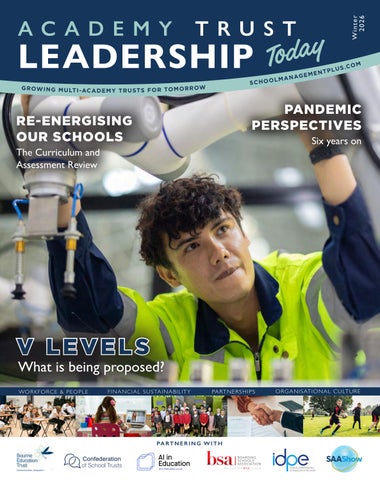
Trust Leadership Today, Winter 2026

Page 1


LEADERSHIP ACADEMY TRUST

ACADEMY TRUST

Today LEADERSHIP

William Clarence Education

Green Park House, 15 Stratton Street, Mayfair, London W1J 8LQ

Tel: +44 (0)207 412 8988 williamclarence.com

EDITOR

David Moncrieff

david@williamclarence.com

EDITORIAL ADVISORY BOARD

Ann Mroz

Former Editor, Times Educational Supplement (TES)

Louise Bennett

CEO, The Institute of Development Professionals in Education (IDPE)

Alex Russell

CEO, Bourne Education Trust

Samuel Skerritt

Director of Public Affairs and Policy, Confederation of School Trusts (CST)

Andrew Thraves

Chair, Big Education Trust

David Walker

Director, BSA Group

Dr Helen Wright

Educational Consultant and Coach

Steve Price

Chief Executive, Tudor Park Education Trust

DESIGN & PRINT

Fellows Media Ltd

The Gallery, Southam Lane, Cheltenham GL52 3PB 01242 259241 hello@fellowsmedia.com

ADVERTISING

Alice Ireson alice.ireson@fellowsmedia.com 01242 259249

PUBLISHER

William Clarence Education Ltd

The William Clarence Education Group is a leading education publisher and provider of admissions, recruitment and careers solutions for parents, leaders and schools across the world. williamclarence.com

DISTRIBUTION

(Print & Digital)

Trust Leadership Today is distributed as follows: all UK Single and MAT Trusts; Schools & Academy Show, NEC. Quarterly print reach: 5,000; digital reach: 65,000; social reach 25,000.

FOREWORD

Another new year is upon us – and, once again, it is likely to herald a busy and demanding time for MAT leadership teams, not least with the continuing lack of certainty about the direction of education policy in several key areas. Hopefully, there will soon be more clarity, particularly around the delivery of future SEND provision, when the Government’s long-awaited White Paper is published.

But there are undoubtedly reasons to feel positive. The recommendations from the Curriculum and Assessment Review are generally felt to have landed well and, as Claire Heald outlines in her article (p6), these may help to re-energise our schools. Could this indeed be a ‘strategic moment’ for our sector, providing an opportunity to shape the direction, ethos and identity of our MAT communities for the next decade?

In particular, the introduction of V Levels appears to indicate a move away from the previous Government’s focus on highly contentheavy academic qualifications, possibly thereby providing a ‘third way’ which doesn’t push students onto an ‘academic’ or ‘vocational’ pathway too early. The jury is out, as Penny Alford explains in her insightful piece (p11), and the devil – as always - lies in the detail. A diversity of provision is essential; but again, maybe there is an opportunity to be grasped?

COULD THIS INDEED BE A ‘STRATEGIC MOMENT’ FOR OUR SECTOR…?

March 2026 marks the sixth anniversary of the first COVID-19 lockdown. For many of us – either intentionally or not – the memories of that time are starting to fade. Yet, as the preliminary outputs from the Government’s COVID Inquiry indicate, there are important lessons which should be learned and built into every MAT’s emergency plan for managing future pandemics. Dr Helen Wright (p22) and James Reece and Leora Cruddas (p19) share their insights in the first of a series of articles on the subject, which we will carry this year.

As Gandhi observed, ‘There is more to life than increasing its speed’, so maybe all of us should raise our heads and take a moment or two to pause and remember what drives us, resolving to make the most of each and every opportunity which might benefit our students.

David Moncrieff

© William Clarence Education

No part of this magazine may be reproduced without the permission of the publisher. The information contained in Academy Trust Leadership Today has been published in good faith and every effort has been made to ensure its accuracy. All liability for loss, disappointment, negligence or damage caused by reliance on the information contained within this publication is hereby excluded to the fullest extent permitted by law.

THE CURRICULUM AND ASSESSMENT REVIEW

AN OPPORTUNITY TO RE-ENERGISE OUR SCHOOLS

Claire Heald examines the recommendations from the Curriculum and Assessment Review and welcomes the opportunities they provide for the sector.

In November 2025, the Department for Education (DfE) published the final report of the Curriculum and Assessment Review (CAR), a highly anticipated overhaul of England’s National Curriculum, assessment and qualifications system. Led by Professor Becky Francis CBE, the CAR represents the biggest rethinking of curriculum and assessment since the last major reforms of a decade past. It also represents an exciting opportunity for schools and trusts. Presented, in Francis’ own words, as ‘evolution not revolution’ there is a real space here for schools to shape their future vision around what they feel is right for their young people. It is a real moment for the sector.

WHY THIS AND WHY NOW?

The CAR was launched in July 2024, with the purpose of ensuring that England’s curriculum and assessment arrangements remain ‘fit for purpose’ in our changing,

modern world. There were calls in the sector to take a fresh look at National Curriculum content and assessment approaches. Many felt, myself included, that the curriculum and assessment load, particularly Key Stage 4 assessment, had become over-loaded. There were also questions about relevance and diversity when it came to content.

Aware of the pressures already facing schools, there was an emphasis on the need to avoid any reforms that created unmanageable additional workload for teachers and school leaders. This is an approach I support personally and I’m happy to say that the CAR has delivered on this commitment.

THE MAIN RECOMMENDATIONS?

So, what are the main recommendations? I’ve focused here on the recommendations that we know have been accepted by DfE.

• Review and update all Programmes of Study – and, where appropriate, the corresponding GCSE subject content –to include stronger representation of the diversity that makes up our modern society.

- With a recommendation to involve teachers in testing and design processes.

• Remove the EBacc performance measures and associated EBacc entry and attainment accountability measures. The review recommended retaining progress 8 but the Government has already announced an alternative approach.

• Explore approaches for assessing progress for the minority of pupils with certain SEND needs that make the phonics screening check inaccessible

• Replace the current KS2 grammar, punctuation and spelling (GPS) test with an amended test that better assesses composition and application of grammar and punctuation. It was recommended that the DfE might also consider whether the new test might be included in headline measures.

• Seek to reduce overall exam time at KS4, on a subject-by-subject basis, by at least 10%, focusing on assessment design choices to deliver this reduction.

THE OPPORTUNITIES

Overall, the Review feels very sensible and has broadly landed well in the sector. Aside from being well-received, I’d suggest we shouldn’t overlook the opportunities it presents. Evolutionary it may be – but some recommendations have potentially huge significance if gripped in the right way.

A lighter, smarter and fairer approach to assessment

The Review acknowledges that the current end-of-course assessment burden at Key Stage 4 (KS4) is excessive, particularly in volume, time and pressure. Specifically, the CAR recommends reducing overall exam time by at least 10%, which translates to around 2.5 to 3 hours less exam time on average for a typical student taking eight or nine GCSEs.

Reducing assessment load, alongside changes in accountability measures, should enable more flexibility and choice in the system. This is likely to have the most positive impact on our disadvantaged pupils who can most benefit from flexibility and support. This represents a very real chance to level the playing field. F

KEY THEMES

Key themes coming through in the report include:

BREADTH AND DEPTH

• A continued focus on ambition – the refreshed National Curriculum must be aspirational and engaging, retaining a knowledge-rich approach.

• The National Curriculum should be constructed to support pupils to master core concepts, ensuring sufficient space to build knowledge and deepen understanding.

• There should be better access to non-core – but vital – disciplines including the arts, music, sport, drama, citizenship, computing (with a strong digital/ AI dimension) and vocational learning.

INCLUSION

• The review recommends that policymakers adopt the underlying principle that our curriculum and assessment system is for all our children and young people. It needs to reflect our diverse society and the contributions of people of all backgrounds to our knowledge and culture.

PROFESSIONAL AUTONOMY

• The professional autonomy of teachers needs to be maintained. Greater specificity in the refreshed National Curriculum should not substantially ‘restrict teachers’ flexibility to choose lesson content and how to teach it’.

CURRICULUM DESIGN

• Careful sequencing of content to ensure curriculum coherence should ‘be an organising principle for curriculum drafters and support the selection and prioritisation of content'.

MODERNISATION

• In recognition of a rapidly changing world, the review emphasises digital literacy, computational thinking and AI awareness.

• In parallel, there is a push to embed climate literacy, media literacy and broader civic education (e.g. citizenship).

Reduced assessment should free up time for valuable, but non-examined curriculum opportunities. High-quality enrichment could be prioritised on Key Stage 3 and Key Stage 4 in a way that it hasn’t been in recent years. At the CAM Academy Trust, we’re working on an ambitious pupil enrichment entitlement, to take advantage of this.

Flexibility to build distinctive offers

The promised reforms are likely to lead to a reduction and greater precision in curriculum content across all key stages. This opens up the opportunity for schools and trusts to really think about the curriculum offer that is right for their pupils, to consider their provision holistically, with an emphasis on wellbeing and engagement as well as strong academic standards.

Alongside core content, taught really well, with sufficient curriculum time for concepts to be mastered, schools can think carefully about place-based planning, delivering a strong ‘local’ offer

OVERALL, THE REVIEW FEELS VERY SENSIBLE AND HAS BROADLY LANDED WELL IN THE SECTOR.

that meets the needs of their young people and their community.

This is a great opportunity for trusts, particularly those with a strong local, geographic presence.

A deeper focus on reading

The new Year 8 reading test is a policy move that I welcome. I’ve written a lot about the importance of reading in both primary and secondary and it’s a real passion of mine.

There is a slight risk though that a new diagnostic assessment leads to schools

feeling that all their reading assessment is ‘covered’ by this new test. Instead, it would be great to see schools seeing such a test as a necessary ‘hygiene factor’ and investing in training for leaders and teachers around the use of deeper diagnostic assessment, alongside the Year 8 test. The new test will not be enough on its own. Alex Quigley has written well on this – I’d encourage trust leaders to take a look.

Valuing all routes – not just academic

The Review recognises that academic A Level routes are not the only valid pathway. As part of its remit, it calls for clearer, high-quality vocational pathways and more equitable access to them.

There is an important opportunity here – to shatter the historic stigma around non-academic pathways and to position them as equally valid, rigorous and valuable for young people – regardless of background or aspirations.

For this to happen, we need the sector to take this opportunity seriously. We also need newly developed qualifications –such as the mooted V Levels to be really high-quality qualifications that stand up to scrutiny as genuine, high-value alternatives to academic qualifications.

WHAT HAPPENS NEXT?

The DfE expects to publish a refreshed National Curriculum by spring 2027, with first teaching from September 2028.

Revised GCSEs and other reformed qualifications are scheduled to follow.

For leaders of multi-academy trusts (MATs), the CAR presents a strategic moment – one with real potential to shape the direction, identity and ethos of your schools over the next decade. Yes, there will be implementation challenges and we need to see the detail of the DfE’s plans, but this really could be a watershed moment if we approach the proposed reforms with imagination and optimism. ■

HEALD is the CEO of the Cam Academy Trust of 17 schools.

CLAIRE

COST EFFICIENCY ON THE MENU:

HOW SCHOOLS CAN TACKLE RISING COSTS IN THE KITCHEN

Rupert Weber, General Manager of apetito’s Education Division, explores how schools can reduce catering costs and overcome staffing shortages without compromising on quality.

When Chancellor of the Exchequer Rachel Reeves stood up to deliverer her Budget statement in November, there was plenty to unpack. For many in the education sector, the lack of measures which focused on increasing public spending was noticeable.

Following the Budget, Paul Whiteman, General Secretary of the National Association for Head Teachers warned: “This was not a Budget centred on public spending, and school finances remain in a precarious position.” [1]

Anyone working in a school knows that kitchens are facing unprecedented challenges. Continued labour shortages, tightening budgets, inflation and rising food costs are making it increasingly hard for schools to ensure they are offering high-quality, nutritious meals that give pupils the fuel they need to learn.

Here at apetito, we’re on a mission to revolutionise school catering and we’re proud to be different. As the UK’s first and only prepared meals system, we offer unrivalled food quality and benefits to schools, which can’t be achieved in traditional in-house or contracted kitchens.

With our service, not only are schools able to guarantee consistent quality meals but also create real cost savings and efficiencies in the kitchen. Unlike traditional kitchen setups that demand a team of skilled chefs and kitchen staff to source ingredients and prepare and portion meals for pupils with increasingly diverse dietary requirements, our catering system eliminates much of this labourintensive work. In fact, our prepared

service requires 50% less staff to deliver high quality, nutritious meals that pupils love. It also completely removes the requirement for skilled cooks and chefs, which in turn protects schools from the volatile labour market.

This is because at apetito, we do the heavy lifting for you. Our team of chefs, dietitians and nutritionists have developed a huge range of delicious and nutritious prepared meals that school kitchen staff simply need cook and serve.

By reducing the reliance on skilled culinary professionals, schools can mitigate the impact of the ongoing labour crisis and the rising cost of hiring lots of kitchen staff. Staff can cook all our meals easily from frozen, so the complexities of managing kitchen teams are reduced significantly – and this means a notable reduction in cost and stress.

Emily Mullord, Executive Head of two schools in the Dioceses of Salisbury Academy Trust has found a real benefit of using our service is that it enables them to save money on their catering at a time when food and wage inflation are really squeezing school catering budgets. Partnering with us has delivered real commercial benefits for the schools explains Emily:

“In terms of budget, it feels like there is a real reduction in overhead costs when you are using apetito. You feel like you really see what you pay for. A lot of the money you know goes into the food

and the quality of the meals that you are providing to the children. You have a one-off payment to sort your kitchen out and set the ovens up.

“For us we’re in the position where within our budget, apetito’s meals almost pays for themselves because we’ve seen such a large uptake in pupils having or paying for the meals that the overheads for us have reduced. You also see that the money you’re spending is going into high-quality meals that the pupils love.”

We are really proud of our service because we know it is making a real difference to schools – helping schools to give them full control of catering, great quality meals, all whilst reducing cost and creating efficiencies. ■

TRANSFORM YOUR SCHOOL CATERING

Reach out to apetito’s Education team and discover how it can transform your school’s catering with a focus on quality, ease and significant cost savings by scanning the QR code or contacting 0117 463 3563.

V LEVELS WHAT IS BEING PROPOSED?

Penny Alford considers the Government’s recent announcement on the introduction of V Levels and offers some ideas on how these vocational qualifications could be helped to succeed.

WHAT ARE V LEVELS?

The Department for Education (DfE) has announced the launch of vocational levels – V Levels – as the latest iteration for vocational pathways. V Levels are a new set of vocational qualifications being introduced for students aged 16 and above. They will replace Level 3 BTECs and other post-16 technical courses in England from 2027.

The Government says V Levels will simplify a confusing system of more than 900 overlapping courses, making it easier for students to choose clear, practical routes into employment or higher education. Education Secretary Bridget Phillipson describes the change as offering “a vocational route into great careers”, while Skills Minister Baroness Jacqui Smith says the new qualifications will “build on what’s good about BTECs – practical learning and employability – but with clearer pathways”.

V Levels are the latest iteration in a long list of different vocational education offerings; in the last 25 years we have seen GNVQs, BTECs, diplomas, apprenticeships and T Levels to name but a few. We

have also seen investment into studio schools, UTCs and enterprise colleges over the years to respond to this need. Will this be the route which finally sticks around?

WHY THE CHANGE?

Governments from both parties have never really cracked the challenge of vocational education for several reasons. The first is the intellectual snobbery that surrounds the language of ‘vocation’ with parents and some educators feeling this is the ‘soft option’ pathway to ‘create the plumbers’ and ‘for those who aren’t that academic’. This has then become a self-fulfilling prophecy as the take-up has been from non-middle-class pupils, which fuels this narrative.

The second challenge sits around employer engagement. On the one hand, employers are clear that students are not leaving education with the skills they need to thrive in the workplace. A recent report by the World Economic Forum on the skills required to succeed in the careers of the future supports F

this. On the other hand, it is incredibly difficult to secure meaningful and structured work experience placements for young people. This has certainly been a challenge for Sixth Forms and colleges offering T Levels where 20% of the learning should take place in the workplace.

Finally, vocational pathways have often been fragmented. There are multiple awarding bodies offering different types of qualifications with an absence of an overarching strategy. This means there is currently a fragmented system of delivery – with some students getting very high-quality vocational education, but too many getting sub-standard training. This fragmentation contrasts sharply with countries like Germany and France, which have more unified, nationally coordinated vocational education systems with clearer pathways and stronger employer engagement.

WHAT WILL THE IMPACT BE ON SCHOOLS AND COLLEGES?

With any change to curriculum and assessment there is always concern around workload and time pressures. Schools feel they have been triple hit recently with changes to Ofsted, the wider Curriculum and Assessment Review and changes to vocational qualifications. Schools are also facing significant financial pressures and recruitment challenges. The DfE is investing an extra £800 million in 16–19 education and establishing 29 new Technical Excellence Colleges focused on key industries. They also seem to be engaging with the unique challenges facing those working in the Further Education sector, but time will tell.

Key questions for trusts and schools are:

• Do I have the right workforce and skills to deliver V Levels?

• Are they the right option for the needs of our pupils?

• How will we connect to local employers and higher education establishments to ensure they lead to meaningful next steps?

• Who could I partner with to broaden my post-16 educational offer?

Schools are well versed in the language of ‘anchor organisations’ – wanting to serve their local communities and connect with local organisations which make up the fabric of place. We do not yet know the detail of V Levels in terms of work placements, but some form of employer engagement is surely key if qualifications are to link with fulfilling work.

Sixth Forms and colleges face significant funding challenges and often become locked in a cycle of narrowing subject choices as they cannot afford to

WILL THIS BE THE ROUTE WHICH FINALLY STICKS AROUND?

run courses with small numbers of student takeup. In turn, this then means they are not attracting sufficient student numbers. There is an opportunity with V Levels to think differently and to harness technology across a number of providers to run courses which have a range of face-to-face and remote input.

One of the concerns is that V Levels will be offered as single, full-time qualifications (360 guided learning hours), which may be too restrictive. A key strength of the current system has been the flexibility offered to students in combining single qualifications and double qualifications with a third option.

HOW ARE V LEVELS DIFFERENT TO BTECS? SAME, SAME BUT DIFFERENT? There have been comments from the sector a nd the press that the introduction of V Levels is simply a rebranding exercise. However, there are three key differences:

• Nationally-set content: Unlike BTECs, which are developed by awarding organisations, the content of V Levels will be centrally set by the DfE, similar

to A Levels and T Levels. This aims to ensure consistency and rigour, though it raises questions about flexibility.

• Alignment with occupational standards: V Levels are explicitly linked to occupational standards developed by employers and overseen by Skills England, ensuring direct labour market relevance and clear employment pathways without the narrow focus of T Levels.

• Single, unified brand: The Government proposes removing awarding organisation names from qualification titles, creating a single V Level brand to help students, parents and employers better understand the qualification.

WHAT WILL THE IMPACT BE ON PUPILS?

There has been a great deal of attention – and rightly so – in recent years on students voting with their feet, with schools facing significant attendance challenges, increasing SEND needs (in terms of volume and complexity) and the disengagement of some pupil groups, particularly white British pupils on free school meals. It is hoped that any new pathway for students post-16 might help address some of these challenges; the statistics are pretty dismal in terms of pupil attendance, attainment and engagement. Currently, a higher proportion of learners taking BTECs have SEND and are from disadvantaged backgrounds, and a lower proportion have achieved Maths and English GCSE Grade 4, making flexibility crucial for these vulnerable groups.

‘Flexibility’ in education has often been seen as a dirty word, suggesting students opting out or delaying education and then not returning. It is true that any transition between schools, colleges, universities or even key stages can mean students disengage or find change difficult. However, the next generation of learners may wish to complete V Levels alongside paid employment or at a different pace. Offering a more personalised model in terms of age and stage may allow us to lock in learners who welcome a change from the formal 9am–3pm model. Technology could play a key part in this by offering a more blended model with students learning at different times of day, locations and pace.

LIFE AFTER V LEVELS

Meaningful connections with universities and employers will be crucial for V Levels to succeed. This sounds obvious but there is a track record of siloed approaches and lack of joined-up thinking between government departments and different phases of education. With diminishing resources, schools

V LEVELS: SECURING THEIR SUCCESS

• Ensure V Levels are branded and communicated as prestigious and valuable. They cannot be the poor relative to A Levels. Allowing students to ‘mix and match’ could help achieve this.

• Support and incentivise employers to engage with V Levels to ensure explicit links can be made between learning and application, even if this is not part of the assessed content.

• Ensure there is a clear route from V Levels to university entry requirements. This will help raise the status of these qualifications and ensure they are not perceived as an ‘add-on’.

• Don’t be afraid of flexibility; the next generation of learners may wish to access qualifications in different ways.

• Harness technology in terms of offering personalised experiences and allowing schools and colleges to offer a suite of qualifications across a cluster of providers.

cannot always designate human resource into forging links with employers and further or higher education. However, this is key in ensuring that V Levels are being designed to meet the gaps in the future employment market such as green energy, digital industries and healthcare. We must also ensure that universities are ready to promote V Levels as a well-regarded route into higher education.

Who will own and coordinate this partnership?

There needs to be genuine thought about how the qualifications on offer feed into real job opportunities. For example, ESports is one of the fasting-growing global industries; its turnover is more than the film and music industry combined. However, the current ESports qualification does not count towards performance tables, making educational institutions reluctant to offer it.

SHOULD WE BE HOPEFUL?

It’s hard to know - the devil is, as ever, in the detail! On paper, this looks like a clear ‘third way’ which doesn’t narrow students too early into ‘vocational’ or ‘academic’ students, which is to be welcomed. This does seem to be a clear move away from the legacy of Michael Gove and the focus on the e-baccalaureate suite of subjects and highly content-heavy academic qualifications, which did not suite all learners.

While V Levels do seem to represent genuine reform rather than simple rebranding, their success will depend on links with employment and maintaining the flexibility that made BTECs valuable. Without offering various sizes and combinations, there's a risk of losing the diversity of provision that has enabled many young people to thrive. ■

GROUP INSPECTION

GENUINE BENEFITS FOR CHILDREN ARE ESSENTIAL

Steve Rollett believes that the education sector must play a central role in shaping the Government’s evolving group inspection policy to ensure it genuinely strengthens the system.

As the sector settles into 2026, many schools will be looking ahead to their first routine inspections under Ofsted’s new framework.

While it technically came into force in the autumn, initial inspections were mostly from schools that had volunteered to help pilot the changes, allowing for the approach to be road-tested and provide further training for Ofsted’s inspectors – many of whom are serving school leaders themselves.

But while the sector is focused on understanding what the new approach really means on the ground for schools,

Ofsted and the Department for Education are starting to look at something else.

UNCHARTED TERRITORY

In its election manifesto, the Government said it would 'bring multi-academy trusts into the inspection system' and work to inspect school groups is now gearing up. It is largely uncharted territory, bringing with it competing tensions and unintended consequences.

For the Confederation of School Trusts (CST), and the trusts and schools we represent, there is a lot of work to do to understand the purpose of

group inspections, how they fit with our existing system of school-level inspections and, most importantly, how they can help improve things for the nation’s children. Trusts now run more than half of England’s schools, with the majority of children attending an academy – so it is important to get this right.

But trusts are not the only type of organisation running or influencing

GROUP CHECKS MUST GENUINELY ADD SOMETHING TO THE PUBLIC ACCOUNTABILITY MEASURES ALREADY IN PLACE.

OUR STRONG STEER IS THAT ANY GROUP INSPECTION SHOULD REMAIN STRATEGIC AND TIGHTLY FOCUSED, TO AVOID SCOPE CREEP.

multiple schools – we have a diverse school system, and if group inspections truly have the potential to improve what happens in classrooms, we think that shouldn’t apply solely to the ones in academies.

Whoever they eventually extend to, group checks must genuinely add something to the public accountability measures already in place. For example, trusts – rightly – face thorough external audits, oversight from Regions Group, and existing school inspections. Trusts simply existing is not a good enough reason to build a complex bureaucracy of group inspection on top of that: it must bring genuine benefit for children.

So, assuming that can be achieved, what might that all look like in practice?

A CLEAR PURPOSE

With school inspection and extensive regulation of trusts already in place, group inspection needs to bring something new to the table – or replace some of the existing mechanisms.

Trusts and other groups are responsible for taxpayer funds, and inspection could help reassure the public that we are doing a good job, both directly and by informing regulatory, support and intervention decisions. By signposting common areas for improvement or highlighting best practice, it could provide assessments for trusts and other groups to learn from and act on.

Much of this potential benefit is already being realised through existing systems though.

CST has consistently argued that accountability should be underpinned by a clear regulatory strategy. Mapping actors, powers and accountability relationships is essential to ensure coherence with existing frameworks and to identify necessary adjustments.

There are already frameworks for trust assurance, including CST’s own Building Strong Trusts Assurance Framework, and the previous Government’s set of trust quality descriptors. The Academy Trust Handbook, together with funding agreements, legislation and statutory guidance sets out various standards. The Academy Trust Governance Code offers a framework specifically for that area. However, these are not inspection frameworks, and many are integral parts of the work done by the DfE Regions Group, which has significant formal and informal powers of oversight. Assuming Ofsted takes on the mantle of group checks – expanding their role from schools – their job would be to inspect and not to regulate, an important distinction. That will need a targeted and distinct framework and approach of its own.

Inspection must also fit with wider accountability frameworks, including ITT inspection and area SEND inspection.

HOW GROUP INSPECTION MIGHT WORK

• Group inspection would aim to surface patterns in school performance across a group of schools, evaluating organisational responses to weaknesses, strong practices and the capacity of the group to support schools.

• Ofsted could lead, using a small team of specialist HMI, supported by well-trained practitioners working in leadership positions in groups. Legislation could provide Ofsted with a power, not a duty, to inspect groups, allowing flexibility in approach.

Trust inspection must avoid duplicating or conflicting with all these mechanisms. The other elephant in the room is school-level inspection. Might school and group-level inspections present conflicting conclusions? Parents were seen as a primary audience in designing Ofsted’s new report cards, but should the same be true for any future group reports? Might school inspections need to change again to sensibly integrate with work at a group level?

A STRONG EVIDENCE BASE

The legitimacy of group inspection depends on a clear, evidence-based conception of quality, a valid and reliable methodology, and proportionality with its purpose.

Much of the research around academies is through the lens of comparing them against maintained schools, often attempting to compare exam results and inspection outcomes across changing curriculums and frameworks, and assuming sometimes dubious counterfactuals.

Despite this, there is evidence of the benefits of school trusts but there is limited detailed work on how this has been achieved. More high-quality F

• Focus would be on the delivery of educational quality for children.

‘Back office’ functions would be beyond the primary scope of group inspection, except where directly relevant to the strategic leadership of education quality.

• The approach would combine insights from existing schoollevel inspections with a risk-based approach of sampled inspections and reviews of best practice, to give broad coverage and make the process as efficient as possible.

• The output would be written reports that identify key patterns in school quality within the group, and the effectiveness of the group’s response to weaknesses.

WHAT’S HAPPENING WITH SCHOOL INSPECTIONS?

• The new Ofsted framework for school inspections came into force in November 2025, building on some earlier interim changes.

• The framework confirmed the removal of an overall effectiveness judgement, and introduced six core evaluation areas (inclusion; curriculum and teaching; achievement; attendance and behaviour; personal development and wellbeing; and leadership and governance), each graded on a five-point scale ranging from urgent improvement to exceptional. There are separate evaluations for Early Years and Sixth Form, where schools have them. All schools will be assessed as either ‘met’ or ‘not met' for safeguarding.

• Routine inspections will almost always be notified on a Monday morning and take place on the two days following, with shorter days and more feedback and dialogue during the visit. The inspection format has changed, introducing more ‘learning walks’ and conversations with pupils, in addition to meetings with school and trust leaders, including several ‘reflection meetings’ to discuss emerging findings.

• Outcomes of inspections are now published in a new ‘report card’ format, including contextual and outcome data at the point of inspection.

• The new approach means there is no direct correlation with grades under the old framework.

research is needed, and this should be a priority for Government and Ofsted. Without this, group-level inspections will always be vulnerable to the challenge that expectations are not rooted in evidence and could promote unhelpful practices.

In designing the methodology, one clear risk is the temptation to explicitly link school outcomes to whichever group they belong to, either through averaged data or inspection outcomes – indeed some group benchmarking tools already exist.

Bald figures can hide complex context; however, a trust that takes on a ‘stuck’ school might find its averages affected if a purely statistical approach was adopted. Different types of schools – such as specialist and alternative provision – may legitimately need different measures but be in the same group as mainstream settings.

The sensitivity of this in part rests on how group inspection outcomes are used. The closer the relationship between inspection outcomes and regulatory action, the higher the stakes – and, therefore, the more confident we all need to be about the reliability and

consistency of any judgements. It is vital that inspection outcomes support rather than discourage trusts from taking on struggling schools, so that years of progress in improving education, in disadvantaged communities especially, can be sustained. Group inspection must not make school improvement too risky to take on.

GROUP INSPECTION MUST NOT MAKE SCHOOL IMPROVEMENT TOO RISKY TO TAKE ON.

WHAT SHOULD BE INCLUDED?

The inspection areas in Ofsted’s new schools framework are not without controversy. For some, they represent a chance to improve focus on an important area. But too many potentially leads to either an impossibly busy inspection visit

MIGHT SCHOOL AND GROUP-LEVEL INSPECTIONS PRESENT CONFLICTING CONCLUSIONS?

or superficial checking. So, what should be covered in a group inspection?

Given their primary purpose, the quality of education seems a key ingredient. At trust level, that may naturally follow on to leadership, and governance; both areas that can heavily influence daily practice and children’s outcomes.

But what of ‘back office’ activities like finance, HR, or estates? These can also be instrumental in what a trust does and involve a significant number of staff, but the wide variety of group structures means there could be many arguments about what the ‘right’ approach is.

Standalone schools also have these functions, but they are not explicitly covered by Ofsted. If included in group checks, surely the logic follows that they always be checked on, regardless of school type?

Our strong steer is that any group inspection should remain strategic and tightly focused, to avoid scope creep.

Group inspection is a significant policy shift. It must be designed carefully to avoid adding complexity without clear benefits. The education sector must play a central role in shaping this policy to ensure it genuinely strengthens the system. ■

PANDEMIC PERSPECTIVES REFLECTIONS FROM A STUDENT AND A LEADER

The ongoing UK COVID-19 Inquiry recently focused on education with testimony from then-Secretary of State. Sir Gavin Williamson MP, and former Prime Minister Boris Johnson. Reflecting on the Inquiry, James Reece – a student during the pandemic – shares his memories, and discusses their different perspectives of that time with educational leader Leora Cruddas CBE.

Ioften think back to an image of the kitchen table, my laptop open, and a Microsoft Teams lesson with my papers and revision notes spread across the table. Outside, the world was still. Inside that stillness, the routine of learning gave shape to days that might otherwise have slipped into one another.

The months of lockdown were marked by instability, loss and isolation. Studying became my way of coping. It filled long days with purpose and gave me something solid to hold onto when everything else was uncertain.

The quiet also created an unexpected space for thinking about the future. With normal life suspended, questions that had always sat in the background – what I wanted to study, who I hoped to become – came into sharper focus.

I look back with a mixture of gratitude and awareness. The foundations I built during that time were possible only because of support, stability and circumstance. Many others had far less. That contrast shapes how I reflect on those months now.

CHAOTIC AT TIMES

Looking back through the lens of the UK COVID-19 Inquiry, it becomes easier to understand why those months felt so disorienting for young people. The Inquiry has shown that decisions affecting schools were often taken late, under intense pressure and with limited clarity. Evidence from senior civil servants and scientific advisers highlighted moments when communication broke down or when guidance shifted faster than schools could reasonably adapt.

For students, these national dynamics filtered down into the small details of daily life. One week we were preparing for exams; the next, we were told they would be cancelled. Many families found themselves navigating government briefings, school emails, news alerts and rumours, all competing to define what would happen next.

The Inquiry has made clear that education was interwoven with wider leadership challenges: Delayed lockdown decisions, conflicting departmental priorities and strained relationships between ministers

and advisers all shaped the environment in which schools were forced to operate.

The culture within central government – described in testimony as chaotic at times – had real consequences for teachers trying to plan, for leaders trying to build contingency and for students trying to hold onto routine.

SHARING INSIGHTS: A CONVERSATION

James Reece talks to Leora Cruddas CBE, Chief Executive of the Confederation of School Trusts (CST), about the lessons learned during the pandemic which should be carried forward.

ames Reece: In 2020 you wrote that lockdown revealed something essential: that education depends on partnership. Six years later, do you think the sector truly absorbed that lesson –or did some of that spirit fade once we returned to 'normality'?

Leora Cruddas: Back in March 2020, I said that the deep social changes that happened in the first few weeks of the pandemic were unprecedented in our lifetime. The civic role of schools and trusts had suddenly come to the fore in ways that I could never have expected.

Yet, schools and trusts often became stabilising forces when national leadership was uncertain. Many acted quickly to organise food parcels, check on vulnerable pupils and create remote learning packages long before consistent national frameworks were in place. The education workforce became translators of policy, turning mixed messages into workable plans.

Wider societal impacts continue to ripple through the system today. The Inquiry has heard evidence about widening inequalities, digital exclusion, pressures on mental health services, and the fragility of support structures for disadvantaged children. These long-term consequences are visible in attendance patterns, Early Years development, and the rising complexity of needs schools are now grappling with.

The Inquiry has provided a clearer picture of how strained the system became, and how much depended on the judgement, care and perseverance of schools. When national direction faltered, the education sector held together the daily fabric of many young people’s lives.

That is the backdrop against which my own experience unfolded, and the context through which I now understand it.

I said then that we can now be in no doubt that schools and trusts are civic structures. In the pandemic, they took their place alongside other civic structures to organise a local response. That spirit has remained an enduring part of the mission of the trust sector.

For example, just recently Windsor Academy Trust published a brilliant framework, Co-creating Healthy Futures: Schools and Health. This framework, developed in partnership with CST, the NHS Confederation and a group of trusts, is designed to change how schools and health partners work together. It shows what it truly means for our public institutions to act as civic institutions rooted in place, working together across boundaries and committed to the wider common good.

JR: In 2020 you emphasised preparation with agility between remote and in-person teaching, an aligned curriculum and evidence-informed practice. What elements of that preparedness do you think schools and trusts have managed to retain, and what has slipped away?

LC: I think schools showed remarkable agility right through the COVID-19 pandemic. We are much better prepared now than we were in those early weeks of 2020. But there is more work for us to do as a nation to prepare for another pandemic.

STRETCHED TO THEIR LIMITS

When I think about the years that followed, I’m conscious of how uneven the impact of the pandemic was. For some, routine became an anchor that carried forward into university and work. For others, the disruption left deeper marks in loneliness, anxiety, lost learning and a sense of being unmoored.

Many people my age still speak about struggling to reconnect socially, about long hours on screens becoming a habit that’s hard to break, or about feeling somehow older and younger at the same time. Those patterns are visible in younger cohorts too: dips in early language development, rising complexity of needs, lower confidence and far greater variability in wellbeing.

Looking back, the foundations I built in lockdown weren’t the result of extraordinary resilience. They were the result of stability, support and circumstance. I don’t take that for granted.

WHAT WE CARRY

The legacy of the pandemic remains uneven. Some young people have found their footing; others continue to feel the aftershocks. That disparity is one of the clearest lessons the system must confront.

Coherence in future crises matters not because it makes administration easier, but because uncertainty falls hardest on those with the least margin for disruption.

Understanding student experience as a human experience and not an abstract measure of 'learning loss' is equally important. For many of us, routine was more than structure; it was a form of stability. But not everyone had the same access to it.

Digital capability, too, remains a story of both opportunity and inequality. Remote learning was a lifeline for some and a barrier for others. The longterm consequences of digital exclusion are now apparent in ways that go far beyond online lessons. Ensuring equitable access is not simply a technical challenge; it’s a matter of fairness.

Looking ahead, I’m conscious that my own path from lockdown routines to university to the work I do now, was shaped by luck as much as effort. The next generation deserves a system that doesn’t leave their futures to luck. If the pandemic taught us anything, it’s that clarity, care and connection are not luxuries. They are the conditions that allow people to endure uncertainty and, eventually, to move forward. ■

This is why the work of the Pegasus programme is so important. A pandemic remains the top risk of the UK’s National Risk Register. Pegasus is the largest ever simulation of a pandemic in UK history and involves participation from every government department, the devolved governments and representation from armslength bodies and local resilience fora.

JR: As someone who lived through the pandemic as a student, I remember relying on the routine of education, and the realisation that digital spaces were shaping my future. What do you think leaders learned about how young people experienced lockdown beyond the headlines about ‘learning loss’?

LC: I think you are right that the routine of education helped many children and young people. But some students faced challenges due to lack of technology or internet access. Schools and communities helped to support families, but some still struggled. And children with SEND faced additional challenges with remote learning.

We do know that there are quite widespread impacts on children’s learning and development across all age groups, with some starting school not toilet-trained or

REECE is Policy Officer at the Confederation of School Trusts (CST)

presenting with speech and language delays. We also saw some groups of children begin to suffer mental ill health. So, I think there is still quite a lot for us to do to put some of this right.”

JR: Thinking about how the last five years have unfolded, what do you hope leaders remember as they face future adversity?

LC: The tenacity of the human spirit! I’d like to quote another article I wrote during the pandemic. ‘What we know from periods of global stress is that the human spirit prevails. During that first lockdown, we were allowed to leave our houses for a short bit of exercise. As I left my house on a spring morning to do my daily run in the park, I noticed that my neighbours’ twin six-year-old boys, whose school had given them a box of chalk, had created a beautiful chalk image on the pavement. In the centre of their image were the words “Nothing can stop spring”.’ This reminded me of the tenacity of the human spirit – of hope, renewal and the affirmation of life.

So, this is what I want leaders to remember – in adversity, the work we do becomes even more important. And part of that work is nurturing and sustaining that tenacity of the human spirit.

JAMES

LEADING THROUGH THE UNIMAGINABLE

WHAT SCHOOL LEADERS LEARNED FROM THE LOCKDOWN YEARS

Dr Helen Wright shares the insights she gained through observing school leaders operating during the pandemic and urges colleagues to learn the lessons from that terrible time.

When the world closed its doors in March 2020, school leaders faced challenges for which no manual could have prepared them. I was not on the front line of those decisions, having moved on from school headship six years before, but I watched them unfold from several vantage points – as a coach and adviser to leaders around the world, and as a board member, including as the chair of an international school. From those perspectives, I saw a landscape of leadership under stress, including the exhaustion, the deep uncertainty, and the visceral realisation that the futures of hundreds and hundreds of children and staff depended on the decisions that were made. I also saw moral courage and breathtaking ingenuity, and this made me deeply proud to be human at this time in our history.

The sixth anniversary of the first lockdown invites reflection not just on what schools did – although this is worthy of commendation and awe – but also, and primarily, on what we all learned. The

pandemic was a pivotal moment in our understanding of what education is and could be; it is worth us taking the time to remind ourselves of this, and to reflect on what we might need to revisit, to power our forward-thinking.

WHAT WE LEARNED ABOUT LEADERSHIP

In the first weeks of crisis, the previous polished routines of leadership dissolved, and were replaced with an intensity of focus that was phenomenal. Plans had to change daily – sometimes hourly – because of external edicts; clear, accurate and immediate communication became essential. The leaders who grew through that time learned that authority was not about certainty but about moral steadiness – about being clear, honest and

THE LESSONS ABOUT FLEXIBILITY, AGENCY AND THE DIVERSITY OF LEARNERS’ NEEDS RISK BEING FORGOTTEN.

human when there was no rulebook to follow. Many discovered that leadership in uncertainty is less about control than about navigating; it is an exercise in emotional balance, holding anxiety without transmitting it, staying transparent without surrendering hope.

These patterns, which I observed in schools across the world, highlighted that effective leadership is situational, but is also grounded in something enduring: self-awareness, empathy and the ability to keep on learning and growing. The most resilient leaders were those who stayed reflective, and who paused just long enough to make sense of what was happening, drawing on the insights of others, before sharing with their teams in a reflective calmness.

WHAT WE LEARNED ABOUT SCHOOLS

The pandemic exposed that schools are not mechanical systems to be managed; rather, they are living ecosystems sustained by relationships, trust and shared purpose. When formal structures faltered – i.e. when inspection frameworks paused, policies shifted and plans dissolved – it was the informal networks that kept schools alive. From my vantage point on school boards, I saw this vividly. Governance, too, had to evolve from oversight to awareness. Boards that thrived were those that recognised they were part of the same living organism –listening, supporting, adapting – rather than mere arbiters of performance. What emerged was a new understanding of leadership as ecological. The most effective leaders were those who could read the rhythms of their communities, sense imbalance and redirect energy. They led through connection, not command, and they cultivated conditions in which others could thrive. This ecological view of leadership remains one of the most important and, arguably, least fully

LESSONS UNLEARNED?

For all that was learned, much remains undone. The pandemic taught us that schools are places of connection – but it also revealed that not all students flourish in the same kind of connection. Amid the stories of struggle with online learning were quieter stories of thriving. Some children, freed from the social intensity of school life, found confidence and focus in this new approach to their education. Some learned more effectively at their own pace, with fewer distractions. For a significant minority, the hybrid models improvised during lockdown unlocked ways of learning that traditional structures had never enabled.

This should have been a revelation. It showed that ‘school’ – in its familiar physical form – is not universally optimal. Yet, six years on, most systems have reverted almost entirely to the old model. The lessons about flexibility, agency and the diversity of learners’ needs risk being forgotten. If we truly meant it when we said we would ‘build back better’, we should be more adventurous now. Hybrid education, thoughtfully designed, could extend opportunity and choice. It could allow schools to become more personalised ecosystems – adaptable to each learner’s rhythm, rather than uniform by design. The pandemic gave us proof that education can operate differently; the challenge now is to act on that evidence, not retreat from it.

absorbed lessons of the pandemic years. It challenges the managerial structures that are often imposed on education systems and replaces them with something far more complex and human: stewardship of a living community.

At the heart of this ecological awakening lay a profound moral recalibration. When every plan disintegrated, what endured was moral purpose. Schools remembered why they really and truly exist: namely to nurture future generations and give continuity of learning and care. The crisis stripped education to its ethical core. Leaders and teachers rediscovered the everyday acts of service that define the profession: checking on a child’s wellbeing before their homework, supporting families in distress, valuing care as highly as performance. What emerged was not sentimentality, but clarity and focus on our higher goal as educators.

SIX YEARS ON

Six years on, I still think of the leaders I worked alongside – in schools and boardrooms across the world – and what their collective experience taught me. I remain in awe of the leaders who led schools through this time. I am convinced that the pandemic years revealed education’s deepest truth: that schools are living communities whose strength lies in trust, care and adaptability. Whether we honour those lessons will depend on our willingness to keep evolving, and to lead with moral clarity and imaginative courage. And when the next pandemic or global disaster arrives, let us remember all of these lessons, and draw upon them. We know we can do this! ■

DR HELEN WRIGHT is a former President of the GSA and Vice Chair of the ISC. With three major headships under her belt, she now works in international education and advises, recruits and coaches senior leaders.

MANAGEMENT INFORMATION SYSTEMS

WHY TRUSTS NEED TO SHOP AROUND!

Tracy House explains the importance of MIS in the efficient running of a MAT across many sites and explores the process which she believes should underpin the selection and introduction of a new system.

When you think about schools, you probably picture classrooms, teachers and pupils. I imagine the last thing that comes to mind is the Management Information System (MIS) quietly running in the background. That’s understandable. When you recall a great piece of music you remember the melody, not the instruments.

Yet MIS platforms – the digital engines that record attendance, track behaviour, log assessments and manage everything from timetables to safeguarding – are now as vital to a school’s success as textbooks and teachers. And that’s why choosing the right MIS is so critical, especially for trusts overseeing multiple settings.

THE DIGITAL BACKBONE OF SCHOOLS

Think of an MIS as the school’s central nervous system. Every piece of information – from a child’s attendance record to exam results – flows through it. Every school must have one to share compulsory data with government, including statistics on attendance, how many students are on roll, the number of free school meals and those for whom English is an additional language.

But my 20-plus years of working in the MIS world have shown me that few, if any, schools use their MIS to its full potential.

It can be so much more than just a data-collecting device. Other features include helping prepare:

• local authority reports

• reports for parents

• set allocation

• data analysis – e.g. which students are coasting, struggling or flying

• parents’ evening bookings.

Without an effective MIS, schools risk drowning in paperwork, missing safeguarding alerts or failing to spot patterns in pupil progress.

In multi-academy trusts (MATs), the stakes are even higher. A well-chosen MIS can unify dozens of schools, giving leaders a clear view of performance across the trust. A poor choice can leave schools fragmented, unable to share key data and with staff frustrated by clunky systems.

WHY SHOPPING AROUND MATTERS

As humans, we know what we know. And it’s tempting to stick with the familiar even when it is past its prime and better alternatives become available. But schools and trusts should resist that urge – as well as the temptation to switch to the cheapest option on the market.

Schools require procurement routes that prioritise quality, service and genuine choice. Even with recent regulatory changes, value should always trump cost.

There are now plenty of different options on the market covering a range of different needs, so it’s certainly worth taking some time to see what’s available and how each aligns with the work you need it to do. One decision you’ll need to make is whether to choose a cloud-based system or traditional server-based ones. These days, cloud is cheaper, constantly updated and data is backed up automatically.

It’s also worth making sure you consolidate all your apps when you move to a feature-rich system. It’s a good opportunity to do away with lots of standalone apps and use the power of the MIS to bring them all together under one system.

KEY QUESTIONS FOR TRUSTS

When trusts consider switching MIS, the first question should always be: Why? What are you hoping to achieve?

Cohesion vs. Autonomy: Do you want a cohesive trust where every school uses the same assessment and behaviour policies? A single MIS makes this easier, allowing leaders to analyse data across the trust. Or, are you happy for individual schools to make their own decisions? If so, you still need some trust-level analysis tools that can pull data from different systems. Without this, fragmentation becomes a real risk.

Strategic Goals: Is the switch to a new MIS about saving money, or improving outcomes? Cost savings matter, but they should never be the sole driver.

The answers to these questions matter because the MIS is not just software – it’s a strategic tool.

THE HUMAN FACTOR: CHANGE MANAGEMENT

Even the best system will fail if staff aren’t on board. Change management is key to any successful changeover. Schools should involve staff in the decision-making process. Let them attend demos of the MIS which relate to the areas of activity they manage. They often know these systems better than senior leaders and their insights can highlight practical issues.

Getting staff buy-in is crucial. If staff feel the new system makes their lives harder, resistance will grow. But if they see how it helps – saving time, reducing stress and improving outcomes – they will be much more likely to embrace it.

CASE STUDY: HARBOUR LEARNING TRUST

When Lincolnshire-based Harbour Learning Trust decided to unify the range of MIS systems across its eight settings, HFL Education provided full support.

The trust, which looks after 3,200 students, recognised the time and cost savings of bringing its data together under one system –in this case Arbor – but knew the process would create anxiety among staff.

The concerns of the Trust Head of Data, Tom Walch, and the school leadership, centred on continuity; how seamless would the change be and how would staff cope? For teachers and admin teams, fear of the unknown grew as the migration date drew nearer. “Our approach was to start with the basics and make sure we got everything right,” Tom explains. “We wanted clean, accurate data and a cohesive strategy across the board.”

The migration journey was meticulously planned, starting four weeks before the go-live date and continuing for four weeks afterwards. Key elements included:

• Initial setup and planning: introductory conversations to understand needs, discuss pricing and ensure transparency.

• Training and communication: tailored sessions, weekly check-ins and access to pre-recorded content.

• Go-live day: Professional support on hand to address issues and provide proactive assistance.

The benefits have been clear. Managers now run automated inhouse reporting systems, removing a huge burden from principals and admin staff. Tom says: “Reports that once took staff four hours every other Sunday can now be run with two clicks. Arbor has been a massive timesaver for organising parent evenings, clubs, trips and managing meals – all the things that used to keep school admins awake at night. The benefits have been huge.”

And don’t try to migrate alone. Switching from one MIS to another is complex. Schools should seek support from experienced teams. Expertise can mean the difference between a seamless transition and a logistical nightmare.

MAKING FRAMEWORKS WORK

Procurement frameworks provide the easiest route to market and reduce risk. They allow you to buy from a pre-approved list of suppliers at an agreed cost and with clear terms and conditions. They offer transparency, fairness and a clear process and can include significant cost savings. For trusts, this means peace of mind. Instead of navigating a minefield of contracts and compliance issues, frameworks ensure the process is robust and defensible. ■

TRACY HOUSE is Head of Data Management Services at HFL Education. Tracy has 24 years of education MIS expertise. Contact misframework@ hfleducation.org

STANDARD LISTING

45,000+ independent & international professionals

15,000 social media reach accross six channels

Included in weekly jobs newsletter

Recruit the best teaching talent with us

Standard listing PLUS

Featured listing at the top of the Careers Section

Advertising alongside relevant content throughout the site

ATTRACT THE BEST STAFF WITH THE LEADING DIGITAL PLATFORM FOR INDEPENDENT AND INTERNATIONAL SCHOOL PROFESSIONALS WORLDWIDE

School Management Plus is the leading print, digital and social content platform, for leaders, educators and professionals within the independent and international education sector worldwide.

Our readership spans every stakeholder within fee paying education worldwide from Heads, Governors, Bursars, Admissions, Marketing, Development, Fundraising and Educators – to catering, facilities and sports. Our jobs & careers center is the natural meeting point for those already in the sector, aspiring to join it, or hiring from within it.

PREMIUM

Featured listing PLUS

Free listing if the vacancy is not filled

Included on magazine digital distribution to 150,000 readers

Included in school directory

Listing experience hosted on Kampus24

ONLINE INDEPENDENT AND INTERNATIONAL JOB BOARD

UNLIMITED

Premium listing PLUS

Unlimited job listings throughout the year to our audience

Newsletter presence every month for your school

Exposure and features on your school in main careers section

Print adverts for your listings each term

Listing experience hosted on Kampus24

The rst 100 schools to sign up will receive 20% o a year’s unlimited package

•Social following of 15k across 6channels

• 60% annual growth in web tra c

• Core readership of Heads, Senior Leaders, Heads of Department, Bursars and Finance managers, Marketing and Admissions, and Development across the sector

UNFAIR DISMISSAL

WHAT’S CHANGING ?

Louise Brenlund considers the upcoming changes to the rules governing unfair dismissal and urges MATs and schools to be prepared for the material impact they will have on employment practices.

The Employment Rights Bill 2024 (the Bill) has been hailed as 'the biggest upgrade to workers’ rights in a generation'. It aims to modernise employment law and will mean a marked shift for MATs and schools from existing practices.

For the Bill to receive Royal Assent and become law, both the House of Commons (HOC) and House of Lords (HOL) must agree. Convention has tended to be that where they disagree, the HOL would step down. Somewhat surprisingly, this has not happened as the HOL disagree on various key matters, one being the proposal that unfair dismissal rights apply from day one of employment, insisting on a six-month qualifying period.

This has led to the Government convening a series of conversations between trade unions and business representatives. On 27 November 2025, the Government finally agreed that reducing the qualifying period for unfair dismissal from two years to six months was a workable package.

As a result, day one rights for unfair dismissal have been abandoned together with proposals for an Initial Period of Employment, with an indication this will be brought in from January 2027.I In a new development, the Government announced a proposal that the compensation cap on unfair dismissal should be lifted. Confirming on the 5 December 2025, the statutory cap would be removed entirely.

Following further ping-pong the HOL backed down on their opposition of removal of the compensation cap, allowing the Bill to pass. Royal Assent was given on 18 December 2025 so we now have the Employment Rights Act 2025. It is anticipated that the unlimited unfair dismissal compensation and six-month qualifying period will apply from 1 January 2027 but there is still much uncertainty with an impact assessment and consultations due to take place.

CHANGES TO ACAS EARLY CONCILIATION

There have been changes to the ACAS early conciliation period since 1 December 2025. It is currently mandatory for claimants to contact ACAS in relation to most employment tribunal claims and, if both parties agree, to enter a period of early conciliation before a tribunal claim can be issued.

High levels of claims and lack of resources are putting ACAS under pressure, making it difficult for them to conciliate. Employment tribunal statistics, published in June 2025, confirmed an increase by 23% in receipt of single claims for the same period a year ago.

Currently, conciliation can last for up to six weeks. This will extend to twelve weeks. This period will operate to stop the clock on the limitation F F

period for issuing claims. Trust leaders should be aware that this may mean delays of at least nine months to a year until you receive an employment tribunal claim, potentially longer. It will be important to ensure that evidence and documentation is kept for sufficient periods to account for this and reviewing and updating your Data Retention Policies to reflect this position.

UNFAIR DISMISSAL: THE CURRENT POSITION

The most common employment tribunal claims are for unfair dismissal, which account for nearly a quarter of all cases. This trend is expected to continue and potentially increase further with the Bill changes.

To dismiss fairly, employers must have a potentially fair reason to dismiss, such as conduct, and follow a fair procedure. They must also be able to demonstrate that they acted reasonably in treating the chosen reason as sufficient to justify dismissal.

Currently, employees must have at least two years’ continuous service to bring an ordinary unfair dismissal claim. If a claim is successful, the compensation award for such claims is capped at the lower of 52 weeks’ gross pay or the statutory cap, currently £118,223.

WHAT IS PLANNED?

A fundamental change to the law on ordinary unfair dismissal is planned, with major implications for all employers, including MATs and schools.

It was proposed that the two-year qualifying period will be repealed and, instead, all employees should have unfair dismissal rights from day one of employment. In conjunction with this, it was suggested this would be eased by a new ‘Initial Period of Employment’ (IPE) (see below).

In a radical change to the original plans, instead, the IPE has been removed and the two-year qualifying period will be replaced with a six-month qualifying period.

The Government has committed to ensure that the unfair dismissal qualifying period can only be varied by primary legislation, this means any changes will be more difficult.

Also, the right to request written reasons for dismissal, previously only available after two years’ service, will become available after six months' service.

The UK has seen varying periods of continuous employment to bring an unfair dismissal claim, initially one year then increasing to two. Never

has this been a right from day one. Even a move to a six-month period will be a significant shift for employers.

We will also see a further radical change now the cap on compensation has been removed. We will need to keep under review the impact of this.

STATUTORY PROBATIONARY PERIOD (INITIAL PERIOD OF EMPLOYMENT — IPE)

Currently, there is no legislation governing probationary periods. These are usually governed by contractual terms.

Recognising concerns from employers on the proposal of day one rights, the Bill proposed a new concept: a statutory probationary period or ‘Initial Period of Employment’ (IPE). A preference for the IPE to be around nine months was indicated, the exact length and detail around this was to be confirmed and set by regulation. This has now been removed entirely and will not proceed.

WHAT DOES THIS MEAN FOR MATS AND SCHOOLS?

MATs and schools are typically people-intensive employers: teaching staff, support staff, pastoral staff, part-time staff, temporary or fixed-term staff, all may be affected. The proposed changes will therefore have meaningful consequences.

REDUCED MARGIN FOR 'TRIAL AND ERROR' IN HIRING, ESPECIALLY FOR NEW STARTERS

MATs and schools often hire staff for the start of term, sometimes after short recruitment windows, especially for roles like teaching assistants, cover supervisors, part-time tutors, etc.

Schools have had the security of a two-year buffer before a dismissal over performance or suitability might be challenged. Once the Bill becomes law, that buffer largely disappears. As a result:

• More dismissals, even early ones, may lead to tribunal claims, which will be time and cost for MATs and schools.

• There will likely be temptation to rely on the statutory probation period, but that may only provide limited protection depending on how 'lighttouch' the regime turns out to be.

• Schools may want to become more cautious in hiring: especially for roles where suitability is uncertain.

This could impact hiring flexibility and time periods required during hiring processes – which is often important for schools dealing with fluctuating student numbers, part-time roles, or flexible staffing.

INCREASED ADMINISTRATIVE BURDEN AND NEED FOR MORE ROBUST HR PROCEDURES

To manage the risk, MATs and schools will need more formal, careful and documented HR practices not only from the first day of employment but during the application and interview process:

• Recruitment is likely to need to be more rigorous (right from application, reference checks, vetting, interview notes) to ensure suitability before offering employment.

• Onboarding, induction and training will become more important to give new hires the best chance to succeed but also to document support and expectations.

• Performance reviews and line-manager follow-ups should be structured, with clear documentation and records. Line managers will need training to assist with this.

• For dismissals during the IPE, schools will need to follow whatever 'light-touch' process becomes prescribed, likely at least a meeting with the employee to explain concerns. That process should be clearly reflected in MAT/school policies and referenced in contracts.

• Separate contractual probation clauses (e.g. sixmonth probation, different notice periods, different benefit eligibility) may still be useful but they must sit alongside the statutory IPE and not be confused with it. Easier said than done; it could become very confusing!

Collectively, this raises the bar for a specific need for strong HR support, which may be challenging for smaller MATS with lean HR teams or few dedicated HR resources.

POTENTIAL INCREASE IN GRIEVANCES, TRIBUNALS AND COST

Once unfair dismissal becomes available from day one:

• There may be a surge in early dismissal-related claims, either genuine grievances or opportunistic claims. Some commentators anticipate a significant increase in disputes.

• The extension of the time limit for claims (from three to six months) will also increase the timeframe in which former employees can lodge claims. Trust leaders will therefore need to ensure they are aware of this and prepare appropriately.

• Even if many claims are settled or dismissed, the administrative and legal costs are likely to increase and will be cumbersome for schools.

• For schools that rely on short-term or seasonal staff (e.g. cover staff, exam invigilators, sports coaches,

temporary boarding assistants), the risk may weigh heavier, potentially disincentivising hiring those roles.

IMPLICATIONS FOR CERTAIN CATEGORIES OF SCHOOL STAFF

Some roles common in schools may be particularly affected:

• Fixed-term or temporary staff: While the Bill affects 'employees' (not necessarily all kinds of workers or contractors), the expansion of rights could lead to more caution in offering fixed-term contracts or taking on cover staff.

• Part-time/flexible-hour staff: Given the Bill’s broader reforms (e.g. flexible working, shift patterns, guaranteed hours), schools may face more requests for flexibility, which could challenge scheduling of teaching, supervision, boarding, extracurricular activities.

CONCLUSION

The Bill, now the Employment Rights Act 2025, represents a paradigm shift in UK employment law. For MATs and schools, a sector with a diverse workforce, seasonal cycles and a mix of permanent, part-time, temporary and term-time roles, the changes will bring both considerable risk and opportunity.

In short, for MATs and schools, the Bill is something to prepare for, not something to wait and react to. Planning now will pay dividends. Further, by engaging early, schools can influence via consultations, sector bodies, umbrella organisations and trade associations how the regulations and any statutory codes are shaped, especially in ways that reflect the particular needs of education settings. ■

LOUISE BRENLUND is Partner and Head of Employment at Warners Solicitors.

T: 01732 375325

E: l.brenlund@warners.law

ASK THE RECRUITER

RECRUITING A DIRECTOR OF HR IN A MULTI-ACADEMY TRUST

WHY IT

MATTERS MORE THAN EVER.

In recent years, the landscape for multiacademy trusts (MATs) has shifted at pace. Growth, regulatory scrutiny, workforce pressures and heightened expectations around culture and wellbeing have placed people strategy at the centre of trust performance. As MATs move from operational survival to longterm organisational development, the appointment of a Director of HR or Director of People has evolved from a ‘nice to have’ to an absolute strategic necessity.

For MAT executives and boards, the task is not simply to fill a role, it is to secure a leader who will shape the culture, capability and future workforce of the trust. And while the sector has traditionally leaned toward education-specific experience, the maturity now required in HR leadership means the most successful appointments often blend education knowledge with broader organisational acumen.

We have had a number of questions around how to approach recruiting for this pivotal role.

As someone who works closely with senior leaders and trustees across the sector, Hayley Mintern sees firsthand how transformative the right Director of HR / People can be. In this article, she provides insights into why HR leadership is central to developing the people strategies that shape trust success, and considers the skills which are needed for the successful HR leaders of both today and the future.

WHY HR/PEOPLE LEADERSHIP SHOULD BE CENTRAL

TO MAT STRATEGY

Between 70–80% of a MAT’s expenditure is staffing. This means every improvement in recruitment, retention, wellbeing, performance management and workforce planning has a direct impact on financial stability and educational outcomes of a trust.

A Director of HR/People ensures that staffing is not just managed, but actively optimised.

A mature people strategy protects the trust from:

• chronic recruitment shortages

• rising sickness absence

• capability and conduct issues

• low staff morale and burnout

• inconsistent performance culture across academies.

…THE MOST SUCCESSFUL APPOINTMENTS OFTEN

BLEND EDUCATION KNOWLEDGE WITH BROADER ORGANISATIONAL ACUMEN.

The absence of strategic people leadership often leads to reactive firefighting, costly agency reliance and fragmented people practices that undermine trust coherence.

Culture is now a competitive advantage As MATs grow and merge, cultural cohesion becomes a strategic priority. A Director of HR/People ensures:

• a compelling employer brand

• consistency in values-based leadership

• alignment between trust/school vision and staff experience

• meaningful engagement strategies across diverse sites.

In a tight labour market, people choose employers based on culture and talk about them openly; bad processes spread faster than good ones. HR is the engine of a culture that attracts, retains and develops exceptional people.

Workforce strategy is essential for growth and due diligence Growth brings complexity including TUPE, union engagement, restructuring, consultation,

Right: Hayley Mintern.

organisational design and integration of new academies. HR expertise at director level ensures risks are minimised and change is handled ethically, legally and sensitively.

A trust aspiring to grow cannot rely solely on solid HR operations; it needs HR/ people leadership capable of designing a workforce strategy that supports sustainable expansion.

Staff wellbeing and EDI expectations have evolved Wellbeing is no longer an add-on or pastoral gesture, it is a boardlevel priority linked to performance, retention and moral responsibility. Similarly, EDI (Equality, Diversity and Inclusion) has become a hallmark of highperforming trusts. A strategic HR leader turns these commitments into measurable outcomes, not slogans.

WHAT MATS NEED FROM A DIRECTOR OF HR/PEOPLE TODAY

The modern HR/People Director in a MAT is not simply a senior administrator or policy custodian. They are a system-level leader often reporting to the board. Based on current sector needs, the essential attributes include:

Strategic leadership, not just HR operations They must shape longterm workforce strategy and influence trust-wide decision-making, ensuring HR has a voice equal to finance, education and safeguarding.

Exceptional change and transformation capability Trusts need leaders who can:

• redesign structures

• standardise practice across academies

• lead culture change at scale

• manage sensitive and complex workforce reforms.

Confidence working with unions and industrial relations Industrial relations can be challenging within education. A capable HR/People Director builds constructive relationships, diffuses conflict and maintains trust across all stakeholders.

Deep expertise in organisational development MATs need someone who understands how to grow leaders, develop capability and build talent pipelines. The HR/People Director should be the

HOW TO RECRUIT THE RIGHT HR DIRECTOR FOR YOUR MAT

Recruiting for this role cannot be treated as a transactional hire. The search process must be thoughtful, valuesdriven and designed to attract leaders who combine HR expertise with a strong commitment to educational purpose.

Start with a clear, compelling narrative Candidates at this level want to understand:

• the trust’s strategic ambitions

• its current organisational challenges

• the cultural landscape

• the level of influence the HR/People Director will genuinely hold

• how aligned the leadership team is. MATs that communicate openly about their journey attract leaders who are motivated by transformation rather than maintenance.

Define the role around outcomes, not tasks Instead of listing operational responsibilities, describe the strategic priorities, such as:

• developing a trust-wide people strategy

• reducing turnover and absence

• strengthening leadership capability

• designing workforce models aligned to growth

• establishing a positive, cohesive culture.

Outcome-based recruitment attracts strategic thinkers, not operational managers. Look beyond the education

architect of leadership development, not just its administrator.

A strategic partnership with the CEO

The relationship between the CEO and HR Director is pivotal. The HR Director must act as both a strategic adviser and a

sector While sector knowledge is an advantage, many of the most effective HR directors come from:

• healthcare

• local government

• charities/non-profits

• complex federated organisations. MATs benefit enormously from leaders with experience managing large, distributed workforces and navigating highly regulated environments.

Use a search partner who understands the MAT landscape and how to attract professionals from outside the sector in. Roles at this level require:

• targeted search beyond the education sector

• assessment of leadership style and values

• deep understanding of the challenges trusts face

• sensitivity to the political context within MAT boards.

Design a selection process that tests strategic capability Highquality HR/People Directors should be evaluated through:

• scenario-based discussions

• organisational design exercises

• culture-change case studies

• stakeholder engagement panels. Such an approach ensures candidates can handle the complexity and nuance of a trust-wide leadership role.

critical friend, bringing insight, challenge and solutions to complex organisational issues. It also important to reflect where this role reports in the executive structure, ideally there should be close links with the CEO and the board. ■

HAYLEY MINTERN is Partner and Schools Lead at Anderson Quigley. If you’d like to discuss any of the points made above, pose questions, or if you require support with your staff recruitment, you can contact her at hayley.mintern@andersonquigley.com.

LEADER PROFILE

PAUL BANKS

AN ADVOCATE FOR EDUCATION

Zoe MacDougall talks to Paul Banks about the role of MATs in education and the opportunities presented by the recent report from the Curriculum and Assessment Review.

Paul’s passion for teaching places him in a strong position to act as an advocate for the profession.

At a time when teacher recruitment and retention rates are struggling, the profession needs to hear from people like Paul. For graduates at the beginning or early stages of their careers, it can seem hard to look beyond the narrative of the pitfalls of working in schools so regularly aired in the press. Paul’s advice to graduates is this: “Ignore a lot of the negative media noise. Concerns about wellbeing, workload and students’ behaviour are valid. But teaching is a privilege, bringing with it the overwhelming reward of making a real difference to the lives of children and young people.”

WHY MATs MATTER

Advocacy for the MAT sector is part of Paul’s professional DNA, and media negativity around multi-academy trusts is another narrative that he is keen to address.

Paul explains: “I think there’s an opportunity for the MAT sector to state our case in a bit more of a positive light. If you look up MAT stories in the press, they are always about something that’s gone wrong.

CHELMSFORD LEARNING PARTNERSHIP

Chelmsford Learning Partnership (CLP) is a multi-academy trust of 11 academies in Essex, seven of which are primary and four of which are secondary or through-school settings. The age range is a particular feature of CLP. The trust aims to ensure that primary and secondary settings understand each other in order to make school transitions as smooth as possible and address the dips in attainment, which are a recognised issue.

“When I speak to schools who are considering joining MATs, the negative press coverage is a massive hurdle. I’m battling the perception that schools will be taken over, that

PAUL BANKS

Paul Banks’ dedication to the teaching profession is clear from the outset of his career, with a BEd from the University of Edinburgh. He went on to gain an MEd from the Open University, with a focus on educational leadership and management, which he found hugely worthwhile.

He was Headteacher at Roding Valley High School and The Boswells School, before taking up the role of Chief Executive Officer at Chelmsford Learning Partnership in September 2018. He is now in his 29th year in the education sector and believes that, in his role as CEO, “Active involvement in classrooms is fundamental to supporting the quality of teaching and learning across our schools”.

they’ll get swallowed up by this big organisation. Schools ask me how they’ll keep their individuality and ethos. They insist that they don’t want to be part of a big chain where everyone does everything the same.

“Some people think MATs are private companies, making a profit, and we’re not, we’re a charity. There’s a perception out there that MATs don’t follow national regulations about teachers’ pay and

conditions, or about support staff pay and conditions; a common employees’ worry is that they could be worse off working in a MAT. From time to time, stories have emerged about financial mismanagement and overblown executive salaries within the sector. It’s frustrating, because the positives are overwhelming.”

As an authoritative promoter of the MAT sector, Paul emphatically puts forward the reverse narrative: “When we’re a group of schools, we’re

THE CURRICULUM AND ASSESSMENT REVIEW (CAR)

Published by the Department for Education in November 2025, the Curriculum and Assessment Review (also known as the Francis Review) proposes a broader curriculum in schools, to include an increased weighting towards the arts, vocational subjects, digital literacy, oracy and sustainability. It recommends that schools should prepare young people for life beyond the classroom by offering enrichment programmes which promote life skills, personal development and social action.

The CAR states that pupils from all backgrounds should have access to high-quality provision, including those from underprivileged backgrounds and students with SEND.

Controversially, the CAR would scrap the Ebacc, introduced by Michael Gove in 2010, which encouraged all pupils to take GCSEs in English, Maths, a science subject, a humanities subject and a modern foreign language.

Additionally, the CAR recommends a reduction of high-pressure testing and exam load, including 10% less time to be spent on GCSE exams.

In post-16 education, the CAR recommends young people should have more vocational choices alongside academic pathways.

stronger together than apart. We offer real value in terms of continual professional development, shared best practice and in-depth reviews of policies and curriculum. Under a local authority, schools are connected geographically, and that’s it. We’ve always worked very positively with our local authority, but within the Trust, we go much further than that – schools share a vision and ethos whilst retaining a wholesale respect for individuality and community. We benefit from economies of scale in everything, from purchasing to development. And if we come under fire, the MAT can absorb the pressure which, outside of a group, individual schools would face alone.”

SEEKING CLARITY

Paul is concerned that the Government’s position on MATs is not fully developed. “We need clarity about where we’re going.” Whilst this government appears committed to supporting pupils, it has yet to decide on the best way to do it. Will we see support for the growth of MATs, or increased support for maintained schools within local authority jurisdiction?”

Paul recognises this lack of clarity as both a threat and an opportunity: “If you have built up a MAT like we have, and you’re thinking that in the next two years you may want to see growth, then you need strategic stability. If schools aren’t compelled or encouraged to join MATS, then you’re still going to have this fragmented system of MATS, single academies and maintained schools. There’s a lack of clarity about SEND funding and provision too. Yet children with EHIPs are some of the most vulnerable in the system. So, I can see risks. But I can also see opportunities to work creatively and collaboratively with local schools. There’s an imperative on us to offer support to schools who aren’t in a MAT, if it’s wanted or needed.”

A RESPONSE TO THE CURRICULUM AND ASSESSMENT REVIEW

A broader curriculum As a respected leader in the MAT sector, Paul’s thoughts about the recent publication of the Francis Review are particularly relevant. He offers his initial response: “That the Review has taken place is a positive thing. We haven’t had this discussion for 10 or even 15 years. I think

WHEN WE’RE A GROUP OF SCHOOLS, WE’RE STRONGER TOGETHER THAN APART.

we’ve been wedded to one particular train of thought about what an effective school looks like. But I’m concerned about the practical implications of its recommendations.

“A lot of things are welcome – but the devil will be in the detail. I’m glad to see more focus on the arts as part of a broader curriculum. We’ve had over a decade of a curriculum that’s pushed those subjects to the margins. The challenge for schools is how we build those subjects back up, when a workforce isn’t necessarily there for them.”

Paul’s pragmatic thinking picks up on the practical implications of the CAR. Clearly, delivering curriculum content and practical skills in vocational and contemporary subjects is going to require funding for teacher training. A programme of professional development in subject areas such as digital literacy, sustainability, social action and oracy will need to be inaugurated. Funding, personnel and time will need to be found if the Review’s recommendations for curriculum changes are to be implemented in schools.

Assessment Paul goes on to address the issue of assessment, a contentious subject which is also addressed in the Review. “When it comes to assessment, if it’s a test that won’t be used as an accountability measure, but will indicate to a school where a young person is on their learning journey –and allow intervention – I’ll have that all day long. But if it’s a test that’s just going to be another stick to batter a school with, I’m not sure about that.

“I welcome a reduction in the number of individual exam papers that children are required to sit. However, I was concerned to hear that Ofqual have said that they can manage to reduce the number of GCSE exams children sit but keep the same level of content. How can that be? At the moment, children can be looking at sitting around 25 individual papers. That is insanity, in my view.”

Content Depth and mastery of subjects is a current issue of concern. Some members of the education sector feel that the sheer amount of content in some of the current GCSE specifications denies teachers and pupils the opportunity to do anything other than skate over the surface of topics. Deep diving according to interest and opportunity isn’t par for the course. Others are fearful of ‘dumbing down’ subjects without holding hard to weighty specifications.

As Paul has indicated, the CAR has invited this discussion on the national stage and that, in itself, is a positive.

Perhaps rapidly changing times have invited the undeniably contemporary tone of our interview.

Paul refers to a letter responding to the CAR from Dr Rupert Higham, Associate Professor at UCL Institute of Education, published by theguardian.com on 9 November. Paul agrees wholeheartedly with Higham when he opines that ‘…knowledge without the capacity to bring about change is a fastdevaluing currency’.

A CHANGING WORLD

As we grapple with AI’s impact on education, perhaps it will be vocational skills and societal attitudes, rather than knowledge, that will secure the post-school futures of young people. Our current generation of pupils are the post-COVID users of social media, online learning and AI; concepts unknown at the beginning of Paul’s career. They are preparing for jobs and careers which have yet to be discerned. In a world which can seem hard to define, it could be argued that pursuing clarity of vision and purpose in education is in the best interests of this cohort of young people, and of the country they will ultimately uphold. ■

ZOE MACDOUGALL is an educational commentator who has taught in both the maintained and independent sectors.

ALTERNATIVE INCOME STREAMS

DELIVERING FINANCIAL STRENGTH AND BENEFITS FOR STUDENTS

James Nicholson discusses the approach GLF Schools has taken to developing a variety of alternative income streams and celebrates the activities for students from disadvantaged backgrounds which this additional funding has allowed the Trust to support.

The knowledge and skills required to run a multi-academy trust (MAT) of the size of GLF Schools are no different from those required to run any multi-million-pound organisation. Of course, MATs are charities and there isn't the same profit-driven motivation as you would find in the commercial sector, but that doesn't mean having a strong grip on income streams isn't a fundamental requirement for trust leadership, as it would be for a business of a similar scale. In many ways, public discussion of the financial management of MATs is secondary to the focus on the provision of education – and quite right too! But the accountancy and financial discipline sides of delivering the teaching outcomes are at

the core of what a MAT does. Increasingly, MAT leaders need to be able to run a diverse range of income streams to help protect core budgets, at the very least.

DIVERSIFICATION

We are in a very healthy position at GLF Schools, and I see our income streams as a fountain with lots of different jets channelling funds into the central organisational pool. Diversification is key, and it's important that we look at any way possible to generate funds to keep us in that surplus position – especially at a time when budgets have been extremely tight and many of our fellow MATs find themselves in deficit.

Our Finance Committee has set out to develop a diverse set of income streams which can creatively generate significant extra income to complement the main grants coming from the DfE. We wanted to work on highly targeted plans to see how much we could bring in from both outside grants and self-generated new streams of income. That strategic oversight approach has been key and has brought around 2% extra in funding in 2024-25.

SOURCES OF INCOME

My top tips are to find the sources of income, outside the main DfE grants, that bring in the most money for the most efficient amount of extra administration.

For GLF, these are:

GLF Schools Foundation We believe in the soft power of MATs, and the power of our Foundation is to have a fundraising entity within the trust itself. The aim is to make sure that every child, especially those who are disadvantaged, gets equal opportunity to enjoy extracurricular activities, school trips, events and sports. The Foundation enables children and young people within the schools to have exposure to opportunities and experiences regardless of their financial background.

In addition to funds received by the Foundation, many schools also invite voluntary donations to the 'School Fund' from parents. These donations are used to provide boosts for specific projects,

such as sensory rooms, libraries and playground equipment.

The GLF Foundation operates as the umbrella body for donations and grants, and having a central vehicle of this nature for that funding works well and provides a clear sense of purpose for attracting extra income. The Foundation actively engages in fundraising activities, which has resulted in £225,000 of income dedicated to supporting children’s experiences beyond the typical scope of school provision for GLF in 2024-25.

Investment Income All MATs can invest funds, according to regulations and legislation. These short-term deposits have been a most useful diverse income stream, especially while interest rates have been generally higher in recent years. Don’t forget to invest the monthly DfE grants until they are needed to pay the staff. Our investment income has grown substantially, generating nearly £1.1m in 2024-25.

Hire of Facilities This is a source of income which also overlaps significantly with the charitable role of GLF Schools in the community. We have a stated objective of contributing in this way to the local area, and have a variety of rooms, spaces and facilities that can be rented out – normally at rates that are more competitive than commercial event spaces. This provides real benefit to our communities.

Grant Applications Aside from DfE grants, there are hundreds of other grants available for trusts and schools to apply for. From the National Lottery to sports foundations and SEND charities, there are a range of sources of funding that can significantly boost overall income. We have been able to develop a number of successful, innovative projects thanks to targeted grant applications.

GLF has developed a clear track record of applying for grants for capital projects. This has been crucial for our school rebuilding programme. The application process requires an extremely detailed, long-term strategy.

Having a targeted grant and income stream strategy is delivering a considerable impact, enabling us to provide - we would argue – a unique package of inclusive and equal educational opportunities. Key is having the GLF Schools Foundation as the vehicle within the trust as the prime recipient of diverse income streams, but also - for better efficiency - to have the responsibility for delivery.

A SNAPSHOT OF SUCCESS

In 2024-25, just to give a snapshot, we successfully secured £42,000 through applications to the Opportunity Fund. We then saw £96,000 raised for projects and, with other funding, we saw £160,000 go to fund extracurricular activities across the trust. With over 4,000 students classified as disadvantaged, these additional income streams mean we can equalise opportunity and create a level playing field for all. What that actually means for our students, is the chance to join a tennis camp, a music club, an overseas trip or a chess competition. The Foundation was able

to fund 28 extracurricular programmes, from rap music to rooftop gardens and from skateparks to sensory zones. That’s what really motivates us to do even more.

Every year, the Foundation runs a series of interschool competitions and activities. We now have 22 debating teams, we saw over 700 works of art submitted in competitive events, there are 18 eco projects, and 145 chess players challenged each other - as did hundreds of sports players. In all, over 4,000 pupils took part in a year-long programme leading up to our ‘Boundless Festival’ in July, held at Twickenham Stadium.

PROTECTING AND STRENGTHENING

Our alternative income streams take us way beyond the core sources of central funding, allowing us to offer so much more to students without digging into the grants required to deliver the trust’s core education programme.

So, the overall experience of developing these diverse income streams has been successful in protecting and strengthening the trust’s financial position. Our revenue reserves increased from £11.4 million in 2023 to £13.9 million in 2024. This financial health provides resources which allow us to budget both to drive up educational standards and support the continued operational existence of the trust. We believe that through income diversity we can provide strength. ■

JAMES NICHOLSON is Interim Chief Executive, GLF Schools.

BEYOND RECRUITMENT

WHY RETENTION MUST NOW BE EVERY MAT' S PRIORITY

Emma Slater considers how MATs can work to stem the flow of teachers leaving the profession.

For years, the national conversation about teacher supply has circled the same solutions: bigger bursaries, new campaigns, louder messaging about the 'value' of teaching. Yet the reality facing multiacademy trust (MAT) leaders today is stark and familiar. Recruitment may be difficult, but retention is the real crisis. Unless we address it head-on, no amount of incentive funding will stabilise the workforce or strengthen trust-wide performance.

Current government data shows that more than a third of teachers leave within five years of qualifying. The strain on schools is no longer about finding staff for September, it’s about holding onto the people you have by December.

Access Education’s recent Hidden Cost of Teacher Retention report reinforces what many of you already know: teachers are not leaving because they lack passion but because the system makes it increasingly difficult to succeed. Workload intensity, constant role creep, heightened pupil needs and rising accountability pressures sit at the centre of the problem.

What MAT leaders can influence is the everyday experience of teaching. The highest-performing trusts are already shifting their focus here, moving beyond reactive recruitment towards retention-focused leadership decisions.

TIME: THE CURRENCY OF RETENTION

Teachers want time. Time to plan properly, time to collaborate, and time to refine the curriculum and support pupils effectively. When teachers feel constantly squeezed, their energy drains long before their commitment does.

TECH SHOULD LIGHTEN THE LOAD, NOT ADD TO IT

One of the clearest findings of the research is the gap between MATs with integrated digital systems and those without.

With AI now firmly part of strategic conversations, trusts have a window to overhaul outdated workflows. AI-assisted reporting, centralised data dashboards and automated analysis can strip hours of admin each week, if implemented sensibly and supported properly. Technology becomes a burden when leaders buy tools but do not allocate the time to use them well.

CULTURE IS THE QUIET RETENTION STRATEGY

Teachers stay where they feel listened to, supported and trusted. Retention improves when leadership trims unnecessary policies, communicates expectations clearly and builds systems that make teaching, not admin, the priority.

Culture is often the deciding factor in whether staff remain, thrive or leave. A strong culture is one where expectations are clear, workload is genuinely managed and staff feel trusted to exercise professional judgement.

A WORKFORCE ISSUE, OR A TRUSTWIDE STABILITY ISSUE?

For MATs, retention is about safeguarding educational quality, protecting budgets and keeping school cultures stable. Staff are your most important - and expensive - resource, and losing them costs money, momentum and continuity.

EMMA SLATER leads curriculumfocused innovation at The Access Group.

MATs that protect planning time, reduce lowvalue tasks and streamline policies across schools see improved morale almost immediately. These are leadership decisions, not budget miracles, and protecting time is the most tangible expression of valuing staff and one of the quickest ways to improve retention.

But the good news is that retention is one of the few challenges leaders can directly influence. Trusts that take a proactive, strategic approach are already seeing stronger staff stability and improved outcomes.

This is not a crisis without solutions. It is an opportunity for MATs to redefine what it means to support and develop staff in a modern school system. When teachers have the time, tools and trust to do their jobs well, they stay, and they thrive. ■

COLLABORATION NOT COMPETITION

ACHIEVING DEVELOPMENT SUCCESS

BY WORKING TOGETHER

Martha Ware reflects on Chesham Grammar School’s development journey over the past 10 years, celebrating the milestones and highlighting the lessons learned in building a sustainable culture of giving at the School.

It was wonderful to be given the opportunity in 2015 to join Chesham Grammar School (CGS) and create a new development office.

Chesham Grammar School is a co-educational selective state school in south Buckinghamshire and home to over 1,300 boys and girls. Its vision is for all students to enjoy, achieve and belong, and to be exceptionally well prepared for life. In 2015, CGS had some promising indicators of fundraising potential. Its PTA, known as Friends of CGS, was raising significant funds through a calendar of annual events, and parents were engaged and supportive, with some already donating monthly following an annual appeal from the Headteacher. However, there was little in the way of fundraising structure.

HOW DID WE GET STARTED?

Starting a new role is always a mixture of excitement and uncertainty. Our initial focus was to firmly embed regular giving to the School’s registered charitable trust – the CGS Development Fund. This fund aims to continually develop the best possible learning environment for our students. It funds short-term smaller projects, which to date have included refurbishing the PE changing rooms, a new Student Services area for Matron, developing covered outdoor spaces and support for our SEND teams. It also builds a foundation for major long-term capital

efforts, the Friends have become fantastic cheerleaders of our development efforts.

campaigns, including that for our new allweather artificial pitch opened in 2024.

We also diversified our fundraising streams to include:

• trust and foundation grants

• business sponsorships

• alumni engagement and giving. Having a dedicated development role and a clear strategy enabled us to plan ahead and build a more reliable funding base.

WORKING WITH THE PTA

An essential element of the new development role within the School was to build a relationship with the parent volunteers in the Friends of CGS. As the member of staff for fundraising, it was important for me to work with the PTA to ensure they could continue to operate in the best possible interests of the School, and to strengthen support from our parents. Attending PTA meetings and events helped build trust and mutual understanding. These committed parent volunteers became early sounding boards for our development strategy, offering valuable feedback and insight.

I meet regularly with the PTA to discuss plans and to clearly define our individual priorities. Co-ordinating with the PTA can mean anything from committee succession planning to helping find storage space in School or smoothing the pathway for a DBS check for key parent volunteers. As a result of these

The Friends of CGS bring our School community together and offer parents and students a range of opportunities to engage with CGS, from Comedy Nights to the Christmas Fair.

Our collaboration has led to:

• joint grant applications

• support for crowdfunding appeals

• a positive team approach to fundraising. This approach allows parents to support the School in multiple ways – monthly donations, event participation and prize contributions – all often directed towards the same project.

CORE BUILDING BLOCKS OF OUR PROGRAMME

To build a sustainable fundraising programme, we focused on several key areas:

Fundraising strategy Where will the funds come from? How will we reach these stakeholders? What do we need to put in place to achieve our goals?

Data management The need for accurate data cannot be underestimated!

A good CRM database will tell you who is giving and why. Do they tend to have more than one child in school? Do they live in a certain area? Solid data allows testing of different methods of fundraising and trends in giving. For example, following a drop in giving during and immediately after the pandemic, we are now seeing recovery, although with fewer donors tending to give larger amounts. Case for support Prospective donors may know that the School needs funding, but do they know what, in fact, the F

DEVELOPMENT JOURNEY HIGHLIGHTS

• Securing funding for the new all-weather artificial pitch, which opened in 2024

• Producing our first student-led crowdfunding video

• Raising £70,000 on our inaugural Giving Day, with every student involved

• Receiving our first alumni gifts and unveiling a donor wall filled with their messages

money for? How urgent is it? How will funding something positively impact the students? What are the short-term and long-term goals?

Understanding giving channels and creating new avenues How easy is it to make a single donation or set up a regular gift? How can parents or other members of the community find a way to give? When and where do they find out about the opportunity to give?

EVOLVING AND EXPANDING

Over the years, our approach has evolved: Alumni engagement We built an alumni database and created opportunities for former students to reconnect. This culminated in our first alumni fundraising ask during the 2024 artificial pitch campaign with a fantastic 36-hour Giving Day.

Digital transformation The pandemic accelerated our shift to digital

communications – email appeals, video messages, social media and online crowdfunding helped us reach new donors.

Stakeholder listening

The launch of our £900,000 pitch campaign in 2021 involved many interviews with parents, alumni and staff. This led to the creation of an annual parent focus group to find out what we do well and what we could improve in order to continuously enhance our approach.

Donor stewardship We had an early failure with a parent who told us that he hadn’t heard from us about how his gift was being used. Putting a plan in place to ensure that donors are thanked and recognised in the right way, from postcards to donor events, was a key step forward.

A DECADE OF CONNECTION AND COMMUNITY AT CGS

Over the past ten years, the development function at CGS has evolved in countless rewarding ways. The development office now plays a key role in fostering connections with our community – from welcoming new Year 7 parents to hosting our first-ever grandparents’ gathering.

Today, we’re proud to have a vibrant global network of over 3,500 alumni who return to share career insights, reconnect with beloved teachers, or reunite with classmates at our events. Mentoring, mock interviews and work experience are now a hugely valuable part of alumni ‘giving’. We’ve also established a School archive that helps students and alumni connect with our history and traditions.

The role of development goes far beyond fundraising. It’s about shaping the School’s future through deep engagement with the CGS community and building lasting relationships.

We celebrate the relationships that build over time. It doesn’t matter if not everyone is on board for the journey; what matters are the people who become regular supporters. Some of our best

moments have come when a parent approaches me in School to ask how a project is progressing and to tell me how much their child is looking forward to it. They are the ones who spread the word and bring others on board.

LOOKING BACK ON A DECADE OF FUNDRAISING AND ENGAGEMENT

Reflecting on the past decade, several lessons stand out:

• Not everyone will give – and that’s okay. Just because a parent in your school has the apparent capacity to give doesn’t mean they will; there may be many reasons for not supporting the School financially. However, gifts come from the most unexpected people and places, and fundraising is a long-term effort that unfolds during the whole time that a family is part of your school; so keep trying. Relationships built during a student’s time at school can continue well beyond graduation.

• Integrating development into a school culture can be challenging. It goes without saying that teachers and senior school leaders are very busy. Every staff member plays a part in supporting children to achieve their very best and, for many, fundraising may feel like an additional task with little relevance or motivation. Taking the time to share development plans with all staff can yield new understanding and further support for fundraising.

• Every innovative idea or strategic shift in school development must be aligned with existing layers of school operations. Development work needs to sit comfortably and co-exist with other functions of the school – admissions, finance, facilities and pastoral care. Understanding the key roles that interact with fundraising will help you succeed. ■

MARTHA WARE is the Development Director at Chesham Grammar School and a member of IDPE.

10 YEARS OF ADVENTURE WITH MOUNT COOK ADVENTURE CENTRE

Mount Cook Adventure Centre is proud to announce it has been running world-class outdoor experiences for 10 years!

With over 10,000 visitors annually, the gold standard centre runs a range of outdoor activities, including zip wire, rock climbing, bushcraft and archery. Whether it’s helping year 7 students bond through team building or rewarding year 4 pupils with an end of year adventure, Mount Cook provides enriching, confidence boosting experiences for every age group.

The modern, eco friendly site is designed with accessibility in mind, ensuring no child gets left behind.

As an independent and not-for-profit outdoor centre, a small, friendly team of professionals will help you through every step of the booking process. Highly experienced instructors will lead your students safely through activities and encourage thoughtful participation in the outdoors.

“The range of activities and the delivery perfectly fit what we wanted our students to experience from a personal development perspective”. – School Feedback

NEW OFFER FOR 2026: Academies from the same trust can now claim a 5% loyalty discount for residentials trips to Mount Cook Adventure Centre between September and February. If an academy in your trust already goes to Mount Cook, get in touch to claim the discount! ■

FOR

MORE INFORMATION

If you’d like to make a booking at Mount Cook, please visit www.mountcook.uk or call 01629 823 702.

Turn static files into dynamic content formats.

Create a flipbook
Issuu converts static files into: digital portfolios, online yearbooks, online catalogs, digital photo albums and more. Sign up and create your flipbook.