SCHOOLMA N AG EMEN T PLU S.COM
GR OW I N G MU LT I -AC A D E MY T RUSTS FO R TO MO RROW
Autumn 2026
Academy Trusts Today
ALLERGY SAFETY New guidance
PREPARING STUDENTS FOR THE FUTURE Employmentsupport reforms
REFORMING SEND Using the first year intelligently WO R K F O R C E & P E O P L E
F I N A N C I A L S U S TA I N A B I L I T Y
PA RT N E R S H I P S
PA R T N E R I N G W I T H
O R G A N I S AT I O N A L C U LT U R E
2 | Academy Trusts Today | Autumn 2026
William Clarence Education Green Park House, 15 Stratton Street, Mayfair, London W1J 8LQ Tel: +44 (0)207 412 8988 williamclarence.com EDITOR David Moncrieff david@williamclarence.com EDITORIAL ADVISORY BOARD Ann Mroz Former Editor, Times Educational Supplement (TES) Louise Bennett CEO, The Institute of Development Professionals in Education (IDPE) Alex Russell CEO, Bourne Education Trust Samuel Skerritt Director of Public Affairs and Policy, Confederation of School Trusts (CST) Andrew Thraves Robin Fletcher CEO, BSA Group Dr Helen Wright Educational Consultant and Coach Steve Price Chief Executive, Tudor Park Education Trust DESIGN & PRINT Fellows Media Ltd The Gallery, Southam Lane, Cheltenham GL52 3PB 01242 259241 hello@fellowsmedia.com ADVERTISING Alice Ireson alice.ireson@fellowsmedia.com 01242 259249 PUBLISHER William Clarence Education Ltd The William Clarence Education Group is a leading education publisher and provider of admissions, recruitment and careers solutions for parents, leaders and schools across the world. williamclarence.com DISTRIBUTION (Print & Digital) Academy Trust Today is distributed as follows: all UK Single and MAT Trusts; Schools & Academy Show, NEC. Quarterly print reach: 5,000; digital reach: 65,000; social reach 25,000.
Foreword
P
rime Minister Andy Burnham’s planned education reforms amount to more than another qualification shake-up. They signal a fundamental attempt to change what schools are expected to achieve: not simply securing good examination results, but ensuring every young person has a credible route into further study, skilled employment or an apprenticeship. For Multi-Academy Trusts, the message is clear: prepare now rather than wait for the statutory timetable. From 2028, and onwards into 2029, pupils will gain greater access to technical education, employer links and work experience. New Vocational GCSEs will sit alongside academic GCSEs, with nationally set content and Ofqual-regulated assessment. MATs should begin planning how they could contribute to a genuine 14-16 technical pathway, identifying where technical provision could complement their existing curriculum, mapping local employment opportunities and beginning discussions with colleges, employers and regional authorities. The Government’s objective is explicit: academic and technical education are to have parity of esteem. Post-16 choices will increasingly centre on A Levels, T Levels and BURNHAM’S the new V Levels, alongside Occupational and CHALLENGE Foundation Certificates and apprenticeships. MAT leaders should examine whether their IS ULTIMATELY careers advice, option processes, performance A CHALLENGE measures and parental communications genuinely give technical routes equal status. TO MAT MATs should put employers inside the LEADERSHIP. curriculum. The Government is seeking an additional 200,000 work-experience placements for 14–16-year-olds, while Burnham has set out an ambition for young people to undertake a 45-day work placement between 16 and 18. MATs should therefore now, as necessary, appoint senior responsibility for employer engagement. The reforms envisage rethinking post-16 support, with stronger careers guidance, closer tracking of destinations and earlier intervention for young people at risk of becoming NEET. MATs should consider strengthening destination data, careers guidance and transition arrangements, particularly for disadvantaged pupils. The winners will be trusts that see this not as another DfE initiative to implement, but as an opportunity to redesign the 14–19 offer. Burnham’s challenge is ultimately a challenge to MAT leadership: can your trust guarantee every pupil a credible next step – and make technical excellence as ambitious, rigorous and respected as the academic route? © William Clarence Education No part of this magazine may be reproduced without the permission of the publisher. The information contained in Academy Trust Leadership Today has been published in good faith and every effort has been made to ensure its accuracy. All liability for loss, disappointment, negligence or damage caused by reliance on the information contained within this publication is hereby excluded to the fullest extent permitted by law.
Academy Trusts Today | Autumn 2026 | 3
Contents AUTUMN 2026
27
6
Preparing Students for the Future How Logic Studio School aligns with national and regional skills strategies
9
Leader Profile Liz Robinson
Priorities for 2026-27
12 Reforming SEND Using the first year intelligently 15 Teacher Burnout and Shortages The role for AI in the solution
9
Leader Profile
20 AI in Schools Is your approach strategic or reactive?
35
Allergy Safety
27 Priorities for 2026-27 School trust leaders share their top areas of focus 30 Harassment What the latest legal changes mean for trusts
40
Closing the Hunger-Engagement Gap in School Meals
35 Allergy Safety The new guidance for schools
schoolmanagementplus.com
38 Ask the Recruiter Academy Trust Handbook 2026: What boards need to know about executive recruitment
Our School Management Plus online platform offers a wealth of information. Keep up to date and get involved: • latest news, regular features and opinion • monthly newsletter and jobs to your inbox • contribute your own ideas and opinion • join our webinars and round-table discussions. We are the leading opinion platform for the successful running of a modern multi-academy trust school. We are always keen to hear about the issues that matter to you most, so get in touch to have your school’s voice heard. editor@schoolmanagementplus.com
40 Closing the Hunger-Engagement Gap in School Meals 42 Growth without Gambling How MATs can invest in expansion without risking reserves
Academy Trust Today
G R OW I N G M U
The leading source of news, opinion, features and jobs for all professionals working in independent and international education. @Trust Leadership Today @SchoolManagementPlus @SchoolManagementJobs @SchoolAdmissionsPlus
@ISM_Plus
@schoolmanagementplus5799
LT I -AC A D E M Y
T R U STS FO R TO
S C H O O L M A N AG
E M E N TP LUS .CO
Academy Trusts M O R ROW
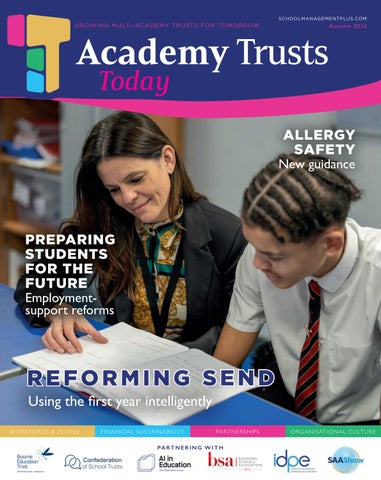
ON THE COVER
Reforming SEND. Page 12 Image courtesy of BDSIP
ALLERGY SAFETY New guidance
PREPAR ING STUDEN TS FOR THE FUTURE Employmentsupport reforms
REFORMING S Using the first year intelligent
ly
WO R K F O R C E &
PEOPLE
FINANCIAL SUS
TA I N A B I L I T Y PA R T N E R I N G
END
PA RT N E R S H I P S WITH
Academy Trusts Today | Autumn 2026 | 5
O R G A N I S AT I O N
M
Autumn 2026
Today
A L C U LT U R E
PREPARING STUDENTS FOR THE FUTURE HOW LOGIC STUDIO SCHOOL ALIGNS WITH NATIONAL AND REGIONAL SKILLS STRATEGIES Jo Lane describes the approach Logic Studio School is taking to prepare students for working life in line with the priorities set out by the Burnham Government.
A
t Logic Studio School, we take immense pride in delivering a strong, future-focused careers curriculum that bridges the gap between the classroom and the modern workplace. By blending academic rigour with technical expertise and employer engagement, our mission is to ensure every student steps out of our doors fully prepared to thrive in an evolving economy. Our vision directly mirrors the priorities set out in the Government's Skills England Annual Skills Report 2026 and regional frameworks similar to Prime Minister Andy Burnham’s flagship Greater Manchester
6 | Academy Trusts Today | Autumn 2026
Baccalaureate (MBacc) model. Both agendas emphasise that technical and vocational education must carry equal prestige to purely academic routes, providing young people with clear, employer-backed pathways into high-growth sectors.
digital literacy and accountability, alongside formal qualifications. How Logic prepares students: Our structured careers curriculum explicitly teaches and assesses core employability competencies. Through project-based learning, business mentoring and structured workplace interactions, students build a transferable skillset that goes beyond traditional exams, giving them the confidence to articulate their strengths to future recruiters.
TACKLING YOUTH EMPLOYABILITY AND ‘WORK-READY’ SKILLS
INDUSTRY-DRIVEN PATHWAYS AND EMPLOYER COLLABORATION
The Skills England Annual Report 2026 highlights a critical national challenge: ensuring young people leave education with transferable ‘work-ready’ capabilities such as communication, problem-solving,
Andy Burnham’s MBacc framework champions clear 14–19 vocational and technical pathways co-designed with industry leaders to address regional skill shortages. Similarly, the national skills
ADAPTING TO AI, AUTOMATION AND TECHNOLOGICAL CHANGE
Chapter 3 of the Skills England Annual Report 2026 emphasises the rapid adoption of Artificial Intelligence and digital tools across all sectors. It calls for an education offer that embeds digital confidence and technical adaptability across the entire workforce. How Logic prepares students: Digital fluency is embedded into everything we do. Whether studying digital media, computing or business, Logic students are trained on modern tools and platforms, equipping them to navigate an AIaugmented workforce safely, efficiently and creatively.
PARITY OF ESTEEM: DEGREE APPRENTICESHIPS AND HIGHER TECHNICAL ROUTES
Both national strategy and Andy Burnham’s vision push for equal value between degree apprenticeships, higher technical qualifications (HTQs) and traditional university degrees. How Logic prepares students: We demystify post-16 and post-18 options. From Year 10 through to Year 13, our students receive comprehensive guidance on higher-level technical routes, T Levels, and higher/degree apprenticeships alongside traditional university applications. By presenting all high-quality destinations with equal weight, we empower students to choose the exact springboard that fits their career ambitions.
BACKGROUND BRIEFING:
EMPLOYMENT-SUPPORT REFORMS The Burnham Government’s employment-support reforms aim to make education from age 14 more closely connected to the world of work. The central idea is to give young people clearer routes into employment, apprenticeships or further technical education, alongside traditional academic pathways. From 2028, pupils aged 14 and over will have greater access to technical education, vocational qualifications, work experience and direct links with employers. The Government has now announced new 14–16 technical pathways and new Vocational GCSEs, designed to sit alongside traditional GCSEs and provide nationally recognised alternatives to existing Technical Awards.
PARITY
The reforms are intended to establish genuine parity between academic and technical routes, rather than treating university as the default measure of educational success. Post-16 provision will be strengthened through new V Levels, expanded T Levels, Occupational and Foundation Certificates and apprenticeships. Schools, colleges, employers, mayors and local leaders will work together to align provision with local skills needs.
MEANINGFUL WORK EXPERIENCE
Work experience is central to the new approach. Burnham has announced a mandatory 45-day work placement for young people aged 16 to 18, alongside enhanced careers and employment support. A National Mission on Work Experience will also seek more opportunities for 14–16-year-olds.
WIDER OBJECTIVE
The aim is to reduce the number of young people who become NEET by providing stronger employability skills, better employer links and clearer pathways into skilled work, and ensuring young people receive support when they need it to remain engaged, confident and connected to the l abour market.
By aligning our careers curriculum with the strategic vision of the current government, and the national benchmarks set by Skills England, Logic Studio School ensures our young people do not just leave with qualifications, they leave with a career roadmap, industry networks and the confidence to succeed in the modern economy. At the heart of all we do at Logic Studio School is our vision: ‘To shape happy, ambitious and digitally fluent
young people who possess the emotional intelligence and resilience to thrive in tomorrow's world’. ■ JO LANE is Careers Lead at Logic Studio School. Logic School’s LinkedIn page provides information on all the opportunities and events the School’s students engage in. linkedin.com/school/12032436/ admin/page-posts/published/ Academy Trusts Today | Autumn 2026 | 7
© UK Parliament 2026
strategy relies heavily on employer-backed standard units and workplace placements. How Logic prepares students: Logic functions as a bridge to industry. We collaborate directly with local and regional employers to offer high-quality work placements, masterclasses and real-world briefs. By embedding employer input directly into our technical subjects, our students gain firsthand exposure to highdemand industries including digital, cyber, creative and business, ensuring they enter the job market with relevant, up-to-date knowledge.
8 | Academy Trusts Today | Autumn 2026
LEADER PROFILE
LIZ ROBINSON
Zoe MacDougall talks to Liz Robinson about her approach to leadership, her new role within Oasis Community Learning and the importance she attaches to asking the ‘big questions’. HEADSHIP: 2006-2018
Liz describes the national zeitgeist during her early leadership years: “When I first became Head in 2006, it was at the mature end of the Labour policy environment. We experienced a holistic view of what schools are for, what education is for, what mattered about the experience that children and young people had, and how we could think together as a range of public services, charities and businesses. There was a sense of cohesion about working together, particularly with the most vulnerable. It was the era of ‘Every Child Matters ̓ and we were seeing accountability and metrics around a broader range of outcomes.
IT IS POSSIBLE TO DO THINGS DIFFERENTLY AND TO FIND LIKE-MINDED PEOPLE, WHO THEN INSPIRE EACH OTHER.
LIZ ROBINSON Liz Robinson, formerly CEO of Big Education Trust and now National Director for Education Transformation at Oasis Community Learning, has enjoyed an impressive career in school leadership. Her passion for leadership blossomed very early during her second year of teaching at Paddington Green School, Edgware Road. There, working within a “complex and challenging” community during and after the 9/11 terrorist attacks, Liz felt part of vital global conversations about diversity, inclusion and belonging. She was particularly inspired by her Headteacher: “I was absolutely gripped by her, a woman in her thirties, who had got the school community by the scruff of its neck and was doing amazing
things. With her as my inspiration, I fell in love with school leadership. I could see how I might also lead people, build a culture and take people along with me.” As a next step, Liz joined a Fast Track programme for teachers, which she describes as “amazing – I had mentoring, coaching, support, training and development; it was intensive”. She rapidly undertook the role of Assistant Head, and then Deputy Head. Moving to Surrey Square Primary School in January 2006, having been teaching for five years, she became a Headteacher. She says: “This was by far the most challenging school I’d ever worked in, set in the Aylesbury Estate in South-East London, with every socially complex problem we encounter in our cities”.
Academy Trusts Today | Autumn 2026 | 9
Services were working together to tackle issues such as child obesity and teenage pregnancy. That’s what we did, then.” As governments changed, so did the prevailing national vision: despite this, Liz’s values remained firmly intact. Her comments relating to those times make her personal feelings clear: “From 2010 onwards, we were presented with a different definition of success. The Department for Children, Schools and Families changed its name to the Department for Education and we saw a much narrower focus on academic learning, as defined by exam success, including a greater emphasis on content and retention of knowledge. “I believe we should be teaching our children a strong core of knowledge, but there needs to be a balance. It’s a clever bit of narrative that suggests that anything that isn’t knowledge-rich is something poor. The fact that we now have more than a million young people not in education and training is testament to the fact that the current system isn’t working. Under Michael Gove and Nick Gibb, the holistic work which we had been engaged in prior to the 2010 Coalition Government was undone. Under the current government, we’re now trying to rebuild, we’re talking about schools as anchor institutions – and that’s actually what we were doing back then.”
THE ‘WILD WEST’ DAYS OF ACADEMIES
During this eventful era for school leaders, the Academies Act 2010 come into law – a piece of legislation about which Liz had reservations. “I didn’t like what happened in terms of the mental model of MATs which, in the ‘Wild Westˇdays, was about top down, going in, sorting out schools in a very directive way. That’s not how I worked, it’s not what I wanted to do, so 10 | Academy Trusts Today | Autumn 2026
LIZ IS A STRONG EMBODIMENT OF SOMEONE WHO ASKS BIG QUESTIONS - IT’S WHO SHE IS, AND WHO SHE WILL CONTINUE TO BE. I stayed out of it. “For the next few years, I was doing different things in the sector – finding people, places and space where I could do work aligned with my values, including the EDT School Partnership programme, focusing on peer review and learning, supporting aspiring leaders. I found places outside of the MAT growth agenda and became an advocate for a more holistic view of education.”
ACCEPTING ACADEMY TRUSTS AS THE DIRECTION OF TRAVEL
Eventually, Liz recognised that she wanted to be a player in the system she remained determined to change. She relates the next phase in her story: “In 2016-17, I decided, along with my senior team and governors at Surrey Square, that we probably should do a MAT, because that was the direction of travel. So, we set up Big Education in 2018 and joined forces with School 21 and Peter Hyman – who was a fellow advocate for a more expansive approach – with a view to having a Trust which was working within
the system as a model of different and innovative approaches. “We also wanted to work on the system itself; to advocate for change, to be part of the national conversation about the need for change and drive innovation across different themes. I gathered together lots of people, forming different networks and coalitions, inspired by the late, great Tim Brighouse’s advice to ‘find the gaps in the hedges’ – and that’s what we were doing. It is possible to do things differently and to find likeminded people, who then inspire each other. “Yes, we have to play the game, we have to show up in the system, we have to navigate Ofsted, but we can also be creative and innovative within the mainstream context. I think I’ve been a plucky outsider in a rebel alliance, because I didn’t want to throw in my lot with things I didn’t believe in. “I’m really proud that Surrey Square continues to be a beacon of practice; it’s shortlisted for the World’s Best Schools Prizes 2026, and it won the Pearson Teaching Award for Primary School of the Year 2024.”
MERGING BIG EDUCATION WITH OASIS COMMUNITY LEARNING
In September this year, Big Education merged with Oasis Community Learning. Liz explains why it was decided that this was the best way forward: “At Big Education, we were in plucky start-up mode, and asked ourselves what was the right maturation, what was the next step? I’ve taken our rebel alliance into a much larger organisation with the same values, working in the most challenging communities. I met John Barnaby, CEO of Oasis Community Learning, when I was busy horizon scanning for a potential merger partner and we knew we were a good fit.” Stepping down from the role of CEO may seem an unusual move but, for Liz, it makes perfect sense. She offers her thoughts on the potential opportunities of her new role as National Director for Education Transformation at Oasis Community Learning: “In the sector, when you reach MAT CEO, that’s seen to be the top of the tree. And then you run a bigger MAT. And the people right at the top run the really big MATs. But I hope I’m modelling something different here which is that there’s different ways to have influence within the sector. “For over 20 years I’ve been directly running and accountable for institutions and carrying that responsibility is a big weight. It feels great to be shifting into a different role. When you’re in the top job, you’ve got to do the short term, the
medium term and the long term, all at the same time, all really well. You’ve got to deal with the immediate thing when there’s been a playground fight, and you have to deal with it in a way that’s also building for the future, building credibility, building culture. You’re also thinking about the event next month and about where you want to be in three years. And all this in a live organisation where a million things are happening at once. Many Heads find it hard to hit the right balance – either they’re too futurefocused or, more often, they’re so busy fire-fighting that they never get ahead of themselves. “What John and I have created with my role as National Director for Education Transformation – and in setting up the Big Education Oasis Institute to house research, development and sector influencing work – is a structure and a resource to hold that future, strategic, forward-thinking work, without being overwhelmed by the churn of the dayto-day job. I’m thinking about what’s our leadership pipeline, what are our leadership capabilities, what are our structures and frameworks? From John’s perspective, running a very large organisation, he’s developing a function of people running the here and now and a function of people supporting strategic planning and shaping the sector. We’re intentionally part of the national conversation around what is education,
what is school, what are we doing? So, yes, in my new role I am super excited about the opportunities to be working at scale in a different way.”
ASKING THE BIG QUESTIONS
Liz is continuing to explore the opportunities that her new role brings; she wants to see more mergers in the sector, where the benefits of scale aren’t just about practical, financial outcomes but about “creating the headroom capacity to enable people to think more deeply”. Liz is a strong embodiment of someone who asks big questions – it’s who she is, and who she will continue to be: “If we always do what we’ve always done, then we’ll always get what we’ve always got. If we believe change is needed, how do we help people to ask bigger questions, starting with ‘What is the point of school?’? What I hope to bring to Oasis, and to the sector more generally, is the readiness to ask bigger questions and the ability to help people get to better answers.” In the current season of national change, responding to AI and exploring alternative curriculum content and assessment strategies, Liz’s voice is set to be heard, within the MAT sector and beyond. ■ ZOE MACDOUGALL is an education commentator who has taught in both the maintained and independent sectors.
Academy Trusts Today | Autumn 2026 | 11
REFORMING SEND USING THE FIRST YEAR INTELLIGENTLY Lee Boyce and Paul Claydon believe that the Government’s policy for reforming SEND provides the architecture for change whilst implementation is the craft of making that architecture work, which is why intelligent use of the 2026-27 school year is going to be so important.
S
END reform is entering a new phase. The direction of travel is clear: earlier identification, more inclusive mainstream provision, stronger collaboration between education, health and care, and greater access to specialist expertise. With new deliverables having begun this September, including Experts at Hand, the question for local areas and schools is not ‘What does the reform say?’. It is ‘What will it look like on a Wednesday morning in a school?’. That distinction is something that system leaders will need to consider whilst balancing the everyday pressures of the job; reform does not happen in a vacuum. Leaders are already managing financial constraints, workforce pressures, increasing levels of need and a growing expectation to do more differently. Reforming SEND is rather like changing the plumbing in a house while people are still living in it. We know that parts of the system need redesigning, but children still need support today, teachers still need advice tomorrow, and families still need confidence that someone understands their child's needs. Implementation therefore cannot be about waiting for the perfect future system. It must be about improving the experience while we build it. Experts at Hand provides an important opportunity. Its ambition is to bring specialist expertise, including educational psychology, speech and language therapy 12 | Academy Trusts Today | Autumn 2026
and specialist teaching, closer to mainstream settings, helping schools identify need earlier and strengthen their own practice. Crucially, it is not intended to replace schools' existing responsibilities or statutory processes.
PRACTICAL PRINCIPLES
For us, this points to four practical principles for implementation.
…REFORM DOES NOT HAPPEN IN A VACUUM.
Start with the child, not the structure It is easy for reform programmes to become discussions about teams, pathways, funding and governance. These things matter, but they are means rather than ends. The test should always be: is a child getting the right support earlier, and is the school becoming more capable of meeting need?
Build capacity rather than dependency Specialist expertise should not simply become another service that schools refer into. The greatest value comes when expertise changes what happens in classrooms after the specialist has left. Coaching, modelling, joint problem-solving and professional learning can turn individual interventions into improvements in whole-school practice.
This is also where the idea of a trusted partner becomes important. Schools do not necessarily need another organisation to tell them what to do. They may need someone who can work alongside leaders and their teams, ask the difficult questions, provide expertise where it is needed and, importantly, leave greater capacity behind. Done well, external support should make itself less necessary over time. Recognise that implementation is a leadership challenge, not simply a policy challenge The most carefully designed reform can falter if leaders underestimate the human side of change. SEND reform asks people to change or adapt established ways of working, often while they are already under considerable pressure. Leaders therefore need to create clarity about why the change matters, build a shared understanding of what good will look like, and give professionals the time and confidence to experiment with new approaches. The principles behind established change models, such as Kotter's work on creating urgency, building a guiding coalition, communicating a clear vision and embedding change, provide a useful lens here. The model does not need to become another initiative for leaders to implement. Rather, it offers a reminder that sustainable change requires more than issuing new guidance. People need to understand the case for change, see their role in it and experience early evidence that the new approach is making a difference. This is where leadership coaching can have a particular value. When the environment is complex, leaders rarely need someone simply to give them another answer. They need the space to step back from the operational noise, test their thinking, explore difficult decisions and consider how they are bringing others with them. Executive coaching can provide that reflective space, while also helping leaders develop the confidence and capability of those around them. For schools and local systems navigating SEND reform, this may be one of the most important forms of capacity building: not simply developing better provision but developing leaders who can lead effectively through uncertainty and change. Make collaboration real The new approach requires local authorities, health partners, schools, specialist settings, parents, children and young people to work as genuine partners. The
national guidance is explicit about the importance of shared planning, governance and accountability. The challenge is translating that principle into relationships where professionals understand each other's contribution and collectively own the outcome. There is also an important opportunity to use this first year intelligently. The guidance describes year one as a baselining and diagnostic phase. We should resist the temptation to measure success simply by counting activity: referrals made, visits completed or professionals deployed. Instead, we should ask whether practice is changing, whether identification is becoming easier, whether staff confidence is increasing and, ultimately, whether outcomes for children improve. Leaders should therefore think about implementation as a cycle rather than a single launch: understand the starting point, establish a clear ambition, test approaches, listen to those experiencing the change, learn from what works and adapt. The first year gives us permission to do this thoughtfully. SEND reform will not be delivered through a single programme, however well designed. Instead, it will be through thousands of small changes in classrooms, conversations with families and professional relationships across services. The policy provides the architecture. Implementation is the craft of making that architecture work for real children, in real schools, every day; that requires more than structures and guidance. It requires leadership, relationships, professional learning and the confidence to change course when something is not working. That is where the success of SEND reform will ultimately be decided. ■
REFORMING SEND IS RATHER LIKE CHANGING THE PLUMBING IN A HOUSE WHILE PEOPLE ARE STILL LIVING IN IT.
LEE BOYCE is Chief Executive and PAUL CLAYDON is Deputy Chief Executive of BDSIP. BDSIP is an education partnership dedicated to improving outcomes for children and young people. Working alongside schools, Trusts and education leaders, we provide expert support, challenge and practical solutions that help organisations improve and thrive. Our work spans school improvement, leadership, inclusion, SEND, teaching and learning, professional development and system leadership. As a trusted partner, we meet schools where they are, combining expertise, collaboration and ambition to enable sustainable improvement and ensure every child has the opportunity to succeed. Academy Trusts Today | Autumn 2026 | 13
TEACHER BURNOUT AND SHORTAGES THE ROLE FOR AI IN THE SOLUTION
Heather Lyons explains why she believes AI can play a valuable role in helping to relieve some of the challenges Trusts are facing with teacher shortages, capacity and workload, examines the evidence of positive learning outcomes from the use of AI and offers advice on the questions which should be asked of providers before any purchase.
T
here is understandable concern about AI in schools. Cognitive offloading is among the most serious worries: letting AI do the thinking for pupils. Plagiarism and privacy are others. These risks deserve careful scrutiny. But the debate also needs to weigh the real benefits for teacher capacity and workload. Used well, AI can support teachers with some of the most time-
consuming parts of the job: planning, admin and feedback. That support matters most where staffing is tightest. Finding and keeping specialist teachers in Physics, Maths and Computing is still difficult for many schools. A Headteacher with an unfilled post cannot simply conjure up a specialist. The timetable still must be covered; lessons need planning and teaching,
work needs marking and pupils need help when they get stuck. These everyday pressures belong in the debate about AI in education. There is a practical opportunity to support teachers working beyond their specialism and to ease the load on those already stretched.
THE LATEST ON TEACHER SHORTAGES
I work in Computing, where schools have struggled to recruit specialists for more than a decade. Retention has made the problem worse. According to NFER's subject-level data, Computing lost 11.2% of its teaching hours as a result of teachers leaving the state sector in 2023-24, more than one in ten (NFER, 2025). There is, at last, some encouraging news. Computing trainee numbers rose by 46% in 2025-26, reaching their highest level since comparable records began. Academy Trusts Today | Autumn 2026 | 15
Maths, English, Biology and Chemistry all met their recruitment targets. Yet Computing still reached only 81% of its target (DfE, 2025b), and the figures need careful interpretation. The Government's estimate of how many computing trainees are needed in 2026-27 has fallen by 37% (DfE, 2026b). That may reflect better recruitment and retention forecasts. But a lower estimate does not mean every school can now find the specialist it needs. One stronger recruitment year cannot undo years of shortfalls, especially if experienced teachers keep leaving. Across the profession, only about two thirds of teachers who qualified five years ago are still in the state sector (DfE, 2025a). Improving recruitment matters. So does giving the teachers already in classrooms the support that makes a demanding job sustainable.
HOW AI CAN HELP
A non-specialist teaching Computing could use AI to explain an unfamiliar concept, create programming challenges at different levels, or flag a misconception
16 | Academy Trusts Today | Autumn 2026
FOR AN EXPERIENCED TEACHER, AI CAN TAKE SOME OF THE REPETITIVE PREPARATION AND FEEDBACK OFF THEIR DESK. in pupils' work. Used well, AI can also help a pupil get unstuck by offering hints that make them think rather than handing over the answer. There's nothing worse, as a teacher, than standing in front of a class and being unable to help a student finish a Computing project because you don't know enough, or having a student wait
patiently while you try to debug their code, only to come up short. For an experienced teacher, AI can take some of the repetitive preparation and feedback off their desk. The teacher still decides what is accurate, suitable and worth teaching. What they skip is the painful process of reviewing 30 submissions one by one, by hand, particularly when those submissions are code!
PLANNING
Using AI to create worksheets, lesson plans, curriculum plans and slide decks is now straightforward. Over the past few years, it has become well-established practice. The options fall broadly into two camps. The first camp is general-purpose assistants built on ‘frontier models’, such as ChatGPT, Claude, Gemini and Copilot. Schools on Google or Microsoft platforms will already have Gemini or Copilot available to staff and students. These models are flexible and remarkably capable, but generic. They don't know your curriculum, your exam board or your pupils, and their output may need checking. The second camp is tools built specifically for teachers. One example is Aila, the free lesson assistant from Oak National Academy. Aila is publicly funded and backed by the Department for Education. It draws on Oak's own curriculum-aligned lessons, which were written by teachers and checked by subject experts. UK-built tools such as TeachMate AI and TeacherMatic, and international platforms such as MagicSchool, offer similar help with planning and resources. The evidence for AI-supported lesson planning is starting to stack up. In an Education Endowment Foundation trial, KS3 Science teachers using ChatGPT cut their lesson planning time by 31% (EEF, 2024). A larger randomised trial of Aila, involving around 450 teachers, is measuring both time saved and lesson quality (EEF, 2025). An independent panel judges the lessons without knowing which ones AI helped to create, and results are
due this autumn. The early findings are encouraging. Importantly, the claims are being tested properly rather than taken on trust.
MARKING AND FEEDBACK
Formative feedback and tutoring open up further opportunities for schools. Because these uses involve giving pupils personalised guidance, they also deserve closer scrutiny. For formative feedback, AI can win teachers back a great deal of marking time. Our recent study with the University of Brighton found that Computing teachers using our platform, Kita, saved over 60% of their marking time (University of Brighton, 2026). One teacher said that what “would normally take me over two hours took 10 to 15 minutes”. When a teacher stays ‘in the loop’ and reviews AI feedback before pupils see it, it is a relatively safe way to bring AI into everyday practice and save teachers hours. AI-enabled feedback can benefit pupils too. A randomised study involved 459 upper-secondary students learning English as a foreign language. Those who received AI-generated feedback improved their drafts more than those who revised without feedback; they also reported greater motivation (Meyer et al., 2024). Another trial involved more than 700 tutors and 1,000 school pupils. It found that AI support for human tutors increased pupils' chances of mastering a Maths topic by four percentage points (Wang et al., 2024).
AI TUTORS
AI tutors are closely related to these feedback tools. A Middlebury College study looked at students who used AI as a tutor to explain concepts and clarify ideas. They kept their test scores high and produced better essays (Contractor and Reyes, 2026). By contrast, high-school pupils in Turkey given unrestricted access to ChatGPT did better during practice but worse once it was taken away (Bastani et al., 2025). AI should help pupils practice, question and develop their understanding, not do the thinking for them.
QUESTIONS FOR AI PROVIDERS Check curriculum alignment Where does the content come from, and how is it checked against your curriculum? Ask whether the provider uses the DfE's Content Store which includes guidance and teaching materials from Oak National Academy and other authoritative sources. aicontentstore.education.gov.uk Ask for evidence of learning What teaching principles underpin the tool? Has it been independently evaluated with pupils of a similar age in the subjects you intend to use it for? Look for evidence of improved understanding, not just claims about time saved. Look for features that encourage independent thinking Does the tool offer hints? Does it ask questions and encourage pupils to attempt problems themselves? Can it recognise overreliance and prompt pupils to work independently or take a break? Make pupil use visible Are teachers able to see how often pupils use the tool, how long they spend on it and what help they receive? That visibility helps identify both pupils who are struggling and those becoming too dependent on AI. Check the safeguarding arrangements How are worrying messages or disclosures identified, recorded and passed to the school's designated safeguarding lead? Ask providers to demonstrate the process and explain its limitations. The DfE's AI product safety standards are a useful starting point for assessing pupil-facing tools. www.gov.uk/government/ publications/generative-ai-productsafety-standards
TOP TIPS
Read the privacy policy and ask what happens in practice What pupil data is collected, who can access it, how long is it kept, and is it used to train AI models?
Check where data goes Where is pupil data stored and processed, including by third-party AI providers? UK hosting may be your Trust's preference, but it is not a blanket legal requirement. Any overseas transfers need an appropriate legal basis and protections. ico.org.uk/for-organisations/ uk-gdpr-guidance-and-resources/ international-transfers Ask about cyber security Does the provider hold current Cyber Essentials or Cyber Essentials Plus certification and which systems does it cover? Ask about staff training too since Cyber Essentials is a certification scheme not a training course. ncsc.gov.uk/cyberessentials/overview Any tool you adopt should fit within your Trust's AI implementation policy. Staff and pupils need clear, practical guidance on which tools they can use, for what purposes and where the boundaries lie. Support is available. The DfE’s leadership materials (www.gov. uk/government/publications/ using-ai-in-education-support-forschool-and-college-leaders) cover auditing current use and planning implementation. AI in Education’s AiEd Certified framework (ai-in-education.co.uk) brings together AI literacy, policies, systems and pedagogy. Our partner organisation, Blueshift (www.blueshift.education) also offers AI literacy training.
Academy Trusts Today | Autumn 2026 | 17
AI SUPPORT FOR HUMAN TUTORS INCREASED PUPILS' CHANCES OF MASTERING A MATHS TOPIC BY FOUR PERCENTAGE POINTS.
BUYER BEWARE
For all the benefits, EdTech is lightly regulated, and even large providers may not meet the latest guidance. The DfE's generative AI product safety standards set out what it expects of tools used in education, including robust privacy and data-protection arrangements (DfE, 2026a). Trusts should ask
REFERENCES Bastani, H., Bastani, O., Sungu, A., Ge, H., Kabakcı, Ö. and Mariman, R. (2025) 'Generative AI without guardrails can harm learning: evidence from high school mathematics', Proceedings of the National Academy of Sciences, 122(26), e2422633122. Available at: https://doi. org/10.1073/pnas.2422633122 Contractor, Z. and Reyes, G. (2026) Experimental evidence on the learning impact of generative AI. arXiv preprint arXiv:2607.08849. Available at: https://arxiv.org/abs/2607.08849 (Accessed: 1 October 2026).
providers how they meet these standards, what happens to pupil data, and where it is stored and processed. UK hosting alone does not guarantee compliance. Tools also need to guard against cognitive offloading: pupils letting the machine do their thinking. The DfE is very clear that tools should NOT give pupils full answers by default. They should offer hints and wait for a genuine attempt before showing a full solution (DfE, 2026a). Alongside the right tools, Trusts need clear rules about what information staff and pupils can enter – and teachers need to check outputs for accuracy and suitability. Cost can be lower than schools expect. In our pilot, the underlying AI processing for
more than 1,400 requests cost a combined 25p. That is only one part of the cost of providing a reliable service, but it shows how inexpensive the processing itself can be. Finally, AI literacy needs to sit alongside the tools. Pupils should understand AI's limits and risks and learn to use it to support their own thinking. That is part of the teaching, too. ■
Department for Education (DfE) (2026a) Generative AI: product safety standards. London: DfE. Available at: https://www.gov.uk/government/publications/ generative-ai-product-safety-standards (Accessed: 1 October 2026).
Meyer, J., Jansen, T., Schiller, R., Liebenow, L.W., Steinbach, M., Horbach, A. and Fleckenstein, J. (2024) 'Using LLMs to bring evidence-based feedback into the classroom: AI-generated feedback increases secondary students' text revision, motivation, and positive emotions', Computers and Education: Artificial Intelligence, 6, 100199. Available at: https://doi. org/10.1016/j.caeai.2023.100199
Department for Education (DfE) (2026b) Teacher demand and postgraduate trainee need: 2026 to 2027. London: DfE. Available at: https://www. gov.uk/government/statistics/teacher-demandand-postgraduate-trainee-need-2026-to-2027 (Accessed: 1 October 2026).
Department for Education (DfE) (2025a) School workforce in England: reporting year 2024. London: DfE. Available at: https:// explore-education-statistics.service.gov.uk/ find-statistics/school-workforce-in-england (Accessed: 1 October 2026).
Education Endowment Foundation (EEF) (2024) ChatGPT in lesson preparation: a Teacher Choices trial. Evaluation report. London: EEF. Available at: https://educationendowmentfoundation. org.uk/projects-and-evaluation/projects/ choices-in-edtech-using-generative-ai-chatgptfor-ks3-science-lesson-preparation-2024-teacherchoices-trial (Accessed: 1 October 2026).
Department for Education (DfE) (2025b) Initial Teacher Training Census: academic year 2025/26. London: DfE. Available at: https:// explore-education-statistics.service.gov. uk/find-statistics/initial-teacher-trainingcensus/2025-26 (Accessed: 1 October 2026).
Education Endowment Foundation (EEF) (2025) Lesson planning using AI lesson assistant, Aila – Teacher Choices trial. London: EEF. Available at: https://educationendowmentfoundation.org.uk/ projects-and-evaluation/projects/aila-teacherchoices-trial (Accessed: 1 October 2026).
18 | Academy Trusts Today | Autumn 2026
HEATHER LYONS is CEO and Founder of Kita, the computing platform for UK schools developed as part of the DfE's AI Tools for Education programme. heather@getkita.com; getkita.org
University of Brighton (2026) [Title of independent evaluation report]. Brighton: University of Brighton. [Unpublished report, August 2026.] Wang, R.E., Ribeiro, A.T., Robinson, C.D., Loeb, S. and Demszky, D. (2024) Tutor CoPilot: a human-AI approach for scaling real-time expertise. EdWorkingPaper No. 24-1054. Providence, RI: Annenberg Institute at Brown University. Available at: https:// edworkingpapers.com/ai24-1054 (Accessed: 1 October 2026). Worth, J. and Scott, M. (2026) The school teacher labour market in England: annual report 2026. Slough: NFER. Available at: https:// www.nfer.ac.uk/publications/school-teacherlabour-market-in-england-annual-report-2026/ (Accessed: 1 October 2026).
Academy Trusts Today | Autumn 2026 | 19
AI IN SCHOOLS IS YOUR APPROACH STRATEGIC OR REACTIVE? As the new academic year gets underway, Chris Loveday explains why he believes it is essential that MATs and their schools take a strategic and not a reactive approach to the continued roll-out of AI, and their wider digital strategy, and offers guidance on the questions which senior leaders should be asking right now.
20 | Academy Trusts Today | Autumn 2026
T
here is something about the start of a new academic year that sharpens the mind. The corridors fill again. Enrolment numbers crystallise. Budgets that were projections become commitments. And for those of us on senior leadership teams, that familiar mix of energy and urgency arrives with a question that is growing harder to ignore: where does Artificial Intelligence fit in what we are building, and are we actually prepared for it? I have spent the last 18 months working at the intersection of digital transformation and operational leadership, first at a leading Sixth Form college and now as Chief Operating Officer and Deputy Principal at City of Portsmouth College. At the College, we are about to launch a new digital strategy, building our own AI agents, exploring migrating on-premises servers to the cloud, and developing data visualisation dashboards powered by a semantic layer and natural language query capability. I say this not to paint a picture of an institution ahead of the curve, but because I recognise that many of the questions we are wrestling with are the same questions landing on desks across the education sector right now. And the honest truth is that AI does not arrive as an entirely new problem. It arrives as a reframing of challenges we already have…and, for many, that we haven’t dealt with.
STRATEGY BEFORE SYSTEMS
The most common mistake I see made in conversations about AI adoption is leading with the tool. A team tries a new generative AI product. Someone signs up for a trial and a policy gets written in a hurry because a governor asked a question at the last board meeting. What rarely exists, and in my opinion what matters most, is the strategic layer underneath all of it. A digital strategy in 2026 is not a document about software. It is a decision about how your organisation relates to data, technology, people and risk. It answers questions like: • What are we trying to achieve – and how does digital capability help us get there? • Who owns our data, and how is it governed? • What is our position on AI, and how does that interact with intellectual property obligations? • What infrastructure is our ambition built on, and is it fit for purpose? To put it plainly, the approach to AI must be strategic, sustainable, coherent and aligned with institutional goals. It is not a race to keep pace with every
tool released, it is a considered position about where technology serves your mission, and where it introduces unacceptable risk. If your institution does not yet have a written digital strategy or has one last reviewed more than two years ago, that is the starting point. Not because it is a compliance exercise, but because every other conversation about AI – procurement, policy, infrastructure, workforce development – is harder without it.
THE INFRASTRUCTURE QUESTION NOBODY WANTS TO ANSWER
Before discussing the problems you are trying to solve and what AI can do, senior leaders need to be honest about what their infrastructure can support. AI is not cloud-native by accident. The systems that make AI genuinely useful – large language model integration, real-time data processing, natural language interfaces, intelligent automation – all assume that your data is accessible, structured and secure. For many educational institutions, that assumption is not yet valid. The infrastructure evolution is, for many organisations, still a multi-year journey. It is unglamorous work. It rarely features in board presentations. But it is the foundation on which everything else sits. At City of Portsmouth College, for example, our cloud migration programme is being explored in parallel with the development of a data lake, data visualisation dashboards and a semantic layer; this represents a structure that will allow staff to query complex data in plain English rather than requiring technical expertise to access institutional intelligence. These are not separate projects. They are the same project – making data genuinely usable so that AI tools, when they arrive, have something meaningful to work with. For senior leadership teams, the key questions here are straightforward: • Where is your data? • Who can access it, and under what conditions? • Is your network infrastructure capable of handling the additional load that AI tool deployment creates?
… INFRASTRUCTURE EVOLUTION IS, FOR MANY ORGANISATIONS, STILL A MULTI-YEAR JOURNEY.
• Do you have a clear inventory of the software and systems currently in use, and do you know what each of them does with the data they touch? If the answers to any of those questions are unclear, that is your infrastructure gap, and – for me – it is a gap worth closing before adding AI capability on top of it.
CHECKLIST FOR SENIOR LEADERSHIP TEAMS As you move further into the new academic year, here are the areas that warrant a direct conversation at leadership team and board level: Digital Strategy • Do you have a current, written digital strategy? Does it address AI explicitly? • Has it been reviewed and endorsed at board level in the last 12 months? • Does your digital strategy connect clearly to your organisational strategy, or does it sit as a separate document that few people use? Infrastructure • What is the current status of your servers and infrastructure, and what is the timeline for completion? • Where does your data live, how is it governed and who is accountable for data quality? • Do you have a view of the AI tools currently in use across the organisation, including those staff have adopted informally? Intellectual Property and Policy • Does your AI acceptable use policy clearly distinguish between tools approved for
use with different categories of data? • Have you addressed the question of ownership of AIgenerated outputs? • Is there a process for reviewing and approving AI-generated content before external use? Data Protection and Automated Decision-Making • Have you reviewed the implications of the Data (Use and Access) Act 2025 for your automated processes? • Do you have documented human review processes for any AI-assisted decisions that affect individuals? • Are your privacy notices and data protection impact assessments current and reflective of how AI tools are actually being used? People and Culture • Is AI literacy included in your CPD planning for this academic year? • Are your most digitally confident staff involved in shaping AI adoption, or are they working around institutional caution? • Does your governance framework for AI feel enabling to staff, or does it feel prohibitive?
Academy Trusts Today | Autumn 2026 | 21
legal and reputational risk that is difficult to fully quantify right now. There are practical steps that reduce exposure. The most important is ensuring that your AI ‘acceptable use policy’ addresses three things explicitly: • What tools staff are permitted to use for which purposes? • What data may and may not be submitted to external AI systems? • What review process applies to AI-generated content before it is published, submitted or acted upon? The second step is data segmentation. Not all data is equal. Student personal data, financial projections, HR records and strategic plans sit in a different category to publicly available curriculum information. Staff need clear guidance about which category applies to what they are working on, and which AI tools (if any) are cleared for use with each category.
MEANINGFUL HUMAN OVERSIGHT REQUIRES GENUINE DISCRETION TO OVERTURN AUTOMATED DECISIONS, NOT MERELY RUBBER-STAMPING ALGORITHMIC OUTPUTS. INTELLECTUAL PROPERTY: THE QUESTION YOU CANNOT DEFER
Here is a scenario that is playing out in organisations across the country. A member of staff uses a generative AI tool to draft a funding bid. The content is good. It passes review. It goes out the door. Nobody asks which tool was used, what training data the model used, what rights attach to the output, or whether the institution's confidential strategic information, submitted as context to generate the output, could now be being used to train a commercial model. Intellectual property in the context of AI is not a niche legal question for the counsel team. It is a live operational issue that touches every team that generates content, analysis, research or strategy. And the position is genuinely unsettled. The UK's approach to AI and copyright remains under review. Government has been consulting on whether to allow AI training on copyrighted works under an exception to current law, and the creative industries have pushed back hard. What this means for institutions is that the provenance of AI-generated outputs, and the inputs used to create them, carries 22 | Academy Trusts Today | Autumn 2026
DATA PROTECTION: A LANDSCAPE THAT JUST CHANGED
On 5 February 2026, the Data (Use and Access) Act 2025 came into force, replacing Article 22 of the UK GDPR and fundamentally reshaping the UK's approach to automated decision-making (ADM). This is the most significant shift in UK data protection law since the post-Brexit consolidation. The new framework makes automated decisionmaking lawful in more circumstances than before, but only where defined safeguards are in place. Those safeguards include transparency, human review and the right for individuals to contest automated decisions, all of which must be documented. For educational institutions, this matters in several concrete areas: automated triage of applicants; AI-assisted tracking of learner progress and risk flags; algorithmic allocation of support resources; predictive analytics that influence staffing decisions. All these touch the ADM framework, and all of them require documented processes, clear transparency information for the individuals affected, and a genuine human review mechanism, not a rubber stamp. The ICO has made clear that meaningful human oversight requires genuine discretion to overturn automated decisions, not merely rubber-stamping algorithmic outputs. If your organisation is using any form of AI-assisted decision-making that affects
individuals, this is a governance priority for the current academic year. The good news is that the new framework is not designed to prohibit AI use, it is designed to enable it responsibly. Organisations investing in structured and adaptable governance frameworks will be better positioned to manage risk, maintain compliance and build trust with regulators, partners and stakeholders.
BUILDING AI CAPABILITY: WHERE TO BEGIN
According to BCG research, roughly 70% of AI transformation success comes from effective organisational design, talent development and change management, not from the technology itself. The conversations that matter most are about people, not platforms. Do your staff (and students) understand what AI can and cannot do? Are there individuals in your organisation who are already using AI in sophisticated ways and, if so, are you learning from them or managing them as a risk? Is professional development around AI capability embedded in your planning, or is it still an afterthought? At City of Portsmouth College, one of our priorities has been developing bespoke AI agents; essentially, AI solutions configured for specific operational tasks rather than general-purpose use. This approach allows us to maintain control over the data those agents access, to design review processes into the workflow, and to build staff confidence through tools that are genuinely useful in context rather than generic. Taking this approach means starting with a clear understanding of the problems you are trying to solve. Not which AI tool is most impressive in a demo, but which operational challenges consume the most time, introduce the most error, or create the most friction for staff and learners. AI is most valuable when it is solving a specific, wellunderstood problem, and least valuable
when it is deployed as a general-purpose response to a vague sense that the organisation should be doing more.
THE OPPORTUNITY
It would be easy, and in some ways defensible, to read the regulatory complexity around AI and conclude that the safest course is to wait. Wait for clearer guidance. Wait for the market to settle. Wait until the risks are better understood. Wait for a centralised plan or solution for the sector. I think this is the wrong conclusion. Not because AI does not carry risks – it clearly does – but because the organisations that will be best placed to manage those risks are the ones building the governance, the infrastructure and the capability now, rather than scrambling to catch up in two years' time. The new academic year is a natural moment to ask whether your organisation's relationship with AI is strategic or reactive and whether your digital infrastructure is a platform for the future or a constraint on it. These are not technology questions. They are leadership questions. And they are very much yours to answer. ■
CHRIS LOVEDAY is Chief Operating Officer and Deputy Principal at City of Portsmouth College. He is a speaker, consultant and author on AI and digital transformation in education, a member of the DfE AI Advisory Board and chair of the AI in Education COO Panel. His books include Leading the Shift: Enhancing Operational Efficiency With AI and Operational Intelligence: The Power of Digital, Data and AI. Visit chrisloveday. com.
Academy Trusts Today | Autumn 2026 | 23
24 | Academy Trusts Today | Autumn 2026
Academy Trusts Today | Autumn 2026 | 25
26 | Academy Trusts Today | Autumn 2026
PRIORITIES FOR 2026-27 SCHOOL TRUST LEADERS SHARE THEIR TOP AREAS OF FOCUS The latest National School Trust Report reveals a complex set of challenges around inclusion, attendance, funding, workforce capacity and technological change. Sam Skerritt reviews the findings. WHAT SCHOOL TRUST LEADERS ARE PRIORITISING IN 2026
For five years now the Confederation of School Trusts (CST), working with survey and feedback experts Edurio, has surveyed chief executives to take their temperature on issues affecting the sector – and financial viability topped the chart for the last two surveys. Rising costs, inflationary pressures, recruitment difficulties and uncertainty over funding settlements caused consternation and uncertainty for executive leaders and Boards alike. The 2026 National School Trust Report suggests a tipping point. While financial concerns remain far from resolved, for the first time since 2023, quality of education, inclusion and pupil outcomes have reclaimed centre stage.
This change comes at a pivotal moment and is reshaping how Trusts think about leadership, growth and public service.
EDUCATION RETURNS TO THE TOP OF THE AGENDA
The strongest theme running through this year's findings is the focus on educational excellence. 63% of Trust CEOs identified quality of education as a priority for the year ahead, up from 58% in 2025. Inclusion was selected by 61% of respondents, rising sharply from 51% the previous year. Pupil outcomes ranked third, selected by 48% of leaders. By contrast, financial sustainability fell from 64% last year to 47% this year. The figures do not suggest that finances have become unimportant. Rather, they indicate that many Trusts have developed greater clarity about how to manage
PUPIL ATTENDANCE CONTINUES TO BE A SERIOUS PRACTICAL CONCERN
financial pressures and are now able to redirect strategic attention towards teaching, learning and pupil experience. Interestingly, while quality of education is the sector's highest priority, relatively few CEOs describe it as a significant challenge. Financial sustainability tells a different story. Although fewer leaders identify it as a headline priority, among those that do, more than three-quarters expect it to remain highly challenging – national figures can mask significant variability between schools and Trusts. The survey's qualitative comments reinforce the focus on standards. Trust leaders spoke repeatedly about improving attainment, strengthening teaching quality and ensuring greater consistency across schools. Many emphasised raising outcomes for disadvantaged pupils, improving attendance and ensuring every child benefits equally from Trust-wide expertise.
Academy Trusts Today | Autumn 2026 | 27
MANY TRUSTS HAVE DEVELOPED GREATER CLARITY ABOUT HOW TO MANAGE FINANCIAL PRESSURES INCLUSION AND SEND MOVE TO CENTRE STAGE
Few issues loom larger over the coming year than SEND and inclusion. Three quarters of CEOs identified inclusion and SEND provision as a key educational priority, making it the most frequently reported area of focus within quality of education. Attendance ranked second at 61%, but SEND remains the dominant theme running throughout the survey. This reflects both growing pupil need and anticipated government reforms. Trust leaders broadly support the direction of travel, particularly efforts to create more flexible, child-centred support systems. Yet they also express considerable concern about whether sufficient funding, staffing and expertise will be available to deliver meaningful change. Their response is already taking shape. More than three-quarters of Trusts are considering additional SEND training for staff. Around half are planning either to establish new specialist resource bases or expand existing provision. Around a quarter are exploring curriculum changes linked to inclusion reforms.
The will to improve things is there but putting that into practice is more challenging. More than a third of Trusts report difficulties filling SEND vacancies, highlighting a workforce challenge that could undermine reform ambitions if l eft unresolved.
PUPIL ATTENDANCE REMAINS A CHALLENGE
Pupil attendance continues to be a serious practical concern for schools and Trusts, with drops following the pandemic being slow to recover; following SEND, it is the second highest educational priority identified by Trusts. CEOs report extensive activity aimed at improving attendance, including monitoring and tracking systems, targeted interventions, collaboration with external agencies, parental engagement and staff training. However, it is clear that attendance cannot be solved by schools alone. Responses point repeatedly to wider social factors, including poverty, mental health concerns, family circumstances and community challenges. Trusts know that tackling these issues calls for strong multi-
THE ACADEMY SECTOR CONTINUES TO EVOLVE CST’s survey also points towards ongoing structural change across the Trust landscape, with mission as the driving factor. 57% of CEOs expect to add schools over the coming year, while more than one in five are considering mergers with other Trusts. The most common motivation is a belief that other schools could benefit from a Trust's educational model. Financial sustainability and building stronger local hubs are also significant drivers. This evolution is taking place within a wider context of academy expansion. With academies educating the vast majority of secondary pupils – and a majority of all state-funded pupils – Trust leaders generally expect growth in academy participation to continue. 28 | Academy Trusts Today | Autumn 2026
agency collaboration involving partners like the NHS, social care, and local and strategic authorities. Attendance is an area of focus for the Government’s Regional Improvement for Standards and Excellence (RISE) programme, and the one that Trusts are most likely to have engaged. Two-thirds of Trusts have had some contact with the ‘universal offer’ on attendance: 5% rated it very effective, 26% quite effective and 47% somewhat effective. For the other RISE areas – attainment, mainstream inclusivity, SEND and reception and early language development – less than half of Trusts have so far accessed the universal offer. For targeted RISE support, usually offered following Ofsted inspections, the survey revealed some teething troubles. Of those who have been offered targeted RISE support, the majority – 65% – feel that the advisers appointed to them were quite or very well-matched, compared to 16% who felt that they were not. We know the DfE has been working to improve this area and it’s one we’re watching closely.
TRUSTS DEEPEN RELATIONSHIPS WITH FAMILIES
If attendance highlights the limits of schools acting alone, the survey also shows how Trusts are attempting to strengthen partnerships with parents and communities. Trust leaders identify economic hardship, mental health difficulties, housing insecurity and wider community pressures as major factors affecting pupils and families. Schools have always been important points of union for local communities, and many Trusts are continuing and developing that tradition. Some Trusts are investing in dedicated family support services, including family workers, parental ambassadors, food banks, clothing support and housing advice. Others describe adopting explicitly relational approaches that focus on understanding family circumstances rather than expecting parents to navigate complex systems alone.
FINANCIAL CONFIDENCE GROWS, BUT PRESSURES REMAIN
Despite lower prominence as a headline priority, finance remains deeply embedded in strategic planning. Trust leaders report their highest levels of confidence in financial sustainability since 2022, with 65% describing themselves as very or quite confident. Yet warning signs remain evident. The biggest risks identified are falling pupil numbers, SEND costs and teaching staff costs. More than a third of CEOs report lacking important information when setting budgets, often citing late government announcements and uncertainty around funding arrangements. One CEO spelt out how their teams wasted effort removing provision, reinstating it following government announcements and then cutting it again after further changes. Trusts are also continuing to pursue cost-saving measures. Significant numbers expect reductions in agency spending, teaching assistant numbers and teacher staffing. At the same time, leaders are exploring procurement efficiencies, service centralisation and alternative income generation to supplement government funding. The overall picture is one of returning confidence rather than abundance. Financial management remains a defining challenge, but Trusts appear better equipped than in previous years to navigate uncertainty.
AI MOVES INTO THE MAINSTREAM
Just two years ago many Trusts were experimenting cautiously with AI tools. Today, only 6% report having implemented no formal AI activity. Adoption is now widespread across administration, teaching, assessment, governance and compliance. The dominant use case is administrative
efficiency. Trusts report using AI to automate routine tasks, reduce workload and free staff time for higher-value activities. Other applications include assessment, feedback generation, meeting notes, policy drafting, compliance checks and data analysis. The findings suggest that AI has moved beyond experimentation into operational reality. For Trust leaders, the challenge is no longer whether to engage with AI, but how to harness its benefits while managing risks around quality, ethics and data security.
WORKFORCE PRIORITIES ARE CHANGING
For several years recruitment and retention dominated discussions about staffing. In 2026, wellbeing, professional development and organisational culture have become leading workforce priorities. Each was selected by more than half of CEOs, while retention and recruitment ranked considerably lower. This does not mean workforce challenges have disappeared: teaching assistants remain particularly difficult to recruit, while SEND specialists are also in short supply.
CIVIC LEADERSHIP COMES INTO SHARPER FOCUS
The survey includes an important reminder that Trusts are at their heart collaborative – not just between the schools within the organisation, but much more broadly. An overwhelming majority provide support to schools beyond their own Trust, while many collaborate with charities, community
groups and wider public services. This civic role is becoming increasingly significant. Trusts are extending community access to facilities, supporting wider educational improvement, partnering with other charities, and participating in local networks. As institutions at their heart of their communities, schools are well placed to think about ‘place’ at a neighbourhood level, and unified together in Trusts they frequently have a broader, but still local, perspective too.
LOOKING AHEAD
Education rarely stands still, and the 2026 survey reveals a sector in the midst of yet more change. Trust leaders are focusing more squarely on educational quality, inclusion, attendance and organisational improvement. We are preparing for SEND reform, embracing AI, exploring new models of growth and strengthening community partnerships. There are emerging discussions about new types of vocational qualifications and ways to tackle the ‘NEET crisis’. The challenges ahead are not insignificant and all will test leadership capacity – but that capacity sits within the sector, and this evidence shows again that Trusts are responding not by retreating from ambition, but by broadening it. ■
THE CIVIC ROLE IS BECOMING INCREASINGLY SIGNIFICANT SAM SKERRITT is Director of Public Affairs and Policy at the Confederation of School Trusts. The full National School Trust Report is available at cstuk.org.uk for download. Academy Trusts Today | Autumn 2026 | 29
HARASSMENT WHAT THE LATEST LEGAL
CHANGES MEAN FOR TRUSTS Louise Brenlund explains the impact the recent changes to the legal framework for harassment will have on Trusts and outlines practical measures which senior leaders should consider.
T
he legal framework on harassment for those working in Trusts has changed significantly over the past two years, with further changes due to take effect on 30 October 2026. As Trusts are people-focused, where staff regularly interact with pupils, parents and carers, contractors, visitors and the wider
30 | Academy Trusts Today | Autumn 2026
community, these developments are particularly important. The changes reinforce a fundamental principle: preventing sexual and thirdparty harassment is not simply about responding appropriately when an incident occurs, employers will be required to take ‘all reasonable steps’ to prevent it occurring in the first place. This means looking beyond the behaviour of colleagues to consider the risks posed during the course of employment by people outside the workforce including suppliers, contractors, visitors, parents, pupils or any other third party who is not the employer or one of your employees.
WHAT WAS THE POSITION?
For a short period there was express legal protection against third-party harassment, but those provisions were repealed in 2013. This means that, until these changes, it has been very difficult for an employee to bring a claim for unlawful harassment suffered during the course of work from a third party.
to cause offence. The effect of unwanted conduct can be relevant, meaning that Trusts should avoid dismissing behaviour as ‘just a joke’ or ‘banter’. Further changes were introduced from April 2026 so that any report of sexual harassment now automatically counts as a protected disclosure in relation to a potential whistleblowing claim. This
FOR TRUSTS, THE INTRODUCTION OF THIRD-PARTY HARASSMENT PROTECTIONS IS PARTICULARLY SIGNIFICANT OCTOBER 2024 CHANGES
The first major change came into force on 26 October 2024 through the Worker Protection (Amendment of Equality Act 2010) Act 2023. This introduced a new proactive duty on employers to take ‘reasonable steps’ to prevent sexual harassment of their employees. The significance of the change was that Trusts could no longer rely solely on having a policy or responding after an allegation had been made. The expectation shifted to anticipate where sexual harassment might occur and take reasonable measures to reduce the risk. Sexual harassment is broadly defined under the Equality Act 2010 as unwanted conduct of a sexual nature that has the purpose or effect of violating someone's dignity or creating an intimidating, hostile, degrading, humiliating or offensive environment. In a school setting, this could encompass a wide range of behaviour. It might include sexual comments, jokes or gestures; unwanted touching; sexually explicit messages; inappropriate comments about someone's body; sharing sexual material; or conduct through social media and other digital platforms. Importantly, the question is not simply whether the person responsible intended
means your staff are protected from detriment and employees are protected from dismissal for disclosures about sexual harassment.
WHAT IS CHANGING IN OCTOBER 2026?
Since 2013 there have been various calls for third-party protection to be reintroduced, notably during the #MeToo movement in 2017. From 30 October 2026, the duty on employers against harassment becomes stronger. The Employment Rights Act 2025 contains provisions making the following changes: • the wording requiring employers to take ‘reasonable steps’ is changing to taking ‘all reasonable steps’ to prevent sexual harassment; and • employers must not ‘permit’ a third party to harass their employees. Trusts will ‘permit’ a third party to harass if: • the third party harasses the employee in the course of their employment; and • the employer has failed to take ‘all’ reasonable steps to prevent the third party from doing so. Previously, third-party harassment required a pattern of incidents on at least two prior occasions. From October, a oneoff incident will be sufficient under the new protection.
An example could be sexually offensive comments made by a visitor or contractor towards a member of the school team. The new provisions potentially bring such a situation within the Trust's responsibility. The legal test is not that the Trust is automatically liable whenever a third party behaves badly. Rather, the question is whether the employer failed to take all reasonable steps to prevent the third-party harassment. This makes prevention particularly important. Importantly, this protection relates to both sexual harassment and any third-party harassment relating to any protected characteristic.
WHAT WILL COUNT AS ‘ALL REASONABLE STEPS’?
For a claim to succeed, a Trust must have failed to take ‘all reasonable steps’ to prevent the third party from harassing the employee. However, this is not defined in the legislation. Trusts should consider the particular circumstances of their school(s) and whether there are further reasonable preventative measures they could take. The Government has also been given the power to make regulations specifying steps that may be regarded as ‘all reasonable steps’, including areas such as risk assessments, policies, reporting arrangements and complaint handling. We can say that the use of ‘all’ implies a higher threshold than before, exactly what they will be isn’t clear. This creates a challenging and unpredictable environment for Trusts. Tribunals may draw on the high bar already in place for an ‘all reasonable steps’ defence under the Equality Act 2010 and the existing case law around this which may assist on what standard is required. The practical message is a policy sitting on a staff intranet is unlikely to be enough. School leaders and governing bodies should be able to demonstrate a considered and documented process of prevention, identifying risks, deciding what action is appropriate, implementing that action and reviewing whether it is working. Academy Trusts Today | Autumn 2026 | 31
WHY DOES THIS MATTER FOR TRUSTS?
The Department for Education's recently published guidance on preventing and tackling bullying and harassment of school staff specifically highlights the importance of protecting staff from abuse, harassment and intimidation, including behaviour from parents and carers. It recommends a whole-Trust approach that promotes mutual respect and robustly addresses behaviour that threatens staff wellbeing or safety. There may be a temptation to treat an allegation involving a pupil or parent as a behaviour-management matter alone. While existing safeguarding and behaviour procedures will remain relevant, Trusts should also ask whether the conduct creates a workplace risk for the member of staff concerned.
WHAT TRUSTS SHOULD DO NOW
Risk assessments One of the most practical consequences of the new duty is the need for Trusts to undertake meaningful risk assessment. Generic statements that sexual harassment or third-party harassment of any kind is unacceptable are important, but they do not demonstrate that a Trust has considered its particular risks. Trusts should consider where staff may be vulnerable to inappropriate behaviour, including different working arrangements and roles, and consider any previous incidents when assessing harassment risks. This may mean the need for different assessments for different schools within each Trust. Any risk assessment should be 32 | Academy Trusts Today | Autumn 2026
specific enough to answer questions such as: • Where could this happen here? • Who might be affected? • What are we going to do about it? Policies Trusts should review and amend any applicable policies to ensure the new law is reflected, this may include sexual-harassment, dignity-at-work and equality policies. All policies should also align with the Trust's grievance, disciplinary, safeguarding, behaviour, complaints and acceptableuse procedures ensuring that your policies work together and specifically cover different types of harassment including online harassment and social media. Training Training will be an important part of demonstrating that a Trust has taken reasonable preventative action. The objective should be to build confidence in recognising and addressing inappropriate behaviour. All staff should understand what sexual harassment and third-party harassment is and know how to report it. Different groups may require different training. Senior leaders and line managers need to understand how to respond when a concern is raised. They should know how to support the person affected, preserve confidentiality, avoid victimisation and ensure that an investigation is handled appropriately. Staff should also understand the importance of challenging inappropriate behaviour where it is safe to do so and of reporting incidents or patterns. Training should include realistic education-sector scenarios rather than relying exclusively on legal definitions. For example: what should a Headteacher do if a parent repeatedly makes sexual comments towards a teacher? What happens if inappropriate messages are sent to a member of staff by a pupil? When does ‘banter’ become unacceptable conduct?
Reporting A preventative culture depends on staff believing that reporting a concern will lead to appropriate action. ACAS recommends making reporting as easy as possible, providing appropriate support and ensuring that investigations are impartial and handled by people with suitable training. Trusts should also consider recording incidents and near misses. A single report may appear isolated, but several apparently minor incidents could reveal a pattern. Anonymous staff surveys or listening exercises can be particularly useful where leaders suspect that under-reporting may be an issue. ACAS identifies surveys, listening sessions, policy reviews and improved reporting options as potentially valuable preventative measures.
THE WIDER MESSAGE FOR TRUST LEADERS
The journey from the October 2024 duty to the stronger requirements coming into force represents a clear shift towards prevention. For trusts, the introduction of third-party harassment protections is particularly significant because schools operate in an environment where staff interact constantly with people outside the workforce. The strongest response will therefore be one that goes beyond compliance. Trusts should combine clear expectations, meaningful risk assessment, effective training, accessible reporting and decisive leadership. Ultimately, the aim is not simply to demonstrate that a Trust has taken ‘all reasonable steps’. It is to create an environment in which sexual harassment and third-party harassment is recognised early, inappropriate behaviour is challenged and staff know that their dignity and safety genuinely matter. ■
LOUISE BRENLUND is a Partner and Head of Employment at Warners Solicitors.
Academy Trusts Today | Autumn 2026 | 33
Scanning Pens turn printed text into speech, helping learners with reading differences access the curriculum more independently.
For academy trusts, that means:
Consistent support across schools
Less reliance on one-to-one assistance
Try it before you invest. Explore the no-cost, 60-day MAT Pilot Programme, including educator-led implementation support. Scan to start your trust’s pilot.
34 | Academy Trusts Today | Autumn 2026
Reduced pressure on staff
A scalable approach to inclusion
Better access. Greater independence. Trust-wide impact.
ALLERGY SAFETY THE NEW GUIDANCE FOR SCHOOLS
Stephen Barnfield outlines the new statutory guidance for schools on allergy safety introduced under Benedict’s Law and considers the practical, best practice measures which school leaders should implement.
T
he Department for Education’s latest statutory guidance on allergy safety in schools was published over the summer and took effect from the start of this term. Schools are now out of their preparation window and into a live compliance period. Any gaps in implementation that weren’t quite upto-date before the summer holidays are now a real legal risk, as well as a safeguarding issue. However, Trusts do not need to panic; this isn’t an entirely new set of rules. Instead, leaders should see this guidance as an extension and formalisation of their existing legal responsibilities – building on foundations most schools have had in place for some time – rather than requiring an allergy management system built from scratch. Now the new term is well underway, Trusts need to check their allergy policies and readiness both hold up in practice.
BENEDICT’S LAW
Benedict’s Law is named after Benedict Blythe, a fiveyear-old who very sadly died following an allergic reaction at school. Despite a number of preventative
measures already in place, Benedict suffered an anaphylactic reaction from an accidental exposure to cow’s milk, one of the 14 major allergens in the UK. Benedict’s family have campaigned to update the guidance regarding allergy risk in schools and to introduce new legislative requirements to ensure that safeguards are observed. The progression from first symptom to a tragic, fatal outcome for Benedict was terrifyingly quick. The new guidance therefore sets up speed and readiness as the goal, not just having the correct paperwork in place.
WHAT IS THE NEW ALLERGY GUIDANCE AND IS IT RELEVANT FOR SCHOOLS AND ACADEMIES?
Under Section 34 of the Children’s Wellbeing and Schools Act 2026, academies, maintained schools and pupil referral units must have an allergy safety policy in place. Much of the focus is on food allergies, but the scope is broader, including hay fever, eczema, asthma and animal fur allergies. It does not include other medical Academy Trusts Today | Autumn 2026 | 35
conditions requiring dietary restrictions such as coeliac disease or food intolerance, which sit under general medical conditions policy instead. Several duties set out in the guidance are requirements that the Government intends to implement later through upcoming regulations, and Trusts should get ahead of those now, instead of waiting for them to come into force. These include appointing a named senior leader responsible for allergy safety, mandatory annual reviews of the school’s allergy safety policy, mandatory stocking of spare adrenaline auto-injector devices, and mandatory publication of the policy. None of these are overly difficult or costly to put into place. Trusts should treat them as current requirements to avoid being caught out later, and because doing so will improve safety in schools now, regardless of when the law formally catches up.
WHAT ARE THE NEW AND UPCOMING SCHOOLS’ ALLERGY SAFETY DUTIES?
A published, regularly reviewed policy A schools’ allergy safety policy is the cornerstone of the guidance. Schools must have an allergy safety policy, and it should be reviewed annually or even sooner if there is an incident or near-miss occurs. The DfE has provided a template policy alongside the guidance that schools can work from. Policies should be published on the school’s website and be available in hard copy format on request. They should also be developed with input from the children, young people and staff with allergies that it affects, not written and issued without consultation. The guidance also discourages some blanket policies such as a standard ‘nut-free’ policy. This is because nuts are only one of the ‘14 major allergens’ in the UK, and these policies can create a false sense of security. Instead, the guidance recommends an ‘allergy-aware’ approach. 36 | Academy Trusts Today | Autumn 2026
Individual Healthcare Plans Any child whose allergy has a functional impact at school, or who is at risk of harm as a result of it, should have an Individual Healthcare Plan (IHP) setting out the arrangements that will be in place for them, including what the response should be in an emergency. IHPs already exist under medical conditions guidance, so this is not a new requirement, but this guidance reinforces the important role they play specifically in allergy cases. The guidance also stresses that an IHP is not a clinical document; it’s a record of how the school will respond to information they have been provided by the child’s parents and carers and any healthcare professionals involved. Spare adrenaline devices A new requirement for spare, and correctly stored, adrenaline devices is likely to be the most operationally significant change for many schools. Spare adrenaline auto-injectors, of the correct dosage for the pupil population, need to be stocked in pairs and stored so they are never more than five minutes away from wherever they might be needed. The five-minute rule is based on clinical guidance, as in a fatal anaphylactic reaction, adrenaline needs to be administered within five minutes. For most schools, this will mean holding two pairs of spare devices. Larger secondary schools with sprawling estates may need more, positioned so no part of the school is out of reach. It’s also important that the devices are accessible – not locked in an office at the far end of a site or away from where pupils may be coming into contact with allergens. Anaphylaxis is unpredictable; up to a fifth of reactions in schools happen to pupils with no prior diagnosis, so spare devices are critical even for schools that believe they know which pupils are most at risk. Mandatory allergy training The guidance is explicit that first aid training alone is not sufficient. All staff present during the school day, including lunchtime supervisors, need to take allergy awareness training covering how to recognise symptoms, how to use adrenaline devices including spares, and how to report an incident or a near miss. This is a duty that affects the whole staff, not just a small number of designated first aiders. The guidance also says that the Government intends to require each school to have a named senior leader responsible for allergy safety. Wellbeing and inclusion Alongside keeping pupils with allergies safe, the guidance makes it clear that allergy management also means making sure children and young people with allergies can fully take part in school life, including trips and extracurricular activities, without being excluded or singled out.
OTHER PRECAUTIONS
The small details that are easy to overlook are where schools can sometimes be caught out: wheat flour in some play doughs, milk or soya in glues, or food used in non-eating activities like a pasta-based portrait. Examples of good practice include inviting new pupils with allergies to tour the kitchen and canteen to get used to the mealtime environment, and introducing ‘allergy champion’ roles for staff and students who can act as a point of contact and support new or anxious pupils. The guidance also sets out a list of unacceptable practices in this area, including penalising allergy-related absence when planning attendance rewards, sending an unwell child to the office unsupervised rather than
ALLERGY SAFETY CHECKLIST Is your policy current, published and consistent across the Trust? Does every child who needs one have a current Individual Healthcare Plan? Does each school have spare adrenaline devices, stocked in pairs, and reachable within five minutes? Have all staff on site during school hours had allergy awareness training, not just first aid? Have school trips, activities and attendance policies been checked for anything that could exclude or penalise a pupil with allergies? Is there a clear process for logging and learning from incidents and near misses?
bringing help to them, and assuming older pupils no longer need support because they can manage their allergies themselves. Schools are also expected to have a strategy for preventing bullying connected to allergies, for safety as much as wellbeing. Another fatal incident in a school occurred in 2017 when 13-year-old Karanbir Singh Cheema, who had a dairy allergy, died after a fellow pupil threw cheese at him. It’s a reminder that allergy risk in schools isn’t confined to eating food, and it can be caused by other behaviours too.
RECORDING AND LEARNING FROM INCIDENTS
Any incidents and near misses should be recorded in the accident book and prompt a review of whether the policy is working as intended, with parents and carers notified too. The guidance explicitly states that failure to learn from near misses has, previously, directly contributed to child deaths in schools.
THE PARTICULAR RISK FOR MULTI-ACADEMY TRUSTS
Beyond what is set out in the guidance, Trust leaders should be aware of the specific risks of managing allergy safety over multiple schools under one Trust. In a Trust with 20 schools, there is rarely one identical allergy safety policy; it is more likely to have 20, each slightly different, shaped by whoever wrote them and possibly dating from before the school became an academy. It’s easy for leadership to see that a policy exists, scan it to check it looks broadly reasonable, and assume it’s sorted. In practice, this leaves 20 different standards in place, each needing to be kept current and adequate in its own right, which is considerably harder to manage than one shared, consistently embedded approach. It’s also more difficult to defend if something goes wrong at one site and questions are asked about consistency across the Trust as a whole. This is where Trusts are well placed to act, provided they use the opportunity. Central oversight allows for a single, consistent standard. Some elements will have to be applied locally – such as the amount of small spare adrenaline devices needed in a single form primary and a large secondary – but others, including how near misses are recorded and what training staff receive, don’t need to vary at all. Trusts should be treating this new guidance as an opportunity to standardise best practice across every school in the Trust, rather than simply confirming that a policy exists on file at each one. ■ STEPHEN BARNFIELD Specialist Regulatory Partner, Forbes Solicitors. Academy Trusts Today | Autumn 2026 | 37
ASK THE RECRUITER
ACADEMY TRUST HANDBOOK 2026
WHAT BOARDS NEED TO KNOW ABOUT EXECUTIVE RECRUITMENT?
T
Hayley Mintern explains that The Academy Trust Handbook 2026 introduces changes that could materially affect how Trusts approach senior leadership recruitment.
wo changes introduced by the 2026 Handbook stand out: greater scrutiny of executive pay and new expectations around CFO qualifications. Neither is simply a compliance issue. Both have implications for succession planning, candidate markets and how early boards need to start thinking about their next appointment.
THE £174,000 SALARY CAP
From 1 October 2026, Academy Trusts looking to recruit to a new role with remuneration above £174,000, or performance-related pay above £25,000, will need Department for Education approval before the role is advertised; this is an approval threshold rather than an absolute salary cap. There will be organisations where paying above £174,000 is appropriate. A large and complex Multi-Academy Trust, for example, may be competing for a candidate with a very different leadership profile from a smaller organisation. The issue is that boards will need to be able to evidence and articulate why that level of remuneration is justified. I expect this will equate to looking closely at the cost per pupil, and that's where this becomes a recruitment question rather than simply a governance one. 38 | Academy Trusts Today | Autumn 2026
Before going to market, Boards need to understand the role they are actually recruiting for. What is the scale and complexity of the organisation? What challenges will the incoming leader inherit? What experience is essential? What are comparable organisations paying, and what does the wider candidate market look like? Most importantly, can the board explain why the proposed package represents value for money?
ACADEMIES AREN'T THE FIRST ORGANISATIONS TO NAVIGATE THIS
We've already seen very similar senior pay controls in Further Education and the NHS. The lesson I would take, from our experience of recruiting in FE and the NHS, is not that pay controls make senior appointments impossible, but they do make planning much more important. If you wait until a CEO resigns, agree the salary, prepare the recruitment campaign and only then discover that an approval process needs to happen, you've created an unnecessary challenge. Better conversations happen much earlier. Boards should be talking about succession, organisational need
and remuneration before a vacancy arises wherever possible. That means understanding the market, benchmarking properly and making sure there is a robust rationale behind the package. The approval process then becomes part of good recruitment planning rather than something that delays it. Publicly funded organisations absolutely should be able to explain what they pay their most senior people, but we shouldn't confuse greater scrutiny with every organisation needing to pay the same. Some leadership roles are simply more complex than others; some organisations are facing transformation, financial challenge, growth or significant performance issues, which may require experience that is particularly scarce. Good governance isn't necessarily about choosing the lowest possible salary, it is about being able to explain why you're paying what you're paying.
WILL THIS AFFECT THE CANDIDATE MARKET?
This reform could potentially affect the market, particularly if Trusts aren't prepared. Experienced public-sector leaders are used to transparency around remuneration, but what candidates find much harder is uncertainty. If a Trust starts a CEO or executive recruitment process without knowing what package it can offer, whether approval will be required, or how that fits into the appointment timetable, that uncertainty can quickly become a recruitment issue. There is also a wider cultural point; the Handbook makes it clear that executive remuneration shouldn't increase faster than teachers' pay without clear justification and prior DfE approval. Boards therefore need to think about executive reward in the context of their wider workforce. The question isn't only ‘What does the market pay?’ It is also, ‘Can we justify this decision to our people, our stakeholders and the public?’. I think that's a healthy discipline and does help with succession planning.
EXECUTIVE RECRUITMENT UNDER THE NEW RULES What immediate actions should the Board take? • Start earlier Identify likely CEO/CFO succession over the next 12–18 months. • Benchmark properly Don't simply roll forward the previous incumbent's salary and package; understand the market, organisational complexity and your DfE value-for-money case. • Build your pipeline For CFOs in particular, identify internal talent now and consider whether support could prepare them for future roles.
WHAT ABOUT CFO RECRUITMENT?
The other change Boards need to be paying close attention to is the strengthening of expectations around CFO qualifications. From October 2026. larger Trusts (those with more than 3,000 pupils), a new CFO recruitment exercise should specify that the successful candidate should be a qualified accountant and member of an appropriate professional accountancy body. From September 2027, that expectation becomes a must. Where a Trust proposes appointing someone who doesn't meet those requirements, it will need to inform the DfE in advance and explain its reasoning. I think this will have a real impact on the candidate market. There are excellent CFOs and finance leaders across the academy sector who have built their careers through experience, rather than a traditional chartered accountancy route. Many have grown alongside their Trusts and have an exceptional understanding of academy finance; therefore, a professional qualification doesn't automatically make somebody a brilliant CFO. What these changes do signal, however, is the continued professionalisation of the
GOOD GOVERNANCE ISN'T NECESSARILY ABOUT CHOOSING THE LOWEST POSSIBLE SALARY. role. The modern Academy Trust CFO isn't simply responsible for producing accurate accounts and balancing the budget. Increasingly, they're a strategic partner to the CEO and Board, so they need to understand risk, challenge investment decisions, support transformation and growth, and help trustees understand the long-term financial consequences of strategic choices. The Handbook reinforces that leadership role, including the expectation that CFOs support trustee oversight through finance and audit and risk committees.
COULD TRUSTS FACE GREATER COMPETITION FOR CFOS?
Boards must consider the likelihood of greater competition for candidates. If you're a Trust with more than 3,000 pupils and the candidate pool becomes more explicitly focused on professionally qualified finance leaders, you aren't necessarily competing
only with the Academy Trust down the road, you're potentially competing with FE colleges, universities, NHS organisations, charities and the commercial sector for the same people. That makes the proposition around the role important – not simply salary, but scale, influence, organisational ambition, flexibility, development and the opportunity to make an impact. It also makes succession planning increasingly important. If you have an outstanding Director of Finance or Deputy CFO who could become your CFO in three years' time, what are you doing now to prepare them? Do they need a professional qualification? Can you support them to achieve it? Greater scrutiny shouldn't mean less ambition when it comes to leadership, but it should mean being better prepared to explain why you've chosen the leader and the package that your organisation needs. ■ HAYLEY MINTERN is a Partner at Anderson Quigley, advising Boards and organisations across education and the wider public sector on executive search, leadership and succession. Academy Trusts Today | Autumn 2026 | 39
CLOSING THE HUNGER-ENGAGEMENT GAP IN SCHOOL MEALS Rupert Weber considers what recent research tells us about students’ relationship with school meals and the home-school divide which has been identified, exploring the actions which senior leadership teams could take to create engaging mealtime experiences for their communities.
S
chool meals continue to be an important priority for educators, but new market research from apetito reveals a significant gap between children’s appetite for school meals and their enthusiasm for what’s on the menu. The survey of children, parents and decision-makers in the sector suggests 77% of children feel hungry at mealtimes, highlighting the importance food plays in the school day, but only a third (36%) look forward to eating the dishes. This suggests the current challenge is centred around child engagement; students may be eager to eat but feel uninspired by what’s on offer. In fact, the children surveyed scored their current school meal experience a 5.5 out of 10, with 32% rating it a three or below.
These findings emphasise a clear need to rethink school mealtimes – balancing meeting children’s expectations while supporting their health, wellbeing and learning.
WHY NUTRITION ALONE ISN’T ENOUGH
Nutrition and children’s enjoyment go hand in hand – nutritious meals only benefit children if they’re eaten. The research indicates a growing need to close the gap between hunger and enjoyment by providing meals that nourish children and that they look forward to eating. Whilst it's essential that children have access to balanced, nutritious meals, the research suggests this isn’t enough to engage them. When asked what makes food appealing, children most strongly resonated with words such as ‘tasty’ and ‘delicious’, while parents placed more emphasis on balanced nutrition. For children, flavour, enjoyment and familiarity prove to be the deciding factors. Over a third (36%) said they are hesitant to try new foods, highlighting the importance of familiar or recognisable options on the
menu, alongside choices that broaden tastes and delight more adventurous eaters. This highlights one key message: nutrition and enjoyment should not be treated as competing priorities.
THE HOME-SCHOOL DIVIDE
In comparison, 80% of parents say their children enjoy mealtimes at home. This raises questions about what’s preventing children feeling the same excitement about school meals as they do about meals at home. The research findings suggest the answer may lie in the broader dining experience rather than the food itself. While mealtimes at home often feature familiar favourites, and children may be more likely to have a degree of influence over what they eat and the environment they’re eating in, school mealtimes can sometimes feel functional and transactional. Rather than focusing on enjoyment and actively engaging children, the priority can often be simply ensuring they’re fed within tight timeframes. Enjoyment is an essential part of successful school food provision. If children feel excited by the food being served, they are more likely to eat during meal service and develop positive relationships with food. If not, they can be more likely to disengage, which can have a knock-on impact on their health and wellbeing. The challenge for schools and food providers is therefore not just to serve food, but to create an engaging mealtime experience that children look forward to. ■
RUPERT WEBER is General Manager of Education at apetito. To find out more about the current state of school catering, download the full market research report at apetito.link/school-meals-research 40 | Academy Trusts Today | Autumn 2026
Academy Trusts Today | Autumn 2026 | 41
GROWTH WITHOUT GAMBLING
HOW MATS CAN INVEST IN EXPANSION WITHOUT RISKING RESERVES
A
Melanie Bailey urges trusts to apply a robust reserves policy when considering expansion, ensuring that the full, unvarnished financial picture is known and understood before any decision is made.
CEO tells their board that a struggling local authority school has approached them about joining. It's a good fit, on paper. Then the CFOO asks the obvious question: ‘What does this do to our reserves if the numbers are worse than we've been told?’. That's the conversation happening in trust boardrooms right now. Growth is back on the agenda, but budgets are still tight, and a trust's reserves position is now weighed up when a school looks to join it. Ambition doesn't cut it anymore, you need to show you are working. The good news: growth and prudence aren't pulling against each other. They just need planning together, not bolting on after a decision's made.
A FRAMEWORK THAT PROTECTS RESERVES
Melanie Bailey is DJH’s senior education specialist, leading a team that supports 100+ academy trusts, schools and colleges.
Start by treating growth as a series of decisions, not one big leap. Scoping, due diligence, financial modelling, board sign-off, integration; each stage has its own trigger to move to the next, so nobody's committing to something the trust hasn't actually tested yet. The testing matters more than it sounds. Rather than one forecast, model an expected case, a pessimistic one, and a best case, and then look specifically at what each scenario does to reserves trust-wide. A school can look perfectly affordable on the numbers you've been handed and much less so
42 | Academy Trusts Today | Autumn 2026
once you assume the deficit is bigger, or integration is likely to take longer than anyone's admitting. Due diligence tells you what is closer to the truth, confirming the numbers you've been given or surfacing liabilities that weren't in them. That gap is what the board needs to see before it decides to proceed, not finding out the hard way six months afterwards. Scoping a conversation is fine at executive level. Spending reserves that belong to every existing pupil in the trust is not a decision for one person.
WHAT A GROWTH-READY RESERVES POLICY LOOKS LIKE
Most reserves policies state the percentage to be held. Fewer say what happens when growth is on the table. A policy that's ready should set three things: a floor that reserves must never drop below, whatever the growth opportunity; a ring-fenced pot for due diligence and integration costs, which is kept apart from that floor so the two never get mixed up under pressure; and a trigger to revisit the whole policy the moment a live opportunity turns up, rather than waiting for the next scheduled review.
GROWTH DONE WELL
One trust we worked with found an unrecorded legal provision and unflagged repair costs during due diligence on a school that wanted to join, this is the sort of data rarely visible in the numbers a local authority presents up front. Instead of walking away or pressing on regardless, the trust funded a capped, tapering three-year integration plan from its ring-fenced pot, modelled against its reserves floor before the board signed off. Reserves dipped, stayed comfortably above the floor throughout, and were back to where they started within two years. What made that possible was finding the real numbers early enough to plan around them, not discovering them after the school had already transferred. This is what our education team's due diligence work is actually for, on either side of a merger. Growth and good governance aren't in conflict when the board's deciding from evidence rather than assurance. And that's usually just a conversation away, well before anything gets signed. ■
Academy Trusts Today | Autumn 2026 | 43
Bring your school’s walls to life ®
Instantly add wow factor to your learning environment with zero maintenance Wall Art
TO ARRANGE A FREE SITE VISIT Call: 020 7404 3400 email: wallart@promoteyourschool.co.uk 44 | Academy Trusts Today | Autumn 2026