MA IN CRITICAL STUDIES The Critical Studies MA explores the structures, ideas, and cultural influences that shape human experiences through the study of art and society. Students engage with topics such as identity, social systems, and cultural frameworks while developing analytical and research skills. Through thesis projects and internships, they apply their learning in professional and academic settings. Graduates gain a deeper understanding of cultural dynamics and critical inquiry, preparing them for careers in research, education, and the arts. • Build professional skills. A Master of Arts in Critical Studies emphasizes skills that are highly valued in many professions, including writing, communication, and critical analysis. • Experience our thesis writing retreat. Spend multiple days with faculty in the stunning Pacific Northwest, workshopping your ideas in intensive dialogue and quiet focus. • Learn from visiting scholars. Prominent artists, writers, scholars, and critics come to campus every year to lead discussions and give lectures that will enhance your education. • Interdisciplinary Collaboration. Study alongside MFA students in Visual Studies, Printmaking, and Creative Writing. Access PNCA’s Creative Technology Lab for digital projects, or pursue our unique three-year dual MA/MFA degree.
ALUMNI SPOTLIGHT Ashley Hollan MA ‘21
Ashley Hollan is a scholar and professor who has owned a law firm with a focus on entertainment law and criminal defense. She has worked with Live Nation as an artist rights consultant and associate counsel. As a freelance creative, business, and legal consultant, she works with all types of professionals including documentary producers, touring artists, visual and alternative artists, and business leaders
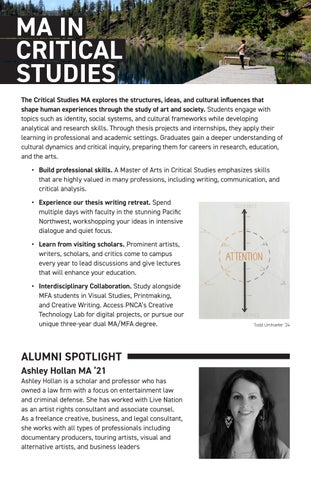
Todd Umhoefer ’24
CURRICULUM In the Critical Studies program, students adopt an interdisciplinary approach to examining society, history, culture, and the arts, with a strong focus on power structures, ideologies, and social constructs. Critical lenses include feminist theory, queer theory, critical race theory, and post-colonial theory. Students develop strong writing skills that translate to many professional fields.
SAMPLE READINGS CRITICAL PEDAGOGY Pedagogy of the Oppressed, Paolo Friere (1970) Teaching to Transgress, bell hooks, (1994) The Undercommons, Fred Moten and Stefano Harney (2013) CULTURAL STUDIES Discipline and Punish, Michel Foucault (1975) Essential Essays Volume 1: Foundations of Cultural Studies, Stuart Hall (2018) Mythologies, Roland Barthes (1957) CRITICAL THEORY Are Prisons Obsolete? Angela Davis (2003) Black Skin White Masks, Frantz Fanon (1952) Capital is Dead. Is This Something Worse?, McKenzie Wark (2021) Terrorist Assemblages, Jasbir Puar (2007) QUEER AND FEMINIST THEORY Black on Both Sides, C. Riley Snorton (2017) Exile and Pride, Eli Clare (1999) Living a Feminist Life, Sara Ahmed (2017) Wayward Lives Beautiful Experiments, Saidiya Hartman (2019) CRITICAL RACE THEORY Black, White, and in Color: Essays on American Literature and Culture, Hortense Spillers (2003) In the Wake, Christina Sharpe (2016) Lose Your Mother, Saidiya Hartman (2006)
FACULTY HIGHLIGHT Shawna Lipton
Chair of Critical Studies Shawna Lipton received her Ph.D. in Literature and Cultural Theory from the University of WisconsinMilwaukee. Her research and teaching interests include critical writing, visual studies, pedagogy, and professional practices. She has received a Tinsley Helton Dissertation Fellowship and was awarded Best Short Documentary at the United Nations Film Festival. WANT TO LEARN MORE?
Schedule a meeting with the Graduate Admissions Team. go.willamette.edu/graduate-info
Julie Noyes Assistant Director of Recruitment Hallie Ford School of Graduate Studies jmnoyes@willamette.edu | 503.821.8975
PNCA admits students of any race, color, and national or ethnic origin.