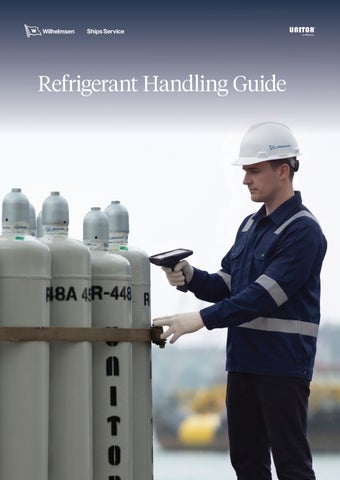
Refrigerant Handling Guide
02
Table of contents
03 04 06 08 10 11 12 13 16 19
Global Warming Potential Refrigerant Rules & Regulations Unitor Marine Refrigerants Refrigerant Quality Under Pressure WSS Approved Refrigerant cylinders Environmental Return Management (ERM) Refrigeration Inventory Inspection Refrigeration Service Essentials Safe handling when working with Refrigerants Air Quality Onboard
Disclaimer of expressed and implied warranties Although reasonable care has been taken in the preparation of this booklet, no warranties or representations as to the accuracy or completeness of the information contained herein can be given; nor can Wilhelmsen Ships Service AS assume any responsibility regarding the suitability of this information for the user’s intended purposes or for the consequences of its use. Each individual should make a determination as to the suitability of the information for their particular purpose(s).
Refrigerant Handling Guide
03
Global warming potential Understanding Global Warming Potential (GWP) is critical for shipowners, superintendents, and QHSSE managers tasked with making responsible refrigerant choices. It not only affects compliance and environmental performance but also long-term operational risk and cost exposure. The older generation of hydrofluorocarbons (HFC) refrigerants such as R-404A, R-507, and R-422D have high GWP. When these gases leak into the atmosphere, they contribute significantly to climate change, even in small quantities. For perspective, R-404A has a GWP value of 3922, which contributes 3922 times more warming than an equal mass of carbon dioxide (CO2). To mitigate this impact, global environmental agreements and regulations are accelerating efforts to phase down high-GWP refrigerants:
•
•
•
The Montreal Protocol, a global initiative originally designed to protect the ozone layer, was amended via the Kigali Amendment to include a global phasedown of HFCs, targeting their high GWP. In Europe, the F-gas Regulation mandates a steep reduction in HFC usage via quota systems, bans on high-GWP refrigerants, and stricter leak control requirements. Other major markets like the United States, Japan, and Australia have implemented or are implementing similar restrictions, with regional timelines and compliance thresholds.
Challenges
Solutions Energy savings and cost control
Rapidly tightening regulation worldwide
Increasing refrigerant scarcity
Increasing costs
High leakage rates from aging systems
Non-compliance penalties Environmental footprint Corporate risks
Future proof compliance
Impact Improved environmental stewardship
Enhanced safety practices
As a result, the maritime sector is under growing pressure to transition to low-GWP alternatives such as Hydrofluoroolefins (HFOs), HFO blends, CO2, and hydrocarbons. These next-generation refrigerants aim to go beyond aligning with current and upcoming regulations by minimizing direct emissions; the goal is to reduce direct greenhouse gas emissions and improve refrigeration practices to better manage environmental risks over the long term.
Refrigerant Handling Guide
04
Refrigerant rules & regulations From October 14th, 2016 HFC refrigerants will be controlled under the Kigali Amendment and it will be phased down from 2019 in order to fight climate change. The following table summarises the current major regulations.
National and international regulatory bodies will continue to regulate the environmental situation through the gradual phase-out of CFC and HCFC refrigerants. Most regulatory work builds upon The 1987 Montreal Protocol on Substances that Deplete the Ozone Layer.
International Regulation
HCFC
HFC
HFC Consumption Phase Down
Kigali Amendment to the Montreal Protocol Valid For: Non-Article-5 countries
Total phase out by 2020 (up to 0.5% of base level consumption can be used until 2030 for servicing existing equipment).
Phase down from 2019 for Non A5 countries (Earlier start)
"Non A5 (Earlier Start)"
“Non A5 (Later Start)”
2024 - 60%
2025 - 65%
2029 - 30%
2029 - 30%
2034 - 20%
2034 - 20%
2036 - 15%
2036 - 15%
A5-1
A5-2
2024 - Freeze at 100%
2028 - Freeze at 100%
2035 - 70%
2037 - 80%
2040 - 50%
2042 - 70%
2045 - 20%
2047 - 15%
Kigali Amendment to the Montreal Protocol Valid For: Article-5 countries
Reg. (EC) 290 / 2024 Valid For: EU countries
Reg. (EC) 573 / 2024 (F-gas regulation) Valid For: EU countries
Total phase out by 2030 (up to 2.5% of base level consumption can be used until 2030 for servicing existing equipment).
“Illegal to use new reclaimed and recycled HCFC for servicing from 2015. HCFCs must be recovered during servicing, decommissioning, or disposal of equipment. Recovered HCFCs must be destroyed using approved technologies in accordance with the Montreal Protocol.” Total phase out by 2020 (up to 0.5% of base level consumption can be used until 2030 for servicing existing equipment).
Production limit freeze from 2024
2019 - 90%
2029 - 90%
2020 - 95%
2032 - 90%
NA
Entities handling HCFCs must report quantities recovered and destroyed to ensure traceability and compliance.
Illegal to use new HFCs with GWP>2500 such as R-404a, R-507 and R-422D from 1st Jan 2020. Recycled or reclaimed HFCs can be used until 2030.
2025 - 24.3%
The GWP threshold for servicing AC and HP equipment will be further reduced to 750 from 2032.
2039 - 3.5%
2027 - 12.3% 2030 - 5.2% 2033 - 4.8% 2036 - 3.8% 2042 - 3.1% 2045 - 2.7% 2048 - 2.4% 2050 - 0%
Refrigerant Handling Guide
05
Regulatory Body
HCFC
HFC
Note
ABS
Not permitted on ships constructed after 1 Jan 2020
GWP <=2000
•
Illegal to vent to atmosphere
•
Consumption logbook
Valid For: ENVIRO / ENVIRO+ Notation LRS
• • •
Not permitted
GWP <1950
•
Consumption logbook
Valid For: ECO Class Notation GWP <=2000 (Clean Design)
Valid For: Clean Class Notation (Clean / In-operation) BV
GWP <=2000
Valid For: Cleanship / Cleanship Super Notation IMO Marpol 73/78
Valid For: Parties to Annex VI
NA
Fixed leak detection system
Monthly checks for max leakage rate (%) per system: 10%, 3-30kg system 5%, 30-300kg system 3%, >300kg system" Illegal to vent to atmosphere
•
Refrigerant monitoring with fixed leak detector and/or logging in consumption and conduct checks with handheld device on weekly basis
•
Recovery system & cylinders
Max leak = 10% of total charge annually"
•
Illegal to vent to atmosphere
•
Consumption logbook
• •
Not permitted on ships constructed after 1 Jan 2020
Recovery system & cylinders
•
•
Not permitted
Max leak = 10% of total annual charge annually Illegal to vent to atmosphere
•
•
Not permitted
Fixed leak detection system
•
•
DNV GL
Recovery system & cylinders
Recovery system & cylinders Fixed leak detection system"
•
Illegal to vent to atmosphere
•
Consumption logbook
• • •
Recovery system & cylinders Max leak = 10% of total charge annually
Refrigerant monitoring: Quarter or annual leak inspection for system charge >50lbs."
The table is intended to be a guideline only. Wilhelmsen Ships Service takes no legal responsibility in case of errors or new regulations in the above table, as applicable rules and regulations are constantly changing.
Refrigerant Handling Guide
06
Unitor Marine Refrigerants Group Name
ODP
GWP IPCC (SAR)
GWP IPCC (4AR)
GWP IPCC (5AR)
Replacement for
Chemical / Composition
HCFC
0.049
1500
1810
1760
-
Chlorodifluoromethane
R-134A
HFC
0
1300
1430
1300
R-12
Tetraflourethane
R-404A
HFC
0
3260
3922
3922
R-502
Blend R-125 / R-143a / R-134a (44/52/4) %
R-407C
HFC
0
1530
1774
1624
R-22
Blend R-32 / R-125 / R-134a (23/25/52) %
R-407F
HFC
0
1555
1824
1674
R-22 / R-404A/ R-507
Blend R-32 / R-125 / R-134a (30/30/40) %
R-407H
HFC
0
1371
1495
1378
R-404A / R-507
Blend R-32 / R-125 / R-134a (32.5/15/52.5) %
R-410A
HFC
0
1730
2090
1923
R-22
Blend R-32 / R-125 (50/50) %
R-417A
HFC
0
1900
2346
2127
R-22
Blend R-125 / R-134a / R-600a (46.5/50/3.5) %
R-422D
HFC
0
2230
2729
2473
R-22
Blend R-125 / R-134a / R-600a (65.1/30.5/3.4) %
R-427A
HFC
0
1830
2138
2024
R-22
Blend R-32 / R-125 / R-143a / R-134a (15/25/10/50) %
R-507
HFC
0
3300
3985
3985
R-502
Blend R-125 / R-143a (50/50) %
R-32
HFC
0
675
677
R-22, R-410A
Difluoromethane
R-448A
HFO Blend
0
1300
1387
1273
R-22 / R-404A/ R-507
Blend R-32 / R-125 / R-1234yf / R134a / R-1234ze (26/26/20/21/7) %
R-449A
HFO Blend
0
1308
1397
1282
R-22 / R-404A/ R-507
Blend R-32 / R-125 / R-1234yf / R-134a (24.3/24.7/25.3/25.7) %
R-452A
HFO Blend
0
2067
2140
2140
R-404A / R-507
Blend R-32 / R-125 / R-1234yf (11/59/30) %
R-513A
HFO Blend
0
-
631
573
R-134A / R-404A
Blend R-1234yf / R-134a (56/44) %
R-1234YF
HFO
0
4
6
R-134A, R-513A
2,3,3,3-Tetrafluoropropene
R-744
-
0
1
1
-
Carbon dioxide
Refrigerant R-22
1
**Applicable to Article-2 countries to the 1987 Montreal Protocol only
Refrigerant Handling Guide
07
Oil Type*
Glide
Boiling Point °C
Cylinder Volume
Filing Weight
Product Number
Cylinder Colour
Remarks
Min, AB, PAO
-
-40.8
12.3 litre 56 litre
12.5 kg 57 kg
905621 905059
green
POE
-
-26.1
12.3 litre 56 litre
12.5 kg 57 kg
905620 905557
blue
Single fluid Consumption and trade limited Phase out 2030**
POE
0.5 K
-46.6
12.3 litre 56 litre
9.5 kg 45 kg
905623 905606
orange
POE
7.4 K
-43.8
12.3 litre 56 litre
11 kg 52 kg
905624 905607
orange-brown
POE
6.6 K
-45.0
12.3 litre 56 litre
11 kg 51 kg
905712 905715
light green
POE
7.0 K
-44.7
12.3 litre 56 litre
10 kg 45 kg
905761 905760
gray
POE
0.2 K
-51.6
12.3 litre 56 litre
9.5 kg 45 kg
905627 905608
rose
Min, AB, PAO, POE
6.0 K
-42.0
12.3 litre 56 litre
11 kg 51 kg
905705 905637
green
Min AB, POE
4.9 K
-43.2
56 litre
52 kg
905710
light green
POE
7K
-42.7
56 litre
53 kg
905708
green
POE
0K
-47.1
12.3 litre 56 litre
9.5 kg 45 kg
905628 905610
Teal
POE
-
-51.7
12.3 litre
9 kg
905901
gray, red shoulder
POE
4K
-45.9
12.3 litre 56 litre
10 kg 45 kg
905736 905740
gray
POE
4K
-46.0
12.3 litre 56 litre
10 kg 45 kg
905744 905748
gray
POE
3K
-47.0
12.3 litre 56 litre
10 kg 45 kg
905728 905732
gray
POE
0K
-29.2
12.3 litre 56 litre
11 kg 50 kg
905771 905770
gray
PAG, POE
-
-29.5
12.3 litre
10 kg
905900
gray, red shoulder
Min, AB, PAO, POE
-
-78.4
40 litre
27 kg
905790
gray
Single fluid Medium temperature applications Zeotrope Service Ban in EU due to high GWP >2500 (F-gas Regulation).
Zeotrope Replacement for R-404A. Interim refrigerant for R-448A and R-449A.
Zeotrope Replacement for R-404A. Interim refrigerant for R-448A and R-449A. Zeotrope Low and medium temperature applications
Zeotrope Pressure 60% higher than R-22 Zeotrope Low, medium and high temperature applications Zeotrope Service Ban in EU due to high GWP >2500 (F-gas Regulation). Zeotrope Low and medium temperature applications
Azeotrope Service Ban in EU due to high GWP >2500 (F-gas Regulation). Single fluid Flammable (A2L)
Zeotrope Low and medium temperature applications
Zeotrope Low and medium temperature applications
Zeotrope Low and medium temperature applications
Azeotrope medium and high temperature applications Single fluid Flammable (A2L)
Single fluid Low and medium temperature applications
Refrigerant Handling Guide
08
Refrigerant Quality Under Pressure The Risks of Disposable and Counterfeit Cylinders
In marine refrigeration, the choices we make extend far beyond technical performance. They impact environmental sustainability, regulatory compliance, and crew safety. As the industry shifts toward low-GWP alternatives, it is equally critical to examine the types of cylinders used to store and transport these gases. Among the most pressing concerns today are the continued use of disposable cylinders and the growing presence of counterfeit refrigerants, both of which pose serious risks to vessels and the environment.
Disposable Cylinders: Outdated and Dangerous
Disposable cylinders, designed for single use, are constructed with thin metal walls that are vulnerable to
*A pile of used disposable cylinders
corrosion, especially in harsh marine environments. Their structural fragility makes them prone to cracks and leaks, increasing the risk of explosions if refilled illegally. Beyond safety, improper disposal of these cylinders often results in residual refrigerant (“heel”) being released into the atmosphere, contributing to greenhouse gas emissions. Despite their historical use, disposable cylinders are now banned in regions such as the EU, Canada, Australia, and India due to their environmental and safety risks.
Counterfeit Cylinders: A Silent Risk
Global regulations like the EU F-Gas Regulation and the Kigali Amendment aim to phase down high-GWP HFCs. However, these efforts have inadvertently fuelled a black market for illegal and counterfeit refrigerants. These substances may be impure, contaminated, or contain banned chemicals incompatible with refrigeration systems.
Refrigerant Handling Guide
Their use can lead to system damage caused by moistureinduced ice formation, acid corrosion, and sludge buildup. Counterfeit refillable cylinders often lack certification and do not meet recognized safety standards such as ISO or DOT. They typically lack proper labelling, traceability, and inspection markings, making them unsafe for use and illegal to transport. These cylinders may be rejected at filling stations, damage equipment, or invalidate insurance coverage, posing a hidden but serious threat to vessel operations.
09
Avoiding Illegal and Counterfeit Refrigerants
To safeguard your vessel and crew, follow these best practices: • Source refrigerants from reputable suppliers with verified credentials. • Avoid disposable cylinders whenever possible. • Question the purity of refrigerants sold in disposable containers. • Verify authenticity and traceability, especially if the price seems unusually low. • Use refillable, reusable cylinders that meet environmental and safety standards.
Refrigerant Handling Guide
10
WSS Approved Refrigerant cylinders Managing refrigerant cylinders globally doesn’t have to be complicated. Our Global Cylinder Exchange program ensures seamless delivery, exchange, servicing, and resupply of cylinders, wherever your vessels are in operation. Our Global Cylinder Exchange gives you full visibility and traceability, helping you stay compliant and confident in the authenticity and quality of every Unitor™ cylinder.
Convenience — Global Cylinder Exchange
Know the what, where, and when of all your cylinders with our Global Cylinder Exchange: our accurate, secure, and cost-effective stock management system. Backed by our global network, we provide end-to-end cylinder delivery, exchange, servicing, and resupply worldwide. By providing full traceability, you can be assured of the authenticity of the refrigerants. Additionally, it helps you to eliminate the risks of receiving illegal or counterfeit refrigerants.
Quality Guaranteed
Some refrigerants are cheaper upfront, but poor purity and high moisture levels can quickly lead to corrosion, ice blockages, and system breakdowns, which is a common issue with counterfeit or contaminated products. Some counterfeits have even caused equipment explosions due to unsafe chemical substitutes. With UnitorTM refrigerants, purity, moisture content, and authenticity are guaranteed to AHRI 700 standards. Our cylinders are filled and sealed only by approved suppliers, and backed by full traceability, verified markings, and strict quality controls.
Reliable - Cylinder Safety and Maintenance
WSS adheres to stringent cylinder maintenance and quality control procedures in compliance with U.S. DOT specifications and European Transport Regulations (ADR). Each cylinder undergoes a thorough inspection, and only those with a valid hydrostatic test date are approved for filling. This ensures the highest levels of integrity and safety across our cylinder assets.
Worry-free — Complete Compliance
The ISPS Code enforces strict rules on the close monitoring of high-pressure cylinder movements. Thankfully, our global track and trace does just that; allowing us, and thereby, you, to stay fully compliant. Our gas products and services also comply with all international regulations for global warming reduction and the prevention of ozone depletion.
Technical Expertise
We have a wide range of documents available detailing all the specific technical data, properties, and other information on our products and their usage to help you maximise your resources effectively.
Refrigerant Handling Guide
11
Refrigerant Handling Guide
12
Environmental Return Management (ERM) As climate change intensifies, increasing attention is being paid to greenhouse gases with high Global Warming Potential (GWP). Among the most concerning are refrigerants, which, if released, can be thousands of times more potent than carbon dioxide in contributing to global warming. Recognizing the environmental impact of improper refrigerant handling, global treaties, marine regulatory bodies, and environmental agencies have established standards and laws to treat refrigerant waste in a responsible manner. Individuals or organizations found guilty of non-compliance, such as releasing refrigerants
into the atmosphere, face severe penalties, including substantial fines and imprisonment. In this regulatory landscape, having the right technical knowledge and operational discipline is not just important. it’s essential. Wilhelmsen Ships Service has established such a procedure on a global basis. The Environmental Return Management (ERM) complies with applicable global treaties, and different local regulations. Today, ERM is available in selected ports in Europe, Americas, Asia Pacific, and Middle East.
ERM Procedure
This procedure ensures compliance with loacal regulations and off-loading requirements and applies to the following requests: • Recovery cylinders (either empty or filled with recovered refrigerants) • Unitor refrigerant cylinders that contain more than 10% of product
Contact WSS
Send to waste management facility
Fill up ERM form
Pick up by WSS
Check quality & weight
Verification & approval
1
Contact WSS sales office and provide them with the refrigerant type and number of cylinders to offload.
2
An ERM form will be sent to the customer which will need to be filled up completely with all cylinder details recorded.
3
Ensure the quantity of cylinders and product weight are accurate.
4
Send over the ERM form once completed. WSS will evaluate if it can be offloaded at the port.
5
The approval process must be completed before offloading can commence.
6
If offloading is not approved, WSS will look for other ports where offloading may be possible.
7
If offloading is approved, a quotation including handling and delivery charges will be sent.
8
Once charges are agreed and a purchase order has been issued, WSS will advise offloading instructions and arrange for pick up.
Refrigerant Handling Guide
13
Refrigeration Inventory Inspection
Ensure compliance, prevent emergencies, and stay in control
Many vessels lack an accurate overview of onboard refrigeration tools, products, and practices, which can lead to emergencies and compliance risks. The Refrigeration Inventory Inspection by WSS Port Services Engineers (PSE) provides a solution to this challenge.
Inventory clarity Know what products are on board
Compliance guidance Stay aligned with changing regulations
Condition check Evaluate availability and condition of tools
Leak detection assessment Ensure proper practices to reduce emissions and cost
Why choose us? The refrigeration market is constantly evolving, with new regulations and requirements across different regions. Our Refrigeration Inventory Inspection provides a comprehensive assessment of your refrigeration system, tools, and compliance status, accompanied by a detailed recommendation report. The Inspection Report Covers • The availability and condition of tools. • The effectiveness of the leak detection system and practices. • The current refrigerant inventory. • Recommendations for compliance and sustainability. Key Regulations Addressed • IMO MARPOL Annex VI covers refrigerant management, leakage control, and onboard logging.
• The Montreal Protocol mandates the gradual phasedown of HFC refrigerants and leakage control. • EU F-Gas and US EPA Regulations introduce quota cuts, usage bans based on GWP, leak checks, refrigerant recovery, recycling, and equipment labelling. How the Inspection Works 1. A Wilhelmsen Port Services Engineer boards your vessel. 2. The engineer conducts a thorough assessment of the refrigeration system, tools, and compliance status. 3. A detailed recommendation report is provided after the inspection. Getting Started Contact your WSS representative and request a Refrigerant Inventory Inspection (PN 779354). Agree on vessel(s) and inform the sailing schedule. Inspections can be combined with other services, such as the Welding Safety Inspection.
Refrigerant Handling Guide
14
Refrigeration Service Essentials
Venting refrigerants into the atmosphere is strictly prohibited under global and national regulations, including the EU F-Gas Regulation, the Montreal Protocol, the US EPA Clean Air Act, and numerous marine classification standards. Compliance requires proper recovery and handling of refrigerants during servicing or retrofit.
The Refrigerant Recovery Package helps crews safely to recover, evacuate, and handle refrigerants in full compliance with global regulations.
Refrigerant Recovery Package 220V (652522) Refrigerant Recovery Package 110V (652511) The Refrigerant Recovery package features high-quality tools specifically designed for the safe, efficient servicing of air conditioning and refrigeration systems onboard. It enables proper refrigerant recovery and charging, system evacuation, leak detection, and routine maintenance, ensuring compliance with industry standards and environmental regulations.
Refrigerant Recovery Unit URU-5000A (613748) Refrigerant Recovery Unit URU-5000B (613747) The refrigerant recovery unit is designed specifically for the demanding environments of the maritime industry. It can recover a wide range of refrigerants, including A2L refrigerants such as R-32 and R-1234yf. It features an automatic shutoff function that stops the machine once the vapor is fully recovered and the specified vacuum level is reached, ensuring efficiency and preventing equipment wear. Vacuum Pump 115/230V UVP1550-A3 (587660) Heavy Duty Vacuum Pump 115/230V UVP1580-A3 (587664) The vacuum pump is specifically designed for efficient evacuation and deep vacuum applications for both non-flammable and flammable refrigerants. It features a bigger and more powerful motor, suitable for cold start and long periods of operation. Voltage can be switched easily between 115V and 230V, making it compatible with various shipboard power supplies. Digital Weighing Platforms ADS-100 (613927) Designed for heavy-duty use, this portable platform accurately weighs cylinders up to 100kg. Users can rely on a precision rate of ±0.5%, ensuring exact measurements for refrigerant charging or recovery.
Refrigerant Leak Detector UNIRX-1A (716142) The refrigerant handheld detector detects all HCFC, HFC, and HFO refrigerants. With an industry-leading sensitivity of 5 ppm, it allows you to effectively pinpoint the smallest leaks in your refrigeration system.
Refrigerant Handling Guide
Deluxe Manifold Set 4-WAY (711473) Deluxe service manifold is equipped with suction and discharge pressure gauges and an optical sight glass to observe the refrigerant as it flows through the manifold. This benefits the operator by enabling visual monitoring of refrigerant flow, helping to support refrigerant recovery and charging operations.
Recovery Cyl Empty 21.6L+DOCUMENTS (596544) Small cylinder for recovering refrigerants during servicing or maintenance work onboard. Comes with a complete documentation kit including transport label following European and American requirements.
Digi-Vacuum Gauge UVG-80 (711509) Digital gauge to determine that the proper system vacuum has been obtained. High Accuracy and Resolution (±10 micron or ±5% of reading: up to 10’000 micron).
Refrigerant Leak Monitor Kit 6CH (708051) The Refrigerant Leak Monitor Kit 6CH offers an effective solution for multi point surveillance of machinery rooms and walk in freezer rooms where refrigerant gases may be present. Each strategically placed refrigerant leak detector acts as an independent sensing point that sends real time status and alarm signals to the central MPU6C controller. During a refrigerant leak, the central controller quickly alerts the crew to the exact location, reducing the chance of unnoticed refrigerant buildup and enabling timely intervention in enclosed or temperature sensitive environments.
Hand Oil Pump 5L & 25L Drums (597540) High pressure hand oil pump designed to allow technicians to pump refrigeration oil into the system or compressor crankcase while the unit is in operation, no need for system shutdown during oil charge.
Vacuum Pump Oil 5 Litre (597674) Vacuum Pump Oil 1 Litre (320424) Vacuum Pump Oil is formulated from highly refined mineral oils and selected additives for use in deep vacuum applications.
15
Refrigerant Handling Guide
16
Safe Storage handling when working with Refrigerants The guidelines below provide general information for refrigerants. For more details, please refer to the applicable Safety Data Sheet. These can be downloaded from our online product catalogue at Wilhelmsen.com, in the documentation tab of each refrigerant. Environmental concerns • All refrigerants have a global warming potential and therefore contribute to the greenhouse effect when released into the atmosphere. • CFC and HCFC refrigerants also contribute to the depletion of the ozone layer when released into the atmosphere. Hazards identification • Odour: Sweet ether-like odour. • Appearance: Liquefied gas. • Contact with eye: May cause irritation. • Contact with skin: Possible frostbite of affected areas. • Inhalation: May cause dizziness, confusion, headache or stupor. In case of severe exposure, unconsciousness may develop. Storage Ensure that cylinders comply with US DOT4BA400 or DOT4BW400 pressure standards. Do not expose cylinders to temperatures above 45ºC, 113ºF. Store as a compressed gas. Keep in a well-ventilated place. Keep away from open flames, hot surfaces and other sources of ignition. Cylinders stored for more than the 10 year qualification date may still be used safely, as long as the cylinder is in good physical condition. Transport Always transport cylinders with the valve fully closed and the protection cap fitted at all times. Hoisting of individual gas cylinders, full or empty, by means of ropes, chains, slings, etc. around the body, valve or protection cap is strictly forbidden because of the risk that the cylinder will fall out of the sling. The use of special lifting/transport devices for gas cylinders, such as transport racks or cages, is required by several marine authorities. When the hoisting of individual large gas cylinders cannot be avoided, use the Unitor cylinder trolley (P/N: 778147).
Safety measures to protect the environment Do not release refrigerants into the atmosphere and always use recovery equipment. Obsolete cylinders should be returned to an approved reception facility and empty ones to the supplier at a maximum 10% of the initial product weight to meet import restrictions. Proper methods for damage limitation and cleanup In case of a leak, prevent sparks and open flames. If it can be done safely, stop the leak immediately. Move leaking cylinder(s) to a well-ventilated outdoor area where the leak will not pose a risk to personnel. Exposure control Refrigerant gases are heavier than air and will accumulate on the ground. They may cause suffocation by reducing the oxygen available for breathing. Avoid apparatus in confined spaces. Install leak detection systems onboard to detect early signs of leakage.
Refrigerant Handling Guide
17
Safety measures to protect persons
Always wear eye protection and Insulated gloves
Protective clothing should be worn if there is a possibility of direct contact or splashes
Wear safety boots when handling refrigerant cylinders
Never lift a cylinder by the top valve
When moving cylinders, keep their caps on
Always assume that the cylinder contains gas
Wear self-contained breathing apparatus in high gas concentrations
Provide good ventilation
Refrigerant Handling Guide
18
Air Quality Onboard Combatting Bacteria and Infection risk In hot or humid conditions, marine Heating Ventilation, and Air-Conditioning (HVAC) and package Air-Conditioning systems can become breeding grounds for bacteria, Legionella, and mould, affecting system cleanliness and the health of crew and passengers. Pollutant levels onboard vessels can be two to five times higher than outdoor air, and repeated exposure may trigger allergies as well as both short and long term health issues. Why Indoor Air Quality (IAQ) Matters Ensuring safe and healthy air onboard is an essential yet often overlooked element of maritime ESG commitments. While emission reduction remains vital, protecting crew health is equally important. Poor IAQ onboard can contribute to: • Headaches and fatigue • Respiratory conditions • Impaired alertness and decision-making Higher pollutant concentrations in the air increases the likelihood of health challenges, reduced productivity, and higher absenteeism. In accordance with Maritime Labour Convention (MLC) 2006, Guideline B3.1.2 – Ventilation 2(b), shipboard ventilation and air conditioning systems must be designed to allow proper cleaning and disinfection to prevent the spread of disease. Natural, Scientifically Proven Air Quality Improvement Recent research from Griffith University demonstrates the strong antimicrobial performance of Unitor™ Duct Air
Treatment (DAT) and A/C Air Treatment (AAT). Controlled experiments showed:
73.5%–90.3%
microbial inactivation of airborne bacteria and fungi within 24 hours
98%
Up to reduction within 7 days
Using advanced monitoring techniques, researchers evaluated bioaerosol levels in both small and large sealed environments, confirming the consistency and durability of TTO vapour performance. These findings hold significant value for the maritime industry, where confined spaces, limited ventilation, and warm, humid conditions heighten the risk of airborne contaminants. Versatile Integration Across Marine HVAC Systems Unitor™ DAT and AAT are compatible with all marine HVAC configurations—including ducted systems, air handling units, and packaged air conditioners—making them suitable for a wide spectrum of vessel types.
Refrigerant Handling Guide
Features • Continuous protection from mould and bacteria. • Operates passively with no additional energy consumption • DAT and AAT solutions cover a wide range of air conditioning systems Benefits • Ensures good indoor air quality for crew and passenger health • Removes bad odour associated with mould and bacteria growth • Improve air quality between routine cleaning and maintenance
19
As the maritime industry continues advancing its environmental footprint, ensuring safe and healthy indoor environments remains a crucial frontier. WSS is redefining indoor air quality standards for today’s fleet through effective and sustainable solutions. For more information or product availability, contact your local WSS customer service representative.
Unitor™ Duct Air Treatment (DAT) 2KG: 743466, 4KG: 764417 Unitor™ Duct Air Treatment (DAT) is an indoor air quality solution designed for installation within air handling units (AHUs) and ducted HVAC systems. By continuously releasing antimicrobial vapour into the supply air stream, DAT helps to control mould and odour issues commonly found within the ventilation system.
Unitor™ A/C Unit Air Treatment (AAT) 743460 Unitor™ A/C Unit Air Treatment (AAT) is an indoor air quality solution designed for wall-mounted and cassette air-conditioning systems. Installed directly within the A/C unit, AAT continuously releases antimicrobial vapour into the local airflow to help support cleaner indoor environments, reduce odour issues, and assist in the control of mould growth within air-conditioning systems.
Refrigerant Handling Guide
20
Glossary
4AR Fourth assessment report: IPCC formula for calculating GWP. Published in 2007. Used for calculating CO2 taxes and import quotas for refrigerants. AB Alkyl benzene refrigeration oil.
Germany, Greece, Holy See, Hong Kong, Hungary, Iceland, Ireland, Italy, Japan, Latvia, Liechtenstein, Lithuania, Luxembourg, Malta, Netherlands Antilles, Netherlands, New Zealand, North Macedonia, Norway, Poland, Portugal, Puerto Rico, Romania, San Marino, Slovakia, Slovenia, Spain, Sweden, Switzerland, Ukraine, United Kingdom, United States of America
ADR European Agreement concerning the International Carriage of Dangerous Goods by Road.
Non Article 5-2 Azerbaijan, Belarus, Kazakhstan, Russian Federation, Tajikistan, Uzbekistan
AHRI Air-Conditioning, Heating, and Refrigeration Institute AHRI 700 Industry standard specifying refrigerant purity requirements and test methods for new, reclaimed, and recycled refrigerants.
Azeotrope Blend of refrigerants of different volatilities which do not appreciably change in composition or temperature as it evaporates or condenses under constant pressure. Behaves like a single refrigerant and has no glide. Refrigerant blends assigned R-500 series number designations by ANSI / ASHRAE 34 are azeotropes.
ASHRAE American Society of Heating, Refrigerating and AirConditioning Engineers.
A2L ASHRAE safety classification for refrigerants with lower toxicity (A) and lower flammability (2L).
Article 5-1 Albania, Angola, Argentina, Armenia, Bahamas, Bangladesh, Barbados, Benin, Bhutan, Bolivia, Bosnia and Herzegovina, Botswana, Brazil, Brunei Darussalam, Bulgaria, Burkina Faso, Burundi, Cabo Verde, Cambodia, Cameroon, Central African Republic, Chad, Chile, China, Colombia, Comoros, Congo, Cook Islands, Costa Rica, Côte d’Ivoire, Cuba, Democratic People’s Republic of Korea, Djibouti, Dominican Republic, Ecuador, Egypt, El Salvador, Eritrea, Eswatini, Ethiopia, Fiji, Gabon, Gambia, Ghana, Grenada, Guatemala, Guinea, Guinea-Bissau, Haiti, Honduras, Indonesia, Jordan, Kiribati, Kyrgyzstan, Laos, Lebanon, Lesotho, Liberia, Madagascar, Malawi, Malaysia, Maldives, Mali, Marshall Islands, Mauritania, Mauritius, Mexico, Micronesia, Mongolia, Montenegro, Morocco, Mozambique, Namibia, Nauru, Nepal, Nicaragua, Niger, Nigeria, Niue, Palau, Panama, Papua New Guinea, Paraguay, Peru, Philippines, Republic of Korea, Rwanda, Saint Kitts and Nevis, Saint Lucia, Saint Vincent and the Grenadines, Samoa, Sao Tome and Principe, Senegal, Serbia, Seychelles, Sierra Leone, Singapore, Solomon Islands, Somalia, South Africa, South Sudan, Sri Lanka, Syrian Arab Republic, Taiwan, Thailand, Timor-Leste, Togo, Tonga, Trinidad and Tobago, Tunisia, Turkiye, Turkmenistan, Tuvalu, Uganda, United Republic of Tanzania, Uruguay, Vanuatu, Venezuela, Vietnam, Zambia, Zimbabwe.
Blend A refrigerant consisting of two or more components mixed together to achieve specific performance characteristics.
Article 5-2 Bahrain, India, Iran, Iraq, Kuwait, Oman, Pakistan, Qatar, Saudi Arabia, United Arab Emirates (UAE) Non Article 5-1 Andorra, Australia, Austria, Belgium, Canada, Croatia, Cyprus, Czech Republic, Denmark, Estonia, Finland, France,
CFC Fully Halogenated Chlorofluorocarbon, e.g. R-12, R-500, R-502 and others. Environmental burden: High ODP, high GWP. Disposal Destruction of used refrigerants in an environmentally sound and Montreal Protocol approved manner. DOT United States Department of Transportation. Responsible for transportation regulations including pressure vessel specifications for gas cylinders. EPA U.S. Environmental Protection Agency. FC, PFC Fluorocarbons, Perfluorocarbon; fully halogenated Fluorocarbons. F-Gas Regulation A EU regulation that is aimed at preventing emissions of Fluorinated gases which are contributing to Global Warming. Glide Temperature Glide. This means that the boiling point temperature increases while vapour is boiled off at constant pressure. (The most volatile component boil off first) Usually
Refrigerant Handling Guide
used to describe the evaporation or condensation of a zeotropic blend. Greenhouse gases Gases that contributes to Global Warming, i.e. has a certain GWP. Regulated by the Kyoto Protocol. GWP Global Warming Potential. Reference value is CO2 which has GWP=1 (time horizon 100 years). Halon Fully halogenated hydrocarbons, containing Bromine, mainly used as fire fighting agent. Regulated and banned by the Montreal Protocol. Environmental burden: High ODP, high GWP. HCFC Hydrochlorofluorocarbon. Partly halogenated Hydrocarbon e.g. R-22, R-401A and others. Environmental burden: Low ODP, moderate - high GWP. HFC Hydrofluorocarbon. Partly halogenated Hydrocarbon, e.g. R-134a, R-125, R-404A and others. Environmental burden: No ODP, moderate - high GWP. HFO Hydrofluoroolefins. Unsaturated organic compounds consist of hydrogen, fluorine and carbon. Environmentally friendly alternative: No ODP, low GWP. IMO International Maritime Organization, main task has been to develop and maintain a comprehensive regulatory framework for shipping.
21
ODP Ozone Depletion Potential. Reference value is R-11, which has ODP=1. The substances implicated generally contain chlorine or bromine. ODS Ozone Depleting Substance. PAO Polyalphaolefin refrigeration oil. POE Polyolester refrigeration oil. Recovery Extraction of refrigerants from a system into a separate container, e.g. a recovery cylinder or tank. Recycling Reuse of a recovered refrigerant following a basic cleaning process such as filtering and drying for removal of oil, moisture and acid from the refrigerant. Reclamation Treatment of recovered refrigerant in order to restore the substance to a specified purity standard (e.g. ARI 700 2006). SAR Second Assessment Report; IPCC formula for calculating Global Warming Potential (GWP). Published in 1996, used by some governmental bodies and classification societies. Single Fluid Refrigerant comprising of one component only e.g. R-22, R-134a and others.
IPCC Intergovernmental Panel on Climate Change is a scientific intergovernmental body set up by the World Meteorological Organization (WMO) and by the United Nations Environment Programme (UNEP).
TAR Third Assessment Report; IPPC formula for calculating Global Warming Potential (GWP). Published in 2001. Used by few selected countries, predominantly to calculate GWP to a higher value, as a basis for CO2 tax calculations.
Kyoto Protocol Promotes policies and measures that limit or reduce the emission of Greenhouse Gases not controlled by the Montreal Protocol, e.g. HFCs, Methane, CO2 and other substances.
TEWI Total Equivalent Warming Impact. Takes into account the direct GWP and the energy consumption required to run the refrigeration system. The TEWI is not refrigerant specific information, but rather relates to a particular refrigeration system.
Min Mineral refrigeration oil. Montreal Protocol Regulates the production and consumption of substances that contribute to the depletion of the ozone layer (i.e. have a certain ODP) e.g. R12, R22 and others.
Zeotrope Blend of refrigerants of different volatilities that appreciably change in composition or temperature as it evaporates or condenses at a given pressure. Causing a temperature glide. Zeotropes are assigned R-400 series number designation.
Refrigerant Handling Guide
22
Refrigerant Handling Guide
23
Scan now
or click here Wilhelmsen Ships Service Phone: (+47) 67 58 40 00 Fax: (+47) 67 58 40 80 Postal Address: PO Box 33, NO-1324 Lysaker, Norway wilhelmsen.com Contact your local WSS customer services for prices and worldwide availability.
802170 V2.0-082026