Wild Sheep
Sportscene Publications Inc.
10450 - 174 Street
Edmonton, Alberta T5S 2G9
Ph: 780.413.0331 Fax 780.413.0388
Email: info@sportscene.ca www.sportscene.ca
Summer 2026 Issue
Editor in Chief Kyle Stelter (CEO)
Editors Peter Gutsche
Nolan Osborne Bill Pastorek
Contributors
Larisa Murdoch
Helen Schwantje, DVM
Design & Layout
Sportscene Publications Inc.
Printing Elite Lithographers Co. Ltd.
Editorial Submissions
Please submit articles and photos to kstelter@wildsheepsociety.com
No portion of Wild Sheep Society of BC Magazine may be copied or reproduced without the prior written consent of the Wild Sheep Society of British Columbia. The views and opinions expressed by the authors of the articles in Wild Sheep Society of BC Magazine are those of the author and not necessarily those of the Wild Sheep Society of British Columbia.
NO. 43363024
Undeliverable
Wild Sheep Society of British Columbia 27009 Fraser Highway Aldergrove, BC V4W 3L6 www.wildsheepsociety.com
Cover photo by Peter Gutsche
Chief Executive Officer – Kyle Stelter 250-619-8415 ● kstelter@wildsheepsociety.com
President – Greg Rensmaag 604-209-4543 ● rensmaag_Greg@hotmail.com
Vice-President – Chris Barker 250-883-3112 ● barkerwildsheep@gmail.com
Vice-President – Peter Gutsche 250-328-5224 ● pgutsche@wildsheepsociety.com
Taylor Dutka
250-219-8289 taylordutka99@gmail.com
Joe Eppele 647-986-3859 joe.eppele@gmail.com
Ken Jyrkkanen 250-319-7759 Email: kjyrkkanen@gmail.com
Communications Committee
Chair: Kyle Stelter ● 250-619-8415 kstelter@wildsheepsociety.com
Fundraising Committee
Chair: Korey Green ● 250-793-2037 kgreen@wildsheepsociety.com
Government Engagement Committee
Chair: Greg Rensmaag ● 604-209-4543 rensmaag_greg@hotmail.com
Hunter Heritage Committee
Chair: Jann Demaske ● 970-539-8742 demaskes@msn.com
Indigenous Relations Committee
Chair: Peter Gutsche ● 250-328-5224 pgutsche@wildsheepsociety.com
Membership Committee
Chair: Matt McCabe ● 250-320-6048 mattmccabe.wssbc@gmail.com
Projects Committee
Chair: Chris Barker ● 250-883-3112 barkerwildsheep@gmail.com
Secretary – Colin Peters 604-833-5802 ● colin.peters12@gmail.com
Treasurer – Joe Humphries 250-230-5313 ● joseph_humphries@hotmail.com
Past President – Korey Green kgreen@wildsheepsociety.com
Justin Kallusky 236-331-6765 kallusky@hotmail.com
Benjamin Matthew MD 778-558-0996 ben.matthew@ubc.ca
Matt McCabe 250-320-6048 mattmccabe.wssbc@gmail.com
Jurassic Classic
James Mitton 778-808-9001 jamesmitton15@gmail.com
Mike Southin 604-240-7337 msouthin@telus.net
Kyle Stelter ● 250 619-8415 ● kstelter@wildsheepsociety.com
Raffles
Joe Humphries ● 250-230-5313 ● joseph_humphries@hotmail.com
Women Shaping Conservation
Rebecca Peters ● 778-886-3097 ● rebeccaanne75@gmail.com
Bookkeeper
Kelly Cioffi ● 778-908-3634 kelly@dkccompany.com
Executive Assistant
Hana Erikson ● 604-690-9555 exec@wildsheepsociety.com
Hunting Expo Coordinator
Kris Wrathall ● 604-340-4903 kwrathall@wildsheepsociety.com
Projects Administrator
Nicole Barker ● 250-361-5734 projects@wildsheepsociety.com
Danny Coyne Darryn Epp Trevor Carruthers
s we roll into summer, we are quickly approaching fall and starting to think about the sheep opener, which is now only weeks away. It is that time of year when many of us are planning our fall hunts, training, or simply dreaming about being back in the mountains. I am personally looking forward to two weeks chasing Stone’s sheep in the high peaks and, with any luck on the LEH, perhaps another great hunt as well. Sometimes we focus on the doom and gloom, however BC still offers incredible hunting opportunities unlike almost anywhere else, and I am looking forward to the fall season.
Vice-President Chris Barker and I recently spent two days in Victoria at the Provincial Hunting and Trapping Advisory Team meetings in late May. Several important discussions took place on issues across the province. Much of what we discuss is bound by confidentiality agreements, but I can share that having our Society represented in these discussions is a benefit to our membership, as important decisions impacting us on the landscape are influenced.
Following those meetings, VP Barker and I travelled to Ottawa to attend the Conservative Hunting and Angling Caucus Outdoor Symposium and the Canadian Wildlife Conservation Partners (CWCP) meetings. The Wild Sheep Society of BC is a founding steering committee member of CWCP, a collaborative tool for Canada’s wildlife conservation and outdoor heritage movement. These conversations in Ottawa allowed us to discuss pressing issues facing our sustainable-use conservation community and to work toward solutions-based outcomes.
For hunters pursuing sheep for the first time, or for anyone needing a refresher, we remind you that excellent resources are available. This year, we will again be offering a webinar that allows for proactive participation. On our website, we also offer three excellent resources to help with horn-aging techniques. We have an online horn-aging course developed in conjunction with our partner, Silvercore Outdoors. We also have a 2025 YouTube presentation from Mike Bridger that offers advanced strategies for horn aging. Finally, a video by Bill Jex provides additional valuable content. We encourage all of you to join us for the webinar and to utilize the resources on our website.
For any new sheep hunter, arguably the best resource is an experienced sheep hunter who can help guide you through your hunt. If you have a buddy you can hunt with, this is the tried-and-tested way to learn the ropes and build toward a successful hunt. I can personally vouch that, for me, having an experienced sheep hunting partner was an invaluable asset and one that was critical to my success in taking my first sheep.
Some of you may have noticed our announcement regarding the postponement of the Northern Fundraiser to 2028. This decision was made after much deliberation and after hearing from our members that a refresh is in order. As a Society, we are re-evaluating how the Northern Fundraiser will be delivered, and we will return in 2028 with a fresh program that will make this event the best we have ever hosted. I do want to assure our northern members that we will continue to invest in our Northern Thinhorns as we always have, and that we truly are taking a one-year hiatus to regroup. We will be back the following year.
I also want to touch on the incredible work that we continue to carry out as a Society. This critical work simply would not happen without the support of you, our dedicated members. You are the lifeblood of our organization. While we have dozens of projects underway across the landscape, our three legacy projects continue to advance.
In late May, we successfully treated additional habitat through prescribed fire in the Peace Region, benefiting Stone’s sheep. This past February, we concluded treatment of another significant herd of California bighorn sheep. This is year nine of the Fraser River Test and Remove Project, and this twomillion-dollar project is having a significant impact on the infected herds.
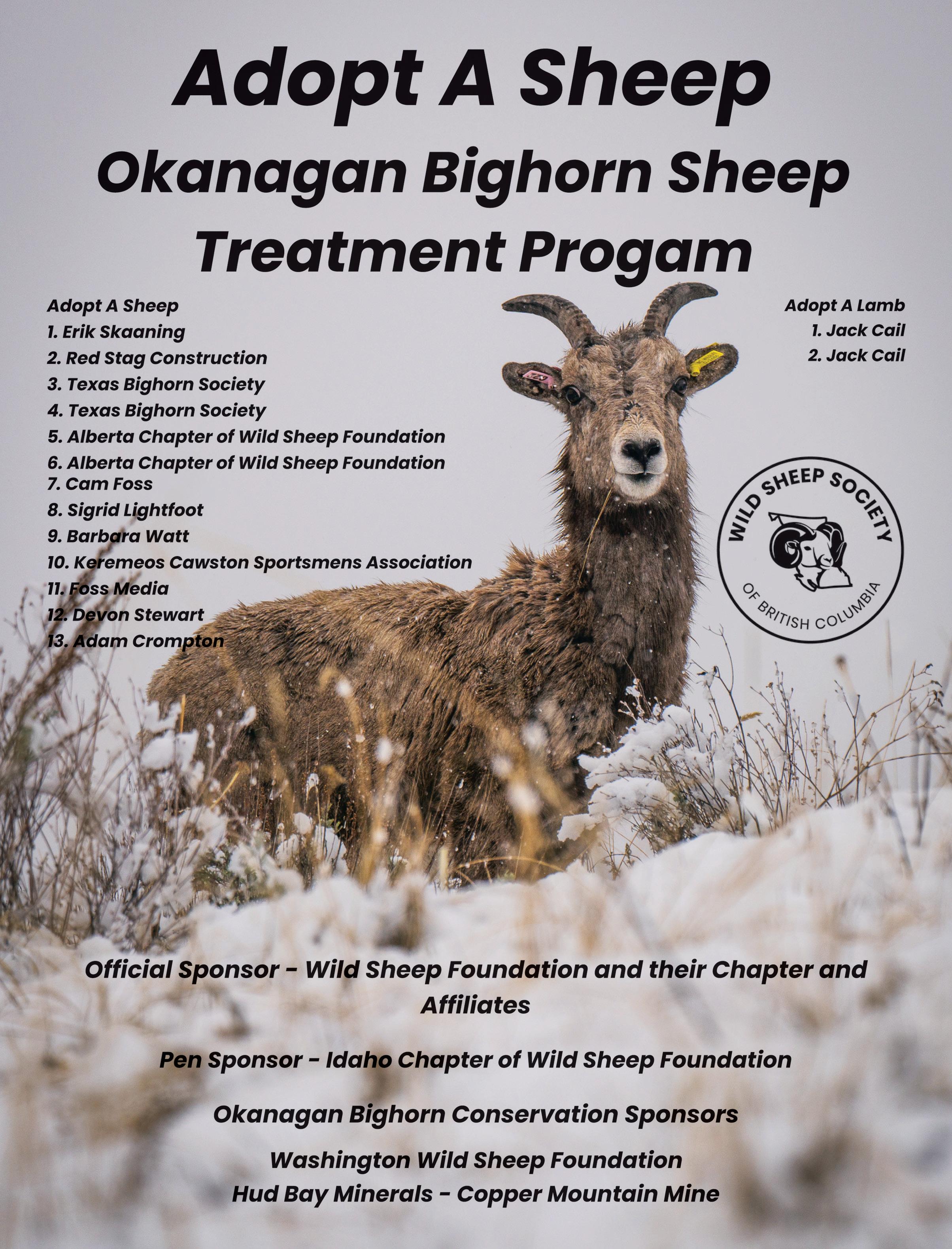
Our Psoroptes Treatment Trials continue in the Okanagan Region in conjunction with the Okanagan Nation Alliance. Another handling was completed in mid-June, post-lambing, and we are gathering excellent data that will inform management decisions for this herd and others impacted by Psoroptes mite infestations.
I want to once again recognize the Washington Chapter of the Wild Sheep Foundation for signing on again as a partner on the Psoroptes Project. In fact, I want to thank all of our partners for their continued support. Our conservation collaboration initiatives are the most effective way we can continue to do our important work for wild sheep and other species. To our many partners and members who continue to support us—thank you.
As this will be my last write-up prior to the fall hunt, I want to wish all of you success in the field. Keep in mind that success is not always about harvesting an animal. It is about spending time outside, appreciating the animals and the landscape, and, for many, the time spent with friends and family. Be safe and be sure to share your stories and photos with us upon your return.
Kyle Stelter Chief Executive Officer
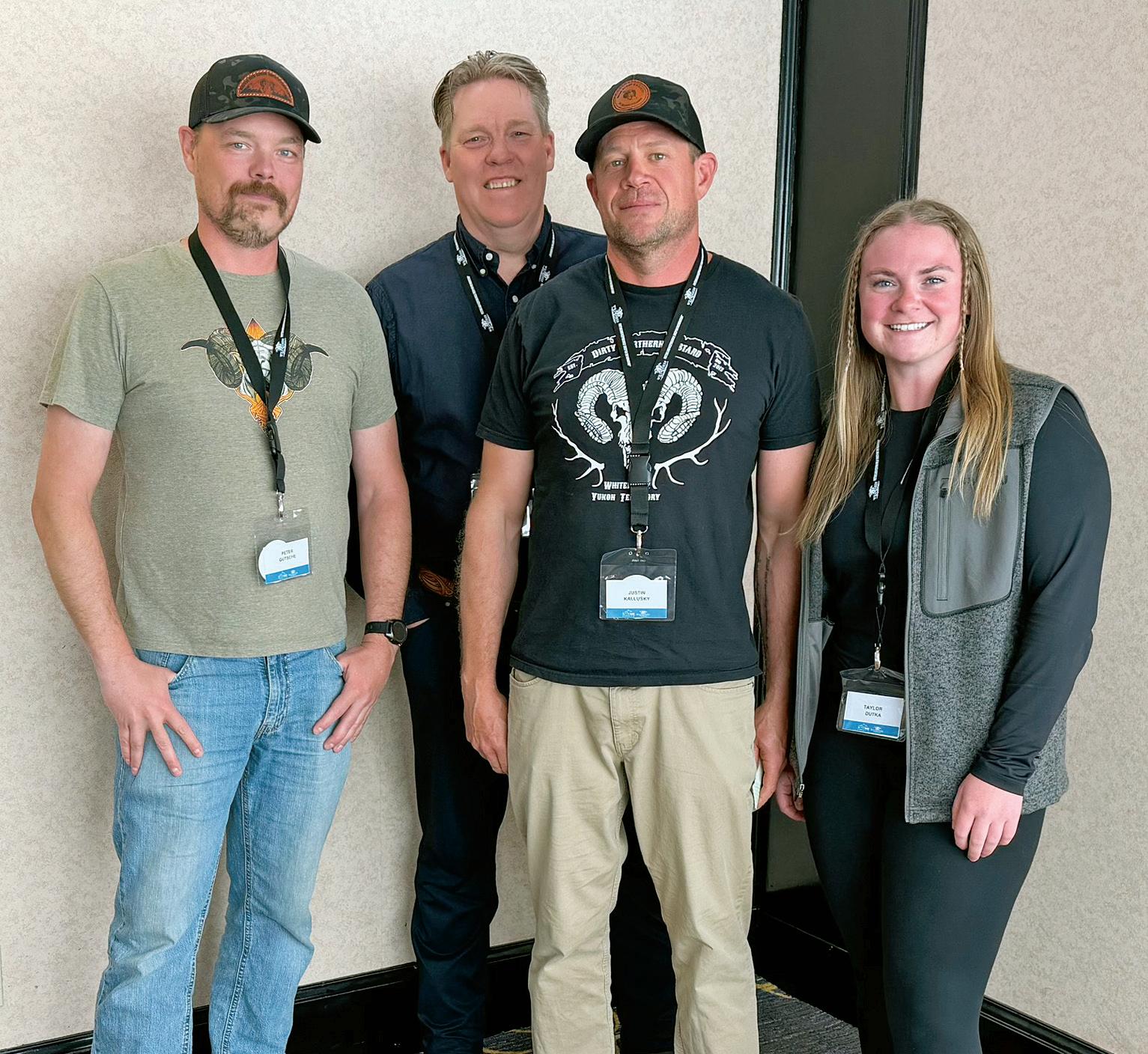
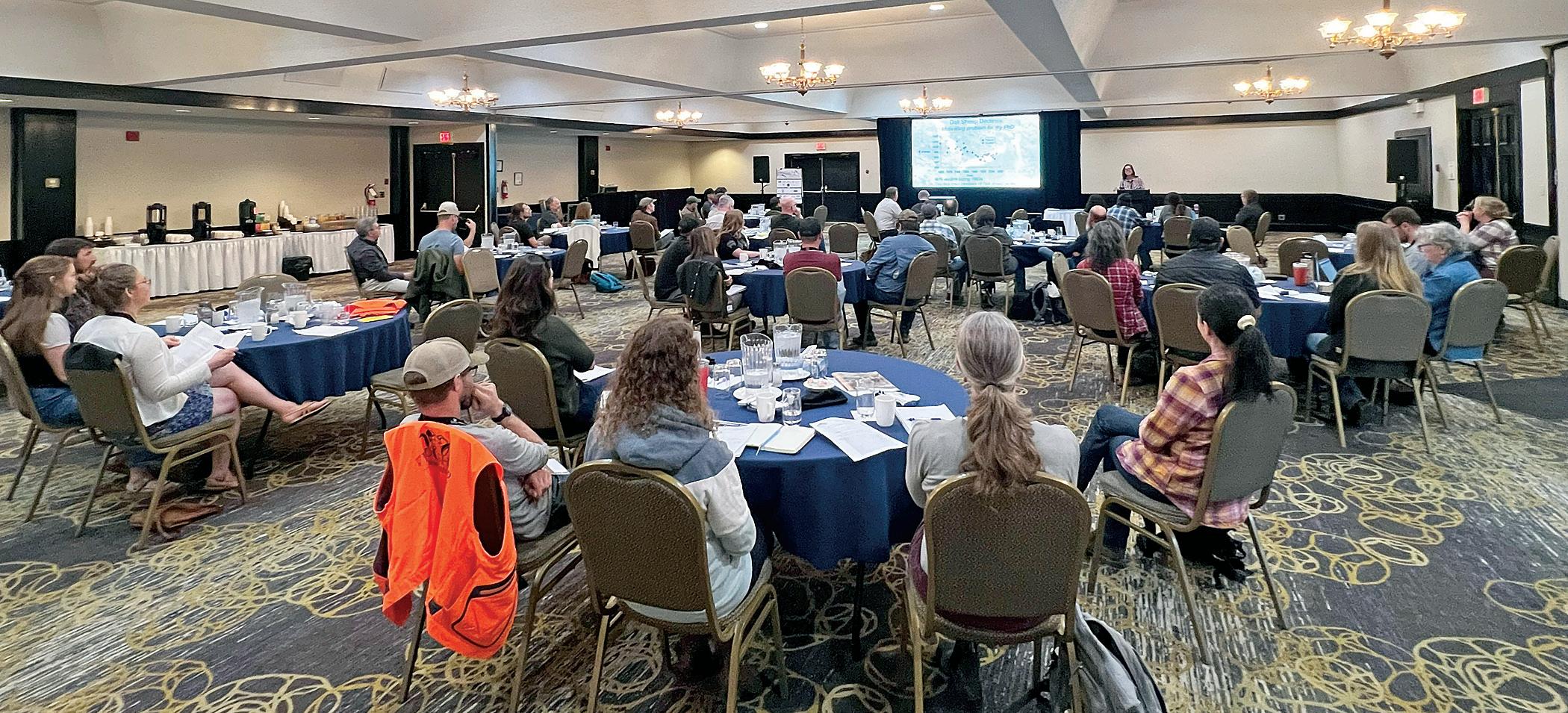
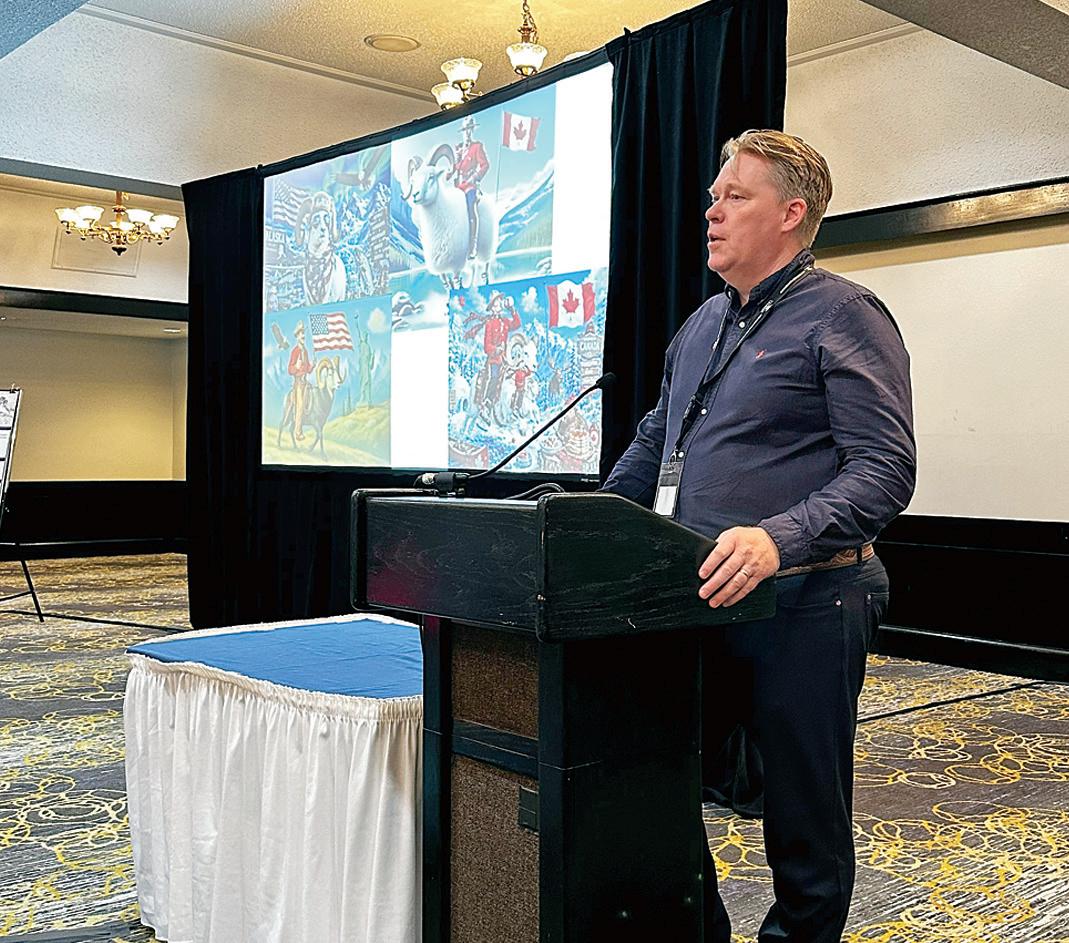
he fourth Thinhorn Sheep Summit, put on by the Wild Sheep Foundation, was held in Prince George in early May. Representing the Wild Sheep Society of British Columbia (WSSBC) were directors Justin Kallusky, Peter Gutsche, and Taylor Dutka who joined wildlife biologists, researchers, conservation organizations, Indigenous communities, and government representatives from British Columbia, Yukon, Alaska, and the Northwest Territories. The event brought together people who were passionate about thinhorn sheep conservation to share research,
by Taylor Dutka (WSSBC Director)
discuss current challenges facing sheep populations, and explore strategies to support these iconic animals and the habitats they rely on. For WSSBC, the summit also offered an important chance to strengthen relationships and bring new ideas and information back to the society and its members.
The summit was an extremely valuable and motivating experience, providing an opportunity to learn directly from experts working on the front lines of thinhorn sheep conservation. Presentations covered a wide range of important topics, including the impacts of climate change,
snowpack and avalanche effects on sheep survival, habitat restoration, wildfire management, disease monitoring, human disturbance, and advancements in wildlife tracking technology. Although many of the presentations focused on scientific research, the overall message throughout the summit was clear: strong partnerships and proactive conservation efforts are critical for the future of thinhorn sheep populations.
One of the most impactful aspects of the summit was its ability to bring representatives from multiple regions together. Despite differences in geography and management
approaches, British Columbia, Yukon, Alaska, and the Northwest Territories all contend with changing environmental conditions, habitat pressures, and increasing human influence on the landscape. The summit created an environment where participants could openly share information, discuss successful management strategies, and learn from one another’s experiences. Bringing together researchers, conservation organizations, governments, and Indigenous communities allowed for meaningful conversations about how to move forward collectively rather than independently.
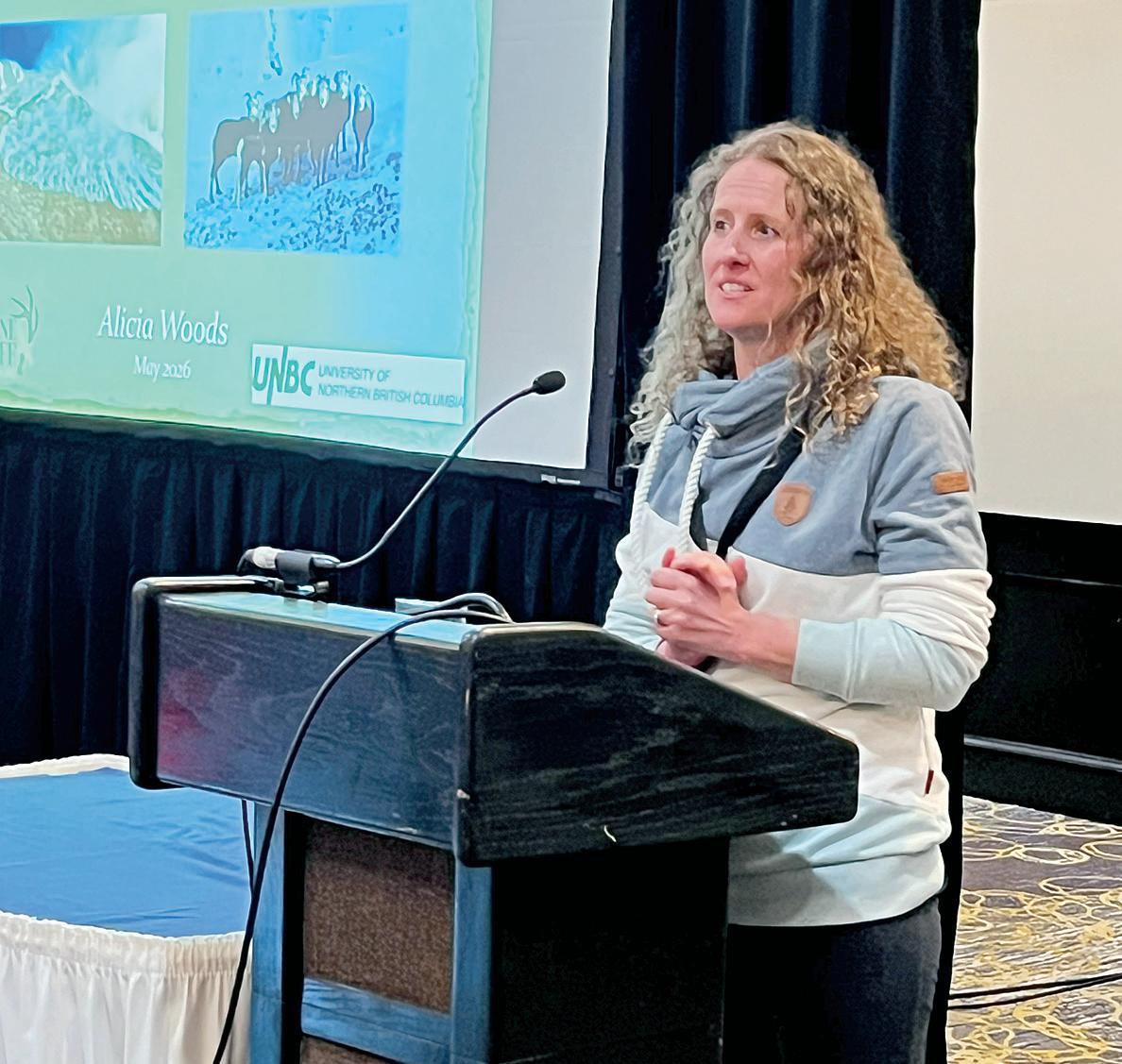
Beyond the presentations and research, the summit highlighted the strong sense of community within the conservation world. Everyone attending shared the same goal of protecting thinhorn sheep populations for future generations, creating an atmosphere of cooperation and mutual support. The enthusiasm and dedication demonstrated throughout the event was inspiring and reinforced the importance of continuing collaborative conservation efforts across northern landscapes. Events such as this help build those connections while advancing the collective
understanding needed to support long-term conservation success. Overall, Thinhorn Sheep Summit IV was both informative and inspiring. It showcased the importance of research, communication, and cooperation in addressing wildlife conservation while highlighting the commitment of those working to protect thinhorn sheep throughout the northern regions. The experience provided practical knowledge, strengthened professional connections, and reinforced the importance of continued collaboration in supporting future conservation initiatives within the Wild Sheep Society of British Columbia.
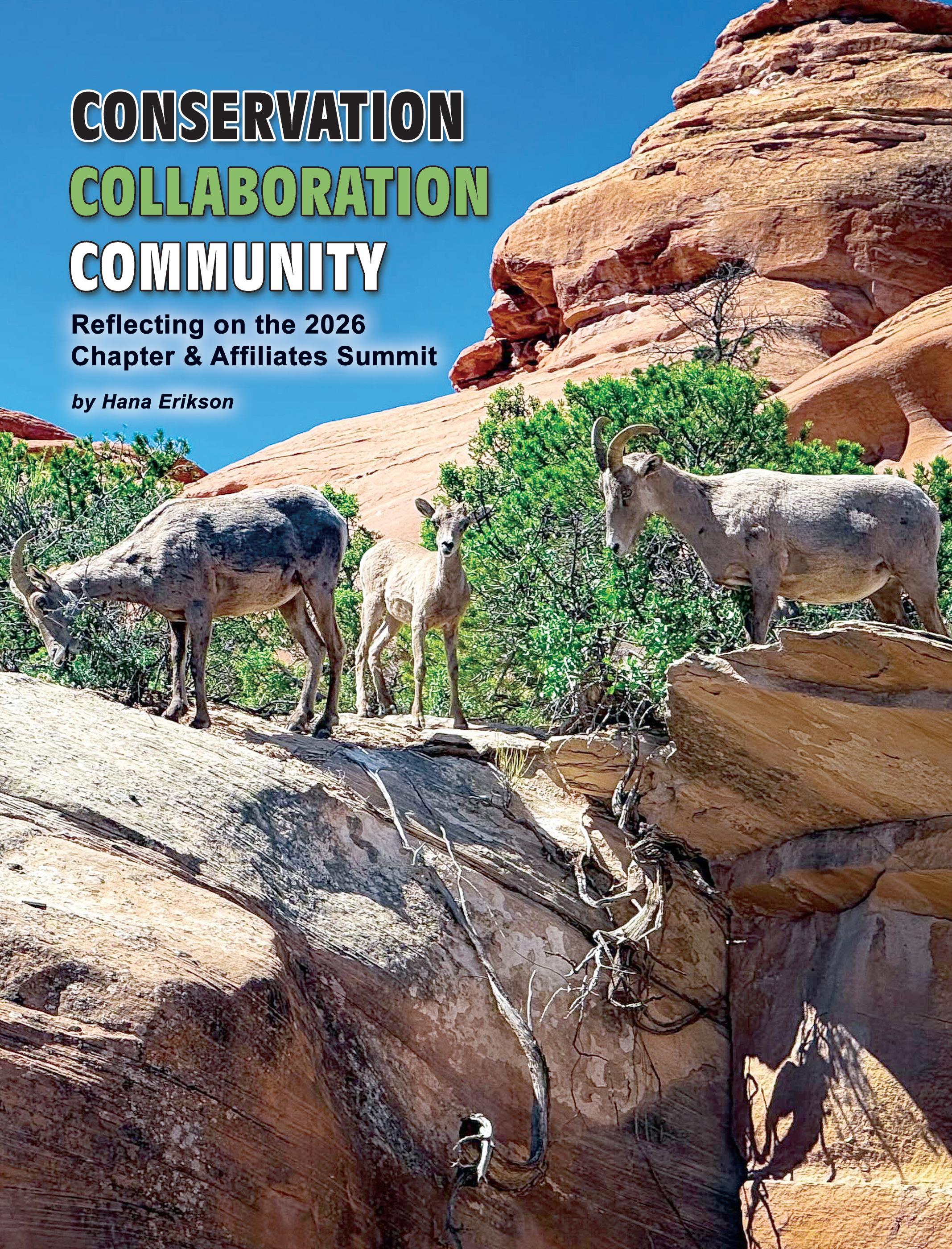
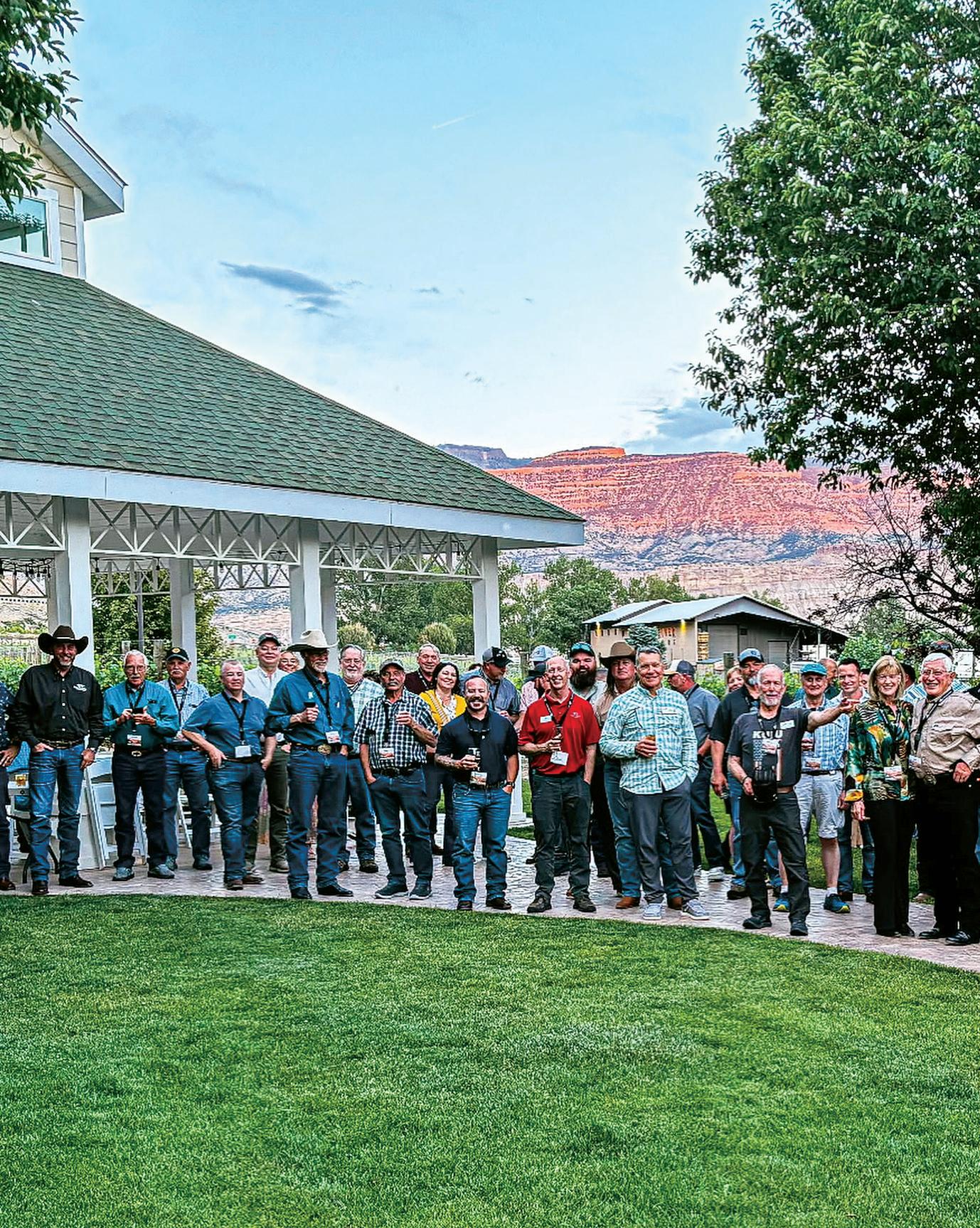
hree words come to mind when reflecting on the 2026 Chapter & Affiliates Summit: conservation, collaboration, and community. Summit XVIII, to be exact. Eighteen gatherings of dedicated conservationists, volunteers, biologists, advocates, and leaders united by a common purpose: ensuring a future for wild sheep. Over nearly two decades, these summits have fostered partnerships, generated innovative ideas, inspired action, and helped accomplish remarkable achievements in wild sheep conservation and management. The information shared, conversations held, and commitments made throughout the weekend were a powerful reminder of what can be achieved when passionate people come together around a common cause.
As I sat near the back of a hotel meeting room in Grand Junction, Colorado, surrounded by men and women from across the United States and Western Canada who have devoted countless hours and, in many cases entire careers, to wildlife conservation, I found myself thinking about the possibilities for our own wild sheep in British Columbia. My mind wandered to projects not yet undertaken, challenges not yet solved, and opportunities still waiting to be seized. Looking around the room, it was impossible not to feel both motivated and inspired. The collective experience, knowledge, and passion represented there created an atmosphere of optimism and determination. It was a reminder that while the challenges facing wild sheep are significant, so too is the commitment of those working to conserve them.
Gathering under the banner of the Wild Sheep Foundation and graciously hosted by the Rocky Mountain Bighorn Society, attendees began the summit by hearing from RMBS Executive Director, Terry Meyers. He shared the history of Colorado’s state animal and the remarkable story of the bighorn sheep within the state. His presentation brought me back to stories from my own childhood
about the great sheep herds that once roamed the landscapes of central British Columbia. In 1859, George Andrew Jackson recorded sightings of approximately 1,000 bighorn sheep along Clear Creek, this journey and the discoveries of Mr. Jackson would also spark the beginning of the Clear Creek Gold Rush. Similarly, I grew up reading accounts of thousands of sheep inhabiting the Churn Creek, Gang Ranch, and Junction regions of British Columbia, sharing the landscape with migratory mule deer herds of unimaginable numbers. Both species have experienced significant declines over time.
Throughout the weekend, one question continually surfaced in my mind: Is that decline irreversible?
As conservationists, we are by nature optimists. We would not dedicate our time, resources, and energy to these efforts if we did not believe that recovery is possible. We would not
gather at events such as this if we did not share a tremendous sense of hope for the future of wild sheep and wildlife in general. Conservation requires a willingness to envision a better future and the determination to work toward it, even when the path forward is difficult. The people in that room embodied that optimism. Their work is driven by the belief that restoration is possible and that collective action can make a meaningful difference.
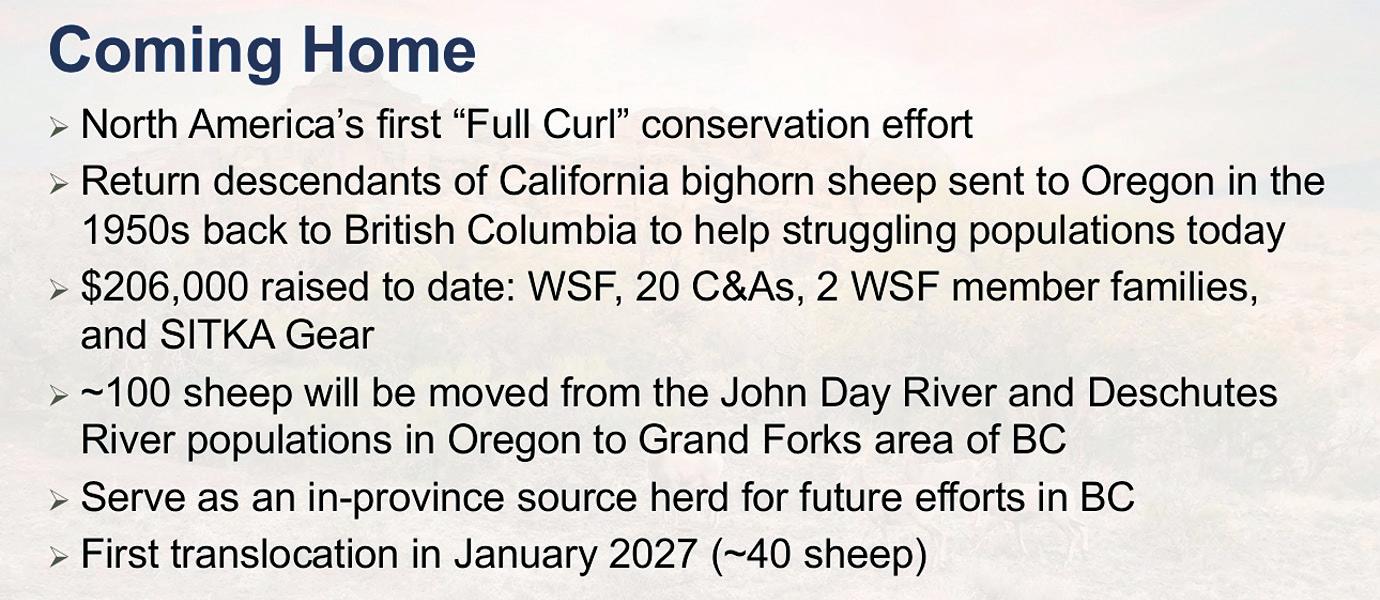
Meetings like the Chapter & Affiliates Summit are where those collective efforts take shape. It is where appeals are made, ideas are exchanged, and chapters unite across borders to fulfill the shared mission of putting and keeping wild sheep on the mountain. The impact of these collaborations is tangible. In 2025, the Wild Sheep Foundation and its Chapters & Affiliates raised more than $180,000 to support the “Coming Home” project, which will facilitate
the translocation of California bighorn sheep to British Columbia.
The story behind that project is particularly meaningful. The sheep involved can trace their lineage back to a 1954 translocation from British Columbia’s historic Junction Herd, undertaken to support struggling populations in central Oregon. That Oregon herd flourished and eventually became a source population for numerous other restoration efforts throughout the state. Decades later, British Columbia is benefiting from the success of that original conservation investment as sheep return home. It is a powerful example of how conservation efforts can transcend generations and geographic boundaries.
This year, attendees once again demonstrated their commitment to collaborative conservation by pledging more than $200,000 toward a cheatgrass management initiative led by the Wyoming Wild Sheep Foundation in partnership with Wyoming Game and Fish. The Wild
Sheep Society of British Columbia proudly contributed $10,000 to the effort. That support is well placed, as cheatgrass continues to impact bighorn sheep habitat in various regions of British Columbia. The research, management techniques, and lessons learned through this initiative will be shared at future summits, benefiting not only Wyoming but every jurisdiction grappling with the challenges posed by this invasive plant. Conservation succeeds when knowledge is shared, and this project is another example of how collaborative investments can produce benefits far beyond a single region.
Wild Sheep Foundation Chief Operating Officer and Executive Vice President of Conservation Corey Mason presented WSF’s vision for the future of wildlife conservation and management. Central to that vision is the concept of resilience; building resilient wild sheep populations and resilient habitats capable of supporting them for generations to come. It is a
vision that resonated deeply with all of us. Achieving that resilience will require a broad range of collaborative efforts, including habitat enhancement, predator management where necessary, invasive species control, translocations, and volunteer-driven monitoring programs. None of these initiatives can succeed in isolation. They require partnerships among provincial and state agencies, private landowners, Indigenous communities, conservation organizations, researchers, volunteers, and countless others. The work ahead is substantial, but so too is the network of people willing to undertake it.
Our own Kyle Stelter, who now also serves as Chair of the Wild Sheep Foundation Board, spoke about strengthening alignment between WSF and its Chapters & Affiliates. He emphasized the importance of building meaningful, long-lasting partnerships capable of advancing conservation objectives and management priorities. He spoke candidly about the scale of the financial commitments required to
achieve ambitious conservation goals and about the strategies necessary to meet those challenges. Equally important, he highlighted the need to expand our conservation footprint by engaging new supporters and sharing the successes of the wild sheep community with a broader audience.
More than ever, we should strive to grow this wild sheep family and introduce others to the extraordinary work being accomplished. The reality is that this community is achieving remarkable results. In many respects, it is setting a standard for excellence in wildlife conservation.
Another highlight of the summit was a presentation by Helen Schwantje, whose contributions to wild sheep conservation continue to have a lasting impact. As Chair of the Professional Resource Advisory Board, she described what she called a “multitalented resource,” highlighting the extensive expertise available within the wild sheep conservation community. From the Spatsizi Plateau in northern British Columbia to the deserts of Mexico, researchers, wildlife managers, veterinarians, and conservation professionals are advancing our understanding of wild sheep and improving management practices across their range. The depth of knowledge and commitment represented within this network is extraordinary.
The needle is always moving, but our true north remains constant. The Chapter & Affiliates Summit brought together representatives from across the wild sheep conservation community, all united by the shared mission of putting and keeping wild sheep on the mountain. The challenges before us can sometimes appear daunting, but the summit served as a reminder that there is tremendous strength in collaboration, community, and a shared commitment to conservation. Together, we continue to build on decades of progress, driven by the belief that future generations deserve the opportunity to experience healthy wild sheep populations and thriving wild landscapes.
by Larisa Murdoch
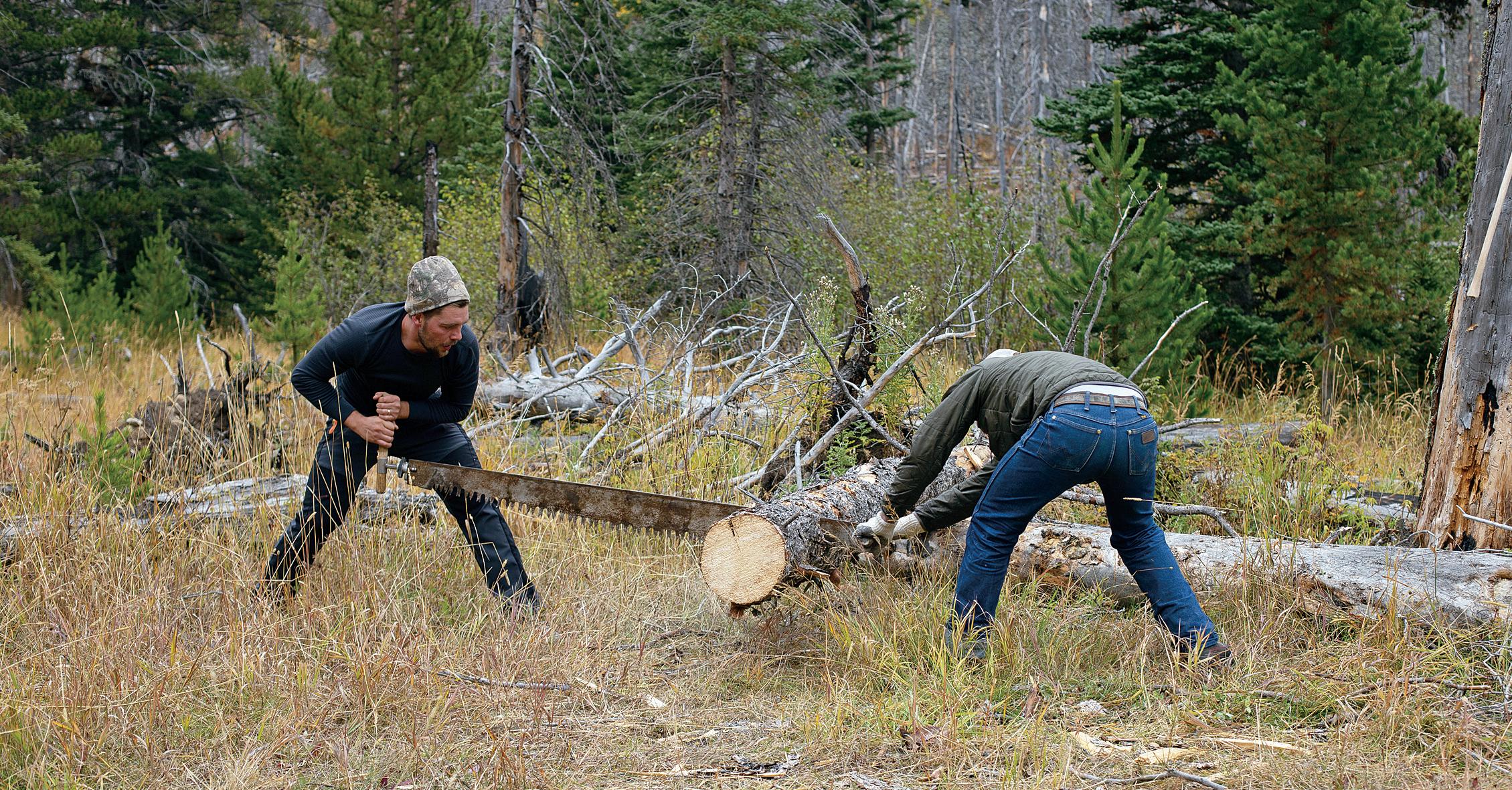
or many people outside the hunting community, conservation and hunting may seem at odds with one another. Yet across North America, hunters have played a foundational role in wildlife conservation. In British Columbia, much of the funding used to restore habitat, monitor wildlife populations, and support conservation programs comes directly from hunters. Every hunting licence purchased, species tags applied for, and limited-entry draw entered contributes to a system that helps sustain wildlife populations and the landscapes they depend on. Modern wildlife conservation in North America was largely shaped in response to severe wildlife declines during the late 1800s and early 1900s. Habitat destruction, unregulated harvest, and human disturbance caused many wildlife populations to plummet, including species such as elk, bison, wild sheep, and many bird species. In response, governments, biologists, and hunters worked together to establish what is now known as the North American Model of Wildlife Conservation; a system based on science-driven management, regulated harvest, and public ownership of wildlife.
A key component of this model is the principle that wildlife users help fund
conservation. In British Columbia, resident hunting licenses include a surcharge that directly supports the Habitat Conservation Trust Foundation (HCTF). These funds are invested into habitat restoration, wildlife research, conservation stewardships with the hunting dollars contributing to tangible conservation outcomes on the landscape. Hunters also contribute through species licences, limited entry hunting applications, and conservation surcharges associated with hunting opportunities. Collectively, these fees generate substantial revenue that provincial wildlife agencies and conservation organizations rely upon. Across North America, the impact of hunter-funded conservation extends even further. In the United States, the Pittman-Robertson Wildlife
Restoration Act places excise taxes on firearms, ammunition, and archery equipment. Since its creation in 1937, this program has generated billions of dollars for wildlife restoration, habitat acquisition, research initiatives, and hunter education. Many of the wildlife populations enjoyed today, including elk, wild turkeys, pronghorn, and bighorn sheep, benefited from conservation efforts supported by these funds.
Hunters contribute far more than financial support alone; for many hunters, conservation extends well beyond purchasing a licence or entering a draw. Across British Columbia, hunters regularly volunteer their time and expertise toward habitat enhancement projects, wildlife surveys, and stewardship initiatives. Organizations like Ducks Unlimited
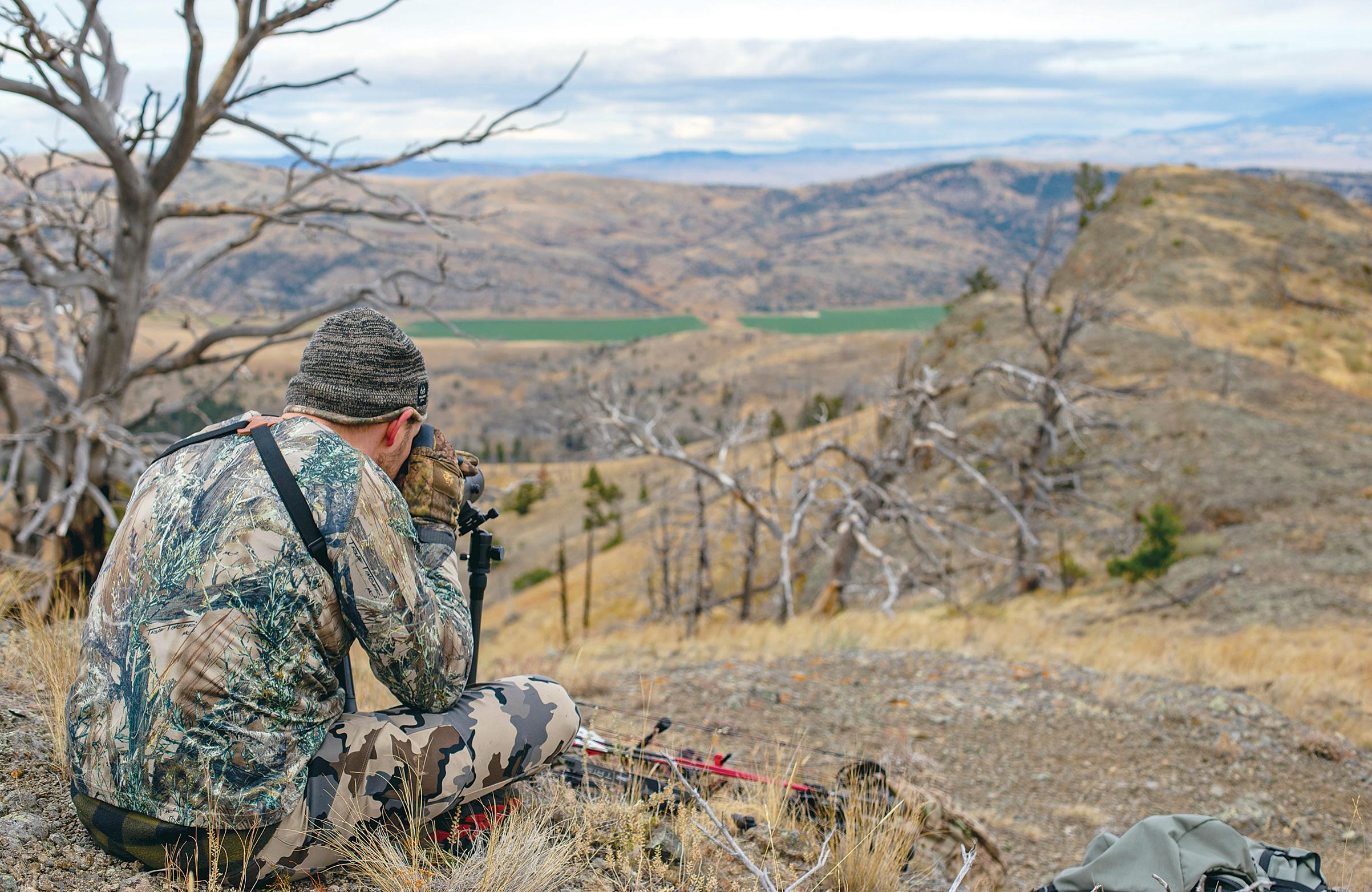
Canada, the Wild Sheep Society of BC, and numerous local fish and game clubs have contributed countless volunteer hours and funding toward prescribed burns, invasive species management, water developments, and habitat restoration projects that directly benefit wildlife species. In many cases, hunters are among the strongest advocates for maintaining healthy ecosystems and sustainable wildlife populations for future generations. These stewardship efforts are particularly important in British Columbia’s grassland and mountain ecosystems, where habitat quality plays a major role in the health of wild sheep populations. Encroachment of forest into open ranges, invasive plant species, habitat fragmentation, and increasing human development continue to place pressure on important sheep habitat. Conservation projects aimed at restoring escape terrain visibility, improving forage quality, and maintaining seasonal ranges benefit not only sheep, but entire ecosystems that support a wide variety of wildlife species.
Modern hunting regulations are also closely tied to science-based wildlife management. Population surveys, harvest data, age classifications, and habitat assessments all help wildlife managers determine sustainable harvest levels. Limited-entry hunts and species-specific quotas are designed to balance recreational opportunity with long-term population health. In species such as wild sheep, mandatory inspections and harvest reporting provide valuable biological information that contributes to ongoing management and conservation planning. This regulated approach differs significantly from the unregulated harvest practices that contributed to wildlife declines over a century ago. Today, hunting seasons, quotas, and licence allocations are adjusted based on population trends and management objectives. In many cases, hunting opportunities are reduced or eliminated entirely when conservation concerns arise, reinforcing the role of hunting as a carefully managed
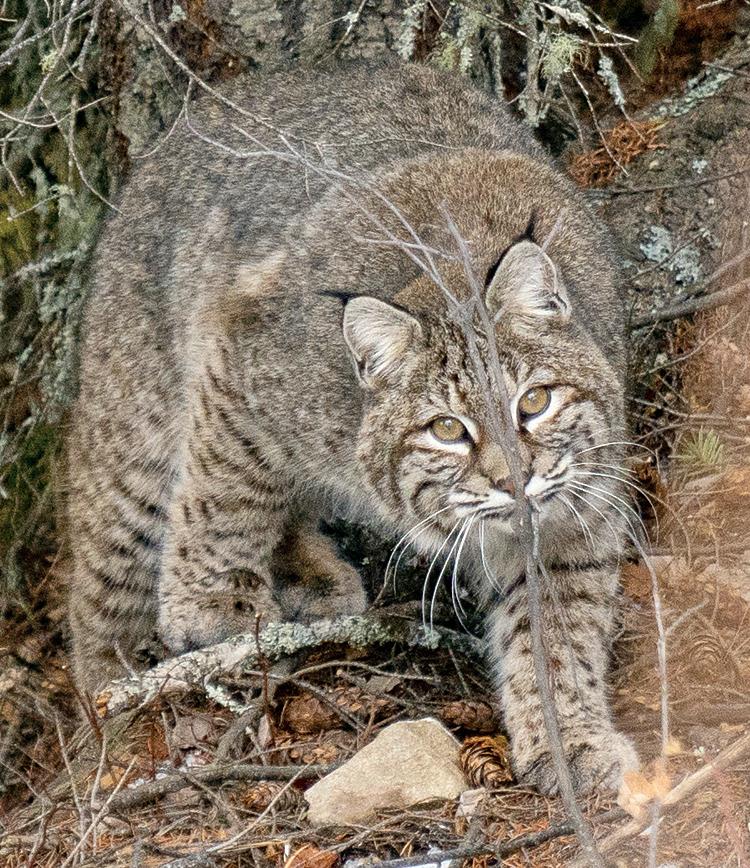
conservation tool rather than unrestricted harvest. Importantly, the benefits of hunter-funded conservation extend far beyond hunters themselves. Healthy wildlife populations, protected habitat, and functioning ecosystems benefit birdwatchers, hikers, Indigenous communities, and the public. Wetlands restored for waterfowl also improve water quality and provide habitat for many other species. Grasslands managed for ungulates support biodiversity across entire ecosystems.
Conservation today also relies on collaboration between many different groups and communities. Government agencies, Indigenous Nations, researchers, conservation organizations, landowners, and volunteers all contribute to the long-term stewardship of wildlife and habitat. Increasingly, successful
conservation initiatives are built on partnerships that combine scientific research, local knowledge, and community involvement to address complex environmental challenges. Hunters also contribute significantly to rural economies throughout British Columbia. Hunting seasons support guide outfitters, hotels, restaurants, outdoor retailers and other local businesses. This economic activity helps support jobs, tourism, and local investment in regions where wildlife and outdoor recreation are deeply connected to community identity and livelihoods.
As conservation challenges continue to grow, including habitat fragmentation, invasive species, climate change, disease transmission, and increasing human development, sustainable funding for wildlife management remains critical. While conservation today involves a broad coalition of partners and stakeholders, hunters continue to play an important role in supporting the future of wildlife and wild places.
References
1. Hunting licences - Province of British Columbia
2. Home - Habitat Conservation Trust Foundation
3. U.S. Fish and Wildlife Service
4. American System of Conservation Funding: Association of Fish & Wildlife Agencies
5. Conserving Canada’s Wetlands – Ducks Unlimited Canada
Larisa Murdoch grew up in Ottawa, Ontario before moving west to complete her Bachelor of Science at the University of Victoria. She completed an undergraduate project studying the denning behaviour of African Wild Dogs in Zululand, South Africa, which sparked her interest in research. She is currently a student at Thompsons River University in Kamloops working on her Master of Environmental Science, where she is partnered with WSSBC, the Ministry of Water Land and Resource Stewardship, Tk’emlups, and Skeetchestn’ Indian Band investigating bighorn habitat selection with lambs. When Larisa is not focused on her thesis, she enjoys outside exploring new places, snowboarding, reading, and volunteering with the WSSBC!
by Alicia Woods
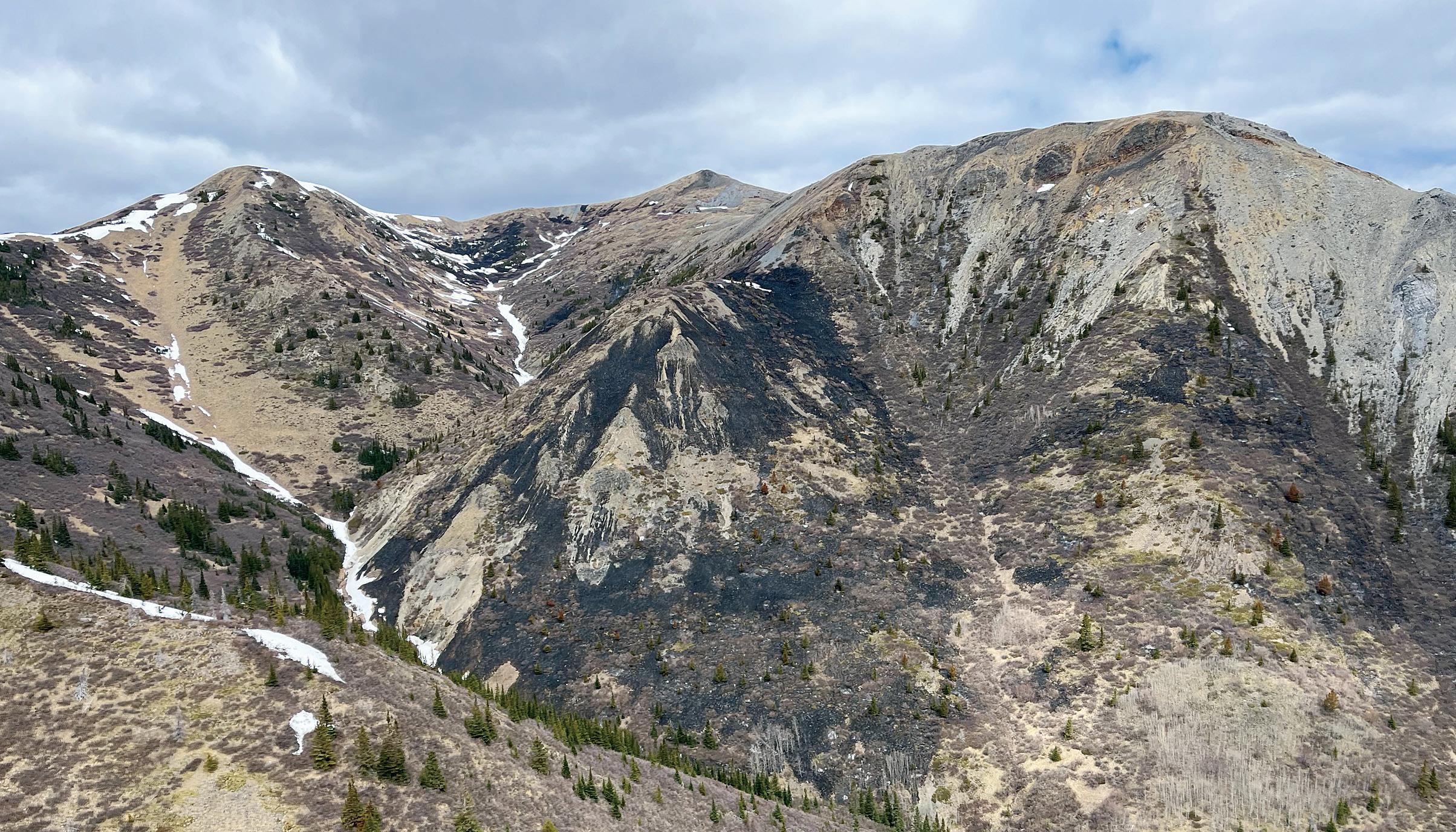
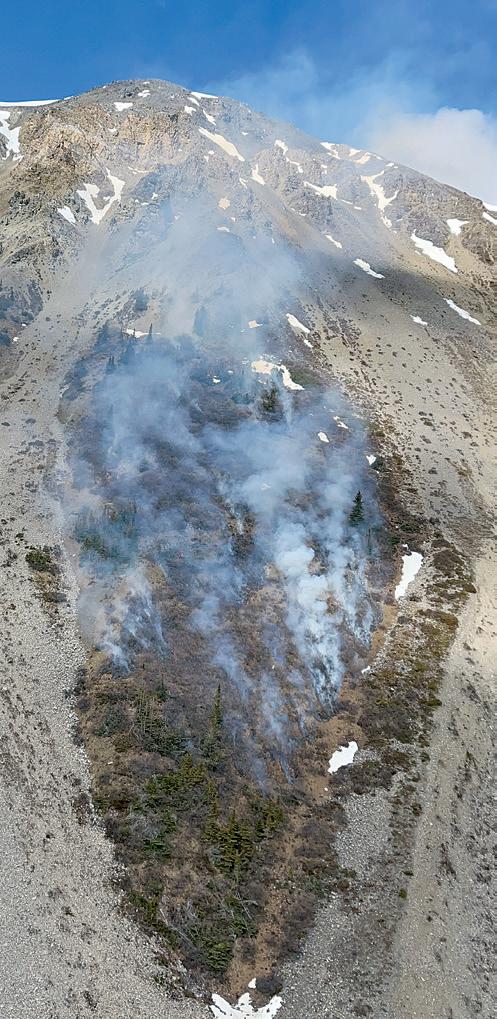
retired biologist once told me that when conducting prescribed burns for Stone’s sheep, “It doesn’t take a lot to make a sheep happy. What matters is where you burn.” In May 2026, the Wild Sheep Society of BC, in partnership with Ridgeline Wildlife Enhancement, took this knowledge and a conducted three prescribed burns in northeastern British Columbia. This year’s burns were small but mighty. Small ridges and grassy patches surrounded by and adjacent to features that provide escape terrain were burned to improve the quantity and quality of forage. Post-burn vegetation growth is more digestible and nutritious, and removal of dense shrubs increases the amount of forage available to sheep. Because of where this year’s burns are located, these sites will have as significant of an impact to Stone’s sheep that burns twice their size do.
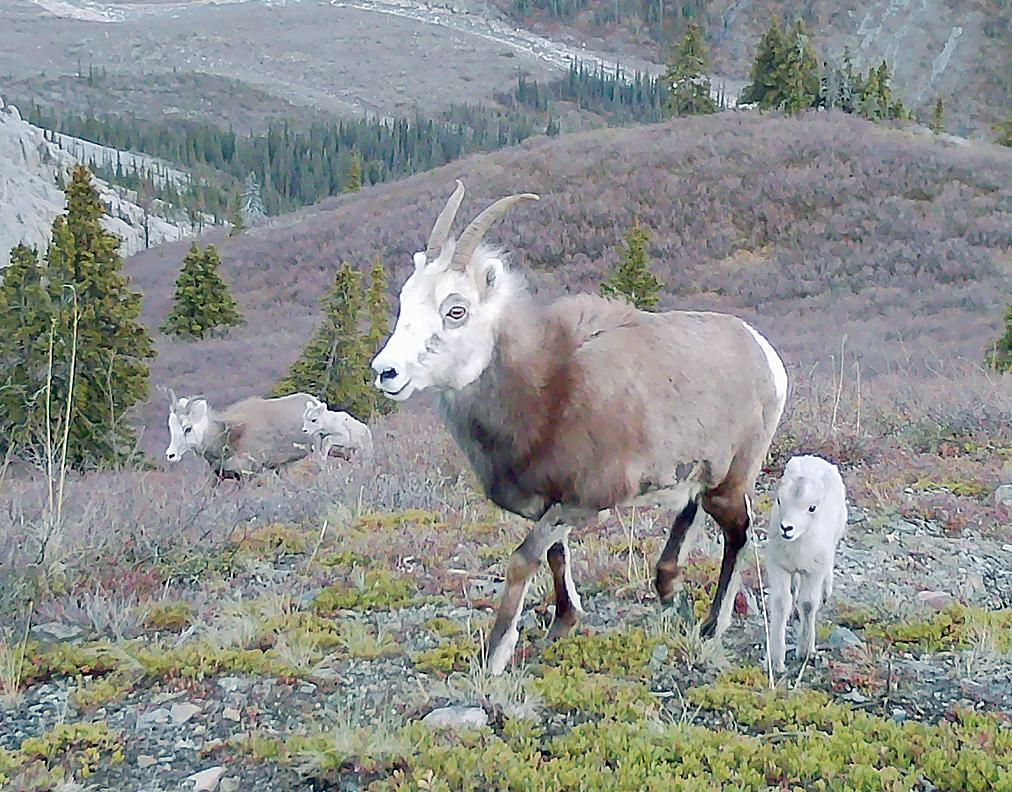
As part of the prescribed burn project, we have continued to monitor the pre- and post-burn use of the burn sites by Stone’s sheep and other wildlife before and after the burn is completed. Using trail and timelapse cameras, we have observed increases in use of sites after treatment with fire. Sheep move into the blackened area to forage on the new growth, and this increased use continues throughout the year. This past winter, we saw a four-fold increase in the number of sheep wintering on a site that was burned just 10-months earlier. Stone’s sheep are not the only species to benefit and
enjoy new burns—we have observed an increase in the occurrence of mountain goats on new burns.
Prescribed burns continue to be an effective, tangible, and on-the-ground management tool to restore, improve, and enhance Stone’s sheep habitat. The sites burned this year will add to the habitat work we have completed in northeastern BC since 2022. Slowly but surely, we are making a real difference for Stone’s sheep. This work would not be possible without the generous support of our partners including the Dallas Safari Club, Mountain Wildlife Conservation Society, Grand Slam Club Ovis – Canada, the Habitat Conservation Trust Foundation, the Forest Enhancement Society of BC, Wild Sheep Foundation, Washington Wild Sheep Foundation and the Wild Sheep Society of BC.
A Cape Buffalo Hunt in Niassa
Three days, twenty-four miles, and the pursuit of an old warrior duggaboy.
by Sue Tidwell
oliage towered over us as we meticulously snaked our way through the dense bush of Mozambique’s Niassa Game Reserve. We moved slowly, each step deliberate. Every rustle of grass or crackle of dry leaves felt amplified in the stillness. Big Foot— the nickname we’d given to the old bull we were pursuing—was close. Very close.
Our steady walk had morphed into a halting, snail-paced crawl. Each foot searched for a bare patch of soil to avoid the snap of dried foliage. Eyes scanned for a flicker of movement; ears strained for any betraying sound. Then a sudden stop. Armindo, our head tracker, lifted a hand to his ear and pointed toward the dried riverbed. For seconds—that felt like minutes— everyone froze, listening. But it wasn’t Big Foot we’d caught up with. It was elephants. Several of them.
As if following a Cape buffalo—one of Africa’s most dangerous game animals—wasn’t unsettling enough, now we were threading our way among elephants too. Peter Capstick summed it up best: “If you are not afraid of elephants, then you’ve either had no experience with them or you’re not especially bright.”
Rich Kok, our professional hunter from Mashambanzou Safaris, conferred with Armindo before deciding we should try to skirt around the herd and regain the buffalo’s tracks. Changing direction, we wove through more dense brush as if playing a high-stakes game of follow-the-leader. But our new route only led us to more elephants— some with calves. Again, we changed direction. Again, we encountered elephants. Somehow we had drifted into a pocket of thick brush and woodland forest dotted with elephant families. As Africans would say, it was time to make a plan. With dusk settling in, visibility worsening, and cows with calves scattered throughout the forest, Rich called it. Continuing would be dangerous—not just for us, but for the
elephants too. If a protective mother charged, he would have to put her down.
Truth is, although we were surrounded, I never saw so much as a flick of an ear. Elephants may be mega-sized, but they blend seamlessly into the landscape and move with surprising silence. Whoever coined the phrase “you sound like a herd of elephants” has clearly never been around elephants. Still, if Rich and the trackers said they were there, you could bet your bottom dollar they were. While the decision disappointed my husband Rick (not to be confused with Rich our PH), I was as happy as a warthog rolling in the mud. Rick is the hunter. Not me. I just love being in the bush with boots on the ground— experiencing nature on her terms. But I do have my limits, and wandering among invisible elephants at dusk is definitely one of them.
Before calling it quits, we’d spent hours following Big Foot’s tracks as he meandered in and out of the riverbed, through long grasses, and into patches of scrub. Armindo was
always in the lead, followed by the assistant tracker Sabado, then Rich, then my husband Rick, then me—with Helio bringing up the rear, watching the back trail—and keeping a discreet eye on the sidekick who loved the bush but hadn’t quite mastered her nerves.
Miraculously, it only took thirty minutes to get back to the Land Cruiser. My phone said we had covered over six miles, yet the old duggaboy’s meandering route left us only a mile from where we’d begun.
The next morning brought a decision: return to the same riverbed—a two-hour, bone-jarring ride over pocked, rutted tracks each way—and hope for fresh spoor. It was a gamble. Rich had seen these tracks for four years but had never laid eyes on the bull. Still, his gut told him this buffalo was something special. And that is exactly the kind of bull Rick wanted—not a record-book beauty, but an old warrior who had survived the ravages of the wild.
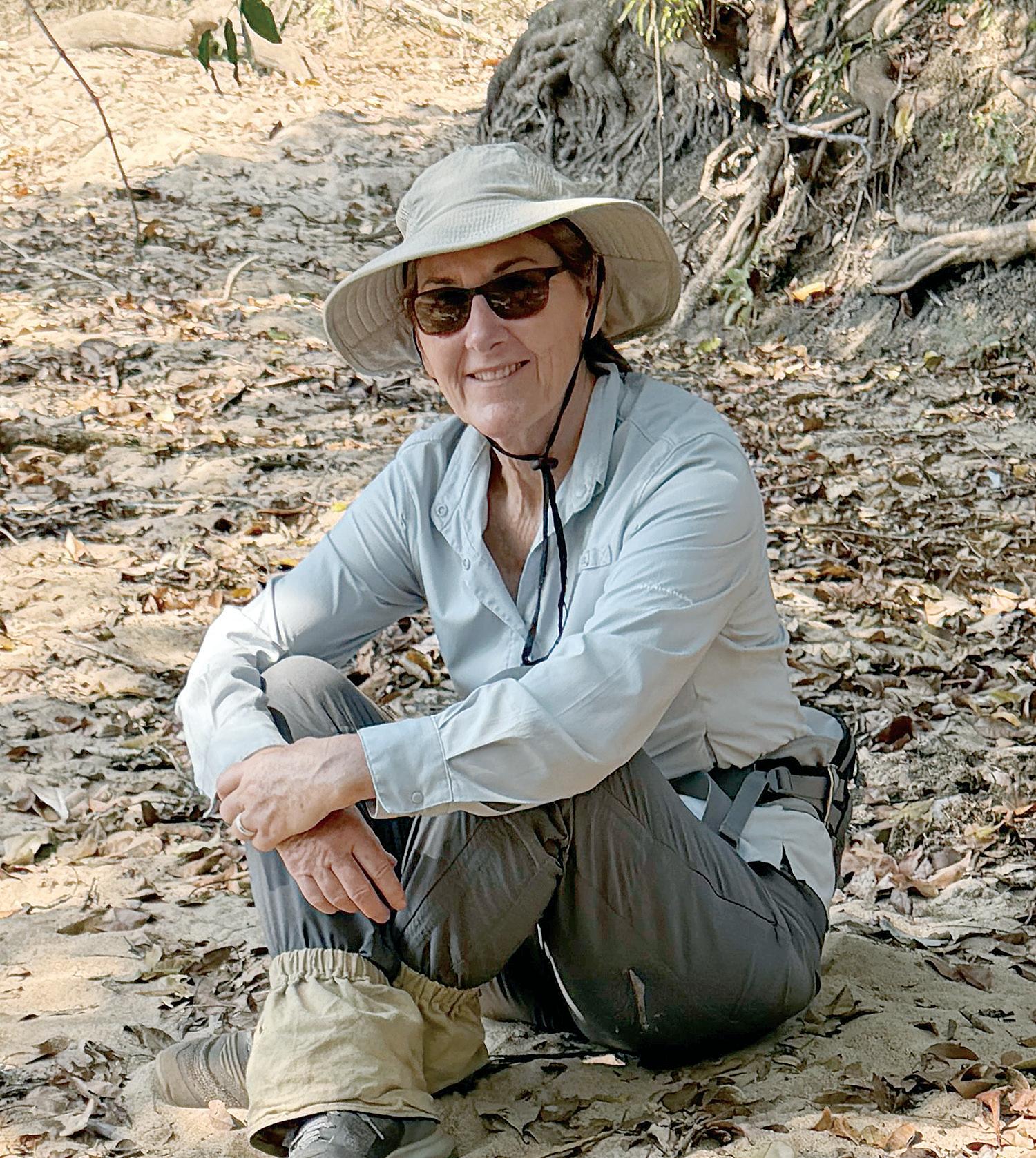
The author, resting in a riverbed while trackers explored a tributary.
So, with the decision made, Rick settled up front with Rich—the two of them able to talk rifle calibres and ballistics for hours, a level of detail guaranteed to put me to sleep. I preferred the back with the trackers, where the wind hit my face and wide-open views—and the occasional glimpse of a kudu slipping into the brush—made every jolt worth it. I braced my legs against the cab and hung onto my teeth as Rich barreled us toward Big Foot’s tracks once again. Upon arrival, all three trackers spread out in search of anything fresher than the day-old prints. But only the old tracks remained. Still, no one was ready to give up on Big Foot. Rich’s next strategy was to walk the dried riverbed and two small tributaries searching for any remaining pools of water. Big Foot had to drink at least once a day.
For hours we trudged through ribbons of sand, inspecting every puddle for telltale signs. Each waterhole told the story of visitors who had come to drink—but Big Foot was not among them. Back to square one. With that plan exhausted, we returned to the day-old tracks, and all three
trackers set off again. Down into the riverbed. Up through tall grass. Down into sand. Up into thick browse. Through a thicket where he’d napped. Back to the riverbed. You get the picture. But Big Foot didn’t simply meander. He looped over his own tracks, doubling back, turning the dirt into a jigsaw puzzle. Several times the trackers lost the trail and had to fan out to pick it up again.
After nearly nine hours, dusk forced us to concede. Big Foot had won another day. But we’d learned something: these tracks were calm. Unhurried. He wasn’t spooked. He had no idea we were on his trail. And by now, Rich and Rick were invested. They wanted to see the bull who belonged to the footprints. And they are stubborn.
We returned to the riverbed with yet another strategy—Rich enlisted the help of Luku, yet another tracker. Four in all. Rich dropped two several miles downriver to work their way up while we started at the original point and walked down. As Murphy’s Law would have it, once the team was split up
and two trackers were miles downriver, Armindo found spoor less than five hours old. Exactly what we needed. For a while, the signs read clearly in the dirt. Then they became a muddled script—overlapping prints and broken blades of grass pointing in every direction, forcing the trackers to stop and rethink the story in front of them. Then the revelation: There weren’t one, but two Cape buffalo bulls. Both with enormous, nearly identical tracks. Big Foot 1 and Big Foot 2! Fortunately, the dirt told us they were at ease—moseying along and grazing. Experience suggested they would soon seek water or a napping spot.
Wanting everyone together, Rich sent the trackers to retrieve the other two. Within thirty minutes, we had a full team and the hunt began in earnest. For the next three hours, we traversed dried riverbeds, miombo woodlands, and riverine forests. We squeezed through dense thickets and shouldered our way through stands of tall grass— the kind of grass where your visibility is measured in inches and where anything, from a sleeping buffalo to a lion, could be lying just feet away. Any open patch allowed a bit more
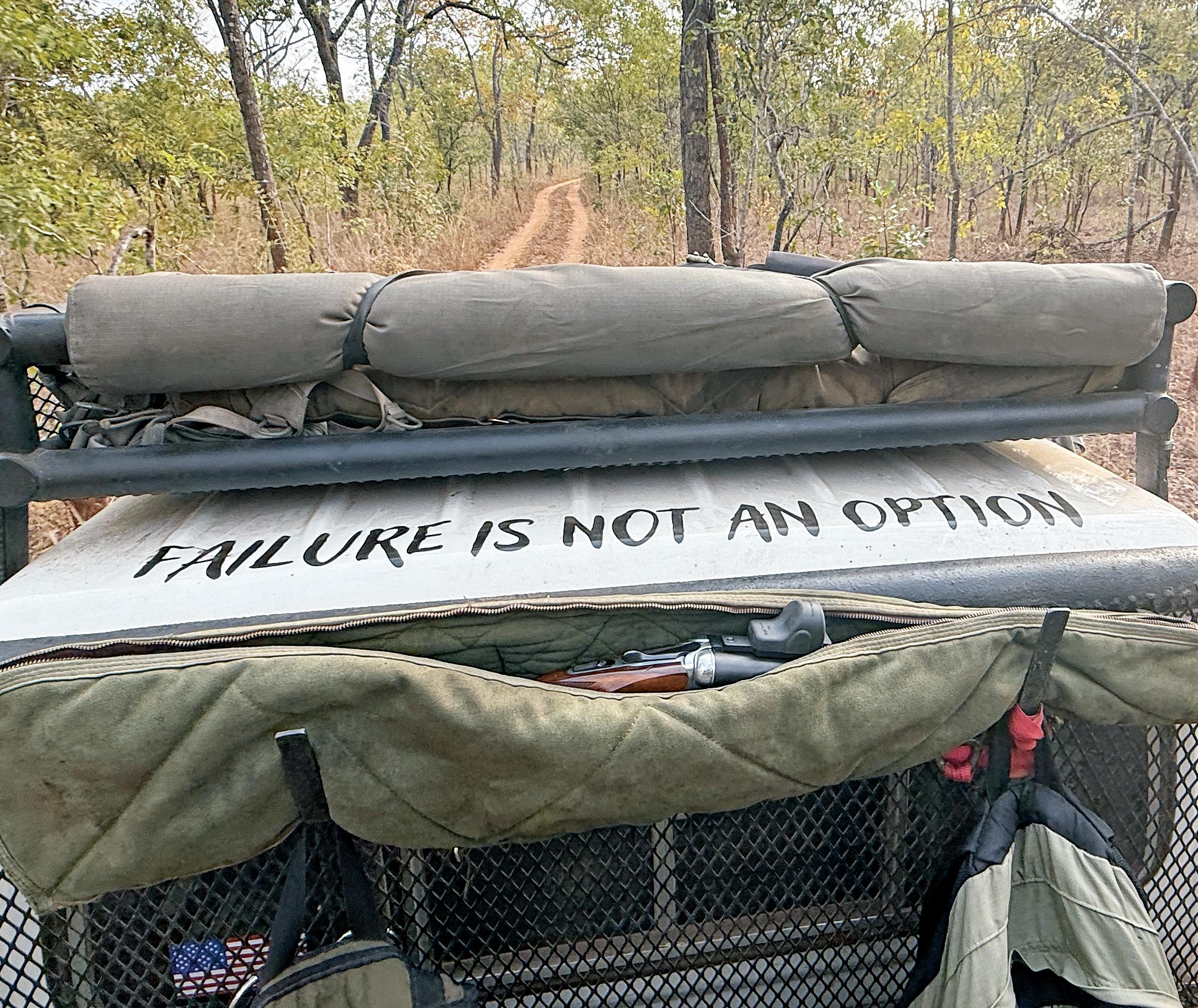
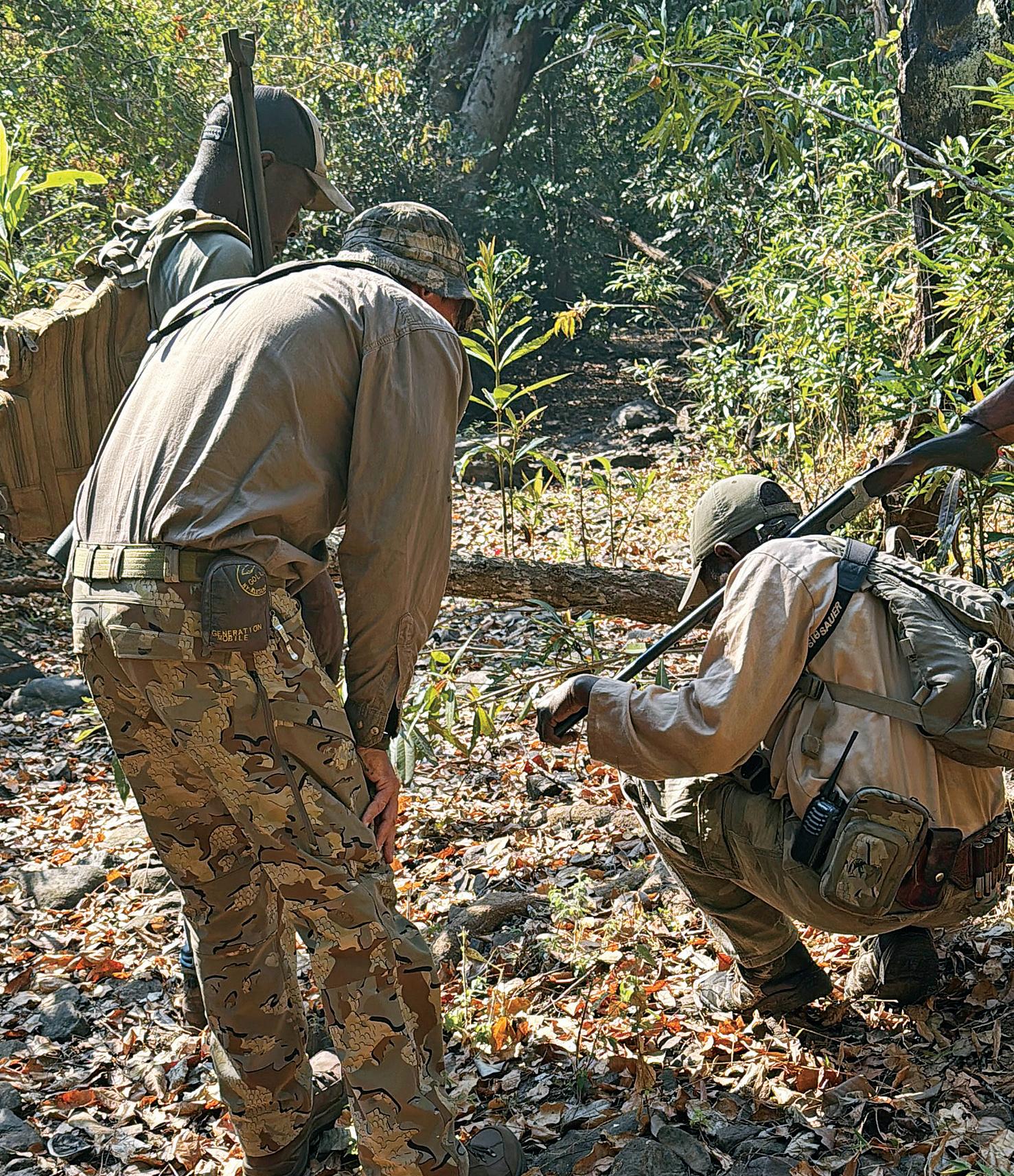
Finding Big Foot’s tracks on Day 2.
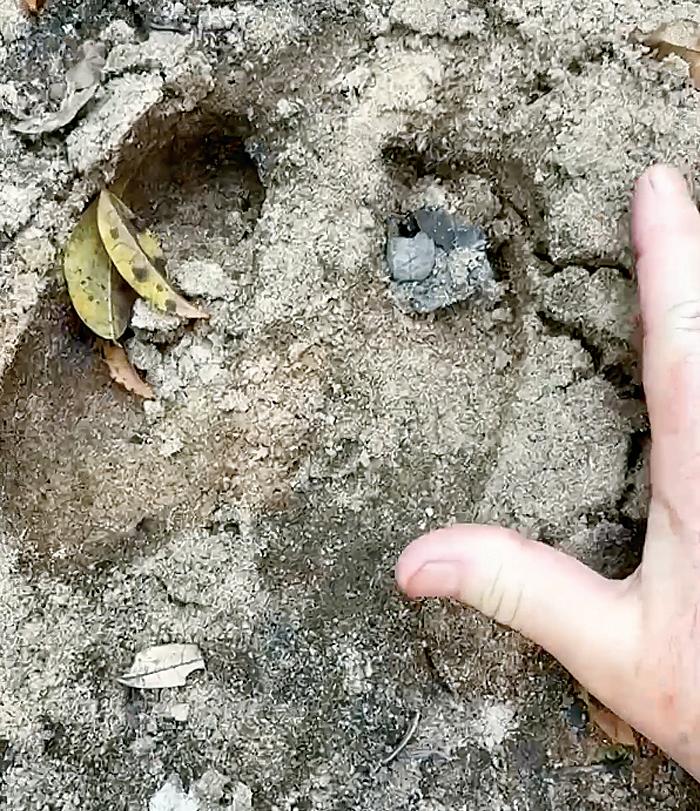
One of Big Foot’s old tracks.
speed, but the moment the vegetation thickened, we reverted to a silent, deliberate creep. More than once the tracks vanished into cracked droughthardened soil. The trackers spread out and eventually found them again.
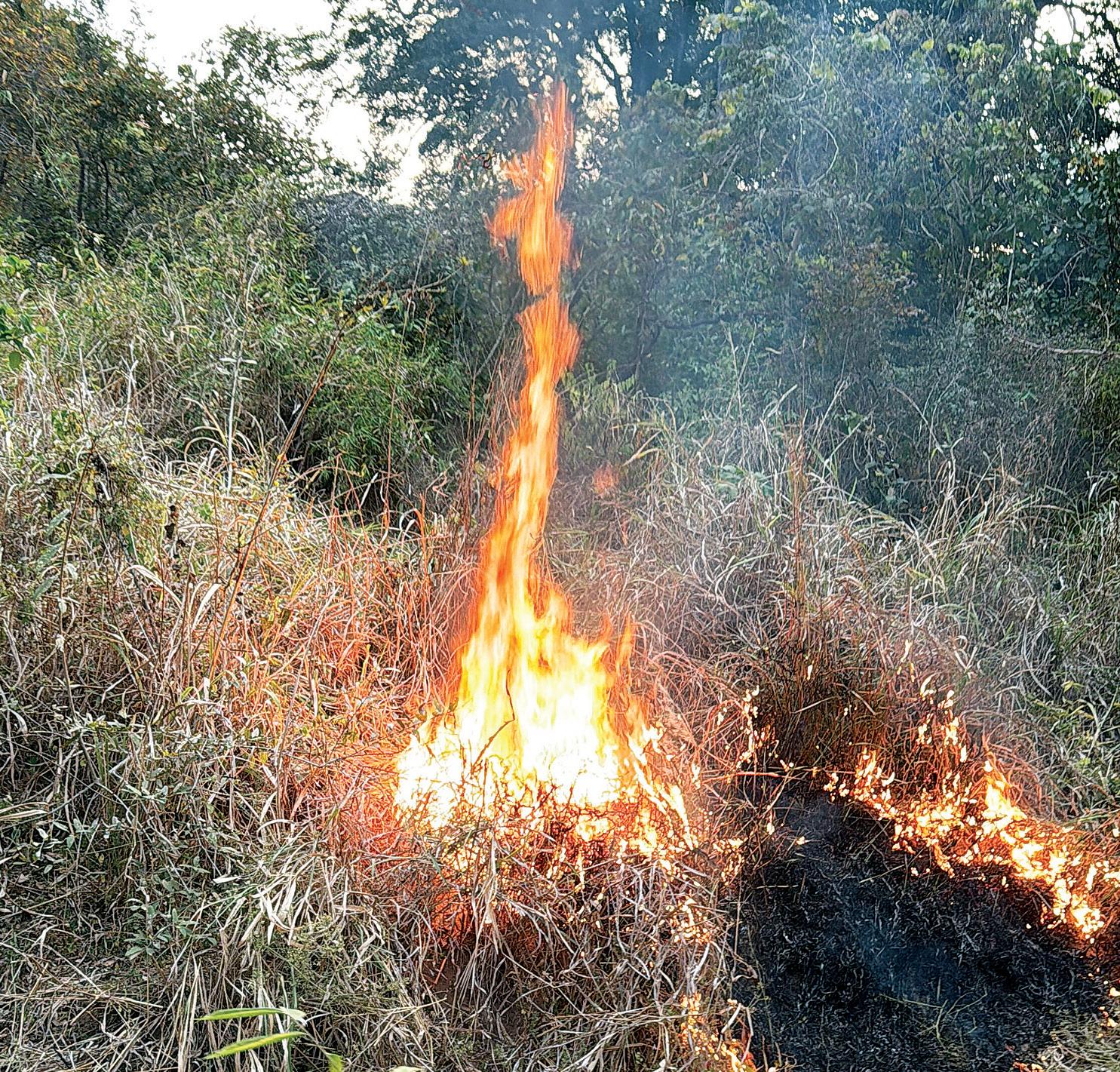
Helio brought up the rear—and with him came the fires. Yes. Fires. From time to time, he’d flick a lit match into a patch of brittle grass, and within seconds a soft crackle would trail behind us. In Africa, that’s normal. Burning is woven into the heartbeat of the bush. Done in the right season, fire clears old grass so new growth can push through—and in our case, the hiss of flame and smoke acted like a curtain, disguising the noise and sight of our seven-person pursuit. The first time I saw him do it, my Idaho instincts nearly short-circuited. Rick and I exchanged identical wide-eyed looks. In Idaho, deliberately starting a fire in dry vegetation is… insane. But this was Africa, where controlled burning is simply part of life.
The fires may have hidden us, but they did nothing for my nerves. I scanned for flames creeping too close, for buffalo ahead, for elephants behind— all while trying to stay silent and instinctively searching for an escape route in case the fire outran us. Flames would whisper along the ground, then hit a patch of tall grass and explode into a mini-inferno before fading again at a bare spot of dirt. My head felt like it was on a swizzle stick.
Suddenly, Armindo dropped to the ground, signaling us down. The bulls were 100 yards away in a small grove of trees. The younger one stood; the older—the one Rick wanted—was lying nearby. From my position, crouched low in the grass, I could see nothing. We began a painstaking bellycrawl to a large tree about thirty yards ahead. Using it for cover, Rick slowly stood and rested his .470 Nitro Express on the shooting sticks.
Then we waited… and waited… and waited...
Huddled in the grass only yards from Rick, I fought my own battle. The sun beat down without mercy. Mopane flies swarmed my face, burrowing into eyes, nose, ears—but I didn’t dare flinch. My legs had fallen asleep in the awkward position, and I kept imagining that if I had to run, they wouldn’t respond.
For 45 excruciating minutes, I stayed motionless as Rick waited for a clear shot. And then — a shift in the wind. Rich and Rick slowly stood and looked back at us with resignation. Our scent had betrayed us. Like a fart in a skillet, the bulls were gone.
Rich gave them time to settle before we continued. After a short break, we were back on the trail. Another lit match. Another stretch of silent walking.
Thirty minutes later, the bulls were spotted again. We dropped. Crawled thirty yards. Stopped. There was little cover ahead. Rich motioned for most of us to stay put while he, Rick, and Armindo crawled twenty more yards
to another tree, positioning Rick at sixty yards.
Rick was just settling onto the sticks when the bulls sensed something. The old bull started to turn.
Rick fired. Then fired again. Both bullets connected—but the bull didn’t go down. Those of us lying in the grass scrambled to our feet and ran toward Rick as he reloaded. Then, cautiously, we followed the blood trail, Rick and Rich in the lead, rifles ready.
The injured bull peeled away from his companion and angled downhill into a dense patch of trees. We slowed, scanning for both the wounded bull and his partner, making sure neither circled back for a counterattack. Cape buffalo are notorious for counterattacks, whether wounded or not.
Moments later came a deep thud and the unmistakable crash of branches. He had fallen into a creek bed beneath the cluster of trees, collapsing as he tried to climb the far bank. Still, the warrior resisted death. From our side of the creek bed at 40 yards, Rick put two more bullets in the bull. Still the bull refused to die. He fired again. And
One of the mini-inferno flare ups behind us.
again. Only then did the bush fall silent. If you didn’t know better, you’d think Rick was a terrible shot. But Cape buffalo don’t die politely. Even solid, vital hits won’t drop an old duggaboy quickly—they’re built for battle, tanks fueled by adrenaline, willpower, and pure stubbornness. Some bulls use every last ounce of fight before they finally fall. We crossed the ravine below him so we could approach from above, along the edge of the dry creek bed. Experience has taught hunters to assume nothing with Cape buffalo. There’s an old saying in Africa: “It’s the dead ones that will kill you.” So for good measure, Rich had Rick take one final insurance shot.
Slowly, warily, we approached the magnificent animal we had nicknamed Big Foot.
Tears slid down my face. Rick—the very man who took this bull’s life— was also overcome, eyes glistening with emotion. Tears are peculiar. They convey a whole host of emotions. There were, of course, tears of joy…
but the tears entailed other things as well: remorse, regret, sorrow, thankfulness, awe, excitement, relief, wonder, loss—even disappointment that the hunt was over.
While these conflicting sentiments accompany any successful hunt, there was a whole other dimension to our
emotions this time. We had pursued this particular old bull through thick bush and sandy riverbeds… while battling mopane flies and sweltering heat… for three twelve-hour days… covering over twenty-four miles. In other words, we felt connected to him. It was personal. And he was everything we hoped he’d be—a magnificent, battle-worn duggaboy. The boss of his massive horns was worn smooth from years of wear, one horn broken off from a previous battle. His ears mangled from years of brutal fights and countless clashes in the thick thorn bush. His hide carried only a thin, weather-worn coat of hair stretched over a tapestry of scars—the unmistakable badges of an old bull who’d lived hard. His molars were worn down to the gum. Had he lived, his enormous frame would soon have declined. Starvation… or a brutal end at the jaws of lions… would have been his fate.
The effort…. the sweat… the danger—it had all been worth it. Big Foot was a true old warrior—and our respect for him was as immense as the life he had lived.
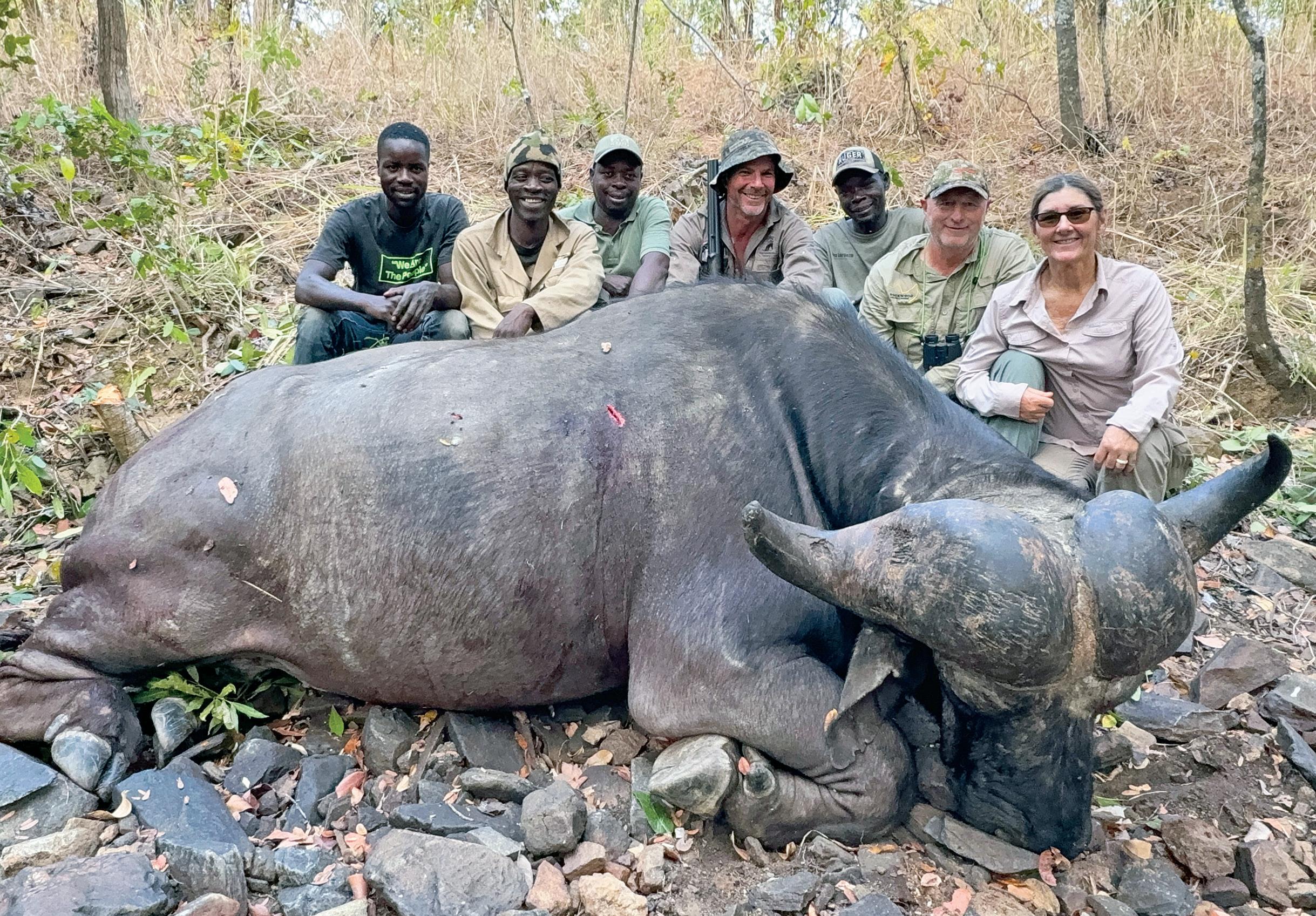
Big Foot with the entire team, including the author.
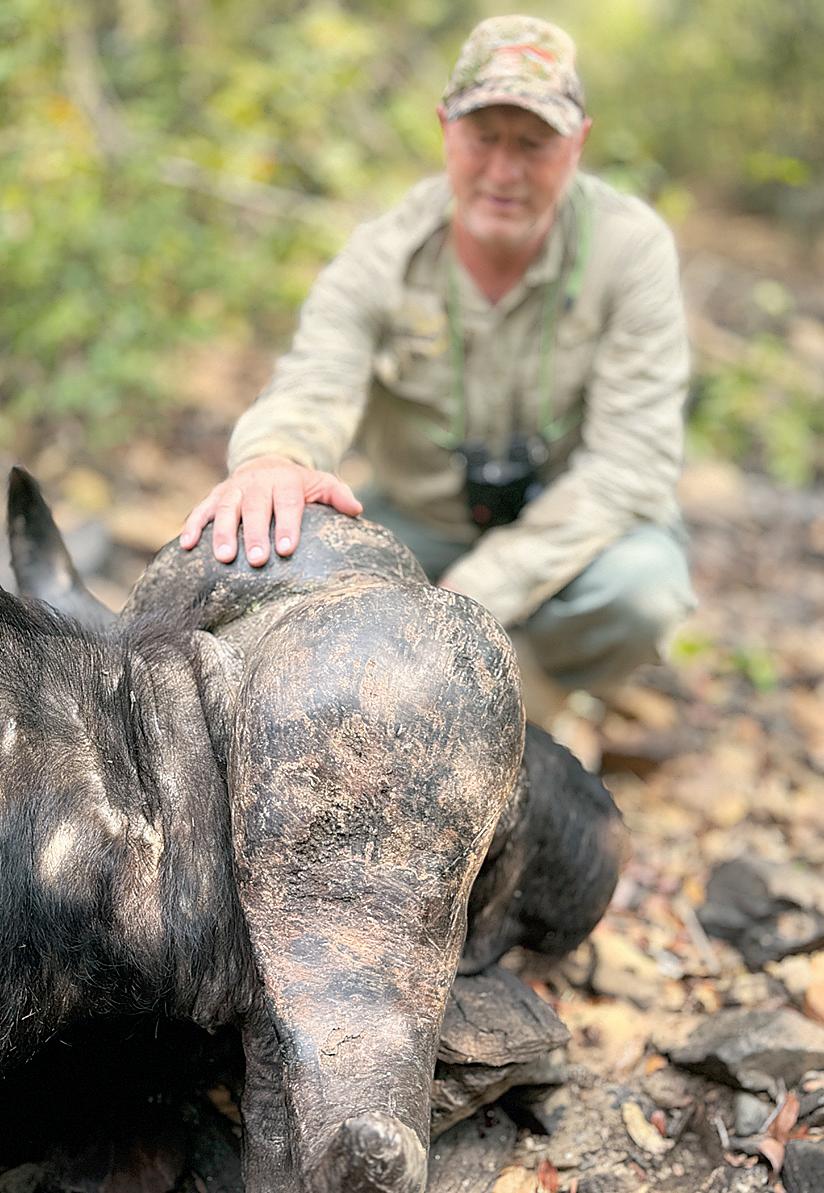
Rick paying his respects.
he Wild Sheep Society of British Columbia continues to grow thanks to the dedication and support of our members. Every membership represents a commitment to conserving wild sheep and their habitats across the province, and we are proud to share an update on the strength of our organization.
As of Summer 2026, WSSBC has 1,793 members supporting our mission. Our membership includes:
● 995 Life Members who have made a lifelong commitment to wild sheep conservation.
● 217 Monarch Members whose exceptional generosity provides critical support for conservation initiatives throughout British Columbia.
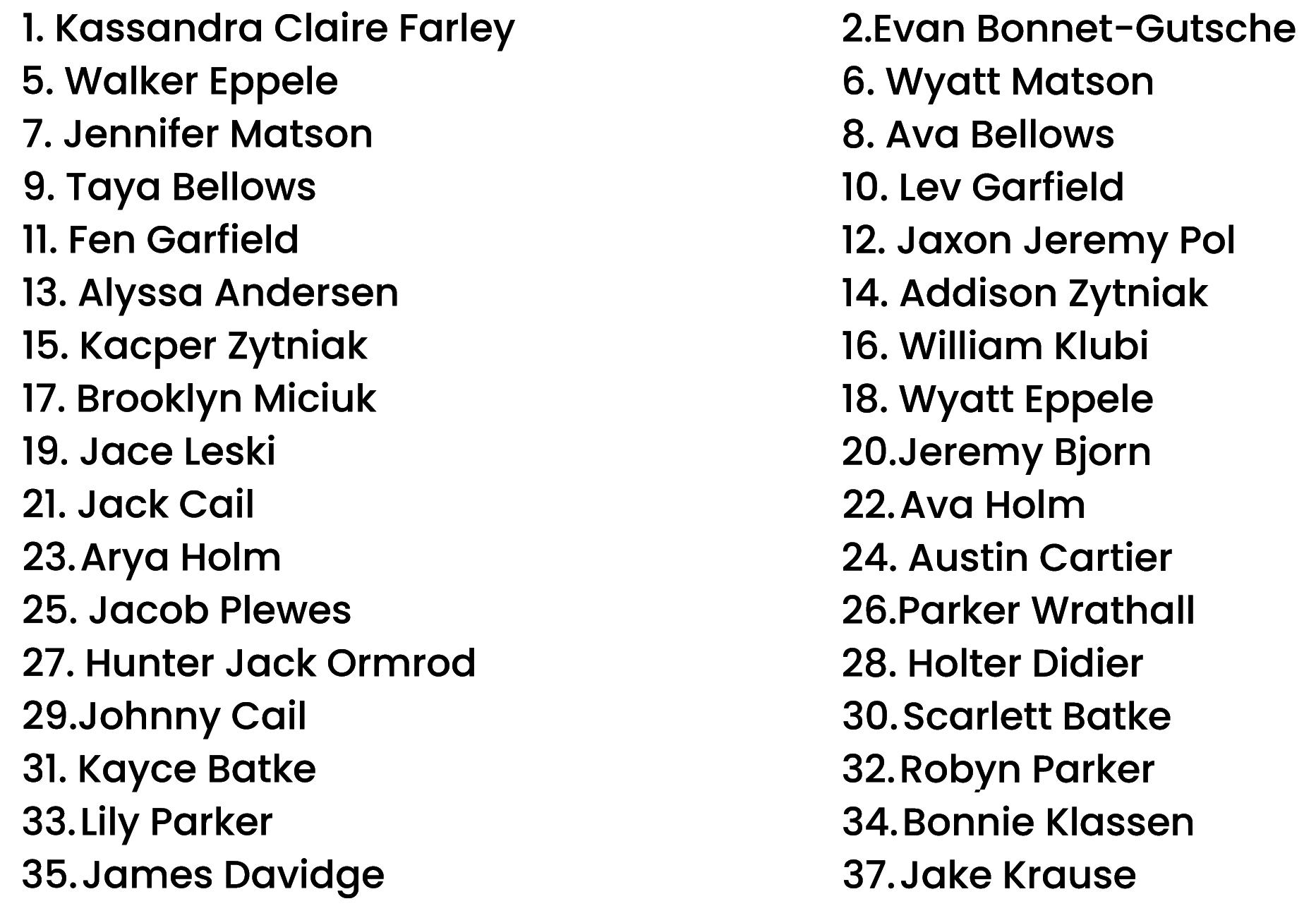
● 37 Youth Half Curl Members who represent the next generation of conservationists and outdoor enthusiasts.
These numbers are more than membership statistics—they reflect a passionate community united by a shared commitment to wildlife conservation,
stewardship, and the future of wild sheep in British Columbia.
Over the coming year, the Membership Committee will continue to focus on three priorities: retaining our existing members, welcoming new members into the Society, and expanding opportunities for youth involvement. A strong and engaged membership remains the foundation of everything we accomplish, from habitat enhancement and population monitoring to disease research, translocations, prescribed fire projects, and science-based wildlife management.
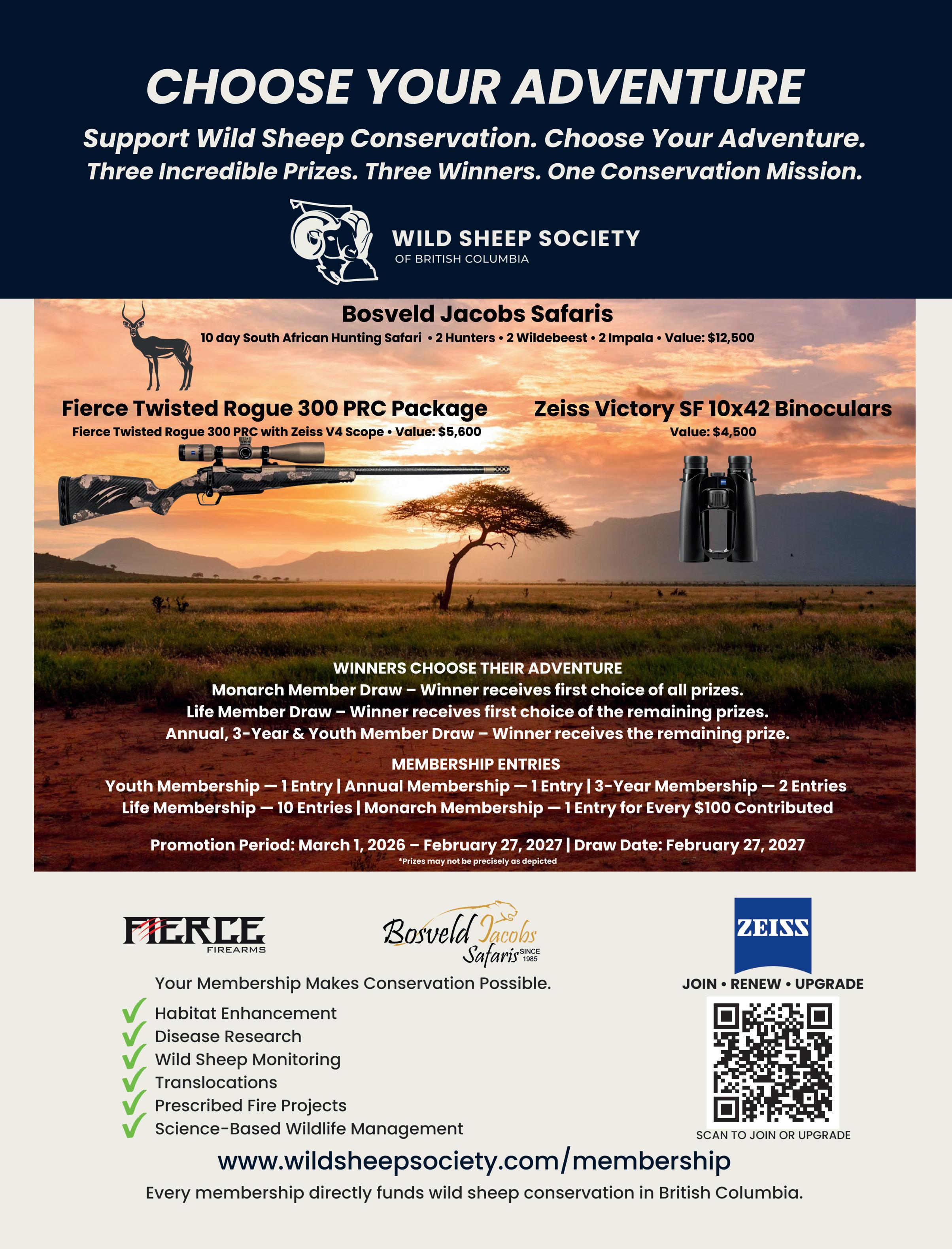
To help grow our membership and generate additional support for conservation efforts, WSSBC recently launched the “Choose Your Adventure” Membership Promotion. Members who join, renew, or upgrade their membership between March 1, 2026, and February 27, 2027, will be entered for a chance to win one of three outstanding prizes, including a South African hunting safari, a Fierce Twisted Rogue rifle package, or a pair of Zeiss Victory SF binoculars.
The promotion is designed not only to reward our members but also to encourage new conservation supporters to become part of the WSSBC family.
Most importantly, we would like to thank every member for your continued support. The success of the Wild Sheep Society of BC is built on the commitment of people who believe in conservation and are willing to invest their time, energy, and resources to make a difference.
Whether you are a Life Member who has supported the Society for decades, a Monarch Member helping drive conservation initiatives forward, a new annual member, or one of our Youth Half Curl members just beginning your conservation journey, you are an essential part of our success.
Together, we are ensuring a strong future for wild sheep in British Columbia. Thank you for your support and for being part of the Wild Sheep Society of British Columbia.
July 11, 2026 – Fraser River Sheep Count
August 8, 2026 – Fraser River Sheep Count
August 21-23, 2026 – Jurassic Classic
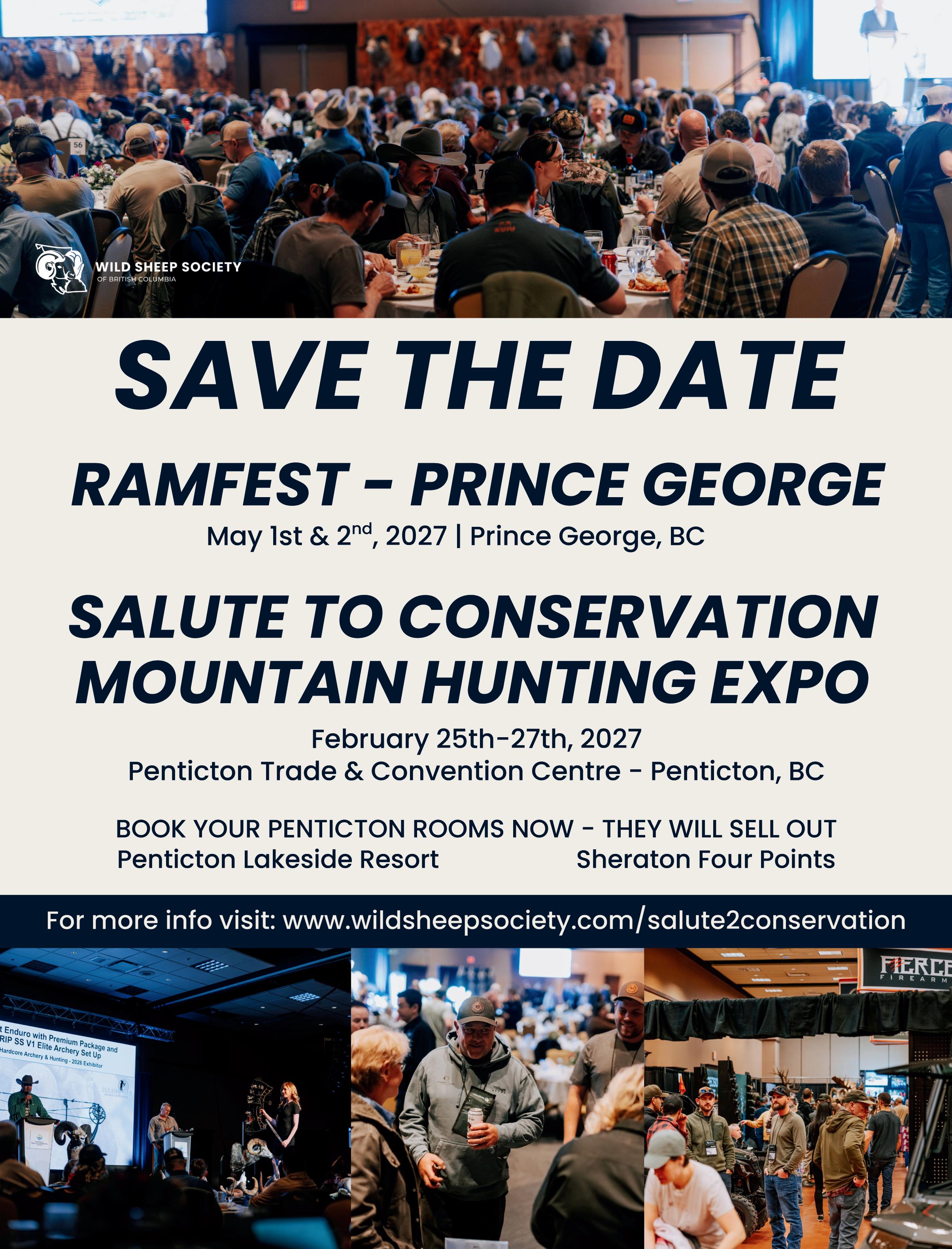
Feb 25-27, 2027 – Salute to Conservation & Mountain Hunting Expo
April 30 - May 3, 2027 – Ramfest
by Rebecca Peters and Hana Erikson
ave you ever wondered what it takes to travel through the mountains with horses?
Most people see the photos, the beauty of these strong, steady animals grazing in high alpine basins, the string at the trailhead packed and ready to head into places unknown. What many don’t see is the knowledge, preparation, responsibility, and care that goes into these animals.
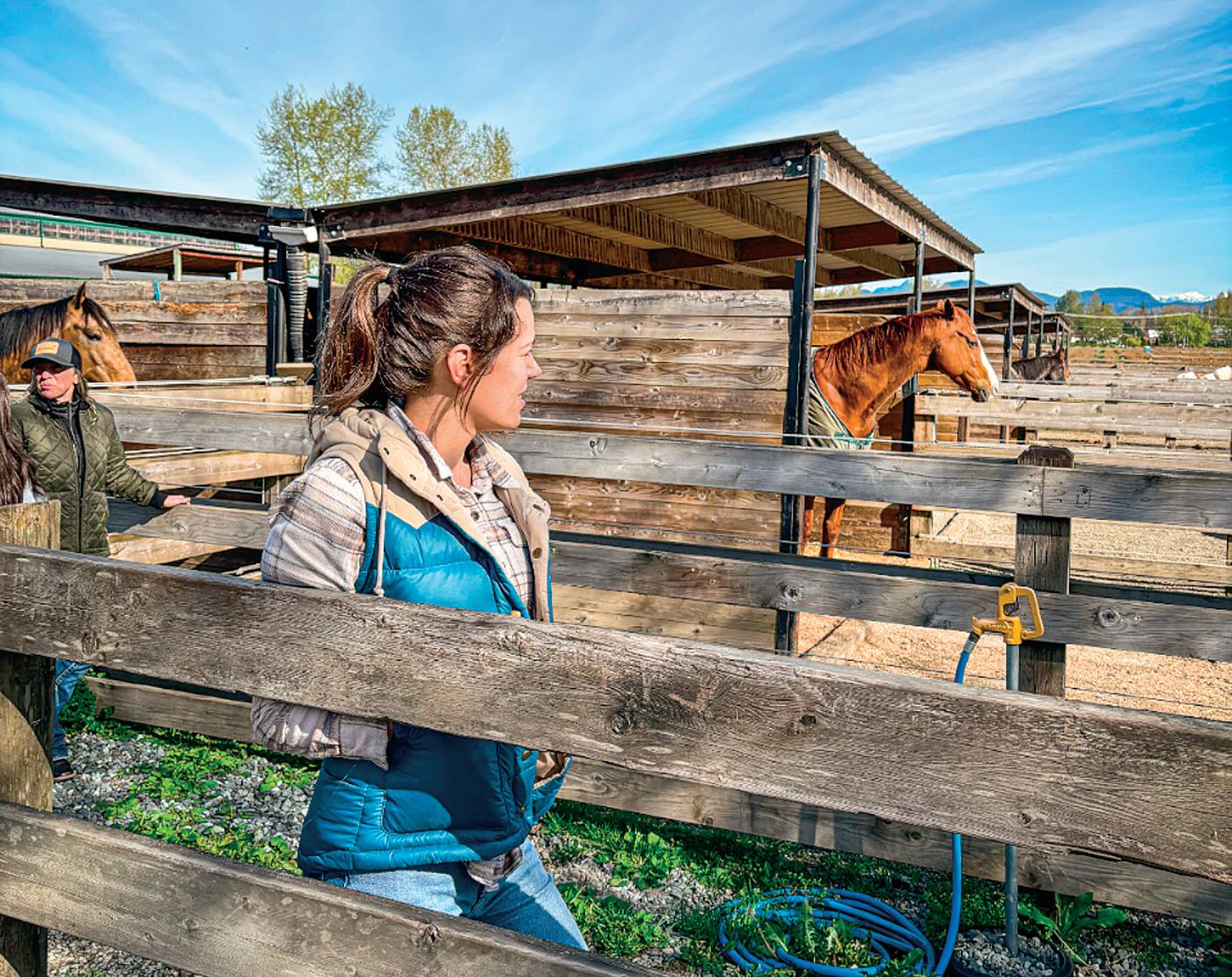
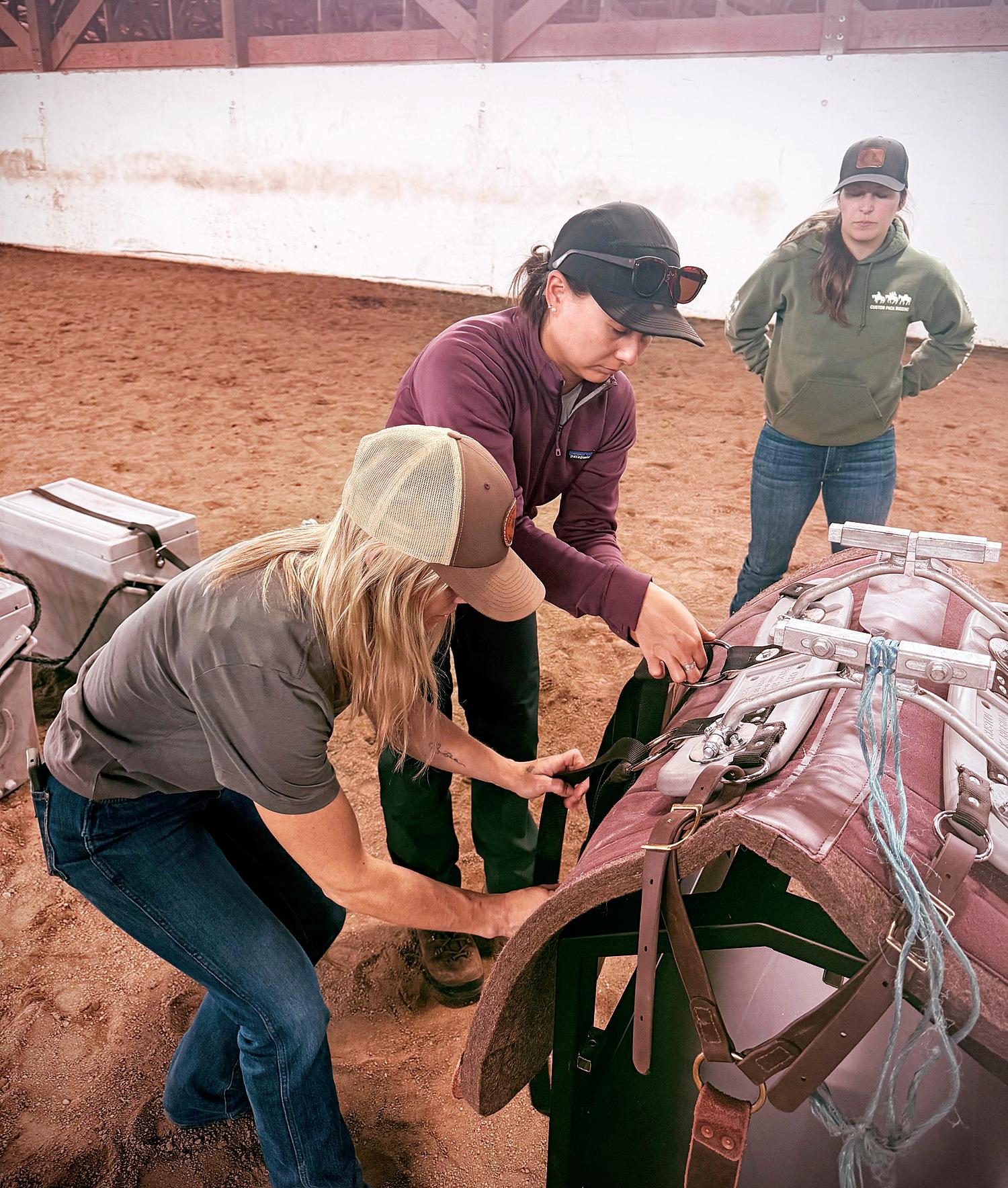
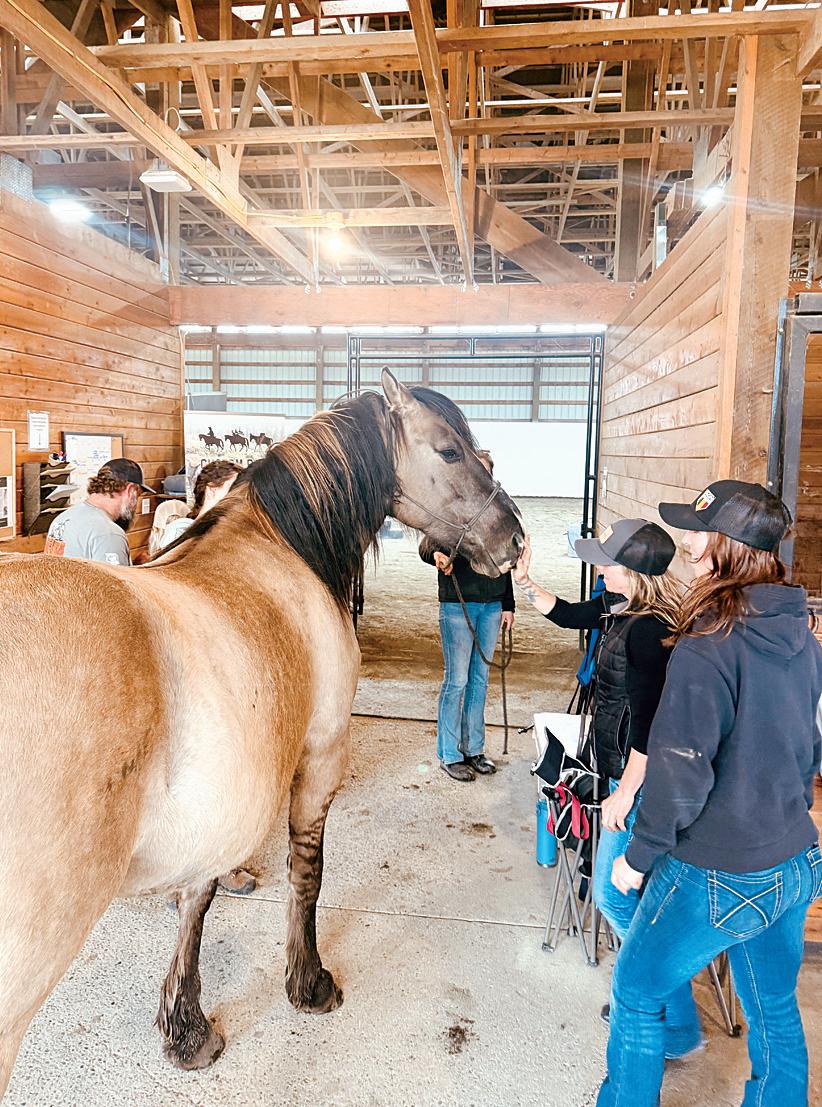
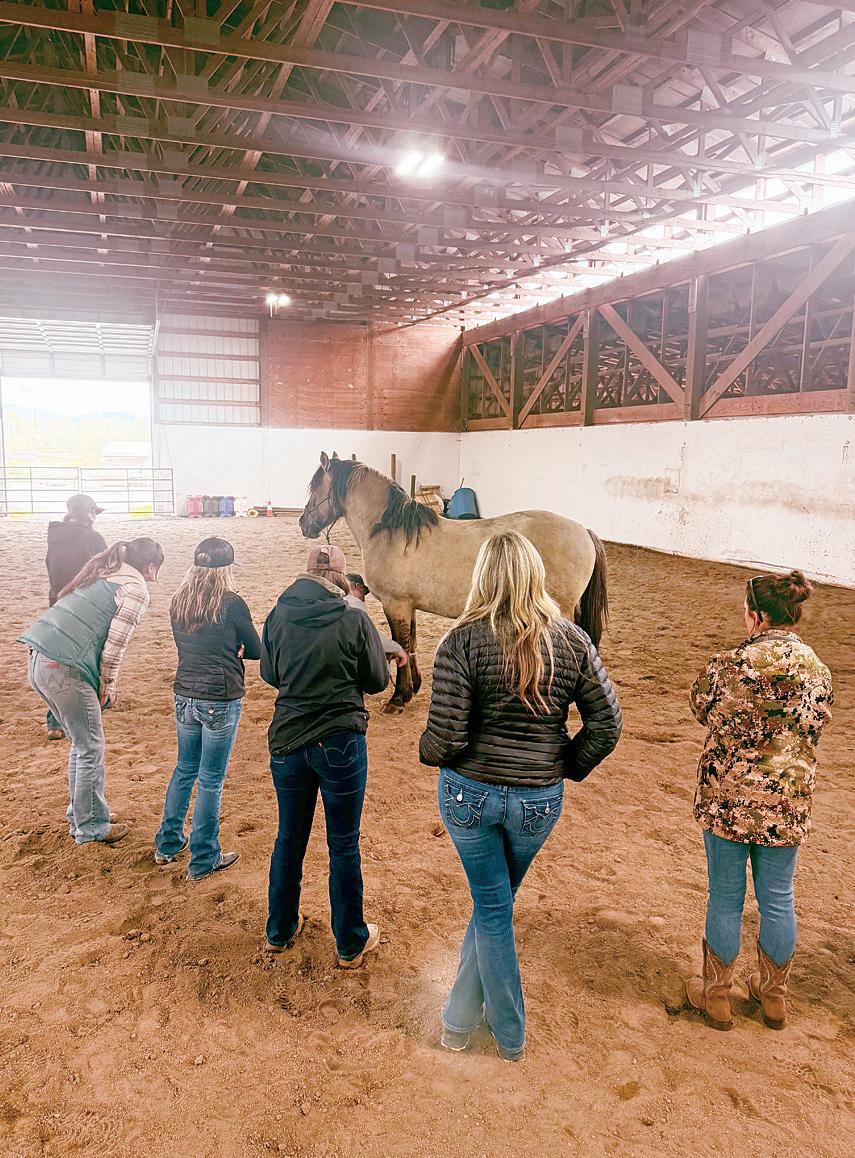
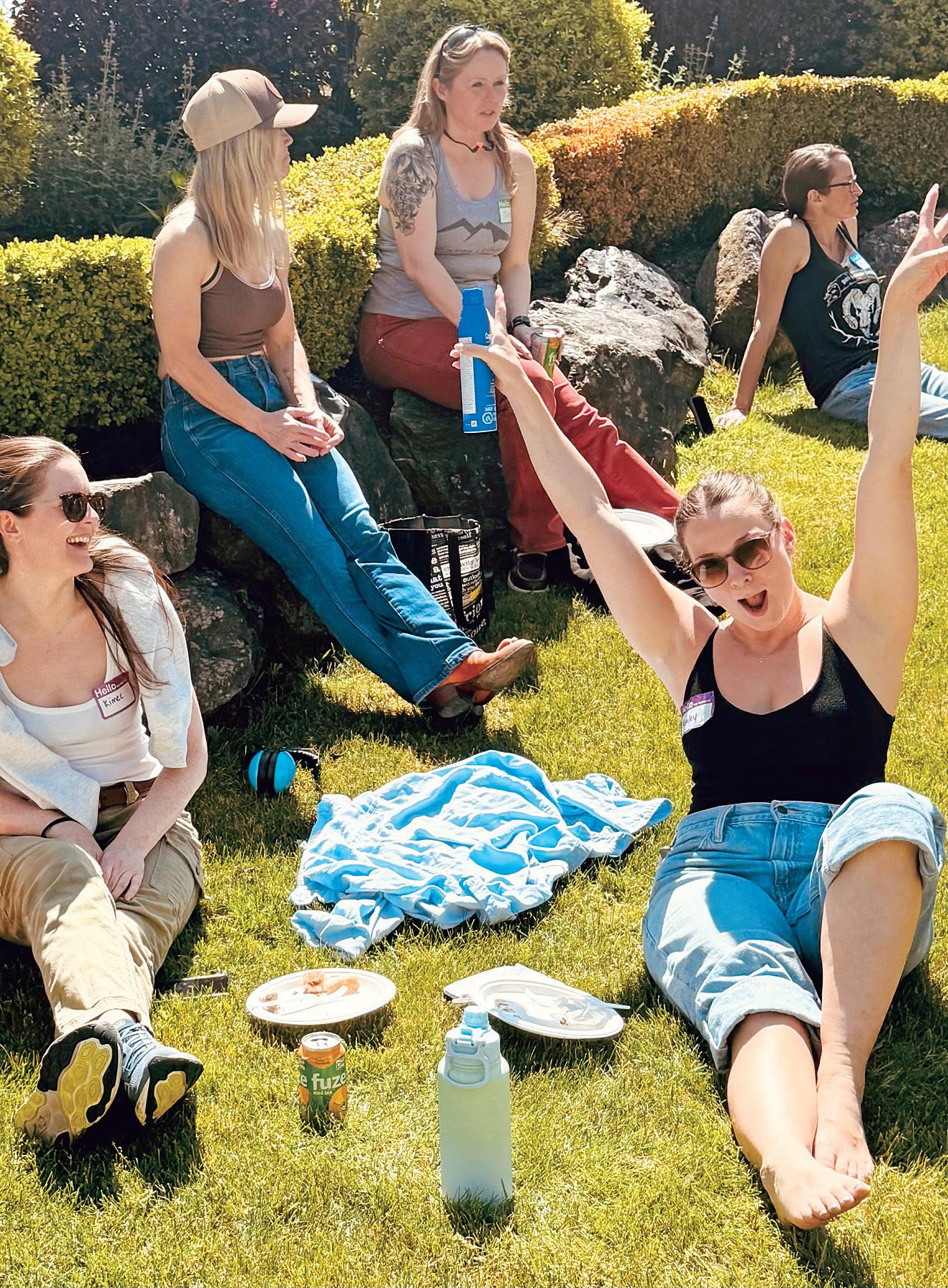
This spring, Women Shaping Conservation brought together a small group of women for ‘A Day with Mountain Horses,’ a handson educational event focused on learning about horses, packing, and backcountry travel. Hosted at Hidden Hills Farm in Fort Langley, the event was designed for women to step outside their comfort zone, ask questions, and gain real hands-on experience around mountain horses in a welcoming environment.
The event was hosted and sponsored alongside Tysen Bjorn of Custom Pack Rigging, whose generosity made the entire day possible. Tysen donated everything; from his time to his horses, equipment, facilities, and his years of knowledge and experience. That level of support says a lot about the kind of people within our conservation and hunting community who are willing to step up and help teach others; passing on knowledge about an art that is slowly dying in this fast-paced world.
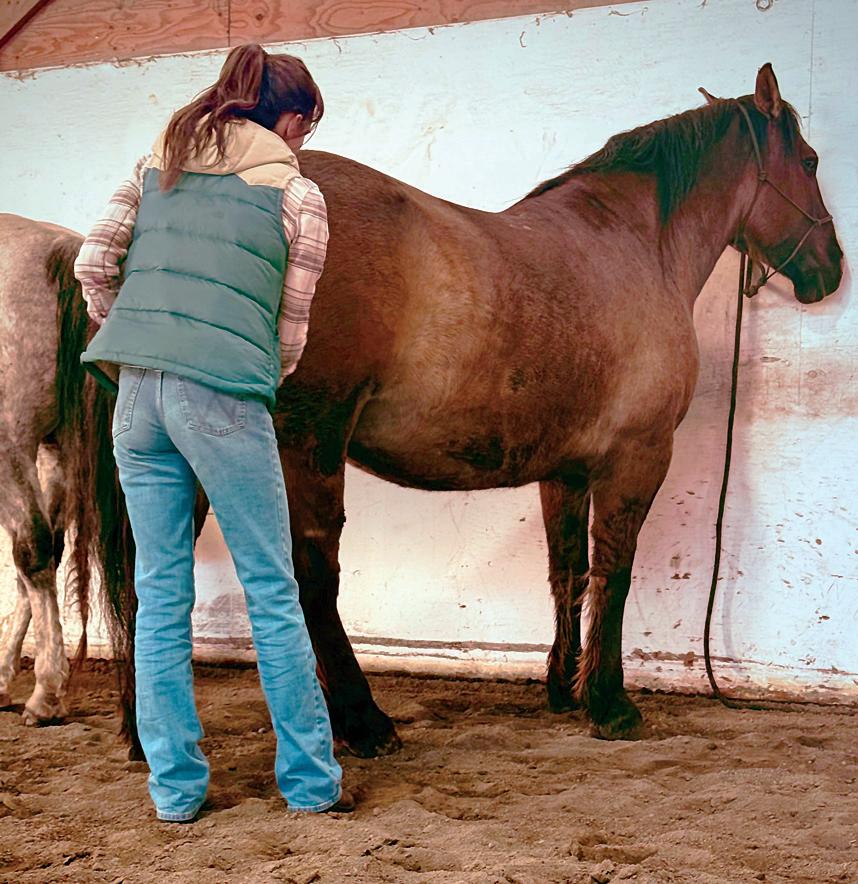
Some of the women that joined us had previous horse experience, while others had never spent much time around horses. Regardless of experience level, everyone came with the same mindset... excited to learn. Throughout the day, women had the chance to spend time working directly with the horses, seeing how the equipment functions, asking questions, and gaining a better understanding of what mountain horse
packing involves. Tysen was full of tips and tricks to give the women the best head start possible and prepping for the mountains.
One thing became very clear throughout the day: these horses are incredible animals, but packing and traveling safely in the mountains takes experience, patience, and respect for both the horses and the terrain.
For some women, simply becoming comfortable standing beside a horse was a huge accomplishment. For others, the day provided valuable insight into mountain packing and backcountry applications they had not yet experienced. That is one of the things that made this event so impactful. It brought women together at all different stages of their outdoor journeys.
There is something important about learning directly from people who have spent years developing these skills. In today’s world, so much information is consumed
online, but hands-on experiences like these are different. You cannot fully understand horses, packing, or backcountry travel through a screen. You learn by being there, making mistakes, asking questions, watching, and spending time around those that are willing to teach. That is how knowledge is passed down. Events like this matter; preserving outdoor knowledge and traditions that could easily be lost. Mentorship and education are a huge part of conservation, and it takes people willing to donate their time, energy, and experience to make that happen. The amount of in-kind support behind this event was incredible. Organizing a day like this involves so much! Horses, facilities, equipment, instruction, preparation, and countless hours behind the scenes. Tysen gave all of that freely because he believes
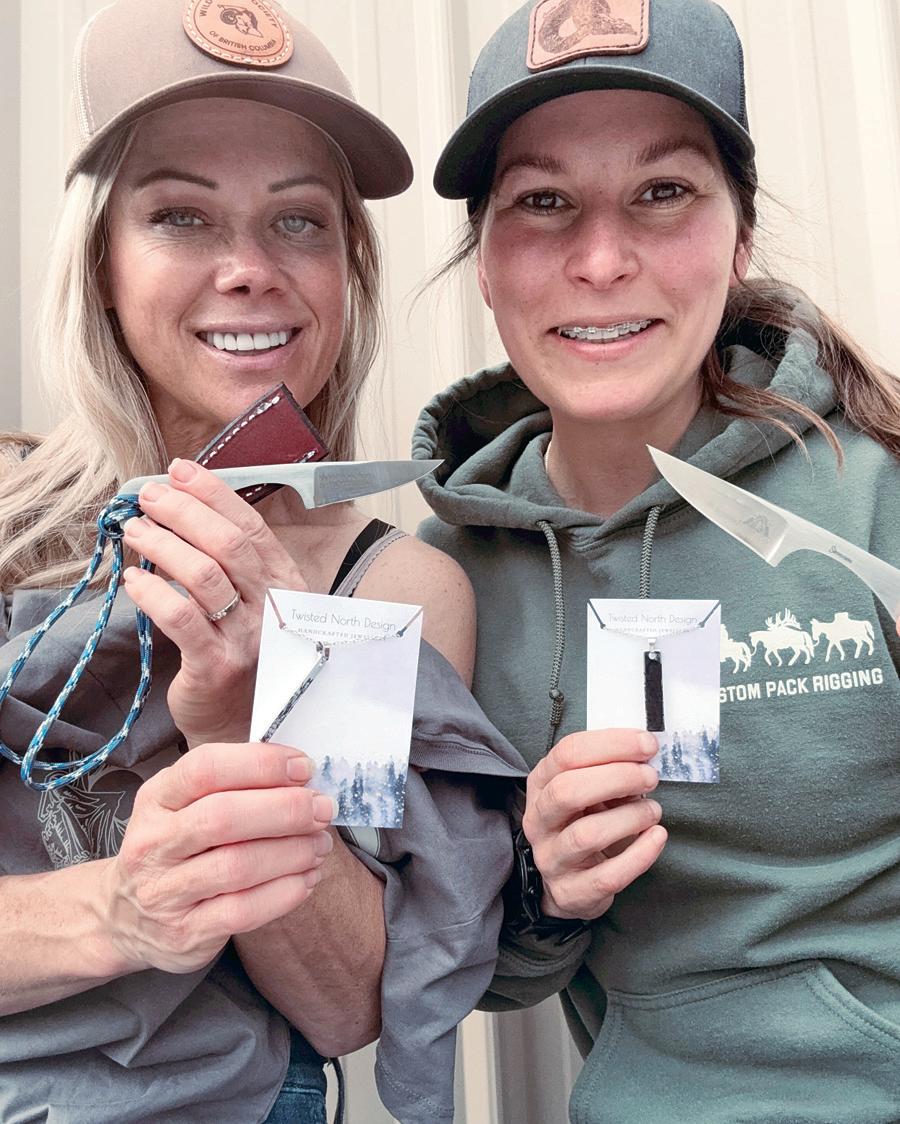
in helping others learn and experience the outdoors. He believes in keeping tradition alive, and his generosity is something that cannot be overlooked. The event was also supported by generous donors including Stevenson Knives and Twisted North Design. Each woman received incredible gifts, including a knife and hand made jewelry that were thoughtfully crafted for the event.
Beyond the horses and education, one of the biggest takeaways from the day was connection. Women were able to spend time together outdoors, encourage one another, and build relationships through something completely outside of everyday life, nurturing a deep sense of community. When women feel welcomed into these spaces and are given opportunities to learn, ask questions, and gain confidence, it creates
stronger involvement in conservation and the outdoors overall.
All proceeds from the event went directly back to the Wild Sheep Society of British Columbia to support on-the-ground conservation projects benefiting wild sheep and wildlife habitat across the province. Women Shaping Conservation will continue creating opportunities that help women step into new experiences outdoors; whether it’s hiking in the backcountry, learning to shoot, experiencing hunting, understanding conservation projects, or spending a day learning about mountain horses. At the end of the day, conservation is not only about wildlife. It is about people, community, and making sure outdoor knowledge, traditions and our hunter heritage continue to be shared for generations to come.
by Kerry Baird
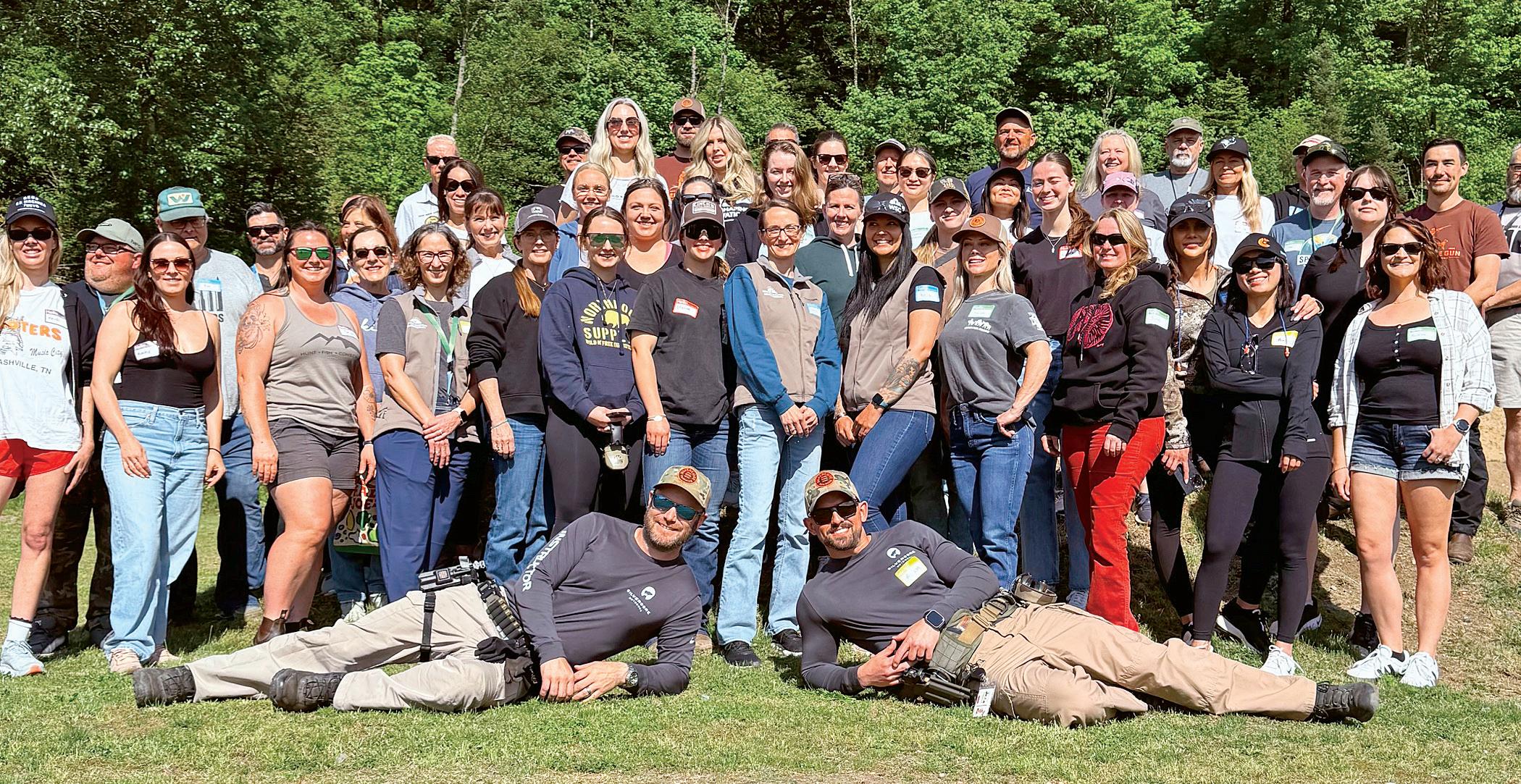
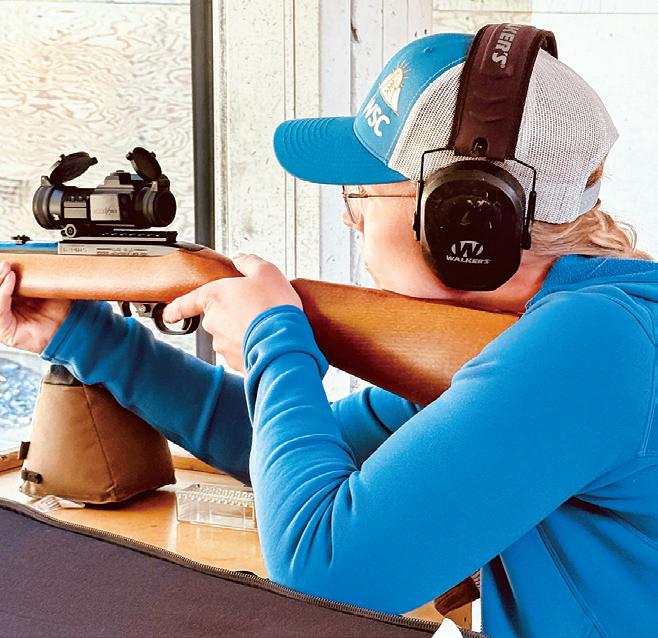
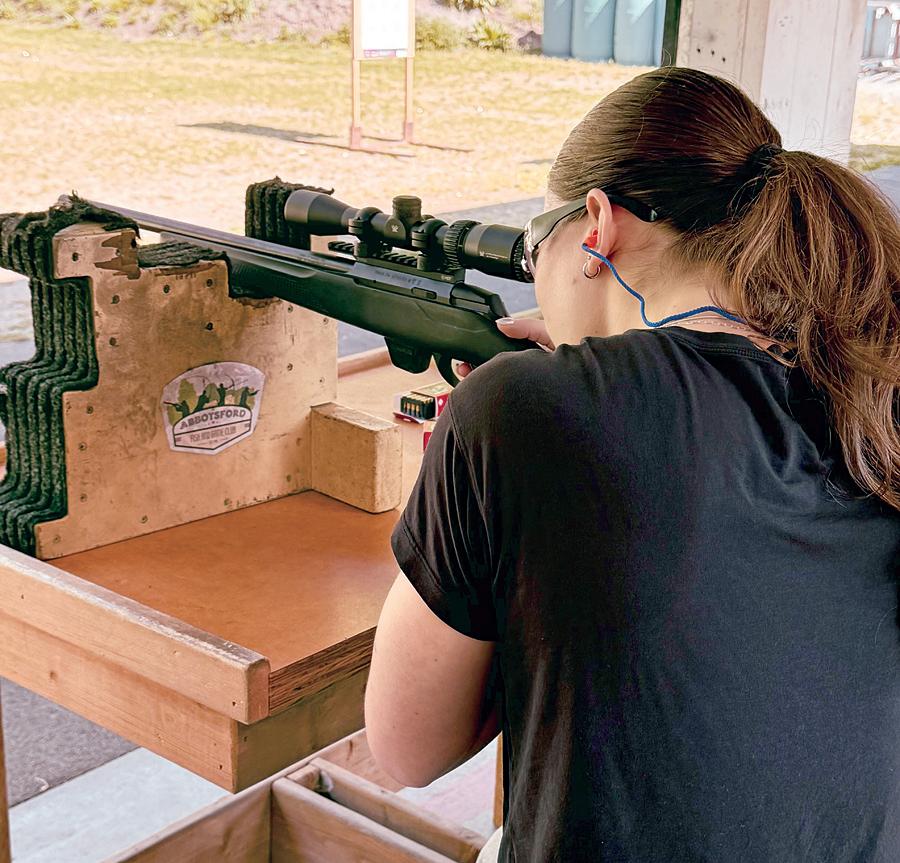
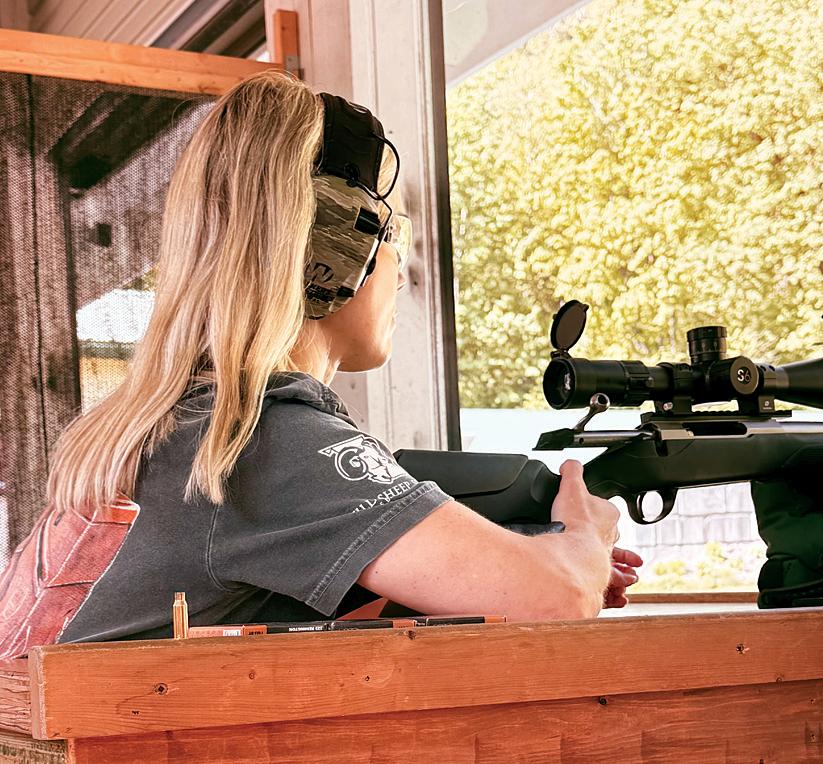
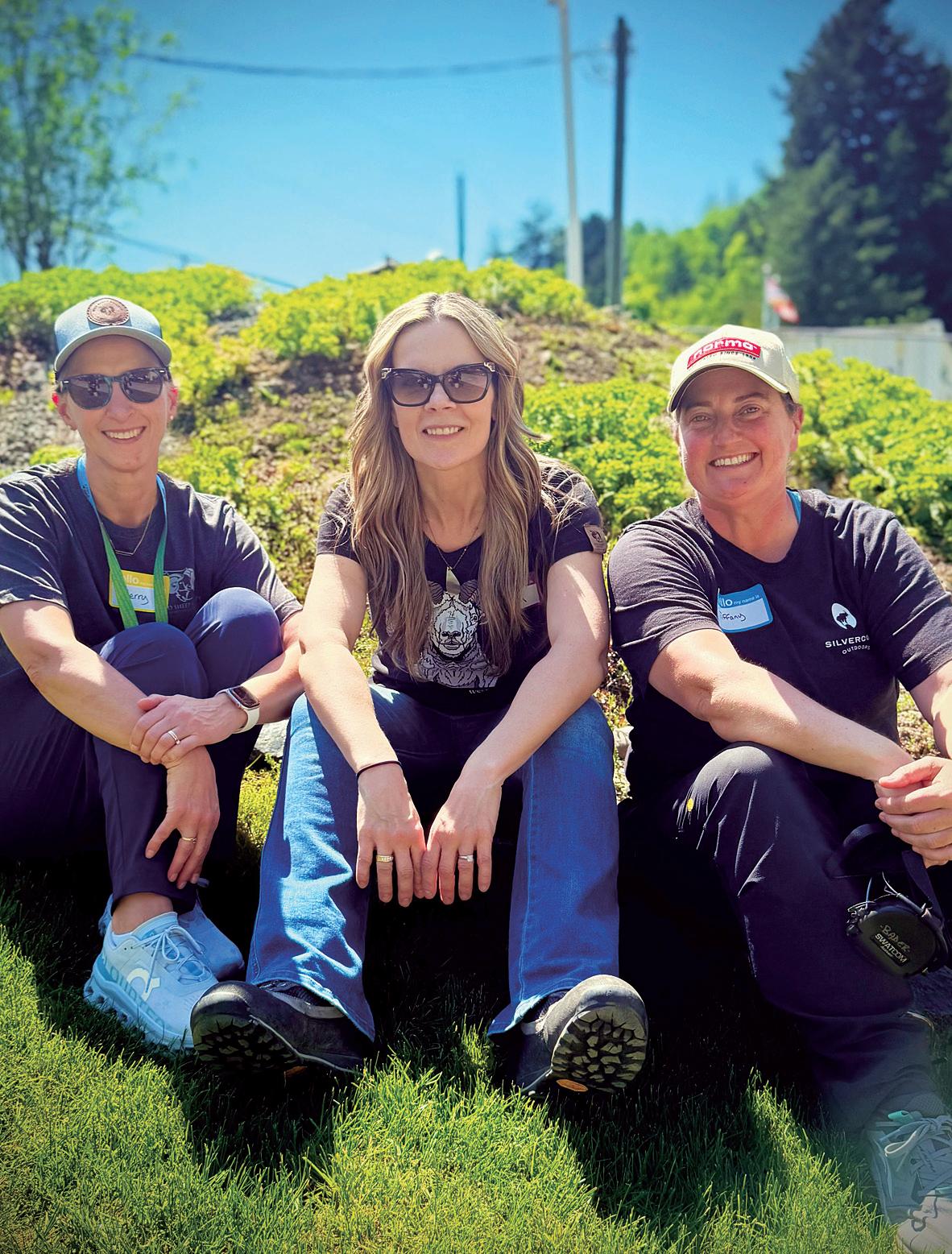
n May 2, Women Shaping Conservation and Abbotsford Fish and Game club hosted the second annual Aim for Impact women’s shooting event, in conjunction with Silvercore Outdoors and Reliable Gun. The event offered an opportunity for women to try various shooting disciplines in a fun, safe, welcoming environment and to learn about conservation, hunting and shooting sports.
Aptly named, the multifaceted Aim for Impact not only provided OPPORTUNITY for marksmanship, but more so OPPORTUNITY for transformative impact for many women who might otherwise never rub elbows in the conservation or shooting space by experiencing community and connection.
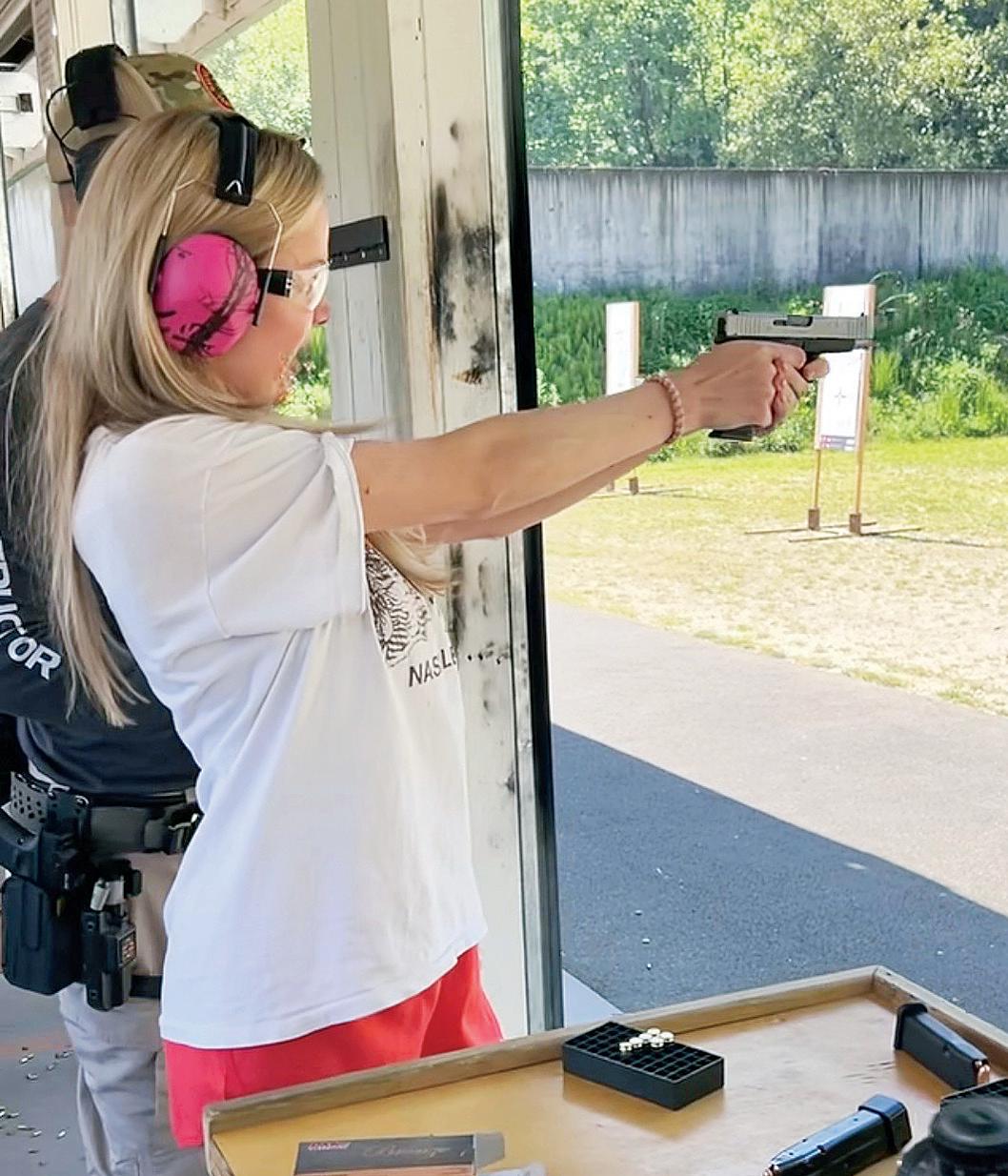
What did the OPPORTUNITY INVOLVE? Women from all over the province and even from Washington state cycled through four stations highlighting different shooting disciplines: 9 mm handgun, .223 rifle, 12 gauge shotgun, and .22 rifle. After a safety debrief and welcome highlighting Women Shaping Conservation, Wild Sheep Society of BC and various conservation initiatives, the day was loaded with hands-on shooting and an amazing barbecue lunch hosted by Wild Sheep Society of BC volunteers. The lunch featured artisan handmade sausages, generously donated by Sumas Meats. Proceeds from this event were specifically directed to the Psoroptes Mange project through Wild Sheep Society of BC, further realizing an immediate conservation impact towards putting and keeping wild sheep on the mountain. The event success and fundraising efforts would not have been possible without our generous sponsors: Wild Sheep Society of BC, Women Shaping Conservation, Abbotsford Fish and Game Club, Silvercore Outdoors, Reliable Gun, Sumas Meats, Don Stevenson Knives, and Twisted North Jewelry Designs. These organizations provided amazing donations of
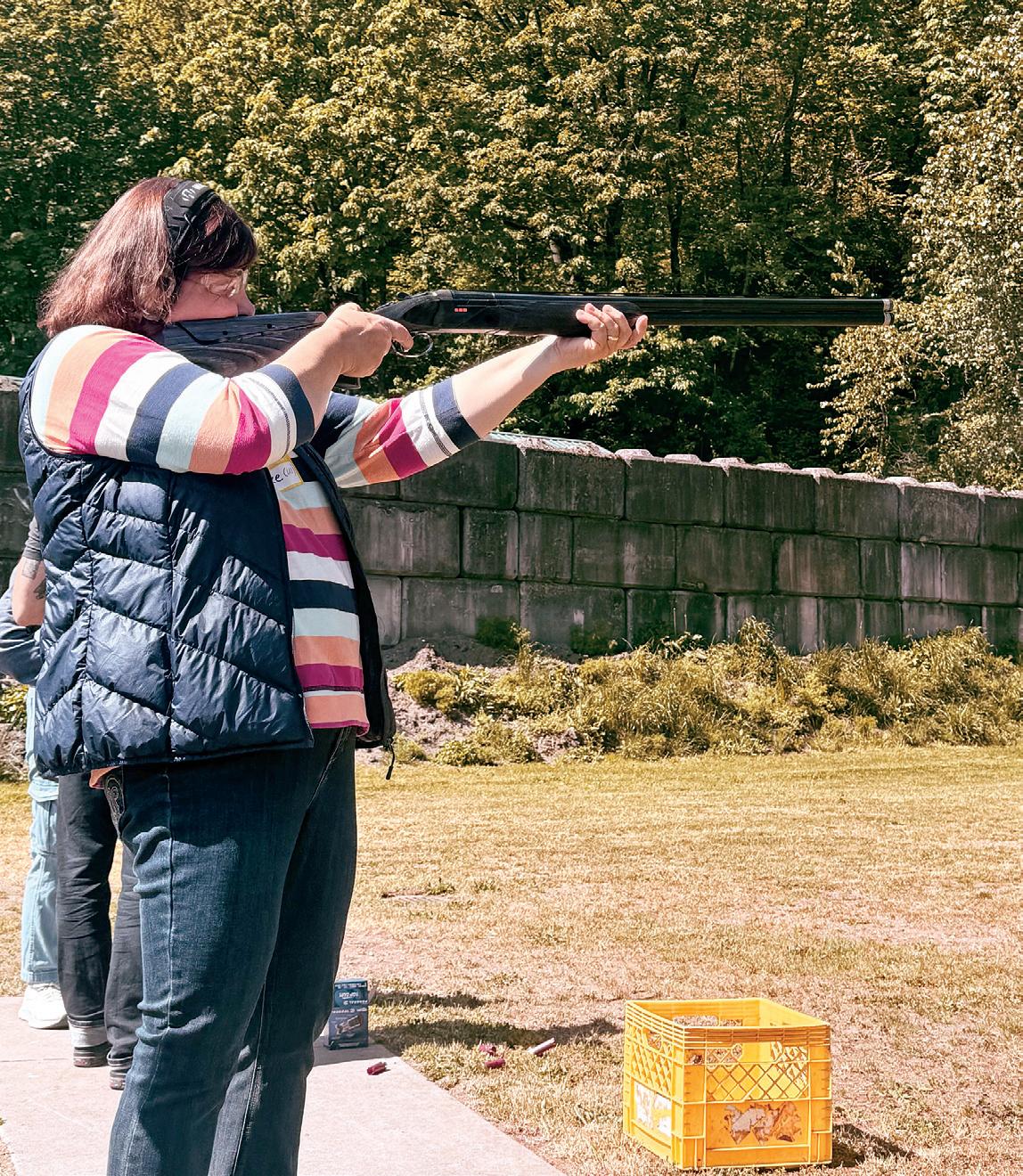
firearms, ammo, instructors, use of the range facilities, as well as door prizes. Every participant left with a prize! Participants could not say enough positive things about the volunteer instructors and we could not have done the event without their amazing contributions of time and talent. One instructor brought their personal revolver, which was a huge hit! One woman commented, “It was amazing to shoot that revolver. I felt like a cowboy!” Glowing reviews about the instructors ranged from knowledgeable, patient, competent, encouraging, engaging and enthusiastic. Some noted that they were nervous going into the event, but those nerves quickly abated with the patience of the instructors. As a further testament to the instructors, one participant had provided this unsolicited feedback: What really stood out for me was how fantastic the instructors and range volunteers were. I am a retired police officer and experienced shooter and I appreciated that there was no “baby talk” or undermining of people’s intelligence. Unfortunately this is still a reality when it comes to women’s events or teaching women a skill that is considered “male dominated”. (I recently experienced this on a 4 wheel drive course and it was so discouraging and demeaning.) The team... was able to work with each individual shooter and lead them to some level of success. It was really fun to watch and just made everyone feel happy and encouraged.
With the opportunity of the event identified, it begged the reflection on why is such an OPPORTUNITY NEEDED? As the above example illustrates, it can be challenging for women to enter the scope of shooting and hunting arenas that are highly dominated by men. Such examples highlight barriers for women to try the sport for the first time or to try the sport but have a negative experience and then risk not returning to the space. As more and more women enter the conservation
community, events are needed where they can feel welcomed, validated, encouraged, and empowered and connect with like-minded women having a desire to learn. There are limited range facilities in the Lower Mainland, and not many offer a dedicated women’s range day. AFGC and Aim for Impact provided such a space and our instructors created a positive experience for future participation, and moreover, for future influence in the conservation realm.
So how did women EMBRACE THE OPPORTUNITY of Aim for Impact? With arms wide open and reckless abandon! There were multiple comments of “Wow, I need to buy a gun!” or, “The second I gripped the rifle, I knew I was going to own one!” Many women wanted to know how to join a club or wanted to know more about joining Women Shaping Conservation. At the very least, all wanted to know when the next event was going to be and wanted to come back next year. Finally, what was the IMPACT of the OPPORTUNITY?
Women Shaping Conservation provided shooting exposure and instruction to 34 women. We also raised $1850 for the Psoroptes Mange initiative to benefit the health and sustainability of wild sheep populations. But far greater impact was felt in the immeasurable new feeling of shooting a firearm in a safe, supportive environment, surrounded by other women, and promoting the ideals of conservation.
Women Shaping Conservation Ambassador Keia Holmes, who attended the event from out of town, accurately summarized it in her words: One of the most impactful parts of the day for me was watching the women who came in inexperienced
or brand new to shooting sports and the outdoors suddenly “click” with it all. You could actually see the moment where confidence started building and they realized what this community is really about. It wasn’t just about shooting—it was about connection, encouragement, learning, support, and women empowering women. Watching women step outside their comfort zones and leave feeling stronger, more capable, and more confident was something really special.
Aim for Impact delivered on its namesake: to have impact for women to shape conservation. As women are a rapidly increasing demographic in the shooting, hunting, and conservation space, their circle of influence is wide. Many women have tremendous influence on the next generation to perpetuate an awareness and respect for conservation and hunting, in a society that is rapidly losing touch with these values. Women often are involved with food choices in the home and want agency and ownership over where their food comes from. They understand the nutritional value of wild game only obtained from harvesting in the hunting and forging space. Additionally, as a majority demographic at the polls, women can exercise influence with their voice to elect representatives that align with their values and that advocate for gun rights and conservation priorities. Finally, for women considering a career in the conservation field, events such as this can inspire, build confidence, and influence future decision makers (the author included!).
The ripple effects from events like this all start from a proverbial drop in the pond, or in this case, a shot at a target, that aim to develop a confident, empowering voice for conservation. Women Shaping Conservation Aim for Impact provided that much needed OPPORTUNITY that was embraced and will result in impact for conservation.
ndre you better get on a plane and come see dad”—the call no one wants to get. By the tone in my sister Karen’s voice, I knew this was serious. It was New Years Eve 2023; my father had been in the hospital with pneumonia since just after Christmas; every effort made could not get the infection under control. I made quick arrangements and flew from Kelowna to Edmonton New Year’s Day.
Upon arriving at the ICU, I was met by my sister and quickly got suited up in hazmat, they were uncertain what the virus or bacteria was. There was no time to waste as Dad had been asking
by Andre Brosseau
for me all day. I entered and was greeted with a big smile by my hero, John Brosseau. He then proceeded to tell everyone to leave the sterile room full of medical equipment, except me of course. He told me how much he loved me, how proud he was of both me and my sister, and that it is important that people know that my accomplishments in life were because of my determination and work ethic, not from handouts from him as some may conclude. Of course, I joked that a few handouts would have been nice. My dad had a very special relationship with my sister’s middle son Ray. Ray showed great interest in the outdoors and old John had taken it upon himself to mentor Ray in the
family traditions. They spent many days in a duck blind, on the water jigging for walleye, or just chatting about life.
Dad loved to hear my hunting stories and, as he would always say with a laugh, “I live vicariously though you now.” As he lay there labouring to breath, he gave me a few final thoughts and added, “you should get your SLAM, and be there for Ray.”
In all my accomplishments and experiences in life, being able to have a final conversation with my father as he is staring at the pearly gates will forever be one of the most meaningful moments in my life; I was blessed to be able to have that opportunity.
Unfortunately, the infection could
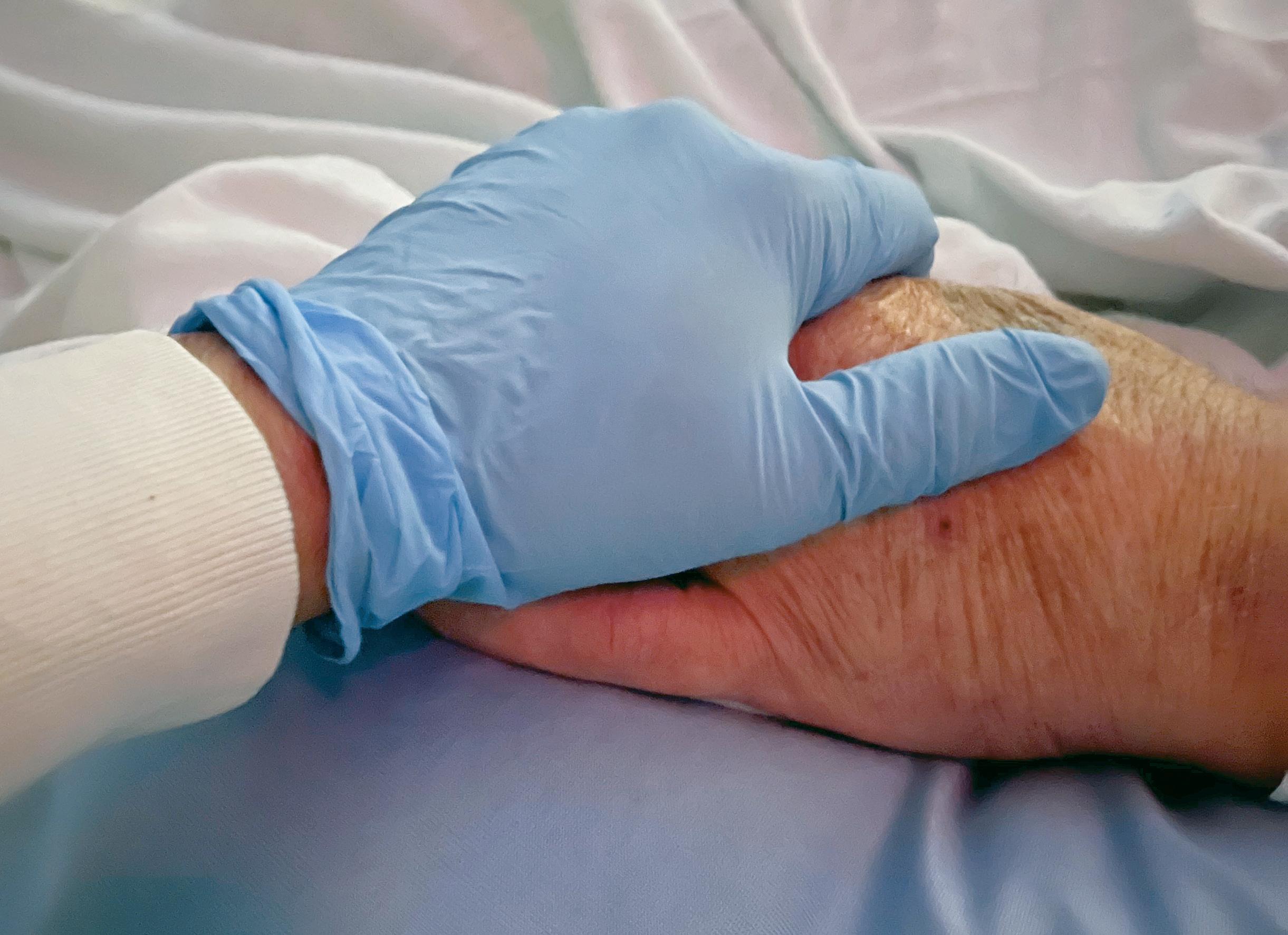
not be gotten under control and Dad decided, at 82, his time had come and to discontinue the barrage of treatments which to this point had been futile. We said our goodbyes, they sedated him for comfort, and removed the life sustaining oxygen. On what was to be his final few hours, with myself and my brother-in-law Jim McMullen at his bedside holding his hands, he surprisingly woke from the heavily sedated state to say his final few words. In typical John Brosseau fashion, his last words were few but to the point: “Am I dead yet?” To which I replied, “I’ve been trying to pillow you for the last 2 hours, but McMullen keeps stopping me!” With a big smirk smile he closed his eyes for the final time and passed shortly after.
For months following those words, “get your slam” kept resonating. I never hunted sheep to get my FNAWS, I honestly didn’t even know if I knew of such a term if you asked me 10 years ago. I just hunted sheep because I liked hunting high in the alpine and the places it took me. I have never been about chasing scores or how many sheep I can notch up, I just hunted and if I was fortunate enough to turn up something that suited my fancy and was legal, good enough.
When I lived in Alberta, I had taken a couple of bighorns and when I turned 50, I spoiled myself on my first guided hunt to the Yukon and took a beautiful 10-year-old Dall. Over the last few years I have been targeting stones and have been fortunate to take an old 10-year-old and a heavy full curl 8. Now I could possibly accomplish something that I never really dreamed of, and it is within my grasp.
I started to do research on free-range Desert Sheep hunts and got a little bit of sticker shock; but considering what guided Stones were going for I shouldn’t have been surprised. I put it in the back of my mind until I received my copy of the winter 2023 Mountain Hunter Magazine, a publication of the Guide Outfitters Association of British Columbia. In there was information on their upcoming convention in Kelowna, BC and the big fundraising
Auction in March 2024. As I scanned thought he auction items and my eyes immediately focused on the free-range desert sheep hunt for a hunter and a guest in Sonora Mexico. Since I lived in Kelowna, and love auctions, I figured why not go and maybe I can get a steal of a deal.
The date came and as I headed out from home, my wife Katia gave me solid words of encouragement, “don’t do anything ridiculous”, or something like that; I tend to get carried away at auctions. I was fortunate to be seated at the same table as Kyle Stelter and Peter Gutsche and told them I was interested in the Desert Hunt. Kyle did a little reconnaissance for me to inquire about the reputation of the outfitter, and he quickly came back with a thumbs up. The hunt came up and the bidding was fast and furious but as the price went up, the hands
went down until it was just me and another gentleman. The price hit my threshold, I was about to throw in the towel but as normally happens with me, my head gave a final nod and the hunt was mine. I was excited and had lots of people come up to me with congratulations. I still have not revealed the price tag to my wife, she never really pried, but I know she has a good idea.
It took considerable effort to line up dates and eventually we were able to make arrangements for February 2025. Both of my boys were unable to go (I even floated it by Daughter who doesn’t hunt, she did give it a few minutes consideration) so I knew exactly who to call, Ray. Ray had come with me for Stone’s sheep opener in 2024 and I had mentioned the idea if he would be interested, there was zero hesitation.
When the time came, we met up in Phoenix and flew out to Hermosillo in central Sonora where we were greeted by our young guide Lorenzo Ramos— great character and quickly found out that he guided for Terminus Mountain Outfitters in BC, and on Tiberon Island and Sonora in the late fall and winter. We quickly started connecting dots and ended up knowing some of the same people in the small world of sheep hunting. The plan was originally to go directly to the ranch, but the outfitter (Rafa Aguilar) and guides had just got off the Tiberon that morning and were wanting a day off, so tequila, beer, tacos, and an Edmonton Oilers game was the call at a local sports bar.
We woke up fresh as a spring daisy, had a couple cups of coffee with a light breakfast and waited outside for our pickup with the other guide Kelly Robertson. Kelly was from Whitehorse and guided for Keel River in the NWT with over 100 sheep kills guided to his credit. A 2000 and something flat black Chev Suburban pulled into the parking lot and Ray said, “that has got to be us,” which sure enough it was. The unit was loaded like a game of Tetris; 7 of us stuffed into it like pickles into a jar, setting off for our 2-hour drive to the Sea of Cortez coast and the El Sacrificio Ranch. After we turned off onto a dirt road for about 20 minutes we arrived at a beautiful well-kept old ranch, to my surprise. I had no idea what I had gotten myself into and this was a pleasant surprise.
Our outfitter had never been on the ranch before and upon arriving, there was great discussion on how this hunt was going to be played as the ranch had 3 guides as well. The decision was made that there were just too many guides and Lornenzo and Kelly would stay with Ray and I while the others took a little R&R for a few days. We woke up early, had a wonderful breakfast, and the 4 of us loaded into a 2005 Ram crew cab and headed out in the cover of darkness. Bouncing along a dirt road for a few miles, this terrain was nothing like anything I had experienced; a landscape full of giant cactus and the ground seemed void of
any grass that you would think would be required to sustain life. As the sun rose, we were perched on a high hill looking into the mountains above. The hills were much steeper than I had imagined, and the country was rough with an unimaginable amount of spots for sheep to remain hidden. An hour of glassing turned up nothing, so we packed up our spotters and binoculars to move to another vantage point. Immediately we picked up a single young ram at approximately one half mile. We picked apart the hillside for an hour and nothing else turned up, so we jumped back into the truck and bounced up a draw on a sketchy trail to a vantage point which would allow us to glass a large portion of the ranches range.
We met the Ranches guides (a father and son team, Pedro and Leo) and we spent the full day picking apart the distant ranges piece by piece. My impression going into this hunt was that it would be easy to pick up sheep in a desert, but that was a false notion. Throughout the day a few ewes were spotted and just at dusk as the temperature started to dip, a couple of rams came out of nowhere. The distance was well over a mile and at least 1500 feet vertical, so there was no way to consider a move that night. One ram had potential, appearing to have good mass and dark horns, worth a closer look in my eyes.
The next morning, we repeated the process and were on our perch at first light. It took several hours but eventually we picked up the 2 rams. A plan was conceived that Ray and Kelly would come about halfway to where they could see the hill side, and myself, Lorenzo, and Pedro would go up after the ram. Lorenzo and Kelly are professionals. They absolutely know what they are doing, how to interact with clients, managing expectations and what needs to be done. The ranch guides, not so much. Dressed in their bright blue hoodies which provided no concealment whatsoever, the two just had an edge about them and you could feel a bit of tension in the air, like we were an
inconvenience. This may have been the fact that this was their territory, and my guides were on their turf. Since they only spoke Spanish, I unfortunately could not play mediator as my mastery of the language is nil.
As the three of us headed up a draw we came close to the spot where we had last seen the rams. Not waiting for us, Pedro scrambled ahead and fully exposed started waving at us to get up to him pronto—easier said than done. His indiscreetness and impatience caused him to blow out the rams. As we sat there, I could see the frustration in Lorenzo and they exchanged words. Then out of nowhere, a younger ram, probably 3-4, popped out 50 yards from us. Pedro was yelling at Lorenzo and me pointing at the ram wanting me to shoot the ram. I must admit, for a young ram he looked nice but was just too young, and all I could say was “Chico, Chico”—boy in Spanish. Pedro was none too happy with us and was quick to turn into a grump.
As we crawled down a tangled shoot of every conceivable pokey plant that tried to impale us, something caught my eye in a thick tangle. “Lorenzo check this out.” I had spotted a massive dead head. As I held the horns up, it was a wow moment as we counted rings and turned the ram head in our hands. We estimated this head was in the 170-180 class and were excited to bring it back, but Pedro would have nothing of that and made us leave the head. We had some thoughts on why he did that, but we left that up to speculation. When I discussed it with the Ranch owners son who oversaw the operation, he said we should have brought it back and he could care less if we wanted to take it home.
That evening we conceived a new plan; we would hike to the backside of the range and leave Pedro and Leo to spot the front side. We spent the morning hiking and glassing the drainages as we worked our way in but turned up nothing.
By early-afternoon we reached our destination and soon picked up 2 rams in the distance. One looked particularly good for the area but it was a long way
off and with the short February days, there would not be enough daylight to attempt a stalk. We watched as the rams moved off in the distance, appearing to head in the direction of the front side of the range where we spent the previous days. With the long hike back to the truck, we had plenty of time to discuss a possible plan for the next day’s hunt. Day 4, the decision was made to start at the front range and go up high to see if we could pick up rams. Over the previous 3 days, we had picked up 4 or 5 different rams and if we got up to a distant knob, we should have an opportunity to be right in their wheelhouse. At first light we were all packed up, except for Lorenzo who picked up a flu bug, and were on our way up a drainage with Pedro and Leo charging up ahead at breakneck speed. As we walked up a ridgeline, almost at our destination, Pedro was quite a distance ahead walking fully exposed for all to see. Suddenly, he started waving his arms and motioning us to hurry up. By the time we reached him he was pointing up the mountain and telling me to shoot. Kelly and I got glass on the rams and definitely one was a shooter, but they are on the move and a long way off.
I unclipped the gun off my pack I borrowed from the outfitter, a 300 RUM, and even before I think of setting up, I asked Kelly, “how far?” “500 yards,” he replied. Not a chance I am ever going to attempt to take a shot at a moving ram at that distance even with Pedro pressing. Kelly, Ray and I sat down and tried to contain our emotions as Pedro walked off in a huff. The rams were within easy reach but the haste of the “guide” and not taking the time to make sure he was concealed as best as possible plus sticking close to the client is a bad recipe. When he got busted by the sheep, if he had simply backed out and not stood there waving his hands, they likely would have stayed put or at least not taken off at mach 2. As the three of us sat there, very few words were spoken. The look on Kelly’s and my face said it all. What a debacle. Leo decided to climb up the knob and we watched him crest over the top and
out of sight. Not 10 minutes later we heard yelling and suddenly 2 rams popped out and momentarily stopped at 100 yards on the other side of the draw. I ignore Pedro’s calls to shoot, “what do you think Kelly?”
“The first one is definitely too young while the other has potential,” he replied. Over the ridge they went and shortly popped out on the next ridge at 200 yards.
I again asked for Kellys input.
“The last one has some age on him,” he replied. As they dropped out of sight, I quickly was processing everything that was going on as I knew they were going to step out on the far ridge and I had to make a decision quickly. Would this be my only opportunity? Are all the rams being chased out of the country with constant bumping?
The lack of curl on deserts was really playing with my head. Having only hunted thinhorns the last several years where it is all about the age of a curl, I just couldn’t quite wrap my head around it. I readied the rifle and got set up, “any thoughts Kelly?”
“It’s up to you but the one does have some age on him,” he responded.
“Good enough for me,” I said. With that the decision was made to take a shot if it was presented. Moments passed and the rams walked through the gulch up the next ridge as anticipated and stopped just below a small cliff.
“300 yards Andre,” Kelly called out. I settled the crosshairs on the ram and squeezed off the shot. The ram didn’t even seem to flinch. I know I was dead on; being hit with a 300 RUM should have dropped him in his tracks. My mind raced, was the gun off? Did I pull the shot? No way I missed, I was dead on.
As I chambered another round and watched the ram scramble up the cliff though the rifle scope, he stopped momentarily then toppled over backwards. As I lay there processing what had just transpired it was a swing of emotions at epic proportions; from wanting to ring someone’s neck to elation.
As I rose to my feet, Ray was right there and gave me the biggest hug. “Uncle Andre you got your SLAM, oh man Grandpa would love to hear this story.” It was a very emotional moment and I shed a few tears as handshakes and congratulations went around. It took a half hour to get to the ram and as I walked up to him there were no surprises; he wasn’t bigger or smaller than I thought, just a nice representation of a desert sheep. No jaw dropper, no Boone and Crockett candidate, nothing that would make your eyes pop, just a ram, my ram. Reflecting, I found this fitting. When I started hunting sheep so many years back, it was nothing about scores, inches, or age class. There was no social media, no grip and grin influencers, there wasn’t even the internet. The only place you would see pictures was in the local hunting shops on the bulletin boards when hunters would thumbtack their pictures and write a little bit on the back with a pen. The pursuit was about hunting in the special places that sheep inhabit and simply looking for legal rams. We lifted the ram onto a flat stone on the pinnacle at the end of the cliff overlooking the Sea of Cortez to take some memorable photographs and to provide a relatively clean surface to process. For what the guides lacked in stealth, they made up for by the care and attention that was taken to remove every morsel of meat, leaving nothing to waste or spoil. Old John would have loved to hear this story, particularly from Ray’s perspective as he got to witness his first big game animal being harvested which coincided with his uncle completing his FNAWS.
I slung on my pack with the horns and cape, feeling pressure against my shoulder straps and hip belt, feeling relatively light weight compared to a full ram. With a little tear in my eye, I looked up at the heavens and said a word of thanks to my late father. He is no longer around to be the first call after a hunt, but I am sure he is watching and waiting until we can reminisce again.
by Brian Poor – Gunwerks
ach miss provides a learning opportunity to analyze what went wrong, and how we can minimize the chances of that occurring again. Often, it comes down to human error and the ability to function under pressure. The proper equipment, training, and processes can minimize the likelihood that a human error will occur.
A bad wind call is by far the biggest contributor to misses. Wind is a complex subject, half art and half science. However, wind is a very complex subject, so this article will focus on simple mistakes.
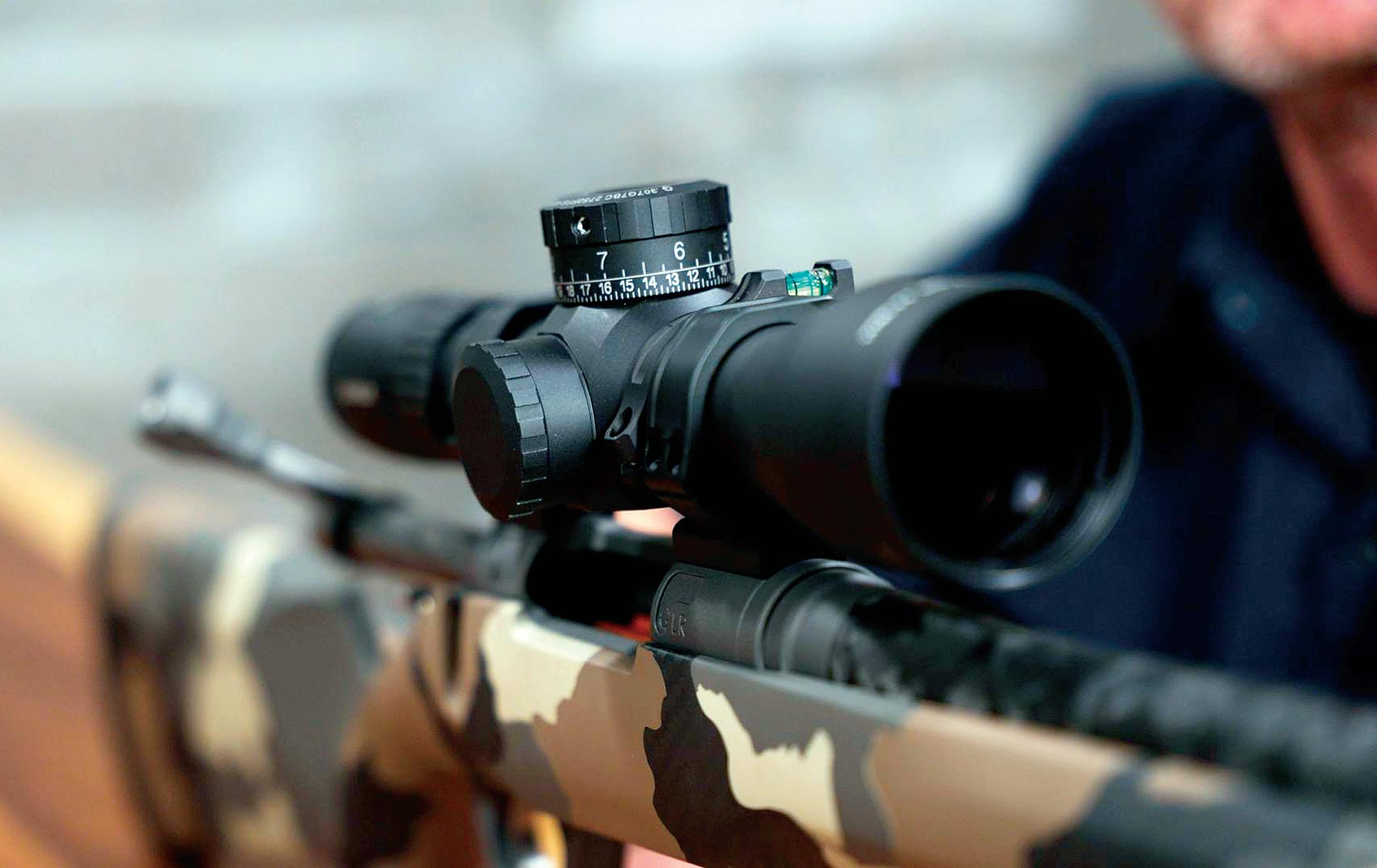
Windage turrets should be capped or locked into position so they can’t be moved inadvertently. Rifle scabbards used on horses mix with non-locking turrets like oil and water. I recall a heartbreaking story of a client who attended LRU to prepare for his second dall sheep hunt. On his first hunt, he missed his only opportunity because his windage turret got spun pulling the rifle out of its scabbard.
Elevation turrets need to have a “zero stop” feature. Most elevation turrets have between 20 and 30 MOA of elevation available on each full revolution. However, it is common for a scope to have 4 or 5 total revolutions of travel. A “zero stop” gives you a failsafe indexing point on your 100-yard zero. This prevents you from adjusting too far down while also giving you the means to ensure you begin the correction on the proper revolution. But, we must use our zero stop correctly. The most common “Oops!” scenario is to prepare for a long shot, let’s say 800 yards. When you dial to 800 yards on a turret, you will be approximately ¾ of the way around a full revolution. Now the opportunity goes away, and the rifle gets put away WITHOUT returning the turret to its zero stop. Now another opportunity presents itself, a slam dunk at 300 yards. The hunter quickly dials up to 300 yards and sends a shot… and
severely misses over the animal’s back because the rifle is dialed a full revolution (20 to 30 MOA) above the correct setting.
Reading wind and converting that into a measurable hold is a complex subject and beyond the scope of this article. Despite having a proper wind hold in mind, the simple mistake of holding the wrong direction gives hunters heartbreak every year. Time is normally not our friend in the field, so we recommend holding wind within the reticle. Holding left or right a measured amount is more intuitive than dialing- the crosshair goes into the wind, and the hashmark corresponding to your wind call becomes your “new crosshair”. Holding for wind allows the shooter to quickly compensate for changes in wind speed and direction.
Although this seems pretty obvious, we can still botch the shot under stress. “Hold right 3 minutes” means push the crosshairs to the RIGHT of the target and use the proper hash mark on the LEFT side of the crosshair. Under stress, it’s easy to hear “Hold 3 minutes right” and then use the hash mark to the right of center. You are now holding the wrong direction.
Holding the wrong direction is only one way we can mishold the wind. Second focal plane (SFP) scopes lead to many improper wind holds. In a SFP scope, the advertised spacing between the hash marks is only correct when the scope is set at its max power, because the reticle doesn’t scale with the image. Seems
pretty simple, just always shoot at max power right? The problem is this opens up the potential for more human error, and none of us is immune to it. I have a truck gun I affectionately call “Fugly”. “Fugly” used to be a .308 duty rifle in my former life, now she is rebarreled in 6.5 Creedmoor. I have stubbornly held on to the old second focal plane 3-15 scope because of the nostalgia of those many years. My newer FFP scopes are on my real hunting rifles. This scope on “Fugly” bit me twice last year. I shot a local PRS match and during one stage I kept reducing the magnification to find targets. I dropped a few points because I didn’t power back up to max magnification (under time pressure) and my intended 2 moa wind holds were really 3 or 4 moa wind holds at lower magnification. I then did the same thing on an antelope hunt. I powered down to find him, powered back up to where I liked the field of view and held the first hash mark for 1 MOA of wind. I hit him a further back than I intended. He died, but I was not happy with my shot placement. I looked at my power ring and it was set to 8x not 15x and I realized I held about 2 MOA of wind instead of 1 MOA.
Scope cant is present when the vertical axis of the crosshair is not parallel to the force of gravity. With more cant and the further we are shooting, the more pronounced this error becomes. When no cant is present, the bullet is launched up and in line with the vertical crosshair while gravity pulls it back down
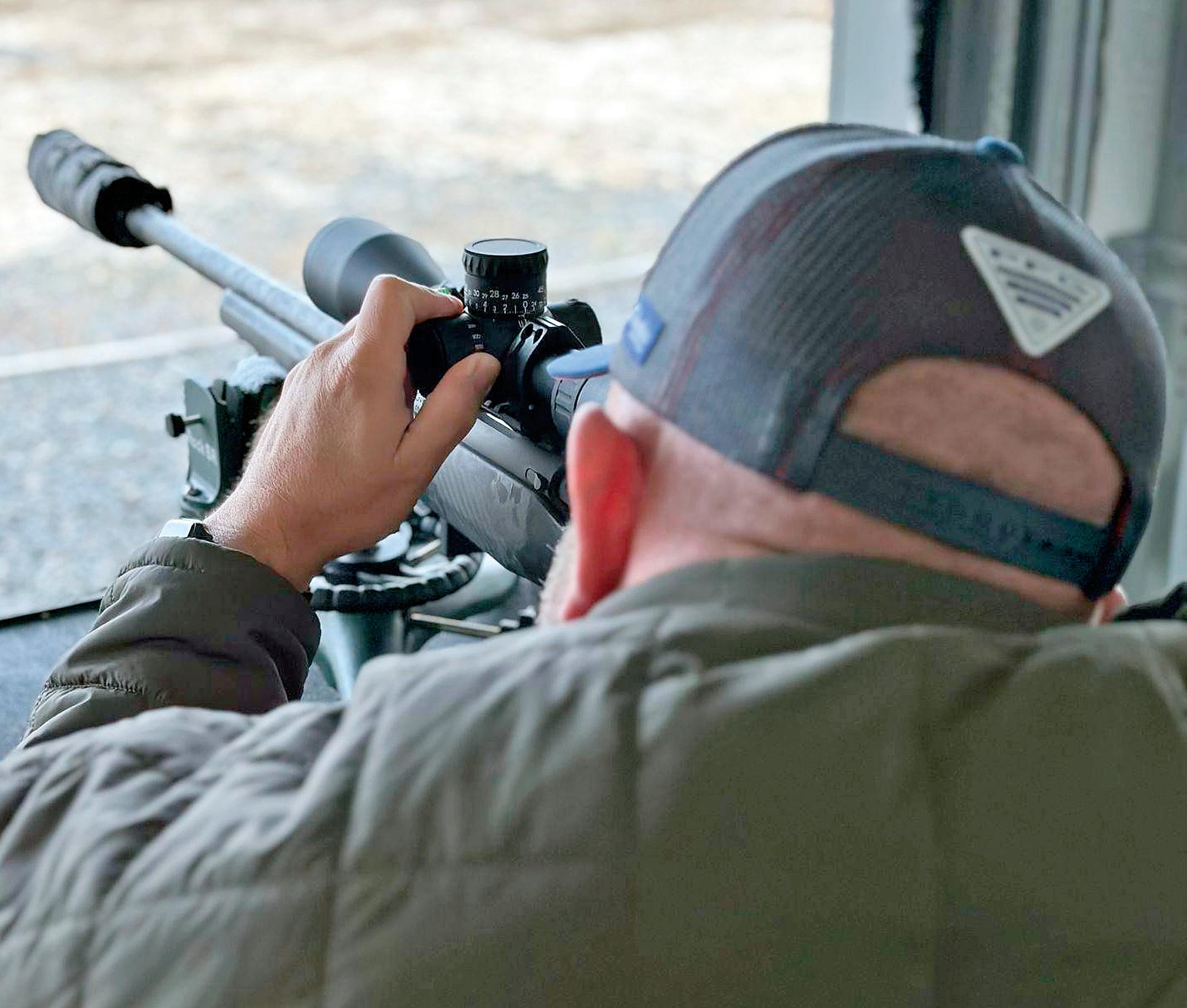
in parallel. If “straight down” is not parallel to the vertical crosshair (i.e. cant is present) then the bullet will impact left or right of center. This can appear to be a poor wind call, but may in fact be a result of canting the rifle. A bubble level is absolutely a critical piece of gear on a long-range shooting system to prevent this mistake- if you check it. It is difficult to level a picture on the wall, let alone in the field where nothing is level, so check your bubble level before every shot. If the rifle and scope are rotated clockwise from level, which is very common for a right handed shooter, the bubble will be buried on the left side and the shot will impact to the right. If the rifle is rotated
counterclockwise, the bubble will be buried on the right side and the impact will be to the left.
Trust your bubble level and make it a habit to check it for every shot. Even if you are a flatlander… Use a bubble level for every shot.
Riflescopes are designed with “eyebox” so we can see through it even if our eye is not perfectly centered behind it. If our eye is too far off center all we see is black and as we move our eye closer to center the image comes into view. Riflescopes compensate for our eye being out of center by adjusting parallax.
A parallax free condition is obtained when the image of the reticle and the image of the target are focused on the same plane. A scope can only be completely parallax free for one range at a time and the way we adjust parallax is through the “parallax knob”, or “side focus”. As the name “side focus” implies, this knob also allows you to focus the image of the target more clearly. The numbers printed on this knob very loosely correspond to the yardage, and often don’t match a parallax free condition. How does parallax hurt you? If your eye is out of center when parallax is present, the image reticle will, in reality, not be aligned with the image
of the target. You will adjust the rifle to the image of the reticle, thereby aiming the rifle off the true center of your target.
Parallax must be set EVERY time we switch yardlines. Until you learn your scope, it is a two step process.
Step 1: Use the parallax knob to get the target image as clear as possible in the scope, this may be more challenging on days with heavy mirage.
Step 2: Ensure the rifle is completely stable, and then pick a precise point to place your crosshair. Slightly rotate your face away from the stock so you can nod your head slightly up and down without moving the rifle. As you move your eye, watch for the reticle to float up and down across the target. If the reticle is floating around, you have parallax. Make a small adjustment and see if it gets better or worse. Adjust until the reticle and the target stay glued together regardless of where you move your eye. You are now parallax free.
In time you will learn your scope. For example, you might find you are parallax free at 400 yards but parallax knob indicates 800 yards. To get parallax free at 800 yards you are at the infinity marker on the scope. Once you have “learned” your scope
you will no longer have to check for parallax you will know where to set it based on the yardage. So just how bad can parallax hurt you at 800 or 900 yards? On days with heavy mirage, it can be easy to set the “side focus” off significantly while you try to create a clear image. I often see over a foot of movement in parallax at these distances when trying to focus the image. It is important to develop a consistent stock weld that centers your eye behind the rifle. If you shoot with your eye perfectly centered, there are no issues. If you are inconsistent with your stock weld, your eye will be in a different position and you’ll be literally aiming at different points for each shot. If you have a consistent stock weld and your eye is in the same consistent, out-ofcenter position, you will shoot a great group, but it will be high or low. You may think your data or your zero is off. Almost every scope I have used has required constant parallax adjustment. If it is parallax free at 600 yards there can easily be a full MOA of reticle movement at 1000 yards. The Revic RS25i is the most parallax forgiving scope I have used since my Unertl in the Marines. I can set it to be parallax free at 1000 yards and there is no discernable movement of the crosshair from 400 to 1000 yards.
Despite the prevalence of laser rangefinders, we see a lot of misses caused by improper use of a laser rangefinder or by using a laser that doesn’t have the ability to adapt to the conditions.
Laser rangefinders are an incredible tool. The prevalence of laser rangefinders forever changed the direction of hunting rifle evolution and they were directly responsible for the decline in popularity of hot-rod cartridges, such as the 300 Ultra Mag and the 30-378 Weatherby. Like any tool, their capabilities are limited by technology, how well the engineers understood the needs of the end user, and the skill level of the end user in the field.
We must have a basic understanding of how a laser rangefinder works to understand what can go wrong with this tool.
The device emits a pulse of light which is zeroed from the factory to coincide with the reticle used within the unit. The light reflects off the target and the unit analyzes the amount of time it takes to return to determine the range. In a perfect world, the laser beam is precisely zeroed with the reticle and doesn’t project outside of the reticle. Additionally, the whole beam would impact a single,
3-Steps to Range
These 3 simple techniques will give you confidence in your range, after you’ve identified the “zero” in your rangefinder.
GET STABLE
Brace the laser on a solid object or better yet use a tripod. Make sure that nothing such as the elevation knob on your rifle scope is blocking the returned light from getting to the bottom lens on the laser. Stability is even more important if you are working in the “Long Range” modes.
BRACKET
Purposely range behind and in front of the animal. Then range the animal. Range distinct features around the animal until you can identify the correct range of the animal from the ranges around it.
TARGETING MODES
When ranging the actual animal, use the near mode and start with the reticle above the animal. Slowly lower the beam to the animal and you should see the range change from the terrain behind the target to the animal. When ranging the terrain behind the animal, or the terrain at their feet use the far mode.
reflective surface so all the returning light registers at the same instant. In reality, the beam doesn’t perfectly imitate the reticle and may impact on an unintended object(s).
So, we must learn where the laser is actually zeroed in relation to the reticle, and we must take advantage of a rangefinder’s targeting modes. All Revic rangefinding products have been engineered with targeting modes that ensure you are getting a correct range. Zeroing is done at the factory and can not be adjusted by the end user in the field. To check the zero on a laser rangefinder, find a traffic sign with nothing close behind it and move to a distance you can confidently get a good range, say 100-200 yards. Get very steady, preferably with the laser mounted on a tripod. Start with the reticle well off to the side of the sign and acquire a range. Keep hitting the fire button and slowly move the reticle towards the sign. Note where the edge of the reticle is in relation to the edge of the sign when the device first gives you the range to the sign. Keep moving across the sign and note where the other side of the reticle is in relation to
the sign when the device stops giving you the range to the sign. Repeat this coming down from above the sign to check where the bottom of the beam is. Now turn the device upside down and repeat from the top of the sign which is actually checking where the top of the beam is without the post supporting the sign interfering.
This gives you a good representation of where the beam really is in relation to the reticle. You might learn that using the bottom of the reticle as your aiming point actually centers the beam on the target. This test should be repeated any time a laser gets dropped or suffers an impact which could disrupt the zero. If the zero is way off it should be returned to the manufacturer. To get the best results conduct this test in the “Near Targeting Mode”.
Targeting modes allow us to tell the processor to ignore some of the returning light. In “Near” mode, the device will give us a range on the first returned light and ignore the later returning light. This setting is great for an antelope in the middle of an open field but would fail with
a little bit of fog, or rain between us and the target.
In “Far” mode the device ignores the early returns and gives a range on the last returning light. This mode works great for rainy or foggy days. In addition, this mode works well when ranging hillsides and trees next to the animal. It would likely fail on the antelope standing in the open plain because more of the light would be returned by the terrain behind the animal than would be reflected off the animal itself.
The G7 Laser rangefinder was one of the first rangefinders to incorporate targeting modes and this capability has been further enhanced in the current Revic BR-4 rangefinder and BLR10b binoculars. There are a surprising number of high end ballistic rangefinders on the market that do not have the ability to select targeting modes.
The Revic line of laser rangefinders also incorporate a “Long Range Mode”. When you push the button on a basic laser, the device emits one beam of light. If the beam encounters numerous objects at different ranges the light will get reflected back at different times. The processor has a “threshold” meaning it must get a significant amount of light back all at once to register a range. If the returning light is so spread out that there is not enough light returning at the same instant to break the threshold the device will not display a range. In “Long Range Mode” the device pulses out multiple beams of light for up to 5 seconds. The processor “remembers” the data from each pulse and stacks the data from subsequent pulses on top of each other creating enough data to break the threshold required to display a range. There are “Long Range Near” and “Long Range Far” modes which work just like the “Near” and “Far” modes but with the addition of the multiple pulses for each button push. Generally I work in either “Near” or “Far” mode and switch to the Long Range Mode if I find it difficult to get the device to display a range.



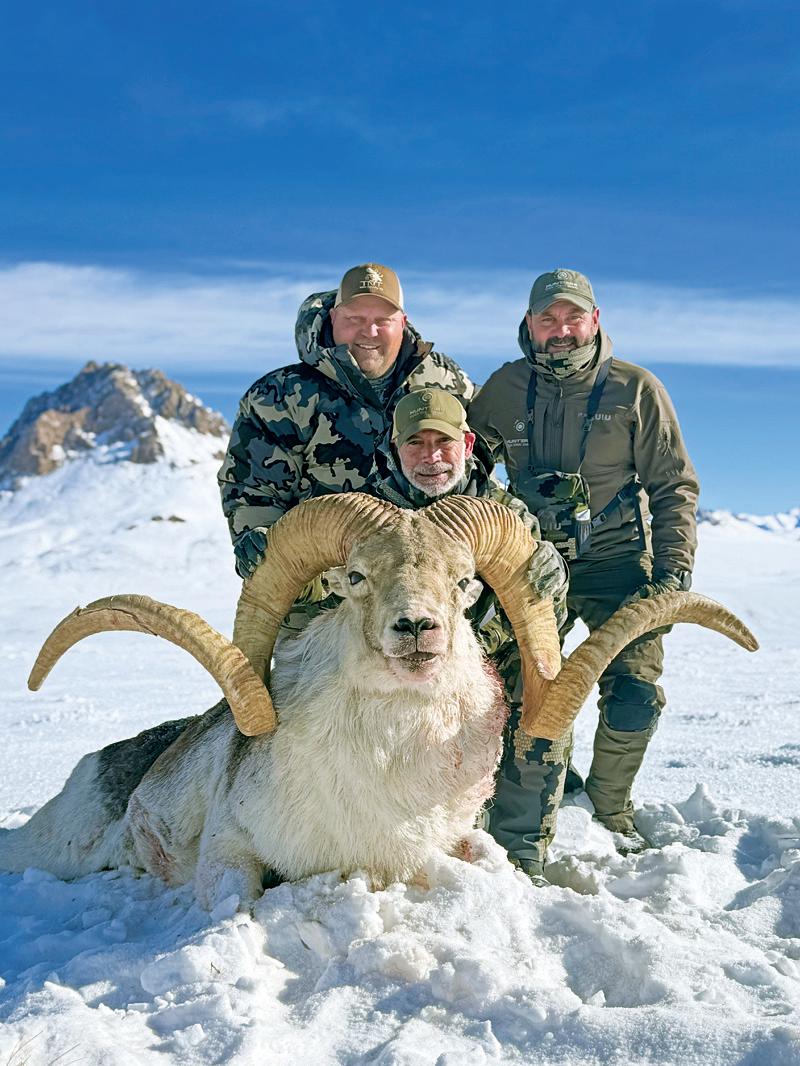
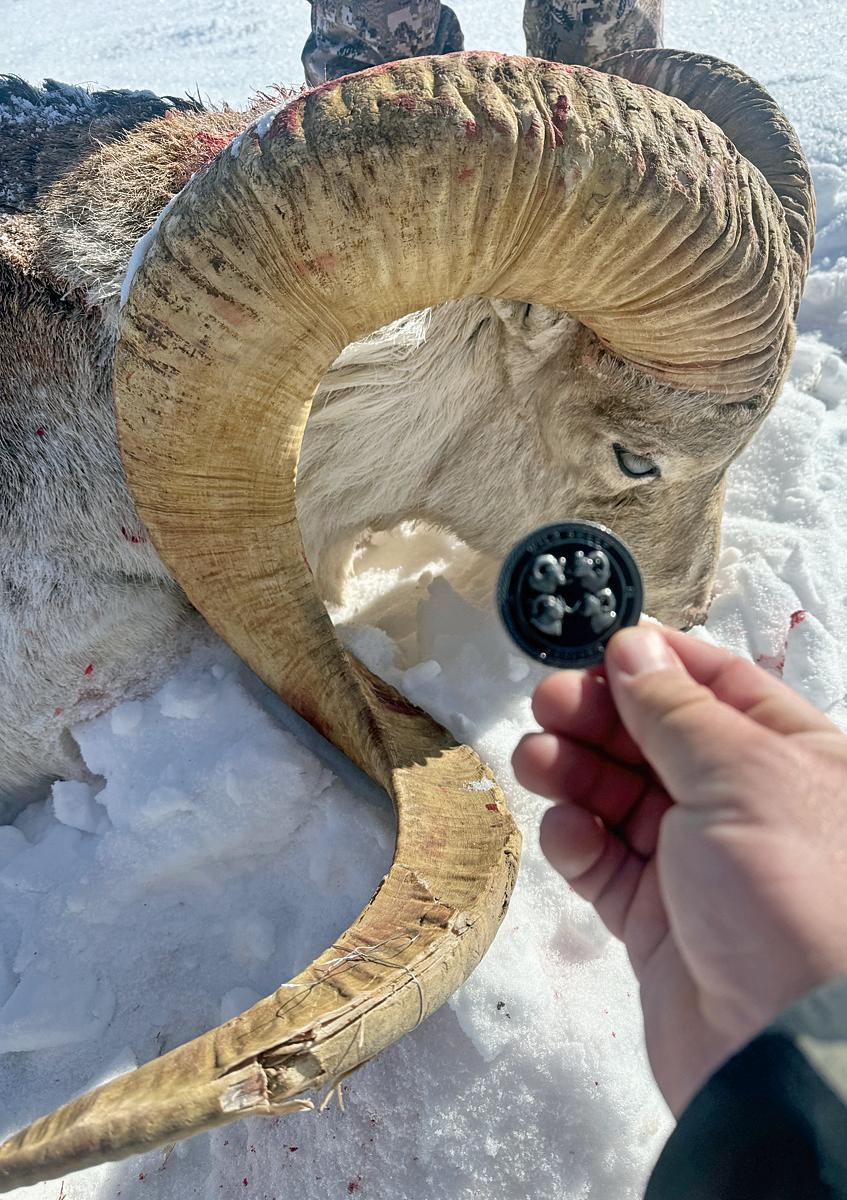
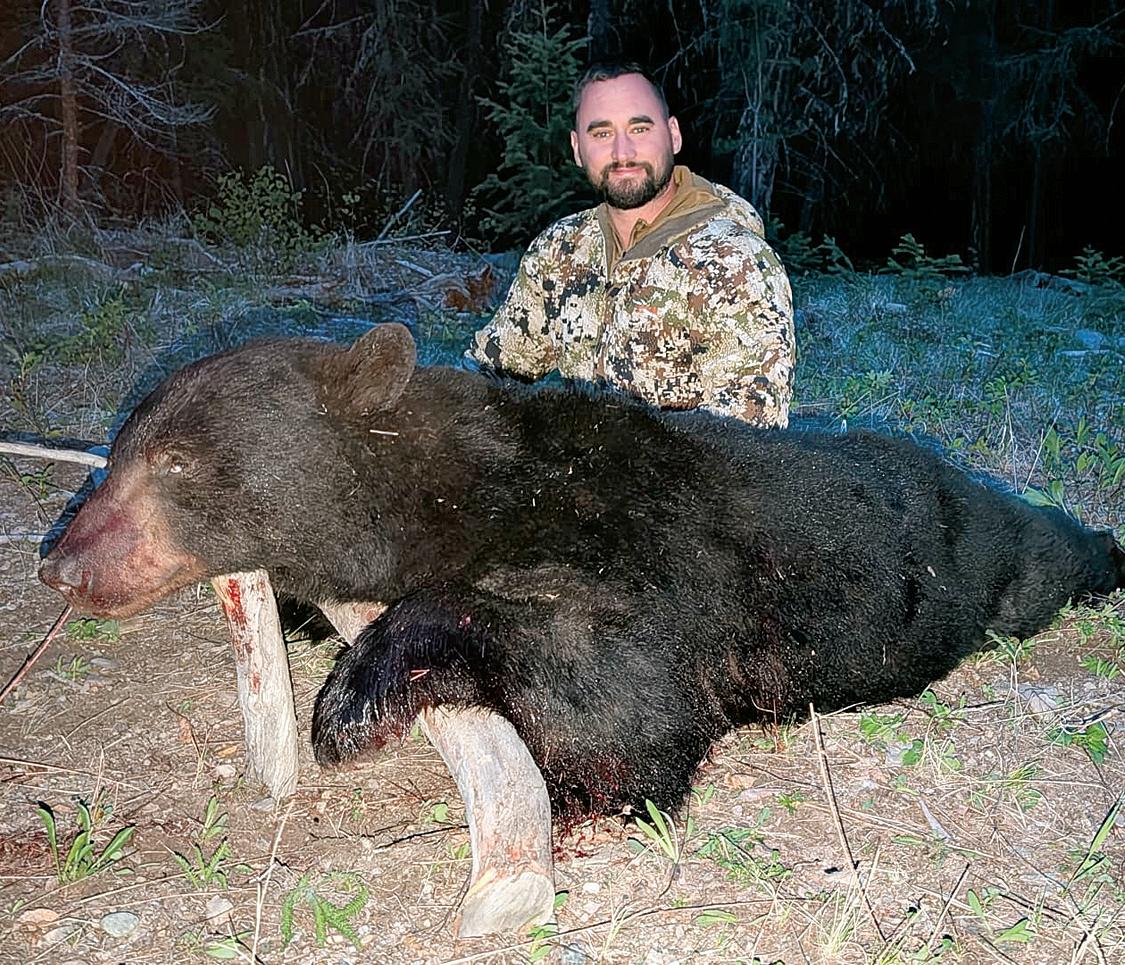
As an avid moose, deer, and sheep hunter, I had never felt the “need” to hunt bears—the freezer was usually pretty full. With a healthy understanding of predator management, curiosity got the better of me and I made the most of a long weekend of fishing and hunting with these two boars taking a ride home. Now my wife has another flavour profile of wild game to feed our family. You can check out @ cmbarndominium on Instagram for her amazing recipes.
– Cole Hank
Members, send us your hunt story ~50 words plus a picture or two to kstelter@wildsheepsociety.com.
I was lucky enough to go to Tajikistan in the winter of 2024. This hunt is every sheep hunters dream and it did not disappoint. We went at the beginning of December and were seeing incredible amounts of animals. We were blessed with 2 fantastic sheep, as well as ibex, wolves and a yak.
– Mark Gushattey
Spring Bear season is one I cherish, no matter how many or few days I get to spend in the mountains chasing them. Generally, a game-rich experience, with mild weather and long days—it is the perfect opportunity for classic rifles and new experiences for hunters. I recently had the pleasure of hunting with an old friend from Ontario on a short but sweet bear trip, where he took his first colour-phase bear. Despite unseasonably cold and wet weather, a tag was cut, many a laugh was had, and a few whiskeys around the campfire, of course. A new to me 1956 Winchester 70 rebarreled in 375 Chatfield Taylor was the rifle of choice for me, and it surely won’t be the last time it sees the mountains.
– Nolan Osborne
Lessons from training a bird dog: keep things simple, build courage through steady exposure, celebrate small wins, and focus on what you can control. Hard years, like hard hunts, teach resilience. Progress is rarely linear, but consistency, clarity, effort, and faith in the process keep you still moving forward.
– Devon Stewart
Editor note: watch for Devon’s full article in the fall magazine.
by Norm Brennand
by Bill Pastorek
arents tend to pass their passions on to their children. By the time he was around three or four years old my son Paul was already following in my footsteps, tagging along while I was bird hunting in southern Ontario. After the family’s move to Alberta in 1990 his desire to hunt only intensified. In his mid-teens he ‘graduated’ from grouse and duck hunting to pronghorns, whitetails, and mulies. In Paul’s twenties, his focus shifted to elk and moose. Like all young hunters, he measured success by whether or not he harvested an animal. But as he got older, he started to see the bigger picture. In the back of his mind though, was a phrase I’d often use, “There’s hunting, and then there’s sheep hunting.” By his late twenties, Paul had come down with the infamous ‘sheep fever’.
My man cave displays countless lifelong hunting memories, most photos capturing father and son moments involving moose, elk, antelope, and the countless deer we have taken together. When Paul was 36 years old, he already had a couple rams of his own. But what was glaringly absent from my man cave was ‘THE’ picture... an image of the two of us together with a bighorn. It was the one piece of the puzzle missing as we were, first and foremost, sheep hunters.
Something we didn’t talk about but was definitely on our minds, was the fact that the sand in my hourglass was running out. At 68 years of age, I wondered how much longer I’d be able to chase rams with Paul when each and every year the mountains seemed to grow a little bit higher. Despite my age, my passion never waned. In fact, it only increased as I truly treasured every minute on the mountains shared with my son. I knew I had to be proactive if I wanted to continue playing what most consider a young man’s game.
When I hit my early forties, I focused on getting in better shape. I got into long distance running, which I enjoyed right into my late fifties when one of my knees started talking back.
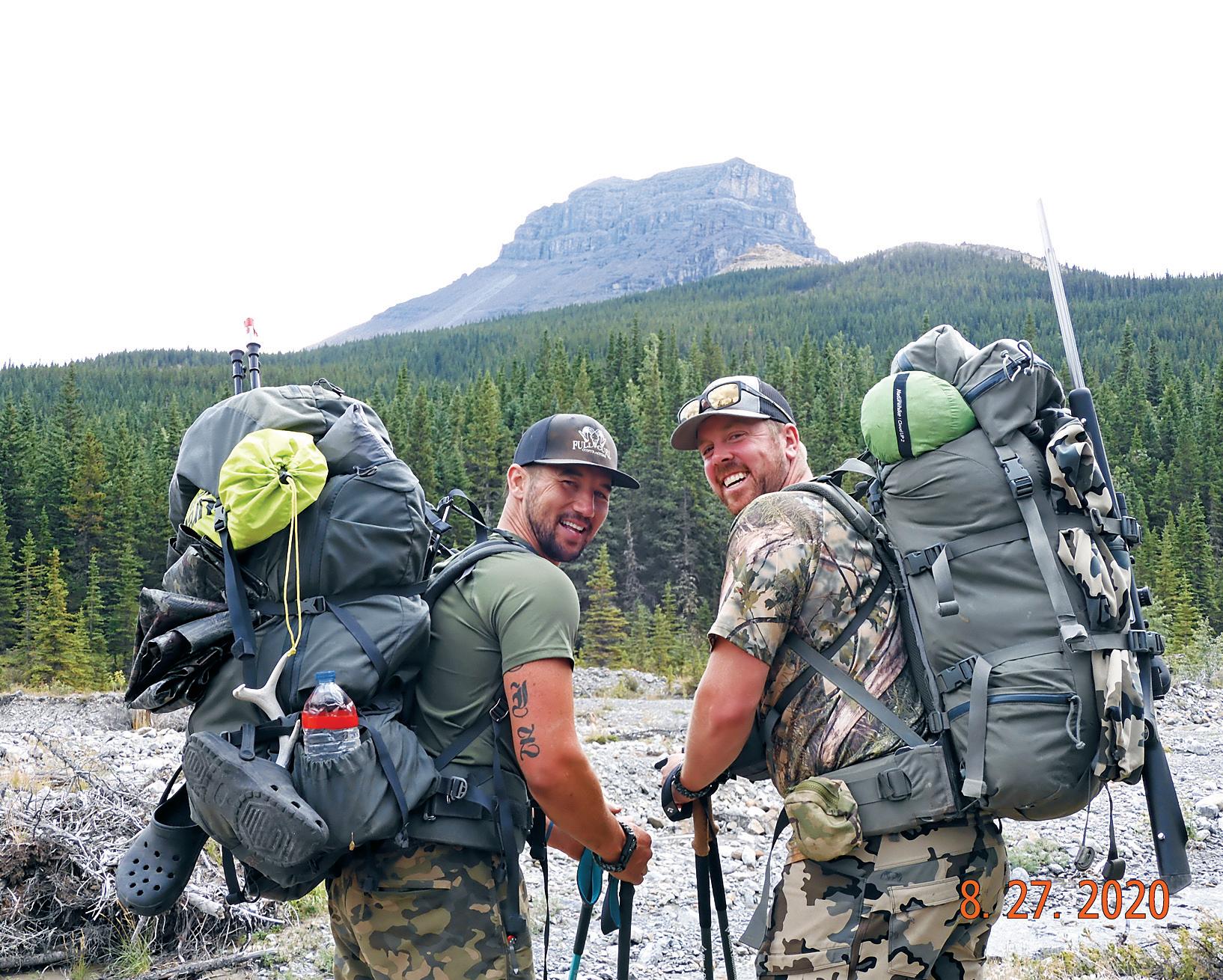
At the same time, I lightened my load... carrying no tent, air mattress, or spotting scope. The majority of our hunts were day trips, but for the times I overnighted, I carried only a $10 emergency tent—basically a large garbage bag with holes at each end. My mattress was all the fresh evergreen boughs I could gather in under ten minutes. Instead of a spotting scope, I’d use a compact camera with a 35 zoom—works like a hot damn. Even retired my 270 pump of 40 years and purchased a Sako Finnlight... every single ounce counts. Most would call me nuts for going so light, but the plan worked. I’m still out there. Plus, at my age I do have one big advantage over younger hunters—perspective. If the rain or snow becomes part of my hunt and I feel a tad uncomfortable snuggled in my glorified garbage bag, it’s all good. I actually feel blessed for every hike I get to make into God’s Country, so I can make do with a bit of roughing it. My son calls me ‘old school’, and he’s probably right. For the past six or seven years, Paul had been going out with his solid hunting buddy Clint McFarland. Both are from the same town and were in excellent shape. More importantly, they shared the same work ethic and passion in their search for rams. They were first into bow hunting but soon found chasing elk in September got in the way of sheep hunting.
Paul and Clint shared their first ram kill in 2015. Then in 2017, Clint ran across some rams bedded down, hopefully for the night. He and Paul skipped work the next day and came home late that night with a ram each. Although they were classy enough to invite me on the hunt, I had work commitments. Plus, I’d thought I’d slow them down. It was their turn to shine. As happy as I was with them getting their rams, I wondered if I’d been stupid to not at least tag along and give it my best effort. Had I blown the one opportunity to share a successful sheep hunt with my son? Fast forward to 2021. I was supposed to get a knee replacement in 2019 but was taken off the list at the last minute. They said to get knee injections, go to physio, lose weight, and walk more... something I interpreted as go climb mountains. At this point, Paul and Clint were not only hunting machines, but they were also generous and continued to include me in their plans. They often went in a few days ahead of me. Or on day trips to our target area, they hit the mountaintop a couple of hours ahead of me to get in some solid glassing before I joined them. Then we’d all share a few laughs around the campfire at the end of the day. How lucky was I to have my son and his best friend continually go out of their way to make me feel welcome. Once Paul had followed in my footsteps, looking up to me with pride and confidence. Now
I followed Paul, so very proud and confident of the man he’d become. Over my lifetime, I’d shot four Dall rams (I’d lived in the NWT for eight years) and one bighorn way back in 1994. Although I’d get out each and every year, 27 years had flown by since I’d last shot at a ram, until October 20th, 2021 that is. With our headlamps ablaze, we started the hike. The three of us would stay together until we gained enough elevation to escape the trees. The grizzly population in the area was soaring. Paul and I had already seen 22 grizzlies over the summer and fall, so we didn’t want to take any chances. By the time we put away the headlamps, it was time to separate. Paul and Clint would hustle up to the top of the mountain. Meanwhile, I’d slowly make my way up, picking my spots to stop, getting comfortable and working my binoculars. By midmorning, the sun was breaking over the mountains. In some spots it was damn near impossible to glass, in others it was perfect, depending on the angle. Before long, I caught a glimpse of two ewes in the distance walking away. Ten minutes later, I saw a group of ewes about 1500 yards straight out in front of me. After some more intense glassing, another eight or nine ewes appeared. To my shock, there was a ram as well. He immediately captured my attention. I reached for my little camera and jacked up the zoom to 35. I didn’t want to text Paul on my inReach until I was
absolutely positive this ram was what I’d been waiting for all these years. I saw he was broomed off on his right side, but it took another 40 minutes to see his left horn. He was indeed a dandy! I immediately texted Paul. Within seconds, Paul and Clint had packed up and were literally running down the mountain to join me. They were both pumped, confident this was my long-awaited ram. The stalk was a simple one. Down the mountain, across the valley, and back up the next mountain. We stayed out of sight and prayed they’d still be there. We knew the wind wasn’t in our favour, but we had no other approach. Once at the bottom, the guys convinced me to take off my pack. I needed to get up to a shooting position ASAP. This would be the ultimate test for me. Knowing a trophy ram was at the top, I was nervous about how quickly I could get up there and make a shot. In my younger years, I took great pride in my fitness level, having run a total of 23 marathons. I ran so I could hunt sheep, but as I mentioned earlier, arthritis in my left knee ended my running days.
During our stalk, a mature black bear watched our every move. Fortunately, when he eventually spooked, he ran in the opposite direction of the sheep. As we climbed, Clint asked, “Are you comfortable taking a shot between 400-500 yards?”
I admitted, “I’d be a lot more comfortable under 200 yards.” Just
before midday, the long-awaited moment arrived. Paul ranged the ram at 159 yards.
Under normal circumstances, this would have been a gift, but I wasn’t confident with my new rifle since I hadn’t shot it enough in the field. Plus, I was shooting from a sloping knoll of grass... not the most comfortable shot I was ever going to try. Despite it not feeling ‘right’, I hit him with a good shot right behind his shoulder. I shot again, standing up and shooting freehand, as I was more comfortable doing that.
We walked to the boulder-filled drainage following his trail, but found nothing. He must have bounced 75100 yards because there he was down below, folded up against a huge boulder. One beautiful but battered ram. When we finally got to him, I saw his best horn had broken during the tumble and a piece was missing. His right horn, despite being broomed, was huge.
Of course I was thrilled, but Paul and Clint were ecstatic. This was, by far, the best part of the hunt. Despite our age difference, Clint had become a close friend and I respected his passion and commitment to sheep hunting. Paul and I were finally going to get that father/son photo we’d wanted so badly. The two of us together with our ram... and it was indeed OUR ram. Countless mountains explored together over the years hoping for this very moment. When the picture taking was finally over, and there was lots, Paul and Clint
wanted to retrace where the ram had bounced down the drainage to see if they could find the broken horn. I appreciated their offer but was certain they’d never find the missing piece. In less than ten minutes, they’d proved me wrong. Paul had somehow found it... unbelievable!
Each and every ram taken is unique, and generates memories that last a lifetime. It had been just over 40 years since I shot my first Dall ram, but this father/son ram was indeed the ultimate moment and special for so many reasons. Going 27 years before seeing a ram you want to take, approaching my 70s, and most important of all, sharing the moment with the best hunting buddy I could ask for, my son Paul. I’m fortunate and blessed that whenever I’m in the mountains, it’s with him.
I’ve no idea how many more years I’ll be doing this, but I’m going to treasure every single moment for as long as I possibly can. To me, age is truly just a number!