Wild Sheep Society of BC Magazine is published four times per year for the Wild Sheep Society of British Columbia by
Sportscene Publications Inc.
10450 - 174 Street Edmonton, Alberta T5S 2G9 Ph: 780.413.0331 Fax 780.413.0388 Email: info@sportscene.ca www.sportscene.ca
Winter 2026 Issue Editor in Chief Kyle Stelter (CEO) Editors Peter Gutsche Nolan Osborne Bill Pastorek Contributors Larisa Murdoch Helen Schwantje, DVM Design & Layout Sportscene Publications Inc. Printing Elite Lithographers Co. Ltd. Editorial Submissions Please submit articles and photos to kstelter@wildsheepsociety.com No portion of Wild Sheep Society of BC Magazine may be copied or reproduced without the prior written consent of the Wild Sheep Society of British Columbia. The views and opinions expressed by the authors of the articles in Wild Sheep Society of BC Magazine are those of the author and not necessarily those of the Wild Sheep Society of British Columbia. PUBLICATIONS MAIL AGREEMENT NO. 43363024
Board of Directors.......................................................................................5 CEO Message.............................................................................................6 Meet Our Team: Nicole Barker....................................................................8 2026 Wild Sheep Ram Awards..................................................................10 Psoroptes Winter Update..........................................................................12 Kootenay Bighorn Sheep Workshop.........................................................16 Adopt a Sheep Sponsors..........................................................................20 Hard Head Facts: The Science Behind Bighorn Horn Growth .................22 Salute to Conservation Mountain Hunting Expo........................................26 No Quit in Me: A Yukon Mountain Caribou Dream at 77...........................30 Membership Update..................................................................................32 WSSBC 2026 Events Calendar.................................................................34 The One....................................................................................................36 Northern Fundraiser..................................................................................40 Mountain Hunting Expo Exhibitors............................................................42 Women Shaping Conservation: One Step at a Time.................................44 Half Curl Youth Life Members....................................................................50 African Hunt of a Lifetime..........................................................................52 Intertwined: The Inseparable Legacies of Jack O’Connor and the Winchester Model 70 ...................................................................54 Monarch Members....................................................................................60 Member Highlights....................................................................................62 Dream Rams: The Best There Ever Was..................................................64
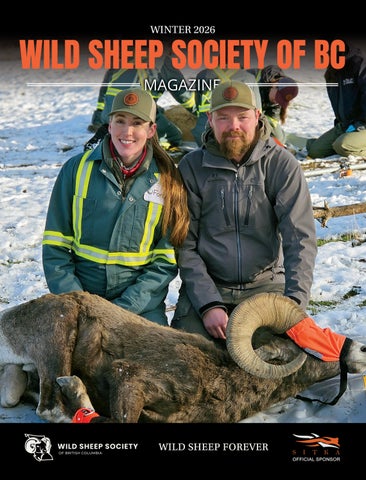
Cover photo of ONA tmixʷ (Wildlife) Program Lead Mackenzie Clarke and WSSBC Director Peter Gutsche.
Return Undeliverable Canadian Addresses to
Wild Sheep Society of British Columbia
#101 - 30799 Simpson Road, Abbotsford, BC V2T 6X4 www.wildsheepsociety.com Printed in Canada
4
WILD SHEEP SOCIETY OF BC
Chief Executive Officer – Kyle Stelter 250-619-8415 ● kstelter@wildsheepsociety.com
Secretary – Colin Peters 604-833-5802 ● colin.peters12@gmail.com
President – Greg Rensmaag 604-209-4543 ● rensmaag_Greg@hotmail.com
Treasurer – Joe Humphries 250-230-5313 ● joseph_humphries@hotmail.com
Vice-President – Chris Barker 250-883-3112 ● barkerwildsheep@gmail.com
Past President – Korey Green kgreen@wildsheepsociety.com
Vice-President – Mike Southin 604-240-7337 ● msouthin@telus.net
Joe Eppele 647-986-3859 joe.eppele@gmail.com
Justin Kallusky 236-331-6765 kallusky@hotmail.com
James Mitton 778-808-9001 jamesmitton15@gmail.com
Peter Gutsche 250-328-5224 pgutsche@wildsheepsociety.com
Benjamin Matthew MD 778-558-0996 ben.matthew@ubc.ca
Greg Nalleweg 778-220-3194 greg@nextgenelectrical.ca
Ken Jyrkkanen 250-319-7759 Email: kjyrkkanen@gmail.com
Matt McCabe 250-320-6048 mattmccabe.wssbc@gmail.com
Communications Committee Chair: Kyle Stelter ● 250-619-8415 kstelter@wildsheepsociety.com Fundraising Committee Chair: Korey Green ● 250-793-2037 kgreen@wildsheepsociety.com Government Engagement Committee Chair: Greg Rensmaag ● 604-209-4543 rensmaag_greg@hotmail.com
Jurassic Classic Kyle Stelter ● 250 619-8415 ● kstelter@wildsheepsociety.com Raffles Joe Humphries ● 250-230-5313 ● joseph_humphries@hotmail.com Women Shaping Conservation Rebecca Peters ● 778-886-3097 ● rebeccaanne75@gmail.com
Hunter Heritage Committee Chair: Jann Demaske ● 970-539-8742 demaskes@msn.com
Bookkeeper Kelly Cioffi ● 778-908-3634 kelly@dkccompany.com
Indigenous Relations Committee Chair: Peter Gutsche ● 250-328-5224 pgutsche@wildsheepsociety.com
Executive Assistant Hana Erikson ● 604-690-9555 exec@wildsheepsociety.com
Membership Committee Chair: Matt McCabe ● 250-320-6048 mattmccabe.wssbc@gmail.com
Hunting Expo Coordinator Kris Wrathall ● 604-340-4903 ovisslam@outlook.com
Projects Committee Chair: Chris Barker ● 250-883-3112 barkerwildsheep@gmail.com
Projects Administrator Nicole Barker ● 250-361-5734 projects@wildsheepsociety.com
WILD SHEEP SOCIETY OF BC
Danny Coyne Darryn Epp Trevor Carruthers
5
ow, has 2025 ever been a year for the books. If we look at where we are as an organization—and specifically at the wild sheep resource—there is a lot to be excited about. This fall has been exceptional, with incredible quality rams harvested in British Columbia. I have heard of over ten bighorn rams surpassing the 180 mark coming from the Kootenay region alone, with a few cracking 190. Incredible. On the thinhorn side, we have witnessed some outstanding Stone’s and Dall’s rams taken as well. WSSBC Monarch Member Waylon Vipond took an impressive Stone’s ram that officially scored over 179”. It was also a great year for Dall’s, with Logan Calvert and a number of other members harvesting fabulous rams. This is a powerful testament to the wild sheep resource itself, and it is inspiring to share in these stories. The timing could not be better with our Ram Awards officially launching this year. Frontiersmen Gear is sponsoring the event, which we will host on Thursday, February 26th at our Salute to Conservation in Penticton. This is going to be an incredible evening as we celebrate hunter achievements and wild sheep themselves. I encourage all of you to join us. With Trench Brewing and Okanagan Spirits as beverage sponsors, complimentary beverages and appetizers, and an amazing social evening centred on wild sheep, this is an event you simply do not want to miss. As a Society we are mission driven and, thanks first and foremost to our members, we have done incredible work for wild sheep. Once again this year, we have exceeded our previous investments in projects within the province. As we round out the year, we have contributed over three-quarters of a million dollars toward projects benefitting BC’s Stone’s, Dall’s, and bighorn sheep. Our three legacy landscape projects continue to advance: the Fraser River California bighorn sheep metapopulation, Peace Region prescribed burns benefitting Stone’s sheep, and our Psoroptes treatment trials in the Okanagan region. Considerable investment has been made in all three, and we are seeing tangible results on the landscape. Lamb recruitment in some herds is close to four times pre-treatment levels in our Fraser River bighorns, and we are seeing increased range use in fire-treated areas in the Peace. Our volunteers spent two days in November treating our captive bighorn sheep in the pens, and we are eager to see the results of these drugs on the pervasive Psoroptes issue they are facing. I want to recognize our Adopt-a-Sheep sponsors and our numerous project partners who share our vision of supporting BC’s wild sheep. On November 21st, the Wild Sheep Society hosted the Kootenay Bighorn Sheep Workshop: From Summit 2022 to Action 2025 and Beyond. Held in Cranbrook, we welcomed 6
over 80 dedicated conservationists, including non-government organizations, biologists, government representatives, and First Nations. Our goal was to listen, learn, and provide additional support where needed for the great work underway in the Kootenays. Thank you to all those who attended, and to our lead, Dr. Helen Schwantje, for a positive and constructive workshop. Following the Kootenay Workshop, your Board of Directors met for a very effective strategic planning session and set our key priorities for 2026 and beyond. Needless to say, we will continue to lean into our conservation work for wild sheep. You will see continued awareness and investment in hornaging education and the selection of mature rams. You will have noted our focus on that for 2025, and early reports from government indicate there was a significant improvement in underage ram harvest compared to previous years. As we roll into our fundraising season, we are again looking to our wild sheep family. At our recent strategic planning meeting, the Board set another aggressive path forward to support our wild sheep resource. We cannot do it without the support of our members, donors, sponsors, and industry partners. Everything we have accomplished to date, we have done together. If we continue to focus on the wild sheep themselves, we will continue to see positive outcomes, just as we have in the past. In closing, I want to share that I am incredibly optimistic about our collective future as a wild sheep family. In the broader context, we see division—politically and otherwise. What I see in our circle of conservationists is an ecosystem of dedicated people, businesses, and supporters who are focused on our mission, vision, and values: Inspire, Integrity, Inclusivity, Respect, Collaboration, Innovation, Stewardship, and Dedication. Together, we are doing incredible things. I hope to see many of you at either the Northern Fundraiser or the Salute to Conservation and Mountain Hunting Expo in the coming months. Our Board of Directors and volunteers have two incredible events planned with a lot of exciting new elements. I have two calls to action for our members. First, please consider introducing a like-minded conservationist to the Society. We have a great Gift of Conservation program designed with this in mind. Second, please consider joining us at one of our fundraisers this winter. Without all of you, we would not achieve what we have done collectively. As a dedicated member of the Society, you are truly making a difference for the wild sheep resource and making BC a better place for all of us. For that, I thank you. Yours in Conservation, Kyle Stelter Chief Executive Officer WILD SHEEP SOCIETY OF BC
y name is Nicole Barker, and I support the Society’s financial administration and project tracking, and day-to-day coordination within the Wild Sheep Society of BC. My role is very much the “behind-the-scenes” side of conservation work, coding projects, tracking funding sources, working closely with our partners, and keeping our projects organized, accurate, and moving in the right direction. I work closely with Kyle, Kelly, Kris, and Hana, and I’m proud to be part of a team that puts so much passion and dedication into protecting wild sheep across the province. A big part of my job is ensuring our information stays clear, accountable, and transparent, which is something I take a lot of pride in. My connection to the Society started long before I worked here. When I was little, my dad used to take me to the Penticton fundraisers and sheep capture-and-treat events, and not to brag, but I actually made the cover of
8
the magazine when I was twelve years old. Coming full circle and being part of this work now feels really meaningful. Conservation has become something I genuinely care about, and seeing the effort that goes into protecting these animals has made me really grateful to be involved. Outside of work, I’m a mom to a very busy little girl, and when I’m not juggling projects, I’m usually chasing her around or spending time with my family on Vancouver Island. I’m proud to support the Society’s mission and to play a small part in the work we’re doing for wild sheep in BC.
WILD SHEEP SOCIETY OF BC
by Peter Gutsche (WSSBC Director) his winter marked a major milestone in the Okanagan Bighorn Psoroptes Treatment Project, a partnership led by the Wild Sheep Society of British Columbia and the Okanagan Nation Alliance that continues to push the boundaries of what collaborative wildlife conservation can achieve. With important support from BC WLRS and Parks staff, as well as members of the Penticton Indian Band, the team gathered at the Penticton sheep pens on November 27–28, 2025 to conduct the first full round of treatments on the bighorn sheep we have been holding since late February. Years of planning, preparation, and commitment finally came to fruition for the benefit of Wild Sheep. Over the two-day handling event, more than thirty dedicated individuals contributed their time and expertise in sub-optimal weather. WSSBC volunteers, ONA biologists, veterinarians, Indigenous knowledge 12
holders, and community members came together with a shared goal: to give these sheep the best possible chance at clearing Psoroptic mange, a debilitating parasitic infestation that has been harming Okanagan bighorn herds for the past twenty-five years. The teamwork on display was exceptional. From calmly moving sheep into the corrals and chutes, to safely restraining animals during processing, to carefully collecting health samples and administering treatments, every person played a vital role in ensuring a smooth and lowstress operation. The sheep in each pen received the treatments assigned to their group: Fluralaner (Flexolt) in Pen 1, a combination of Fluralaner and long-acting Moxidectin (Cydectin LA) in Pen 2, and Cydectin LA alone in Pen 3. Pen 4 remains intentionally untreated to help assess natural reinfection timelines and determine how long-lasting each treatment approach may be.
Fluralaner—previously tested during the 2016–2019 Psoroptes trial—showed strong promise as an oral antiparasitic capable of clearing mites from infected sheep, although the duration of protection was not fully known. The focus now is to refine dosage, confirm how consistently it eliminates live mites, and determine exactly how long sheep remain protected before reinfection occurs. Cydectin LA, a long-acting formulation of moxidectin, is designed to provide extended systemic protection against external parasites. Its ability to remain active in the body for longer periods makes it a strong candidate for field application in wild herds, especially in remote areas where frequent retreatment is not feasible. The combination treatment in Pen 2 pairs the immediate, potent miteclearing action of Fluralaner with the extended protective window of Cydectin LA. This approach may provide both rapid removal of mites and prolonged resistance to WILD SHEEP SOCIETY OF BC
reinfection—two qualities that could be critical for managing psoroptic mange across free-ranging bighorn populations. Together, the three treatment strategies are being compared sideby-side under controlled conditions to give wildlife managers the data needed to determine which treatment is most effective, longest-lasting, and safest to apply at a herd or landscape scale throughout the Okanagan and Similkameen. Beyond the drug administration itself, crews completed a significant amount of additional work. Health sampling was carried out on every animal, including ear swabs, nasal swabs, blood draws, fecal collection, and hair sampling. Hooves were trimmed—an important welfare step given the lack of natural rocky terrain in captivity—and the lambs born in the pens last spring were ear-tagged for future identification. Detailed photographs were taken to monitor lesion severity and body condition over time, creating an essential visual record that will help assess the healing process throughout the next year. WILD SHEEP SOCIETY OF BC
One of the most exciting aspects of this season’s work was the incorporation of four wild, free-ranging bighorn rams. These rams were darted locally and brought temporarily into the pens to breed naturally with the
ewes. The rams will be released back to their home ranges in mid-December once breeding is complete. With the initial treatment phase now behind us, the project moves into an intensive year-long schedule of
13
monthly handling and sampling. These follow-up sessions are critical. They will allow the team to monitor mite presence, assess healing in ear canals and on the body, track weight and body condition, and evaluate the durability of each drug. Understanding the timeline of reinfection—or ideally, the absence of reinfection—is essential before any widespread treatment effort can be launched across the Okanagan and Similkameen. This next phase represents the heart of the clinical trial and will provide the scientific clarity needed to treat wild sheep herds at scale. Psoroptic mange has had a devastating impact on bighorn sheep across the region, contributing to over a 50% decline in certain herds 14
as animals become weakened, lose body condition, and become more vulnerable to predators. The work being done in Penticton is the most comprehensive attempt in North America to remove this parasite from a wild bighorn population. If we are successful, this will not only transform the trajectory of the Okanagan herds—it will set a continental precedent for managing mange outbreaks in sheep populations elsewhere. This project continues to move forward because of the unwavering support of WSSBC members. Your fundraising efforts, your volunteer hours, your passion for wild sheep, and your belief in science-based conservation directly fuel this work. The Okanagan Nation Alliance has
been an extraordinary lead partner in this effort, ensuring the project is rooted in Syilx values, responsibility, and connection to the land. Together, WSSBC and ONA are demonstrating what meaningful, respectful, and effective conservation partnerships can achieve when we work as one. As we head into 2026, the team remains optimistic. The first treatment was a success. The sheep are healthy, monitored closely, and moving into the next phase of this ambitious journey. With continued community support and the tireless work of our partners, we are one step closer to restoring a healthy future for the Okanagan’s bighorn sheep. To follow the project or support ongoing work, visit www. wildsheepsociety.com or follow @okanaganbighorns on Instagram. WILD SHEEP SOCIETY OF BC
From Summit 2022 to Action 2025 and Beyond by Helen Schwantje
n a grey November day in Cranbrook with no snow on the ground and the mountains hidden by clouds, 90 people gathered at the St. Eugene Resort to talk sheep. We met on the traditional lands and territories of the Ktunaxa people and recognized that the lands and the animals on them have been cared for by their ancestors, elders and descendants for thousands of years. We thank them and honour their history and culture and hope to learn from their past, present and future.
16
WILD SHEEP SOCIETY OF BC
Attendees were pre-supplied with documents and eager to listen and work to examine the actions to manage bighorn sheep in the Region and to improve the actions to conserve them into the future. Folks came from the public, organized groups, the Ktunaxa Nation, state, federal and provincial agencies. The common link was, as ever, passion for wild sheep. The meeting was designed to follow up on the Wild Sheep Society of BC (WSSBC) sponsored BC Wild Sheep Summit Outcome Statement and Action Plan in 2022. Participants
were directed to the specific (Kootenay) Region 4 section and the recommendations detailed around the four priority issues identified in 2022. The morning began with a welcome by Jared Cayenne of the Ktunaxa Nation. WSSBC President Greg Rensmaag and CEO Kyle Stelter introduced the WSSBC, why its directors were there, the Society’s role and processes. They emphasized that the Society was there to support the Kootenay wild sheep communities, not to direct, but to support in taking action for the sheep. The Society has assisted the region through funding several projects, but attendees were not all familiar with how donations and auction funds were provided to BC and Region 4 specifically. I as facilitator discussed the specifics of the Workshop, its principles, vision and structure. Our WILD SHEEP SOCIETY OF BC
principles were to collaborate with respect, inclusiveness, flexibility and receptiveness. The Workshop vision “Action together – for the sheep and their future” was designed to check in on the process started by Summit 2022: Region 4 Challenges and Action Items. The work done at that Summit resulted in a summary of regional priorities that helped to kickstart sheep conservation projects around the province as well as in Region 4. In 2022, 4 priority issues were identified: 1. Finalization of the Regional Rocky Mountain Bighorn Sheep Management Plan 2. BHS Herd Health 3. BHS Habitat Management 4. Regional BHS data/surveys/ inventory Each priority was described by a speaker, followed by the group in plenary. We were fortunate to have many of the 2022 participants present in the meeting to update us on each issue and to help examine issues for relevance, progress, or additional needs. Firstly, the Plan was discussed and the disadvantages of a Regional
Plan without a provincial Wild Sheep Management Plan and the extreme challenges of the lack of regional capacity to accomplish recommended actions. In fact, a topic for the top of the “parking lot” was the need for a Senior Wildlife Biologist and continuity for the Sheep and Goat Biologist position. The BC Wildlife Veterinarian, Dr. Caeley Thacker, summarized Region 4 BHS Herd Health with a virtual presentation on the standard operating procedures created and used for 17
Each group was guided by 3 objectives: 1. Identify priority issues for bighorn management in the Kootenay Regions. 2. Select appropriate actions, strategies, and timelines (short, medium, and long term) for each priority issue. 3. Identify who/what group/individual can lead on action to address issues.
sampling and testing. This includes hunter/guide outfitter observations and field sampling of live and dead animals. Caeley finished with a summary of bighorn health in the region including some interesting and unique findings of Giant Liver Fluke in the Radium herd. Emily Chow from Wildlife delivered a summary of Regional BHS status with data on Population Management Units, herd trends, and inventory methods. The total number of Rocky Mountain Bighorn Sheep in Region 4 is at 1700-2500 animals but no closer estimate is possible currently. Several herds are at exceptionally low total numbers but most others are stable to increasing. Richard Klafki from the Nature Conservancy of Canada and Chris Bosman from BC Nature Trust provided summaries of their organizations’ activities to protect, acquire, and enhance bighorn habitats in the region. Ariana McKay from Forests and Hanna McIntyre from Range gave updates on their work with wild sheep habitat and tools used to manage and protect those landscapes. We were fortunate to host Tonya Radandt from Montana who shared information about cross border populations and challenges shared with these sheep across the BC/ Montana border. After one of St. Eugene’s signature lunches, Gary Phillips provided an enthusiastic story of his journey with 18
forestry practices remediating sheep habitat in the southern Trench—it was especially inspiring with his photographs of multiple species using the sites following harvesting, thinning, and reseeding. All presentations throughout the day led into deep discussion and participation from many attendees. The rest of the afternoon was organized with 8 Breakout Groups tasked to develop or confirm priorities with actions and timelines. The groups were assigned a lead and notetaker and were titled; Population Monitoring, Population Management, Habitat Management/Enhancement, Invasive Species, Habitat Protection/ Acquisition, Connectivity, Policy Needs, and Collaborative approaches.
The Breakout session led into presentations by each group to the plenary and a roundtable discussion on workshop effectiveness and perspectives from First Nations/provincial/ federal government, resident hunters, guide outfitters, NGOs, and public. Unanimously, there was not enough time but the notes were extensive! In the remainder of the day the organizers committed to creating a Region 4 Workshop 2025 Outcome document using the results of the workshop with the 2022 Summit document and applying the principles of accountability, responsibility, and communication to assign names for actions and delivery—everyone has a task and owns it—and finally, to circle back annually on short and long term actions, to maintain engagement and share successes and failures. To sum it all up, I am so appreciative of the trust that the WSSBC and Kootenay communities gave me to facilitate them on this next journey for sheep. We are all sheep people. We admire them and their survival in some of the most challenging places whether it’s our backyard or halfway across the province. We share this space with them. We respect them and want them to be there forever. But despite this we are their worst enemies and our presence has created challenges for their persistence. We who are not from the Kootenays care about their communities and want to support Kootenay work to maintain and improve bighorn sheep populations. I personally don’t care who pays you, what you eat or how you spend your days—I just care that you care about sheep and are willing to roll up your sleeves, think, invest your time and work together to keep bighorns in the Kootenay. WILD SHEEP SOCIETY OF BC
WILD SHEEP SOCIETY OF BC
19
The Science Behind Bighorn Horn Growth by Larisa Murdoch
Fig 1. Male (ram) and female (ewe) bighorn sheep exhibiting sexual dimorphism in horn size and curl, reflecting different evolutionary and nutritional investments. - photo: https://www.nps.gov/yell/learn/nature/bighorn-sheep.htm
ew symbols of North American wilderness are as iconic as the spiraling horns of a bighorn sheep. These massive, curved structures are more than a mark of dominance or a breathtaking display of evolution, they are living records of nutrition, health, and environmental conditions. Behind every horn is a complex story of biology, chemistry, and ecology that links soil minerals to mountain majesty.
A bighorn sheep’s horn is not bone, it’s made primarily of keratin, the same protein that forms human hair and nails. Beneath the keratin sheath lies a bony core that grows from the skull. The sheath is living tissue during growth, constantly supplied with nutrients through a dense network of blood vessels. Together, 22
the keratin and bone create a structure that is remarkably durable, capable of withstanding the impact of headbutting contests that can reach speeds over 30 km/h. Horn growth is permanent, unlike antlers which are shed annually, horns grow throughout a sheep’s life. Growth occurs from the base, where new keratin and bone are deposited in layers. Seasonal growth patterns result in visible “annuli,” or growth rings, that can be used to estimate age. Each ring marks a year of life and often reflects nutritional or environmental stress during the winter.
Building a horn is metabolically demanding. The primary structural component, keratin, is rich in
sulfur-containing amino acids like cysteine and methionine. These amino acids require adequate dietary protein and sulfur to synthesize. A shortage of these amino acids leads to weak, brittle horn sheaths This is a relationship that has been recognized in domestic sheep and goats and believed to apply equally to wild species. The bony core depends on calcium and phosphorus, supported by trace minerals such as magnesium, zinc, and manganese that act as cofactors in bone metabolism. Vitamin D, synthesized through sunlight exposure, is essential for calcium absorption and bone deposition. These minerals must be obtained from the diet, absorbed in the digestive tract, and mobilized through the bloodstream to the horn base, where specialized cells deposit keratin and bone tissue.
Horn development reflects not just what sheep eat, but the landscapes they occupy. Nutrient availability starts with the soil: regions with mineral-rich substrates, such as limestone or volcanic soils, often support plants higher in calcium, phosphorus, and magnesium. These nutrients move up the food chain as sheep graze on grasses and forbs, especially species like bluebunch wheatgrass and Junegrass, which are known for their mineral content. In the spring and early summer newly sprouting grasses and forbs are protein-rich and contain the highest concentrations of bioavailable sulfur WILD SHEEP SOCIETY OF BC
Fig 2. Diagram showing the bony core and how the keratin sheath of a bighorn sheep horn grows. - photo: markwitton.com
amino acids, which is prime material for keratin synthesis. As vegetation matures, protein levels drop, and horn growth slows accordingly. Sheep often migrate upward in elevation with the “green wave,” staying aligned with this flush of high-quality forage. In mid to late summer sheep shift toward forbs and shrubs that retain minerals longer into the growing season, potentially at higher elevations. Selenium and zinc content tends to be higher in these alpine forages, particularly in species rooted in volcanic or glacial soils common across interior BC ranges. In the autumn and winter plants senesce and dietary nutrients decline. Growth slows or stops, leaving the visible growth rings (annuli) that mark each year’s progression.Environmental stress such as drought, wildfire, or invasive plants, can indirectly limit horn development by reducing access to nutritious forage or altering soil nutrient cycles. Studies have shown that bighorn sheep often seek natural salt licks to replenish sodium and trace elements lost through sweat or urination. These licks can be critical in replenishing zinc, copper, WILD SHEEP SOCIETY OF BC
and selenium, micronutrients that not only aid keratin formation but also boost immune function and reproductive success.
The nutrient content of forage plants is far from uniform. Soil mineral profiles, elevation, slope, and plant species all interact to shape diet quality. When native grasses and forbs are replaced by invasive plants, the nutrient pipeline can weaken. Over time, this shift can influence both body condition and horn development, as animals struggle to meet amino acid and mineral needs during critical growth windows. Protecting and restoring native vegetation not only supports overall herd health but also maintains the biochemical foundation that literally builds horns.
Horn growth requires substantial energy, and wild sheep constantly balance competing physiological
demands. During periods of limited resources, rams may prioritize body maintenance and survival over horn development. Younger or nutritionally stressed animals often exhibit slower horn growth even in good years. Conversely, mature, dominant males in excellent condition can allocate more nutrients to horn mass. Long-term studies in bighorn populations have shown that environmental stressors, overpopulation, or poor range condition can all lead to smaller annual horn increments. Because horns grow continuously and are never shed, they provide a permanent archive of these trade-offs through time.
While both males (rams) and females (ewes) possess horns, their size and shape differ dramatically. Rams’ horns can weigh up to 14 kg combined, roughly equivalent to the weight of an adult coyote, whereas ewes’ horns are shorter, slender, and less curved. This difference is largely driven by testosterone. In rams, elevated hormone levels stimulate continuous 23
horn growth, particularly during the first 7–8 years of life. Testosterone not only enhances keratin and bone deposition but also plays a role in shaping the horn’s massive curl. For ewes, lower hormone levels result in slower growth rates and smaller horns, which still serve social and defensive functions but do not carry the same reproductive advantage. From an evolutionary perspective, large horns in rams function as a signal of fitness, a visual display of strength, genetic quality, and survival. The energy and nutrients required to build and maintain these structures are immense, meaning only the healthiest individuals can afford the investment.
Horns are natural record-keepers. Monitoring horn growth across cohorts can reveal trends in range condition, mineral availability, or climate impacts before changes appear in survival data. Declines in horn size or increment width may flag nutritional stress, while rebounds after habitat restoration or controlled burns indicate improving forage quality. For wildlife managers, understanding horn nutrition can guide practical conservation through protecting and mapping mineral licks, which act as nutrient hubs, link horn monitoring with vegetation phenology to detect environmental shifts, and prioritizing forage diversity restoration over isolated mineral supplementation leading to a balanced diet is what builds both bone and keratin.
A bighorn’s horns are not just a symbol of strength; they’re a biological narrative written in keratin and calcium. Each curl tells the story of mountain soils, spring green-up, summer foraging, and the unseen chemistry that connects a wild sheep to its range. By understanding what nourishes those horns, we gain insight into the landscapes that sustain one of British Columbia’s most iconic species. 24
Fig 3. Two bighorn rams obtain trace minerals such as salt and zinc, essential for horn and bone growth, from roadside deposits. - photo: https://www.aiwc.ca/blog/bighorn-sheep-albertas-provincial-mammal/
References 1. Mysore, T.H.M. et al. (2021). Materials. Mechanical properties and keratin composition of sheep horn. 2. Zhang, Y. et al. (2019). Scientific Reports. Microstructure and mechanical properties of ruminant horns. 3. AHDB Beef & Lamb (2020). “Key minerals for hoof and horn quality.” 4. Merck Veterinary Manual (2024). “Mineral and vitamin requirements in ruminants.” 5. Hebert, D.M. & Cowan, I.M. (1971). Can. J. Zool. “Natural mineral licks as ecological resources for mountain ungulates.” 6. Festa-Bianchet, M. et al. (2004). Ecology. “Trade-offs between growth, survival, and reproduction in bighorn sheep.” 7. Monteith, K.L. et al. (2018). Journal of Mammalogy. “Life-history consequences of energy allocation in mountain ungulates.” 8. Beck, J.L. et al. (2014). Rangeland Ecology & Management. “Vegetation phenology and forage quality dynamics in relation to ungulate nutrition.” Larisa Murdoch grew up in Ottawa, Ontario before moving west to complete her Bachelor of Science at the University of Victoria. She completed an undergraduate project studying the denning behaviour of African Wild Dogs in Zululand, South Africa, which sparked her interest in research. She is currently a student at Thompsons River University in Kamloops working on her Master of Environmental Science, where she is partnered with WSSBC, the Ministry of Water Land and Resource Stewardship, Tk’emlups, and Skeetchestn’ Indian Band investigating bighorn habitat selection with lambs. When Larisa is not focused on her thesis, she enjoys outside exploring new places, snowboarding, reading, and volunteering with the WSSBC! WILD SHEEP SOCIETY OF BC
A Yukon Mountain Caribou Dream at 77 by Cheryl Stark
30
his all started when I bought a Wild Sheep Society of BC winning ticket for the Mountain Caribou hunt in the Yukon with Rogue River Outfitters—and got a phone call on April 27th letting me know that I had won. I promptly commandeered my husband Vern’s Antler Arms 7mm PRC and, after shooting some rounds, I felt comfortable with the rifle. I am a 77-year-old woman with two knee replacements, a hip replacement, and I’m a cancer survivor, so I wondered if I could really do this. But I am not a quitter, and Rogue River assured me that they would get me where I needed to be for a successful hunt— and they delivered. We drove to Whitehorse, where Taylor met us and got us started. That evening we had dinner with Joe Humphries, Taylor, the other hunter from Kentucky, Tim, and my husband Vern. The next day we were all set to fly out to Caribou camp. It was an awesome flight in a Twin Otter over snow-capped mountains—scenery that WILD SHEEP SOCIETY OF BC
will take your breath away, make you realize how small you really are, and remind you that this is a trip of a lifetime, with or without an animal on the ground. Our two guides, Jim Fry and Brian Arguin, were amazing. We sighted in the guns, moved our gear into the cabins, and got to know each other that evening. The next morning, when we could start hunting, we headed out. On the first day we saw about 100 head of caribou with some good bulls—one group of 67 that we spooked off a lick, plus several smaller groups. On the way back to camp we spotted two bulls and two cows, but they were quite high up. The following morning we went back out and found the same four caribou we had seen the evening before, now a little lower. Brian and Jim got the Argos to within 310– 340 yards. After some rearranging to get a good rest for my rifle, I was able to put one bull on the ground. Tim decided to take the other bull and, just like that, we both had a successful hunt.
But the experience was far from over. We spent the next five days making friends, soaking up the atmosphere of camp, glassing caribou, and watching a wolverine work the bait pile. We didn’t see any wolves, but I would not have missed those last five days for anything and will remember this trip for the rest of my life. Having my husband with me and being able to share this experience was amazing. Without outfitters like Rogue River and organizations like the Wild Sheep Society of BC (WSSBC), this kind of hunt would be out of reach for a lot of people. Supporting this organization has always been part of what we do as hunters because of the conservation work and programs that will allow future generations the opportunities that are so important. Editor’s note: Congratulations to Cheryl, the winner of our 2024 Mountain Caribou Hunt with Rogue River Outfitters. This year we are excited to offer a world class Yukon Moose Hunt with Rogue River on our Wild Sheep Raffle line-up. Get your tickets today. 31
A
s we move through the winter months, our WSSBC family continues to grow in both strength and commitment. The dedication of our members has driven another year of meaningful progress for wild sheep conservation across British Columbia. Over the past season, volunteers and partners have remained active on multiple fronts. In the Fraser River region, our annual series of sheep counts once again drew an incredible group of supporters, showcasing our community’s continued passion for California Bighorn monitoring efforts. In the Okanagan, work on the Psoroptic Mange project at the Penticton sheep pens has commenced, with drug administration conducted in late November. This critical initiative benefits greatly from volunteer involvement, and we encourage anyone interested to reach out for opportunities to assist. Youth engagement also remains a key focus for WSSBC. Building on the success of earlier initiatives, we continue to support events and 32
programs that introduce young people to conservation, ethical hunting, and stewardship. We are pleased to share that our membership numbers continue to climb. We are now sitting at over 1,700 active members, including 919 Life Members, 197 Monarch Members, and 28 Half Curl Members. This strong growth brings us closer to our long-term goal of surpassing 2,000 members and expanding our capacity for on-the-ground work. Our member referral program continues, with a full-day sturgeon fishing trip for four with Streamline Guiding as the grand prize. Every new member who lists an active
member as their referral enters both individuals into the draw. There is no limit to the number of entries an active member may accumulate. The promotion will continue until December 31, 2025, or until we reach 2,000 members. For our Life and Monarch members, we continue to offer exciting incentives. Those upgrading to a Life Membership will be entered to win a Fierce CT Rage in 7PRC. Members upgrading within the Monarch tiers will receive one entry per $100 contributed toward a Gunwerks ClymR package in 300PRC. Both prizes will be awarded at our Life Member Breakfast during the 2026 Salute to Conservation in Penticton. Thank you to every member, volunteer, partner, and supporter. Your commitment ensures that wild sheep—and the landscapes they depend on—continue to thrive across British Columbia. WILD SHEEP SOCIETY OF BC
Jan 30-31 – Northern Fundraiser, Dawson Creek
June (TBD) – Fraser River Sheep Count
Feb 26 – Ram Awards, Penticton
June (TBD) – Ruck for Conservation
Feb 27-28 – Salute to Conservation and Mountain
July (TBD) – Fraser River Sheep Count
Hunting Expo, Penticton Apr 11 – Spences Bridge Sheep Count
August (TBD) – Fraser River Sheep Count August 21-23 – Jurassic Classic
Apr 18 – Pub Night + WSR Drawing, Courtenay
34
WILD SHEEP SOCIETY OF BC
by Chuck Peeling started my Sheep Hunting journey at the tender age of 51. On that first trip I remember watching the plane take off and feeling a shadow of self doubt creep in. The 75 lb pack and pounding heartbeat as I struggled up the mountain did not help. It was not until Blake whispered the words “there’s sheep” that the feeling evaporated. When I saw that band of ewes and lambs crest the horizon, I was all in. Over the course of the next six years the obsession with wild sheep consumed me. The pack weight dropped by 20 lbs and the mountains called me. Blake and I wanted to find a way to promote hunters as the true conservationists that we are. When I reached out to Kyle Stelter and pitched the idea of creating a community that supports conservation and hunting, he was all in. We engaged RMGA and WSFAB as well and on April 1, 2023 Spike Camp was born. If it weren’t for the friends and relationships harvested through Spike Camp, I wouldn’t be writing this story today. My goal has always been to harvest a mature ram. Year after year found me passing on rams in search of “The One.” July 29, 2025, found me on the trail with my good friend Ed Thompson. We were headed into an area he knows well. The plan was to methodically work each spot for a few feeding cycles before moving to the next one. After seven days we had a solid inventory of rams with a few that were legal by curl, but not what we were after. 36
On day number 8, we moved camp to a new basin 5 kilometres deeper to an intersection of two valleys and a big basin. After setting up camp, we pulled out the chairs to start glassing. As I was taking my first bite of my lunch, something caught my eye. When I lined up the spotting scope, there was a ram staring through my soul. I dove out of my chair and onto the ground declaring, “He’s 3 inches over the nose.” Ed calmly pulled up his spotter and chuckled, “Ya he is.” We had indeed found “The One.” The ram was alone and bedded on a perch overlooking the valley 1600 yards away—he had been watching us without a care in the world. There was no way for us to close distance—all we could do was watch him for the next 7 hours as he eventually fed up and over the mountain. At last light we saw a band of a dozen or so rams headed to bed a few hundred yards from his last known location and felt he might join them overnight. After a short sleepless night, we headed back up the drainage to where we last saw him and quickly found the large band of rams, but he was not with them or anywhere to be found. We decided to head back towards camp and see if we could turn him up. We worked our way back down the valley to a point that we could glass for the afternoon. I settled into my chair and pulled out my lunch. One bite in and I spotted him not 300 yards from where I saw him 24 hours earlier—this time he had no idea we were there. We watched him for an hour and planned our stalk. After an hour of side-hilling shale and rockslides, 37
we were 380 yards from his perch. I did my best to get comfortable in a semi vertical prone position with footholds dug out for support. I settled the Alpine Riflecraft Zenith onto the Spartan bipod and started to prepare myself for the shot. After 45 minutes he stood up and stretched. I settled the crosshairs behind the shoulder and sent the 160 gr Accubond on its way. Ed was spotting and confirmed the shot to be good but a little high. The ram took 38
two steps then stopped and I sent a second round. He staggered and as he started to collapse I sent an insurance shot downrange—he tumbled down the jagged chute and out of sight. 45 minutes later I could not believe I was walking up to my ram. I was overcome with emotion and took a moment to thank him for giving his life for my dream. The next two hours are a blur—photos, video, reflection, and the realization that this had finally happened. The next day we loaded up and made the 30 kilometre pack out to the lake. That night I caped him out under the stars as Ed cooked tenderloins over the fire. After that incredible feast I took a moment to raise my ram to the sky and say goodbye to my
friend Shane Pallister who had passed away a few weeks earlier. I am blessed to have two amazing sheep hunting partners. My son Blake has been on most of the trips but could not make this one. Ed’s unwavering patience and sound judgment calls on rams made the difference. Passing on legal rams is not easy, and a good partner is critical when judging rams. I also want to thank the WSSBC for all the work they do to educate sheep hunters. The ageing seminars are incredible, and the recent video produced with our good friend Mike Bridger is a must watch and should be downloaded to every sheep hunter’s phone. The resources available today are incredible and getting better all the time. Good Luck in your quest for The One! WILD SHEEP SOCIETY OF BC
A Woman’s Journey into Wild Sheep Conservation and Community by Dallas Matson (WSSBC Life Member) 44
WILD SHEEP SOCIETY OF BC
o start with, I would like to express just how incredible the community surrounding the Wild Sheep Society of British Columbia (WSSBC), Women Shaping Conservation (WSC) and the other chapters of the Wild Sheep Foundation (WSF) are. I have never met more committed and driven individuals, each dedicated to forging a pathway toward a brighter future for our natural world, through conservation, education and inclusion. It is honestly nothing short of inspiring. I have never encountered a group of individuals as united by a common passion for conservation. My own journey into the conservation landscape began much earlier than I realized, rooted in the hunting traditions of my family. Growing up in southern Alberta, hunting was more than a pastime, it was our way of life, tradition that prioritized sustenance. From an early age, I would tag along with my family, absorbing lessons about tracking animals, understanding feeding patterns, and observing how our choices impacted local herds. My early education in conservation was wrapped in warmth and wisdom, although I didn’t fully grasp its significance at the time. It quietly molded my appreciation for wildlife and conservation. Lessons that were engraved in my heart, setting a foundation for my love of nature. We weren’t just hunters, we are stewards of the land. Little did I realize, these experiences were sowing the seeds of a conservationist spirit within me. During my teenage years, I had the privilege of getting involved with the Alberta chapter of FNAWS with my dad. I remember the buzz of excitement during banquets and events. Farmers, hunters, guides, individuals from all walks of life gathered, joined under a common goal: to protect and support the conservation of wild sheep in their natural landscape. They shared stories and experiences. Just stepping into that room was inspiring; I was WILD SHEEP SOCIETY OF BC
instantly hooked. Their fire ignited my desire to join this cause, I wanted to contribute to the legacy they were working to build. I had stumbled upon a vibrant community dedicated to conserving wild sheep. The passion in those rooms was contagious, making me want to be involved and contribute to a cause much larger than myself. Years passed, and life took its course: moves, schooling, marriage and a family of my own. I stepped back from my outdoor pursuits, focusing on imparting the same love for nature to my children. passing on my love for the outdoors to my kiddos. Our family journey continued, hunting trips with my kids were a way of life. I made it a priority to impart the lessons I had once learned, taking my children into the wild from their earliest months. I cherished those moments, sharing the lessons of conservation and appreciation for nature’s marvels. I am thankful that both my kids share my passion for the outdoors, they prefer exploring nature over screens. This shared love has allowed me to immerse myself further in the WSSBC community, igniting the passion that had always
been there. This fired my own desire to reintegrate into the conservation space. This passion opened doors for me within the WSSBC community, allowing me to become more active in conservation efforts. After a life-altering health issue led me to reevaluate my path, I realized I wanted to do something both fulfilling and impactful. I longed to find some way to give back to the communities that had given me so much, those that shaped me and were close to my heart. I started making jewelry as a form of therapy and creative expression, initially to regain dexterity. My dad, Don Stevenson (a craftsman in his own right), encouraged me to repurpose remnants of sheep horn he could no longer use. The idea of crafting unique pieces that captured the spirit of the outdoors awakened a new passion within me. Each item became a distinctive representation of the outdoors, a little token of the wild each bearer could treasure. I began to design unique pieces—no two alike—that carried the memory of the wilderness. Each telling a story through its curves and patterns, the pieces of sheep horn turned into 45
unique pieces that paid tribute to the animals and environment we are passionate to support. Each item became more than just jewelry, it was a memento carrying memories, fostering connection to the land. Each piece became a canvas of my love for nature, and designing jewelry not only connected me with my creativity but also allowed me to contribute to various fundraising efforts for the Wild Sheep Society. Donating these creations to support conservation efforts became a true passion, connecting me with some of the most remarkable people I’ve ever met—allowing me to contribute and help in a small way to raise funds for critical projects, and allowing me to contribute in a meaningful way to the conservation landscape. My designs became part of auction, prizes and gifts for WSSBC, WSC and WSF, connecting my newfound creativity with my dedication to conservation. Sharing my handmade jewellery with the Wild Sheep Society of BC and Women Shaping Conservation introduced me to an incredible, welcoming community whose dedication energizes my own 46
commitment to conservation. Contributing unique pieces for the WSSBC’s auction was especially meaningful, knowing that each item directly helped fund many projects— and allowing me to connect with those benefitting from our collective efforts was truly rewarding. These genuine connections and the impact we achieve together continue to inspire and motivate me, and I warmly encourage anyone with a passion for conservation to get involved—every contribution, no matter the size, helps shape a brighter future for our wild spaces. My support for youth and women in conservation deepened. I proudly supported initiatives like the Half Curl program, ensuring that younger generations felt a part of this vibrant community. Witnessing our youth embrace the wilderness fills me with hope. As someone who once felt unsure of where I fit, I was determined to make kids feel included in conservation efforts, and giving them plaques to display their achievements was rewarding beyond words. Witnessing the pride and excitement in their eyes when they received their
recognition will forever be etched in my memory, a reminder of the joy that comes from genuine connection. I believe that the future of hunting and conservation lies in the hands of our young generations. Teaming up with WSSBC to sponsor the Half Curl program was a personal highlight. Meeting and learning about WSC, it was refreshing to see the roles of women celebrated as the Wild Sheep Society embraced diversity in conservation efforts. I was empowered to be part of a movement that champions women’s contributions to the outdoor world. The warmth and determination of the WSSBC and WSC community are unmatched. Women have often been underestimated in conservation, but within WSSBC and WSC, I witnessed a powerful movement celebrating women’s contributions and influence. Our collective efforts have fostered an environment where we thrive and celebrate one another. As I engaged more with the women of WSSBC and WSC, I witnessed a movement celebrating our contributions. Through one of the Wild Sheep ageing events, I learned about the WILD SHEEP SOCIETY OF BC
WSC Elevate hike and knew I had to participate. It was a challenge to push personal boundaries while supporting wild sheep conservation. I invited my daughter Jennifer (a Half Curl Member herself), to join me and the experience was surreal. We trained together, forging a bond as we prepared for the backcountry. When we finally gathered with the uplifting group of women at base camp, the excitement in the air was infectious. I realized how profound these connections are. Our shared love for the outdoors, each step reinforcing our bond and our commitment to conservation. The experience brought together women from diverse backgrounds, all rallying for the same cause. Each step was a challenge, but the support and positivity from this diverse group filled my heart with optimism. Each step we took together was not just a trek into the mountains; it was a tribute to resilience and commitment. My daughter Jennifer saw the beauty WILD SHEEP SOCIETY OF BC
of the backcountry and alpine for the first time—her joy was pure and uplifting. Jen beamed with excitement at every creek crossing, and the shared laughter and stories continued even after the hike. Together, we celebrated the wilderness while creating unforgettable memories. Hiking in the alpine was a truly unreal experience. Together, we ventured into the backcountry—a collection of eleven women (two “Half Curls”) united by our commitment to conservation. To say it was transformative seems like an understatement. Each of us embarked on this journey for different reasons, yet we found common ground in the joy of the experience. For me, this hike wasn’t just about reaching our destination; it was about reclaiming a part of myself I thought was lost. With every step we took, I found pieces of my old self reborn. Watching Jennifer’s spirit light up in the alpine highlighted the beauty of nature’s simplicity. Every step taken was a testament to perseverance,
reminding us of the joy, power and connections found in nature. When we reached base camp, the overwhelming sense of accomplishment washed over me. I stood amidst breathtaking landscapes, tears of gratitude streaming down my face, realizing my journey might look different now, but I had overcome. For every step I demonstrated resilience, not just for myself but for my daughter as well. I had regained a part of myself I thought lost, proving to myself that I could still explore the mountains. I realized that though I might navigate the trails differently now, my drive had not diminished. Those women helped revive a part of me I wasn’t sure was there anymore, proving that each step taken together cultivates strength and hope. The bonds forged during those three days will forever hold a special place in my heart, as we cheered each other on and supported one another. We ventured out of our comfort zones, supporting one another in a stunning alpine landscape. I 47
realized that stepping away from our daily lives can be the reset we all need. Elevate had helped me reclaim a piece of myself. Each step, every laugh, and shared memory reminded me that perseverance leads to growth. I wanted to demonstrate to Jennifer that there is strength in trying and setting goals. The connections forged during that hike continue to encourage me. We cheer for each other’s successes and support new endeavors. Our shared experiences create a sense of community that fuels our collective passion for conservation. The laughter and friendship amongst us created memories to cherish. Those phenomenal women, I look up to for so many reasons, each bringing a different experience with them—it allows us to see things from multiple angles. I don’t think I would have succeeded without them. The journey may look different for each of us, but it’s the steps we take together that truly shape our path forward. Through shared experiences 48
and fellowship, my passion for conservation has grown, affirming the importance of supporting and empowering women and youth in hunting and conservation. Connecting with inspiring women has enriched my personal journey. Their companionship, mentorship and encouragement have been instrumental in deepening my commitment to this cause. Our collective efforts extend beyond friendship—together, we actively pass on our excitement and knowledge to the next generation of conservationists. For example, the Elevate Hike had 11 people brainstorming ideas for conservation, sparking genuine enthusiasm for protecting wildlife and ways to get others involved. These moments demonstrate how we can nurture newcomers, ensuring they have the tools and confidence needed to carry on this legacy. I feel profoundly blessed to be part of a dynamic community—
trailblazers and mentors who uplift each other and support a culture where everyone feels empowered to step into the great outdoors. As I recall those beautiful days in the mountains, filled with laughter and meaningful connections, I am filled with hope for the future. Together, we are sowing seeds for a lasting legacy, encouraging the next generation of conservationists and safeguarding the wild sheep we cherish. Our journey continues one step at a time, strengthened by friendships and the shared commitment to conservation. Every piece of jewelry I create serves as a joyful reminder of this dedication. As long as I am able, I will continue supporting youth, women, and all aspects of conservation, especially through the Wild Sheep Society of BC and Women Shaping Conservation. By uplifting one another and celebrating successes, we are weaving a vibrant future for our cherished landscapes and communities. WILD SHEEP SOCIETY OF BC
50
WILD SHEEP SOCIETY OF BC
by Parker Wrathall
n August 24, 2025, my family and I arrived at the Bosveld Jacob’s Safari Lodge at around 3:00 pm. We were greeted with great hospitality and memorably a bowl of sliced biltong. The staff took our bags to our rooms and shortly after getting settled in, we were ready to zero in the .243 and .375 rifles we borrowed from the lodge. Our professional hunter, Henk, drove my father, my brother, and I to a nearby field where we shot both rifles until we were satisfied with our shooting (about 3 shots each). We arrived back at the lodge just in time to watch the South African Springboks play the Australian Wallabies in a rugby game. Henk told us about the game plan for hunting on day one, and we prepared for an early rise. We all slept well that night.
52
WILD SHEEP SOCIETY OF BC
On day three of our five-day hunt, it was time for me to go after impala. We spent the morning sitting in a blind for a couple hours hoping something would show. After patiently sitting and glassing the savannah, it was time for lunch. We ate lunch then decided to get back on the move. With high hopes of seeing something, we spent the next while of our hunt driving and seeing notable animals such as giraffe, eland and zebra—which we were not hunting. Eventually we stumbled upon a bachelorette herd of impala—or so we thought. After stopping and taking a look at the herd I saw one male impala. Henk confirmed it was a nice mature ram. We backed the vehicle slowly, stopped, and carefully climbed out of the safari vehicle.
As we approached a reasonable shooting distance, Henk placed his shooting sticks into the dirt, and I placed the .243 down. My heart was pounding as I lined up the crosshairs, took a few deep breaths, steadied the scope, and squeezed off a shot. The impala visibly jumped as a reaction to the shot. Certain the animal was down, we waited a few minutes to track the impala. We walked to start tracking the impala, but our tracker, Camion, saw no signs of blood. I was completely surprised as I was confident with my shot. After following the trail for about fifteen minutes, we decided to go for a short drive to try and cut off the ram. The terrain opened into a large field, and we saw the same herd. The ram was standing next to a distinct large tree with yellow leaves, it was the only tree that looked this way in the field. This time I took a shot across the field prone and knew it was a good hit because the impala flailed its legs in the air as it took off behind the tree. “Surely the impala is down,” I thought to myself. By now it was getting dark and we were having trouble finding a blood WILD SHEEP SOCIETY OF BC
trail. After about half an hour, we got back in the vehicle and drove to where we expected the herd to be.
As we were driving, we saw a couple ewes run across the dirt road. It was determined this was the same herd, so we stopped and looked for the ram. We saw the impala in the brush with a visible gunshot wound to the stomach from my previous shot. Henk and I slowly climbed out of the vehicle with the two tracking dogs. One of the dogs was a smaller brown dog, Molly. The other dog was a standard sized beige colored dog, Loco. Immediately Molly took off after the impala, and we followed the dog. As we shined our flashlights, we could see the eyes of the impala through the thick brush. We walked towards the brush and in a small clearing Loco was barking at the impala. We approached the clearing and as soon as we saw the impala, it tried to ram its horns into Loco in defense. In that moment Henk told me,
“Please don’t shoot my dog.” I quickly replied, “I won’t.” Henk called Loco over and as soon as the dog was out of sight, I lined up the shot and took down the impala.
This hunt will stick with me for the rest of my life. The incredible tracking skills of Camion, with help from the dogs, were vital in this hunt. Henk was always one step ahead of the impala, which played a big part in a successful hunt. Overall, in the 5 days of hunting my father shot a bushpig, my brother shot a warthog, and I shot this impala along with a blesbok. After Camion skinned the blesbok, the group used a small amount of meat as bait to catch a barbel catfish at a nearby pond. My brother, father and I each caught one that day. Thanks to Bosveld Jacob’s Safaris for an incredible trip that will stick with me and my family for the rest of our lives. 53
by Justin Hale – Pre64Win.com
Jack O’Connor poses with an Eland and his .375 H&H model 70.
54
WILD SHEEP SOCIETY OF BC
he year was 1936. Winchester had just introduced a new sporting rifle—the Model 70—and a young journalism professor at the University of Arizona was making a name for himself as a prolific freelance writer on outdoor topics and especially on the subject of sheep hunting. The professor’s articles were a unique blend of adventure and technical detail, telling gripping stories of the hunt yet without ignoring the science of the rifle, the cartridge, and the shot. His writings were punctuated with humor, clever wordplay, and an acerbic wit that only added to their appeal. As the popularity of the author and his articles grew, the professor’s writings appeared in everything from Sports Afield and Field & Stream magazine to Redbook and the Saturday Evening Post. By the end of 1936, the professor had signed an exclusive contract to write for Outdoor Life magazine, and ‘Jack O’Connor’ became a household name. Over the 50 years that followed, no individual contributed more to the legacy of the Winchester Model 70 than Jack O’Connor. O’Connor was enormously influential in making the pre-64 Model 70 desired, and also in making the post-1963 Model 70 despised. As such, it is impossible to separate the legacy of the Model 70 from that of Jack O’Connor. Born in 1902 and a life-long hunter, O’Connor’s interest in rifles began long before the Model 70, or even its predecessor—the Model 54—was ever imagined by the designers in New Haven. In O’Connor’s early years, he hunted the deserts and mountains of the southwest US, carrying the surplus military rifles which were so common for his day—often a Mauser or Springfield rifle. Unmodified, these rifles were awkward and heavy, but well-designed, reliable, and accurate. When finances enabled it, O’Connor commissioned a sporterized version of the 1903 Springfield for his hunting rifle. It had a compact stock made by Adolf Minar of Colorado fitted to a modified 03 action with a 22-inch barrel made by William Sukalle of Tucson. The rifle was chambered in 7x57mm Mauser. It was O’Connor’s first truly custom rifle. In 1925, Winchester introduced the Model 54. For all the shortcomings of the Mauser and Springfield rifles, O’Connor was drawn to the Model 54 at least in part by his experience with and his appreciation for the military rifles that inspired it. Despite the weight and other limitations of the military rifles, O’Connor appreciated their build quality and the precision and reliability of their controlled-round-feed action design. It was these things that attracted O’Connor to the Model 54. Winchester had brought the quality and technology of the Mauser action to the sporting rifle. It is no surprise that, in the year it was introduced, O’Connor purchased a standard-grade Model 54 rifle chambered in .270 W.C.F. This purchase set O’Connor and Winchester on an intertwined course that would last the next 52 years of O’Connor’s life, and for decades beyond his death. WILD SHEEP SOCIETY OF BC
A young O’Connor with his Sukalle-Minar Springfield.
In 1936, Winchester perfected the Model 54 design with the introduction of the Model 70. A ground-breaking safety design was incorporated, barrel steel was improved, and a trap-door floorplate was added to an already great Model 54 design. O’Connor saw it for what it was—a further improvement to an already great sporting rifle. Writing about the new Model 70 rifles, O’Connor said: “My experience with the Model 70 actually goes back to the fall of 1925 when I bought my first Winchester Model 54 in .270 caliber. The Model 54 was really sort of a primitive Model 70, or the Model 70 is a refined Model 54.” In the model 54 and then subsequently in the model 70, O’Connor found the sporting rifle refinements he desired, but without sacrificing the quality of the controlled round feed action design. From his earliest days at Outdoor Life O’Connor wrote often and favorably about the Winchester Model 70. But nobody, and certainly no rifle, received a free pass from O’Connor, not even the Model 70. If he had one complaint about the Model 70, it was the rifle’s weight. O’Connor realized the sturdiness of any rifle came at a price, but on the topic of heft, he employed his classic sarcasm: “She’s all rifle, a yard wide, and built like the brick edifice in Mrs. Kelly’s backyard. For mountain hunting, she’s a bit on the heavy side, though, and with certain scopes and mounts she’s likely to weigh 10 or 10½ pounds.” 55
O’Connor shoulders a model 70 varmint rifle.
In 1939, O’Connor was promoted to the position of fulltime gun columnist for Outdoor Life—a position for which he resigned from his professorship in Arizona. He was promoted again to the position of Arms and Ammunition Editor at Outdoor Life in 1941. O’Connor’s role at Outdoor Life magazine positioned him for enormous influence among hunters and shooters worldwide – influence he would hold and wield throughout his life. By the late 1940s, O’Connor had developed a deep affection for sheep hunting. The beauty and remoteness of sheep country, the ruggedness of the terrain, the intelligence of the prey, and the particular challenge of the shots sheep hunting required all combined to make hunting sheep into O’Connor’s life-long passion. O’Connor’s skill and enthusiasm for sheep would result in at least three grand slams before the term even had official meaning in the world of sheep hunters, and his pursuit of sheep would eventually take him to five continents in search of his favorite game. This focus on sheep also set O’Connor on a quest to find the perfect sheep rifle. With his influence in the world of hunting, O’Connor had access to pretty much whatever rifle he chose and whatever customizations he desired. It is safe to assume that for his personal sheep rifle, O’Connor hunted with the rifle he felt was best suited for the task. Beyond his affinity for the controlled round feed action, in his 1952 book The Big Game Rifle, O’Connor wrote about the ideal stock, saying: “A good sporting stock should enable the shooter to get a shot off quickly and accurately, and it should also be a thing of beauty.” O’Connor added… “Many fine sporting stocks are handsome but of little aid in accurate shooting. Many others that hold and shoot well are homely and clumsy. The very best sporter stock design results in a stock with handsome, graceful lines and one which also enables the man behind it to do his best work.” From the time he purchased his first Model 54, O’Connor had been a fan of the .270 Winchester, and it grew to become one of his preferred hunting cartridges. Certainly, O’Connor owned rifles in many different chamberings. In 56
the Model 70 alone, O’Connor owned a .220 Swift, .257 Roberts, .270, .30-06, .375 H&H, and others. When the circumstances demanded something other than the .270, O’Connor would oblige. Regardless, the .270 never lost favor with him. In the face of numerous new cartridges being introduced over his five decades of shooting and hunting—many of which O’Connor tested and wrote about—he found no compelling reason to move on from the .270 Winchester. For sheep and most other hoofed animals, O’Connor stuck with the .270, expressing his confidence in it when he wrote: “If the hunter does his part, the .270 will not let him down”. With the .270 being the second most popular chambering for the Model 70, O’Connor had more than one reason to like the rifle. But the Model 70’s heft remained a concern. Not just for O’Connor, but for the sporting rifle in general. In 1952, rumors of a forthcoming lightweight model 70 were circulating, and in anticipation this “Featherweight” model 70, O’Connor would write: “Now, chaps with varicose veins and fallen arches find lugging standard Model 70s over hill and dale a bit burdensome. So these rumors of a light musket interested me vastly, not only because my own legs have been worn off halfway to the knees by lugging heavy rifles over sheep mountains, but because many of the letters I’ve had plead for a rifle light enough to be transported by elderly characters without the aid of a dog team.” As much for himself as anyone else, O’Connor was hopeful the rumors were true and wrote hilariously about Winchester’s ability to keep the new rifle under wraps. “Never let it be said that Winchester can’t keep a secret. Once at the factory, a hired hand drew me aside and was about to spill the dope. He glanced furtively about, his eyes rolling in fear. Then he drew my ear close to his lips and began to whisper, “Now this is absolutely confidential, but I’ll tell you what we plan to do.” Just then, a secret porthole in the wall slid open. There was a flash and a hiss through the air, and a silver-mounted Malay dagger buried itself in the wall within an inch of my pal’s head. He fainted dead away, and when he finally revived I did not press him further. For as much as O’Connor had the inside scoop on the soon-to-be-introduced Featherweight rifle, his hunches about the chambering of this new rifle were not only incorrect but were personally disappointing. The Featherweight rifle was not offered in O’Connor’s preferred .270. “With my well-known feminine intuition, I had it doped out that the Winchester featherweight, if and when it materialized, would be in the .270 and .30/06, the best selling calibers in the good Model 70. That seemed only logical, but alas, the world does not always operate on a logical basis. The featherweight has now arrived—and WILD SHEEP SOCIETY OF BC
O’Connor’s Sheep Rifle No. 2 – a 1959 Featherweight in .270 Win.
O’Connor with a 6x6 Rocky Mountain elk and a Model 70 standard rifle.
with it a mysterious new cartridge, the .308 W.C.F. It’s this cartridge, for which the rifle’s chambered, that’s the real surprise.” Unfortunately for O’Connor (and perhaps for Winchester as well), the new Model 70 Featherweight rifle would be introduced in a new cartridge—the .308 Winchester—and was not initially offered in O’Connor’s preferred .270. Wary of the new cartridge and not about to let it replace his beloved .270, O’Connor steered clear of the new lightweight Model 70. In 1954, Jack O’Connor would settle on the perfect combination of rifle and stock, choosing an exceptionally accurate Winchester Model 70 standard rifle chambered in .270 Win as his sheep rifle. The Winchester barrel was shortened, removing the sight ramp, and a Stith Kollmorgen scope was added in Tilden mounts. The action was fitted to a straight-grain French walnut stock which eliminated the barrel screw. The stock had a straight comb, raised cheekpiece, finely checkered panels with sweeping curved edges, and an ebony forestock tip. At just over 8.5 lbs, the rifle was light enough to be carried into difficult terrain, while the shortened Winchester barrel and .270 cartridge with 150 grain Nosler Partition bullets delivered consistent 1 MOA performance. O’Connor was thrilled and referred to the rifle as “sheep rifle No. 1”. O’Connor both hunted with and wrote about his number 1 rifle in the years that followed. WILD SHEEP SOCIETY OF BC
By 1959, and partly out of concern for how much use No. 1 was seeing, O’Connor was looking for a second sheep rifle. O’Connor had left his native Arizona a decade prior and was living in Lewiston, Idaho. It was at Erb Hardware in Lewiston that O’Connor picked up a Featherweight Model 70 in .270 and decided to see how the rifle would shoot. He was surprised and elated to find the 22” Featherweight could outperform his heavier “No. 1” rifle. He purchased the rifle and delivered it to Al Biesen in nearby Spokane, Washington, for customization. Biesen removed the sight ramp, checkered the bolt knob, jeweled the bolt shaft, extractor, and follower, revised the tang to look more like the pre-war Model 70, added a custom trigger bow, and tuned the trigger. Other than these modest and mostly cosmetic modifications to the barrel and action, Biesen left the Winchester parts alone. For a stock, Biesen fitted the action to a fine piece of French walnut. The stock had a straight comb with a raised cheekpiece and featured finely checkered panels with fleur-de-lis accents, with an ebony forestock tip. Biesen added a grip cap engraved with the head of a moose and a trapdoor buttplate ornately engraved with a ram. The rifle was topped with a Leupold Mountaineer 4X scope in very compact Tilden mounts. The completed rifle was handed back to O’Connor in 1960, weighing right at 8 lbs. After testing and load development, O’Connor found the rifle liked 130 grain Nosler Partitions and would punch the paper at slightly less than 1 MOA. O’Connor was delighted. He christened the rifle “sheep rifle No. 2” and it would become the one rifle O’Connor never moved on from. The most famous and best documented of all his rifles, O’Connor would hunt with and write about sheep rifle No. 2 until he died in 1978. 57
O’Connor with a Stone sheep and Sheep Rifle No. 2. O’Connor with Sheep Rifle No. 2 and a nice full-turn ram.
For all of its greatness, the Model 70’s undoing came at the hands of inferior rifles. In the late 1950s, Winchester was facing competitors offering rifles that cost much less to produce, and this pressure on Winchester’s margins was weighing heavily on the company’s bottom line. By 1960, and in response to a failing business, Winchester had begun making changes to reduce its cost to produce the Model 70. The quality of wood used in Model 70 stocks went down, and hand checkering of the stocks gave way to machines, which produced small, lifeless checkered panels. These things were anathema to O’Connor, who always believed the stock was of central importance to a rifle. But the final straw came in 1964 when Winchester abandoned the controlled round feed action design in favor of the simpler push feed designs used on all other sporting rifles. O’Connor was utterly unimpressed. For all the praise he had heaped upon the pre-64 model 70, his measured comments dripped with disdain for the new 1964 design. It is not disputed that O’Connor played a central role in making the pre-64 Model 70 the most desired and respected bolt-action sporting rifle in history. It is equally true that with his vast following, O’Connor’s thinly veiled contempt for the revised 1964 design was similarly powerful in creating an overwhelming preference for the pre-64 rifle. In a phenomenon rarely seen, the new rifle design created instant demand for its predecessor. Sixty-four years later, O’Connor’s influence and the phenomenon of preference for the pre-64 rifle continues. O’Connor passed away in 1978 and never had the opportunity to see how the Model 70 would evolve beyond the push feed design of the late 1960s and 1970s. But if he had, this writer believes he would be pleased. 58
In the 1980s, finishes and many of the materials used in the Model 70 were dramatically improved. In 1992, Winchester began reintroducing many of the pre-64 design features, including the controlled round feed action design O’Connor preferred. In 2006, all Model 70s returned to the pre-64 style action, which continues to this day. The modern Model 70 has returned in many ways to its former glory, with superb levels of quality, the legendary pre-64 design, and the critical acclaim it rightly deserves. No doubt, in very measurable ways, Winchester’s decision to return the Model 70 to some semblance of its former glory was a result of O’Connor’s enormous clout. Even decades after his death, O’Connor’s influence unquestionably still shapes how the world views what a model 70 should be. From the larger-than-life writer who made the pre-64 Model 70 the must-have sporting rifle for all serious hunters, to the influence of a legend in reshaping the Model 70 even decades after his death, in ongoing, very tangible ways, O’Connor’s legacy remains inseparably intertwined with the Winchester Model 70. Editor’s Note: While neither the Winchester Model 70 nor the 270 Win is still present in the frontal lobes of many modern-day sheep hunters, the rich history of this rifle and cartridge in the sheep hills is undeniable. Today, the concept of a sheep rifle—particularily among our audience—is common; but it was one of the godfathers of sheep hunting, Jack O’Connor, who pioneered this concept 72 years ago. If you’re anything like me, you may still have one or two of these weathered classics in the safe, and in a world of planned obsolescence and flash-in-the-pan fads, I think that’s something worth raising a glass to. WILD SHEEP SOCIETY OF BC
60
WILD SHEEP SOCIETY OF BC
WILD SHEEP SOCIETY OF BC
61
Members, send us your hunt story ~50 words plus a picture or two to kstelter@wildsheepsociety.com.
So much luck lately in the mountains! I opened up LEH results in June and saw ‘Successful’ for mountain sheep. I set aside 40 hunting days for this ram and knew very well the tall task ahead. After a week of scouting, we caught a heavy, old broomed ram walking a ridge about 3,000 feet above us opening morning. We went up after him and 3 hours later, caught him bedded at 325 yards. Randal and I looked at each other right away and smiled as we knew he was the one. Ram down, and a night spent on the mountain under the stars completed the day. Mountain sheep are all hard earned and to come home with an old, heavy ram of this calibre was more than I could ask for! Good luck to all in 2026. – Brent Acorn This year was my buddy’s (Jonah) first year ever getting his hunting license, and he drew the Penticton sheep draw! Me and my other friend Sam had very limited time to scout, as we both work for BCWS in the summers. We all also were limited to hunting weekends as we are all full-time students. We made the trip down to Penticton every weekend and looked hard for a nice ram. On our fourth trip out, we finally connected on a ram. I will never forget helping my friend get set up on this ram, and watching this ram hit the ground after a clean shot. It is such a rewarding feeling to help a friend harvest their first animal, let alone a sheep. This was my first ever sheep hunt, and I have always dreamed of hunting sheep. I am 100% hooked on sheep hunting now. I have so much love and respect for these animals. I couldn’t be more grateful to have had this once in a lifetime opportunity. Wild Sheep Forever. – Henry Routley 62
WILD SHEEP SOCIETY OF BC
My name is Eric Derksen and I am 15 years old. I’ve wanted to hunt sheep with my dad for as long as I can remember. This September it finally happened. On the last day in the final hour, my bullet hit this 9 year old stone. He was heavy. It is now my addiction.
WILD SHEEP SOCIETY OF BC
A good mentor and rookie sheep hunter. Over 100 kilometres hiked with packs exceeding 120 lbs. Hard work, perseverance and mental fortitude allowed us to harvest a 39” ram scoring 165. The journey was 14 days but the memories are for a lifetime. – Chris Bentley
63
by Bill Pastorek
The Scotty MacDougall Ram by Bill Pastorek
64
WILD SHEEP SOCIETY OF BC
addens me, leaving my cabin, here in the mountains on Tobacco Creek. The game is hunted out, mostly gone. Although, if I’m going to be truthful, it’s largely my doin’. I’ve lived off the sheep, both by eating the meat and selling the hides and horns, for decades. Between the hunting and the gold panning, it’s been a wonderful life. It’s 1887 and I have to leave my home. But, I think, time to move on. I’ve heard of gold down in Colorado so I think I’ll head there, follow my way down to eventually hit the Kootenai River and then catch a ride for a ways at breakup. I’m planning on stopping in to see my friend William Sheard in Livingstone, Montana, dropping off a final load to him. I’ve a pack of Bighorn pelts for him, and some big curls as well, as much as I can haul. He tells me that he’s going to be opening up another office in Tacoma, and that he may stay out there for a spell. He wants to take advantage of the all the fur coming in from up north, Alaska way, and he wants to open up a taxidermy studio. “Lots of hunters looking for big rams,” he laughs. “Write me”. Your letter will find me. And don’t forget, I’m still looking for the biggest Rocky Mountain bighorn curls in the world.” Taxidermy studio. ”Huumph.” Actually, I’m amazed. “People stickin’ heads on their walls. What next. Next thing you know there’ll be flyin’ machines.” So, it’s now five years later. Been gone a coon’s age, and I’m standing, looking in despair, back at my diggings. I guess with a bit of work I can get some of the mice out and get the sod roof fixed again so it won’t leak. Had some good years and some bad while I was gone, but there’s enough gold dust in my pack to last me a while. But I’m tired, tired of travel, and just need to be home. Really, it doesn’t take long and my eyes start looking upward, once again searching Gunder Peak. I’m hoping that after five years the sheep will WILD SHEEP SOCIETY OF BC
be back. Maybe I can control myself and maybe I won’t kill so many. “Ya right”, I chortle. “I’m a sheep hunter through and through. Except to use as food, the deer and the bears just don’t interest me.” Didn’t really take long, and I’m feeling restless. I’m a thinkin’, time to hit the hills and take the goldpan for a walk. And the rifle. I’m now using a 40-90 Ballard, and it really works for me. Not much I missed while down south. It can really throw the lead a long ways. And real accurate like. Thankfully the sheep are back. Not sure I could stay here if they weren’t. I’d seen a couple of big herds of bighorns, up in the clouds, and I had a hankerin’ for sheep ribs. I loaded up some grub, the pan and bedroll and headed out. Five years away had made me mountain soft. Fleshy. But I plugged along, each day getting stronger. While my hand was still steady, I found that my eyes weren’t what they were in my youth. Glad I brought along the field glasses I’d traded for. Wasn’t long and I’d snuck up on and taken a young ewe, the succulent flesh wonderful on my evening fires.
My days were filled with panning, and then glassing. Hundreds and hundreds of benches and basins. I wandered, away from home for weeks, living off the land and each day feeling stronger. Like I belonged. Each peak and crevice, creek and slide, bringing back the memory. Then my life changed. Forever. Just sitting and glassing one evening, my heart stopped. There in the glass was the largest set of curls I’d ever seen. By far. Surely this was the world record that my friend had been looking to buy. With these horns, I’d have enough money I wouldn’t have to work for years. What a thought. I reckon I could spend all of my time hunting. It was at that moment that I decided, “Scotty me lad, he’s goin’ to be yours.” I was once again mountain strong, and I knew every inch of this place. “It’s like money in the bank”, I thought. “If there was a bank here.” So I tried. I’d spot him from down low and plan my route. Made a couple of stalks, but each time he was gone. Neither hide nor hair would I see. And then a couple a weeks later, he’d be back. Tempting me. He was like a ghost, like he could read my mind. But by now, my mind was made up. I had to have him. Each time I saw him from afar, I’d make my plan. So far futile, but it would only take one mistake on his part. A lot had changed in five years, these sheep were now smart. But, smarter than me? I don’t think so. During the following years, I had company out in the hills. Other hunters had heard about the ram and had come calling, to claim him as their own. Thankfully they all had the same amount of success as I seemed to be having. Now, all I could think of was this ram. No more panning for gold. No more trapping. Now, it was just him or me. The decision had been made. The more I thought on it, the more I thought that he’d made me the fool. Time to take care of that, Scotty. Time to go the whole hog. Winter was coming on, but I didn’t care. I was going to hunt this ram until I got him. I readied myself. My pack held only my bedroll, a few odds n’ ends and food, a big bundle of jerked 65
Mule deer and chocolate. One single pot tied on, and my pipe and tobacco in my pockets. I headed back to the last place I had seen him in the snow. Now, I could follow him. I went slowly, studying each track. Until I knew him. My speed increased, rarely did I have to slow. As I could now recognize his track from a glance. A few nights later and I was still following. I saw one place where he had turned and stood. So now he knew, he was being hunted. Even though I hadn’t seen him, I knew he had seen me. Doggedly I followed, day after day. At night I’d find a little hollow, rocks to my back, get a small fire going and have something that passed for a meal. Instantly I’d fall to sleep, dreaming of my ram. Scotty’s ram. It’s at this point, I realized, that normal men would already be back in their beds at home. What was wrong with me? Why did I have to own him? And own it was. He had to be mine. Possibly my heritage, making me stubborn beyond all reason. I’d been called pig-headed, and much worse. Maybe now it would turn out a curse. Maybe I was going crazy. A couple of times now I’d mutter to myself, “Scotty, there he is, watching me from a distance.” He was still with his herd, still heading south, the mountain range petering out. Now in the tracks Scotty could sense hesitation. The herd was running out of options. The hunter picked up his pace, peeking over a boulder to see them milling, unsure. “But too far”, he thought. “Too far.” But that didn’t stop him from trying. He carefully laid the rifle across the rock on his mitt, aimed high above the rams back, and touched off. Just as the ram turned. Scotty groaned, knowing the shot hadn’t been true. But the mighty ram staggered, the shot lightly grazing his back and touching a horn. Barely enough to crease but enough to knock him off balance as he started to step. “Maybe, maybe,” Scotty thought, as he raced towards the spot. But no, the herd had scattered and 66
the big ram had headed downhill, towards the Flathead River. Scotty watched in disbelief as the ram crossed the river on the ice, and then swung northeast, sticking to the worst terrain. The rocks, the cliffs, the toughest places to track. Resigned, Scotty headed down, and with much trepidation, he crossed the river. The ice was still thin and he could hear the water rushing, just under his feet. He’d had many a friend die trying to do just this. Once across, he felt a new sense of vigor. Of determination. And he was off. For five days Scotty struggled to keep up. To catch up. But the ram would have none of it. But then his luck changed. The ram had been heading east, near to Terry’s Lake, where there were many new lumber camps. “Maybe he doesn’t know the area”, Scotty thought grimly. He’d worked a spell in the camps one winter, a year when the summer gold was elusive. So he certainly knew the area well. For the first time in many days, Scotty left the trail. Determined to set up an ambush. If he hurried to the north, he thought he could surprise the ram when he too figured out that he had to turn. He chose his spot and waited. For hours. At first the sound did not register. The wind, a west wind, slowly picking up and then turning into a roar. A Chinook. The “wet” wind, for it often carried snow. The hunter suddenly became the hunted, by the elements. Luckily, he found a shallow cave and crawled inside. No fire now, just slide into the sleeping robes and wait it out. The roar going on all night. By morning, all was silent once again. While the wind was still from the west, it was greatly diminished. Scotty awoke to a dazzling display, the dawn sun casting colored shadows on the new snow. Quickly he brought out his glasses, searching. Naught but a trail, near to the rimrocks, heading north. He was gone. Scotty just sighed, gathered himself, and headed out. It wasn’t long until the tracks led under an overhang, the trail free of
snow, and he was sure. It was “He”. Scotty took a moment, and sat and lit his pipe. What to do? And it occurred to him that the mighty ram had a plan after all. Could he be heading towards Kintla Lake, an area where Scotty had seen him before? Anyway, the wind was still from the west, so that’s the direction the ram was headed. At least until the Chinook had blown itself out. Would the wind stop in the night? He thought so. Once again he left the track, heading north, with the idea of setting up another ambush. He made it over the divide by dusk, carefully dropping down in the near dark to timberline, to get a fire going. He’d managed to stone a Grouse, he needed to eat real food to build back up his strength. He’s been out for what felt a month of Sundays. He was shrunken. Aging. Tiring. He ate, slept, and then waited. But he had chosen poorly. The ram, beginning as speck, getting larger and larger in the glasses, chose the opposite ridge. And there they were, separated by 500 yards, just looking at each other. Scotty so badly wanted to shoot he was shaking, but at this range, he thought, he’d almost have to have the stock of the gun on the ground, pointing at the sky. They stood for what seemed an eternity, and the ram slowly lifted a front leg, and stamped down. In contempt, Scotty thought. He couldn’t contain his anger and lifted the rifle and shot. The empty sound echoing, bouncing, returning. The ram just stood, turned his head, and slowly walked off. Slowly heading east for the great divide. He too was hungry, for the relentless pressure never gave him a chance to eat properly. Always moving, always on the lookout, never sure. He too was gaunt, tiring. Now, it was a test of wills. Who could outlast, for surely one of them would die. There could be no other outcome. More slowly now they both moved, day after day. Closer now as if bonded together, their destiny intertwined. If anything, it helped the ram, as whenever the hunter was in sight, but out of distance, the ram would feed. Pawing away at the snow, searching for the life giving grasses. But not enough. Never WILD SHEEP SOCIETY OF BC
enough. Day after day, sometimes a trail easily followed, a couple of times after a snowfall, very hard. And the hunter would fall behind. But eventually he would find the trail by casting about, searching. And catching up. The ram, feeling safe for a short period, had taken his fill of graze and had rested. But no longer feeling like the King of the Mountain. Unsure. His horns, his crown of glory, for the first time were feeling heavy. Once again they found themselves 500 yards apart, both now knowing this was a safe distance. Immediately the ram started pawing the snow, looking for the life giving bunch grass. It occurred to Scotty that if he could push the ram harder, that he would maybe give up. But he didn’t have it in him. It was all he could do to struggle along. Earlier in the day he had fired a shot, not in anger or despair, but in hunger. He happened across a rabbit, so he took it. “What’s the harm,” he thought. “The ram knows I’m back here anyway.” For an eternity the struggle continued, week after week, until a hand full of weeks were gone. Five weeks. Both were now struggling, haggard, tired. But there was no quit in either of them. Two evenly matched foes with grit to spare. For the next two weeks, except for during a couple of snow storms, they were in constant sight of each other. Night would fall, and they would rest. The sun would rise, and they would slowly stagger on. Each morning Scotty would rise, then the ram, and Scotty would yell at him to “git movin”. The ram would stomp his foot in displeasure, grab a few mouthfuls, and then head off into the wind. Travelling slowly, always keeping the 500 yards between them. Eventually, ten full weeks had passed since the odyssey had begun. Ten weeks of the ultimate struggle, of despair, of hatred, of anger. Of lust. Scotty’s want had not waned. If anything, it was stronger than ever. A lesser ram would have given up long ago. But not his ram. WILD SHEEP SOCIETY OF BC
Whenever Scotty stopped to have a rest, or a pipe, the ram would feed. Always, a watchful eye on his foe. One morning when he rose, he couldn’t find the ram. Almost in a panic he searched frantically. Until he heard a distant snort. Behind him. Indeed, the wind had shifted but Scotty was too tired to have taken notice. The ram stared for a moment, and then headed off. And so it happened, over the better part of the winter, they traversed a huge portion of the Kootenay Rocky Mountains. From south of the American border, up to the Crows Nest Pass. Then to the west with the Chinook and south to the McDonald Range. Onwards to the Galton Range they went, tiny in a huge expanse of white. Whenever the ram came across other sheep, he’d try to hide his trail in amongst. But Scotty would have none of it. He knew those tracks better than the back of his hand. Sure, he’d get slowed down, but before long he’d be trailing behind, only a half mile or less away. It came to that time of winter when the snow-storms lessened. The man’s hair had turned grey since they had started. He was dying. The ram was gaunt, his stomach hollowed. Yet on they went. Scotty was tired of the chase, he needed to do something. So he tried tricks. One night he got up early and tried to sneak in while it was still dark. But a chance gust gave him away. He tried to get him by the light of the moon. He just didn’t care anymore. He’d left his cabin three months earlier. “How was that possible,” he thought. They’d travelled over ten mountain ranges, over 500 miles. Now they were heading west again, in the direction of the little town of Fort Steele. An area he knew well. Scotty sat and lit his pipe, as he had done countless times before. The ram fed, yet watched. It was at that moment that Scotty had a flash of brilliance. A scarecrow. That’s what he’d make. Moving slowly, he took
out his knife and he cut two branches, tying them into a cross. Slowly scraping together some rocks he sturdied it, hoping it wouldn’t topple in the wind. Standing behind, he carefully removed his coat and hat, hanging them on the propped up wood. And then snuck out behind. Being very careful of the wind, he dared not even peek to see if his ruse had worked. An hour he crawled and crept, staying out of sight, until he came up behind the ridge the ram was on. With more hope than he had ever had, total despair just below the surface, he snuck a peek through a tiny crack between two stones. He almost couldn’t believe it. Was it an apparition? Was the mighty ram really standing only 100 yards away? And he shook, like a new-born fawn. Deathly afraid. The ram stared at the dummy, not moving. No longer feeding, as he knew something was wrong. What was this? Another trick? It was all Scotty could do to move his eyes from the horns. The want burned. And still he shook. Feeling the tiniest hint of breeze on the back of his neck, he knew the time was now. He slowly raised the gun and the ram turned, seeing him. The rams eyes widened as he knew he’s been tricked. He just stood, waiting. Hoping for honor. But it was not to be. The gun, which rarely missed, and never from this distance, fired on its own. 67
Months later, the snow gone, a friend happened by. He hadn’t heard from Scotty in a while and came to see if he was ok. The cabin was a pile of rubble, Scotty cold as a wagon tire. The ram lying nearby, unharmed, undamaged. Should he dare take it. Was it cursed? The lure was too great as he too knew of the man named Sheard. Digging a shallow grave, his friend was buried. He shouldered his pack, and was off. South.
Scotty, spellbound, watched the mighty one stagger, and fall. Never to move again. The hunter, though, felt nothing but horror. As he walked up, he wasn’t even looking at the horns. He was watching the eyes, praying for life. Sitting, he cried. What had he done. Why had he done it. He’d turned from a hunter to a killer. Ending the life of perhaps the most majestic animal in the world, by trickery. After matching wits for week after week, he had to cheat to win. Now, he felt nothing but despair. Weeks had passed and he’d made it back to his cabin. Now an old man. The chase had aged both his body and his mind. The horns he put on a shelf up on the wall, like the rich people did. But he couldn’t stand to look at them. He covered them with a cloth. Of course the taxidermist eventually 68
heard about the ram that had been taken. Letter after letter was sent, but always Scotty replied that he couldn’t do it. He couldn’t sell the horns. More money was offered but no, he wouldn’t sell. Still though, he kept the horns covered. They scared him. Four years had passed, and Old Man MacDougall, as he was now known, had never hunted sheep again. The winter was turning to spring, and a heavy winter it had been. Snow was piled high. Once again Scotty slowly recognized the sound, the Chinook wind, just a whisper at first. And then a roar. But the roar kept getting louder, a train, a snowslide barreling down on his cabin. The wind, blowing the door open, snatched the cloth from the horns. Just as the avalanche barreled into the cabin, destroying it in an instant.
Did this ram really exist? Well, let’s talk about that. In 1896, a naturalist by the name of Andrew Jackson Stone, the man who later that year was the first to discover the Black or Stone sheep, was setting off on his voyage from Tacoma Washington. With time to kill, waiting on the steamer, he thought he’d stop in at the Taxidermy shop. “Always great things to see there”, he thought. Sometimes things he’d never seen before. Upon entry into the shop he was staggered. There before him was a Bighorn sheep, the likes of which he’d never seen before. He could only stare. The propieter, Mr. Sheird, came over to see him. Introductions were made, and they quickly learned that each was from Montana and that they had friends in common. With a bit of urging from Stone, Mr. Sheard pulled out his tape and measured the ram while he watched. Fifty two and half inches on the curls, with eighteen and a half inch bases. A world record. Did this did truly happen? I say yes, as Stone talks about it in his Journal. Andrew J. was a man of honor, he needed to be. Everything precisely recorded, no detail left out. Without his credibility, his career would be over before it even began. He knew this. And that’s why I believe this story to be true. The story above, as some of you will know, is of Krag, The Kootenay Ram. Written by Ernest Seton Thompson in 1901, this story is in his book titled “Lives Of The Hunted”. Truly, this is one of the best stories ever written. Something every sheep hunter needs to read. To me, this offers further proof. Seton Thompson is rumored to WILD SHEEP SOCIETY OF BC
mention in his later writings that the McDougall ram was the inspiration for his Krag story. Then there’s the fact that Sheard mentions to Stone that he had been visited by someone from Rowland Ward and that the ram was listed as the Number 1 Rocky Mountain Bighorn in the third edition, published in 1900. I haven’t been able to find a copy of this book to verify, they are about as common as Unicorns, and the price that Rowland Ward charges for research of their files is quite prohibitive. But still, more proof. A year earlier, in 1900, William Baillie-Grohman published a book titled “Fifteen Years of Life and Sport on the Hunting Grounds of western America and British Columbia.” In it, he mentions that Rowland Ward gives a reproduction of Sheard’s photograph in it’s just published, third edition. He also talks of personally knowing MacDougall, as Scotty had worked for him some
WILD SHEEP SOCIETY OF BC
years earlier. He also quotes, “… for not only did I hear about the killing of the ram four or five years before Sheard did, i.e., at the time it was shot, when I passed through the Kootenay country in the winter of 1892 – 1893.” B.G. also talks in his
book of how the ram was killed near Fort Steele, In British Columbia. All more proof, I should add. And then, finally, a story written in Recreation magazine by W.F. Sheard, from the July 1897 edition. It’s titled, “How The Big Ram Was Killed.”
69