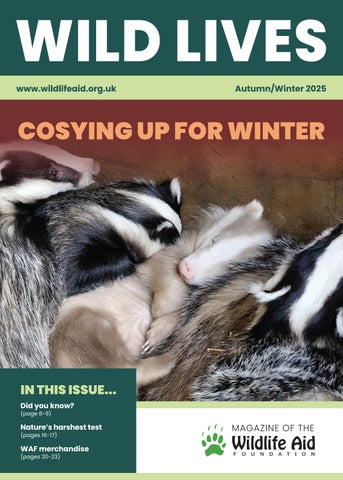
Wild Lives Winter 25

Page 1


www.wildlifeaid.org.uk

An injured animal is capable of inflicting injury. Do not put yourself in any danger. Always ring for advice first.

General

Carry a wildlife first aid kit in your car: box, heavy duty gloves, towel and a torch.

Close proximity of humans to any wild animal will cause it stress - stay quiet and do not handle them more than necessary.

Never rush to pick up young animals with no obvious injuries. Watch to see if its parents return. If in doubt ring for advice.

Never handle young mammals with bare hands - always use gloves.

Large Animals

In the case of road accidents, protect the animal with your car without endangering yourself or other road users.

The long beaks of birds such as herons can inflict injury, especially to your eyes.

Covering the animal will reduce stress and keep it warm.

Never attempt to handle deer, badgers or foxes and never carry wild animals loose in your car. Always seek help.

Small Animals

Fledglings spend several days on the ground before they can fly. If you are concerned, please seek advice before intervening.

Place injured or stunned animals in a ventilated box and put in a dark place while you seek advice.

A message from Lou

Hi folks,

As another year draws to a close, we want to take a moment to thank you, our wonderful supporters, for being part of the WAF journey. Your belief in what we do, and your continued kindness, have carried us through another busy year.

It’s now been almost a year and a half since we lost Dad –Simon - our founder, our inspiration, and the driving force behind Wildlife Aid. We miss him, dearly; his vision continues to shape everything we do, and his spirit is felt, every day, in the work that goes on here.

Carrying Simon’s Vision Forward

Our Simon’s Last Wish appeal, thanks to you, helped raise over £750,000 - we’ve been deeply moved by your generosity. This is an incredible achievement that has provided the foundation for the next chapter of Wildlife Aid’s story.

Over the past year, we’ve been working hard, behind the scenes, to plan the transformation of our existing site, the very place where it all began. Alongside our architects, planners, and Trustees, we’re developing designs for a modern, sustainable wildlife hospital that will secure our future and allow us to help even more animals in the years ahead.

We’re still in the planning phase, right now, fine-tuning designs, exploring options, and ensuring every decision we make stays true to Dad’s vision and to the charity’s core purpose.

Staying True to Our Mission

We made the careful decision to turn down a £2.8 million grant from Your Fund Surrey. While we were honoured to be considered for such a significant award, the grant was specifically tied to the creation of an education facility, rather than the redevelopment of our hospital, which remains the very heart of Wildlife Aid.

Education is, and will continue to be, an important part of our future. But, for now, our focus must remain where it always has been: rescuing, rehabilitating, and releasing the wild animals that need us most. This is what truly defines who we are.

The 20-Acre Site

Our additional 20-acre site continues to develop beautifully as a haven for wildlife. Continued rewilding work is ever bringing new life to the area, and we’re laying the groundwork for future education and community projects that will allow people to connect with nature, up-close.

Looking Ahead

As we move into 2026, we’re filled with faith and determination. The coming year will see our plans take further shape, as we prepare to bring Wildlife Aid’s next chapter to life, carefully, sustainably, and always in keeping with the values Simon built this charity upon.

From all of us here at Wildlife Aid, thank you for your continued support, encouragement, and belief in our work. Every message, donation, and kind word helps us to keep going, for the animals, for the planet, and for Simon’s legacy.

Wishing you all a peaceful and happy winter season,

YOUR PICTURES IN PRINT!

Thank you to all of you who submitted pictures for this feature. Whilst, we didn’t have space to print them all and the witling them down was no easy task, we’re delighted to present the chosen images, below.

We’ll be featuring more stunning images of wildlife in each newsletter, so please do send your pictures to office@wildlifeaid.org.uk before 1st March 2026 to be in with a shot of having your photo shared amongst 30,000 supporters!

NB: In the first instance, please send images that are 2MB or less. We will be in touch for higher quality images as needed.

Laraine Burnett

Barn owl – Tyto alba

Julia Mottram
Grey heron – Ardea cinerea
Kayleigh Hawkins Eurasian blue tit – Cyanistes caeruleus
Elaine Foster Atlantic puffin – Fratercula
Tim Edwards
Grey seal pup – Halichoerus grypus

Common starling – Sturnus vulgaris

Fiona Sim
Gadwall duck – Mareca strepera
Christina Boissy-Parker Red fox – Vulpes vulpes
Jane Chadwick Grey squirrel – Sciurus carolinensis
Emma Dodson

Martin Mellor

Red deer – Cervus elaphus

Paul Silvester

Red-tailed bumblebee – Bombus lapidarius

Mike Berwick

European robin – Erithacus rubecula

Veronique Dochain

Great spotted woodpecker –Dendrocopos major

DID YOU KNOW?

OWL FACT

Owls possess asymmetrical ear placements—one ear is positioned higher than the other. This unique arrangement allows them to pinpoint the exact location of sounds, aiding in precise hunting, especially in low-light conditions.

BAT FACT

The common pipistrelle bat, a tiny insectivore, can consume over 3,000 insects in a single night, playing a crucial role in controlling insect populations.

BADGER FACT

The European badger is the UK’s largest land predator, feeding on small mammals, birds’ eggs, worms, fruit, and plants.

FOX FACT

Urban foxes have adapted to city life by learning to navigate human-made environments. They often use linear features like roads and hedgerows to move through urban landscapes efficiently.

HEDGEHOG FACT

During hibernation, a hedgehog’s heart rate can drop from 190 beats per minute to just 20, significantly reducing its metabolic rate to conserve energy.

ROE DEER FACT

Roe deer are agile creatures capable of jumping fences up to 1.8 meters high, showcasing their impressive leaping abilities.

PHEASANT FACT

Pheasants are the UK’s fastest feathered runners, reaching speeds of up to 40 mph, enabling them to escape predators swiftly.

STARLING FACT

Starlings are exceptional mimics, capable of imitating various sounds such as car alarms, telephones, and other birds, showcasing their advanced vocal abilities.

HERRING GULL FACT

Herring gulls ‘dance’ for their dinner by stomping on the ground to imitate rainfall, tricking earthworms into surfacing.

COMMON FROG

Common frogs often close their eyes when they eat, which helps them push food down their throats more effectively.

ADDER FACT

The adder is the UK’s only venomous snake, but bites are extremely rare and seldom dangerous, with most occurring when the snake is provoked.

WREN FACT

The tiny wren is one of Britain’s loudest birds for its size, with its song capable of being heard up to 500 metres away.

INTERVIEW WITH VOLUNTEER VET, MANDY

Can you tell us a little about yourself and your background?

I am a vet married to a retired GP, and together we have three married daughters and two grandchildren. From as early as I can remember, I have had a deep love for God’s creation especially animals. Growing up, our family home was often shared with injured birds, hedgehogs, and whatever else needed a helping hand!

Becoming a vet was always my dream, and for many years I worked in small animal practice. When I heard about the need for volunteer vets at WAF, it felt like the perfect chance to reconnect with my passion for wildlife and contribute to their care in a more hands-on way.

What is a common misconception people have about being a wildlife vet?

People often imagine a wildlife vet heroically nursing an injured creature back to perfect health before it flies or runs off into the sunset. The reality is a little more complex! A wildlife vet is just one part of

a much bigger team rescuers, husbandry staff, nurses, rehabilitation and release workers, reception, and admin staff, and even the maintenance crew all play vital roles.

Sadly, not every animal can be saved. Many arrive at the centre too sick or injured to make a full recovery. In those cases, our role is to relieve suffering with compassion and dignity something that, while heartbreaking, is also incredibly meaningful.

What part of working with wildlife excites you the most?

The sheer variety! You never know what species will come through the door next. Each one offers a new challenge and a new opportunity to make a difference.

I also love the chance to educate others about WAF’s work and simple ways they can protect local wildlife whether it is removing garden netting or properly disposing of tin cans. It is frustrating to see animals harmed through human carelessness but knowing that awareness can prevent future injuries makes outreach an especially rewarding part of what we do.

Do you have a favourite species to work with, and if so, why?

I never thought I would say this but I have developed quite a soft spot for pigeons! Before joining WAF, I will admit I mostly thought of them as nuisances in the garden or town centres. But over the past two years, I have come to really admire them. They are gentle, resilient, and surprisingly cooperative patients. Feral pigeons, in particular, often steal my heart with their calm nature.

What is the biggest challenge of working with wildlife, and how do you handle it?

The hardest part is seeing animals come in with devastating injuries or in severe pain. Sometimes the kindest thing we can do is to let them go but those decisions are never easy. When a case feels uncertain, I always seek a second opinion from another team member.

Losing a patient, you have poured time and hope into is also tough. Talking through those cases with colleagues really helps put things into perspective and reminds me that every act of care even easing suffering matters deeply.

What

advice would you give to those interested in pursuing the same

career?

Start by volunteering! Find your local wildlife rescue centre and offer your time. It is the best way to discover whether this kind of work is right for you. Wildlife care can be demanding, both physically and emotionally, but it is also incredibly fulfilling.

Most centres, including WAF, simply could not function without their volunteers they are the backbone of everything we do.

VOLUNTEER OPPORTUNITIES

Studies show that volunteering can significantly improve mental health and wellbeing by reducing stress, anxiety, and depression, while also increasing feelings of purpose, happiness, and social connection. So, luckily for you guys, we have a variety of volunteer roles to fit all ages and abilities!

If you’re over the age of 18 and can commit to the same shift each week, or fortnightly at the weekends, then check out the roles below and get in touch.

Receptionist – Based on the busy hospital reception desk, this publicfacing role involves: taking incoming telephone calls and giving advice to the general public (think wildlife 999), booking in patients via our database, handling our smaller patients from pigeons to hedgehogs (with training, of course) to transfer them into holding cages for the vet team, organising rescues for injured wildlife, encouraging donations and general administrative support for our office staff.

Animal Husbandry – This is quite a physical role, especially when the hospital is busy, and involves cleaning out and feeding animals at the hospital (you will have to handle some natural prey foods for some of our patients), handling animals to transfer them into a holding pen whilst they are being cleaned out, setting up pens and cages, ready for use, restocking supplies for all areas to keep the centre running smoothly, helping to move patients, when needed, as they progress with their rehabilitation and, finally, some general maintenance of the hospital – tidying, cleaning, painting and weeding, etc.

Centre Maintenance – This role is less hands-on with the animals, but still vitally important, as our maintenance team is responsible for keeping the centre running. From re-filling and ordering food supplies to cleaning out and mending cages, this role is for a practical and physically fit person. If you have experience in construction, gardening, are or were once an electrician, we’d love to hear from you. You will still have the opportunity to get involved with the animals, if you’d like; there are always times when we are short-staffed and need an extra pair of hands!

Without our volunteers, we would not be able to operate; the 20,000 wildlife-related incidents our volunteers respond to, each year, would go unanswered and the thousands of animals they care for would not have a chance of survival. Scan the QR code or visit wildlifeaid.org.uk/volunteering to apply

OPEN WEEKEND UPDATE

All the pennies are counted, the figures are finalised, and the photos are in and we are delighted to share that at the 2025 Open Weekend, you helped us raise an incredible £20,644.70!

A huge THANK YOU to everyone who joined us — 1,803 of you came through the gates over the two-day event! Seeing so many supporters of not just WAF, but of our precious wildlife, was truly heartwarming.

Your generosity and enthusiasm make all the difference. Every pound raised helps us continue to rescue, rehabilitate, and protect the wild animals that need us most.

We are already planning next year’s, dates to be revealed soon…

SOFT RELEASE SITES NEEDED FOR 2026

Can you help? Do you have a safe wild space, where our cubs can gently be re-accustomed to life in the wild?

Criteria:

Located in Surrey or surrounding area.

Land avoids major roads.

Away from persecution by hunters.

No existing litter of fox or badger cubs.

Details:

No costs involved - all materials and food provided by us.

Cubs will need to be fed and cleaned, daily, prior to release.

Support provided pre and post release, to ensure the cubs. are integrating successfully.

If you or someone you

THE SWEET LIFE: A BEEKEEPER’S JOURNEY FROM CURIOSITY TO CRAFT

When Hayden Sallah was about ten or twelve years old, a curious boy became fascinated by the beehives kept by his neighbours. “I said one day I’ll do it,” he recalls. That early intrigue never quite left him. Years later, after much reading and preparation, Hayden finally began his own beekeeping journey.

“It’s like when people say a dog isn’t just for Christmas,” he says with a grin. “Bees aren’t just for summer.”

That was around fifteen years ago, and since then Hayden’s hobby has grown into a lifelong commitment, one shaped by patience, respect, and genuine affection for these remarkable insects.

A Labour of Love

Asked what inspired him to start his first hive, Hayden smiles. “Maybe it was my hay fever,” he laughs, “but really, it’s a labour of love.”

Beekeeping, he explains, isn’t something to be taken lightly. It requires time, research and a sense of responsibility. Hayden is the first in his family to take it up and now tends between forty and fifty hives.

“They’re not all producing,” he explains. “Some are still small colonies, what I call the babies, and they need a year or so to develop before they can start making honey. You need around fifty to sixty thousand bees before a hive is truly productive.”

Inside the Hive

Every hive, Hayden says, has its own rhythm. “Each frame is like a book,” he explains. “You read it, you learn what’s happening inside. And no two hives are ever the same.”

The structure of bee society fascinates him. Worker bees, all female, carry out every task from cleaning and caring for larvae to collecting nectar once they’re mature. The males, or drones, exist only to mate with a queen. “They don’t sting, they don’t work, and they get fed,” Hayden says, amused. “But once winter comes, they’re kicked out. There’s no need for them then.”

Many people are surprised by how short a bee’s life is. “Summer bees live about four to six weeks,” he

explains, “but winter bees can live up to six months. The queen can reign for up to five years.”

The colony decides when new queens are needed. “Sometimes I open a hive and find fifteen potential queens,” he says. “But they’ll choose the strongest one themselves.”

Reading the Hive

Good beekeeping, Hayden says, is a mix of skill and instinct. “Every time I lift a frame, I read it,” he explains. “You can tell if they’re healthy, if they’ve got enough stores, if the colony is content. Their movements and dances tell you so much.”

It takes experience to notice the details, but it’s that careful observation that keeps a colony thriving.

From Hive to Jar

Harvesting honey is a delicate process. The lower “brood box” is where the queen lives and the young bees develop. The boxes above are used for surplus honey. “That’s the part I collect,” Hayden says. “If I don’t, something else will, in the wild, bears or other animals would take it.”

The bees themselves know when nectar has become honey. They fan their wings to evaporate moisture, and once it reaches the right consistency, they seal it with wax. “When I see the combs capped, I know it’s ready,” Hayden says.

He removes the frames, gently shaves off the wax cappings, and spins them in a centrifuge. “Mine holds twenty frames, it saves time,” he notes. “The honey flows out, and the wax I shave off is the purest you can get. The bees love it when I return it to them because it still smells of honey. They don’t have to rebuild everything from scratch.”

Nature’s Challenges and Joys

Beekeeping isn’t without its difficulties. “Working in full gear in thirty-five degrees is no fun,” Hayden admits. “During the summer I check the hives weekly, but in winter I leave them alone, just make sure the entrances aren’t blocked by snow or water.”

Losing a hive is part of the reality of the job. “You can’t control everything,” he says simply. “You learn to accept what nature decides.”

But the rewards make it worthwhile. “When I go out in early spring and see the bees flying again, I know they’ve survived the winter. That’s the best moment of the year.”

The Taste of Honey – and a Happy Accident

The flavour of honey changes with the seasons. “In March and April, they go for apple and cherry blossom. Then come dandelion, horse chestnut, lavender, and later clover,” Hayden explains. “You can smell the difference; it’s like wine tasting.”

His first attempt at cleaning honey buckets led to an unexpected discovery. “I’d left some warm water in a bucket with a bit of honey, sealed it up, and a week later it exploded!” he laughs. “That’s how I made my first mead, completely by accident.”

He later refined the process and even won first prize at the Surrey Beekeepers’ Association. “It started as a mistake, but it turned into something special.”

Words of Advice

For anyone tempted to start their own hive, Hayden’s advice is straightforward: “Do it out of love, not for money. It’s expensive, and there’s no subsidy, but if you love it, it’s worth every penny.”

He’s sceptical of the growing trend of rooftop hives in cities. “People ask me to put hives on hotel roofs in London, but there’s no forage, no flowers, no trees. It’s just for show. Bees need nature, not concrete.”

A Timeless Connection

Beekeeping, Hayden says, hasn’t changed much in over a century. “The Victorians had the same principles. The equipment’s improved, but the relationship between humans and bees is timeless.”

As he reflects on his years among the hives, Hayden’s respect for them is clear. “When you open a hive and watch how perfectly they work together, how organised and purposeful they are, you realise how much we could learn from them.”

You can follow Hayden on Instagram @honey_bees14

Fancy trying the WAF and Hayden honey collaboration? Order yours on our website today! (UK mainland delivery only).

WINTER APPEAL

NATURE’S HARSHEST TEST

Winter is nature’s harshest test. Wildlife Aid needs your help to rescue and care for sick and injured wildlife. Your support gives warmth, food, and hope to animals fighting to survive the cold.

As the days grow shorter and the cold sets in, Britain’s wildlife faces a silent struggle for survival. Every frost, every storm, and every dark night brings new dangers for the wildlife that lives alongside us.

Hedgehogs curl up in nests of leaves that barely keep out the chill. Birds search desperately for food, as the ground hardens with ice. Badgers and foxes battle hunger and cold in the long, frozen nights. Deer, owls, and other wild creatures must navigate roads and fields, shrouded in darkness, just to survive another day.

At Wildlife Aid, we see the reality of winter, every day. Our hospital fills with patients - starving hedgehogs, injured foxes, exhausted birds - each clinging to life. Without our help, many simply wouldn’t make it through the season.

But, beyond our hospital walls, the struggle continues. Winter is a season of survival for Britain’s wildlife - a time when even the strongest struggle to endure, as temperatures plummet, daylight fades, food disappears, shelter becomes scarce, and freezing winds cut through every hedge and hollow. For many animals, every night is a fight for life.

Frost and snow seal off natural food sources, leaving birds and small mammals starving. Flooding destroys

nests and burrows, washing away homes built with care through autumn. The cold seeps into the bones of weak, injured, and orphaned animals - especially those born late in the year, who haven’t had time to build vital fat reserves. For them, winter isn’t just harsh - it’s deadly.

And if these environmental hardships weren’t enough, they are only the tip of the iceberg. What lies beneath - the hidden dangers caused by human activity and seasonal behaviour - can be even more devastating.

As animals struggle to survive the cold relentless months, they face new threats brought about by human activity and seasonal behaviours:

• Darker nights mean danger on the roads - more foxes, badgers, deer, and owls are hit by cars than at any other time of year.

• Bonfires become deadly traps, as hedgehogs and other small mammals make their nests inside log piles, unaware of the risk.

• Fireworks and loud celebrations force animals to flee their nests in panic, burning vital energy reserves they can’t replace.

• Habitat disturbance from gardening, tree cutting, and building work destroys crucial winter shelters and hibernation spots.

• Territorial fights break out between foxes and badgers during mating season, leaving many with deep bite wounds that can quickly become infected.

• Hibernating species, like bats, dormice, and amphibians, face fatal consequences if disturbed or if their safe places are destroyed.

For Britain’s wildlife, winter is not just cold - it’s cruel. BUT you can be their lifeline.

When the nights grow longer and the cold takes hold, your kindness can bring warmth, safety, and hope to the wild animals that need it most. Our hospital can only operate thanks to the generosity of people like you - people who believe every life is worth saving.

With your support, we can provide warmth to the freezing, food to the starving, and urgent medical care to the injured.

This winter, your generosity will help keep our doors open, our wards warm, and our patients safe - giving every animal that arrives at our hospital the best possible chance to survive, recover, and return to the wild.

You can save lives, this winter.

Every call we answer, every animal we treat, every life we save - happens because someone like you cared enough to act.

Your gift will bring warmth, comfort, and hope to the animals struggling to survive the harshest season.

Card type (circle): MASTERCARD/VISA (not AMEX or Electron)

Name as it appears on card:____________________________________________ Card No:

Expiry date: ___/____ CVV (last 3 digits on reverse)

Cheques to be made payable to The Wildlife Aid Foundation or you can donate online at justgiving.com/campaign/winter appeal natures harshest test

Please send this completed form to The Wildlife Aid Foundation, Randalls Road, Leatherhead, KT22 0AL

Boost your donation by 25p of Gift Aid for every £1 you donate. Gift Aid is reclaimed by the charity from the tax you pay for the current year. Your address is needed to identify you as a current UK taxpayer. In order to Gift Aid your donation, please tick the box. I want to Gift Aid my donation and any donations I make in the future or have made in the past 4 years to The Wildlife Aid Foundation. I am a UK taxpayer and understand that if I pay less Income Tax and/or Capital Gains Tax than the amount of Gift Aid claimed on all my donations in that tax year, it is my responsibility to pay any difference.

Signature: Date:

Please notify the charity if you: want to cancel the declaration change your name or home address no longer pay sufficient tax on your income and/or Capital Gains. If you pay Income Tax at the higher or additional rate, and want to receive the additional tax relief due to you, you must include all your Gift Aid donations on your Self Assessment tax return or ask HMRC to adjust your tax code. I no longer wish to receive communications by post. Name:

WILDLIFE FAQS: WHAT TO DO IN COMMON RESCUE SITUATIONS

Every year, animal lovers contact wildlife rescues across the UK for help with animals in distress. Below is a guide to some of the most frequent situations people encounter and what action you should take.

Remember: Wildlife Aid may not be your nearest rescue centre, so if you need hands-on help, please contact your local wildlife hospital for advice and support.

A bat is flying inside my house — what should I do?

Young bats learning to fly (especially from mid-July to mid-August) occasionally end up indoors.

If it’s a warm evening:

• Close the door to the room.

• Open windows wide.

• Dim the lights.

Bats navigate using echolocation and usually find their way out. If you need to check whether it has gone, look in:

• Curtain folds

• Behind picture frames

• High, dark corners

• Lower hiding spots bats can surprise us by roosting on chair tassels or cushions!

During daylight or winter:

Exhausted or grounded bats need specialist care. Wearing gloves, contain the bat safely in a box, and take it to your nearest wildlife hospital for assessment..

What is the best course of action for a bird that has flown into a window?

Many birds collide with windows each year, often becoming temporarily stunned.

If there are no visible injuries or blood:

1. Place the bird in a dark, quiet, ventilated box.

2. Leave the box in a calm, quiet and safe area for 2 hours.

3. Take the box outside and open it.

If the bird does not fly away, seek help from your local wildlife hospital.

A bird has fallen down my chimney; how do I get it out?

Before anything else, ensure the fireplace or burner is switched off. Gas fires must be disconnected by a registered engineer only. Then:

• Clear the fireplace area.

• Turn off all lights, close all but one set of curtains/blinds

• Leave one window open as the only source of light.

Allow the bird up to two hours to find its way out. If the chimney opening is too narrow or the bird is unable to escape, send photos to your nearest wildlife rescue and ask for guidance.

There

is a duck on a local pond with a broken wing, what can I do to help?

A wing that sticks out at an odd angle often leads people to believe the bird’s wing is broken. In many cases, however, the bird has a condition called Angel Wing, or “aeroplane wing”.

This developmental condition occurs in young ducks, geese and swans, usually while their flight feathers are growing.

What causes Angel Wing?

Angel Wing is linked to nutritional imbalance during growth, often due to:

• High-calorie diets (e.g., bread and processed food)

• Excess protein

• Rapid weight gain

• Deficiencies in key vitamins and minerals

This causes the wing joints to twist outward and the feathers to point sideways.

How to recognise it

• One or both wings stick out at an angle

• The wing feathers may look rotated or misaligned

Does the bird need treatment?

For adult birds, Angel Wing is permanent and cannot be corrected. Fortunately, it is not painful, and birds can swim, feed, mate and live normally.

For juveniles, early treatment may help, but only at a wildlife hospital.

If you’re unsure, send a photo or video to your nearest wildlife rescue for confirmation.

In memoriam

Virginia Jane Alexander, Wendy Barrett, Patricia Enid Blyth, Sheila Ann Briggs, Ms Claire Judit Briginshaw, Leslie Allan Brown, Lois Patricia Burchell, Alan Frederick Cawsey , Susan Ann Chapman, Roy Richard Cousins, John Gerard Doohan, Hilda Dredge, Donald Leslie Ellis, Hazel Elizabeth Anne Fleet, Mary Fleming, Margaret Anne Goodrum, Betty Grant, Maria Angelica Hatherell, Vena Amy Jacques, Martin Rodney Jenkins, Brenda Jones, Christopher Nash, Margaret Mary Suzanne O’Gorman, Mr Edwin Charles & Mrs Pearson, Maurice Frederick Phillips, Carol Sage, Joy Cynthia Strutt, John Christopher Thurner, John Gordon Toy, Ms Marissa Sharon Tree, Gail Williams

Major donations

Linda Myers, Linda and Andy Warr, Colin and Mary Huntingford, Anthony Cowdy Trust, Nigel Grant

WILDLIFE AID FOUNDATION

MERCHANDISE

Meet the Artist: Sian Peach

This autumn and winter, we’re delighted to showcase our latest collection of wildlifeinspired gifts and homeware, created by the wonderfully talented Sian Peach.

Sian’s journey as an illustrator began with a lifelong love of creativity and the natural world. Art was always her favourite subject at school, but it wasn’t until the COVID lockdown that she rediscovered her passion for illustration. Since then, she’s explored a range of media from watercolour and gouache to collage and digital art — each piece capturing the charm and character of British wildlife.

When she’s not at her 9–5 job, Sian volunteers with Holbrook Animal Rescue, helping to rehome abandoned dogs, and with us at the Wildlife Aid Foundation. A keen traveller and photographer, she’s often found exploring new places, camera in hand, waiting for that perfect wildlife moment.

Every design in this collection reflects Sian’s deep appreciation for nature and her commitment to protecting the creatures that inspire her art.

See back page for prices and an order form

Coasters

500ml Water Bottle

Whether you’re out on a crisp woodland walk or heading into work, stay hydrated in style this season with our wildlife-inspired 500ml water bottle.

Featuring some of the UK’s most loved species – the red fox, badger, bee and pigeon – this double-walled bottle keeps your drinks perfectly hot or refreshingly cool, whatever the weather.

A practical essential and a thoughtful gift for any nature lover.

Cosy evenings call for warm drinks – and our bee-utiful wildlife coasters are just the thing to bring a touch of nature to your home.

Designed by Sian, each coaster features beautifully detailed illustrations of the red fox, badger, bee and pigeon. Made from sustainable cork and FSC-certified, recycled materials, they’re as kind to the planet as they are to your coffee table.

A perfect blend of style, sustainability and everyday practicality. Pack of 4.

Coffee Tumbler

Keep your hands warm and your drinks hot this winter with our wildlifeinspired Coffee Tumbler.

Featuring vibrant illustrations of the red fox, badger, bee and pigeon, this reusable and recyclable tumbler is ideal for your morning commute, countryside stroll or weekend adventure.

The ridged design offers a comfortable grip while keeping your hands protected from the heat perfect for coffee lovers on the go.

A5 Notebook

As the nights draw in, jot down your winter thoughts, to-do lists and creative ideas in our new A5 wildlife notebook.

Adorned with Sian’s charming illustrations of the red fox, badger, bee and pigeon, this soft-touch PU notebook includes 80 cream lined pages, rounded corners, an elastic strap closure, pen loop and ribbon marker. Ideal for journaling, note-taking or gifting to a fellow wildlife enthusiast.

Please visit our website to purchase.

Christmas Cards

Celebrate the magic of the season with our exclusive 2025 Wildlife Aid Christmas Cards, featuring four stunning photos robin, waxwing, deer, and red squirrel taken by volunteers and supporters; Veronique Dochain, Rachel Hill, Mindi Khera, and Lou Kingston, who have generously donated their work.

Each pack includes 8 premium-quality cards (two of each design) with envelopes, printed on sustainably sourced card. Measuring 12cm x 12cm, they’re the perfect way to send festive wishes while supporting wildlife rescue and conservation.

Wrendale Scarf

Elegant, cosy, and effortlessly stylish the perfect gift for any animal lover.

Each scarf measures 70 x 190cm and comes with a beautiful Wrendale gift bag.

Wildlife Aid 2026 Calendar

Bring British wildlife into your home all year round with our 2026 Wildlife Aid Calendar.

Featuring breathtaking photographs of animals in the wild all taken by our amazing supporters and volunteers this calendar captures the beauty and diversity of the natural world we work to protect.

Printed on recycled paper, it comes in a convenient A4 horizontal format (29.7 x 21cm), perfect for any wall or office space. A wonderful way to enjoy wildlife every month of the year.

Forest Friends Stationery

Mini Buddies

Fun, nature-themed stationery packs for kids includes a pencil, sharpener, ruler, rubber, and notepad.

Adorable, soft, and just 9cm tall! These mini wildlife buddies make perfect stocking fillers for children (and grown-ups too).

£3.50

£8 £10 £20

£3.50

Christmas Bee Seedball Tins

Grow a little patch of wildflower magic! Each tin (3.6cm x 1.6cm) contains 5 seedballs with over 30 native wildflower seeds. Simply scatter and let nature do the rest perfect for pots, window boxes, or gardens.

Simon King Frog Log

A realistic, eco-friendly amphibian habitat made from 100% recyclable Clayplas (40% recycled plastic, 60% natural clay).

Provides a cool, safe refuge for frogs and toads frost-resistant, durable, and guaranteed for 10 years.

Wild Line-Art Tote Bag

Take wildlife with you wherever you go.

Wildlife Aid Honey

Pure, raw, and unpasteurised straight from the hive to your table.

Our bees forage freely on wildflowers, lavender, and blossom for a floral, natural sweetness that captures the taste of the countryside.

See Page 14 for where our honey comes from.

Nest Pocket

A cosy nesting or roosting spot for small birds such as robins, wrens, and finches.

Handmade from natural fibres with a built-in wire hanger simple, effective, and maintenance-free.

Our natural cotton tote by artist Eric Smith features intricate line art of British animals including the fox, badger, and hedgehog.

Durable with 60cm handles (38 x 42cm).

4 99 Living Nature Mini Buddy (specify species: _____________ )

Splash Art 500ml Water Bottle (specify animal: _____________ )

Splash Art Coasters (specify animal: _____________ )

Splash Art A5 Notebook (specify animal: _____________ )

Splash Art Co ee Tumbler (specify animal: _____________ ) £15.00

Line Art Tote Bag (specify animal: _____________ )

Happy Christmas Seed Box

Mini Seedball Tins – Christmas Bees

Frog Log

Nest Pockets

£7.00

£3.50

£4.00

£15.00

£6.00

GIFT AID DECLARATION

for past, present and future donations The Wildlife Aid Foundation (Registered Charity No 1138944)

BILLING DETAILS:

Name: Mr/Mrs/Ms/Other

First name:

Please tick the boxes if you are happy to be contacted by Wildlife Aid Foundation Email Post Phone We will never sell, rent or give away your information I would like to make an additional donation to The Wildlife Aid Foundation of: PAYMENT DETAILS: Merchandising o rder total: £ Postage & packing total: £ Number of adoptions (£30.00 each): Adoption amount due: £ Additional d onation to WAF: £ Total amount to pay: £ Payment method: CARD / CHEQUE (please circle)

Please make cheques payable to The Wildlife Aid Foundation Card type: VISA / MASTERCARD (not Visa Electron, Maestro or Solo please) Card no: Expiry date (MM/YY): / CVV (last 3 digits on reverse):

Turn static files into dynamic content formats.

Create a flipbook