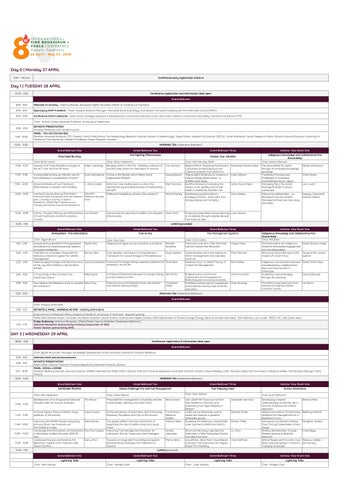
Day 0 | Monday 27 APRIL 5:00 - 7:00 pm
Conference ealry registration check-in
Day 1 | TUESDAY 28 APRIL 07:30 - 5:00
Conference registration and information desk open Grand Ballroom
8:30 - 8:45
Welcome to Country : Todd Sculthorpe. Aboriginal Higher Education Officer at University of Tasmania
8:45 - 8:55
Opening by IAWF President: Trevor Howard, National Manager, Prescribed Burning Strategy, Australasian Fire and Emergency Service Authorities Council (AFAC)
8:55 - 9:00
Conference Chair's Welcome: Sarah Harris, Manager Research & Development, Country Fire Authority (CFA), Chris Collins, Director, Community Fire Safety, Tasmania Fire Service (TFS)
Chair: Hamish Clarke, Associate Professor, University of Melbourne 9:00 - 9:30
KEYNOTE PRESENTATION: Amanda McKenzie, CEO Climate Council
9:30 - 10:30
PANEL: Fire and Climate Risk Panelists: Amanda McKenzie, CEO Climate Council | Mika Peace, Fire Meteorology Research Scientist, Bureau of Meteorology | Tegan Brown, Applied Fire Scientist, DEECA | Grant Williamson, Senior Research Fellow, School of Natural Sciences, University of Tasmania | Timothy Brown, Research Professor, Desert Research Institute
10:30 - 11:00
MORNING TEA (Federation Ballroom) Grand Ballroom One
Grand Ballroom Two
Grand Ballroom Three
Harbour View Room One
Smoke, Fuel, Satellite
Indigenous Knowledge and Collaborative Fire Stewardship
Fire Fighting Effectiveness
Prescribed Burning
Chair: Brian Levine
Chair: Simon Heemstra
11:00 - 11:20
Lessons from Prescribed Burn Escapes in the ACT over the Past 20 Years
Adam Leavesley
Bringing Water to the Fire – Building a network of remote water points for helicopters in Victoria
11:20 - 11:40
Is prescribed burning an efficient tool for fire prevention in southeastern France ?
Anne Ganteaume A Drop in the Bucket: What Makes Aerial Suppression Efficient
Andy Ackland
11:40 - 12:00
Empirical Models of Fuel Treatment Effectiveness in Western USA Wildfires
C. Alina Cansler
What can case studies teach us about the operational use and effectiveness of firebombing aircraft?
Matt Plucinski
12:00 - 12:20
Interface Protection Burning Pilot ProjectNSW RFS Planning Phase: A proposed multi-site research Predictive Services pilot, currently in scoping, to explore Team Bradstock's (2025) High-Frequency LowIntensity planned burning recommendations
Defensive Firefighting: Where is the research?
Nick McCarthy
12:20 - 12:40
Fuel for Thought: Efficacy and Effectiveness Lori Daniels of Fuel Treatments in British Columbia, Canada
Automating the reporting of wildfire risk mitigation Owen Price effectiveness
12:40 - 1:40
Tim Gazzard
Chair: Merinda Day-Smith
Chair: Donna Sherwen
Beyond PM2.5: Assessing Practitioners' Maximilien Desservettaz Cumulative Smoke Exposure and Chemical Hazards From Bush Fire Testing AQFx Sensitivity to variation in Luba Volkova Coarse Woody Debris loads - a Wildfire Case Study Bushfire Emissions: Evaluating the Hafsa Yousuf Nipa Impact on Air Quality and Human Health in Katherine, Northern Ter
Fire stewardship for plants through an emerging knowledge exchange Traditional Practices and Challenges of Grassland Controlled Burning in Japan Managing fire in the World Heritage Budj Bim Cultural Landscape
Renee Woodward
Developing pyrosilviculture in Eucalyptus forests - bark traits, fuel energy release and mortality
Enhancing collaboration - an Aboriginal Cultural Incident Management Exercise case study and video
Gregory Summerell, Graham Moore
Chris Weston
LUNCH (provided) Grand Ballroom Two
Grand Ballroom Three
Atmosphere - Fire interactions
Fuel to Fire
Fire Management Systems
Chair: Dan Hoar Assessing the potential for fire-generated David Field Mapping fuel types across Australia’s arid interior Randall thunderstorms. Operationalising research Donohue to protect firefighters FireInSite: an accessible, integrated fire Kerryn Little Fuel, Weather, and Flame: A Comprehensive Hugh Wallace behaviour prediction system for wildfire Framework for Causal Analysis of Fire Behaviour management Meteorological Analysis and Reconstruction Jasmina Dobranić Improving Fire Danger Ratings: Assessing Updated Fuel Davie Dean Modelling in the AFDRS of the July 2022 Wildfire in the Northern Adriatic
Chair: Chris Collins Improved Long-Term, Risk-Informed Natural Hazard Risk Reduction Understanding future fire regimes to inform management: One size does not fit all Rainbow’s End: A Unified Theory of Forest Fire Management
Trent Penman
2:40 - 3:00
A Case Study of the Currowan Fire impacting Conjola
An Empirical Relationship Between Fire Danger Ratings Bart Pindor and the Incidence of Fires
Bridging Science and Practice: Collaborative Fire Management for Biodiversity and Community Outcomes
Jaime Kruusmaa
3:00 - 3:20
How large is the Deadman Zone in complex Kevin Tory fire scenarios?
Predicting Hourly Fire Radiative Power with Weather and Machine Learning Models
Mobilising Community for suppression and protection during large scale fire operations
Mark Gunning
2:00 - 2:20
2:20 - 2:40
Levi Lovett
Enhancing prescribed burning planning Laura Alonso in shrublands through satellite-derived fuel moisture data
Grand Ballroom One
Chair: Tegan Brown 1:40 - 2:00
Chiho Ochiai
Mika Peace
3:20 - 3:50
Christopher Rodell
Holger Maier
Rick McRae
Harbour View Room One Indigenous Knowledge and Collaborative Fire Stewardship Chair: Phil Brien Territorial patrol: an Indigenous Sarah Dickson-Hoyle model of land-based engagement and fire stewardship Returning Cultural Burning to the Tonya Smith, Jordon Forests of Lil'wat Tmicw Gabriel Indigenous communities empower Sarah Smith-Tripp transdisciplinary collaborations that overcome barriers in landscapeProtecting cultural heritage Donna Sherwen through fire planning Fire deficits reveal departures from historical fire regimes in British Columbia, Canada
Jen Baron
Afternoon Tea (Federation Ballroom) Grand Ballroom
Chair: Gregory Summerell 3:50 - 5:15
KEYNOTE & PANEL: WORKING AS ONE - Country and Culture Greg Lehman, Professorial Fellow, Indigenous Research, University of Tasmania - keynote opening Panel: NSW Graham Moore, Yuin Elder and Senior Scientist Cultural Science, Science and Insights Division, NSW Department of Climate Change, Energy, the Environment and Water. Tom Robinson, Levi Lovett, DEECA VIC Little Desert team
5:15 - 7:15
G’day Gathering: Welcome Reception, Official Poster Launch, Exhibition (Federation Ballroom) Welcome Reception sponsored by Forestry Corporation of NSW Poster Session sponsored by AFAC
DAY 2 | WEDNESDAY 29 APRIL 08:00 - 5:00
Conference registration & information desk open Grand Ballroom
Chair: Blythe McLennan, Manager, Knowledge Development at the Australian Institute for Disaster Resilience 8:30 - 8:45 8:45 - 9:15 9:15 - 10:30
Welcome back and announcements KEYNOTE PRESENTATION Robb Clifton, Director Field and Traverse Operations, Australian Antarctic Division PANEL: SOCIAL LICENSE Panelists: Bethany Hannah, Executive Director, Wildfire International | Robb Clifton, Director Field and Traverse Operations, Australian Antarctic Division | Steve Whiteley, Chair, Tasmania State Fire Commission | Rebecca Walker, Partnerships Manager, Parks Victoria
10:30 - 11:00
MORNING TEA (Federation Ballroom) Grand Ballroom One
Grand Ballroom Two
Grand Ballroom Three
Landscape Dryness
Global Challenge Fire and Fuel Management
Fuel Mapping/Lidar
Chair: Alen Slijepcevic 11:00 - 11:20
11:20 - 11:40
11:40 - 12:00
12:00 - 12:20
12:20 - 12:40
Chair: Sam Hillman
Chair: Grant Pearce
Development of an Evaporative Demand Drought Index for Victoria, Australia
Tim Brown
Prescribed fire management in Australia and the United States: Learning from each other
In-forest Vapour Pressure Deficit: A key predictor of fire activity
Jane Cawson
At the Intersection of Operations and Community - Tim McKern / Decisions, Perception and Fire on the Ground Rebecca Walker The global wildfire crisis: the importance of Fantina Tedim expanding the role of wildfire origin and cause invest Improving Fuel Management Decisions: An Amelie Interactive Tool for Forest and Land Managers Jeanneau
Improving the AFDRS though integrating Alex Holmes process driven fuel moisture and flammability models Landscape and atmospheric characteristics Paul Fox-Hughes in the leadup to Black Summer 2019-20 fires Landscape Dryness and Extreme Fire Darcy Prior Behaviour: Insights from Victoria's Little Desert Bushfire
Towards an Integrated Fire Intelligence System: Demonstrating Pathways from Detection to Decision
12:40 - 1:40
Brian Levine
Marta Yebra
Harbour View Room One Human Dimentions
Chair: Scott Dehnisch
UAV LiDAR–MS Fusion and a MultiTask Model for Overstory and Understory Fuel Type Mapping in Belgium LiDAR can be effectively used to assess fire hazards in gardens’ defensible spaces Modelling fire behaviour using Mobile Laser Scanner (LiDAR) fuel metrics
Alexander Van Hout
Stefania Ondei
Simeon Telfer
Structural Recovery Lags Spectral Liu Zhao Greenness in NSW Sclerophyll Forests Post-Black Summer cloud2trees: Aerial Point Cloud-Based Chad Hoffman Individual Tree Inventories for PhysicsBased Fire Modelling
Developing a shared understanding of bushfire risk in Victoria: A behavioural science approach Igniting Innovations: Transforming Wildland Fire Management for a Resilience Future Advancing Fire Decision-Making Tools Through Stakeholder-Driven Design Building Relationships Through Shared Learning in Bushfire Research Where People and Fire meet: trust, place and partnership in Victoria’s changing landscape
Bernice Plant
Bethany Hannah
Meaghan Jenkins
Chloe Begg
Rebecca Walker / Sam Strong
LUNCH (provided)
Chair: Alex Holmes
Grand Ballroom One
Grand Ballroom Two
Grand Ballroom Three
Lightning Talks
Lightning Talks
Lightning Talks
Chair: Wendy Smith
Chair: Luba Volkova
Harbour View Room One
Lightning Talks Chair: Bridget Clark