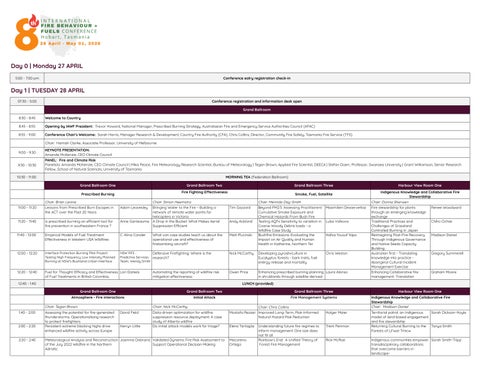
Day0|Monday27APRIL
5:00-7:00pm Conferenceealryregistrationcheck-in
Day1|TUESDAY28APRIL
07:30-5:00
8:30-8:45 WelcometoCountry
Conferenceregistrationandinformationdeskopen GrandBallroom
8:45-8:55 OpeningbyIAWFPresident: TrevorHoward,NationalManager,PrescribedBurningStrategy,AustralasianFireandEmergencyServiceAuthoritiesCouncil(AFAC)
8:55-9:00 ConferenceChair'sWelcome: SarahHarris,ManagerResearch&Development,CountryFireAuthority(CFA),ChrisCollins,Director,CommunityFireSafety,TasmaniaFireService(TFS)
Chair: HamishClarke,AssociateProfessor,UniversityofMelbourne
9:00-9:30 KEYNOTEPRESENTATION: AmandaMcKenzie,CEOClimateCouncil
9:30-10:30
10:30-11:00
PANEL: FireandClimateRisk
Panelists:AmandaMcKenzie,CEOClimateCouncil MikaPeace,FireMeteorologyResearchScientist,BureauofMeteorology|TeganBrown,AppliedFireScientist,DEECA|StefanDoerr,Professor,SwanseaUniversity|GrantWilliamson,SeniorResearch Fellow,SchoolofNaturalSciences,UniversityofTasmania
MORNINGTEA(FederationBallroom)
PrescribedBurning FireFightingEffectiveness Smoke,Fuel,Satellite IndigenousKnowledgeandCollaborativeFire Stewardship
Chair:BrianLevine
11:00-11:20 LessonsfromPrescribedBurnEscapesin theACToverthePast20Years
11:20-11:40 Isprescribedburninganefficienttoolfor firepreventioninsoutheasternFrance?
11:40-12:00 EmpiricalModelsofFuelTreatment EffectivenessinWesternUSAWildfires
12:00-12:20 InterfaceProtectionBurningPilotProject: TestingHighFrequencyLowIntensityPlanned BurningatNSW'sBushland-UrbanInterface
12:20-12:40
12:40-1:40
Chair:SimonHeemstra
AdamLeavesley BringingWatertotheFire–Buildinga networkofremotewaterpointsfor helicoptersinVictoria
AnneGanteaume ADropintheBucket:WhatMakesAerial SuppressionEfficient
C.AlinaCansler Whatcancasestudiesteachusaboutthe operationaluseandeffectivenessof firebombingaircraft?
NSWRFSPredictiveServices Team,WendySmith
FuelforThought:EfficacyandEffectiveness ofFuelTreatmentsinBritishColumbia, Canada
LoriDaniels
DefensiveFirefighting:Whereisthe research?
Automatingthereportingofwildfirerisk mitigationeffectiveness
TimGazzard
Chair:MerindaDay-Smith
BeyondPM2.5:AssessingPractitioners' CumulativeSmokeExposureand ChemicalHazardsFromBushFire
AndyAckland TestingAQFxSensitivitytovariationin CoarseWoodyDebrisloads-a WildfireCaseStudy
MattPlucinski BushfireEmissions:Evaluatingthe ImpactonAirQualityandHuman HealthinKatherine,NorthernTer
NickMcCarthy Developingpyrosilviculturein Eucalyptusforests-barktraits,fuel energyreleaseandmortality
OwenPrice Enhancingprescribedburningplanning inshrublandsthroughsatellite-derived fuelmoisturedata
LUNCH(provided)
Chair:TeganBrown
1:40-2:00 Assessingthepotentialforfire-generated thunderstorms.Operationalisingresearch toprotectfirefighters
2:00-2:20 Persistentextremeblockinghighsdrive enhancedwildfireactivityacrossEurope
2:20-2:40
Chair:NickMcCarthy
DavidField Data-drivenoptimizationforwildfire suppressionresourcedeployment:Acase studyofAlbertawildfire
Chair:ChrisCollins
Chair:DonnaSherwen
MaximilienDesservettaz Firestewardshipforplants throughanemergingknowledge exchange
LubaVolkova TraditionalPracticesand ChallengesofGrassland ControlledBurninginJapan
HafsaYousufNipa ReimaginingPost-FireRecovery ThroughIndigenousGovernance andNativeSeedsCapacity Building
ChrisWeston Australianfirst-Translating knowledgeintopracticeAboriginalCulturalIncident ManagementExercise
LauraAlonso EnhancingCollaborativefire management:Translation knowledgeintopractice
Chair: MadisonDaniel
MadisonDaniel
GregorySummerell
GrahamMoore
2:40-3:00
HowlargeistheDeadmanZoneincomplex firescenarios?
3:00-3:20 ACaseStudyoftheCurrowanFire impactingConjola
3:20-3:50
Chair:GregorySummerell
3:50-5:00 KEYNOTE&PANEL:INDIGENOUS/WORKINGASONE
Fourthresholdsthatdescribethesensitivity ofwildfirestoinitialattack
3Yearsonfromthedevelopmentofthe suppressioneffectivenessmodelfroman FBANperspective
behaviourpredictionsystemfor wildfiremanagement
MobilisingCommunityforsuppression andprotectionduringlargescalefire operations
AfternoonTea(FederationBallroom) GrandBallroom
5:00-7:00
Protectingculturalheritage throughfireplanning
GregLehman,ProfessorialFellow,IndigenousResearch,UniversityofTasmania-keynoteopening Panel:NSWGrahamMoore,YuinElderandSeniorScientistCulturalScience,ScienceandInsightsDivision,NSWDepartmentofClimateChange,Energy,theEnvironmentandWater. VICLittleDesertteam
G’dayGathering:WelcomeReception,OfficialPosterLaunch,Exhibition(FederationBallroom) WelcomeReceptionsponsoredbyForestryCorporationofNSW PosterSessionsponsoredbyAFAC*Posterslistedattheendoftheprogramschedule
DAY2|WEDNESDAY29APRIL
08:00-5:00
Conferenceregistration&informationdeskopen
Chair:JohnRichardson
8:30-8:45 Welcomebackandannouncements
8:45-9:15 KEYNOTEPRESENTATION
9:15-10:30
10:30-11:00
RobbClifton,DirectorFieldandTraverseOperations,AustralianAntarcticDivision
PANEL:SOCIALLICENSE
Panelists:BethanyHannah,ExecutiveDirector,WildfireInternational|RobbClifton,DirectorFieldandTraverseOperations,AustralianAntarcticDivision|BlytheMcLennan,Manager,KnowledgeDevelopmentattheAustralianInstituteforDisaster Resilience SteveWhiteley,Chair,TasmaniaStateFireCommission
MORNINGTEA(FederationBallroom)
11:00-11:20
11:20-11:40
11:40-12:00
12:00-12:20
12:20-12:40
12:40-1:40
Chair:AlenSlijepcevic
DevelopmentofanEvaporativeDemand DroughtIndexforVictoria,Australia
In-forestVapourPressureDeficit:Akey predictoroffireactivity
ImprovingtheAFDRSthoughintegrating processdrivenfuelmoistureand flammabilitymodels
Landscapeandatmosphericcharacteristics intheleaduptoBlackSummer2019-20 fires
LandscapeDrynessandExtremeFire Behaviour:InsightsfromVictoria'sLittle DesertBushfire
Chair:GrantPearce
TimBrown PrescribedfiremanagementinAustraliaand theUnitedStates:Learningfromeachother
JaneCawson BridgingContinents,BridgingSystems: LessonsfromAustraliaandCanadaLiving withFire
AlexHolmes Theglobalwildfirecrisis:theimportanceof expandingtheroleofwildfireoriginand causeinvest
PaulFox-Hughes
ImprovingFuelManagementDecisions:An InteractiveToolforForestandLand Managers
DarcyPrior
Chair:SamHillman
BrianLevine UAVLiDAR–MSFusionandaMultiTaskModelforOverstoryand UnderstoryFuelTypeMappingin Belgium
JohnDavies LiDARcanbeeffectivelyusedto assessfirehazardsingardens’ defensiblespaces
FantinaTedim ModellingfirebehaviourusingMobile LaserScanner(LiDAR)fuelmetrics
Amelie Jeanneau
TowardsanIntegratedFireIntelligence System:DemonstratingPathwaysfrom DetectiontoDecision
StructuralRecoveryLagsSpectral GreennessinNSWSclerophyllForests Post-BlackSummer
MartaYebra Newmethodsforfuelclassification andcarbonestimationfromgroundbased3Dpointclouds
provided)
AtefeChoopani
Chair:ScottDehnisch
Developingashared understandingofbushfireriskin Victoria:Abehaviouralscience approach
StefaniaOndei IgnitingInnovations:Transforming WildlandFireManagementfora ResilienceFuture
SimeonTelfer WherePeopleandFiremeet:trust, placeandpartnershipinVictoria’s changinglandscape
LiuZhao
BuildingRelationshipsThrough SharedLearninginBushfire Research
AdvancingFireDecision-Making ToolsThroughStakeholder-Driven Design
BethanyHannah
RebeccaWalker
ChloeBegg
MeaghanJenkins
1:40-1:45
NationalFuelAvailabilityFactorfromDailySoil MoistureGrids
AndyAckland
ADfiRe:APhysics-InformedWildfireSimulator withExplicitFuel-StructureIntegration
Konstantinos Vogiatzoglou
EstimatingBurntFuelVolumesAfter PrescribedBurningUsingMultitemporal
Chair:ChrisRodell
2:00-2:20 Movingtowardsprobabilisticfireweather forecasts BradleySantos
2:20-2:40 Towardsoperationalfireforecastingusing theory-guidedAI MatthiasBoer
2:40-3:00 UnifyingtheAFDRSviaasimplefire weatherindex JasonSharples
3:00-3:20
3:20-3:50
Spatialanalysisofignitionimpactsundera rangeofweatherconditions NicholasWilson
Chair:DanHoar
MappingfueltypesacrossAustralia’sarid interior Randall Donohue
cloud2trees:AerialPointCloud-Based IndividualTreeInventoriesforPhysics-Based FireModelling ChadHoffman
Chair:MartaYebra
Hyperspectralimaging&bushfirefuel, behaviour&emissions1:Overview AndyAllen
FireSatinAction:HowaGlobal CommunityisShapingtheFutureof WildfireResilience KarenO'Connor
Firebehaviourinnovelecosystemsand alteredfuelstructures KevinSpeer Firespreadpredictionsfromadeep learningmodelandW.I.S.E.compared usingsatellitefiredata JeffBoisvert/Liam Bennett
Fuel,Weather,andFlame:AComprehensive FrameworkforCausalAnalysisofFire Behaviour
HughWallace ForestSphere:AForestDigitalTwinfor ManagingForestsandWildfireRisk CarlosViegas
(FederationBallroom)
Chair:ChloeBegg
BeyondtheFlame:Centering HumanitarianImpactsinWildfire Response ScottDehnisch
BuildingDamageinthe2025 OfunatoWildfire:Surveyand Analysis YutaSuzuki
Community-basedpost-disaster reviews:aninnovationinbuilding trustandresilience ZoeD'Arcy
Buildingthenextgenerationof post-disastersurveytools PeterBaker
3:50-5:00
Chair:SandyWhight,ExecutiveDirectorNationalCapability,AFAC
PANEL:FutureFire-IntegratingAIandAdvancedTechnologiesinBushfireManagement–Globalinsights Panelists:MartaYebra,Professor,ANU|KarenO'Connor,EarthFireAlliance DavidSaah,Professor/ManagingPrincipal,USF/SIG AdrianCardil,DirectorofFireScience,TechnosylvaInc|PeterMcKechnie,DeputyCommissioner,NSWRuralFireService
5:00 DAY2CLOSE
6:30-10:00 Meet&MingleNight(TheHangingGarden-112MurraySt,HobartTasmania)
DAY3|THURSDAY30APRIL
08:00-17:30
8:30-9:00
Chair:MelissaO'Haloran,ManagerBushFireRiskPlanning,NSWRuralFireService
KEYNOTEPRESENTATION:
DavidBowman,ARCLaureateFellowProfessorofPyrogeographyandFireScienceDirectoroftheFireCentre,TheUniversityofTasmania
9:00-10:00 PANEL:BushfireRiskMeetstheHousingCrunch:RethinkingLandUseandLiabilityinClimateChange DavidBowman,TheUniversityofTasmania PhillipaMcCormack,AustralianResearchCouncilDECRAFellow,AdelaideUniversity IuliiaShustikova,Moody's|LauraGannon,Director,MeridianUrban|RaphiBlanchi,CSIRO
10:00-10:30 MORNINGTEA(FederationBallroom)
CaseStudiesforFireManagement Chair: SarahHarris Chair:AlexFilkov
Chair:SimeonTelfer
10:30-10:50
10:50-11:10
11:10-11:30
11:30-11:50
11:50-12:10
ExtraordinaryWildfiresinthe21stCentury Calum Cunningham
Comparativeanalysisofclimatechangefor bushfirehazard
LatitudinalShiftingofForestFireHotspots andClimaticCorrelations:ATwo-Decade GlobalAnalysis
Assessingbushfireriskatdifferinglead times
Beyondclimatetrends:understandinghow arangeoffutureclimatetimeseries characteristic
Modellingandmappingprescribedfires burnseverity:challengesandpotential solutions
AlessioArena WhenSparksFly:IntegratingEnsemble WeatherforFireBehaviourPrediction
AlishaSinha BurningandLearninginCanolaStubble–Datareductionandmodeldevelopment
NaomiBenger Newapproachesandtechnologyforlargescalebushfirehazardmodelling
MariaZubkova Fuellingfirebehaviourmodelsofthe future-developingnewfuel assessmentguide
SamFerguson Rethinkingfueldynamics–howcan oursystemsmovepastfuel accumulationcurves?
William Swedosh
Effectofheightandmoisturecontent ongorseshrubflammability
JamesHilton Fuelresponsestofireintervaland severity:implicationsforfuelprediction modelsandfirerisk
Chair:RaphiBlanchi
SamHillman Burningtreesequalslong-term joblossesandtimbershortages
ThomasDuff ManagedLandscapes,Wildfire Outcomes:QuantifyingtheEffect ofSilviculturalTreatmentsonBurn Se
KateMelnik Grampians-Gariwerd2024-25 BushfiresSuppressionandFuel Breakcasestudies
ChrisGordon Understandingfirebehaviourand managingiteffectsinGondwana temperaterainforest
CollaborationforSustainableFire
RuthRyan
GlennRudolph
RossPeacock
Chair:StefanDoerr
1:25-1:45 Evidencebriefsforlandscapefire management
1:45-2:05
2:05-2:25
2:250-2:45
2:45-3:05
Gazingintotheflames:Aguidetoassessing theimpactsofclimatechangeon landscapefire
Ridingthewavesofuncertainty:an adaptive,relationalapproachtoclimate changeengagement
Hotter,Longer,LessPredictable:Preparing NSWFireManagementforaChanging Climate
Chair:PepTurner
CaitlinSymon Developingnationalplantflammability databases–acasestudyfromAotearoa NewZealand
HamishClarke NaturalvaluesimpactsofclimatechangedrivenlandscapefiresinTasmania-West CoastComplex2025
StefanieRussell Simulatingfire-vegetationfeedbacks:The evolutionoflandscape-fire-succession models
MelissaO'Halloran Abetterapproachtoprotectingecological assetsfrombothbushfiresandsuppression techniques.
Futurefireweatheratthedecision-making scale:implicationsofclimatechangeonfire dangerandagencyactivations TeganBrown
Whenonefirechangeseverything:FiredrivenstructuralcollapseinMadagascar’s sandforests
Chair:JasonSharples
TimCurran UnravellingJunctionFireDynamics: Field-ScaleInsightsforEnhanced PredictionandManagement
SteveLeonard AUnifiedScalingLawforMerging BushfireSpreadAcrossDifferent LengthScalesUsingByram’s ConvectiveNumber
Chair:MarkHolland
AlexanderFilkov LandUsePlanningforEmber Attack:StrengtheningSettlement andUrbanDesignResilience
AhmadHassan Useofbushfireplacesoflast resort(NearbySaferPlaces)in TasmanianBushfire Communications
JenBaron Thepowerofinteractingfirelines MartaJerebets Doesdesigninggardensforfire mitigationandbiodiversity conservationpromoteresidential action?
VictorHurley Roleofignitionlinelengthonthe behaviourofexperimentalagricultural cropstubblefires
JosephPercival LinkingLandscapeandLightning: TerrainEffectsonLightningand Ignition
3:05-3:35 AfternoonTea(FederationBallroom)
Chair:TrevorHoward,IAWFPresident&NationalManager,PrescribedBurningStrategy,AFAC
3:35-4:35
PANEL:IgnitingIdeas:GenerationalInsightsofFireScience KelseyTarabini,DEECA,Victoria,DrKerrynLittle,UniversityofBirmingham,UK,DrChloeBegg,CFA,Victoria MartyMcLaughlin,QPWS,Queensland&ChairAFACRLMG,NeilCooper,NBIC,ACT
4:35-5:00 Closingcomments
Conferenceclose
WORKSHOPS&FIELDTRIPS|FRIDAY01MAY
Workshop#1
Bigweatherdataforfiremanagement
9:00-1:00
9:00-3:00
9:00-3:15
Instructors:SimonLouisandPaulFox-Hughes,Bureauof Meteorology
FieldTrip: kunanyi/MtWellingtonBushfireRiskManagement
FieldTrip:Appliedpyrogeography:fromfieldtolaboratory
POSTERPRESENTATIONS
Hyperspectralimaging&bushfirefuel, behaviour&emissions1:Overview AndyAllen
Workshop#2
Ignitingresearch-FireBehaviourandFuelsresearch translationworkshop
Instructor:DrRowenaMorrisNHRA
AndresValenciaCorrea Landscapefiremanagement throughthelensofapublic authority
SimaRahmani Triageingovernmentdecision makingaboutfire:aStrathbogie Forestcasestudy
LauraGannon
AnnaMarieGjedrem
NathanCampbell
Workshop#3
Measuringfiremanagementeffectivenessusingperformance indicators
Instructor: LachieMcCaw–ForestryAustralia’sfiremanagement committee
Workshop#4
NavigatingtheSocialDimensionsofCascadingand CompoundingDisasters
Instructors:BlytheMcLennan,IsabelCornes,Claire Leppold,LisaGibbs.AIDRandUniMelb
GeospatialFoundationModelsforDynamicFuel HazardMappinginVictoria PaulBentley
Adata-drivenwebsiteforexploring patternsinlandscapefireanditsdrivers HamishClarke
IntegratingLandscaping OpportunitiesintoPost-Bushfire InfrastructureRestorationProjects JamesGullison FireSeverityinLong-unburntandRecently BurntForestFollowingtheOrroralValley Wildfire
ForestFuelCharacteristicsandWind ThresholdsforCrownFiresinGangwon,Korea
AdamLeavesley, TonyBartlett,Tony Scherl
ChanJinLim,Hee MunChae
Contributingtotheunderstandingoffire patterndevelopment,usedforfireinvestigation ChrisWarren
Beyondfueltypes:simulatingfirebehaviorwith continuousfuelproperties
AdriánCardil, JoaquinRamirez Ontheeffectivenessoffuelbreaks HamishClarke
CanRainforestEdgesHoldtheLineagainstfire? Floristics,FuelsandFireatForestBoundaries. Shubham Chhajed
Energeticallyanomalouswildfireextremesand regimevolatilityidentifiedbyfireradiative powerindices ZakDerler
VariabilityofWildfireRegimesinPower GridInfrastructureacrossPacific NorthwestEcoregions EliceoRuizGuzman
Definingacceptablefireregimesfor differentVictoriangrasslandtypes JoshuaHodges
InterfaceProtectionBurningPilot Project:TestingHighFrequencyLow IntensityPlannedBurningatNSW's Bushland-UrbanInterface
NSWRFS-Predictive ServicesTeam,Wendy Smith
Narrativescenariosinbushfire regimemodellingundermultiple climatefutures PatrickNykiel
Implicationsofincomplete combustiononplume thermodynamics KevinTory ACaseStudyoftheWooroloofireinWestern Australia,February2021 MelanieWebb
FireEffectsinaChangingLandscape (Cumulativefireimpactsonbiodiversityand ecosystemservice)
ShaileshKumar
Diagnosingtheevolutionofcriticalfire weatheroversoutheastAustralia WenyuanMa
Multispectralassessmentoffuelload inCanolaStubble RachelBessell Metaheuristicalgorithmsforthecalibrationof firespreadpredictionmodelusingestimated scars CarlosViegas
AData-DrivenApproachtoPrescribedBurn Planning;EnhancingBushFireRiskManagement inNSW
JessicaWells, Melissa O'Halloran, SusannahBilous
ASatellite-BasedApproachforIdentifying andMappingHistoricalBlow-UpFire EventsoverSoutheast WenyuanMa
BushfireDevelopmentPhase Modelling:IntegratingCaseStudy EvidencewithOperationalPractice DarcyPrior PredictingHourlyFireRadiativePowerwith WeatherandMachineLearningModels ChristopherRodell
FuelsandFireBehaviourinComplexSystems: Couplingfueldatawithreal-timefiresimulation tools Amila Wickramasinghe
Cross-DisciplinaryFrameworkforStrengthening PreparednessforManagedBurns DianaKuchinke
PredictingLocalWeatherFieldsfor WildfireResponseUsingTerrainandFuel Characteristics
DaeunJeong,HyunSeong Shin,JewooBae,Namkeun Kim
ImprovingBushfireFuelClassification mappingwith30mresolutiondata RakeshJoshi,Randall Donohue Fuelhazardreductionandrestorationthinning strategytrade-offsinfrequentlyburnedpine forests ChadHoffman
MostU.S.wildfireimpactsoccurwithin24 hoursofreport:thechallengeofshortfusefires NickMcCarthy
IntroducingtheSparkResearch Platform WilliamSwedosh ModelingWildfireSpreadHazardsUsingStatic GeospatialParametersandMachineLearning VenkataSuresh BabuKukkala EvaluatingPFTandotherindicesfor distinguishingpyroCbenvironmentsinsoutheast Australia CalebWilson
Protectingthecollareddelma(Delma torquata)infiremanagementthrough collaborativeapproaches ClareRogers,DianaVirkki
DevelopmentofanEnhancedFire PackageforBushfireBehaviour Monitoring WaseemHittini Supportingtransboundarypreventionplanning insouthernEuropethroughwildfireprobabilistic simul LauraAlonso
Next-GenTechnologiesandData-DrivenFire Science:ArtificialIntelligence(AI)enhancedfire sprea Amila Wickramasinghe, VishalDeshwal
ProgressintheVictorianfire reconstructionprogram NickMcCarthy
MappingEucalyptFlammabilityUsing Trait-BasedHyperspectralModels NicolasYounes
Simulatingfiremanagementforlongtermecosystemresilience AmySmith,Jenny Huang Conflagrationorconflation:Howmightwe defineourneedsforassessingbushfirerisk? AmberEutsler Roleoftopographyinevolutionofridgelinefire Chantelle Blachut,Jason Sharples
MeteorologicalAnalysisofthe2013 Dunalley–ForcettWildfire,Tasmania
IvanaCavlina Tomasevic Fuelloadinfluencesfiresuppressiondifficulty findingsofacombustionwindtunnel experiment MattPlucinski
DBI-Anewlong-termforecastmethodologyfor bushfireseverity DavidDennison Usinghyperspectralimagingspectroscopy tolinkbushfirefuelcombustibility, emissionfactors,bio NicolasYounes
High-ResolutionFuelMoistureIntelligencefor SmarterFireManagement MartaYebra
UnderstandingDeckingIgnitionby FirebrandPilesforWUIRisk Mitigation MohamedMohamed Reframinghowtoconnectwiththecommunity: Engagementthroughcommunitybased bushfiremanagement DamonMudge
Field-parameterisedcatchment-scale modellingofpost-firedebrisflowhazard mitigation MollyHarrison
Earlydetectionofwildfirethrough sensornetworkandinversegas dispersionmodelling MdKhalidMustafa
Upscalingplot-basedestimatesoffuel structuretotheburnscaleusingremote sensing
LukeWallace,Sam Hillman,Thomas Gooch
Fireandfueltreatmentinteractionsof Grampiansfirecomplex2024/25
MerindaDaySmith,Sam Hillman,Timothy Hunt
Evaluatingandoptimizingprescribedfire allocationinafire-pronemountainous region LauraAlonso
Hyperspectralimaging&bushfire fuel,behaviour&emissions:Fuel preparation&firebehaviour AndrewSullivan Causesofvariationofcamera-basedsmoke detectionefficacy NicholasWilson
BuildingTrustthroughcollaborative engagement–AcaseofAustralianFireDanger RatingSystemcoPrativaSapkota
FindingsfromoperationaltestingofSparkfire simulatorinVictoria SamHillman, SeanWalsh
Firedeficitsrevealdeparturesfrom historicalfireregimesinBritishColumbia, Canada JenBaron
Morethanriskreduction:theroleof extensioninpromotingdiversevisions forfueltreatment'success' SarahDickson-Hoyle Futurefireweatheratthedecision-making scale:implicationsofclimatechangeonfire dangerandagencyactivations TeganBrown
Linkingfunctionaltraitstoshootflammabilityfor guidinggreenfirebreakdesigninNewCaledonia VaeaLefeuvre
TransformingFireIncidentManagement TrainingThroughImmersive,AI-Enabled DigitalSimulation
ConnorKneebone,Tim Hobbs
TopologicalDataAnalysisforStand DelineationinAerialLidarData MatthewWozniak Numericalstudyofwildfirepropagationin discontinuousforestsundervariableconditions usingFDS KyeongnamKwon
BeyondBurnObjectives:BridgingRemote SensingandNarrativeEcologyin PrescribedFireMonitoring NoahHellmund
WildfiresofWar:Landscape Transformation,ClimateRisks,and theNeedforNewFireGovernancein C SerhiiSydorenko EffectsofFrequentHigh-SeverityFiresonChir PineandEucalyptForests VijayKumar
Identifyinginvasiveplantspeciesmostlikelyto initiateinvasion-firecycles BreeIredale
Optimisingfueltreatmentstoreduceburn probability:navigatingcontext,prioritiesand trade-offs DouglasRadford
Fireregimesandenvironmentalgradientsshape wildlifehabitats GraceVielleux
UnderstandingPost-firechangesin Evapotrainspiration JackBoyle
AMulti-AssetBayesianNetwork FrameworkforBushfireRiskPlanning VictoriaReynolds
SmoulderingCoarseWoodyDebrisfor SmokeandCarbonEmissionsPredictions LiubovVolkova
Prioritisinghazardreductionburning,and understandingit’slimitations
MeasuringWoodyDebris ConsumptioninSlashBurnswith TerrestrialLaserScanning MinhasHussain
WhereandWhyDoFiresStop?
ExplainableMachine-Learning Insightsfromthe2019RiveauxRoad Fire LiuZhao NSWBushfireandNaturalHazardsResearch Centre:connectingresearchers,end-usersand community RachaelNolan
Demonstratingthepotentialfor3Dmappingof fuelmoistureusingterrestrialLiDAR MiaCallaway
20YearsofSageSTEP:Fueltreatment effectivenessandfireriskreductioninarid shrublands LisaEllsworth
IntegrationofGIS-DerivedTerrainDatafor Physics-BasedWildfireSimulations SiddharthGupta
AndrewSturgess,Rodney Anderson Flammabilityofnativeperennial grassesasitisinfluencedbydryness, fireintensity,andspecies
HabtamuGetnet Gessesse
Fuel,Fire,andsilviculture:TheImpact ofShelterwoodHarvestingand BiomassRecoveryonFire RobinTremblay CFAPlannedBurnTaskforce–Encouraging equitableparticipation KerrynTait
EricWalmsley, PeterDorn
Fromstructuretoflame:short-intervalfires reshapefuelsandfirebehaviourintemperate forests AaronHeap
IntegratingAIandAdvancedTechnologiesin BushfireManagement–Globalinsightsatalocal level
ExperimentalInvestigationoftheInfluence ofFirebrandGeometryandShower ParametersonTransport MuhammadShahidImran
MappingEucalyptFlammabilityUsing Trait-BasedHyperspectralModels
AndreaVinuales Navarro SyntheticApertureRadarandBurntArea Detection:AssessingtheRoleofEnvironmental Conditions
Understandingfuturefire:fuels,habitat, andfireregimes EmWindow
RedHotTips-Practicalbushfire management SamTacey HighresolutionLFMC:remotesensing modellingandprediction IvanKotzur
Effectsofsurfaceandcrownfuelloadson crowningusingtheFireDynamicsSimulator (FDS) Mohamedsharaf
X-bandSARBurnt-AreaDetection:Operational LessonsfromaConstellationArchive
EricWalmsley, PeterDorn
DavidSaah, KarenO'Connor, PeterMckechnie, SandyWhight
Investigationoflocalrate-of-spreadforusein dynamicbushfirebehaviourmodels WilliamSwedosh
TheChangingFaceofFireinAustralia–andHowTechnologyCanHelpUsAdapt RobVernon
Advancing3Dtrackingofuntethered burningfirebrandswithstereocamerasin averticalwindtunnel MisarahAbdelaziz
Resurfacingofundergroundpeatfire: smoulderingtransitiontoflaming wildfireonlittersurface
ShaorunLin,Yichao Zhang
ACCESS-Fireforfirecasestudies HarveyYe IntegratingFireRiskMappingandNetwork AnalysisforSafeAccessibilitytoHospitals HINDMADANI