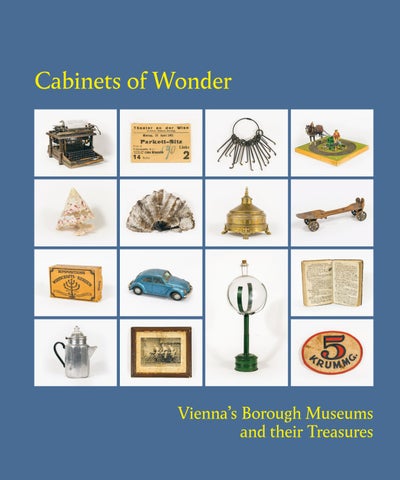
Cabinets of Wonder


Vienna’s Borough Museums and their Treasures


![]()


Vienna’s Borough Museums and their Treasures


With Photographs by Klaus Pichler and Texts by Regina Wonisch

Foreword 19
On the History of Vienna’s Borough Museums 20
Wearable 48
Branded 58
Silvery 68
Fragile 78
Useful 88
Childhood-Related 98
Fragmentary 108
Memorable 118
Imperially Nostalgic 128
Documentary 138
Scaled 148
Signposted 158
Framed 168
Paper-Based 178
Golden 188 Index
REGINA WONISCH
“The history of Vienna’s boroughs is a necessity— not only for the educated, but for every one of its inhabitants. For only those who know the history of each individual district, and are able to follow its development, can truly gain a clear picture of their native city.”1
In his 1884 “History of the Development of Vienna’s Suburbs,”2 secondary school teacher
Jakob Blümel rightly criticized the fact that the city’s periphery had thus far been excluded from historical scholarship.3 At the university, instruction had initially focused primarily on the history of states. The Antiquities Association of Vienna, founded in 1853 and formally established on March 23, 1854, in the Lower Austrian Assembly Building, was concerned above all with the history of that domain.
As regional history gradually found its way into academic teaching, the Antiquities Association’s interests also began to shift toward the history of the City of Vienna and the transformations it underwent as a result of urban expansion. The state-political upheaval that became apparent during World War I finally led, in 1917, to its renaming as the Association for the History of the City of Vienna.4 But by the time non-university scholarship slowly began to discover urban history as a field of study, the lower middle class had already long been engaged in exploring and documenting local history.
It was no coincidence that a secondary school teacher championed the history of the city’s periphery. Since the late 18th century, educators had advocated for the introduction of the subject of Heimatkunde (local studies) in elementary schools and engaged in local-historical research.5 The understanding of Heimat among these teachers was not yet charged with identity
politics, but referred quite simply to an engagement with the immediate lived environment.
With the passage of the General Imperial Elementary School Act of 1869, the subject of Heimatkunde was formally introduced. However, since the necessary teaching materials were non-existent, this educational reform also served as a crucial impulse for local-historical research.6
The step from engaging with local history to collecting various historical sources—objects, images, documents, or archaeological finds— was usually a short one. The knowledge generated by these amateur researchers through their explorations may be assessed in different ways. Yet without their thirst for knowledge, paired with a passion for collecting, many stories and objects would have been lost.7
Several local histories were written, mostly by teachers, such as “Memoirs of the Community of Simmering in Lower Austria” (1883) by Ernest C. Gatter, “The Alsergrund Then and Now” (1904) by Leopold Donatin, or “The Wieden” (1913) by, among others, August Aichhorn, Hans Kaindlstorfer, and Edgar Weyrich. Johanna Bischoff (née Kuh), who at the age of 90 published “Some News from the Suburb of Weinhaus” (1888), 8 was an exception in two respects: as a woman and as a representative of the upper middle class.9 The salon that she and her husband, Ignaz Rudolf Bischoff, a respected physician, hosted in their villa in Meidling was a meeting place for wellknown figures.10
The research for the Heimatbücher (local history books) often went hand in hand with the search for historical evidence, which was intended not only to serve as sources but also as visual material for classroom teaching. Following the Swiss reform pedagogue Johann Heinrich Pestalozzi, observation was regarded as the foundation of all knowledge and declared the highest principle of education. In this spirit, secondary school teacher Edgar Weyrich, in his manual for vivid history instruction, advocated using the museum alongside the street as a kind of teaching aid.11 Yet before World War I, attempts to establish a Heimatmuseum (local heritage museum) in Vienna were unsuccessful.
The comprehensive research and documentation of district histories was ultimately a “legislative invention of the First Republic”.12 After the collapse of the Habsburg monarchy in the aftermath of World War I, it became necessary to create a new sense of identity. This was expressed in particular through the reforms of Otto Glöckel, the member of the coalition government of Social Democrats and Christian Socials under Karl Renner who was responsible for education. In a decree dated August 16, 1919, Glöckel mandated the teaching of a locally grounded curriculum in the general elementary and secondary schools:
“In order to place general studies on a contemporary footing, it is necessary for each school to assemble the curriculum for this subject according to the principles of rootedness […] For all areas of general studies, points of connection must be sought in the student’s immediate and easily accessible Heimat. To this end, thorough research into the Heimat is to be promoted—under natural-scientific, geographical, folkloric, historical, art-historical, and economic perspectives […].”13
Behind this lay the notion that knowledge of one’s immediate lived environment would lead to a better understanding of broader historical contexts and to identification with the new state. In any case, Social Democracy relied on a concept of Heimat that was not based on a symbolic place of the past. Rather, it was about concrete social reference points whose meaning was to be shaped by people’s active engagement.14
In contrast to other approaches within school reform, Otto Glöckel’s promotion of Heimat instruction was not particularly progressive. What was new, however, was the way in which the lack of appropriate teaching materials was to be addressed. To this end, so-called teachers’ working groups were established—associations of educators who, on a voluntary basis, engaged with questions of curriculum content and didactics.15
These working groups quickly produced a Heimatbuch (local history book) for nearly

every municipal district of Vienna—though their quality varied considerably. Despite their heterogeneity, the borough studies were quite similar in structure. They included geological, zoological, botanical, and topographical accounts, historical facts, as well as descriptions of various institutions such as churches, businesses, and schools—topics that would later all be found
in Heimatmuseen (local heritage museums) as well.16
The strength of the Heimatbücher lay above all in their richly detailed documentation. What was often lacking, however, was the integration of the overwhelming abundance of individual cases into a broader historical context.17 The teacher Hans Pemmer, who supported the founding of
Schoolbag and writing utensils, Borough Museum Floridsdorf


How do simple glass bottles find their way into a museum? It is the context they come from that gives them meaning: they were filled in famous breweries—even if the Jedlesee Brewery, unlike Mautner Markhof, may have faded from memory today. One glass object, however, stands out: the Schusterkugel (“shoemaker’s globe”). It was part of the inventory of many workshops—wherever as much light as possible was needed to undertake detailed manual work. The principle is simple: the spherical glass bulb, filled with water, concentrates diffuse light like a magnifying lens and thus helps to better illuminate the workplace.
Next to the translucent glass objects, porcelain seems almost solid, yet it is just as fragile. The noble material enhances the value of everyday items, such as the “good” dinnerware that is taken out of the cupboard only on special occasions. Porcelain is also used for things that serve purely decorative purposes and have no functional use. The range extends from knickknacks to art. The most elaborate pieces were produced by the Augarten Porcelain Manufactory, founded in 1923 at Augarten Palace to revive the workshop originally established in 1718 by Claudius Innocentius du Paquier. A figurine of a dancer comes from the Goldscheider Porcelain Manufactory, founded in 1885—a highly successful company until the family emigrated to the United States in 1938 following the expropriation of their business. In addition to Biedermeier figures, their range also included small sculptures, spanning from Art Nouveau to New Objectivity.
Often displayed in glass cabinets—protected from dust and damage—porcelain objects lend domestic interiors a museum-like aura, or conversely bring the homely, the exotic, or even the erotic into the museum.

’s globe with stand for illuminating a worksho · BM 4


1 Levade with rider, Augarten Porcelain Manufactory · BM 2
2 Swing-top glass bottle, Mautner Markhof · BM 21
3 Glass bottle from the Jedlesee Brewery, Rudolf Dengler AG · BM 21
4 Container for lard, ceramic · BM 21
5 Wash bowl and jug, ceramic · BM 14