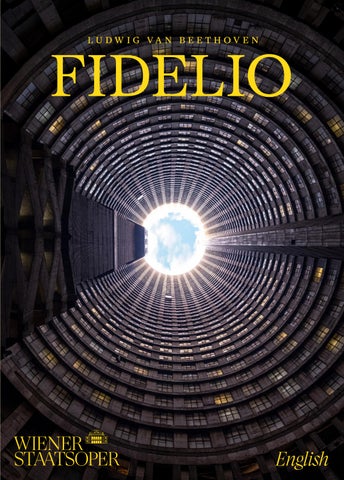
L U DW I G VA N B E E T H OV E N
FIDELIO
CONTENTS
P.
4
SYNOPSIS P.
8
“AN ANGEL LEONORE” INTERVIEW WITH FRANZ WELSER-MÖST P.
17
WITH BEETHOVEN THERE IN REHEARSAL INTERVIEW WITH NIKOLAUS HABJAN
P.
23
ABOUT THE PUPPETRY P.
24
NO COMPARISON – AND INCONCEIVABLY DIVINE OLIVER LÁNG P.
30
BEETHOVEN THE TITAN. THE POWER OF AN IMAGE MELANIE UNSELD P.
36
IMPRINT
L U DW I G VA N B E E T H OV E N
FIDELIO OPERA in two acts Text JOSEPH SONNLEITHNER & STEPHAN VON BREUNING & GEORG FRIEDRICH TREITSCHKE Text adapted by PAULUS HOCHGATTERER
ORCHESTRA
2 flutes / piccolo / 2 oboes 2 clarinets / 2 bassoons contrabassoon / 4 horns 2 trumpets / 2 trombones timpani / violin I / violin II viola / cello / double bass
STAGE ORCHESTRA
trumpet
AUTOGRAPH (3rd version)
Staatsbibliothek Stiftung Preußischer Kulturbesitz
WORLD PREMIÈRE (3rd version)
23 MARCH 1814 Kärntnertortheater, Vienna
IN THE HOUSE ON THE RING Vienna Court Opera DURATION
2 H 45 M
10 JUNE 1869
INCL. 1 INTERMISSION
FIDELIO
SYNOPSIS
The grim everyday life of a prison. Deprived of their identity, prisoners vanish in the darkness of the cells. The place is governed by Pizarro, who is outwardly pleasant, ingratiating and smooth, but inwardly brutal and consumed by hatred. In the deepest dungeon he has hidden his opponent Florestan, who has already been languishing there in the dark for two years. He has been abandoned by everyone – except his wife Leonore, who is searching for him and plans to rescue him. Disguised as a man and calling herself Fidelio, she takes a job in the prison. Here she quickly gains the trust and affection of the jailer Rocco, who even intends to marry his daughter Marzelline to Fidelio.
ACT 1 The gatekeeper Jaquino, who was sure his own future was with Marzelline before Fidelio arrived, fights for her affections. When she rejects him, his mood quickly becomes pressing and threatening. Jaquino is forced to beat angry retreat, while Marzelline dreams of spending her future in freedom with Fidelio. In his quarters, Rocco shows them the accumulated treasures he has confiscated from the prisoners and sings about the joys of gold. Encouraged by his trust, Leonore asks to accompany him to the secret prisoners, among whom she suspects she will find her husband Florestan.
Previous pages: SCENE
4
SYNOPSIS
Pizarro discovers that the Minister is investigating his abuses of power and is planning a surprise visit. He decides that Florestan, his most prominent victim, must be got rid of immediately. When Rocco refuses to carry out the murder, he orders him to dig a grave in the dungeon. He will perform the deed himself. Leonore successfully requests that the prisoners be given a moment in the sunshine: among their starving faces she hopes she will be able to discover her husband. But her hope is in vain.
ACT 2 Down in the dungeon, Florestan thinks about his fate. In a vision he sees his wife Leonore guiding him to freedom. Then Rocco and Fidelio arrive to dig Florestan’s grave. When Pizarro joins them and is about to commit the murder, Fidelio places herself in front of the prisoner and sings: “Töt’ erst sein Weib!” (“Kill his wife first!”) A trumpet signals the Minister’s arrival: liberation has come! On the King’s orders, the Minister grants the prisoners their freedom. Leonore is allowed to release Florestan from his chains, while Pizarro is arrested. The prison is opened; Leonore’s actions are praised in song as she symbolises liberty, loyalty and courage.
Following page: TAREQ NAZMI as ROCCO CHRISTOPHER MALTMAN as PIZARRO
ABOUT THE PUPPETRY A puppet is always truthful. It does not play a role – it is the role that we give it. As a result, it can be absolutely convincing, without any personal barrier. So when a puppet dies, it dies better than any actor or singer. Because those performers will get back up again, they will bow and sweat. A puppet detached from its puppeteer is dead. And so affectingly dead that it can be heartbreaking. Puppets might not be able to show certain facial expressions, but they release emotions and ideas in those who are watching. The audience complements what we perform. Because puppets are wonderful at channelling emotions projected onto them. Assuming, not only that they are not only well performed, but also well constructed, just like a musical instrument. A puppet gives us the chance to present the internal and external world of a character – and in Leonore’s case there is a great distance between them. We are confronted by a desperate woman who is inwardly torn: she is searching for her husband but must suppress her emotions, disguise herself and appear to the outside world as someone else – Fidelio. Her inner world, her soul is shown by the singer. What the character must also present to the outside world is shown by the puppet. These levels can separate and distance themselves from each other. They can each be felt through the music and the text, but both are not usually visible on stage. In our production, however, we not only hear the inner and outer worlds, we can also see them. DAVID BUTT PHILIP as FLORESTAN MALIN BYSTRÖM as LEONORE
23
MELANIE UNSELD
BEETHOVEN THE TITAN. THE POWER OF AN IMAGE Unclothed he sits on a splendid throne. Lying across his legs is a heavy, dark cloth. His naked feet wear plain sandals. Nothing that the figure is wearing suggests a historical person from the early 19th century. There are no breeches, shirt or frockcoat… His hair is curly and uncombed, it too reveals no fashion, no period reference. His right hand, lying on his knee, is balled into a fist, his serious gaze appears to be looking inwards and at the same time broadens out into an indeterminate distance. The allusions to ancient figures, to marble statues of gods and heroes, are unmistakable. And even if the figure’s posture, his bent back and an upper body that is strong but not muscular, does not suggest a Herculean figure, the figure as a whole is akin to that of a Titan. His only companion is an eagle that sits at his feet and appears to shrink back in fear at such strength of will. No other monument sums up the image that the bourgeois 19th century created for the composer Ludwig van Beethoven better than Max Klinger’s statue, which the artist designed for
the Beethoven exhibition in Vienna in 1902. Klinger’s statue crystallises an entire discourse: this is Beethoven as a Titan, as an artist who is removed from all ages and all temporality, as a genius, a lonely and profoundly serious figure. This image is so firmly entrenched in our cultural memory that one wonders whether we are capable of imagining Beethoven without this pronounced furrow in his brow. At the same time, the question arises of how this image interrelates to the historical sources that provide information about Ludwig van Beethoven. Here a contradiction immediately becomes apparent: the Beethoven who was employed by the Theater an der Wien at the beginning of 1803, living there amongst other theatre families and working on his career as an opera composer, is described as active and sociable. Ignaz Seyfried, for example, looking back on this time remembered his “bachelor household” with Beethoven, a form of co-habitation between two single men who both worked in the theatre: “When he was composing Fide-
30
BEETHOVEN THE TITAN. THE POWER OF AN IMAGE
lio , the oratorio Christus am Oelberge, the symphonies in E flat, C minor and F, the piano concertos in C minor and G major and the violin concerto in D, we both lived in one and the same house and, because we were a bachelor household, visited the same eating house almost every day, and would chat together for many an unforgettable hour in collegial homeliness; because Beethoven then was cheery, welcomed every joke, jocund, with a spirited lust for life, witty and quite often satirical.” In the letter to his brother from 1802 that became famous as the “Heiligenstadt Testament”, Beethoven also describes himself as having been “born with a fiery and active temperament [and am] susceptible to the distractions of company.” He loved experiencing “relaxation in the company of others, refined conversation, mutual exchanges of ideas.” At the same time, he complains that he has been “thought to be or called malevolent, stubborn and misanthropic” – “what injustice they do to me.” How did this contradiction come about? And where does the image of Beethoven as a lonely, misanthropic person come from? Ludwig van Beethoven, born in Bonn in 1770, had been living in Vienna since 1792. Having originally planned to visit as a student, it had become the centre of his life and there was no question of this young court musician from Bonn returning home: his native city was occupied by Napoleon’s troops. Now he had to establish himself in Vienna – in the heart of a thriving musical culture that offered inspiration and rivalry in equal measure. Beethoven was in demand as a pianist, and he hoped to achieve additional success in the the-
atre. For Vienna around 1800 was (as now) a city that loved theatre and several stages offered frequently changing programmes. Which constantly called for new pieces. The Theater an der Wien, which had moved in 1801 to the site on the Wienzeile that it still occupies now, was one of the vibrant theatres of the period. It is quite understandable that this was where Beethoven tried to make contacts and as it were ‘immersed’ himself in the world of Viennese theatre. Here he could learn how to compose for voices and what went down well with the audience. Admittedly, the young composer did not bring much experience with him, up until then he had composed very little for the stage. He had a great deal to learn about the theatre and a great deal of experience to gain to become successful as a composer for the stage. So he took lessons from Antonio Salieri – still one of the most important names on the Viennese opera scene even after the beginning of the 19th century – and went frequently and regularly to the theatre to learn by listening and watching. Seyfried remembers: “Beethoven […] liked to visit […] opera performances repeatedly; especially those at the Theater an der Wien, which was flourishing so splendidly at that time, partly to take advantage of its convenience as he simply needed to set foot outside his lodgings to be sitting in the stalls. There he was fascinated chiefly by Cherubini’s and Mehul’s creations, which were then beginning to fill the whole of Vienna with enthusiasm. Then he would plant himself firmly behind the lectern and would stay there, as silent as a tailor’s dummy, until the last stroke of the bow.”
31