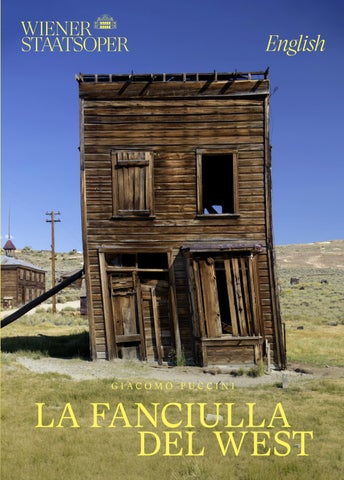
GIACOMO PUCCINI
LA FANCIULLA DEL WEST
L A FA NCI U LL A DEL W E ST
SYNOPSIS ACT 1 Evening in an American miners’ camp. Nick the barkeeper opens the bar. The workers return from the mines and wait for Minnie, who runs the bar and is also the only woman in the camp. They pass the time playing cards and brawling. To distract them, Nick has a song from their distant home played. Larkens is overcome by homesickness, and his friends collect money to pay for his journey home. The self-appointed sheriff Jack Rance, who is after Minnie, brags in front of the assembled company that Minnie will soon be his wife. He gets into a fight with Sonora, who is also madly in love with Minnie. In the middle of the fight, Minnie enters and puts them all in their place. She not only runs the inn but also tries to give the rough men some schooling in winter, and she makes them stop and think with a Bible lesson. Ashby, an agent for a transport company, visits the camp. He is on the trail of a bandit called Ramerrez, who has been making the region unsafe for some time. The post arrives; a message from a dubious woman provides Ashby with information about the supposed whereabouts of Ramerrez. Jack promises Minnie a thousand dollars for a kiss and tries to win her love with money. She abruptly rejects his advances and tells him of the poor but happy life and love of her parents. A stranger arrives at the heavily-guarded camp; Jack becomes suspicious and calls the workers together, inciting them against the stranger. However, Minnie vouches for the stranger, who has introduced himself as Mister Johnson from Sacramento. Minnie remembers him from a previous encounter. A waltz begins, and the stranger is accepted into the community. An alarm sounds, and the workers drag in Castro, a member of Ramerrez’s band. He has come to lure the workers out of the camp with erroneous information about Ramerrez’s hiding place, giving his leader the opportunity to rob the camp (for the stranger Dick Johnson is actually Ramerrez). The entire camp sets out to hunt for Ramerrez, while Minnie remains alone with Dick. Dick’s growing feelings for Minnie make it impossible for him to overpower her and rob the woman who has stayed behind to defend the hidden stocks of gold with her life. The two agree to meet in her cabin up the mountain later that evening. Previous pages: SCENE
4
SYNOPSIS
ACT 2 Minnie is preparing for Dick’s visit to her cabin. When he arrives, she confides in him and tells him about her life, but he conceals his true identity from her. They declare their love for each other, but their idyll is abruptly interrupted by Jack and some of the workers. They reveal Johnson’s true identity to Minnie and warn her about him, as he is a criminal. Disappointed, Minnie confronts Dick, and he tries to defend himself. He did not become a bandit by choice; after his father’s death, he had to take over his father’s band of robbers. But meeting Minnie has shown him the path to a new life. When he notices how deeply Minnie is affected by this breach of trust, he tries to leave, but hardly has he set foot outside when he is hit by a bullet from Jack’s gun, who has been lying in wait for him. Minnie’s love is rekindled, she takes him back into her cabin and hides her wounded lover. However, a few drops of blood reveal his hid ing place to the sheriff, who has returned to have his way with Minnie. Minnie is determined to fight for Dick’s life. A game of poker will determine both her fate and that of Johnson’s. If he wins, she will give herself to him and hand Johnson over to him; if she wins, her lover will be hers alone. After Jack has given her his word of honour, she wins the game with trick cards.
ACT 3 Jack has broken his word to Minnie and is intent on capturing Dick. At dawn, he sets out in pursuit of Dick, but at first Dick seems to evade him. Finally, Ashby manages to capture him. Jack wants to make short work of his rival; he incites a mob, and before long they have a noose around Dick’s neck. But the lynching stops when Minnie is heard calling. She takes advantage of the general element of surprise and stands protectively in front of her lover. She gradually manages to subdue the hate and murderous intent in the men and persuades them to forgive her lover. Minnie and Dick set off to start a new life elsewhere.
5
KARL LÖBL
MINNIE STARTED OUT ON BROADWAY Let us turn the clock back to 1910. Puccini had just completed the score of La fanciulla del West when the first big article appeared in the New York Times in June. It reported that in December American audiences would be the first to hear the latest work by the leading Italian opera composer. And there was no lack of details. “The action,” readers were informed, “includes a realistic lynching scene in a wood” and the chorus “consists of auxiliary policemen, cowboys and villains, and they all sing in Italian. Most probably”, the New York Times was so bold as to predict six months before the première, “all of them are just as romantic as the Roma, bandits, Druids, farmers, Egyptians and Nubians in previous operas”. The author had evidently confused the characters from Bellini’s, Verdi’s and Puccini’s operas. On 7 December, Puccini who had himself witnessed Arturo Toscanini’s intense rehearsals in the auditorium of the Metropolitan Opera, wrote to his wife Elvira, who had not come with him to New York: “The opera will be magnificent. Act 1 is a little long, but Act 2 is splendid and Act 3 sublime. Caruso is outstanding in his role (Dick Johnson), Destinn (Minnie) is not bad, but she needs to be more fiery. I am satisfied with my work and hope for
the best – but it is all terribly difficult, this music and this production!” Puccini had given numerous inter views during the rehearsal period. In them, he made some very revealing remarks about the new work. In one interview, the composer said: “For this drama, I have composed music that I believe reflects the spirit of the American people – in particular the strong, vigorous nature of the West. Although I have never been to the West, I have read so much about the country that I know it well, and I have experienced the sentiments of my characters so intensely that I believe I have created a true musical portrait. With a few exceptions, I have not incorporated any American motifs. It is nevertheless American music, while at the same time being my creation, in other words, genuine Puccini.” The “Wild West” was about to be discovered by films, but it had already found its place in literature. Numerous novels, not all equally good, described people and conflicts, the lives and loves of adventurers, gold-diggers, individuals on the periphery of society, looking above all to make a quick buck. One of these books (by Bret Harte) had been reworked by David Belasco into a successful stage play. It was this play that Puccini had seen on Broadway when
28
M I N N I E S TA RT E D O U T ON B ROA DWAY
visiting America. The opera libretto was based on the play. Interest in the new opera was significant, and ticket speculators threatened to disrupt the Met’s systems. Two dress rehearsals were given for invited audiences, both of which were a huge success. The première on 10 December 1910 proved to be equally successful. Between Act 2 and Act 3, Met Director Gatti-Casazza brought the composer on stage to take a bow. At the end of the opera, the applause lasted 15 minutes. Of the reviews, which were by no means all positive, the one in the New York Times was the most interesting. There Richard Aldrich wrote: “It is not easy to determine what place music should have in a drama like this. In setting this drama to music, Mr Puccini undertook a task that not so many years ago would have been deemed impossible, almost a contradiction in terms of all the conceptions of what the lyric drama could or should be... He has now gone still further into this field of augmented intervals and chorus of the higher dissonances... In a word, there is a marked predilection for the idiom that is coupled particularly with the name of Debussy.” Puccini paid little attention to the critics. He was accustomed to being judged either with diffidence or negatively by them. The enthusiasm of audiences was more important to him. On 28 December he set off for home; in his luggage was the silver wreath that Gatti-Casazza had presented him with on stage at the première. He had to have another souvenir sent on. He had found a motorboat in a marine shop and paid $ 3,000 for it. He had become a rich composer.
After the New York première, La fan ciulla del West was performed in eleven cities over the next two years – also in Polish, French, English and Hungarian. The piece was not performed in German translation until 1913 – initially in Berlin, Riga, Prague and Vienna (where it was not included in the repertoire between 1915 and 1925). Maria Jeritza was most frequently seen in the title role in Vienna and even sang Minnie here twice after 1945, but by then Ljuba Welitsch was considered her undisputed successor. The first studio recording of Fan ciulla was not made until much later: in 1950 at RAI in Milan. An exciting live recording from Florence (then as an LP on Cetra, now on CD on several labels) with Mitropoulos as a conductor came out four years later. On CD (EMI) you can also hear how Birgit Nilsson transformed Minnie into a Wild West heroine with vocal power in Milan in 1958. The same year, a Roman recording with Renata Tebaldi and Mario del Monaco came out on Decca. The London recording (1978, CD on Deutsche Grammophon) with Carol Neblett and Plácido Domingo is faithful to the play, because conductor Zubin Mehta unobtrusively but distinctly brings out the Americanisms in the music. Looking through the lists of old and new recordings of Fanciulla, it quickly becomes apparent that Domingo was most in demand as Dick Johnson for two decades. (He sang this role seven times at the Wiener Staatsoper too.) If one compares the interpretations of the tenor aria by Aragall, Björling, Corelli and Zambon on the internet, it is obvious that Domingo’s ability to establish a dramatic situation
29
KOPFZEILE
32